Concurrency Control
Techniques
Chapter 10
UNIT V
By C.Aruna Devi(DSCASC) 1
Data Base Management System
[DBMS]
Locking Techniques for concurrency control
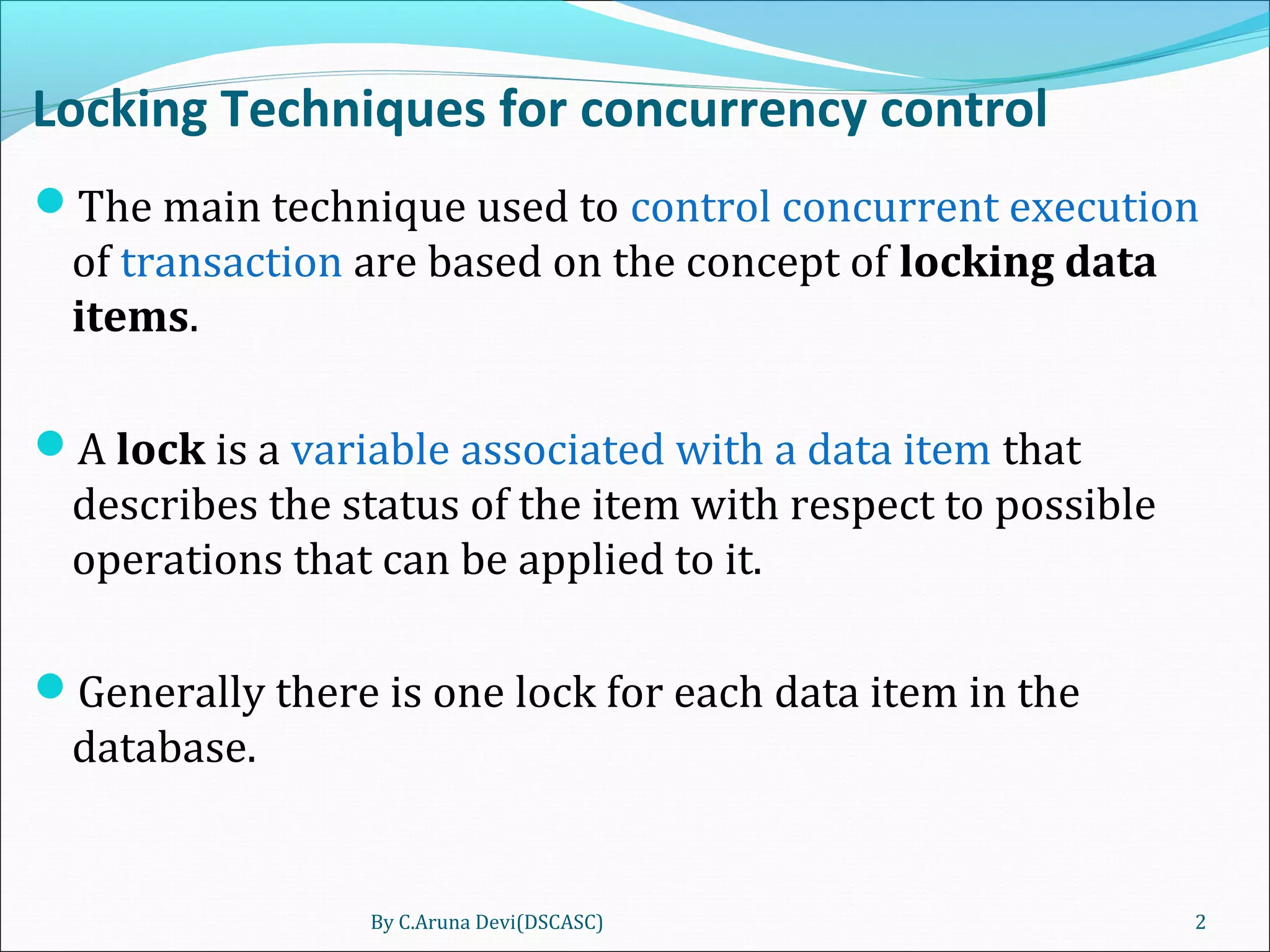
The main technique used to control concurrent execution
of transaction are based on the concept of locking data
items.
A lock is a variable associated with a data item that
describes the status of the item with respect to possible
operations that can be applied to it.
Generally there is one lock for each data item in the
database.
By C.Aruna Devi(DSCASC) 2
Types of locks and system lock tables
Binary Locks.
Shared/Exclusive (or Read/write) Locks.
Conversion of Locks.
By C.Aruna Devi(DSCASC) 3
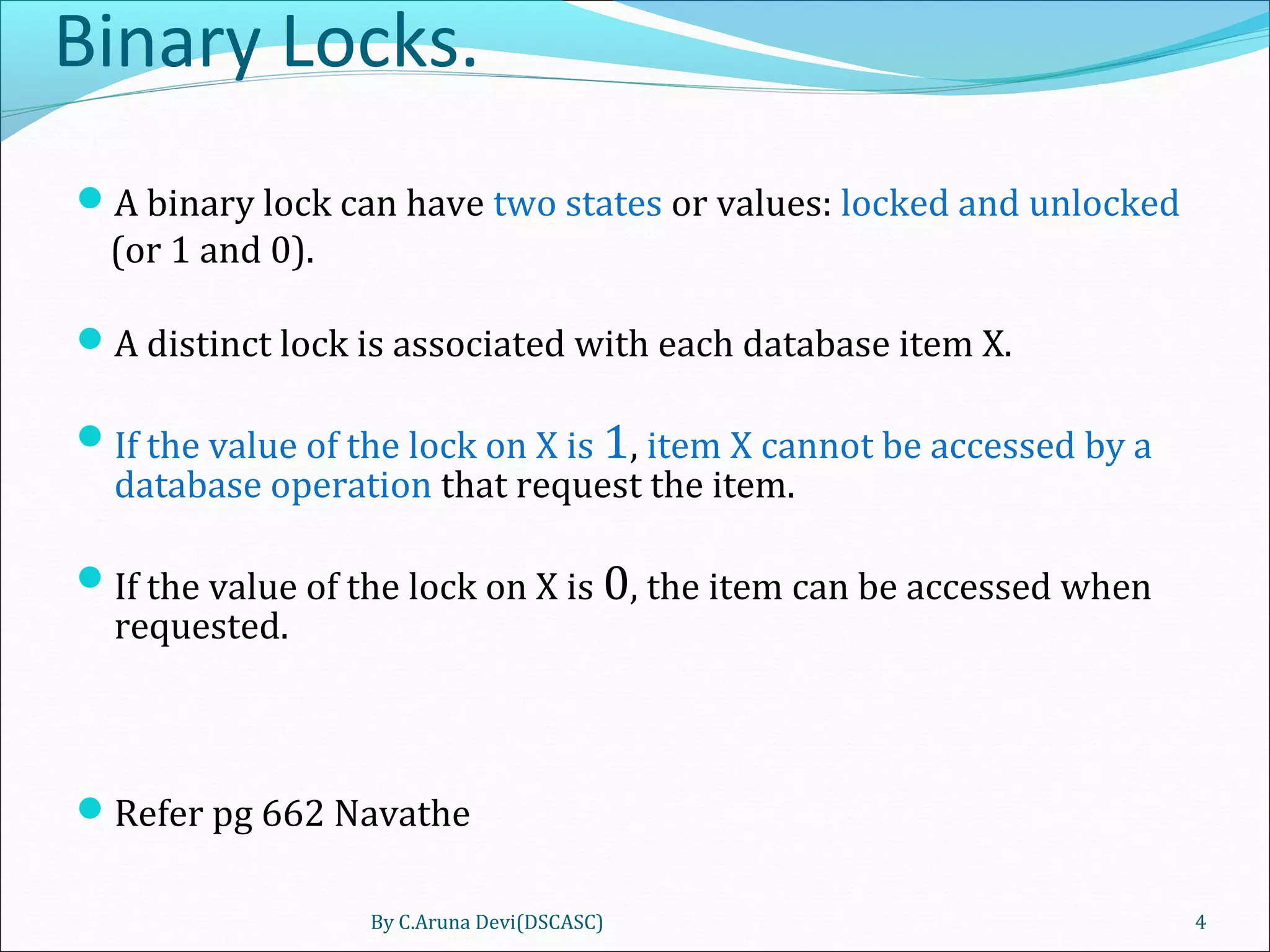
Binary Locks.
A binary lock can have two states or values: locked and unlocked
(or 1 and 0).
A distinct lock is associated with each database item X.
If the value of the lock on X is 1, item X cannot be accessed by a
database operation that request the item.
If the value of the lock on X is 0, the item can be accessed when
requested.
Refer pg 662 Navathe
By C.Aruna Devi(DSCASC) 4
Binary Lock
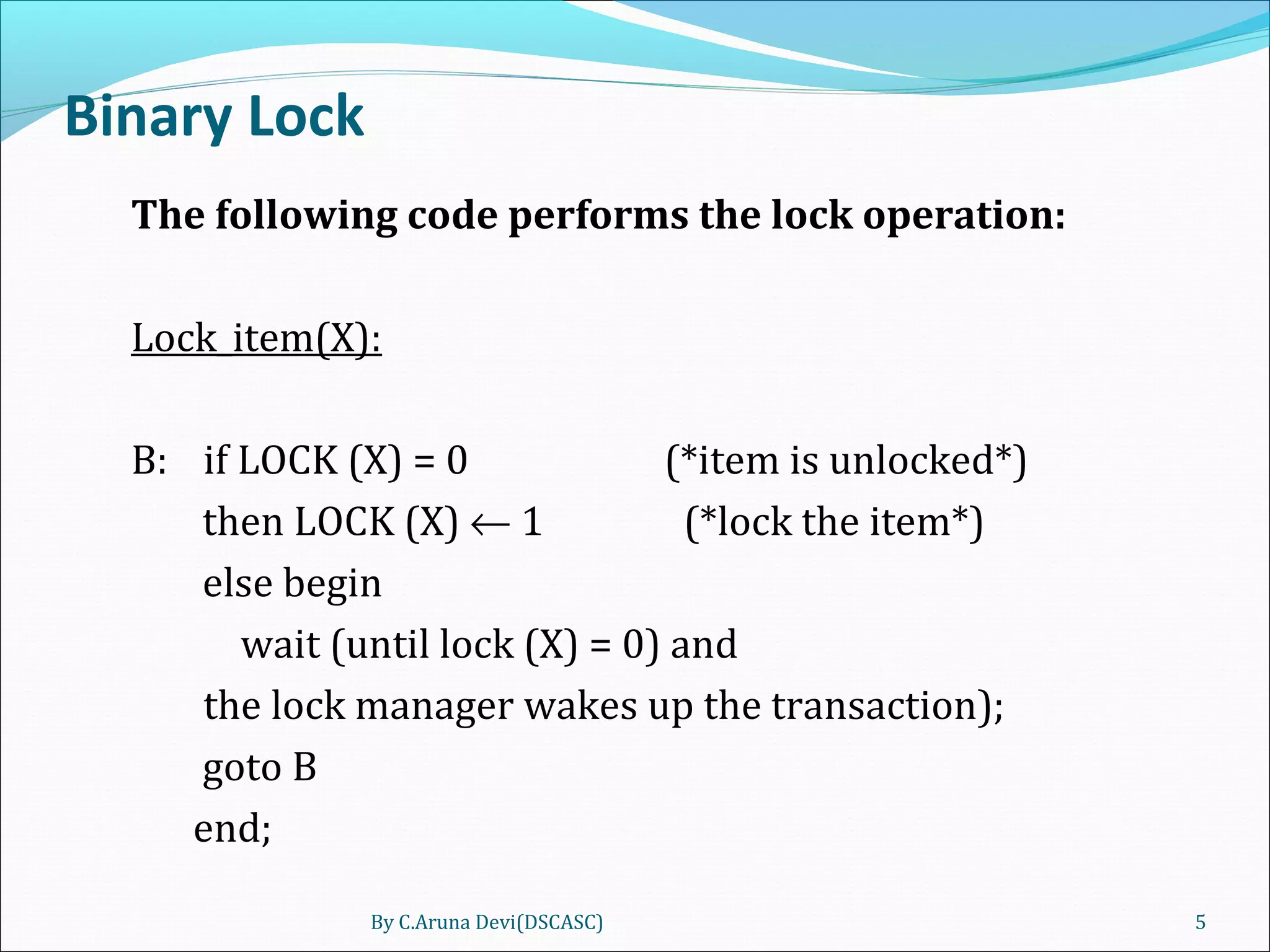
The following code performs the lock operation:
Lock_item(X):
B: if LOCK (X) = 0 (*item is unlocked*)
then LOCK (X) ← 1 (*lock the item*)
else begin
wait (until lock (X) = 0) and
the lock manager wakes up the transaction);
goto B
end;
By C.Aruna Devi(DSCASC) 5
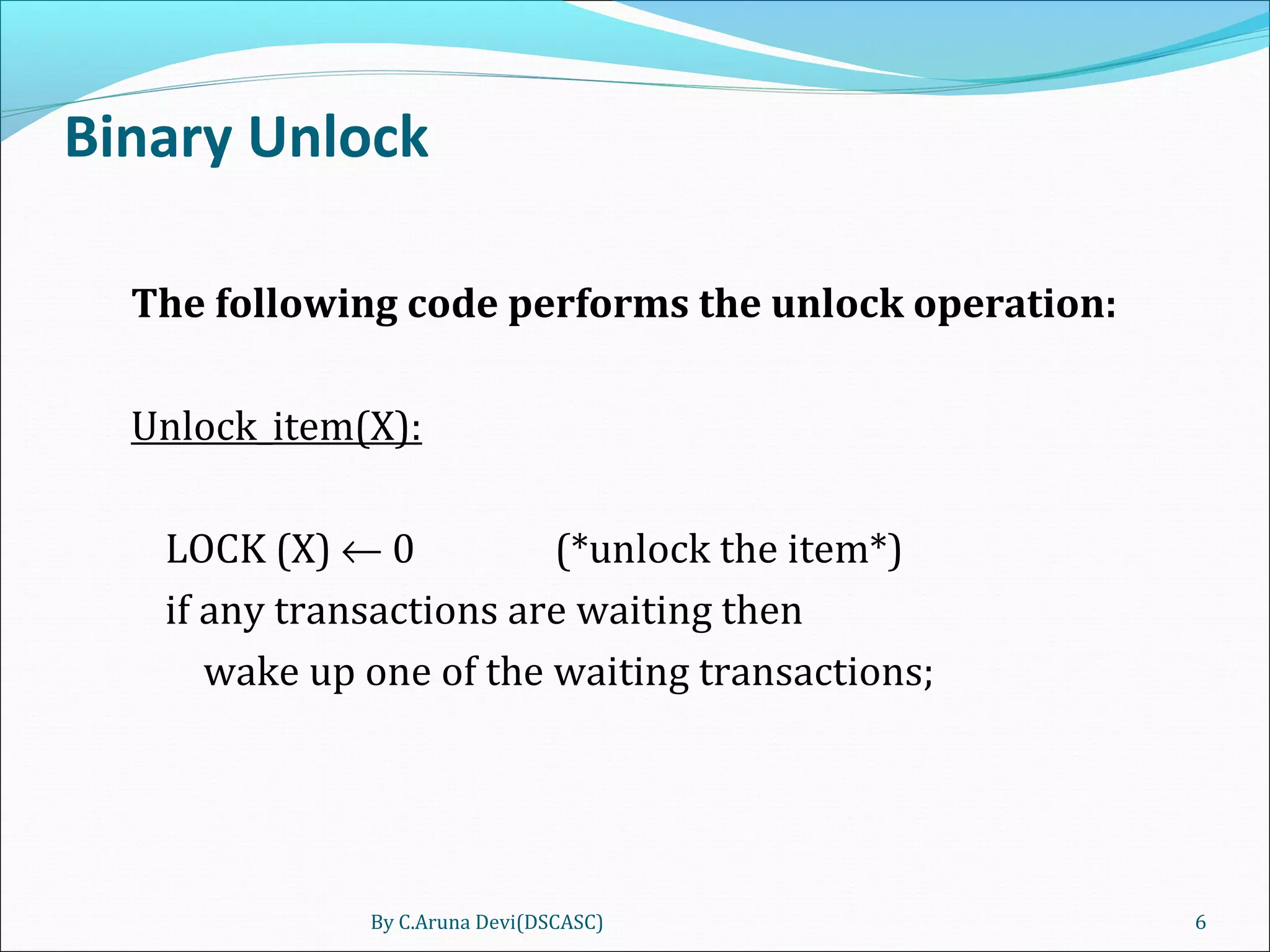
Binary Unlock
The following code performs the unlock operation:
Unlock_item(X):
LOCK (X) ← 0 (*unlock the item*)
if any transactions are waiting then
wake up one of the waiting transactions;
By C.Aruna Devi(DSCASC) 6
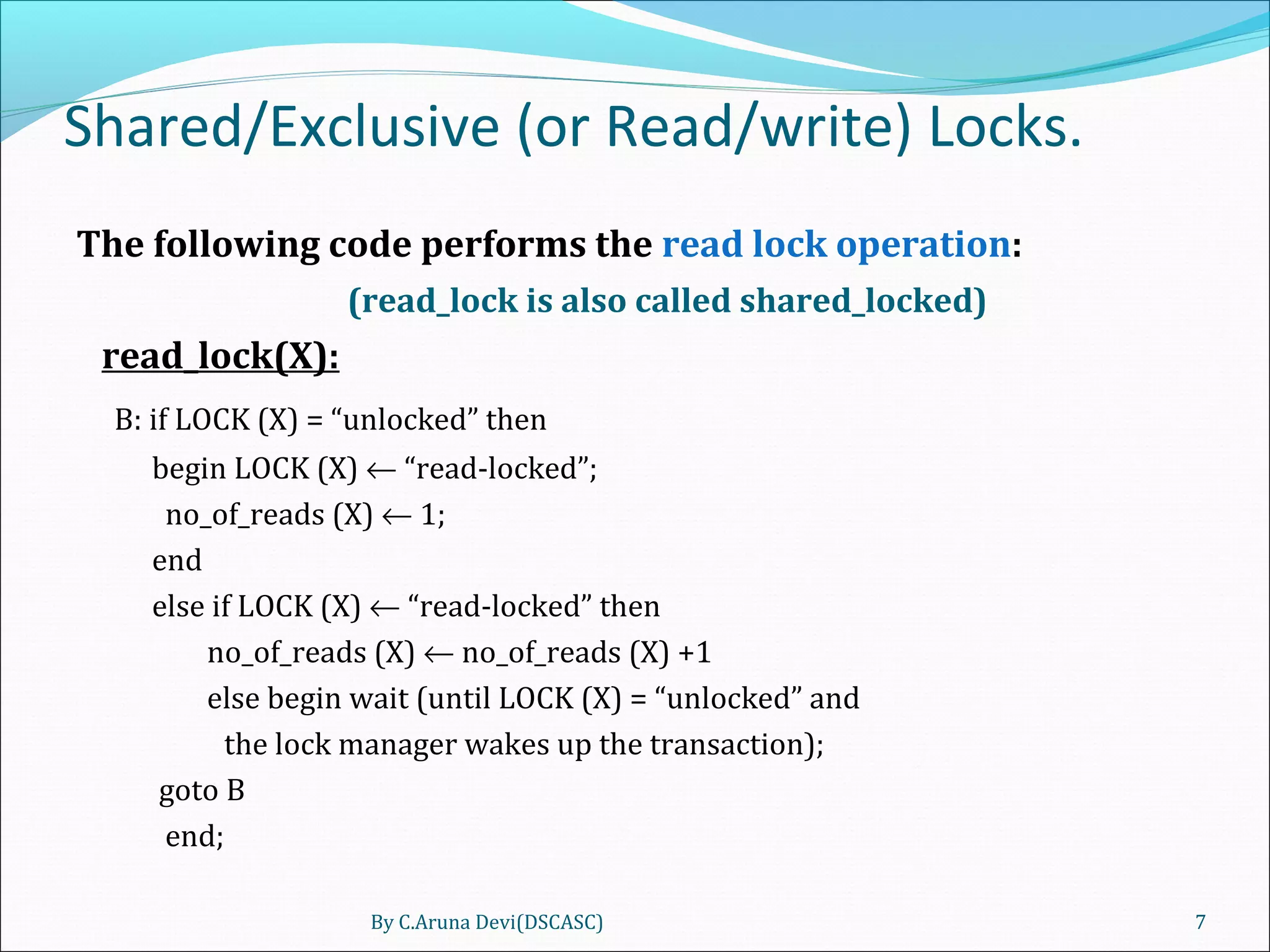
Shared/Exclusive (or Read/write) Locks.
The following code performs the read lock operation:
(read_lock is also called shared_locked)
read_lock(X):
B: if LOCK (X) = “unlocked” then
begin LOCK (X) ← “read-locked”;
no_of_reads (X) ← 1;
end
else if LOCK (X) ← “read-locked” then
no_of_reads (X) ← no_of_reads (X) +1
else begin wait (until LOCK (X) = “unlocked” and
the lock manager wakes up the transaction);
goto B
end;
By C.Aruna Devi(DSCASC) 7
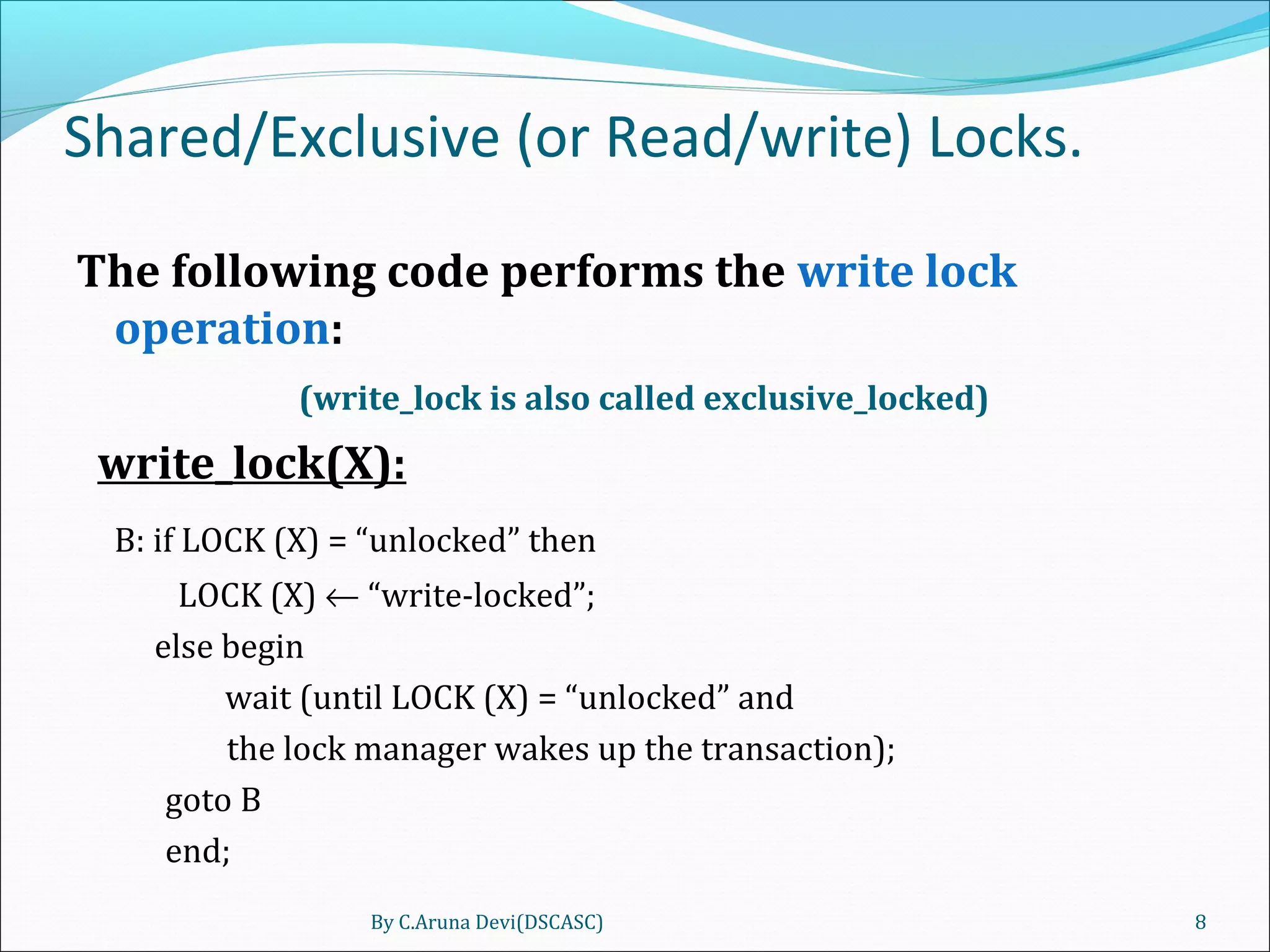
Shared/Exclusive (or Read/write) Locks.
The following code performs the write lock
operation:
(write_lock is also called exclusive_locked)
write_lock(X):
B: if LOCK (X) = “unlocked” then
LOCK (X) ← “write-locked”;
else begin
wait (until LOCK (X) = “unlocked” and
the lock manager wakes up the transaction);
goto B
end;
By C.Aruna Devi(DSCASC) 8
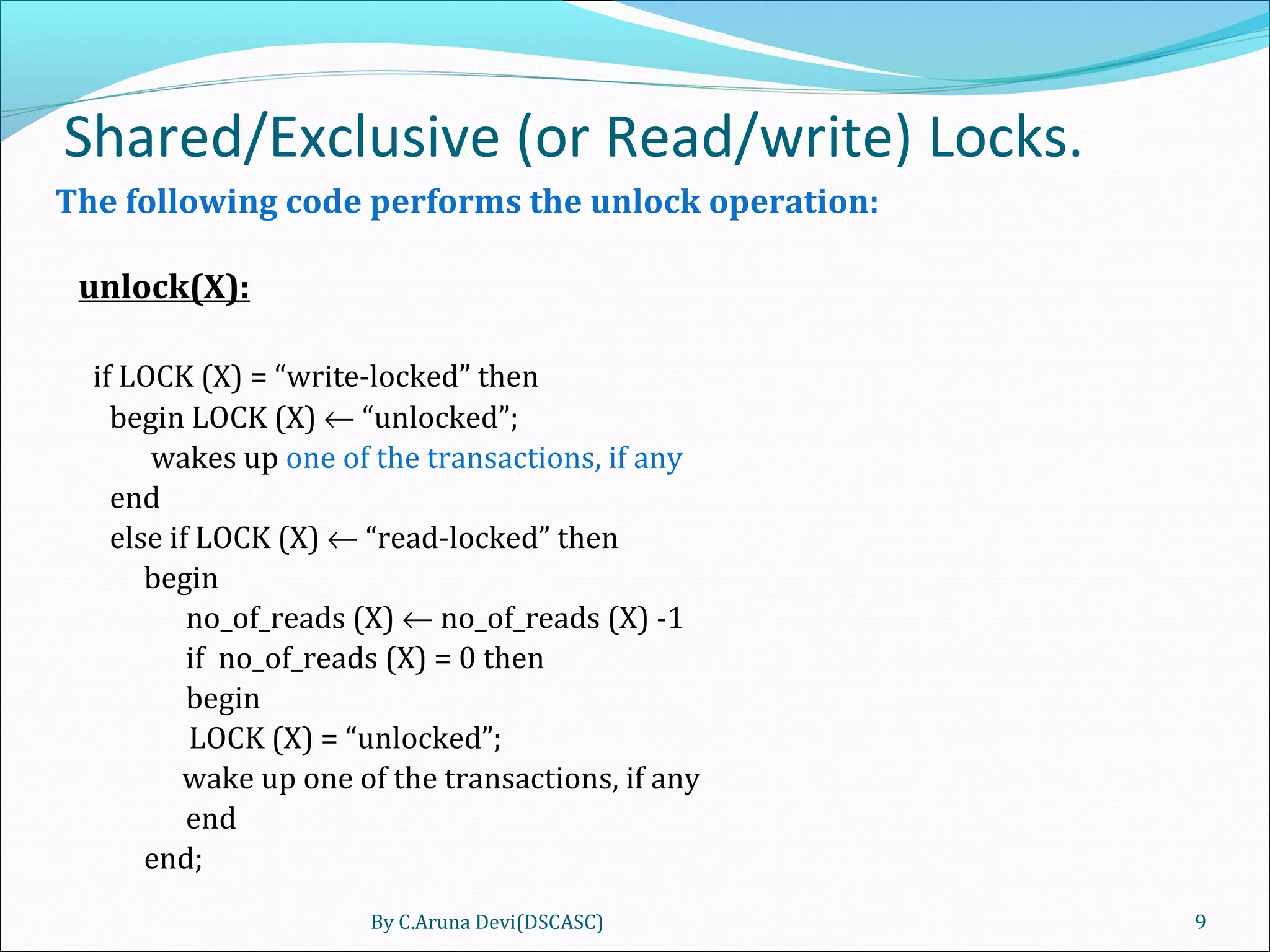
Shared/Exclusive (or Read/write) Locks.
The following code performs the unlock operation:
unlock(X):
if LOCK (X) = “write-locked” then
begin LOCK (X) ← “unlocked”;
wakes up one of the transactions, if any
end
else if LOCK (X) ← “read-locked” then
begin
no_of_reads (X) ← no_of_reads (X) -1
if no_of_reads (X) = 0 then
begin
LOCK (X) = “unlocked”;
wake up one of the transactions, if any
end
end;
By C.Aruna Devi(DSCASC) 9
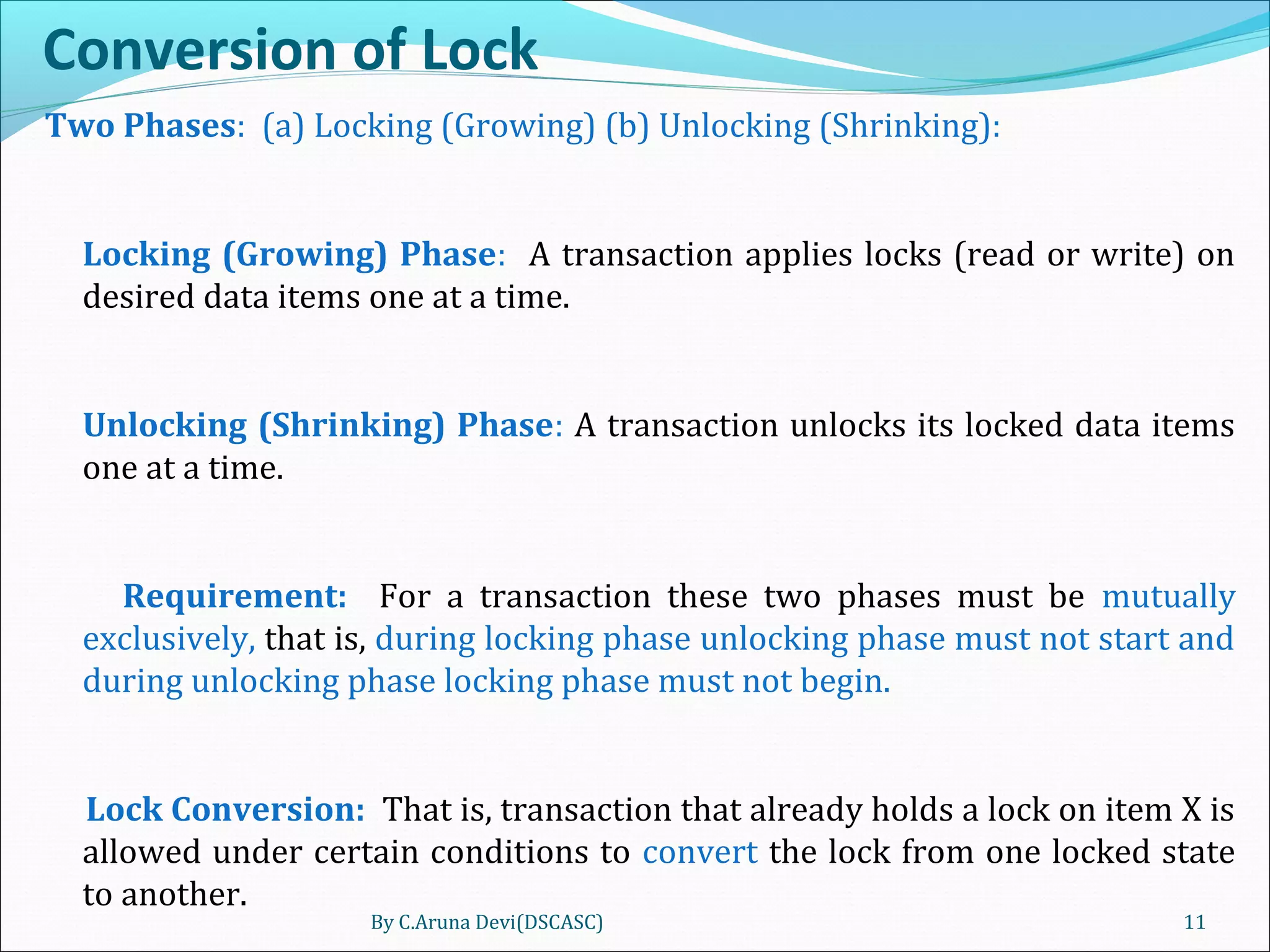
Conversion of Lock
Two Phases: (a) Locking (Growing) (b) Unlocking (Shrinking):
Locking (Growing) Phase: A transaction applies locks (read or write) on
desired data items one at a time.
Unlocking (Shrinking) Phase: A transaction unlocks its locked data items
one at a time.
Requirement: For a transaction these two phases must be mutually
exclusively, that is, during locking phase unlocking phase must not start and
during unlocking phase locking phase must not begin.
Lock Conversion: That is, transaction that already holds a lock on item X is
allowed under certain conditions to convert the lock from one locked state
to another.
By C.Aruna Devi(DSCASC) 11
Conversion of Lock
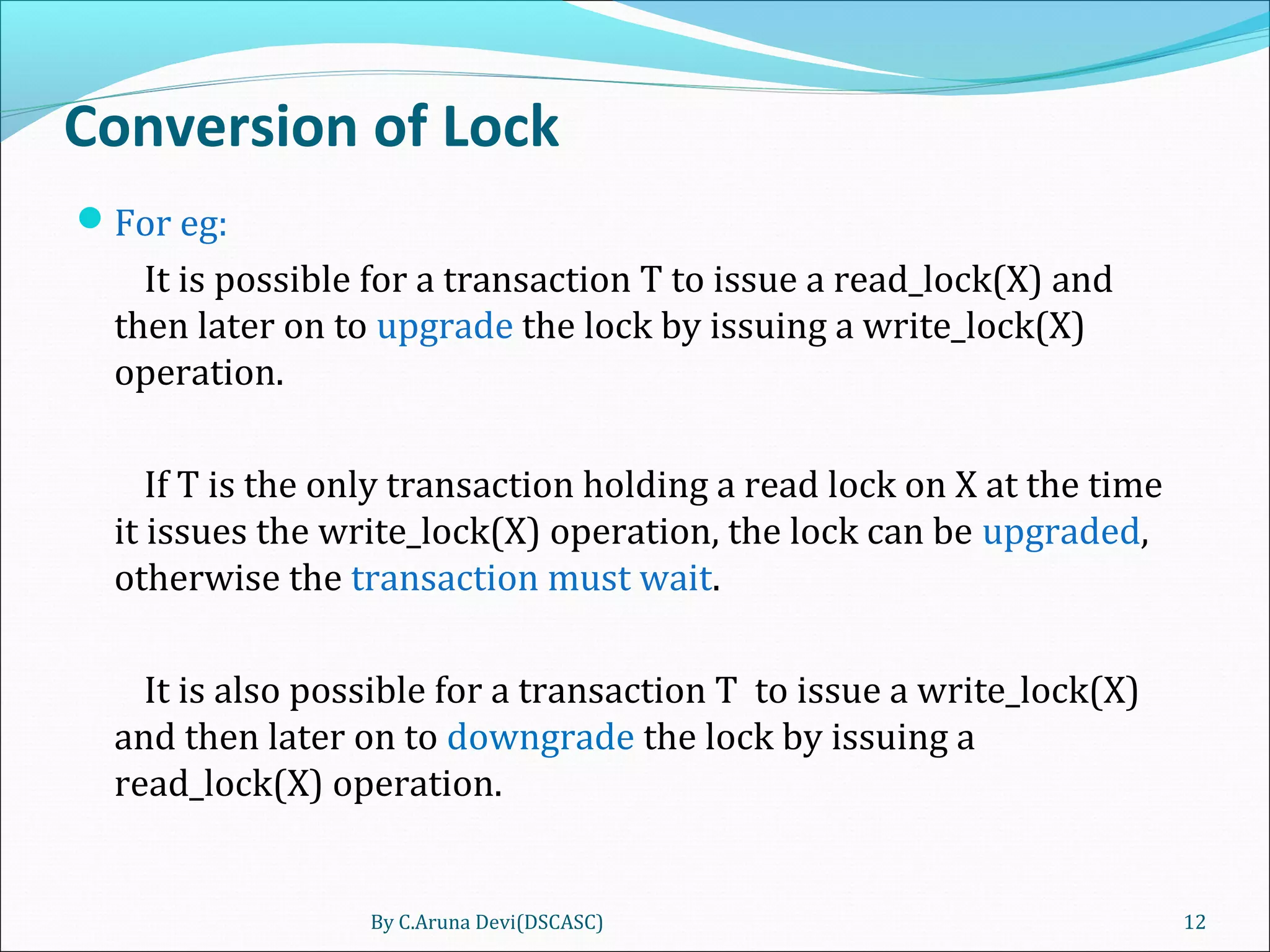
For eg:
It is possible for a transaction T to issue a read_lock(X) and
then later on to upgrade the lock by issuing a write_lock(X)
operation.
If T is the only transaction holding a read lock on X at the time
it issues the write_lock(X) operation, the lock can be upgraded,
otherwise the transaction must wait.
It is also possible for a transaction T to issue a write_lock(X)
and then later on to downgrade the lock by issuing a
read_lock(X) operation.
By C.Aruna Devi(DSCASC) 12
Conversion of Lock
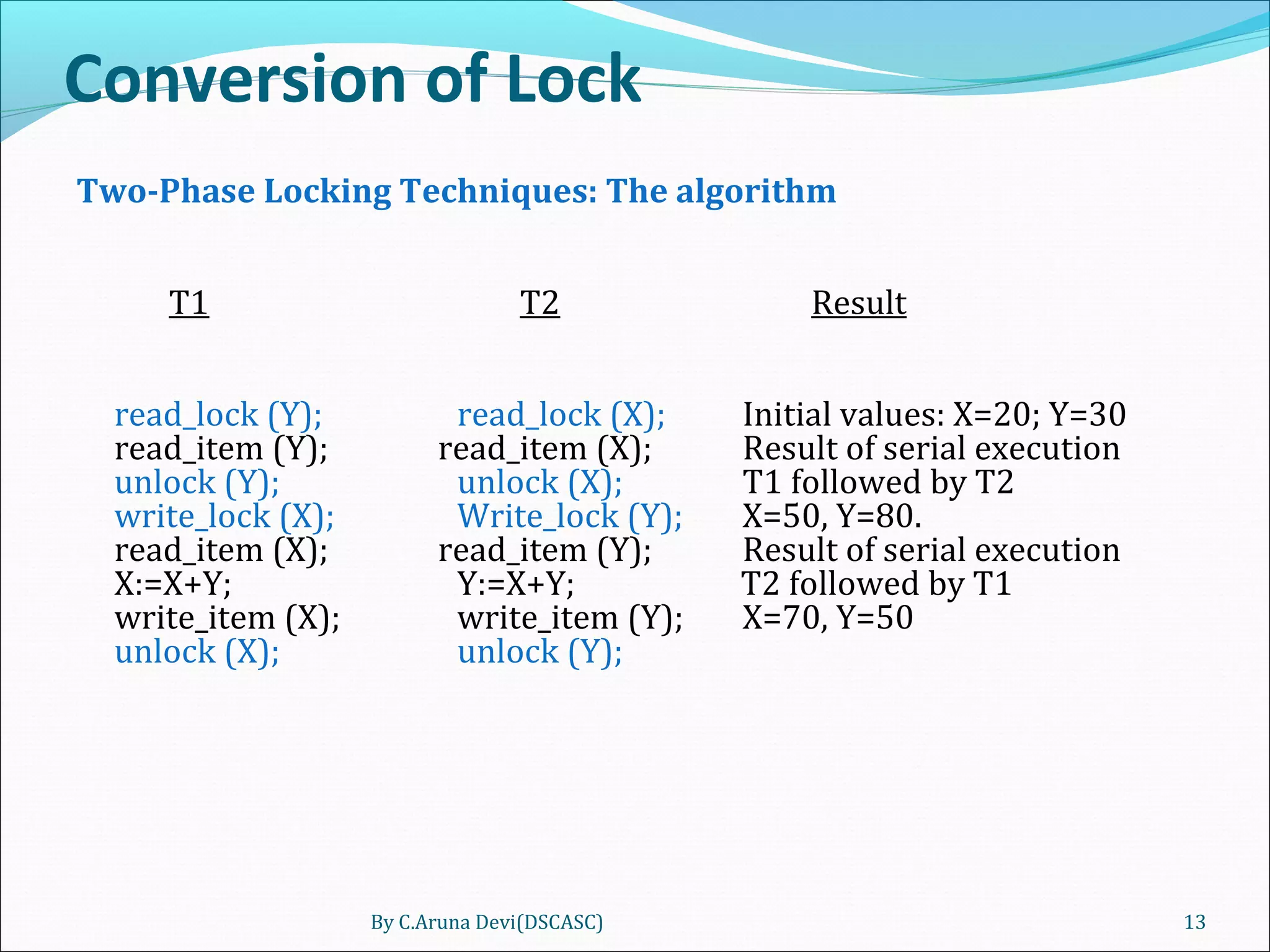
Two-Phase Locking Techniques: The algorithm
T1 T2 Result
read_lock (Y); read_lock (X); Initial values: X=20; Y=30
read_item (Y); read_item (X); Result of serial execution
unlock (Y); unlock (X); T1 followed by T2
write_lock (X); Write_lock (Y); X=50, Y=80.
read_item (X); read_item (Y); Result of serial execution
X:=X+Y; Y:=X+Y; T2 followed by T1
write_item (X); write_item (Y); X=70, Y=50
unlock (X); unlock (Y);
By C.Aruna Devi(DSCASC) 13
Conversion of Lock
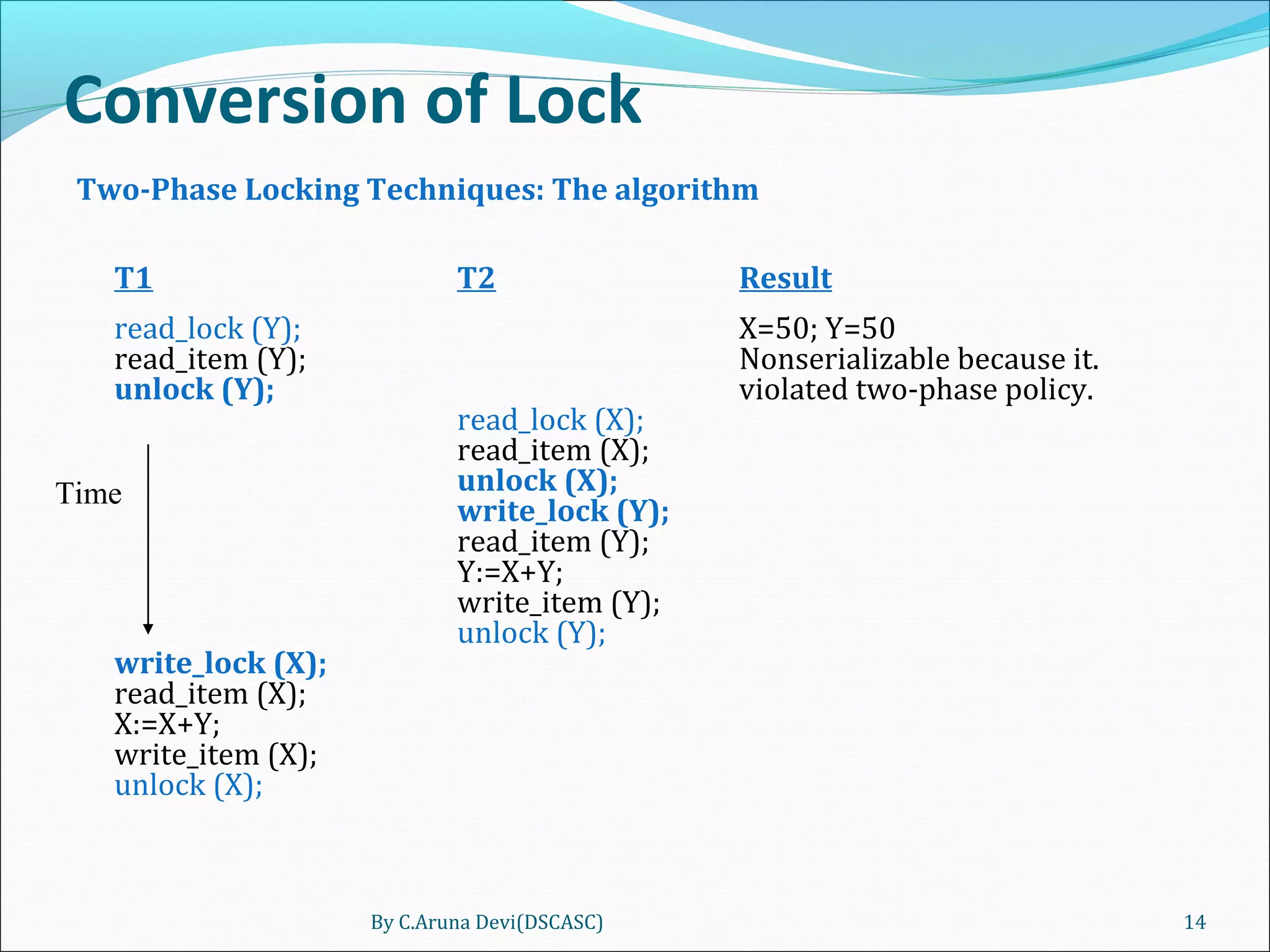
Two-Phase Locking Techniques: The algorithm
T1 T2 Result
read_lock (Y); X=50; Y=50
read_item (Y); Nonserializable because it.
unlock (Y); violated two-phase policy.
read_lock (X);
read_item (X);
unlock (X);
write_lock (Y);
read_item (Y);
Y:=X+Y;
write_item (Y);
unlock (Y);
write_lock (X);
read_item (X);
X:=X+Y;
write_item (X);
unlock (X);
By C.Aruna Devi(DSCASC) 14
Time

Dbms ii mca-ch10-concurrency-control-2013

  • 1.
    Concurrency Control Techniques Chapter 10 UNITV By C.Aruna Devi(DSCASC) 1 Data Base Management System [DBMS]
  • 2.
    Locking Techniques forconcurrency control The main technique used to control concurrent execution of transaction are based on the concept of locking data items. A lock is a variable associated with a data item that describes the status of the item with respect to possible operations that can be applied to it. Generally there is one lock for each data item in the database. By C.Aruna Devi(DSCASC) 2
  • 3.
    Types of locksand system lock tables Binary Locks. Shared/Exclusive (or Read/write) Locks. Conversion of Locks. By C.Aruna Devi(DSCASC) 3
  • 4.
    Binary Locks. A binarylock can have two states or values: locked and unlocked (or 1 and 0). A distinct lock is associated with each database item X. If the value of the lock on X is 1, item X cannot be accessed by a database operation that request the item. If the value of the lock on X is 0, the item can be accessed when requested. Refer pg 662 Navathe By C.Aruna Devi(DSCASC) 4
  • 5.
    Binary Lock The followingcode performs the lock operation: Lock_item(X): B: if LOCK (X) = 0 (*item is unlocked*) then LOCK (X) ← 1 (*lock the item*) else begin wait (until lock (X) = 0) and the lock manager wakes up the transaction); goto B end; By C.Aruna Devi(DSCASC) 5
  • 6.
    Binary Unlock The followingcode performs the unlock operation: Unlock_item(X): LOCK (X) ← 0 (*unlock the item*) if any transactions are waiting then wake up one of the waiting transactions; By C.Aruna Devi(DSCASC) 6
  • 7.
    Shared/Exclusive (or Read/write)Locks. The following code performs the read lock operation: (read_lock is also called shared_locked) read_lock(X): B: if LOCK (X) = “unlocked” then begin LOCK (X) ← “read-locked”; no_of_reads (X) ← 1; end else if LOCK (X) ← “read-locked” then no_of_reads (X) ← no_of_reads (X) +1 else begin wait (until LOCK (X) = “unlocked” and the lock manager wakes up the transaction); goto B end; By C.Aruna Devi(DSCASC) 7
  • 8.
    Shared/Exclusive (or Read/write)Locks. The following code performs the write lock operation: (write_lock is also called exclusive_locked) write_lock(X): B: if LOCK (X) = “unlocked” then LOCK (X) ← “write-locked”; else begin wait (until LOCK (X) = “unlocked” and the lock manager wakes up the transaction); goto B end; By C.Aruna Devi(DSCASC) 8
  • 9.
    Shared/Exclusive (or Read/write)Locks. The following code performs the unlock operation: unlock(X): if LOCK (X) = “write-locked” then begin LOCK (X) ← “unlocked”; wakes up one of the transactions, if any end else if LOCK (X) ← “read-locked” then begin no_of_reads (X) ← no_of_reads (X) -1 if no_of_reads (X) = 0 then begin LOCK (X) = “unlocked”; wake up one of the transactions, if any end end; By C.Aruna Devi(DSCASC) 9
  • 10.
    Conversion of Lock TwoPhases: (a) Locking (Growing) (b) Unlocking (Shrinking): Locking (Growing) Phase: A transaction applies locks (read or write) on desired data items one at a time. Unlocking (Shrinking) Phase: A transaction unlocks its locked data items one at a time. Requirement: For a transaction these two phases must be mutually exclusively, that is, during locking phase unlocking phase must not start and during unlocking phase locking phase must not begin. Lock Conversion: That is, transaction that already holds a lock on item X is allowed under certain conditions to convert the lock from one locked state to another. By C.Aruna Devi(DSCASC) 11
  • 11.
    Conversion of Lock Foreg: It is possible for a transaction T to issue a read_lock(X) and then later on to upgrade the lock by issuing a write_lock(X) operation. If T is the only transaction holding a read lock on X at the time it issues the write_lock(X) operation, the lock can be upgraded, otherwise the transaction must wait. It is also possible for a transaction T to issue a write_lock(X) and then later on to downgrade the lock by issuing a read_lock(X) operation. By C.Aruna Devi(DSCASC) 12
  • 12.
    Conversion of Lock Two-PhaseLocking Techniques: The algorithm T1 T2 Result read_lock (Y); read_lock (X); Initial values: X=20; Y=30 read_item (Y); read_item (X); Result of serial execution unlock (Y); unlock (X); T1 followed by T2 write_lock (X); Write_lock (Y); X=50, Y=80. read_item (X); read_item (Y); Result of serial execution X:=X+Y; Y:=X+Y; T2 followed by T1 write_item (X); write_item (Y); X=70, Y=50 unlock (X); unlock (Y); By C.Aruna Devi(DSCASC) 13
  • 13.
    Conversion of Lock Two-PhaseLocking Techniques: The algorithm T1 T2 Result read_lock (Y); X=50; Y=50 read_item (Y); Nonserializable because it. unlock (Y); violated two-phase policy. read_lock (X); read_item (X); unlock (X); write_lock (Y); read_item (Y); Y:=X+Y; write_item (Y); unlock (Y); write_lock (X); read_item (X); X:=X+Y; write_item (X); unlock (X); By C.Aruna Devi(DSCASC) 14 Time