Chapter 4
Normalization of Database
Tables
Database Tables and

Normalization




Table is basic building block in database design
Table’s structure is of great interest
Two cases:





possible poor table structures in good database design
Modify existing database with existing poor table
structure

Normalization can help recognize a poor table and
convert to good tables with good structure
2
Database Tables and
Normalization


Normalization is process for assigning
attributes to entities
Reduces data redundancies
 Expending entities
 Helps eliminate data anomalies
 Produces controlled redundancies to link tables
 Cost more processing efforts
 Series steps called normal forms


3
Database Tables and
Normalization


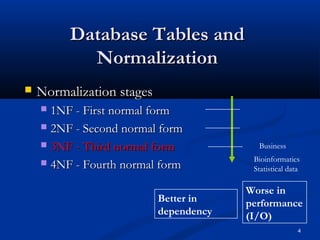
Normalization stages
1NF - First normal form
 2NF - Second normal form
 3NF - Third normal form
 4NF - Fourth normal form


Better in
dependency

Business
Bioinformatics
Statistical data

Worse in
performance
(I/O)
4
Database Tables and
Normalization


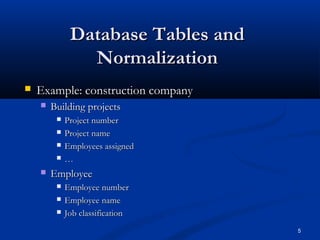
Example: construction company


Building projects







Project number
Project name
Employees assigned
…

Employee




Employee number
Employee name
Job classification
5
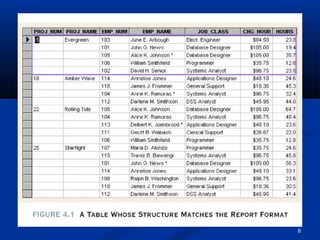
Table 4.1 should be here.

6
Figure 4.1 Observations




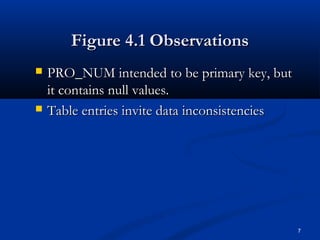
PRO_NUM intended to be primary key, but
it contains null values.
Table entries invite data inconsistencies

7
Figure 4.1 Observations


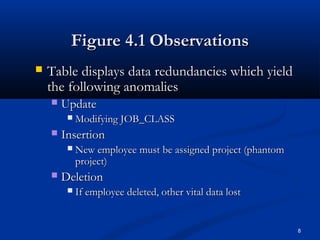
Table displays data redundancies which yield
the following anomalies


Update




Insertion




Modifying JOB_CLASS
New employee must be assigned project (phantom
project)

Deletion


If employee deleted, other vital data lost

8
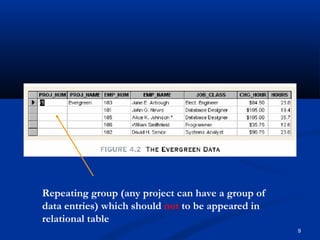
Figure 4.2 is insert here.

Repeating group (any project can have a group of
data entries) which should not to be appeared in
relational table
9
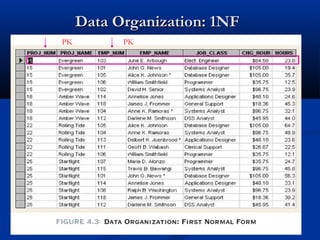
Data Organization: 1NF
PK

PK

Figure 4.3

10
Conversion to 1NF


Repeating groups must be eliminated


Proper primary key developed
Uniquely identifies attribute values (rows)
 Combination of PROJ_NUM and EMP_NUM


11
Conversion to 1NF


Repeating groups must be eliminated


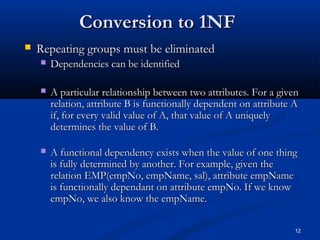
Dependencies can be identified



A particular relationship between two attributes. For a given
relation, attribute B is functionally dependent on attribute A
if, for every valid value of A, that value of A uniquely
determines the value of B.



A functional dependency exists when the value of one thing
is fully determined by another. For example, given the
relation EMP(empNo, empName, sal), attribute empName
is functionally dependant on attribute empNo. If we know
empNo, we also know the empName.
12
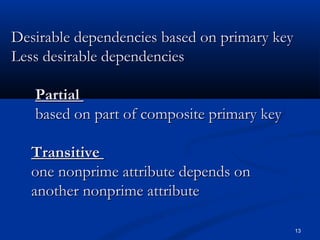
Desirable dependencies based on primary key
Less desirable dependencies
Partial
based on part of composite primary key
Transitive
one nonprime attribute depends on
another nonprime attribute
13
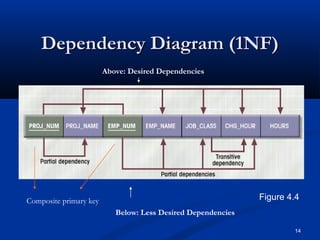
Dependency Diagram (1NF)
Above: Desired Dependencies

Figure 4.4

Composite primary key
Below: Less Desired Dependencies

14
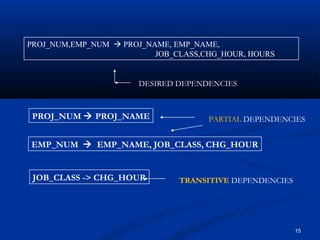
PROJ_NUM,EMP_NUM  PROJ_NAME, EMP_NAME,
JOB_CLASS,CHG_HOUR, HOURS

DESIRED DEPENDENCIES

PROJ_NUM  PROJ_NAME

PARTIAL DEPENDENCIES

EMP_NUM  EMP_NAME, JOB_CLASS, CHG_HOUR

JOB_CLASS -> CHG_HOUR

TRANSITIVE DEPENDENCIES

15
1NF Summarized




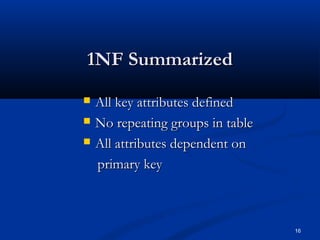
All key attributes defined
No repeating groups in table
All attributes dependent on
primary key

16
Conversion to 2NF






Start with 1NF format:
Write each key component on separate line
Write original key on last line
Each component is new table
Write dependent attributes after each key

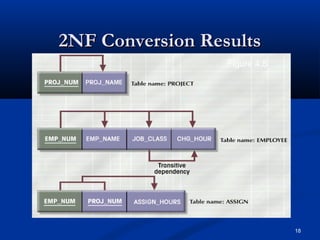
PROJECT (PROJ_NUM, PROJ_NAME)
EMPLOYEE (EMP_NUM, EMP_NAME, JOB_CLASS, CHG_HOUR)
ASSIGN (PROJ_NUM, EMP_NUM, HOURS)
17
2NF Conversion Results
Figure 4.5

18
2NF Summarized



In 1NF
Includes no partial dependencies




No attribute dependent on a portion of primary
key

Still possible to exhibit transitive dependency


Attributes may be functionally dependent on
nonkey attributes

19
Conversion to 3NF


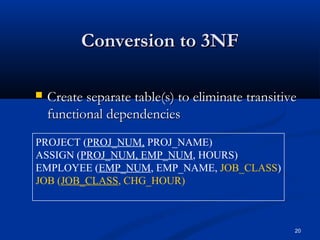
Create separate table(s) to eliminate transitive
functional dependencies

PROJECT (PROJ_NUM, PROJ_NAME)
ASSIGN (PROJ_NUM, EMP_NUM, HOURS)
EMPLOYEE (EMP_NUM, EMP_NAME, JOB_CLASS)
JOB (JOB_CLASS, CHG_HOUR)

20
3NF Summarized



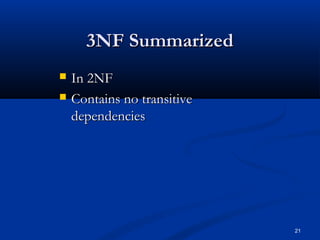
In 2NF
Contains no transitive
dependencies

21
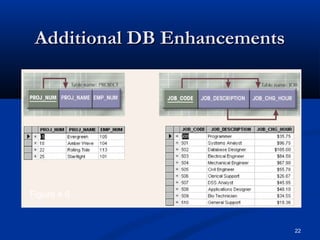
Additional DB Enhancements

Figure 4.6

22
23
Boyce-Codd Normal Form
(BCNF)


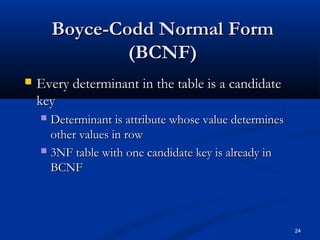
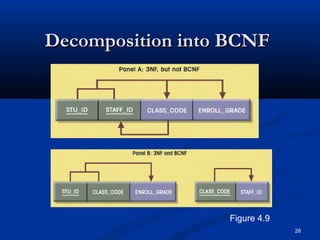
Every determinant in the table is a candidate
key
Determinant is attribute whose value determines
other values in row
 3NF table with one candidate key is already in
BCNF


24
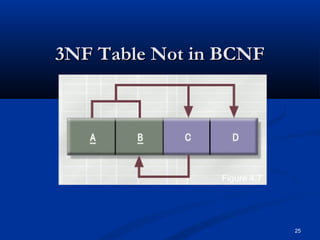
3NF Table Not in BCNF

Figure 4.7

25
Decomposition of Table
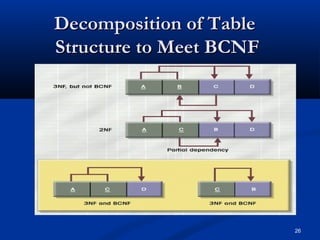
Structure to Meet BCNF

Figure 4.8
26
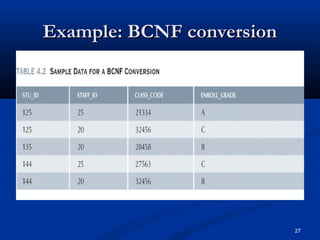
Example: BCNF conversion

27
Decomposition into BCNF

Figure 4.9
28
Normalization and Database
Design








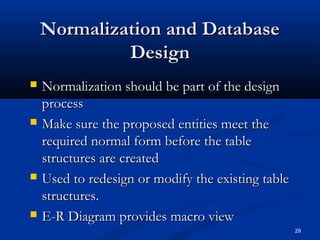
Normalization should be part of the design
process
Make sure the proposed entities meet the
required normal form before the table
structures are created
Used to redesign or modify the existing table
structures.
E-R Diagram provides macro view
29
Normalization and Database
Design


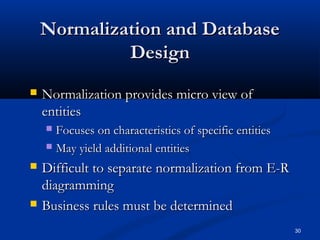
Normalization provides micro view of
entities
Focuses on characteristics of specific entities
 May yield additional entities






Difficult to separate normalization from E-R
diagramming
Business rules must be determined
30
Normalization and Database
Design


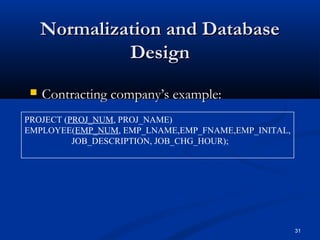
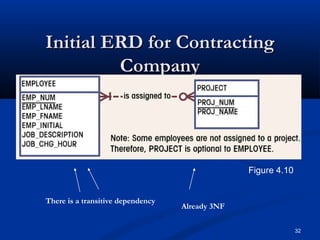
Contracting company’s example:

PROJECT (PROJ_NUM, PROJ_NAME)
EMPLOYEE(EMP_NUM, EMP_LNAME,EMP_FNAME,EMP_INITAL,
JOB_DESCRIPTION, JOB_CHG_HOUR);

31
Initial ERD for Contracting
Company

Figure 4.10
There is a transitive dependency

Already 3NF
32
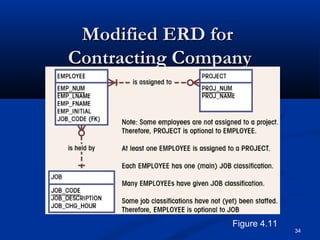
Removal
PROJECT (PROJ_NUM, PROJ_NAME)
EMPLOYEE(EMP_NUM, EMP_LNAME,EMP_FNAME,EMP_INITAL,
JOB_CODE)
JOB (JOB_CODE, JOB_DESCRIPTION, JOB_CHG_HOUR);

33
Modified ERD for
Contracting Company

Figure 4.11

34
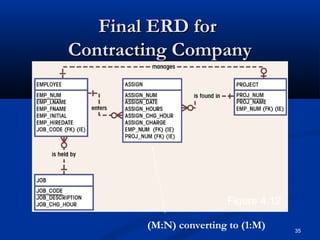
Final ERD for
Contracting Company

Figure 4.12
(M:N) converting to (1:M)

35
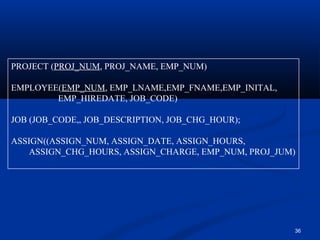
PROJECT (PROJ_NUM, PROJ_NAME, EMP_NUM)
EMPLOYEE(EMP_NUM, EMP_LNAME,EMP_FNAME,EMP_INITAL,
EMP_HIREDATE, JOB_CODE)
JOB (JOB_CODE,, JOB_DESCRIPTION, JOB_CHG_HOUR);
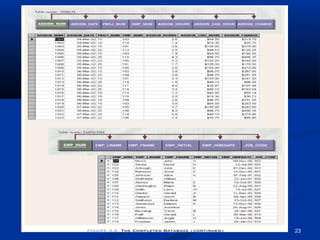
ASSIGN((ASSIGN_NUM, ASSIGN_DATE, ASSIGN_HOURS,
ASSIGN_CHG_HOURS, ASSIGN_CHARGE, EMP_NUM, PROJ_JUM)

36
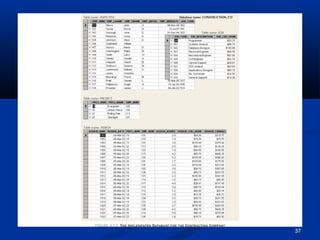
37
Denormalization




Normalization is one of many database
design goals
Normalized table requirements
Additional processing
 Loss of system speed


38
Denormalization


Normalization purity is difficult to sustain
due to conflict in:
Design efficiency
 Information requirements
 Processing


39

Normalization of database_tables_chapter_4