UNIT 2
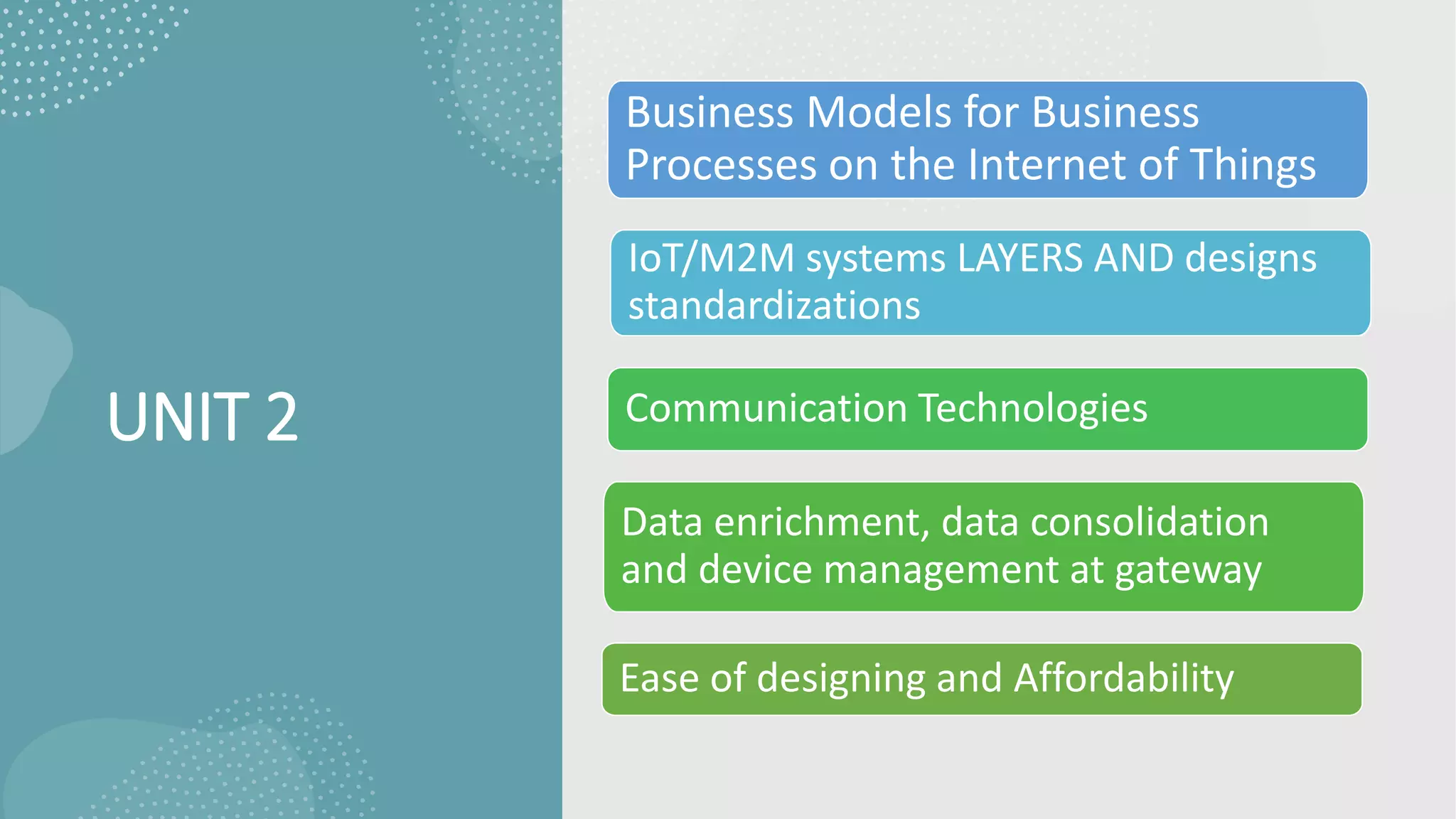
Business Models for Business
Processes on the Internet of Things
IoT/M2M systems LAYERS AND designs
standardizations
Communication Technologies
Data enrichment, data consolidation
and device management at gateway
Ease of designing and Affordability
UNIT 2
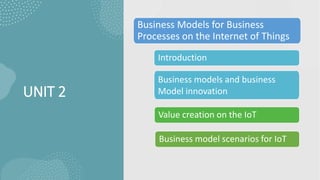
Business Models for Business
Processes on the Internet of Things
Introduction
Business models and business
Model innovation
Value creation on the IoT
Business model scenarios for IoT
• IoT has many applications in different
domains such as applications/services of
RFIDs in logistics, WSNs, predictive
maintenance of railroads, oil pipelines,
monitoring of transport units in logistics,
detecting machine faults in industry, and
deploying these IoT based applications and
services.
Business Models for
Business Processes
on the Internet of
Things
Introduction
Key Terms:
• Application or App means software for application,
such as software for creating and sending an SMS,
measuring and sending the measured data, or
receiving message from a specified sender.
• Service means a mechanism, which enables the
provisioning of access to one or more capabilities.
Business Models for
Business Processes
on the Internet of
Things
Introduction
Key Terms:
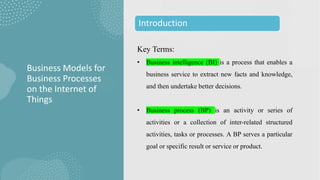
• Business intelligence (BI) is a process that enables a
business service to extract new facts and knowledge,
and then undertake better decisions.
• Business process (BP) is an activity or series of
activities or a collection of inter-related structured
activities, tasks or processes. A BP serves a particular
goal or specific result or service or product.
Business Models for
Business Processes
on the Internet of
Things
Introduction
Key Terms:
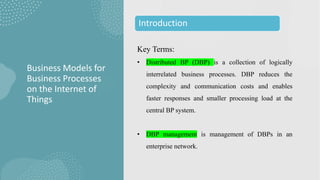
• Distributed BP (DBP) is a collection of logically
interrelated business processes. DBP reduces the
complexity and communication costs and enables
faster responses and smaller processing load at the
central BP system.
• DBP management is management of DBPs in an
enterprise network.
Business Models for
Business Processes
on the Internet of
Things
Introduction
Key Terms:
• Distributed BP (DBP) is a collection of logically
interrelated business processes. DBP reduces the
complexity and communication costs and enables
faster responses and smaller processing load at the
central BP system.
• DBP management is management of DBPs in an
enterprise network.
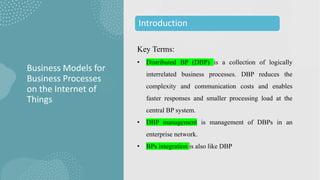
• BPs integration is also like DBP
Business Models for
Business Processes
on the Internet of
Things
Introduction
Key Terms:
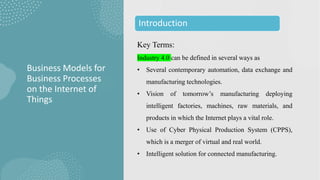
Industry 4.0 can be defined in several ways as
• Several contemporary automation, data exchange and
manufacturing technologies.
• Vision of tomorrow’s manufacturing deploying
intelligent factories, machines, raw materials, and
products in which the Internet plays a vital role.
• Use of Cyber Physical Production System (CPPS),
which is a merger of virtual and real world.
• Intelligent solution for connected manufacturing.
Business Models for
Business Processes
on the Internet of
Things
Introduction
UNIT 2
Business Models for Business
Processes on the Internet of Things
Introduction
Business models and business
Model innovation
Value creation on the IoT
Business model scenarios for IoT
• A business model nowadays considers many factors,
such as competitive advantage, experience curves,
value chain, theory of portfolio of products and
services, core competencies of business organization
and generic strategies.
• Portfolio means mix of two or more products or
services.
• For example, producing watches and jewelry.
Business Models for
Business Processes
on the Internet of
Things
Business models and business
Model innovation
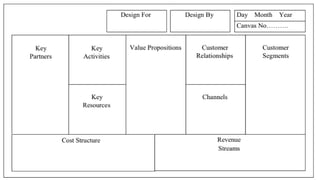
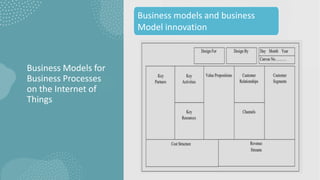
• A business model can be defined as a conceptual
structure supporting the viability of a business,
including its purpose, its goals and its ongoing plans
for achieving them.
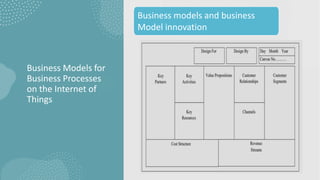
• The Business Model Canvas is a business tool used to
visualize all the building blocks when you want to
start a business, including customers, route to market,
value proposition and finance.
Business Models for
Business Processes
on the Internet of
Things
Business models and business
Model innovation
Business Models for
Business Processes
on the Internet of
Things
Business models and business
Model innovation
Business Models for
Business Processes
on the Internet of
Things
Business models and business
Model innovation
Business Models for
Business Processes
on the Internet of
Things
Business models and business
Model innovation
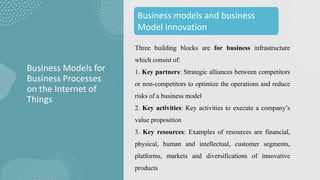
Three building blocks are for business infrastructure
which consist of:
1. Key partners: Strategic alliances between competitors
or non-competitors to optimize the operations and reduce
risks of a business model
2. Key activities: Key activities to execute a company’s
value proposition
3. Key resources: Examples of resources are financial,
physical, human and intellectual, customer segments,
platforms, markets and diversifications of innovative
products
Business Models for
Business Processes
on the Internet of
Things
Business models and business
Model innovation
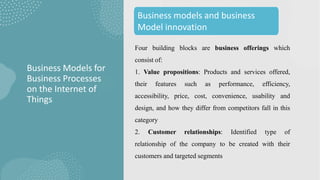
Four building blocks are business offerings which
consist of:
1. Value propositions: Products and services offered,
their features such as performance, efficiency,
accessibility, price, cost, convenience, usability and
design, and how they differ from competitors fall in this
category
2. Customer relationships: Identified type of
relationship of the company to be created with their
customers and targeted segments
Business Models for
Business Processes
on the Internet of
Things
Business models and business
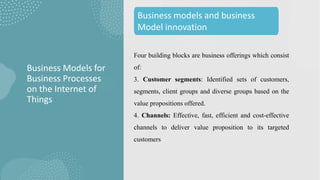
Model innovation
Four building blocks are business offerings which consist
of:
3. Customer segments: Identified sets of customers,
segments, client groups and diverse groups based on the
value propositions offered.
4. Channels: Effective, fast, efficient and cost-effective
channels to deliver value proposition to its targeted
customers
Business Models for
Business Processes
on the Internet of
Things
Business models and business
Model innovation
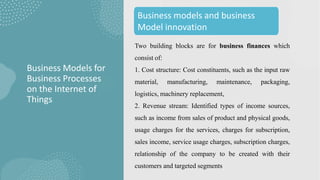
Two building blocks are for business finances which
consist of:
1. Cost structure: Cost constituents, such as the input raw
material, manufacturing, maintenance, packaging,
logistics, machinery replacement,
2. Revenue stream: Identified types of income sources,
such as income from sales of product and physical goods,
usage charges for the services, charges for subscription,
sales income, service usage charges, subscription charges,
relationship of the company to be created with their
customers and targeted segments
Business Models for
Business Processes
on the Internet of
Things
Business models and business
Model innovation
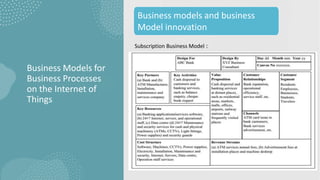
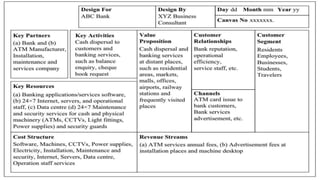
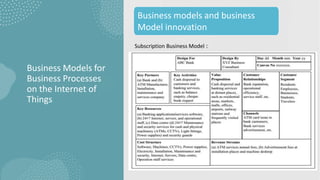
Subscription Business Model :
Business Models for
Business Processes
on the Internet of
Things
Business models and business
Model innovation
Subscription Business Model :
Business Models for
Business Processes
on the Internet of
Things
Business models and business
Model innovation
Subscription Business Model :
Business Models for
Business Processes
on the Internet of
Things
Business models and business
Model innovation
A business model needs innovation because:
• New access path to businesses and direct interaction with
the customers have come into existence. The access has
become fast and easy. New communication channels are
now fast due to use of Internet, more powerful with low
cost of computers, mobile communication and cloud
computing.
• Direct interactions at lower costs require modifications in
marketing channels deployed earlier to reach customers.
Customers also have faster and multichannel information
access and better search options.
Business Models for
Business Processes
on the Internet of
Things
Business models and business
Model innovation
• Business transactions have become easier and partly
automated. Information about customers has become an asset.
• New price models need to be worked out in new competitive
environment with wider use of ICT.
• Decentralized models: The model should have flexible value
chain which reacts fast according to varying customer
requirements.
• Faster introduction of new products and new portfolio
strategies due to better search options with the customers
Business Models for
Business Processes
on the Internet of
Things
Business models and business
Model innovation
UNIT 2
Business Models for Business
Processes on the Internet of Things
Introduction
Business models and business
Model innovation
Value creation on the IoT
Business model scenarios for IoT
• Value proposition means producing product or provisioning
of a platform or service.
• For example, using RFIDs in tracking service for the goods is
a value proposition.
• Value creation means creation of a ‘smart tracking and
logistics service’ from the sensed IDs of the RFIDs
communication on Internet, data analytics, data visualizations
and mobile communication for provisions for SMS to
receiver and delivery confirmation to the sender.
Business Models for
Business Processes
on the Internet of
Things
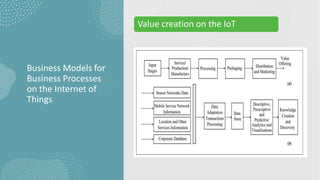
Value creation on the IoT
Features of value creation using IoT are:
• IoT enables addressing the emergent needs and real-time
needs using predictive analytics.
• Information convergence creates new experiences for current
products. Information enables innovative services.
• IoT enables value capture and thus recurrent revenue.
• Adds personalization and context and uses networked
products/services.
Business Models for
Business Processes
on the Internet of
Things
Value creation on the IoT
Business Models for
Business Processes
on the Internet of
Things
Value creation on the IoT
Business Models for
Business Processes
on the Internet of
Things
Value creation on the IoT
Business Models for
Business Processes
on the Internet of
Things
Value creation on the IoT
UNIT 2
Business Models for Business
Processes on the Internet of Things
Introduction
Business models and business
Model innovation
Value creation on the IoT
Business model scenarios for IoT
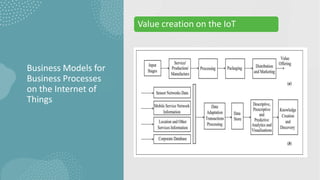
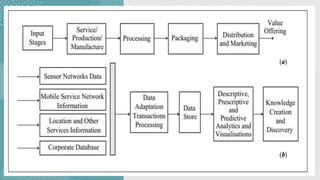
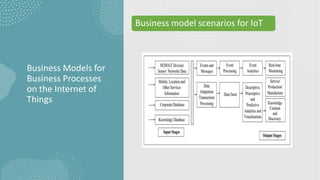
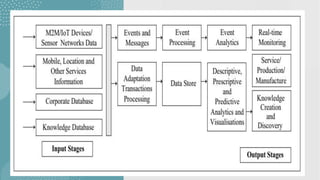
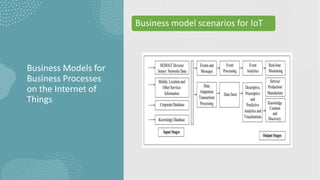
• Sensors, M2M, sensor networks data and the data using web
APIs for multiple information sources data, open data, mobile
services network information data, corporate database and
knowledge database are at the input stages.
• The data from multiple sources and services are part of the
key resources in business model scenarios for IoT.
Business Models for
Business Processes
on the Internet of
Things
Business model scenarios for IoT
Business Models for
Business Processes
on the Internet of
Things
Business model scenarios for IoT
Business Models for
Business Processes
on the Internet of
Things
Business model scenarios for IoT
Business Models for
Business Processes
on the Internet of
Things
Business model scenarios for IoT
UNIT 2
Business Models for Business
Processes on the Internet of Things
Introduction
Business models and business
Model innovation
Value creation on the IoT
Business model scenarios for IoT
UNIT 2
Business Models for Business
Processes on the Internet of Things
IoT/M2M systems LAYERS AND designs
standardizations
Communication Technologies
Data enrichment, data consolidation
and device management at gateway
Ease of designing and Affordability

Business models for business processes on IoT

  • 1.
    UNIT 2 Business Modelsfor Business Processes on the Internet of Things IoT/M2M systems LAYERS AND designs standardizations Communication Technologies Data enrichment, data consolidation and device management at gateway Ease of designing and Affordability
  • 2.
    UNIT 2 Business Modelsfor Business Processes on the Internet of Things Introduction Business models and business Model innovation Value creation on the IoT Business model scenarios for IoT
  • 3.
    • IoT hasmany applications in different domains such as applications/services of RFIDs in logistics, WSNs, predictive maintenance of railroads, oil pipelines, monitoring of transport units in logistics, detecting machine faults in industry, and deploying these IoT based applications and services. Business Models for Business Processes on the Internet of Things Introduction
  • 4.
    Key Terms: • Applicationor App means software for application, such as software for creating and sending an SMS, measuring and sending the measured data, or receiving message from a specified sender. • Service means a mechanism, which enables the provisioning of access to one or more capabilities. Business Models for Business Processes on the Internet of Things Introduction
  • 5.
    Key Terms: • Businessintelligence (BI) is a process that enables a business service to extract new facts and knowledge, and then undertake better decisions. • Business process (BP) is an activity or series of activities or a collection of inter-related structured activities, tasks or processes. A BP serves a particular goal or specific result or service or product. Business Models for Business Processes on the Internet of Things Introduction
  • 6.
    Key Terms: • DistributedBP (DBP) is a collection of logically interrelated business processes. DBP reduces the complexity and communication costs and enables faster responses and smaller processing load at the central BP system. • DBP management is management of DBPs in an enterprise network. Business Models for Business Processes on the Internet of Things Introduction
  • 7.
    Key Terms: • DistributedBP (DBP) is a collection of logically interrelated business processes. DBP reduces the complexity and communication costs and enables faster responses and smaller processing load at the central BP system. • DBP management is management of DBPs in an enterprise network. • BPs integration is also like DBP Business Models for Business Processes on the Internet of Things Introduction
  • 8.
    Key Terms: Industry 4.0can be defined in several ways as • Several contemporary automation, data exchange and manufacturing technologies. • Vision of tomorrow’s manufacturing deploying intelligent factories, machines, raw materials, and products in which the Internet plays a vital role. • Use of Cyber Physical Production System (CPPS), which is a merger of virtual and real world. • Intelligent solution for connected manufacturing. Business Models for Business Processes on the Internet of Things Introduction
  • 9.
    UNIT 2 Business Modelsfor Business Processes on the Internet of Things Introduction Business models and business Model innovation Value creation on the IoT Business model scenarios for IoT
  • 10.
    • A businessmodel nowadays considers many factors, such as competitive advantage, experience curves, value chain, theory of portfolio of products and services, core competencies of business organization and generic strategies. • Portfolio means mix of two or more products or services. • For example, producing watches and jewelry. Business Models for Business Processes on the Internet of Things Business models and business Model innovation
  • 11.
    • A businessmodel can be defined as a conceptual structure supporting the viability of a business, including its purpose, its goals and its ongoing plans for achieving them. • The Business Model Canvas is a business tool used to visualize all the building blocks when you want to start a business, including customers, route to market, value proposition and finance. Business Models for Business Processes on the Internet of Things Business models and business Model innovation
  • 12.
    Business Models for BusinessProcesses on the Internet of Things Business models and business Model innovation
  • 13.
    Business Models for BusinessProcesses on the Internet of Things Business models and business Model innovation
  • 14.
    Business Models for BusinessProcesses on the Internet of Things Business models and business Model innovation
  • 15.
    Three building blocksare for business infrastructure which consist of: 1. Key partners: Strategic alliances between competitors or non-competitors to optimize the operations and reduce risks of a business model 2. Key activities: Key activities to execute a company’s value proposition 3. Key resources: Examples of resources are financial, physical, human and intellectual, customer segments, platforms, markets and diversifications of innovative products Business Models for Business Processes on the Internet of Things Business models and business Model innovation
  • 16.
    Four building blocksare business offerings which consist of: 1. Value propositions: Products and services offered, their features such as performance, efficiency, accessibility, price, cost, convenience, usability and design, and how they differ from competitors fall in this category 2. Customer relationships: Identified type of relationship of the company to be created with their customers and targeted segments Business Models for Business Processes on the Internet of Things Business models and business Model innovation
  • 17.
    Four building blocksare business offerings which consist of: 3. Customer segments: Identified sets of customers, segments, client groups and diverse groups based on the value propositions offered. 4. Channels: Effective, fast, efficient and cost-effective channels to deliver value proposition to its targeted customers Business Models for Business Processes on the Internet of Things Business models and business Model innovation
  • 18.
    Two building blocksare for business finances which consist of: 1. Cost structure: Cost constituents, such as the input raw material, manufacturing, maintenance, packaging, logistics, machinery replacement, 2. Revenue stream: Identified types of income sources, such as income from sales of product and physical goods, usage charges for the services, charges for subscription, sales income, service usage charges, subscription charges, relationship of the company to be created with their customers and targeted segments Business Models for Business Processes on the Internet of Things Business models and business Model innovation
  • 19.
    Subscription Business Model: Business Models for Business Processes on the Internet of Things Business models and business Model innovation
  • 20.
    Subscription Business Model: Business Models for Business Processes on the Internet of Things Business models and business Model innovation
  • 21.
    Subscription Business Model: Business Models for Business Processes on the Internet of Things Business models and business Model innovation
  • 22.
    A business modelneeds innovation because: • New access path to businesses and direct interaction with the customers have come into existence. The access has become fast and easy. New communication channels are now fast due to use of Internet, more powerful with low cost of computers, mobile communication and cloud computing. • Direct interactions at lower costs require modifications in marketing channels deployed earlier to reach customers. Customers also have faster and multichannel information access and better search options. Business Models for Business Processes on the Internet of Things Business models and business Model innovation
  • 23.
    • Business transactionshave become easier and partly automated. Information about customers has become an asset. • New price models need to be worked out in new competitive environment with wider use of ICT. • Decentralized models: The model should have flexible value chain which reacts fast according to varying customer requirements. • Faster introduction of new products and new portfolio strategies due to better search options with the customers Business Models for Business Processes on the Internet of Things Business models and business Model innovation
  • 24.
    UNIT 2 Business Modelsfor Business Processes on the Internet of Things Introduction Business models and business Model innovation Value creation on the IoT Business model scenarios for IoT
  • 25.
    • Value propositionmeans producing product or provisioning of a platform or service. • For example, using RFIDs in tracking service for the goods is a value proposition. • Value creation means creation of a ‘smart tracking and logistics service’ from the sensed IDs of the RFIDs communication on Internet, data analytics, data visualizations and mobile communication for provisions for SMS to receiver and delivery confirmation to the sender. Business Models for Business Processes on the Internet of Things Value creation on the IoT
  • 26.
    Features of valuecreation using IoT are: • IoT enables addressing the emergent needs and real-time needs using predictive analytics. • Information convergence creates new experiences for current products. Information enables innovative services. • IoT enables value capture and thus recurrent revenue. • Adds personalization and context and uses networked products/services. Business Models for Business Processes on the Internet of Things Value creation on the IoT
  • 27.
    Business Models for BusinessProcesses on the Internet of Things Value creation on the IoT
  • 28.
    Business Models for BusinessProcesses on the Internet of Things Value creation on the IoT
  • 29.
    Business Models for BusinessProcesses on the Internet of Things Value creation on the IoT
  • 30.
    UNIT 2 Business Modelsfor Business Processes on the Internet of Things Introduction Business models and business Model innovation Value creation on the IoT Business model scenarios for IoT
  • 31.
    • Sensors, M2M,sensor networks data and the data using web APIs for multiple information sources data, open data, mobile services network information data, corporate database and knowledge database are at the input stages. • The data from multiple sources and services are part of the key resources in business model scenarios for IoT. Business Models for Business Processes on the Internet of Things Business model scenarios for IoT
  • 32.
    Business Models for BusinessProcesses on the Internet of Things Business model scenarios for IoT
  • 33.
    Business Models for BusinessProcesses on the Internet of Things Business model scenarios for IoT
  • 34.
    Business Models for BusinessProcesses on the Internet of Things Business model scenarios for IoT
  • 35.
    UNIT 2 Business Modelsfor Business Processes on the Internet of Things Introduction Business models and business Model innovation Value creation on the IoT Business model scenarios for IoT
  • 36.
    UNIT 2 Business Modelsfor Business Processes on the Internet of Things IoT/M2M systems LAYERS AND designs standardizations Communication Technologies Data enrichment, data consolidation and device management at gateway Ease of designing and Affordability