Putting Succession Planning
into Practice – Talent Assessment
and Development
Amanda White
Managing Director
www.ihsdubai.com
 Award-winning team of Occupational Psychologists,
Executive Coaches, L&D and HR Specialists
 Headquartered in the UAE for 14 years, working across GCC
 Working with government, semi-government, multi-national
and large family businesses
 Representing 12 International Test Publishers in the Gulf
Introduction to Innovative HR Solutions
2
Roadmap for the Next 45 Minutes!
1. What do we mean by Talent?
2. What should your Talent Framework address?
3. How do we measure Talent?
4. Talent Development
Question?
Harvard Business School
 Harvard Business School conducted a global survey /
interviews with 45 leading companies worldwide
 “How do you identify and develop talent?”
 98% reported that they purposefully identify high potentials
 All talked off the benefit of identifying leaders for the future
 ALL said it was not just about performance
 …. So what is it?
The Harvard Business School
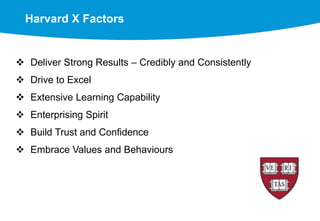
Harvard X Factors
 Deliver Strong Results – Credibly and Consistently
 Drive to Excel
 Extensive Learning Capability
 Enterprising Spirit
 Build Trust and Confidence
 Embrace Values and Behaviours
What Should Your Plan Look Like?
The Framework
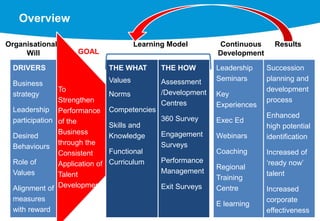
Overview
DRIVERS
Business
strategy
Leadership
participation
Desired
Behaviours
Role of
Values
Alignment of
measures
with reward
To
Strengthen
Performance
of the
Business
through the
Consistent
Application of
Talent
Development
THE WHAT
Values
Norms
Competencies
Skills and
Knowledge
Functional
Curriculum
THE HOW
Assessment
/Development
Centres
360 Survey
Engagement
Surveys
Performance
Management
Exit Surveys
Leadership
Seminars
Key
Experiences
Exec Ed
Webinars
Coaching
Regional
Training
Centre
E learning
Succession
planning and
development
process
Enhanced
high potential
identification
Increased of
‘ready now’
talent
Increased
corporate
effectiveness
Organisational
Will GOAL
Learning Model Continuous
Development
Results
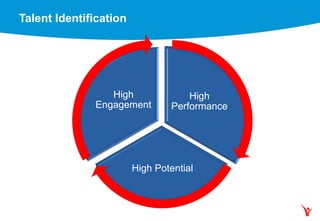
How do we identify and
‘measure’ talent?
High
Performance
High Potential
High
Engagement
Talent Identification
Engagement
 Living the values
 Job / person and organisation fit
 Advocacy; Promote their organisation and initiatives
 Immersed in their work and going the extra mile, seek out
stretch assignments
 Work well with teams and support others in the pursuit of
the organisational goals
 Energy and passion
Potential Indicators
PERFORMANCE
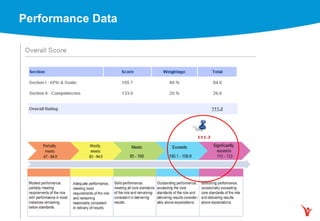
Performance Data
POTENTIAL
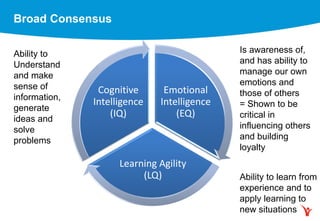
Emotional
Intelligence
(EQ)
Learning Agility
(LQ)
Cognitive
Intelligence
(IQ)
Broad Consensus
Ability to
Understand
and make
sense of
information,
generate
ideas and
solve
problems
Is awareness of,
and has ability to
manage our own
emotions and
those of others
= Shown to be
critical in
influencing others
and building
loyalty
Ability to learn from
experience and to
apply learning to
new situations
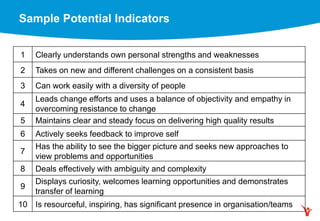
1 Clearly understands own personal strengths and weaknesses
2 Takes on new and different challenges on a consistent basis
3 Can work easily with a diversity of people
4
Leads change efforts and uses a balance of objectivity and empathy in
overcoming resistance to change
5 Maintains clear and steady focus on delivering high quality results
6 Actively seeks feedback to improve self
7
Has the ability to see the bigger picture and seeks new approaches to
view problems and opportunities
8 Deals effectively with ambiguity and complexity
9
Displays curiosity, welcomes learning opportunities and demonstrates
transfer of learning
10 Is resourceful, inspiring, has significant presence in organisation/teams
Sample Potential Indicators
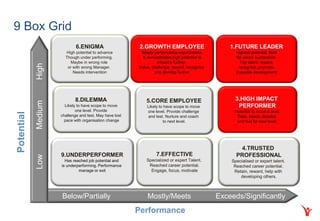
Potential
Performance
9.UNDERPERFORMER
Has reached job potential and
is underperforming. Performance
manage or exit
Below/Partially Mostly/Meets Exceeds/Significantly
LowMediumHigh
8.DILEMMA
Likely to have scope to move
one level. Provide
challenge and test. May have lost
pace with organisation change
6.ENIGMA
High potential to advance
Though under performing.
Maybe in wrong role
or with wrong Manager.
Needs intervention
7.EFFECTIVE
Specialized or expert Talent.
Reached career potential.
Engage, focus, motivate
2.GROWTH EMPLOYEE
Meets performance expectations
& demonstrates high potential to
advance further.
Value, challenge, reward, recognise
and develop further
4.TRUSTED
PROFESSIONAL
Specialised or expert talent.
Reached career potential.
Retain, reward, help with
developing others.
3.HIGH IMPACT
PERFORMER
Potential to move a level.
Train, coach, develop
and test for next level.
1.FUTURE LEADER
Highest potential. Best
for senior succession.
Top talent, reward,
recognise, promote,
Expedite development
5.CORE EMPLOYEE
Likely to have scope to move
one level. Provide challenge
and test. Nurture and coach
to next level.
9 Box Grid
Potential Indicators
Assessment
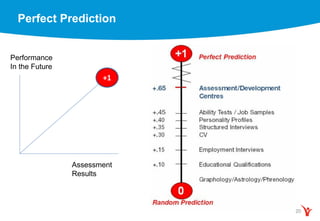
Perfect Prediction
Performance
In the Future
Assessment
Results
+1
20
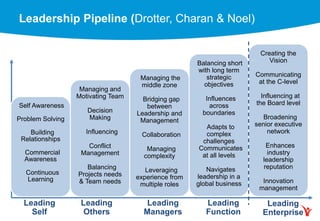
Leading
Self
Leading
Others
Leading
Managers
Leading
Function
Leading
Enterprise
Self Awareness
Problem Solving
Building
Relationships
Commercial
Awareness
Continuous
Learning
Managing and
Motivating Team
Decision
Making
Influencing
Conflict
Management
Balancing
Projects needs
& Team needs
Managing the
middle zone
Bridging gap
between
Leadership and
Management
Collaboration
Managing
complexity
Leveraging
experience from
multiple roles
Leadership Pipeline (Drotter, Charan & Noel)
Balancing short
with long term
strategic
objectives
Influences
across
boundaries
Adapts to
complex
challenges
Communicates
at all levels
Navigates
leadership in a
global business
Creating the
Vision
Communicating
at the C-level
Influencing at
the Board level
Broadening
senior executive
network
Enhances
industry
leadership
reputation
Innovation
management
22
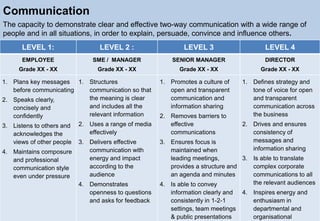
Communication
The capacity to demonstrate clear and effective two-way communication with a wide range of
people and in all situations, in order to explain, persuade, convince and influence others.
LEVEL 1: LEVEL 2 : LEVEL 3 LEVEL 4
EMPLOYEE
Grade XX - XX
SME / MANAGER
Grade XX - XX
SENIOR MANAGER
Grade XX - XX
DIRECTOR
Grade XX - XX
1. Plans key messages
before communicating
2. Speaks clearly,
concisely and
confidently
3. Listens to others and
acknowledges the
views of other people
4. Maintains composure
and professional
communication style
even under pressure
1. Structures
communication so that
the meaning is clear
and includes all the
relevant information
2. Uses a range of media
effectively
3. Delivers effective
communication with
energy and impact
according to the
audience
4. Demonstrates
openness to questions
and asks for feedback
1. Promotes a culture of
open and transparent
communication and
information sharing
2. Removes barriers to
effective
communications
3. Ensures focus is
maintained when
leading meetings,
provides a structure and
an agenda and minutes
4. Is able to convey
information clearly and
consistently in 1-2-1
settings, team meetings
& public presentations
1. Defines strategy and
tone of voice for open
and transparent
communication across
the business
2. Drives and ensures
consistency of
messages and
information sharing
3. Is able to translate
complex corporate
communications to all
the relevant audiences
4. Inspires energy and
enthusiasm in
departmental and
organisational
23
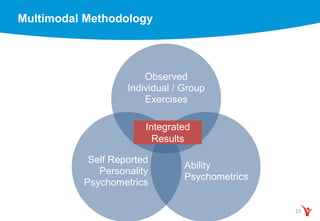
Observed
Individual / Group
Exercises
Ability
Psychometrics
Self Reported
Personality
Psychometrics
Integrated
Results
Multimodal Methodology
24
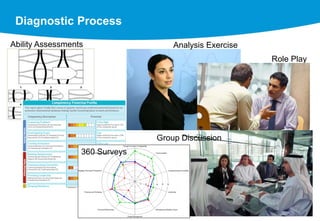
Diagnostic Process
Role Play
Ability Assessments Analysis Exercise
Group Discussion
360 Surveys
25
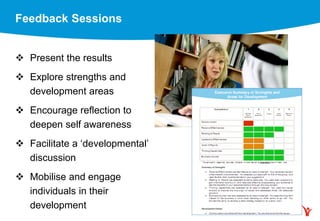
 Present the results
 Explore strengths and
development areas
 Encourage reflection to
deepen self awareness
 Facilitate a ‘developmental’
discussion
 Mobilise and engage
individuals in their
development
Feedback Sessions
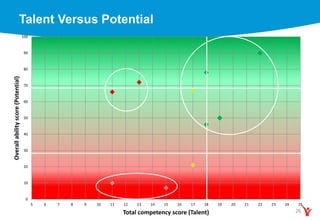
Talent Versus Potential
26
0
10
20
30
40
50
60
70
80
90
100
5 6 7 8 9 10 11 12 13 14 15 16 17 18 19 20 21 22 23 24 25
Overallabilityscore(Potential)
Total competency score (Talent)
Outcomes
Next Steps
28
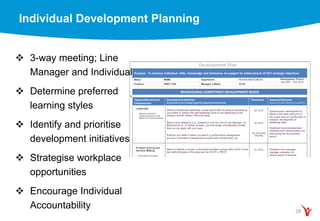
Purpose: To enhance individual skills, knowledge and behaviour to support he achievement of EO’s strategic objectives
TargetedBehavioural
Competencies
DevelopmentActivities
(Individually Driven, Manager Supported, Organisational Sponsored)
Timeframe ExpectedOutcome
(How will I know I havebeensuccessful?)
BEHAVOURIAL COMPETENCYDEVELOPMENTNEEDS
 3-way meeting; Line
Manager and Individual
 Determine preferred
learning styles
 Identify and prioritise
development initiatives
 Strategise workplace
opportunities
 Encourage Individual
Accountability
Individual Development Planning
29
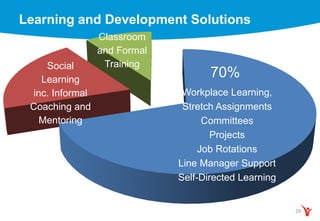
Social
Learning
inc. Informal
Coaching and
Mentoring
Classroom
and Formal
Training
Learning and Development Solutions
70%
Workplace Learning,
Stretch Assignments
Committees
Projects
Job Rotations
Line Manager Support
Self-Directed Learning
30
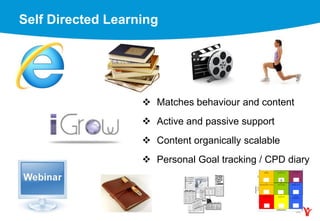
Self Directed Learning
70%
 Matches behaviour and content
 Active and passive support
 Content organically scalable
 Personal Goal tracking / CPD diary
31
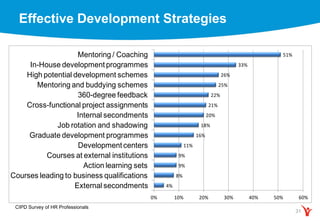
4%
8%
9%
9%
11%
16%
18%
20%
21%
22%
25%
26%
33%
51%
0% 10% 20% 30% 40% 50% 60%
External secondments
Courses leading to business qualifications
Action learning sets
Courses at external institutions
Development centers
Graduate development programmes
Job rotation and shadowing
Internal secondments
Cross-functional project assignments
360-degree feedback
Mentoring and buddying schemes
High potential development schemes
In-House development programmes
Mentoring / Coaching
Effective Development Strategies
CIPD Survey of HR Professionals
Process
Conclusion
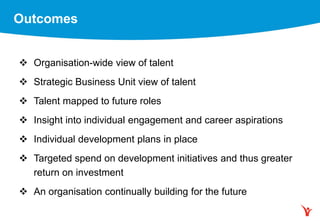
Outcomes
 Organisation-wide view of talent
 Strategic Business Unit view of talent
 Talent mapped to future roles
 Insight into individual engagement and career aspirations
 Individual development plans in place
 Targeted spend on development initiatives and thus greater
return on investment
 An organisation continually building for the future
Amanda White
Managing Director
Innovative HR Solutions
+9714390 2778
awhite@ihsdubai.com
www.ihsdubai.com
Any questions?

Putting Succession Planning into Practice – Talent Assessment and Development

  • 1.
    Putting Succession Planning intoPractice – Talent Assessment and Development Amanda White Managing Director www.ihsdubai.com
  • 2.
     Award-winning teamof Occupational Psychologists, Executive Coaches, L&D and HR Specialists  Headquartered in the UAE for 14 years, working across GCC  Working with government, semi-government, multi-national and large family businesses  Representing 12 International Test Publishers in the Gulf Introduction to Innovative HR Solutions 2
  • 3.
    Roadmap for theNext 45 Minutes! 1. What do we mean by Talent? 2. What should your Talent Framework address? 3. How do we measure Talent? 4. Talent Development Question?
  • 4.
    Harvard Business School Harvard Business School conducted a global survey / interviews with 45 leading companies worldwide  “How do you identify and develop talent?”  98% reported that they purposefully identify high potentials  All talked off the benefit of identifying leaders for the future  ALL said it was not just about performance  …. So what is it?
  • 5.
  • 6.
    Harvard X Factors Deliver Strong Results – Credibly and Consistently  Drive to Excel  Extensive Learning Capability  Enterprising Spirit  Build Trust and Confidence  Embrace Values and Behaviours
  • 7.
    What Should YourPlan Look Like? The Framework
  • 8.
    Overview DRIVERS Business strategy Leadership participation Desired Behaviours Role of Values Alignment of measures withreward To Strengthen Performance of the Business through the Consistent Application of Talent Development THE WHAT Values Norms Competencies Skills and Knowledge Functional Curriculum THE HOW Assessment /Development Centres 360 Survey Engagement Surveys Performance Management Exit Surveys Leadership Seminars Key Experiences Exec Ed Webinars Coaching Regional Training Centre E learning Succession planning and development process Enhanced high potential identification Increased of ‘ready now’ talent Increased corporate effectiveness Organisational Will GOAL Learning Model Continuous Development Results
  • 9.
    How do weidentify and ‘measure’ talent?
  • 10.
  • 12.
    Engagement  Living thevalues  Job / person and organisation fit  Advocacy; Promote their organisation and initiatives  Immersed in their work and going the extra mile, seek out stretch assignments  Work well with teams and support others in the pursuit of the organisational goals  Energy and passion
  • 13.
  • 14.
  • 15.
  • 16.
    Emotional Intelligence (EQ) Learning Agility (LQ) Cognitive Intelligence (IQ) Broad Consensus Abilityto Understand and make sense of information, generate ideas and solve problems Is awareness of, and has ability to manage our own emotions and those of others = Shown to be critical in influencing others and building loyalty Ability to learn from experience and to apply learning to new situations
  • 17.
    1 Clearly understandsown personal strengths and weaknesses 2 Takes on new and different challenges on a consistent basis 3 Can work easily with a diversity of people 4 Leads change efforts and uses a balance of objectivity and empathy in overcoming resistance to change 5 Maintains clear and steady focus on delivering high quality results 6 Actively seeks feedback to improve self 7 Has the ability to see the bigger picture and seeks new approaches to view problems and opportunities 8 Deals effectively with ambiguity and complexity 9 Displays curiosity, welcomes learning opportunities and demonstrates transfer of learning 10 Is resourceful, inspiring, has significant presence in organisation/teams Sample Potential Indicators
  • 18.
    Potential Performance 9.UNDERPERFORMER Has reached jobpotential and is underperforming. Performance manage or exit Below/Partially Mostly/Meets Exceeds/Significantly LowMediumHigh 8.DILEMMA Likely to have scope to move one level. Provide challenge and test. May have lost pace with organisation change 6.ENIGMA High potential to advance Though under performing. Maybe in wrong role or with wrong Manager. Needs intervention 7.EFFECTIVE Specialized or expert Talent. Reached career potential. Engage, focus, motivate 2.GROWTH EMPLOYEE Meets performance expectations & demonstrates high potential to advance further. Value, challenge, reward, recognise and develop further 4.TRUSTED PROFESSIONAL Specialised or expert talent. Reached career potential. Retain, reward, help with developing others. 3.HIGH IMPACT PERFORMER Potential to move a level. Train, coach, develop and test for next level. 1.FUTURE LEADER Highest potential. Best for senior succession. Top talent, reward, recognise, promote, Expedite development 5.CORE EMPLOYEE Likely to have scope to move one level. Provide challenge and test. Nurture and coach to next level. 9 Box Grid
  • 19.
  • 20.
    Perfect Prediction Performance In theFuture Assessment Results +1 20
  • 21.
    Leading Self Leading Others Leading Managers Leading Function Leading Enterprise Self Awareness Problem Solving Building Relationships Commercial Awareness Continuous Learning Managingand Motivating Team Decision Making Influencing Conflict Management Balancing Projects needs & Team needs Managing the middle zone Bridging gap between Leadership and Management Collaboration Managing complexity Leveraging experience from multiple roles Leadership Pipeline (Drotter, Charan & Noel) Balancing short with long term strategic objectives Influences across boundaries Adapts to complex challenges Communicates at all levels Navigates leadership in a global business Creating the Vision Communicating at the C-level Influencing at the Board level Broadening senior executive network Enhances industry leadership reputation Innovation management
  • 22.
    22 Communication The capacity todemonstrate clear and effective two-way communication with a wide range of people and in all situations, in order to explain, persuade, convince and influence others. LEVEL 1: LEVEL 2 : LEVEL 3 LEVEL 4 EMPLOYEE Grade XX - XX SME / MANAGER Grade XX - XX SENIOR MANAGER Grade XX - XX DIRECTOR Grade XX - XX 1. Plans key messages before communicating 2. Speaks clearly, concisely and confidently 3. Listens to others and acknowledges the views of other people 4. Maintains composure and professional communication style even under pressure 1. Structures communication so that the meaning is clear and includes all the relevant information 2. Uses a range of media effectively 3. Delivers effective communication with energy and impact according to the audience 4. Demonstrates openness to questions and asks for feedback 1. Promotes a culture of open and transparent communication and information sharing 2. Removes barriers to effective communications 3. Ensures focus is maintained when leading meetings, provides a structure and an agenda and minutes 4. Is able to convey information clearly and consistently in 1-2-1 settings, team meetings & public presentations 1. Defines strategy and tone of voice for open and transparent communication across the business 2. Drives and ensures consistency of messages and information sharing 3. Is able to translate complex corporate communications to all the relevant audiences 4. Inspires energy and enthusiasm in departmental and organisational
  • 23.
    23 Observed Individual / Group Exercises Ability Psychometrics SelfReported Personality Psychometrics Integrated Results Multimodal Methodology
  • 24.
    24 Diagnostic Process Role Play AbilityAssessments Analysis Exercise Group Discussion 360 Surveys
  • 25.
    25  Present theresults  Explore strengths and development areas  Encourage reflection to deepen self awareness  Facilitate a ‘developmental’ discussion  Mobilise and engage individuals in their development Feedback Sessions
  • 26.
    Talent Versus Potential 26 0 10 20 30 40 50 60 70 80 90 100 56 7 8 9 10 11 12 13 14 15 16 17 18 19 20 21 22 23 24 25 Overallabilityscore(Potential) Total competency score (Talent)
  • 27.
  • 28.
    28 Purpose: To enhanceindividual skills, knowledge and behaviour to support he achievement of EO’s strategic objectives TargetedBehavioural Competencies DevelopmentActivities (Individually Driven, Manager Supported, Organisational Sponsored) Timeframe ExpectedOutcome (How will I know I havebeensuccessful?) BEHAVOURIAL COMPETENCYDEVELOPMENTNEEDS  3-way meeting; Line Manager and Individual  Determine preferred learning styles  Identify and prioritise development initiatives  Strategise workplace opportunities  Encourage Individual Accountability Individual Development Planning
  • 29.
    29 Social Learning inc. Informal Coaching and Mentoring Classroom andFormal Training Learning and Development Solutions 70% Workplace Learning, Stretch Assignments Committees Projects Job Rotations Line Manager Support Self-Directed Learning
  • 30.
    30 Self Directed Learning 70% Matches behaviour and content  Active and passive support  Content organically scalable  Personal Goal tracking / CPD diary
  • 31.
    31 4% 8% 9% 9% 11% 16% 18% 20% 21% 22% 25% 26% 33% 51% 0% 10% 20%30% 40% 50% 60% External secondments Courses leading to business qualifications Action learning sets Courses at external institutions Development centers Graduate development programmes Job rotation and shadowing Internal secondments Cross-functional project assignments 360-degree feedback Mentoring and buddying schemes High potential development schemes In-House development programmes Mentoring / Coaching Effective Development Strategies CIPD Survey of HR Professionals
  • 32.
  • 33.
    Outcomes  Organisation-wide viewof talent  Strategic Business Unit view of talent  Talent mapped to future roles  Insight into individual engagement and career aspirations  Individual development plans in place  Targeted spend on development initiatives and thus greater return on investment  An organisation continually building for the future
  • 34.
    Amanda White Managing Director InnovativeHR Solutions +9714390 2778 awhite@ihsdubai.com www.ihsdubai.com Any questions?