An Objective Succession
Planning Process
Paul Walsh
About the HR Observer
• The HR Observer is an initiative by IIR Middle East aimed at becoming a
platform for HR professionals in the Middle East to exchange insights
and expertise, both online and offline, in an effort to take the industry
forward.
• The initiative features a blog, LinkedIn group, Twitter feed, online
webinars and a series of offline informal networking functions.
Housekeeping
• Un-answered questions will be posted with answers to our blog
• Slides will be available on our SlideShare page, link will be emailed to
you
• Recording of the webinar will be available to download, link will be
emailed
• Take the time to complete post-webinar survey that will pop up at the
end
Today’s Presenter
Paul Walsh is a professional Human Resources Trainer, Consultant and Practitioner with over 20 years’
experience in the GCC, MENA and Asia. Based in Kuwait and Oman for 10 years Paul now runs his own
consultancy based in Cyprus, specialising in HR, Finance and Leadership.
Well known in the Gulf region; his unique experience in Human Resources, Finance and Operations ensures he
brings real practical examples and a wealth of experience to his Talent Management, Recruitment,
Competencies, Training and Development, Performance Management, HR Budgeting, and Manpower Planning
courses. He has also undertaken consultancy work in Qatar, Pakistan, Malaysia, Hong Kong, UAE, Oman,
Bahrain and Egypt.
He has worked with clients in the Oil & Gas, Banking, Telecommunications, Retail, Construction and
Automotive Sectors.
WEBINAR
AN OBJECTIVE SUCCESSION PLANNING PROCESS
Join us in this webinar with Paul Walsh, a leading HR Consultant and Trainer in the
region, to discuss, question and improve a succession planning process.
A high level process map will be the focus of the webinar with Paul discussing what
steps we need to take to ensure, not only that we get the right succession candidates,
but also how we can ensure that the process of selection is open, objective,
transparent and fair.
SUCCESSION PLANNING
• Identifying future potential leaders to fill key positions.
• A process by which one or more successors are identified for key
posts (or groups of similar key posts), and career moves and/or
development activities are planned for these successors.
SUCCESSION PLANNING
• Succession planning is a systematic approach to:
• Building a leadership pipeline/talent pool to ensure leadership continuity
• Developing potential successors in ways that best fit their strengths
• Identifying the best candidates for categories of positions
• Concentrating resources on the talent development process yielding a greater
return on investment.
SUCCESSION PLANNING
• Succession planning recognizes that some jobs are the lifeblood of
the organization and too critical to be left vacant or filled by any but
the best qualified persons.
• Effectively done, succession planning is critical to mission success and
creates an effective process for recognizing, developing, and retaining
top leadership talent.
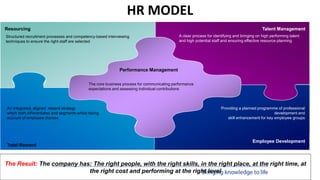
HR MODEL
Talent Management
Total Reward
Employee Development
A clear process for identifying and bringing on high performing talent
and high potential staff and ensuring effective resource planning
Providing a planned programme of professional
development and
skill enhancement for key employee groups
An integrated, aligned reward strategy
which both differentiates and segments whilst taking
account of employee choices
Performance Management
The core business process for communicating performance
expectations and assessing individual contributions
Resourcing
Structured recruitment processes and competency-based interviewing
techniques to ensure the right staff are selected
The Result: The company has: The right people, with the right skills, in the right place, at the right time, at
the right cost and performing at the right level
TALENT MANAGEMENT
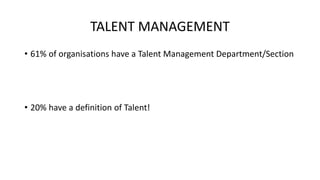
• 61% of organisations have a Talent Management Department/Section
• 20% have a definition of Talent!
DEFINITION OF TALENT
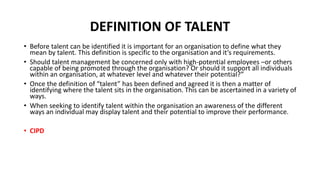
• Before talent can be identified it is important for an organisation to define what they
mean by talent. This definition is specific to the organisation and it’s requirements.
• Should talent management be concerned only with high-potential employees –or others
capable of being promoted through the organisation? Or should it support all individuals
within an organisation, at whatever level and whatever their potential?”
• Once the definition of “talent” has been defined and agreed it is then a matter of
identifying where the talent sits in the organisation. This can be ascertained in a variety of
ways.
• When seeking to identify talent within the organisation an awareness of the different
ways an individual may display talent and their potential to improve their performance.
• CIPD
AN EXAMPLE
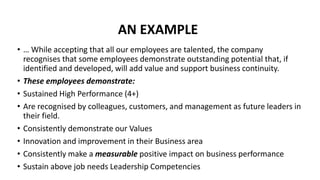
• … While accepting that all our employees are talented, the company
recognises that some employees demonstrate outstanding potential that, if
identified and developed, will add value and support business continuity.
• These employees demonstrate:
• Sustained High Performance (4+)
• Are recognised by colleagues, customers, and management as future leaders in
their field.
• Consistently demonstrate our Values
• Innovation and improvement in their Business area
• Consistently make a measurable positive impact on business performance
• Sustain above job needs Leadership Competencies
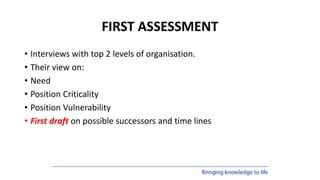
FIRST ASSESSMENT
• Interviews with top 2 levels of organisation.
• Their view on:
• Need
• Position Criticality
• Position Vulnerability
• First draft on possible successors and time lines
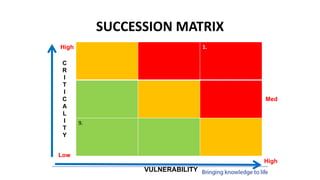
SUCCESSION MATRIX
1.
9.
C
R
I
T
I
C
A
L
I
T
Y
VULNERABILITY
High
Med
High
Low
Regional Manager - Dhofar
Bruce Willis
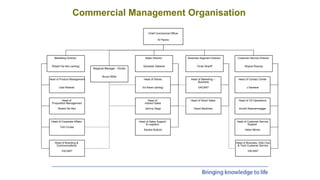
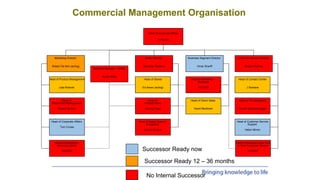
Commercial Management Organisation
Chief Commercial Officer
Al Pacino
Marketing Director
Robert De Niro (acting)
Head of Corporate Affairs
Tom Cruise
Head of Branding &
Communications
VACANT
Head of
Proposition Management
Robert De Niro
Head of Product Management
Julia Roberts
Sales Director
Sylvester Stallone
Head of Sales Support
& Logistics
Sandra Bullock
Head of
Indirect Sales
Johnny Depp
Head of Stores
Ed Asner (acting)
Customer Service Director
Wayne Rooney
Head of Customer Service
Support
Helen Mirren
Head of CS Operations
Arnold Swarzennegger
Head of Contact Center
J Santana
Business Segment Director
Omar Shariff
Head of Business, Elite Club
& Tech Customer Service
VACANT
Head of Direct Sales
David Beckham
Head of Marketing –
Business
VACANT
Regional Manager - Dhofar
Bruce Willis
Commercial Management Organisation
Chief Commercial Officer
Al Pacino
Marketing Director
Robert De Niro (acting)
Head of Corporate Affairs
Tom Cruise
Head of Branding &
Communications
VACANT
Head of
Proposition Management
Robert De Niro
Head of Product Management
Julia Roberts
Sales Director
Sylvester Stallone
Head of Sales Support
& Logistics
Sandra Bullock
Head of
Indirect Sales
Johnny Depp
Head of Stores
Ed Asner (acting)
Customer Service Director
Wayne Rooney
Head of Customer Service
Support
Helen Mirren
Head of CS Operations
Arnold Swarzennegger
Head of Contact Center
J Santana
Business Segment Director
Omar Shariff
Head of Business, Elite Club
& Tech Customer Service
VACANT
Head of Direct Sales
David Beckham
Head of Marketing –
Business
VACANT
Successor Ready now
Successor Ready 12 – 36 months
No Internal Successor
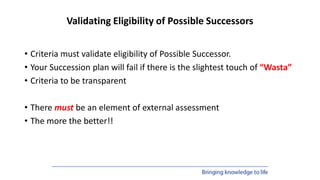
Validating Eligibility of Possible Successors
• Criteria must validate eligibility of Possible Successor.
• Your Succession plan will fail if there is the slightest touch of “Wasta”
• Criteria to be transparent
• There must be an element of external assessment
• The more the better!!
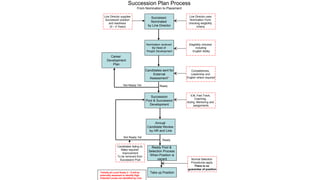
Succession Plan Process
From Nomination to Placement
Successor
Nominated
by Line Director
Line Director supplies
Succession position
and readiness
(0 – 4 Years)
Nomination received
By Head of
People Development
Candidates sent for
External
Assessment*
Career
Development
Plan
Succession
Pool & Succession
Development
Line Director uses
Nomination Form
checking elegibility
criteria.
Elegibility checked
including
English Ability
ReadyNot Ready Yet
Annual
Candidate Review
by HR and Line
Ready Pool &
Selection Process
When Position is
vacant
Take up Position
ILM, Fast Track,
Coaching,
Acting, Mentoring and
assignments
Ready
Not Ready Yet
Competencies,
Leadership and
English where required
Normal Selection
Procedures apply
There is no
guarantee of position
Candidates failing to
Make required
improvement
To be removed from
Succession Pool
*Initially all Local Grade 2 – 5 will be
externally assessed to identify High
Potential Locals not identified by Line.

Webinar an objective succession planning process

  • 1.
  • 2.
    About the HRObserver • The HR Observer is an initiative by IIR Middle East aimed at becoming a platform for HR professionals in the Middle East to exchange insights and expertise, both online and offline, in an effort to take the industry forward. • The initiative features a blog, LinkedIn group, Twitter feed, online webinars and a series of offline informal networking functions.
  • 3.
    Housekeeping • Un-answered questionswill be posted with answers to our blog • Slides will be available on our SlideShare page, link will be emailed to you • Recording of the webinar will be available to download, link will be emailed • Take the time to complete post-webinar survey that will pop up at the end
  • 4.
    Today’s Presenter Paul Walshis a professional Human Resources Trainer, Consultant and Practitioner with over 20 years’ experience in the GCC, MENA and Asia. Based in Kuwait and Oman for 10 years Paul now runs his own consultancy based in Cyprus, specialising in HR, Finance and Leadership. Well known in the Gulf region; his unique experience in Human Resources, Finance and Operations ensures he brings real practical examples and a wealth of experience to his Talent Management, Recruitment, Competencies, Training and Development, Performance Management, HR Budgeting, and Manpower Planning courses. He has also undertaken consultancy work in Qatar, Pakistan, Malaysia, Hong Kong, UAE, Oman, Bahrain and Egypt. He has worked with clients in the Oil & Gas, Banking, Telecommunications, Retail, Construction and Automotive Sectors.
  • 5.
    WEBINAR AN OBJECTIVE SUCCESSIONPLANNING PROCESS Join us in this webinar with Paul Walsh, a leading HR Consultant and Trainer in the region, to discuss, question and improve a succession planning process. A high level process map will be the focus of the webinar with Paul discussing what steps we need to take to ensure, not only that we get the right succession candidates, but also how we can ensure that the process of selection is open, objective, transparent and fair.
  • 6.
    SUCCESSION PLANNING • Identifyingfuture potential leaders to fill key positions. • A process by which one or more successors are identified for key posts (or groups of similar key posts), and career moves and/or development activities are planned for these successors.
  • 7.
    SUCCESSION PLANNING • Successionplanning is a systematic approach to: • Building a leadership pipeline/talent pool to ensure leadership continuity • Developing potential successors in ways that best fit their strengths • Identifying the best candidates for categories of positions • Concentrating resources on the talent development process yielding a greater return on investment.
  • 8.
    SUCCESSION PLANNING • Successionplanning recognizes that some jobs are the lifeblood of the organization and too critical to be left vacant or filled by any but the best qualified persons. • Effectively done, succession planning is critical to mission success and creates an effective process for recognizing, developing, and retaining top leadership talent.
  • 9.
    HR MODEL Talent Management TotalReward Employee Development A clear process for identifying and bringing on high performing talent and high potential staff and ensuring effective resource planning Providing a planned programme of professional development and skill enhancement for key employee groups An integrated, aligned reward strategy which both differentiates and segments whilst taking account of employee choices Performance Management The core business process for communicating performance expectations and assessing individual contributions Resourcing Structured recruitment processes and competency-based interviewing techniques to ensure the right staff are selected The Result: The company has: The right people, with the right skills, in the right place, at the right time, at the right cost and performing at the right level
  • 10.
    TALENT MANAGEMENT • 61%of organisations have a Talent Management Department/Section • 20% have a definition of Talent!
  • 11.
    DEFINITION OF TALENT •Before talent can be identified it is important for an organisation to define what they mean by talent. This definition is specific to the organisation and it’s requirements. • Should talent management be concerned only with high-potential employees –or others capable of being promoted through the organisation? Or should it support all individuals within an organisation, at whatever level and whatever their potential?” • Once the definition of “talent” has been defined and agreed it is then a matter of identifying where the talent sits in the organisation. This can be ascertained in a variety of ways. • When seeking to identify talent within the organisation an awareness of the different ways an individual may display talent and their potential to improve their performance. • CIPD
  • 12.
    AN EXAMPLE • …While accepting that all our employees are talented, the company recognises that some employees demonstrate outstanding potential that, if identified and developed, will add value and support business continuity. • These employees demonstrate: • Sustained High Performance (4+) • Are recognised by colleagues, customers, and management as future leaders in their field. • Consistently demonstrate our Values • Innovation and improvement in their Business area • Consistently make a measurable positive impact on business performance • Sustain above job needs Leadership Competencies
  • 14.
    FIRST ASSESSMENT • Interviewswith top 2 levels of organisation. • Their view on: • Need • Position Criticality • Position Vulnerability • First draft on possible successors and time lines
  • 15.
  • 16.
    Regional Manager -Dhofar Bruce Willis Commercial Management Organisation Chief Commercial Officer Al Pacino Marketing Director Robert De Niro (acting) Head of Corporate Affairs Tom Cruise Head of Branding & Communications VACANT Head of Proposition Management Robert De Niro Head of Product Management Julia Roberts Sales Director Sylvester Stallone Head of Sales Support & Logistics Sandra Bullock Head of Indirect Sales Johnny Depp Head of Stores Ed Asner (acting) Customer Service Director Wayne Rooney Head of Customer Service Support Helen Mirren Head of CS Operations Arnold Swarzennegger Head of Contact Center J Santana Business Segment Director Omar Shariff Head of Business, Elite Club & Tech Customer Service VACANT Head of Direct Sales David Beckham Head of Marketing – Business VACANT
  • 17.
    Regional Manager -Dhofar Bruce Willis Commercial Management Organisation Chief Commercial Officer Al Pacino Marketing Director Robert De Niro (acting) Head of Corporate Affairs Tom Cruise Head of Branding & Communications VACANT Head of Proposition Management Robert De Niro Head of Product Management Julia Roberts Sales Director Sylvester Stallone Head of Sales Support & Logistics Sandra Bullock Head of Indirect Sales Johnny Depp Head of Stores Ed Asner (acting) Customer Service Director Wayne Rooney Head of Customer Service Support Helen Mirren Head of CS Operations Arnold Swarzennegger Head of Contact Center J Santana Business Segment Director Omar Shariff Head of Business, Elite Club & Tech Customer Service VACANT Head of Direct Sales David Beckham Head of Marketing – Business VACANT Successor Ready now Successor Ready 12 – 36 months No Internal Successor
  • 18.
    Validating Eligibility ofPossible Successors • Criteria must validate eligibility of Possible Successor. • Your Succession plan will fail if there is the slightest touch of “Wasta” • Criteria to be transparent • There must be an element of external assessment • The more the better!!
  • 19.
    Succession Plan Process FromNomination to Placement Successor Nominated by Line Director Line Director supplies Succession position and readiness (0 – 4 Years) Nomination received By Head of People Development Candidates sent for External Assessment* Career Development Plan Succession Pool & Succession Development Line Director uses Nomination Form checking elegibility criteria. Elegibility checked including English Ability ReadyNot Ready Yet Annual Candidate Review by HR and Line Ready Pool & Selection Process When Position is vacant Take up Position ILM, Fast Track, Coaching, Acting, Mentoring and assignments Ready Not Ready Yet Competencies, Leadership and English where required Normal Selection Procedures apply There is no guarantee of position Candidates failing to Make required improvement To be removed from Succession Pool *Initially all Local Grade 2 – 5 will be externally assessed to identify High Potential Locals not identified by Line.