Talent Conversations
Glenmore Global Resources
People | Performance | Values | Culture
.
.
.
.
In-depth learning
aboutTalent
Assessment Grid - 09
Box
Map individuals with;
- Dev Readiness
-TACT
- Retention Risk
04Types ofTalent
Conversations
Apply 70:20:10
Rule
ACS Dev Model for an
effective talent
conversation
Contents in Brief
Learning Objectives
• Apply 09 Box Talent Assessment Grid to analyze the talent pool to provide a snapshot of
succession pipeline, leadership bench strength & potential risks and prepare the
organization to take action appropriate
• Learn possible talent development actions for each type of individual including
inconsistent & lower performers
• Conduct Talent Conversations in order to help individuals to improve performance,
focus development & reach positive outcomes
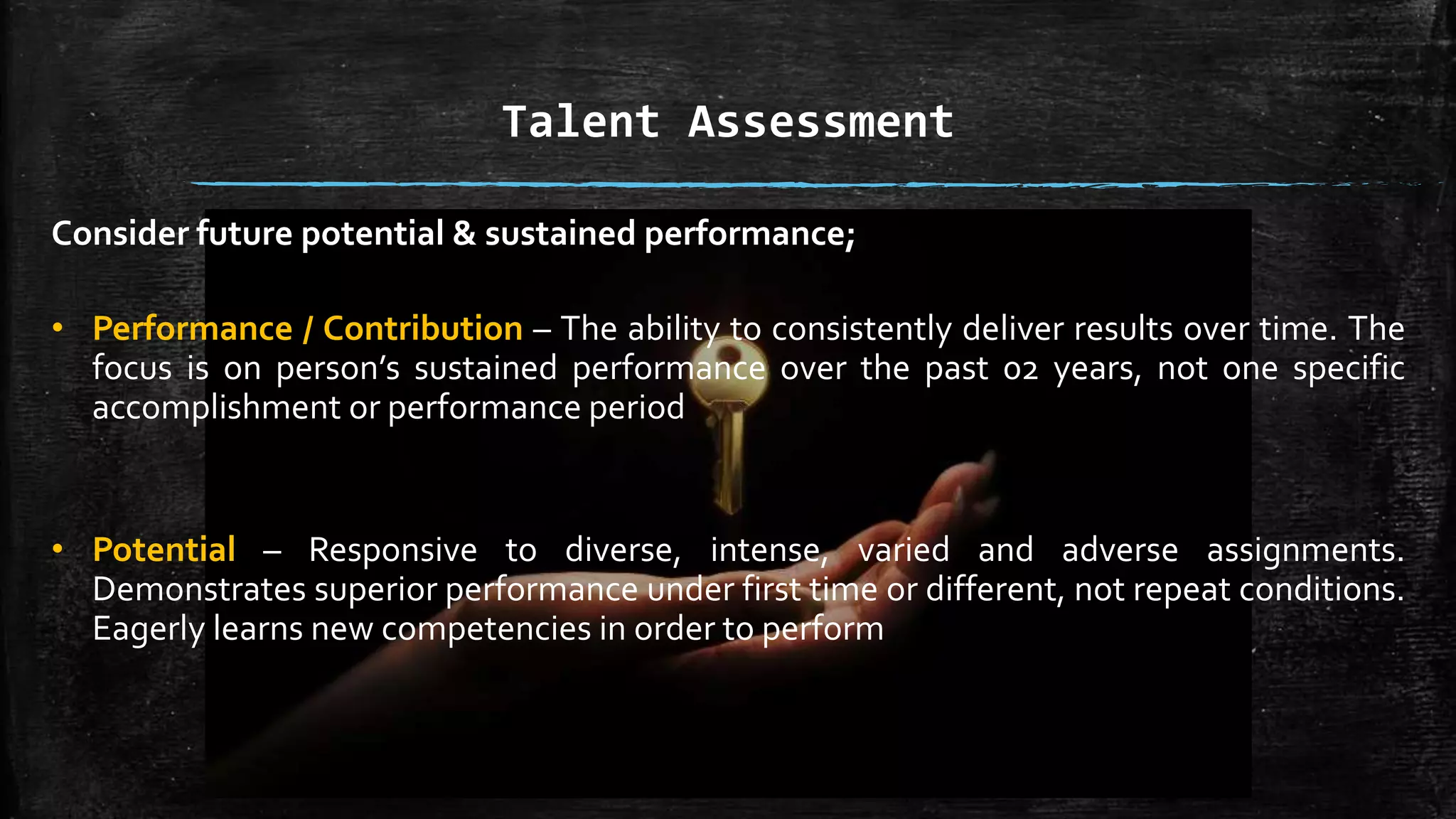
Talent Assessment
Consider future potential & sustained performance;
• Performance / Contribution – The ability to consistently deliver results over time. The
focus is on person’s sustained performance over the past 02 years, not one specific
accomplishment or performance period
• Potential – Responsive to diverse, intense, varied and adverse assignments.
Demonstrates superior performance under first time or different, not repeat conditions.
Eagerly learns new competencies in order to perform
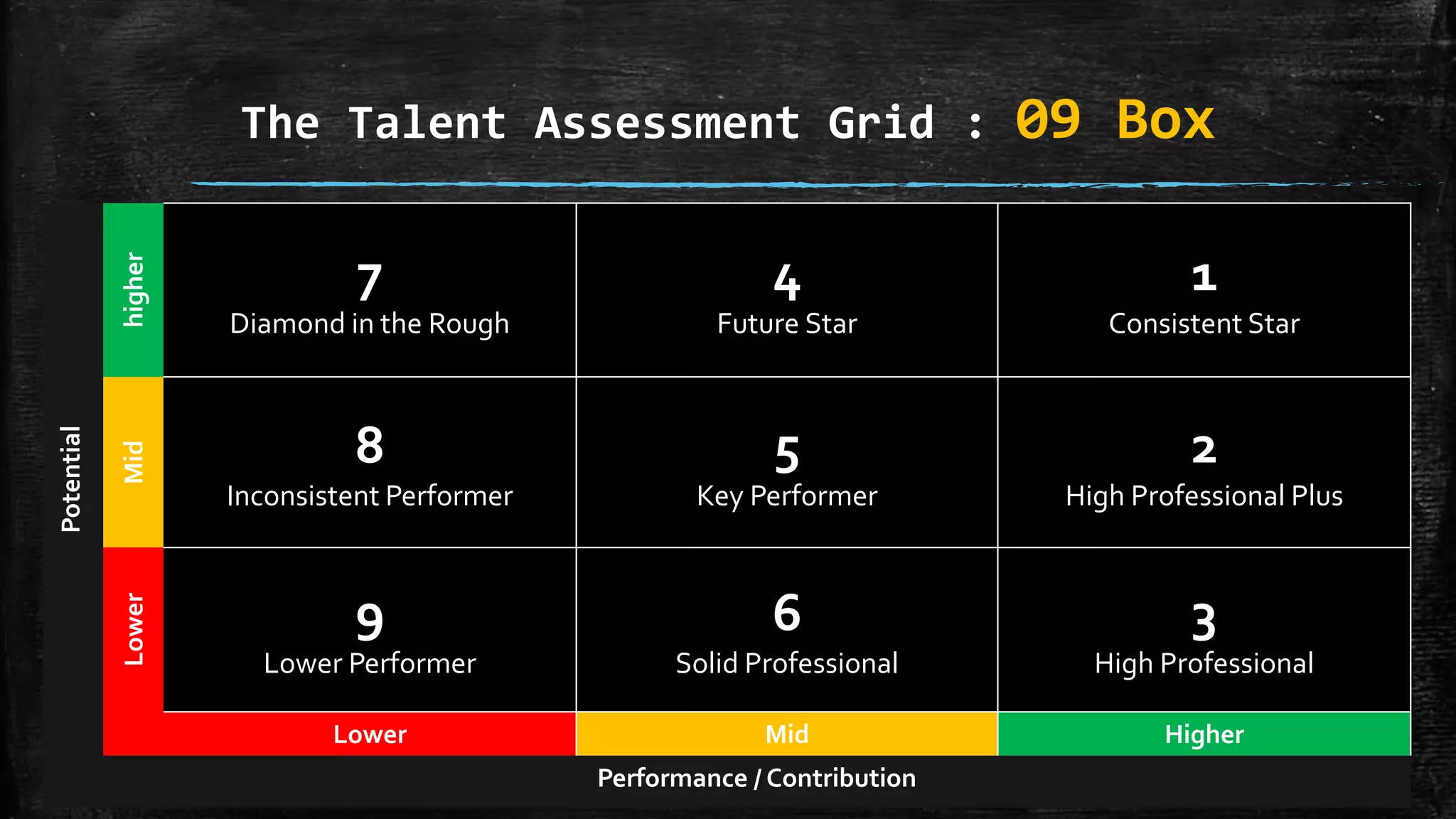
The Talent Assessment Grid : 09 Box
Potential
higher
7
Diamond in the Rough
4
Future Star
1
Consistent Star
Mid
8
Inconsistent Performer
5
Key Performer
2
High Professional Plus
Lower
9
Lower Performer
6
Solid Professional
3
High Professional
Lower Mid Higher
Performance / Contribution
A way to measure Potential
Aon Hewitt defines potential as the
assessment of an employee’s ability
to rise to and succeed in a more
senior or expanded role
Potential considers individuals’
performance, character, capability
and motivation
Rating
Performance Appraisal Score
(1 – 5 Scale)
Description
High
Contribution
3.00 – 5.00
• Employee consistently (last 2 years) exceeds
performance expectations
Solid
Contribution
2.00 – 2.99
• Employee consistently (last 2 years) meets and may
sometimes exceed performance expectations
• Can have a single year of exceeding expectations or a
single year of not meeting expectations
Low
Contribution
0.00 – 1.99
• Employee consistently (last 2 years) does not meet
performance expectations
• New to company / Newly promoted with a scope, role or
function change
A way to measure Performance / Contribution
Individual is
developing in the
current role and
with LONGTERM
DEVELOPMENT
can assume a role
of a greater
responsibility
RF
Ready
Future
(more than
03 years)
Individual has
reasonably
developed in
current role and
with SOME
DEVELOPMENT
can assume greater
responsibilities
RS
Ready Soon
(1 -3 years)
The current role
does not provide
additional
development
opportunities.Can
assume greater
responsibility NOW
RN
Ready Now
(Less than 1
year)
• A secondary component to determining where an individual is placed on the high potential spectrum is to
evaluate the employee’s readiness to take on expanded responsibilities or experience a change in role
• Readiness is typically categorized into three stages;
• This helps the organizations to determine timelines to identify critical gaps in capabilities and identify pipeline risks
within succession planning processes
Developmental Readiness
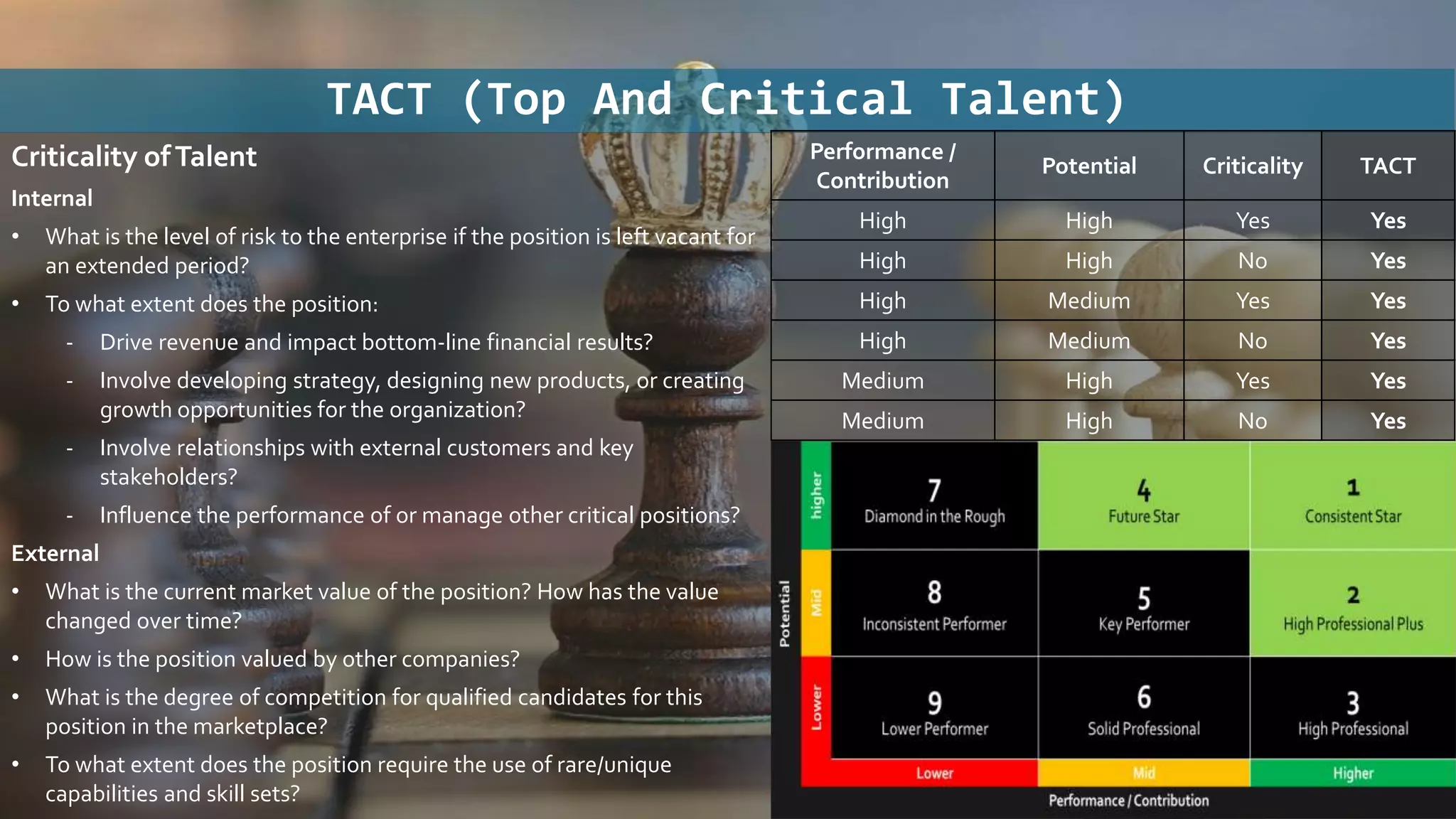
TACT (Top And Critical Talent)
Performance /
Contribution
Potential Criticality TACT
High High Yes Yes
High High No Yes
High Medium Yes Yes
High Medium No Yes
Medium High Yes Yes
Medium High No Yes
Criticality ofTalent
Internal
• What is the level of risk to the enterprise if the position is left vacant for
an extended period?
• To what extent does the position:
- Drive revenue and impact bottom-line financial results?
- Involve developing strategy, designing new products, or creating
growth opportunities for the organization?
- Involve relationships with external customers and key
stakeholders?
- Influence the performance of or manage other critical positions?
External
• What is the current market value of the position? How has the value
changed over time?
• How is the position valued by other companies?
• What is the degree of competition for qualified candidates for this
position in the marketplace?
• To what extent does the position require the use of rare/unique
capabilities and skill sets?
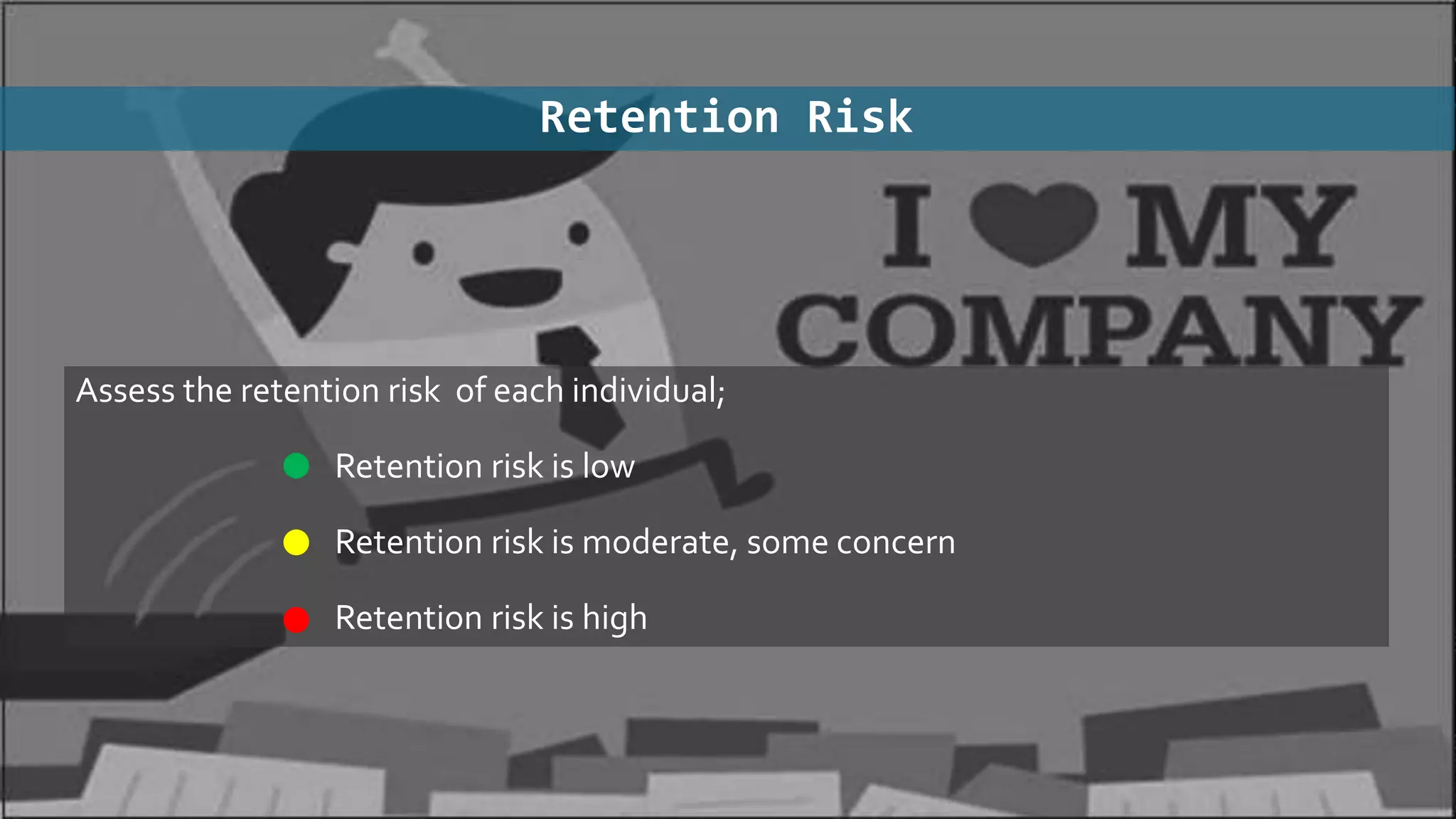
Retention Risk
Assess the retention risk of each individual;
• Retention risk is low
• Retention risk is moderate, some concern
• Retention risk is high
Four types ofTalent Conversations
These four types of talent conversation provide
guidelines to help you;
• Prepare the key message you want to share with
the employee
• Anticipate and prepare for the employee’s
reaction
• Identify needed development areas
• Determine the types of support the employee will
need to be successful
Cell No PossibleTalent Development Actions
1. Consistent Star - Move thru a series of challenging and diverse jobs in every 2 – 3 years to
build perspective and breadth
- Expose to top management
- Assign them to lead key task forces, strategic projects, international
initiatives
- Assign a senior-level mentor i.e. member of the ExecutiveTeam / Board
2. High Professional Plus - Keep in current assignment and role as long as is reasonable and they are
motivated but look for additional one-off assignments for the future
- Assign them to lead key task forces, strategic projects, international
initiatives
- Facilitate and support internal & external networking in the field or area
of specialization and top management
09 Box – Possible Talent Development Actions
and so on ………………………………………
70 : 20 : 10 Rule for Leadership Development
Preparing for the Conversation
Think about someone with whom
you need to have a talent
conversation in the near future.
Keep this person in mind as you go
about preparing for the talent
conversation using the ACS model;
- Assessment
- Challenge
- Support
Deliver the Conversations
Preparing for and having a
talent conversation are two
different things.
A talent conversation is not
done to someone but with
someone
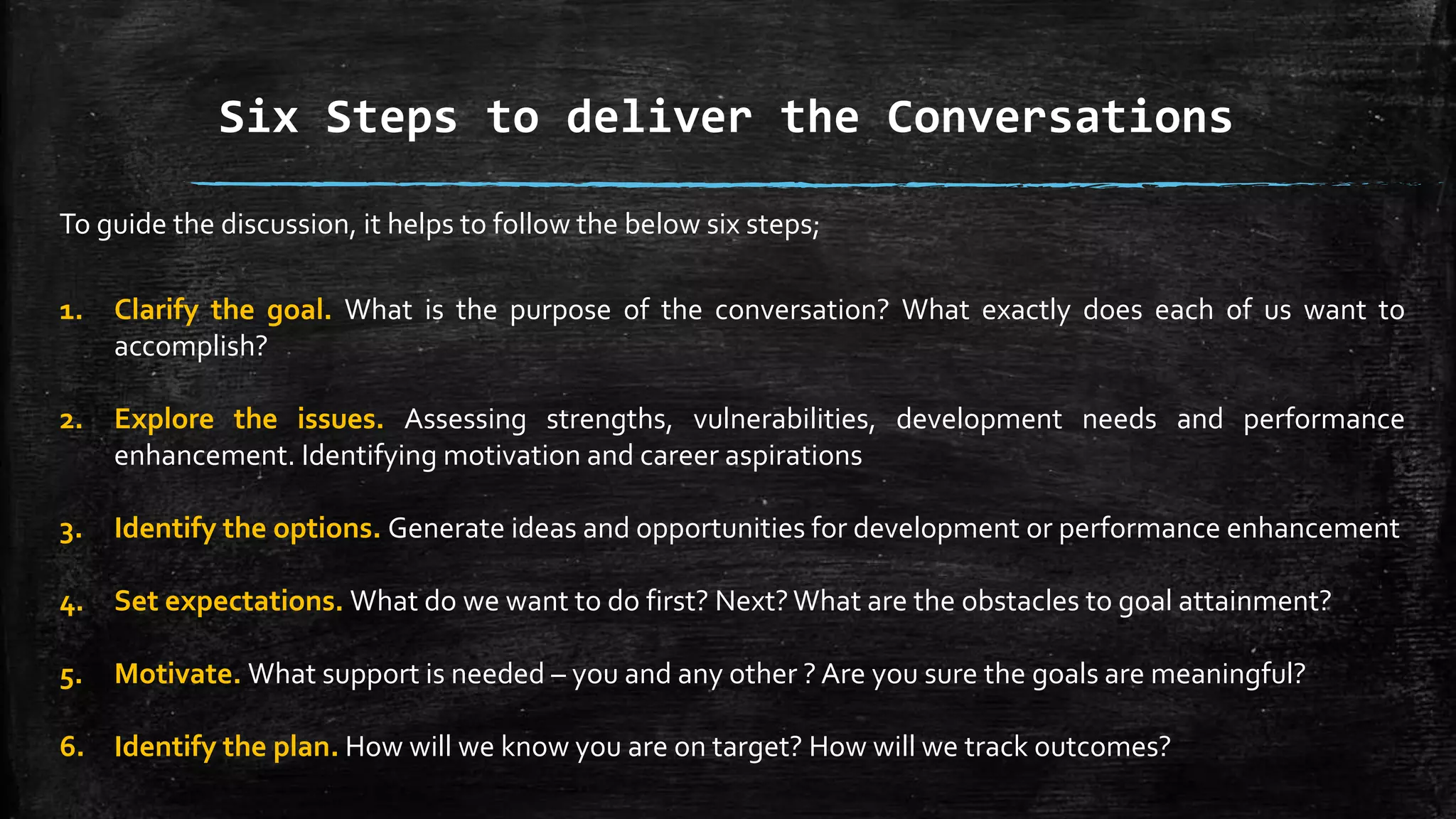
Six Steps to deliver the Conversations
To guide the discussion, it helps to follow the below six steps;
1. Clarify the goal. What is the purpose of the conversation? What exactly does each of us want to
accomplish?
2. Explore the issues. Assessing strengths, vulnerabilities, development needs and performance
enhancement. Identifying motivation and career aspirations
3. Identify the options. Generate ideas and opportunities for development or performance enhancement
4. Set expectations. What do we want to do first? Next?What are the obstacles to goal attainment?
5. Motivate. What support is needed – you and any other ? Are you sure the goals are meaningful?
6. Identify the plan. How will we know you are on target? How will we track outcomes?
Regardless of the economic situation a company finds itself in, its top talent has choices. Talent
Conversations are critical to retaining high potentials
Three things would help to strengthen the Talent Pipeline;
• Clearly Identify Your High Potentials
• Take a Personal Approach
Treating all high-potential employees the same is a common mistake
• Engage in the Best Strategy: Reciprocity
High potentials receive the investment in development they want from their organization
Organization receives a more committed and engaged group of leaders along with stronger
performance and bottom-line results
Bottom line : Crucial to have talent conversations. Do them right, Do them
now !
Do it right, do it now !
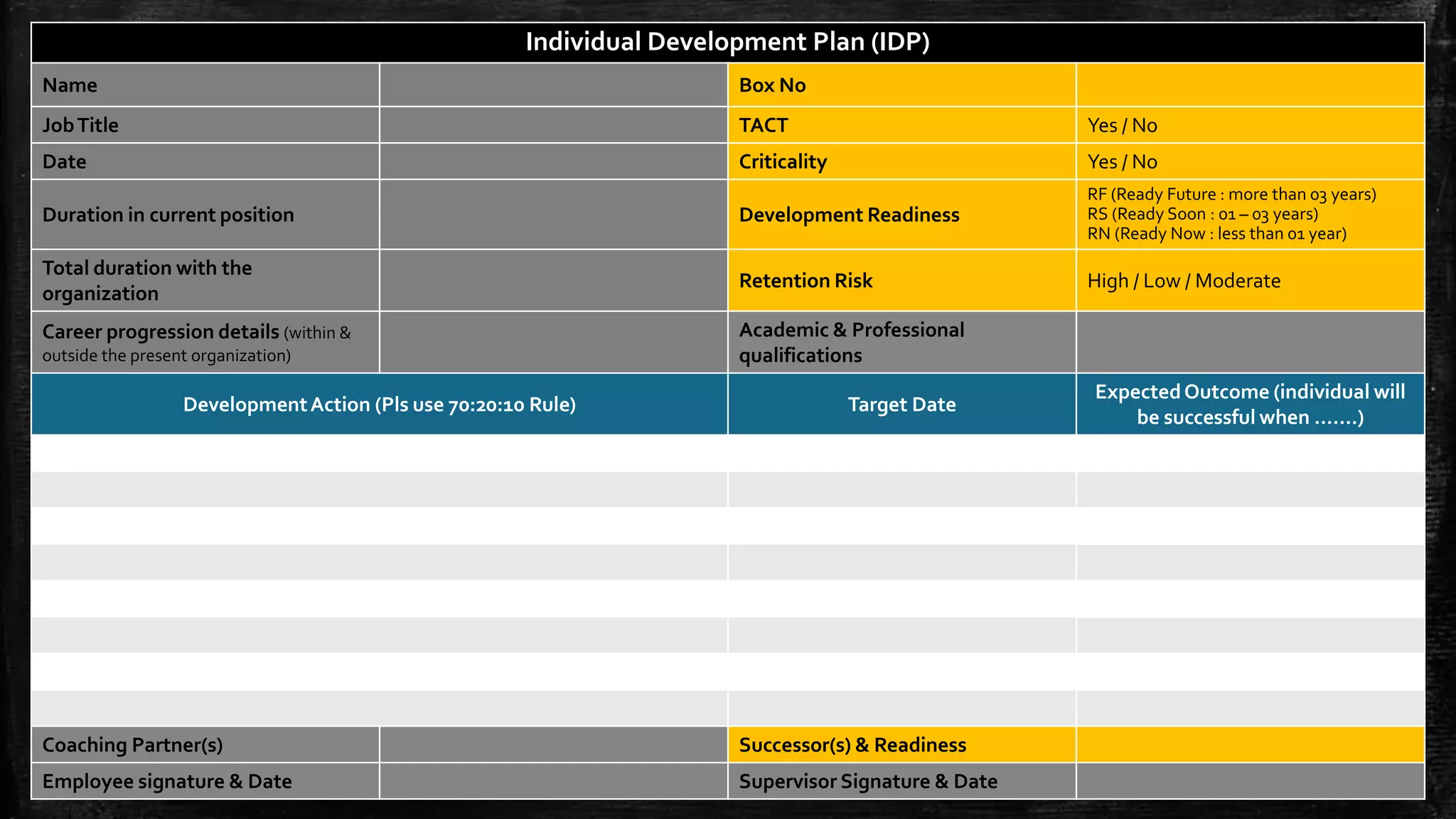
Individual Development Plan (IDP)
Name Box No
JobTitle TACT Yes / No
Date Criticality Yes / No
Duration in current position Development Readiness
RF (Ready Future : more than 03 years)
RS (Ready Soon : 01 – 03 years)
RN (Ready Now : less than 01 year)
Total duration with the
organization
Retention Risk High / Low / Moderate
Career progression details (within &
outside the present organization)
Academic & Professional
qualifications
DevelopmentAction (Pls use 70:20:10 Rule) Target Date
ExpectedOutcome (individual will
be successful when …….)
Coaching Partner(s) Successor(s) & Readiness
Employee signature & Date Supervisor Signature & Date
• Talent Conversations : What They Are, Why They’re Crucial, and How To Do Them Right by Roland Smith and
Michael Campbell, Centre for Creative Leadership
• Talent Review & Development Guidebook by Doug Adams, MDA Associates International, Boston, USA
• The 70-20-10 Rule for Leadership Development, Centre for Creative Leadership
• Building the Right High Potential Pool - How Organizations Define, Assess, and CalibrateTheir CriticalTalent
Aon Hewitt, January 2013
References
info@glenmore.lk
Glenmore Global
Resources
People | Performance | Values | Culture
glenmore.lk
glenmore.harrisonassessments.asia

Talent Conversations by Glenmore Global Resources

  • 1.
    Talent Conversations Glenmore GlobalResources People | Performance | Values | Culture
  • 2.
    . . . . In-depth learning aboutTalent Assessment Grid- 09 Box Map individuals with; - Dev Readiness -TACT - Retention Risk 04Types ofTalent Conversations Apply 70:20:10 Rule ACS Dev Model for an effective talent conversation Contents in Brief
  • 3.
    Learning Objectives • Apply09 Box Talent Assessment Grid to analyze the talent pool to provide a snapshot of succession pipeline, leadership bench strength & potential risks and prepare the organization to take action appropriate • Learn possible talent development actions for each type of individual including inconsistent & lower performers • Conduct Talent Conversations in order to help individuals to improve performance, focus development & reach positive outcomes
  • 4.
    Talent Assessment Consider futurepotential & sustained performance; • Performance / Contribution – The ability to consistently deliver results over time. The focus is on person’s sustained performance over the past 02 years, not one specific accomplishment or performance period • Potential – Responsive to diverse, intense, varied and adverse assignments. Demonstrates superior performance under first time or different, not repeat conditions. Eagerly learns new competencies in order to perform
  • 5.
    The Talent AssessmentGrid : 09 Box Potential higher 7 Diamond in the Rough 4 Future Star 1 Consistent Star Mid 8 Inconsistent Performer 5 Key Performer 2 High Professional Plus Lower 9 Lower Performer 6 Solid Professional 3 High Professional Lower Mid Higher Performance / Contribution
  • 6.
    A way tomeasure Potential Aon Hewitt defines potential as the assessment of an employee’s ability to rise to and succeed in a more senior or expanded role Potential considers individuals’ performance, character, capability and motivation
  • 7.
    Rating Performance Appraisal Score (1– 5 Scale) Description High Contribution 3.00 – 5.00 • Employee consistently (last 2 years) exceeds performance expectations Solid Contribution 2.00 – 2.99 • Employee consistently (last 2 years) meets and may sometimes exceed performance expectations • Can have a single year of exceeding expectations or a single year of not meeting expectations Low Contribution 0.00 – 1.99 • Employee consistently (last 2 years) does not meet performance expectations • New to company / Newly promoted with a scope, role or function change A way to measure Performance / Contribution
  • 8.
    Individual is developing inthe current role and with LONGTERM DEVELOPMENT can assume a role of a greater responsibility RF Ready Future (more than 03 years) Individual has reasonably developed in current role and with SOME DEVELOPMENT can assume greater responsibilities RS Ready Soon (1 -3 years) The current role does not provide additional development opportunities.Can assume greater responsibility NOW RN Ready Now (Less than 1 year) • A secondary component to determining where an individual is placed on the high potential spectrum is to evaluate the employee’s readiness to take on expanded responsibilities or experience a change in role • Readiness is typically categorized into three stages; • This helps the organizations to determine timelines to identify critical gaps in capabilities and identify pipeline risks within succession planning processes Developmental Readiness
  • 9.
    TACT (Top AndCritical Talent) Performance / Contribution Potential Criticality TACT High High Yes Yes High High No Yes High Medium Yes Yes High Medium No Yes Medium High Yes Yes Medium High No Yes Criticality ofTalent Internal • What is the level of risk to the enterprise if the position is left vacant for an extended period? • To what extent does the position: - Drive revenue and impact bottom-line financial results? - Involve developing strategy, designing new products, or creating growth opportunities for the organization? - Involve relationships with external customers and key stakeholders? - Influence the performance of or manage other critical positions? External • What is the current market value of the position? How has the value changed over time? • How is the position valued by other companies? • What is the degree of competition for qualified candidates for this position in the marketplace? • To what extent does the position require the use of rare/unique capabilities and skill sets?
  • 10.
    Retention Risk Assess theretention risk of each individual; • Retention risk is low • Retention risk is moderate, some concern • Retention risk is high
  • 11.
    Four types ofTalentConversations These four types of talent conversation provide guidelines to help you; • Prepare the key message you want to share with the employee • Anticipate and prepare for the employee’s reaction • Identify needed development areas • Determine the types of support the employee will need to be successful
  • 12.
    Cell No PossibleTalentDevelopment Actions 1. Consistent Star - Move thru a series of challenging and diverse jobs in every 2 – 3 years to build perspective and breadth - Expose to top management - Assign them to lead key task forces, strategic projects, international initiatives - Assign a senior-level mentor i.e. member of the ExecutiveTeam / Board 2. High Professional Plus - Keep in current assignment and role as long as is reasonable and they are motivated but look for additional one-off assignments for the future - Assign them to lead key task forces, strategic projects, international initiatives - Facilitate and support internal & external networking in the field or area of specialization and top management 09 Box – Possible Talent Development Actions
  • 13.
    09 Box –Possible Talent Development Actions and so on ………………………………………
  • 14.
    70 : 20: 10 Rule for Leadership Development
  • 15.
    Preparing for theConversation Think about someone with whom you need to have a talent conversation in the near future. Keep this person in mind as you go about preparing for the talent conversation using the ACS model; - Assessment - Challenge - Support
  • 16.
    Deliver the Conversations Preparingfor and having a talent conversation are two different things. A talent conversation is not done to someone but with someone
  • 17.
    Six Steps todeliver the Conversations To guide the discussion, it helps to follow the below six steps; 1. Clarify the goal. What is the purpose of the conversation? What exactly does each of us want to accomplish? 2. Explore the issues. Assessing strengths, vulnerabilities, development needs and performance enhancement. Identifying motivation and career aspirations 3. Identify the options. Generate ideas and opportunities for development or performance enhancement 4. Set expectations. What do we want to do first? Next?What are the obstacles to goal attainment? 5. Motivate. What support is needed – you and any other ? Are you sure the goals are meaningful? 6. Identify the plan. How will we know you are on target? How will we track outcomes?
  • 18.
    Regardless of theeconomic situation a company finds itself in, its top talent has choices. Talent Conversations are critical to retaining high potentials Three things would help to strengthen the Talent Pipeline; • Clearly Identify Your High Potentials • Take a Personal Approach Treating all high-potential employees the same is a common mistake • Engage in the Best Strategy: Reciprocity High potentials receive the investment in development they want from their organization Organization receives a more committed and engaged group of leaders along with stronger performance and bottom-line results Bottom line : Crucial to have talent conversations. Do them right, Do them now ! Do it right, do it now !
  • 19.
    Individual Development Plan(IDP) Name Box No JobTitle TACT Yes / No Date Criticality Yes / No Duration in current position Development Readiness RF (Ready Future : more than 03 years) RS (Ready Soon : 01 – 03 years) RN (Ready Now : less than 01 year) Total duration with the organization Retention Risk High / Low / Moderate Career progression details (within & outside the present organization) Academic & Professional qualifications DevelopmentAction (Pls use 70:20:10 Rule) Target Date ExpectedOutcome (individual will be successful when …….) Coaching Partner(s) Successor(s) & Readiness Employee signature & Date Supervisor Signature & Date
  • 20.
    • Talent Conversations: What They Are, Why They’re Crucial, and How To Do Them Right by Roland Smith and Michael Campbell, Centre for Creative Leadership • Talent Review & Development Guidebook by Doug Adams, MDA Associates International, Boston, USA • The 70-20-10 Rule for Leadership Development, Centre for Creative Leadership • Building the Right High Potential Pool - How Organizations Define, Assess, and CalibrateTheir CriticalTalent Aon Hewitt, January 2013 References
  • 21.
  • 22.
    Glenmore Global Resources People |Performance | Values | Culture glenmore.lk glenmore.harrisonassessments.asia