Building An Employee Value Proposition
Lesley Harvey
The Human Edge
Agenda
• Welcome
• Housekeeping notes
• Session starts
• Q&A
• End of webinar
Housekeeping
• Slides will be available on our SlideShare page, link will be emailed to you
• Recording of the webinar will be available to download, link will be
emailed
• Take the time to complete post-webinar survey that will pop up at the
end
• You can type your questions throughout the session
• Time will be allocated in the end for the speaker to address your
questions
Today’s Presenter
Lesley Harvey, Director – The Human Edge, is an accomplished management consultant specialising
in Human Resources, an author, speaker and facilitator. She started her career in sales and
marketing, followed by marketing management, and then Human Resources, where she used her
marketing skills to good effect when managing employment branding, internal communications and
building employee engagement within organisations.
With over 18 years’ experience in HR, Lesley has extensive hands-on expertise in large multinational
organisations based in the UK and internationally.
What is it
• Describes the mix of characteristics, benefits, and ways of working in
an organisation.
• It is the deal struck between an organisation and employee in return
for their contribution and performance
• It is a major differentiator between one organisation and another
• And it is the basis on which individuals make employment decisions.
• Answers the question : What’s in it for me to come and work for you?
Why is it important?
• Most organisations encounter two main problems when it comes to
their EVP:
• They struggle to differentiate themselves from their competition.
Differentiation is crucial if an organisation is to stand out from the “sea of
sameness” that characterises some sectors.
• Their branding is appealing but it does not accurately reflect the reality
• An effective EVP enables an organisation to stand out as different but
also it ensures that the “packaging‟ reflects the “contents”.
• All too often people join organisations tempted by the “branding‟
and are disappointed when they experience the reality
What are the benefits?
• Helps you to attract and retain talent
• Helps you to appeal to different markets and tough to hire talent
groups
• Means you stand out for reasons other than cash
• Helps you to re-engage your current workforce – and through that
drives up performance
• Enables you to attract unsolicited applications from ‘hidden’ talent
pools
• Helps you to prioritise your HR agenda
• Creates a strong “people‟ brand
What makes a good EVP?
• It clearly articulates what you have to offer
• It differentiates you easily from the competition
• It is built around attributes that genuinely targets the talent you want
to attract
• The EVP is at the core of all other organisational processes
• If operationalised well is the driver of engagement
It answers these questions
• Are we offering a differentiated promise which will attract target
candidates and motivate current employees, and which is closely
aligned to our corporate brand?
• Are we over-reliant on salaries and missing other more compelling
attraction and retention benefits?
• Are we investing efficiently using an integrated media approach which
targets the right candidates at the right time with the right message?
• Are our employees experiencing the promises they were given when
they joined?
Corporate Brand v EVP
• A corporate brand positioning sets the agenda for the promises to
specific target audiences – customers, employees, shareholders and
the wider community.
• The EVP defines the employee experience of the corporate brand and
links to and build off key corporate brand elements, such as the
corporate brand values or beliefs, and engage all employees in its
delivery.
What should an EVP Contain?
• it should comprise similar elements to a brand– namely, a clear strategic
positioning (how we define our market, who’s our target candidate/s,
who’s our competitive set);
• an underpinning insight, based on a deep understanding of target
candidate and employee needs and motivations;
• a compelling and differentiating promise, supported by key, tangible facts;
• and an integrated expression of the EVP across all external and internal
‘touchpoints’.
• In short, an EVP should provide a succinct and clear distillation of what sets
you apart as an employer, brought to life in a way which your target
candidates or employees will find irresistible.
• Think Virgin, Google, Procter & Gamble, Accenture...
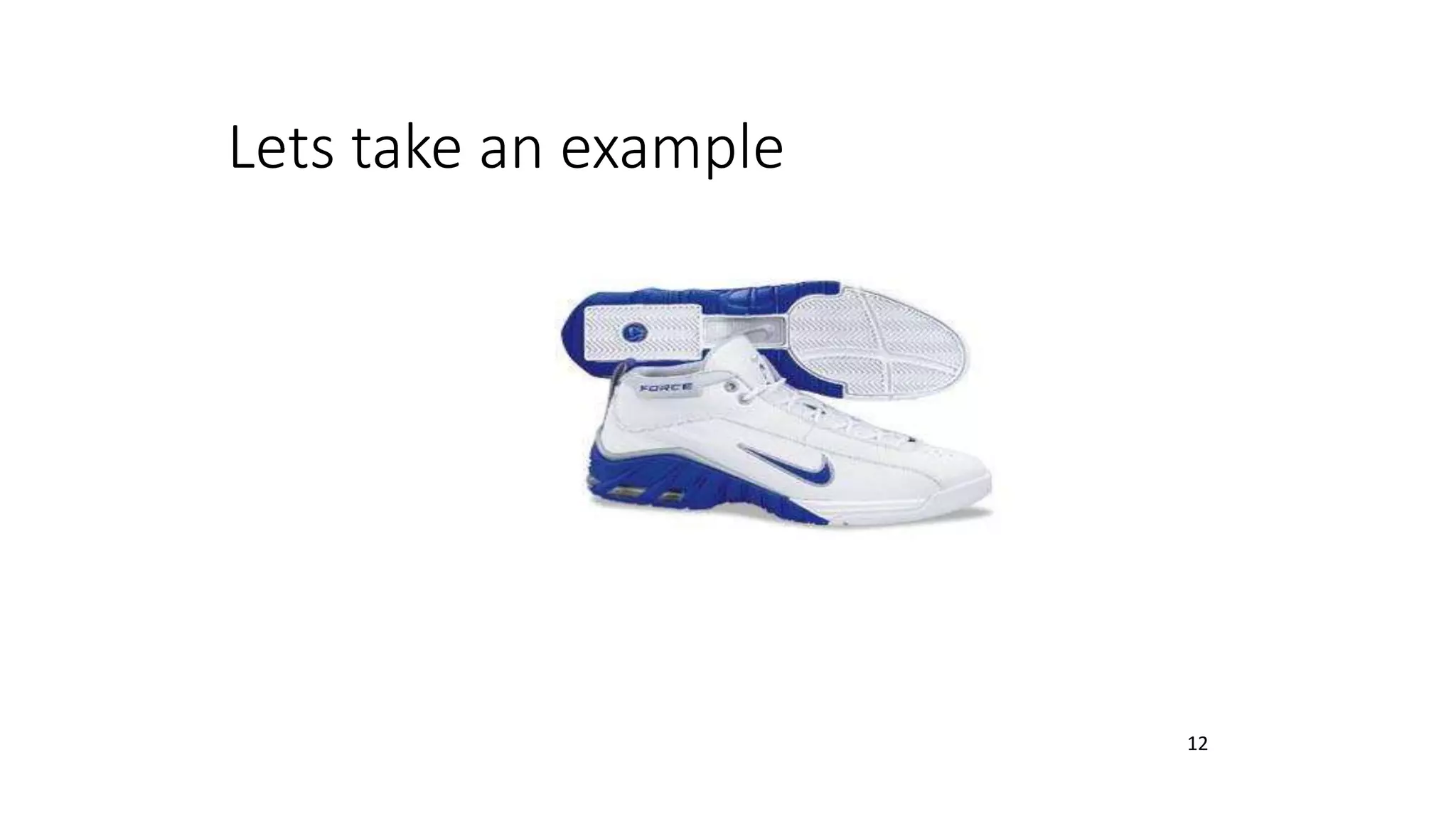
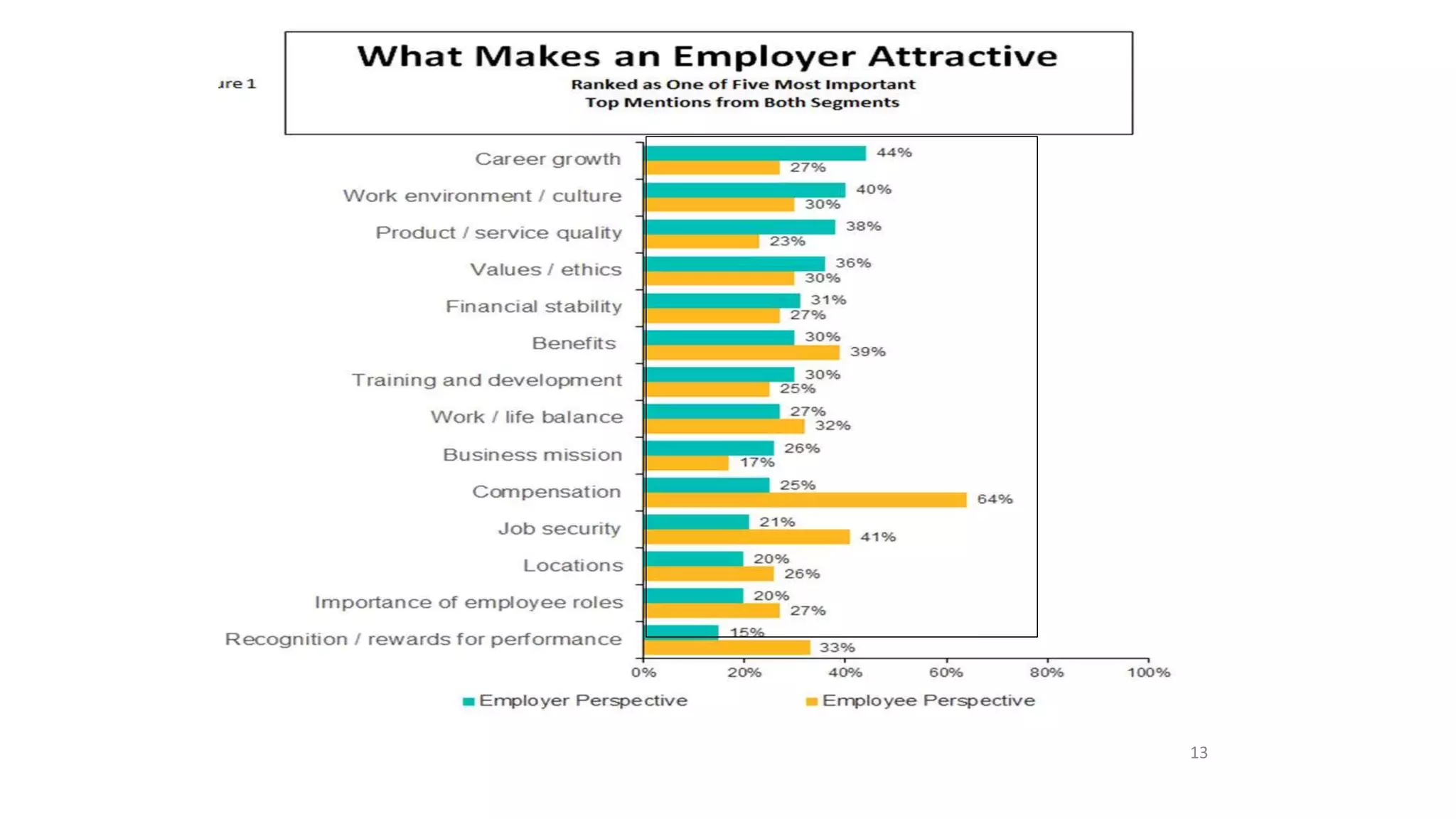
Lets take an example
12
13
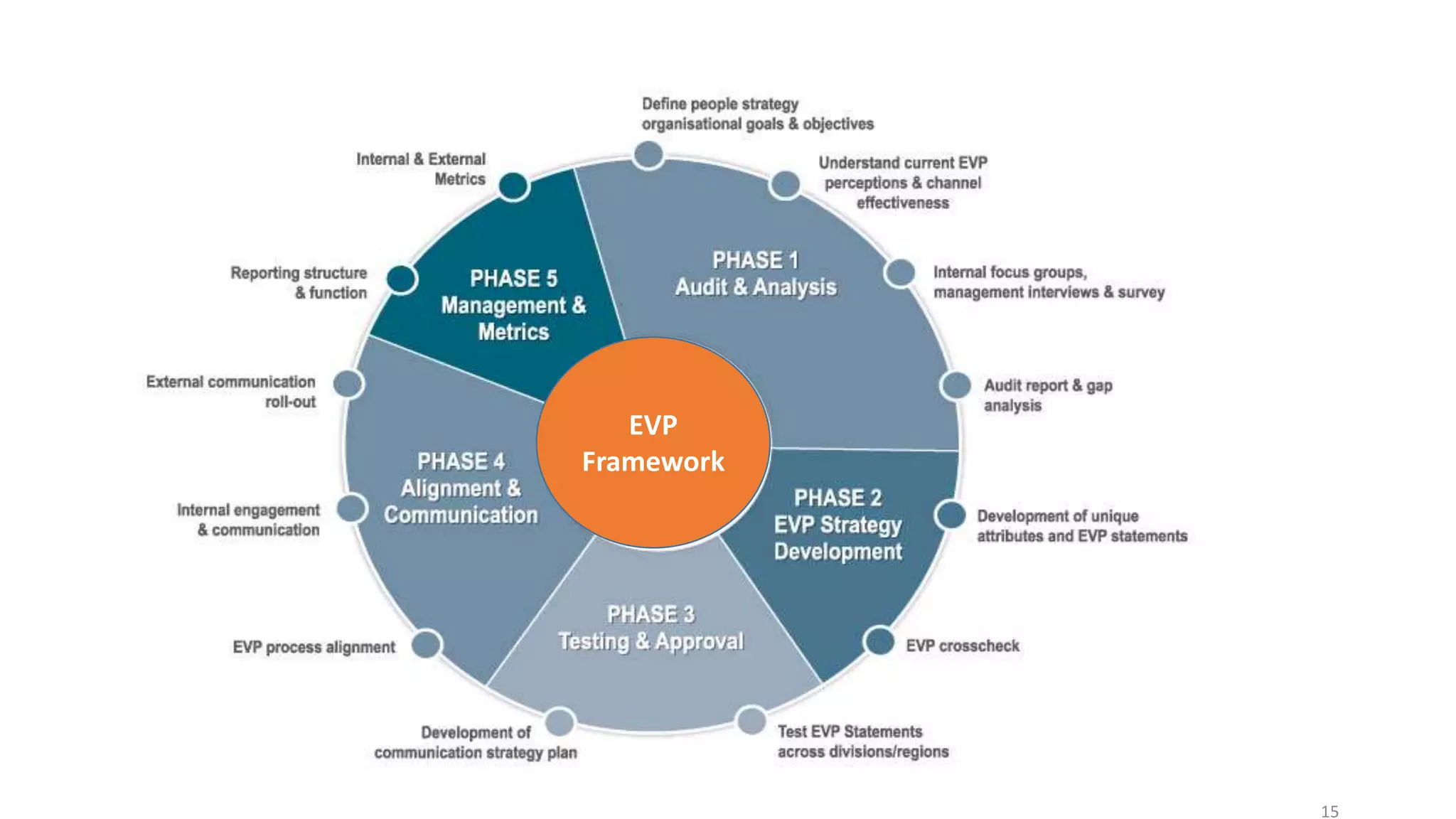
How do we create one
Collect
Data
Analyse
Data
Develop
test
proposition
Revise and
Finalise
Launch Review
15
EVP
Framework
In short
Employee Value Propositions offer a key
marketing tool to enable employers to
attract and retain the right talent and to
build the competitive edge needed to
drive growth.
Questions?
Please type your questions in the Question box on the right.
Thank you for your time!

Building an employee value proposition

  • 1.
    Building An EmployeeValue Proposition Lesley Harvey The Human Edge
  • 2.
    Agenda • Welcome • Housekeepingnotes • Session starts • Q&A • End of webinar
  • 3.
    Housekeeping • Slides willbe available on our SlideShare page, link will be emailed to you • Recording of the webinar will be available to download, link will be emailed • Take the time to complete post-webinar survey that will pop up at the end • You can type your questions throughout the session • Time will be allocated in the end for the speaker to address your questions
  • 4.
    Today’s Presenter Lesley Harvey,Director – The Human Edge, is an accomplished management consultant specialising in Human Resources, an author, speaker and facilitator. She started her career in sales and marketing, followed by marketing management, and then Human Resources, where she used her marketing skills to good effect when managing employment branding, internal communications and building employee engagement within organisations. With over 18 years’ experience in HR, Lesley has extensive hands-on expertise in large multinational organisations based in the UK and internationally.
  • 5.
    What is it •Describes the mix of characteristics, benefits, and ways of working in an organisation. • It is the deal struck between an organisation and employee in return for their contribution and performance • It is a major differentiator between one organisation and another • And it is the basis on which individuals make employment decisions. • Answers the question : What’s in it for me to come and work for you?
  • 6.
    Why is itimportant? • Most organisations encounter two main problems when it comes to their EVP: • They struggle to differentiate themselves from their competition. Differentiation is crucial if an organisation is to stand out from the “sea of sameness” that characterises some sectors. • Their branding is appealing but it does not accurately reflect the reality • An effective EVP enables an organisation to stand out as different but also it ensures that the “packaging‟ reflects the “contents”. • All too often people join organisations tempted by the “branding‟ and are disappointed when they experience the reality
  • 7.
    What are thebenefits? • Helps you to attract and retain talent • Helps you to appeal to different markets and tough to hire talent groups • Means you stand out for reasons other than cash • Helps you to re-engage your current workforce – and through that drives up performance • Enables you to attract unsolicited applications from ‘hidden’ talent pools • Helps you to prioritise your HR agenda • Creates a strong “people‟ brand
  • 8.
    What makes agood EVP? • It clearly articulates what you have to offer • It differentiates you easily from the competition • It is built around attributes that genuinely targets the talent you want to attract • The EVP is at the core of all other organisational processes • If operationalised well is the driver of engagement
  • 9.
    It answers thesequestions • Are we offering a differentiated promise which will attract target candidates and motivate current employees, and which is closely aligned to our corporate brand? • Are we over-reliant on salaries and missing other more compelling attraction and retention benefits? • Are we investing efficiently using an integrated media approach which targets the right candidates at the right time with the right message? • Are our employees experiencing the promises they were given when they joined?
  • 10.
    Corporate Brand vEVP • A corporate brand positioning sets the agenda for the promises to specific target audiences – customers, employees, shareholders and the wider community. • The EVP defines the employee experience of the corporate brand and links to and build off key corporate brand elements, such as the corporate brand values or beliefs, and engage all employees in its delivery.
  • 11.
    What should anEVP Contain? • it should comprise similar elements to a brand– namely, a clear strategic positioning (how we define our market, who’s our target candidate/s, who’s our competitive set); • an underpinning insight, based on a deep understanding of target candidate and employee needs and motivations; • a compelling and differentiating promise, supported by key, tangible facts; • and an integrated expression of the EVP across all external and internal ‘touchpoints’. • In short, an EVP should provide a succinct and clear distillation of what sets you apart as an employer, brought to life in a way which your target candidates or employees will find irresistible. • Think Virgin, Google, Procter & Gamble, Accenture...
  • 12.
    Lets take anexample 12
  • 13.
  • 14.
    How do wecreate one Collect Data Analyse Data Develop test proposition Revise and Finalise Launch Review
  • 15.
  • 16.
    In short Employee ValuePropositions offer a key marketing tool to enable employers to attract and retain the right talent and to build the competitive edge needed to drive growth.
  • 17.
    Questions? Please type yourquestions in the Question box on the right.
  • 18.
    Thank you foryour time!