1
1
Building & Assessing
Competencies for
Organizational Development
- Sangeeta Mathur
(mathur.sangeeta@gmail.com)
Sources:
1) “The handbook of competency mapping” by Seema Sanghi
2) “360 degree feedback, competency mapping & assessment
centers” by Radha R Sharma
3) “360 degree feedback” by Peter Ward
2
2
Contents
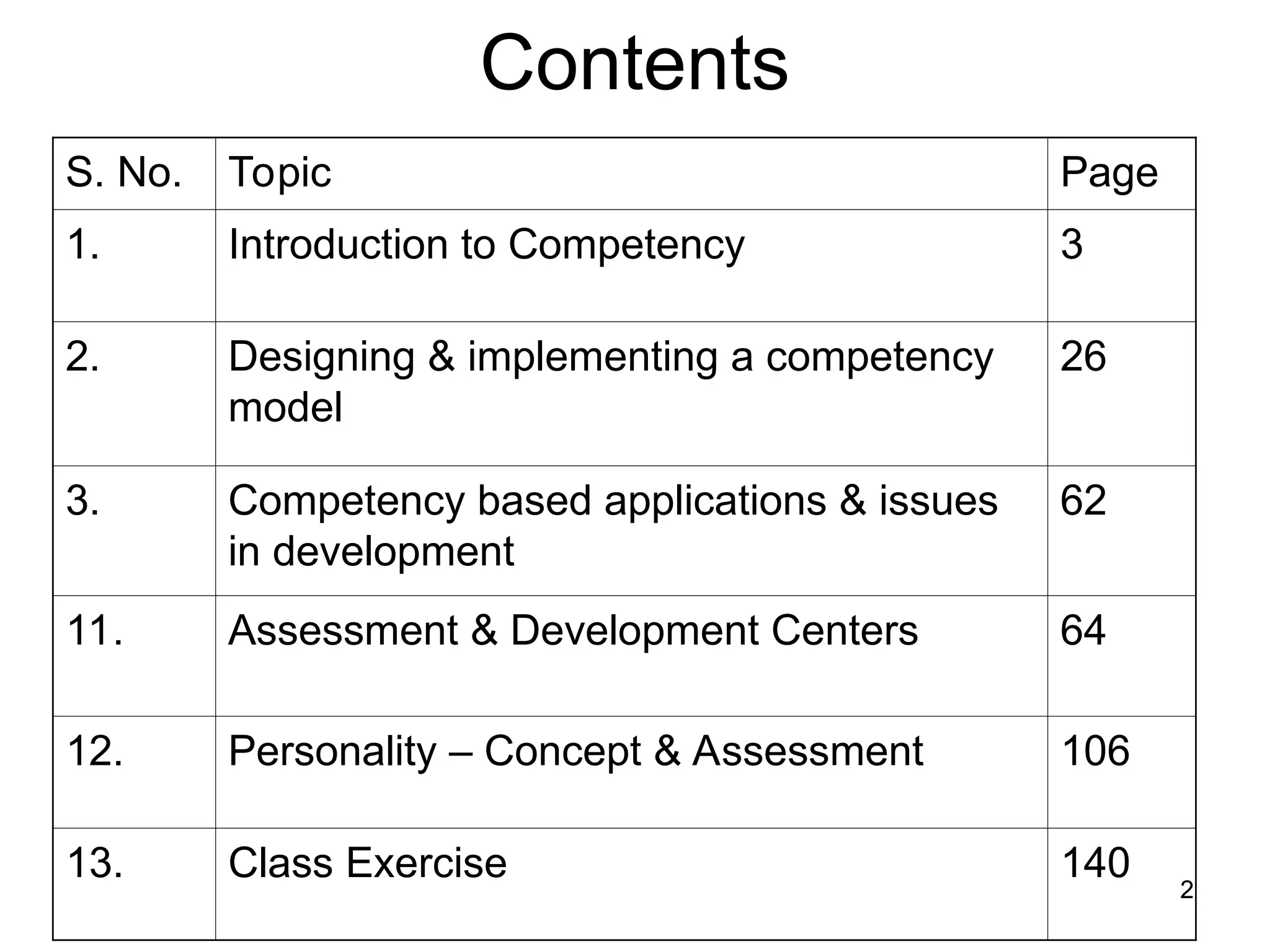
S. No. Topic Page
1. Introduction to Competency 3
2. Designing & implementing a competency
model
26
3. Competency based applications & issues
in development
62
11. Assessment & Development Centers 64
12. Personality – Concept & Assessment 106
13. Class Exercise 140
3
3
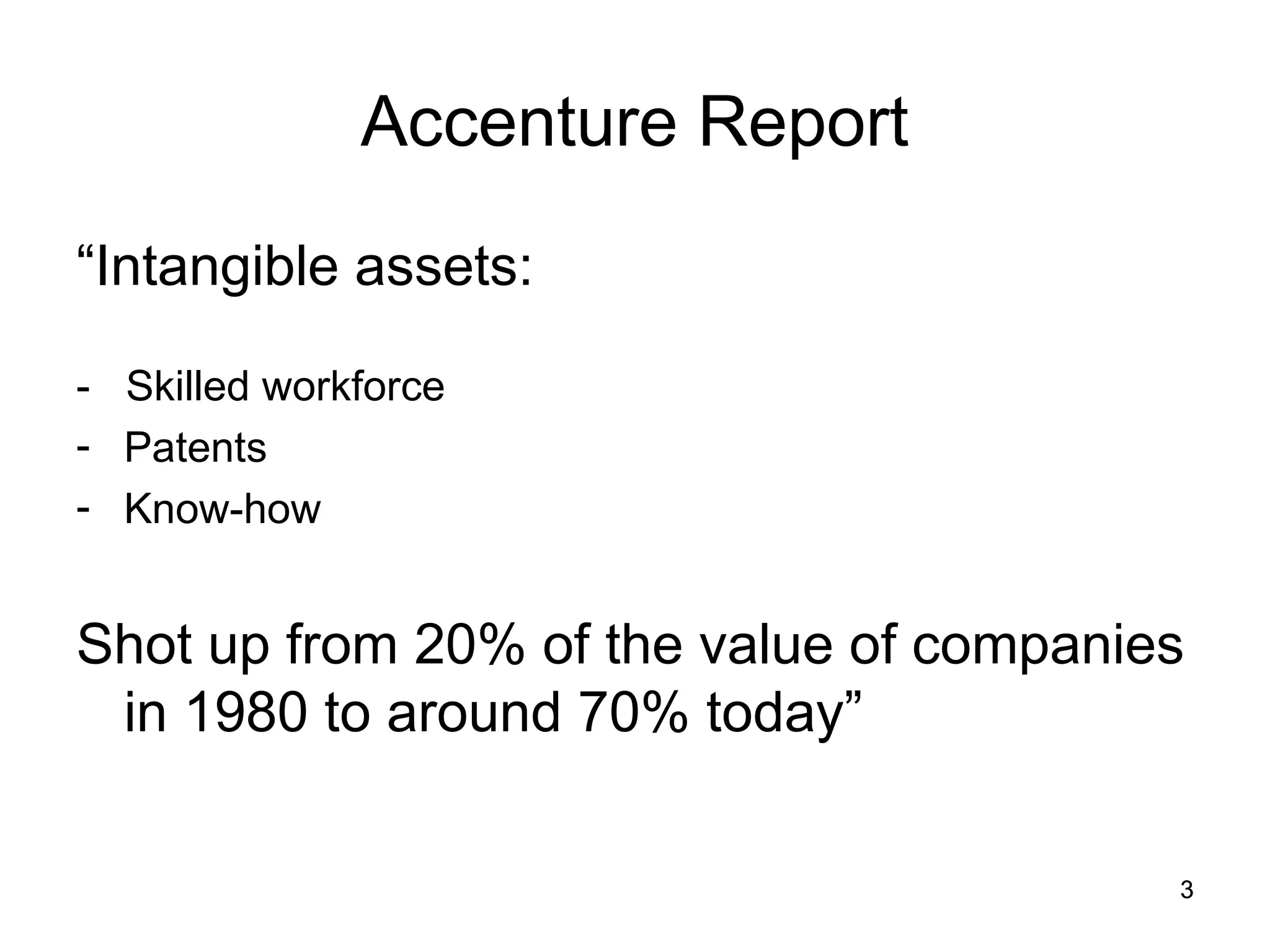
Accenture Report
“Intangible assets:
- Skilled workforce
- Patents
- Know-how
Shot up from 20% of the value of companies
in 1980 to around 70% today”
4
4
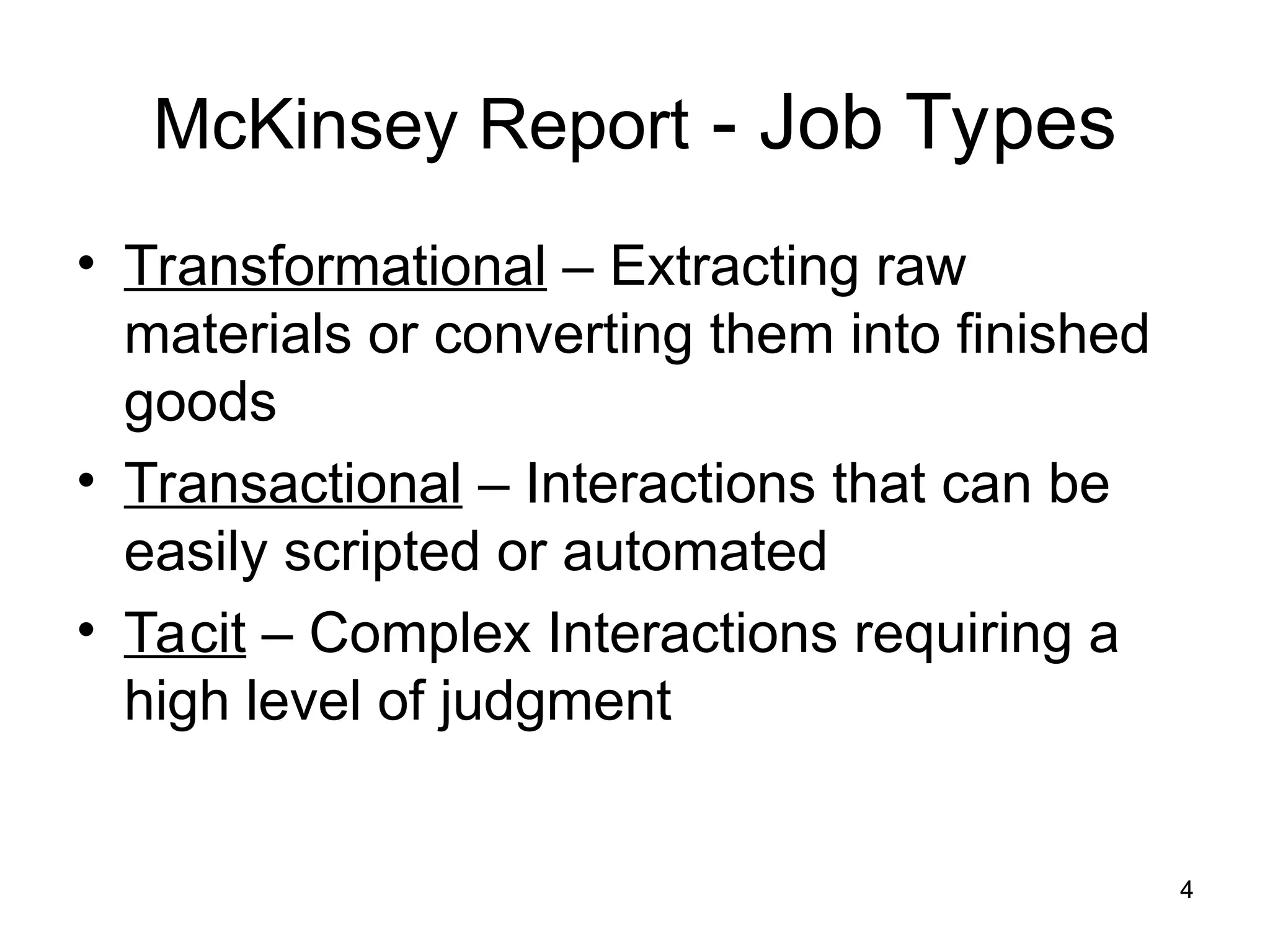
McKinsey Report - Job Types
• Transformational – Extracting raw
materials or converting them into finished
goods
• Transactional – Interactions that can be
easily scripted or automated
• Tacit – Complex Interactions requiring a
high level of judgment
5
5
“Over the past 6years, the number of
American jobs emphasizing “tacit
interactions” have grown 2.5 times
faster than transactional jobs & 3
times faster than employment in
general”
6
6
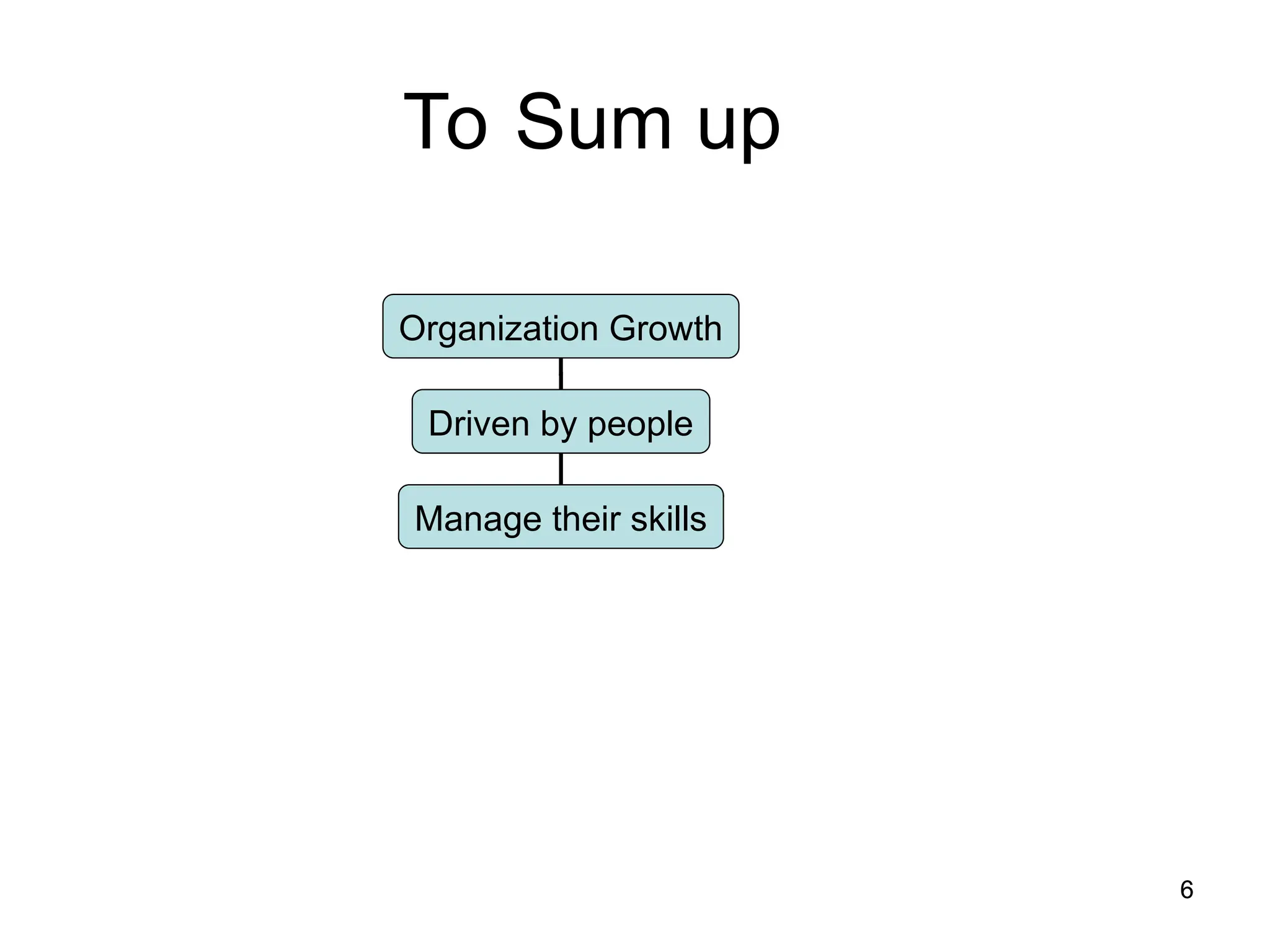
To Sum up
Organization Growth
Driven by people
Manage their skills
7
7
What is Competency
“An underlying characteristic of a person which
enables him to deliver superior performance in a
given job, role or situation”
The “attribute bundle” including the intellectual,
motivational, social & emotional capability
aspects
A combination of IQ & EQ
8
Characteristics of Competencies
• Observable & not inferred
• “Underlying characteristic” – deep &
enduring part of personality
• Not restricted to a single job; the person is
able to carry them along
9
9
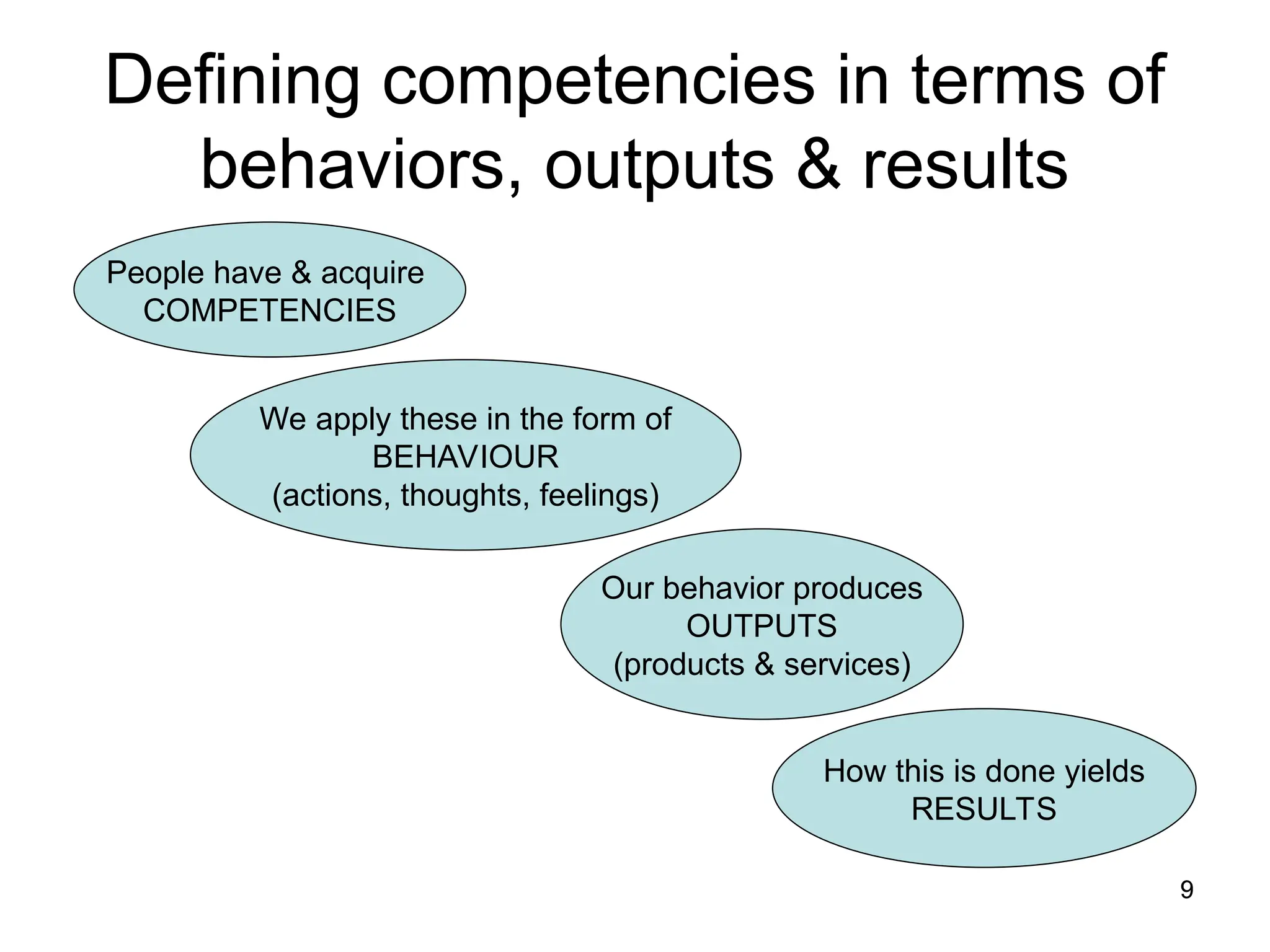
Defining competencies in terms of
behaviors, outputs & results
People have & acquire
COMPETENCIES
We apply these in the form of
BEHAVIOUR
(actions, thoughts, feelings)
Our behavior produces
OUTPUTS
(products & services)
How this is done yields
RESULTS
10
10
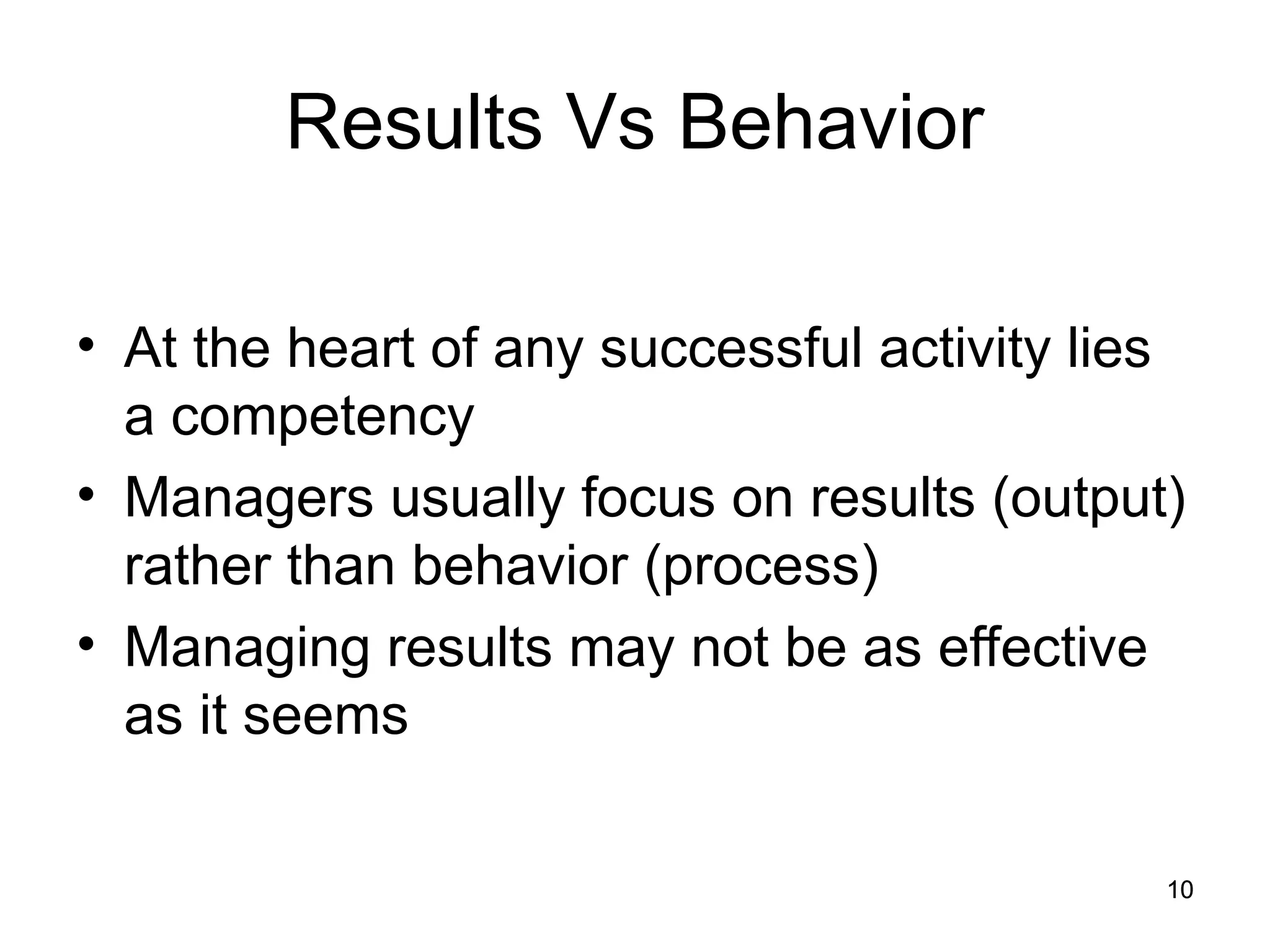
Results Vs Behavior
• At the heart of any successful activity lies
a competency
• Managers usually focus on results (output)
rather than behavior (process)
• Managing results may not be as effective
as it seems
11
11
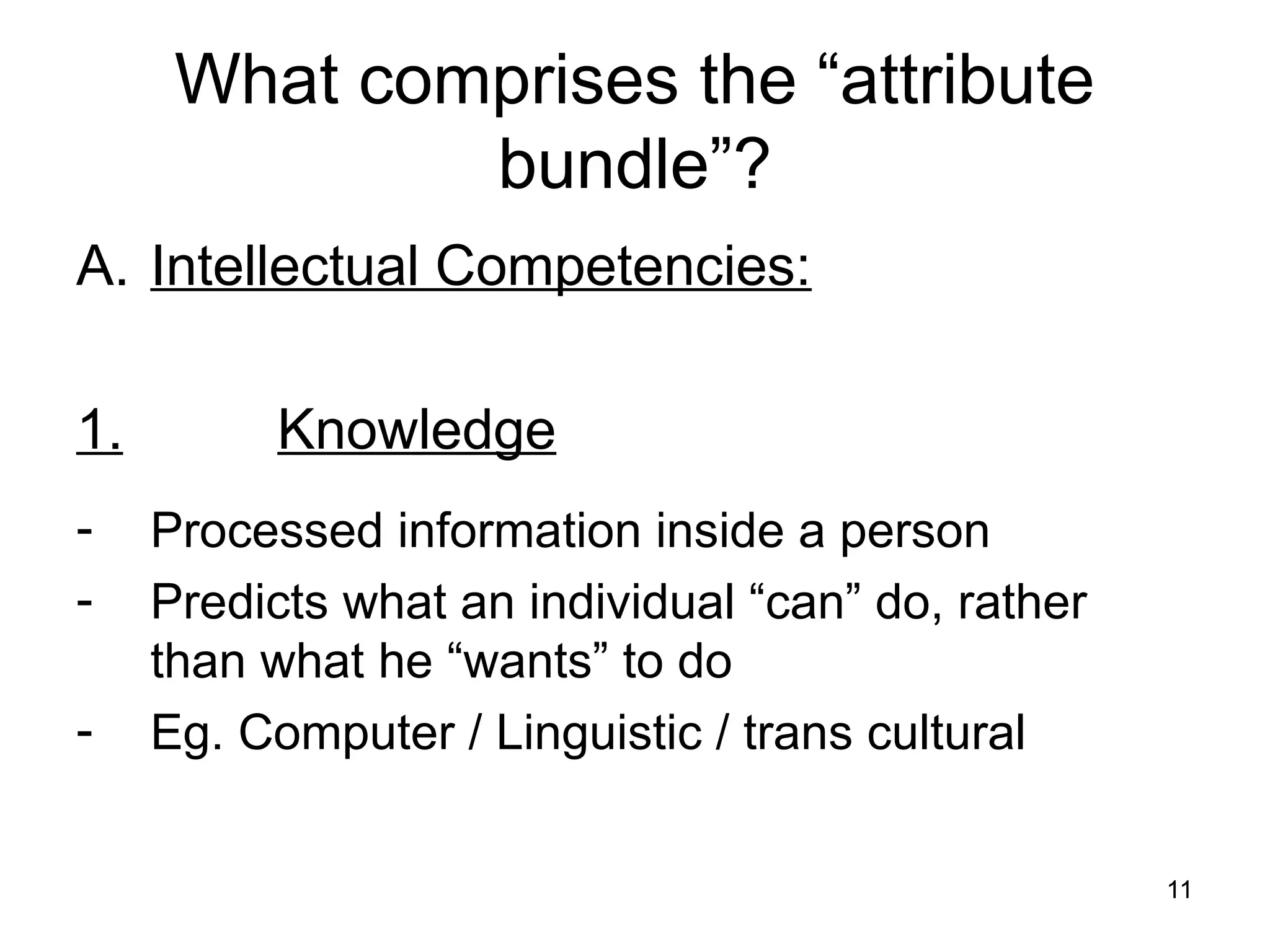
What comprises the “attribute
bundle”?
A. Intellectual Competencies:
1. Knowledge
- Processed information inside a person
- Predicts what an individual “can” do, rather
than what he “wants” to do
- Eg. Computer / Linguistic / trans cultural
12
12
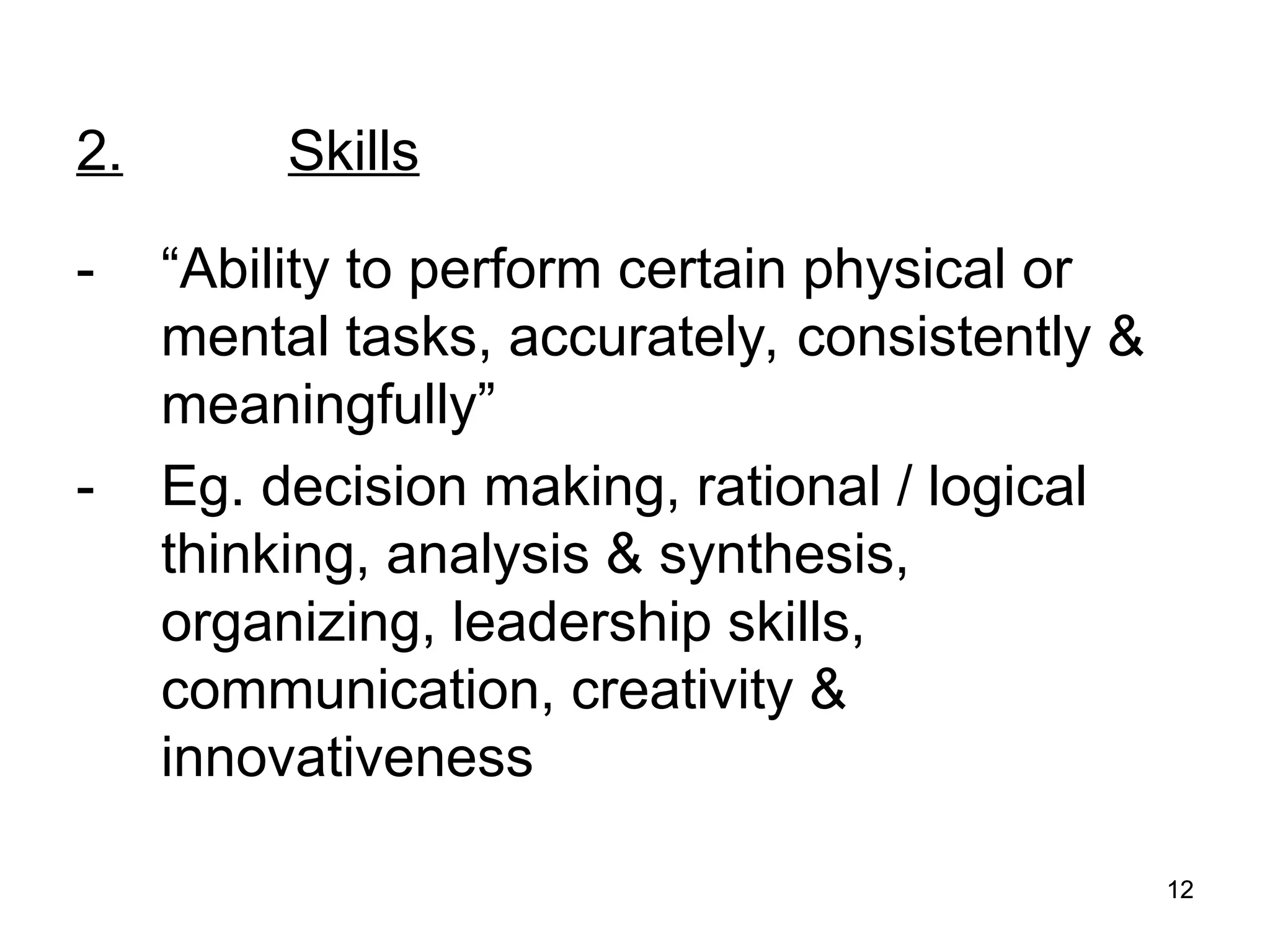
2. Skills
- “Ability to perform certain physical or
mental tasks, accurately, consistently &
meaningfully”
- Eg. decision making, rational / logical
thinking, analysis & synthesis,
organizing, leadership skills,
communication, creativity &
innovativeness
13
13
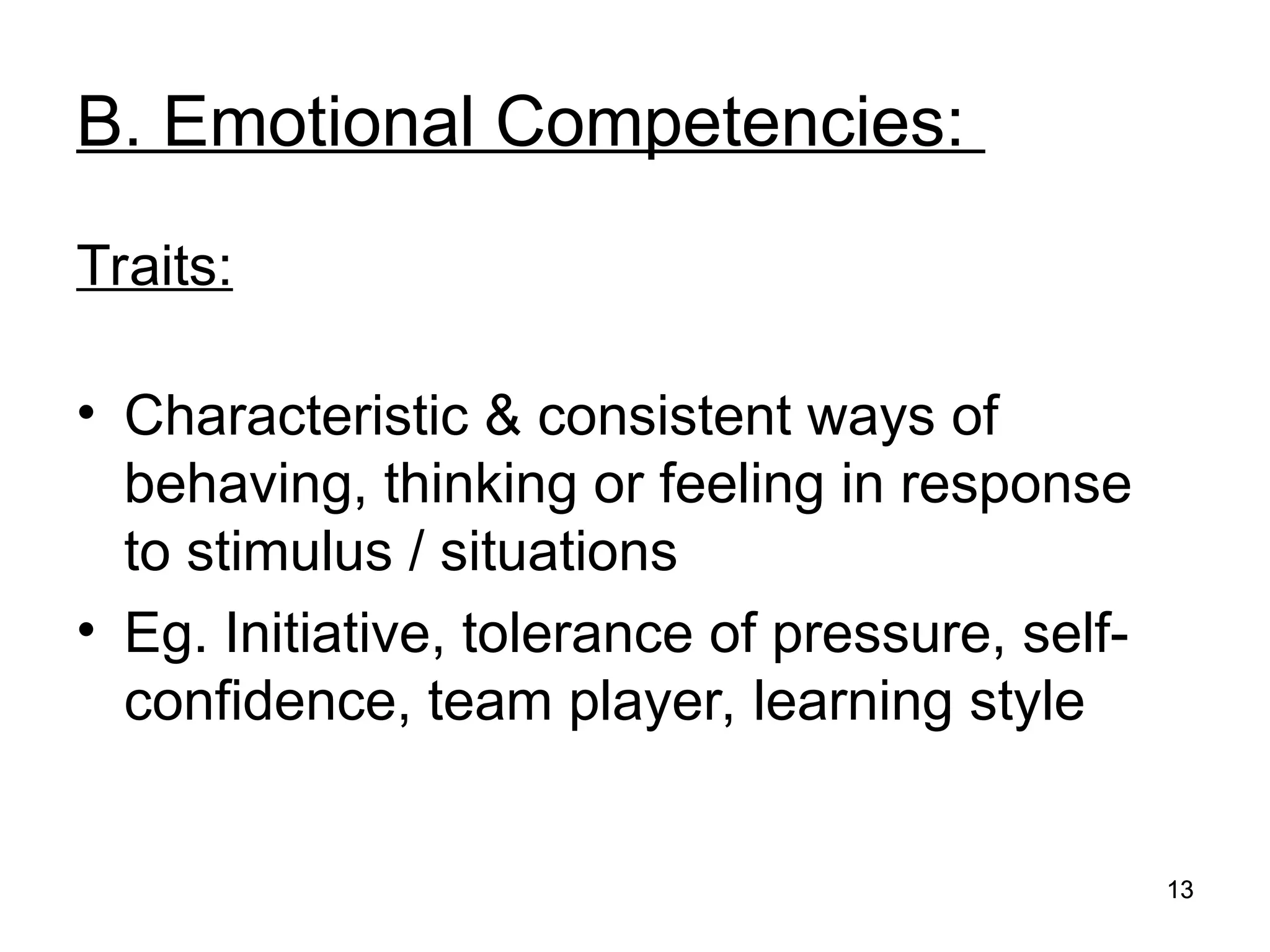
B. Emotional Competencies:
Traits:
• Characteristic & consistent ways of
behaving, thinking or feeling in response
to stimulus / situations
• Eg. Initiative, tolerance of pressure, self-
confidence, team player, learning style
14
14
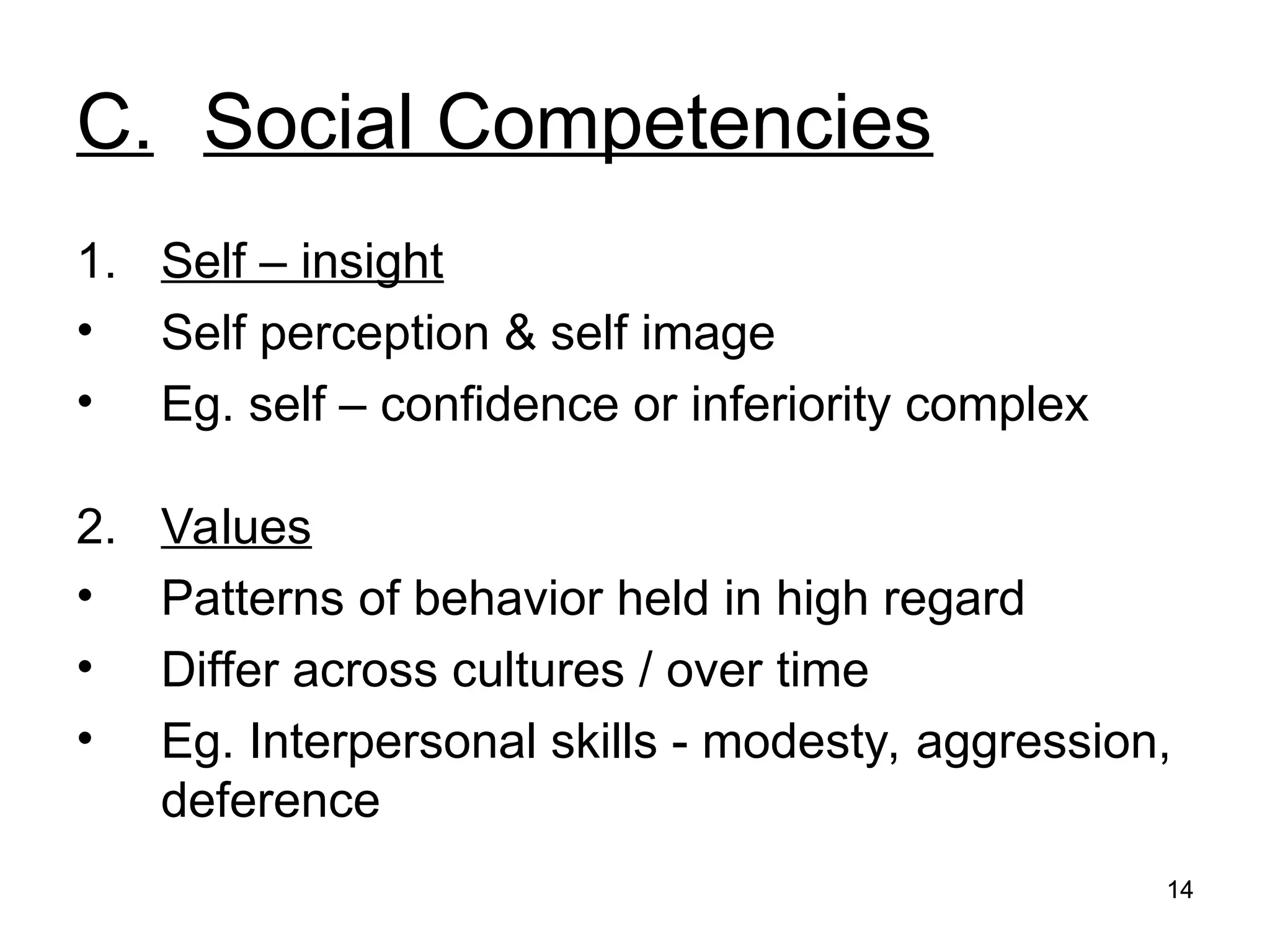
C. Social Competencies
1. Self – insight
• Self perception & self image
• Eg. self – confidence or inferiority complex
2. Values
• Patterns of behavior held in high regard
• Differ across cultures / over time
• Eg. Interpersonal skills - modesty, aggression,
deference
15
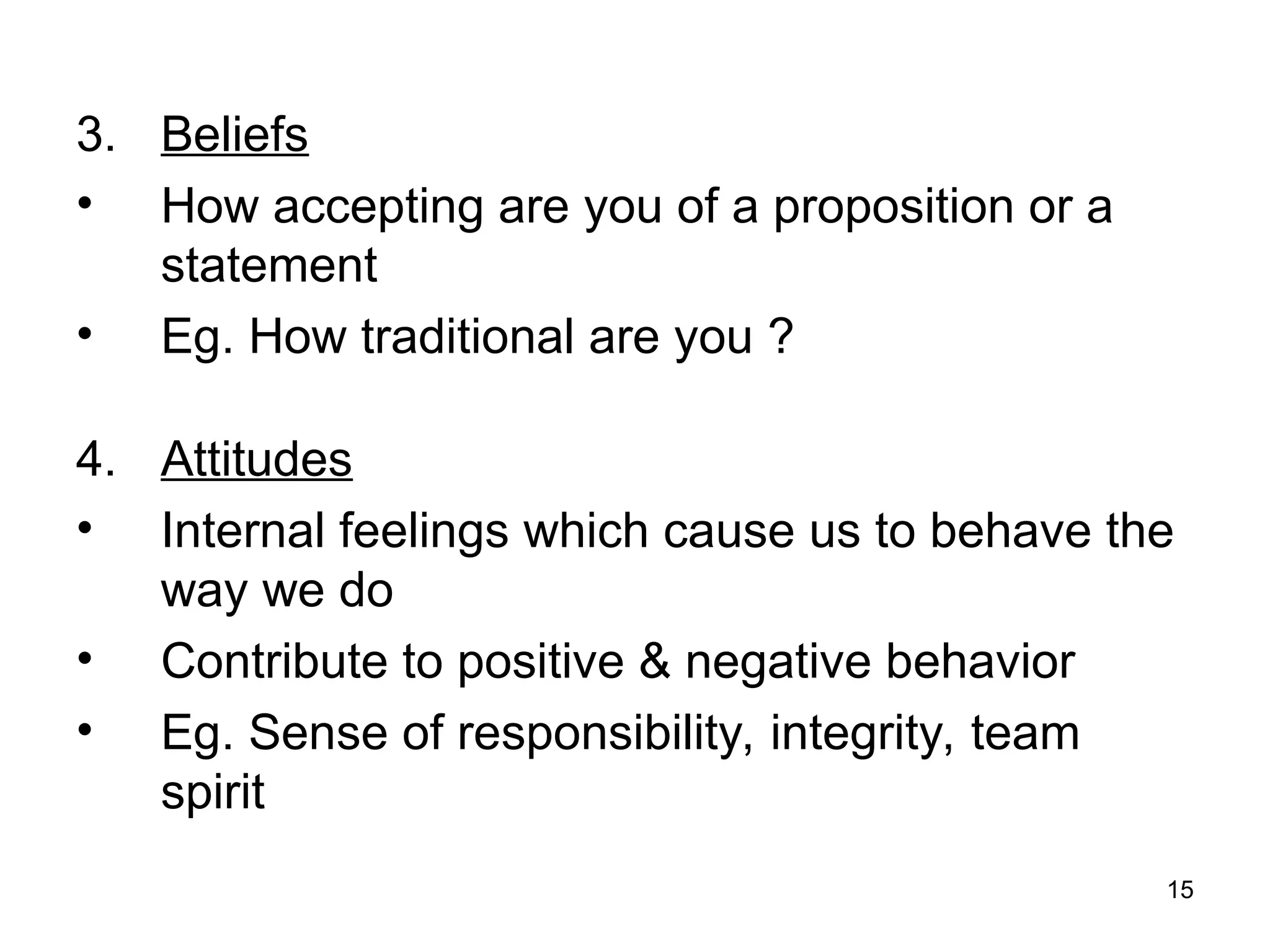
3. Beliefs
• How accepting are you of a proposition or a
statement
• Eg. How traditional are you ?
4. Attitudes
• Internal feelings which cause us to behave the
way we do
• Contribute to positive & negative behavior
• Eg. Sense of responsibility, integrity, team
spirit
16
16
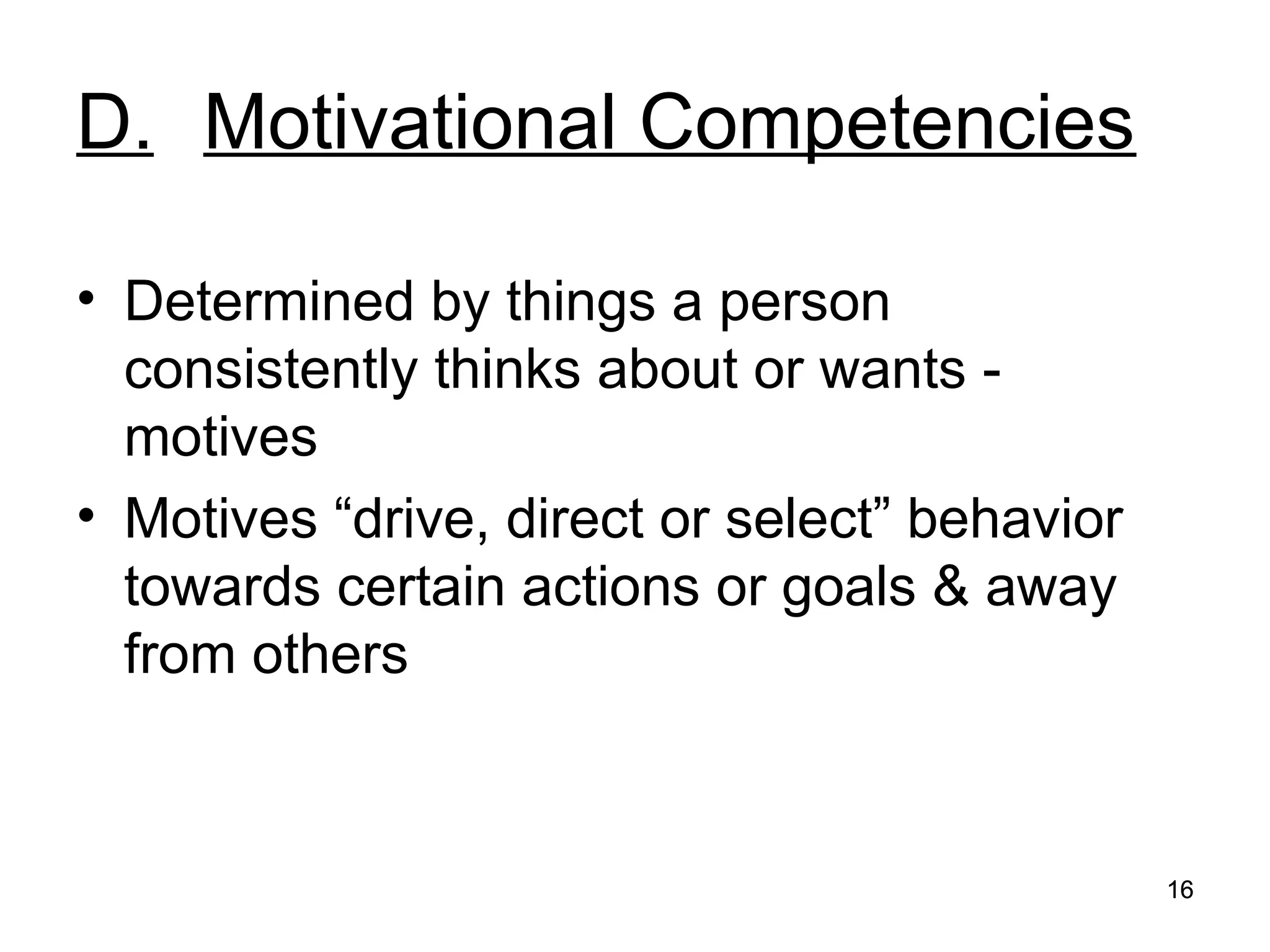
D. Motivational Competencies
• Determined by things a person
consistently thinks about or wants -
motives
• Motives “drive, direct or select” behavior
towards certain actions or goals & away
from others
17
17
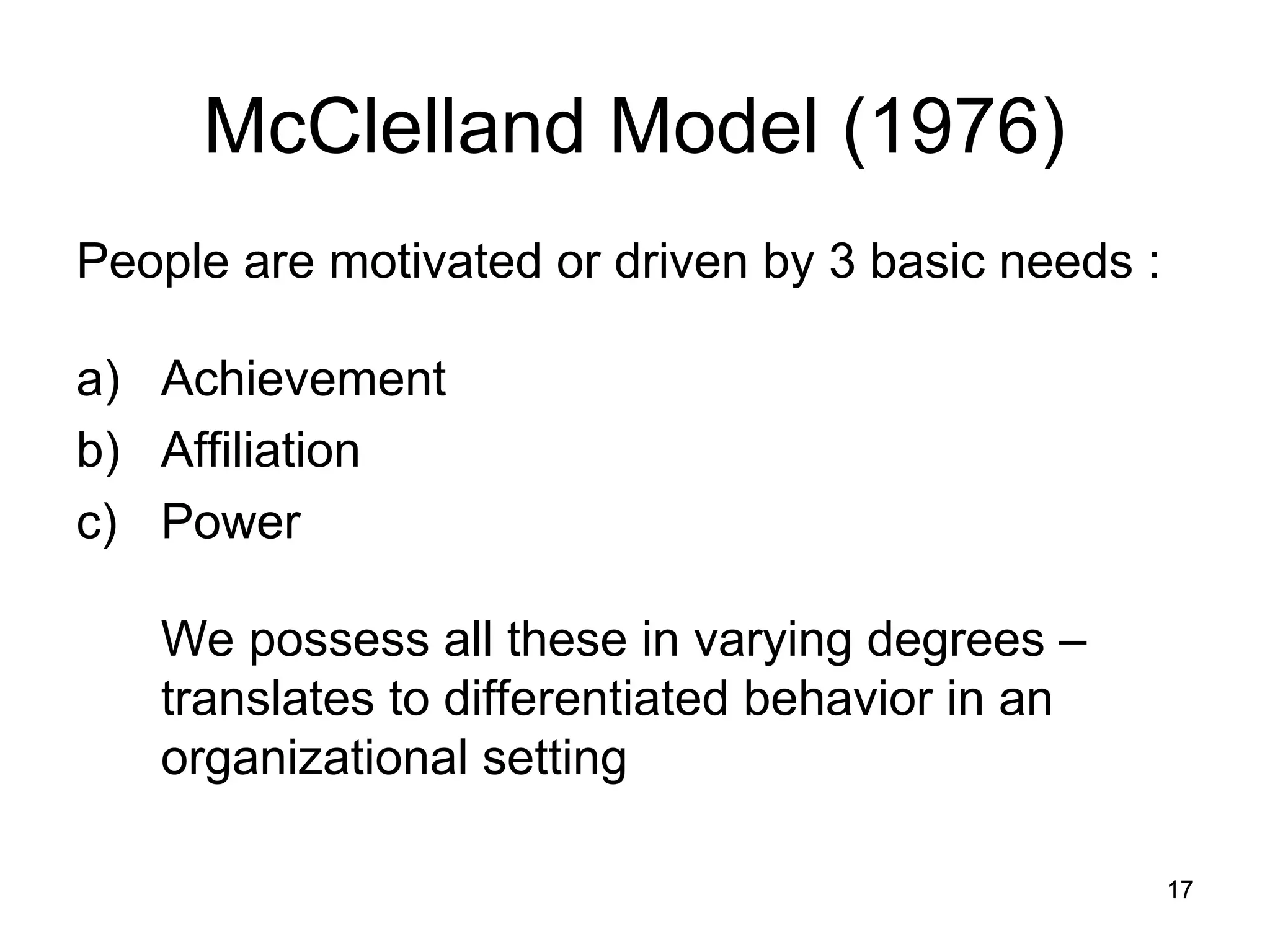
McClelland Model (1976)
People are motivated or driven by 3 basic needs :
a) Achievement
b) Affiliation
c) Power
We possess all these in varying degrees –
translates to differentiated behavior in an
organizational setting
18
18
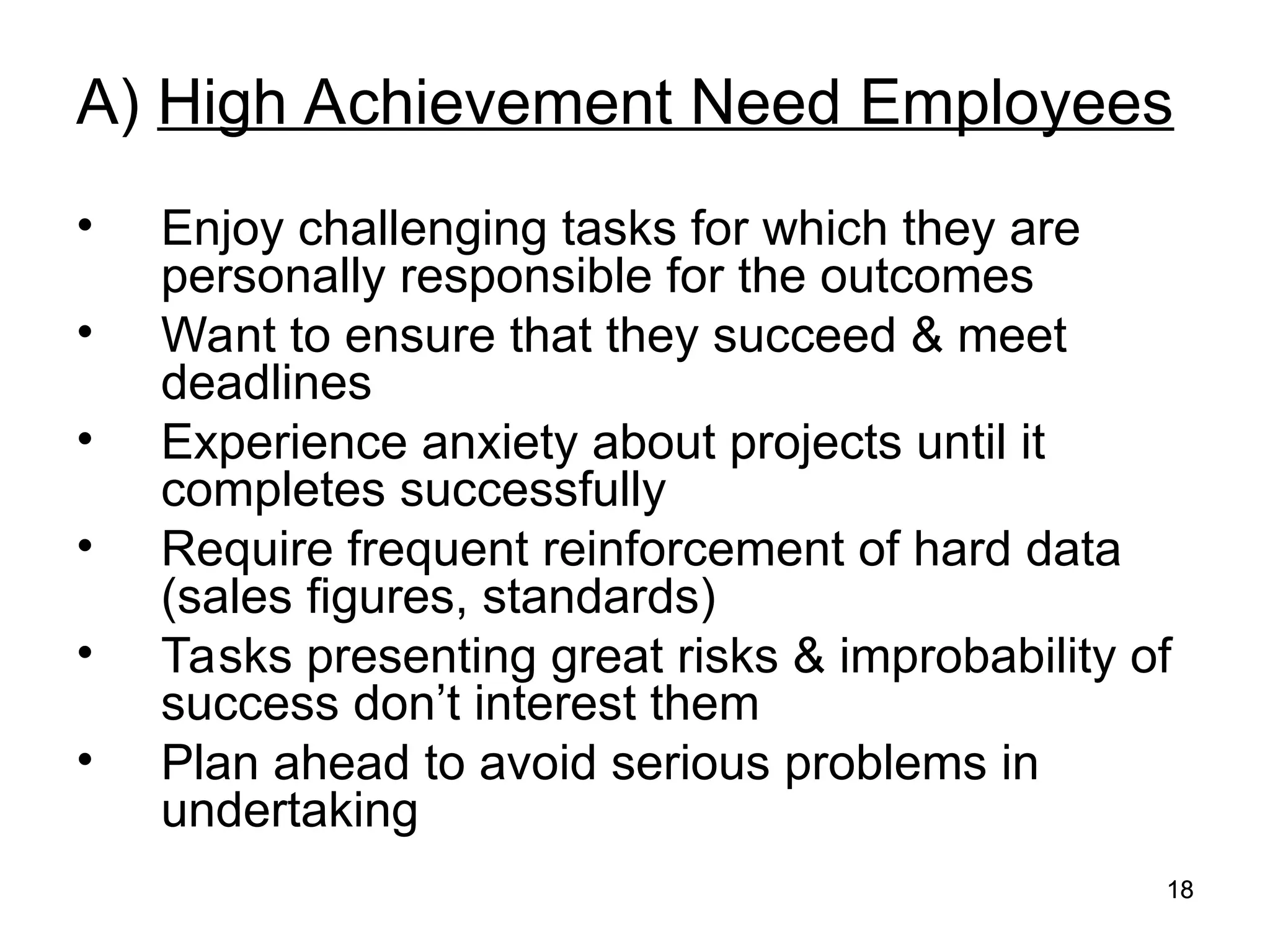
A) High Achievement Need Employees
• Enjoy challenging tasks for which they are
personally responsible for the outcomes
• Want to ensure that they succeed & meet
deadlines
• Experience anxiety about projects until it
completes successfully
• Require frequent reinforcement of hard data
(sales figures, standards)
• Tasks presenting great risks & improbability of
success don’t interest them
• Plan ahead to avoid serious problems in
undertaking
19
19
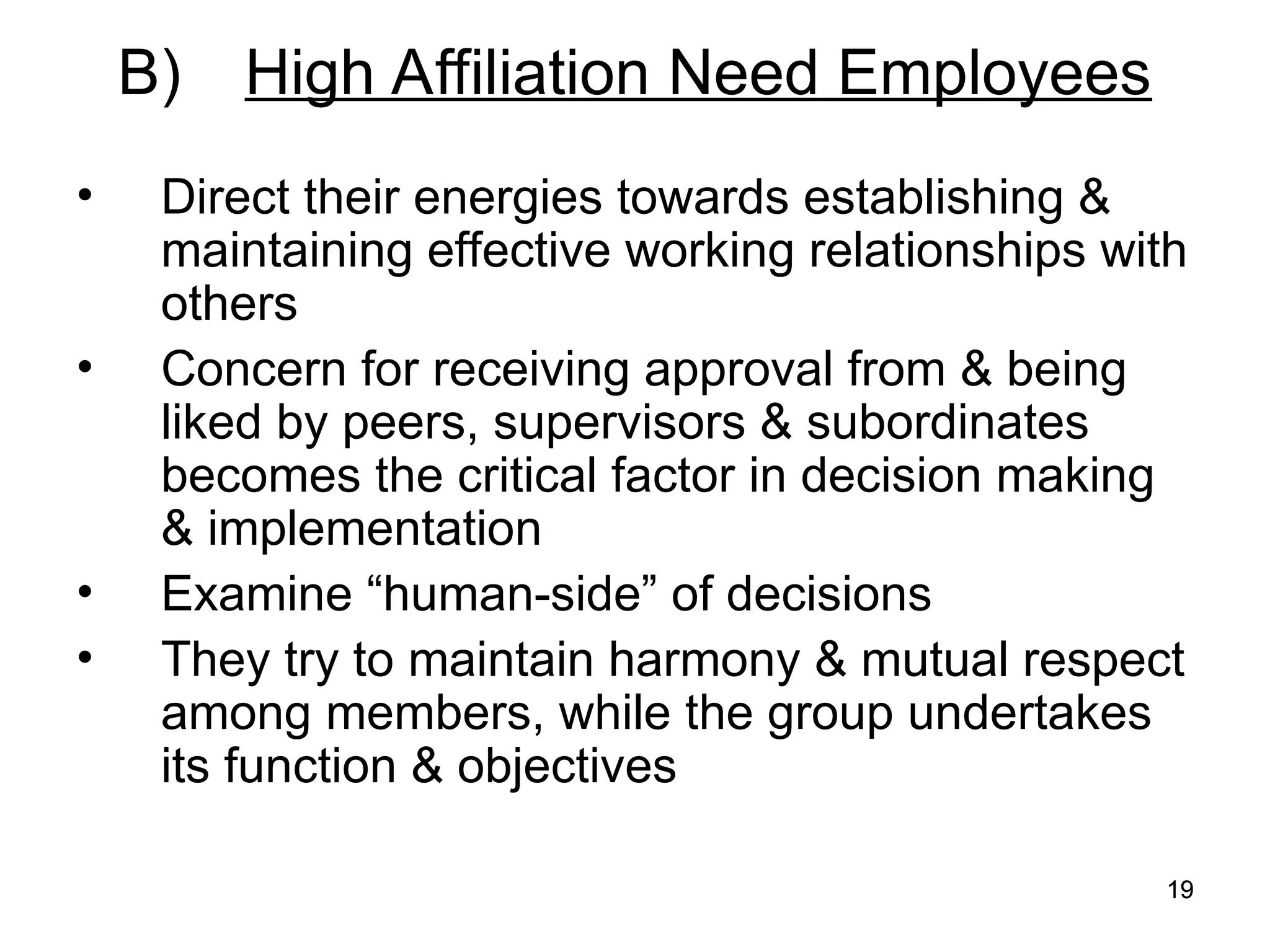
B) High Affiliation Need Employees
• Direct their energies towards establishing &
maintaining effective working relationships with
others
• Concern for receiving approval from & being
liked by peers, supervisors & subordinates
becomes the critical factor in decision making
& implementation
• Examine “human-side” of decisions
• They try to maintain harmony & mutual respect
among members, while the group undertakes
its function & objectives
20
20
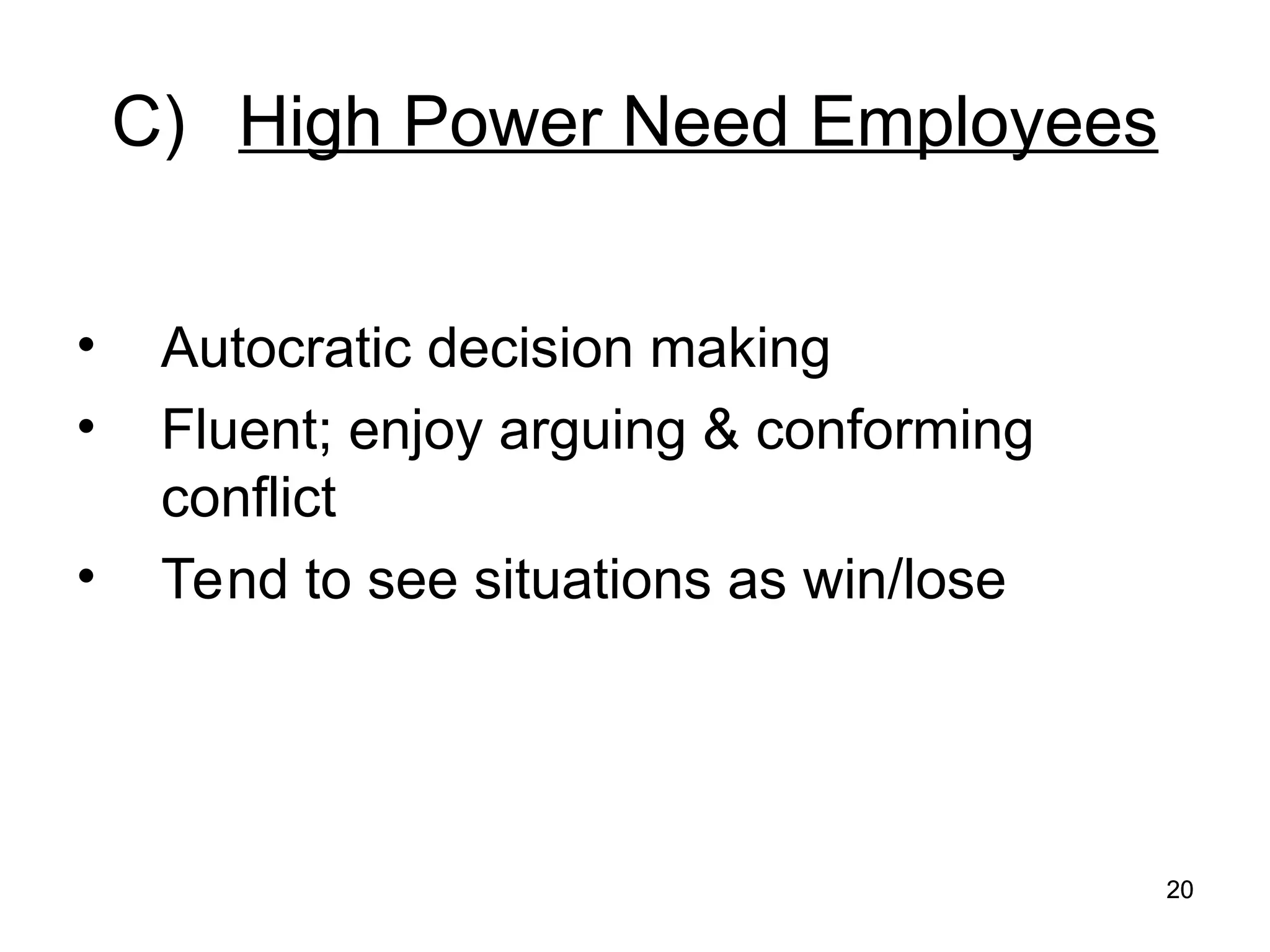
C) High Power Need Employees
• Autocratic decision making
• Fluent; enjoy arguing & conforming
conflict
• Tend to see situations as win/lose
21
21
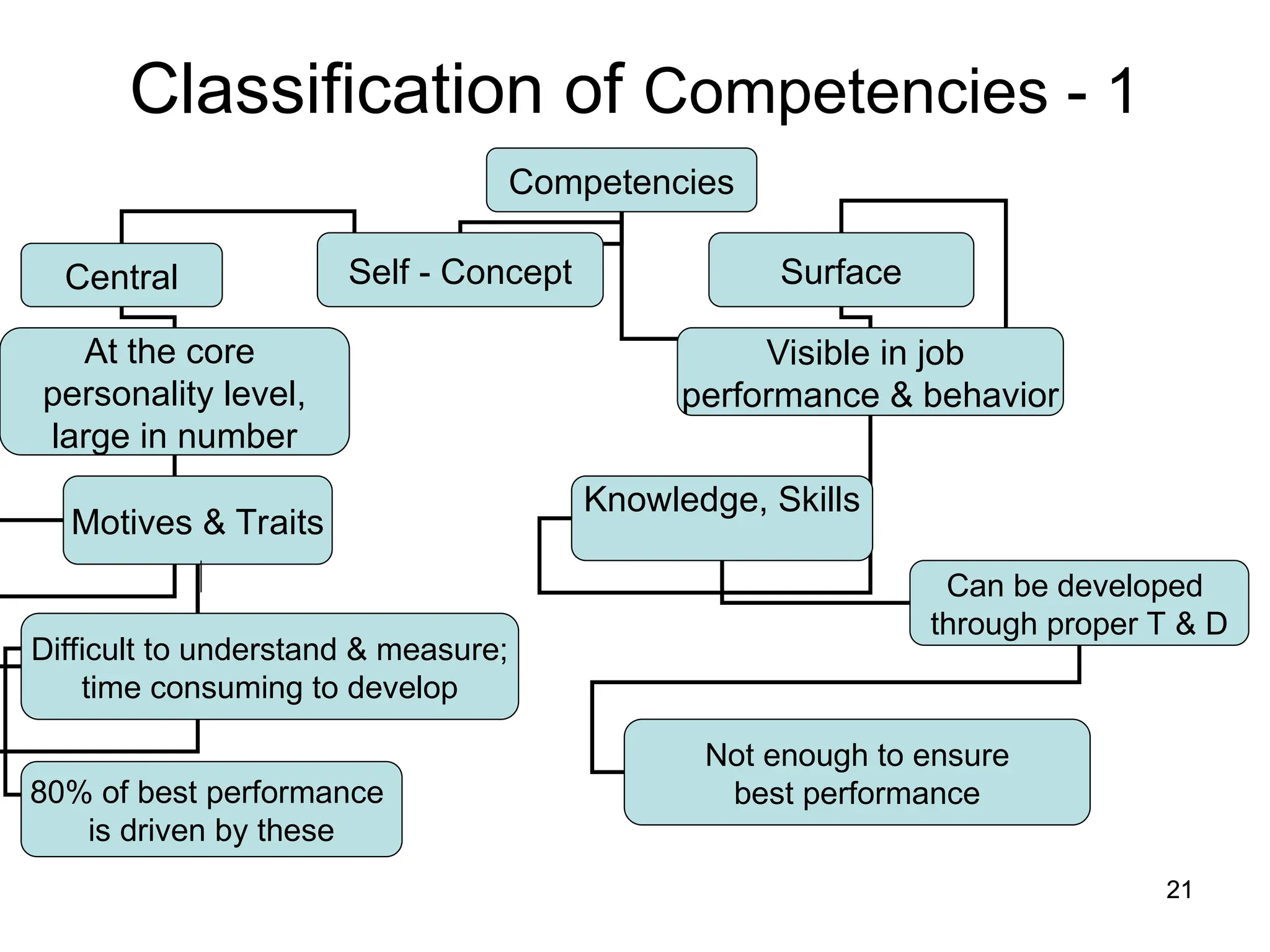
Classification of Competencies - 1
Competencies
Central Self - Concept
At the core
personality level,
large in number
Motives & Traits
Surface
Visible in job
performance & behavior
Knowledge, Skills
Can be developed
through proper T & D
80% of best performance
is driven by these
Not enough to ensure
best performance
Difficult to understand & measure;
time consuming to develop
22
22
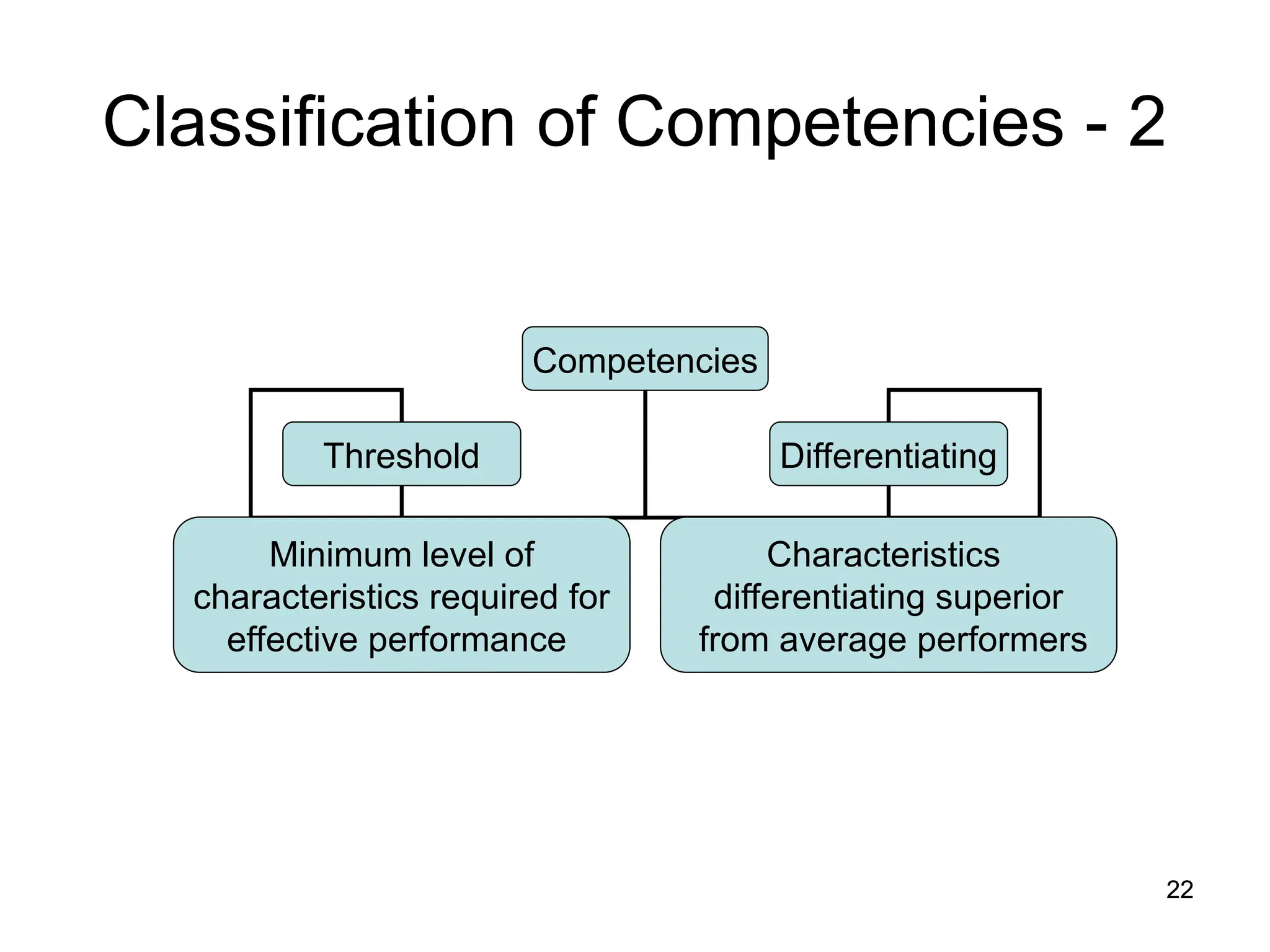
Classification of Competencies - 2
Competencies
Threshold Differentiating
Minimum level of
characteristics required for
effective performance
Characteristics
differentiating superior
from average performers
23
23
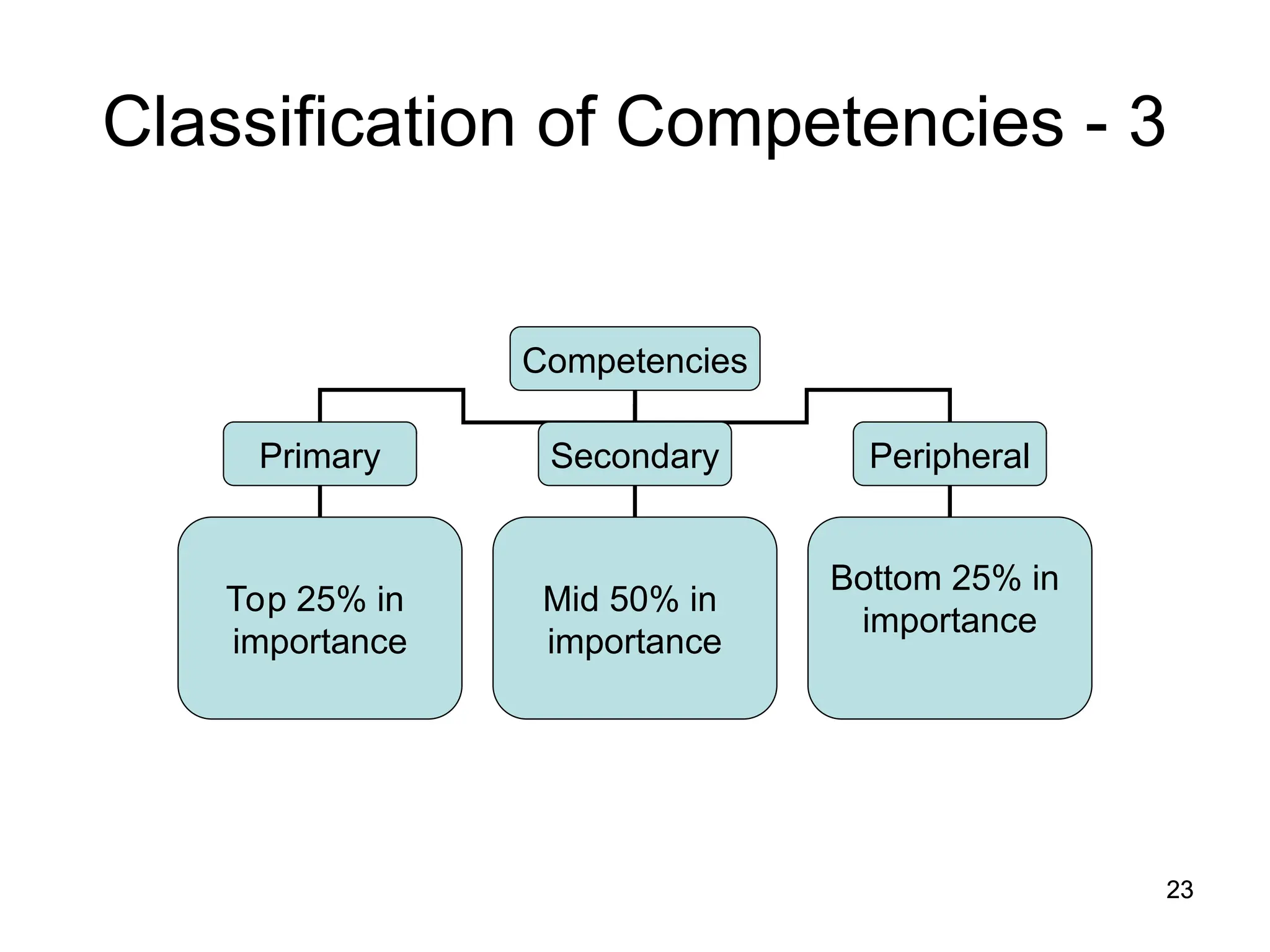
Classification of Competencies - 3
Competencies
Primary Secondary
Top 25% in
importance
Mid 50% in
importance
Peripheral
Bottom 25% in
importance
24
24
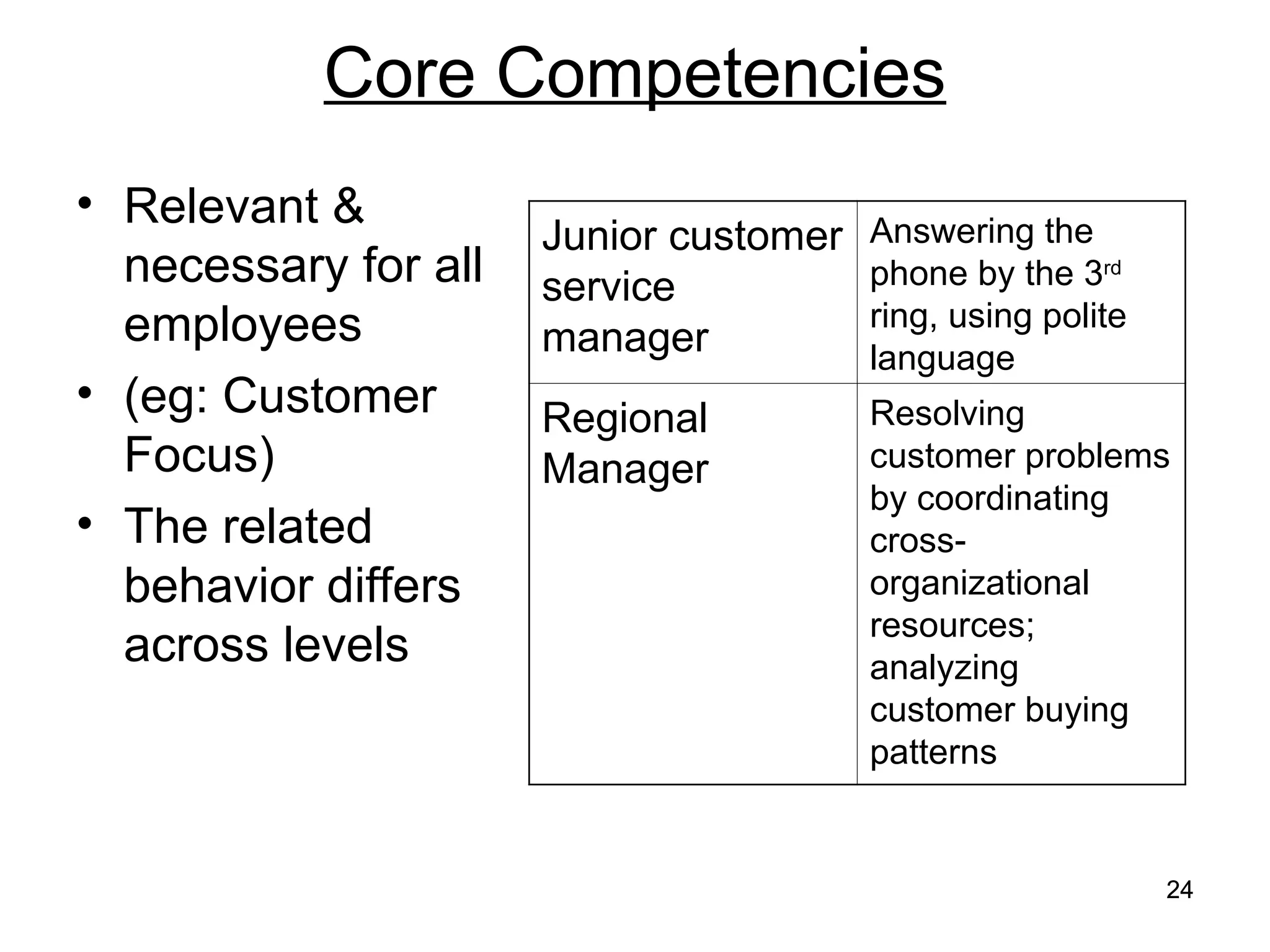
Core Competencies
• Relevant &
necessary for all
employees
• (eg: Customer
Focus)
• The related
behavior differs
across levels
Junior customer
service
manager
Answering the
phone by the 3rd
ring, using polite
language
Regional
Manager
Resolving
customer problems
by coordinating
cross-
organizational
resources;
analyzing
customer buying
patterns
25
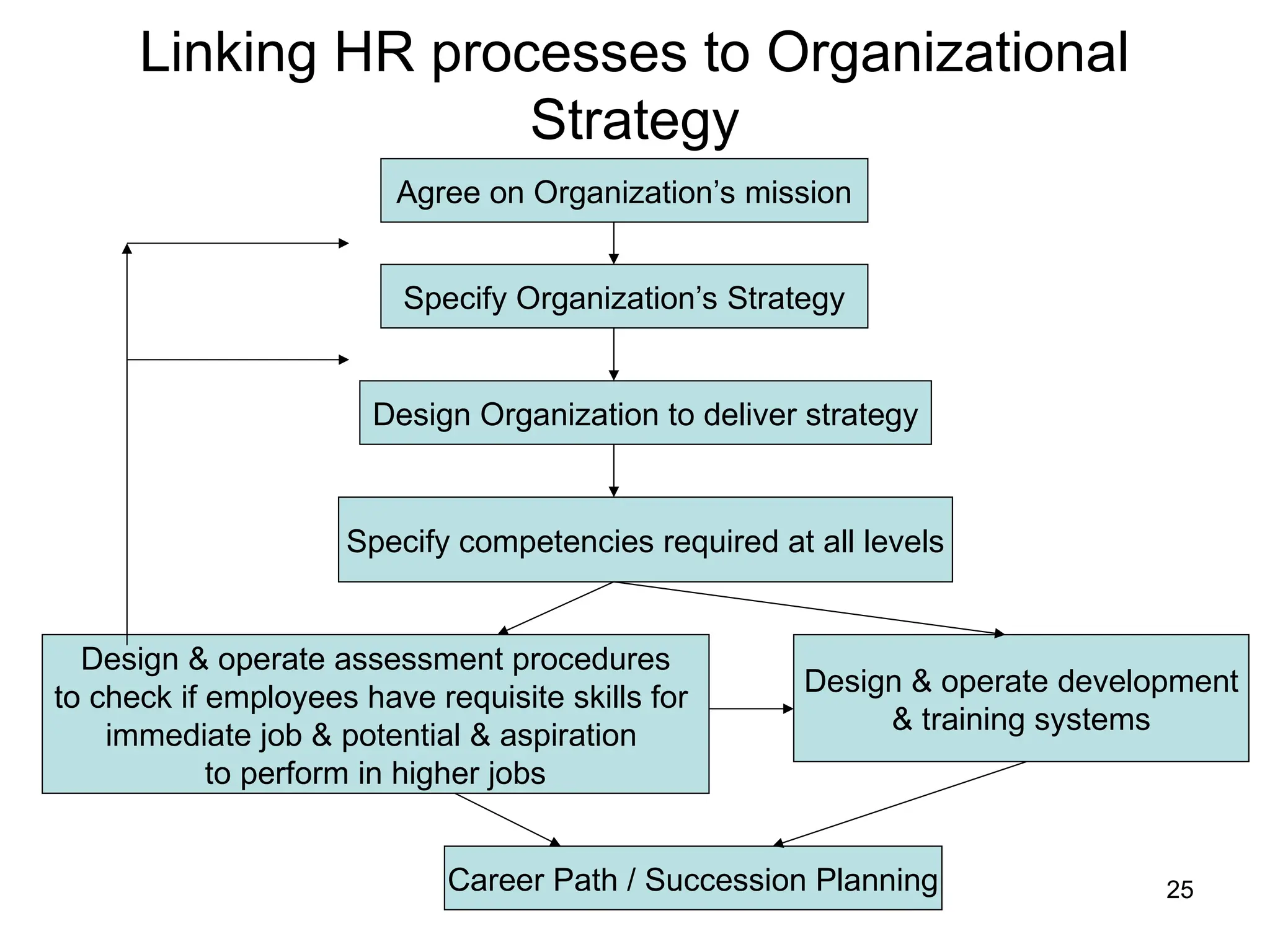
Linking HR processes to Organizational
Strategy
Design Organization to deliver strategy
Specify competencies required at all levels
Design & operate assessment procedures
to check if employees have requisite skills for
immediate job & potential & aspiration
to perform in higher jobs
Specify Organization’s Strategy
Agree on Organization’s mission
Design & operate development
& training systems
Career Path / Succession Planning
26
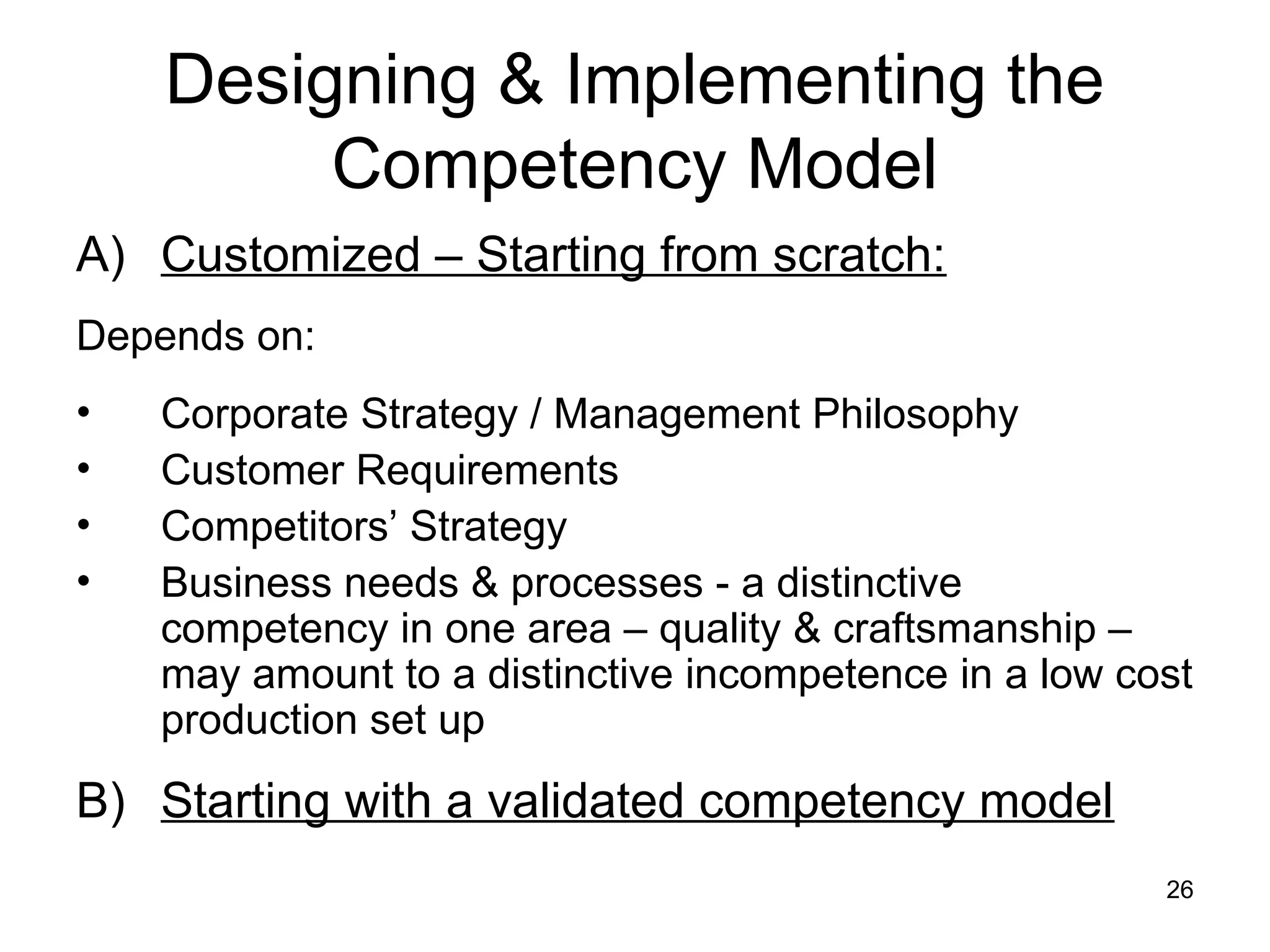
Designing & Implementing the
Competency Model
A) Customized – Starting from scratch:
Depends on:
• Corporate Strategy / Management Philosophy
• Customer Requirements
• Competitors’ Strategy
• Business needs & processes - a distinctive
competency in one area – quality & craftsmanship –
may amount to a distinctive incompetence in a low cost
production set up
B) Starting with a validated competency model
27
27
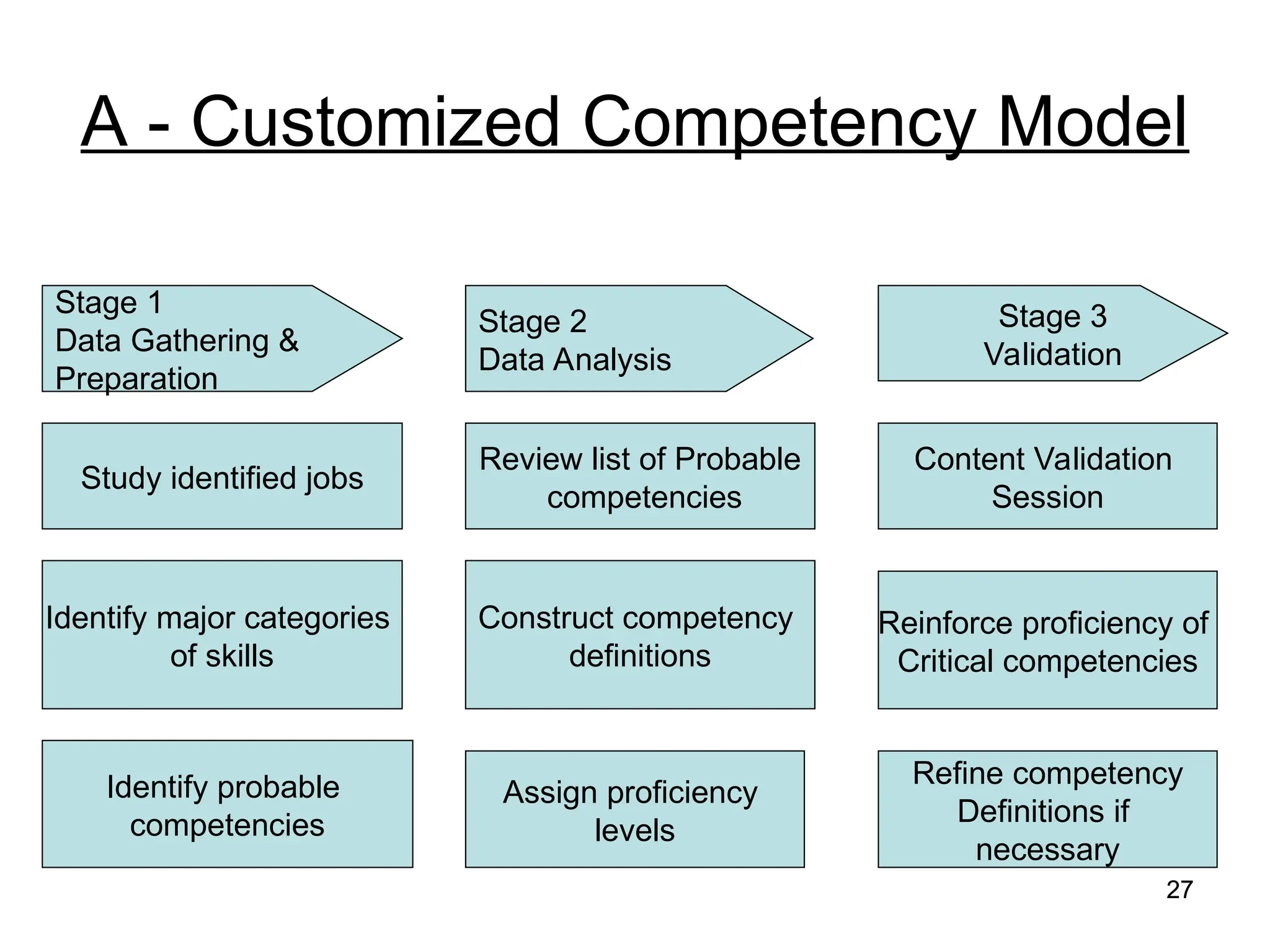
A - Customized Competency Model
Stage 1
Data Gathering &
Preparation
Study identified jobs
Identify major categories
of skills
Identify probable
competencies
Stage 2
Data Analysis
Review list of Probable
competencies
Construct competency
definitions
Assign proficiency
levels
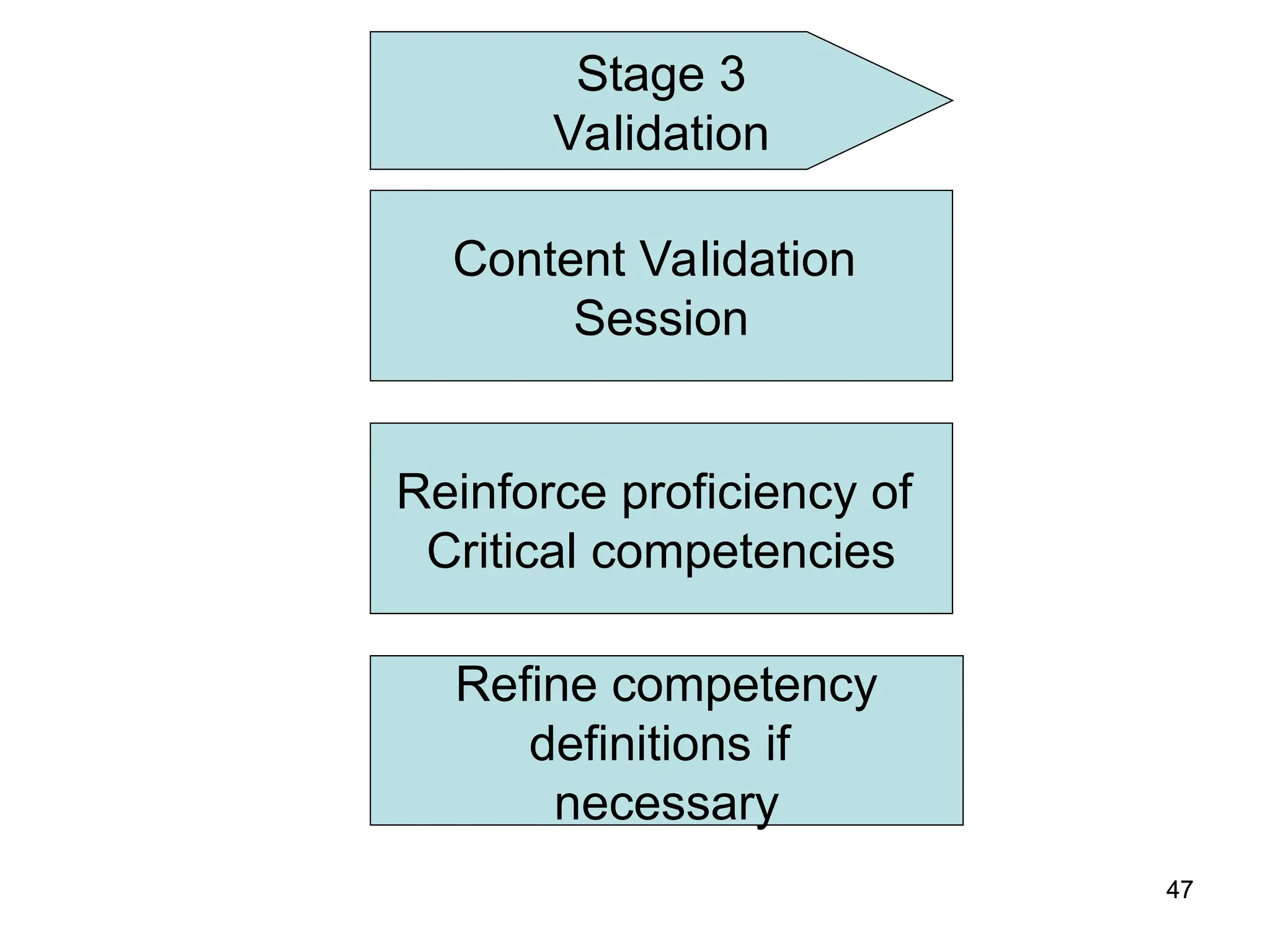
Stage 3
Validation
Content Validation
Session
Reinforce proficiency of
Critical competencies
Refine competency
Definitions if
necessary
28
28
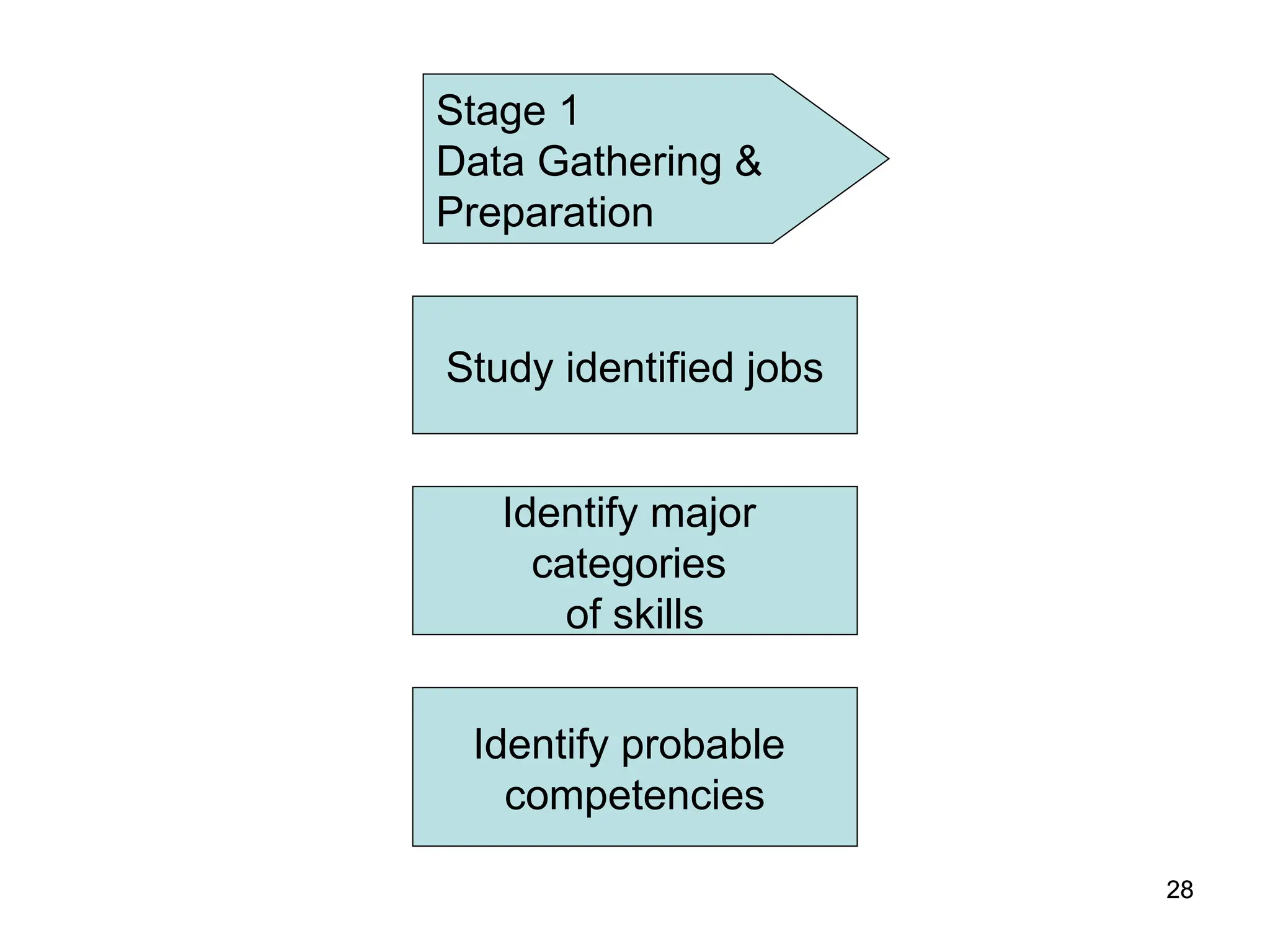
Stage 1
Data Gathering &
Preparation
Study identified jobs
Identify major
categories
of skills
Identify probable
competencies
29
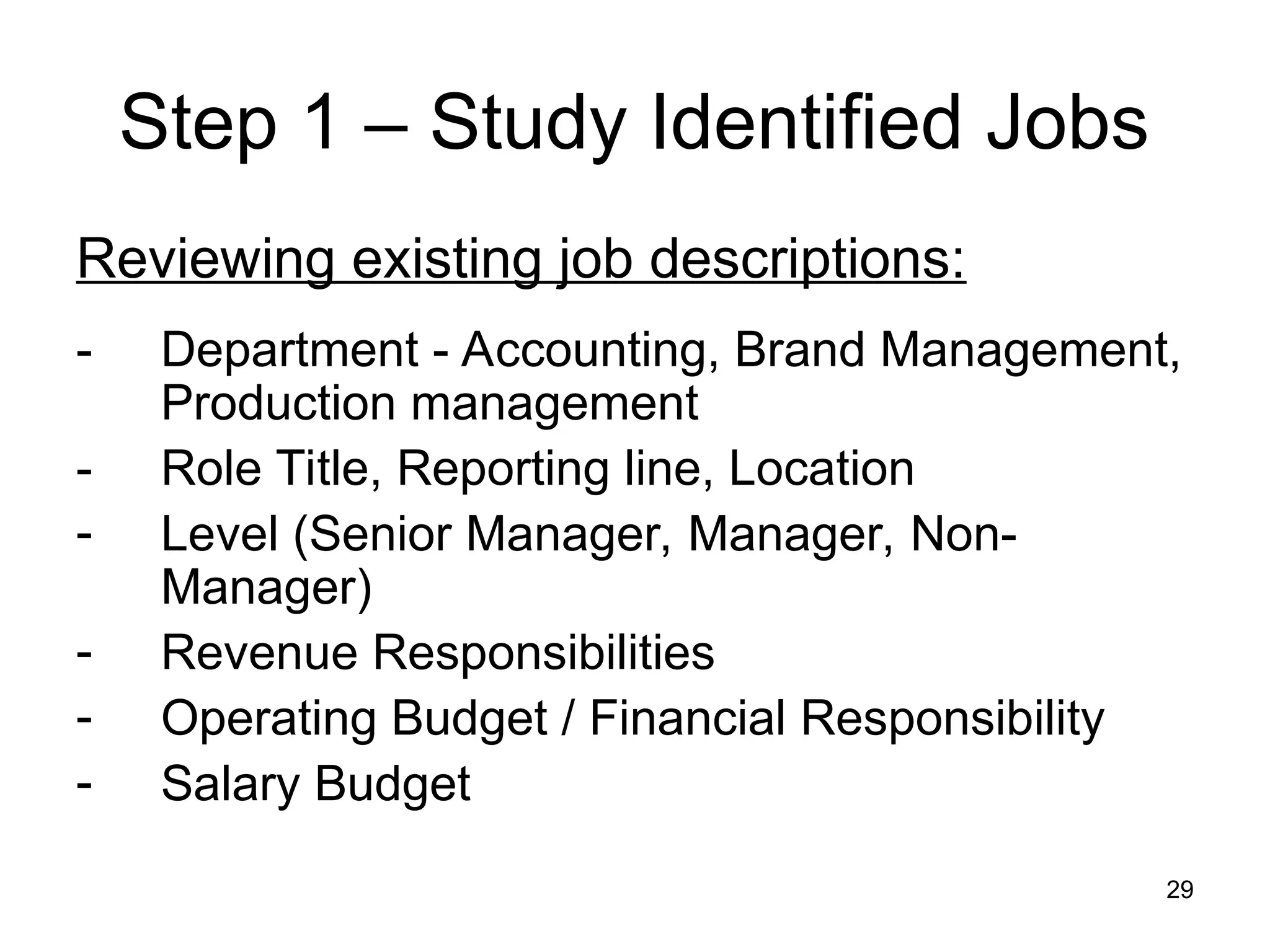
Step 1 – Study Identified Jobs
Reviewing existing job descriptions:
- Department - Accounting, Brand Management,
Production management
- Role Title, Reporting line, Location
- Level (Senior Manager, Manager, Non-
Manager)
- Revenue Responsibilities
- Operating Budget / Financial Responsibility
- Salary Budget
30
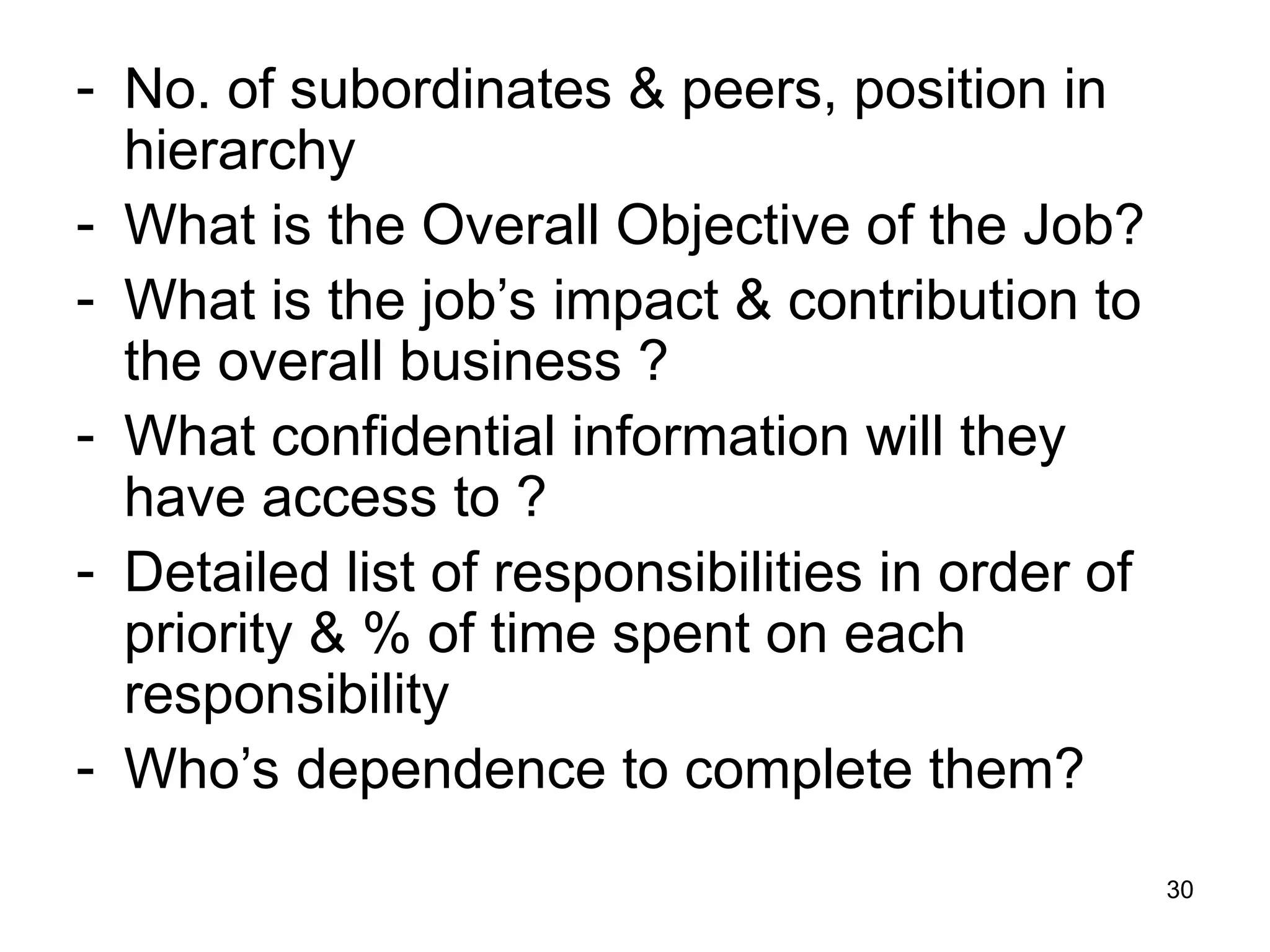
- No. of subordinates & peers, position in
hierarchy
- What is the Overall Objective of the Job?
- What is the job’s impact & contribution to
the overall business ?
- What confidential information will they
have access to ?
- Detailed list of responsibilities in order of
priority & % of time spent on each
responsibility
- Who’s dependence to complete them?
31
31
Step 2 – Identify & assign weights
to skills
Each Job has
Minimum Skill Requirement
Necessary for effective role performance
32
32
Technical Vs. Non Technical Skills
Technical
• Acquired through
training / education
• Industry specific
process / licenses
• Eg: Technology,
safety or legal
regulations
• Maybe accompanied
by some certification
Non - Technical
• “Soft Skills” /
Personality
• Not industry / process
specific
• Honesty, Risk Taking,
Flexibility, Leadership
33
33
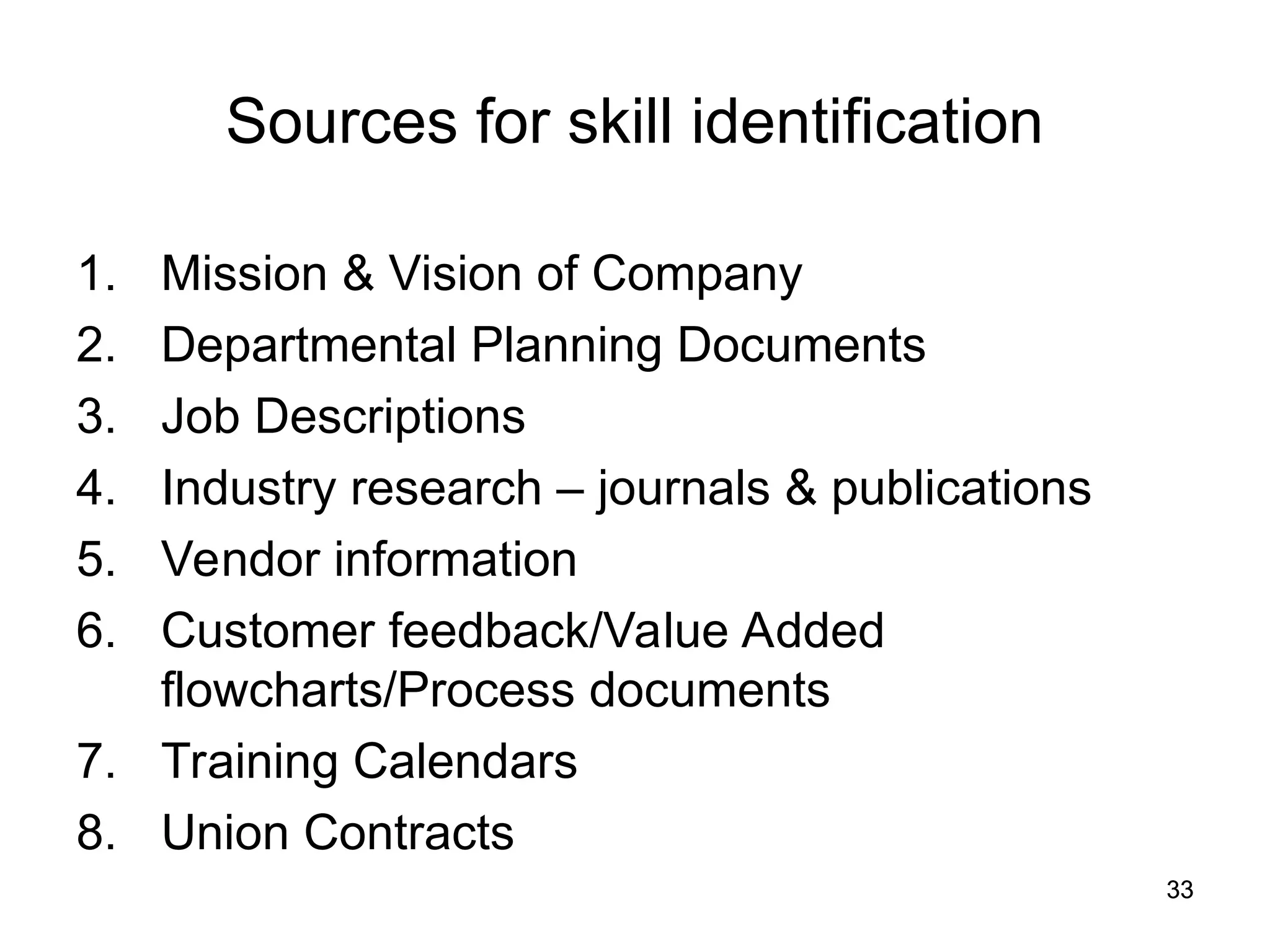
Sources for skill identification
1. Mission & Vision of Company
2. Departmental Planning Documents
3. Job Descriptions
4. Industry research – journals & publications
5. Vendor information
6. Customer feedback/Value Added
flowcharts/Process documents
7. Training Calendars
8. Union Contracts
34
34
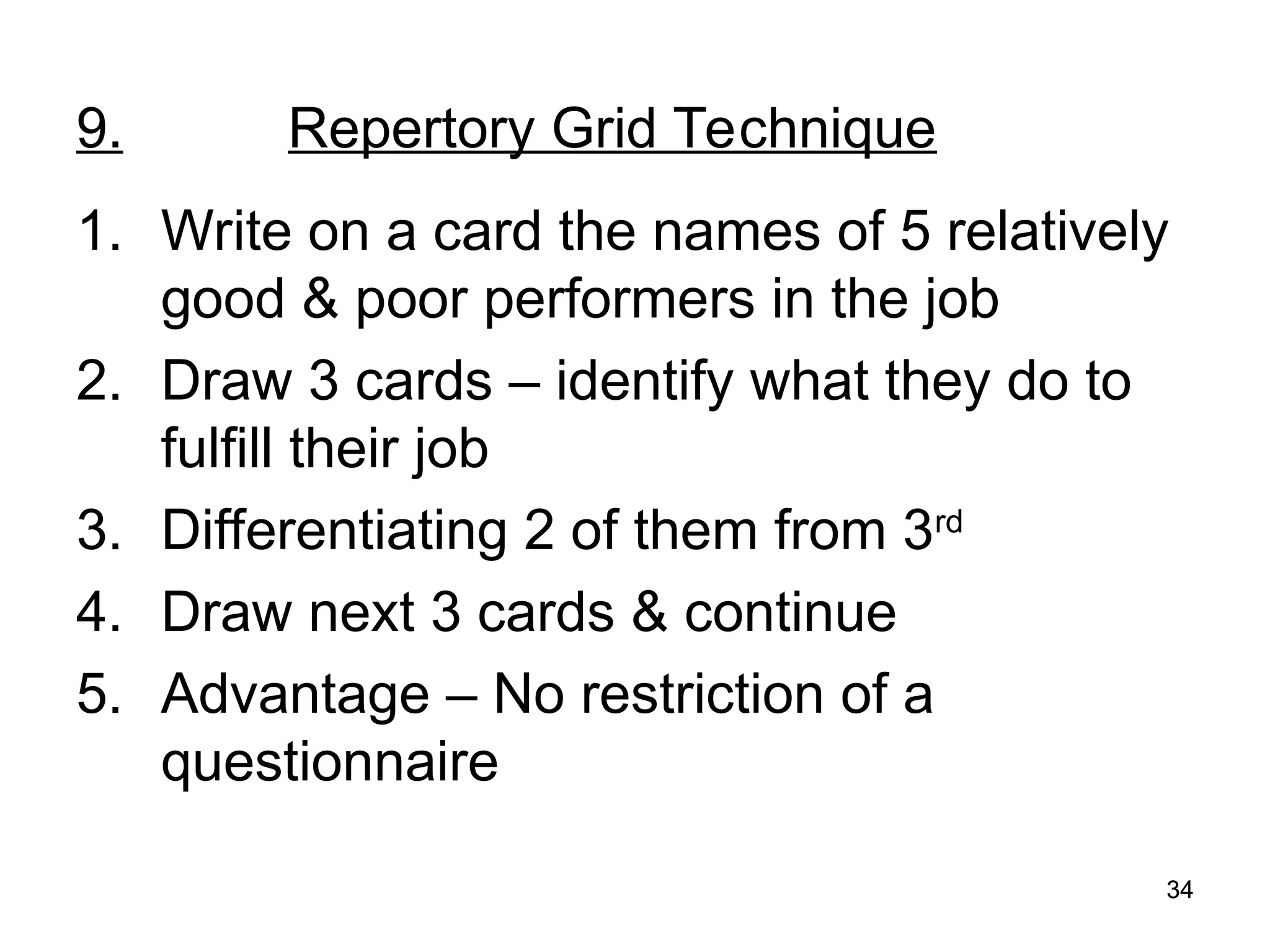
9. Repertory Grid Technique
1. Write on a card the names of 5 relatively
good & poor performers in the job
2. Draw 3 cards – identify what they do to
fulfill their job
3. Differentiating 2 of them from 3rd
4. Draw next 3 cards & continue
5. Advantage – No restriction of a
questionnaire
35
35
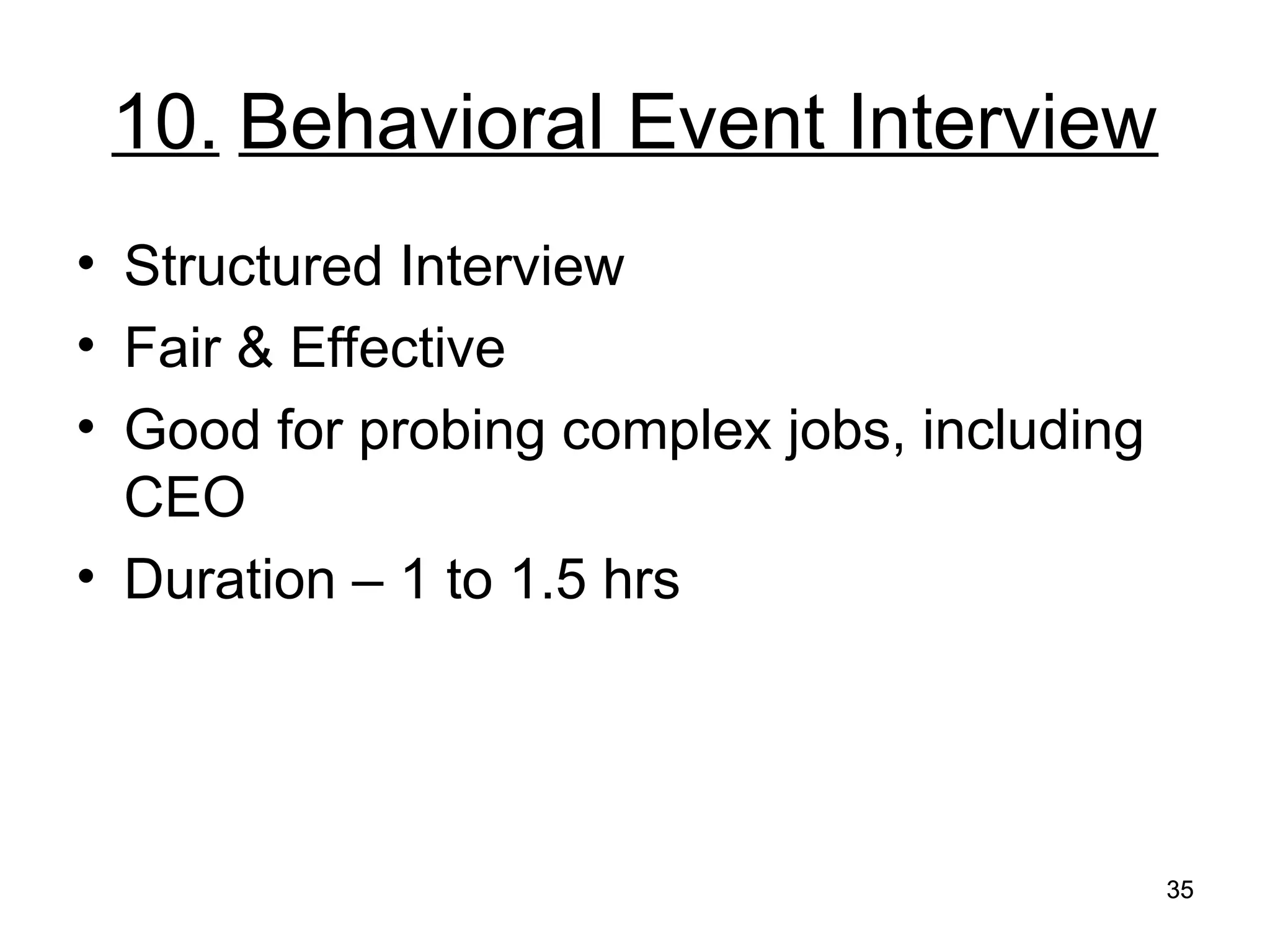
10. Behavioral Event Interview
• Structured Interview
• Fair & Effective
• Good for probing complex jobs, including
CEO
• Duration – 1 to 1.5 hrs
36
36
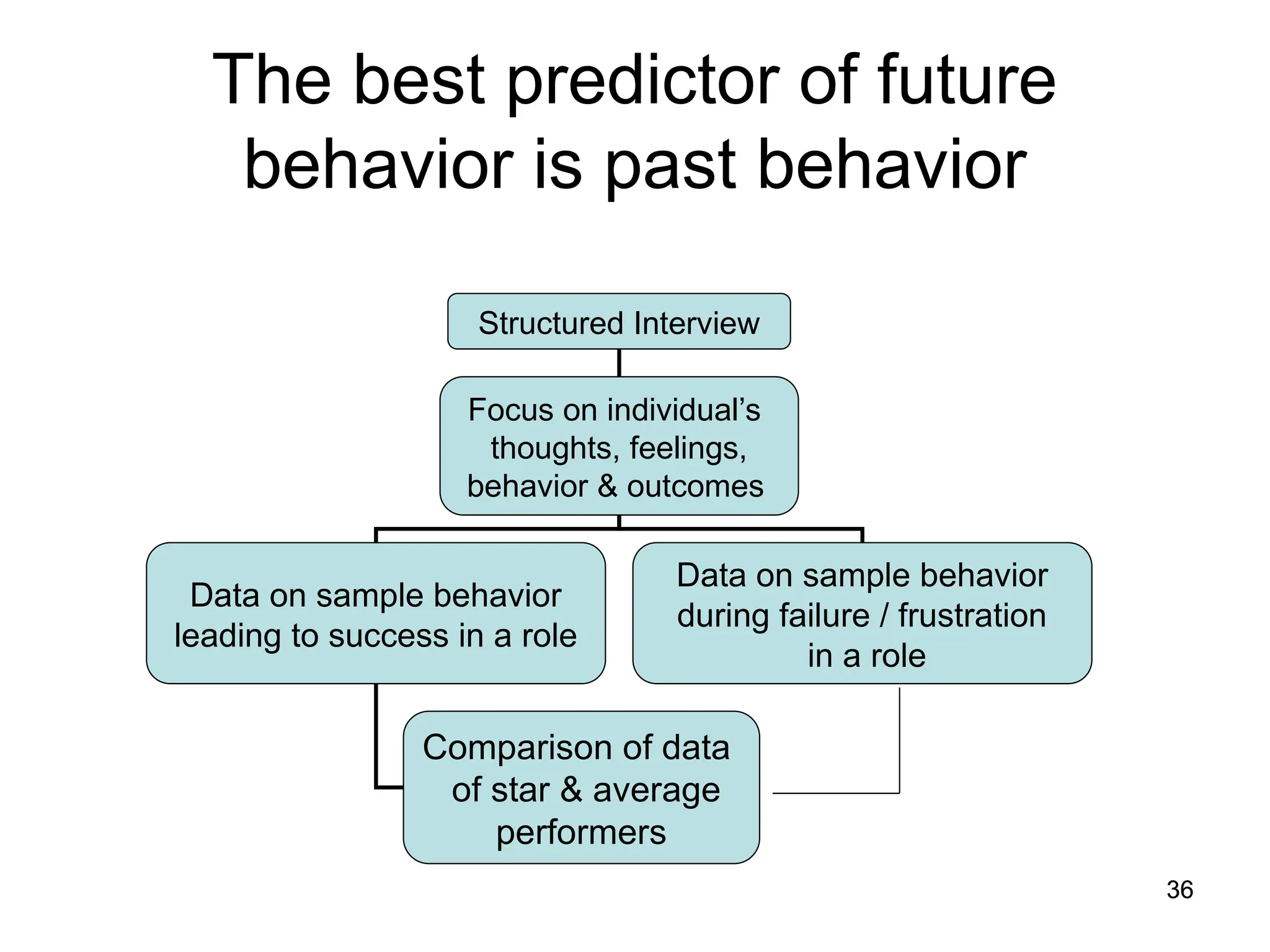
The best predictor of future
behavior is past behavior
Structured Interview
Focus on individual’s
thoughts, feelings,
behavior & outcomes
Data on sample behavior
leading to success in a role
Data on sample behavior
during failure / frustration
in a role
Comparison of data
of star & average
performers
37
37
Step 3 – Identify Probable
Competencies
• Skills to be applied behaviorally to become
a competency
• Between 8 & 12 competencies required for
effective role performance
38
38
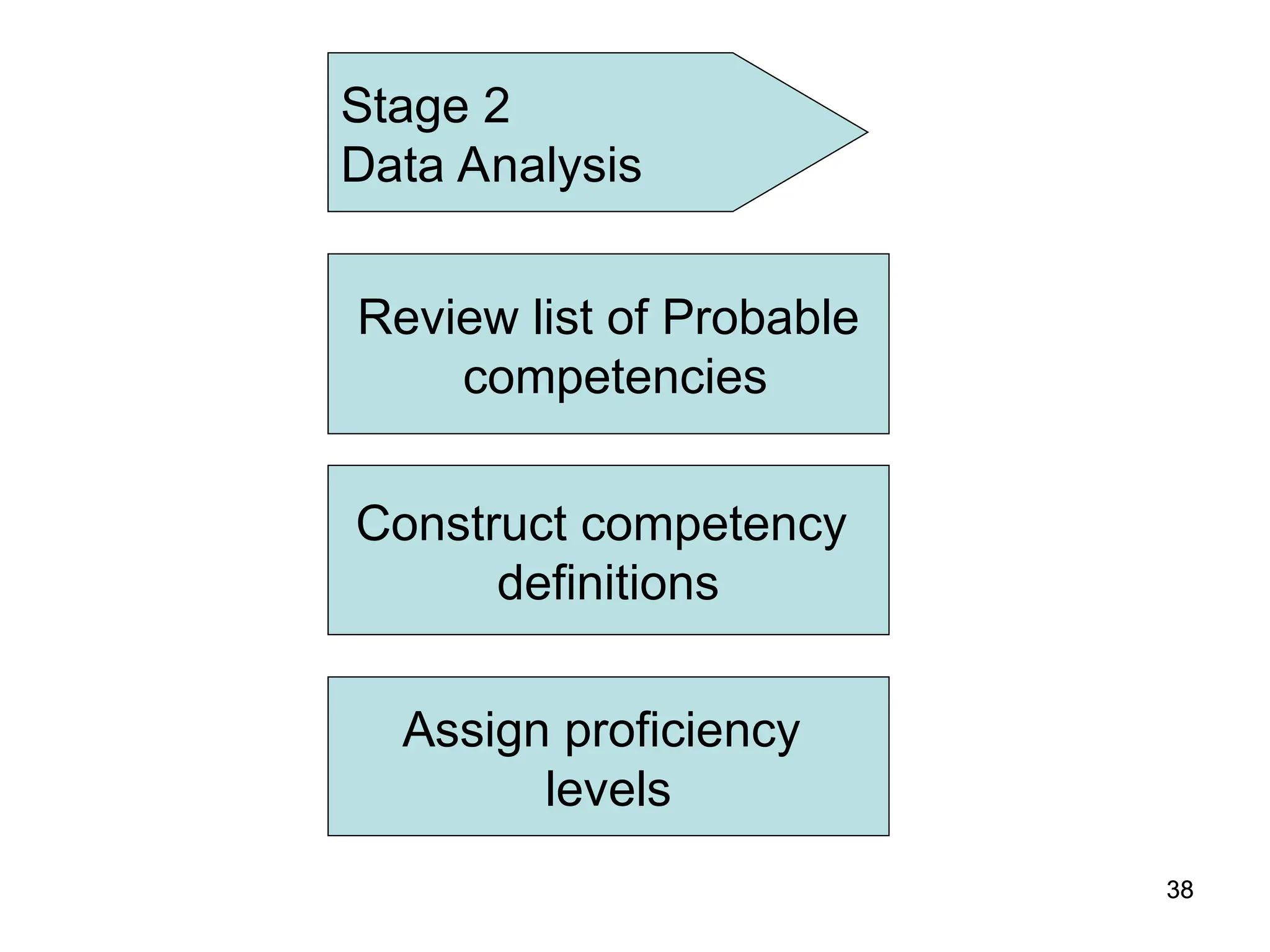
Stage 2
Data Analysis
Review list of Probable
competencies
Construct competency
definitions
Assign proficiency
levels
39
39
Step 1 - Review list of competencies
• Review for internal consistency, validity &
exhaustiveness
Step 2 - Construct competency definitions
• Simple, Brief, Meaningful
• State behavioral expectation from
employee
40
40
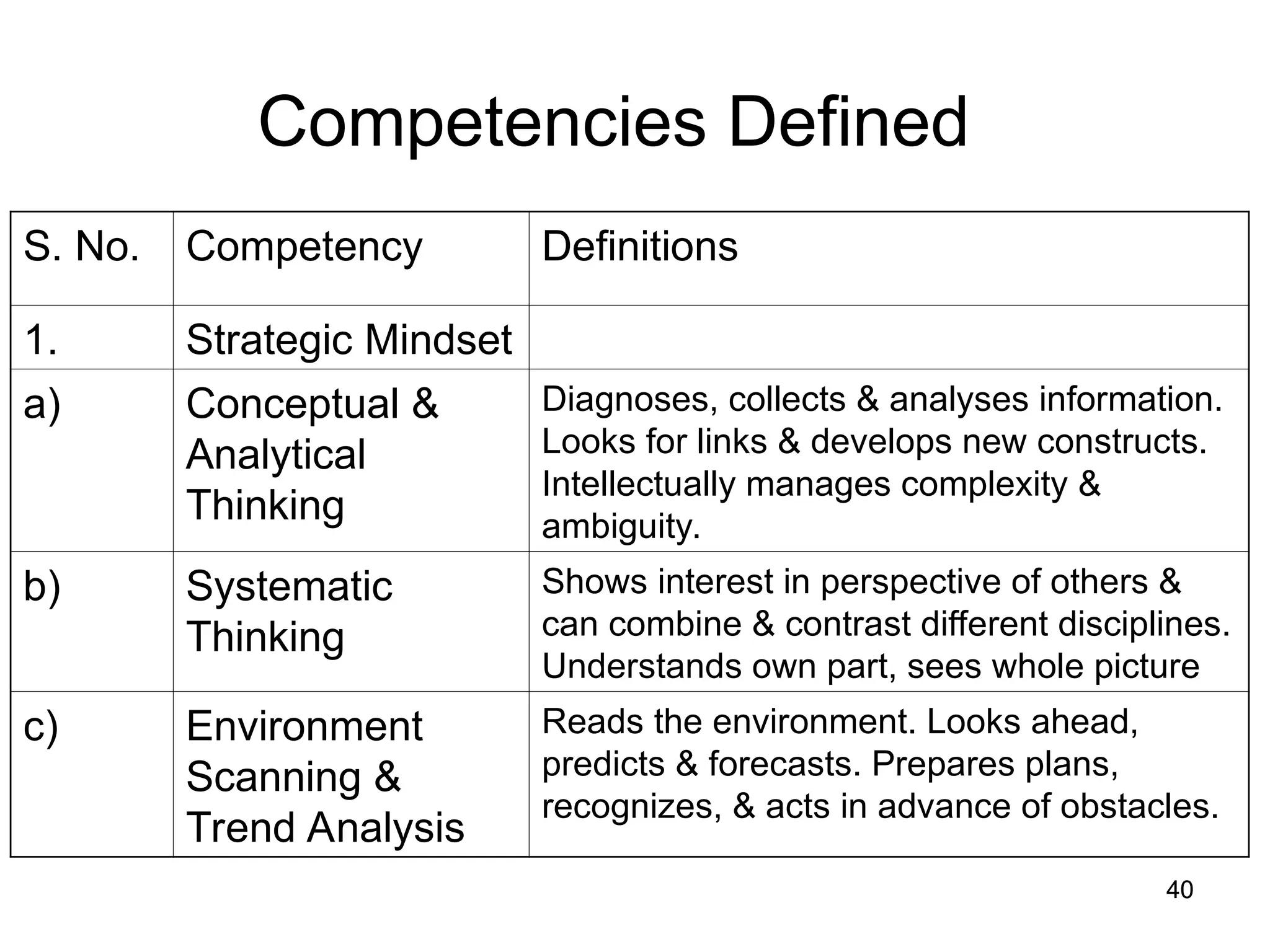
Competencies Defined
S. No. Competency Definitions
1. Strategic Mindset
a) Conceptual &
Analytical
Thinking
Diagnoses, collects & analyses information.
Looks for links & develops new constructs.
Intellectually manages complexity &
ambiguity.
b) Systematic
Thinking
Shows interest in perspective of others &
can combine & contrast different disciplines.
Understands own part, sees whole picture
c) Environment
Scanning &
Trend Analysis
Reads the environment. Looks ahead,
predicts & forecasts. Prepares plans,
recognizes, & acts in advance of obstacles.
41
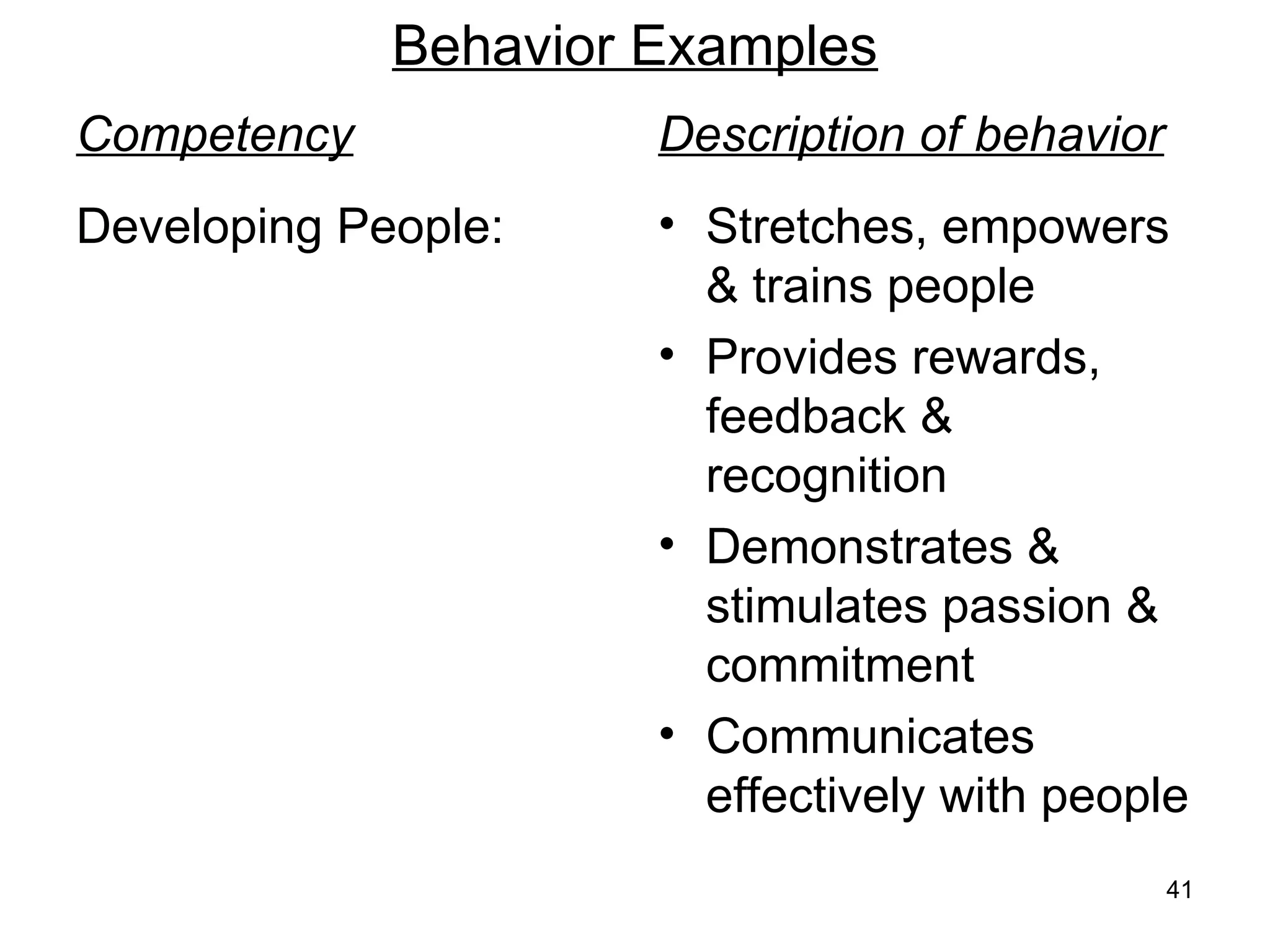
Behavior Examples
Competency
Developing People:
Description of behavior
• Stretches, empowers
& trains people
• Provides rewards,
feedback &
recognition
• Demonstrates &
stimulates passion &
commitment
• Communicates
effectively with people
42
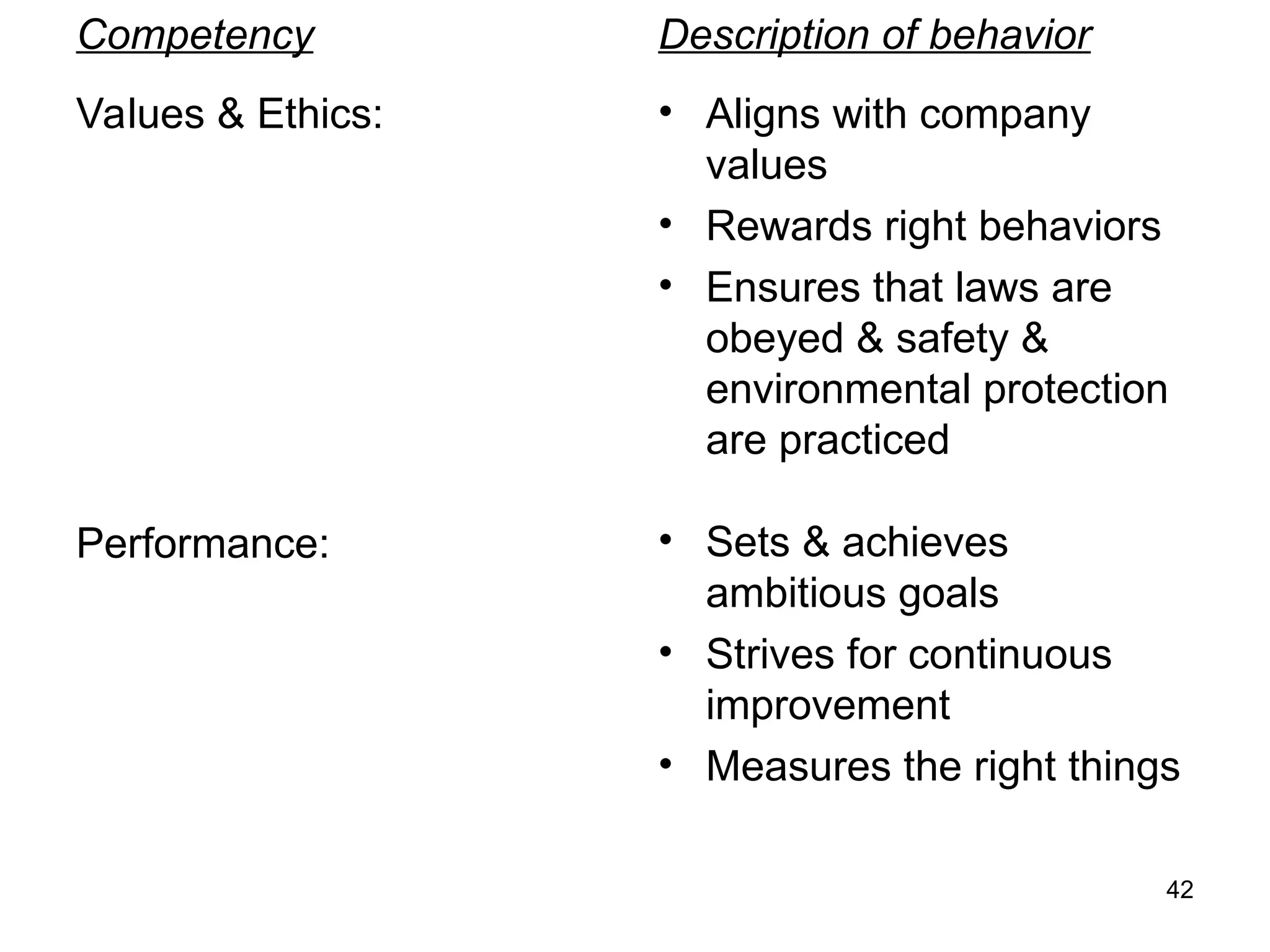
Competency
Values & Ethics:
Performance:
Description of behavior
• Aligns with company
values
• Rewards right behaviors
• Ensures that laws are
obeyed & safety &
environmental protection
are practiced
• Sets & achieves
ambitious goals
• Strives for continuous
improvement
• Measures the right things
43
43
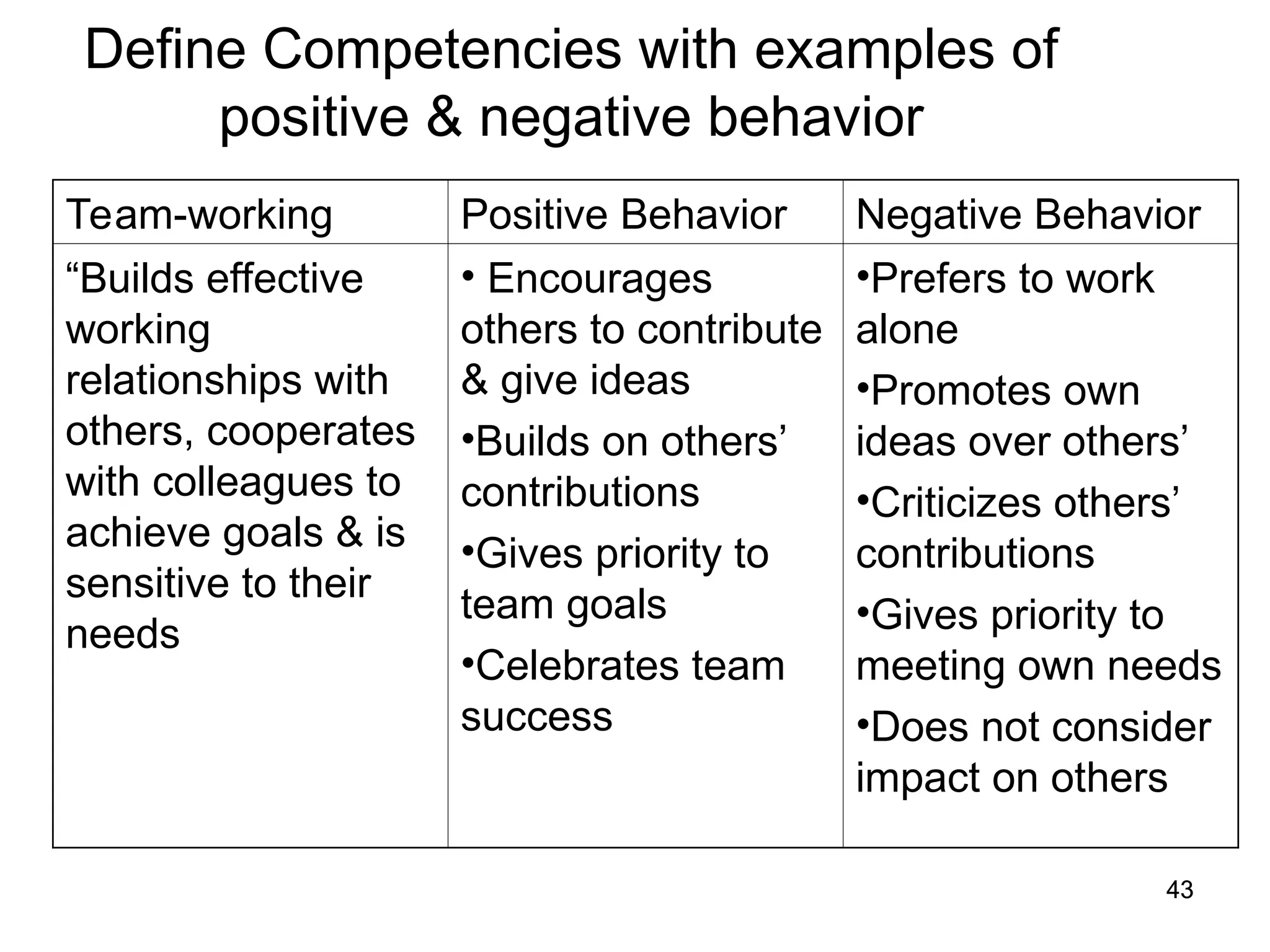
Team-working Positive Behavior Negative Behavior
“Builds effective
working
relationships with
others, cooperates
with colleagues to
achieve goals & is
sensitive to their
needs
• Encourages
others to contribute
& give ideas
•Builds on others’
contributions
•Gives priority to
team goals
•Celebrates team
success
•Prefers to work
alone
•Promotes own
ideas over others’
•Criticizes others’
contributions
•Gives priority to
meeting own needs
•Does not consider
impact on others
Define Competencies with examples of
positive & negative behavior
44
44
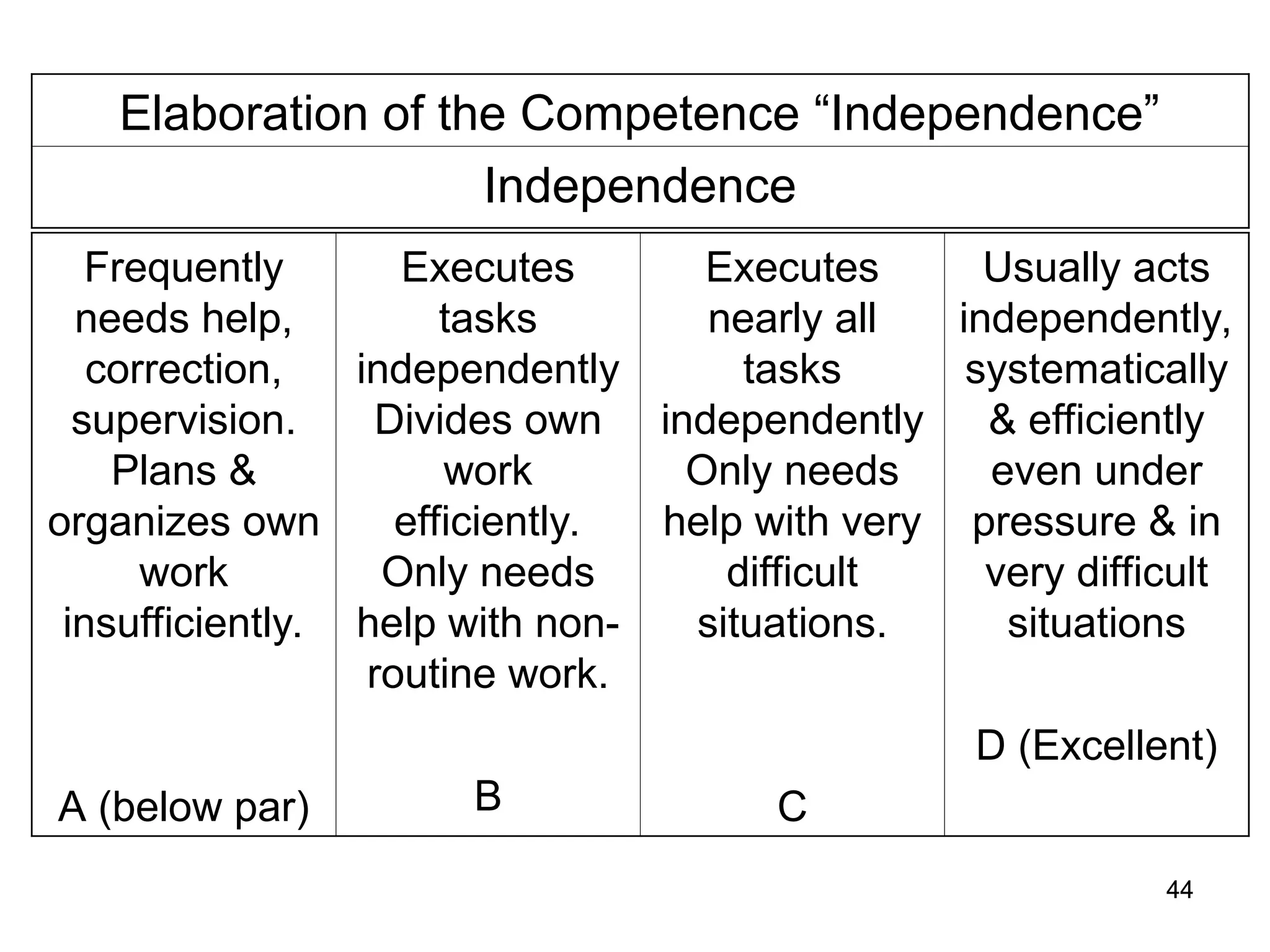
Elaboration of the Competence “Independence”
Independence
Frequently
needs help,
correction,
supervision.
Plans &
organizes own
work
insufficiently.
A (below par)
Executes
tasks
independently
Divides own
work
efficiently.
Only needs
help with non-
routine work.
B
Executes
nearly all
tasks
independently
Only needs
help with very
difficult
situations.
C
Usually acts
independently,
systematically
& efficiently
even under
pressure & in
very difficult
situations
D (Excellent)
45
45
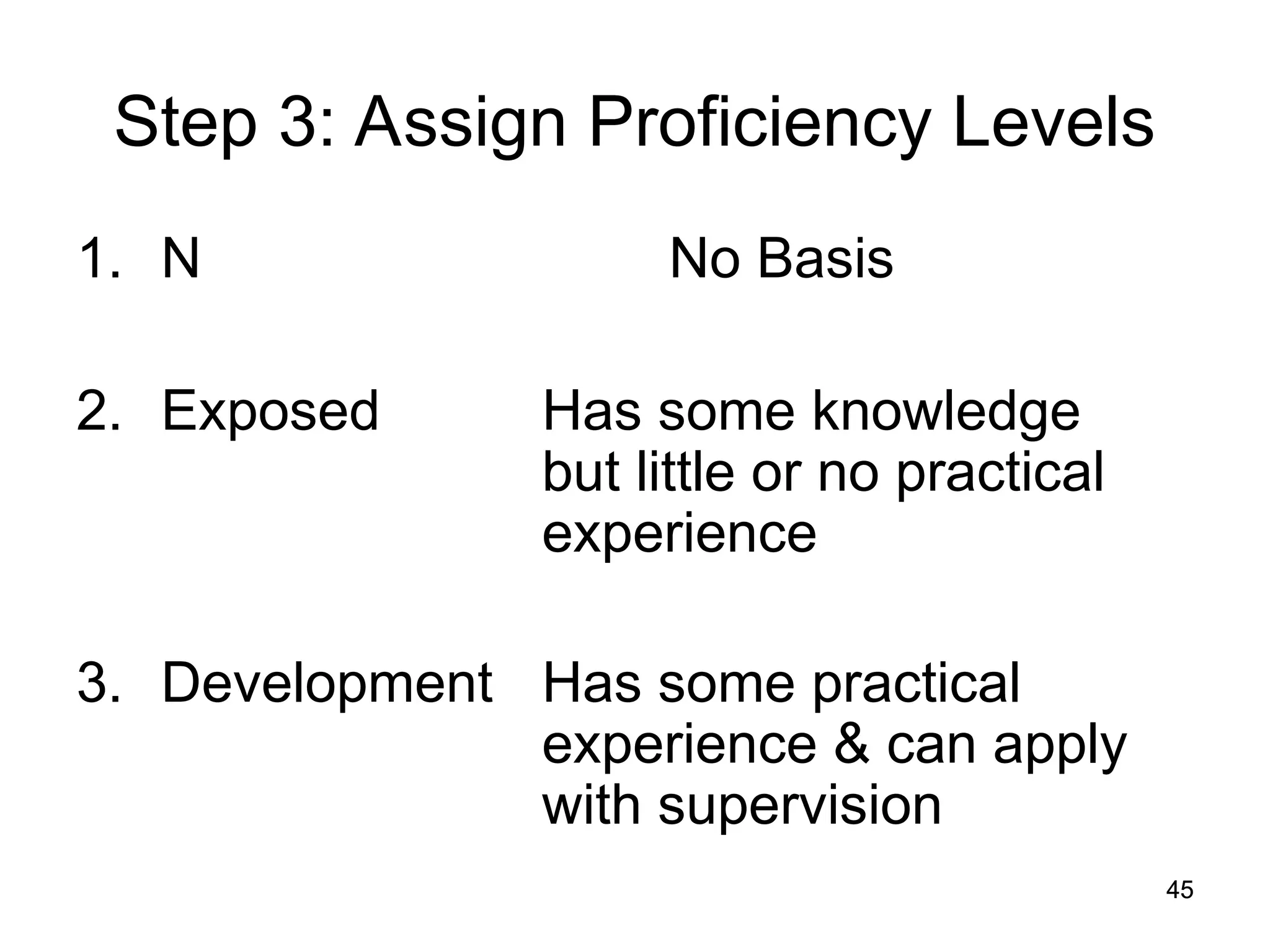
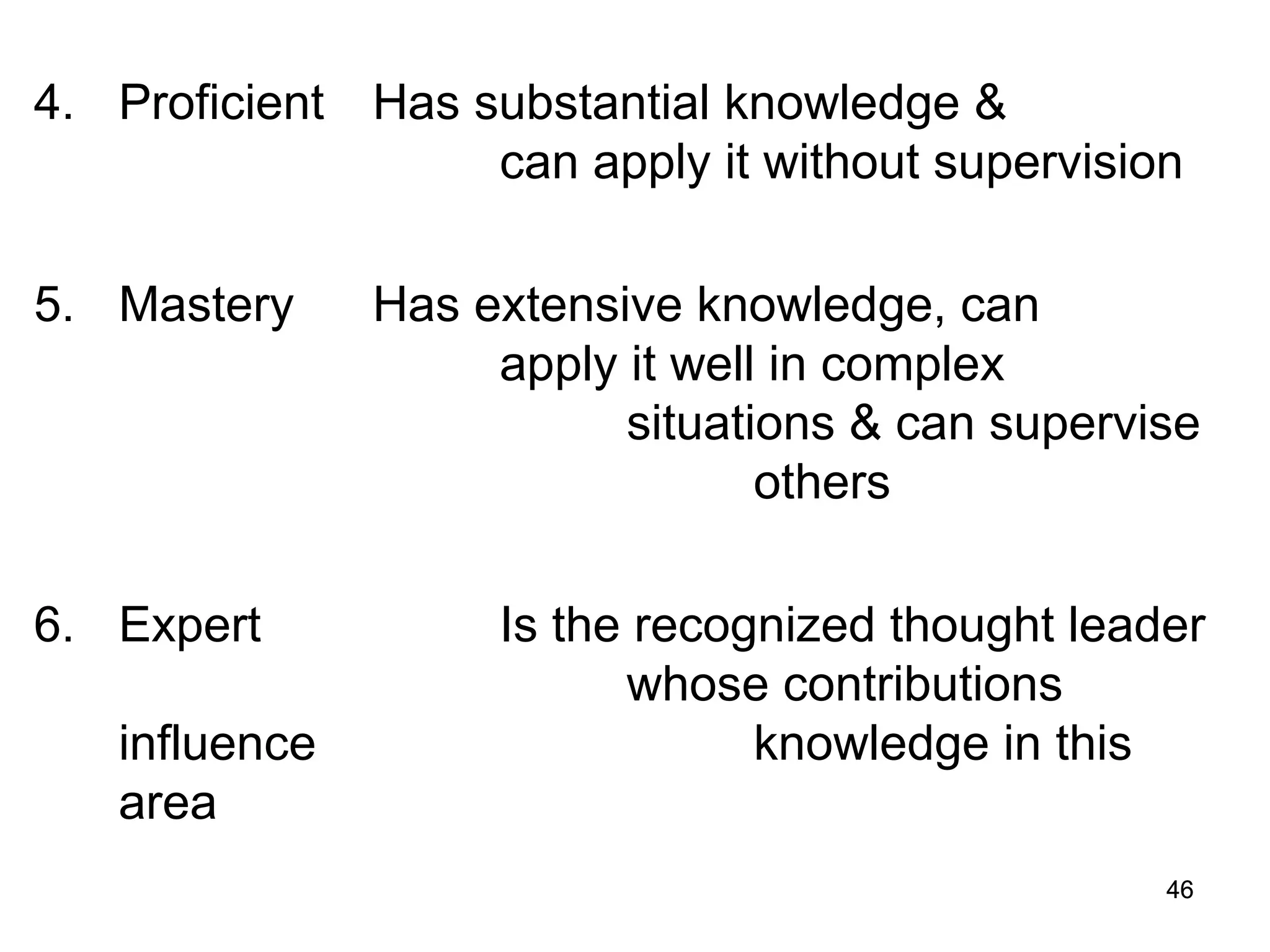
Step 3: Assign Proficiency Levels
1. N No Basis
2. Exposed Has some knowledge
but little or no practical
experience
3. Development Has some practical
experience & can apply
with supervision
46
46
4. Proficient Has substantial knowledge &
can apply it without supervision
5. Mastery Has extensive knowledge, can
apply it well in complex
situations & can supervise
others
6. Expert Is the recognized thought leader
whose contributions
influence knowledge in this
area
47
47
Stage 3
Validation
Content Validation
Session
Reinforce proficiency of
Critical competencies
Refine competency
definitions if
necessary
48
48
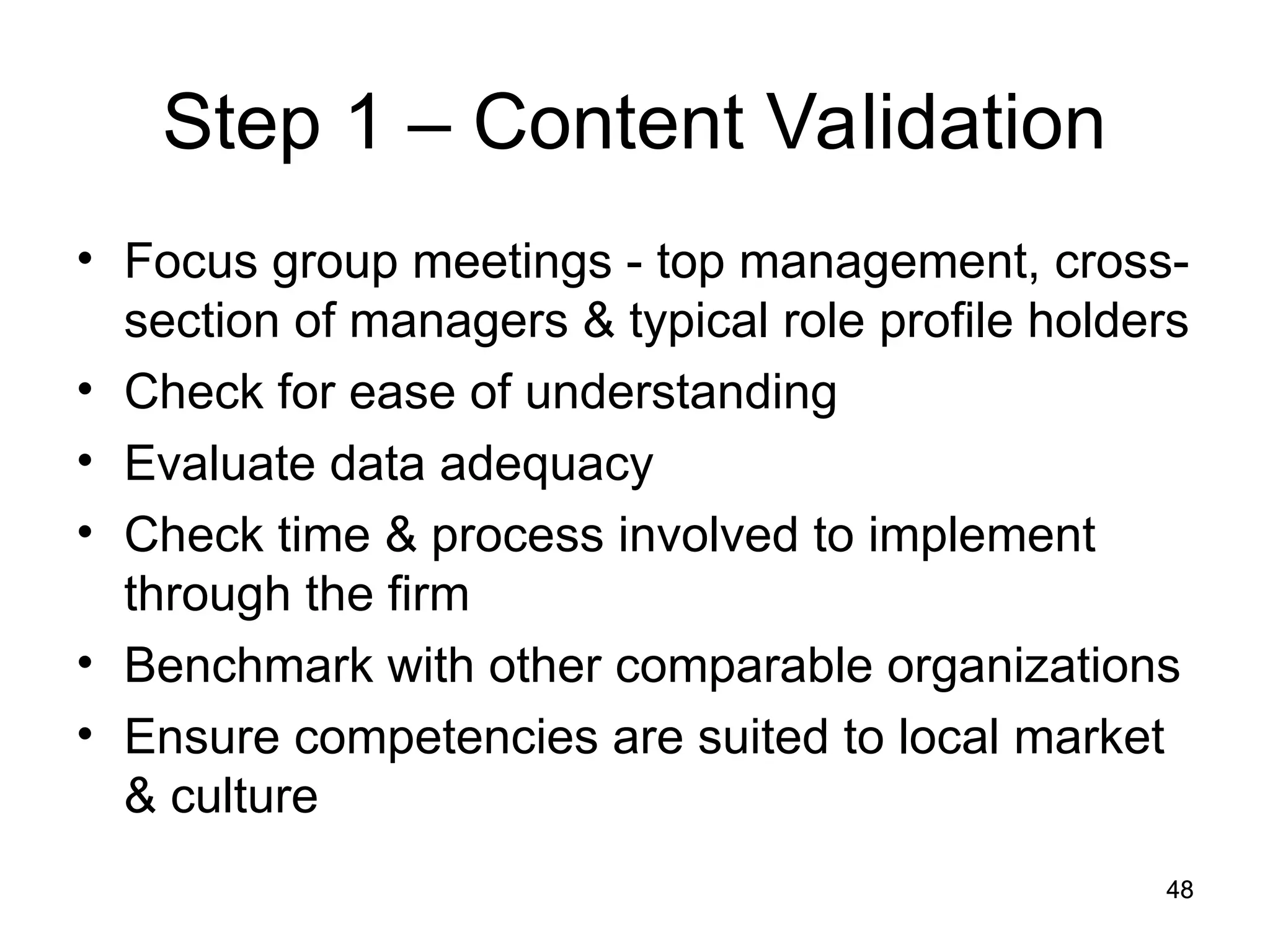
Step 1 – Content Validation
• Focus group meetings - top management, cross-
section of managers & typical role profile holders
• Check for ease of understanding
• Evaluate data adequacy
• Check time & process involved to implement
through the firm
• Benchmark with other comparable organizations
• Ensure competencies are suited to local market
& culture
49
49
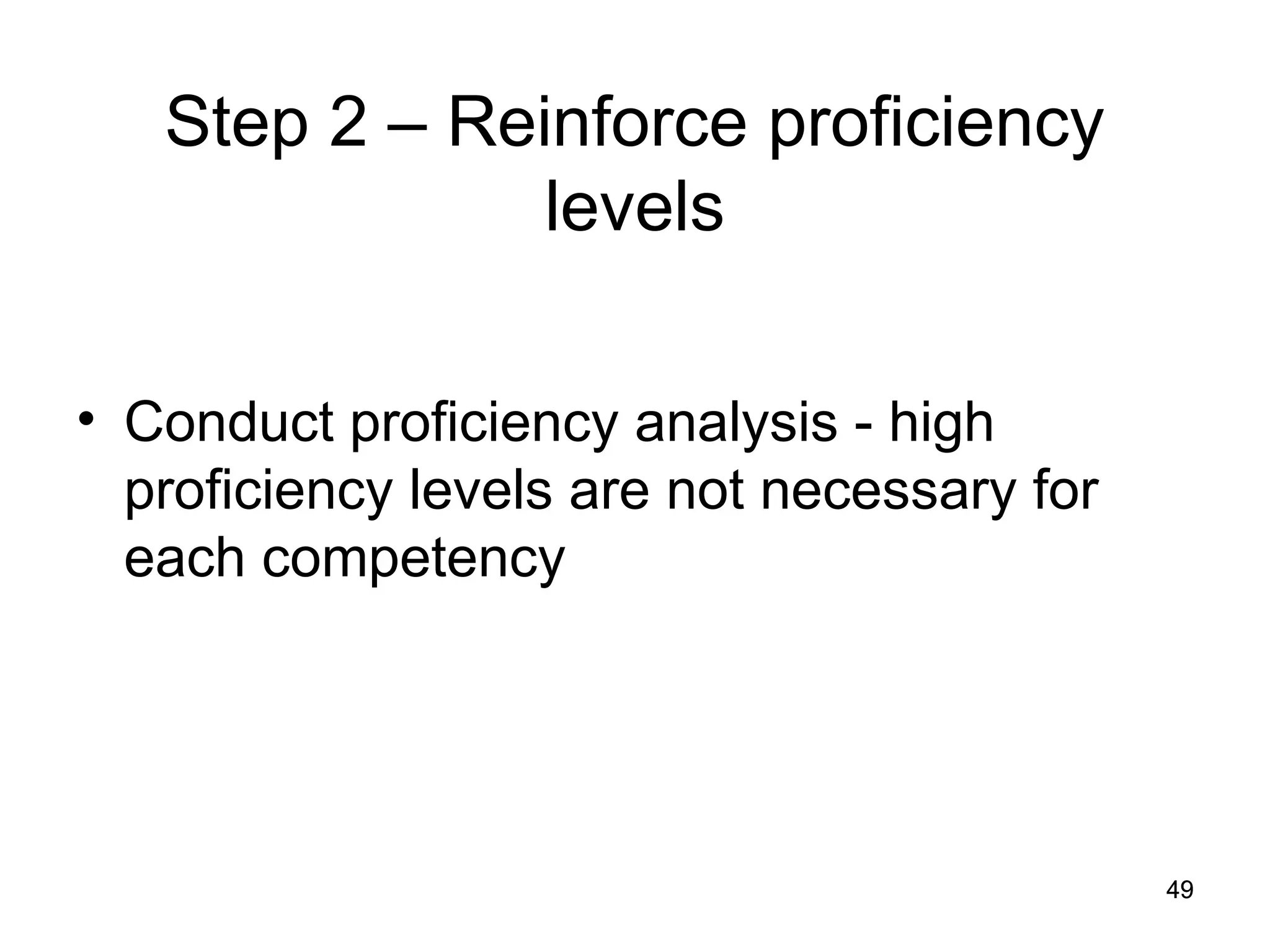
Step 2 – Reinforce proficiency
levels
• Conduct proficiency analysis - high
proficiency levels are not necessary for
each competency
50
B) Starting with a validated
competency model
1. Personal Competency Framework
2. Lancaster Model of Managerial
Competencies
51
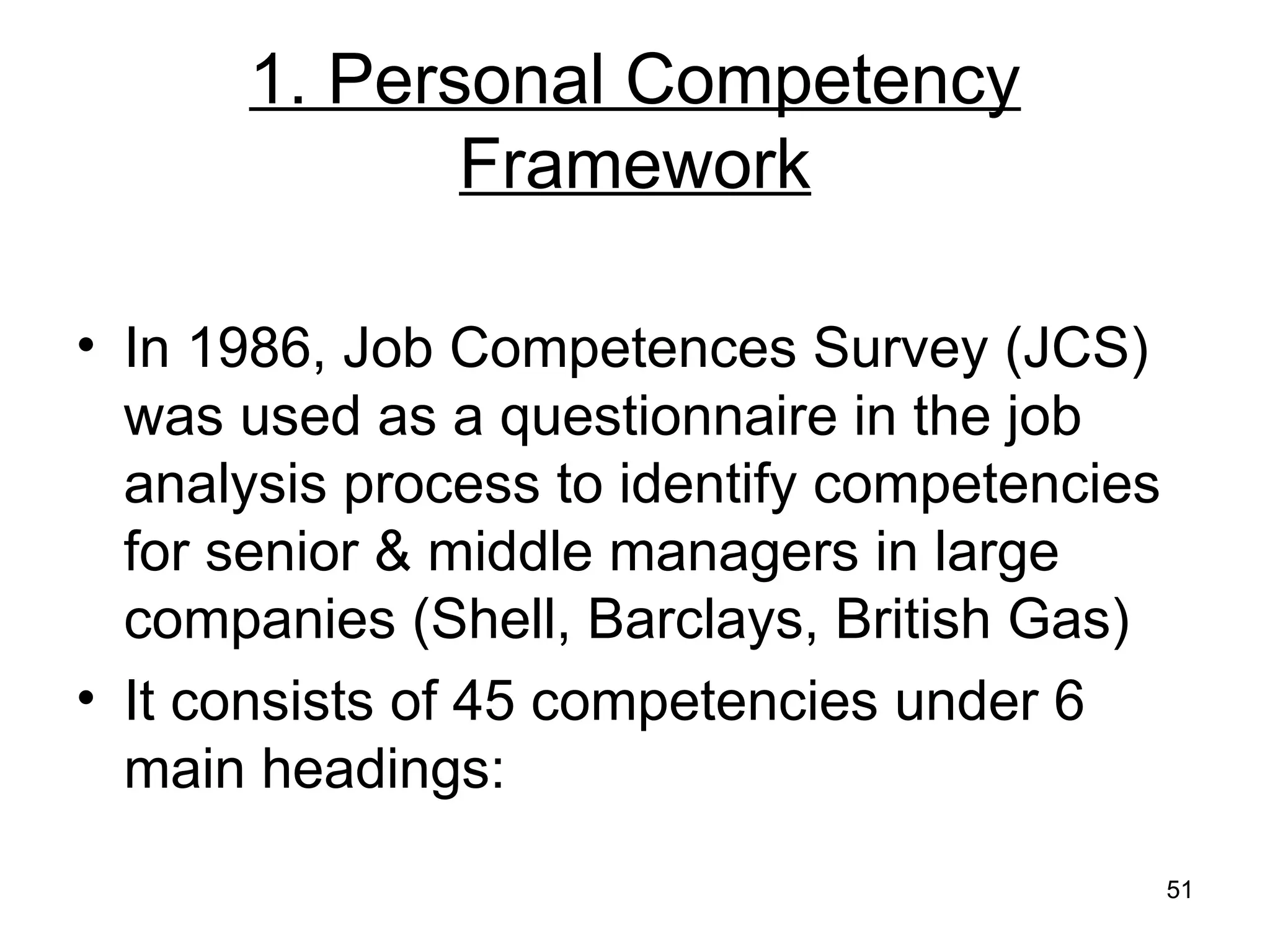
1. Personal Competency
Framework
• In 1986, Job Competences Survey (JCS)
was used as a questionnaire in the job
analysis process to identify competencies
for senior & middle managers in large
companies (Shell, Barclays, British Gas)
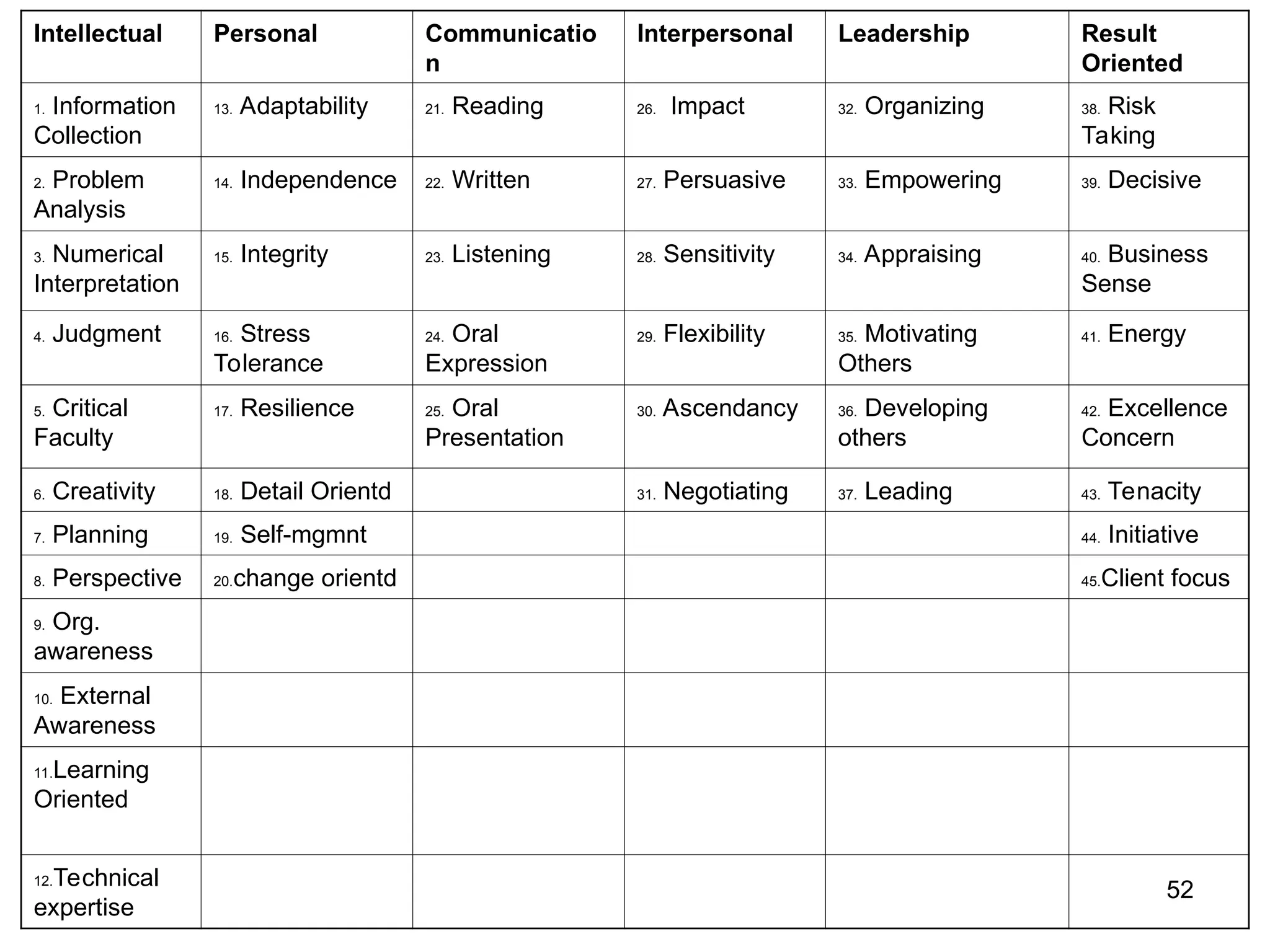
• It consists of 45 competencies under 6
main headings:
52
Intellectual Personal Communicatio
n
Interpersonal Leadership Result
Oriented
1. Information
Collection
13. Adaptability 21. Reading 26. Impact 32. Organizing 38. Risk
Taking
2. Problem
Analysis
14. Independence 22. Written 27. Persuasive 33. Empowering 39. Decisive
3. Numerical
Interpretation
15. Integrity 23. Listening 28. Sensitivity 34. Appraising 40. Business
Sense
4. Judgment 16. Stress
Tolerance
24. Oral
Expression
29. Flexibility 35. Motivating
Others
41. Energy
5. Critical
Faculty
17. Resilience 25. Oral
Presentation
30. Ascendancy 36. Developing
others
42. Excellence
Concern
6. Creativity 18. Detail Orientd 31. Negotiating 37. Leading 43. Tenacity
7. Planning 19. Self-mgmnt 44. Initiative
8. Perspective 20.change orientd 45.Client focus
9. Org.
awareness
10. External
Awareness
11.Learning
Oriented
12.Technical
expertise
53
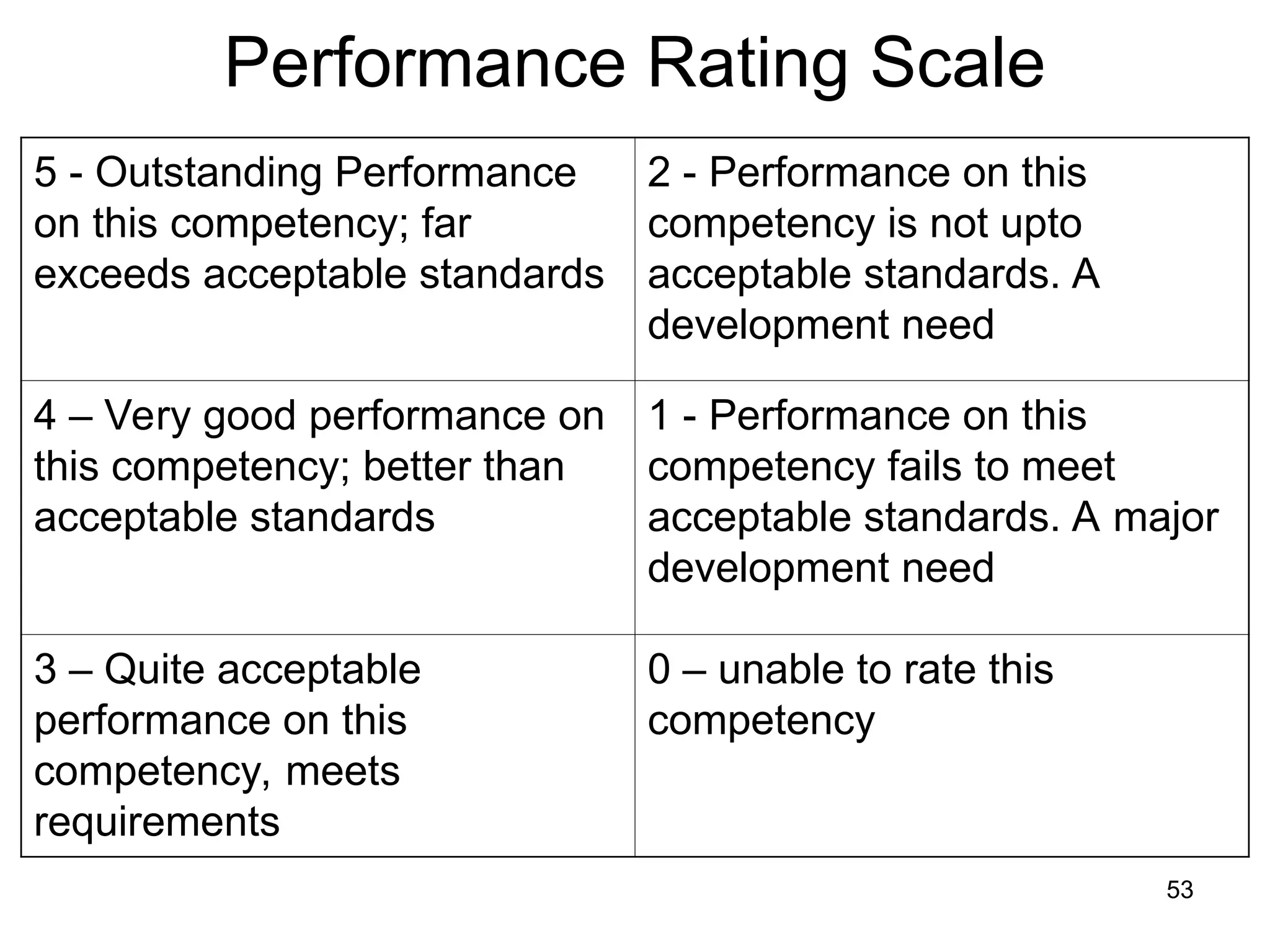
Performance Rating Scale
5 - Outstanding Performance
on this competency; far
exceeds acceptable standards
2 - Performance on this
competency is not upto
acceptable standards. A
development need
4 – Very good performance on
this competency; better than
acceptable standards
1 - Performance on this
competency fails to meet
acceptable standards. A major
development need
3 – Quite acceptable
performance on this
competency, meets
requirements
0 – unable to rate this
competency
54
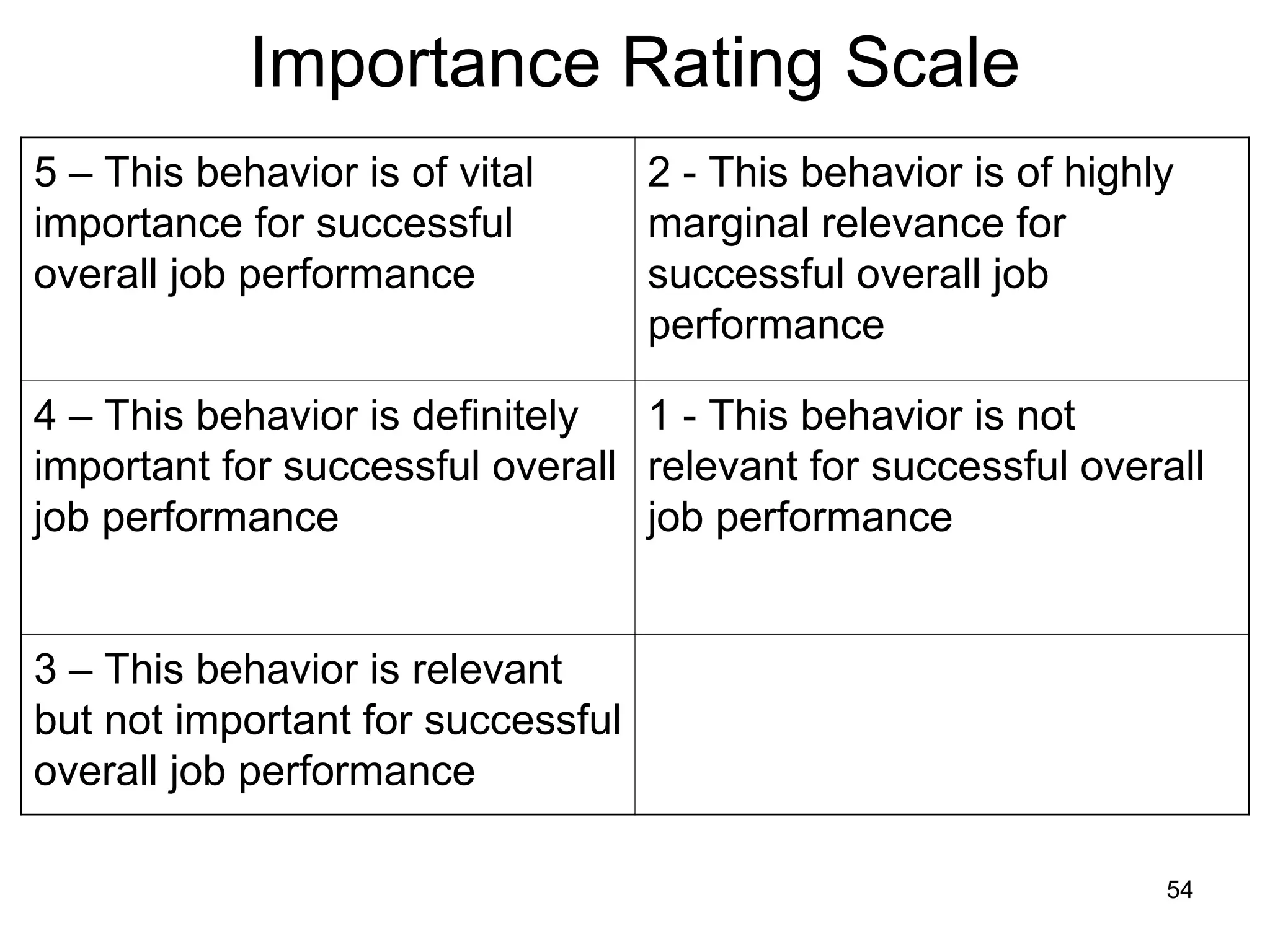
Importance Rating Scale
5 – This behavior is of vital
importance for successful
overall job performance
2 - This behavior is of highly
marginal relevance for
successful overall job
performance
4 – This behavior is definitely
important for successful overall
job performance
1 - This behavior is not
relevant for successful overall
job performance
3 – This behavior is relevant
but not important for successful
overall job performance
55
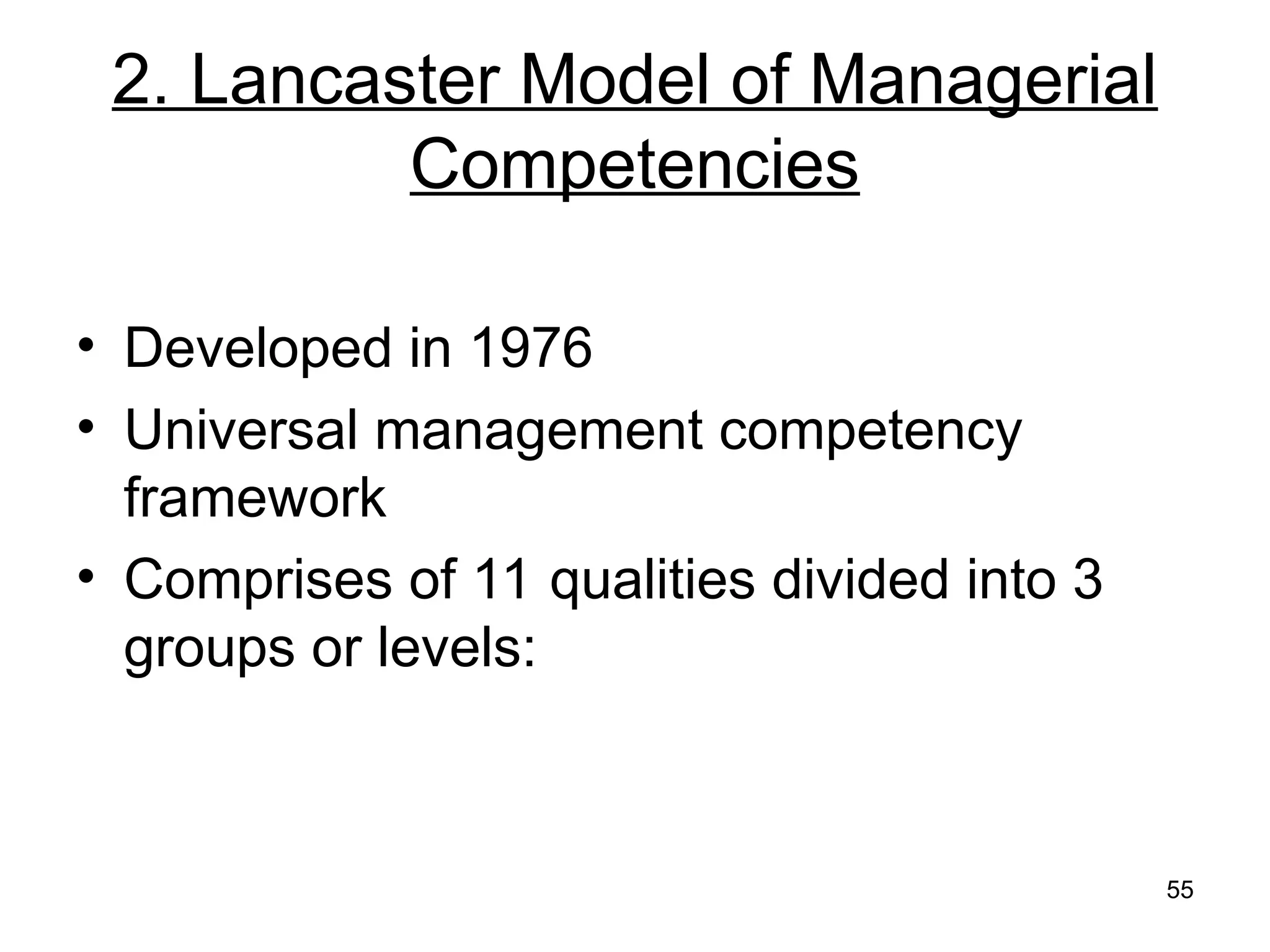
2. Lancaster Model of Managerial
Competencies
• Developed in 1976
• Universal management competency
framework
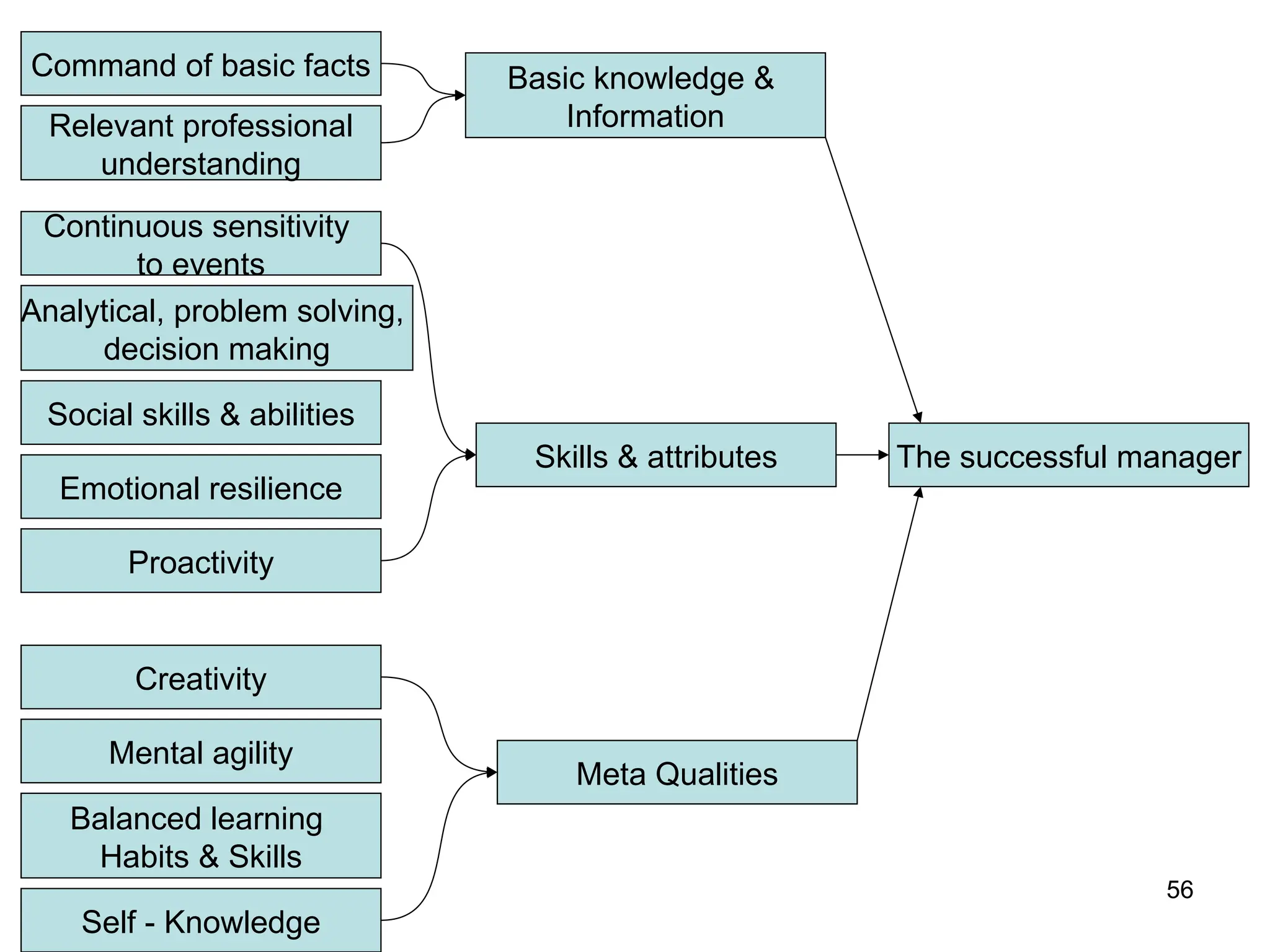
• Comprises of 11 qualities divided into 3
groups or levels:
56
Command of basic facts
Relevant professional
understanding
Continuous sensitivity
to events
Analytical, problem solving,
decision making
Social skills & abilities
Emotional resilience
Proactivity
Creativity
Mental agility
Balanced learning
Habits & Skills
Self - Knowledge
Basic knowledge &
Information
Skills & attributes
Meta Qualities
The successful manager
57
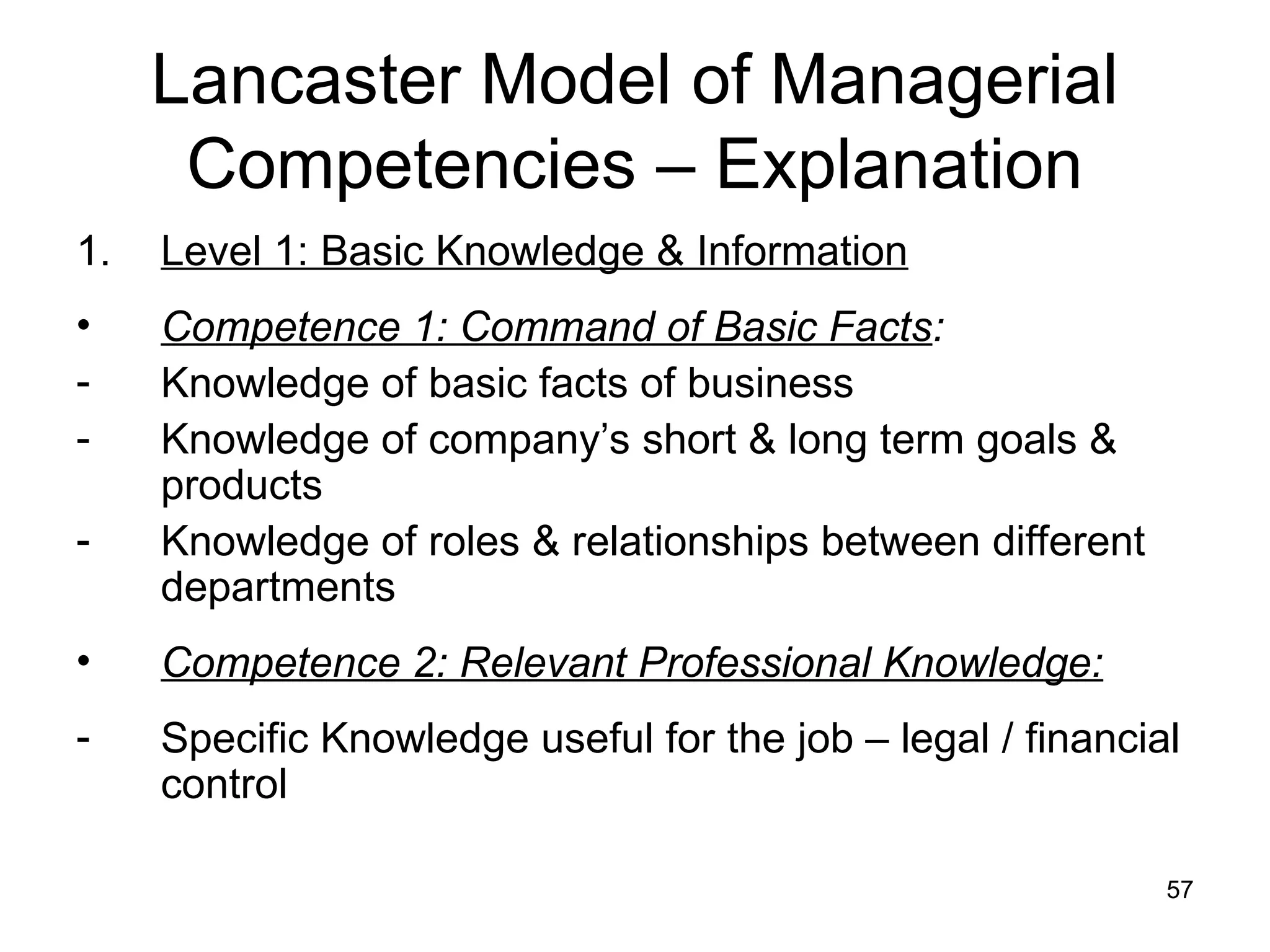
Lancaster Model of Managerial
Competencies – Explanation
1. Level 1: Basic Knowledge & Information
• Competence 1: Command of Basic Facts:
- Knowledge of basic facts of business
- Knowledge of company’s short & long term goals &
products
- Knowledge of roles & relationships between different
departments
• Competence 2: Relevant Professional Knowledge:
- Specific Knowledge useful for the job – legal / financial
control
58
2. Level 2: Skills & Attributes:
• Competence 1: Continuous sensitivity to
events:
• Being aware of what is going on
• Perceptive & open to information: hard
information (facts & figures) & soft information
(feelings of other people)
• Can respond suitably
• Competence 2: Analytical, problem solving,
decision making:
- Judgment, intuition, weighing pros & cons
59
• Competence 3: Social skills & abilities :
• Interpersonal skills – communicating,
delegating, negotiating, resolving conflict,
persuading
• Competence 4: Emotional Resilience:
- Ability to cope with emotional stress & strain
without getting insensitive & losing self-control
• Competence 5: Proactivity:
- Dedication & Commitment
- Taking responsibility by considering the long-
term goals & impact of decision
60
3. Level 3: Meta Qualities: situation specific
skills
• Competence 1: Creativity:
• Ability to come up with unique ideas &
solutions
• Insight to use useful ideas from another
source
• Competence 2: Mental agility:
- Grasping problems quickly
- Thinking about several things at once
61
• Competence 3: Balanced learning habits
& skills:
• Ability to use a range of learning
processes – teaching, discovering from
personal experiences & reflection
• Exhibit independence as learners
• Competence 4: Self knowledge:
- Being aware of own beliefs, goals,
values, feelings, behavior & the part they
play in influencing actions
62
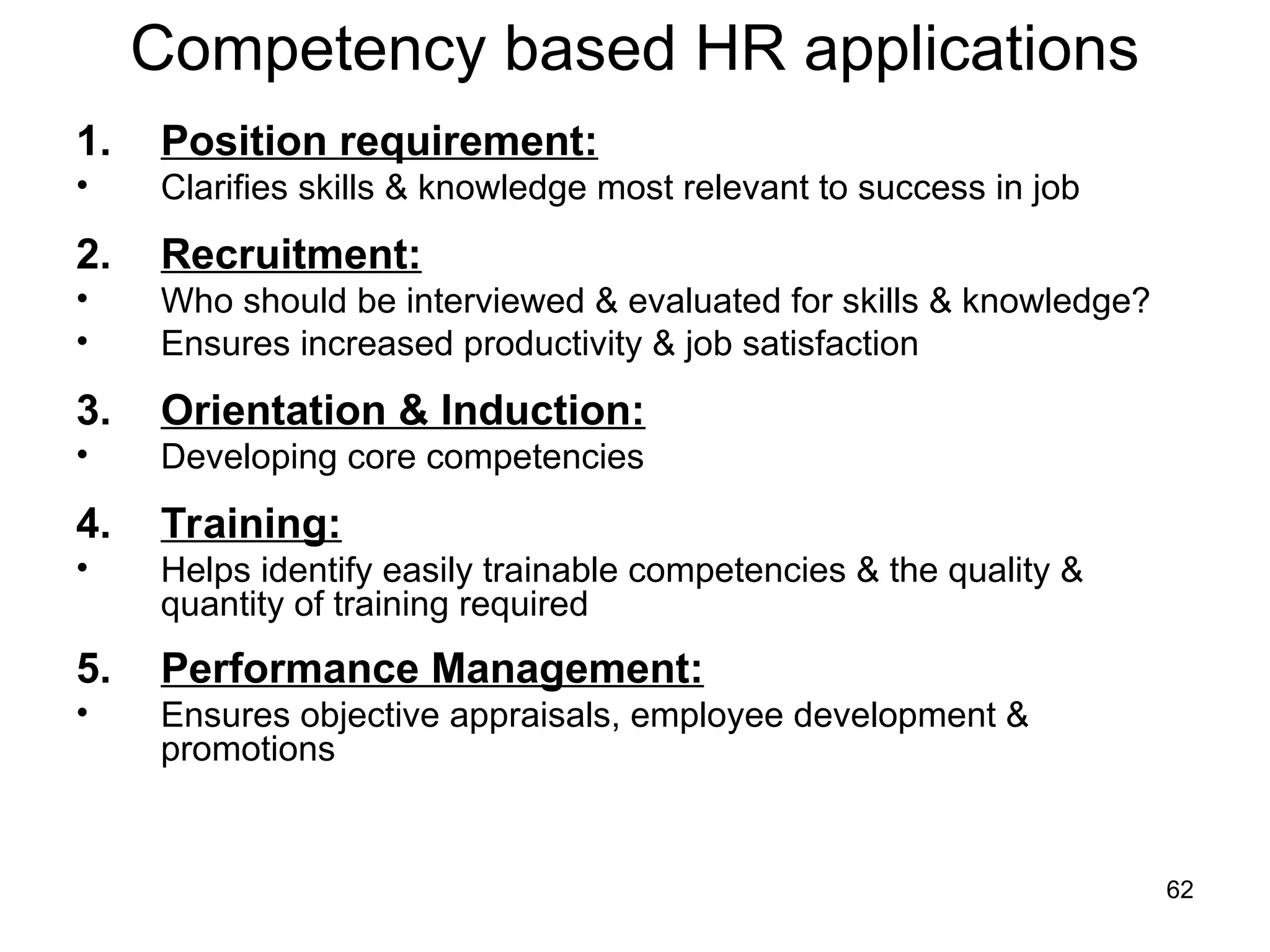
Competency based HR applications
1. Position requirement:
• Clarifies skills & knowledge most relevant to success in job
2. Recruitment:
• Who should be interviewed & evaluated for skills & knowledge?
• Ensures increased productivity & job satisfaction
3. Orientation & Induction:
• Developing core competencies
4. Training:
• Helps identify easily trainable competencies & the quality &
quantity of training required
5. Performance Management:
• Ensures objective appraisals, employee development &
promotions
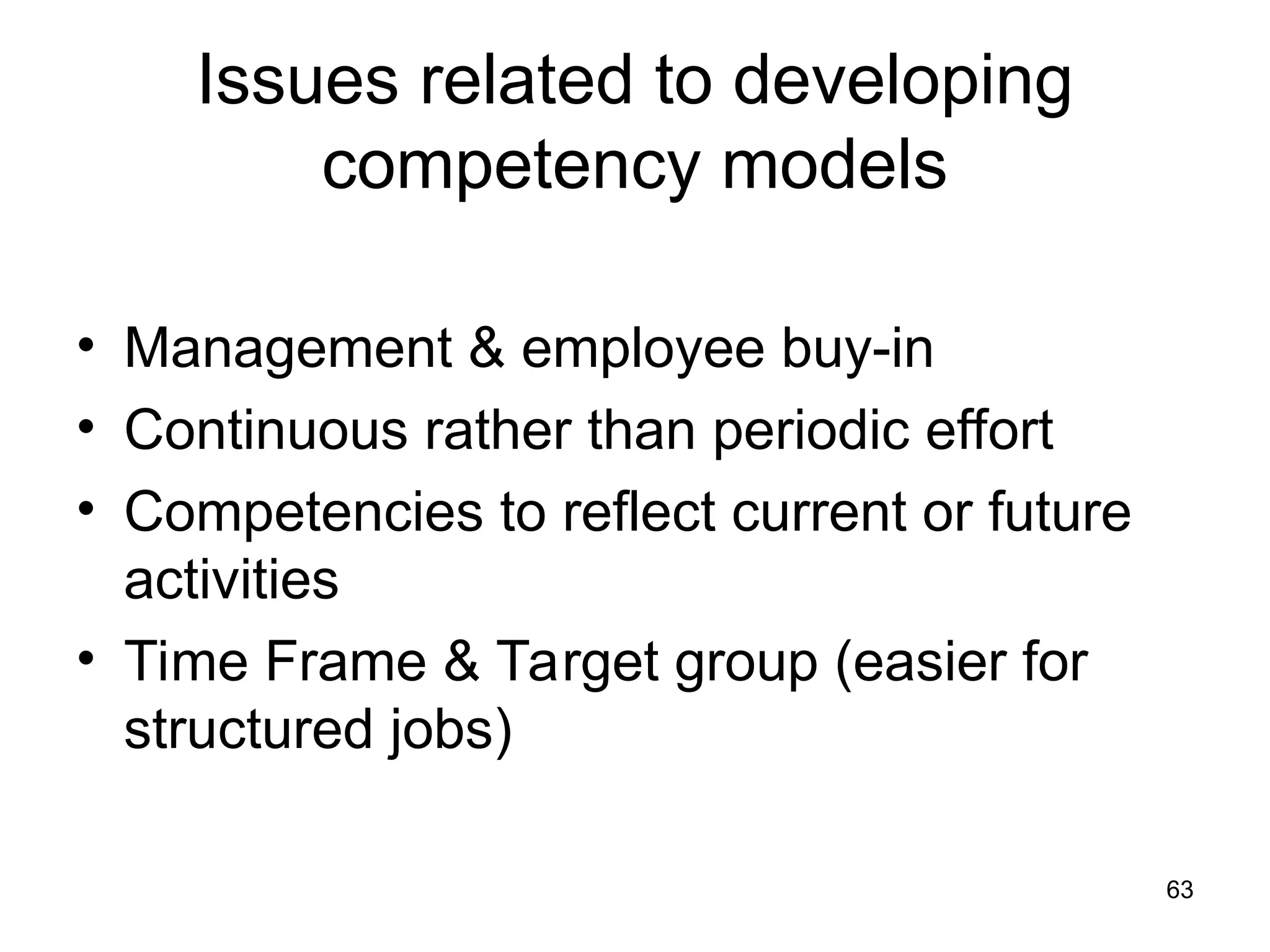
63
Issues related to developing
competency models
• Management & employee buy-in
• Continuous rather than periodic effort
• Competencies to reflect current or future
activities
• Time Frame & Target group (easier for
structured jobs)
64
64
Assessment & Development
Centers
Multi dimensional approach to obtain the
best possible indication of peoples’ current
or potential competencies to perform at
the target job or current job level
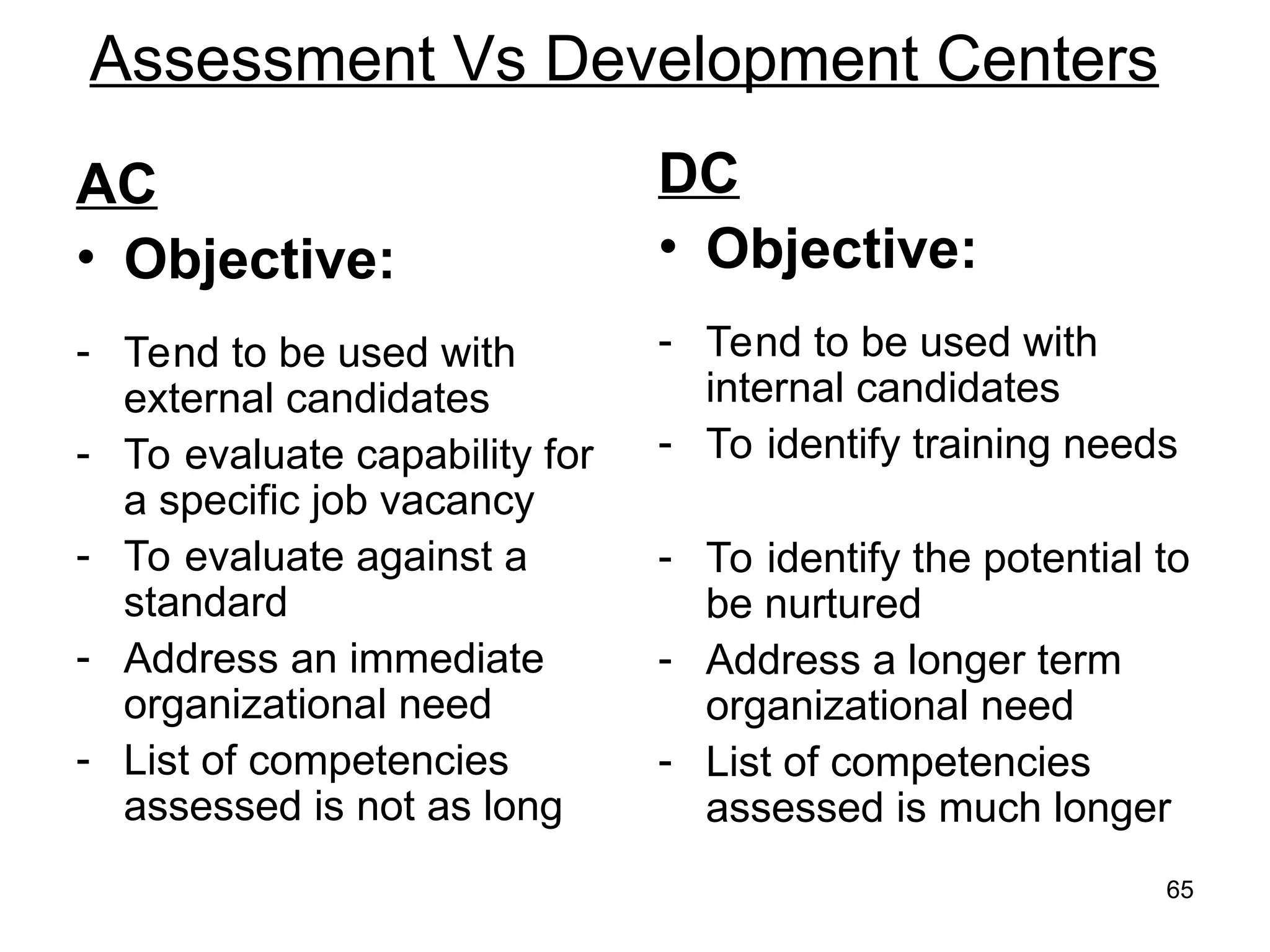
65
Assessment Vs Development Centers
AC
• Objective:
- Tend to be used with
external candidates
- To evaluate capability for
a specific job vacancy
- To evaluate against a
standard
- Address an immediate
organizational need
- List of competencies
assessed is not as long
DC
• Objective:
- Tend to be used with
internal candidates
- To identify training needs
- To identify the potential to
be nurtured
- Address a longer term
organizational need
- List of competencies
assessed is much longer
66
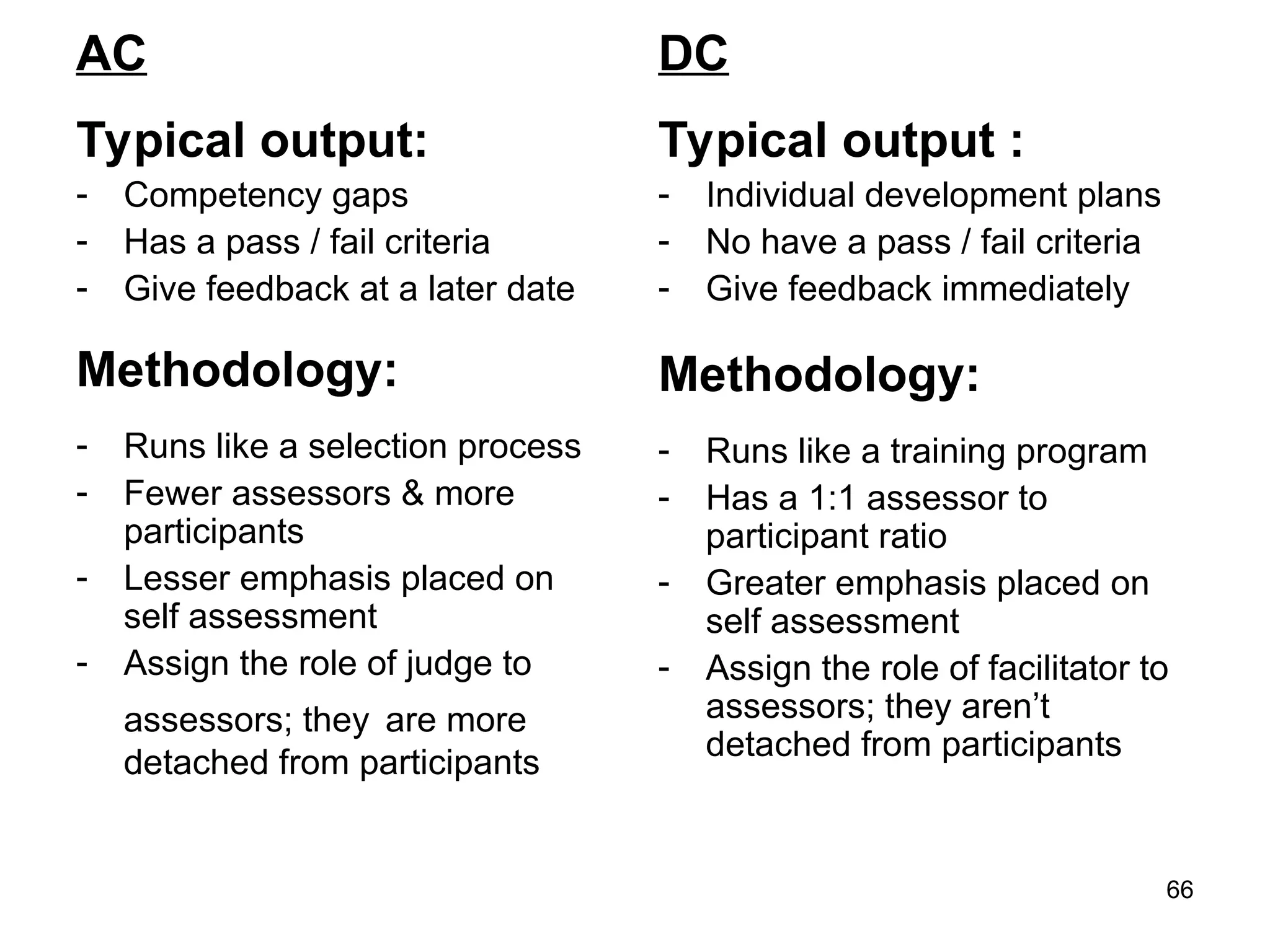
AC
Typical output:
- Competency gaps
- Has a pass / fail criteria
- Give feedback at a later date
Methodology:
- Runs like a selection process
- Fewer assessors & more
participants
- Lesser emphasis placed on
self assessment
- Assign the role of judge to
assessors; they are more
detached from participants
DC
Typical output :
- Individual development plans
- No have a pass / fail criteria
- Give feedback immediately
Methodology:
- Runs like a training program
- Has a 1:1 assessor to
participant ratio
- Greater emphasis placed on
self assessment
- Assign the role of facilitator to
assessors; they aren’t
detached from participants
67
67
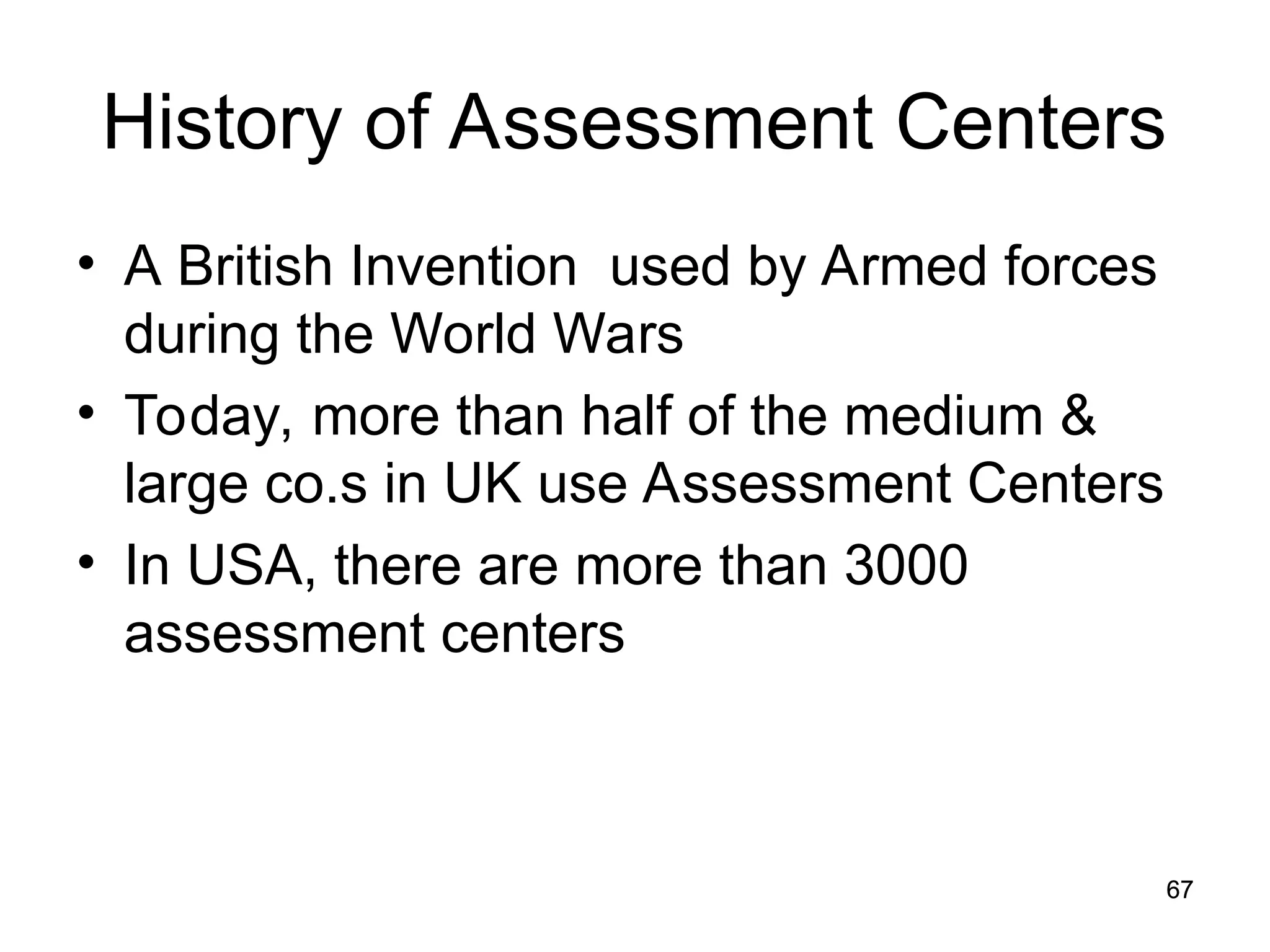
History of Assessment Centers
• A British Invention used by Armed forces
during the World Wars
• Today, more than half of the medium &
large co.s in UK use Assessment Centers
• In USA, there are more than 3000
assessment centers
68
68
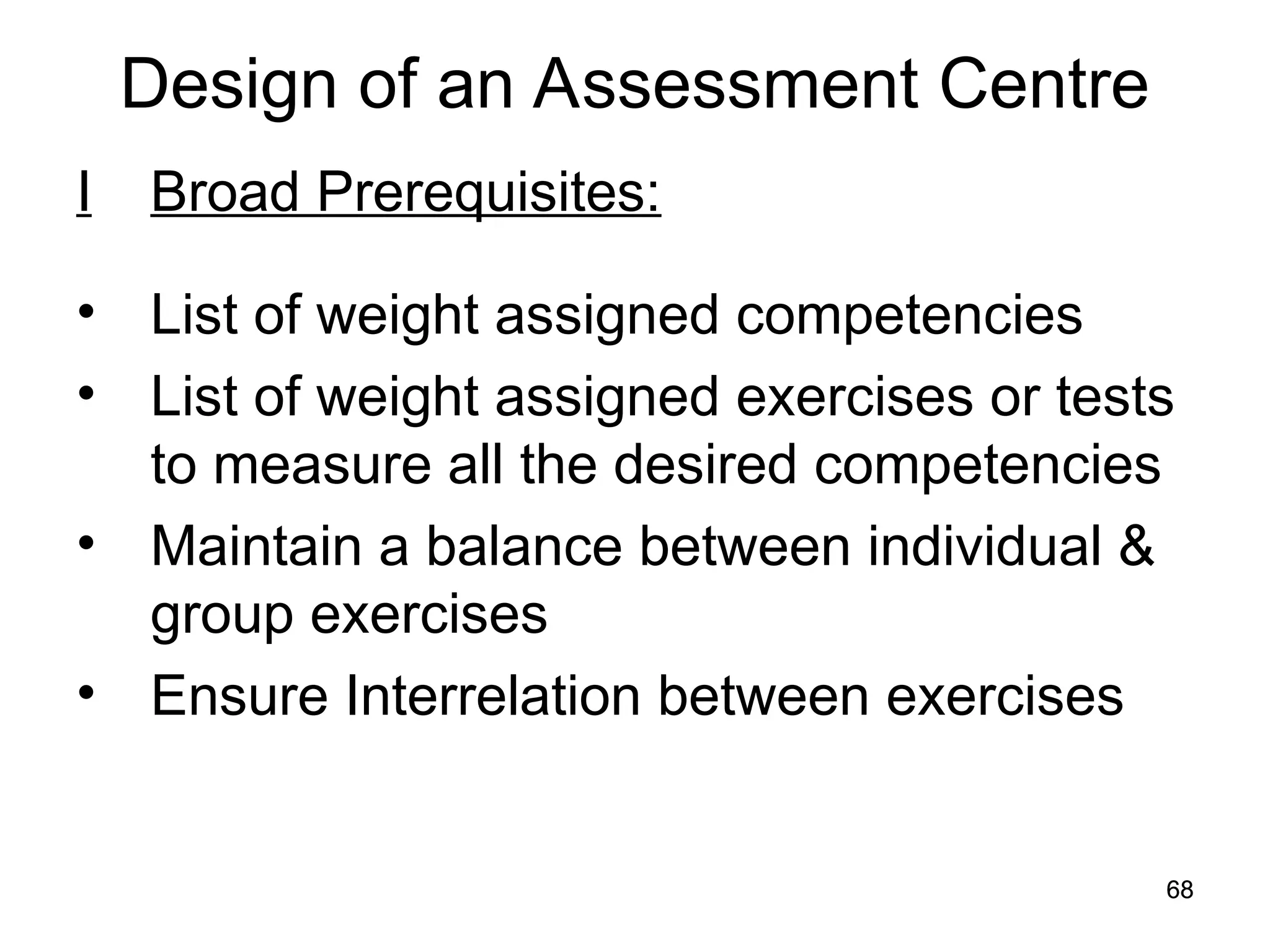
Design of an Assessment Centre
I Broad Prerequisites:
• List of weight assigned competencies
• List of weight assigned exercises or tests
to measure all the desired competencies
• Maintain a balance between individual &
group exercises
• Ensure Interrelation between exercises
69
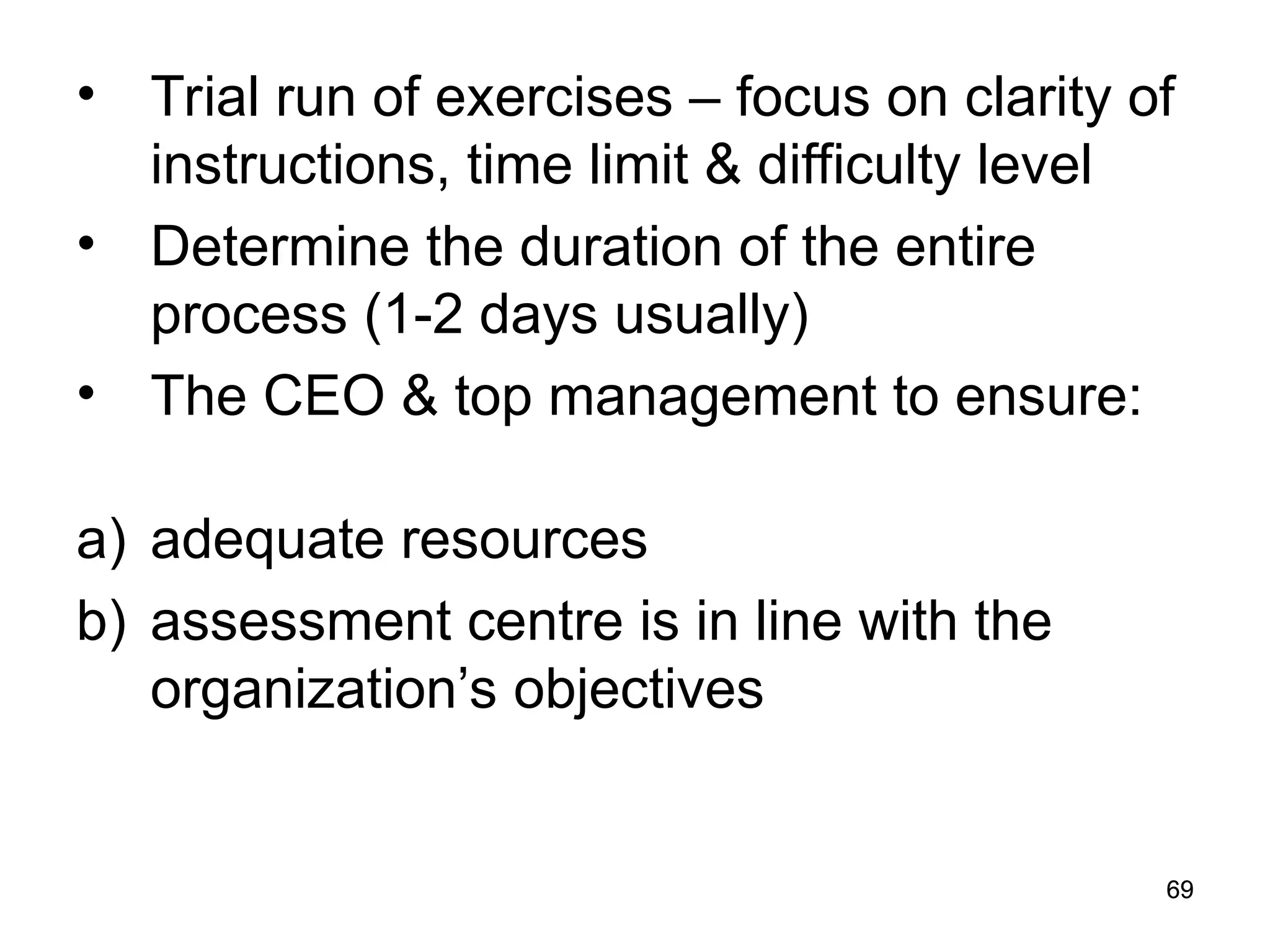
69
• Trial run of exercises – focus on clarity of
instructions, time limit & difficulty level
• Determine the duration of the entire
process (1-2 days usually)
• The CEO & top management to ensure:
a) adequate resources
b) assessment centre is in line with the
organization’s objectives
70
70
II Assessor selection & training:
– Best to train senior managers for the role
of assessors
- Avoid direct assessment by line managers
(assessor perception / participant under
pressure)
- Competency Framework Familiarization;
understanding competencies & their
assigned +ve & -ve behaviors; share video
of trial run
71
71
- Communication skills: for giving feedback &
assistance in formulating development action
plans:
1. Listening
2. Questioning
3. Empathy
4. Inter personal skills
- Personal Qualities:
1. Managerial professionalism & Integrity
2. Confidence & credibility
72
72
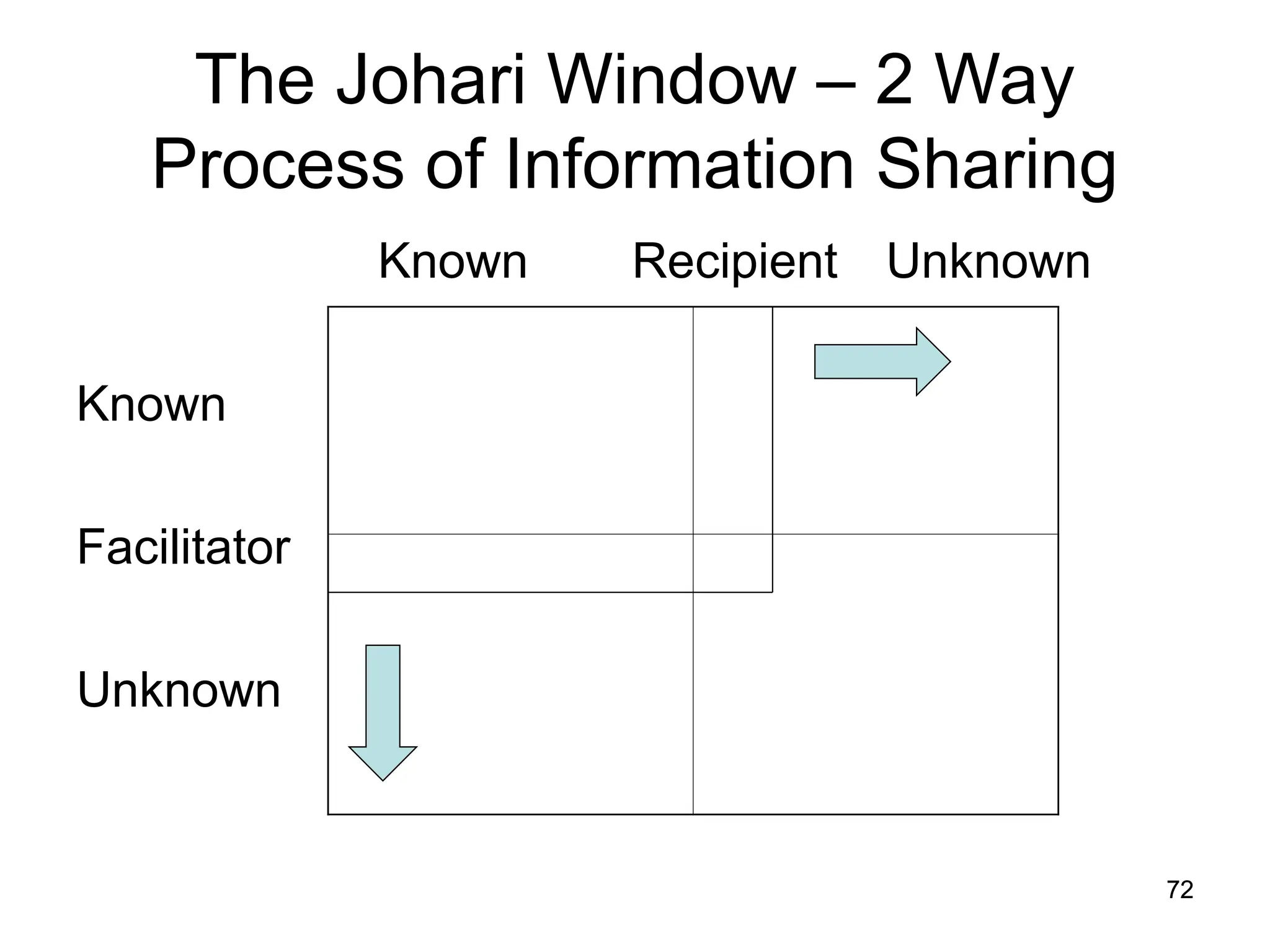
The Johari Window – 2 Way
Process of Information Sharing
Known Recipient Unknown
Known
Facilitator
Unknown
73
73
III. Assessment Centre Procedure
1. Observation – of participant behavior as they
complete the various exercises
2. Recording – making notes of behavior &
evidence of performance & ability
3. Classification – of recorded & observed
behavior against appropriate competencies
4. Evaluation – of performance in each area of
competence & giving a numerical rating
74
74
5. Assessors’ Discussions
• Comparative Analysis & Clarifications
• Participants to be evaluated against the
norm & not against each other
• Reach a consensus / summary evaluation
• Final decision on the participant as per the
assessment centre objective
75
75
Advantages of Assessment Centres
1. Organizational Development
• Provides a momentum for HR to be a
strategic partner in business
• Sends out a positive image of the
organization’s professionalism,
objectivity, transparency & consistency in
recruitment & performance appraisals
across functions, levels & geographical
locations
76
76
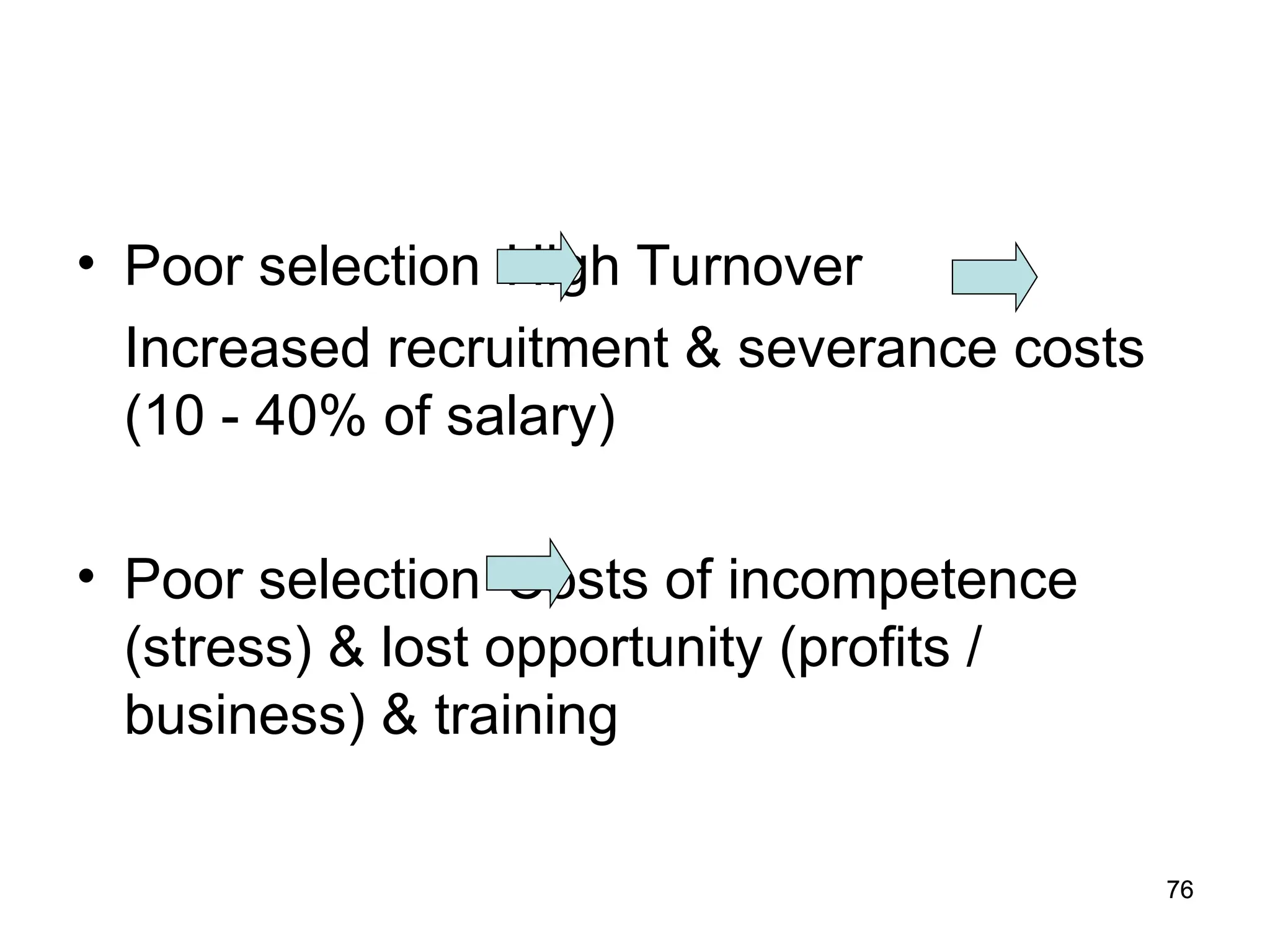
• Poor selection High Turnover
Increased recruitment & severance costs
(10 - 40% of salary)
• Poor selection Costs of incompetence
(stress) & lost opportunity (profits /
business) & training
77
77
Advantages of an Assessment
Centre
2. Employee Development
• Provides valuable & objective self-insight &
self-awareness
• Helps identify untapped employee potential
• Creates a talent pool for future reference
• Unlike other capital that depreciates, human
capital appreciates with its development & use
78
78
Advantages of an Assessment
Centre
3. Team & Leadership Management
• Compares individual’s preferred work style
with others in team
• Helps find role balance across teams &
conflict management for maximum
effectiveness
79
79
Assessment Tools
1. Work Sample Tests
2. Simulations
3. Interviews
4. Projective Techniques
5. Self – Portfolio Presentation
6. Psychometric Tests & Questionnaires
7. 360 degree feedback
80
Choice of Tools
All tools designed after a thorough job –
analysis
1. Off the shelf – quicker, cheaper, reliable
& valid
2. Designed internally – tailor made
3. Customized by external consultant
4. External Centre – more objective
81
81
1. Work Sample Tests
• Written exercises related to job
• Perform a sample job task
• For relatively simple jobs where important
tasks can be identified
• Eg. Putting a cuff on a shirt for hiring
sewing machinists
• Work quality + behavior is observed
82
82
Work Sample Tests
• Advantages
- Very Job relevant
- Promote Self
selection or applicant
withdrawal
• Disadvantages
- Labor intensive
- Time consuming
83
83
2. Simulations
• Not necessary to replicate the entire job
• Identify the critical aspects to simulate
84
84
Types of Simulations
a) In-tray / In - basket exercises:
- Day to day decision making situations from
different sources
- Memos, correspondence, emails, telephone
messages or requests
- Time bound reaction in writing expected from
participant
- Skills assessed: general activity level, problem
solving, planning & organizing, time
management, concern for priority & delegation
85
85
b) Management games & Role Plays:
- Real life situation is simulated for a group
- Skills assessed – Strategic planning, conflict
management, team work, leadership,
communication, flexibility & motivation
- Easier to give feedback
c) Presentations (organizational issues / case
study)
d) Written reports
86
86
3. Interviews
• Gives additional information
• To acquire past performance evidence
• Questions & rated sample responses to
be decided beforehand
87
87
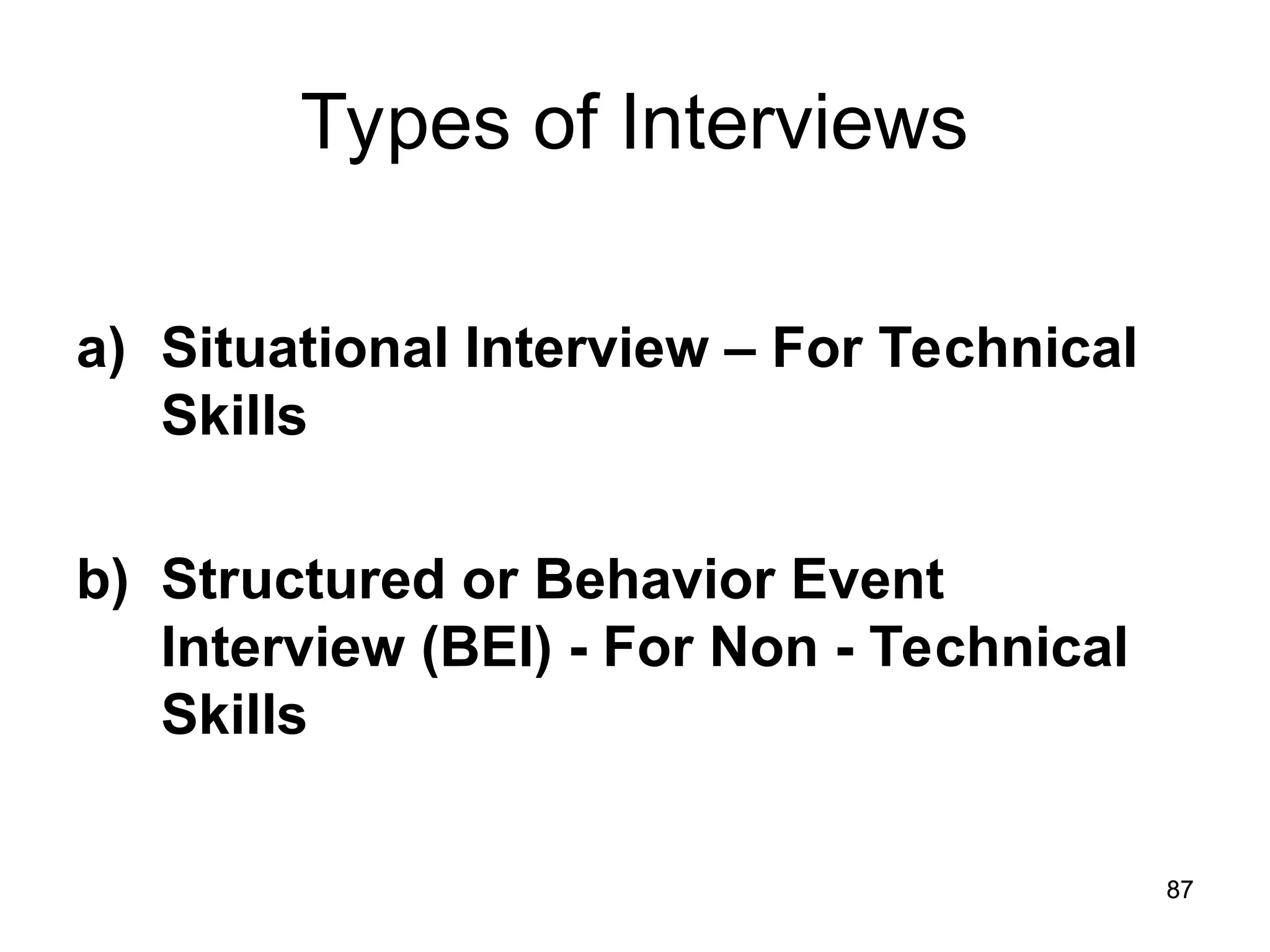
Types of Interviews
a) Situational Interview – For Technical
Skills
b) Structured or Behavior Event
Interview (BEI) - For Non - Technical
Skills
88
88
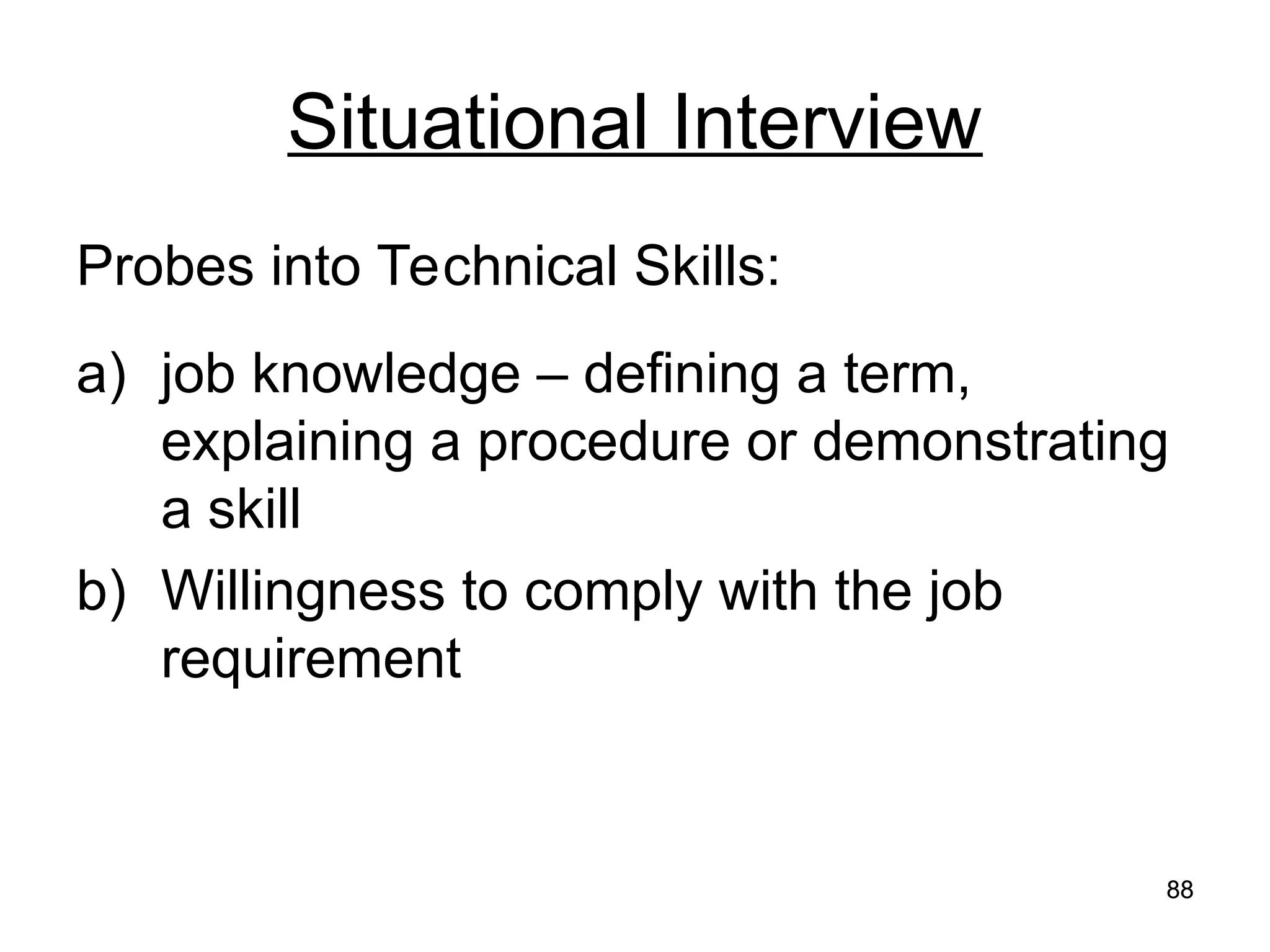
Situational Interview
Probes into Technical Skills:
a) job knowledge – defining a term,
explaining a procedure or demonstrating
a skill
b) Willingness to comply with the job
requirement
89
89
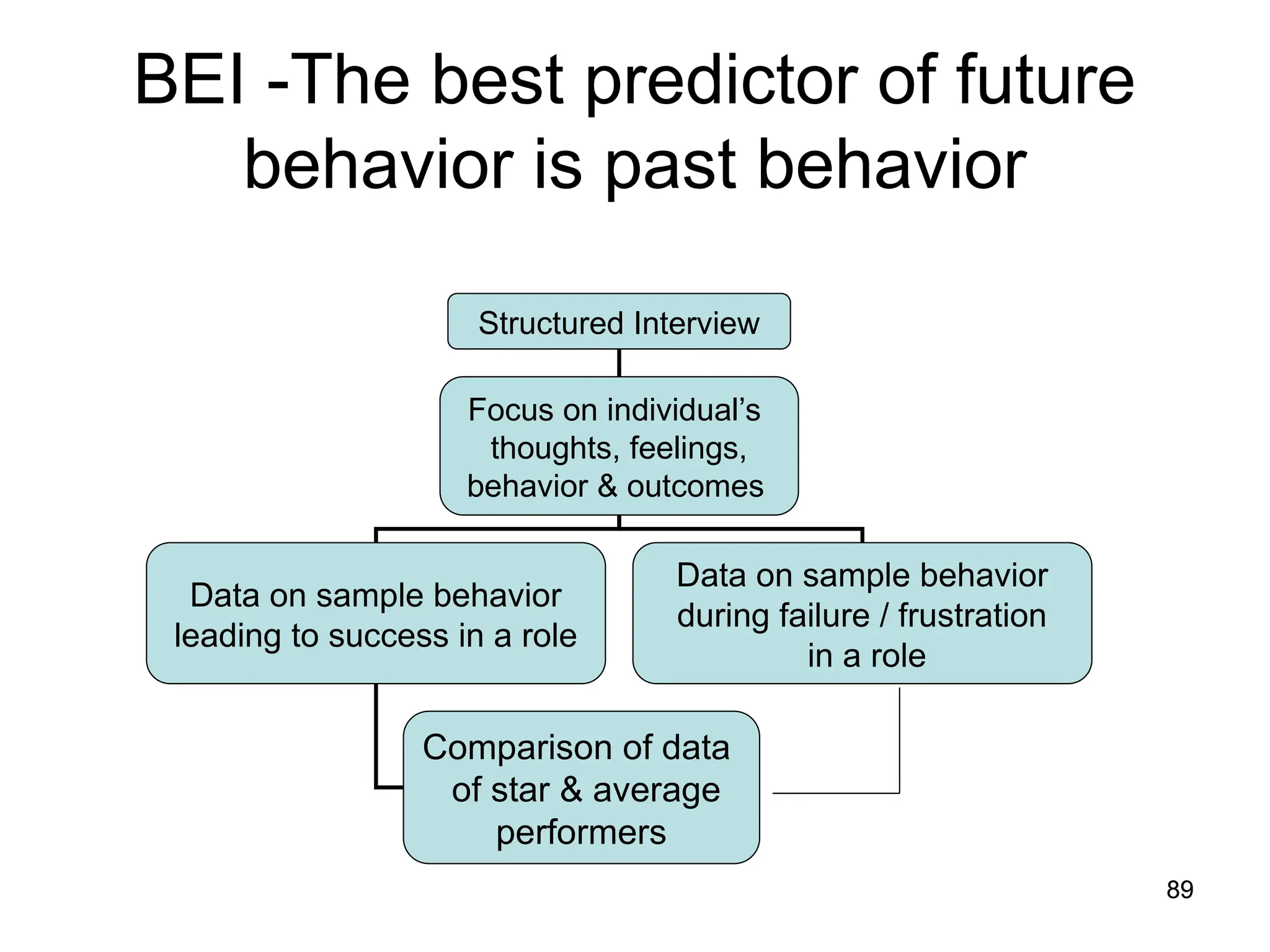
BEI -The best predictor of future
behavior is past behavior
Structured Interview
Focus on individual’s
thoughts, feelings,
behavior & outcomes
Data on sample behavior
leading to success in a role
Data on sample behavior
during failure / frustration
in a role
Comparison of data
of star & average
performers
90
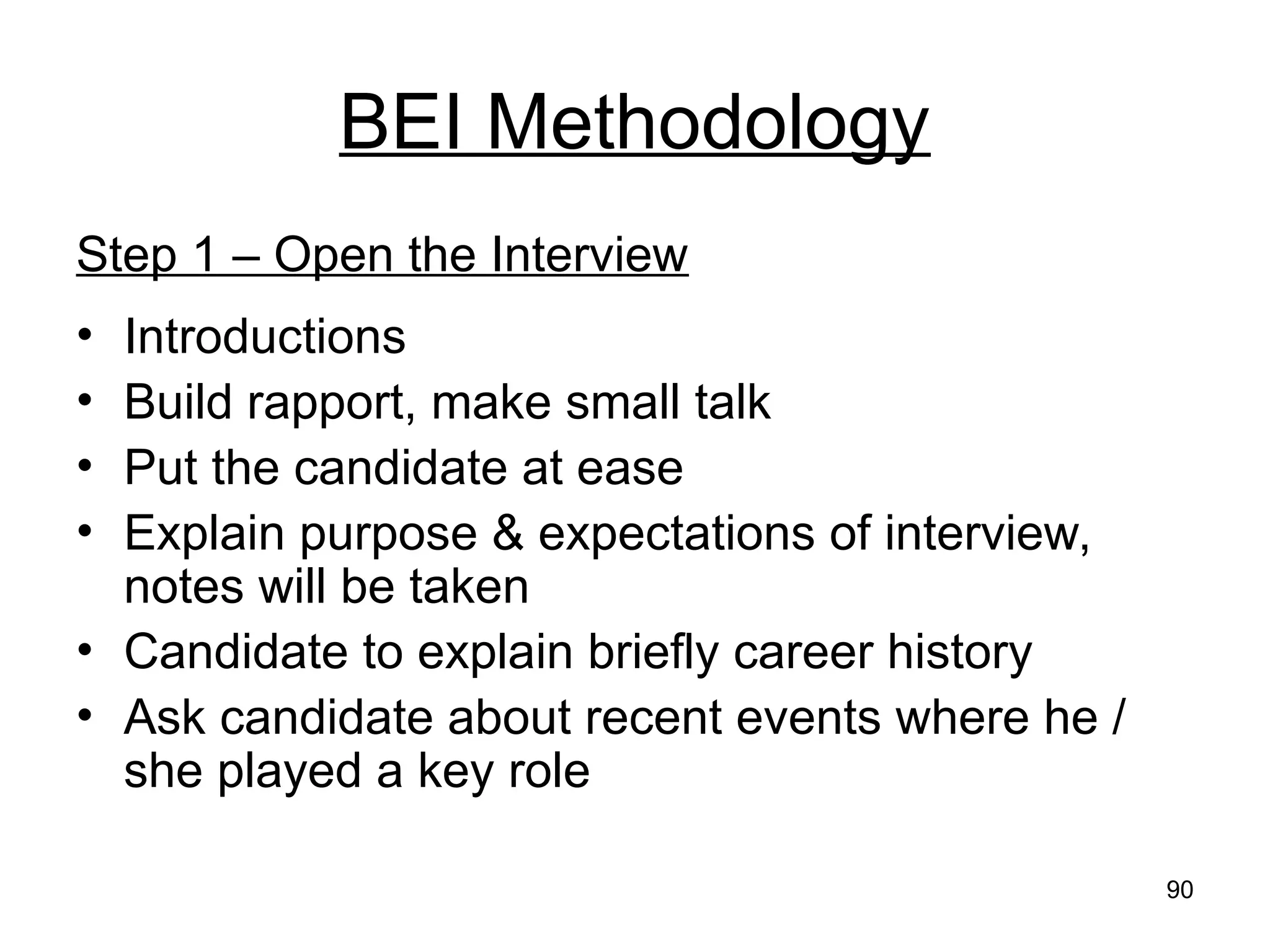
BEI Methodology
Step 1 – Open the Interview
• Introductions
• Build rapport, make small talk
• Put the candidate at ease
• Explain purpose & expectations of interview,
notes will be taken
• Candidate to explain briefly career history
• Ask candidate about recent events where he /
she played a key role
91
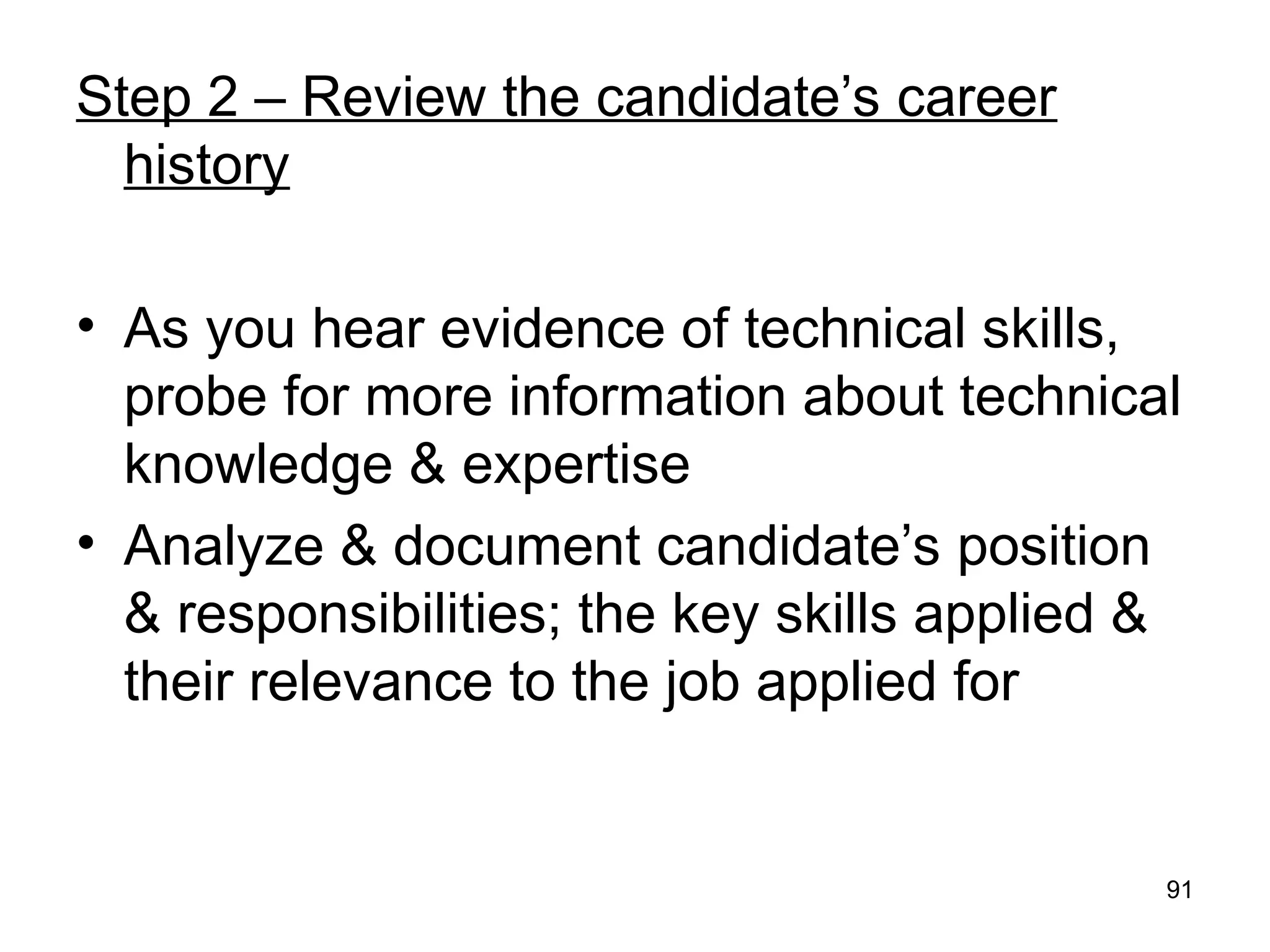
Step 2 – Review the candidate’s career
history
• As you hear evidence of technical skills,
probe for more information about technical
knowledge & expertise
• Analyze & document candidate’s position
& responsibilities; the key skills applied &
their relevance to the job applied for
92
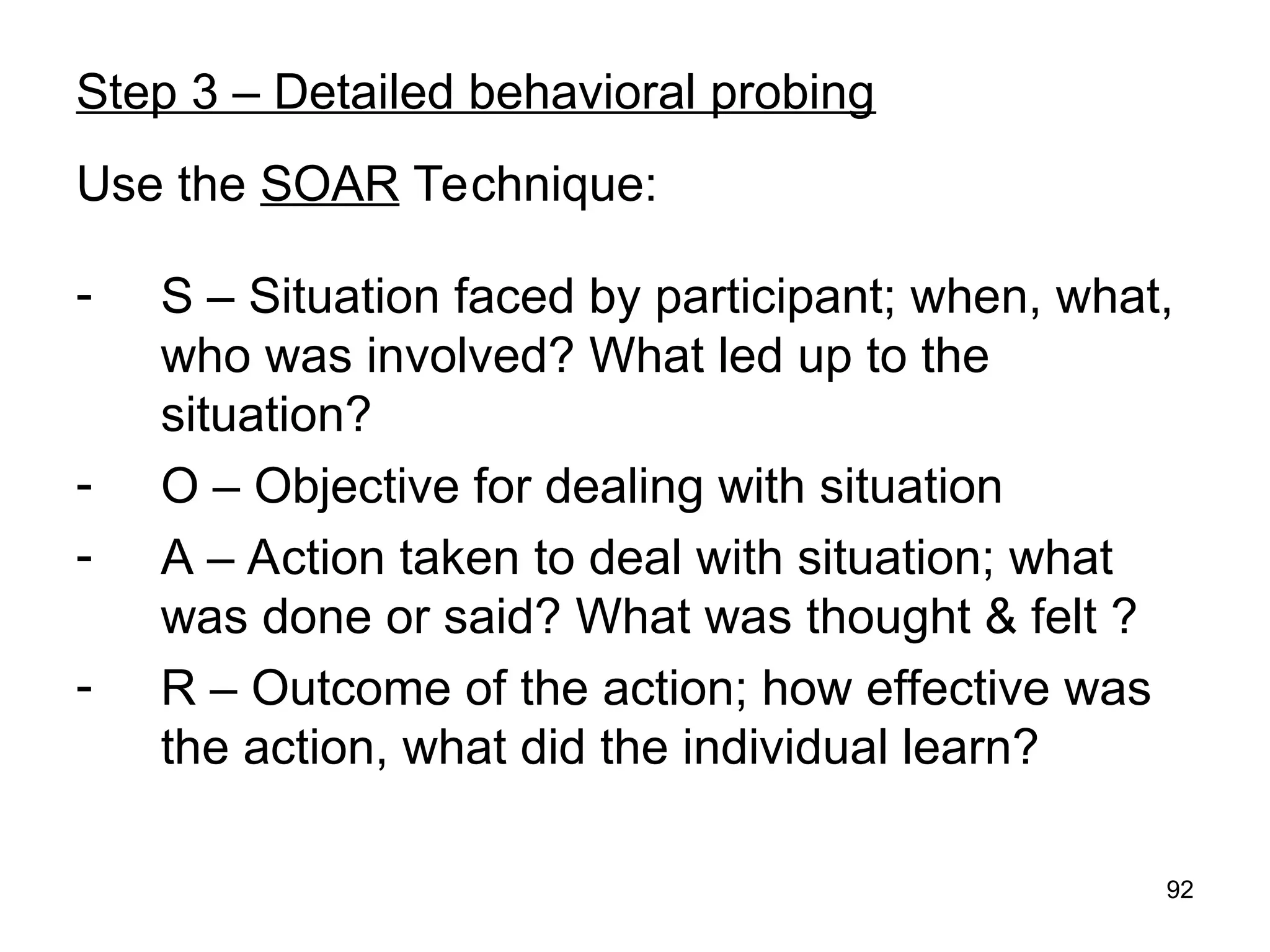
Step 3 – Detailed behavioral probing
Use the SOAR Technique:
- S – Situation faced by participant; when, what,
who was involved? What led up to the
situation?
- O – Objective for dealing with situation
- A – Action taken to deal with situation; what
was done or said? What was thought & felt ?
- R – Outcome of the action; how effective was
the action, what did the individual learn?
93
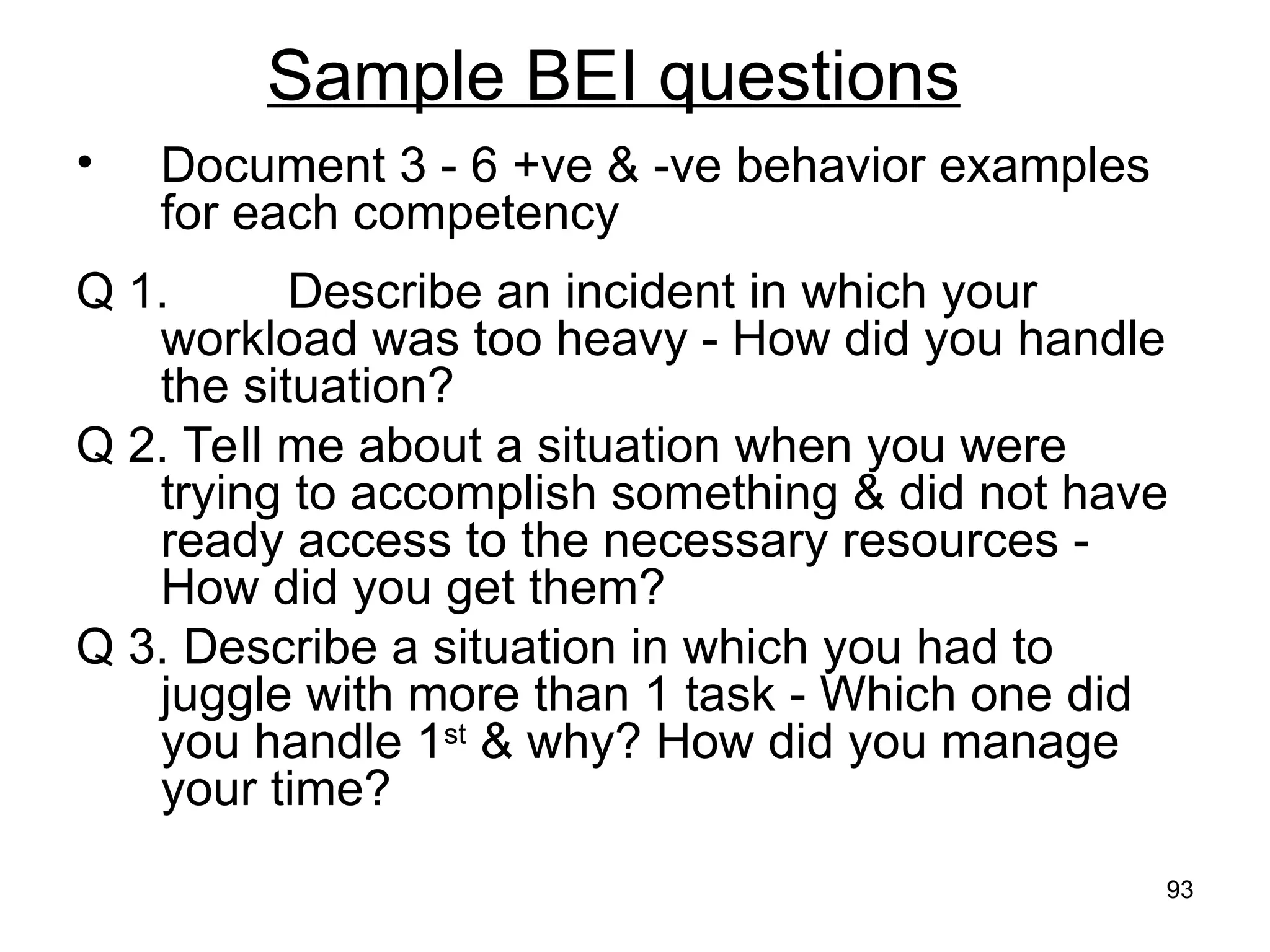
Sample BEI questions
• Document 3 - 6 +ve & -ve behavior examples
for each competency
Q 1. Describe an incident in which your
workload was too heavy - How did you handle
the situation?
Q 2. Tell me about a situation when you were
trying to accomplish something & did not have
ready access to the necessary resources -
How did you get them?
Q 3. Describe a situation in which you had to
juggle with more than 1 task - Which one did
you handle 1st
& why? How did you manage
your time?
94
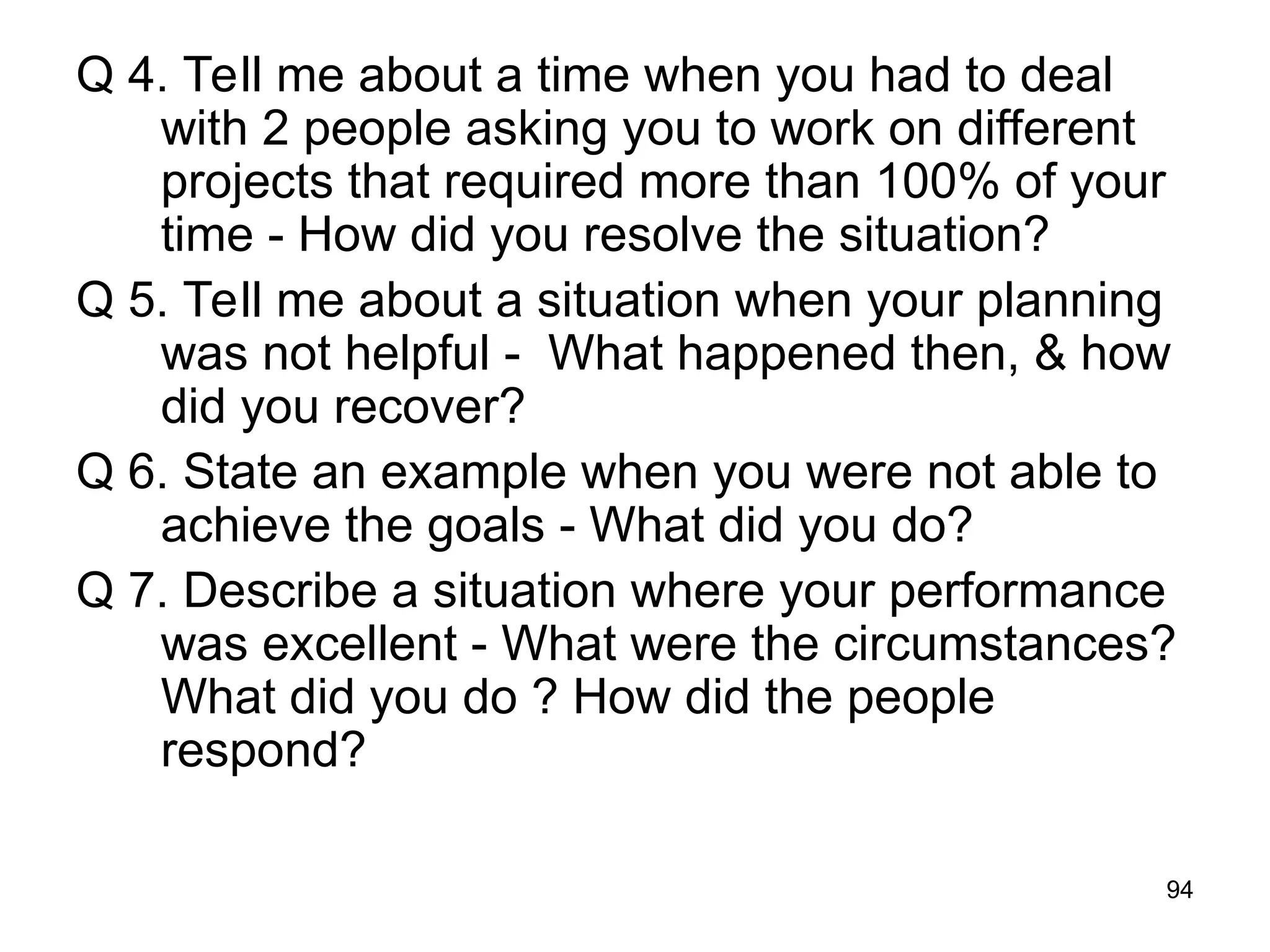
Q 4. Tell me about a time when you had to deal
with 2 people asking you to work on different
projects that required more than 100% of your
time - How did you resolve the situation?
Q 5. Tell me about a situation when your planning
was not helpful - What happened then, & how
did you recover?
Q 6. State an example when you were not able to
achieve the goals - What did you do?
Q 7. Describe a situation where your performance
was excellent - What were the circumstances?
What did you do ? How did the people
respond?
95
95
4. Projective Techniques
• Assesses deep aspects of personality
• Types of Techniques:
a) Ink – Blot Test
b) Word Association Tasks
c) Thematic Apperception Test (TAT)
96
96
5. Self – Portfolio Presentation
• Candidate highlights his / her strengths,
weaknesses & experiences
• Gives an insight into candidate’s
presentation skills, his attitude & aptitude
97
97
6. Psychometric Tests &
Questionnaires
a) Psychometric Tests:
1. Achievement / Attainment Tests: Assesses
results of formal education & training
2. IQ or General Intelligence Tests: Assesses a
unitary measure of general intelligence (speed)
3. Aptitude or Special Ability Tests: Assesses the
ability to acquire further knowledge or skills
b) Psychometric Questionnaires:
Personality Questionnaires
98
98
Psychometric Tests & Questionnaires – IQ
Tests
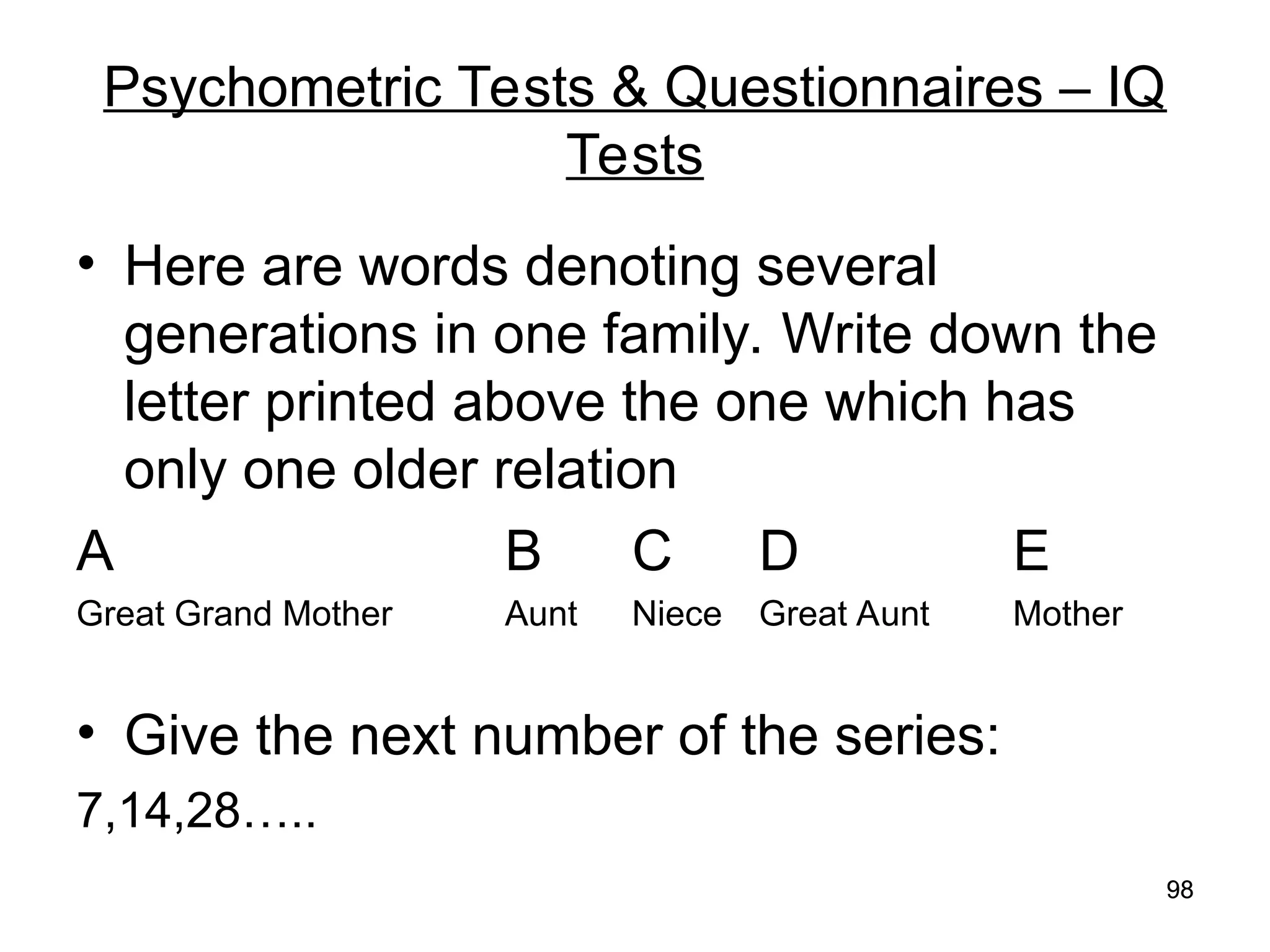
• Here are words denoting several
generations in one family. Write down the
letter printed above the one which has
only one older relation
A B C D E
Great Grand Mother Aunt Niece Great Aunt Mother
• Give the next number of the series:
7,14,28…..
99
99
Types of Ability Tests
• Diagrammatic:
a) Logical reasoning
from data presented
as diagrams &
abstract shapes
b) Useful for data
processing jobs
• Mechanical
a) Mechanical
problems in pictorial
form
b) Engineering Jobs
100
100
Types of Ability Tests
• Spatial
a) Ability to imagine
rotation of objects in
space
b) Design jobs / how
parts of equipment
fit together
• Clerical
a) Speed & accuracy in
checking errors in
lists / print-outs,
filing, classification
101
101
Types of Ability Tests
• Dexterity
a) Hand Speed / Fine
Precision Skills
b) Process & Assembly
workers
c) Co-ordination Tests
for pilot selection
• Sensory
a) Near & Far visual,
sound or color
discrimination
b) Military (Color
blindness)
102
102
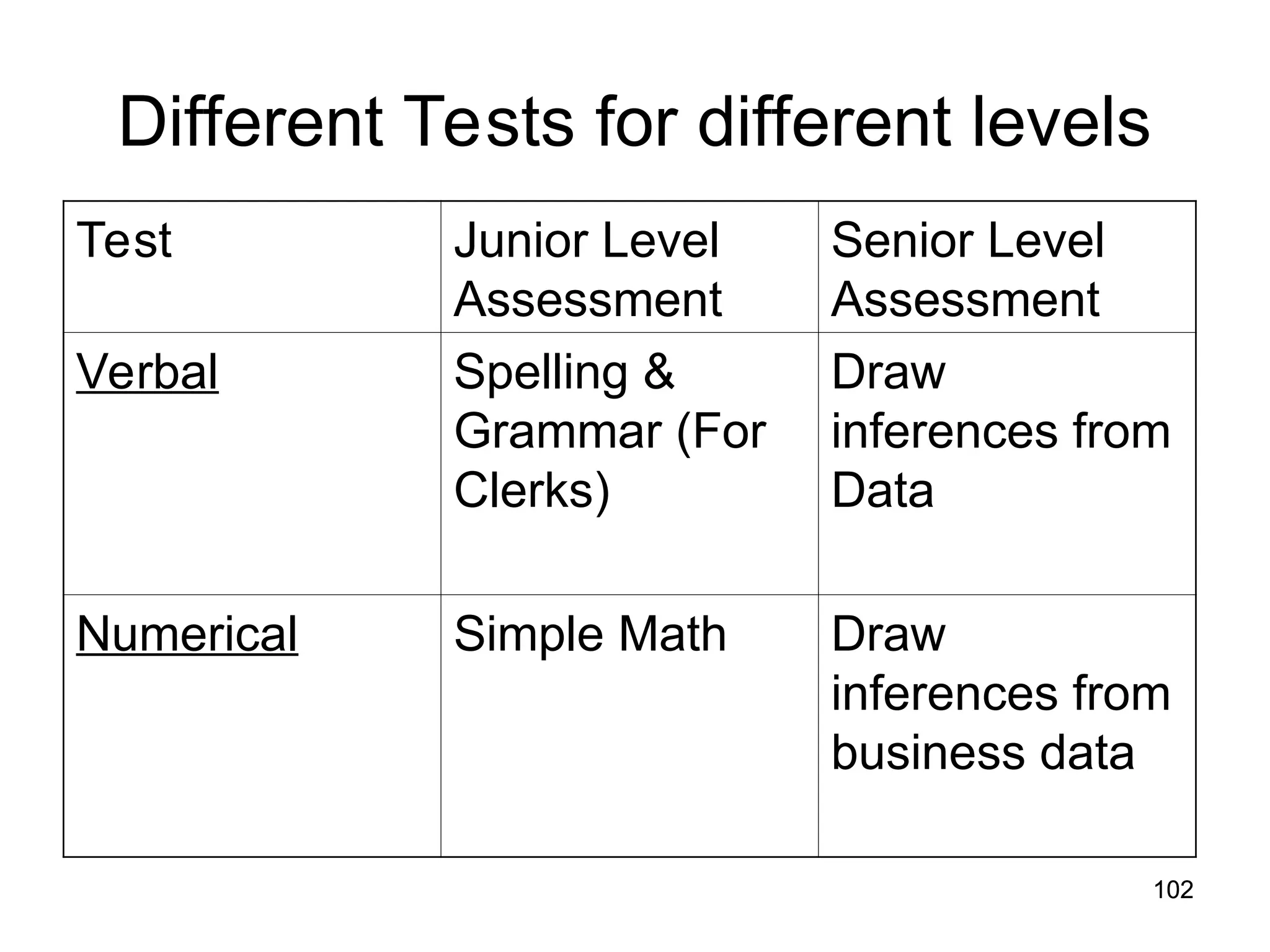
Different Tests for different levels
Test Junior Level
Assessment
Senior Level
Assessment
Verbal Spelling &
Grammar (For
Clerks)
Draw
inferences from
Data
Numerical Simple Math Draw
inferences from
business data
103
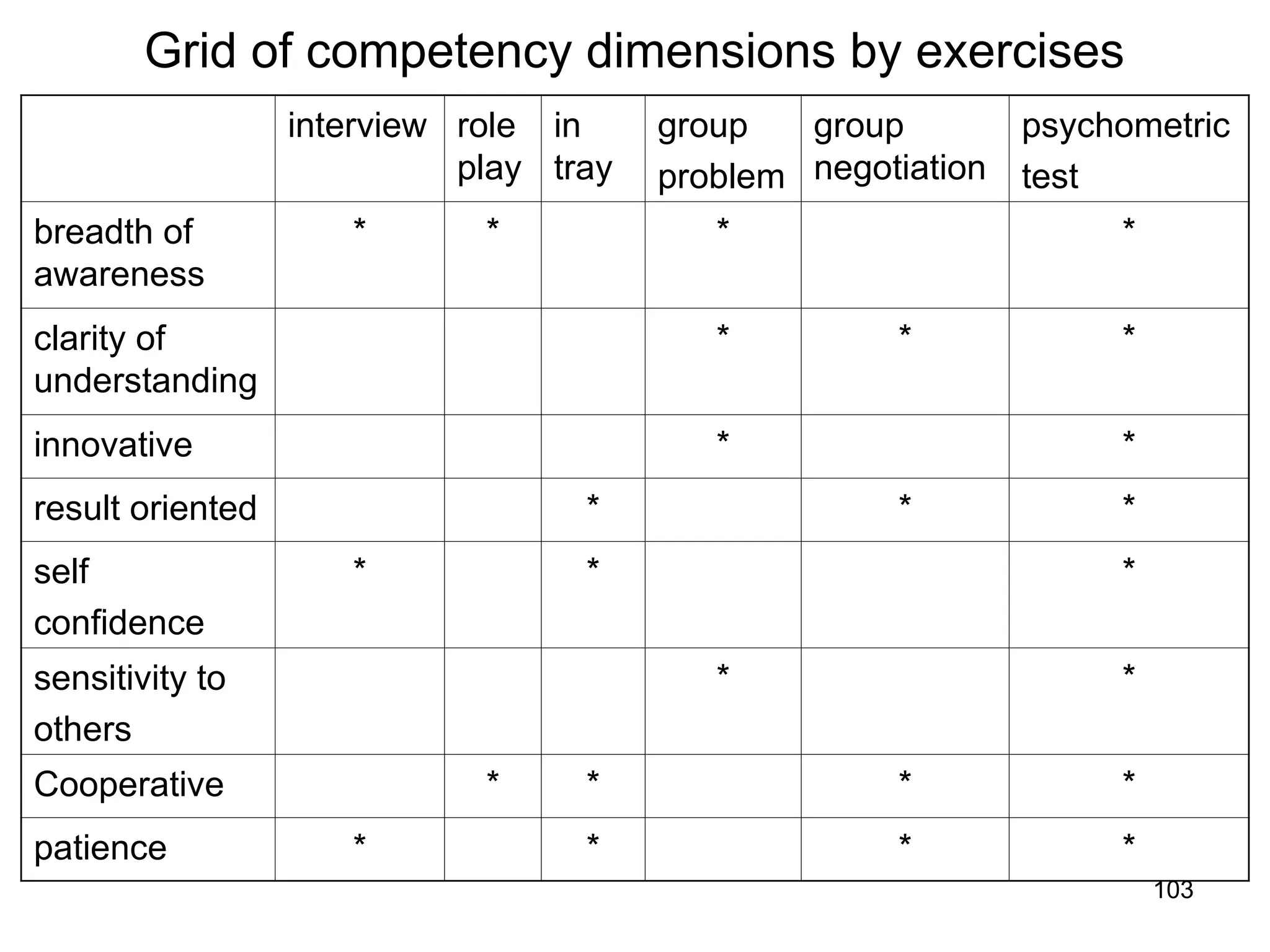
Grid of competency dimensions by exercises
interview role
play
in
tray
group
problem
group
negotiation
psychometric
test
breadth of
awareness
* * * *
clarity of
understanding
* * *
innovative * *
result oriented * * *
self
confidence
* * *
sensitivity to
others
* *
Cooperative * * * *
patience * * * *
104
104
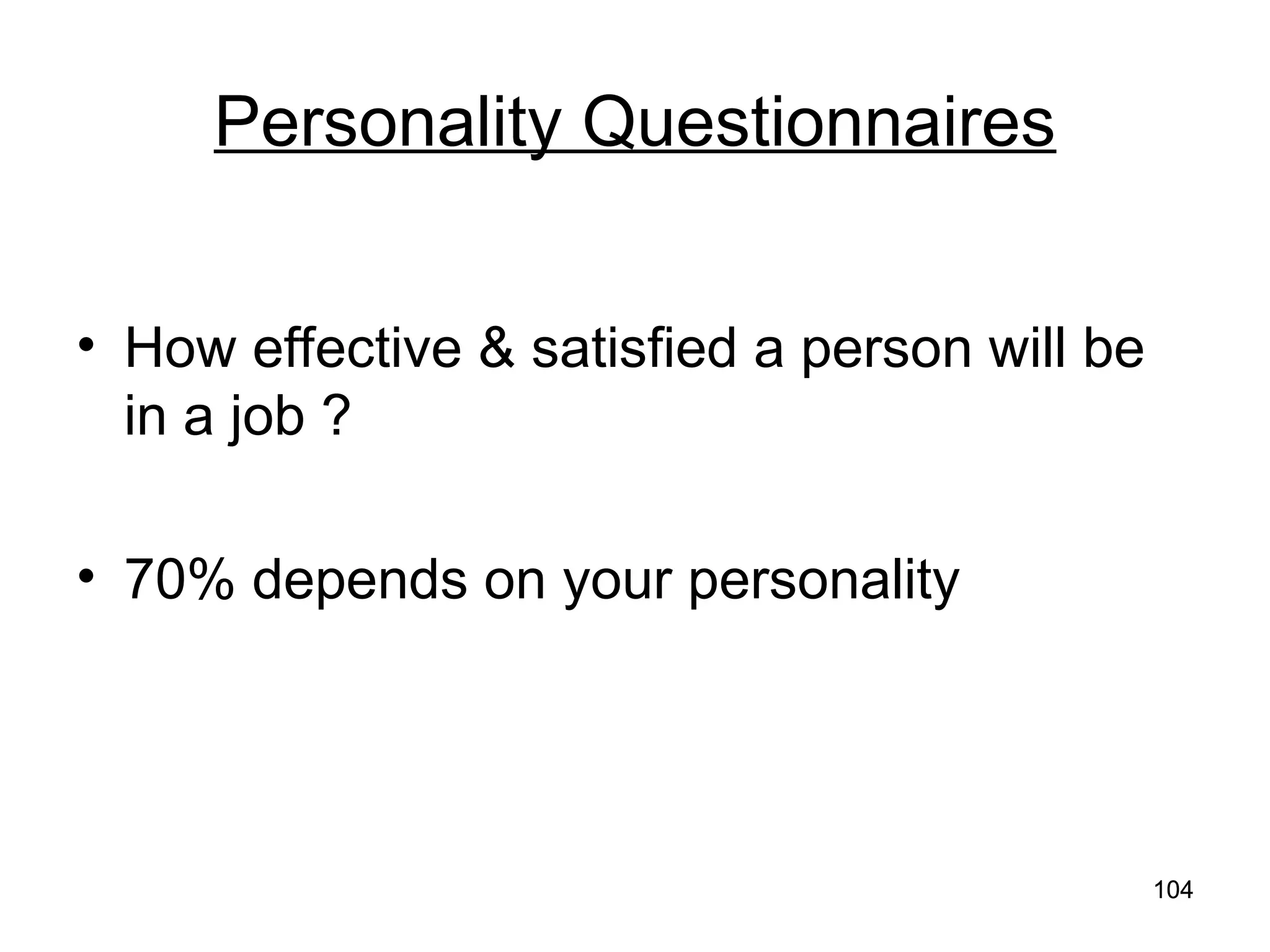
Personality Questionnaires
• How effective & satisfied a person will be
in a job ?
• 70% depends on your personality
105
105
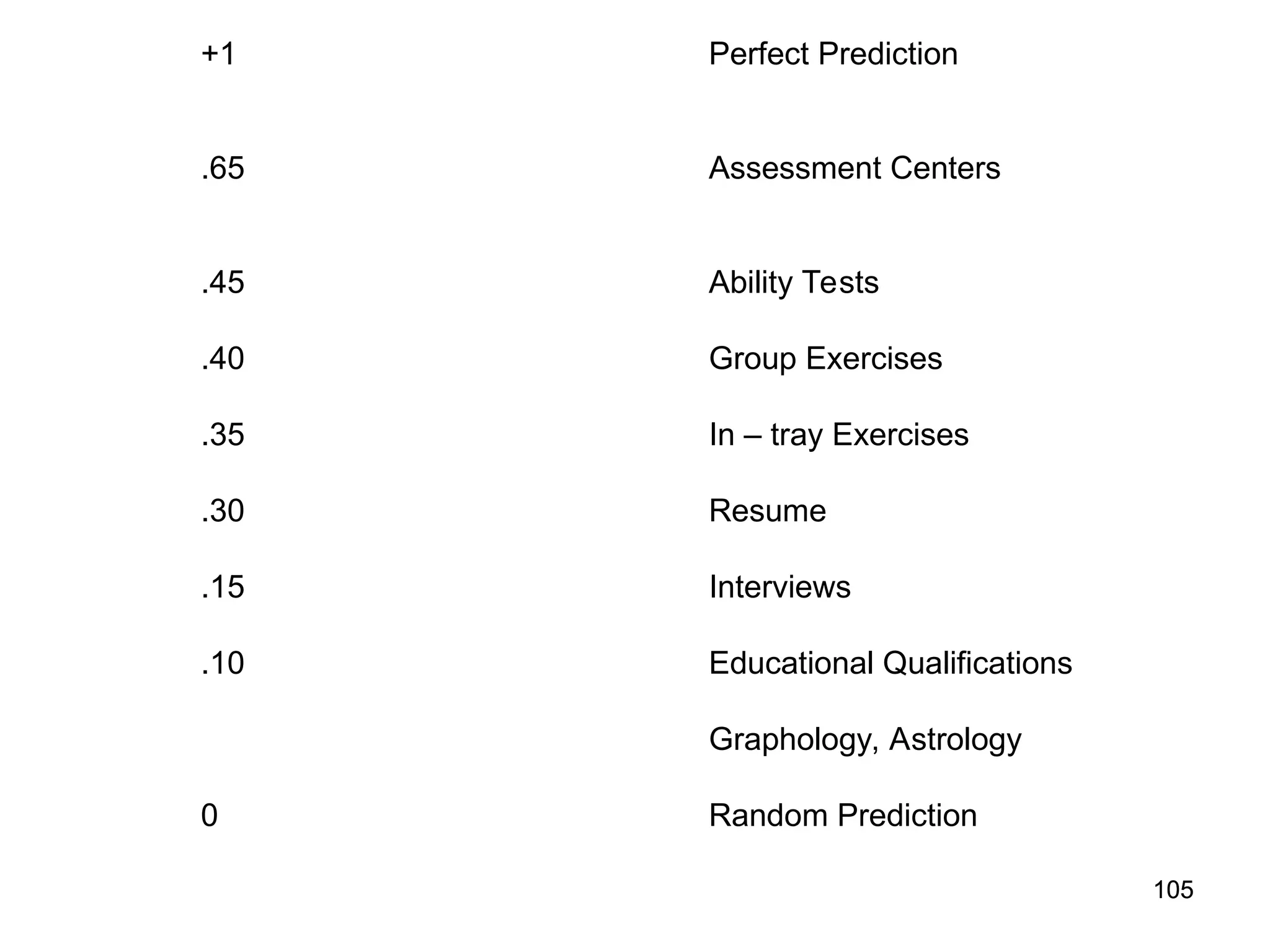
+1 Perfect Prediction
.65 Assessment Centers
.45 Ability Tests
.40 Group Exercises
.35 In – tray Exercises
.30 Resume
.15 Interviews
.10 Educational Qualifications
Graphology, Astrology
0 Random Prediction
106
106
What is personality ?
• Derived from the Latin word “Persona”
• “A person’s typical or preferred way of
behaving, thinking & feeling”
107
107
Components of Personality
1. Temperament
• Feelings & Emotions
• Moods
2. Motivation
• What drives an individual ?
• What directs his behavior ?
108
108
Components of Personality
3. Values
• What behavior do we have respect for ?
• Differs across cultures & over time
• Modesty, Aggression, Deference
4. Interests
• Things we want to do & focus on
• What are our goals ?
5. Attitudes
109
109
Implicit Vs Explicit
Theories on Personality
1. Implicit
a) Not defined or written down
b) When you have an instinctive “feel” of
what is human nature & how employees
behave
c) People act on this all the time
110
110
Implicit Vs Explicit
Theories on Personality
2. Explicit
a) Defined
b) Based on research or some theory of
psychology
c) Can be verified / modified
d) Personality Questionnaires are based on
explicit theories of personality
111
111
Assumptions about the Nature of
Personality
1. Individual Differences:
• There are visible differences in people’s
behavior
• This helps progress of society & fulfills
different needs of organizations
112
112
2. Stability
• Personality is a changing thing but stays
quite constant
• There will be certain behavioral styles
which we find difficult to adopt
• We try to control & improve our
personalities but change is not easy & is
slow
113
113
3. Genetic & Environmental influence
• Genetic
• Aspects of personality
that change little
throughout life
• Environmental
• Cultural influence &
education
• Aspects of personality
that change in the
longer term; affects
personality stability
114
114
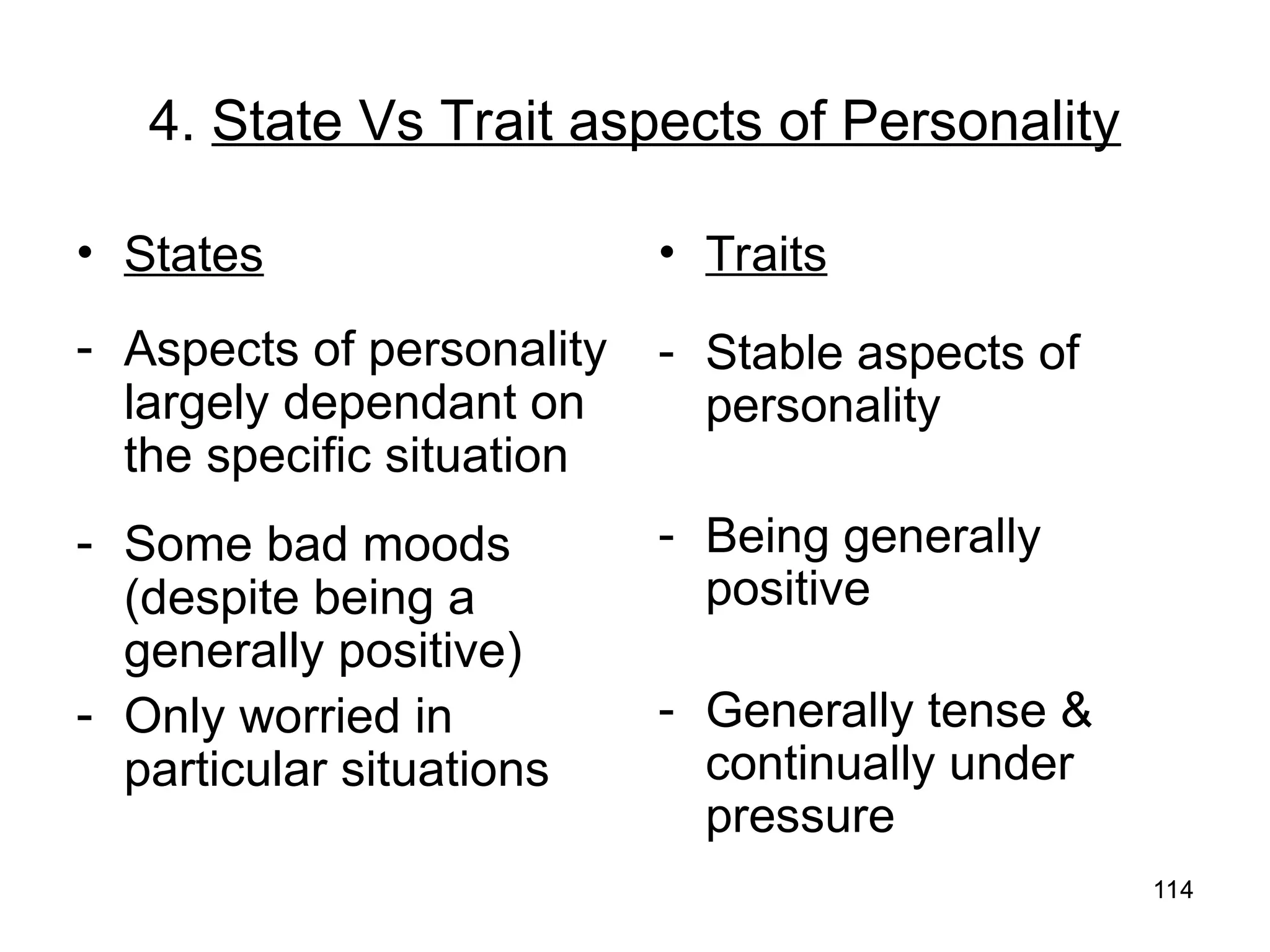
4. State Vs Trait aspects of Personality
• States
- Aspects of personality
largely dependant on
the specific situation
- Some bad moods
(despite being a
generally positive)
- Only worried in
particular situations
• Traits
- Stable aspects of
personality
- Being generally
positive
- Generally tense &
continually under
pressure
115
115
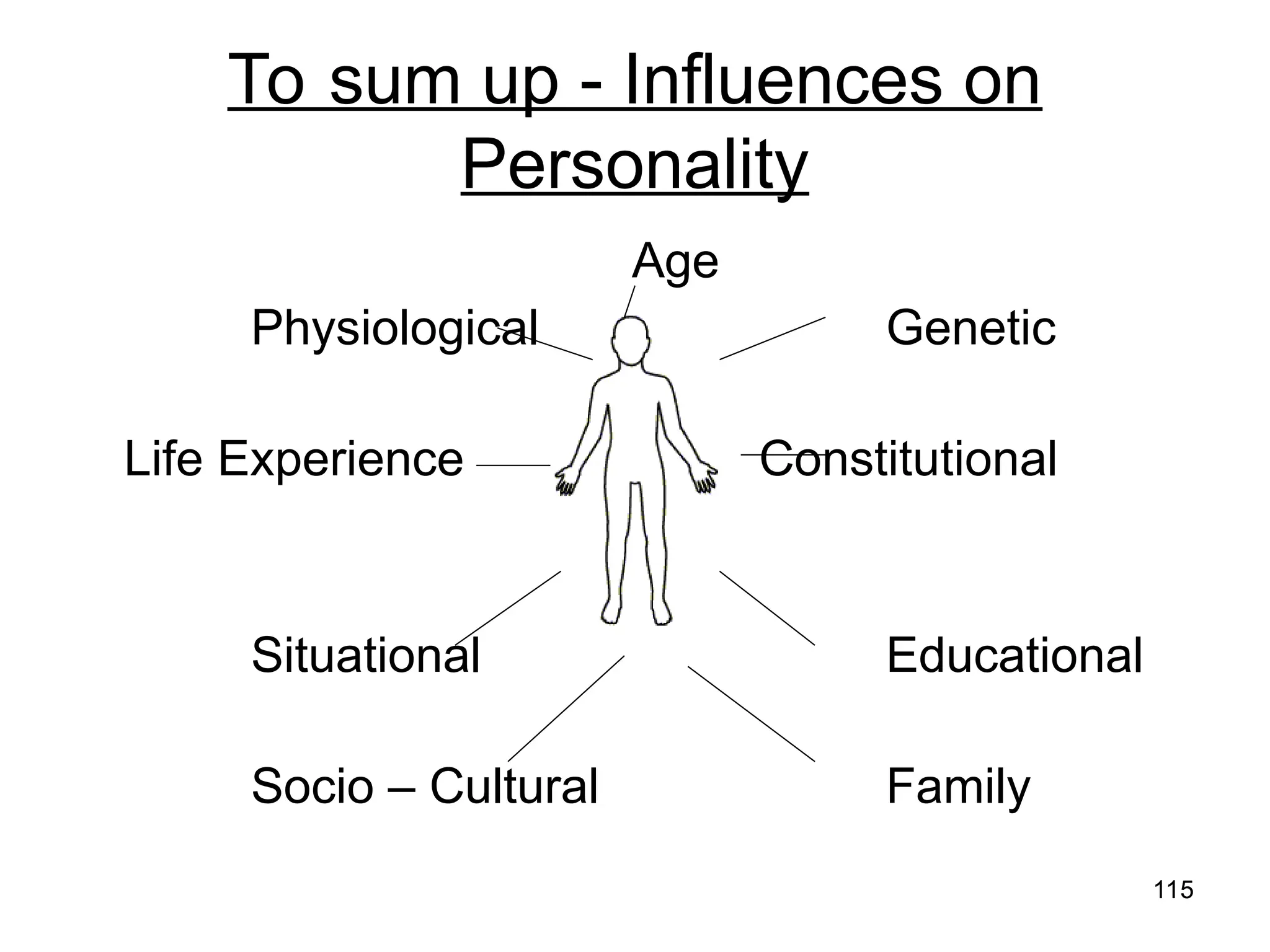
To sum up - Influences on
Personality
Age
Physiological Genetic
Life Experience Constitutional
Situational Educational
Socio – Cultural Family
116
116
Personality Questionnaires
• To scientifically study a person’s inner
thoughts & feelings
• Describes different parts of behavior
• Easy to use & score
117
117
Types of Personality
Questionnaires (PQ)
a. Exhaustive
• 30 - 32 Scales or dimensions of personality
• The questions force respondents to make a
choice between the most & least preferred
behavior & aspects of their personalities
• Offers an exhaustive summary of personality at
work
• Can be used as an international measure of
personality
118
118
b. Summarized Versions: Measure 5 – 16
dimensions of personality
c. Versions to probe specific areas of work:
1. Sales Personality Questionnaire:
• Designed for Sales teams
2. Customer Service Questionnaire :
• Designed for Customer Service teams
119
119
d. General Work Style Questionnaire:
• For non-managerial staff in
manufacturing & production jobs
• Measures 17 dimensions of personality
important for the job
120
120
• e. 360° Feedback Versions:
• Others (managers, colleagues, direct
reports & customers) rate an employee on
the same questionnaire
• Compares self-perception with how we are
seen by others
121
121
Test / Questionnaire Selection
a) Validity
b) Reliability
c) Norms
d) Results as a normal distribution
e) Objectivity
f) Cost & Copyright restrictions
122
122
a) Test Validity
• Does the test measure what is was
designed to measure ?
• The extent of relation between test scores
& a criterion of job performance such as:
- Targets Achieved
- Appraisal Ratings
- Ratings on a training program
performance
123
123
Types of Validity
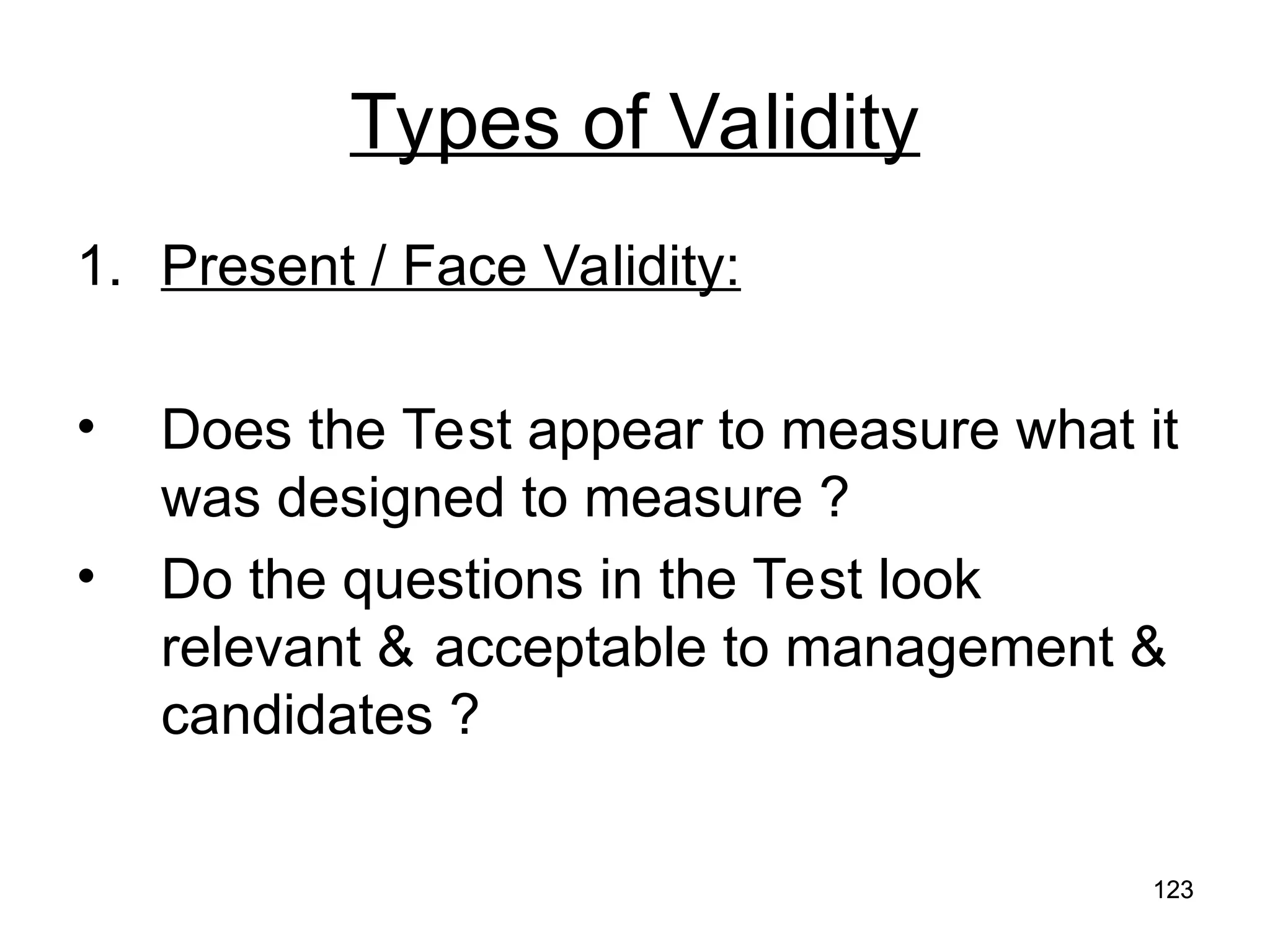
1. Present / Face Validity:
• Does the Test appear to measure what it
was designed to measure ?
• Do the questions in the Test look
relevant & acceptable to management &
candidates ?
124
124
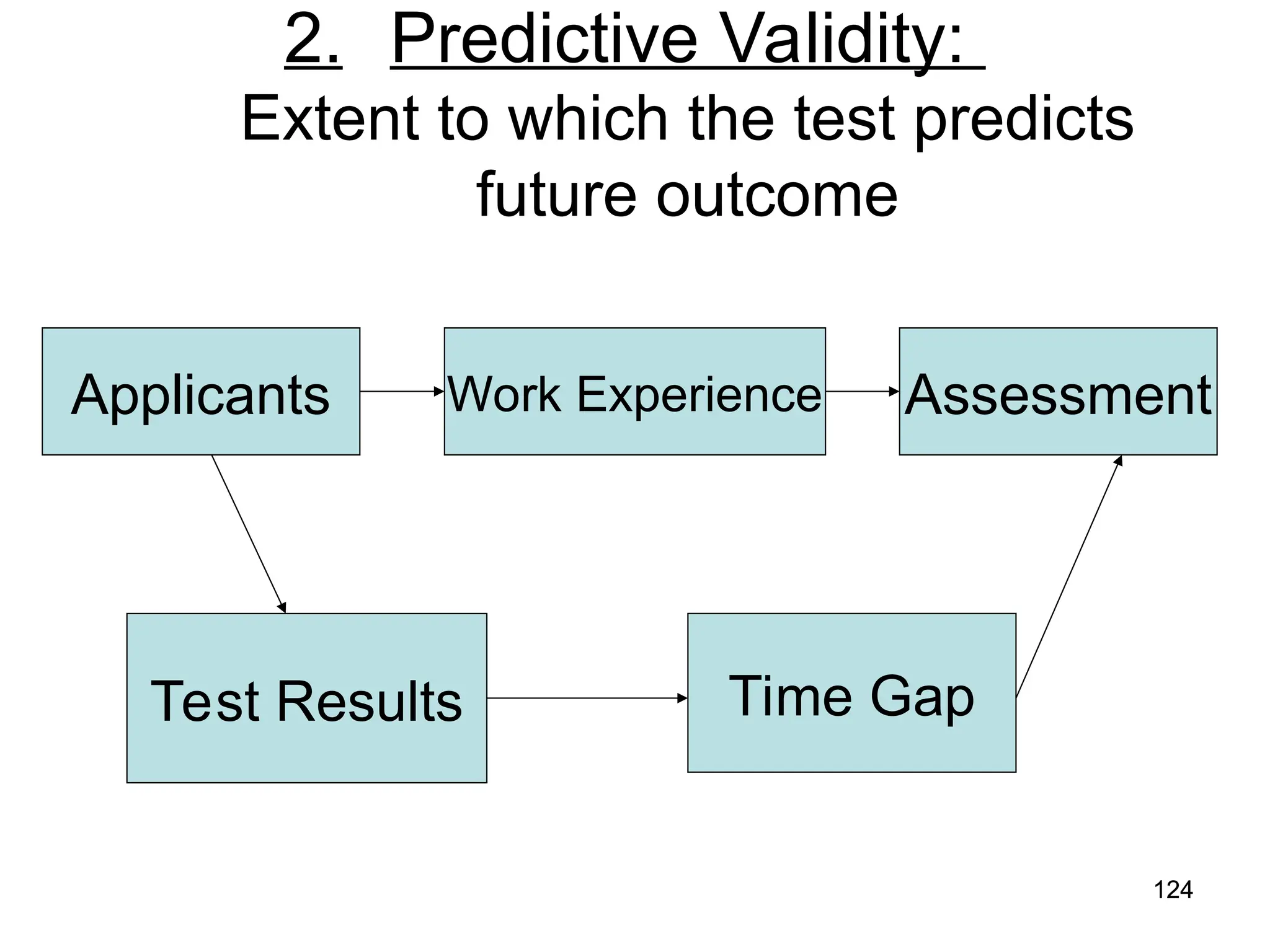
2. Predictive Validity:
Extent to which the test predicts
future outcome
Applicants Work Experience Assessment
Test Results Time Gap
125
125
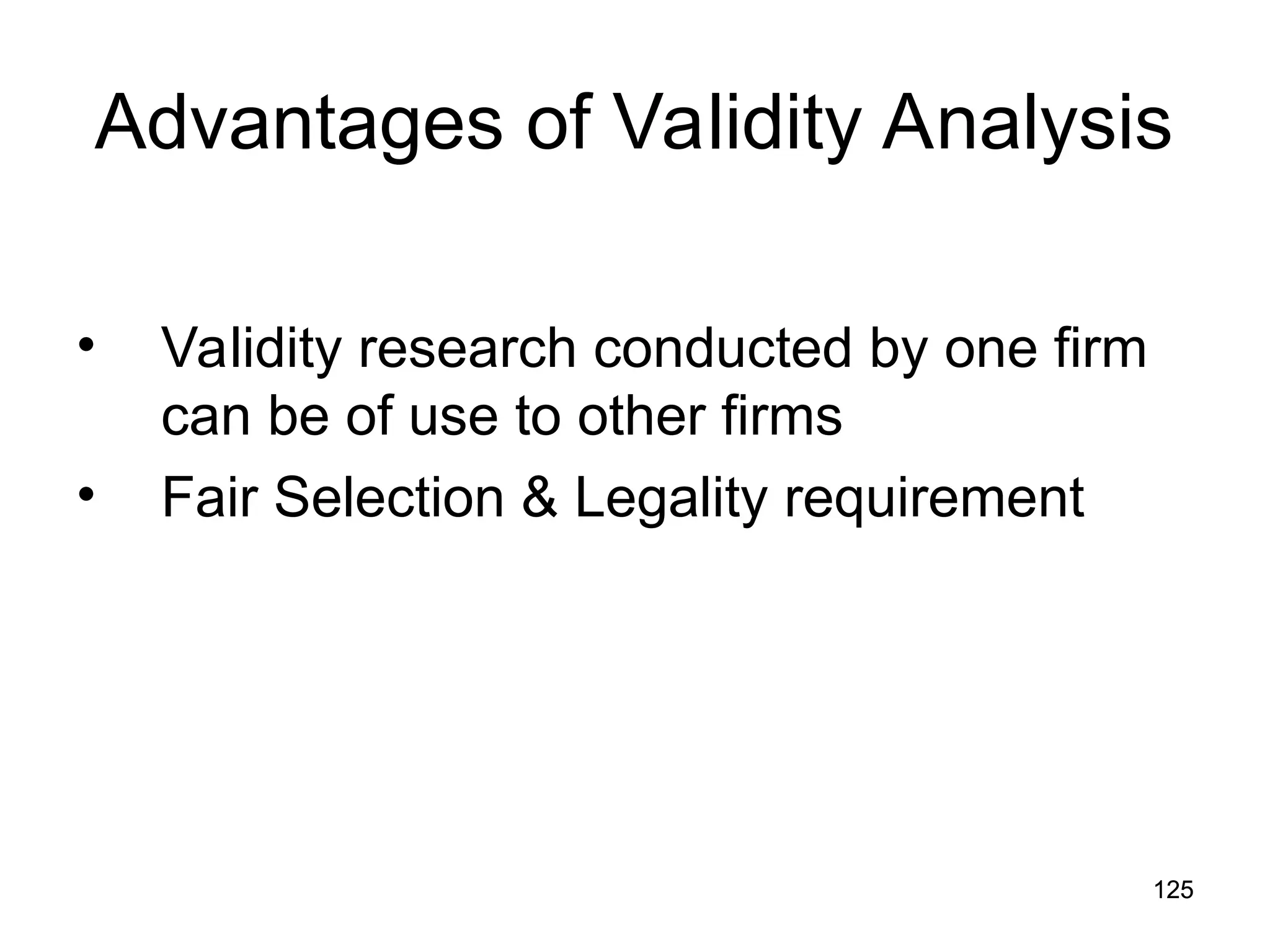
Advantages of Validity Analysis
• Validity research conducted by one firm
can be of use to other firms
• Fair Selection & Legality requirement
126
126
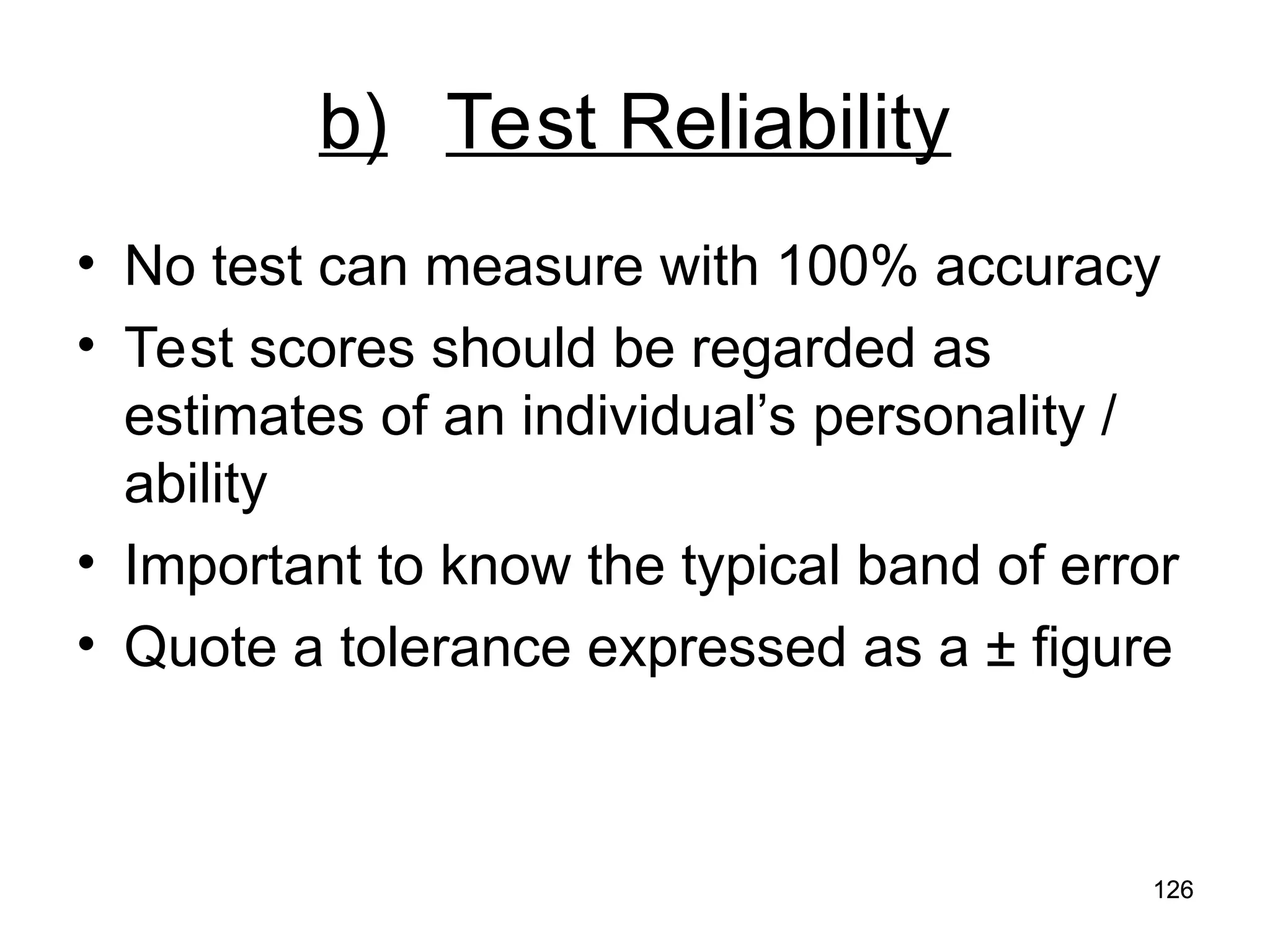
b) Test Reliability
• No test can measure with 100% accuracy
• Test scores should be regarded as
estimates of an individual’s personality /
ability
• Important to know the typical band of error
• Quote a tolerance expressed as a ± figure
127
127
Definition of Reliability
“Reliability refers to the consistency &
stability of results obtained”
128
128
Types of Reliability
1. Test – Retest Reliability
2. Alternate Form Reliability
3. Internal Consistency Reliability
129
129
Test – Retest Reliability
• “Measure of a test’s accuracy or
consistency over a relatively short time
interval”
• Compare test results at one time with
results for the same group of respondents
later, usually after a month
130
130
Alternate Form Reliability
• Extent to which 2 forms of a test measure
the same dimensions of personality /
ability
131
131
Internal Consistency Reliability
• Measure of the accuracy or consistency of
the test items
• Split – half technique
132
132
c) Norms
• Scores are judged against scores obtained
by a relevant comparison group – Norm
Group
• Norm group should be as representative of
the applicant group as possible
• Constitutes a group applying for a similar
position, with similar education, age, ethnic
& gender mix
133
133
d) NORMAL DISTRIBUTION
• Human Characteristics – abilities /
aptitudes are distributed normally through
the population
• More people with average abilities /
aptitudes
• Bell – shaped frequency polygon
134
134
SKEW
• Scores are massed at one or the other
end of the Score Scale
• Negative Skew – Scores massed at high
end – Test relatively easy for group
• Positive Skew - Scores massed at low end
– Test relatively difficult for group
135
135
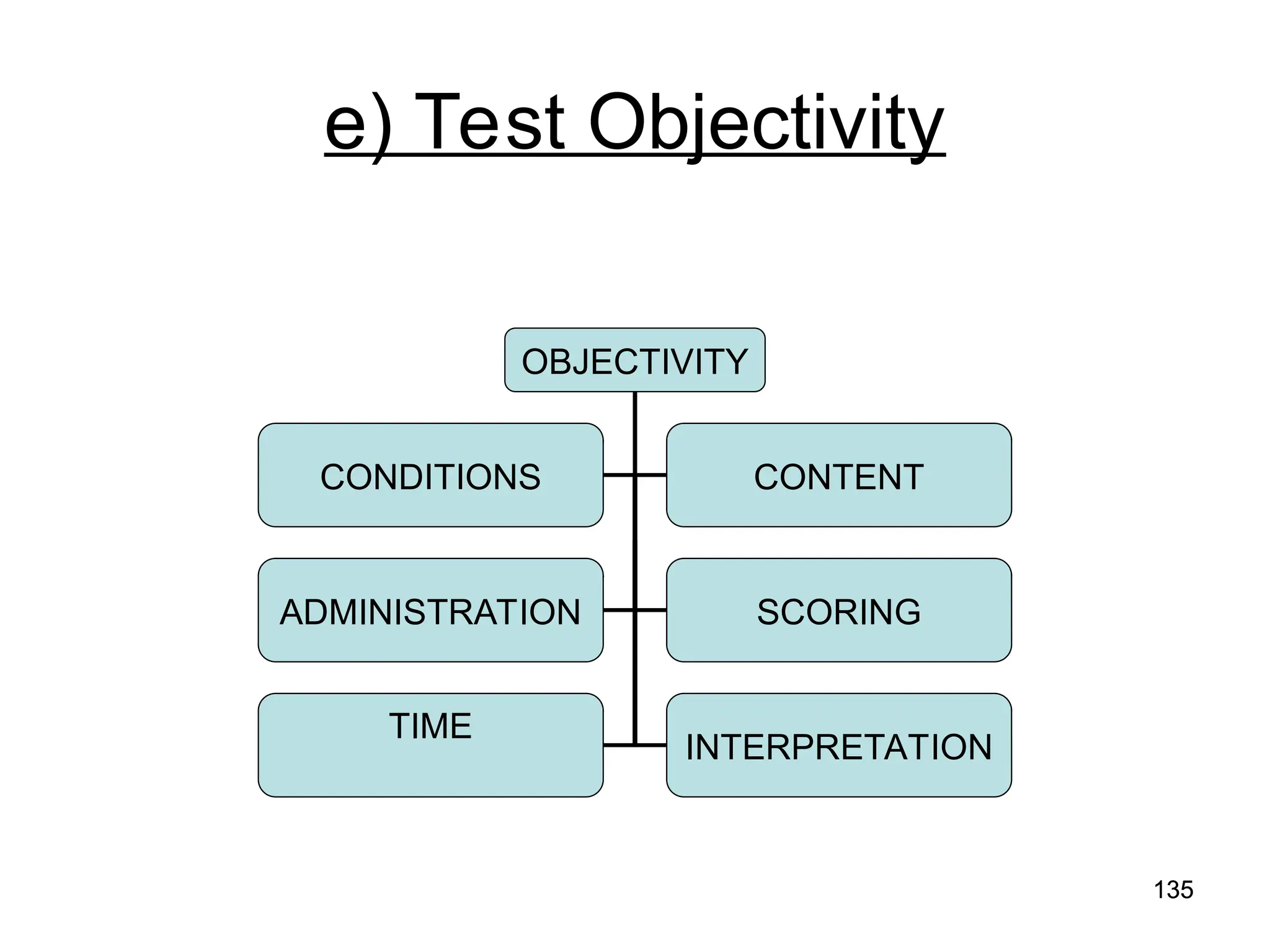
e) Test Objectivity
OBJECTIVITY
CONDITIONS CONTENT
ADMINISTRATION SCORING
TIME
INTERPRETATION
136
136
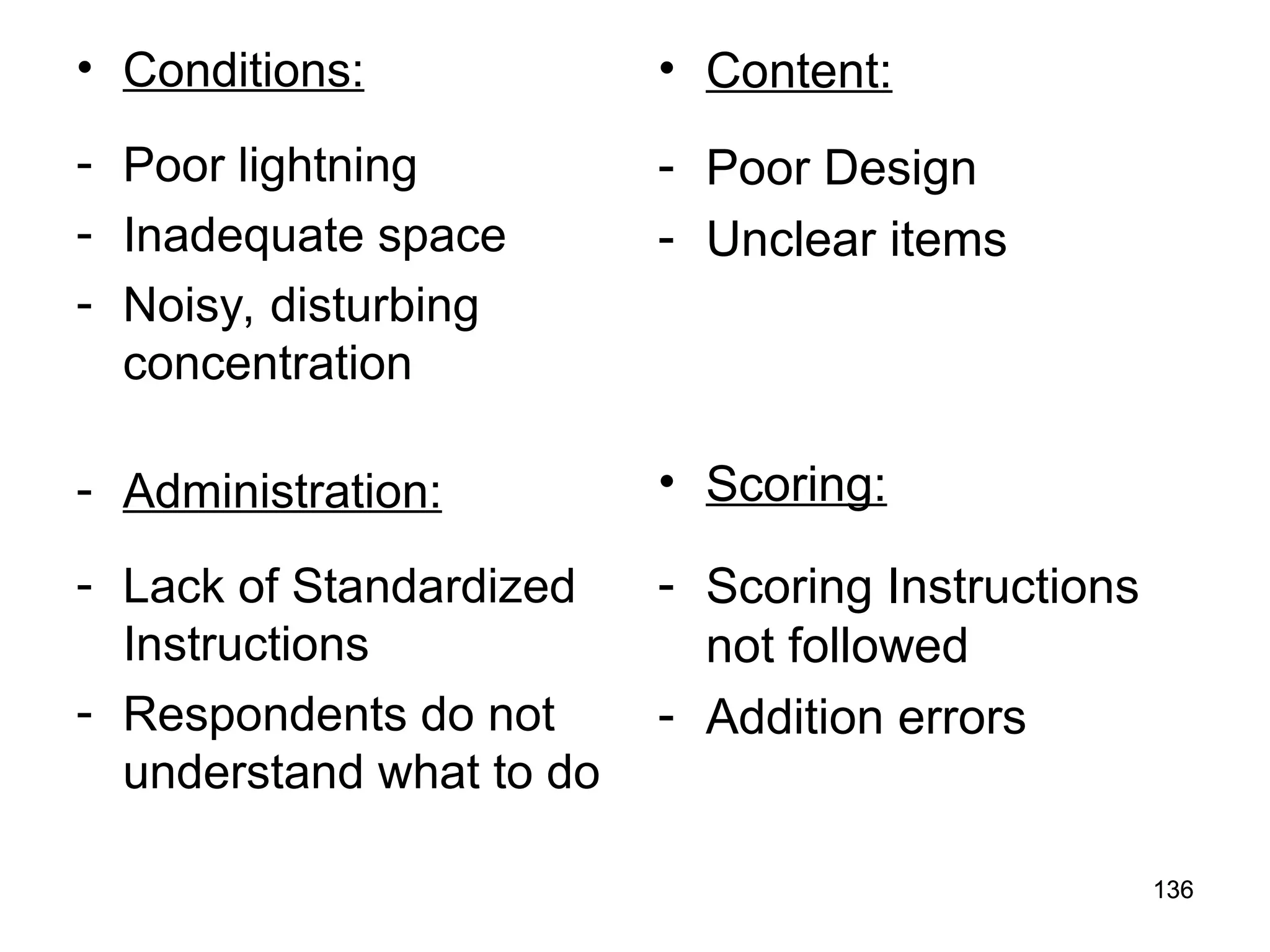
• Conditions:
- Poor lightning
- Inadequate space
- Noisy, disturbing
concentration
- Administration:
- Lack of Standardized
Instructions
- Respondents do not
understand what to do
• Content:
- Poor Design
- Unclear items
• Scoring:
- Scoring Instructions
not followed
- Addition errors
137
137
• Interpretation:
- Feedback to candidates & 3rd
party to be
given immediately by persons trained in
test use
- Face to face feedback is best but not
always practical if applicants are large
- Feedback can also be given over the
phone or in a written report
- Manage feedback with tact & sensitivity
- Confidentiality should be discussed &
adhered to
138
138
- First discuss applicant’s understanding of
test & his experience
- Discuss skill tested & its relevance to the
job
- Discuss the level of test
- Mention that the test results are usually
valid for 12 – 18 months
- Never give actual results (%)
- Give a rough guide on how results
compare to norm group
- Don’t “go beyond the data”
139
139
- Discuss the applicant’s speed & accuracy in
completing the test
- Don’t give the impression that the decision is
taking solely on test results
- For unsuccessful candidates, stress that they
were not right for the position, but they have
valuable strengths in other areas
• Legal & Ethical obligation to fully share recorded
information
• Fairness – Equal Opportunities selection
process, reduce feelings of bias & prejudice
• Public Relations (PR) for organization
140
Class Exercise – November 9
• Choose one of the following companies & corresponding jobs;
• CSOB: Competition for Retail Customers for Banking & Insurance
• PWC – Tax & Finance Advisory for Local & Multinational Companies
• T – Mobile – Competitive Market
• IBM – Software Solutions for retail & corporate clients
• Skoda Auto – Reduce CO2 emissions
• Adidas – Sustained Market Share
• Tesco – Reducing Turnover
• Sales Head for CSOB
• Corporate Client Management Head - PWC
• Brand Management Head for T-Mobile
• Software Solutions Head for IBM
• Production Management Head for Skoda
• Supply Chain Management Head for Adidas
• HR Head for Tesco
Write:
• Corporate Strategy
• job descriptions (with the % of time spent & priority on each activity)
• job level – Salary , Geographic Region
• team
• reporting line
• dependence on other Strategic Business Units
• Technical / Non-Technical Competencies – Behavior examples

mph_ahrm_lectures_9_13Nov.ppt lecture complete

  • 1.
    1 1 Building & Assessing Competenciesfor Organizational Development - Sangeeta Mathur (mathur.sangeeta@gmail.com) Sources: 1) “The handbook of competency mapping” by Seema Sanghi 2) “360 degree feedback, competency mapping & assessment centers” by Radha R Sharma 3) “360 degree feedback” by Peter Ward
  • 2.
    2 2 Contents S. No. TopicPage 1. Introduction to Competency 3 2. Designing & implementing a competency model 26 3. Competency based applications & issues in development 62 11. Assessment & Development Centers 64 12. Personality – Concept & Assessment 106 13. Class Exercise 140
  • 3.
    3 3 Accenture Report “Intangible assets: -Skilled workforce - Patents - Know-how Shot up from 20% of the value of companies in 1980 to around 70% today”
  • 4.
    4 4 McKinsey Report -Job Types • Transformational – Extracting raw materials or converting them into finished goods • Transactional – Interactions that can be easily scripted or automated • Tacit – Complex Interactions requiring a high level of judgment
  • 5.
    5 5 “Over the past6years, the number of American jobs emphasizing “tacit interactions” have grown 2.5 times faster than transactional jobs & 3 times faster than employment in general”
  • 6.
    6 6 To Sum up OrganizationGrowth Driven by people Manage their skills
  • 7.
    7 7 What is Competency “Anunderlying characteristic of a person which enables him to deliver superior performance in a given job, role or situation” The “attribute bundle” including the intellectual, motivational, social & emotional capability aspects A combination of IQ & EQ
  • 8.
    8 Characteristics of Competencies •Observable & not inferred • “Underlying characteristic” – deep & enduring part of personality • Not restricted to a single job; the person is able to carry them along
  • 9.
    9 9 Defining competencies interms of behaviors, outputs & results People have & acquire COMPETENCIES We apply these in the form of BEHAVIOUR (actions, thoughts, feelings) Our behavior produces OUTPUTS (products & services) How this is done yields RESULTS
  • 10.
    10 10 Results Vs Behavior •At the heart of any successful activity lies a competency • Managers usually focus on results (output) rather than behavior (process) • Managing results may not be as effective as it seems
  • 11.
    11 11 What comprises the“attribute bundle”? A. Intellectual Competencies: 1. Knowledge - Processed information inside a person - Predicts what an individual “can” do, rather than what he “wants” to do - Eg. Computer / Linguistic / trans cultural
  • 12.
    12 12 2. Skills - “Abilityto perform certain physical or mental tasks, accurately, consistently & meaningfully” - Eg. decision making, rational / logical thinking, analysis & synthesis, organizing, leadership skills, communication, creativity & innovativeness
  • 13.
    13 13 B. Emotional Competencies: Traits: •Characteristic & consistent ways of behaving, thinking or feeling in response to stimulus / situations • Eg. Initiative, tolerance of pressure, self- confidence, team player, learning style
  • 14.
    14 14 C. Social Competencies 1.Self – insight • Self perception & self image • Eg. self – confidence or inferiority complex 2. Values • Patterns of behavior held in high regard • Differ across cultures / over time • Eg. Interpersonal skills - modesty, aggression, deference
  • 15.
    15 3. Beliefs • Howaccepting are you of a proposition or a statement • Eg. How traditional are you ? 4. Attitudes • Internal feelings which cause us to behave the way we do • Contribute to positive & negative behavior • Eg. Sense of responsibility, integrity, team spirit
  • 16.
    16 16 D. Motivational Competencies •Determined by things a person consistently thinks about or wants - motives • Motives “drive, direct or select” behavior towards certain actions or goals & away from others
  • 17.
    17 17 McClelland Model (1976) Peopleare motivated or driven by 3 basic needs : a) Achievement b) Affiliation c) Power We possess all these in varying degrees – translates to differentiated behavior in an organizational setting
  • 18.
    18 18 A) High AchievementNeed Employees • Enjoy challenging tasks for which they are personally responsible for the outcomes • Want to ensure that they succeed & meet deadlines • Experience anxiety about projects until it completes successfully • Require frequent reinforcement of hard data (sales figures, standards) • Tasks presenting great risks & improbability of success don’t interest them • Plan ahead to avoid serious problems in undertaking
  • 19.
    19 19 B) High AffiliationNeed Employees • Direct their energies towards establishing & maintaining effective working relationships with others • Concern for receiving approval from & being liked by peers, supervisors & subordinates becomes the critical factor in decision making & implementation • Examine “human-side” of decisions • They try to maintain harmony & mutual respect among members, while the group undertakes its function & objectives
  • 20.
    20 20 C) High PowerNeed Employees • Autocratic decision making • Fluent; enjoy arguing & conforming conflict • Tend to see situations as win/lose
  • 21.
    21 21 Classification of Competencies- 1 Competencies Central Self - Concept At the core personality level, large in number Motives & Traits Surface Visible in job performance & behavior Knowledge, Skills Can be developed through proper T & D 80% of best performance is driven by these Not enough to ensure best performance Difficult to understand & measure; time consuming to develop
  • 22.
    22 22 Classification of Competencies- 2 Competencies Threshold Differentiating Minimum level of characteristics required for effective performance Characteristics differentiating superior from average performers
  • 23.
    23 23 Classification of Competencies- 3 Competencies Primary Secondary Top 25% in importance Mid 50% in importance Peripheral Bottom 25% in importance
  • 24.
    24 24 Core Competencies • Relevant& necessary for all employees • (eg: Customer Focus) • The related behavior differs across levels Junior customer service manager Answering the phone by the 3rd ring, using polite language Regional Manager Resolving customer problems by coordinating cross- organizational resources; analyzing customer buying patterns
  • 25.
    25 Linking HR processesto Organizational Strategy Design Organization to deliver strategy Specify competencies required at all levels Design & operate assessment procedures to check if employees have requisite skills for immediate job & potential & aspiration to perform in higher jobs Specify Organization’s Strategy Agree on Organization’s mission Design & operate development & training systems Career Path / Succession Planning
  • 26.
    26 Designing & Implementingthe Competency Model A) Customized – Starting from scratch: Depends on: • Corporate Strategy / Management Philosophy • Customer Requirements • Competitors’ Strategy • Business needs & processes - a distinctive competency in one area – quality & craftsmanship – may amount to a distinctive incompetence in a low cost production set up B) Starting with a validated competency model
  • 27.
    27 27 A - CustomizedCompetency Model Stage 1 Data Gathering & Preparation Study identified jobs Identify major categories of skills Identify probable competencies Stage 2 Data Analysis Review list of Probable competencies Construct competency definitions Assign proficiency levels Stage 3 Validation Content Validation Session Reinforce proficiency of Critical competencies Refine competency Definitions if necessary
  • 28.
    28 28 Stage 1 Data Gathering& Preparation Study identified jobs Identify major categories of skills Identify probable competencies
  • 29.
    29 Step 1 –Study Identified Jobs Reviewing existing job descriptions: - Department - Accounting, Brand Management, Production management - Role Title, Reporting line, Location - Level (Senior Manager, Manager, Non- Manager) - Revenue Responsibilities - Operating Budget / Financial Responsibility - Salary Budget
  • 30.
    30 - No. ofsubordinates & peers, position in hierarchy - What is the Overall Objective of the Job? - What is the job’s impact & contribution to the overall business ? - What confidential information will they have access to ? - Detailed list of responsibilities in order of priority & % of time spent on each responsibility - Who’s dependence to complete them?
  • 31.
    31 31 Step 2 –Identify & assign weights to skills Each Job has Minimum Skill Requirement Necessary for effective role performance
  • 32.
    32 32 Technical Vs. NonTechnical Skills Technical • Acquired through training / education • Industry specific process / licenses • Eg: Technology, safety or legal regulations • Maybe accompanied by some certification Non - Technical • “Soft Skills” / Personality • Not industry / process specific • Honesty, Risk Taking, Flexibility, Leadership
  • 33.
    33 33 Sources for skillidentification 1. Mission & Vision of Company 2. Departmental Planning Documents 3. Job Descriptions 4. Industry research – journals & publications 5. Vendor information 6. Customer feedback/Value Added flowcharts/Process documents 7. Training Calendars 8. Union Contracts
  • 34.
    34 34 9. Repertory GridTechnique 1. Write on a card the names of 5 relatively good & poor performers in the job 2. Draw 3 cards – identify what they do to fulfill their job 3. Differentiating 2 of them from 3rd 4. Draw next 3 cards & continue 5. Advantage – No restriction of a questionnaire
  • 35.
    35 35 10. Behavioral EventInterview • Structured Interview • Fair & Effective • Good for probing complex jobs, including CEO • Duration – 1 to 1.5 hrs
  • 36.
    36 36 The best predictorof future behavior is past behavior Structured Interview Focus on individual’s thoughts, feelings, behavior & outcomes Data on sample behavior leading to success in a role Data on sample behavior during failure / frustration in a role Comparison of data of star & average performers
  • 37.
    37 37 Step 3 –Identify Probable Competencies • Skills to be applied behaviorally to become a competency • Between 8 & 12 competencies required for effective role performance
  • 38.
    38 38 Stage 2 Data Analysis Reviewlist of Probable competencies Construct competency definitions Assign proficiency levels
  • 39.
    39 39 Step 1 -Review list of competencies • Review for internal consistency, validity & exhaustiveness Step 2 - Construct competency definitions • Simple, Brief, Meaningful • State behavioral expectation from employee
  • 40.
    40 40 Competencies Defined S. No.Competency Definitions 1. Strategic Mindset a) Conceptual & Analytical Thinking Diagnoses, collects & analyses information. Looks for links & develops new constructs. Intellectually manages complexity & ambiguity. b) Systematic Thinking Shows interest in perspective of others & can combine & contrast different disciplines. Understands own part, sees whole picture c) Environment Scanning & Trend Analysis Reads the environment. Looks ahead, predicts & forecasts. Prepares plans, recognizes, & acts in advance of obstacles.
  • 41.
    41 Behavior Examples Competency Developing People: Descriptionof behavior • Stretches, empowers & trains people • Provides rewards, feedback & recognition • Demonstrates & stimulates passion & commitment • Communicates effectively with people
  • 42.
    42 Competency Values & Ethics: Performance: Descriptionof behavior • Aligns with company values • Rewards right behaviors • Ensures that laws are obeyed & safety & environmental protection are practiced • Sets & achieves ambitious goals • Strives for continuous improvement • Measures the right things
  • 43.
    43 43 Team-working Positive BehaviorNegative Behavior “Builds effective working relationships with others, cooperates with colleagues to achieve goals & is sensitive to their needs • Encourages others to contribute & give ideas •Builds on others’ contributions •Gives priority to team goals •Celebrates team success •Prefers to work alone •Promotes own ideas over others’ •Criticizes others’ contributions •Gives priority to meeting own needs •Does not consider impact on others Define Competencies with examples of positive & negative behavior
  • 44.
    44 44 Elaboration of theCompetence “Independence” Independence Frequently needs help, correction, supervision. Plans & organizes own work insufficiently. A (below par) Executes tasks independently Divides own work efficiently. Only needs help with non- routine work. B Executes nearly all tasks independently Only needs help with very difficult situations. C Usually acts independently, systematically & efficiently even under pressure & in very difficult situations D (Excellent)
  • 45.
    45 45 Step 3: AssignProficiency Levels 1. N No Basis 2. Exposed Has some knowledge but little or no practical experience 3. Development Has some practical experience & can apply with supervision
  • 46.
    46 46 4. Proficient Hassubstantial knowledge & can apply it without supervision 5. Mastery Has extensive knowledge, can apply it well in complex situations & can supervise others 6. Expert Is the recognized thought leader whose contributions influence knowledge in this area
  • 47.
    47 47 Stage 3 Validation Content Validation Session Reinforceproficiency of Critical competencies Refine competency definitions if necessary
  • 48.
    48 48 Step 1 –Content Validation • Focus group meetings - top management, cross- section of managers & typical role profile holders • Check for ease of understanding • Evaluate data adequacy • Check time & process involved to implement through the firm • Benchmark with other comparable organizations • Ensure competencies are suited to local market & culture
  • 49.
    49 49 Step 2 –Reinforce proficiency levels • Conduct proficiency analysis - high proficiency levels are not necessary for each competency
  • 50.
    50 B) Starting witha validated competency model 1. Personal Competency Framework 2. Lancaster Model of Managerial Competencies
  • 51.
    51 1. Personal Competency Framework •In 1986, Job Competences Survey (JCS) was used as a questionnaire in the job analysis process to identify competencies for senior & middle managers in large companies (Shell, Barclays, British Gas) • It consists of 45 competencies under 6 main headings:
  • 52.
    52 Intellectual Personal Communicatio n InterpersonalLeadership Result Oriented 1. Information Collection 13. Adaptability 21. Reading 26. Impact 32. Organizing 38. Risk Taking 2. Problem Analysis 14. Independence 22. Written 27. Persuasive 33. Empowering 39. Decisive 3. Numerical Interpretation 15. Integrity 23. Listening 28. Sensitivity 34. Appraising 40. Business Sense 4. Judgment 16. Stress Tolerance 24. Oral Expression 29. Flexibility 35. Motivating Others 41. Energy 5. Critical Faculty 17. Resilience 25. Oral Presentation 30. Ascendancy 36. Developing others 42. Excellence Concern 6. Creativity 18. Detail Orientd 31. Negotiating 37. Leading 43. Tenacity 7. Planning 19. Self-mgmnt 44. Initiative 8. Perspective 20.change orientd 45.Client focus 9. Org. awareness 10. External Awareness 11.Learning Oriented 12.Technical expertise
  • 53.
    53 Performance Rating Scale 5- Outstanding Performance on this competency; far exceeds acceptable standards 2 - Performance on this competency is not upto acceptable standards. A development need 4 – Very good performance on this competency; better than acceptable standards 1 - Performance on this competency fails to meet acceptable standards. A major development need 3 – Quite acceptable performance on this competency, meets requirements 0 – unable to rate this competency
  • 54.
    54 Importance Rating Scale 5– This behavior is of vital importance for successful overall job performance 2 - This behavior is of highly marginal relevance for successful overall job performance 4 – This behavior is definitely important for successful overall job performance 1 - This behavior is not relevant for successful overall job performance 3 – This behavior is relevant but not important for successful overall job performance
  • 55.
    55 2. Lancaster Modelof Managerial Competencies • Developed in 1976 • Universal management competency framework • Comprises of 11 qualities divided into 3 groups or levels:
  • 56.
    56 Command of basicfacts Relevant professional understanding Continuous sensitivity to events Analytical, problem solving, decision making Social skills & abilities Emotional resilience Proactivity Creativity Mental agility Balanced learning Habits & Skills Self - Knowledge Basic knowledge & Information Skills & attributes Meta Qualities The successful manager
  • 57.
    57 Lancaster Model ofManagerial Competencies – Explanation 1. Level 1: Basic Knowledge & Information • Competence 1: Command of Basic Facts: - Knowledge of basic facts of business - Knowledge of company’s short & long term goals & products - Knowledge of roles & relationships between different departments • Competence 2: Relevant Professional Knowledge: - Specific Knowledge useful for the job – legal / financial control
  • 58.
    58 2. Level 2:Skills & Attributes: • Competence 1: Continuous sensitivity to events: • Being aware of what is going on • Perceptive & open to information: hard information (facts & figures) & soft information (feelings of other people) • Can respond suitably • Competence 2: Analytical, problem solving, decision making: - Judgment, intuition, weighing pros & cons
  • 59.
    59 • Competence 3:Social skills & abilities : • Interpersonal skills – communicating, delegating, negotiating, resolving conflict, persuading • Competence 4: Emotional Resilience: - Ability to cope with emotional stress & strain without getting insensitive & losing self-control • Competence 5: Proactivity: - Dedication & Commitment - Taking responsibility by considering the long- term goals & impact of decision
  • 60.
    60 3. Level 3:Meta Qualities: situation specific skills • Competence 1: Creativity: • Ability to come up with unique ideas & solutions • Insight to use useful ideas from another source • Competence 2: Mental agility: - Grasping problems quickly - Thinking about several things at once
  • 61.
    61 • Competence 3:Balanced learning habits & skills: • Ability to use a range of learning processes – teaching, discovering from personal experiences & reflection • Exhibit independence as learners • Competence 4: Self knowledge: - Being aware of own beliefs, goals, values, feelings, behavior & the part they play in influencing actions
  • 62.
    62 Competency based HRapplications 1. Position requirement: • Clarifies skills & knowledge most relevant to success in job 2. Recruitment: • Who should be interviewed & evaluated for skills & knowledge? • Ensures increased productivity & job satisfaction 3. Orientation & Induction: • Developing core competencies 4. Training: • Helps identify easily trainable competencies & the quality & quantity of training required 5. Performance Management: • Ensures objective appraisals, employee development & promotions
  • 63.
    63 Issues related todeveloping competency models • Management & employee buy-in • Continuous rather than periodic effort • Competencies to reflect current or future activities • Time Frame & Target group (easier for structured jobs)
  • 64.
    64 64 Assessment & Development Centers Multidimensional approach to obtain the best possible indication of peoples’ current or potential competencies to perform at the target job or current job level
  • 65.
    65 Assessment Vs DevelopmentCenters AC • Objective: - Tend to be used with external candidates - To evaluate capability for a specific job vacancy - To evaluate against a standard - Address an immediate organizational need - List of competencies assessed is not as long DC • Objective: - Tend to be used with internal candidates - To identify training needs - To identify the potential to be nurtured - Address a longer term organizational need - List of competencies assessed is much longer
  • 66.
    66 AC Typical output: - Competencygaps - Has a pass / fail criteria - Give feedback at a later date Methodology: - Runs like a selection process - Fewer assessors & more participants - Lesser emphasis placed on self assessment - Assign the role of judge to assessors; they are more detached from participants DC Typical output : - Individual development plans - No have a pass / fail criteria - Give feedback immediately Methodology: - Runs like a training program - Has a 1:1 assessor to participant ratio - Greater emphasis placed on self assessment - Assign the role of facilitator to assessors; they aren’t detached from participants
  • 67.
    67 67 History of AssessmentCenters • A British Invention used by Armed forces during the World Wars • Today, more than half of the medium & large co.s in UK use Assessment Centers • In USA, there are more than 3000 assessment centers
  • 68.
    68 68 Design of anAssessment Centre I Broad Prerequisites: • List of weight assigned competencies • List of weight assigned exercises or tests to measure all the desired competencies • Maintain a balance between individual & group exercises • Ensure Interrelation between exercises
  • 69.
    69 69 • Trial runof exercises – focus on clarity of instructions, time limit & difficulty level • Determine the duration of the entire process (1-2 days usually) • The CEO & top management to ensure: a) adequate resources b) assessment centre is in line with the organization’s objectives
  • 70.
    70 70 II Assessor selection& training: – Best to train senior managers for the role of assessors - Avoid direct assessment by line managers (assessor perception / participant under pressure) - Competency Framework Familiarization; understanding competencies & their assigned +ve & -ve behaviors; share video of trial run
  • 71.
    71 71 - Communication skills:for giving feedback & assistance in formulating development action plans: 1. Listening 2. Questioning 3. Empathy 4. Inter personal skills - Personal Qualities: 1. Managerial professionalism & Integrity 2. Confidence & credibility
  • 72.
    72 72 The Johari Window– 2 Way Process of Information Sharing Known Recipient Unknown Known Facilitator Unknown
  • 73.
    73 73 III. Assessment CentreProcedure 1. Observation – of participant behavior as they complete the various exercises 2. Recording – making notes of behavior & evidence of performance & ability 3. Classification – of recorded & observed behavior against appropriate competencies 4. Evaluation – of performance in each area of competence & giving a numerical rating
  • 74.
    74 74 5. Assessors’ Discussions •Comparative Analysis & Clarifications • Participants to be evaluated against the norm & not against each other • Reach a consensus / summary evaluation • Final decision on the participant as per the assessment centre objective
  • 75.
    75 75 Advantages of AssessmentCentres 1. Organizational Development • Provides a momentum for HR to be a strategic partner in business • Sends out a positive image of the organization’s professionalism, objectivity, transparency & consistency in recruitment & performance appraisals across functions, levels & geographical locations
  • 76.
    76 76 • Poor selectionHigh Turnover Increased recruitment & severance costs (10 - 40% of salary) • Poor selection Costs of incompetence (stress) & lost opportunity (profits / business) & training
  • 77.
    77 77 Advantages of anAssessment Centre 2. Employee Development • Provides valuable & objective self-insight & self-awareness • Helps identify untapped employee potential • Creates a talent pool for future reference • Unlike other capital that depreciates, human capital appreciates with its development & use
  • 78.
    78 78 Advantages of anAssessment Centre 3. Team & Leadership Management • Compares individual’s preferred work style with others in team • Helps find role balance across teams & conflict management for maximum effectiveness
  • 79.
    79 79 Assessment Tools 1. WorkSample Tests 2. Simulations 3. Interviews 4. Projective Techniques 5. Self – Portfolio Presentation 6. Psychometric Tests & Questionnaires 7. 360 degree feedback
  • 80.
    80 Choice of Tools Alltools designed after a thorough job – analysis 1. Off the shelf – quicker, cheaper, reliable & valid 2. Designed internally – tailor made 3. Customized by external consultant 4. External Centre – more objective
  • 81.
    81 81 1. Work SampleTests • Written exercises related to job • Perform a sample job task • For relatively simple jobs where important tasks can be identified • Eg. Putting a cuff on a shirt for hiring sewing machinists • Work quality + behavior is observed
  • 82.
    82 82 Work Sample Tests •Advantages - Very Job relevant - Promote Self selection or applicant withdrawal • Disadvantages - Labor intensive - Time consuming
  • 83.
    83 83 2. Simulations • Notnecessary to replicate the entire job • Identify the critical aspects to simulate
  • 84.
    84 84 Types of Simulations a)In-tray / In - basket exercises: - Day to day decision making situations from different sources - Memos, correspondence, emails, telephone messages or requests - Time bound reaction in writing expected from participant - Skills assessed: general activity level, problem solving, planning & organizing, time management, concern for priority & delegation
  • 85.
    85 85 b) Management games& Role Plays: - Real life situation is simulated for a group - Skills assessed – Strategic planning, conflict management, team work, leadership, communication, flexibility & motivation - Easier to give feedback c) Presentations (organizational issues / case study) d) Written reports
  • 86.
    86 86 3. Interviews • Givesadditional information • To acquire past performance evidence • Questions & rated sample responses to be decided beforehand
  • 87.
    87 87 Types of Interviews a)Situational Interview – For Technical Skills b) Structured or Behavior Event Interview (BEI) - For Non - Technical Skills
  • 88.
    88 88 Situational Interview Probes intoTechnical Skills: a) job knowledge – defining a term, explaining a procedure or demonstrating a skill b) Willingness to comply with the job requirement
  • 89.
    89 89 BEI -The bestpredictor of future behavior is past behavior Structured Interview Focus on individual’s thoughts, feelings, behavior & outcomes Data on sample behavior leading to success in a role Data on sample behavior during failure / frustration in a role Comparison of data of star & average performers
  • 90.
    90 BEI Methodology Step 1– Open the Interview • Introductions • Build rapport, make small talk • Put the candidate at ease • Explain purpose & expectations of interview, notes will be taken • Candidate to explain briefly career history • Ask candidate about recent events where he / she played a key role
  • 91.
    91 Step 2 –Review the candidate’s career history • As you hear evidence of technical skills, probe for more information about technical knowledge & expertise • Analyze & document candidate’s position & responsibilities; the key skills applied & their relevance to the job applied for
  • 92.
    92 Step 3 –Detailed behavioral probing Use the SOAR Technique: - S – Situation faced by participant; when, what, who was involved? What led up to the situation? - O – Objective for dealing with situation - A – Action taken to deal with situation; what was done or said? What was thought & felt ? - R – Outcome of the action; how effective was the action, what did the individual learn?
  • 93.
    93 Sample BEI questions •Document 3 - 6 +ve & -ve behavior examples for each competency Q 1. Describe an incident in which your workload was too heavy - How did you handle the situation? Q 2. Tell me about a situation when you were trying to accomplish something & did not have ready access to the necessary resources - How did you get them? Q 3. Describe a situation in which you had to juggle with more than 1 task - Which one did you handle 1st & why? How did you manage your time?
  • 94.
    94 Q 4. Tellme about a time when you had to deal with 2 people asking you to work on different projects that required more than 100% of your time - How did you resolve the situation? Q 5. Tell me about a situation when your planning was not helpful - What happened then, & how did you recover? Q 6. State an example when you were not able to achieve the goals - What did you do? Q 7. Describe a situation where your performance was excellent - What were the circumstances? What did you do ? How did the people respond?
  • 95.
    95 95 4. Projective Techniques •Assesses deep aspects of personality • Types of Techniques: a) Ink – Blot Test b) Word Association Tasks c) Thematic Apperception Test (TAT)
  • 96.
    96 96 5. Self –Portfolio Presentation • Candidate highlights his / her strengths, weaknesses & experiences • Gives an insight into candidate’s presentation skills, his attitude & aptitude
  • 97.
    97 97 6. Psychometric Tests& Questionnaires a) Psychometric Tests: 1. Achievement / Attainment Tests: Assesses results of formal education & training 2. IQ or General Intelligence Tests: Assesses a unitary measure of general intelligence (speed) 3. Aptitude or Special Ability Tests: Assesses the ability to acquire further knowledge or skills b) Psychometric Questionnaires: Personality Questionnaires
  • 98.
    98 98 Psychometric Tests &Questionnaires – IQ Tests • Here are words denoting several generations in one family. Write down the letter printed above the one which has only one older relation A B C D E Great Grand Mother Aunt Niece Great Aunt Mother • Give the next number of the series: 7,14,28…..
  • 99.
    99 99 Types of AbilityTests • Diagrammatic: a) Logical reasoning from data presented as diagrams & abstract shapes b) Useful for data processing jobs • Mechanical a) Mechanical problems in pictorial form b) Engineering Jobs
  • 100.
    100 100 Types of AbilityTests • Spatial a) Ability to imagine rotation of objects in space b) Design jobs / how parts of equipment fit together • Clerical a) Speed & accuracy in checking errors in lists / print-outs, filing, classification
  • 101.
    101 101 Types of AbilityTests • Dexterity a) Hand Speed / Fine Precision Skills b) Process & Assembly workers c) Co-ordination Tests for pilot selection • Sensory a) Near & Far visual, sound or color discrimination b) Military (Color blindness)
  • 102.
    102 102 Different Tests fordifferent levels Test Junior Level Assessment Senior Level Assessment Verbal Spelling & Grammar (For Clerks) Draw inferences from Data Numerical Simple Math Draw inferences from business data
  • 103.
    103 Grid of competencydimensions by exercises interview role play in tray group problem group negotiation psychometric test breadth of awareness * * * * clarity of understanding * * * innovative * * result oriented * * * self confidence * * * sensitivity to others * * Cooperative * * * * patience * * * *
  • 104.
    104 104 Personality Questionnaires • Howeffective & satisfied a person will be in a job ? • 70% depends on your personality
  • 105.
    105 105 +1 Perfect Prediction .65Assessment Centers .45 Ability Tests .40 Group Exercises .35 In – tray Exercises .30 Resume .15 Interviews .10 Educational Qualifications Graphology, Astrology 0 Random Prediction
  • 106.
    106 106 What is personality? • Derived from the Latin word “Persona” • “A person’s typical or preferred way of behaving, thinking & feeling”
  • 107.
    107 107 Components of Personality 1.Temperament • Feelings & Emotions • Moods 2. Motivation • What drives an individual ? • What directs his behavior ?
  • 108.
    108 108 Components of Personality 3.Values • What behavior do we have respect for ? • Differs across cultures & over time • Modesty, Aggression, Deference 4. Interests • Things we want to do & focus on • What are our goals ? 5. Attitudes
  • 109.
    109 109 Implicit Vs Explicit Theorieson Personality 1. Implicit a) Not defined or written down b) When you have an instinctive “feel” of what is human nature & how employees behave c) People act on this all the time
  • 110.
    110 110 Implicit Vs Explicit Theorieson Personality 2. Explicit a) Defined b) Based on research or some theory of psychology c) Can be verified / modified d) Personality Questionnaires are based on explicit theories of personality
  • 111.
    111 111 Assumptions about theNature of Personality 1. Individual Differences: • There are visible differences in people’s behavior • This helps progress of society & fulfills different needs of organizations
  • 112.
    112 112 2. Stability • Personalityis a changing thing but stays quite constant • There will be certain behavioral styles which we find difficult to adopt • We try to control & improve our personalities but change is not easy & is slow
  • 113.
    113 113 3. Genetic &Environmental influence • Genetic • Aspects of personality that change little throughout life • Environmental • Cultural influence & education • Aspects of personality that change in the longer term; affects personality stability
  • 114.
    114 114 4. State VsTrait aspects of Personality • States - Aspects of personality largely dependant on the specific situation - Some bad moods (despite being a generally positive) - Only worried in particular situations • Traits - Stable aspects of personality - Being generally positive - Generally tense & continually under pressure
  • 115.
    115 115 To sum up- Influences on Personality Age Physiological Genetic Life Experience Constitutional Situational Educational Socio – Cultural Family
  • 116.
    116 116 Personality Questionnaires • Toscientifically study a person’s inner thoughts & feelings • Describes different parts of behavior • Easy to use & score
  • 117.
    117 117 Types of Personality Questionnaires(PQ) a. Exhaustive • 30 - 32 Scales or dimensions of personality • The questions force respondents to make a choice between the most & least preferred behavior & aspects of their personalities • Offers an exhaustive summary of personality at work • Can be used as an international measure of personality
  • 118.
    118 118 b. Summarized Versions:Measure 5 – 16 dimensions of personality c. Versions to probe specific areas of work: 1. Sales Personality Questionnaire: • Designed for Sales teams 2. Customer Service Questionnaire : • Designed for Customer Service teams
  • 119.
    119 119 d. General WorkStyle Questionnaire: • For non-managerial staff in manufacturing & production jobs • Measures 17 dimensions of personality important for the job
  • 120.
    120 120 • e. 360°Feedback Versions: • Others (managers, colleagues, direct reports & customers) rate an employee on the same questionnaire • Compares self-perception with how we are seen by others
  • 121.
    121 121 Test / QuestionnaireSelection a) Validity b) Reliability c) Norms d) Results as a normal distribution e) Objectivity f) Cost & Copyright restrictions
  • 122.
    122 122 a) Test Validity •Does the test measure what is was designed to measure ? • The extent of relation between test scores & a criterion of job performance such as: - Targets Achieved - Appraisal Ratings - Ratings on a training program performance
  • 123.
    123 123 Types of Validity 1.Present / Face Validity: • Does the Test appear to measure what it was designed to measure ? • Do the questions in the Test look relevant & acceptable to management & candidates ?
  • 124.
    124 124 2. Predictive Validity: Extentto which the test predicts future outcome Applicants Work Experience Assessment Test Results Time Gap
  • 125.
    125 125 Advantages of ValidityAnalysis • Validity research conducted by one firm can be of use to other firms • Fair Selection & Legality requirement
  • 126.
    126 126 b) Test Reliability •No test can measure with 100% accuracy • Test scores should be regarded as estimates of an individual’s personality / ability • Important to know the typical band of error • Quote a tolerance expressed as a ± figure
  • 127.
    127 127 Definition of Reliability “Reliabilityrefers to the consistency & stability of results obtained”
  • 128.
    128 128 Types of Reliability 1.Test – Retest Reliability 2. Alternate Form Reliability 3. Internal Consistency Reliability
  • 129.
    129 129 Test – RetestReliability • “Measure of a test’s accuracy or consistency over a relatively short time interval” • Compare test results at one time with results for the same group of respondents later, usually after a month
  • 130.
    130 130 Alternate Form Reliability •Extent to which 2 forms of a test measure the same dimensions of personality / ability
  • 131.
    131 131 Internal Consistency Reliability •Measure of the accuracy or consistency of the test items • Split – half technique
  • 132.
    132 132 c) Norms • Scoresare judged against scores obtained by a relevant comparison group – Norm Group • Norm group should be as representative of the applicant group as possible • Constitutes a group applying for a similar position, with similar education, age, ethnic & gender mix
  • 133.
    133 133 d) NORMAL DISTRIBUTION •Human Characteristics – abilities / aptitudes are distributed normally through the population • More people with average abilities / aptitudes • Bell – shaped frequency polygon
  • 134.
    134 134 SKEW • Scores aremassed at one or the other end of the Score Scale • Negative Skew – Scores massed at high end – Test relatively easy for group • Positive Skew - Scores massed at low end – Test relatively difficult for group
  • 135.
    135 135 e) Test Objectivity OBJECTIVITY CONDITIONSCONTENT ADMINISTRATION SCORING TIME INTERPRETATION
  • 136.
    136 136 • Conditions: - Poorlightning - Inadequate space - Noisy, disturbing concentration - Administration: - Lack of Standardized Instructions - Respondents do not understand what to do • Content: - Poor Design - Unclear items • Scoring: - Scoring Instructions not followed - Addition errors
  • 137.
    137 137 • Interpretation: - Feedbackto candidates & 3rd party to be given immediately by persons trained in test use - Face to face feedback is best but not always practical if applicants are large - Feedback can also be given over the phone or in a written report - Manage feedback with tact & sensitivity - Confidentiality should be discussed & adhered to
  • 138.
    138 138 - First discussapplicant’s understanding of test & his experience - Discuss skill tested & its relevance to the job - Discuss the level of test - Mention that the test results are usually valid for 12 – 18 months - Never give actual results (%) - Give a rough guide on how results compare to norm group - Don’t “go beyond the data”
  • 139.
    139 139 - Discuss theapplicant’s speed & accuracy in completing the test - Don’t give the impression that the decision is taking solely on test results - For unsuccessful candidates, stress that they were not right for the position, but they have valuable strengths in other areas • Legal & Ethical obligation to fully share recorded information • Fairness – Equal Opportunities selection process, reduce feelings of bias & prejudice • Public Relations (PR) for organization
  • 140.
    140 Class Exercise –November 9 • Choose one of the following companies & corresponding jobs; • CSOB: Competition for Retail Customers for Banking & Insurance • PWC – Tax & Finance Advisory for Local & Multinational Companies • T – Mobile – Competitive Market • IBM – Software Solutions for retail & corporate clients • Skoda Auto – Reduce CO2 emissions • Adidas – Sustained Market Share • Tesco – Reducing Turnover • Sales Head for CSOB • Corporate Client Management Head - PWC • Brand Management Head for T-Mobile • Software Solutions Head for IBM • Production Management Head for Skoda • Supply Chain Management Head for Adidas • HR Head for Tesco Write: • Corporate Strategy • job descriptions (with the % of time spent & priority on each activity) • job level – Salary , Geographic Region • team • reporting line • dependence on other Strategic Business Units • Technical / Non-Technical Competencies – Behavior examples