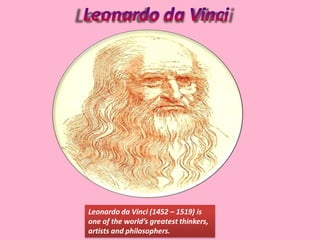
Leonardo da Vinci (1452 – 1519) is
one of the world’s greatest thinkers,
artists and philosophers.
Short Biography of Leonardo da Vinci
Leonardo was born an illegitimate son of a
Florentine noble and peasant woman. he grew
up in Vinci, Italy. In his formative years, he
developed a love of nature and from an early
age began to display his remarkable academic
and artistic talents. In 1466, he moved to
Florence where he entered the workshop of
Verrocchio. Initially, his formative style reflected
his teacher but he soon developed an artistic
sense which went far beyond his master’s rigid
style.
…..
In 1482, Leonardo went
to the court of Ludovico
Sforza in Milan, where
he stayed for 16 years.
Here he continued
painting and also
branched out into other
interest such as
engineering and
anatomy.
Last Supper
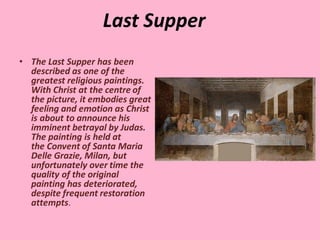
• The Last Supper has been
described as one of the
greatest religious paintings.
With Christ at the centre of
the picture, it embodies great
feeling and emotion as Christ
is about to announce his
imminent betrayal by Judas.
The painting is held at
the Convent of Santa Maria
Delle Grazie, Milan, but
unfortunately over time the
quality of the original
painting has deteriorated,
despite frequent restoration
attempts.
Leonardo Da Vinci and Mona Lisa
During this period, he painted the fresco of
the Battle of Anghiari. This artwork was
to exert tremendous influence over future
artists. However, it was never completed
and was later destroyed. It was also
during this period that Leonardo
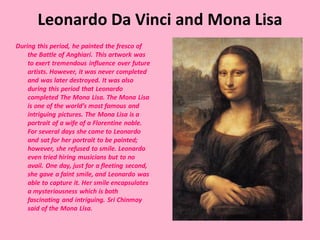
completed The Mona Lisa. The Mona Lisa
is one of the world’s most famous and
intriguing pictures. The Mona Lisa is a
portrait of a wife of a Florentine noble.
For several days she came to Leonardo
and sat for her portrait to be painted;
however, she refused to smile. Leonardo
even tried hiring musicians but to no
avail. One day, just for a fleeting second,
she gave a faint smile, and Leonardo was
able to capture it. Her smile encapsulates
a mysteriousness which is both
fascinating and intriguing. Sri Chinmoy
said of the Mona Lisa.
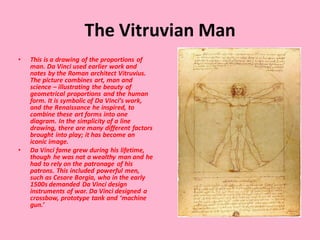
The Vitruvian Man
• This is a drawing of the proportions of
man. Da Vinci used earlier work and
notes by the Roman architect Vitruvius.
The picture combines art, man and
science – illustrating the beauty of
geometrical proportions and the human
form. It is symbolic of Da Vinci’s work,
and the Renaissance he inspired, to
combine these art forms into one
diagram. In the simplicity of a line
drawing, there are many different factors
brought into play; it has become an
iconic image.
• Da Vinci fame grew during his lifetime,
though he was not a wealthy man and he
had to rely on the patronage of his
patrons. This included powerful men,
such as Cesare Borgia, who in the early
1500s demanded Da Vinci design
instruments of war. Da Vinci designed a
crossbow, prototype tank and ‘machine
gun.’
Leonardo died at Clos Lucé on 2 May
1519 at the age of 67, possibly of a
stroke.
End…..

12.avramidou nikoleta-b2

  • 1.
    Leonardo da Vinci(1452 – 1519) is one of the world’s greatest thinkers, artists and philosophers.
  • 2.
    Short Biography ofLeonardo da Vinci Leonardo was born an illegitimate son of a Florentine noble and peasant woman. he grew up in Vinci, Italy. In his formative years, he developed a love of nature and from an early age began to display his remarkable academic and artistic talents. In 1466, he moved to Florence where he entered the workshop of Verrocchio. Initially, his formative style reflected his teacher but he soon developed an artistic sense which went far beyond his master’s rigid style.
  • 3.
    ….. In 1482, Leonardowent to the court of Ludovico Sforza in Milan, where he stayed for 16 years. Here he continued painting and also branched out into other interest such as engineering and anatomy.
  • 4.
    Last Supper • TheLast Supper has been described as one of the greatest religious paintings. With Christ at the centre of the picture, it embodies great feeling and emotion as Christ is about to announce his imminent betrayal by Judas. The painting is held at the Convent of Santa Maria Delle Grazie, Milan, but unfortunately over time the quality of the original painting has deteriorated, despite frequent restoration attempts.
  • 5.
    Leonardo Da Vinciand Mona Lisa During this period, he painted the fresco of the Battle of Anghiari. This artwork was to exert tremendous influence over future artists. However, it was never completed and was later destroyed. It was also during this period that Leonardo completed The Mona Lisa. The Mona Lisa is one of the world’s most famous and intriguing pictures. The Mona Lisa is a portrait of a wife of a Florentine noble. For several days she came to Leonardo and sat for her portrait to be painted; however, she refused to smile. Leonardo even tried hiring musicians but to no avail. One day, just for a fleeting second, she gave a faint smile, and Leonardo was able to capture it. Her smile encapsulates a mysteriousness which is both fascinating and intriguing. Sri Chinmoy said of the Mona Lisa.
  • 6.
    The Vitruvian Man •This is a drawing of the proportions of man. Da Vinci used earlier work and notes by the Roman architect Vitruvius. The picture combines art, man and science – illustrating the beauty of geometrical proportions and the human form. It is symbolic of Da Vinci’s work, and the Renaissance he inspired, to combine these art forms into one diagram. In the simplicity of a line drawing, there are many different factors brought into play; it has become an iconic image. • Da Vinci fame grew during his lifetime, though he was not a wealthy man and he had to rely on the patronage of his patrons. This included powerful men, such as Cesare Borgia, who in the early 1500s demanded Da Vinci design instruments of war. Da Vinci designed a crossbow, prototype tank and ‘machine gun.’
  • 7.
    Leonardo died atClos Lucé on 2 May 1519 at the age of 67, possibly of a stroke. End…..