Data Structures
Lecture No. 16
Huffman’s Algorithm
Engr. Rashid Farid Chishti
http://youtube.com/rfchishti
http://sites.google.com/site/chishti
International Islamic University H-10, Islamabad, Pakistan
Video Lecture
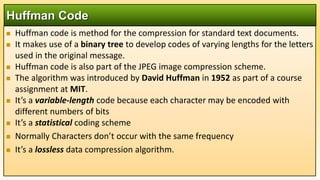
 Huffman code is method for the compression for standard text documents.
 It makes use of a binary tree to develop codes of varying lengths for the letters
used in the original message.
 Huffman code is also part of the JPEG image compression scheme.
 The algorithm was introduced by David Huffman in 1952 as part of a course
assignment at MIT.
 It’s a variable-length code because each character may be encoded with
different numbers of bits
 It’s a statistical coding scheme
 Normally Characters don’t occur with the same frequency
 It’s a lossless data compression algorithm.
Huffman Code
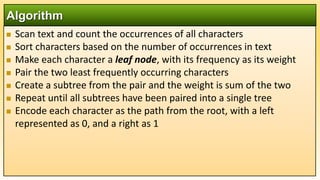
 Scan text and count the occurrences of all characters
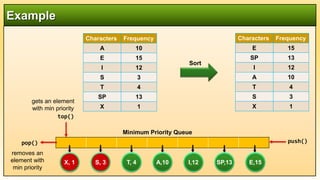
 Sort characters based on the number of occurrences in text
 Make each character a leaf node, with its frequency as its weight
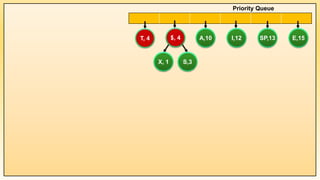
 Pair the two least frequently occurring characters
 Create a subtree from the pair and the weight is sum of the two
 Repeat until all subtrees have been paired into a single tree
 Encode each character as the path from the root, with a left
represented as 0, and a right as 1
Algorithm
Example
Characters Frequency
A 10
E 15
I 12
S 3
T 4
SP 13
X 1
Characters Frequency
E 15
SP 13
I 12
A 10
T 4
S 3
X 1
Sort
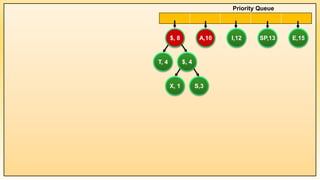
Minimum Priority Queue
X, 1 S, 3 E,15
SP,13
I,12
A,10
T, 4
push()
pop()
top()
removes an
element with
min priority
gets an element
with min priority
X, 1
E,15
SP,13
I,12
A,10
T, 4 $, 4
S,3
Priority Queue
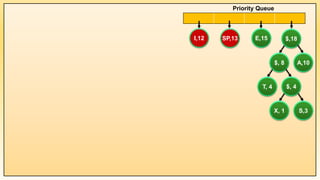
E,15
SP,13
I,12
A,10
$, 8
T, 4
S,3
X, 1
$, 4
Priority Queue
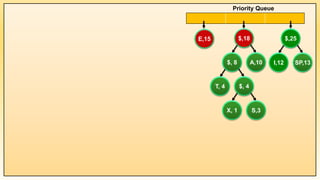
E,15
SP,13
I,12
$, 8
T, 4
$,18
A,10
X, 1
$, 4
S,3
Priority Queue
E,15
$, 8
T, 4
$,18
A,10
X, 1
$, 4
S,3
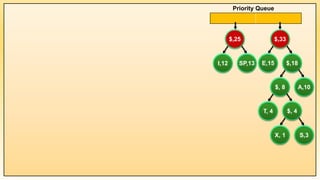
I,12
$,25
SP,13
Priority Queue
I,12
$,25
SP,13
$, 8
T, 4
$,18
E,15
$,33
A,10
S,3
X, 1
$, 4
Priority Queue
Priority Queue
SP,13
I,12
$, 8
T, 4
$,25
$,18
E,15
$,33
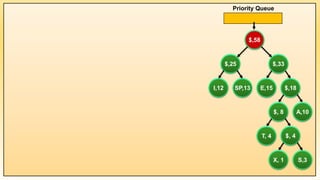
$,58
A,10
S,3
X, 1
$, 4
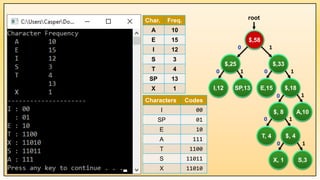
root
SP,13
I,12
$, 8
T, 4
$,25
$,18
E,15
$,33
$,58
1
1
1
1
0
0
0
0
A,10
1
0
0
S,3
1
X, 1
$, 4
Characters Codes
I 00
SP 01
E 10
A 111
T 1100
S 11011
X 11010
Char. Freq.
A 10
E 15
I 12
S 3
T 4
SP 13
X 1
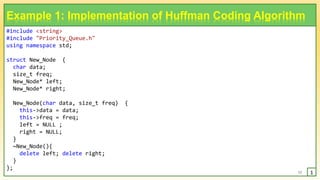
#include <string>
#include "Priority_Queue.h"
using namespace std;
struct New_Node {
char data;
size_t freq;
New_Node* left;
New_Node* right;
New_Node(char data, size_t freq) {
this->data = data;
this->freq = freq;
left = NULL ;
right = NULL;
}
~New_Node(){
delete left; delete right;
}
};
12
Example 1: Implementation of Huffman Coding Algorithm
1
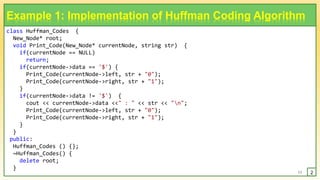
class Huffman_Codes {
New_Node* root;
void Print_Code(New_Node* currentNode, string str) {
if(currentNode == NULL)
return;
if(currentNode->data == '$') {
Print_Code(currentNode->left, str + "0");
Print_Code(currentNode->right, str + "1");
}
if(currentNode->data != '$') {
cout << currentNode->data <<" : " << str << "n";
Print_Code(currentNode->left, str + "0");
Print_Code(currentNode->right, str + "1");
}
}
public:
Huffman_Codes () {};
~Huffman_Codes() {
delete root;
}
13
Example 1: Implementation of Huffman Coding Algorithm
2
void Generate_Huffman_Tree(char data[], size_t freq[], size_t size) {
New_Node* left;
New_Node* right;
Priority_Queue <New_Node*>PQ;
for(size_t i = 0; i < size; ++i) {
PQ.Push(new New_Node(data[i], freq[i]));
}
PQ.Show();
while(PQ.size() != 1) {
left = PQ.Top(); PQ.Pop();
right = PQ.Top(); PQ.Pop();
root = new New_Node('$', left->freq + right->freq);
root->left = left; root->right = right;
PQ.Push(root); PQ.Show();
}
Print_Code(PQ.Top(), "");
}
};
14
Example 1: Implementation of Huffman Coding Algorithm
3
int main() {
Huffman_Codes Huff;
char data [] = { 'A', 'E', 'I', 'S', 'T', ' ', 'X'};
size_t freq [] = { 10 , 15, 12, 3, 4, 13, 1};
size_t size = sizeof(data);
cout <<"Character Frequency" << endl;
for (size_t i=0 ; i<size ; i++)
cout <<" "<< data[i] << " " << freq[i] << endl;
cout <<"---------------------" << endl;
Huff.Generate_Huffman_Tree(data, freq, size);
system("PAUSE"); return 0;
}
15
Example 1: Implementation of Huffman Coding Algorithm
4

Data Structures and Agorithm: DS 16 Huffman Coding.pptx

  • 1.
    Data Structures Lecture No.16 Huffman’s Algorithm Engr. Rashid Farid Chishti http://youtube.com/rfchishti http://sites.google.com/site/chishti International Islamic University H-10, Islamabad, Pakistan Video Lecture
  • 2.
     Huffman codeis method for the compression for standard text documents.  It makes use of a binary tree to develop codes of varying lengths for the letters used in the original message.  Huffman code is also part of the JPEG image compression scheme.  The algorithm was introduced by David Huffman in 1952 as part of a course assignment at MIT.  It’s a variable-length code because each character may be encoded with different numbers of bits  It’s a statistical coding scheme  Normally Characters don’t occur with the same frequency  It’s a lossless data compression algorithm. Huffman Code
  • 3.
     Scan textand count the occurrences of all characters  Sort characters based on the number of occurrences in text  Make each character a leaf node, with its frequency as its weight  Pair the two least frequently occurring characters  Create a subtree from the pair and the weight is sum of the two  Repeat until all subtrees have been paired into a single tree  Encode each character as the path from the root, with a left represented as 0, and a right as 1 Algorithm
  • 4.
    Example Characters Frequency A 10 E15 I 12 S 3 T 4 SP 13 X 1 Characters Frequency E 15 SP 13 I 12 A 10 T 4 S 3 X 1 Sort Minimum Priority Queue X, 1 S, 3 E,15 SP,13 I,12 A,10 T, 4 push() pop() top() removes an element with min priority gets an element with min priority
  • 5.
    X, 1 E,15 SP,13 I,12 A,10 T, 4$, 4 S,3 Priority Queue
  • 6.
  • 7.
    E,15 SP,13 I,12 $, 8 T, 4 $,18 A,10 X,1 $, 4 S,3 Priority Queue
  • 8.
    E,15 $, 8 T, 4 $,18 A,10 X,1 $, 4 S,3 I,12 $,25 SP,13 Priority Queue
  • 9.
  • 10.
    Priority Queue SP,13 I,12 $, 8 T,4 $,25 $,18 E,15 $,33 $,58 A,10 S,3 X, 1 $, 4
  • 11.
    root SP,13 I,12 $, 8 T, 4 $,25 $,18 E,15 $,33 $,58 1 1 1 1 0 0 0 0 A,10 1 0 0 S,3 1 X,1 $, 4 Characters Codes I 00 SP 01 E 10 A 111 T 1100 S 11011 X 11010 Char. Freq. A 10 E 15 I 12 S 3 T 4 SP 13 X 1
  • 12.
    #include <string> #include "Priority_Queue.h" usingnamespace std; struct New_Node { char data; size_t freq; New_Node* left; New_Node* right; New_Node(char data, size_t freq) { this->data = data; this->freq = freq; left = NULL ; right = NULL; } ~New_Node(){ delete left; delete right; } }; 12 Example 1: Implementation of Huffman Coding Algorithm 1
  • 13.
    class Huffman_Codes { New_Node*root; void Print_Code(New_Node* currentNode, string str) { if(currentNode == NULL) return; if(currentNode->data == '$') { Print_Code(currentNode->left, str + "0"); Print_Code(currentNode->right, str + "1"); } if(currentNode->data != '$') { cout << currentNode->data <<" : " << str << "n"; Print_Code(currentNode->left, str + "0"); Print_Code(currentNode->right, str + "1"); } } public: Huffman_Codes () {}; ~Huffman_Codes() { delete root; } 13 Example 1: Implementation of Huffman Coding Algorithm 2
  • 14.
    void Generate_Huffman_Tree(char data[],size_t freq[], size_t size) { New_Node* left; New_Node* right; Priority_Queue <New_Node*>PQ; for(size_t i = 0; i < size; ++i) { PQ.Push(new New_Node(data[i], freq[i])); } PQ.Show(); while(PQ.size() != 1) { left = PQ.Top(); PQ.Pop(); right = PQ.Top(); PQ.Pop(); root = new New_Node('$', left->freq + right->freq); root->left = left; root->right = right; PQ.Push(root); PQ.Show(); } Print_Code(PQ.Top(), ""); } }; 14 Example 1: Implementation of Huffman Coding Algorithm 3
  • 15.
    int main() { Huffman_CodesHuff; char data [] = { 'A', 'E', 'I', 'S', 'T', ' ', 'X'}; size_t freq [] = { 10 , 15, 12, 3, 4, 13, 1}; size_t size = sizeof(data); cout <<"Character Frequency" << endl; for (size_t i=0 ; i<size ; i++) cout <<" "<< data[i] << " " << freq[i] << endl; cout <<"---------------------" << endl; Huff.Generate_Huffman_Tree(data, freq, size); system("PAUSE"); return 0; } 15 Example 1: Implementation of Huffman Coding Algorithm 4