MULTIPLICATION OF 2
POLYNOMIALS
PRESENTED BY:
AARUL MISHRA (21MCA025)
TARUN GOVER (21MCA008)
INTRODUCTION
Polynomial
A polynomial is an algebraic expression consisting of
variables, coefficients, and operations such as addition,
subtraction, multiplication, and non-negative
exponentiation of variables.
E.g., P(x) = x² − 5x + 9
Linked List
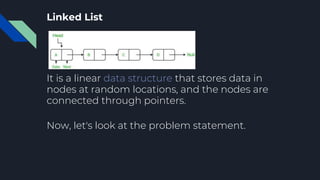
It is a linear data structure that stores data in
nodes at random locations, and the nodes are
connected through pointers.
Now, let's look at the problem statement.
WHAT IS POLYNOMIAL MULTIPLICATION?
Problem Statement
You are given the head pointers two linked lists representing two polynomials, say
head1 and head2. Perform the multiplication of the two polynomials and return the
output as a linked list. The structure of the linked list is provided below.
Now, let's take a look at an example of the multiplication of two polynomials.
Let say we have, P(x) = x² − 5x + 9 and Q(x) = x3 − 10x2 + 9x + 1
We need to find the product P(x)*Q(x).
P(x)*Q(x) = (x² − 5x + 9) * (x3 − 10x2 + 9x + 1)
Every term of P(x) will be multiplied to Q(x) in this way -
P(x)*Q(x) = x² (x3 − 10x2 + 9x + 1) - 5x(x3 − 10x2 + 9x + 1) + 9(x3−10x2+ 9x + 1)
To multiply any two terms, we multiply their coefficients and add up the exponents of
the variable.
So, we get -
P(x)*Q(x) =x5 - 10x4 + 9x3 + x2 - 5x4+50x3 -45x2 - 5x + 9x3 - 90x2 + 81x + 9
=x5 -15x4 +68x3 -134x2 +76x +9
Representation of Polynomials as Linked List
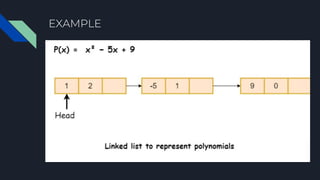
Each node in the linked list denotes one term of the polynomial.
Every node stores -
● Value of exponent
● Value of coefficient
● Pointer to the next node
So, the structure of the node looks like this -
EXAMPLE
Algorithm
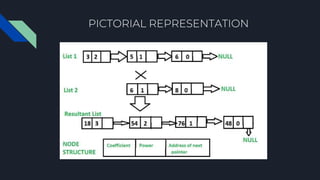
1. Define two pointers ptr1 and ptr2, which point to head1 and head2, respectively. These pointers
will be used to iterate over the two lists.
2. Define a new node head3 which points to the head node of the resulting product polynomial.
3. Multiply the terms pointed by ptr1 and ptr2.
4. Declare two variables coefficient and exponent where coefficient = ptr1->coefficient*ptr2-
>coefficient and exponent = ptr1->exponent + ptr2->exponent.
5. Create a new node with the coefficient and exponent found above. And append it to the list
pointed by head3.
6. Update ptr2 to point to the next node in the second polynomial and repeat the above steps till
ptr2 becomes NULL.
7. Similarly, after each complete pass over the second polynomial, reset ptr2 to point to head2
and update ptr1 to point to the next node in the first polynomial.
PICTORIAL REPRESENTATION
Complexity Analysis
Time Complexity
The time complexity for the above-discussed approach is O(n*m), where n is the number of
nodes in the first polynomial and m is the number of nodes in the second polynomial because we
used two nested loops.
Space Complexity
The space complexity for the above approach is O(n+m), we need to store all the multiplied
values in the node.

MULTIPLICATION OF 2 POLYNOMIALS.pptx

  • 1.
    MULTIPLICATION OF 2 POLYNOMIALS PRESENTEDBY: AARUL MISHRA (21MCA025) TARUN GOVER (21MCA008)
  • 2.
    INTRODUCTION Polynomial A polynomial isan algebraic expression consisting of variables, coefficients, and operations such as addition, subtraction, multiplication, and non-negative exponentiation of variables. E.g., P(x) = x² − 5x + 9
  • 3.
    Linked List It isa linear data structure that stores data in nodes at random locations, and the nodes are connected through pointers. Now, let's look at the problem statement.
  • 4.
    WHAT IS POLYNOMIALMULTIPLICATION? Problem Statement You are given the head pointers two linked lists representing two polynomials, say head1 and head2. Perform the multiplication of the two polynomials and return the output as a linked list. The structure of the linked list is provided below. Now, let's take a look at an example of the multiplication of two polynomials. Let say we have, P(x) = x² − 5x + 9 and Q(x) = x3 − 10x2 + 9x + 1 We need to find the product P(x)*Q(x). P(x)*Q(x) = (x² − 5x + 9) * (x3 − 10x2 + 9x + 1) Every term of P(x) will be multiplied to Q(x) in this way - P(x)*Q(x) = x² (x3 − 10x2 + 9x + 1) - 5x(x3 − 10x2 + 9x + 1) + 9(x3−10x2+ 9x + 1) To multiply any two terms, we multiply their coefficients and add up the exponents of the variable. So, we get - P(x)*Q(x) =x5 - 10x4 + 9x3 + x2 - 5x4+50x3 -45x2 - 5x + 9x3 - 90x2 + 81x + 9 =x5 -15x4 +68x3 -134x2 +76x +9
  • 5.
    Representation of Polynomialsas Linked List Each node in the linked list denotes one term of the polynomial. Every node stores - ● Value of exponent ● Value of coefficient ● Pointer to the next node So, the structure of the node looks like this -
  • 6.
  • 7.
    Algorithm 1. Define twopointers ptr1 and ptr2, which point to head1 and head2, respectively. These pointers will be used to iterate over the two lists. 2. Define a new node head3 which points to the head node of the resulting product polynomial. 3. Multiply the terms pointed by ptr1 and ptr2. 4. Declare two variables coefficient and exponent where coefficient = ptr1->coefficient*ptr2- >coefficient and exponent = ptr1->exponent + ptr2->exponent. 5. Create a new node with the coefficient and exponent found above. And append it to the list pointed by head3. 6. Update ptr2 to point to the next node in the second polynomial and repeat the above steps till ptr2 becomes NULL. 7. Similarly, after each complete pass over the second polynomial, reset ptr2 to point to head2 and update ptr1 to point to the next node in the first polynomial.
  • 8.
  • 9.
    Complexity Analysis Time Complexity Thetime complexity for the above-discussed approach is O(n*m), where n is the number of nodes in the first polynomial and m is the number of nodes in the second polynomial because we used two nested loops. Space Complexity The space complexity for the above approach is O(n+m), we need to store all the multiplied values in the node.