11/29/10
Challenge the future
Delft
University of
Technology
Quantitative Methods of
Research
Research Methods for Urban Planners and Designers
Roberto Rocco, Urbanism
Data, Statistics and Spatial Representation
Data, statistics
and how to
represent them
spatially!
Data, Statistics and Spatial Representation
Data, statistics
and how to
represent them
spatially!
For a fact based
view of the
world
(Hans Rosling)
Data, Statistics and Spatial Representation
The Science of Great Numbers
Statistics is a mathematical science
pertaining to the collection, analysis,
interpretation or explanation, and
presentation of data
Understanding Society
Data, Statistics and Spatial Representation
Census X Statistics
Data collection only is not exactly
statistics.
Statistics is about understanding
trends and their evolution through
periods of time using data.
Measuring Society X Interpreting society
Data, Statistics and Spatial Representation
Population measures
Population measures (birth and death
rates) were the major preoccupation
of early quantifiers of society.
Measuring Society
Data, Statistics and Spatial Representation
The origin of the name: Statistik
Although census have been around since antiquity,
the science of understanding trends, foreseeing
outcomes and explaining societal movements
through numbers is relatively new.
Data, Statistics and Spatial Representation
The origin of the name: Statistik
The study of ‘ social numbers’ needed a name. In
1749, the German scholar Gottfried Achenwall
suggested that since this science dealt with the
natural ‘states’ of society (rather than ‘laws’) , it
should be called Statistik.
Data, Statistics and Spatial Representation
Modern sources for data
• The Census (CBS): several kinds of census
• Revenue (Belastingdienst)
• Commercial associations (KvK)
• Municipalities and ministries (former VROM,
Traffic, Housing, Green , Pollution, Water, etc)
• Internet is not a source: it is a means. Where in the
internet? (source = institution/publisher/author)
Data, Statistics and Spatial Representation
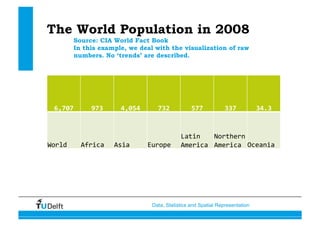
The World Population in 2008
Source: CIA World Fact Book
In this example, we deal with the visualization of raw
numbers. No ‘trends’ are described.
6,707
 973
 4,054
 732
 577
 337
 34.3

World
 Africa
 Asia
 Europe

Latin

America

Northern

America
 Oceania

Data, Statistics and Spatial Representation
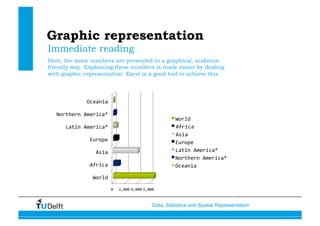
Graphic representation
Immediate reading
Here, the same numbers are presented in a graphical, audience
friendly way. Explaining these numbers is made easier by dealing
with graphic representation. Excel is a good tool to achieve this.
0
 2,000
4,000
6,000

World

Africa

Asia

Europe

Latin
America*

Northern
America*

Oceania

World

Africa

Asia

Europe

Latin
America*

Northern
America*

Oceania

Data, Statistics and Spatial Representation
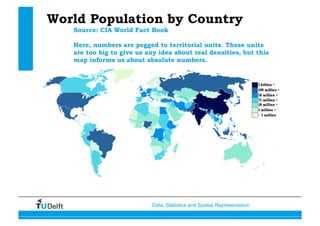
World Population by Country
Source: CIA World Fact Book
Here, numbers are pegged to territorial units. These units
are too big to give us any idea about real densities, but this
map informs us about absolute numbers.
Data, Statistics and Spatial Representation
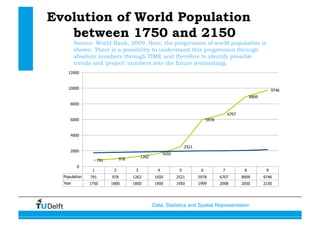
Evolution of World Population
between 1750 and 2150
Source: World Bank, 2009. Here, the progression of world population is
shown. There is a possibility to understand this progression through
absolute numbers through TIME and therefore to identify possible
trends and ‘project’ numbers into the future (estimating).
1 2 3 4 5 6 7 8 9
Population 791 978 1262 1650 2521 5978 6707 8909 9746
Year 1750 1800 1850 1900 1950 1999 2008 2050 2150
791 978
1262
1650
2521
5978
6707
8909
9746
0
2000
4000
6000
8000
10000
12000
Data, Statistics and Spatial Representation
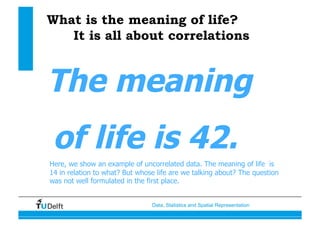
What is the meaning of life?
It is all about correlations
The meaning
of life is 42.
Here, we show an example of uncorrelated data. The meaning of life is
14 in relation to what? But whose life are we talking about? The question
was not well formulated in the first place.
Data, Statistics and Spatial Representation
The answer to the Ultimate Question
of Life, the Universe and
Everything
•  The number 42 is in the novel ‘The Hitchhiker's Guide to the
Galaxy’ by Douglas Adams.
•  The Answer to the Ultimate Question of Life, the Universe,
and Everything is calculated by an enormous supercomputer
over a period of 7.5 million years to be 42. Unfortunately no
one knows what the correlations are (42 what?)
Data, Statistics and Spatial Representation
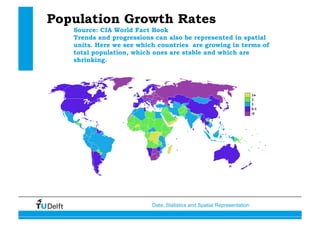
Population Growth Rates
Source: CIA World Fact Book
Trends and progressions can also be represented in spatial
units. Here we see which countries are growing in terms of
total population, which ones are stable and which are
shrinking.
Data, Statistics and Spatial Representation
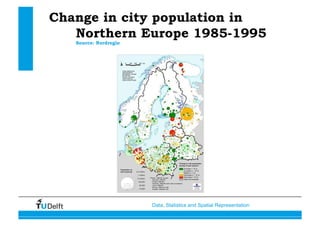
Change in city population in
Northern Europe 1985-1995
Source: Nordregio
Data, Statistics and Spatial Representation
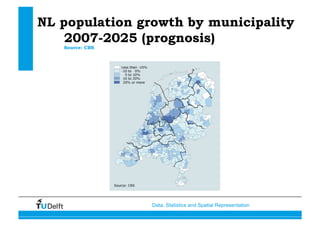
NL population growth by municipality
2007-2025 (prognosis)
Source: CBS
Data, Statistics and Spatial Representation
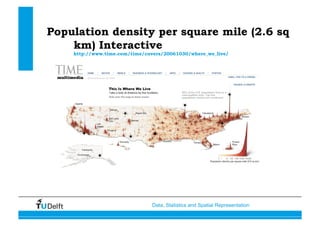
Population density per square mile (2.6 sq
km) Interactive
http://www.time.com/time/covers/20061030/where_we_live/
Data, Statistics and Spatial Representation
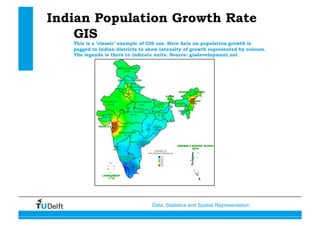
Indian Population Growth Rate
GIS
This is a ‘classic’ example of GIS use. Here data on population growth is
pegged to Indian districts to show intensity of growth represented by colours.
The legenda is there to indicate units. Source: gisdevelopment.net
Data, Statistics and Spatial Representation
The science of trends and
probabilities
The analysis of social data over
extended periods of time can give us
indications on trends and
probabilities, but never certainties.
Undersanding where society is going
It is possible to measure some social processes. The science of big large numbers
informs us about the behaviour of large numbers of people, but not about the
behaviour of individuals. It is also not an ‘exact’ science, in the sense that results
are inferred, but they are not mathematical certainties.
Data, Statistics and Spatial Representation
Spatializing Data
One of the great ‘leaps forward’ in statistics was
the pegging of data to space, generally in the
form of maps.
Understanding society and space
Data, Statistics and Spatial Representation
Spatializing Data
The correlation of space with social processes has
revealed behavioral patterns and social processes
that are simultaneously defining and defined by
space.
An iterative relationship
Data, Statistics and Spatial Representation
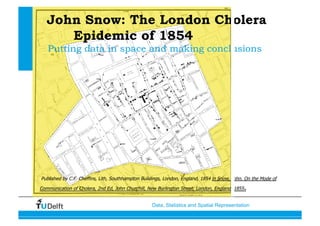
John Snow: The London Cholera
Epidemic of 1854
Published by C.F. Cheffins, Lith, Southhampton Buildings, London, England, 1854 in Snow, John. On the Mode of
Communication of Cholera, 2nd Ed, John Churchill, New Burlington Street, London, England, 1855.
Putting data in space and making conclusions
Data, Statistics and Spatial Representation
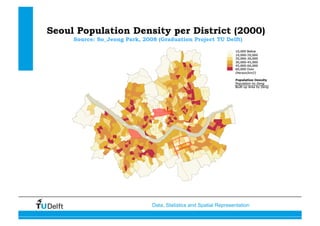
Seoul Population Density per District (2000)
Source: So_Jeong Park, 2008 (Graduation Project TU Delft)
Data, Statistics and Spatial Representation
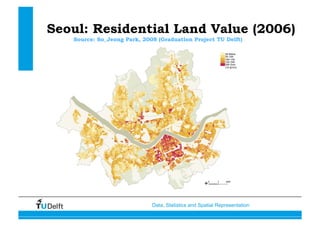
Seoul: Residential Land Value (2006)
Source: So_Jeong Park, 2008 (Graduation Project TU Delft)
Data, Statistics and Spatial Representation
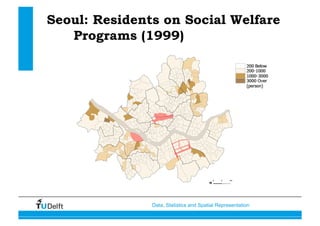
Seoul: Residents on Social Welfare
Programs (1999)
Data, Statistics and Spatial Representation
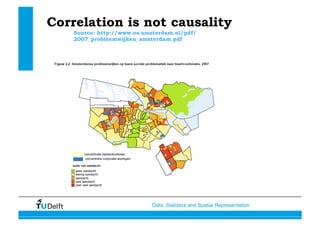
Correlation is not causality
Source: http://www.os.amsterdam.nl/pdf/
2007_probleemwijken_amsterdam.pdf
Data, Statistics and Spatial Representation
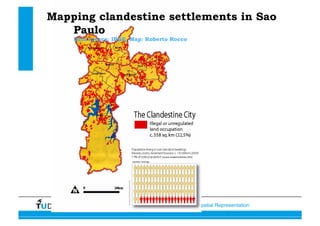
Mapping clandestine settlements in Sao
Paulo
Data source: IBGE, Map: Roberto Rocco
Data, Statistics and Spatial Representation
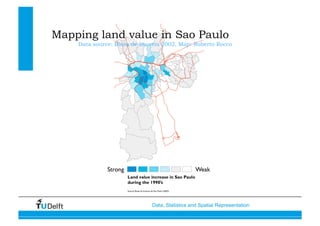
Mapping land value in Sao Paulo
Data source: Bolsa de Imoveis 2002, Map: Roberto Rocco
Data, Statistics and Spatial Representation
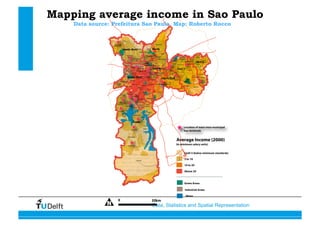
Mapping average income in Sao Paulo
Data source: Prefeitura Sao Paulo, Map: Roberto Rocco
Data, Statistics and Spatial Representation
Human Development Index
United Nations Human Development Forum
The Human Development Index (HDI) is an index used to rank
countries by level of development of social indicators. This
may show us whether a country is developed, developing, or
underdeveloped. It combines three key indicators:
•  Life expectancy at birth
•  Knowledge and education, measured by the adult literacy
rate (2/3) and the combined primary, secondary, and tertiary
gross enrolment ratio (1/3).
•  Gross domestic product per capita at purchasing power parity
(PPP).
Data, Statistics and Spatial Representation
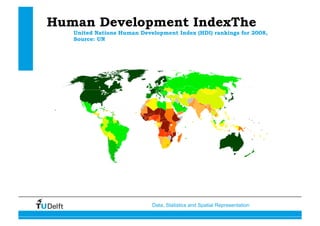
Human Development IndexThe
United Nations Human Development Index (HDI) rankings for 2008,
Source: UN
Data, Statistics and Spatial Representation
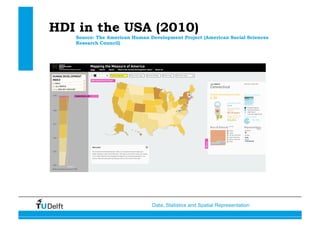
HDI in the USA (2010)
Source: The American Human Development Project (American Social Sciences
Research Council)
Data, Statistics and Spatial Representation
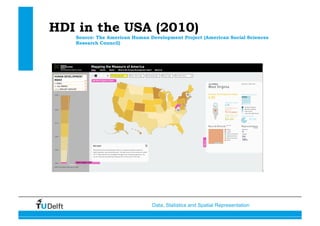
HDI in the USA (2010)
Source: The American Human Development Project (American Social Sciences
Research Council)
Data, Statistics and Spatial Representation
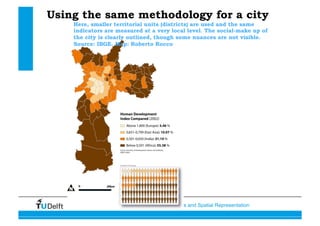
Using the same methodology for a city
Here, smaller territorial units (districts) are used and the same
indicators are measured at a very local level. The social-make up of
the city is clearly outlined, though some nuances are not visible.
Source: IBGE. Map: Roberto Rocco
Data, Statistics and Spatial Representation
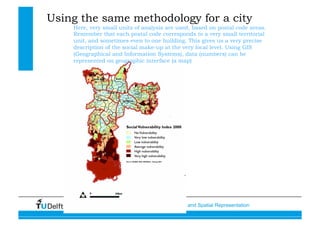
Using the same methodology for a city
Here, very small units of analysis are used, based on postal code areas.
Remember that each postal code corresponds to a very small territorial
unit, and sometimes even to one building. This gives us a very precise
description of the social make-up at the very local level. Using GIS
(Geographical and Information Systems), data (numbers) can be
represented on geographic interface (a map)
Data, Statistics and Spatial Representation
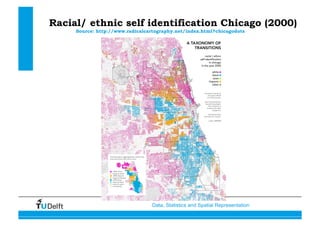
Racial/ ethnic self identification Chicago (2000)
Source: http://www.radicalcartography.net/index.html?chicagodots
Data, Statistics and Spatial Representation
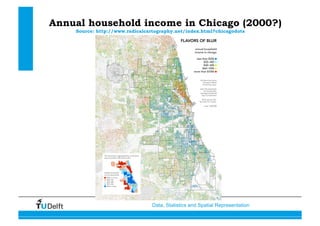
Annual household income in Chicago (2000?)
Source: http://www.radicalcartography.net/index.html?chicagodots
Data, Statistics and Spatial Representation
But why oh why do we need statistics and its
graphic representation in urbanism?
•  Which country has the highest child mortality in the
following pairs?
•  Sri Lanka or Turkey
•  Poland or South Korea
•  Malaysia or Russia
•  Pakistan or Vietnam
•  Thailand or South Africa
Data, Statistics and Spatial Representation
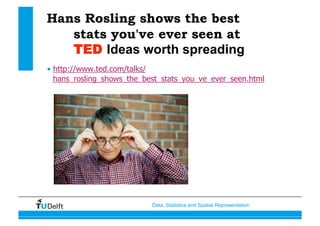
Hans Rosling shows the best
stats you've ever seen at
TED Ideas worth spreading
•  http://www.ted.com/talks/
hans_rosling_shows_the_best_stats_you_ve_ever_seen.html
Data, Statistics and Spatial Representation
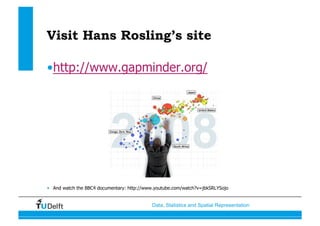
Visit Hans Rosling’s site
• http://www.gapminder.org/
•  And watch the BBC4 documentary: http://www.youtube.com/watch?v=jbkSRLYSojo
Data, Statistics and Spatial Representation
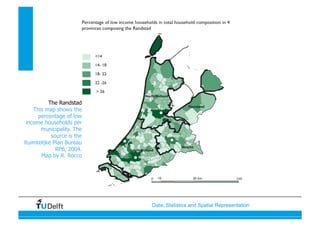
The Randstad
This map shows the
percentage of low
income households per
municipality. The
source is the
Ruimtelijke Plan Bureau
RPB, 2004.
Map by R. Rocco
Data, Statistics and Spatial Representation
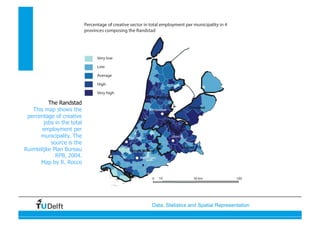
The Randstad
This map shows the
percentage of creative
jobs in the total
employment per
municipality. The
source is the
Ruimtelijke Plan Bureau
RPB, 2004.
Map by R. Rocco
Data, Statistics and Spatial Representation
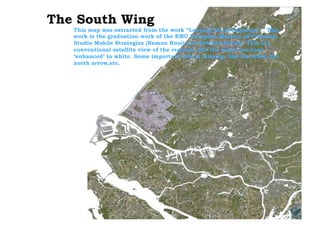
The South Wing
This map was extracted from the work “Looping the archipelago” . This
work is the graduation work of the EMU European Masters of Urbanism
Studio Mobile Strategies (Remon Rooij and Roberto Rocco). This is a
conventional satellite view of the regional, but the water has been
‘enhanced’ in white. Some important info is missing, like the scale, the
north arrow,etc.
Data, Statistics and Spatial Representation
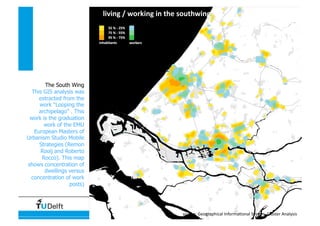
living / working in the southwing 
source: Geographical Informa4onal System, Cluster Analysis 
The South Wing
This GIS analysis was
extracted from the
work “Looping the
archipelago” . This
work is the graduation
work of the EMU
European Masters of
Urbanism Studio Mobile
Strategies (Remon
Rooij and Roberto
Rocco). This map
shows concentration of
dwellings versus
concentration of work
posts)
Data, Statistics and Spatial Representation
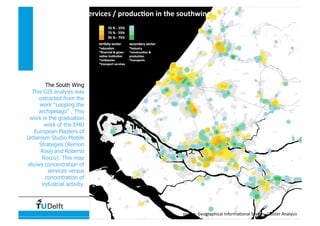
services / produc4on in the southwing 
source: Geographical Informa4onal System, Cluster Analysis 
The South Wing
This GIS analysis was
extracted from the
work “Looping the
archipelago” . This
work is the graduation
work of the EMU
European Masters of
Urbanism Studio Mobile
Strategies (Remon
Rooij and Roberto
Rocco). This map
shows concentration of
services versus
concentration of
industrial activity.
Data, Statistics and Spatial Representation
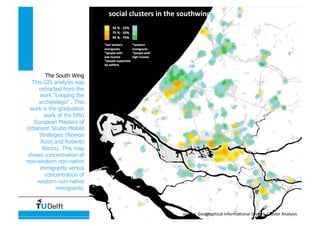
social clusters in the southwing 
source: Geographical Informa4onal System, Cluster Analysis 
The South Wing
This GIS analysis was
extracted from the
work “Looping the
archipelago” . This
work is the graduation
work of the EMU
European Masters of
Urbanism Studio Mobile
Strategies (Remon
Rooij and Roberto
Rocco). This map
shows concentration of
non-western non-native
immigrants versus
concentration of
western non-native
immigrants.
Data, Statistics and Spatial Representation
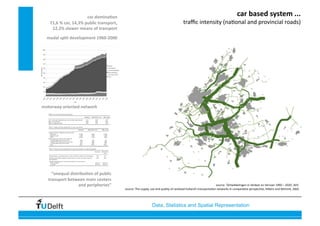
environmental balance car domina4on 
71,6 % car, 14,3% public transport, 
12,2% slower means of transport  
modal split development 1960‐2000 
car based system ... 
traffic intensity (na4onal and provincial roads) 
motorway oriented network 
“unequal distribu4on of public 
transport between main centers  
and peripheries”   source: ‘Ontwikkelingen in Verkeer en Vervoer 1990 – 2020’, AVV 
source: The supply, use and quality of randstad holland’s transporta4on networks in compara4ve perspec4ve, Hilbers and Wilmink, 2002 
Data, Statistics and Spatial Representation
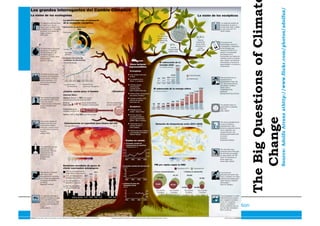
TheBigQuestionsofClimat
Change
Source:AdolfoArranzathttp://www.flickr.com/photos/adolfux/
Data, Statistics and Spatial Representation
Thank you
Data, Statistics and Spatial Representation
MAPSCROLL

http://mapscroll.blogspot.com/2009_06_01_archive.htm

Information
is
beautiful

http://www.informationisbeautiful.net/

Flowing
Data

http://flowingdata.com/

Urban
Data
Visualization
Lab
University
of
Illinois

http://www.uic.edu/cuppa/udv/research.html

Design
Reviver
(for
info
graphics)

http://designreviver.com/inspiration/30‐of‐the‐best‐infographics‐that‐effectively‐
showcase‐data/

50
informative
and
well
design
graphics

http://www.hongkiat.com/blog/50‐informative‐and‐well‐designed‐infographics/

Please,
have
a
look
at
the
Statistical Literacy Guides 
of
the
British
government
for

useful
guides
in
English

http://www.parliament.uk/topics/Statistics‐policyArchive.htm

For more innovative and inventive use of statistics in
maps and graphic representation, go to
Data, Statistics and Spatial Representation
http://flowingdata.com/2010/11/29/statistics-vs-stories/
For an analysis on the differences between individual
stories and statistics go to
Data, Statistics and Spatial Representation
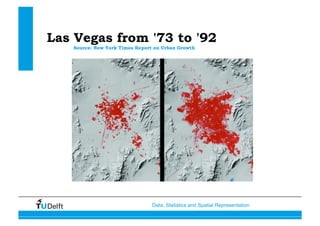
Las Vegas from '73 to '92
Source: New York Times Report on Urban Growth
Data, Statistics and Spatial Representation
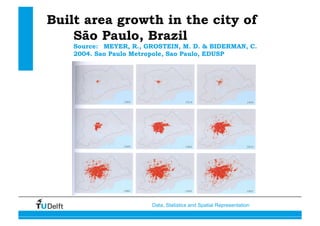
Built area growth in the city of
São Paulo, Brazil
Source: MEYER, R., GROSTEIN, M. D. & BIDERMAN, C.
2004. Sao Paulo Metropole, Sao Paulo, EDUSP
Data, Statistics and Spatial Representation
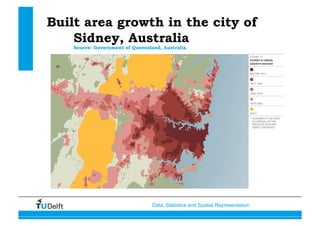
Built area growth in the city of
Sidney, Australia
Source: Government of Queensland, Australia.
Data, Statistics and Spatial Representation
Questions? Answers?
Please contact me at
Roberto Rocco
R.c.rocco@tudelft.nl

Spatial representation of data in Urban Planning and Design

  • 1.
    11/29/10 Challenge the future Delft Universityof Technology Quantitative Methods of Research Research Methods for Urban Planners and Designers Roberto Rocco, Urbanism
  • 2.
    Data, Statistics andSpatial Representation Data, statistics and how to represent them spatially!
  • 3.
    Data, Statistics andSpatial Representation Data, statistics and how to represent them spatially! For a fact based view of the world (Hans Rosling)
  • 4.
    Data, Statistics andSpatial Representation The Science of Great Numbers Statistics is a mathematical science pertaining to the collection, analysis, interpretation or explanation, and presentation of data Understanding Society
  • 5.
    Data, Statistics andSpatial Representation Census X Statistics Data collection only is not exactly statistics. Statistics is about understanding trends and their evolution through periods of time using data. Measuring Society X Interpreting society
  • 6.
    Data, Statistics andSpatial Representation Population measures Population measures (birth and death rates) were the major preoccupation of early quantifiers of society. Measuring Society
  • 7.
    Data, Statistics andSpatial Representation The origin of the name: Statistik Although census have been around since antiquity, the science of understanding trends, foreseeing outcomes and explaining societal movements through numbers is relatively new.
  • 8.
    Data, Statistics andSpatial Representation The origin of the name: Statistik The study of ‘ social numbers’ needed a name. In 1749, the German scholar Gottfried Achenwall suggested that since this science dealt with the natural ‘states’ of society (rather than ‘laws’) , it should be called Statistik.
  • 9.
    Data, Statistics andSpatial Representation Modern sources for data • The Census (CBS): several kinds of census • Revenue (Belastingdienst) • Commercial associations (KvK) • Municipalities and ministries (former VROM, Traffic, Housing, Green , Pollution, Water, etc) • Internet is not a source: it is a means. Where in the internet? (source = institution/publisher/author)
  • 10.
    Data, Statistics andSpatial Representation The World Population in 2008 Source: CIA World Fact Book In this example, we deal with the visualization of raw numbers. No ‘trends’ are described. 6,707
 973
 4,054
 732
 577
 337
 34.3
 World
 Africa
 Asia
 Europe
 Latin
 America
 Northern
 America
 Oceania

  • 11.
    Data, Statistics andSpatial Representation Graphic representation Immediate reading Here, the same numbers are presented in a graphical, audience friendly way. Explaining these numbers is made easier by dealing with graphic representation. Excel is a good tool to achieve this. 0
 2,000
4,000
6,000
 World
 Africa
 Asia
 Europe
 Latin
America*
 Northern
America*
 Oceania
 World
 Africa
 Asia
 Europe
 Latin
America*
 Northern
America*
 Oceania

  • 12.
    Data, Statistics andSpatial Representation World Population by Country Source: CIA World Fact Book Here, numbers are pegged to territorial units. These units are too big to give us any idea about real densities, but this map informs us about absolute numbers.
  • 13.
    Data, Statistics andSpatial Representation Evolution of World Population between 1750 and 2150 Source: World Bank, 2009. Here, the progression of world population is shown. There is a possibility to understand this progression through absolute numbers through TIME and therefore to identify possible trends and ‘project’ numbers into the future (estimating). 1 2 3 4 5 6 7 8 9 Population 791 978 1262 1650 2521 5978 6707 8909 9746 Year 1750 1800 1850 1900 1950 1999 2008 2050 2150 791 978 1262 1650 2521 5978 6707 8909 9746 0 2000 4000 6000 8000 10000 12000
  • 14.
    Data, Statistics andSpatial Representation What is the meaning of life? It is all about correlations The meaning of life is 42. Here, we show an example of uncorrelated data. The meaning of life is 14 in relation to what? But whose life are we talking about? The question was not well formulated in the first place.
  • 15.
    Data, Statistics andSpatial Representation The answer to the Ultimate Question of Life, the Universe and Everything •  The number 42 is in the novel ‘The Hitchhiker's Guide to the Galaxy’ by Douglas Adams. •  The Answer to the Ultimate Question of Life, the Universe, and Everything is calculated by an enormous supercomputer over a period of 7.5 million years to be 42. Unfortunately no one knows what the correlations are (42 what?)
  • 16.
    Data, Statistics andSpatial Representation Population Growth Rates Source: CIA World Fact Book Trends and progressions can also be represented in spatial units. Here we see which countries are growing in terms of total population, which ones are stable and which are shrinking.
  • 17.
    Data, Statistics andSpatial Representation Change in city population in Northern Europe 1985-1995 Source: Nordregio
  • 18.
    Data, Statistics andSpatial Representation NL population growth by municipality 2007-2025 (prognosis) Source: CBS
  • 19.
    Data, Statistics andSpatial Representation Population density per square mile (2.6 sq km) Interactive http://www.time.com/time/covers/20061030/where_we_live/
  • 20.
    Data, Statistics andSpatial Representation Indian Population Growth Rate GIS This is a ‘classic’ example of GIS use. Here data on population growth is pegged to Indian districts to show intensity of growth represented by colours. The legenda is there to indicate units. Source: gisdevelopment.net
  • 21.
    Data, Statistics andSpatial Representation The science of trends and probabilities The analysis of social data over extended periods of time can give us indications on trends and probabilities, but never certainties. Undersanding where society is going It is possible to measure some social processes. The science of big large numbers informs us about the behaviour of large numbers of people, but not about the behaviour of individuals. It is also not an ‘exact’ science, in the sense that results are inferred, but they are not mathematical certainties.
  • 22.
    Data, Statistics andSpatial Representation Spatializing Data One of the great ‘leaps forward’ in statistics was the pegging of data to space, generally in the form of maps. Understanding society and space
  • 23.
    Data, Statistics andSpatial Representation Spatializing Data The correlation of space with social processes has revealed behavioral patterns and social processes that are simultaneously defining and defined by space. An iterative relationship
  • 24.
    Data, Statistics andSpatial Representation John Snow: The London Cholera Epidemic of 1854 Published by C.F. Cheffins, Lith, Southhampton Buildings, London, England, 1854 in Snow, John. On the Mode of Communication of Cholera, 2nd Ed, John Churchill, New Burlington Street, London, England, 1855. Putting data in space and making conclusions
  • 25.
    Data, Statistics andSpatial Representation Seoul Population Density per District (2000) Source: So_Jeong Park, 2008 (Graduation Project TU Delft)
  • 26.
    Data, Statistics andSpatial Representation Seoul: Residential Land Value (2006) Source: So_Jeong Park, 2008 (Graduation Project TU Delft)
  • 27.
    Data, Statistics andSpatial Representation Seoul: Residents on Social Welfare Programs (1999)
  • 28.
    Data, Statistics andSpatial Representation Correlation is not causality Source: http://www.os.amsterdam.nl/pdf/ 2007_probleemwijken_amsterdam.pdf
  • 29.
    Data, Statistics andSpatial Representation Mapping clandestine settlements in Sao Paulo Data source: IBGE, Map: Roberto Rocco
  • 30.
    Data, Statistics andSpatial Representation Mapping land value in Sao Paulo Data source: Bolsa de Imoveis 2002, Map: Roberto Rocco
  • 31.
    Data, Statistics andSpatial Representation Mapping average income in Sao Paulo Data source: Prefeitura Sao Paulo, Map: Roberto Rocco
  • 32.
    Data, Statistics andSpatial Representation Human Development Index United Nations Human Development Forum The Human Development Index (HDI) is an index used to rank countries by level of development of social indicators. This may show us whether a country is developed, developing, or underdeveloped. It combines three key indicators: •  Life expectancy at birth •  Knowledge and education, measured by the adult literacy rate (2/3) and the combined primary, secondary, and tertiary gross enrolment ratio (1/3). •  Gross domestic product per capita at purchasing power parity (PPP).
  • 33.
    Data, Statistics andSpatial Representation Human Development IndexThe United Nations Human Development Index (HDI) rankings for 2008, Source: UN
  • 34.
    Data, Statistics andSpatial Representation HDI in the USA (2010) Source: The American Human Development Project (American Social Sciences Research Council)
  • 35.
    Data, Statistics andSpatial Representation HDI in the USA (2010) Source: The American Human Development Project (American Social Sciences Research Council)
  • 36.
    Data, Statistics andSpatial Representation Using the same methodology for a city Here, smaller territorial units (districts) are used and the same indicators are measured at a very local level. The social-make up of the city is clearly outlined, though some nuances are not visible. Source: IBGE. Map: Roberto Rocco
  • 37.
    Data, Statistics andSpatial Representation Using the same methodology for a city Here, very small units of analysis are used, based on postal code areas. Remember that each postal code corresponds to a very small territorial unit, and sometimes even to one building. This gives us a very precise description of the social make-up at the very local level. Using GIS (Geographical and Information Systems), data (numbers) can be represented on geographic interface (a map)
  • 38.
    Data, Statistics andSpatial Representation Racial/ ethnic self identification Chicago (2000) Source: http://www.radicalcartography.net/index.html?chicagodots
  • 39.
    Data, Statistics andSpatial Representation Annual household income in Chicago (2000?) Source: http://www.radicalcartography.net/index.html?chicagodots
  • 40.
    Data, Statistics andSpatial Representation But why oh why do we need statistics and its graphic representation in urbanism? •  Which country has the highest child mortality in the following pairs? •  Sri Lanka or Turkey •  Poland or South Korea •  Malaysia or Russia •  Pakistan or Vietnam •  Thailand or South Africa
  • 41.
    Data, Statistics andSpatial Representation Hans Rosling shows the best stats you've ever seen at TED Ideas worth spreading •  http://www.ted.com/talks/ hans_rosling_shows_the_best_stats_you_ve_ever_seen.html
  • 42.
    Data, Statistics andSpatial Representation Visit Hans Rosling’s site • http://www.gapminder.org/ •  And watch the BBC4 documentary: http://www.youtube.com/watch?v=jbkSRLYSojo
  • 43.
    Data, Statistics andSpatial Representation The Randstad This map shows the percentage of low income households per municipality. The source is the Ruimtelijke Plan Bureau RPB, 2004. Map by R. Rocco
  • 44.
    Data, Statistics andSpatial Representation The Randstad This map shows the percentage of creative jobs in the total employment per municipality. The source is the Ruimtelijke Plan Bureau RPB, 2004. Map by R. Rocco
  • 45.
    Data, Statistics andSpatial Representation The South Wing This map was extracted from the work “Looping the archipelago” . This work is the graduation work of the EMU European Masters of Urbanism Studio Mobile Strategies (Remon Rooij and Roberto Rocco). This is a conventional satellite view of the regional, but the water has been ‘enhanced’ in white. Some important info is missing, like the scale, the north arrow,etc.
  • 46.
    Data, Statistics andSpatial Representation living / working in the southwing  source: Geographical Informa4onal System, Cluster Analysis  The South Wing This GIS analysis was extracted from the work “Looping the archipelago” . This work is the graduation work of the EMU European Masters of Urbanism Studio Mobile Strategies (Remon Rooij and Roberto Rocco). This map shows concentration of dwellings versus concentration of work posts)
  • 47.
    Data, Statistics andSpatial Representation services / produc4on in the southwing  source: Geographical Informa4onal System, Cluster Analysis  The South Wing This GIS analysis was extracted from the work “Looping the archipelago” . This work is the graduation work of the EMU European Masters of Urbanism Studio Mobile Strategies (Remon Rooij and Roberto Rocco). This map shows concentration of services versus concentration of industrial activity.
  • 48.
    Data, Statistics andSpatial Representation social clusters in the southwing  source: Geographical Informa4onal System, Cluster Analysis  The South Wing This GIS analysis was extracted from the work “Looping the archipelago” . This work is the graduation work of the EMU European Masters of Urbanism Studio Mobile Strategies (Remon Rooij and Roberto Rocco). This map shows concentration of non-western non-native immigrants versus concentration of western non-native immigrants.
  • 49.
    Data, Statistics andSpatial Representation environmental balance car domina4on  71,6 % car, 14,3% public transport,  12,2% slower means of transport   modal split development 1960‐2000  car based system ...  traffic intensity (na4onal and provincial roads)  motorway oriented network  “unequal distribu4on of public  transport between main centers   and peripheries”   source: ‘Ontwikkelingen in Verkeer en Vervoer 1990 – 2020’, AVV  source: The supply, use and quality of randstad holland’s transporta4on networks in compara4ve perspec4ve, Hilbers and Wilmink, 2002 
  • 50.
    Data, Statistics andSpatial Representation
  • 51.
    Data, Statistics andSpatial Representation
  • 52.
    Data, Statistics andSpatial Representation TheBigQuestionsofClimat Change Source:AdolfoArranzathttp://www.flickr.com/photos/adolfux/
  • 53.
    Data, Statistics andSpatial Representation
  • 54.
    Data, Statistics andSpatial Representation Thank you
  • 55.
    Data, Statistics andSpatial Representation MAPSCROLL
 http://mapscroll.blogspot.com/2009_06_01_archive.htm
 Information
is
beautiful
 http://www.informationisbeautiful.net/
 Flowing
Data
 http://flowingdata.com/
 Urban
Data
Visualization
Lab
University
of
Illinois
 http://www.uic.edu/cuppa/udv/research.html
 Design
Reviver
(for
info
graphics)
 http://designreviver.com/inspiration/30‐of‐the‐best‐infographics‐that‐effectively‐ showcase‐data/
 50
informative
and
well
design
graphics
 http://www.hongkiat.com/blog/50‐informative‐and‐well‐designed‐infographics/
 Please,
have
a
look
at
the
Statistical Literacy Guides 
of
the
British
government
for
 useful
guides
in
English
 http://www.parliament.uk/topics/Statistics‐policyArchive.htm
 For more innovative and inventive use of statistics in maps and graphic representation, go to
  • 56.
    Data, Statistics andSpatial Representation http://flowingdata.com/2010/11/29/statistics-vs-stories/ For an analysis on the differences between individual stories and statistics go to
  • 57.
    Data, Statistics andSpatial Representation Las Vegas from '73 to '92 Source: New York Times Report on Urban Growth
  • 58.
    Data, Statistics andSpatial Representation Built area growth in the city of São Paulo, Brazil Source: MEYER, R., GROSTEIN, M. D. & BIDERMAN, C. 2004. Sao Paulo Metropole, Sao Paulo, EDUSP
  • 59.
    Data, Statistics andSpatial Representation Built area growth in the city of Sidney, Australia Source: Government of Queensland, Australia.
  • 60.
    Data, Statistics andSpatial Representation Questions? Answers? Please contact me at Roberto Rocco R.c.rocco@tudelft.nl