321
DATA
REPRESENTATION
PRESENTED BY: PRASHANT SAURABH
KESHAV JHA
VIKASH TIWARY
PAYAL
SURBHI SONI
WHAT IS DATA REPRESENTATION?
▪ Data representation refers to the internal method used to represent
various types of data stored on a computer. Computers use different
types of numeric codes to represent various forms of data, such as text,
number, graphics and sound.
NUMBER SYSTEM
Non-positional number systems
▪ Use symbols such as I for 1, II for 2, III for 3, IIII for 4, IIIII for 5, etc.
▪ Each symbol represents the same value regardless of its position in the
number
▪ Symbols are simply added to find out the value of a particular number
▪ Difficult to perform arithmetic with such a number system
Positional number systems
▪ Use only a few symbols called digits
▪ These symbols represent different values depending on the position they
occupy in the number
▪ The value of each digit is determined by:
The digit itself
The position of the digit in the number
The base of the number system (base = total number of digits in the number
system)
▪ The maximum value of a single digit is always equal to one less than the value
of the base
NUMBER SYSTEMS USED IN COMPUTER
▪ Decimal number system
▪ Binary number system
▪ Octal number system
▪ Hexadecimal number system
DECIMAL NUMBER SYSTEM
▪ A positional number system
▪ Has 10 symbols or digits (0, 1, 2, 3, 4, 5, 6, 7, 8, 9). Hence, its base = 10
▪ Each position of a digit represents a specific power of the base (10)
▪ Can represent any number by using the available digits and arranging
them in various positions
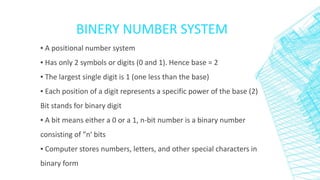
BINERY NUMBER SYSTEM
▪ A positional number system
▪ Has only 2 symbols or digits (0 and 1). Hence base = 2
▪ The largest single digit is 1 (one less than the base)
▪ Each position of a digit represents a specific power of the base (2)
Bit stands for binary digit
▪ A bit means either a 0 or a 1, n-bit number is a binary number
consisting of ”n‘ bits
▪ Computer stores numbers, letters, and other special characters in
binary form
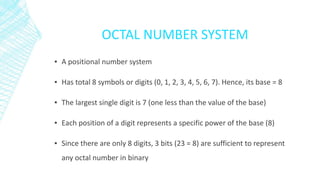
OCTAL NUMBER SYSTEM
▪ A positional number system
▪ Has total 8 symbols or digits (0, 1, 2, 3, 4, 5, 6, 7). Hence, its base = 8
▪ The largest single digit is 7 (one less than the value of the base)
▪ Each position of a digit represents a specific power of the base (8)
▪ Since there are only 8 digits, 3 bits (23 = 8) are sufficient to represent
any octal number in binary
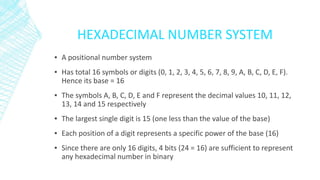
HEXADECIMAL NUMBER SYSTEM
▪ A positional number system
▪ Has total 16 symbols or digits (0, 1, 2, 3, 4, 5, 6, 7, 8, 9, A, B, C, D, E, F).
Hence its base = 16
▪ The symbols A, B, C, D, E and F represent the decimal values 10, 11, 12,
13, 14 and 15 respectively
▪ The largest single digit is 15 (one less than the value of the base)
▪ Each position of a digit represents a specific power of the base (16)
▪ Since there are only 16 digits, 4 bits (24 = 16) are sufficient to represent
any hexadecimal number in binary
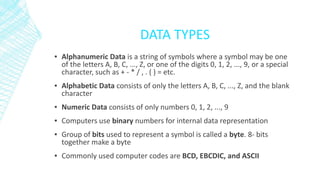
DATA TYPES
▪ Alphanumeric Data is a string of symbols where a symbol may be one
of the letters A, B, C, ..., Z, or one of the digits 0, 1, 2, ..., 9, or a special
character, such as + - * / , . ( ) = etc.
▪ Alphabetic Data consists of only the letters A, B, C, ..., Z, and the blank
character
▪ Numeric Data consists of only numbers 0, 1, 2, ..., 9
▪ Computers use binary numbers for internal data representation
▪ Group of bits used to represent a symbol is called a byte. 8- bits
together make a byte
▪ Commonly used computer codes are BCD, EBCDIC, and ASCII
BINARY ARITHMATIC
▪ Data is handled in the computer by electronic/electrical components
▪ Electronic components operate in binary mode (can only indicate two
states œ on (1) or off (0)
▪ The binary number system has only two digits (0 and 1), computer
circuits only have to handle two binary digits
▪ Arithmetic rules/processes possible with binary numbers
UNICODE
Why Unicode?
▪ No single encoding system supports all languages
▪ Different encoding systems conflict
▪ Universal character-encoding standard used for representation of text
for computer processing
▪ —Provides a unique number for every character, no matter what the
platform, no matter what the program, no matter what the language“
UNICODE FEATURES
▪ Provides a consistent way of encoding multilingual plain text
▪ Defines codes for characters used in all major languages of the world
▪ Defines codes for special characters, mathematical symbols, technical symbols, and
diacritics
▪ Capacity to encode as many as a million characters
▪ Assigns each character a unique numeric value and name
▪ Reserves a part of the code space for private use
▪ Affords simplicity and consistency of ASCII, even corresponding characters have same
code
▪ Specifies an algorithm for the presentation of text with bi- directional behavior
▪ Has lot of room to accommodate new characters, its growth process is strictly additive
UNICODE CHARACTERS
▪ Simple Characters
▪ Composite characters
▪ Duplicate characters in multiple languages
▪ Glyphs
THANK YOU

Data representation

  • 1.
  • 2.
    DATA REPRESENTATION PRESENTED BY: PRASHANTSAURABH KESHAV JHA VIKASH TIWARY PAYAL SURBHI SONI
  • 3.
    WHAT IS DATAREPRESENTATION? ▪ Data representation refers to the internal method used to represent various types of data stored on a computer. Computers use different types of numeric codes to represent various forms of data, such as text, number, graphics and sound.
  • 4.
    NUMBER SYSTEM Non-positional numbersystems ▪ Use symbols such as I for 1, II for 2, III for 3, IIII for 4, IIIII for 5, etc. ▪ Each symbol represents the same value regardless of its position in the number ▪ Symbols are simply added to find out the value of a particular number ▪ Difficult to perform arithmetic with such a number system
  • 5.
    Positional number systems ▪Use only a few symbols called digits ▪ These symbols represent different values depending on the position they occupy in the number ▪ The value of each digit is determined by: The digit itself The position of the digit in the number The base of the number system (base = total number of digits in the number system) ▪ The maximum value of a single digit is always equal to one less than the value of the base
  • 6.
    NUMBER SYSTEMS USEDIN COMPUTER ▪ Decimal number system ▪ Binary number system ▪ Octal number system ▪ Hexadecimal number system
  • 7.
    DECIMAL NUMBER SYSTEM ▪A positional number system ▪ Has 10 symbols or digits (0, 1, 2, 3, 4, 5, 6, 7, 8, 9). Hence, its base = 10 ▪ Each position of a digit represents a specific power of the base (10) ▪ Can represent any number by using the available digits and arranging them in various positions
  • 8.
    BINERY NUMBER SYSTEM ▪A positional number system ▪ Has only 2 symbols or digits (0 and 1). Hence base = 2 ▪ The largest single digit is 1 (one less than the base) ▪ Each position of a digit represents a specific power of the base (2) Bit stands for binary digit ▪ A bit means either a 0 or a 1, n-bit number is a binary number consisting of ”n‘ bits ▪ Computer stores numbers, letters, and other special characters in binary form
  • 9.
    OCTAL NUMBER SYSTEM ▪A positional number system ▪ Has total 8 symbols or digits (0, 1, 2, 3, 4, 5, 6, 7). Hence, its base = 8 ▪ The largest single digit is 7 (one less than the value of the base) ▪ Each position of a digit represents a specific power of the base (8) ▪ Since there are only 8 digits, 3 bits (23 = 8) are sufficient to represent any octal number in binary
  • 10.
    HEXADECIMAL NUMBER SYSTEM ▪A positional number system ▪ Has total 16 symbols or digits (0, 1, 2, 3, 4, 5, 6, 7, 8, 9, A, B, C, D, E, F). Hence its base = 16 ▪ The symbols A, B, C, D, E and F represent the decimal values 10, 11, 12, 13, 14 and 15 respectively ▪ The largest single digit is 15 (one less than the value of the base) ▪ Each position of a digit represents a specific power of the base (16) ▪ Since there are only 16 digits, 4 bits (24 = 16) are sufficient to represent any hexadecimal number in binary
  • 11.
    DATA TYPES ▪ AlphanumericData is a string of symbols where a symbol may be one of the letters A, B, C, ..., Z, or one of the digits 0, 1, 2, ..., 9, or a special character, such as + - * / , . ( ) = etc. ▪ Alphabetic Data consists of only the letters A, B, C, ..., Z, and the blank character ▪ Numeric Data consists of only numbers 0, 1, 2, ..., 9 ▪ Computers use binary numbers for internal data representation ▪ Group of bits used to represent a symbol is called a byte. 8- bits together make a byte ▪ Commonly used computer codes are BCD, EBCDIC, and ASCII
  • 12.
    BINARY ARITHMATIC ▪ Datais handled in the computer by electronic/electrical components ▪ Electronic components operate in binary mode (can only indicate two states œ on (1) or off (0) ▪ The binary number system has only two digits (0 and 1), computer circuits only have to handle two binary digits ▪ Arithmetic rules/processes possible with binary numbers
  • 13.
    UNICODE Why Unicode? ▪ Nosingle encoding system supports all languages ▪ Different encoding systems conflict ▪ Universal character-encoding standard used for representation of text for computer processing ▪ —Provides a unique number for every character, no matter what the platform, no matter what the program, no matter what the language“
  • 14.
    UNICODE FEATURES ▪ Providesa consistent way of encoding multilingual plain text ▪ Defines codes for characters used in all major languages of the world ▪ Defines codes for special characters, mathematical symbols, technical symbols, and diacritics ▪ Capacity to encode as many as a million characters ▪ Assigns each character a unique numeric value and name ▪ Reserves a part of the code space for private use ▪ Affords simplicity and consistency of ASCII, even corresponding characters have same code ▪ Specifies an algorithm for the presentation of text with bi- directional behavior ▪ Has lot of room to accommodate new characters, its growth process is strictly additive
  • 15.
    UNICODE CHARACTERS ▪ SimpleCharacters ▪ Composite characters ▪ Duplicate characters in multiple languages ▪ Glyphs
  • 17.