Presented By:
Diksha Sharma
Ravi Shekhar
Shruti Chaturvedi
Shubham Tilara
 A geographical indication (GI) is a sign used
on goods that have a specific geographical
origin and possess qualities, reputation or
characteristics that are essentially attributable
to that origin.
 Geographical indications may be used for a
wide variety of products, whether natural,
agricultural or manufactured.
 Name: Darjeeling Tea
 Object of Protection: Distinctive Signs / Commercial
Names, Goods with Specific Geographical Origin
 Organization Type: Co-operative, Government
 Instrument of Protection: Geographical Indications
and Appellations of Origin, Trademarks
 Industry: Food Products
 Country/ Territory: India
 Darjeeling tea gardens were planted in 1835.
 Statutorily controlled by Government as part of the Tea
industry from 1933 under various enactments culminating
in the Tea Act, 1953
 The Tea Board, India is vested with the authority to
administer all stages of tea cultivation, processing & sale
through various orders. Its mandate includes
implementing schemes for quality control, increase in
productivity, R&D, licensing, promotion, statistics.
Traders as well as individual buyers, while purchasing
Darjeeling tea, will expect the tea to be cultivated, grown
and produced in the defined region of the district of
Darjeeling. Consequently, Darjeeling tea that is worthy of
its name cannot be grown or manufactured anywhere else
in the world.
 The tea estates are located in valleys ranging
from 200 meters to 2,000 meters above sea
level, and with slopes are as steep as sixty to
seventy degrees.
 High rainfall and high humidity, the evaporation
rate, wind speed, an average of two to four hours
of sunshine a day, abundant mist, clouds and fog
are also all important factors.
 The average carbon level of soil in other tea
growing regions in India is less than one percent,
but it is much higher in the Darjeeling region.

 Bushes that grow in the region belong to a
Chinese hybrid, camellia sinensis.
To safeguard the special characteristics associated with this tea
and its high reputation, both the Tea Board and the Darjeeling
Planters Association have been involved at various levels in
protecting this common heritage. The protection is essentially
geared to:
• prevent misuse of the word "Darjeeling" for other types of tea
sold worldwide;
• deliver the authentic product to the consumer;
• enable the commercial benefit of the equity of the brand to reach
the Indian industry and hence the plantation worker;
• achieve international status similar to Champagne or Scotch
Whisky both in terms of brand equity and
governance/administration.
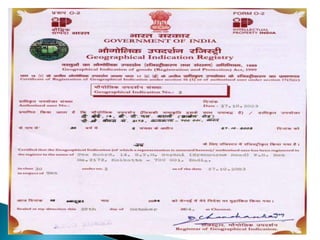
 Both the logo and the word “Darjeeling” are
registered domestically under the Geographical
Indications of Goods (Registration and Protection)
Act of 1999 of India. The geographical indication
(GI) protection is significant, particularly when
CTM registration is not accepted in a jurisdiction
where protection is sought, for example, in
France for Darjeeling. Additionally, under
European Union (EU) Regulation 2081/92, GI
registration is necessary to obtain reciprocal
protection of a mark.
 When the Geographical Indication Act in India
was enacted in September 2003, the Tea Board
applied for GI protection of ‘Darjeeling’ in
October 2003. In October 2004, Darjeeling was
granted the GI status in India to become the first
application to be registered in India as a GI.
 The Tea Board has fought almost 15 cases in the
last four years against infringement and misuse
of the word Darjeeling Tea worldwide which
includes Russia, USA, Japan, France, Germany,
Israel, Norway and Sri Lanka etc.
 French law does not permit any opposition to an
application for a trademark similar or identical to a GI if
the goods covered are different from those represented by
the GI.
 The owner of the GI can take appropriate judicial
proceedings only after the given application has
proceeded to registration.
 The net effect of such a provision has been that despite
India’s protests, Darjeeling has been misappropriated as a
trademark in respect of several goods such as clothing,
shoes and headgear.
The Tea Board with the help of the Indian Government
continues to negotiate with France at various levels over
the activities of the French trademark authorities.
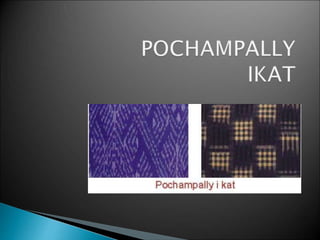
 THE famed Ikat style, whose creations include
the attractive `Tie and Dye' and silk woven
sarees from Pochampally village, has been
granted the Geographical Indication (GI)
status, giving it both protection and branding.
 It will now confer legal protection to the
Pochampally Ikat, against its unauthorised use.
 It is also expected to give a brand image to the
Pochampally products, gaining greater reach in
domestic and international markets.
 The idea is to make the products of
Pochampally cluster as a "globally preferred Tie
and Dye textiles".
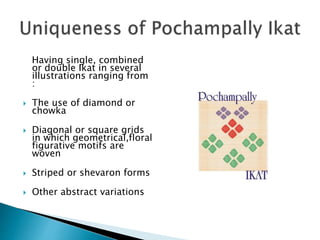
Having single, combined
or double Ikat in several
illustrations ranging from
:
 The use of diamond or
chowka
 Diagonal or square grids
in which geometrical,floral
figurative motifs are
woven
 Striped or shevaron forms
 Other abstract variations
 Issue of misappropriation: manufacture and marketing of
products with Pochampally name and design by large mills
outside Pochampally using power looms: a heritage
problem
 Livelihood Issue: Reduced market; low price of mill
products
 Reduced Income for about 5000 handloom weavers
 Shrinking Employment Opportunities in the region; in one
decade about 50 % weavers switched to other professions
 The Government, therefore, engaged an agency to study
and find solution
 Confederation of Indian Industry and other organisations
were associated
 Awareness seminars and workshops were organised
 Associations of weavers of Pochampally Ikat
from the region were formed
 Associations obtained registration of various
IP rights such as copyrights, trade marks,
designs and geographical indications during
2004-05
 Greater stress on Trade Marks and
Geographical Indications.
• Object of Protection:Goods with Specific
Geographical Origin, Traditional Knowledge
• Organization Type:Government
• Instrument of Protection:Geographical
Indications and Appellations of Origin
• Industry:Food Products
• Focus:Commercialization, IP Enforcement /
Infringement
• Country/Territory:Mexico
• The red volcanic soil of the Mexican city of Tequila
and its outskirts offers the perfect environment for
plantations of agave tequilana weber (blue agave).
• The fermented juices obtained from the hearts of
these blue agave plants are distilled to produce
tequila, the fiery Mexican liquor, which takes its name
from this city in the state of Jalisco where its
production started more than two hundred years ago.
• While there are many types of agave, only blue agave
can be used for tequila production. Famed for its
smooth aroma, this Mexican liquor is highly coveted
by collectors and connoisseurs all over the world.
• Tequila and Mexico share an inextricable
history. Tequila is Mexico's undisputed
national drink and a cultural symbol whose
significance extends beyond the status of
alcoholic beverage.
• Variants of the modern-day spirit have been
produced in the arid highlands of central
Mexico for at least nine hundred years,
predating Hernando Cortez and the Spanish
conquest by four centuries.
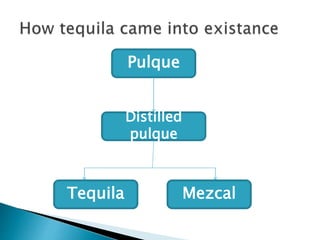
Pulque
Mezcal
Distilled
pulque
Tequila
 Tequila was Mexico’s first appellation of origin (AO) in 1974,
and in 1978 it was internationally registered for protection
under the Lisbon Agreement for the Protection of
Appellations of Origin and their International Registration.
 The AO defines the area in which tequila can be produced.
Under the AO, selected municipalities within only five
Mexican states can grow the agave and produce tequila.
These municipalities were selected based on geographical
factors and human factors.
 Further to the AO registration, the Mexican government holds
all the rights over the use of the name tequila.
 The Mexican government enforces the tequila IP
through the Mexican Institute of Industrial Property
(IMPI). The use of the name tequila is authorized
and administered only by IMPI. IMPI may prohibit
any unauthorized use of the name that may create
confusion for the consumers, or constitute an act
of unfair competition.
 Along with the international protection, Mexico has
also sought similar protection for tequila in other
important countries and regions through a number
of bilateral and multilateral agreements.
 Despite protection under the Lisbon
Agreement and NAFTA, tequila still faced
competition from some “pseudo tequilas”.
During the mid-1990s, as much as 3.5
million liters of these liquors were sold
annually in Europe. The European liquors
were produced from sugars of agave-like
plants and were illegally labeled as tequila.
 Following the NAFTA precedent, Mexico
entered into a bilateral agreement with the
European Union (EU) concerning the mutual
recognition and protection of AO in the
spirits sector. Under this agreement the EU
recognizes tequila and mezcal as
“denominations of origin”, although
enforcement has still been quite lax in
Europe.
 The Tequila Regulatory Council of Mexico (Consejo
Regulador del Tequila, CRT), established in 1993,
certifies the production of tequila and helps to
protect the image of the liquor taking action
against “pseudo-tequilas” and counterfeit
products. Through the AO protection, CRT has
been able to destroy about 2.4 million liters of fake
tequila within the first two years since the Council’s
establishment. The CRT has successfully eliminated
at least 86 fake brands of tequila.
 The tequila AO is linked to the Mexican Official
Standard for Tequila, which sets out product
specifications and includes testing methods,
quality control and labeling information. Along with
the aging requirements, the government
regulations also stipulate that the spirit must be
made from 100 percent natural ingredients and
contain at least 38% alcohol to be called “tequila”.
Needless to mention, all tequilas must be made
from blue agave grown and harvested only in the
Mexican states of Jalisco, Guanajuato, Michoacan,
Nayarit or Tamaulipas.
 Tequila producers require two authorizations – for producing
tequila and for using the tequila AO – which are issued by the
CRT/ Ministry of Economy and the IMPI. In order to ensure the
official standards, bottling or marketing of tequila is also
regulated by the government agencies. The bottlers are
required to follow certain compliance assessment procedures
and obtain approval certificates from the CRT/ Ministry of
Economy before they can go into operation and are obliged to
file quarterly reports on conformity assessment. The CRT
maintains three categories of bottling mark – national
bottling trademarks (1102 marks), foreign bottling
trademarks (196 marks) and certification trademarks (66
marks) to ensure the authenticity of tequila. The certification
procedures are the key factor behind the success of the
tequila AO.
• Made in Varanasi (Benares)
• Historically considered to be among the finest saris in India
• Known for their gold and silver brocade, fine silk and opulent
embroidery, and being highly sought after.
• Relatively heavy.
• Distinctive features are Heavy gold work, Compact weaving,
figures with small details, metallic visual effects, pallus, jal (a net
like pattern), and mina work.
•15 days to a one month and sometimes up to six months to
complete.
Introduction
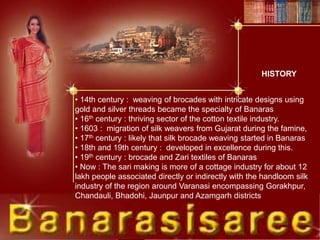
• 14th century : weaving of brocades with intricate designs using
gold and silver threads became the specialty of Banaras
• 16th century : thriving sector of the cotton textile industry.
• 1603 : migration of silk weavers from Gujarat during the famine,
• 17th century : likely that silk brocade weaving started in Banaras
• 18th and 19th century : developed in excellence during this.
• 19th century : brocade and Zari textiles of Banaras
• Now : The sari making is more of a cottage industry for about 12
lakh people associated directly or indirectly with the handloom silk
industry of the region around Varanasi encompassing Gorakhpur,
Chandauli, Bhadohi, Jaunpur and Azamgarh districts
HISTORY
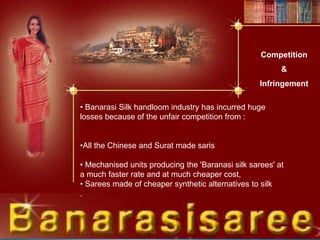
• Banarasi Silk handloom industry has incurred huge
losses because of the unfair competition from :
•All the Chinese and Surat made saris
• Mechanised units producing the 'Baranasi silk sarees' at
a much faster rate and at much cheaper cost,
• Sarees made of cheaper synthetic alternatives to silk
.
Competition
&
Infringement
EFFECT
ON
WEAVERS
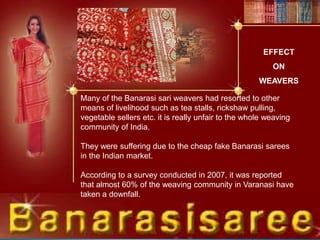
Many of the Banarasi sari weavers had resorted to other
means of livelihood such as tea stalls, rickshaw pulling,
vegetable sellers etc. it is really unfair to the whole weaving
community of India.
They were suffering due to the cheap fake Banarasi sarees
in the Indian market.
According to a survey conducted in 2007, it was reported
that almost 60% of the weaving community in Varanasi have
taken a downfall.
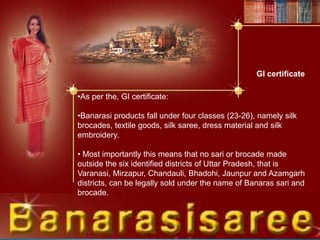
•As per the, GI certificate:
•Banarasi products fall under four classes (23-26), namely silk
brocades, textile goods, silk saree, dress material and silk
embroidery.
• Most importantly this means that no sari or brocade made
outside the six identified districts of Uttar Pradesh, that is
Varanasi, Mirzapur, Chandauli, Bhadohi, Jaunpur and Azamgarh
districts, can be legally sold under the name of Banaras sari and
brocade.
GI certificate
GI
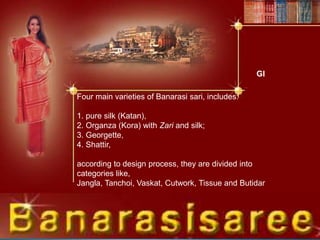
Four main varieties of Banarasi sari, includes:
1. pure silk (Katan),
2. Organza (Kora) with Zari and silk;
3. Georgette,
4. Shattir,
according to design process, they are divided into
categories like,
Jangla, Tanchoi, Vaskat, Cutwork, Tissue and Butidar
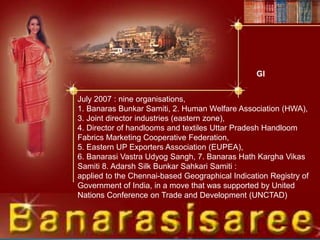
July 2007 : nine organisations,
1. Banaras Bunkar Samiti, 2. Human Welfare Association (HWA),
3. Joint director industries (eastern zone),
4. Director of handlooms and textiles Uttar Pradesh Handloom
Fabrics Marketing Cooperative Federation,
5. Eastern UP Exporters Association (EUPEA),
6. Banarasi Vastra Udyog Sangh, 7. Banaras Hath Kargha Vikas
Samiti 8. Adarsh Silk Bunkar Sahkari Samiti :
applied to the Chennai-based Geographical Indication Registry of
Government of India, in a move that was supported by United
Nations Conference on Trade and Development (UNCTAD)
GI
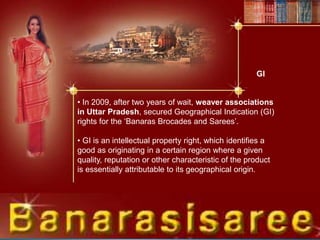
• In 2009, after two years of wait, weaver associations
in Uttar Pradesh, secured Geographical Indication (GI)
rights for the ‘Banaras Brocades and Sarees’.
• GI is an intellectual property right, which identifies a
good as originating in a certain region where a given
quality, reputation or other characteristic of the product
is essentially attributable to its geographical origin.
GI
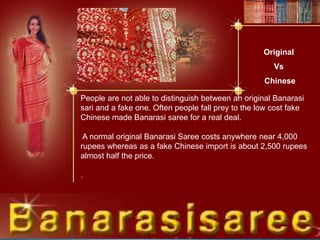
Original
Vs
Chinese
People are not able to distinguish between an original Banarasi
sari and a fake one. Often people fall prey to the low cost fake
Chinese made Banarasi saree for a real deal.
A normal original Banarasi Saree costs anywhere near 4,000
rupees whereas as a fake Chinese import is about 2,500 rupees
almost half the price.
.
Check Original
Method 1.
When you go to buy a Banarasi saree just pull its other side
up i.e. reverse the saree to check for floats between the
grids of warps and wefts on the saree.
Only a hand-woven Banarasi saree will boats of such warp
and weft technique. The machine fails to replicate that.
Check Original
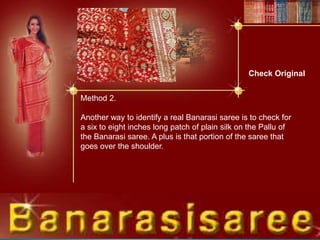
Method 2.
Another way to identify a real Banarasi saree is to check for
a six to eight inches long patch of plain silk on the Pallu of
the Banarasi saree. A plus is that portion of the saree that
goes over the shoulder.
Check Original
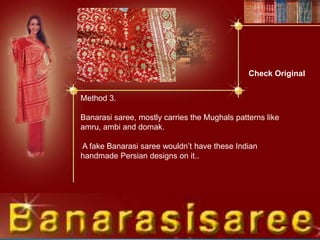
Method 3.
Banarasi saree, mostly carries the Mughals patterns like
amru, ambi and domak.
A fake Banarasi saree wouldn’t have these Indian
handmade Persian designs on it..

Geographical indications

  • 1.
    Presented By: Diksha Sharma RaviShekhar Shruti Chaturvedi Shubham Tilara
  • 2.
     A geographicalindication (GI) is a sign used on goods that have a specific geographical origin and possess qualities, reputation or characteristics that are essentially attributable to that origin.  Geographical indications may be used for a wide variety of products, whether natural, agricultural or manufactured.
  • 4.
     Name: DarjeelingTea  Object of Protection: Distinctive Signs / Commercial Names, Goods with Specific Geographical Origin  Organization Type: Co-operative, Government  Instrument of Protection: Geographical Indications and Appellations of Origin, Trademarks  Industry: Food Products  Country/ Territory: India
  • 5.
     Darjeeling teagardens were planted in 1835.  Statutorily controlled by Government as part of the Tea industry from 1933 under various enactments culminating in the Tea Act, 1953  The Tea Board, India is vested with the authority to administer all stages of tea cultivation, processing & sale through various orders. Its mandate includes implementing schemes for quality control, increase in productivity, R&D, licensing, promotion, statistics. Traders as well as individual buyers, while purchasing Darjeeling tea, will expect the tea to be cultivated, grown and produced in the defined region of the district of Darjeeling. Consequently, Darjeeling tea that is worthy of its name cannot be grown or manufactured anywhere else in the world.
  • 6.
     The teaestates are located in valleys ranging from 200 meters to 2,000 meters above sea level, and with slopes are as steep as sixty to seventy degrees.  High rainfall and high humidity, the evaporation rate, wind speed, an average of two to four hours of sunshine a day, abundant mist, clouds and fog are also all important factors.  The average carbon level of soil in other tea growing regions in India is less than one percent, but it is much higher in the Darjeeling region.  Bushes that grow in the region belong to a Chinese hybrid, camellia sinensis.
  • 7.
    To safeguard thespecial characteristics associated with this tea and its high reputation, both the Tea Board and the Darjeeling Planters Association have been involved at various levels in protecting this common heritage. The protection is essentially geared to: • prevent misuse of the word "Darjeeling" for other types of tea sold worldwide; • deliver the authentic product to the consumer; • enable the commercial benefit of the equity of the brand to reach the Indian industry and hence the plantation worker; • achieve international status similar to Champagne or Scotch Whisky both in terms of brand equity and governance/administration.
  • 8.
     Both thelogo and the word “Darjeeling” are registered domestically under the Geographical Indications of Goods (Registration and Protection) Act of 1999 of India. The geographical indication (GI) protection is significant, particularly when CTM registration is not accepted in a jurisdiction where protection is sought, for example, in France for Darjeeling. Additionally, under European Union (EU) Regulation 2081/92, GI registration is necessary to obtain reciprocal protection of a mark.
  • 9.
     When theGeographical Indication Act in India was enacted in September 2003, the Tea Board applied for GI protection of ‘Darjeeling’ in October 2003. In October 2004, Darjeeling was granted the GI status in India to become the first application to be registered in India as a GI.  The Tea Board has fought almost 15 cases in the last four years against infringement and misuse of the word Darjeeling Tea worldwide which includes Russia, USA, Japan, France, Germany, Israel, Norway and Sri Lanka etc.
  • 11.
     French lawdoes not permit any opposition to an application for a trademark similar or identical to a GI if the goods covered are different from those represented by the GI.  The owner of the GI can take appropriate judicial proceedings only after the given application has proceeded to registration.  The net effect of such a provision has been that despite India’s protests, Darjeeling has been misappropriated as a trademark in respect of several goods such as clothing, shoes and headgear. The Tea Board with the help of the Indian Government continues to negotiate with France at various levels over the activities of the French trademark authorities.
  • 13.
     THE famedIkat style, whose creations include the attractive `Tie and Dye' and silk woven sarees from Pochampally village, has been granted the Geographical Indication (GI) status, giving it both protection and branding.  It will now confer legal protection to the Pochampally Ikat, against its unauthorised use.  It is also expected to give a brand image to the Pochampally products, gaining greater reach in domestic and international markets.  The idea is to make the products of Pochampally cluster as a "globally preferred Tie and Dye textiles".
  • 14.
    Having single, combined ordouble Ikat in several illustrations ranging from :  The use of diamond or chowka  Diagonal or square grids in which geometrical,floral figurative motifs are woven  Striped or shevaron forms  Other abstract variations
  • 15.
     Issue ofmisappropriation: manufacture and marketing of products with Pochampally name and design by large mills outside Pochampally using power looms: a heritage problem  Livelihood Issue: Reduced market; low price of mill products  Reduced Income for about 5000 handloom weavers  Shrinking Employment Opportunities in the region; in one decade about 50 % weavers switched to other professions  The Government, therefore, engaged an agency to study and find solution  Confederation of Indian Industry and other organisations were associated  Awareness seminars and workshops were organised
  • 16.
     Associations ofweavers of Pochampally Ikat from the region were formed  Associations obtained registration of various IP rights such as copyrights, trade marks, designs and geographical indications during 2004-05  Greater stress on Trade Marks and Geographical Indications.
  • 18.
    • Object ofProtection:Goods with Specific Geographical Origin, Traditional Knowledge • Organization Type:Government • Instrument of Protection:Geographical Indications and Appellations of Origin • Industry:Food Products • Focus:Commercialization, IP Enforcement / Infringement • Country/Territory:Mexico
  • 19.
    • The redvolcanic soil of the Mexican city of Tequila and its outskirts offers the perfect environment for plantations of agave tequilana weber (blue agave). • The fermented juices obtained from the hearts of these blue agave plants are distilled to produce tequila, the fiery Mexican liquor, which takes its name from this city in the state of Jalisco where its production started more than two hundred years ago. • While there are many types of agave, only blue agave can be used for tequila production. Famed for its smooth aroma, this Mexican liquor is highly coveted by collectors and connoisseurs all over the world.
  • 20.
    • Tequila andMexico share an inextricable history. Tequila is Mexico's undisputed national drink and a cultural symbol whose significance extends beyond the status of alcoholic beverage. • Variants of the modern-day spirit have been produced in the arid highlands of central Mexico for at least nine hundred years, predating Hernando Cortez and the Spanish conquest by four centuries.
  • 21.
  • 22.
     Tequila wasMexico’s first appellation of origin (AO) in 1974, and in 1978 it was internationally registered for protection under the Lisbon Agreement for the Protection of Appellations of Origin and their International Registration.  The AO defines the area in which tequila can be produced. Under the AO, selected municipalities within only five Mexican states can grow the agave and produce tequila. These municipalities were selected based on geographical factors and human factors.  Further to the AO registration, the Mexican government holds all the rights over the use of the name tequila.
  • 23.
     The Mexicangovernment enforces the tequila IP through the Mexican Institute of Industrial Property (IMPI). The use of the name tequila is authorized and administered only by IMPI. IMPI may prohibit any unauthorized use of the name that may create confusion for the consumers, or constitute an act of unfair competition.  Along with the international protection, Mexico has also sought similar protection for tequila in other important countries and regions through a number of bilateral and multilateral agreements.
  • 24.
     Despite protectionunder the Lisbon Agreement and NAFTA, tequila still faced competition from some “pseudo tequilas”. During the mid-1990s, as much as 3.5 million liters of these liquors were sold annually in Europe. The European liquors were produced from sugars of agave-like plants and were illegally labeled as tequila.
  • 25.
     Following theNAFTA precedent, Mexico entered into a bilateral agreement with the European Union (EU) concerning the mutual recognition and protection of AO in the spirits sector. Under this agreement the EU recognizes tequila and mezcal as “denominations of origin”, although enforcement has still been quite lax in Europe.
  • 26.
     The TequilaRegulatory Council of Mexico (Consejo Regulador del Tequila, CRT), established in 1993, certifies the production of tequila and helps to protect the image of the liquor taking action against “pseudo-tequilas” and counterfeit products. Through the AO protection, CRT has been able to destroy about 2.4 million liters of fake tequila within the first two years since the Council’s establishment. The CRT has successfully eliminated at least 86 fake brands of tequila.
  • 27.
     The tequilaAO is linked to the Mexican Official Standard for Tequila, which sets out product specifications and includes testing methods, quality control and labeling information. Along with the aging requirements, the government regulations also stipulate that the spirit must be made from 100 percent natural ingredients and contain at least 38% alcohol to be called “tequila”. Needless to mention, all tequilas must be made from blue agave grown and harvested only in the Mexican states of Jalisco, Guanajuato, Michoacan, Nayarit or Tamaulipas.
  • 28.
     Tequila producersrequire two authorizations – for producing tequila and for using the tequila AO – which are issued by the CRT/ Ministry of Economy and the IMPI. In order to ensure the official standards, bottling or marketing of tequila is also regulated by the government agencies. The bottlers are required to follow certain compliance assessment procedures and obtain approval certificates from the CRT/ Ministry of Economy before they can go into operation and are obliged to file quarterly reports on conformity assessment. The CRT maintains three categories of bottling mark – national bottling trademarks (1102 marks), foreign bottling trademarks (196 marks) and certification trademarks (66 marks) to ensure the authenticity of tequila. The certification procedures are the key factor behind the success of the tequila AO.
  • 30.
    • Made inVaranasi (Benares) • Historically considered to be among the finest saris in India • Known for their gold and silver brocade, fine silk and opulent embroidery, and being highly sought after. • Relatively heavy. • Distinctive features are Heavy gold work, Compact weaving, figures with small details, metallic visual effects, pallus, jal (a net like pattern), and mina work. •15 days to a one month and sometimes up to six months to complete. Introduction
  • 31.
    • 14th century: weaving of brocades with intricate designs using gold and silver threads became the specialty of Banaras • 16th century : thriving sector of the cotton textile industry. • 1603 : migration of silk weavers from Gujarat during the famine, • 17th century : likely that silk brocade weaving started in Banaras • 18th and 19th century : developed in excellence during this. • 19th century : brocade and Zari textiles of Banaras • Now : The sari making is more of a cottage industry for about 12 lakh people associated directly or indirectly with the handloom silk industry of the region around Varanasi encompassing Gorakhpur, Chandauli, Bhadohi, Jaunpur and Azamgarh districts HISTORY
  • 32.
    • Banarasi Silkhandloom industry has incurred huge losses because of the unfair competition from : •All the Chinese and Surat made saris • Mechanised units producing the 'Baranasi silk sarees' at a much faster rate and at much cheaper cost, • Sarees made of cheaper synthetic alternatives to silk . Competition & Infringement
  • 33.
    EFFECT ON WEAVERS Many of theBanarasi sari weavers had resorted to other means of livelihood such as tea stalls, rickshaw pulling, vegetable sellers etc. it is really unfair to the whole weaving community of India. They were suffering due to the cheap fake Banarasi sarees in the Indian market. According to a survey conducted in 2007, it was reported that almost 60% of the weaving community in Varanasi have taken a downfall.
  • 34.
    •As per the,GI certificate: •Banarasi products fall under four classes (23-26), namely silk brocades, textile goods, silk saree, dress material and silk embroidery. • Most importantly this means that no sari or brocade made outside the six identified districts of Uttar Pradesh, that is Varanasi, Mirzapur, Chandauli, Bhadohi, Jaunpur and Azamgarh districts, can be legally sold under the name of Banaras sari and brocade. GI certificate
  • 35.
    GI Four main varietiesof Banarasi sari, includes: 1. pure silk (Katan), 2. Organza (Kora) with Zari and silk; 3. Georgette, 4. Shattir, according to design process, they are divided into categories like, Jangla, Tanchoi, Vaskat, Cutwork, Tissue and Butidar
  • 36.
    July 2007 :nine organisations, 1. Banaras Bunkar Samiti, 2. Human Welfare Association (HWA), 3. Joint director industries (eastern zone), 4. Director of handlooms and textiles Uttar Pradesh Handloom Fabrics Marketing Cooperative Federation, 5. Eastern UP Exporters Association (EUPEA), 6. Banarasi Vastra Udyog Sangh, 7. Banaras Hath Kargha Vikas Samiti 8. Adarsh Silk Bunkar Sahkari Samiti : applied to the Chennai-based Geographical Indication Registry of Government of India, in a move that was supported by United Nations Conference on Trade and Development (UNCTAD) GI
  • 37.
    • In 2009,after two years of wait, weaver associations in Uttar Pradesh, secured Geographical Indication (GI) rights for the ‘Banaras Brocades and Sarees’. • GI is an intellectual property right, which identifies a good as originating in a certain region where a given quality, reputation or other characteristic of the product is essentially attributable to its geographical origin. GI
  • 38.
    Original Vs Chinese People are notable to distinguish between an original Banarasi sari and a fake one. Often people fall prey to the low cost fake Chinese made Banarasi saree for a real deal. A normal original Banarasi Saree costs anywhere near 4,000 rupees whereas as a fake Chinese import is about 2,500 rupees almost half the price. .
  • 39.
    Check Original Method 1. Whenyou go to buy a Banarasi saree just pull its other side up i.e. reverse the saree to check for floats between the grids of warps and wefts on the saree. Only a hand-woven Banarasi saree will boats of such warp and weft technique. The machine fails to replicate that.
  • 40.
    Check Original Method 2. Anotherway to identify a real Banarasi saree is to check for a six to eight inches long patch of plain silk on the Pallu of the Banarasi saree. A plus is that portion of the saree that goes over the shoulder.
  • 41.
    Check Original Method 3. Banarasisaree, mostly carries the Mughals patterns like amru, ambi and domak. A fake Banarasi saree wouldn’t have these Indian handmade Persian designs on it..