DATA
COMMUNICATION
Data Communication
The transfer of data or information from one
location to another is called data
communication or data transmission.
ELEMENTS OF DATA COMMUNICATION SYSTEM
Transmitter or sender or source
Receiver or sink or destination
Medium
Message
Transmitter
The computer or device that is used for
sending the data from one location to other is
called transmitter.
In electronic data communication, computer
is usually used as transmitter.
Receiver
The computer or device that receives the
data is called receiver.
It is also known as ‘sink’. The receiver can be
a computer, printer or a fax machine.
Elements of Data Communication
Medium
The path or link through which data is
transferred from sender to receiver is called
medium.
Message
The data or information which is sent from
sender to receiver is called message”. It is
the main element of data communication
system, due to which data communication
occur.
The path or link through which data is
transferred from sender to receiver is called
medium”.
There are two main categories of data
communication media.
Guided Media
Unguided Media
Communication Media
GUIDED MEDIA
Guided media are the physical links through
which signals are transferred. These are also
called bounded media. These include various
types of cables. The type of cable chosen for a
network depends upon the network’s topology,
size and speed.
Commonly used guided media include
coaxial cables, wire pairs and fiber-optic
cables.
Communication Media
UNGUIDED MEDIA
Unguided media are the logical links through
which signals are transferred. These are the
natural parts of environment that can be used
to transfer signals in the form of waves. The
atmosphere and space are examples of
unguided media.
Commonly used methods of transmission
through unguided media are microwave and
satellite transmission.
Communication Media
The manner in which data is transmitted from
one location to another is called data
transmission mode.
There are three different modes for
transmitting data from one location to another.
Simplex Mode
Half Duplex Mode
Full Duplex Mode
DATA COMMUNICATION MODES
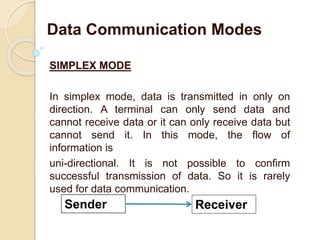
SIMPLEX MODE
In simplex mode, data is transmitted in only on
direction. A terminal can only send data and
cannot receive data or it can only receive data but
cannot send it. In this mode, the flow of
information is
uni-directional. It is not possible to confirm
successful transmission of data. So it is rarely
used for data communication.
Data Communication Modes
Sender Receiver
Use:
This mode is normally used for Remote control
devices in which one device can only send data
and other can only receive data. TV remote control
is an example of Simplex mode.
Data Communication Modes
HALF-DUPLEX MODE
In half-duplex mode, data can be transmitted in
both directions, but only in one direction at a time.
Therefore data can be sent and received
alternatively. Its disadvantage is that a lot of time is
wasted in changing direction of flow of data. So,
the transmission rate for this mode is slow.
Data Communication Modes
Sender/Receiver Receiver/Sende
r
Use:
It is possible to confirm the transmission of
data in this mode. So this is normally used in
wireless communication system.
Data Communication Modes
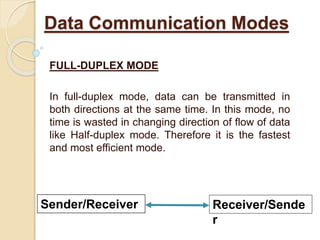
FULL-DUPLEX MODE
In full-duplex mode, data can be transmitted in
both directions at the same time. In this mode, no
time is wasted in changing direction of flow of data
like Half-duplex mode. Therefore it is the fastest
and most efficient mode.
Data Communication Modes
Sender/Receiver Receiver/Sende
r
Use:
Telephone communication is an example of
full-duplex mode.
Mobile phone communication is an example
of full duplex mode.
Data Communication Modes

Data communication

  • 1.
  • 2.
    Data Communication The transferof data or information from one location to another is called data communication or data transmission. ELEMENTS OF DATA COMMUNICATION SYSTEM Transmitter or sender or source Receiver or sink or destination Medium Message
  • 3.
    Transmitter The computer ordevice that is used for sending the data from one location to other is called transmitter. In electronic data communication, computer is usually used as transmitter. Receiver The computer or device that receives the data is called receiver. It is also known as ‘sink’. The receiver can be a computer, printer or a fax machine. Elements of Data Communication
  • 4.
    Elements of DataCommunication Medium The path or link through which data is transferred from sender to receiver is called medium. Message The data or information which is sent from sender to receiver is called message”. It is the main element of data communication system, due to which data communication occur.
  • 5.
    The path orlink through which data is transferred from sender to receiver is called medium”. There are two main categories of data communication media. Guided Media Unguided Media Communication Media
  • 6.
    GUIDED MEDIA Guided mediaare the physical links through which signals are transferred. These are also called bounded media. These include various types of cables. The type of cable chosen for a network depends upon the network’s topology, size and speed. Commonly used guided media include coaxial cables, wire pairs and fiber-optic cables. Communication Media
  • 7.
    UNGUIDED MEDIA Unguided mediaare the logical links through which signals are transferred. These are the natural parts of environment that can be used to transfer signals in the form of waves. The atmosphere and space are examples of unguided media. Commonly used methods of transmission through unguided media are microwave and satellite transmission. Communication Media
  • 8.
    The manner inwhich data is transmitted from one location to another is called data transmission mode. There are three different modes for transmitting data from one location to another. Simplex Mode Half Duplex Mode Full Duplex Mode DATA COMMUNICATION MODES
  • 9.
    SIMPLEX MODE In simplexmode, data is transmitted in only on direction. A terminal can only send data and cannot receive data or it can only receive data but cannot send it. In this mode, the flow of information is uni-directional. It is not possible to confirm successful transmission of data. So it is rarely used for data communication. Data Communication Modes Sender Receiver
  • 10.
    Use: This mode isnormally used for Remote control devices in which one device can only send data and other can only receive data. TV remote control is an example of Simplex mode. Data Communication Modes
  • 11.
    HALF-DUPLEX MODE In half-duplexmode, data can be transmitted in both directions, but only in one direction at a time. Therefore data can be sent and received alternatively. Its disadvantage is that a lot of time is wasted in changing direction of flow of data. So, the transmission rate for this mode is slow. Data Communication Modes Sender/Receiver Receiver/Sende r
  • 12.
    Use: It is possibleto confirm the transmission of data in this mode. So this is normally used in wireless communication system. Data Communication Modes
  • 13.
    FULL-DUPLEX MODE In full-duplexmode, data can be transmitted in both directions at the same time. In this mode, no time is wasted in changing direction of flow of data like Half-duplex mode. Therefore it is the fastest and most efficient mode. Data Communication Modes Sender/Receiver Receiver/Sende r
  • 14.
    Use: Telephone communication isan example of full-duplex mode. Mobile phone communication is an example of full duplex mode. Data Communication Modes