Data Communication is
the exchange of data
between two devices via
some form of
transmission medium
such as a wire cable
Here are three fundamental characteristics
of Data Communication:
1. Delivery to correct destination
2. Accuracy of data
3. Timelines Timely delivery of data
A data communication system has five
components:
1. Message
2. Sender
3. Receiver
4. Medium
5. Protocol
There are three modes for data
communication:
1. Simplex
2. Half Duplex
3. Full Duplex
In Simplex mode, the communication is
unidirectional. For example:
1. Keyboard
2. Monitor
3. Television etc.
In Half Duplex mode, each station can both
transmit and receive data but not at the
same time, e.g. :
1. Walkie-talkie
2. Radio phones in Police cars etc
In Full Duplex mode, both station can
transmit and receive data simultaneously,
e.g. :
1. Telephone Network
2. 2-Way Traffic etc.
Guided Media:
Which provide a physical channel from one
device to another:
• Twisted Pair Cable
• Coaxial Cable
• Fiber Optic Cable
Un-Guided Media:
Transports electromagnetic waves without
using a physical medium:
• Radio Waves
• Microwaves
• Infrared
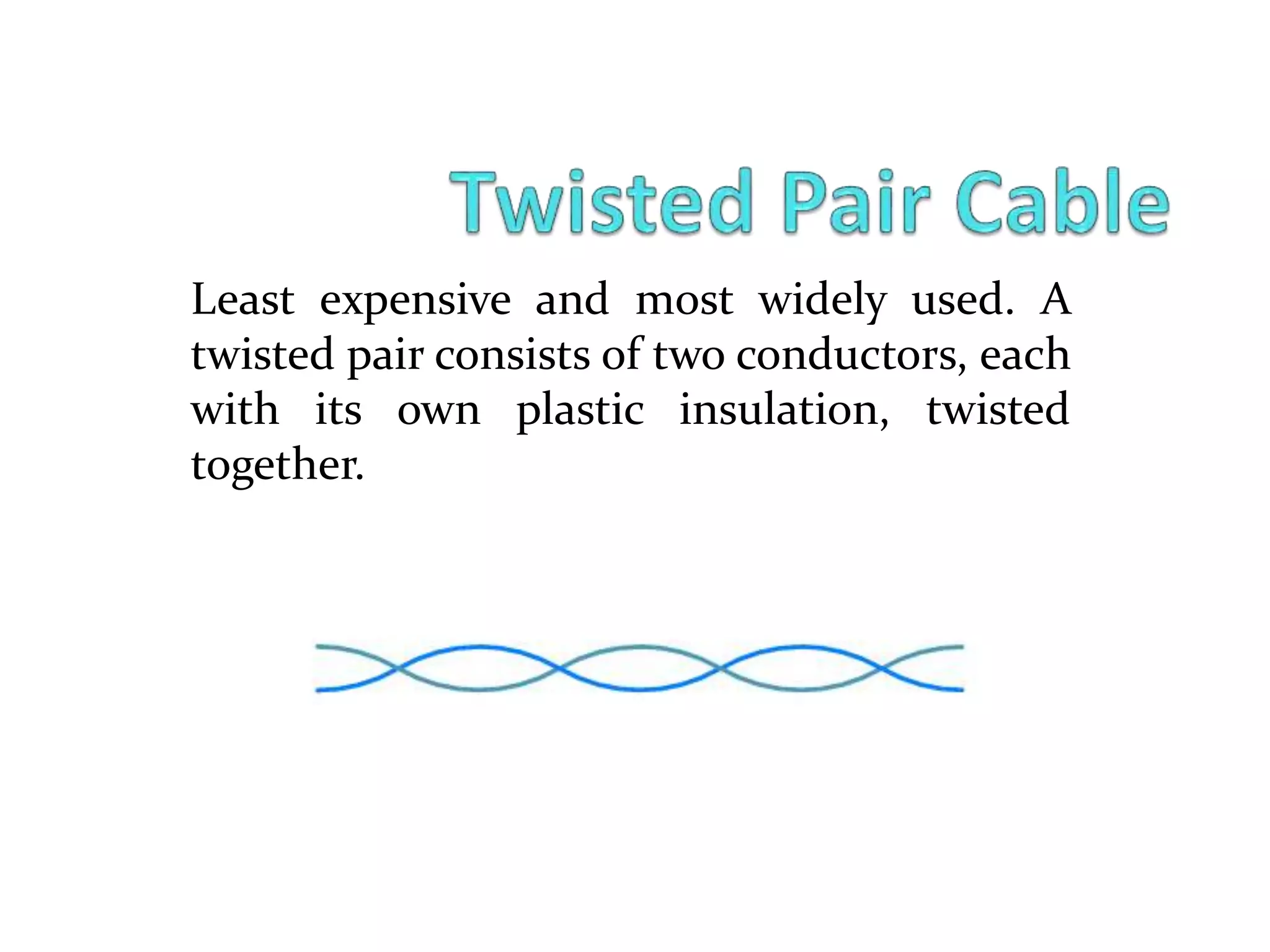
Least expensive and most widely used. A
twisted pair consists of two conductors, each
with its own plastic insulation, twisted
together.
A conductive metal such as copper transmits
data using electric current. Many twisted
pairs can occur in a single cable. They tend
to have different twist length to prevent
crosstalk interference. Most common within
telephone networks and data networks.
Distance:
Analog : 5 to 6 Kms then amplifiers
required.
Digital : 2 to 3 Kms then repeaters required.
Two types of Twisted Pair Cable:
1. UTP – Unshielded Twisted Pair
2. STP – Shielded Twisted Pair
Versatile transmission medium that operates
over a wide range of frequencies.
Used in:
• Cable Television Network
• Old Local Area Networks
• Long Distance Telephone
Transmission
A fiber optic cable is made of
glass and transmits signals in
the form of light. Data
transmission using optical fiber
is many times faster than with
electrical method
It has following characteristics:
• Light wave.
• High transmission rate.
• Immune to interference.
• Light weight.
• Greater repeater spacing.
Radio waves are omni-directional. When an
antenna transmits radio waves, they are
propagated in all directions. They can
propagate in the sky mode and can travel
long distance.
Used for:
• Radio
• Television
• Cordless Phones
• Paging Systems
Microwaves are unidirectional. When an
antenna transmits microwave waves, they
van be narrowly focused i.e. sending and
receiving antennas need to be aligned.
Microwave propagation is line-of-sight.
Repeaters are oftenly needed for long
distance communication.
Used for:
• Cellular Phones
• Satellite Networks
• Wireless LANs
Infrared transmission is usually
limited to a small area, e.g. one
room, with the transmitter pointed
towards the receiver. The hardware
is inexpensive and does not require
an antenna. Infrared signal can not
penetrate walls.
We cannot use infrared waves
outside a building because the sun’s
rays contain infrared waves that can
interfere with the communication.
Infrared signals can be used for
short range communication e.g.
mobile phones, remote controls etc.

Data Communication.pptx

  • 1.
    Data Communication is theexchange of data between two devices via some form of transmission medium such as a wire cable
  • 2.
    Here are threefundamental characteristics of Data Communication: 1. Delivery to correct destination 2. Accuracy of data 3. Timelines Timely delivery of data
  • 3.
    A data communicationsystem has five components: 1. Message 2. Sender 3. Receiver 4. Medium 5. Protocol
  • 4.
    There are threemodes for data communication: 1. Simplex 2. Half Duplex 3. Full Duplex
  • 5.
    In Simplex mode,the communication is unidirectional. For example: 1. Keyboard 2. Monitor 3. Television etc.
  • 6.
    In Half Duplexmode, each station can both transmit and receive data but not at the same time, e.g. : 1. Walkie-talkie 2. Radio phones in Police cars etc
  • 7.
    In Full Duplexmode, both station can transmit and receive data simultaneously, e.g. : 1. Telephone Network 2. 2-Way Traffic etc.
  • 8.
    Guided Media: Which providea physical channel from one device to another: • Twisted Pair Cable • Coaxial Cable • Fiber Optic Cable
  • 9.
    Un-Guided Media: Transports electromagneticwaves without using a physical medium: • Radio Waves • Microwaves • Infrared
  • 10.
    Least expensive andmost widely used. A twisted pair consists of two conductors, each with its own plastic insulation, twisted together.
  • 11.
    A conductive metalsuch as copper transmits data using electric current. Many twisted pairs can occur in a single cable. They tend to have different twist length to prevent crosstalk interference. Most common within telephone networks and data networks.
  • 12.
    Distance: Analog : 5to 6 Kms then amplifiers required. Digital : 2 to 3 Kms then repeaters required.
  • 13.
    Two types ofTwisted Pair Cable: 1. UTP – Unshielded Twisted Pair 2. STP – Shielded Twisted Pair
  • 14.
    Versatile transmission mediumthat operates over a wide range of frequencies.
  • 15.
    Used in: • CableTelevision Network • Old Local Area Networks • Long Distance Telephone Transmission
  • 16.
    A fiber opticcable is made of glass and transmits signals in the form of light. Data transmission using optical fiber is many times faster than with electrical method
  • 17.
    It has followingcharacteristics: • Light wave. • High transmission rate. • Immune to interference. • Light weight. • Greater repeater spacing.
  • 18.
    Radio waves areomni-directional. When an antenna transmits radio waves, they are propagated in all directions. They can propagate in the sky mode and can travel long distance.
  • 19.
    Used for: • Radio •Television • Cordless Phones • Paging Systems
  • 20.
    Microwaves are unidirectional.When an antenna transmits microwave waves, they van be narrowly focused i.e. sending and receiving antennas need to be aligned. Microwave propagation is line-of-sight. Repeaters are oftenly needed for long distance communication.
  • 21.
    Used for: • CellularPhones • Satellite Networks • Wireless LANs
  • 22.
    Infrared transmission isusually limited to a small area, e.g. one room, with the transmitter pointed towards the receiver. The hardware is inexpensive and does not require an antenna. Infrared signal can not penetrate walls.
  • 23.
    We cannot useinfrared waves outside a building because the sun’s rays contain infrared waves that can interfere with the communication. Infrared signals can be used for short range communication e.g. mobile phones, remote controls etc.