PROGRAMME B.COM
SUBJECT
QUANTITATIVE TECHNIQUE – I
SEMESTER III
UNIVERSITY VIJAYANAGAR SRI
KRISHNADEVARAYA UNIVERSITY,
BALLARI
SESSION 05
AKKI MARUTHI
ASSISTANT PROFESSOR OF COMMERCE
SKNG,GFGC,GANGAVATHI, KOPPAL
akkimaruthi@gmail.com
RECAP
• LIMITATIONS AND APPLICATIONS OF STATISTICS IN
VARIOUS FIELDS
Learning Objectives
• After going through this chapter the students will
be able to have a broad overview of the subject of
statistics and application thereof,Know about data
Collection Technique including the distinction of
Primary and Secondary data.
Learning Outcomes
• The students Can be able to understand overview
of the subject of statistics and application and
Know about data Collection Technique.
Session -5
• Primary and Secondary data collection methods
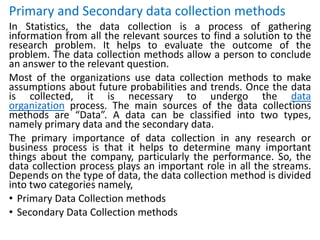
Primary and Secondary data collection methods
In Statistics, the data collection is a process of gathering
information from all the relevant sources to find a solution to the
research problem. It helps to evaluate the outcome of the
problem. The data collection methods allow a person to conclude
an answer to the relevant question.
Most of the organizations use data collection methods to make
assumptions about future probabilities and trends. Once the data
is collected, it is necessary to undergo the data
organization process. The main sources of the data collections
methods are “Data”. A data can be classified into two types,
namely primary data and the secondary data.
The primary importance of data collection in any research or
business process is that it helps to determine many important
things about the company, particularly the performance. So, the
data collection process plays an important role in all the streams.
Depends on the type of data, the data collection method is divided
into two categories namely,
• Primary Data Collection methods
• Secondary Data Collection methods
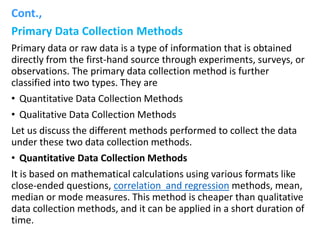
Cont.,
Primary Data Collection Methods
Primary data or raw data is a type of information that is obtained
directly from the first-hand source through experiments, surveys, or
observations. The primary data collection method is further
classified into two types. They are
• Quantitative Data Collection Methods
• Qualitative Data Collection Methods
Let us discuss the different methods performed to collect the data
under these two data collection methods.
• Quantitative Data Collection Methods
It is based on mathematical calculations using various formats like
close-ended questions, correlation and regression methods, mean,
median or mode measures. This method is cheaper than qualitative
data collection methods, and it can be applied in a short duration of
time.
Cont.,
• Qualitative Data Collection Methods
It does not involve any mathematical calculations. This method is closely
associated with elements that are not quantifiable. This qualitative data
collection method includes interviews, questionnaires, observations, case
studies etc. There are several methods to collect this type of data. They are
• Observation Method
Observation method is used when the study relates to behavioural science. This
method is planned systematically. It subjects many controls and checks. The
different types of observations are:
Structured and unstructured observation
Controlled and uncontrolled observation
Participant, non-participant and disguised observation
• Interview Method
The method of collecting data in terms of oral or verbal responses. It is achieved
in two ways, such as
Personal Interview – In this method, a person known as an interviewer is
required to ask questions face to face to the other person. The personal
interview can be structured or unstructured, direct investigation, focused
conversation etc.
Telephonic Interview – In this method, an interviewer obtains information by
contacting people on the telephone to ask the questions or views orally
Cont.,
• Questionnaire Method
In this method, the set of questions are mailed to the respondent.
They should read, reply and subsequently return the questionnaire.
The questions are printed in the definite order on the form. A good
survey should have the following features:
Short and simple
Should follow a logical sequence
Provide adequate space for answers
Avoid technical terms
Should have good physical appearance such as colour, quality of the
paper to attract the attention of the respondent
• Schedules
This method is similar to the questionnaire method with a slight
difference. The enumerations are specially appointed for the purpose
of filling the schedules. It explains the aims and objects of the
investigation and may remove misunderstandings if any have come
up. Enumerations should be trained to perform their job with hard
work and patience
Cont.,
Secondary Data Collection Methods
Secondary data is data collected by someone other than the
actual user. It means that the information is already available,
and someone analyses it. The secondary data includes
magazines, newspapers, books, journals etc. It may be either
published data or unpublished data.
Published data are available in various resources including
• Government publications
• Public records
• Historical and statistical documents
• Business documents
• Technical and trade journals
Unpublished data includes
• Diaries
• Letters
• Unpublished biographies etc.
SUMMARY
As we already discussed and learnt today on
Statistics as below
• Meaning of Primary data and What are collection
methods
• Meaning of Secondary data and What are
collection methods
MCQs
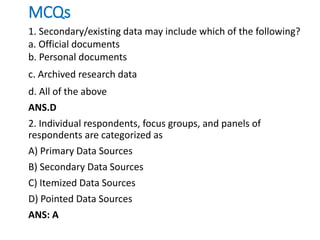
1. Secondary/existing data may include which of the following?
a. Official documents
b. Personal documents
c. Archived research data
d. All of the above
ANS.D
2. Individual respondents, focus groups, and panels of
respondents are categorized as
A) Primary Data Sources
B) Secondary Data Sources
C) Itemized Data Sources
D) Pointed Data Sources
ANS: A
MCQs
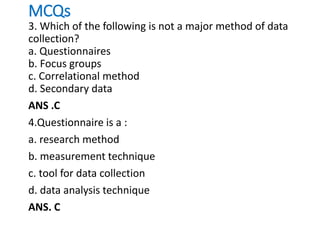
3. Which of the following is not a major method of data
collection?
a. Questionnaires
b. Focus groups
c. Correlational method
d. Secondary data
ANS .C
4.Questionnaire is a :
a. research method
b. measurement technique
c. tool for data collection
d. data analysis technique
ANS. C
MCQs
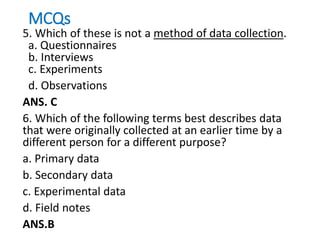
5. Which of these is not a method of data collection.
a. Questionnaires
b. Interviews
c. Experiments
d. Observations
ANS. C
6. Which of the following terms best describes data
that were originally collected at an earlier time by a
different person for a different purpose?
a. Primary data
b. Secondary data
c. Experimental data
d. Field notes
ANS.B
REFERENCES
• STATISTICAL METHODS BY S.P GUPTA SULTAN CHAND
PUBLICATIONS
• FUNDAMENTALS OF STATISTICS BY S.C.GUPTA SULTAN CHAND
PUBLICATIONS
• BUSINESS STATISTICS BY PILLAI AND BHAGAWATHI SULTAN
CHAND PUBLICATIONS
THANK YOU

INTRODUCTION TO STATISTICS

  • 1.
    PROGRAMME B.COM SUBJECT QUANTITATIVE TECHNIQUE– I SEMESTER III UNIVERSITY VIJAYANAGAR SRI KRISHNADEVARAYA UNIVERSITY, BALLARI SESSION 05
  • 2.
    AKKI MARUTHI ASSISTANT PROFESSOROF COMMERCE SKNG,GFGC,GANGAVATHI, KOPPAL akkimaruthi@gmail.com
  • 3.
    RECAP • LIMITATIONS ANDAPPLICATIONS OF STATISTICS IN VARIOUS FIELDS
  • 4.
    Learning Objectives • Aftergoing through this chapter the students will be able to have a broad overview of the subject of statistics and application thereof,Know about data Collection Technique including the distinction of Primary and Secondary data.
  • 5.
    Learning Outcomes • Thestudents Can be able to understand overview of the subject of statistics and application and Know about data Collection Technique.
  • 6.
    Session -5 • Primaryand Secondary data collection methods
  • 7.
    Primary and Secondarydata collection methods In Statistics, the data collection is a process of gathering information from all the relevant sources to find a solution to the research problem. It helps to evaluate the outcome of the problem. The data collection methods allow a person to conclude an answer to the relevant question. Most of the organizations use data collection methods to make assumptions about future probabilities and trends. Once the data is collected, it is necessary to undergo the data organization process. The main sources of the data collections methods are “Data”. A data can be classified into two types, namely primary data and the secondary data. The primary importance of data collection in any research or business process is that it helps to determine many important things about the company, particularly the performance. So, the data collection process plays an important role in all the streams. Depends on the type of data, the data collection method is divided into two categories namely, • Primary Data Collection methods • Secondary Data Collection methods
  • 8.
    Cont., Primary Data CollectionMethods Primary data or raw data is a type of information that is obtained directly from the first-hand source through experiments, surveys, or observations. The primary data collection method is further classified into two types. They are • Quantitative Data Collection Methods • Qualitative Data Collection Methods Let us discuss the different methods performed to collect the data under these two data collection methods. • Quantitative Data Collection Methods It is based on mathematical calculations using various formats like close-ended questions, correlation and regression methods, mean, median or mode measures. This method is cheaper than qualitative data collection methods, and it can be applied in a short duration of time.
  • 9.
    Cont., • Qualitative DataCollection Methods It does not involve any mathematical calculations. This method is closely associated with elements that are not quantifiable. This qualitative data collection method includes interviews, questionnaires, observations, case studies etc. There are several methods to collect this type of data. They are • Observation Method Observation method is used when the study relates to behavioural science. This method is planned systematically. It subjects many controls and checks. The different types of observations are: Structured and unstructured observation Controlled and uncontrolled observation Participant, non-participant and disguised observation • Interview Method The method of collecting data in terms of oral or verbal responses. It is achieved in two ways, such as Personal Interview – In this method, a person known as an interviewer is required to ask questions face to face to the other person. The personal interview can be structured or unstructured, direct investigation, focused conversation etc. Telephonic Interview – In this method, an interviewer obtains information by contacting people on the telephone to ask the questions or views orally
  • 10.
    Cont., • Questionnaire Method Inthis method, the set of questions are mailed to the respondent. They should read, reply and subsequently return the questionnaire. The questions are printed in the definite order on the form. A good survey should have the following features: Short and simple Should follow a logical sequence Provide adequate space for answers Avoid technical terms Should have good physical appearance such as colour, quality of the paper to attract the attention of the respondent • Schedules This method is similar to the questionnaire method with a slight difference. The enumerations are specially appointed for the purpose of filling the schedules. It explains the aims and objects of the investigation and may remove misunderstandings if any have come up. Enumerations should be trained to perform their job with hard work and patience
  • 11.
    Cont., Secondary Data CollectionMethods Secondary data is data collected by someone other than the actual user. It means that the information is already available, and someone analyses it. The secondary data includes magazines, newspapers, books, journals etc. It may be either published data or unpublished data. Published data are available in various resources including • Government publications • Public records • Historical and statistical documents • Business documents • Technical and trade journals Unpublished data includes • Diaries • Letters • Unpublished biographies etc.
  • 12.
    SUMMARY As we alreadydiscussed and learnt today on Statistics as below • Meaning of Primary data and What are collection methods • Meaning of Secondary data and What are collection methods
  • 13.
    MCQs 1. Secondary/existing datamay include which of the following? a. Official documents b. Personal documents c. Archived research data d. All of the above ANS.D 2. Individual respondents, focus groups, and panels of respondents are categorized as A) Primary Data Sources B) Secondary Data Sources C) Itemized Data Sources D) Pointed Data Sources ANS: A
  • 14.
    MCQs 3. Which ofthe following is not a major method of data collection? a. Questionnaires b. Focus groups c. Correlational method d. Secondary data ANS .C 4.Questionnaire is a : a. research method b. measurement technique c. tool for data collection d. data analysis technique ANS. C
  • 15.
    MCQs 5. Which ofthese is not a method of data collection. a. Questionnaires b. Interviews c. Experiments d. Observations ANS. C 6. Which of the following terms best describes data that were originally collected at an earlier time by a different person for a different purpose? a. Primary data b. Secondary data c. Experimental data d. Field notes ANS.B
  • 16.
    REFERENCES • STATISTICAL METHODSBY S.P GUPTA SULTAN CHAND PUBLICATIONS • FUNDAMENTALS OF STATISTICS BY S.C.GUPTA SULTAN CHAND PUBLICATIONS • BUSINESS STATISTICS BY PILLAI AND BHAGAWATHI SULTAN CHAND PUBLICATIONS
  • 17.