Data Analysis
Data Analysis Data are collected, created, and kept for the purpose of analysis Without analysis, it’s just a bunch of bits Data managers need familiarity with analysis practices
Data-collection techniques allow us to  systematically  collect information about our objects of study (people, objects, phenomena) and about the settings in which they occur. In the collection of data we have to be systematic. If data are collected haphazardly, it will be difficult to answer our research questions in a conclusive way. DATA COLLECTION TECHNIQUES Example: During a class survey three different class scales were used in three schools. The researchers did not record which scales were used in which school. After completion of the survey it was discovered that the scales were not standardized and indicated different institutions when evaluating the same school. It was therefore impossible to conclude in which school bad classes were most prevalent.
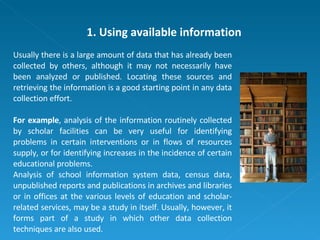
1. Using available information Usually there is a large amount of data that has already been collected by others, although it may not necessarily have been analyzed or published. Locating these sources and retrieving the information is a good starting point in any data collection effort. For example , analysis of the information routinely collected by scholar facilities can be very useful for identifying problems in certain interventions or in flows of resources supply, or for identifying increases in the incidence of certain educational problems. Analysis of school information system data, census data, unpublished reports and publications in archives and libraries or in offices at the various levels of education and scholar-related services, may be a study in itself. Usually, however, it forms part of a study in which other data collection techniques are also used.
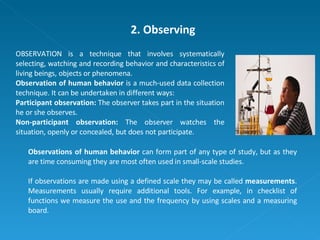
2. Observing OBSERVATION is a technique that involves systematically selecting, watching and recording behavior and characteristics of living beings, objects or phenomena. Observation of human behavior  is a much-used data collection technique. It can be undertaken in different ways: Participant observation:  The observer takes part in the situation he or she observes.  Non-participant observation:  The observer watches the situation, openly or concealed, but does not participate.  Observations of human behavior  can form part of any type of study, but as they are time consuming they are most often used in small-scale studies. If observations are made using a defined scale they may be called  measurements . Measurements usually require additional tools. For example, in checklist of functions we measure the use and the frequency by using scales and a measuring board.
3. Interviewing An INTERVIEW is a data-collection technique that involves oral questioning of respondents, either individually or as a group. Answers to the questions posed during an interview can be recorded by writing them down (either during the interview itself or immediately after the interview) or by tape-recording the responses, or by a combination of both. It is method of data collection that provides a deep understanding of the experience of other people and the meaning they make of that experience. It is a powerful way to gain insight into educational issues through understanding the experience of the individuals whose lives constitute education. Additionally, it helps people to symbolize their experience through language. (Seidman, I. 1991) Interviewing is the art and science of exploring the subjective knowledge, opinions and beliefs of an individual. (Merriam, S. 1998)
The purpose of interviews To obtain in-depth information about a particular research issue or question. To find out those things that we cannot directly observe: feelings, thoughts and intentions. To get answers to questions, not to test hypothesis. To put people’s behavior in context and thereby to understand their actions.
Types of interviews Structured unstructured Semi-structured Predetermined questions. Question and answer questions. Order of questions predetermined. Free wheeling It’s more conversational Flexible or exploratory Guided by a list of issues or possible questions to be explored. Questions are more flexibly ordered.  There is use of probes.
Types of questions to avoid Multiple questions Example: How do you feel about the instructors, the classes and your classmates? Leading questions: Example: What kind of problems have you had since changing school? Yes-no questions:  Example: Do you like this program?
Tips for research interviews Be prepared. Select participants who may really contribute to your research. Be sure of the time and location of the interview and arrive on time. Determine what the interviewee expertise is beforehand. Try to find locations which are quiet.
Clarify before and afterwards the conditions and purpose of the interview. Be careful with your physical position. Be sure to smile and make the interviewee feel at ease. Keep and eye on your watch. Avoid bias. Even if you are taping the interview, be sure to take notes. If you use video-recording make sure that the interviewer as well as the interviewee appear on the recording. Transcribe your notes as soon as possible. Refine and pilot the questions.
Possible disadvantages It takes time, energy, thoughtfulness and money. The interviewer must be potential to establish contact with people who has never met.  Others’ words can be appropriated for the benefit of the researcher’s personal advancement. Interviews are done by people with a relatively higher position of power.
4. Administering written questionnaires WRITTEN QUESTIONNAIRE (also referred to as self-administered questionnaire) is a data collection tool in which written questions are presented that are to be answered by the respondents in written form. A written questionnaire can be administered in different ways, such as by: Sending questionnaires by mail with clear instructions on how to answer the questions and asking for mailed responses; Gathering all or part of the respondents in one place at one time, giving oral or written instructions, and letting the respondents fill out the questionnaires; or Hand-delivering questionnaires to respondents and collecting them later.
Order the questions rationally The quintadimensional plan Grouping questions by type, function, format and topic Controlling the ordering for clarity
Format the questionnaire for clarity Spacing  Typefaces Highlighting
Write clear directions Overall directions Specific directions Introductions
Edit carefully Getting others to help edit Piloting the questionnaire Final editing
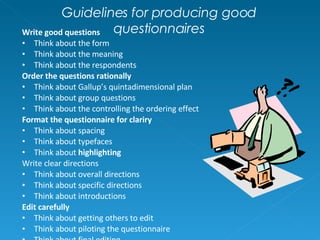
Guidelines for producing good questionnaires Write good questions  Think about the form Think about the meaning Think about the respondents Order the questions rationally Think about Gallup’s quintadimensional plan Think about group questions Think about the controlling the ordering effect Format the questionnaire for clariry Think about spacing Think about typefaces Think about  highlighting Write clear directions Think about overall directions Think about specific directions Think about introductions Edit carefully Think about getting others to edit Think about piloting the questionnaire Think about final editing
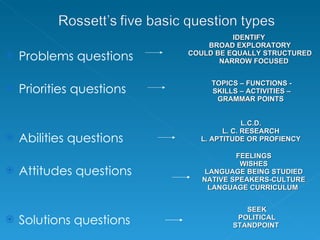
Problems questions Priorities questions Abilities questions Attitudes questions Solutions questions IDENTIFY  BROAD EXPLORATORY  COULD BE EQUALLY STRUCTURED NARROW FOCUSED   TOPICS – FUNCTIONS - SKILLS – ACTIVITIES – GRAMMAR POINTS   L.C.D.  L. C. RESEARCH  L. APTITUDE OR PROFIENCY   FEELINGS WISHES LANGUAGE BEING STUDIED NATIVE SPEAKERS-CULTURE LANGUAGE CURRICULUM   SEEK POLITICAL STANDPOINT
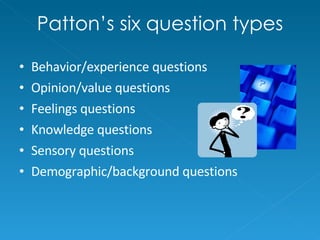
Patton’s six question types Behavior/experience questions Opinion/value questions Feelings questions Knowledge questions Sensory questions Demographic/background questions
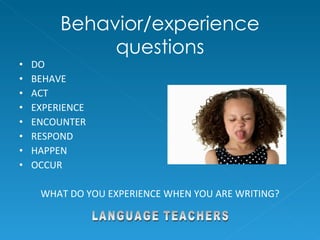
Behavior/experience questions DO BEHAVE ACT EXPERIENCE ENCOUNTER RESPOND HAPPEN OCCUR WHAT DO YOU EXPERIENCE WHEN YOU ARE WRITING? LANGUAGE TEACHERS
WHAT DO YOU DO WHEN STUDENTS CHALLENGE YOUR AUTHORITY?  WHAT DO STUDENTS HAVE TO DO IN YOUR COURSE? WHAT HAPPENS TO THE STUDENTS STEP BY STEP DURING THE PLACEMENT EXAMINATION? LANGUAGE STUDENTS CONTENT - AREA – TEACHERS LANGUAGE PROGRAM ADMINISTRATORS
Opinion/value questions THOUGHTS REACTIONS IMPRESSIONS ATTITUDES ASPECTS OF LANGUAGE LANGUAGE LEARNING PROCESSES Example: WHAT IS THE MOST IMPORTANT ASPECT OF THE LANGUAGE CLASS FOR YOU? HOW DO YOU LIKE THE TEXTBOOK USED IN YOUR LANGUAGE CLASS? WHICH DO YOU THINK IS THE MOST IMPORTAT LEARNING ORAL OR WRITTEN GERMAN?  WHEN DO YOU THINK WE SHOULD HAVE THE CLASS PARTY?
Feelings Emotions Emotional reactions Questions language teachers: Is there anything in this language program that you do not like? How do you feel about the classroom observations that the program director does every semester? *Supervisor every month?  *Coordinator every week?  What is your emotional reaction when students criticize your teaching? How do you feel about all the testing we do in this program?
Knowledge INFORMATION ABOUT LANGUAGE T. & L. PROCESSES LANGUAGE PROGRAM ADMINISTRATORS  Example: HOW MANY TEACHERS WORK IN THIS PROGRAM? WHAT IS THE SCHEDULE OF CLASSES FOR THIS PROGRAM? HOW LONG IS EACH CLASS? WHAT TEXTSBOOKS DO YOU USE?
Sensory VISUAL TACTILE AUDITORY OLFACTORY ASPECTS OF THE LANGUAGE T. & L. PROGRAM ADMINISTRATORS Example:  WHAT ARE THE NOISE LEVELS LIKE OUTSIDE THE C CLASSROOM? IS THE AIR CONDITIONING SET AT THE RIGHT LEVEL IN THE CLASSROOM?  IS THERE ENOUGH LIGHT IN THE TEACHERS’ ROOM TO WORK PROPERLY? WHAT ARE YOUR CLASSRO0MS LIKE PHYSICALLY?
Demographic/background BIOGRAPHICAL HISTORICAL INFORMATION LANGUAGE STUDENTS HOW MANY YEARS HAVE YOU STUDIED SPANISH? HOW OLD ARE YOU? WHAT OTHER LANGUAGES DO YOU SPEAK? WHAT COURSES ARE YOU TAKING THIS SEMESTER?
Open responses Advantages and disadvantages Forms of questions Fill-in questions Short-answer questions
Question length Question clarity Negative questions Incomplete questions Overlapping choices Questions across pages
Double-barreled questions Loaded words Leading questions Prestige questions Embarrasing questions Biased questions
Level of language Questions respondents are unable to answer Not everyone has an answer Questions that don’t apply Irrelevant questions Superfluous information
A focus group discussion allows a group of 8 - 12 informants to freely discuss a certain subject with the guidance of a facilitator or reporter. In fact, members have the opportunity to share their insights, seek clarifications on ideas from texts, activities, classes; and make connections between the reading and their classrooms. 5. Focus group discussions (FGD)
BIAS in information collection is a distortion in the collected data so that it does not represent reality. Possible sources of bias during data collection: 1. Defective instruments, such as: Questionnaires with: — fixed or closed questions on topics about which little is known (often asking the ‘wrong things’);  —  open-ended questions without guidelines on how to ask (or to answer) them; —  vaguely phrased questions; — ‘ leading questions’ that cause the respondent to believe one answer would be preferred over another; or —  questions placed in an illogical order. BIAS IN INFORMATION COLLECTION
Observer bias: Observer bias can easily occur when conducting observations or utilising loosely structured group- or individual interviews. There is a risk that the data collector will only see or hear things in which (s)he is interested or will miss information that is critical to the research. Observation protocols  and  guidelines for conducting loosely structured interviews  should be prepared, and training and practice should be provided to data collectors in using both these tools. Moreover it is highly recommended that data collectors  work in pairs  when using flexible research techniques and discuss and interpret the data immediately after collecting it. Another possibility - commonly used by anthropologists - is using a tape recorder and transcribing the tape word by word.

Data Analysis

  • 1.
  • 2.
    Data Analysis Dataare collected, created, and kept for the purpose of analysis Without analysis, it’s just a bunch of bits Data managers need familiarity with analysis practices
  • 3.
    Data-collection techniques allowus to systematically collect information about our objects of study (people, objects, phenomena) and about the settings in which they occur. In the collection of data we have to be systematic. If data are collected haphazardly, it will be difficult to answer our research questions in a conclusive way. DATA COLLECTION TECHNIQUES Example: During a class survey three different class scales were used in three schools. The researchers did not record which scales were used in which school. After completion of the survey it was discovered that the scales were not standardized and indicated different institutions when evaluating the same school. It was therefore impossible to conclude in which school bad classes were most prevalent.
  • 4.
    1. Using availableinformation Usually there is a large amount of data that has already been collected by others, although it may not necessarily have been analyzed or published. Locating these sources and retrieving the information is a good starting point in any data collection effort. For example , analysis of the information routinely collected by scholar facilities can be very useful for identifying problems in certain interventions or in flows of resources supply, or for identifying increases in the incidence of certain educational problems. Analysis of school information system data, census data, unpublished reports and publications in archives and libraries or in offices at the various levels of education and scholar-related services, may be a study in itself. Usually, however, it forms part of a study in which other data collection techniques are also used.
  • 5.
    2. Observing OBSERVATIONis a technique that involves systematically selecting, watching and recording behavior and characteristics of living beings, objects or phenomena. Observation of human behavior is a much-used data collection technique. It can be undertaken in different ways: Participant observation: The observer takes part in the situation he or she observes. Non-participant observation: The observer watches the situation, openly or concealed, but does not participate. Observations of human behavior can form part of any type of study, but as they are time consuming they are most often used in small-scale studies. If observations are made using a defined scale they may be called measurements . Measurements usually require additional tools. For example, in checklist of functions we measure the use and the frequency by using scales and a measuring board.
  • 6.
    3. Interviewing AnINTERVIEW is a data-collection technique that involves oral questioning of respondents, either individually or as a group. Answers to the questions posed during an interview can be recorded by writing them down (either during the interview itself or immediately after the interview) or by tape-recording the responses, or by a combination of both. It is method of data collection that provides a deep understanding of the experience of other people and the meaning they make of that experience. It is a powerful way to gain insight into educational issues through understanding the experience of the individuals whose lives constitute education. Additionally, it helps people to symbolize their experience through language. (Seidman, I. 1991) Interviewing is the art and science of exploring the subjective knowledge, opinions and beliefs of an individual. (Merriam, S. 1998)
  • 7.
    The purpose ofinterviews To obtain in-depth information about a particular research issue or question. To find out those things that we cannot directly observe: feelings, thoughts and intentions. To get answers to questions, not to test hypothesis. To put people’s behavior in context and thereby to understand their actions.
  • 8.
    Types of interviewsStructured unstructured Semi-structured Predetermined questions. Question and answer questions. Order of questions predetermined. Free wheeling It’s more conversational Flexible or exploratory Guided by a list of issues or possible questions to be explored. Questions are more flexibly ordered. There is use of probes.
  • 9.
    Types of questionsto avoid Multiple questions Example: How do you feel about the instructors, the classes and your classmates? Leading questions: Example: What kind of problems have you had since changing school? Yes-no questions: Example: Do you like this program?
  • 10.
    Tips for researchinterviews Be prepared. Select participants who may really contribute to your research. Be sure of the time and location of the interview and arrive on time. Determine what the interviewee expertise is beforehand. Try to find locations which are quiet.
  • 11.
    Clarify before andafterwards the conditions and purpose of the interview. Be careful with your physical position. Be sure to smile and make the interviewee feel at ease. Keep and eye on your watch. Avoid bias. Even if you are taping the interview, be sure to take notes. If you use video-recording make sure that the interviewer as well as the interviewee appear on the recording. Transcribe your notes as soon as possible. Refine and pilot the questions.
  • 12.
    Possible disadvantages Ittakes time, energy, thoughtfulness and money. The interviewer must be potential to establish contact with people who has never met. Others’ words can be appropriated for the benefit of the researcher’s personal advancement. Interviews are done by people with a relatively higher position of power.
  • 13.
    4. Administering writtenquestionnaires WRITTEN QUESTIONNAIRE (also referred to as self-administered questionnaire) is a data collection tool in which written questions are presented that are to be answered by the respondents in written form. A written questionnaire can be administered in different ways, such as by: Sending questionnaires by mail with clear instructions on how to answer the questions and asking for mailed responses; Gathering all or part of the respondents in one place at one time, giving oral or written instructions, and letting the respondents fill out the questionnaires; or Hand-delivering questionnaires to respondents and collecting them later.
  • 14.
    Order the questionsrationally The quintadimensional plan Grouping questions by type, function, format and topic Controlling the ordering for clarity
  • 15.
    Format the questionnairefor clarity Spacing Typefaces Highlighting
  • 16.
    Write clear directionsOverall directions Specific directions Introductions
  • 17.
    Edit carefully Gettingothers to help edit Piloting the questionnaire Final editing
  • 18.
    Guidelines for producinggood questionnaires Write good questions Think about the form Think about the meaning Think about the respondents Order the questions rationally Think about Gallup’s quintadimensional plan Think about group questions Think about the controlling the ordering effect Format the questionnaire for clariry Think about spacing Think about typefaces Think about highlighting Write clear directions Think about overall directions Think about specific directions Think about introductions Edit carefully Think about getting others to edit Think about piloting the questionnaire Think about final editing
  • 19.
    Problems questions Prioritiesquestions Abilities questions Attitudes questions Solutions questions IDENTIFY BROAD EXPLORATORY COULD BE EQUALLY STRUCTURED NARROW FOCUSED TOPICS – FUNCTIONS - SKILLS – ACTIVITIES – GRAMMAR POINTS L.C.D. L. C. RESEARCH L. APTITUDE OR PROFIENCY FEELINGS WISHES LANGUAGE BEING STUDIED NATIVE SPEAKERS-CULTURE LANGUAGE CURRICULUM SEEK POLITICAL STANDPOINT
  • 20.
    Patton’s six questiontypes Behavior/experience questions Opinion/value questions Feelings questions Knowledge questions Sensory questions Demographic/background questions
  • 21.
    Behavior/experience questions DOBEHAVE ACT EXPERIENCE ENCOUNTER RESPOND HAPPEN OCCUR WHAT DO YOU EXPERIENCE WHEN YOU ARE WRITING? LANGUAGE TEACHERS
  • 22.
    WHAT DO YOUDO WHEN STUDENTS CHALLENGE YOUR AUTHORITY? WHAT DO STUDENTS HAVE TO DO IN YOUR COURSE? WHAT HAPPENS TO THE STUDENTS STEP BY STEP DURING THE PLACEMENT EXAMINATION? LANGUAGE STUDENTS CONTENT - AREA – TEACHERS LANGUAGE PROGRAM ADMINISTRATORS
  • 23.
    Opinion/value questions THOUGHTSREACTIONS IMPRESSIONS ATTITUDES ASPECTS OF LANGUAGE LANGUAGE LEARNING PROCESSES Example: WHAT IS THE MOST IMPORTANT ASPECT OF THE LANGUAGE CLASS FOR YOU? HOW DO YOU LIKE THE TEXTBOOK USED IN YOUR LANGUAGE CLASS? WHICH DO YOU THINK IS THE MOST IMPORTAT LEARNING ORAL OR WRITTEN GERMAN? WHEN DO YOU THINK WE SHOULD HAVE THE CLASS PARTY?
  • 24.
    Feelings Emotions Emotionalreactions Questions language teachers: Is there anything in this language program that you do not like? How do you feel about the classroom observations that the program director does every semester? *Supervisor every month? *Coordinator every week? What is your emotional reaction when students criticize your teaching? How do you feel about all the testing we do in this program?
  • 25.
    Knowledge INFORMATION ABOUTLANGUAGE T. & L. PROCESSES LANGUAGE PROGRAM ADMINISTRATORS Example: HOW MANY TEACHERS WORK IN THIS PROGRAM? WHAT IS THE SCHEDULE OF CLASSES FOR THIS PROGRAM? HOW LONG IS EACH CLASS? WHAT TEXTSBOOKS DO YOU USE?
  • 26.
    Sensory VISUAL TACTILEAUDITORY OLFACTORY ASPECTS OF THE LANGUAGE T. & L. PROGRAM ADMINISTRATORS Example: WHAT ARE THE NOISE LEVELS LIKE OUTSIDE THE C CLASSROOM? IS THE AIR CONDITIONING SET AT THE RIGHT LEVEL IN THE CLASSROOM? IS THERE ENOUGH LIGHT IN THE TEACHERS’ ROOM TO WORK PROPERLY? WHAT ARE YOUR CLASSRO0MS LIKE PHYSICALLY?
  • 27.
    Demographic/background BIOGRAPHICAL HISTORICALINFORMATION LANGUAGE STUDENTS HOW MANY YEARS HAVE YOU STUDIED SPANISH? HOW OLD ARE YOU? WHAT OTHER LANGUAGES DO YOU SPEAK? WHAT COURSES ARE YOU TAKING THIS SEMESTER?
  • 28.
    Open responses Advantagesand disadvantages Forms of questions Fill-in questions Short-answer questions
  • 29.
    Question length Questionclarity Negative questions Incomplete questions Overlapping choices Questions across pages
  • 30.
    Double-barreled questions Loadedwords Leading questions Prestige questions Embarrasing questions Biased questions
  • 31.
    Level of languageQuestions respondents are unable to answer Not everyone has an answer Questions that don’t apply Irrelevant questions Superfluous information
  • 32.
    A focus groupdiscussion allows a group of 8 - 12 informants to freely discuss a certain subject with the guidance of a facilitator or reporter. In fact, members have the opportunity to share their insights, seek clarifications on ideas from texts, activities, classes; and make connections between the reading and their classrooms. 5. Focus group discussions (FGD)
  • 33.
    BIAS in informationcollection is a distortion in the collected data so that it does not represent reality. Possible sources of bias during data collection: 1. Defective instruments, such as: Questionnaires with: — fixed or closed questions on topics about which little is known (often asking the ‘wrong things’); — open-ended questions without guidelines on how to ask (or to answer) them; — vaguely phrased questions; — ‘ leading questions’ that cause the respondent to believe one answer would be preferred over another; or — questions placed in an illogical order. BIAS IN INFORMATION COLLECTION
  • 34.
    Observer bias: Observerbias can easily occur when conducting observations or utilising loosely structured group- or individual interviews. There is a risk that the data collector will only see or hear things in which (s)he is interested or will miss information that is critical to the research. Observation protocols and guidelines for conducting loosely structured interviews should be prepared, and training and practice should be provided to data collectors in using both these tools. Moreover it is highly recommended that data collectors work in pairs when using flexible research techniques and discuss and interpret the data immediately after collecting it. Another possibility - commonly used by anthropologists - is using a tape recorder and transcribing the tape word by word.