CONCEPT OF DATA COLLECTION
Introduction
• Data collection is the process of gathering and
measuring information on variables of interest, in
an established systematic fashion that enables
one to answer stated research questions, test
hypotheses, and evaluate outcomes.
• The goal for all data collection is to capture
quality evidence that then translates to rich data
analysis and allows the building of a convincing
and credible answer to questions that have been
posed.
• Regardless of the field of study or preference
for defining data (quantitative, qualitative),
accurate data collection is essential to
maintaining the integrity of research.
• Both the selection of appropriate data
collection instruments (existing, modified, or
newly developed) and clearly delineated
instructions for their correct use reduce the
likelihood of errors occurring.
• Data collection is one of the most important stages in
conducting a research.
• You can have the best research design in the world but
if you cannot collect the required data you will be not
be able to complete your project.
• Data collection is a very demanding job which needs
thorough planning, hard work, patience, perseverance
and more to be able to complete the task successfully.
• Data collection starts with determining what kind of
data required followed by the selection of a sample
from a certain population.
• After that, you need to use a certain instrument to
collect the data from the selected sample.
TYPES OF DATA
• Data are organized into two broad categories:
qualitative and quantitative.
• Qualitative Data: Qualitative data are mostly
non-numerical and usually descriptive or
nominal in nature.
• This means the data collected are in the form of
words and sentences.
• Often (not always), such data captures feelings,
emotions, or subjective perceptions of
something.
Quantitative Data:
• Quantitative data is numerical in nature and can
be mathematically computed.
• Quantitative data measure uses different scales,
which can be classified as nominal scale,
ordinal scale, interval scale and ratio scale.
Often (not always), such data includes
measurements of something.
• Quantitative approaches address the ‘what’ of
the program. They use a systematic
standardized approach and employ methods
such as surveys and ask questions.
PRIMARY DATA
• Data that has been collected from first-hand-
experience is known as primary data.
• Primary data has not been published yet and is
more reliable, authentic and objective.
• Primary data has not been changed or altered by
human beings; therefore its validity is greater than
secondary data. Importance of Primary Data: In
statistical surveys it is necessary to get information
from primary sources and work on primary data.
• For example, the statistical records of female
population in a country cannot be based on
newspaper, magazine and other printed sources.
• A research can be conducted without
secondary data but a research based on only
secondary data is least reliable and may have
biases because secondary data has already
been manipulated by human beings.
• One of such sources is old and secondly they
contain limited information as well as they
can be misleading and biased.
Advantages of Using Primary Data
• The investigator collects data specific to the
problem under study.
• There is no doubt about the quality of the data
collected (for the investigator).
• If required, it may be possible to obtain
additional data during the study period.
Disadvantages of Using Primary
Data
1. The investigator has to contend with all the hassles of
data collection-
• deciding why, what, how, when to collect;
• getting the data collected (personally or through others); getting

funding and dealing with funding agencies;
• ethical considerations (consent, permissions, etc.).
2. Ensuring the data collected is of a high standard-
 all desired data is obtained accurately, and in the format it is
required in;
 there is no fake/ cooked up data;
 unnecessary/ useless data has not been included.
3. Cost of obtaining the data is often the major expense in
studies.
SECONDARY DATA
• Data collected from a source that has already been
published in any form is called as secondary data.
The review of literature in any research is based on
secondary data.
• It is collected by someone else for some other
purpose (but being utilized by the investigator for
another purpose). For examples, Census data being
used to analyze the impact of education on career
choice and earning.
• Secondary data is essential, since it is impossible to
conduct a new survey that can adequately capture
past change and/or developments
Sources of Secondary Data:
The following are some ways of collecting secondary
data –
• Books
• Records
• Biographies
• Newspapers
• Published censuses or other statistical data
• Data archives
• Internet articles
• Research articles by other researchers (journals)
• Databases, etc.
Importance of Secondary Data:
Secondary data can be less valid but its importance is still there.
1.Sometimes it is difficult to obtain primary data; in these cases getting
information from secondary sources is easier and possible.
2.Sometimes primary data does not exist in such situation one has to
confine the research on secondary data.
3.Sometimes primary data is present but the respondents are not willing to
reveal it in such case too secondary data can suffice
4.A clear benefit of using secondary data is that much of the background
work needed has already been carried out.
For example, literature reviews, case studies might have been carried out,
published texts and statistics could have been already used elsewhere,
media promotion and personal contacts have also been utilized.
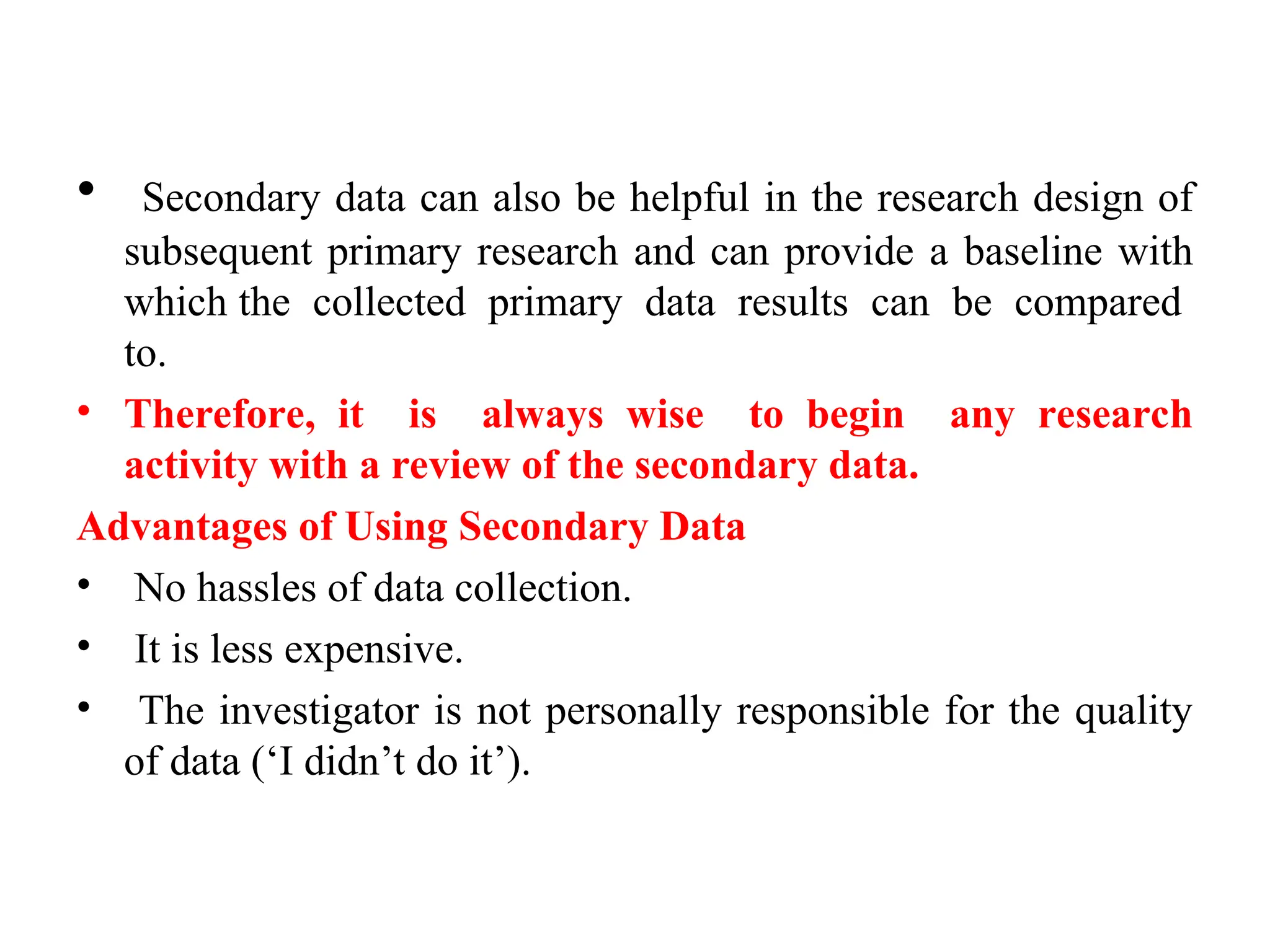
• Secondary data can also be helpful in the research design of
subsequent primary research and can provide a baseline with
which the collected primary data results can be compared
to.
• Therefore, it is always wise to begin any research
activity with a review of the secondary data.
Advantages of Using Secondary Data
• No hassles of data collection.
• It is less expensive.
• The investigator is not personally responsible for the quality
of data (‘I didn’t do it’).
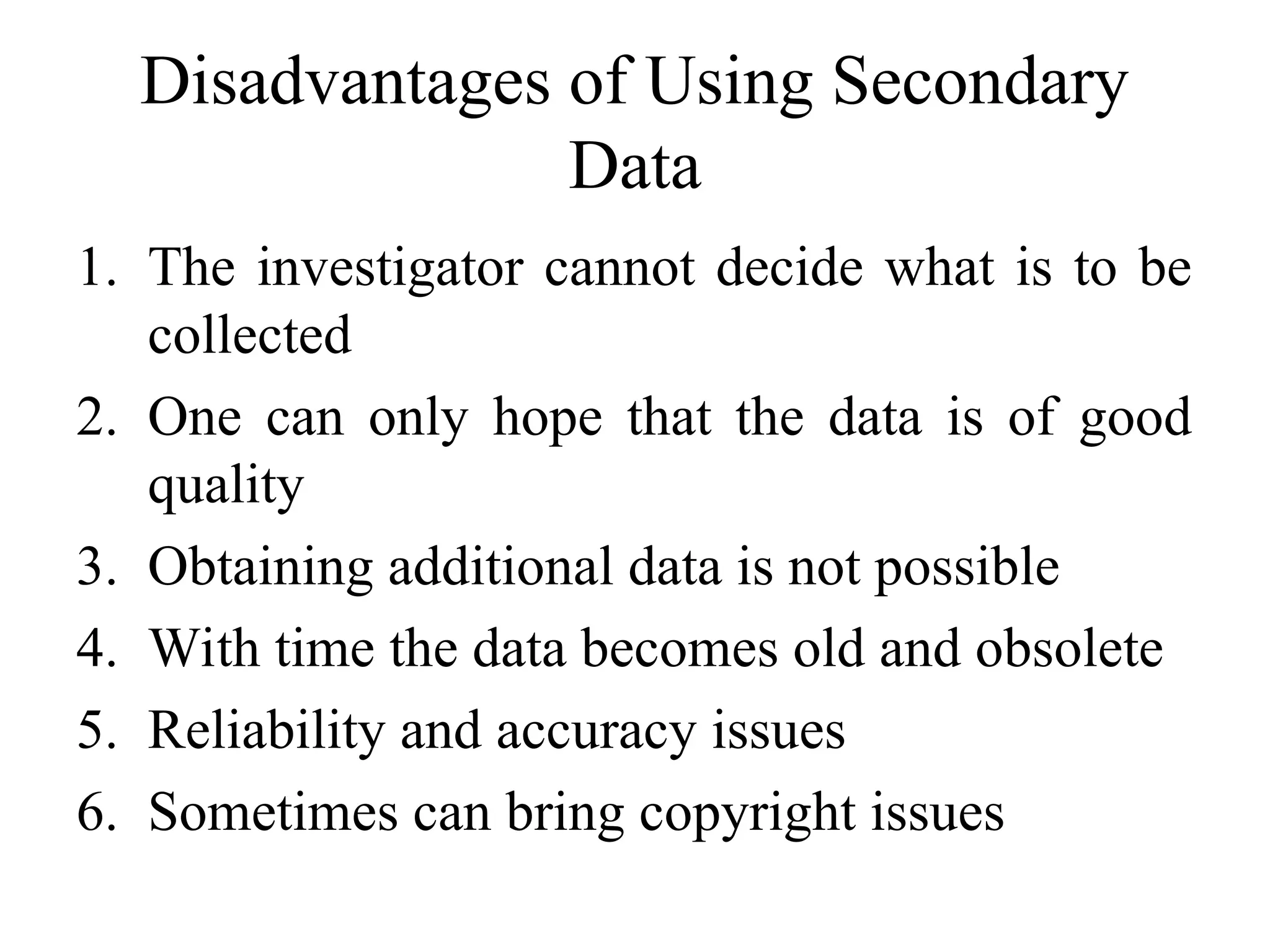
Disadvantages of Using Secondary
Data
1. The investigator cannot decide what is to be
collected
2. One can only hope that the data is of good
quality
3. Obtaining additional data is not possible
4. With time the data becomes old and obsolete
5. Reliability and accuracy issues
6. Sometimes can bring copyright issues
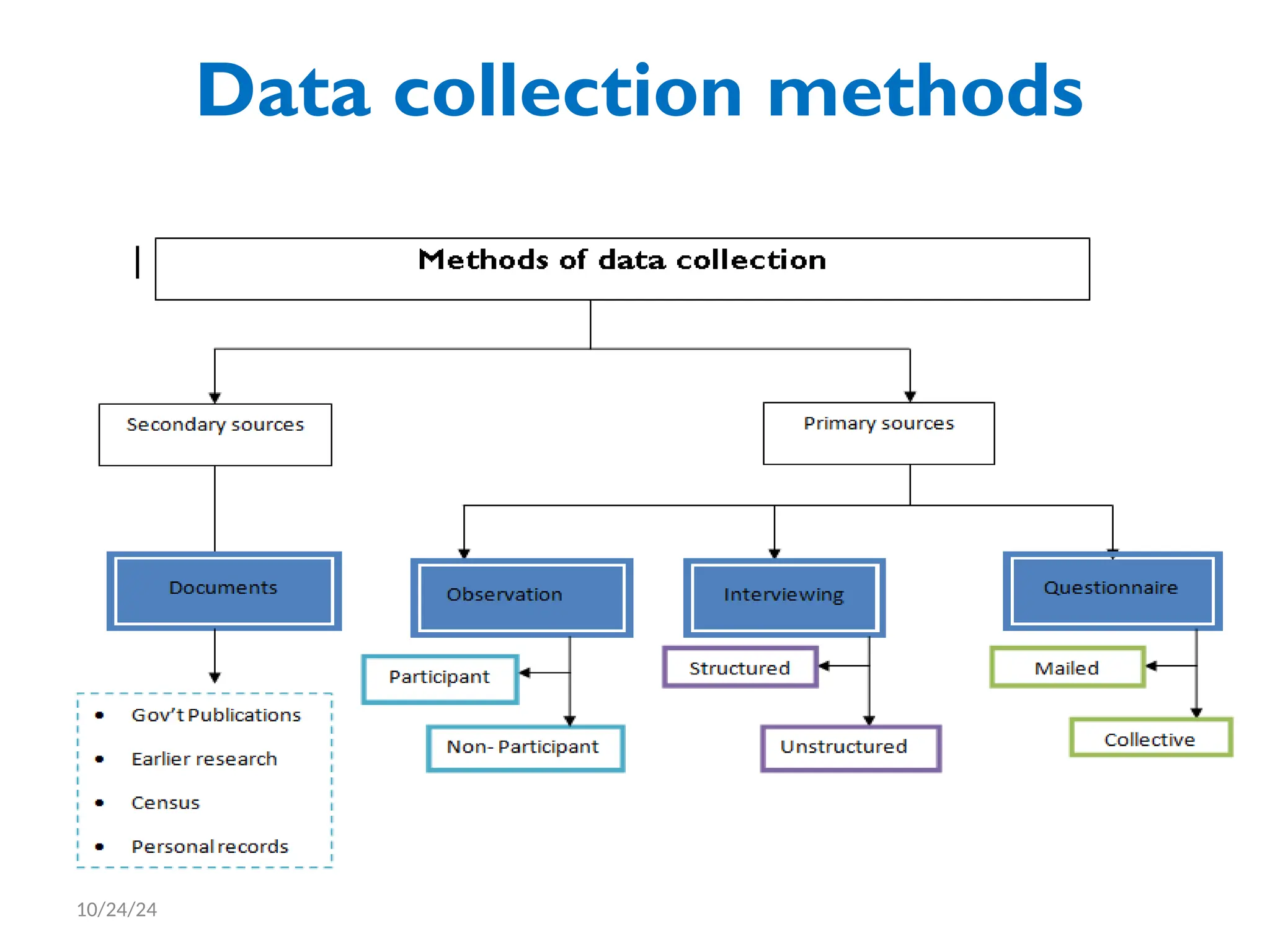
Data collection methods
10/24/24
The questionnaire
• A questionnaire is a written list of questions, the answers to
which are recorded by respondents.
• In questionnaire respondents read the question, interpret what is
expected and the write down the answers.
• Unlike an interview guide in which the researcher may explain the
meaning of some questions, in the case of questionnaire, there is
no one to explain the meaning of questions to respondents.
• Therefore questions in a questionnaire must be clear and easy to
understand.
10/24/24
Ways of administering a questionnaire
• A questionnaire can be administered in different ways..
– A mailed questionnaire – one approach to collecting
information is to send the questionnaire to prospective
respondents by mail. Obviously, this method presupposes that u
have access to their address. One of the major problem with this
approach is the low response rate.
– Collective administration – one of the best ways of
administering questionnaires is to obtain a captive audience such
as students in a class room, people attending a function, or people
assembled in one place. This ensures a high response rate as you
will find very few people refusing to participate in your study.
10/24/24
Contents of a questionnaire cover letter
• It is essential that you write a cover letter to accompany your
questionnaire. It should very briefly:
– Introduce you and the institution you are representing.
– Describe in two or three lines the main objective of the study.
– Convey any general instructions.
– Assure respondents of the anonymity of the information
provided by them.
– Provide a contact number incase they have questions.
– Give them a return address for the questionnaire and a
deadline for its return.
– Thank them for their participation.
10/24/24
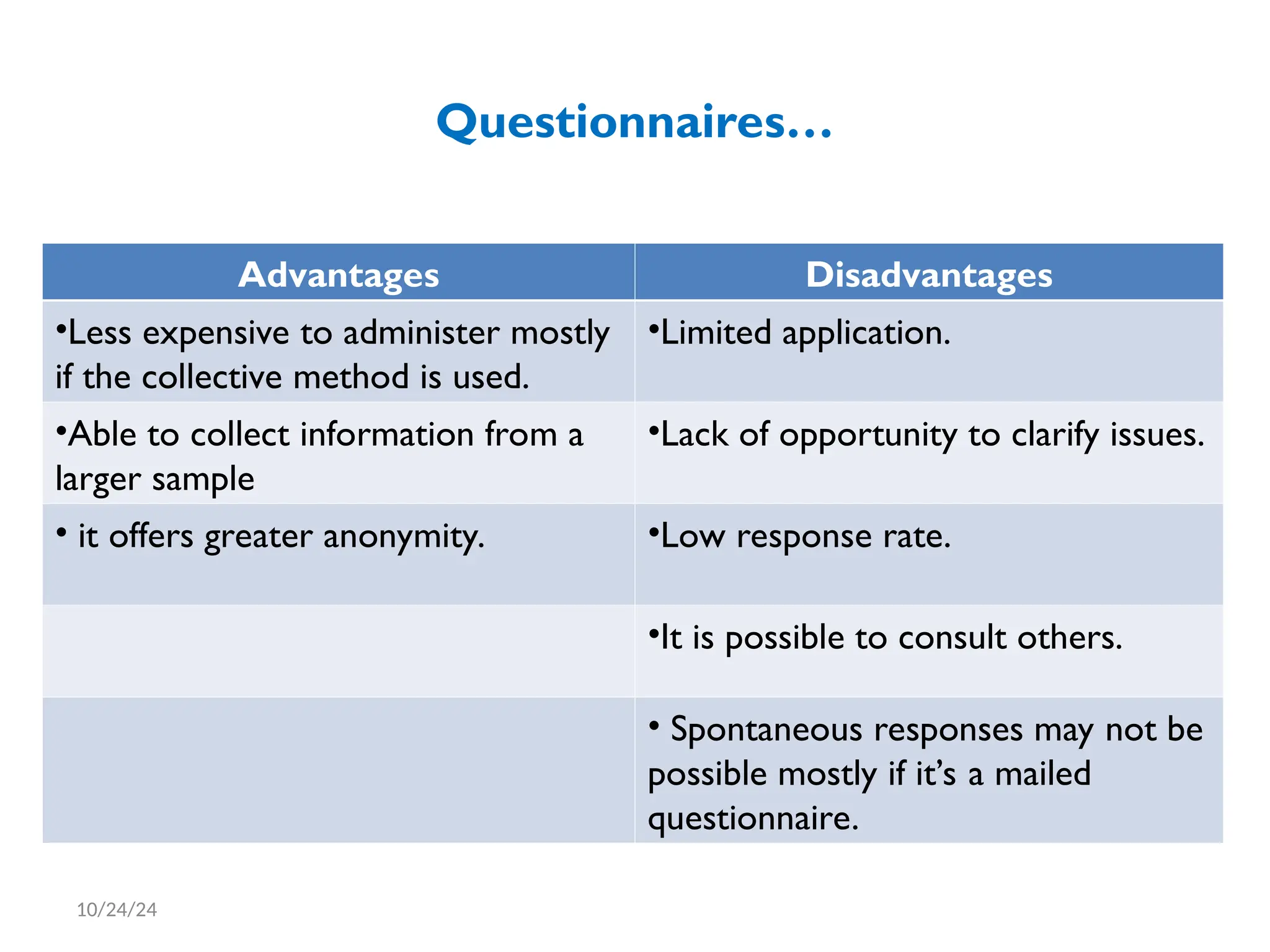
Questionnaires…
Advantages Disadvantages
•Less expensive to administer mostly
if the collective method is used.
•Limited application.
•Able to collect information from a
larger sample
•Lack of opportunity to clarify issues.
• it offers greater anonymity. •Low response rate.
•It is possible to consult others.
• Spontaneous responses may not be
possible mostly if it’s a mailed
questionnaire.
10/24/24
Forms of questions in a questionnaire
• In a questionnaires, questions may be formulated as;
– Closed ended or
– Open ended
• In a closed-ended question, the possible answers are set out in
the questionnaire and the respondent ticks the category that
best describes the respondents answer. E.g.
– Please tick the type of research you would love to undertake.
Applied research Basic Research descriptive research quantitative
• In open ended questions, the possible responses are not given.
The respondent writes down the answers in his/her words. E.g.
– Please explain why you opted for a Bachelors degree in Information technology?
10/24/24
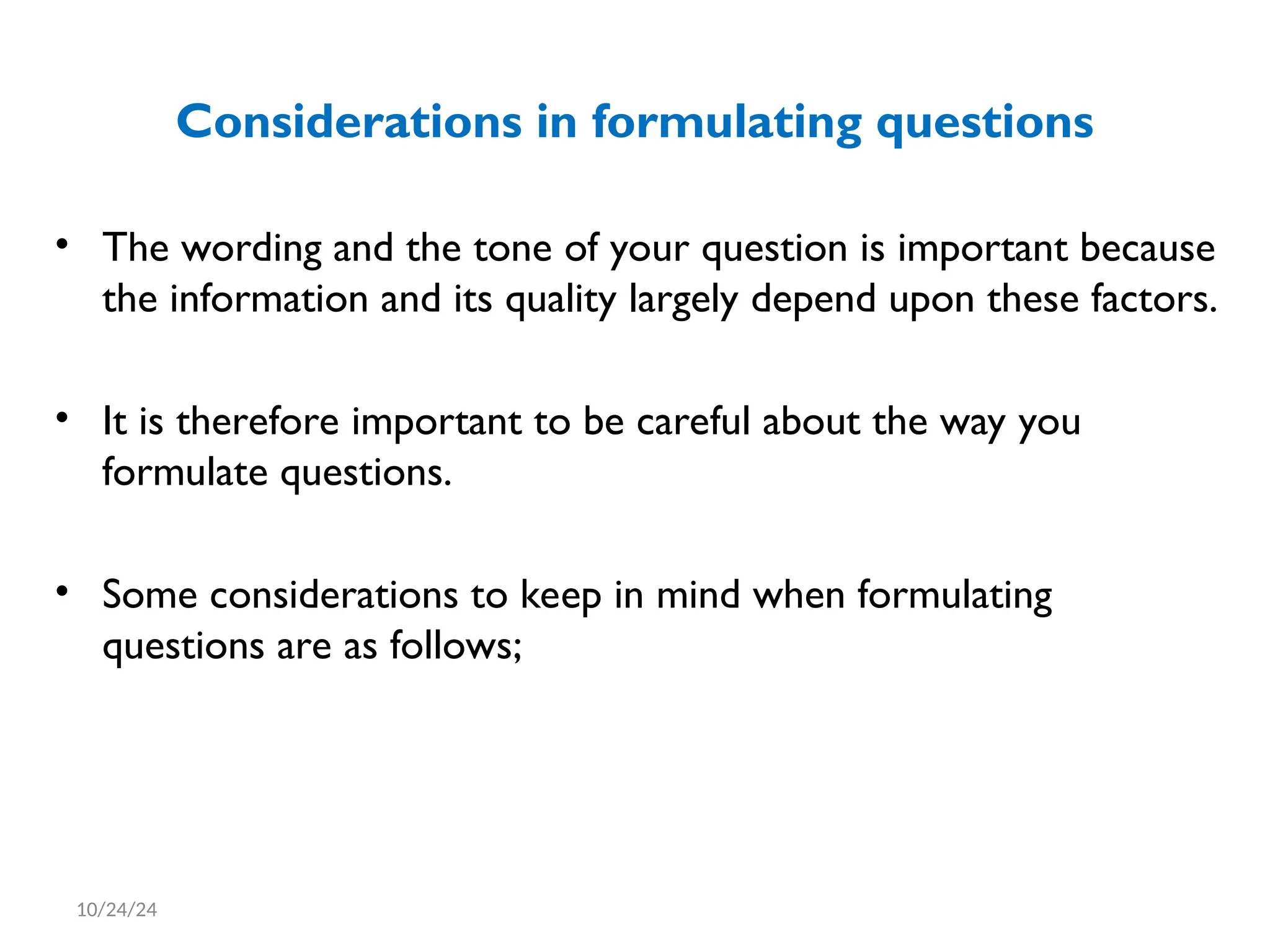
Considerations in formulating questions
• The wording and the tone of your question is important because
the information and its quality largely depend upon these factors.
• It is therefore important to be careful about the way you
formulate questions.
• Some considerations to keep in mind when formulating
questions are as follows;
10/24/24
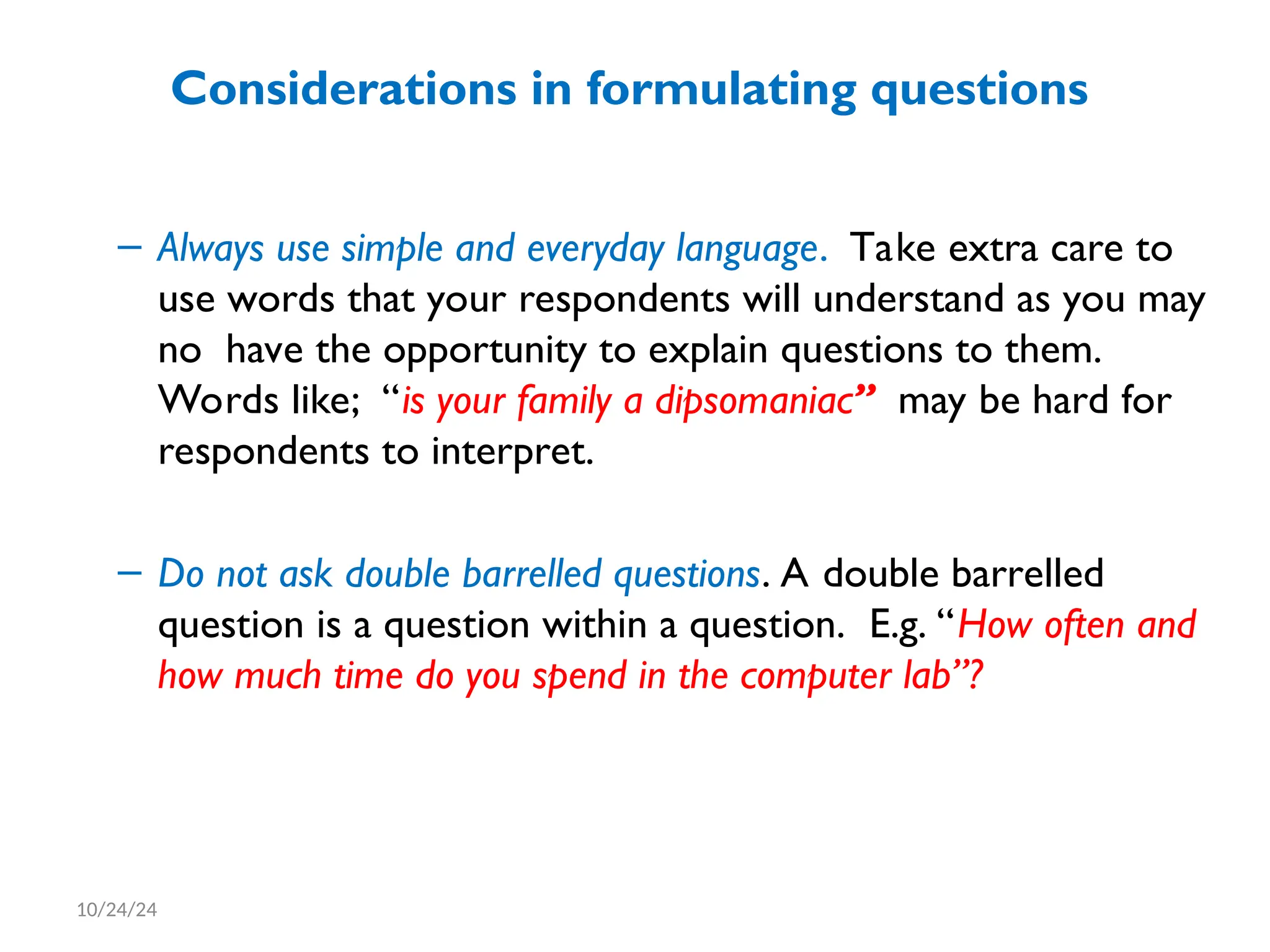
Considerations in formulating questions
– Always use simple and everyday language. Take extra care to
use words that your respondents will understand as you may
no have the opportunity to explain questions to them.
Words like; “is your family a dipsomaniac” may be hard for
respondents to interpret.
– Do not ask double barrelled questions. A double barrelled
question is a question within a question. E.g. “How often and
how much time do you spend in the computer lab”?
10/24/24
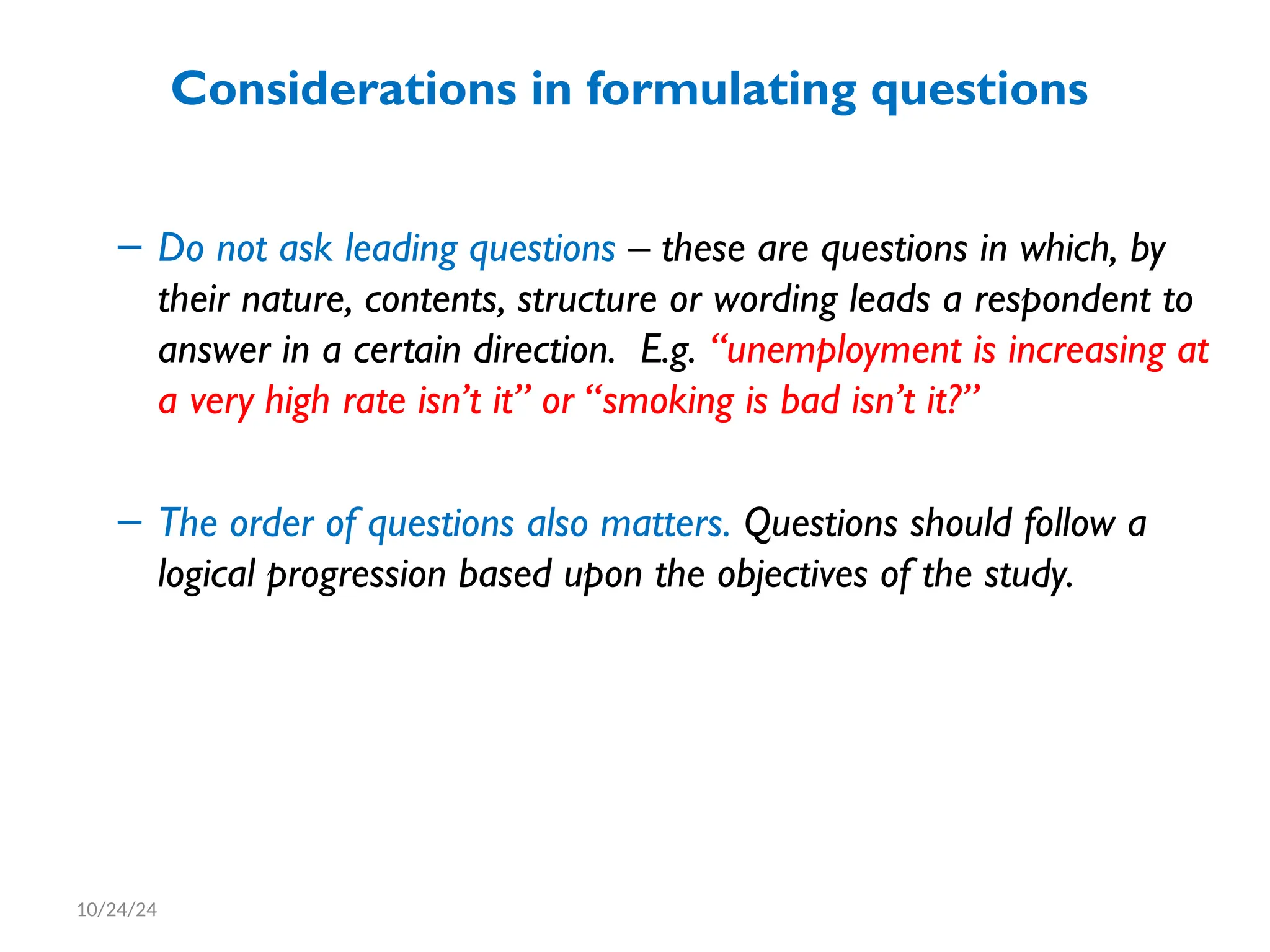
Considerations in formulating questions
– Do not ask leading questions – these are questions in which, by
their nature, contents, structure or wording leads a respondent to
answer in a certain direction. E.g. “unemployment is increasing at
a very high rate isn’t it” or “smoking is bad isn’t it?”
– The order of questions also matters. Questions should follow a
logical progression based upon the objectives of the study.
10/24/24
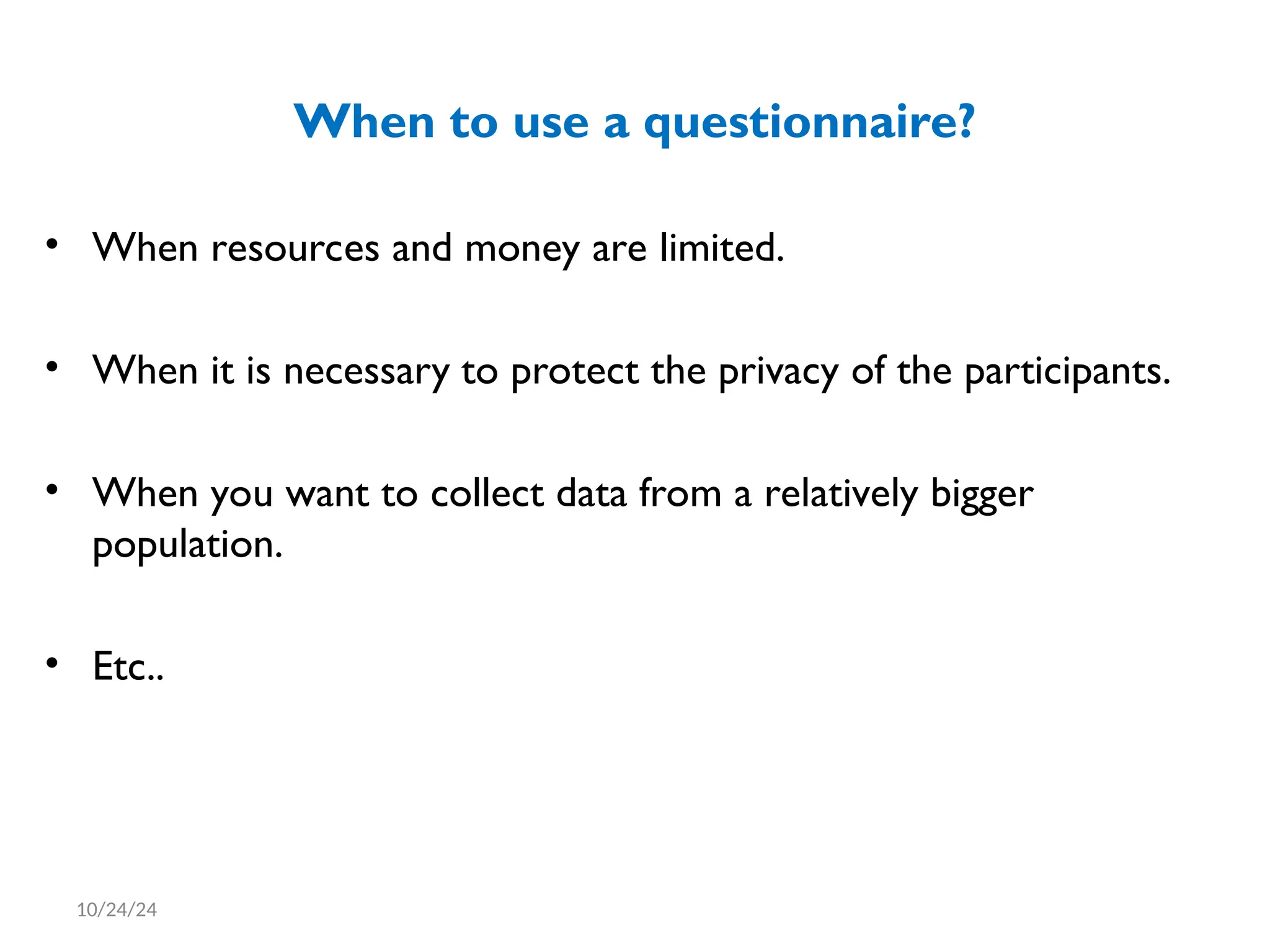
When to use a questionnaire?
• When resources and money are limited.
• When it is necessary to protect the privacy of the participants.
• When you want to collect data from a relatively bigger
population.
• Etc..
10/24/24
Course-work (Individual)
1 a) Define observation as a primary method of collecting data.
b) Types of observation
c) Problems associated with observation as a method of data collection.
d) Under what circumstances may observation as a method of data collection
be used?
2 a) Define Interview as a primary method of collecting data.
b) Interview classification
c) What criteria should a researcher base on to choose between an interview
schedule and a questionnaire
3 Explain the ethical issues that should be considered by a researcher while
collecting data.
10/24/24
Course-work specifications
• Font size - 12
• Font style - Times New Roman
• Line Spacing – 1.5
• Maximum number of pages – 6
• All the work should be justified.
10/24/24
METHODS OF SECONDARY DATA
COLLECTION
• Published Printed Sources: There are varieties of
published printed sources. Their credibility depends on
many factors. For example, on the writer, publishing
company and time and date when published. New sources
are preferred and old sources should be avoided as new
technology and researches bring new facts into light.
• Books: Books are available today on any topic that you
want to research.. After selection of topics books provide
insight on how much work has already been done on the
same topic and you can prepare your literature review.
Books are secondary source but most authentic one in
secondary sources.
• Journals/periodicals: Journals and periodicals are becoming
more important as far as data collection is concerned. The
reason is that journals provide up-to-date information
which at times books cannot and secondly, journals can
give information on the very specific topic on which you
are researching rather talking about more general topics.
• Magazines/Newspapers: Magazines are also effective but not
very reliable. Newspapers on the other hand are more reliable
and in some cases the information can only be obtained from
newspapers as in the case of some political studies.
• Published Electronic Sources: As internet is
becoming more advance, fast and reachable to the
masses; it has been seen that much information that is
not available in printed form is available on internet. In
the past the credibility of internet was questionable but
today it is not.. Some are free and for others you have
to pay the price.
• e-journals: e-journals are more commonly available
than printed journals. Latest journals are difficult to
retrieve without subscription but if your university
has an e-library you can view any journal, print it
and those that are not available you can make an order
for them.
• General Websites: Generally websites do not contain
very reliable information so their content should be
checked for the reliability before quoting from them.
Weblogs: Weblogs are also becoming common. They are
actually diaries written by different people. These diaries are
as reliable to use as personal written diaries.
• Unpublished Personal Records: Some unpublished data
may also be useful in some cases. Diaries: Diaries are
personal records and are rarely available but if you are
conducting a descriptive research then they might be very
useful. Letters: Letters like diaries are also a rich source but
should be checked for their reliability before using them.
• Government Records: Government records
are very important for marketing,
management, humanities and social science
research.
• Census Data/population statistics: Health
records; Educational institutes’ records etc.
Public Sector Records: NGOs’ survey data;
Other private companies records.

CONCEPT OF DATA COLLECTION METHODS USED IN RESEARCH.

  • 1.
    CONCEPT OF DATACOLLECTION
  • 2.
    Introduction • Data collectionis the process of gathering and measuring information on variables of interest, in an established systematic fashion that enables one to answer stated research questions, test hypotheses, and evaluate outcomes. • The goal for all data collection is to capture quality evidence that then translates to rich data analysis and allows the building of a convincing and credible answer to questions that have been posed.
  • 3.
    • Regardless ofthe field of study or preference for defining data (quantitative, qualitative), accurate data collection is essential to maintaining the integrity of research. • Both the selection of appropriate data collection instruments (existing, modified, or newly developed) and clearly delineated instructions for their correct use reduce the likelihood of errors occurring.
  • 4.
    • Data collectionis one of the most important stages in conducting a research. • You can have the best research design in the world but if you cannot collect the required data you will be not be able to complete your project. • Data collection is a very demanding job which needs thorough planning, hard work, patience, perseverance and more to be able to complete the task successfully. • Data collection starts with determining what kind of data required followed by the selection of a sample from a certain population. • After that, you need to use a certain instrument to collect the data from the selected sample.
  • 5.
    TYPES OF DATA •Data are organized into two broad categories: qualitative and quantitative. • Qualitative Data: Qualitative data are mostly non-numerical and usually descriptive or nominal in nature. • This means the data collected are in the form of words and sentences. • Often (not always), such data captures feelings, emotions, or subjective perceptions of something.
  • 6.
    Quantitative Data: • Quantitativedata is numerical in nature and can be mathematically computed. • Quantitative data measure uses different scales, which can be classified as nominal scale, ordinal scale, interval scale and ratio scale. Often (not always), such data includes measurements of something. • Quantitative approaches address the ‘what’ of the program. They use a systematic standardized approach and employ methods such as surveys and ask questions.
  • 7.
    PRIMARY DATA • Datathat has been collected from first-hand- experience is known as primary data. • Primary data has not been published yet and is more reliable, authentic and objective. • Primary data has not been changed or altered by human beings; therefore its validity is greater than secondary data. Importance of Primary Data: In statistical surveys it is necessary to get information from primary sources and work on primary data. • For example, the statistical records of female population in a country cannot be based on newspaper, magazine and other printed sources.
  • 8.
    • A researchcan be conducted without secondary data but a research based on only secondary data is least reliable and may have biases because secondary data has already been manipulated by human beings. • One of such sources is old and secondly they contain limited information as well as they can be misleading and biased.
  • 9.
    Advantages of UsingPrimary Data • The investigator collects data specific to the problem under study. • There is no doubt about the quality of the data collected (for the investigator). • If required, it may be possible to obtain additional data during the study period.
  • 10.
    Disadvantages of UsingPrimary Data 1. The investigator has to contend with all the hassles of data collection- • deciding why, what, how, when to collect; • getting the data collected (personally or through others); getting  funding and dealing with funding agencies; • ethical considerations (consent, permissions, etc.). 2. Ensuring the data collected is of a high standard-  all desired data is obtained accurately, and in the format it is required in;  there is no fake/ cooked up data;  unnecessary/ useless data has not been included. 3. Cost of obtaining the data is often the major expense in studies.
  • 11.
    SECONDARY DATA • Datacollected from a source that has already been published in any form is called as secondary data. The review of literature in any research is based on secondary data. • It is collected by someone else for some other purpose (but being utilized by the investigator for another purpose). For examples, Census data being used to analyze the impact of education on career choice and earning. • Secondary data is essential, since it is impossible to conduct a new survey that can adequately capture past change and/or developments
  • 12.
    Sources of SecondaryData: The following are some ways of collecting secondary data – • Books • Records • Biographies • Newspapers • Published censuses or other statistical data • Data archives • Internet articles • Research articles by other researchers (journals) • Databases, etc.
  • 13.
    Importance of SecondaryData: Secondary data can be less valid but its importance is still there. 1.Sometimes it is difficult to obtain primary data; in these cases getting information from secondary sources is easier and possible. 2.Sometimes primary data does not exist in such situation one has to confine the research on secondary data. 3.Sometimes primary data is present but the respondents are not willing to reveal it in such case too secondary data can suffice 4.A clear benefit of using secondary data is that much of the background work needed has already been carried out. For example, literature reviews, case studies might have been carried out, published texts and statistics could have been already used elsewhere, media promotion and personal contacts have also been utilized.
  • 14.
    • Secondary datacan also be helpful in the research design of subsequent primary research and can provide a baseline with which the collected primary data results can be compared to. • Therefore, it is always wise to begin any research activity with a review of the secondary data. Advantages of Using Secondary Data • No hassles of data collection. • It is less expensive. • The investigator is not personally responsible for the quality of data (‘I didn’t do it’).
  • 15.
    Disadvantages of UsingSecondary Data 1. The investigator cannot decide what is to be collected 2. One can only hope that the data is of good quality 3. Obtaining additional data is not possible 4. With time the data becomes old and obsolete 5. Reliability and accuracy issues 6. Sometimes can bring copyright issues
  • 16.
  • 17.
    The questionnaire • Aquestionnaire is a written list of questions, the answers to which are recorded by respondents. • In questionnaire respondents read the question, interpret what is expected and the write down the answers. • Unlike an interview guide in which the researcher may explain the meaning of some questions, in the case of questionnaire, there is no one to explain the meaning of questions to respondents. • Therefore questions in a questionnaire must be clear and easy to understand. 10/24/24
  • 18.
    Ways of administeringa questionnaire • A questionnaire can be administered in different ways.. – A mailed questionnaire – one approach to collecting information is to send the questionnaire to prospective respondents by mail. Obviously, this method presupposes that u have access to their address. One of the major problem with this approach is the low response rate. – Collective administration – one of the best ways of administering questionnaires is to obtain a captive audience such as students in a class room, people attending a function, or people assembled in one place. This ensures a high response rate as you will find very few people refusing to participate in your study. 10/24/24
  • 19.
    Contents of aquestionnaire cover letter • It is essential that you write a cover letter to accompany your questionnaire. It should very briefly: – Introduce you and the institution you are representing. – Describe in two or three lines the main objective of the study. – Convey any general instructions. – Assure respondents of the anonymity of the information provided by them. – Provide a contact number incase they have questions. – Give them a return address for the questionnaire and a deadline for its return. – Thank them for their participation. 10/24/24
  • 20.
    Questionnaires… Advantages Disadvantages •Less expensiveto administer mostly if the collective method is used. •Limited application. •Able to collect information from a larger sample •Lack of opportunity to clarify issues. • it offers greater anonymity. •Low response rate. •It is possible to consult others. • Spontaneous responses may not be possible mostly if it’s a mailed questionnaire. 10/24/24
  • 21.
    Forms of questionsin a questionnaire • In a questionnaires, questions may be formulated as; – Closed ended or – Open ended • In a closed-ended question, the possible answers are set out in the questionnaire and the respondent ticks the category that best describes the respondents answer. E.g. – Please tick the type of research you would love to undertake. Applied research Basic Research descriptive research quantitative • In open ended questions, the possible responses are not given. The respondent writes down the answers in his/her words. E.g. – Please explain why you opted for a Bachelors degree in Information technology? 10/24/24
  • 22.
    Considerations in formulatingquestions • The wording and the tone of your question is important because the information and its quality largely depend upon these factors. • It is therefore important to be careful about the way you formulate questions. • Some considerations to keep in mind when formulating questions are as follows; 10/24/24
  • 23.
    Considerations in formulatingquestions – Always use simple and everyday language. Take extra care to use words that your respondents will understand as you may no have the opportunity to explain questions to them. Words like; “is your family a dipsomaniac” may be hard for respondents to interpret. – Do not ask double barrelled questions. A double barrelled question is a question within a question. E.g. “How often and how much time do you spend in the computer lab”? 10/24/24
  • 24.
    Considerations in formulatingquestions – Do not ask leading questions – these are questions in which, by their nature, contents, structure or wording leads a respondent to answer in a certain direction. E.g. “unemployment is increasing at a very high rate isn’t it” or “smoking is bad isn’t it?” – The order of questions also matters. Questions should follow a logical progression based upon the objectives of the study. 10/24/24
  • 25.
    When to usea questionnaire? • When resources and money are limited. • When it is necessary to protect the privacy of the participants. • When you want to collect data from a relatively bigger population. • Etc.. 10/24/24
  • 26.
    Course-work (Individual) 1 a)Define observation as a primary method of collecting data. b) Types of observation c) Problems associated with observation as a method of data collection. d) Under what circumstances may observation as a method of data collection be used? 2 a) Define Interview as a primary method of collecting data. b) Interview classification c) What criteria should a researcher base on to choose between an interview schedule and a questionnaire 3 Explain the ethical issues that should be considered by a researcher while collecting data. 10/24/24
  • 27.
    Course-work specifications • Fontsize - 12 • Font style - Times New Roman • Line Spacing – 1.5 • Maximum number of pages – 6 • All the work should be justified. 10/24/24
  • 28.
    METHODS OF SECONDARYDATA COLLECTION • Published Printed Sources: There are varieties of published printed sources. Their credibility depends on many factors. For example, on the writer, publishing company and time and date when published. New sources are preferred and old sources should be avoided as new technology and researches bring new facts into light. • Books: Books are available today on any topic that you want to research.. After selection of topics books provide insight on how much work has already been done on the same topic and you can prepare your literature review. Books are secondary source but most authentic one in secondary sources.
  • 29.
    • Journals/periodicals: Journalsand periodicals are becoming more important as far as data collection is concerned. The reason is that journals provide up-to-date information which at times books cannot and secondly, journals can give information on the very specific topic on which you are researching rather talking about more general topics. • Magazines/Newspapers: Magazines are also effective but not very reliable. Newspapers on the other hand are more reliable and in some cases the information can only be obtained from newspapers as in the case of some political studies.
  • 30.
    • Published ElectronicSources: As internet is becoming more advance, fast and reachable to the masses; it has been seen that much information that is not available in printed form is available on internet. In the past the credibility of internet was questionable but today it is not.. Some are free and for others you have to pay the price. • e-journals: e-journals are more commonly available than printed journals. Latest journals are difficult to retrieve without subscription but if your university has an e-library you can view any journal, print it and those that are not available you can make an order for them.
  • 31.
    • General Websites:Generally websites do not contain very reliable information so their content should be checked for the reliability before quoting from them. Weblogs: Weblogs are also becoming common. They are actually diaries written by different people. These diaries are as reliable to use as personal written diaries. • Unpublished Personal Records: Some unpublished data may also be useful in some cases. Diaries: Diaries are personal records and are rarely available but if you are conducting a descriptive research then they might be very useful. Letters: Letters like diaries are also a rich source but should be checked for their reliability before using them.
  • 32.
    • Government Records:Government records are very important for marketing, management, humanities and social science research. • Census Data/population statistics: Health records; Educational institutes’ records etc. Public Sector Records: NGOs’ survey data; Other private companies records.