DATA
COLLECTION
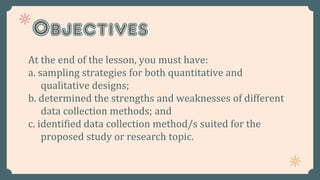
Objectives
At the end of the lesson, you must have:
a. sampling strategies for both quantitative and
qualitative designs;
b. determined the strengths and weaknesses of different
data collection methods; and
c. identified data collection method/s suited for the
proposed study or research topic.
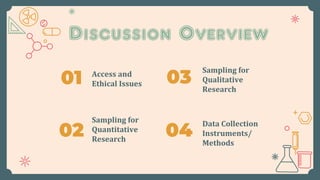
Discussion Overview
01 Access and
Ethical Issues
02
Sampling for
Quantitative
Research
03
04
Sampling for
Qualitative
Research
Data Collection
Instruments/
Methods
Gaining access to people
and institutions for data
collection purposes
requires initiating a
relationship based on a
degree of trust.
The identity of the
participants in your
study should not be
revealed.
provide study participants with a statement in writing
informing them that their participation is voluntary,
that the data will be treated in a confidential manner
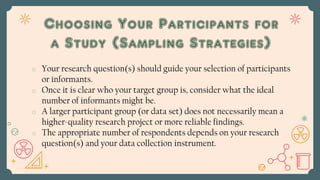
o Your research question(s) should guide your selection of participants
or informants.
o Once it is clear who your target group is, consider what the ideal
number of informants might be.
o A larger participant group (or data set) does not necessarily mean a
higher-quality research project or more reliable findings.
o The appropriate number of respondents depends on your research
question(s) and your data collection instrument.
Choosing Your Participants for
a Study (Sampling Strategies)
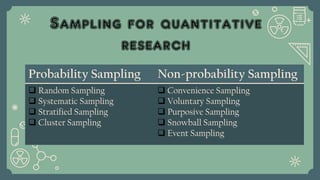
Sampling for quantitative
research
Probability Sampling Non-probability Sampling
 Random Sampling
 Systematic Sampling
 Stratified Sampling
 Cluster Sampling
 Convenience Sampling
 Voluntary Sampling
 Purposive Sampling
 Snowball Sampling
 Event Sampling
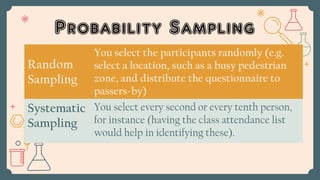
Probability Sampling
Random
Sampling
You select the participants randomly (e.g.
select a location, such as a busy pedestrian
zone, and distribute the questionnaire to
passers-by)
Systematic
Sampling
You select every second or every tenth person,
for instance (having the class attendance list
would help in identifying these).
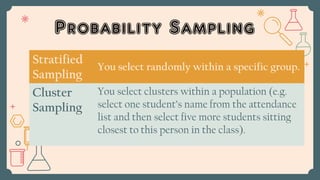
Probability Sampling
Stratified
Sampling
You select randomly within a specific group.
Cluster
Sampling
You select clusters within a population (e.g.
select one student’s name from the attendance
list and then select five more students sitting
closest to this person in the class).
Sampling for qualitative
research
Qualitative research focuses on describing, understanding,
and clarifying a human experience and therefore
qualitative studies are directed at describing the aspects
that make up an idiosyncratic experience rather than
determining the most likely, or mean experience, within a
group (Polkinghorne 2005).
Main goal of Sampling
to find individuals who can provide rich
and varied insights into the phenomenon
under investigation so as to maximize
what we can learn. This goal is best

achieved by means of some sort of
'purposeful' or 'purposive' sampling’.

How big should the sample
size be in a qualitative study?
A well-designed qualitative study usually
requires a relatively small number of
respondents to yield the saturated and rich
data that is needed to understand even subtle
meanings in the phenomenon under focus.
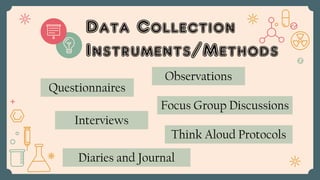
Data Collection
Instruments/Methods
Questionnaires
Interviews
Observations
Focus Group Discussions
Diaries and Journal
Think Aloud Protocols
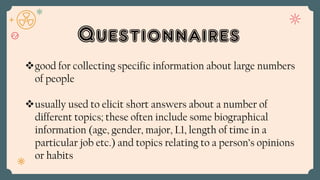
Questionnaires
good for collecting specific information about large numbers
of people
usually used to elicit short answers about a number of
different topics; these often include some biographical
information (age, gender, major, L1, length of time in a
particular job etc.) and topics relating to a person’s opinions
or habits
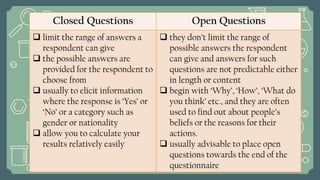
Closed Questions Open Questions
 limit the range of answers a
respondent can give
 the possible answers are
provided for the respondent to
choose from
 usually to elicit information
where the response is ‘Yes’ or
‘No’ or a category such as
gender or nationality
 allow you to calculate your
results relatively easily
 they don’t limit the range of
possible answers the respondent
can give and answers for such
questions are not predictable either
in length or content
 begin with ‘Why’, ‘How’, ‘What do
you think’ etc., and they are often
used to find out about people’s
beliefs or the reasons for their
actions.
 usually advisable to place open
questions towards the end of the
questionnaire
Interviews
Collecting data through an interview rather than
a questionnaire provides the opportunity to
explore a topic in conversation with the
interviewee; it is likely you don’t know exactly
how the conversation will develop and what
topics will be raised. This unknown quality is
one of the exciting things about interviews.
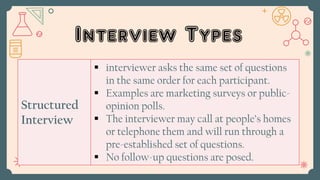
Interview Types
Structured
Interview
 interviewer asks the same set of questions
in the same order for each participant.
 Examples are marketing surveys or public-
opinion polls.
 The interviewer may call at people’s homes
or telephone them and will run through a
pre-established set of questions.
 No follow-up questions are posed.
Interview Types
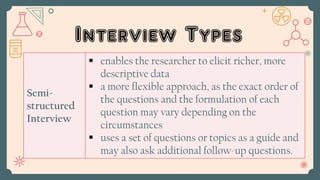
Semi-
structured
Interview
 enables the researcher to elicit richer, more
descriptive data
 a more flexible approach, as the exact order of
the questions and the formulation of each
question may vary depending on the
circumstances
 uses a set of questions or topics as a guide and
may also ask additional follow-up questions.
Interview Types
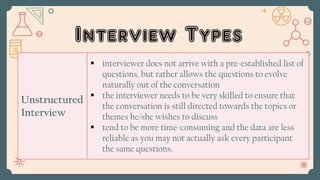
Unstructured
Interview
 interviewer does not arrive with a pre-established list of
questions, but rather allows the questions to evolve
naturally out of the conversation
 the interviewer needs to be very skilled to ensure that
the conversation is still directed towards the topics or
themes he/she wishes to discuss
 tend to be more time-consuming and the data are less
reliable as you may not actually ask every participant
the same questions.
Observations
 Observations can provide valuable insight into real life practice; what
people say they do and what they actually do in practice may be quite
different.
 Observation is a widely used method for data collection in the field of
applied linguistics, especially for those involving qualitative research
designs.
 it provides researchers with the opportunity to collect ‘live’ and first-
hand data from naturally occurring situations around language
(Cohen, Maion, & Morrison, 2011).
As a non-participant, you don’t take part in any activities
and the goal is to be as unobtrusive as possible. You will
probably have a checklist of things you are looking for and
you will be taking detailed notes during your observation. As
a participant, you take an active part in the usual activities
undertaken at this location.
The researcher may take a non-participatory or
participatory role during the observation.
 The unstructured approach involves the researcher
undertaking observations without a preconceived plan of
what to focus on; in this case, the researcher needs to take
notes on everything that is happening. Later, the researcher
looks through the data to find patterns.
There are two approaches to observations:
unstructured or structured (or planned).
 Alternatively, during a structured or planned observation,
the researcher has a clear framework of what he/she is
intending to observe, usually in the form of a worksheet
with a list of topics.
There are two approaches to observations:
unstructured or structured (or planned).
Focus Group Discussions
A focus group is a gathering of people brought together by
the researcher for the specific purpose of discussing
topics related to an area of research.
The point of a focus group is to elicit people’s views in
relation to a topic and to examine how people make sense
of certain situations and experiences through talk.
Focus Group Discussions
Focus groups are not suitable for all types of studies.
A focus-group discussion is not a suitable method to
compile data on whether people agree or disagree with a
particular idea or phenomenon.
A focus group is a public setting and, just as in any other
interaction, people may not necessarily disclose their true
opinion.
Focus Group Discussions
The typical group size of a focus group is around six. Larger
groups offer fewer opportunities for individuals to participate;
however, if you have too few participants, the range of views
and experiences within the group will likely be narrower.
The discussion may last around 60–90 minutes depending on
the group. If the discussion continues too long, participants
may start leaving, which will inevitably change the discussion
dynamics.
Think Aloud Protocols
Collecting data through think-aloud protocols allows insight
into students’ thought processes while completing an activity.
Activities typically suited for this data collection method
involve decision making, judgements or reasoning processes.
Students are instructed to voice all thoughts that run through
their mind (‘think aloud’) and these verbalizations are
recorded and later analyzed by the researcher.
Think Aloud Protocols
The think-aloud approach to data collection is most
typically used while participants undertake a task.
This is known as concurrent think-aloud and it gives
the researcher insights into the participants’ thought
processes while experiencing a particular task or
activity.
Think Aloud Protocols
Participants can also be asked to think aloud after the
activity, while watching a recording of themselves
undertaking a task. This version is known as
retrospective think-aloud or stimulated recall. The
think-aloud technique is only suitable for certain
research topics, as the act of thinking aloud may
interfere with how participants undertake a task (Gu,
2014).
Think Aloud Protocols
If this technique is chosen and implemented with care,
however, it can be an effective means of investigating
how learners use the knowledge they have of the
language or the information that is provided to them to
complete certain tasks (Bowles, 2010; Koro- Ljungberg
et al., 2012).
Think Aloud Protocols
To ensure this metacognitive approach is successful,
the instructions need to be carefully worded so that
participants are prompted to provide justifications for
their answers (Bowles, 2010, p. 119).
Think Aloud Protocols
1. The first step of these instructions should include a brief statement
of the purpose of the activity and a simple explanation of why
students need to verbalize their thoughts (e.g. ‘I am interested in
what you think about as you use the correction code symbols to
revise your text. Please think aloud as you revise the text. Let me
understand what is going through your mind.’). It is best not to
explain the goal of the research to participants, however, as this
could lead to students becoming overly conscious of the particular
feature under study.
Think Aloud Protocols
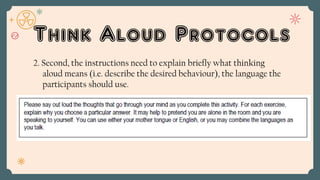
2. Second, the instructions need to explain briefly what thinking
aloud means (i.e. describe the desired behaviour), the language the
participants should use.
Think Aloud Protocols
Rather than using think-alouds as the sole data
collection method, Koro-Ljungberg et al. (2012, p. 742)
propose using them in conjunction with interviews. In
their study, they describe scheduling interviews with
participants two days after the think-aloud exercise.
Diaries and Journal
Diary methods are powerful data collection methods for
classroom-based L2 research, especially when students
are participants in a study. As they are completed by
the students themselves, diaries and journals can tap
directly into learners’ everyday language practices and
thoughts, which may otherwise be difficult to capture
with other data collection methods (Dörnyei, 2007).
Diaries and Journal
Porto (2007) notes that diary methods can be
used to promote reflection and introspection
into learner autonomy in particular, where
learning behaviours occur outside observable
learning contexts.
Diaries and Journal
Bolger, Davis, and Rafaeli (2003) state that diaries and
journals, as “self-report instruments used repeatedly to
examine ongoing experiences, offer the opportunity to
investigate social, psychological, and physiological
processes, within everyday situations” (p. 580).
Diaries and Journal
 As Krishnamurty (2008) observes: Data from diary
studies can be used to make cross-sectional comparisons
across people, track an individual over time, or study
processes within individuals or families.
 they allow events to be recorded in their natural setting
and, in theory, minimize the delay between the event and
the time it is recorded. (p. 197)
Diaries and Journal
An advantage of diary methods is their ability to
enable the investigation of behaviours and thoughts
surrounding events and experiences in their real-
world and unprompted context – something not
attainable via most other introspective research
methods (Reis & Gable, 2000).
Diaries and Journal
 Another advantage of diary methods is the agency they
transfer from the researcher to the participant.
 Dörnyei (2007) argues that diary methods provide an
insider account of the research construct, in that the
participants act as co-researchers in the study.
References:
Buckingham, L. (2016). Doing a research project in English studies.
New York, NY: Routledge.
Dornyei, Z. (2011). Research methods in applied linguistics. Oxford,
United Kingdom: Oxford University Press.
Mckinley J. & Rose, H. (2020). The Routledge Handbook of Research
Methods in Applied Linguistics. New York, NY: Routledge.
CREDITS: This presentation template was
created by Slidesgo, including icons by
Flaticon, and infographics & images by
Freepik
Do you have any questions?
You can email me at
julieanne.tasic@deped.gov.ph
Thanks!

Module 2- Data Collection.pdf

  • 1.
  • 2.
    Objectives At the endof the lesson, you must have: a. sampling strategies for both quantitative and qualitative designs; b. determined the strengths and weaknesses of different data collection methods; and c. identified data collection method/s suited for the proposed study or research topic.
  • 3.
    Discussion Overview 01 Accessand Ethical Issues 02 Sampling for Quantitative Research 03 04 Sampling for Qualitative Research Data Collection Instruments/ Methods
  • 4.
    Gaining access topeople and institutions for data collection purposes requires initiating a relationship based on a degree of trust. The identity of the participants in your study should not be revealed. provide study participants with a statement in writing informing them that their participation is voluntary, that the data will be treated in a confidential manner
  • 5.
    o Your researchquestion(s) should guide your selection of participants or informants. o Once it is clear who your target group is, consider what the ideal number of informants might be. o A larger participant group (or data set) does not necessarily mean a higher-quality research project or more reliable findings. o The appropriate number of respondents depends on your research question(s) and your data collection instrument. Choosing Your Participants for a Study (Sampling Strategies)
  • 6.
    Sampling for quantitative research ProbabilitySampling Non-probability Sampling  Random Sampling  Systematic Sampling  Stratified Sampling  Cluster Sampling  Convenience Sampling  Voluntary Sampling  Purposive Sampling  Snowball Sampling  Event Sampling
  • 7.
    Probability Sampling Random Sampling You selectthe participants randomly (e.g. select a location, such as a busy pedestrian zone, and distribute the questionnaire to passers-by) Systematic Sampling You select every second or every tenth person, for instance (having the class attendance list would help in identifying these).
  • 8.
    Probability Sampling Stratified Sampling You selectrandomly within a specific group. Cluster Sampling You select clusters within a population (e.g. select one student’s name from the attendance list and then select five more students sitting closest to this person in the class).
  • 9.
    Sampling for qualitative research Qualitativeresearch focuses on describing, understanding, and clarifying a human experience and therefore qualitative studies are directed at describing the aspects that make up an idiosyncratic experience rather than determining the most likely, or mean experience, within a group (Polkinghorne 2005).
  • 10.
    Main goal ofSampling to find individuals who can provide rich and varied insights into the phenomenon under investigation so as to maximize what we can learn. This goal is best achieved by means of some sort of 'purposeful' or 'purposive' sampling’.
  • 11.
    How big shouldthe sample size be in a qualitative study? A well-designed qualitative study usually requires a relatively small number of respondents to yield the saturated and rich data that is needed to understand even subtle meanings in the phenomenon under focus.
  • 12.
  • 13.
    Questionnaires good for collectingspecific information about large numbers of people usually used to elicit short answers about a number of different topics; these often include some biographical information (age, gender, major, L1, length of time in a particular job etc.) and topics relating to a person’s opinions or habits
  • 14.
    Closed Questions OpenQuestions  limit the range of answers a respondent can give  the possible answers are provided for the respondent to choose from  usually to elicit information where the response is ‘Yes’ or ‘No’ or a category such as gender or nationality  allow you to calculate your results relatively easily  they don’t limit the range of possible answers the respondent can give and answers for such questions are not predictable either in length or content  begin with ‘Why’, ‘How’, ‘What do you think’ etc., and they are often used to find out about people’s beliefs or the reasons for their actions.  usually advisable to place open questions towards the end of the questionnaire
  • 15.
    Interviews Collecting data throughan interview rather than a questionnaire provides the opportunity to explore a topic in conversation with the interviewee; it is likely you don’t know exactly how the conversation will develop and what topics will be raised. This unknown quality is one of the exciting things about interviews.
  • 16.
    Interview Types Structured Interview  interviewerasks the same set of questions in the same order for each participant.  Examples are marketing surveys or public- opinion polls.  The interviewer may call at people’s homes or telephone them and will run through a pre-established set of questions.  No follow-up questions are posed.
  • 17.
    Interview Types Semi- structured Interview  enablesthe researcher to elicit richer, more descriptive data  a more flexible approach, as the exact order of the questions and the formulation of each question may vary depending on the circumstances  uses a set of questions or topics as a guide and may also ask additional follow-up questions.
  • 18.
    Interview Types Unstructured Interview  interviewerdoes not arrive with a pre-established list of questions, but rather allows the questions to evolve naturally out of the conversation  the interviewer needs to be very skilled to ensure that the conversation is still directed towards the topics or themes he/she wishes to discuss  tend to be more time-consuming and the data are less reliable as you may not actually ask every participant the same questions.
  • 19.
    Observations  Observations canprovide valuable insight into real life practice; what people say they do and what they actually do in practice may be quite different.  Observation is a widely used method for data collection in the field of applied linguistics, especially for those involving qualitative research designs.  it provides researchers with the opportunity to collect ‘live’ and first- hand data from naturally occurring situations around language (Cohen, Maion, & Morrison, 2011).
  • 20.
    As a non-participant,you don’t take part in any activities and the goal is to be as unobtrusive as possible. You will probably have a checklist of things you are looking for and you will be taking detailed notes during your observation. As a participant, you take an active part in the usual activities undertaken at this location. The researcher may take a non-participatory or participatory role during the observation.
  • 21.
     The unstructuredapproach involves the researcher undertaking observations without a preconceived plan of what to focus on; in this case, the researcher needs to take notes on everything that is happening. Later, the researcher looks through the data to find patterns. There are two approaches to observations: unstructured or structured (or planned).
  • 22.
     Alternatively, duringa structured or planned observation, the researcher has a clear framework of what he/she is intending to observe, usually in the form of a worksheet with a list of topics. There are two approaches to observations: unstructured or structured (or planned).
  • 23.
    Focus Group Discussions Afocus group is a gathering of people brought together by the researcher for the specific purpose of discussing topics related to an area of research. The point of a focus group is to elicit people’s views in relation to a topic and to examine how people make sense of certain situations and experiences through talk.
  • 24.
    Focus Group Discussions Focusgroups are not suitable for all types of studies. A focus-group discussion is not a suitable method to compile data on whether people agree or disagree with a particular idea or phenomenon. A focus group is a public setting and, just as in any other interaction, people may not necessarily disclose their true opinion.
  • 25.
    Focus Group Discussions Thetypical group size of a focus group is around six. Larger groups offer fewer opportunities for individuals to participate; however, if you have too few participants, the range of views and experiences within the group will likely be narrower. The discussion may last around 60–90 minutes depending on the group. If the discussion continues too long, participants may start leaving, which will inevitably change the discussion dynamics.
  • 26.
    Think Aloud Protocols Collectingdata through think-aloud protocols allows insight into students’ thought processes while completing an activity. Activities typically suited for this data collection method involve decision making, judgements or reasoning processes. Students are instructed to voice all thoughts that run through their mind (‘think aloud’) and these verbalizations are recorded and later analyzed by the researcher.
  • 27.
    Think Aloud Protocols Thethink-aloud approach to data collection is most typically used while participants undertake a task. This is known as concurrent think-aloud and it gives the researcher insights into the participants’ thought processes while experiencing a particular task or activity.
  • 28.
    Think Aloud Protocols Participantscan also be asked to think aloud after the activity, while watching a recording of themselves undertaking a task. This version is known as retrospective think-aloud or stimulated recall. The think-aloud technique is only suitable for certain research topics, as the act of thinking aloud may interfere with how participants undertake a task (Gu, 2014).
  • 29.
    Think Aloud Protocols Ifthis technique is chosen and implemented with care, however, it can be an effective means of investigating how learners use the knowledge they have of the language or the information that is provided to them to complete certain tasks (Bowles, 2010; Koro- Ljungberg et al., 2012).
  • 30.
    Think Aloud Protocols Toensure this metacognitive approach is successful, the instructions need to be carefully worded so that participants are prompted to provide justifications for their answers (Bowles, 2010, p. 119).
  • 31.
    Think Aloud Protocols 1.The first step of these instructions should include a brief statement of the purpose of the activity and a simple explanation of why students need to verbalize their thoughts (e.g. ‘I am interested in what you think about as you use the correction code symbols to revise your text. Please think aloud as you revise the text. Let me understand what is going through your mind.’). It is best not to explain the goal of the research to participants, however, as this could lead to students becoming overly conscious of the particular feature under study.
  • 32.
    Think Aloud Protocols 2.Second, the instructions need to explain briefly what thinking aloud means (i.e. describe the desired behaviour), the language the participants should use.
  • 33.
    Think Aloud Protocols Ratherthan using think-alouds as the sole data collection method, Koro-Ljungberg et al. (2012, p. 742) propose using them in conjunction with interviews. In their study, they describe scheduling interviews with participants two days after the think-aloud exercise.
  • 34.
    Diaries and Journal Diarymethods are powerful data collection methods for classroom-based L2 research, especially when students are participants in a study. As they are completed by the students themselves, diaries and journals can tap directly into learners’ everyday language practices and thoughts, which may otherwise be difficult to capture with other data collection methods (Dörnyei, 2007).
  • 35.
    Diaries and Journal Porto(2007) notes that diary methods can be used to promote reflection and introspection into learner autonomy in particular, where learning behaviours occur outside observable learning contexts.
  • 36.
    Diaries and Journal Bolger,Davis, and Rafaeli (2003) state that diaries and journals, as “self-report instruments used repeatedly to examine ongoing experiences, offer the opportunity to investigate social, psychological, and physiological processes, within everyday situations” (p. 580).
  • 37.
    Diaries and Journal As Krishnamurty (2008) observes: Data from diary studies can be used to make cross-sectional comparisons across people, track an individual over time, or study processes within individuals or families.  they allow events to be recorded in their natural setting and, in theory, minimize the delay between the event and the time it is recorded. (p. 197)
  • 38.
    Diaries and Journal Anadvantage of diary methods is their ability to enable the investigation of behaviours and thoughts surrounding events and experiences in their real- world and unprompted context – something not attainable via most other introspective research methods (Reis & Gable, 2000).
  • 39.
    Diaries and Journal Another advantage of diary methods is the agency they transfer from the researcher to the participant.  Dörnyei (2007) argues that diary methods provide an insider account of the research construct, in that the participants act as co-researchers in the study.
  • 40.
    References: Buckingham, L. (2016).Doing a research project in English studies. New York, NY: Routledge. Dornyei, Z. (2011). Research methods in applied linguistics. Oxford, United Kingdom: Oxford University Press. Mckinley J. & Rose, H. (2020). The Routledge Handbook of Research Methods in Applied Linguistics. New York, NY: Routledge.
  • 41.
    CREDITS: This presentationtemplate was created by Slidesgo, including icons by Flaticon, and infographics & images by Freepik Do you have any questions? You can email me at julieanne.tasic@deped.gov.ph Thanks!