Problem-Solution fit canvas
Put on your customer shoes
by Daria Nepriakhina
@epicantus
If you don’t know your customer well
then 99% of your assumptions are wrong.
Are we optimising the right thing?
Do people care?
Be (stay) relevant
to your customer
• customer state changes;
• problem and solution evolve;
• market shifts;
• audience switches to other channels;
• the perception of your brand changes too;
• ways of getting the job done advance.
Stay relevant, because:
Understand your customer and existing
experience to design for improvement
of people’s lives.
That’s why you need to
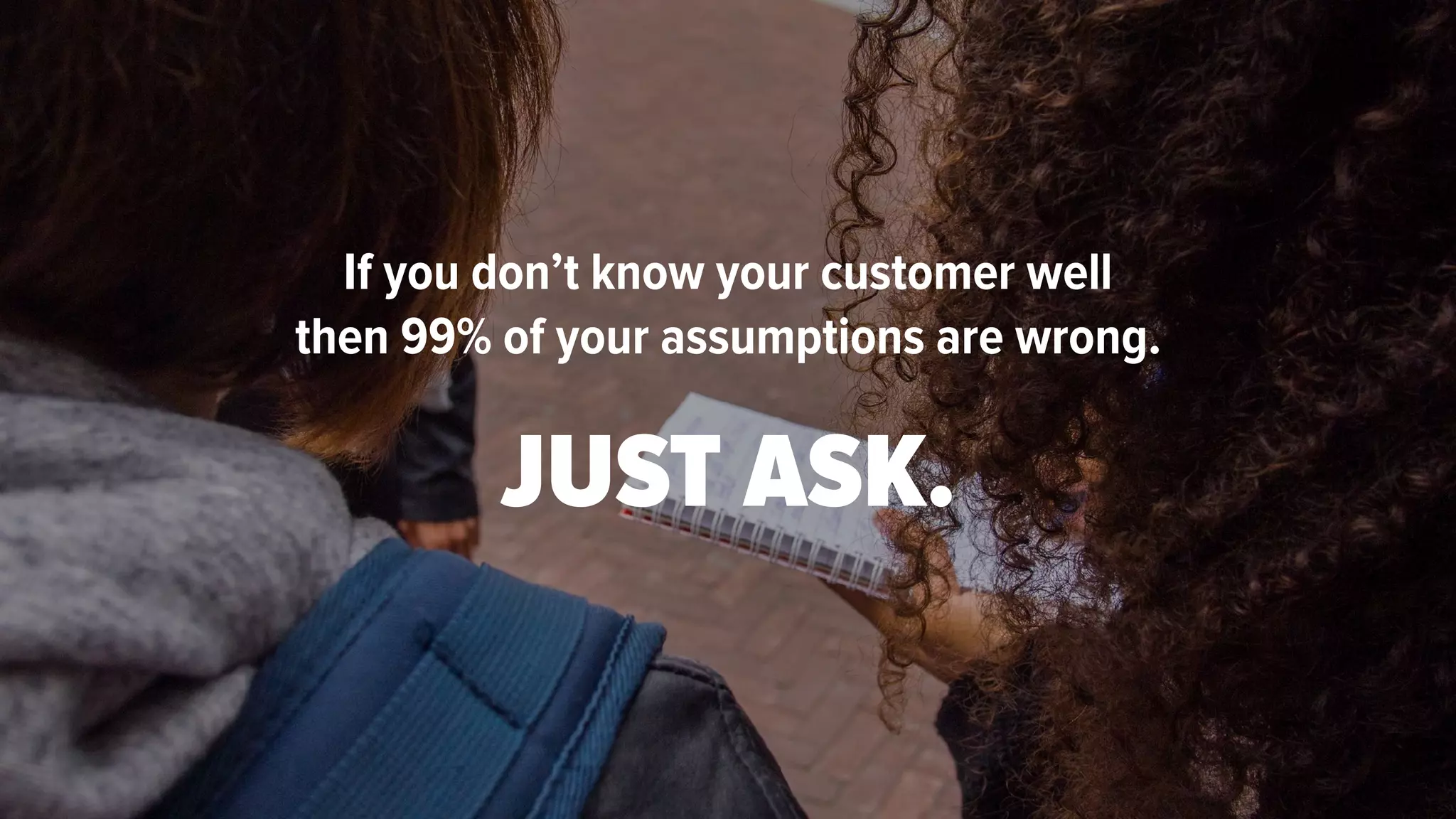
If you don’t know your customer well
then 99% of your assumptions are wrong.
JUST ASK.
In 90% of the cases people
can’t explain back
a value proposition they just saw.
“Can you look at this page and tell me what is it about?”
Do a comprehension test or 5-second test.
100% biological
hand-made
chocolate bar
Less calories
than in an average
sweet snack
Perfect hunger
killer in-between
lunch and dinner
The tastiest
chocolate bar
to share with a friend.
INFP / RCUAI ISFJ / RCOAN ENTJ / SCOEI ENFP / SCUAI
SAME CHOCOLATE BAR: different customer - different problem - different way of communication
If you are in business,
People are your subject to study.
Body language,
Big 5 type / SLOAN,
Communication style
Past behaviour,
Familiar methods
of doing the task
Worldview, social
circle, stereotypes,
Familiar triggers
The WHY behind
their actions.
What matters?
Data tells you what is wrong.
Customer interviews help you
to understand why.
Collect stories + data.
Context
Need Motivation
Fears
CUSTOMER STATE
Customers are real people.
Just like you, yet they might think differently.
… People are lazy.
They tend to go for the easiest
and more familiar solution.
Less effort, looks familiar, fits their state.
Lazy User model
Lazy User Theory for Solution Selection
USER
NEED
USER
STATE
limits
defines Set of
possible
solutions
to fulfil
the need
Selection of
solution based
on the lowest
level of effort
by Tétard & Collan
lazyusermodel.org
Lazy User model
Lazy User Theory for Solution Selection
USER
NEED
defines Set of
possible
solutions
to fulfil
the need
Selection of
solution based
on the lowest
level of effort
by Tétard & Collan
lazyusermodel.org
In a hurry,
no WiFi
connection
limits
Think in scenarios.
A person stumbles upon a trigger that increases problem
awareness. This boost causes a particular behaviour
to show up which results in an outcome: perceived
improvement or relief in customer's eyes.
Learn how people feel about the problem, current solution
and paying for it X much.
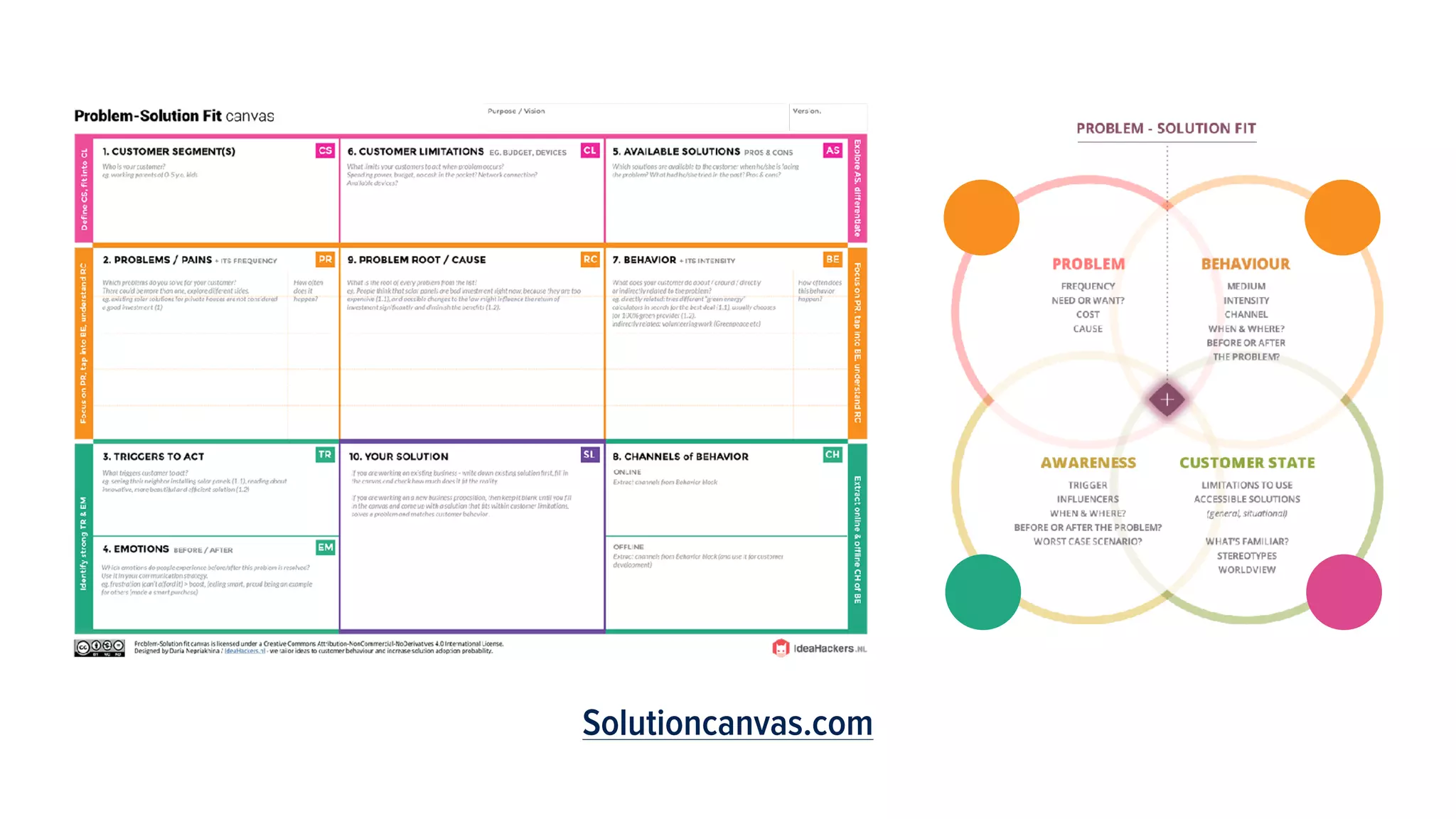
Solutioncanvas.com
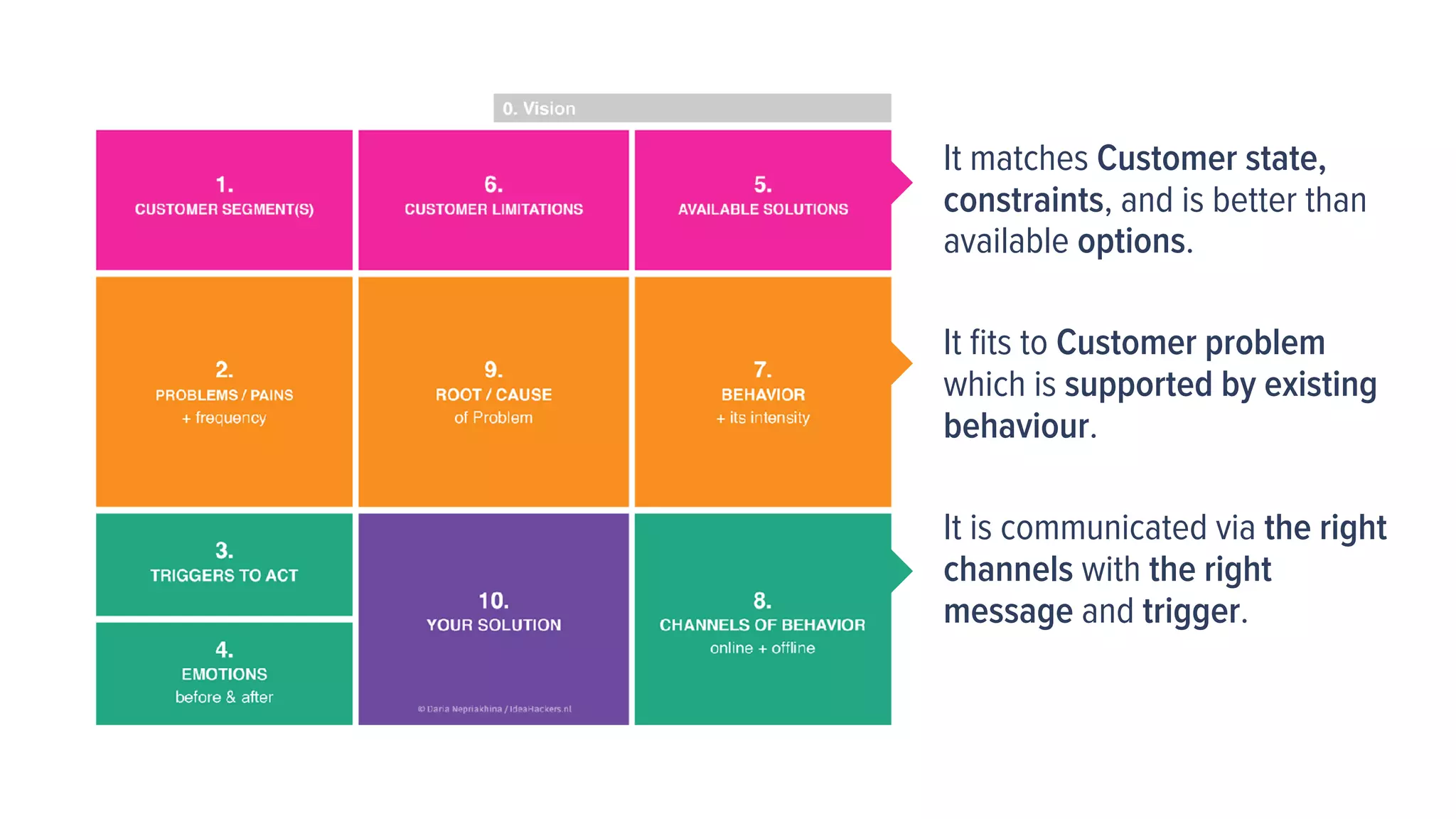
It matches Customer state,
constraints, and is better than
available options.
It fits to Customer problem
which is supported by existing
behaviour.
It is communicated via the right
channels with the right
message and trigger.
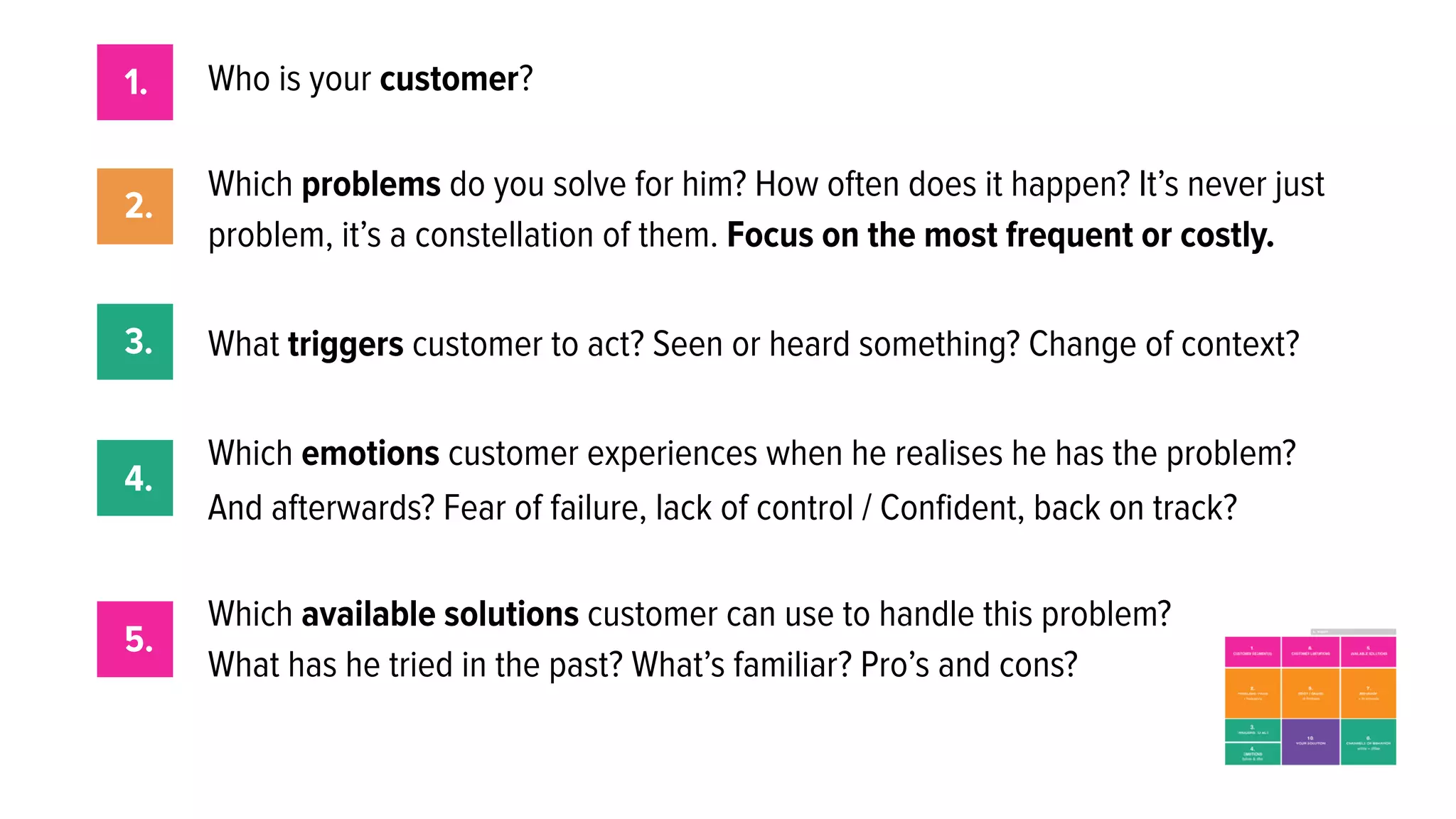
Who is your customer?
Which problems do you solve for him? How often does it happen? It’s never just
problem, it’s a constellation of them. Focus on the most frequent or costly.
What triggers customer to act? Seen or heard something? Change of context?
Which emotions customer experiences when he realises he has the problem?
And afterwards? Fear of failure, lack of control / Confident, back on track?
Which available solutions customer can use to handle this problem?
What has he tried in the past? What’s familiar? Pro’s and cons?
5.
4.
3.
2.
1.
Which constraints your customer is facing at the moment when this problem occurs?
Spending power, no cash, no network connection? Fit to customer constraints.
Existing behaviour: what does your customer do about / around / directly
or indirectly related to the problem? How often? Tap into frequent behaviour.
Where does this behavior occur? Extract online and offline channels of behaviour.
What is the root cause of every problem from the list? Is it still worth solving?
Does your proposition still match?
6.
8.
7.
9.
It’s all about behaviour and its frequency.
If there is no existing behaviour, there is
no problem to solve.
When people spend time on something,
they care about it.
How can this help me?
Identify intent, interest and baseline behavior based
on customer state and situation to find the right
product strategy.
“I’ve just arrived in a new country, where I don’t know the language. 🤷”
Context changed. Customer’s State is disturbed, high urgency to keep things on track.
ON TRAVEL EXPECTING A BABY
INTENT
Look for change of context or life stage, when disturbance of
the customer state boosts problem urgency and results into
behaviour.
Your strategy:
1. Get the job done efficiently.
2. Manage their expectations and fears.
3. Follow up to help them stay on track.
“Yesterday it was raining 🌧. I forgot my umbrella so I bought one ☔.
It’ll be the fifth we have 🤦”
Context changed. High urgency.
UNEXPECTED RAIN EMPTY BATTERY
INTENT
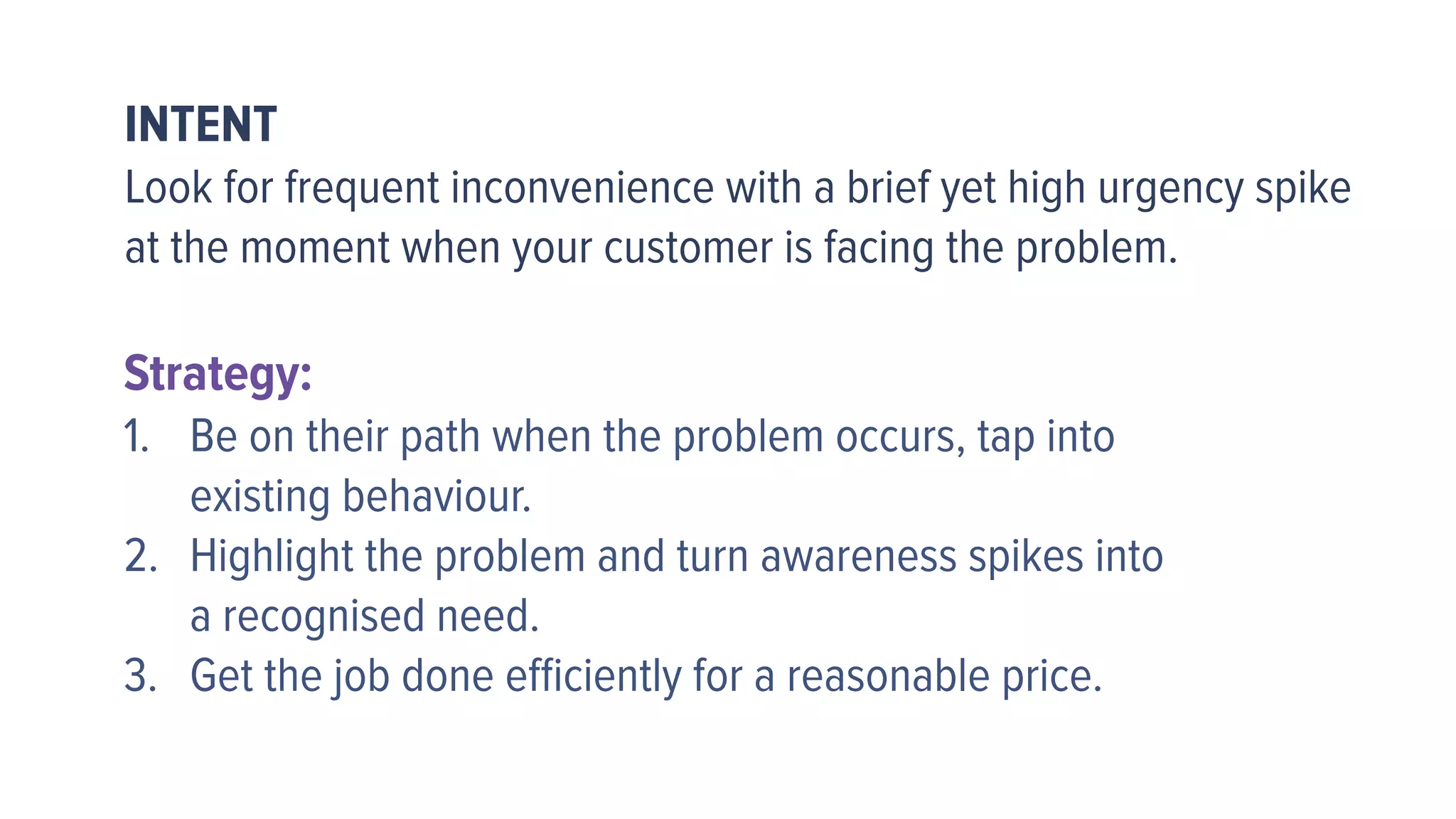
Look for frequent inconvenience with a brief yet high urgency spike
at the moment when your customer is facing the problem.
Strategy:
1. Be on their path when the problem occurs, tap into 

existing behaviour.
2. Highlight the problem and turn awareness spikes into 

a recognised need.
3. Get the job done efficiently for a reasonable price.
“My friend is sharing these beautiful photos from his holiday on
Instagram. We need to go there too!!! 🏝🥂⛵”
A Trigger disturbed Customer state and increased urgency.
SOLAR PANELS ON
NEIGHBOUR’S ROOF
FRIENDS POSTED PHOTOS
FROM HOLIDAY
FIDGET SPINNERS ON
YOUTUBE, WOW.
Identify INTEREST and turn it into INTENT
Spot intensified, triggered behaviour when an external factor
caused a boost in problem awareness.
Strategy:
1. Design a perfect trigger.
2. Educate them on the problem, aggregate inspiration and
information to feed customer interest.
3. Compare what they have now with what they could have.
4. Sell an improved Customer state.
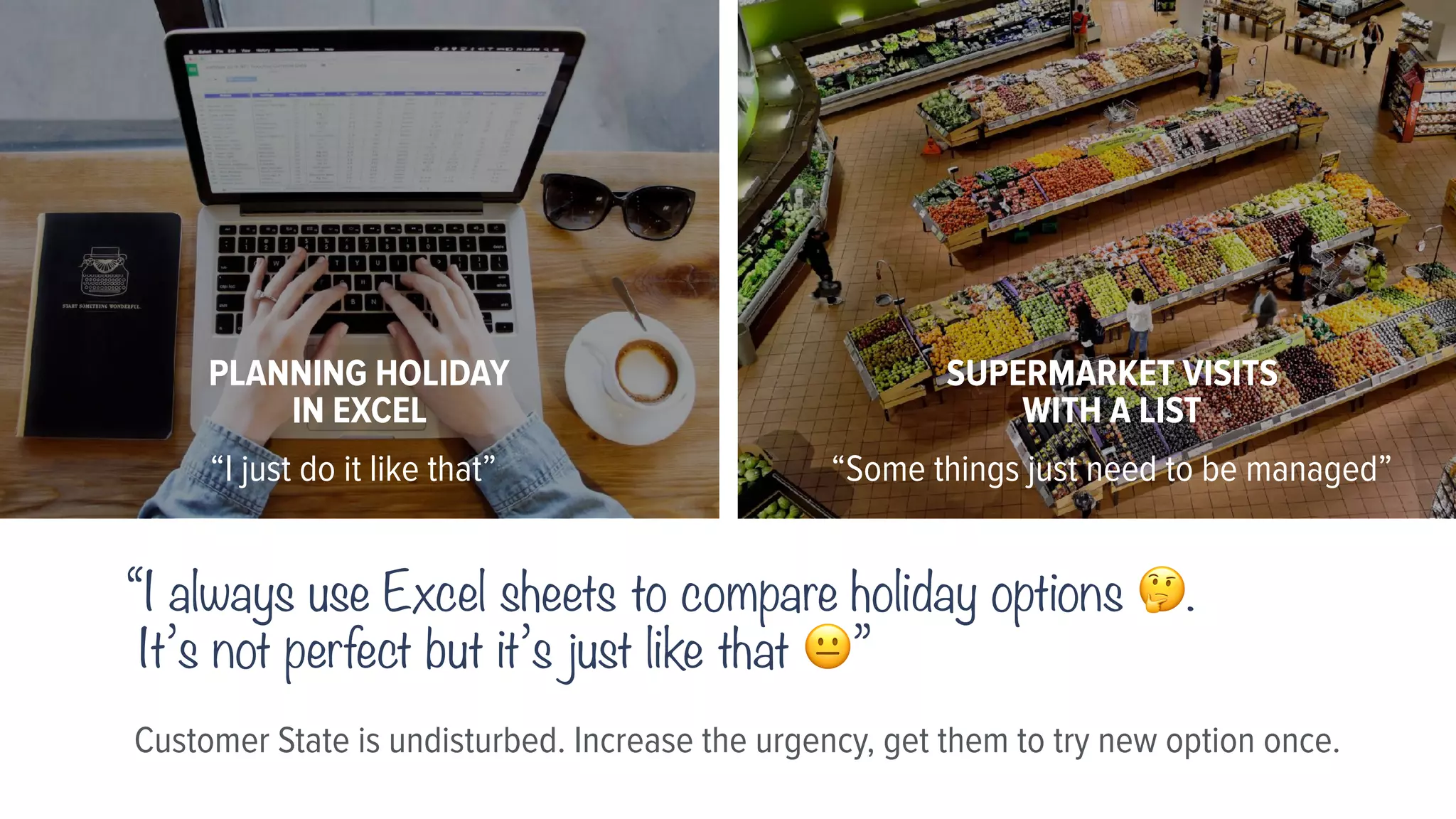
“I always use Excel sheets to compare holiday options 🤔.
It’s not perfect but it’s just like that 😐”
Customer State is undisturbed. Increase the urgency, get them to try new option once.
PLANNING HOLIDAY
IN EXCEL
SUPERMARKET VISITS
WITH A LIST
“I just do it like that” “Some things just need to be managed”
Identify BASELINE behavior and turn it into an intent to try
Recognise frequent behaviour that forms a baseline.
Strategy:
• Re-design current experience to offer a better, different, futuristic way 

of doing what they already do.
• Quantify their time/money losses - boost problem awareness.
• Compare what they have, their experience, with what they could have.
• Encourage to try it once, give a free trial.
• Afterwards keep quantifying newly gained benefits to form a new habit.
Constant comparison
of what we had, have vs. what we could have.
Same done differently
be safe, be loved, belong, be on track.
New, presented in a familiar way
to increase the probability of adoption & delight.
Current vs. the Unknown
where your product is “the unknown”
Manage their expectations, address their fears
and help them to improve their lives.
Solutioncanvas.com
It starts with People.
Put on your customer shoes.
Solutioncanvas.com
@epicantus
Email me: daria@ideahackers.nl

Daria Nepriakhina - Problem-Solution Fit

  • 1.
    Problem-Solution fit canvas Puton your customer shoes by Daria Nepriakhina @epicantus
  • 2.
    If you don’tknow your customer well then 99% of your assumptions are wrong. Are we optimising the right thing? Do people care?
  • 5.
    Be (stay) relevant toyour customer
  • 6.
    • customer statechanges; • problem and solution evolve; • market shifts; • audience switches to other channels; • the perception of your brand changes too; • ways of getting the job done advance. Stay relevant, because:
  • 7.
    Understand your customerand existing experience to design for improvement of people’s lives. That’s why you need to
  • 8.
    If you don’tknow your customer well then 99% of your assumptions are wrong. JUST ASK.
  • 9.
    In 90% ofthe cases people can’t explain back a value proposition they just saw. “Can you look at this page and tell me what is it about?” Do a comprehension test or 5-second test.
  • 10.
    100% biological hand-made chocolate bar Lesscalories than in an average sweet snack Perfect hunger killer in-between lunch and dinner The tastiest chocolate bar to share with a friend. INFP / RCUAI ISFJ / RCOAN ENTJ / SCOEI ENFP / SCUAI SAME CHOCOLATE BAR: different customer - different problem - different way of communication
  • 11.
    If you arein business, People are your subject to study. Body language, Big 5 type / SLOAN, Communication style Past behaviour, Familiar methods of doing the task Worldview, social circle, stereotypes, Familiar triggers The WHY behind their actions. What matters?
  • 12.
    Data tells youwhat is wrong. Customer interviews help you to understand why. Collect stories + data.
  • 13.
    Context Need Motivation Fears CUSTOMER STATE Customersare real people. Just like you, yet they might think differently.
  • 14.
    … People arelazy. They tend to go for the easiest and more familiar solution. Less effort, looks familiar, fits their state.
  • 15.
    Lazy User model LazyUser Theory for Solution Selection USER NEED USER STATE limits defines Set of possible solutions to fulfil the need Selection of solution based on the lowest level of effort by Tétard & Collan lazyusermodel.org
  • 16.
    Lazy User model LazyUser Theory for Solution Selection USER NEED defines Set of possible solutions to fulfil the need Selection of solution based on the lowest level of effort by Tétard & Collan lazyusermodel.org In a hurry, no WiFi connection limits
  • 17.
    Think in scenarios. Aperson stumbles upon a trigger that increases problem awareness. This boost causes a particular behaviour to show up which results in an outcome: perceived improvement or relief in customer's eyes. Learn how people feel about the problem, current solution and paying for it X much.
  • 18.
  • 19.
    It matches Customerstate, constraints, and is better than available options. It fits to Customer problem which is supported by existing behaviour. It is communicated via the right channels with the right message and trigger.
  • 20.
    Who is yourcustomer? Which problems do you solve for him? How often does it happen? It’s never just problem, it’s a constellation of them. Focus on the most frequent or costly. What triggers customer to act? Seen or heard something? Change of context? Which emotions customer experiences when he realises he has the problem? And afterwards? Fear of failure, lack of control / Confident, back on track? Which available solutions customer can use to handle this problem? What has he tried in the past? What’s familiar? Pro’s and cons? 5. 4. 3. 2. 1.
  • 21.
    Which constraints yourcustomer is facing at the moment when this problem occurs? Spending power, no cash, no network connection? Fit to customer constraints. Existing behaviour: what does your customer do about / around / directly or indirectly related to the problem? How often? Tap into frequent behaviour. Where does this behavior occur? Extract online and offline channels of behaviour. What is the root cause of every problem from the list? Is it still worth solving? Does your proposition still match? 6. 8. 7. 9.
  • 22.
    It’s all aboutbehaviour and its frequency. If there is no existing behaviour, there is no problem to solve. When people spend time on something, they care about it.
  • 23.
    How can thishelp me? Identify intent, interest and baseline behavior based on customer state and situation to find the right product strategy.
  • 24.
    “I’ve just arrivedin a new country, where I don’t know the language. 🤷” Context changed. Customer’s State is disturbed, high urgency to keep things on track. ON TRAVEL EXPECTING A BABY
  • 25.
    INTENT Look for changeof context or life stage, when disturbance of the customer state boosts problem urgency and results into behaviour. Your strategy: 1. Get the job done efficiently. 2. Manage their expectations and fears. 3. Follow up to help them stay on track.
  • 26.
    “Yesterday it wasraining 🌧. I forgot my umbrella so I bought one ☔. It’ll be the fifth we have 🤦” Context changed. High urgency. UNEXPECTED RAIN EMPTY BATTERY
  • 27.
    INTENT Look for frequentinconvenience with a brief yet high urgency spike at the moment when your customer is facing the problem. Strategy: 1. Be on their path when the problem occurs, tap into 
 existing behaviour. 2. Highlight the problem and turn awareness spikes into 
 a recognised need. 3. Get the job done efficiently for a reasonable price.
  • 28.
    “My friend issharing these beautiful photos from his holiday on Instagram. We need to go there too!!! 🏝🥂⛵” A Trigger disturbed Customer state and increased urgency. SOLAR PANELS ON NEIGHBOUR’S ROOF FRIENDS POSTED PHOTOS FROM HOLIDAY FIDGET SPINNERS ON YOUTUBE, WOW.
  • 29.
    Identify INTEREST andturn it into INTENT Spot intensified, triggered behaviour when an external factor caused a boost in problem awareness. Strategy: 1. Design a perfect trigger. 2. Educate them on the problem, aggregate inspiration and information to feed customer interest. 3. Compare what they have now with what they could have. 4. Sell an improved Customer state.
  • 30.
    “I always useExcel sheets to compare holiday options 🤔. It’s not perfect but it’s just like that 😐” Customer State is undisturbed. Increase the urgency, get them to try new option once. PLANNING HOLIDAY IN EXCEL SUPERMARKET VISITS WITH A LIST “I just do it like that” “Some things just need to be managed”
  • 31.
    Identify BASELINE behaviorand turn it into an intent to try Recognise frequent behaviour that forms a baseline. Strategy: • Re-design current experience to offer a better, different, futuristic way 
 of doing what they already do. • Quantify their time/money losses - boost problem awareness. • Compare what they have, their experience, with what they could have. • Encourage to try it once, give a free trial. • Afterwards keep quantifying newly gained benefits to form a new habit.
  • 32.
    Constant comparison of whatwe had, have vs. what we could have. Same done differently be safe, be loved, belong, be on track. New, presented in a familiar way to increase the probability of adoption & delight.
  • 33.
    Current vs. theUnknown where your product is “the unknown” Manage their expectations, address their fears and help them to improve their lives.
  • 34.
  • 35.
    It starts withPeople. Put on your customer shoes. Solutioncanvas.com @epicantus Email me: daria@ideahackers.nl