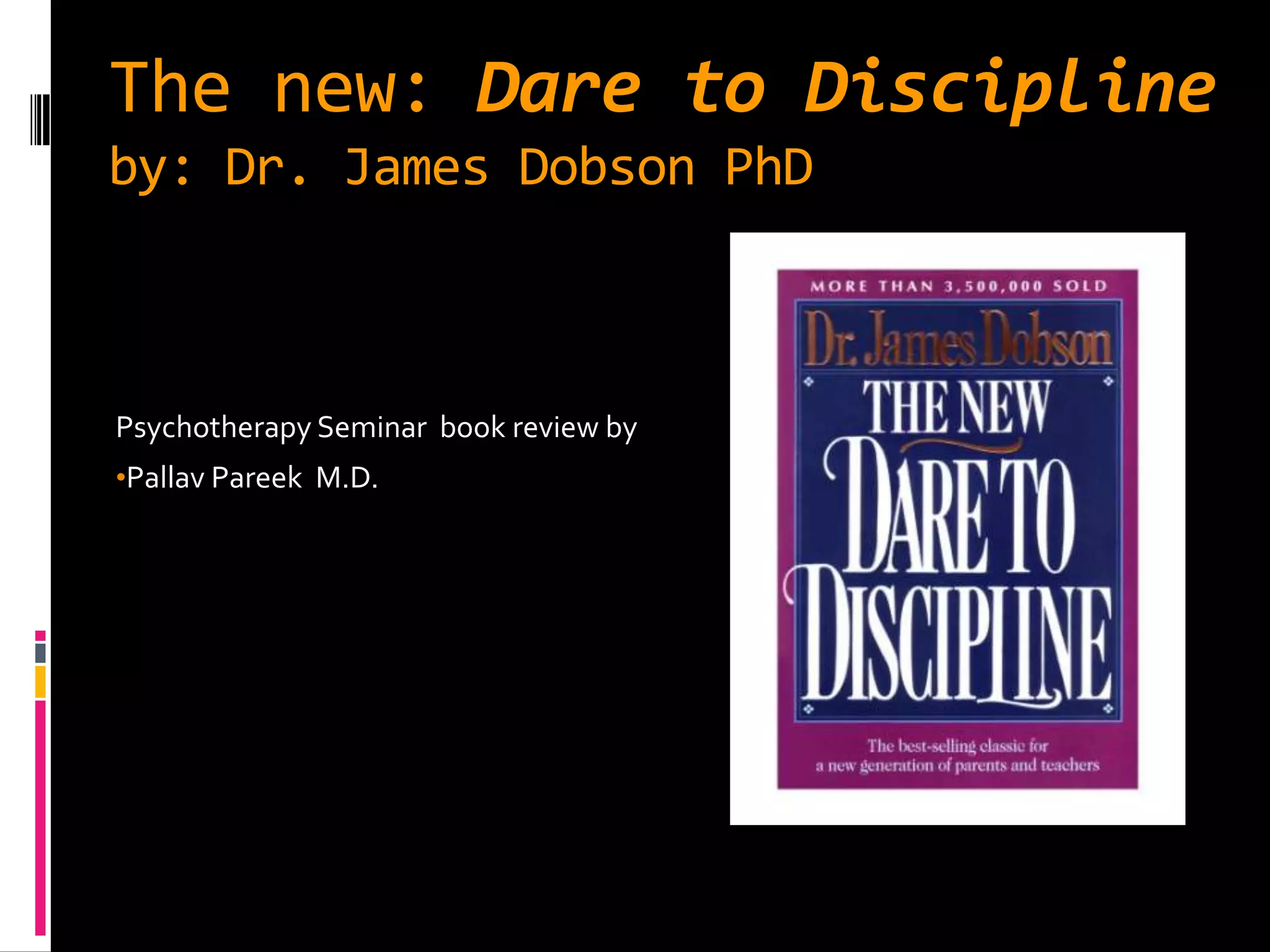
The new: Dare to Discipline
by: Dr. James Dobson PhD


Psychotherapy Seminar book review by
•Pallav Pareek M.D.
About the Author
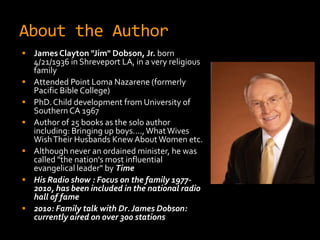
 James Clayton "Jim" Dobson, Jr. born
    4/21/1936 in Shreveport LA, in a very religious
    family
   Attended Point Loma Nazarene (formerly
    Pacific Bible College)
   PhD. Child development from University of
    Southern CA 1967
   Author of 25 books as the solo author
    including: Bringing up boys…., What Wives
    Wish Their Husbands Knew About Women etc.
   Although never an ordained minister, he was
    called "the nation's most influential
    evangelical leader" by Time
   His Radio show : Focus on the family 1977-
    2010, has been included in the national radio
    hall of fame
   2010: Family talk with Dr. James Dobson:
    currently aired on over 300 stations
About the Book

 Originally published as Dare to Discipline in 1970
 Revised as The new Dare to discipline in1992
 There are no grey areas for Dr. Dobson, and so
  are no grey areas for people who like/dislike his
  work. People either absolutely hate/love his work
 www.goodreads.com labels it as “All who work
  with children or youth will welcome this sound
  discussion about maintaining order, developing
  responsibility, and building character. “
What is the theme

 Just like his religious upbringing, DTD is
  about old school evangelical Christian way of
  bringing up children.
 This is a book which argues for the prinicple
  concept of corporal punishment (as a ++)
 Parents have well defined roles as do their
  children……..
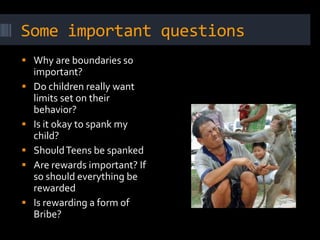
Some important questions
 Why are boundaries so
    important?
   Do children really want
    limits set on their
    behavior?
   Is it okay to spank my
    child?
   Should Teens be spanked
   Are rewards important? If
    so should everything be
    rewarded
   Is rewarding a form of
    Bribe?
Framework of Book: Chapters

1.    The Challenge
2.    Common Sense in your child
3.    More common sense about children
4.    Questions and Answers
5.    The Miracle tools part 1
6.    The Miracle tools part 2
7.    Discipline and learning
8.    The Barriers to learning, part 1
9.    The Barriers to learning, part 2
10.   Discipline in morality
11.   A moment for mom
The Challenge
 The social backdrop from the original DTD has
  changed……..But children haven’t changed, nor they ever
  will. I’m even more convinced now that the principles of
  good parenting are eternal, having originated with the
  Creator of families……
 Much has been written about the dangers of harsh,
  oppressive, unloving discipline; these warnings are valid
  and should be heeded. However, the consequences of
  oppressive discipline have been cited as a justification for
  the abdication of leadership. That is foolish. There are times
  when a strong willed child will clench his little fists and dare
  his parents to accept his challenges. He is not motivated by
  frustration or inner hostility, as it is often supposed. He
  merely wants to know where the boundaries lie, and who’s
  available to enforce them.
Common sense and more..

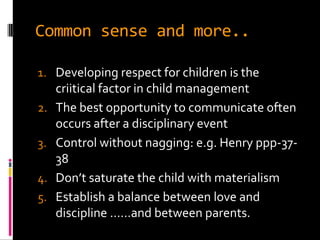
1. Developing respect for children is the
     criitical factor in child management
2.   The best opportunity to communicate often
     occurs after a disciplinary event
3.   Control without nagging: e.g. Henry ppp-37-
     38
4.   Don’t saturate the child with materialism
5.   Establish a balance between love and
     discipline ……and between parents.
Summary: Dobson’s own words

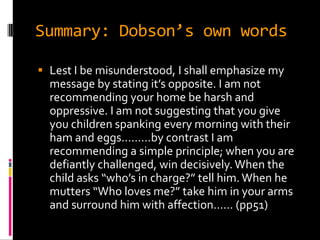
 Lest I be misunderstood, I shall emphasize my
  message by stating it’s opposite. I am not
  recommending your home be harsh and
  oppressive. I am not suggesting that you give
  you children spanking every morning with their
  ham and eggs………by contrast I am
  recommending a simple principle; when you are
  defiantly challenged, win decisively. When the
  child asks “who’s in charge?” tell him. When he
  mutters “Who loves me?” take him in your arms
  and surround him with affection…… (pp51)
Q&A
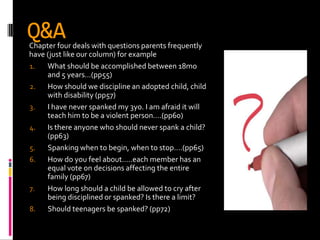
Chapter four deals with questions parents frequently
have (just like our column) for example
1.   What should be accomplished between 18mo
     and 5 years…(pp55)
2.   How should we discipline an adopted child, child
     with disability (pp57)
3.   I have never spanked my 3yo. I am afraid it will
     teach him to be a violent person….(pp60)
4.   Is there anyone who should never spank a child?
     (pp63)
5.   Spanking when to begin, when to stop….(pp65)
6.   How do you feel about…..each member has an
     equal vote on decisions affecting the entire
     family (pp67)
7.   How long should a child be allowed to cry after
     being disciplined or spanked? Is there a limit?
8.   Should teenagers be spanked? (pp72)
The Miracle Tools:1&2

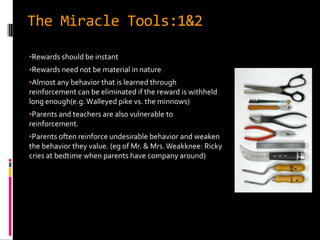
•Rewards should be instant
•Rewards need not be material in nature
•Almost any behavior that is learned through
reinforcement can be eliminated if the reward is withheld
long enough(e.g. Walleyed pike vs. the minnows)
•Parents and teachers are also vulnerable to
reinforcement.
•Parents often reinforce undesirable behavior and weaken
the behavior they value. (eg of Mr. & Mrs. Weakknee: Ricky
cries at bedtime when parents have company around)
Discipline in learning
   Major part of this section is spent criticizing: concepts like Permissive
    education, The open classroom , The Summer-hill school
   Proponents of these schools of thought: AS Neill, Herbert R Kohn
   Very ardently supports strict disciplinarian approach for learning: cites
    Newsweek article in May 1971 “Leaning can be fun”, and then December
    1975 article “Why Johnny can’t write” . Writes a letter to the editor:
    Perhaps Johnny couldn’t write because he spent too much time having
    fun in (…1971)the classroom”
   Criticizes approach of Miss. Peach: who said on day one “I am so glad we
    had a chance to get together. This is going to be such a fun year for you;
    we’re going to make soap and soup, and we’re going to paint a mural
    that will paint the entire wall. We’ll take field trips and play games…..this
    is going to be a great year. You’re going to love me and I am going to
    love you, and we’ll just have a ball”
   Condones the approach of Mrs. Justice: who’s day 1 speech was “This is
    going to be a good year, and I am glad you are my students. I want you
    to know that each one of you is important to me. I hope you will feel free
    to ask questions, and enjoy learning in this class………..Well we have
    some work to do so let’s get started. Would you take out your math
    books and turn to page 4”
The Barriers to learning 1&2

 The Late Bloomer
 The Slow Learner
 The Underachiever
Discipline in Morality

What is discussed?          Conclusions…..
 “In defense of a little    Here is this section the author,
                              gives a very religious outlook on
  virginity”                  issues, such as premarital sex,
                              abortions, sex education and
 Who should impart sex       cohabitation in college
  education?                  dorms….etc.
                             How much of this is applicable in
 When to say what?           this day and time is difficult to
                              say. If all the things suggested by
                              the author were to be applied, it
                              will need a sea change in the
                              whole cosmos around us…which
                              is neither practical nor should be
                              tried……
A moment for mom

1. Reserve some time for yourself
2. Don’t Struggle with things you can’t change
   e.g. Mother in law 
3. Don’t deal with big problems late at night
4. Try making a list
5. Seek divine assistance
Disclaimer

 I have no affiliation with the book or the
  author. I do not agree or disagree with his
  thoughts. This presentation has been made
  as a part of the book review club, under the
  psychotherapy seminar series.

If there is a question or concern regarding this
   presentation , please feel free to email me at
   pallavpareek@gmail.com

Dare to-discipline

  • 1.
    The new: Dareto Discipline by: Dr. James Dobson PhD Psychotherapy Seminar book review by •Pallav Pareek M.D.
  • 2.
    About the Author James Clayton "Jim" Dobson, Jr. born 4/21/1936 in Shreveport LA, in a very religious family  Attended Point Loma Nazarene (formerly Pacific Bible College)  PhD. Child development from University of Southern CA 1967  Author of 25 books as the solo author including: Bringing up boys…., What Wives Wish Their Husbands Knew About Women etc.  Although never an ordained minister, he was called "the nation's most influential evangelical leader" by Time  His Radio show : Focus on the family 1977- 2010, has been included in the national radio hall of fame  2010: Family talk with Dr. James Dobson: currently aired on over 300 stations
  • 3.
    About the Book Originally published as Dare to Discipline in 1970  Revised as The new Dare to discipline in1992  There are no grey areas for Dr. Dobson, and so are no grey areas for people who like/dislike his work. People either absolutely hate/love his work  www.goodreads.com labels it as “All who work with children or youth will welcome this sound discussion about maintaining order, developing responsibility, and building character. “
  • 4.
    What is thetheme  Just like his religious upbringing, DTD is about old school evangelical Christian way of bringing up children.  This is a book which argues for the prinicple concept of corporal punishment (as a ++)  Parents have well defined roles as do their children……..
  • 5.
    Some important questions Why are boundaries so important?  Do children really want limits set on their behavior?  Is it okay to spank my child?  Should Teens be spanked  Are rewards important? If so should everything be rewarded  Is rewarding a form of Bribe?
  • 6.
    Framework of Book:Chapters 1. The Challenge 2. Common Sense in your child 3. More common sense about children 4. Questions and Answers 5. The Miracle tools part 1 6. The Miracle tools part 2 7. Discipline and learning 8. The Barriers to learning, part 1 9. The Barriers to learning, part 2 10. Discipline in morality 11. A moment for mom
  • 7.
    The Challenge  Thesocial backdrop from the original DTD has changed……..But children haven’t changed, nor they ever will. I’m even more convinced now that the principles of good parenting are eternal, having originated with the Creator of families……  Much has been written about the dangers of harsh, oppressive, unloving discipline; these warnings are valid and should be heeded. However, the consequences of oppressive discipline have been cited as a justification for the abdication of leadership. That is foolish. There are times when a strong willed child will clench his little fists and dare his parents to accept his challenges. He is not motivated by frustration or inner hostility, as it is often supposed. He merely wants to know where the boundaries lie, and who’s available to enforce them.
  • 8.
    Common sense andmore.. 1. Developing respect for children is the criitical factor in child management 2. The best opportunity to communicate often occurs after a disciplinary event 3. Control without nagging: e.g. Henry ppp-37- 38 4. Don’t saturate the child with materialism 5. Establish a balance between love and discipline ……and between parents.
  • 9.
    Summary: Dobson’s ownwords  Lest I be misunderstood, I shall emphasize my message by stating it’s opposite. I am not recommending your home be harsh and oppressive. I am not suggesting that you give you children spanking every morning with their ham and eggs………by contrast I am recommending a simple principle; when you are defiantly challenged, win decisively. When the child asks “who’s in charge?” tell him. When he mutters “Who loves me?” take him in your arms and surround him with affection…… (pp51)
  • 10.
    Q&A Chapter four dealswith questions parents frequently have (just like our column) for example 1. What should be accomplished between 18mo and 5 years…(pp55) 2. How should we discipline an adopted child, child with disability (pp57) 3. I have never spanked my 3yo. I am afraid it will teach him to be a violent person….(pp60) 4. Is there anyone who should never spank a child? (pp63) 5. Spanking when to begin, when to stop….(pp65) 6. How do you feel about…..each member has an equal vote on decisions affecting the entire family (pp67) 7. How long should a child be allowed to cry after being disciplined or spanked? Is there a limit? 8. Should teenagers be spanked? (pp72)
  • 11.
    The Miracle Tools:1&2 •Rewardsshould be instant •Rewards need not be material in nature •Almost any behavior that is learned through reinforcement can be eliminated if the reward is withheld long enough(e.g. Walleyed pike vs. the minnows) •Parents and teachers are also vulnerable to reinforcement. •Parents often reinforce undesirable behavior and weaken the behavior they value. (eg of Mr. & Mrs. Weakknee: Ricky cries at bedtime when parents have company around)
  • 12.
    Discipline in learning  Major part of this section is spent criticizing: concepts like Permissive education, The open classroom , The Summer-hill school  Proponents of these schools of thought: AS Neill, Herbert R Kohn  Very ardently supports strict disciplinarian approach for learning: cites Newsweek article in May 1971 “Leaning can be fun”, and then December 1975 article “Why Johnny can’t write” . Writes a letter to the editor: Perhaps Johnny couldn’t write because he spent too much time having fun in (…1971)the classroom”  Criticizes approach of Miss. Peach: who said on day one “I am so glad we had a chance to get together. This is going to be such a fun year for you; we’re going to make soap and soup, and we’re going to paint a mural that will paint the entire wall. We’ll take field trips and play games…..this is going to be a great year. You’re going to love me and I am going to love you, and we’ll just have a ball”  Condones the approach of Mrs. Justice: who’s day 1 speech was “This is going to be a good year, and I am glad you are my students. I want you to know that each one of you is important to me. I hope you will feel free to ask questions, and enjoy learning in this class………..Well we have some work to do so let’s get started. Would you take out your math books and turn to page 4”
  • 13.
    The Barriers tolearning 1&2  The Late Bloomer  The Slow Learner  The Underachiever
  • 14.
    Discipline in Morality Whatis discussed? Conclusions…..  “In defense of a little  Here is this section the author, gives a very religious outlook on virginity” issues, such as premarital sex, abortions, sex education and  Who should impart sex cohabitation in college education? dorms….etc.  How much of this is applicable in  When to say what? this day and time is difficult to say. If all the things suggested by the author were to be applied, it will need a sea change in the whole cosmos around us…which is neither practical nor should be tried……
  • 15.
    A moment formom 1. Reserve some time for yourself 2. Don’t Struggle with things you can’t change e.g. Mother in law  3. Don’t deal with big problems late at night 4. Try making a list 5. Seek divine assistance
  • 16.
    Disclaimer  I haveno affiliation with the book or the author. I do not agree or disagree with his thoughts. This presentation has been made as a part of the book review club, under the psychotherapy seminar series. If there is a question or concern regarding this presentation , please feel free to email me at pallavpareek@gmail.com