Parent WorkshopBullying Kathy CortesAndrea Grajeda
Overview of the WorkshopIdentify different types and forms of bullyingWhat is known about the nature and prevalence of bullying?Implications for bullyingWarning signsWhat can I do as a parent?Additional ResourcesParent-Student Role Play Activity
What is Bullying?Intentional aggressive behavior including humiliationImbalance of power or strength in a relationshipUsually occurs over time
Direct BullyingHitting, kicking, shoving, spitting…Taunting, teasing, racial slurs, verbal harassmentThreatening, obscene gestures
Indirect BullyingGetting another person to bully someone for youSpreading rumorsDeliberately excluding someone from a group or activityCyber-bullying
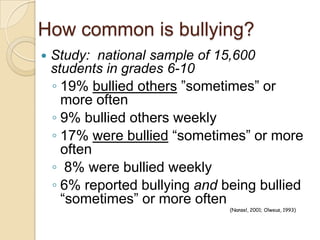
How common is bullying?Study:  national sample of 15,600 students in grades 6-1019% bullied others ”sometimes” or more often9% bullied others weekly17% were bullied “sometimes” or more often 8% were bullied weekly6% reported bullying and being bullied “sometimes” or more often							(Nansel, 2001; Olweus, 1993)
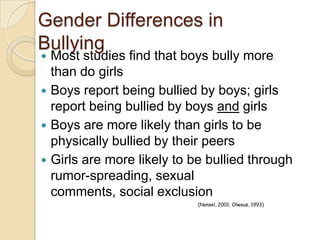
Gender Differences in BullyingMost studies find that boys bully more than do girlsBoys report being bullied by boys; girls report being bullied by boys and girlsBoys are more likely than girls to be physically bullied by their peersGirls are more likely to be bullied through rumor-spreading, sexual comments, social exclusion						(Nansel, 2001; Olweus, 1993)
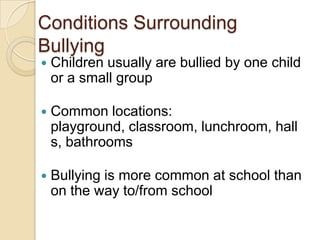
Conditions Surrounding BullyingChildren usually are bullied by one child or a small groupCommon locations: playground, classroom, lunchroom, halls, bathroomsBullying is more common at school than on the way to/from school
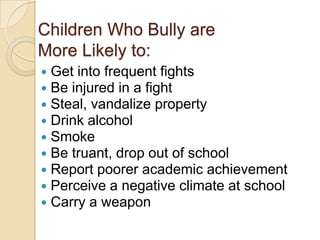
Children Who Bully are More Likely to:Get into frequent fightsBe injured in a fightSteal, vandalize propertyDrink alcoholSmokeBe truant, drop out of schoolReport poorer academic achievementPerceive a negative climate at schoolCarry a weapon
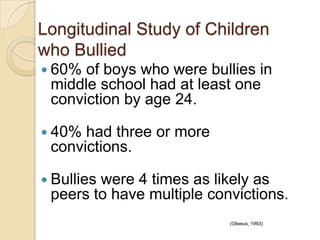
Longitudinal Study of Children who Bullied60% of boys who were bullies in middle school had at least one conviction by age 24.40% had three or more convictions.Bullies were 4 times as likely as peers to have multiple convictions.							(Olweus, 1993)
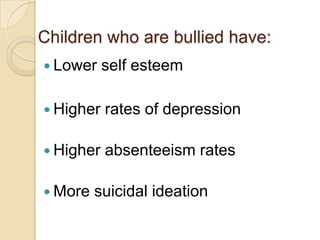
Children who are bullied have:Lower self esteemHigher rates of depressionHigher absenteeism ratesMore suicidal ideation
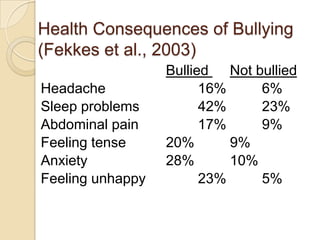
Health Consequences of Bullying (Fekkes et al., 2003)Bullied Not bulliedHeadache			16%		6%Sleep problems		42%		23%Abdominal pain		17%		9%Feeling tense		20%		9%Anxiety			28%		10%Feeling unhappy		23%		5%
Possible Warning Signs that a child is being bullied:Comes home with torn, damaged, or missing pieces of clothing, books, or other belongingsHas unexplained cuts, bruises, and scratchesHas few, if any friends, with whom he or she spends timeSeems afraid of going to school, walking to and from school, riding the school bus, or taking part in organized activities with peers (such as clubs)Sudden loss of appetite or appears anxious Takes a long, “illogical” route when walking to or from schoolHas lost interest in school work or suddenlyBegins to do poorly in schoolAppears sad, moody, teary, or depressed when he or she comes homeComplains frequently of headaches, stomachaches, or other physical ailments;Has trouble sleeping or has frequent bad dreams;Suffers from low self-esteem
 What should you do if you suspect your child is being bullied?If your child shows any of these signs, this does notnecessarily mean that he or she is being bullied,but it is a possibility worth exploring.   What shouldyou do? Talk with your child and talk with staff atschool to learn more.1. Talk with your child. Tell your child that you are concerned and that you’d like to help. Here are some questions that can get the discussion going:
What should you do if you suspect your child is being bullied? Some direct questions:I’m worried about you. Are there any kids at school who may be picking on you or bullying you?” “Are there any kids at school who tease you in a mean way?”“Are there any kids at school who leave you out orexclude you on purpose?”
What should you do if you suspect your child is being bullied?Some subtle questions:“Do you have any special friends at school thisyear? Who are they? Who do you hang out with?”“Who do you sit with at lunch and on the bus?”“Are there any kids at school who you really don’tlike? Why don’t you like them? Do they ever pickon you or leave you out of things?”
What should I do if my child is bullying others?2.   Talk with staff at your child’s school. Call or set up an appointment to talk with your child’s teacher.   Share your concerns about your child and ask the teacher such questions as:“How does my child get along with other        students in his or her class?”“With whom does he or she spend free time?”“Have you noticed any unusual changes in the way my child interacts with some of his peers?”
What should I do if my child is bullying others?3. Ask the teacher to talk with other adults who   interact with your child at school (such as the music teacher, physical education teacher, or bus driver) to see whether they have observed students bullying your child.4. If you are not comfortable talking with your child’s teacher, or if you are not satisfied with the   conversation, make an appointment to meet with    your child’s guidance counselor or principal to    discuss your concerns.
Bottom line…If you obtaininformation from yourchild or from staff atyour child’s school thatleads you to believethat he or she is beingbullied, take quickaction.  Bullying can have serious effects on children.If, after talking with your child and staff at his or her school, you don’t suspect that your child is being bullied, stay vigilant to other possible problems that your child may be having.   Some of the warning signs discussed earlier may be signs of other serious problems.   Share your concerns with a counselor at your child’s school!
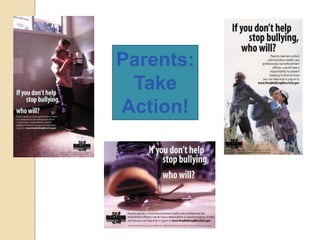
Parents:Take Action!
Interactive WebsiteInteractive Website:www.stopbullyingnow.hrsa.govAnimated Serial ComicGames, polls for tweensAdvice for tweensResource Kit for adultsLinks to partner groups and activitiesCall 1-800-789-2647 or go to www.mentalhealth.samhsa.gov	for more information
Parent Role Playing Activity:  BullyingPurpose: copying with or stopping bullyingMaterials: Parent Power Point, copy and cut as many scenarios as is needed for every two parents—keep in Ziploc until neededGardner’s Intelligences: Interpersonal, Visual-linguistic, IntrapersonalProcedure:Have parents pair up and take turns acting out the child and parent roles.Have them discuss in pairs other ways of dealing with the particular situation.As a group discuss the ideasMake a chart as an added visual.Ideas can be transferred to a handout for added assistance to parents.
Scenario 1You are walking to school and a gang of older bullies demand your money or something else valuable to you.   You are quite frightened and all of the sudden you see you mom.  What would you say to your mom?  What would your mom say to you?
Scenario 2Someone in your class always makes rudecomments about your best friend and says them loud enough for you and others to hear.   It really upsets him/her and you are getting  so fed up with it.   You also know that your friend is starting to  be afraid to come to school because of this situation.   You want to get help but you just don’t know where to start.  So you come home and sit alone in your room refusing to speak to anyone.
Scenario 3Paul is continually harassed by bullies callinghim names, making comments about hismother and cussing his family. They are pushing him around and generally making his life miserable.   Paul is refusing to go to school and fakes he has a stomachache only that his parents don’t believe him.
Scenario 4Josie comes home after school and runs to her bedroom.   When her little brother comes to get her, she slams herbedroom door.   What has caused Josie to behave in this manner?
ReferencesFekkes, M., Pijpers, F. I. M., & Verloove-VanHorick, S. P. (2004).  Bullying behavior      and  associations with pychosomatic complaints and depression in victims.      Journal of  Pediatrics, 144, 17-22.Nansel, T. R., Overpeck, M., Pilla, R. S., Ruan, W. J., Simmons-Morton, B., & Scheidt, P.      (2001).  Bullying behaviors among US youth: Prevalence and association with      psychosocial adjustment.  Journal of the American Medical Association, 285, 2094-2100.Olweus, D. (1993). Bullying at school: What we know and what we can do. NY:      Blackwell.Olweus, D., Limber, S., & Mihalic, S. (1999). The bullying prevention program:      Blueprints for violence prevention.  Boulder, CO: Center for the Study and Prevention of  Violence.

Bullying Parent Workshop

  • 1.
    Parent WorkshopBullying KathyCortesAndrea Grajeda
  • 2.
    Overview of theWorkshopIdentify different types and forms of bullyingWhat is known about the nature and prevalence of bullying?Implications for bullyingWarning signsWhat can I do as a parent?Additional ResourcesParent-Student Role Play Activity
  • 3.
    What is Bullying?Intentionalaggressive behavior including humiliationImbalance of power or strength in a relationshipUsually occurs over time
  • 4.
    Direct BullyingHitting, kicking,shoving, spitting…Taunting, teasing, racial slurs, verbal harassmentThreatening, obscene gestures
  • 5.
    Indirect BullyingGetting anotherperson to bully someone for youSpreading rumorsDeliberately excluding someone from a group or activityCyber-bullying
  • 6.
    How common isbullying?Study: national sample of 15,600 students in grades 6-1019% bullied others ”sometimes” or more often9% bullied others weekly17% were bullied “sometimes” or more often 8% were bullied weekly6% reported bullying and being bullied “sometimes” or more often (Nansel, 2001; Olweus, 1993)
  • 7.
    Gender Differences inBullyingMost studies find that boys bully more than do girlsBoys report being bullied by boys; girls report being bullied by boys and girlsBoys are more likely than girls to be physically bullied by their peersGirls are more likely to be bullied through rumor-spreading, sexual comments, social exclusion (Nansel, 2001; Olweus, 1993)
  • 8.
    Conditions Surrounding BullyingChildrenusually are bullied by one child or a small groupCommon locations: playground, classroom, lunchroom, halls, bathroomsBullying is more common at school than on the way to/from school
  • 9.
    Children Who Bullyare More Likely to:Get into frequent fightsBe injured in a fightSteal, vandalize propertyDrink alcoholSmokeBe truant, drop out of schoolReport poorer academic achievementPerceive a negative climate at schoolCarry a weapon
  • 10.
    Longitudinal Study ofChildren who Bullied60% of boys who were bullies in middle school had at least one conviction by age 24.40% had three or more convictions.Bullies were 4 times as likely as peers to have multiple convictions. (Olweus, 1993)
  • 11.
    Children who arebullied have:Lower self esteemHigher rates of depressionHigher absenteeism ratesMore suicidal ideation
  • 12.
    Health Consequences ofBullying (Fekkes et al., 2003)Bullied Not bulliedHeadache 16% 6%Sleep problems 42% 23%Abdominal pain 17% 9%Feeling tense 20% 9%Anxiety 28% 10%Feeling unhappy 23% 5%
  • 13.
    Possible Warning Signsthat a child is being bullied:Comes home with torn, damaged, or missing pieces of clothing, books, or other belongingsHas unexplained cuts, bruises, and scratchesHas few, if any friends, with whom he or she spends timeSeems afraid of going to school, walking to and from school, riding the school bus, or taking part in organized activities with peers (such as clubs)Sudden loss of appetite or appears anxious Takes a long, “illogical” route when walking to or from schoolHas lost interest in school work or suddenlyBegins to do poorly in schoolAppears sad, moody, teary, or depressed when he or she comes homeComplains frequently of headaches, stomachaches, or other physical ailments;Has trouble sleeping or has frequent bad dreams;Suffers from low self-esteem
  • 14.
    What shouldyou do if you suspect your child is being bullied?If your child shows any of these signs, this does notnecessarily mean that he or she is being bullied,but it is a possibility worth exploring. What shouldyou do? Talk with your child and talk with staff atschool to learn more.1. Talk with your child. Tell your child that you are concerned and that you’d like to help. Here are some questions that can get the discussion going:
  • 15.
    What should youdo if you suspect your child is being bullied? Some direct questions:I’m worried about you. Are there any kids at school who may be picking on you or bullying you?” “Are there any kids at school who tease you in a mean way?”“Are there any kids at school who leave you out orexclude you on purpose?”
  • 16.
    What should youdo if you suspect your child is being bullied?Some subtle questions:“Do you have any special friends at school thisyear? Who are they? Who do you hang out with?”“Who do you sit with at lunch and on the bus?”“Are there any kids at school who you really don’tlike? Why don’t you like them? Do they ever pickon you or leave you out of things?”
  • 17.
    What should Ido if my child is bullying others?2. Talk with staff at your child’s school. Call or set up an appointment to talk with your child’s teacher. Share your concerns about your child and ask the teacher such questions as:“How does my child get along with other students in his or her class?”“With whom does he or she spend free time?”“Have you noticed any unusual changes in the way my child interacts with some of his peers?”
  • 18.
    What should Ido if my child is bullying others?3. Ask the teacher to talk with other adults who interact with your child at school (such as the music teacher, physical education teacher, or bus driver) to see whether they have observed students bullying your child.4. If you are not comfortable talking with your child’s teacher, or if you are not satisfied with the conversation, make an appointment to meet with your child’s guidance counselor or principal to discuss your concerns.
  • 19.
    Bottom line…If youobtaininformation from yourchild or from staff atyour child’s school thatleads you to believethat he or she is beingbullied, take quickaction. Bullying can have serious effects on children.If, after talking with your child and staff at his or her school, you don’t suspect that your child is being bullied, stay vigilant to other possible problems that your child may be having. Some of the warning signs discussed earlier may be signs of other serious problems. Share your concerns with a counselor at your child’s school!
  • 20.
  • 21.
    Interactive WebsiteInteractive Website:www.stopbullyingnow.hrsa.govAnimatedSerial ComicGames, polls for tweensAdvice for tweensResource Kit for adultsLinks to partner groups and activitiesCall 1-800-789-2647 or go to www.mentalhealth.samhsa.gov for more information
  • 22.
    Parent Role PlayingActivity: BullyingPurpose: copying with or stopping bullyingMaterials: Parent Power Point, copy and cut as many scenarios as is needed for every two parents—keep in Ziploc until neededGardner’s Intelligences: Interpersonal, Visual-linguistic, IntrapersonalProcedure:Have parents pair up and take turns acting out the child and parent roles.Have them discuss in pairs other ways of dealing with the particular situation.As a group discuss the ideasMake a chart as an added visual.Ideas can be transferred to a handout for added assistance to parents.
  • 23.
    Scenario 1You arewalking to school and a gang of older bullies demand your money or something else valuable to you. You are quite frightened and all of the sudden you see you mom. What would you say to your mom? What would your mom say to you?
  • 24.
    Scenario 2Someone inyour class always makes rudecomments about your best friend and says them loud enough for you and others to hear. It really upsets him/her and you are getting so fed up with it. You also know that your friend is starting to be afraid to come to school because of this situation. You want to get help but you just don’t know where to start. So you come home and sit alone in your room refusing to speak to anyone.
  • 25.
    Scenario 3Paul iscontinually harassed by bullies callinghim names, making comments about hismother and cussing his family. They are pushing him around and generally making his life miserable. Paul is refusing to go to school and fakes he has a stomachache only that his parents don’t believe him.
  • 26.
    Scenario 4Josie comeshome after school and runs to her bedroom. When her little brother comes to get her, she slams herbedroom door. What has caused Josie to behave in this manner?
  • 27.
    ReferencesFekkes, M., Pijpers,F. I. M., & Verloove-VanHorick, S. P. (2004). Bullying behavior and associations with pychosomatic complaints and depression in victims. Journal of Pediatrics, 144, 17-22.Nansel, T. R., Overpeck, M., Pilla, R. S., Ruan, W. J., Simmons-Morton, B., & Scheidt, P. (2001). Bullying behaviors among US youth: Prevalence and association with psychosocial adjustment. Journal of the American Medical Association, 285, 2094-2100.Olweus, D. (1993). Bullying at school: What we know and what we can do. NY: Blackwell.Olweus, D., Limber, S., & Mihalic, S. (1999). The bullying prevention program: Blueprints for violence prevention. Boulder, CO: Center for the Study and Prevention of Violence.

Editor's Notes

  • #4 Researchers and practitioners generally agree that bullying has three defining characteristics (review 3 characteristics).It is important to note that bullying is a form of victimization (or peer abuse) and shares some characteristics with other forms of victimization: domestic violence & child maltreatmentIt also is important to consider what bullying ISN’T. Bullying isn’t a form of conflict, which implies that the two parties are on more or less equal footing.