Sulphones
By
Gunjan Kalyani, M.Pharm.
Assistant Professor
Columbia Institute of Pharmacy
Raipur 493111, Chhattisgarh, India
Mobile: +91-8349204583
Mail ID: kalyani.gunjan@yahoo.in
Former Research Fellow
National Center for Natural Resources (NCNR)
Pt. Ravishankar Shukla University, Raipur 492010, India
Sulphones
A. In the early 20th century, the German chemist Paul Ehrlich
was developing theories of selective toxicity based largely
on the ability of certain dyes to kill microbes.
B. Gerhard Domagk, who would later win a Nobel Prize for his
efforts, made a major breakthrough in 1932 with the
discovery of the antibacterial prontosil red
(sulfonamidochrysoidine).
C. Further investigation into the involved chemicals opened the
way to sulfa drug and sulfone therapy, first with the
discovery of sulfanilamide, the active agent of prontosil, by
Daniel Bovet and his team at Pasteur Institute(1935).
History
D. Then with of Dapsone independently by Ernest Fourneau
in France and Gladwin Buttle in United Kingdom.
E. Dapsone (diamino-diphenyl sulfone) is a medication most
commonly used in combination with rifampicin and
clofazimine as multidrug therapy (MDT) for the
treatmentof Mycobacterium leprae infections (leprosy).
F. Official in IP, BPandUSP.
History
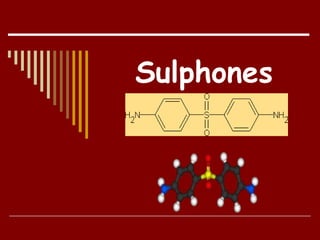
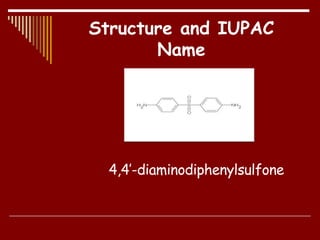
4,4’-diaminodiphenylsulfone
Structure and IUPAC
Name
Introduction
A. Sulfones are one of the members of organo sulfur
compounds.
B. Sulfones are S, S-dioxides of ether and represented by
general structural formula R-S(O)2-R’, where R and R’
are organic groups.
C. The chemistry of sulfones has been explored due to
their importance as synthetic intermediates for the
production of a wide range of chemically and
biologically active molecules.
D. Sulfones are widely used as solvents, polymers, and
biopharmaceutical agents.
E. Several drug molecules containing sulfone groups are
used for the treatment of leprosy, dermatitis
herpetiformis, and tuberculosis.
F. Researchers have also determined many therapeutic
activities of sulfone containing compounds, including
antibacterial, antifungal, antimalarial, cysteine protease
inhibitor, anti-HIV, anti-proliferative, anti-cancer,
protein phosphatase methylesterase-1 inhibitors, thyroid
receptor antagonist, β-lactamase inhibitors and
gelatinase inhibitors.
Introduction
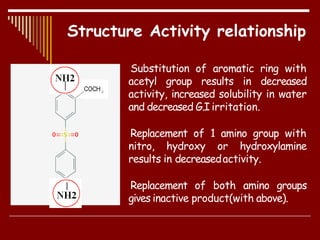
Substitution of aromatic ring with
acetyl group results in decreased
activity, increased solubility in water
and decreased G.I irritation.
Replacement of 1 amino group with
nitro, hydroxy or hydroxylamine
results in decreasedactivity.
Replacement of both amino groups
gives inactive product(with above).
Structure Activity relationship
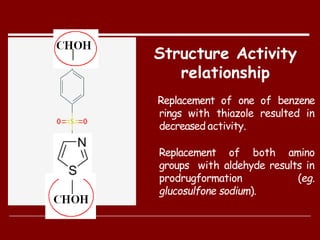
Replacement of one of benzene
rings with thiazole resulted in
decreased activity.
Replacement of both amino
groups with aldehyde results in
prodrugformation (eg.
glucosulfone sodium).
Structure Activity
relationship
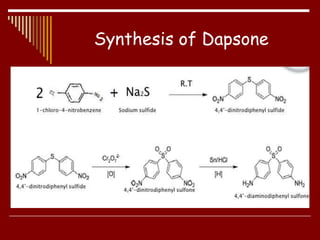
Synthesis of Dapsone
Mechanism of Action
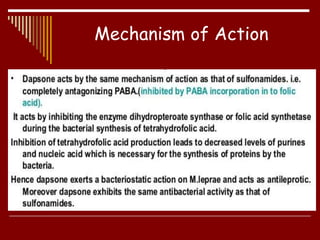
A. Dapsone acts against bacteria and protozoa in the
same way as sulphonamides, that is by inhibiting the
synthesis of dihydrofolic acid through competition
with para-amino-benzoate for the active site of
dihydropteroate synthetase.
B. The anti-inflammatory action of the drug is unrelated
to its antibacterial action and is still not fully
understood.
Mechanism of Action
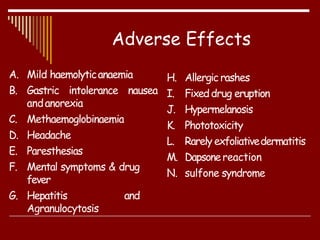
A. Mild haemolyticanaemia
B. Gastric intolerance nausea
andanorexia
C. Methaemoglobinaemia
D. Headache
E. Paresthesias
F. Mental symptoms & drug
fever
G. Hepatitis and
Agranulocytosis
H. Allergic rashes
I. Fixeddrug eruption
J. Hypermelanosis
K. Phototoxicity
L. Rarely exfoliativedermatitis
M. Dapsonereaction
N. sulfone syndrome
Adverse Effects
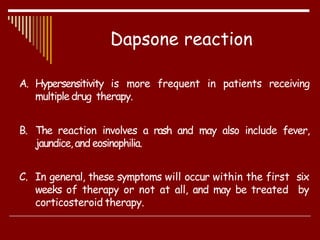
A. Hypersensitivity is more frequent in patients receiving
multiple drug therapy.
B. The reaction involves a rash and may also include fever,
jaundice,and eosinophilia.
C. In general, these symptoms will occur within the first six
weeks of therapy or not at all, and may be treated by
corticosteroid therapy.
Dapsone reaction
A. Mycobacteriumleprae infections (leprosy).
B. Hansen’s disease
C. Acne.
D. Pneumocystispneumonia
E. DermatitisHerpetiformis
F. Toxoplasmosis- Prophylaxis
Uses
Drug Interactions
A. Before using this medication, consult with your doctor
or pharmacist of all prescription and non
prescription/herbal products you may use, especially
of: folic acid antagonists (such as pyrimethamine),
nitrofurantoin, primaquine.
B. This medication may decrease the effectiveness of
combination-type birth control pills.
C. This can result in pregnancy.
Recent development
A. The need for a more reliable route of administration led
to investigation the possibility of an I.M. dapsone depot
injection.
B. To achieve effective blood levels for 3-4 weeks, suspensions
of large dapsone particles in anaqueous vehicle were made.
C. Studies in the rat revealed that dapsone-dependent
methaemoglobinaemia could be greatly diminished by the
co-administration of metabolicinhibitors (eg- cimetidine).
D. The need for a more reliable route of administration
ledto investigation the possibility of an I.M. dapsone
depot injection.
E. To achieve effective blood levels for 3-4 weeks,
suspensions of large dapsone particles in an aqueous
vehicle were made.
F. Studies in the rat revealed that dapsone-dependent
methaemoglobinaemia could be greatly diminished by
the co-administration of metabolic inhibitors (eg-
cimetidine).
Recent development
1. Williams D.et al, Foye's principles of medicinal
chemistry, fifth edition, Lippincott's Williams &
Wilkins
2. John H.et al ,Wilson & Gisvolds textbook of organic medical
& pharmaceutical chemistry, eleventh edition, Lippincott's
Williams & Wilkins
3. Indian Pharmacopoeia, 1996,Volume I, 1162-1163
4. United states Pharmacopoeia,2009,Volume II, 2059-2060
5. Moncrief J. Journal of Chromatography B: Biomedical
Sciences and Applications
Volume 654, Issue 1, 18 March 1994,103:110.
7. http://www.rxlist.com
8. http:// www.medicinenet.com
9. http://www.leprosy-information.org
10. http://onlinelibrary.wiley.com
References
Acknowledgements
A. D.A.V. Public School, ACC Colony, Jamul – 490024, Durg, Chhattigarh, India (1990 – 2004)
B. University Institute of Pharmacy, Pt. Ravishankar Shukla University, Raipur, Chhattisgarh, India (2005 –
2009)
C. Shri Rawatpura Sarkar Institute of Pharmacy, Kumhari, Durg, Chhattisgarh, India (2010 – 2012)
D. Royal College of Pharmacy, Raipur, Chhattisgarh, India (March – October 2013)
E. National Center for Natural Resources (NCNR), Pt. Ravishankar Shukla University, Raipur, Chhattisgarh,
India (2013 – 2017)
F. Columbia Institute of Pharmacy, Raipur 493111, Chhattisgarh, India ( 2017 – till date)
G. Gratitude to Resp. Prof. Shiv Shankar Shukla Sir, Columbia Institute of Pharmacy, Raipur 493111,
Chhattisgarh, India (Mentor)
H. Gratitude to Resp. Prof. Atanu Kumar Pati Sir, Vice Chancellor, Gangadhar Meher University, Sambalpur,
Odisha
I. Gratitude to Resp. Prof. Mitashree Mitra Madam, Dept. of Anthropology, PRSU, Raipur, Chhattisgarh.
J. Gratitude to Resp. Vishal S. Deshmukh Sir (M.Pharm. Supervisor)
Q & A Time!
1. Discuss the chemistry of dapsone with historical
development (5 marks).
2. Discuss the SAR of Dapsone (5 marks).
3. Write the synthesis of Dapsone along with some
adverse effects associated with it (5 marks).
4. Discuss about mechanism of action of Sulphones. Write
about the Dapsone syndrome (5 marks).
Q & A Time!
Thanks for studying !!!!

Sulphones

  • 1.
    Sulphones By Gunjan Kalyani, M.Pharm. AssistantProfessor Columbia Institute of Pharmacy Raipur 493111, Chhattisgarh, India Mobile: +91-8349204583 Mail ID: kalyani.gunjan@yahoo.in Former Research Fellow National Center for Natural Resources (NCNR) Pt. Ravishankar Shukla University, Raipur 492010, India
  • 2.
  • 3.
    A. In theearly 20th century, the German chemist Paul Ehrlich was developing theories of selective toxicity based largely on the ability of certain dyes to kill microbes. B. Gerhard Domagk, who would later win a Nobel Prize for his efforts, made a major breakthrough in 1932 with the discovery of the antibacterial prontosil red (sulfonamidochrysoidine). C. Further investigation into the involved chemicals opened the way to sulfa drug and sulfone therapy, first with the discovery of sulfanilamide, the active agent of prontosil, by Daniel Bovet and his team at Pasteur Institute(1935). History
  • 4.
    D. Then withof Dapsone independently by Ernest Fourneau in France and Gladwin Buttle in United Kingdom. E. Dapsone (diamino-diphenyl sulfone) is a medication most commonly used in combination with rifampicin and clofazimine as multidrug therapy (MDT) for the treatmentof Mycobacterium leprae infections (leprosy). F. Official in IP, BPandUSP. History
  • 5.
  • 6.
    Introduction A. Sulfones areone of the members of organo sulfur compounds. B. Sulfones are S, S-dioxides of ether and represented by general structural formula R-S(O)2-R’, where R and R’ are organic groups. C. The chemistry of sulfones has been explored due to their importance as synthetic intermediates for the production of a wide range of chemically and biologically active molecules. D. Sulfones are widely used as solvents, polymers, and biopharmaceutical agents.
  • 7.
    E. Several drugmolecules containing sulfone groups are used for the treatment of leprosy, dermatitis herpetiformis, and tuberculosis. F. Researchers have also determined many therapeutic activities of sulfone containing compounds, including antibacterial, antifungal, antimalarial, cysteine protease inhibitor, anti-HIV, anti-proliferative, anti-cancer, protein phosphatase methylesterase-1 inhibitors, thyroid receptor antagonist, β-lactamase inhibitors and gelatinase inhibitors. Introduction
  • 8.
    Substitution of aromaticring with acetyl group results in decreased activity, increased solubility in water and decreased G.I irritation. Replacement of 1 amino group with nitro, hydroxy or hydroxylamine results in decreasedactivity. Replacement of both amino groups gives inactive product(with above). Structure Activity relationship
  • 9.
    Replacement of oneof benzene rings with thiazole resulted in decreased activity. Replacement of both amino groups with aldehyde results in prodrugformation (eg. glucosulfone sodium). Structure Activity relationship
  • 10.
  • 11.
    Mechanism of Action A.Dapsone acts against bacteria and protozoa in the same way as sulphonamides, that is by inhibiting the synthesis of dihydrofolic acid through competition with para-amino-benzoate for the active site of dihydropteroate synthetase. B. The anti-inflammatory action of the drug is unrelated to its antibacterial action and is still not fully understood.
  • 12.
  • 13.
    A. Mild haemolyticanaemia B.Gastric intolerance nausea andanorexia C. Methaemoglobinaemia D. Headache E. Paresthesias F. Mental symptoms & drug fever G. Hepatitis and Agranulocytosis H. Allergic rashes I. Fixeddrug eruption J. Hypermelanosis K. Phototoxicity L. Rarely exfoliativedermatitis M. Dapsonereaction N. sulfone syndrome Adverse Effects
  • 14.
    A. Hypersensitivity ismore frequent in patients receiving multiple drug therapy. B. The reaction involves a rash and may also include fever, jaundice,and eosinophilia. C. In general, these symptoms will occur within the first six weeks of therapy or not at all, and may be treated by corticosteroid therapy. Dapsone reaction
  • 15.
    A. Mycobacteriumleprae infections(leprosy). B. Hansen’s disease C. Acne. D. Pneumocystispneumonia E. DermatitisHerpetiformis F. Toxoplasmosis- Prophylaxis Uses
  • 16.
    Drug Interactions A. Beforeusing this medication, consult with your doctor or pharmacist of all prescription and non prescription/herbal products you may use, especially of: folic acid antagonists (such as pyrimethamine), nitrofurantoin, primaquine. B. This medication may decrease the effectiveness of combination-type birth control pills. C. This can result in pregnancy.
  • 17.
    Recent development A. Theneed for a more reliable route of administration led to investigation the possibility of an I.M. dapsone depot injection. B. To achieve effective blood levels for 3-4 weeks, suspensions of large dapsone particles in anaqueous vehicle were made. C. Studies in the rat revealed that dapsone-dependent methaemoglobinaemia could be greatly diminished by the co-administration of metabolicinhibitors (eg- cimetidine).
  • 18.
    D. The needfor a more reliable route of administration ledto investigation the possibility of an I.M. dapsone depot injection. E. To achieve effective blood levels for 3-4 weeks, suspensions of large dapsone particles in an aqueous vehicle were made. F. Studies in the rat revealed that dapsone-dependent methaemoglobinaemia could be greatly diminished by the co-administration of metabolic inhibitors (eg- cimetidine). Recent development
  • 19.
    1. Williams D.etal, Foye's principles of medicinal chemistry, fifth edition, Lippincott's Williams & Wilkins 2. John H.et al ,Wilson & Gisvolds textbook of organic medical & pharmaceutical chemistry, eleventh edition, Lippincott's Williams & Wilkins 3. Indian Pharmacopoeia, 1996,Volume I, 1162-1163 4. United states Pharmacopoeia,2009,Volume II, 2059-2060 5. Moncrief J. Journal of Chromatography B: Biomedical Sciences and Applications Volume 654, Issue 1, 18 March 1994,103:110. 7. http://www.rxlist.com 8. http:// www.medicinenet.com 9. http://www.leprosy-information.org 10. http://onlinelibrary.wiley.com References
  • 20.
    Acknowledgements A. D.A.V. PublicSchool, ACC Colony, Jamul – 490024, Durg, Chhattigarh, India (1990 – 2004) B. University Institute of Pharmacy, Pt. Ravishankar Shukla University, Raipur, Chhattisgarh, India (2005 – 2009) C. Shri Rawatpura Sarkar Institute of Pharmacy, Kumhari, Durg, Chhattisgarh, India (2010 – 2012) D. Royal College of Pharmacy, Raipur, Chhattisgarh, India (March – October 2013) E. National Center for Natural Resources (NCNR), Pt. Ravishankar Shukla University, Raipur, Chhattisgarh, India (2013 – 2017) F. Columbia Institute of Pharmacy, Raipur 493111, Chhattisgarh, India ( 2017 – till date) G. Gratitude to Resp. Prof. Shiv Shankar Shukla Sir, Columbia Institute of Pharmacy, Raipur 493111, Chhattisgarh, India (Mentor) H. Gratitude to Resp. Prof. Atanu Kumar Pati Sir, Vice Chancellor, Gangadhar Meher University, Sambalpur, Odisha I. Gratitude to Resp. Prof. Mitashree Mitra Madam, Dept. of Anthropology, PRSU, Raipur, Chhattisgarh. J. Gratitude to Resp. Vishal S. Deshmukh Sir (M.Pharm. Supervisor)
  • 21.
    Q & ATime!
  • 22.
    1. Discuss thechemistry of dapsone with historical development (5 marks). 2. Discuss the SAR of Dapsone (5 marks). 3. Write the synthesis of Dapsone along with some adverse effects associated with it (5 marks). 4. Discuss about mechanism of action of Sulphones. Write about the Dapsone syndrome (5 marks). Q & A Time!
  • 23.