University of Chakwal, Pakistan
Topic:Zebra Fish
Department of Zoology
Presented by: Komal Zahra
Roll no# UOC-BSZOL-F2020/035
BS Zoology
Session: 2020-2024
Subject: Ichthyology
Instructor Name: Dr. Syeda Nadia Ahmad
Introduction
 The zebrafish is one of the model
organisms for genetic and
 developmental studies.
 The scientific name of zebrafish is Danio
rerio
 The zebrafish (Danio rerio) Is a freshwater
fish
 it belongs to the minnow family,
Cyprinidae.
 Native to India and South Asia also found
in private ponds.
Fig.1 Zebra fish
https://images.app.goo.gl/dbRs3W4L
U1PjTFfp7
 Zebrafish grow to maturity and are able breed
within 2 to 3 months.
 Got its common name from the presence of five
uniform and pigmented horizontal stripes on the
side of its body.
 Stripes of zebrafish are blue in colour and they
extend from the gill cover to the end of the caudal
fin.
 Zebrafish has been used for biomedicine and
developmental biology. (Metscher, B. D., &
Ahlberg, P. E. 2014).
Fig.2 Zebra fish
https://images.app.goo.gl/vH5GGVrc4G
Ltn957A
Taxnomy:
 Domain: Eukaryota
 Kingdom: Animalia
 Phylum: Chordata
 Class: Actinopterygii
 Order: Cypriniformes
 Family: Cyprinidae
 Subfamily: Danioninae
 Genus: Danio
 Species: D. rerio
 Binomial Names:
 Barilius rerio
 Cyprinus chapalio
 Brachydanio rerio
 Cyprinus rerio
 Danio lineatus
 Nuria rerio
 Perilampus striatus (Broughton, R.,2016)
General Characteristics:
 Body Shape:Its shape is fusiform and laterally compressed,
 Mouth Shape: Mouth directed upwards.
 Tail: Forked tail
 Fins: Dorsal, pectoral, pelvic,Anal, Cadual
 Type of scales:Elasmoid scales
Meristic Characterstics:
 Feeder: Zebrafish are primarily carnivorous ( zooplankton, insect larvae,
and small crustaceans in the wild)
 Migrate: they don’t migrate in the same sense as some other species.
 Growth rate:The growth rate of zebrafish can vary depending on factors
such as genetics, environment, and diet.
 Life span: 2 to 3 years
 Weight: between 0.1 to 0.5 grams
 Natural predators: (predatory cichlids, snakes, birds, and aquatic
insects.)
 Fin formula:
 Dorsal fin rays: 8 to 9.
 Pectoral fins rays: 11-12 rays.
 Pelvic fin rays: 6-7 rays.
 Anal fin rays: 8 to 9.
 Cadual fin rays: 15 or more rays.
 Lateral Line scales: 32-35
Distribution:
 Native to India and South Asia also found in private ponds.
 Countries such as India, Bangladesh, Nepal, Myanmar, and Pakistan.
 Slow-moving or stagnant waters, including streams, ponds, ditches,
and rice paddies.
 Often found in shallow waters with sandy or muddy substrates and
dense aquatic vegetation.
 Zebrafish have been introduced to various parts of the world beyond
their native range. (Broughton, R.,2016)
Importance of Zebra fish:
 Economic Importance of Zebra fish:
 Indicator Species
 Prey Species
 Control of Insect Populations:
 Nutrient Cycling
 Seed Dispersal
 Biodiversity Maintenance:
 Research on Aquatic Ecology.(Tavares, B., & Lopes, S.,2019).
 Biological importance of Zebra fish:
 Genetic Similarity to Humans
 Embryonic Development
 Regenerative Abilities
 Drug Discovery and Toxicology
 Neuroscience
 Cardiovascular Research
 Cancer Research
 Environmental Biology .(Tavares, B., & Lopes, S.,2019).
Interesting or Unique facts about Zebra fish:
 Origin and Habitat
 Distinctive Stripes
 Genetic Optical Clarity
 Regenerative Abilities
 Social Behavior
 Drug Discover
 Developmental Biology
 Environmental Sensitivity
 Educational Tool
 Short Reproduction Cycle
 Optogenetics.( Pritchard, V. L. 2017).
Morphology of Zebra fish:
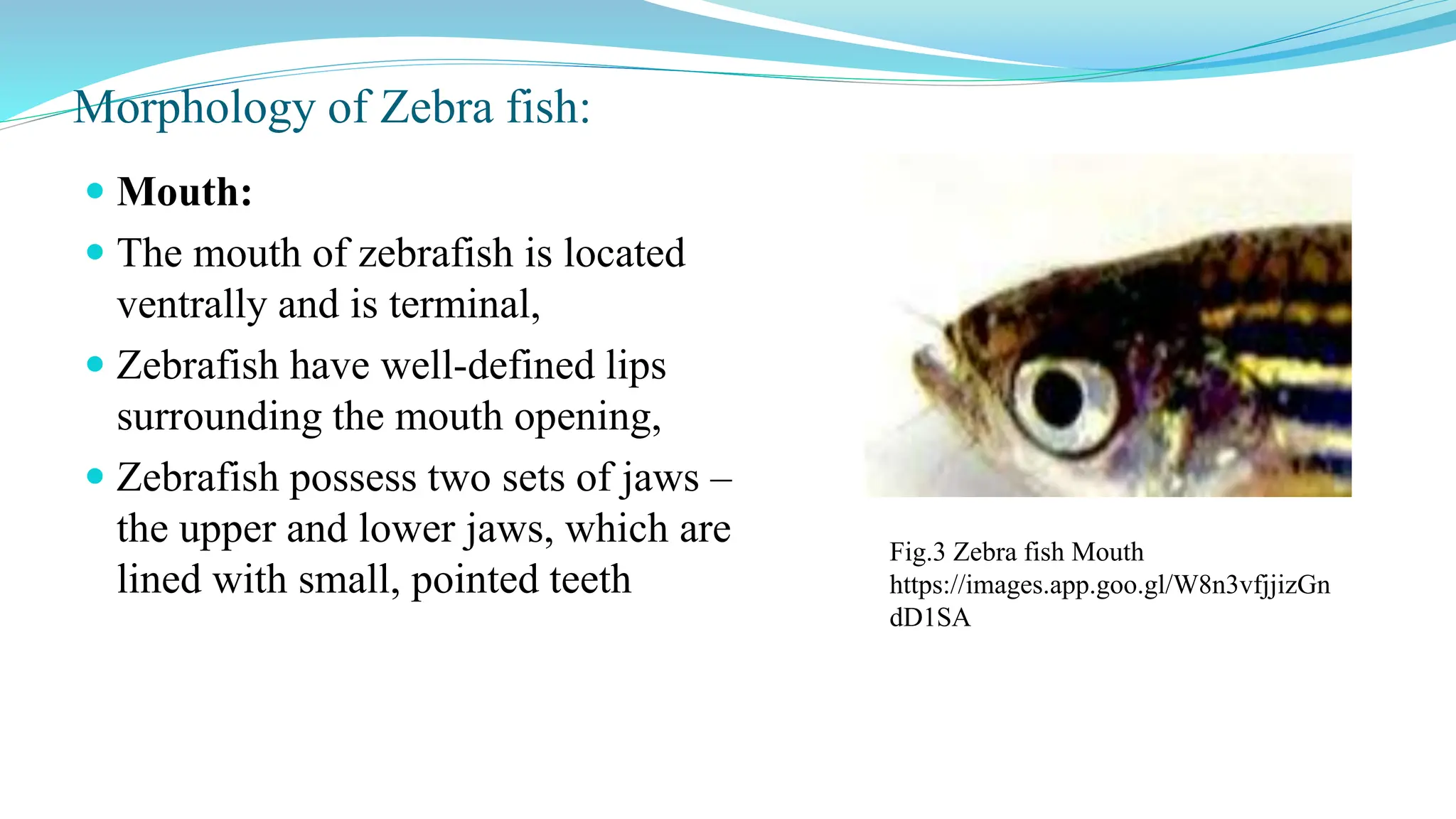
 Mouth:
 The mouth of zebrafish is located
ventrally and is terminal,
 Zebrafish have well-defined lips
surrounding the mouth opening,
 Zebrafish possess two sets of jaws –
the upper and lower jaws, which are
lined with small, pointed teeth
Fig.3 Zebra fish Mouth
https://images.app.goo.gl/W8n3vfjjizGn
dD1SA
 Oral cavity
 Zebrafish have pharyngeal teeth located at the back of the throat.
 Along the inner side of the gill arches, zebrafish have gill rakers
 Zebrafish mouths are adapted for omnivorous feeding habits
 Scales:
 The zebrafish, Danio rerio, has a
streamlined body covered in overlapping
scales called dermal scales.
 These scales are composed of bone-like
material called dentin covered by a thin
layer of enamel.
 the coloration and patterning of the scales
vary between different strains and
individuals
Fig.4 Zebra fish scales
https://images.app.goo.gl/JNzo62
8RBCGFkEi5A
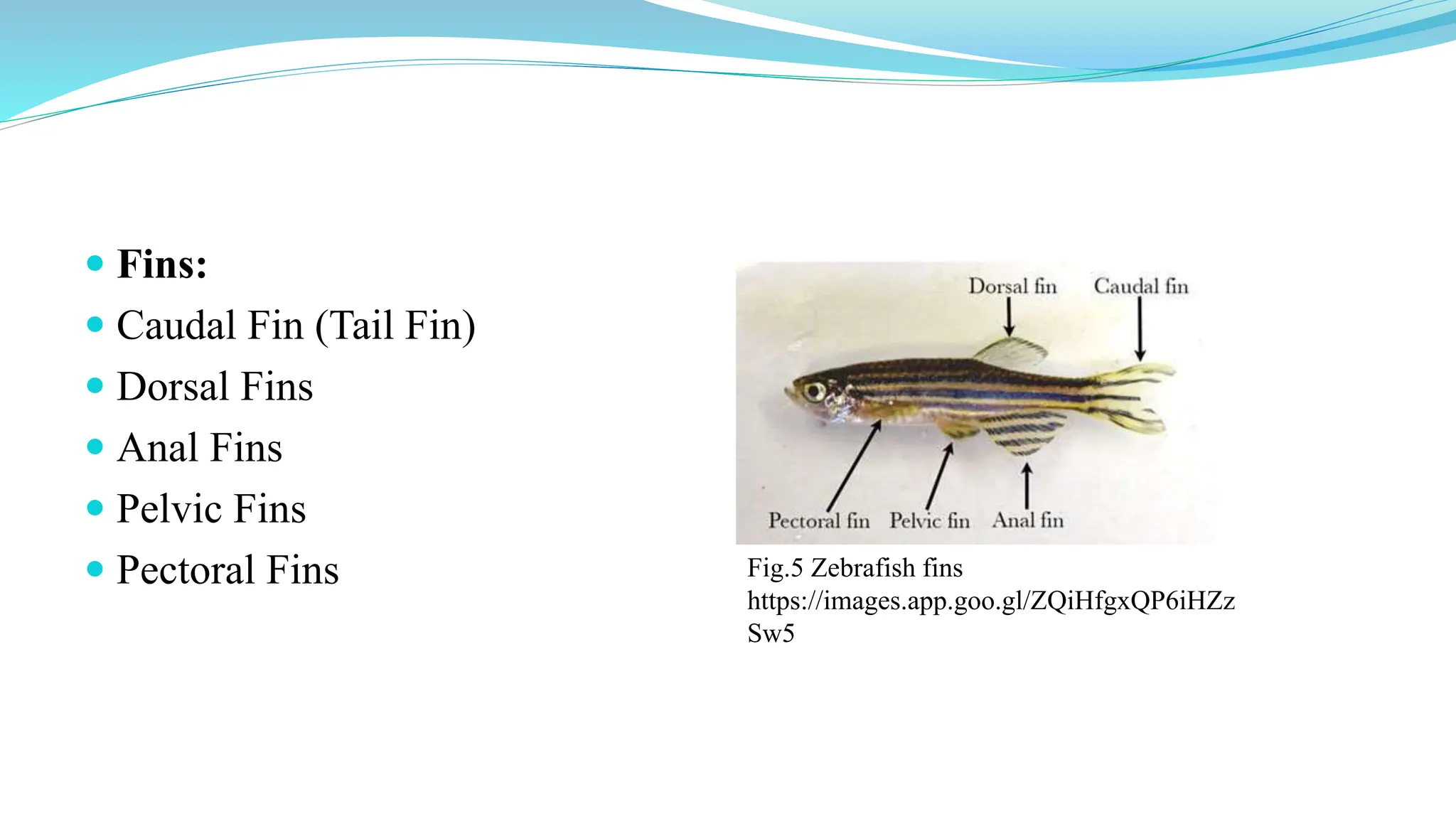
 Fins:
 Caudal Fin (Tail Fin)
 Dorsal Fins
 Anal Fins
 Pelvic Fins
 Pectoral Fins Fig.5 Zebrafish fins
https://images.app.goo.gl/ZQiHfgxQP6iHZz
Sw5
Behavior:
 Migratory Behavior:
 In the wild, they migrate in response to environmental cues such as
temperature changes, photoperiod, and food availability.
 These migrations are essential for their survival and reproduction.
 Zebrafish larvae, for example, may migrate towards warmer waters or
areas with higher food abundance.
 (Spence, R., Gerlach, G.,2019)
 Parental Behavior:
 caring for their eggs and offspring.
 After spawning, the male fertilizes the eggs.
 role in guarding and maintaining the nest.
 fan the eggs with their fins to ensure proper oxygenation and remove
debris.
 defend the nest against potential (Spence, R., Gerlach, G.,2019)
Recent research findings:
 Genetic Studies
 Disease Modeling
 Drug Screening
 Neuroscience
 Regenerative Medicine
 Environmental Studies(Spence, R., Gerlach, G.,2019)
References:
 Metscher, B. D., & Ahlberg, P. E. (2014). Zebrafish in context: uses of a
laboratory model in comparative studies. Developmental biology, 210(1),
1-14.
 Broughton, R. E., Milam, J. E., & Roe, B. A. (2016). The complete
sequence of the zebrafish (Danio rerio) mitochondrial genome and
evolutionary patterns in vertebrate mitochondrial DNA. Genome
research, 11(11), 1958-1967.
 Spence, R., Fatema, M. K., Reichard, M., Huq, K. A., Wahab, M. A.,
Ahmed, Z. F., & Smith, C. (2018). The distribution and habitat
preferences of the zebrafish in Bangladesh. Journal of fish biology, 69(5),
1435-1448.
 Tavares, B., & Lopes, S. S. (2019). The importance of Zebrafish in
biomedical research. Acta medica portuguesa, 26(5), 583-592.
 Spence, R., Gerlach, G., Lawrence, C., & Smith, C. (2019). The
behaviour and ecology of the zebrafish, Danio rerio. Biological reviews,
83(1), 13-34.
 Pritchard, V. L. (2016). Behaviour and morphology of the zebrafish,
Danio rerio (Doctoral dissertation, University of Leeds).
 Brittijn, S. A., Duivesteijn, S. J., Belmamoune, M., Bertens, L. F., Bitter,
W., De Bruijn, J. D., … & Richardson, M. K. (2018). Zebrafish
development and regeneration: new tools for biomedical research.
International Journal of Developmental Biology, 53(5-6), 835-850.
Danio rerio ( zebra fish) introduction & Morphology

Danio rerio ( zebra fish) introduction & Morphology

  • 1.
  • 2.
    Topic:Zebra Fish Department ofZoology Presented by: Komal Zahra Roll no# UOC-BSZOL-F2020/035 BS Zoology Session: 2020-2024 Subject: Ichthyology Instructor Name: Dr. Syeda Nadia Ahmad
  • 3.
    Introduction  The zebrafishis one of the model organisms for genetic and  developmental studies.  The scientific name of zebrafish is Danio rerio  The zebrafish (Danio rerio) Is a freshwater fish  it belongs to the minnow family, Cyprinidae.  Native to India and South Asia also found in private ponds. Fig.1 Zebra fish https://images.app.goo.gl/dbRs3W4L U1PjTFfp7
  • 4.
     Zebrafish growto maturity and are able breed within 2 to 3 months.  Got its common name from the presence of five uniform and pigmented horizontal stripes on the side of its body.  Stripes of zebrafish are blue in colour and they extend from the gill cover to the end of the caudal fin.  Zebrafish has been used for biomedicine and developmental biology. (Metscher, B. D., & Ahlberg, P. E. 2014). Fig.2 Zebra fish https://images.app.goo.gl/vH5GGVrc4G Ltn957A
  • 5.
    Taxnomy:  Domain: Eukaryota Kingdom: Animalia  Phylum: Chordata  Class: Actinopterygii  Order: Cypriniformes  Family: Cyprinidae  Subfamily: Danioninae  Genus: Danio  Species: D. rerio
  • 6.
     Binomial Names: Barilius rerio  Cyprinus chapalio  Brachydanio rerio  Cyprinus rerio  Danio lineatus  Nuria rerio  Perilampus striatus (Broughton, R.,2016)
  • 7.
    General Characteristics:  BodyShape:Its shape is fusiform and laterally compressed,  Mouth Shape: Mouth directed upwards.  Tail: Forked tail  Fins: Dorsal, pectoral, pelvic,Anal, Cadual  Type of scales:Elasmoid scales
  • 8.
    Meristic Characterstics:  Feeder:Zebrafish are primarily carnivorous ( zooplankton, insect larvae, and small crustaceans in the wild)  Migrate: they don’t migrate in the same sense as some other species.  Growth rate:The growth rate of zebrafish can vary depending on factors such as genetics, environment, and diet.  Life span: 2 to 3 years  Weight: between 0.1 to 0.5 grams  Natural predators: (predatory cichlids, snakes, birds, and aquatic insects.)
  • 9.
     Fin formula: Dorsal fin rays: 8 to 9.  Pectoral fins rays: 11-12 rays.  Pelvic fin rays: 6-7 rays.  Anal fin rays: 8 to 9.  Cadual fin rays: 15 or more rays.  Lateral Line scales: 32-35
  • 10.
    Distribution:  Native toIndia and South Asia also found in private ponds.  Countries such as India, Bangladesh, Nepal, Myanmar, and Pakistan.  Slow-moving or stagnant waters, including streams, ponds, ditches, and rice paddies.  Often found in shallow waters with sandy or muddy substrates and dense aquatic vegetation.  Zebrafish have been introduced to various parts of the world beyond their native range. (Broughton, R.,2016)
  • 11.
    Importance of Zebrafish:  Economic Importance of Zebra fish:  Indicator Species  Prey Species  Control of Insect Populations:  Nutrient Cycling  Seed Dispersal  Biodiversity Maintenance:  Research on Aquatic Ecology.(Tavares, B., & Lopes, S.,2019).
  • 12.
     Biological importanceof Zebra fish:  Genetic Similarity to Humans  Embryonic Development  Regenerative Abilities  Drug Discovery and Toxicology  Neuroscience  Cardiovascular Research  Cancer Research  Environmental Biology .(Tavares, B., & Lopes, S.,2019).
  • 13.
    Interesting or Uniquefacts about Zebra fish:  Origin and Habitat  Distinctive Stripes  Genetic Optical Clarity  Regenerative Abilities  Social Behavior  Drug Discover  Developmental Biology  Environmental Sensitivity  Educational Tool  Short Reproduction Cycle  Optogenetics.( Pritchard, V. L. 2017).
  • 14.
    Morphology of Zebrafish:  Mouth:  The mouth of zebrafish is located ventrally and is terminal,  Zebrafish have well-defined lips surrounding the mouth opening,  Zebrafish possess two sets of jaws – the upper and lower jaws, which are lined with small, pointed teeth Fig.3 Zebra fish Mouth https://images.app.goo.gl/W8n3vfjjizGn dD1SA
  • 15.
     Oral cavity Zebrafish have pharyngeal teeth located at the back of the throat.  Along the inner side of the gill arches, zebrafish have gill rakers  Zebrafish mouths are adapted for omnivorous feeding habits
  • 16.
     Scales:  Thezebrafish, Danio rerio, has a streamlined body covered in overlapping scales called dermal scales.  These scales are composed of bone-like material called dentin covered by a thin layer of enamel.  the coloration and patterning of the scales vary between different strains and individuals Fig.4 Zebra fish scales https://images.app.goo.gl/JNzo62 8RBCGFkEi5A
  • 17.
     Fins:  CaudalFin (Tail Fin)  Dorsal Fins  Anal Fins  Pelvic Fins  Pectoral Fins Fig.5 Zebrafish fins https://images.app.goo.gl/ZQiHfgxQP6iHZz Sw5
  • 18.
    Behavior:  Migratory Behavior: In the wild, they migrate in response to environmental cues such as temperature changes, photoperiod, and food availability.  These migrations are essential for their survival and reproduction.  Zebrafish larvae, for example, may migrate towards warmer waters or areas with higher food abundance.  (Spence, R., Gerlach, G.,2019)
  • 19.
     Parental Behavior: caring for their eggs and offspring.  After spawning, the male fertilizes the eggs.  role in guarding and maintaining the nest.  fan the eggs with their fins to ensure proper oxygenation and remove debris.  defend the nest against potential (Spence, R., Gerlach, G.,2019)
  • 20.
    Recent research findings: Genetic Studies  Disease Modeling  Drug Screening  Neuroscience  Regenerative Medicine  Environmental Studies(Spence, R., Gerlach, G.,2019)
  • 21.
    References:  Metscher, B.D., & Ahlberg, P. E. (2014). Zebrafish in context: uses of a laboratory model in comparative studies. Developmental biology, 210(1), 1-14.  Broughton, R. E., Milam, J. E., & Roe, B. A. (2016). The complete sequence of the zebrafish (Danio rerio) mitochondrial genome and evolutionary patterns in vertebrate mitochondrial DNA. Genome research, 11(11), 1958-1967.  Spence, R., Fatema, M. K., Reichard, M., Huq, K. A., Wahab, M. A., Ahmed, Z. F., & Smith, C. (2018). The distribution and habitat preferences of the zebrafish in Bangladesh. Journal of fish biology, 69(5), 1435-1448.
  • 22.
     Tavares, B.,& Lopes, S. S. (2019). The importance of Zebrafish in biomedical research. Acta medica portuguesa, 26(5), 583-592.  Spence, R., Gerlach, G., Lawrence, C., & Smith, C. (2019). The behaviour and ecology of the zebrafish, Danio rerio. Biological reviews, 83(1), 13-34.  Pritchard, V. L. (2016). Behaviour and morphology of the zebrafish, Danio rerio (Doctoral dissertation, University of Leeds).  Brittijn, S. A., Duivesteijn, S. J., Belmamoune, M., Bertens, L. F., Bitter, W., De Bruijn, J. D., … & Richardson, M. K. (2018). Zebrafish development and regeneration: new tools for biomedical research. International Journal of Developmental Biology, 53(5-6), 835-850.