The Caring Classroom: A
Curriculum of Care in the
Classroom

How to encourage the growth of competent and
caring students who are prepared to be productive
citizens in a 21st century society.
•

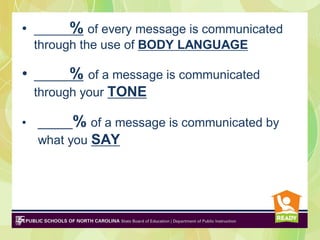
% of every message is communicated
through the use of BODY LANGUAGE

•

% of a message is communicated
through your TONE

• _____% of a message is communicated by
what you SAY
The Caring Classroom: A
Curriculum of Care in the
Classroom

How to encourage the growth of competent and
caring students who are prepared to be productive
citizens in a 21st century society.
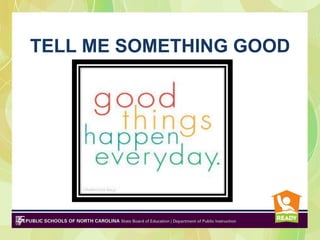
TELL ME SOMETHING GOOD
Objectives
• Understand the importance of an safe, orderly
and caring environment that builds true
community in your classroom.
• Understand the importance of focusing on
students’ moral development as well as
intellectual growth in order to prepare them to be
caring citizens in our society today.

• Create a safe, trusting, self-managing
environment by building a sense of community
within the classroom.
Guiding Questions
• What is the ultimate aim of public education today?
• What do our students need from their education, and
what does our society need?
• What does a classroom community look like?
• What are your most frequent challenges with
students?
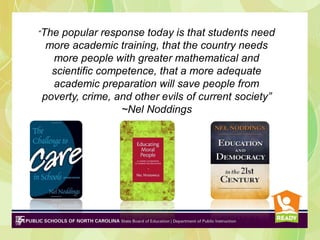
“The

popular response today is that students need
more academic training, that the country needs
more people with greater mathematical and
scientific competence, that a more adequate
academic preparation will save people from
poverty, crime, and other evils of current society”
~Nel Noddings
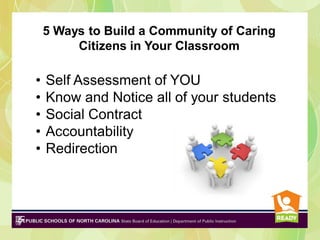
5 Ways to Build a Community of Caring
Citizens in Your Classroom

•
•
•
•
•

Self Assessment of YOU
Know and Notice all of your students
Social Contract
Accountability
Redirection
Evaluate your own behavior
1. If everybody where I work was just like me, what would
this place be like?
2. If my face froze in my most common expression, what
would it be?
3. If as many people helped me today as I helped others,
how much help would I get?“
4. If today was videoed for my peers, what would be their
criticisms? What would be their accolades?
5. If I became just like the two people I choose to be
around the most at work - what would I become?"
How are you "the change you wish to see in the world"?
~Mahatma Gandhi
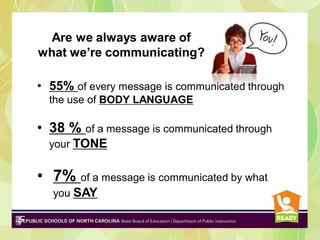
Are we always aware of
what we’re communicating?

• 55% of every message is communicated through
the use of BODY LANGUAGE

• 38 % of a message is communicated through
your TONE

• 7% of a message is communicated by what
you SAY
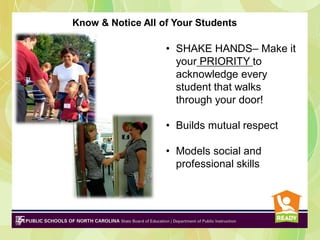
Know & Notice All of Your Students

• SHAKE HANDS– Make it
your PRIORITY to
acknowledge every
student that walks
through your door!
• Builds mutual respect
• Models social and
professional skills
If you really knew me you
would know…..
• Reflective writing

• Small group discussion
• One on one discussion with students
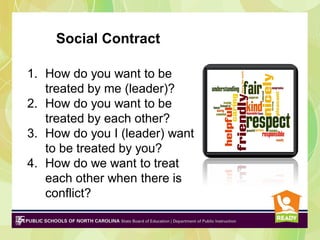
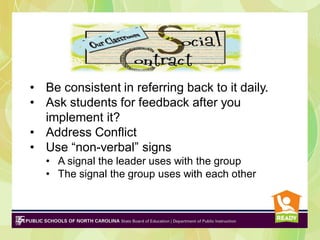
Social Contract
1. How do you want to be
treated by me (leader)?
2. How do you want to be
treated by each other?
3. How do you I (leader) want
to be treated by you?
4. How do we want to treat
each other when there is
conflict?
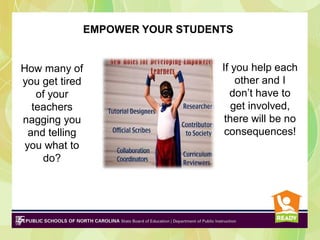
EMPOWER YOUR STUDENTS

How many of
you get tired
of your
teachers
nagging you
and telling
you what to
do?

If you help each
other and I
don’t have to
get involved,
there will be no
consequences!
4 Redirecting Questions
1.
2.
3.
4.

What are you doing?
What are you supposed to be doing?
Are you doing it?
What are you going to do about it?
• So what’s going to happen if you do this
again?
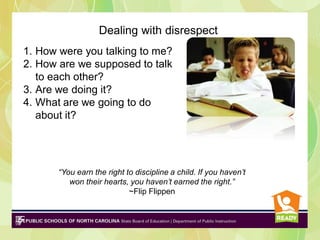
Dealing with disrespect
1. How were you talking to me?
2. How are we supposed to talk
to each other?
3. Are we doing it?
4. What are we going to do
about it?

“You earn the right to discipline a child. If you haven’t
won their hearts, you haven’t earned the right.”
~Flip Flippen
• Be consistent in referring back to it daily.
• Ask students for feedback after you
implement it?
• Address Conflict
• Use “non-verbal” signs
• A signal the leader uses with the group
• The signal the group uses with each other
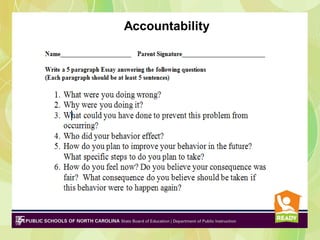
Accountability
Resources
• Challenge Day:
o http://www.challengeday.org/mtv/downloads/IYRKM_IntroGuide.pdf
• Capturing Kids Hearts
o http://www.flippengroup.com/education/ckh.html
o http://www.pinterest.com/hbolles/capturing-kids-hearts/
• Developing Social Contracts
o http://www.edutopia.org/pdfs/stw/edutopia-stw-louisville-sel-protocolfor-developing-the-social-contract.pdf
Resources
• The Flippen Education Group
http://www.flippengroup.com/education/ckh.html
• Noddings, N. (2002). Educating moral people: A caring
alternative to character education. New York: Teachers College
Press.
• Noddings, N (2006). Critical Lessons: What our school should
teach. New York: Cambridge University Press.
• Watson Marilyn (2003). Learning to Trust: Transforming Difficult
Elementary Classrooms Through Developmental Discipline.
Jossey-Bass.
Every Kid Needs a Champion
Will you be a champion?

The Caring Classroom

  • 1.
    The Caring Classroom:A Curriculum of Care in the Classroom How to encourage the growth of competent and caring students who are prepared to be productive citizens in a 21st century society.
  • 2.
    • % of everymessage is communicated through the use of BODY LANGUAGE • % of a message is communicated through your TONE • _____% of a message is communicated by what you SAY
  • 3.
    The Caring Classroom:A Curriculum of Care in the Classroom How to encourage the growth of competent and caring students who are prepared to be productive citizens in a 21st century society.
  • 4.
  • 5.
    Objectives • Understand theimportance of an safe, orderly and caring environment that builds true community in your classroom. • Understand the importance of focusing on students’ moral development as well as intellectual growth in order to prepare them to be caring citizens in our society today. • Create a safe, trusting, self-managing environment by building a sense of community within the classroom.
  • 6.
    Guiding Questions • Whatis the ultimate aim of public education today? • What do our students need from their education, and what does our society need? • What does a classroom community look like? • What are your most frequent challenges with students?
  • 7.
    “The popular response todayis that students need more academic training, that the country needs more people with greater mathematical and scientific competence, that a more adequate academic preparation will save people from poverty, crime, and other evils of current society” ~Nel Noddings
  • 8.
    5 Ways toBuild a Community of Caring Citizens in Your Classroom • • • • • Self Assessment of YOU Know and Notice all of your students Social Contract Accountability Redirection
  • 9.
    Evaluate your ownbehavior 1. If everybody where I work was just like me, what would this place be like? 2. If my face froze in my most common expression, what would it be? 3. If as many people helped me today as I helped others, how much help would I get?“ 4. If today was videoed for my peers, what would be their criticisms? What would be their accolades? 5. If I became just like the two people I choose to be around the most at work - what would I become?" How are you "the change you wish to see in the world"? ~Mahatma Gandhi
  • 10.
    Are we alwaysaware of what we’re communicating? • 55% of every message is communicated through the use of BODY LANGUAGE • 38 % of a message is communicated through your TONE • 7% of a message is communicated by what you SAY
  • 11.
    Know & NoticeAll of Your Students • SHAKE HANDS– Make it your PRIORITY to acknowledge every student that walks through your door! • Builds mutual respect • Models social and professional skills
  • 12.
    If you reallyknew me you would know….. • Reflective writing • Small group discussion • One on one discussion with students
  • 13.
    Social Contract 1. Howdo you want to be treated by me (leader)? 2. How do you want to be treated by each other? 3. How do you I (leader) want to be treated by you? 4. How do we want to treat each other when there is conflict?
  • 14.
    EMPOWER YOUR STUDENTS Howmany of you get tired of your teachers nagging you and telling you what to do? If you help each other and I don’t have to get involved, there will be no consequences!
  • 15.
    4 Redirecting Questions 1. 2. 3. 4. Whatare you doing? What are you supposed to be doing? Are you doing it? What are you going to do about it? • So what’s going to happen if you do this again?
  • 16.
    Dealing with disrespect 1.How were you talking to me? 2. How are we supposed to talk to each other? 3. Are we doing it? 4. What are we going to do about it? “You earn the right to discipline a child. If you haven’t won their hearts, you haven’t earned the right.” ~Flip Flippen
  • 17.
    • Be consistentin referring back to it daily. • Ask students for feedback after you implement it? • Address Conflict • Use “non-verbal” signs • A signal the leader uses with the group • The signal the group uses with each other
  • 18.
  • 19.
    Resources • Challenge Day: ohttp://www.challengeday.org/mtv/downloads/IYRKM_IntroGuide.pdf • Capturing Kids Hearts o http://www.flippengroup.com/education/ckh.html o http://www.pinterest.com/hbolles/capturing-kids-hearts/ • Developing Social Contracts o http://www.edutopia.org/pdfs/stw/edutopia-stw-louisville-sel-protocolfor-developing-the-social-contract.pdf
  • 20.
    Resources • The FlippenEducation Group http://www.flippengroup.com/education/ckh.html • Noddings, N. (2002). Educating moral people: A caring alternative to character education. New York: Teachers College Press. • Noddings, N (2006). Critical Lessons: What our school should teach. New York: Cambridge University Press. • Watson Marilyn (2003). Learning to Trust: Transforming Difficult Elementary Classrooms Through Developmental Discipline. Jossey-Bass.
  • 21.
    Every Kid Needsa Champion Will you be a champion?