Class Room: H3
Hours: Tuesday , 12.00– 14.00
Instructor: SAYGIN GÖNÇ
Email: saygingonc@gau.edu.tr
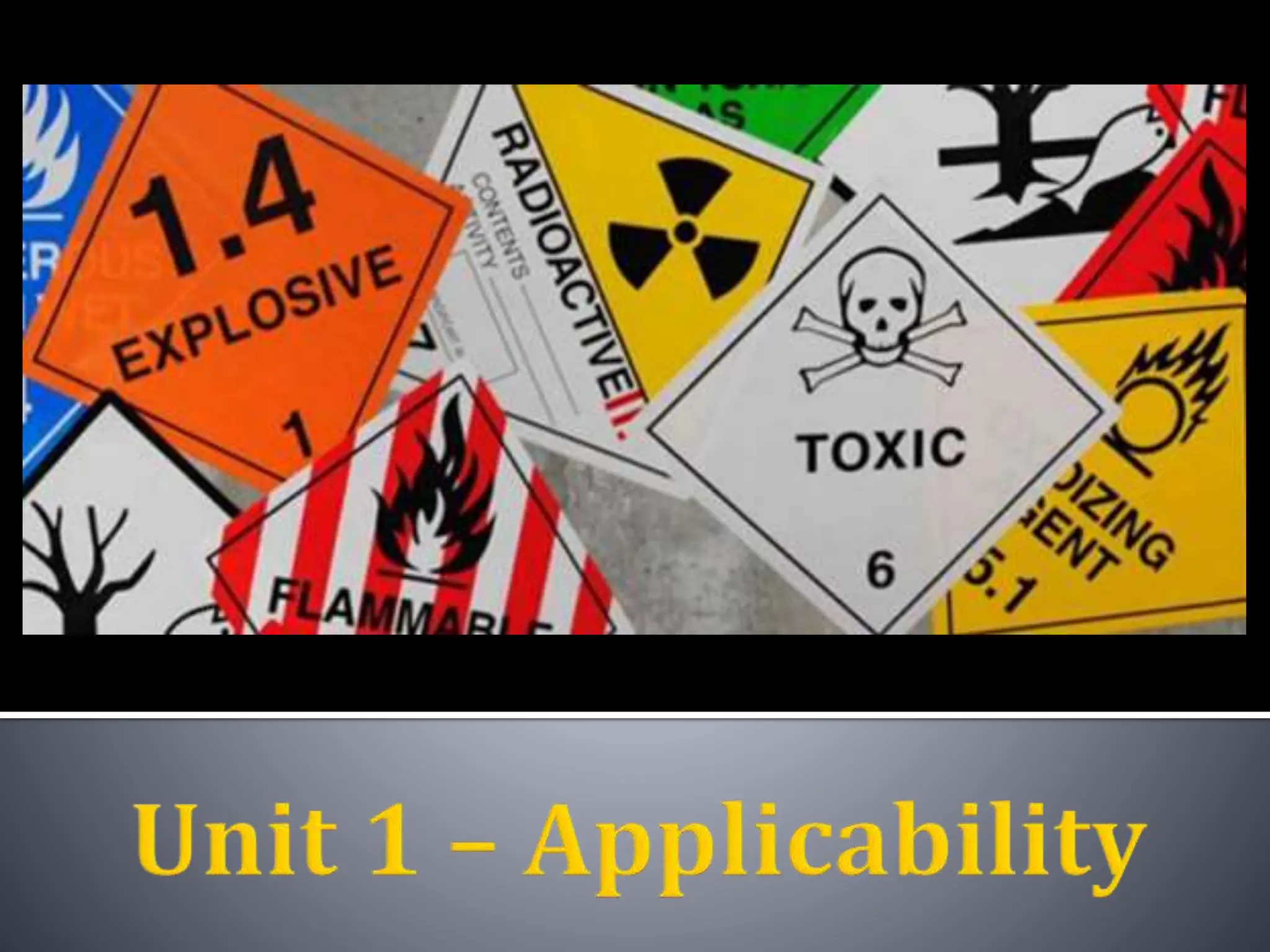
 Dangerous goods are commodities that possess potentially
dangerous characteristics.
 These characteristics will not make their transport by air
dangerous, provided that suitable precautions are taken.
 Dangerous goods consists not only of obvious substances
such as acids, explosives and poisons, but also include less
apparent articles like magnets, refrigerants and some
everyday household items such as bleaches, aerosols and
perfumes.
 There are internationally agreed rules to ensure the safe
transportation of dangerous goods by air.
2
 The IATA Dangerous Goods Regulations (aka DGR) are
published in order to provide procedures for the shipper
and the operator by which articles and substances with
hazardous properties can be safely transported by air on all
commercial air transport.
 In 1953, the Member airlines of IATA recognized the growing
need to transport by air, articles and substances having
hazardous properties which, if uncontrolled, could adversely
affect the safety of the passengers, crew and/or aircraft on
which they are carried.
3
 Experience in other modes of transport had demonstrated
that most such articles and substances could be carried
safely provided that the article or substance was properly
packed and the quantities in each package were properly
limited.
 Using this experience together with the industry's
knowledge of the specialized characteristics of air transport,
IATA developed the first regulations for the transport of
dangerous goods by air.
 The first edition of the IATA Dangerous Goods Regulations
was published in 1956 as the IATA Restricted Articles
Regulations.
4
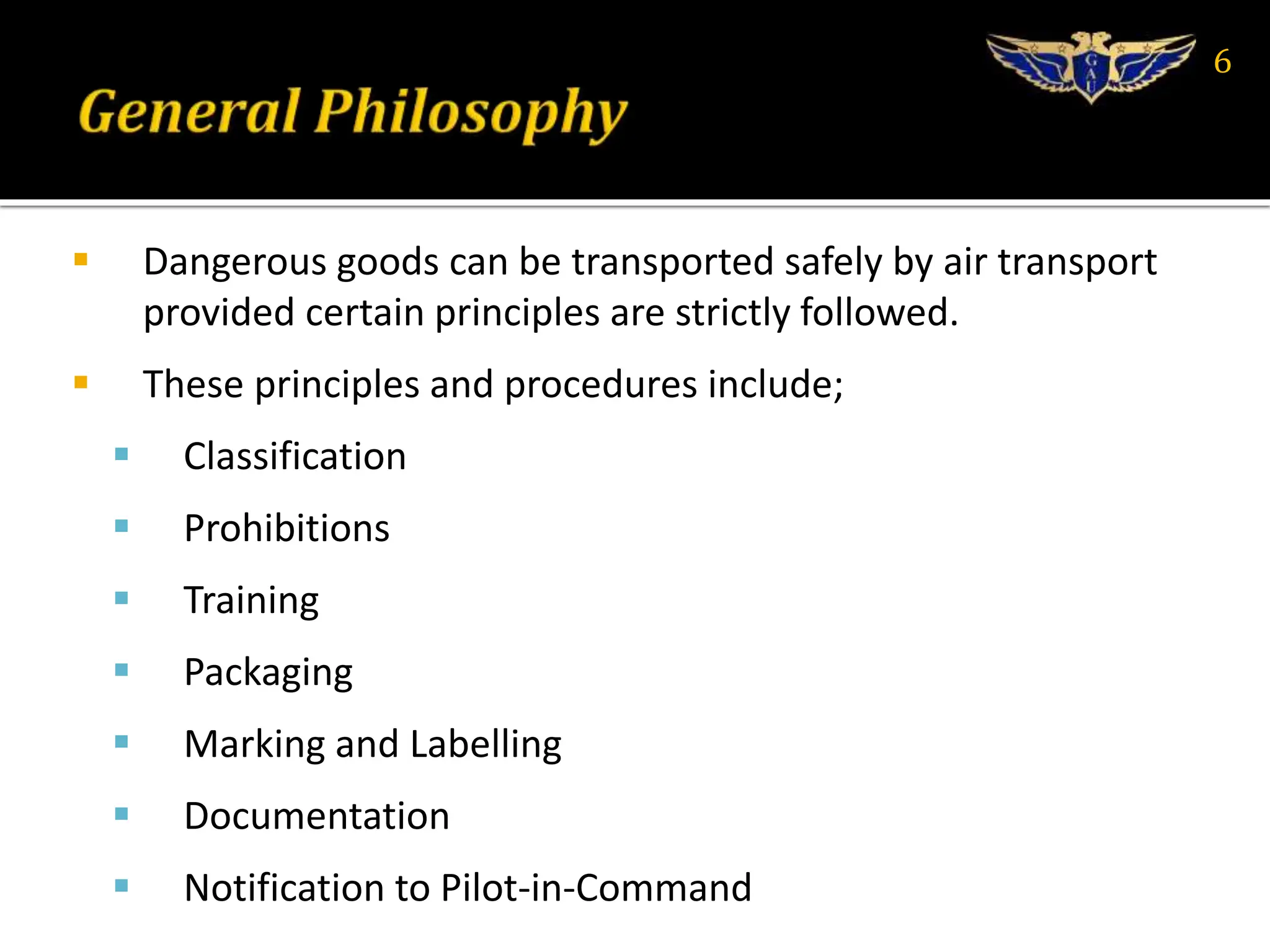
 Dangerous goods can be transported safely by air transport
provided certain principles are strictly followed.
 These principles and procedures include;
 Classification
 Prohibitions
 Training
 Packaging
 Marking and Labelling
 Documentation
 Notification to Pilot-in-Command
6
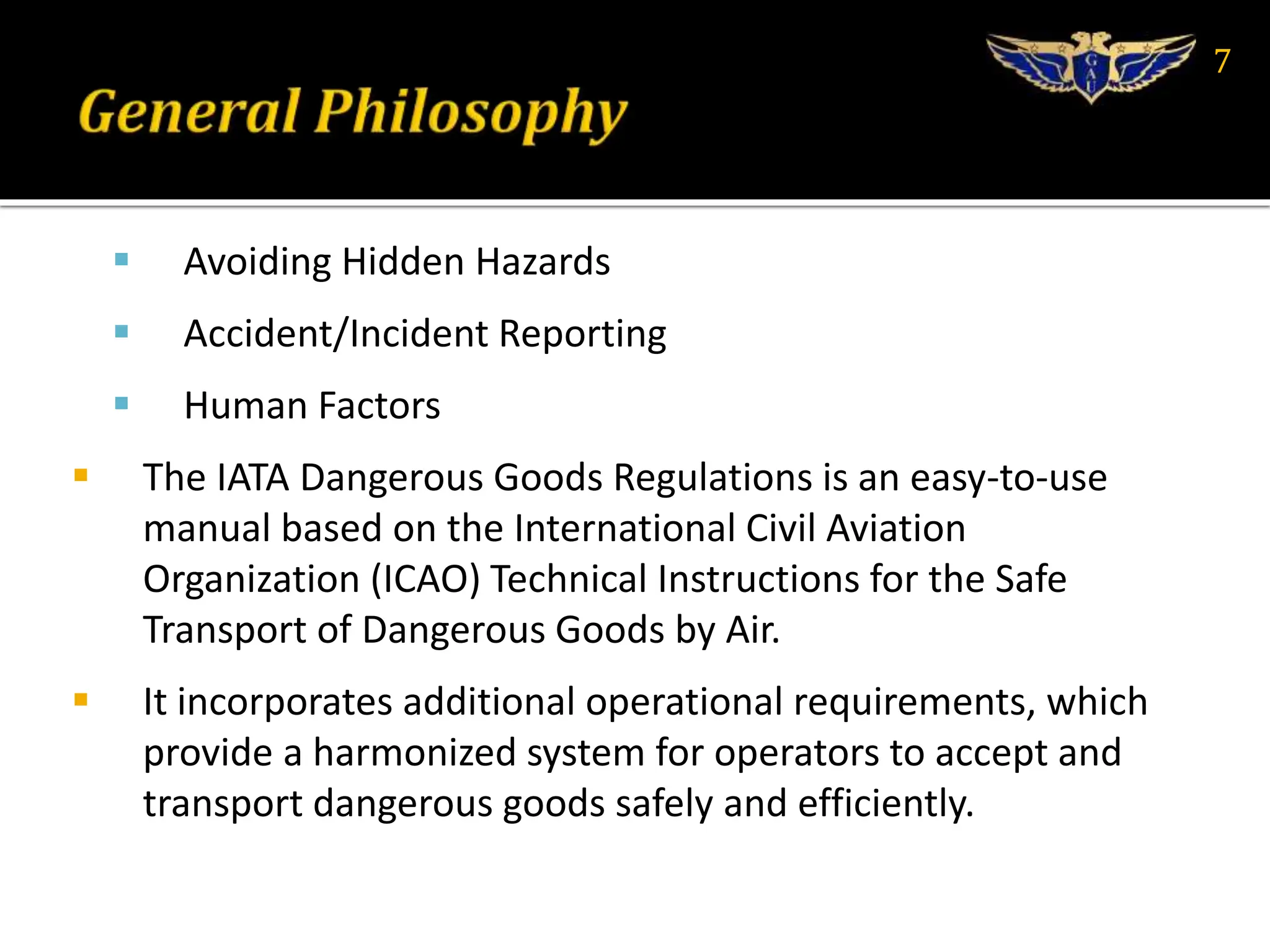
 Avoiding Hidden Hazards
 Accident/Incident Reporting
 Human Factors
 The IATA Dangerous Goods Regulations is an easy-to-use
manual based on the International Civil Aviation
Organization (ICAO) Technical Instructions for the Safe
Transport of Dangerous Goods by Air.
 It incorporates additional operational requirements, which
provide a harmonized system for operators to accept and
transport dangerous goods safely and efficiently.
7
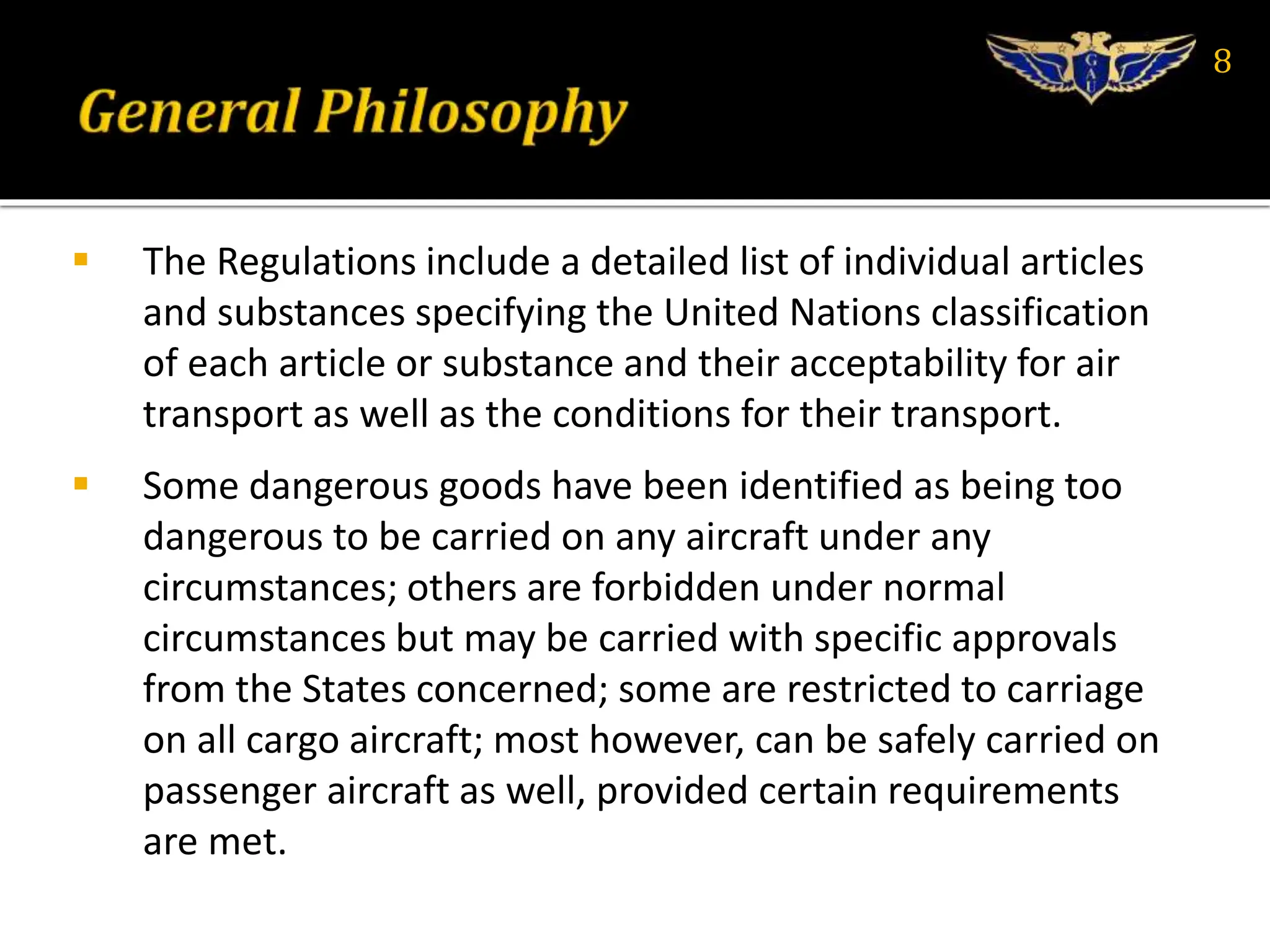
 The Regulations include a detailed list of individual articles
and substances specifying the United Nations classification
of each article or substance and their acceptability for air
transport as well as the conditions for their transport.
 Some dangerous goods have been identified as being too
dangerous to be carried on any aircraft under any
circumstances; others are forbidden under normal
circumstances but may be carried with specific approvals
from the States concerned; some are restricted to carriage
on all cargo aircraft; most however, can be safely carried on
passenger aircraft as well, provided certain requirements
are met.
8
 Packaging is the essential component in the safe transport
of dangerous goods by air.
 The IATA Dangerous Goods Regulations provide packing
instructions for all dangerous goods acceptable for air
transport with a wide range of options for inner, outer and
single packagings.
 The packing instructions normally require the use of UN
performance-tested specification packagings, however
these are not required when dangerous goods are shipped
in Limited Quantities under the provisions of Limited
Quantity “Y” Packing Instructions.
9
 The quantity of dangerous goods permitted within these
packagings is strictly limited by the Regulations so as to
minimize the risk should an incident occur.
 Training is also an essential element in maintaining a safe
regulatory regime.
 It is necessary for all individuals involved in the preparation
or transport of dangerous goods to be properly trained to
carry out their responsibilities.
 Depending on the job-function, this may entail only
familiarization training or may also include more detailed
training in the intricacies of the Regulations.
10
 It is important to remember that dangerous goods are very
unlikely to cause a problem when they are prepared and
handled in compliance with the IATA Dangerous Goods
Regulations.
 The proper declaration of dangerous goods by the shipper
ensures that all in the transportation chain know what
dangerous goods they are transporting, how to properly
load and handle them and what to do if an incident or
accident occurs either in-flight or on the ground.
 The pilot-in-command must know what is on board the
aircraft in order to properly deal with any emergencies,
which may occur.
11
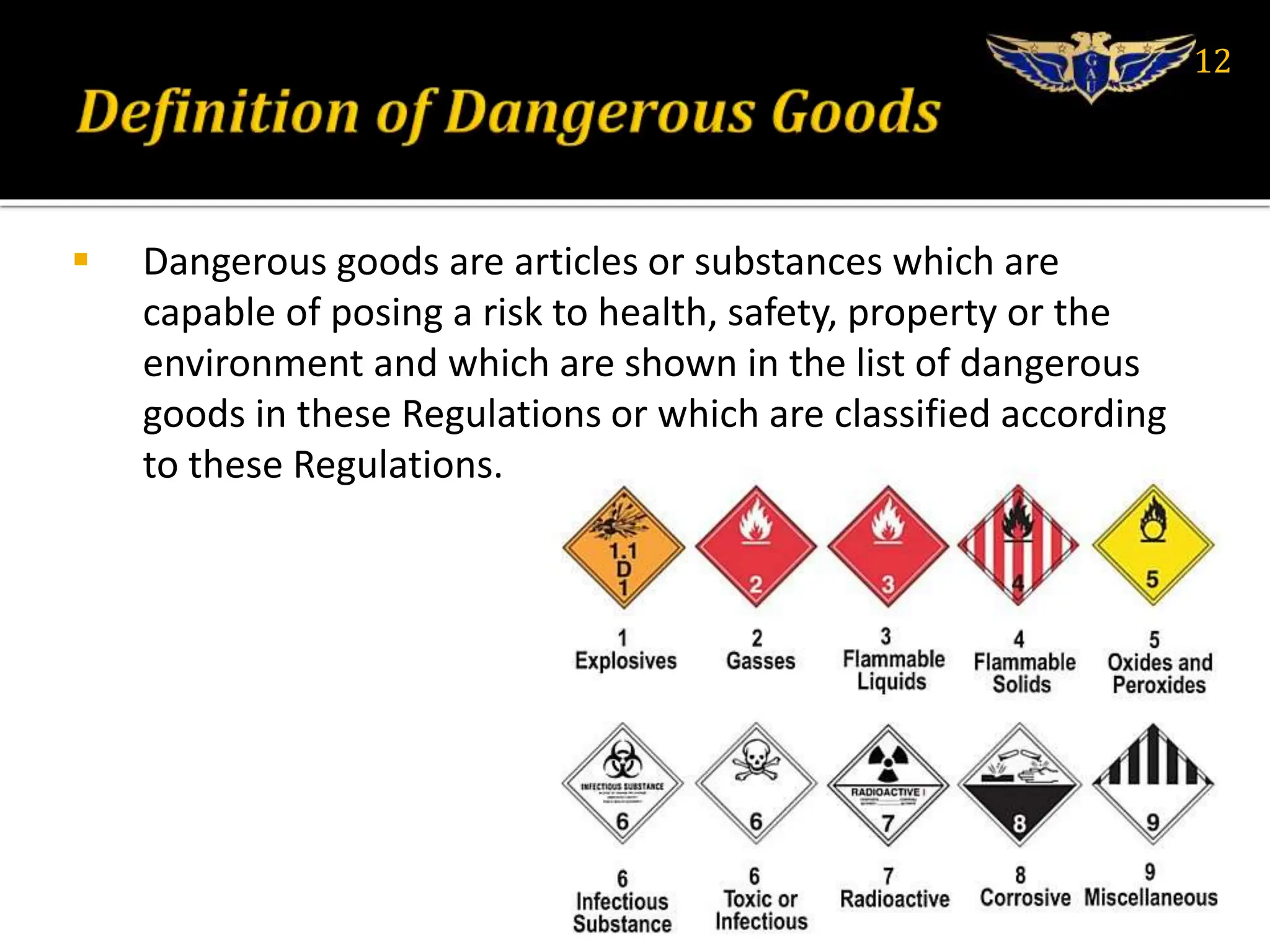
 Dangerous goods are articles or substances which are
capable of posing a risk to health, safety, property or the
environment and which are shown in the list of dangerous
goods in these Regulations or which are classified according
to these Regulations.
12
 The importance of shipper’s respoonsibilities and compliance
cannot be over-emphasized. The shipper specifically must;
 establish that his employees are trained to enable them
tocarry out their responsibilities
 establish whether the article or substance is prohibited
(forbidden) for transport by air
 Ensure that dangerous goods are identified, classified,
packed, marked, labelled and documented in full
compliance. Also that cargo offered for transport by air as
being «Not restricted» or «Non-dangerous goods» does
not met any of the classification criteria for dangerous
goods
13
 Ensure that dangerous goods are packed in compliance
with all applicable air transport requirements.
 The shipper, the freight forwarder and the cargo agent must
also establish:
 For all consignments, that documents and exterior of the
package have been checked for any indication of hidden
hazards and other responsibilities as stipulated.
14
 When accepting cargo for transportation by air it is the
operator’s cargo acceptance staff who have the responsibility
to ensure, as far as possible, that theconsignment does not
contain dangerous goods unless the shipper has prepared the
shipment of dangerous goods in accordance with the
regulations.
 A checklist must be used to accept declared dangerous goods
consignments.
 In addition to acceptance, the operator has seven other
responsibilities as set out;
 Storage
15
 Loading
 Inspection
 Provision of information, including emergency response
information
 Reporting dangerous goods accidents and incidents
 Retention of records and
 Training
 It is important to note that when the operator offers a
shipment of dangerous goods for carriage on its own service
or that of another operator, it must comply with all shipper’s
responsibilities.
16
 An operator must ensure that information as to the types of
dangerous goods which a passenger is forbidden from
transporting aboard an aircraft is provided at the point of
ticket purchase. Information provided via the Internet may be
in text or pictorial form but must be such that ticket purchase
cannot be completed until the passenger, or a person acting
on their behalf, has indicated that they have understood the
restrictions on dangerous goods in baggage.
 An operator or the operator's handling agent and the airport
operator must ensure that notices warning passengers as to
the type of dangerous goods which are forbidden for
transport aboard an aircraft are available and:
17
 (a) must be prominently displayed in sufficient number at
each of the places at an airport:
 where tickets are issued,
 where passengers check-in,
 in aircraft boarding areas,
 (b) prominently displayed at any other location where
passengers are checked in; and
 (c) should be prominently displayed in sufficient numbers in
baggage claim areas.
 These notices must include visual examples of dangerous
goods forbidden from transport aboard an aircraft.
18
 An operator, of passenger aircraft, should have information
on those dangerous goods which may be carried by
passengers available prior to the check-in process on their
web sites or other sources of information.
 When provision is made for the check-in process to be
completed remotely (e.g. via the Internet), the operator must
ensure that information on the types of dangerous goods
which a passenger is forbidden to transport aboard an aircraft
is provided to passengers. Information may be in text or
pictorial form but must be such that the check-in process
cannot be completed until the passenger, or a person acting
on their behalf, has indicated that they have understood the
restrictions on dangerous goods in baggage.
19
 When provision is made for the check-in process to be
completed at an airport by a passenger without the
involvement of any other person (e.g. automated check-in
facility), the operator or the airport operator must ensure
that information on the types of dangerous goods which a
passenger is forbidden to transport aboard an aircraft is
provided to passengers. Information should be in pictorial
form and must be such that the check-in process cannot be
completed until the passenger has indicated that they have
understood the restrictions on dangerous goods in baggage.
20
 Any organization or enterprise other than an operator (such
as a travel agent) involved in the air transport of passengers,
should provide passengers with information about the types
of dangerous goods which they are forbidden from
transporting aboard an aircraft.
21
Thank you for your attention!
22

Hazardous Materials Training course - Chapter 1

  • 1.
    Class Room: H3 Hours:Tuesday , 12.00– 14.00 Instructor: SAYGIN GÖNÇ Email: saygingonc@gau.edu.tr
  • 2.
     Dangerous goodsare commodities that possess potentially dangerous characteristics.  These characteristics will not make their transport by air dangerous, provided that suitable precautions are taken.  Dangerous goods consists not only of obvious substances such as acids, explosives and poisons, but also include less apparent articles like magnets, refrigerants and some everyday household items such as bleaches, aerosols and perfumes.  There are internationally agreed rules to ensure the safe transportation of dangerous goods by air. 2
  • 3.
     The IATADangerous Goods Regulations (aka DGR) are published in order to provide procedures for the shipper and the operator by which articles and substances with hazardous properties can be safely transported by air on all commercial air transport.  In 1953, the Member airlines of IATA recognized the growing need to transport by air, articles and substances having hazardous properties which, if uncontrolled, could adversely affect the safety of the passengers, crew and/or aircraft on which they are carried. 3
  • 4.
     Experience inother modes of transport had demonstrated that most such articles and substances could be carried safely provided that the article or substance was properly packed and the quantities in each package were properly limited.  Using this experience together with the industry's knowledge of the specialized characteristics of air transport, IATA developed the first regulations for the transport of dangerous goods by air.  The first edition of the IATA Dangerous Goods Regulations was published in 1956 as the IATA Restricted Articles Regulations. 4
  • 6.
     Dangerous goodscan be transported safely by air transport provided certain principles are strictly followed.  These principles and procedures include;  Classification  Prohibitions  Training  Packaging  Marking and Labelling  Documentation  Notification to Pilot-in-Command 6
  • 7.
     Avoiding HiddenHazards  Accident/Incident Reporting  Human Factors  The IATA Dangerous Goods Regulations is an easy-to-use manual based on the International Civil Aviation Organization (ICAO) Technical Instructions for the Safe Transport of Dangerous Goods by Air.  It incorporates additional operational requirements, which provide a harmonized system for operators to accept and transport dangerous goods safely and efficiently. 7
  • 8.
     The Regulationsinclude a detailed list of individual articles and substances specifying the United Nations classification of each article or substance and their acceptability for air transport as well as the conditions for their transport.  Some dangerous goods have been identified as being too dangerous to be carried on any aircraft under any circumstances; others are forbidden under normal circumstances but may be carried with specific approvals from the States concerned; some are restricted to carriage on all cargo aircraft; most however, can be safely carried on passenger aircraft as well, provided certain requirements are met. 8
  • 9.
     Packaging isthe essential component in the safe transport of dangerous goods by air.  The IATA Dangerous Goods Regulations provide packing instructions for all dangerous goods acceptable for air transport with a wide range of options for inner, outer and single packagings.  The packing instructions normally require the use of UN performance-tested specification packagings, however these are not required when dangerous goods are shipped in Limited Quantities under the provisions of Limited Quantity “Y” Packing Instructions. 9
  • 10.
     The quantityof dangerous goods permitted within these packagings is strictly limited by the Regulations so as to minimize the risk should an incident occur.  Training is also an essential element in maintaining a safe regulatory regime.  It is necessary for all individuals involved in the preparation or transport of dangerous goods to be properly trained to carry out their responsibilities.  Depending on the job-function, this may entail only familiarization training or may also include more detailed training in the intricacies of the Regulations. 10
  • 11.
     It isimportant to remember that dangerous goods are very unlikely to cause a problem when they are prepared and handled in compliance with the IATA Dangerous Goods Regulations.  The proper declaration of dangerous goods by the shipper ensures that all in the transportation chain know what dangerous goods they are transporting, how to properly load and handle them and what to do if an incident or accident occurs either in-flight or on the ground.  The pilot-in-command must know what is on board the aircraft in order to properly deal with any emergencies, which may occur. 11
  • 12.
     Dangerous goodsare articles or substances which are capable of posing a risk to health, safety, property or the environment and which are shown in the list of dangerous goods in these Regulations or which are classified according to these Regulations. 12
  • 13.
     The importanceof shipper’s respoonsibilities and compliance cannot be over-emphasized. The shipper specifically must;  establish that his employees are trained to enable them tocarry out their responsibilities  establish whether the article or substance is prohibited (forbidden) for transport by air  Ensure that dangerous goods are identified, classified, packed, marked, labelled and documented in full compliance. Also that cargo offered for transport by air as being «Not restricted» or «Non-dangerous goods» does not met any of the classification criteria for dangerous goods 13
  • 14.
     Ensure thatdangerous goods are packed in compliance with all applicable air transport requirements.  The shipper, the freight forwarder and the cargo agent must also establish:  For all consignments, that documents and exterior of the package have been checked for any indication of hidden hazards and other responsibilities as stipulated. 14
  • 15.
     When acceptingcargo for transportation by air it is the operator’s cargo acceptance staff who have the responsibility to ensure, as far as possible, that theconsignment does not contain dangerous goods unless the shipper has prepared the shipment of dangerous goods in accordance with the regulations.  A checklist must be used to accept declared dangerous goods consignments.  In addition to acceptance, the operator has seven other responsibilities as set out;  Storage 15
  • 16.
     Loading  Inspection Provision of information, including emergency response information  Reporting dangerous goods accidents and incidents  Retention of records and  Training  It is important to note that when the operator offers a shipment of dangerous goods for carriage on its own service or that of another operator, it must comply with all shipper’s responsibilities. 16
  • 17.
     An operatormust ensure that information as to the types of dangerous goods which a passenger is forbidden from transporting aboard an aircraft is provided at the point of ticket purchase. Information provided via the Internet may be in text or pictorial form but must be such that ticket purchase cannot be completed until the passenger, or a person acting on their behalf, has indicated that they have understood the restrictions on dangerous goods in baggage.  An operator or the operator's handling agent and the airport operator must ensure that notices warning passengers as to the type of dangerous goods which are forbidden for transport aboard an aircraft are available and: 17
  • 18.
     (a) mustbe prominently displayed in sufficient number at each of the places at an airport:  where tickets are issued,  where passengers check-in,  in aircraft boarding areas,  (b) prominently displayed at any other location where passengers are checked in; and  (c) should be prominently displayed in sufficient numbers in baggage claim areas.  These notices must include visual examples of dangerous goods forbidden from transport aboard an aircraft. 18
  • 19.
     An operator,of passenger aircraft, should have information on those dangerous goods which may be carried by passengers available prior to the check-in process on their web sites or other sources of information.  When provision is made for the check-in process to be completed remotely (e.g. via the Internet), the operator must ensure that information on the types of dangerous goods which a passenger is forbidden to transport aboard an aircraft is provided to passengers. Information may be in text or pictorial form but must be such that the check-in process cannot be completed until the passenger, or a person acting on their behalf, has indicated that they have understood the restrictions on dangerous goods in baggage. 19
  • 20.
     When provisionis made for the check-in process to be completed at an airport by a passenger without the involvement of any other person (e.g. automated check-in facility), the operator or the airport operator must ensure that information on the types of dangerous goods which a passenger is forbidden to transport aboard an aircraft is provided to passengers. Information should be in pictorial form and must be such that the check-in process cannot be completed until the passenger has indicated that they have understood the restrictions on dangerous goods in baggage. 20
  • 21.
     Any organizationor enterprise other than an operator (such as a travel agent) involved in the air transport of passengers, should provide passengers with information about the types of dangerous goods which they are forbidden from transporting aboard an aircraft. 21
  • 22.
    Thank you foryour attention! 22