Basic Cargo
Course
Corse Contents
Have 3 Chapters of Course
Chapter 1:
INTRODUCTION TO THE CARGO WAREHOUSE
Chapter 2:
UNIT LOAD DEVICES
Chapter 3:
SAFETY IN WAREHOUSE
Chapter 1:
INTRODUCTION TO THE
CARGO WAREHOUSE
By the end of this chapter, you will be able to :
• Define a Cargo Warehouse.
• Describe cargo flow and processes in the
warehouse.
• Identify various functions of each area of the
warehouse.
• Describe legal requirements governing the safety
and security of cargo operation.
Effects of weight
What are cargo ?
•The word cargo refers in
particular to goods or
produce being conveyed –
generally for commercial gain
– by ship, Track, or aircraft.
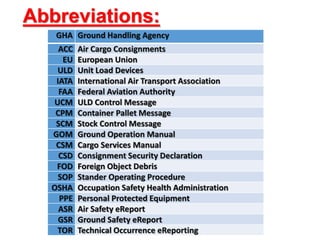
Abbreviations:
GHA Ground Handling Agency
ACC Air Cargo Consignments
EU European Union
ULD Unit Load Devices
IATA International Air Transport Association
FAA Federal Aviation Authority
UCM ULD Control Message
CPM Container Pallet Message
SCM Stock Control Message
GOM Ground Operation Manual
CSM Cargo Services Manual
CSD Consignment Security Declaration
FOD Foreign Object Debris
SOP Stander Operating Procedure
OSHA Occupation Safety Health Administration
PPE Personal Protected Equipment
ASR Air Safety eReport
GSR Ground Safety eReport
TOR Technical Occurrence eReporting
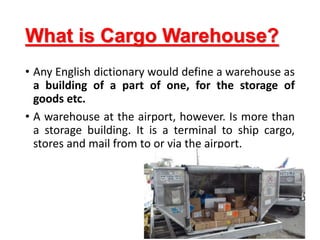
What is Cargo Warehouse?
• Any English dictionary would define a warehouse as
a building of a part of one, for the storage of
goods etc.
• A warehouse at the airport, however. Is more than
a storage building. It is a terminal to ship cargo,
stores and mail from to or via the airport.
Airport Cargo Terminal
• Goods transport starts with the shipper.
When the shipper contracts with a freight
forwarder, the forwarder arranges the entire
transportation chain, from door to door
(shipper and consignee).
• The freight forwarder company is
responsible for ensure compliance with all
legal and customs requirements, and
advising shippers on or arranging the
packaging of transported goods.
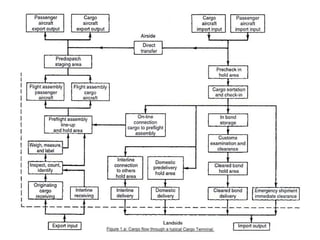
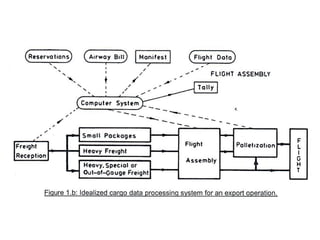
Figure 1.a
How import and export flows of cargo
move through the airport terminal
incoming cargo for export passes through
the reception area.
Export Area
This stage is complex: it need to satisfy all
the inherent and potential problems of
bringing goods from an uncontrolled
environment into a highly regulated and
measured environment before goods can
be loaded an aircraft, for example,
ensuring whether the package(s) is/are
ready for carriage.
Import Area
This area of cargo terminal is controlled
by airlines or independent organization
approved by local customs. This is done
because in some counties role of the
airlines is jest to remove the cargo from
its aircraft and together with manifest,
Import Area
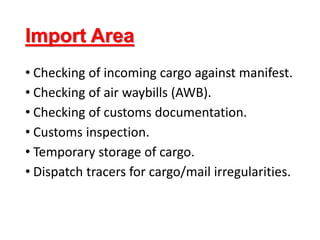
• Checking of incoming cargo against manifest.
• Checking of air waybills (AWB).
• Checking of customs documentation.
• Customs inspection.
• Temporary storage of cargo.
• Dispatch tracers for cargo/mail irregularities.
Interline / Trans-shipment Area
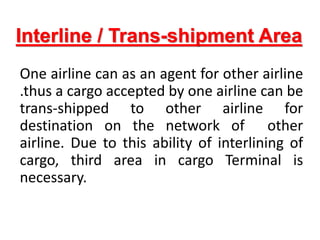
One airline can as an agent for other airline
.thus a cargo accepted by one airline can be
trans-shipped to other airline for
destination on the network of other
airline. Due to this ability of interlining of
cargo, third area in cargo Terminal is
necessary.
Storage (Export and Imports)
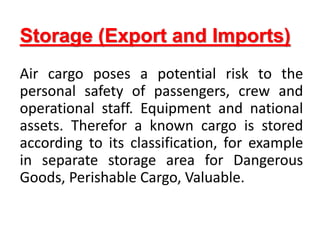
Air cargo poses a potential risk to the
personal safety of passengers, crew and
operational staff. Equipment and national
assets. Therefor a known cargo is stored
according to its classification, for example
in separate storage area for Dangerous
Goods, Perishable Cargo, Valuable.
Role of Agencies (Governmental
and Non-Governmenatal)
The shipper must ensure that the
consignment complies with all the laws,
regulations and decrees of the country of
origin, transit and destination and meets
the requirements of relevant airlines as
well.
Cargo Compliances
An important part of air cargo service
quality occurs on the ground. Airlines
employ continuous process management
techniques and audits to reduce the
incident rate (loss of freight due to damage
and pilferage, service failure), optimize
throughout in the warehouse and limit
costs.
Role of Cargo Customer
Services
The customer services is a single point of
contact for customers, both internal and
external, to track and resolve
queries/services failures related to cargo
activities within the airline stated service
level.
Liability and claims
The Montreal convention governs all
international carriage of persons, baggage,
or cargo performed by aircraft for reward
between or within member countries. It
also governs gratuitous carriage by aircraft
performed by an air transport undertaking.
Importance of an Air Waybill:
Contract of Carriage
The air waybill is most important cargo
control document issued by the airline or
its appointed agent when shipping
commercial goods. It serves the following
functions:
Importance of an Air Waybill:
Contract of Carriage
•To document the contract of carriage.
•To prove receipt of goods for shipments.
•Certificate of insurance (if goods insured
under airlines policy).
•It serves as a customs declaration.
•It is a waybill (i.e. it guides airline
personnel in the handling and delivery of
the goods).
•Freight bill.
What is the Carrier liable for?
The carrier is liable for delay (assessment of
claim may be based on the cause of the
delay), loss (assessed on the basis of the
weight indicated in the air waybill, if value
declared in the air waybill, and then liability
shall be assessed as being the declared in
the air waybill).
Cargo Security
In a successful cargo warehouse operations,
optimal balance between efficiency and high
profitability is required. At the same time,
compromises in security cannot be afforded.
In recent years, security requirement have been
continually increasing in the air cargo industry.
Air freight security is an integral part of all
processes at Airways.
It is a Airways mandatory requirement now that
a Consignment Security Declaration (CSD) be
duly filled up and accompany the shipment.
What is an ACC3 Vaildation?
Reading ………………….
Cargo Risk Assessment
Cargo warehouse is considered to be a
vulnerable area. Cargo shipments are
handled by many people, providing
numerous opportunities for tampering.
Lack of 100% screening is another risk. It
now easier to target to specific flights
through cargo.
How do we minimize the Risk
The safest method is to comply with
airways procedures regarding cargo
acceptance, security controls, handling,
storage and movement of cargo through
our network airports.
General Cargo Security
Measures
•Verifying the identity of the person
delivering the shipment and record the
details.
•Conducting visual examination of the
shipment.
•Matching the details on the documents to
the actual shipment (discrepancies should
be reported and shipment may be re-
screened or rejected).
General Cargo Security Measures
• Ensuring cargo is processed according to its
classification.
• Ensuring known cargo is securely stored.
• Building ULDs in a secure area or under
security monitoring (CCTV coverage).
• Having cargo safely transported to aircraft
• Always being aware of suspicious activities in
and around the cargo warehouse.
• Report any damage / open cargo to your
supervisor immediately.
Thanks end of chapter 1
1   basic cargo course

1 basic cargo course

  • 1.
  • 2.
  • 3.
    Have 3 Chaptersof Course Chapter 1: INTRODUCTION TO THE CARGO WAREHOUSE Chapter 2: UNIT LOAD DEVICES Chapter 3: SAFETY IN WAREHOUSE
  • 4.
    Chapter 1: INTRODUCTION TOTHE CARGO WAREHOUSE By the end of this chapter, you will be able to : • Define a Cargo Warehouse. • Describe cargo flow and processes in the warehouse. • Identify various functions of each area of the warehouse. • Describe legal requirements governing the safety and security of cargo operation.
  • 5.
  • 6.
    What are cargo? •The word cargo refers in particular to goods or produce being conveyed – generally for commercial gain – by ship, Track, or aircraft.
  • 7.
    Abbreviations: GHA Ground HandlingAgency ACC Air Cargo Consignments EU European Union ULD Unit Load Devices IATA International Air Transport Association FAA Federal Aviation Authority UCM ULD Control Message CPM Container Pallet Message SCM Stock Control Message GOM Ground Operation Manual CSM Cargo Services Manual CSD Consignment Security Declaration FOD Foreign Object Debris SOP Stander Operating Procedure OSHA Occupation Safety Health Administration PPE Personal Protected Equipment ASR Air Safety eReport GSR Ground Safety eReport TOR Technical Occurrence eReporting
  • 8.
    What is CargoWarehouse? • Any English dictionary would define a warehouse as a building of a part of one, for the storage of goods etc. • A warehouse at the airport, however. Is more than a storage building. It is a terminal to ship cargo, stores and mail from to or via the airport.
  • 9.
    Airport Cargo Terminal •Goods transport starts with the shipper. When the shipper contracts with a freight forwarder, the forwarder arranges the entire transportation chain, from door to door (shipper and consignee). • The freight forwarder company is responsible for ensure compliance with all legal and customs requirements, and advising shippers on or arranging the packaging of transported goods.
  • 10.
    Figure 1.a How importand export flows of cargo move through the airport terminal incoming cargo for export passes through the reception area.
  • 13.
    Export Area This stageis complex: it need to satisfy all the inherent and potential problems of bringing goods from an uncontrolled environment into a highly regulated and measured environment before goods can be loaded an aircraft, for example, ensuring whether the package(s) is/are ready for carriage.
  • 14.
    Import Area This areaof cargo terminal is controlled by airlines or independent organization approved by local customs. This is done because in some counties role of the airlines is jest to remove the cargo from its aircraft and together with manifest,
  • 15.
    Import Area • Checkingof incoming cargo against manifest. • Checking of air waybills (AWB). • Checking of customs documentation. • Customs inspection. • Temporary storage of cargo. • Dispatch tracers for cargo/mail irregularities.
  • 17.
    Interline / Trans-shipmentArea One airline can as an agent for other airline .thus a cargo accepted by one airline can be trans-shipped to other airline for destination on the network of other airline. Due to this ability of interlining of cargo, third area in cargo Terminal is necessary.
  • 18.
    Storage (Export andImports) Air cargo poses a potential risk to the personal safety of passengers, crew and operational staff. Equipment and national assets. Therefor a known cargo is stored according to its classification, for example in separate storage area for Dangerous Goods, Perishable Cargo, Valuable.
  • 19.
    Role of Agencies(Governmental and Non-Governmenatal) The shipper must ensure that the consignment complies with all the laws, regulations and decrees of the country of origin, transit and destination and meets the requirements of relevant airlines as well.
  • 25.
    Cargo Compliances An importantpart of air cargo service quality occurs on the ground. Airlines employ continuous process management techniques and audits to reduce the incident rate (loss of freight due to damage and pilferage, service failure), optimize throughout in the warehouse and limit costs.
  • 26.
    Role of CargoCustomer Services The customer services is a single point of contact for customers, both internal and external, to track and resolve queries/services failures related to cargo activities within the airline stated service level.
  • 27.
    Liability and claims TheMontreal convention governs all international carriage of persons, baggage, or cargo performed by aircraft for reward between or within member countries. It also governs gratuitous carriage by aircraft performed by an air transport undertaking.
  • 28.
    Importance of anAir Waybill: Contract of Carriage The air waybill is most important cargo control document issued by the airline or its appointed agent when shipping commercial goods. It serves the following functions:
  • 29.
    Importance of anAir Waybill: Contract of Carriage •To document the contract of carriage. •To prove receipt of goods for shipments. •Certificate of insurance (if goods insured under airlines policy). •It serves as a customs declaration. •It is a waybill (i.e. it guides airline personnel in the handling and delivery of the goods). •Freight bill.
  • 30.
    What is theCarrier liable for? The carrier is liable for delay (assessment of claim may be based on the cause of the delay), loss (assessed on the basis of the weight indicated in the air waybill, if value declared in the air waybill, and then liability shall be assessed as being the declared in the air waybill).
  • 31.
    Cargo Security In asuccessful cargo warehouse operations, optimal balance between efficiency and high profitability is required. At the same time, compromises in security cannot be afforded. In recent years, security requirement have been continually increasing in the air cargo industry. Air freight security is an integral part of all processes at Airways. It is a Airways mandatory requirement now that a Consignment Security Declaration (CSD) be duly filled up and accompany the shipment.
  • 34.
    What is anACC3 Vaildation? Reading ………………….
  • 35.
    Cargo Risk Assessment Cargowarehouse is considered to be a vulnerable area. Cargo shipments are handled by many people, providing numerous opportunities for tampering. Lack of 100% screening is another risk. It now easier to target to specific flights through cargo.
  • 36.
    How do weminimize the Risk The safest method is to comply with airways procedures regarding cargo acceptance, security controls, handling, storage and movement of cargo through our network airports.
  • 37.
    General Cargo Security Measures •Verifyingthe identity of the person delivering the shipment and record the details. •Conducting visual examination of the shipment. •Matching the details on the documents to the actual shipment (discrepancies should be reported and shipment may be re- screened or rejected).
  • 38.
    General Cargo SecurityMeasures • Ensuring cargo is processed according to its classification. • Ensuring known cargo is securely stored. • Building ULDs in a secure area or under security monitoring (CCTV coverage). • Having cargo safely transported to aircraft • Always being aware of suspicious activities in and around the cargo warehouse. • Report any damage / open cargo to your supervisor immediately.
  • 40.
    Thanks end ofchapter 1