1
2
PACKING AND SHIPPING DANGEROUS GOODS
FACILITY RESPONSIBILITY
The procedures and practices highlighted in this training are based
on the requirements of the Department of Transportation (DOT),
United States Postal Service (USPS), International Civil Aviation
Organization (ICAO), International Air Transport Association (IATA),
and Occupational Safety and Health Administration (OSHA).
Facility responsibilities include:1
• Providing or verifying training that applies to job functions
• Conducting or verifying that each employee is competent to perform
job functions related to shipping dangerous goods
• Certifying that an employee has been trained and that test results
indicate employee's ability to satisfactorily perform job functions
• Developing and retaining current training records for each employee
However, each facility is responsible for assuring that appropriate
packing instructions are adhered to as required by federal law and
air transport association standards.
3
PACKING AND SHIPPING DANGEROUS GOODS
WHY TAKE THIS TRAINING?
Anyone who plays a role in packing and shipping dangerous goods
must be trained. In addition, training is required for those who perform
one or more of the functions listed below:
• Determine modes of transport
• Classify Division 6.2 infectious substances
• Select packaging for Division 6.2 infectious substances
• Prepare shipping paperwork (e.g., a Shipper's Declaration, Air
Waybills)
• Pack dangerous goods for transport
• Label or mark a package that contains dangerous goods
• Transport dangerous goods in commerce
• Provide transportation emergency response or incident mitigation
information
This training covers the packaging instructions for different modes of
transport and the requirements to complete the packing and shipping
process.
4
PACKING AND SHIPPING DANGEROUS GOODS
 COURSE OBJECTIVES
After completing this eLearning course, learners will be
able to:
• Recognize requirements for initial and recurrent training and
certification for the transportation of Division 6.2 infectious
substances and dry ice
• Identify applicable regulations and requirements for the
transportation of Division 6.2 infectious substances and dry ice
• Determine the proper course of action for packing and shipping
Division 6.2 infectious substances and dry ice
5
PACKING AND SHIPPING DANGEROUS GOODS
 COURSE OUTLINE
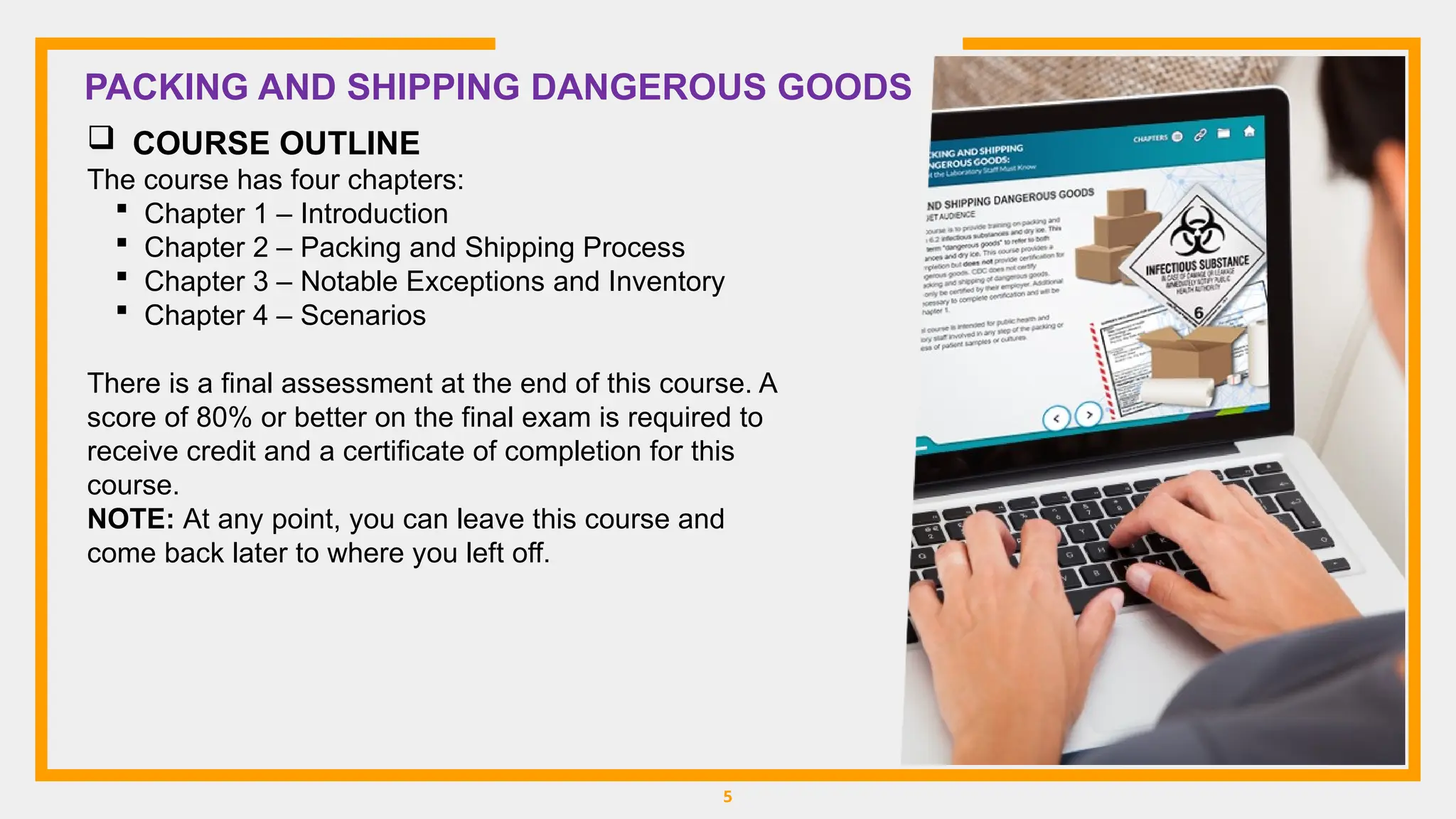
The course has four chapters:
 Chapter 1 – Introduction
 Chapter 2 – Packing and Shipping Process
 Chapter 3 – Notable Exceptions and Inventory
 Chapter 4 – Scenarios
There is a final assessment at the end of this course. A
score of 80% or better on the final exam is required to
receive credit and a certificate of completion for this
course.
NOTE: At any point, you can leave this course and
come back later to where you left off.
6
7
INTRODUCTION
DANGEROUS GOODS OVERVIEW
• Dangerous goods are materials that present an
unreasonable risk to health, safety, and property when
transported by air or on public roadways.1
• Dangerous goods are divided into the nine classes listed
to the right.1
• This course focuses on Class 6: Division 6.2 infectious
substances and only one of the Class 9 substances, dry
ice.
8
INTRODUCTION
TRAINING REQUIREMENTS 1 OF 2
Training requirements to pack and ship dangerous goods can be confusing because they vary based on the
substance, quantity, and mode of transport. DOT establishes US training requirements for packing and shipping
dangerous goods. However, the Dangerous Goods Regulations (DGR) training requirements are required when
dangerous goods are shipped with an IATA-member airline.
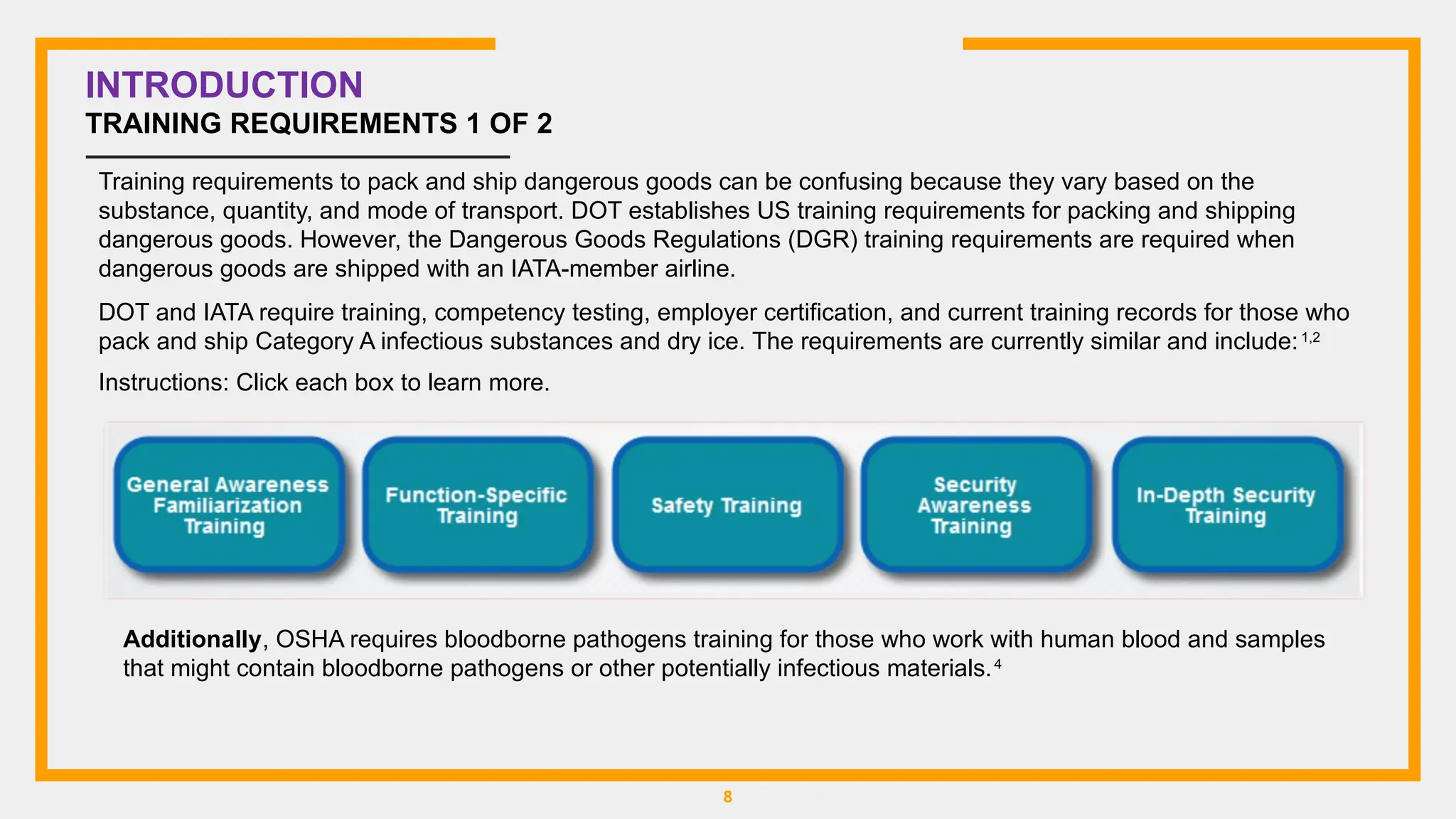
DOT and IATA require training, competency testing, employer certification, and current training records for those who
pack and ship Category A infectious substances and dry ice. The requirements are currently similar and include:1,2
Instructions: Click each box to learn more.
Additionally, OSHA requires bloodborne pathogens training for those who work with human blood and samples
that might contain bloodborne pathogens or other potentially infectious materials.4
9
INTRODUCTION
TRAINING REQUIREMENTS 1 OF 2
 Recognition and identification of dangerous goods consistent with the hazard communication standards.
 Training specifically applicable to the functions the employee performs.
 Emergency response information and specific measures to protect employees from accidents and hazards
associated with dangerous goods.
 Awareness of security risks associated with dangerous goods transportation. And, recognition and response to
possible security threats.
 Security plan and its implementation related to the dangerous goods.
10
INTRODUCTION
TRAINING REQUIREMENTS 2 OF 2
DOT and IATA training is required for all personnel involved in
the packing, packaging, and shipment of Category A infectious
substance.
Laboratory staff that ONLY pack and ship Category B
substances for air or water transport do not require DOT and
IATA's formal training requirements mentioned on the previous
page.
However, in these instances, you are responsible for knowing
and following the specific packaging instructions for your mode
of transport.
11
INTRODUCTION
WHAT THIS COURSE COVERS
It is important to know that this course does not provide certification or final approval to pack and ship dangerous
goods. Additional training is necessary beyond this course to complete certification.
This course covers:
• General awareness/familiarization training
Additional training requirements for Category A and Dry Ice (>5.5 lbs by air or water) certification to be provided by
your employer are NOT covered by this course including:1
• Functional-specific training
• Safety training
• Security awareness training
• In-depth security training

Packing and Shipping Dangerous presentation

  • 1.
  • 2.
    2 PACKING AND SHIPPINGDANGEROUS GOODS FACILITY RESPONSIBILITY The procedures and practices highlighted in this training are based on the requirements of the Department of Transportation (DOT), United States Postal Service (USPS), International Civil Aviation Organization (ICAO), International Air Transport Association (IATA), and Occupational Safety and Health Administration (OSHA). Facility responsibilities include:1 • Providing or verifying training that applies to job functions • Conducting or verifying that each employee is competent to perform job functions related to shipping dangerous goods • Certifying that an employee has been trained and that test results indicate employee's ability to satisfactorily perform job functions • Developing and retaining current training records for each employee However, each facility is responsible for assuring that appropriate packing instructions are adhered to as required by federal law and air transport association standards.
  • 3.
    3 PACKING AND SHIPPINGDANGEROUS GOODS WHY TAKE THIS TRAINING? Anyone who plays a role in packing and shipping dangerous goods must be trained. In addition, training is required for those who perform one or more of the functions listed below: • Determine modes of transport • Classify Division 6.2 infectious substances • Select packaging for Division 6.2 infectious substances • Prepare shipping paperwork (e.g., a Shipper's Declaration, Air Waybills) • Pack dangerous goods for transport • Label or mark a package that contains dangerous goods • Transport dangerous goods in commerce • Provide transportation emergency response or incident mitigation information This training covers the packaging instructions for different modes of transport and the requirements to complete the packing and shipping process.
  • 4.
    4 PACKING AND SHIPPINGDANGEROUS GOODS  COURSE OBJECTIVES After completing this eLearning course, learners will be able to: • Recognize requirements for initial and recurrent training and certification for the transportation of Division 6.2 infectious substances and dry ice • Identify applicable regulations and requirements for the transportation of Division 6.2 infectious substances and dry ice • Determine the proper course of action for packing and shipping Division 6.2 infectious substances and dry ice
  • 5.
    5 PACKING AND SHIPPINGDANGEROUS GOODS  COURSE OUTLINE The course has four chapters:  Chapter 1 – Introduction  Chapter 2 – Packing and Shipping Process  Chapter 3 – Notable Exceptions and Inventory  Chapter 4 – Scenarios There is a final assessment at the end of this course. A score of 80% or better on the final exam is required to receive credit and a certificate of completion for this course. NOTE: At any point, you can leave this course and come back later to where you left off.
  • 6.
  • 7.
    7 INTRODUCTION DANGEROUS GOODS OVERVIEW •Dangerous goods are materials that present an unreasonable risk to health, safety, and property when transported by air or on public roadways.1 • Dangerous goods are divided into the nine classes listed to the right.1 • This course focuses on Class 6: Division 6.2 infectious substances and only one of the Class 9 substances, dry ice.
  • 8.
    8 INTRODUCTION TRAINING REQUIREMENTS 1OF 2 Training requirements to pack and ship dangerous goods can be confusing because they vary based on the substance, quantity, and mode of transport. DOT establishes US training requirements for packing and shipping dangerous goods. However, the Dangerous Goods Regulations (DGR) training requirements are required when dangerous goods are shipped with an IATA-member airline. DOT and IATA require training, competency testing, employer certification, and current training records for those who pack and ship Category A infectious substances and dry ice. The requirements are currently similar and include:1,2 Instructions: Click each box to learn more. Additionally, OSHA requires bloodborne pathogens training for those who work with human blood and samples that might contain bloodborne pathogens or other potentially infectious materials.4
  • 9.
    9 INTRODUCTION TRAINING REQUIREMENTS 1OF 2  Recognition and identification of dangerous goods consistent with the hazard communication standards.  Training specifically applicable to the functions the employee performs.  Emergency response information and specific measures to protect employees from accidents and hazards associated with dangerous goods.  Awareness of security risks associated with dangerous goods transportation. And, recognition and response to possible security threats.  Security plan and its implementation related to the dangerous goods.
  • 10.
    10 INTRODUCTION TRAINING REQUIREMENTS 2OF 2 DOT and IATA training is required for all personnel involved in the packing, packaging, and shipment of Category A infectious substance. Laboratory staff that ONLY pack and ship Category B substances for air or water transport do not require DOT and IATA's formal training requirements mentioned on the previous page. However, in these instances, you are responsible for knowing and following the specific packaging instructions for your mode of transport.
  • 11.
    11 INTRODUCTION WHAT THIS COURSECOVERS It is important to know that this course does not provide certification or final approval to pack and ship dangerous goods. Additional training is necessary beyond this course to complete certification. This course covers: • General awareness/familiarization training Additional training requirements for Category A and Dry Ice (>5.5 lbs by air or water) certification to be provided by your employer are NOT covered by this course including:1 • Functional-specific training • Safety training • Security awareness training • In-depth security training