
Floating Knee Injury
Dr. Kavin Khatri
AIIMS, Bathinda.
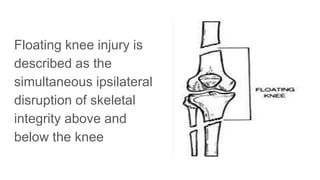
Floating knee injury is
described as the
simultaneous ipsilateral
disruption of skeletal
integrity above and
below the knee
Exact incidence is not known but numbers are on rise.....
Mechanism
• Usually a high-energy trauma (RTA)
• Collisions between cars
•‘Knocked down’ pedestrians
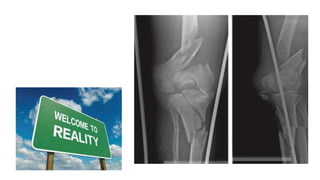
Floating Knee,
Hmmm….
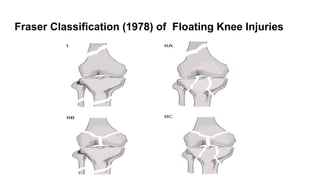
Fraser Classification (1978) of Floating Knee Injuries
⮚ Associated trauma to the head, chest, abdomen, pelvis and
long bones of the contralateral extremity is common
⮚ Reported rate of such injuries may be as high as 89%
Obviously deformed and bruised limb is easily distracting
High incidence of open fractures (57% to 81%).
Most common pattern is an open tibia and closed femur fracture
Timing of intervention
● Nonorthopedic injuries play a significant role in surgical decision making with
regard to timing of the procedures
● Orthopedic management must be integrated with the overall resuscitation and
stabilization of the polytraumatized patient
● Damage Control Orthopedics
Absolute Indications
▪ Open Fracture
▪ Associated with vascular injury
▪ Compartment syndrome
Position
⮚ Supine on a radiolucent table
⮚ Traction table ? Surgeon Preference
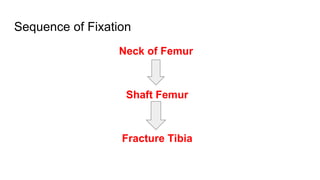
Sequence of Fixation
Neck of Femur
Shaft Femur
Fracture Tibia
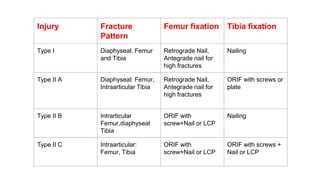
Injury Fracture
Pattern
Femur fixation Tibia fixation
Type I Diaphyseal: Femur
and Tibia
Retrograde Nail,
Antegrade nail for
high fractures
Nailing
Type II A Diaphyseal: Femur,
Intraarticular Tibia
Retrograde Nail,
Antegrade nail for
high fractures
ORIF with screws or
plate
Type II B Intrarticular
Femur,diaphyseal
Tibia
ORIF with
screw+Nail or LCP
Nailing
Type II C Intraarticular:
Femur, Tibia
ORIF with
screw+Nail or LCP
ORIF with screws +
Nail or LCP
Ligament injuries and Meniscal injuries are
present in about 18 to 44% cases*
* Szalay MJ, Hosking OR, Annear P. Injury of knee ligament associated with ipsilateral femoral shaft
fractures with ipsilateral femoral and tibial shaft fractures. Injury 1990;21:398–400
* Kao FC, Tu YK, Hsu KY, Su JY, Yen CY, Chou MC. Floating knee injuries: a high complication rate.
Orthopedics 2010;33:14.
Should we go for MRI in a case of floating injury ?
● In cases of complain of persistent pain around the knee
● Complaint of locking of knee
Area which warrants attention….
● Lateral collateral ligament avulsion injuries
● Avulsion fractures of cruciate ligaments should be addressed
Systemic Localized
Fat embolism syndrome Pain
Restricted range of knee
movement
Renal failure Ligament instability of knee
Sequelae of
head/chest/abdominal injury
Limp
Delayed/malunion/non-union
Osteomyelitis
Take Home Message
● Floating knee injury is an indicator of severe trauma
● Damage to remote organs should be suspected and systematically sought for
● Following resuscitation, early stabilization with aggressive postoperative
rehabilitation offer the best chance of an optimum outcome
● Ligament laxity is common and should be specifically assessed
Thank you

Floating knee injuries

  • 1.
    Floating Knee Injury Dr.Kavin Khatri AIIMS, Bathinda.
  • 2.
    Floating knee injuryis described as the simultaneous ipsilateral disruption of skeletal integrity above and below the knee
  • 3.
    Exact incidence isnot known but numbers are on rise.....
  • 4.
    Mechanism • Usually ahigh-energy trauma (RTA) • Collisions between cars •‘Knocked down’ pedestrians
  • 5.
  • 7.
    Fraser Classification (1978)of Floating Knee Injuries
  • 8.
    ⮚ Associated traumato the head, chest, abdomen, pelvis and long bones of the contralateral extremity is common ⮚ Reported rate of such injuries may be as high as 89%
  • 9.
    Obviously deformed andbruised limb is easily distracting
  • 10.
    High incidence ofopen fractures (57% to 81%). Most common pattern is an open tibia and closed femur fracture
  • 11.
    Timing of intervention ●Nonorthopedic injuries play a significant role in surgical decision making with regard to timing of the procedures ● Orthopedic management must be integrated with the overall resuscitation and stabilization of the polytraumatized patient ● Damage Control Orthopedics
  • 12.
    Absolute Indications ▪ OpenFracture ▪ Associated with vascular injury ▪ Compartment syndrome
  • 14.
    Position ⮚ Supine ona radiolucent table ⮚ Traction table ? Surgeon Preference
  • 15.
    Sequence of Fixation Neckof Femur Shaft Femur Fracture Tibia
  • 16.
    Injury Fracture Pattern Femur fixationTibia fixation Type I Diaphyseal: Femur and Tibia Retrograde Nail, Antegrade nail for high fractures Nailing Type II A Diaphyseal: Femur, Intraarticular Tibia Retrograde Nail, Antegrade nail for high fractures ORIF with screws or plate Type II B Intrarticular Femur,diaphyseal Tibia ORIF with screw+Nail or LCP Nailing Type II C Intraarticular: Femur, Tibia ORIF with screw+Nail or LCP ORIF with screws + Nail or LCP
  • 17.
    Ligament injuries andMeniscal injuries are present in about 18 to 44% cases* * Szalay MJ, Hosking OR, Annear P. Injury of knee ligament associated with ipsilateral femoral shaft fractures with ipsilateral femoral and tibial shaft fractures. Injury 1990;21:398–400 * Kao FC, Tu YK, Hsu KY, Su JY, Yen CY, Chou MC. Floating knee injuries: a high complication rate. Orthopedics 2010;33:14.
  • 18.
    Should we gofor MRI in a case of floating injury ? ● In cases of complain of persistent pain around the knee ● Complaint of locking of knee
  • 19.
    Area which warrantsattention…. ● Lateral collateral ligament avulsion injuries ● Avulsion fractures of cruciate ligaments should be addressed
  • 20.
    Systemic Localized Fat embolismsyndrome Pain Restricted range of knee movement Renal failure Ligament instability of knee Sequelae of head/chest/abdominal injury Limp Delayed/malunion/non-union Osteomyelitis
  • 21.
    Take Home Message ●Floating knee injury is an indicator of severe trauma ● Damage to remote organs should be suspected and systematically sought for ● Following resuscitation, early stabilization with aggressive postoperative rehabilitation offer the best chance of an optimum outcome ● Ligament laxity is common and should be specifically assessed
  • 22.