Bone Cement
By
Ihab El-Desouky (M.D.)
Asst. Prof. Orthopaedics & Traumatology
Pelvis and Joints Reconstruction Unit
Kasr Al-Ainy School pf Medicine
Cairo University- Egypt
BONE CEMENT
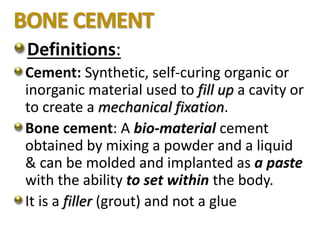
Definitions:
Cement: Synthetic, self-curing organic or
inorganic material used to fill up a cavity or
to create a mechanical fixation.
Bone cement: A bio-material cement
obtained by mixing a powder and a liquid
& can be molded and implanted as a paste
with the ability to set within the body.
It is a filler (grout) and not a glue
BONE CEMENT
History:
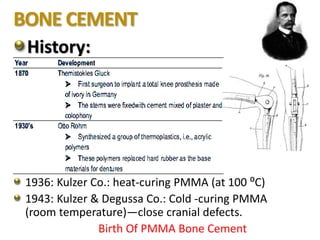
1936: Kulzer Co.: heat-curing PMMA (at 100 ⁰C)
1943: Kulzer & Degussa Co.: Cold -curing PMMA
(room temperature)—close cranial defects.
Birth Of PMMA Bone Cement
BONE CEMENT
History
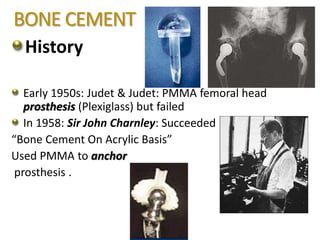
Early 1950s: Judet & Judet: PMMA femoral head
prosthesis (Plexiglass) but failed
In 1958: Sir John Charnley: Succeeded
“Bone Cement On Acrylic Basis”
Used PMMA to anchor
prosthesis .
Components Of Bone Cement
Powder:
Polymers
Polymethyl methacrylate
(PMMA)
Initiator
Benzoyl Peroxide (BPO)
Radio-opacifier:
Barium Sulfate
Zirconia
Antibiotics (heat stable)
e.g.: gentamycin, vancomycin
tobramycin
Liquid
Monomer
Methyl methacrylate (polymerizable)
Activator (accelerator):
N-Dimethyl-p-Toluidine (DmpT)
Inhibitor (stabilizer)
Hydroquinone
Polymerization Process:
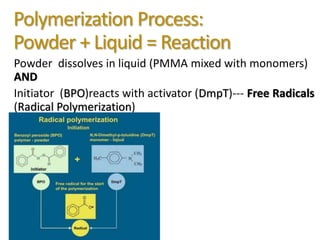
Powder + Liquid = Reaction
Powder dissolves in liquid (PMMA mixed with monomers)
AND
Initiator (BPO)reacts with activator (DmpT)--- Free Radicals
(Radical Polymerization)
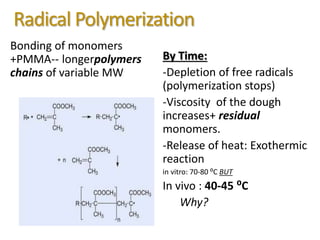
Radical Polymerization
Bonding of monomers
+PMMA-- longerpolymers
chains of variable MW
By Time:
-Depletion of free radicals
(polymerization stops)
-Viscosity of the dough
increases+ residual
monomers.
-Release of heat: Exothermic
reaction
in vitro: 70-80 ⁰C BUT
In vivo : 40-45 ⁰C
Why?
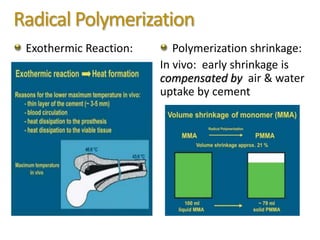
Radical Polymerization
Exothermic Reaction: Polymerization shrinkage:
In vivo: early shrinkage is
compensated by air & water
uptake by cement
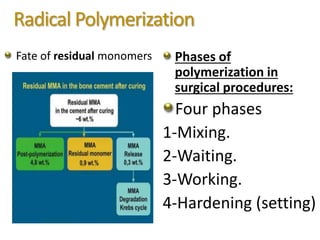
Radical Polymerization
Fate of residual monomers Phases of
polymerization in
surgical procedures:
Four phases
1-Mixing.
2-Waiting.
3-Working.
4-Hardening (setting)
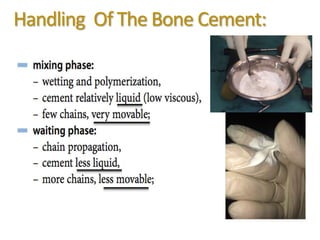
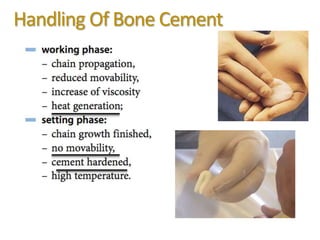
Handling Of The Bone Cement:
Handling Of Bone Cement
Handling Of The Bone Cement
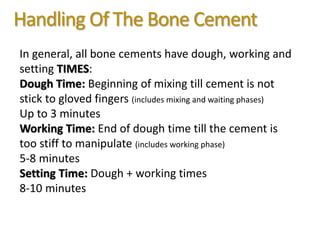
In general, all bone cements have dough, working and
setting TIMES:
Dough Time: Beginning of mixing till cement is not
stick to gloved fingers (includes mixing and waiting phases)
Up to 3 minutes
Working Time: End of dough time till the cement is
too stiff to manipulate (includes working phase)
5-8 minutes
Setting Time: Dough + working times
8-10 minutes
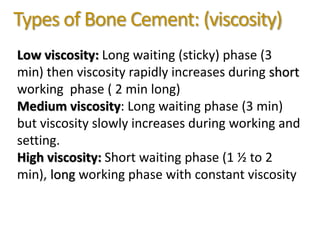
Types of Bone Cement: (viscosity)
Low viscosity: Long waiting (sticky) phase (3
min) then viscosity rapidly increases during short
working phase ( 2 min long)
Medium viscosity: Long waiting phase (3 min)
but viscosity slowly increases during working and
setting.
High viscosity: Short waiting phase (1 ½ to 2
min), long working phase with constant viscosity
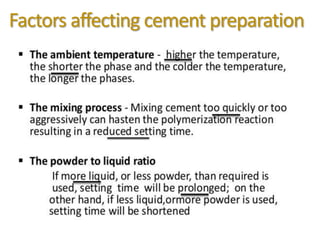
Factors affecting cement preparation
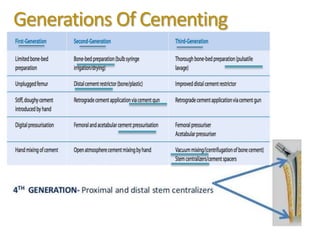
Generations Of Cementing
Technique of better bone cementing:
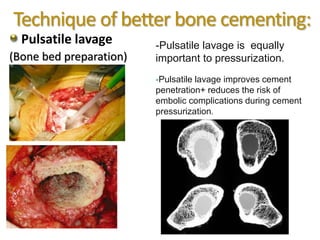
Pulsatile lavage
(Bone bed preparation)
-Pulsatile lavage is equally
important to pressurization.
-Pulsatile lavage improves cement
penetration+ reduces the risk of
embolic complications during cement
pressurization.
Technique of better bone cementing:
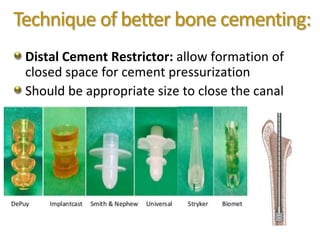
Distal Cement Restrictor: allow formation of
closed space for cement pressurization
Should be appropriate size to close the canal
Technique of better bone cementing:
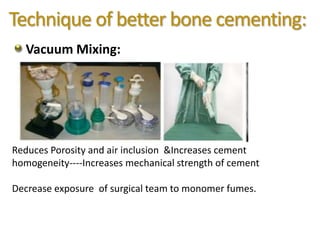
Vacuum Mixing:
Reduces Porosity and air inclusion &Increases cement
homogeneity----Increases mechanical strength of cement
Decrease exposure of surgical team to monomer fumes.
Technique of better bone cementing:
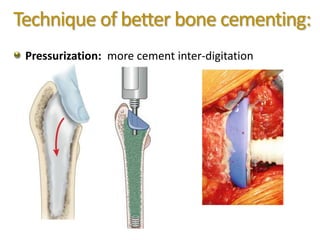
Pressurization: more cement inter-digitation
Technique of better bone cementing:
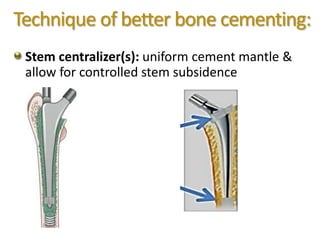
Stem centralizer(s): uniform cement mantle &
allow for controlled stem subsidence
Technique of better bone cementing:
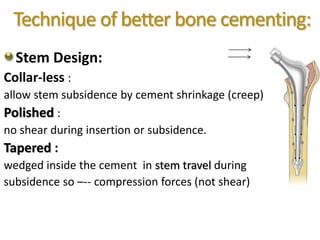
Stem Design:
Collar-less :
allow stem subsidence by cement shrinkage (creep)
Polished :
no shear during insertion or subsidence.
Tapered :
wedged inside the cement in stem travel during
subsidence so –-- compression forces (not shear)
Properties of Bone Cement
Visco-elastic material
1-Creep
- Gradual Deformation of
material under constant load
-Cement creep is reflected as
Volume reduction
Properties of Bone Cement
Stress relaxation
Decrease of material stress under condition of
constant strain
Effect of loading:
Compression> Tension> Shear
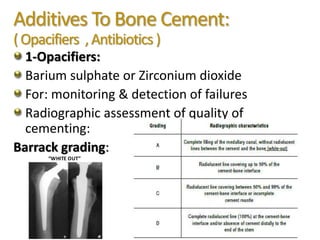
Additives To Bone Cement:
(Opacifiers ,Antibiotics )
1-Opacifiers:
Barium sulphate or Zirconium dioxide
For: monitoring & detection of failures
Radiographic assessment of quality of
cementing:
Barrack grading:
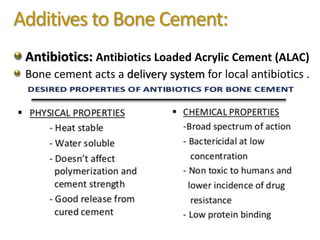
Additives to Bone Cement:
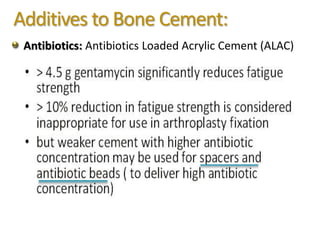
Antibiotics: Antibiotics Loaded Acrylic Cement (ALAC)
Bone cement acts a delivery system for local antibiotics .
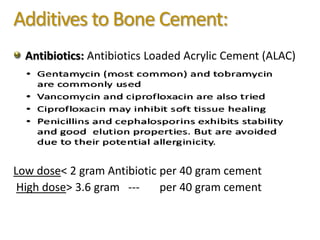
Additives to Bone Cement:
Antibiotics: Antibiotics Loaded Acrylic Cement (ALAC)
Low dose< 2 gram Antibiotic per 40 gram cement
High dose> 3.6 gram --- per 40 gram cement
Additives to Bone Cement:
Antibiotics: Antibiotics Loaded Acrylic Cement (ALAC)
Hazards Of Bone Cementing
Occupational hazards : on Surgical team
1-Excessive vapor– respiratory irritation
2-High vapor concentration---headache,
drowsiness and even loss of
consciousness.
3-Skin irritation and burns if exposed to
liquid.
4-Contact lenses (soft) penetration by
vapor---pitting
Hazards Of Bone Cementing
Patient Hazards : Bone Cement implantation
Syndrome(BCIS)
Hypoxia, hypotension, loss of consciousness and even
cardiac arrest
At time of: cementing, prosthesis insertion, joint
reduction, or deflation of tourniquet in stemmed total
knee.
Etiology: (theories)
1-Monomer liquid absorption into circulation
2-Emblosim: exothermic reaction expand medullary B.V.–
embolism of fat , marrow , air or cement particles.
3-Anapylxis and complement activation
Hazards Of Bone Cementing
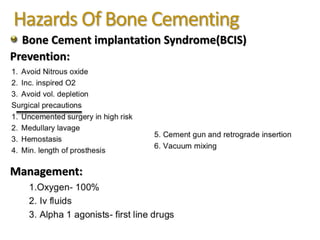
Bone Cement implantation Syndrome(BCIS)
Prevention:
Management:
Take Home Messages
Bone cementing technique: results and
complications.
A stem: respects the natural properties of
the bone cement
Antibiotics loaded cement : dose and use.
Complications: strict technique to avoid its
occurrence. Thank you

Bone cement

  • 1.
    Bone Cement By Ihab El-Desouky(M.D.) Asst. Prof. Orthopaedics & Traumatology Pelvis and Joints Reconstruction Unit Kasr Al-Ainy School pf Medicine Cairo University- Egypt
  • 2.
    BONE CEMENT Definitions: Cement: Synthetic,self-curing organic or inorganic material used to fill up a cavity or to create a mechanical fixation. Bone cement: A bio-material cement obtained by mixing a powder and a liquid & can be molded and implanted as a paste with the ability to set within the body. It is a filler (grout) and not a glue
  • 3.
    BONE CEMENT History: 1936: KulzerCo.: heat-curing PMMA (at 100 ⁰C) 1943: Kulzer & Degussa Co.: Cold -curing PMMA (room temperature)—close cranial defects. Birth Of PMMA Bone Cement
  • 4.
    BONE CEMENT History Early 1950s:Judet & Judet: PMMA femoral head prosthesis (Plexiglass) but failed In 1958: Sir John Charnley: Succeeded “Bone Cement On Acrylic Basis” Used PMMA to anchor prosthesis .
  • 5.
    Components Of BoneCement Powder: Polymers Polymethyl methacrylate (PMMA) Initiator Benzoyl Peroxide (BPO) Radio-opacifier: Barium Sulfate Zirconia Antibiotics (heat stable) e.g.: gentamycin, vancomycin tobramycin Liquid Monomer Methyl methacrylate (polymerizable) Activator (accelerator): N-Dimethyl-p-Toluidine (DmpT) Inhibitor (stabilizer) Hydroquinone
  • 6.
    Polymerization Process: Powder +Liquid = Reaction Powder dissolves in liquid (PMMA mixed with monomers) AND Initiator (BPO)reacts with activator (DmpT)--- Free Radicals (Radical Polymerization)
  • 7.
    Radical Polymerization Bonding ofmonomers +PMMA-- longerpolymers chains of variable MW By Time: -Depletion of free radicals (polymerization stops) -Viscosity of the dough increases+ residual monomers. -Release of heat: Exothermic reaction in vitro: 70-80 ⁰C BUT In vivo : 40-45 ⁰C Why?
  • 8.
    Radical Polymerization Exothermic Reaction:Polymerization shrinkage: In vivo: early shrinkage is compensated by air & water uptake by cement
  • 9.
    Radical Polymerization Fate ofresidual monomers Phases of polymerization in surgical procedures: Four phases 1-Mixing. 2-Waiting. 3-Working. 4-Hardening (setting)
  • 10.
    Handling Of TheBone Cement:
  • 11.
  • 12.
    Handling Of TheBone Cement In general, all bone cements have dough, working and setting TIMES: Dough Time: Beginning of mixing till cement is not stick to gloved fingers (includes mixing and waiting phases) Up to 3 minutes Working Time: End of dough time till the cement is too stiff to manipulate (includes working phase) 5-8 minutes Setting Time: Dough + working times 8-10 minutes
  • 13.
    Types of BoneCement: (viscosity) Low viscosity: Long waiting (sticky) phase (3 min) then viscosity rapidly increases during short working phase ( 2 min long) Medium viscosity: Long waiting phase (3 min) but viscosity slowly increases during working and setting. High viscosity: Short waiting phase (1 ½ to 2 min), long working phase with constant viscosity
  • 14.
  • 15.
  • 16.
    Technique of betterbone cementing: Pulsatile lavage (Bone bed preparation) -Pulsatile lavage is equally important to pressurization. -Pulsatile lavage improves cement penetration+ reduces the risk of embolic complications during cement pressurization.
  • 17.
    Technique of betterbone cementing: Distal Cement Restrictor: allow formation of closed space for cement pressurization Should be appropriate size to close the canal
  • 18.
    Technique of betterbone cementing: Vacuum Mixing: Reduces Porosity and air inclusion &Increases cement homogeneity----Increases mechanical strength of cement Decrease exposure of surgical team to monomer fumes.
  • 19.
    Technique of betterbone cementing: Pressurization: more cement inter-digitation
  • 20.
    Technique of betterbone cementing: Stem centralizer(s): uniform cement mantle & allow for controlled stem subsidence
  • 21.
    Technique of betterbone cementing: Stem Design: Collar-less : allow stem subsidence by cement shrinkage (creep) Polished : no shear during insertion or subsidence. Tapered : wedged inside the cement in stem travel during subsidence so –-- compression forces (not shear)
  • 22.
    Properties of BoneCement Visco-elastic material 1-Creep - Gradual Deformation of material under constant load -Cement creep is reflected as Volume reduction
  • 23.
    Properties of BoneCement Stress relaxation Decrease of material stress under condition of constant strain Effect of loading: Compression> Tension> Shear
  • 24.
    Additives To BoneCement: (Opacifiers ,Antibiotics ) 1-Opacifiers: Barium sulphate or Zirconium dioxide For: monitoring & detection of failures Radiographic assessment of quality of cementing: Barrack grading:
  • 25.
    Additives to BoneCement: Antibiotics: Antibiotics Loaded Acrylic Cement (ALAC) Bone cement acts a delivery system for local antibiotics .
  • 26.
    Additives to BoneCement: Antibiotics: Antibiotics Loaded Acrylic Cement (ALAC) Low dose< 2 gram Antibiotic per 40 gram cement High dose> 3.6 gram --- per 40 gram cement
  • 27.
    Additives to BoneCement: Antibiotics: Antibiotics Loaded Acrylic Cement (ALAC)
  • 28.
    Hazards Of BoneCementing Occupational hazards : on Surgical team 1-Excessive vapor– respiratory irritation 2-High vapor concentration---headache, drowsiness and even loss of consciousness. 3-Skin irritation and burns if exposed to liquid. 4-Contact lenses (soft) penetration by vapor---pitting
  • 29.
    Hazards Of BoneCementing Patient Hazards : Bone Cement implantation Syndrome(BCIS) Hypoxia, hypotension, loss of consciousness and even cardiac arrest At time of: cementing, prosthesis insertion, joint reduction, or deflation of tourniquet in stemmed total knee. Etiology: (theories) 1-Monomer liquid absorption into circulation 2-Emblosim: exothermic reaction expand medullary B.V.– embolism of fat , marrow , air or cement particles. 3-Anapylxis and complement activation
  • 30.
    Hazards Of BoneCementing Bone Cement implantation Syndrome(BCIS) Prevention: Management:
  • 31.
    Take Home Messages Bonecementing technique: results and complications. A stem: respects the natural properties of the bone cement Antibiotics loaded cement : dose and use. Complications: strict technique to avoid its occurrence. Thank you

Editor's Notes

  • #4 Otto Rohm : chemist who synthesized the methyl methacrylate
  • #10  This amount decreases within 2–3 weeks to about 0.5%, mainly (about 80%) by slow post-polymerization and form polymers. The minor part of the residual MMA enters the blood circulation and then leaves the body by simple respiration or being metabolized via the Krebs cycle.
  • #11 Waiting phase till cement sticky to gloved fingers
  • #12 Working phase cement is no longer sticky to gloved hand Reduced movability of monomers to form polymers
  • #13 Times not phases
  • #14 In low viscosity one waiting phase is reached HURRY before setting to inject it Long working phase = enough time to manipulate your cement paset
  • #15 Ambient temp= surrounding temp More liquid prolongs time till hardening
  • #17 Left side with pulsatile lavage (more cement penetration) Rt side with syringe lavage (less penetration)
  • #21 زى ما عرفنا فى كورس الهيب stem subsidence
  • #22 Tapered يتزحلق مش بيعلق و هو بينزل
  • #26 Low protein binding to diffuse to tissues and not adhere to nearby marrow forming a barrier film around the cement prevent its flaw.
  • #31 High risk as need of long femoral stem , hemodynamically unstable patn during surgery, pre-existing cadiac disease Cement gun and retrograde injection ---Seal of the inside medulla without exposed cracks of cement prevent escape of emboli