DAMAGE CONTROL
ORTHOPAEDICS
Presenter - Dr Akhil John
Moderator - Dr N Ravinder Kumar
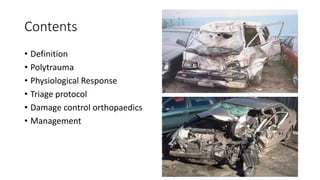
Contents
โ€ข Definition
โ€ข Polytrauma
โ€ข Physiological Response
โ€ข Triage protocol
โ€ข Damage control orthopaedics
โ€ข Management
Definition
โ€ข is an approach that contains and stabilizes orthopaedic injuries so
that the patientโ€™s overall physiology can improve.
โ€ข purpose :
- avoid worsening of the patient's condition by the โ€œsecond hitโ€ of a
major orthopaedic procedure
- delay definitive fracture repair until a time when the overall condition
of the patient is optimized
โ€ข Basic principles include arresting hemorrhage;
โ€ข restoring blood volume;
โ€ข and correcting Coagulopathy, Acidosis and Hypothermia.
โ€ข Early rapid fracture stabilization by external fixation
โ€ข Avoiding prolonged operative times
โ€ข Preventing the onset of thelethal triad ( Coagulopathy, Acidosis &
Hypothermia )
WHAT IS POLYTRAUMA
โ€ข Polytrauma and multiple trauma are medical terms
describing the condition of a person who has been subjected
to multiple traumatic injuries, The term is defined via an
Injury Severity Score (ISS)>/=17
โ€ข Sequential Post traumatic Systemic Inflammatory
Reactions (SIRS)
โ€ข Dysfunction or failure of Remote Systems or Organs which
are not injured(MODS โ€“ MOF)
โšซTodescribe the overall condition of the pt many trauma scoring
systems have been developed like-
1. Abbrevieted injury scale(AIS)
2. Injury severity scale(ISS)
3. Revised trauma score
4. Anatomic profile
5. Glasgow coma scale
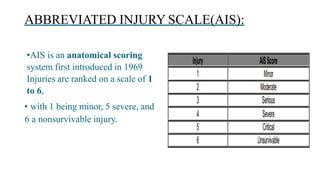
ABBREVIATED INJURY SCALE(AIS):
โ€ขAIS is an anatomical scoring
system first introduced in 1969
Injuries are ranked on a scale of 1
to 6,
โ€ข with 1 being minor, 5 severe, and
6 a nonsurvivable injury.
Injury severity score(ISS)-
โšซISS is an anatomical scoring system that provides an overall score for
patients with multiple injuries.
โšซEach injury is assigned an AIS and is allocated to one of six body
regions (Head,Face, Chest, Abdomen, Extremities (including
Pelvis), External).
โšซ Only the highest AIS score in each body region is used.
โšซThe 3 most severely injured body regions have their score
โ€ข squared and added together to produce the ISS score.
โ€ข The ISS score takes values from 0 to 75. If an injury is assigned an AIS
of
โ€ข 6 (unsurvivable injury), the
โ€ข ISS score is automatically assigned to 75
Physiological response to injury
๏‚จ Inflammatory immune response
โ€ข Innate immune response
โ€ข Adaptive immune response
๏‚จ Systemic Inflammatory Response Syndrome (SIRS)
๏‚จ Compensatory Anti-inflammatory Response Syndrome (CARS)
๏‚จ Multi Organ Dysfunction Syndrome (MODS)
Inflammatory immune response
๏‚จ EARLY innate immune response
๏‚จ DELAYED adaptive immune response
โ€ข Innate = Hyperinflammation = SIRS
โ€ข Adaptive = Immunosuppression = CARS
Early innate immune response
๏‚จ Neutrophils (major cellular โ€˜playerโ€™) are drawn to the site of injury by
IL-8 and C5a (chemokines)
๏‚จ Priming neutrophils for defence and debridement of injured
tissue, and mediating inflammation
๏‚จ Activation of PMN, monocytes, macrophages, NKC and endothelial
cells
๏‚จ Release of pro-inflammatory mediators (cytokines and
molecular mediators)
๏‚จ Considered the hyperinflammatory period
SIRS DEFINITION
๏‚จ Heart rate: > 90 bpm
๏‚จ WBC: <4000/mm3 or >12000/mm3 or >10% immature PMNs
๏‚จ Respiratory rate: >20/min with PaCO2<32mmHg
๏‚จ Core temperature: <360C or >380C
โ€ข 2 of 4 parameters = SIRS
Delayed adaptive immune response
๏‚จ Non-apoptotic necrotic/dead cells produce alarmins plus
Endogenous triggers (DAMPs = damage-associated molecular
patterns)
๏‚จ CD5+ B-cells to produce natural antibody without prior exposure and
subsets of T- cells to inflict self-reactivity โ†’ autoimmune tissue
destruction
๏‚จ Considered the immunosuppression period or CARS
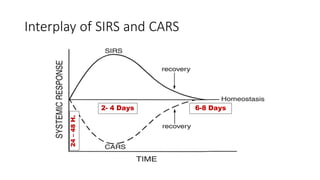
Interplay of SIRS and CARS
2- 4 Days
24
โ€“
48
H.
6-8 Days
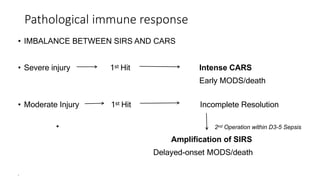
Pathological immune response
โ€ข IMBALANCE BETWEEN SIRS AND CARS
โ€ข Severe injury 1st Hit Intense CARS
Early MODS/death
โ€ข Moderate Injury 1st Hit Incomplete Resolution
โ€ข 2nd Operation within D3-5 Sepsis
Amplification of SIRS
Delayed-onset MODS/death
โ€ข
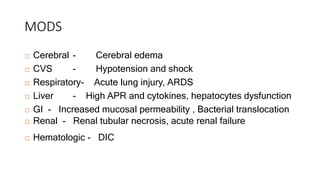
MODS
๏‚จ Cerebral - Cerebral edema
๏‚จ CVS - Hypotension and shock
๏‚จ Respiratory- Acute lung injury, ARDS
๏‚จ Liver - High APR and cytokines, hepatocytes dysfunction
๏‚จ GI - Increased mucosal permeability , Bacterial translocation
๏‚จ Renal - Renal tubular necrosis, acute renal failure
๏‚จ Hematologic - DIC
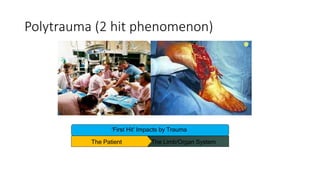
Polytrauma (2 hit phenomenon)
โ€˜First Hitโ€™ Impacts by Trauma
The Patient The Limb/Organ System
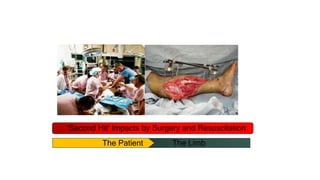
โ€˜Second Hitโ€™ Impacts by Surgery and Resuscitation
The Patient The Limb
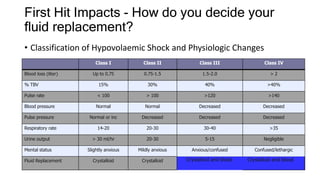
First Hit Impacts - How do you decide your
fluid replacement?
โ€ข Classification of Hypovolaemic Shock and Physiologic Changes
Class I Class II Class III Class IV
Blood loss (liter) Up to 0.75 0.75-1.5 1.5-2.0 > 2
% TBV 15% 30% 40% >40%
Pulse rate < 100 > 100 >120 >140
Blood pressure Normal Normal Decreased Decreased
Pulse pressure Normal or inc Decreased Decreased Decreased
Respiratory rate 14-20 20-30 30-40 >35
Urine output > 30 ml/hr 20-30 5-15 Negligible
Mental status Slightly anxious Mildly anxious Anxious/confused Confused/lethargic
Fluid Replacement Crystalloid Crystalloid Crystalloid and blood Crystalloid and blood
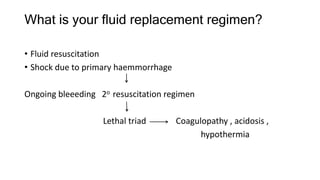
What is your fluid replacement regimen?
โ€ข Fluid resuscitation
โ€ข Shock due to primary haemmorrhage
Ongoing bleeeding 2o resuscitation regimen
Lethal triad Coagulopathy , acidosis ,
hypothermia
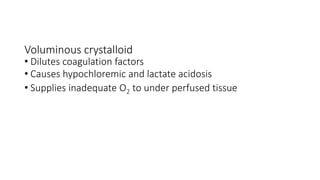
Voluminous crystalloid
โ€ข Dilutes coagulation factors
โ€ข Causes hypochloremic and lactate acidosis
โ€ข Supplies inadequate O2 to under perfused tissue
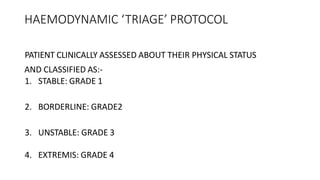
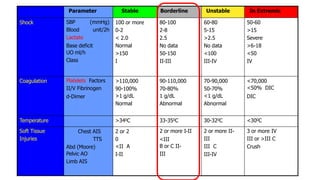
HAEMODYNAMIC โ€˜TRIAGEโ€™ PROTOCOL
PATIENT CLINICALLY ASSESSED ABOUT THEIR PHYSICAL STATUS
AND CLASSIFIED AS:-
1. STABLE: GRADE 1
2. BORDERLINE: GRADE2
3. UNSTABLE: GRADE 3
4. EXTREMIS: GRADE 4
Parameter Stable Borderline Unstable In Extremis
Shock SBP (mmHg)
Blood unit/2h
Lactate
Base deficit
UO ml/h
Class
100 or more
0-2
< 2.0
Normal
>150
I
80-100
2-8
2.5
No data
50-150
II-III
60-80
5-15
>2.5
No data
<100
III-IV
50-60
>15
Severe
>6-18
<50
IV
Coagulation Platelets Factors
II/V Fibrinogen
d-Dimer
>110,000
90-100%
>1 g/dL
Normal
90-110,000
70-80%
1 g/dL
Abnormal
70-90,000
50-70%
<1 g/dL
Abnormal
<70,000
<50% DIC
DIC
Temperature >340C 33-350C 30-320C <300C
Soft Tissue
Injuries
Chest AIS
TTS
Abd (Moore)
Pelvic AO
Limb AIS
2 or 2
0
<II A
I-II
2 or more I-II
<III
B or C II-
III
2 or more II-
III
III C
III-IV
3 or more IV
III or >III C
Crush
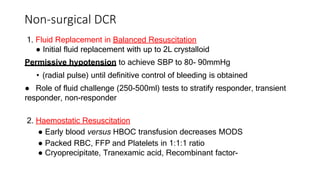
Non-surgical DCR
1. Fluid Replacement in Balanced Resuscitation
โ— Initial fluid replacement with up to 2L crystalloid
Permissive hypotension to achieve SBP to 80- 90mmHg
โ€ข (radial pulse) until definitive control of bleeding is obtained
โ— Role of fluid challenge (250-500ml) tests to stratify responder, transient
responder, non-responder
2. Haemostatic Resuscitation
โ— Early blood versus HBOC transfusion decreases MODS
โ— Packed RBC, FFP and Platelets in 1:1:1 ratio
โ— Cryoprecipitate, Tranexamic acid, Recombinant factor-
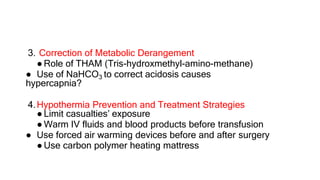
3. Correction of Metabolic Derangement
โ— Role of THAM (Tris-hydroxmethyl-amino-methane)
โ— Use of NaHCO3 to correct acidosis causes
hypercapnia?
4.Hypothermia Prevention and Treatment Strategies
โ— Limit casualtiesโ€™ exposure
โ— Warm IV fluids and blood products before transfusion
โ— Use forced air warming devices before and after surgery
โ— Use carbon polymer heating mattress
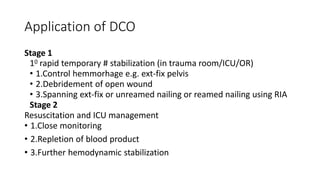
Application of DCO
Stage 1
10 rapid temporary # stabilization (in trauma room/ICU/OR)
โ€ข 1.Control hemmorhage e.g. ext-fix pelvis
โ€ข 2.Debridement of open wound
โ€ข 3.Spanning ext-fix or unreamed nailing or reamed nailing using RIA
Stage 2
Resuscitation and ICU management
โ€ข 1.Close monitoring
โ€ข 2.Repletion of blood product
โ€ข 3.Further hemodynamic stabilization
Stage 3
โ€ข Definitive # fixation once the patient is optimized (avoid day 2-5)
Injury complexes
suitable for damage
control orthopaedics
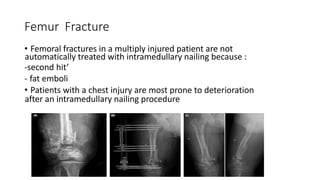
Femur Fracture
โ€ข Femoral fractures in a multiply injured patient are not
automatically treated with intramedullary nailing because :
-second hitโ€™
- fat emboli
โ€ข Patients with a chest injury are most prone to deterioration
after an intramedullary nailing procedure
โ€ข Bilateral femoral fracture is associated with a higher mortality rate
and incidence of adult respiratory distress syndrome than is a
unilateral femoral fracture
โ€ข Increase in mortality may be more closely related to associated
injuries and physiologic parameters than to the bilateral femoral
fracture itself
Pelvic Ring Injuries
โ€ข Exsanguinating haemorrhage associated with pelvic fracture
โ€ข Conditions where haemorrhage can be expected, when
there is pelvic injury :
โ€ข -Posterior pelvic ring injuries
โ€ข -Anterior-posterior compression type III injuries, lateral compression
injuries
โ€ข -Pelvic fracture in patients over 55 years old
Mangement
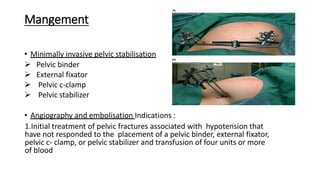
โ€ข Minimally invasive pelvic stabilisation
โžข Pelvic binder
โžข External fixator
โžข Pelvic c-clamp
โžข Pelvic stabilizer
โ€ข Angiography and embolisation Indications :
1.Initial treatment of pelvic fractures associated with hypotension that
have not responded to the placement of a pelvic binder, external fixator,
pelvic c- clamp, or pelvic stabilizer and transfusion of four units or more
of blood
2. expanding retroperitoneal hematoma,
3. a vascular blush seen on CT
4. a massive retroperitoneal hematoma observed on CT
- Timing is important
- Embolisation later than 3 hours after injury increased risk of mortality
โ€ข -Average procedure time is 90 minutes
โ€ข Pelvic Packing Indication :
โ€ข 1. Patient with severe hypotension and a pelvic fracture that is unresponsive
to other initial treatment measures, associated with imminent risk of death
Chest Injuries
โ€ข Treatment of multiply injured patients with long bone fractures and a
chest injury:
โ€ข early fracture stabilisation (within 48 hours)is safe and may be
beneficial
โ€ข early fracture stabilisation is safe and maybe beneficial
Head Injuries
โ€ข Early stabilisation doesnโ€™t enhance or worsen the outcome in
patients with head injury.
โ€ข Management :
โ€ข Based on the individual clinical assessment and
treatment requirements
โ€ข Damage control orthopaedics can provide temporary
osseous stability to an injured extremity, functioning as a
temporary bridge to staged definitive osteosynthesis,
without worsening the patient's head injury or overall
condition.
โ€ข Aggressive management of intracranial pressure
โ€ข Maintenance of cerebral perfusion pressure at >70 mm Hg
and intracranial pressure at <20 mm Hg
Mangled Extremities
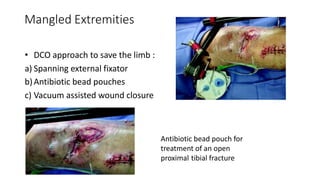
โ€ข DCO approach to save the limb :
a) Spanning external fixator
b)Antibiotic bead pouches
c) Vacuum assisted wound closure
Antibiotic bead pouch for
treatment of an open
proximal tibial fracture
Isolated Complex Lower-Extremity Trauma
โ€ข โ€œlimb damage control orthopaedicsโ€
โ€ข Proximal tibial articular and metaphyseal fractures,
metaphyseal fractures, distal tibial pilon fractures
โ€ข Useful for preventing soft-tissue complications by spanning the
articular segment with an external fixator and avoiding areas of
future incisions.
โ€ข Then minimally invasive plate osteosynthesis can be performed at a
stage when the condition of the soft tissue envelope is optimized.
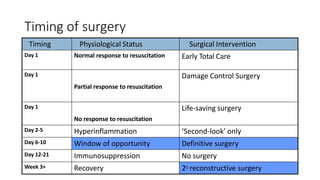
Timing of surgery
Timing Physiological Status Surgical Intervention
Day 1 Normal response to resuscitation Early Total Care
Day 1
Partial response to resuscitation
Damage Control Surgery
Day 1
No response to resuscitation
Life-saving surgery
Day 2-5 Hyperinflammation โ€˜Second-lookโ€™ only
Day 6-10 Window of opportunity Definitive surgery
Day 12-21 Immunosuppression No surgery
Week 3+ Recovery 20 reconstructive surgery
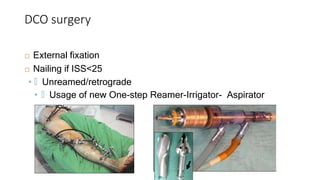
DCO surgery
๏‚จ External fixation
๏‚จ Nailing if ISS<25
โ€ข ๐Ÿž‘ Unreamed/retrograde
โ€ข ๐Ÿž‘ Usage of new One-step Reamer-Irrigator- Aspirator
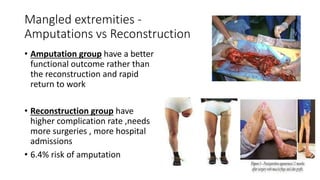
Mangled extremities -
Amputations vs Reconstruction
โ€ข Amputation group have a better
functional outcome rather than
the reconstruction and rapid
return to work
โ€ข Reconstruction group have
higher complication rate ,needs
more surgeries , more hospital
admissions
โ€ข 6.4% risk of amputation
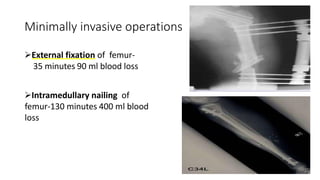
Minimally invasive operations
โžขExternal fixation of femur-
35 minutes 90 ml blood loss
โžขIntramedullary nailing of
femur-130 minutes 400 ml blood
loss
Reamed IMN vs Ex Fix
โ€ข Reamed Intramedullary nailing Has been associated with
development of โ€œsecond hitโ€ phenomena
โ‘ Primary external fixation
โ€ข has not stimulated any inflammatory reactionโ€œsecond hitโ€
Skeletal traction vs External fixation
โ‘External fixation of femur fractures in severely injured patients offers
no significant advantages compared with skeletal traction. The use of
ST as a temporization method remains a practical option.
CONCLUSION
โ€ข Incidence of Polytrauma is rising
โ€ข Initial evaluation and stabilisation is of paramount importance
โ€ข Changing trends in fluid therapy
โ€ข Proper selection of patient for ETC and DCO
โ€ข Multidisciplinary approach
DCO principles in polytrauma
Ortho team must be resuscitatorsand
stabilizers: not โ€œfixersโ€
โ€ขTHANK YOU

DAMAGE CONTROL ORTHOPAEDICS.pdf

  • 1.
    DAMAGE CONTROL ORTHOPAEDICS Presenter -Dr Akhil John Moderator - Dr N Ravinder Kumar
  • 2.
    Contents โ€ข Definition โ€ข Polytrauma โ€ขPhysiological Response โ€ข Triage protocol โ€ข Damage control orthopaedics โ€ข Management
  • 3.
    Definition โ€ข is anapproach that contains and stabilizes orthopaedic injuries so that the patientโ€™s overall physiology can improve. โ€ข purpose : - avoid worsening of the patient's condition by the โ€œsecond hitโ€ of a major orthopaedic procedure - delay definitive fracture repair until a time when the overall condition of the patient is optimized
  • 4.
    โ€ข Basic principlesinclude arresting hemorrhage; โ€ข restoring blood volume; โ€ข and correcting Coagulopathy, Acidosis and Hypothermia.
  • 5.
    โ€ข Early rapidfracture stabilization by external fixation โ€ข Avoiding prolonged operative times โ€ข Preventing the onset of thelethal triad ( Coagulopathy, Acidosis & Hypothermia )
  • 6.
    WHAT IS POLYTRAUMA โ€ขPolytrauma and multiple trauma are medical terms describing the condition of a person who has been subjected to multiple traumatic injuries, The term is defined via an Injury Severity Score (ISS)>/=17 โ€ข Sequential Post traumatic Systemic Inflammatory Reactions (SIRS) โ€ข Dysfunction or failure of Remote Systems or Organs which are not injured(MODS โ€“ MOF)
  • 7.
    โšซTodescribe the overallcondition of the pt many trauma scoring systems have been developed like- 1. Abbrevieted injury scale(AIS) 2. Injury severity scale(ISS) 3. Revised trauma score 4. Anatomic profile 5. Glasgow coma scale
  • 8.
    ABBREVIATED INJURY SCALE(AIS): โ€ขAISis an anatomical scoring system first introduced in 1969 Injuries are ranked on a scale of 1 to 6, โ€ข with 1 being minor, 5 severe, and 6 a nonsurvivable injury.
  • 9.
    Injury severity score(ISS)- โšซISSis an anatomical scoring system that provides an overall score for patients with multiple injuries. โšซEach injury is assigned an AIS and is allocated to one of six body regions (Head,Face, Chest, Abdomen, Extremities (including Pelvis), External). โšซ Only the highest AIS score in each body region is used.
  • 10.
    โšซThe 3 mostseverely injured body regions have their score โ€ข squared and added together to produce the ISS score. โ€ข The ISS score takes values from 0 to 75. If an injury is assigned an AIS of โ€ข 6 (unsurvivable injury), the โ€ข ISS score is automatically assigned to 75
  • 11.
    Physiological response toinjury ๏‚จ Inflammatory immune response โ€ข Innate immune response โ€ข Adaptive immune response ๏‚จ Systemic Inflammatory Response Syndrome (SIRS) ๏‚จ Compensatory Anti-inflammatory Response Syndrome (CARS) ๏‚จ Multi Organ Dysfunction Syndrome (MODS)
  • 12.
    Inflammatory immune response ๏‚จEARLY innate immune response ๏‚จ DELAYED adaptive immune response โ€ข Innate = Hyperinflammation = SIRS โ€ข Adaptive = Immunosuppression = CARS
  • 13.
    Early innate immuneresponse ๏‚จ Neutrophils (major cellular โ€˜playerโ€™) are drawn to the site of injury by IL-8 and C5a (chemokines) ๏‚จ Priming neutrophils for defence and debridement of injured tissue, and mediating inflammation ๏‚จ Activation of PMN, monocytes, macrophages, NKC and endothelial cells ๏‚จ Release of pro-inflammatory mediators (cytokines and molecular mediators) ๏‚จ Considered the hyperinflammatory period
  • 14.
    SIRS DEFINITION ๏‚จ Heartrate: > 90 bpm ๏‚จ WBC: <4000/mm3 or >12000/mm3 or >10% immature PMNs ๏‚จ Respiratory rate: >20/min with PaCO2<32mmHg ๏‚จ Core temperature: <360C or >380C โ€ข 2 of 4 parameters = SIRS
  • 15.
    Delayed adaptive immuneresponse ๏‚จ Non-apoptotic necrotic/dead cells produce alarmins plus Endogenous triggers (DAMPs = damage-associated molecular patterns) ๏‚จ CD5+ B-cells to produce natural antibody without prior exposure and subsets of T- cells to inflict self-reactivity โ†’ autoimmune tissue destruction ๏‚จ Considered the immunosuppression period or CARS
  • 16.
    Interplay of SIRSand CARS 2- 4 Days 24 โ€“ 48 H. 6-8 Days
  • 17.
    Pathological immune response โ€ขIMBALANCE BETWEEN SIRS AND CARS โ€ข Severe injury 1st Hit Intense CARS Early MODS/death โ€ข Moderate Injury 1st Hit Incomplete Resolution โ€ข 2nd Operation within D3-5 Sepsis Amplification of SIRS Delayed-onset MODS/death โ€ข
  • 18.
    MODS ๏‚จ Cerebral -Cerebral edema ๏‚จ CVS - Hypotension and shock ๏‚จ Respiratory- Acute lung injury, ARDS ๏‚จ Liver - High APR and cytokines, hepatocytes dysfunction ๏‚จ GI - Increased mucosal permeability , Bacterial translocation ๏‚จ Renal - Renal tubular necrosis, acute renal failure ๏‚จ Hematologic - DIC
  • 19.
    Polytrauma (2 hitphenomenon) โ€˜First Hitโ€™ Impacts by Trauma The Patient The Limb/Organ System
  • 20.
    โ€˜Second Hitโ€™ Impactsby Surgery and Resuscitation The Patient The Limb
  • 21.
    First Hit Impacts- How do you decide your fluid replacement? โ€ข Classification of Hypovolaemic Shock and Physiologic Changes Class I Class II Class III Class IV Blood loss (liter) Up to 0.75 0.75-1.5 1.5-2.0 > 2 % TBV 15% 30% 40% >40% Pulse rate < 100 > 100 >120 >140 Blood pressure Normal Normal Decreased Decreased Pulse pressure Normal or inc Decreased Decreased Decreased Respiratory rate 14-20 20-30 30-40 >35 Urine output > 30 ml/hr 20-30 5-15 Negligible Mental status Slightly anxious Mildly anxious Anxious/confused Confused/lethargic Fluid Replacement Crystalloid Crystalloid Crystalloid and blood Crystalloid and blood
  • 22.
    What is yourfluid replacement regimen? โ€ข Fluid resuscitation โ€ข Shock due to primary haemmorrhage Ongoing bleeeding 2o resuscitation regimen Lethal triad Coagulopathy , acidosis , hypothermia
  • 23.
    Voluminous crystalloid โ€ข Dilutescoagulation factors โ€ข Causes hypochloremic and lactate acidosis โ€ข Supplies inadequate O2 to under perfused tissue
  • 24.
    HAEMODYNAMIC โ€˜TRIAGEโ€™ PROTOCOL PATIENTCLINICALLY ASSESSED ABOUT THEIR PHYSICAL STATUS AND CLASSIFIED AS:- 1. STABLE: GRADE 1 2. BORDERLINE: GRADE2 3. UNSTABLE: GRADE 3 4. EXTREMIS: GRADE 4
  • 25.
    Parameter Stable BorderlineUnstable In Extremis Shock SBP (mmHg) Blood unit/2h Lactate Base deficit UO ml/h Class 100 or more 0-2 < 2.0 Normal >150 I 80-100 2-8 2.5 No data 50-150 II-III 60-80 5-15 >2.5 No data <100 III-IV 50-60 >15 Severe >6-18 <50 IV Coagulation Platelets Factors II/V Fibrinogen d-Dimer >110,000 90-100% >1 g/dL Normal 90-110,000 70-80% 1 g/dL Abnormal 70-90,000 50-70% <1 g/dL Abnormal <70,000 <50% DIC DIC Temperature >340C 33-350C 30-320C <300C Soft Tissue Injuries Chest AIS TTS Abd (Moore) Pelvic AO Limb AIS 2 or 2 0 <II A I-II 2 or more I-II <III B or C II- III 2 or more II- III III C III-IV 3 or more IV III or >III C Crush
  • 26.
    Non-surgical DCR 1. FluidReplacement in Balanced Resuscitation โ— Initial fluid replacement with up to 2L crystalloid Permissive hypotension to achieve SBP to 80- 90mmHg โ€ข (radial pulse) until definitive control of bleeding is obtained โ— Role of fluid challenge (250-500ml) tests to stratify responder, transient responder, non-responder 2. Haemostatic Resuscitation โ— Early blood versus HBOC transfusion decreases MODS โ— Packed RBC, FFP and Platelets in 1:1:1 ratio โ— Cryoprecipitate, Tranexamic acid, Recombinant factor-
  • 27.
    3. Correction ofMetabolic Derangement โ— Role of THAM (Tris-hydroxmethyl-amino-methane) โ— Use of NaHCO3 to correct acidosis causes hypercapnia? 4.Hypothermia Prevention and Treatment Strategies โ— Limit casualtiesโ€™ exposure โ— Warm IV fluids and blood products before transfusion โ— Use forced air warming devices before and after surgery โ— Use carbon polymer heating mattress
  • 28.
    Application of DCO Stage1 10 rapid temporary # stabilization (in trauma room/ICU/OR) โ€ข 1.Control hemmorhage e.g. ext-fix pelvis โ€ข 2.Debridement of open wound โ€ข 3.Spanning ext-fix or unreamed nailing or reamed nailing using RIA Stage 2 Resuscitation and ICU management โ€ข 1.Close monitoring โ€ข 2.Repletion of blood product โ€ข 3.Further hemodynamic stabilization
  • 29.
    Stage 3 โ€ข Definitive# fixation once the patient is optimized (avoid day 2-5)
  • 30.
    Injury complexes suitable fordamage control orthopaedics
  • 31.
    Femur Fracture โ€ข Femoralfractures in a multiply injured patient are not automatically treated with intramedullary nailing because : -second hitโ€™ - fat emboli โ€ข Patients with a chest injury are most prone to deterioration after an intramedullary nailing procedure
  • 32.
    โ€ข Bilateral femoralfracture is associated with a higher mortality rate and incidence of adult respiratory distress syndrome than is a unilateral femoral fracture โ€ข Increase in mortality may be more closely related to associated injuries and physiologic parameters than to the bilateral femoral fracture itself
  • 33.
    Pelvic Ring Injuries โ€ขExsanguinating haemorrhage associated with pelvic fracture โ€ข Conditions where haemorrhage can be expected, when there is pelvic injury : โ€ข -Posterior pelvic ring injuries โ€ข -Anterior-posterior compression type III injuries, lateral compression injuries โ€ข -Pelvic fracture in patients over 55 years old
  • 34.
    Mangement โ€ข Minimally invasivepelvic stabilisation โžข Pelvic binder โžข External fixator โžข Pelvic c-clamp โžข Pelvic stabilizer โ€ข Angiography and embolisation Indications : 1.Initial treatment of pelvic fractures associated with hypotension that have not responded to the placement of a pelvic binder, external fixator, pelvic c- clamp, or pelvic stabilizer and transfusion of four units or more of blood
  • 35.
    2. expanding retroperitonealhematoma, 3. a vascular blush seen on CT 4. a massive retroperitoneal hematoma observed on CT - Timing is important - Embolisation later than 3 hours after injury increased risk of mortality โ€ข -Average procedure time is 90 minutes โ€ข Pelvic Packing Indication : โ€ข 1. Patient with severe hypotension and a pelvic fracture that is unresponsive to other initial treatment measures, associated with imminent risk of death
  • 36.
    Chest Injuries โ€ข Treatmentof multiply injured patients with long bone fractures and a chest injury: โ€ข early fracture stabilisation (within 48 hours)is safe and may be beneficial โ€ข early fracture stabilisation is safe and maybe beneficial
  • 37.
    Head Injuries โ€ข Earlystabilisation doesnโ€™t enhance or worsen the outcome in patients with head injury. โ€ข Management : โ€ข Based on the individual clinical assessment and treatment requirements โ€ข Damage control orthopaedics can provide temporary osseous stability to an injured extremity, functioning as a temporary bridge to staged definitive osteosynthesis, without worsening the patient's head injury or overall condition. โ€ข Aggressive management of intracranial pressure โ€ข Maintenance of cerebral perfusion pressure at >70 mm Hg and intracranial pressure at <20 mm Hg
  • 38.
    Mangled Extremities โ€ข DCOapproach to save the limb : a) Spanning external fixator b)Antibiotic bead pouches c) Vacuum assisted wound closure Antibiotic bead pouch for treatment of an open proximal tibial fracture
  • 39.
    Isolated Complex Lower-ExtremityTrauma โ€ข โ€œlimb damage control orthopaedicsโ€ โ€ข Proximal tibial articular and metaphyseal fractures, metaphyseal fractures, distal tibial pilon fractures โ€ข Useful for preventing soft-tissue complications by spanning the articular segment with an external fixator and avoiding areas of future incisions. โ€ข Then minimally invasive plate osteosynthesis can be performed at a stage when the condition of the soft tissue envelope is optimized.
  • 40.
    Timing of surgery TimingPhysiological Status Surgical Intervention Day 1 Normal response to resuscitation Early Total Care Day 1 Partial response to resuscitation Damage Control Surgery Day 1 No response to resuscitation Life-saving surgery Day 2-5 Hyperinflammation โ€˜Second-lookโ€™ only Day 6-10 Window of opportunity Definitive surgery Day 12-21 Immunosuppression No surgery Week 3+ Recovery 20 reconstructive surgery
  • 41.
    DCO surgery ๏‚จ Externalfixation ๏‚จ Nailing if ISS<25 โ€ข ๐Ÿž‘ Unreamed/retrograde โ€ข ๐Ÿž‘ Usage of new One-step Reamer-Irrigator- Aspirator
  • 42.
    Mangled extremities - Amputationsvs Reconstruction โ€ข Amputation group have a better functional outcome rather than the reconstruction and rapid return to work โ€ข Reconstruction group have higher complication rate ,needs more surgeries , more hospital admissions โ€ข 6.4% risk of amputation
  • 43.
    Minimally invasive operations โžขExternalfixation of femur- 35 minutes 90 ml blood loss โžขIntramedullary nailing of femur-130 minutes 400 ml blood loss
  • 44.
    Reamed IMN vsEx Fix โ€ข Reamed Intramedullary nailing Has been associated with development of โ€œsecond hitโ€ phenomena โ‘ Primary external fixation โ€ข has not stimulated any inflammatory reactionโ€œsecond hitโ€
  • 45.
    Skeletal traction vsExternal fixation โ‘External fixation of femur fractures in severely injured patients offers no significant advantages compared with skeletal traction. The use of ST as a temporization method remains a practical option.
  • 46.
    CONCLUSION โ€ข Incidence ofPolytrauma is rising โ€ข Initial evaluation and stabilisation is of paramount importance โ€ข Changing trends in fluid therapy โ€ข Proper selection of patient for ETC and DCO โ€ข Multidisciplinary approach DCO principles in polytrauma Ortho team must be resuscitatorsand stabilizers: not โ€œfixersโ€
  • 47.