






CONTROL
ORTHOPAEDICS(D
CO)
Presented
By
Hany A.Y. Al-Dakar
Consultant of Orthopedic&
Traumatology
Al-Mahmoudia General Hospital
OBJECTIVES
By the end of this lecture the Trainees will be
able to :
1) Know the history of damage control
orthopedics (DCO).
2) Understand the pathophysiology of DCO.
3) Define poly-trauma patient.
4) Know steps of DCO strategy.
HISTORICAL
REVIEW
IN 1960S
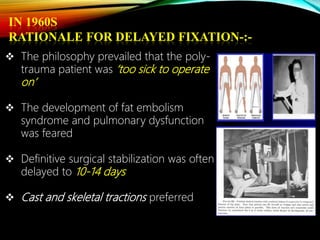
RATIONALE FOR DELAYED FIXATION-:-
 The philosophy prevailed that the poly-
trauma patient was ‘too sick to operate
on’
 The development of fat embolism
syndrome and pulmonary dysfunction
was feared
 Definitive surgical stabilization was often
delayed to 10-14 days
 Cast and skeletal tractions preferred
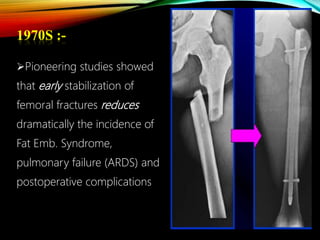
1970S :-
Pioneering studies showed
that early stabilization of
femoral fractures reduces
dramatically the incidence of
Fat Emb. Syndrome,
pulmonary failure (ARDS) and
postoperative complications
IN1980S
RATIONALE OF EARLY FIXATION
(ETC) EARLY TOTAL CARE):-
“There is a beneficial effect of early stabilization of fractures
on both mortality and morbidity and length of hospital stay.”
This new philosophy was named Early Total Care ( ETC ).
“The patient is too sick not to be treated surgically”
Surgeries were done within 24 hrs of admission
A variety of unexpected complications related to the early
stabilization of fractures of long bones was described.
These complications mainly developed in patients with
severe chest injuries,
severe hemodynamic shock
post reamed intramedullary nailing without thoracic
trauma.
IN THE EARLY 1990S
This led to the conclusion that the
method of stabilization and the timing
of surgery may have played a major
role in the development of such
complications.
1990S
THE EVOLUTION OF DAMAGE CONTROL
ORTHOPAEDICS
 An approach to achieve rapid skeletal
stabilization of major orthopedic
injuries to stop the cycle of ongoing
musculo -skeletal injury and to control
hemorrhage
 Its purpose is to avoid worsening of
the patient's condition by the "second
hit" of a major orthopedic procedures
WHAT IS
DAMAGE CONTROL ?
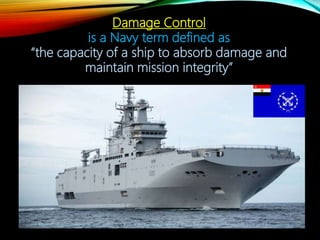
Damage Control
is a Navy term defined as
“the capacity of a ship to absorb damage and
maintain mission integrity”
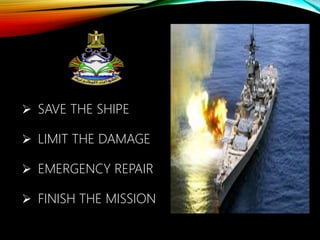
 SAVE THE SHIPE
 LIMIT THE DAMAGE
 EMERGENCY REPAIR
 FINISH THE MISSION
I. Contains & Stabilizes Orthopedic Injuries so that the
Patient’s Overall Physiology can improve
II. Avoid worsening of the patient’s condition by a
major Orthopedic Procedure
III. Delay Definitive Fracture Repair in borderline or
unstable patient till condition is optimized
DAMAGE CONTROL ORTHOPAEDICS (DCO)
Relatively recent concept in Orthopedic
practice that:
DAMAGE CONTROL ORTHOPAEDICS (DCO)
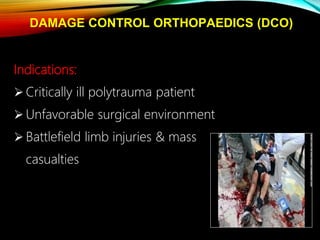
Indications:
 Critically ill polytrauma patient
 Unfavorable surgical environment
 Battlefield limb injuries & mass
casualties
DAMAGE CONTROL ORTHOPEDICS:
Its priorities are:
• Control of hemorrhage
• Provisional stabilization of major skeletal
fractures
• Management of soft-tissue injuries
• Minimizing the degree of surgical insult
to the patient.
5 TENETS OF DAMAGE CONTROL
ORTHOPAEDICS
1. Recognize who needs damage control.
2. Salvage operations.
3. Keep the patient alive.
4. Accept morbidity of the salvage procedures.
5. 5. Definitive repair later
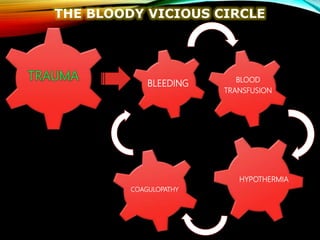
PATHOPHYSIOLOGY
HYPOTHERMIA
COAGULOPATHY
BLOOD
TRANSFUSION
BLEEDING
THE BLOODY VICIOUS CIRCLE
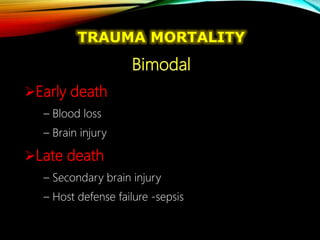
TRAUMA MORTALITY
Bimodal
Early death
– Blood loss
– Brain injury
Late death
– Secondary brain injury
– Host defense failure -sepsis
TWO-HITS THEORY
“Hits” Induce a Host Immune Response
First Hit (Trauma)
 Hypoxia
 Hypotension
 Organ & soft tissue injury
 Fractures
Second Hit (operation)
 Ischemia/reperfusion injury
 Compartment syndrome
 Operative intervention
 Infection
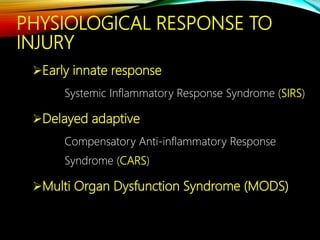
PHYSIOLOGICAL RESPONSE TO
INJURY
Early innate response
Systemic Inflammatory Response Syndrome (SIRS)
Delayed adaptive
Compensatory Anti-inflammatory Response
Syndrome (CARS)
Multi Organ Dysfunction Syndrome (MODS)
EARLY INNATE IMMUNE RESPONSE
Activation of
PMN
Monocytes
Macrophages
Endothelial cells
Release of
pro-inflammatory mediators
o Cytokines and
o Molecular mediators
Considered Systemic Inflammatory Response
Syndrome (SIRS)
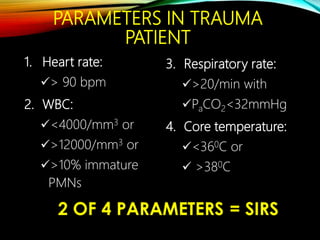
PARAMETERS IN TRAUMA
PATIENT
1. Heart rate:
> 90 bpm
2. WBC:
<4000/mm3 or
>12000/mm3 or
>10% immature
PMNs
3. Respiratory rate:
>20/min with
PaCO2<32mmHg
4. Core temperature:
<360C or
 >380C
DELAYED ADAPTIVE IMMUNE
RESPONSE
Necrotic/dead cells (Non-apoptotic)
produce Endogenous triggers → auto-
immune tissue destruction
Considered Compensatory Anti-
inflammatory Response Syndrome (CARS)
MULTI ORGAN DYSFUNCTION SYNDROME
(MODS)
Pathology
Organ
Cerebral edema
Cerebral
Hypotension and shock
CVS
Acute lung injury, ARDS
Respiratory
hepatocytes dysfunction
Liver
Increased mucosal Bacterial
translocation
GI permeability
Renal tubular necrosis, acute
renal failure
Renal
DIVC
Hematologic
PATHOLOGICAL IMMUNE RESPONSE
1st Hit
Moderate Injury 1st Hit
Amplification of SIRS
Delayed-onset MODS/death
Incomplete Resolution
2
nd
Hit
2nd Operation within D3-5
Sepsis
Severe injury Intense CARS
Early MODS/death
IMBALANCE BETWEEN SIRS AND CARS
INTERPLAY OF SIRS AND CARS
Systemic
Response
SIRS
CARS
D14
D7
Adaptive Immune
Response
Innate Immune
Response
Insult
Homeostasis
Mild-Moderate Injury
Pro-inflammatory
Anti-inflammatory
Balanced SIRS-CARS maintains homeostasis
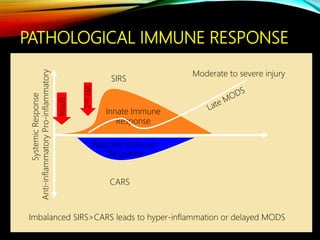
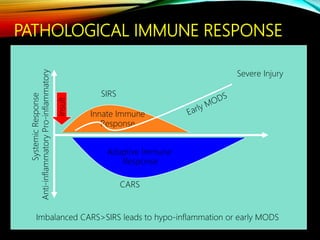
PATHOLOGICAL IMMUNE RESPONSE
Systemic
Response
SIRS
CARS
Adaptive Immune
Response
Insult
Moderate to severe injury
Pro-inflammatory
Anti-inflammatory
Imbalanced SIRS>CARS leads to hyper-inflammation or delayed MODS
Innate Immune
Response
2
nd
Hit
PATHOLOGICAL IMMUNE RESPONSE
Systemic
Response
SIRS
CARS
Adaptive Immune
Response
Innate Immune
Response
Insult
Severe Injury
Pro-inflammatory
Anti-inflammatory
Imbalanced CARS>SIRS leads to hypo-inflammation or early MODS
WE‘VE To LIMIT THE 2ND HIT
PATIENT SELECTION
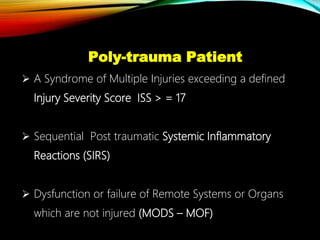
Poly-trauma Patient
 A Syndrome of Multiple Injuries exceeding a defined
Injury Severity Score ISS > = 17
 Sequential Post traumatic Systemic Inflammatory
Reactions (SIRS)
 Dysfunction or failure of Remote Systems or Organs
which are not injured (MODS – MOF)
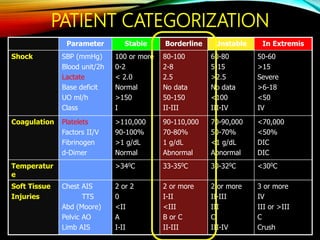
PATIENT CLINICALLY ASSESSED ABOUT THEIR
PHYSICAL STATUS AND CLASSIFIED AS:-
1. STABLE: GRADE I
2. BORDERLINE: GRADE II
3. UNSTABLE: GRADE III
4. EXTREMIS: GRADE VI
PATIENT CATEGORIZATION
Parameter Stable Borderline Unstable In Extremis
Shock SBP (mmHg)
Blood unit/2h
Lactate
Base deficit
UO ml/h
Class
100 or more
0-2
< 2.0
Normal
>150
I
80-100
2-8
2.5
No data
50-150
II-III
60-80
5-15
>2.5
No data
<100
III-IV
50-60
>15
Severe
>6-18
<50
IV
Coagulation Platelets
Factors II/V
Fibrinogen
d-Dimer
>110,000
90-100%
>1 g/dL
Normal
90-110,000
70-80%
1 g/dL
Abnormal
70-90,000
50-70%
<1 g/dL
Abnormal
<70,000
<50%
DIC
DIC
Temperatur
e
>340C 33-350C 30-320C <300C
Soft Tissue
Injuries
Chest AIS
TTS
Abd (Moore)
Pelvic AO
Limb AIS
2 or 2
0
<II
A
I-II
2 or more
I-II
<III
B or C
II-III
2 or more
II-III
III
C
III-IV
3 or more
IV
III or >III
C
Crush
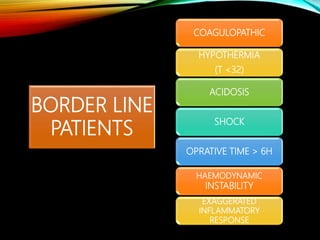
BORDER LINE
PATIENTS
COAGULOPATHIC
HYPOTHERMIA
(T <32)
ACIDOSIS
SHOCK
OPRATIVE TIME > 6H
HAEMODYNAMIC
INSTABILITY
EXAGGERATED
INFLAMMATORY
RESPONSE
MANAGMENT
ORTHOPEDIC INJURY COMPLEX
PROBLEMS
 Femoral fractures in a multiply injured patient
 Pelvic ring injuries with shock
 Poly-trauma in a geriatric patient
 Long bone fractures with chest or head injuries
 Mangled extremities
APPLICATION OF DCO STRATEGY
 Multiply injured patient
 Physiologically unstable
 Severe chest injury
 Severe hemorrhage
 Mass casualty situation
 Stage 1: early temporary External Fixation,
Stabilization of unstable fractures and the
control of hemorrhage and, if indicated,
decompression of intracranial lesion.
 Stage 2: resuscitation of the patient in ICU and
optimization of his condition.
 Stage 3: delayed definitive management of
the fracture
STATGED TREATMENT
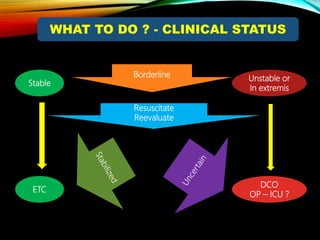
Stable
WHAT TO DO ? - CLINICAL STATUS
ETC
Unstable or
In extremis
DCO
OP – ICU ?
Borderline
Resuscitate
Reevaluate
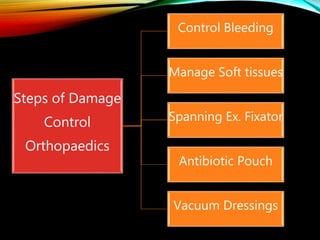
Steps of Damage
Control
Orthopaedics
Control Bleeding
Manage Soft tissues
Spanning Ex. Fixator
Antibiotic Pouch
Vacuum Dressings
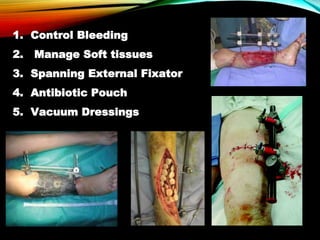
1. Control Bleeding
2. Manage Soft tissues
3. Spanning External Fixator
4. Antibiotic Pouch
5. Vacuum Dressings
SECONDARY PROCEDURE
WHEN?
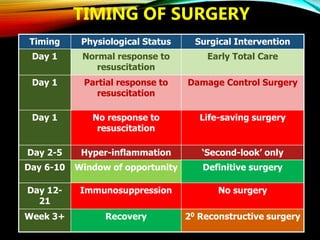
TIMING OF SURGERY
Timing Physiological Status Surgical Intervention
Day 1 Normal response to
resuscitation
Early Total Care
Day 1 Partial response to
resuscitation
Damage Control Surgery
Day 1 No response to
resuscitation
Life-saving surgery
Day 2-5 Hyper-inflammation ‘Second-look’ only
Day 6-10 Window of opportunity Definitive surgery
Day 12-
21
Immunosuppression No surgery
Week 3+ Recovery 20 Reconstructive surgery
CONCLUSION
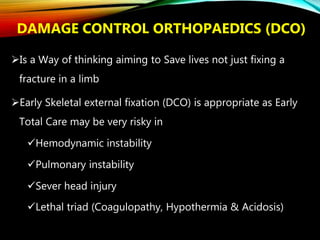
DAMAGE CONTROL ORTHOPAEDICS (DCO)
Is a Way of thinking aiming to Save lives not just fixing a
fracture in a limb
Early Skeletal external fixation (DCO) is appropriate as Early
Total Care may be very risky in
Hemodynamic instability
Pulmonary instability
Sever head injury
Lethal triad (Coagulopathy, Hypothermia & Acidosis)
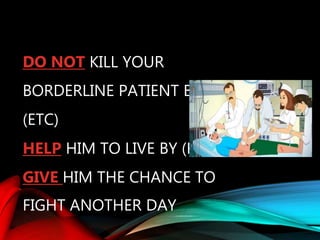
DO NOT KILL YOUR
BORDERLINE PATIENT BY
(ETC)
HELP HIM TO LIVE BY (DCO)
GIVE HIM THE CHANCE TO
FIGHT ANOTHER DAY
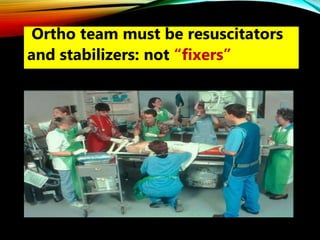
Ortho team must be resuscitators
and stabilizers: not “fixers”
Damage control orthopedics

Damage control orthopedics

  • 1.
    CONTROL ORTHOPAEDICS(D CO) Presented By Hany A.Y. Al-Dakar Consultantof Orthopedic& Traumatology Al-Mahmoudia General Hospital
  • 3.
    OBJECTIVES By the endof this lecture the Trainees will be able to : 1) Know the history of damage control orthopedics (DCO). 2) Understand the pathophysiology of DCO. 3) Define poly-trauma patient. 4) Know steps of DCO strategy.
  • 4.
  • 5.
    IN 1960S RATIONALE FORDELAYED FIXATION-:-  The philosophy prevailed that the poly- trauma patient was ‘too sick to operate on’  The development of fat embolism syndrome and pulmonary dysfunction was feared  Definitive surgical stabilization was often delayed to 10-14 days  Cast and skeletal tractions preferred
  • 6.
    1970S :- Pioneering studiesshowed that early stabilization of femoral fractures reduces dramatically the incidence of Fat Emb. Syndrome, pulmonary failure (ARDS) and postoperative complications
  • 7.
    IN1980S RATIONALE OF EARLYFIXATION (ETC) EARLY TOTAL CARE):- “There is a beneficial effect of early stabilization of fractures on both mortality and morbidity and length of hospital stay.” This new philosophy was named Early Total Care ( ETC ). “The patient is too sick not to be treated surgically” Surgeries were done within 24 hrs of admission
  • 8.
    A variety ofunexpected complications related to the early stabilization of fractures of long bones was described. These complications mainly developed in patients with severe chest injuries, severe hemodynamic shock post reamed intramedullary nailing without thoracic trauma. IN THE EARLY 1990S
  • 9.
    This led tothe conclusion that the method of stabilization and the timing of surgery may have played a major role in the development of such complications.
  • 10.
    1990S THE EVOLUTION OFDAMAGE CONTROL ORTHOPAEDICS  An approach to achieve rapid skeletal stabilization of major orthopedic injuries to stop the cycle of ongoing musculo -skeletal injury and to control hemorrhage  Its purpose is to avoid worsening of the patient's condition by the "second hit" of a major orthopedic procedures
  • 11.
  • 12.
    Damage Control is aNavy term defined as “the capacity of a ship to absorb damage and maintain mission integrity”
  • 13.
     SAVE THESHIPE  LIMIT THE DAMAGE  EMERGENCY REPAIR  FINISH THE MISSION
  • 14.
    I. Contains &Stabilizes Orthopedic Injuries so that the Patient’s Overall Physiology can improve II. Avoid worsening of the patient’s condition by a major Orthopedic Procedure III. Delay Definitive Fracture Repair in borderline or unstable patient till condition is optimized DAMAGE CONTROL ORTHOPAEDICS (DCO) Relatively recent concept in Orthopedic practice that:
  • 15.
    DAMAGE CONTROL ORTHOPAEDICS(DCO) Indications:  Critically ill polytrauma patient  Unfavorable surgical environment  Battlefield limb injuries & mass casualties
  • 16.
    DAMAGE CONTROL ORTHOPEDICS: Itspriorities are: • Control of hemorrhage • Provisional stabilization of major skeletal fractures • Management of soft-tissue injuries • Minimizing the degree of surgical insult to the patient.
  • 17.
    5 TENETS OFDAMAGE CONTROL ORTHOPAEDICS 1. Recognize who needs damage control. 2. Salvage operations. 3. Keep the patient alive. 4. Accept morbidity of the salvage procedures. 5. 5. Definitive repair later
  • 18.
  • 19.
  • 20.
    TRAUMA MORTALITY Bimodal Early death –Blood loss – Brain injury Late death – Secondary brain injury – Host defense failure -sepsis
  • 21.
    TWO-HITS THEORY “Hits” Inducea Host Immune Response First Hit (Trauma)  Hypoxia  Hypotension  Organ & soft tissue injury  Fractures Second Hit (operation)  Ischemia/reperfusion injury  Compartment syndrome  Operative intervention  Infection
  • 22.
    PHYSIOLOGICAL RESPONSE TO INJURY Earlyinnate response Systemic Inflammatory Response Syndrome (SIRS) Delayed adaptive Compensatory Anti-inflammatory Response Syndrome (CARS) Multi Organ Dysfunction Syndrome (MODS)
  • 23.
    EARLY INNATE IMMUNERESPONSE Activation of PMN Monocytes Macrophages Endothelial cells Release of pro-inflammatory mediators o Cytokines and o Molecular mediators Considered Systemic Inflammatory Response Syndrome (SIRS)
  • 24.
    PARAMETERS IN TRAUMA PATIENT 1.Heart rate: > 90 bpm 2. WBC: <4000/mm3 or >12000/mm3 or >10% immature PMNs 3. Respiratory rate: >20/min with PaCO2<32mmHg 4. Core temperature: <360C or  >380C
  • 25.
    DELAYED ADAPTIVE IMMUNE RESPONSE Necrotic/deadcells (Non-apoptotic) produce Endogenous triggers → auto- immune tissue destruction Considered Compensatory Anti- inflammatory Response Syndrome (CARS)
  • 26.
    MULTI ORGAN DYSFUNCTIONSYNDROME (MODS) Pathology Organ Cerebral edema Cerebral Hypotension and shock CVS Acute lung injury, ARDS Respiratory hepatocytes dysfunction Liver Increased mucosal Bacterial translocation GI permeability Renal tubular necrosis, acute renal failure Renal DIVC Hematologic
  • 27.
    PATHOLOGICAL IMMUNE RESPONSE 1stHit Moderate Injury 1st Hit Amplification of SIRS Delayed-onset MODS/death Incomplete Resolution 2 nd Hit 2nd Operation within D3-5 Sepsis Severe injury Intense CARS Early MODS/death IMBALANCE BETWEEN SIRS AND CARS
  • 28.
    INTERPLAY OF SIRSAND CARS Systemic Response SIRS CARS D14 D7 Adaptive Immune Response Innate Immune Response Insult Homeostasis Mild-Moderate Injury Pro-inflammatory Anti-inflammatory Balanced SIRS-CARS maintains homeostasis
  • 29.
    PATHOLOGICAL IMMUNE RESPONSE Systemic Response SIRS CARS AdaptiveImmune Response Insult Moderate to severe injury Pro-inflammatory Anti-inflammatory Imbalanced SIRS>CARS leads to hyper-inflammation or delayed MODS Innate Immune Response 2 nd Hit
  • 30.
    PATHOLOGICAL IMMUNE RESPONSE Systemic Response SIRS CARS AdaptiveImmune Response Innate Immune Response Insult Severe Injury Pro-inflammatory Anti-inflammatory Imbalanced CARS>SIRS leads to hypo-inflammation or early MODS
  • 31.
    WE‘VE To LIMITTHE 2ND HIT
  • 32.
  • 33.
    Poly-trauma Patient  ASyndrome of Multiple Injuries exceeding a defined Injury Severity Score ISS > = 17  Sequential Post traumatic Systemic Inflammatory Reactions (SIRS)  Dysfunction or failure of Remote Systems or Organs which are not injured (MODS – MOF)
  • 34.
    PATIENT CLINICALLY ASSESSEDABOUT THEIR PHYSICAL STATUS AND CLASSIFIED AS:- 1. STABLE: GRADE I 2. BORDERLINE: GRADE II 3. UNSTABLE: GRADE III 4. EXTREMIS: GRADE VI
  • 35.
    PATIENT CATEGORIZATION Parameter StableBorderline Unstable In Extremis Shock SBP (mmHg) Blood unit/2h Lactate Base deficit UO ml/h Class 100 or more 0-2 < 2.0 Normal >150 I 80-100 2-8 2.5 No data 50-150 II-III 60-80 5-15 >2.5 No data <100 III-IV 50-60 >15 Severe >6-18 <50 IV Coagulation Platelets Factors II/V Fibrinogen d-Dimer >110,000 90-100% >1 g/dL Normal 90-110,000 70-80% 1 g/dL Abnormal 70-90,000 50-70% <1 g/dL Abnormal <70,000 <50% DIC DIC Temperatur e >340C 33-350C 30-320C <300C Soft Tissue Injuries Chest AIS TTS Abd (Moore) Pelvic AO Limb AIS 2 or 2 0 <II A I-II 2 or more I-II <III B or C II-III 2 or more II-III III C III-IV 3 or more IV III or >III C Crush
  • 36.
    BORDER LINE PATIENTS COAGULOPATHIC HYPOTHERMIA (T <32) ACIDOSIS SHOCK OPRATIVETIME > 6H HAEMODYNAMIC INSTABILITY EXAGGERATED INFLAMMATORY RESPONSE
  • 37.
  • 38.
    ORTHOPEDIC INJURY COMPLEX PROBLEMS Femoral fractures in a multiply injured patient  Pelvic ring injuries with shock  Poly-trauma in a geriatric patient  Long bone fractures with chest or head injuries  Mangled extremities
  • 39.
    APPLICATION OF DCOSTRATEGY  Multiply injured patient  Physiologically unstable  Severe chest injury  Severe hemorrhage  Mass casualty situation
  • 40.
     Stage 1:early temporary External Fixation, Stabilization of unstable fractures and the control of hemorrhage and, if indicated, decompression of intracranial lesion.  Stage 2: resuscitation of the patient in ICU and optimization of his condition.  Stage 3: delayed definitive management of the fracture STATGED TREATMENT
  • 41.
    Stable WHAT TO DO? - CLINICAL STATUS ETC Unstable or In extremis DCO OP – ICU ? Borderline Resuscitate Reevaluate
  • 42.
    Steps of Damage Control Orthopaedics ControlBleeding Manage Soft tissues Spanning Ex. Fixator Antibiotic Pouch Vacuum Dressings
  • 43.
    1. Control Bleeding 2.Manage Soft tissues 3. Spanning External Fixator 4. Antibiotic Pouch 5. Vacuum Dressings
  • 44.
  • 45.
    TIMING OF SURGERY TimingPhysiological Status Surgical Intervention Day 1 Normal response to resuscitation Early Total Care Day 1 Partial response to resuscitation Damage Control Surgery Day 1 No response to resuscitation Life-saving surgery Day 2-5 Hyper-inflammation ‘Second-look’ only Day 6-10 Window of opportunity Definitive surgery Day 12- 21 Immunosuppression No surgery Week 3+ Recovery 20 Reconstructive surgery
  • 46.
  • 47.
    DAMAGE CONTROL ORTHOPAEDICS(DCO) Is a Way of thinking aiming to Save lives not just fixing a fracture in a limb Early Skeletal external fixation (DCO) is appropriate as Early Total Care may be very risky in Hemodynamic instability Pulmonary instability Sever head injury Lethal triad (Coagulopathy, Hypothermia & Acidosis)
  • 48.
    DO NOT KILLYOUR BORDERLINE PATIENT BY (ETC) HELP HIM TO LIVE BY (DCO) GIVE HIM THE CHANCE TO FIGHT ANOTHER DAY
  • 49.
    Ortho team mustbe resuscitators and stabilizers: not “fixers”