LET’S TAKE A LOOK TO THEIR JOURNEY……..
Prepared by KALYANI RAJPUT
SEM-8 B Pharm
HISTORY
 The founder of Dabur India Ltd, Dr. S. K. Burman.
 In the mid-1880s, as an Ayurvedic practitioner in Kolkata, he formulated
Ayurvedic medicines for diseases like cholera, constipation and malaria. He
went on to set up Dabur India Ltd in 1884 to mass-produce his Ayurvedic
formulations.
 In 1896 Setting up a manufacturing plant. With growing popularity of Dabur
products, Dr. Burman expands his operations by setting up a manufacturing
plant for mass production of formulations.
 Early 1900s Ayurvedic medicines Dabur enters the specialized area of nature-
based Ayurvedic medicines , for which standardized drugs are not available in
the market.
 1896-Setting up a manufacturing plant
 Early 1900s-Dabur enters the specialized area of nature-based Ayurvedic medicines , for which standardized drugs are not available in
the market.
 1919-Establishment of research laboratories. The need to develop scientific processes and quality checks for mass production of
traditional Ayurvedic medicines leads to establishment of research laboratories.
 1920-Expands further .Dabur expands further with new manufacturing units at Narendrapur and Daburgram. The distribution of Dabur
products spreads to Bihar and the North-East.
 1936-Dabur India (Dr. S.K. Burman) Pvt. Ltd.Dabur becomes a full-fledged company - Dabur India (Dr. S. K. Burman) Pvt. Ltd.
 1972-Shift to Delhi. Dabur's operations shift to Delhi. A new manufacturing plant is set up in temporary premises in Faridabad on the
outskirts of Delhi.
 1993-Cancer treatment.Dabur enters the specialized health care area of cancer treatment with its oncology formulation plant at Baddi
in Himachal Pradesh.
 1994-Public issue.Dabur India Ltd. raises its first public issue. Due to market confidence in the Company, shares issued at a high
premium are oversubscribed 21 times.
 1996-3 separate divisions, For better operation and management, 3 separate divisions are created according to their product mix -
Health Care, Products Division, Family Product Division & Dabur Ayurvedic Specialties Limited.
 1997-Foods Division / Project STARS.Dabur enters full-scale in the nascent processed foods market with creation of a Foods
Division. Project STARS (Strive to Achieve Record Successes) is initiated to give a jump-start to the Company and accelerate its
growth performance.
 1998-Professionals to manage the Company. With changing demands of business and to inculcate a spirit of corporate
governance, the Burman family inducts professional to manage the company. For the first time in the history of Dabur,
a non family professional CEO sits at the helm of the company.
 2000-Dabur India Ltd.'s turnover crosses the Rs 1,000 Crore mark.
 2003-Dabur demerges Pharma Business.
 2005-Dabur acquires Balsara.As part of its inorganic growth strategy, Dabur India
acquires Balsara's Hygiene and Home products businesses, a leading provider of Oral
Care and Household Care products in the Indian Market, in a INR 143 Crore all cash deal.
 2008-Acquires Fem Care Pharma.Dabur India acquires Fem Care Pharma, a leading
player in the women skin care market. Besides an entry into the high growth skin care
market with an established brand named Fem, this transaction also offers Dabur a strong
platform to enter newer product categories and markets.
 2011-Dabur India acquiers 30-Plus from Ajanta Pharma.
 2011-Dabur enters professional skin care market.Dabur enters professional skin care
market with the launch of Oxylife Professional Facial Kit, created exclusively for
professional use. The range is further expanded with the launch of facials and a body
bleach under the brand Fem.
 2015-Brand Real, Vatika and Amla cross the Rs. 1,000-Crore turnover mark.
 2016-Dabur Gulabari and Dabur Lal Dant Manjan clock a turnover of Rs. 100 Crore each.
ABOUT….
 Dabur Ltd is an Indian multinational consumer goods company, founded by S. K.
Burman and headquartered in Ghaziabad, Uttar Pradesh. It manufactures Ayurvedic
medicine and natural consumer products.
 one of the FOURTH largest fast-moving consumer goods (FMCG) companies in India.
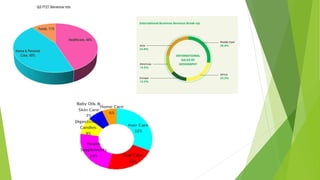
 Dabur derives around 60% of its revenue from the consumer care business, 11% from the
food business and remaining from the international business unit.
 Revenues of over Rs. 9,500 Crore & Market Capitalization of over Rs 100,000 Crore.
 Building on a legacy of quality and experience of over 137 years.
 portfolio of over 250 Herbal/Ayurvedic products.
 Known as the 'Custodian of Ayurveda’.
CURRENT STATUS….
 India FMCG Volume Growth at 34.4%
 Dabur India Ltd ended Q1 of 2021-22 with a robust 32% surge in Consolidated Revenue at Rs 2,612
Crore, up from Rs 1,980 Crore. Consolidated Net Profit for the first quarter reported a 28% growth
at Rs 437 Crore, up from Rs 342 Crore a year earlier.
 Dabur’s India FMCG Business grew by 35.4%, with an underlying Volume Growth of 34.4%
in the first quarter of 2021-22.
 Operating Margin reported a 32.5% growth during the quarter, which marked a 10 bps gain
despite high inflationary pressures. Our Pre-Tax Profit also grew by a robust 34% during the
quarter,” Dabur India Ltd Chief Executive Officer Mr. Mohit Malhotra said.
 Dabur continued to post strong growth and market share gains across all key verticals like
Health Care, Home Care, Personal Care and Foods in Q1 2021-22. E-Commerce reported an
over 100% growth and today contributes to 8.2% of the India FMG business.
 Category Growths:Dabur's Food & Beverages business end Q1, 2021-22 with an 80.4%
surge.
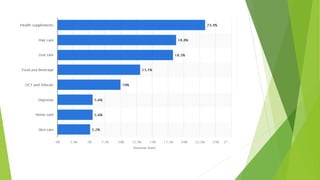
 Healthcare business reported a strong 30% growth in Q1 with the Ayurvedic OTC business
growing by over 52%, Ayurvedic Ethical business reporting a growth of nearly 51% and the
Health Supplements category ending the quarter with a 24.5% growth.
 The revival in discretionary spending continued during the quarter, which helped the
Home & Personal Care business grow by over 26%.
 The Hair Care category was up nearly 39% during the first quarter
 Home Care business grew by over 30% and the Oral Care business by over 21%.
 The Skin Care and Salon business (excluding Sanitizers) reported a 66% growth during
the quarter.
Account for more than 70% of its total Sales
POWER PRDUCTS
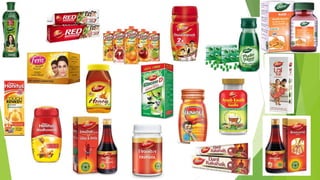
 Healthcare space :Dabur Chyawanprash, Dabur Honey, Dabur Honitus, Dabur
PudinHara and Dabur Lal Tail
 Personal Care category :Dabur Amla and Dabur Red Paste
 Food & Beverages space: Real
 Vatika is the ninth International Power Brand.
REFERENCES
 https://www.dabur.com/amp/in/en-us/product
 https://www.dabur.com/amp/in/en-us/media/dabur-india-fmcg-business-
surges-35-4-in-q1-2021-22
 https://www.dabur.com/amp/in/en-us/about/aboutus/history
 https://en.wikipedia.org/wiki/Dabur
 https://finpedia.co/bin/Dabur%20India%20Ltd/

Dabur

  • 1.
    LET’S TAKE ALOOK TO THEIR JOURNEY…….. Prepared by KALYANI RAJPUT SEM-8 B Pharm
  • 2.
    HISTORY  The founderof Dabur India Ltd, Dr. S. K. Burman.  In the mid-1880s, as an Ayurvedic practitioner in Kolkata, he formulated Ayurvedic medicines for diseases like cholera, constipation and malaria. He went on to set up Dabur India Ltd in 1884 to mass-produce his Ayurvedic formulations.  In 1896 Setting up a manufacturing plant. With growing popularity of Dabur products, Dr. Burman expands his operations by setting up a manufacturing plant for mass production of formulations.  Early 1900s Ayurvedic medicines Dabur enters the specialized area of nature- based Ayurvedic medicines , for which standardized drugs are not available in the market.
  • 3.
     1896-Setting upa manufacturing plant  Early 1900s-Dabur enters the specialized area of nature-based Ayurvedic medicines , for which standardized drugs are not available in the market.  1919-Establishment of research laboratories. The need to develop scientific processes and quality checks for mass production of traditional Ayurvedic medicines leads to establishment of research laboratories.  1920-Expands further .Dabur expands further with new manufacturing units at Narendrapur and Daburgram. The distribution of Dabur products spreads to Bihar and the North-East.  1936-Dabur India (Dr. S.K. Burman) Pvt. Ltd.Dabur becomes a full-fledged company - Dabur India (Dr. S. K. Burman) Pvt. Ltd.  1972-Shift to Delhi. Dabur's operations shift to Delhi. A new manufacturing plant is set up in temporary premises in Faridabad on the outskirts of Delhi.  1993-Cancer treatment.Dabur enters the specialized health care area of cancer treatment with its oncology formulation plant at Baddi in Himachal Pradesh.  1994-Public issue.Dabur India Ltd. raises its first public issue. Due to market confidence in the Company, shares issued at a high premium are oversubscribed 21 times.  1996-3 separate divisions, For better operation and management, 3 separate divisions are created according to their product mix - Health Care, Products Division, Family Product Division & Dabur Ayurvedic Specialties Limited.  1997-Foods Division / Project STARS.Dabur enters full-scale in the nascent processed foods market with creation of a Foods Division. Project STARS (Strive to Achieve Record Successes) is initiated to give a jump-start to the Company and accelerate its growth performance.  1998-Professionals to manage the Company. With changing demands of business and to inculcate a spirit of corporate governance, the Burman family inducts professional to manage the company. For the first time in the history of Dabur, a non family professional CEO sits at the helm of the company.
  • 4.
     2000-Dabur IndiaLtd.'s turnover crosses the Rs 1,000 Crore mark.  2003-Dabur demerges Pharma Business.  2005-Dabur acquires Balsara.As part of its inorganic growth strategy, Dabur India acquires Balsara's Hygiene and Home products businesses, a leading provider of Oral Care and Household Care products in the Indian Market, in a INR 143 Crore all cash deal.  2008-Acquires Fem Care Pharma.Dabur India acquires Fem Care Pharma, a leading player in the women skin care market. Besides an entry into the high growth skin care market with an established brand named Fem, this transaction also offers Dabur a strong platform to enter newer product categories and markets.  2011-Dabur India acquiers 30-Plus from Ajanta Pharma.  2011-Dabur enters professional skin care market.Dabur enters professional skin care market with the launch of Oxylife Professional Facial Kit, created exclusively for professional use. The range is further expanded with the launch of facials and a body bleach under the brand Fem.  2015-Brand Real, Vatika and Amla cross the Rs. 1,000-Crore turnover mark.  2016-Dabur Gulabari and Dabur Lal Dant Manjan clock a turnover of Rs. 100 Crore each.
  • 5.
    ABOUT….  Dabur Ltdis an Indian multinational consumer goods company, founded by S. K. Burman and headquartered in Ghaziabad, Uttar Pradesh. It manufactures Ayurvedic medicine and natural consumer products.  one of the FOURTH largest fast-moving consumer goods (FMCG) companies in India.  Dabur derives around 60% of its revenue from the consumer care business, 11% from the food business and remaining from the international business unit.  Revenues of over Rs. 9,500 Crore & Market Capitalization of over Rs 100,000 Crore.  Building on a legacy of quality and experience of over 137 years.  portfolio of over 250 Herbal/Ayurvedic products.  Known as the 'Custodian of Ayurveda’.
  • 6.
    CURRENT STATUS….  IndiaFMCG Volume Growth at 34.4%  Dabur India Ltd ended Q1 of 2021-22 with a robust 32% surge in Consolidated Revenue at Rs 2,612 Crore, up from Rs 1,980 Crore. Consolidated Net Profit for the first quarter reported a 28% growth at Rs 437 Crore, up from Rs 342 Crore a year earlier.  Dabur’s India FMCG Business grew by 35.4%, with an underlying Volume Growth of 34.4% in the first quarter of 2021-22.  Operating Margin reported a 32.5% growth during the quarter, which marked a 10 bps gain despite high inflationary pressures. Our Pre-Tax Profit also grew by a robust 34% during the quarter,” Dabur India Ltd Chief Executive Officer Mr. Mohit Malhotra said.  Dabur continued to post strong growth and market share gains across all key verticals like Health Care, Home Care, Personal Care and Foods in Q1 2021-22. E-Commerce reported an over 100% growth and today contributes to 8.2% of the India FMG business.  Category Growths:Dabur's Food & Beverages business end Q1, 2021-22 with an 80.4% surge.  Healthcare business reported a strong 30% growth in Q1 with the Ayurvedic OTC business growing by over 52%, Ayurvedic Ethical business reporting a growth of nearly 51% and the Health Supplements category ending the quarter with a 24.5% growth.
  • 7.
     The revivalin discretionary spending continued during the quarter, which helped the Home & Personal Care business grow by over 26%.  The Hair Care category was up nearly 39% during the first quarter  Home Care business grew by over 30% and the Oral Care business by over 21%.  The Skin Care and Salon business (excluding Sanitizers) reported a 66% growth during the quarter.
  • 11.
    Account for morethan 70% of its total Sales
  • 12.
    POWER PRDUCTS  Healthcarespace :Dabur Chyawanprash, Dabur Honey, Dabur Honitus, Dabur PudinHara and Dabur Lal Tail  Personal Care category :Dabur Amla and Dabur Red Paste  Food & Beverages space: Real  Vatika is the ninth International Power Brand.
  • 13.
    REFERENCES  https://www.dabur.com/amp/in/en-us/product  https://www.dabur.com/amp/in/en-us/media/dabur-india-fmcg-business- surges-35-4-in-q1-2021-22 https://www.dabur.com/amp/in/en-us/about/aboutus/history  https://en.wikipedia.org/wiki/Dabur  https://finpedia.co/bin/Dabur%20India%20Ltd/