Randomization Tests – unequal-N,
      unequal-σ problem


            AK Dhamija
Agenda
Assumptions of t, F tests
Randomization tests
Problems of Randomization Test
  Too liberal
  Too conservative
  Computationally Intensive
Solving the problems
  Resampling
  Gill’s algorithm
Assumptions of t, F tests

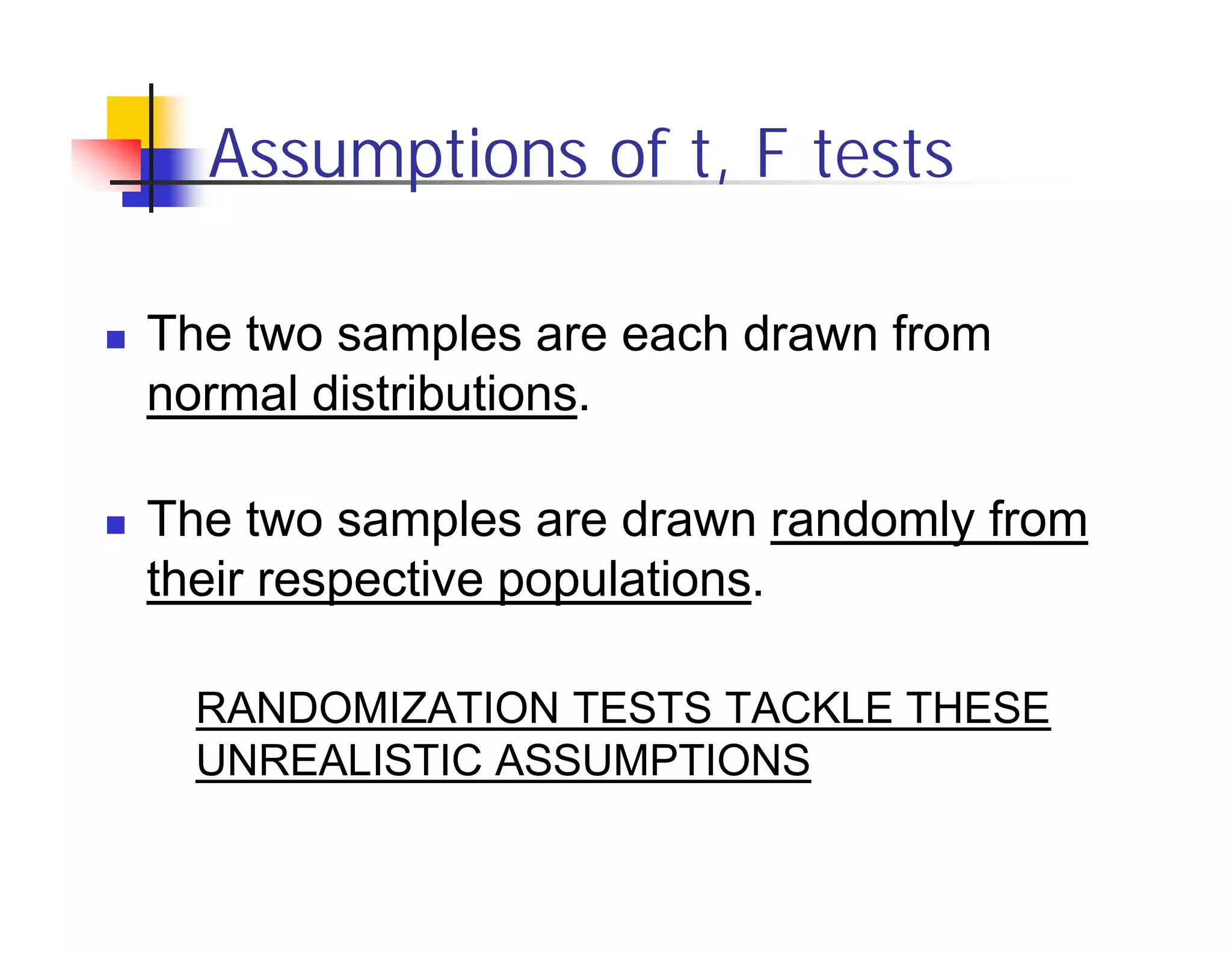
The two samples are each drawn from
normal distributions.

The two samples are drawn randomly from
their respective populations.

  RANDOMIZATION TESTS TACKLE THESE
  UNREALISTIC ASSUMPTIONS
Randomization tests
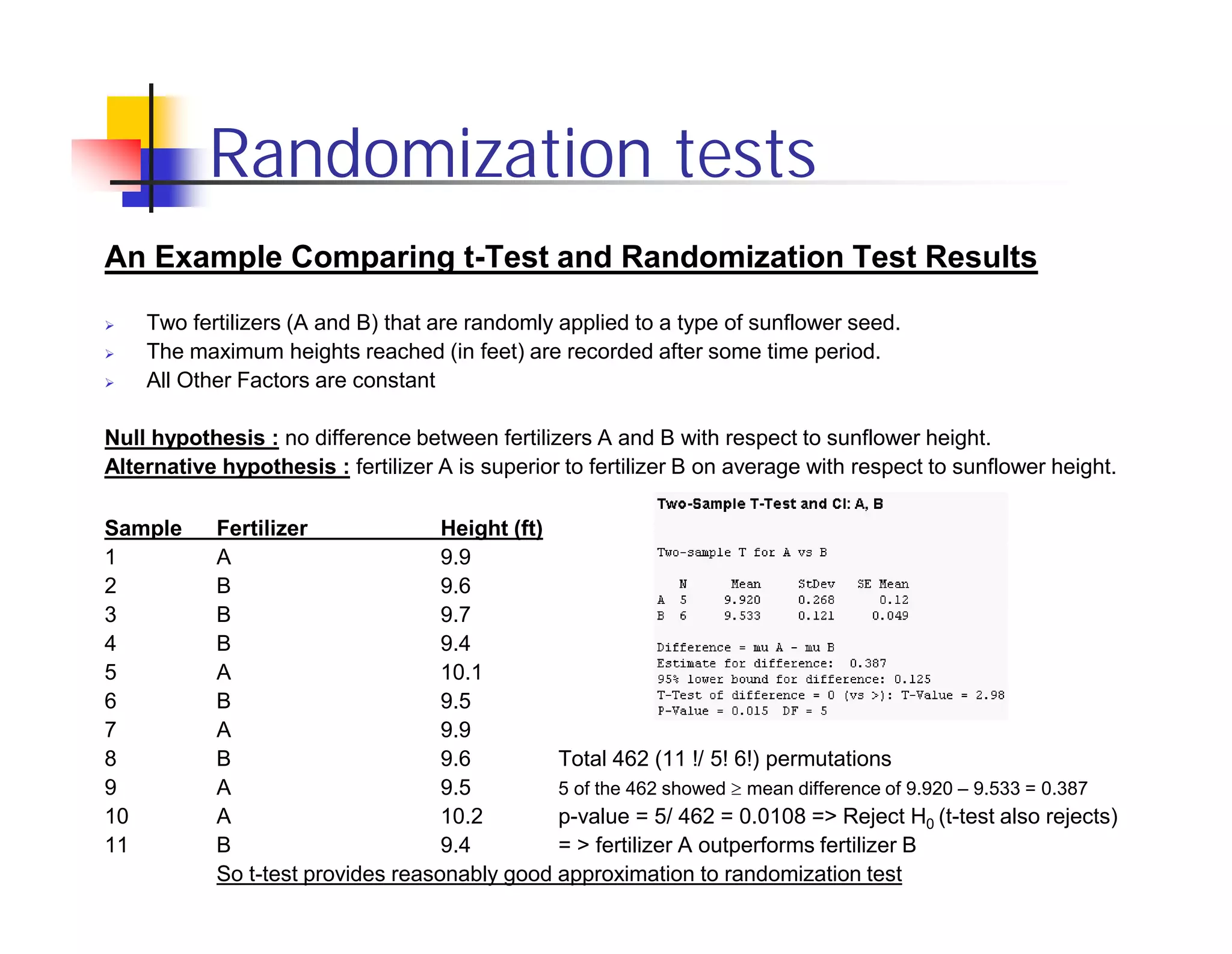
An Example Comparing t-Test and Randomization Test Results
    Two fertilizers (A and B) that are randomly applied to a type of sunflower seed.
    The maximum heights reached (in feet) are recorded after some time period.
    All Other Factors are constant

Null hypothesis : no difference between fertilizers A and B with respect to sunflower height.
Alternative hypothesis : fertilizer A is superior to fertilizer B on average with respect to sunflower height.

Sample      Fertilizer              Height (ft)
1           A                       9.9
2           B                       9.6
3           B                       9.7
4           B                       9.4
5           A                       10.1
6           B                       9.5
7           A                       9.9
8           B                       9.6         Total 462 (11 !/ 5! 6!) permutations
9           A                       9.5         5 of the 462 showed mean difference of 9.920 – 9.533 = 0.387
10          A                       10.2        p-value = 5/ 462 = 0.0108 => Reject H0 (t-test also rejects)
11          B                       9.4         = > fertilizer A outperforms fertilizer B
            So t-test provides reasonably good approximation to randomization test
Randomization tests
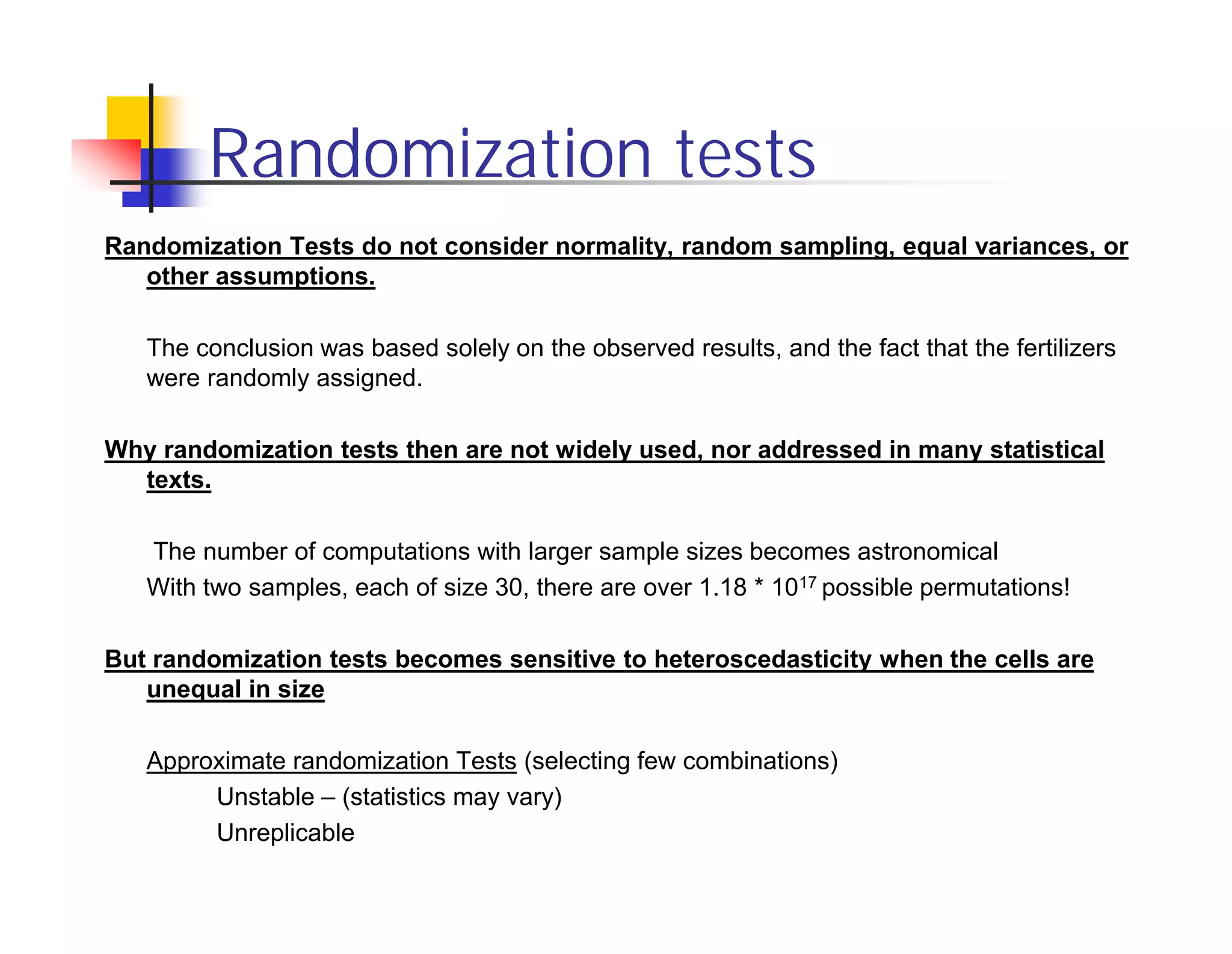
Randomization Tests do not consider normality, random sampling, equal variances, or
   other assumptions.

   The conclusion was based solely on the observed results, and the fact that the fertilizers
   were randomly assigned.

Why randomization tests then are not widely used, nor addressed in many statistical
  texts.

   The number of computations with larger sample sizes becomes astronomical
   With two samples, each of size 30, there are over 1.18 * 1017 possible permutations!

But randomization tests becomes sensitive to heteroscedasticity when the cells are
   unequal in size

   Approximate randomization Tests (selecting few combinations)
        Unstable – (statistics may vary)
        Unreplicable
Randomization tests
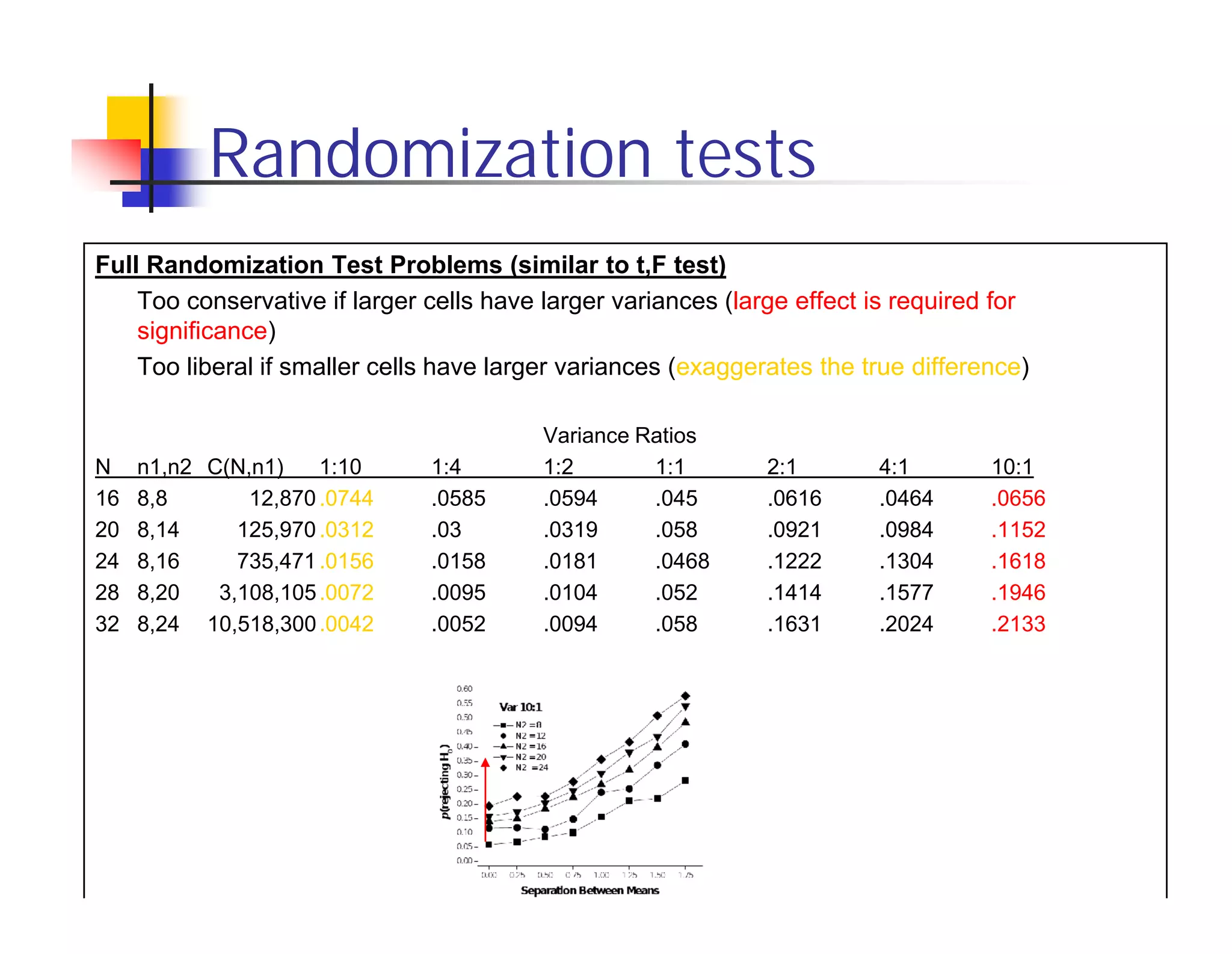
Full Randomization Test Problems (similar to t,F test)
    Too conservative if larger cells have larger variances (large effect is required for
    significance)
    Too liberal if smaller cells have larger variances (exaggerates the true difference)

                                          Variance Ratios
N    n1,n2 C(N,n1)    1:10     1:4        1:2       1:1        2:1       4:1        10:1
16   8,8       12,870 .0744    .0585      .0594     .045       .0616     .0464      .0656
20   8,14     125,970 .0312    .03        .0319     .058       .0921     .0984      .1152
24   8,16     735,471 .0156    .0158      .0181     .0468      .1222     .1304      .1618
28   8,20   3,108,105 .0072    .0095      .0104     .052       .1414     .1577      .1946
32   8,24 10,518,300 .0042     .0052      .0094     .058       .1631     .2024      .2133
Randomization tests
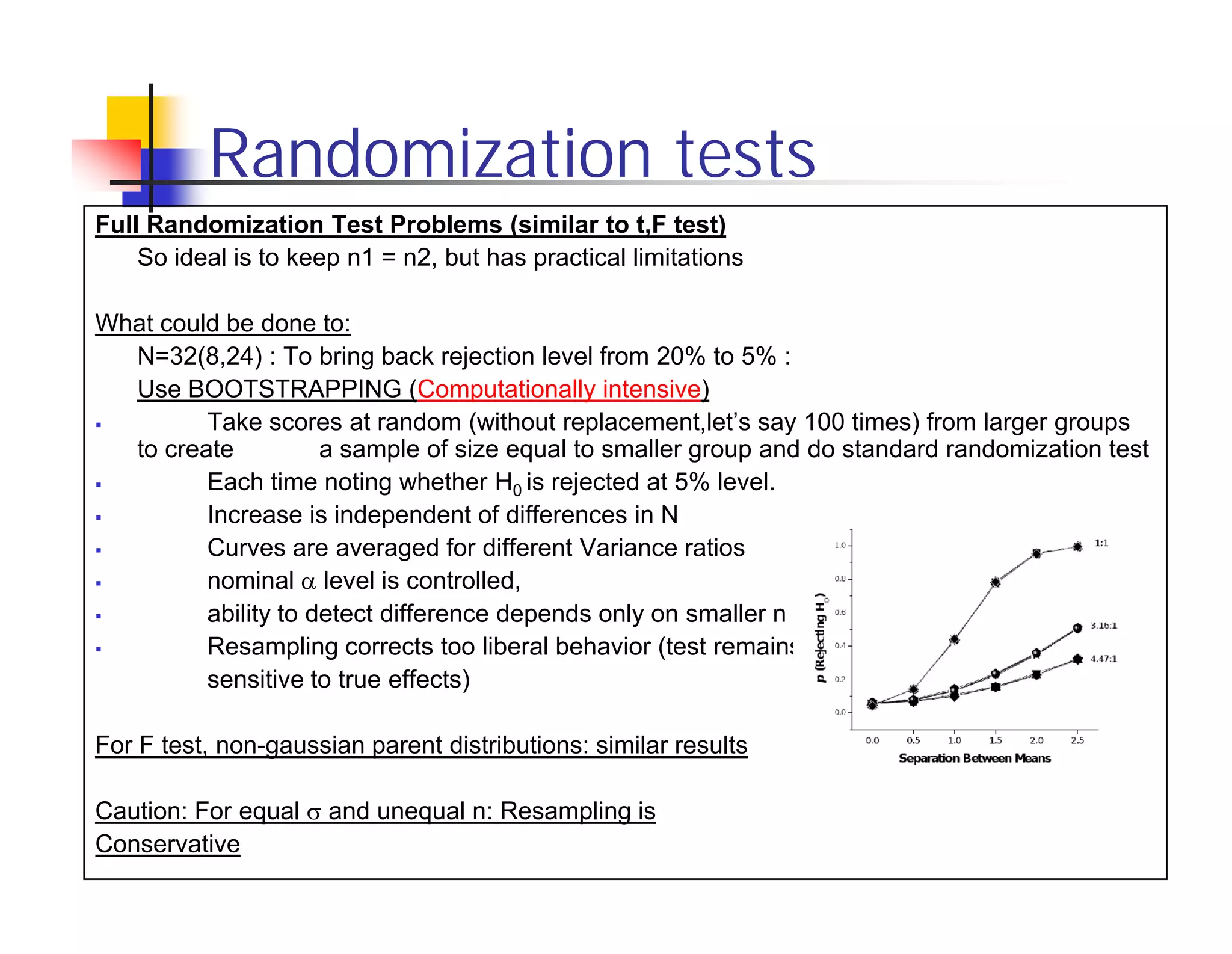
Full Randomization Test Problems (similar to t,F test)
    So ideal is to keep n1 = n2, but has practical limitations

What could be done to:
  N=32(8,24) : To bring back rejection level from 20% to 5% :
  Use BOOTSTRAPPING (Computationally intensive)
         Take scores at random (without replacement,let’s say 100 times) from larger groups
  to create          a sample of size equal to smaller group and do standard randomization test
         Each time noting whether H0 is rejected at 5% level.
         Increase is independent of differences in N
         Curves are averaged for different Variance ratios
         nominal level is controlled,
         ability to detect difference depends only on smaller n
         Resampling corrects too liberal behavior (test remains
         sensitive to true effects)

For F test, non-gaussian parent distributions: similar results

Caution: For equal    and unequal n: Resampling is
Conservative
Randomization tests
Full Randomization Test Problems : Bringing Computational cost under control
     Computations : (n1=10,n2=16, equal ) = C(26,10) = 26!/16!10! = 5,311,735 combinations
                    (larger in smaller cell) => resampling => 100 randomization tests each involves
                       C(20,10) = 184,756 combinations => Total 18,475,600 combinations

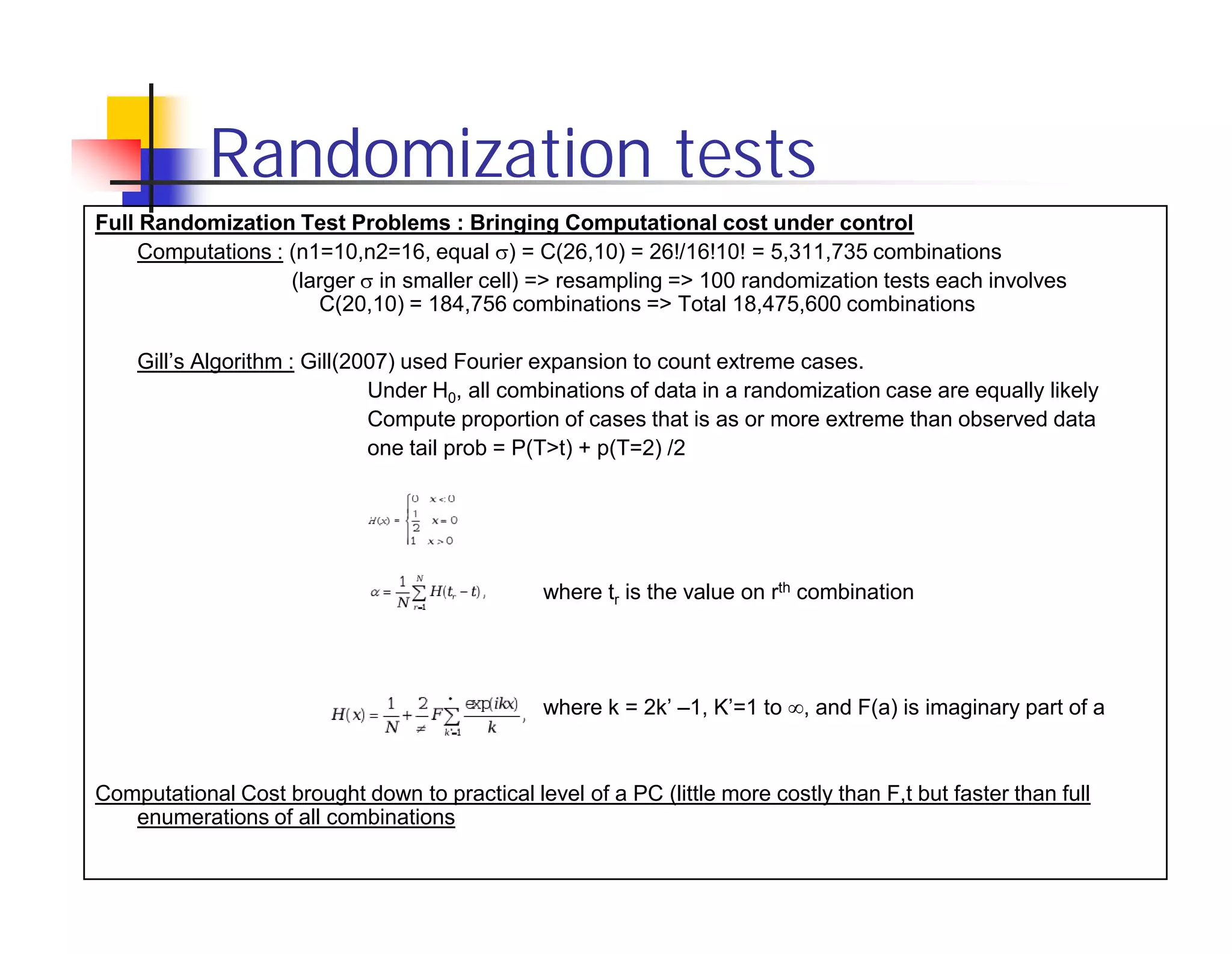
    Gill’s Algorithm : Gill(2007) used Fourier expansion to count extreme cases.
                              Under H0, all combinations of data in a randomization case are equally likely
                              Compute proportion of cases that is as or more extreme than observed data
                              one tail prob = P(T>t) + p(T=2) /2


                                                where tr is the value on rth combination


                                                where k = 2k’ –1, K’=1 to , and F(a) is imaginary part of a


Computational Cost brought down to practical level of a PC (little more costly than F,t but faster than full
   enumerations of all combinations
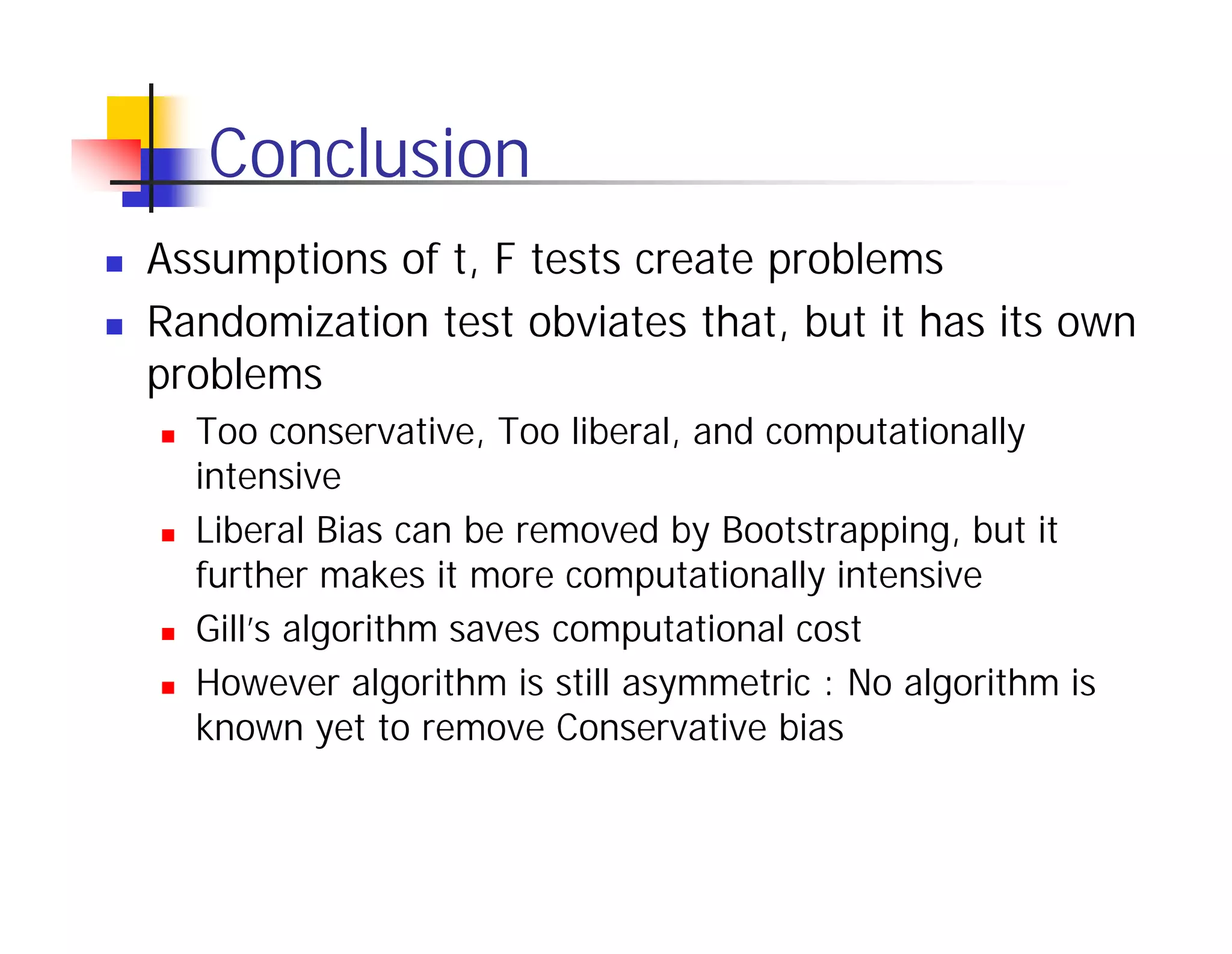
Conclusion
Assumptions of t, F tests create problems
Randomization test obviates that, but it has its own
problems
  Too conservative, Too liberal, and computationally
  intensive
  Liberal Bias can be removed by Bootstrapping, but it
  further makes it more computationally intensive
  Gill’s algorithm saves computational cost
  However algorithm is still asymmetric : No algorithm is
  known yet to remove Conservative bias
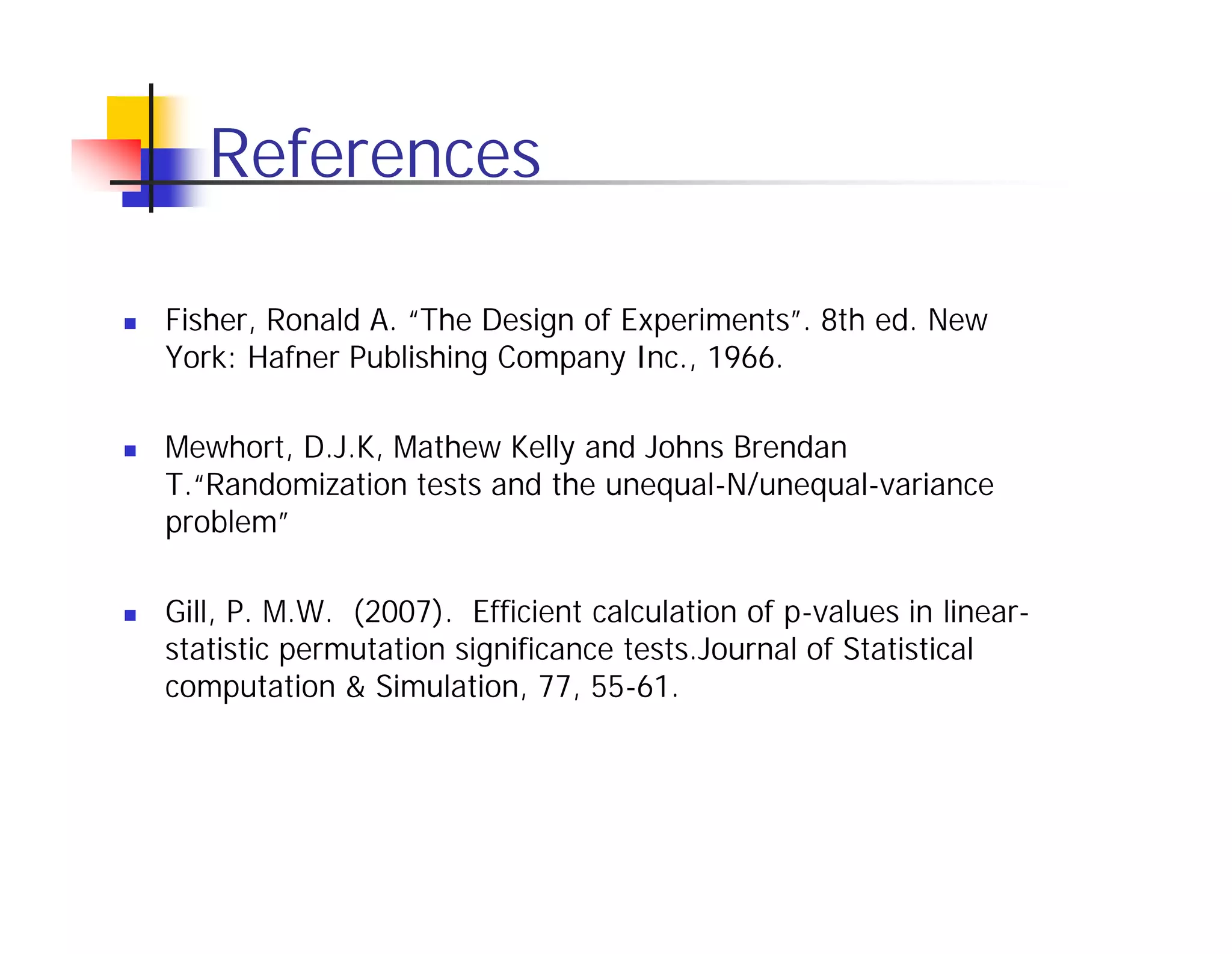
References

Fisher, Ronald A. “The Design of Experiments”. 8th ed. New
York: Hafner Publishing Company Inc., 1966.

Mewhort, D.J.K, Mathew Kelly and Johns Brendan
T.“Randomization tests and the unequal-N/unequal-variance
problem”

Gill, P. M.W. (2007). Efficient calculation of p-values in linear-
statistic permutation significance tests.Journal of Statistical
computation & Simulation, 77, 55-61.

Randomization Tests

  • 1.
    Randomization Tests –unequal-N, unequal-σ problem AK Dhamija
  • 2.
    Agenda Assumptions of t,F tests Randomization tests Problems of Randomization Test Too liberal Too conservative Computationally Intensive Solving the problems Resampling Gill’s algorithm
  • 3.
    Assumptions of t,F tests The two samples are each drawn from normal distributions. The two samples are drawn randomly from their respective populations. RANDOMIZATION TESTS TACKLE THESE UNREALISTIC ASSUMPTIONS
  • 4.
    Randomization tests An ExampleComparing t-Test and Randomization Test Results Two fertilizers (A and B) that are randomly applied to a type of sunflower seed. The maximum heights reached (in feet) are recorded after some time period. All Other Factors are constant Null hypothesis : no difference between fertilizers A and B with respect to sunflower height. Alternative hypothesis : fertilizer A is superior to fertilizer B on average with respect to sunflower height. Sample Fertilizer Height (ft) 1 A 9.9 2 B 9.6 3 B 9.7 4 B 9.4 5 A 10.1 6 B 9.5 7 A 9.9 8 B 9.6 Total 462 (11 !/ 5! 6!) permutations 9 A 9.5 5 of the 462 showed mean difference of 9.920 – 9.533 = 0.387 10 A 10.2 p-value = 5/ 462 = 0.0108 => Reject H0 (t-test also rejects) 11 B 9.4 = > fertilizer A outperforms fertilizer B So t-test provides reasonably good approximation to randomization test
  • 5.
    Randomization tests Randomization Testsdo not consider normality, random sampling, equal variances, or other assumptions. The conclusion was based solely on the observed results, and the fact that the fertilizers were randomly assigned. Why randomization tests then are not widely used, nor addressed in many statistical texts. The number of computations with larger sample sizes becomes astronomical With two samples, each of size 30, there are over 1.18 * 1017 possible permutations! But randomization tests becomes sensitive to heteroscedasticity when the cells are unequal in size Approximate randomization Tests (selecting few combinations) Unstable – (statistics may vary) Unreplicable
  • 6.
    Randomization tests Full RandomizationTest Problems (similar to t,F test) Too conservative if larger cells have larger variances (large effect is required for significance) Too liberal if smaller cells have larger variances (exaggerates the true difference) Variance Ratios N n1,n2 C(N,n1) 1:10 1:4 1:2 1:1 2:1 4:1 10:1 16 8,8 12,870 .0744 .0585 .0594 .045 .0616 .0464 .0656 20 8,14 125,970 .0312 .03 .0319 .058 .0921 .0984 .1152 24 8,16 735,471 .0156 .0158 .0181 .0468 .1222 .1304 .1618 28 8,20 3,108,105 .0072 .0095 .0104 .052 .1414 .1577 .1946 32 8,24 10,518,300 .0042 .0052 .0094 .058 .1631 .2024 .2133
  • 7.
    Randomization tests Full RandomizationTest Problems (similar to t,F test) So ideal is to keep n1 = n2, but has practical limitations What could be done to: N=32(8,24) : To bring back rejection level from 20% to 5% : Use BOOTSTRAPPING (Computationally intensive) Take scores at random (without replacement,let’s say 100 times) from larger groups to create a sample of size equal to smaller group and do standard randomization test Each time noting whether H0 is rejected at 5% level. Increase is independent of differences in N Curves are averaged for different Variance ratios nominal level is controlled, ability to detect difference depends only on smaller n Resampling corrects too liberal behavior (test remains sensitive to true effects) For F test, non-gaussian parent distributions: similar results Caution: For equal and unequal n: Resampling is Conservative
  • 8.
    Randomization tests Full RandomizationTest Problems : Bringing Computational cost under control Computations : (n1=10,n2=16, equal ) = C(26,10) = 26!/16!10! = 5,311,735 combinations (larger in smaller cell) => resampling => 100 randomization tests each involves C(20,10) = 184,756 combinations => Total 18,475,600 combinations Gill’s Algorithm : Gill(2007) used Fourier expansion to count extreme cases. Under H0, all combinations of data in a randomization case are equally likely Compute proportion of cases that is as or more extreme than observed data one tail prob = P(T>t) + p(T=2) /2 where tr is the value on rth combination where k = 2k’ –1, K’=1 to , and F(a) is imaginary part of a Computational Cost brought down to practical level of a PC (little more costly than F,t but faster than full enumerations of all combinations
  • 9.
    Conclusion Assumptions of t,F tests create problems Randomization test obviates that, but it has its own problems Too conservative, Too liberal, and computationally intensive Liberal Bias can be removed by Bootstrapping, but it further makes it more computationally intensive Gill’s algorithm saves computational cost However algorithm is still asymmetric : No algorithm is known yet to remove Conservative bias
  • 10.
    References Fisher, Ronald A.“The Design of Experiments”. 8th ed. New York: Hafner Publishing Company Inc., 1966. Mewhort, D.J.K, Mathew Kelly and Johns Brendan T.“Randomization tests and the unequal-N/unequal-variance problem” Gill, P. M.W. (2007). Efficient calculation of p-values in linear- statistic permutation significance tests.Journal of Statistical computation & Simulation, 77, 55-61.