Fast
Moving Consumer Goods
( FMCG )
Marketing
VIKAS KUMAR
‱ One of the fastest growing sector in early 1980’s till
1990’s
‱ The dream of every creative man, any investor,
advertising agency, or B-school graduate to work in or
for FMCG company.
‱ After 1990’s,
o FMCG started losing their sheen due to introduction of other
product types
o Total lack of imagination on the part of FMCG companies.
‱ By 2000, volumes & margins either shrank or stagnated
‱ During 2006, Consumers willingness to upgrade to
better, value added products helped FMCG.
What is FMCG ?
‱ Also known as Consumer Packaged Goods (CPG)
‱ Products with quick turnover &relatively low cost
‱ Less thinking by consumers
‱ Absolute profit made on FMCG products is relatively
small but they sell in large quantity & earn large profits.
‱ Durable Products; E.g. Soaps, Cosmetics, teeth cleaning
products, shaving products etc.
‱ Non-Durable Products; E.g. Glassware's, bulbs,
batteries, plastic goods etc.
‱ FMCG companies are Nestle, Unilever, Proctor &
Gamble.
‱ Their products are in varieties of soft drinks, chocolate
bars etc.
‱ Few FMCG brands are Coca-Cola, Kleenex, Pepsi etc.
‱ FMCG industry is
o Innovative
o Full of Rich Experience
o Worldwide reach
o Frequently travelling opportunities
FMCG Category & Products
‱ Household Care
e.g. laundry soaps, mosquito repellents, dish cleaners etc.
‱ Food & beverages
e.g. soft drinks, bakery products, tea, coffee, vegetables etc.
‱ Personal Care
e.g. oral care, hair care, skin care, cosmetics, deodorants, perfumes
etc.
Why INDIA?
1. Large Domestic Market:-
2. Large Consumer Goods Spender:-
3. Low Penetration & Low per Capita consumption :-
4. Changing Lifestyles:-
5. Retailing – New growth area
6. Demand & Supply Gap
India’s competitiveness
&
Comparison with World Market
1. Materials Availability:-
2. Leveraging The Cost Advantage:-
e.g. P & G outsourced Vicks Vaporub to
Australia, Japan etc. from Hyderabad
Domestic Players
1. Britannia India Ltd. (BIL)
2. Dabur India Ltd.
3. Indian Tobacco Corporation Ltd. (ITCL)
4. Marico
5. Nirma Ltd.
1. Cadbury India Ltd. (CIL)
2. Cargill
3. Coca-Cola
4. Colgate Palmolive India
5. H.J. Heinz Co.
6. Hindustan Lever Ltd. (HLL)
7. Nestle India Ltd.
8. Procter & Gamble
Foreign Players
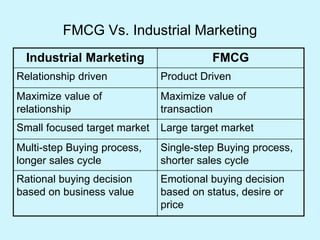
FMCG Vs. Industrial Marketing
Industrial Marketing FMCG
Relationship driven Product Driven
Maximize value of
relationship
Maximize value of
transaction
Small focused target market Large target market
Multi-step Buying process,
longer sales cycle
Single-step Buying process,
shorter sales cycle
Rational buying decision
based on business value
Emotional buying decision
based on status, desire or
price
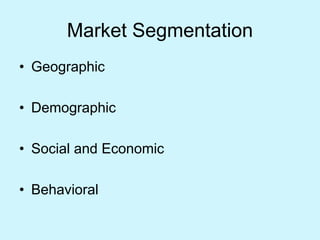
Market Segmentation
‱ Geographic
‱ Demographic
‱ Social and Economic
‱ Behavioral
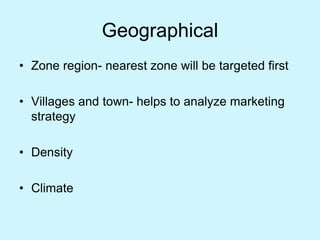
Geographical
‱ Zone region- nearest zone will be targeted first
‱ Villages and town- helps to analyze marketing
strategy
‱ Density
‱ Climate
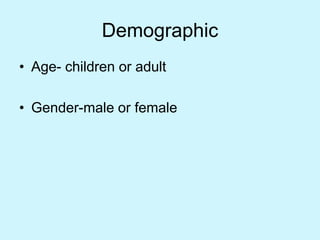
Demographic
‱ Age- children or adult
‱ Gender-male or female
Socio-Economic
‱ Income group- high, medium or low
‱ Social and Economic- Education (illiterate,
literate , highly literate), social class
Behavioral
‱ Occasions ( Diwali, Deshehra, Eid)
‱ Brand loyalty (rural area people are more
brand loyal)
Marketing Strategy
‱ Direct on-screen marketing (e.g. Harpic)
‱ Power brand strategy
(Include those brand that have maximum pulling
power and growth e.g. lifebuoy soap)
‱ Power brand extension (e.g. lifebuoy talcum
powder)
‱ Exit from non power brand
‱ Using “India” as a brand
‱ Small size packet strategy
‱ Pricing strategy
1. Mark up
2. Go- deterring (e.g. bingo chips)
3. Competitor based
4. Product bundling
‱ Same value, size increase
‱ Same value, size decrease (e.g. society tea)
Target market
‱ Differs from product to product
examples:
1. Mc Donald's – Youth
2. Vim bar - Housewives
3. Pepsodent – Kids
4. Kellogg's – Previously kids now adults too
5. Sugar free – Age group of 35 and more
Advertisement
‱ Huge investment on advertisement
‱ Frequent broadcast
‱ Specially during peak hours
‱ During live matches
‱ During popular TV shows
‱ Target TV channels ( M TV, V TV)
‱ Through banners, posters, trial packs, events,
hoardings, radio etc.
‱ Based on Market Research
Why advertisement?
‱ As a reminder
‱ To inform about our product
‱ To show the success of brand
‱ To attract the customers
‱ To hamper the unsecured mind of consumer
(e.g. saffola,dettol)
‱ To arise the need purposely
‱ To attach consumer emotionally with product
‱ To show facts and figures of products
Message delivery
‱ Surf excel for washing machine
‱ Vim bar gel
‱ Gillette razor
‱ Bingo chips
‱ Happy dent chewing gum
‱ Bourn vita, Horlicks
‱ Pepsodent, Colgate
‱ Pepsi, sprite, coca-cola
Why product line extension is
done?
‱ According to the need of consumer
‱ To avoid the loss of product diversification
‱ To balance the profit through product line
‱ To avoid penetration by competitor ( perk
glucose)
Packaging
‱ Attractive packs
‱ Vibrant colors
‱ Pack will show the important feature of product
‱ Protective packaging( bru coffee)
‱ Size wise packing (Navratna oil and Colgate)
‱ According to segmentation of Market
‱ Packaging should be enhanced time by time
‱ Affordable packs ( coca cola 200 ml).
Latest scenario in FMCG
market
‱ Increasing per year with the growth rate of 9
percent
‱ Price of raw materials are decreasing
‱ Cost of machinery required for consumer goods
are less then durable goods.
- mint newspaper 23rd Jan 2010

Fmcg ppt

  • 1.
    Fast Moving Consumer Goods (FMCG ) Marketing VIKAS KUMAR
  • 2.
    ‱ One ofthe fastest growing sector in early 1980’s till 1990’s ‱ The dream of every creative man, any investor, advertising agency, or B-school graduate to work in or for FMCG company. ‱ After 1990’s, o FMCG started losing their sheen due to introduction of other product types o Total lack of imagination on the part of FMCG companies. ‱ By 2000, volumes & margins either shrank or stagnated ‱ During 2006, Consumers willingness to upgrade to better, value added products helped FMCG.
  • 3.
    What is FMCG? ‱ Also known as Consumer Packaged Goods (CPG) ‱ Products with quick turnover &relatively low cost ‱ Less thinking by consumers ‱ Absolute profit made on FMCG products is relatively small but they sell in large quantity & earn large profits. ‱ Durable Products; E.g. Soaps, Cosmetics, teeth cleaning products, shaving products etc. ‱ Non-Durable Products; E.g. Glassware's, bulbs, batteries, plastic goods etc.
  • 4.
    ‱ FMCG companiesare Nestle, Unilever, Proctor & Gamble. ‱ Their products are in varieties of soft drinks, chocolate bars etc. ‱ Few FMCG brands are Coca-Cola, Kleenex, Pepsi etc. ‱ FMCG industry is o Innovative o Full of Rich Experience o Worldwide reach o Frequently travelling opportunities
  • 5.
    FMCG Category &Products ‱ Household Care e.g. laundry soaps, mosquito repellents, dish cleaners etc. ‱ Food & beverages e.g. soft drinks, bakery products, tea, coffee, vegetables etc. ‱ Personal Care e.g. oral care, hair care, skin care, cosmetics, deodorants, perfumes etc.
  • 6.
    Why INDIA? 1. LargeDomestic Market:- 2. Large Consumer Goods Spender:- 3. Low Penetration & Low per Capita consumption :- 4. Changing Lifestyles:- 5. Retailing – New growth area 6. Demand & Supply Gap
  • 7.
    India’s competitiveness & Comparison withWorld Market 1. Materials Availability:- 2. Leveraging The Cost Advantage:- e.g. P & G outsourced Vicks Vaporub to Australia, Japan etc. from Hyderabad
  • 8.
    Domestic Players 1. BritanniaIndia Ltd. (BIL) 2. Dabur India Ltd. 3. Indian Tobacco Corporation Ltd. (ITCL) 4. Marico 5. Nirma Ltd.
  • 9.
    1. Cadbury IndiaLtd. (CIL) 2. Cargill 3. Coca-Cola 4. Colgate Palmolive India 5. H.J. Heinz Co. 6. Hindustan Lever Ltd. (HLL) 7. Nestle India Ltd. 8. Procter & Gamble Foreign Players
  • 10.
    FMCG Vs. IndustrialMarketing Industrial Marketing FMCG Relationship driven Product Driven Maximize value of relationship Maximize value of transaction Small focused target market Large target market Multi-step Buying process, longer sales cycle Single-step Buying process, shorter sales cycle Rational buying decision based on business value Emotional buying decision based on status, desire or price
  • 11.
    Market Segmentation ‱ Geographic ‱Demographic ‱ Social and Economic ‱ Behavioral
  • 12.
    Geographical ‱ Zone region-nearest zone will be targeted first ‱ Villages and town- helps to analyze marketing strategy ‱ Density ‱ Climate
  • 13.
    Demographic ‱ Age- childrenor adult ‱ Gender-male or female
  • 14.
    Socio-Economic ‱ Income group-high, medium or low ‱ Social and Economic- Education (illiterate, literate , highly literate), social class
  • 15.
    Behavioral ‱ Occasions (Diwali, Deshehra, Eid) ‱ Brand loyalty (rural area people are more brand loyal)
  • 16.
    Marketing Strategy ‱ Directon-screen marketing (e.g. Harpic) ‱ Power brand strategy (Include those brand that have maximum pulling power and growth e.g. lifebuoy soap) ‱ Power brand extension (e.g. lifebuoy talcum powder) ‱ Exit from non power brand ‱ Using “India” as a brand
  • 17.
    ‱ Small sizepacket strategy ‱ Pricing strategy 1. Mark up 2. Go- deterring (e.g. bingo chips) 3. Competitor based 4. Product bundling ‱ Same value, size increase ‱ Same value, size decrease (e.g. society tea)
  • 18.
    Target market ‱ Differsfrom product to product examples: 1. Mc Donald's – Youth 2. Vim bar - Housewives 3. Pepsodent – Kids 4. Kellogg's – Previously kids now adults too 5. Sugar free – Age group of 35 and more
  • 19.
    Advertisement ‱ Huge investmenton advertisement ‱ Frequent broadcast ‱ Specially during peak hours ‱ During live matches ‱ During popular TV shows ‱ Target TV channels ( M TV, V TV) ‱ Through banners, posters, trial packs, events, hoardings, radio etc. ‱ Based on Market Research
  • 20.
    Why advertisement? ‱ Asa reminder ‱ To inform about our product ‱ To show the success of brand ‱ To attract the customers ‱ To hamper the unsecured mind of consumer (e.g. saffola,dettol) ‱ To arise the need purposely ‱ To attach consumer emotionally with product ‱ To show facts and figures of products
  • 21.
    Message delivery ‱ Surfexcel for washing machine ‱ Vim bar gel ‱ Gillette razor ‱ Bingo chips ‱ Happy dent chewing gum ‱ Bourn vita, Horlicks ‱ Pepsodent, Colgate ‱ Pepsi, sprite, coca-cola
  • 22.
    Why product lineextension is done? ‱ According to the need of consumer ‱ To avoid the loss of product diversification ‱ To balance the profit through product line ‱ To avoid penetration by competitor ( perk glucose)
  • 23.
    Packaging ‱ Attractive packs ‱Vibrant colors ‱ Pack will show the important feature of product ‱ Protective packaging( bru coffee) ‱ Size wise packing (Navratna oil and Colgate) ‱ According to segmentation of Market ‱ Packaging should be enhanced time by time ‱ Affordable packs ( coca cola 200 ml).
  • 24.
    Latest scenario inFMCG market ‱ Increasing per year with the growth rate of 9 percent ‱ Price of raw materials are decreasing ‱ Cost of machinery required for consumer goods are less then durable goods. - mint newspaper 23rd Jan 2010