DECLARATION
I Tanya Tewari student of BBA (2020-23) and Dr. Virendra Swarup
Institute of Computer Studies, Kanpur of hereby declare that the project
work entitled a study on the ‘Market Analysis of Dabur Products is
compiled and submitted under the guidance of Mr. Ajay Nath Dubey.
This is my original work whatever information furnished in this project
report is true to the best of my knowledge.
Name Tanya Tewari
BBA : 2nd
year
Roll no : 0503798
PREFACE
A professional course (BBA- Bachelor of Business Administration) is
incomplete unless the theoretical knowledge acquired in the class room is
backed up by the practical exposure. Practical exposure was gained
report, which has been integral part of the syllabus.
I was assigned a project ‘Market Analysis of Dabur Products’. I have
tried my level best to be as systematic as possible and to avoid any sort of
biasness.
ACKNOWLEDGEMENT
This project is our professional experience that enriched our knowledge
to a great extent. During the course of our project, we had the good of
fortune of being guided by Mr. Ajay Nath Dubey. Who with all his
magnanimity supervised the project report through all the stages.
I have benefited a great deal from her intensive analysis critical
suggestions. Our special thanks to all our faculties for their unremitting
help in numerous ways, which deserve adequate experience on his page.
In the end we would like to say that it was a great experience working on
this project.
Introduction
Topic : Market Analysis of Dabur products
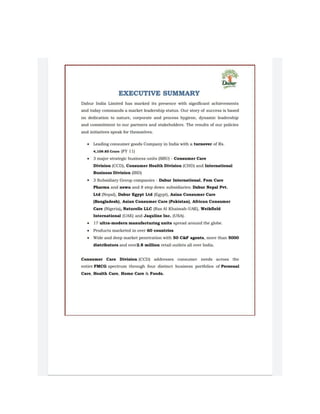
Dabur India Ltd. is one of India’s leading FMCG Companies :-
Revenues of over Rs8,500 Crore & Market Capitalisation of over Rs 72,500 Crore. Building on
a legacyof quality and experience of over 135 years, Dabur is today India’s most trusted name
and the world’s largest Ayurvedic and Natural Health Care Company. Dabur India is also a
world leader in ayurveda with a portfolio of over 250Herbal/Ayurvedic products. Dabur's
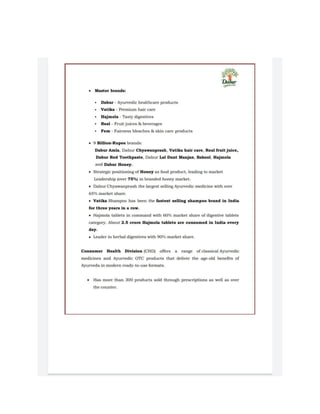
FMCG portfolio today includes five flagship brands with distinct brand identities -- Dabur as the
master brand for natural healthcare products, Vatika for premium personal care, Hajmola for
digestives, Réal for fruit juices and beverages and Fem for fairness bleaches and skin care
products.Dabur today operates in key consumer product categories like Hair Care, Oral
Care,Health Care, Skin Care, Home Care and Foods. The Ayurvedic Company has a wide
distribution network, covering 6.7 million retail outlets with a high penetration in both urban
and rural markets.Dabur's products also have huge presence in the overseas markets and are
today available in over 100 countries across the globe. Its brands are highly popularin the
Middle East, SAARC countries, Africa, US, Europe and Russia. Dabur'soverseas revenue today
accounts for over 27% of the total turnover. From the small dispensary in Calcutta in 1884, the
organisation has today grown into a corporation having significant presence in health and
personal care markets in India and abroad with more than 100 years of understanding of
consumer needs and ability it provides safe solutions from a deep understanding of Ayurveda,
Dabur has sets its vision to strive for providing good health and well being to every
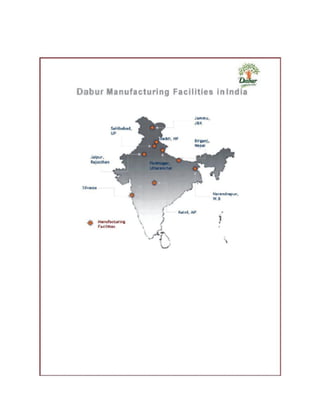
householdthrough its ten productions bases spread across India manufacturing arange of herbal,
health and personal care products, foods Ayurvedic medicines and pharmaceuticals. Dabur
products are also manufactured in Nepal, Egypt and Dubai. An ontological parental facility has
just beenestablished in the U.K. The company is served by a strong distribution network of C&F
agents and distributors that ensures the presence of Dabur products in over 1.5 million retail
outlets. At Dabur, key to our growth is knowledge of nature, which provides the basis, and useof
modern research tools for superior understanding of this knowledge for providing continuos
innovation. Innovation inproducts, processes and method will drive Dabur to globalleadership in
health and personal care products.
Dabur India is a household name in the natural foods and ayurvedic industry, and a company that
is famous for its marketing efforts. Based on the background of around 135 years of experience
and quality, Dabur India Limited is the largest Ayurvedic and natural health care company in the
world with a product range of more than 250+ herbal & ayurvedic items. It is the 4th Largest
FMCG Company in India, with headquarters in Ghaziabad and Mohit Malhotra as the CEO .
Dabur India Limited is one of the leading consumer goods company of India with interests in
healthcare, personal care and foods. For more than a century. Dabur has worked in active
collaboration with nature to provide the best of herbal health and personal care products to its
consumers. Today, Dabur is all set to take this abundant knowledge of Ayurvedic to global
frontiers.
Dabur India Limited is the fourth largest FMCG Company in India with interests in Health care,
Personal care, Home care and Food products. Building on a legacy of quality and experience for
over 125 years, today Dabur has a revenue of Rs. 4111 crore with powerful brands like Dabur
Alma, Dabur Chyawanprash, Vatika, Hajmola & Real.
CEO (Chief Executive Officer)
Mr.Sunil Duggal took over as the Chief Executive Officer of Dabur India Limited in June2002,
holding reins of the organisation he joined in 1995. Mr.Duggal started his career as a
management trainee in Wimco Limited in 1981 after getting his Engineering Degree (Electrical &
Electronics) from BITS, Pilani, and Business Management from IIM, Calcutta. His stint at Wimco
continued till 1994, with a break in between when he joined Bennett Coleman & Co. Ltd for a
short period. In 1994, he moved to Pepsi Foods as GM, Sales Operation. In 1995, he joined the
Dabur family as General Manager (Sales & Marketing) of the Family Products Division with
products like Dabur Amla, Lal Dant Manjan and Vatika in his portfolio. This Division
spearheaded the spectacular growth recorded by Dabur in this period. Vatika was also launched
during this period and is now the Company's second biggest brand.
With his dynamic spirit and leadership abilities, he soon became Vice-President and SBU-Head
of the Family Products Division. In July 2000 Mr. Duggal was appointed Director Sales and
Marketing of Dabur India Limited. And in 2002, he became the CEO of the Company - a
professional with valuable experience to steer the company ahead in its growth plans.
Spanning a career of over 20 years, Mr. Sunil Duggal has travelled widely across India and
handled diverse portfolios that have helped him understand the dynamics of FMCG businesses
and market trends. He is well versed in the intricacies of India's regional diversities and consumer
needs.
About Dabur
Dabur India Ltd is one of the most trusted and leading FMCG companies in India. It was founded
by Dr S.K. Burman in 1884. In the last 100+ years, the small firm has grown ginormous. Currently
Dabur has accumulated a market share of over Rs 80,000 crore with annual returns of Rs
8,700crore. Their main product ranges deal with hair care, oral care, health care, skincare, home
care, and packaged food.
Dabur became a public limited company in 1996 and within 4 years it marked the leading
position with a turnover worth Rs 1,000 Crore. Three distinct divisions were established for
improving operations and management, namely, Goods for Health Care, Family Products, &
Dabur Ayurvedic Specialties.Internationally, Dabur’s goods enjoy a large reach and are available
in more than 100 countries. Overseas revenue from Dabur today accounts for more than 27 per
cent of the overall turnover.
CORPORATE PHILOSOPHY
Knowledge is the key to growth in today’s world. Whatever the industry, it is the
Knowledge, which provides cutting edge to individual and organizations. For
More than a century nature has been a rich source of knowledge for Dabur.
Nature has not only given us the ingredients for all our products but has also
Taught us how to create a harmony within and without the organization. Nature
Has inspired us in all our acts. Ayurvedic – the science of life is based on
Principles of nature. All Ayurvedic preparations have their ingredients derived
From Nature. Dabur has converted the healing properties of natural ingredients
And the age-old knowledge of Ayurveda into contemporary healthcare products
To alleviate health problems of its consumers.
Dabur is committed to expand the reach of this age-old knowledge of Ayurvedaand Nature
through web. Through web, they aim to overcome the physical boundaries to take Ayurvedic
way of life to global frontiers. Dabur India Limited understands its responsibility as a corporate
house. Wehave not only set our sight on increasing turnover and profitability of thecompany but
also on propagating Ayurveda - the Indian system of medicine .
VISION :-
"Dedicated to the Health and Well Being of Every Household."
Dabur is always dedicated and focused on the good health and well-being of every household with
a tagline- celebrate life justifying the vision.
Dabur is a company with a set of established business values, which direct its
functioning as well as all its operations. In this, Dabur is guided by the words
of its founder Dr. S K Burman "What is that life worth that cannot give
comfort to others." The company offers its consumers, products to suit their
needs and give them good value for money. The company is committed to
follow the ethical practices in doing business. At Dabur, Nature acts as not
only the source of raw material but also an inspiration and the company is
committed to protect the ecological balance..
MISSION :-
"To be the leader in the Natural Foods & Beverages
Industry “
Dabur aims to provide 100% natural products for its customers .
Strive to deliver this by:
Consistently delighting the consumer through quality product.
Being the company of choice for our business partners.
Delivering higher returns to stakeholders.
DABUR PRODUCTS MIX
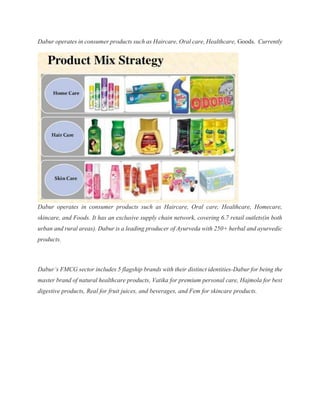
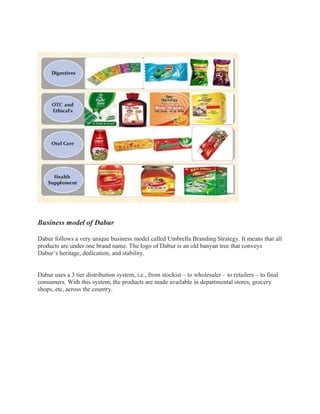
Product mix refers to the graphical representation of a company’s product portfolio to understand
all the industries and needs they fulfil. Dabur being a massive organisation with 250+ products
currently covers multiple industries but focuses largely on FMCG or Fast-Moving-Consumer
Dabur operates in consumer products such as Haircare, Oral care, Healthcare, Goods. Currently
Dabur operates in consumer products such as Haircare, Oral care, Healthcare, Homecare,
skincare, and Foods. It has an exclusive supply chain network, covering 6.7 retail outlets(in both
urban and rural areas). Dabur is a leading producer of Ayurveda with 250+ herbal and ayurvedic
products.
Dabur’s FMCG sector includes 5 flagship brands with their distinct identities-Dabur for being the
master brand of natural healthcare products, Vatika for premium personal care, Hajmola for best
digestive products, Real for fruit juices, and beverages, and Fem for skincare products.
Business model of Dabur
Dabur follows a very unique business model called Umbrella Branding Strategy. It means that all
products are under one brand name. The logo of Dabur is an old banyan tree that conveys
Dabur’s heritage, dedication, and stability.
Dabur uses a 3 tier distribution system, i.e., from stockist – to wholesaler – to retailers – to final
consumers. With this system, the products are made available in departmental stores, grocery
shops, etc, across the country.
MARKETING STRATEGIES OF DABUR
Marketing strategy is a long-term plan carried out to promote the goods and services of
a company. Strategies are the long-term plans made to achieve the organizational goal
and marketing deals in the selling or promotion of goods and services with a primary
aim of customer satisfaction.
Dabur’s marketing strategy aims at continuing its brand image by providing a variety of
products and using print media and sales promotion for reaching out to its customers.
We will discuss the marketing strategy of Dabur in more detail now. Let us begin by
learning more about the advertising strategy used by Dabur.
Dabur Advertisements Strategy
Dabur already holds on to print and television advertising and recently is planning to
take over digital media as a medium for advertising its products.
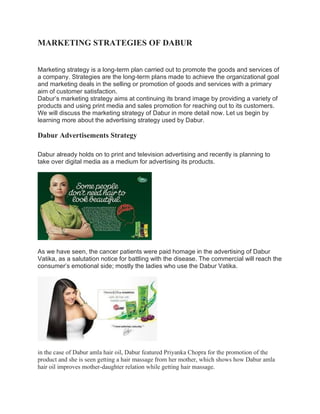
As we have seen, the cancer patients were paid homage in the advertising of Dabur
Vatika, as a salutation notice for battling with the disease. The commercial will reach the
consumer’s emotional side; mostly the ladies who use the Dabur Vatika.
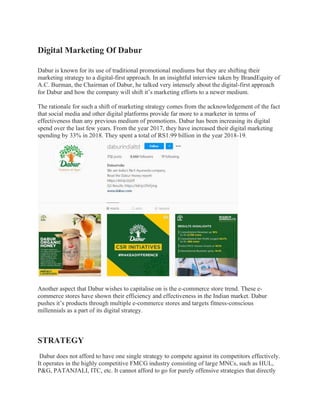
in the case of Dabur amla hair oil, Dabur featured Priyanka Chopra for the promotion of the
product and she is seen getting a hair massage from her mother, which shows how Dabur amla
hair oil improves mother-daughter relation while getting hair massage.
Digital Marketing Of Dabur
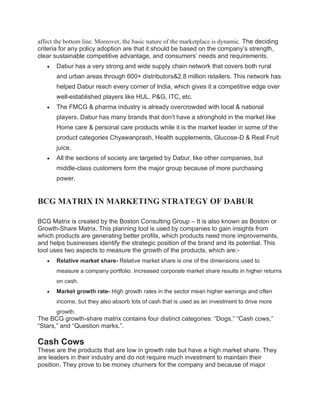
Dabur is known for its use of traditional promotional mediums but they are shifting their
marketing strategy to a digital-first approach. In an insightful interview taken by BrandEquity of
A.C. Burman, the Chairman of Dabur, he talked very intensely about the digital-first approach
for Dabur and how the company will shift it’s marketing efforts to a newer medium.
The rationale for such a shift of marketing strategy comes from the acknowledgement of the fact
that social media and other digital platforms provide far more to a marketer in terms of
effectiveness than any previous medium of promotions. Dabur has been increasing its digital
spend over the last few years. From the year 2017, they have increased their digital marketing
spending by 33% in 2018. They spent a total of RS1.99 billion in the year 2018-19.
Another aspect that Dabur wishes to capitalise on is the e-commerce store trend. These e-
commerce stores have shown their efficiency and effectiveness in the Indian market. Dabur
pushes it’s products through multiple e-commerce stores and targets fitness-conscious
millennials as a part of its digital strategy.
STRATEGY
Dabur does not afford to have one single strategy to compete against its competitors effectively.
It operates in the highly competitive FMCG industry consisting of large MNCs, such as HUL,
P&G, PATANJALI, ITC, etc. It cannot afford to go for purely offensive strategies that directly
affect the bottom line. Moreover, the basic nature of the marketplace is dynamic. The deciding
criteria for any policy adoption are that it should be based on the company’s strength,
clear sustainable competitive advantage, and consumers’ needs and requirements.
• Dabur has a very strong and wide supply chain network that covers both rural
and urban areas through 600+ distributors&2.8 million retailers. This network has
helped Dabur reach every corner of India, which gives it a competitive edge over
well-established players like HUL, P&G, ITC, etc.
• The FMCG & pharma industry is already overcrowded with local & national
players. Dabur has many brands that don’t have a stronghold in the market like
Home care & personal care products while it is the market leader in some of the
product categories Chyawanprash, Health supplements, Glucose-D & Real Fruit
juice.
• All the sections of society are targeted by Dabur, like other companies, but
middle-class customers form the major group because of more purchasing
power.
BCG MATRIX IN MARKETING STRATEGY OF DABUR
BCG Matrix is created by the Boston Consulting Group – It is also known as Boston or
Growth-Share Matrix. This planning tool is used by companies to gain insights from
which products are generating better profits, which products need more improvements,
and helps businesses identify the strategic position of the brand and its potential. This
tool uses two aspects to measure the growth of the products, which are:-
• Relative market share- Relative market share is one of the dimensions used to
measure a company portfolio. Increased corporate market share results in higher returns
on cash.
• Market growth rate- High growth rates in the sector mean higher earnings and often
income, but they also absorb lots of cash that is used as an investment to drive more
growth.
The BCG growth-share matrix contains four distinct categories: “Dogs,” “Cash cows,”
“Stars,” and “Question marks.”.
Cash Cows
These are the products that are low in growth rate but have a high market share. They
are leaders in their industry and do not require much investment to maintain their
position. They prove to be money churners for the company and because of major
competitors in the same sector they are not expected to show any growth soon and are
considered cash cows.
Stars
Stars are the products that are high in growth rate as well as market share. These are
the best-selling products and have an important role in boosting up the financial
strength of an organization. They have a constantly rising demand and high opportunity
for future growth.
Question Marks
As the BCG matrix considers the current position of the products, the products that are
not financially contributing and have an uncertain performance at present are put under
this category, but there are some chances of future growth and demand of these
products.
Dogs
Products that are not performing well and prove to be a liability for the firm, rather than
an income source, are considered under the dog category. There are very few chances
of future growth and the company often decides to discontinue these types of products.
INDUSTRY PROFILE :-
Fast-moving consumer goods (FMCG) sector is India's fourth-largest sector with household and personal care
accounting for 50% of FMCG sales in India. Growing awareness, easier access and changing lifestyles have
been the key growth drivers for the sector. The urban segment (accounts for a revenue share of around 55%) is
the largest contributor to the overall revenue generated by the FMCG sector in India. However, in the last few
years, the FMCG market has grown at a faster pace in rural India compared to urban India. Semi-urban and
rural segments are growing at a rapid pace and FMCG products account for 50% of the total rural spending.
Market Size :-
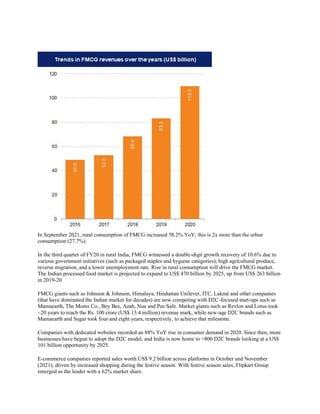
The FMCG market in India is expected to increase at a CAGR of 14.9% to reach US$ 220 billion by 2025,
from US$ 110 billion in 2020. The Indian FMCG industry grew by 16% in CY21 a 9-year high, despite
nationwide lockdowns, supported by consumption-led growth and value expansion from higher product prices,
particularly for staples. The rural market registered an increase of 14.6% in the same quarter and metro
markets recorded positive growth after two quarters. Final consumption expenditure increased at a CAGR of
5.2% during 2015-20. According to Fitch Solutions, real household spending is projected to increase 9.1%
YoY in 2021, after contracting >9.3% in 2020 due to economic impact of the pandemic. The FMCG sector's
revenue growth will double from 5-6% in FY21 to 10-12% in FY22, according to CRISIL Ratings. Price
increases across product categories will offset the impact of rising raw material prices, along with volume
growth and resurgence in demand for discretionary items, are driving growth. The FMCG sector grew by
36.9% in the April-June quarter of 2021 despite lockdowns in various parts of the country.
Number of households shopping on modern-trade channel grew 29.15% YoY in the September quarter and
shopping volume on the channel went up by 19.2% YoY .
In September 2021, rural consumption of FMCG increased 58.2% YoY; this is 2x more than the urban
consumption (27.7%).
In the third quarter of FY20 in rural India, FMCG witnessed a double-digit growth recovery of 10.6% due to
various government initiatives (such as packaged staples and hygiene categories); high agricultural produce,
reverse migration, and a lower unemployment rate. Rise in rural consumption will drive the FMCG market.
The Indian processed food market is projected to expand to US$ 470 billion by 2025, up from US$ 263 billion
in 2019-20
FMCG giants such as Johnson & Johnson, Himalaya, Hindustan Unilever, ITC, Lakmé and other companies
(that have dominated the Indian market for decades) are now competing with D2C-focused start-ups such as
Mamaearth, The Moms Co., Bey Bee, Azah, Nua and Pee Safe. Market giants such as Revlon and Lotus took
~20 years to reach the Rs. 100 crore (US$ 13.4 million) revenue mark, while new-age D2C brands such as
Mamaearth and Sugar took four and eight years, respectively, to achieve that milestone.
Companies with dedicated websites recorded an 88% YoY rise in consumer demand in 2020. Since then, more
businesses have begun to adopt the D2C model, and India is now home to >800 D2C brands looking at a US$
101 billion opportunity by 2025.
E-commerce companies reported sales worth US$ 9.2 billion across platforms in October and November
(2021), driven by increased shopping during the festive season. With festive season sales, Flipkart Group
emerged as the leader with a 62% market share.
Advertising volumes on television recorded healthy growth in the July-September quarter, registering 461
million seconds of advertising, which is the highest in 2021. FMCG continued to maintain its leadership
position with 29% growth in ad volumes against the same period in 2019. Even the e-commerce sector showed
a healthy 26% jump over 2020.
Investments
The Government has allowed 100% Foreign Direct Investment (FDI) in food processing and single-brand
retail and 51% in multi-brand retail. This would bolster employment, supply chain and high visibility for
FMCG brands across organised retail markets thereby bolstering consumer spending and encouraging more
product launches. The sector witnessed healthy FDI inflows of US$ 20.01 billion from April 2000-December
2021.
Some of the recent developments in the FMCG sector are as follows:
• In February 2022, Dabur India, formed an exclusive partnership with energy provider
Indian Oil, which will give Dabur's products direct access to around 140 million Indane
LPG consumer households across India.
• Beco, a startup in India, is revolutionising the FMCG market with low-cost,
environmentally-friendly consumer goods.
• In February 2022, Dabur India achieved its goal to collect, process, and recycle
approximately 22,000MT of post-consumer plastic three months early.
• In February 2022, Marico Ltd announced its aims to achieve net-zero emissions by 2040
in its global operations.
• In November 2021, Tata Consumer Products (TCPL) signed definitive agreements to
acquire 100% equity shares of Tata SmartFoodz Limited (TSFL) from Tata Industries
Limited for a cash consideration of Rs. 395 crore (US$ 53.13 million). This move was in
line with TCPL's strategic intent to expand into the value-added categories.
• In November 2021, Unilever Plc agreed to sell its global tea business to CVC Capital
Partners for EUR 4.5 billion (US$ 5.1 billion. The business being sold—Ekaterra—hosts
a portfolio of 34 tea brands, including Lipton, PG Tips, Pukka Herbs and TAZO.
• In November 2021, McDonald's India partnered with an FMCG company ITC to add a
differentiated fruit beverage, B Natural, to its Happy Meal, which will be available across
all McDonald's restaurants in South and West India, primarily catering to children aged
3–12 years.
• In October 2021, Procter & Gamble announced an investment of Rs. 500 crore (US$ 66.8
million) in rural India.
• In September 2021, PepsiCo commissioned its Rs. 814 crore (US$ 109.56 million) Kosi
Kalan foods facility in Mathura, Uttar Pradesh; it is the company's largest greenfield
manufacturing investment in India.
• In September 2021, Vahdam India, an Indian tea brand, raised Rs. 174 crore (US$ 24
million) as part of its Series D round led by IIFL AMC's Private Equity Fund.
• In September 2021, RP-Sanjiv Goenka Group entered the personal-care segment by
launching skin and haircare products, aiming at a revenue of Rs. 400-500 crore (US$
53.84-67.30 million) in the next 4-5 years
• In September 2021, Adani Wilmar announced the opening of physical stores under the
name 'Fortune Mart' that will exclusively sell Fortune and other Adani Wilmar brand
products.
• In August 2021, Apnaklub, a Bengaluru-based B2B wholesale marketplace for consumer
goods, raised US$ 3.5 million in a seed round from Sequoia Capital India's Surge,
increasing the total funds to US$ 5 million.
• In August 2021, Soothe Healthcare, an Indian personal hygiene products brand, raised
Rs. 130 crore (US$ 17.54 million) in a Series-C round of funding from A91 Partner
Partners.
• In August, Adani Wilmar, a 50/50 joint venture between Adani Group and Singapore-
based Wilmar, filed for initial public offering (IPO) to raise up to Rs. 4,500 crore (US$
607.13 million) for expansion.
• In the fourth quarter of FY21, e-commerce sales of Marico Ltd., Hindustan Unilever Ltd.,
Dabur India, ITC and Godrej Consumer Products Ltd. were 8%, 6%, 5%, 5%, and 4%,
respectively, of the total FMCG sales.
• In July 2021, Emami Ltd. increased its stake (by 15% to 46%) in Helios Lifestyle, which
sells male-grooming products under The Man Company
• brand in line with its ambition to tap emerging online opportunities.
• In July 2021, Tata Consumer Products Ltd. introduced 'Eight O'Clock', America's
Original Gourmet Coffee, under D2C, besides Tata Coffee 1868 and Sonnets, as a part of
its strategy to enhance its D2C approach for select coffee brands and their specific
websites. The company plans to add more brands in the D2C space as these three coffee
brands stabilise.
• In July 2021, HUL launched in-store vending machine model, Smart Fill machine, for its
home care products with the aim to reuse and recycle plastic. Smart Fill machine will
allow consumers to reuse plastic bottles by refilling products from its brands like Surf
Excel, Comfort and Vim.
• As of June 2021, e-commerce share has already touched 7-8% for some of the largest
FMCG companies in the country, according to Accenture India.
• In June 2021, Dabur India announced its Rs. 550 crore (US$ 75.6 million) investment to
set up a new plant in Madhya Pradesh for manufacturing of food products, ayurvedic
medicines and health supplements.
• In May 2021, Tata Digital Ltd., a 100% subsidiary of Tata Sons, acquired a 64.3% stake
in supermarket grocery supplies, the business-to-business arm of Big Basket in tandem
with Tata Group's strategy to build a digital consumer ecosystem. According to the
Economic Times, the deal is worth U$ 1.8-2 billion.
• In May 2021, Nepal-based CG Corp Global, known for its popular noodles brand Wai
Wai, announced its plan to invest Rs. 200 crore (27.42 million) to set up two new
manufacturing plants in West Bengal and Uttar Pradesh.
Government Initiatives :-
Some of the major initiatives taken by the Government to promote the FMCG sector in India are as follows:
• In November 2021, Flipkart signed an MoU with the Ministry of R7ural Development of
the Government of India (MoRD) for their ambitious Deendayal Antyodaya Yojana –
National Rural Livelihood Mission (DAY-NRLM) programme to empower local
businesses and self-help groups (SHGs) by bringing them into the e-commerce fold.
• Companies are counting on recent budget announcements like direct transfer of Rs. 2.37
lakh crore (US$ 30.93 billion) in minimum support payment (MSP) to wheat and paddy
farmers and the integration of 150,000 post offices into the core banking system to
expand their reach in rural India.
• On November 11, 2020, Union Cabinet approved the production-linked incentive (PLI)
scheme in 10 key sectors (including electronics and white goods) to boost India's
manufacturing capabilities, exports and promote the 'Atmanirbhar Bharat' initiative.
• The Government of India has approved 100% FDI in the cash and carry segment and in
single-brand retail along with 51% FDI in multi-brand retail.
• The Government has drafted a new Consumer Protection Bill with special emphasis on
setting up an extensive mechanism to ensure simple, speedy, accessible, affordable and
timely delivery of justice to consumers.
• The Goods and Services Tax (GST) is beneficial for the FMCG industry as many of the
FMCG products such as soap, toothpaste and hair oil now come under the 18% tax
bracket against the previous rate of 23-24%. Also, GST on food products and hygiene
products has been reduced to 0-5% and 12-18% respectively.
• GST is expected to transform logistics in the FMCG sector into a modern and efficient
model as all major corporations are remodelling their operations into larger logistics and
warehousing .
Road ahead
Rural consumption has increased, led by a combination of increasing income and higher
aspiration levels. There is an increased demand for branded products in rural India.
On the other hand, with the share of unorganised market in the FMCG sector falling, the
organised sector growth is expected to rise with increased level of brand consciousness,
augmented by the growth in modern retail.
Another major factor propelling the demand for food services in India is the growing youth
population, primarily in urban regions. India has a large base of young consumers who form
majority of the workforce, and due to time constraints, barely get time for cooking.
Online portals are expected to play a key role for companies trying to enter the hinterlands.
Internet has contributed in a big way, facilitating a cheaper and more convenient mode to
increase a company’s reach. The number of internet users in India is likely to reach 1 billion by
2025. It is estimated that 40% of all FMCG consumption in India will be made online by 2020.
The online FMCG market is forecast to reach US$ 45 billion in 2020 from US$ 20 billion in
2017.
It is estimated that India will gain US$ 15 billion a year by implementing GST. GST and
demonetisation are expected to drive demand, both in the rural and urban areas, and economic
growth in a structured manner in the long term and improved performance of companies within
the sector.
COMPANY PROFILE :-
The story of Dabur goes back to 1884, to a young doctor armed with a degree in medicine and a
burning desire to serve mankind. This young man, Dr. S. K. Burman, laid the foundations of
what is today known as Dabur India Limited.From those humble beginnings, the company has
grown into India's leading manufacturer of consumer healthcare, personal care and food
products. This phenomenal progress has seen many milestones, some of which are mentioned
below:
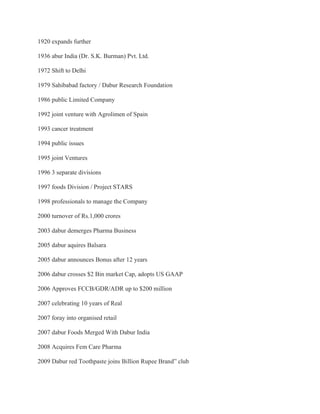
1884 birth of Dabur
1896 Setting up a manufacturing plant
1900s Ayurvedic medicines
1919 stablishment of research laboratories
1920 expands further
1936 abur India (Dr. S.K. Burman) Pvt. Ltd.
1972 Shift to Delhi
1979 Sahibabad factory / Dabur Research Foundation
1986 public Limited Company
1992 joint venture with Agrolimen of Spain
1993 cancer treatment
1994 public issues
1995 joint Ventures
1996 3 separate divisions
1997 foods Division / Project STARS
1998 professionals to manage the Company
2000 turnover of Rs.1,000 crores
2003 dabur demerges Pharma Business
2005 dabur aquires Balsara
2005 dabur announces Bonus after 12 years
2006 dabur crosses $2 Bin market Cap, adopts US GAAP
2006 Approves FCCB/GDR/ADR up to $200 million
2007 celebrating 10 years of Real
2007 foray into organised retail
2007 dabur Foods Merged With Dabur India
2008 Acquires Fem Care Pharma
2009 Dabur red Toothpaste joins Billion Rupee Brand” club
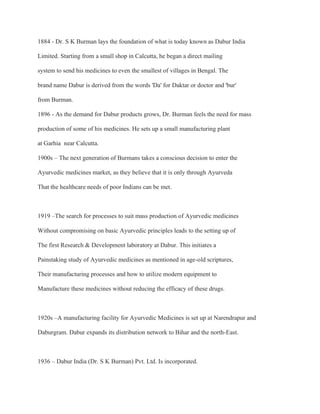
1884 - Dr. S K Burman lays the foundation of what is today known as Dabur India
Limited. Starting from a small shop in Calcutta, he began a direct mailing
system to send his medicines to even the smallest of villages in Bengal. The
brand name Dabur is derived from the words 'Da' for Daktar or doctor and 'bur'
from Burman.
1896 - As the demand for Dabur products grows, Dr. Burman feels the need for mass
production of some of his medicines. He sets up a small manufacturing plant
at Garhia near Calcutta.
1900s – The next generation of Burmans takes a conscious decision to enter the
Ayurvedic medicines market, as they believe that it is only through Ayurveda
That the healthcare needs of poor Indians can be met.
1919 –The search for processes to suit mass production of Ayurvedic medicines
Without compromising on basic Ayurvedic principles leads to the setting up of
The first Research & Development laboratory at Dabur. This initiates a
Painstaking study of Ayurvedic medicines as mentioned in age-old scriptures,
Their manufacturing processes and how to utilize modern equipment to
Manufacture these medicines without reducing the efficacy of these drugs.
1920s –A manufacturing facility for Ayurvedic Medicines is set up at Narendrapur and
Daburgram. Dabur expands its distribution network to Bihar and the north-East.
1936 – Dabur India (Dr. S K Burman) Pvt. Ltd. Is incorporated.
1940 –Dabur diversifies into personal care products with the launch of its Dabur Amla Hair Oil.
This perfumed heavy hair oil catches the imagination of the Common man and film stars alike
and becomes the largest hair oil brand in India.
1949 – Dabur Chyawanprash is launched in a pack and becomes the first branded
Chyawanprash of India.
1956 - Dabur buys its first computer. Accounts and stock keeping are one of first operations to
be computerized.
1970 -Dabur expands its personal care portfolio by adding oral care products. Dabur Lal Dant
Manjan is launched and captures the Indian rural market.
1972 - Dabur shifts base to Delhi from Calcutta. Starts production from a hired manufacturing
facility at Faridabad.
1978 - Dabur launches the Hajmola tablet. This is the first time that a classical Ayurvedic
medicine is branded - from Shudhabardhak bati to Hajmola tablet.
1979 -The Dabur Research Foundation (DRF), an independent company, is set up to spearhead
Dabur's multi-faceted research.
1979- Commercial production starts at Sahibabad. This is one of the largest and most modern
production facilities for Ayurvedic medicines in India at this time.
1984 - The Dabur brand turns 100 but is young enough to experiment with new offerings in the
market.
abur Red Toothpaste joins 'Billion Ruperate divisions
1986 -
1986 - Dabur becomes a public limited company through reverse merger with Vidogum Limited,
and is re-christened Dabur India Limited.
1989 - Hajmola Candy is launched and captures the imagination of children and establishes a
large market share.
1992 -Dabur enters into a joint venture with Agrolimen of Spain for manufacturing and marketing
confectionery items such as bubble gums in India.
1993 -Dabur sets up the oncology formulation plant at Baddi, Himachal Pradesh.
1994 -Dabur India Limited comes out with its first public issue. The Rs.10 share is issued at a
premium of Rs.85 per share. The issue is oversubscribed 21 times.
1994 -Dabur reorganizes its business with sales and marketing operations being divided into 3
separate divisions.
1994 -Dabur enters the oncology (anti-cancer) market with the launch of In axel(Paclitaxel).
Dabur becomes only the second company in the world to launch this product. The Dabur
Research Foundation develops the unique eco-friendly process of extracting the drug from the
leaves of the Asian Yew tree.
1995 -Dabur enters into a joint venture with Osem of Israel for food and Bong rain of France for
cheese and other dairy products.
1996 -Dabur launches Real Fruit Juice which heralds the company's entry into the processed
foods market.
1997 -The Foods division is created, comprising of Real Fruit Juice and Homemade cooking
pastes to form the core of this division's product portfolio. Project STARS (Strive to Achieve
Record Successes) is initiated by the company to achieve accelerated growth in the coming
years. The scope of this project is strategic, structural and operational changes to enable
efficiencies and improve growth rates.
1998- The Burman family hands over the reins of the company to professionals. Mr.Ninu
Khanna joins Dabur as the Chief Executive Officer.
2000- Dabur establishes its market leadership status with a turnover of Rs 1,000 crore. From a
small beginning and uploading the values of its founder, dabur now enters the august league of
large corporate business.
2003 - Dabur India approved the demerge of its pharmaceuticals business from the FMCG
business into a separate company as part of plans to provide greater focus to both the
business. With this, dabur india now largely comprises of theFMCG business that include
personal care product healthcare product and Ayurvedic specialties. While the pharmaceuticals
business would include Allopathic, Oncology formulations and Bulk druges. Dabur oncology
PLC, a subsidiary of dabur India would also be part of the pharmaceutical business.
2005 - As part of its inorganic growth strategy, Dabur India acquire Balsara’s Hygiene and
Home products business, a leading provider of oral care and household care products in the
Indian market in a Rs 143 crore all-cash deal.
2005 - Dabur India announced issued of 1:1 Bonus Share to the shareholders of the company,
i.e. one share for every one share hold. The Board also provided an increase in the authorized
share capital of the company from existing Rs 50 crore to Rs 125 crore.
2006 - Dabur India crosses the $ 2-billion marks in market capitalization. The company also
adopted US GAAP in line with its commitment to follow global best practices and adopt highest
standard of transparency and governance.
2006 - Moving forward on the inorganic growth path, dabur India decides to raise upto $ 200
million from the international market through Bonds, FCCBS, GDR,ADR, QIRs or any other
securities. The capital raised will be used to fund dabur’s aggressive growth ambitions and
acquisition plans in India and abroad
2007 - Dabur foods unveiled the new packaging and design for Real at the completion of 10
years of the brand the new refined modern look depicts the natural goodness of the juice from
freshly plucked fruits.
2007 - Dabur India announced its foray into the organized retail business through a wholly
owned subsidiary, H&B stores LTD. Dabur will invest Rs 140 crore .
2010 Establish its presence in the retail market in the India with a chain of stores on the health
& beauty formats.
2007 - Dabur India decides to merge its wholly-owned subsidiary, dabur foods limited with it to
extract synergies and unlock operational efficiencies. The integration will also help dabur
sharpen focus on the high growth business of foods and beverage and enter newer product
categories in this space.
2008 –Dabur India acquires Fem care pharma, a leading player in the women’s skincare
market. Besides an entry into the high-growth skin care market with an establishment brand
name FEM, this transaction also offers dabur a categories and markets.
2009 -Dabur Red Toothpaste becomes the dabur’s ninth billion rupee brands. Dabur red
toothpaste crosses the billion rupee turnover mark within five years of its launch .
COMPANY DETAILS :-
Welcome to Dabur India Ltd. In this section, you'll find information on the various :-
Dabur group companies.
Dabur Worldwide
In this section, you'll get information on Dabur's worldwide footprint.
Plants in India
In this section, you'll find information on Dabur's manufacturing presence in India.
Board Of Directors
In this section, you'll find detailed information about Dabur's Board of Directors.
CEO
In this section, you'll find the detailed profile of Dabur India Ltd Chief Executive Officer
Mr. Sunil Duggal.
Corporate Governance
In this section, you'll find all the information on the good governance practices being
followed at Dabur India Ltd.
SWOT Analysis of Dabur Products :-
SWOT (strengths, weaknesses, opportunities, and threats) analysis is a technique used by the
company to determine its competitive position, to form strategies and plans accordingly, and to
achieve the organizational objective. A SWOT analysis measures internal and external factors, as
well as current and future possibilities. We have done in-depth research and have developed this
SWOT analysis of Dabur for you, have a look:-
STRENGTH
Dabur has a wide variety of products for each age group. Being a century-old brand, it has a
strong brand image in the eyes of customers. Currently operating in over 60 countries, with 5000
distributors and 3 million outlets.
WEAKNESS
Many unbranded and duplicate products are being sold under the name of Dabur.Dabur not only
has competition from local brands, but also international players like Colgate.
OPPORTUNITIES
The era of modernization and instant food has led to an unhealthy lifestyle, and people are forced
to take ayurvedic medicines and supplements like Chyawanprash, Hajmola, etc. Dabur products
have an equally high demand in foreign markets. Expansion of the product line and introducing
ayurvedic beverages can boost their business.
THREATS
Stiff competition from big MNC’s like ITC, HUL, Patanjali. With an increasing trend of
ayurvedic medicines and supplements, many local brands have also entered the market.
Chapter : 2
LITERATURE
REVIEW
REVIEW OF LITERATURE :-
Sharma M. (2012) defines consumer preferences as the subjective (individual)
tastes, as measured by utility, of various bundles of goods. They permit the
consumer to rank these bundles of goods according to the levels of utility they
give the consumer. Note that preferences are independent of income and prices.
Ability to purchase goods does not determine a consumer's likes or dislikes. This
is used primarily to mean an option that has the greatest anticipated value among a
number of options.
Customer preference refers to how customers select goods and services in relation
to factors like taste, preference and individual choices. Factors such as the
consumer's income and price of the goods do not influence the customer's
preferred products or services. Mishra (2007) highlighted that the rapid growth of
retailing in recent years has necessitated the upcoming many new firms to
benchmark. Retail firms are concerned about the available resources and their
optimum utilization with respect to consumers‟ need and preference.
Jack and Rose, (2012) opined that it would be difficult and almost impossible to
create quantitative variables to describe the overall appearances of the main
characters combining varying views (e.g., price, taste, quality, hygiene etc.) as
well as the dynamic design, colours, and sounds of the machine in that vending
solution, which may have a significant impact on consumers' preferences.
Sinha P.K, Banerjee A and Uniyal D.P. (2012) studied store choice behaviour
of shoppers in the context of the changing retailing environment. They have tried
to identify major drivers behind choice of stores for various shopping needs as
exhibited by a typical Indian consumer. Their study revealed that convenience and
merchandise are the primary reasons behind choosing a store. Seiders and Tigert (2012)
compared supercenter shoppers with traditional supermarket shoppers in his study. Supercenter
shoppers identified low prices and range of product assortment as the primary reasons for their
format choice. In contrast, traditional supermarket shoppers placed more importance on location
and product quality.
White and Schlosser (2005) found that effect of a large assortment was found to be dependent on
the familiarity of the purchaser with the product group and their attitude towards risk. However,
this study also found that a wide variety did not always result in reduced purchasing. Where
product choices were described in terms of their experiential attributes and not merely physical
characteristics then large assortments were more likely to result in purchases (Diehl, 2005).
Herrmann .
Heitmann (2006) found that large assortments may prevent a purchasing decision. The process
consumers use to form preferences depends on their level of involvement in the purchase
decision and their need for cognition, as well as the capability of their memory (Alba et al,
1992). Certain consumers may be more concerned with the specific attributes of their choice
object/s; others may focus more on how it makes them feel or its affect (Powell Mantel and
Kerdes, 1999).Shendge, (2013) states that Preference (or "taste") is a concept, used in the social
sciences, particularly economics. It assumes a real or imagined "choice" between alternatives and
the possibility of rank ordering of these alternatives, based on happiness, satisfaction,
gratification, enjoyment, utility they provide. More generally, it can be seen as a source of
motivation. In cognitive sciences, individual preferences enable choice of objectives/goals.
Virmani R. T., (2011) stated the reasons for preference of the brands ranged from quality to
availability. But it was quality that was ranked as the No. 1 parameter for brand preference. Most
of the consumers reported that they do get carried away by advertisements sometimes but in the
end it is the quality of the product that is a decisive factor for purchase. Sanjeev Verma (2007)
studied consumer preferences for retail store selection in Mumbai.
The study was undertaken to understand the factors affecting consumer preferences for retail
store selection and developing marketing strategies towards meeting the needs and wants of
consumers. This study examines the linkage between consumer preferences and the importance
of some salient store attributes.
(Singh and Agarwal, 2013), Verma and Khandelwal, 2011; Brand and Leonard, 2001), store
attributes (Bianchi, 2009), AHP (Saaty, 1980; Subbaiah, 2011), retailer selection (Liisa 1990;
Mitchell and Kiral 1998; Arora, 1999; Franklin, 2001; Liu - Hai, 2005; Philippidis and Hubbard,
2003; Tzeng et al., 2002).
Retailer selection decisions are complicated by the fact that various criteria must be considered
in decisions making process. Studies by (Goffin, Szwejczewski and New, 1997; Howe, 1998;
Dawson, 2000) were focused on groceries and nutrition products. Attitudes cannot be observed
directly, they are mental positions that marketers must try to infer through research measures
(Wilkie, 1994: 83). Based on the consumers‟ preference, the consumer can score the relative
preference level between two attributes from 1 to 9, where 1 is nominally preferred and
extremely preferred (Tseng and Lin, 2005, 201).
Pan and Zinkhan (2013) studied the consumer store patronage and store choice in the retailing
literature. These studies suggest that several attributes affect consumers preferences and
expectations of retail stores, such assortment, service, product quality, store atmosphere, store
location, price level, checkout speed, hours of operation, friendliness of salespeople, and parking
facilities. When choice is unconstrained consumers will enact their purchase preferences and buy
only their preferred products (East, 1990).
Varun Jain (2014) concluded that the shoppers in India prefer the local kirana stores over malls.
The shoppers love to hangout and shop from their local traditional stores because of the
familiarity with ambiance, ease of access, emotional attachment, early opening and late closing
times etc., which suits the local residents.
Spiller Bolten and Kennerknecht (2016) identified service and product quality as main
determinant of customer satisfaction. They propose that customer consider freshness of fruits and
vegetables as the quality of whole assortment. Study by Kim et al., (2012) concluded that the
retailing scenario has changed significantly during the last two decades. The retailing industry in
the world has converted from the domestic market-based traditional market format of the past to
large scaled franchising and establishment of brand names.
Grocery industry is strongly driven by price competitiveness (Taylor, 2016). „„Credit‟‟ is a
predictor of grocery shopping expenditures spent out of the community and consumers spending
a medium proportion of their grocery expenditures out of a locality had the highest overall
shopping expenditures in all categories (Sullivan and Savitt, 1997). Product selection, assortment
and courtesy of personnel are also very important in determining format choice and cleanliness is
the most important attribute regardless of the format of grocery found that grocery shoppers
consider quality to be most important, followed by price, locality, range of products and parking.
Fox et al. concluded that shopping and spending vary much more across than within formats, and
expenditures respond more to varying levels of assortment and promotion than price, although
price sensitivity was most evident at grocers.Seiders et al. (2016) concluded that low price and
assortment more often are the reason for store choice. found quality, assortment, store location,
price and product variety as the most important store attributes influencing satisfaction.
Yang (2016) concluded that spatial separation distance best explained respondents‟ shopping
destination choice behaviour, followed by store selection criteria. A study in Vietnam on the
factors which influence decision-making by consumers when selecting traditional bazaars vs
supermarkets revealed that freshness, price and convenience are important in shaping the choice
by consumers for traditional outlets for fresh food, while price played a key role in selecting
shopping outlets for processed food and drinks and non-food products concluded that grocery
shopping patterns vary with culture.
Chapter : 3
RESEARCH
METHODOLOGY
Research Methodology
Research Problem Statement :-
There are many competitors in FMCG industry. The Dabur one of them. A study on Customer
satisfaction various factors like service, price, Availability, brand, and Promotional activities of
Dabur will enable them to develop the production in view of Competitions. A careful and
through study of the Factors enable the company to with Stand the changing situations of
competition. These factors have an impact in determining the company sales and its position in
the market.
Research Objectives :-
• To Study the Retailer satisfaction regarding Dabur .
• To analyses the factors influencing the purchases of the Products .
• To analyses the retailer satisfaction towards various brands of the
company .
• To Study about the promotional activities of the Dabur for retailers
Research Design :-
The present study is in Descriptive nature, as it seeks to discover ideas
and insight to bright Out new relationship. Research design is flexible
enough to provide opportunity for Considering different aspects of
problem under study. It helps in bringing into focus some Inherent
weakness in enterprise regarding which in depth study can be conducted
by management
SAMPLING :-
Population
Size of Population
The sample size selected for the research is 100
Sampling Technique
Convenience Sampling Technique is used . It is least expensive and least time
consuming of all sampling technique . The Sampling unit are easily accessible and
easy to measure .
Sampling unit
Business
Service
Women
Every single member of the population or sample is known as Sample Unit .
50 Women’s , 20 Service peoples and 30 Business men are considered as a Sample unit .
Research Hypothesis:-
Ho: Customers are not satisfied with services of Dabur Products
H1: Customers are satisfied with services of Dabur Products.
Data Collection
After the research problem has been identified and selected, the next step is to gather the
requisite data. While deciding about the method of data collection to be used for, the
researcher should kept in mind two types of data: primary and secondary.
In the present study researcher has made use of the primary data which has been collected
through Questionnaire, Observation, Personal Interview along with the secondary data
which has been collected from Company’s website and from their records, Books,
magazines, newspapers and journals.
PRIMARY DATA :-
• Personal Interview
• Questionnaire
• Observation
SECONDARY DATA :-
• Marketing Manuals
• Magazines
• Internet
• Books
• Journals
Scope
Of
The
Study
Scope of the study
One of the Best Ayurvedic Companies – Dabur Corporate Profile
Dabur India Limited is the fourth largest FMCG Company in India with Revenues of over Rs.
9,500 Crore & Market Capitalization of over Rs 100,000 Crore. Building on a legacy of quality
and experience of over 137 years, Dabur is today India’s most trusted name and the world’s
largest Ayurvedic and Natural Health Care Company with a portfolio of over 250
Herbal/Ayurvedic products.
Known as the 'Custodian of Ayurveda', Dabur marries age-old traditional wisdom with modern-
day Science to develop products for consumers across generations and geographies. Dabur's
FMCG portfolio today includes 8 Power Brands with distinct brand identities -- Dabur
Chyawanprash, Dabur Honey, Dabur PudinHara, Dabur Lal Tail and Dabur Honitus in the
Healthcare space; Dabur Amla and Dabur Red Paste in the Personal Care category; and Réal
in the Food & Beverages category. In addition, Vatika is an International Power Brand.
Dabur today operates in key consumer product categories like Hair Care, Oral Care, Health
Care, Skin Care, Home Care and Foods. The ayurvedic company has a wide distribution
network, covering 6.7 million retail outlets with a high penetration in both urban and rural
markets.
Dabur's products also have huge presence in the overseas markets and are today available in
over 120 countries across the globe. Its brands are highly popular in the Middle East, SAARC
countries, Africa, US, Europe and Russia. Dabur's overseas revenue today accounts for over
27% of the total turnover.
The 137-year-old ayurvedic company, promoted by the Burman family, started operating in 1884
as an Ayurvedic medicines company. From its humble beginnings in the bylanes of Calcutta,
Dabur India Ltd has come a long way today to become one of the biggest Indian-owned
consumer goods companies with the largest herbal and natural product portfolio in the world.
Overall, Dabur has successfully transformed itself from being a family-run business to become a
professionally managed enterprise. What sets Dabur apart from the crowd is its ability to change
ahead of others and to always set new standards in corporate governance & innovation.
Dabur also recommends various Ayurvedic Home Remedies formulated using ayurvedic plants
& herbs which are natural & chemical free .
Limitations
Of
The
Study
LIMITATIONS OF THE STUDY :-
However the researcher has tried her best in collecting the relevant information for
research report, yet there have been some problems faced by the researcher. The prime
difficulties which researcher has faced in collection of information are discussed below:
Time Constraint: The time period for carrying out the research has been limited
as a result of which many facts have been left unexplored. So if more time had
been provided, the sample size would have been increased. The respondent would
have been given more time to fill the questionnaire.
Limited sample size: The sample size was only 150 which can't be regarded as
true representative of all employees working in service sector.
Unwillingness of respondents: While collection of the data many employees
were unwilling to fill the questionnaire. Respondents were having a feeling of
wastage of time.
Limited area for research: The area for study has been only selected
organizations area to represent emotional intelligence of employees of service
sector.
Respondents’ bias: Due to the biasness on the part of respondents, data collected
may have been affected which further reduces the credibility of the findings.
Researcher’s bias: While analyzing the data, some biasness on the part of
researcher may have crept into the duty.
Despite of these difficulties, best efforts have been put to do the full justice with
the subject matter and in the completion of report.
Chapter: 4
Data
Analysis
&
Findings
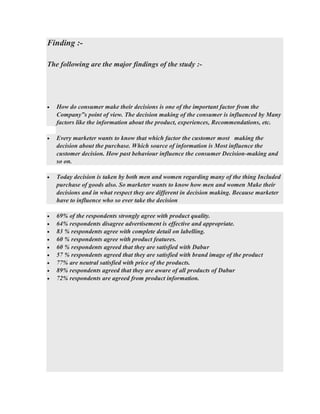
Finding :-
The following are the major findings of the study :-
• How do consumer make their decisions is one of the important factor from the
Company‟s point of view. The decision making of the consumer is influenced by Many
factors like the information about the product, experiences, Recommendations, etc.
• Every marketer wants to know that which factor the customer most making the
decision about the purchase. Which source of information is Most influence the
customer decision. How past behaviour influence the consumer Decision-making and
so on.
• Today decision is taken by both men and women regarding many of the thing Included
purchase of goods also. So marketer wants to know how men and women Make their
decisions and in what respect they are different in decision making. Because marketer
have to influence who so ever take the decision
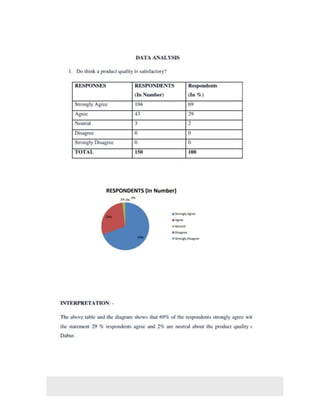
• 69% of the respondents strongly agree with product quality.
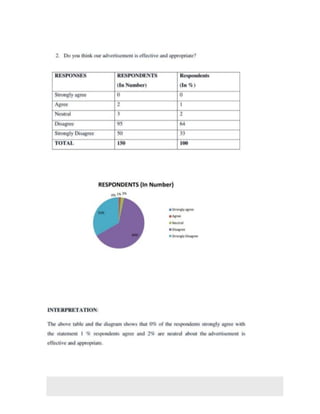
• 64% respondents disagree advertisement is effective and appropriate.
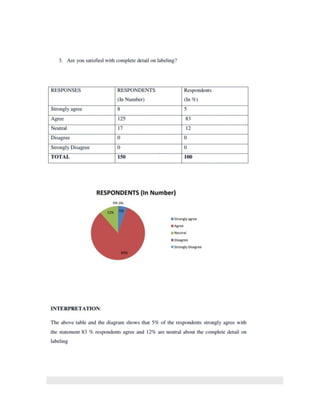
• 83 % respondents agree with complete detail on labelling.
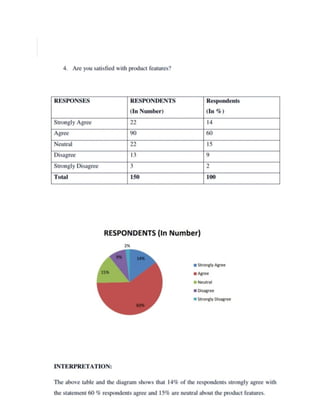
• 60 % respondents agree with product features.
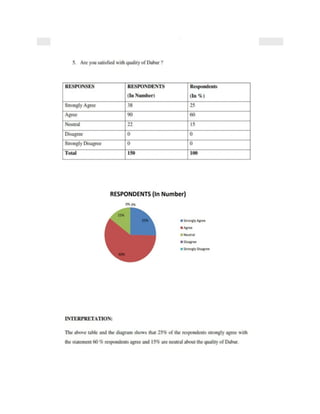
• 60 % respondents agreed that they are satisfied with Dabur
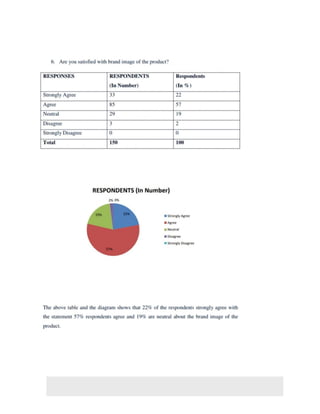
• 57 % respondents agreed that they are satisfied with brand image of the product
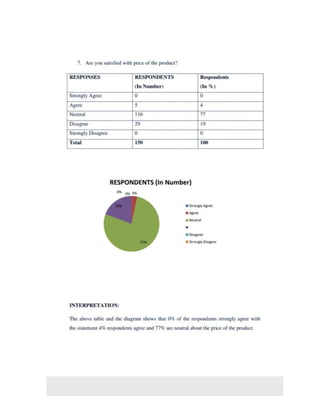
• 77% are neutral satisfied with price of the products.
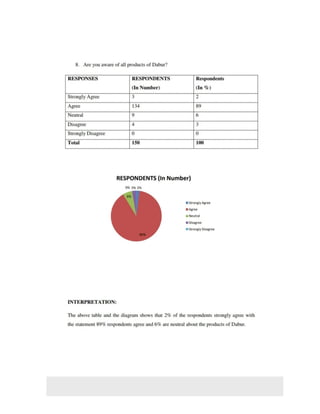
• 89% respondents agreed that they are aware of all products of Dabur
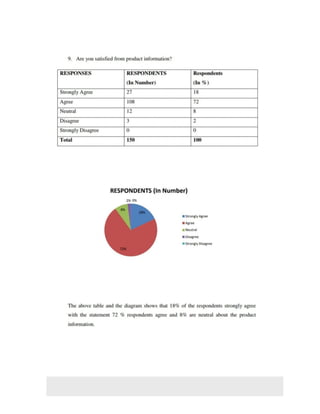
• 72% respondents are agreed from product information.
Chapter : 5
Conclusion
&
Suggestion
Conclusion
Company should ensure proper promotional activities should be adopted in order to capture
maximum market share. The company should ensure that they provide high quality of service
in order to attract more and more customers and retailers. The cost of products should be
less as compared to the other products. The salesman should be trained to behave properly
with retailers as it has a significant impact on retailers satisfaction. The facilities provided
by the company should be luxurious enough to retain the retailers.
BIBLIOGRAPHY
BIBLIOGRAPHY
Books
1. Kothari C R(2004), “Research Methodology-Methods &
Techniques”, New Delhi:
New Age International (P) Ltd.,PP-185-186
2. Jain T.R. &Aggarwal S.C. (2004), “Statistics for MBA”, VK
publication, New
Delhi,PP -1-3 Part b, PP-131-134.
3. Hair Joseph f. & Robert P. Bush (2005), “Marketing Research”,
New Delhi:
Kalyan Publishers, PP-115-138.
4. Etzel J. Michael, Walker J. Bruce, Stanton J. William &Pandit
Ajay
(2008),“Marketing Concepts & Cases”, 13th Edition, Tata McGraw
Hill Publishing
Co. Ltd. New Delhi, PP- 418-430.
5. Beri G.C.(2008),“Marketing Research”, New Delhi: Publishing
House, PP- 67-70.
6. Kotler Phillip & Armstrong Gary (2008),“Principles of
Marketing”, 12th Edition,
Prentice hall of India Pvt. Ltd., New Delhi, PP- 493-505.
7. Sharma D.D, “Marketing Research”,Himalaya Publishing House
New Delhi, PP 68-
78
8. Gupta S.P., “Statistical Methods”,New Delhi: Publishing House,
PP- 67-70
9. Stanton, William.J (1994): „Fundamentals of Marketing‟ New
York, Mcgraw Hill.
10. BaackClow, (Third Edition) “Integrated advertising, promotion
&
Marketingcommunication”, , Prentice hall, New Delhi, PP-85
Journals & Magazine
11. SurajCom muri, Journal of Marketing, “Building consumer
brand
relationship: (may 2008), PP-86-111
12. Penghuang, Nicholas H.luire, Journal of the Marketing
“Implications of loyalty
programs membership and services experiences for customer
retention and
value” (march2009) Vol.28, 95-108.
13. Dr.k.Shivkumar, “Indian Journal of Marketing”,( January
2004) PP-35
14. Christian Homburg, Nicole Koschate& Wayne D. Hoyer”,
Journal of Marketing,
“Do satisfied customer really pay more? A study of the relationship
between
customer satisfaction and willingness to pay” (April 2005) Vol.69,
84-95.
15. Roger Hallowell, International Journal of Service Industry Management, “The
relationships of customer satisfaction, customer loyalty,and profitability”: an
empirical study Vol. 7 No. 4,1996, pp. 27-42
16. R. S. Mani, Journals of marketing, “Organization Effectiveness in Management
Education Institutions”
Websites
17. Onlineavailablewww.esurveyspro.com/customer-statisfaction-
surveys.asinformationabout questionnaire.
18. Online available http://www.dabur.com/default.aspx
19. Online available http://www.dabur.com/nepa
20. Online available www.dabur.com/About Dabur-Company Details
ANNEXURE
QUESTIONNAIRE
Dear SirMadam
You are requested to fill in the below mentioned questions which I am
letting filled For my academic purpose. I assure you that the details
provided by you will be used Confidentially only for academic purpose
and not for any other malicious acts.
Respondents Profile
Name : __________________________________
Age : ___________________________________
Place : ___________________________________
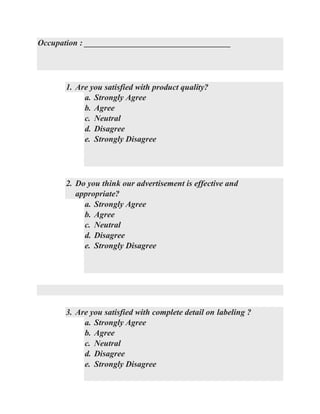
Occupation : ___________________________________
1. Are you satisfied with product quality?
a. Strongly Agree
b. Agree
c. Neutral
d. Disagree
e. Strongly Disagree
2. Do you think our advertisement is effective and
appropriate?
a. Strongly Agree
b. Agree
c. Neutral
d. Disagree
e. Strongly Disagree
3. Are you satisfied with complete detail on labeling ?
a. Strongly Agree
b. Agree
c. Neutral
d. Disagree
e. Strongly Disagree
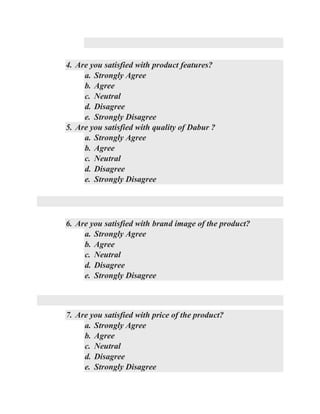
4. Are you satisfied with product features?
a. Strongly Agree
b. Agree
c. Neutral
d. Disagree
e. Strongly Disagree
5. Are you satisfied with quality of Dabur ?
a. Strongly Agree
b. Agree
c. Neutral
d. Disagree
e. Strongly Disagree
6. Are you satisfied with brand image of the product?
a. Strongly Agree
b. Agree
c. Neutral
d. Disagree
e. Strongly Disagree
7. Are you satisfied with price of the product?
a. Strongly Agree
b. Agree
c. Neutral
d. Disagree
e. Strongly Disagree
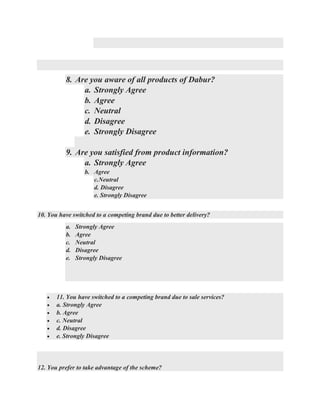
8. Are you aware of all products of Dabur?
a. Strongly Agree
b. Agree
c. Neutral
d. Disagree
e. Strongly Disagree
9. Are you satisfied from product information?
a. Strongly Agree
b. Agree
c.Neutral
d. Disagree
e. Strongly Disagree
10. You have switched to a competing brand due to better delivery?
a. Strongly Agree
b. Agree
c. Neutral
d. Disagree
e. Strongly Disagree
• 11. You have switched to a competing brand due to sale services?
• a. Strongly Agree
• b. Agree
• c. Neutral
• d. Disagree
• e. Strongly Disagree
12. You prefer to take advantage of the scheme?
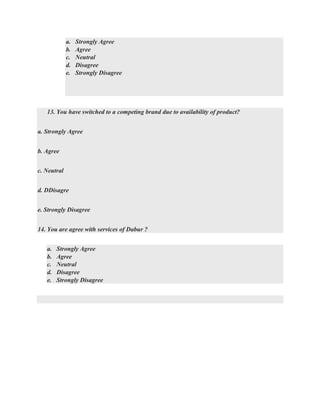
a. Strongly Agree
b. Agree
c. Neutral
d. Disagree
e. Strongly Disagree
13. You have switched to a competing brand due to availability of product?
a. Strongly Agree
b. Agree
c. Neutral
d. DDisagre
e. Strongly Disagree
14. You are agree with services of Dabur ?
a. Strongly Agree
b. Agree
c. Neutral
d. Disagree
e. Strongly Disagree

Project Report BBA on Dabur Co

  • 2.
    DECLARATION I Tanya Tewaristudent of BBA (2020-23) and Dr. Virendra Swarup Institute of Computer Studies, Kanpur of hereby declare that the project work entitled a study on the ‘Market Analysis of Dabur Products is compiled and submitted under the guidance of Mr. Ajay Nath Dubey. This is my original work whatever information furnished in this project report is true to the best of my knowledge. Name Tanya Tewari BBA : 2nd year Roll no : 0503798
  • 3.
    PREFACE A professional course(BBA- Bachelor of Business Administration) is incomplete unless the theoretical knowledge acquired in the class room is backed up by the practical exposure. Practical exposure was gained report, which has been integral part of the syllabus. I was assigned a project ‘Market Analysis of Dabur Products’. I have tried my level best to be as systematic as possible and to avoid any sort of biasness.
  • 4.
    ACKNOWLEDGEMENT This project isour professional experience that enriched our knowledge to a great extent. During the course of our project, we had the good of fortune of being guided by Mr. Ajay Nath Dubey. Who with all his magnanimity supervised the project report through all the stages. I have benefited a great deal from her intensive analysis critical suggestions. Our special thanks to all our faculties for their unremitting help in numerous ways, which deserve adequate experience on his page. In the end we would like to say that it was a great experience working on this project.
  • 11.
    Introduction Topic : MarketAnalysis of Dabur products Dabur India Ltd. is one of India’s leading FMCG Companies :- Revenues of over Rs8,500 Crore & Market Capitalisation of over Rs 72,500 Crore. Building on a legacyof quality and experience of over 135 years, Dabur is today India’s most trusted name and the world’s largest Ayurvedic and Natural Health Care Company. Dabur India is also a world leader in ayurveda with a portfolio of over 250Herbal/Ayurvedic products. Dabur's FMCG portfolio today includes five flagship brands with distinct brand identities -- Dabur as the master brand for natural healthcare products, Vatika for premium personal care, Hajmola for digestives, Réal for fruit juices and beverages and Fem for fairness bleaches and skin care products.Dabur today operates in key consumer product categories like Hair Care, Oral Care,Health Care, Skin Care, Home Care and Foods. The Ayurvedic Company has a wide distribution network, covering 6.7 million retail outlets with a high penetration in both urban and rural markets.Dabur's products also have huge presence in the overseas markets and are today available in over 100 countries across the globe. Its brands are highly popularin the Middle East, SAARC countries, Africa, US, Europe and Russia. Dabur'soverseas revenue today accounts for over 27% of the total turnover. From the small dispensary in Calcutta in 1884, the organisation has today grown into a corporation having significant presence in health and personal care markets in India and abroad with more than 100 years of understanding of consumer needs and ability it provides safe solutions from a deep understanding of Ayurveda, Dabur has sets its vision to strive for providing good health and well being to every householdthrough its ten productions bases spread across India manufacturing arange of herbal, health and personal care products, foods Ayurvedic medicines and pharmaceuticals. Dabur products are also manufactured in Nepal, Egypt and Dubai. An ontological parental facility has just beenestablished in the U.K. The company is served by a strong distribution network of C&F agents and distributors that ensures the presence of Dabur products in over 1.5 million retail outlets. At Dabur, key to our growth is knowledge of nature, which provides the basis, and useof modern research tools for superior understanding of this knowledge for providing continuos
  • 12.
    innovation. Innovation inproducts,processes and method will drive Dabur to globalleadership in health and personal care products. Dabur India is a household name in the natural foods and ayurvedic industry, and a company that is famous for its marketing efforts. Based on the background of around 135 years of experience and quality, Dabur India Limited is the largest Ayurvedic and natural health care company in the world with a product range of more than 250+ herbal & ayurvedic items. It is the 4th Largest FMCG Company in India, with headquarters in Ghaziabad and Mohit Malhotra as the CEO . Dabur India Limited is one of the leading consumer goods company of India with interests in healthcare, personal care and foods. For more than a century. Dabur has worked in active collaboration with nature to provide the best of herbal health and personal care products to its consumers. Today, Dabur is all set to take this abundant knowledge of Ayurvedic to global frontiers. Dabur India Limited is the fourth largest FMCG Company in India with interests in Health care, Personal care, Home care and Food products. Building on a legacy of quality and experience for over 125 years, today Dabur has a revenue of Rs. 4111 crore with powerful brands like Dabur Alma, Dabur Chyawanprash, Vatika, Hajmola & Real. CEO (Chief Executive Officer) Mr.Sunil Duggal took over as the Chief Executive Officer of Dabur India Limited in June2002, holding reins of the organisation he joined in 1995. Mr.Duggal started his career as a management trainee in Wimco Limited in 1981 after getting his Engineering Degree (Electrical & Electronics) from BITS, Pilani, and Business Management from IIM, Calcutta. His stint at Wimco continued till 1994, with a break in between when he joined Bennett Coleman & Co. Ltd for a short period. In 1994, he moved to Pepsi Foods as GM, Sales Operation. In 1995, he joined the Dabur family as General Manager (Sales & Marketing) of the Family Products Division with products like Dabur Amla, Lal Dant Manjan and Vatika in his portfolio. This Division spearheaded the spectacular growth recorded by Dabur in this period. Vatika was also launched during this period and is now the Company's second biggest brand.
  • 13.
    With his dynamicspirit and leadership abilities, he soon became Vice-President and SBU-Head of the Family Products Division. In July 2000 Mr. Duggal was appointed Director Sales and Marketing of Dabur India Limited. And in 2002, he became the CEO of the Company - a professional with valuable experience to steer the company ahead in its growth plans. Spanning a career of over 20 years, Mr. Sunil Duggal has travelled widely across India and handled diverse portfolios that have helped him understand the dynamics of FMCG businesses and market trends. He is well versed in the intricacies of India's regional diversities and consumer needs. About Dabur Dabur India Ltd is one of the most trusted and leading FMCG companies in India. It was founded by Dr S.K. Burman in 1884. In the last 100+ years, the small firm has grown ginormous. Currently Dabur has accumulated a market share of over Rs 80,000 crore with annual returns of Rs 8,700crore. Their main product ranges deal with hair care, oral care, health care, skincare, home care, and packaged food. Dabur became a public limited company in 1996 and within 4 years it marked the leading position with a turnover worth Rs 1,000 Crore. Three distinct divisions were established for improving operations and management, namely, Goods for Health Care, Family Products, & Dabur Ayurvedic Specialties.Internationally, Dabur’s goods enjoy a large reach and are available in more than 100 countries. Overseas revenue from Dabur today accounts for more than 27 per cent of the overall turnover.
  • 15.
    CORPORATE PHILOSOPHY Knowledge isthe key to growth in today’s world. Whatever the industry, it is the Knowledge, which provides cutting edge to individual and organizations. For More than a century nature has been a rich source of knowledge for Dabur. Nature has not only given us the ingredients for all our products but has also Taught us how to create a harmony within and without the organization. Nature Has inspired us in all our acts. Ayurvedic – the science of life is based on Principles of nature. All Ayurvedic preparations have their ingredients derived From Nature. Dabur has converted the healing properties of natural ingredients And the age-old knowledge of Ayurveda into contemporary healthcare products To alleviate health problems of its consumers. Dabur is committed to expand the reach of this age-old knowledge of Ayurvedaand Nature through web. Through web, they aim to overcome the physical boundaries to take Ayurvedic way of life to global frontiers. Dabur India Limited understands its responsibility as a corporate house. Wehave not only set our sight on increasing turnover and profitability of thecompany but also on propagating Ayurveda - the Indian system of medicine . VISION :- "Dedicated to the Health and Well Being of Every Household." Dabur is always dedicated and focused on the good health and well-being of every household with a tagline- celebrate life justifying the vision. Dabur is a company with a set of established business values, which direct its functioning as well as all its operations. In this, Dabur is guided by the words of its founder Dr. S K Burman "What is that life worth that cannot give comfort to others." The company offers its consumers, products to suit their needs and give them good value for money. The company is committed to

  • 16.
    follow the ethicalpractices in doing business. At Dabur, Nature acts as not only the source of raw material but also an inspiration and the company is committed to protect the ecological balance.. MISSION :- "To be the leader in the Natural Foods & Beverages Industry “ Dabur aims to provide 100% natural products for its customers . Strive to deliver this by: Consistently delighting the consumer through quality product. Being the company of choice for our business partners. Delivering higher returns to stakeholders. DABUR PRODUCTS MIX Product mix refers to the graphical representation of a company’s product portfolio to understand all the industries and needs they fulfil. Dabur being a massive organisation with 250+ products currently covers multiple industries but focuses largely on FMCG or Fast-Moving-Consumer
  • 17.
    Dabur operates inconsumer products such as Haircare, Oral care, Healthcare, Goods. Currently Dabur operates in consumer products such as Haircare, Oral care, Healthcare, Homecare, skincare, and Foods. It has an exclusive supply chain network, covering 6.7 retail outlets(in both urban and rural areas). Dabur is a leading producer of Ayurveda with 250+ herbal and ayurvedic products. Dabur’s FMCG sector includes 5 flagship brands with their distinct identities-Dabur for being the master brand of natural healthcare products, Vatika for premium personal care, Hajmola for best digestive products, Real for fruit juices, and beverages, and Fem for skincare products.
  • 18.
    Business model ofDabur Dabur follows a very unique business model called Umbrella Branding Strategy. It means that all products are under one brand name. The logo of Dabur is an old banyan tree that conveys Dabur’s heritage, dedication, and stability. Dabur uses a 3 tier distribution system, i.e., from stockist – to wholesaler – to retailers – to final consumers. With this system, the products are made available in departmental stores, grocery shops, etc, across the country.
  • 19.
    MARKETING STRATEGIES OFDABUR Marketing strategy is a long-term plan carried out to promote the goods and services of a company. Strategies are the long-term plans made to achieve the organizational goal and marketing deals in the selling or promotion of goods and services with a primary aim of customer satisfaction. Dabur’s marketing strategy aims at continuing its brand image by providing a variety of products and using print media and sales promotion for reaching out to its customers. We will discuss the marketing strategy of Dabur in more detail now. Let us begin by learning more about the advertising strategy used by Dabur. Dabur Advertisements Strategy Dabur already holds on to print and television advertising and recently is planning to take over digital media as a medium for advertising its products. As we have seen, the cancer patients were paid homage in the advertising of Dabur Vatika, as a salutation notice for battling with the disease. The commercial will reach the consumer’s emotional side; mostly the ladies who use the Dabur Vatika. in the case of Dabur amla hair oil, Dabur featured Priyanka Chopra for the promotion of the product and she is seen getting a hair massage from her mother, which shows how Dabur amla hair oil improves mother-daughter relation while getting hair massage.
  • 20.
    Digital Marketing OfDabur Dabur is known for its use of traditional promotional mediums but they are shifting their marketing strategy to a digital-first approach. In an insightful interview taken by BrandEquity of A.C. Burman, the Chairman of Dabur, he talked very intensely about the digital-first approach for Dabur and how the company will shift it’s marketing efforts to a newer medium. The rationale for such a shift of marketing strategy comes from the acknowledgement of the fact that social media and other digital platforms provide far more to a marketer in terms of effectiveness than any previous medium of promotions. Dabur has been increasing its digital spend over the last few years. From the year 2017, they have increased their digital marketing spending by 33% in 2018. They spent a total of RS1.99 billion in the year 2018-19. Another aspect that Dabur wishes to capitalise on is the e-commerce store trend. These e- commerce stores have shown their efficiency and effectiveness in the Indian market. Dabur pushes it’s products through multiple e-commerce stores and targets fitness-conscious millennials as a part of its digital strategy. STRATEGY Dabur does not afford to have one single strategy to compete against its competitors effectively. It operates in the highly competitive FMCG industry consisting of large MNCs, such as HUL, P&G, PATANJALI, ITC, etc. It cannot afford to go for purely offensive strategies that directly
  • 21.
    affect the bottomline. Moreover, the basic nature of the marketplace is dynamic. The deciding criteria for any policy adoption are that it should be based on the company’s strength, clear sustainable competitive advantage, and consumers’ needs and requirements. • Dabur has a very strong and wide supply chain network that covers both rural and urban areas through 600+ distributors&2.8 million retailers. This network has helped Dabur reach every corner of India, which gives it a competitive edge over well-established players like HUL, P&G, ITC, etc. • The FMCG & pharma industry is already overcrowded with local & national players. Dabur has many brands that don’t have a stronghold in the market like Home care & personal care products while it is the market leader in some of the product categories Chyawanprash, Health supplements, Glucose-D & Real Fruit juice. • All the sections of society are targeted by Dabur, like other companies, but middle-class customers form the major group because of more purchasing power. BCG MATRIX IN MARKETING STRATEGY OF DABUR BCG Matrix is created by the Boston Consulting Group – It is also known as Boston or Growth-Share Matrix. This planning tool is used by companies to gain insights from which products are generating better profits, which products need more improvements, and helps businesses identify the strategic position of the brand and its potential. This tool uses two aspects to measure the growth of the products, which are:- • Relative market share- Relative market share is one of the dimensions used to measure a company portfolio. Increased corporate market share results in higher returns on cash. • Market growth rate- High growth rates in the sector mean higher earnings and often income, but they also absorb lots of cash that is used as an investment to drive more growth. The BCG growth-share matrix contains four distinct categories: “Dogs,” “Cash cows,” “Stars,” and “Question marks.”. Cash Cows These are the products that are low in growth rate but have a high market share. They are leaders in their industry and do not require much investment to maintain their position. They prove to be money churners for the company and because of major
  • 22.
    competitors in thesame sector they are not expected to show any growth soon and are considered cash cows. Stars Stars are the products that are high in growth rate as well as market share. These are the best-selling products and have an important role in boosting up the financial strength of an organization. They have a constantly rising demand and high opportunity for future growth. Question Marks As the BCG matrix considers the current position of the products, the products that are not financially contributing and have an uncertain performance at present are put under this category, but there are some chances of future growth and demand of these products. Dogs Products that are not performing well and prove to be a liability for the firm, rather than an income source, are considered under the dog category. There are very few chances of future growth and the company often decides to discontinue these types of products. INDUSTRY PROFILE :- Fast-moving consumer goods (FMCG) sector is India's fourth-largest sector with household and personal care accounting for 50% of FMCG sales in India. Growing awareness, easier access and changing lifestyles have been the key growth drivers for the sector. The urban segment (accounts for a revenue share of around 55%) is the largest contributor to the overall revenue generated by the FMCG sector in India. However, in the last few years, the FMCG market has grown at a faster pace in rural India compared to urban India. Semi-urban and rural segments are growing at a rapid pace and FMCG products account for 50% of the total rural spending. Market Size :- The FMCG market in India is expected to increase at a CAGR of 14.9% to reach US$ 220 billion by 2025, from US$ 110 billion in 2020. The Indian FMCG industry grew by 16% in CY21 a 9-year high, despite nationwide lockdowns, supported by consumption-led growth and value expansion from higher product prices, particularly for staples. The rural market registered an increase of 14.6% in the same quarter and metro markets recorded positive growth after two quarters. Final consumption expenditure increased at a CAGR of 5.2% during 2015-20. According to Fitch Solutions, real household spending is projected to increase 9.1% YoY in 2021, after contracting >9.3% in 2020 due to economic impact of the pandemic. The FMCG sector's revenue growth will double from 5-6% in FY21 to 10-12% in FY22, according to CRISIL Ratings. Price increases across product categories will offset the impact of rising raw material prices, along with volume growth and resurgence in demand for discretionary items, are driving growth. The FMCG sector grew by 36.9% in the April-June quarter of 2021 despite lockdowns in various parts of the country. Number of households shopping on modern-trade channel grew 29.15% YoY in the September quarter and shopping volume on the channel went up by 19.2% YoY .
  • 23.
    In September 2021,rural consumption of FMCG increased 58.2% YoY; this is 2x more than the urban consumption (27.7%). In the third quarter of FY20 in rural India, FMCG witnessed a double-digit growth recovery of 10.6% due to various government initiatives (such as packaged staples and hygiene categories); high agricultural produce, reverse migration, and a lower unemployment rate. Rise in rural consumption will drive the FMCG market. The Indian processed food market is projected to expand to US$ 470 billion by 2025, up from US$ 263 billion in 2019-20 FMCG giants such as Johnson & Johnson, Himalaya, Hindustan Unilever, ITC, Lakmé and other companies (that have dominated the Indian market for decades) are now competing with D2C-focused start-ups such as Mamaearth, The Moms Co., Bey Bee, Azah, Nua and Pee Safe. Market giants such as Revlon and Lotus took ~20 years to reach the Rs. 100 crore (US$ 13.4 million) revenue mark, while new-age D2C brands such as Mamaearth and Sugar took four and eight years, respectively, to achieve that milestone. Companies with dedicated websites recorded an 88% YoY rise in consumer demand in 2020. Since then, more businesses have begun to adopt the D2C model, and India is now home to >800 D2C brands looking at a US$ 101 billion opportunity by 2025. E-commerce companies reported sales worth US$ 9.2 billion across platforms in October and November (2021), driven by increased shopping during the festive season. With festive season sales, Flipkart Group emerged as the leader with a 62% market share.
  • 24.
    Advertising volumes ontelevision recorded healthy growth in the July-September quarter, registering 461 million seconds of advertising, which is the highest in 2021. FMCG continued to maintain its leadership position with 29% growth in ad volumes against the same period in 2019. Even the e-commerce sector showed a healthy 26% jump over 2020. Investments The Government has allowed 100% Foreign Direct Investment (FDI) in food processing and single-brand retail and 51% in multi-brand retail. This would bolster employment, supply chain and high visibility for FMCG brands across organised retail markets thereby bolstering consumer spending and encouraging more product launches. The sector witnessed healthy FDI inflows of US$ 20.01 billion from April 2000-December 2021. Some of the recent developments in the FMCG sector are as follows: • In February 2022, Dabur India, formed an exclusive partnership with energy provider Indian Oil, which will give Dabur's products direct access to around 140 million Indane LPG consumer households across India. • Beco, a startup in India, is revolutionising the FMCG market with low-cost, environmentally-friendly consumer goods. • In February 2022, Dabur India achieved its goal to collect, process, and recycle approximately 22,000MT of post-consumer plastic three months early. • In February 2022, Marico Ltd announced its aims to achieve net-zero emissions by 2040 in its global operations. • In November 2021, Tata Consumer Products (TCPL) signed definitive agreements to acquire 100% equity shares of Tata SmartFoodz Limited (TSFL) from Tata Industries Limited for a cash consideration of Rs. 395 crore (US$ 53.13 million). This move was in line with TCPL's strategic intent to expand into the value-added categories. • In November 2021, Unilever Plc agreed to sell its global tea business to CVC Capital Partners for EUR 4.5 billion (US$ 5.1 billion. The business being sold—Ekaterra—hosts a portfolio of 34 tea brands, including Lipton, PG Tips, Pukka Herbs and TAZO. • In November 2021, McDonald's India partnered with an FMCG company ITC to add a differentiated fruit beverage, B Natural, to its Happy Meal, which will be available across all McDonald's restaurants in South and West India, primarily catering to children aged 3–12 years. • In October 2021, Procter & Gamble announced an investment of Rs. 500 crore (US$ 66.8 million) in rural India. • In September 2021, PepsiCo commissioned its Rs. 814 crore (US$ 109.56 million) Kosi Kalan foods facility in Mathura, Uttar Pradesh; it is the company's largest greenfield manufacturing investment in India.
  • 25.
    • In September2021, Vahdam India, an Indian tea brand, raised Rs. 174 crore (US$ 24 million) as part of its Series D round led by IIFL AMC's Private Equity Fund. • In September 2021, RP-Sanjiv Goenka Group entered the personal-care segment by launching skin and haircare products, aiming at a revenue of Rs. 400-500 crore (US$ 53.84-67.30 million) in the next 4-5 years • In September 2021, Adani Wilmar announced the opening of physical stores under the name 'Fortune Mart' that will exclusively sell Fortune and other Adani Wilmar brand products. • In August 2021, Apnaklub, a Bengaluru-based B2B wholesale marketplace for consumer goods, raised US$ 3.5 million in a seed round from Sequoia Capital India's Surge, increasing the total funds to US$ 5 million. • In August 2021, Soothe Healthcare, an Indian personal hygiene products brand, raised Rs. 130 crore (US$ 17.54 million) in a Series-C round of funding from A91 Partner Partners. • In August, Adani Wilmar, a 50/50 joint venture between Adani Group and Singapore- based Wilmar, filed for initial public offering (IPO) to raise up to Rs. 4,500 crore (US$ 607.13 million) for expansion. • In the fourth quarter of FY21, e-commerce sales of Marico Ltd., Hindustan Unilever Ltd., Dabur India, ITC and Godrej Consumer Products Ltd. were 8%, 6%, 5%, 5%, and 4%, respectively, of the total FMCG sales. • In July 2021, Emami Ltd. increased its stake (by 15% to 46%) in Helios Lifestyle, which sells male-grooming products under The Man Company • brand in line with its ambition to tap emerging online opportunities. • In July 2021, Tata Consumer Products Ltd. introduced 'Eight O'Clock', America's Original Gourmet Coffee, under D2C, besides Tata Coffee 1868 and Sonnets, as a part of its strategy to enhance its D2C approach for select coffee brands and their specific websites. The company plans to add more brands in the D2C space as these three coffee brands stabilise. • In July 2021, HUL launched in-store vending machine model, Smart Fill machine, for its home care products with the aim to reuse and recycle plastic. Smart Fill machine will allow consumers to reuse plastic bottles by refilling products from its brands like Surf Excel, Comfort and Vim. • As of June 2021, e-commerce share has already touched 7-8% for some of the largest FMCG companies in the country, according to Accenture India.
  • 26.
    • In June2021, Dabur India announced its Rs. 550 crore (US$ 75.6 million) investment to set up a new plant in Madhya Pradesh for manufacturing of food products, ayurvedic medicines and health supplements. • In May 2021, Tata Digital Ltd., a 100% subsidiary of Tata Sons, acquired a 64.3% stake in supermarket grocery supplies, the business-to-business arm of Big Basket in tandem with Tata Group's strategy to build a digital consumer ecosystem. According to the Economic Times, the deal is worth U$ 1.8-2 billion. • In May 2021, Nepal-based CG Corp Global, known for its popular noodles brand Wai Wai, announced its plan to invest Rs. 200 crore (27.42 million) to set up two new manufacturing plants in West Bengal and Uttar Pradesh. Government Initiatives :- Some of the major initiatives taken by the Government to promote the FMCG sector in India are as follows: • In November 2021, Flipkart signed an MoU with the Ministry of R7ural Development of the Government of India (MoRD) for their ambitious Deendayal Antyodaya Yojana – National Rural Livelihood Mission (DAY-NRLM) programme to empower local businesses and self-help groups (SHGs) by bringing them into the e-commerce fold. • Companies are counting on recent budget announcements like direct transfer of Rs. 2.37 lakh crore (US$ 30.93 billion) in minimum support payment (MSP) to wheat and paddy farmers and the integration of 150,000 post offices into the core banking system to expand their reach in rural India. • On November 11, 2020, Union Cabinet approved the production-linked incentive (PLI) scheme in 10 key sectors (including electronics and white goods) to boost India's manufacturing capabilities, exports and promote the 'Atmanirbhar Bharat' initiative. • The Government of India has approved 100% FDI in the cash and carry segment and in single-brand retail along with 51% FDI in multi-brand retail. • The Government has drafted a new Consumer Protection Bill with special emphasis on setting up an extensive mechanism to ensure simple, speedy, accessible, affordable and timely delivery of justice to consumers. • The Goods and Services Tax (GST) is beneficial for the FMCG industry as many of the FMCG products such as soap, toothpaste and hair oil now come under the 18% tax bracket against the previous rate of 23-24%. Also, GST on food products and hygiene products has been reduced to 0-5% and 12-18% respectively. • GST is expected to transform logistics in the FMCG sector into a modern and efficient model as all major corporations are remodelling their operations into larger logistics and warehousing . Road ahead
  • 27.
    Rural consumption hasincreased, led by a combination of increasing income and higher aspiration levels. There is an increased demand for branded products in rural India. On the other hand, with the share of unorganised market in the FMCG sector falling, the organised sector growth is expected to rise with increased level of brand consciousness, augmented by the growth in modern retail. Another major factor propelling the demand for food services in India is the growing youth population, primarily in urban regions. India has a large base of young consumers who form majority of the workforce, and due to time constraints, barely get time for cooking. Online portals are expected to play a key role for companies trying to enter the hinterlands. Internet has contributed in a big way, facilitating a cheaper and more convenient mode to increase a company’s reach. The number of internet users in India is likely to reach 1 billion by 2025. It is estimated that 40% of all FMCG consumption in India will be made online by 2020. The online FMCG market is forecast to reach US$ 45 billion in 2020 from US$ 20 billion in 2017. It is estimated that India will gain US$ 15 billion a year by implementing GST. GST and demonetisation are expected to drive demand, both in the rural and urban areas, and economic growth in a structured manner in the long term and improved performance of companies within the sector. COMPANY PROFILE :- The story of Dabur goes back to 1884, to a young doctor armed with a degree in medicine and a burning desire to serve mankind. This young man, Dr. S. K. Burman, laid the foundations of what is today known as Dabur India Limited.From those humble beginnings, the company has grown into India's leading manufacturer of consumer healthcare, personal care and food products. This phenomenal progress has seen many milestones, some of which are mentioned below: 1884 birth of Dabur 1896 Setting up a manufacturing plant 1900s Ayurvedic medicines 1919 stablishment of research laboratories
  • 28.
    1920 expands further 1936abur India (Dr. S.K. Burman) Pvt. Ltd. 1972 Shift to Delhi 1979 Sahibabad factory / Dabur Research Foundation 1986 public Limited Company 1992 joint venture with Agrolimen of Spain 1993 cancer treatment 1994 public issues 1995 joint Ventures 1996 3 separate divisions 1997 foods Division / Project STARS 1998 professionals to manage the Company 2000 turnover of Rs.1,000 crores 2003 dabur demerges Pharma Business 2005 dabur aquires Balsara 2005 dabur announces Bonus after 12 years 2006 dabur crosses $2 Bin market Cap, adopts US GAAP 2006 Approves FCCB/GDR/ADR up to $200 million 2007 celebrating 10 years of Real 2007 foray into organised retail 2007 dabur Foods Merged With Dabur India 2008 Acquires Fem Care Pharma 2009 Dabur red Toothpaste joins Billion Rupee Brand” club
  • 29.
    1884 - Dr.S K Burman lays the foundation of what is today known as Dabur India Limited. Starting from a small shop in Calcutta, he began a direct mailing system to send his medicines to even the smallest of villages in Bengal. The brand name Dabur is derived from the words 'Da' for Daktar or doctor and 'bur' from Burman. 1896 - As the demand for Dabur products grows, Dr. Burman feels the need for mass production of some of his medicines. He sets up a small manufacturing plant at Garhia near Calcutta. 1900s – The next generation of Burmans takes a conscious decision to enter the Ayurvedic medicines market, as they believe that it is only through Ayurveda That the healthcare needs of poor Indians can be met. 1919 –The search for processes to suit mass production of Ayurvedic medicines Without compromising on basic Ayurvedic principles leads to the setting up of The first Research & Development laboratory at Dabur. This initiates a Painstaking study of Ayurvedic medicines as mentioned in age-old scriptures, Their manufacturing processes and how to utilize modern equipment to Manufacture these medicines without reducing the efficacy of these drugs. 1920s –A manufacturing facility for Ayurvedic Medicines is set up at Narendrapur and Daburgram. Dabur expands its distribution network to Bihar and the north-East. 1936 – Dabur India (Dr. S K Burman) Pvt. Ltd. Is incorporated.
  • 30.
    1940 –Dabur diversifiesinto personal care products with the launch of its Dabur Amla Hair Oil. This perfumed heavy hair oil catches the imagination of the Common man and film stars alike and becomes the largest hair oil brand in India. 1949 – Dabur Chyawanprash is launched in a pack and becomes the first branded Chyawanprash of India. 1956 - Dabur buys its first computer. Accounts and stock keeping are one of first operations to be computerized. 1970 -Dabur expands its personal care portfolio by adding oral care products. Dabur Lal Dant Manjan is launched and captures the Indian rural market. 1972 - Dabur shifts base to Delhi from Calcutta. Starts production from a hired manufacturing facility at Faridabad. 1978 - Dabur launches the Hajmola tablet. This is the first time that a classical Ayurvedic medicine is branded - from Shudhabardhak bati to Hajmola tablet. 1979 -The Dabur Research Foundation (DRF), an independent company, is set up to spearhead Dabur's multi-faceted research. 1979- Commercial production starts at Sahibabad. This is one of the largest and most modern production facilities for Ayurvedic medicines in India at this time. 1984 - The Dabur brand turns 100 but is young enough to experiment with new offerings in the market. abur Red Toothpaste joins 'Billion Ruperate divisions 1986 - 1986 - Dabur becomes a public limited company through reverse merger with Vidogum Limited, and is re-christened Dabur India Limited. 1989 - Hajmola Candy is launched and captures the imagination of children and establishes a large market share. 1992 -Dabur enters into a joint venture with Agrolimen of Spain for manufacturing and marketing confectionery items such as bubble gums in India. 1993 -Dabur sets up the oncology formulation plant at Baddi, Himachal Pradesh.
  • 31.
    1994 -Dabur IndiaLimited comes out with its first public issue. The Rs.10 share is issued at a premium of Rs.85 per share. The issue is oversubscribed 21 times. 1994 -Dabur reorganizes its business with sales and marketing operations being divided into 3 separate divisions. 1994 -Dabur enters the oncology (anti-cancer) market with the launch of In axel(Paclitaxel). Dabur becomes only the second company in the world to launch this product. The Dabur Research Foundation develops the unique eco-friendly process of extracting the drug from the leaves of the Asian Yew tree. 1995 -Dabur enters into a joint venture with Osem of Israel for food and Bong rain of France for cheese and other dairy products. 1996 -Dabur launches Real Fruit Juice which heralds the company's entry into the processed foods market. 1997 -The Foods division is created, comprising of Real Fruit Juice and Homemade cooking pastes to form the core of this division's product portfolio. Project STARS (Strive to Achieve Record Successes) is initiated by the company to achieve accelerated growth in the coming years. The scope of this project is strategic, structural and operational changes to enable efficiencies and improve growth rates. 1998- The Burman family hands over the reins of the company to professionals. Mr.Ninu Khanna joins Dabur as the Chief Executive Officer. 2000- Dabur establishes its market leadership status with a turnover of Rs 1,000 crore. From a small beginning and uploading the values of its founder, dabur now enters the august league of large corporate business. 2003 - Dabur India approved the demerge of its pharmaceuticals business from the FMCG business into a separate company as part of plans to provide greater focus to both the business. With this, dabur india now largely comprises of theFMCG business that include personal care product healthcare product and Ayurvedic specialties. While the pharmaceuticals business would include Allopathic, Oncology formulations and Bulk druges. Dabur oncology PLC, a subsidiary of dabur India would also be part of the pharmaceutical business. 2005 - As part of its inorganic growth strategy, Dabur India acquire Balsara’s Hygiene and Home products business, a leading provider of oral care and household care products in the Indian market in a Rs 143 crore all-cash deal.
  • 32.
    2005 - DaburIndia announced issued of 1:1 Bonus Share to the shareholders of the company, i.e. one share for every one share hold. The Board also provided an increase in the authorized share capital of the company from existing Rs 50 crore to Rs 125 crore. 2006 - Dabur India crosses the $ 2-billion marks in market capitalization. The company also adopted US GAAP in line with its commitment to follow global best practices and adopt highest standard of transparency and governance. 2006 - Moving forward on the inorganic growth path, dabur India decides to raise upto $ 200 million from the international market through Bonds, FCCBS, GDR,ADR, QIRs or any other securities. The capital raised will be used to fund dabur’s aggressive growth ambitions and acquisition plans in India and abroad 2007 - Dabur foods unveiled the new packaging and design for Real at the completion of 10 years of the brand the new refined modern look depicts the natural goodness of the juice from freshly plucked fruits. 2007 - Dabur India announced its foray into the organized retail business through a wholly owned subsidiary, H&B stores LTD. Dabur will invest Rs 140 crore . 2010 Establish its presence in the retail market in the India with a chain of stores on the health & beauty formats. 2007 - Dabur India decides to merge its wholly-owned subsidiary, dabur foods limited with it to extract synergies and unlock operational efficiencies. The integration will also help dabur sharpen focus on the high growth business of foods and beverage and enter newer product categories in this space. 2008 –Dabur India acquires Fem care pharma, a leading player in the women’s skincare market. Besides an entry into the high-growth skin care market with an establishment brand name FEM, this transaction also offers dabur a categories and markets. 2009 -Dabur Red Toothpaste becomes the dabur’s ninth billion rupee brands. Dabur red toothpaste crosses the billion rupee turnover mark within five years of its launch . COMPANY DETAILS :-
  • 33.
    Welcome to DaburIndia Ltd. In this section, you'll find information on the various :- Dabur group companies. Dabur Worldwide In this section, you'll get information on Dabur's worldwide footprint. Plants in India In this section, you'll find information on Dabur's manufacturing presence in India. Board Of Directors In this section, you'll find detailed information about Dabur's Board of Directors. CEO In this section, you'll find the detailed profile of Dabur India Ltd Chief Executive Officer Mr. Sunil Duggal. Corporate Governance In this section, you'll find all the information on the good governance practices being followed at Dabur India Ltd. SWOT Analysis of Dabur Products :- SWOT (strengths, weaknesses, opportunities, and threats) analysis is a technique used by the company to determine its competitive position, to form strategies and plans accordingly, and to achieve the organizational objective. A SWOT analysis measures internal and external factors, as well as current and future possibilities. We have done in-depth research and have developed this SWOT analysis of Dabur for you, have a look:- STRENGTH
  • 34.
    Dabur has awide variety of products for each age group. Being a century-old brand, it has a strong brand image in the eyes of customers. Currently operating in over 60 countries, with 5000 distributors and 3 million outlets. WEAKNESS Many unbranded and duplicate products are being sold under the name of Dabur.Dabur not only has competition from local brands, but also international players like Colgate. OPPORTUNITIES The era of modernization and instant food has led to an unhealthy lifestyle, and people are forced to take ayurvedic medicines and supplements like Chyawanprash, Hajmola, etc. Dabur products have an equally high demand in foreign markets. Expansion of the product line and introducing ayurvedic beverages can boost their business. THREATS Stiff competition from big MNC’s like ITC, HUL, Patanjali. With an increasing trend of ayurvedic medicines and supplements, many local brands have also entered the market.
  • 35.
  • 36.
    REVIEW OF LITERATURE:- Sharma M. (2012) defines consumer preferences as the subjective (individual) tastes, as measured by utility, of various bundles of goods. They permit the consumer to rank these bundles of goods according to the levels of utility they give the consumer. Note that preferences are independent of income and prices. Ability to purchase goods does not determine a consumer's likes or dislikes. This is used primarily to mean an option that has the greatest anticipated value among a number of options. Customer preference refers to how customers select goods and services in relation to factors like taste, preference and individual choices. Factors such as the consumer's income and price of the goods do not influence the customer's preferred products or services. Mishra (2007) highlighted that the rapid growth of retailing in recent years has necessitated the upcoming many new firms to benchmark. Retail firms are concerned about the available resources and their optimum utilization with respect to consumers‟ need and preference. Jack and Rose, (2012) opined that it would be difficult and almost impossible to create quantitative variables to describe the overall appearances of the main characters combining varying views (e.g., price, taste, quality, hygiene etc.) as well as the dynamic design, colours, and sounds of the machine in that vending solution, which may have a significant impact on consumers' preferences.
  • 37.
    Sinha P.K, BanerjeeA and Uniyal D.P. (2012) studied store choice behaviour of shoppers in the context of the changing retailing environment. They have tried to identify major drivers behind choice of stores for various shopping needs as exhibited by a typical Indian consumer. Their study revealed that convenience and merchandise are the primary reasons behind choosing a store. Seiders and Tigert (2012) compared supercenter shoppers with traditional supermarket shoppers in his study. Supercenter shoppers identified low prices and range of product assortment as the primary reasons for their format choice. In contrast, traditional supermarket shoppers placed more importance on location and product quality. White and Schlosser (2005) found that effect of a large assortment was found to be dependent on the familiarity of the purchaser with the product group and their attitude towards risk. However, this study also found that a wide variety did not always result in reduced purchasing. Where product choices were described in terms of their experiential attributes and not merely physical characteristics then large assortments were more likely to result in purchases (Diehl, 2005). Herrmann . Heitmann (2006) found that large assortments may prevent a purchasing decision. The process consumers use to form preferences depends on their level of involvement in the purchase decision and their need for cognition, as well as the capability of their memory (Alba et al, 1992). Certain consumers may be more concerned with the specific attributes of their choice object/s; others may focus more on how it makes them feel or its affect (Powell Mantel and Kerdes, 1999).Shendge, (2013) states that Preference (or "taste") is a concept, used in the social sciences, particularly economics. It assumes a real or imagined "choice" between alternatives and the possibility of rank ordering of these alternatives, based on happiness, satisfaction, gratification, enjoyment, utility they provide. More generally, it can be seen as a source of motivation. In cognitive sciences, individual preferences enable choice of objectives/goals. Virmani R. T., (2011) stated the reasons for preference of the brands ranged from quality to availability. But it was quality that was ranked as the No. 1 parameter for brand preference. Most of the consumers reported that they do get carried away by advertisements sometimes but in the end it is the quality of the product that is a decisive factor for purchase. Sanjeev Verma (2007) studied consumer preferences for retail store selection in Mumbai. The study was undertaken to understand the factors affecting consumer preferences for retail store selection and developing marketing strategies towards meeting the needs and wants of consumers. This study examines the linkage between consumer preferences and the importance of some salient store attributes. (Singh and Agarwal, 2013), Verma and Khandelwal, 2011; Brand and Leonard, 2001), store attributes (Bianchi, 2009), AHP (Saaty, 1980; Subbaiah, 2011), retailer selection (Liisa 1990;
  • 38.
    Mitchell and Kiral1998; Arora, 1999; Franklin, 2001; Liu - Hai, 2005; Philippidis and Hubbard, 2003; Tzeng et al., 2002). Retailer selection decisions are complicated by the fact that various criteria must be considered in decisions making process. Studies by (Goffin, Szwejczewski and New, 1997; Howe, 1998; Dawson, 2000) were focused on groceries and nutrition products. Attitudes cannot be observed directly, they are mental positions that marketers must try to infer through research measures (Wilkie, 1994: 83). Based on the consumers‟ preference, the consumer can score the relative preference level between two attributes from 1 to 9, where 1 is nominally preferred and extremely preferred (Tseng and Lin, 2005, 201). Pan and Zinkhan (2013) studied the consumer store patronage and store choice in the retailing literature. These studies suggest that several attributes affect consumers preferences and expectations of retail stores, such assortment, service, product quality, store atmosphere, store location, price level, checkout speed, hours of operation, friendliness of salespeople, and parking facilities. When choice is unconstrained consumers will enact their purchase preferences and buy only their preferred products (East, 1990). Varun Jain (2014) concluded that the shoppers in India prefer the local kirana stores over malls. The shoppers love to hangout and shop from their local traditional stores because of the familiarity with ambiance, ease of access, emotional attachment, early opening and late closing times etc., which suits the local residents. Spiller Bolten and Kennerknecht (2016) identified service and product quality as main determinant of customer satisfaction. They propose that customer consider freshness of fruits and vegetables as the quality of whole assortment. Study by Kim et al., (2012) concluded that the retailing scenario has changed significantly during the last two decades. The retailing industry in the world has converted from the domestic market-based traditional market format of the past to large scaled franchising and establishment of brand names. Grocery industry is strongly driven by price competitiveness (Taylor, 2016). „„Credit‟‟ is a predictor of grocery shopping expenditures spent out of the community and consumers spending a medium proportion of their grocery expenditures out of a locality had the highest overall shopping expenditures in all categories (Sullivan and Savitt, 1997). Product selection, assortment and courtesy of personnel are also very important in determining format choice and cleanliness is the most important attribute regardless of the format of grocery found that grocery shoppers consider quality to be most important, followed by price, locality, range of products and parking. Fox et al. concluded that shopping and spending vary much more across than within formats, and expenditures respond more to varying levels of assortment and promotion than price, although
  • 39.
    price sensitivity wasmost evident at grocers.Seiders et al. (2016) concluded that low price and assortment more often are the reason for store choice. found quality, assortment, store location, price and product variety as the most important store attributes influencing satisfaction. Yang (2016) concluded that spatial separation distance best explained respondents‟ shopping destination choice behaviour, followed by store selection criteria. A study in Vietnam on the factors which influence decision-making by consumers when selecting traditional bazaars vs supermarkets revealed that freshness, price and convenience are important in shaping the choice by consumers for traditional outlets for fresh food, while price played a key role in selecting shopping outlets for processed food and drinks and non-food products concluded that grocery shopping patterns vary with culture. Chapter : 3
  • 40.
    RESEARCH METHODOLOGY Research Methodology Research ProblemStatement :- There are many competitors in FMCG industry. The Dabur one of them. A study on Customer satisfaction various factors like service, price, Availability, brand, and Promotional activities of Dabur will enable them to develop the production in view of Competitions. A careful and through study of the Factors enable the company to with Stand the changing situations of competition. These factors have an impact in determining the company sales and its position in the market. Research Objectives :-
  • 41.
    • To Studythe Retailer satisfaction regarding Dabur . • To analyses the factors influencing the purchases of the Products . • To analyses the retailer satisfaction towards various brands of the company . • To Study about the promotional activities of the Dabur for retailers Research Design :- The present study is in Descriptive nature, as it seeks to discover ideas and insight to bright Out new relationship. Research design is flexible enough to provide opportunity for Considering different aspects of problem under study. It helps in bringing into focus some Inherent weakness in enterprise regarding which in depth study can be conducted by management SAMPLING :- Population Size of Population The sample size selected for the research is 100 Sampling Technique
  • 42.
    Convenience Sampling Techniqueis used . It is least expensive and least time consuming of all sampling technique . The Sampling unit are easily accessible and easy to measure . Sampling unit Business Service Women Every single member of the population or sample is known as Sample Unit . 50 Women’s , 20 Service peoples and 30 Business men are considered as a Sample unit . Research Hypothesis:- Ho: Customers are not satisfied with services of Dabur Products H1: Customers are satisfied with services of Dabur Products. Data Collection After the research problem has been identified and selected, the next step is to gather the requisite data. While deciding about the method of data collection to be used for, the researcher should kept in mind two types of data: primary and secondary. In the present study researcher has made use of the primary data which has been collected through Questionnaire, Observation, Personal Interview along with the secondary data which has been collected from Company’s website and from their records, Books, magazines, newspapers and journals. PRIMARY DATA :- • Personal Interview • Questionnaire
  • 43.
    • Observation SECONDARY DATA:- • Marketing Manuals • Magazines • Internet • Books • Journals Scope
  • 44.
    Of The Study Scope of thestudy One of the Best Ayurvedic Companies – Dabur Corporate Profile Dabur India Limited is the fourth largest FMCG Company in India with Revenues of over Rs. 9,500 Crore & Market Capitalization of over Rs 100,000 Crore. Building on a legacy of quality and experience of over 137 years, Dabur is today India’s most trusted name and the world’s largest Ayurvedic and Natural Health Care Company with a portfolio of over 250 Herbal/Ayurvedic products. Known as the 'Custodian of Ayurveda', Dabur marries age-old traditional wisdom with modern- day Science to develop products for consumers across generations and geographies. Dabur's FMCG portfolio today includes 8 Power Brands with distinct brand identities -- Dabur
  • 45.
    Chyawanprash, Dabur Honey,Dabur PudinHara, Dabur Lal Tail and Dabur Honitus in the Healthcare space; Dabur Amla and Dabur Red Paste in the Personal Care category; and Réal in the Food & Beverages category. In addition, Vatika is an International Power Brand. Dabur today operates in key consumer product categories like Hair Care, Oral Care, Health Care, Skin Care, Home Care and Foods. The ayurvedic company has a wide distribution network, covering 6.7 million retail outlets with a high penetration in both urban and rural markets. Dabur's products also have huge presence in the overseas markets and are today available in over 120 countries across the globe. Its brands are highly popular in the Middle East, SAARC countries, Africa, US, Europe and Russia. Dabur's overseas revenue today accounts for over 27% of the total turnover. The 137-year-old ayurvedic company, promoted by the Burman family, started operating in 1884 as an Ayurvedic medicines company. From its humble beginnings in the bylanes of Calcutta, Dabur India Ltd has come a long way today to become one of the biggest Indian-owned consumer goods companies with the largest herbal and natural product portfolio in the world. Overall, Dabur has successfully transformed itself from being a family-run business to become a professionally managed enterprise. What sets Dabur apart from the crowd is its ability to change ahead of others and to always set new standards in corporate governance & innovation. Dabur also recommends various Ayurvedic Home Remedies formulated using ayurvedic plants & herbs which are natural & chemical free .
  • 46.
  • 47.
    Study LIMITATIONS OF THESTUDY :- However the researcher has tried her best in collecting the relevant information for research report, yet there have been some problems faced by the researcher. The prime difficulties which researcher has faced in collection of information are discussed below: Time Constraint: The time period for carrying out the research has been limited as a result of which many facts have been left unexplored. So if more time had been provided, the sample size would have been increased. The respondent would
  • 48.
    have been givenmore time to fill the questionnaire. Limited sample size: The sample size was only 150 which can't be regarded as true representative of all employees working in service sector. Unwillingness of respondents: While collection of the data many employees were unwilling to fill the questionnaire. Respondents were having a feeling of wastage of time. Limited area for research: The area for study has been only selected organizations area to represent emotional intelligence of employees of service sector. Respondents’ bias: Due to the biasness on the part of respondents, data collected may have been affected which further reduces the credibility of the findings. Researcher’s bias: While analyzing the data, some biasness on the part of researcher may have crept into the duty. Despite of these difficulties, best efforts have been put to do the full justice with the subject matter and in the completion of report.
  • 50.
  • 66.
    Finding :- The followingare the major findings of the study :- • How do consumer make their decisions is one of the important factor from the Company‟s point of view. The decision making of the consumer is influenced by Many factors like the information about the product, experiences, Recommendations, etc. • Every marketer wants to know that which factor the customer most making the decision about the purchase. Which source of information is Most influence the customer decision. How past behaviour influence the consumer Decision-making and so on. • Today decision is taken by both men and women regarding many of the thing Included purchase of goods also. So marketer wants to know how men and women Make their decisions and in what respect they are different in decision making. Because marketer have to influence who so ever take the decision • 69% of the respondents strongly agree with product quality. • 64% respondents disagree advertisement is effective and appropriate. • 83 % respondents agree with complete detail on labelling. • 60 % respondents agree with product features. • 60 % respondents agreed that they are satisfied with Dabur • 57 % respondents agreed that they are satisfied with brand image of the product • 77% are neutral satisfied with price of the products. • 89% respondents agreed that they are aware of all products of Dabur • 72% respondents are agreed from product information.
  • 69.
  • 70.
    Conclusion Company should ensureproper promotional activities should be adopted in order to capture maximum market share. The company should ensure that they provide high quality of service in order to attract more and more customers and retailers. The cost of products should be less as compared to the other products. The salesman should be trained to behave properly with retailers as it has a significant impact on retailers satisfaction. The facilities provided by the company should be luxurious enough to retain the retailers.
  • 71.
  • 72.
    BIBLIOGRAPHY Books 1. Kothari CR(2004), “Research Methodology-Methods & Techniques”, New Delhi: New Age International (P) Ltd.,PP-185-186 2. Jain T.R. &Aggarwal S.C. (2004), “Statistics for MBA”, VK publication, New Delhi,PP -1-3 Part b, PP-131-134. 3. Hair Joseph f. & Robert P. Bush (2005), “Marketing Research”, New Delhi: Kalyan Publishers, PP-115-138. 4. Etzel J. Michael, Walker J. Bruce, Stanton J. William &Pandit Ajay
  • 73.
    (2008),“Marketing Concepts &Cases”, 13th Edition, Tata McGraw Hill Publishing Co. Ltd. New Delhi, PP- 418-430. 5. Beri G.C.(2008),“Marketing Research”, New Delhi: Publishing House, PP- 67-70. 6. Kotler Phillip & Armstrong Gary (2008),“Principles of Marketing”, 12th Edition, Prentice hall of India Pvt. Ltd., New Delhi, PP- 493-505. 7. Sharma D.D, “Marketing Research”,Himalaya Publishing House New Delhi, PP 68- 78 8. Gupta S.P., “Statistical Methods”,New Delhi: Publishing House, PP- 67-70 9. Stanton, William.J (1994): „Fundamentals of Marketing‟ New York, Mcgraw Hill. 10. BaackClow, (Third Edition) “Integrated advertising, promotion & Marketingcommunication”, , Prentice hall, New Delhi, PP-85 Journals & Magazine
  • 74.
    11. SurajCom muri,Journal of Marketing, “Building consumer brand relationship: (may 2008), PP-86-111 12. Penghuang, Nicholas H.luire, Journal of the Marketing “Implications of loyalty programs membership and services experiences for customer retention and value” (march2009) Vol.28, 95-108. 13. Dr.k.Shivkumar, “Indian Journal of Marketing”,( January 2004) PP-35 14. Christian Homburg, Nicole Koschate& Wayne D. Hoyer”, Journal of Marketing, “Do satisfied customer really pay more? A study of the relationship between customer satisfaction and willingness to pay” (April 2005) Vol.69, 84-95. 15. Roger Hallowell, International Journal of Service Industry Management, “The relationships of customer satisfaction, customer loyalty,and profitability”: an empirical study Vol. 7 No. 4,1996, pp. 27-42 16. R. S. Mani, Journals of marketing, “Organization Effectiveness in Management
  • 75.
    Education Institutions” Websites 17. Onlineavailablewww.esurveyspro.com/customer-statisfaction- surveys.asinformationaboutquestionnaire. 18. Online available http://www.dabur.com/default.aspx 19. Online available http://www.dabur.com/nepa 20. Online available www.dabur.com/About Dabur-Company Details
  • 76.
  • 77.
    QUESTIONNAIRE Dear SirMadam You arerequested to fill in the below mentioned questions which I am letting filled For my academic purpose. I assure you that the details provided by you will be used Confidentially only for academic purpose and not for any other malicious acts. Respondents Profile Name : __________________________________ Age : ___________________________________ Place : ___________________________________
  • 78.
    Occupation : ___________________________________ 1.Are you satisfied with product quality? a. Strongly Agree b. Agree c. Neutral d. Disagree e. Strongly Disagree 2. Do you think our advertisement is effective and appropriate? a. Strongly Agree b. Agree c. Neutral d. Disagree e. Strongly Disagree 3. Are you satisfied with complete detail on labeling ? a. Strongly Agree b. Agree c. Neutral d. Disagree e. Strongly Disagree
  • 79.
    4. Are yousatisfied with product features? a. Strongly Agree b. Agree c. Neutral d. Disagree e. Strongly Disagree 5. Are you satisfied with quality of Dabur ? a. Strongly Agree b. Agree c. Neutral d. Disagree e. Strongly Disagree 6. Are you satisfied with brand image of the product? a. Strongly Agree b. Agree c. Neutral d. Disagree e. Strongly Disagree 7. Are you satisfied with price of the product? a. Strongly Agree b. Agree c. Neutral d. Disagree e. Strongly Disagree
  • 80.
    8. Are youaware of all products of Dabur? a. Strongly Agree b. Agree c. Neutral d. Disagree e. Strongly Disagree 9. Are you satisfied from product information? a. Strongly Agree b. Agree c.Neutral d. Disagree e. Strongly Disagree 10. You have switched to a competing brand due to better delivery? a. Strongly Agree b. Agree c. Neutral d. Disagree e. Strongly Disagree • 11. You have switched to a competing brand due to sale services? • a. Strongly Agree • b. Agree • c. Neutral • d. Disagree • e. Strongly Disagree 12. You prefer to take advantage of the scheme?
  • 81.
    a. Strongly Agree b.Agree c. Neutral d. Disagree e. Strongly Disagree 13. You have switched to a competing brand due to availability of product? a. Strongly Agree b. Agree c. Neutral d. DDisagre e. Strongly Disagree 14. You are agree with services of Dabur ? a. Strongly Agree b. Agree c. Neutral d. Disagree e. Strongly Disagree