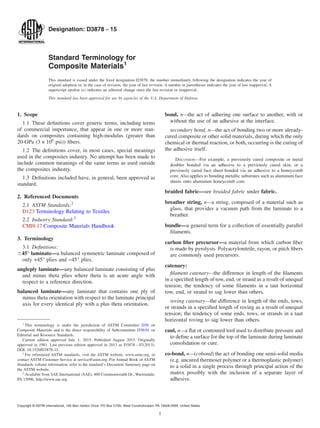
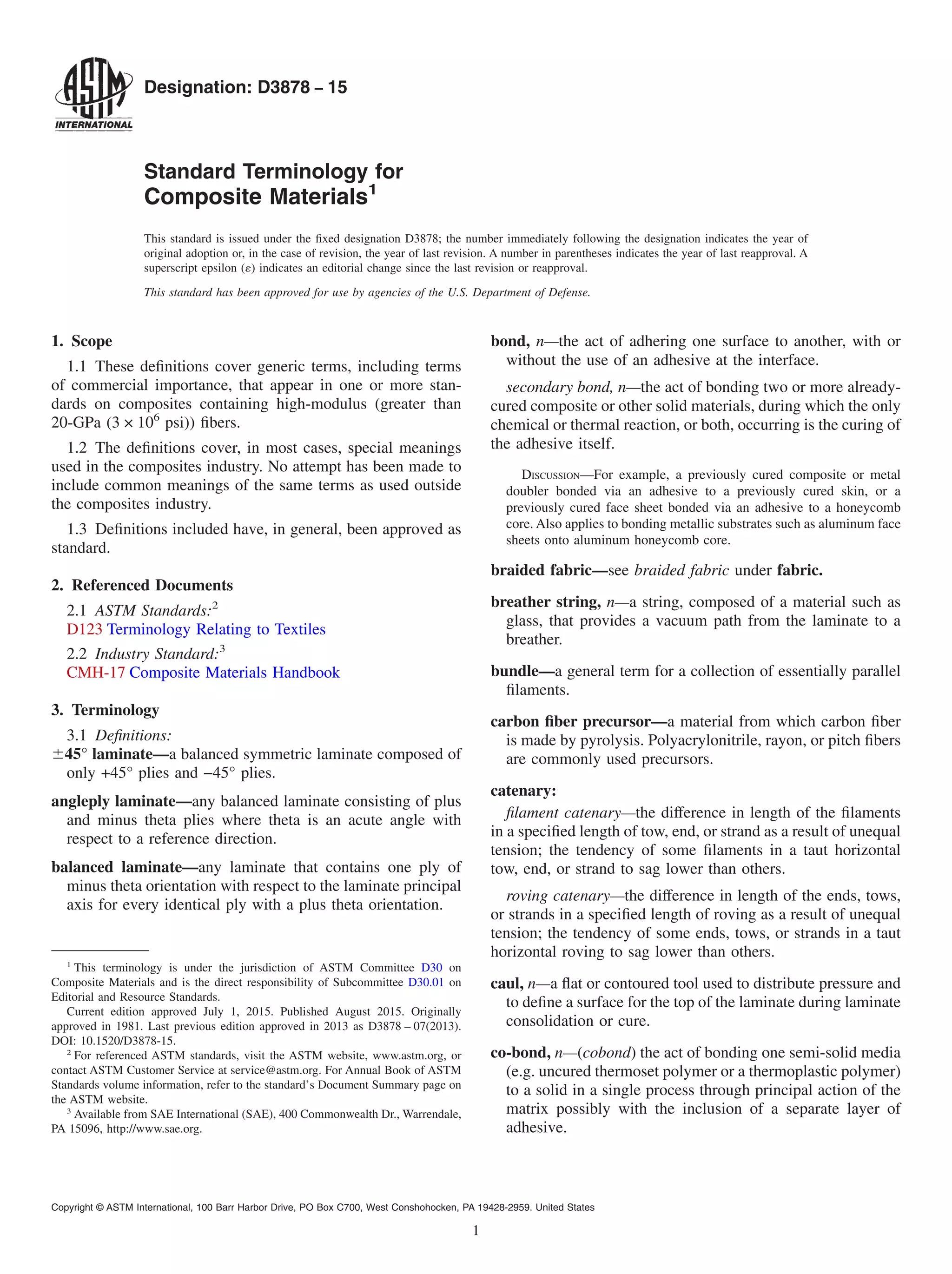
Designation: D3878 − 15
Standard Terminology for
Composite Materials1
This standard is issued under the fixed designation D3878; the number immediately following the designation indicates the year of
original adoption or, in the case of revision, the year of last revision. A number in parentheses indicates the year of last reapproval. A
superscript epsilon (´) indicates an editorial change since the last revision or reapproval.
This standard has been approved for use by agencies of the U.S. Department of Defense.
1. Scope
1.1 These definitions cover generic terms, including terms
of commercial importance, that appear in one or more stan-
dards on composites containing high-modulus (greater than
20-GPa (3 × 10⁶
psi)) fibers.
1.2 The definitions cover, in most cases, special meanings
used in the composites industry. No attempt has been made to
include common meanings of the same terms as used outside
the composites industry.
1.3 Definitions included have, in general, been approved as
standard.
2. Referenced Documents
2.1 ASTM Standards:2
D123 Terminology Relating to Textiles
2.2 Industry Standard:3
CMH-17 Composite Materials Handbook
3. Terminology
3.1 Definitions:
645° laminate—a balanced symmetric laminate composed of
only +45° plies and −45° plies.
angleply laminate—any balanced laminate consisting of plus
and minus theta plies where theta is an acute angle with
respect to a reference direction.
balanced laminate—any laminate that contains one ply of
minus theta orientation with respect to the laminate principal
axis for every identical ply with a plus theta orientation.
bond, n—the act of adhering one surface to another, with or
without the use of an adhesive at the interface.
secondary bond, n—the act of bonding two or more already-
cured composite or other solid materials, during which the only
chemical or thermal reaction, or both, occurring is the curing of
the adhesive itself.
DISCUSSION—For example, a previously cured composite or metal
doubler bonded via an adhesive to a previously cured skin, or a
previously cured face sheet bonded via an adhesive to a honeycomb
core. Also applies to bonding metallic substrates such as aluminum face
sheets onto aluminum honeycomb core.
braided fabric—see braided fabric under fabric.
breather string, n—a string, composed of a material such as
glass, that provides a vacuum path from the laminate to a
breather.
bundle—a general term for a collection of essentially parallel
filaments.
carbon fiber precursor—a material from which carbon fiber
is made by pyrolysis. Polyacrylonitrile, rayon, or pitch fibers
are commonly used precursors.
catenary:
filament catenary—the difference in length of the filaments
in a specified length of tow, end, or strand as a result of unequal
tension; the tendency of some filaments in a taut horizontal
tow, end, or strand to sag lower than others.
roving catenary—the difference in length of the ends, tows,
or strands in a specified length of roving as a result of unequal
tension; the tendency of some ends, tows, or strands in a taut
horizontal roving to sag lower than others.
caul, n—a flat or contoured tool used to distribute pressure and
to define a surface for the top of the laminate during laminate
consolidation or cure.
co-bond, n—(cobond) the act of bonding one semi-solid media
(e.g. uncured thermoset polymer or a thermoplastic polymer)
to a solid in a single process through principal action of the
matrix possibly with the inclusion of a separate layer of
adhesive.
1
This terminology is under the jurisdiction of ASTM Committee D30 on
Composite Materials and is the direct responsibility of Subcommittee D30.01 on
Editorial and Resource Standards.
Current edition approved July 1, 2015. Published August 2015. Originally
approved in 1981. Last previous edition approved in 2013 as D3878 – 07(2013).
DOI: 10.1520/D3878-15.
2
For referenced ASTM standards, visit the ASTM website, www.astm.org, or
contact ASTM Customer Service at service@astm.org. For Annual Book of ASTM
Standards volume information, refer to the standard’s Document Summary page on
the ASTM website.
3
Available from SAE International (SAE), 400 Commonwealth Dr., Warrendale,
PA 15096, http://www.sae.org.
Copyright © ASTM International, 100 Barr Harbor Drive, PO Box C700, West Conshohocken, PA 19428-2959. United States
1
co-cure, n—(cocure) the act of curing two semi-solid media
(i.e. uncured thermoset polymers) in a single process result-
ing in the two media being bonded through principal action
of the matrix, possibly with the inclusion of a separate layer
of adhesive at the interface.
co-fabrication, n—(cofabrication) a fabrication process where
items such as inserts and other details are bonded into a
composite structural component at the same time that the
component is cured or consolidated.
composite:
composite material—a substance consisting of two or more
materials, insoluble in one another, which are combined to
form a useful engineering material possessing certain proper-
ties not possessed by the constituents.
DISCUSSION—a composite material is inherently inhomogeneous on a
microscopic scale but can often be assumed to be homogeneous on a
macroscopic scale for certain engineering applications. The constitu-
ents of a composite retain their identities: they do not dissolve or
otherwise merge completely into each other, although they act in
concert.
discontinuous fiber-reinforced composite— any composite
material consisting of a matrix reinforced by discontinuous
fibers. The fibers may be whiskers or chopped fibers.
fabric-reinforced composite—any composite material con-
sisting of a matrix reinforced by fabric (woven, knitted, or
braided assemblages of fibers).
fiber-reinforced composite—any composite material consist-
ing of a matrix reinforced by continuous or discontinuous
fibers.
filamentary composite—a composite material reinforced
with continuous fibers.
unidirectional fiber-reinforced composite—any fiber-
reinforced composite with all fibers aligned in a single direc-
tion.
continuous filament yarn, n—two or more continuous fila-
ments twisted into a single fiber bundle.
core, n—an inner layer of a multi-layer adherend assembly.
DISCUSSION—The core is usually of a relatively low density material.
It separates the surface layers, and other possible layers, of a multi-
layer construction, generally stabilizing and transmitting shear between
them.
honeycomb core, n—a core material having a thin-walled
cell structure (often hexagonal) formed from a sheet material
and resembling natural honeycomb in appearance.
DISCUSSION—Honeycomb core materials exhibit anisotropic behav-
ior; therefore the following notation is used:
L = ribbon or longitudinal direction of core, parallel to the material used
to construct the core;
W = expanded or transverse direction of core; and
T = core thickness or cell depth.
core shear instability, n—the buckling of the core due to
transverse shear stresses.
DISCUSSION—Core shear instability is transverse-shear stress-
induced, occurs through the depth (thickness) of the core, and may
result in failure of the component by causing the face sheets to also fail
locally due to reduction in support. This phenomenon is sometimes
imprecisely referred to as “shear crimping.”
crossply laminate—a laminate composed of only 0 and 90°
plies. This is not necessarily symmetric.
cure, n—in thermoset polymer composite materials, the pro-
cess resulting in the overall transformation of the polymeric
matrix phase of the composite from a low molecular weight
resin/hardener system to a cross-linked network by chemical
reaction
dam, n—a solid material (such as silicone rubber, steel, or
aluminum), used in processing composites, to contain the
matrix material within defined boundaries or to prevent
crowning of a processing bag.
damage, n—in structures and structural mechanics, a struc-
tural anomaly in material or structure created by manufac-
turing or service usage.
damage resistance, n— in structures and structural
mechanics, a measure of the relationship between the force,
energy, or other parameter(s) associated with an event or
sequence of events and the resulting damage size and type.
DISCUSSION—Damage resistance increases as the force, energy, or
other parameter increases for a given size or type of damage.
Conversely, damage resistance increases as damage decreases, for a
given applied force, energy, or other parameter. Damage resistance and
damage tolerance are often confused. A material or structure with high
damage resistance will incur less physical damage from a given event.
Materials or structures with high damage tolerance may incur varying
levels of physical damage but will have high amounts of remaining
functionality. A damage-resistant material or structure may, or may not,
be considered damage tolerant.
damage tolerance, n—1) in structures and structure materials,
a measure of the relationship between damage size and type
and the level of a performance parameter, such as stiffness or
strength, at which the structure or structural material can
operate for a particular loading condition; 2) in structural
systems, a measure of the ability of such systems to function
at designated performance parameters (for example,
magnitude, length of time, and type of loading(s)) without
system failure in the presence of a particular or specified
level of damage.
DISCUSSION—Damage tolerance involves, and can be provided by, a
number of factors operating at a number of levels: structural material,
structural, and overall system. These factors include 1) basic material
ability to operate with damage present (often referred to as the residual
strength aspect), 2) damage growth resistance and containment pro-
vided by material and structural considerations, and 3) system inspec-
tion and maintenance plans which allow the damage to be detected and
corrected and which depend upon material, structural, and operational
considerations.
Damage tolerance increases as the damage size increases for a given
level of a performance parameter. Damage tolerance increases as the
level of the performance parameter increases for a given damage size.
Damage tolerance depends upon the type of loading which is applied.
For example, the damage tolerance for a compressive load can be, and
generally is, different than for the same level of tensile load.
Damage resistance is often confused with damage tolerance. Dam-
age tolerance is directly related only to the size and type of damage
while being only indirectly related to how the damage was created (see
damage resistance). Thus, damage tolerance is distinct from damage
resistance.
D3878 − 15
2
debond—a deliberate separation of a bonded joint or interface,
usually for repair or rework purposes.
debulk, v—to decrease voids between lamina before laminate
consolidation through use of vacuum or by mechanical
means.
DISCUSSION—Laminae can be debulked at ambient or elevated
temperatures.
delamination—separation of plies in a laminate. This may be
local or may cover a large area in the laminate.
denier, n—a direct numbering system for expressing linear
density, equal to the mass in grams per 9000 metres of yarn,
filament, fiber, or other textile strand.
disbond—an area within a bonded interface between two
adherents in which an adhesive or cohesive failure has
occurred. It may occur at any time during the life of the
structure and may arise from a wide variety of causes. It is
sometimes used to describe an area of separation between
two laminae in the finished laminate (the term “delamina-
tion” is preferred).
discontinuous fiber—a polycrystalline or amorphous fiber
that is discontinuous within the sample or component or that
has one or both ends inside of the stress field under
consideration. The minimum diameter of a discontinuous
fiber is not limited, but the maximum diameter may not
exceed 0.25 mm (0.010 in.).
end, n—in fibrous composites, a general term for a continuous,
ordered assembly of essentially parallel, collimated
filaments, with or without twist.
DISCUSSION—This term covers tow, strand, sliver, yarn, and roving.
The relationship between fiber form terms is shown in Table X1.1.
fabric—a planar textile (Synonym: cdth)
braided fabric, n—a cloth constructed by a braiding process.
knitted fabric, n—a cloth constructed by a knitting process.
nonwoven fabric, n—a cloth constructed by bonding or
interlocking, or both (but not interlacing) fiber by any combi-
nation of mechanical, chemical, thermal, or solvent means.
plied yarn, n—a yarn formed by twisting together two or
more single yarns in one operation.
DISCUSSION—Plying, which is done in the opposite direction from the
twist of each of the simple yarns, serves to counter the tendency of
simple yarns to untwist.
woven fabric, n—a cloth constructed by a weaving process.
face sheets, n—(facesheets) in sandwich construction, the
outer structural layers on each face of the core. (Synonyms:
face, skin, facing.)
DISCUSSION—The face sheets are generally thin and of higher density
relative to the core. The face sheets provide the primary ability to
equilibrate the in-plane normal and shear forces from bending and
torsion applied to the construction. If the face sheets are composite,
then the entire composite laminate bonded to one side of the core
constitutes a face sheet.
face sheet dimpling, n—in sandwich construction,(1) the
buckling of a face sheet into or out of the individual cells of
a honeycomb core due to localized compressive or shear
stresses, or both, or (2) the sagging of the face sheet into the
individual honeycomb cells during curing of composite face
sheets onto the core.
DISCUSSION—Although described by the same phrase, these two
phenomena are different in nature and in subsequent effects.
fabrication, n—the process of manufacturing, forming,
constructing, or assembling a product or component.
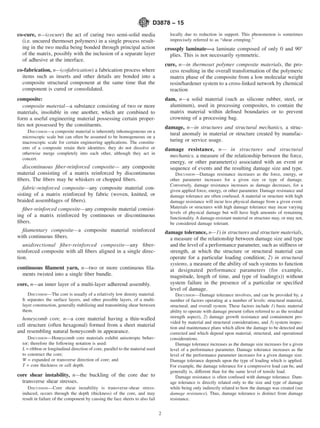
fiber, n—one or more filaments in an ordered assemblage.
DISCUSSION—There are a number of general and specific terms that
define specific types of fiber forms. The relationship between fiber form
terms is shown in Table 1.
fiber content—the amount of fiber present in a composite
expressed either as percent by weight or percent by volume.
This is sometimes stated as a fraction, that is, fiber volume
fraction.
fiber volume fraction—see fiber content.
filament, n—a fibrous form of matter with an aspect ratio >10
and an effective diameter <1 mm. (See also monofilament.)
DISCUSSION—Filaments may be essentially continuous (aspect ratio
on the order of 105
or larger) or discontinuous. Whiskers are the special
case of single crystal discontinuous filaments.
filament count—number of filaments in the cross section of a
fiber bundle.
fill, n—in a woven fabric, the yarn running from selvage to
selvage at right angles to the warp. CMH-17
filler—in composite materials, a primarily inert solid constitu-
ent added to the matrix to modify the composite properties or
to lower cost.
float, n—in woven fabric, the portion of a warp (or fill) yarn
that extends unbound over two ro more fill (or warp) yarns.
D123
gel time, n—in thermosetting polymers, the period of time
from a predetermined starting point to the onset of gelation
as determined by a specific test method.
TABLE 1 Fiber Forms
Continuous Filaments Discontinuous Filaments
Twist Twisted
Little or
No Twist
Twisted
Little
or No
Twist
Tow,A
*B
PC
—D
—
strand,
sliver
Single
yarn
P * P —
Plied
yarn
P — P —
RovingE
* P — —
end (generic term that can be applied to any of the above)
Chopped
fiber
— — — P
Whisker — — (single crystal)
A
Small filament count.
B
*—Secondary ⁄alternate definition.
C
P—primary ⁄preferred definition.
D
—not applicable.
E
Large filament count.
D3878 − 15
3
hybrid—(for composite materials) containing at least two
distinct types of matrix or reinforcement. Each matrix or
reinforcement type can be distinct because of its a) physical
or mechanical properties, or both, b) material form, or c)
chemical composition.
insert, n—in composite construction, an item bonded into the
composite, either during fabrication or via a secondary
operation, to distribute attachment stresses such as concen-
trated in-plane or pull-through loads.
DISCUSSION—Commonly used in sandwich construction, but also can
be used in compression molded composites and (rarely) in laminates.
Previously also referred to as “hard points.”
interlaminar—describing objects (for example, voids), events
(for example, fracture), or fields (for example, stress) be-
tween the laminae of a laminate.
intralaminar—describing objects (for example, voids), events
(for example, fracture), or fields (for example, stress) within
the laminae of a laminate.
knit—a textile process that interlocks, in a specific pattern loop
of yarn by means of needles or wires.
knitted fabric—See knitted fabric under fabric.
lamina—a subunit of a laminate consisting of one or more
adjacent plies of the same material with identical orientation.
lamina orientation—same as ply orientation.
laminate—any fiber- or fabric-reinforced composite consisting
of laminae (plies) with one or more orientations with respect
to some reference direction.
laminate coordinate axes—a set of coordinate axes, usually
right-handed Cartesian, used as reference in describing the
directional properties and geometrical structure of the lami-
nate. Usually the x-axis and the y-axis lie in the plane of the
laminate and the x-axis is the reference axis from which ply
angle is measured.
laminate midplane—the plane that is equidistant from both
surfaces of the laminate.
laminate principal axis—the laminate coordinate axis that
coincides with the direction of maximum inplane Young’s
modulus.
lay-up, n—(1) the stack of plies in specified sequence and
orientation before cure or consolidation; (2) the complete
stack of plies, bagging material, breather material, and so on
before cure or consolidation; and (3) a description of the
component materials, geometry, and so on of a laminate.
lay-up, v—to stack plies of material in specified sequence and
orientation.
lay-up code—a designation system for abbreviating the stack-
ing sequence of laminated composites.
mandrel—a form, fixture, or male mold used as the base for
production of a part in processes such as lay-up or filament
winding.
material form—the contour, arrangement, and structure of an
unconsolidated composite material, especially with regard to
the geometry and nature of the reinforcement. Factors
considered part of the material form include, but are not
limited to: reinforcement diameter, reinforcement length (for
discontinuous reinforcements), tow size or count, fabric
areal weight, fabric style, reinforcement content, and ply
thickness.
matrix, n—the continuous constituent of a composite material,
which surrounds or engulfs embedded filler or reinforce-
ment.
matrix content—the amount of matrix present in a composite
expressed either as percent by weight or percent by volume.
For polymer matrix composites this is resin content.
mold, n—the support structure that holds the laminate or
lay-up during the laminate consolidation process.
monofilament—a continuous filament strong enough to func-
tion as a yarn in commercial textile operations or as an entity
in other operations.
nonwoven fabric—See nonwoven fabric under fabric.
off-axis laminate—a laminate whose principal axis is oriented
at an angle theta other than 0 or 90° with respect to a
reference direction, usually related to principal load or stress
direction.
orthotropic material—a material in which a property of
interest, at a given point, possesses three mutually perpen-
dicular planes of symmetry, which taken together define the
principal material coordinate system.
pigment—a substance, generally in the form of fine particles,
that is substantially insoluble in the matrix and is used
because of its color or decorative properties.
plied yarn—See plied yarn under yarn.
ply—(in laminar composites) the constituent single layer as
used in fabricating, or occurring within a composite struc-
ture.
ply coordinate axes—a set of Cartesian coordinates two of
which lie within the plane of the ply, one axis of which is
parallel to the principal fiber direction and the other axis
perpendicular to the principal fiber direction (the third axis is
through the ply’s thickness).
ply count, n—in laminated composite materials, the number of
plies or laminae used to construct the composite.
ply orientation—the acute angle (theta) including 90° be-
tween a reference direction and the ply principal axis. The
ply orientation is positive if measured counterclockwise
from the reference direction and negative if measured
clockwise.
ply principal axis—the ply coordinate axis that coincides with
the direction of maximum inplane Young’s modulus. For
balanced weave fabric either warp or fill direction may be
chosen.
D3878 − 15
4
preform, n—a preshaped fibrous reinforcement, normally
without matrix, but often containing a binder to facilitate
manufacture, formed by distribution of fibers to the approxi-
mate contour and thickness of the finished part.
prepreg—the admixture of fibrous reinforcement and poly-
meric matrix used to fabricate composite materials. Its form
may be sheet, tape, or tow. For thermosetting matrices, it has
been partially cured to a controlled viscosity called “B
stage.”
quasi-isotropic laminate—a balanced and symmetric lami-
nate for which a constitutive property of interest, at a given
point, displays isotropic behavior in the plane of the lami-
nate. Common quasi-isotropic laminates are (0/660)s and
(0/645/90)s.
DISCUSSION—Usually a quasi-isotropic laminate refers to elastic
properties, for which case, the laminate contains equal numbers of
identical plies at k orientations such that the angles between the plies
are 180i/k (i = 0, 1 . . . k − 1); k > = 3. Other material properties may
follow different rules. For example, thermal conductivity becomes
quasi-isotropic for k > = 2, while strength properties generally are not
capable of true quasi-isotropy, only approximating this behavior.
reinforcement, n—in a composite material, the discrete con-
stituent of a composite material, either fiber or particle,
which is contained within the matrix, with a purpose of
increasing the strength, or stiffness, or both.
resin—a solid or pseudosolid organic material often of high
molecular weight, which exhibits a tendency to flow when
subjected to stress, usually has a softening or melting range,
and usually fractures conchoidally.
resin content—see matrix content.
roving, n—in fibrous composites, large filament count tow.
(See also tow and filament count.)
sandwich construction, n—a structural arrangement consist-
ing of three or more bonded layers of differing materials.
DISCUSSION—In its most common form, two relatively thin, generally
parallel sheets of structural material are bonded to, and separated by, a
relatively thick, light-weight core.
satin, adj—description of a weave pattern in which warp yarns
pass unbound (“float”) over several fill yarns before crossing
under a single fill yarn.
DISCUSSION—A satin weave is characterized by parallel fibers and no
diagonal pattern.
selvage, n—the woven edge portion of a fabric parallel to the
warp.
single yarn—See single yarn under yarn.
stacking sequence—the arrangement of ply orientations and
material components in a laminate specified with respect to
some reference direction.
staple, n—a collection of discontinuous filaments of spinnable
length that are natural, manufactured directly in a short
length, or cut from continuous filaments.
strand— in fibrous composites, Synonym for tow.
symmetric laminate—a laminate in which the stacking se-
quence for the plies located on one side of the geometric
midplane are the mirror image of the stacking sequence on
the other side of the midplane.
tab, n—a piece of material used to hold the laminate specimen
in a grip or fixture for testing so that the laminate is not
damaged and is adequately supported.
textile, n—a general term applied to fibers and organized
assemblies of fibers with sufficient integrity to retain the
organization.
DISCUSSION—Originally limited to woven fabrics, this term is now
also applied to fibers, yarn intermediates, yarns, woven and nonwoven
fabrics, braids, knits, and preforms, as illustrated in Fig. 1.
thermoplastic—a plastic that repeatedly can be softened by
heating and hardened by cooling through a temperature
range characteristic of the plastic, and that in the softened
state can be shaped by flow into articles by molding or
extrusion.
thermoset—a class of polymers that, when cured using heat,
chemical, or other means, changes into a substantially
infusible and insoluble material.
FIG. 1 Illustration of Textile Relationships
D3878 − 15
5
tow—in fibrous composites, a continuous, ordered assembly of
essentially parallel, collimated filaments, normally without
twist and of continuous filaments (Synonyms: strand and
silver).
twist, n—in fibrous composites, a measure of the number of
turns per unit length a fiber bundle makes around its axis.
DISCUSSION—Twist is noted as being either ’S’-twist or ’Z’-twist,
where the shape of the letters are used as a mnemonic to describe the
direction of the twist. Following the right-hand rule along the axis of
the fiber bundle, ’Z’-twist is a positive twist and ’S’-twist is a negative
twist. In addition, ’U’ is often used to represent no twist (untwisted) and
’N’ no twist (never twisted).
void—any pocket of enclosed gas or air within a composite.
void content, n—the volume percentage of voids in a compos-
ite.
warp, n—(1) the yarn running lengthwise in a woven fabric;
(2) a group of yarns in long lengths and approximately
parallel, put on beams or warp reels for further textile
processing including weaving, knitting, twisting, dyeing,
and so forth. D123
warp nested, adj—laid up so that warp plies alternate in the
pattern: warp surface up, warp surface down.
warp surface, n—the ply surface that shows the larger area of
warp tows with respect to fill tows.
DISCUSSION—Fabrics in which both surfaces show an equal area of
warp tows with respect to fill tows do not have a warp surface.
weave, v—interlaces, in a specific pattern, strands or yarns
oriented in two or more directions in a planar textile process.
winding—a process in which continuous material is applied
under controlled tension to a form in a predetermined
geometric relationship to make a structure. A matrix material
to bind the fibers together may be added before, during or
after winding. Filament winding is the most common type.
woven fabric—See woven fabric under fabric.
yarn—in fibrous composites, a continuous, ordered assembly
of essentially parallel, collimated filaments, normally with
twist, and of either discontinuous or continuous filaments.
single yarn, n—an end in which each filament follows the
same twist.
ASTM International takes no position respecting the validity of any patent rights asserted in connection with any item mentioned
in this standard. Users of this standard are expressly advised that determination of the validity of any such patent rights, and the risk
of infringement of such rights, are entirely their own responsibility.
This standard is subject to revision at any time by the responsible technical committee and must be reviewed every five years and
if not revised, either reapproved or withdrawn. Your comments are invited either for revision of this standard or for additional standards
and should be addressed to ASTM International Headquarters. Your comments will receive careful consideration at a meeting of the
responsible technical committee, which you may attend. If you feel that your comments have not received a fair hearing you should
make your views known to the ASTM Committee on Standards, at the address shown below.
This standard is copyrighted by ASTM International, 100 Barr Harbor Drive, PO Box C700, West Conshohocken, PA 19428-2959,
United States. Individual reprints (single or multiple copies) of this standard may be obtained by contacting ASTM at the above
address or at 610-832-9585 (phone), 610-832-9555 (fax), or service@astm.org (e-mail); or through the ASTM website
(www.astm.org). Permission rights to photocopy the standard may also be secured from the Copyright Clearance Center, 222
Rosewood Drive, Danvers, MA 01923, Tel: (978) 646-2600; http://www.copyright.com/
D3878 − 15
6

D3878.40664 Standard Terminology for Composite Materials.pdf

  • 1.
    Designation: D3878 −15 Standard Terminology for Composite Materials1 This standard is issued under the fixed designation D3878; the number immediately following the designation indicates the year of original adoption or, in the case of revision, the year of last revision. A number in parentheses indicates the year of last reapproval. A superscript epsilon (´) indicates an editorial change since the last revision or reapproval. This standard has been approved for use by agencies of the U.S. Department of Defense. 1. Scope 1.1 These definitions cover generic terms, including terms of commercial importance, that appear in one or more stan- dards on composites containing high-modulus (greater than 20-GPa (3 × 10⁶ psi)) fibers. 1.2 The definitions cover, in most cases, special meanings used in the composites industry. No attempt has been made to include common meanings of the same terms as used outside the composites industry. 1.3 Definitions included have, in general, been approved as standard. 2. Referenced Documents 2.1 ASTM Standards:2 D123 Terminology Relating to Textiles 2.2 Industry Standard:3 CMH-17 Composite Materials Handbook 3. Terminology 3.1 Definitions: 645° laminate—a balanced symmetric laminate composed of only +45° plies and −45° plies. angleply laminate—any balanced laminate consisting of plus and minus theta plies where theta is an acute angle with respect to a reference direction. balanced laminate—any laminate that contains one ply of minus theta orientation with respect to the laminate principal axis for every identical ply with a plus theta orientation. bond, n—the act of adhering one surface to another, with or without the use of an adhesive at the interface. secondary bond, n—the act of bonding two or more already- cured composite or other solid materials, during which the only chemical or thermal reaction, or both, occurring is the curing of the adhesive itself. DISCUSSION—For example, a previously cured composite or metal doubler bonded via an adhesive to a previously cured skin, or a previously cured face sheet bonded via an adhesive to a honeycomb core. Also applies to bonding metallic substrates such as aluminum face sheets onto aluminum honeycomb core. braided fabric—see braided fabric under fabric. breather string, n—a string, composed of a material such as glass, that provides a vacuum path from the laminate to a breather. bundle—a general term for a collection of essentially parallel filaments. carbon fiber precursor—a material from which carbon fiber is made by pyrolysis. Polyacrylonitrile, rayon, or pitch fibers are commonly used precursors. catenary: filament catenary—the difference in length of the filaments in a specified length of tow, end, or strand as a result of unequal tension; the tendency of some filaments in a taut horizontal tow, end, or strand to sag lower than others. roving catenary—the difference in length of the ends, tows, or strands in a specified length of roving as a result of unequal tension; the tendency of some ends, tows, or strands in a taut horizontal roving to sag lower than others. caul, n—a flat or contoured tool used to distribute pressure and to define a surface for the top of the laminate during laminate consolidation or cure. co-bond, n—(cobond) the act of bonding one semi-solid media (e.g. uncured thermoset polymer or a thermoplastic polymer) to a solid in a single process through principal action of the matrix possibly with the inclusion of a separate layer of adhesive. 1 This terminology is under the jurisdiction of ASTM Committee D30 on Composite Materials and is the direct responsibility of Subcommittee D30.01 on Editorial and Resource Standards. Current edition approved July 1, 2015. Published August 2015. Originally approved in 1981. Last previous edition approved in 2013 as D3878 – 07(2013). DOI: 10.1520/D3878-15. 2 For referenced ASTM standards, visit the ASTM website, www.astm.org, or contact ASTM Customer Service at service@astm.org. For Annual Book of ASTM Standards volume information, refer to the standard’s Document Summary page on the ASTM website. 3 Available from SAE International (SAE), 400 Commonwealth Dr., Warrendale, PA 15096, http://www.sae.org. Copyright © ASTM International, 100 Barr Harbor Drive, PO Box C700, West Conshohocken, PA 19428-2959. United States 1
  • 2.
    co-cure, n—(cocure) theact of curing two semi-solid media (i.e. uncured thermoset polymers) in a single process result- ing in the two media being bonded through principal action of the matrix, possibly with the inclusion of a separate layer of adhesive at the interface. co-fabrication, n—(cofabrication) a fabrication process where items such as inserts and other details are bonded into a composite structural component at the same time that the component is cured or consolidated. composite: composite material—a substance consisting of two or more materials, insoluble in one another, which are combined to form a useful engineering material possessing certain proper- ties not possessed by the constituents. DISCUSSION—a composite material is inherently inhomogeneous on a microscopic scale but can often be assumed to be homogeneous on a macroscopic scale for certain engineering applications. The constitu- ents of a composite retain their identities: they do not dissolve or otherwise merge completely into each other, although they act in concert. discontinuous fiber-reinforced composite— any composite material consisting of a matrix reinforced by discontinuous fibers. The fibers may be whiskers or chopped fibers. fabric-reinforced composite—any composite material con- sisting of a matrix reinforced by fabric (woven, knitted, or braided assemblages of fibers). fiber-reinforced composite—any composite material consist- ing of a matrix reinforced by continuous or discontinuous fibers. filamentary composite—a composite material reinforced with continuous fibers. unidirectional fiber-reinforced composite—any fiber- reinforced composite with all fibers aligned in a single direc- tion. continuous filament yarn, n—two or more continuous fila- ments twisted into a single fiber bundle. core, n—an inner layer of a multi-layer adherend assembly. DISCUSSION—The core is usually of a relatively low density material. It separates the surface layers, and other possible layers, of a multi- layer construction, generally stabilizing and transmitting shear between them. honeycomb core, n—a core material having a thin-walled cell structure (often hexagonal) formed from a sheet material and resembling natural honeycomb in appearance. DISCUSSION—Honeycomb core materials exhibit anisotropic behav- ior; therefore the following notation is used: L = ribbon or longitudinal direction of core, parallel to the material used to construct the core; W = expanded or transverse direction of core; and T = core thickness or cell depth. core shear instability, n—the buckling of the core due to transverse shear stresses. DISCUSSION—Core shear instability is transverse-shear stress- induced, occurs through the depth (thickness) of the core, and may result in failure of the component by causing the face sheets to also fail locally due to reduction in support. This phenomenon is sometimes imprecisely referred to as “shear crimping.” crossply laminate—a laminate composed of only 0 and 90° plies. This is not necessarily symmetric. cure, n—in thermoset polymer composite materials, the pro- cess resulting in the overall transformation of the polymeric matrix phase of the composite from a low molecular weight resin/hardener system to a cross-linked network by chemical reaction dam, n—a solid material (such as silicone rubber, steel, or aluminum), used in processing composites, to contain the matrix material within defined boundaries or to prevent crowning of a processing bag. damage, n—in structures and structural mechanics, a struc- tural anomaly in material or structure created by manufac- turing or service usage. damage resistance, n— in structures and structural mechanics, a measure of the relationship between the force, energy, or other parameter(s) associated with an event or sequence of events and the resulting damage size and type. DISCUSSION—Damage resistance increases as the force, energy, or other parameter increases for a given size or type of damage. Conversely, damage resistance increases as damage decreases, for a given applied force, energy, or other parameter. Damage resistance and damage tolerance are often confused. A material or structure with high damage resistance will incur less physical damage from a given event. Materials or structures with high damage tolerance may incur varying levels of physical damage but will have high amounts of remaining functionality. A damage-resistant material or structure may, or may not, be considered damage tolerant. damage tolerance, n—1) in structures and structure materials, a measure of the relationship between damage size and type and the level of a performance parameter, such as stiffness or strength, at which the structure or structural material can operate for a particular loading condition; 2) in structural systems, a measure of the ability of such systems to function at designated performance parameters (for example, magnitude, length of time, and type of loading(s)) without system failure in the presence of a particular or specified level of damage. DISCUSSION—Damage tolerance involves, and can be provided by, a number of factors operating at a number of levels: structural material, structural, and overall system. These factors include 1) basic material ability to operate with damage present (often referred to as the residual strength aspect), 2) damage growth resistance and containment pro- vided by material and structural considerations, and 3) system inspec- tion and maintenance plans which allow the damage to be detected and corrected and which depend upon material, structural, and operational considerations. Damage tolerance increases as the damage size increases for a given level of a performance parameter. Damage tolerance increases as the level of the performance parameter increases for a given damage size. Damage tolerance depends upon the type of loading which is applied. For example, the damage tolerance for a compressive load can be, and generally is, different than for the same level of tensile load. Damage resistance is often confused with damage tolerance. Dam- age tolerance is directly related only to the size and type of damage while being only indirectly related to how the damage was created (see damage resistance). Thus, damage tolerance is distinct from damage resistance. D3878 − 15 2
  • 3.
    debond—a deliberate separationof a bonded joint or interface, usually for repair or rework purposes. debulk, v—to decrease voids between lamina before laminate consolidation through use of vacuum or by mechanical means. DISCUSSION—Laminae can be debulked at ambient or elevated temperatures. delamination—separation of plies in a laminate. This may be local or may cover a large area in the laminate. denier, n—a direct numbering system for expressing linear density, equal to the mass in grams per 9000 metres of yarn, filament, fiber, or other textile strand. disbond—an area within a bonded interface between two adherents in which an adhesive or cohesive failure has occurred. It may occur at any time during the life of the structure and may arise from a wide variety of causes. It is sometimes used to describe an area of separation between two laminae in the finished laminate (the term “delamina- tion” is preferred). discontinuous fiber—a polycrystalline or amorphous fiber that is discontinuous within the sample or component or that has one or both ends inside of the stress field under consideration. The minimum diameter of a discontinuous fiber is not limited, but the maximum diameter may not exceed 0.25 mm (0.010 in.). end, n—in fibrous composites, a general term for a continuous, ordered assembly of essentially parallel, collimated filaments, with or without twist. DISCUSSION—This term covers tow, strand, sliver, yarn, and roving. The relationship between fiber form terms is shown in Table X1.1. fabric—a planar textile (Synonym: cdth) braided fabric, n—a cloth constructed by a braiding process. knitted fabric, n—a cloth constructed by a knitting process. nonwoven fabric, n—a cloth constructed by bonding or interlocking, or both (but not interlacing) fiber by any combi- nation of mechanical, chemical, thermal, or solvent means. plied yarn, n—a yarn formed by twisting together two or more single yarns in one operation. DISCUSSION—Plying, which is done in the opposite direction from the twist of each of the simple yarns, serves to counter the tendency of simple yarns to untwist. woven fabric, n—a cloth constructed by a weaving process. face sheets, n—(facesheets) in sandwich construction, the outer structural layers on each face of the core. (Synonyms: face, skin, facing.) DISCUSSION—The face sheets are generally thin and of higher density relative to the core. The face sheets provide the primary ability to equilibrate the in-plane normal and shear forces from bending and torsion applied to the construction. If the face sheets are composite, then the entire composite laminate bonded to one side of the core constitutes a face sheet. face sheet dimpling, n—in sandwich construction,(1) the buckling of a face sheet into or out of the individual cells of a honeycomb core due to localized compressive or shear stresses, or both, or (2) the sagging of the face sheet into the individual honeycomb cells during curing of composite face sheets onto the core. DISCUSSION—Although described by the same phrase, these two phenomena are different in nature and in subsequent effects. fabrication, n—the process of manufacturing, forming, constructing, or assembling a product or component. fiber, n—one or more filaments in an ordered assemblage. DISCUSSION—There are a number of general and specific terms that define specific types of fiber forms. The relationship between fiber form terms is shown in Table 1. fiber content—the amount of fiber present in a composite expressed either as percent by weight or percent by volume. This is sometimes stated as a fraction, that is, fiber volume fraction. fiber volume fraction—see fiber content. filament, n—a fibrous form of matter with an aspect ratio >10 and an effective diameter <1 mm. (See also monofilament.) DISCUSSION—Filaments may be essentially continuous (aspect ratio on the order of 105 or larger) or discontinuous. Whiskers are the special case of single crystal discontinuous filaments. filament count—number of filaments in the cross section of a fiber bundle. fill, n—in a woven fabric, the yarn running from selvage to selvage at right angles to the warp. CMH-17 filler—in composite materials, a primarily inert solid constitu- ent added to the matrix to modify the composite properties or to lower cost. float, n—in woven fabric, the portion of a warp (or fill) yarn that extends unbound over two ro more fill (or warp) yarns. D123 gel time, n—in thermosetting polymers, the period of time from a predetermined starting point to the onset of gelation as determined by a specific test method. TABLE 1 Fiber Forms Continuous Filaments Discontinuous Filaments Twist Twisted Little or No Twist Twisted Little or No Twist Tow,A *B PC —D — strand, sliver Single yarn P * P — Plied yarn P — P — RovingE * P — — end (generic term that can be applied to any of the above) Chopped fiber — — — P Whisker — — (single crystal) A Small filament count. B *—Secondary ⁄alternate definition. C P—primary ⁄preferred definition. D —not applicable. E Large filament count. D3878 − 15 3
  • 4.
    hybrid—(for composite materials)containing at least two distinct types of matrix or reinforcement. Each matrix or reinforcement type can be distinct because of its a) physical or mechanical properties, or both, b) material form, or c) chemical composition. insert, n—in composite construction, an item bonded into the composite, either during fabrication or via a secondary operation, to distribute attachment stresses such as concen- trated in-plane or pull-through loads. DISCUSSION—Commonly used in sandwich construction, but also can be used in compression molded composites and (rarely) in laminates. Previously also referred to as “hard points.” interlaminar—describing objects (for example, voids), events (for example, fracture), or fields (for example, stress) be- tween the laminae of a laminate. intralaminar—describing objects (for example, voids), events (for example, fracture), or fields (for example, stress) within the laminae of a laminate. knit—a textile process that interlocks, in a specific pattern loop of yarn by means of needles or wires. knitted fabric—See knitted fabric under fabric. lamina—a subunit of a laminate consisting of one or more adjacent plies of the same material with identical orientation. lamina orientation—same as ply orientation. laminate—any fiber- or fabric-reinforced composite consisting of laminae (plies) with one or more orientations with respect to some reference direction. laminate coordinate axes—a set of coordinate axes, usually right-handed Cartesian, used as reference in describing the directional properties and geometrical structure of the lami- nate. Usually the x-axis and the y-axis lie in the plane of the laminate and the x-axis is the reference axis from which ply angle is measured. laminate midplane—the plane that is equidistant from both surfaces of the laminate. laminate principal axis—the laminate coordinate axis that coincides with the direction of maximum inplane Young’s modulus. lay-up, n—(1) the stack of plies in specified sequence and orientation before cure or consolidation; (2) the complete stack of plies, bagging material, breather material, and so on before cure or consolidation; and (3) a description of the component materials, geometry, and so on of a laminate. lay-up, v—to stack plies of material in specified sequence and orientation. lay-up code—a designation system for abbreviating the stack- ing sequence of laminated composites. mandrel—a form, fixture, or male mold used as the base for production of a part in processes such as lay-up or filament winding. material form—the contour, arrangement, and structure of an unconsolidated composite material, especially with regard to the geometry and nature of the reinforcement. Factors considered part of the material form include, but are not limited to: reinforcement diameter, reinforcement length (for discontinuous reinforcements), tow size or count, fabric areal weight, fabric style, reinforcement content, and ply thickness. matrix, n—the continuous constituent of a composite material, which surrounds or engulfs embedded filler or reinforce- ment. matrix content—the amount of matrix present in a composite expressed either as percent by weight or percent by volume. For polymer matrix composites this is resin content. mold, n—the support structure that holds the laminate or lay-up during the laminate consolidation process. monofilament—a continuous filament strong enough to func- tion as a yarn in commercial textile operations or as an entity in other operations. nonwoven fabric—See nonwoven fabric under fabric. off-axis laminate—a laminate whose principal axis is oriented at an angle theta other than 0 or 90° with respect to a reference direction, usually related to principal load or stress direction. orthotropic material—a material in which a property of interest, at a given point, possesses three mutually perpen- dicular planes of symmetry, which taken together define the principal material coordinate system. pigment—a substance, generally in the form of fine particles, that is substantially insoluble in the matrix and is used because of its color or decorative properties. plied yarn—See plied yarn under yarn. ply—(in laminar composites) the constituent single layer as used in fabricating, or occurring within a composite struc- ture. ply coordinate axes—a set of Cartesian coordinates two of which lie within the plane of the ply, one axis of which is parallel to the principal fiber direction and the other axis perpendicular to the principal fiber direction (the third axis is through the ply’s thickness). ply count, n—in laminated composite materials, the number of plies or laminae used to construct the composite. ply orientation—the acute angle (theta) including 90° be- tween a reference direction and the ply principal axis. The ply orientation is positive if measured counterclockwise from the reference direction and negative if measured clockwise. ply principal axis—the ply coordinate axis that coincides with the direction of maximum inplane Young’s modulus. For balanced weave fabric either warp or fill direction may be chosen. D3878 − 15 4
  • 5.
    preform, n—a preshapedfibrous reinforcement, normally without matrix, but often containing a binder to facilitate manufacture, formed by distribution of fibers to the approxi- mate contour and thickness of the finished part. prepreg—the admixture of fibrous reinforcement and poly- meric matrix used to fabricate composite materials. Its form may be sheet, tape, or tow. For thermosetting matrices, it has been partially cured to a controlled viscosity called “B stage.” quasi-isotropic laminate—a balanced and symmetric lami- nate for which a constitutive property of interest, at a given point, displays isotropic behavior in the plane of the lami- nate. Common quasi-isotropic laminates are (0/660)s and (0/645/90)s. DISCUSSION—Usually a quasi-isotropic laminate refers to elastic properties, for which case, the laminate contains equal numbers of identical plies at k orientations such that the angles between the plies are 180i/k (i = 0, 1 . . . k − 1); k > = 3. Other material properties may follow different rules. For example, thermal conductivity becomes quasi-isotropic for k > = 2, while strength properties generally are not capable of true quasi-isotropy, only approximating this behavior. reinforcement, n—in a composite material, the discrete con- stituent of a composite material, either fiber or particle, which is contained within the matrix, with a purpose of increasing the strength, or stiffness, or both. resin—a solid or pseudosolid organic material often of high molecular weight, which exhibits a tendency to flow when subjected to stress, usually has a softening or melting range, and usually fractures conchoidally. resin content—see matrix content. roving, n—in fibrous composites, large filament count tow. (See also tow and filament count.) sandwich construction, n—a structural arrangement consist- ing of three or more bonded layers of differing materials. DISCUSSION—In its most common form, two relatively thin, generally parallel sheets of structural material are bonded to, and separated by, a relatively thick, light-weight core. satin, adj—description of a weave pattern in which warp yarns pass unbound (“float”) over several fill yarns before crossing under a single fill yarn. DISCUSSION—A satin weave is characterized by parallel fibers and no diagonal pattern. selvage, n—the woven edge portion of a fabric parallel to the warp. single yarn—See single yarn under yarn. stacking sequence—the arrangement of ply orientations and material components in a laminate specified with respect to some reference direction. staple, n—a collection of discontinuous filaments of spinnable length that are natural, manufactured directly in a short length, or cut from continuous filaments. strand— in fibrous composites, Synonym for tow. symmetric laminate—a laminate in which the stacking se- quence for the plies located on one side of the geometric midplane are the mirror image of the stacking sequence on the other side of the midplane. tab, n—a piece of material used to hold the laminate specimen in a grip or fixture for testing so that the laminate is not damaged and is adequately supported. textile, n—a general term applied to fibers and organized assemblies of fibers with sufficient integrity to retain the organization. DISCUSSION—Originally limited to woven fabrics, this term is now also applied to fibers, yarn intermediates, yarns, woven and nonwoven fabrics, braids, knits, and preforms, as illustrated in Fig. 1. thermoplastic—a plastic that repeatedly can be softened by heating and hardened by cooling through a temperature range characteristic of the plastic, and that in the softened state can be shaped by flow into articles by molding or extrusion. thermoset—a class of polymers that, when cured using heat, chemical, or other means, changes into a substantially infusible and insoluble material. FIG. 1 Illustration of Textile Relationships D3878 − 15 5
  • 6.
    tow—in fibrous composites,a continuous, ordered assembly of essentially parallel, collimated filaments, normally without twist and of continuous filaments (Synonyms: strand and silver). twist, n—in fibrous composites, a measure of the number of turns per unit length a fiber bundle makes around its axis. DISCUSSION—Twist is noted as being either ’S’-twist or ’Z’-twist, where the shape of the letters are used as a mnemonic to describe the direction of the twist. Following the right-hand rule along the axis of the fiber bundle, ’Z’-twist is a positive twist and ’S’-twist is a negative twist. In addition, ’U’ is often used to represent no twist (untwisted) and ’N’ no twist (never twisted). void—any pocket of enclosed gas or air within a composite. void content, n—the volume percentage of voids in a compos- ite. warp, n—(1) the yarn running lengthwise in a woven fabric; (2) a group of yarns in long lengths and approximately parallel, put on beams or warp reels for further textile processing including weaving, knitting, twisting, dyeing, and so forth. D123 warp nested, adj—laid up so that warp plies alternate in the pattern: warp surface up, warp surface down. warp surface, n—the ply surface that shows the larger area of warp tows with respect to fill tows. DISCUSSION—Fabrics in which both surfaces show an equal area of warp tows with respect to fill tows do not have a warp surface. weave, v—interlaces, in a specific pattern, strands or yarns oriented in two or more directions in a planar textile process. winding—a process in which continuous material is applied under controlled tension to a form in a predetermined geometric relationship to make a structure. A matrix material to bind the fibers together may be added before, during or after winding. Filament winding is the most common type. woven fabric—See woven fabric under fabric. yarn—in fibrous composites, a continuous, ordered assembly of essentially parallel, collimated filaments, normally with twist, and of either discontinuous or continuous filaments. single yarn, n—an end in which each filament follows the same twist. ASTM International takes no position respecting the validity of any patent rights asserted in connection with any item mentioned in this standard. Users of this standard are expressly advised that determination of the validity of any such patent rights, and the risk of infringement of such rights, are entirely their own responsibility. This standard is subject to revision at any time by the responsible technical committee and must be reviewed every five years and if not revised, either reapproved or withdrawn. Your comments are invited either for revision of this standard or for additional standards and should be addressed to ASTM International Headquarters. Your comments will receive careful consideration at a meeting of the responsible technical committee, which you may attend. If you feel that your comments have not received a fair hearing you should make your views known to the ASTM Committee on Standards, at the address shown below. This standard is copyrighted by ASTM International, 100 Barr Harbor Drive, PO Box C700, West Conshohocken, PA 19428-2959, United States. Individual reprints (single or multiple copies) of this standard may be obtained by contacting ASTM at the above address or at 610-832-9585 (phone), 610-832-9555 (fax), or service@astm.org (e-mail); or through the ASTM website (www.astm.org). Permission rights to photocopy the standard may also be secured from the Copyright Clearance Center, 222 Rosewood Drive, Danvers, MA 01923, Tel: (978) 646-2600; http://www.copyright.com/ D3878 − 15 6