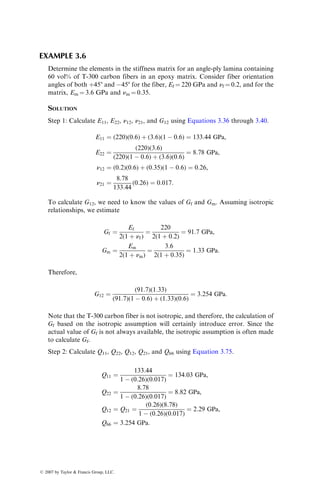
FIBER-
REINFORCED
COMPOSITES
Materials, Manufacturing,
and Design
THIRD EDITION
ß 2007 by Taylor & Francis Group, LLC.
CRC Press is an imprint of the
Taylor & Francis Group, an informa business
Boca Raton London New York
FIBER-
REINFORCED
COMPOSITES
Materials, Manufacturing,
and Design
P.K. Mallick
Department of Mechanical Engineering
University of Michigan-Dearborn
Dearborn, Michigan
THIRD EDITION
ß 2007 by Taylor & Francis Group, LLC.
CRC Press
Taylor & Francis Group
6000 Broken Sound Parkway NW, Suite 300
Boca Raton, FL 33487-2742
© 2008 by Taylor & Francis Group, LLC
CRC Press is an imprint of Taylor & Francis Group, an Informa business
No claim to original U.S. Government works
Printed in the United States of America on acid-free paper
10 9 8 7 6 5 4 3 2 1
International Standard Book Number-13: 978-0-8493-4205-9 (Hardcover)
This book contains information obtained from authentic and highly regarded sources. Reprinted material
is quoted with permission, and sources are indicated. A wide variety of references are listed. Reasonable
efforts have been made to publish reliable data and information, but the author and the publisher cannot
assume responsibility for the validity of all materials or for the consequences of their use.
No part of this book may be reprinted, reproduced, transmitted, or utilized in any form by any electronic,
mechanical, or other means, now known or hereafter invented, including photocopying, microfilming,
and recording, or in any information storage or retrieval system, without written permission from the
publishers.
For permission to photocopy or use material electronically from this work, please access www.copyright.
com (http://www.copyright.com/) or contact the Copyright Clearance Center, Inc. (CCC) 222 Rosewood
Drive, Danvers, MA 01923, 978-750-8400. CCC is a not-for-profit organization that provides licenses and
registration for a variety of users. For organizations that have been granted a photocopy license by the
CCC, a separate system of payment has been arranged.
Trademark Notice: Product or corporate names may be trademarks or registered trademarks, and are
used only for identification and explanation without intent to infringe.
Library of Congress Cataloging-in-Publication Data
Mallick, P.K., 1946-
Fiber-reinforced composites : materials, manufacturing, and design / P.K. Mallick.
-- 3rd ed.
p. cm.
Includes bibliographical references and index.
ISBN-13: 978-0-8493-4205-9 (alk. paper)
ISBN-10: 0-8493-4205-8 (alk. paper)
1. Fibrous composites. I. Title.
TA418.9.C6M28 2007
620.1’18--dc22 2007019619
Visit the Taylor & Francis Web site at
http://www.taylorandfrancis.com
and the CRC Press Web site at
http://www.crcpress.com
ß 2007 by Taylor & Francis Group, LLC.
To
my parents
ß 2007 by Taylor & Francis Group, LLC.
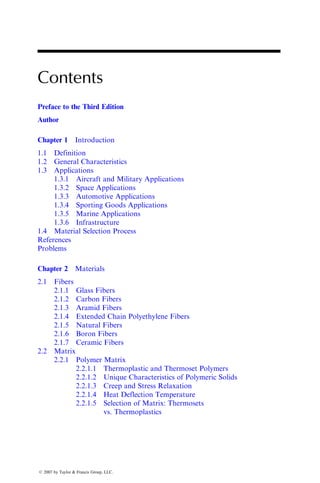
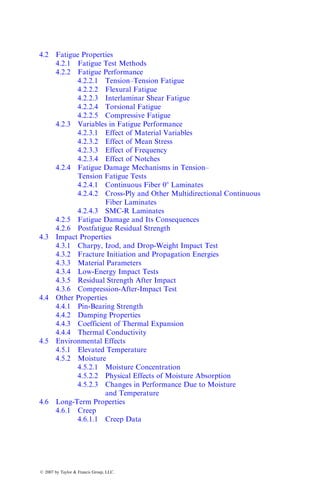
Contents
Preface to the Third Edition
Author
Chapter 1 Introduction
1.1 Definition
1.2 General Characteristics
1.3 Applications
1.3.1 Aircraft and Military Applications
1.3.2 Space Applications
1.3.3 Automotive Applications
1.3.4 Sporting Goods Applications
1.3.5 Marine Applications
1.3.6 Infrastructure
1.4 Material Selection Process
References
Problems
Chapter 2 Materials
2.1 Fibers
2.1.1 Glass Fibers
2.1.2 Carbon Fibers
2.1.3 Aramid Fibers
2.1.4 Extended Chain Polyethylene Fibers
2.1.5 Natural Fibers
2.1.6 Boron Fibers
2.1.7 Ceramic Fibers
2.2 Matrix
2.2.1 Polymer Matrix
2.2.1.1 Thermoplastic and Thermoset Polymers
2.2.1.2 Unique Characteristics of Polymeric Solids
2.2.1.3 Creep and Stress Relaxation
2.2.1.4 Heat Deflection Temperature
2.2.1.5 Selection of Matrix: Thermosets
vs. Thermoplastics
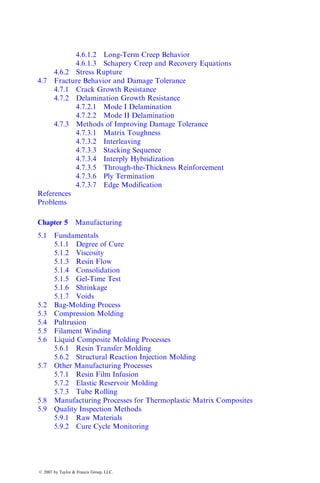
ß 2007 by Taylor & Francis Group, LLC.
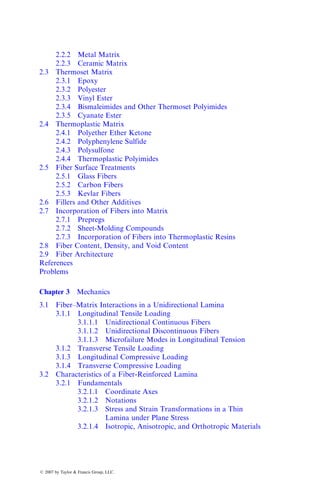
2.2.2 Metal Matrix
2.2.3 Ceramic Matrix
2.3 Thermoset Matrix
2.3.1 Epoxy
2.3.2 Polyester
2.3.3 Vinyl Ester
2.3.4 Bismaleimides and Other Thermoset Polyimides
2.3.5 Cyanate Ester
2.4 Thermoplastic Matrix
2.4.1 Polyether Ether Ketone
2.4.2 Polyphenylene Sulfide
2.4.3 Polysulfone
2.4.4 Thermoplastic Polyimides
2.5 Fiber Surface Treatments
2.5.1 Glass Fibers
2.5.2 Carbon Fibers
2.5.3 Kevlar Fibers
2.6 Fillers and Other Additives
2.7 Incorporation of Fibers into Matrix
2.7.1 Prepregs
2.7.2 Sheet-Molding Compounds
2.7.3 Incorporation of Fibers into Thermoplastic Resins
2.8 Fiber Content, Density, and Void Content
2.9 Fiber Architecture
References
Problems
Chapter 3 Mechanics
3.1 Fiber–Matrix Interactions in a Unidirectional Lamina
3.1.1 Longitudinal Tensile Loading
3.1.1.1 Unidirectional Continuous Fibers
3.1.1.2 Unidirectional Discontinuous Fibers
3.1.1.3 Microfailure Modes in Longitudinal Tension
3.1.2 Transverse Tensile Loading
3.1.3 Longitudinal Compressive Loading
3.1.4 Transverse Compressive Loading
3.2 Characteristics of a Fiber-Reinforced Lamina
3.2.1 Fundamentals
3.2.1.1 Coordinate Axes
3.2.1.2 Notations
3.2.1.3 Stress and Strain Transformations in a Thin
Lamina under Plane Stress
3.2.1.4 Isotropic, Anisotropic, and Orthotropic Materials
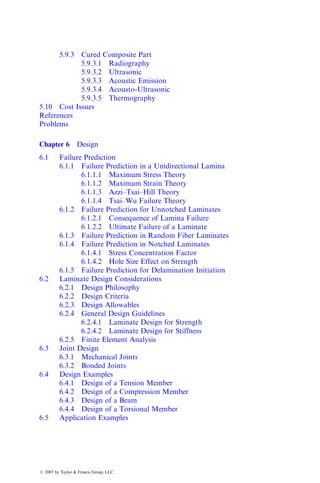
ß 2007 by Taylor & Francis Group, LLC.
3.2.2 Elastic Properties of a Lamina
3.2.2.1 Unidirectional Continuous Fiber 08 Lamina
3.2.2.2 Unidirectional Continuous Fiber
Angle-Ply Lamina
3.2.2.3 Unidirectional Discontinuous Fiber 08 Lamina
3.2.2.4 Randomly Oriented Discontinuous Fiber Lamina
3.2.3 Coefficients of Linear Thermal Expansion
3.2.4 Stress–Strain Relationships for a Thin Lamina
3.2.4.1 Isotropic Lamina
3.2.4.2 Orthotropic Lamina
3.2.5 Compliance and Stiffness Matrices
3.2.5.1 Isotropic Lamina
3.2.5.2 Specially Orthotropic Lamina (u ¼ 08 or 908)
3.2.5.3 General Orthotropic Lamina (u 6¼ 08 or 908)
3.3 Laminated Structure
3.3.1 From Lamina to Laminate
3.3.2 Lamination Theory
3.3.2.1 Assumptions
3.3.2.2 Laminate Strains
3.3.2.3 Laminate Forces and Moments
3.3.2.4 Elements in Stiffness Matrices
3.3.2.5 Midplane Strains and Curvatures
3.3.2.6 Lamina Strains and Stresses
Due to Applied Loads
3.3.2.7 Thermal Strains and Stresses
3.4 Interlaminar Stresses
References
Problems
Chapter 4 Performance
4.1 Static Mechanical Properties
4.1.1 Tensile Properties
4.1.1.1 Test Method and Analysis
4.1.1.2 Unidirectional Laminates
4.1.1.3 Cross-Ply Laminates
4.1.1.4 Multidirectional Laminates
4.1.1.5 Woven Fabric Laminates
4.1.1.6 Sheet-Molding Compounds
4.1.1.7 Interply Hybrid Laminates
4.1.2 Compressive Properties
4.1.3 Flexural Properties
4.1.4 In-Plane Shear Properties
4.1.5 Interlaminar Shear Strength
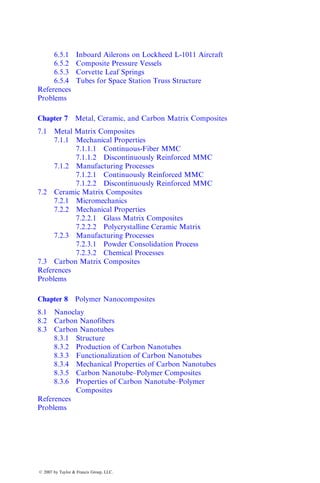
ß 2007 by Taylor & Francis Group, LLC.
4.2 Fatigue Properties
4.2.1 Fatigue Test Methods
4.2.2 Fatigue Performance
4.2.2.1 Tension–Tension Fatigue
4.2.2.2 Flexural Fatigue
4.2.2.3 Interlaminar Shear Fatigue
4.2.2.4 Torsional Fatigue
4.2.2.5 Compressive Fatigue
4.2.3 Variables in Fatigue Performance
4.2.3.1 Effect of Material Variables
4.2.3.2 Effect of Mean Stress
4.2.3.3 Effect of Frequency
4.2.3.4 Effect of Notches
4.2.4 Fatigue Damage Mechanisms in Tension–
Tension Fatigue Tests
4.2.4.1 Continuous Fiber 08 Laminates
4.2.4.2 Cross-Ply and Other Multidirectional Continuous
Fiber Laminates
4.2.4.3 SMC-R Laminates
4.2.5 Fatigue Damage and Its Consequences
4.2.6 Postfatigue Residual Strength
4.3 Impact Properties
4.3.1 Charpy, Izod, and Drop-Weight Impact Test
4.3.2 Fracture Initiation and Propagation Energies
4.3.3 Material Parameters
4.3.4 Low-Energy Impact Tests
4.3.5 Residual Strength After Impact
4.3.6 Compression-After-Impact Test
4.4 Other Properties
4.4.1 Pin-Bearing Strength
4.4.2 Damping Properties
4.4.3 Coefficient of Thermal Expansion
4.4.4 Thermal Conductivity
4.5 Environmental Effects
4.5.1 Elevated Temperature
4.5.2 Moisture
4.5.2.1 Moisture Concentration
4.5.2.2 Physical Effects of Moisture Absorption
4.5.2.3 Changes in Performance Due to Moisture
and Temperature
4.6 Long-Term Properties
4.6.1 Creep
4.6.1.1 Creep Data
ß 2007 by Taylor & Francis Group, LLC.
4.6.1.2 Long-Term Creep Behavior
4.6.1.3 Schapery Creep and Recovery Equations
4.6.2 Stress Rupture
4.7 Fracture Behavior and Damage Tolerance
4.7.1 Crack Growth Resistance
4.7.2 Delamination Growth Resistance
4.7.2.1 Mode I Delamination
4.7.2.2 Mode II Delamination
4.7.3 Methods of Improving Damage Tolerance
4.7.3.1 Matrix Toughness
4.7.3.2 Interleaving
4.7.3.3 Stacking Sequence
4.7.3.4 Interply Hybridization
4.7.3.5 Through-the-Thickness Reinforcement
4.7.3.6 Ply Termination
4.7.3.7 Edge Modification
References
Problems
Chapter 5 Manufacturing
5.1 Fundamentals
5.1.1 Degree of Cure
5.1.2 Viscosity
5.1.3 Resin Flow
5.1.4 Consolidation
5.1.5 Gel-Time Test
5.1.6 Shrinkage
5.1.7 Voids
5.2 Bag-Molding Process
5.3 Compression Molding
5.4 Pultrusion
5.5 Filament Winding
5.6 Liquid Composite Molding Processes
5.6.1 Resin Transfer Molding
5.6.2 Structural Reaction Injection Molding
5.7 Other Manufacturing Processes
5.7.1 Resin Film Infusion
5.7.2 Elastic Reservoir Molding
5.7.3 Tube Rolling
5.8 Manufacturing Processes for Thermoplastic Matrix Composites
5.9 Quality Inspection Methods
5.9.1 Raw Materials
5.9.2 Cure Cycle Monitoring
ß 2007 by Taylor & Francis Group, LLC.
5.9.3 Cured Composite Part
5.9.3.1 Radiography
5.9.3.2 Ultrasonic
5.9.3.3 Acoustic Emission
5.9.3.4 Acousto-Ultrasonic
5.9.3.5 Thermography
5.10 Cost Issues
References
Problems
Chapter 6 Design
6.1 Failure Prediction
6.1.1 Failure Prediction in a Unidirectional Lamina
6.1.1.1 Maximum Stress Theory
6.1.1.2 Maximum Strain Theory
6.1.1.3 Azzi–Tsai–Hill Theory
6.1.1.4 Tsai–Wu Failure Theory
6.1.2 Failure Prediction for Unnotched Laminates
6.1.2.1 Consequence of Lamina Failure
6.1.2.2 Ultimate Failure of a Laminate
6.1.3 Failure Prediction in Random Fiber Laminates
6.1.4 Failure Prediction in Notched Laminates
6.1.4.1 Stress Concentration Factor
6.1.4.2 Hole Size Effect on Strength
6.1.5 Failure Prediction for Delamination Initiation
6.2 Laminate Design Considerations
6.2.1 Design Philosophy
6.2.2 Design Criteria
6.2.3 Design Allowables
6.2.4 General Design Guidelines
6.2.4.1 Laminate Design for Strength
6.2.4.2 Laminate Design for Stiffness
6.2.5 Finite Element Analysis
6.3 Joint Design
6.3.1 Mechanical Joints
6.3.2 Bonded Joints
6.4 Design Examples
6.4.1 Design of a Tension Member
6.4.2 Design of a Compression Member
6.4.3 Design of a Beam
6.4.4 Design of a Torsional Member
6.5 Application Examples
ß 2007 by Taylor & Francis Group, LLC.
6.5.1 Inboard Ailerons on Lockheed L-1011 Aircraft
6.5.2 Composite Pressure Vessels
6.5.3 Corvette Leaf Springs
6.5.4 Tubes for Space Station Truss Structure
References
Problems
Chapter 7 Metal, Ceramic, and Carbon Matrix Composites
7.1 Metal Matrix Composites
7.1.1 Mechanical Properties
7.1.1.1 Continuous-Fiber MMC
7.1.1.2 Discontinuously Reinforced MMC
7.1.2 Manufacturing Processes
7.1.2.1 Continuously Reinforced MMC
7.1.2.2 Discontinuously Reinforced MMC
7.2 Ceramic Matrix Composites
7.2.1 Micromechanics
7.2.2 Mechanical Properties
7.2.2.1 Glass Matrix Composites
7.2.2.2 Polycrystalline Ceramic Matrix
7.2.3 Manufacturing Processes
7.2.3.1 Powder Consolidation Process
7.2.3.2 Chemical Processes
7.3 Carbon Matrix Composites
References
Problems
Chapter 8 Polymer Nanocomposites
8.1 Nanoclay
8.2 Carbon Nanofibers
8.3 Carbon Nanotubes
8.3.1 Structure
8.3.2 Production of Carbon Nanotubes
8.3.3 Functionalization of Carbon Nanotubes
8.3.4 Mechanical Properties of Carbon Nanotubes
8.3.5 Carbon Nanotube–Polymer Composites
8.3.6 Properties of Carbon Nanotube–Polymer
Composites
References
Problems
ß 2007 by Taylor & Francis Group, LLC.
Appendixes
A.1 Woven Fabric Terminology
A.2 Residual Stresses in Fibers and Matrix in a Lamina
Due to Cooling
Reference
A.3 Alternative Equations for the Elastic and Thermal
Properties of a Lamina
References
A.4 Halpin–Tsai Equations
References
A.5 Typical Mechanical Properties of Unidirectional
Continuous Fiber Composites
A.6 Properties of Various SMC Composites
A.7 Finite Width Correction Factor for Isotropic Plates
A.8 Determination of Design Allowables
A.8.1 Normal Distribution
A.8.2 Weibull Distribution
Reference
A.9 Typical Mechanical Properties of Metal Matrix Composites
A.10 Useful References
A.10.1 Text and Reference Books
A.10.2 Leading Journals on Composite Materials
A.10.3 Professional Societies Associated with Conferences
and Publications on Composite Materials
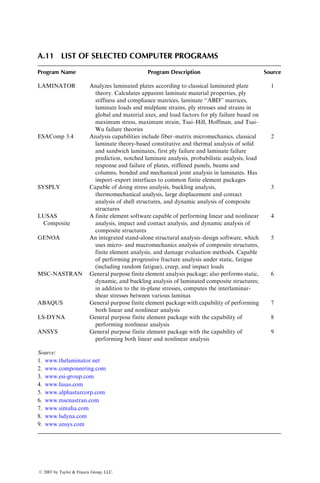
A.11 List of Selected Computer Programs
ß 2007 by Taylor & Francis Group, LLC.
Preface to the Third Edition
Almost a decade has gone by since the second edition of this book was
published. The fundamental understanding of fiber reinforcement has not
changed, but many new advancements have taken place in the materials area,
especially after the discovery of carbon nanotubes in 1991. There has also been
increasing applications of composite materials, which started mainly in the
aerospace industry in the 1950s, but now can be seen in many nonaerospace
industries, including consumer goods, automotive, power transmission, and
biomedical. It is now becoming a part of the ‘‘regular’’ materials vocabulary.
The third edition is written to update the book with recent advancements
and applications.
Almost all the chapters in the book have been extended with new informa-
tion, example problems and chapter-end problems. Chapter 1 has been rewrit-
ten to show the increasing range of applications of fiber-reinforced polymers
and emphasize the material selection process. Chapter 2 has two new sections,
one on natural fibers and the other on fiber architecture. Chapter 7 has a new
section on carbon–carbon composites. Chapter 8 has been added to introduce
polymer-based nanocomposites, which are the most recent addition to the
composite family and are receiving great attention from both researchers as
well as potential users.
As before, I have tried to maintain a balance between materials, mechanics,
processing and design of fiber-reinforced composites. This book is best-suited
for senior-level undergraduate or first-level graduate students, who I believe
will be able to acquire a broad knowledge on composite materials from this
book. Numerous example problems and chapter-end problems will help them
better understand and apply the concepts to practical solutions. Numerous
references cited in the book will help them find additional research information
and go deeper into topics that are of interest to them.
I would like to thank the students, faculty and others who have used the
earlier editions of this book in the past. I have received suggestions and
encouragement from several faculty on writing the third edition—thanks to
them. Finally, the editorial and production staff of the CRC Press needs to be
acknowledged for their work and patience—thanks to them also.
P.K. Mallick
ß 2007 by Taylor & Francis Group, LLC.
Author
P.K. Mallick is a professor in the Department of Mechanical Engineering and
the director of Interdisciplinary Programs at the University of Michigan-Dear-
born. He is also the director of the Center for Lightweighting Automotive
Materials and Processing at the University. His areas of research interest are
mechanical properties, design considerations, and manufacturing process
development of polymers, polymer matrix composites, and lightweight alloys.
He has published more than 100 technical articles on these topics, and also
authored or coauthored several books on composite materials, including
Composite Materials Handbook and Composite Materials Technology. He is a
fellow of the American Society of Mechanical Engineers. Dr Mallick received
his BE degree (1966) in mechanical engineering from Calcutta University,
India, and the MS (1970) and PhD (1973) degrees in mechanical engineering
from the Illinois Institute of Technology.
ß 2007 by Taylor & Francis Group, LLC.
1 Introduction
1.1 DEFINITION
Fiber-reinforced composite materials consist of fibers of high strength and
modulus embedded in or bonded to a matrix with distinct interfaces (bound-
aries) between them. In this form, both fibers and matrix retain their physical
and chemical identities, yet they produce a combination of properties that cannot
be achieved with either of the constituents acting alone. In general, fibers are the
principal load-carrying members, while the surrounding matrix keeps them in the
desired location and orientation, acts as a load transfer medium between them,
and protects them from environmental damages due to elevated temperatures
and humidity, for example. Thus, even though the fibers provide reinforcement
for the matrix, the latter also serves a number of useful functions in a fiber-
reinforced composite material.
The principal fibers in commercial use are various types of glass and carbon
as well as Kevlar 49. Other fibers, such as boron, silicon carbide, and aluminum
oxide, are used in limited quantities. All these fibers can be incorporated into a
matrix either in continuous lengths or in discontinuous (short) lengths. The matrix
material may be a polymer, a metal, or a ceramic. Various chemical composi-
tions and microstructural arrangements are possible in each matrix category.
The most common form in which fiber-reinforced composites are used in
structural applications is called a laminate, which is made by stacking a number
of thin layers of fibers and matrix and consolidating them into the desired
thickness. Fiber orientation in each layer as well as the stacking sequence of
various layers in a composite laminate can be controlled to generate a wide
range of physical and mechanical properties for the composite laminate.
In this book, we focus our attention on the mechanics, performance,
manufacturing, and design of fiber-reinforced polymers. Most of the data
presented in this book are related to continuous fiber-reinforced epoxy lamin-
ates, although other polymeric matrices, including thermoplastic matrices, are
also considered. Metal and ceramic matrix composites are comparatively new,
but significant developments of these composites have also occurred. They are
included in a separate chapter in this book. Injection-molded or reaction
injection-molded (RIM) discontinuous fiber-reinforced polymers are not dis-
cussed; however, some of the mechanics and design principles included in this
book are applicable to these composites as well. Another material of great
ß 2007 by Taylor & Francis Group, LLC.
commercial interest is classified as particulate composites. The major constitu-
ents in these composites are particles of mica, silica, glass spheres, calcium
carbonate, and others. In general, these particles do not contribute to the load-
carrying capacity of the material and act more like a filler than a reinforcement
for the matrix. Particulate composites, by themselves, deserve a special atten-
tion and are not addressed in this book.
Another type of composites that have the potential of becoming an import-
ant material in the future is the nanocomposites. Even though nanocomposites
are in the early stages of development, they are now receiving a high degree of
attention from academia as well as a large number of industries, including
aerospace, automotive, and biomedical industries. The reinforcement in nano-
composites is either nanoparticles, nanofibers, or carbon nanotubes. The effect-
ive diameter of these reinforcements is of the order of 109
m, whereas the effective
diameter of the reinforcements used in traditional fiber-reinforced composites
is of the order of 106
m. The nanocomposites are introduced in Chapter 8.
1.2 GENERAL CHARACTERISTICS
Many fiber-reinforced polymers offer a combination of strength and modulus
that are either comparable to or better than many traditional metallic materials.
Because of their low density, the strength–weight ratios and modulus–weight
ratios of these composite materials are markedly superior to those of metallic
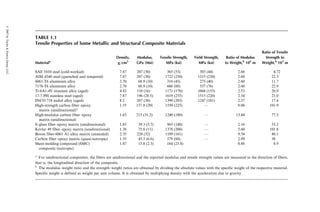
materials (Table 1.1). In addition, fatigue strength as well as fatigue damage
tolerance of many composite laminates are excellent. For these reasons, fiber-
reinforced polymers have emerged as a major class of structural materials and
are either used or being considered for use as substitution for metals in many
weight-critical components in aerospace, automotive, and other industries.
Traditional structural metals, such as steel and aluminum alloys, are consid-
ered isotropic, since they exhibit equal or nearly equal properties irrespective of the
direction of measurement. In general, the properties of a fiber-reinforced compos-
ite depend strongly on the direction of measurement, and therefore, they are not
isotropic materials. For example, the tensile strength and modulus of a unidirec-
tionally oriented fiber-reinforced polymer are maximum when these properties are
measured in the longitudinal direction of fibers. At any other angle of measure-
ment, these properties are lower. The minimum value is observed when they are
measured in the transverse direction of fibers, that is, at 908 to the longitudinal
direction. Similar angular dependence is observed for other mechanical and
thermal properties, such as impact strength, coefficient of thermal expansion
(CTE), and thermal conductivity. Bi- or multidirectional reinforcement yields a
more balanced set of properties. Although these properties are lower than the
longitudinal properties of a unidirectional composite, they still represent a
considerable advantage over common structural metals on a unit weight basis.
The design of a fiber-reinforced composite structure is considerably more
difficult than that of a metal structure, principally due to the difference in its
ß 2007 by Taylor  Francis Group, LLC.
TABLE 1.1
Tensile Properties of Some Metallic and Structural Composite Materials
Materiala
Density,
g=cm3
Modulus,
GPa (Msi)
Tensile Strength,
MPa (ksi)
Yield Strength,
MPa (ksi)
Ratio of Modulus
to Weight,b
106
m
Ratio of Tensile
Strength to
Weight,b
103
m
SAE 1010 steel (cold-worked) 7.87 207 (30) 365 (53) 303 (44) 2.68 4.72
AISI 4340 steel (quenched and tempered) 7.87 207 (30) 1722 (250) 1515 (220) 2.68 22.3
6061-T6 aluminum alloy 2.70 68.9 (10) 310 (45) 275 (40) 2.60 11.7
7178-T6 aluminum alloy 2.70 68.9 (10) 606 (88) 537 (78) 2.60 22.9
Ti-6A1-4V titanium alloy (aged) 4.43 110 (16) 1171 (170) 1068 (155) 2.53 26.9
17-7 PH stainless steel (aged) 7.87 196 (28.5) 1619 (235) 1515 (220) 2.54 21.0
INCO 718 nickel alloy (aged) 8.2 207 (30) 1399 (203) 1247 (181) 2.57 17.4
High-strength carbon fiber–epoxy
matrix (unidirectional)a
1.55 137.8 (20) 1550 (225) — 9.06 101.9
High-modulus carbon fiber–epoxy
matrix (unidirectional)
1.63 215 (31.2) 1240 (180) — 13.44 77.5
E-glass fiber–epoxy matrix (unidirectional) 1.85 39.3 (5.7) 965 (140) — 2.16 53.2
Kevlar 49 fiber–epoxy matrix (unidirectional) 1.38 75.8 (11) 1378 (200) — 5.60 101.8
Boron fiber-6061 A1 alloy matrix (annealed) 2.35 220 (32) 1109 (161) — 9.54 48.1
Carbon fiber–epoxy matrix (quasi-isotropic) 1.55 45.5 (6.6) 579 (84) — 2.99 38
Sheet-molding compound (SMC)
composite (isotropic)
1.87 15.8 (2.3) 164 (23.8) 0.86 8.9
a
For unidirectional composites, the fibers are unidirectional and the reported modulus and tensile strength values are measured in the direction of fibers,
that is, the longitudinal direction of the composite.
b
The modulus–weight ratio and the strength–weight ratios are obtained by dividing the absolute values with the specific weight of the respective material.
Specific weight is defined as weight per unit volume. It is obtained by multiplying density with the acceleration due to gravity.
ß
2007
by
Taylor

Francis
Group,
LLC.
properties in different directions. However, the nonisotropic nature of a fiber-
reinforced composite material creates a unique opportunity of tailoring its
properties according to the design requirements. This design flexibility can be
used to selectively reinforce a structure in the directions of major stresses,
increase its stiffness in a preferred direction, fabricate curved panels without
any secondary forming operation, or produce structures with zero coefficients
of thermal expansion.
The use of fiber-reinforced polymer as the skin material and a lightweight
core, such as aluminum honeycomb, plastic foam, metal foam, and balsa wood,
to build a sandwich beam, plate, or shell provides another degree of design
flexibility that is not easily achievable with metals. Such sandwich construction
can produce high stiffness with very little, if any, increase in weight. Another
sandwich construction in which the skin material is an aluminum alloy and the
core material is a fiber-reinforced polymer has found widespread use in aircrafts
and other applications, primarily due to their higher fatigue performance and
damage tolerance than aluminum alloys.
In addition to the directional dependence of properties, there are a number
of other differences between structural metals and fiber-reinforced composites.
For example, metals in general exhibit yielding and plastic deformation. Most
fiber-reinforced composites are elastic in their tensile stress–strain character-
istics. However, the heterogeneous nature of these materials provides mechan-
isms for energy absorption on a microscopic scale, which is comparable to the
yielding process. Depending on the type and severity of external loads, a
composite laminate may exhibit gradual deterioration in properties but usually
would not fail in a catastrophic manner. Mechanisms of damage development
and growth in metal and composite structures are also quite different and must
be carefully considered during the design process when the metal is substituted
with a fiber-reinforced polymer.
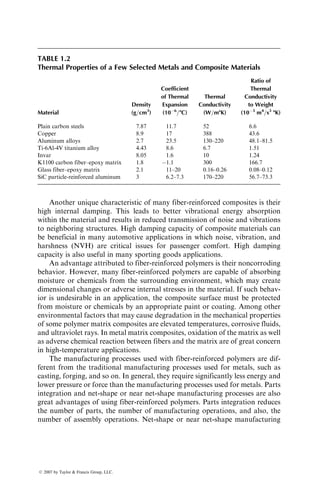
Coefficient of thermal expansion (CTE) for many fiber-reinforced composites
is much lower than that for metals (Table 1.2). As a result, composite structures
may exhibit a better dimensional stability over a wide temperature range. How-
ever, the differences in thermal expansion between metals and composite materials
may create undue thermal stresses when they are used in conjunction, for example,
near an attachment. In some applications, such as electronic packaging, where
quick and effective heat dissipation is needed to prevent component failure or
malfunctioning due to overheating and undesirable temperature rise, thermal
conductivity is an important material property to consider. In these applications,
some fiber-reinforced composites may excel over metals because of the combin-
ation of their high thermal conductivity–weight ratio (Table 1.2) and low CTE. On
the other hand, electrical conductivity of fiber-reinforced polymers is, in general,
lower than that of metals. The electric charge build up within the material because
of low electrical conductivity can lead to problems such as radio frequency
interference (RFI) and damage due to lightning strike.
ß 2007 by Taylor  Francis Group, LLC.
Another unique characteristic of many fiber-reinforced composites is their
high internal damping. This leads to better vibrational energy absorption
within the material and results in reduced transmission of noise and vibrations
to neighboring structures. High damping capacity of composite materials can
be beneficial in many automotive applications in which noise, vibration, and
harshness (NVH) are critical issues for passenger comfort. High damping
capacity is also useful in many sporting goods applications.
An advantage attributed to fiber-reinforced polymers is their noncorroding
behavior. However, many fiber-reinforced polymers are capable of absorbing
moisture or chemicals from the surrounding environment, which may create
dimensional changes or adverse internal stresses in the material. If such behav-
ior is undesirable in an application, the composite surface must be protected
from moisture or chemicals by an appropriate paint or coating. Among other
environmental factors that may cause degradation in the mechanical properties
of some polymer matrix composites are elevated temperatures, corrosive fluids,
and ultraviolet rays. In metal matrix composites, oxidation of the matrix as well
as adverse chemical reaction between fibers and the matrix are of great concern
in high-temperature applications.
The manufacturing processes used with fiber-reinforced polymers are dif-
ferent from the traditional manufacturing processes used for metals, such as
casting, forging, and so on. In general, they require significantly less energy and
lower pressure or force than the manufacturing processes used for metals. Parts
integration and net-shape or near net-shape manufacturing processes are also
great advantages of using fiber-reinforced polymers. Parts integration reduces
the number of parts, the number of manufacturing operations, and also, the
number of assembly operations. Net-shape or near net-shape manufacturing
TABLE 1.2
Thermal Properties of a Few Selected Metals and Composite Materials
Material
Density
(g=cm3
)
Coefficient
of Thermal
Expansion
(106
=8C)
Thermal
Conductivity
(W=m8K)
Ratio of
Thermal
Conductivity
to Weight
(103
m4
=s3
8K)
Plain carbon steels 7.87 11.7 52 6.6
Copper 8.9 17 388 43.6
Aluminum alloys 2.7 23.5 130–220 48.1–81.5
Ti-6Al-4V titanium alloy 4.43 8.6 6.7 1.51
Invar 8.05 1.6 10 1.24
K1100 carbon fiber–epoxy matrix 1.8 1.1 300 166.7
Glass fiber–epoxy matrix 2.1 11–20 0.16–0.26 0.08–0.12
SiC particle-reinforced aluminum 3 6.2–7.3 170–220 56.7–73.3
ß 2007 by Taylor  Francis Group, LLC.
processes, such as filament winding and pultrusion, used for making many
fiber-reinforced polymer parts, either reduce or eliminate the finishing oper-
ations such as machining and grinding, which are commonly required as
finishing operations for cast or forged metallic parts.
1.3 APPLICATIONS
Commercial and industrial applications of fiber-reinforced polymer composites
are so varied that it is impossible to list them all. In this section, we highlight
only the major structural application areas, which include aircraft, space,
automotive, sporting goods, marine, and infrastructure. Fiber-reinforced poly-
mer composites are also used in electronics (e.g., printed circuit boards),
building construction (e.g., floor beams), furniture (e.g., chair springs), power
industry (e.g., transformer housing), oil industry (e.g., offshore oil platforms and
oil sucker rods used in lifting underground oil), medical industry (e.g., bone plates
for fracture fixation, implants, and prosthetics), and in many industrial prod-
ucts, such as step ladders, oxygen tanks, and power transmission shafts. Poten-
tial use of fiber-reinforced composites exists in many engineering fields. Putting
them to actual use requires careful design practice and appropriate process
development based on the understanding of their unique mechanical, physical,
and thermal characteristics.
1.3.1 AIRCRAFT AND MILITARY APPLICATIONS
The major structural applications for fiber-reinforced composites are in the
field of military and commercial aircrafts, for which weight reduction is critical
for higher speeds and increased payloads. Ever since the production application
of boron fiber-reinforced epoxy skins for F-14 horizontal stabilizers in 1969,
the use of fiber-reinforced polymers has experienced a steady growth in the
aircraft industry. With the introduction of carbon fibers in the 1970s, carbon
fiber-reinforced epoxy has become the primary material in many wing, fuselage,
and empennage components (Table 1.3). The structural integrity and durability
of these early components have built up confidence in their performance and
prompted developments of other structural aircraft components, resulting in an
increasing amount of composites being used in military aircrafts. For example,
the airframe of AV-8B, a vertical and short take-off and landing (VSTOL)
aircraft introduced in 1982, contains nearly 25% by weight of carbon fiber-
reinforced epoxy. The F-22 fighter aircraft also contains ~25% by weight of
carbon fiber-reinforced polymers; the other major materials are titanium (39%)
and aluminum (16%). The outer skin of B-2 (Figure 1.1) and other stealth
aircrafts is almost all made of carbon fiber-reinforced polymers. The stealth
characteristics of these aircrafts are due to the use of carbon fibers, special
coatings, and other design features that reduce radar reflection and heat
radiation.
ß 2007 by Taylor  Francis Group, LLC.
The composite applications on commercial aircrafts began with a few
selective secondary structural components, all of which were made of a high-
strength carbon fiber-reinforced epoxy (Table 1.4). They were designed and
produced under the NASA Aircraft Energy Efficiency (ACEE) program and
were installed in various airplanes during 1972–1986 [1]. By 1987, 350 compos-
ite components were placed in service in various commercial aircrafts, and over
the next few years, they accumulated millions of flight hours. Periodic inspec-
tion and evaluation of these components showed some damages caused by
ground handling accidents, foreign object impacts, and lightning strikes.
TABLE 1.3
Early Applications of Fiber-Reinforced Polymers in Military Aircrafts
Aircraft Component Material
Overall Weight
Saving Over
Metal Component (%)
F-14 (1969) Skin on the horizontal stabilizer
box
Boron fiber–epoxy 19
F-11 Under the wing fairings Carbon fiber–epoxy
F-15 (1975) Fin, rudder, and stabilizer skins Boron fiber–epoxy 25
F-16 (1977) Skins on vertical fin box, fin
leading edge
Carbon fiber–epoxy 23
F=A-18 (1978) Wing skins, horizontal and
vertical tail boxes; wing and
tail control surfaces, etc.
Carbon fiber–epoxy 35
AV-8B (1982) Wing skins and substructures;
forward fuselage; horizontal
stabilizer; flaps; ailerons
Carbon fiber–epoxy 25
Source: Adapted from Riggs, J.P., Mater. Soc., 8, 351, 1984.
FIGURE 1.1 Stealth aircraft (note that the carbon fibers in the construction of the
aircraft contributes to its stealth characteristics).
ß 2007 by Taylor  Francis Group, LLC.
Apart from these damages, there was no degradation of residual strengths due
to either fatigue or environmental exposure. A good correlation was found
between the on-ground environmental test program and the performance of the
composite components after flight exposure.
Airbus was the first commercial aircraft manufacturer to make extensive
use of composites in their A310 aircraft, which was introduced in 1987. The
composite components weighed about 10% of the aircraft’s weight and
included such components as the lower access panels and top panels of the
wing leading edge, outer deflector doors, nose wheel doors, main wheel leg
fairing doors, engine cowling panels, elevators and fin box, leading and
trailing edges of fins, flap track fairings, flap access doors, rear and forward
wing–body fairings, pylon fairings, nose radome, cooling air inlet fairings, tail
leading edges, upper surface skin panels above the main wheel bay, glide slope
antenna cover, and rudder. The composite vertical stabilizer, which is 8.3 m
high by 7.8 m wide at the base, is about 400 kg lighter than the aluminum
vertical stabilizer previously used [2]. The Airbus A320, introduced in 1988,
was the first commercial aircraft to use an all-composite tail, which includes
the tail cone, vertical stabilizer, and horizontal stabilizer. Figure 1.2 schemat-
ically shows the composite usage in Airbus A380 introduced in 2006. About
25% of its weight is made of composites. Among the major composite com-
ponents in A380 are the central torsion box (which links the left and right
wings under the fuselage), rear-pressure bulkhead (a dome-shaped partition
that separates the passenger cabin from the rear part of the plane that is not
pressurized), the tail, and the flight control surfaces, such as the flaps, spoilers,
and ailerons.
TABLE 1.4
Early Applications of Fiber-Reinforced Polymers in Commercial Aircrafts
Aircraft Component Weight (lb)
Weight
Reduction (%) Comments
Boeing
727 Elevator face sheets 98 25 10 units installed in 1980
737 Horizontal stabilizer 204 22
737 Wing spoilers — 37 Installed in 1973
756 Ailerons, rudders,
elevators, fairings, etc.
3340 (total) 31
McDonnell-Douglas
DC-10 Upper rudder 67 26 13 units installed in 1976
DC-10 Vertical stabilizer 834 17
Lockheed
L-1011 Aileron 107 23 10 units installed in 1981
L-1011 Vertical stabilizer 622 25
ß 2007 by Taylor  Francis Group, LLC.
Starting with Boeing 777, which was first introduced in 1995, Boeing has
started making use of composites in the empennage (which include horizontal
stabilizer, vertical stabilizer, elevator, and rudder), most of the control surfaces,
engine cowlings, and fuselage floor beams (Figure 1.3). About 10% of Boeing
777’s structural weight is made of carbon fiber-reinforced epoxy and about 50%
is made of aluminum alloys. About 50% of the structural weight of Boeing’s
Outer wing
Ailerons
Flap track fairings
Outer flap
Radome
Fixed leading edge
upper and lower panels
Main landing
gear leg fairing
door
Main and
center landing
gear doors
Nose landing
gear doors
Central torsion box
Pylon
fairings,
nacelles,
and
cowlings
Pressure
bulkhead
Keel beam
Tail cone
Vertical
stabilizer
Horizontal
stabilizer
Outer boxes
Over-wing panel
Belly fairing skins
Trailing edge upper and lower
panels and shroud box
Spoilers
Wing box
FIGURE 1.2 Use of fiber-reinforced polymer composites in Airbus 380.
Rudder
Fin torque box
Elevator
Stabilizer torque box
Floor beams
Wing landing gear doors
Flaps
Flaperon
Inboard and
outboard spoilers
Engine cowlings
Nose gear doors
Nose radome
Strut–Fwd and aft fairing
Wing fixed
leading edge
Outboard aileron
Outboard flap
Trailing edge panels
Leading and
trailing
edge panels
FIGURE 1.3 Use of fiber-reinforced polymer composites in Boeing 777.
ß 2007 by Taylor  Francis Group, LLC.
next line of airplanes, called the Boeing 787 Dreamliner, will be made of carbon
fiber-reinforced polymers. The other major materials in Boeing 787 will be
aluminum alloys (20%), titanium alloys (15%), and steel (10%). Two of the
major composite components in 787 will be the fuselage and the forward
section, both of which will use carbon fiber-reinforced epoxy as the major
material of construction.
There are several pioneering examples of using larger quantities of com-
posite materials in smaller aircrafts. One of these examples is the Lear Fan
2100, a business aircraft built in 1983, in which carbon fiber–epoxy and Kevlar
49 fiber–epoxy accounted for ~70% of the aircraft’s airframe weight. The
composite components in this aircraft included wing skins, main spar, fuselage,
empennage, and various control surfaces [3]. Another example is the Rutan
Voyager (Figure 1.4), which was an all-composite airplane and made the first-
ever nonstop flight around the world in 1986. To travel 25,000 miles without
refueling, the Voyager airplane had to be extremely light and contain as much
fuel as needed.
Fiber-reinforced polymers are used in many military and commercial heli-
copters for making baggage doors, fairings, vertical fins, tail rotor spars, and so
on. One key helicopter application of composite materials is the rotor blades.
Carbon or glass fiber-reinforced epoxy is used in this application. In addition to
significant weight reduction over aluminum, they provide a better control over
the vibration characteristics of the blades. With aluminum, the critical flopping
FIGURE 1.4 Rutan Voyager all-composite plane.
ß 2007 by Taylor  Francis Group, LLC.
and twisting frequencies are controlled principally by the classical method of
mass distribution [4]. With fiber-reinforced polymers, they can also be con-
trolled by varying the type, concentration, distribution, as well as orientation of
fibers along the blade’s chord length. Another advantage of using fiber-
reinforced polymers in blade applications is the manufacturing flexibility of
these materials. The composite blades can be filament-wound or molded into
complex airfoil shapes with little or no additional manufacturing costs, but
conventional metal blades are limited to shapes that can only be extruded,
machined, or rolled.
The principal reason for using fiber-reinforced polymers in aircraft and
helicopter applications is weight saving, which can lead to significant fuel
saving and increase in payload. There are several other advantages of using
them over aluminum and titanium alloys.
1. Reduction in the number of components and fasteners, which results in
a reduction of fabrication and assembly costs. For example, the vertical
fin assembly of the Lockheed L-1011 has 72% fewer components and
83% fewer fasteners when it is made of carbon fiber-reinforced epoxy
than when it is made of aluminum. The total weight saving is 25.2%.
2. Higher fatigue resistance and corrosion resistance, which result in a
reduction of maintenance and repair costs. For example, metal fins
used in helicopters flying near ocean coasts use an 18 month repair
cycle for patching corrosion pits. After a few years in service, the
patches can add enough weight to the fins to cause a shift in the center
of gravity of the helicopter, and therefore the fin must then be rebuilt or
replaced. The carbon fiber-reinforced epoxy fins do not require any
repair for corrosion, and therefore, the rebuilding or replacement cost
is eliminated.
3. The laminated construction used with fiber-reinforced polymers allows
the possibility of aeroelastically tailoring the stiffness of the airframe
structure. For example, the airfoil shape of an aircraft wing can be
controlled by appropriately adjusting the fiber orientation angle in
each lamina and the stacking sequence to resist the varying lift and
drag loads along its span. This produces a more favorable airfoil
shape and enhances the aerodynamic characteristics critical to the air-
craft’s maneuverability.
The key limiting factors in using carbon fiber-reinforced epoxy in aircraft
structures are their high cost, relatively low impact damage tolerance (from
bird strikes, tool drop, etc.), and susceptibility to lightning damage. When they
are used in contact with aluminum or titanium, they can induce galvanic
corrosion in the metal components. The protection of the metal components
from corrosion can be achieved by coating the contacting surfaces with a
corrosion-inhibiting paint, but it is an additional cost.
ß 2007 by Taylor  Francis Group, LLC.
1.3.2 SPACE APPLICATIONS
Weight reduction is the primary reason for using fiber-reinforced composites in
many space vehicles [5]. Among the various applications in the structure of
space shuttles are the mid-fuselage truss structure (boron fiber-reinforced alu-
minum tubes), payload bay door (sandwich laminate of carbon fiber-reinforced
epoxy face sheets and aluminum honeycomb core), remote manipulator arm
(ultrahigh-modulus carbon fiber-reinforced epoxy tube), and pressure vessels
(Kevlar 49 fiber-reinforced epoxy).
In addition to the large structural components, fiber-reinforced polymers are
used for support structures for many smaller components, such as solar arrays,
antennas, optical platforms, and so on [6]. A major factor in selecting them for
these applications is their dimensional stability over a wide temperature range.
Many carbon fiber-reinforced epoxy laminates can be ‘‘designed’’ to produce a
CTE close to zero. Many aerospace alloys (e.g., Invar) also have a comparable
CTE. However, carbon fiber composites have a much lower density, higher
strength, as well as a higher stiffness–weight ratio. Such a unique combination
of mechanical properties and CTE has led to a number of applications for carbon
fiber-reinforced epoxies in artificial satellites. One such application is found in
the support structure for mirrors and lenses in the space telescope [7]. Since the
temperature in space may vary between 1008C and 1008C, it is critically
important that the support structure be dimensionally stable; otherwise, large
changes in the relative positions of mirrors or lenses due to either thermal
expansion or distortion may cause problems in focusing the telescope.
Carbon fiber-reinforced epoxy tubes are used in building truss structures for
low earth orbit (LEO) satellites and interplanetary satellites. These truss structures
support optical benches, solar array panels, antenna reflectors, and other modules.
Carbon fiber-reinforced epoxies are preferred over metals or metal matrix com-
posites because of their lower weight as well as very low CTE. However, one of the
major concerns with epoxy-based composites in LEO satellites is that they are
susceptible to degradation due to atomic oxygen (AO) absorption from the
earth’s rarefied atmosphere. This problem is overcome by protecting the tubes
from AO exposure, for example, by wrapping them with thin aluminum foils.
Other concerns for using fiber-reinforced polymers in the space environ-
ment are the outgassing of the polymer matrix when they are exposed to
vacuum in space and embrittlement due to particle radiation. Outgassing can
cause dimensional changes and embrittlement may lead to microcrack forma-
tion. If the outgassed species are deposited on the satellite components, such as
sensors or solar cells, their function may be seriously degraded [8].
1.3.3 AUTOMOTIVE APPLICATIONS
Applications of fiber-reinforced composites in the automotive industry can be
classified into three groups: body components, chassis components, and engine
ß 2007 by Taylor  Francis Group, LLC.
components. Exterior body components, such as the hood or door panels,
require high stiffness and damage tolerance (dent resistance) as well as a
‘‘Class A’’ surface finish for appearance. The composite material used for
these components is E-glass fiber-reinforced sheet molding compound (SMC)
composites, in which discontinuous glass fibers (typically 25 mm in length) are
randomly dispersed in a polyester or a vinyl ester resin. E-glass fiber is used
instead of carbon fiber because of its significantly lower cost. The manufactur-
ing process used for making SMC parts is called compression molding. One of
the design requirements for many exterior body panels is the ‘‘Class A’’ surface
finish, which is not easily achieved with compression-molded SMC. This prob-
lem is usually overcome by in-mold coating of the exterior molded surface with
a flexible resin. However, there are many underbody and under-the-hood com-
ponents in which the external appearance is not critical. Examples of such
components in which SMC is used include radiator supports, bumper beams,
roof frames, door frames, engine valve covers, timing chain covers, oil pans, and
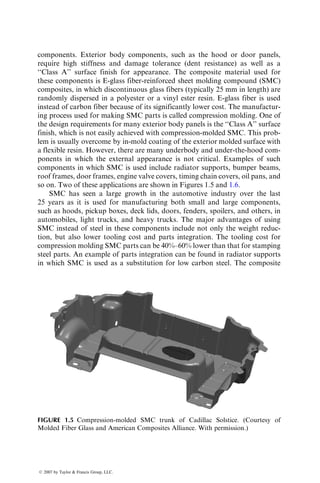
so on. Two of these applications are shown in Figures 1.5 and 1.6.
SMC has seen a large growth in the automotive industry over the last
25 years as it is used for manufacturing both small and large components,
such as hoods, pickup boxes, deck lids, doors, fenders, spoilers, and others, in
automobiles, light trucks, and heavy trucks. The major advantages of using
SMC instead of steel in these components include not only the weight reduc-
tion, but also lower tooling cost and parts integration. The tooling cost for
compression molding SMC parts can be 40%–60% lower than that for stamping
steel parts. An example of parts integration can be found in radiator supports
in which SMC is used as a substitution for low carbon steel. The composite
FIGURE 1.5 Compression-molded SMC trunk of Cadillac Solstice. (Courtesy of
Molded Fiber Glass and American Composites Alliance. With permission.)
ß 2007 by Taylor  Francis Group, LLC.
radiator support is typically made of two SMC parts bonded together by an
adhesive instead of 20 or more steel parts assembled together by large number
of screws. The material in the composite radiator support is randomly oriented
discontinuous E-glass fiber-reinforced vinyl ester. Another example of parts
integration can be found in the station wagon tailgate assembly [9], which has
significant load-bearing requirements in the open position. The composite
tailgate consists of two pieces, an outer SMC shell and an inner reinforcing
SMC piece. They are bonded together using a urethane adhesive. The compos-
ite tailgate replaces a seven-piece steel tailgate assembly, at about one-third its
weight. The material for both the outer shell and the inner reinforcement is a
randomly oriented discontinuous E-glass fiber-reinforced polyester.
Another manufacturing process for making composite body panels in the
automotive industry is called the structural reaction injection molding (SRIM).
The fibers in these parts are usually randomly oriented discontinuous E-glass
fibers and the matrix is a polyurethane or polyurea. Figure 1.7 shows the
photograph of a one-piece 2 m long cargo box that is molded using this process.
The wall thickness of the SRIM cargo box is 3 mm and its one-piece construc-
tion replaces four steel panels that are joined together using spot welds.
Among the chassis components, the first major structural application of
fiber-reinforced composites is the Corvette rear leaf spring, introduced first in
FIGURE 1.6 Compression-molded SMC valve cover for a truck engine. (Courtesy of
Ashland Chemicals and American Composites Alliance. With permission.)
ß 2007 by Taylor  Francis Group, LLC.
1981 [10]. Unileaf E-glass fiber-reinforced epoxy springs have been used to
replace multileaf steel springs with as much as 80% weight reduction. Other
structural chassis components, such as drive shafts and road wheels, have been
successfully tested in laboratories and proving grounds. They have also been
used in limited quantities in production vehicles. They offer opportunities for
substantial weight savings, but so far they have not proven to be cost-effective
over their steel counterparts.
The application of fiber-reinforced composites in engine components has
not been as successful as the body and chassis components. Fatigue loads at
very high temperatures pose the greatest challenge in these applications. Devel-
opment of high-temperature polymers as well as metal matrix or ceramic matrix
composites would greatly enhance the potential for composite usage in this area.
Manufacturing and design of fiber-reinforced composite materials for auto-
motive applications are significantly different from those for aircraft applica-
tions. One obvious difference is in the volume of production, which may range
from 100 to 200 pieces per hour for automotive components compared with a
few hundred pieces per year for aircraft components. Although the labor-
intensive hand layup followed by autoclave molding has worked well for
fabricating aircraft components, high-speed methods of fabrication, such as
compression molding and SRIM, have emerged as the principal manufacturing
process for automotive composites. Epoxy resin is the major polymer matrix
FIGURE 1.7 One-piece cargo box for a pickup truck made by the SRIM process.
ß 2007 by Taylor  Francis Group, LLC.
used in aerospace composites; however, the curing time for epoxy resin is very
long, which means the production time for epoxy matrix composites is also
very long. For this reason, epoxy is not considered the primary matrix
material in automotive composites. The polymer matrix used in automotive
applications is either a polyester, a vinyl ester, or polyurethane, all of which
require significantly lower curing time than epoxy. The high cost of carbon
fibers has prevented their use in the cost-conscious automotive industry.
Instead of carbon fibers, E-glass fibers are used in automotive composites
because of their significantly lower cost. Even with E-glass fiber-reinforced
composites, the cost-effectiveness issue has remained particularly critical, since
the basic material of construction in present-day automobiles is low-carbon
steel, which is much less expensive than most fiber-reinforced composites on a
unit weight basis.
Although glass fiber-reinforced polymers are the primary composite mater-
ials used in today’s automobiles, it is well recognized that significant vehicle
weight reduction needed for improved fuel efficiency can be achieved only with
carbon fiber-reinforced polymers, since they have much higher strength–weight
and modulus–weight ratios. The problem is that the current carbon fiber price,
at $16=kg or higher, is not considered cost-effective for automotive applica-
tions. Nevertheless, many attempts have been made in the past to manufacture
structural automotive parts using carbon fiber-reinforced polymers; unfortu-
nately most of them did not go beyond the stages of prototyping and structural
testing. Recently, several high-priced vehicles have started using carbon fiber-
reinforced polymers in a few selected components. One recent example of this is
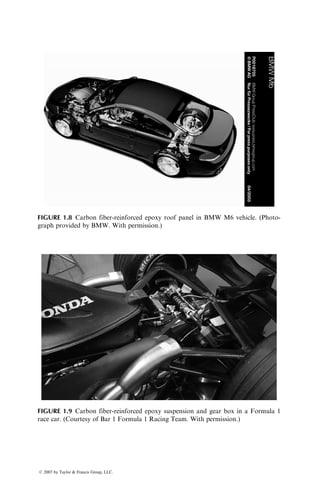
seen in the BMW M6 roof panel (Figure 1.8), which was produced by a process
called resin transfer molding (RTM). This panel is twice as thick as a compar-
able steel panel, but 5.5 kg lighter. One added benefit of reducing the weight of
the roof panel is that it slightly lowers the center of gravity of the vehicle, which
is important for sports coupe.
Fiber-reinforced composites have become the material of choice in motor
sports where lightweight structure is used for gaining competitive advantage of
higher speed [11] and cost is not a major material selection decision factor. The
first major application of composites in race cars was in the 1950s when glass
fiber-reinforced polyester was introduced as replacement for aluminum body
panels. Today, the composite material used in race cars is mostly carbon fiber-
reinforced epoxy. All major body, chassis, interior, and suspension components
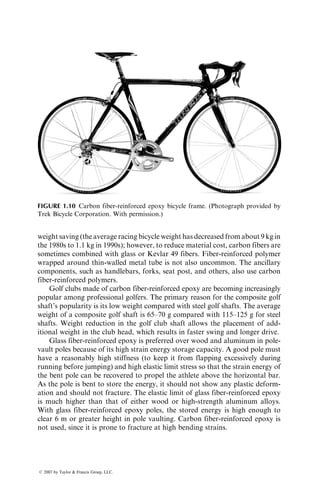
in today’s Formula 1 race cars use carbon fiber-reinforced epoxy. Figure 1.9
shows an example of carbon fiber-reinforced composite used in the gear box
and rear suspension of a Formula 1 race car. One major application of carbon
fiber-reinforced epoxy in Formula 1 cars is the survival cell, which protects the
driver in the event of a crash. The nose cone located in front of the survival cell
is also made of carbon fiber-reinforced epoxy. Its controlled crush behavior is
also critical to the survival of the driver.
ß 2007 by Taylor  Francis Group, LLC.
FIGURE 1.8 Carbon fiber-reinforced epoxy roof panel in BMW M6 vehicle. (Photo-
graph provided by BMW. With permission.)
FIGURE 1.9 Carbon fiber-reinforced epoxy suspension and gear box in a Formula 1
race car. (Courtesy of Bar 1 Formula 1 Racing Team. With permission.)
ß 2007 by Taylor  Francis Group, LLC.
1.3.4 SPORTING GOODS APPLICATIONS
Fiber-reinforced polymers are extensively used in sporting goods ranging
from tennis rackets to athletic shoes (Table 1.5) and are selected over such
traditional materials as wood, metals, and leather in many of these applications
[12]. The advantages of using fiber-reinforced polymers are weight reduction,
vibration damping, and design flexibility. Weight reduction achieved by substi-
tuting carbon fiber-reinforced epoxies for metals leads to higher speeds and
quick maneuvering in competitive sports, such as bicycle races and canoe races.
In some applications, such as tennis rackets or snow skis, sandwich construc-
tions of carbon or boron fiber-reinforced epoxies as the skin material and a
soft, lighter weight urethane foam as the core material produces a higher weight
reduction without sacrificing stiffness. Faster damping of vibrations provided
by fiber-reinforced polymers reduces the shock transmitted to the player’s arm
in tennis or racket ball games and provides a better ‘‘feel’’ for the ball. In
archery bows and pole-vault poles, the high stiffness–weight ratio of fiber-
reinforced composites is used to store high elastic energy per unit weight, which
helps in propelling the arrow over a longer distance or the pole-vaulter to jump
a greater height. Some of these applications are described later.
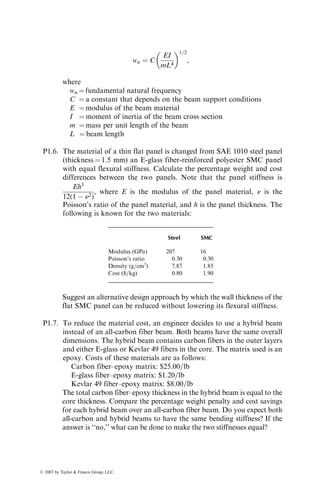
Bicycle frames for racing bikes today are mostly made of carbon fiber-
reinforced epoxy tubes, fitted together by titanium fittings and inserts. An
example is shown in Figure 1.10. The primary purpose of using carbon fibers is
TABLE 1.5
Applications of Fiber-Reinforced Polymers
in Sporting Goods
Tennis rackets
Racket ball rackets
Golf club shafts
Fishing rods
Bicycle frames
Snow and water skis
Ski poles, pole vault poles
Hockey sticks
Baseball bats
Sail boats and kayaks
Oars, paddles
Canoe hulls
Surfboards, snow boards
Arrows
Archery bows
Javelins
Helmets
Exercise equipment
Athletic shoe soles and heels
ß 2007 by Taylor  Francis Group, LLC.
weight saving (the average racing bicycle weight has decreased from about 9 kg in
the 1980s to 1.1 kg in 1990s); however, to reduce material cost, carbon fibers are
sometimes combined with glass or Kevlar 49 fibers. Fiber-reinforced polymer
wrapped around thin-walled metal tube is not also uncommon. The ancillary
components, such as handlebars, forks, seat post, and others, also use carbon
fiber-reinforced polymers.
Golf clubs made of carbon fiber-reinforced epoxy are becoming increasingly
popular among professional golfers. The primary reason for the composite golf
shaft’s popularity is its low weight compared with steel golf shafts. The average
weight of a composite golf shaft is 65–70 g compared with 115–125 g for steel
shafts. Weight reduction in the golf club shaft allows the placement of add-
itional weight in the club head, which results in faster swing and longer drive.
Glass fiber-reinforced epoxy is preferred over wood and aluminum in pole-
vault poles because of its high strain energy storage capacity. A good pole must
have a reasonably high stiffness (to keep it from flapping excessively during
running before jumping) and high elastic limit stress so that the strain energy of
the bent pole can be recovered to propel the athlete above the horizontal bar.
As the pole is bent to store the energy, it should not show any plastic deform-
ation and should not fracture. The elastic limit of glass fiber-reinforced epoxy
is much higher than that of either wood or high-strength aluminum alloys.
With glass fiber-reinforced epoxy poles, the stored energy is high enough to
clear 6 m or greater height in pole vaulting. Carbon fiber-reinforced epoxy is
not used, since it is prone to fracture at high bending strains.
FIGURE 1.10 Carbon fiber-reinforced epoxy bicycle frame. (Photograph provided by
Trek Bicycle Corporation. With permission.)
ß 2007 by Taylor  Francis Group, LLC.
Glass and carbon fiber-reinforced epoxy fishing rods are very common
today, even though traditional materials, such as bamboo, are still used. For
fly-fishing rods, carbon fiber-reinforced epoxy is preferred, since it produces a
smaller tip deflection (because of its higher modulus) and ‘‘wobble-free’’ action
during casting. It also dampens the vibrations more rapidly and reduces the
transmission of vibration waves along the fly line. Thus, the casting can be
longer, quieter, and more accurate, and the angler has a better ‘‘feel’’ for the
catch. Furthermore, carbon fiber-reinforced epoxy rods recover their original
shape much faster than the other rods. A typical carbon fiber-reinforced epoxy
rod of No. 6 or No. 7 line weighs only 37 g. The lightness of these rods is also a
desirable feature to the anglers.
1.3.5 MARINE APPLICATIONS
Glass fiber-reinforced polyesters have been used in different types of boats (e.g.,
sail boats, fishing boats, dinghies, life boats, and yachts) ever since their
introduction as a commercial material in the 1940s [13]. Today, nearly 90% of
all recreational boats are constructed of either glass fiber-reinforced polyester or
glass fiber-reinforced vinyl ester resin. Among the applications are hulls, decks,
and various interior components. The manufacturing process used for making a
majority of these components is called contact molding. Even though it is
a labor-intensive process, the equipment cost is low, and therefore it is afford-
able to many of the small companies that build these boats. In recent years,
Kevlar 49 fiber is replacing glass fibers in some of these applications because of its
higher tensile strength–weight and modulus–weight ratios than those of glass
fibers. Among the application areas are boat hulls, decks, bulkheads, frames,
masts, and spars. The principal advantage is weight reduction, which translates
into higher cruising speed, acceleration, maneuverability, and fuel efficiency.
Carbon fiber-reinforced epoxy is used in racing boats in which weight
reduction is extremely important for competitive advantage. In these boats,
the complete hull, deck, mast, keel, boom, and many other structural compon-
ents are constructed using carbon fiber-reinforced epoxy laminates and sand-
wich laminates of carbon fiber-reinforced epoxy skins with either honeycomb
core or plastic foam core. Carbon fibers are sometimes hybridized with other
lower density and higher strain-to-failure fibers, such as high-modulus poly-
ethylene fibers, to improve impact resistance and reduce the boat’s weight.
The use of composites in naval ships started in the 1950s and has grown
steadily since then [14]. They are used in hulls, decks, bulkheads, masts,
propulsion shafts, rudders, and others of mine hunters, frigates, destroyers,
and aircraft carriers. Extensive use of fiber-reinforced polymers can be seen in
Royal Swedish Navy’s 72 m long, 10.4 m wide Visby-class corvette, which is the
largest composite ship in the world today. Recently, the US navy has commis-
sioned a 24 m long combat ship, called Stiletto, in which carbon fiber-
reinforced epoxy will be the primary material of construction. The selection
ß 2007 by Taylor  Francis Group, LLC.
of carbon fiber-reinforced epoxy is based on the design requirements of light-
weight and high strength needed for high speed, maneuverability, range, and
payload capacity of these ships. Their stealth characteristics are also important
in minimizing radar reflection.
1.3.6 INFRASTRUCTURE
Fiber-reinforced polymers have a great potential for replacing reinforced con-
crete and steel in bridges, buildings, and other civil infrastructures [15]. The
principal reason for selecting these composites is their corrosion resistance,
which leads to longer life and lower maintenance and repair costs. Reinforced
concrete bridges tend to deteriorate after several years of use because of
corrosion of steel-reinforcing bars (rebars) used in their construction. The
corrosion problem is exacerbated because of deicing salt spread on the bridge
road surface in winter months in many parts of the world. The deterioration
can become so severe that the concrete surrounding the steel rebars can start to
crack (due to the expansion of corroding steel bars) and ultimately fall off, thus
weakening the structure’s load-carrying capacity. The corrosion problem does
not exist with fiber-reinforced polymers. Another advantage of using fiber-
reinforced polymers for large bridge structures is their lightweight, which
means lower dead weight for the bridge, easier transportation from the pro-
duction factory (where the composite structure can be prefabricated) to the
bridge location, easier hauling and installation, and less injuries to people in
case of an earthquake. With lightweight construction, it is also possible to
design bridges with longer span between the supports.
One of the early demonstrations of a composite traffic bridge was made in
1995 by Lockheed Martin Research Laboratories in Palo Alto, California. The
bridge deck was a 9 m long 3 5.4 m wide quarter-scale section and the material
selected was E-glass fiber-reinforced polyester. The composite deck was a
sandwich laminate of 15 mm thick E-glass fiber-reinforced polyester face sheets
and a series of E-glass fiber-reinforced polyester tubes bonded together to form
the core. The deck was supported on three U-shaped beams made of E-glass
fabric-reinforced polyester. The design was modular and the components were
stackable, which simplified both their transportation and assembly.
In recent years, a number of composite bridge decks have been constructed
and commissioned for service in the United States and Canada. The Wickwire
Run Bridge located in West Virginia, United States is an example of one such
construction. It consists of full-depth hexagonal and half-depth trapezoidal
profiles made of glass fabric-reinforced polyester matrix. The profiles are
supported on steel beams. The road surface is a polymer-modified concrete.
Another example of a composite bridge structure is shown in Figure 1.11,
which replaced a 73 year old concrete bridge with steel rebars. The replacement
was necessary because of the severe deterioration of the concrete deck, which
reduced its load rating from 10 to only 4.3 t and was posing safety concerns. In
ß 2007 by Taylor  Francis Group, LLC.
the composite bridge, the internal reinforcement for the concrete deck is a two-
layer construction and consists primarily of pultruded I-section bars (I-bars) in
the width direction (perpendicular to the direction of traffic) and pultruded
round rods in the length directions. The material for the pultruded sections is
glass fiber-reinforced vinyl ester. The internal reinforcement is assembled by
inserting the round rods through the predrilled holes in I-bar webs and keeping
them in place by vertical connectors.
Besides new bridge construction or complete replacement of reinforced
concrete bridge sections, fiber-reinforced polymer is also used for upgrading,
retrofitting, and strengthening damaged, deteriorating, or substandard concrete
or steel structures [16]. For upgrading, composite strips and plates are
attached in the cracked or damaged areas of the concrete structure using adhe-
sive, wet layup, or resin infusion. Retrofitting of steel girders is accomplished
View from the top showing round
composite cross-rods inserted in the
predrilled holes in composite I-bars
placed in the direction of trafffic
FIGURE 1.11 Glass fiber-reinforced vinyl ester pultruded sections in the construction of
a bridge deck system. (Photograph provided by Strongwell Corporation. With permission.)
ß 2007 by Taylor  Francis Group, LLC.
by attaching composite plates to their flanges, which improves the flange stiff-
ness and strength. The strengthening of reinforced concrete columns in earth-
quake prone areas is accomplished by wrapping them with fiber-reinforced
composite jackets in which the fibers are primarily in the hoop direction. They
are found to be better than steel jackets, since, unlike steel jackets, they do not
increase the longitudinal stiffness of the columns. They are also much easier to
install and they do not corrode like steel.
1.4 MATERIAL SELECTION PROCESS
Material selection is one of the most important and critical steps in the
structural or mechanical design process. If the material selection is not done
properly, the design may show poor performance; may require frequent main-
tenance, repair, or replacement; and in the extreme, may fail, causing damage,
injuries, or fatalities. The material selection process requires the knowledge of
the performance requirements of the structure or component under consider-
ation. It also requires the knowledge of
1. Types of loading, for example, axial, bending, torsion, or combination
thereof
2. Mode of loading, for example, static, fatigue, impact, shock, and so on
3. Service life
4. Operating or service environment, for example, temperature, humidity
conditions, presence of chemicals, and so on
5. Other structures or components with which the particular design under
consideration is required to interact
6. Manufacturing processes that can be used to produce the structure or
the component
7. Cost, which includes not only the material cost, but also the cost of
transforming the selected material to the final product, that is, the
manufacturing cost, assembly cost, and so on
The material properties to consider in the material selection process depend on
the performance requirements (mechanical, thermal, etc.) and the possible
mode or modes of failure (e.g., yielding, brittle fracture, ductile failure, buck-
ling, excessive deflection, fatigue, creep, corrosion, thermal failure due to over-
heating, etc.). Two basic material properties often used in the preliminary
selection of materials for a structural or mechanical design are the modulus
and strength. For a given design, the modulus is used for calculating the
deformation, and the strength is used for calculating the maximum load-carrying
capacity. Which property or properties should be considered in making a
preliminary material selection depends on the application and the possible
failure modes. For example, yield strength is considered if the design of
a structure requires that no permanent deformation occurs because of the
ß 2007 by Taylor  Francis Group, LLC.
application of the load. If, on the other hand, there is a possibility of brittle
failure because of the influence of the operating environmental conditions,
fracture toughness is the material property to consider.
In many designs the performance requirement may include stiffness, which
is defined as load per unit deformation. Stiffness should not be confused with
modulus, since stiffness depends not only on the modulus of the material
(which is a material property), but also on the design. For example, the stiffness
of a straight beam with solid circular cross section depends not only on the
modulus of the material, but also on its length, diameter, and how it is
supported (i.e., boundary conditions). For a given beam length and support
conditions, the stiffness of the beam with solid circular cross section is propor-
tional to Ed 4
, where E is the modulus of the beam material and d is its diameter.
Therefore, the stiffness of this beam can be increased by either selecting a higher
modulus material, or increasing the diameter, or doing both. Increasing the
diameter is more effective in increasing the stiffness, but it also increases
the weight and cost of the beam. In some designs, it may be possible to increase
the beam stiffness by incorporating other design features, such as ribs, or by
using a sandwich construction.
In designing structures with minimum mass or minimum cost, material
properties must be combined with mass density (r), cost per unit mass ($=kg),
and so on. For example, if the design objective for a tension linkage or a tie bar
is to meet the stiffness performance criterion with minimum mass, the material
selection criterion involves not just the tensile modulus of the material (E), but
also the modulus–density ratio (E=r). The modulus–density ratio is a material
index, and the material that produces the highest value of this material index
should be selected for minimum mass design of the tension link. The material
index depends on the application and the design objective. Table 1.6 lists the
material indices for minimum mass design of a few simple structures.
As an example of the use of the material index in preliminary material
selection, consider the carbon fiber–epoxy quasi-isotropic laminate in Table 1.1.
Thin laminates of this type are considered well-suited for many aerospace
applications [1], since they exhibit equal elastic properties (e.g., modulus) in
all directions in the plane of load application. The quasi-isotropic laminate
in Table 1.1 has an elastic modulus of 45.5 GPa, which is 34% lower than that
of the 7178-T6 aluminum alloy and 59% lower than that of the Ti-6 Al-4V
titanium alloy. The aluminum and the titanium alloys are the primary metallic
alloys used in the construction of civilian and military aircrafts. Even though
the quasi-isotropic carbon fiber–epoxy composite laminate has a lower modulus,
it is a good candidate for substituting the metallic alloys in stiffness-critical
aircraft structures. This is because the carbon fiber–epoxy quasi-isotropic
laminate has a superior material index in minimum mass design of stiffness-
critical structures. This can be easily verified by comparing the values of
the material index E1=3
r of all three materials, assuming that the structure can
be modeled as a thin plate under bending load.
ß 2007 by Taylor  Francis Group, LLC.
Weight reduction is often the principal consideration for selecting fiber-
reinforced polymers over metals, and for many applications, they provide a
higher material index than metals, and therefore, suitable for minimum mass
design. Depending on the application, there are other advantages of using fiber-
reinforced composites, such as higher damping, no corrosion, parts integration,
control of thermal expansion, and so on, that should be considered as well, and
some of these advantages add value to the product that cannot be obtained
with metals. One great advantage is the tailoring of properties according to the
design requirements, which is demonstrated in the example of load-bearing
orthopedic implants [17]. One such application is the bone plate used for bone
fracture fixation. In this application, the bone plate is attached to the bone
fracture site with screws to hold the fractured pieces in position, reduce the
mobility at the fracture interface, and provide the required stress-shielding of
the bone for proper healing. Among the biocompatible materials used for
orthopedic implants, stainless steel and titanium are the two most common
materials used for bone plates. However, the significantly higher modulus of
both of these materials than that of bone creates excessive stress-shielding, that is,
they share the higher proportion of the compressive stresses during healing than
the bone. The advantage of using fiber-reinforced polymers is that they can be
designed to match the modulus of bone, and indeed, this is the reason for
TABLE 1.6
Material Index for Stiffness and Strength-Critical Designs at Minimum Mass
Structure Constraints
Design
Variable
Material Index
Stiffness-Critical
Design
Strength-Critical
Design
Round tie bar loaded
in axial tension
Length fixed Diameter
E
r
Sf
r
Rectangular beam loaded
in bending
Length and
width fixed
Height
E1=3
r
S
1=2
f
r
Round bar or shaft loaded
in torsion
Length fixed Diameter
G1=2
r
S
2=3
f
r
Flat plate loaded in
bending
Length and
width fixed
Thickness
E1=3
r
S
1=2
f
r
Round column loaded
in compression
Length Diameter
E1=2
r
Sf
r
Source: Adapted from Ashby, M.F., Material Selection in Mechanical Design, 3rd Ed., Elsevier,
Oxford, UK, 2005.
Note: r ¼ mass density, E ¼ Young’s modulus, G ¼ shear modulus, and Sf ¼ strength.
ß 2007 by Taylor  Francis Group, LLC.
selecting carbon fiber-reinforced epoxy or polyether ether ketone (PEEK) for
such an application [18,19].
REFERENCES
1. C.E. Harris, J.H. Starnes, Jr., and M.J. Shuart, Design and manufacturing of
aerospace composite structures, state-of-the-art assessment, J. Aircraft, 39:545
(2002).
2. C. Soutis, Carbon fiber reinforced plastics in aircraft applications, Mater. Sci. Eng.,
A, 412:171 (2005).
3. J.V. Noyes, Composites in the construction of the Lear Fan 2100 aircraft, Compos-
ites, 14:129 (1983).
4. R.L. Pinckney, Helicopter rotor blades, Appl. Composite Mat., ASTM STP, 524:108
(1973).
5. N.R. Adsit, Composites for space applications, ASTM Standardization News,
December (1983).
6. H. Bansemir and O. Haider, Fibre composite structures for space applications—recent
and future developments, Cryogenics, 38:51 (1998).
7. E.G. Wolff, Dimensional stability of structural composites for spacecraft applica-
tions, Metal Prog., 115:54 (1979).
8. J. Guthrie, T.B. Tolle, and D.H. Rose, Composites for orbiting platforms, AMP-
TIAC Q., 8:51 (2004).
9. D.A. Riegner, Composites in the automotive industry, ASTM Standardization
News, December (1983).
10. P. Beardmore, Composite structures for automobiles, Compos. Struct., 5:163 (1986).
11. G. Savage, Composite materials in Formula 1 racing, Metals Mater., 7:617 (1991).
12. V.P. McConnell, Application of composites in sporting goods, Comprehensive Com-
posite Materials, Vol. 6, Elsevier, Amsterdam, pp. 787–809 (2000).
13. W. Chalmers, The potential for the use of composite materials in marine structures,
Mar. Struct., 7:441 (1994).
14. A.P. Mouritz, E. Gellert, P. Burchill, and K. Challis, Review of advanced composite
structures for naval ships and submarines, Compos. Struct., 53:21 (2001).
15. L.C. Hollaway, The evolution of and the way forward for advanced polymer
composites in the civil infrastructure, Construct. Build. Mater., 17:365 (2003).
16. V.M. Karbhari, Fiber reinforced composite bridge systems—transition from the
laboratory to the field, Compos. Struct., 66:5 (2004).
17. S.L. Evans and P.J. Gregson, Composite technology in load-bearing orthopedic
implants, Biomaterials, 19:1329 (1998).
18. M.S. Ali, T.A. French, G.W. Hastings, T. Rae, N. Rushton, E.R.S. Ross, and
C.H. Wynn-Jones, Carbon fibre composite bone plates, J. Bone Joint Surg.,
72-B:586 (1990).
19. Z.-M. Huang and K. Fujihara, Stiffness and strength design of composite bone
plate, Compos. Sci. Tech., 65:73 (2005).
ß 2007 by Taylor  Francis Group, LLC.
PROBLEMS*
P1.1. The modulus and tensile strength of a SMC composite are reported as
15 GPa and 230 MPa, respectively. Assuming that the density of the
SMC is 1.85 g=cm3
, calculate the strength–weight ratio and modulus–
weight ratio for the composite.
P1.2. The material of a tension member is changed from AISI 4340 steel to a
unidirectional high-modulus (HM) carbon fiber-reinforced epoxy.
1. Calculate the ratio of the cross-sectional areas, axial stiffnesses, and
weights of these two members for equal load-carrying capacities
2. Calculate the ratio of the cross-sectional areas, load-carrying cap-
acities, and weights of these two members for equal axial stiffness
(Hint: Load ¼ strength 3 cross-sectional area, and axial stiffness ¼
modulus 3 cross-sectional area)
P1.3. Compare the heights and weights of three rectangular beams made of
aluminum alloy 6061-T6, titanium alloy Ti-6Al-4V, and a unidirectional
high-strength (HS) carbon fiber-reinforced epoxy designed to posses (a)
equal bending stiffness and (b) equal bending moment carrying capacity.
Assume that all three beams have the same length and width. (Hint: The
bending stiffness is proportional to Eh3
and the bending moment is
proportional to Sh2
, where E, S, and h are the modulus, strength, and
height, respectively.)
P1.4. Calculate the flexural (bending) stiffness ratio of two cantilever beams
of equal weight, one made of AISI 4340 steel and the other made of a
unidirectional high-modulus carbon fiber–epoxy composite. Assume
that both beams have the same length and width, but different heights.
If the beams were simply supported instead of fixed at one end like a
cantilever beam, how will the ratio change?
P1.5. In a certain application, a steel beam of round cross section (dia-
meter ¼ 10 mm) is to be replaced by a unidirectional fiber-reinforced
epoxy beam of equal length. The composite beam is designed to have a
natural frequency of vibration 25% higher than that of the steel beam.
Among the fibers to be considered are high-strength carbon fiber, high-
modulus carbon fiber, and Kevlar 49 (see Table 1.1). Select one of these
fibers on the basis of minimum weight for the beam.
Note that the natural frequency of vibration of a beam is given by
the following equation:
* Use Table 1.1 for material properties if needed.
ß 2007 by Taylor  Francis Group, LLC.
wn ¼ C
EI
mL4
 1=2
,
where
wn ¼ fundamental natural frequency
C ¼ a constant that depends on the beam support conditions
E ¼ modulus of the beam material
I ¼ moment of inertia of the beam cross section
m ¼ mass per unit length of the beam
L ¼ beam length
P1.6. The material of a thin flat panel is changed from SAE 1010 steel panel
(thickness ¼ 1.5 mm) an E-glass fiber-reinforced polyester SMC panel
with equal flexural stiffness. Calculate the percentage weight and cost
differences between the two panels. Note that the panel stiffness is
Eh3
12(1  n2)
, where E is the modulus of the panel material, n is the
Poisson’s ratio of the panel material, and h is the panel thickness. The
following is known for the two materials:
Steel SMC
Modulus (GPa) 207 16
Poisson’s ratio 0.30 0.30
Density (g=cm3
) 7.87 1.85
Cost ($=kg) 0.80 1.90
Suggest an alternative design approach by which the wall thickness of the
flat SMC panel can be reduced without lowering its flexural stiffness.
P1.7. To reduce the material cost, an engineer decides to use a hybrid beam
instead of an all-carbon fiber beam. Both beams have the same overall
dimensions. The hybrid beam contains carbon fibers in the outer layers
and either E-glass or Kevlar 49 fibers in the core. The matrix used is an
epoxy. Costs of these materials are as follows:
Carbon fiber–epoxy matrix: $25.00=lb
E-glass fiber–epoxy matrix: $1.20=lb
Kevlar 49 fiber–epoxy matrix: $8.00=lb
The total carbon fiber–epoxy thickness in the hybrid beam is equal to the
core thickness. Compare the percentage weight penalty and cost savings
for each hybrid beam over an all-carbon fiber beam. Do you expect both
all-carbon and hybrid beams to have the same bending stiffness? If the
answer is ‘‘no,’’ what can be done to make the two stiffnesses equal?
ß 2007 by Taylor  Francis Group, LLC.
P1.8. The shear modulus (G) of steel and a quasi-isotropic carbon fiber–
epoxy is 78 and 17 GPa, respectively. The mean diameter (D) of a
thin-walled steel torque tube is 25 mm and its wall thickness (t) is 3 mm.
Knowing that the torsional stiffness of a thin-walled tube is propor-
tional to D3
tG, calculate:
1. Mean diameter of a composite tube that has the same torsional
stiffness and wall thickness as the steel tube
2. Wall thickness of a composite tube that has the same torsional
stiffness and mean diameter as the steel tube
3. Difference in weight (in percentage) between the steel tube and the
composite tube in each of the previous cases, assuming equal length
for both tubes
P1.9. Using the information in Problem P1.8, design a composite torque tube
that is 30% lighter than the steel tube but has the same torsional
stiffness. Will the axial stiffnesses of these two tubes be the same?
P1.10. Write the design and material selection considerations for each of the
following applications and discuss why fiber-reinforced polymers can
be a good candidate material for each application.
1. Utility poles
2. Aircraft floor panels
3. Aircraft landing gear doors
4. Household step ladders
5. Wind turbine blades
6. Suspension arms of an automobile
7. Drive shaft of an automobile
8. Underground gasoline storage tanks
9. Hydrogen storage tanks for fuel cell vehicles
10. Leg prosthetic
11. Flywheel for energy storage
ß 2007 by Taylor  Francis Group, LLC.
2 Materials
Major constituents in a fiber-reinforced composite material are the reinforcing
fibers and a matrix, which acts as a binder for the fibers. Other constituents that
may also be found are coupling agents, coatings, and fillers. Coupling agents
and coatings are applied on the fibers to improve their wetting with the matrix
as well as to promote bonding across the fiber–matrix interface. Both in turn
promote a better load transfer between the fibers and the matrix. Fillers are
used with some polymeric matrices primarily to reduce cost and improve their
dimensional stability.
Manufacturing of a composite structure starts with the incorporation of a
large number of fibers into a thin layer of matrix to form a lamina (ply). The
thickness of a lamina is usually in the range of 0.1–1 mm (0.004–0.04 in.). If
continuous (long) fibers are used in making the lamina, they may be arranged
either in a unidirectional orientation (i.e., all fibers in one direction, Figure 2.1a),
in a bidirectional orientation (i.e., fibers in two directions, usually normal to
each other, Figure 2.1b), or in a multidirectional orientation (i.e., fibers in more
than two directions, Figure 2.1c). The bi- or multidirectional orientation of
fibers is obtained by weaving or other processes used in the textile industry. The
bidirectional orientations in the form of fabrics are shown in Appendix A.1.
For a lamina containing unidirectional fibers, the composite material has the
highest strength and modulus in the longitudinal direction of the fibers. How-
ever, in the transverse direction, its strength and modulus are very low. For a
lamina containing bidirectional fibers, the strength and modulus can be varied
using different amounts of fibers in the longitudinal and transverse directions.
For a balanced lamina, these properties are the same in both directions.
A lamina can also be constructed using discontinuous (short) fibers in a
matrix. The discontinuous fibers can be arranged either in unidirectional
orientation (Figure 2.1c) or in random orientation (Figure 2.1d). Disconti-
nuous fiber-reinforced composites have lower strength and modulus than
continuous fiber composites. However, with random orientation of fibers
(Figure 2.1e), it is possible to obtain equal mechanical and physical properties
in all directions in the plane of the lamina.
The thickness required to support a given load or to maintain a given
deflection in a fiber-reinforced composite structure is obtained by stacking
several laminas in a specified sequence and then consolidating them to form a
laminate. Various laminas in a laminate may contain fibers either all in one
ß 2007 by Taylor  Francis Group, LLC.
direction or in different directions. It is also possible to combine different
kinds of fibers to form either an interply or an intraply hybrid laminate. An
interply hybrid laminate consists of different kinds of fibers in different laminas,
whereas an intraply hybrid laminate consists of two or more different kinds
of fibers interspersed in the same lamina. Generally, the same matrix is used
throughout the laminate so that a coherent interlaminar bond is formed between
the laminas.
Fiber-reinforced polymer laminas can also be combined with thin
aluminum or other metallic sheets to form metal–composite hybrids,
commonly known as fiber metal laminates (FML). Two such commercial
metal–composite hybrids are ARALL and GLARE. ARALL uses alternate
layers of aluminum sheets and unidirectional aramid fiber–epoxy laminates
Constituents
Fibers + matrix +
coupling agent or fiber surface coating +
fillers and other additives
Lamina
(thin ply or layer)
(a) Unidirectional continuous fibers
(b) Bidirectional continuous fibers
(c) Multidirectional continuous fibers
(d) Unidirectional discontinuous fibers
(e) Random discontinuous fibers
Laminate
(consolidated stack of many layers)
FIGURE 2.1 Basic building blocks in fiber-reinforced composites.
ß 2007 by Taylor  Francis Group, LLC.
(Figure 2.2). GLARE uses alternate layers of aluminum sheets and either
unidirectional or bidirectional S-glass fiber–epoxy laminates. Both metal–
composite hybrids have been primarily developed for aircraft structures such
as wing panels and fuselage sections.
2.1 FIBERS
Fibers are the principal constituents in a fiber-reinforced composite material.
They occupy the largest volume fraction in a composite laminate and share the
major portion of the load acting on a composite structure. Proper selection of
the fiber type, fiber volume fraction, fiber length, and fiber orientation is very
important, since it influences the following characteristics of a composite
laminate:
1. Density
2. Tensile strength and modulus
3. Compressive strength and modulus
4. Fatigue strength as well as fatigue failure mechanisms
5. Electrical and thermal conductivities
6. Cost
A number of commercially available fibers and their properties are listed in
Table 2.1. The first point to note in this table is the extremely small filament
diameter for the fibers. Since such small sizes are difficult to handle, the useful
form of commercial fibers is a bundle, which is produced by gathering a large
number of continuous filaments, either in untwisted or twisted form. The
untwisted form is called strand or end for glass and Kevlar fibers and tow for
carbon fibers (Figure 2.3a). The twisted form is called yarn (Figure 2.3b).
Tensile properties listed in Table 2.1 are the average values reported by the
fiber manufacturers. One of the test methods used for determining the tensile
properties of filaments is the single filament test. In this test method, designated
as ASTM D3379, a single filament is mounted along the centerline of a slotted
Nominal
thickness
= 1.3 mm
1
3
5
2
4
Construction of a 3/2 ARALL
Layers 1, 3, and 5: Aluminum alloy sheet (each 0.3 mm thick)
Layers 2 and 4: Unidirectional aramid fiber/epoxy laminate (each 0.2 mm thick)
FIGURE 2.2 Construction of an ARALL laminate.
ß 2007 by Taylor  Francis Group, LLC.
TABLE 2.1
Properties of Selected Commercial Reinforcing Fibers
Fiber
Typical
Diameter
(mm)a
Density
(g=cm3
)
Tensile
Modulus
GPa (Msi)
Tensile
Strength
GPa (ksi)
Strain-to-Failure
(%)
Coefficient of
Thermal
Expansion
(106
=8C)b
Poisson’s
Ratio
Glass
E-glass 10 (round) 2.54 72.4 (10.5) 3.45 (500) 4.8 5 0.2
S-glass 10 (round) 2.49 86.9 (12.6) 4.30 (625) 5.0 2.9 0.22
PAN carbon
T-300c
7 (round) 1.76 231 (33.5) 3.65 (530) 1.4 0.6 (longitudinal) 0.2
7–12 (radial)
AS-1d
8 (round) 1.80 228 (33) 3.10 (450) 1.32
AS-4d
7 (round) 1.80 248 (36) 4.07 (590) 1.65
T-40c
5.1 (round) 1.81 290 (42) 5.65 (820) 1.8 0.75 (longitudinal)
IM-7d
5 (round) 1.78 301 (43.6) 5.31 (770) 1.81
HMS-4d
8 (round) 1.80 345 (50) 2.48 (360) 0.7
GY-70e
8.4 (bilobal) 1.96 483 (70) 1.52 (220) 0.38
Pitch carbon
P-55c
10 2.0 380 (55) 1.90 (275) 0.5 1.3 (longitudinal)
P-100c
10 2.15 758 (110) 2.41 (350) 0.32 1.45 (longitudinal)
Aramid
Kevlar 49f
11.9 (round) 1.45 131 (19) 3.62 (525) 2.8 2 (longitudinal) 0.35
59 (radial)
Kevlar 149f
1.47 179 (26) 3.45 (500) 1.9
Technorag
1.39 70 (10.1) 3.0 (435) 4.6 6 (longitudinal)
ß
2007
by
Taylor

Francis
Group,
LLC.
Extended chain polyethylene
Spectra 900h
38 0.97 117 (17) 2.59 (375) 3.5
Spectra 1000h
27 0.97 172 (25) 3.0 (435) 2.7
Boron 140 (round) 2.7 393 (57) 3.1 (450) 0.79 5 0.2
SiC
Monofilament 140 (round) 3.08 400 (58) 3.44 (499) 0.86 1.5
Nicaloni
(multifilament) 14.5 (round) 2.55 196 (28.4) 2.75 (399) 1.4
Al2O3
Nextel 610j
10–12 (round) 3.9 380 (55) 3.1 (450) 8
Nextel 720j
10–12 3.4 260 (38) 2.1 (300) 6
Al2O3–SiO2
Fiberfrax (discontinuous) 2–12 2.73 103 (15) 1.03–1.72
(150–250)
a
1 mm ¼ 0.0000393 in.
b
m=m per 8C ¼ 0.556 in.=in. per 8F.
c
Amoco.
d
Hercules.
e
BASF.
f
DuPont.
g
Teijin.
h
Honeywell.
i
Nippon carbon.
j
3-M.
ß
2007
by
Taylor

Francis
Group,
LLC.
tab by means of a suitable adhesive (Figure 2.4). After clamping the tab in the
grips of a tensile testing machine, its midsection is either cut or burned away.
The tension test is carried out at a constant loading rate until the filament
(a)
(b)
FIGURE 2.3 (a) Untwisted and (b) twisted fiber bundle.
Cement or sealing
wax
Cut or burned out
Single filament specimen
Tab
slot
20−30 mm
60−90 mm
10−15 mm
Grip
area
Grip
area
FIGURE 2.4 Mounting tab for tensile testing of single filament.
ß 2007 by Taylor  Francis Group, LLC.
fractures. From the load-time record of the test, the following tensile properties
are determined:
Tensile strength sfu ¼
Fu
Af
(2:1)
and
Tensile modulus Ef ¼
Lf
CAf
, (2:2)
where
Fu ¼ force at failure
Af ¼ average filament cross-sectional area, measured by a planimeter from
the photomicrographs of filament ends
Lf ¼ gage length
C ¼ true compliance, determined from the chart speed, loading rate, and
the system compliance
Tensile stress–strain diagrams obtained from single filament test of reinforcing
fibers in use are almost linear up to the point of failure, as shown in Figure 2.5.
They also exhibit very low strain-to-failure and a brittle failure mode. Although
the absence of yielding does not reduce the load-carrying capacity of the fibers,
it does make them prone to damage during handling as well as during contact
with other surfaces. In continuous manufacturing operations, such as filament
winding, frequent fiber breakage resulting from such damages may slow the
rate of production.
The high tensile strengths of the reinforcing fibers are generally attributed
to their filamentary form in which there are statistically fewer surface flaws than
in the bulk form. However, as in other brittle materials, their tensile strength
data exhibit a large amount of scatter. An example is shown in Figure 2.6.
The experimental strength variation of brittle filaments is modeled using the
following Weibull distribution function [1]:
f (sfu) ¼ asa
o sa1
fu
Lf
Lo
 
exp 
Lf
Lo
 
sfu
so
 a
 
, (2:3)
where
f(sfu) ¼ probability of filament failure at a stress level equal to sfu
sfu ¼ filament strength
Lf ¼ filament length
Lo ¼ reference length
a ¼ shape parameter
so ¼ scale parameter (the filament strength at Lf ¼ Lo)
ß 2007 by Taylor  Francis Group, LLC.
The cumulative distribution of strength is given by the following equation:
F(sfu) ¼ 1  exp 
Lf
Lo
 
sfu
so
 a
 
, (2:4)
where F(sfu) represents the probability of filament failure at a stress level
lower than or equal to sfu. The parameters a and so in Equations 2.3
and 2.4 are called the Weibull parameters, and are determined using the
experimental data. a can be regarded as an inverse measure of the coefficient
of variation. The higher the value of a, the narrower is the distribution
of filament strength. The scale parameter so may be regarded as a reference
stress level.
700 4830
4140
3450
2760
2070
Tensile
stress
(MPa)
Tensile
stress
(10
3
psi)
1380
690
0
600
500
High-strength
carbon
High-
modulus
carbon
400
300
200
100
0
0 1.0 2.0
Tensile strain (%)
S-glass
E-glass
Kevlar 49
3.0 4.0 5.0
FIGURE 2.5 Tensile stress–strain diagrams for various reinforcing fibers.
ß 2007 by Taylor  Francis Group, LLC.
The mean filament strength fu is given by
sfu ¼ so
Lf
Lo
 1=a
G 1 þ
1
a
 
, (2:5)
where G represents a gamma function. Equation 2.5 clearly shows that the
mean strength of a brittle filament decreases with increasing length. This is also
demonstrated in Figure 2.7.
Tensile properties of fibers can also be determined using fiber bundles. It has
been observed that even though the tensile strength distribution of individual
filaments follows the Weibull distribution, the tensile strength distribution of
fiber bundles containing a large number of parallel filaments follows a normal
distribution [1]. The maximum strength, sfm, that the filaments in the bundle will
exhibit and the mean bundle strength, b, can be expressed in terms of the Weibull
parameters determined for individual filaments. They are given as follows:
sfm ¼ so
Lf
Lo
 
a
 1=a
,
sb ¼ so
Lf
Lo
 
a
 1=a
e1=a
: (2:6)
20
(a)
MODMOR I
Carbon fiber
(b)
GY-70
Carbon fiber
Frequency
Frequency
10
0
20
10
0
100 200 300 400 500 ksi
MPa
690 1380 2070
Tensile strength
2760 3450
FIGURE 2.6 Histograms of tensile strengths for (a) Modmor I carbon fibers and (b)
GY-70 carbon fibers. (After McMahon, P.E., Analysis of the Test Methods for High
Modulus Fibers and Composites, ASTM STP, 521, 367, 1973.)
ß 2007 by Taylor  Francis Group, LLC.
The fiber bundle test method is similar to the single filament test method. The
fiber bundle can be tested either in dry or resin-impregnated condition. Gener-
ally, the average tensile strength and modulus of fiber bundles are lower than
those measured on single filaments. Figure 2.8 shows the stress–strain diagram
of a dry glass fiber bundle containing 3000 filaments. Even though a single glass
filament shows a linear tensile stress–strain diagram until failure, the glass fiber
strand shows not only a nonlinear stress–strain diagram before reaching the
maximum stress, but also a progressive failure after reaching the maximum
stress. Both nonlinearity and progressive failure occur due to the statistical
distribution of the strength of glass filaments. The weaker filaments in the
bundle fail at low stresses, and the surviving filaments continue to carry the
tensile load; however, the stress in each surviving filament becomes higher.
Some of them fail as the load is increased. After the maximum stress is reached,
the remaining surviving filaments continue to carry even higher stresses and
start to fail, but not all at one time, thus giving the progressive failure mode as
seen in Figure 2.8. Similar tensile stress–strain diagrams are observed with
carbon and other fibers in fiber bundle tests.
In addition to tensile properties, compressive properties of fibers are also of
interest in many applications. Unlike the tensile properties, the compressive
properties cannot be determined directly by simple compression tests on fila-
ments or strands. Various indirect methods have been used to determine the
compressive strength of fibers [2]. One such method is the loop test in which a
filament is bent into the form of a loop until it fails. The compressive strength
600 4140
2760
1380
690
500
400
300
Filament
tensile
strength
(10
3
psi)
Filament
tensile
strength
(MPa)
200
100
50 100 200
(x) Corresponds to 1 in. (25.4 mm) gage length
500
Gage length/filament diameter ratio (10−4
)
1000 2000
Boron
High-strength carbon
Kevlar 49
S-glass
E-glass
5000
FIGURE 2.7 Filament strength variation as a function of gage length-to-diameter ratio.
(After Kevlar 49 Data Manual, E. I. duPont de Nemours  Co., 1975.)
ß 2007 by Taylor  Francis Group, LLC.
of the fiber is determined from the compressive strain at the fiber surface.
In general, compressive strength of fibers is lower than their tensile strength,
as is shown in Table 2.2. The compressive strength of boron fibers is higher
than that of carbon and glass fibers. All organic fibers have low compressive
0.00 0.02 0.04 0.06
Strain
0.00
0.40
0.80
1.20
1.60
Stress
(GPa)
FIGURE 2.8 Tensile stress–strain diagram of an untwisted E-glass fiber bundle contain-
ing 3000 filaments.
TABLE 2.2
Compressive Strength of a Few Selected Reinforcing Fibers
Fiber
Tensile
Strengtha
(GPa)
Compressive
Strengtha
(GPa)
E-glass fiber 3.4 4.2
T-300 carbon fiber 3.2 2.7–3.2
AS 4 carbon fiber 3.6 2.7
GY-70 carbon fiber 1.86 1.06
P100 carbon fiber 2.2 0.5
Kevlar 49 fiber 3.5 0.35–0.45
Boron 3.5 5
Source: Adapted from Kozey, V.V., Jiang, H., Mehta, V.R., and Kumar, S.,
J. Mater. Res., 10, 1044, 1995.
a
In the longitudinal direction.
ß 2007 by Taylor  Francis Group, LLC.
strength. This includes Kevlar 49, which has a compressive strength almost 10
times lower than its tensile strength.
2.1.1 GLASS FIBERS
Glass fibers are the most common of all reinforcing fibers for polymeric matrix
composites (PMC). The principal advantages of glass fibers are low cost, high
tensile strength, high chemical resistance, and excellent insulating properties.
The disadvantages are relatively low tensile modulus and high density (among
the commercial fibers), sensitivity to abrasion during handling (which fre-
quently decreases its tensile strength), relatively low fatigue resistance, and
high hardness (which causes excessive wear on molding dies and cutting tools).
The two types of glass fibers commonly used in the fiber-reinforced plastics
(FRP) industry are E-glass and S-glass. Another type, known as C-glass, is
used in chemical applications requiring greater corrosion resistance to acids
than is provided by E-glass. E-glass has the lowest cost of all commercially
available reinforcing fibers, which is the reason for its widespread use in the
FRP industry. S-glass, originally developed for aircraft components and missile
casings, has the highest tensile strength among all fibers in use. However,
the compositional difference and higher manufacturing cost make it more
expensive than E-glass. A lower cost version of S-glass, called S-2-glass, is
also available. Although S-2-glass is manufactured with less-stringent nonmili-
tary specifications, its tensile strength and modulus are similar to those of
S-glass.
The chemical compositions of E- and S-glass fibers are shown in Table 2.3.
As in common soda-lime glass (window and container glasses), the principal
ingredient in all glass fibers is silica (SiO2). Other oxides, such as B2O3 and
Al2O3, are added to modify the network structure of SiO2 as well as to improve
its workability. Unlike soda-lime glass, the Na2O and K2O content in E- and
S-glass fibers is quite low, which gives them a better corrosion resistance to
water as well as higher surface resistivity. The internal structure of glass fibers is
a three-dimensional, long network of silicon, oxygen, and other atoms arranged
in a random fashion. Thus, glass fibers are amorphous (noncrystalline) and
isotropic (equal properties in all directions).
TABLE 2.3
Typical Compositions of Glass Fibers (in wt%)
Type SiO2 Al2O3 CaO MgO B2O3 Na2O
E-glass 54.5 14.5 17 4.5 8.5 0.5
S-glass 64 26 — 10 — —
ß 2007 by Taylor  Francis Group, LLC.
The manufacturing process for glass fibers is depicted in the flow diagram
in Figure 2.9. Various ingredients in the glass formulation are first dry-mixed
and melted in a refractory furnace at about 13708C. The molten glass is exuded
Raw materials
Limestone
Clay Coal
Automatic controls
Fluorspar Hopper
Tank
(melting  refining)
Binder
formulation
Platinum
bushings
(electrically
heated and
electrically
controlled)
Mixer
Screw feeder
Continuous
strand forming packages
Hopper
Creels
Loom
Woven
roving
Mat machine
Roving
winder
Chopped strand
mat
Creels
Chopping machine
Continuous
roving
Chopped strand
Finished E-glass products
Silica.... 54.0%
20.5
14.0
8.0
1.0
1.0
0.5
100.0%
0.5%–2%
1.0
Calcium oxide....
Alumina....
Boron oxide....
Soda....
Calcium fluoride....
Magnesia....
Total minor oxides....
Bare glass composition....
Plus binder....
Inspection
and
weighing
Shipping
Trucks
Packaging
and palletizing
Oven heat treating
Glass
batch
Filaments
Strand
High speed
winder
Inspection
and
weighing
Binder
applicator
Silica sand Boric acid
FIGURE 2.9 Flow diagram in glass fiber manufacturing. (Courtesy of PPG Industries.
With permission.)
ß 2007 by Taylor  Francis Group, LLC.
through a number of orifices contained in a platinum bushing and rapidly
drawn into filaments of ~10 mm in diameter. A protective coating (size) is
then applied on individual filaments before they are gathered together into a
strand and wound on a drum. The coating or size is a mixture of lubricants
(which prevent abrasion between the filaments), antistatic agents (which reduce
static friction between the filaments), and a binder (which packs the filaments
together into a strand). It may also contain small percentages of a coupling
agent that promotes adhesion between fibers and the specific polymer matrix
for which it is formulated.
The basic commercial form of continuous glass fibers is a strand, which is a
collection of parallel filaments numbering 204 or more. Other common forms
of glass fibers are illustrated in Figure 2.10. A roving is a group of untwisted
parallel strands (also called ends) wound on a cylindrical forming package.
Rovings are used in continuous molding operations, such as filament winding
and pultrusion. They can also be preimpregnated with a thin layer of polymeric
resin matrix to form prepregs. Prepregs are subsequently cut into required
dimensions, stacked, and cured into the final shape in batch molding oper-
ations, such as compression molding and hand layup molding.
Chopped strands are produced by cutting continuous strands into short
lengths. The ability of the individual filaments to hold together during or
after the chopping process depends largely on the type and amount of the
size applied during fiber manufacturing operation. Strands of high integrity
are called ‘‘hard’’ and those that separate more readily are called ‘‘soft.’’
Chopped strands ranging in length from 3.2 to 12.7 mm (0.125–0.5 in.) are
used in injection-molding operations. Longer strands, up to 50.8 mm (2 in.) in
length, are mixed with a resinous binder and spread in a two-dimensional
random fashion to form chopped strand mats (CSMs). These mats are used
mostly for hand layup moldings and provide nearly equal properties in all
directions in the plane of the structure. Milled glass fibers are produced by
grinding continuous strands in a hammer mill into lengths ranging from 0.79 to
3.2 mm (0.031–0.125 in.). They are primarily used as a filler in the plastics
industry and do not possess any significant reinforcement value.
Glass fibers are also available in woven form, such as woven roving or woven
cloth. Woven roving is a coarse drapable fabric in which continuous rovings are
woven in two mutually perpendicular directions. Woven cloth is weaved using
twisted continuous strands, called yarns. Both woven roving and cloth provide
bidirectional properties that depend on the style of weaving as well as relative
fiber counts in the length (warp) and crosswise ( fill ) directions (See Appendix
A.1). A layer of woven roving is sometimes bonded with a layer of CSM to
produce a woven roving mat. All of these forms of glass fibers are suitable for
hand layup molding and liquid composite molding.
The average tensile strength of freshly drawn glass fibers may exceed 3.45
GPa (500,000 psi). However, surface damage (flaws) produced by abrasion,
either by rubbing against each other or by contact with the processing
ß 2007 by Taylor  Francis Group, LLC.
Strand (a bundle of filaments)
Woven roving
Filament
Continuous strand roving
Woven roving mat
Chopped strands Chopped strand mat
FIGURE 2.10 Common forms of glass fibers. (Courtesy of Owens Corning Fiberglas
Corporation.)
ß 2007 by Taylor  Francis Group, LLC.
equipment, tends to reduce it to values that are in the range of 1.72–2.07 GPa
(250,000–300,000 psi). Strength degradation is increased as the surface flaws
grow under cyclic loads, which is one of the major disadvantages of using glass
fibers in fatigue applications. Surface compressive stresses obtained by alkali
ion exchange [3] or elimination of surface flaws by chemical etching may reduce
the problem; however, commercial glass fibers are not available with any such
surface modifications.
The tensile strength of glass fibers is also reduced in the presence of water or
under sustained loads (static fatigue). Water bleaches out the alkalis from the
surface and deepens the surface flaws already present in fibers. Under sustained
loads, the growth of surface flaws is accelerated owing to stress corrosion by
atmospheric moisture. As a result, the tensile strength of glass fibers is
decreased with increasing time of load duration (Figure 2.11).
2.1.2 CARBON FIBERS
Carbon fibers are commercially available with a variety of tensile modulus
values ranging from 207 GPa (30 3 106
psi) on the low side to 1035 GPa
(150 3 106
psi) on the high side. In general, the low-modulus fibers have
lower density, lower cost, higher tensile and compressive strengths, and higher
tensile strains-to-failure than the high-modulus fibers. Among the advantages
of carbon fibers are their exceptionally high tensile strength–weight ratios as
well as tensile modulus–weight ratios, very low coefficient of linear thermal
expansion (which provides dimensional stability in such applications as space
antennas), high fatigue strengths, and high thermal conductivity (which is even
500
Tensile
stress
(10
3
psi)
24⬚C (75⬚F)
400⬚C (750⬚F)
500⬚C (930⬚F)
600⬚C (1,110⬚F)
400
300
200
100
0
1 10 100
Load duration (min)
Tensile
stress
(MPa)
1,000 10,000
2,760
1,380
0
FIGURE 2.11 Reduction of tensile stress in E-glass fibers as a function of time at various
temperatures. (After Otto, W.H., Properties of glass fibers at elevated temperatures,
Owens Corning Fiberglas Corporation, AD 228551, 1958.)
ß 2007 by Taylor  Francis Group, LLC.
higher than that of copper). The disadvantages are their low strain-to-failure, low
impact resistance, and high electrical conductivity, which may cause ‘‘shorting’’
in unprotected electrical machinery. Their high cost has so far excluded them
from widespread commercial applications. They are used mostly in the aerospace
industry, where weight saving is considered more critical than cost.
Structurally, carbon fibers contain a blend of amorphous carbon and
graphitic carbon. Their high tensile modulus results from the graphitic form,
in which carbon atoms are arranged in a crystallographic structure of parallel
planes or layers. The carbon atoms in each plane are arranged at the corners of
interconnecting regular hexagons (Figure 2.12). The distance between the
planes (3.4 Å) is larger than that between the adjacent atoms in each plane
(1.42 Å). Strong covalent bonds exist between the carbon atoms in each plane,
but the bond between the planes is due to van der Waals-type forces, which is
much weaker. This results in highly anisotropic physical and mechanical prop-
erties for the carbon fiber.
The basal planes in graphite crystals are aligned along the fiber axis.
However, in the transverse direction, the alignment can be either circumferen-
tial, radial, random, or a combination of these arrangements (Figure 2.13).
Depending on which of these arrangements exists, the thermoelastic properties,
such as modulus (E) and coefficient of thermal expansion (a), in the radial (r)
and circumferential (u) directions of the fiber can be different from those in the
axial (a) or longitudinal direction. For example, if the arrangement is circumfer-
ential, Ea ¼ Eu  Er, and the fiber is said to be circumferentially orthotropic. For
the radial arrangement, Ea ¼ Er  Eu, and the fiber is radially orthotropic.
When there is a random arrangement, Ea  Eu ¼ Er, the fiber is transversely
isotropic. In commercial fibers, a two-zone structure with circumferential
1.42 Å
3.4 Å
FIGURE 2.12 Arrangement of carbon atoms in a graphite crystal.
ß 2007 by Taylor  Francis Group, LLC.
arrangement in the skin and either radial or random arrangement in the core is
commonly observed [4].
Carbon fibers are manufactured from two types of precursors (starting
materials), namely, textile precursors and pitch precursors. The manufacturing
process from both precursors is outlined in Figure 2.14. The most common
textile precursor is polyacrylonitrile (PAN). The molecular structure of PAN,
illustrated schematically in Figure 2.15a, contains highly polar CN groups that
are randomly arranged on either side of the chain. Filaments are wet spun from
a solution of PAN and stretched at an elevated temperature during which the
polymer chains are aligned in the filament direction. The stretched filaments are
then heated in air at 2008C–3008C for a few hours. At this stage, the CN groups
located on the same side of the original chain combine to form a more stable
and rigid ladder structure (Figure 2.15b), and some of the CH2 groups are
oxidized. In the next step, PAN filaments are carbonized by heating them at a
controlled rate at 10008C–20008C in an inert atmosphere. Tension is main-
tained on the filaments to prevent shrinking as well as to improve molecular
orientation. With the elimination of oxygen and nitrogen atoms, the filaments
now contain mostly carbon atoms, arranged in aromatic ring patterns in
parallel planes. However, the carbon atoms in the neighboring planes are not
yet perfectly ordered, and the filaments have a relatively low tensile modulus.
As the carbonized filaments are subsequently heat-treated at or above 20008C,
(a) (b) (c)
(d) (e)
FIGURE 2.13 Arrangement of graphite crystals in a direction transverse to the fiber
axis: (a) circumferential, (b) radial, (c) random, (d) radial–circumferential, and (e)
random–circumferential.
ß 2007 by Taylor  Francis Group, LLC.
their structure becomes more ordered and turns toward a true graphitic form
with increasing heat treatment temperature. The graphitized filaments attain a
high tensile modulus, but their tensile strength may be relatively low (Figure
2.16). Their tensile strength can be increased by hot stretching them above
20008C, during which the graphitic planes are aligned in the filament direction.
Other properties of carbon fibers (e.g., electrical conductivity, thermal conduct-
ivity, longitudinal coefficient of thermal expansion, and oxidation resistance)
can be improved by controlling the amount of crystallinity and eliminating the
defects, such as missing carbon atoms or catalyst impurities. Tensile strength
and tensile modulus are also affected by the amount of crystallinity and the
presence of defects (Table 2.4).
Polyacrylonitrile
(PAN)
Two types of precursors
Pitch
(isotropic)
Wet spinning and stretching
followed by heat stabilization in
air at 2008C–3008C for ~2 h
Heat treatment
at 3008C–5008C
PAN filament
Mesophase pitch
(anisotropic)
Melt spinning and drawing
followed by heat stabilization
at 2008C–3008C
Pitch filament
Carbonization
Heating and stretching at 10008C–20008C
in an inert atmosphere for ~30 min
Heating above 20008C
with or without stretching
Relatively low-modulus (between
200 and 300 GPa),
high-strength carbon fibers
Graphitization
Without stretching: relatively high-modulus
(between 500 and 600 GPa) carbon fibers
With stretching: carbon fibers with
improved strength
FIGURE 2.14 Flow diagram in carbon fiber manufacturing.
ß 2007 by Taylor  Francis Group, LLC.
Pitch, a by-product of petroleum refining or coal coking, is a lower cost
precursor than PAN. The carbon atoms in pitch are arranged in low-molecular-
weight aromatic ring patterns. Heating to temperatures above 3008C polymer-
izes (joins) these molecules into long, two-dimensional sheetlike structures. The
highly viscous state of pitch at this stage is referred to as ‘‘mesophase.’’ Pitch
filaments are produced by melt spinning mesophase pitch through a spinneret
(Figure 2.17). While passing through the spinneret die, the mesophase pitch
molecules become aligned in the filament direction. The filaments are cooled to
freeze the molecular orientation, and subsequently heated between 2008C and
3008C in an oxygen-containing atmosphere to stabilize them and make them
infusible (to avoid fusing the filaments together). In the next step, the filaments
are carbonized at temperatures around 20008C. The rest of the process of
transforming the structure to graphitic form is similar to that followed for
PAN precursors.
PAN carbon fibers are generally categorized into high tensile strength (HT),
high modulus (HM), and ultrahigh modulus (UHM) types. The high tensile
strength PAN carbon fibers, such as T-300 and AS-4 in Table 2.1, have the
CH CH CH CH
CN
CN
Heating at 2208C
in air
CH
CN
CH2
O O
CH2
CH2 CH2
CH2 CH2
CN
(a)
(b)
CH CH
CN
CH
CN
CH
C C
C
CH
NH
C
N N
C
CN
Ladder structure
FIGURE 2.15 Ladder structure in an oxidized PAN molecule. (a) Molecular structure of
PAN and (b) rigid ladder structure.
ß 2007 by Taylor  Francis Group, LLC.
lowest modulus, while the ultrahigh-modulus PAN carbon fibers, such as
GY-70, have the lowest tensile strength as well as the lowest tensile strain-
to-failure. A number of intermediate modulus (IM) high-strength PAN carbon
fibers, such as T-40 and IM-7, have also been developed that possess the highest
strain-to-failure among carbon fibers. Another point to note in Table 2.1 is
that the pitch carbon fibers have very high modulus values, but their tensile
strength and strain-to-failure are lower than those of the PAN carbon
fibers. The high modulus of pitch fibers is the result of the fact that they are
more graphitizable; however, since shear is easier between parallel planes of a
graphitized fiber and graphitic fibers are more sensitive to defects and flaws, their
tensile strength is not as high as that of PAN fibers.
The axial compressive strength of carbon fibers is lower than their tensile
strength. The PAN carbon fibers have higher compressive strength than pitch
carbon fibers. It is also observed that the higher the modulus of a carbon fiber,
the lower is its compressive strength. Among the factors that contribute to the
reduction in compressive strength are higher orientation, higher graphitic
order, and larger crystal size [5,6].
3.5
High
strength
(Type 2)
High
modulus
(Type 1)
1200
1600
1800
2000
2200
2400
Heat treatment temperature (8C)
3.0
2.5
2.0
1.5
1.0
200
Fiber
strength
(GPa)
300
Fiber modulus (GPa)
400 500
FIGURE 2.16 Influence of heat treatment temperature on strength and modulus of
carbon fibers. (After Watt, W., Proc. R. Soc. Lond., A319, 5, 1970.)
ß 2007 by Taylor  Francis Group, LLC.
TABLE 2.4
Structural Features and Controlling Parameters Affecting the Properties of Carbon Fibers
Structural Feature Controlling Parameters
Properties
Increase Decrease
Increasing orientation of
crystallographic basal planes
parallel to the fiber axis
Fiber drawing, fiber structure,
restraint against shrinkage during
heat treatment
Longitudinal strength and modulus,
longitudinal negative CTE,
thermal and electrical
conductivities
Transverse strength and modulus
Increasing crystallinity (larger and
perfect crystals)
Precursor chemistry, heat treatment Thermal and electrical
conductivities, longitudinal
negative CTE, oxidation
resistance
Longitudinal tensile and
compressive strengths,
transverse strength and modulus
Decreasing defect content Precursor purity, fiber handling Tensile strength, thermal and
electrical conductivities, oxidation
resistance
ß
2007
by
Taylor

Francis
Group,
LLC.
The PAN carbon fibers have lower thermal conductivity and electrical
conductivity than pitch carbon fibers [6]. For example, thermal conductivity
of PAN carbon fibers is in the range of 10–100 W=m 8K compared with
20–1000 W=m 8K for pitch carbon fibers. Similarly, electrical conductivity of
PAN carbon fibers is in the range of 104
–105
S=m compared with 105
–106
S=m
for pitch carbon fibers. For both types of carbon fibers, the higher the tensile
modulus, the higher are the thermal and electrical conductivities.
Carbon fibers are commercially available in three basic forms, namely, long
and continuous tow, chopped (6–50 mm long), and milled (30–3000 mm
long). The long and continuous tow, which is simply an untwisted bundle of
1,000–160,000 parallel filaments, is used for high-performance applications.
The price of carbon fiber tow decreases with increasing filament count.
Although high filament counts are desirable for improving productivity in
continuous molding operations, such as filament winding and pultrusion, it
becomes increasingly difficult to wet them with the matrix. ‘‘Dry’’ filaments are
not conducive to good mechanical properties.
Pressure
Spinneret
Orifice
Molten
mesophase
pitch
molecules
Pitch
filament
FIGURE 2.17 Alignment of mesophase pitch into a pitch filament. (After Commercial
Opportunities for Advanced Composites, ASTM STP, 704, 1980.)
ß 2007 by Taylor  Francis Group, LLC.
Carbon fiber tows can also be weaved into two-dimensional fabrics of
various styles (see Appendix A.1). Hybrid fabrics containing commingled or
coweaved carbon and other fibers, such as E-glass, Kevlar, PEEK, PPS, and so
on, are also available. Techniques of forming three-dimensional weaves with
fibers running in the thickness direction have also been developed.
2.1.3 ARAMID FIBERS
Aramid fibers are highly crystalline aromatic polyamide fibers that have the
lowest density and the highest tensile strength-to-weight ratio among the cur-
rent reinforcing fibers. Kevlar 49 is the trade name of one of the aramid fibers
available in the market. As a reinforcement, aramid fibers are used in many
marine and aerospace applications where lightweight, high tensile strength, and
resistance to impact damage (e.g., caused by accidentally dropping a hand tool)
are important. Like carbon fibers, they also have a negative coefficient of
thermal expansion in the longitudinal direction, which is used in designing
low thermal expansion composite panels. The major disadvantages of aramid
fiber-reinforced composites are their low compressive strengths and difficulty in
cutting or machining.
The molecular structure of aramid fibers, such as Kevlar 49 fibers, is
illustrated in Figure 2.18. The repeating unit in its molecules contains an
amide (NH) group (which is also found in nylons) and an aromatic ring
represented by in Figure 2.18. The aromatic ring gives it a higher
chain stiffness (modulus) as well as better chemical and thermal stability over
other commercial organic fibers, such as nylons.
Repeating unit in a
Kevlar 49 molecule
Hydrogen bonding
C
O
H
C C C
N
N N N
N
H O
O
C
O H O
C C C
O
H
O
O
H
FIGURE 2.18 Molecular structure of Kevlar 49 fiber.
ß 2007 by Taylor  Francis Group, LLC.
Kevlar 49 filaments are manufactured by extruding an acidic solution of a
proprietary precursor (a polycondensation product of terephthaloyol chloride
and p-phenylene diamine) from a spinneret. During the filament drawing
process, Kevlar 49 molecules become highly oriented in the direction of the
filament axis. Weak hydrogen bonds between hydrogen and oxygen atoms in
adjacent molecules hold them together in the transverse direction. The resulting
filament is highly anisotropic, with much better physical and mechanical prop-
erties in the longitudinal direction than in the radial direction.
Although the tensile stress–strain behavior of Kevlar 49 is linear, fiber
fracture is usually preceded by longitudinal fragmentation, splintering, and even
localized drawing. In bending, Kevlar 49 fibers exhibit a high degree of yielding on
the compression side. Such a noncatastrophic failure mode is not observed in glass
or carbon fibers, and gives Kevlar 49 composites superior damage tolerance
against impact or other dynamic loading. One interesting application of this
characteristic of Kevlar 49 fibers is found in soft lightweight body armors and
helmets used for protecting police officers and military personnel.
Kevlar 49 fibers do not melt or support combustion but will start to
carbonize at about 4278C. The maximum long-term use temperature recom-
mended for Kevlar 49 is 1608C. They have very low thermal conductivity, but a
very high vibration damping coefficient. Except for a few strong acids and
alkalis, their chemical resistance is good. However, they are quite sensitive to
ultraviolet lights. Prolonged direct exposure to sunlight causes discoloration
and significant loss in tensile strength. The problem is less pronounced in
composite laminates in which the fibers are covered with a matrix. Ultraviolet
light-absorbing fillers can be added to the matrix to further reduce the problem.
Kevlar 49 fibers are hygroscopic and can absorb up to 6% moisture at 100%
relative humidity and 238C. The equilibrium moisture content (i.e., maximum
moisture absorption) is directly proportional to relative humidity and is
attained in 16–36 h. Absorbed moisture seems to have very little effect on the
tensile properties of Kevlar 49 fibers. However, at high moisture content, they
tend to crack internally at the preexisting microvoids and produce longitudinal
splitting [7].
A second-generation Kevlar fiber is Kevlar 149, which has the highest
tensile modulus of all commercially available aramid fibers. The tensile modulus
of Kevlar 149 is 40% higher than that of Kevlar 49; however, its strain-to-failure
is lower. Kevlar 149 has the equilibrium moisture content of 1.2% at 65% relative
humidity and 228C, which is nearly 70% lower than that of Kevlar 49 under
similar conditions. Kevlar 149 also has a lower creep rate than Kevlar 49.
2.1.4 EXTENDED CHAIN POLYETHYLENE FIBERS
Extended chain polyethylene fibers, commercially available under the trade
name Spectra, are produced by gel spinning a high-molecular-weight polyethyl-
ene. Gel spinning yields a highly oriented fibrous structure with exceptionally
ß 2007 by Taylor  Francis Group, LLC.
high crystallinity (95%–99%) relative to melt spinning used for conventional
polyethylene fibers.
Spectra polyethylene fibers have the highest strength-to-weight ratio of all
commercial fibers available to date. Two other outstanding features of Spectra
fibers are their low moisture absorption (1% compared with 5%–6% for Kevlar
49) and high abrasion resistance, which make them very useful in marine
composites, such as boat hulls and water skis.
The melting point of Spectra fibers is 1478C; however, since they exhibit a
high level of creep above 1008C, their application temperature is limited to
808C–908C. The safe manufacturing temperature for composites containing Spec-
tra fibers is below 1258C, since they exhibit a significant and rapid reduction in
strength as well as increase in thermal shrinkage above this temperature. Another
problemwithSpectrafibersistheirpooradhesionwithresinmatrices,whichcanbe
partially improved by their surface modification with gas plasma treatment.
Spectra fibers provide high impact resistance for composite laminates even
at low temperatures and are finding growing applications in ballistic composites,
such as armors, helmets, and so on. However, their use in high-performance
aerospace composites is limited, unless they are used in conjunction with stiffer
carbon fibers to produce hybrid laminates with improved impact damage
tolerance than all-carbon fiber laminates.
2.1.5 NATURAL FIBERS
Examples of natural fibers are jute, flax, hemp, remi, sisal, coconut fiber (coir),
and banana fiber (abaca). All these fibers are grown as agricultural plants in
various parts of the world and are commonly used for making ropes, carpet
backing, bags, and so on. The components of natural fibers are cellulose
microfibrils dispersed in an amorphous matrix of lignin and hemicellulose [8].
Depending on the type of the natural fiber, the cellulose content is in the range
of 60–80 wt% and the lignin content is in the range of 5–20 wt%. In addition,
the moisture content in natural fibers can be up to 20 wt%. The properties of
some of the natural fibers in use are given in Table 2.5.
TABLE 2.5
Properties of Selected Natural Fibers
Property Hemp Flax Sisal Jute
Density (g=cm3
) 1.48 1.4 1.33 1.46
Modulus (GPa) 70 60–80 38 10–30
Tensile strength (MPa) 550–900 800–1500 600–700 400–800
Elongation to failure (%) 1.6 1.2–1.6 2–3 1.8
Source: Adapted from Wambua, P., Ivens, J., and Verpoest, I., Compos. Sci. Tech., 63, 1259, 2003.
ß 2007 by Taylor  Francis Group, LLC.
Recently, natural fiber-reinforced polymers have created interest in the
automotive industry for the following reasons. The applications in which
natural fiber composites are now used include door inner panel, seat back,
roof inner panel, and so on.
1. They are environment-friendly, meaning that they are biodegradable,
and unlike glass and carbon fibers, the energy consumption to produce
them is very small.
2. The density of natural fibers is in the range of 1.251.5 g=cm3
compared
with 2.54 g=cm3
for E-glass fibers and 1.8–2.1 g=cm3
for carbon fibers.
3. The modulus–weight ratio of some natural fibers is greater than that of
E-glass fibers, which means that they can be very competitive with
E-glass fibers in stiffness-critical designs.
4. Natural fiber composites provide higher acoustic damping than glass or
carbon fiber composites, and therefore are more suitable for noise
attenuation, an increasingly important requirement in interior automo-
tive applications.
5. Natural fibers are much less expensive than glass and carbon fibers.
However, there are several limitations of natural fibers. The tensile strength of
natural fibers is relatively low. Among the other limitations are low melting
point and moisture absorption. At temperatures higher than 2008C, natural
fibers start to degrade, first by the degradation of hemicellulose and then by the
degradation of lignin. The degradation leads to odor, discoloration, release of
volatiles, and deterioration of mechanical properties.
2.1.6 BORON FIBERS
The most prominent feature of boron fibers is their extremely high tensile
modulus, which is in the range of 379–414 GPa (55–60 3 106
psi). Coupled
with their relatively large diameter, boron fibers offer excellent resistance to
buckling, which in turn contributes to high compressive strength for boron
fiber-reinforced composites. The principal disadvantage of boron fibers is their
high cost, which is even higher than that of many forms of carbon fibers. For
this reason, its use is at present restricted to a few aerospace applications.
Boron fibers are manufactured by chemical vapor deposition (CVD) of
boron onto a heated substrate (either a tungsten wire or a carbon monofilament).
Boron vapor is produced by the reaction of boron chloride with hydrogen:
2BCl3 þ 3H2 ¼ 2B þ 6HCl
The most common substrate used in the production of boron fibers is tungsten
wire, typically 0.0127 mm (0.0005 in.) in diameter. It is continuously pulled
ß 2007 by Taylor  Francis Group, LLC.
through a reaction chamber in which boron is deposited on its surface at
11008C–13008C. The speed of pulling and the deposition temperature can be
varied to control the resulting fiber diameter. Currently, commercial boron
fibers are produced in diameters of 0.1, 0.142, and 0.203 mm (0.004, 0.0056, and
0.008 in.), which are much larger than those of other reinforcing fibers.
During boron deposition, the tungsten substrate is converted into tungsten
boride by diffusion and reaction of boron with tungsten. The core diameter
increases in diameter from 0.0127 mm (0.0005 in.) to 0.0165 mm (0.00065 in.),
placing boron near the core in tension. However, near the outer surface of the
boron layer, a state of biaxial compression exists, which makes the boron fiber
less sensitive to mechanical damage [9]. The adverse reactivity of boron fibers
with metals is reduced by chemical vapor deposition of silicon carbide on boron
fibers, which produces borsic fibers.
2.1.7 CERAMIC FIBERS
Silicon carbide (SiC) and aluminum oxide (Al2O3) fibers are examples of
ceramic fibers notable for their high-temperature applications in metal and
ceramic matrix composites. Their melting points are 28308C and 20458C,
respectively. Silicon carbide retains its strength well above 6508C, and alumi-
num oxide has excellent strength retention up to about 13708C. Both fibers are
suitable for reinforcing metal matrices in which carbon and boron fibers exhibit
adverse reactivity. Aluminum oxide fibers have lower thermal and electrical
conductivities and have higher coefficient of thermal expansion than silicon
carbide fibers.
Silicon carbide fibers are available in three different forms [10]:
1. Monofilaments that are produced by chemical vapor deposition of b-SiC
on a 10–25 mm diameter carbon monofilament substrate. The carbon
monofilament is previously coated with ~1 mm thick pyrolitic graphite to
smoothen its surface as well as to enhance its thermal conductivity. b-SiC
is produced by the reaction of silanes and hydrogen gases at around
13008C. The average fiber diameter is 140 mm.
2. Multifilament yarn produced by melt spinning of a polymeric precursor,
such as polycarbosilane, at 3508C in nitrogen gas. The resulting poly-
carbosilane fiber is first heated in air to 1908C for 30 min to cross-link
the polycarbosilane molecules by oxygen and then heat-treated to
10008C–12008C to form a crystalline structure. The average fiber dia-
meter in the yarn is 14.5 mm and a commercial yarn contains 500 fibers.
Yarn fibers have a considerably lower strength than the monofilaments.
3. Whiskers, which are 0.1–1 mm in diameter and around 50 mm in length.
They are produced from rice hulls, which contain 10–20 wt% SiO2. Rice
hulls are first heated in an oxygen-free atmosphere to 7008C–9008C to
remove the volatiles and then to 15008C–16008C for 1 h to produce SiC
ß 2007 by Taylor  Francis Group, LLC.
whiskers. The final heat treatment is at 8008C in air, which removes free
carbon. The resulting SiC whiskers contain 10 wt% of SiO2 and up to 10
wt% Si3N4. The tensile modulus and tensile strength of these whiskers
are reported as 700 GPa and 13 GPa (101.5 3 106
psi and 1.88 3 106
psi),
respectively.
Many different aluminum oxide fibers have been developed over the years, but
many of them at present are not commercially available. One of the early
aluminum oxide fibers, but not currently available in the market, is called the
Fiber FP [11]. It is a high-purity (99%) polycrystalline a-Al2O3 fiber, dry spun
from a slurry mix of alumina and proprietary spinning additives. The spun
filaments are fired in two stages: low firing to control shrinkage, followed by
flame firing to produce a suitably dense a-Al2O3. The fired filaments may be
coated with a thin layer of silica to improve their strength (by healing the
surface flaws) as well as their wettability with the matrix. The filament diameter
is 20 mm. The tensile modulus and tensile strength of Fiber FP are reported as
379 GPa and 1.9 GPa (55 3 106
psi and 275,500 psi), respectively. Experiments
have shown that Fiber FP retains almost 100% of its room temperature tensile
strength after 300 h of exposure in air at 10008C. Borsic fiber, on the other
hand, loses 50% of its room temperature tensile strength after only 1 h of
exposure in air at 5008C. Another attribute of Fiber FP is its remarkably high
compressive strength, which is estimated to be about 6.9 GPa (1,000,000 psi).
Nextel 610 and Nextel 720, produced by 3 M, are two of the few aluminum
oxide fibers available in the market now [12]. Both fibers are produced in
continuous multifilament form using the sol–gel process. Nextel 610 contains
greater than 99% Al2O3 and has a single-phase structure of a-Al2O3. The
average grain size is 0.1 mm and the average filament diameter is 14 mm.
Because of its fine-grained structure, it has a high tensile strength at room
temperature; but because of grain growth, its tensile strength decreases rapidly
as the temperature is increased above 11008C. Nextel 720, which contains 85%
Al2O3 and 15% SiO2, has a lower tensile strength at room temperature, but is
able to retain about 85% of its tensile strength even at 14008C. Nextel 720 also
has a much lower creep rate than Nextel 610 and other oxide fibers at temper-
atures above 10008C. The structure of Nextel 720 contains a-Al2O3 grains
embedded in mullite grains. The strength retention of Nextel 720 at high
temperatures is attributed to reduced grain boundary sliding and reduced
grain growth.
Another ceramic fiber, containing approximately equal parts of Al2O3 and
silica (SiO2), is available in short, discontinuous lengths under the trade name
Fiberfrax. The fiber diameter is 2–12 mm and the fiber aspect ratio (length to
diameter ratio) is greater than 200. It is manufactured either by a melt blowing
or by a melt spinning process. Saffil, produced by Saffil Ltd., is also a discon-
tinuous aluminosilicate fiber, containing 95% Al2O3 and 5% SiO2. Its diameter
is 1–5 mm. It is produced by blow extrusion of partially hydrolyzed solution of
ß 2007 by Taylor  Francis Group, LLC.
aluminum salts with a small amount of SiO2. It contains mainly d-Al2O3 grains
of 50 nm size, but it also contains some larger size a-Al2O3. These two fibers are
mostly used for high temperature insulation.
2.2 MATRIX
The roles of the matrix in a fiber-reinforced composite are: (1) to keep the fibers
in place, (2) to transfer stresses between the fibers, (3) to provide a barrier
against an adverse environment, such as chemicals and moisture, and (4) to
protect the surface of the fibers from mechanical degradation (e.g., by abra-
sion). The matrix plays a minor role in the tensile load-carrying capacity of a
composite structure. However, selection of a matrix has a major influence on
the compressive, interlaminar shear as well as in-plane shear properties of the
composite material. The matrix provides lateral support against the possibility
of fiber buckling under compressive loading, thus influencing to a large extent,
the compressive strength of the composite material. The interlaminar shear
strength is an important design consideration for structures under bending
loads, whereas the in-plane shear strength is important under torsional loads.
The interaction between fibers and matrix is also important in designing
damage-tolerant structures. Finally, the processing and defects in a composite
material depend strongly on the processing characteristics of the matrix. For
example, for epoxy polymers used as matrix in many aerospace composites, the
processing characteristics include the liquid viscosity, the curing temperature,
and the curing time.
Table 2.6 lists various matrix materials that have been used either commer-
cially or in research. Among these, thermoset polymers, such as epoxies,
polyesters, and vinyl esters, are more commonly used as matrix material in
continuous or long fiber-reinforced composites, mainly because of the ease of
processing due to their low viscosity. Thermoplastic polymers are more com-
monly used with short fiber-reinforced composites that are injection-molded;
however, the interest in continuous fiber-reinforced thermoplastic matrix is
growing. Metallic and ceramic matrices are primarily considered for high-
temperature applications. We briefly discuss these three categories of matrix
in this section.
2.2.1 POLYMER MATRIX
A polymer is defined as a long-chain molecule containing one or more repeat-
ing units of atoms (Figure 2.19), joined together by strong covalent bonds.
A polymeric material (commonly called a plastic) is a collection of a large
number of polymer molecules of similar chemical structure (but not of equal
length). In the solid state, these molecules are frozen in space, either in a
random fashion in amorphous polymers or in a mixture of random fashion
ß 2007 by Taylor  Francis Group, LLC.
TABLE 2.6
Matrix Materials
Polymeric
Thermoset polymers
Epoxies: principally used in aerospace and aircraft applications
Polyesters, vinyl esters: commonly used in automotive, marine, chemical, and electrical
applications
Phenolics: used in bulk molding compounds
Polyimides, polybenzimidazoles (PBI), polyphenylquinoxaline (PPQ): for high-temperature
aerospace applications (temperature range: 2508C–4008C)
Cyanate ester
Thermoplastic polymers
Nylons (such as nylon 6, nylon 6,6), thermoplastic polyesters (such as PET, PBT),
polycarbonate (PC), polyacetals: used with discontinuous fibers in injection-molded
articles
Polyamide-imide (PAI), polyether ether ketone (PEEK), polysulfone (PSUL), polyphenylene
sulfide (PPS), polyetherimide (PEI): suitable for moderately high temperature applications
with continuous fibers
Metallic
Aluminum and its alloys, titanium alloys, magnesium alloys, copper-based alloys, nickel-based
superalloys, stainless steel: suitable for high-temperature applications (temperature range:
3008C–5008C)
Ceramic
Aluminum oxide (Al2O3), carbon, silicon carbide (SiC), silicon nitride (Si3N4): suitable for
high-temperature applications
H H
H
(a)
(b)
C
H
C
H
Repeating
unit
Repeating
unit
H H
N N
C
H
C
C
O
C
O
H
C
H
C
CH3
(CH2)6 (CH2)4
H
CH3 CH3
FIGURE 2.19 Examples of repeating units in polymer molecules. (a) A polypropylene
molecule. (b) A nylon 6,6 molecule.
ß 2007 by Taylor  Francis Group, LLC.
and orderly fashion (folded chains) in semicrystalline polymers (Figure 2.20).
However, on a submicroscopic scale, various segments in a polymer molecule
may be in a state of random excitation. The frequency, intensity, and number of
these segmental motions increase with increasing temperature, giving rise to the
temperature-dependent properties of a polymeric solid.
2.2.1.1 Thermoplastic and Thermoset Polymers
Polymers are divided into two broad categories: thermoplastics and thermosets.
In a thermoplastic polymer, individual molecules are not chemically joined
together (Figure 2.21a). They are held in place by weak secondary bonds or
intermolecular forces, such as van der Waals bonds and hydrogen bonds. With
the application of heat, these secondary bonds in a solid thermoplastic polymer
can be temporarily broken and the molecules can now be moved relative to
each other or flow to a new configuration if pressure is applied on them. On
cooling, the molecules can be frozen in their new configuration and the sec-
ondary bonds are restored, resulting in a new solid shape. Thus, a thermoplas-
tic polymer can be heat-softened, melted, and reshaped (or postformed) as
many times as desired.
In a thermoset polymer, on the other hand, the molecules are chemically
joined together by cross-links, forming a rigid, three-dimensional network
structure (Figure 2.21b). Once these cross-links are formed during the poly-
merization reaction (also called the curing reaction), the thermoset polymer
Crystallite
(a) (b)
FIGURE 2.20 Arrangement of molecules in (a) amorphous polymers and (b) semicrys-
talline polymers.
ß 2007 by Taylor  Francis Group, LLC.
cannot be melted by the application of heat. However, if the number of cross-
links is low, it may still be possible to soften them at elevated temperatures.
2.2.1.2 Unique Characteristics of Polymeric Solids
There are two unique characteristics of polymeric solids that are not observed
in metals under ordinary conditions, namely, that their mechanical properties
depend strongly on both the ambient temperature and the loading rate.
Figure 2.22 schematically shows the general trends in the variation of tensile
modulus of various types of polymers with temperature. Near the glass transi-
tion temperature, denoted by Tg in this diagram, the polymeric solid changes
from a hard, sometimes brittle (glass-like) material to a soft, tough (leather-
like) material. Over a temperature range around Tg, its modulus is reduced by
as much as five orders of magnitude. Near this temperature, the material is also
highly viscoelastic. Thus, when an external load is applied, it exhibits an
Cross-links
(a)
(b)
FIGURE 2.21 Schematic representation of (a) thermoplastic polymer and (b) thermoset
polymer.
ß 2007 by Taylor  Francis Group, LLC.
instantaneous elastic deformation followed by a slow viscous deformation.
With increasing temperature, the polymer changes into a rubber-like solid
capable of undergoing large, elastic deformations under external loads. As
the temperature is increased further, both amorphous and semicrystalline
thermoplastics achieve highly viscous liquid states, with the latter showing a
sharp transition at the crystalline melting point, denoted by Tm. However, for a
thermoset polymer, no melting occurs; instead, it chars and finally burns at very
high temperatures. The glass transition temperature of a thermoset polymer
can be controlled by varying the amount of cross-linking between the mol-
ecules. For very highly cross-linked polymers, the glass transition and the
accompanying softening may not be observed.
The mechanical characteristics of a polymeric solid depend on the ambient
temperature relative to the glass transition temperature of the polymer. If the
ambient temperature is above Tg, the polymeric solid exhibits low surface
hardness, low modulus, and high ductility. At temperatures below Tg, the
segmental motion in a polymer plays an important role. If the molecular
structure of a polymer allows many segmental motions, it behaves in a ductile
manner even below Tg. Polycarbonate (PC), polyethylene terephthalate (PET),
and various nylons fall into this category. If, on the other hand, the segmental
motions are restricted, as in polymethyl methacrylate (PMMA), polystyrene
(PS), and many thermoset polymers, it shows essentially a brittle failure.
Figure 2.23 shows the effects of temperature and loading rate on the stress–
strain behavior of polymeric solids. At low temperatures, the stress–strain
behavior is much like that of a brittle material. The polymer may not exhibit any
signs of yielding and the strain-to-failure is low. As the temperature is increased,
yielding may occur; but the yield strength decreases with increasing tempera-
ture. The strain-to-failure, on the other hand, increases with increasing tem-
perature, transforming the polymer from a brittle material at low temperatures
to a ductile material at elevated temperatures.
Temperature
(a) (b) (c)
Tg Tm
Modulus
Temperature
Increasing
crystallinity
Increasing
cross-link
density
Modulus
Temperature
Modulus
FIGURE 2.22 Variation of tensile modulus with temperature for three different types
of polymers: (a) amorphous thermoplastic, (b) semicrystalline thermoplastic, and
(c) thermoset.
ß 2007 by Taylor  Francis Group, LLC.
The effect of loading rate on the stress–strain behavior is opposite to that
due to temperature (Figure 2.23). At low loading rates or long durations of
loading, the polymer may behave in a ductile manner and show high toughness.
At high loading rates or short durations of loading, the same polymer behaves
in a rigid, brittle (glass-like) manner.
2.2.1.3 Creep and Stress Relaxation
The viscoelastic characteristic of a polymeric solid is best demonstrated by
creep and stress relaxation tests. In creep tests, a constant stress is maintained
on a specimen while its deformation (or strain) is monitored as a function to
time. As the polymer creeps, the strain increases with time. In stress relaxation
tests, a constant deformation (strain) is maintained while the stress on the
specimen is monitored as a function of time. In stress relaxation, stress
decreases with time. Both tests are performed at various ambient temperatures
of interest. Typical creep and stress relaxation diagrams, shown schematically
in Figure 2.24, exhibit an instantaneous elastic response followed by a delayed
viscous response. In general, thermoset polymers exhibit lower creep and stress
relaxation than thermoplastic polymers.
2.2.1.4 Heat Deflection Temperature
Softening characteristics of various polymers are often compared on the basis
of their heat deflection temperatures (HDT). Measurement of HDT is
Increasing loading rate
Increasing
temperature
Strain
Stress
FIGURE 2.23 Effects of loading rate and temperature on the stress–strain behavior of
polymeric solids.
ß 2007 by Taylor  Francis Group, LLC.
described in ASTM test method D648. In this test, a polymer bar of rectangular
cross section is loaded as a simply supported beam (Figure 2.25) inside a
suitable nonreacting liquid medium, such as mineral oil. The load on the bar
is adjusted to create a maximum fiber stress of either 1.82 MPa (264 psi) or
0.455 MPa (66 psi). The center deflection of the bar is monitored as the
temperature of the liquid medium is increased at a uniform rate of 2 ±
0.28C=min. The temperature at which the bar deflection increases by 0.25 mm
Applied
stress
Constant stress
Strain
(a) (b)
Stress
Applied
strain
Viscous flow
Time
Time
Time
Time
Elastic response Elastic response
Constant strain
Viscous
flow
FIGURE 2.24 (a) Creep and (b) stress relaxation in solid polymers.
Weight
10 cm
(4 in.)
Immersion
bath
Liquid, such as
mineral oil
Beam
specimen
Dial
gage
FIGURE 2.25 Test setup for measuring heat deflection temperature (HDT).
ß 2007 by Taylor  Francis Group, LLC.
(0.01 in.) from its initial room temperature deflection is called the HDT at the
specific fiber stress.
Although HDT is widely reported in the plastics product literature, it
should not be used in predicting the elevated temperature performance of a
polymer. It is used mostly for quality control and material development pur-
poses. It should be pointed out that HDT is not a measure of the glass
transition temperature. For glass transition temperature measurements, such
methods as differential scanning calorimetry (DSC) or differential thermal
analysis (DTA) are used [13].
2.2.1.5 Selection of Matrix: Thermosets vs. Thermoplastics
The primary consideration in the selection of a matrix is its basic mechanical
properties. For high-performance composites, the most desirable mechanical
properties of a matrix are
1. High tensile modulus, which influences the compressive strength of the
composite
2. High tensile strength, which controls the intraply cracking in a compos-
ite laminate
3. High fracture toughness, which controls ply delamination and crack
growth
For a polymer matrix composite, there may be other considerations, such as
good dimensional stability at elevated temperatures and resistance to moisture
or solvents. The former usually means that the polymer must have a high glass
transition temperature Tg. In practice, the glass transition temperature should
be higher than the maximum use temperature. Resistance to moisture and
solvent means that the polymer should not dissolve, swell, crack (craze), or
otherwise degrade in hot–wet environments or when exposed to solvents. Some
common solvents in aircraft applications are jet fuels, deicing fluids, and paint
strippers. Similarly, gasoline, motor oil, and antifreeze are common solvents in
the automotive environment.
Traditionally, thermoset polymers (also called resins) have been used as a
matrix material for fiber-reinforced composites. The starting materials used in
the polymerization of a thermoset polymer are usually low-molecular-weight
liquid chemicals with very low viscosities. Fibers are either pulled through or
immersed in these chemicals before the polymerization reaction begins. Since
the viscosity of the polymer at the time of fiber incorporation is very low, it is
possible to achieve a good wet-out between the fibers and the matrix without
the aid of either high temperature or pressure. Fiber surface wetting is
extremely important in achieving fiber–matrix interaction in the composite,
an essential requirement for good mechanical performance. Among other
ß 2007 by Taylor  Francis Group, LLC.
advantages of using thermoset polymers are their thermal stability and chem-
ical resistance. They also exhibit much less creep and stress relaxation than
thermoplastic polymers. The disadvantages are
1. Limited storage life (before the final shape is molded) at room tempera-
ture
2. Long fabrication time in the mold (where the polymerization reaction,
called the curing reaction or simply called curing, is carried out to
transform the liquid polymer to a solid polymer)
3. Low strain-to-failure (Figure 2.26), which also contributes to their low
impact strengths
The most important advantage of thermoplastic polymers over thermoset
polymers is their high impact strength and fracture resistance, which in turn
impart an excellent damage tolerance characteristic to the composite material.
In general, thermoplastic polymers have higher strain-to-failure (Figure 2.25)
than thermoset polymers, which may provide a better resistance to matrix
microcracking in the composite laminate. Other advantages of thermoplastic
polymers are
1. Unlimited storage (shelf) life at room temperature
2. Shorter fabrication time
3. Postformability (e.g., by thermoforming)
100
Toughened
epoxy
Brittle
epoxy
Polysulfone
75
50
25
0
0 2 4 6
Strain (percent)
Stress
(MPa)
Stress
(ksi)
8 10
16
12
8
4
0
FIGURE 2.26 Tensile stress–strain diagrams of a thermoset polymer (epoxy) and a
thermoplastic polymer (polysulfone).
ß 2007 by Taylor  Francis Group, LLC.
4. Ease of joining and repair by welding, solvent bonding, and so on
5. Ease of handling (no tackiness)
6. Can be reprocessed and recycled
In spite of such distinct advantages, the development of continuous fiber-
reinforced thermoplastic matrix composites has been much slower than that
of continuous fiber-reinforced thermoset matrix composites. Because of their
high melt or solution viscosities, incorporation of continuous fibers into a
thermoplastic matrix is difficult. Commercial engineering thermoplastic poly-
mers, such as nylons and polycarbonate, are of very limited interest in struc-
tural applications because they exhibit lower creep resistance and lower thermal
stability than thermoset polymers. Recently, a number of thermoplastic poly-
mers have been developed that possess high heat resistance (Table 2.7) and they
are of interest in aerospace applications.
2.2.2 METAL MATRIX
Metal matrix has the advantage over polymeric matrix in applications requiring
a long-term resistance to severe environments, such as high temperature [14].
The yield strength and modulus of most metals are higher than those for
polymers, and this is an important consideration for applications requiring
high transverse strength and modulus as well as compressive strength for the
composite. Another advantage of using metals is that they can be plastically
deformed and strengthened by a variety of thermal and mechanical treatments.
However, metals have a number of disadvantages, namely, they have high
TABLE 2.7
Maximum Service Temperature for Selected Polymeric Matrices
Polymer Tg, 8C Maximum Service Temperature, 8C (8F)
Thermoset matrix
DGEBA epoxy 180 125 (257)
TGDDM epoxy 240–260 190 (374)
Bismaleimides (BMI) 230–290 232 (450)
Acetylene-terminated polyimide (ACTP) 320 280 (536)
PMR-15 340 316 (600)
Thermoplastic matrix
Polyether ether ketone (PEEK) 143 250 (482)
Polyphenylene sulfide (PPS) 85 240 (464)
Polysulfone 185 160 (320)
Polyetherimide (PEI) 217 267 (512)
Polyamide-imide (PAI) 280 230 (446)
K-III polyimide 250 225 (437)
LARC-TPI polyimide 265 300 (572)
ß 2007 by Taylor  Francis Group, LLC.
densities, high melting points (therefore, high process temperatures), and a
tendency toward corrosion at the fiber–matrix interface.
The two most commonly used metal matrices are based on aluminum and
titanium. Both of these metals have comparatively low densities and are avail-
able in a variety of alloy forms. Although magnesium is even lighter, its great
affinity toward oxygen promotes atmospheric corrosion and makes it less
suitable for many applications. Beryllium is the lightest of all structural metals
and has a tensile modulus higher than that of steel. However, it suffers from
extreme brittleness, which is the reason for its exclusion as a potential matrix
material. Nickel- and cobalt-based superalloys have also been used as matrix;
however, the alloying elements in these materials tend to accentuate the oxida-
tion of fibers at elevated temperatures.
Aluminum and its alloys have attracted the most attention as matrix
material in metal matrix composites. Commercially, pure aluminum has been
used for its good corrosion resistance. Aluminum alloys, such as 201, 6061, and
1100, have been used for their higher tensile strength–weight ratios. Carbon
fiber is used with aluminum alloys; however, at typical fabrication temperatures
of 5008C or higher, carbon reacts with aluminum to form aluminum carbide
(Al4C3), which severely degrades the mechanical properties of the composite.
Protective coatings of either titanium boride (TiB2) or sodium has been used on
carbon fibers to reduce the problem of fiber degradation as well as to improve their
wetting with the aluminum alloy matrix [15]. Carbon fiber-reinforced aluminum
composites are inherently prone to galvanic corrosion, in which carbon fibers
act as a cathode owing to a corrosion potential of 1 V higher than that of
aluminum. A more common reinforcement for aluminum alloys is SiC.
Titanium alloys that are most useful in metal matrix composites [16] are a,
b alloys (e.g., Ti-6Al-9V) and metastable b-alloys (e.g., Ti-10V-2Fe-3Al). These
titanium alloys have higher tensile strength–weight ratios as well as better
strength retentions at 4008C–5008C over those of aluminum alloys. The thermal
expansion coefficient of titanium alloys is closer to that of reinforcing fibers,
which reduces the thermal mismatch between them. One of the problems with
titanium alloys is their high reactivity with boron and Al2O3 fibers at normal
fabrication temperatures. Borsic (boron fibers coated with silicon carbide) and
silicon carbide (SiC) fibers show less reactivity with titanium. Improved
tensile strength retention is obtained by coating boron and SiC fibers with
carbon-rich layers.
2.2.3 CERAMIC MATRIX
Ceramics are known for their high temperature stability, high thermal shock
resistance, high modulus, high hardness, high corrosion resistance, and low
density. However, they are brittle materials and possess low resistance to crack
propagation, which is manifested in their low fracture toughness. The primary
reason for reinforcing a ceramic matrix is to increase its fracture toughness.
ß 2007 by Taylor  Francis Group, LLC.
Structural ceramics used as matrix materials can be categorized as either
oxides or nonoxides. Alumina (Al2O3) and mullite (Al2O3–SiO2) are the two
most commonly used oxide ceramics. They are known for their thermal and
chemical stability. The common nonoxide ceramics are silicon carbide (SiC),
silicon nitride (Si3N4), boron carbide (B4C), and aluminum nitride (AlN). Of
these, SiC has found wider applications, particularly where high modulus is
desired. It also has an excellent high temperature resistance. Si3N4 is considered
for applications requiring high strength and AlN is of interest because of its
high thermal conductivity.
The reinforcements used in ceramic matrix composites are SiC, Si3N4, AlN,
and other ceramic fibers. Of these, SiC has been the most commonly used
reinforcement because of its thermal stability and compatibility with a broad
range of both oxide and nonoxide ceramic matrices. The forms in which the
reinforcement is used in ceramic matrix composites include whiskers (with
length to diameter ratio as high as 500), platelets, particulates, and both
monofilament and multifilament continuous fibers.
2.3 THERMOSET MATRIX
2.3.1 EPOXY
Starting materials for epoxy matrix are low-molecular-weight organic liquid
resins containing a number of epoxide groups, which are three-member rings of
one oxygen atom and two carbon atoms:
C C
O
A common starting material is diglycidyl ether of bisphenol A (DGEBA),
which contains two epoxide groups, one at each end of the molecule (Figure
2.27a). Other ingredients that may be mixed with the starting liquid are diluents
to reduce its viscosity and flexibilizers to improve the impact strength of the
cured epoxy matrix.
The polymerization (curing) reaction to transform the liquid resin to the
solid state is initiated by adding small amounts of a reactive curing agent just
before incorporating fibers into the liquid mix. One such curing agent is
diethylene triamine (DETA, Figure 2.27b). Hydrogen atoms in the amine
(NH2) groups of a DETA molecule react with the epoxide groups of DGEBA
molecules in the manner illustrated in Figure 2.28a. As the reaction continues,
DGEBA molecules form cross-links with each other (Figure 2.28b) and a
three-dimensional network structure is slowly formed (Figure 2.28c). The
resulting material is a solid epoxy polymer.
ß 2007 by Taylor  Francis Group, LLC.
H2C
CH3
OH CH3
CH3
C
O
n = 2
O
CH3
OCH2CHCH2 OCH2HC CH2
C
(a)
(b)
CHCH2O
H2N (CH2)2 (CH2)2
NH NH2
O
FIGURE 2.27 Principal ingredients in the preparation of an epoxy matrix. (a) A mol-
ecule of diglycidyl ether of bisphenol A (DGEBA) epoxy resin. (b) A molecule of
diethylene triamine (DETA) curing agent.
O
Epoxy
molecule #1
DETA
molecule
HC
(a)
OH
CH NH
CH2
CH2 H2N NH2
NH2
+
Epoxy
molecule #2
OH
NH CH2
CH2
CH
H2N
H2N CH2 CH
OH
N
HC OH
(b)
H2C CH
O
+
FIGURE 2.28 Schematic representation of a cross-linked epoxy resin. (a) Reaction
of epoxide group with DETA molecule; (b) formation of cross-links; and
ß 2007 by Taylor  Francis Group, LLC.
If the curing reaction is slowed by external means (e.g., by lowering the
reaction temperature) before all the molecules are cross-linked, the resin would
exist in B-stage form. At this stage, cross-links have formed at widely spaced
points in the reactive mass. Hardness, tackiness, and the solvent reactivity of
the B-staged resin depend on the cure advancement or the degree of cure at the
end of B-staging. The B-staged resin can be transformed into a hard, insoluble
mass by completing the cure at a later time.
Curing time (also called pot life) and temperature to complete the polymer-
ization reaction depend on the type and amount of curing agent. With some
curing agents, the reaction initiates and proceeds at room temperature; but with
others, elevated temperatures are required. Accelerators are sometimes added
to the liquid mix to speed up a slow reaction and shorten the curing time.
The properties of a cured epoxy resin depend principally on the cross-link
density (spacing between successive cross-link sites). In general, the tensile
modulus, glass transition temperature, and thermal stability as well as chemical
resistance are improved with increasing cross-link density, but the strain-
to-failure and fracture toughness are reduced. Factors that control the cross-
link density are the chemical structure of the starting liquid resin (e.g., number
of epoxide groups per molecule and spacing between epoxide groups), func-
tionality of the curing agent (e.g., number of active hydrogen atoms in DETA),
and the reaction conditions, such as temperature and time.
The continuous use temperature for DGEBA-based epoxies is 1508C or
less. Higher heat resistance can be obtained with epoxies based on novolac and
cycloaliphatics, for example, which have a continuous use temperature ranging
up to 2508C. In general, the heat resistance of an epoxy is improved if it
contains more aromatic
 
rings in its basic molecular chain.
Molecule #1
Liquid epoxy resin + curing agent Heat
Molecule #2
Molecule #8
Molecule #3
Molecule #4
Molecule #6
Molecule #7
Molecule #5
(c)
FIGURE 2.28 (continued) (c) three-dimensional network structure of solid epoxy.
ß 2007 by Taylor  Francis Group, LLC.
Epoxy matrix, as a class, has the following advantages over other thermoset
matrices:
1. Wide variety of properties, since a large number of starting materials,
curing agents, and modifiers are available
2. Absence of volatile matters during cure
3. Low shrinkage during cure
4. Excellent resistance to chemicals and solvents
5. Excellent adhesion to a wide variety of fillers, fibers, and other sub-
strates
The principal disadvantages are its relatively high cost and long cure time.
Typical properties of cast epoxy resins are given in Table 2.8.
One of the epoxy resins used in the aerospace industry is based on tetra-
glycidal diaminodiphenyl methane (TGDDM). It is cured with diaminodiphe-
nyl sulfone (DDS) with or without an accelerator. The TGDDM–DDS system
is used due to its relatively high glass transition temperature (2408C–2608C,
compared with 1808C–1908C for DGEBA systems) and good strength retention
even after prolonged exposure to elevated temperatures. Prepregs made with
this system can be stored for a longer time period due to relatively low curing
reactivity of DDS in the ‘‘B-staged’’ resin. Limitations of the TGDDM system
are their poor hot–wet performance, low strain-to-failure, and high level of
atmospheric moisture absorption (due to its highly polar molecules). High
moisture absorption reduces its glass transition temperature as well as its
modulus and other mechanical properties.
Although the problems of moisture absorption and hot–wet performance
can be reduced by changing the resin chemistry (Table 2.9), brittleness or low
strain-to-failure is an inherent problem of any highly cross-linked resin.
Improvement in the matrix strain-to-failure and fracture toughness is consid-
ered essential for damage-tolerant composite laminates. For epoxy resins, this
can be accomplished by adding a small amount of highly reactive carboxyl-
terminated butadiene–acrylonitrile (CTBN) liquid elastomer, which forms a
TABLE 2.8
Typical Properties of Cast Epoxy Resin (at 238C)
Density (g=cm3
) 1.2–1.3
Tensile strength, MPa (psi) 55–130 (8,000–19,000)
Tensile modulus, GPa (106
psi) 2.75–4.10 (0.4–0.595)
Poisson’s ratio 0.2–0.33
Coefficient of thermal expansion, 106
m=m per 8C
(106
in.=in. per 8F)
50–80 (28–44)
Cure shrinkage, % 1–5
ß 2007 by Taylor  Francis Group, LLC.
TABLE 2.9
Mechanical Properties of High-Performance Epoxy Resinsa,b
Property Epoxy 1
Epoxy 2
(Epon HPT 1072,
Shell Chemical)
Epoxy 3 (Tactix 742,
Dow Chemical)
Tg, 8C 262 261 334
Flexural properties
(at room temperature)
Strength, MPa (ksi) 140.7 (20.4) 111.7 (16.2) 124.1 (18)
Modulus, GPa (Msi) 3.854 (0.559) 3.378 (0.490) 2.965 (0.430)
Flexural properties (hot–wet)c
Strength (% retained) 55 65 —
Modulus (% retained) 64.5 87.3 —
Fracture energy, GIc,
kJ=m2
(in. lb=in.2
)
0.09 (0.51) 0.68 (3.87) 0.09 (0.51)
Moisture gain, % 5.7 2.6 —
O
N
H
H
Epoxy 1
C N
O
CH2 CH2 CH2
CH2
CH
CH2
CH
O
O
CH2
CH
CH2 CH2
CH
Epoxy 2
O
O CH2
CH2
CH2
CH
CH CH
O
O O
O
CH2
CH
(continued)
ß 2007 by Taylor  Francis Group, LLC.
second phase in the cured matrix and impedes its microcracking. Although the
resin is toughened, its glass transition temperature, modulus, and tensile
strength as well as solvent resistance are reduced (Table 2.10). This problem
is overcome by blending epoxy with a tough thermoplastic resin, such as
polyethersulfone, but the toughness improvement depends on properly match-
ing the epoxy and thermoplastic resin functionalities, their molecular weights,
and so on [17].
2.3.2 POLYESTER
The starting material for a thermoset polyester matrix is an unsaturated poly-
ester resin that contains a number of C¼
¼C double bonds. It is prepared by the
TABLE 2.9 (continued)
Mechanical Properties of High-Performance Epoxy Resinsa,b
Epoxy 3
CH2
CH2
CH3
CH3
CH3 CH3 CH2 CH2
CH
CH2
CH
CH2
CH3
CH3
CH3
CH3
CH2
CH
CH2 CH
N C
O
C N
O
O
O
a
All epoxies were cured with DDS.
b
Molecular structures for Epoxies 1–3 are given in the accompanying figures.
c
Percent retained with room temperature and dry properties when tested in water at 938C after 2
week immersion at 938C.
TABLE 2.10
Effect of CTBN Addition on the Properties of Cast Epoxy Resin
CTBN parts per 100 parts of epoxya
0 5 10 15
Tensile strength, MPa 65.8 62.8 58.4 51.4
Tensile modulus, GPa 2.8 2.5 2.3 2.1
Elongation at break (%) 4.8 4.6 6.2 8.9
Fracture energy, GIc, kJ=m2
1.75 26.3 33.3 47.3
HDT, 8C (at 1.82 MPa) 80 76 74 71
Source: Adapted from Riew, C.K., Rowe, E.H., and Siebert, A.R., Toughness and Brittleness of
Plastics, R.D. Deanin and A.M. Crugnola, eds., American Chemical Society, Washington, D.C.,
1976.
a
DGEBA epoxy (Epon 828, Shell) cured with five parts of piperidine at 1208C for 16 h.
ß 2007 by Taylor  Francis Group, LLC.
reaction of maleic anhydride and ethylene glycol or propylene glycol (Figure
2.29a). Saturated acids, such as isophthalic acid or orthophthalic acid, are also
added to modify the chemical structure between the cross-linking sites; how-
ever, these acids do not contain any C¼
¼C double bonds. The resulting poly-
meric liquid is dissolved in a reactive (polymerizable) diluent, such as styrene
(Figure 2.29b), which reduces its viscosity and makes it easier to handle. The
diluent also contains C¼
¼C double bonds and acts as a cross-linking agent by
bridging the adjacent polyester molecules at their unsaturation points. Trace
amounts of an inhibitor, such as hydroquinone or benzoquinone, are added to
the liquid mix to prevent premature polymerization during storage.
The curing reaction for polyester resins is initiated by adding small quantities
of a catalyst, such as an organic peroxide or an aliphatic azo compound (Figure
2.29c), to the liquid mix. With the application of heat (in the temperature range
+
∗ ∗
HO
(a)
(b)
(c)
OH OH
H O
H H
H H
C C C C
HO C C C C C C
H H
H H
O H H
H
H
H
C C
O
O
O
COOC(CH3)3
O O H
n = 3 to 5
H2O
+
O H H
Maleic anhydride
Unsaturated polyester molecule
Ethylene glycol
O
C C
FIGURE 2.29 Principal ingredients in the preparation of a thermoset polyester matrix.
(a) Unsaturated polyester molecule. The asterisk denotes unsaturation points (reactive
sites) in the unsaturated polyester molecule; (b) styrene molecule; and (c) t-butyl
perbenzoate molecule (tBPB).
ß 2007 by Taylor  Francis Group, LLC.
of 1078C–1638C), the catalyst decomposes rapidly into free radicals, which react
(mostly) with the styrene molecules and break their C¼
¼C bonds. Styrene
radicals, in turn, join with the polyester molecules at their unsaturation points
and eventually form cross-links between them (Figure 2.30). The resulting
material is a solid polyester resin.
The curing time for polyester resins depends on the decomposition rate of
the catalyst, which can be increased by increasing the curing temperature.
However, for a given resin–catalyst system, there is an optimum temperature
at which all of the free radicals generated from the catalyst are used in curing
the resin. Above this optimum temperature, free radicals are formed so rapidly
that wasteful side reactions occur and deterioration of the curing reaction is
observed. At temperatures below the optimum, the curing reaction is very slow.
The decomposition rate of a catalyst is increased by adding small quantities of
an accelerator, such as cobalt naphthanate (which essentially acts as a catalyst
for the primary catalyst).
As in the case of epoxy resins, the properties of polyester resins depend
strongly on the cross-link density. The modulus, glass transition temperature,
and thermal stability of cured polyester resins are improved by increasing the
cross-link density, but the strain-to-failure and impact energy are reduced. The
major factor influencing the cross-link density is the number of unsaturation
points in an uncured polyester molecule. The simplest way of controlling the
frequency of unsaturation points is to vary the weight ratio of various ingredi-
ents used for making unsaturated polyesters. For example, the frequency of
unsaturation in an isophthalic polyester resin decreases as the weight ratio
Unsaturated polyester
(liquid)
Styrene monomer
(liquid)
Initiator
(TBPB)
Styrene
Styrene
Heat or light
Styrene
Styrene
Styrene Styrene
Styrene
Styrene
Styrene
Polyester
molecule #1
Polyester
molecule #2
Polyester
molecule #3
+ +
FIGURE 2.30 Schematic representation of a cross-linked polyester resin.
ß 2007 by Taylor  Francis Group, LLC.
of isophthalic acid to maleic anhydride is increased. The effect of such weight
ratio variation on various properties of a cured isophthalic polyester resin is
shown in Figure 2.31. The type of ingredients also influences the properties and
processing characteristics of polyester resins. For example, terephthalic acid
generally provides a higher HDT than either isophthalic or orthophthalic acid,
but it has the slowest reactivity of the three phthalic acids. Adipic acid, if used
instead of any of the phthalic acids, lowers the stiffness of polyester molecules,
since it does not contain an aromatic ring in its backbone. Thus, it can be used
as a flexibilizer for polyester resins. Another ingredient that can also lower the
stiffness is diethylene glycol. Propylene glycol, on the other hand, makes the
polyester resin more rigid, since the pendant methyl groups in its structure
restrict the rotation of polyester molecules.
The amount and type of diluent are also important factors in controlling
the properties and processing characteristics of polyester resins. Styrene is the
most widely used diluent because it has low viscosity, high solvency, and low
cost. Its drawbacks are flammability and potential (carcinogenic) health hazard
due to excessive emissions. Increasing the amount of styrene reduces the
modulus of the cured polyester resin, since it increases the space between
polyester molecules. Because styrene also contributes unsaturation points,
higher styrene content in the resin solution increases the total amount of
unsaturation and, consequently, the curing time is increased. An excessive
amount of styrene tends to promote self-polymerization (i.e., formation of
110
100
130
120
90
80
1:4 1:2 1:1 2:1 4:1
1.5
1.0
2.0
2.5
20
40
16
12
4
24
8
80
120
160
Tensile
strength
Tensile
elongation
HDT
Ratio of saturated acid to unsaturated acid
Heat
deflection
temperature
(⬚C)
Tensile
strength
Percent
elongation
MPa
FIGURE 2.31 Effect of unsaturation level on the properties of a thermoset polyester
resin. (After How ingredients influence unsaturated polyester properties, Amoco Chemi-
cals Corporation, Bulletin IP-70, 1980.)
ß 2007 by Taylor  Francis Group, LLC.
polystyrene) and causes polystyrene-like properties to dominate the cured
polyester resin (Figure 2.32).
Polyester resins can be formulated in a variety of properties ranging from
hard and brittle to soft and flexible. Its advantages are low viscosity, fast cure
time, and low cost. Its properties (Table 2.11) are generally lower than those for
epoxies. The principal disadvantage of polyesters over epoxies is their high
volumetric shrinkage. Although this allows easier release of parts from the
mold, the difference in shrinkage between the resin and fibers results in uneven
depressions (called sink marks) on the molded surface. The sink marks are
undesirable for exterior surfaces requiring high gloss and good appearance
HDT
Tensile modulus
Tensile
strength
Property
Molar ratio of styrene to polyester unsaturation
FIGURE 2.32 Effect of increasing styrene content on the properties of a thermoset
polyester resin.
TABLE 2.11
Typical Properties of Cast Thermoset Polyester
Resins (at 238C)
Density (g=cm3
) 1.1–1.43
Tensile strength, MPa (psi) 34.5–103.5 (5,000–15,000)
Tensile modulus, GPa (106
psi) 2.1–3.45 (0.3–0.5)
Elongation, % 1–5
HDT, 8C (8F) 60–205 (140–400)
Cure shrinkage, % 5–12
ß 2007 by Taylor  Francis Group, LLC.
(e.g., Class A surface quality in automotive body panels, such as hoods). One
way of reducing these surface defects is to use low-shrinkage (also called low-
profile) polyester resins that contain a thermoplastic component (such as
polystyrene or PMMA). As curing proceeds, phase changes in the thermoplas-
tic component allow the formation of microvoids that compensate for the
normal shrinkage of the polyester resin.
2.3.3 VINYL ESTER
The starting material for a vinyl ester matrix is an unsaturated vinyl ester resin
produced by the reaction of an unsaturated carboxylic acid, such as methacrylic
or acrylic acid, and an epoxy (Figure 2.33). The C¼
¼C double bonds (unsaturation
points) occur only at the ends of a vinyl ester molecule, and therefore, cross-
linking can take place only at the ends, as shown schematically in Figure 2.34.
Because of fewer cross-links, a cured vinyl ester resin is more flexible and has
higher fracture toughness than a cured polyester resin. Another unique char-
acteristic of a vinyl ester molecule is that it contains a number of OH (hydroxyl)
groups along its length. These OH groups can form hydrogen bonds with
similar groups on a glass fiber surface resulting in excellent wet-out and good
adhesion with glass fibers.
C C C
C C C C C
OH
C
R O O
C
CH3
CH3
−CH3
=
C
n =1 to 2
C
Vinyl ester resin
C C C C
R
O
O O
R
Epoxy resin
where
and
Unsaturated carboxylic
acid
R9
R9
R9 or
−H
R9
C C
O
C +
O
C
2HO
OH O
C C
O
=
∗ ∗ ∗
∗
FIGURE 2.33 Chemistry of a vinyl ester resin. The asterisk denotes unsaturation points
(reactive sites).
ß 2007 by Taylor  Francis Group, LLC.
Vinyl ester resins, like unsaturated polyester resins, are dissolved in styrene
monomer, which reduces their viscosity. During polymerization, styrene core-
acts with the vinyl ester resin to form cross-links between the unsaturation
points in adjacent vinyl ester molecules. The curing reaction for vinyl ester
resins is similar to that for unsaturated polyesters.
Vinylesterresinspossessgoodcharacteristicsofepoxyresins,suchasexcellent
chemical resistance and tensile strength, and of unsaturated polyester resins, such
as low viscosity and fast curing. However, the volumetric shrinkage of vinyl ester
resins is in the range of 5%–10%, which is higher than that of the parent epoxy
resins (Table 2.12). They also exhibit only moderate adhesive strengths compared
with epoxy resins.Thetensileandflexuralproperties ofcured vinyl ester resins do
not vary appreciably with the molecular weight and type of epoxy resin or other
coreactants. However, the HDT and thermal stability can be improved by using
heat-resistant epoxy resins, such as phenolic-novolac types.
Styrene
Styrene
OH
OH
OH
Chain #1
Styrene
Styrene
Styrene
Chain #2
Chain #3
OH
OH
OH
OH
OH
OH OH
OH
FIGURE 2.34 Schematic representation of a cross-linked vinyl ester resin.
TABLE 2.12
Typical Properties of Cast Vinyl Ester Resins
(at 238C)
Density (g=cm3
) 1.12–1.32
Tensile strength, MPa (psi) 73–81 (10,500–11,750)
Tensile modulus, GPa (106
psi) 3–3.5 (0.44–0.51)
Elongation, % 3.5–5.5
HDT, 8C (8F) 93–135 (200–275)
Cure shrinkage, % 5.4–10.3
ß 2007 by Taylor  Francis Group, LLC.
2.3.4 BISMALEIMIDES AND OTHER THERMOSET POLYIMIDES
Bismaleimide (BMI), PMR-15 (for polymerization of monomer reactants), and
acetylene-terminated polyimide (ACTP) are examples of thermoset polyimides
(Table 2.13). Among these, BMIs are suitable for applications requiring a
service temperature of 1278C–2328C. PMR and ACTP can be used up to
2888C and 3168C, respectively. PMR and ACTP also have exceptional
thermo-oxidative stability and show only 20% weight loss over a period of
1000 h at 3168C in flowing air [18].
Thermoset polyimides are obtained by addition polymerization of liquid
monomeric or oligomeric imides to form a cross-linked infusible structure.
They are available either in solution form or in hot-melt liquid form. Fibers
can be coated with the liquid imides or their solutions before the cross-linking
reaction. On curing, they not only offer high temperature resistance, but also
high chemical and solvent resistance. However, these materials are inherently
very brittle due to their densely cross-linked molecular structure. As a result,
their composites are prone to excessive microcracking. One useful method of
reducing their brittleness without affecting their heat resistance is to combine
them with one or more tough thermoplastic polyimides. The combination
produces a semi-interpenetrating network (semi-IPN) polymer [19], which
retains the easy processability of a thermoset and exhibits the good toughness
of a thermoplastic. Although the reaction time is increased, this helps in
broadening the processing window, which otherwise is very narrow for some
TABLE 2.13
Properties of Thermoset Polyimide Resins (at 238C)
Bismaleimidea
Property
Without
Modifier
Withb
Modifier PMR-15c
ACTPd
Density (g=cm3
) — 1.28 1.32 1.34
Tensile strength, MPa (ksi) — — 38.6 (5.6) 82.7 (12)
Tensile modulus, GPa (Msi) — — 3.9 (0.57) 4.1 (0.60)
Strain-to-failure (%) — — 1.5 1.5
Flexural strength, MPa (ksi) 60 (8.7) 126.2 (18.3) 176 (25.5) 145 (21)
Flexural modulus, GPa (Msi) 5.5 (0.8) 3.7 (0.54) 4 (0.58) 4.5 (0.66)
Fracture energy, GIc,
J=m2
(in. lb=in.2
)
24.5 (0.14) 348 (1.99) 275 (1.57) —
a
Compimide 353 (Shell Chemical Co.).
b
Compimide 353 melt blended with a bis-allylphenyl compound (TM 121), which acts as a
toughening modifier (Shell Chemical Co.).
c
From Ref. [18].
d
Thermid 600 (National Starch and Chemical Corporation).
ß 2007 by Taylor  Francis Group, LLC.
of these polyimides and causes problems in manufacturing large or complex
composite parts.
BMIs are the most widely used thermoset polyimides in the advanced
composite industry. BMI monomers (prepolymers) are prepared by the reac-
tion of maleic anhydride with a diamine. A variety of BMI monomers can be
prepared by changing the diamine. One commercially available BMI monomer
has the following chemical formula:
N C N
H
H
Bismaleimide (BMI)
C
C
C
C
O
O
C
C
C
C
O
O
BMI monomers are mixed with reactive diluents to reduce their viscosity and
other comonomers, such as vinyl, acrylic, and epoxy, to improve the toughness
of cured BMI. The handling and processing techniques for BMI resins are
similar to those for epoxy resins. The curing of BMI occurs through addition-
type homopolymerization or copolymerization that can be thermally induced
at 1708C–1908C.
2.3.5 CYANATE ESTER
Cyanate ester resin has a high glass transition temperature (Tg ¼ 2658C), lower
moisture absorption than epoxies, good chemical resistance, and good dimen-
sional stability [20]. Its mechanical properties are similar to those of epoxies.
The curing reaction of cyanate ester involves the formation of thermally stable
triazine rings, which is the reason for its high temperature resistance. The
curing shrinkage of cyanate ester is also relatively small. For all these reasons,
cyanate ester is considered a good replacement for epoxy in some aerospace
applications. Cyanate ester is also considered for printed circuit boards, encap-
sulants, and other electronic components because of its low dielectric constant
and high dielectric breakdown strength, two very important characteristics for
many electronic applications.
Cyanate ester is commonly used in blended form with other polymers. For
example, it is sometimes blended with epoxy to reduce cost. Blending it with
BMI has shown to improve its Tg. Like many other thermoset polymers,
cyanate ester has low fracture toughness. Blending it with thermoplastics,
such as polyarylsulfone and polyethersulfone, has shown to improve its
fracture toughness.
ß 2007 by Taylor  Francis Group, LLC.
2.4 THERMOPLASTIC MATRIX
Table 2.14 lists the mechanical properties of selected thermoplastic polymers
that are considered suitable for high-performance composite applications. The
molecules in these polymers contain rigid aromatic rings that give them
a relatively high glass transition temperature and an excellent dimensional
stability at elevated temperatures. The actual value of Tg depends on the size
and flexibility of other chemical groups or linkages in the chain.
2.4.1 POLYETHER ETHER KETONE
Polyether ether ketone (PEEK) is a linear aromatic thermoplastic based on the
following repeating unit in its molecules:
TABLE 2.14
Properties of Selected Thermoplastic Matrix Resins (at 238C)
Property PEEKa
PPSb
PSULc
PEId
PAIe
K-IIIf
LARC-TPIg
Density (g=cm3
) 1.30–1.32 1.36 1.24 1.27 1.40 1.31 1.37
Yield (Y) or
tensile
(T) strength,
MPa (ksi)
100 82.7 70.3 105 185.5 102 138
(14.5) (12) (10.2) (15.2) (26.9) (14.8) (20)
(Y) (T) (Y) (Y) (T) (T) (T)
Tensile
modulus,
GPa (Msi)
3.24 3.3 2.48 3 3.03 3.76 3.45
(0.47) (0.48) (0.36) (0.43) (0.44) (0.545) (0.5)
Elongation-at-break (%) 50 4 75 60 12 14 5
Poisson’s ratio 0.4 — 0.37 — — 0.365 0.36
Flexural
strength,
MPa (ksi)
170 152 106.2 150 212 — —
(24.65) (22) (15.4) (21.75) (30.7) — —
Flexural
modulus,
GPa (Msi)
4.1 3.45 2.69 3.3 4.55 — —
(0.594) (0.5) (0.39) (0.48) (0.66) — —
Fracture energy
(GIc), kJ=m2
6.6 — 3.4 3.7 3.9 1.9 —
HDT, 8C (at 1.82 MPa) 160 135 174 200 274 — —
CLTE, 105
=8C 4.7 4.9 5.6 5.6 3.6 — 3.5
a
Victrex.
b
Ryton.
c
Udel.
d
Ultem.
e
Torlon.
f
Avimid.
g
Durimid.
ß 2007 by Taylor  Francis Group, LLC.
O
C
Ketone Ether
Polyetherether ketone (PEEK)
Ether
O O
n
Continuous carbon fiber-reinforced PEEK composites are known in the indus-
try as aromatic polymer composite or APC.
PEEK is a semicrystalline polymer with a maximum achievable crystallinity
of 48% when it is cooled slowly from its melt. Amorphous PEEK is produced if
the melt is quenched. At normal cooling rates, the crystallinity is between 30%
and 35%. The presence of fibers in PEEK composites tends to increase the
crystallinity to a higher level, since the fibers act as nucleation sites for crystal
formation [21]. Increasing the crystallinity increases both modulus and yield
strength of PEEK, but reduces its strain-to-failure (Figure 2.35).
PEEK has a glass transition temperature of 1438C and a crystalline melting
point of 3358C. Melt processing of PEEK requires a temperature range of
3708C–4008C. The maximum continuous use temperature is 2508C.
The outstanding property of PEEK is its high fracture toughness, which is
50–100 times higher than that of epoxies. Another important advantage of
PEEK is its low water absorption, which is less than 0.5% at 238C compared
with 4%–5% for conventional aerospace epoxies. As it is semicrystalline, it does
not dissolve in common solvents. However, it may absorb some of these
Stress
(ksi)
Stress
(MPa)
Crystallinity in %
15
12
9
6
3
0 0.2
0.1 0.3 0.4 0.5
0 0
20
40
60
80
100
30%
19%
26%
9%
FIGURE 2.35 Tensile stress–strain diagram of PEEK at different crystallinities.
(Adapted from Seferis, J.C., Polym. Compos., 71, 58, 1986.)
ß 2007 by Taylor  Francis Group, LLC.
solvents, most notably methylene chloride. The amount of solvent absorption
decreases with increasing crystallinity.
2.4.2 POLYPHENYLENE SULFIDE
Polyphenylene sulfide (PPS) is a semicrystalline polymer with the following
repeating unit in its molecules:
S
n
PPS is normally 65% crystalline. It has a glass transition temperature of 858C
and a crystalline melting point of 2858C. The relatively low Tg of PPS is due to
the flexible sulfide linkage between the aromatic rings. Its relatively high
crystallinity is attributed to the chain flexibility and structural regularity of its
molecules. Melt processing of PPS requires heating the polymer in the tem-
perature range of 3008C–3458C. The continuous use temperature is 2408C. It
has excellent chemical resistance.
2.4.3 POLYSULFONE
Polysulfone is an amorphous thermoplastic with the repeating unit shown as
follows:
O
O
O
Diphenylene sulfone group
Polysulfone
O C
CH3
CH3
n
S
Polysulfone has a glass transition temperature of 1858C and a continuous use
temperature of 1608C. The melt processing temperature is between 3108C and
4108C. It has a high tensile strain-to-failure (50%–100%) and an excellent
hydrolytic stability under hot–wet conditions (e.g., in steam). Although poly-
sulfone has good resistance to mineral acids, alkalis, and salt solutions, it will
swell, stress-crack, or dissolve in polar organic solvents such as ketones, chlor-
inated hydrocarbons, and aromatic hydrocarbons.
ß 2007 by Taylor  Francis Group, LLC.
2.4.4 THERMOPLASTIC POLYIMIDES
Thermoplastic polyimides are linear polymers derived by condensation poly-
merization of a polyamic acid and an alcohol. Depending on the types of the
polyamic acid and alcohol, various thermoplastic polyimides can be produced.
The polymerization reaction takes place in the presence of a solvent and pro-
duces water as its by-product. The resulting polymer has a high melt viscosity
and must be processed at relatively high temperatures. Unlike thermosetting
polyimides, they can be reprocessed by the application of heat and pressure.
Polyetherimide (PEI) and polyamide-imide (PAI) are melt-processable
thermoplastic polyimides. Their chemical structures are shown as follows.
O
O O
O
CH3
O O
N
C
C
C
C
CH3
C
N
n
Polyetherimide (PEI)
R C
C
C n
N
O
O
H
N
O
Polyamide-imide (PAI)
Both are amorphous polymers with high glass transition temperatures, 2178C
for PEI and 2808C for PAI. The processing temperature is 3508C or above.
Two other thermoplastic polyimides, known as K polymers and Langley
Research Center Thermoplastic Imide (LARC-TPI), are generally available as
prepolymers dissolved in suitable solvents. In this form, they have low viscos-
ities so that the fibers can be coated with their prepolymers to produce flexible
prepregs. Polymerization, which for these polymers means imidization or imide
ring formation, requires heating up to 3008C or above.
The glass transition temperatures of K polymers and LARC-TPI are 2508C
and 2658C, respectively. Both are amorphous polymers, and offer excellent
heat and solvent resistance. Since their molecules are not cross-linked, they
ß 2007 by Taylor  Francis Group, LLC.
are not as brittle as thermoset polymers. They are processed with fibers from
low-viscosity solutions much like the thermoset resins; yet after imidization,
they can be made to flow and be shape-formed like conventional thermoplastics
by heating them over their Tg. This latter characteristic is due to the presence of
flexible chemical groups between the stiff, fused-ring imide groups in their
backbones. In LARC-TPI, for example, the sources of flexibility are the carbonyl
groups and the meta-substitution of the phenyl rings in the diamine-derived
portion of the chain. The meta-substitution, in contrast to para-substitution,
allows the polymer molecules to bend and flow.
O
O
LARC-TPI
C
O
C
O
C
C
O
O
C
n
C
N N
2.5 FIBER SURFACE TREATMENTS
The primary function of a fiber surface treatment is to improve the fiber surface
wettability with the matrix and to create a strong bond at the fiber–matrix
interface. Both are essential for effective stress transfer from the matrix to the
fiber and vice versa. Surface treatments for glass, carbon, and Kevlar fibers for
their use in polymeric matrices are described in this section.*
2.5.1 GLASS FIBERS
Chemical coupling agents are used with glass fibers to (1) improve the fiber–
matrix interfacial strength through physical and chemical bonds and (2) protect
the fiber surface from moisture and reactive fluids.
* Several investigators [27] have suggested that there is a thin but distinct interphase between the
fibers and the matrix. The interphase surrounds the fiber and has properties that are different from
the bulk of the matrix. It may be created by local variation of the matrix microstructure close to the
fiber surface. For example, there may be a variation in cross-link density in the case of a thermo-
setting matrix, or a variation of crystallinity in the case of a semicrystalline thermoplastic matrix,
both of which are influenced by the presence of fibers as well as the fiber surface chemistry. The
interphase may also contain microvoids (resulting from poor fiber surface wetting by the matrix or
air entrapment) and unreacted solvents or curing agents that tend to migrate toward the fiber
surface.
ß 2007 by Taylor  Francis Group, LLC.
Common coupling agents used with glass fibers are organofunctional
silicon compounds, known as silanes. Their chemical structure is represented
by R0
-Si(OR)3, in which the functional group R0
must be compatible with the
matrix resin in order for it to be an effective coupling agent. Some representa-
tive commercial silane coupling agents are listed in Table 2.15.
The glass fiber surface is treated with silanes in aqueous solution. When a
silane is added to water, it is hydrolyzed to form R0
-Si(OH)3:
R0
 Si(OR)3
Silane
þ 3H2O
Water
! R0
 Si(OH)3 þ 3HOR:
Before treating glass fiber with a coupling agent, its surface must be cleaned
from the size applied at the time of forming. The size is burned away by heating
the fiber in an air-circulating oven at 3408C for 15–20 h. As the heat-cleaned
fibers are immersed into the aqueous solution of a silane, chemical bonds
(Si–O–Si) as well as physical bonds (hydrogen bonds) are established between
the (OH) groups on the glass fiber surface (which is hydroscopic owing to
alkaline content) and R0
– Si(OH)3 molecules.
TABLE 2.15
Recommended Silane Coupling Agents for
Glass Fiber-Reinforced Thermoset Polymers
With epoxy matrix:
1. g-Aminopropyltriethoxysilane
H2N  (CH2)3  Si(OC2H5)3
2. g-Glycidyloxypropyltrimethoxysilane
H2C – CH – CH2 – O(CH2)3 – Si(OCH3)3
O
3. N-b-Aminoethyl-g-aminopropyltrimethoxysilane
H2N  CH2  CH2  NH  (CH2)3  Si(OCH3)3
With polyester and vinyl ester matrix:
1. g-Methacryloxypropyltrimethoxysilane
CH3 O
j k
H2 ¼ C  C  O(CH2)3  Si(OCH3)3
2. Vinyl triethoxysilane
H2C ¼ CH  Si(OC2H5)3
3. Vinyl tris(b-methoxyethoxy)silane
H2C ¼ CH  Si(OCH2  CH2  O  CH3)3
ß 2007 by Taylor  Francis Group, LLC.
OH
H
H
H
H
O
O
O
O
O
OH (HO)3 Si-R9 Si-R9
+
Glass
fiber
surface
Glass
fiber
surface
OH
When treated glass fibers are incorporated into a resin matrix, the functional
group R0
in the silane film reacts with the resin to form chemical coupling
between fibers and matrix.
H
H
H
H
O
Si-R9 Resin
Glass
fiber
surface
O
O
O O
Without a coupling agent, stress transfer between the fibers and the polymer
matrix is possible owing to a mechanical interlocking that arises because of
higher thermal contraction of the matrix relative to the fibers. Since the
coefficient of thermal expansion (and contraction) of the polymer matrix is
nearly 10 times higher than that of the fibers, the matrix shrinks considerably
more than the fibers as both cool down from the high processing temperature.
In addition, polymerization shrinkage in the case of a thermoset polymer and
crystallization shrinkage in the case of a semicrystalline polymer contribute
to mechanical interlocking. Residual stresses are generated in the fiber as well
as the matrix surrounding the fiber as a result of mechanical interlocking.
However, at elevated service temperatures or at high applied loads, the
difference in expansion of fibers and matrix may relieve this mechanical inter-
locking and residual stresses. Under extreme circumstances, a microcrack may
be formed at the interface, resulting in reduced mechanical properties for the
composite. Furthermore, moisture or other reactive fluids that may diffuse
through the resin can accumulate at the interface and cause deterioration in
fiber properties.
Evidence of fiber–matrix coupling effect can be observed in Figure 2.36,
in which fracture surfaces of uncoupled and coupled fiber-reinforced epoxies
are compared. In the uncoupled system (Figure 2.36a), the interfacial failure
ß 2007 by Taylor  Francis Group, LLC.
is characterized by clean fiber surfaces, thin cracks (debonding) between
fibers and matrix, and clear impressions in the matrix from which the fibers
have pulled out or separated. In the coupled system (Figure 2.36b), strong
interfacial strength is characterized by fiber surfaces coated with thin layers
of matrix and the absence of fiber–matrix debonding as well as absence of
clear fiber surface impressions in the matrix. In the former, debonding occurs at
(a)
(b)
FIGURE 2.36 Photomicrographs of fracture surfaces of E-glass–epoxy composites
demonstrating (a) poor adhesion with an incompatible silane coupling agent and (b)
good adhesion with a compatible silane coupling agent.
ß 2007 by Taylor  Francis Group, LLC.
the fiber–matrix interface, but in the latter, cohesive failure occurs in the
matrix.
The interfacial bond created by silanes or other coupling agents allows a
better load stress transfer between fibers and matrix, which in turn improves
the tensile strength as well as the interlaminar shear strength of the composite.
However, the extent of strength improvement depends on the compatibility of
the coupling agent with the matrix resin. Furthermore, it has been observed
that although a strong interface produces higher strength, a relatively weaker
interface may contribute to higher energy dissipation through debonding at
the fiber–matrix interface, which may be beneficial for attaining higher fracture
toughness.
The data in Table 2.16 show the improvement in strength achieved by
using different silane coupling agents on the glass fiber surface of a glass fiber–
polyester composite. The wet strength of the composite, measured after boiling in
water for 72 h, is lower than the dry strength; however, by adding the silane
coupling agent and creating a stronger interfacial bond between the fibers and the
matrix, the wet strength is significantly improved.
2.5.2 CARBON FIBERS
Carbon fiber surfaces are chemically inactive and must be treated to form
surface functional groups that promote good chemical bonding with the poly-
mer matrix. Surface treatments also increase the surface area by creating
micropores or surface pits on already porous carbon fiber surface. Increase in
surface area provides a larger number of contact points for fiber–matrix bonding.
Commercial surface treatments for carbon fibers are of two types, oxidative
or nonoxidative [4,5]:
TABLE 2.16
Effect of Silane Coupling Agent on the
Strength of E-Glass Fiber-Reinforced
Polyester Rods
Strength (MPa)
Treatment Dry Weta
No silane 916 240
Vinyl silane 740 285
Glycidyl silane 990 380
Methacryl silane 1100 720
a
After boiling in water at 1008C for 72 h.
ß 2007 by Taylor  Francis Group, LLC.
1. Oxidative surface treatments produce acidic functional groups, such as
carboxylic, phenolic, and hydroxylic, on the carbon fiber surface. They
may be carried out either in an oxygen-containing gas (air, oxygen, carbon
dioxide, ozone, etc.) or in a liquid (nitric acid, sodium hypochloride, etc.).
The gas-phase oxidation is conducted at 2508C or above and often in
the presence of a catalyst. Oxidation at very high temperatures causes
excessive pitting on the carbon fiber surface and reduces the fiber
strength.
Nitric acid is the most common liquid used for the liquid-phase
oxidation. The effectiveness of treatment in improving the surface prop-
erties depends on the acid concentration, treatment time, and tempera-
ture, as well as the fiber type.
2. Several nonoxidative surface treatments have been developed for carbon
fibers. In one of these treatments, the carbon fiber surface is coated with
an organic polymer that has functional groups capable of reacting with
the resin matrix. Examples of polymer coatings are styrene–maleic
anhydride copolymers, methyl acrylate–acrylonitrile copolymer, and
polyamides. The preferred method of coating the fiber surface is electro-
polymerization, in which carbon fibers are used as one of the electrodes in
an acidic solution of monomers or monomer mixtures [22]. Improved
results are obtained if the carbon fiber surface is oxidized before the
coating process.
2.5.3 KEVLAR FIBERS
Similar to carbon fibers, Kevlar 49 fibers also suffer from weak interfacial
adhesion with most matrix resins. Two methods have been successful in
improving the interfacial adhesion of Kevlar 49 with epoxy resin [7]:
1. Filament surface oxidation or plasma etching, which reduces the fiber
tensile strength but tends to improve the off-axis strength of the com-
posite, which depends on better fiber–matrix interfacial strength.
2. Formation of reactive groups, such as amines (NH2), on the fiber
surface. These reactive groups form covalent bonds with the epoxide
groups across the interface.
2.6 FILLERS AND OTHER ADDITIVES
Fillers are added to a polymer matrix for one or more of the following reasons:
1. Reduce cost (since most fillers are much less expensive than the matrix
resin)
2. Increase modulus
ß 2007 by Taylor  Francis Group, LLC.
3. Reduce mold shrinkage
4. Control viscosity
5. Produce smoother surface
The most common filler for polyester and vinyl ester resins is calcium carbonate
(CaCO3), which is used to reduce cost as well as mold shrinkage. Examples of
other fillers are clay, mica, and glass microspheres (solid as well as hollow).
Although fillers increase the modulus of an unreinforced matrix, they tend to
reduce its strength and impact resistance. Typical properties obtained with
calcium carbonate-filled polyester matrix are shown in Table 2.17.
Impact strength and crack resistance of brittle thermosetting polymers can
be improved by mixing them with small amounts of a liquid elastomeric tough-
ener, such as carboxyl-terminated polybutadiene acrylonitrile (CTBN) [23]. In
addition to fillers and tougheners, colorants, flame retardants, and ultraviolet
(UV) absorbers may also be added to the matrix resin [24].
2.7 INCORPORATION OF FIBERS INTO MATRIX
Processes for incorporating fibers into a polymer matrix can be divided into
two categories. In one category, fibers and matrix are processed directly into
the finished product or structure. Examples of such processes are filament
winding and pultrusion. In the second category, fibers are incorporated into
the matrix to prepare ready-to-mold sheets that can be stored and later
processed to form laminated structures by autoclave molding or compres-
sion molding. In this section, we briefly describe the processes used in
preparing these ready-to-mold sheets. Knowledge of these processes will be
helpful in understanding the performance of various composite laminates.
Methods for manufacturing composite structures by filament winding, pul-
trusion, autoclave molding, compression molding, and others are described
in Chapter 5.
Ready-to-mold fiber-reinforced polymer sheets are available in two basic
forms, prepregs and sheet-molding compounds.
TABLE 2.17
Properties of Calcium Carbonate-Filled Polyester Resin
Property Unfilled Polyester Polyester Filled with 30 phr CaCO3
Density, g=cm3
1.30 1.48
HDT, 8C (8F) 79 (174) 83 (181)
Flexural strength, MPa (psi) 121 (17,600) 62 (9,000)
Flexural modulus, GPa (106
psi) 4.34 (0.63) 7.1 (1.03)
ß 2007 by Taylor  Francis Group, LLC.
2.7.1 PREPREGS
These are thin sheets of fibers impregnated with predetermined amounts of
uniformly distributed polymer matrix. Fibers may be in the form of continuous
rovings, mat, or woven fabric. Epoxy is the primary matrix material in prepreg
sheets, although other thermoset and thermoplastic polymers have also been
used. The width of prepreg sheets may vary from less than 25 mm (1 in.) to
over 457 mm (18 in.). Sheets wider than 457 mm are called broadgoods.
The thickness of a ply cured from prepreg sheets is normally in the range of
0.13–0.25 mm (0.005–0.01 in.). Resin content in commercially available pre-
pregs is between 30% and 45% by weight.
Unidirectional fiber-reinforced epoxy prepregs are manufactured by pulling
a row of uniformly spaced (collimated) fibers through a resin bath containing
catalyzed epoxy resin dissolved in an appropriate solvent (Figure 2.37). The
solvent is used to control the viscosity of the liquid resin. Fibers preimpreg-
nated with liquid resin are then passed through a chamber in which heat is
applied in a controlled manner to advance the curing reaction to the B-stage. At
the end of B-staging, the prepreg sheet is backed up with a release film or waxed
paper and wound around a take-up roll. The backup material is separated from
the prepreg sheet just before it is placed in the mold to manufacture the
composite part. The normal shelf life (storage time before molding) for epoxy
prepregs is 6–8 days at 238C; however, it can be prolonged up to 6 months or
more if stored at 188C.
2.7.2 SHEET-MOLDING COMPOUNDS
Sheet-molding compounds (SMC) are thin sheets of fibers precompounded
with a thermoset resin and are used primarily in compression molding process
[25]. Common thermoset resins for SMC sheets are polyesters and vinyl esters.
The longer cure time for epoxies has limited their use in SMC.
Controlled heating
elements
Resin solution
Fiber
collimator
Metering device
Take-up roll
Back-up material (Release film)
Fiber package
FIGURE 2.37 Schematic of prepreg manufacturing.
ß 2007 by Taylor  Francis Group, LLC.
The various types of sheet-molding compounds in current use (Figure 2.38)
are as follows:
1. SMC-R, containing randomly oriented discontinuous fibers. The nom-
inal fiber content (by weight percent) is usually indicated by two-digit
numbers after the letter R. For example, the nominal fiber content in
SMC-R30 is 30% by weight.
2. SMC-CR, containing a layer of unidirectional continuous fibers on top
of a layer of randomly oriented discontinuous fibers. The nominal fiber
contents are usually indicated by two-digit numbers after the letters C
and R. For example, the nominal fiber contents in SMC-C40R30 are
40% by weight of unidirectional continuous fibers and 30% by weight of
randomly oriented discontinuous fibers.
3. XMC (trademark of PPG Industries), containing continuous fibers
arranged in an X pattern, where the angle between the interlaced fibers
is between 58 and 78. Additionally, it may also contain randomly
oriented discontinuous fibers interspersed with the continuous fibers.
A typical formulation for sheet-molding compound SMC-R30 is presented in
Table 2.18. In this formulation, the unsaturated polyester and styrene are
polymerized together to form the polyester matrix. The role of the low shrink
additive, which is a thermoplastic polymer powder, is to reduce the polymer-
ization shrinkage. The function of the catalyst (also called the initiator) is to
initiate the polymerization reaction, but only at an elevated temperature. The
function of the inhibitor is to prevent premature curing (gelation) of the resin
that may start by the action of the catalyst while the ingredients are blended
together. The mold release agent acts as an internal lubricant, and helps in
releasing the molded part from the die. Fillers assist in reducing shrinkage of
(b)
(a) (c)
FIGURE 2.38 Various types of sheet-molding compounds (SMC): (a) SMC-R,
(b) SMC-CR, and (c) XMC.
ß 2007 by Taylor  Francis Group, LLC.
the molded part, promote better fiber distribution during molding, and reduce
the overall cost of the compound. Typical filler–resin weight ratios are 1.5:1 for
SMC-R30, 0.5:1 for SMC-R50, and nearly 0:1 for SMC-R65. The thickener is
an important component in an SMC formulation since it increases the viscosity
of the compound without permanently curing the resin and thereby makes it
easier to handle an SMC sheet before molding. However, the thickening
reaction should be sufficiently slow to allow proper wet-out and impregnation
of fibers with the resin. At the end of the thickening reaction, the compound
becomes dry, nontacky, and easy to cut and shape. With the application of heat
in the mold, the thickening reaction is reversed and the resin paste becomes
sufficiently liquid-like to flow in the mold. Common thickeners used in SMC
formulations are oxides and hydroxides of magnesium and calcium, such as
MgO, Mg(OH)2, CaO, and Ca(OH)2. Another method of thickening is known
as the interpenetrating thickening process (ITP), in which a proprietary poly-
urethane rubber is used to form a temporary three-dimensional network struc-
ture with the polyester or vinyl ester resin.
SMC-R and SMC-CR sheets are manufactured on a sheet-molding com-
pound machine (Figure 2.39). The resin paste is prepared by mechanically
blending the various components listed in Table 2.18. It is placed on two
moving polyethylene carrier films behind the metering blades. The thickness of
the resin paste on each carrier film is determined by the vertical adjustment
of the metering blades. Continuous rovings are fed into the chopper arbor,
which is commonly set to provide 25.4 mm long discontinuous fibers. Chopped
fibers are deposited randomly on the bottom resin paste. For SMC-CR sheets,
parallel lines of continuous strand rovings are fed on top of the chopped fiber
layer. After covering the fibers with the top resin paste, the carrier films are
TABLE 2.18
Typical Formulation of SMC-R30
Material Weight (%)
Resin paste 70%
Unsaturated polyester 10.50
Low shrink additive 3.45
Styrene monomer 13.40
Filler (CaCO3) 40.70
Thickener (MgO) 0.70
Catalyst (TBPB) 0.25
Mold release agent (zinc stearate) 1.00
Inhibitor (benzoquinone) 0.005 g
Glass fiber (25.4 mm, chopped) 30%
Total 100%
ß 2007 by Taylor  Francis Group, LLC.
pulled through a number of compaction rolls to form a sheet that is then wound
around a take-up roll. Wetting of fibers with the resin paste takes place at the
compaction stage.
XMC sheets are manufactured by the filament winding process (see
Chapter 5) in which continuous strand rovings are pulled through a tank of
resin paste and wound under tension around a large rotating cylindrical drum.
Chopped fibers, usually 25.4 mm long, are deposited on the continuous fiber
layer during the time of winding. After the desired thickness is obtained, the
built-up material is cut by a knife along a longitudinal slit on the drum to form
the XMC sheet.
At the end of manufacturing, SMC sheets are allowed to ‘‘mature’’ (thicken
or increase in viscosity) at about 308C for 1–7 days. The matured sheet can be
either compression molded immediately or stored at 188C for future use.
2.7.3 INCORPORATION OF FIBERS INTO THERMOPLASTIC RESINS
Incorporating fibers into high-viscosity thermoplastic resins and achieving a
good fiber wet-out are much harder than those in low-viscosity thermoset
resins. Nevertheless, several fiber incorporation techniques in thermoplastic
resins have been developed, and many of them are now commercially used to
produce thermoplastic prepregs. These prepregs can be stored for unlimited
time without any special storage facility and, whenever required, stacked and
consolidated into laminates by the application of heat and pressure.
1. Hot-melt impregnation is used mainly for semicrystalline thermoplastics,
such as PEEK and PPS, for which there are no suitable solvents avail-
able for solution impregnation. Amorphous polymers are also used for
hot-melt impregnation.
Continuous strand
Chopper
Resin paste
Carrier film roll
Compaction rollers
Take-up roll
roving
Resin
paste
Carrier film roll
Chopped fibers
FIGURE 2.39 Schematic of a sheet molding compounding operation.
ß 2007 by Taylor  Francis Group, LLC.
In this process, collimated fiber tows are pulled through a die attached
at the end of an extruder, which delivers a fine sheet of hot polymer melt
under high pressure to the die. To expose the filaments to the polymer
melt, the fiber tows are spread by an air jet before they enter the die
(Figure 2.40). The hot prepreg exiting from the die is rapidly cooled by a
cold air jet and wound around a take-up roll.
For good and uniform polymer coating on filaments, the resin melt
viscosity should be as low as possible. Although the viscosity can be
reduced by increasing the melt temperature, there may be polymer
degradation at very high temperatures. Hot-melt-impregnated prepregs
tend to be stiff, boardy, and tack-free (no stickiness). This may cause
problems in draping the mold surface and sticking the prepreg layers to
each other as they are stacked before consolidation.
2. Solution impregnation is used for polymers that can be dissolved in a
suitable solvent, which usually means an amorphous polymer, such as
polysulfone and PEI. The choice of solvent depends primarily on
the polymer solubility, and therefore, on the chemical structure of the
polymer and its molecular weight. The solvent temperature also affects
the polymer solubility. In general, a low-boiling-point solvent is pre-
ferred, since it is often difficult to remove high-boiling-point solvents
from the prepreg.
Solution impregnation produces drapable and tacky prepregs. How-
ever, solvent removal from the prepreg is a critical issue. If the solvent is
entrapped, it may create a high void content in the consolidated lamin-
ate and seriously affect its properties.
3. Liquid impregnation uses low-molecular-weight monomers or prepoly-
mers (precursors) to coat the fibers. This process is commonly used for
LARC-TPI and a few other thermoplastic polyimides. In this case, the
precursor is dissolved in a solvent to lower its viscosity.
Collimator
Air banding
jet
Fiber
spools
Molten polymer
inlet from extruder
Tension
pin
Tape die
Air quench
device
Take-up
roll
FIGURE 2.40 Hot-melt impregnation of thermoplastic prepregs. (Adapted from
Muzzy, J.D., The Manufacturing Science of Composites, T.G. Gutowski, ed., ASME,
New York, 1988.)
ß 2007 by Taylor  Francis Group, LLC.
Liquid-impregnated prepregs are drapable and tacky. However, the
removal of residual solvents and reaction by-products from the prepreg
during the consolidation stage can be difficult.
4. Film stacking is primarily used with woven fabrics or random fiber mats,
which are interleaved between unreinforced thermoplastic polymer
sheets. The layup is then heated and pressed to force the thermoplastic
into the reinforcement layers and thus form a prepregged sheet.
5. Fiber mixing is a process of intimately mixing thermoplastic fibers with
reinforcement fibers by commingling, wrapping, or coweaving (Figure 2.41).
Commingled and wrapped fibers can be woven, knitted, or braided into
two- or three-dimensional hybrid fabrics. The thermoplastic fibers in
these fabrics can be melted and spread to wet the reinforcement fibers at
the consolidation stage during molding.
The principal advantage of using hybrid fabrics is that they are highly
flexible and can be draped over a contoured mold, whereas the other
thermoplastic prepregs are best suited for relatively flat surfaces. How-
ever, fiber mixing is possible only if the thermoplastic polymer is avail-
able in filamentary form. Such is the case for PEEK and PPS that are
spun into monofilaments with diameters in the range of 16–18 mm.
Polypropylene (PP) and polyethylene terephthalate (PET) fibers are also
used in making commingled rovings and fabrics.
(a) (b)
Carbon fiber
Thermoplastic matrix
(c)
FIGURE 2.41 (a) Commingled, (b) wrapped, and (c) coweaved fiber arrangements.
ß 2007 by Taylor  Francis Group, LLC.
6. Dry powder coating [26] uses charged and fluidized thermoplastic pow-
ders to coat the reinforcement fibers. After passing through the fluidized
bed, the fibers enter a heated oven, where the polymer coating is melted
on the fiber surface.
2.8 FIBER CONTENT, DENSITY, AND VOID CONTENT
Theoretical calculations for strength, modulus, and other properties of a fiber-
reinforced composite are based on the fiber volume fraction in the material.
Experimentally, it is easier to determine the fiber weight fraction wf, from
which the fiber volume fraction vf and composite density rc can be calculated:
vf ¼
wf=rf
(wf=rf) þ (wm=rm)
, (2:7)
rc ¼
1
(wf=rf) þ (wm=rm)
, (2:8)
where
wf ¼ fiber weight fraction (same as the fiber mass fraction)
wm ¼ matrix weight fraction (same as the matrix mass fraction) and is equal
to (1wf)
rf ¼ fiber density
rm ¼ matrix density
In terms of volume fractions, the composite density rc can be written as
rc ¼ rfvf þ rmvm, (2:9)
where vf is the fiber volume fraction and vm is the matrix volume fraction. Note
that vm is equal to (1vf).
The fiber weight fraction can be experimentally determined by either the
ignition loss method (ASTM D2854) or the matrix digestion method (ASTM
D3171). The ignition loss method is used for PMC-containing fibers that do not
lose weight at high temperatures, such as glass fibers. In this method, the cured
resin is burned off from a small test sample at 5008C–6008C in a muffle furnace.
In the matrix digestion method, the matrix (either polymeric or metallic) is
dissolved away in a suitable liquid medium, such as concentrated nitric acid.
In both cases, the fiber weight fraction is determined by comparing the weights
of the test sample before and after the removal of the matrix. For unidirectional
composites containing electrically conductive fibers (such as carbon) in a
ß 2007 by Taylor  Francis Group, LLC.
nonconductive matrix, the fiber volume fraction can be determined directly by
comparing the electrical resistivity of the composite with that of fibers (ASTM
D3355).
During the incorporation of fibers into the matrix or during the manufac-
turing of laminates, air or other volatiles may be trapped in the material. The
trapped air or volatiles exist in the laminate as microvoids, which may signifi-
cantly affect some of its mechanical properties. A high void content (over 2%
by volume) usually leads to lower fatigue resistance, greater susceptibility to
water diffusion, and increased variation (scatter) in mechanical properties. The
void content in a composite laminate can be estimated by comparing the
theoretical density with its actual density:
vv ¼
rc  r
rc
, (2:10)
where
vv ¼ volume fraction of voids
rc ¼ theoretical density, calculated from Equation 2.8 or 2.9
r ¼ actual density, measured experimentally on composite specimens (which
is less than rc due to the presence of voids)
EXAMPLE 2.1
Calculate vf and rc for a composite laminate containing 30 wt% of E-glass fibers in
a polyester resin. Assume rf ¼ 2.54 g=cm3
and rm ¼ 1.1 g=cm3
.
SOLUTION
Assume a small composite sample of mass 1 g and calculate its volume.
Fiber Matrix
Mass (g) 0.3 1  0.3 ¼ 0.7
Density (g=cm3
) 2.54 1.1
Volume (cm3
)
0:3
2:54
¼ 0:118
0:7
1:1
¼ 0:636
Therefore, volume of 1 g of composite is (0.118 þ 0.636) or 0.754 cm3
. Now, we
calculate
Fiber volume fraction vf ¼
0:118
0:754
¼ 0:156 or 15.6%
Matrix volume fraction vm ¼ 1  vf ¼ 1  0.156 ¼ 0.844 or 84.4%
ß 2007 by Taylor  Francis Group, LLC.
Composite density rc ¼
1 g
0:754 cm3
¼ 1:326 g=cm3
Note: These values can also be obtained using Equations 2.7 and 2.8.
EXAMPLE 2.2
Assume that the fibers in a composite lamina are arranged in a square array as
shown in the figure. Determine the maximum fiber volume fraction that can be
packed in this arrangement.
+
Unit
cell
a
a
rf
SOLUTION
Number of fibers in the unit cell ¼ 1 þ (4) (1=4) ¼ 2
Fiber cross-sectional area in the unit cell ¼ (2) (pr2
f )
Unit cell area ¼ a2
Therefore,
Fiber volume fraction (vf) ¼
2pr2
f
a2
from which, we can write
a ¼
ffiffiffiffiffiffi
2p
p
v
1=2
f
rf:
Interfiber spacing (R) between the central fiber and each corner fiber is given by
R ¼
a
ffiffiffi
2
p  2rf ¼ rf
p
vf
 1=2
2
 #
:
ß 2007 by Taylor  Francis Group, LLC.
For maximum volume fraction, R ¼ 0, which gives
vfmax
¼ 0:785 or 78:5%:
2.9 FIBER ARCHITECTURE
Fiber architecture is defined as the arrangement of fibers in a composite, which
not only influences the properties of the composite, but also its processing. The
characteristics of fiber architecture that influence the mechanical properties
include fiber continuity, fiber orientation, fiber crimping, and fiber interlock-
ing. During processing, matrix flow through the fiber architecture determines
the void content, fiber wetting, fiber distribution, dry area and others in the
final composite, which in turn, also affect its properties and performance.
If continuous fibers are used, the fiber architecture can be one-dimensional,
two-dimensional, or three-dimensional. The one-dimensional architecture can
be produced by the prepregging technique described earlier or by other manu-
facturing methods, such as pultrusion. The two- and three-dimensional archi-
tectures are produced by textile manufacturing processes and are used with
liquid composite molding processes, such as resin transfer molding, in which a
liquid polymer is injected into the dry fiber preform containing two- or three-
dimensional fiber architecture. Each fiber architecture type has its unique
characteristics, and if properly used, can provide an opportunity not only to
tailor the structural performance of the composite, but also to produce a
variety of structural shapes and forms.
In the one-dimensional architecture, fiber strands (or yarns) are oriented all
in one direction. The unidirectional orientation of continuous fibers in the
composite produces the highest strength and modulus in the fiber direction,
but much lower strength and modulus in the transverse to the fiber direction. A
multilayered composite laminate can be built using the one-dimensional archi-
tecture in which each layer may contain unidirectional continuous fibers, but
the angle of orientation from layer to layer can be varied. With proper orien-
tation of fibers in various layers, the difference in strength and modulus values
in different directions can be reduced. However, one major problem with many
multilayered laminates is that their interlaminar properties can be low and they
can be prone to early failure by delamination, in which cracks originated at the
interface between the layers due to high interlaminar tensile and shear stresses
cause separation of layers.
The two-dimensional architecture with continuous fibers can be either
bidirectional or multidirectional. In a bidirectional architecture, fiber yarns
(or strands) are either woven or interlaced together in two mutually perpen-
dicular directions (Figure 2.42a). These two directions are called warp and fill
directions, and represent 08 and 908 orientations, respectively. The fiber yarns
are crimped or undulated as they move up and down to form the interlaced
ß 2007 by Taylor  Francis Group, LLC.
structure. The nomenclature used for woven fabric architecture is given in
Appendix A.1. By changing the number of fiber yarns per unit width in the
warp and fill directions, a variety of properties can be obtained in these
two directions. If the number of fiber yarns is the same in both warp and
fill directions, then the properties are the same in these two directions and
the fabric is balanced. However, the properties in other directions are still low.
In order to improve the properties in the other directions, fiber yarns
can be interlaced in the other directions to produce multidirectional fabrics
(Figure 2.42b), such as 0=±u or 0=90=±u fabric. The angle ±u refers to þu and
u orientation of the bias yarns relative to the warp or 08 direction.
(a) (b)
(c) (d)
(e) (f)
FIGURE 2.42 Two-dimensional fiber architectures with continuous fibers. (a) Bidirec-
tional fabric, (b) Multidirectional fabric, (c) Weft-knitted fabric, (d) Warp-knitted
fabric, (e) Biaxial braided fabric, and (f) Triaxial braided fabric.
ß 2007 by Taylor  Francis Group, LLC.
Knitting and braiding are two other textile processes used for making
two-dimensional fiber architecture. In a knitted fabric, the fiber yarns are
interlooped instead of interlaced (Figure 2.42c and d). If the knitting yarn
runs in the cross-machine direction, the fabric is called the weft knit, and if it
runs in the machine direction, it is called the warp knit. Knitted fabrics are
produced on industrial knitting machines in which a set of closely spaced
needles pull the yarns and form the loops. Knitted fabrics are more flexible
than woven fabrics and are more suitable for making shapes with tight
corners. Biaxial braided fabrics are produced by intertwining two sets of
continuous yarns, one in the þu direction and the other in the u direction
relative to the braiding axis (Figure 2.42e). The angle u is called the braid
angle or the bias angle. Triaxial braids contain a third set of yarns oriented
along the braiding axis (Figure 2.42f). Braided construction is most suitable
for tubular structures, although it is also used for flat form.
A two-dimensional architecture can also be created using randomly
oriented fibers, either with continuous lengths or with discontinuous lengths
(Figure 2.43). The former is called the continuous fiber mat (CFM), while the
latter is called the chopped strand mat (CSM). In a CFM, the continuous yarns
can be either straight or oriented in a random swirl pattern. In a CSM, the fiber
yarns are discontinuous (chopped) and randomly oriented. In both mats, the
fibers are held in place using a thermoplastic binder. Because of the random
orientation of fibers, the composite made from either CFM or CSM displays
equal or nearly equal properties in all directions in the plane of the composite
and thus, can be considered planar isotropic.
Composites made with one- and two-dimensional fiber architectures are
weak in the z-direction (thickness direction) and often fail by delamination. To
improve the interlaminar properties, fibers are added in the thickness direction,
creating a three-dimensional architecture (Figure 2.44). The simplest form of
(a) (b)
FIGURE 2.43 Two-dimensional fiber architecture with random fibers. (a) Continuous
fiber mat (CFM) and (b) Chopped strand mat (CSM).
ß 2007 by Taylor  Francis Group, LLC.
three-dimensional architecture can be created by stitching a stack of woven
fabrics with stitching threads. The three-dimensional architecture can also be
produced by weaving or braiding.
REFERENCES
1. T.-W. Chou, Microstructural Design of Fiber Composites, Cambridge University
Press, Cambridge, UK (1992).
2. V.V. Kozey, H. Jiang, V.R. Mehta, and S. Kumar, Compressive behavior of
materials: Part II. High performance fibers, J. Mater. Res., 10:1044 (1995).
3. J.F. Macdowell, K. Chyung, and K.P. Gadkaree, Fatigue resistant glass and glass-
ceramic macrofiber reinforced polymer composites, 40th Annual Technical Confer-
ence, Society of Plastics Industry, January (1985).
4. J.-B. Donnet and R.C. Bansal, Carbon Fibers, Marcel Dekker, New York (1984).
5. S. Chand, Carbon fibres for composites, J. Mater. Sci., 35:1303 (2000).
6. M.L. Minus and S. Kumar, The processing, properties, and structure of carbon
fibers, JOM, 57:52 (2005).
7. R.J. Morgan and R.E. Allred, Aramid fiber reinforcements, Reference Book for Com-
posites Technology, Vol. 1 (S.M. Lee, ed.), Technomic Publishing Company, Lancaster,
PA (1989).
8. D. Nabi Saheb and J.P. Jog, Natural fiber polymer composites: a review, Adv.
Polym. Tech., 18:351 (1999).
(i) (ii)
(iii) (iv)
FIGURE 2.44 Examples of three-dimensional fiber architecture. (i) 3D, (ii) 2D or angle
interlock, (iii) 3X, and (iv) 3X with warp stuffer yarns. (From Wilson, S., Wenger, W.,
Simpson, D. and Addis, S., ‘‘SPARC’’ 5 Axis, 3D Woven, Low Crimp Performs, Resin
Transfer Molding, SAMPE Monograph 3, SAMPE, 1999. With permission.)
ß 2007 by Taylor  Francis Group, LLC.
9. J.G. Morley, Fibre reinforcement of metals and alloys, Int. Metals Rev., 21:153
(1976).
10. C.-H. Andersson and R. Warren, Silicon carbide fibers and their potential for use in
composite materials, Part 1, Composites, 15:16 (1984).
11. A.K. Dhingra, Alumina Fibre FP, Phil. Trans. R. Soc. Lond., A, 294:1 (1980).
12. A.R. Bunsell, Oxide fibers for high-temperature reinforcement and insulation,
JOM, 57, 2:48 (2005).
13. C.D. Armeniades and E. Baer, Transitions and relaxations in polymers, Introduction
to Polymer Science and Technology (H.S. Kaufman and J.J. Falcetta, eds.), John
Wiley  Sons, New York (1977).
14. J.E. Schoutens, Introduction to metal matrix composite materials, MMCIAC
Tutorial Series, DOD Metal Matrix Composites Information Analysis Center,
Santa Barbara, CA (1982).
15. M.U. Islam and W. Wallace, Carbon fibre reinforced aluminum matrix composites:
a critical review, Report No. DM-4, National Research Council, Canada (1984).
16. P.R. Smith and F.H. Froes, Developments in titanium metal matrix composites,
J. Metal, March (1984).
17. H.G. Recker et al., Highly damage tolerant carbon fiber epoxy composites for
primary aircraft structural applications, SAMPE Q., October (1989).
18. D.A. Scola and J.H. Vontell, High temperature polyimides: chemistry and proper-
ties, Polym. Compos., 9:443 (1988).
19. R.H. Pater, Improving processing and toughness of a high performance composite
matrix through an interpenetrating polymer network, Part 6, SAMPE J., 26 (1990).
20. I. Hamerton and J.H. Nay, Recent technological developments in cyanate ester
resins, High Perform. Polym., 10:163 (1998).
21. H.X. Nguyen and H. Ishida, Poly(aryl-ether-ether-ketone) and its advanced com-
posites: a review, Polym. Compos., 8:57 (1987).
22. J.P. Bell, J. Chang, H.W. Rhee, and R. Joseph, Application of ductile polymeric
coatings onto graphite fibers, Polym. Compos., 8:46 (1987).
23. E.H. Rowe, Developments in improved crack resistance of thermoset resins and com-
posites, 37th Annual Technical Conference, Society of Plastics Engineers, May (1979).
24. Modern Plastics Encyclopedia, McGraw-Hill, New York (1992).
25. P.K. Mallick, Sheet Molding Compounds, Composite Materials Technology
(P.K. Mallick and S. Newman, eds.), Hanser Publishers, Munich (1990).
26. J.D. Muzzy, Processing of advanced thermoplastic composites, The Manufacturing
Science of Composites (T.G. Gutowski, ed.), ASME, New York (1988).
27. L.T. Drzal, Composite property dependence on the fiber, matrix, and the inter-
phase, Tough Composite Materials: Recent Developments, Noyes Publications, Park
Ridge, NJ, p. 207 (1985).
ß 2007 by Taylor  Francis Group, LLC.
PROBLEMS
P2.1. The linear density of a dry carbon fiber tow is 0.198 g=m. The
density of the carbon fiber is 1.76 g=cm3
and the average filament
diameter is 7 mm. Determine the number of filaments in the tow.
P2.2. Glass fiber rovings are commonly designated by the term yield,
which is the length of the roving per unit weight (e.g., 1275 yd=lb).
Estimate the yield for a glass fiber roving that contains 20 ends
(strands) per roving. Each strand in the roving is made of 204
filaments, and the average filament diameter is 40 3 105
in.
P2.3. The strength of brittle fibers is expressed by the well-known
Griffith’s formula:
sfu ¼
2Efgf
pc
 1=2
,
where
sfu ¼ fiber tensile strength
Ef ¼ fiber tensile modulus
gf ¼ surface energy
c ¼ critical flaw size
1. The average tensile strength of as-drawn E-glass fibers is 3.45
GPa, and that of commercially available E-glass fibers is 1.724
GPa. Using Griffith’s formula, compare the critical flaw sizes
in these two types of fibers. Suggest a few reasons for the
difference.
2. Assuming that the critical flaw size in the as-drawn E-glass fiber
is 104
cm, estimate the surface energy of E-glass fibers.
P2.4. Scanning electron microscope study of fracture surfaces of carbon
fibers broken in tension shows that they fail either at the surface
flaws (pits) or at the internal voids. The surface energy of graphite is
4.2 J=m2
. Assuming this as the surface energy of carbon fibers,
estimate the range of critical flaw size in these fibers if the observed
strength values vary between 1.3 and 4.3 GPa. The fiber modulus in
tension is 230 GPa. Use Griffith’s formula in Problem P2.3.
P2.5. The filament strength distribution of a carbon fiber is represented
by the Weibull distribution function given by Equation 2.4. The
following Weibull parameters are known for this particular carbon
fiber: a ¼ 6.58 and so ¼ 2.56 GPa at Lf ¼ 200 mm. Determine the
ß 2007 by Taylor  Francis Group, LLC.
filament strength at which 99% of the filaments are expected to fail
if the filament length is (a) 20 mm, (b) 100 mm, (c) 200 mm, and (d)
500 mm.
P2.6. A carbon fiber bundle containing 2000 parallel filaments is being
tested in tension. The filament length is 100 mm. The strength
distribution of individual filaments is described in Problem P2.5.
Compare the mean filament strength and the mean fiber bundle
strength. Schematically show the tensile stress–strain diagram of the
carbon fiber bundle and compare it with that of the carbon fila-
ment. (Note: For a ¼ 6.58, G 1 þ 1
a
	 

ffi 0:93.)
P2.7. The Weibull parameters for the filament strength distribution of an
E-glass fiber are a ¼ 11.32 and so ¼ 4.18 GPa at Lf ¼ 50 mm. Assume
that the filament stress–strain relationship obeys Hooke’s law, that is,
sf ¼ Ef«f, where Ef ¼ fiber modulus ¼ 69 GPa, and the tensile load
applied on the bundle in a fiber bundle test is distributed uniformly
among the filaments, develop the tensile load–strain diagram of the
fiber bundle. State any assumption you may make to determine the
load–strain diagram.
P2.8. It has been observed that the strength of a matrix-impregnated fiber
bundle is significantly higher than that of a dry fiber bundle (i.e.,
without matrix impregnation). Explain.
P2.9. The strength of glass fibers is known to be affected by the time of
exposure at a given stress level. This phenomenon, known as the
static fatigue, can be modeled by the following equation:
s ¼ A  B log (t þ 1),
where A and B are constants and t is the time of exposure (in
minutes) under stress. For an as-drawn E-glass fiber, A ¼ 450,000
psi and B ¼ 20,000 psi.
Determine the tensile strength of an as-drawn E-glass fiber after
1000 h of continuous tensile loading at 238C. Using the results of
Problem P2.3, determine the rate of increase of the critical flaw size
in this fiber at 1, 10, and 1000 h.
P2.10. Kevlar 49 fiber strands are used in many high strength cable appli-
cations where its outstanding strength–weight ratio leads to a con-
siderable weight saving over steel cables.
ß 2007 by Taylor  Francis Group, LLC.
1. Compare the breaking loads and weights of Kevlar 49 and steel
cables, each with a 6.4 mm diameter
2. Compare the maximum stresses and elongations in 1000 m long
Kevlar 49 and steel cables due to their own weights
P2.11. The smallest radius to which a fiber can be bent or knotted without
fracturing is an indication of how easily it can be handled in a
manufacturing operation. The handling characteristic of a fiber is
particularly important in continuous manufacturing operations,
such as filament winding or pultrusion, in which continuous strand
rovings are pulled through a number of guides or eyelets with sharp
corners. Frequent breakage of fibers at these locations is undesir-
able since it slows down the production rate.
Using the following relationship between the bending radius rb
and the maximum tensile strain in the fiber,
rb ¼
df
2«max
,
compare the smallest radii to which various glass, carbon, and
Kevlar fibers in Table 2.1 can be bent without fracturing.
P2.12. During a filament winding operation, T-300 carbon fiber tows
containing 6000 filaments per tow are pulled over a set of guide
rollers 6 mm in diameter. The mean tensile strength of the filaments
is 3000 MPa, and the standard deviation is 865 MPa (assuming
a standard normal distribution for filament strength). Determine
the percentage of filaments that may snap as the tows are pulled
over the rollers. The fiber modulus is 345 GPa, and the filament
diameter is 7 mm.
P2.13. The energy required to snap (break) a brittle fiber is equal to
the strain energy stored (which is equal to the area under the
stress–strain diagram) in the fiber at the time of its failure. Com-
pare the strain energies of E-glass, T-300, IM-7, GY-70, Kevlar 49,
and Spectra 900 fibers.
P2.14. Assume that the area under the stress–strain diagram of a material
is a measure of its toughness. Using the stress–strain diagrams
shown in the following figure, compare the toughness values of
the three matrix resins considered.
ß 2007 by Taylor  Francis Group, LLC.
Matrix 1
Matrix 2
Matrix 3
2
1
0
0
25
75
100
125
150
175
50
3 5 6 8 12
11
10
9
7
4
Stress
(MPa)
Strain (percent)
P2.15. Assuming that the unidirectional continuous fibers of round cross
section are arranged in a simple square array as shown in the
accompanying figure, calculate the theoretical fiber volume fraction
in the composite lamina. What is the maximum fiber volume frac-
tion that can be arranged in this fashion?
a
a
rf
ß 2007 by Taylor  Francis Group, LLC.
P2.16. Using the simple square arrangement in the earlier figure , show that
fibers with square or hexagonal cross sections can be packed to
higher fiber volume fractions than fibers with round cross sections.
Compare the fiber surface area per unit volume fraction for each
cross section. What is the significance of the surface area calculation?
(a) Round
2rf 2rf 2rf
(b) Square (c) Hexagonal
P2.17. Assuming that the fibers in a bundle are arranged in a simple square
array, calculate the interfiber spacings in terms of the fiber radius rf
for a fiber volume fraction of 0.6.
P2.18. Assuming that the fibers in a unidirectional continuous fiber com-
posite are arranged in a hexagonal packing as shown in the accom-
panying figure, show that the fiber volume fraction is given by 3.626
(rf=a)2
. Calculate the maximum volume fraction of fibers that can
be packed in this fashion.
a
rf
P2.19. Assume that the unit cell of a composite containing commingled
filaments of E-glass and T-300 carbon fibers can be represented by a
ß 2007 by Taylor  Francis Group, LLC.
square array shown in the following figure. The diameters of
the E-glass filaments and T-300 filaments are 7 3 106
m and
103 106
m, respectively.
1. Determine the unit cell dimension if the fiber volume fraction is
60%
2. Determine the theoretical density of the composite
E-glass filament
T-300 filament
a
a
P2.20. The following data were obtained in a resin burn-off test of an
E-glass–polyester sample:
Weight of an empty crucible ¼ 10.1528 g
Weight of crucible þ sample before burn-off ¼ 10.5219 g
Weight of crucible þ sample after burn-off ¼ 10.3221 g
Calculate the fiber weight fraction, the fiber volume fraction, and
the density of the composite sample. Assume rf ¼ 2.54 g=cm3
and
rm ¼ 1.25 g=cm3
. Do you expect the calculated value to be higher or
lower than the actual value?
P2.21. An interply hybrid composite contains 30 wt% AS-4 carbon fibers,
30 wt% Kevlar 49 fibers, and 40 wt% epoxy resin. Assume that the
density of the epoxy resin is 1.2 g=cm3
. Calculate the density of the
composite.
P2.22. The fiber content in an E-glass fiber-reinforced polypropylene is
30% by volume.
1. How many kilograms of E-glass fibers are in the composite for
every 100 kg of polypropylene? The density of polypropylene is
0.9 g=cm3
.
2. Assume that half of the E-glass fibers (by weight) in part (1) is
replaced with T-300 carbon fibers. How will the density of the new
composite compare with the density of the original composite?
P2.23. The density, rm, of a semicrystalline polymer matrix, such as PEEK,
can be expressed as
ß 2007 by Taylor  Francis Group, LLC.
rm ¼ rmcvmc þ rmavma,
where rmc and rma are the densities of the crystalline phase and the
amorphous phase in the matrix, respectively, and, vmc and vma are
the corresponding volume fractions.
The density of an AS-4 carbon fiber-reinforced PEEK is
reported as 1.6 g=cm3
. Knowing that the fiber volume fraction is
0.6, determine the volume and weight fractions of the crystalline
phase in the matrix. For PEEK, rmc ¼ 1.401 g=cm3
and rma ¼ 1.263
g=cm3
.
P2.24. A carbon fiber–epoxy plate of thickness t was prepared by curing N
prepeg plies of equal thickness. The number of fiber yarns per unit
prepreg width is n, and the yarn weight per unit length is Wy. Show
that the fiber volume fraction in the plate is
vf ¼
WynN
trfg
,
where
rf is the fiber density
g is the acceleration due to gravity
P2.25. Determine the weight and cost of prepreg required to produce a
hollow composite tube (outside diameter ¼ 50 mm, wall
thickness ¼ 5 mm, and length ¼ 4 m) if it contains 60 vol% AS-4
carbon fibers (at $60=kg) in an epoxy matrix (at $8=kg). The tube is
manufactured by wrapping the prepreg around a mandrel, and the
cost of prepregging is $70=kg.
P2.26. The material in a composite beam is AS-1 carbon fiber-reinforced
epoxy (vf ¼ 0.60). In order to save cost, carbon fibers are being
replaced by equal volume percent of E-glass fibers. To compensate
for the lower modulus of E-glass fibers, the thickness of the beam
is increased threefold. Assuming that the costs of carbon fibers,
E-glass fibers, and epoxy are $40=kg, $4=kg, and $6=kg, respect-
ively, determine the percent material cost saved. The density of
epoxy is 1.25 g=cm3
.
P2.27. Calculate the average density of an interply hybrid beam contain-
ing m layers of T-300 carbon fiber–epoxy and n layers of E-glass
fiber–epoxy. The thickness of each carbon fiber layer is tc and that
of each glass layer is tg. The fiber volume fractions in carbon and
glass layers are vc and vg, respectively.
ß 2007 by Taylor  Francis Group, LLC.
P2.28. An interply hybrid laminate contains 24 layers of GY-70 carbon
fiber–epoxy and 15 layers of Kevlar 49 fiber–epoxy. The
fiber weight fraction in both carbon and Kevlar 49 layers is 60%.
Determine
1. Overall volume fraction of carbon fibers in the laminate
2. Volume fraction of layers containing carbon fibers
ß 2007 by Taylor  Francis Group, LLC.
3 Mechanics
The mechanics of materials deal with stresses, strains, and deformations in
engineering structures subjected to mechanical and thermal loads. A common
assumption in the mechanics of conventional materials, such as steel and
aluminum, is that they are homogeneous and isotropic continua. For a homo-
geneous material, properties do not depend on the location, and for an iso-
tropic material, properties do not depend on the orientation. Unless severely
cold-worked, grains in metallic materials are randomly oriented so that, on a
statistical basis, the assumption of isotropy can be justified. Fiber-reinforced
composites, on the other hand, are microscopically inhomogeneous and non-
isotropic (orthotropic). As a result, the mechanics of fiber-reinforced composites
are far more complex than that of conventional materials.
The mechanics of fiber-reinforced composite materials are studied at
two levels:
1. The micromechanics level, in which the interaction of the constituent
materials is examined on a microscopic scale. Equations describing the
elastic and thermal characteristics of a lamina are, in general, based on
micromechanics formulations. An understanding of the interaction
between various constituents is also useful in delineating the failure
modes in a fiber-reinforced composite material.
2. The macromechanics level, in which the response of a fiber-reinforced
composite material to mechanical and thermal loads is examined on a
macroscopic scale. The material is assumed to be homogeneous. Equa-
tions of orthotropic elasticity are used to calculate stresses, strains, and
deflections.
In this chapter, we look into a few basic concepts as well as a number of simple
working equations used in the micro- and macromechanics of fiber-reinforced
composite materials. Detailed derivations of these equations are given in the
references cited in the text.
ß 2007 by Taylor  Francis Group, LLC.
3.1 FIBER–MATRIX INTERACTIONS IN A UNIDIRECTIONAL
LAMINA
We consider the mechanics of materials approach [1] in describing fiber–matrix
interactions in a unidirectional lamina owing to tensile and compressive load-
ings. The basic assumptions in this vastly simplified approach are as follows:
1. Fibers are uniformly distributed throughout the matrix.
2. Perfect bonding exists between the fibers and the matrix.
3. The matrix is free of voids.
4. The applied force is either parallel to or normal to the fiber direction.
5. The lamina is initially in a stress-free state (i.e., no residual stresses are
present in the fibers and the matrix).
6. Both fibers and matrix behave as linearly elastic materials.
A review of other approaches to the micromechanical behavior of a composite
lamina is given in Ref. [2].
3.1.1 LONGITUDINAL TENSILE LOADING
In this case, the load on the composite lamina is a tensile force applied parallel
to the longitudinal direction of the fibers.
3.1.1.1 Unidirectional Continuous Fibers
Assuming a perfect bonding between fibers and matrix, we can write
«f ¼ «m ¼ «c, (3:1)
where «f, «m, and «c are the longitudinal strains in fibers, matrix, and compos-
ite, respectively (Figure 3.1).
Since both fibers and matrix are elastic, the respective longitudinal stresses
can be calculated as
sf ¼ Ef«f ¼ Ef«c, (3:2)
sm ¼ Em«m ¼ Em«c: (3:3)
Comparing Equation 3.2 with Equation 3.3 and noting that Ef  Em, we
conclude that the fiber stress sf is always greater than the matrix stress sm.
The tensile force Pc applied on the composite lamina is shared by the fibers
and the matrix so that
Pc ¼ Pf þ Pm: (3:4)
ß 2007 by Taylor  Francis Group, LLC.
Since force ¼ stress 3 area, Equation 3.4 can be rewritten as
scAc ¼ sfAf þ smAm
or
sc ¼ sf
Af
Ac
þ sm
Am
Ac
, (3:5)
where
sc ¼ average tensile stress in the composite
Af ¼ net cross-sectional area for the fibers
Am ¼ net cross-sectional area for the matrix
Ac ¼ Af þ Am
Since vf ¼
Af
Ac
and vm ¼ (1  vf) ¼
Am
Ac
, Equation 3.5 gives
sc ¼ sfvf þ smvm ¼ sfvf þ sm(1  vf): (3:6)
Dividing both sides of Equation 3.6 by «c, and using Equations 3.2 and 3.3, we
can write the longitudinal modulus for the composite as
EL ¼ Efvf þ Emvm ¼ Efvf þ Em(1  vf) ¼ Em þ vf(Ef  Em): (3:7)
Strain (e)
Pc
Pc
Longitudinal
direction sf
sm
sc
Fiber
Matrix
Composite
sfu
Stress
(s)
emu
efu
sLtu
smu
ef =em =ec
FIGURE 3.1 Longitudinal tensile loading of a unidirectional continuous fiber lamina.
ß 2007 by Taylor  Francis Group, LLC.
Equation 3.7 is called the rule of mixtures. This equation shows that the
longitudinal modulus of a unidirectional continuous fiber composite is inter-
mediate between the fiber modulus and the matrix modulus; it increases linearly
with increasing fiber volume fraction; and since Ef  Em, it is influenced more
by the fiber modulus than the matrix modulus.
The fraction of load carried by fibers in longitudinal tensile loading is
Pf
Pc
¼
sfvf
sfvf þ sm(1  vf)
¼
Efvf
Efvf þ Em(1  vf)
: (3:8)
Equation 3.8 is plotted in Figure 3.2 as a function of Ef
Em
ratio and fiber volume
fraction. In polymer matrix composites, the fiber modulus is much greater than
the matrix modulus. In most polymer matrix composites, Ef
Em
 10. Thus, even
for vf ¼ 0.2, fibers carry 70% of the composite load. Increasing the fiber
volume fraction increases the fiber load fraction as well as the composite
load. Although cylindrical fibers can be theoretically packed to almost 90%
volume fraction, the practical limit is close to ~80%. Over this limit, the matrix
will not be able to wet the fibers.
In general, the fiber failure strain is lower than the matrix failure strain, that
is, «fu  «mu. Assuming all fibers have the same tensile strength and the tensile
rupture of fibers immediately precipitates a tensile rupture of the composite, the
100
0.9
0.7
0.6
0.5
0.3
0.1 = vf
50
10
5
1
0.1 0.5 1 5
P
f
/
P
c
(%)
10 50 100
Ef /Em
FIGURE 3.2 Fraction of load shared by fibers in longitudinal tensile loading of a
unidirectional continuous fiber lamina.
ß 2007 by Taylor  Francis Group, LLC.
longitudinal tensile strength sLtu of a unidirectional continuous fiber composite
can be estimated as
sLtu ¼ sfuvf þ s0
m(1  vf), (3:9)
where
sfu ¼ fiber tensile strength (assuming a single tensile strength value for all
fibers, which is not actually the case)
s0
m ¼ matrix stress at the fiber failure strain, that is, at «m ¼ «fu (Figure 3.1)
For effective reinforcement of the matrix, that is, for sLtu  smu, the fiber
volume fraction in the composite must be greater than a critical value. This
critical fiber volume fraction is calculated by setting sLtu ¼ smu. Thus, from
Equation 3.9,
Critical vf ¼
smu  s0
m
sfu  s0
m
: (3:10a)
Equation 3.9 assumes that the matrix is unable to carry the load transferred to
it after the fibers have failed, and therefore, the matrix fails immediately after
the fiber failure. However, at low fiber volume fractions, it is possible that the
matrix will be able to carry additional load even after the fibers have failed. For
this to occur,
smu(1  vf)  sfuvf þ s0
m(1  vf),
from which the minimum fiber volume fraction can be calculated as
Minimum vf ¼
smu  s0
m
smu þ sfu  s0
m
: (3:10b)
If the fiber volume fraction is less than the minimum value given by Equation
3.10b, the matrix will continue to carry the load even after the fibers have failed
at sf ¼ sfu. As the load on the composite is increased, the strain in the matrix
will also increase, but some of the load will be transferred to the fibers. The
fibers will continue to break into smaller and smaller lengths, and with decreas-
ing fiber length, the average stress in the fibers will continue to decrease.
Eventually, the matrix will fail when the stress in the matrix reaches smu,
causing the composite to fail also. The longitudinal tensile strength of the
composite in this case will be smu(1vf).
Figure 3.3 shows the longitudinal strength variation with fiber volume
fraction for a unidirectional continuous fiber composite containing an elastic,
brittle matrix. Table 3.1 shows critical fiber volume fraction and minimum fiber
ß 2007 by Taylor  Francis Group, LLC.
volume fraction for unidirectional continuous fiber-reinforced epoxy. For all
practical applications, fiber volume fractions are much greater than these values.
There are other stresses in the fibers as well as the matrix besides the
longitudinal stresses. For example, transverse stresses, both tangential and
radial, may arise due to the difference in Poisson’s ratios, nf and nm, between
the fibers and matrix. If nf  nm, the matrix tends to contract more in the
transverse directions than the fibers as the composite is loaded in tension in the
longitudinal direction. This creates a radial pressure at the interface and, as a
result, the matrix near the interface experiences a tensile stress in the tangential
vf
sLtu
sfu
smu
s 9
m
vf minimum vf critical
0
(0%)
1
(100%)
Single fracture of fibers
Multiple
fracture
of fibers
FIGURE 3.3 Longitudinal tensile strength variation with fiber volume fraction in a
unidirectional continuous fiber composite in which the matrix failure strain is greater
than the fiber failure strain.
TABLE 3.1
Critical and Minimum Fiber Volume Fractions in E-glass, Carbon,
and Boron Fiber-Reinforced Epoxy Matrixa
Composite
Property E-Glass Fiber Carbon Fiber Boron Fiber
Ef 10 3 106
psi 30 3 106
psi 55 3 106
psi
sfu 250,000 psi 400,000 psi 450,000 psi
«fu ¼
sfu
Ef
0.025 0.0133 0.0082
sm
0
¼ Em «fu 2,500 psi 1,330 psi 820 psi
Critical vf 3.03% 2.17% 2.04%
Minimum vf 2.9% 2.12% 2%
a
Matrix properties: smu ¼ 10,000 psi, Em ¼ 0.1 3 106
psi, and «mu ¼ 0.1.
ß 2007 by Taylor  Francis Group, LLC.
direction and a compressive stress in the radial direction. Tangential and radial
stresses in the fibers are both compressive. However, all these stresses are
relatively small compared with the longitudinal stresses.
Another source of internal stresses in the lamina is due to the difference in
thermal contraction between the fibers and matrix as the lamina is cooled down
from the fabrication temperature to room temperature. In general, the matrix
has a higher coefficient of thermal expansion (or contraction), and, therefore,
tends to contract more than the fibers, creating a ‘‘squeezing’’ effect on the
fibers. A three-dimensional state of residual stresses is created in the fibers as
well as in the matrix. These stresses can be calculated using the equations given
in Appendix A.2.
3.1.1.2 Unidirectional Discontinuous Fibers
Tensile load applied to a discontinuous fiber lamina is transferred to the fibers
by a shearing mechanism between fibers and matrix. Since the matrix has a
lower modulus, the longitudinal strain in the matrix is higher than that in
adjacent fibers. If a perfect bond is assumed between the two constituents,
the difference in longitudinal strains creates a shear stress distribution across
the fiber–matrix interface. Ignoring the stress transfer at the fiber end cross
sections and the interaction between the neighboring fibers, we can calculate
the normal stress distribution in a discontinuous fiber by a simple force equi-
librium analysis (Figure 3.4).
Consider an infinitesimal length dx at a distance x from one of the fiber
ends (Figure 3.4). The force equilibrium equation for this length is
p
4
d2
f
 
(sf þ dsf) 
p
4
d2
f
 
sf  pdf dx
ð Þt ¼ 0,
dx
sf + dsf
sf
t
lf
df
x
Pc
Pc
Longitudinal
direction
FIGURE 3.4 Longitudinal tensile loading of a unidirectional discontinuous fiber lamina.
ß 2007 by Taylor  Francis Group, LLC.
which on simplification gives
dsf
dx
¼
4t
df
, (3:11)
where
sf ¼ longitudinal stress in the fiber at a distance x from one of its ends
t ¼ shear stress at the fiber–matrix interface
df ¼ fiber diameter
Assuming no stress transfer at the fiber ends, that is, sf ¼ 0 at x ¼ 0, and
integrating Equation 3.11, we determine the longitudinal stress distribution in
the fiber as
sf ¼
4
df
ðx
0
t dx: (3:12)
For simple analysis, let us assume that the interfacial shear stress is constant
and is equal to ti. With this assumption, integration of Equation 3.12 gives
sf ¼
4ti
df
x: (3:13)
From Equation 3.13, it can be observed that for a composite lamina
containing discontinuous fibers, the fiber stress is not uniform. According to
Equation 3.13, it is zero at each end of the fiber (i.e., x ¼ 0) and it increases linearly
with x. The maximum fiber stress occurs at the central portion of the fiber
(Figure 3.5). The maximum fiber stress that can be achieved at a given load is
(sf)max ¼ 2ti
lt
df
, (3:14)
where x ¼ lt=2 ¼ load transfer length from each fiber end. Thus, the load
transfer length, lt, is the minimum fiber length in which the maximum fiber
stress is achieved.
For a given fiber diameter and fiber–matrix interfacial condition, a critical
fiber length lc is calculated from Equation 3.14 as
lc ¼
sfu
2ti
df, (3:15)
where
sfu ¼ ultimate tensile strength of the fiber
lc ¼ minimum fiber length required for the maximum fiber stress to be equal
to the ultimate tensile strength of the fiber at its midlength (Figure 3.6b)
ti ¼ shear strength of the fiber–matrix interface or the shear strength of the
matrix adjacent to the interface, whichever is less
ß 2007 by Taylor  Francis Group, LLC.
Increasing sc
Increasing sc
(sf)max
lf
lt
2
(a)
(b)
lt
2
ti
ti
lt
2
lt
2
FIGURE 3.5 Idealized (a) longitudinal stress and (b) shear stress distributions along a
discontinuous fiber owing to longitudinal tensile loading.
lf lc
(a) (b) (c)
lc
lf = lc lf  lc
Fiber tensile strength (sfu)
2
lc
2
lc
2
lc
2
FIGURE 3.6 Significance of critical fiber length on the longitudinal stresses of a discon-
tinuous fiber.
ß 2007 by Taylor  Francis Group, LLC.
From Equations 3.14 and 3.15, we make the following observations:
1. For lf  lc, the maximum fiber stress may never reach the ultimate fiber
strength (Figure 3.6a). In this case, either the fiber–matrix interfacial
bond or the matrix may fail before fibers achieve their potential
strength.
2. For lf  lc, the maximum fiber stress may reach the ultimate fiber
strength over much of its length (Figure 3.6c). However, over a distance
equal to lc=2 from each end, the fiber remains less effective.
3. For effective fiber reinforcement, that is, for using the fiber to its
potential strength, one must select lf  lc.
4. For a given fiber diameter and strength, lc can be controlled by increas-
ing or decreasing ti. For example, a matrix-compatible coupling agent
may increase ti, which in turn decreases lc. If lc can be reduced relative
to lf through proper fiber surface treatments, effective reinforcement can
be achieved without changing the fiber length.
Although normal stresses near the two fiber ends, that is, at x  lt=2, are lower
than the maximum fiber stress, their contributions to the total load-carrying
capacity of the fiber cannot be completely ignored. Including these end stress
distributions, an average fiber stress is calculated as

sf ¼
1
lf
ðlf
0
sf dx,
which gives

sf ¼ (sf)max 1 
lt
2lf
 
: (3:16)
Note that the load transfer length for lf  lc is
lf
2
, whereas that for lf  lc is
lc
2
.
For lf  lc, the longitudinal tensile strength of a unidirectional discontinu-
ous fiber composite is calculated by substituting (sf)max ¼ sfu and lt ¼ lc (Figure
3.6c). Thus,
sLtu ¼ 
sfuvf þ s0
m(1  vf)
¼ sfu 1 
lc
2lf
 
vf þ s0
m(1  vf): (3:17)
In Equation 3.17, it is assumed that all fibers fail at the same strength level of
sfu. Comparison of Equations 3.9 and 3.17 shows that discontinuous fibers
always strengthen a matrix to a lesser degree than continuous fibers. However,
ß 2007 by Taylor  Francis Group, LLC.
for lf  5lc, strengthening greater than 90% can be achieved even with discon-
tinuous fibers. An example is shown in Figure 3.7.
For lf  lc, there will be no fiber failure. Instead, the lamina fails primarily
because of matrix tensile failure. Since the average tensile stress in the fiber is

sf ¼ ti
lf
df
, the longitudinal tensile strength of the composite is given by
sLtu ¼ ti
lf
df
vf þ smu(1  vf), (3:18)
where smu is the tensile strength of the matrix material.
A simple method of determining the fiber–matrix interfacial shear strength
is called a single fiber fragmentation test, which is based on the observation that
fibers do not break if their length is less than the critical value. In this test, a
single fiber is embedded along the centerline of a matrix tensile specimen
(Figure 3.8). When the specimen is tested in axial tension, the tensile stress is
transferred to the fiber by shear stress at the fiber–matrix interface. The
embedded fiber breaks when the maximum tensile stress in the fiber reaches
its tensile strength. With increased loading, the fiber breaks into successively
shorter lengths until the fragmented lengths become so short that the maximum
Fiber length, lf (in.)
lc =10.2 mm (0.4 in.)
lc =12.7 mm (0.5 in.)
lc =15.2 mm (0.6 in.)
Theoretical points taking lc =12.7 mm
Experimental points from three-point
bending experiments
Fiber length, lf (mm)
Composite
strength
(10
4
psi)
Composite
strength
(100
MPa)
0
1
2
3
4
5
8
7
6
5
4
3
2
1
0
0 25 50 75 100 125
FIGURE 3.7 Variation in the longitudinal strength of a unidirectional discontinuous
fiber composite as a function of fiber length. (After Hancock, P. and Cuthbertson, R.C.,
J. Mater. Sci., 5, 762, 1970.)
ß 2007 by Taylor  Francis Group, LLC.
tensile stress can no longer reach the fiber tensile strength. The fragmented fiber
lengths at this point are theoretically equal to the critical fiber length, lc. How-
ever, actual (measured) fragment lengths vary between lc=2 and lc. Assuming a
uniform distribution for the fragment lengths and a mean value of 
l equal to
0.75lc, Equation 3.15 can be used to calculate the interfacial shear strength tim [3]:
tim ¼
3dfsfu
8
l
, (3:19)
where 
l is the mean fragment length.
Equation 3.13 was obtained assuming that the interfacial shear stress ti is a
constant. The analysis that followed Equation 3.13 was used to demonstrate
the importance of critical fiber length in discontinuous fiber composites. How-
ever, strictly speaking, this analysis is valid only if it can be shown that ti is a
constant. This will be true in the case of a ductile matrix that yields due to high
shear stress in the interfacial zone before the fiber–matrix bond fails and then
flows plastically with little or no strain hardening (i.e., the matrix behaves as a
perfectly plastic material with a constant yield strength as shown in Figure 3.9).
When this occurs, the interfacial shear stress is equal to the shear yield strength of
the matrix (which is approximately equal to half of its tensile yield strength)
and remains constant at this value. If the fiber–matrix bond fails before matrix
yielding, a frictional force may be generated at the interface, which transfers the
load from the matrix to the fibers through slippage (sliding). In a polymer
matrix composite, the source of this frictional force is the radial pressure on the
fiber surface created by the shrinkage of the matrix as it cools down from the
Fiber embedded
in matrix
Fragmented
fiber
(a)
(b)
FIGURE 3.8 Single fiber fragmentation test to determine fiber–matrix interfacial shear
strength.
ß 2007 by Taylor  Francis Group, LLC.
curing temperature. In this case, the interfacial shear stress is equal to the
product of the coefficient of sliding friction and the radial pressure.
When the matrix is in the elastic state and the fiber–matrix bond is still
unbroken, the interfacial shear stress is not a constant and varies with x.
Assuming that the matrix has the same strain as the composite, Cox [4] used
a simple shear lag analysis to derive the following expression for the fiber stress
distribution along the length of a discontinuous fiber:
sf ¼ Ef«1 1 
cosh b
lf
2
 x
 
cosh
blf
2
2
6
6
4
3
7
7
5 for 0  x 
lf
2
, (3:20)
where
sf ¼ longitudinal fiber stress at a distance x from its end
Ef ¼ fiber modulus
«1 ¼ longitudinal strain in the composite
b ¼
ffiffiffiffiffiffiffiffiffiffiffiffiffiffiffiffiffiffiffiffiffiffiffiffiffiffiffi
2Gm
Efr2
f ln (R=rf)
s
,
where
Gm ¼ matrix shear modulus
rf ¼ fiber radius
2R ¼ center-to-center distance from a fiber to its nearest neighbor
(b) Elastic–strain hardening
(a) Elastic–perfectly plastic
Elastic
modulus
Strain
Stress
smy
FIGURE 3.9 Stress–strain diagrams of (a) an elastic-perfectly plastic material and (b) an
elastic-strain hardening material.
ß 2007 by Taylor  Francis Group, LLC.
Using Equations 3.11 and 3.20, shear stress at the fiber–matrix interface is
obtained as:
t ¼
1
2
Ef«1brf
sinh b
lf
2
 x
 
cosh
blf
2
: (3:21)
Equations 3.20 and 3.21 are plotted in Figure 3.10 for various values of blf. It
shows that the fiber stress builds up over a shorter load transfer length if blf is
high. This means that not only a high fiber length to diameter ratio (called the
fiber aspect ratio) but also a high ratio of Gm=Ef is desirable for strengthening a
discontinuous fiber composite.
Note that the stress distribution in Figure 3.5 or 3.10 does not take into
account the interaction between fibers. Whenever a discontinuity due to fiber
end occurs, a stress concentration must arise since the tensile stress normally
assumed by the fiber without the discontinuity must be taken up by the
surrounding fibers. As a result, the longitudinal stress distribution for each
fiber may contain a number of peaks.
Increasing blf
Tensile
stress
in the
fiber
Interfacial
shear
stress
+
−
x Fiber length=lf
Increasing
blf
Increasing blf
(a)
(b)
FIGURE 3.10 (a) Normal stress distribution along the length of a discontinuous fiber
according to Equation 3.20 and (b) shear stress distribution at the fiber–matrix
interface according to Equation 3.21.
ß 2007 by Taylor  Francis Group, LLC.
EXAMPLE 3.1
A unidirectional fiber composite contains 60 vol% of HMS-4 carbon fibers in an
epoxy matrix. Using the fiber properties in Table 2.1 and matrix properties as
Em ¼ 3.45 GPa and smy ¼ 138 MPa, determine the longitudinal tensile strength of
the composite for the following cases:
1. The fibers are all continuous.
2. The fibers are 3.17 mm long and ti is (i) 4.11 MPa or (ii) 41.1 MPa.
SOLUTION
Since HMS-4 carbon fibers are linearly elastic, their failure strain is
«fu ¼
sfu
Ef
¼
2480 MPa
345  103 MPa
¼ 0:0072:
Assuming that the matrix behaves in an elastic-perfectly plastic manner, its yield
strain can be calculated as
«my ¼
smy
Em
¼
138 MPa
3:45  103 MPa
¼ 0:04:
Thus, the fibers are expected to break before the matrix yields and the stress in the
matrix at the instance of fiber failure is
s0
m ¼ Em«fu ¼ (3:45  103
MPa) (0:0072) ¼ 24:84 MPa:
1. Using Equation 3.9, we get
sLtu ¼ (2480)(0:6) þ (24:84)(1  0:6)
¼ 1488 þ 9:94 ¼ 1497:94 MPa:
2. (i) When ti ¼ 4.11 MPa, the critical fiber length is
lc ¼
2480 MPa
(2)(4:11 MPa)
(8  103
mm) ¼ 2:414 mm:
Since lf  lc, we can use Equation 3.17 to calculate
sLtu ¼ (2480) 1 
2:414
(2)(3:17)
 
(0:6) þ (24:84)(1  0:6)
¼ 921:43 þ 9:94 ¼ 931:37 MPa:
(ii) When ti ¼ 41.1 MPa, lc ¼ 0.2414 mm. Thus, lf  lc.
ß 2007 by Taylor  Francis Group, LLC.
Equation 3.17 now gives sLtu ¼ 1441.28 MPa.
This example demonstrates that with the same fiber length, it is possible to
achieve a high longitudinal tensile strength for the composite by increasing the
interfacial shear stress. Physically, this means that the bonding between the fibers
and the matrix must be improved.
3.1.1.3 Microfailure Modes in Longitudinal Tension
In deriving Equations 3.9 and 3.17, it was assumed that all fibers have equal
strength and the composite lamina fails immediately after fiber failure. In
practice, fiber strength is not a unique value; instead it follows a statistical
distribution. Therefore, it is expected that a few fibers will break at low stress
levels. Although the remaining fibers will carry higher stresses, they may not
fail simultaneously.
When a fiber breaks (Figure 3.11), the normal stress at each of its broken
ends becomes zero. However, over a distance of lc=2 from each end, the stress
builds back up to the average value by shear stress transfer at the fiber–matrix
interface (Figure 3.11c). Additionally, the stress states in a region close to the
broken ends contain
1. Stress concentrations at the void created by the broken fiber
2. High shear stress concentrations in the matrix near the fiber ends
3. An increase in the average normal stress in adjacent fibers (Figure 3.11b)
(a) (b) (c)
1 2 3 4
P
P
Fiber
breakage
FIGURE 3.11 Longitudinal stress distributions (a) in unidirectional continuous fibers
before the failure of fiber 3, (b) in fibers 2 and 4 after the failure of fiber 3, and (c) in fiber
3 after it fails.
ß 2007 by Taylor  Francis Group, LLC.
Owing to these local stress magnifications, possibilities for several microfailure
modes exist:
1. Partial or total debonding of the broken fiber from the surrounding
matrix due to high interfacial shear stresses at its ends. As a result, the
fiber effectiveness is reduced either completely or over a substantial
length (Figure 3.12a).
2. Initiation of a microcrack in the matrix due to high stress concentration
at the ends of the void (Figure 3.12b).
P
Fiber
breakage
(c)
P
1 2 3 4
P
Matrix
cracking
P
(b)
1 2 3 4
P
P
(a)
1 2 3 4
Debonding
at the
fiber–matrix
interface
FIGURE 3.12 Possible microfailure modes following the breakage of fiber 3.
ß 2007 by Taylor  Francis Group, LLC.
3. Plastic deformation (microyielding) in the matrix, particularly if the
matrix is ductile.
4. Failure of other fibers in the vicinity of the first fiber break due to high
average normal stresses and the local stress concentrations (Figure
3.12c). Each fiber break creates additional stress concentrations in the
matrix as well as in other fibers. Eventually, many of these fiber breaks
and the surrounding matrix microcracks may join to form a long micro-
crack in the lamina.
The presence of longitudinal stress (syy) concentration at the tip of an advan-
cing crack is well known. Cook and Gordon [5] have shown that the stress
components sxx and txy may also reach high values slightly ahead of the crack
tip (Figure 3.13a). Depending on the fiber–matrix interfacial strength, these
stress components are capable of debonding the fibers from the surrounding
matrix even before they fail in tension (Figure 3.13b). Fiber–matrix debonding
ahead of the crack tip has the effect of blunting the crack front and reducing the
notch sensitivity of the material. High fiber strength and low interfacial
strength promote debonding over fiber tensile failure.
With increasing load, fibers continue to break randomly at various loca-
tions in the lamina. Because of the statistical distribution of surface flaws, the
Debonding
ahead
of the
crack tip
s
syy
sxx
s
x
y
(a) (b)
FIGURE 3.13 Schematic representation of (a) normal stress distributions and (b) fiber–
matrix debonding ahead of a crack tip.
ß 2007 by Taylor  Francis Group, LLC.
fiber failure does not always occur in the crack plane (Figure 3.14). Therefore,
the opening of the matrix crack may cause broken fibers to pull out from the
surrounding matrix (Figure 3.15), which is resisted by the friction at the fiber–
matrix interface. If the interfacial strength is high or the broken fiber lengths
are greater than lc=2, the fiber pullout is preceded by either debonding or fiber
failure even behind the crack front. Thus, broken fibers act as a bridge between
the two faces of the matrix crack. In some instances, multiple parallel cracks are
formed in the matrix normal to the fiber direction. If these cracks are bridged
by fibers, the volume of matrix between the cracks may deform significantly
before rupture.
Fracture toughness of a unidirectional 08 lamina is the sum of the energies
consumed by various microfailure processes, namely, fiber fracture, matrix
cracking or yielding, debonding, and fiber pullout. Theoretical models to
calculate the energy contributions from some of these failure modes are given
in Table 3.2. Although the true nature of the fracture process and stress fields
are not known, these models can serve to recognize the variables that play
a
a
c b c c
a
a
a
Crack
surface
Crack
surface
FIGURE 3.14 Schematic representation of fiber pullout and matrix bridging by broken
fibers (a) fiber breakage; (b) fiber pullout; and (c) matrix bridging.
ß 2007 by Taylor  Francis Group, LLC.
major roles in the development of high fracture toughness for a fiber-reinforced
composite lamina. It should be noted that energy contributions from the
fracturing of brittle fibers and a brittle matrix are negligible (10%) compared
with those listed in Table 3.2.
3.1.2 TRANSVERSE TENSILE LOADING
When a transverse tensile load is applied to the lamina, the fibers act as hard
inclusions in the matrix instead of the principal load-carrying members.
Although the matrix modulus is increased by the presence of fibers, local
stresses and strains in the surrounding matrix are higher than the applied stress.
Figure 3.16b shows the variation of radial stress (srr) and tangential stress (suu)
in a lamina containing a single cylindrical fiber. Near the fiber–matrix interface,
the radial stress is tensile and is nearly 50% higher than the applied stress.
Because of this radial stress component, cracks normal to the loading direction
FIGURE 3.15 Fracture surface of a randomly oriented discontinuous fiber composite
showing the evidence of fiber pullout.
ß 2007 by Taylor  Francis Group, LLC.
may develop either at the fiber–matrix interface or in the matrix at u ¼ 908
(Figure 3.16c).
In a lamina containing a high volume fraction of fibers, there will be
interactions of stress fields from neighboring fibers. Adams and Doner [10]
used a finite difference method to calculate the stresses in unidirectional com-
posites under transverse loading. A rectangular packing arrangement of paral-
lel fibers was assumed, and solutions were obtained for various interfiber
spacings representing different fiber volume fractions. Radial stresses at the
fiber–matrix interface for 55% and 75% fiber volume fractions are shown in
Figure 3.17. The maximum principal stress increases with increasing Ef=Em
ratio and fiber volume fraction, as indicated in Figure 3.18. The transverse
modulus of the composite has a similar trend. Although an increased transverse
modulus is desirable in many applications, an increase in local stress concen-
trations at high volume fractions and high fiber modulus may reduce the
transverse strength of the composite (Table 3.3).
The simplest model used for deriving the equation for the transverse modulus
of a unidirectional continuous fiber-reinforced composite is shown in Figure 3.19
TABLE 3.2
Important Energy Absorption Mechanisms During Longitudinal Tensile
Loading of a Unidirectional Continuous Fiber Lamina
Stress relaxation energy (energy dissipated
owing to reduction in stresses at the
ends of a broken fiber [6])
Er ¼
vfs2
fulc
6Ef
Stored elastic energy in a partially
debonded fiber [7]
Es ¼
vfs2
fuy
4Ef
(where y ¼ debonded length of
the fiber when it breaks)
Fiber pullout energy ½8 Epo ¼
vfsful2
c
12lf
for lf  lc
¼
vfsful2
f
12lc
for lf  lc
Energy absorption by matrix deformation
between parallel matrix cracks [9]
Emd ¼
(1  vf)2
vf
smudf
4ti
 
Um
(where Um ¼ energy required in deforming
unit volume of the matrix to rupture)
Notes:
1. All energy expressions are on the basis of unit fracture surface area.
2. Debonding of fibers ahead of a crack tip or behind a crack tip is an important energy absorption
mechanism. However, no suitable energy expression is available for this mechanism.
3. Energy absorption may also occur because of yielding of fibers or matrix if either of these
constituents is ductile in nature.
ß 2007 by Taylor  Francis Group, LLC.
in which the fibers and the matrix are replaced by their respective ‘‘equivalent’’
volumes and are depicted as two structural elements (slabs) with strong bond-
ing across their interface. The tensile load is acting normal to the fiber direc-
tion. The other assumptions made in this simple slab model are as follows.
s
srr
r
Fiber
q
sqq
s
(a)
Matrix
df
At q=908
At q=−908
6
4
r
df
2
0
0
2
4
6
1.6
Stress
ratio 1.6
0.4
0.4
srr /s
sqq /s
r
df
(b)
Matrix
cracking
Fiber–matrix
interfacial
cracking
Fiber
(c)
FIGURE 3.16 (a) Transverse tensile loading on a lamina containing a single cylindrical
fiber, (b) stress distribution around a single fiber due to transverse tensile loading, and
(c) possible microfailure modes.
ß 2007 by Taylor  Francis Group, LLC.
1. Total deformation in the transverse direction is the sum of the total
fiber deformation and the total matrix deformation, that is, DWc ¼
DWf þ DWm.
2. Tensile stress in the fibers and the tensile stress in the matrix are both
equal to the tensile stress in the composite, that is, sf ¼ sm ¼ sc.
Since «c ¼ DWc
Wc
, «f ¼ DWf
Wf
, and «m ¼ DWm
Wm
, the deformation equation DWc ¼ DWf þ
DWm can be written as
«cWc ¼ «fWf þ «mWm: (3:22)
(a)
4
1 2 3
0
(b)
−1
1
Shear stress
0
−1
Tensile
normal stress
Fiber
1
0
−1 0 1 2 3
−1
Tensile
normal stress
Shear
stress
Fiber
FIGURE 3.17 Variation of shear stress tru and normal stress srr at the surface of a
circular fiber in a square array subjected to an average tensile stress s transverse to the
fiber directions: (a) vf ¼ 55% and (b) vf ¼ 75%. (After Adams, D.F. and Doner, D.R.,
J. Compos. Mater., 1, 152, 1967.)
ß 2007 by Taylor  Francis Group, LLC.
Dividing both sides by Wc and noting that Wf
Wc
¼ vf and Wm
Wc
¼ vm, we can rewrite
Equation 3.22 as
«c ¼ «fvf þ «mvm: (3:23)
1.0
1 2 4 6 8 10 20 40
Circular fibers arranged in a square array
Denotes locations
of maximum principal
stress
r
d
s
s
vf = 0.78
0.75
0.70
0.55
0.40
0.04
60 100 200 400 600 1000
2.0
Ratio
of
maximum
principal
stress
to
applied
stress
Ratio of fiber modulus to matrix modulus, Ef/Em
3.0
d
FIGURE 3.18 Ratio of the maximum principal stress in the matrix to the applied
transverse stress on the composite for various fiber volume fractions. (After Adams,
D.F. and Doner, D.R., J. Compos. Mater., 1, 152, 1967.)
TABLE 3.3
Effect of Transverse Loading in a Unidirectional Composite
Composite Material
Ef
Em
vf (%)
Transverse
Modulus,
GPa (Msi)
Transverse
Strength,
MPa (ksi)
E-glass–epoxy 20 39 8.61 (1.25) 47.2 (6.85)
67 18.89 (2.74) 30.87 (4.48)
E-glass–epoxy 24 46 8.96 (1.30) 69.1 (10.03)
57 13.23 (1.92) 77.92 (11.31)
68 21.91 (3.18) 67.93 (9.86)
73 25.9 (3.76) 41.27 (5.99)
Boron–epoxy 120 65 23.43 (3.4) 41.96 (6.09)
Source: Adapted from Adams, D.F. and Doner, D.R., J. Compos. Mater., 1, 152, 1967.
ß 2007 by Taylor  Francis Group, LLC.
Since «c ¼
sc
ET
, «f ¼
sf
Ef
, and «m ¼
sm
Em
, Equation 3.23 can be written as
sc
ET
¼
sf
Ef
vf þ
sm
Em
vm: (3:24)
In Equation 3.24, ET is the transverse modulus of the unidirectional continuous
fiber composite.
Finally, since it is assumed that sf ¼ sm ¼ sc, Equation 3.24 becomes
1
ET
¼
vf
Ef
þ
vm
Em
: (3:25)
Rearranging Equation 3.25, the expression for the transverse modulus ET
becomes
ET ¼
EfEm
Efvm þ Emvf
¼
EfEm
Ef  vf(Ef  Em)
: (3:26)
Equation 3.26 shows that the transverse modulus increases nonlinearly with
increasing fiber volume fraction. By comparing Equations 3.7 and 3.26, it can
be seen that the transverse modulus is lower than the longitudinal modulus and
is influenced more by the matrix modulus than by the fiber modulus.
A simple equation for predicting the transverse tensile strength of a unidir-
ectional continuous fiber lamina [11] is
sTtu ¼
smu
Ks
, (3:27)
Fiber
slab
Matrix
slab
Transverse
direction
Wc
Wf Wm
FIGURE 3.19 Transverse loading of a unidirectional continuous fiber lamina and the
equivalent slab model.
ß 2007 by Taylor  Francis Group, LLC.
where
Ks ¼
1  vf[1  (Em=Ef)]
1  (4vf=p)1=2
[1  (Em=Ef)]
:
Equation 3.27 assumes that the transverse tensile strength of the composite is
limited by the ultimate tensile strength of the matrix. Note that Ks represents
the maximum stress concentration in the matrix in which fibers are arranged in
a square array. The transverse tensile strength values predicted by Equation
3.27 are found to be in reasonable agreement with those predicted by the finite
difference method for fiber volume fractions 60% [2]. Equation 3.27 predicts
that for a given matrix, the transverse tensile strength decreases with increasing
fiber modulus as well as increasing fiber volume fraction.
3.1.3 LONGITUDINAL COMPRESSIVE LOADING
An important function of the matrix in a fiber-reinforced composite material is
to provide lateral support and stability for fibers under longitudinal compres-
sive loading. In polymer matrix composites in which the matrix modulus is
relatively low compared with the fiber modulus, failure in longitudinal com-
pression is often initiated by localized buckling of fibers. Depending on whether
the matrix behaves in an elastic manner or shows plastic deformation, two
different localized buckling modes are observed: elastic microbuckling and fiber
kinking.
Rosen [12] considered two possible elastic microbuckling modes of fibers in
an elastic matrix as demonstrated in Figure 3.20. The extensional mode of
(a) (b)
FIGURE 3.20 Fiber microbuckling modes in a unidirectional continuous fiber compos-
ite under longitudinal compressive loading: (a) extensional mode and (b) shear mode.
ß 2007 by Taylor  Francis Group, LLC.
microbuckling occurs at low fiber volume fractions (vf  0.2) and creates an
extensional strain in the matrix because of out-of-phase buckling of fibers. The
shear mode of microbuckling occurs at high fiber volume fractions and creates
a shear strain in the matrix because of in-phase buckling of fibers. Using
buckling theory for columns in an elastic foundation, Rosen [12] predicted
the compressive strengths in extensional mode and shear mode as
Extensional mode: sLcu ¼ 2vf
vfEmEf
3(1  vf)
 1=2
, (3:28a)
Shear mode: sLcu ¼
Gm
(1  vf)
, (3:28b)
where
Gm is the matrix shear modulus
vf is the fiber volume fraction
Since most fiber-reinforced composites contain fiber volume fraction
30%, the shear mode is more important than the extensional mode. As
Equation 3.28b shows, the shear mode is controlled by the matrix shear
modulus as well as fiber volume fraction. The measured longitudinal compres-
sive strengths are generally found to be lower than the theoretical values
calculated from Equation 3.28b. Some experimental data suggest that the
longitudinal compressive strength follows a rule of mixtures prediction similar
to Equation 3.9.
The second important failure mode in longitudinal compressive loading is
fiber kinking, which occurs in highly localized areas in which the fibers are
initially slightly misaligned from the direction of the compressive loading. Fiber
bundles in these areas rotate or tilt by an additional angle from their initial
configuration to form kink bands and the surrounding matrix undergoes large
shearing deformation (Figure 3.21). Experiments conducted on glass and car-
bon fiber-reinforced composites show the presence of fiber breakage at the ends
of kink bands [13]; however, whether fiber breakage precedes or follows the
kink band formation has not been experimentally verified. Assuming an elastic-
perfectly plastic shear stress–shear strain relationship for the matrix, Budiansky
and Fleck [14] have determined the stress at which kinking is initiated as
sck ¼
tmy
w þ gmy
, (3:29)
where
tmy ¼ shear yield strength of the matrix
gmy ¼ shear yield strain of the matrix
w ¼ initial angle of fiber misalignment
ß 2007 by Taylor  Francis Group, LLC.
Besides fiber microbuckling and fiber kinking, a number of other failure modes
have also been observed in longitudinal compressive loading of unidirectional
continuous fiber-reinforced composites. They include shear failure of the com-
posite, compressive failure or yielding of the reinforcement, longitudinal split-
ting in the matrix due to Poisson’s ratio effect, matrix yielding, interfacial
debonding, and fiber splitting or fibrillation (in Kevlar 49 composites). Factors
that appear to improve the longitudinal compressive strength of unidirectional
composites are increasing values of the matrix shear modulus, fiber tensile
modulus, fiber diameter, matrix ultimate strain, and fiber–matrix interfacial
strength. Fiber misalignment or bowing, on the other hand, tends to reduce the
longitudinal compressive strength.
3.1.4 TRANSVERSE COMPRESSIVE LOADING
In transverse compressive loading, the compressive load is applied normal to
the fiber direction, and the most common failure mode observed is the matrix
shear failure along planes that are parallel to the fiber direction, but inclined to
the loading direction (Figure 3.22). The failure is initiated by fiber–matrix
debonding. The transverse compressive modulus and strength are considerably
lower than the longitudinal compressive modulus and strength. The transverse
compressive modulus is higher than the matrix modulus and is close to the
transverse tensile modulus. The transverse compressive strength is found to be
nearly independent of fiber volume fraction [15].
b
a
w
FIGURE 3.21 Kink band geometry. a ¼ Kink band angle, b ¼ Fiber tilt angle, and
v ¼ Kink band width.
ß 2007 by Taylor  Francis Group, LLC.
3.2 CHARACTERISTICS OF A FIBER-REINFORCED LAMINA
3.2.1 FUNDAMENTALS
3.2.1.1 Coordinate Axes
Consider a thin lamina in which fibers are positioned parallel to each other in a
matrix, as shown in Figure 3.23. To describe its elastic properties, we first
define two right-handed coordinate systems, namely, the 1-2-z system and the
Fiber
direction
(a)
Fiber
direction
(b)
FIGURE 3.22 Shear failure (a) in longitudinal compression (compressive load parallel to
the fiber direction) and (b) in transverse compression (compressive load normal to the
fiber direction).
z
y
1
x
q
2
FIGURE 3.23 Definition of principal material axes and loading axes for a lamina.
ß 2007 by Taylor  Francis Group, LLC.
x-y-z system. Both 1-2 and x-y axes are in the plane of the lamina, and the z axis
is normal to this plane. In the 1-2-z system, axis 1 is along the fiber length and
represents the longitudinal direction of the lamina, and axis 2 is normal to the
fiber length and represents the transverse direction of the lamina. Together they
constitute the principal material directions in the plane of the lamina. In the xyz
system, x and y axes represent the loading directions.
The angle between the positive x axis and the 1-axis is called the fiber
orientation angle and is represented by u. The sign of this angle depends on the
right-handed coordinate system selected. If the z axis is vertically upward to the
lamina plane, u is positive when measured counterclockwise from the positive
x axis (Figure 3.24a). On the other hand, if the z axis is vertically downward, u is
positive when measured clockwise from the positive x axis (Figure 3.24b). In a 08
lamina, the principal material axis 1 coincides with the loading axis x, but in a
908 lamina, the principal material axis 1 is at a 908 angle with the loading axis x.
3.2.1.2 Notations
Fiber and matrix properties are denoted by subscripts f and m, respectively.
Lamina properties, such as tensile modulus, Poisson’s ratio, and shear modu-
lus, are denoted by two subscripts. The first subscript represents the loading
direction, and the second subscript represents the direction in which the par-
ticular property is measured. For example, n12 represents the ratio of strain in
direction 2 to the applied strain in direction 1, and n21 represents the ratio of
strain in direction 1 to the applied strain in direction 2.
Stresses and strains are also denoted with double subscripts (Figure 3.25).
The first of these subscripts represents the direction of the outward normal to
the plane in which the stress component acts. The second subscript represents
(a) (b)
z
y
x x
1
z
y
+q
+q
1
FIGURE 3.24 Right-handed coordinate systems. Note the difference in fiber orientation
in (a) and (b).
ß 2007 by Taylor  Francis Group, LLC.
the direction of the stress component. Thus, for example, the subscript x in the
shear stress component txy represents the outward normal to the yz plane and
the subscript y represents its direction. The stress components sxx, syy, and txy
are called in-plane (intralaminar) stresses, whereas szz, txz, and tyz are called
interlaminar stresses.
In order to visualize the direction (sense) of various stress components, we
adopt the following sign conventions:
1. If the outward normal to a stress plane is directed in a positive coordi-
nate direction, we call it a positive plane. A negative plane has its
outward normal pointing in the negative coordinate direction.
2. A stress component is positive in sign if it acts in a positive direction on
a positive plane or in a negative direction on a negative plane. On the
other hand, the stress component is negative in sign if it acts in a
negative direction on a positive plane or in a positive direction on
a negative plane. Thus, all stress components in Figure 3.25 are positive
in sign.
y
z
x
sxx
szz
syy
sxx
szz
syy
txy
txz
tyx
tyz
tzy
tzx
tyx
FIGURE 3.25 Normal stress and shear stress components.
ß 2007 by Taylor  Francis Group, LLC.
3.2.1.3 Stress and Strain Transformations in a Thin Lamina
under Plane Stress
In stress analysis of a thin lamina with fiber orientation angle u, it is often
desirable to transform stresses in the xy directions to stresses in the 12 direc-
tions. The stress transformation equations are
s11 ¼ sxx cos2
u þ syy sin2
u þ 2txy cos u sin u,
s22 ¼ sxx sin2
u þ syy cos2
u  2txy cos u sin u,
t12 ¼ (sxx þ syy) sin u cos u þ txy(cos2
u  sin2
u): (3:30)
where sxx, syy, and txy are applied stresses in the xy directions and s11, s22, and
t12 are transformed stresses in the 12 directions. Similar equations can also be
written for strain transformation by replacing each s with « and each t with
g=2 in Equation 3.30. Thus, the strain transformation equations are
«11 ¼ «xx cos2
u þ «yy sin2
u þ gxy cos u sin u,
«22 ¼ «xx sin2
u þ «yy cos2
u  gxy cos u sin u,
g12 ¼ 2(«xx þ «yy) sin u cos u þ gxy(cos2
u  sin2
u): (3:31)
EXAMPLE 3.2
A normal stress sxx of 10 MPa is applied on a unidirectional angle-ply lamina
containing fibers at 308 to the x axis, as shown at the top of the figure. Determine
the stresses in the principal material directions.
Note: q = −30°
sxx sxx
q
y
x
s22
s11
s11
s
30°
2
1
t12 t12
ß 2007 by Taylor  Francis Group, LLC.
SOLUTION
Since syy ¼ txy ¼ 0, the transformation equations become
s11 ¼ sxx cos2
u,
s22 ¼ sxx sin2
u,
t12 ¼ sxx sin u cos u:
In this example, sxx ¼ þ10 MPa and u ¼ 308. Therefore,
s11 ¼ 7:5 MPa,
s22 ¼ 2:5 MPa,
t12 ¼ 4:33 MPa:
The stresses in the principal material directions are shown in the figure.
3.2.1.4 Isotropic, Anisotropic, and Orthotropic Materials
In an isotropic material, properties are the same in all directions. Thus, the
material contains an infinite number of planes of material property symmetry
passing through a point. In an anisotropic material, properties are different in all
directions so that the material contains no planes of material property symmetry.
Fiber-reinforced composites, in general, contain three orthogonal planes of
material property symmetry, namely, the 1–2, 2–3, and 1–3 plane shown in
Figure 3.26, and are classified as orthotropic materials. The intersections of
3
2
1
FIGURE 3.26 Three planes of symmetry in an orthotropic material.
ß 2007 by Taylor  Francis Group, LLC.
these three planes of symmetry, namely, axes 1, 2, and 3, are called the principal
material directions.
Differences in the mechanical behavior of isotropic, orthotropic, and aniso-
tropic materials are demonstrated schematically in Figure 3.27. Tensile normal
stresses applied in any direction on an isotropic material cause elongation in the
direction of the applied stresses and contractions in the two transverse direc-
tions. Similar behavior is observed in orthotropic materials only if the normal
stresses are applied in one of the principal material directions. However,
normal stresses applied in any other direction create both extensional and
shear deformations. In an anisotropic material, a combination of extensional
and shear deformation is produced by a normal stress acting in any direction.
This phenomenon of creating both extensional and shear deformations by the
application of either normal or shear stresses is termed extension-shear coupling
and is not observed in isotropic materials.
The difference in material property symmetry in isotropic, orthotropic, and
anisotropic materials is also reflected in the mechanics and design of these types
of materials. Two examples are given as follows.
1. The elastic stress–strain characteristics of an isotropic material are
described by three elastic constants, namely, Young’s modulus E,
Poisson’s ratio n, and shear modulus G. Only two of these three elastic
Uniaxial
tension
Pure
shear
(a) (b) (c)
FIGURE 3.27 Differences in the deformations of isotropic, specially orthotropic and
anisotropic materials subjected to uniaxial tension ((a) Isotropic, (b) Special orthotropic,
and (c) General orthotropic and anisotropic) and pure shear stresses.
ß 2007 by Taylor  Francis Group, LLC.
constants are independent since they can be related by the following
equation:
G ¼
E
2(1 þ n)
: (3:32)
The number of independent elastic constants required to characterize
anisotropic and orthotropic materials are 21 and 9, respectively [16].
For an orthotropic material, the nine independent elastic constants are
E11, E22, E33, G12, G13, G23, n12, n13, and n23.
Unidirectionally oriented fiber composites are a special class
of orthotropic materials. Referring to Figure 3.28, which shows a
Lamina
thickness
1
(Fiber direction)
2
Longitudinal
tension (s11)
Transverse
tension (s22)
Transverse
tension (s33)
In-plane
shear (t12)
Out-of-plane
shear (t23)
Out-of-plane
shear (t13)
3
FIGURE 3.28 Tensile and shear loading on a unidirectional continuous fiber composite.
ß 2007 by Taylor  Francis Group, LLC.
composite in which the fibers are in the 12 plane, it can be visualized that
the elastic properties are equal in the 2–3 direction so that E22 ¼ E33,
n12 ¼ n13, and G12 ¼ G13. Furthermore, G23 can be expressed in terms of
E22 and n23 by an expression similar to Equation 3.32.
G23 ¼
E22
2(1 þ n23)
: (3:33)
Thus, the number of independent elastic constants for a unidirectionally
oriented fiber composite reduces to 5, namely, E11, E22, n12, G12, and n23.
Such composites are often called transversely isotropic.
Note that n21 6¼ n12 and n31 6¼ n13, but n31 ¼ n21. However, n21 is
related to n12 by the following equation, and therefore is not an inde-
pendent elastic constant.
n21 ¼
E22
E11
 
n12: (3:34)
Christensen [17] has shown that in the case of unidirectional fiber-
reinforced composites with fibers oriented in the 1-direction, n23 can
be related to n12 and n21 using the following equation:
n23 ¼ n32 ¼ n12
(1  n21)
(1  n12)
: (3:35)
Equation 3.35 fits the experimental data within the range of experimen-
tal accuracy. Thus, for a unidirectional fiber-reinforced composite, the
number of independent elastic constants is reduced from 5 to 4.
2. For an isotropic material, the sign convention for shear stresses and
shear strains is of little practical significance, since its mechanical behav-
ior is independent of the direction of shear stress. For an orthotropic or
anisotropic material, the direction of shear stress is critically important
in determining its strength and modulus [18]. For example, consider a
unidirectional fiber-reinforced lamina (Figure 3.29) subjected to states
of pure shear of opposite sense. For positive shear (Figure 3.29a), the
maximum (tensile) principal stress is parallel to the fiber direction that
causes fiber fracture. For negative shear (Figure 3.29b), the maximum
(tensile) principal stress is normal to the fiber direction, which causes
either a matrix failure or a fiber–matrix interface failure. Obviously, a
positive shear condition will favor a higher load-carrying capacity than
the negative shear condition. For an isotropic material, shear strength is
equal in all directions. Therefore, the direction of shear stress will not
influence the failure of the material.
ß 2007 by Taylor  Francis Group, LLC.
3.2.2 ELASTIC PROPERTIES OF A LAMINA
3.2.2.1 Unidirectional Continuous Fiber 08 Lamina
Elastic properties of a unidirectional continuous fiber 08 lamina (Figure 3.30)
are calculated from the following equations.
1. Referring to Figure 3.30a in which the tensile stress is applied in the
1-direction,
Longitudinal modulus:
E11 ¼ Efvf þ Emvm (3:36)
x
y
+ txy
458
x
y
txy
45⬚
s11
s11
s11
s22
s22
s22
s11
s22
(a)
(b)
−
FIGURE 3.29 Normal stress components parallel and perpendicular to the fibers due to
(a) positive shear stress and (b) negative shear stress on a 458 lamina.
ß 2007 by Taylor  Francis Group, LLC.
and
Major Poisson’s ratio:
n12 ¼ nfvf þ nmvm, (3:37)
where n12 ¼ 
Strain in the 2-direction
Strain in the 1-direction (i:e:, the stress direction)
.
2. Referring to Figure 3.30b in which the tensile stress is applied in the
2-direction
Transverse modulus:
E22 ¼
EfEm
Efvm þ Emvf
(3:38)
and
Minor Poisson’s ratio:
n21 ¼
E22
E11
n12, (3:39)
where n21 ¼ 
Strain in the 1-direction
Strain in the 2-direction (i:e:, the stress direction)
.
F F
F
F
(c)
F
F
2
F
(b)
1
F
(a)
FIGURE 3.30 Applications of (a) longitudinal tensile stress, (b) transverse tensile stress,
and (c) in-plane shear stress on a unidirectional continuous fiber 08 lamina.
ß 2007 by Taylor  Francis Group, LLC.
3. Referring to Figure 3.30c in which the shear stress is applied in 12 plane
In-plane shear modulus:
G12 ¼ G21 ¼
GfGm
Gfvm þ Gmvf
: (3:40)
The following points should be noted from Equations 3.36 through 3.40:
1. The longitudinal modulus (E11) is always greater than the transverse
modulus (E22) (Figure 3.31).
2. The fibers contribute more to the development of the longitudinal
modulus, and the matrix contributes more to the development of the
transverse modulus.
3. The major Poisson’s ratio (n12) is always greater than the minor Pois-
son’s ratio (n21). Since these Poisson’s ratios are related to Equation
3.39, only one of them can be considered independent.
4. As for E22, the matrix contributes more to the development of G12 than
the fibers.
5. Four independent elastic constants, namely, E11, E22, n12, and G12, are
required to describe the in-plane elastic behavior of a lamina. The ratio
E11=E22 is often considered a measure of orthotropy.
vf
Ef
E11
Em
Composite
modulus
E22
0 1
FIGURE 3.31 Variations of longitudinal and transverse modulus of a unidirectional
continuous fiber 08 lamina with fiber volume fraction.
ß 2007 by Taylor  Francis Group, LLC.
Equations 3.36 through 3.40 are derived using the simple mechanics of mater-
ials approach along with the following assumptions:
1. Both fibers and matrix are linearly elastic isotropic materials.
2. Fibers are uniformly distributed in the matrix.
3. Fibers are perfectly aligned in the 1-direction.
4. There is perfect bonding between fibers and matrix.
5. The composite lamina is free of voids.
Since, in practice, none of these assumptions is completely valid, these equa-
tions provide only approximate values for the elastic properties of a continuous
fiber 08 lamina. It has been found that the values of E11 and n12 predicted by
Equations 3.36 and 3.37 agree well with the experimental data, but values of
E22 and G12 predicted by Equations 3.38 and 3.40 are lower than the experi-
mental data [19]. Both E22 and G12 are sensitive to void content, fiber anisot-
ropy, and the matrix Poisson’s ratio. Since equations based on the theory of
elasticity or the variational approach, for example, are difficult to solve, Equa-
tions 3.36 through 3.40 or empirically modified versions of these equations (see
Appendix A.3) are used frequently for the laminate design.
In Equations 3.36 through 3.40, it is assumed that both fibers and matrix
are isotropic materials. While the matrix in most fiber-reinforced compo-
sites exhibits isotropic behavior, many reinforcing fibers are not isotropic
and their elastic modulus in the longitudinal direction, EfL, is much greater than
their elastic modulus in the transverse direction, EfT. Accordingly, Equations
3.36 and 3.38 should be modified in the following manner.
E11 ¼ EfLvf þ Emvm, (3:41)
E22 ¼
EfTEm
EfTvm þ Emvf
: (3:42)
The Poisson’s ratio of the fiber in Equation 3.37 should be represented by nfLT,
and its shear modulus in Equation 3.40 should be represented by GfLT. Since for
most of the fibers, EfT, nfLT, and GfLT are difficult to measure and are not
available, Equations 3.36 and 3.40 are commonly used albeit the errors that
they can introduce.
EXAMPLE 3.3
To demonstrate the difference between n12 and n21, consider the following
example in which a square composite plate containing unidirectional continuous
T-300 carbon fiber-reinforced epoxy is subjected to a uniaxial tensile load of 1000 N.
The plate thickness is 1 mm. The length (Lo) and width (Wo) of the plate are
100 mm each.
ß 2007 by Taylor  Francis Group, LLC.
Consider two loading cases, where
1. Load is applied parallel to the fiber direction
2. Load is applied normal to the fiber direction
Calculate the changes in length and width of the plate in each case. The basic
elastic properties of the composite are given in Appendix A.5.
SOLUTION
From Appendix A.5, E11 ¼ 138 GPa, E22 ¼ 10 GPa, and n12 ¼ 0.21. Using Equa-
tion 3.39, we calculate n21.
n21 ¼
E22
E11
n12 ¼
10 GPa
138 GPa
 
(0:21) ¼ 0:0152:
1. Tensile load is applied parallel to the fiber direction, that is, in the
1-direction. Therefore, s11 ¼ 1000 N
(100 mm)(1 mm) ¼ 10 MPa and s22 ¼ 0.
Now, we calculate the normal strains «11 and «22.
«11 ¼
s11
E11
¼
10 MPa
138 GPa
¼ 0:725  104
,
«22 ¼ n12«11 ¼ (0:21) (0:725  104
) ¼ 0:152  104
:
Since «11 ¼ DL
Lo
and «22 ¼ DW
Wo
,
DL ¼ Lo«11 ¼ (100 mm) (0:725  104
) ¼ 0:00725 mm,
DW ¼ Wo«22 ¼ (100 mm) ( 0:152  104
) ¼ 0:00152 mm:
2. Tensile load is applied normal to the fiber direction, that is, in the
2-direction. Therefore, s22 ¼ 1000 N
(100 mm)(1 mm) ¼ 10 MPa and s11 ¼ 0.
The normal strains in this case are
«22 ¼
s22
E22
¼
10 MPa
10 GPa
¼ 10  104
,
«11 ¼ n21«22 ¼ (0:0152) (10  104
) ¼ 0:152  104
:
Since «11 ¼ DL
Lo
and «22 ¼ DW
Wo
,
DL ¼ Lo«11 ¼ (100 mm) (0:152  104
) ¼ 0:00152 mm,
DW ¼ Wo«22 ¼ (100 mm) (10  104
) ¼ 0:1 mm:
ß 2007 by Taylor  Francis Group, LLC.
3.2.2.2 Unidirectional Continuous Fiber Angle-Ply Lamina
The following equations are used to calculate the elastic properties of an angle-
ply lamina in which continuous fibers are aligned at an angle u with the positive
x direction (Figure 3.32):
1
Exx
¼
cos4
u
E11
þ
sin4
u
E22
þ
1
4
1
G12

2n12
E11
 
sin2
2u, (3:43)
1
Eyy
¼
sin4
u
E11
þ
cos4
u
E22
þ
1
4
1
G12

2n12
E11
 
sin2
2u, (3:44)
1
Gxy
¼
1
E11
þ
2n12
E11
þ
1
E22

1
E11
þ
2n12
E11
þ
1
E22

1
G12
 
cos2
2u, (3:45)
nxy ¼ Exx
n12
E11

1
4
1
E11
þ
2n12
E11
þ
1
E22

1
G12
 
sin2
2u
 
, (3:46)
nyx ¼
Eyy
Exx
nxy, (3:47)
where E11, E22, n12, and G12 are calculated using Equations 3.36 through 3.40.
Figure 3.33 shows the variation of Exx as a function of fiber orientation
angle u for an angle-ply lamina. Note that at u ¼ 08, Exx is equal to E11, and at
u ¼ 908, Exx is equal to E22. Depending on the shear modulus G12, Exx can be
x
y
2
1
θ
θ
FIGURE 3.32 Unidirectional continuous fiber angle-ply lamina.
ß 2007 by Taylor  Francis Group, LLC.
either greater than E11 or less than E22 at some intermediate values of u. The
range of G12 for which Exx is within E11 and E22 [20] is given by
E11
2(1 þ n12)
 G12 
E11
2 E11
E22
þ n12
  : (3:48)
For glass fiber–epoxy, high-strength carbon fiber–epoxy, and Kevlar 49 fiber–
epoxy composites, G12 is within the range given by Equation 3.48, and therefore,
for these composite laminas, E22  Exx  E11. However, for very high-modulus
carbon fiber–epoxy and boron fiber–epoxy composites, G12 is less than the
lower limit in Equation 3.48, and therefore for a range of angles between 08 and
908, Exx for these laminas can be lower than E22.
3.2.2.3 Unidirectional Discontinuous Fiber 08 Lamina
Elastic properties of a unidirectional discontinuous fiber 08 lamina are calcu-
lated using the following equations (Figure 3.34).
Longitudinal modulus:
E11 ¼
1 þ 2(lf=df)hLvf
1  hLvf
Em, (3:49)
Gxy /G12
Exx /E11
1
0
08 458 908
Fiber orientation angle, q
␯xy /␯12
FIGURE 3.33 Variation of elastic constants of continuous E-glass fiber lamina with
fiber-orientation angle.
ß 2007 by Taylor  Francis Group, LLC.
Transverse modulus:
E22 ¼
1 þ 2hTvf
1  hTvf
Em, (3:50)
Shear modulus:
G12 ¼ G21 ¼
1 þ hGvf
1  hGvf
Gm, (3:51)
Major Poisson’s ratio:
n12 ¼ nfvf þ nmvm, (3:52)
Minor Poisson’s ratio:
n21 ¼
E22
E11
n12, (3:53)
where
hL ¼
(Ef=Em)  1
(Ef=Em) þ 2(lf=df)
hT ¼
(Ef=Em)  1
(Ef=Em) þ 2
hG ¼
(Gf=Gm)  1
(Gf=Gm) þ 1
(3:54)
2,y
1,x
FIGURE 3.34 Unidirectional discontinuous fiber 08 lamina.
ß 2007 by Taylor  Francis Group, LLC.
Equations 3.49 through 3.53 are derived from the Halpin–Tsai equations
(Appendix A.4) with the following assumptions:
1. Fiber cross section is circular.
2. Fibers are arranged in a square array.
3. Fibers are uniformly distributed throughout the matrix.
4. Perfect bonding exists between the fibers and the matrix.
5. Matrix is free of voids.
Fiber aspect ratio, defined as the ratio of average fiber length lf to fiber diameter
df, has a significant effect on the longitudinal modulus E11 (Figure 3.35). On the
other hand, the transverse modulus E22 is not affected by the fiber aspect ratio.
Furthermore, the longitudinal modulus E11 for a discontinuous fiber 08 lamina
is always less than that for a continuous fiber 08 lamina.
3.2.2.4 Randomly Oriented Discontinuous Fiber Lamina
A thin lamina containing randomly oriented discontinuous fibers (Figure 3.36)
exhibits planar isotropic behavior. The properties are ideally the same in all
directions in the plane of the lamina. For such a lamina, the tensile modulus
and shear modulus are calculated from
Erandom ¼
3
8
E11 þ
5
8
E22, (3:55)
105
104
lf/df
103
1 10 100
Nylon fiber
in
rubber matrix
Halpin−Tsai
equation
E
11
(psi)
1000
FIGURE 3.35 Variation of longitudinal modulus of a unidirectional discontinuous fiber
lamina with fiber length–diameter ratio. (After Halpin, J.C., J. Compos. Mater., 3, 732,
1969.)
ß 2007 by Taylor  Francis Group, LLC.
Grandom ¼
1
8
E11 þ
1
4
E22, (3:56)
where E11 and E22 are the longitudinal and transverse tensile moduli given by
Equations 3.49 and 3.50, respectively, for a unidirectional discontinuous fiber
08 lamina of the same fiber aspect ratio and same fiber volume fraction as the
randomly oriented discontinuous fiber composite. The Poisson’s ratio in the
plane of the lamina is
nrandom ¼
Erandom
2Grandom
 1: (3:57)
EXAMPLE 3.4
Consider a sheet molding compound composite, designated SMC-R65, containing
E-glass fibers in a thermoset polyester matrix. The following data are known.
For E-glass fiber,
Ef ¼ 68:9 GPa
rf ¼ 2:54 g=cm3
lf ¼ 25 mm
df ¼ 2:5 mm:
For polyester,
Em ¼ 3:45 GPa
rm ¼ 1:1 g=cm3
:
Calculate the tensile modulus, shear modulus, and Poisson’s ratio for the material.
FIGURE 3.36 Randomly oriented discontinuous fiber lamina.
ß 2007 by Taylor  Francis Group, LLC.
SOLUTION
Step 1: Calculate the fiber volume fraction vf.
Fiber weight fraction in SMC-R65 is wf ¼ 0.65. Therefore, from Equation 2.7,
vf ¼
0:65=2:54
(0:65=2:54) þ (1  0:65)=1:1
¼ 0:446 or 44:6%:
Step 2: Calculate E11 for a unidirectional lamina containing 44.6 vol% discon-
tinuous fibers of length lf ¼ 25 mm.
Ef
Em
¼
68:9
3:45
¼ 19:97,
lf
df
¼
25
2:5
¼ 10:
Therefore, from Equation 3.54,
hL ¼
19:97  1
19:97 þ (2)(10)
¼ 0:475:
Using Equation 3.49, we calculate
E11 ¼
1 þ (2)(10)(0:475)(0:446)
1  (0:475)(0:446)
¼ 22:93 GPa:
Step 3: Calculate E22 for a unidirectional lamina containing 44.6 vol% discon-
tinuous fibers of length lf ¼ 25 mm. From Equation 3.54,
hT ¼
19:97  1
19:97 þ 2
¼ 0:863:
Using Equation 3.50, we calculate
E22 ¼
1 þ (2)(0:863)(0:446)
1  (0:863)(0:446)
¼ 9:93 GPa:
Step 4: Calculate E and G for SMC-R65 using values of E11 and E22 in Equations
3.55 and 3.56, and then calculate n using Equation 3.57.
E ¼ Erandom ¼
3
8
E11 þ
5
8
E22 ¼ 14:81 GPa,
G ¼ Grandom ¼
1
8
E11 þ
1
4
E22 ¼ 5:35 GPa,
n ¼ nrandom ¼
E
2G
 1 ¼ 0:385:
ß 2007 by Taylor  Francis Group, LLC.
3.2.3 COEFFICIENTS OF LINEAR THERMAL EXPANSION [21]
For a unidirectional continuous fiber lamina, coefficients of linear thermal
expansion in the 08 and 908 directions can be calculated from the following
equations:
a11 ¼
aflEfvf þ amEmvm
Efvf þ Emvm
(3:58)
and
a22 ¼ (1 þ nf)
(afl þ afr)
2
vf þ (1 þ nm)amvm  a11n12, (3:59)
where
n12 ¼ nfvf þ nmvm
afl ¼ coefficient of linear thermal expansion for the fiber in the longitudinal
direction
afr ¼ coefficient of linear thermal expansion for the fiber in the radial direction
am ¼ coefficient of linear thermal expansion for the matrix
Equations 3.58 and 3.59 are plotted in Figure 3.37 as a function of fiber volume
fraction for a typical glass fiber-reinforced polymer matrix composite for which
am  af. It should be noted that the coefficient of linear thermal expansion in
such composites is greater in the transverse (908) direction than in the longitu-
dinal (08) direction.
If the fibers are at an angle u with the x direction, the coefficients of thermal
expansion in the x and y directions can be calculated using a11 and a22:
am
a11
af
1
0
vf
a22
2
1
a
FIGURE 3.37 Variation of longitudinal and transverse coefficients of thermal expansion
with fiber volume fraction in a 08 unidirectional continuous E-glass fiber-reinforced
epoxy lamina.
ß 2007 by Taylor  Francis Group, LLC.
axx ¼ a11 cos2
u þ a22 sin2
u,
ayy ¼ a11 sin2
u þ a22 cos2
u,
axy ¼ (2 sin u cos u) (11  a22), (3:60)
where axx and ayy are coefficients of linear expansion and axy is the coefficient
of shear expansion. It is important to observe that, unless u ¼ 08 or 908, a
change in temperature produces a shear strain owing to the presence of axy.
The other two coefficients, axx and ayy, produce extensional strains in the x and
y directions, respectively.
3.2.4 STRESS–STRAIN RELATIONSHIPS FOR A THIN LAMINA
3.2.4.1 Isotropic Lamina
For a thin isotropic lamina in plane stress (i.e., szz ¼ txz ¼ tyz ¼ 0) (Figure 3.38),
the strain–stress relations in the elastic range are
«xx ¼
1
E
(sxx  nsyy),
«yy ¼
1
E
(nsxx þ syy),
gxy ¼
1
G
txy, (3:61)
syy
syy
sxx
sxx
txy
txy
y
x
FIGURE 3.38 Stresses in an isotropic lamina under a plane stress condition.
ß 2007 by Taylor  Francis Group, LLC.
where E, G, and n represent the Young’s modulus, shear modulus, and Pois-
son’s ratio, respectively.
An important point to note in Equation 3.61 is that there is no coupling
between the shear stress txy and normal stresses sxx and syy. In other words,
shear stress txy does not influence the normal strains «xx and «yy just as the
normal stresses sxx and syy do not influence the shear strain gxy.
3.2.4.2 Orthotropic Lamina
For a thin orthotropic lamina in plane stress (szz ¼ txz ¼ tyz ¼ 0) (Figure 3.39),
the strain–stress relations in the elastic range are
«xx ¼
sxx
Exx
 nyx
syy
Eyy
 mxtxy, (3:62)
«yy ¼ nxy
sxx
Exx
þ
syy
Eyy
 mytxy, (3:63)
gxy ¼ mxsxx  mysyy þ
txy
Gxy
, (3:64)
syy
syy
txy
txy
sxx
sxx
q
2
y
1
x
FIGURE 3.39 Stresses in a general orthotropic lamina under a plane stress condition.
ß 2007 by Taylor  Francis Group, LLC.
where Exx, Eyy, Gxy, nxy, and nyx are elastic constants for the lamina obtained
from Equations 3.43 through 3.47 and mx and my are given by the following
equations:
mx ¼ (sin 2u)
n12
E11
þ
1
E22

1
2G12
 (cos2
u)
1
E11
þ
2n12
E11
þ
1
E22

1
G12
 
 
, (3:65)
my ¼ (sin 2u)
n12
E11
þ
1
E22

1
2G12
 (sin2
u)
1
E11
þ
2n12
E11
þ
1
E22

1
G12
 
 
: (3:66)
The new elastic constants mx and my represent the influence of shear stresses on
extensional strains in Equations 3.62 and 3.63 and the influence of normal
stresses on shear strain in Equation 3.64. These constants are called coefficients
of mutual influence.
The following important observations can be made from Equations 3.62
through 3.66:
1. Unlike isotropic lamina, extensional and shear deformations are
coupled in a general orthotropic lamina; that is, normal stresses cause
both normal strains and shear strains, and shear stress causes both shear
strain and normal strains. The effects of such extension-shear coupling
phenomena are demonstrated in Figure 3.27c.
2. For u ¼ 08 and 908, both mx and my are zero, and therefore, for these
fiber orientations, there is no extension-shear coupling. Such a lamina,
in which the principal material axes (1 and 2 axes) coincide with the
loading axes (x and y axes), is called specially orthotropic. For a specially
orthotropic lamina (Figure 3.40), the strain–stress relations are
«xx ¼ «11 ¼
sxx
E11
 n21
syy
E22
, (3:67)
«yy ¼ «22 ¼ n12
sxx
E11
þ
syy
E22
, (3:68)
gxy ¼ gyx ¼ g12 ¼ g21 ¼
txy
G12
: (3:69)
3. Both mx and my are functions of the fiber orientation angle u and exhibit
maximum values at an intermediate angle between u ¼ 08 and 908
(Figure 3.41).
A critical point to note is that, unlike isotropic materials, the directions of
principal stresses and principal strains do not coincide in a general orthotropic
lamina. The only exception is found for specially orthotropic lamina in which
principal stresses are in the same direction as the material principal axes.
ß 2007 by Taylor  Francis Group, LLC.
syy
syy
sxx
sxx
txy
txy
y,2
x,1
FIGURE 3.40 Stresses in a specially orthotropic lamina under a plane stress condition.
mx
mx
my
0° 45°
Fiber orientation angle, q
90°
or
my
FIGURE 3.41 Variation of coefficients of mutual influence with fiber orientation angle
in an E-glass fiber–epoxy lamina.
ß 2007 by Taylor  Francis Group, LLC.
Greszczuk [22] has shown that the difference between the principal stress and
principal strain directions is a function of the material orthotropy (i.e., the ratio
E11=E22) as well as the ratio of the two principal stresses (i.e., the ratio s2=s1,
Figure 3.42).
EXAMPLE 3.5
A thin plate is subjected to a biaxial stress field of sxx ¼ 1 GPa and syy ¼ 0.5 GPa.
Calculate the strains in the xy directions if the plate is made of (a) steel, (b) a 08
unidirectional boron–epoxy composite, and (c) a 458 unidirectional boron–epoxy
composite.
Use the elastic properties of the boron–epoxy composite given in Appendix A.5.
0
0
10
20
30
40
50
60
15
Angular
difference
in
principal
stress
and
principal
strain
directions
(degrees)
30 45
0.0
0.1
0.2
0.3
sxx
q
syy /sxx
syy
x
1
y
Principal strain
direction
60
Fiber orientation angle, q (degrees)
75 90
FIGURE 3.42 Difference in principal stress and principal strain directions as a function
of fiber orientation angle in an E-glass–epoxy composite (E11=E22 ¼ 2.98). Note that,
for the biaxial normal stress condition shown in this figure, sxx and syy represent the
principal stresses s1 and s2, respectively. (After Greszczuk, L.B., Orientation Effects in
the Mechanical Behavior of Anisotropic Structural Materials, ASTM STP, 405, 1, 1966.)
ß 2007 by Taylor  Francis Group, LLC.
SOLUTION
1. Using E ¼ 207 GPa and n ¼ 0.33 for steel in Equation 3.61, we obtain
«xx ¼
1
207
[1  (0:33) (0:5)] ¼ 4:034  103
,
«yy ¼
1
207
[ (0:33) (1) þ 0:5] ¼ 0:821  103
,
gxy ¼ 0:
2. For the 08 unidirectional boron–epoxy (from Appendix A.5):
E11 ¼ 207 GPa (same as steel’s modulus)
E22 ¼ 19 GPa
n12 ¼ 0:21
G12 ¼ 6:4 GPa:
We first calculate n21:
n21 ¼ (0:21)
19
207
¼ 0:0193:
Since 08 unidirectional boron–epoxy is a specially orthotropic lamina, we
use Equations 3.67 through 3.69 to obtain
«xx ¼
1
207
 (0:0193)
0:5
19
¼ 4:323  103
,
«yy ¼ (0:21)
1
207
þ
0:5
19
¼ 25:302  103
,
gxy ¼ 0:
3. We first need to calculate the elastic constants of the 458 boron–epoxy
laminate using Equations 3.43 through 3.47:
Exx ¼ Eyy ¼ 18:896 GPa,
nxy ¼ nyx ¼ 0:476:
Next, we calculate the coefficients of mutual influence using Equations
3.65 and 3.66:
mx ¼ my ¼ 0:0239 GPa1
:
ß 2007 by Taylor  Francis Group, LLC.
Now, we use Equations 3.62 through 3.64 to calculate:
«xx ¼
1
18:896
 (0:476)
0:5
18:896
¼ 40:326  103
,
«yy ¼ (0:476)
1
18:896
þ
0:5
18:896
¼ 1:270  103
,
gxy ¼ (0:0239) (1 þ 0:5) ¼ 35:85  103
:
Note that although the shear stress is zero, there is a shear strain due to
extension-shear coupling. This causes a distortion of the plate in addition
to the extensions due to «xx and «yy as shown in the figure. In addition,
note that a negative shear strain means that the initial 908 angle between
the adjacent edges of the stress element is increased.
sxx = 1 GPa
syy = 0.5 GPa
sxx = 1 GPa
syy = 0.5 GPa
y
x
(a) Steel (b) 08 Boron fiber–epoxy (c) 458 Boron fiber–epoxy
3.2.5 COMPLIANCE AND STIFFNESS MATRICES
3.2.5.1 Isotropic Lamina
For an isotropic lamina, Equation 3.61 can be written in the matrix form as
«xx
«yy
gxy
2
6
4
3
7
5 ¼
1
E  n
E 0
 n
E
1
E 0
0 0 1
G
2
6
4
3
7
5
sxx
syy
txy
2
4
3
5 ¼ [S]
sxx
syy
txy
2
4
3
5, (3:70)
ß 2007 by Taylor  Francis Group, LLC.
where [S] represents the compliance matrix relating strains to known stresses.
The inverse of the compliance matrix is called the stiffness matrix, which is used
in relating stresses to known strains. Thus, the stiffness matrix [Q] for an
isotropic lamina is
[Q] ¼ [S]1
¼
E
1n2
nE
1n2 0
nE
1n2
E
1n2 0
0 0 G
2
6
4
3
7
5: (3:71)
3.2.5.2 Specially Orthotropic Lamina (u508 or 908)
Arranging Equations 3.67 through 3.69 in matrix form, we can write the strain–
stress relation for a specially orthotropic lamina as
«xx
«yy
gxy
2
6
4
3
7
5 ¼
S11 S12 0
S21(¼S12) S22 0
0 0 S66
2
4
3
5
sxx
syy
txy
2
4
3
5 ¼ [S]
sxx
syy
txy
2
4
3
5, (3:72)
where
S11 ¼
1
E11
S12 ¼ S21 ¼ 
n12
E11
¼ 
n21
E22
S22 ¼
1
E22
S66 ¼
1
G12
(3:73)
The [S] matrix is the compliance matrix for the specially orthotropic lamina.
Inverting Equation 3.72, we can write the stress–strain relations for a specially
orthotropic lamina as
sxx
syy
txy
2
4
3
5 ¼
Q11 Q12 0
Q21(¼ Q12) Q22 0
0 0 Q66
2
4
3
5
«xx
«yy
gxy
2
6
4
3
7
5 ¼ [Q]
«xx
«yy
gxy
2
6
4
3
7
5, (3:74)
where [Q] represents the stiffness matrix for the specially orthotropic lamina.
Various elements in the [Q] matrix are
ß 2007 by Taylor  Francis Group, LLC.
Q11 ¼
E11
1  n12n21
,
Q22 ¼
E22
1  n12n21
,
Q12 ¼ Q21 ¼
n12E22
1  n12n21
¼
n21E11
1  n12n21
,
Q66 ¼ G12: (3:75)
3.2.5.3 General Orthotropic Lamina (u 6¼ 08 or 908)
The strain–stress relations for a general orthotropic lamina, Equations 3.62
through 3.64, can be expressed in matrix notation as
«xx
«yy
gxy
2
4
3
5 ¼

S11

S12

S16

S12

S22

S26

S16

S26

S66
2
4
3
5
sxx
syy
txy
2
4
3
5 ¼ [
S]
sxx
syy
txy
2
4
3
5, (3:76)
where [
S] represents the compliance matrix for the lamina. Various elements in
the [
S] matrix are expressed in terms of the elements in the [S] matrix for a
specially orthotropic lamina. These expressions are

S11 ¼
1
Exx
¼ S11 cos4
u þ (2S12 þ S66) sin2
u cos2
u þ S22 sin4
u,

S12 ¼ 
nxy
Exx
¼ S12(sin4
u þ cos4
u) þ (S11 þ S22  S66) sin2
u cos2
u,

S22 ¼
1
Eyy
¼ S11 sin4
u þ (2S12 þ S66) sin2
u cos2
u þ S22 cos4
u,

S16 ¼ mx ¼ (2S11  2S12  S66) sin u cos3
u  (2S22  2S12  S66) sin3
u cos u,

S26 ¼ my ¼ (2S11  2S12  S66) sin3
u cos u  (2S22  2S12  S66) sin u cos3
u,

S66 ¼
1
Gxy
¼ 2(2S11 þ 2S22  4S12  S66) sin2
u cos2
u þ S66(sin4
u þ cos4
u):
(3:77)
On substitution for S11, S12, and so on, into Equation 3.77, we obtain the same
equations as Equations 3.43 through 3.46 for Exx, Eyy, Gxy, and nxy, and
Equations 3.65 and 3.66 for mx and my.
Inverting Equation 3.76, the stress–strain relations for a general orthotropic
lamina can be written as
sxx
syy
txy
2
4
3
5 ¼

Q11

Q12

Q16

Q12

Q22

Q26

Q16

Q26

Q66
2
4
3
5
«xx
«yy
gxy
2
4
3
5 ¼ [
Q]
sxx
syy
gxy
2
4
3
5, (3:78)
ß 2007 by Taylor  Francis Group, LLC.
where [
Q] represents the stiffness matrix for the lamina. Various elements in the
[
Q] matrix are expressed in terms of the elements in the [Q] matrix as

Q11 ¼ Q11 cos4
u þ 2(Q12 þ 2Q66) sin2
u cos2
u þ Q22 sin4
u,

Q12 ¼ Q12(sin4
u þ cos4
u) þ (Q11 þ Q22  4Q66) sin2
u cos2
u,

Q22 ¼ Q11 sin4
u þ 2(Q12 þ 2Q66) sin2
u cos2
u þ Q22 cos4
u,

Q16 ¼ (Q11  Q12  2Q66) sin u cos3
u þ (Q12  Q22 þ 2Q66) sin3
u cos u,

Q26 ¼ (Q11  Q12  2Q66) sin3
u cos u þ (Q12  Q22 þ 2Q66) sin u cos3
u,

Q66 ¼ (Q11 þ Q22  2Q12  2Q66) sin2
u cos2
u þ Q66(sin4
u þ cos4
u): (3:79)
In using Equations 3.77 and 3.79, the following points should be noted:
1. Elements 
S16 and 
S26 in the [
S] matrix or 
Q16 and 
Q26 in the [
Q] matrix
represent extension-shear coupling.
2. From Equation 3.77 or 3.79, it appears that there are six elastic con-
stants that govern the stress–strain behavior of a lamina. However, a
closer examination of these equations would indicate that 
S16 and 
S26
(or 
Q16 and 
Q26) are linear combinations of the four basic elastic con-
stants, namely, 
S11, 
S12, 
S22, and 
S66, and therefore are not independent.
3. Elements in both the [
S] and [
Q] matrices are expressed in terms of the
properties in the principal material directions, namely, E11, E22, G12, and
n12, which can be either experimentally determined or predicted from the
constituent properties using Equations 3.36 through 3.40.
4. Elements in the [
Q] and [
S] matrices can be expressed in terms of five
invariant properties of the lamina, as shown below.
Using trigonometric identities, Tsai and Pagano [23] have shown that the
elements in the [
Q] matrix can be written as

Q11 ¼ U1 þ U2 cos 2u þ U3 cos 4u,

Q12 ¼ 
Q21 ¼ U4  U3 cos 4u,

Q22 ¼ U1  U2 cos 2u þ U3 cos 4u,

Q16 ¼
1
2
U2 sin 2u þ U3 sin 4u,

Q26 ¼
1
2
U2 sin 2u  U3 sin 4u,

Q66 ¼ U5  U3 cos 4u, (3:80)
where U1 through U5 represent angle-invariant stiffness properties of a lamina
and are given as
ß 2007 by Taylor  Francis Group, LLC.
U1 ¼
1
8
(3Q11 þ 3Q22 þ 2Q12 þ 4Q66),
U2 ¼
1
2
(Q11  Q22),
U3 ¼
1
8
(Q11 þ Q22  2Q12  4Q66),
U4 ¼
1
8
(Q11 þ Q22 þ 6Q12  4Q66),
U5 ¼
1
2
(U1  U4): (3:81)
It is easy to observe from Equation 3.80 that for fiber orientation angles u and u,

Q11(u) ¼ 
Q11(u),

Q12(u) ¼ 
Q12(u),

Q22(u) ¼ 
Q22(u),

Q66(u) ¼ 
Q66(u),

Q16(u) ¼ 
Q16(u),

Q26(u) ¼ 
Q26(u):
Similar expressions for the elements in the [
S] matrix are

S11 ¼ V1 þ V2 cos 2u þ V3 cos 4u,

S12 ¼ 
S21 ¼ V4  V3 cos 4u,

S22 ¼ V1  V2 cos 2u þ V3 cos 4u,

S16 ¼ V2 sin 2u þ 2V3 sin 4u,

S26 ¼ V2 sin 2u  2V3 sin 4u,

S66 ¼ V5  4V3 cos 4u, (3:82)
where
V1 ¼
1
8
(3S11 þ 3S22 þ 2S12 þ S66),
V2 ¼
1
2
(S11  S22),
V3 ¼
1
8
(S11 þ S22  2S12  S66),
V4 ¼
1
8
(S11 þ S22 þ 6S12  S66),
V5 ¼ 2(V1  V4): (3:83)
These invariant forms are very useful in computing the elements in [
Q] and [
S]
matrices for a lamina.
ß 2007 by Taylor  Francis Group, LLC.
EXAMPLE 3.6
Determine the elements in the stiffness matrix for an angle-ply lamina containing
60 vol% of T-300 carbon fibers in an epoxy matrix. Consider fiber orientation
angles of both þ458 and 458 for the fiber, Ef ¼ 220 GPa and nf ¼ 0.2, and for the
matrix, Em ¼ 3.6 GPa and nm ¼ 0.35.
SOLUTION
Step 1: Calculate E11, E22, n12, n21, and G12 using Equations 3.36 through 3.40.
E11 ¼ (220)(0:6) þ (3:6)(1  0:6) ¼ 133:44 GPa,
E22 ¼
(220)(3:6)
(220)(1  0:6) þ (3:6)(0:6)
¼ 8:78 GPa,
n12 ¼ (0:2)(0:6) þ (0:35)(1  0:6) ¼ 0:26,
n21 ¼
8:78
133:44
(0:26) ¼ 0:017:
To calculate G12, we need to know the values of Gf and Gm. Assuming isotropic
relationships, we estimate
Gf ¼
Ef
2(1 þ nf)
¼
220
2(1 þ 0:2)
¼ 91:7 GPa,
Gm ¼
Em
2(1 þ nm)
¼
3:6
2(1 þ 0:35)
¼ 1:33 GPa:
Therefore,
G12 ¼
(91:7)(1:33)
(91:7)(1  0:6) þ (1:33)(0:6)
¼ 3:254 GPa:
Note that the T-300 carbon fiber is not isotropic, and therefore, the calculation of
Gf based on the isotropic assumption will certainly introduce error. Since the
actual value of Gf is not always available, the isotropic assumption is often made
to calculate Gf.
Step 2: Calculate Q11, Q22, Q12, Q21, and Q66 using Equation 3.75.
Q11 ¼
133:44
1  (0:26)(0:017)
¼ 134:03 GPa,
Q22 ¼
8:78
1  (0:26)(0:017)
¼ 8:82 GPa,
Q12 ¼ Q21 ¼
(0:26)(8:78)
1  (0:26)(0:017)
¼ 2:29 GPa,
Q66 ¼ 3:254 GPa:
ß 2007 by Taylor  Francis Group, LLC.
Step 3: Calculate U1, U2, U3, U4, and U5 using Equation 3.81.
U1 ¼
1
8
[(3)(134:03) þ (3)(8:82) þ (2)(2:29) þ (4)(3:254)] ¼ 55:77 GPa,
U2 ¼
1
2
(134:03  8:82) ¼ 62:6 GPa,
U3 ¼
1
8
[134:03 þ 8:82  (2)(2:29)  (4)(3:254)] ¼ 15:66 GPa,
U4 ¼
1
8
[134:03 þ 8:82 þ (6)(2:29)  (4)(3:259)] ¼ 17:95 GPa,
U5 ¼
1
2
(55:77  17:95) ¼ 18:91 GPa:
Step 4: Calculate 
Q11, 
Q22, 
Q12, 
Q16, 
Q26, and 
Q66 using Equation 3.80. For a
u ¼ þ458 lamina,

Q11 ¼ 55:77 þ (62:6) cos 90
þ (15:66) cos 180
¼ 40:11 GPa,

Q22 ¼ 55:77  (62:6) cos 90
þ (15:66) cos 180
¼ 40:11 GPa,

Q12 ¼ 17:95  (15:66) cos 180
¼ 33:61 GPa,

Q66 ¼ 18:91  (15:66) cos 180
¼ 34:57 GPa,

Q16 ¼
1
2
(62:6) sin 90
þ (15:66) sin 180
¼ 31:3 GPa,

Q26 ¼
1
2
(62:6) sin 90
 (15:66) sin 180
¼ 31:3 GPa:
Similarly, for a u ¼ 458 lamina,

Q11 ¼ 40:11 GPa,

Q22 ¼ 40:11 GPa,

Q12 ¼ 33:61 GPa,

Q66 ¼ 34:57 GPa,

Q16 ¼ 31:3 GPa,

Q26 ¼ 31:3 GPa:
In the matrix form,
[
Q]45 ¼
40:11 33:61 31:3
33:61 40:11 31:3
31:3 31:3 34:57
2
4
3
5 GPa,
[
Q]45 ¼
40:11 33:61 31:3
33:61 40:11 31:3
31:3 31:3 34:57
2
4
3
5 GPa:
ß 2007 by Taylor  Francis Group, LLC.
3.3 LAMINATED STRUCTURE
3.3.1 FROM LAMINA TO LAMINATE
A laminate is constructed by stacking a number of laminas in the thickness (z)
direction. Examples of a few special types of laminates and the standard
lamination code are given as follows:
Unidirectional laminate: In a unidirectional laminate (Figure 3.43), fiber
orientation angles are the same in all laminas. In unidirectional 08 lamin-
ates, for example, u ¼ 08 in all laminas.
Angle-ply laminate: In an angle-ply laminate (Figure 3.44), fiber orientation
angles in alternate layers are =u=u=u=u= when u 6¼ 08 or 908.
Cross-ply laminate: In a cross-ply laminate (Figure 3.45), fiber orientation
angles in alternate layers are =08=908=08=908=.
Symmetric laminate: In a symmetric laminate, the ply orientation is symmet-
rical about the centerline of the laminate; that is, for each ply above the
midplane, there is an identical ply (in material, thickness, and fiber
orientation angle) at an equal distance below the midplane. Thus, for a
symmetric laminate,
FIGURE 3.43 Unidirectional laminate.
FIGURE 3.44 Angle-ply laminate.
ß 2007 by Taylor  Francis Group, LLC.
u(z) ¼ u(z),
where z is the distance from the midplane of the laminate. Some examples
of symmetric laminates and their codes are listed.
1 2 3 4 5 6
1. [0=þ45=90=90 þ45=0]
Code: [0=45=90]S
Subscript S in the code indicates symmetry about the midplane.
1 2 3 4 5
2. [0=þ45=90=þ45=0]
Code: [0=45=90]S
The bar over 90 indicates that the plane of symmetry passes midway
through the thickness of the 908 lamina.
1 2 3 4 5 6 7
3. [0=þ45=45=90=45=þ45=0]
Code: [0=+45=90]S
Adjacent þ458 and 458 laminas are grouped as ±458.
1 2 3 4 5 6 7 8 9 10 11 12 13 14
4. [0 = 90 = 0 = 0 = 0 = 0 = 45 = 45 = 0 = 0 = 0 = 0 = 90 = 0]
Code: [0=90=04=45]S
Four adjacent 08 plies are grouped together as 04.
1 2 3 4 5 6 7 8 9 10
5. [0=45=45=þ45=45=45=þ45=45=þ45=0]
Code: [0=(±45)2]S
Two adjacent ±458 plies are grouped as (±45)2.
FIGURE 3.45 Cross-ply laminate.
ß 2007 by Taylor  Francis Group, LLC.
6. [0=45=45=45=45=45=45=0=0=0=0=0=45=45=45=45=45=45=0]
Code: [0=(+45)3=02=
0]S
7. [u=u=u=u=u=u=u=u]
Code: [u= u]2S or [±u]2S
Two adjacent ±u plies on each side of the plane of symmetry are denoted
by the subscript 2S.
8. Symmetric angle-ply laminate
[u= u= u=u=u=u=u]
Code: [u=u=
u]S
Note that symmetric angle-ply laminates contain an odd number of plies.
9. Symmetric cross-ply laminate
[0=90=0=90=0=90=0=90=0]
Code: [(0=90)2=
0]S
Note that symmetric cross-ply laminates contain an odd number of plies.
10. Hybrid (interply) laminate.
[0B=0B=45C=45C=90G=90G=45C=45C=0B=0B]
Code: [02B=(±45)C=90G]S
where B, C, and G represent boron, carbon, and glass fiber, respectively.
Antisymmetric laminate: In antisymmetric laminates, the ply orientation is
antisymmetric about the centerline of the laminate; that is, for each ply of
fiber orientation angle u above the midplane, there is a ply of fiber
orientation angle u with identical material and thickness at an equal
distance below the midplane. Thus, for an antisymmetric laminate,
u(z) ¼ u(z):
For example, u= u= u = u is an antisymmetric laminate. In contrast,
u=u= u=u is symmetric.
Unsymmetric laminate: In unsymmetric laminates, there is no symmetry or
antisymmetry. Examples are 0=0=0=90=90=90 and 0=u=u=90.
Quasi-isotropic laminate: These laminates are made of three or more laminas
of identical thickness and material with equal angles between each
adjacent lamina. Thus, if the total number of laminas is n, the orientation
angles of the laminas are at increments of p=n. The resulting laminate
ß 2007 by Taylor  Francis Group, LLC.
exhibits an in-plane isotropic elastic behavior in the xy plane. However,
its strength properties may still vary with the direction of loading.
Examples of simple quasi-isotropic laminates are [þ60=0=60] and
[þ45=0=45=90]. Other combinations of these stacking sequences, such
as [0=þ60=60] and [0=þ45=45=90], also exhibit in-plane isotropic
elastic behavior. A very common and widely used quasi-isotropic sym-
metrical stacking sequence is [0=±45=90]S.
3.3.2 LAMINATION THEORY
Lamination theory is useful in calculating stresses and strains in each lamina of
a thin laminated structure. Beginning with the stiffness matrix of each lamina,
the step-by-step procedure in lamination theory includes
1. Calculation of stiffness matrices for the laminate
2. Calculation of midplane strains and curvatures for the laminate due to a
given set of applied forces and moments
3. Calculation of in-plane strains «xx, «yy, and gxy for each lamina
4. Calculation of in-plane stresses sxx, syy, and txy in each lamina
The derivation of lamination theory is given in Ref. [16]. The principal equa-
tions and a number of examples are presented in the following sections.
3.3.2.1 Assumptions
Basic assumptions in the lamination theory are
1. Laminate is thin and wide (width  thickness).
2. A perfect interlaminar bond exists between various laminas.
3. Strain distribution in the thickness direction is linear.
4. All laminas are macroscopically homogeneous and behave in a linearly
elastic manner.
The geometric midplane of the laminate contains the xy axes, and the z
axis defines the thickness direction. The total thickness of the laminate is h,
and the thickness of various laminas are represented by t1, t2, t3, and so on.
The total number of laminas is N. A sketch for the laminate is shown in
Figure 3.46.
3.3.2.2 Laminate Strains
Following assumption 3, laminate strains are linearly related to the distance
from the midplane as
ß 2007 by Taylor  Francis Group, LLC.
«xx ¼ «
xx þ zkxx,
«yy ¼ «
yy þ zkyy,
gxy ¼ g
xy þ zkxy, (3:84)
where
«8
xx, «8
yy ¼ midplane normal strains in the laminate
g8xy ¼ midplane shear strain in the laminate
kxx, kyy ¼ bending curvatures of the laminate
kxy ¼ twisting curvature of the laminate
z ¼ distance from the midplane in the thickness direction
3.3.2.3 Laminate Forces and Moments
Applied force and moment resultant (Figure 3.47) on a laminate are related to
the midplane strains and curvatures by the following equations:
Nxx ¼ A11«
xx þ A12«
yy þ A16g
xy þ B11kxx þ B12kyy þ B16kxy,
Nyy ¼ A12«
xx þ A22«
yy þ A26g
xy þ B12kxx þ B22kyy þ B26kxy,
Nxy ¼ A16«
xx þ A26«
yy þ A66g
xy þ B16kxx þ B26kyy þ B66kxy,
Mxx ¼ B11«
xx þ B12«
yy þ B16g
xy þ D11kxx þ D12kyy þ D16kxy,
Myy ¼ B12«
xx þ B22«
yy þ B26g
xy þ D12kxx þ D22kyy þ D26kxy,
Mxy ¼ B16«
xx þ B26«
yy þ B66g
xy þ D16kxx þ D26kyy þ D66kxy:
tN
hN
hN −1
hj −1
Midplane
1st Lamina t1
j th Lamina
tj
h/2
h/2 h0
h1
h
+z
N th Lamina
hj
FIGURE 3.46 Laminate geometry.
ß 2007 by Taylor  Francis Group, LLC.
In matrix notation,
Nxx
Nyy
Nxy
2
4
3
5 ¼ [A]
«
xx
«
yy
g
xy
2
4
3
5 þ [B]
kxx
kyy
kxy
2
4
3
5 (3:85)
and
Mxx
Myy
Mxy
2
4
3
5 ¼ [B]
«
xx
«
yy
g
xy
2
4
3
5 þ [D]
kxx
kyy
kxy
2
4
3
5, (3:86)
where
Nxx ¼ normal force resultant in the x direction (per unit width)
Nyy ¼ normal force resultant in the y direction (per unit width)
Nxy ¼ shear force resultant (per unit width)
Mxx ¼ bending moment resultant in the yz plane (per unit width)
Myy ¼ bending moment resultant in the xz plane (per unit width)
Mxy ¼ twisting moment (torsion) resultant (per unit width)
[A] ¼ extensional stiffness matrix for the laminate (unit: N=m or lb=in.)
[A] ¼
A11 A12 A16
A12 A22 A26
A16 A26 A66
2
4
3
5, (3:87)
[B] ¼ coupling stiffness matrix for the laminate (unit: N or lb)
[B] ¼
B11 B12 B16
B12 B22 B26
B16 B26 B66
2
4
3
5, (3:88)
Nxx Nxx
Nyy
Nyy
Mxy
Myx = Mxy
Myy
Myy
Mxx
Mxx Mxy
Myx
y
z
x
Nyx = Nxy
Nxy
FIGURE 3.47 In-plane, bending, and twisting loads applied on a laminate.
ß 2007 by Taylor  Francis Group, LLC.
[D] ¼ bending stiffness matrix for the laminate (unit: N m or lb in.)
[D] ¼
D11 D12 D16
D12 D22 D26
D16 D26 D66
2
4
3
5: (3:89)
Referring to Equation 3.85, it can be observed that
1. A16 and A26 couple in-plane normal forces to midplane shear strain and
in-plane shear force to midplane normal strains.
2. B11, B12, and B22 couple in-plane normal forces to bending curvatures
and bending moments to midplane normal strains.
3. B16 and B26 couple in-plane normal forces to twisting curvature and
twisting moment to midplane normal strains.
4. B66 couples in-plane shear force to twisting curvature and twisting
moment to midplane shear strain.
5. D16 and D26 couple bending moments to twisting curvature and twisting
moment to bending curvatures.
The couplings between normal forces and shear strains, bending moments
and twisting curvatures, and so on, occur only in laminated structures and
not in a monolithic structure. If the laminate is properly constructed, some of
these couplings can be eliminated. For example, if the laminate is constructed
such that both A16 and A26 ¼ 0, there will be no coupling between in-plane
normal forces and midplane shear strains, that is, in-plane normal forces will
not cause shear deformation of the laminate. Similarly, if the laminate is
constructed such that both D16 and D26 ¼ 0, there will be coupling between
bending moments and twisting curvature, that is, bending moments will not
cause twisting of the laminate. These special constructions are described in the
following section.
3.3.2.4 Elements in Stiffness Matrices
The elements in [A], [B], and [D] matrices are calculated from
Amn ¼
X
N
j¼1

Qmn
	 

j
hj  hj1
	 

, (3:90)
Bmn ¼
1
2
X
N
j¼1

Qmn
	 

j
h2
j  h2
j1
 
, (3:91)
ß 2007 by Taylor  Francis Group, LLC.
Dmn ¼
1
3
X
N
j¼1

Qmn
	 

j
h3
j  h3
j1
 
, (3:92)
where
N ¼ total number of laminas in the laminate
(
Qmn)j ¼ elements in the [
Q] matrix of the jth lamina
hj1 ¼ distance from the midplane to the top of the jth lamina
hj ¼ distance from the midplane to the bottom of the jth lamina
For the coordinate system shown in Figure 3.46, hj is positive below the mid-
plane and negative above the midplane.
The elements of the stiffness matrices [A], [B], and [D] are functions of the
elastic properties of each lamina and its location with respect to the midplane of
the laminate. The following observations are important regarding these stiff-
ness matrices:
1. If [B] is a nonzero matrix, a normal force, such as Nxx, will create
extension and shear deformations as well as bending–twisting curva-
tures. Similarly, a bending moment, such as Mxx, will create bending and
twisting curvatures as well as extension-shear deformations. Such
‘‘extension-bending coupling,’’ represented by the [B] matrix, is unique
in laminated structures regardless of whether the layers are isotropic or
orthotropic. The coupling occurs because of the stacking of layers.
2. For a symmetric laminate, [B] ¼ [0] and there is no extension-bending
coupling. To construct a symmetric laminate, every lamina of þu
orientation above the midplane must be matched with an identical (in
thickness and material) lamina of þu orientation at the same distance
below the midplane (Figure 3.48). Note that a symmetric angle-ply or
cross-ply laminate contains an odd number of plies.
t0
t0
Midplane
h1
h1
+q
+q
FIGURE 3.48 Symmetric laminate configuration for which [B] ¼ [0], and therefore no
extension-bending coupling.
ß 2007 by Taylor  Francis Group, LLC.
3. If for every lamina of þu orientation, there is an identical (equal in
thickness and material) lamina of u orientation (Figure 3.49), the
normal stress–shear strain coupling (represented by A16 and A26 in
the [A] matrix) for the laminate is zero. The locations of these
two laminas are arbitrary. Such a laminate is called balanced;
for example, [0=þ30=30=þ30=30=0] is a balanced laminate for
which A16 ¼ A26 ¼ 0. Note that, with proper positioning of layers, it
is possible to prepare a balanced symmetric laminate. For example,
[0=þ30=30=30=þ30=0] is a balanced symmetric laminate, for which
A16 ¼ A26 ¼ 0 as well as [B] ¼ [0].
4. If for every lamina of þu orientation above the midplane, there is
an identical lamina (in thickness and material) of u orientation at
the same distance below the midplane (Figure 3.50), the bending
Midplane
+q
−q
t0
t0
h2
h1
FIGURE 3.49 Balanced laminate configuration for which A16 ¼ A26 ¼ 0, and therefore
no extension-shear coupling.
Midplane
+q
−q
t0
t0
h1
h1
FIGURE 3.50 Laminate configuration for which D16 ¼ D26 ¼ 0, and therefore no bend-
ing-twisting coupling.
ß 2007 by Taylor  Francis Group, LLC.
moment-twisting curvature coupling (represented by D16 and D26
in the [D] matrix) for the laminate is zero. For example, for a
[0=þ30=30=þ30=30=0] laminate, D16 ¼ D26 ¼ 0. Note that the D16
and D26 terms cannot be zero for a symmetric laminate, unless u ¼ 08
and 908.
EXAMPLE 3.7
Determine [A], [B], and [D] matrices for (a) a [þ45=45] angle-ply laminate, (b) a
[þ45=45]S symmetric laminate, and (c) a [þ45=0=45] unsymmetric laminate.
Each lamina is 6 mm thick and contains 60 vol% of T-300 carbon fiber in an epoxy
matrix. Use the same material properties as in Example 3.6.
Laminated structure
Mid
plane
(a)
Mid
plane
(b)
h0
h0
h0
h2
h2
h4
h2
h1
h1
h3
−h3
+z
+z
+z
(1) +45⬚
(2) −45⬚
(1) +45⬚
(4) +45⬚
(2) −45⬚
(1) +45⬚
(2) 0⬚
(3) −45⬚
(3) −45⬚
−h1
Mid
plane
(c)
SOLUTION
From Example 3.6, [
Q] matrices for the 08, þ458, and 458 layers are written as
[
Q]0 ¼ [Q]0 ¼
134:03 2:29 0
2:29 8:82 0
0 0 3:254
2
6
6
4
3
7
7
5GPa,
[
Q]þ45 ¼
40:11 33:61 31:3
33:61 40:11 31:3
31:3 31:3 34:57
2
6
6
4
3
7
7
5 GPa,
[
Q]45 ¼
40:11 33:61 31:3
33:61 40:11 31:3
31:3 31:3 34:57
2
6
6
4
3
7
7
5 GPa:
ß 2007 by Taylor  Francis Group, LLC.
(a) [þ45=45] Angle-ply laminate: From the figure (top left), we note
h0 ¼ 0.006 m, h1 ¼ 0, and h2 ¼ 0.006 m. In this laminate, (
Qmn)1 ¼
(
Qmn)þ458 and (
Qmn)2 ¼ (
Qmn)458. Therefore,
Amn ¼ (
Qmn)1(h1  h0) þ (
Qmn)2(h2  h1)
¼ 6  103
(
Qmn)þ45 þ 6  103
(
Qmn)45 ,
Bmn ¼
1
2
(
Qmn)1 h2
1  h2
0
	 

þ (
Qmn)2 h2
2  h2
1
¼ 18  106
(
Qmn)þ45 þ 18  106
(
Qmn)45 ,
Dmn ¼
1
3
(
Qmn)1 h3
1  h3
0
	 

þ (
Qmn)2 h3
2  h3
1
¼ 72  109
(
Qmn)þ45 þ 72  109
(
Qmn)45 :
Substituting for various (
Qmn) values, we calculate
[A] ¼
481:32 403:32 0
403:32 481:32 0
0 0 414:84
2
6
6
6
4
3
7
7
7
5
 106
N=m,
[B] ¼
0 0 1126:8
0 0 1126:8
1126:8 1126:8 0
2
6
6
6
4
3
7
7
7
5
 103
N,
[D] ¼
5775:84 4839:84 0
4839:84 5775:84 0
0 0 4978:08
2
6
6
6
4
3
7
7
7
5
N m:
Note that for a [þ45=45] angle-ply laminate, A16 ¼ A26 ¼ 0 (since it is
balanced) as well as D16 ¼ D26 ¼ 0.
(b) [(45=45)]S Symmetric laminate: From the figure (top right), we note that
h3 ¼ h1 ¼ 0.006 m, h4 ¼ h0 ¼ 0.012 m, and h2 ¼ 0. In this laminate,
(
Qmn)4 ¼ (
Qmn)1 ¼ (
Qmn)þ45
ß 2007 by Taylor  Francis Group, LLC.
and
(
Qmn)3 ¼ (
Qmn)2 ¼ (
Qmn)45 :
Therefore,
Amn ¼ (
Qmn)1(h1  h0) þ (
Qmn)2(h2  h1) þ (
Qmn)3(h3  h2) þ (
Qmn)4(h4  h3)
¼ (
Qmn)þ45 (h1  h0 þ h4  h3) þ (
Qmn)45 (h2  h1 þ h3  h2)
¼ 12  103
(
Qmn)þ45 þ 12  103
(
Qmn)45 ,
Bmn ¼
1
2
(
Qmn)1 h2
1  h2
0
	 

þ (
Qmn)2 h2
2  h2
1
	 

þ (
Qmn)3 h2
3  h2
2
	 

þ (
Qmn)4 h2
4  h2
3
¼
1
2
(
Qmn)45 h2
1  h2
0 þ h2
4  h2
3
	 

þ (
Qmn)45 h2
2  h2
1 þ h2
3  h2
2
¼ 0 since h2
1 ¼ h2
3 and h2
0 ¼ h2
4,
Dmn ¼
1
3
(
Qmn)1 h3
1  h3
0
	 

þ (
Qmn)2 h3
2  h3
1
	 

þ (
Qmn)3 h3
3  h3
2
	 

þ (Qmn)4 h3
4  h3
3
¼
1
3
(
Qmn)þ45 h3
1  h3
0 þ h3
4  h3
3
	 

þ (
Qmn)45 h3
2  h3
1 þ h3
3  h3
2
¼ 1008  109
(
Qmn)þ45 þ 144  109
(
Qmn)45 :
Substituting for various (
Qmn) values, we calculate
[A] ¼
962:64 806:64 0
806:64 962:64 0
0 0 829:68
2
6
6
4
3
7
7
5  106
N=m,
[B] ¼ [0],
[D] ¼
46:21 38:72 27:04
38:72 46:21 27:04
27:04 27:04 39:82
2
6
6
4
3
7
7
5  103
N m:
Note that [±45]S is a balanced symmetric laminate in which A16 ¼ A26 ¼ 0
and [B] ¼ [0].
(c) [þ45=0=45] Unsymmetric laminate: From the figure (bottom), we note
h2 ¼ h1 ¼ 3  103
m,
h3 ¼ h0 ¼ 9  103
m:
ß 2007 by Taylor  Francis Group, LLC.
In this laminate,
(
Qmn)1 ¼ (
Qmn)þ45 ,
(
Qmn)2 ¼ (
Qmn)0 ,
(
Qmn)3 ¼ (
Qmn)45 :
Therefore,
Amn ¼ (
Qmn)1(h1  h0) þ (
Qmn)2(h2  h1) þ (
Qmn)3(h3  h2)
¼ 6  103
(
Qmn)þ45 þ 6  103
(
Qmn)0 þ 6  103
(
Qmn)45 ,
Bmn ¼
1
2
(
Qmn)1 h2
1  h2
0
	 

þ (
Qmn)2 h2
2  h2
1
	 

þ (
Qmn)3 h2
3  h2
2
¼ 36  106
(
Qmn)þ45 þ 36  106
(
Qmn)45 ,
Dmn ¼
1
3
(
Qmn)1 h3
1  h3
0
	 

þ (
Qmn)2 h3
2  h3
1
	 

þ (
Qmn)3 h3
3  h3
2
¼ 234  109
(
Qmn)þ45 þ 18  109
(
Qmn)0 þ 234  109
(
Qmn)45 :
Substituting for [
Qmn] values, we calculate
[A] ¼
1285:50 417:06 0
417:06 534:24 0
0 0 434:36
2
4
3
5  106
N=m,
[B] ¼
0 0 2253:6
0 0 2253:6
2253:6 2253:6 0
2
4
3
5  103
N,
[D] ¼
21,183:84 15,770:70 0
15,770:70 18,930:24 0
0 0 16,237:33
2
4
3
5N m:
Comparing cases (a) and (c), we note that the addition of a 08 lamina
increases the value of A11 by a significant amount, but A12, A22, and A66
are only marginally improved. Elements in the [D] matrix are improved
owing to the presence of the 08 lamina as well as the additional thickness
in the [þ45=0=45] laminate.
EXAMPLE 3.8
Compare the stiffness matrices of [0=90=90=0] and [0=90=0=90] laminates. Assume
each ply has a thickness of h=4.
ß 2007 by Taylor  Francis Group, LLC.
0
90
h/2
h/2
h/2
h/2
+z
h/4
h/4
Midplane
h/4
h/4 90
0
(a) (b)
0
90
0
90
SOLUTION
First, we note that for 08 and 908 plies,
(Q11)0 ¼ (Q22)90,
(Q22)0 ¼ (Q11)90,
(Q12)0 ¼ (Q12)90,
(Q66)0 ¼ (Q66)90,
(Q16)0 ¼ (Q16)90 ¼ 0,
(Q26)0 ¼ (Q26)90 ¼ 0:
For the [0=90=90=0] laminate on the left,
Aij ¼ (Qij)0 
h
4
 
h
2
 
 
þ (Qij)90 0  
h
4
 
 
þ (Qij)90
h
4
 0
 
þ (Qij)0
h
2

h
4
 
¼
h
2
[(Qij)0 þ (Qij)90],
Bij ¼ 0 (since this is a symmetric laminate),
Dij ¼
1
3
(
(Qij)0 
h
4
 3
 
h
2
 3
 #
þ (Qij)90 0  
h
4
 3
 #
þ (Qij)90
h
4
 3
0
 #
þ (Qij)0
h
2
 3

h
4
 3
 #)
¼
h3
96
[7(Qij)0 þ (Qij)90]:
For the [0=90=0=90] laminate on the right,
ß 2007 by Taylor  Francis Group, LLC.
Aij ¼ (Qij)0 
h
4
 
 
h
2
 
 
þ (Qij)90 0  
h
4
 
 
þ (Qij)0
h
4
 0
 
þ (Qij)90
h
2

h
4
 
¼
h
2
[(Qij)0 þ (Qij)90],
Bij ¼
1
2
(
(Qij)0 
h
4
 2
 
h
2
 2
 #
þ (Qij)90 0  
h
4
 2
 #
þ (Qij)0
h
4
 2
0
 #
þ (Qij)90
h
2
 2

h
4
 2
 #)
¼
h2
16
[ (Qij)0 þ (Qij)90],
Dij ¼
1
3
(
(Qij)0 
h
4
 3
 
h
2
 3
 #
þ (Qij)90 0  
h
4
 3
 #
þ (Qij)0
h
4
 3
0
 #
þ (Qij)90
h
2
 3

h
4
 3
 #)
¼
h3
24
[(Qij)0 þ (Qij)90]:
This example demonstrates the influence of stacking sequence on the stiffness
matrices and the difference it can make to the elastic response of laminates
containing similar plies, but arranged in different orders. In this case, although
[A] matrices for the [0=90=90=0] and [0=90=0=90] are identical, their [B] and [D]
matrices are different.
3.3.2.5 Midplane Strains and Curvatures
If the normal force and moment resultants acting on a laminate are known, its
midplane strains and curvatures can be calculated by inverting Equations 3.85
and 3.86. Thus,
«
xx
«
yy
g
xy
2
4
3
5 ¼ [A1]
Nxx
Nyy
Nxy
2
4
3
5 þ [B1]
Mxx
Myy
Mxy
2
4
3
5 (3:93)
and
kxx
kyy
kxy
2
4
3
5 ¼ [C1]
Nxx
Nyy
Nxy
2
4
3
5 þ [D1]
Mxx
Myy
Mxy
2
4
3
5, (3:94)
ß 2007 by Taylor  Francis Group, LLC.
where
[A1] ¼ [A1
] þ [A1
][B][(D*)1
][B][A1
]
[B1] ¼ [A1
][B][(D*)1
]
[C1] ¼ [(D*)1
][B][A1
] ¼ [B1]T
[D*] ¼ [D]  [B][A1
][B]
[D1] ¼ [(D*)1
] (3:95)
Note that for a symmetric laminate, [B] ¼ [0], and therefore, [A1] ¼ [A1
], [B1] ¼
[C1] ¼ [0], and [D1] ¼ [D1
]. In this case, equations for midplane strains and
curvatures become
«
xx
«
yy
g
xy
2
4
3
5 ¼ [A1
]
Nxx
Nyy
Nxy
2
4
3
5 (3:96)
and
kxx
kyy
kxy
2
4
3
5 ¼ [D1
]
Mxx
Myy
Mxy
2
4
3
5: (3:97)
Equation 3.96 shows that for a symmetric laminate, in-plane forces cause only
in-plane strains and no curvatures. Similarly, Equation 3.97 shows that bending
and twisting moments cause only curvatures and no in-plane strains.
EXAMPLE 3.9
Elastic properties of a balanced symmetric laminate: For a balanced symmetric
laminate, the extensional stiffness matrix is
[A] ¼
A11 A12 0
A12 A22 0
0 0 A66
2
4
3
5
and the coupling stiffness matrix [B] ¼ [0].
The inverse of the [A] matrix is
[A1
] ¼
1
A11A22  A2
12
A22 A12 0
A12 A11 0
0 0
A11A22  A2
12
	 

A66
2
6
6
4
3
7
7
5:
ß 2007 by Taylor  Francis Group, LLC.
Therefore, Equation 3.96 gives
«
xx
«
yy
g
xy
2
4
3
5 ¼
1
A11A22  A2
12
A22 A12 0
A12 A11 0
0 0
A11A22  A2
12
 
A66
2
6
6
4
3
7
7
5
Nxx
Nyy
Nxy
2
4
3
5: (3:98)
Let us assume that the laminate is subjected to a uniaxial tensile stress sxx in the
x direction, and both syy and txy are zero. If the laminate thickness is h, the tensile
force per unit width in the x direction Nxx ¼ hsxx, Nyy ¼ 0, and Nxy ¼ 0. Thus,
from Equation 3.98, we obtain
«
xx ¼
A22
A11A22  A2
12
hsxx,
«
yy ¼ 
A12
A11A22  A2
12
hsxx,
g
xy ¼ 0,
which give
Exx ¼
sxx
«
xx
¼
A11A22  A2
12
hA22
, (3:99)
nxy ¼ 
«
yy
«
xx
¼
A12
A22
: (3:100)
In turn, applying Nyy and Nxy separately, we can determine
Eyy ¼
A11A22  A2
12
hA11
, (3:101)
nyx ¼
A12
A11
which is the same as nxy
Eyy
Exx
 
, (3:102)
and
Gxy ¼
A66
h
: (3:103)
EXAMPLE 3.10
Elastic properties of a symmetric quasi-isotropic laminate: For a symmetric quasi-
isotropic laminate,
[A] ¼
A11 A12 0
A12 A22 ¼ A11 0
0 0 A66 ¼
A11  A12
2
2
6
4
3
7
5
and [B] ¼ [0]
ß 2007 by Taylor  Francis Group, LLC.
Now using the results of Example 3.9, we obtain
Exx ¼ Eyy ¼
A2
11  A2
12
hA11
,
nxy ¼
A12
A11
,
Gxy ¼
A11  A12
2h
,
where h is the laminate thickness.
Note that for a quasi-isotropic laminate, Exx ¼ Eyy and, from the previous
equations, it can be easily shown that
Gxy ¼
Exx
2(1 þ nxy)
:
However, Exx ¼ Eyy does not necessarily mean quasi-isotropy. For example, Exx
and Eyy are equal for a [0=90]S laminate, but it is not a quasi-isotropic laminate.
For a quasi-isotropic laminate, elastic modulus at any arbitrary angle in the plane
of the laminate is the same as Exx or Eyy. That will not be the case with the [0=90]S
laminate.
EXAMPLE 3.11
Elastic properties of symmetric angle-ply laminates: For angled plies with u and
u fiber orientation angles,

Q11(u) ¼ 
Q11(u),

Q22(u) ¼ 
Q22(u),

Q12(u) ¼ 
Q12(u),

Q66(u) ¼ 
Q66(u),

Q16(u) ¼ 
Q16(u),

Q26(u) ¼ 
Q26(u):
Referring to the four-layer angle-ply laminate shown in the left side of the
figure, we can write the elements in the extensional stiffness matrix [A] of the
[u=u]S as
ß 2007 by Taylor  Francis Group, LLC.
175
Exx
Exx, Eyy,
Gxy
(GPa)
Eyy
Gxy
␯xy
␯xy
140
105
70
35
0
0 30 60
q (Degrees)
(b)
90
2.0
1.5
1.0
0.5
0
h/2
h/2
h/4
q
q
−q
+z
−q
h/4
(a)
Midplane
Aij ¼ (
Qij)u 
h
4
þ
h
2
 
þ (
Qij)u 0 þ
h
4
 
þ (
Qij)u
h
4
 0
 
þ (
Qij)u
h
2

h
4
 
¼
h
2
(
Qij)u þ (
Qij)u
:
Thus,
[A] ¼
h
Q11 h
Q12 0
h
Q12 h
Q22 0
0 0 h
Q66
2
6
4
3
7
5:
Now, using Equations 3.99 through 3.103, we can write
Exx ¼

Q11

Q22  
Q2
12

Q22
,
Eyy ¼

Q11

Q22  
Q2
12

Q11
,
nxy ¼

Q12

Q22
,
Gxy ¼ 
Q66:
Since 
Q11, 
Q22, 
Q12, and 
Q66 are functions of the fiber orientation angle u,
the elastic properties of the angle-ply laminate will also be functions of u. This
ß 2007 by Taylor  Francis Group, LLC.
is illustrated in the right side of the figure. Note that the shear modulus is
maximum at u ¼ 458, that is, for a [±45]S laminate. In addition, note the variation
in the Poisson’s ratio, which has values greater than unity for a range of fiber
orientation angles. In an isotropic material, the Poisson’s ratio cannot exceed a
value of 0.5.
EXAMPLE 3.12
Bending of a balanced symmetric laminate beam specimen: For a balanced
symmetric laminate, [B] ¼ [0].
[D] ¼
D11 D12 D16
D12 D22 D26
D16 D26 D66
2
6
4
3
7
5,
[D1
] ¼
1
D0
D
11 D
12 D
16
D
12 D
22 D
26
D
16 D
26 D
66
2
6
4
3
7
5,
where
D0 ¼ D11 D22D66  D2
26
	 

 D12(D12D66  D16D26) þ D16(D12D26  D22D16)
D
11 ¼ D22D66  D2
26
	 

D
12 ¼ (D12D66  D16D26)
D
16 ¼ (D12D26  D22D16)
D
22 ¼ D11D66  D2
16
	 

D
26 ¼ (D11D26  D12D16)
D
66 ¼ D11D12  D2
12
	 

If a bending moment is applied in the yz plane so that Mxx is present and
Myy ¼ Mxy ¼ 0, the specimen curvatures can be obtained from Equation 3.97:
kxx ¼
D
11
D0
Mxx,
kyy ¼
D
12
D0
Mxx,
kxy ¼
D
16
D0
Mxx: (3:104)
ß 2007 by Taylor  Francis Group, LLC.
Thus, even though no twisting moment is applied, the specimen would tend to twist
unless D816 ¼ (D12D26  D22D16) ¼ 0. This is possible only if the balanced symmet-
ric laminate contains fibers in the 08 and 908 directions. The twisting phenomenon
can be easily demonstrated in a three-point flexural test in which the specimen lifts
off the support on opposite corners of its span, as shown in the figure.
3.3.2.6 Lamina Strains and Stresses Due to Applied Loads
Knowing the midplane strains and curvatures for the laminate, strains at the
midplane of each lamina can be calculated using the following linear relationships:
«xx
«yy
gxy
2
4
3
5
j
¼
«
xx
«
yy
g
xy
2
4
3
5 þ zj
kxx
kyy
kxy
2
4
3
5, (3:105)
where zj is the distance from the laminate midplane to the midplane of the jth
lamina.
In turn, stresses in the jth lamina can be calculated using its stiffness matrix.
Thus,
sxx
syy
txy
2
4
3
5
j
¼ [
Qmn]j
«xx
«yy
gxy
2
4
3
5
j
¼ [
Qmn]j
«
xx
«
yy
g
xy
2
4
3
5 þ zj[
Qmn]j
kxx
kyy
kxy
2
4
3
5: (3:106)
Figure 3.51 demonstrates schematically the strain and stress distributions in a
laminate. Note that the strain distribution is continuous and linearly varies
with the distance z from the laminate midplane. The stress distribution is not
continuous, although it varies linearly across each lamina thickness. For thin
laminas, the strain and stress variation across the thickness of each lamina is
small. Therefore, their average values are calculated using the center distance zj,
as shown in Equations 3.105 and 3.106.
ß 2007 by Taylor  Francis Group, LLC.
EXAMPLE 3.13
Calculate lamina stresses at the midplane of each lamina in the [þ45=45]
laminate in Example 3.7 due to Nxx ¼ 100 kN=m.
SOLUTION
Step 1: From the laminate stiffness matrices [A], [B], and [D], determine [A1
],
[D*], [A1], [B1], [C1], and [D1].
[A1
] ¼
0:697 0:584 0
0:584 0:697 0
0 0 0:241
2
6
4
3
7
5108
m=N,
[B][A1
][B] ¼
3:06 3:06 0
3:06 3:06 0
0 0 2:87
2
6
4
3
7
5103
N m,
[D*] ¼ [D]  [B][A1
][B] ¼
2715:84 1779:84 0
1779:84 2715:84 0
0 0 2108:08
2
6
4
3
7
5N m,
[D1] ¼ [(D*)1
] ¼
6:45 4:23 0
4:23 6:45 0
0 0 4:74
2
6
4
3
7
5104 1
N m
,
[B1] ¼ [A1
][B][(D*)1
] ¼
0 0 603:54
0 0 603:54
602:74 602:74 0
2
6
4
3
7
5109 1
N
,
[C1] ¼ [(D*)1
][B][A1
] ¼
0 0 602:74
0 0 602:74
603:54 603:54 0
2
6
4
3
7
5109 1
N
,
x
Nxx
Mxx
h
z
(a) (b) (c) (d)
y
FIGURE 3.51 Strain and stress distributions in a laminate. (a) Laminate; (b) Strain
distribution; (c) Stress distribution; and (d) Normal force and bending moment resultants.
ß 2007 by Taylor  Francis Group, LLC.
[A1] ¼ [A1
]þ[A1
][B][(D*)1
][B][A1
] ¼
7:7385 5:0715 0
5:0715 7:7385 0
0 0 5:683
2
6
4
3
7
5109
m=N:
Step 2: Using Equations 3.93 and 3.94, calculate the [«8] and [k] matrices.
[«
] ¼
«
xx
«
yy
g
xy
2
4
3
5 ¼ [A1]
100  103
N=m
0
0
2
4
3
5:
Therefore,
«
xx ¼ 77:385  105
m=m,
«
yy ¼ 50:715  105
m=m,
g
xy ¼ 0:
[k] ¼
kxx
kyy
kxy
2
4
3
5 ¼ [C1]
100  103
N=m
0
0
2
4
3
5,
Therefore,
kxx ¼ 0
kyy ¼ 0
kxy ¼ 0.060354 per m
Step 3: Using Equation 3.105, calculate «8xx, «8yy, and gxy at the midplane of þ458
and 458 laminas.
«xx
«yy
gxy
2
6
4
3
7
5
þ45
¼
77:385  105
50:715  105
0
2
6
4
3
7
5 þ ( 3  103
)
0
0
0:060354
2
6
4
3
7
5
¼
77:385
50:715
18:106
2
6
4
3
7
5  105
:
Similarly,
«xx
«yy
gxy
2
4
3
5
45
¼
77:385
50:715
18:106
2
4
3
5  105
:
Step 4: Using Equation 3.106, calculate sxx, syy, and txy at the midplanes of þ458
and 458 laminas.
ß 2007 by Taylor  Francis Group, LLC.
sxx
syy
txy
2
4
3
5
þ45
¼
40:11 33:61 31:3
33:61 40:11 31:3
31:3 31:3 34:57
2
4
3
5 GPa
77:385  105
50:715  105
18:106  105
2
4
3
5 ¼
8:33
0
2:09
2
4
3
5 MPa:
Similarly,
sxx
syy
txy
2
4
3
5
45
¼
8:33
0
2:09
2
4
3
5 MPa:
Using the stress transformation Equation 3.30, we may compute the longitudinal,
transverse, and shear stresses in the 1–2 directions, which give the following
results:
458 Layer (MPa) 458 Layer (MPa)
s11 6.255 6.255
s22 2.075 2.075
t12 4.165 4.165
3.3.2.7 Thermal Strains and Stresses
If a temperature variation DT is involved, lamina strains will be
«xx ¼ «M
xx þ «T
xx ¼ «
xx þ zkxx,
«yy ¼ «M
yy þ «T
yy ¼ «
yy þ zkyy,
gxy ¼ gM
xy þ gT
xy ¼ g
xy þ zkxy, (3:107)
where the superscripts M and T denote the mechanical and thermal strains,
respectively.
Thermal strains are due to free expansions (or contractions) caused by
temperature variations, but mechanical strains are due to both applied loads
and thermal loads. Thermal loads appear due to restrictions imposed by
various layers against their free thermal expansion. In many applications
involving polymer matrix composites, moisture can also influence the laminate
strains owing to volumetric expansion (swelling) or contraction of the matrix
caused by moisture absorption or desorption [24]. In such cases, a third
term representing hygroscopic strains must be added in the middle column of
Equation 3.107.
Modifying Equations 3.85 and 3.86 for thermal effects, we can write
ß 2007 by Taylor  Francis Group, LLC.
Nxx
Nyy
Nxy
2
4
3
5 ¼ [A]
«
xx
«
yy
g
xy
2
4
3
5þ [B]
kxx
kyy
kxy
2
4
3
5 [T*]DT (3:108)
and
Mxx
Myy
Mxy
2
4
3
5 ¼ [B]
«
xx
«
yy
g
xy
2
4
3
5þ [D]
kxx
kyy
kxy
2
4
3
5 [T		
]DT, (3:109)
where
[T*] ¼
P
N
j¼1
(
Q11)j(axx)j þ (
Q12)j(ayy)j þ (
Q16)j(axy)j
(hj  hj1)
P
N
j¼1
(
Q12)j(axx)j þ (
Q22)j(ayy)j þ (
Q26)j(axy)j
(hj  hj1)
P
N
j¼1
(
Q16)j(axx)j þ (
Q26)j(ayy)j þ (
Q66)j(axy)j
(hj  hj1)
2
6
6
6
6
6
6
6
6
6
4
3
7
7
7
7
7
7
7
7
7
5
[T		
] ¼
1
2
P
N
j¼1
(
Q11)j(axx)j þ (
Q12)j(ayy)j þ (
Q16)j(axy)j
h2
j  h2
j1


P
N
j¼1
(
Q12)j(axx)j þ (
Q22)j(ayy)j þ (
Q26)j(axy)j
h2
j  h2
j1


P
N
j¼1
(
Q16)j(axx)j þ (
Q26)j(ayy)j þ (
Q66)j(axy)j
h2
j  h2
j1


2
6
6
6
6
6
6
6
6
6
4
3
7
7
7
7
7
7
7
7
7
5
(3:110)
Note that even if no external loads are applied, that is, if [N] ¼ [M] ¼ [0], there
may be midplane strains and curvatures due to thermal effects, which in turn
will create thermal stresses in various laminas. These stresses can be calculated
using midplane strains and curvatures due to thermal effects in Equation 3.106.
When a composite laminate is cooled from the curing temperature to room
temperature, significant curing (residual) stresses may develop owing to the
thermal mismatch of various laminas. In some cases, these curing stresses may
be sufficiently high to cause intralaminar cracks [25]. Therefore, it may be
prudent to consider them in the analysis of composite laminates.
For example, consider a [0=90]S laminate being cooled from the curing
temperature to room temperature. If the plies were not joined and could
contract freely, the 08 ply will contract much less in the x direction than the
908 ply, while the reverse is true in the y direction. Since the plies are joined and
must deform together, internal residual stresses are generated to maintain the
geometric compatibility between the plies. In [0=90]S laminate, residual stresses
ß 2007 by Taylor  Francis Group, LLC.
are compressive in the fiber direction, but tensile in the transverse direction in
both 08 and 908 plies (see Example 3.16). Thus, when such a laminate is loaded
in tension in the x direction, residual tensile stress added to the applied tensile
stress can initiate transverse cracks in the 908 plies at relatively low loads.
Equations 3.108 and 3.109 are also useful for calculating the coefficients of
thermal expansion and the cured shapes of a laminate. This is demonstrated in
the following two examples.
EXAMPLE 3.14
Coefficients of thermal expansion for a balanced symmetric laminate
SOLUTION
For a balanced symmetric laminate, A16 ¼ A26 ¼ 0 and [B] ¼ [0]. In a thermal
experiment, [N] ¼ [M] ¼ [0]. Therefore, from Equation 3.108,
0
0
0
2
4
3
5 ¼
A11 A12 0
A12 A22 0
0 0 A66
2
4
3
5
«
xx
«
yy
g
xy
2
4
3
5 
T1*
T2*
T3*
2
4
3
5DT,
which gives
A11«
xx þ A12«
yy ¼ T1
*DT,
A12«
xx þ A22«
yy ¼ T2
*DT,
and
A66g
xy ¼ T3
*DT:
From the first two of these equations, we calculate «xx
8 and «yy
8 as
«
xx ¼
A22T1
*  A12T2
*
A11A22  A2
12
DT,
«
yy ¼
A11T2
*  A12T1
*
A11A22  A2
12
DT:
Following the definitions of thermal expansion coefficients, we write
axx ¼
«
xx
DT
¼
A22T1
*  A12T2
*
A11A22  A2
12
,
ayy ¼
«
yy
DT
¼
A11T2
*  A12T1
*
A11A22  A2
12
,
axy ¼
g
xy
DT
¼
T3
*
A66
:
ß 2007 by Taylor  Francis Group, LLC.
For a balanced symmetric laminate, elements in the [T**] matrix are zero. There-
fore, there will be no curvatures due to temperature variation. However, the same
is not true for unsymmetric laminates.
EXAMPLE 3.15
Determine the curvatures of a two-layer unsymmetric [0=90] laminate after it
is cooled from the curing temperature to the room temperature. The material is
T-300 carbon fiber in an epoxy matrix for which a11 ¼ 0.5 3 106
m=m per 8C
and a22 ¼ 12 3 106
m=m per 8C. Other material properties are the same as those
in Example 3.6. The thickness of each layer is t, and the temperature drop is DT.
SOLUTION
From Example 3.6, the stiffness matrices for the 08 and 908 layers are
[Q]0 ¼
134:03 2:29 0
2:29 8:82 0
0 0 3:254
2
6
4
3
7
5  109
N=m2
,
[Q]90 ¼
8:82 2:29 0
2:29 134:03 0
0 0 3:254
2
6
4
3
7
5  109
N=m2
:
Step 1: Determine the [A], [B], and [D] matrices for the laminate.
Referring to the figure (top), we note that h0 ¼ t, h1 ¼ 0, and h2 ¼ t. Following
Equations 3.90 through 3.92, the [A], [B], and [D] matrices for the [0=90] laminate
can be written.
[A] ¼
142:85 4:58 0
4:58 142:85 0
0 0 6:508
2
6
4
3
7
5  109
t N=m,
[B] ¼
62:605 0 0
0 62:605 0
0 0 0
2
6
4
3
7
5  109
t2
N,
[D] ¼
47:62 1:53 0
1:53 47:62 0
0 0 2:17
2
6
4
3
7
5  109
t3
N m:
Step 2: Determine the [T*] and [T**] matrices for the laminate.
The first element in the [T*] matrix is
T1
* ¼ [(
Q11)1(axx)1 þ (
Q12)1(ayy)1](0 þ t)
þ [(
Q11)2(axx)2 þ (
Q12)2(ayy)2](t  0):
ß 2007 by Taylor  Francis Group, LLC.
t
t h2
h0
y
z
Saddle
shape
08
908
(a) (b)
h1 = 0
Two possible
cylindrical shapes
(c)
Since (axx)1 ¼ (ayy)2 ¼ a11 ¼ 0.5 3 106
m=m per 8C and (axx)2 ¼ (ayy)1 ¼
12 3 106
m=m per 8C, we obtain
T1
* ¼ [(134:03)(0:5) þ (2:29)(12)](109
)(106
)t
þ [(8:82)(12) þ (2:29)(0:5)](109
)(106
)t
¼ 65:16  103
t N=m
C:
Using appropriate expressions for other elements in [T*] and [T**], we obtain
[T*] ¼
65:16
65:16
0
2
6
4
3
7
5  103
t N=m
C,
[T**] ¼
72:12
72:12
0
2
6
4
3
7
5  103
t2
N=
C:
Step 3: Determine the laminate curvature matrix.
Substitution of [T*] and [T**] in Equations 3.108 and 3.109 gives
0
0
0
2
6
4
3
7
5 ¼ [A]
«
xx
«
yy
g
xy
2
6
4
3
7
5 þ [B]
kxx
kyy
kxy
2
6
4
3
7
5 
65:16
65:16
0
2
6
4
3
7
5  103
tDT,
0
0
0
2
6
4
3
7
5 ¼ [B]
«
xx
«
yy
g
xy
2
6
4
3
7
5 þ [D]
kxx
kyy
kxy
2
6
4
3
7
5 
72:12
72:12
0
2
6
4
3
7
5  103
t2
DT,
where [A], [B], and [D] are laminate stiffness matrices.
Eliminating the midplane strain matrix from the previous equations, we
obtain the following expression relating the laminate curvature matrix to tem-
perature variation DT:
[k] ¼ [C1][T*] þ [D1][T		
],
ß 2007 by Taylor  Francis Group, LLC.
where [C1] and [D1] are given in Equation 3.95.
In this example,
[C1] ¼
0:0218 0 0
0 0:0218 0
0 0 0
2
6
4
3
7
5109
t2 1
N
,
[D1] ¼
0:0497 0:0016 0
0:0016 0:0497 0
0 0 0:4608
2
6
4
3
7
5109
t3 1
N m
:
Therefore, solving for [k], we obtain
kxx ¼ kyy ¼ 5:119  106
t1
DT per m,
kxy ¼ 0:
From the expressions for kxx and kyy, we note that both curvatures decrease with
increasing layer thickness as well as decreasing temperature variation. Further-
more, since kyy ¼ kxx, the laminate will assume a saddle shape at room tempera-
ture, as shown in the figure ((b) on page 207).
Classical lamination theory, such as that used here, predicts the room tempera-
ture shapes of all unsymmetric laminates to be a saddle. However, Hyer [26,27] has
shown that both cylindrical and saddle shapes are possible, as shown in the figure ((c)
on page 207). The cured shape of the laminate depends on the thickness–width ratio
as well as the thickness–length ratio. Saddle shapes are obtained for thick laminates,
but depending on the relative values of length and width, two different cylindrical
shapes (with either kxx or kyy ¼ 0) are obtained for thin laminates in which the
thickness–length or thickness–width ratios are small. It should be noted that sym-
metric laminates do not curve (warp) on curing since [B] ¼ [0] as well as [T**]¼ [0].
EXAMPLE 3.16
Residual stresses generated because of cooling from high curing temperatures:
A [0=902]S laminate of AS-4 carbon fiber–epoxy is cured at temperature
Ti ¼ 1908C and slowly cooled down to room temperature, Tf ¼ 238C. Determine
the residual stresses generated in each layer because of cooling from the curing
temperature. Assume each layer in the laminate has a thickness t0.
Midplane
t0
(1) 0
(2) 90
(3) 90
(4) 90
(5) 90
(6) 0
+z
ß 2007 by Taylor  Francis Group, LLC.
Following material properties are known:
E11 ¼ 142 GPa,
E22 ¼ 10:3 GPa,
n12 ¼ 0:27,
G12 ¼ 7:6 GPa,
a11 ¼ 1:8  106
per 
C,
a22 ¼ 27  106
per 
C:
SOLUTION
Step 1: Using Equation 3.80, determine stiffness matrices for the 08 and 908 layers.
[
Q]0 ¼
142:77 2:796 0
2:796 10:356 0
0 0 7:6
2
6
4
3
7
5  109
N=m2
,
[
Q]90 ¼
10:356 2:796 0
2:796 142:77 0
0 0 7:6
2
6
4
3
7
5  109
N=m2
:
Step 2: Determine the [A] matrix for the laminate.
Note that because of symmetry, [B] ¼ [0] and, since [k] ¼ [0], we need not deter-
mine the [D] matrix.
For a [0=902]S laminate, Amn ¼ 2t0 [(
Qmn)0 þ 2(
Qmn)90]. Therefore,
[A] ¼ 2t0
163:48 8:39 0
8:39 295:90 0
0 0 22:8
2
4
3
5  109
N=m:
Step 3: Determine the [T*] matrix for the laminate.
T1
* ¼ 2[{(
Q11)0(axx)0 þ (
Q12)0(ayy)0 þ 0}( 2t0 þ 3t0)
þ {(
Q11)90(axx)90 þ (
Q12)90(ayy)90 þ 0}( t0 þ 2t0)
þ {(
Q11)90(axx)90 þ (
Q12)90(ayy)90 þ 0}(0 þ t0)]:
Since (axx)0 ¼ (ayy)90 ¼ a11 ¼ 1.8 3 106
per 8C and (ayy)0 ¼ (axx)90 ¼ a22 ¼ 27 3
106
per 8C, we obtain
T1
* ¼ 735:32t0  103
N=m
C:
ß 2007 by Taylor  Francis Group, LLC.
Similarly, T2
* ¼ 176.82 t0 3 103
N=m 8C and T3
* ¼ 0.
Therefore,
[T*] ¼
735:32t0
176:82t0
0
2
4
3
5  103
N=m
C:
Step 4: Using Equation 3.108, determine the midplane strains.
Since there are no external forces, [N] ¼ [0]. Since [B] ¼ [0], we can write Equation
3.108 as
[0] ¼ [A]
«
xx
«
yy
g
xy
2
4
3
5 þ [0] 
T1
*
T2
*
T3
*
2
4
3
5DT,
where DT ¼ Tf  Ti (which, in this case, has a negative value).
Solving for the strain components gives
«
xx
«
yy
g
xy
2
4
3
5 ¼
2:267
0:352
0
2
4
3
5  106
DT m=m:
Step 5: Determine strains in each layer.
Since [k] ¼ [0], strains in each layer are the same as the midplane strains.
Step 6: Determine the free thermal contraction strains in each layer.
«xxf
«yyf
gxyf
2
4
3
5
0
¼
1:8
27
0
2
4
3
5  106
DT m=m
and
«xxf
«yyf
gxyf
2
4
3
5
90
¼
27
1:8
0
2
4
3
5  106
DT m=m:
Step 7: Subtract free thermal contraction strains from strains determined in Step 5
to obtain residual strains in each layer.
«xxr
«yyr
gxyr
2
4
3
5
0
¼
(2:267  (1:8)  106
DT
(0:352 27)  106
DT
0
2
4
3
5 ¼
4:067
27:352
0
2
4
3
5  106
DT m=m
and
«xxr
«yyr
gxyr
2
4
3
5
90
¼
(2:267  27)  106
DT
(0:352  (1:8))  106
DT
0
2
4
3
5 ¼
24:733
1:448
0
2
4
3
5  106
DT m=m:
ß 2007 by Taylor  Francis Group, LLC.
Step 8: Calculate the residual stresses in each layer
sxxr
syyr
txyr
2
6
4
3
7
5
0
¼ [
Q]0
«xxr
«yyr
gxyr
2
6
4
3
7
5
0
¼
504:17
271:89
0
2
6
4
3
7
5  103
DT N=m2
and
sxxr
syyr
txyr
2
6
4
3
7
5
90
¼ [
Q]90
«xxr
«yyr
gxyr
2
6
4
3
7
5
90
¼
252:087
137:550
0
2
6
4
3
7
5  103
DT N=m2
:
Since, in this case, DT ¼ 238C  1908C ¼ 1678C, the residual stresses are as follows:
08 Layer 908 Layer
In the fiber direction 84.2 MPa 22.97 MPa
In the transverse direction 45.40 MPa 42.10 MPa
3.4 INTERLAMINAR STRESSES
Load transfer between adjacent layers in a fiber-reinforced laminate takes place
by means of interlaminar stresses, such as szz, txz, and tyz. To visualize the
mechanism of load transfer, let us consider a balanced symmetric [±45]S
laminate under uniaxial tensile load Nxx (Figure 3.52). Since A16 ¼ A26 ¼ 0
and [B] ¼ [0] for this laminate, the midplane strains are given by
«
xx ¼
A22
A11A22  A2
12
Nxx,
«
yy ¼ 
A12
A11A22  A2
12
Nxx,
g
xy ¼ 0:
The state of stress in the jth layer is
sxx
syy
txy
2
6
4
3
7
5
j
¼

Q11

Q12

Q16

Q12

Q22

Q26

Q16

Q26

Q66
2
6
4
3
7
5
j
«
xx
«
yy
0
2
6
4
3
7
5:
ß 2007 by Taylor  Francis Group, LLC.
Thus, although the shear stress resultant Nxy on the laminate is zero, each layer
experiences an in-plane shear stress txy. Since there is no applied shear stress at
the laminate boundary, the in-plane shear stress must diminish from a finite
value in the laminate interior to zero at its free edges. The large shear stress
gradient at the ends of the laminate width is equilibrated by the development of
the interlaminar shear stress txz near the free edges, as shown in Figure 3.52.
Similar equilibrium arguments can be made to demonstrate the presence of tyz
and szz in other laminates.
The principal reason for the existence of interlaminar stresses is the mis-
match of Poisson’s ratios nxy and coefficients of mutual influence mx and my
between adjacent laminas. If the laminas were not bonded and could deform
freely, an axial loading in the x direction would create dissimilar transverse
strains «yy in various laminas because of the difference in their Poisson’s ratios.
However, in perfect bonding, transverse strains must be identical throughout
the laminate. The constraint against free transverse deformations produces
normal stress syy in each lamina and interlaminar shear stress tyz at the lamina
b
y
z
[45/−45/−45/45]
b = 8t0
Laminate
free
edge
Laminate
free
edge
Stress
components
normalized
with
respect
to
the
avg.
strain
in
the
x
direction
(10
6
)
b
x
2t0
txz
txz
txy
txy
sxx
sxx
Nxx
3.5
3.0
2.5
2.0
1.5
1.0
0.5
0
−1.0 −0.5 +1.0
+0.5
0
y/b
FIGURE 3.52 Interlaminar shear stress txz between the þ458 and 458 plies at the free
edges of a [±45]S laminate. (After Pipes, R.B. and Pagano, N.J., J. Compos. Mater., 4,
538, 1970.)
ß 2007 by Taylor  Francis Group, LLC.
interfaces (Figure 3.53). Similarly, the difference in the coefficients of mutual
influence mx would create dissimilar shear strains gxy in various laminas only if
they were not bonded. For a bonded laminate, equal shear strains for all
laminas require the development of interlaminar shear stress tzx. Although
the force equilibrium in the y direction is maintained by the action of syy and
tyz, the force resultants associated with syy and tyz are not collinear.
The moment equilibrium about the x axis is satisfied by the action of the
interlaminar normal stress szz.
Interlaminar stresses szz, txz, and tyz are determined by numerical methods
(e.g., finite difference [28] or finite element methods [29,30]), which are beyond
the scope of this book. A few approximate methods have also been developed
[31,32]. For practical purposes, it may be sufficient to note the following.
1. Interlaminar stresses in laminated composites develop owing to mis-
match in the Poisson’s ratios and coefficients of mutual influence
between various layers. If there is no mismatch of these two engineering
properties, there are no interlaminar stresses regardless of the mismatch
in elastic and shear moduli.
2. Interlaminar stresses can be significantly high over a region equal to the
laminate thickness near the free edges of a laminate. The free edges may
be at the boundaries of a laminated plate, around a cutout or hole, or at
the ends of a laminated tube. As a result of high interlaminar stresses,
Top
free
surface
y
b
z
08
908
908
08
b b
Interface
between
08 and 908 laminas
szz
tyz
syy
t0
t0
t0
t0
t0
FIGURE 3.53 Source of interlaminar shear stress tyz and interlaminar normal stress szz
in a [0=90=90=0] laminate.
ß 2007 by Taylor  Francis Group, LLC.
0
−0.5
0
0.5
1.0
1.5
2.0
15 30 45 60
q (degrees)
t
xz
/t
max
tmax =txz at q=35°
+q −q
75 90
FIGURE 3.54 Variation of interlaminar shear stress txz in a [±u]S laminate with fiber
orientation angle u. (Adapted from Pipes, R.B. and Pagano, N.J., J. Compos. Mater., 4,
538, 1970.)
y
b
A (0/90/90/0)
12
8
4
0
−4
−8
−12
B (0/90/90/0)
B (90/0/0/90)
A (90/0/0/90)
Cross-plied laminates
Free
edge
Normalized
interlaminar
shear
(t
yz
)
and
normal
(s
zz
)
stress
1.0
0.5
y/b
szz
szz
tyz
tyz
b
(a)
(b)
FIGURE 3.55 Distribution of (a) interlaminar shear stress tyz and (b) interlaminar
normal stress szz along the width of cross-plied laminates. (Note that the interlaminar
stresses are normalized with respect to the average normal strain in the x direction.)
(Adapted from Pipes, R.B., Fibre Sci. Technol., 13, 49, 1980.)
ß 2007 by Taylor  Francis Group, LLC.
delamination (i.e., separation between various laminas) may initiate at
the free edges.
3. For an [u=u] angle-ply laminate in uniaxial tension, txz is the most
significant interlaminar stress at the interfaces of the u and –u laminas.
Its magnitude and direction depend strongly on the fiber orientation
angle u (Figure 3.54). Furthermore, txz has a higher value at the (u=u)
interfaces in a clustered [un=un]S laminate than in an alternating
[(u=u)n]S laminate.
4. For a [0=90] type laminate in uniaxial tension, the significant interlami-
nar stresses are szz and tyz. Their magnitude, locations, and directions
depend strongly on the stacking sequence (Figure 3.55). For example,
the maximum szz at the midplane of a [0=90=90=0] laminate is tensile,
but maximum szz at the midplane of a [90=0=0=90] laminate is compres-
sive. Thus, delamination is likely in the [0=90=90=0] laminate.
5. For a general laminate, different combinations of txz, tyz, and szz may
be present between various laminas. For example, consider a
[45=45=0=0=–45=45] laminate in uniaxial tension. In this case, all
TABLE 3.4
Effect of Stacking Sequence on the Critical Interlaminar Stresses
in Quasi-Isotropic [0=90=±45]S T-300 Carbon–Epoxy
Laminates under Uniaxial Tensiona
Max szz Max txz
Laminate Value Location Value Location
[90=45=0=45]S 6.8 Midplane 6.9 08=458
[0=45=90=45]S 6.2 908 layer 6.6 908=458
[45=90=0=45]S 6.6 908 layer 5.9 08=458
[45=90=45=0]S 6.9 908 layer 6.5 458=908
[45=0=90=45]S 7.6 908 layer 5.8 908=458
[45=0=45=90]S 10.4 Midplane 6.0 08=458
[90=0=45=45]S 8.2 458=458 9.0 458=458
[90=45=45=0]S 7.4 458=458 9.2 458=458
[0=90=45=45]S 7.6 458 layer 9.2 458=458
[0=45=45=90]S 10.0 Midplane 8.3 458=458
[45=45=90=0]S 9.0 08 layer 7.7 458=458
[45=45=0=90]S 10.9 Midplane 7.2 458=458
Source: Adapted from Herakovich, C.T., J. Compos. Mater., 15, 336, 1981.
a
The stress magnitudes are in ksi. To transform to MPa, multiply by 6.89. The (=) indicates
interface between adjacent layers.
ß 2007 by Taylor  Francis Group, LLC.
three interlaminar stress components are present between the 45=45
layers as well as the 0=45 layers. However, the interlaminar shear stress
txz between adjacent 45=45 laminas is higher than that between adja-
cent 0=45 laminas. On the other hand, the interlaminar shear stress tyz
between 0=45 laminas is higher than that between 45=45 laminas.
However, the maximum szz occurs at the laminate midplane.
6. Stacking sequence has a strong influence on the nature, magnitude, and
location of interlaminar stresses. This is demonstrated in Table 3.4.
Note that laminates with interspersed ±458 layers (separated by 08 or
908 layers) have lower txz than those with adjacent ±458 layers, and,
therefore, are less likely to delaminate. Among the laminates with
0
−1.0
−0.8
−0.6
−0.4
−0.2
0
0.2
0.4
0.6
Normalized
interlaminar
shear
and
normal
stresses
Laminate
free
edge
Laminate
centerline
0.8
0.25 0.50
b
y
Carbon fiber–epoxy
(c)
Glass fiber–epoxy
Carbon fiber–epoxy
(b) tyz
txz
Glass fiber–epoxy
Carbon fiber–epoxy
(45/−45/0/0/−45/45)
(a) szz
Glass fiber–epoxy
y/b
0.75 1.00
b
FIGURE 3.56 Distribution of interlaminar stresses in [±45=0]S laminates with carbon
and glass fibers in an epoxy matrix. (Adapted from Pipes, R.B., Fibre Sci. Technol., 13,
49, 1980.)
ß 2007 by Taylor  Francis Group, LLC.
interspersed ±458 layers, [90=45=0=45]S has the most favorable szz
under a uniaxial tensile load applied on the laminates.
7. Material properties also have a strong influence on the interlaminar
shear stresses of a laminate, as shown in Figure 3.56.
REFERENCES
1. G.S. Holister and C. Thomas, Fibre Reinforced Materials, Elsevier Publishing Co.,
London (1966).
2. C.C. Chamis, Micromechanics strength theories, Composite Materials, Vol. 5, Frac-
ture and Fatigue (L.J. Broutman, ed.), Academic Press, New York, p. 93 (1974).
3. A.N. Netravali, P. Schwartz, and S.L. Phoenix, Study of interfaces of high perform-
ance glass fibers and DGEBA-based epoxy resins using single-fiber-composite test,
Polym. Compos., 6:385 (1989).
4. H.L. Cox, The elasticity and strength of paper and other fibrous materials, Br.
J. Appl. Phys., 3:72 (1952).
5. J. Cook and J.E. Gordon, A mechanism for the control of crack propagation in all
brittle systems, Proc. R. Soc. Lond., A, 282:508 (1964).
6. D.C. Phillips, The fracture energy of carbon fibre reinforced glass, J. Mater. Sci., 7
(1972).
7. J.O. Outwater and M.C. Murphy, The fracture energy of unidirectional laminates,
Proc. 24th Annual Technical Conference, Society of the Plastics Industry (1969).
8. A. Kelly, Interface effects and the work of fracture of a fibrous composite, Proc. R.
Soc. Lond., A, 319:95 (1970).
9. G.A. Cooper, Micromechanics aspects of fracture and toughness, Composite Mater-
ials, Vol. 5, Fracture and Fatigue (L.J. Broutman, ed.), Academic Press, New York,
p. 415 (1974).
10. D.F. Adams and D.R. Doner, Transverse normal loading of a unidirectional
composite, J. Compos. Mater., 1:152 (1967).
11. L.B. Greszczuk, Theoretical and experimental studies on properties and behavior of
filamentary composites, Proc. 21st Annual Technical Conference, Society of the
Plastics Industry (1966).
12. B.W. Rosen, Mechanics of composite strengthening, Fiber Composite Materials,
American Society for Metals, Metals Park, OH, p. 37 (1965).
13. C.R. Schultheisz and A.M. Waas, Compressive failure of composites, Part I: Testing
and micromechanical theories, Prog. Aerospace Sci., 32:1 (1996).
14. B. Budiansky and N.A. Fleck, Compressive failure of fibre composites, J. Mech.
Phys. Solids., 41:183 (1993).
15. T.A. Collings, Transverse compressive behavior of unidirectional carbon fibre
reinforced plastics, Composites, 5:108 (1974).
16. R.M. Jones, Mechanics of Composite Materials, 2nd Ed., Taylor  Francis, Phila-
delphia (1999).
17. R.M. Christensen, The numbers of elastic properties and failure parameters for fiber
composites, J. Eng. Mater. Technol., 120:110 (1998).
ß 2007 by Taylor  Francis Group, LLC.
18. N.J. Pagano and P.C. Chou, The importance of signs of shear stress and shear strain
in composites, J. Compos. Mater., 3:166 (1969).
19. C.C. Chamis and G.P. Sendeckyj, Critique on theories predicting thermoelastic
properties of fibrous composites, J. Compos. Mater., 2:332 (1968).
20. R.M. Jones, Stiffness of orthotropic materials and laminated fiber-reinforced com-
posites, AIAA J., 12:112 (1974).
21. R.A. Schapery, Thermal expansion coefficients of composite materials based on
energy principles, J. Compos. Mater., 2:280 (1968).
22. L.B. Greszczuk, Effect of material orthotropy on the directions of principal stresses
and strains, Orientation Effects in the Mechanical Behavior of Anisotropic Structural
Materials, ASTM STP, 405:1 (1966).
23. S.W. Tsai and N.J. Pagano, Invariant properties of composite materials, Composite
Materials Workshop (S.W. Tsai, J.C. Halpin, and N.J. Pagano, eds.), Technomic
Publishing Co., Stamford, CT, p. 233 (1968).
24. R.B. Pipes, J.R. Vinson, and T.W. Chou, On the hygrothermal response of lamin-
ated composite systems, J. Compos. Mater., 10:129 (1976).
25. H.T. Hahn, Residual stresses in polymer matrix composite laminates, J. Compos.
Mater., 10:266 (1976).
26. M.W. Hyer, Some observations on the cured shape of thin unsymmetric laminates,
J. Compos. Mater., 15:175 (1981).
27. M.W. Hyer, Calculations of room-temperature shapes of unsymmetric laminates,
J. Compos. Mater., 15:295 (1981).
28. R.B. Pipes and N.J. Pagano, Interlaminar stresses in composite laminates under
uniform axial extension, J. Compos. Mater., 4:538 (1970).
29. G. Isakson and A. Levy, Finite-element analysis of interlaminar shear in fiberous
composites, J. Compos. Mater., 5:273 (1971).
30. E.F. Rybicki, Approximate three-dimensional solutions for symmetric laminates
under inplane loading, J. Compos. Mater., 5:354 (1971).
31. J.M. Whitney, Free-edge effects in the characterization of composite materials,
Analysis of the Test Methods for High Modulus Fibers and Composites, ASTM
STP, 521:167 (1973).
32. P. Conti and A.D. Paulis, A simple model to simulate the interlaminar stresses
generated near the free edge of a composite laminate, Delamination and Debonding
of Materials, ASTM STP, 876:35 (1985).
PROBLEMS
P3.1. Calculate the longitudinal modulus, tensile strength, and failure strain
of a unidirectional continuous fiber composite containing 60 vol% of
T-800 carbon fibers (Ef ¼ 294 GPa and sfu ¼ 5.6 GPa) in an epoxy
matrix (Em ¼ 3.6 GPa, smu ¼ 105 MPa, and «mu ¼ 3.1%). Compare
these values with the experimentally determined values of EL ¼ 162
GPa, sLtu ¼ 2.94 GPa, and «Ltu ¼ 1.7%. Suggest three possible reasons
for the differences. What fraction of load is carried by the fibers in this
composite?
ß 2007 by Taylor  Francis Group, LLC.
P3.2. The material of a tension link is changed from a Ti-6A1-4V (aged)
titanium alloy to a unidirectional continuous GY-70 carbon fiber–
epoxy. The stress–strain curve of the epoxy resin is shown in the
following figure. Calculate the volume fraction of GY-70 fibers
required in the composite link to match the modulus of the titanium
alloy.
In addition, estimate the tensile strength of the composite link and
compare its strength–weight ratio with that of the titanium alloy.
10
s (ksi)
e
(Percent)
8
6
4
2
0
0 1 2
P3.3. To increase the longitudinal tensile modulus of a unidirectional con-
tinuous E-glass fiber-reinforced epoxy, some of the E-glass fibers are
replaced with T-300 carbon fibers. The total fiber volume fraction is
kept unchanged at 60%. Assume that the E-glass and T-300 carbon
fibers in the new composite are uniformly distributed.
1. Calculate the volume fraction of T-300 carbon fibers needed in the
new composite to double the longitudinal tensile modulus
2. Compare the longitudinal tensile strength of the new composite with
that of the original composite
3. Schematically compare the stress–strain diagrams of the fibers, the
matrix, and the composite
The tensile modulus and strength of the epoxy are 5 GPa and 50 MPa,
respectively. Assume that the tensile stress–strain diagram of the epoxy
is linear up to the point of failure.
ß 2007 by Taylor  Francis Group, LLC.
P3.4. Consider a unidirectional continuous fiber lamina containing brittle,
elastic fibers in an elastic-perfectly plastic matrix. The stress–strain
diagrams for the fibers and the matrix are shown as follows:
Fiber
Matrix
efu
emy
smy
sfu
s
e
1. Calculate the longitudinal modulus of the composite lamina before
and after the matrix yielding
2. Calculate the failure stress for the lamina
3. Draw the stress–strain diagram for the lamina, and explain how it
may change if the matrix has the capacity for strain hardening
4. Compare the loads carried by the fibers before and after the matrix
yields
P3.5. Compare ET=EL vs. vf of a unidirectional continuous IM-7 carbon fiber-
reinforced epoxy and a unidirectional continuous fiber E-glass-reinforced
epoxy. Assume Em ¼ 2.8 GPa. What observations will you make from
this comparison?
P3.6. A unidirectional continuous fiber lamina is subjected to shear stress as
shown in the following figure. Using the ‘‘slab’’ model, show that the shear
modulus GLT of the lamina can be represented by the following equation.
1
GLT
¼
vf
Gf
þ
(1  vf)
Gm
:
ß 2007 by Taylor  Francis Group, LLC.
Matrix
Fiber
Unidirectional continuous fiber-reinforced composite
and the equivalent slab model in in-plane shear loading
P3.7. Compare the minimum critical fiber aspect ratios for E-glass, T-300
carbon, P-100 carbon, and Kevlar 49 fibers in an epoxy matrix. Assume
that the epoxy matrix behaves as an elastic, perfectly plastic material
with a tensile yield strength of 10,000 psi.
P3.8. Compare the failure strength of a unidirectional alumina whisker
(lf=df ¼ 200)-reinforced epoxy with that of a unidirectional continuous
alumina fiber-reinforced epoxy. The tensile strength of alumina whis-
kers is 1,000,000 psi, but that of continuous alumina fibers is 275,000
psi. Assume vf ¼ 0.5 and tmy ¼ 4,800 psi.
P3.9. A unidirectional discontinuous E-glass fiber-reinforced vinyl ester com-
posite is required to have a longitudinal tensile strength of 1000 MPa. The
fiber volume fraction is 60%. Fiber length and fiber bundle diameter are
12 and 1 mm, respectively. Determine the fiber–matrix interfacial shear
strength needed to achieve the required longitudinal tensile strength.
The fiber and matrix properties are as follows:
Fiber: Modulus ¼ 72.4 GPa, tensile strength ¼ 2500 MPa
Matrix: Modulus ¼ 2.8 GPa, tensile strength ¼ 110 MPa.
P3.10. Derive an expression for the critical fiber volume fraction in a unidirec-
tional discontinuous fiber composite. On a plot of the composite tensile
strength vs. fiber volume fraction, indicate how the critical fiber volume
fraction depends on the fiber length.
P3.11. In deriving Equation 3.13, the interfacial shear stress has been assumed
constant. Instead, assume that
ti ¼ 3000  6000
x
lt
psi for 0  x 
1
2
lt
¼ 0 for
1
2
lt  x 
1
2
lf
ß 2007 by Taylor  Francis Group, LLC.
(a) Show how the fiber stress varies with x, (b) Calculate the critical
fiber length, and (c) Calculate the average fiber stress.
P3.12. Using Equation 3.20, derive an expression for the average longitudinal
stress in a discontinuous fiber. Assuming a simple square array of AS-1
carbon fibers in an epoxy matrix (Gm ¼ 1.01 GPa), plot the average
longitudinal fiber stress as a function of lf=df for vf ¼ 0.2, 0.4, and 0.6.
P3.13. The interfacial shear strength of a fiber–matrix joint is often measured
by a pullout test. This involves pulling a fiber bundle out of a resin disk
cast around a small length of the bundle. A typical load–displacement
curve obtained in a pullout test is shown.
1. Calculate the average interfacial shear strength of the joint
2. What must the maximum thickness of the resin disk be so that the
fiber bundle pulls out before it breaks within the disk?
Load
(
P
)
Displacement
Fiber bundle
Resin disk
P
h
df
Pmax
P3.14. Using the equations for the fiber pullout energies (Table 3.2) show that
the maximum energy dissipation by fiber pullout occurs at lf ¼ lc. How
do the fiber tensile strength and fiber–matrix interfacial strength affect
the pullout energy?
P3.15. Longitudinal tensile tests of single-fiber specimens containing AS-1
carbon fiber in epoxy and HMS-4 carbon fiber in epoxy produce
cleavage cracks (normal to the fiber direction) in the matrix adjacent
to the fiber rupture. However, the cleavage crack in the AS specimen is
longer than in the HMS specimen. Furthermore, the longitudinal tensile
strength of the AS specimen increases significantly with increasing
matrix ductility, but that of the HMS carbon specimen remains
ß 2007 by Taylor  Francis Group, LLC.
unaffected. Explain both phenomena in terms of the energy released on
fiber fracture.
P3.16. A fiber breaks at a location away from the matrix crack plane and pulls
out from the matrix with the opening of the matrix crack. Assuming
that the embedded fiber length l in the figure is less than half the critical
length lc, show that the work required to pull out the fiber is
Wpo ¼
p
2
dfl2
ti,
where ti is the interfacial shear stress (assumed constant). What might
be expected if the embedded fiber length l is greater than 1
2 lc?
dy
ti
y
Fiber crack
Matrix
crack plane
P3.17. Using the rule of mixture approach as was done for longitudinal tensile
loading, derive equations for the longitudinal compressive modulus and
strength of a unidirectional continuous fiber composite for the follow-
ing cases:
1. «fc  «myc
2. «fc  «myc
where
«fc ¼ fiber ‘‘fracture’’ strain in compression
«myc ¼ matrix yield strain in compression
ß 2007 by Taylor  Francis Group, LLC.
Compare the rule of mixtures approach with Rosen’s microbuckling
approach for a carbon fiber-reinforced epoxy composite using the
following information: Efc ¼ 517 GPa, «fc ¼ 0.25%, Emc ¼ 2.1 GPa,
«myc ¼ 2.85%, nm ¼ 0.39, and vf ¼ 0.4, 0.5, 0.6.
P3.18. Under longitudinal compressive loads, a unidirectional continuous
fiber-reinforced brittle matrix composite often fails by longitudinal
matrix cracks running parallel to the fibers. Explain this failure mode
in terms of the stress and strain states in the matrix, and, derive an
equation for the longitudinal compressive strength of the composite for
this failure mode.
P3.19. A 500 mm long 3 25 mm wide 3 3 mm thick composite plate contains
55% by weight of unidirectional continuous T-300 carbon fibers in an
epoxy matrix parallel to its length.
1. Calculate the change in length, width, and thickness of the plate if it
is subjected to an axial tensile force of 75 kN in the length direction
2. Calculate the change in length, width, and thickness of the plate if it
subjected to an axial tensile force of 75 kN in the width direction
Assume that the density, modulus, and Poisson’s ratio of the epoxy
matrix are 1.25 g=cm3
, 3.2 GPa, and 0.3, respectively.
P3.20. A round tube (outside diameter ¼ 25 mm, wall thickness ¼ 2.5 mm, and
length ¼ 0.5 m) is made by wrapping continuous AS-4 carbon fiber-
reinforced epoxy layers, all in the hoop direction. The fiber volume
fraction is 60%.
1. Determine the change in length and diameter of the tube if it is
subjected to an axial tensile load of 2 kN
2. Determine the maximum axial tensile load that can be applied on the
tube?
3. Suppose the tube is used in a torsional application. What will be its
torsional stiffness (torque per unit angle of twist)?
The modulus, tensile strength, and Poisson’s ratio of the epoxy matrix
are 5 GPa, 90 MPa, and 0.34, respectively.
P3.21. The normal stress sxx of 100 MPa and shear stress txy of 25 MPa are
applied on a unidirectional angle-ply lamina containing fibers at an
angle u as shown in the figure. Determine the stresses in the principal
material directions for u ¼ 08, 158, 308, 458, 608, 758, and 908. Do these
stresses remain the same (a) if the direction for the shear stress txy is
reversed and (b) if the fiber orientation angles are reversed?
ß 2007 by Taylor  Francis Group, LLC.
y
sxx
sxx
txy
txy
x
2
1
q
P3.22. A tubular specimen containing fibers at a helix angle a with the tube
axis is tested in a combined tension–torsion test. Determine the ratio of
sxx and txy as well as the required helix angle a that will create biaxial
principal stresses s11 and s22 of ratio m. Note that the shear stress t12 in
the principal stress directions is zero.
P3.23. A cylindrical oxygen tank made of an E-glass fiber-reinforced epoxy
contains oxygen at a pressure of 10 MPa. The tank has a mean diameter
of 300 mm and a wall thickness of 8.9 mm. The fiber orientation angles
in various layers of the tank wall are ±558 with its longitudinal axis.
Neglecting the interaction between the layers, calculate the stresses in
the principal material directions for both fiber orientation angles.
P3.24. The following tensile modulus values were experimentally determined for
a unidirectional carbon fiber-reinforced PEEK composite (vf ¼ 0.62):
Fiber orientation
angle (degrees)
0 5 10 30 45 60 75 90
Modulus (GPa) 135.2 113.4 72 25.4 11.5 9.65 8.36 9.20
Plot the data as a function of the fiber orientation angle and compare
them with the theoretical predictions assuming Ef ¼ 230 GPa, nf ¼ 0.28,
Em ¼ 3.45 GPa, and nm ¼ 0.4. Verify the validity of Equation 3.36.
P3.25. Calculate the elastic constants Exx, Eyy, nxy, nyx, and Gxy for a T-300
carbon fiber-reinforced epoxy lamina. The fiber orientation angle is 308,
ß 2007 by Taylor  Francis Group, LLC.
and the fiber volume fraction is 0.6. For the epoxy matrix, use
Em ¼ 2.07 GPa and nm ¼ 0.45.
P3.26. A unidirectional discontinuous fiber lamina contains T-300 carbon
fiber in an epoxy matrix. The fiber aspect ratio (lf=df) is 50, and the
fiber volume fraction is 0.5. Determine the elastic constants E11, E22,
n12, n21, and G12 for the lamina. For the matrix, use Em ¼ 2.07 GPa and
nm ¼ 0.45. If the fibers are misaligned by 108 with the uniaxial loading
direction, how would these elastic constants change?
P3.27. The material used in the transmission gears of an automobile is an
injection-molded nylon 6,6 containing 20 wt% of chopped randomly
oriented E-glass fibers. The tensile modulus of this material is 1.25 3
106
psi.
In a more demanding application for the transmission gears, the
modulus of the material must be 50% higher. An engineer wants to
accomplish this by replacing the E-glass fibers with carbon fibers. If the
fiber weight fraction remains the same, calculate the length of carbon
fibers that must be used to obtain the desired modulus.
Use the following information in your calculations. (a) For the
carbon fiber, rf ¼ 1.8 g=cm3
, Ef ¼ 30 3 106
psi, and df ¼ 0.0006 in. and
(b) for nylon 6,6, rm ¼ 1.14 g=cm3
and Em ¼ 0.4 3 106
psi.
P3.28. A unidirectional discontinuous E-glass fiber-reinforced polyphenylene
sulfide (PPS) composite needs to be developed so that its longitudinal
tensile modulus is at least 25 GPa and its longitudinal tensile strength is
at least 950 MPa. Through the use of proper coupling agent on the glass
fiber surface, it would be possible to control the interfacial shear
strength between 10 and 30 MPa. The fiber bundle diameter is 0.30 mm
and the fiber weight fraction is 60%. Determine the fiber length required
for this composite.
The matrix properties are: rm ¼ 1.36 g=cm3
, Em ¼ 3.5 GPa, and
Smu ¼ 165 MPa.
P3.29. A unidirectional continuous fiber lamina contains carbon fibers in
an epoxy matrix. The fiber volume fraction is 0.55. The coefficient
of longitudinal thermal expansion for the lamina is measured as
0.61 3 106
per 8C, and that for the matrix at the same temperature
is 54 3 106
per 8C. Estimate the coefficient of thermal expansion for
the fiber. The longitudinal modulus of the lamina is 163.3 GPa and the
matrix modulus is 3.5 GPa.
P3.30. Coefficients of axial and transverse thermal expansion of 08 unidirec-
tional Spectra 900 fiber-reinforced epoxy composite (vf ¼ 60%) are
ß 2007 by Taylor  Francis Group, LLC.
9 3 106
and 100 3 106
per 8C, respectively. For the same compos-
ite, the major Poisson’s ratio is 0.32. The matrix properties are Em ¼ 2.8
GPa, nm ¼ 0.38, and am ¼ 60 3 106
per 8C. Using these values, esti-
mate (a) the Poisson’s ratio of the fiber, (b) coefficients of thermal
expansion of the fiber in longitudinal and radial directions, and (c)
the fiber volume fraction at which the composite has a zero CTE.
P3.31. A 1 m long thin-walled composite tube has a mean diameter of 25 mm
and its wall thickness is 2 mm. It contains 60 vol% E-glass fibers in a
vinyl ester matrix. Determine the change in length and diameter of the
tube if the temperature is increased by 508C. The matrix properties are
Em ¼ 3.5 GPa, nm ¼ 0.35, am ¼ 70 3 106
per 8C.
P3.32. An E-glass fiber–epoxy laminate has the following construction:
[0=30=  30=45=  45=90=  45=45=  30=30=0]:
The following are known: vf ¼ 0.60, Ef ¼ 10 3 106
psi, Em ¼ 0.34 3 106
psi, nf ¼ 0.2, nm ¼ 0.35, af ¼ 5 3 106
per 8C, and am ¼ 60 3 106
per 8C.
Determine the coefficients of thermal expansion in the x and y directions
for each lamina.
P3.33. Consider a unidirectional continuous fiber lamina. Applying s11, s22,
and t12 separately, show that the engineering elastic constants E11, E22,
n12, n21, and G12 can be expressed in terms of the elements in the lamina
stiffness matrix as
E11 ¼ Q11 
Q2
12
Q22
,
E22 ¼ Q22 
Q2
12
Q11
,
n12 ¼
Q12
Q22
,
n21 ¼
Q12
Q11
,
G12 ¼ Q66:
P3.34. A T-300 carbon fiber–epoxy lamina (vf ¼ 0.60) with a fiber orientation
angle of 458 is subjected to a biaxial stress state of sxx ¼ 100 MPa and
syy ¼ 50 MPa. Determine (a) the strains in the xy directions, (b) the
strains in the 1–2 directions, and (c) the stresses in the 1–2 directions.
Use the material property data of Example 3.6.
ß 2007 by Taylor  Francis Group, LLC.
P3.35. Plot and compare the coefficients of mutual influence as functions of
fiber orientation angle u in T-300 carbon fiber–epoxy laminas contain-
ing fibers at the þu and u orientations. For what fiber orientation
angle u do the coefficients of mutual influence have the maximum
values? Use the material property data of Example 3.6.
P3.36. The elastic constants of a 08 unidirectional carbon fiber-reinforced
PEEK lamina are E11 ¼ 132.2 GPa, E22 ¼ 9.2 GPa, G12 ¼ 4.90 GPa,
and n12 ¼ 0.35. Write the compliance and stiffness matrices for the
same material if the fiber orientation angle is (a) 308, (b) 308, (c) 608,
and (d) 908.
P3.37. A T-300 carbon fiber–epoxy lamina (vf ¼ 0.6) is subjected to a uniaxial
normal stress sxx. Compare the strains in the xy directions as well as
in the 1–2 directions for u ¼ 08, þ458, 458, and 908. Use the material
property data of Example 3.6 and Problem P3.35.
P3.38. Compare the stiffness matrices of three-layered [0=60=60],
[60=0=60], and [60=60=60] laminates. Which of these laminates
can be considered quasi-isotropic, and why? Assume that each layer
has the same thickness t0.
P3.39. Compare the stiffness matrices of two-layered, three-layered, and four-
layered angle-ply laminates containing alternating u and u laminas.
Assume that each layer has the same thickness t0.
P3.40. Show that the extensional stiffness matrices for quasi-isotropic [0=
±60]S, [±60=0]S, and [60=0=60]S laminates are identical, while their
bending stiffness matrices are different.
P3.41. The modulus of a [0m=90n] laminate can be calculated using the follow-
ing ‘‘averaging’’ equation.
Exx ¼
m
m þ n
E11 þ
n
m þ n
E22:
Suppose a [0=90=0]3S laminate is constructed using continuous T-300
fibers in an epoxy matrix. Verify that the modulus of the laminate
calculated by the averaging equation is the same as calculated by the
lamination theory. Use the material properties given in Example 3.6.
P3.42. The [A] matrix for a boron fiber–epoxy [±45]S laminate of thickness h is
ß 2007 by Taylor  Francis Group, LLC.
[A] ¼
0:99h 0:68h 0
0:68h 0:99h 0
0 0 0:72h
2
4
3
5  107
lb=in:
1. Calculate the engineering elastic constants for the laminate
2. Calculate the strains in the þ458 and 458 laminas owing to average
laminate stresses Nxx=h ¼ Nyy=h ¼ p and Nxy=h ¼ 0. Assume that
each lamina has a thickness of h=4
P3.43. The elastic properties of unidirectional carbon fiber–epoxy lamina are
E11 ¼ 181.3 GPa, E22 ¼ 10.27 GPa, G12 ¼ 7.17 GPa, and n12 ¼ 0.28.
Compare the engineering elastic constants of the [±45=0]S and
[±45=0=90]S laminates manufactured from this carbon fiber–epoxy
material.
P3.44. Show that the shear modulus of a thin [±45]nS plate is given by
Gxy ¼
1
4
E11 þ E22  2n12E22
1  n12n21
 
:
P3.45. Show that the elements in the bending stiffness matrix of [0=60=60]S
and [0=90=45=45]S laminates are given by
Dij ¼
h3
12
(
Qij)60 þ 7(
Qij)60 þ 19(
Qij)0
27
 
and
Dij ¼
h3
12
(
Qij)45 þ 7(
Qij)45 þ 19(
Qij)90 þ 37(
Qij)0
64
 
,
respectively. Here, h represents the laminate thickness.
P3.46. A torsional moment Mxy applied to a symmetric laminated plate creates
a bending curvature as well as a twisting curvature. Find an expression
for the additional bending moment Mxx that must be applied to the
plate to create a pure twisting curvature kxy.
P3.47. An ARALL-4 laminate contains three layers of 2024-T8 aluminum
alloy sheet (each 0.3 mm thick) and two layers of 08 unidirectional
Kevlar 49-epoxy in an alternate sequence, [A1=0K=A1=0K=A1]. Elastic
properties of the aluminum alloy are E ¼ 73 GPa and n ¼ 0.32, whereas
ß 2007 by Taylor  Francis Group, LLC.
those for the Kevlar layers are E11 ¼ 56.2 GPa, E22 ¼ 4.55 GPa,
n12 ¼ 0.456, and G12 ¼ 1.85 GPa. The nominal thickness of the laminate
is 1.3 mm. Calculate the elastic properties of the ARALL-4 laminate.
P3.48. Using the basic ply level properties of Example 3.6, determine the
stresses in each layer of a [±45]32S laminate subjected to Nxx ¼ 0.1
N=mm. The ply thickness is 0.013 mm.
P3.49. Using the material properties in Example 3.16, determine the residual
thermal stresses in each lamina of (i) a [902=0]S and (ii) a [0=90=0]S
laminate. Both laminates are slowly cooled down from a curing tem-
perature of 1908C to 238C.
P3.50. The following thermomechanical properties are known for a carbon
fiber–epoxy composite: E11 ¼ 145 GPa, E22 ¼ 9 GPa, G12 ¼ 4.5 GPa,
n12 ¼ 0.246, a11 ¼ 0.25 3 106
per 8C, and a22 ¼ 34.1 3 106
per 8C.
Determine the coefficients of thermal expansion of a [45=45]S lamin-
ate of this material.
P3.51. Using the ply level thermomechanical properties given in Problem 3.49,
determine the coefficients of thermal expansion of a [0=45=45=90]S
laminate of this material.
P3.52. An approximate expression for the maximum interlaminar shear stress
txz in a [u=u]nS class of laminates* is
Max txz ¼
1
2n
A22

Q16  A12

Q26
A11A22  A2
12
 
Nxx
h
,
where Nxx=h is the average tensile stress on the laminate in the x
direction.
Using this expression, compare the maximum interlaminar shear
stress txz in [15=15]8S and [45=45]8S T-300 carbon–epoxy laminates.
Use Example 3.6 for the basic material property data.
P3.53. Following is an approximate expression* for the maximum interlami-
nar normal stress, szz, at an interface position z from the midplane of a
symmetric [0=90]S type laminate:
* J.M. Whitney, I.M. Daniel, and R.B. Pipes, Experimental Mechanics of Fiber Reinforced Com-
posite Materials, Society for Experimental Mechanics, Brookfield Center, CT (1984).
ß 2007 by Taylor  Francis Group, LLC.
Max szz(z) ¼
90
sxx
7Ah
X
j
A22

Q12
	 

j
A12

Q22
	 

j
h i
tj(hj  z),
where
sxx ¼ applied normal stress in the x direction
A ¼ A11A22  A12
2
h ¼ laminate thickness
hj ¼ distance from the midplane of the laminate to the midplane of
the jth lamina
tj ¼ thickness of the jth lamina
and the summation extends over all the laminas above the interface
position z. This equation is valid for thin laminas in which the variation
of in-plane stresses is assumed to be negligible over the thickness of each
lamina.
Using this approximate expression, compare the maximum inter-
laminar normal stresses at the midplanes of [0=90=90=0] and
[90=0=0=90] laminates.
ß 2007 by Taylor  Francis Group, LLC.
4 Performance
The performance of an engineering material is judged by its properties and
behavior under tensile, compressive, shear, and other static or dynamic loading
conditions in both normal and adverse test environments. This information is
essential for selecting the proper material in a given application as well as
designing a structure with the selected material. In this chapter, we describe
the performance of fiber-reinforced polymer composites with an emphasis
on the general trends observed in their properties and behavior. A wealth of
property data for continuous fiber thermoset matrix composites exists in the
published literature. Continuous fiber-reinforced thermoplastic matrix com-
posites are not as widely used as continuous fiber-reinforced thermoset matrix
composites and lack a wide database.
Material properties are usually determined by conducting mechanical and
physical tests under controlled laboratory conditions. The orthotropic nature
of fiber-reinforced composites has led to the development of standard test
methods that are often different from those used for traditional isotropic
materials. These unique test methods and their limitations are discussed
in relation to many of the properties considered in this chapter. The effects of
environmental conditions, such as elevated temperature or humidity, on the
physical and mechanical properties of composite laminates are presented near
the end of the chapter. Finally, long-term behavior, such as creep and stress
rupture, and damage tolerance are also discussed.
4.1 STATIC MECHANICAL PROPERTIES
Static mechanical properties, such as tensile, compressive, flexural, and shear
properties, of a material are the basic design data in many, if not most,
applications. Typical mechanical property values for a number of 08 laminates
and sheet-molding compound (SMC) laminates are given in Appendix A.5 and
Appendix A.6, respectively.
4.1.1 TENSILE PROPERTIES
4.1.1.1 Test Method and Analysis
Tensile properties, such as tensile strength, tensile modulus, and Poisson’s ratio
of flat composite laminates, are determined by static tension tests in accordance
ß 2007 by Taylor  Francis Group, LLC.
with ASTM D3039. The tensile specimen is straight-sided and has a constant
cross section with beveled tabs adhesively bonded at its ends (Figure 4.1).
A compliant and strain-compatible material is used for the end tabs to reduce
stress concentrations in the gripped area and thereby promote tensile failure in
the gage section. Balanced [0=90] cross-ply tabs of nonwoven E-glass–epoxy
have shown satisfactory results. Any high-elongation (tough) adhesive system
can be used for mounting the end tabs to the test specimen.
The tensile specimen is held in a testing machine by wedge action grips and
pulled at a recommended cross-head speed of 2 mm=min (0.08 in.=min).
Longitudinal and transverse strains are measured employing electrical resistance
strain gages that are bonded in the gage section of the specimen. Longitudinal
tensile modulus E11 and the major Poisson’s ratio n12 are determined from the
tension test data of 08 unidirectional laminates. The transverse modulus E22 and
the minor Poisson’s ratio n21 are determined from the tension test data of 908
unidirectional laminates.
For an off-axis unidirectional specimen (08  u  908), a tensile load creates
both extension and shear deformations (since A16 and A26 6¼ 0). Since the
specimen ends are constrained by the grips, shear forces and bending couples
are induced that create a nonuniform S-shaped deformation in the specimen
(Figure 4.2). For this reason, the experimentally determined modulus of an off-
axis specimen is corrected to obtain its true modulus [1]:
Etrue ¼ (1  h) Eexperimental,
where
h ¼
3
S2
16

S2
11[3(
S66=
S11) þ 2(L=w)2
]
, (4:1)
≥58
Specimen
thickness
Tab
thickness
Tab
thickness
Width
End tab
38 mm (1.5 in.)
38 mm (1.5 in.) Gage length + 2 (width)
End tab
FIGURE 4.1 Tensile test specimen configuration.
ß 2007 by Taylor  Francis Group, LLC.
where
L is the specimen length between grips
w is the specimen width

S11,
S16, and 
S66 are elements in the compliance matrix (see Chapter 3)
The value of h approaches zero for large values of L=w. Based on the
investigation performed by Rizzo [2], L=w ratios 10 are recommended for
the tensile testing of off-axis specimens.
The inhomogeneity of a composite laminate and the statistical nature of its
constituent properties often lead to large variation in its tensile strength.
Assuming a normal distribution, the average strength, standard deviation,
and coefficient of variation are usually reported as
Average strength ¼ save ¼
X si
n
,
Standard deviation ¼ d ¼
ffiffiffiffiffiffiffiffiffiffiffiffiffiffiffiffiffiffiffiffiffiffiffiffiffiffiffiffiffiffi
P
si  save
ð Þ2
(n  1)
s
,
Coefficient of variation ¼
100d
save
, (4:2)
where
n is the number of specimens tested
si is the tensile strength of the ith specimen
Instead of a normal distribution, a more realistic representation of the
tensile strength variation of a composite laminate is the Weibull distribution.
Using two-parameter Weibull statistics, the cumulative density function for the
composite laminate strength is
F(s) ¼ Probability of surviving stress s ¼ exp 
s
s0
 
a
 
, (4:3)
FIGURE 4.2 Nonuniform deformation in a gripped off-axis tension specimen.
ß 2007 by Taylor  Francis Group, LLC.
where
a is a dimensionless shape parameter
s0 is the location parameter (MPa or psi)
The mean tensile strength and variance of the laminates are

s ¼ s0G
1 þ a
a
 
,
s2
¼ s2
0 G
2 þ a
a
 
 G2 1 þ a
a
 
 
, (4:4)
where G represents a gamma function.
Figure 4.3 shows typical strength distributions for various composite lamin-
ates. Typical values of a and s0 are shown in Table 4.1. Note that the
decreasing value of the shape parameter a is an indication of greater scatter
in the tensile strength data.
EXAMPLE 4.1
Static tension test results of 22 specimens of a 08 carbon–epoxy laminate shows
the following variations in its longitudinal tensile strength (in MPa): 57.54, 49.34,
68.67, 50.89, 53.20, 46.15, 71.49, 72.84, 58.10, 47.14, 67.64, 67.10, 72.95, 50.78,
63.59, 54.87, 55.96, 65.13, 47.93, 60.67, 57.42, and 67.51. Plot the Weibull
distribution curve, and determine the Weibull parameters a and s0 for this
distribution.
1.0
0.8
[90] [0]
[0/±45/90]
0.6
0.4
0.2
0
7.4 8.2 9.0 9.8 10.6 55 67
Ultimate stress (ksi)
Probability
of
survival
79 148 181 214
FIGURE 4.3 Tensile strength distribution in various carbon fiber–epoxy laminates.
(Adapted from Kaminski, B.E., Analysis of the Test Methods for High Modulus Fibers
and Composites, ASTM STP, 521, 181, 1973.)
ß 2007 by Taylor  Francis Group, LLC.
SOLUTION
Step 1: Starting with the smallest number, arrange the observed strength values in
ascending order and assign the following probability of failure value for
each strength.
P ¼
i
n þ 1
,
where
i ¼ 1, 2, 3, . . . , n
n ¼ total number of specimens tested
i s P
1 46.15 1=23 ¼ 0.0435
2 47.14 2=23 ¼ 0.0869
3 47.94 3=23 ¼ 0.1304
. . . . . . . . .
. . . . . . . . .
21 72.84 21=23 ¼ 0.9130
22 72.95 22=23 ¼ 0.9565
Step 2: Plot P vs. tensile strength s to obtain the Weibull distribution plot (see the
following figure).
TABLE 4.1
Typical Weibull Parameters for Composite Laminates
Material Laminate
Shape
Parameter, a
Location Parameter,
s0 MPa (ksi)
Boron–epoxya
[0] 24.3 1324.2 (192.0)
[90] 15.2 66.1 (9.6)
[02=±45]S 18.7 734.5 (106.6)
[0=±45=90]S 19.8 419.6 (60.9)
[902=45]S 19.8 111.9 (16.1)
T-300 Carbon–epoxyb
[08] 17.7 1784.5 (259)
[016] 18.5 1660.5 (241)
E-glass–polyester SMCc
SMC-R25 7.6 74.2 (10.8)
SMC-R50 8.7 150.7 (21.9)
a
From B.E. Kaminski, Analysis of the Test Methods for High Modulus Fibers and Composites,
ASTM STP, 521, 181, 1973.
b
From R.E. Bullock, J. Composite Mater., 8, 200, 1974.
c
From C.D. Shirrell, Polym. Compos., 4, 172, 1983.
ß 2007 by Taylor  Francis Group, LLC.
1.0
0.8
0.6
0.4
Probability
of
failure
Probability
of
survival
Tensile strength (MPa)
0.2
0
30 40 50 60 70 80
0
0.2
0.4
0.6
0.8
1.0
Step 3: CalculateYP ¼ ln{ln[1=(1 P)]} for eachstrengthvalue,andplotYP vs.lns.
Use a linear least-squares method to fit a straight line to the data. The slope of
this line is equal to a, and its intersection with the ln s axis is equal to ln s0. In
our example, a ¼ 7.62 and lns0 ¼ 4.13, which gives s0 ¼ 62.1 MPa.
4.1.1.2 Unidirectional Laminates
For unidirectional polymer matrix laminates containing fibers parallel to the
tensile loading direction (i.e., u ¼ 08), the tensile stress–strain curve is linear up to
the point of failure (Figure 4.4). These specimens fail by tensile rupture of fibers,
which is followed or accompanied by longitudinal splitting (debonding along the
fiber–matrix interface) parallel to the fibers. This gives a typical broom-type
appearanceinthe failedarea of08specimens (Figure 4.5a).Foroff-axisspecimens
with08  u  908,thetensilestress–strain curvesmayexhibitnonlinearity. For908
specimens in which the fibers are 908 to the tensile loading direction, tensile
rupture of the matrix or the fiber–matrix interface causes the ultimate failure.
For intermediate angles, failure may occur by a combination of fiber–matrix
interfacial shear failure, matrix shear failure, and matrix tensile rupture. For
many of these off-axis specimens (including 908), matrix craze marks parallel to
the fiber direction may appear throughout the gage length at low loads. Repre-
sentative failure profiles for these specimens are shown in Figure 4.5b and c.
Both tensile strength and modulus for unidirectional specimens depend
strongly on the fiber orientation angle u (Figure 4.6). The maximum tensile
strength and modulus are at u ¼ 08. With increasing fiber orientation angle,
both tensile strength and modulus are reduced. The maximum reduction is
observed near u ¼ 08 orientations.
ß 2007 by Taylor  Francis Group, LLC.
4.1.1.3 Cross-Ply Laminates
The tensile stress–strain curve for a cross-ply [0=90]S laminate tested at u ¼ 08
direction is slightly nonlinear; however, it is commonly approximated as a
bilinear curve (Figure 4.7). The point at which the two linear sections intersect
is called the knee and represents the failure of 908 plies. Ultimate failure of the
1,725
1,380
1,035
690
345
0
25
Fiber volume fraction (vf) = 0.6
Boron−
epoxy HT Carbon−
epoxy Kevlar 49−
epoxy
S-Glass−
epoxy
Aluminum
(7075-T6)
Tensile strain (%)
0.0 0.5 1.0 1.5 2.0 2.5 3.0
20
15
10
Tensile
stress
(10,000
psi)
5
0
FIGURE 4.4 Tensile stress–strain curves for various 08 laminates.
Longitudinal
splitting
Craze
marks
(a) (b) (c)
FIGURE 4.5 Schematic failure modes in unidirectional laminates: (a) u ¼ 08, (b) u ¼ 908,
and (c) 0  u  908.
ß 2007 by Taylor  Francis Group, LLC.
laminate occurs at the fracture strain of 08 plies. The change in slope of
the stress–strain curve at the knee can be reasonably predicted by assuming
that all 908 plies have failed at the knee and can no longer contribute to the
laminate modulus.
Denoting the moduli of the 08 and 908 plies as E11 and E22, respectively, the
initial (primary) modulus of the cross-ply laminate can be approximated as
E ¼
A0
A
E11 þ
A90
A
E22, (4:5)
80
60
40
Strength
(ksi)
20
0
40
30
20
10
0
0
0 30 60 90
100
200
300
90
60
q (degrees)
q (degrees)
30
0
(b)
(a)
0
10
20
Strength
(MPa)
Modulus
(Msi)
Modulus
(GPa)
30
40
50
s
q
s
60
FIGURE 4.6 Variations of tensile modulus and tensile strength of a unidirectional
carbon fiber–epoxy laminate with fiber orientation angle. (After Chamis, C.C. and
Sinclair, J.H., Mechanical behavior and fracture characteristics of off-axis fiber com-
posites, II—Theory and comparisons, NASA Technical Paper 1082, 1978.)
[90]
[0]
s
sF
sk
[0/90]S
Knee
E
eTt eLt e
ES
FIGURE 4.7 Schematic tensile stress–strain diagram for a [0=90]S cross-plied laminate
tested at u ¼ 08 direction.
ß 2007 by Taylor  Francis Group, LLC.
where
A0 ¼ net cross-sectional area of the 08 plies
A90 ¼ net cross-sectional area of the 908 plies
A ¼ A0 þ A90
At the knee, the laminate strain is equal to the ultimate tensile strain «TU of
the 908 plies. Therefore, the corresponding stress level in the laminate is
sk ¼ E«TU, (4:6)
where sk is the laminate stress at the knee.
If 908 plies are assumed to be completely ineffective after they fail, the second-
ary modulus (slope after the knee) Es of the laminate can be approximated as
Es ¼
A0
A
E11: (4:7)
Failure of the laminate occurs at the ultimate tensile strain «LU of the 08 plies.
Therefore, the laminate failure stress sF is
sF ¼ sk þ Es «LU  «TU
ð Þ: (4:8)
Unloading of the cross-ply laminate from a stress level sL above the knee
follows a path AB (Figure 4.8) and leaves a small residual strain in the
laminate. Reloading takes place along the same path until the stress level sL
is recovered. If the load is increased further, the slope before unloading is also
A
sL
sk
C
B D
Stress
Strain
FIGURE 4.8 Unloading and reloading of a [0=90]S laminate.
ß 2007 by Taylor  Francis Group, LLC.
recovered. Unloading from a higher stress level follows a path CD, which has a
smaller slope than AB. The difference in slope between the two unloading paths
AB and CD is evidence that the 908 plies fail in a progressive manner. Neglect-
ing the small residual strains after unloading, Hahn and Tsai [6] predicted the
elastic modulus ED of the damaged laminate as
ED ¼
E
1 þ [(AE=A0E11)  1](1  sk=sL)
: (4:9)
4.1.1.4 Multidirectional Laminates
Tensile stress–strain curves for laminates containing different fiber orientations
in different laminas are in general nonlinear. A few examples are shown in
Figure 4.9. For the purposes of analysis, these curves are approximated by a
number of linear portions that have different slopes. When these linear portions
are extended, a number of knees, similar to that observed in a cross-ply
laminate, can be identified. The first knee in these diagrams is called the first
ply failure (FPF) point. Many laminates retain a significant load-carrying
capacity beyond the FPF point, but for some laminates with high notch
sensitivity, failure occurs just after FPF (Table 4.2). Furthermore, cracks
appearing at the FPF may increase the possibility of environmental damage
(such as moisture pickup) as well as fatigue failure. For all these reasons, the
FPF point has special importance in many laminate designs.
Angle-ply laminates containing [±u] layups exhibit two kinds of stress–
strain nonlinearity (Figure 4.10). At values of u closer to 08, a stiffening effect
140
120
80
40
0
0 2 4
Strain (10−6
)
[0/±45]S
[0/±45/90]S
[±45/90]S
Stress
(MPa)
Stress
(ksi)
6
1104
828
552
276
0
FIGURE 4.9 Typical tensile stress–strain diagrams for multidirectional laminates.
ß 2007 by Taylor  Francis Group, LLC.
TABLE 4.2
Tensile Strengths and First-Ply Failure (FPF) Stresses in High-Strength
Carbon–Epoxy Symmetric Laminatesa
UTS, MPa (ksi)
Estimated FPF Stress,
MPa (ksi)
Tensile
Modulus,
GPa (Msi)
Initial
Tensile
Strain (%)
Laminate Resin 1 Resin 2 Resin 1 Resin 2
[0]S 1378 (200) 1378 (200) — — 151.6 (22) 0.3
[90]S 41.3 (6) 82.7 (12) — — 8.96 (1.3) 0.5–0.9
[±45]S 137.8 (20) 89.6 (13) 89.6 (13) 89.6 (13) 17.2 (2.5) 1.5–4.5
[0=90]S 447.8 (65) 757.9 (110) 413.4 (60) 689 (100) 82.7 (12) 0.5–0.9
[02=±45]S 599.4 (87) 689 (110) 592.5 (86) 689 (100) 82.7 (12) 0.8–0.9
[0=±60]S 461.6 (67) 551.2 (80) 323.8 (47) 378.9 (55) 62 (9) 0.8–0.9
[0=90=±45]S 385.8 (56) 413.4 (60) 275.6 (40) 413.4 (60) 55.1 (8) 0.8–0.9
Source: Adapted from Freeman, W.T. and Kuebeler, G.C., Composite Materials: Testing and
Design (Third Conference), ASTM STP, 546, 435, 1974.
a
Resin 2 is more flexible than resin 1 and has a higher strain-to-failure.
AS carbon−epoxy
[±15]S
[±30]S
[±45]S
[±60]S
Stress
(100
MPa)
Stress
(10,000
psi)
[90]
0
0
2
4
6
8
4 8 12
Strain (10−3
)
16 20
0
2.9
5.8
8.7
11.6
FIGURE 4.10 Typical tensile stress–strain diagrams for angle-ply laminates. (Adapted
from Lagace, P.A., AIAA J., 23, 1583, 1985.)
ß 2007 by Taylor  Francis Group, LLC.
is observed so that the modulus increases with increasing load. At larger values
of u, a softening effect is observed so that the modulus decreases with the
increasing load [7]. The stiffening effect is attributed to the longitudinal tensile
stresses in various plies, whereas the softening effect is attributed to the
shear stresses. Stiffening laminates do not exhibit residual strain on unloading.
Softening laminates, on the other hand, exhibit a residual strain on unloading
and a hysteresis loop on reloading. However, the slope of the stress–strain
curve during reloading does not change from the slope of the original stress–
strain curve.
The tensile failure mode and the tensile strength of a multidirectional
laminate containing laminas of different fiber orientations depend strongly
on the lamina stacking sequence. An example of the stacking sequence effect
is observed in the development of cracks in [0=±45=90]S and [0=90=±45]S
laminates (Figure 4.11). In both laminates, intralaminar transverse cracks
(parallel to fibers) appear in the 908 plies. However, they are arrested at the
0
0
0
+45
−45
90
+45
+45
−45
−45
90
90
90
−45
+45
0
Delamination
Transverse cracks
Transverse cracks
(a)
(b)
FIGURE 4.11 Damage development in (a) [0=±45=90]S and (b) [0=90=±45]S laminates
subjected to static tension loads in the 08 direction.
ß 2007 by Taylor  Francis Group, LLC.
lamina interfaces and do not immediately propagate into the adjacent plies. The
number of transverse cracks in the 908 plies increases until uniformly spaced
cracks are formed throughout the specimen length [8]; however, these trans-
verse cracks are more closely spaced in [0=90=±45]S laminates than [0=±45=90]S
laminates. Increasing the tensile load also creates a few intralaminar cracks
parallel to the fiber directions in both 458 and þ458 plies. Apart from these
intralaminar crack patterns, subsequent failure modes in these two apparently
similar laminates are distinctly different. In [0=±45=90]S laminates, longitudinal
interlaminar cracks grow between the 908 plies, which join together to form
continuous edge delaminations with occasional jogging into the 90=45 inter-
faces. With increasing load, the edge delamination extends toward the center of
the specimen; however, the specimen fails by the rupture of 08 fibers before the
entire width is delaminated. In contrast to the [0=±45=90]S laminate, there is no
edge delamination in the [0=90=±45]S laminate; instead, transverse cracks
appear in both þ458 and 458 plies before the laminate failure. The difference
in edge delamination behavior between the [0=±45=90]S and [0=90=±45]S lamin-
ates can be explained in terms of the interlaminar normal stress szz, which is
tensile in the former and compressive in the latter.
Table 4.3 presents the tensile test data and failure modes observed in several
multidirectional carbon fiber–epoxy laminates. If the laminate contains 908
plies, failure begins with transverse microcracks appearing in these plies. With
increasing stress level, the number of these transverse microcracks increases
until a saturation number, called the characteristic damage state (CDS),
is reached. Other types of damages that may follow transverse microcracking
are delamination, longitudinal cracking, and fiber failure.
4.1.1.5 Woven Fabric Laminates
The principal advantage of using woven fabric laminates is that they provide
properties that are more balanced in the 08 and 908 directions than unidirec-
tional laminates. Although multilayered laminates can also be designed to
produce balanced properties, the fabrication (layup) time for woven fabric
laminates is less than that of a multilayered laminate. However, the tensile
strength and modulus of a woven fabric laminate are, in general, lower than
those of multilayered laminates. The principal reason for their lower tensile
properties is the presence of fiber undulation in woven fabrics as the fiber yarns
in the fill direction cross over and under the fiber yarns in the warp direction to
create an interlocked structure. Under tensile loading, these crimped fibers tend
to straighten out, which creates high stresses in the matrix. As a result, micro-
cracks are formed in the matrix at relatively low loads. This is also evidenced by
the appearance of one or more knees in the stress–strain diagrams of woven
fabric laminates (Figure 4.12). Another factor to consider is that the fibers in
woven fabrics are subjected to additional mechanical handling during the
weaving process, which tends to reduce their tensile strength.
ß 2007 by Taylor  Francis Group, LLC.
TABLE 4.3
Tensile Test Data and Failure Modes of Several Symmetric Carbon Fiber-Reinforced Epoxy Laminates
Laminate Type
Secant Modulus
at Low
Strain, GPa
Failure Stress,
MPa
Failure
Strain
Transverse
Ply Strain
Cracking Failure Modes (in Sequence)
[04=90]S
[04=902]S
[04=904]S
[04=908]S
122
109
93
72
1620
1340
1230
930
0.0116
0.011
0.0114
0.0115
0.0065
0.004
0.0035
0.003
Small transverse ply cracks in 908 plies, transverse cracks growing
in number as well as in length up to 08 plies, delamination at 0=90
interfaces, 08 ply failure
[±45]S
[þ452=452]S
[þ453=453]S
[þ45=452=45]S
[(þ45=45)2]S
17.3
19
14
18.2
17
126
135
89
152
125
0.017
0.0117
0.01
0.016
0.014
—
—
—
—
—
Edge crack formation, edge cracks growing across the width parallel
to fiber direction, delamination at the þ45=45 interfaces, single
or multiple ply failure
[±45=902=02]S
[±45=02=902]S
[02=±45=902]S
[02=902=±45]S
64.2
61.2
56.4
59.1
690
630
640
670
0.014
0.014
0.012
0.012
0.0028
0.0022
0.0016
0.0035
Transverse microcracks in 908 plies, longitudinal or angled cracks
in 908 plies in the first three laminates, a few edge cracks in 458 plies,
delamination (45=90, 0=90, ±45, and 45=0 interfaces in ascending
order of threshold strain), longitudinal ply failure
Source: Adapted from Harrison, R.P. and Bader, M.G., Fibre Sci. Technol., 18, 163, 1983.
ß
2007
by
Taylor

Francis
Group,
LLC.
Tensile properties of woven fabric laminates can be controlled by varying the
yarn characteristics and the fabric style (see Appendix A.1). The yarn charac-
teristics include the number of fiber ends, amount of twist in the yarn, and
relative number of yarns in the warp and fill directions. The effect of fiber ends
can be seen in Table 4.4 when the differences in the 08 and 908 tensile properties of
the parallel laminates with 181 fabric style and 143 fabric style are compared.
The difference in the tensile properties of each of these laminates in the 08 and 908
directions reflects the difference in the number of fiber ends in the warp and fill
100
80
60
Stress
(ksi)
Stress
(MPa)
Style 143
Style 181
40
20
0
0 0.01 0.02 0.03
Strain
0.04 0.05
690
552
414
276
138
0
0⬚
0⬚
90⬚
90⬚
45⬚
45⬚
FIGURE 4.12 Stress–strain diagrams of woven glass fabric-epoxy laminates with fabric
style 143 (crowfoot weave with 49 3 30 ends) and fabric style 181 (8-harness satin weave
with 57 3 54 ends).
TABLE 4.4
Tensile Properties of Glass Fabric Laminates
Tensile Strength, MPa
Direction of Testing
Tensile Modulus, GPa
Direction of Testing
Fabric Stylea
08 (Warp) 908 (Fill) 458 08 (Warp) 908 (Fill) 458
181 Parallel lamination 310.4 287.7 182.8 21.4 20.34 15.5
143 Parallel lamination 293.1 34.5 31.0 16.5 6.9 5.5
143 Cross lamination 327.6 327.6 110.3 23.4 23.4 12.2
Source: Adapted from Broutman, L.J., in Modern Composite Materials, L.J. Broutman and
R.H. Krock, eds., Addison-Wesley, Reading, MA, 1967.
a
Style 181: 8-harness satin weave, 57 (warp) 3 54 (fill) ends, Style 143: Crowfoot weave, 49 (warp)
3 30 (fill) ends.
ß 2007 by Taylor  Francis Group, LLC.
directions, which is smaller for the 181 fabric style than for the 143 fabric style.
Tensile properties of fabric-reinforced laminates can also be controlled by chang-
ing the lamination pattern (see, e.g., parallel lamination vs. cross lamination of the
laminates with 143 fabric style in Table 4.4) and stacking sequence (Figure 4.13).
4.1.1.6 Sheet-Molding Compounds
Figure 4.14 shows the typical tensile stress–strain diagram for a random fiber
SMC (SMC-R) composite containing randomly oriented chopped fibers in a
CaCO3-filled polyester matrix. The knee in this diagram corresponds to the
development of craze marks in the specimen [9]. At higher loads, the density of
craze marks increases until failure occurs by tensile cracking in the matrix and
fiber pullout. Both tensile strength and tensile modulus increase with fiber
volume fraction. The stress at the knee is nearly independent of fiber volume
fractions 20%. Except for very flexible matrices (with high elongations at
failure), the strain at the knee is nearly equal to the matrix failure strain. In
general, SMC-R composites exhibit isotropic properties in the plane of the
laminate; however, they are capable of exhibiting large scatter in strength values
from specimen to specimen within a batch or between batches. The variation in
strength can be attributed to the manufacturing process for SMC-R composites.
They are compression-molded instead of the carefully controlled hand layup
technique used for many continuous fiber laminates. A discussion of process-
induced defects in compression-molded composites is presented in Chapter 5.
1
2
3
4
5
1. [0]4S
2. [02/452]S
3. [0/45]2S
4. [452/02]S
5. [45]4S
Central hole dia.
= 10 mm
Specimen width
= 50 mm
200
150
100
Stress
(MPa)
Strain
50
0
0 0.01 0.02 0.03 0.04 0.05
FIGURE 4.13 Effect of stacking sequence on the tensile properties of woven fabric
laminates with a central hole. (Adapted from Naik, N.K., Shembekar, P.S., and
Verma, M.K., J. Compos. Mater., 24, 838, 1990.)
ß 2007 by Taylor  Francis Group, LLC.
Tensile stress–strain diagrams for SMC composites containing both
continuous and randomly oriented fibers (SMC-CR and XMC) are shown in
Figure 4.15. As in the case of SMC-R composites, these stress–strain diagrams
are also bilinear. Unlike SMC-R composites, the tensile strength and modulus
of SMC-CR and XMC composites depend strongly on the fiber orientation
angle of continuous fibers relative to the tensile loading axis. Although the
longitudinal tensile strength and modulus of SMC-CR and XMC are consi-
derably higher than those of SMC-R containing equivalent fiber volume
fractions, they decrease rapidly to low values as the fiber orientation angle is
increased (Figure 4.16). The macroscopic failure mode varies from fiber failure
and longitudinal splitting at u ¼ 08 to matrix tensile cracking at u ¼ 908. For
other orientation angles, a combination of fiber–matrix interfacial shear fail-
ure and matrix tensile cracking is observed.
4.1.1.7 Interply Hybrid Laminates
Interply hybrid laminates are made of separate layers of low-elongation (LE)
fibers, such as high-modulus carbon fibers, and high-elongation (HE) fibers,
such as E-glass or Kevlar 49, both in a common matrix. When tested in tension,
the interply hybrid laminate exhibits a much higher ultimate strain at failure
than the LE fiber composites (Figure 4.17). The strain at which the LE fibers
1400
300
203
43.5
29.0
14.5
0
200
100
0
0 0.5 1.0
Matrix
Knee
point
Glass
fiber
Tensile strength
Strain (%)
Tensile
stress
(MPa)
Tensile
stress
(10
3
psi)
1.5 2.0
FIGURE 4.14 Tensile stress–strain diagram of an SMC-R laminate. (After Watanabe, T.
and Yasuda, M., Composites, 13, 54, 1982.)
ß 2007 by Taylor  Francis Group, LLC.
300 43.5
29.0
14.5
200
100
Tensile
stress
(MPa)
Tensile
stress
(10
3
psi)
0
0 0.5 1.0
Strain (%)
21.4
GPa
17.4 GPa
Longitudinal
12.4 GPa
Transverse
4.32 GPa
1.5 2.0 2.5
0
FIGURE 4.15 Tensile stress–strain diagrams for an SMC-C20R30 laminate in the
longitudinal (08) and transverse (908) directions. (After Riegner, D.A. and Sanders, B.A.,
A characterization study of automotive continuous and random glass fiber composites,
Proceedings National Technical Conference, Society of Plastics Engineers, November
1979.)
XMC 3
SMC-C20R30
SMC-R65
SMC-R50
Fiber orientation angle (degrees)
SMC-R25
700
600
500
400
Tensile
strength
(MPa)
300
200
100
0
0 10 20 30 40 50 60 70 80 90
101.5
87.0
72.5
58.0
Tensile
strength
(10
3
psi)
43.5
29.0
14.5
0
FIGURE 4.16 Variation of tensile strength of various SMC laminates with fiber orien-
tation angle. (After Riegner, D.A. and Sanders, B.A., A characterization study of
automotive continuous and random glass fiber composites, Proceedings National Tech-
nical Conference, Society of Plastics Engineers, November 1979.)
ß 2007 by Taylor  Francis Group, LLC.
in the hybrid begin to fail is either greater than or equal to the ultimate tensile
strain of the LE fibers. Furthermore, instead of failing catastrophically, the LE
fibers now fail in a controlled manner, giving rise to a step or smooth inflection
in the tensile stress–strain diagram. During this period, multiple cracks are
observed in the LE fiber layers [10].
The ultimate strength of interply hybrid laminates is lower than the tensile
strengths of either the LE or the HE fiber composites (Figure 4.18). Note that
4
3
2
1
0
0 1
Strain (%)
Tensile
load
(lbs)
2 3
FIGURE 4.17 Tensile stress–strain diagram for a GY-70 carbon=S glass–epoxy
interply hybrid laminate. (After Aveston, J. and Kelly, A., Phil. Trans. R. Soc. Lond.,
A, 294, 519, 1980.)
200 40
30
20
10
0
150
100
50
Strength
Modulus
0
0 20 40
Relative carbon fiber content (vol%)
Tensile
modulus
(Msi)
Tensile
strength
(ksi)
60 80 100
FIGURE 4.18 Variations of tensile strength and modulus of a carbon=glass–epoxy
interply hybrid laminate with carbon fiber content. (After Kalnin, L.E., Composite
Materials: Testing and Design (Second Conference), ASTM STP, 497, 551, 1972.)
ß 2007 by Taylor  Francis Group, LLC.
the ultimate strain of interply hybrid laminates is also lower than that of the
HE fiber composite. The tensile modulus of the interply hybrid laminate falls
between the tensile modulus values of the LE and HE fiber composites. Thus, in
comparison to the LE fiber composite, the advantage of an interply hybrid
laminate subjected to tensile loading is the enhanced strain-to-failure. However,
this enhancement of strain, referred to as the hybrid effect, is achieved at the
sacrifice of tensile strength and tensile modulus.
The strength variation of hybrid laminates as a function of LE fiber content
was explained by Manders and Bader [11]. Their explanation is demonstrated
in Figure 4.19, where points A and D represent the tensile strengths of an
all-HE fiber composite and an all-LE fiber composite, respectively. If each type
of fiber is assumed to have its unique failure strain, the first failure event in
the interply hybrid composite will occur when the average tensile strain in it
exceeds the failure strain of the LE fibers. The line BD represents the stress
in the interply hybrid composite at which failure of the LE fibers occurs. The
line AE represents the stress in the interply hybrid composite assuming that
the LE fibers carry no load. Thus, if the LE fiber content is less than vc, the
ultimate tensile strength of the interply hybrid laminate is controlled by the HE
fibers. Even though the LE fibers have failed at stress levels given by the line
BC, the HE fibers continue to sustain increasing load up to the level given by
the line AC. For LE fiber contents greater than vc, the HE fibers fail almost
immediately after the failure of the LE fibers. Thus, the line ACD represents the
tensile strength of the interply hybrid laminate. For comparison, the rule of
mixture prediction, given by the line AD, is also shown in Figure 4.19.
A
B
0 0.5
vc
Volume fraction of low-elongation (LE) fibers
1.0
Tensile
strength
C
Rule of mixture
D
E
FIGURE 4.19 Model for tensile strength variation in interply hybrid laminates.
ß 2007 by Taylor  Francis Group, LLC.
4.1.2 COMPRESSIVE PROPERTIES
Compressive properties of thin composite laminates are difficult to measure
owing to sidewise buckling of specimens. A number of test methods and
specimen designs have been developed to overcome the buckling problem
[12]. Three of these test methods are described as follows.
Celanese test: This was the first ASTM standard test developed for testing
fiber-reinforced composites in compression; however, because of its several
deficiencies, it is no longer a standard test. It employs a straight-sided specimen
with tabs bonded at its ends and 108 tapered collet-type grips that fit into
sleeves with a matching inner taper (Figure 4.20). An outer cylindrical shell is
used for ease of assembly and alignment. As the compressive load is applied at
Specimen
3.99 mm
(a)
Collet
grip
Tapered
sleeve
Cylindrical
shell
63.5
mm
diameter
63.5 mm
12.7 mm
63.5 mm
10⬚
FIGURE 4.20 (a) Celanese test specimen and fixture for compression testing.
(continued)
ß 2007 by Taylor  Francis Group, LLC.
the ends of the tapered sleeves, the grip on the specimen tightens and the gage
section of the specimen is compressed by the frictional forces transmitted
through the end tabs. Strain gages are mounted in the gage section to measure
longitudinal and transverse strain data from which compressive modulus and
Poisson’s ratio are determined.
IITRI test: The IITRI test was first developed at the Illinois Institute of
Technology Research Institute and was later adopted as a standard compres-
sion test for fiber-reinforced composites (ASTM D3410). It is similar to the
Celanese test, except it uses flat wedge grips instead of conical wedge grips
(Figure 4.21). Flat wedge surfaces provide a better contact between the wedge
and the collet than conical wedge surfaces and improve the axial alignment. Flat
wedge grips can also accommodate variation in specimen thickness. The IITRI
test fixture contains two parallel guide pins in its bottom half that slide into two
roller bushings that are located in its top half. The guide pins help maintain
good lateral alignment between the two halves during testing. The standard
specimen length is 140 mm, out of which the middle 12.7 mm is unsupported
and serves as the gage length. Either untabbed or tabbed specimens can be used;
however, tabbing is preferred, since it prevents surface damage and end crush-
ing of the specimen if the clamping force becomes too high.
Sandwich edgewise compression test: In this test, two straight-sided speci-
mens are bonded to an aluminum honeycomb core that provides the necessary
FIGURE 4.20 (continued) (b) Celanese compression test fixture. (Courtesy of MTS
Systems Corporation. With permission.)
ß 2007 by Taylor  Francis Group, LLC.
support for lateral stability (Figure 4.22). Compressive load is applied through
the end caps, which are used for supporting the specimen as well as preventing
end crushing. The average compressive stress in the composite laminate is
calculated assuming that the core does not carry any load. Table 4.5 shows
representative compressive properties for carbon fiber–epoxy and boron fiber–
epoxy laminates obtained in a sandwich edgewise compression test. The data in
this table show that the compressive properties depend strongly on the fiber
type as well as the laminate configuration.
Compressive test data on fiber-reinforced composites are limited. From the
available data on 08 laminates, the following general observations can be made.
1. Unlike ductile metals, the compressive modulus of a 08 laminate is not
equal to its tensile modulus.
2. Unlike tensile stress–strain curves, compressive stress–strain curves of 08
laminates may not be linear.
Guide pin
08 Unidirectional
composite
specimen
Flat wedge
grip
(a)
FIGURE 4.21 IITRI compression test fixture. (Courtesy of MTS Systems Corporation.
With permission.)
ß 2007 by Taylor  Francis Group, LLC.
3. The longitudinal compressive strength of a 08 laminate depends on the fiber
type, fiber volume fraction, matrix yield strength, fiber length–diameter
ratio, fiber straightness, fiber alignment as well as fiber–matrix interfacial
shear strength. The effects of some of these variables on the compressive
properties of unidirectional fiber-reinforced polyester composites have
been studied by Piggott and Harris and are described in Ref. [4].
End cap
Composite
specimens
Aluminum
honeycomb
FIGURE 4.22 Sandwich edgewise compression testing specimen.
TABLE 4.5
Compressive Properties of Carbon and Boron Fiber-Reinforced
Epoxy Composites
Carbon–Epoxy Boron–Epoxy
Laminate
Strength, MPa
(ksi)
Modulus, GPa
(Msi)
Strength, MPa
(ksi)
Modulus, GPa
(Msi)
[0] 1219.5 (177) 110.9 (16.1) 2101.4 (305) 215.6 (31.3)
[±15] 799.2 (116) 95.8 (13.9) 943.9 (137) 162.9 (23.65)
[±45] 259.7 (37.7) 15.6 (2.27) 235.6 (34.2) 17.4 (2.53)
[90] 194.3 (28.2) 13.1 (1.91) 211.5 (30.7) 20.5 (2.98)
[0=90] 778.6 (113) 60.6 (8.79) 1412.4 (205) 118.3 (17.17)
[0=±45=90] 642.8 (93.3) 46.4 (6.74) 1054.2 (153) 79.0 (11.47)
Source: Adapted from Weller, T., Experimental studies of graphite=epoxy and boron=epoxy angle
ply laminates in compression, NASA Report No. NASA-CR-145233, September 1977.
ß 2007 by Taylor  Francis Group, LLC.
4. Among the commercially used fibers, the compressive strength and
modulus of Kevlar 49-reinforced composites are much lower than
their tensile strength and modulus. Carbon and glass fiber-reinforced
composites exhibit slightly lower compressive strength and modulus
than their respective tensile values, and boron fiber-reinforced compos-
ites exhibit virtually no difference between the tensile and compressive
properties.
4.1.3 FLEXURAL PROPERTIES
Flexural properties, such as flexural strength and modulus, are determined
by ASTM test method D790. In this test, a composite beam specimen of
rectangular cross section is loaded in either a three-point bending mode (Figure
4.23a) or a four-point bending mode (Figure 4.23b). In either mode, a large
span–thickness (L=h) ratio is recommended. We will consider only the three-
point flexural test for our discussion.
The maximum fiber stress at failure on the tension side of a flexural
specimen is considered the flexural strength of the material. Thus, using a
homogeneous beam theory, the flexural strength in a three-point flexural test
is given by
sUF ¼
3Pmax L
2bh2
, (4:10)
where
Pmax ¼ maximum load at failure
b ¼ specimen width
h ¼ specimen thickness
L ¼ specimen length between the two support points
Flexural modulus is calculated from the initial slope of the load–deflection
curve:
h
L
P/2 P/2
P
(a) (b)
L/2
L/2
h
L
b h
FIGURE 4.23 Flexural test arrangements in (a) three-point bending and (b) four-point
bending modes.
ß 2007 by Taylor  Francis Group, LLC.
EF ¼
mL3
4bh3
, (4:11)
where m is the initial slope of the load–deflection curve.
Three-point flexural tests have received wide acceptance in the composite
material industry because the specimen preparation and fixtures are very
simple. However, the following limitations of three-point flexural tests should
be recognized.
1. The maximum fiber stress may not always occur at the outermost layer
in a composite laminate. An example is shown in Figure 4.24. Thus,
Equation 4.10 gives only an apparent strength value. For more accurate
values, lamination theory should be employed.
2. In the three-point bending mode, both normal stress sxx and shear stress
txz are present throughout the beam span. If contributions from both
stresses are taken into account, the total deflection at the midspan of the
beam is
D ¼
PL3
4Ebh3
|fflffl{zfflffl}
normal
þ
3PL
10Gbh
|fflfflffl{zfflfflffl}
shear
¼
PL3
4Ebh3
1 þ
12
10
E
G
 
h
L
 2
 #
: (4:12)
90
0
90
90
90
90
90
90
0
90
(a) (b)
0
90
0
0
0
0
0
0
90
0
FIGURE 4.24 Normal stress (sxx) distributions in various layers of (a) [90=0=
(90)6=0=90] and (b) [0=90=(0)6=90=0] laminates under flexural loading.
ß 2007 by Taylor  Francis Group, LLC.
This equation shows that the shear deflection can be quite significant in
a composite laminate, since the E=G ratio for fiber-reinforced compos-
ites is often quite large. The shear deflection can be reduced employing a
high span–thickness (L=h) ratio for the beam. Based on data of Zweben
et al. [13], L=h ratios of 60:1 are recommended for the determination of
flexural modulus.
3. Owing to large deflection at high L=h ratios, significant end forces are
developed at the supports. This in turn affects the flexural stresses in a
beam. Unless a lower L=h ratio, say 16:1, is used, Equation 4.10 must be
corrected for these end forces in the following way:
max ¼
3PmaxL
2bh2
1 þ 6
D
L
 2
4
h
L
 
D
L
 
 #
, (4:13)
where D is given by Equation 4.12.
4. Although the flexural strength value is based on the maximum tensile
stress in the outer fiber, it does not reflect the true tensile strength of the
material. The discrepancy arises owing to the difference in stress dis-
tributions in flexural and tensile loadings. Flexural loads create a non-
uniform stress distribution along the length, but a tensile load creates a
uniform stress distribution. Using a two-parameter Weibull distribution
for both tensile strength and flexural strength variations, the ratio of
the median flexural strength to the median tensile strength can be
written as
sUF
sUT
¼ 2(1 þ a)2 VT
VF
 1=a
, (4:14)
where
a ¼ shape parameter in the Weibull distribution function (assumed
to be equal in both tests)
VT ¼ volume of material stressed in a tension test
VF ¼ volume of material stressed in a three-point flexural test
Assuming VT ¼ VF and using typical values of a ¼ 15 and 25 for 08
E-glass–epoxy and 08 carbon–epoxy laminates, respectively [12], Equation 4.14
shows that
sUF ¼ 1.52sUT for 08 E-glass–epoxy laminates
sUF ¼ 1.33sUT for 08 carbon–epoxy laminates
ß 2007 by Taylor  Francis Group, LLC.
Thus, the three-point flexural strength of a composite laminate can be signifi-
cantly higher than its tensile strength. The experimental data presented by
Bullock [14] as well as Whitney and Knight [15] verify this observation.
Figure 4.25 shows the flexural load-deflection diagrams for four unidirec-
tional 08 laminates. The materials of construction are an ultrahigh-modulus
carbon (GY-70), a high-strength carbon (T-300), Kevlar 49, and E-glass fiber-
reinforced epoxies. The difference in slope in their load–deflection diagrams
reflects the difference in their respective fiber modulus. The GY-70 laminate
exhibits a brittle behavior, but other laminates exhibit a progressive failure
mode consisting of fiber failure, debonding (splitting), and delamination. The
Kevlar 49 laminate has a highly nonlinear load–deflection curve due to com-
pressive yielding. Fiber microbuckling damages are observed on the compres-
sion side of both E-glass and T-300 laminates. Since high contact stresses just
under the loading point create such damage, it is recommended that a large
loading nose radius be used.
The flexural modulus is a critical function of the lamina stacking sequence
(Table 4.6), and therefore, it does not always correlate with the tensile modulus,
which is less dependent on the stacking sequence. In angle-ply laminates,
a bending moment creates both bending and twisting curvatures. Twisting
curvature causes the opposite corners of a flexural specimen to lift off its
supports. This also influences the measured flexural modulus. The twisting
curvature is reduced with an increasing length–width (L=b) ratio and a decreasing
degree of orthotropy (i.e., decreasing E11=E22).
800
600
400
200
0
0 0.05 0.10 0.15 0.20 0.25
Deflection (in.)
Kevlar 49–epoxy
E-glass–epoxy
T-300 Carbon–epoxy
GY-70 Carbon−
epoxy
Load
(lbs)
Three-point flexural test with L/h=11–16
unidirectional (0⬚) laminates
FIGURE 4.25 Load–deflection diagrams for various 08 unidirectional laminates in
three-point flexural tests.
ß 2007 by Taylor  Francis Group, LLC.
4.1.4 IN-PLANE SHEAR PROPERTIES
A variety of test methods [16,17] have been used for measuring in-plane shear
properties, such as the shear modulus G12 and the ultimate shear strength t12U
of unidirectional fiber-reinforced composites. Three common in-plane shear
test methods for measuring these two properties are described as follows.
±45 Shear test: The ±45 shear test (ASTM D3518) involves uniaxial tensile
testing of a [þ45=45]nS symmetric laminate (Figure 4.26). The specimen
dimensions, preparation, and test procedure are the same as those described
in the tension test method ASTM D3039. A diagram of the shear stress t12 vs.
the shear strain g12 is plotted using the following equations:
t12 ¼
1
2
sxx,
g12 ¼ «xx  «yy, (4:15)
where sxx, «xx, and «yy represent tensile stress, longitudinal strain, and trans-
verse strain, respectively, in the [±45]nS tensile specimen. A typical tensile stress–
tensile strain response of a [±45]S boron–epoxy laminate and the corresponding
shear stress–shear strain diagram are shown in Figure 4.27.
108 Off-axis test: The 108 off-axis test [18] involves uniaxial tensile testing of
a unidirectional laminate with fibers oriented at 108 from the tensile loading
direction (Figure 4.28). The shear stress t12 is calculated from the tensile stress
sxx using the following expression:
t12 ¼
1
2
sxx sin 2uju¼10 ¼ 0:171sxx: (4:16)
TABLE 4.6
Tensile and Flexural Properties of Quasi-Isotropic Laminates
Tension Test Flexural Testa
Laminate
Configurationb
Strength,
MPa (ksi)
Modulus,
GPa (Msi)
Strength,
MPa (ksi)
Modulus,
GPa (Msi)
[0=±45=90]S 506.4 (73.5) 48.23 (7) 1219.5 (177) 68.9 (10)
[90=±45=0]S 405.8 (58.9) 45.47 (6.6) 141.2 (20.5) 18.6 (2.7)
[45=0=45=90]S 460.9 (66.9) 46.85 (6.8) 263.9 (38.3) 47.54 (6.9)
Source: Adapted from Whitney, J.M., Browning, C.E., and Mair, A., Composite Materials: Testing
and Design (Third Conference), ASTM STP, 546, 30, 1974.
a
Four-point flexural test with L=h ¼ 32 and L=b ¼ 4.8.
b
Material: AS carbon fiber–epoxy composite, vf ¼ 0.6, eight plies.
ß 2007 by Taylor  Francis Group, LLC.
25.4
mm
45⬚
45⬚
38.5 mm
38.5 mm
End
tab
End
tab
P
178 mm
Transverse
strain gage
Longitudinal
strain gage
P
FIGURE 4.26 Test configuration for a [±45]S shear test.
43.75
35.00
[±45]S Tensile test data
26.25
17.50
s
xx
(ksi)
t
12
(ksi)
exx
8.75
0
0 0 0.01 0.02 0.03
␥12
0.04 0.05
(a) (b)
20
15
10
5
0
0.005 0.010 0.015 0.020 0.025
FIGURE 4.27 (a) Tensile stress–strain diagram for a [±45]S boron–epoxy specimen and
(b) the corresponding shear stress–shear strain diagram. (Adapted from the data in
Rosen, B.M., J. Compos. Mater., 6, 552, 1972.)
ß 2007 by Taylor  Francis Group, LLC.
Calculation of the shear strain g12 requires measurements of three normal
strains using either a rectangular strain gage rosette or a 608 D-strain gage
rosette. If a rectangular strain gage rosette is used (Figure 4.28), the expression
for shear strain g12 is
g12 ¼ 0:5977«g1  1:8794«g2 þ 1:2817«g3, (4:17)
where «g1, «g2, and «g3 are normal strains in gage 1, 2, and 3, respectively.
Iosipescu shear test: The Iosipescu shear test (ASTM D5379) was originally
developed by Nicolai Iosipescu for shear testing of isotropic materials and was
later adopted by Walrath and Adams [19] for determining the shear strength
P
45°
45°
10⬚
10°
1
2
x
y
2
3
Strain
gage
rosette
P
45⬚
45⬚
2
3
1
FIGURE 4.28 Test configuration for a 108 off-axis shear test.
ß 2007 by Taylor  Francis Group, LLC.
and modulus of fiber-reinforced composites. It uses a double V-notched test
specimen, which is tested in a four-point bending fixture (Figure 4.29).
A uniform transverse shear force is created in the gage section of the specimen,
while the bending moment at the notch plane is zero. Various analyses have
shown that except at the close vicinity of the notch roots, a state of pure
P
P
P
0
Shear
force
Pa
Bending
moment
(e)
(d)
(b) (c)
2
Pa
2
L
w
a
Pa
(L – a)
PL
(L–a)
Pa
(L – a)
Pa
(L–a)
PL
(L – a)
− −
FIGURE 4.29 Iosipescu shear test: (a) test fixture (Courtesy of MTS System Corpo-
ration), (b) schematic representation, (c) free body, (d) shear force, and (e) bending
moment distribution.
ß 2007 by Taylor  Francis Group, LLC.
shear exists at the notch plane. The presence of notch creates a shear stress
concentration at the notch root, which reduces with increasing notch angle and
notch root radius, but increases with increasing orthotropy, that is, increasing
(E11=E22). Typical Iosipescu specimens use a 908 notch angle, notch depth equal
to 20% of the specimen width, and notch root radius of 1.3 mm.
The shear stress in an Iosipescu shear test is calculated as
t12 ¼
P
wh
, (4:18)
where
P ¼ applied load
w ¼ distance between the notches
h ¼ specimen thickness
A ±458 strain rosette, centered in the gage section of the specimen, is used to
measure the shear strain at the midsection between the notches. The shear
strain is given as
g12 ¼ «þ45  «45 : (4:19)
Based on a round robin test conducted by the ASTM [20], it is recommended
that 08 specimens be used for measuring shear strength t12U and shear modulus
G12 of a continuous fiber-reinforced composite material. The 908 specimens
show evidence of failure due to transverse tensile stresses that exist outside the
notch plane. A schematic of the acceptable and unacceptable failure modes in
08 and 908 specimens is shown in Figure 4.30.
In-plane shear properties txyU and Gxy of a general laminate are commonly
determined by either a two-rail or a three-rail edgewise shear test method (ASTM
D4255). In a two-rail shear test, two pairs of steel rails are fastened along the long
edges of a 76.2 mm wide 3 152.4 mm long rectangular specimen, usually by three
boltsoneachside(Figure4.31a).Attheothertwoedges,thespecimenremainsfree.
Load
Notch root
crack develops
Ultimate
failure
Load–deflection
curve for 0⬚ specimen
Deflection
Acceptable failure
Unacceptable failure
(b)
(a)
FIGURE 4.30 (a) Load-deflection diagram and (b) acceptable and unacceptable failure
modes in an Iosipescu shear test.
ß 2007 by Taylor  Francis Group, LLC.
A tensileloadappliedtotherailstendstodisplaceone railrelativetotheother, thus
inducing an in-plane shear load on the test laminate. In a three-rail shear test, three
pairs of steel rails are fastened to a 136 mm wide 3 152 mm long rectangular
specimen, two along its long edges, and one along its centerline (Figure 4.31b).
A compressive load applied at the center rail creates an in-plane shear load in
the specimen. The shear stress txy is calculated from the applied load P as
Two-rail: txy ¼
P
Lh
,
Three-rail: txy ¼
P
2Lh
, (4:20)
where
L is the specimen length
h is the specimen thickness
The shear strain gxy is determined using a strain gage mounted in the center
of the test section at 458 to the specimen’s longitudinal axis. The shear strain gxy
is calculated from the normal strain in the 458 direction:
gxy ¼ 2«45 : (4:21)
In order to assure a uniform shear stress field at a short distance away from the
free edges of a rail shear specimen [21], the length–width ratio must be greater
than 10:1. A low effective Poisson’s ratio for the laminate is also desirable, since
Rail
P
Rail
Specimen
(a)
P
P
Specimen
Side rail
Side rail
Center rail
(b)
P
FIGURE 4.31 Test configuration for (a) two-rail and (b) three-rail shear tests.
ß 2007 by Taylor  Francis Group, LLC.
the shear stress distribution in laminates of a high Poisson’s ratio is irregular
across the width. For shear properties of unidirectional laminates, either 08 or 908
orientation (fibers parallel or perpendicular to the rails) can be used. However,
normal stress concentration near the free edges is transverse to the fibers in a 08
orientation and parallel to the fibers in the 908 orientation. Since normal stresses
may cause premature failure in the 08 laminate, it is recommended that a 908
laminate be used for determining t12U and G12 [22].
Although the results from various in-plane shear tests do not always
correlate, several general conclusions can be made:
1. The shear stress–strain response for fiber-reinforced composite mater-
ials is nonlinear.
2. Even though 08 laminates have superior tensile strength and modulus,
their shear properties are poor.
The shear strength and modulus depend on the fiber orientation angle and
laminate configuration. The highest shear modulus is obtained with [±45]S
symmetric laminates (Table 4.7). The addition of 08 layers reduces both the
shear modulus and the shear strength of [±45]S laminates.
4.1.5 INTERLAMINAR SHEAR STRENGTH
Interlaminar shear strength (ILSS) refers to the shear strength parallel to the
plane of lamination. It is measured in a short-beam shear test in accordance
with ASTM D2344. A flexural specimen of small span–depth (L=h) ratio is
tested in three-point bending to produce a horizontal shear failure between the
laminas. To explain the short-beam shear test, let us consider the following
homogeneous beam equations:
Maximum normal stress sxx ¼
3PL
2bh2
¼
3P
2bh
L
h
 
, (4:22a)
TABLE 4.7
In-Plane Shear Properties of [0] and [±45]S Laminatesa
Shear Strength, MPa (ksi) Shear Modulus, GPa (Msi)
Material (vf 5 60%) [0] [±45]S [0] [±45]S
Boron–epoxy 62 (9) 530.5 (77) 4.82 (0.7) 54.4 (7.9)
Carbon–epoxy 62 (9) 454.7 (66) 4.48 (0.65) 37.9 (5.5)
Kevlar 49–epoxy 55.1 (8) 192.9 (28) 2.07 (0.3) 20.7 (3)
S-Glass–epoxy 55.1 (8) 241.1 (35) 5.51 (0.8) 15.1 (2.2)
a
For comparison, the shear modulus of steel ¼ 75.8 GPa (11 Msi) and that of
aluminum alloys ¼ 26.9 GPa (3.9 Msi).
ß 2007 by Taylor  Francis Group, LLC.
Maximum shear stress txz ¼
3P
4bh
: (4:22b)
From Equation 4.22, it can be seen that the maximum normal stress in the
beam decreases with decreasing L=h ratio and the maximum shear stress (at the
neutral axis) is not affected by the L=h ratio. Thus, for sufficiently small L=h
ratios, the maximum shear stress in the beam will reach the ILSS of the material
even though the maximum normal stress is still quite low. Thus, the beam will
fail in the interlaminar shear mode by cracking along a horizontal plane
between the laminas (Figure 4.32). The recommended L=h ratios for short-
beam shear tests are between 4 and 5. However, testing a few specimens at
various L=h ratios is usually needed before the proper L=h ratio for interlaminar
shear failure is found. For very small L=h ratios a compressive failure may occur
on the top surface of the specimen, whereas for large L=h ratios a tensile failure
may occur at the bottom surface of the specimen [23]. Knowing the maximum
load at failure, the ILSS is determined using Equation 4.22b.
Because of its simplicity, the short-beam shear test is widely accepted for
material screening and quality control purposes [24]. However, it does not
provide design data for the following reasons:
1. Equation 4.22b is based on homogeneous beam theory for long slender
beams, which predicts a continuous parabolic shear stress distribution in
the thickness direction (Figure 4.33). Such symmetrical shear stress
distribution may not occur in a short-beam shear test [25]. Additionally,
it may also contain discontinuities at lamina interfaces. Therefore,
Equation 4.22b is only an approximate formula for ILSS.
2. In the homogeneous beam theory, maximum shear stress occurs at the
neutral plane where normal stresses are zero. In short-beam shear tests of
many laminates, maximum shear stress may occur in an area where other
stresses may exist. As a result, a combination of failure modes, such as fiber
rupture, microbuckling, and interlaminar shear cracking, are observed.
Interlaminarshearfailuremayalsonot takeplaceatthelaminatemidplane.
Fiber direction
Interlaminar
shear crack
FIGURE 4.32 Interlaminar shear failure in a 08 laminate in a short-beam shear test.
ß 2007 by Taylor  Francis Group, LLC.
For these reasons, it is often difficult to interpret the short-beam shear test
data and compare the test results for various materials.
The ILSS, txzU is not the same as the in-plane shear strength, txyU.
Furthermore, the short-beam shear test should not be used to determine the
shear modulus of a material.
Despite the limitations of the short-beam shear test, interlaminar shear
failure is recognized as one of the critical failure modes in fiber-reinforced
composite laminates. ILSS depends primarily on the matrix properties and
fiber–matrix interfacial shear strengths rather than the fiber properties. The
ILSS is improved by increasing the matrix tensile strength as well as the matrix
volume fraction. Because of better adhesion with glass fibers, epoxies in general
produce higher ILSS than vinyl ester and polyester resins in glass fiber-reinforced
composites. The ILSS decreases, often linearly, with increasing void content.
Fabrication defects, such as internal microcracks and dry strands, also reduce
the ILSS.
4.2 FATIGUE PROPERTIES
The fatigue properties of a material represent its response to cyclic loading,
which is a common occurrence in many applications. It is well recognized
that the strength of a material is significantly reduced under cyclic loads.
Metallic materials, which are ductile in nature under normal operating condi-
tions, are known to fail in a brittle manner when they are subjected to repeated
cyclic stresses (or strains). The cycle to failure depends on a number of vari-
ables, such as stress level, stress state, mode of cycling, process history, material
composition, and environmental conditions.
Fatigue behavior of a material is usually characterized by an S–N diagram,
which shows the relationship between the stress amplitude or maximum stress
and number of cycles to failure on a semilogarithmic scale. This diagram is
obtained by testing a number of specimens at various stress levels under
P
h
L
(a)
(b)
Ideal parabolic
shear stress distribution
FIGURE 4.33 Shear stress distributions in a short-beam shear specimen: (a) near the
support points and (b) near the midspan.
ß 2007 by Taylor  Francis Group, LLC.
sinusoidal loading conditions. For a majority of materials, the number of cycles
to failure increases continually as the stress level is reduced. For low-carbon
steel and a few other alloys, a fatigue limit or endurance limit is observed
between 105
and 106
cycles. For low-carbon steels, the fatigue limit is ffi50%
of its ultimate tensile strength. Below the fatigue limit, no fatigue failure occurs
so that the material has essentially an infinite life. For many fiber-reinforced
composites, a fatigue limit may not be observed; however, the slope of the S–N
plot is markedly reduced at low stress levels. In these situations, it is common
practice to specify the fatigue strength of the material at very high cycles, say,
106
or 107
cycles.
4.2.1 FATIGUE TEST METHODS
The majority of fatigue tests on fiber-reinforced composite materials have been
performed with uniaxial tension–tension cycling (Figure 4.34). Tension–
compression and compression–compression cycling are not commonly used
since failure by compressive buckling may occur in thin laminates. Completely
reversed tension–compression cycling is achieved by flexural fatigue tests. In
addition, a limited number of interlaminar shear fatigue and in-plane shear
fatigue tests have also been performed.
The tension–tension fatigue cycling test procedure is described in ASTM
D3479. It uses a straight-sided specimen with the same dimensions and end tabs
as in static tension tests. At high cyclic frequencies, polymer matrix composites
may generate appreciable heat due to internal damping, which is turn increases
the specimen temperature. Since a frequency-induced temperature rise can
affect the fatigue performance adversely, low cyclic frequencies (10 Hz) are
Stress
or
strain
Range
Amplitude
1 Cycle
smax
smin
smin
smin
Note: R =
Time
smax
FIGURE 4.34 Stress vs. time diagram in a fatigue test.
ß 2007 by Taylor  Francis Group, LLC.
preferred. Both stress-controlled and strain-controlled tests are performed. In a
stress-controlled test, the specimen is cycled between specified maximum
and minimum stresses so that a constant stress amplitude is maintained. In a
strain-controlled test, the specimen is cycled between specified maximum and
minimum strains so that a constant strain amplitude is maintained.
A unique feature of a fiber-reinforced composite material is that it exhibits
a gradual softening or loss in stiffness due to the appearance of microscopic
damages long before any visible damage occurs. As a result, the strain in the
specimen increases in load-controlled tests, but the stress in the specimen
decreases in strain-controlled tests (Figure 4.35). Microscopic damages also
cause a loss in residual strength of the material. Instead of specimen separation,
Time
Strain
Stress
Minimum
strain
Maximum
strain
Strain-controlled
Strain
Fatigue cycling
Stress
or
strain
Maximum stress
Minimum stress
Stress
Stress-controlled
(a)
(b)
(c)
FIGURE 4.35 (a) Fatigue cycling in stress-controlled or strain-controlled fatigue tests.
Differences in (b) stress-controlled test and (c) strain-controlled fatigue test of polymer
matrix composites.
ß 2007 by Taylor  Francis Group, LLC.
many fatigue tests are performed until the specimen stiffness or residual
strength decreases to a predetermined level. Thus, cycles to failure may not
always represent the specimen life at complete fracture.
Many investigators have attempted to describe the S–log N plot for various
fiber-reinforced composites by a straight line:
S ¼ sU(m log N þ b), (4:23)
where
S ¼ maximum fatigue stress
N ¼ number of cycles to failure
sU ¼ average static strength
m, b ¼ constants
Values of m and b for a few epoxy matrix composites are given in Table 4.8.
A power-law representation for the S–N plot is also used:
S
sU
Nd
¼ c, (4:24)
where c and d are constants. Similar expressions can be written for «N plots
obtained in strain-controlled fatigue tests.
The number of cycles to failure, also called the fatigue life, usually exhibits a
significant degree of scatter. Following a two-parameter Weibull distribution,
the probability of fatigue life exceeding L can be written as
F(L) ¼ exp 
L
L0
 af
 
, (4:25)
TABLE 4.8
Constants in S–N Representation of Composite Laminates
Constants in Equation 4.23
Material Layup R m b References
E-glass–ductile epoxy 08 0.1 0.1573 1.3743 [26]
T-300 Carbon–ductile epoxy 08 0.1 0.0542 1.0420 [26]
E-glass–brittle epoxy 08 0.1 0.1110 1.0935 [26]
T-300 Carbon–brittle epoxy 08 0.1 0.0873 1.2103 [26]
E-glass–epoxy [0=±45=90]S 0.1 0.1201 1.1156 [27]
E-glass–epoxy [0=90]S 0.05 0.0815 0.934 [28]
Note: R represents the ratio of the minimum stress and the maximum stress in fatigue cycling.
ß 2007 by Taylor  Francis Group, LLC.
where
af is the shape parameter in fatigue
L0 is the location parameter for the fatigue life distribution (cycles)
Comparing the static strength data and fatigue life data of unidirectional 08
E-glass–epoxy, Hahn and Kim [29] proposed the following correlation between
the static strength and fatigue data:
L
L0
¼
S
sU
 a=af
: (4:26)
Equation 4.26 implies that the higher the static strength of a specimen, the
longer would be its fatigue life.
4.2.2 FATIGUE PERFORMANCE
4.2.2.1 Tension–Tension Fatigue
Tension–tension fatigue tests on unidirectional 08 ultrahigh-modulus carbon
fiber-reinforced thermoset polymers produce S–N curves that are almost hori-
zontal and fall within the static scatter band (Figure 4.36). The fatigue effect
is slightly greater for relatively lower modulus carbon fibers. Unidirectional 08
boron and Kevlar 49 fiber composites also exhibit exceptionally good fatigue
strength in tension–tension loading (Figure 4.37). Other laminates, such as
[0=±45=90]S carbon, [0=90]S carbon, [0=±30]S carbon, and [0=±45]S boron
Static tensile failure scatter band
High modulus carbon fibers in
a polyester matrix (vf =0.4)
(Ef =360 GPa (52.2 Msi))
R = 0
log N
Maximum
stress
(100
MPa)
0
2
4
6
8
−1 0 1 2 3 4 5 6 7
Fraction
of
tensile
strength
0
0.5
1.0
FIGURE 4.36 Tension–tension S–N diagram for a 08 ultrahigh-modulus carbon fiber–
polyester composite. (After Owen, M.J. and Morris, S., Carbon Fibres: Their Composites
and Applications, Plastics Institute, London, 1971.)
ß 2007 by Taylor  Francis Group, LLC.
(Figure 4.38), show very similar S–N diagrams, although the actual fatigue
effect depends on the proportion of fibers aligned with the loading axis, stacking
sequence, and mode of cycling. The effect of cycling mode is demonstrated in
Figure 4.39, in which a tension–compression cycling (R ¼ 1.6) produces a
steeper S–N plot than the tension–tension cycling (R ¼ 0.1) and the compres-
sion–compression cycling (R ¼ 10) gives the lowest S–N plot.
The fatigue performances of both E- and S-glass fiber-reinforced compo-
sites are inferior to those of carbon, boron, and Kevlar 49 fiber-reinforced
200
0° Boron–epoxy
0° Kevlar 49–epoxy
R=0.1
Room temperature
Number of cycles to failure
Maximum
stress
(ksi)
160
120
0
103
104
105
106
107
80
40
FIGURE 4.37 Tension–tension S–N diagram for a 08 boron and Kevlar 49 fiber–epoxy
composites. (After Miner, L.H., Wolfe, R.A., and Zweben, C.H., Composite Reliability,
ASTM STP, 580, 1975.)
Number of cycles to failure
Max
stress
(ksi)
103
104
105
106
107
100
130
120
Test temperature=68⬚F
110
Frequency=32 Hz
R=0.1
+
+
+
FIGURE 4.38 Tension–tension S–N diagram for a [0=±45]S boron fiber–epoxy laminate.
(After Donat, R.C., J. Compos. Mater., 4, 124, 1970.)
ß 2007 by Taylor  Francis Group, LLC.
composites. Both types of fibers produce steep S–N plots for unidirectional
08 composites (Figures 4.40 and 4.41). An improvement in their fatigue
performance can be achieved by hybridizing them with other high-modulus
fibers, such as T-300 carbon (Figure 4.42).
1000
AS carbon fiber–epoxy
Frequency = 10 Hz
[0/± 30]6S
Stress
amplitude
(MPa)
log (Cycles)
R = 0.1
R = −1.6
R = 10
0 3 4 5 6 7
800
600
400
200
0
FIGURE 4.39 S–N diagrams for [0=±30]6S AS carbon fiber–epoxy laminates at various
fatigue stress ratios (Note: R ¼ 0.1 in tension–tension cycling, R ¼ 1.6 in tension–
compression cycling, and R ¼ 10 in compression–compression cycling). (After Ramani, S.
V. and Williams, D.P., Failure Mode in Composites III, AIME, 1976.)
E-glass–epoxy R = 0.1
Maximum
stress
(10
MPa)
Cycles
107
106
105
104
103
40
80
120
18.8 Hz
34.2 Hz
FIGURE 4.40 Tension–tension S–N diagram for a 08 E-glass–epoxy laminate. (After
Hashin, Z. and Rotem, A., J. Compos. Mater., 7, 448, 1973.)
ß 2007 by Taylor  Francis Group, LLC.
The tension–tension fatigue properties of SMC composites have been
reported by several investigators [30–32]. SMC materials containing E-glass
fiber-reinforced polyester or vinyl ester matrix also do not exhibit fatigue limit.
Their fatigue performance depends on the proportion of continuous and
chopped fibers in the laminate (Figure 4.43).
4.2.2.2 Flexural Fatigue
The flexural fatigue performance of fiber-reinforced composite materials is in
general less satisfactory than the tension–tension fatigue performance. This can
Frequency=25–27 Hz
R=0.5
S-glass−epoxy
103
0.1
0.3
0.5
0.7
104
Number of cycles
105 106 107
R=0.1
UTS
s
max
FIGURE 4.41 Tension–tension S–N diagram for a 08 S-glass–epoxy laminate at various
fatigue stress ratios. (After Tobler, R.L. and Read, D.L., J. Compos. Mater., 10, 32,
1976.)
160
80
0
103
104
105
106
107
Max
stress
(ksi)
R=0.1, 30 Hz
Cycles to failure
S-glass
T-300 Carbon
2:1 Hybrid
1:1 Hybrid
FIGURE 4.42 Tension–tension S–N diagram for a 08 S-glass, T-300 carbon, and
S-glass=T-300 carbon interply hybrid laminates. (After Hofer, K.E., Jr., Stander, M.,
and Bennett, L.C., Polym. Eng. Sci., 18, 120, 1978.)
ß 2007 by Taylor  Francis Group, LLC.
be observed in Figure 4.44, where the slope of the flexural S–N curve is greater
than that of the tension–tension S–N curve for high-modulus carbon fibers.
The lower fatigue strength in flexure is attributed to the weakness of composites
on the compression side.
87.0
6
7
5
XMC
−3
R = 0.05
23⬚C
90⬚C
90⬚C
23⬚C −40⬚C
SMC
−R65
4
3
2
1
0
0.1 1 10
Number of cycles to failure
102
103
104
105
106
72.5
58.0
43.5
29.0
Maximum
stress
(ksi)
Maximum
stress
(100
MPa)
14.5
0
FIGURE 4.43 Tension–tension S–N diagrams for SMC laminates.
Static failure scatter band
8
6
4
2
Max.
tensile
stress
(100
MPa)
Fraction
of
flexural
strength
0
−1 0 1 2 3 4 5 6 7
High-modulus carbon–polyester
1.0
0.5
0
High-modulus carbon–epoxy
log N
R = −1
FIGURE 4.44 Flexural S–N diagram for 08 carbon fiber–epoxy and polyester laminates.
(After Hahn, H.T. and Kim, R.Y., J. Compos. Mater., 10, 156, 1976.)
ß 2007 by Taylor  Francis Group, LLC.
4.2.2.3 Interlaminar Shear Fatigue
Fatigue characteristics of fiber-reinforced composite materials in the inter-
laminar shear (txz) mode have been studied by Pipes [33] and several other
investigators [34,35]. The interlaminar shear fatigue experiments were
conducted using short-beam shear specimens. For a unidirectional 08 carbon
fiber-reinforced epoxy, the interlaminar shear fatigue strength at 106
cycles was
reduced to 55% of its static ILSS even though its tension–tension fatigue
strength was nearly 80% of its static tensile strength (Figure 4.45). The inter-
laminar shear fatigue performance of a unidirectional 08 boron–epoxy system
was similar to that of unidirectional 08 carbon–epoxy system. However, a
reverse trend was observed for a unidirectional 08 S-glass-reinforced epoxy.
For this material, the interlaminar shear fatigue strength at 106
cycles was ~60%
of its static ILSS, but the tension–tension fatigue strength at 106
cycles was
40% of its static tensile strength. Unlike the static interlaminar strengths, fiber
volume fraction [34] and fiber surface treatment [35] did not exhibit any
significant influence on the high cycle interlaminar fatigue strength.
Wilson [36] has studied the interlaminar shear fatigue behavior of an SMC-
R50 laminate. His results show that the interlaminar shear fatigue strength
of this material at 106
cycles and 268C is equal to 64% of its static ILSS.
The interlaminar shear fatigue strength at 106
cycles and 908C is between 45%
and 50% of the corresponding ILSS.
HTS carbon fiber–epoxy
Glass fiber–epoxy
Fatigue
stress
Static
strength
Tension
Tension
ILS
ILS
1.0
0.8
0.6
0.4
0.2
100
101
102
103
Cycles
104
105
106
0
FIGURE 4.45 Interlaminar shear S–N diagrams for 08 carbon and glass fiber–epoxy
laminates. (After Pipes, R.B., Composite Materials: Testing and Design (Third Confe-
rence), ASTM STP, 546, 419, 1974.)
ß 2007 by Taylor  Francis Group, LLC.
4.2.2.4 Torsional Fatigue
The torsional fatigue behavior of carbon fiber-reinforced epoxy thin tubes is
shown in Figure 4.46 for 08 and ±458 orientations. On a log–log scale, the S–N
plot in alternating (R ¼ 1) torsional fatigue exhibits linear behavior. The
torsional fatigue strength of ±458 specimens is ~3.7–3.8 times higher than that
of the 08 specimens at an equivalent number of cycles. The data for [0=±45]
tubes fall between the 08 and ±458 lines. The 08 specimens failed by a few
longitudinal cracks (cracks parallel to fibers), and the ±458 specimens failed
by cracking along the ±458 lines and extensive delamination. Although the 08
specimens exhibited a lower torsional fatigue strength than ±458 specimens,
they retained a much higher postfatigue static torsional strength.
Torsional fatigue data for a number of unidirectional 08 fiber-reinforced
composites are compared in Figure 4.47. The data in this figure were obtained
by shear strain cycling of solid rod specimens [37]. Fatigue testing under pure shear
conditions clearly has a severe effect on unidirectional composites, all failing at
~103
cycles at approximately half the static shear strain to failure. Short-beam
interlaminar shear fatigue experiments do not exhibit such rapid deterioration.
4.2.2.5 Compressive Fatigue
Compression–compression fatigue S–N diagram of various E-glass fiber-
reinforced polyester and epoxy composites is shown in Figure 4.48. Similar
trends are also observed for T-300 carbon fiber-reinforced epoxy systems [38].
100.0
10.0
1.0
Maximum
torsional
stress
(ksi)
0.1
103
104
105
106
Number of cycles to failure
107
108
0⬚ Unidirectional
[±45]S
FIGURE 4.46 Torsional S–N diagrams for a 08 and [±45]S high tensile strength carbon
fiber–epoxy composites. (After Fujczak, B.R., Torsional fatigue behavior of graphite–epoxy
cylinders, U.S. Army Armament Command, Report No. WVT-TR-74006, March 1974.)
ß 2007 by Taylor  Francis Group, LLC.
70
60
50
40
30
20
10
0
100
101
102
Cycles to failure
G
lass−epoxy
E
p
o
x
y
r
e
s
i
n
HTS Carbon–epoxy
Kevlar 49–epoxy
High-mod. carbon–epoxy
103
104
Shear
strain
amplitude
(10
−3
)
FIGURE 4.47 Torsional shear strain-cycle diagrams for various 08 fiber-reinforced
composites. (After Phillips, D.C. and Scott, J.M., Composites, 8, 233, 1977.)
Chopped strand mat
Woven roving
[0/±45/90]S
[0/±45]S
[0/90]S
−70
−60
−50
−40
−30
−20
−10
0
0 1 2 3
log N
4 5 6
Max
compressive
stress
(ksi)
FIGURE 4.48 Compression–compression S–N diagrams for various composite lami-
nates. (After Conners, J.D., Mandell, J.F., and McGarry, F.J., Compressive fatigue in
glass and graphite reinforced composites, Proceedings 34th Annual Technical Conference,
Society of the Plastics Industry, 1979.)
ß 2007 by Taylor  Francis Group, LLC.
4.2.3 VARIABLES IN FATIGUE PERFORMANCE
4.2.3.1 Effect of Material Variables
Fatigue tests on unidirectional composites containing off-axis fibers (i.e.,
u 6¼ 08) show a steady deterioration in fatigue strength with increasing
fiber orientation angle [39]. Analogous to static tests, the fatigue failure
mode in off-axis composites changes from progressive fiber failure at u  58
to matrix failure or fiber–matrix interface failure at u  58. However, a laminate
containing alternate layers of ±58 fibers has higher fatigue strength than a 08
laminate (Figure 4.49). The fatigue performance of 08 laminates is also
improved by the addition of a small percentage of 908 plies, which reduce the
tendency of splitting (cracks running parallel to fibers in the 08 laminas) due to
low transverse strengths of 08 laminas [40]. However, as the percentage of 908
plies increases, the fatigue strength is reduced.
Figure 4.50 shows the zero-tension fatigue data of two carbon fiber-
reinforced PEEK laminates, namely, [45=0=45=90]2S and [±45]4S. Higher
fatigue strength of the [45=0=45=90]2S is due to the presence of 08 fibers.
Experiments by Boller [40] and Davis et al. [41] have also shown that the
fatigue performance of laminates containing woven fabrics or randomly
oriented fibers is lower than that of unidirectional or nonwoven cross-ply lamin-
ates (Figure 4.51). Fatigue performance of laminates containing combinations
E-glass–epoxy
Zero mean stress
Frequency=15 Hz
100
80
690
552
414
276
±5⬚
±10⬚
±15⬚
0⬚
138
0
60
40
20
Alternating
stress
amplitude
(ksi)
Alternating
stress
amplitude
(MPa)
0
1 10 102
103
104
Cycles to failure
105
106
107
108
FIGURE 4.49 Effect of fiber orientation angles on the fatigue performance of E-glass–
epoxy composites. (After Boller, K.H., Mod. Plast., 41, 145, 1964.)
ß 2007 by Taylor  Francis Group, LLC.
of fiber orientations, such as [0=90]S and [0=±45=90]S, are particularly sensitive
to laminate configuration, since the signs of interlaminar stresses may be
reversed by simple variations in stacking sequence (Figure 4.52).
900
600
300
0
0 2 4
log N
Maximum
stress
(MPa)
6 8
Frequency=0.5 Hz
Temperature=23⬚C
Zero–tension
Square wave
[−45/0/45/90]2S
[±45]4S
FIGURE 4.50 Zero-tension fatigue data of carbon fiber-reinforced PEEK laminates.
(After Carlile, D.R., Leach, D.C., Moore, D.R., and Zahlan, N., Advances in Thermo-
plastic Matrix Composite Materials, ASTM STP, 1044, 199, 1989.)
70
60 414
483
345
276
207
138
69
0
50
40
Alternating
stress
amplitude
(ksi)
Alternating
stress
amplitude
(MPa)
30
20
10
0
103
104
105
106
Cycles to failure
Nonwoven bias ±5⬚
Nonwoven unidirectional
Woven 181 glass fabric
Random glass fiber mat
Nonwoven cross-ply (50–50)
107
108
FIGURE 4.51 Fatigue performance of various woven fabric, nonwoven fabric, and mat-
reinforced composite laminates. (After Davis, J.W., McCarthy, J.A., and Schrub, J.N.,
Materials in Design Engineering, 1964.)
ß 2007 by Taylor  Francis Group, LLC.
A systematic study of the effects of resin type and coupling agents on the
fatigue performance of fiber-reinforced polymer composites is lacking. Early
work by Boller [40] on balanced E-glass fabric-reinforced laminates has shown
the superiority of epoxies over polyesters and other thermoset resins. Mallick
[32] has shown that vinyl ester resin provides a better fatigue damage resistance
than polyester resin in an SMS-R65 laminate. However, within the same resin
category, the effects of compositional differences (e.g., low reactivity vs. high
reactivity in polyester resins or hard vs. flexible in epoxy resins) on the long-
life fatigue performance are relatively small. In zero-tension fatigue (R ¼ 0)
experiments with chopped E-glass strand mat–polyester laminates, Owen and
Rose [42] have shown that the principal effect of flexibilizing the resin is to delay
theonsetoffatiguedamage.Thelong-termfatiguelivesarenotaffectedbytheresin
flexibility.
Investigations by Tanimoto and Amijima [43] as well as Dharan [44] have
shown that, analogous to static tensile strength, the fatigue strength also
increases with increasing fiber volume fraction. An example of the effect of
fiber volume fraction is shown in Figure 4.53.
4.2.3.2 Effect of Mean Stress
The effect of tensile mean stress on the fatigue properties of fiber-
reinforced composite materials was first studied by Boller [45]. For 08 and
±158 E-glass–epoxy laminates, the stress amplitude at a constant life tends to
decrease with increasing tensile mean stress (Figure 4.54). This behavior is
70 483
414
345
276
207
138
69
0
108
107
106
105
104
103
A,B.. [±45/±15]S
C.. [±15/±45]S
20 Hz., R=0.1
b/t=8.9
2.3
A
Cycles
8.9
B
C
z
t
y
b b
Maximum
stress
(MPa)
Maximum
stress
(ksi)
60
50
40
30
20
10
0
FIGURE 4.52 Effect of laminate stacking sequence on the tension–tension fatigue
performance of carbon fiber–epoxy laminates.
ß 2007 by Taylor  Francis Group, LLC.
vf
0.5
120 8
6
4
2
0
100
80
60
40
Stress
amplitude
(ksi)
Stress
amplitude
(100
MPa)
20
0
1 10 102
103
104
Reversals to failure
105
106
107
0.33
0.16
FIGURE 4.53 Effect of fiber volume fraction on the fatigue performance of 08 E-glass–
epoxy laminates. (After Dharan, C.K.H., J. Mater. Sci., 10, 1665, 1975.)
[±5⬚] Angle-ply laminate [±15⬚] Angle-ply laminate
E-glass–epoxy, 900 cycles/min (frequency)
Tensile strength
Tensile strength
103 Cycles
103
Cycles
105
Cycles
105
Cycles
10 7
Cycles
107
Cycles
Compressive
strength
Compressive strength
140
120
100
80
60
40
20
0
0 20 40 60 80 20 40 60 80 100
0
Mean tensile stress (ksi)
Alternating
stress
amplitude
(ksi)
FIGURE 4.54 Effect of tensile mean stress on the fatigue strengths of two E-glass–epoxy
laminates. (After Boller, K.H., Effect of tensile mean stresses on fatigue properties of
plastic laminates reinforced with unwoven glass fibers, U.S. Air Force Materials
Laboratory, Report No. ML-TDR-64–86, June 1964.)
ß 2007 by Taylor  Francis Group, LLC.
similar to that of ductile metals. However, the Goodman equation,* which is
commonly used for ductile metals, may not be applicable for fiber-reinforced
composite materials.
Figure 4.55 shows the relationship between mean stress and stress ampli-
tude at 106
cycles for a cross-ply high-modulus carbon–epoxy composite. At
high tensile mean stresses, the fatigue curve lies within the static tensile strength
scatter band. However, low tensile mean stresses as well as compressive
mean stresses have a significant adverse effect on the fatigue strength of this
material. Similar behavior was also observed for a [0=±30]6S carbon–epoxy
composite [46].
Smith and Owen [47] have reported the effect of mean stresses on the stress
amplitude for chopped E-glass strand mat–polyester composites. Their data
(Figure 4.56) show that a small compressive mean stress may have a beneficial
effect on the fatigue performance of random fiber composites.
600
400
Stress
amplitude
(MPa)
200
Static
compressive
failure
band
Static
tensile
failure
band
0
−200 0 200
Mean stress (MPa)
400 600
FIGURE 4.55 Effect of mean stress on the fatigue strength of a cross-ply carbon fiber–
epoxy laminate. (After Owen, M.J. and Morris, S., Carbon Fibres: Their Composites and
Applications, Plastic Institute, London, 1971.)
* The Goodman equation used for taking into account the effect of tensile mean stresses for high
cycle fatigue design of metals is given by
sa
Sf
þ
sm
Sut
¼ 1,
where
sa ¼ alternating stress
sm ¼ mean stress
Sf ¼ fatigue strength with sm ¼ 0
Sut ¼ ultimate tensile strength
ß 2007 by Taylor  Francis Group, LLC.
4.2.3.3 Effect of Frequency
The viscoelastic nature of polymers causes a phase difference between cyclic
stresses and strains in polymer matrix composites, which is exemplified by
hysteresis loops even at low stress levels. This results in energy accumulation
in the form of heat within the material. Owing to the low thermal conductivity
of the material, the heat is not easily dissipated, which in turn creates a
temperature difference between the center and surfaces of a polymer matrix
laminate. At a constant stress level, the temperature difference due to viscoelastic
heating increases with increasing frequency of cycling (Figure 4.57). Depending
on the frequency, it may attain a steady-state condition after a few cycles and
then rise rapidly to high values shortly before the specimen failure.
In spite of the heating effect at high cyclic frequencies, Dally and Broutman
[48] found only a modest decrease in fatigue life with increasing frequency up to
40 Hz for cross-ply as well as quasi-isotropic E-glass–epoxy composites.
On the other hand, Mandell and Meier [49] found a decrease in the fatigue life
of a cross-ply E-glass–epoxy laminate as the cyclic frequency was reduced from
1 to 0.1 Hz. For a [±45]2S T-300 carbon–epoxy laminate containing a center hole,
Sun and Chan [50] have reported a moderate increase in fatigue life to a peak value
between 1 and 30 Hz (Figure 4.58). The frequency at which the peak life was
observed shifted toward a higher value as the load level was decreased. Similar
results were observed by Saff [51] for [±45]2S AS carbon–epoxy laminates with
center holes and Reifsnider et al. [52] for [0=±45=0]S boron–aluminum laminates
with center holes.
16
12
8
4
−4 0 4 8
Mean stress (ksi)
103
Cycles
104
Cycles
105
Cycles
106
Cycles
Stress
amplitude
(ksi)
12 16
0
FIGURE 4.56 Effect of mean stress on the fatigue stress amplitude of an E-glass
mat-reinforced polyester laminate. (After Smith, T.R. and Owen, M.J., Mod. Plast., 46,
124, 1969.)
ß 2007 by Taylor  Francis Group, LLC.
120
20
10
Frequency in Hz
5
1
30
40
Temperature
difference
(⬚F)
100
80
60
40
20
0
0 2,000 4,000
Time (s)
55,000
FIGURE 4.57 Difference in temperatures at the center and outside surfaces of cross-ply
E-glass–epoxy laminates during fatigue cycling. (After Dally, J.W. and Broutman, L.J.,
J. Compos. Mater., 1, 424, 1967.)
107
106
105
Load
cycles
to
failure
104
103
102
0.01 0.1 1
Load frequency (Hz)
10 100
53.3% Ultimate
57.9% Ultimate
66.6% Ultimate
FIGURE 4.58 Effect of cyclic frequency on the fatigue life of a [±45]2S carbon fiber–
epoxy laminate containing a center hole. (After Sun, C.T. and Chan, W.S., Composite
Materials, Testing and Design (Fifth Conference), ASTM STP, 674, 418, 1979.)
ß 2007 by Taylor  Francis Group, LLC.
Frequency-dependent temperature rise was also detected in zero-tension
fatigue testing of carbon fiber-reinforced PEEK laminates. Temperature rise
was found to be dependent on the laminate configuration. For example, the
temperature rise in [45=0=45=90]2S laminates was only 208C above the ambi-
ent temperature, but it was up to 1508C in [±45]4S laminates, when both were
fatigue-tested at 5 Hz. Higher temperature rise in the latter was attributed to
their matrix-dominated layup. The difference in the fatigue response at 0.5 and
5 Hz for these laminate configurations is shown in Figure 4.59.
4.2.3.4 Effect of Notches
The fatigue strength of a fiber-reinforced polymer decreases with increasing notch
depth (Figure 4.60) as well as increasing notch tip sharpness (Figure 4.61). Stack-
ing sequence also plays an important role in the notch effect in fiber-reinforced
polymers. Underwood and Kendall [53] have shown that multidirectional
laminates containing 08 layers in the outer surfaces have a much longer fatigue
life than either 908 or off-axis layers in the outer surfaces.
900
600
Maximum
stress
(MPa)
300
0
0 2 4
log N
Zero-tension, square wave
6 8
, 0.5 Hz
5.0 Hz
,
[±
45]
4S
[−45/0/45/90]
2S
FIGURE 4.59 Influence of test frequency on the fatigue performance of [45=0=45=90]2S
and [±45]4S carbon fiber-reinforced PEEK laminates. (After Carlile, D.R., Leach, D.C.,
Moore, D.R., and Zahlan, N., Advances in Thermoplastic Matrix Composite Materials,
ASTM STP, 1044, 199, 1989.)
ß 2007 by Taylor  Francis Group, LLC.
Many fiber-reinforced polymers exhibit less notch sensitivity in fatigue than
conventional metals. Fatigue damage created at the notch tip of these laminates
tends to blunt the notch severity and increases their residual strengths. A
comparison of fatigue strength reductions due to notching in a 2024-T4 alumi-
num alloy with those in a HT carbon–epoxy laminate (Table 4.9) demonstrates
this important advantage of composite materials.
98
84
70
Stress
(MPa)
56
42
102
103
104
Cycles to failure
Frequency=5 Hz
3 mm Unnotched
6 mm
105
106
FIGURE 4.60 Effect of notch depth on the fatigue performance of a cross-ply E-glass–
epoxy laminate. (After Carswell, W.S., Composites, 8, 251, 1977.)
6 mm Hole
4 mm Slot+2 mm Hole
6 mm Slot
Frequency=5 Hz
102
103
104
Cycles to failure
Stress
(MPa)
105
106
FIGURE 4.61 Effect of notch sharpness on the fatigue performance of a cross-ply
E-glass–epoxy laminate. (After Carswell, W.S., Composites, 8, 251, 1977.)
ß 2007 by Taylor  Francis Group, LLC.
4.2.4 FATIGUE DAMAGE MECHANISMS IN TENSION–TENSION FATIGUE TESTS
4.2.4.1 Continuous Fiber 08 Laminates
Depending on the maximum stress level, fiber type, and matrix fatigue prop-
erties, fatigue damage in continuous fiber 08 laminates is dominated either by
fiber breakage or by matrix microcracking [54–56]. At very high fatigue stress
levels, the fiber stress may exceed the lower limit of the fiber strength scatter
band. Thus, on the first application on the maximum stress, the weakest fibers
break. The locations of fiber breakage are randomly distributed in the volume
of the composite (Figure 4.62a). High stress concentration at the broken
fiber ends initiates more fiber breakage in the nearby areas. Rapidly increasing
zones of fiber failure weaken the composite severely, leading eventually to
catastrophic failure in a few hundred cycles.
At lower fatigue loads, the fiber stress may be less than the lower limit of
the fiber strength scatter band, but the matrix strain may exceed the cyclic
strain limit of the matrix. Thus failure initiation takes place by matrix
microcracking (Figure 4.62b) instead of fiber failure. High stress concentra-
tions at the ends of matrix microcracks may cause debonding at the fiber–
matrix interface and occasional fiber failure. Since the propagation of matrix
microcracks is frequently interrupted by debonding, the fatigue failure in
this region is progressive and, depending on the stress level, may span over
106
cycles.
TABLE 4.9
Comparison of Unnotched and Notched Fatigue Strengthsa
Ratio of Fatigue Strength to UTS
Unnotched Notched (Kt 5 3)b
Material
Lamination
Configuration
UTS, Mpa
(ksi)
At 104
Cycles
At 107
Cycles
At 104
Cycles
At 107
Cycles
High tensile strength
carbon fiber–epoxy
(r ¼ 1.57 g=cm3
)
08 1138 (165) 0.76 0.70 0.42 0.36
[0=90]S 759 (110) 0.71 0.59 0.57 0.55
[0=90=±45]S 400 (58) 0.83 0.78 0.55 0.52
2024-T4 aluminum
(r ¼ 2.77 g=cm3
)
— 531 (77) 0.83 0.55 0.65 0.23
Source: Adapted from Freeman, W.T. and Kuebeler, G.C., Composite Materials: Testing and
Design (Third Conference), ASTM STP, 546, 435, 1974.
a
Fatigue stress ratio R ¼ 0.1 for all experiments.
b
Kt is the theoretical stress concentration factor.
ß 2007 by Taylor  Francis Group, LLC.
An important factor in determining the fatigue failure mechanism and the
nature of the fatigue life diagram in 08 laminates is the fiber stiffness [56], which
also controls the composite stiffness. For 08 composites, the composite fracture
strain «cu in the longitudinal direction is equal to the fiber fracture strain «fu.
Their scatter bands are also similar. Now, consider the tensile stress–strain
diagrams (Figure 4.63) of a high-modulus fiber composite and a low-modulus
fiber composite. For high-modulus fibers, such as GY-70 fibers, «cu is less than
(a) (b)
FIGURE 4.62 Damage development during tension–tension fatigue cycling of a 08
laminate. (a) Fiber breakage at high stress levels and (b) Matrix microcracks followed
by debonding at low stress levels.
Fiber
Fiber
efu emf
s
s
(a)
e efu
emf
(b)
e
Composite Composite
Matrix Matrix
FIGURE 4.63 Schematic longitudinal tensile stress–strain diagrams for (a) high-modulus
and (b) low-modulus 08 fiber-reinforced composite laminates. Note that «mf is the fatigue
strain limit of the matrix.
ß 2007 by Taylor  Francis Group, LLC.
the fatigue strain limit of the matrix «mf. In this case, catastrophic fatigue
failure, initiated by fiber breakage, is expected if the maximum fatigue strain
due to applied load, «max, falls within the fiber fracture scatter band. The
fatigue life diagram for such composites is nearly horizontal (as seen for the
carbon fiber–epoxy composite in Figure 4.64) and the fatigue strength values
are restricted within the fiber strength scatter band, as seen in Figure 4.36. No
fatigue failure is expected below this scatter band.
For low-modulus fibers, such as T-300 carbon or E-glass, «mf falls below
the lower bound of «cu. Thus, if «max is such that the matrix is strained above
«mf, fatigue failure will be initiated by matrix microcracking and will continue
in a progressive manner. The fatigue life diagram in this region will show a
sloping band. At very low strain levels, where «max is less than «mf, there will be
no fatigue failure. On the other hand, if «max exceeds the lower bound of «cu
there will still be a catastrophic failure dominated by fiber breakage. The entire
fatigue strain-life diagram for such composites shows three distinct regions, as
seen for the glass fiber–epoxy composite in Figure 4.64:
1. Region I (high strain levels): catastrophic fatigue failure, low cycles to
failure, nearly horizontal
2. Region II (intermediate strain levels): progressive fatigue failure,
intermediate to high cycles to failure, steep slope
3. Region III (low strain levels): infinite life, horizontal
4.2.4.2 Cross-Ply and Other Multidirectional Continuous Fiber Laminates
Fatigue failure in cross-ply [0=90]S laminates begins with the formation of trans-
verse microcracks at the fiber–matrix interface in the 908 layers (Figure 4.65).
0.024
0.020
0.016
0.012
0.008
0.004
0
1 10 102
103
104
Reversals to failure
Sirain
amplitude
105
106
107
Glass
fiber–
epoxy
vf
0.5
0.33
0.16
Carbon
fiber–
epoxy
0.50
0.33
Epoxy resin
FIGURE 4.64 Cyclic strain amplitude vs. reversals-to-failure. (After Dharan, C.K.H.,
J. Mater. Sci., 10, 1665, 1975.)
ß 2007 by Taylor  Francis Group, LLC.
As the cycling continues, these microcracks propagate across the 908 layers until
they reach the adjacent 08 layers. Some of the microcracks are then deflected
parallel to the 08 layers, causing delaminations between the 08 and the 908 layers.
Depending on the stress level, a number of these transverse microcracks may
appear at random locations in the first cycle; however as noted by Broutman and
Sahu [57], the transverse crack density (number of microcracks per unit area)
becomes nearly constant in a few cycles after their first appearance. It has been
found by Agarwal and Dally [28] that delaminations do not propagate for nearly
95% of the fatigue life at a given stress level. It is only during the last 5% of the
fatigue life that delaminations propagate rapidly across the 08=908 interfaces
before fiber failure in the 08 layers.
The sequence of damage development events in other multidirectional
laminates containing off-axis fibers is similar to that found in cross-ply lamin-
ates. Reifsnider et al. [58] have divided this sequence into three regions (Figure
4.66). Region I usually involves matrix microcracking through the thickness of
off-axis or 908 layers. These microcracks are parallel to fiber direction in these
layers and develop quite early in the life cycle, but they quickly stabilize to a
nearly uniform pattern with fixed spacing. The crack pattern developed in
region I is called the characteristic damage state (CDS) and is similar to that
FIGURE 4.65 Damage development during tension–tension fatigue tests of a [0=90]S
laminate.
ß 2007 by Taylor  Francis Group, LLC.
observed in quasi-static loadings. The CDS is a laminate property in the sense
that it depends on the properties of individual layers, their thicknesses, and
the stacking sequence. The CDS is found to be independent of load history,
environment, residual stresses, or stresses due to moisture absorption.
Region II involves coupling and growth of matrix microcracks that ulti-
mately lead to debonding at fiber–matrix interfaces and delaminations along
layer interfaces. Both occur owing to high normal and shear stresses created at
the tips of matrix microcracks. Edge delamination may also occur in some
laminates (e.g., in [0=±45=90]S laminates) because of high interlaminar stresses
between various layers. As a result of delamination, local stresses in the 08
layers increase, since the delaminated off-axis plies cease to share the 08 load.
Additional stresses in 08 layers, in turn, cause fiber failure and accelerate the
fatigue failure process.
The principal failure mechanism in region III is the fiber fracture in 08
layers followed by debonding (longitudinal splitting) at fiber–matrix interfaces
in these layers. These fiber fractures usually develop in local areas adjacent to
the matrix microcracks in off-axis plies. It should be noted that fiber fracture
occurs in both regions II and III; however, the rate of fiber fracture is much
higher in region III, which leads quickly to laminate failure.
4.2.4.3 SMC-R Laminates
The inhomogeneous fiber distribution and random fiber orientation in SMC-R
laminates give rise to a multitude of microscopic cracking modes, such as
Residual strength
Damage development
log N
I II III
S–N
curve
1
0
S
S
ult
FIGURE 4.66 Three stages of fatigue damage development in multidirectional lami-
nates. (After Reifsnider, K., Schultz, K., and Duke, J.C., Long-Term Behavior of
Composites, ASTM STP, 813, 136, 1983.)
ß 2007 by Taylor  Francis Group, LLC.
matrix cracking, fiber–matrix interfacial debonding, and fiber failure [59]. In
matrix-rich areas containing sparsely dispersed fibers, matrix cracks are formed
normal to the loading direction. Matrix cracks also develop in fiber-rich areas;
however, these cracks are shorter in length owing to close interfiber spacing.
Furthermore, if the fibers are at an angle with the loading direction, fiber–
matrix debonding is observed. Fiber fracture is rarely observed in SMC-R
laminates.
Crack density as well as average crack length in SMC-R laminates depends
strongly on the stress level. At high fatigue stress levels (60% of the ultimate
tensile strength), the crack density is high but the average crack length is small.
At lower stress levels, cracks have a lower density and longer lengths. Another
important parameter in controlling crack density and length is the resin
type [32]. This is demonstrated in Figure 4.67.
4.2.5 FATIGUE DAMAGE AND ITS CONSEQUENCES
Unlike metals, fiber-reinforced composites seldom fail along a self-similar
and well-defined crack path. Instead, fatigue damage in fiber-reinforced
composites occurs at multiple locations in the form of fiber breakage, delami-
nation, debonding, and matrix cracking or yielding. Depending on the stress
level, fiber length, fiber orientation, constituent properties, and lamination
configuration, some of these failure modes may appear either individually
or in combination quite early in the life cycle of a composite. However, they
A
B
C
Polyester
A. 2,000 Cycles, ± 15,000 psi
C. 367,000 Cycles, ± 15,000 psi
B. 40,000 Cycles, ± 15,000 psi
D. 595,000 Cycles, ± 15,000 psi
F. 375,000 Cycles, ± 20,000 psi
E. 15,000 Cycles, ± 20,000 psi
Vinyl ester
D
E
F
FIGURE 4.67 Damage development during flexural fatigue testing of SMC-R65 lami-
nates containing polyester and vinyl ester matrix. Dark lines at the center of each
specimen indicate the formation of microcracks nearly normal to the loading direction.
Note that more microcracks were formed in polyester laminates than in vinyl ester
laminates.
ß 2007 by Taylor  Francis Group, LLC.
may not immediately precipitate a failure in the material. The damage grows in
size or intensity in a progressive manner until the final rupture takes place.
Figure 4.68 shows the S–N curve of a randomly oriented chopped E-glass
fiber strand mat–polyester composite in which the onset of debonding
and matrix cracking was observed two to three decades earlier than its final
rupture [60].
As the fatigue damage accumulates with cycling, the dynamic modulus of
the material is continuously decreased. This cyclic ‘‘softening’’ phenomenon
causes an increase in strain level if a stress-controlled test is used and a decrease
in stress level if a strain-controlled test is used. Because of less damage devel-
opment in a continuously reducing stress field, a strain-controlled test is
expected to produce a higher fatigue life than a stress-controlled test.
Many investigators have used the reduction in dynamic modulus as a
method of monitoring the fatigue damage development in a composite. Since
dynamic modulus can be measured frequently during fatigue cycling without
discontinuing the test or affecting the material, it is a potential nondestructive
test parameter and can be used to provide adequate warning before a structure
becomes totally ineffective [61]. Figure 4.69 shows the dynamic modulus loss of
[±45]S boron fiber–epoxy laminates in strain-controlled tension–tension fatigue
tests. Reduction in the dynamic modulus of an SMC-R in deflection-controlled
flexural fatigue tests is shown in Figure 4.70. These examples demonstrate that
the reduction in dynamic modulus depends on the stress or strain level, resin
type, and lamination configuration. Other factors that may influence the
dynamic modulus reduction are fiber type, fiber orientation angle, temperature,
Separation
Resin cracking
Debonding
Chopped strand mat E-glass−polyester
Cycles
Stress
amplitude
Tensile
strength
1.0
0.75
0.5
0.25
0
0.1 1 10 102
103
104
105
106
FIGURE 4.68 Various stages of damage growth during tension–tension fatigue cycling
of E-glass mat-reinforced polyester laminates. (After Smith, T.R. and Owen, M.J., Mod.
Plast., 46, 128, 1969.)
ß 2007 by Taylor  Francis Group, LLC.
humidity, frequency, and test control mode. The significance of the fiber
orientation angle is observed in unidirectional laminates in which the dynamic
modulus reduction for u ¼ 08 orientation is considerably smaller than that for
u ¼ 908 orientation.
40
30
20
Dynamic
stiffness
loss,
percent
10
0
0 2 4 6
Cycles (105
)
emax =0.0025
emax =0.0035
emax =0.004
emax =0.005
8 10
FIGURE 4.69 Reduction in dynamic modulus during strain-controlled fatigue testing of
[±45]S boron–epoxy laminates. (After O’Brien, T.K. and Reifsnider, K.L., J. Compos.
Mater., 15, 55, 1981.)
SMC-R65 Laminates
Polyester
matrix
Vinyl ester
matrix
a. S = ± 0.56 sUF
a
1
0
20
40
102
104
Number of cycles
Reduction
in
dynamic
modulus
(percent)
106
b
c
d
e
b. S = ± 0.34 sUF
c. S = ± 0.20 sUF
d. S = ± 0.64 sUF
e. S = ± 0.38 sUF
FIGURE 4.70 Reduction in dynamic modulus during flexural fatigue cycling of SMC-
R65 laminates. (After Mallick, P.K., Polym. Compos., 2, 18, 1981.)
ß 2007 by Taylor  Francis Group, LLC.
Several phenomenological models have been proposed to describe the modu-
lus reduction due to fatigue loading. One of them is due to Whitworth [62], who
suggested the following equation for calculating the residual modulus EN after N
fatigue cycles in a stress-controlled fatigue test with a maximum stress level S:
Ea
N ¼ Ea
0  H(E0  Eff)a N
Nf
 
, (4:27)
where
E0 ¼ initial modulus
Eff ¼ modulus at the time of fatigue failure
a, H ¼ damage parameters determined by fitting Equation 4.27 to experimen-
tal data (Figure 4.71)
Nf ¼ number of cycles to failure when the maximum stress level is S(Nf  N)
If the fatigue test is conducted between fixed maximum and minimum stress
levels, then the strain level increases with fatigue cycling due to increasing
damage accumulation in the material. Assuming that the stress–strain response
of the material is linear and the fatigue failure occurs when the maximum strain
level reaches the static ultimate strain,
Eff ¼ E0
S
sU
¼ E0

S, (4:28)
where
sU ¼ ultimate static strength

S ¼ S
sU
1.0
0.9
0.8
0.7
0.6
0 0.2 0.4 0.6
Fractional life, N/Nf
Equation 4.27
[±35]2S
Modulus
reduction
ratio,
E
N
/E
0
0.8 1.0
FIGURE 4.71 Dynamic modulus reduction ratio as a function of fractional life for
[±35]2S carbon fiber–epoxy laminates (after Whitworth, H.W., ASME J. Eng. Mater.
Technol., 112, 358, 1990.)
ß 2007 by Taylor  Francis Group, LLC.
Thus, Equation 4.27 can be rewritten as
Ea
N ¼ Ea
0  HEa
0(1  
S)a N
Nf
 
: (4:29)
Whitworth defined the fractional damage Di in a composite laminate after Ni
cycles of fatigue loading with a maximum stress level Si as
Di ¼
Ea
0  Ea
Ni
Ea
0  Ea
ffi
: (4:30)
Combining Equations 4.28 through 4.30, the fractional damage can be
written as
Di ¼ ri
Ni
Nfi
, (4:31)
where
ri ¼
H(1  
Si)a
1  
Sa
i
:
In a variable amplitude stress loading, the total damage can be expressed as
D ¼
X
m
i¼1
ri
rm
Ni
Nfi
, (4:32)
where
ri
rm
¼
(1  
Si)(1  
Sa
m)
(1  
Sa
i )(1  
Sm)
Ni ¼ number of cycles endured at a maximum stress level Si
Nfi ¼ fatigue life at Si
m ¼ number of the stress level
In a variable amplitude stress loading, failure occurs when the sum of the
fractional damages equals 1, that is, D ¼ 1. In addition, note that for a ¼ 1,
ß 2007 by Taylor  Francis Group, LLC.
Equation 4.32 transforms into the linear damage rule (Miner’s rule), which is
frequently used for describing damage in metals:
Miner’s rule: D ¼
X
m
i¼1
Ni
Nfi
: (4:33)
EXAMPLE 4.2
A quasi-isotropic T-300 carbon fiber–epoxy laminate is subjected to 100,000
cycles at 382 MPa after which the stress level is increased to 437 MPa. Estimate
the number of cycles the laminate will survive at the second stress level. Median
fatigue lives at 382 and 437 MPa are 252,852 and 18,922 cycles, respectively. From
the modulus vs. fatigue cycle data, the constant a and H in Equation 4.27 have
been determined as 1.47 and 1.66, respectively (see Ref. [62]). The ultimate static
strength of this material is 545 MPa.
SOLUTION
Using Equation 4.32, we can write, for failure to occur at the end of second stress
cycling,
D ¼ 1 ¼
r1
r2
N1
Nf1
þ
r2
r2
N2
Nf2
which gives,
N2 ¼ Nf2 1 
r1
r2
N1
Nf1
 
:
In this example,
sU ¼ 545 MPa
S1 ¼ 382 MPa
Nf1 ¼ 252,852 cycles
N1 ¼ 100,000 cycles
S2 ¼ 437 MPa
Nf2 ¼ 18,922 cycles
Therefore,
r1 ¼ (1:66)
1 
382
545
 1:47
1 
382
545
 1:47
¼ 0:6917:
Similarly, r2 ¼ 0.5551
Thus,
ß 2007 by Taylor  Francis Group, LLC.
N2 ¼ (18,922) 1 
0:6917
0:5551
 
100,000
252,852
 
 
ffi 9,600 cycles:
This compares favorably with the experimental median value of 10,800 cycles [62].
4.2.6 POSTFATIGUE RESIDUAL STRENGTH
The postfatigue performance of a fiber-reinforced composite is studied by
measuring its static modulus and strength after cycling it for various fractions
of its total life. Both static modulus and strength are reduced with increasing
number of cycles. Broutman and Sahu [57] reported that much of the static
strength of a [0=90]S E-glass fiber–epoxy composite is reduced rapidly in the
first 25% of its fatigue life, which is then followed by a much slower rate of
strength reduction until the final rupture occurs (Figure 4.72). Tanimoto
and Amijima [43] also observed similar behavior for a woven E-glass cloth–
polyester laminate; however, in this case the reduction in strength takes place
only after a slight increase at 2% of the total life.
An initial increase in static strength was also observed by Reifsnider et al.
[52] for a [0=±45=0]S boron fiber–epoxy laminate containing a center hole. This
unique postfatigue behavior of a composite material was explained by means of
a wear-in and wear-out mechanism in damage development. The wear-in
process takes place in the early stages of fatigue cycling. During this process,
[0/90]S E-glass–epoxy laminates
S=0.4 sU
0
0
0.2
0.4
0.6
0.8
1.0
1 2 3 4
Number of cycles (104)
Residual
static
strength/ultimate
static
strength
5 6 7
FIGURE 4.72 Reduction in residual static strengths of [0=90]S laminates after fatigue
testing to various cycles. (After Broutman, L.J. and Sahu, S., Progressive damage of a
glass reinforced plastic during fatigue, Proceedings 20th Annual Technical Conference,
Society of the Plastics Industry, 1969.)
ß 2007 by Taylor  Francis Group, LLC.
the damage developed locally around the center hole reduces the stress concen-
tration in the vicinity of the hole, thus resulting in increased strength. This
beneficial stage of fatigue cycling is followed by the wear-out process, which
comprises large-scale and widespread damage development leading to strength
reduction. Thus, the residual strength of a composite after a period of fatigue
cycling is modeled as
sresidual ¼ sU þ swear-in  swear-out,
where
sU ¼ ultimate static strength
swear-in ¼ change in static strength due to wear-in
swear-out ¼ change in static strength due to wear-out
The effect of wear-in is more pronounced at high fatigue load levels. Since
fatigue life is longer at low load levels, there is a greater possibility of develop-
ing large-scale damage throughout the material. Thus, at low load levels, the
effect of wear-out is more pronounced.
A number of phenomenological equations have been proposed to predict
the residual static strength of a fatigued composite laminate [63,64]. The
simplest among them is based on the assumption of linear strength reduction
[63] and is given as
sri
¼ sUi1
 (sU0
 Si)
Ni
Nfi
, (4:34)
where
sri
¼ residual strength after Ni cycles at the ith stress level Si
Nfi ¼ fatigue life at Si
sU0
¼ ultimate static strength of the original laminate
sUi1
¼ ultimate static strength before being cycled at Si
In Equation 4.34, the ratio Ni=Nfi represents the fractional fatigue life
spent at Si.
Assuming a nonlinear strength degradation model, Yang [64] proposed
the following equation for the residual strength for a composite laminate
after N fatigue cycles:
sc
res ¼ sc
U  sc
0KSd
N, (4:35)
where
c ¼ damage development parameter
s0 ¼ location parameter in a two-parameter Weibull function for the static
strength distribution of the laminate
S ¼ stress range in the fatigue test ¼ smaxsmin
K, d ¼ parameters used to describe the S–N diagram as KSd
Nf ¼ 1
ß 2007 by Taylor  Francis Group, LLC.
Procedures for determining c, d, and K are given in Ref. [64]. It is worth
noting that, just as the static strengths, the residual strengths at the end of a
prescribed number of cycles also follow the Weibull distribution (Figure 4.73).
4.3 IMPACT PROPERTIES
The impact properties of a material represent its capacity to absorb and
dissipate energies under impact or shock loading. In practice, the impact
condition may range from the accidental dropping of hand tools to high-
speed collisions, and the response of a structure may range from localized
damage to total disintegration. If a material is strain rate sensitive, its static
mechanical properties cannot be used in designing against impact failure.
Furthermore, the fracture modes in impact conditions can be quite different
from those observed in static tests.
A variety of standard impact test methods are available for metals (ASTM
E23) and unreinforced polymers (ASTM D256). Some of these tests have also
been adopted for fiber-reinforced composite materials. However, as in the case
of metals and unreinforced polymers, the impact tests do not yield basic
material property data that can be used for design purposes. They are useful
in comparing the failure modes and energy absorption capabilities of two
different materials under identical impact conditions. They can also be used
in the areas of quality control and materials development.
Equation 4.35
Residual strength (ksi)
Distribution
function
50
0
0.2
0.4
0.6
0.8
1.0
60 70 80 90
FIGURE 4.73 Residual strength distribution in postfatigue tension tests. (After Yang,
J.N., J. Compos. Mater., 12, 19, 1978.)
ß 2007 by Taylor  Francis Group, LLC.
4.3.1 CHARPY, IZOD, AND DROP-WEIGHT IMPACT TEST
Charpy and Izod impact tests are performed on commercially available
machines in which a pendulum hammer is released from a standard height to
contact a beam specimen (either notched or unnotched) with a specified kinetic
energy. A horizontal simply supported beam specimen is used in the Charpy
test (Figure 4.74a), whereas a vertical cantilever beam specimen is used in
the Izod test (Figure 4.74b). The energy absorbed in breaking the specimen,
usually indicated by the position of a pointer on a calibrated dial attached to
the testing machine, is equal to the difference between the energy of the
pendulum hammer at the instant of impact and the energy remaining in
the pendulum hammer after breaking the specimen.
Striking edge
Specimen
Specimen
support
Striking edge
Specimen
Jaw
(b)
22 mm (0.866 in.)
Anvil
(a)
95.3 mm
(3.75 in.)
FIGURE 4.74 Schematic arrangements for (a) Charpy and (b) Izod impact tests.
ß 2007 by Taylor  Francis Group, LLC.
Table 4.10 compares the longitudinal Charpy and Izod impact energies of a
number of unidirectional 08 laminates and conventional metals. In general,
carbon and boron fiber-reinforced epoxies have lower impact energies than
many metals. However, the impact energies of glass and Kevlar 49 fiber-
reinforced epoxies are equal to or better than those of steel and aluminum
alloys. Another point to note in this table is that the Izod impact energies are
lower than the Charpy impact energies.
The drop-weight impact test uses the free fall of a known weight to supply
the energy to break a beam or a plate specimen (Figure 4.75). The specimen can
be either simply supported or fixed. The kinetic energy of the falling weight is
adjusted by varying its drop height. The impact load on the specimen is
measured by instrumenting either the striking head or the specimen supports.
Energy absorbed by the specimen is calculated as
Ut ¼
W
2g
u2
1  u2
2
 	
, (4:36)
where
W ¼ weight of the striking head
u1 ¼ velocity of the striking head just before impact (¼
ffiffiffiffiffiffiffiffiffiffi
2gH
p
)
u2 ¼ measured velocity of the striking head just after impact
g ¼ acceleration due to gravity
H ¼ drop height
A comparison of drop-weight impact energies of carbon, Kevlar 49, and
E-glass fiber-reinforced epoxy laminates is given in Table 4.11.
TABLE 4.10
Standard V-Notched Charpy and Izod Impact Energies
of Various Materials
Impact Energy, kJ=m2
(ft lb=in.2
)
Material Charpy Izod
S-glass–epoxy, 08, vf ¼ 55% 734 (348) —
Boron–epoxy, 08, vf ¼ 55% 109–190 (51.5–90) —
Kevlar 49–epoxy, 08, vf ¼ 60% 317 (150) 158 (75)
AS carbon–epoxy, 08, vf ¼ 60% 101 (48) 33 (15.5)
HMS carbon–epoxy, 08, vf ¼ 60% 23 (11) 7.5 (3.6)
T-300 carbon–epoxy, 08, vf ¼ 60% 132 (62.6) 67.3 (31.9)
4340 Steel (Rc ¼ 43–46) 214 (102) —
6061-T6 aluminum alloy 153 (72.5) —
7075-T6 aluminum alloy 67 (31.7) —
ß 2007 by Taylor  Francis Group, LLC.
Drop weight
Electromagnet
Added weights
Winch
Load cell
supports
High-speed
movie camera
Slides for supports
Specimen
Scope Scope trigger
Time interval
meter
Time interval
meter
FIGURE 4.75 Schematic arrangement for a drop-weight impact test.
TABLE 4.11
Drop-Weight Impact Force and Energy Valuesa
Material
Force per Unit
Thickness,
kN=mm (lb=in.)
Energy per Unit
Thickness,
J=mm (ft lb=in.)
AS-4 carbon–epoxy
10-ply cross-ply 1.07 (6,110) 0.155 (2.92)
10-ply fabric 1.21 (6,910) 0.209 (3.94)
Kevlar 49–epoxy
10-ply cross-ply 1.16 (6,630) 0.284 (5.36)
10-ply fabric 0.91 (5,200) 0.233 (4.39)
E-glass–epoxy
6-ply cross-ply 2.83 (16,170) 0.739 (13.95)
10-ply cross-ply 2.90 (16,570) 0.789 (14.89)
10-ply fabric 0.99 (5,660) 0.206 (3.89)
Source: Adapted from Winkel, J.D. and Adams, D.F., Composites, 16, 268, 1985.
a
Simply supported 127 mm2
plate specimens were used in these experiments.
ß 2007 by Taylor  Francis Group, LLC.
The impact energy measured in all these tests depends on the ratio of beam
length to effective depth. Below a critical value of this ratio, there is a consider-
able increase in impact energy caused by extensive delamination [65]. The effect
of notch geometry has relatively little influence on the impact energy because
delamination at the notch root at low stresses tends to reduce its severity.
4.3.2 FRACTURE INITIATION AND PROPAGATION ENERGIES
The impact energy measured in either of the impact tests does not indicate the
fracture behavior of a material unless the relative values of fracture initiation
and propagation energies are known. Thus, for example, a high-strength brittle
material may have a high fracture initiation energy but a low fracture propa-
gation energy, and the reverse may be true for a low-strength ductile material.
Even though the sum of these two energies may be the same, their fracture
behavior is completely different. Unless the broken specimens are available for
fracture mode inspection, the toughness of a material cannot be judged by the
total impact energy alone.
Fracture initiation and propagation energies are determined from the
measurements of the dynamic load and striking head velocity during the
time of contact. Through proper instrumentation, the load and velocity signals
are integrated to produce the variation of cumulative energy as a function of
time. Both load–time and energy–time responses are recorded and are then
used for energy absorption analysis.
The load–time response during the impact test of a unidirectional composite
(Figure 4.76) can be conveniently divided into three regions [66]:
Preinitial fracture region: The preinitial fracture behavior represents
the strain energy in the beam specimen before the initial fracture occurs. In
unidirectional 08 specimens, strain energy is stored principally by the fibers.
The contribution from the matrix is negligible. The fiber strain energy Uf is
estimated as
Uf ¼
s2
f
6Ef
vf, (4:37)
where
sf ¼ longitudinal stress at the outermost fibers in the beam specimen
Ef ¼ fiber modulus
vf ¼ fiber volume fraction
This equation indicates that the energy absorption in this region can be
increased by using a low-modulus fiber and a high fiber volume fraction.
Initial fracture region: Fracture initiation at or near the peak load occurs
either by the tensile failure of the outermost fibers or by interlaminar shear
ß 2007 by Taylor  Francis Group, LLC.
failure. In many cases, fiber microbuckling is observed at the location of impact
(i.e., on the compression side of the specimen) before reaching the peak load.
Compressive yielding is observed in Kevlar 49 composites.
Interlaminar shear failure precedes fiber tensile failure if either the specimen
length-to-depth ratio is low or the ILSS is lower than the tensile strength of the
material. If the ILSS is high and fibers have either a low tensile strength or a
low tensile strain-to-failure, shear failure would not be the first event in the
fracture process. Instead, fiber tensile failure would occur on the nonimpacting
side as the peak load is reached.
Postinitial fracture region: The postinitial fracture region represents the
fracture propagation stage. In unidirectional composites containing low
strain-to-failure fibers (e.g., GY-70 carbon fiber), a brittle failure mode is
observed. On the other hand, many other fiber-reinforced composites, including
Pmax
Time
Time
Energy
Ui
Ut
Propagation
Load
(a)
(b)
Initiation
FIGURE 4.76 Schematic (a) load–time and (b) energy–time curves obtained in an
instrumented impact test.
ß 2007 by Taylor  Francis Group, LLC.
unidirectional E-glass, S-glass, T-300 or AS carbon, and Kevlar 49, fail in a
sequential manner starting with fiber failure, which is followed by debonding
and fiber pullout within each layer and delamination between various layers.
Additionally, Kevlar 49 composites exhibit considerable yielding and may not
even fracture in an impact test.
Progressive delamination is the most desirable fracture mode in high-energy
impact situations. High shear stress ahead of the crack tip causes delamination
between adjacent layers, which in turn arrests the advancing crack and reduces
its severity as it reaches the delaminated interface. Thus, the specimen continues
to carry the load until the fibers in the next layer fail in tension. Depending on
the material and lamination configuration, this process is repeated several times
until the crack runs through the entire thickness. Energy absorbed in delamina-
tion depends on the interlaminar shear fracture energy and the length of
delamination, as well as the number of delaminations. Owing to progressive
delamination, the material exhibits a ‘‘ductile’’ behavior and absorbs a signifi-
cant amount of impact energy.
Referring to Figure 4.76b, the energy corresponding to the peak load is
called the fracture initiation energy Ui. The remaining energy is called the
fracture propagation energy Up, where
Up ¼ Ut  Ui: (4:38)
These energy values are often normalized by dividing them either by the
specimen width or by specimen cross-sectional area (effective cross-sectional
area in notched specimens).
The fracture initiation and propagation energies of a number of uni-
directional fiber-reinforced epoxies are compared in Table 4.12. With the
exception of GY-70, other composites in this table fail in a progressive manner.
An E-glass–epoxy composite has a much higher fracture initiation energy than
other composites owing to higher strain energy. The fracture propagation
energy for E-glass and Kevlar 49 fiber composites are higher than that for a
T-300 carbon fiber composite. Thus, both E-glass and Kevlar 49 fiber compos-
ites have higher impact toughness than carbon fiber composites.
4.3.3 MATERIAL PARAMETERS
The primary factor influencing the impact energy of a unidirectional 08
composite is the fiber type. E-glass fiber composites have higher impact energy
due to the relatively high strain-to-failure of E-glass fibers. Carbon and boron
fiber composites have low strain-to-failure that leads to low impact energies
for these composites. Increasing the fiber volume fraction also leads to higher
impact energy, as illustrated in Figure 4.77.
ß 2007 by Taylor  Francis Group, LLC.
TABLE 4.12
Static and Impact Properties of Unidirectional 08 Fiber-Reinforced Epoxy Composites
Static Flexure
Test Unnotched Charpy Impact Test
Fiber Type
Fiber Strain
Energy Index L=h
smax,
MPa
(ksi) L=h
smax,
MPa
(ksi)
Ui,
kJ=m2
(ft lb=in.2
)
Up,
kJ=m2
(ft lb=in.2
)
Ut, kJ=m2
(ft lb=in.2
)
E-Glass 82 15.8 1641
(238)
16.1 1938
(281)
466.2
(222)
155.4
(74)
621.6
(296)
Kevlar 49 29 11 703
(102)
10.5 676
(98)
76
(36.2)
162.5
(77.4)
238.5
(113.6)
T-300 Carbon 10.7 14.6 1572
(228)
14.6 1579
(229)
85.7
(40.8)
101.2
(48.2)
186.9
(89)
GY-70 Carbon 2.8 12.8 662
(96)
14.6 483
(70)
12.3
(5.85)
0 12.3
(5.85)
Source: Adapted from Mallick, P.K. and Broutman, L.J., J. Test. Eval., 5, 190, 1977.
ß
2007
by
Taylor

Francis
Group,
LLC.
The next important factor influencing the impact energy is the fiber–matrix
interfacial shear strength. Several investigators [69–71] have reported that
impact energy is reduced when fibers are surface-treated for improved adhesion
with the matrix. At high levels of adhesion, the failure mode is brittle and
relatively little energy is absorbed. At very low levels of adhesion, multiple
delamination may occur without significant fiber failure. Although the energy
absorption is high, failure may take place catastrophically. At intermediate
levels of adhesion, progressive delamination occurs, which in turn produces a
high impact energy absorption.
Yeung and Broutman [71] have shown that a correlation exists between the
impact energy and ILSS of a composite laminate (Figure 4.78). Different
coupling agents were used on E-glass woven fabrics to achieve various ILSSs
in short-beam shear tests. It was observed that the fracture initiation energy
increases modestly with increasing ILSS. However, the fracture propagation
energy as well as the total impact energy decrease with increasing ILSS, exhibit
a minimum, and appear to level off to intermediate values. The principal failure
mode at low ILSSs was delamination. At very high ILSSs, fiber failure was
predominant.
The strain energy contribution from the matrix in the development of
impact energy is negligible. However, the matrix can influence the impact
damage mechanism since delamination, debonding, and fiber pullout energies
depend on the fiber–matrix interfacial shear strength. Since epoxies have better
High-strength carbon fiber
in epoxy
Treated, unnotched
Untreated, unnotched
Untreated, notched Treated, notched
High-modulus carbon fiber
in epoxy
Izod
impact
energy
per
unit
width
(100
J/m)
Fiber volume fraction (%)
20
0
2
4
6
8
10
12
14
30 40 50 60 70 20 30 40 60 70
50
FIGURE 4.77 Variation of unnotched Izod impact energy with fiber volume fraction in
08 carbon–epoxy laminates. (After Hancox, N.L., Composites, 3, 41, 1971.)
ß 2007 by Taylor  Francis Group, LLC.
adhesion with E-glass fibers than polyesters, E-glass–epoxy composites exhibit
higher impact energies than E-glass–polyester composites when the failure
mode is a combination of fiber failure and delamination.
In unidirectional composites, the greatest impact energy is exhibited when
the fibers are oriented in the direction of the maximum stress, that is, at 08 fiber
orientation. Any variation from this orientation reduces the load-carrying
capacity as well as the impact energy of the composite laminate. Figure 4.79
shows an example of the effect of fiber orientation on the drop-weight impact
energy of [0=90=04=0]S and [(0=90)3=0]S laminates [72]. In both cases, a min-
imum impact energy was observed at an intermediate angle between u ¼ 08 and
908. Furthermore, fracture in off-axis specimens took place principally by
interfiber cleavage parallel to the fiber direction in each layer.
The most efficient way of improving the impact energy of a low strain-
to-failure fiber composite is to hybridize it with high strain-to-failure fiber
laminas. For example, consider the GY-70 carbon fiber composite in Table
4.12 that exhibits a brittle failure mode and a low impact energy. Mallick
and Broutman [67] have shown that a hybrid sandwich composite containing
GY-70 fiber laminas in the outer skins and E-glass fiber laminas in the core has
Ut
Up
Ul
50
0
2
Interlaminar shear strength (ksi)
3 6
5 7 8
4
100
150
Unnotched
Charpy
impact
energy
(ft
lb/in.
2
)
FIGURE 4.78 Variation of unnotched Charpy impact energy with interlaminar shear
strength in E-glass fabric–polyester laminates. (After Yeung, P. and Broutman, L.J.,
Polym. Eng. Sci., 18, 62, 1978.)
ß 2007 by Taylor  Francis Group, LLC.
a 35 times higher impact energy than the GY-70 fiber composite. This is
achieved without much sacrifice in either the flexural strength or the flexural
modulus. The improvement in impact energy is due to delamination at the
GY-70=E-glass interface, which occurs after the GY-70 skin on the tension side
has failed. Even after the GY-70 skin sheds owing to complete delamination,
the E-glass laminas continue to withstand higher stresses, preventing brittle
failure of the whole structure. By varying the lamination configuration as well
as the fiber combinations, a variety of impact properties can be obtained (Table
4.13). Furthermore, the impact energy of a hybrid composite can be varied by
controlling the ratio of various fiber volume fractions (Figure 4.80).
4.3.4 LOW-ENERGY IMPACT TESTS
Low-energy impact tests are performed to study localized damage without
destroying the specimen. Two types of low-energy impact tests are performed,
namely, the ballistic impact test and the low-velocity drop-weight impact test.
In ballistic impact tests, the specimen surface is impinged with very low
Cross-ply
Drop height = 24⬙
L/b = 16, L/h = 32, b/h = 2
UNI
Drop-weight
impact
energy,
E
f
,
ft
lb
12
11
9
10
8
7
6
5
4
3
2
1
0
20
10
0 30 40 50 60 70 80 90
q, degrees
FIGURE 4.79 Variation of drop-weight impact energy with fiber orientation angle.
(After Mallick, P.K. and Broutman, L.J., Eng. Fracture Mech., 8, 631, 1976.)
ß 2007 by Taylor  Francis Group, LLC.
mass spherical balls at high speeds. In low-velocity drop-weight impact tests,
a relatively heavier weight or ball is dropped from small heights onto the
specimen surface. After the impact test, the specimen is visually as well as
nondestructively inspected for internal and surface damages and then tested
TABLE 4.13
Unnotched Charpy Impact Energies of Various Interply Hybrid Laminates
Impact Energy, kJ=m2
(ft lb=in.2
)
Laminate Ui Up Ut
GY-70=E-glass: (05G=05E)S
a
6.7 (3.2) 419.6 (199.8) 426.3 (203)
T-300=E-glass: (05T=05E)S
a
60.3 (28.7) 374.4 (178.3) 434.7 (207)
GY-70=Kevlar 49: (05G=05K)S
a
7.3 (3.5) 86.9 (41.4) 94.2 (44.9)
GY-70=E-glass: [(0G=0E)5=0G]S
a
13.9 (6.6) 204 (97.2) 217.9 (103.8)
T-300=E-glass: [(0T=0E)5=0T]S
a
59.4 (28.3) 80.2 (38.2) 139.6 (66.5)
Modmor II carbon=E-glass:b
[(0E=(45=90=0=45)M)7=0E=(45=90)M]S
29.4 (14) 264.8 (126) 294.2 (140)
For comparison: All Modmor II carbon:b
[(0=45=90=0=45)7=0=45=90]S
27.3 (13) 56.8 (27) 84.1 (40)
a
From P.K. Mallick and L.J. Broutman, J. Test. Eval., 5, 190, 1977.
b
From J.L. Perry and D.F. Adams, Composites, 7, 166, 1975.
Complete break
Percentage of carbon fiber composite
Delamination and resin cracking
Unnotched
Izod
impact
energy
(J)
80
60
40
20
0
0
5
10
100
FIGURE 4.80 Effect of carbon fiber content on the unnotched Izod impact energy of
08 carbon=E-glass–epoxy interply hybrid laminates. (After Hancox, N.L. and Wells, H.,
The Izod impact properties of carbon fibre=glass fibre sandwich structures, U.K.
Atomic Energy Research Establishment Report AERE-R7016, 1972.)
ß 2007 by Taylor  Francis Group, LLC.
in static tension or compression modes to determine its postimpact residual
properties.
Sidey and Bradshaw [73] performed ballistic impact experiments on
both unidirectional 08 and [(0=90)]2S carbon fiber–epoxy composites. Steel
balls, 3 mm in diameter, were impacted on 3 mm thick rectangular specimens.
The impact velocity ranged from 70 to 300 m=s. Failure mode in unidirectional
composites was longitudinal splitting (through-the-thickness cracks running
parallel to the fibers) and subsurface delamination. In cross-ply laminates, the
908 layers prevented the longitudinal cracks from running through the thickness
and restricted them to the surface layers only. Delamination was more pro-
nounced with untreated fibers.
Rhodes et al. [74] performed similar ballistic impact experiments on carbon
fiber–epoxy composites containing various arrangements of 08, 908, and ±458
laminas. Aluminum balls, 12.7 mm in diameter, were impacted on 5–8 mm
thick rectangular specimens at impact velocities ranging from 35 to 125 m=s.
Their experiments showed that, over a threshold velocity, appreciable internal
damage appeared in the impacted area even though the surfaces remained
undamaged. The principal internal damage was delamination, which was pro-
nounced at interfaces between 08 and 908 or 08 and 458 laminas. The damaged
specimens exhibited lower values of critical buckling loads and strains than the
unimpacted specimens.
Ramkumar [75] studied the effects of low-velocity drop-weight impact
tests on the static and fatigue strengths of two multidirectional AS carbon
fiber–epoxy composites. His experiments indicate that impact-induced delami-
nations, with or without visible surface damages, can severely reduce the
static compressive strengths. Static tensile strengths were affected only if dela-
minations were accompanied with surface cracks. Fatigue strengths at 106
cycles were reduced considerably more in compression–compression and
tension–compression fatigue tests than in tension–tension fatigue tests.
The growth of impact-induced delaminations toward the free edges was the
predominant failure mechanism in these fatigue tests.
Morton and Godwin [76] compared the low-velocity impact damage in
carbon fiber-reinforced [02=±45]2S and [±45=03=±45=0]S laminates containing
either a toughened epoxy or PEEK as the matrix. They observed that the
incident impact energy level to produce barely visible impact damage was
approximately equal for both toughened epoxy and PEEK composites; how-
ever, energy to produce perforation was significantly higher in PEEK compos-
ites. Nondestructive inspection of impacted laminates showed that the PEEK
laminates had less damage at or near perforation energy. Both epoxy and
PEEK laminates showed matrix cracking and ply delamination, but the latter
also exhibited local permanent deformation. Morton and Godwin [76] also
observed that the stacking sequence with 458 fibers in the outside layers pro-
vided a higher residual strength after low-energy impact than that with 08 layers
in the outside layers.
ß 2007 by Taylor  Francis Group, LLC.
4.3.5 RESIDUAL STRENGTH AFTER IMPACT
If a composite laminate does not completely fail by impact loading, it may still
be able to carry loads even though it has sustained internal as well as surface
damages. The load-carrying capacity of an impact-damaged laminate is meas-
ured by testing it for residual strength in a uniaxial tension test.
The postimpact residual strength as well as the damage growth with
increasing impact velocity is shown schematically in Figure 4.81. For small
impact velocities, no strength degradation is observed (region I). As the damage
appears, the residual tensile strength is reduced with increasing impact velocity
(region II) until a minimum value is reached just before complete perforation
(region III). Higher impact velocities produce complete perforation, and the
hole diameter becomes practically independent of impact velocity (region IV).
The residual strength in this region remains constant and is equal to the
notched tensile strength of the laminate containing a hole of the same diameter
as the impacting ball. Husman et al. [77] proposed the following relationship
between the residual tensile strength in region II and the input kinetic energy:
sR ¼ sU
ffiffiffiffiffiffiffiffiffiffiffiffiffiffiffiffiffiffiffiffiffiffiffi
Us  kUKE
Us
s
, (4:39)
where
sR ¼ residual tensile strength after impact
sU ¼ tensile strength of an undamaged laminate
I
II
Residual
strength
Impact velocity
III IV
Damage size
FIGURE 4.81 Schematic representation of the residual static strength in impact-
damagedlaminates.(AfterAwerbuch,J.andHahn,H.T.,J. Compos.Mater.,10,231, 1976.)
ß 2007 by Taylor  Francis Group, LLC.
Us ¼ area under the stress–strain curve for an undamaged laminate
UKE ¼ input kinetic energy per unit laminate thickness
k ¼ a constant that depends on the laminate stacking sequence and
boundary conditions (e.g., one end fixed vs. both ends fixed)
Two experiments are required to determine the value of k, namely, a static
tension test on an undamaged specimen and a static tension test on an impact-
damaged specimen. Knowing the preimpact kinetic energy, the value of k can be
calculated usingEquation 4.39. Although the value of k isnot significantly affected
by the laminate thickness, it becomes independent of laminate width only for wide
specimens. Residual strength measurements on [0=90]3S laminates of various
fiber–matrix combinations have shown reasonable agreement with Equation 4.39.
4.3.6 COMPRESSION-AFTER-IMPACT TEST
The compression-after-impact test is used for assessing the nonvisible or barely
visible impact damage in composite laminates. An edge-supported quasi-
isotropic laminated plate, 153 mm 3 102 mm 3 3–5 mm thick, is impacted at
the center with an energy level of 6.7 J=mm (1500 in. lb=in.). After nondestruc-
tively examining the extent of impact damage (e.g., by ultrasonic C-scan), the
plate is compression-tested in a fixture with antibuckling guides (Figure 4.82).
The compressive strength of an impact-damaged laminate is lower than the
undamaged compressive strength. Failure modes observed in compression-
after-impact tests are shear crippling of fibers and ply delamination. In brittle
epoxy laminates, delamination is the predominant failure mode, while in
toughened epoxy matrix composites, significant shear crippling occurs before
failure by ply delamination.
Postimpact compressive strength (PICS) of a laminate can be improved by
reducing the impact-induced delamination. One way of achieving this is by
increasing the interlaminar fracture toughness of the laminate. Figure 4.83
shows that the PICS of carbon fiber-reinforced laminates increases considerably
Fixture with side
grooves to support
the composite plate
against buckling
Composite
plate with
impact
damage at
the center
Impact
damage
FIGURE 4.82 Test fixture for compression test after impact.
ß 2007 by Taylor  Francis Group, LLC.
when their interlaminar fracture toughness is increased from 200 to 500 J=m2
;
however, above 1000 J=m2
, PICS is nearly independent of the interlaminar
fracture toughness. In this case, higher interlaminar fracture toughness was
obtained by increasing the fracture toughness of the matrix either by toughening
it or by changing the matrix from the standard epoxy to a thermoplastic. Other
methods of increasing the interlaminar fracture toughness and reducing ply
delamination are discussed in Section 4.7.3.
4.4 OTHER PROPERTIES
4.4.1 PIN-BEARING STRENGTH
Pin-bearing strength is an important design parameter for bolted joints and has
been studied by a number of investigators. It is obtained by tension testing a pin-
loaded hole in a flat specimen (Figure 4.84). The failure mode in pin-bearing tests
depends on a number of geometric variables [78]. Generally, at low w=d ratios,
the failure is by net tension with cracks originating at the hole boundary, and at
low e=d ratios, the failure is by shear-out. The load-carrying capacity of the
laminate is low if either of these failure modes occurs instead of bearing failure.
For bearing failure, relatively high values of w=d and e=d ratios are required.
The minimum values of w=d and e=d ratios needed to develop full bearing
400
300
200
Postimpact
compressive
strength
(MPa)
100
0
0 0.5 1.0 2.0
Interlaminar fracture toughness (kJ/m2
)
Type of carbon fiber indicated
next to each symbol
Standard epoxy
Toughened epoxy
Thermoplastic
3.0 4.0
T300
T300
T300
AS4
AS4
AS4
AS4
AS4
3K70P
AS4
AS6
IM6
IM7
FIGURE 4.83 Postimpact compressive strength of carbon fiber-reinforced laminates as a
function of their interlaminar fracture toughness (impact energy ¼ 6.7 J=mm). (Adapted
from Leach, D., Tough and damage tolerant composites, Symposium on Damage Devel-
opment and Failure Mechanisms in Composite Materials, Leuven, Belgium, 1987.)
ß 2007 by Taylor  Francis Group, LLC.
strength depend on the material and fiber orientation as well as on the stacking
sequence. Another geometric variable controlling the bearing strength is the d=h
ratio of the specimen. In general, bearing strength is decreased at higher
d=h ratios, and a tendency toward shear failure is observed at low d=h ratios.
A d=h ratio between 1 and 1.2 is recommended for developing the full bearing
strength. A few representative pin-bearing strengths are given in Table 4.14.
For 08 laminates, failure in pin-bearing tests occurs by longitudinal split-
ting, since such laminates have poor resistance to in-plane transverse stresses at
the loaded hole. The bearing stress at failure for 08 laminates is also quite low.
Inclusion of 908 layers [79], ±458 layers, or ±608 layers [80] at or near the
surfaces improves the bearing strength significantly. However, [±45]S, [±60]S,
or [90=±45]S laminates have lower bearing strengths than [0=±45]S and [0=±60]S
(a) (b) (c) (d)
Pin
Specimen
h
d
e
w
FIGURE 4.84 Pin-bearing test and various failure modes: (a) shear-out, (b) net tension,
(c) cleavage, and (d) bearing failure (accompanied by hole elongation).
ß 2007 by Taylor  Francis Group, LLC.
laminates. A number of other observations on the pin-bearing strength of
composite laminates are listed as follows.
1. Stacking sequence has a significant influence on the pin-bearing strength
of composite laminates. Quinn and Matthews [81] have shown that
a [90=±45=0]S layup is nearly 30% stronger in pin-bearing tests than a
[0=90=±45]S layup.
2. The number of ±u layers present in a [0=±u]S laminate has a great effect
on its pin-bearing strength. Collings [80] has shown that a [0=±45]S
laminate attains its maximum pin-bearing strength when the ratio of
08 and 458 layers is 60:40.
3. Fiber type is an important material parameter for developing high pin-
bearing strength in [0=±u]S laminates. Kretsis and Matthews [78] have
shown that for the same specimen geometry, the bearing strength of a
[0=±45]S carbon fiber-reinforced epoxy laminate is nearly 20% higher
than a [0=±45]S E-glass fiber-reinforced epoxy.
4. The pin-bearing strength of a composite laminate can be increased sig-
nificantly by adhesively bonding a metal insert (preferably an aluminum
insert) at the hole boundary [82].
5. Lateral clamping pressure distributed around the hole by washers can
significantly increase the pin-bearing strength of a laminate [83]. The
increase is attributed to the lateral restraint provided by the washers as
well as frictional resistance against slip. The lateral restraint contains the
shear cracks developed at the hole boundary within the washer peri-
meter and allows the delamination to spread over a wider area before
final failure occurs. The increase in pin-bearing strength levels off at
high clamping pressure. If the clamping pressure is too high, causing the
washers to dig into the laminate, the pin-bearing strength may decrease.
TABLE 4.14
Representative Pin-Bearing Strength of Various Laminates
Laminates
Tightening Torque,
N m (in. lb) e=d
Pin-Bearing
Strength, MPa (ksi) References
E-glass–vinyl ester SMC-R50 0 3 325 (47.1) [79]
E-glass–vinyl ester SMC-C40R30 0 3 400 (58) [79]
E-glass–epoxy
[0=90]S 1.85 (16.4) 6 600 (87) [78]
[0=±45]S 1.85 (16.4) 4.5 725 (105.1) [78]
[±45]S 1.85 (16.4) 5 720 (104.4) [78]
HTS carbon–epoxy
[0=90]S 3.40 (30.2) 6 800 (116) [80]
[0=±45]S 3.40 (30.2) 3 900 (130) [80]
[±45]S 3.40 (30.2) 5 820 (118.9) [80]
ß 2007 by Taylor  Francis Group, LLC.
4.4.2 DAMPING PROPERTIES
The damping property of a material represents its capacity to reduce the
transmission of vibration caused by mechanical disturbances to a structure.
The measure of damping of a material is its damping factor h. A high value of h
is desirable for reducing the resonance amplitude of vibration in a structure.
Table 4.15 compares the typical damping factors for a number of materials.
Fiber-reinforced composites, in general, have a higher damping factor than
metals. However, its value depends on a number of factors, including fiber and
resin types, fiber orientation angle, and stacking sequence.
4.4.3 COEFFICIENT OF THERMAL EXPANSION
The coefficient of thermal expansion (CTE) represents the change in unit length
of a material due to unit temperature rise or drop. Its value is used for calculating
dimensional changes as well as thermal stresses caused by temperature variation.
The CTE of unreinforced polymers is higher than that of metals. The
addition of fibers to a polymer matrix generally lowers its CTE. Depending
on the fiber type, orientation, and fiber volume fraction, the CTE of fiber-
reinforced polymers can vary over a wide range of values. In unidirectional 08
laminates, the longitudinal CTE, a11, reflects the fiber characteristics. Thus,
both carbon and Kevlar 49 fibers produce a negative CTE, and glass and boron
fibers produce a positive CTE in the longitudinal direction. As in the case of
elastic properties, the CTEs for unidirectional 08 laminates are different in
longitudinal and transverse directions (Table 4.16). Compared with carbon
fiber-reinforced epoxies, Kevlar 49 fiber-reinforced epoxies exhibit a greater
anisotropy in their CTE due to greater anisotropy in the CTE of Kevlar 49
TABLE 4.15
Representative Damping Factors of Various Polymeric Laminates
Material Fiber Orientation Modulus (106
psi) Damping Factor h
Mild steel — 28 0.0017
6061 Al alloy — 10 0.0009
E-glass–epoxy 08 5.1 0.0070
Boron–epoxy 08 26.8 0.0067
Carbon–epoxy 08 27.4 0.0157
22.58 4.7 0.0164
908 1.0 0.0319
[0=22.5=45=90]S 10.0 0.0201
Source: Adapted from Friend, C.A., Poesch, J.G., and Leslie, J.C., Graphite fiber composites fill
engineering needs, Proceedings 27th Annual Technical Conference, Society of the Plastics Industry,
1972.
ß 2007 by Taylor  Francis Group, LLC.
TABLE 4.16
Coefficients of Thermal Expansion of Various Laminatesa
Coefficient of Thermal Expansion, 106
m=m per 8C (106
in.=in. per 8F)
Unidirectional (08)
Material Longitudinal Transverse Quasi-Isotropic
S-glass–epoxy 6.3 (3.5) 19.8 (11) 10.8 (6)
Kevlar 49–epoxy 3.6 (2) 54 (30) 0.9 to 0.9 (0.5 to 0.5)
Carbon–epoxy
High-modulus carbon 0.9 (0.5) 27 (15) 0 to 0.9 (0 to 0.5)
Ultrahigh-modulus carbon 1.44 (0.8) 30.6 (17) 0.9 to 0.9 (0.5 to 0.5)
Boron–epoxy 4.5 (2.5) 14.4 (8) 3.6 to 5.4 (2 to 3)
Aluminum 21.6 to 25.2 (12 to 14)
Steel 10.8 to 18 (6 to 10)
Epoxy 54 to 90 (30 to 50)
Source: Adapted from Freeman, W.T. and Kuebeler, G.C., Composite Materials: Testing and Design (Third Conference), ASTM
STP, 546, 435, 1974.
a
The fiber content in all composite laminates is 60% by volume.
ß
2007
by
Taylor

Francis
Group,
LLC.
fibers [84]. The anisotropic nature of the CTE of a unidirectional laminate is
further demonstrated in Table 4.17.
In quasi-isotropic laminates as well as randomly oriented discontinuous
fiber laminates, the CTEs are equal in all directions in the plane of the laminate.
Furthermore, with proper fiber type and lamination configuration, CTE in
the plane of the laminate can be made close to zero. An example is shown in
Figure 4.85, in which the proportions of fibers in 08, 908, and ±458 layers
TABLE 4.17
Coefficients of Thermal Expansion of Various E-Glass–Epoxy Laminates
Laminate
Fiber Volume
Fraction (%)
Direction of
Measurement
Coefficient of Thermal
Expansion, 106
m=m per 8C
(106
in.=in. per 8F)
Unidirectional 63 08 7.13 (3.96)
158 9.45 (5.25)
308 13.23 (7.35)
458 30.65 (12.08)
608 30.65 (17.03)
758 31.57 (17.54)
908 32.63 (18.13)
[±30=90]7S 60 In-plane 15.66 (8.7)
[(0=90=)9=(±45)2]S 71 In-plane 12.6 (7.0)
Source: Adapted from Raghava, R., Polym. Compos., 5, 173, 1984.
2
1
Coeff.
of
thermal
expansion
(10
−5
/°C)
0
0 25 50 75
% ±45°
[0/±45]S
[90/±45]S
% 0°
% 90⬚
100
FIGURE 4.85 Coefficients of thermal expansion of [0=±45]S and [90=±45]S carbon
fiber-epoxy laminates. (After Parker, S.F.H., Chandra, M., Yates, B., Dootson, M.,
and Walters, B.J., Composites, 12, 281, 1981.)
ß 2007 by Taylor  Francis Group, LLC.
were controlled to obtain a variety of CTEs in the [0=±45]S and [90=±45]S
laminates [85].
4.4.4 THERMAL CONDUCTIVITY
The thermal conductivity of a material represents its capacity to conduct heat.
Polymers in general have low thermal conductivities, which make them useful
as insulating materials. However, in some circumstances, they may also act as a
heat sink with little ability to dissipate heat efficiently. As a result, there may be
a temperature rise within the material.
The thermal conductivity of a fiber-reinforced polymer depends on the fiber
type, orientation, fiber volume fraction, and lamination configuration. A few
representative values are shown in Table 4.18. With the exception of carbon
fibers, fiber-reinforced polymers in general have low thermal conductivities.
Carbon fiber-reinforced polymers possess relatively high thermal conductivities
due to the highly conductive nature of carbon fibers. For unidirectional 08
composites, the longitudinal thermal conductivity is controlled by the fibers and
the transverse thermal conductivity is controlled by the matrix. This is reflected
in widely different values of thermal conductivities in these two directions.
The electrical conductivities of fiber-reinforced polymers are similar in
nature to their thermal counterparts. For example, E-glass fiber-reinforced
polymers are poor electrical conductors and tend to accumulate static electri-
city. For protection against static charge buildup and the resulting electromag-
netic interference (EMI) or radio frequency interference (RFI), small quantities
of conductive fibers, such as carbon fibers, aluminum flakes, or aluminum-
coated glass fibers, are added to glass fiber composites.
TABLE 4.18
Thermal Conductivities of Various Composite Laminates
Thermal Conductivity, W=m per 8C (Btu=h ft per 8F)
Unidirectional (08)
Material Longitudinal Transverse Quasi-Isotropic
S-glass–epoxy 3.46 (2) 0.35 (0.2) 0.346 (0.2)
Kevlar 49–epoxy 1.73 (1) 0.173 (0.1) 0.173 (0.1)
Carbon–epoxy
High modulus 48.44–60.55 (28–35) 0.865 (0.5) 10.38–20.76 (6–12)
Ultrahigh modulus 121.1–29.75 (70–75) 1.04 (0.6) 24.22–31.14 (14–18)
Boron–epoxy 1.73 (1) 1.04 (0.6) 1.384 (0.8)
Aluminum 138.4–216.25 (80–125)
Steel 15.57–46.71 (9–27)
Epoxy 0.346 (0.2)
Source: Adapted from Freeman, W.T. and Kuebeler, G.C., Composite Materials: Testing and
Design (Third Conference), ASTM STP, 546, 435, 1974.
ß 2007 by Taylor  Francis Group, LLC.
4.5 ENVIRONMENTAL EFFECTS
The influence of environmental factors, such as elevated temperatures,
high humidity, corrosive fluids, and ultraviolet (UV) rays, on the performance
of polymer matrix composites is of concern in many applications. These
environmental conditions may cause degradation in the mechanical and
physical properties of a fiber-reinforced polymer because of one or more of
the following reasons:
1. Physical and chemical degradation of the polymer matrix, for example,
reduction in modulus due to increasing temperature, volumetric expan-
sion due to moisture absorption, and scission or alteration of polymer
molecules due to chemical attack or ultraviolet rays. However, it is
important to note that different groups of polymers or even different
molecular configurations within the same group of polymers would
respond differently to the same environment.
2. Loss of adhesion or debonding at the fiber–matrix interface, which may be
followed by diffusion of water or other fluids into this area. In turn, this
may cause a reduction in fiber strength due to stress corrosion. Many
experimental studies have shown that compatible coupling agents are
capable of either slowing down or preventing the debonding process even
under severe environmental conditions, such as exposure to boiling water.
3. Reduction in fiber strength and modulus. For a short-term or intermit-
tent temperature rise up to 1508C–3008C, reduction in the properties of
most commercial fibers is insignificant. However, depending on the fiber
type, other environmental conditions may cause deterioration in fiber
properties. For example, moisture is known to accelerate the static
fatigue in glass fibers. Kevlar 49 fibers are capable of absorbing mois-
ture from the environment, which reduces its tensile strength and
modulus. The tensile strength of Kevlar 49 fibers is also reduced with
direct exposure to ultraviolet rays.
In this section, we consider the effect of elevated temperature and high
humidity on the performance of composite laminates containing polymer matrix.
4.5.1 ELEVATED TEMPERATURE
When a polymer specimen is tension-tested at elevated temperatures, its mod-
ulus and strength decrease with increasing temperature because of thermal
softening. In a polymeric matrix composite, the matrix-dominated properties
are more affected by increasing temperature than the fiber-dominated proper-
ties. For example, the longitudinal strength and modulus of a unidirectional 08
laminate remain virtually unaltered with increasing temperature, but its trans-
verse and off-axis properties are significantly reduced as the temperature
approaches the Tg of the polymer. For a randomly oriented discontinuous
ß 2007 by Taylor  Francis Group, LLC.
fiber composite, strength and modulus are reduced in all directions. Reductions
in modulus as a function of increasing test temperature are shown for unidir-
ectional continuous and randomly oriented discontinuous fiber laminates in
Figures 4.86 and 4.87, respectively.
Thermal aging due to long-term exposure to elevated temperatures without
load can cause deterioration in the properties of a polymer matrix composite.
Kerr and Haskins [86] reported the effects of 100–50,000 h of thermal aging on
the tensile strength of AS carbon fiber–epoxy and HTS carbon fiber–polyimide
unidirectional and cross-ply laminates. For the AS carbon–epoxy systems,
thermal aging at 1218C produced no degradation for the first 10,000 h. Matrix
degradation began between 10,000 and 25,000 h and was severe after 50,000 h.
After 5000 h, the matrix was severely embrittled. Longitudinal tensile strength
was considerably reduced for aging times of 5000 h or longer. The HTS
carbon–polyimide systems were aged at higher temperatures but showed less
degradation than the AS carbon–epoxy systems.
Devine [87] reported the effects of thermal aging on the flexural strength
retention in SMC-R laminates containing four different thermoset polyester
resins and a vinyl ester resin. At 1308C, all SMC-R laminates retained 80%
of their respective room temperature flexural strengths even after thermal
aging for 12 months. At 1808C, all SMC-R laminates showed deterioration;
5.0
4.5
4.0
Tensile
modulus
(GPa)
1.5
1.0
0.5
0
20 40 60 80 100
Test temperature (°C)
120 140 160
0°
30°
45°
60° and 90°
Epoxy resin
FIGURE 4.86 Effect of increasing test temperature on the static tensile modulus of
unidirectional E-glass–epoxy laminates. (After Marom, G. and Broutman, L.J.,
J. Adhes., 12, 153, 1981.)
ß 2007 by Taylor  Francis Group, LLC.
however, vinyl ester laminates had higher strength retention than all polyester
laminates.
The concern for the reduction in mechanical properties of thermoplastic
matrix composites at elevated temperatures is more than the thermoset matrix
composites, since the properties of thermoplastic polymers reduce significantly
at or slightly above their glass transition temperatures. As in thermoset matrix
composites, the effect of increasing temperature is more pronounced for matrix-
dominated properties than for fiber-dominated properties (Figure 4.88).
4.5.2 MOISTURE
When exposed to humid air or water environments, many polymer matrix
composites absorb moisture by instantaneous surface absorption followed by
diffusion through the matrix. Analysis of moisture absorption data for epoxy
and polyester matrix composites shows that the moisture concentration
increases initially with time and approaches an equilibrium (saturation) level
after several days of exposure to humid environment (Figure 4.89). The rate at
which the composite laminate attains the equilibrium moisture concentration is
determined by its thickness as well as the ambient temperature. On drying, the
moisture concentration is continually reduced until the composite laminate
returns to the original as-dry state. In general, the rate of desorption is higher
than the rate of absorption, although for the purposes of analysis they are
assumed to be equal.
100
80
60
40
Percent
retention
of
flexural
modulus
20
0
50 150 250
Test temperature (°F)
350
SMC-R65
Polyester
Vinyl ester
Epoxy
FIGURE 4.87 Effect of increasing test temperature on the static flexural modulus of
E-glass-SMC-R65 laminates. (After Mallick, P.K., Polym. Compos., 2, 18, 1981.)
ß 2007 by Taylor  Francis Group, LLC.
4.5.2.1 Moisture Concentration
The moisture concentration M, averaged over the thickness, of a composite
laminate at any time during its exposure to humid environment at a given
temperature can be calculated from the following equation [88]:
M ¼ Mi þ G(Mm  Mi), (4:40)
2760
0° Specimens 90° Specimens
C(23°C)
C(121°C)
T(121°C)
T(23°C)
T(121°C)
T(23°C)
C(21°C)
C(121°C)
2070
207
138
69
0
0 0.010 0.020
Strain
0.030 0.040
1380
Stress
(MPa)
Stress
(MPa)
690
0
0 0.005 0.010
Strain
(a) (b)
0.015
FIGURE 4.88 Tensile (T) and compressive (C) stress–strain diagrams of 08 and 908
carbonfiber-reinforcedPEEKlaminatesat238Cand1218C.(AfterFisher,J.M.,Palazotto,
A.N., and Sandhu, R.S., J. Compos. Technol. Res., 13, 152, 1991.)
Temperature=24°C (758F) 97% R.H.
75% R.H.
45% R.H.
T-300 carbon fiber–epoxy
4-ply laminate
10
8
6
4
Time (days)1/2
Moisture
content,
percent
weight
2
0
0
0.4
0.8
1.2
1.6
FIGURE 4.89 Moisture absorption in a carbon–epoxy laminate at 248C (758F). (After
Shen, C.H. and Springer, G.S., J. Compos. Mater., 10, 2, 1976.)
ß 2007 by Taylor  Francis Group, LLC.
where
Mi ¼ initial moisture concentration, which is equal to zero if the material is
completely dried
Mm ¼ equilibrium (maximum) moisture concentration in the saturated
condition
G ¼ time-dependent dimensionless parameter related to the diffusion
coefficient of the material
For a material immersed in water, the equilibrium moisture concentration
Mm is a constant. If the material is exposed to humid air, the equilibrium
moisture concentration Mm increases with increasing relative humidity of the
surrounding air (Table 4.19); however, it is found that Mm is relatively insensi-
tive to the ambient temperature. For the humid air environment, Mm is
expressed as
Mm ¼ A(RH)B
, (4:41)
where RH is the relative humidity (percent) of the surrounding air, and A and
_
B
are constants that depend primarily on the type of polymer; the exponent B has
a value between 1 and 2.
Assuming a Fickian diffusion through the laminate thickness, the time-
dependent parameter G can be approximated as
G  1 
8
p2
exp 
p2
Dzt
c2
 
, (4:42)
TABLE 4.19
Equilibrium Moisture Content in Various Composite Laminates
Material Laminate RH (%)
Temperature
(8C) Mm (%)
T-300 carbon–epoxya
(vf ¼ 68%)
Unidirectional
(08) and
quasi-isotropic
50 23 0.35
75 23 0.7875
100 23 1.4
Fully submerged
in water
23 1.8
E-glass–polyesterb
(wf ¼ 50%)
SMC-R50 50 23 0.10
100 23 1.35
E-glass–vinyl esterb
(wf ¼ 50%)
SMC-R50 50 23 0.13
100 23 0.63
a
Adapted from C.H. Shen and G.S. Springer, J. Composite Matls., 10, 2, 1976.
b
Adapted from G.S. Springer, B.A. Sanders and R.W. Tung, J. Composite Matls., 14, 213, 1980.
ß 2007 by Taylor  Francis Group, LLC.
where
Dz ¼ diffusion coefficient (mm2
=s) of the material in the direction normal to
the surface (moisture diffusion is in the thickness direction)
c ¼ laminate thickness h if both sides of the laminate are exposed to humid
environment; for exposure on one side, c ¼ 2h
t ¼ time (s)
Equation 4.42 is valid at sufficiently large values of t. For shorter times, the
average moisture concentration increases linearly with t1=2
, and the parameter
G can be approximated as
G ¼ 4
Dzt
pc2
 1=2
: (4:43)
The diffusion coefficient Dz is related to the matrix diffusion coefficient Dm by
the following equation:
Dz ¼ D11 cos2
f þ D22 sin2
f, (4:44)
where
D11 ¼ Dm (1  vf)
D12 ¼ Dm 1  2
ffiffiffiffi
vf
p
q

 
)
Assuming fiber diffusivity (Df)  matrix
diffusivity (Dm)
f ¼ fiber angle with the z direction (f ¼ 908 for fibers parallel to the
laminate surface)
vf ¼ fiber volume fraction
Equations 4.40 through 4.44 can be used to estimate the moisture concentra-
tion in a polymer matrix composite. However, the following internal and external
parameters may cause deviations from the calculated moisture concentrations.
Void content: The presence of voids has a dramatic effect on increasing the
equilibrium moisture concentration as well as the diffusion coefficient.
Fiber type: Equation 4.44 assumes that the fiber diffusivity is negligible
compared with the matrix diffusivity. This assumption is valid for glass,
carbon, and boron fibers. However, Kevlar 49 fibers are capable of absorbing
and diffusing significant amounts of moisture from the environment. As a
result, Kevlar 49 fiber-reinforced composites absorb much more moisture
than other composites.
Resin type: Moisture absorption in a resin depends on its chemical structure
and the curing agent as well as the degree of cure. Analysis of the water
absorption data of various epoxy resin compositions shows that the weight
gain due to water absorption may differ by a factor of 10 or more between
different resin chemical structures and by a factor of 3 or more for the same
resin that has different curing formulations [90]. For many resin systems,
ß 2007 by Taylor  Francis Group, LLC.
the water absorption process may continue for a long time and equilibrium may
not be attained for months or even years.
Temperature: Moisture diffusion in a polymer is an energy-activated
process, and the diffusion coefficient depends strongly on the temperature
(Table 4.20). In general, the temperature dependence can be predicted from
an Arrhenius-type equation:
Dz ¼ Dz0 exp 
E
RT
 
, (4:45)
where
E ¼ activation energy (cal=g mol)
R ¼ universal gas constant ¼ 1.987 cal=(g mol K)
T ¼ absolute temperature (K)
Dz0 ¼ a constant (mm2
=s)
Stress level: Gillat and Broutman [91] have shown that increasing the
applied stress level on a T-300 carbon–epoxy cross-ply laminate produces
higher diffusion coefficients but does not influence the equilibrium moisture
content. Similar experiments by Marom and Broutman [92] show that the
moisture absorption is a function of fiber orientation angle relative to the
loading direction. The maximum effect is observed at u ¼ 908.
Microcracks: The moisture concentration in a laminate may exceed the
equilibrium moisture concentration if microcracks develop in the material.
Moisture absorption is accelerated owing to capillary action at the microcracks
as well as exposed fiber–matrix interfaces at the laminate edges. On the other
TABLE 4.20
Diffusion Coefficients for Absorption and Desorption
in an Epoxy Resin at 100% Relative Humidity
Diffusion Coefficient (108
mm2
=s)
Temperature (8C) Absorption Desorption
0.2 3 3
25 21 17
37 41 40
50 102 88
60 179 152
70 316 282
80 411 489
90 630 661
Source: After Wright, W.W., Composites, 12, 201, 1981.
ß 2007 by Taylor  Francis Group, LLC.
hand, there may be an ‘‘apparent’’ reduction in moisture concentration if there
is a loss of material from leaching or cracking.
Thermal spikes: Diffusion characteristics of composite laminates may
alter significantly if they are rapidly heated to high temperatures followed by
rapid cooling to the ambient condition, a process known as thermal spiking.
McKague et al. [93] have shown that the moisture absorption in specimens
exposed to 75% relative humidity at 248C and occasional (twice weekly) thermal
spikes (rapid heating to 1498C followed by rapid cooling to 248C) is twice that of
specimens not exposed to spikes. Additionally, thermally spiked specimens
exhibit a permanent change in their moisture absorption characteristics.
The increased diffusion rate and higher moisture absorption are attributed
to microcracks formed owing to stress gradients caused by thermal cycling and
resin swelling. The service temperature in a spike environment should be limited
to the glass transition temperature Tg of the resin, since spike temperatures
above Tg cause much higher moisture absorption than those below Tg.
Reverse thermal effect: Adamson [94] has observed that cast-epoxy resins
or epoxy-based laminates containing an equilibrium moisture concentration
exhibit a rapid rate of moisture absorption when the ambient temperature
is reduced. For example, an AS carbon fiber-reinforced epoxy laminate
attained an equilibrium moisture concentration of 2.3 wt% after 140 days of
exposure at 748C. When the exposure temperature was reduced to 258C, the
equilibrium moisture concentration increased to 2.6% within 40 days. This
inverse temperature dependence of moisture absorption is called the reverse
thermal effect.
4.5.2.2 Physical Effects of Moisture Absorption
Moisture absorption produces volumetric changes (swelling) in the resin, which
in turn cause dimensional changes in the material. Assuming that the swollen
volume of the resin is equal to the volume of absorbed water, the resulting
volume change can be computed from the following relationship:
DV(t)
V0
¼
rm
rw
M, (4:46)
where
rm ¼ matrix density
rw ¼ water density (1 kg=mm3
)
M ¼ moisture content at time t
The corresponding dilatational (volumetric) strain in the resin is
«m ¼
1
3
DV
V0
¼
1
3
rm
rw
M ¼ bmM, (4:47)
ß 2007 by Taylor  Francis Group, LLC.
where
bm ¼
1
3
rm
rw
bm is called the swelling coefficient
In practice, swelling is negligible until a threshold moisture concentration
M0 is exceeded. Therefore, the dilatational strain in the resin is
«m ¼ 0 for M  M0,
¼ bm(M  M0) for M  M0 (4:48)
The threshold moisture concentration M0 represents the amount of water
absorbed in the free volume as well as microvoids present in the resin. For a
variety of cast-epoxy resins, the measured swelling coefficient ranges from 0.26 to
0.33 and the threshold moisture concentration is in the range of 0.3%–0.7% [95].
The dilatational strain in a unidirectional 08 composite laminate due to
moisture absorption can be calculated as
Longitudinal: «mL ¼ 0, (4:49a)
Transverse: «mT ¼ bT(M  Mv), (4:49b)
where
bT ¼ (1 þ nm)bm(rm=rc)
rc ¼ composite density
vm ¼ matrix Poisson’s ratio
Mv ¼ vv(rw=rc)
vv ¼ void volume fraction
Another physical effect of moisture absorption is the reduction in
glass transition temperature of the resin (Figure 4.90). Although the room-
temperature performance of a resin may not change with a reduction in Tg, its
elevated-temperature properties are severely affected. For example, the modu-
lus of an epoxy resin at 1508C decreases from 2,070 MPa (300,000 psi) to 20.7
MPa (3,000 psi) as its Tg is reduced from 2158C to 1278C. Similar effects may be
expected for the matrix-dominated properties of a polymer matrix composite.
Finally, the dilatational expansion of the matrix around the fiber reduces
the residual compressive stresses at the fiber–matrix interface caused by curing
shrinkage. As a result, the mechanical interlocking between the fiber and the
matrix may be relieved.
4.5.2.3 Changes in Performance Due to Moisture and Temperature
From the available data on the effects of temperature and moisture content on
the tensile strength and modulus of carbon and boron fiber-reinforced epoxy
laminates [96,97], the following conclusions can be made.
ß 2007 by Taylor  Francis Group, LLC.
For 08 and [0=±45=90]S quasi-isotropic laminates, changes in temperature
up to 1078C (2258F) have negligible effects on tensile strength and modulus
values regardless of the moisture concentration in the material. Although the
effect on modulus is negligible up to 1778C (3508F), there may be up to a 20%
decrease in tensile strength as the temperature increases from 1078C (2258F) to
1778C (3508F).
For 08 and [0=±45=90]S laminates, the tensile strength and modulus are not
affected by moisture absorption below 1% moisture concentration. Although
the modulus is not affected by even higher moisture concentration, the tensile
strength may decrease by as much as 20% for moisture concentrations
above 1%.
For 908 laminates, increasing temperature and moisture concentration
reduce both the tensile strength and the modulus by significant amounts.
Depending on the temperature and moisture concentration, the reduction
may range as high as 60%–90% of the room temperature properties under dry
conditions.
The ILSS of composite laminates is also reduced by increasing moisture
absorption. For example, short-beam shear tests of a unidirectional carbon
fiber–epoxy show nearly a 10% reduction in ILSS at a moisture concentration
of 1.2 wt% that was attained after 33 days of exposure to humid air of 95%
relative humidity at 508C. Immersion in boiling water reduced the ILSS by 35%
500
400
300
Glass
transition
temperature
(°F)
200
100
0
2
Moisture content in epoxy (%)
4 6 8
+
+
+ +
+
+
FIGURE 4.90 Variation of glass transition temperature of various epoxy matrices
and their composites with moisture content. (After Shirrell, C.D., Halpin, J.C., and
Browning, C.E., Moisture—an assessment of its impact on the design of resin based
advanced composites, NASA Technical Report, NASA-44-TM-X-3377, April 1976.)
ß 2007 by Taylor  Francis Group, LLC.
for the same exposure time [98]. Experiments by Gillat and Broutman [91] on
cross-ply carbon fiber–epoxy show nearly a 25% reduction in ILSS as the
moisture concentration increased by 1.5 wt%.
Jones et al. [99] reported the effect of moisture absorption on the tension–
tension fatigue and flexural fatigue properties of [0=90]S cross-ply epoxy matrix
composites reinforced with E-glass, HTS carbon, and Kevlar 49 fibers. Con-
ditioning treatments included exposure to humid air (65% relative humidity)
and immersion in boiling water. The fatigue resistance of carbon fiber–epoxy
was found to be unaffected by the conditioning treatment. Exposure to humid
air also did not affect the fatigue response of E-glass fiber–epoxy composites;
however, immersion in boiling water reduced the fatigue strength by significant
amounts, principally due to the damage incurred on the glass fibers by boiling
water. On the other hand, the fatigue response of Kevlar 49–epoxy composites
was improved owing to moisture absorption, although at high cycles there
appears to be a rapid deterioration as indicated by the sharp downward
curvature of the S–N curve (Figure 4.91).
Curtis and Moore [100] reported the effect of moisture absorption on the
zero tension and zero compression fatigue performance of two matrix-dominated
laminates, namely, [(90=±30)3]S and [02=452=902=þ452]S layups of carbon
fibers in an epoxy matrix. Conditioning was performed in humid air of 95%
humidity at 708C. Despite the matrix-dominated behavior of these laminates,
moisture absorption had very little effect on their fatigue lives.
Chamis et al. [101] proposed the following empirical equation for estimating
the hygrothermal effect on the matrix properties, which can subsequently be
used in modifying the matrix-dominated properties of a unidirectional lamina:
PwT
P0
¼
Tgw  T
Tgd  T0
 1=2
, (4:50)
where
PwT ¼ matrix property at the use temperature T and moisture content M
P0 ¼ matrix property at a reference temperature T0
Tgd ¼ glass transition temperature in the dry condition
Tgw ¼ glass transition temperature in the wet condition with a moisture
content M
The glass transition temperature in the wet condition, Tgw is calculated
using the following equation:
Tgw ¼ (0:005M2
 0:1M þ 1)Tgd for M  10%: (4:51)
Equations 4.50 and 4.51 have been used to estimate the hygrothermal effect on
epoxy matrix composites, but need experimental validation for other polymer
matrix systems.
ß 2007 by Taylor  Francis Group, LLC.
0
0
0 2 4 6 8
2 4 6 8
0
(a)
(b)
(c)
1
0.5
0
1.0
0.5
0
0.5
1
4
2 6 8
Dry
65% RH
Boiled
Carbon–epoxy
[0/90]S
E-glass–epoxy
[0/90]S
Kevlar 49–epoxy
[0/90]S
log N
Maximum
tensile
stress
(GPa)
FIGURE 4.91 Effect of moisture absorption on the fatigue behavior of epoxy compo-
sites with (a) carbon, (b) E-glass, and (c) Kevlar 49. (After Jones, C.J., Dickson, R.F.,
Adam, T., Reiter, H., and Harris, B., Composites, 14, 288, 1983.)
ß 2007 by Taylor  Francis Group, LLC.
EXAMPLE 4.3
The tensile strength and modulus of an epoxy matrix at 238C and dry conditions
are 100 MPa and 3.45 GPa, respectively. Estimate its tensile strength and modulus
at 1008C and 0.5% moisture content. The glass transition temperature of this
epoxy matrix in the dry condition is 2158C.
SOLUTION
Using Equation 4.51, estimate the glass transition temperature at 0.5% moisture
content:
Tgw ¼ [(0:005)(0:5)2
 (0:1)(0:5) þ 1](215)
¼ 204:5
C:
Now, using Equation 4.50, estimate PwT:
PwT ¼
204:5  100
215  23
 1=2
P0 ¼ 0:738P0:
Thus, the tensile strength and modulus of the epoxy matrix at 1008C and 0.5%
moisture content are estimated as:
smu ¼ (0:738)(100 MPa) ¼ 73:8 MPa,
Em ¼ (0:738)(3:45 GPa) ¼ 2:546 GPa:
These values can now be used to estimate the transverse modulus and strength of a
unidirectional 08 composite using Equations 3.26 and 3.27, respectively.
4.6 LONG-TERM PROPERTIES
4.6.1 CREEP
Creep is defined as the increase in strain with time at a constant stress level. In
polymers, creep occurs because of a combination of elastic deformation and
viscous flow, commonly known as viscoelastic deformation. The resulting creep
strain increases nonlinearly with increasing time (Figure 4.92). When the stress
(a) (b)
Strain
Stress
Constant stress
Time Time
Elastic
strain
Elastic
strain
Recovery
strain
FIGURE 4.92 Schematic representation of creep strain and recovery strain in a polymer.
ß 2007 by Taylor  Francis Group, LLC.
is released after a period of time, the elastic deformation is immediately recov-
ered. The deformation caused by the viscous flow recovers slowly to an asymp-
totic value called recovery strain.
Creep strain in polymers and polymer matrix composites depends on the
stress level and temperature. Many polymers can exhibit large creep strains at
room temperature and at low stress levels. At elevated temperatures or high
stress levels, the creep phenomenon becomes even more critical. In general,
highly cross-linked thermoset polymers exhibit lower creep strains than
thermoplastic polymers. With the exception of Kevlar 49 fibers, commercial
reinforcing fibers, such as glass, carbon, and boron, do not creep [102].
4.6.1.1 Creep Data
Under uniaxial stress, the creep behavior of a polymer or a polymer matrix
composite is commonly represented by creep compliance, defined as
Creep compliance ¼ D(t) ¼
«(t)
s
, (4:52)
where
s is the constant stress level in a creep experiment
«(t) is the strain measured as a function of time
Figure 4.93 shows typical creep curves for an SMC-R25 laminate at
various stress levels. Creep compliances are determined from the slopes of
these curves. In general, creep compliance increases with time, stress level,
and temperature. For unidirectional fiber-reinforced polymers, it is also a
function of fiber orientation angle u. For u ¼ 08 creep compliance is nearly
constant, which indicates that creep in the longitudinal direction of a unidirec-
tional 08 laminate is negligible. However, at other fiber orientation angles creep
strain can be quite significant.
Fiber orientation angle also influences the temperature dependence of creep
compliance. If the fibers are in the loading direction, creep in the composite is
governed by the creep in fibers. Thus, with the exception of Kevlar 49 fibers,
little temperature dependence is expected in the fiber direction. For other fiber
orientations, creep in the matrix becomes the controlling factor. As a result,
creep compliance for off-axis laminates increases with increasing temperature
(Table 4.21). Creep in SMC-R laminates [103] containing randomly oriented
discontinuous fibers is also largely controlled by the matrix creep.
Creep in multidirectional laminates depends on the laminate construction.
For example, room temperature creep strains of [±45] and [90=±45] laminates
are nearly an order of magnitude different (Figure 4.94), even though the static
mechanical properties of these two laminates are similar. The addition of 908
layers to a ±458 construction tends to restrain the rotational tendency of ±458
fibers toward the loading direction and reduces the creep strain significantly.
ß 2007 by Taylor  Francis Group, LLC.
4.6.1.2 Long-Term Creep Behavior
Creep data for a material are generated in the laboratory by conducting either a
tensile creep test or a flexural creep test over a period of a few hours to a few
hundred hours. Long-term creep behavior of a polymer composite can be predicted
from such short-term creep data by the time–temperature superposition method.
The modulus of a polymer at time t and a reference temperature T0 can be
related to its modulus at time t1 and temperature T1 by the following equation:
E(t,T0) ¼
r1T1
r0T0
E(t1,T1), (4:53)
where r1 and r0 are the densities of the polymer at absolute temperatures T1
and T0, respectively.
t ¼ aT jat T¼T1

 
t1 (4:54)
Room temperature
Creep
strain
(10
−3
)
6
5
4
2
3
1
0
0 20 40 60 80
Time (min)
10.62 MPa
21.24 MPa
31.86 MPa
42.69 MPa
47.80 MPa
53.11 MPa
FIGURE 4.93 Tensile creep curves for SMC-R25 polyester laminates. (After Cartner,
J.S., Griffith, W.I., and Brinson, H.F., in Composite Materials in the Automotive Indus-
try, S.V. Kulkarni, C.H. Zweben, and R.B. Pipes, eds., American Society of Mechanical
Engineers, New York, 1978.)
ß 2007 by Taylor  Francis Group, LLC.
where aT is the horizontal shift factor. For most solids, the variation of density with
temperature is negligible so that r1 ¼ r0. The horizontal shift factor aT represents
the distance along the time scale over which the modulus value at (t1, T1) is shifted
to create an equivalent response at the reference temperature T0. Note that aT is a
function of temperature and is determined from short-term creep test data.
Temperature=218c
±458
50 MPa
90±458
62 MPa
2000
1000
0
0 10 100 1000
1
Duration of loading (h)
Creep
strain
(10
−6
)
FIGURE 4.94 Comparison of creep curves for [±45]S and [90=±45]S laminates. (After
Sturgeon, J.B., in Creep of Engineering Materials, C.D. Pomeroy, ed., Mechanical
Engineering Publishing Ltd., London, 1978.)
TABLE 4.21
Creep Compliancea
of Unidirectional E-Glass–Epoxy Laminates
Fiber Orientation Angle
Temperature Property 308 458 608 908
288C Tensile strength (MPa) 278 186.4 88.8 55.2
1 h compliance (106
per MPa) 0.0883 0.2065 0.3346 0.5123
10 h compliance (106
per MPa) 0.1300 0.3356 0.6295 1.4390
758C Tensile strength (MPa) 230 162.8 74.8 43.2
1 h compliance (106
per MPa) 0.1217 0.2511 0.4342 0.6689
10 h compliance (106
per MPa) 0.1461 0.3841 0.6539 1.5377
1008C Tensile strength (MPa) 206 134.4 67.7 40.2
1 h compliance (106
per MPa) 0.1460 0.3586 0.6931 0.7728
10 h compliance (106
per MPa) 0.1751 0.5739 1.2084 1.9031
Source: Sturgeon, J.B., in Creep of Engineering Materials, C.D. Pomeroy, ed., Mechanical
Engineering Publishing Ltd., London, 1978.
a
All compliance values are at stress levels equal to 40% of the tensile strength at the corresponding
temperature.
ß 2007 by Taylor  Francis Group, LLC.
The procedure for using the time–temperature superposition method is
given as follows.
1. Perform short-term (15 min–1 h) creep tests at various temperatures.
2. Plot creep modulus (or compliance) vs. log (time) for these experiments
(Figure 4.95).
3. Select a reference temperature from among the test temperatures used in
Step 1.
4. Displace the modulus curves at temperatures other than T0 horizontally
and vertically to match these curves with the modulus curve at T0.
20°C
100°C
155°C
180°C
200°C
210°C
[90]8S T-300 carbon fiber–epoxy
2.5
5.0
7.5
12.5
15.0
2.4
2.0
1.6
1.2
0.8
0.4
0
−1 2
1
10.0
Modulus
(Msi)
log Time (min)
Modulus
(GPa)
Part of
the
master
curve
FIGURE 4.95 Creep compliance curves and a portion of the master curve for a T-300
carbon–epoxy laminate. (After Yeow, Y.T., Morris, D.H., and Brinson, H.F., Compo-
site Materials: Testing and Design (Fifth Conference), ASTM STP, 674, 263, 1979.)
ß 2007 by Taylor  Francis Group, LLC.
Themoduluscurvesbelow thereferencetemperatureareshiftedtothe left;
those above the reference temperatures are shifted to the right. The modu-
lus curve thus obtained is called the master curve at the selected reference
temperature and may extend over several decades of time (Figure 4.95).
5. Plot the horizontal displacements (which are equal to log aT) as
a function of the corresponding temperature. This shift factor curve
(Figure 4.96) can now be used to determine the value of aT at any
other temperature within the range of test temperatures used.
6. The master curve at any temperature within the range of test temperat-
ures used can be determined by multiplying the reference master curve
with the appropriate aT value obtained from the shift factor curve.
The time–temperature superposition method described earlier has been used by
Yeow et al. [104] to generate master curves for T-300 carbon fiber–epoxy
composites.
4.6.1.3 Schapery Creep and Recovery Equations
For the case of uniaxial loading at a constant temperature, Schapery and his
coworker [105] have developed the following constitutive equation relating
creep strain to the applied stress s0:
0
−4
0
4
8
12
16
20
24
40 80 120
Temperature (8C)
log
10
a
T
160 200 240
FIGURE 4.96 Shift factor aT vs. temperature for the time–temperature superposition
used in Figure 4.95. (After Yeow, Y.T., Morris, D.H., and Brinson, H.F., Composite
Materials: Testing and Design (Fifth Conference), ASTM STP, 674, 263, 1979.)
ß 2007 by Taylor  Francis Group, LLC.
«(t) ¼ g0D(0) þ C
g1g2tn
an
s
 
s0, (4:55)
where
D(0) ¼ initial compliance
g0, g1, g2, as ¼ stress-dependent constants
C, n ¼ constants (independent of stress level)
During recovery after t  t1, the recovery strain «r is
«r(t) ¼
D«1
g1
[(1 þ asl)n
 (asl)n
], (4:56)
where
D«1 ¼
g1g2Ctn
1
an
s
s0
l ¼
t  t1
t1
where t1 is the time at which the stress is released. Detailed derivations
of Equations 4.55 and 4.56 as well as the assumptions involved are given in
Ref. [105].
At low stress levels, the constants g0, g1, g2, and as are equal to unity. Creep
data obtained at low stress levels are used to determine the remaining three
constants D(0), C, and n. At high stress levels, the constants g0 6¼ g1 6¼ g2 6¼ as 6¼ 1;
however, the constants D(0), C, and n do not change.
Determination of g0, g1, g2, and as requires creep and creep recovery tests at
high stress levels. Lou and Schapery [105] have presented a graphical technique
to reduce the high-stress creep data to determine these constants. Computer-
based routines have been developed by Brinson and his coworkers and are
described in Ref. [104]. Tuttle and Brinson [106] have also presented a scheme
for predicting the long-term creep behavior of a general laminate. In this
scheme, the lamination theory (see Chapter 3) and the Schapery theory are
combined to predict the long-term creep compliance of the general laminate
from the long-term creep compliances of individual laminas.
4.6.2 STRESS RUPTURE
Stress rupture is defined as the failure of a material under sustained constant
load. It is usually performed by applying a constant tensile stress to a specimen
until it fractures completely. The time at which the fracture occurs is termed the
lifetime or stress rupture time. The objective of this test is to determine a range
of applied stresses and lifetimes within which the material can be considered
‘‘safe’’ in long-term static load applications.
ß 2007 by Taylor  Francis Group, LLC.
The data obtained from stress rupture tests are plotted with the applied
stress on a linear scale along the ordinate and the lifetime on a logarithmic scale
along the abscissa. The functional relationship between the applied stress level
and lifetime [107] is often represented as
s
sU
¼ A  B log t
(4:57)
where sU is the static tensile strength, and A and B are constants. Since the
stress-rupture data show a wide range of scatter, the constants are determined
by the linear regression method.
Glass, Kevlar 49, and boron fibers and their composites exhibit failure by
stress rupture. Carbon fibers, on the other hand, are relatively less prone to stress
rupture failure. Chiao and his coworkers [108,109] have gathered the most
extensive stress rupture data on epoxy-impregnated S-glass and Kevlar 49 fiber
strands. For both materials, the lifetime at a stress level varied over a wide range.
However, the rate of degradation under sustained tensile load was lower in
Kevlar 49 strands than in S-glass strands. The data were analyzed using a two-
parameter Weibull distribution in which the Weibull parameters a and s0 were
the functions of both stress level s and test temperature T. An example of the
maximum likelihood estimates of lifetimes for Kevlar 49 strands is shown in
Figure 4.97. To illustrate the use of this figure, consider the first percentile
10−3
10−4
10−5
39.5% of fiber UTS
0
100
200
300
400
Hour
Day
Year
3
Yr
5
Yr
10
Yr
20
Yr
100
Yr
3000
2500
2000
1500
1380
Fiber
stress
(MPa)
Fiber
stress
(ksi)
1000
689
1 2 3
Estimate lifetime (log (hour))
4 5 5.1 6
Quantile probability
10−6
10−2
10−1
0
FIGURE 4.97 Maximum likelihood estimates of lifetimes for Kevlar 49–epoxy strands
(under ambient conditions with ultraviolet light) for quantile probabilities. (After
Glaser, R.E., Moore, R.L., and Chiao, T.T., Compos. Technol. Rev., 6, 26, 1984.)
ß 2007 by Taylor  Francis Group, LLC.
lifetime estimate of Kevlar 49 strands at 1380 MPa (200 ksi). Corresponding to
the first percentile (102
) curve, log t ffi 5.1, which gives a maximum likelihood
estimate for the lifetime as 105.1
¼ 126,000 h ¼ 14.4 years.
4.7 FRACTURE BEHAVIOR AND DAMAGE TOLERANCE
The fracture behavior of materials is concerned with the initiation and
growth of critical cracks that may cause premature failure in a structure.
In fiber-reinforced composite materials, such cracks may originate at manufac-
turing defects, such as microvoids, matrix microcracks, and ply overlaps, or at
localized damages caused by in-service loadings, such as subsurface delamina-
tions due to low-energy impacts and hole-edge delaminations due to static or
fatigue loads. The resistance to the growth of cracks that originate at the
localized damage sites is frequently referred to as the damage tolerance of
the material.
4.7.1 CRACK GROWTH RESISTANCE
Many investigators [110–112] have used the linear elastic fracture mechanics
(LEFM) approach for studying the crack growth resistance of fiber-reinforced
composite materials. The LEFM approach, originally developed for metallic
materials, is valid for crack growth with little or no plastic deformation at the
crack tip. It uses the concept of stress intensity factor KI, which is defined as
KI ¼ so
ffiffiffiffiffiffi
pa
p
Y, (4:58)
where
KI ¼ Mode I stress intensity factor (Mode I refers to the opening mode of
crack propagation due to an applied tensile stress normal to the crack
plane)
so ¼ applied stress
a ¼ crack length
Y ¼ geometric function that depends on the crack length, crack location,
and mode of loading
Equation 4.58 shows that the stress intensity factor increases with both
applied stress and crack length. An existing crack in a material may propagate
rapidly in an unstable manner (i.e., with little or no plastic deformation), when
the KI value reaches a critical level. The critical stress intensity factor, KIc, also
called the fracture toughness, indicates the resistance of the material to unstable
crack growth.
The critical stress intensity factor of metals is determined by standard test
methods, such as ASTM E399. No such standard test method is currently
available for fiber-reinforced composite materials. Most investigators have
ß 2007 by Taylor  Francis Group, LLC.
used static tensile testing of prenotched straight-sided specimens to experimen-
tally determine the stress intensity factor of fiber-reinforced composite lamin-
ates. Three types of specimens, namely, center-notched (CN), single-edge
notched (SEN), and double-edge notched (DEN) specimens, are commonly
used (Figure 4.98). Load vs. crack opening displacement records (Figure 4.99)
obtained in these tests are initially linear. However, they become increasingly
nonlinear or even discontinuous as irreversible subcritical damages appear in
a a
2w
(c)
s0
s0
2a a
2w w
(a) (b)
s0
s0
s0
s0
FIGURE 4.98 Notched specimens for determining the fracture toughness of a material:
(a) center notched, (b) single-edge notched, and (c) double-edge notched.
COD
5%
Load
COD
5%
Load
COD
5%
Load
FIGURE 4.99 Typical load vs. crack opening displacement (COD) records obtained in
tension testing of center-notched specimens. (After Harris, C.E. and Morris, D.H.,
J. Compos. Technol. Res., 7, 77, 1985.)
ß 2007 by Taylor  Francis Group, LLC.
the vicinity of the notch tip. Since the load–displacement curve deviates from
linearity, it becomes difficult to determine the load at which crack growth
begins in an unstable manner. The critical stress intensity factor calculated on
the basis of the maximum load tends to depend on the notch size, laminate
thickness, and laminate stacking sequence. Instead of using the maximum load,
Harris and Morris [110] calculated the stress intensity factor on the basis of the
load where a line drawn through the origin with 95% of the initial slope (i.e., 5%
offset from the initial slope) intercepts the load–displacement curve. Physically,
this stress intensity factor, denoted as K5, has been associated with the onset of
significant notch tip damage. Harris and Morris found the K5 value to be
relatively insensitive to the geometric variables, such as notch length, laminate
thickness, and laminate stacking sequence (Table 4.22), and called it the frac-
ture toughness of the composite material.
TABLE 4.22
Fracture Toughness of T-300 Carbon
Fiber–Epoxy Laminates
Fracture Toughness, K5 Values
Laminate Type (MPa m1=2
) (ksi in.1=2
)
[0=90=±45]S 37.0 33.7
[0=±45=90]S 33.5 30.5
[±45=0=90]S 31.4 28.6
[0=±45=90]8S 29.8 27.1
[0=±45=90]15S 29.9 27.2
[±45=0]S 32.3 29.4
[0=±45]S 32.0 29.1
[0=±45]10S 32.2 29.3
[0=±45]20S 31.6 28.8
[45=0=45]S 27.5 25.0
[0=90]S 27.8 25.3
[0=90]16S 28.7 26.1
[0=90]30S 26.6 24.2
[±30=90]S 35.7 32.5
[90=±30]S 36.4 33.1
[30=90=30]S 37.6 34.2
[90=±30]16S 28.2 25.7
[60=0=60]S 26.4 24.0
[0=±60]S 33.8 30.8
[±60=0]S 35.9 32.7
[0=±60]S 27.4 24.9
Source: Adapted from Harris, C.E. and Morris, D.H.,
J. Compos. Technol. Res., 7, 77, 1985.
ß 2007 by Taylor  Francis Group, LLC.
Harris and Morris [110,113] have also observed that the fracture process in
continuous fiber laminates depends on the laminate type and laminate thickness.
For example, in thin [0=±45]nS laminates, massive delaminations at the crack tip
create uncoupling between the þ458 and 458 plies, which is followed by an
immediate failure of the laminate. The nonlinearity in the load–displacement
diagram of this laminate ensues at or near the maximum load. As the laminate
thickness increases, the thickness constraint provided by the outer layers prevents
ply delaminations at the interior layers and the notched laminate strength is
increased. In contrast, thin [0=±45=90]nS laminates develop minor delaminations
as well as matrix microcracks at the crack tip at lower than the maximum load;
however, the damage developed at the crack tip tends to relieve the stress concent-
ration in its vicinity. As a result, the load–displacement diagram for [0=±45=90]nS
laminates is more nonlinear and their notched laminate strength is also higher
than that of [0=±45]nS laminates. With increasing thickness, the size of the crack
tip damage in [0=±45=90]nS decreases and there is less stress relief in the crack tip
region, which in turn lowers the value of their notched tensile strength.
In laminates containing randomly oriented fibers, crack tip damage con-
tains matrix microcracks, fiber–matrix interfacial debonding, fiber breakage,
and so on. This damage may start accumulating at load levels as low as
50%–60% of the maximum load observed in a fracture toughness test. Thus
the load–displacement diagrams are also nonlinear for these laminates.
From the load–displacement records for various initial crack lengths, Gaggar
and Broutman [112] developed a crack growth resistance curve similar to that
given in Figure 4.100. This curve can be used to predict the stress intensity
factor at the point of unstable crack growth.
Crack growth
resistance curve
Unstable
crack growth
Crack driving
force curves
at three stress
levels
Crack length (a)
Strees
intensity
factor
(K
I
)
s3
s3  s2  s1
s2 s1
FIGURE 4.100 Crack growth resistance curve of a random fiber laminate. (After
Gaggar, S.K. and Broutman, L.J., J. Compos. Mater., 9, 216, 1975.)
ß 2007 by Taylor  Francis Group, LLC.
4.7.2 DELAMINATION GROWTH RESISTANCE
Interply delamination is considered the most critical failure mode limiting the
long-term fatigue life of certain composite laminates [114]. In general, delami-
nation develops at the free edges of a laminate where adverse interlaminar
stresses may exist owing to its particular stacking sequence. Once developed,
the delaminated areas may grow steadily with increasing number of cycles,
which in turn reduces the effective modulus of the laminate. The presence of
delamination also causes a redistribution of stresses within the laminate, which
may influence the initiation of fiber breakage in the primary load-bearing plies
and reduce the fatigue life of the laminate. In recognition of this problem, a
number of test methods [115] have been developed to measure the interlaminar
fracture toughness of composite laminates.
The interlaminar fracture toughness, measured in terms of the critical strain
energy release rate, is defined as the amount of strain energy released in
propagating delamination by a unit length. This LEFM parameter is frequently
used for comparing the resistance of various resin systems against the growth of
delamination failure.
Delamination may occur in Mode I (opening mode or tensile mode of crack
propagation), Mode II (sliding mode or in-plane shear mode of crack propa-
gation), Mode III (tearing mode or antiplane shear mode of crack propaga-
tion), or a combination of these modes. The test methods used for determining
the critical strain energy release rate in Mode I and Mode II delaminations are
briefly described here. In Mode I, crack propagation occurs as the crack
surfaces pull apart due to a normal stress perpendicular to the crack plane. In
Mode II, crack propagation occurs as the crack surfaces slide over each other
due to a shear stress parallel to the crack plane. The compliance method is used
in the calculation of the strain energy release rate for each mode, which is
related to the specimen compliance by the following equation:
GI or GII ¼
P2
2w
dC
da
, (4:59)
where
P ¼ applied load
w ¼ specimen width
a ¼ crack length (measured by a traveling microscope during the test)
C ¼ specimen compliance (slope of the load–displacement curve for each
crack length) (see Figure 4.102)
dC
da ¼ slope of the compliance vs. crack length curve
The interlaminar fracture toughness, GIc in Mode I and GIIc in Mode II, are
calculated using the critical load Pc and dC
da corresponding to the crack length at
the onset of delamination propagation.
ß 2007 by Taylor  Francis Group, LLC.
4.7.2.1 Mode I Delamination
Two commonly used Mode I interlaminar fracture energy tests are the double-
cantilever beam (DCB) test and the edge delamination tension (EDT) test.
DCB test: The DCB test is used for determining the strain energy release
rate GI for delamination growth under Mode I loading. It commonly uses a
straight-sided 08 unidirectional specimen (Figure 4.101) in which an initial
crack (delamination) is created by inserting a thin Teflon film (typically 0.013
mm thick) at the midplane before molding the laminate. Hinged metal tabs are
bonded at the delaminated end of the specimen. Load is applied through the
metal tabs until the initial crack grows slowly by a predetermined length. The
specimen is unloaded and then reloaded until the new crack in the specimen
grows slowly by another predetermined length. This process is repeated several
times with the same specimen to obtain a series of load–displacement records,
as shown in Figure 4.102. For each crack length, a specimen compliance value
is calculated using the slope of the loading portion of the corresponding load–
displacement record. A typical compliance vs. crack length curve is shown in
Figure 4.103.
EDT test: The EDT test uses a straight-sided 11-ply [(30)2=90=90]S
laminate that exhibits free-edge delaminations at both 308=908 interfaces
under a tensile load. It involves determining the laminate stiffness ELAM and
Initial crack Laminate
Hinged end tab
P
P
FIGURE 4.101 A double-cantilever beam (DCB) specimen.
ß 2007 by Taylor  Francis Group, LLC.
the normal strain «c at the onset of delamination from the stress–strain diagram
(Figure 4.104) obtained in a static tension test of the [(30)2=90=90]S laminate.
The critical strain energy release rate at the onset of delamination is then
calculated using the following equation [116]:
Δd
Δd
d
d
ΔP
ΔP Compliance (C) =
a1
a0
a0
a1
a2
a2
P
P
P
FIGURE 4.102 Typical load–displacement records obtained in a DCB test.
dC
da
at crack
length ai
ai
Crack length (mm or in.)
Compliance,
C
(m/N
or
in./lb)
FIGURE 4.103 Schematic representation of compliance vs. crack length in a DCB test.
ß 2007 by Taylor  Francis Group, LLC.
GIc ¼
«2
ct
2
(ELAM  E*), (4:60)
where
h ¼ specimen thickness
«c ¼ strain at the onset of delamination
ELAM ¼ initial laminate stiffness
E* ¼ [8E(30)þ þ 3E(90)]=11
The E* term in Equation 4.60 represents a simple rule of mixture calcula-
tion for the laminate stiffness after complete delamination has taken place at
both 308=908 interfaces.
Both DCB and EDT tests are useful in qualitatively ranking various matrix
materials for their role in delamination growth resistance of a laminate. Both
tests produce comparable results (Figure 4.105). In general, the delamination
growth resistance increases with increasing fracture toughness of the matrix;
however, improving the fracture toughness of a matrix may not translate into
an equivalent increase in the delamination growth of a laminate.
4.7.2.2 Mode II Delamination
End notched flexure tests are used to determine the interlaminar fracture
toughness in Mode II delamination of [0] unidirectional laminates. There are
two types of end notched flexure tests: (a) 3-point or 3-ENF test and (b) 4-point
or 4-ENF test. The specimen and loading configurations for these two tests are
shown in Figure 4.106. In both specimens, a starter crack is created at one end
of the specimen by placing a thin Teflon film (typically 0.013 mm thick) at the
Extensometer
100 mm (4 in.)
254 mm
(10 in.)
178 mm
(7 in.)
s
s
s
38 mm (1.5 in.)
ec e
ELAM
FIGURE 4.104 An edge delamination tension (EDT) test.
ß 2007 by Taylor  Francis Group, LLC.
2.5
2.0
1.5
1.0
0.5
0
Interlaminar
fracture
toughness
(kJ/m
2
)
DCB test
EDT test
3508F
Epoxy
2508F
Epoxy
Thermo-
plastic
Rubber–toughened
epoxy
FIGURE 4.105 Comparison of the interlaminar fracture toughness of various resin
systems. (After O’Brien, T.K., Tough Composite Materials: Recent Developments,
Noyes Publications, Park Ridge, NJ, 1985.)
2L=100 mm
Starter
crack Specimen
ao
ao
2L=100 mm
2l =60 mm
Starter
crack Specimen
Loading
bar
(a) 3-ENF test arrangement
(b) 4-ENF test arrangement
FIGURE 4.106 Schematic of the (a) 3-ENF and (b) 4-ENF specimens and tests.
ß 2007 by Taylor  Francis Group, LLC.
midplane of the laminate before molding the laminate. The test is conducted at
a constant displacement rate of the loading point and the crack growth is
monitored. The load–displacement diagram is also recorded during the test.
In the 3-ENF test, it is difficult to obtain stable crack growth, and there-
fore, multiple specimens with different initial crack lengths are required to plot
the compliance vs. crack length curve. On the other hand, the 4-ENF test
produces a stable crack growth, and therefore, one specimen is sufficient to
determine the Mode II strain energy release rate. In the 4-ENF test, the
specimen is unloaded after every 2–3 mm stable crack growth and then
reloaded until the new crack grows slowly by another 2–3 mm. As with the
DCB specimen, the specimen compliance, C, is determined from the slope of
the load–displacement curve corresponding to each new crack length. From the
compliance vs. crack length curve dc=da is calculated, which is then used in
Equation 4.59 for calculating GIIc. Schuecker and Davidson [117] have shown
that if crack length and compliance are measured accurately, the 3-ENF and
4-ENF tests yield similar GIIc.
4.7.3 METHODS OF IMPROVING DAMAGE TOLERANCE
Damage tolerance of laminated composites is improved if the initiation and
growth of delamination can be either prevented or delayed. Efforts to control
delamination have focused on both improving the interlaminar fracture tough-
ness and reducing the interlaminar stresses by means of laminate tailoring.
Material and structural parameters that influence the damage tolerance are
matrix toughness, fiber–matrix interfacial strength, fiber orientation, stacking
sequence, laminate thickness, and support conditions. Some of these para-
meters have been studied by many investigators and are discussed in the
following section.
4.7.3.1 Matrix Toughness
The fracture toughness of epoxy resins commonly used in the aerospace indus-
try is 100 J=m2
or less. Laminates using these resins have an interlaminar (Mode
I delamination) fracture toughness in the range of 100–200 J=m2
. Increasing
the fracture toughness of epoxy resins has been shown to increase the inter-
laminar fracture toughness of the composite. However, the relative increase in
the interlaminar fracture toughness of the laminate is not as high as that of the
resin itself.
The fracture toughness of an epoxy resin can be increased by adding
elastomers (e.g., CTBN), reducing cross-link density, increasing the resin
chain flexibility between cross-links, or a combination of all three (Table
4.23). Addition of rigid thermoplastic resins also improves its fracture tough-
ness. Another alternative is to use a thermoplastic matrix, such as PEEK, PPS,
PAI, and so on, which has a fracture toughness value in the range of 1000 J=m2
,
10-fold higher than that of conventional epoxy resins.
ß 2007 by Taylor  Francis Group, LLC.
4.7.3.2 Interleaving
A second approach of enhancing the interlaminar fracture toughness is to add a
thin layer of tough, ductile polymer or adhesive between each consecutive plies
in the laminate [118] (Figure 4.107). Although the resin-rich interleaves increase
the interlaminar fracture toughness, fiber-dominated properties, such as tensile
TABLE 4.23
Mode I Interlaminar Fracture Toughness as Influenced by the Matrix
Composition
Matrix Properties Composite Propertiesa
General Feature
of the Base Resin
Tensile
Strain-to-
Failure (%) GIc (J=m2
) vf (%)
Transverse
Tensile Strain-
to-Failure (%) GIc (J=m2
)
Rigid TGMDA=DDS epoxy 1.34 70 76 0.632 190
Moderately cross-linked with
rigid backbone between
cross-links
1.96 167 54 0.699 335
Same as above plus CTBN
rubber particles
3.10 730 60 0.580 1015
69 520
71 615
Epoxy with low cross-link
density and soft backbone
between cross-links
3.24 460 58 0.538 455
Same as above plus CTBN
rubber particles
18.00 5000 57 0.538 1730
Source: Adapted from Jordan, W.M., Bradley, W.L., and Moulton, R.J., J. Compos. Mater., 23,
923, 1989.
a
08 Unidirectional carbon fiber-reinforced epoxy composites.
Adhesive
layers
(a) (b)
FIGURE 4.107 Interleaving with adhesive layers (a) along the whole laminate width and
(b) along the free edges only.
ß 2007 by Taylor  Francis Group, LLC.
strength and modulus, may decrease due to a reduction in overall fiber volume
fraction.
4.7.3.3 Stacking Sequence
High interlaminar normal and shear stresses at the free edges of a laminate are
created due to mismatch of Poisson’s ratios and coefficients of mutual influence
between adjacent layers. Changing the ply stacking sequence may change
the interlaminar normal stress from tensile to compressive so that opening
mode delamination can be suppressed. However, the growth of delamination
may require the presence of an interrupted load path. For example, Lee and
Chan [119] used discrete 908 plies at the midplanes of [30=302=30]S
and [±35=0]S laminates to reduce delamination in these laminates. Delamina-
tion was arrested at the boundaries of these discrete plies.
4.7.3.4 Interply Hybridization
This can also be used to reduce the mismatch of Poisson’s ratios and coeffi-
cients of mutual influence between consecutive layers, and thus reduce the
possibility of interply edge delamination. For example, replacing the 908 carbon
fiber–epoxy plies in [±45=02=902]S AS-4 carbon fiber–epoxy laminates with 908
E-glass fiber–epoxy plies increases the stress level for the onset of edge delami-
nation (due to interlaminar normal stress, szz) from 324 to 655 MPa.
The ultimate tensile strength is not affected, since it is controlled mainly by
the 08 plies, which are carbon fiber–epoxy for both laminates [120].
4.7.3.5 Through-the-Thickness Reinforcement
Resistance to interlaminar delamination can be improved by means of through-
the-thickness reinforcement that can be in the form of stitches, metallic wires
and pins, or three-dimensional fabric structures.
Mignery et al. [121] used fine Kevlar thread to stitch the layers in [±30=0]S,
[±30=90]S, and [±45=02=90]S AS-4 carbon fiber–epoxy laminates. Stitches par-
allel to the 08 direction were added after layup with an industrial sewing
machine at a distance of 1.3–2.5 mm from the free edges in 32 mm wide test
specimens. Although stitching did not prevent the occurrence of free-edge
delamination in uniaxial tensile tests, it substantially reduced the rate of
delamination growth into the interior of the latter two laminates. No visible
edge delamination occurred in either unstitched or stitched [±30=0]S laminates
before complete fracture.
Figure 4.108 shows the construction of a three-dimensional composite
containing alternate 0=90 layers in the laminate plane (xy plane) and vertical
through-the-thickness fibers interlocked with the in-plane layers. Gillespie and
his coworkers [122] reported a 10-fold increase in the Mode I interlaminar
ß 2007 by Taylor  Francis Group, LLC.
fracture toughness of such three-dimensional composites over the two-dimen-
sional 0=90 laminates; however, the in-plane stiffness properties are decreased.
4.7.3.6 Ply Termination
High interlaminar stresses created by mismatching plies in a narrow region near
the free edge are reduced if they are terminated away from the free edge. Chan
and Ochoa [123] tension tested [±35=0=09]S laminates in which the 908 layers
were terminated at ~3.2 mm away from the free edges of the tension specimen
and found no edge delamination up to the point of laminate failure. The
ultimate tensile strength of the laminate with 908 ply terminations was 36%
higher than the baseline laminate without ply termination. In the baseline
laminate, free-edge delamination between the central 908 layers was observed
at 49% of the ultimate load.
4.7.3.7 Edge Modification
Sun and Chu [124] introduced a series of narrow and shallow (1.6–3.2 mm deep)
notches (Figure 4.109) along the laminate edges and observed a significant
z
908 0⬚
FIGURE 4.108 Construction of a three-dimensional laminate.
Machined notches along
the free edges of a laminate
FIGURE 4.109 Edge notched laminate.
ß 2007 by Taylor  Francis Group, LLC.
increase (25% or higher) in tensile failure load for laminates that are prone to
interlaminar shear failure. Delamination was either eliminated or delayed
in laminates that are prone to opening mode delamination, but there was no
improvement in tensile failure load. The presence of notches disrupts the load
path near the free edges and reduces the interlaminar stresses. However, they
also introduce high in-plane stress concentration. Thus, suppression of delami-
nation by edge notching may require proper selection of notch size and spacing.
REFERENCES
1. N.J. Pagano and J.C. Halpin, Influence of end constraint in the testing of aniso-
tropic bodies, J. Compos. Mater., 2:18 (1968).
2. R.R. Rizzo, More on the influence of end constraints on off-axis tensile tests,
J. Compos. Mater., 3:202 (1969).
3. B.E. Kaminski, Effects of specimen geometry on the strength of composite mater-
ials, Analysis of the Test Methods for High Modulus Fibers and Composites, ASTM
STP, 521:181 (1973).
4. M.R. Piggott and B. Harris, Compression strength of carbon, glass and Kevlar 49
fibre reinforced polyester resins, J. Mater. Sci., 15:2523 (1980).
5. C.D. Shirrell, Variability in static strengths of sheet molding compounds (SMC),
Polym. Compos., 4:172 (1983).
6. H.T. Hahn and S.W. Tsai, On the behavior of composite laminates after initial
failure, J. Compos. Mater., 8:288 (1974).
7. P.A. Lagace, Nonlinear stress–strain behavior of graphite=epoxy laminates, AIAA
J., 23:1583 (1985).
8. J.E. Masters and K.L. Reifsnider, An investigation of cumulative damage develop-
ment in quasi-isotropic graphite=epoxy laminates, Damage in Composite Materials,
ASTM STP, 775:40 (1982).
9. T. Watanabe and M. Yasuda, Fracture behavior of sheet molding compounds.
Part 1: Under tensile load, Composites, 13:54 (1982).
10. J. Aveston and A. Kelly, Tensile first cracking strain and strength of hybrid
composites and laminates, Phil. Trans. R. Soc. Lond., A, 294:519 (1980).
11. P.W. Manders and M.G. Bader, The strength of hybrid glass=carbon fiber com-
posites. Part 1: Failure strain enhancement and failure mode, J. Mater. Sci.,
16:2233 (1981).
12. J.M. Whitney, I.M. Daniel, and R.B. Pipes, Experimental Mechanics of Fiber
Reinforced Composite Materials, Society for Experimental Mechanics, Brookfield
Center, CT (1984).
13. C. Zweben, W.S. smith, and M.M. Wardle, Test methods for fiber tensile strength,
composite flexural modulus, and properties of fabric-reinforced laminates,
Composite Materials: Testing and Design (Fifth Conference), ASTM STP,
674:228 (1979).
14. R.E. Bullock, Strength ratios of composite materials in flexure and in tension,
J. Compos. Mater., 8:200 (1974).
15. J.M. Whitney and M. Knight, The relationship between tensile strength and flexure
strength in fiber-reinforced composites, Exp. Mech., 20:211 (1980).
ß 2007 by Taylor  Francis Group, LLC.
16. Y.T. Yeow and H.F. Brinson, A comparison of simple shear characterization
methods for composite laminates, Composites, 9:49 (1978).
17. C.C. Chiao, R.L. Moore, and T.T. Chiao, Measurement of shear properties of
fibre composites. Part 1: Evaluation of test methods, Composites, 8:161 (1977).
18. C.C. Chamis and J.J. Sinclair, Ten-deg off-axis test for shear properties in fiber
composites, Exp. Mech., 17:339 (1977).
19. D.E. Walrath and D.F. Adams, The Iosipescu shear test as applied to composite
materials, Exp. Mech., 23:105 (1983).
20. D.W. Wilson, Evaluation of V-notched beam shear test through an interlaboratory
study, J. Compos. Technol. Res., 12:131 (1990).
21. J.M. Whitney, D.L. Stansberger, and H.B. Howell, Analysis of the rail shear test—
applications and limitations, J. Compos. Mater., 5:24 (1971).
22. R. Garcia, T.A. Weisshaar, and R.R. McWithey, An experimental and analytical
investigation of the rail shear-test method as applied to composite materials, Exp.
Mech., 20:273 (1980).
23. B.K. Daniels, N.K. Harakas, and R.C. Jackson, Short beam shear tests of graphite
fiber composites, Fibre Sci. Technol., 3:187 (1971).
24. W.W. Stinchcomb, E.G. Henneke, and H.L. Price, Use of the short-beam shear test
for quality control of graphite-polyimide laminates, Reproducibility and Accuracy
of Mechanical Tests, ASTM STP, 626:96 (1977).
25. C.A. Berg, T. Tirosh, and M. Israeli, Analysis of the short beam bending of fiber
reinforced composites, Composite Materials: Testing and Design (Second Confer-
ence), ASTM STP, 497:206 (1972).
26. L.L. Lorenzo and H.T. Hahn, Fatigue failure mechanisms in unidirectional
composites, Composite Materials—Fatigue and Fracture, ASTM STP, 907:
210 (1986).
27. H.T. Hahn and R.Y. Kim, Fatigue behavior of composite laminates, J. Compos.
Mater., 10:156 (1976).
28. B.D. Agarwal and J.W. Dally, Prediction of low-cycle fatigue behavior of GFRP:
an experimental approach, J. Mater. Sci., 10:193 (1975).
29. H.T. Hahn and R.Y. Kim, Proof testing of composite materials, J. Compos.
Mater., 9:297 (1975).
30. D.A. Riegner and B.A. Sanders, A characterization study of automotive continu-
ous and random glass fiber composites, Proceedings National Technical Confer-
ence, Society of Plastics Engineers, November (1979).
31. R.A. Heimbuch and B.A. Sanders, Mechanical properties of automotive chopped
fiber reinforced plastics, Composite Materials in the Automobile Industry, ASME,
New York (1978).
32. P.K. Mallick, Fatigue characteristics of high glass content sheet molding com-
pound (SMC) materials, Polym. Compos., 2:18 (1981).
33. R.B. Pipes, Interlaminar shear fatigue characteristics of fiber reinforced composite
materials, Composite Materials: Testing and Design (Third Conference), ASTM
STP, 546:419 (1974).
34. C.K.H. Dharan, Interlaminar shear fatigue of pultruded graphite fibre–polyester
composites, J. Mater. Sci., 13:1243 (1978).
35. M.J. Owen and S. Morris, Some interlaminar-shear fatigue properties of carbon-
fibre-reinforced plastics, Plast. Polym., 4:209 (1972).
ß 2007 by Taylor  Francis Group, LLC.
36. D.W. Wilson, Characterization of the interlaminar shear fatigue properties of
SMC-R50, Technical Report No. 80–05, Center for Composite Materials, Univer-
sity of Delaware, Newark, DE (1980).
37. D.C. Phillips and J.M. Scott, The shear fatigue of unidirectional fibre composites,
Composites, 8:233 (1977).
38. J.D. Conners, J.F. Mandell, and F.J. McGarry, Compressive fatigue in glass and
graphite reinforced composites, Proceedings 34th Annual Technical Conference,
Society of the Plastics Industry (1979).
39. Z. Hashin and A. Rotem, A fatigue failure criterion for fiber reinforced materials,
J. Compos. Mater., 7:448 (1973).
40. K.H. Boller, Fatigue characteristics of RP laminates subjected to axial loading,
Mod. Plast., 41:145 (1964).
41. J.W. Davis, J.A. McCarthy, and J.N. Schrub, The fatigue resistance of reinforced
plastics, Materials in Design Engineering, p. 87 (1964).
42. M.J. Owen and R.G. Rose, Polyester flexibility versus fatigue behavior of RP,
Mod. Plast., 47:130 (1970).
43. T. Tanimoto and S. Amijima, Progressive nature of fatigue damage of glass fiber
reinforced plastics, J. Compos. Mater., 9 (1975).
44. C.K.H. Dharan, Fatigue failure in graphite fibre and glass fibre-polymer compos-
ites, J. Mater. Sci., 10:1665 (1975).
45. K.H. Boller, Effect of tensile mean stresses on fatigue properties of plastic lamin-
ates reinforced with unwoven glass fibers, U.S. Air Force Materials Laboratory,
Report No. ML-TDR-64–86, June (1964).
46. S.V. Ramani and D.P. Williams, Axial fatigue of [0=±30]6S graphite=epoxy, Failure
Mode in Composites III, AIME, p. 115 (1976).
47. T.R. Smith and M.J. Owen, Fatigue properties of RP, Mod. Plast., 46:124
(1969).
48. J.W. Dally and L.J. Broutman, Frequency effects on the fatigue of glass reinforced
plastics, J. Compos. Mater., 1:424 (1967).
49. J.F. Mandell and U. Meier, Effects of stress ratio, frequency, and loading time on
the tensile fatigue of glass-reinforced epoxy, Long-Term Behavior of Composites,
ASTM STP, 813:55 (1983).
50. C.T. Sun and W.S. Chan, Frequency effect on the fatigue life of a laminated
composite, Composite Materials, Testing and Design (Fifth Conference), ASTM
STP, 674:418 (1979).
51. C.R. Saff, Effect of load frequency and lay-up on fatigue life of composites, Long-
Term Behavior of Composites, ASTM STP, 813:78 (1983).
52. K.L. Reifsnider, W.W. Stinchcomb, and T.K. O’Brien, Frequency effects on a
stiffness-based fatigue failure criterion in flawed composite specimens, Fatigue of
Filamentary Composite Materials, ASTM STP, 636: 171 (1977).
53. J.H. Underwood and D.P. Kendall, Fatigue damage in notched glass–epoxy sheet,
Proceedings International Conference on Composite Materials, Vol. 2, AIME,
p. 1122 (1975).
54. C.K.H. Dharan, Fatigue failure mechanisms in a unidirectionally reinforced com-
posite material, Fatigue of Composite Materials, ASTM STP, 569:171 (1975).
55. H.C. Kim and L.J. Ebert, Axial fatigue failure sequence and mechanisms in
unidirectional fiberglass composites, J. Compos. Mater., 12:139 (1978).
56. R. Talreja, Fatigue of composite materials: damage mechanisms and fatigue-life
diagrams, Proc. R. Soc. Lond., A, 378:461 (1981).
ß 2007 by Taylor  Francis Group, LLC.
57. L.J. Broutman and S. Sahu, Progressive damage of a glass reinforced plastic during
fatigue, Proceedings 20th Annual Technical Conference, Society of the Plastics
Industry (1969).
58. K. Reifsnider, K. Schultz, and J.C. Duke, Long-term fatigue behavior of composite
materials, Long-Term Behavior of Composites, ASTM STP, 813:136 (1983).
59. S.S. Wang and E.S.M. Chim, Fatigue damage and degradation in random short-
fiber SMC composite, J. Compos. Mater., 17:114 (1983).
60. T.R. Smith and M.J. Owen, Progressive nature of fatigue damage in RP, Mod.
Plast., 46:128 (1969).
61. P.K. Mallick, A fatigue failure warning method for fiber reinforced composite
structures, Failure Prevention and Reliability—1983 (G. Kurajian, ed.), ASME,
New York (1983).
62. H.W. Whitworth, Cumulative damage in composites, ASME J. Eng. Mater. Tech-
nol., 112:358 (1990).
63. L.J. Broutman and S. Sahu, A new theory to predict cumulative fatigue damage in
fiberglass reinforced plastics, Composite Materials: Testing and Design (Second
Conference), ASTM STP, 497:170 (1972).
64. J.N. Yang, Fatigue and residual strength degradation for graphite=epoxy com-
posites under tension–compression cyclic loadings, J. Compos. Mater., 12:19
(1978).
65. M.G. Bader and R.M. Ellis, The effect of notches and specimen geometry on the
pendulum impact strength of uniaxial CFRP, Composites, 6:253 (1974).
66. R.H. Toland, Failure modes in impact-loaded composite materials, Symposium on
Failure Modes in Composites, AIME Spring Meeting, May (1972).
67. P.K. Mallick and L.J. Broutman, Static and impact properties of laminated hybrid
composites, J. Test. Eval., 5:190 (1977).
68. J.L. Perry and D.F. Adams, Charpy impact experiments on graphite=epoxy hybrid
composites, Composites, 7:166 (1975).
69. N.L. Hancox, Izod impact testing of carbon-fibre-reinforced plastics, Composites,
3:41 (1971).
70. M.G. Bader, J.E. Bailey, and I. Bell, The effect of fibre–matrix interface strength
on the impact and fracture properties of carbon-fibre-reinforced epoxy resin com-
posites, J. Phys. D: Appl. Phys., 6:572 (1973).
71. P. Yeung and L.J. Broutman, The effect of glass-resin interface strength on the
impact strength of fiber reinforced plastics, Polym. Eng. Sci., 18:62 (1978).
72. P.K. Mallick and L.J. Broutman, Impact properties of laminated angle ply com-
posites, Eng. Fracture Mech., 8:631 (1976).
73. G.R. Sidey and F.J. Bradshaw, Some investigations on carbon-fibre-reinforced
plastics under impact loading, and measurements of fracture energies, Carbon
Fibres: Their Composites and Applications, Plastics Institute, London, p. 208
(1971).
74. M.D. Rhodes, J.G. Williams, and J.H. Starnes, Jr., Low-velocity impact damage in
graphite-fiber reinforced epoxy laminates, Proceedings 34th Annual Technical Con-
ference, Society of the Plastics Industry (1979).
75. R.L. Ramkumar, Effect of low-velocity impact damage on the fatigue behavior of
graphite=epoxy laminates, Long-Term Behavior of Composites, ASTM STP,
813:116 (1983).
76. J. Morton and E.W. Godwin, Impact response of tough carbon fibre composites,
Compos. Struct., 13:1 (1989).
ß 2007 by Taylor  Francis Group, LLC.
77. G.E. Husman, J.M. Whitney, and J.C. Halpin, Residual strength characterization
of laminated composites subjected to impact loading, Foreign Object Impact Dam-
age to Composites, ASTM STP, 568:92 (1975).
78. G. Kretsis and F.L. Matthews, The strength of bolted joints in glass fibre=epoxy
laminates, Composites, 16:92 (1985).
79. P.K. Mallick and R.E. Little, Pin bearing strength of fiber reinforced composite
laminates, Proceedings Advanced Composites, American Society for Metals (1985).
80. T.A. Collings, The strength of bolted joints in multi-directional cfrp laminates,
Composites, 8:43 (1977).
81. W.J. Quinn and F.L. Matthews, The effect of stacking sequence on the pin-bearing
strength in glass fibre reinforced plastic, J. Compos. Mater., 11:139 (1977).
82. S. Nilsson, Increasing strength of graphite=epoxy bolted joints by introducing an
adhesively bonded metallic insert, J. Compos. Mater., 23:641 (1989).
83. J.H. Stockdale and F.L. Matthews, The effect of clamping pressure on bolt bearing
loads in glass fibre-reinforced plastics, Composites, 7:34 (1976).
84. J.R. Strife and K.M. Prewo, The thermal expansion behavior of unidirectional and
bidirectional Kevlar=epoxy composites, J. Compos. Mater., 13:264 (1979).
85. S.F.H. Parker, M. Chandra, B. Yates, M. Dootson, and B.J. Walters, The
influence of distribution between fibre orientations upon the thermal expansion
characteristics of carbon fibre-reinforced plastics, Composites, 12:281 (1981).
86. J.R. Kerr and J.F. Haskins, Effects of 50,000 h of thermal aging on graphite=epoxy
and graphite=polyimide composites, AIAA J., 22:96 (1982).
87. F.E. Devine, Polyester moulding materials in automotive underbonnet environ-
ments, Composites, 14:353 (1983).
88. C.H. Shen and G.S. Springer, Moisture absorption and desorption of composite
materials, J. Compos. Mater., 10:2 (1976).
89. G.S. Springer, B.A. Sanders, and R.W. Tung, Environmental effects on glass fiber
reinforced polyester and vinyl ester composites, J. Compos. Mater., 14:213 (1980).
90. W.W. Wright, The effect of diffusion of water into epoxy resins and their carbon-
fibre reinforced composites, Composites, 12:201 (1981).
91. O. Gillat and L.J. Broutman, Effect of an external stress on moisture diffusion
and degradation in a graphite-reinforced epoxy laminate, Advanced Composite
Materials—Environmental Effects, ASTM STP, 658:61 (1978).
92. G. Marom and L.J. Broutman, Moisture in epoxy resin composites, J. Adhes.,
12:153 (1981).
93. E.L. McKague, Jr., J.E. Halkias, and J.D. Reynolds, Moisture in composites: the
effect of supersonic service on diffusion, J. Compos. Mater., 9:2 (1975).
94. M.J. Adamson, A conceptual model of the thermal-spike mechanism in graphite=
epoxy laminates, Long-Term Behavior of Composites, ASTM STP, 813:179 (1983).
95. H.T. Hahn, Hygrothermal damage in graphite=epoxy laminates, J. Eng. Mater.
Technol., 109:1 (1987).
96. C.H. Shen and G.S. Springer, Effects of moisture and temperature on the tensile
strength of composite materials, J. Compos. Mater., 11:2 (1977).
97. C.H. Shen and G.S. Springer, Environmental effects on the elastic moduli of
composite materials, J. Compos. Mater., 11:250 (1977).
98. O.K. Joshi, The effect of moisture on the shear properties of carbon fibre compos-
ites, Composites, 14:196 (1983).
99. C.J. Jones, R.F. Dickson, T. Adam, H. Reiter, and B. Harris, Environmental
fatigue of reinforced plastics, Composites, 14:288 (1983).
ß 2007 by Taylor  Francis Group, LLC.
100. P.T. Curtis and B.B. Moore, The effects of environmental exposure on the fatigue
behavior of CFRP laminates, Composites, 14:294 (1983).
101. C.C. Chamis, R.R. Lark, and J.H. Sinclair, Integrated theory for predicting the
hygrothermomechanical response of advanced composite structural components,
Advanced Composite Material—Environmental Effects, ASTM STP, 658:160 (1978).
102. J.B. Sturgeon, Creep of fibre reinforced thermosetting resins, Creep of Engineering
Materials (C.D. Pomeroy, ed.), Mechanical Engineering Publishing Ltd., London
(1978).
103. J.S. Cartner, W.I. Griffith, and H.F. Brinson, The viscoelastic behavior of com-
posite materials for automotive applications, Composite Materials in the Automo-
tive Industry (S.V. Kulkarni, C.H. Zweben, and R.B. Pipes, eds.), American Society
of Mechanical Engineers, New York (1978).
104. Y.T. Yeow, D.H. Morris, and H.F. Brinson, Time–temperature behavior of a
unidirectional graphite=epoxy composite, Composite Materials: Testing and Design
(Fifth Conference), ASTM STP, 674:263 (1979).
105. Y.C. Lou and R.A. Schapery, Viscoelastic characterization of a non-linear fiber-
reinforced plastic, J. Compos. Mater., 5:208 (1971).
106. M.E. Tuttle and H.F. Brinson, Prediction of the long-term creep compliance of
general composite laminates, Exp. Mech., 26:89 (1986).
107. M.G. Phillips, Prediction of long-term stress-rupture life for glass fibre-reinforced
polyester composites in air and in aqueous environments, Composites, 14:270 (1983).
108. R.E. Glaser, R.L. Moore, and T.T. Chiao, Life estimation of an S-glass=epoxy
composite under sustained tensile loading, Compos. Technol. Rev., 5:21 (1983).
109. R.E. Glaser, R.L. Moore, and T.T. Chiao, Life estimation of aramid=epoxy
composites under sustained tension, Compos. Technol. Rev., 6:26 (1984).
110. C.E. Harris and D.H. Morris, A damage tolerant design parameter for graphite=
epoxy laminated composites, J. Compos. Technol. Res., 7:77 (1985).
111. J.F. Mandell, S.S. Wang, and F.J. McGarry, The extension of crack tip damage
zones in fiber reinforced plastic laminates, J. Compos. Mater., 9:266 (1975).
112. S.K. Gaggar and L.J. Broutman, Crack growth resistance of random fiber com-
posites, J. Compos. Mater., 9:216 (1975).
113. C.E. Harris and D.H. Morris, Role of delamination and damage development on
the strength of thick notched laminates, Delamination and Debonding of Materials,
ASTM STP, 876:424 (1985).
114. D.J. Wilkins, J.R. Eisenmann, R.A. Camin, W.S. Margolis, and R.A. Benson,
Characterizing delamination growth in graphite–epoxy, Damage in Composite
Materials, ASTM STP, 775:168 (1980).
115. D.F. Adams, L.A. Carlsson, and R.B. Pipes, Experimental Characterization of
Advanced Composite Materials, 3rd Ed., CRC Press, Boca Raton, FL (2003).
116. T.K. O’Brien, Characterization of delamination onset and growth in a composite
laminate, Damage in Composite Materials, ASTM STP, 775:140 (1982).
117. C. Schuecker and B.D. Davidson, Evaluation of the accuracy of the four-point
end-notched flexure test for mode II delamination toughness determination, Com-
pos. Sci. Tech., 60:2137 (2000).
118. O. Ishai, H. Rosenthal, N. Sela, and E. Drukker, Effect of selective adhesive
interleaving on interlaminar fracture toughness of graphite=epoxy composite
laminates, Composites, 19:49 (1988).
119. E.W.Y. Lee and W.S. Chan, Delamination arrestment by discretizing the critical
ply in a laminate, AIAA Paper No. 89-1403, Amer. Inst. Aero. Astro., 1989.
ß 2007 by Taylor  Francis Group, LLC.
120. C.T. Sun, Intelligent tailoring of composite laminates, Carbon, 27:679 (1989).
121. L.A. Mignery, T.M. Tan, and C.T. Sun, The use of stitching to suppress delamina-
tion in laminated composites, Delamination and Debonding, ASTM STP, 876:371
(1985).
122. J.H. Byun, J.W. Gillespie, and T.W. Chou, Mode I delamination of a three-
dimensional fabric composite, J. Compos. Mater., 24:497 (1990).
123. W.S. Chan and O.O. Ochoa, Suppression of edge delamination by terminating a
critical ply near edges in composite laminates, Key Engineering Materials Series,
Vol. 37, Transtech Publications, p. 285 (1989).
124. C.T. Sun and G.D. Chu, Reducing free edge effect on laminate strength by edge
modification, J. Compos. Mater., 25:142 (1991).
PROBLEMS
P4.1. The load–strain data obtained in a tension test of a unidirectional
carbon fiber–epoxy composite are given in the following table. Speci-
men dimensions are length ¼ 254 mm, width ¼ 12.7 mm, and thick-
ness ¼ 1.4 mm.
1. Determine the tensile modulus and Poisson’s ratio for each fiber
orientation
2. Using Equation 3.45, determine the shear modulus, G12 of this
material and then verify the validity of Equation 3.46 for the 458
orientation
Load (N) Transverse Strain, %
Axial Strain, % 08 458 908 08 458 908
0.05 2130 130 67 0.012 0.00113 0.0004
0.10 4270 255 134 0.027 0.0021 0.001
0.15 6400 360 204 0.041 0.0029 0.0014
0.20 8620 485 333 0.054 0.0038 0.0019
0.25 — 565 396 — 0.0048 0.0025
P4.2. The following tensile modulus (Exx) values were calculated from
the tensile stress–strain diagrams of 308 carbon fiber–epoxy off-axis
specimens:
L=w Exx(106
psi)
2 2.96
4 2.71
8 2.55
ß 2007 by Taylor  Francis Group, LLC.
Using the following material properties, calculate the corrected tensile
modulus values at each L=w and compare them with the theoretical
modulus: E11 ¼ 20 3 106
psi, E22 ¼ 1 3 106
psi, n12 ¼ 0.25, and G12 ¼
0.6 3 106
psi.
P4.3. The following longitudinal tensile strength data (in MPa) were obtained
for a [0=±45=90]S E-glass fiber–epoxy laminate: 520.25, 470.27, 457.60,
541.18, 566.35, 489.82, 524.55, 557.87, 490.00, 498.99, 496.95, 510.84,
and 558.76.
(a) Determine the average tensile strength, the standard deviation, and
coefficient of variation
(b) Determine the Weibull parameters for the given strength distribu-
tion
(c) Using the Weibull parameters in (b), determine the mean strength
for the material
P4.4. The tensile stress–strain diagram for a [(0=90)2=0=90]S E-glass fiber–
epoxy laminate is shown in the figure. Determine the initial modulus,
the stress at the knee point, the secondary modulus, and the failure
strength for the laminate. Compare these experimental values with the
theoretical estimates.
C
B
A
A: 0⬚
C: 90⬚
B: [(0/90)2/0/90]S
Strain
Stress
10
ksi
0.01 in./in.
ß 2007 by Taylor  Francis Group, LLC.
P4.5. Tensile stress–strain diagram of a [0=904]S AS-4 carbon fiber–epoxy
laminate is shown in the figure. The longitudinal modulus and trans-
verse modulus of a 08 unidirectional laminate of the same material are
142 and 10.3 GPa, respectively.
1. Determine the initial axial modulus of the [0=904]S laminate and
compare it with the theoretical value. How would this value change
if the 908 layers are at the outside or the laminate construction is
changed to [02=903]S?
2. The knee in the stress–strain diagram is at a strain of 0.005 mm=mm.
However, the ultimate longitudinal and transverse strains of the 08
unidirectional laminate are at 0.0146 and 0.006 mm=mm, respect-
ively. Explain what might have caused a lower strain at the knee
3. Describe the reason for the nonlinear portion of the stress–strain
diagram
0
0
100
200
300
400
500
0.3 0.6 0.9 1.2
Strain (percent)
Stress
(MPa)
1.5 1.8
P4.6. The longitudinal compressive strength of a unidirectional 08 carbon
fiber–epoxy laminate is estimated as 190 ksi. Using the Euler buckling
formula for homogeneous materials, design the minimum thickness of a
Celanese compression specimen that will be required to avoid lateral
buckling.
P4.7. The following compressive strength data were obtained for a 08 uni-
directional surface-treated high-strength carbon fiber–epoxy composite
tested in the longitudinal (fiber) direction.* The composite specimens
failed by shear cracks at 458 to the axis of loading.
* N.L. Hancox, The compression strength of unidirectional carbon fibre reinforced plastic,
J. Mater. Sci., 10:234 (1975).
ß 2007 by Taylor  Francis Group, LLC.
vf (%) sLCU (MPa)
10 325
20 525
30 712
40 915
50 1100
60 1250
70 1750
Plot the data and verify that the compressive strength is linear with vf.
Assuming that the rule of mixture applies, determine the longitudinal
compressive strength of the carbon fiber. How may the compressive
strength and failure mode of the composite be affected by matrix
strength and fiber surface treatment?
P4.8. The following tensile stress–strain values were obtained in uniaxial
tensile testing of a [±45]S laminate:
sxx (MPa) «xx (mm=mm) «yy (mm=mm)
27.5 0.001 0.00083
54.4 0.002 0.00170
82.7 0.003 0.00250
96.5 0.004 0.00340
115.7 0.005 0.00700
132.5 0.006 0.00811
161.0 0.007 0.00905
214.0 0.014 0.01242
Plot the data and determine the Exx and nxy of the laminate. In
addition, reduce the data to plot t12 vs. g12 for the material and
determine G12.
P4.9. Using the stress and strain transformation Equations 3.30 and 3.31, verify
Equations 4.16 and 4.17 for the 108 off-axis test shown in Figure 4.28.
P4.10. The following table* gives the stress–strain data for [0=90=±45]S and
[0=90]2S AS-4 carbon fiber–epoxy laminates obtained in a three-rail
shear test. Plot the data and determine the shear modulus for each
laminate. Compare these values with those predicted by the lamination
* S. Tan and R. Kim, Fracture of composite laminates containing cracks due to shear loading, Exp.
Mech., 28:364 (1988).
ß 2007 by Taylor  Francis Group, LLC.
theory based on the following material properties: E11 ¼ 143.92 GPa,
E22 ¼ 11.86 GPa, G12 ¼ 6.68 GPa, and n12 ¼ 0.326.
Shear Stress (MPa)
Shear Strain (%) [0=90=±45]S [0=90]2S
0.2 40 13.6
0.4 91 24.5
0.6 128.6 37
0.8 155 47.3
1.0 178 54.5
1.2 208 62
1.4 232 65.4
1.6 260 70
P4.11. The following figure shows the schematic of an asymmetric four-point
bend (AFPB) test developed for measuring the shear properties of
composite laminates. As in the Iosipescu shear test, it uses a V-notched
beam specimen. Derive an expression for the shear stress at the center of
the specimen and compare it with that in the Iosipescu shear test.
V-notched
specimen
w
P
L
a
P4.12. Torsion of a thin-walled tube is considered the best method of creating a
pure shear stress state in a material. Describe some of the practical
problems that may arise in the torsion test of a laminated composite tube.
ß 2007 by Taylor  Francis Group, LLC.
P4.13. Using Equation 4.12, develop a correction factor for the modulus
measurements in a three-point flexure test with a small span–thickness
ratio and plot the ratio of corrected modulus and measured modulus
as a function of the span–thickness ratio.
P4.14. Using the homogeneous beam theory, develop equations for flexural
strength and modulus calculations from the load–deflection diagram in
a four-point static flexure test.
P4.15. Using the lamination theory, develop the flexural load–deflection
diagram (up to the point of first failure) of a sandwich hybrid beam
containing 08 T-300 carbon fiber-reinforced epoxy in the two outer
layers and 08 E-glass fiber-reinforced epoxy in the core. Describe the
failure mode expected in flexural loading of such a beam.
P4.16. Unidirectional 08 Kevlar 49 composites exhibit a linear stress–strain
curve in a longitudinal tension test; however, their longitudinal compres-
sive stress–strain curve is similar to that of an elastic, perfectly plastic
metal (see the figure). Furthermore, the compressive proportional limit
for a Kevlar 49 composite is lower than its tensile strength. Explain how
these two behaviors may affect the stress distribution across the thick-
ness of a unidirectional Kevlar 49 composite beam as the transversely
applied load on the beam is increased. Estimate the transverse load at
which the flexural load–deflection diagram of a Kevlar 49 beam becomes
nonlinear. (Hint: Assume that the strain distribution through the thick-
ness of the beam remains linear at all load levels.)
Tension
Compression
Strain
Stress
P4.17. The flexural strength of a unidirectional 08 E-glass–vinyl ester beam is
95 ksi, and the estimated ILSS for the material is 6 ksi. Determine the
maximum span–thickness ratio for a short-beam shear specimen in
which interlaminar shear failure is expected.
ß 2007 by Taylor  Francis Group, LLC.
P4.18. Some investigators have proposed using a four-point flexure test for
ILSS measurements. Using the homogeneous beam theory, develop
equations for ILSS in a four-point flexure test and discuss the merits
of such a test over a three-point short-beam shear test.
P4.19. Using Table 4.8, compare the fatigue strengths of T-300 carbon–epoxy
and E-glass–epoxy composites at 104
and 107
cycles.
P4.20. The Weibull parameters for the tension–tension fatigue life distribution
of a [0=90=±45]S T-300 carbon fiber–epoxy composite are as follows: at
smax ¼ 340 MPa, L0 ¼ 1,000,000, and af ¼ 1.6. At smax ¼ 410 MPa,
L0 ¼ 40,000, and af ¼ 1.7.
1. Determine the mean fatigue lives at 340 and 410 MPa
2. What is the expected probability of surviving 50,000 cycles at 410 MPa?
P4.21. Fatigue lives (numbers of cycles to failure) of twelve 08 Kevlar 49 fiber-
reinforced composite specimens in tension–tension cycling at 90% UTS,
R ¼ 0.1, 0.5 Hz frequency, and 238C are reported as 1,585; 25; 44,160;
28,240; 74,140; 47; 339,689; 50,807; 320,415; 865; 5,805; and 4,930. Plot
the Weibull distribution curve for these fatigue lives and determine the
Weibull parameters for this distribution.
P4.22. For the major portion of the fatigue life of a composite laminate, the
instantaneous modulus can be modeled as
E ¼ E0(1  c log N)
where
E0 ¼ initial modulus at N ¼ 1
N ¼ number of fatigue cycles
c ¼ an experimentally determined damage-controlling factor
Using this model, determine the number of cycles that a simply sup-
ported centrally loaded beam can endure before its deflection becomes
50% higher than its initial value.
P4.23. For the quasi-isotropic laminate described in Example 4.2, suppose
the loading sequence is 10,000 cycles at 437 MPa followed by cycling
to failure at 382 MPa. Estimate the total life expected in this high–
low stress sequence using (a) the Whitworth model and (b) the
Miner’s rule.
P4.24. The mean fatigue lives of [0=90]S E-glass fiber–epoxy laminates at
maximum stress levels of 56,000 and 35,000 psi are 1,500 and 172,000,
respectively. The static tensile strength of this material is 65,000 psi.
ß 2007 by Taylor  Francis Group, LLC.
1. Determine the residual static strength of this material after 50% of
the fatigue life at each stress level
2. After cycling for 50% of the fatigue life at 35,000 psi, the maximum
stress level in a fatigue specimen is increased to 56,000 psi. Estimate
the number of cycles the specimen would survive at 56,000 psi
3. If the first stress level is 56,000 psi, which is then followed by 35,000
psi, estimate the number of cycles at the second stress level
P4.25. Adam et al.* have found that, depending on the fiber type, the post-
fatigue residual strength of [0=90] cross-plied composites may show
either a gradual decrease with increasing number of cycles (usually
after a rapid reduction in the first few cycles) or virtually no change
until they fail catastrophically (sudden death). They proposed the
following empirical equation to predict the residual strength:
sres ¼ smax(sU  smax)(1  rx
)1=y
,
where
r ¼
log N  log 0:5
log Nf  log 0:5
x, y ¼ parameters obtained by fitting the residual strength equation to
the experimental data (both vary with material and environmen-
tal conditions)
Graphically compare the residual strength after fatigue for the follo-
wing [(0=90)2=0=90]S epoxy laminates at smax ¼ 0.9, 0.7, and 0.5 sU:
Fiber sU (MPa) x y
HTS carbon 944 1.8 23.1
E-glass 578 1.5 4.8
Kevlar 49 674 2.1 8.8
P4.26. Poursartip et al.y
have proposed the following empirical equation to
represent the fatigue damage (delamination) growth rate at R ¼ 0.1 in
[±45=90=45=0]S carbon fiber–epoxy laminate:
dD
dN
¼ k1
Ds
sU
 k2
,
* T. Adam, R.F. Dickson, C.J. Jones, H. Reiter, and B. Harris, A power law fatigue damage model
for fibre-reinforced plastic laminates, Proc. Inst. Mech. Eng., 200:155 (1986).
y
A. Poursartip, M.F. Ashby, and P.W.R. Beaumont, The fatigue damage mechanics of fibrous
composites, Polymer NDE (K.H.G. Ashbee, ed.), Technomic Pub. Co. (1986).
ß 2007 by Taylor  Francis Group, LLC.
where
D ¼ damage (ratio of delaminated area to total surface area)
Ds ¼ stress range
sU ¼ ultimate tensile strength
k1, k2 ¼ constants determined by fitting a least-square regression line
to damage growth rate vs. stress range data
Assuming that the damage can be represented by
D ¼ k3(1  E=E0),
where
E is the modulus after N cycles
E0 is the initial modulus
k3 is a constant
Find expressions for the terminal damage and the number of cycles
to failure in terms of Ds.
P4.27. The following figure shows the load–time curve recorded during the
instrumented Charpy impact testing of an unnotched 08 T-300 carbon–
epoxy specimen. The pendulum velocity just before impacting the speci-
men was 16.8 ft.=s. The specimen dimensions were as follows: length
between specimen supports¼ 1.6 in.; thickness ¼ 0.125 in.; and width¼
0.5 in. Calculate the dynamic flexural strength, dynamic flexural modu-
lus, initiation energy, propagation energy, and total impact energy for the
specimen. State your assumptions and critically evaluate your answers.
100 lb
Load
1 ms
Time
ß 2007 by Taylor  Francis Group, LLC.
P4.28. In a drop-weight impact test, a 1 in. diameter spherical ball weighing
0.15 lb is dropped freely on 0.120 in. thick [0=±45=90]3S carbon
fiber–epoxy beam specimens and the rebound heights are recorded.
The beam specimens are simply supported, 0.5 in. wide and 6 in. long
between the supports. The drop heights, rebound heights, and specimen
deflections in three experiments are as follows:
Drop
Height (ft)
Rebound
Height (ft)
Measured Maximum
Deflection (in.)
1 0.72 0.056
4 2.20 0.138
6 3.02 0.150
(a) Calculate the energy lost by the ball in each case.
(b) Assuming that all of the energy lost by the ball is transformed into
strain energy in the beam, calculate the maximum deflection of the
specimen in each case. The flexural modulus of the laminate is 20 3
106
psi.
(c) Explain why the measured maximum deflections are less than those
calculated in (b).
P4.29. The following table* gives the tensile strength and Charpy impact
energy data of a unidirectional hybrid composite containing intermin-
gled carbon and Spectra 1000 polyethylene fibers in an epoxy matrix.
The polyethylene fibers were either untreated or surface-treated to
improve their adhesion with the epoxy matrix. Plot the data as a
function of the polyethylene fiber volume fraction and compare them
with the rule of mixture predictions. Explain the differences in impact
energy in terms of the failure modes that might be expected in untreated
and treated fiber composites. Will you expect differences in other
mechanical properties of these composites?
* A.A.J.M. Peijs, P. Catsman, L.E. Govaert, and P.J. Lemstra, Hybrid composites based on
polyethylene and carbon fibres, Part 2: Influence of composition and adhesion level of polyethylene
fibers on mechanical properties, Composites, 21:513 (1990).
ß 2007 by Taylor  Francis Group, LLC.
Polyethylene Fiber
Volume Fraction (%)
Tensile
Strength (MPa)
Charpy Impact
Energy (kJ=m2
)
Untreated Treated Untreated Treated
0 1776 1776 90.8 98.8
20 1623 1666 206 100
40 1367 1384 191 105.1
60 1222 1282 171.2 118.2
80 928 986 140.8 124.8
100 1160 1273 116.7 145.3
P4.30. Show that the time required for a material to attain at least 99.9% of its
maximum possible moisture content is given by
t ¼
0:679c2
Dz
,
where
t is time in seconds
c is the laminate thickness
P4.31. The maximum possible moisture content in a [0=90=±45]S T-300 carbon
fiber–epoxy composite (vf ¼ 0.6) is given by
Mm ¼ 0:000145(RH)1:8
:
A 6.25 mm thick panel of this material is exposed on both sides to air
with 90% relative humidity at 258C. The initial moisture content in the
panel is 0.01%.
(a) Estimate the time required for the moisture content to increase to
the 0.1% level
(b) If the panel is painted on one side with a moisture-impervious
material, what would be the moisture content in the panel at the
end of the time period calculated in (a)?
P4.32. Following Equation 4.43, design an experiment for determining the
diffusion coefficient, Dz of a composite laminate. Be specific about
any calculations that may be required in this experiment.
P4.33. Estimate the transverse tensile strength, transverse modulus, and shear
modulus of a 08 unidirectional T-300 carbon fiber-reinforced epoxy
composite (vf ¼ 0.55) at 508C and 0.1% moisture content. The matrix
ß 2007 by Taylor  Francis Group, LLC.
tensile strength, modulus, and Poisson’s ratio at 238C and dry condi-
tions are 56 MPa, 2.2 GPa, and 0.43, respectively; Tgd for the matrix
is 1778C.
P4.34. Shivakumar and Crews* have proposed the following equation for the
bolt clamp-up force Ft between two resin-based laminates:
Ft ¼
F0
1 þ 0:1126(t=ath)0:20
,
where
F0 ¼ initial (elastic) clamp-up force
t ¼ elapsed time (weeks)
ath ¼ a shift factor corresponding to a specific steady-state tempera-
ture or moisture
1. At 238C, the ath values for an epoxy resin are 1, 0.1, 0.01, and 0.001
for 0%, 0.5%, 1%, and 1.5% moisture levels, respectively. Using these
ath values, estimate the time for 20%, 50%, 80%, and 100% relax-
ation in bolt clamp-up force.
2. At 668C and 0.5% moisture level, the bolt clamp-up force relaxes to
80% of its initial value in 3 weeks. Calculate the ath value for this
environmental condition.
P4.35. A quasi-isotropic [0=±45=90]8S panel of T-300 carbon fiber–epoxy
develops a 12 mm long sharp crack at its center. The panel width and
thickness are 200 and 8 mm, respectively. The unnotched tensile
strength of the laminate is 565 MPa. Determine the safe load that can
be applied normal to the crack plane before an unstable fracture occurs.
Describe the possible fracture modes for the cracked panel.
P4.36. The load–displacement record shown in the figure was obtained in a
double-cantilever beam (DCB) test of a unidirectional 08 carbon fiber–
epoxy laminate. The initial crack length was 25 mm and the specimen
was unloaded–reloaded after crack extension of every 5 mm. Plot (a)
compliance vs. crack length and (b) strain energy release rate G1 vs.
crack length for this specimen. What is the Mode I interlaminar fracture
toughness of this material? The specimen width was 25 mm.
* K.N. Shivakumar and J.H. Crews, Jr., Bolt clamp-up relaxation in a graphite=epoxy laminate,
Long-Term Behavior of Composites, ASTM STP, 813:5 (1983).
ß 2007 by Taylor  Francis Group, LLC.
0
0
70
140
Load,
P
(N)
210
280
350
0.5 1.0 1.5 2.0
Crack opening displacement, d (mm)
2.5
P4.37. The compliance data obtained in a 4-ENF test of a 08 unidirectional
carbon fiber–epoxy laminate are given in the following table. The
specimen width was 25.4 mm and the initial crack length was 50 mm.
The load at which the initial crack was observed to grow was 700 N.
Determine the Mode II interlaminar fracture toughness of the material.
Crack Length (mm) Compliance (mm=N)
60 5.85 3 103
65 6.20 3 103
70 6.60 3 103
75 6.96 3 103
ß 2007 by Taylor  Francis Group, LLC.
5 Manufacturing
A key ingredient in the successful production application of a material or a
component is a cost-effective and reliable manufacturing method. Cost-
effectiveness depends largely on the rate of production, and reliability
requires a uniform quality from part to part.
The early manufacturing method for fiber-reinforced composite structural
parts used a hand layup technique. Although hand layup is a reliable process, it
is by nature very slow and labor-intensive. In recent years, particularly due to
the interest generated in the automotive industry, there is more emphasis on the
development of manufacturing methods that can support mass production
rates. Compression molding, pultrusion, and filament winding represent three
such manufacturing processes. Although they have existed for many years,
investigations on their basic characteristics and process optimization started
mostly in the mid-1970s. Resin transfer molding (RTM) is another manufac-
turing process that has received significant attention in both aerospace and
automotive industries for its ability to produce composite parts with complex
shapes at relatively high production rates. With the introduction of automa-
tion, fast-curing resins, new fiber forms, high-resolution quality control tools,
and so on, the manufacturing technology for fiber-reinforced polymer compos-
ites has advanced at a remarkably rapid pace.
This chapter describes the basic characteristics of major manufacturing
methods used in the fiber-reinforced polymer industry. Emphasis is given to
process parameters and their relation to product quality. Quality inspection
methods and cost issues are also discussed in this chapter.
5.1 FUNDAMENTALS
Transformation of uncured or partially cured fiber-reinforced thermoset poly-
mers into composite parts or structures involves curing the material at elevated
temperatures and pressures for a predetermined length of time. High cure
temperatures are required to initiate and sustain the chemical reaction that
transforms the uncured or partially cured material into a fully cured solid. High
pressures are used to provide the force needed for the flow of the highly viscous
resin or fiber–resin mixture in the mold, as well as for the consolidation of
individual unbonded plies into a bonded laminate. The magnitude of these two
important process parameters, as well as their duration, significantly affects the
ß 2007 by Taylor  Francis Group, LLC.
quality and performance of the molded product. The length of time required to
properly cure a part is called the cure cycle. Since the cure cycle determines the
production rate for a part, it is desirable to achieve the proper cure in the
shortest amount of time. It should be noted that the cure cycle depends on a
number of factors, including resin chemistry, catalyst reactivity, cure tempera-
ture, and the presence of inhibitors or accelerators.
5.1.1 DEGREE OF CURE
A number of investigators [1–3] have experimentally measured the heat evolved
in a curing reaction and related it to the degree of cure achieved at any time
during the curing process. Experiments are performed in a differential scanning
calorimeter (DSC) in which a small sample, weighing a few milligrams, is
heated either isothermally (i.e., at constant temperature) or dynamically (i.e.,
with uniformly increasing temperature). The instrumentation in DSC monitors
the rate of heat generation as a function of time and records it. Figure 5.1
schematically illustrates the rate of heat generation curves for isothermal and
dynamic heating.
The total heat generation to complete a curing reaction (i.e., 100% degree of
cure) is equal to the area under the rate of heat generation–time curve obtained
in a dynamic heating experiment. It is expressed as
HR ¼
ðtf
0
dQ
dt
 
d
dt, (5:1)
where
HR ¼ heat of reaction
(dQ=dt)d ¼ rate of heat generation in a dynamic experiment
tf ¼ time required to complete the reaction
HR
Rate
of
heat
generation
Rate
of
heat
generation
0
H
(b)
t
Time
0 tf
(a)
Time
FIGURE 5.1 Schematic representation of the rate of heat generation in (a) dynamic and
(b) isothermal heating of a thermoset polymer in a differential scanning calorimeter (DSC).
ß 2007 by Taylor  Francis Group, LLC.
The amount of heat released in time t at a constant curing temperature T is
determined from isothermal experiments. The area under the rate of heat
generation–time curve obtained in an isothermal experiment is expressed as
H ¼
ðt
0
dQ
dt
 
i
dt, (5:2)
where H is the amount of heat released in time t and (dQ=dt)i is the rate of heat
generation in an isothermal experiment conducted at a constant temperature T.
The degree of cure ac at any time t is defined as
ac ¼
H
HR
: (5:3)
Figure 5.2 shows a number of curves relating the degree of cure ac to cure time
for a vinyl ester resin at various cure temperatures. From this figure, it can be
seen that ac increases with both time and temperature; however, the rate of
cure, dac=dt, is decreased as the degree of cure attains asymptotically a max-
imum value. If the cure temperature is too low, the degree of cure may not
reach a 100% level for any reasonable length of time. The rate of cure dac=dt,
obtained from the slope of ac vs. t curve and plotted in Figure 5.3, exhibits
65⬚C 60⬚C
50⬚C
45⬚C
40⬚C
35⬚C
0
0 .2
0 .4
0 .6
0 .8
Degree
of
cure
Cure time (min)
0.1 1 10 100
FIGURE 5.2 Degree of cure for a vinyl ester resin at various cure temperatures. (After
Han, C.D. and Lem, K.W., J. Appl. Polym. Sci., 29, 1878, 1984.)
ß 2007 by Taylor  Francis Group, LLC.
a maximum value at 10%–40% of the total cure achieved. Higher cure
temperatures increase the rate of cure and produce the maximum degree of
cure in shorter periods of time. On the other hand, the addition of a low-profile
agent, such as a thermoplastic polymer, to a polyester or a vinyl ester resin
decreases the cure rate.
Kamal and Sourour [4] have proposed the following expression for the
isothermal cure rate of a thermoset resin:
dac
dt
¼ (k1 þ k2am
c )(1  ac)n
, (5:4)
where k1 and k2 are reaction rate constants and m and n are constants describ-
ing the order of reaction. The parameters m and n do not vary significantly with
the cure temperature, but k1 and k2 depend strongly on the cure temperature.
With the assumption of a second-order reaction (i.e., m þ n ¼ 2), Equation 5.4
has been used to describe the isothermal cure kinetics of epoxy, unsaturated
polyester, and vinyl ester resins. The values of k1, k2, m, and n are determined
by nonlinear least-squares curve fit to the dac=dt vs. ac data. Typical values of
these constants for a number of resins are listed in Table 5.1.
65⬚C
60⬚C
0.7
0.6
0.5
0.4
0.3
0.2
0.1
0.0
0 0.2 0.4 0.6
Degree of cure (ac)
0.8 1.0
50⬚C
45⬚C
40⬚C
35⬚C
Rate
of
cure
(a
c
)
(per
minute)
FIGURE 5.3 Rate of cure for a vinyl ester resin at various cure temperatures. (After
Han, C.D. and Lem, K.W., J. Appl. Polym. Sci., 29, 1878, 1984.)
ß 2007 by Taylor  Francis Group, LLC.
5.1.2 VISCOSITY
Viscosity of a fluid is a measure of its resistance to flow under shear stresses.
Low-molecular-weight fluids, such as water and motor oil, have low viscosities
and flow readily. High-molecular-weight fluids, such as polymer melts, have
high viscosities and flow only under high stresses.
The two most important factors determining the viscosity of a fluid are the
temperature and shear rate. For all fluids, the viscosity decreases with increas-
ing temperature. Shear rate does not have any influence on the viscosity of low-
molecular-weight fluids, whereas it tends to either increase (shear thickening)
or decrease (shear thinning) the viscosity of a high-molecular-weight fluids
(Figure 5.4). Polymer melts, in general, are shear-thinning fluids since their
viscosity decreases with increasing intensity of shearing.
The starting material for a thermoset resin is a low-viscosity fluid. However,
its viscosity increases with curing and approaches a very large value as it
transforms into a solid mass. Variation of viscosity during isothermal curing
of an epoxy resin is shown in Figure 5.5. Similar viscosity–time curves are also
observed for polyester [3] and vinyl ester [5] resins. In all cases, the viscosity
increases with increasing cure time and temperature. The rate of viscosity
increase is low at the early stage of curing. After a threshold degree of cure is
achieved, the resin viscosity increases at a very rapid rate. The time at
which this occurs is called the gel time. The gel time is an important molding
parameter, since the flow of resin in the mold becomes increasingly difficult at
the end of this time period.
A number of important observations can be made from the viscosity data
reported in the literature:
TABLE 5.1
Kinetic Parameters for Various Resin Systems
Resin
Temperature,
8C (8F)
Kinetic Parameters
in Equation 5.4
k1 (per min) k2 (per min) m n
Polyester 45 (113) 0.0131 0.351 0.23 1.77
60 (140) 0.0924 1.57 0.40 1.60
Low-profile polyester
(with 20% polyvinyl
acetate)
45 (113) 0.0084 0.144 0.27 1.73
60 (140) 0.0264 0.282 0.27 1.73
Vinyl ester 45 (113) 0.0073 0.219 0.33 1.76
60 (140) 0.0624 1.59 0.49 1.51
Source: Adapted from Lem, K.W. and Han, C.D., Polym. Eng. Sci., 24, 175, 1984.
ß 2007 by Taylor  Francis Group, LLC.
1. A B-staged or a thickened resin has a much higher viscosity than the
neat resin at all stages of curing.
2. The addition of fillers, such as CaCO3, to the neat resin increases its
viscosity as well as the rate of viscosity increase during curing. On the
Shear-
thickening
Newtonian
Shear-thinning
Shear rate
Shear
stress
FIGURE 5.4 Schematic shear stress vs. shear rate curves for various types of liquids.
Note that the viscosity is defined as the slope of the shear stress–shear rate curve.
500
400
127⬚C
117⬚C
107⬚C
97⬚C
300
200
100
0
0 10 20
Time (min)
Viscosity
(poise)
30 40
FIGURE 5.5 Variation of viscosity during isothermal curing of an epoxy resin. (After
Kamal, M.R., Polym. Eng. Sci., 14, 231, 1974.)
ß 2007 by Taylor  Francis Group, LLC.
other hand, the addition of thermoplastic additives (such as those added
in low-profile polyester and vinyl ester resins) tends to reduce the rate of
viscosity increase during curing.
3. The increase in viscosity with cure time is less if the shear rate is increased.
This phenomenon, known as shear thinning, is more pronounced in
B-staged or thickened resins than in neat resins. Fillers and thermo-
plastic additives also tend to increase the shear-thinning phenomenon.
4. The viscosity h of a thermoset resin during the curing process is a
function of cure temperature T, shear rate _
g, and the degree of cure ac
h ¼ h(T, _
g, ac): (5:5)
The viscosity function for thermosets is significantly different from that
for thermoplastics. Since no in situ chemical reaction occurs during the
processing of a thermoplastic polymer, its viscosity depends on tempera-
ture and shear rate.
5. At a constant shear rate and for the same degree of cure, the h vs. 1=T
plot is linear (Figure 5.6). This suggests that the viscous flow of a
7
0
6
0
5
0
4
0
H
=30
kcal
1
2
5
10
20
50
100
200
500
1000
2.4 2.5 2.6 2.7 2.8 2.9
Viscosity
(poise)
1000
T
(per ⬚K)
FIGURE 5.6 Viscosity–temperature relationships for an epoxy resin at different levels of
cure. (After Kamal, M.R., Polym. Eng. Sci., 14, 231, 1974.)
ß 2007 by Taylor  Francis Group, LLC.
thermoset polymer is an energy-activated process. Thus, its viscosity as a
function of temperature can be written as
h ¼ ho exp
E
RT
 
, (5:6)
where
h ¼ viscosity* (Pa s or poise)
E ¼ flow activation energy (cal=g mol)
R ¼ universal gas constant
T ¼ cure temperature (8K)
ho ¼ constant
The activation energy for viscous flow increases with the degree of cure and
approaches a very high value near the gel point.
5.1.3 RESIN FLOW
Proper flow of resin through a dry fiber network (in liquid composite mold-
ing [LCM]) or a prepreg layup (in bag molding) is critical in producing
void-free parts and good fiber wet-out. In thermoset resins, curing may take
place simultaneously with resin flow, and if the resin viscosity rises too rapidly
due to curing, its flow may be inhibited, causing voids and poor interlaminar
adhesion.
Resin flow through fiber network has been modeled using Darcy’s equa-
tion, which was derived for flow of Newtonian fluids through a porous med-
ium. This equation relates the volumetric resin-flow rate q per unit area to the
pressure gradient that causes the flow to occur. For one-dimensional flow in the
x direction,
q ¼ 
P0
h
dp
dx
 
, (5:7)
where
q ¼ volumetric flow rate per unit area (m=s) in the x direction
P0 ¼ permeability (m2
)
h ¼ viscosity (N s=m2
)
dp
dx ¼ pressure gradient (N=m3
), which is negative in the direction of flow
(positive x direction)
* Unit of viscosity: 1 Pa s ¼ 1 N s=m2
¼ 10 poise (P) ¼ 1000 centipoise (cP).
ß 2007 by Taylor  Francis Group, LLC.
The permeability is determined by the following equation known as the
Kozeny-Carman equation:
P0 ¼
d2
f
16K
(1  vf)3
v2
f
, (5:8)
where
df ¼ fiber diameter
vf ¼ fiber volume fraction
K ¼ Kozeny constant
Equations 5.7 and 5.8, although simplistic, have been used by many investiga-
tors in modeling resin flow from prepregs in bag-molding process and mold
filling in RTM. Equation 5.8 assumes that the porous medium is isotropic, and
the pore size and distribution are uniform. However, fiber networks are non-
isotropic and therefore, the Kozeny constant, K, is not the same in all direc-
tions. For example, for a fiber network with unidirectional fiber orientation,
the Kozeny constant in the transverse direction (K22) is an order of magnitude
higher than the Kozeny constant in the longitudinal direction (K11). This means
that the resin flow in the transverse direction is much lower than that in
the longitudinal direction. Furthermore, the fiber packing in a fiber network
is not uniform, which also affects the Kozeny constant, and therefore the
resin flow.
Equation 5.8 works well for predicting resin flow in the fiber direction.
However, Equation 5.8 is not valid for resin flow in the transverse direction,
since according to this equation resin flow between the fibers does not stop even
when the fiber volume fraction reaches the maximum value at which the fibers
touch each other and there are no gaps between them. Gebart [6] derived the
following permeability equations in the fiber direction and normal to the fiber
direction for unidirectional continuous fiber network with regularly arranged,
parallel fibers.
In the fiber direction: P11 ¼
2d2
f
C1
1  v3
f
 
v2
f
, (5:9a)
Normal to the fiber direction: P22 ¼ C2
ffiffiffiffiffiffiffiffiffiffiffiffi
vf, max
vf
r
 1
 
5=2
d2
f
4
, (5:9b)
where
C1 ¼ hydraulic radius between the fibers
C2 ¼ a constant
vf,max ¼ maximum fiber volume fraction (i.e., at maximum fiber packing)
ß 2007 by Taylor  Francis Group, LLC.
The parameters C1, C2, and vf,max depend on the fiber arrangement in
the network. For a square arrangement of fibers, C1 ¼ 57, C2 ¼ 0.4, and
vf,max ¼ 0.785. For a hexagonal arrangement of fibers (see Problem P2.18),
C1 ¼ 53, C2 ¼ 0.231, and vf,max ¼ 0.906. Note that Equation 5.9a for resin
flow parallel to the fiber direction has the same form as the Kozeny-Carman
equation 5.8. According to Equation 5.9b, which is applicable for resin flow
transverse to the flow direction, P22 ¼ 0 at vf ¼ vf,max, and therefore, the
transverse resin flow stops at the maximum fiber volume fraction.
The permeability equations assume that the fiber distribution is uniform,
the gaps between the fibers are the same throughout the network, the fibers
are perfectly aligned, and all fibers in the network have the same diameter.
These assumptions are not valid in practice, and therefore, the permeability
predictions using Equation 5.8 or 5.9 can only be considered approximate.
5.1.4 CONSOLIDATION
Consolidation of layers in a fiber network or a prepreg layup requires good
resin flow and compaction; otherwise, the resulting composite laminate may
contain a variety of defects, including voids, interply cracks, resin-rich areas, or
resin-poor areas. Good resin flow by itself is not sufficient to produce good
consolidation [7].
Both resin flow and compaction require the application of pressure during
processing in a direction normal to the dry fiber network or prepreg layup. The
pressure is applied to squeeze out the trapped air or volatiles, as the liquid resin
flows through the fiber network or prepreg layup, suppresses voids, and attains
uniform fiber volume fraction. Gutowski et al. [8] developed a model for
consolidation in which it is assumed that the applied pressure is shared by the
fiber network and the resin so that
p ¼ s þ 
pr, (5:10)
where
p ¼ applied pressure
s ¼ average effective stress on the fiber network

pr ¼ average pressure on the resin
The average effective pressure on the fiber network increases with increasing
fiber volume fraction and is given by
s ¼ A
1 
ffiffiffiffiffi
vf
vo
q
ffiffiffiffiffi
va
vf
q
 1
 4
, (5:11)
ß 2007 by Taylor  Francis Group, LLC.
where
A is a constant
vo is the initial fiber volume fraction in the fiber network (before compaction)
vf is the fiber volume fraction at any instant during compaction
va is the maximum possible fiber volume fraction
The constant A in Equation 5.11 depends on the fiber stiffness and the fiber
waviness, and is a measure of the deformability of the fiber network. Since the
fiber volume fraction, vf, increases with increasing compaction, Equation 5.11
predicts that s also increases with increasing compaction, that is, the fiber
network begins to take up an increasing amount of the applied pressure. On
the other hand, the average pressure on the resin decreases with increasing
compaction, which can lead to void formation.
5.1.5 GEL-TIME TEST
The curing characteristics of a resin–catalyst combination are frequently deter-
mined by the gel-time test. In this test, a measured amount (10 g) of a thoroughly
mixed resin–catalyst combination is poured into a standard test tube. The
temperature rise in the material is monitored as a function of time by means of
a thermocouple while the test tube is suspended in a 828C (1808F) water bath.
A typical temperature–time curve (also known as exotherm curve) obtained in
a gel-time test is illustrated in Figure 5.7. On this curve, point A indicates the time
required for the resin–catalyst mixture to attain the bath temperature. The begin-
ning of temperature rise indicates the initiation of the curing reaction. As the
curing reaction begins, the liquid mix begins to transform into a gel-like mass.
Heat generated by the exothermic curing reaction increases the mix temperature,
which in turn causes the catalyst to decompose at a faster rate and the reaction to
proceed at a progressively increasing speed. Since the rate of heat generation is
higher than the rate of heat loss to the surrounding medium, the temperature rises
rapidly to high values. As the curing reaction nears completion, the rate of heat
generation is reduced and a decrease in temperature follows. The exothermic peak
temperature observed in a gel-time test is a function of the resin chemistry (level of
unsaturation) and the resin–catalyst ratio. The slope of the exotherm curve is a
measure of cure rate, which depends primarily on the catalyst reactivity.
Shortly after the curing reaction begins at point A, the resin viscosity
increases very rapidly owing to the increasing number of cross-links formed
by the curing reaction. The time at which a rapid increase in viscosity ensues is
called the gel time and is indicated by point B in Figure 5.7. According to one
standard, the time at which the exotherm temperature increases by 5.58C (108F)
above the bath temperature is considered the gel time. It is sometimes measured
by probing the surface of the reacting mass with a clean wooden applicator
stick every 15 s until the reacting material no longer adheres to the end of a
clean stick.
ß 2007 by Taylor  Francis Group, LLC.
5.1.6 SHRINKAGE
Shrinkage is the reduction in volume or linear dimensions caused by curing as
well as thermal contraction. Curing shrinkage occurs because of the rearrange-
ment of polymer molecules into a more compact mass as the curing reaction
proceeds. The thermal shrinkage occurs during the cooling period that follows
the curing reaction and may take place both inside and outside the mold.
The volumetric shrinkage for cast-epoxy resins is of the order of 1%–5%
and that for polyester and vinyl ester resins may range from 5% to 12%. The
addition of fibers or fillers reduces the volumetric shrinkage of a resin. How-
ever, in the case of unidirectional fibers, the reduction in shrinkage in the
longitudinal direction is higher than in the transverse direction.
High shrinkage in polyester or vinyl ester resins can be reduced significantly
by the addition of low shrink additives (also called low-profile agents), which
are thermoplastic polymers, such as polyethylene, polymethyl acrylate, polyvi-
nyl acetate, and polycaprolactone (see Chapter 2). These thermoplastic addi-
tives are usually mixed in styrene monomer during blending with the liquid
Peak exotherm
temperature
= 3858F
400
350
250
300
200
180
150
100
50
2 4 6 8 10 12
Time (min)
3.1 min
4.2 min
6.1 min
A
B
Bath temp.
10⬚F
Temperature
(⬚F)
FIGURE 5.7 Typical temperature–time curve obtained in a gel-time test.
ß 2007 by Taylor  Francis Group, LLC.
resin. On curing, the thermoplastic polymer becomes incompatible with the
cross-linked resin and forms a dispersed second phase in the cured resin. High
resin shrinkage is desirable for easy release of the part from the mold surface;
however, at the same time, high resin shrinkage can contribute to many
molding defects, such as warpage and sink marks. These defects are described
in Section 5.3.
5.1.7 VOIDS
Among the various defects produced during the molding of a composite lamin-
ate, the presence of voids is considered the most critical defect in influencing its
mechanical properties. The most common cause for void formation is the
inability of the resin to displace air from the fiber surface during the time fibers
are coated with the liquid resin. The rate at which the fibers are pulled through
the liquid resin, the resin viscosity, the relative values of fiber and resin surface
energies, and the mechanical manipulation of fibers in the liquid resin affect air
entrapment at the fiber–resin interface. Voids may also be caused by air
bubbles and volatiles entrapped in the liquid resin. Solvents used for resin
viscosity control, moisture, and chemical contaminants in the resin, as well as
styrene monomer, may remain dissolved in the resin mix and volatilize during
elevated temperature curing. In addition, air is also entrapped between various
layers during the lamination process.
Much of the air or volatiles entrapped at the premolding stages can be
removed by (1) degassing the liquid resin, (2) applying vacuum during the molding
process, and (3) allowing the resin mix to flow freely in the mold, which helps in
carrying the air and volatiles out through the vents in the mold. The various
process parameters controlling the resin flow are described in later sections.
The presence of large volume fractions of voids in a composite laminate can
significantly reduce its tensile, compressive, and flexural strengths. Large reduc-
tions in interlaminar shear strength are observed even if the void content is only
2%–3% by volume (Figure 5.8). The presence of voids generally increases the
rate and amount of moisture absorption in a humid environment, which in turn
increases the physical dimensions of the part and reduces its matrix-dominated
properties.
5.2 BAG-MOLDING PROCESS
The bag-molding process is used predominantly in the aerospace industry
where high production rate is not an important consideration. The starting
material for bag-molding processes is a prepreg that contains fibers in a
partially cured (B-staged) epoxy resin. Typically, a prepreg contains 42 wt%
of resin. If this prepreg is allowed to cure without any resin loss, the cured
laminate would contain 50 vol% of fibers. Since nearly 10 wt% of resin flows
out during the molding process, the actual fiber content in the cured laminate is
ß 2007 by Taylor  Francis Group, LLC.
60 vol% which is considered an industry standard for aerospace applications.
The excess resin flowing out from the prepreg removes the entrapped air and
residual solvents, which in turn reduces the void content in the laminate.
However, the recent trend is to employ a near-net resin content, typically
34 wt%, and to allow only 1–2 wt% resin loss during molding.
Figure 5.9 shows the schematic of a bag-molding process. The mold surface
is covered with a Teflon-coated glass fabric separator (used for preventing
sticking in the mold) on which the prepreg plies are laid up in the desired fiber
orientation angle as well as in the desired sequence. Plies are trimmed from the
prepreg roll into the desired shape, size, and orientation by means of a cutting
device, which may simply be a mat knife. Laser beams, high-speed water jets, or
trimming dies are also used. The layer-by-layer stacking operation can be
performed either manually (by hand) or by numerically controlled automatic
tape-laying machines. Before laying up the prepreg, the backup release film is
peeled off from each ply. Slight compaction pressure is applied to adhere the
prepreg to the Teflon-coated glass fabric or to the preceding ply in the layup.
After the layup operation is complete, a porous release cloth and a few
layers of bleeder papers are placed on top of the prepreg stack. The bleeder
papers are used to absorb the excess resin in the prepreg as it flows out during
the molding process. The complete layup is covered with another sheet of
AS carbon fiber–epoxy
(12-Ply–unidirectional)
Autoclave
pressure:
20
18
16
14
Interlaminar
shear
strength
(ksi)
12
10
8
0 2 4
Void content (%)
6 8 10
Fiber volume fraction
60%–70%
50 psi
100 psi
150 psi
FIGURE 5.8 Effect of void volume fraction on the interlaminar shear strength of a
composite laminate. (After Yokota, M.J., SAMPE J., 11, 1978.)
ß 2007 by Taylor  Francis Group, LLC.
Teflon-coated glass fabric separator, a caul plate, and then a thin heat-resistant
vacuum bag, which is closed around its periphery by a sealant. The entire
assembly is placed inside an autoclave where a combination of external pres-
sure, vacuum, and heat is applied to consolidate and densify separate plies into
a solid laminate. The vacuum is applied to remove air and volatiles, while the
pressure is required to consolidate individual layers into a laminate.
As the prepreg is heated in the autoclave, the resin viscosity in the B-staged
prepreg plies first decreases, attains a minimum, and then increases rapidly
(gels) as the curing (cross-linking) reaction begins and proceeds toward com-
pletion. Figure 5.10 shows a typical two-stage cure cycle for a carbon fiber–
epoxy prepreg. The first stage in this cure cycle consists of increasing the
temperature at a controlled rate (say, 28C=min) up to 1308C and dwelling at
this temperature for nearly 60 min when the minimum resin viscosity is reached.
Vacuum bag
Plastic breather
Nonporous teflon
Aluminum caul plate
Nonporous teflon
Bleeder
Porous teflon
Laminate
Porous teflon
Bleeder
Dam
Aluminum tool plate
Nonporous teflon
FIGURE 5.9 Schematic of a bag-molding process.
200
150
100
0
0
0
8
2
0
4
6
0.2
0.6
0.8
0.4
120
Time (min)
Pressure
Dwell
Temparature
Vacuum
Cure 2 h/175⬚C
Vacuum
(bars)
Pressure
(bars)
Temperature
(⬚C)
300
240
180
60
50
FIGURE 5.10 Typical two-stage cure cycle for a carbon fiber–epoxy prepreg.
ß 2007 by Taylor  Francis Group, LLC.
During this period of temperature dwell, an external pressure is applied on the
prepreg stack that causes the excess resin to flow out into the bleeder papers.
The resin flow is critical since it allows the removal of entrapped air and
volatiles from the prepreg and thus reduces the void content in the cured
laminate. At the end of the temperature dwell, the autoclave temperature is
increased to the actual curing temperature for the resin. The cure temperature
and pressure are maintained for 2 h or more until a predetermined level of cure
has occurred. At the end of the cure cycle, the temperature is slowly reduced
while the laminate is still under pressure. The laminate is removed from the
vacuum bag and, if needed, postcured at an elevated temperature in an air-
circulating oven.
The flow of excess resin from the prepregs is extremely important in
reducing the void content in the cured laminate. In a bag-molding process for
producing thin shell or plate structures, resin flow by face bleeding (normal to
the top laminate face) is preferred over edge bleeding. Face bleeding is more
effective since the resin-flow path before gelation is shorter in the thickness
direction than in the edge directions. Since the resin-flow path is relatively long
in the edge directions, it is difficult to remove entrapped air and volatiles from
the central areas of the laminate by the edge bleeding process.
The resin flow from the prepregs reduces significantly and may even stop
after the gel time, which can be increased by reducing the heat-up rate as well as
the dwell temperature (Figure 5.11). Dwelling at a temperature lower than the
curing temperature is important for two reasons: (1) it allows the layup to
achieve a uniform temperature throughout the thickness and (2) it provides
140
120
100
80
60
40
20
0
0 20 40
Time (min)
A
A
B
B
C
C
Gelation
Temperature
(⬚C)
Viscosity
(simulated
output)
1258C Dwell
1358C Dwell
Simulated autoclave
temperature
cycle
60
50
0
100
100
80
FIGURE 5.11 Effect of dwelling on gel time. (Adapted from Purslaw, D. and Childs, R.,
Composites, 17, 757, 1986.)
ß 2007 by Taylor  Francis Group, LLC.
time for the resin to achieve a low viscosity. A small batch-to-batch variation in
dwell temperature may cause a large variation in gel time, as evidenced in
Figure 5.11.
The cure temperature and pressure are selected to meet the following
requirements:
1. The resin is cured uniformly and attains a specified degree of cure in the
shortest possible time.
2. The temperature at any position inside the prepreg does not exceed a
prescribed limit during the cure.
3. The cure pressure is sufficiently high to squeeze out all of the excess resin
from every ply before the resin gels (increases in viscosity) at any
location inside the prepreg.
Loos and Springer [9] developed a theoretical model for the complex thermo-
mechanical phenomenon that takes place in a vacuum bag-molding process.
Based on their model and experimental works, the following observations can
be made regarding the various molding parameters.
The maximum temperature inside the layup depends on (1) the maximum
cure temperature, (2) the heating rate, and (3) the initial layup thickness. The
maximum cure temperature is usually prescribed by the prepreg manufacturer
for the particular resin–catalyst system used in the prepreg and is determined
from the time–temperature–viscosity characteristics of the resin–catalyst sys-
tem. At low heating rates, the temperature distribution remains uniform within
the layup. At high heating rates and increased layup thickness, the heat gener-
ated by the curing reaction is faster than the heat transferred to the mold
surfaces and a temperature ‘‘overshoot’’ occurs.
Resin flow in the layup depends on the maximum pressure, layup thickness,
and heating rate, as well as the pressure application rate. A cure pressure
sufficient to squeeze out all excess resin from 16 to 32 layups was found to
be inadequate for squeezing out resin from the layers closer to the bottom
surface in a 64-ply layup. Similarly, if the heating rate is very high, the resin
may start to gel before the excess resin is squeezed out from every ply in
the layup.
Loos and Springer [9] have pointed out that the cure cycle recommended by
prepreg manufactures may not be adequate to squeeze out excess resin from
thick layups. Since the compaction and resin flow progress inward from the
top, the plies adjacent to the bottom mold surface may remain uncompacted
and rich in resin, thereby creating weak interlaminar layers in the laminate.
Excess resin must be squeezed out of every ply before the gel point is
reached at any location in the prepreg. Therefore, the maximum cure pressure
should be applied just before the resin viscosity in the top ply becomes suffi-
ciently low for the resin flow to occur. If the cure pressure is applied too early,
excess resin loss would occur owing to very low viscosity in the pregel period.
ß 2007 by Taylor  Francis Group, LLC.
If on the other hand the cure pressure is applied after the gel time, the resin may
not be able to flow into the bleeder cloth because of the high viscosity it quickly
attains in the postgel period. Thus the pressure application time is an important
molding parameter in a bag-molding process. In general, it decreases with
increasing cure pressure as well as increasing heating rate.
The uniformity of cure in the laminate requires a uniform temperature
distribution in the laminate. The time needed for completing the desired degree
of cure is reduced by increasing the cure temperature as well as increasing the
heating rate (Table 5.2).
Besides voids and improper cure, defects in bag-molded laminates relate to
the ply layup and trimming operations. Close control must be maintained over
the fiber orientation in each ply, the stacking sequence, and the total number of
plies in the stack. Since prepreg tapes are not as wide as the part itself, each
layer may contain a number of identical plies laid side by side to cover the entire
mold surface. A filament gap in a single layer should not exceed 0.76 mm (0.03
in.), and the distance between any two gaps should not be 38 mm (1.5 in.) [10].
Care must also be taken to avoid filament crossovers. Broken filaments, foreign
matter, and debris should not be permitted. To prevent moisture pickup, the
prepreg roll on removal from the cold storage should be warmed to room
temperature before use.
5.3 COMPRESSION MOLDING
Compression molding is used for transforming sheet-molding compounds
(SMC) into finished products in matched molds. The principal advantage of
compression molding is its ability to produce parts of complex geometry in
short periods of time. Nonuniform thickness, ribs, bosses, flanges, holes, and
shoulders, for example, can be incorporated during the compression-molding
TABLE 5.2
Cure Time for 90% Degree of Cure in a 32-Ply
Carbon Fiber–Epoxy Laminatea
Cure Temperature,
8C (8F)
Heating Rate,
8C=min (8F=min)
Cure Time
(min)
135 (275) 2.8 (5) 236
163 (325) 2.8 (5) 110
177 (351) 2.8 (5) 89
177 (351) 5.6 (10) 65
177 (351) 11.1 (20) 52
a
Based on a theoretical model developed by Loos and Springer —
Loos, A.C. and Springer, G.S., J. Compos. Mater., 17, 135, 1983.
ß 2007 by Taylor  Francis Group, LLC.
process. Thus, it allows the possibility of eliminating a number of secondary
finishing operations, such as drilling, forming, and welding. The entire molding
process, including mold preparation and placement of SMC in the mold, as well
as part removal from the mold, can be automated. Thus, the compression-
molding process is suitable for the high-volume production of composite parts.
It is considered the primary method of manufacturing for many structural
automotive components, including road wheels, bumpers, and leaf springs.
The compression-molding operation begins with the placement of a precut
and weighed amount of SMC, usually a stack of several rectangular plies called
the charge, onto the bottom half of a preheated mold cavity (Figure 5.12). The
ply dimensions are selected to cover 60% –70% of the mold surface area.
The mold is closed quickly after the charge placement, and the top half of the
mold is lowered at a constant rate until the pressure on the charge increases to a
preset level. With increasing pressure, the SMC material in the mold starts to
flow and fill the cavity. Flow of the material is required to expel air entrapped
in the mold as well as in the charge. Depending on the part complexity, length
of flow, and fiber content (which controls the viscosity of SMC), the molding
pressure may vary from 1.4 to 34.5 MPa (200–5000 psi). Usually, high pressures
are required for molding parts that contain deep ribs and bosses. The mold
temperature is usually in the range of 1308C–1608C (2708F–3208F). After a
Movable
mold
half
Fixed
mold
half
Fixed platen
Shear edge
Charge
Ejector pin
Movable platen
FIGURE 5.12 Schematic of a compression-molding process.
ß 2007 by Taylor  Francis Group, LLC.
reasonable degree of cure is achieved under pressure, the mold is opened and
the part is removed, often with the aid of ejector pins.
During molding, a complex heat transfer and a viscous flow phenomenon
take place in the cavity. A review of the current understanding of the flow and
cure characteristics of compression-molded SMC is given in Ref. [11].
Temperature–time curves measured at the outer surface, subsurface, and cen-
terline of thick E-glass fiber-SMC moldings (Figure 5.13) show that the charge
surface temperature quickly attains the mold temperature and remains rela-
tively uniform compared with the centerline temperature. However, owing to
the low thermal conductivity of E-glass fiber-SMC, the centerline temperature
increases slowly until the curing reaction is initiated at the mid-thickness of the
part. Since the SMC material has a relatively low thermal conductivity,
the heat generated by the exothermic curing reaction in the interior of the
SMC charge is not efficiently conducted to the mold surface and the centerline
temperature increases rapidly to a peak value. As the curing reaction nears
completion, the centerline temperature decreases gradually to the mold surface
temperature. For thin parts, the temperature rise is nearly uniform across the
thickness and the maximum temperature in the material seldom exceeds the
mold temperature.
Since the surface temperature first attains the resin gel temperature,
curing begins first at the surface and progresses inward. Curing occurs more
rapidly at higher mold temperatures (Figure 5.14); however, the peak exotherm
temperature may also increase. Since peak exotherm temperature of 2008C or
higher may cause burning and chemical degradation in the resin, high molding
temperatures in thick parts should be avoided.
Temperature
Peak exotherm temperature
Time
Centerline
Mold temperature
Surface
layers
Time to reach reak exotherm
Subsurface layers
FIGURE 5.13 Temperature distribution at various locations across the thickness of an
SMC during the compression-molding operation. (After Mallick, P.K. and Raghupathi,
N., Polym. Eng. Sci., 19, 774, 1979.)
ß 2007 by Taylor  Francis Group, LLC.
Increasing the filler content in SMC formulations decreases the peak
exotherm temperature since it replaces part of the resin and thereby decreases
the total amount of heat liberated. It also acts as a heat sink within the material.
The time to reach peak exotherm, which increases almost linearly with the part
thickness, is also reduced with increasing filler content. Thus fillers can play a
significant role in reducing the cure cycle of a part. Another efficient way of
reducing the cure time in the mold is to preheat the charge to pregel temperat-
ures outside the mold and finish curing with high mold-closing speeds inside the
mold. Preheating can be accomplished by dielectric heaters that increase the
temperature rapidly and uniformly throughout the charge volume. During
molding, the thermal gradient remains nearly constant across the thickness of
a preheated charge, which allows uniform curing in the thickness direction. As
a result, residual curing stresses in the molded part are also reduced.
As the temperature of SMC charge increases in the mold, the network
structure created by the thickening reaction with MgO (see Chapter 2) breaks
down and the resin viscosity is reduced (Figure 5.15). If the material does not
attain a low viscosity before gelling, its flow in the mold is severely restricted. If
premature gelation occurs before the mold is filled, the molded part will be
incomplete and may contain voids and interlaminar cracks. A number of
investigators have studied the basic flow behavior of random fiber SMC with
multicolored layers in flat plaque mold cavities [12–14]. At fast mold-closing
speeds, the layers flow with uniform extension (plug flow), with slip occurring
at the mold surface (Figure 5.16a). The charge thickness does not influence this
flow pattern at fast mold-closing speeds. At slow mold-closing speeds, on the
other hand, SMC flow pattern depends very much on the charge thickness.
10
8
6
4
2
0
130 140 150
Mold temperature (⬚C)
Cure
time
(min)
160 175
Thickness (cm)
2.0
1.0
0.25
FIGURE 5.14 Curing time vs. mold temperature of SMC sheets. Note that the shaded
area represents undesirable molding conditions due to the exotherm temperature exceed-
ing 2008C. (After Panter, M.R., The effect to processing variables on curing time and
thermal degradation of compression molded SMC, Proceedings 36th Annual Conference,
Society of the Plastics Industry, February 1981.)
ß 2007 by Taylor  Francis Group, LLC.
For thick charges, the viscosity of SMC in layers adjacent to the hot mold
surfaces decreases rapidly while the viscosity in the interior layers is still quite
high. As a result, the outer layers begin to flow before the interior layers and
may even squirt into the uncovered areas of the mold (Figure 5.16b). Thus the
outer layers in this case undergo greater extensional deformation than
Before
molding
Increasing
MgO
Days
Thickening
Seconds
Flow
Resin
viscosity
During
molding
FIGURE 5.15 Viscosity variation of an SMC before and during the compression-
molding operation.
Initial charge (7 layers)
Fast mold-closing speed Slow mold-closing speed
(a) (b)
FIGURE 5.16 Flow of various layers of an SMC charge during compression molding at
(a) fast mold-closing speeds and (b) slow mold-closing speeds. (After Barone, M.R. and
Caulk, D.A., Polym. Compos., 6, 105, 1985.)
ß 2007 by Taylor  Francis Group, LLC.
the interior layers, with slip occurring between the layers as well as at the mold
surface. As the charge thickness is reduced, the extensional deformation
becomes more uniform and approaches the same flow pattern observed at
fast mold-closing speeds. For a good molded part, a rapid mold-closing speed
is desirable since it avoids the possibility of premature gelation and produces
the most uniform flow pattern regardless of the charge thickness [14].
Compression-molded SMC parts may contain a wide variety of surface and
internal defects (Table 5.3). The surface defects usually create a poor surface
appearance or unacceptable surface finish, and the internal defects may affect
performance of the molded part. The origin of some of these defects is discussed
as follows.
Porosity is the result of small internal voids or surface pits (Figure 5.17a)
caused by the entrapment of air or other gases in the molded part. Air is
introduced into the SMC at a number of stages, namely, (1) in the resin paste
during mechanical blending of liquid resin, styrene monomer, and fillers, (2) at
the fiber–resin interface owing to inefficient wetting, (3) in the SMC sheet
during compaction between carrier films, (4) between layers of SMC sheets in
the charge, and (5) in the closed mold. Air entrapped in the SMC before mold
closure is squeezed into small volumes by the pressure exerted during molding.
A substantial amount of these air volumes can be carried away by the material
flowing toward the vents and shear edges. However, if proper venting is not
provided in the mold or the material viscosity is high during its flow, these air
volumes may remain entrapped as voids in the molded part.
Blisters are interlaminar cracks (Figure 5.17b) formed at the end of molding
due to excessive gas pressure in the interior region of the molded part. The
internal gas pressure is generated during molding from unreacted styrene
monomer in undercured parts or from large pockets of entrapped air between
the stacked layers. If this internal pressure is high, interlaminar cracks may form
at the time of mold opening. The delaminated area near the surface may bulge
TABLE 5.3
Common Surface Defects in Compression-Molded SMC
Defect Possible Contributing Factors
Pinhole Coarse filler particles, filler particle agglomeration
Long-range waviness or ripple Resin shrinkage, glass fiber distribution
Craters Poor dispersion of the lubricant (zinc stearate)
Sink marks Resin shrinkage, fiber distribution, fiber length,
fiber orientation
Surface roughness Resin shrinkage, fiber bundle integrity, strand dimensions,
fiber distribution
Dark areas Styrene loss from the surface
Pop-up blisters in painted parts Subsurface voids due to trapped air and volatiles
ß 2007 by Taylor  Francis Group, LLC.
into a dome-shaped blister by the entrapped gas pressure. Blisters may also
appear during some postmolding operations, such as high-temperature baking
in a paint oven, which causes expansion of entrapped air or gases.
Griffith and Shanoski [15] suggested two possible ways of reducing blisters:
1. Minimize the entrapped air. The most effective method for minimizing
the entrapped air is vacuum molding, in which air from the mold is
evacuated just as the mold is closed. A second method of reducing the
entrapped air is to allow more radial flow by stacking more plies over a
smaller area instead of stacking fewer plies over a larger area.
2. Increase the interlaminar shear strength by changing the resin type,
using coupling agents, reducing contamination between layers, decreas-
ing the molding temperature, and assuring proper cure before the mold
pressure is released.
In any molding operation involving long flow paths, it is extremely difficult to
control the preferential orientation of fibers. With compression molding of
SMC-R, abrupt changes in thickness, any obstruction in the flow path, or the
Surface
pinholes
Voids
(a)
(c) (d)
(e) (f)
(b)
Fibers oriented
parallel to the edge
Insert
Knit line
Fiber buckling
Blister
Sink mark
Rib
FIGURE 5.17 Various defects in a compression-molded SMC part.
ß 2007 by Taylor  Francis Group, LLC.
presence of high shear zones can create fiber orientations that deviate from the
ideal random orientation. As a result, the molded part may become locally
anisotropic with its strength and modulus higher in the direction of flow than
in the transverse direction. In the compression molding of SMC-R, it is common
practice to cover only 60%–70% of the mold surface with the charge, and then use
high normal pressure to spread it over the entire mold cavity. When the flow
front contacts the cavity edges, discontinuous fibers in the SMC-R tend to rotate
normal to the flow direction (Figure 5.17c). This results in strength reduction
normal to the flow direction and makes the edges prone to early cracking.
Compression molding of SMC-CR or XMC containing continuous fibers is
normally performed with 90%–95% initial mold surface coverage. For these
materials, flow is possible only in the transverse direction of fibers. If excessive
transverse flow is allowed, continuous fibers in the surface and subsurface
layers of both SMC-CR and XMC may buckle (bow out) near the end of the
flow path (Figure 5.17d). In addition, the included angle between the
X-patterned fibers in XMC may also increase. As a result, the longitudinal
tensile strengths of SMC-CR and XMC are reduced in areas with fiber mis-
orientation [16]. However, since severe fiber misorientations are generally
restricted to the outer layers, increasing the number of plies improves the
longitudinal strength to the level observed with no misorientation.
Knit lines are linear domains of aligned fiber orientation and are formed at
the joining of two divided flow fronts (Figure 5.17e), such as behind a metal
insert or pin or where two or more separate flow fronts arising from multiple
charge pieces meet. Multiple charge pieces are used for compression molding of
large and complex parts. Since fibers tend to align themselves along the knit
line, the strength of the part in a direction normal to the knit line is reduced.
The formation of knit lines can be reduced by proper charge placement in
the mold. A common location of knit lines in behind a core pin used in forming
molded-in holes. Thus if the holes are in a high-stress area, it is better to drill
them instead of using core pins, since knit lines formed behind such core pins
may extend to the edge and initiate premature cracking.
Warpage is critical in thin-section moldings and is caused by variations in
cooling rate between sections of different thicknesses or different fiber orien-
tations. Differential cooling rates may also lead to complex residual stresses,
which may ultimately reduce the strength of a molded part.
Nonuniform cure is critical in thick-section moldings and can create a
gradient of properties in the thickness direction. Since the curing reaction is
initiated at the surfaces and progresses inward, it is likely that insufficient
molding time will leave the interior undercured. As a result, the interlaminar
shear strength of the molded part is reduced.
The effect of various molding times on the development of through-
thickness properties of a thick-section molding is demonstrated in Figure 5.18.
This figure was developed by sectioning 12 mm (0.5 in.) thick compression-molded
specimens along the center plane and testing each half in flexure, one with the
ß 2007 by Taylor  Francis Group, LLC.
outer skin in tension and the other with the exposed center in tension. For short
mold-opening times the center has a much lower strength than the outer skin,
indicating that the part was removed before completion of cure at the center. The
difference in strength is reduced at higher molding times.
Sink marks are small surface depressions normally observed above the ribs
in compression-molded SMC parts (Figure 5.17f). Jutte [17] has shown that the
flow of material into a rib creates a fiber-rich zone near its base and resin-rich
zone near the opposite surface. Since the resin-rich zone has a higher coefficient
of thermal contraction, it shrinks more than the surrounding material, which
contains uniform fiber distribution. As a result, the surface opposite to a rib
will depress and a sink mark will appear.
A nonuniform flow pattern of material is generally considered the reason
for the separation of resin from fibers at or near the base of a rib. Smith and
Suh [18] have shown that protruding rib corners (Figure 5.19) create less sink
40
35
30
2 3 4 5
Mold-opening time (min)
Center section
in tension
Outer surface
in tension
SMC-R50
Thickness=12.7 cm (0.5 in.)
Mold temp.=1498C (300⬚F)
E-glass–vinyl ester
6 7
276
207
Flexural
strength
(MPa)
Flexural
strength
(ksi)
FIGURE 5.18 Effect of cure time on the development of flexural strength in a compression-
molded SMC-R laminate. (After Mallick, P.K. and Raghupathi, N., Polym. Eng. Sci., 19,
774, 1979.)
(a) (b) (c)
FIGURE 5.19 Rib design in SMC parts: (a) rounded corner, (b) sharp corner, and (c)
protruded corner.
ß 2007 by Taylor  Francis Group, LLC.
depths than either sharp or rounded rib corners. Their experiments also show
that sink depths in 12 mm (0.5 in.) long fiber-reinforced SMC are lower than
those in 25 mm (1 in.) long fiber-reinforced SMC. Uneven part thickness on the
two sides of a rib tends to reduce the sink depth as well as shift the sink mark
toward the thicker section.
A poor surface finish caused by sink marks is undesirable in highly visible
exterior automotive body panels, such as a hood or a door panel, made of
compression-molded SMC. Short ribs are commonly used on the back surface
of these panels to improve their flexural stiffness. However, sink marks formed
on the top surface reduce the surface finish to lower than the Class A (mirror)
finish. Although sink depths can be controlled by using longer ribs, a combin-
ation of long and short fibers in the SMC-R sheets, or a low-profile resin, they
are not completely eliminated. The current approach is to mask these and other
surface imperfections by coating the outer surface with a flexible paint. Just
after the completion of the cure cycle, the top mold is retracted by a small
amount and the liquid paint is injected over the top surface. This process is
known as in-mold coating.
5.4 PULTRUSION
Pultrusion is a continuous molding process for producing long, straight struc-
tural members of constant cross-sectional area. Among the common pultruded
products are solid rods, hollow tubes, flat sheets, and beams of a variety of
cross sections, including angles, channels, hat sections, and wide-flanged sec-
tions. Pultrusion processes for producing variable cross sections along the
length as well as curved members have also been developed.
The major constituent in a pultruded product is longitudinally oriented
continuous strand rovings. Several layers of mats or woven rovings are added
at or near the outer surface (Figure 5.20) to improve its transverse strength. The
total fiber content in a pultruded member may be as high as 70% by weight;
however, owing to the presence of mats or woven rovings, its longitudinal
Continuous
strand
rovings
Mat layers
FIGURE 5.20 Typical construction of a pultruded sheet.
ß 2007 by Taylor  Francis Group, LLC.
strength and modulus are lower than those obtained with all unidirectional 08
fiber strands. The ratio of continuous strand rovings to mats or woven rovings
determines its mechanical properties (Table 5.4).
In commercial applications, polyester and vinyl ester resins are used as the
matrix material. Epoxies have also been used; however, they require longer cure
times and do not release easily from the pultrusion die. Pultrusion process has
also been used with thermoplastic polymers, such as PEEK and polysulfone.
Figure 5.21 is a schematic of a typical pultrusion line. Continuous strand
rovings and mats are pulled from one end of the line into a resin bath that
contains liquid resin, curing agent (initiator), and other ingredients, such as
colorant, ultraviolet (UV) stabilizer, and fire retardant. The viscosity of the
liquid resin, residence time, and mechanical action on the fibers (such as loop-
ing of fibers) in the resin bath are adjusted to ensure a complete wet-out of
fibers with the resin. Thermoplastic polyester surfacing veils are added to the
fiber–resin stream just outside the resin bath to improve the surface smoothness
of the molded product. The fiber–resin stream is pulled first through a series of
preformers and then through a long preheated die. The preformers distribute
TABLE 5.4
Mechanical Properties of Pultruded E-Glass–Polyester Sheets
Total Fiber Content
(wt%) 70 60 50 40 30
Continuous roving
content (wt%)
38.8 28.8 18.8 18.8 16.1
Mat content (wt%) 31.2 31.2 31.2 20.8 13.9
Roving–mat ratio 1.24 0.92 0.60 0.90 1.16
Roving end count 79 58 38 29 33
No. mat layers 2 3 3 3 2
Mat weight (oz) 1.5 1.5 1.5 1.5 1
Tensile strength,
MPa (ksi)
Longitudinal 373.1 (54.1) 332.4 (48.2) 282.1 (40.9) 265.5 (38.5) 217.2 (31.5)
Transverse 86.9 (12.6) 93.1 (13.5) 94.5 (13.7) 84.8 (12.3) 67.6 (9.8)
Tensile modulus,
GPa (Msi)
Longitudinal 28.8 (4.17) 23.6 (3.42) 18.4 (2.67) 17.1 (2.48) 15.4 (2.24)
Transverse 8.34 (1.21) 9.31 (1.35) 8.55 (1.24) 7.1 (1.03) 5.24 (0.76)
Flexural strength,
MPa (ksi)
Longitudinal 412.4 (59.8) 375.9 (54.5) 325.5 (47.2) 338.6 (49.1) 180.7 (26.2)
Transverse 204.1 (29.6) 199.3 (28.9) 220.0 (31.9) 181.4 (26.3) 169 (24.5)
Source: Adapted from Evans, D.J., Classifying pultruded products by glass loading, Proceedings
41st Annual Conference, Society of the Plastics Industry, January 1986.
ß 2007 by Taylor  Francis Group, LLC.
the fiber bundles evenly, squeeze out the excess resin, and bring the material
into its final configuration. Final shaping, compaction, and curing take place in
the die, which has a gradually tapering section along its length. The entrance
section of the die is usually water cooled to prevent premature gelling, and the
rest of the die is heated in a controlled manner either by oil heaters or by electric
heaters. Infrared heating has also been used to speed up the curing process.
A number of pulling rolls or blocks pull the cured pultruded member out of the
die. The die temperature, die length, and pulling speed are controlled to ensure
that the resin has cured completely before the pultruded member exits from the
die. After cooling with air or water, it is cut into desired lengths by a diamond-
impregnated saw at the end of the line.
The most important factor controlling the mechanical performance of a
pultruded member is the fiber wet-out. The ability to wet out the fibers with the
resin depends on the initial resin viscosity, residence time in the resin bath, resin
bath temperature, and mechanical action applied to fibers in the resin bath. For
a given resin viscosity, the degree of wet-out is improved as (1) the residence
time is prolonged by using slower line speeds or longer baths, (2) the resin bath
temperature is increased (which reduces the resin viscosity), or (3) the degree of
mechanical working on fibers is increased. Since each roving pulled through the
resin bath contains a large number of fiber bundles, it is extremely important
that the resin penetrates inside the roving and coats each bundle uniformly.
Resin penetration takes place through capillary action as well as lateral squeez-
ing between the bundles. Lateral pressure at the resin squeeze-out bushings
(located at the resin bath exit), preformers, and die entrance also improves the
resin penetration in the bundles. Generally, slower line speed and lower resin
viscosity favor resin penetration by capillary action, and faster line speed and
higher resin viscosity improve the amount of resin pickup owing to increased
drag force [19]. The fiber and resin surface energies are also important param-
eters in improving the amount of resin coating on fiber rovings. Thus, Kevlar
49 fibers, by virtue of their high surface energies, pick up more resin in the resin
bath than either E-glass or carbon fibers under similar process conditions.
The resin viscosity in commercial pultrusion lines may range from 0.4 to
5 Pa s (400–5000 cP). Resin viscosities 5 Pa s may result in poor fiber wet-out,
Mat creels
Resin bath
Surfacing veil Cut-off
saw
Guide
Roving creels
Preformer
Die
Pull blocks
FIGURE 5.21 Schematic of a pultrusion process.
ß 2007 by Taylor  Francis Group, LLC.
slower line speed, and frequent fiber breakage at the resin squeeze-out bush-
ings. On the other hand, very low resin viscosities may cause excessive resin
draining from the fiber–resin stream after it leaves the resin bath. Resin
viscosity can be lowered by increasing the bath temperature; however, if it
reduces to 0.2 Pa s or lower, the fiber–resin stream must be cooled at the
resin bath exit to increase the resin viscosity and prevent excessive draining.
As the fiber–resin stream enters the heated die, the resin viscosity first
decreases, which aids in the continued wet-out of uncoated fibers. However,
the curing reaction begins a short distance from the die entrance, and soon after
the resin viscosity increases rapidly, as shown in Figure 5.22. If the die tem-
perature is not gradually increased in the die entrance zone, a cured resin skin
may quickly form on the die walls. The separation of uncured material from the
skin results in poor surface quality for the pultruded product. This problem can
be alleviated by preheating the fiber–resin stream just outside the die, which
reduces the temperature gradient at the die entrance zone.
The curing reaction continues at an increasing rate as the fiber–resin stream
moves toward the exit end of the die. Heat generated by the exothermic curing
reaction raises the temperature in the fiber–resin stream. The location of the
exothermic peak depends on the speed of pulling the fiber–resin stream through
0 6 12 18 24 30 36
Temperature
and
viscosity
Position (inches)
Exit
Viscosity
Die
temperature
Fiber–resin
temperature
Entrance
FIGURE 5.22 Viscosity change of a thermosetting resin in a pultrusion die.
ß 2007 by Taylor  Francis Group, LLC.
the die (Figure 5.23). As the curing reaction nears completion, the exotherm
temperature decreases and a cooling period begins. The rate of heat transfer
from the cured material into the die walls is increased owing to a lower die
temperature near the exit zone. This allows rapid cooling of the entire cured
section while it is still under the confinement of the die walls. If the temperature
in the interior of the cured section remains high at the time of exit from the die,
interlaminar cracks may form within the pultruded member.
Unlike many other molding processes, no external pressure is applied in a
pultrusion process. However, experiments performed by Sumerak [20]
have demonstrated that the pressure in the die entrance zone is in the range
of 1.7–8.6 MPa (250–1250 psi). The principal source for such high internal
pressure is the volumetric expansion of the resin as it is heated in the die
entrance zone. However, as the curing reaction begins, the polymerization
shrinkage reduces the pressure to near-zero values at approximately the mid-
length of the die. In general, the internal pressure can be increased by control-
ling the resin chemistry and the fiber volume fraction. Although increasing the
internal pressure may also result in a higher pulling force, it will improve fiber–
resin consolidation in the pultruded section.
Depending on the part complexity, resin viscosity, and cure schedule, the
line speed in a commercial pultrusion process may range from 50–75 mm=min
(2–3 in.=min) to 3–4.5 m=min (10–15 ft.=min). High line speeds usually shift the
24
18
12
Die
30
Pulling speed =
36 in./min
Position in the die (in.)
0 6 12 18 24 30 36 42 48 54
100
200
300
400
Temperature
(⬚F)
FIGURE 5.23 Temperature distribution along the length of a pultrusion die. (After
Sumerak, J.E. and Martin, J.D., Applying internal temperature measurement data to
pultrusion process control, Proceedings 41st Annual Conference, Society of the Plastics
Industry, January 1986.)
ß 2007 by Taylor  Francis Group, LLC.
location of the peak exotherm temperature toward the exit end of the die and
increase the pulling force. Although the production rate is increased at high line
speeds, the product quality may deteriorate owing to poor fiber wet-out,
unfinished curing, and roving migration within the cross section. If high output
is desired, it is often better to use multiple dies instead of high line speeds.
The pulling force applied to the pulling mechanism at the end of the pultru-
sion line must overcome the combined effects of (1) the frictional force of fibers
sliding against the die wall, (2) the shear viscous force between a very thin layer
of resin and the die wall, and (3) the backflow force or drag resistance between
the fibers and the backflowing resin at the die entrance. The contribution from
each of these forces to the total pulling force varies along the length of the die.
For example, the shear viscous force and the backflow force have larger contri-
butions near the die entrance. As curing progresses along the die length and the
liquid resin transforms into a solid mass, the frictional force becomes more
predominant. The theoretical model developed by Bibbo and Gutowski [21]
shows that the pulling force increases with increasing fiber volume fraction,
resin viscosity, line speed, and compaction ratio (i.e., the ratio of the die
entrance opening to the die exit opening). However, contributions from each
of these parameters on the frictional force, shear viscous force, and backflow
force are not uniform. Control of the pulling force and the design of the fiber
guidance system are extremely important since they influence the fiber align-
ment as well as fiber wet-out. Some of the defects found in pultruded products,
such as fiber bunching, fiber shifting, wrinkles, and folding of mats or woven
rovings, are related to these factors.
5.5 FILAMENT WINDING
In a filament-winding process, a band of continuous resin-impregnated rovings
or monofilaments is wrapped around a rotating mandrel and cured to produce
axisymmetric hollow parts. Among the applications of filament winding are
automotive drive shafts, helicopter blades, oxygen tanks, pipelines, spherical
pressure vessels, conical rocket motor cases, and large underground gasoline
storage tanks. The filament-winding process is also used to manufacture prepreg
sheets or continuous fiber-reinforced sheet-molding compounds, such as XMC.
The sheet is formed by slitting the wound shape parallel to the mandrel axis.
Figure 5.24 shows the schematic of a basic filament-winding process.
A large number of fiber rovings are pulled from a series of creels into a liquid
resin bath containing liquid resin, catalyst, and other ingredients, such as
pigments and UV absorbers. Fiber tension is controlled using the fiber guides
or scissor bars located between each creel and the resin bath. Just before
entering the resin bath, the rovings are usually gathered into a band by passing
them through a textile thread board or a stainless steel comb.
At the end of the resin tank, the resin-impregnated rovings are pulled
through a wiping device that removes the excess resin from the rovings and
ß 2007 by Taylor  Francis Group, LLC.
controls the resin coating thickness around each roving. The most commonly
used wiping device is a set of squeeze rollers in which the position of the top
roller is adjusted to control the resin content as well as the tension in fiber
rovings. Another technique for wiping the resin-impregnated rovings is to pull
each roving separately through an orifice, very much like the procedure in a
wire drawing process. This latter technique provides better control of resin
content. However, in the case of fiber breakage during a filament-winding
operation, it becomes difficult to rethread the broken roving line through its
orifice.
Once the rovings have been thoroughly impregnated and wiped, they are
gathered together in a flat band and positioned on the mandrel. Band forma-
tion can be achieved by using a straight bar, a ring, or a comb. The band former
is usually located on a carriage, which traverses back and forth parallel to the
mandrel, like a tool stock in a lathe machine. The traversing speed of the
carriage and the winding speed of the mandrel are controlled to create the
desired winding angle patterns. Typical winding speeds range from 90 to 110
linear m=min (300–360 linear ft.=min). However, for more precise winding,
slower speeds are recommended.
The basic filament-winding process described earlier creates a helical wind-
ing pattern (Figure 5.25) and is called the helical winding process. The angle of
the roving band with respect to the mandrel axis is called the wind angle. By
adjusting the carriage feed rate and the mandrel’s rotational speed, any wind
angle between near 08 (i.e., longitudinal winding) to near 908 (i.e., hoop wind-
ing) can be obtained. Since the feed carriage moves backward and forward,
fiber bands crisscross at plus and minus the wind angle and create a weaving or
interlocking effect. It is also possible to produce a helical winding by keeping
the feed carriage stationary and traversing the rotating mandrel back and forth.
The mechanical properties of the helically wound part depend strongly on the
Fiber
path
Mandrel
Carriage
Resin bath tank
Fiber creels
Resin
wiping device
FIGURE 5.24 Schematic of a filament-winding process.
ß 2007 by Taylor  Francis Group, LLC.
wind angle, as shown in Figure 5.26. In another type of filament-winding
process, called polar winding, the carriage rotates about the longitudinal axis
of a stationary (but indexable) mandrel. After each rotation of the carriage, the
mandrel is indexed to advance one fiber bandwidth. Thus, the fiber bands lie
adjacent to each other and there are no fiber crossovers. A complete wrap
consists of two plies oriented at plus and minus the wind angle on two sides of
the mandrel (Figure 5.27).
After winding a number of layers to generate the desired thickness, the
filament-wound part is generally cured on the mandrel. The mandrel is then
extracted from the cured part. To facilitate mandrel extraction, collapsible
mandrels, either segmented or inflatable, are used for products in which the
end closures are integrally wound, as in pressure vessels. For prototyping or for
End dome
(a)
(b)
L
q
2r1 2r
FIGURE 5.25 (a) Schematic of helical winding pattern and (b) a helically wound
cylindrical tank. (Courtesy of En-Tec Technology, Inc. With permission.)
ß 2007 by Taylor  Francis Group, LLC.
low-volume productions, soluble plasters, eutectic salts, or low-melting alloys
are also used. However, a proper mandrel material must be able to resist
sagging due to its own weight, withstand the applied winding tension, and
keep its form during curing at elevated temperatures.
Both helical and polar winding processes require winding the fiber band
around the mandrel ends. Hemispherical domes with central openings are
commonly used at the mandrel ends for manufacturing pressure vessels.
The central openings are necessary to extract the mandrel from the cured
pressure vessel. Pins or rounded edges at the mandrel ends are used for
manufacturing open-ended products, such as a pipe or a drive shaft.
Conventional filament-winding machines use a driving motor to rotate the
mandrel and a chain and sprocket to move the carriage back and forth parallel
to the mandrel (Figure 5.28). The main sprocket is connected to the mandrel
shaft through a set of gears so that the carriage feed can be controlled in relation
to the mandrel rotation by changing the gear ratios or the sprocket size. For a
7
Exx
Eyy
Gxy
6 41.4
x
y
q q
34.5
27.6
20.7
13.8
6.9
0
180
160 1104
828
552
276
0
140
120
100
80
60
40
Shear
T
e
n
s
i
l
e
20
0
0 10 20 30 40 50
5
4
3
Modulus
(Msi)
Modulus
(GPa)
Static
strength
(ksi)
Static
strength
(MPa)
2
1
0
0 10 20 30 40 50
Winding angle (±q⬚) Winding angle (±q⬚)
FIGURE 5.26 Mechanical property variation in a filament-wound part as a function of
wind angle.
FIGURE 5.27 Polar winding pattern.
ß 2007 by Taylor  Francis Group, LLC.
circular mandrel rotating with a constant rotational speed of N revolutions per
minute and a constant carriage feed of V, the wind angle is given by
u ¼
2pNr
V
, (5:12)
where r is the radius of the mandrel. Equation 5.12 shows that a constant wind
angle can be maintained in a thick part only if the ratio N=V is adjusted from
layer to layer. Winding with the conventional machine also requires the
carriage to travel extra lengths on both sides of the mandrel.
The versatility of filament-winding process is improved tremendously if
numerical controls are added to the filament-winding machine [22,23]. In
numerically controlled machines, independent drives are used for the mandrel
as well as for the carriage. In addition, a cross (transverse) feed mechanism and
a rotating pay-out eye (Figure 5.29) allow an unequal fiber placement on the
mandrel. The cross feed mechanism is mounted on the carriage and can move in
and out radially; the pay-out eye can be controlled to rotate about a horizontal
axis. The combination of these two motions prevents fiber slippage as well as
fiber bunching on mandrels of irregular shape. Although each mechanism is
driven by its own hydraulic motor, their movements are related to the mandrel
rotation by numerical controls. Since no mechanical connections are involved,
wind angles can be varied without much manual operation. With conventional
filament-winding machines, the shapes that can be created are limited to
surfaces of revolution, such as cylinders of various cross sections, cones, box
beams, or spheroids (Figure 5.30). The computer-controlled multiaxis machines
can wind irregular and complex shapes with no axis of symmetry, such as the
aerodynamic shape of a helicopter blade.
Head
stock
and
control
gear
box
Sprocket
Spindle
Mandrel
Carriage
Tail
stock
Secondary chain drive
Primary
chain drive
FIGURE 5.28 Schematic of a conventional filament-winding machine.
ß 2007 by Taylor  Francis Group, LLC.
The important process parameters in a filament-winding operation are fiber
tension, fiber wet-out, and resin content. Adequate fiber tension is required to
maintain fiber alignment on the mandrel as well as to control the resin content
in the filament-wound part. Excessive fiber tension can cause differences in
resin content in the inner and outer layers, undesirable residual stresses in the
finished product, and large mandrel deflections. Typical tension values range
from 1.1 to 4.4 N (0.25–1 lb) per end.
Fiber tension is created by pulling the rovings through a number of fiber
guides placed between the creels and the resin bath. Figure 5.31 illustrates three
Carriage
Pay-out eye
Cross feed
FIGURE 5.29 Schematic of a numerically controlled filament-winding machine.
Various cylindrical cross sections
that can be filament-wound
Spheroid
A cross section that
cannot be filament-wound
(a) (b) (c)
FIGURE 5.30 Cross sections of possible filament-wound parts (a and b); (c) demon-
strates a cross section that cannot be filament wound.
ß 2007 by Taylor  Francis Group, LLC.
common types of fiber guides. Mechanical action on the fibers in the resin bath,
such as looping, generates additional fiber tension.
Good fiber wet-out is essential for reducing voids in a filament-wound part.
The following material and process parameters control the fiber wet-out:
1. Viscosity of the catalyzed resin in the resin bath, which depends on the
resin type and resin bath temperature, as well as cure advancement in
the resin bath
2. Number of strands (or ends) in a roving, which determines the accessi-
bility of resin to each strand
3. Fiber tension, which controls the pressure on various layers already
wound around the mandrel
4. Speed of winding and length of the resin bath
There are two essential requirements for the resin used in filament winding:
1. The viscosity of the mixed resin system (which may include a solvent)
should be low enough for impregnating the moving fiber strands in the
resin bath, yet not so low that the resin drips and runs out easily from
the impregnated fiber strands. Usually, a viscosity level of 1–2 Pa s
(1000–2000 cP) is preferred.
2. The resin must have a relatively long pot life so that large structures can
be filament-wound without premature gelation or excessive exotherm.
Furthermore, the resin bath is usually heated to lower the viscosity level
of the mixed resin system. Since increased temperature of the resin bath
may reduce the pot life, a resin with short pot life at room temperature
has a limited usefulness in filament winding.
As a rule of thumb, each roving should be under the resin surface level for 1=3–
1=2 s. In a line moving at 60 m=min (200 ft.=min), this means that the length of
Guide eyes in line
Center rotating
guide eye Rotating
scissor bars
Fiber
creel
Fiber
creel
Fiber
creel
FIGURE 5.31 Typical fiber guides used in controlling fiber tension in a filament-
winding line.
ß 2007 by Taylor  Francis Group, LLC.
roving under the resin surface level be ~30 cm (1 ft.). For good wetting, the
minimum roving length under the resin surface level is 15 cm (6 in.).
Proper resin content and uniform resin distribution are required for good
mechanical properties as well as for weight and thickness control. Resin content
is controlled by proper wiping action at the squeegee bars or stripper die, fiber
tension, and resin viscosity. Dry winding in which prepregs are wound around a
mandrel often provides a better uniform resin distribution than the wet winding
process.
Fiber collimation in a multiple-strand roving is also an important consid-
eration to create uniform tension in each strand as well as to coat each strand
evenly with the resin. For good fiber collimation, single-strand rovings are
often preferred over conventional multiple-strand rovings. Differences in
strand lengths in conventional multiple-strand rovings can cause sagging
(catenary) in the filament-winding line.
In a helical winding operation, the fiber bands crisscross at several points
along the length of the mandrel, and one complete layer consists of a balanced
helical pattern with fiber oriented in the þu8=u8 directions. The thickness of a
layer depends on the band density (i.e., the number of rovings per unit length of
a band), the roving count (i.e., the number of strands or ends per roving), and
the resin content. For the same band density, a high roving count results in
larger amounts of fibers and, therefore, thicker layers. Increasing the resin
content also results in thicker layers. An example is shown in Figure 5.32.
0.06
0.05
0.04
0.03
0.02
0.01
12 16 20
Band density (ends/in.)
Layer
thickness
(in.)
24 28
50
Weight percent
of
glass fibers
900 Yield E-glass fiber
60
70
80
1.3
1.2
Resin density=1.1 g/cm
3
FIGURE 5.32 Effects of roving count, fiber weight fraction, and matrix density (in g=cm3
)
of the thickness of a filament-wound E-glass fiber-reinforced epoxy part. (Adapted from
Filament Winding, Publication No. 5-CR-6516, Owens-Corning Fiberglas, 1974.)
ß 2007 by Taylor  Francis Group, LLC.
The common defects in filament-wound parts are voids, delaminations, and
fiber wrinkles. Voids may appear because of poor fiber wet-out, the presence of
air bubbles in the resin bath, an improper bandwidth resulting in gapping or
overlapping, or excessive resin squeeze-out from the interior layers caused by
high winding tension. In large filament-wound parts, an excessive time lapse
between two consecutive layers of windings can result in delaminations, espe-
cially if the resin has a limited pot life. Reducing the time lapse and brushing
the wound layer with fresh resin just before starting the next winding are
recommended for reducing delaminations. Wrinkles result from improper
winding tension and misaligned rovings. Unstable fiber paths that cause fibers
to slip on the mandrel may cause fibers to bunch, bridge, and improperly orient
in the wound part.
5.6 LIQUID COMPOSITE MOLDING PROCESSES
In liquid composite molding (LCM) processes, a premixed liquid thermoset
resin is injected into a dry fiber perform in a closed mold. As the liquid spreads
through the preform, it coats the fibers, fills the space between the fibers, expels
air, and finally as it cures, it transforms into the matrix. This section describes
two LCM processes, namely RTM and structural reaction injection molding
(SRIM).
5.6.1 RESIN TRANSFER MOLDING
In RTM, several layers of dry continuous strand mat, woven roving, or cloth
are placed in the bottom half of a two-part mold, the mold is closed, and a
catalyzed liquid resin is injected into the mold via a centrally located sprue. The
resin injection point is usually at the lowest point of the mold cavity.
The injection pressure is in the range of 69–690 kPa (10–100 psi). As the resin
flows and spreads throughout the mold, it fills the space between the fiber yarns
in the dry fiber preform, displaces the entrapped air through the air vents in the
mold, and coats the fibers. Depending on the type of the resin–catalyst system
used, curing is performed either at room temperature or at an elevated tem-
perature in an air-circulating oven. After the cured part is pulled out of the
mold, it is often necessary to trim the part at the outer edges to conform to the
exact dimensions.
Instead of using flat-reinforcing layers, such as a continuous strand mat, the
starting material in an RTM process can be a preform that already has the
shape of the desired product (Figure 5.33). The advantages of using a preform
are good moldability with complicated shapes (particularly with deep draws)
and the elimination of the trimming operation, which is often the most labor-
intensive step in an RTM process.
There are various methods of producing preforms. One of them is the
spray-up process in which 12.7–76.2 mm (0.5–3 in.) long fibers, chopped from
ß 2007 by Taylor  Francis Group, LLC.
continuous fiber rovings, are sprayed onto a preshaped screen. Vacuum applied
to the rear side of the screen holds the fibers securely on the screen. A binder
sprayed with the fibers keeps them in place and maintains the preformed shape.
Continuous strand mats containing random fibers can be preformed by a
stamping operation using a simple press and a preshaped die (Figure 5.34).
Both thermoplastic and thermoset binders are available for retaining the
formed shape after stamping. With woven fabric containing bidirectional
fibers, a ‘‘cut and sew’’ method is used in which various patterns are first cut
from the fabric and then stitched together by polyester, glass, or Kevlar sewing
threads into the shape of the part that is being produced. Braiding and textile
weaving processes have also been used to produce two- or three-dimensional
preforms [24]. Braiding is particularly suitable for producing tubular preforms.
Compared with the compression-molding process, RTM has a very low
tooling cost and simple mold clamping requirements. In some cases, a ratchet
clamp or a series of nuts and bolts can be used to hold the two mold halves
together. RTM is a low-pressure process, and therefore parts can be resin
transfer molded in low-tonnage presses. A second advantage of the RTM
process is its ability to encapsulate metal inserts, stiffeners, washers, and so
on within the molded laminate. It is also possible to encapsulate a foam core
between the top and bottom preforms of a hollow part, which adds stiffness to
Fiber mat
rolls
Preforms made
in a preform press
Foam
Preforms placed in the
mold with foam core in
this example
Mold closed and
liquid resin injected
Molded part
FIGURE 5.33 Schematic of RTM process.
ß 2007 by Taylor  Francis Group, LLC.
the structure and allows molding of complex three-dimensional shapes in one
piece. The RTM process has been successfully used in molding such parts as
cabinet walls, chair or bench seats, hoppers, water tanks, bathtubs, and boat
hulls. It also offers a cost-saving alternative to the labor-intensive bag-molding
process or the capital-intensive compression-molding process. It is particularly
suitable for producing low- to midvolume parts, say 5,000–50,000 parts a year.
There are several variations of the basic RTM process described earlier. In
one of these variations, known as vacuum-assisted RTM (VARTM), vacuum is
used in addition to the resin injection system to pull the liquid resin into the
preform. Another variation of the RTM process is SCRIMP, which stands for
Seemann’s Composite Resin Infusion Molding Process, a patented process
named after its inventor William Seemann. Vacuum is also used in SCRIMP
to pull the liquid resin into the dry fiber preform, but in this process, a porous
layer is placed on the preform to distribute the resin uniformly throughout the
preform. The porous layer is selected such that it has a very low resistance to
flow and it provides the liquid resin an easy flow path to the preform. In both
VARTM and SCRIMP, a single-sided hard mold is used. The preform is placed
on the hard mold surface (Figure 5.35) and covered with a vacuum bag, much
like the bag-molding process described in Section 5.2.
5.6.2 STRUCTURAL REACTION INJECTION MOLDING
Another manufacturing process very similar to RTM is called structural
reaction injection molding (SRIM). It also uses dry fiber preform that is
FIGURE 5.34 Photograph of a preform stamped from multiple layers of continuous
strand random glass fiber mat. (Courtesy of Ford Motor Co. With permission.)
ß 2007 by Taylor  Francis Group, LLC.
placed in the mold before resin injection. The difference in RTM and SRIM is
mainly in the resin reactivity, which is much higher for SRIM resins than for
RTM resins. SRIM is based on the reaction injection molding (RIM) tech-
nology [25] in which two highly reactive, low-viscosity liquid streams are
impinged on each other at high speeds in a mixing chamber immediately
before injecting the liquid mix into a closed mold cavity (Figure 5.36).
Dry fiber
preform
Liquid
resin
injection
Mold
To
vacuum
pump
Vacuum
bag
FIGURE 5.35 Vacuum-assisted resin transfer molding (VARTM).
Liquid A
Dry
nitrogen
Heat exchanger
Feed pump
Metering pump
Cleaning piston
Mixing chamber
Mold
Liquid jets
impinging
Liquid B
FIGURE 5.36 Schematic of SRIM process.
ß 2007 by Taylor  Francis Group, LLC.
Commercial RIM resins are mostly based on polyurethane chemistry,
although epoxies have also been used. The curing temperature for polyureth-
ane resins is between 608C and 1208C.
The reaction rate for the resins used in RIM or SRIM is much faster than
epoxy, polyester, or vinyl ester resins that are commonly used for the RTM
process. The curing time for the SRIM resins is in the range of a few seconds
compared with a few minutes for the RTM resins. The molding pressure for
both processes is in the range of 0.5–1.5 MPa (70–210 psi).
In both RTM and SRIM processes, the liquid resin flows through layers of
dry fiber preform while the curing reaction continues. For producing good
quality parts, it is imperative that the resin fills the mold completely and wets
out the reinforcement before arriving at the gel point. Therefore, the resin
viscosity in both processes must be low. However, since the curing reaction is
much faster in SRIM, the initial viscosity of SRIM resins must be lower than
that for RTM resins. Preferred room temperature viscosity range for SRIM
resins is 0.01–0.1 Pa s (10–100 cP) compared with 0.1–1 Pa s (100–1000 cP) for
RTM resins. Since the reaction rate of the liquid resin mix in SRIM is very
high, its viscosity increases rapidly, and therefore, the mold must be filled very
quickly. For this reason, preforms in SRIM are, in general, lower in fiber
content and simpler in shape than in RTM.
The quality of liquid composite-molded parts depends on resin flow
through the dry fiber preform, since it determines mold filling, fiber surface
wetting, and void formation. The principal molding problems observed are
incomplete filling, dry spots, nonuniform resin distribution, void formation,
nonuniform cure, and low degree of cure. The main source of void formation is
the air entrapped in the complex fiber network in the preform. Good resin flow
and mold venting are essential in reducing the void content in the composite.
There may also be fiber displacement and preform distortion as the liquid resin
moves through the fiber preform, especially if the viscosity increases rapidly
before the mold filling is complete.
5.7 OTHER MANUFACTURING PROCESSES
5.7.1 RESIN FILM INFUSION
In the resin film infusion (RFI) process, a precatalyzed resin film placed under
the dry fiber preform provides the liquid resin that flows through the preform
and on curing, becomes the matrix. The process starts by covering the mold
surface with the resin film and then placing the dry fiber preform on top of the
resin film (Figure 5.37). The thickness of the resin film depends on the quantity
of resin needed to completely infiltrate the preform.
RFI can be carried out using the bag-molding technique described in
Section 5.2. In that case, the assembly of resin film and dry fiber preform is
covered with a vacuum bag and placed inside an autoclave. The full vacuum
ß 2007 by Taylor  Francis Group, LLC.
is applied at the beginning to remove the trapped air from the preform. As the
temperature is increased in the autoclave, the resin viscosity decreases and the
resin starts to flow through the dry fiber preform. Pressure is applied to force
the liquid resin to infiltrate the preform and wet out the fibers. With the
temperature now raised to the prescribed curing temperature, the curing reac-
tion begins and the liquid resin starts to gel. If an epoxy film is used, the curing
cycle is similar to that shown in Figure 5.10 and may take several minutes to
several hours depending on the resin type and the curing conditions used.
5.7.2 ELASTIC RESERVOIR MOLDING
In elastic reservoir molding (ERM), a sandwich of liquid resin-impregnated
open-celled foam and face layers of dry continuous strand mat, woven roving,
or cloth placed in a heated mold (Figure 5.38) are pressed with a molding
pressure of 520–1030 kPa (75–150 psi). The foam in the center of the sandwich
Vacuum
bag
Dry fiber
stack
Mold
Precatalyzed resin
film
To
vacuum
pump
FIGURE 5.37 Schematic of resin film infusion process.
Dry fibrous
reinforcement
Resin-impregnated
foam
(a)
(b)
FIGURE 5.38 Schematic of the elastic reservoir molding process.
ß 2007 by Taylor  Francis Group, LLC.
is usually a flexible polyurethane that acts as an elastic reservoir for the
catalyzed liquid resin. As the foam is compressed, resin flows out vertically
and wets the face layers. On curing, a sandwich of low-density core and fiber-
reinforced skins is formed.
Among the advantages of an ERM process are low-cost tooling, better control
of properties (since there is no horizontal flow), and a better stiffness–weight ratio
(due to the sandwich construction). It is generally restricted to molding thin panels
of simple geometry. Examples of ERM applications are bus roof panels, radar
reflecting surfaces, automotive body panels, and luggage carriers.
5.7.3 TUBE ROLLING
Circular tubes for space truss or bicycle frame, for example, are often fabricated
from prepregs using the tube-rolling technique. In this process, precut lengths
of a prepreg are rolled onto a removable mandrel, as illustrated in Figure 5.39.
The uncured tube is wrapped with a heat-shrinkable film or sleeve and cured at
elevated temperatures in an air-circulating oven. As the outer wrap shrinks
tightly on the rolled prepreg, air entrapped between the layers is squeezed out
through the ends. For a better surface finish, the curing operation can be
performed in a close-fitting steel tube or a split steel mold. The outer steel
mold also prevents the mandrel from sagging at the high temperatures used for
curing. After curing, the mandrel is removed and a hollow tube is formed. The
advantages of the tube-rolling process over the filament-winding process are
low tooling cost, simple operation, better control of resin content and resin
distribution, and faster production rate. However, this process is generally
more suitable for simple layups containing 08 and 908 layers.
5.8 MANUFACTURING PROCESSES FOR THERMOPLASTIC
MATRIX COMPOSITES
Many of the manufacturing processes described earlier for thermoset matrix
composites are also used for thermoplastic matrix composites. However, there
(a) (b) (c) (d)
FIGURE 5.39 Schematic of various tube-rolling methods.
ß 2007 by Taylor  Francis Group, LLC.
are some critical differences that arise due to the differences in physical and
thermal characteristics of these two types of polymers. For example, thermo-
plastic prepregs are not tacky (sticky). They are also not very flexible, which
poses problems in draping them into contoured mold surfaces. To overcome
the problem associated with the lack of stickiness, thermoplastic prepreg layups
are spot-welded together along the outside edges. One method of spot welding
is to use a hot soldering iron and light pressure, which causes the matrix to melt
and fuse at the edges. Laser beams have also been used to melt and fuse
thermoplastic prepregs in continuous tape-laying processes.
The processing temperatures required for thermoplastic matrix composites
are much higher than the curing temperatures required for thermoset matrix
composites. Therefore, if a bag-molding process is used, the bagging material
and sealant tapes must be of high-temperature type.
Unlike thermoset matrix composites, no chemical reaction occurs during
the processing of thermoplastic matrix composites. However, individual plies in
the stack must still be consolidated to form a laminate, which requires both
high temperature and pressure. The stacked layup can be heated rapidly by
means of quartz lamps or infrared heaters. The consolidation time may range
from a few seconds to several minutes, depending on the laminate thickness and
geometry. After consolidation, the laminate must be cooled at a controlled rate
to solidify the matrix without causing residual stresses, warpage, and so on. For
a semicrystalline thermoplastic matrix, such as PEEK, the crystallinity in the
solidified matrix depends very much on the cooling rate (Figure 5.40). Slower
cooling rate produces a higher crystallinity in the matrix, which in turn may
influence the matrix properties, particularly its fracture toughness.
50
40
AS-4 carbon fiber/PEEK
(APC–2)
30
20
10
0
1 10
Cooling rate (⬚C/min)
Crystallinity
(%)
100 1000
FIGURE 5.40 Crystallinity in PEEK thermoplastic matrix composite as a function of
cooling rate.
ß 2007 by Taylor  Francis Group, LLC.
Since thermoplastic matrix composites can be shaped and formed repeat-
edly by the application of heat and pressure, they can be processed using some
metal-working as well as thermoplastic forming techniques, such as matched
die forming, hydroforming, and thermoforming [26]. These are highly efficient
processes for converting flat sheets into three-dimensional objects at relatively
high production rates.
Matched die forming is a widely used forming technique for sheet metals. It
uses two matching metal dies mounted in a hydraulic press (Figure 5.41a).
The deformation produced in the sheet during forming is a combination of
stretching, bending, and drawing. It is suitable for forming constant thickness
parts, since the dies are generally designed to a fixed gap with close tolerances.
The forming pressure for thermoplastic matrix composites is considerably
lower than that for metals. However, if a thickness variation exists in the
part, the pressure distribution will be nonuniform, which may result in nonuni-
form ply consolidation.
Hydroforming uses a hydraulic fluid inside an elastomeric diaphragm to
generate pressure required for deforming and consolidating the layup (Figure
5.41b). Only one metal die is required for the hydroforming operation.
Although this process is limited due to temperature limitation of the elasto-
meric diaphragm, it allows a better control on the forming pressure distribution
in parts with nonuniform thickness.
Thermoforming is a common manufacturing technique in the plastics
industry for forming unreinforced thermoplastic sheets into trays, cups, pack-
ages, bathtubs, small boats, and so on. In this process, the sheet is preheated to
the forming temperature, placed in the mold, clamped around the edges, and
formed into the mold cavity by the application of either vacuum, pressure, or
both (Figure 5.41c). The forming temperature is usually higher than the glass
transition temperature Tg of the polymer. After forming, the part is cooled
Stacked
thermoplastic
prepreg
Clamp
Bladder
Hydraulic
fluid
Pump
Clamp
Vacuum
Press
Die
(b) (c)
(a)
Die
Infrared
heating
oven
FIGURE 5.41 Forming methods for thermoplastic matrix composites: (a) matched die
forming, (b) hydroforming, and (c) thermoforming.
ß 2007 by Taylor  Francis Group, LLC.
under pressure to below the glass transition temperature before it is removed
from the mold. If this process is applied to thermoplastic matrix composites,
various layers in the layup must be consolidated into a laminated sheet before
thermoforming. If consolidation takes place during the thermoforming process,
the forming temperature will be close to the melt temperature of the polymer.
In the forming operation, the sheet is both stretched and drawn into the
final shape. However, for thermoplastic matrix composites containing continu-
ous fibers that are inextensible, it is not possible to stretch the individual plies in
the fiber direction without breaking the fibers. Therefore, the thermoplastic
matrix composite layup cannot be clamped and fixed around its edges. On the
other hand, if the plies are not in tension during forming, some of them may
wrinkle. To overcome this problem, the layup is placed between two thin, highly
deformable diaphragms, which are clamped around their edges (Figure 5.42).
As the forming pressure is applied, the deformation of diaphragms creates a
biaxial tension in the layup, which prevents the plies from wrinkling. Common
diaphragm materials are superplastic aluminum alloys and polyimide films.
A typical process cycle for diaphragm forming of carbon fiber-reinforced
PEEK in an autoclave is shown in Figure 5.43. The temperature in the auto-
clave is slowly increased to 3808C, which is ~408C above the melting point of
PEEK. The autoclave pressure is increased to ~0.4 MPa (60 psi) to force the
layup into the mold cavity and is maintained at that pressure to consolidate
the laminate. The thickness of the layup decreases during consolidation as the
free spaces between the plies are eliminated and interlaminar adhesion builds
up. There may also be some rearrangement of fibers and matrix squeeze-out
during consolidation.
Figure 5.44 depicts the four basic mechanisms that may occur during
consolidation and forming of thermoplastic matrix composites [27]:
1. Percolation or flow of molten polymer through fiber layers
2. Transverse flow (movement in the thickness direction) of fibers or fiber
networks
Heated
autoclave
Clamping
ring
Vacuum
ring
Mold
cavity
Prepreg
stack
Diaphragms
Vacuum
Vacuum
FIGURE 5.42 Schematic of diaphragm forming.
ß 2007 by Taylor  Francis Group, LLC.
0
0
100
200
400
300
10 40 50 60
0.4
0.8
0
30
Time (min)
Vacuum
Pressure
Dwell
Form Consolidate
Temperature
Pressure
(MPa)
Temperature
(⬚C)
20
FIGURE 5.43 Typical process cycle in diaphragm forming. (Adapted from Mallon, P.J.,
O’Bradaigh, C.M., and Pipes, R.B., Composites, 20, 48, 1989.)
Pressure
Resin percolation
around fibers
Transverse flow of
fibers under pressure
Intraply shearing
Interply slippage
Transverse Axial
FIGURE 5.44 Basic mechanisms during forming of thermoplastic matrix composites.
(Adapted from Cogswell, F.N., Int. Polym. Proc., 1, 157, 1987.)
ß 2007 by Taylor  Francis Group, LLC.
3. Intraply shearing which allows fibers within each ply to move relative to
each other in the axial as well as in the transverse direction
4. Interply slip, by which plies slide over each other while conforming to
the shape of the die
The first two mechanisms are essential for good consolidation, since they help
reduce the gaps and voids that exist between the plies as well as within each ply
and create good interlaminar adhesion. The other two mechanisms help in
forming contoured shapes without fiber wrinkling, splitting, or local thinning.
5.9 QUALITY INSPECTION METHODS
The mechanical properties of a molded part and their variations from part to
part depend on many factors, including the quality of raw materials, the degree
of cure, and the presence of molding defects in the part. Many of the molding
defects can be either eliminated or reduced by proper part and mold designs as
well as by controlling the various process parameters described in the earlier
sections. Since complete elimination of all molding defects is not possible, it is
important that the quality of the molded parts be inspected regularly for critical
defects that can cause premature failure in a part during its service. The
criticality of a defect or a group of defects is established through extensive
testing at the prototype development stage. The quality inspection techniques
and the part acceptance criteria are also established at the prototype develop-
ment stage.
5.9.1 RAW MATERIALS
Among the raw materials, the two most important candidates for close quality
inspection are fibers and resin. Measurements of tensile strength and modulus
are the primary screening methods for continuous fibers. For the resin, curing
agents, or diluents, the standard quality inspection items are the density,
viscosity, color, and moisture content. Additional tests recommended for the
incoming resin and other components [28] are (1) wet chemical analysis to
determine the amount of functional groups (such as epoxide groups in epoxies
or acid numbers in polyesters) in the material, (2) infrared (IR) spectroscopy or
nuclear magnetic resonance (NMR) spectroscopy to fingerprint the chemical
structure and impurities, and (3) liquid chromatography or gel permeation
chromatography (GPC) to determine the weight-average molecular weight
and molecular weight distribution of the resin molecules.
The average molecular weight and molecular weight distribution are
two very important characteristics of a resin that control its viscosity and
mechanical properties. Burns et al. [29] have shown that high fractions of
low-molecular-weight molecules in a polyester resin reduce the rate of thicken-
ing (viscosity increase) in SMC sheets. The viscosity of a polyester resin with
ß 2007 by Taylor  Francis Group, LLC.
low-average molecular weight may not attain the level required for proper
handling (0.5–1.3 3 106
P) even after a thickening period of 7 days or more.
Another factor in controlling the thickening rate of polyester resins was found
to be the moisture content.
Raw materials are often purchased by the part manufacturer in the form of
prepreg rolls. The prepreg characteristics that influence its moldability as well
as its mechanical properties are resin content, volatile content, filament count,
filament diameter, gel time, and resin flow. The gel-time and resin-flow tests
can indicate cure advancement in the B-staged resin, which in turn is related to
the tackiness and drapability of the prepreg as well as to the fluidity of the resin
during the molding process. Proper tack is required to (1) adhere the prepreg to
the mold surface as well as to the preceding ply and (2) release the backup film
without separating the resin from the prepreg. The prepreg should also be
sufficiently drapable to conform to the contour of the mold surface.
The gel-time and resin-flow tests are inadequate to detect variations in resin
formulation. To improve the quality assurance of the B-staged resin in the
prepreg, chemical and rheological tests, such as liquid chromatography, differ-
ential scanning calorimetry (DSC), and dynamic mechanical analysis (DMA),
should be adopted [30].
5.9.2 CURE CYCLE MONITORING
Cure cycle monitoring during production runs is important to ensure that each
molded part has the same degree of cure as has been established earlier in the
prototype development stage. Accurate control over the cure cycle helps
achieve greater consistency between the parts and reduce the amount of scrap
or waste.
Many research tools are available for monitoring the curing process of a
fiber-reinforced thermoset polymer. They include wet chemical analysis, infra-
red spectroscopy, NMR, DSC, DMA, and dielectrometry. Among these, die-
lectrometry is considered the most promising technique to monitor cure cycle
during a production molding operation [31]. In this technique, the dielectric
loss factor of the resin is measured as a function of cure time. The instrumen-
tation includes two conductor probes (electrodes), which are usually embedded
in the top and bottom mold surfaces and are connected to an alternating
electric field. Since polymers are dielectric materials, the combination of these
probes and fiber–resin system forms a parallel-plate capacitor. The charge
accumulated in this capacitor depends on the ability of the dipoles and ions
present in polymer molecules to follow the alternating electric field at different
stages of curing. The loss factor of a resin represents the energy expended in
aligning its dipoles and moving its ions in accordance with the direction of the
alternating electric field.
A typical dielectric loss factor plot obtained during the molding of a fiber-
reinforced thermoset polymer is shown in Figure 5.45. At the beginning of the
ß 2007 by Taylor  Francis Group, LLC.
cure cycle, the resin viscosity in the uncured prepreg is relatively high so that the
dipole and ion mobilities are restricted. This results in low loss factor just after
the uncured prepreg is placed in the mold. As the temperature of the prepreg
increases in the mold, the resin viscosity is reduced and the loss factor increases
owing to greater dipole and ion mobilities. As soon as the gel point is reached,
the resin viscosity increases rapidly and the loss factor decreases. At a full
degree of cure, the loss factor levels off to a constant value.
5.9.3 CURED COMPOSITE PART
Quality inspection of cured composite parts includes both destructive
and nondestructive tests (NDT). Examples of routine destructive tests are
burn-off tests for checking the fiber weight fraction and tension tests on
specimens cut from the finished parts for checking their strength and modulus
values. Performance tests on randomly selected parts are also recommended.
Simple NDT include thickness measurements, visual inspection for surface
defects, and proof tests. In proof tests, each part is loaded to predetermined
stress levels, which are usually lower than the design stress level.
A cured composite part may contain a multitude of internal defects, such as
voids, delaminations, fiber misorientations, and nonuniform fiber distribution.
Some of these internal defects may act as or grow into critical flaws during the
service operation of a part and severely affect its performance. During a
production process, these defects are detected by NDT, and parts are either
0
−1
0
2
4
100 Hz
1 Hz
Temperature
Time (minute)
Log
loss
factor
Temperature
(⬚F)
10,000 Hz
3
1
60 180 240 300
0
100
200
300
400
120
FIGURE 5.45 Dielectric loss factor as a function of cure time and frequency of the
oscillating electric field.
ß 2007 by Taylor  Francis Group, LLC.
accepted or rejected on the basis of defect quality standards developed earlier at
the prototype development stage. In the event of service failure, the NDT
records can also serve a useful purpose in analyzing the cause of failure. At
the present time, both ultrasonic and radiographic tests are performed on
structural composites used in aircraft or aerospace applications. Other NDT
methods, such as the acoustic emission test, thermography, and the acousto-
ultrasonic test, are used mostly as research tools to monitor damage develop-
ment during mechanical tests of composite specimens. A common problem
with all these tests, including ultrasonic and radiography, is the lack of stand-
ards that can be used to distinguish between critical and noncritical defects.
5.9.3.1 Radiography
In radiographic techniques, the internal structure of a molded part is examined
by impinging a beam of radiation on one of its surfaces and recording the
intensity of the beam as it emerges from the opposite surface. Conventional
radiography uses x-rays (in the range of 7–30 keV) as the source of radiation
and records the internal defects as shadow images on a photographic film.
Gamma rays are more useful in thicker parts, since they possess shorter
wavelengths and, hence, greater penetrating power than x-rays. Other radiation
beams, such as beta irradiation and neutron radiation, are also used. Imaging
techniques, such as displaying the image on a fluorescent screen (fluoroscopy)
or cross-sectional scanning [32] by computed tomography (CT), are also avail-
able. The former is more useful for on-line inspection of production parts than
the photographic technique.
In fiber-reinforced composite structures, radiography is capable of detect-
ing large voids, foreign inclusions, translaminar cracks, and nonuniform fiber
distribution, as well as fiber misorientation (such as weld lines or fiber wrin-
kles). These defects change the intensity of the radiation beam by varying
amounts and create images of different shades and contrasts on the photo-
graphic film. Thus, for example, large voids appear as dark spots and fiber-rich
areas appear as light streaks on an x-ray film. The detection of microvoids and
delaminations is possible by using radiopaque penetrants, such as sulfur,
trichloroethylene, or carbon tetrachloride. The detection of fiber misorienta-
tion may require the use of lead glass tracers in the prepreg or SMC.
5.9.3.2 Ultrasonic
Ultrasonic inspection uses the energy levels of high-frequency (1–25 MHz)
sound waves to detect internal defects in a test material. The ultrasonic sound
energy is generated by electrically exciting a piezoelectric transducer and is
introduced into the surface of a molded part by means of a coupling medium.
As the ultrasonic waves propagate through the material, their energy levels
are attenuated by the presence of defects. Although some of the attenuated
ß 2007 by Taylor  Francis Group, LLC.
ultrasonic waves are transmitted through the part thickness, others are reflected
back to the input surface. The energy levels of these transmitted and reflected
ultrasonic waves are converted into electrical signals by a receiving transducer
and are then compared with a preset threshold and displayed on a cathode ray
tube (CRT) screen or a computer screen.
The following methods are commonly used for ultrasonic inspection of
defects in a fiber-reinforced composite material.
Pulse-echo method: In this method, echos reflecting from the front surface,
back surface, and internal defects are picked up either by the transmitting
transducer or by a separate receiving transducer. All reflected pulses are dis-
played as distinct peaks on the monitor (Figure 5.46). Pulse-echo depths are
determined by measuring the time intervals between the front surface reflection
peak and other significant peaks. Knowing the ultrasonic wave velocity in the
material, these time intervals can be converted into defect location (depth) or
part thickness measurements.
Through-transmission method: In this method, ultrasonic waves transmitted
through the part thickness are picked up by a receiving transducer on the other
side of the part (Figure 5.47). Since the transmitted wave interacting with a
Amplitude
Time
Defect
To cathode ray tube
Transducer
Defect
Part
thickness
Front
surface
Back
surface
FIGURE 5.46 Pulse-echo method of ultrasonic testing.
Cathode ray tube
Defect
Receiving
transducer
Transmitting
transducer
Part
thickness
FIGURE 5.47 Through-transmission method of ultrasonic testing.
ß 2007 by Taylor  Francis Group, LLC.
defect has a lower energy level than an uninterrupted wave, it is displayed as a
smaller peak. In contrast to the pulse-echo method, the through-transmission
method requires access to both surfaces of the part.
In general, part surfaces are scanned at regular intervals by piezoelectric
transducers and an ultrasonic map of the entire part is generated. The three
different procedures used for data presentation are A scan, B scan, and C scan.
In the A-scan procedure, output signal amplitudes are displayed against a time
scale (Figure 5.48) and the depths of various defect locations are judged from
the positions of the signal peaks on the time sweep. The B-scan procedure
profiles the top and bottom surfaces of a defect (Figure 5.49). The C-scan
procedure, on the other hand, displays the plan view of the defect boundaries
in the material (Figure 5.50).
Time
Amplitude
A
B
C
t1
t2
FIGURE 5.48 A-scan representation of internal defects: peak A for front surface reflec-
tion, peak B for reflection from a defect, and peak C for back surface reflection.
Front surface
Back surface
Defects
Part
thickness
FIGURE 5.49 B-scan representation of internal defects.
ß 2007 by Taylor  Francis Group, LLC.
C-scan images of through-transmission waves are commonly used for
on-line inspection of large molded parts. In gray-level C scans, weaker trans-
mitted signals are either dark gray or black. Thus, defects are identified as dark
patches in a light gray background. The through-the-thickness location of any
defect observed in a C scan can be obtained by using the pulse-echo method
and by recording the A-scan image of the reflected pulse.
The ultrasonic inspection has been successfully used to detect large voids,
delaminations, clusters of microvoids, and foreign materials. Reynolds [33] has
reported the widespread application of ultrasonic C scanning in the aircraft
industry. Water is the most commonly used coupling medium for ultrasonic
scanning. The composite part may be squirted with water on its surface or may
be completely immersed in a water tank for more uniform coupling.
5.9.3.3 Acoustic Emission
Acoustic emission (AE) refers to the transient elastic stress waves generated by
the release of sound energy at stress-induced microscopic damage sites in the
material. In metals, localized plastic deformation, crack initiation, and crack
propagation are the primary sources of acoustic emission. In fiber-reinforced
composites, acoustic emission is generated by the development of matrix
microcracking, fiber–matrix interfacial debonding, localized delamination,
fiber pullout, and fiber breakage. If the applied stress level is relatively low,
these failure modes are likely to occur at the sites of inherent defects. Thus by
monitoring the acoustic emission at low proof stress levels, it may be possible to
locate and map critical defects in a molded part.
Acoustic emissions in a stressed part are detected by an array of highly
sensitive piezoelectric transducers attached at various locations on its surface.
These transducers measure the surface displacements caused by stress waves
originating at the defect sites. Through proper instrumentation and a multiple-
channel recorder, the electrical signal output from each transducer is amplified,
stored, and recorded for further analysis.
Figure 5.51 illustrates the electrical signal output associated with an acous-
tic emission event. The most important AE parameter obtained from such
output records is the cumulative event count. This is defined as the total
Defects
FIGURE 5.50 C-scan representation of internal defects.
ß 2007 by Taylor  Francis Group, LLC.
number of events that contain signal amplitudes higher than a preset threshold.
In general, the cumulative event count increases almost exponentially with
increasing stress level. If the stress is held constant, the cumulative event
count levels off, unless the part continues to deform owing to creep.
Figure 5.52 shows the cumulative AE event count recorded during a quasi-
static loading–unloading cycle of a notched carbon–epoxy tensile specimen.
Rise time
Peak amplitude
Ring-down counts
Threshold
Event
duration
FIGURE 5.51 An acoustic emission signal (event) and associated nomenclatures.
1000
800
600
400
200
0
0 10
Load (kN)
Cumulative
event
counts
20 30
FIGURE 5.52 Typical AE event count as a function of loading on a fiber-reinforced
laminate.
ß 2007 by Taylor  Francis Group, LLC.
The acoustic emission begins only after the applied load in the first cycle
exceeds a minimum value, and then the cumulative event count increases
rapidly with increasing load. If the specimen is unloaded, the acoustic emission
stops. If the load is reapplied, the acoustic emission occurs even before the
previous maximum load is reached. This unique AE characteristic of a fiber-
reinforced composite is not observed in metals and is called the felicity
effect [34]. The load at which the AE begins on the (n þ 1)th load cycle divided
by the maximum load reached on the nth load cycle is termed the felicity ratio.
The value of the felicity ratio indicates the extent of damage in the material and
can be used as a potential acceptance or rejection criterion [35].
The difference in arrival times of a given event at various transducers can be
used to locate the source of an acoustic emission. However, since a fiber-
reinforced composite structure emits numerous bursts of emission in successive
order, the transducers may not always be able to isolate a specific event.
Furthermore, signal attenuation in fiber-reinforced polymers is high. Since
low-frequency waves (typically 20–111 kHz) attenuate less and therefore travel
longer distances than high-frequency waves, transducers designed to detect this
frequency range are preferred for fiber-reinforced composite structures. Usu-
ally, high-frequency transducers are used in local areas of probable emission in
conjunction with low-frequency transducers.
Acoustic emission has been used by a number of investigators to study the
development and progression of damage with increasing time or stress. Some of
these studies have also included the effects of various process and material
parameters, such as cure temperature, cooling rate, matrix flexibility, and fiber
orientation, on the acoustic emission activities of fiber-reinforced polymers.
Standard practices have been developed for acoustic emission testing of glass
fiber-reinforced plastic tanks and pressure vessels [36]. However, as Hamstad
[37] has noted, acoustic emission in fiber-reinforced composites is a complex
phenomenon and may lead to erroneous source identification if proper
attention is not paid to the nature of wave attenuation and extraneous noise
generation.
5.9.3.4 Acousto-Ultrasonic
Acousto-ultrasonic testing combines aspects of ultrasonic testing with acoustic
emission signal analysis techniques to measure the severity of subtle internal
flaws and inhomogeneity in a material. Examples of such flaws in a composite
material are porosity, fiber breaks, fiber bunching, resin-rich zones, improper
curing, fiber misorientations, and fiber–matrix debonding. While these flaws are
not always considered as critical as delaminations or large voids, collectively they
can reduce the mechanical properties or structural response of a material [38].
In acousto-ultrasonic method, a broad-band piezoelectric transducer is
used to introduce a series of repeating ultrasonic pulses in the material. When
these pulses interact with various flaws in the material, spontaneous stress
ß 2007 by Taylor  Francis Group, LLC.
waves are produced that simulate acoustic emission events. The attenuated
stress waves are detected by another piezoelectric transducer, which is com-
monly located on the same surface, but at some distance away from the sender
transducer (Figure 5.53).
Acousto-ultrasonic signals received at the second transducer resemble
acoustic emission burst-type waves that decay exponentially. They are
processed using acoustic emission methodology, for example, ring-down
count or voltage peak. The degree of attenuation of the transmitted waves is
converted into a numerical value, called the stress wave factor (SWF). It is used
as an indirect measure for the criticality of total flaw population present in the
material. A low SWF that occurs due to high attenuation of stress waves
indicates a severe flaw population. High values of SWF indicate an efficient
transmission of stress waves through the material and, therefore, a relatively
defect-free material.
The SWF has been correlated with mechanical properties, such as tensile
strength or interlaminar shear strength. The SWF is also a sensitive indicator of
accumulated damage in composite laminates subjected to fatigue cycling or
impact loads. However, it is not suited for detecting isolated gross flaws, such
as delaminations or voids, for which ultrasonic testing is recommended.
5.9.3.5 Thermography
Thermography or thermal imaging is based on the principle that the thermal
conductivity of a material is altered locally due to the presence of defects,
such as delaminations or inclusions. If the material containing such defects is
Sending
transducer
Front surface
Back surface
Ultrasonic output Acousto-ultrasonic output
Specimen
Lamina
boundaries
Receiving
transducer
FIGURE 5.53 Acousto-ultrasonic measurements.
ß 2007 by Taylor  Francis Group, LLC.
subjected to a uniform heat source on one surface, the heat flow through its
thickness will be uneven as a result of local variation of thermal conductivity.
This will result in a nonuniform surface temperature distribution, which is
detected and related to the presence of defects in the interior of the material
[39]. For example, heat flow obstructed by a delaminated area increases the
surface temperature above the delaminated area compared with that in the
surrounding area (Figure 5.54).
The most common technique in thermography is to apply a uniform heat
source on one surface of the material and record the transient temperature
contours on the other surface by means of either liquid crystals or an infrared
heat detection camera. The heat source can be as simple as hot water bags, hot
air-dryers, a bank of light bulbs, or a photographic flash gun. Planar location
and planar size of the defect can be easily detected from the thermogram.
A modified form of thermography is called vibrothermography [40], in
which low-amplitude mechanical vibrations are used to induce localized heat-
ing in the material. It has been observed that localized heating occurs prefer-
entially around internal defects, such as delaminations and large matrix cracks.
The resulting temperature contours are recorded as before.
0
0
50
ΔT (⬚C)
T
(⬚C)
100
4
Time (seconds)
Heating Cooling
Away from
delamination
Delaminated
area
8 12
10
5
0
FIGURE 5.54 Surface temperature difference over delaminated and away from delami-
nated areas in a eight-ply carbon fiber–epoxy laminate. The delamination size is 5 mm
between plies 1 and 2. (Adapted from Mirchandani, M.G. and McLaughlin, P.V., Jr.,
Quantitative Nondestructive Evaluation, Vol. 5B, Plenum Press, New York, 1986.)
ß 2007 by Taylor  Francis Group, LLC.
5.10 COST ISSUES
One major obstacle to greater use of fiber-reinforced composites in structural
applications is their cost. Although carbon fiber-reinforced composites are used
in large quantities in aerospace applications, their high cost is still a concern.
The automotive industry is significantly more cost-conscious and has used
carbon fiber-reinforced composites in a very limited amount. Most of the
structural composite parts used in automobiles today are manufactured from
glass fiber-reinforced polyesters or vinyl esters using compression molding
or glass fiber-reinforced polyurethane using SRIM. Even with their lower
cost, they cannot always compete with low carbon steel, which is less than
half as expensive. It has been shown that carbon fiber-reinforced polymers can
greatly reduce the weight of automotive body and chassis components due to
their high modulus–weight ratio and fatigue resistance, but the high cost of
carbon fibers has prevented their use in the automotive industry. The same
argument can be made for many other nonaerospace industries as well.
The high cost of fibers is not the only reason for the high cost of fiber-
reinforced polymers. The cost of the matrix can also be very high, especially if it
is a high-temperature polymer. For the total material cost, one must also
include the cost of preparing the material, for example, for making prepreg
or for making sheet-molding compound sheet. The standard unidirectional
carbon fiber–epoxy prepreg is typically about 1.5–2 times the cost of carbon
fibers [41]. The cost of making toughened epoxy prepreg or high temperature
thermoplastic matrix prepreg can be as much as three times higher than that of
making standard epoxy prepregs.
The second item in the cost consideration is the fabrication cost of fiber-
reinforced polymer parts, which depends on part design and the manufacturing
process selected for fabrication. In the early days of composite applications in the
aerospace industry, hand layup of prepreg stacks followedby vacuum bagging and
autoclave curing was the most common method of producing carbon fiber-
reinforced epoxy parts. The processing steps involved in autoclave molding are
1. Cutting the prepreg material (template layout, actual cutting and mark-
ing of the cut plies)
2. Laying up the plies (orienting the plies, building up the stack, and
tacking or debulking)
3. Bagging and autoclave preparation
4. Autoclave cycle
5. Demolding
6. Trimming the part to final dimensions
7. Inspection, including nondestructive testing
Most of the operations involved in autoclave molding are done manually,
may take several minutes to several hours, and require the use of highly
ß 2007 by Taylor  Francis Group, LLC.
skilled workers. It is a labor-intensive process and the direct labor cost for
such a process may be 3–3.5 times the direct material cost. While vacuum
bagging is still the most common manufacturing process in the aerospace
industry, the use of computer-controlled prepreg cutting and tape-laying
machines has reduced the labor cost; albeit at a higher equipment cost.
RTM is also increasingly used in manufacturing many aircraft composite
parts. Filament winding and pultrusion are less labor-intensive, can be highly
automated, and can produce higher number of parts per hour; however, as
discussed earlier in this chapter, they are suitable for making relatively simple
structures.
Another aspect of the cost issue is the tooling cost, which includes the mold
material cost and mold making cost. The selection of the mold material
depends on part design (both size and complexity), production rate, and
volume of production. For thermoset matrix prepregs, alloy steel tools are
commonly used for high-volume production runs. For thermoplastic matrix
prepregs, the processing temperature is higher, typically in the range of 2608C–
3008C compared with 1758C or lower for thermoset matrix prepregs. At high
processing temperatures, the difference in thermal expansions of the tool
material and the prepreg must be minimized; otherwise, there may be fiber
motion during cooling, which can cause fiber buckling and fiber breakage.
Many low CTE mold materials are available—for example, monolithic graph-
ite, castable ceramic, and chemically bonded ceramic. However, these materials
are very expensive and they are easily damaged during transport, demolding,
and temperature ramp-up.
Next, the cost of assembly must also be considered. Even though reduc-
tion in the number of parts achieved through parts integration reduces the
number of assembly operations, there may still be a few needed to construct a
large or complex composite structure. Assembly operations are also needed to
attach composite parts with metal parts. Mechanical assembly using rivets and
bolts is the primary assembly technique used in the aerospace industry.
Cocuring and cobonding are also becoming assembly techniques. Mechanical
assembly is often preferred over adhesive bonding, since it does not require
surface preparation and long cycle time as is needed for the adhesive curing
process and it allows disassembly for inspection and repair. However, the
close tolerance required for mechanical assembly or secondary adhesive bond-
ing is often not achieved with fiber-reinforced polymers, and shimming is used
to assure a good fit and avoid damage to composite part during assembly.
Thus, even with mechanical assembly, the assembly cost may be close to the
part fabrication cost.
Finally, the cost of quality inspection must also be added. For high-
performance parts requiring safe operation during their life time, 100% of the
parts may need to be inspected for manufacturing defects, such as voids,
delaminations, ply gap, resin-rich or resin-starved areas, misoriented plies,
and so on. In the aerospace industry, the most common quality inspection
ß 2007 by Taylor  Francis Group, LLC.
technique for many of these defects is the through-transmission ultrasonic
testing. Depending on the part complexity and the level as well as frequency
of inspection needed, the cost of quality inspection can be in the range of 25%–
100% of the fabrication cost [41].
REFERENCES
1. W.I. Lee, A.C. Loos, and G.S. Springer, Heat of reaction, degree of cure, and
viscosity of Hercules 3501-6 resin, J. Compos. Mater., 16:510 (1982).
2. K.W. Lem and C.D. Han, Thermokinetics of unsaturated polyester and vinyl ester
resins, Polym. Eng. Sci., 24:175 (1984).
3. D.S. Lee and C.D. Han, Chemorheology and curing behavior of low-profile poly-
ester resin, Proceedings 40th Annual Technical Conference, Society of the Plastics
Industry, January (1985).
4. M.R. Kamal and S. Sourour, Kinetics and thermal characterization of thermoset
cure, Polym. Eng, Sci., 13:59 (1973).
5. M.R. Kamal, Thermoset characterization for moldability analysis, Polym. Eng. Sci.,
14:231 (1974).
6. B.R. Gebart, Permeability of unidirectional reinforcements in RTM, J. Compos.
Mater., 26:1100 (1992).
7. P. Hubert and A. Poursartip, A review of flow and compaction modelling relevant
to thermoset matrix laminate processing, J. Reinf. Plast. Compos., 17:286 (1998).
8. T.G. Gutowski, T. Morgaki, and Z. Cai, The consolidation of laminate composites,
J. Compos. Mater., 21:172 (1987).
9. A.C. Loos and G.S. Springer, Curing of epoxy matrix composites, J. Compos.
Mater., 17:135 (1983).
10. Structural Composites Fabrication Guide, Vol. 1, Manufacturing Technology Divi-
sion, U.S. Air Force Materials Laboratory (1982).
11. P.K. Mallick, Compression molding, Composite Materials Technology (P.K.
Mallick and S. Newman, eds.), Hanser Publishers, New York (1990).
12. L.F. Marker and B. Ford, Flow and curing behavior of SMC during molding, Mod.
Plast., 54:64 (1977).
13. P.J. Costigan, B.C. Fisher, and M. Kanagendra, The rheology of SMC during
compression molding and resultant material properties, Proceedings 40th Annual
Conference, Society of the Plastics Industry, January (1985).
14. M.R. Barone and D.A. Caulk, Kinematics of flow in sheet molding compounds,
Polym. Compos., 6:105 (1985).
15. R.M. Griffith and H. Shanoski, Reducing blistering in SMC molding, Plast. Des.
Process., 17:10 (1977).
16. P.K. Mallick, Effect of fiber misorientation on the tensile strength of compression
molded continuous fiber composites, Polym. Compos., 7:14 (1986).
17. R.B. Jutte, SMC-sink mechanisms and techniques of minimizing sing, International
Automotive Engineering Congress, Detroit, Paper No. 730171, Society of Automo-
tive Engineers (1973).
18. K.L. Smith and N.P. Suh, An approach towards the reduction of sink marks in
sheet molding compound, Polym. Eng. Sci., 19:829 (1979).
ß 2007 by Taylor  Francis Group, LLC.
19. A.N. Dharia and N.R. Schott, Resin pick-up and fiber wet-out associated with
coating and pultrusion processes, Proceedings 44th Annual Technical Conference,
Society of Plastics Engineers, p. 1321, April (1986).
20. J.E. Sumerak, Understanding pultrusion process variables, Mod. Plast., 62:58 (1985).
21. M.A. Bibbo and T.G. Gutowski, An analysis of the pulling force in pultrusion,
Proceedings 44th Annual Technical Conference, Society of Plastics Engineers,
p. 1430, April (1986).
22. C.D. Hermansen and R.R. Roser, Filament winding machine: which type is best for
your application? Proceedings 36th Annual Conference, Society of the Plastics Indus-
try, February (1981).
23. J.F. Kober, Microprocessor-controlled filament winding, Plastics Machinery Equip-
ment, June (1979).
24. D. Brosius and S. Clarke, Textile preforming techniques for low cost structural
composites, Advanced Composite Materials: New Developments and Applications,
ASM International (1991).
25. C.W. Macosko, Fundamentals of Reaction Injection Molding, Hanser Publishers,
New York (1989).
26. R.K. Okine, Analysis of forming parts from advanced thermoplastic composite
sheet materials, SAMPE J., 25:9 (1989).
27. F.N. Cogswell, The processing science of thermoplastic structural composites, Int.
Polym. Proc., 1:157 (1987).
28. L.S. Penn, Physiochemical characterization of composites and quality control of
raw materials, Composite Materials: Testing and Design (Fifth Conference), ASTM
STP, 674:519 (1979).
29. R. Burns, K.S. Gandhi, A.G. Hankin, and B.M. Lynskey, Variability in sheet
molding compound (SMC). Part I. The thickening reaction and effect of raw
materials, Plast. Polym., 43:228 (1975).
30. C.M. Tung and P.J. Dynes, Chemorheological characterization of B-stage printed
wiring board resins, Composite Materials: Quality Assurance and Processing, ASTM
STP, 797:38 (1983).
31. M.L. Bromberg, Application of dielectric measurements to quality control, Pro-
ceedings Annual Technical Conference, Society of Plastics Engineers, p. 403, April
(1986).
32. W.H. Pfeifer, Computed tomography of advanced composite materials, Proceedings
Advanced Composites Conference, American Society for Metals, December (1985).
33. W.N. Reynolds, Nondestructive testing (NDT) of fibre-reinforced composite mater-
ials, Mater. Des., 5:256 (1985).
34. T.J. Fowler, Acoustic emission testing of fiber reinforced plastics, American Society
of Civil Engineers Fall Convention, Preprint 3092, October (1977).
35. J. Awerbuch, M.R. Gorman, and M. Madhukar, Monitoring acoustic emission
during quasi-static loading=unloading cycles of filament-wound graphite=epoxy
laminate coupons, First International Symposium on Acoustic Emission from
Reinforced Composites, Society of the Plastics Industry, July (1983).
36. C.H. Adams, Recommended practice for acoustic emission testing of fiberglass
reinforced plastic tanks=vessels, Proceedings 37th Annual Conference, Society of
the Plastics Industry, January (1982).
37. M.A. Hamstad, A review: acoustic emission, a tool for composite materials studies,
Exp. Mech., 26:7 (1986).
ß 2007 by Taylor  Francis Group, LLC.
38. A. Vary, Acousto-ultrasonics, Non-Destructive Testing of Fibre-Reinforced Plastics
Composites, Vol. 2 (J. Summerscales, ed.), Elsevier Applied Science, London (1990).
39. D.J. Hillman and R.L. Hillman, Thermographic inspection of carbon epoxy struc-
tures, Delamination and Debonding of Materials, ASTM STP, 873:481 (1985).
40. E.G. Henneke, II and T.S. Jones, Detection of damage in composite materials by
vibrothermography, Nondestructive Evaluation and Flaw Criticality of Composite
Materials, ASTM STP, 696:83 (1979).
41. T.G. Gutowski, Cost, automation, and design, Advanced Composites Processing
(T.G. Gutowski, ed.), John Wiley  Sons, New York, NY (1997).
PROBLEMS
P5.1. The following isothermal cure rate equation was found to fit the DSC
data for a thermoset resin:
dac
dt
¼ k(1  ac)2
,
where k is a temperature-dependent constant. Solve this differential
equation to show that time required to achieve a cure level ac is given by
t ¼
ac
k(1  ac)
:
P5.2. In Problem 5.1, the constant k (per minute) is given by the following
Arrhenius equation:
k ¼ 2:3  106
exp 
14:8
RT
 
,
where
R is the universal gas constant (kcal=mol K)
T is the absolute temperature (K)
Calculate the cure times for 50%, 80%, and 99.9% cure levels in the
thermoset resin at 1008C and 1508C. State the observations you will
make from these calculations.
P5.3. The degree of cure of a vinyl ester resin used for RTM as a function of
cure time is given by the following equation.
ac ¼
kt
1 þ kt
,
ß 2007 by Taylor  Francis Group, LLC.
where
k ¼ 1:25  106
exp 
5000
T
 
t is the cure time in minutes
T is the temperature in 8K
(a) Assuming that the presence of fibers does not influence the cure
kinetics, determine the temperature that should be used to achieve
80% cure in 1 min cure time.
(b) What is the cure rate at 80% cure in (a)?
(c) What temperature should be used if the cure rate needs to be
doubled at 80% cure? What will be the cure time now?
P5.4. The isothermal rate of cure for a thermoset polyester system is given by
the following equation:
dac
dt
¼ kam
c (1  ac)n
:
Show that the maximum rate of cure for this polyester system is
obtained at a cure level
ac ¼
m
m þ n
:
P5.5. The isothermal cure rate of a DGEBA epoxy cured with m-phenylene
diamine is given by Equation 5.4. The kinetic parameters, determined
from DSC data, are
m ¼ 0:45
n ¼ 1:55
k1 ¼ 2:17  106
exp (E1=RT) per minute
k2 ¼ 1:21  106
exp (E2=RT) per minute
E1 ¼ 13,600 cal=mol
E2 ¼ 13,700 cal=mol
1. Graphically compare the cure rates of this epoxy resin at 1008C,
1258C, and 1508C as a function of the degree of cure, ac. State the
observations you will make from the graphs.
2. Determine the maximum cure rate at each temperature.
ß 2007 by Taylor  Francis Group, LLC.
P5.6. The following isothermal viscosity data were obtained in a parallel-plate
viscometer for an epoxy system cured at 1258C:
Time (min) Viscosity (cP)
0 79.5
20 100
40 148
60 162
80 263
100 512
120 1,480
140 6,160
160 44,600
180 513,000
200 14,781,000
Plot the data on a semilog scale and schematically show how the nature
of this curve may change if (a) the curing temperature is 1508C, (b) the
curing temperature is 1008C, and (c) the epoxy system is B-staged before
curing at 1258C.
P5.7. Lee et al. [1] fitted the following equation to the viscosity (h) data (in Pa s)
for an epoxy system:
h ¼ 7:9  1014
exp
E
RT
þ 14ac
 
for ac  0:5,
where
E ¼ activation energy for viscosity ¼ 9 3 104
J=mol
R ¼ universal gas constant (J=mol K)
T ¼ absolute temperature (K)
ac ¼ degree of cure
Using this equation, estimate the viscosity of the epoxy system at 1008C
and 1508C (a) at the beginning of the curing reaction, (b) at 20% cure,
and (c) at 40% cure.
P5.8. Roller* has represented the isothermal viscosity data for a B-staged
epoxy resin, by the following four-parameter equation:
* M.B. Roller, Characterization of the time–temperature–viscosity behavior of curing B-staged
epoxy resin, Polym. Eng. Sci., 15:406 (1975).
ß 2007 by Taylor  Francis Group, LLC.
ln h ¼ ln h1 þ
E1
RT
þ tk exp 
E2
RT
 
,
where
E1 and E2 are activation energies
k is a kinetic parameter (which depends on the resin type, curing agent
concentration, and other factors)
h1 is the calculated viscosity at T ¼ 1
T is the absolute temperature
t is the time at temperature T
R is the universal gas constant
For a particular B-staged epoxy resin, the four parameters in the iso-
thermal viscosity equation are: E1 ¼ 27,000 cal=mol, E2 ¼ 19,000 cal=
mol, k ¼ 6.4 3 107
per second, and h1 ¼ 2 3 1011
cP. Determine the
gel-time viscosity of the resin at 1708C if the gel time is 200 s at this
temperature.
P5.9. A gel-time test on an epoxy resulted in the following data:
T (8C) Time (min)
140 4
130 7.5
120 14
110 25
105 34.3
1. Plot ln(gel time) vs. 1=T is (where T is the temperature in K).
2. Assume that gel time can be represented by Arrhenius equation:
tgel ¼ A exp
E
RT
 
,
where
E ¼ activation energy
R ¼ universal gas constant
A ¼ constant
Determine the values of A and E.
3. Determine the gel time at 1008C and 1508C using the Arrhenius
equation.
ß 2007 by Taylor  Francis Group, LLC.
P5.10. The following figure shows two cure cycles and the corresponding
viscosity–time curves for an epoxy-based prepreg. Which of these two
cure cycles is expected to produce better and more uniform mechanical
properties, and why?
10,000
1,000
A
A
B
B
100
10
0 40 80 120
Time (min)
Viscosity
(poise)
Temperature
(⬚C)
Temperature
Viscosity
Pressure
applied
Pressure
applied
160 200 240
170
130
90
50
1
P5.11. The following figure shows the viscosity and gel-time curves for two
epoxy resin systems. Which of the two resin systems will be more
suitable for a bag-molding process, and why?
Temperature Temperature
A
A
B
B
(a) (b)
Viscosity
Gel
time
ß 2007 by Taylor  Francis Group, LLC.
P5.12. The following figure shows a typical isothermal DSC curve for a poly-
ester resin system. It contains t-butyl perbenzoate (TBPB) as the initi-
ator for the curing reaction. The three important time parameters
relevant for the compression-molding cycle of this material are also
indicated in the figure. Explain how these time parameters may be
affected by (a) an increase in cure temperature, (b) an increase in the
initiator concentration, (c) the presence of an inhibitor, (d) the use of a
lower temperature initiator, and (e) a combination of TBPB and a lower
temperature initiator. From the standpoint of flow in the mold, which
one of these changes would be more desirable?
Time
Reaction
rate
110⬚C
ti
ti =Induction time
tm =Time to reach
maximum reaction rate
tc
tm
tc =Cure time
P5.13. As a part of the manufacturing study of an SMC-R material, you are asked
to investigate the effects of SMC machine variables as well as molding
variables on the mechanical properties of compression-molded flat
plaques. The study was instigated by the wide variation in tensile strengths
and failure locations observed in a prototype molded part. Select the
experimental variables that might be of primary importance in this inves-
tigation, and design an experimental program (including test methods,
specimen location, and so on) for this study.
P5.14. A thin-walled cylinder with closed ends contains oxygen at a high
internal pressure, which creates a hoop tensile stress twice the axial
tensile stress in its wall. Assume that the fibers carry all load and there
is no interaction between the layers. Show that the optimum helix angle
in the filament-wound cylinder is 54.748.
P5.15. The price of carbon fibers is lower when there are 25,000–50,000 filaments
per tow instead of 1,000–5,000 filaments per tow. Discuss the advantages
and disadvantages of using such large tows in filament winding.
ß 2007 by Taylor  Francis Group, LLC.
P5.16. One common specimen used in testing the quality of materials in fila-
ment winding is the Naval Ordnance Laboratory (NOL) ring, which
contains only circumferential fibers. The specimen dimensions are
shown in the figure.
D
b
d
d=1.52 mm (0.06 in.)
b=6.35 mm (0.25 in.)
D=146.05 mm (5.75 in.)
Develop a method of producing NOL ring specimens and the test
techniques that can be used to measure the tensile, compressive, inter-
laminar shear, and in-plane shear strengths using such specimens. Dis-
cuss the advantages and disadvantages of NOL ring tests compared with
the test methods presented in Chapter 4.
P5.17. List material (both resin and preform), process, and tool design param-
eters that may influence the quality of a resin transfer molded part.
P5.18. In an LCM process, liquid resin is injected under isothermal condition
through a dry-fiber bed at a constant pressure Po. Assuming that the
flow is one-dimensional and is in the x direction, show that the fill time t
is proportional to x2
, where x is the fill distance in time t.
P5.19. RTM is used to mold 500 mm long 3 50 mm wide 3 2.5 mm thick E-glass
fiber-reinforced epoxy plates. The following details are given.
vf ¼ 32%, rf ¼ 2:54 g=cm3
, rm ¼ 1:2 g=cm3
,
Permeability (P) ¼ 4  104
mm2
:
The resin viscosity during mold filling ¼ 1.15 3 106
MPa s.
The gate is located at one of the edges normal to 500 mm length of the
flat plate mold.
ß 2007 by Taylor  Francis Group, LLC.
1. How much resin (in kilograms) must be pumped to fill the cavity?
2. How much time will be needed to fill the cavity at a constant flow
rate of 130 mm3
=s?
3. What will be the maximum injection pressure needed to fill the cavity
at this constant flow rate?
P5.20. Suppose in Problem 5.19, it is decided to fill the cavity at constant
pressure instead of constant fill rate. If the constant pressure is
1.5 MPa, how much time will be needed to fill the cavity?
P5.21. Ultrasonic testing of an impact-tested quasi-isotropic composite panel
containing carbon fibers in PEEK matrix shows the presence of local
delaminations, even though there are no apparent damages on the
outside. Propose, in as much detail as possible, a plan to repair the
internal damage and recommend tests to validate the repair.
P5.22. Eddy current technique has been used for nondestructively detecting
cracks and inclusions in metals. Investigate how this technique can be
used for fiber-reinforced composites and discuss its limitations.
ß 2007 by Taylor  Francis Group, LLC.
6 Design
In the preceding chapters, we have discussed various aspects of fiber-reinforced
polymers, including the constituent materials, mechanics, performance, and
manufacturing methods. A number of unique characteristics of fiber-reinforced
polymers that have emerged in these chapters are listed in Table 6.1. Many of
these characteristics are due to the orthotropic nature of fiber-reinforced com-
posites, which has also necessitated the development of new design approaches
that are different from the design approaches traditionally used for isotropic
materials, such as steel or aluminum alloys. This chapter describes some of the
design methods and practices currently used for fiber-reinforced polymers
including the failure prediction methods, the laminate design procedures, and
the joint design considerations. A number of design examples are also included.
6.1 FAILURE PREDICTION
Design analysis of a structure or a component is performed by comparing
stresses (or strains) due to applied loads with the allowable strength (or strain
capacity) of the material. In the case of biaxial or multiaxial stress fields, a
suitable failure theory is used for this comparison. For an isotropic material
that exhibits yielding, such as a mild steel or an aluminum alloy, either the
maximum shear stress theory or the distortional energy theory (von Mises yield
criterion) is commonly used for designing against yielding. Fiber-reinforced
polymers are not isotropic, nor do they exhibit gross yielding. Thus, failure
theories developed for metals or other isotropic materials are not applicable to
composite materials. Instead, many new failure theories have been proposed for
fiber-reinforced composites, some of which are discussed in this section.
6.1.1 FAILURE PREDICTION IN A UNIDIRECTIONAL LAMINA
We consider the plane stress condition of a general orthotropic lamina contain-
ing unidirectional fibers at a fiber orientation angle of u with respect to the
x axis (Figure 6.1). In Chapter 3, we saw that four independent elastic constants,
namely, E11, E22, G12, and n12, are required to define its elastic characteristics.
Its strength properties are characterized by five independent strength values:
SLt ¼ longitudinal tensile strength
STt ¼ transverse tensile strength
ß 2007 by Taylor  Francis Group, LLC.
SLc ¼ longitudinal compressive strength
STc ¼ transverse compressive strength
SLTs ¼ in-plane shear strength
Experimental techniques for determining these strength properties have
been presented in Chapter 4. Note that the in-plane shear strength SLTs in the
principal material directions does not depend on the direction of the shear
stress although both the longitudinal and transverse strengths may depend on
the direction of the normal stress, namely, tensile or compressive.
TABLE 6.1
Unique Characteristics of Fiber-Reinforced Polymer Composites
Nonisotropic
Orthotropic
Directional properties
Four independent elastic constants instead of two
Principal stresses and principal strains not in the same direction
Coupling between extensional and shear deformations
Nonhomogeneous
More than one macroscopic constituent
Local variation in properties due to resin-rich areas, voids, fiber misorientation, etc.
Laminated structure
Laminated structure
Extensional–bending coupling
Planes of weakness between layers
Interlaminar stresses
Properties depend on the laminate type
Properties may depend on stacking sequence
Properties can be tailored according to requirements
Poisson’s ratio can be greater than 0.5
Nonductile behavior
Lack of plastic yielding
Nearly elastic or slightly nonelastic stress–strain behavior
Stresses are not locally redistributed around bolted or riveted holes by yielding
Low strains-to-failure in tension
Noncatastrophic failure modes
Delamination
Localized damage (fiber breakage, matrix cracking, debonding, fiber pullout, etc.)
Less notch sensitivity
Progressive loss in stiffness during cyclic loading
Interlaminar shear failure in bending
Low coefficient of thermal expansion
Dimensional stability
Zero coefficient of thermal expansion possible
Attachment problem with metals due to thermal mismatch
High internal damping: High attenuation of vibration and noise
Noncorroding
ß 2007 by Taylor  Francis Group, LLC.
Many phenomenological theories have been proposed to predict failure in a
unidirectional lamina under plane stress conditions. Among these, the simplest
theory is known as the maximum stress theory; however, the more commonly
used failure theories are the maximum strain theory and the Azzi–Tsai–Hill
failure theory. We discuss these three theories as well as a more generalized
theory, known as the Tsai–Wu theory. To use them, applied stresses (or strains)
are first transformed into principal material directions using Equation 3.30.
The transformed stresses are denoted s11, s22, and t12, and the applied stresses
are denoted sxx, syy, and txy.
6.1.1.1 Maximum Stress Theory
According to the maximum stress theory, failure occurs when any stress in the
principal material directions is equal to or greater than the corresponding
ultimate strength. Thus to avoid failure,
SLc  s11  SLt,
STc  s22  STt,
SLTs  t12  SLTs: (6:1)
For the simple case of uniaxial tensile loading in the x direction, only sxx is
present and syy ¼ txy ¼ 0. Using Equation 3.30, the transformed stresses are
y
syy
syy
sxx
q
sxx
txy
txy
x
FIGURE 6.1 Two-dimensional stress state in a thin orthotropic lamina.
ß 2007 by Taylor  Francis Group, LLC.
s11 ¼ sxx cos2
u,
s22 ¼ sxx sin2
u,
t12 ¼ sxx sin u cos u:
Thus, using the maximum stress theory, failure of the lamina is predicted if the
applied stress sxx exceeds the smallest of (SLt=cos2
u), (STt=sin2
u), and
(SLTs=sinu cosu). Thus the safe value of sxx depends on the fiber orientation
angle u, as illustrated in Figure 6.2. At small values of u, longitudinal tensile
failure is expected, and the lamina strength is calculated from (SLt=cos2
u). At
high values of u, transverse tensile failure is expected, and the lamina strength is
calculated from (STt=sin2
u). At intermediate values of u, in-plane shear failure
of the lamina is expected and the lamina strength is calculated from (SLTs=sinu
cosu). The change from longitudinal tensile failure to in-plane shear failure
occurs at u ¼ u1 ¼ tan1
SLTs=SLt and the change from in-plane shear failure to
Maximum stress theory
Maximum strain theory
Azzi–Tsai−
Hill theory
Uniaxial
tensile
strength
(ksi)
Fiber orientation angle, q (deg)
2
0 15 30 45 60 75 90
200
100
60
40
20
10
8
6
4
q
FIGURE 6.2 Comparison of maximum stress, maximum strain, and Azzi–Tsai–Hill
theories with uniaxial strength data of a glass fiber-reinforced epoxy composite. (After
Azzi, V.D. and Tsai, S.W., Exp. Mech., 5, 283, 1965.)
ß 2007 by Taylor  Francis Group, LLC.
transverse tensile failure occurs at u ¼ u2 ¼ tan1
STt=SLTs. For example, for an
E-glass fiber–epoxy composite with SLt ¼ 1100 MPa, STt ¼ 96:5 MPa, and
SLTs ¼ 83 MPa, u1 ¼ 4:3
and u2 ¼ 49:3
. Thus, according to the maximum
stress theory, longitudinal tensile failure of this composite lamina will occur
for 0
 u  4:3
, in-plane shear failure will occur for 4:3
 u  49:3
and
transverse tensile failure will occur for 49:3
 u  90
.
EXAMPLE 6.1
A unidirectional continuous T-300 carbon fiber-reinforced epoxy laminate is
subjected to a uniaxial tensile load P in the x direction. The laminate width and
thickness are 50 and 2 mm, respectively. The following strength properties are
known:
SLt ¼ SLc ¼ 1447:5 MPa, STt ¼ 44:8 MPa, and SLTs ¼ 62 MPa:
Determine the maximum value of P for each of the following cases: (a) u ¼ 08,
(b) u ¼ 308, and (c) u ¼ 608.
SOLUTION
The laminate is subjected to a uniaxial tensile stress sxx due to the tensile load
applied in the x direction. In all three cases, sxx ¼ P
A, where A is the cross-sectional
area of the laminate.
1. Since u ¼ 0
, s11 ¼ sxx, s22 ¼ 0, and t12 ¼ 0.
Therefore, in this case the laminate failure occurs when s11 ¼ sxx ¼ SLt ¼
1447:5 MPa.
Since sxx ¼ P
A ¼ P
(0:05 m)(0:002 m), the tensile load P at which failure
occurs is 144.75 kN. The mode of failure is the longitudinal tensile failure
of the lamina.
2. Since u ¼ 308, using Equation 3.30,
s11 ¼ sxx cos2
30
¼ 0:75 sxx,
s22 ¼ sxx sin2
30
¼ 0:25 sxx,
t12 ¼ sxx sin 30
cos 30
¼ 0:433 sxx:
According to Equation 6.1, the maximum values of s11, s22, and t12 are
(1) s11 ¼ 0:75sxx ¼ SLt ¼ 1447:5 MPa, which gives sxx ¼ 1930 MPa
(2) s22 ¼ 0:25sxx ¼ STt ¼ 44:8 MPa, which gives sxx ¼ 179:2 MPa
(3) t12 ¼ 0:433sxx ¼ SLTs ¼ 62 MPa, which gives sxx ¼ 143:2 MPa
Laminate failure occurs at the lowest value of sxx. In this case, the lowest
value is 143.2 MPa. Using sxx ¼ P
A ¼ 143:2 MPa, P ¼ 14.32 kN. The mode
of failure is the in-plane shear failure of the lamina.
ß 2007 by Taylor  Francis Group, LLC.
3. Since u ¼ 608, using Equation 3.30,
s11 ¼ sxx cos2
60
¼ 0:25 sxx,
s22 ¼ sxx sin2
60
¼ 0:75 sxx,
t12 ¼ sxx sin 60
cos 60
¼ 0:433 sxx:
According to Equation 6.1, the maximum values of s11, s22, and t12 are
(1) s11 ¼ 0:25sxx ¼ SLt ¼ 1447:5 MPa, which gives sxx ¼ 5790 MPa
(2) s22 ¼ 0:75sxx ¼ STt ¼ 44:8 MPa, which gives sxx ¼ 59:7 MPa
(3) t12 ¼ 0:433sxx ¼ SLTs ¼ 62 MPa, which gives sxx ¼ 143:2 MPa
Laminate failure occurs at the lowest value of sxx. In this case, the lowest
value is 59.7 MPa. Using sxx ¼ P
A ¼ 59:7 MPa, P ¼ 5.97 kN. The mode of
failure is transverse tensile failure of the lamina.
6.1.1.2 Maximum Strain Theory
According to the maximum strain theory, failure occurs when any strain in the
principal material directions is equal to or greater than the corresponding
ultimate strain. Thus to avoid failure,
«Lc  «11  «Lt,
«Tc  «22  «Tt,
gLTs  g12  gLTs: (6:2)
Returning to the simple case of uniaxial tensile loading in which a stress sxx is
appliedtothelamina,thesafevalueofthisstressiscalculatedinthefollowingway.
1. Using the strain–stress relationship, Equation 3.72, and the transformed
stresses, the strains in the principal material directions are
«11 ¼ S11s11 þ S12s22 ¼ (S11 cos2
u þ S12 sin2
u) sxx,
«22 ¼ S12s11 þ S22s22 ¼ (S12 cos2
u þ S22 sin2
u) sxx,
g12 ¼ S66t22 ¼ S66 sin u cos u sxx,
where
S11 ¼
1
E11
S12 ¼ 
n12
E11
¼ 
n21
E22
S22 ¼
1
E22
S66 ¼
1
G12
ß 2007 by Taylor  Francis Group, LLC.
2. Using the maximum strain theory, failure of the lamina is predicted if
the applied stress sxx exceeds the smallest of
(1)
«Lt
S11 cos2 u þ S12 sin2
u
¼
E11«Lt
cos2 u  n12 sin2
u
¼
SLt
cos2 u  n12 sin2
u
(2)
«Tt
S12 cos2 u þ S22 sin2
u
¼
E22«Tt
sin2
u  n21 cos2 u
¼
STt
sin2
u  n21 cos2 u
(3)
gLTs
S66 sin u cos u
¼
G12gLTs
sin u cos u
¼
SLTs
sin u cos u
The safe value of sxx for various fiber orientation angles is also shown
in Figure 6.2. It can be seen that the maximum strain theory is similar to
the maximum stress theory for u approaching 08. Both theories are
operationally simple; however, no interaction between strengths in
different directions is accounted for in either theory.
EXAMPLE 6.2
A T-300 carbon fiber-reinforced epoxy lamina containing fibers at a þ 108 angle is
subjected to the biaxial stress condition shown in the figure. The following
material properties are known:
10,000 psi
20,000 psi
x
1
2
θ=10⬚
y
ß 2007 by Taylor  Francis Group, LLC.
E11t ¼ E11c ¼ 21  106
psi
E22t ¼ 1:4  106
psi
E22c ¼ 2  106
psi
G12 ¼ 0:85  106
psi
n12t ¼ 0:25
n12c ¼ 0:52
«Lt ¼ 9,500 min:=in:
«Tt ¼ 5,100 min:=in:
«Lc ¼ 11,000 min:=in:
«Tc ¼ 14,000 min:=in:
gLTs ¼ 22,000 min:=in:
Using the maximum strain theory, determine whether the lamina would fail.
SOLUTION
Step 1: Transform sxx and syy into s11, s22, and t12.
s11 ¼ 20,000 cos2
10
þ (10,000) sin2
10
¼ 19,095:9 psi,
s22 ¼ 20,000 sin2
10
þ (10,000) cos2
10
¼ 9,095:9 psi,
t12 ¼ (20,000  10,000) sin 10
cos 10
¼ 5,130 psi:
Step 2: Calculate «11, «22, and g12.
«11 ¼
s11
E11t
 n21c
s22
E22c
¼ 1134:3  106
in:=in:,
«22 ¼ n12t
s11
E11t
þ
s22
E22c
¼ 4774:75  106
in:=in:,
g12 ¼
t12
G12
¼ 6035:3  106
in:=in:
Step 3: Compare «11, «22, and g12 with the respective ultimate strains to determine
whether the lamina has failed. For the given stress system in this example
problem,
«11  «Lt,
«Tc  «22,
gLTs  g12:
Thus, the lamina has not failed.
ß 2007 by Taylor  Francis Group, LLC.
6.1.1.3 Azzi–Tsai–Hill Theory
Following Hill’s anisotropic yield criterion for metals, Azzi and Tsai [1]
proposed that failure occurs in an orthotropic lamina if and when the following
equality is satisfied:
s2
11
S2
Lt

s11s22
S2
Lt
þ
s2
22
S2
Tt
þ
t2
12
S2
LTs
¼ 1, (6:3)
where s11 and s22 are both tensile (positive) stresses. When s11 and s22 are
compressive, the corresponding compressive strengths are used in Equation 6.3.
For the uniaxial tensile stress situation considered earlier, failure is
predicted if
sxx 
1
cos4
u
S2
Lt

sin2
u cos2
u
S2
Lt
þ
sin4
u
S2
Tt
þ
sin2
u cos2
u
S2
Lts
 
1=2
:
This equation, plotted in Figure 6.2, indicates a better match with experimental
data than the maximum stress or the maximum strain theories.
EXAMPLE 6.3
Determine and draw the failure envelope for a general orthotropic lamina using
Azzi–Tsai–Hill theory.
SOLUTION
A failure envelope is a graphic representation of failure theory in the stress
coordinate system and forms a boundary between the safe and unsafe design
spaces. Selecting s11 and s22 as the coordinate axes and rearranging Equation
6.3, we can represent the Azzi–Tsai–Hill failure theory by the following equations.
1. In the þs11=þs22 quadrant, both s11 and s22 are tensile stresses. The corre-
sponding strengths to consider are SLt and STt.
s2
11
S2
Lt

s11s22
S2
Lt
þ
s2
22
S2
Tt
¼ 1 
t2
12
S2
LTs
2. In the þs11=s22 quadrant, s11 is tensile and s22 is compressive. The corres-
ponding strengths to consider are SLt and STc.
s2
11
S2
Lt
þ
s11s22
S2
Lt
þ
s2
22
S2
Tc
¼ 1 
t2
12
S2
LTs
ß 2007 by Taylor  Francis Group, LLC.
3. In the s11=þs22 quadrant, s11 is compressive and s22 is tensile. The corres-
ponding strengths to consider are SLc and STt.
s2
11
S2
Lc
þ
s11s22
S2
Lc
þ
s2
22
S2
Tt
¼ 1 
t2
12
S2
LTs
4. In the s11=s22 quadrant, both s11 and s22 are compressive stresses. The
corresponding strengths to consider are SLc and STc.
s2
11
S2
Lc

s11s22
S2
Lc
þ
s2
22
S2
Tc
¼ 1 
t2
12
S2
LTs
s22
s11
Increasing t12
A failure envelope based on these equations is drawn in the figure for various
values of the t12=SLTs ratio. Note that, owing to the anisotropic strength charac-
teristics of a fiber-reinforced composite lamina, the Azzi–Tsai–Hill failure envel-
ope is not continuous in the stress space.
6.1.1.4 Tsai–Wu Failure Theory
Under plane stress conditions, the Tsai–Wu failure theory [2] predicts failure in
an orthotropic lamina if and when the following equality is satisfied:
F1s11 þ F2s22 þ F6t12 þ F11s2
11 þ F22s2
22 þ F66t2
12 þ 2F12s11s22 ¼ 1, (6:4)
where F1, F2, and so on are called the strength coefficients and are given by
ß 2007 by Taylor  Francis Group, LLC.
F1 ¼
1
SLt

1
SLc
F2 ¼
1
STt

1
STc
F6 ¼ 0
F11 ¼
1
SLtSLc
F22 ¼
1
STtSTc
F66 ¼
1
S2
LTs
and F12 is a strength interaction term between s11 and s22. Note that F1, F2,
F11, F22, and F66 can be calculated using the tensile, compressive, and shear
strength properties in the principal material directions. Determination of F12
requires a suitable biaxial test [3]. For a simple example, consider an equal
biaxial tension test in which s11 ¼ s12 ¼ s at failure. Using Equation 6.4, we
can write
(F1 þ F2) s þ (F11 þ F22 þ 2F12) s2
¼ 1,
from which
F12 ¼
1
2s2
1 
1
SLt

1
SLc
þ
1
STt

1
STc
 
s 
1
SLtSLc
þ
1
STtSTc
 
s2
 
:
Since reliable biaxial tests are not always easy to perform, an approximate
range of values for F12 has been recommended [4]:

1
2
(F11F22)1=2
 F12  0: (6:5)
In the absence of experimental data, the lower limit of Equation 6.5 is frequently
used for F12.
Figure 6.3 shows a comparison of the maximum strain theory, the
Azzi–Tsai–Hill Theory, and the Tsai–Wu theory with a set of experimental
data for a carbon fiber–epoxy lamina. The Tsai–Wu theory appears to fit the
data best, which can be attributed to the presence of the strength interaction
terms in Equation 6.4. Note that, for a given value of t12, the failure envelope
defined by the Tsai–Wu failure theory is a continuous ellipse in the (s11, s22)
plane. The inclination of the ellipse in the s11, s22 plane and the lengths of its
semi-axes are controlled by the value of F12. The ellipse intercepts the s11 axis
at SLt and SLc, and the s22 axis at STt and STc.
ß 2007 by Taylor  Francis Group, LLC.
EXAMPLE 6.4
Estimate the failure strength of a unidirectional lamina in an off-axis tension test
using the Tsai–Wu theory. Assume that all strength coefficients for the lamina are
known.
SOLUTION
An off-axis tension test on a unidirectional lamina is performed at a fiber orien-
tation angle u with the loading axis. The stress state in the gage section of the
(a)
(b)
(c)
150
150
150
−500
−500
−500
500
1000
1000
1000
500
500
s22
s22
s22
s11
s11
s11
FIGURE 6.3 Comparison of (a) Tsai–Wu, (b) maximum strain, and (c) Azzi–Tsai–Hill
failure theories with biaxial strength data of a carbon fiber-reinforced epoxy composite
(note that the stresses are in MPa). (After Tsai, S.W. and Hahn, H.T., Inelastic Behavior
of Composite Materials, C.T. Herakovich, ed., American Society of Mechanical Engin-
eers, New York, 1975.)
ß 2007 by Taylor  Francis Group, LLC.
lamina is shown in the figure. The stress sxx in the loading direction creates the
following stresses in the principal material directions:
q
s11 ¼ sxx cos2
u ¼
1
2
sxx(1 þ cos 2u),
s22 ¼ sxx sin2
u ¼
1
2
sxx(1  cos 2u),
t12 ¼ sxx sin u cos u ¼ 
1
2
sxx sin 2u:
At failure, sxx ¼ Su, where Su denotes the failure strength in the off-axis tension
test. Substituting for s11, s22, and t12 in Equation 6.4 gives
S2
u[(3F11 þ 3F22 þ 2F12 þ F66) þ 4(F11  F22) cos 2u þ (F11 þ F22  2F12  F66)
cos 4u] þ 4Su[(F1 þ F2) þ (F1  F2) cos 2u]  8 ¼ 0:
This represents a quadratic equation of the form
AS2
u þ BSu þ C ¼ 0,
which can be solved to calculate the failure strength Su.
6.1.2 FAILURE PREDICTION FOR UNNOTCHED LAMINATES
Failure prediction for a laminate requires knowledge of the stresses and strains
in each lamina, which are calculated using the lamination theory described in
Chapter 3. The individual lamina stresses or strains in the loading directions are
transformed into stresses or strains in the principal material directions for
each lamina, which are then used in an appropriate failure theory to check
whether the lamina has failed. After a lamina fails, the stresses and strains in the
ß 2007 by Taylor  Francis Group, LLC.
remaining laminas increase and the laminate stiffness is reduced; however, the
laminate may not fail immediately. Furthermore, the failed lamina may not
cease to carry its share of load in all directions.
6.1.2.1 Consequence of Lamina Failure
Several methods have been proposed to account for the failed lamina and the
subsequent behavior of the laminate [5]. Among them are the following:
Total discount method: In this method, zero stiffness and strength are
assigned to the failed lamina in all directions.
Limited discount method: In this method, zero stiffness and strength are
assigned to the failed lamina for the transverse and shear modes if the lamina
failure is in the matrix material. If the lamina fails by fiber rupture, the total
discount method is adopted.
Residual property method: In this method, residual strength and stiffness are
assigned to the failed lamina.
EXAMPLE 6.5
A quasi-isotropic [0=±45=90]S laminate made from T-300 carbon–epoxy is sub-
jected to an in-plane normal load Nxx per unit width. With increasing values of
Nxx, failure occurs first in the 908 layers owing to transverse cracks.
Determine the stiffness matrices before and after the first ply failure (FPF).
Assume that each ply has a thickness t0. Use the same material properties as in
Example 3.6.
h0
(1) 0o
Lamina
(8) 0⬚ Lamina
(2) +45⬚ Lamina
(7) +45⬚ Lamina
(3) −45⬚ Lamina
(6) −45⬚ Lamina
(4) 90⬚ Lamina Mid-plane
+z
(5) 90⬚ Lamina
h8
t0
SOLUTIONS
Referring to the figure, we observe h8 ¼ h0 ¼ 4t0, h7 ¼ h1 ¼ 3t0, h6 ¼ h2 ¼ 2t0,
h5 ¼ h3 ¼ t0, and h4 ¼ 0. In addition, note that
(
Qmn)1 ¼ (
Qmn)8 ¼ (
Qmn)0 ,
(
Qmn)2 ¼ (
Qmn)7 ¼ (
Qmn)þ45 ,
(
Qmn)3 ¼ (
Qmn)6 ¼ (
Qmn)45 ,
(
Qmn)4 ¼ (
Qmn)5 ¼ (
Qmn)90 :
ß 2007 by Taylor  Francis Group, LLC.
Since the given laminate is symmetric about the midplane, [B] ¼ [0]. For in-plane
loads, we need to determine the elements in the [A] matrix.
Amn ¼
X
8
j¼1
(
Qmn)j(hj  hj1)
¼ 2t0[(
Qmn)0 þ (
Qmn)þ45 þ (
Qmn)45 þ (Qmn)90 ]:
Note that Amn does not depend on the stacking sequence, since (hj  hj1) ¼ t0
regardless of where the jth lamina is located.
Before the 908 layers fail: From Example 3.6, we tabulate the values of various

Qmn as follows. The unit of 
Qmn is GPa.
08 1458 458 908

Q11 134.03 40.11 40.11 8.82

Q12 2.29 33.61 33.61 2.29

Q16 0 31.30 31.30 0

Q22 8.82 40.11 40.11 134.03

Q26 0 31.30 31.30 0

Q66 3.254 34.57 34.57 3.254
Therefore,
[A]before ¼
446:14t0 143:60t0 0
143:60t0 446:14t0 0
0 0 151:30t0
2
4
3
5:
After the 908 layers fail:
1. Total discount method: For the failed 908 layers, we assume 
Q11 ¼ 
Q12 ¼

Q16 ¼ 
Q22 ¼ 
Q26 ¼ 
Q66 ¼ 0.
Therefore,
[A]after ¼
428:50t0 139:02t0 0
139:02t0 178:08t0 0
0 0 144:79t0
2
4
3
5
2. Limited discount method: Since the 908 layers failed by transverse crack-
ing, we assume 
Q11 ¼ 
Q12 ¼ 
Q16 ¼ 
Q26 ¼ 
Q66 ¼ 0:
However, 
Q22 ¼ 134:03 GPa. Therefore,
[A]after ¼
428:50t0 139:02t0 0
139:02t0 446:14t0 0
0 0 144:79t0
2
4
3
5
ß 2007 by Taylor  Francis Group, LLC.
6.1.2.2 Ultimate Failure of a Laminate
Steps for the ultimate failure prediction of a laminate are as follows.
1. Calculate stresses and strains in each lamina using the lamination theory
2. Apply an appropriate failure theory to predict which lamina failed
first
3. Assign reduced stiffness and strength to the failed lamina
4. Recalculate stresses and strains in each of the remaining laminas using
the lamination theory
5. Follow through steps 2 and 3 to predict the next lamina failure
6. Repeat steps 2–4 until ultimate failure of the laminate occurs
Following the procedure outlined earlier, it is possible to generate failure
envelopes describing the FPF as well as the ultimate failure of the laminate.
In practice, a series of failure envelopes is drawn in a two-dimensional normal
stress space in which the coordinate axes represent the average laminate stresses
Nxx=h and Nyy=h. The area bounded by each failure envelope represents
the safe design space for a constant average laminate shear stress Nxy=h
(Figure 6.4).
Experimental verification for the laminate failure prediction methods
requires the use of biaxial tests in which both normal stresses and shear stresses
are present. Thin-walled large-diameter tubes subjected to various combin-
ations of internal and external pressures, longitudinal loads, and torsional
loads are the most suitable specimens for this purpose [6]. From the limited
number of experimental results reported in the literature, it can be concluded
Nyy /h
Nxx /h
Nxy /h=0
−100 −75 75
10
10
100
20
20
50
50
−50
−50
25
25
−25
−25
FIGURE 6.4 Theoretical failure envelopes for a carbon fiber–epoxy [0=90±45]S laminate
(note that the in-plane loads per unit laminate thickness are in ksi).
ß 2007 by Taylor  Francis Group, LLC.
that no single failure theory represents all laminates equally well. Among the
various deficiencies in the theoretical prediction methods are the absence of
interlaminar stresses and nonlinear effects. The assumption regarding the load
transfer between the failed laminas and the active laminas can also introduce
errors in the theoretical analyses.
The failure load prediction for a laminate depends strongly on the lamina
failure theory selected [7]. In the composite material industry, there is little
agreement on which lamina failure theory works best, although the maximum
strain theory is more commonly used than the others [8]. Recently, the Tsai–Wu
failure theory is finding more applications in the academic field.
6.1.3 FAILURE PREDICTION IN RANDOM FIBER LAMINATES
There are two different approaches for predicting failure in laminates contain-
ing randomly oriented discontinuous fibers.
In the Hahn’s approach [9], which is a simple approach, failure is predicted
when the maximum tensile stress in the laminate equals the following strength
averaged over all possible fiber orientation angles:
Sr ¼
4
p
ffiffiffiffiffiffiffiffiffiffiffiffiffi
SLtSTt
p
, (6:6)
where
Sr ¼ strength of the random fiber laminate
SLt ¼ longitudinal strength of a 08 laminate
STt ¼ transverse strength of a 08 laminate
In the Halpin–Kardos approach [10], the random fiber laminate is modeled
as a quasi-isotropic [0=±45=90]S laminate containing discontinuous fibers in the
08, ±458, and 908 orientations. The Halpin–Tsai equations, Equations 3.49
through 3.53, are used to calculate the basic elastic properties, namely, E11,
E22, n12, and G12, of the 08 discontinuous fiber laminas. The ultimate strain
allowables for the 08 and 908 laminas are estimated from the continuous fiber
allowables using the Halpin–Kardos equations:
«Lt(d) ¼ «Lt
Ef
Em
 0:87
þ 0:50
 #
for lf  lc (6:7)
and
«Td(d) ¼ «Tt 1  1:21v
2=3
f
 
:
The procedure followed by Halpin and Kardos [10] for estimating the ultimate
strength of random fiber laminates is the same as the ply-by-ply analysis used
for continuous fiber quasi-isotropic [0=±45=90]S laminates.
ß 2007 by Taylor  Francis Group, LLC.
6.1.4 FAILURE PREDICTION IN NOTCHED LAMINATES
6.1.4.1 Stress Concentration Factor
It is well known that the presence of a notch in a stressed member creates highly
localized stresses at the root of the notch. The ratio of the maximum stress at
the notch root to the nominal stress is called the stress concentration factor.
Consider, for example, the presence of a small circular hole in an infinitely wide
plate (i.e., w 
 R, Figure 6.5). The plate is subjected to a uniaxial tensile stress
s far from the hole. The tangential stress syy at the two ends of the horizontal
diameter of the hole is much higher than the nominal stress s. In this case, the
hole stress concentration factor KT is defined as
KT ¼
syy(R,0)
s
:
For an infinitely wide isotropic plate, the hole stress concentration factor is 3.
For a symmetric laminated plate with orthotropic in-plane stiffness properties,
the hole stress concentration factor is given by
KT ¼ 1 þ
ffiffiffiffiffiffiffiffiffiffiffiffiffiffiffiffiffiffiffiffiffiffiffiffiffiffiffiffiffiffiffiffiffiffiffiffiffiffiffiffiffiffiffiffiffiffiffiffiffiffiffiffiffiffiffiffiffiffiffiffiffiffiffiffiffiffiffiffiffiffiffiffiffiffiffiffiffiffi
2
A22
ffiffiffiffiffiffiffiffiffiffiffiffiffiffiffi
A11A22
p
 A12 þ
A11A22  A2
12
2A66
 
s
, (6:8)
where A11, A12,, A22, and A66 are the in-plane stiffnesses defined in Chapter 3.
s
s
w  R
y
x
2R
FIGURE 6.5 A uniaxially loaded infinite plate with a circular hole.
ß 2007 by Taylor  Francis Group, LLC.
Note that, for an infinitely wide plate, the hole stress concentration factor
KT is independent of the hole size. However, for a finite width plate, KT
increases with increasing ratio of hole diameter to plate width. No closed-
form solutions are available for the hole stress concentration factors in finite
width orthotropic plates. They are determined either by finite element methods
[11,12] or by experimental techniques, such as strain gaging, moire interfero-
metry, and birefringent coating, among other techniques [13]. Appendix A.7
gives the finite width correction factor for isotropic plates, which can be used
for approximate calculation of hole stress concentration factors for orthotropic
plates of finite width.
Table 6.2 lists values of hole stress concentration factors for a number of
symmetric laminates. For each material, the highest value of KT is observed
with 08 fiber orientation. However, KT decreases with increasing proportions of
±458 layers in the laminate. It is interesting to note that a [0=90=±45]S laminate
has the same KT value as an isotropic material and a [±458]S laminate has a
much lower KT than an isotropic material.
6.1.4.2 Hole Size Effect on Strength
The hole stress concentration factor in wide plates containing very small holes
(R  w) is constant, yet experimental results show that the tensile strength
of many laminates is influenced by the hole diameter instead of remaining
constant. This hole size effect has been explained by Waddoups et al. [14] on
the basis of intense energy regions on each side of the hole. These energy
regions were modeled as incipient cracks extending symmetrically from the
hole boundary perpendicular to the loading direction. Later, Whitney and
Nuismer [15,16] proposed two stress criteria to predict the strength of notched
composites. These two failure criteria are discussed next.
TABLE 6.2
Circular Hole Stress Concentration Factors
Material Laminate
Circular Hole Stress
Concentration Factor (KT)
Isotropic material — 3
S-glass–epoxy 0 4
[02=±45]S 3.313
[0=90=±45]S 3
[±45]S 2.382
T-300 carbon–epoxy 0 6.863
[04=±45]S 4.126
[0=90=±45]S 3
[0=±45]S 2.979
[±45]S 1.984
ß 2007 by Taylor  Francis Group, LLC.
Point Stress Criterion: According to the point stress criterion, failure occurs
when the stress over a distance d0 away from the notch (Figure 6.6) is equal to
or greater than the strength of the unnotched laminate. This characteristic
distance d0 is assumed to be a material property, independent of the laminate
geometry as well as the stress distribution. It represents the distance over which
the material must be critically stressed to find a flaw of sufficient length to
initiate failure.
To apply the point stress criterion, the stress field ahead of the notch root
must be known. For an infinitely wide plate containing a circular hole of radius R
and subjected to a uniform tensile stress s away from the hole, the most
significant stress is syy acting along the x axis on both sides of the hole edges.
For an orthotropic plate, this normal stress component is approximated as [17]:
syy(x, 0) ¼
s
2
2 þ
R
x
 
2
þ 3
R
x
 
4
 (KT  3) 5
R
x
 
6
 7
R
x
 
8
 #
( )
, (6:9)
which is valid for x  R. In this equation, KT is the hole stress concentration
factor given in Equation 6.8.
2R
d0
x
y
sUt
syy
s
s
FIGURE 6.6 Failure prediction in a notched laminate according to the point stress
criterion.
ß 2007 by Taylor  Francis Group, LLC.
According to the point stress criterion, failure occurs at s ¼ sN for which
syy(R þ d0, 0) ¼ sUt,
where sN is the notched tensile strength and sUt is the unnotched tensile
strength for the laminate.
Thus from Equation 6.9, the ratio of notched to unnotched tensile strength is
sN
sUt
¼
2
2 þ l2
1 þ 3l4
1  (KT  3)(5l6
1  7l8
1)
, (6:10)
where
l1 ¼
R
R þ d0
:
Average Stress Criterion: According to the average stress criterion, failure of the
laminate occurs when the average stress over a distance a0 ahead of the notch
reaches the unnotched laminate strength. The characteristic distance a0 is
assumed to be a material property. It represents the distance over which incipient
failure has taken place in the laminate owing to highly localized stresses.
In a plate containing a circular hole of radius R, failure by the average stress
criterion occurs when
1
a0
ðRþa0
R
syy(x, 0)dx ¼ sUt:
If the plate is made of a symmetric laminate with orthotropic properties,
substitution of Equation 6.9 gives
sN
sUt
¼
2(1  l2)
2  l2
2  l4
2 þ (KT  3)(l6
2  l8
2)
, (6:11)
where
l2 ¼
R
R þ a0
:
Both Equations 6.10 and 6.11 show that the notched tensile strength sN
decreases with increasing hole radius. At very small hole radius, that is, as
R ! 0, sN ! sUt. At very large hole radius, as l1 or l2 ! 1, sN !
sUt
KT
.
The following points should be noted in applying the point stress and the
average stress criteria for notched laminates.
ß 2007 by Taylor  Francis Group, LLC.
1. The application of both the criteria requires the knowledge of the overall
stress field surrounding the notch tip. Since closed-form solutions are
seldom available for notch geometries other than circular holes, this
stress field must be determined by either numerical or experimental
methods.
2. As a first approximation, the characteristic lengths d0 and a0 appearing
in Equations 6.10 and 6.11 are considered independent of the notch
geometry and the laminate configuration. Thus, the values d0 and a0
determined from a single hole test on one laminate configuration can be
used for predicting the notched laminate strength of any laminate of
the same material system. Nuismer and Whitney [16] have observed that
d0 ¼ 1.02 mm (0.04 in.) and a0 ¼ 3.81 mm (0.15 in.) are applicable for a
variety of laminate configurations of both E-glass fiber–epoxy and
T-300 carbon fiber–epoxy composites.
3. Both the failure criteria make adequate failure predictions for notched
laminates under uniaxial loading conditions only. The point stress
criterion is simpler to apply than the average stress criterion. However,
the errors resulting from the approximate analysis of the notch tip
stresses tend to have less effect on the average stress criterion because
of the averaging process itself.
It is important to note that, for many laminates, the unnotched tensile strength
is strongly affected by the stacking sequence and the notched tensile strength is
relatively insensitive to the stacking sequence. An example of this behavior
is given in Table 6.3. In uniaxial tensile loading, unnotched [±45=90=0]S
TABLE 6.3
Tensile Strengths of Unnotched and Notched Laminatesa
Average Tensile Strength, MPa (ksi)
Test Condition [±45=0=90]S [90=0=±45]S
Unnotched 451 (65.4) 499.3 (72.4)
Notched
2.5 mm (0.1 in.) hole 331.7 (48.1) 322.8 (46.8)
7.5 mm (0.3 in.) hole 273.1 (39.6) 273.1 (39.6)
15.0 mm (0.6 in.) hole 235.2 (34.1) 233.1 (33.8)
2.5 mm (0.1 in.) crack 324.2 (47.0) 325.5 (47.2)
7.5 mm (0.3 in.) crack 268.3 (38.9) 255.9 (37.1)
15.0 mm (0.6 in.) crack 222.1 (32.2) 214.5 (31.1)
Source: Adapted from Whitney, J.M. and Kim, R.Y., Composite Materials:
Testing and Design (Fourth Conference), ASTM STP, 617, 229, 1977.
a
Material: T-300 carbon–epoxy.
ß 2007 by Taylor  Francis Group, LLC.
laminates fail by gross edge delaminations due to the presence of tensile inter-
laminar normal stress szz throughout the thickness. In contrast, the interlaminar
normal stress at the free edges of [90=0=±45]S laminates under similar loading
conditions is compressive in nature and no free-edge delaminations are
found in these laminates. When notched, both laminates fail by the initiation
and propagation of tensile cracks from the hole boundary, regardless of the
interlaminar stress distributions at the free edges of the hole or the straight
boundaries.
EXAMPLE 6.6
Failure Prediction in a Centrally Cracked Plate. Using the point stress criterion,
estimate the strength of an infinitely wide symmetric laminated plate containing a
central straight crack of length 2c subjected to a uniform tensile stress applied
normal to the crack plane at infinity.
s
y
x
2c
s
SOLUTION
The expression for the normal stress syy ahead of the crack is
syy(x, 0) ¼
x
ffiffiffiffiffiffiffiffiffiffiffiffiffiffiffi
x2  c2
p s,
which is valid for x  c.
According to the point stress criterion, failure occurs at s ¼ sN for which syy
(c þ d0, 0) ¼ sUt.
Thus,
(c þ d0)sN
ffiffiffiffiffiffiffiffiffiffiffiffiffiffiffiffiffiffiffiffiffiffiffiffiffiffiffiffi
(c þ d0)2
 c2
p ¼ sUt
ß 2007 by Taylor  Francis Group, LLC.
or
sN ¼ sUt
ffiffiffiffiffiffiffiffiffiffiffiffiffi
1  l2
3
q
,
where
l3 ¼
c
c þ d0
:
The mode I stress intensity factor for this condition can be written as
K1 ¼ sN
ffiffiffiffiffiffi
pc
p
¼ sUt
ffiffiffiffiffiffiffiffiffiffiffiffiffiffiffiffiffiffiffiffiffiffi
pc(1  l2
3)
q
:
6.1.5 FAILURE PREDICTION FOR DELAMINATION INITIATION
Delamination or ply separation due to interlaminar stresses is a critical failure
mode in many composite laminates. It can reduce the failure strength of some
laminates well below that predicted by the in-plane failure theories discussed in
Section 6.1.1.
Brewer and Lagace [18] as well as Zhou and Sun [19] proposed the following
quadratic failure criterion to predict the initiation of delamination at the free
edges:

s2
zz
S2
zt
þ

t2
xz
S2
xz
þ

t2
yz
S2
yz
¼ 1, (6:12)
where
Szt ¼ tensile strength in the thickness direction
Sxz, Syz ¼ interlaminar shear strengths

szz, 
txz, and 
tyz are the average interlaminar stresses defined by
(
szz, 
txz, 
tyz) ¼
1
xc
ðxc
0
(szz, txz, tyz)dx,
where xc is the critical distance over which the interlaminar stresses are
averaged.
Since the interlaminar strength data are not usually available, Zhou and
Sun [19] have suggested using Sxz ¼ Syz ¼ SLTs and Szt ¼ STt.. They also
recommend using xc equal to twice the ply thickness.
EXAMPLE 6.7
The average interlaminar shear stresses in a [±45]2S laminate under an in-plane
tensile force Nxx ¼ 410 kN=m are given as:
ß 2007 by Taylor  Francis Group, LLC.
Interface 
szz (MPa) 
txz (MPa) 
tyz (MPa)
1 0.9 5.67 68.71
2 1.45 2.71 26.60
3 0.73 9.91 67.47
Using Szt ¼ 42.75 MPa and Sxz ¼ Syz ¼ 68.95 MPa, investigate whether any
of the interfaces will fail by delamination at this load.
SOLUTION
Interface 1: Since 
szz is compressive, we will not consider it in the failure predic-
tion by Equation 6.12. Thus, the left-hand side (LHS) of Equation
6.12 is
5:67
68:95
 2
þ
68:71
68:95
 2
 1:
Interface 2: The term 
szz is also compressive at this interface. Therefore, we will
not consider szz in the failure prediction by Equation 6.12. Thus the
LHS of Equation 6.12 is
2:71
68:95
 2
þ
26:6
68:95
 2
¼ 0:1504:
Interface 3: We will consider all three interlaminar stresses at this interface and
compute the LHS of Equation 6.12 as:
0:73
42:75
 2
þ
9:91
68:95
 2
þ
67:47
68:95
 2
¼ 0:9784:
Thus, according to Equation 6.12, only interface 1 is expected to fail by delamina-
tion at Nxx ¼ 410 kN=m.
6.2 LAMINATE DESIGN CONSIDERATIONS
6.2.1 DESIGN PHILOSOPHY
The design of a structure or a component is in general based on the philosophy
of avoiding failure during a predetermined service life. However, what consti-
tutes failure depends principally on the type of application involved. For
example, the most common failure mode in a statically loaded structure made
of a ductile metal is yielding beyond which a permanent deformation may occur
in the structure. On the other hand, the design of the same structure in a fatigue
load application must take into account the possibility of a brittle failure
accompanied by negligible yielding and rapid crack propagation.
ß 2007 by Taylor  Francis Group, LLC.
Unlike ductile metals, composite laminates containing fiber-reinforced
thermoset polymers do not exhibit gross yielding, yet they are also not classic
brittle materials. Under a static tensile load, many of these laminates show
nonlinear characteristics attributed to sequential ply failures. The question that
often arises in designing with such composite laminates is, ‘‘Should the design
be based on the ultimate failure or the first ply failure?’’ The current design
practice in the aircraft or aerospace industry uses the FPF approach, primarily
since cracks appearing in the failed ply may make the neighboring plies sus-
ceptible to mechanical and environmental damage. In many laminated con-
structions, the ultimate failure occurs soon after the FPF (Table 6.4), and
therefore with these laminates an FPF design approach is justified. For many
other laminates, the difference between the FPF stress level and the ultimate
strength level is quite high. An FPF design approach with these laminates may
be considered somewhat conservative.
The behavior of a fiber-reinforced composite laminate in a fatigue load
application is also quite different from that of metals. In a metal, nearly
80%–90% of its fatigue life is spent in the formation of a critical crack. Generally,
the fatigue crack in a metal is not detectable by the present-day NDT techniques
until it reaches the critical length. However, once the fatigue crack attains the
critical length, it propagates rapidly through the structure, failing it in a cata-
strophic manner (Figure 6.7). In many polymer matrix composites, fatigue
damage may appear at multiple locations in the first few hundred to a thousand
cycles. Some of these damages, such as surface craze marks, fiber splitting, and
edge delaminations, may also be visible in the early stages of the fatigue life.
Unlike metals, the propagation or further accumulation of damage in a fiber-
reinforced composite takes place in a progressive manner resulting in a gradual
loss in the stiffness of the structure. Thus, the laminated composite structure
continues to carry the load without failing catastrophically; however, the loss of
its stiffness may create gradually increasing deflections or vibrations. In these
situations, a fatigue design approach based on the appearance of the first
mechanical damage may again be considered conservative.
Since the history of their development is new, very few long-term field
performance experiences exist. Design data in the areas of combined stresses,
cumulative fatigue, repeated impact, environmental damage, and so on are not
available. There is very little agreement among designers about what consti-
tutes a structural failure and how to predict it. Industry-wide standards for
material specifications, quality control, test methods, and failure analysis have
not yet been developed. For all these reasons, the development of fiber-
reinforced composite parts often relies on empirical approaches and requires
extensive prototyping and testing.
6.2.2 DESIGN CRITERIA
In general, the current design practice for fiber-reinforced composite structures
uses the same design criteria as those used for metals. For example, the primary
ß 2007 by Taylor  Francis Group, LLC.
TABLE 6.4
Predicted Tensile Properties of [02=±45]S and [0=90]S Laminates
First Ply Failure (FPF) Ultimate Failure
Material Laminate
Stress,
MPa (ksi) Strain (%)
Modulus,
GPa (Msi)
Stress,
MPa (ksi) Strain (%)
Modulus,
GPa (Msi)
S-glass–epoxy [02=±45]S 345.5 (50.1) 1.34 25.5 (3.7) 618.0 (89.6) 2.75 19.3 (2.8)
[0=90]S 89.7 (13.0) 0.38 23.4 (3.4) 547.6 (79.4) 2.75 19.3 (2.8)
HTS carbon–epoxy [02=±45]S 591.1 (85.7) 0.72 82.1 (11.9) 600.0 (87.0) 0.83 82.8 (12.0)
[0=90]S 353.1 (51.2) 0.45 78.6 (11.4) 549.0 (79.6) 0.72 72.4 (10.5)
Source: Adapted from Halpin, J.C., J. Compos. Mater., 6, 208, 1972.
ß
2007
by
Taylor

Francis
Group,
LLC.
structural components in an aircraft, whether made from an aluminum alloy or a
carbon fiber-reinforced epoxy, are designed on the basis of the following criteria.
1. They must sustain the design ultimate load (DUL) in static testing.
2. The fatigue life must equal or exceed the projected vehicle life.
3. Deformations resulting from the applications of repeated loads and
limit design load must not interfere with the mechanical operation of
the aircraft, adversely affect its aerodynamic characteristics, or require
repair or replacement of parts.
The DUL consists of the design limit load (DLL) multiplied by a specified
ultimate factor of safety. The DLL is the maximum load that the structure (or
any of its parts) is likely to experience during its design life. At the DLL, the
structure should not undergo any permanent deformation. For metallic com-
ponents, the most commonly used factor of safety is 1.5, although in fatigue-
critical components it may be raised to 1.95. A higher factor of safety, such as 2
or more, is often used with fiber-reinforced composite materials, principally
owing to the lack of design and field experience with these materials.
6.2.3 DESIGN ALLOWABLES
Design allowable properties of a composite laminate are established by two
different methods, namely, either by testing the laminate itself or by using
Number of fatigue cycles
Damage
size
Fracture
Fiber-reinforced
polymers Fracture
Critical
damage
size
Inspection
threshold
Metals
FIGURE 6.7 Schematic representation of damage development in metals and fiber-
reinforced polymers. (Adapted from Salkind, M.J., Composite Materials: Testing and
Design (2nd Conference), ASTM STP, 497, 143, 1972.)
ß 2007 by Taylor  Francis Group, LLC.
the lamination theory along with a ply-level material property database.
Considering the wide variety of lamination possibilities with a given fiber–
resin combination, the second method is preferred by many designers since it
has the flexibility of creating new design allowables without recourse to extensive
testing.
The ply-level database is generated by testing unnotched unidirectional
specimens in the tension, compression, and shear modes. The basic character-
istics of the lamina, such as its longitudinal, transverse, and shear moduli,
Poisson’s ratios, and longitudinal, transverse, and shear strengths, as well as
strains-to-failure, are determined by the various static test procedures described
in Chapter 4. These tests are usually performed at room temperature; however,
the actual application environment should also be included in the test program.
The lamination theory combined with a failure criterion and a definition of
failure is then used to predict the design allowables for the selected lamination
configuration. This approach is particularly advantageous in generating design
charts (also called carpet plots) for a family of laminates with the same basic ply
orientations. Two of these charts for the [0=±45=90]S family of a carbon fiber–
epoxy composite are shown in Figures 6.8 and 6.9. Such charts are very useful
in selecting the proportions of the various ply orientations required to meet the
particular design criteria involved [20].
Owing to the statistical nature of the ultimate properties, the design
allowable strengths and strains are usually presented on one of the follow-
ing bases:
y
x
100
80
60
50
40
30
20
10
70
90
0
0
69
138
207
0
0
10
20
30
20 40 60 80 100
Percent ±458 plies
Percent 0⬚ plies
08
Tensile
modulus,
E
xx
(Msi)
E
xx
(GPa)
FIGURE 6.8 Carpet plot for tensile modulus Exx of a carbon fiber–epoxy [0=90=±45]S
laminate family. Note that the percentage of 908 plies is equal to 100  (percentage of 08
plies)  (percentage of ±458 plies).
ß 2007 by Taylor  Francis Group, LLC.
1. A basis: Designed on the A-basis strength or strain, a component has at
least a 99% probability of survival with a confidence level of 95%.
2. B basis: Designed on the B-basis strength or strain, a component has at
least a 90% probability of survival with a confidence level of 95%.
Statistical methods to generate A- and B-basis design allowables are briefly
described in Appendix A.8. The B-basis design allowables are commonly used
for fiber-reinforced composite laminates, since the failure of one or more plies
in these materials does not always result in the loss of structural integrity.
Ekvall and Griffin [21] have described a step-by-step procedure of formulating
the B-basis design allowables for T-300 carbon fiber–epoxy unidirectional and
multidirectional laminates. Their approach also takes into account the effects
of a 4.76 mm (0.1875 in.) diameter hole on the design allowable static strengths
of these laminates.
In establishing the fatigue strength allowables for composite helicopter
structures, Rich and Maass [22] used the mean fatigue strength minus 3 stand-
ard deviations. They observed that extrapolating the tension–tension fatigue
data to the tension–compression or compression–compression mode may not
be applicable for composite materials since significant fatigue strength reduc-
tions are possible in these two modes. Ply-level static and fatigue tests in their
program were conducted under a room-temperature dry (RTD) as well as at an
elevated-temperature wet (ETW) condition. The ETW condition selected was
more severe than the actual design environment for helicopters. However, this
y
1035
690
345
0
0
100
80
60
40
20
0
0
50
100
150
Allowable
tensile
strength
(ksi)
Percent ±458 plies
(MPa)
x
08
100
90
80
70
60
50
40
30
20
10
Percent
08 plies
FIGURE 6.9 Carpet plot for tensile strength sxx of a carbon fiber–epoxy [0=90=±45]S
laminate family.
ß 2007 by Taylor  Francis Group, LLC.
procedure of testing at an ETW exceeding the design condition allows the
designer to determine the allowable values for a variety of environmental
conditions within the range investigated by interpolation rather than by
extrapolation (Figure 6.10).
6.2.4 GENERAL DESIGN GUIDELINES
The principal steps in designing a composite laminate are
1. Selection of fiber, resin, and fiber volume fraction
2. Selection of the optimum fiber orientation in each ply and the lamina
stacking sequence
3. Selection of the number of plies needed in each orientation, which also
determines the final thickness of the part
Considering these variables, it is obvious that a large variety of laminates may
be created even if the ply orientations are restricted to a single family, such as a
[0=±45=90]S family. Thus in most cases there is no straightforward method of
designing a composite laminate unless the problem involves a simple structure,
such as a rod or a column, and the loading is uniaxial.
From the standpoint of design as well as analytic simplicity, symmetric
laminates are commonly preferred over unsymmetric laminates. This eliminates
the extension–bending coupling represented by the [B] matrix. The presence of
Dry
Design
condition
Wet
Elevated
Test temperature
Room
A
or
B
allowable
strength
Interpolated line
FIGURE 6.10 Linear interpolation method for determining design allowables.
ß 2007 by Taylor  Francis Group, LLC.
extension–bending coupling is also undesirable from the stiffness standpoint,
since it reduces the effective stiffness of the laminate and thereby increases its
deflection, reduces the critical buckling loads, and decreases the natural fre-
quency of vibration. Similar but lesser effects are observed if the laminate has
bending–twisting coupling due to the presence of D16 and D26 terms. However,
unless the fibers are at 0, 90, or 0=90 combinations, a symmetric laminate
cannot be designed with D16 ¼ D26 ¼ 0.
The deleterious free-edge effects in a laminate can be reduced through
proper selection of lamina stacking sequence. If angle-ply laminates are used,
the layers with þu and u orientations should be alternated instead of in a
clustered configuration [23]. Thus, for example, an eight-layer laminate with
four layers of þu orientations and four layers of u orientations should be
designed as [þu=u=þu=u]S instead of [u=u=u=u]S or [u=u=þu=þu]S.
However, if a laminate contains 0, 90, and ±u layers, adjacent þu and u layers
shouldbeavoided.Forexample,inthequasi-isotropiclaminatefamilycontaining
0, 90, and ±45 layers, a [45=0=90=45]S configuration is preferred over a
[90=þ45=45=0]S or a [0=þ45=45=90]S configuration.
6.2.4.1 Laminate Design for Strength
When the state of stress in a structure is known and does not change during the
course of its service operation, the lamina orientations may be selected in the
following way [24].
Using the standard Mohr’s circle technique, determine the principal normal
loads and the principal directions. Analytically, the principal normal loads are
N1 ¼
1
2
(Nxx þ Nyy) þ
Nxx  Nyy
2
 2
þ N2
xy
 #1=2
,
N2 ¼
1
2
(Nxx þ Nyy) 
Nxx  Nyy
2
 2
þ N2
xy
 #1=2
, (6:13)
and the principal direction with respect to the x axis is
tan 2u ¼
2Nxy
Nxx  Nyy
: (6:14)
Select a [0i=90j]S cross-ply configuration with the 08 layers aligned in the
direction of the maximum principal load N1 and the 908 layers aligned in
the direction of the minimum principal load N2. Thus with respect to the x
axis, the laminate configuration is [ui=(90 þ u)j]S. The ratio of 08 to 908 plies, i=j,
is equal to the principal load ratio N1=N2.
When the stress state in a structure varies in direction or is unknown, a
common approach in laminate design is to make it quasi-isotropic, for example,
ß 2007 by Taylor  Francis Group, LLC.
[0i=±45j=90k]S. The design procedure is then reduced to the selection of ply
ratios (i=j=k) and the total thickness of the laminate. Design charts or carpet
plots of the types shown in Figures 6.8 and 6.9 can be used to select the initial
ply ratios; however, the final design must include a ply-by-ply analysis of the
entire laminate.
Massard [25] has used an iterative ply-by-ply approach for designing sym-
metric laminates under in-plane and bending loads. In this approach, an initial
laminate configuration is assumed and additional plies are added in a stepwise
fashion to achieve the most efficient laminate that can sustain the given loading
condition. At each step, strains in each lamina and the margin of safety (ratio of
lamina strength to effective lamina stress) for each lamina are calculated.
A margin of safety greater than unity indicates a safe ply in the laminate. The
process is repeated until the margin of safety in each lamina is greater than unity.
Park [26] has used a simple optimization procedure to determine the fiber
orientation angle u for maximum FPF stress in symmetric laminates, such as
[±u]S, [u=0=u]S, and so on. The objective function F was expressed as
F ¼ «
2
xx þ «
2
yy þ
1
2
g
2
xy: (6:15)
For a given laminate configuration, the midplane strain components are func-
tions of the applied in-plane loads (Nxx, Nyy, and Nxy) as well as the fiber
orientation angle u. If the in-plane loads are specified, the design optimization
procedure reduces to finding u for which the objective function is minimum.
EXAMPLE 6.8
Using the carpet plots in Figures 6.8 and 6.9, determine the number of layers of 0,
90, and ±458 orientations in a quasi-isotropic [0=90=±45]S laminate that meets the
following criteria:
1. Minimum modulus in the axial (08) direction ¼ 6 3 106
psi
2. Minimum B-allowable strength in the axial (08) direction ¼ 65 ksi
SOLUTION
Step 1: Referring to Figure 6.8, determine the ply ratio that gives Exx ¼ 6 3 106
psi.
0:90: 45 ¼ 20%: 60%: 20%
Step 2: Referring to Figure 6.9, check the B-allowable strength for the ply ratio
determined in Step 1, which in our case is 51 ksi. Since this value is less than
the minimum required, we select a new ply ratio that will give a minimum
B-allowable strength of 65 ksi. This new ply ratio is 0:90:±45 ¼ 30:50:20.
Referring back to Figure 6.8, we find that this ply ratio gives an axial
modulus of 7 3 106
psi, which is higher than the minimum required in the
present design. Thus, the laminate configuration selected is [03=905=±452]S.
ß 2007 by Taylor  Francis Group, LLC.
Step 3: Assuming that the ply thickness is 0.005 in., we determine the ply thickness
for each fiber orientation as
0
: 6  0:005 in: ¼ 0:03 in:
90
: 10  0:005 in: ¼ 0:05 in:
þ45
: 4  0:005 in: ¼ 0:02 in:
45
: 4  0:005 in: ¼ 0:02 in:
Thus, the total laminate thickness is 0.12 in.
6.2.4.2 Laminate Design for Stiffness
The stiffness of a member is a measure of its resistance to deformation or
deflection owing to applied loads. If the member is made of an isotropic
material, its stiffnesses are given by
Axial stiffness ¼ EA0,
Bending stiffness ¼ EIc,
Torsional stiffness ¼ GJc, (6:16)
where
E ¼ modulus of elasticity
G ¼ shear modulus
A0 ¼ cross-sectional area
Ic ¼ moment of inertia of the cross section about the neutral axis
Jc ¼ polar moment of inertia of the cross section
The stiffness equations for composite members are in general more involved
than those given in Equation 6.16. If the composite member is made of a
symmetric laminate, its stiffness against the in-plane loads is related to the
elements in the [A] matrix, whereas its stiffness against bending, buckling, and
torsional loads is related to the elements in the [D] matrix. The elements in both
[A] and [D] matrices are functions of the fiber type, fiber volume fraction, fiber
orientation angles, lamina thicknesses, and the number of layers of each orien-
tation. In addition, the elements in the [D] matrix depend strongly on the
lamina stacking sequence.
Except for 0, 90, and 0=90 combinations, the [D] matrix for all symmetric
laminates contains nonzero D16 and D26 terms. Closed-form solutions for
bending deflections, buckling loads, and vibrational frequencies of general
symmetric laminates are not available. The following closed-form solutions
[27,28] are valid for the special class of laminates for which D16 ¼ D26 ¼ 0
and the elements in the [B] matrix are negligible:
ß 2007 by Taylor  Francis Group, LLC.
1. Center deflection of a simply supported rectangular plate carrying a
uniformly distributed load p0:
w ffi
16p0R4
b4
p6
1
D11 þ 2(D12 þ 2D66)R2 þ D22R4
 
(6:17)
2. Critical buckling load for a rectangular plate with pinned edges at the
ends of its long dimension:
Ncr ffi
p2
[D11 þ 2(D12 þ 2D66)R2
þ D22R4
]
b2R2
(6:18)
3. Fundamental frequency of vibration for a simply supported rectangular
plate:
f 2
ffi
p4
rR4b4
[D11 þ 2(D12 þ 2D66)R2
þ D22R4
] (6:19)
where
a ¼ plate length
b ¼ plate width
R ¼ plate aspect ratio ¼ a=b
r ¼ density of the plate material
A few closed-form solutions are also available in the literature for unsym-
metric laminates with a nonzero [B] matrix [27,28]. However, it has been shown
that the coupling effect of the [B] matrix becomes small when the laminate
contains more than six to eight layers [29]. Therefore, for most practical lamin-
ates, Equations 6.17 through 6.19 can be used for initial design purposes.
6.2.5 FINITE ELEMENT ANALYSIS
Design analysis of a laminated composite structure almost invariably requires
the use of computers to calculate stresses and strains in each ply and to inves-
tigate whether the structure is ‘‘safe.’’ For simple structures, such as a plate or a
beam, the design analysis can be performed relatively easily. If the structure and
the loading are complex, it may be necessary to perform the design analysis
using finite element analysis. Commercially available finite element softwares,
such as MSC-NASTRAN, ANSYS, ABAQUS, and LS-DYNA, have the cap-
ability of combining the lamination theory with the finite element codes. Many
of these packages are capable of calculating in-plane as well as interlaminar
stresses, incorporate more than one failure criterion, and contain a library of
plate, shell, or solid elements with orthotropic material properties [30].
Although finite element analyses for both isotropic materials and laminated
composite materials follow the same procedure, the problem of preparing the
ß 2007 by Taylor  Francis Group, LLC.
input data and interpreting the output data for composite structures is much
more complex than in the case of metallic structures. Typical input information
for an isotropic element includes its modulus, Poisson’s ratio, and thickness. Its
properties are assumed invariant in the thickness direction. An element for a
composite structure may contain the entire stack of laminas. Consequently, in
this case, the element specification must include the fiber orientation angle in
each lamina, lamina thicknesses, and the location of each lamina with respect to
the element midplane. Furthermore, the basic material property data for plane
stress analysis of thin fiber-reinforced composite structure include four elastic
constants, namely, the longitudinal modulus, transverse modulus, major Pois-
son’s ratio, and shear modulus. Thus, the amount of input information even for
a static load analysis of a composite structure is quite large compared with a
similar analysis of a metallic structure.
The stress output from the finite element analysis of an isotropic material
includes only three stress components for each element. In contrast, the stress
output for a composite structure can be very large since it contains three
in-plane stresses in each individual lamina as well as the interlaminar stresses
between various laminas for every element. The lamina in-plane stresses are
usually computed in the material principal directions, which vary from layer to
layer within the same element. To examine the occurrence of failure in an
element, a preselected failure criterion is applied to each lamina. In many finite
element packages, the stress output may be reduced by calculating stress
resultants, which are integrals of the lamina stresses through the thickness.
However, interpretation of these stress resultants is difficult since they do not
provide information regarding the adequacy of a design.
6.3 JOINT DESIGN
The purpose of a joint is to transfer loads from one member to another in a
structure. The design of joints has a special significance in fiber-reinforced
composite structures for two reasons: (1) the joints are often the weakest
areas in a composite structure and (2) the composite materials do not possess
the forgiving characteristics of ductile metals, namely, their capacity to redis-
tribute local high stresses by yielding.
For composite laminates, the basic joints are either mechanical or bonded.
Mechanical joints are created by fastening the substrates with bolts or rivets;
bonded joints use an adhesive interlayer between the substrates (commonly
called the adherends). The advantages and disadvantages of these two types of
joints are listed as follows.
Mechanical Joints:
1. Permit quick and repeated disassembly for repairs or replacements
without destroying the substrates
2. Require little or no surface preparation
ß 2007 by Taylor  Francis Group, LLC.
3. Are easy to inspect for joint quality
4. Require machining of holes that interrupt the fiber continuity and may
reduce the strength of the substrate laminates
5. Create highly localized stress concentrations around the joints that may
induce failure in the substrates
6. Add weight to the structure
7. May create a potential corrosion problem, for example, in an aluminum
fastener if used for joining carbon fiber–epoxy laminates
Bonded Joints:
1. Distribute the load over a larger area than mechanical joints
2. Require no holes, but may need surface preparation (cleaning, pretreat-
ment, etc.)
3. Add very little weight to the structure
4. Are difficult to disassemble without either destroying or damaging
substrates
5. May be affected by service temperature, humidity, and other environ-
mental conditions
6. Are difficult to inspect for joint quality
We will now discuss the general design considerations with these two types
of joints.
6.3.1 MECHANICAL JOINTS
The strength of mechanical joints depends on the following.
1. Geometric parameters, such as the ratios of edge distance to bolt hole
diameter (e=d ), width to bolt hole diameter (w=d ), and laminate thick-
ness to bolt hole diameter (h=d). In multibolt joints, spacing between
holes and their arrangements are also important.
2. Material parameters, such as fiber orientation and laminate stacking
sequence. Some of these material parameters are discussed in Chapter 4
(see Section 4.4.1).
In applications involving mechanical joints, three basic failure modes are
observed in the substrates, namely, shear-out, net tension, and bearing failure
(Figure 6.11). If the laminate contains nearly all 08 fibers, cleavage failure is
also possible. From a safe design standpoint, a bearing failure is more desirable
than either a shear-out or a net tension failure. However, unless the e=d and
w=d ratios are very large, the full bearing strength is seldom achieved. In
general, shear-out and net tension failures are avoided if e=d  3 and w=d  6.
The actual geometric parameters are usually determined by conducting
pin-bearing tests on the specific laminates involved. However, a bolted joint
ß 2007 by Taylor  Francis Group, LLC.
differs from a pinned joint, since in the former the clamping torque is an
added factor contributing to the joint strength. The edge distance needed to
reduce shear-out failure can be reduced by increasing the laminate thickness at
the edge or by inserting metal shims between various composite layers near the
bolted area.
The strength of a mechanical joint can be improved significantly by reliev-
ing the stress concentrations surrounding the joint. The following are some of
the methods used for relieving stress concentrations.
Softening strips of lower modulus material are used in the bolt bearing area.
For example, strips made of E-glass fiber plies can be used to replace some of
the carbon fiber plies aligned with the loading direction in a carbon fiber-
reinforced laminate.
Laminate tailoring method [31] divides the bolt hole area of structure into two
regions, namely, a primary region and a bearing region. This is demonstrated
in Figure 6.12 for a structure made of a [02=±45]2S laminate. In the bearing
region surrounding the bolt hole, the 08 plies in the laminate are replaced by
±458 plies. Thus, the lower modulus bearing region is bounded on both sides
by the primary region of [02=±45] laminate containing 20%–60% 08 plies. The
majority of the axial load in the joint is carried by the high-modulus primary
region, which is free of fastener holes. The combination of low axial stress in
the bearing region and the relatively low notch sensitivity of the [±45] lamin-
ate delays the onset of the net tension failure commonly observed in non-
tailored [02=±45]S laminates.
(a) (b) (c) (d)
FIGURE 6.11 Basic failure modes in bolted laminates: (a) shear-out, (b) net tension
failure, (c) cleavage, and (d) bearing failure. Combinations of these failure modes are
possible.
ß 2007 by Taylor  Francis Group, LLC.
Interference fit fasteners increase the possibility of localized delamination instead
of fiber failure in the joint area (Figure 6.13). This leads to a redistribution of
high stresses surrounding the joint. However, care must be taken not to
damage the fibers while installing the interference fit fasteners.
Holes for mechanical joints can either be machined in a postmolding operation
or formed during the molding of the part. Machining is preferred, since molded
Bolt
hole
A
Bearing
region
A
Primary
region
0
0
0
0
0
0
0
0
+45
+45
+45
+45
−45
−45
−45
−45
Bearing
region
Primary
region
Primary
region
Section AA
+45⬚or −45⬚
FIGURE 6.12 Laminate tailoring method for improving bolted joint strength.
Delaminated
zone
(a) (b)
FIGURE 6.13 Stress distributions in areas adjacent to a bolt hole with (a) no delami-
nated zone and (b) a delaminated zone. (After Jones, R.M., Morgan, H.S., and Whitney,
J.M., J. Appl. Mech., 40, 1143, 1973.)
ß 2007 by Taylor  Francis Group, LLC.
holes may be surrounded by misoriented fibers, resin-rich areas, or knit lines.
Drilling is the most common method of machining holes in a cured laminate;
however, unless proper cutting speed, sharp tools, and fixturing are used, the
material around the drilled hole (particularly at the exit side of the drill) may be
damaged. High-speed water jets or lasers produce cleaner holes and little or no
damage compared with the common drilling process.
6.3.2 BONDED JOINTS
Thesimplest andmostwidely used bondedjoint isasingle-lapjoint (Figure6.14a)
in which the load transfer between the substrates takes place through a distribu-
tion of shear stresses in the adhesive. However, since the loads applied at the
substrates are off-centered, the bending action sets up a normal (peel) stress in the
thickness direction of the adhesive. Both shear and normal stress distributions
exhibit high values at the lap ends of the adhesive layer, which tends to reduce the
joint strength. The double-lap joint, shown in Figure 6.14b, eliminates much of
the bending and normal stresses present in the single-lap joint. Since the average
shear stress in the adhesive is also reduced by nearly one-half, a double-lap joint
has a higher joint strength than a single-lap joint (Figure 6.15). The use of a long-
bonded strap on either side or on each side of the substrates (Figure 6.14c) also
improves the joint strength over that of single-lap joints.
Stepped lap (Figure 6.14d) and scarf joints (Figure 6.14e) can potentially
achieve very high joint strengths, however in practice, the difficulty in machin-
ing the steps or steep scarf angles often overshadows their advantages. If a
h
h
L
(b)
(a) (c) (d) (e)
FIGURE 6.14 Basic bonded joint configurations: (a) single-lap joint, (b) double-lap
joint, (c) single- and double-strap joints, (d) stepped lap joint, and (e) scarf joint.
ß 2007 by Taylor  Francis Group, LLC.
stepped lap joint is used, it may often be easier and less expensive to lay up the
steps before cure. This eliminates the machining operation and prevents dam-
age to the fibers.
The following points are important in designing a bonded joint and select-
ing an appropriate adhesive for the joint.
1. Increasing the ratio of lap length to substrate thickness h improves the
joint strength significantly at small L=h ratios. At high L=h ratios, the
improvement is marginal (Figure 6.16).
2. Tapering the substrate ends at the ends of the overlap reduces the high
normal stresses at these locations [32].
3. Equal axial stiffnesses for the substrates are highly desirable for achiev-
ing the maximum joint strength (Figure 6.16). Since stiffness is a product
of modulus E and thickness h, it is important to select the proper
thickness of each substrate so that E1h1 ¼ E2h2. If the two substrates
are of the same material, their thicknesses must be equal.
4. The important characteristics of a good adhesive are high shear and
tensile strengths but low shear and tensile moduli. An efficient way of
Double lap
Aluminum
failure
Boron–epoxy to aluminum joints
(0/45/−45/0)
Adhesive: epoxy
Single lap
Scarf
S
t
e
p
p
e
d
l
a
p
Length of joint, L (in.)
Adhesive
joint
strength
(ksi)
14
12
10
6
4
2
0
0 0.5 1.0 1.5 2.0 2.5
8
FIGURE 6.15 Increase in the joint strength of single-lap bonded joints with lap length.
(After Griffin, O.H., Compos. Technol. Rev., 4, 136, 1982.)
ß 2007 by Taylor  Francis Group, LLC.
increasing the joint strength is to use a low-modulus adhesive only near
the ends of the overlap, which reduces stress concentrations, and a
higher modulus adhesive in the central region, which carries a large
share of the load. High ductility for the adhesive becomes an important
selection criterion if the substrates are of dissimilar stiffnesses or if the
joint is subjected to impact loads.
5. Fiber orientation in the laminate surface layers adjacent to the lap joints
should be parallel to the loading direction (Figure 6.17). Otherwise, a
scarf joint should be considered even though machining is required to
produce this configuration.
6.4 DESIGN EXAMPLES
6.4.1 DESIGN OF A TENSION MEMBER
The simplest and the most efficient structure to design with a fiber-reinforced
composite material is a two-force tension member, such as a slender rod or a
slender bar subjected to tensile forces along its axis. Since the fibers have
Lap length (in.)
Joint
strength
(ksi)
Fiber glass–aluminium
Adhesive: epoxy
Fiber glass h=0.04 in.
Aluminum h=0.063 in.
Fiber glass–fiber glass
4
3
2
1
0
0 1.0
0.5 1.5
FIGURE 6.16 Comparison of joint strengths of various bonded joint configurations.
(After Griffin, O.H., Compos. Technol. Rev., 4, 136, 1982.)
ß 2007 by Taylor  Francis Group, LLC.
exceptionally high tensile strength–weight ratios, the load-carrying capacity of
a tension member with fibers oriented parallel to its axis can be very high. The
static tension load that can be supported by a tension member containing
longitudinal continuous fibers is
P ¼ SLtA0 ffi sfuvfA0, (6:20)
where
sfu ¼ ultimate tensile strength of the fibers
vf ¼ fiber volume fraction
A0 ¼ cross-sectional area
The axial stiffness of the tension member is
EA0 ffi EfvfA0, (6:21)
so that its axial elongation can be written as
D ¼
PL0
EA0
¼
sfu
Ef
L0: (6:22)
Equations 6.20 and 6.21 indicate the importance of selecting the proper fiber
type as well as the fiber volume fraction for maximum load-carrying capacity
and stiffness of a tension member. For good fiber wet-out, the practical limit
for the maximum fiber volume fraction is about 0.6. Thus, for a specified design
load, the minimum cross-sectional area is obtained by selecting the strongest
fiber. In many applications, however, the maximum elongation may also be
specified. In that case, the ratio of fiber strength to fiber modulus should also
be checked. Although selection of the matrix has little influence on the load-
carrying capacity or the elongation, it can influence the manufacturing and
environmental considerations for the member.
Adhesive
bond line
Adhesive
bond line
Resin
Resin
Load
Load
90⬚ Lamina
90⬚ Lamina
0⬚ Lamina
0⬚ Lamina
Load
Load
x
x
λ
λ
(a)
(b)
FIGURE 6.17 Examples of (a) poor and (b) good laminate designs for bonded joints.
(After Ref. Griffin, O.H., Compos. Technol. Rev., 4, 136, 1982.)
ß 2007 by Taylor  Francis Group, LLC.
For most 08 continuous fiber composites, the fatigue strength in tension–
tension cycling can be approximated as
S ¼ SLt(1  b log N), (6:23)
where the value of the constant b depends primarily on the fiber type
(Table 6.5). If the tension member is exposed to tension–tension fatigue, its
design should be based on the fatigue strength of the material at the desired
number of cycles. It should be noted that ranking of the fibers based on the
fatigue strength can be different from that based on the fiber tensile strength.
The most critical design issue for a tension member involves the joints or
connections at its ends. A few joint design ideas other than the simple bolted or
bonded joints are shown in Figure 6.18.
6.4.2 DESIGN OF A COMPRESSION MEMBER
Tubular compression members made from fiber-reinforced polymeric materials
are finding applications in many aerospace structures, such as satellite trusses,
support struts, and flight control rods. Since these compression members are
mostly slender tubes, their design is usually based on preventing overall column
buckling as well as local buckling [33].
The compressive stress on a thin tube of radius r and wall thickness t is
s ¼
P
A0
¼
P
2prt
, (6:24)
where P is the axial compressive load.
For a pin-ended column, the overall buckling stress is given by
scol ¼
2L2
p2Exxr2
þ
2
Gxy
 1
, (6:25)
TABLE 6.5
Tensile Fatigue Strength Coefficient b for
Various 08 Laminates
Fiber Type b
Ultrahigh-modulus carbon 0.021
High-modulus carbon 0.035
High-strength carbon 0.05
Kevlar 49 0.035
S-glass 0.088
E-glass 0.093
ß 2007 by Taylor  Francis Group, LLC.
where
L ¼ length of the compression member
Exx ¼ modulus of elasticity in the axial direction
Gxy ¼ shear modulus
Note that the second term in Equation 6.25 represents the shear effect on
the critical buckling stress.
The local buckling stress of a thin-walled tube is given by
slocal ¼ b0
t
r
, (6:26)
where
b0 ¼
gF
ffiffiffiffiffiffiffiffiffiffiffiffiffiffi
ExxEyy
p
ffiffiffiffiffiffiffiffiffiffiffiffiffiffiffiffiffiffiffiffiffiffiffiffiffiffiffi
3(1  nxynyx)
p
g ¼ a correlation coefficient
F ¼
2Gxy
ffiffiffiffiffiffiffiffiffiffiffiffiffiffi
ExxEyy
p (1 þ nxynyx)
 #1=2
or 1, whichever is smaller
(a)
(b)
(c)
FIGURE 6.18 Joints in tension members: (a) tube with bonded shear fitting, (b) tube with
wedge fitting, and (c) wrapping around a bushing. (Adapted from Taig, I.C., Composites—
Standards, Testing and Design, National Physical Laboratory, London, 1974.)
ß 2007 by Taylor  Francis Group, LLC.
Using Equations 6.24 through 6.26, Maass [33] developed the following
optimum stress equation for a compression tube design:
s3
opt
4
pExxb0(P=L2)
 
þ sopt
2
Gxy
 
¼ 1: (6:27)
Neglecting the shear term, an approximate sopt can be calculated as
sopt ¼
pExxb0(P=L2
)
4
 1=3
, (6:28)
where (P=L2
) is called the loading index.
Knowing sopt from either Equation 6.27 or 6.28, the actual tube dimensions
can be determined from the following equations:
ropt ¼
Pb0
2ps2
opt
!
1=2
,
topt ¼
sopt
b0
ropt: (6:29)
Equations 6.27 through 6.29 show that the optimum design of a compression
tube depends very much on the laminate configuration. Maass [33] used these
equations to determine the optimum stress and the corresponding ply ratio for
various [0=±u]S tubes made of high-strength carbon–epoxy laminates. For a
unit loading index, the highest optimum stress occurs for a [03=±45]S tube,
although a [±15]S tube with no 08 fibers exhibits approximately the same
optimum stress. The optimum design with increasing off-axis angle u is
obtained with increasing percentages of 08 layers in the tube.
6.4.3 DESIGN OF A BEAM
Beams are slender structural members designed principally to resist transverse
loads. In general, the stress state at any point in the beam consists of an axial
normal stress sxx and a transverse shear stress txz. Both these stresses are
nonuniformly distributed across the thickness (depth) of the beam. In an
isotropic homogeneous beam, these stress distributions are continuous with
the maximum and minimum normal stresses occurring at the outermost surfaces
and the maximum shear stress occurring at the neutral axis. In laminated
beams, the normal stress and shear stress distributions are not only nonuniform,
but also they are discontinuous at the interfaces of dissimilar laminas.
Depending on the lamination configuration, it is possible to create maximum
normal stresses in the interior of the beam thickness and the maximum shear
ß 2007 by Taylor  Francis Group, LLC.
stress away from the midplane of the beam. For this reason, the actual stress
distribution in a laminated composite beam should always be calculated using
the lamination theory instead of the homogeneous beam theory.
Except all 0, all 90, and 0=90 combinations for which D16 ¼ D26 ¼ 0, there
will be a bending–twisting coupling in all symmetric beams. This means that
a bending moment will create not only bending deformations, but also tend
to twist the beam. Whitney et al. [34] have shown that the deflection equation for
a symmetric beam has the same form as that for a homogeneous beam, namely,
d2
w
dx2
¼
bMxx
EbI
, (6:30)
where
w ¼ beam deflection
b ¼ beam width
Mxx ¼ bending moment per unit width
I ¼ moment of inertia of the cross section about the midplane
Eb ¼ effective bending modulus of the beam
The effective bending modulus Eb is defined as
Eb ¼
12
h3D11
*
, (6:31)
where
h is the beam thickness
D11
* is the first element in the inverse [D] matrix (see Example 3.13)
Equation 6.31 neglects the effect due to transverse shear, which can be
significant for beams with small span-to-thickness ratio. For long beams, for
which the effect of the transverse shear is negligible, the maximum deflection can
be calculated by replacing the isotropic modulus E with the effective bending
modulus Eb in the deflection formulas for homogeneous beams. From Equation
6.31, the effective bending stiffness for a laminated beam can be written as
EbI ¼
b
D11
*
: (6:32)
For a symmetric beam containing isotropic layers or specially orthotropic
layers (such as all 08, all 908, or combinations of 08 and 908 layers), the effective
bending stiffness becomes
(EI)b ¼ S(E11)jIj, (6:33)
ß 2007 by Taylor  Francis Group, LLC.
where (E11)j is the longitudinal modulus of the jth layer and Ij is the moment of
inertia of the jth layer with respect to the midplane
The most effective method of reducing the weight of a beam (or a panel)
without sacrificing its bending stiffness is to use a sandwich construction
(Figure 6.19). This consists of a lightweight, low-modulus foam or honeycomb
core adhesively bonded to high-modulus fiber-reinforced laminate skins (face-
sheets). The bending stiffness of the sandwich beam is
(EI)b ¼ Es
bt3
6
þ 2bEst
d þ t
2
 2
þ Ec
bd3
12
, (6:34)
where
Es ¼ modulus of the skin material
Ec ¼ modulus of the core material (Ec 
 Es)
b ¼ beam width
t ¼ skin thickness
d ¼ core thickness
Equation 6.34 shows that the bending stiffness of a sandwich beam can be
increased significantly by increasing the value of d, that is, by using a thicker
core. Since the core material has a relatively low density, increasing its thickness
(within practical limits) does not add much weight to the beam. However, it
should be noted that the core material also has a low shear modulus. Thus,
unless the ratio of span to skin thickness of the sandwich beam is high, its
deflection will be increased owing to the transverse shear effect.
Commonly used core materials are honeycombs with hexagonal cells made
of either aluminum alloys or aramid fiber-reinforced phenolics.* The strength
and stiffness of such cores depend on the cell size, cell wall thickness, and the
material used in the honeycomb. High core strength is desirable to resist
t
t
d
Skin
Skin
Core
FIGURE 6.19 Construction of a sandwich beam.
* Trade name: Nomex, manufactured by Du Pont.
ß 2007 by Taylor  Francis Group, LLC.
transverse shear stresses as well as to prevent crushing of the core under the
applied load. While the facings in a sandwich beam or panel resist tensile and
compressive stresses induced due to bending, the core is required to withstand
transverse shear stresses, which are high near the center of the beam cross
section. The core must also have high stiffness to resist not only the overall
buckling of the sandwich structure but also local wrinkling of the facing
material under high compressive loads.
Proper fiber selection is important in any beam design. Although beams
containing ultrahigh-modulus carbon fibers offer the highest flexural stiffness,
they are brittle and exhibit a catastrophic failure mode under impact condi-
tions. The impact energy absorption of these beams can be increased signifi-
cantly by using an interply hybrid system of ultrahigh-modulus carbon fibers in
the skin and glass or Kevlar 49 fibers in the core. Even with lower modulus
carbon fibers, hybridization is recommended since the cost of a hybrid beam is
lower than an all-carbon beam. Beams containing only Kevlar 49 fibers are
seldom used, since composites containing Kevlar 49 fibers have low compres-
sive strengths. In some beam applications, as in the case of a spring, the
capacity of the beam to store elastic strain energy is important. In selecting
fibers for such applications, the elastic strain energy storage capacity of the
fibers should be compared (Table 6.6).
EXAMPLE 6.9
Design of a Hybrid Beam. Determine the thickness of 25.4 mm (1 in.) wide hybrid
beam containing three layers of HMS carbon–epoxy and two layers of S-glass–
epoxy to replace a steel beam of bending stiffness 26.2 kN m2
(150 lb in.2
). Fibers
in the composite beam are parallel to the beam axis. Assuming that each carbon
fiber ply is 0.15 mm (0.006 in.) thick and each glass fiber ply is 0.13 mm (0.005 in.)
thick, determine the number of plies required for each fiber type.
1
t0
t0
t0
2
HMS Carbon
S Glass
HMS Carbon
Mid
Plane
S Glass
HMS Carbon
SOLUTION
For maximum stiffness, we place two carbon fiber layers on the outside surfaces.
For symmetry, the layers just below the outside carbon layers will be the S-glass
layers, which will leave the remaining carbon fiber layer at the center of the cross
section. We assume that each layer has a thickness t0. Since fibers in each layer are
ß 2007 by Taylor  Francis Group, LLC.
TABLE 6.6
Strain Energy Storage Capacity of E-Glass and Carbon Fiber Laminates
Strain Energy Capacitya
Strength, MPa (ksi)
Per Unit Volume, Per Unit Weight, Per Unit
Density, g=cm3
Modulus, kN m=m3
kN m=kg Cost,b
Material (lb=in.3
) Static Fatigue GPa (Msi) (lb in.=in.3
) (lb in.=lb) kN m=$ (lb in.=$)
Spring steel 7.84 (0.283) 1448 (210) 724 (105) 200 (29) 1310 (190) 167 (672) 253 (2240)
E-glass–epoxy 1.77 (0.064) 690 (100) 241 (35) 38 (5.5) 765 (111) 432 (1734) 245 (2167)
High-strength
carbon–epoxy
1.50 (0.054) 1035 (150) 672 (97.5) 145 (21) 1558 (226) 1041 (4185) 23.6 (209)
a
Strain energy per unit volume ¼ strength2
=(2 3 modulus). In this table, strain energy is calculated on the basis of fatigue strength.
b
Cost: Steel ¼ $0.30=lb, E-glass–epoxy ¼ $0.80=lb, high-strength carbon–epoxy ¼ $20=lb.
ß
2007
by
Taylor

Francis
Group,
LLC.
at a 08 orientation with the beam axis, we can apply Equation 6.33 to calculate the
bending stiffness of the hybrid beam. Thus,
(EI)hybrid ¼ 2EcI1 þ 2EgI2 þ EcI3
¼ 2Ec
1
12
bt3
0 þ bt0 t0 þ
1
2
t0 þ
1
2
t0
 2
 #
þ 2Eg
1
12
bt3
0 þ bt0
1
2
t0 þ
1
2
t0
 2
 #
þ Ec
1
12
bt3
0
 
¼
1
12
bt3
0(99Ec þ 26Eg):
Substituting Ec ¼ 207 GPa, Eg ¼ 43 GPa (from Appendix A.5), and b ¼ 0.0254 m
into the equation for bending stiffness and equating it to 26.2 kN m2
, we calculate
t0 ¼ 8.3 mm (0.33 in.). Since there are five layers, the total thickness of the beam is
41.5 mm (1.65 in.). In comparison, the thickness of the steel beam of the same width
is 39 mm (1.535 in.).
Now we calculate the number of plies for each layer by dividing the layer
thickness by the ply thickness. For HMS carbon fibers, the number of plies in each
layer is 55.3, or 56, and that for the S-glass layers is 63.8, or 64.
6.4.4 DESIGN OF A TORSIONAL MEMBER
The shear modulus of many fiber-reinforced composites is lower than that for
steel. Thus for an equivalent torsional stiffness, a fiber-reinforced composite
tube must have either a larger diameter or a greater thickness than a steel tube.
Among the various laminate configurations, [±45]S laminates possess the high-
est shear modulus and are the primary laminate type used in purely torsional
applications.
In general, the shear modulus of a laminate increases with increasing fiber
modulus. Thus, for example, the shear modulus of a GY-70 carbon–epoxy
[±45]S laminate is 79.3 GPa (11.5 Msi), which is equivalent to that of steel. The
shear modulus of an AS carbon–epoxy [±45]S laminate is 31 GPa (4.49 Msi),
which is slightly better than that of aluminum alloys. Glass fiber laminates
have even lower shear modulus, and Kevlar 49 fiber laminates are not gener-
ally used in torsional applications because of their low shear strengths. The
shear strengths of both GY-70 and AS carbon–epoxy [±45]S laminates
are comparable with or even slightly better than those for mild steel and
aluminum alloys.
The maximum torsional shear stress in a thin-walled tube of balanced
symmetric laminate constructions [35] is
txy ¼
T
2pr2t
(6:35)
ß 2007 by Taylor  Francis Group, LLC.
and the angle of twist per unit length of the tube is given by
f ¼
T
2pGxyr3t
, (6:36)
where
T ¼ applied torque
r ¼ mean radius
t ¼ wall thickness
For very thin-walled tubes, the possibility of torsional buckling exists.
For symmetrically laminated tubes of moderate lengths, the critical buckling
torque [36] is
Tcr ¼ 24:4CD
5=8
22 A
3=8
11 r5=4
L1=2
, (6:37)
where C is end-fixity coefficient, which is equal to 0.925 for simply supported
ends and 1.03 for clamped ends.
EXAMPLE 6.10
Design of an Automotive Drive Shaft. Select a laminate configuration for an
automotive drive shaft that meets the following design requirements:
1. Outer diameter ¼ 95.25 mm (3.75 in.)
2. Length ¼ 1.905 m (75 in.)
3. Minimum resonance frequency ¼ 90 Hz
4. Operating torque ¼ 2,822 N m (25,000 in. lb)
5. Overload torque ¼ 3,386 N m (30,000 in. lb)
Use a carbon–epoxy laminate containing 60% by volume of T-300 carbon fibers.
The ply thickness is 0.1524 mm (0.006 in.). The elastic properties of the material
are given in Example 3.6. The static shear strength for a [±45]S laminate of this
material is 455 MPa (66,000 psi).
SOLUTION
Step 1: Select an initial laminate configuration, and determine the minimum wall
thickness for the drive shaft.
The primary load on the drive shaft is a torsional moment for which we select
a [±45]kS laminate, where k stands for the number of ±458 layers in the laminate.
The minimum wall thickness for the laminate is determined from the following
equation:
tall ¼
Sxys
n
¼
Tmax
2pr2t
,
ß 2007 by Taylor  Francis Group, LLC.
where
Tmax ¼ maximum torque ¼ 3386 N m
r ¼ mean radius ¼ 0.048 m
t ¼ wall thickness
Sxys ¼ static shear strength ¼ 455 3 106
N=m2
n ¼ factor of safety ¼ 2.2 (assumed)
Using this equation, we calculate t ¼ 0.001131 m ¼ 1.131 mm. Since each ply
is 0.1524 mm thick, the minimum number of 458 plies is (1.131=0.1524) ¼ 7.42.
Assume eight plies, so that the initial laminate configuration is [±45]2S.
Step 2: Check for the minimum resonance frequency. The fundamental resonance
frequency corresponding to the critical speed of a rotating shaft is
fcr ¼
1
2p
p2
L2
ffiffiffiffiffiffiffiffiffiffiffi
ExxIc
rA0
s
 #
,
where
Exx ¼ axial modulus
A0 ¼ 2prt
Ic ¼ pr3
t
r ¼ density
Substituting for A0 and Ic, we obtain
fcr ¼
p
2
r
L2
ffiffiffiffiffiffiffiffi
Exx
2r
s
:
To meet the minimum resonance frequency, the shaft must have an adequate axial
modulus. Since the axial modulus of a [±45]2S laminate is rather low, we add four
plies of 08 layers to the previous ±458 layers so that the new laminate configur-
ation is [±45=02=±45]S. The two 458 layers are placed in the outer diameter instead
of the 08 layers to resist the maximum shear stress due to the torsional moment.
Using the lamination theory, we calculate Exx as 53.39 GPa. Since the ply material
contains 60% by volume of T-300 carbon fibers, its density is calculated as 1556
kg=m3
. Using these values, we calculate the resonance frequency as 86 Hz, which
is less than the minimum value required.
To improve the resonance frequency, we add two more layers of 08 plies,
which brings the laminate configuration to [±45=03=±45]S. Using the lamination
theory, we recalculate Exx as 65.10 GPa. The resonance frequency of this new
shaft is 95 Hz, which exceeds the minimum value required.
Step 3: Check for the maximum torsional shear stress. We need to check for
the maximum torsional shear stress since the laminate configuration is
different from that assumed in Step 1. The [±45=03=±45]S laminate
contains 14 plies with a wall thickness of 14 3 0.1524 mm ¼ 2.13 mm.
The maximum torsional shear stress is calculated as 109.8 MPa.
ß 2007 by Taylor  Francis Group, LLC.
The maximum static shear strength of the [±45=03=±45]S laminate is not
known. Since 57% of this laminate is ±458 layers, we estimate its shear strength
as 57% of the static shear strength of the [±45]S laminate, or 0.57 3 455 MPa ¼
260 MPa. Comparing the maximum torsional shear stress with this estimated
shear strength, we find the factor of safety as n ¼ 260=109.8 ¼ 2.37, which is
adequate for the torsional shear stress.
Step 4: Check the critical buckling torque. Using the lamination theory, we
calculate D22 ¼ 71.48 N m and A11 ¼ 1714.59 3 105
N=m. Substitution
of these values into Equation 6.37 gives Tcr ¼ 6420 N m, which is nearly
twice the maximum application torque. Thus the [±45=03=±45]S laminate
is safe against torsional buckling. If this were not the case, the easiest way
to increase the critical buckling torque would be to increase D22, which is
achieved by adding one or more 908 plies on both sides of the laminate
midplane.
Although this example does not address the problem of the end fitting
attachments, it is a critical design issue for an automotive drive shaft. The
common methods of attaching the metal end fittings are bonded or interference
joints for low applied torques and bonded or bolted joints for high applied
torques. If bolting is used, it is recommended that the joint area be locally
reinforced either by using a tubular metal insert or by using additional layers in
the laminate.
6.5 APPLICATION EXAMPLES
6.5.1 INBOARD AILERONS ON LOCKHEED L-1011 AIRCRAFT [37]
Ailerons are adjustable control surfaces hinged to the wing trailing edges of
an aircraft for controlling its roll (rotation about the longitudinal axis).
Their angular positions are manipulated by hydraulic actuators. Each aileron
has a wedge-shaped one-cell box configuration consisting of a front spar, a
rear spar, upper and lower covers, and a number of reinforcing ribs. Other
parts in the aileron assembly are leading edge shrouds, end fairings, trailing
edge wedge, shroud supports, feedback fittings, and hinge and actuator fit-
tings. The primary load on the aileron surfaces is the air pressure. Ailerons are
not considered primary structural components in an aircraft. Like other
secondary components, their design is governed by stiffness instead of
strength.
In Lockheed L-1011 aircraft, inboard ailerons are located between the
outboard and inboard flaps on each wing (Figure 6.20). At the front spar,
each aileron is 2.34 m (92 in.) in length and ~250 mm (10 in.) deep. Its width is
1.27 m (50 in.). The composite ailerons in L-1011 aircraft are designed with the
following goals.
ß 2007 by Taylor  Francis Group, LLC.
1. They must directly replace production aluminum ailerons in fit, form,
function, and stiffness, and result in weight reduction.
2. As in the case of aluminum ailerons, the composite ailerons must meet
the fail–safe design criteria for limit flight loads in accordance with the
U.S. Federal Aviation Administration (FAA) requirements.
3. The material selected for the aileron structure must not severely degrade
at temperatures ranging from 548C to 828C (658F to 1808F) or at
high humidity conditions.
After careful evaluation of a large number of material as well as design
alternatives, the following material and laminate constructions have been
selected for the principal structural components of composite ailerons.
Upper and lower covers: The cover panels have a sandwich construction
consisting of three layers of T-300 carbon fiber–epoxy tape on each side of a
0.95 mm (0.0375 in.) thick syntactic epoxy core. The laminate configuration is
[45=0=45=syntactic core=45=0=45], with the 08 plies oriented in the spanwise
direction. The syntactic epoxy core is a film epoxy adhesive filled with hollow
glass microspheres. Near the main rib as well as at the ends of each cover, the
syntactic core is replaced by five plies of T-300 carbon fiber–epoxy tape
oriented in the chordwise direction.
Front spar: The front spar is a constant-thickness channel section con-
structed of a [45=0=45=90=0]S T-300 carbon fiber–epoxy tape laminate. The
Intermediate ribs
Covers
Front spar
End rib
FIGURE 6.20 Construction of a Lockheed L-1011 composite aileron. (Note: The hinge
and actuator fittings are not shown. They are located on the front spar.)
ß 2007 by Taylor  Francis Group, LLC.
08 plies in the front spar laminate are in the spanwise direction. Holes are
machined in the spar web for access and inspection purposes. The flange
width of the spar caps is increased locally to facilitate mountings of main ribs
and rib backup fittings.
Main ribs: Main ribs are used at three hinge or actuator fitting locations for
transferring loads from the fittings to the aileron covers and spars. They are
constant-thickness channel sections constructed with four plies of T-300 carbon
fiber–epoxy bidirectional fabric oriented at [45=902=45], where 08 represents the
lengthwise direction for the rib. Five plies of unidirectional 08 T-300 carbon
fiber–epoxy tape are added to the rib cap to increase the stiffness and strength
at the rib ends.
Other ribs: In addition to the three main ribs, the aileron assembly has five
intermediate ribs and two end closeout ribs that support the covers and share
the air pressure load. These ribs are constant-thickness channel sections con-
sisting of five plies of T-300 carbon fiber–epoxy bidirectional fabric oriented at
[45=90=45=90=45], where the 08 direction represents the lengthwise direction
for each rib. Five holes are machined in each rib to reduce its weight.
Rear spar: No material substitution is made for the rear spar, since the
usage of composites is considered too expensive for the small amount of weight
saved over the existing constant-thickness channel section of 7075-T6 clad
aluminum.
In the aileron assembly, the upper cover, all ribs, and two spars are perman-
ently fastened with titanium screws and stainless steel collars. The removable
lower cover, trailing edge wedge, leading edge shroud, and fairings are fastened
with the same type of screws, but with stainless steel nut plates attached to these
substructures with stainless steel rivets. To prevent galvanic corrosion, all alu-
minum parts are anodized, primed with epoxy, and then painted with a urethane
top coat. All carbon fiber–epoxy parts are also painted with a urethane coat.
The composite aileron is 23.2% lighter than the metal aileron. It also
contains 50% fewer parts and fasteners (Table 6.7). A summary of the ground
TABLE 6.7
Comparison of Composite and Metal Ailerons
Composite Aluminum
Weight (lb) 100.1 140.4
Number of ribs 10 18
Number of parts 205 398
Number of fasteners 2574 5253
Source: Adapted from Griffin, C.F., Design development of an
advanced composite aileron, Paper No. 79–1807, AIAA Aircraft
Systems and Technology Meeting, August 1979.
ß 2007 by Taylor  Francis Group, LLC.
tests performed on the aileron assemblies is given in Table 6.8. Additionally, a
number of composite aileron prototypes have also been tested on the aircraft
during engine run-up, level flights, and high-speed descends. The performance
of composite aileron prototypes has been judged equal to or better than the
performance of metal ailerons in these tests. As part of the maintenance
evaluation program, five sets of composite ailerons were installed on commer-
cial aircrafts and placed in service in September 1981.
6.5.2 COMPOSITE PRESSURE VESSELS [38]
Composite pressure vessels with S-glass or Kevlar 49 fiber-reinforced epoxy
wrapped around a metal liner are used in many space, military, and commercial
applications. The liner is used to prevent leakage of the high-pressure fluid
through the matrix microcracks that often form in the walls of filament-wound
fiber-reinforced epoxy pressure vessels. The winding is done on the liner, which
also serves as a mandrel. The winding tension and the subsequent curing action
create compressive stresses in the liner and tensile stresses in the fiber-
reinforced epoxy overwrap. After fabrication, each vessel is pressurized with
an internal proof pressure (also called the ‘‘sizing’’ pressure) to create tensile
yielding in the metal liner and additional tensile stresses in the overwrap. When
the proof pressure is released, the metal liner attains a compressive residual
TABLE 6.8
Ground Tests on Lockheed L-1011 Composite Ailerons
Vibration in the flapping mode Resonance frequencies comparable with those
of metal ailerons
Vibration in the torsional mode Resonance frequencies comparable with those
of metal ailerons
Chordwise static bending stiffness Composite ailerons 27% less stiff than metal
ailerons
Static torsional stiffness Comparable with metal ailerons
Static loading 124% Design ultimate load without failure at 128
down-aileron positions
139% Design ultimate load at 208 up-aileron
positions with postbuckling of the hinge and
backup rib webs
Impact loading to cause visible damage at
four locations followed by one lifetime
flight-by-flight fatigue loading
Slight growth of damage (caused by impact
loading) during the fatigue cycling
Simulated lightning followed by static
loading
Burn-through and delamination over a small
area; however, no evidence of growth of this
damage during static testing
Source: Adapted from Griffin, C.F., Design development of an advanced composite aileron, Paper
No. 79–1807, AIAA Aircraft Systems and Technology Meeting, August 1979.
ß 2007 by Taylor  Francis Group, LLC.
stress and the overwrap remains in tension. In service, the metal liner operates
elastically from compression to tension and the composite overwrap operates in
tension mode (Figure 6.21).
A commercial application of the metal liner–composite overwrap concept is
the air-breathing tank that firefighters carry on their backs during a firefighting
operation. It is a thin-walled pressure vessel with closed ends containing air or
oxygen at pressures as high as 27.6 MPa (4000 psi). The internal pressure
generates tensile normal stresses in the tank wall in both the hoop (circumfer-
ential) and axial directions. The hoop stress for the most part is twice the axial
stress. The fiber orientation pattern in the composite overwrap is shown in
Figure 6.22. The metal liner is usually a seamless 6061-T6 aluminum tube with
a closed dome at one end and a dome with a threaded port at the other end. The
tanks are designed to withstand a maximum (burst) pressure three times the
operating pressure. Selected numbers of tanks are tested up to the burst
pressure after subjecting them to 10,000 cycles of zero to operating pressure
and 30 cycles of zero to proof pressure. Leakage before catastrophic rupture is
considered the desirable failure mode during this pressure cycling. Other major
Stress
Operating
pressure
Proof
pressure
Hoop stress
in fibers
Hoop stress
in the liner
Maximum allowable compressive stress
Strain
FIGURE 6.21 Schematic stress–strain representations in the composite overwrap and
metal liner in a pressure vessel.
ß 2007 by Taylor  Francis Group, LLC.
qualification tests for the air-breathing tanks are drop impacts, exposure to
high temperatures in the pressurized condition, and exposure to direct fire.
6.5.3 CORVETTE LEAF SPRINGS [39]
The first production application of fiber-reinforced polymers in an automotive
structural component is the 1981 Corvette leaf spring manufactured by the
General Motors Corporation. It is a single-leaf transverse spring weighing
about 35.3 N (7.95 lb) that directly replaces a 10-leaf spring weighing 182.5 N
(41 lb).
The material in the 1981 Corvette composite spring is an E-glass fiber-
reinforced epoxy with fibers oriented parallel to the length direction of the
spring. Although the cross-sectional area of the spring is uniform, its width and
thickness are varied to achieve a constant stress level along its length. This
design concept can be easily understood by modeling the spring as a simply
supported straight beam with a central vertical load P (Figure 6.23). If the
Longitudinal
wrap
Hoop
wrap
Metal liner
Longitudinal fibers
Circumferential fibers
a
FIGURE 6.22 Fiber orientation in the composite overwrap of a pressure vessel.
Section A-A
t
A
A
P
x
L
2
L
2
b
FIGURE 6.23 Simplified model of a leaf spring.
ß 2007 by Taylor  Francis Group, LLC.
beam has a rectangular cross section, the maximum normal stress at any
location x in the beam is given by
sxx ¼
3Px
bt2
, (6:38)
where b and t are the width and thickness of the beam, respectively.
For a uniform cross-sectional area beam, bt ¼ constant ¼ A0. Furthermore,
the beam is designed for a constant maximum stress, sxx ¼ constant ¼ s0.
Thus, using Equation 6.38, we can write the thickness variation for each half
length of the beam as
t ¼
3P
A0s0
x (6:39)
and correspondingly, its width variation as
b ¼
A2
0s0
3P
1
x
: (6:40)
Equations 6.39 and 6.40 show that an ideal spring of uniform cross-sectional
area and constant stress level has zero thickness and infinite width at each end.
The production Corvette composite spring is ~15 mm (0.6 in.) thick by 86 mm
(3.375 in.) wide at each end and 25 mm thick (1 in.) by 53 mm (2.125 in.) wide
at the center. Two of these springs are filament-wound in the mold cavities,
which are machined on two sides of an elliptic mandrel. After winding to the
proper thickness, the mold cavities are closed and the springs are compression-
molded on the mandrel at elevated temperature and pressure. The pressure
applied during the molding stage spreads the filament-wound material in the
mold cavities and creates the desired cross-sectional shapes. Each cured spring
has a semi-elliptic configuration in the unloaded condition. When the spring is
installed under the axle of a Corvette and the curb load is applied, it assumes a
nearly flat configuration.
Prototype Corvette composite springs are tested in the laboratory to deter-
mine their static spring rates as well as their lives in jounce-to-rebound stroke-
controlled fatigue tests. The test springs are required to survive a minimum of
500,000 jounce-to-rebound cycles with a load loss not exceeding 5% of the
initially applied load at both high (above 1008C) and low (below 08C) temper-
atures. Stress relaxation tests are performed for 24 h at elevated temperatures
and high-humidity conditions. Other laboratory tests include torsional fatigue
and gravelometer test (to evaluate the effect of gravel impingement on the
surface coating). Prototype composite springs are also vehicle-tested to deter-
mine their ride and durability characteristics.
ß 2007 by Taylor  Francis Group, LLC.
Figure 6.24 shows photographs of 1984 Corvette front and rear springs
made of E-glass–epoxy composite material. The front spring has a constant
width, but the rear spring has a variable width. Both springs are transversely
mounted in the car. At maximum wheel travel, the front and rear springs
support 13,000 N (2,925 lb.) and 12,000 N (2,700 lb.), respectively.
6.5.4 TUBES FOR SPACE STATION TRUSS STRUCTURE [40]
The truss structure in low earth orbiting (LEO) space stations is made of
tubular members with a nominal diameter of 50 mm (2 in.). Lengths of these
tubes are 7 m (23 ft.) for the diagonal members and 5 m (16.4 ft.) for other
members. The function of the truss structure is to support the crew and lab
modules as well as the solar arrays.
The important design criteria for the tubes are
1. Maximum axial load ¼ ±5.33 kN (±1200 lb.)
2. Coefficient of thermal expansion ¼ 0 ± 0.9 3 106
=8C (CTE in the axial
direction including the end fittings)
3. Low outgassing
4. Joints that allow easy tube replacements while in operation
5. 30 year service life
In addition, there are several environmental concerns in using polymer matrix
composites for the space station applications:
FIGURE 6.24 E glass–epoxy front (top) and rear (bottom) springs for 1984 Corvette.
(Courtesy of General Motors Corporation.)
ß 2007 by Taylor  Francis Group, LLC.
1. Atomic oxygen (AO) degradation: Atomic oxygen is the major compon-
ent in the LEO atmosphere. On prolonged exposure, it can substantially
reduce the thickness of carbon fiber-reinforced epoxy tubes and reduce
their properties. The AO degradation of such tubes can be controlled by
wrapping them with a thin aluminum foil or by cladding them with an
aluminum layer.
2. Damage due to thermal cycling: It is estimated that the space station,
orbiting at 250 nautical miles with an orbital period of 90 min, will
experience 175,000 thermal cyclings during a 30 year service life. Unless
protected by reflective aluminum coatings, the transient temperature
variation may range from 628C to 778C. In the ‘‘worst case’’ situation,
for example, when the tube is always shadowed, the lowest steady-state
temperature may reach 1018C.
3. Damage due to low-velocity impact during assembly or due to extravehi-
cular activities. This type of damage may occur when two tubes acciden-
tally strike one another or when a piece of equipment strikes the tube.
These incidents can cause internal damages in the tube material and
reduce its structural properties. They can also damage the AO protective
coating and expose the tube material to atomic oxygen.
Since the tubes have large slenderness ratios (length-to-diameter ratios) and are
subjected to axial loading, column buckling is considered to be the primary
failure mode. Using Euler’s buckling formula for pin-ended columns, the
critical axial force is written as
Pcr ¼
p2
EI
L2
, (6:41)
where
E ¼ axial modulus for the tube material
I ¼ moment of inertia of the tube cross section
L ¼ tube length
Setting Pcr ¼ 5.33 kN, the minimum allowable flexural stiffness (EI) is
calculated as 26.49 kN m2
for the 7 m long diagonal tubes and 13.51 kN m2
for
the 5 m long nondiagonal tubes.
The CTE requirement for the entire tube including its end fittings is 0 ± 0.9 3
106
=8C. Assuming that the end fittings are made of aluminum and are 5% of the
total length, the CTE requirement for the tube is 0.635 ± 0.5 3 106
=8C.
Bowles and Tenney [40] used the lamination theory to calculate the axial
modulus (E) and CTE for several carbon fiber-reinforced composites. The first
three composites are 1778C (3508F) cure carbon fiber–epoxies containing either
T-300, T-50, or P-75 carbon fibers (having Ef ¼ 207, 344.5, and 517 GPa,
respectively). Two different ply orientations were examined for each of these
material systems:
ß 2007 by Taylor  Francis Group, LLC.
1. [15=0=±10=0=15]S, containing only small-angle off-axis plies to pro-
vide high axial modulus and low CTE
2. [60=0=±10=0=60]S, containing 608 and 608 plies to provide higher
hoop modulus and strength than (1); but lower axial modulus and
higher CTE than (1).
A hybrid construction with ply orientations as just described but containing
T-50 carbon fiber–epoxy in the ±158 and ±608 plies and P-75 carbon fiber–
epoxy in the 08 and ±108 plies was also investigated. For AO protection, thin
aluminum foils (0.05 mm thick) were used on both inside and outside of the
tubes made of these materials. A 0.075 mm thick adhesive layer is used between
the aluminum foil and the composite tube. The fourth material was a sandwich
construction with unidirectional P-75 carbon fiber-reinforced epoxy in the core
and 0.125–0.25 mm thick aluminum claddings in the skins.
Figure 6.25 shows the axial modulus vs. CTE values for all composite
laminates investigated by Bowles and Tenney. It appears that the CTE require-
ment is met by the following materials=constructions:
1. [15=0=±10=0=15]S T-50 carbon fiber–epoxy
2. Both P-75 carbon fiber–epoxy laminates
3. Hybrid construction
CTE
(10
−6
/
⬚C)
E (GPa)
E (Msi)
0.9
1.8
0
−1.8
0
0 138
69 207 276 345
10 20 30 40 50
−0.9
T50
C/Ep
P75 C/Ep
T50 C/Ep in 15  60⬚ plies
P75 C/Ep in other plies
P75 C/Ep, Al clad
P100 C/Al
T300
C/Ep
[15/0/±10/0/−15]S
[60/0/±10/0/−60]S
FIGURE 6.25 Axial modulus vs. CTE values for various laminates considered for space
station truss structure tubes. (Adapted from Bowles, D.E. and Tenney, D.R., SAMPE
J., 23, 49, 1987.)
ß 2007 by Taylor  Francis Group, LLC.
For comparison, the modulus and CTE values of a P-100 carbon fiber=6061
aluminum alloy composite, also shown in Figure 6.25, are 330 GPa and 0.36 3
106
=8C, respectively. The 6061 aluminum alloy has a modulus of 70 GPa and a
CTE of 22.9 3 106
=8C.
After selecting the laminate type based on the CTE requirement, the next
step is to examine which laminate provides the required flexural stiffness
and has the minimum weight per unit length. The flexural stiffness EI is a
function of the cross-sectional dimensions of the tube. Using an inner radius of
25.4 mm, EI values are plotted as a function of the tube wall thickness in
Figure 6.26, along with the range of EI values required for this application.
A comparison of tube weight per unit length is made in Figure 6.27, which
shows P-75 carbon fiber–epoxy to be the lightest of all candidate materials
considered.
Although both [15=0=±10=0=15]S and [60=0=±10=0=60]S laminates meet
the structural requirements, it is necessary to compare the residual thermal
stresses that may be induced in these laminates due to cooling from the curing
temperature to the use temperature. These residual stresses can be high enough
to cause matrix microcracking, and change the mechanical and environmental
characteristics of the laminate.
Figure 6.28 shows the residual thermal stresses in the principal material
directions (1–2 directions) through the thickness of a [15=0=±10=0=15]S
Flexural
stiffness
(N
m
2
)
945
630
315
0
Tube wall thickness (mm)
1 2 3 4 5
276 MPa
For inner radius=25.4 mm
Tube length
= 5 m
Tube length
= 7 m
138 MPa
69 MPa
207 MPa
FIGURE 6.26 Flexural stiffness (EI) as a function of the tube wall thickness for different
axial modulus values. (Adapted from Bowles, D.E. and Tenney, D.R., SAMPE J., 23,
49, 1987.)
ß 2007 by Taylor  Francis Group, LLC.
laminate. The normal stress s22 (which is transverse to the fiber direction and
controls the matrix microcracking) is tensile in all the plies and has the largest
magnitude in the 158 plies. A comparison of maximum transverse normal
stresses (s22) in [15=0=±10=0=15]S and [60=0=±10=0=60]S laminates indi-
cates that the latter is more prone to matrix microcracking.
For inner radius=25.4 mm
P75 C/Ep, Al foil
inside and out
6061 Al
P100 C/Al
P75 C/Ep, Al Clad
(0.25 mm thick)
Tube wall thickness (mm)
Mass
per
unit
length
(kg
/m)
1.8
1.5
1.2
0.9
0.6
0.3
0
1.5 2 2.5 3 3.5
FIGURE 6.27 Mass per unit length of various materials as a function of tube wall
thickness. (Adapted from Bowles, D.E. and Tenney, D.R., SAMPE J., 23, 49, 1987.)
0 77
−77 154
−154 231
−231
−15
0
0
15
Al foil
adhesive
Stress per degree of cooling (MPa/⬚C)
528
MPa/⬚C
10
−10
308
s11
s22
t12
FIGURE 6.28 Thermally induced lamina stresses in a [15=0=±10=0=15]S carbon fiber–
epoxy laminate. (Adapted from Bowles, D.E. and Tenney, D.R., SAMPE J., 23, 49,
1987.)
ß 2007 by Taylor  Francis Group, LLC.
REFERENCES
1. V.D. Azzi and S.W. Tsai, Anisotropic strength of composites, Exp. Mech., 5:283
(1965).
2. S.W. Tsai and E.M. Wu, A general theory of strength for anisotropic materials,
J. Compos. Mater., 5:58 (1971).
3. E.M. Wu, Optimal experimental measurements of anisotropic failure tensors,
J. Compos. Mater., 6:472 (1972).
4. S.W. Tsai and H.T. Hahn, Failure analysis of composite materials, Inelastic Behav-
ior of Composite Materials (C.T. Herakovich, ed.), American Society of Mechanical
Engineers, New York, p. 73 (1975).
5. P.H. Petit and M.E. Waddoups, A method of predicting the non-linear behavior of
laminated composites, J. Compos. Mater., 3:2 (1969).
6. R.E. Rowlands, Flow and failure of biaxially loaded composites: experimental–
theoretical correlation, Inelastic Behavior of Composite Materials (C.T. Herakovich,
ed.), American Society of Mechanical Engineers, New York, p. 97 (1975).
7. S.R. Soni, A comparative study of failure envelopes in composite laminates,
J. Reinforced Plast. Compos., 2:34 (1983).
8. R.C. Burk, Standard failure criteria needed for advanced composites, Astronaut.
Aeronaut., 21:6 (1983).
9. H.T. Hahn, On approximations for strength of random fiber composites,
J. Compos. Mater., 9:316 (1975).
10. J.C. Halpin and J.L. Kardos, Strength of discontinuous reinforced composites:
I. Fiber reinforced composites, Polym. Eng. Sci., 18:6 (1978).
11. C.S. Hong and J.H. Crews, Jr., Stress concentration factors for finite orthotropic
laminates with a circular hole and uniaxial loading, NASA Technical Paper No. 1469
(1979).
12. B. Pradhan, Effect of width and axial to transverse elastic stiffness ratio on SCF
in uniaxially loaded FRP composite plates containing circular holes, Fibre Sci.
Technol., 17:245 (1982).
13. J.M. Whitney, I.M. Daniel, and R.B. Pipes, Experimental Mechanics of Fiber
Reinforced Composite Materials, Society for Experimental Mechanics, Brookfield
Center, CT (1984).
14. M.E. Waddoups, J.R. Eisenmann, and B.E. Kaminski, Macroscopic fracture mech-
anics of advanced composite materials, J. Compos. Mater., 5:446 (1971).
15. J.M. Whitney and R.J. Nuismer, Stress fracture criteria for laminated composites
containing stress concentrations, J. Compos. Mater., 8:253 (1974).
16. R.J. Nuismer and J.M. Whitney, Uniaxial failure of composite laminates containing
stress concentrations, Fracture Mechanics of Composites, ASTM STP, 593:117
(1975).
17. H.J. Konish and J.M. Whitney, Approximate stresses in an orthotropic plate con-
taining a circular hole, J. Compos. Mater., 9:157 (1975).
18. J.C. Brewer and P.A. Lagace, Quadratic stress criterion for initiation of delamina-
tion, J. Compos. Mater., 22:1141 (1988).
19. S.G. Zhou and C.T. Sun, Failure analysis of composite laminates with free edge,
J. Compos. Tech. Res., 12:91 (1990).
ß 2007 by Taylor  Francis Group, LLC.
20. H. Kulkarni and P. Beardmore, Design methodology for automotive components
using continuous fibre-reinforced composite materials, Composites, 11:225 (1980).
21. J.C. Ekvall and C.F. Griffin, Design allowables for T300=5208 graphite=epoxy
composite materials, J. Aircraft, 19:661 (1982).
22. M.J. Rich and D.P. Maass, Developing design allowables for composite helicopter
structures, Test Methods and Design Allowables for Fibrous Composites, ASTM
STP, 734:181 (1981).
23. C.T. Herakovich, Influence of layer thickness on the strength of angle-ply laminates,
J. Compos. Mater., 16:216 (1982).
24. S.L. Donaldson, Simplified weight saving techniques for composite panels,
J. Reinforced Plast. Compos., 2:140 (1983).
25. T.N. Massard, Computer sizing of composite laminates for strength, J. Reinforced
Plast. Compos., 3:300 (1984).
26. W.J. Park, An optimal design of simple symmetric laminates under first ply failure
criterion, J. Compos. Mater., 16:341 (1982).
27. J.M. Whitney and A.W. Leissa, Analysis of heterogeneous anisotropic plates,
J. Appl. Mech., 36:261 (1969).
28. J.M. Whitney, Bending–extensional coupling in laminated plates under transverse
loading, J. Compos. Mater., 3:20 (1969).
29. R.M. Jones, H.S. Morgan, and J.M. Whitney, Buckling and vibration of anti-
symmetrically laminated angle-ply rectangular plates, J. Appl. Mech., 40:1143 (1973).
30. O.H. Griffin, Evaluation of finite-element software packages for stress analysis of
laminated composites, Compos. Technol. Rev., 4:136 (1982).
31. J.R. Eisenmann and J.L. Leonhardt, Improving composite bolted joint efficiency by
laminate tailoring, Joining of Composite Materials, ASTM STP, 749:117 (1979).
32. L.J. Hart-Smith, Designing to minimize peel stresses in adhesive-bonded joints,
Delamination and Debonding of Materials, ASTM STP, 876:238 (1985).
33. D.P. Maass, Tubular composite compression members—design considerations and
practices, Proceedings 41st Annual Conference, Society of the Plastics Industry,
January (1986).
34. J.M. Whitney, C.E. Browning, and A. Mair, Analysis of the flexural test for
laminated composite materials, Composite Materials: Testing and Design (Third
Conference), ASTM STP, 546:30 (1974).
35. J.M. Whitney and J.C. Halpin, Analysis of laminated anisotropic tubes under
combined loading, J. Compos. Mater., 2:360 (1968).
36. G.J. Simitses, Instability of orthotropic cylindrical shells under combined torsion
and hydrostatic pressure, AIAA J., 5:1463 (1967).
37. C.F. Griffin, Design development of an advanced composite aileron, Paper No. 79-
1807, AIAA Aircraft Systems and Technology Meeting, August (1979).
38. E.E. Morris, W.P. Patterson, R.E. Landes, and R. Gordon, Composite pressure
vessels for aerospace and commercial applications, Composites in Pressure Vessels
and Piping (S.V. Kulkarni and C.H. Zweben, eds.), American Society of Mechanical
Engineers, New York, PVP-PB-021 (1977).
39. B.E. Kirkham, L.S. Sullivan, and R.E. Bauerie, Development of the Liteflex sus-
pension leaf spring, Society of Automotive Engineers, Paper No. 820160 (1982).
40. D.E. Bowles and D.R. Tenney, Composite tubes for the space station truss struc-
ture, SAMPE J., 23:49 (1987).
ß 2007 by Taylor  Francis Group, LLC.
PROBLEMS
P6.1. A Kevlar 49–epoxy composite has the following material properties:
E11 ¼ 11 3 106
psi, E22 ¼ 0.8 3 106
psi, G12 ¼ 0.33 3 106
psi, n12 ¼
0.34, SLt ¼ 203 ksi, STt ¼ 1.74 ksi, SLc ¼ 34 ksi, STc ¼ 7.7 ksi, and
SLTs ¼ 4.93 ksi. A unidirectional laminate of this material is subjected to
uniaxial tensile loading in the x direction. Determine the failure stress of
the laminate using (a) the maximum stress theory, (b) the maximum strain
theory, and (c) the Azzi–Tsai–Hill theory for u ¼ 08, 308, 458, 608, and 908.
P6.2. The Kevlar 49–epoxy composite in Problem P6.1 has a fiber orientation
angle of 458 and is subjected to a biaxial normal stress field (txy ¼ 0).
Determine the failure stress of the laminate using (a) the maximum stress
theory, (b) the maximum strain theory, and (c) the Azzi–Tsai–Hill theory
for the normal stress ratios of 0, 1, and 2.
P6.3. Biaxial tension–compression tests on closed-ended 908 tubes (with fibers
oriented in the hoop direction of the tube) are performed to determine
the normal stress interaction parameter F12, which appears in the Tsai–
Wu failure criterion.
The desired stress state is created by a combination of the internal
pressure and axial compressive load. In one particular experiment with
carbon fiber–epoxy composites, the biaxial stress ratio s11=s22 was 9.
The internal tube diameter was 2 in. and the tube wall thickness was 0.05
in. If the burst pressure was recorded as 2700 psi, determine (a) the axial
compressive load at the time of failure and (b) the value of F12 for this
carbon fiber–epoxy composite.
The following strength properties for the material are known:
SLt ¼ 185ksi,STt ¼ 7.5ksi,SLc ¼ 127ksi,STc ¼ 34ksi,andSLTs ¼ 11ksi.
P6.4. Average tensile strengths of 158, 458, and 608 boron–epoxy off-axis tensile
specimens are 33.55, 12.31, and 9.28 ksi, respectively. Determine F12 for
these three cases using the Tsai–Wu failure theory. Which of the three F12
values is in the permissible range? What conclusion can be made about the
use of an off-axis tensile test for determining the F12 value? The following
properties are known for the boron–epoxy system: SLt ¼ 188 ksi, SLc ¼
361 ksi, STt ¼ 9 ksi, STc ¼ 45 ksi, and SLTs ¼ 10 ksi.
P6.5. A [0=45]8S T-300 carbon fiber–epoxy laminate is subjected to a uniaxial
tensile force Fxx.
Each ply in this laminate is 0.1 mm thick. The laminate is 100 mm
wide. The ply-level elastic properties of the material are given in Example
3.6. The basic strength properties of the material are as follows:
ß 2007 by Taylor  Francis Group, LLC.
SLt ¼ SLc ¼ 1447.5 MPa, STt ¼ STc ¼ 44.8 MPa, and SLTs ¼ 62
MPa. Assuming that the maximum stress failure theory applies to this
material, determine Fxx at (a) FPF and (b) ultimate failure.
P6.6. A [0=90=±45]S T-300 carbon fiber–epoxy laminate is subjected to the
following in-plane loads: Nxx ¼ 1000 lb=in., Nyy ¼ 200 lb=in., and
Nxy ¼ 500 lb=in. Each ply in the cured laminate is 0.006 in. thick.
The basic elastic and ultimate properties of the material are as follows:
E11 ¼ 20 3 106
psi, E22 ¼ 1.3 3 106
psi, G12 ¼ 1.03 3 106
psi, n12 ¼ 0.3,
«Lt ¼ 0.0085, «Lc ¼ 0.0098, «Tt ¼ 0.0045, «Tc ¼ 0.0090, and gLTs ¼
0.015. Using the maximum strain theory, determine whether any of the
laminas in this laminate would fail at the specified load.
P6.7. If the laminate in Problem P6.6 is subjected to an increasing unaxial
load in the x direction, determine the minimum load at which the FPF
would occur.
P6.8. Show that, for an isotropic material, Equation 6.8 gives a hole stress
concentration factor of 3.
P6.9. Show that the hole stress concentration factor for a 08 laminate is
KT ¼ 1 þ
ffiffiffiffiffiffiffiffiffiffiffiffiffiffiffiffiffiffiffiffiffiffiffiffiffiffiffiffiffiffiffiffiffiffiffiffiffiffiffiffiffiffiffiffiffiffi
2
ffiffiffiffiffiffiffi
E11
E22
r
 n12
 
þ
E11
G12
s
:
P6.10. Compare the hole stress concentration factors of [0=90]4S, [0=90=±45]2S,
and [0=90=±60]2S T-300 carbon fiber–epoxy laminates. The basic lam-
ina properties are: E11 ¼ 21 3 106
psi, E22 ¼ 1.35 3 106
psi, n12 ¼
0.25, and G12 ¼ 0.83 3 106
psi.
P6.11. A 10 mm diameter hole is drilled at the center of the 100 mm wide
[0=45]8S laminate in Problem P6.5. Calculate the hole stress concentra-
tion factor of the laminate, and state how it may change if (a) some of
the 458 layers are replaced with 458 layers, (b) some of the 458 layers
are replaced with 908 layers, and (c) some of the 458 layers are replaced
with 08 layers.
P6.12. Using the point stress criterion, estimate the notched tensile strength
of a [0=±30=90]8S T-300 carbon fiber–epoxy laminate containing a
central hole of (a) 0.25 in. diameter and (b) 1 in. diameter. Assume
that the characteristic distance d0 for the material is 0.04 in. The basic
elastic properties for the material are given in Problem P6.10. Assume
sUt ¼ 61 ksi.
ß 2007 by Taylor  Francis Group, LLC.
P6.13. Rework Problem P6.12 using the average stress criterion. Assume that
the characteristic distance a0 is 0.15 in.
P6.14. A 300 mm wide SMC-R65 panel contains a 12 mm diameter hole at its
center. The unnotched tensile strength of the material is 220 MPa.
During the service operation, the panel may be subjected to an axial
force of 25 kN. Using a characteristic distance d0 of 0.8 mm in the point
stress criterion, estimate the notched tensile strength of the material and
determine the minimum safe thickness of the panel.
P6.15. A T-300 carbon fiber–epoxy panel is made of alternate layers of fibers
at right angles to each other. For the various loading conditions shown
in the figure, determine the proportion of the two types of layers and
their orientations with the x axis. The total laminate thickness may not
exceed 0.100 in.
(a) (b)
(d)
(c)
y y
y
y
x
x x
x
20 ksi 40 ksi
40 ksi 20 ksi
25 ksi
25 ksi
25 ksi
40 ksi
25 ksi
P6.16. The primary load on a rectangular plate, 1 m long 3 0.25 m wide, is a
1000 N load acting parallel to its length. The plate is to be made of
a symmetric cross-plied T-300 carbon fiber–epoxy laminate with 08
ß 2007 by Taylor  Francis Group, LLC.
outside layers. Assuming that the plate is pinned along its width,
determine the minimum number of 08 and 908 plies required to avoid
failure due to buckling. Each cured layer in the laminate is 0.125 mm
thick. Basic elastic properties of the material are given in Appendix A.5.
P6.17. A 20 in. long E-glass–polyester pultruded rod (vf ¼ 50%) with a solid
round cross section is designed to carry a static tensile load of 1000 lb.
The longitudinal extension of the rod may not exceed 0.05 in. Deter-
mine the minimum diameter of the rod. Laboratory tests have shown
that the tensile strength and tensile modulus for the material is 100,000
psi and 5.5 3 106
psi, respectively. Assume a factor of safety of 2.0.
P6.18. A 1 m tension bar of solid round cross section is to be designed using
unidirectional GY-70 carbon fiber-reinforced epoxy with 60% fiber
volume fraction. The maximum load on the rod is expected to be 445
kN. The rod may be subjected to tension–tension fatigue cycling at an
average cycling rate of 10 cycles=s for a total time period of 10 years in
an environment where the temperature may fluctuate between 208C
and 1008C. The elongation of the rod should not exceed 0.2 mm.
1. Determine the diameter of the rod using a factor of safety of 3.
2. Assume the rod will be pin-connected at each end to another struc-
ture, propose two conceptual designs for the end fittings for the rod
and discuss their applicability.
P6.19. A [0=±45=90]4S T-300 carbon fiber–epoxy laminate is used in a beam
application. Each layer in the cured laminate is 0.005 in. thick. The
beam is 0.5 in. wide. Using the basic elastic properties in Problem P6.10,
calculate the effective bending stiffness of the laminated beam.
P6.20. Determine the effective bending stiffness and the failure load of a
[(0=90)8=0]S E-glass–epoxy beam having a rectangular cross section,
12.7 mm wide 3 4.83 mm thick. Assume that each layer in the beam
has the same cured thickness. Use Appendix A.5 for the basic material
properties.
P6.21. A cantilever beam, 0.1 m long 3 50 mm wide 3 10 mm thick, has a
sandwich construction with [0=±45=90]S carbon fiber–epoxy facings
and an aluminum honeycomb core. Each layer in the cured laminate
is 0.125 mm thick. Assuming that the core has a negligible bending
stiffness, determine the end deflection of the beam if it is subjected to a
2000 N load at its free end. Basic ply-level elastic properties of the
material are the same as in Example 3.6.
ß 2007 by Taylor  Francis Group, LLC.
P6.22. A 2 m long, 100 mm wide, simply supported rectangular beam is
subjected to a central load of 5 kN. The beam material is pultruded
E-glass–polyester containing 60 wt% continuous fibers and 20 wt% mat.
Determine the thickness of the beam so that its central deflection does
not exceed 70 mm. Laboratory tests have shown that the tensile modu-
lus of the material is 35.2 GPa. Assume its flexural modulus to be 20%
less than the tensile modulus.
P6.23. A 30 in. long automotive transmission member has a hat section with
uniform thickness. It is connected to the frame by means of two bolts at
each end. The maximum load acting at the center of the member is
estimated not to exceed 600 lb during its service life. The material
considered for its construction is SMC-C20R30.
Modeling the transmission member as a simply supported beam,
determine its thickness and the maximum deflection at its center. What
special attention must be given at the ends of the transmission member
where it is bolted to the frame? The fatigue strength of the SMC
material at 106
cycles is 45% of its static tensile strength.
P6.24. Using the same material and design requirements as in Example 6.10,
design the wall thickness of an automotive drive shaft with a [±15]nS
T-300 carbon fiber–epoxy laminate.
P6.25. Design a constant stress cantilever leaf spring of uniform width (70 mm)
using (a) E-glass–epoxy and (b) AS carbon–epoxy. Free length of the
spring is 500 mm. It is subjected to a reversed fatigue load of ±10 kN.
What will be a suitable manufacturing method for this spring?
ß 2007 by Taylor  Francis Group, LLC.
7 Metal, Ceramic, and
Carbon Matrix
Composites
In the earlier chapters of this book, we considered the performance, manufac-
turing, and design issues pertaining to polymer matrix composites. In this
chapter, we review the thermomechanical properties of metal, ceramic, and
carbon matrix composites and a few important manufacturing methods used in
producing such composites.
The history of development of metal, ceramic, and carbon matrix compos-
ites is much more recent than that of the polymer matrix composites. Initial
research on the metal and ceramic matrix composites was based on continuous
carbon or boron fibers, but there were difficulties in producing good quality
composites due to adverse chemical reaction between these fibers and the
matrix. With the development of newer fibers, such as silicon carbide or
aluminum oxide, in the early 1980s, there has been a renewed interest and an
accelerated research activity in developing the technology of both metal and
ceramic matrix composites. The initial impetus for this development has come
from the military and aerospace industries, where there is a great need for
materials with high strength-to-weight ratios or high modulus-to-weight ratios
that can also withstand severe high temperature or corrosive environments.
Presently, these materials are very expensive and their use is limited to appli-
cations that can use their special characteristics, such as high temperature
resistance or high wear resistance. With developments of lower cost fibers
and more cost-effective manufacturing techniques, it is conceivable that both
metal and ceramic matrix composites will find commercial applications in
automobiles, electronic packages, sporting goods, and others.
The carbon matrix composites are more commonly known as carbon–
carbon composites, since they use carbon fibers as the reinforcement for carbon
matrix. The resulting composite has a lower density, higher modulus and
strength, lower coefficient of thermal expansion, and higher thermal shock
resistance than conventional graphite. The carbon matrix composites have
been used as thermal protection materials in the nose cap and the leading
edges of the wing of space shuttles. They are also used in rocket nozzles, exit
cones, and aircraft brakes, and their potential applications include pistons in
ß 2007 by Taylor  Francis Group, LLC.
internal combustion engines, gas turbine components, heat exchangers, and
biomedical implants.
7.1 METAL MATRIX COMPOSITES
The metal matrix composites (MMC) can be divided into four general categories:
1. Fiber-reinforced MMC containing either continuous or discontinuous
fiber reinforcements; the latter are in the form of whiskers with approxi-
mately 0.10.5 mm in diameter and have a length-to-diameter ratio up
to 200.
2. Particulate-reinforced MMC containing either particles or platelets that
range in size from 0.5 to 100 mm. The particulates can be incorporated
into the metal matrix to higher volume fractions than the whiskers.
3. Dispersion-strengthened MMC containing particles that are 0.1 mm in
diameter.
4. In situ MMC, such as directionally solidified eutectic alloys.
In this chapter, we focus our attention on the first two categories, more
specifically on whisker- and particulate-reinforced MMCs. More detailed infor-
mations on MMC can be found in Refs. [1–4].
Continuous carbon or boron fiber-reinforced MMCs have been under
development for 20 years; however, they have found limited use due to
problems in controlling the chemical reaction between the fibers and the molten
metal at the high processing temperatures used for such composites. The result
of this chemical reaction is a brittle interphase that reduces the mechanical
properties of the composite. Fiber surface treatments developed to reduce this
problem increase the cost of the fiber. Additionally, the manufacturing cost of
continuous carbon or boron fiber-reinforced MMC is also high, which makes
them less attractive for many applications. Much of the recent work on MMC
is based on silicon carbide whiskers (SiCw) or silicon carbide particulates
(SiCp). SiC is less prone to oxidative reactions at the processing temperatures
used. Furthermore, not only they are less expensive than carbon or boron
fibers, but also they can be incorporated into metal matrices using common
manufacturing techniques, such as powder metallurgy and casting.
7.1.1 MECHANICAL PROPERTIES
In Chapter 2, we discussed simple micromechanical models in relation to
polymer matrix composites in which fibers carry the major portion of the
composite load by virtue of their high modulus compared with the polymer
matrix, such as epoxy. The same micromechanical models can be applied to
MMC with some modifications. The modulus of metals is an order of magni-
tude higher than that of polymers (Table 7.1). Many metals are capable of
ß 2007 by Taylor  Francis Group, LLC.
TABLE 7.1
Properties of Some Metal Alloys Used in Metal Matrix Composites
Material
Density,
g=cm3
Tensile
Modulus,
GPa (Gsi)
YS,
MPa (ksi)
UTS, MPa
(ksi)
Failure
Strain, %
CTE 106
per 8C
Melting
Point, 8C
Aluminum alloy
2024-T6 2.78 70 (10.1) 468.9 (68) 579.3 (84) 11 23.2
6061-T6 2.70 70 (10.1) 275.9 (40) 310.3 (45) 17 23.6
7075-T6 2.80 70 (10.1) 503.5 (73) 572.4 (83) 11 23.6
8009 2.92 88 (12.7) 407 (59) 448 (64.9) 17 23.5
380 (As cast) 2.71 70 (10.1) 165.5 (24) 331 (48) 4 — 540
Titanium alloy
Ti-6A1-4V
(Solution-treated
and aged)
4.43 110 (16) 1068 (155) 1171 (170) 8 9.5 1650
Magnesium alloy
AZ91A 1.81 45 (6.5) 158.6 (23) 234.5 (34) 3 26 650
Zinc–aluminum alloy
ZA-27 (Pressure die-cast) 5 78 (11.3) 370 (53.6) 425 (61.6) 3 26 375
ß
2007
by
Taylor

Francis
Group,
LLC.
undergoing large plastic deformations and strain hardening after yielding. In
general, they exhibit higher strain-to-failure and fracture toughness than poly-
mers. Furthermore, since the processing temperature for MMCs is very high,
the difference in thermal contraction between the fibers and the matrix during
cooling can lead to relatively high residual stresses. In some cases, the matrix
may yield under the influence of these residual stresses, which can affect the
stress–strain characteristics as well as the strength of the composite.
7.1.1.1 Continuous-Fiber MMC
Consider an MMC containing unidirectional continuous fibers subjected to a
tensile load in the fiber direction. Assume that the matrix yield strain is lower
than the fiber failure strain. Initially, both fibers and matrix deform elastically.
The longitudinal elastic modulus of the composite is given by the rule of
mixtures:
EL ¼ Efvf þ Emvm: (7:1)
After the matrix reaches its yield strain, it begins to deform plastically, but the
fiber remains elastic. At this point, the stress–strain diagram begins to deviate
from its initial slope (Figure 7.1) and exhibits a new longitudinal modulus,
which is given by:
EL ¼ Efvf þ
ds
d«
 
m
vm, (7:2)
where
ds
d«
 
m
is slope of the stress–strain curve of the matrix at the composite
strain «c. The stress–strain diagram of the composite in this region is not elastic.
In addition, it may not be linear if the matrix has a nonuniform strain-
hardening rate.
For brittle fiber MMCs, such as SiC fiber-reinforced aluminum alloys, the
composite strength is limited by fiber fracture, and the MMCs fail as the com-
posite strain becomes equal to the fiber failure strain. For ductile fiber MMCs,
such as tungsten fiber-reinforced copper alloys [5] and beryllium fiber-reinforced
aluminum alloys [6], the fiber also yields and plastically deforms along with the
matrix. In addition, the composite strength is limited by the fiber failure strain,
unless the fibers fail by necking. If the fibers exhibit necking before failure and its
failure strain is lower than that of the matrix, the strain at the ultimate tensile
stress of the composite will be greater than that at the ultimate tensile stress of the
fiber alone.
If the composite failure is controlled by the fiber failure strain, the
longitudinal composite strength is given by
sLtu ¼ sfuvf þ sm
0
(1  vf), (7:3)
ß 2007 by Taylor  Francis Group, LLC.
where sm
0
is the matrix flow stress at the ultimate fiber strain that is determined
from the matrix stress–strain diagram.
Equation 7.3 appears to fit the experimental strength values for a number of
MMCs, such as copper matrix composites (Figure 7.2) containing either brittle
or ductile tungsten fibers [5]. In general, they are valid for MMCs in which (1)
there is no adverse interfacial reaction between the fibers and the matrix that
produces a brittle interphase, (2) there is a good bond between the fibers and
the matrix, and (3) the thermal residual stresses at or near the interface are low.
The longitudinal tensile strength predicted by Equation 7.3 is higher than
the experimental values for carbon fiber-reinforced aluminum alloys. In these
systems, unless the carbon fibers are coated with protective surface coating, a
brittle Al4C3 interphase is formed. Cracks initiated in this interphase cause the
fibers to fail at strains that are lower than their ultimate strains. In some cases,
the interfacial reaction is so severe that it weakens the fibers, which fail at very
low strains compared with the unreacted fibers [7]. If the matrix continues to
carry the load, the longitudinal tensile strength of the composite will be
sLtu ¼ smu(1  vf), (7:4)
Brittle
fiber Ductile
fiber
Ductile fiber
composite
Brittle fiber
composite
Secondary modulus
Primary modulus
Matrix
Strain
Stress
FIGURE 7.1 Schematic representation of longitudinal tensile stress–strain diagram of a
unidirectional continuous fiber-reinforced MMC.
ß 2007 by Taylor  Francis Group, LLC.
which is less than the matrix tensile strength smu. Thus, in this case, the
matrix is weakened in the presence of fibers instead of getting strengthened
(Figure 7.3).
7.1.1.2 Discontinuously Reinforced MMC
In recent years, the majority of the research effort has been on SiCw- and SiCp-
reinforced aluminum alloys [8]. Titanium, magnesium, and zinc alloys have also
been used; however, they are not discussed in this chapter. Reinforcements
other than SiC, such as Al2O3, have also been investigated. Tensile properties of
some of these composites are given in Appendix A.9.
McDanels [9] has reported the mechanical properties of both SiCw- and
SiCp-reinforced aluminum alloys, such as 6061, 2024=2124, 7075, and 5083.
Reinforcement content is in the range of 10–40 vol%. These composites were
produced by powder metallurgy, followed by extrusion and hot rolling. His
observations are summarized as follows:
1200
1000
800
600
Longitudinal
tensile
strength
(MPa)
400
200
0
0 0.5
Fiber volume fraction, vf
1.0
Equation 7.4
Equation 7.3
FIGURE 7.2 Longitudinal tensile strength variation of a unidirectional continuous
tungsten fiber=copper matrix composite at various fiber volume fractions. (Adapted
from Kelly, A. and Davies, G.J., Metall. Rev., 10, 1, 1965.)
ß 2007 by Taylor  Francis Group, LLC.
1. The tensile modulus of the composite increases with increasing
reinforcement volume fraction; however, the increase is not linear. The
modulus values are much lower than the longitudinal modulus predicted
by Equation 7.1 for continuous-fiber composites. Furthermore, the
reinforcement type has no influence on the modulus.
2. Both yield strength and tensile strength of the composite increase with
increasing reinforcement volume fractions; however, the amount of
increase depends more on the alloy type than on the reinforcement
type. The higher the strength of the matrix alloy, the higher the strength
of the composite.
3. The strain-to-failure decreases with increasing reinforcement volume
fraction (Figure 7.4). The fracture mode changes from ductile at low
volume fractions (below 15%) to brittle (flat and granular) at 30–40 vol%.
2000
1500
1000
Longitudinal
tensile
strength
(MPa)
500
0
0 0.5
Fiber volume fraction, vf
Equation 7.4
1.0
SiC/CP-Al
SiC/A384
sLtu =vf sfu + (1−vf)smu
sfu (as received)
sfu (as extracted)
FIGURE 7.3 Longitudinal tensile strength variation of a unidirectional continuous SiC
fiber-reinforced high-purity aluminum and A384 aluminum alloy composites at various
fiber volume fractions. (Adapted from Everett, R.K. and Arsenault, R.J., eds., Metal
Matrix Composites: Processing and Interfaces, Academic Press, San Diego, 1991.)
ß 2007 by Taylor  Francis Group, LLC.
McDanels [9] did not observe much directionality in SiC-reinforced aluminum
alloys. Since MMCs manufactured by powder metallurgy are transformed into
bars and sheets by hot rolling, it is possible to introduce differences in orien-
tation in SiCw-reinforced alloys with more whiskers oriented in the rolling
direction. Repeated rolling through small roll gaps can break whiskers and
particulates into smaller sizes, thereby reducing the average particle size or the
average length-to-diameter ratio of the whiskers. Both whisker orientation and
size reduction may affect the tensile properties of rolled MMCs.
Johnson and Birt [10] found that the tensile modulus of both SiCp- and
SiCw-reinforced MMCs can be predicted reasonably well using Halpin–Tsai
equations (Equations 3.49 through 3.53). However, the strength and ductility of
MMCs with discontinuous reinforcements are difficult to model in terms of
reinforcement and matrix properties alone, since the matrix microstructure in
the composite may be different from the reinforcement-free matrix due to
complex interaction between the two. The particle size has a significant influ-
ence on yield strength, tensile strength, and ductility of SiCp-reinforced MMCs
[11]. Both yield and tensile strengths increase with decreasing particle size. Such
behavior is attributed to the generation of thermal residual stresses, increase in
dislocation density, and constraints to dislocation motion, all due to the pres-
ence of particles. The ductility of the composite also increases with decreasing
SiCp, 40%
SiCw, 30%
SiCp, 30% SiCp, 20%
SiCw, 20%
SiCw, 10%
SiCp, 15%
SiC/6061 A1 Composites
10
8
6
Strain (percent)
4
2
0
0
100
200
Stress
(MPa)
300
400
500
600
FIGURE 7.4 Tensile stress–strain diagrams of SiCp- and SiCw-reinforced 6061-T6
aluminum alloy composites. (Adapted from McDanels, D.L., Metall. Trans., 16A,
1105, 1985.)
ß 2007 by Taylor  Francis Group, LLC.
particle size; however, after attaining a maximum value at particle diameters
between 2 and 4 mm, it decreases rapidly to low values. The failure of the
composite is initiated by cavity formation at the interface or by particle fracture.
Other observations on the thermomechanical properties of SiCp- or SiCw-
reinforced aluminum alloys are
1. Both CTE and thermal conductivity of aluminum alloys are reduced by
the addition of SiCp [11,12].
2. The fracture toughness of aluminum alloys is reduced by the addition of
SiCp. Investigation by Hunt and his coworkers [13] indicates that frac-
ture toughness is also related to the particle size. They have also
observed that overaging, a heat treatment process commonly used for
7000-series aluminum alloys to enhance their fracture toughness, may
produce lower fracture toughness in particle-reinforced aluminum
alloys.
3. The long-life fatigue strength of SiCw-reinforced aluminum alloys is
higher than that of the unreinforced matrix, whereas that of SiCp-
reinforced aluminum alloys is at least equal to that of the unreinforced
matrix (Figure 7.5).
4. The high-temperature yield strength and ultimate tensile strength of
SiC-reinforced aluminum alloys are higher than the corresponding
values of unreinforced alloys. The composite strength values follow
similar functional dependence on temperature as the matrix strength
values (Figure 7.6).
42
35
Alternating
stress
(MPa)
28
21
14
7
0
103
104
105
106
Cycles to failure
SiCw/6061–Al
6061 Al Matrix
SiCp/6061–Al
107
108
FIGURE 7.5 S–N curves for SiCw- and SiCp-reinforced 6061 aluminum alloy. (Adapted
from Rack, H.J. and Ratnaparkhi, P., J. Metals, 40, 55, 1988.)
ß 2007 by Taylor  Francis Group, LLC.
5. Karayaka and Sehitoglu [14] conducted strain-controlled fatigue tests
on 20 vol% SiCp-reinforced 2xxx-T4 aluminum alloys at 2008C and
3008C. Based on stress range, the reinforced alloys have a superior
fatigue performance than the unreinforced alloys.
6. Creep resistance of aluminum alloys is improved by the addition of
either SiCw or SiCp. For example, Morimoto et al. [15] have shown
that the second-stage creep rate of 15 vol% SiCw-reinforced 6061 alu-
minum alloy is nearly two orders of magnitude lower than that of the
unreinforced alloy (Figure 7.7).
2024 Al
2024 Al
21 vol% SiC/2024 Al
21 vol% SiC/2024 Al
500
400
Ultimate
tensile
strength,
MPa
Yield
strength,
MPa
300
200
100
0
400
300
200
100
0
0 100 200
Temperature, ⬚C
300 400 0 100 200
Temperature, ⬚C
300 400
FIGURE 7.6 Effects of increasing temperature on the ultimate tensile strength and yield
strength of unreinforced and 21 vol% SiC-reinforced 2024 aluminum alloy. (Adapted
from Nair, S.V., Tien, J.K., and Bates, R.C., Int. Metals Rev., 30, 275, 1985.)
0
0
1
Strain,
%
2
0.5
Time, 105 s
1.0 1.5
6061 Al
s =26 MPa
15 vol% SiCw/6061
s =70 MPa
T =300°C
FIGURE 7.7 Comparison of creep strains of unreinforced and 15 vol% SiCw-reinforced
6061 aluminum alloy. (Adapted from Morimoto, T., Yamaoka, T., Lilholt, H., and
Taya, M., J. Eng. Mater. Technol., 110, 70, 1988.)
ß 2007 by Taylor  Francis Group, LLC.
7.1.2 MANUFACTURING PROCESSES
7.1.2.1 Continuously Reinforced MMC
Vacuum hot pressing (VHP) is the most common method of manufacturing con-
tinuous fiber-reinforced MMC. The starting material (precursor) is made either by
drum winding a set of parallel fibers on a thin matrix foil with the fibers held in
place by a polymeric binder or by plasma spraying the matrix material onto a layer
of parallel fibers that have been previously wound around a drum (Figure 7.8).
Sheets are then cut from these preformed tapes by shears or dies and stacked into a
layered structure. The fiber orientation in each layer can be controlled as desired.
The layup is inserted into a vacuum bag, which is then placed between
the preheated platens of a hydraulic press. After the vacuum level and the
temperature inside the vacuum bag reach the preset values, the platen pressure
Fiber
spool
Fiber
spool
Plasma spray
gum
Matrix foil with a
fugitive binder
wrapped around
the drum
Heated
platens
To vacuum pump
Vacuum
bag
(a)
(b)
(c)
FIGURE 7.8 Schematic of drum winding and vacuum hot pressing for manufacturing
continuous-fiber MMC (a) drum winding, (b) cut and stack, and (c) vacuum hot pressing.
ß 2007 by Taylor  Francis Group, LLC.
is raised and held for a length of time to complete the consolidation of layers
into the final thickness. Typically, the temperature is 50%–90% of the solidus
temperature of the matrix, and the pressure ranges from 10 to 120 MPa (1.45–
17.4 ksi). Afterward, the cooling is carried out at a controlled rate and under
pressure to reduce residual stresses as well as to prevent warping.
The consolidation of layers in VHP takes place through diffusion bonding,
plastic deformation, and creep of the metal matrix [16]. The basic process param-
eters that control the quality of consolidation are temperature, pressure, and
holding time. Another important parameter is the cleanliness of the layers to be
joined. Polymeric binder residues or oxide scales can cause poor bonding between
the fibers and the matrix as well as between the matrices in various layers. There-
fore, careful surface preparation before stacking the layers can be very beneficial.
7.1.2.2 Discontinuously Reinforced MMC
7.1.2.2.1 Powder Metallurgy
In this process, atomized metal powders (typically with a mean diameter of
15 mm or 325 mesh size) are blended with deagglomerated whiskers
or particulates. Deagglomeration may involve agitation of a liquid suspension
of the reinforcement in an ultrasonic bath. The blended mixture is cold-
compacted in a graphite die, outgassed, and vacuum hot-pressed to form a
cylindrical billet. The pressure is applied in the hot-pressing stage only after the
temperature is raised above the solidus temperature of the matrix alloy.
Currently available SiCp-reinforced aluminum billets range from 15 cm
(6 in.) to 44.5 cm (17.5 in.) in diameter. Most billets are extruded to rods or
rectangular bars using lubricated conical or streamline dies. Various structural
shapes can be fabricated from these rods and bars using hot extrusion, while
sheets and plates can be produced by hot rolling on conventional rolling mills.
Other metalworking processes, such as forging and shear spinning, can also be
used for shaping them into many other useable forms.
Typical tensile properties of SiCw- and SiCp-reinforced aluminum alloys are
given in Table 7.2. All of these composites were manufactured by powder
metallurgy and then extruded to rods or bars. Sheets were formed by hot rolling
the bars. Following observations can be made from the table:
1. The secondary processing of extrusion and rolling can create significant
difference in tensile properties in the longitudinal and transverse direc-
tions, especially in whisker-reinforced composites.
2. Ultimate tensile strength, yield strength, and modulus of discontinuously
reinforced aluminum alloys increase with increasing reinforcement
content, but elongation to failure (which is related to ductility) decreases.
3. For the same reinforcement content, whiskers produce stronger and
stiffer composites than particulates.
ß 2007 by Taylor  Francis Group, LLC.
7.1.2.2.2 Casting=Liquid Metal Infiltration
The conventional casting methods can be adopted for producing MMC com-
ponents for low costs and high production rates. In casting MMC, the liquid
metal is poured over a fiber preform and forced to infiltrate the preform either
by gravity or by the application of moderate to high pressure. After the
infiltration is complete, the liquid metal is allowed to cool slowly in the mold.
The pressure is usually applied by means of a hydraulic ram as in die-casting.
Vacuum may also be applied to remove air and gaseous by-products of any
chemical reaction that may take place between the fibers and matrix as the
liquid metal flows into the fiber preform.
Two most important requirements for liquid metal infiltration are (1) the
flowing liquid must have a low viscosity and (2) the liquid metal must wet the
TABLE 7.2
Tensile Properties of Discontinuously Reinforced Aluminum
Alloy Sheets and Extrusions
Material
(Alloy=SiCw or p=
vol. frac.-temper) Orientation
UTS,
MPa (ksi)
YS,
MPa (ksi)
Elongation,
%
Modulus,
GPa (Msi)
2009=SiCw=15%-T8
(Sheet)
L 634 (91.9) 483 (70) 6.4 106 (15.37)
T 552 (80) 400 (58) 8.4 98 (14.21)
2009=SiCp=20%-T8
(Sheet)
L 593 (86) 462 (67) 5.2 109 (15.8)
T 572 (82.9) 421 (61) 5.3 109 (15.8)
6013=SiCp=15%-T6
(Extrusion)
L 517 (75) 434 (62.9) 6.3 101 (14.64)
6013=SiCp=20%-T6
(Extrusion)
L 538 (78) 448 (65) 5.6 110 (15.95)
6013=SiCp=25%-T6
(Extrusion)
L 565 (81.9) 469 (68) 4.3 121 (17.54)
6013=SiCw=15%-T6
(Extrusion)
L 655 (95) 469 (68) 3.2 119 (17.25)
6090=SiCp=25%-T6
(Extrusion)
A 483 (70) 393 (57) 5.5 117 (17)
6090=SiCp=40%-T6
(Extrusion)
A 538 (78) 427 (61.9) 2.0 138 (20)
7475=SiCp=25%-T6
(Extrusion)
A 655 (95) 593 (86) 2.5 117 (17)
Sources: From Geiger, A.L. and Andrew Walker, J., J. Metals, 43, 8, 1991; Harrigan, W.C., Jr.,
J. Metals, 43, 22, 1991.
Notes: L, longitudinal; T, transverse; A, average.
ß 2007 by Taylor  Francis Group, LLC.
fiber surface. The viscosity of molten aluminum or other alloys is very low
(almost two orders of magnitude lower than that of liquid epoxy and five to
seven orders of magnitude lower than that of liquid thermoplastics). However,
there is, in general, poor wettability between the fibers and the liquid metal,
which may affect the infiltration process. The wettability is improved by
increasing fiber=atmosphere surface tension or by reducing the liquid
metal=fiber surface tension [17]. Both approaches reduce the fiber wetting
angle (Figure 7.9) and, therefore, improve wetting between the fibers and the
matrix. Common methods of improving wettability are
1. Control the chemical environment in which the infiltration is conducted.
For example, controlling the oxygen content of the environment can
improve the wettability of aluminum alloys with carbon fibers. This
is because aluminum has a strong affinity toward atmospheric oxygen.
As the hot liquid metal comes in contact with air, a thin, adherent
aluminum oxide layer is formed on its surface, which interferes with
wetting.
2. Add an alloying element that modifies or disrupts the surface oxide
layer. For example, magnesium added to aluminum alloys disrupts the
surface oxide and improves wettability with most reinforcements.
3. Use a coating on the reinforcement surface that promotes wetting.
Suitable coatings may also prevent unwanted chemical reaction between
the fibers and the matrix. For example, aluminum reacts with carbon
fibers above 5508C to form Al4C3 platelets, which cause pitting on the
carbon fiber surface and reduce the fiber tensile strength.
In general, for high cooling rates and low reinforcement levels (i.e., large
interfiber spacings), the matrix microstructure in the solidified MMC is similar
to that observed in a reinforcement-free alloy. However, for slower cooling
V
S
gLV
gSL gSV
L q
V
S
gLV
gSL gSV
L q
V=Vapor (atmosphere), L=Liquid metal, S=Solid (fiber)
For good wettability, gSV − gSL  gLV cosq
(a) Good wetting (b) Poor wetting
FIGURE 7.9 Surface energy requirement for good fiber surface wetting.
ß 2007 by Taylor  Francis Group, LLC.
rates or high reinforcement levels, the matrix microstructure in the MMC can
be significantly different from that of the reinforcement-free alloy [18,19]. Some
of the observed microstructural differences are
1. Matrix microsegregation may be reduced.
2. The crystal morphology may change from cellular dendritic to com-
pletely featureless.
3. Certain primary phases may nucleate preferentially at the reinforcement
surface (e.g., silicon in a hypereutectic Al–Si alloy nucleating on the
surfaces of carbon fibers or SiC particles).
4. If the reinforcement is relatively mobile, it can be pushed by growing
dendrites into the last freezing zone, thereby creating an uneven distri-
bution of the reinforcement in the composite.
5. If the fibers are held below the liquidus temperature of the matrix alloy,
the liquid melt is very rapidly cooled as it comes in contact with the
fibers and solidification begins at the fiber surface. This leads to finer
grain size, which is of the order of the fiber diameter.
7.1.2.2.3 Compocasting
When a liquid metal is vigorously stirred during solidification by slow cooling,
it forms a slurry of fine spheroidal solids floating in the liquid. Stirring at high
speeds creates a high shear rate, which tends to reduce the viscosity of the slurry
even at solid fractions that are as high as 50%–60% by volume. The process of
casting such a slurry is called rheocasting. The slurry can also be mixed with
particulates, whiskers, or short fibers before casting. This modified form of
rheocasting to produce near net-shape MMC parts is called compocasting.
The melt-reinforcement slurry can be cast by gravity casting, die-casting,
centrifugal casting, or squeeze casting. The reinforcements have a tendency to
either float to the top or segregate near the bottom of the melt due to the
differences in their density from that of the melt. Therefore, a careful choice of
the casting technique as well as the mold configuration is of great importance in
obtaining uniform distribution of reinforcements in a compocast MMC [20].
Compocasting allows a uniform distribution of reinforcement in the matrix
as well as a good wet-out between the reinforcement and the matrix. Continuous
stirring of the slurry creates an intimate contact between them. Good bonding
is achieved by reducing the slurry viscosity as well as increasing the mixing time.
The slurry viscosity is reduced by increasing the shear rate as well as increasing
the slurry temperature. Increasing mixing time provides longer interaction
between the reinforcement and the matrix.
7.1.2.2.4 Squeeze Casting
Squeeze casting is a net-shape metal casting process and involves solidification
of liquid metal under pressure. It differs from the more familiar process of
ß 2007 by Taylor  Francis Group, LLC.
pressure die-casting in which pressure is used only to inject the liquid metal into
a die cavity and the solidification takes place under little or no pressure. In
squeeze casting, high pressure is maintained throughout solidification. This
leads to a fine equiaxed grain structure and very little porosity in the cast
component. In general, squeeze-cast metals have higher tensile strengths as
well as greater strains-to-failure than the gravity-cast or die-cast metals. In
addition, since the use of pressure increases castability, a wide variety of alloy
compositions can be squeeze cast, including the wrought alloys that are usually
considered unsuitable for casting because of their poor fluidity.
Squeeze casting, as it applies to MMC, starts by placing a preheated fiber
preform in an open die cavity, which is mounted in the bottom platen of a
hydraulic press. A measured quantity of liquid metal is poured over the
preform, the die cavity is closed, and pressure up to 100 MPa is applied to
force the liquid metal into the preform. The pressure is released only after the
solidification is complete.
Squeeze casting has been used to produce a variety of MMCs, including
those with wrought aluminum alloys, such as 2024, 6061, and 7075. However,
several investigators [21,22] have suggested that improved properties are
obtained by alloy modification of commercial alloys. Other variables that
may influence the quality of a squeeze-cast MMC are the temperatures of the
molten metal as well as the fiber preform, infiltration speed, and the final
squeeze pressure [22,23].
7.2 CERAMIC MATRIX COMPOSITES
Structural ceramics such as silicon carbide (SiC), silicon nitride (Si3N4), and
aluminum oxide (Al2O3) are considered candidate materials for applications in
internal combustion engines, gas turbines, electronics, and surgical implants.
They are high-modulus materials with high temperature resistance (Table 7.3);
however, they have low failure strains and very low fracture toughness. Poor
structural reliability resulting from their brittleness and high notch sensitivity is
the principal drawback for widespread applications of these materials.
The impetus for developing ceramic matrix composites comes from the
possibility of improving the fracture toughness and reducing the notch sensi-
tivity of structural ceramics [24]. Early work on ceramic matrix composites used
carbon fibers in reinforcing low- to intermediate-modulus ceramics, such as
glass and glass-ceramics. Recent work on ceramic matrix composites has
focused on incorporating SiC fibers or whiskers into high-temperature-resistant
polycrystalline ceramics, such as SiC and Si3N4. Since the modulus values of
these materials are close to those of fibers, there is very little reinforcement
effect from the fibers. Instead, the heterogeneous nature of the composite
contributes to the increase in matrix toughness through several microfailure
mechanisms as described in the following section.
ß 2007 by Taylor  Francis Group, LLC.
7.2.1 MICROMECHANICS
Consider a ceramic matrix of modulus Em containing unidirectional continuous
fibers of modulus Ef. Under a tensile load applied in the fiber direction, the initial
response of the composite is linear and the composite modulus is given by
EL ¼ Efvf þ Emvm: (7:5)
Unlike polymer or metal matrices, the ceramic matrix has a failure strain that is
lower than that of the fiber. As a result, failure in ceramic matrix composites
initiates by matrix cracking, which originates from preexisting flaws in the
matrix. Depending on the fiber strength as well as the fiber–matrix interfacial
bond strength, two different failure modes are observed:
1. If the fibers are weak and the interfacial bond is strong, the matrix
crack runs through the fibers, resulting in a catastrophic failure of the
material. The stress–strain behavior of the composite, in this case, is
linear up to failure ((a) in Figure 7.10).
2. If the fibers are strong and the interfacial bond is relatively weak, the
matrix crack grows around the fibers and the fiber–matrix interface is
debonded (both in front as well as the wake of the matrix crack tip) before
the fiber failure. Thus, the matrix crack, in this case, does not result in a
catastrophic failure. The ultimate failure of the composite occurs at
strains that can be considerably higher than the matrix failure strain.
TABLE 7.3
Properties of Ceramics and Fibers Used in Ceramic Matrix Composites
Material
Density,
g=cm3
Modulus,
GPa (Msi)
Strength,
GPa (ksi)
CTE, 106
per 8C
Melting
Point, 8C
Ceramic matrix
a-Al2O3 3.95 380 (55) 200–310
(29–45)
8.5 2050
SiC 3.17 414 (60) — 4.8 2300–2500
Si3N4 3.19 304 (44) 350–580
(51–84)
2.87 1750–1900
ZrO2 5.80 138 (20) — 7.6 2500–2600
Borosilicate glass 2.3 60 (8.7) 100 (14.5) 3.5 —
Lithium aluminosilicate
glass-ceramic
2.0 100 (14.5) 100–150
(14.5–21.8)
1.5 —
Fibers
SiC (Nicalon) 2.55 182–210
(26.4–30.4)
2520–3290
(365.4–477)
— —
SiC (SCS-6) 3 406 (58.9) 3920 (568.3) — —
Al2O2 (Nextel-440) 3.05 189 (27.4) 2100 (304.5) — —
ß 2007 by Taylor  Francis Group, LLC.
Assuming that the failure mode is of the second type, increasing load leads
to the formation of multiple matrix cracks [25], which divide the composite
into blocks of matrix held together by intact fibers (Figure 7.11). Fibers
also form bridges between the crack faces and stretch with the opening
of cracks. The stress–strain behavior of the composite becomes nonlinear
at the onset of matrix cracking ((b) in Figure 7.10). The ultimate strength of
the composite is determined by fiber failure. However, even after the fibers fail,
there may be substantial energy absorption as the broken fibers pull out from
the matrix. This is evidenced by a long tail in the stress–strain diagram.
The onset of matrix cracking occurs at a critical strain, «m
* , which may be
different from the matrix failure strain, «mu. This strain is given by
«m
* ¼
24gmtiv2
f Ef
df(1  vf)E2
mEL
 1=3
, (7:6)
where
gm ¼ fracture energy of the unreinforced matrix
ti ¼ fiber–matrix interfacial shear stress (or the resistance to sliding
of fibers relative to the matrix)
df ¼ fiber diameter
vf ¼ fiber volume fraction
Once the matrix crack has formed, the stress in the matrix at the crack plane
reduces to zero and builds up slowly over a stress transfer length lm, which is
inversely proportional to the fiber–matrix interfacial shear stress. Fiber stress,
on the other hand, is maximum at the crack plane and reduces to a lower value
Onset of fiber
failure
(b)
(a)
Onset of matrix
cracking
Strain
Tensile
stress
FIGURE 7.10 Schematic tensile stress–strain diagrams of ceramic matrix composites.
ß 2007 by Taylor  Francis Group, LLC.
over the same stress transfer length. If the sliding resistance is high, the fiber
stress decays rapidly over a small stress transfer length, and the possibility of
fiber failure close to the crack plane increases. If the fiber fails close to the crack
plane so that the pull-out length is small, the pull-out energy is reduced, and so
is the fracture toughness of the composite.
Debonding instead of fiber failure, and subsequently fiber pull-out are
essential in achieving high fracture toughness of a ceramic matrix composite.
Fiber Matrix
Wake
debonding
Crack front
debonding
(a)
Random
fiber
failure
(b)
Periodic
matrix
cracks
FIGURE 7.11 (a) Debonding and (b) matrix cracking in CMC.
ß 2007 by Taylor  Francis Group, LLC.
Evans and Marshall [26] have made the following suggestions for promoting
debonding and fiber pull-out:
1. The fracture energy required for debonding, Gic, should be sufficiently
small compared with that for fiber fracture, Gfc:
Gic
Gfc

1
4
:
2. Residual radial strain at the interface due to matrix cooling from the
processing temperature should be tensile instead of compressive.
3. Sliding resistance between the fibers and the matrix should be small,
which means the friction coefficient along the debonded interface should
also be small (~0.1).
4. Long pull-out lengths are expected with fibers having a large variability
in their strength distribution; however, for high composite strength, the
median value of the fiber strength distribution should be high.
As suggested in the preceding discussion and also verified experimentally, the
fracture toughness of a ceramic matrix composite is improved if there is poor
bonding between the fibers and the matrix. This can be achieved by means of a
fiber coating or by segregation at the fiber–matrix interface. The most common
method is to use a dual coating in which the inner coating meets the require-
ments for debonding and sliding, and the outer coating protects the fiber
surface from degradation at high processing temperatures.
7.2.2 MECHANICAL PROPERTIES
7.2.2.1 Glass Matrix Composites
Development of ceramic matrix composites began in the early 1970s with
carbon fiber-reinforced glass and glass-ceramic composites. Research by
Sambell et al. [27,28] on carbon fiber-reinforced borosilicate (Pyrex) glass
showed the following results:
1. Increasing fiber volume fraction increases both flexural strength and
flexural modulus of the composite containing continuous fibers.
2. The fracture energy of the glass matrix, as measured by the area under
the load–deflection diagrams of notched flexural specimens, increases
significantly by the addition of continuous carbon fibers. For example,
the fracture energy of 40 vol% carbon fiber-borosilicate glass is 3000
J=m2
compared with only 3 J=m2
for borosilicate glass. The flexural
strength for the same composite is 680 MPa compared with 100 MPa for
the matrix alone. The load–deflection diagram for the matrix is linear up
ß 2007 by Taylor  Francis Group, LLC.
to failure, whereas that for the composite is linear up to 340 MPa. The
load–deflection diagram becomes nonlinear at this stress due to matrix
cracking on the tension side of the flexural specimen.
3. Random fiber orientation of short carbon fibers produces flexural
strengths that are lower than that of borosilicates; however, the fracture
energy (work of fracture) increases with fiber volume fraction, as shown
in Figure 7.12.
Prewo and Brennan [29] have reported that carbon fiber-reinforced borosilicate
glass retains its flexural strength up to 6008C. Above this temperature, the
composite strength is reduced due to matrix softening. Thus, although glass
matrix is attractive for its lower processing temperature, its application tempera-
ture is limited to 6008C. An alternative is to replace glass with a glass-ceramic,
such as lithium aluminosilicate (LAS), which increases the use temperature to
10008C or higher. Since carbon fibers are prone to oxidation above 3008C, they
400
1: Carbon fibers (aligned)
in borosilicate glass
2: Carbon fibers (random)
in borosilicate glass
3: Carbon fibers
in Mg0
4: Carbon fibers
in glass-ceramic
1
2
3
4
300
200
100
0
0 10 20 30
Fiber volume fraction
Work
of
fracture
(J/m
2
)
40
FIGURE 7.12 Work of fracture of various glass matrix composites. (Adapted from
Sambell, R.A.J., Bowen, D.H., and Phillips, D.C., J. Mater. Sci., 7, 663, 1972.)
ß 2007 by Taylor  Francis Group, LLC.
are replaced by SiC fibers, which show no appreciable reduction in either
strength or modulus up to 8008C.
Thermomechanical properties of SiC-reinforced glass-ceramics have been
studied by a number of investigators [30,31]. The results of investigations on
Nicalon (SiC) fiber-reinforced LAS are summarized as follows:
1. Nicalon=LAS composites retain their flexural strength up to 8008C
when tested in air, and up to 11008C when tested in an inert atmosphere,
such as argon. The fracture mode of these composites depends strongly
on the test environment.
2. Room-temperature tension test in air of unidirectional Nicalon=LAC
composites shows multiple matrix cracking and fiber pull-out. The
composite fails gradually after the maximum load is reached. When
the same composite is tested at 9008C and above, fiber failure occurs
after one single matrix crack has formed, resulting in a catastrophic
failure with sudden load drop. This change in failure mode is attributed
to fiber strength degradation as well as increased fiber–matrix bonding
in the oxidative atmosphere. The initial carbon-rich layer between the
SiC fiber and the LAS matrix is replaced by an amorphous silicate due
to oxidation at 6508C–10008C. This creates a strong interfacial bond and
transforms the composite from a relatively tough material to a brittle
material [31].
3. The presence of a carbon-rich interface is very important in obtaining a
strong, tough SiC fiber-reinforced LAS composite, since this interface is
strong enough to transfer the load from the matrix to the fibers, yet
weak enough to debond before fiber failure. This enables the composite
to accumulate a significant amount of local damage without failing in a
brittle mode.
7.2.2.2 Polycrystalline Ceramic Matrix
Ceramic matrix composites using polycrystalline ceramic matrix, such as SiC,
Si3N4, and ZrO2–TiO2, are also developed. These matrices offer higher tem-
perature capabilities than glasses or glass-ceramics. Research done by Rice and
Lewis [32] on unidirectional Nicalon (SiC) fiber-reinforced ZrO2–TiO2 and
ZrO2–SiO2 composites shows the importance of proper fiber–matrix bonding
in achieving high flexural strength and fracture toughness in ceramic matrix
composites. The BN coating used on Nicalon fibers in their work creates a
weaker bond than if the fibers are uncoated. The composite with coated fibers
has a flexural strength of 400–900 MPa (60–125 ksi), compared with 70–220
MPa (10–32 ksi) for uncoated fibers. The difference in flexural load–deflection
diagrams of coated and uncoated fiber composites is shown in Figure 7.13. The
coated fibers not only increased the strength but also created a noncatastrophic
failure mode with significant fiber pull-out. Fracture toughness of coated fiber
ß 2007 by Taylor  Francis Group, LLC.
composites is 20 MPa m1=2
, compared with about 1 MPa m1=2
for uncoated
fiber composites.
Thomson and LeCostaonec [33] reported the tensile and flexural properties
of Si3N4 matrix reinforced with unidirectional and bidirectional SiC monofila-
ments. The fibers are designated as SCS-6 (filament diameter ¼ 140 mm) and
SCS-9 (filament diameter ¼ 75 mm), both having a double carbon-rich layer on
the outside surface. The purpose of the double layer is to enhance the fiber
strength as well as to promote debonding. As demonstrated in Figure 7.14,
SCS-reinforced Si3N4 composites exhibit considerable load-carrying capability
and toughness beyond the initial matrix microcracking at both 238C and 13508C.
7.2.3 MANUFACTURING PROCESSES
The manufacturing processes for ceramic matrix composites can be divided into
two groups.
7.2.3.1 Powder Consolidation Process
This is a two-step process of first making a ‘‘green’’ compact, followed by
hot pressing the compact into the final shape (Figure 7.15). Hot pressing at
Max. stress=280 MPa (40 ksi)
Coated SiC fibers
in SiO2 matrix
Max. stress =
80 MPa (11 ksi)
Uncoated SiC fibers
in SiO2 matrix
Deflection
Load
FIGURE 7.13 Effect of fiber surface coating on the room temperature flexural load-
deflection diagrams of SiC (Nicalon)-reinforced SiO2. (Adapted from Rice, R.W. and
Lewis, D., III, Reference Book for Composites Technology, Vol. 1, S.M. Lee, ed.,
Technomic Pub. Co., Lancaster, PA, 1989.)
ß 2007 by Taylor  Francis Group, LLC.
0
0
200
400
600
800
1000
0.2 0.4 0.6
Deflection (mm)
Flexural
stress,
MPa
0.8 1.0 1.2
30 vol% SCS-6 SiC fiber
in Si3N4 matrix
at RT
at 1350⬚C
FIGURE 7.14 Flexural stress–deflection diagrams of unidirectional 30 vol% SiC (SCS-6)-
reinforced hot-pressed Si3N4. (Adapted from Thomson, B. and LeCostaonec, J.F.,
SAMPE Q., 22, 46, 1991.)
Fiber
spool
Slurry
Cut and
stack
Take-up
drum
Heated platens
To
vacuum
Press
FIGURE 7.15 Powder consolidation process for manufacturing CMC.
ß 2007 by Taylor  Francis Group, LLC.
temperatures ranging from 12008C to 16008C is used to consolidate the com-
pact into a dense material with as little porosity as possible.
There are various ways of making the green compact. For continuous
fibers, the compact is made by stacking a number of tapes, which are cut
from a sheet of fiber yarns infiltrated with the matrix. The sheet is produced
by pulling a row of parallel fiber yarns through a tank containing a colloidal
slurry of the matrix and winding it around a drum. The compact can also be
made by infiltrating a fiber preform with either a matrix slurry or a colloidal sol
prepared from alkoxides and other organic precursors.
The green compact is consolidated and transformed into a dense compos-
ite either by VHP in a press or by hot isotactic pressing (HIP) inside an
autoclave. VHP is commonly used; however, it is limited to producing only
simple shapes, such as plates, rods, or blocks. To reduce porosity in the
composite, the hot-pressing temperature is selected in the range of 1008C–
2008C higher than that for hot pressing the matrix alone. In some cases, such
high temperatures may cause fiber degradation as well as undesirable reactions
at the fiber–matrix interface. Rice and Lewis [32] have shown that the strength
and toughness of hot-pressed ceramic matrix composites depend strongly on
the processing conditions, which include temperature, pressure, and time.
Fiber degradation and adverse fiber–matrix reactions can be reduced with a
fiber coating as well as by using an inert atmosphere (such as argon) during
hot pressing.
The processing temperature is usually lower in HIP. Since pressure is
applied equally in all directions instead of uniaxially as in VHP, it is also
capable of producing more intricate net-shape structures with higher density
and greater uniformity. However, in HIP, the compact must be enclosed in a
gas-permeable envelope (called the ‘‘can’’) which is removed after processing.
Finding a suitable canning material frequently poses a problem.
7.2.3.2 Chemical Processes
Two common chemical processes are chemical vapor infiltration (CVI) and
polymer pyrolysis. They are briefly described as follows.
In CVI, the ceramic matrix is deposited on fibers from a gaseous medium by
passing it over a preheated fiber preform in a controlled environment. The gas
is selected such that it either reacts or decomposes when it comes in contact
with the fibers. The temperature range for CVI is 10008C–12008C, which is
lower than the hot-pressing temperature. For example, SiC matrix can be
deposited on SiC fibers by passing methyltrichlorosilane over the SiC fiber
preform in the presence of hydrogen at 12008C [34].
The advantages of CVI are that (1) it can be used to produce a variety of
shapes, (2) there is a uniform distribution of matrix in the composite, and
(3) fibers undergo less mechanical damage, although the possibility of chemical
degradation due to contact with the gas exists. Controlling the porosity in CVI
ß 2007 by Taylor  Francis Group, LLC.
can be a problem, since pores can seal off between the matrix deposits as they
grow from adjacent fibers and impinge on each other.
Polymer pyrolysis is a two-step process of first making a polymer-impregnated
preform via standard polymer impregnation techniques, followed by pyrolysis
of the polymer at high temperatures to yield the ceramic matrix. For example,
the polymer precursor for producing SiC matrix is an organosilicon polymer,
such as polycarbosilane or polyborosiloxane.
The pyrolysis temperature is in the range of 7008C–10008C, which is low
compared with that used in hot pressing. Therefore, provided a suitable poly-
mer precursor is available, it is suitable for a wide range of fibers that cannot
ordinarily be used with hot pressing. The principal disadvantage is that it
results in a highly porous matrix, primarily due to shrinkage cracks originating
from the polymerization process during pyrolysis. One method of reducing the
polymer shrinkage is to mix it with fine ceramic fillers.
7.3 CARBON MATRIX COMPOSITES
The carbon matrix composites consist of carbon fibers in carbon matrix and are
commonly referred to as carbon–carbon (C–C) composites. They are thermally
stable up to 30008C in a nonoxidative environment, but unless protected by a
surface coating or chemically modified to provide protection, they oxidize and
degrade in presence of oxygen, even at 4008C–5008C. The protection of C–C
composites against oxidation at high temperatures requires the use of either an
external coating or internal modification. Both oxide coatings, such as SiO2
and Al2O3, and nonoxide coatings, such as SiC, Si3N4, and HFB2, have been
used. Low oxygen permeability and thermal expansion matching are the two
most critical requirements for the external coating. Thermal expansion mis-
match between the coating and the C–C composite may cause cracking in the
coating, which in the most severe case may result in spalling of the coating from
the C–C composite surface. For applications in oxidizing environments, current
coatings limit the maximum use temperature of C–C composites to 17008C.
Fibers in the C–C composites can be either continuous or discontinuous.
Continuous fibers are selected for structural applications. Table 7.4 shows
the mechanical and thermal properties of continuous fiber-reinforced C–C
composites containing carbon fibers that have strengths up to 2.5 GPa and
elastic modulus in the range of 350–450 GPa. For comparison, properties of
graphite are also listed in Table 7.4, since graphite is also considered for high
temperature applications in which C–C composites are used. As with other
fiber-reinforced composites, the tensile and compressive properties of C–C
composites depend on the fiber properties and fiber architecture. While they
are generally very high, the shear strength and modulus are very low. This is
one of the limitations of C–C composites. Another point to note is that the
failure strain of the matrix in C–C composites is lower than that of the fibers.
Thus if there is a strong bond between the fibers and the matrix in a C–C
ß 2007 by Taylor  Francis Group, LLC.
TABLE 7.4
Properties of Carbon–Carbon Composites
Mechanical Properties at 238C Thermal Properties
Material vf (%)
Tensile
Strength (MPa)
Tensile
Modulus (GPa)
Compressive
Strength
(MPa)
Shear
Strength
(MPa)
Shear
Modulus
(GPa)
CTEa
(106
per 8C)
Thermal
Conductivityb
(W=m8C)
C–C with
1D
Unidirectional
continuous
65 650–1000 (x) 2 (z) 240–280 (x) 3.4 (z) 620 (x) 7–14 (xy) 4–7 (xy) 1.1(x) 10.1(z) 125 (x) 10 (z)
C–C with 2D
Fabric
31 (x) 30 (y) 300–350 (x) 2.8–5 (z) 110–125 (x) 4.1 (z) 150 (x) 7–14 (xy) 4–7 (xy) 1.3 (x) 6.1 (z) 95 (x) 4 (z)
C–C with 3D
Woven
orthogonal
fibers
13 (x) 13 (y) 21 (z) 170 (x) 300 (z) 55 (x) 96 (z) 140 (z) 21–27 (xy) 1.4–2.1 (xy) 1.3 (x) 1.3 (z) 57 (x) 80 (z)
Graphite 20–30 7.5–11 83 2.8 50
Source: Adapted from Sheehan, J.E., Buesking, K.W., and Sullivan, B.J., Annu. Rev. Mater. Sci., 24, 19, 1994.
a
Coefficient of thermal expansion between 238C and 16508C.
b
At 8008C.
ß
2007
by
Taylor

Francis
Group,
LLC.
composite, fibers fail immediately after the matrix fails and the composite fails
in a brittle manner with low strength. On the other hand, if the fiber–matrix
bond is not very strong, matrix cracking at low strain will not produce imme-
diate fiber failure; instead, there will be energy absorption due to debonding,
fiber bridging, fiber fracture, and fiber pull-out, and such a composite can
possess high fracture toughness. Indeed, the work of fracture test of fully
densified unidirectional C–C composites shows fracture energy value of about
2 3 104
J=m2
[35]. In comparison, the fracture energy of engineering ceramics
and premium-grade graphite is 102
J=m2
.
Two basic fabrication methods are used for making C–C composites [36]:
(1) liquid infiltration and (2) chemical vapor deposition (CVD). The starting
material in either of these methods is a carbon fiber preform, which may
contain unidirectional fibers, bi- or multidirectional fabrics, or a three-
dimensional structure of carbon fibers. In the liquid infiltration process, the
preform is infiltrated with a liquid, which on heating, carbonizes to yield at
least 50 wt% carbon. In the CVD process, a hydrocarbon gas is infiltrated into
the preform at high temperature and pressure. The chemical breakdown of the
hydrocarbon gas produces the carbon matrix. In general, CVD is used with thin
sections and liquid infiltration is used with thick sections.
Two types of liquids are used in the liquid infiltration method: (1) pitch,
which is made from coal tar or petroleum and (2) a thermoset resin, such as a
phenolic or an epoxy. In the pitch infiltration method, either an isotropic pitch
or a mesophase pitch is infiltrated into the dry carbon fiber preform at 10008C
or higher and at pressure ranging from atmospheric to 207 MPa (30,000 psi).
At this temperature, carbonization occurs simultaneously with infiltration. If
the carbonization is performed at the atmospheric pressure, the carbon yield is
50–60 wt% with isotropic pitch and 80 wt% with mesophase pitch. The
carbon yield is higher if the pressure is increased.
In the thermoset resin infiltration method, the starting material is a prepreg
containing carbon fibers in a partially cured thermoset resin. A laminate is first
constructed using the prepreg layers and the vacuum bag molding process
described in Chapter 5. The resin in the laminate is then carbonized at
8008C–10008C in an inert atmosphere. The volatiles emitted during the carbon-
ization reaction cause shrinkage and a reduction in density. The carbonization
process is performed slowly to prevent rapid evolution of volatiles, which may
cause high porosity and delamination between the layers. The infiltration=
carbonization process is repeated several times to reduce the porosity and
increase the density of the composite. The carbon yield in this process is
between 50% and 70% depending on the resin and processing conditions used.
The CVD process starts with the fabrication of a dry fiber preform in the
shape of the desired part. The preform is heated in a furnace under pressure
(typically around 1 psi or 7 kPa) and in the presence of a hydrocarbon gas,
such as methane, propane, or benzene. As the gas is thermally decomposed, a
layer of pyrolitic carbon is slowly formed and deposited on the hot preform
ß 2007 by Taylor  Francis Group, LLC.
surface. In the isothermal CVD process, the temperature of the furnace is
maintained constant at 11008C. Since the pyrolitic carbon deposited on the
surface tends to close the pores located at and very close to the surface, it
becomes difficult to fill the internal pores with carbon. Thus it may be
necessary to lightly machine the preform surfaces to remove the surface carbon
layer and then repeat the infiltration process. The infiltration is better if either
a thermal gradient or a pressure gradient is created across the thickness of the
preform. In the thermal gradient technique, one surface is maintained at a
higher temperature than the other, and the carbon infiltration progresses from
the hotter surface to the colder surface. In the pressure gradient technique, a
pressure differential is created across the thickness, which forces the hydro-
carbon gas to flow through the pores in the preform and deposit carbon
throughout the thickness. With both these techniques, very little, if any,
crust is formed on the surfaces.
The C–C composite obtained by either liquid infiltration or by CVD can be
heated further to transform the carbon matrix from amorphous form to gra-
phitic form. The graphitization temperature is between 21008C and 30008C.
Graphitization increases both strength and modulus of the C–C composite,
while the fracture toughness depends on the graphitization temperature. For
example, for a pitch-based matrix, the optimum graphitization temperature is
27008C, above which fracture toughness starts to decrease [37].
Depending on the starting material and the process condition, the micro-
structure of carbon matrix in C–C composites may vary from small, randomly
oriented crystallites of turbostratic carbon to large, highly oriented, and graph-
itized crystallites. The carbon matrix may also contain large amount of poros-
ity, which causes the density to be lower than the maximum achievable density
of approximately 1.8–2 g=cm3
. There may also be microcracks originating from
thermal stresses as the C–C composite cools down from the processing tem-
perature to room temperature. Since porosity affects not only the density, but
also the properties of the composite, repeated impregnation and carbonization
cycles are used to reduce the porosity. This process is often referred to as
densification.
REFERENCES
1. R.K. Everett and R.J. Arsenault (eds.), Metal Matrix Composites: Mechanisms and
Properties, Academic Press, San Diego (1991).
2. R.K. Everett and R.J. Arsenault (eds.), Metal Matrix Composites: Processing and
Interfaces, Academic Press, San Diego (1991).
3. T.W. Clyne and P.J. Withers, An Introduction to Metal Matrix Composites, Cam-
bridge University Press, Cambridge, UK (1993).
4. N. Chawla and K.K. Chawla, Metal Matrix Composites, Springer, New York (2006).
5. A. Kelly and G.J. Davies, The principles of the fibre reinforcement of metals,
Metall. Rev., 10:1 (1965).
ß 2007 by Taylor  Francis Group, LLC.
6. A. Toy, Mechanical properties of beryllium filament-reinforced aluminum compos-
ites, J. Mater., 3:43 (1968).
7. M. Taya and R.J. Arsenault, Metal Matrix Composites: Thermomechanical Behav-
ior, Pergamon Press, Oxford (1989).
8. S.V. Nair, J.K. Tien, and R.C. Bates, SiC-reinforced aluminum metal matrix
composites, Int. Metals Rev., 30:275 (1985).
9. D.L. McDanels, Analysis of stress–strain, fracture, and ductility behavior of alumi-
num matrix composites containing discontinuous silicon carbide reinforcement,
Metall. Trans., 16A:1105 (1985).
10. W.S. Johnson and M.J. Birt, Comparison of some micromechanics models for
discontinuously reinforced metal matrix composites, J. Compos. Technol. Res.,
13:168 (1991).
11. A.L. Geiger and J. Andrew Walker, The processing and properties of discontinu-
ously reinforced aluminum composites, J. Metals, 43:8 (1991).
12. K. Schmidt, C. Zweben, and R. Arsenault, Mechanical and thermal properties of
silicon-carbide particle-reinforced aluminum, Thermal and Mechanical Behavior of
Metal Matrix and Ceramic Matrix Composites, ASTM STP, 1080:155 (1990).
13. J.J. Lewandowski, C. Liu, and W.H. Hunt, Jr., Microstructural effects on the
fracture mechanisms in 7xxx A1 P=M-SiC particulate metal matrix composites,
Processing and Properties for Powder Metallurgy Composites (P. Kumar, K. Vedula,
and A. Ritter, eds.), TMS, Warrendale, PA (1988).
14. M. Karayaka and H. Sehitoglu, Thermomechanical fatigue of particulate-reinforced
aluminum 2xxx-T4, Metall. Trans. A, 22A:697 (1991).
15. T. Morimoto, T. Yamaoka, H. Lilholt, and M. Taya, Second stage creep of
whisker=6061 aluminum composites at 573K, J. Eng. Mater. Technol., 110:70
(1988).
16. R.K. Everett, Diffusion bonding, Metal Matrix Composites: Processing and Inter-
faces, Chapter 2 (R.K. Everett and R.J. Arsenault, eds.), Academic Press, San Diego
(1991).
17. A. Mortensen, J.A. Cornie, and M.C. Flemings, Solidification processing of metal-
matrix composites, J. Metals, 40:12 (1988).
18. A. Mortensen, M.N. Gungor, J.A. Cornie, and M.C. Flemings, Alloy microstruc-
tures in cast metal matrix composites, J. Metals, 38:30 (1986).
19. P. Rohatgi and R. Asthana, The solidification of metal-matrix particulate compos-
ites, J. Metals, 43:35 (1991).
20. P. Rohatgi, Cast aluminum-matrix composites for automotive applications,
J. Metals, 43:10 (1991).
21. C.R. Cook, D.I. Yun, and W.H. Hunt, Jr., System optimization for squeeze cast
composites, Cast Reinforced Metal Composites (S.G. Fishman and A.K. Dhingra,
eds.), ASM International, Metals Park, OH (1988).
22. T. Kobayashi, M. Yosino, H. Iwanari, M. Niinomi, and K. Yamamoto, Mechanical
properties of SiC whisker reinforced aluminum alloys fabricated by pressure casting
method, Cast Reinforced Metal Composites (S.G. Fishman and A.K. Dhingra, eds.),
ASM International, Metals Park, OH (1988).
23. H. Fukunaga, Squeeze casting processes for fiber reinforced metals and their
mechanical properties, Cast Reinforced Metal Composites (S.G. Fishaman and
A.K. Dingra, eds.), ASM International, Metal Park, OH (1988).
24. K.K. Chawla, Ceramic Matrix Composites, Chapman  Hall, London (1993).
ß 2007 by Taylor  Francis Group, LLC.
25. J. Aveston, G.A. Cooper, and A. Kelly, Single and multiple fracture, The Properties
of Fiber=Composites, IPC Science and Technology Press, Surrey, England (1971).
26. A.G. Evans and D.B. Marshall, The mechanical behavior of ceramic matrix com-
posites, Acta Metall., 37:2567 (1989).
27. R.A.J. Sambell, D.H. Bowen, and D.C. Phillips, Carbon fibre composites with
ceramic and glass matrices, Part 1: Discontinuous fibres, J. Mater. Sci., 7:663 (1972).
28. R.A.J. Sambell, A. Briggs, D.C. Phillips, and D.H. Bowen, Carbon fibre composites
with ceramic and glass matrices, Part 2: Continuous fibres, J. Mater. Sci., 7:676
(1972).
29. K.M. Prewo and J.J. Brennan, Fiber reinforced glasses and glass ceramics for high
performance applications, Reference Book for Composites Technology, Vol. 1 (S.M.
Lee, ed.), Technomic Pub. Co., Lancaster, PA (1989).
30. J.J. Brennan and K.M. Prewo, Silicon carbide fibre reinforced glass-ceramic matrix
composites exhibiting high strength and toughness, J. Mater. Sci., 17:2371 (1982).
31. T. Mah, M.G. Mendiratta, A.P. Katz, and K.S. Mazdiyasni, Recent developments in
fiber-reinforced high temperature ceramic composites, Ceramic Bull., 66:304 (1987).
32. R.W. Rice and D. Lewis III, Ceramic fiber composites based upon refractory
polycrystalline ceramic matrices, Reference Book for Composites Technology, Vol.
1 (S.M. Lee, ed.), Technomic Pub. Co., Lancaster, PA (1989).
33. B. Thomson and J.F. LeCostaonec, Recent developments in SiC monofilament
reinforced Si3N4 composites, SAMPE Q., 22:46 (1991).
34. R.L. Lehman, Ceramic matrix fiber composites, Structural Ceramics (J.B. Wacht-
man, Jr., ed.), Academic Press, San Diego (1989).
35. J.E. Sheehan, K.W. Buesking, and B.J. Sullivan, Carbon–carbon composites, Annu.
Rev. Mater. Sci., 24:19 (1994).
36. J.D. Buckley and D.D. Edie, Carbon–Carbon Materials and Composites, William
Andrews Publishing, Norwich, NY (1993).
37. D.L. Chung, Carbon Fiber Composites, Butterworth-Heinemann, Newton, MA
(1994).
PROBLEMS
P7.1. Experimentally determined elastic properties of a unidirectional continu-
ous P-100 carbon fiber-reinforced 6061-T6 aluminum alloy are E11 ¼ 403
GPa, E22 ¼ 24 GPa, v12 ¼ 0.291, and G12 ¼ 18.4 GPa. Fiber volume
fraction in the composite is 0.5.
1. Compare these values with theoretical predictions and explain the
differences, if any.
2. Using the experimental values, determine the off-axis elastic modu-
lus, Exx, at u ¼ 158 and 458 and compare them with the experimental
values of 192 and 41 GPa, respectively.
P7.2. Suppose both fibers and matrix in a unidirectional continuous fiber
MMC are ductile, and their tensile stress–strain equations are given by
the general form:
s ¼ K «m
,
ß 2007 by Taylor  Francis Group, LLC.
where K and m are material constants obtained from experimentally
determined stress–strain data. K and m for the fibers are different from
K and m for the matrix.
Assuming that the longitudinal stress–strain relationship for the
composite can also be described by a similar equation, derive the mater-
ial constants K and m of the composite in terms of fiber and matrix
parameters.
P7.3. Referring to Problem P7.2, determine the stress–strain equation for a
unidirectional beryllium fiber-reinforced aluminum alloy. Assume that
the fiber volume fraction is 0.4. Material constants for the fiber and the
matrix are given as follows:
K (MPa) m
Beryllium fiber 830 0.027
Aluminum matrix 250 0.127
P7.4. Referring to Appendix A.2, determine the thermal residual stresses in a
unidirectional SCS-6-reinforced titanium alloy (vf ¼ 40%) and com-
ment on their effects on the failure mode expected in this composite
under longitudinal tensile loading. The fabrication temperature is
9408C. Use the following fiber and matrix characteristics in your calcu-
lations:
Fiber: Ef ¼ 430 GPa, vf ¼ 0:25, af ¼ 4:3  106
per8C,
sfu ¼ 3100 MPa, rf ¼ 102 mm:
Matrix: Em ¼ 110 GPa, vm ¼ 0:34, am ¼ 9:5  106
per8C,
smy ¼ 800 MPa, smu ¼ 850 MPa, «mu ¼ 15%:
P7.5. Using Halpin–Tsai equations, determine the tensile modulus of 20 vol%
SiC whisker-reinforced 2024-T6 aluminum alloy for (a) lf=df ¼ 1 and
(b) lf=df ¼ 10. Assume a random orientation for the whiskers.
P7.6. SiCw-reinforced 6061-T6 aluminum alloy (vf ¼ 0.25) is formed by
powder metallurgy and then extruded into a sheet. Microscopic exam-
ination of the cross section shows about 90% of the whiskers are aligned
in the extrusion direction. Assuming lf=df ¼ 10, estimate the tensile
modulus and strength of the composite. Make reasonable assumptions
for your calculations.
P7.7. Coefficient of thermal expansion of spherical particle-reinforced com-
posites is estimated using the Turner equation:
ß 2007 by Taylor  Francis Group, LLC.
ac ¼
vrKrar þ vmKmam
vrKr þ vmKm
,
where
K ¼ Bulk modulus ¼
E
3(1  2n)
v ¼ volume fraction
a ¼ CTE
E ¼ modulus
n ¼ Poisson’s ratio
Subscripts r and m represent reinforcement and matrix, respectively
Using the Turner equation and assuming SiC particulates to be spher-
ical, plot the coefficient of thermal expansion of SiCP-reinforced 6061
aluminum alloy as a function of reinforcement volume fraction. Assume
ar ¼ 3.8 3 106
per 8C, Er ¼ 450 GPa, nr ¼ 0.17.
For comparison, experimental values of ac are reported as 16.25 3
106
and 10.3 3 106
per 8C at vr ¼ 25% and 50%, respectively.
P7.8. The steady-state (secondary) creep rate of both unreinforced and
reinforced metallic alloys has been modeled by the following power-
law equation:
_
« ¼ Asn
exp 
E
RT
 
,
where
_
« ¼ steady-state creep rate (per s)
A ¼ constant
s ¼ stress (MPa)
n ¼ stress exponent
E ¼ activation energy
R ¼ universal gas constant
T ¼ temperature (8K)
1. Plot the following constant temperature creep data (Ref. [15])
obtained at 3008C on an appropriate graph and determine the values
of A and n. Assume the activation energies for 6061 aluminum alloy
and SiCw=6061 as 140 and 77 kJ=mol, respectively.
2. Compare the creep rates of the above two materials at 70 MPa and
2508C.
ß 2007 by Taylor  Francis Group, LLC.
Material Stress (MPa) _
« (per s)
6061 26 9.96 3 1010
34 3.68 3 109
38 6.34 3 109
SiCw=6061 70 7.36 3 109
(vf ¼ 15%) 86 3.60 3 107
90 6.40 3 107
95 2.04 3 106
100 6.40 3 106
P7.9. A unidirectional Nicalon fiber-reinforced LAS glass matrix composite
(vf ¼ 0.45) is tested in tension parallel to the fiber direction. The first
microcrack in the matrix is observed at 0.3% strain. Following fiber and
matrix parameters are given:
df ¼ 15 mm, Ef ¼ 190 GPa, sfu ¼ 2.6 GPa, Em ¼ 100 GPa, smu ¼ 125
MPa, and gm ¼ 4 3 105
MPa m.
Determine (a) the sliding resistance between the fibers and matrix,
(b) the stress transfer length, and (c) expected range of spacing between
matrix cracks.
P7.10. A continuous fiber-reinforced ceramic matrix composite is tested in
three-point flexure. Describe the failure modes you may expect as the
load is increased. What material parameters you will recommend to
obtain a strong as well as tough ceramic matrix composite in a flexural
application.
P7.11. The longitudinal tensile modulus of a unidirectional continuous carbon
fiber-reinforced carbon matrix composite is reported as 310 GPa. It is
made by liquid infiltration process using epoxy resin. The carbon fiber
content is 50% by volume. The carbon fiber modulus is 400 GPa.
1. Calculate the modulus of the carbon matrix and the percentage of the
tensile load shared by the carbon matrix. Comment on how this is
different from a carbon fiber-reinforced epoxy matrix composite.
2. Assume that the failure strains of the carbon fibers and the
carbon matrix are 0.8% and 0.3%, respectively. Estimate the longi-
tudinal tensile strength of the C–C composite. Comment on how
this is different from a carbon fiber-reinforced epoxy matrix
composite.
3. Using the rule of mixtures, calculate the longitudinal thermal con-
ductivity of the C–C composite. Assume that the thermal conduct-
ivity of the carbon fibers is 100 W=m8K and the thermal conductivity
of the carbon matrix is 50 W=m8K.
ß 2007 by Taylor  Francis Group, LLC.
8 Polymer Nanocomposites
Polymer nanocomposites are polymer matrix composites in which the
reinforcement has at least one of its dimensions in the nanometer range
(1 nanometer (nm) ¼ 103
mm (micron) ¼ 109
m). These composites show
great promise not only in terms of superior mechanical properties, but also in
terms of superior thermal, electrical, optical, and other properties, and, in
general, at relatively low-reinforcement volume fractions. The principal reasons
for such highly improved properties are (1) the properties of nano-reinforce-
ments are considerably higher than the reinforcing fibers in use and (2) the ratio
of their surface area to volume is very high, which provides a greater interfacial
interaction with the matrix.
In this chapter, we discuss three types of nanoreinforcements, namely
nanoclay, carbon nanofibers, and carbon nanotubes. The emphasis here will
be on the improvement in the mechanical properties of the polymer matrix. The
improvement in other properties is not discussed in this chapter and can be
found in the references listed at the end of this chapter.
8.1 NANOCLAY
The reinforcement used in nanoclay composites is a layered silicate clay min-
eral, such as smectite clay, that belongs to a family of silicates known as 2:1
phyllosilicates [1]. In the natural form, the layered smectite clay particles are
6–10 mm thick and contain 3000 planar layers. Unlike the common clay
minerals, such as talc and mica, smectite clay can be exfoliated or delaminated
and dispersed as individual layers, each ~1 nm thick. In the exfoliated form, the
surface area of each nanoclay particle is ~750 m2
=g and the aspect ratio is 50.
The crystal structure of each layer of smectite clays contains two outer
tetrahedral sheets, filled mainly with Si, and a central octahedral sheet of
alumina or magnesia (Figure 8.1). The thickness of each layer is ~1 nm, but
the lateral dimensions of these layers may range from 200 to 2000 nm. The
layers are separated by a very small gap, called the interlayer or the gallery. The
negative charge, generated by isomorphic substitution of Al3þ
with Mg2þ
or
Mg2þ
with Liþ
within the layers, is counterbalanced by the presence of
hydrated alkaline cations, such as Na or Ca, in the interlayer. Since the forces
that hold the layers together are relatively weak, it is possible to intercalate
small organic molecules between the layers.
ß 2007 by Taylor  Francis Group, LLC.
One of the common smectite clays used for nanocomposite applications is
called montmorillonite that has the following chemical formula
Mx(Al4xMgx)Si8O20(OH)4,
where M represents a monovalent cation, such as a sodium ion, and x is the
degree of isomorphic substitution (between 0.5 and 1.3). Montmorillonite is
hydrophilic which makes its exfoliation in conventional polymers difficult. For
exfoliation, montmorillonite is chemically modified to exchange the cations
with alkyl ammonium ions. Since the majority of the cations are located inside
the galleries and the alkyl ammonium ions are bulkier than the cations, the
exchange increases the interlayer spacing and makes it easier for intercalation
of polymer molecules between the layers.
When modified smectite clay is mixed with a polymer, three different types
of dispersion are possible. They are shown schematically in Figure 8.2. The
type of dispersion depends on the polymer, layered silicate, organic cation, and
the method of preparation of the nanocomposite.
1. Intercalated dispersion, in which one or more polymer molecules
are intercalated between the silicate layers. The resulting material has a
well-ordered multilayered morphology of alternating polymer and silicate
layers. The spacing between the silicate layers is between 2 and 3 nm.
O
Basal spacing
Inter layer
Silicate layer
~1 nm
Si
Si
O, OH
O, OH
Al, Mg, Fe
O
Na+
:O :OH
. :Si (AI)
:Al, Fe, Mg
FIGURE 8.1 Crystal structure of smectite clay. (From Kato, M. and Usuki, A.,
Polymer–Clay Nanocomposites, T.J. Pinnavai and Beall, eds., John Wiley  Sons,
Chichester, U.K., 2000. With permission.)
ß 2007 by Taylor  Francis Group, LLC.
2. Exfoliated dispersion, in which the silicate layers are completely dela-
minated and are uniformly dispersed in the polymer matrix. The spacing
between the silicate layers is between 8 and 10 nm. This is the most
desirable dispersion for improved properties.
3. Phase-separated dispersion, in which the polymer is unable to intercal-
ate the silicate sheets and the silicate particles are dispersed as phase-
separated domains, called tactoids.
Following are the most common techniques used for dispersing layered silicates
in polymers to make nanoclay–polymer composites.
1. Solution method: In this method, the layered silicate is first exfoliated
into single layers using a solvent in which the polymer is soluble. When
the polymer is added later, it is adsorbed into the exfoliated sheets, and
when the solvent is evaporated, a multilayered structure of exfoliated
sheets and polymer molecules sandwiched between them is created.
The solution method has been widely used with water-soluble polymers,
such as polyvinyl alcohol (PVA) and polyethylene oxide.
2. In situ polymerization method: In this method, the layered silicate is
swollen within the liquid monomer, which is later polymerized either
by heat or by radiation. Thus, in this method, the polymer molecules are
formed in situ between the intercalated sheets.
Layered silicate Polymer
(a) (b) (c)
FIGURE 8.2 Three possible dispersions of smectite clay in polymer matrix. (a) phase-
separated (microcomposite); (b) intercalated (nanocomposite); and (c) exfoliated
(nanocomposite). (From Alexandre, M. and Dubois, P., Mater. Sci. Eng., 28, 1, 2000. With
permission.)
ß 2007 by Taylor  Francis Group, LLC.
The in situ method is commonly used with thermoset polymers, such as
epoxy. It has also been used with thermoplastics, such as polystyrene
and polyamide-6 (PA-6), and elastomers, such as polyurethane and
thermoplastic polyolefins (TPOs). The first important commercial appli-
cation of nanoclay composite was based on polyamide-6, and as dis-
closed by its developer, Toyota Motor Corp., it was prepared by the
in situ method [2]. In this case, the montmorillonite clay was mixed with
an a,v-amino acid in aqueous hydrochloric acid to attach carboxyl
groups to the clay particles. The modified clay was then mixed with
the caprolactam monomer at 1008C, where it was swollen by the mono-
mer. The carboxyl groups initiated the ring-opening polymerization
reaction of caprolactam to form polyamide-6 molecules and ionically
bonded them to the clay particles. The growth of the molecules caused
the exfoliation of the clay particles.
3. Melt processing method: The layered silicate particles are mixed with the
polymer in the liquid state. Depending on the processing condition and
the compatibility between the polymer and the clay surface, the polymer
molecules can enter into the interlayer space of the clay particles and can
form either an intercalated or an exfoliated structure.
The melt processing method has been used with a variety of thermoplastics,
such as polypropylene and polyamide-6, using conventional melt processing
techniques, such as extrusion and injection molding. The high melt viscosity of
thermoplastics and the mechanical action of the rotating screw in an extruder
or an injection-molding machine create high shear stresses which tend to
delaminate the original clay stack into thinner stacks. Diffusion of polymer
molecules between the layers in the stacks then tends to peel the layers away
into intercalated or exfoliated form [3].
The ability of smectite clay to greatly improve mechanical properties of
polymers was first demonstrated in the research conducted by Toyota Motor
Corp. in 1987. The properties of the nanoclay–polyamide-6 composite prepared
by the in situ polymerization method at Toyota Research are given in Table 8.1.
With the addition of only 4.2 wt% of exfoliated montmorillonite nanoclay, the
tensile strength increased by 55% and the tensile modulus increased by 91%
compared with the base polymer, which in this case was a polyamide-6.
The other significant increase was in the heat deflection temperature (HDT).
Table 8.1 also shows the benefit of exfoliation as the properties with exfoliation
are compared with those without exfoliation. The nonexfoliated clay–PA-6
composite was prepared by simply melt blending montmorillonite clay with
PA-6 in a twin-screw extruder.
Since the publication of the Toyota research results, the development of
nanoclay-reinforced thermoplastics and thermosets has rapidly progressed.
ß 2007 by Taylor  Francis Group, LLC.
The most attractive attribute of adding nanoclay to polymers has been the
improvement of modulus that can be attained with only 1–5 wt% of nanoclay.
There are many other advantages such as reduction in gas permeability and
increase in thermal stability and fire retardancy [1,4]. The key to achieving
improved properties is the exfoliation. Uniform dispersion of nanoclay and
interaction between nanoclay and the polymer matrix are also important
factors, especially in controlling the tensile strength, elongation at break, and
impact resistance.
8.2 CARBON NANOFIBERS
Carbon nanofibers are produced either in vapor-grown form [5] or by electro-
spinning [6]. Vapor-grown carbon nanofibers (VGCNF) have so far received the
most attention for commercial applications and are discussed in this section.
They are typically 20–200 nm in diameter and 30–100 mm in length. In com-
parison, the conventional PAN or pitch-based carbon fibers are 5–10 mm in
diameter and are produced in continuous length. Carbon fibers are also made
in vapor-grown form, but their diameter is in the range of 3–20 mm.
VGCNF are produced in vapor phase by decomposing carbon-containing
gases, such as methane (CH4), ethane (C2H6), acetylene (C2H2), carbon mon-
oxide (CO), benzene, or coal gas in presence of floating metal catalyst particles
inside a high-temperature reactor. Ultrafine particles of the catalyst are either
carried by the flowing gas into the reactor or produced directly in the reactor by
the decomposition of a catalyst precursor. The most common catalyst is iron,
which is produced by the decomposition of ferrocene, Fe(CO)5. A variety of
other catalysts, containing nickel, cobalt, nickel–iron, and nickel–cobalt com-
pounds, have also been used. Depending on the carbon-containing gas, the
TABLE 8.1
Properties of Nanoclay-Reinforced Polyamide-6
Wt%
of Clay
Tensile
Strength
(MPa)
Tensile
Modulus
(GPa)
Charpy Impact
Strength
(kJ=m2
)
HDT (8C)
at 145 MPa
Polyamide-6
(PA-6)
0 69 1.1 2.3 65
PA-6 with exfoliated
nanoclay
4.2 107 2.1 2.8 145
PA-6 with
nonexfoliated clay
5.0 61 1.0 2.2 89
Source: Adapted from Kato, M. and Usuki, A., in Polymer–Clay Nanocomposites, T.J. Pinnavai
and G.W. Beall, eds., John Wiley  Sons, Chichester, UK, 2000.
ß 2007 by Taylor  Francis Group, LLC.
decomposition temperature can range up to 12008C. The reaction is conducted
in presence of other gases, such as hydrogen sulfide and ammonia, which act as
growth promoters. Cylindrical carbon nanofibers grow on the catalyst particles
and are collected at the bottom of the reactor. Impurities on their surface,
such as tar and other aromatic hydrocarbons, are removed by a subsequent
process called pyrolitic stripping, which involves heating them to about 10008C
in a reducing atmosphere. Heat treatment at temperatures up to 30008C is used
to graphitize their surface and achieve higher tensile strength and tensile
modulus. However, the optimum heat treatment temperature for maximum
mechanical properties is found to be close to 15008C [5].
The diameter of carbon nanofibers and the orientation of graphite layers in
carbon nanofibers with respect to their axis depend on the carbon-containing
gas, the catalyst type, and the processing conditions, such as gas flow rate and
temperature [7,8]. The catalyst particle size also influences the diameter.
Several different morphologies of carbon nanofibers have been observed
[8,9]: platelet, in which the graphite layers are stacked normal to the fiber axis;
hollow tubular construction, in which the graphite layers are parallel to the fiber
axis, and fishbone or herringbone (with or without a hollow core), in which
graphite layers are at an angle between 108 and 458 with the fiber axis (Figure
8.3). Single-wall and double-wall morphologies have been observed in heat-
treated carbon nanofibers [10]. Some of the graphite layers in both single-wall
and double-wall morphologies are folded, the diameter of the folds remaining
close to 1 nm.
Table 8.2 lists the properties of a commercial carbon nanofiber (Pyrograf
III) (Figure 8.4) as reported by its manufacturer (Applied Sciences, Inc.). The
tensile modulus value listed in Table 8.2 is 600 GPa; however it should be noted
that owing to the variety of morphologies observed in carbon nanofibers, they
exhibit a range of modulus values, from as low as 110 GPa to as high as 700
GPa. Studies on vapor-grown carbon fibers (VGCF) [11], which are an order of
(a) (b) (c) (d) (e) (f)
FIGURE 8.3 Different morphologies of carbon nanofibers. (a) Graphite layers stacked
normal to the fiber axis; (b) Hollow tubular construction with graphite layers parallel
to the fiber axis; (c) and (d) Fishbone or herringbone morphology with graphite layers
at an angle with the fiber axis; (e) Fishbone morphology with end loops; and (f) Double-
walled morphology.
ß 2007 by Taylor  Francis Group, LLC.
magnitude larger in diameter than the VGCNF, have shown that tensile
modulus decreases with increasing diameter, whereas tensile strength decreases
with both increasing diameter and increasing length.
Carbon nanofibers have been incorporated into several different thermo-
plastic and thermoset polymers. The results of carbon nanofiber addition on
the mechanical properties of the resulting composite have been mixed.
TABLE 8.2
Properties of Vapor-Grown Carbon Nanofibers
Carbon Nanofibersa
Properties Pyrotically Stripped
Diameter (nm) 60–200
Density (g=cm3
) 1.8
Tensile Modulus (GPa) 600
Tensile Strength (GPa) 7
Coefficient of thermal expansion (106
=8C) 1.0
Electrical resistivity (mV cm) 55
a
Pyrograf III, produced by Applied Sciences, Inc.
FIGURE 8.4 Photograph of carbon nanofibers. (Courtesy of Applied Sciences, Inc.
With permission.)
ß 2007 by Taylor  Francis Group, LLC.
In general, incorporation of carbon nanofibers in thermoplastics has shown
modest to high improvement in modulus and strength, whereas their incorpor-
ation in thermosets has shown relatively smaller improvements. An example of
each is given as follows.
Finegan et al. [12] conducted a study on the tensile properties of carbon
nanofiber-reinforced polypropylene. The nanofibers were produced with a variety
of processing conditions (different carbon-containing gases, different gas flow
rates, with and without graphitization). A variety of surface treatments were
applied on the nanofibers. The composite tensile specimens with 15 vol% nanofi-
bers were prepared using melt processing (injection molding). In all cases, they
observed an increase in both tensile modulus and strength compared with poly-
propylene itself. However, the amount of increase was influenced by the nanofiber
production condition and the surface treatment. When the surface treatment
involved surface oxidation in a CO2 atmosphere at 8508C, the tensile modulus
and strength of the composite were 4 GPa and 70 MPa, respectively, both of which
were greater than three times the corresponding values for polypropylene.
Patton et al. [13] reported the effect of carbon nanofiber addition to epoxy.
The epoxy resin was diluted using acetone as the solvent. The diluted epoxy was
then infused into the carbon nanofiber mat. After removing the solvent, the
epoxy-soaked mat was cured at 1208C and then postcured. Various nanofiber
surface treatments were tried. The highest improvement in flexural modulus
and strength was observed with carbon nanofibers that were heated in air at
4008C for 30 min. With ~18 vol% of carbon nanofibers, the flexural modulus of
the composite was nearly twice that of epoxy, but the increase in flexural
strength was only about 36%.
8.3 CARBON NANOTUBES
Carbon nanotubes were discovered in 1991, and within a short period of time,
have attracted a great deal of research and commercial interest due to their
potential applications in a variety of fields, such as structural composites,
energy storage devices, electronic systems, biosensors, and drug delivery sys-
tems [14]. Their unique structure gives them exceptional mechanical, thermal,
electrical, and optical properties. Their elastic modulus is reported to be 1
TPa, which is close to that of diamond and 3–4 times higher than that of carbon
fibers. They are thermally stable up to 28008C in vacuum; their thermal con-
ductivity is about twice that of diamond and their electric conductivity is 1000
times higher than that of copper.
8.3.1 STRUCTURE
Carbon nanotubes are produced in two forms, single-walled nanotubes
(SWNT) and multiwalled nanotubes (MWNT). SWNT is a seamless hollow
cylinder and can be visualized as formed by rolling a sheet of graphite layer,
ß 2007 by Taylor  Francis Group, LLC.
whereas MWNT consists of a number of concentric SWNT. Both SWNT
and MWNT are closed at the ends by dome-shaped caps. The concentric
SWNTs inside an MWNT are also end-capped. The diameter of an SWNT is
typically between 1 and 1.4 nm and its length is between 50 and 100 mm. The
specific surface area of an SWNT is 1315 m2
=g, and is independent of its
diameter [15]. The outer diameter of an MWNT is between 1.4 and 100 nm.
The separation between the concentric SWNT cylinders in an MWNT is about
3.45 A8, which is slightly greater than the distance between the graphite layers
in a graphite crystal. The specific surface area of an MWNT depends on the
number of walls. For example, the specific surface area of a double-walled
nanotube is between 700 and 800 m2
=g and that of a 10-walled nanotube is
about 200 m2
=g [15].
The structure of an SWNT depends on how the graphite sheets is rolled up
and is characterized by its chirality or helicity, which is defined by the chiral
angle and the chiral vector (Figure 8.5). The chiral vector is written as
Ch ¼ na1 þ ma2, (8:1)
Zigzag direction
(0,0)
(1,1) Ch
(3,0)
(2,2)
a1
a2
(3,3)
(4,4)
(5,5)
Armchair direction
(7,4)
(6,3)
(4,2) (5,2) (7,2) (8,2)
(4,0) (6,0)
θ (8,0)
(8,1)
(9,0)
FIGURE 8.5 Chiral vector and chiral angle. (From Govindaraj, A. and Rao, C.N.R.,
The Chemistry of Nanomaterials, Vol. 1, C.N.R. Rao, A. Müller, and A.K. Cheetham,
eds., Wiley-VCH, KGaA, Germany, 2004. With permission.)
ß 2007 by Taylor  Francis Group, LLC.
where a1 and a2 are unit vectors in a two-dimensional graphite sheet and (n, m)
are called chirality numbers. Both n and m are integers and they define the way
the graphite sheet is rolled to form a nanotube.
Nanotubes with n 6¼ 0, m ¼ 0 are called the zigzag tubes (Figure 8.6a) and
nanotubes with n ¼ m 6¼ 0 are called armchair tubes (Figure 8.6b). In zigzag
tubes, two opposite C–C bonds of each hexagon are parallel to the tube’s axis,
whereas in the armchair tubes, the C–C bonds of each hexagon are perpen-
dicular to the tube’s axis. If the C–C bonds are at an angle with the tube’s axis,
the tube is called a chiral tube (Figure 8.6c). The chiral angle u is defined as the
angle between the zigzag direction and the chiral vector, and is given by
u ¼ tan1 31=2
m
2n þ m
 
(8:2)
(a)
(b) (c)
FIGURE 8.6 (a) Zigzag, (b) armchair, and (c) chiral nanotubes. (From Rakov, E.G.,
Nanomaterials Handbook, Y. Gogotsi, ed., CRC Press, Boca Raton, USA, 2006. With
permission.)
ß 2007 by Taylor  Francis Group, LLC.
and 0
 u  30
. The diameter of the nanotube is given by
d ¼
ao
ffiffiffi
3
p
p
ffiffiffiffiffiffiffiffiffiffiffiffiffiffiffiffiffiffiffiffiffiffiffiffiffiffiffiffi
m2 þ mn þ n2
p
, (8:3)
where ao ¼ C–C bond length, which is equal to 1.42 Å.
The chirality of a carbon nanotube has a significant influence on its electrical
and mechanical properties. Depending on the chirality, a carbon nanotube can
behave either as a metallic material or a semiconducting material. For example,
armchair nanotubes are metallic; nanotubes with (nm) ¼ 2k, where k is a
nonzero integer, are semiconductors with a tiny band gap, and all other nano-
tubes are semiconductors with a band gap that inversely varies with the nanotube
diameter. Chirality also controls the deformation characteristics of carbon
nanotubes subjected to tensile stresses and therefore, determines whether they
will fracture like a brittle material or deform like a ductile material [16].
The current processing methods used for making carbon nanotubes intro-
duce two types of defect in their structures: topological defects and structural
defects. The examples of topological defects are pentagonal and heptagonal
arrangements of carbon atoms, which may be mixed with the hexagonal arrange-
ments. The structural defects include nontubular configurations, such as cone-
shaped end caps, bent shapes, branched construction with two or more tubes
connected together, and bamboo-like structure in which several nanotubes are
joined in the lengthwise direction. In general, MWNTs contain more defects
than SWNTs.
Carbon nanotubes can form secondary structures. One of these secondary
structures is the SWNT rope or bundle, which is a self-assembled close-
packed array of many (often thousands or more) SWNTs. The self-assembly
occurs at the time of forming the SWNTs, due to the attractive forces between
them arising from binding energy of 500–900 eV=nm. If the arrangement
of SWNTs in the array is well ordered (e.g., with hexagonal lattice structure),
it is called a rope. If the arrangement of SWNTs is not ordered, it is called
a bundle [17].
8.3.2 PRODUCTION OF CARBON NANOTUBES
There are three main methods for producing carbon nanotubes: electric arc
discharge, laser ablation, and chemical vapor deposition (CVD) [18]. The
quantity of production of carbon nanotubes by the first two methods is
relatively small. Since CVD can produce larger quantities of carbon nanotubes
and is more versatile, it has become the focus of attention for industrial
production and several different variations of the basic CVD process
(e.g., plasma-enhanced CVD or PECVD process and high-pressure carbon
monoxide or HiPco process) have been developed. However, the structure of
nanotubes produced by CVD is usually different from that of nanotubes
ß 2007 by Taylor  Francis Group, LLC.
produced by the other two methods. For example, the CVD-produced
MWNTs are less crystalline and contain more defects than the arc-discharged
MWNTs. The CVD-produced MWNTs are longer and less straight than the
arc-discharged MWNTs.
The arc discharge method uses two graphite rods; one serving as the
cathode and the other serving as the anode, in either helium, argon, or a
mixture of helium and argon atmosphere. The graphite rods are placed side
by side with a very small gap, typically about 1 mm in size, between them. The
pressure inside the reaction chamber is maintained between 100 and 1000 torr.
When a stable arc is produced in the gap by passing 50–120 A electric current
(at 12–25 V) between the graphite rods, the material eroded from the anode is
deposited on the cathode in the form of MWNTs, amorphous carbon, and
other carbon particles. To produce SWNTs, the cathode is doped with a small
amount of metallic catalyst (Fe, Co, Ni, Y, or Mo). However, the yield of
SWNTs is only between 20% and 40% by weight.
The laser ablation method uses either pulsed or continuous-wave laser to
vaporize a graphite target held at 12008C in a controlled atmosphere of argon
or helium inside a tube furnace. The vaporized material is collected on a water-
cooled copper collector in the form of carbon nanotubes, amorphous carbon,
and other carbon particles. To produce SWNTs, the graphite target is doped
with metal catalysts such as nickel and cobalt catalysts. The yield of SWNTs is
between 20% and 80% by weight.
In the basic CVD method, carbon nanotubes are produced by the decom-
position of a carbon-containing gas, such as carbon monoxide and hydrocar-
bon gases, or by the pyrolysis of carbon-containing solids, such as polymers, at
a high pressure inside a furnace. The temperature inside the furnace is typically
between 3008C and 8008C for making MWNTs, and 6008C and 12008C for
making SWNTs. MWNTs are produced in an inert gas atmosphere, whereas a
mixture of hydrogen and an inert gas is used for SWNTs. A high-temperature
substrate, such as alumina, coated with catalyst particles, such as Fe, Ni, and
Co, is placed in the furnace. The decomposition of the carbon-containing gas
flowing over the substrate causes the growth of carbon nanotubes on the
substrate. They are collected after cooling the system down to room tempera-
ture. Depending on the carbon-containing gas, catalyst, furnace temperature,
pressure, flow rate, residence time for thermal decomposition, and so on, the
yield can be between 30% and 99% by weight.
All three production methods produce carbon nanotubes that are contam-
inated with impurities such as amorphous carbon, carbon soot, other carbon
particles, and metal catalysts. Several purification processes have been devel-
oped to produce cleaner carbon nanotubes. Two of the processes are gas
phase oxidation and liquid phase purification. Purification of MWNTs by
gas phase oxidation involves heating them in an oxygen or air atmosphere
at temperatures 7008C. In the case of SWNT, it involves heating in a mixed
atmosphere of hydrochloric acid, chlorine, and water vapor at 5008C.
ß 2007 by Taylor  Francis Group, LLC.
Liquid phase purification involves refluxing in an acid such as nitric acid at an
elevated temperature. In general, carbon nanotubes produced by the arc dis-
charge process requires more extensive purification than the other two processes.
Carbon nanotubes are often formed as long, entangled bundles. The ‘‘cut-
ting’’ process is used to shorten their lengths, disentangle them, open up the
ends, and provide active sites for functionalization. The cutting process can be
either mechanical (e.g., by ball-milling) or chemical (e.g., by treating them in a
3:1 mixture of concentrated sulfuric acid and nitric acid).
Carbon nanotubes are available in a variety of forms. One of these forms is
called the bucky paper, which is a thin film of randomly oriented SWNTs. It is
made by filtering SWNTs dispersed in an aqueous or organic solution and then
peeling off the nanotube film from filter paper. Carbon nanotube fibers and
yarns containing aligned SWNTs have also been produced [19].
8.3.3 FUNCTIONALIZATION OF CARBON NANOTUBES
Carbon nanotubes are functionalized for a variety of purposes. Among them
are (1) improve their dispersion in the polymer matrix, (2) create better bonding
with the polymer matrix, and (3) increase their solubility in solvents. Functio-
nalization has also been used for joining of nanotubes to form a network
structure.
Functionalization can occur either at the defect sites on the nanotube wall
or at the nanotube ends. The functional groups are covalently bonded to the
nanotubes using either oxidation, fluorination, amidation, or other chemical
reactions. Functionalization can also be achieved using noncovalent inter-
actions, for example, by wrapping the nanotubes with polymer molecules or
adsorption of polymer molecules in the nanotubes. The covalent functionaliza-
tion is generally considered to provide better load transfer between the nano-
tubes and the surrounding polymer matrix, and therefore, improved
mechanical properties. On the other hand, noncovalent functionalization may
be preferred if it is required that the electronic characteristics of carbon nano-
tubes remain unchanged.
The covalent bonds can be produced in two different ways: (1) by direct
attachment of functional groups to the nanotubes and (2) by a two-step
functionalization process in which the nanotubes are chemically treated first
to attach simple chemical groups (e.g., –COOH and –OH) at the defect sites or
at their ends (Figure 8.7), which are later substituted with more active organic
groups. Carbon nanotubes have also been functionalized using silane-coupling
agents [20]. Silane-coupling agents are described in Chapter 2.
A variety of chemical and electrochemical functionalization processes have
been developed [15]. One of these processes is a two-step functionalization
process in which acidic groups, such as the carboxylic (–COOH) groups or
the hydroxyl (–OH) groups, are first attached by refluxing carbon nanotubes in
concentrated HNO3 or a mixture of H2SO4 and HNO3. One problem in acid
ß 2007 by Taylor  Francis Group, LLC.
refluxing is that it also tends to cut the nanotubes to shorter lengths, thus
reducing the fiber aspect ratio. Other milder treatments have also been devel-
oped; one of them is the ozone treatment. The ozonized surface can be reacted
with several types of reagents, such as hydrogen peroxide, to create the acidic
group attachments. In the second step of this process, the carbon nanotubes
containing the acidic groups are subjected to amidation reaction either in a
mixture of thionyl chloride (SOCl2) and dimethyl formamide or directly in
presence of an amine. The second step produces amide functionality on carbon
nanotubes that are more reactive than the acid groups.
8.3.4 MECHANICAL PROPERTIES OF CARBON NANOTUBES
Theoretical calculations for defect-free carbon nanotubes show that the
Young’s modulus of 1–2 nm diameter SWNT is ~1 TPa and that of MWNT is
between 1.1 and 1.3 TPa (Table 8.3). The Young’s modulus of SWNT is inde-
pendent of tube chirality, but it decreases with increasing diameter. The Young’s
CONH
NCO
CH3
CH3
CONH
NCO
NHOC
H3C
OCN
FIGURE 8.7 Schematic of a functionalized SWNT.
TABLE 8.3
Properties of Carbon Nanotubes
Young’s
Modulus (GPa)
Tensile
Strength (GPa)
Density
(g=cm3
)
SWNT 1054a
75a
1.3
SWNT Bundle 563 1.3
MWNT 1200a
2.6
Graphite (in-plane) 350 2.5 2.6
P-100 Carbon fiber 758 2.41 2.15
Note: 1 TPa ¼ 103
GPa.
a
Theoretical values.
ß 2007 by Taylor  Francis Group, LLC.
modulus of MWNT is higher than that of SWNT due to contributions from
the van der Waals forces between the concentric SWNTs in MWNT [14].
Experimental determination of the mechanical properties of carbon nano-
tubes is extremely difficult and has produced a variety of results. Several
investigators have used atomic force microscope (AFM) to determine the
Young’s modulus and strength. The Young’s modulus of MWNT determined
on AFM has ranged from 0.27 to 1.8 TPa and that of SWNT ranges from 0.32
to 1.47 TPa. Similarly, the strength of MWNT ranges from 11 to 63 GPa and
that of SWNT from 10 to 52 GPa. In the TPM experiments, the carbon
nanotubes have also shown high tensile strain (up to 15%) before fracture. It
has also been observed that carbon nanotubes exhibit nonlinear elastic deform-
ation under tensile, bending, as well as twisting loads. At high strains, they tend
to buckle of the wall.
The large variation in Young’s modulus and strength is attributed to the fact
that nanotubes produced by the current production methods may vary in length,
diameter, number of walls, chirality, and even atomic structure [21]. Further-
more, nanotubes produced by different methods contain different levels of
defects and impurities, which influence their mechanical properties. For
example, the Young’s modulus of CVD-produced MWNTs is found to be an
order of magnitude lower than that of the arc-discharged MWNTs, which is due
to the presence of higher amount of defects in the CVD-produced MWNTs.
8.3.5 CARBON NANOTUBE–POLYMER COMPOSITES
The three principal processing methods for combining carbon nanotubes with
polymer matrix [22,23] are (1) in situ polymerization, (2) solution processing,
and (3) melt processing.
1. In Situ Polymerization: In this process, the nanotubes are first dispersed
in the monomer and then the polymerization reaction is initiated to
transform the monomer to polymer. Depending on the polymer formed
and the surface functionality of the nanotubes, the polymer molecules
are either covalently bonded to the nanotubes or wrapped around the
nanotubes at the completion of the polymerization reaction.
2. Solution Processing: In this process, the nanotubes are mixed with a
polymer solution, which is prepared by dissolving the polymer in a
suitable solvent. The mixing is done using magnetic stirring, high shear
mixing, or sonication. The dispersion of the nanotubes in the solution
can be improved by treating them with a surfactant, such as derivatives
of sodium dodecylsulfate. The solution is poured in a casting mold and
the solvent is allowed to evaporate. The resulting material is a cast film
or sheet of carbon nanotube-reinforced polymer.
3. Melt Processing: Melt processing is the preferred method for incorpor-
ating carbon nanotubes in thermoplastics, particularly for high volume
ß 2007 by Taylor  Francis Group, LLC.
applications. It has been used with a variety of thermoplastics, such as
high-density polyethylene, polypropylene, polystyrene, polycarbonate,
and polyamide-6. In this process, the nanotubes are blended with the
liquid polymer in a high shear mixer or in an extruder. The blend is then
processed to produce the final product using injection molding, extru-
sion, or compression molding. It is important to note that the addition
of carbon nanotubes increases the viscosity of the liquid polymer, and
therefore, proper adjustments need to be made in the process parameters
to mold a good product.
Carbon nanotubes have also been used with thermoset polymers such as epoxy
and vinyl ester. They are dispersed in the liquid thermoset prepolymer using
sonication. After mixing the blend with a hardener or curing initiator, it is
poured into a casting mold, which is then heated to the curing temperature.
Curing can be conducted in vacuum to reduce the void content in the compos-
ite. To improve the dispersion of the nanotubes, the viscosity of the thermoset
prepolymer can be reduced with a solvent that can be evaporated later.
8.3.6 PROPERTIES OF CARBON NANOTUBE–POLYMER COMPOSITES
Based on the mechanical properties of carbon nanotubes described in Section
8.3.4, it is expected that the incorporation of carbon nanotubes in a polymer
matrix will create composites with very high modulus and strength. Indeed,
many studies have shown that with proper dispersion of nanotubes in the
polymer matrix, significant improvement in mechanical properties can be
achieved compared with the neat polymer. Three examples are given as follows.
In the first example, CVD-produced MWNTs were dispersed in a toluene
solution of polystyrene using an ultrasonic bath [24]. The mean external
diameter of the MWNTs was 30 nm and their length was between 50 and 55
mm. No functionalization treatments were used. MWNT-reinforced polystyr-
ene film was produced by solution casting. Tensile properties of the solution
cast films given in Table 8.4 show that both elastic modulus and tensile
strength increased with increasing MWNT weight fraction. With the addition
of 5 wt% MWNT, the elastic modulus of the composite was 120% higher and
the tensile strength was 57% higher than the corresponding properties of
polystyrene.
The second example involves melt-processed MWNT-reinforced poly-
amide-6 [25]. The MWNTs, in this example, was also prepared by CVD and
functionalized by treating them in nitric acid. The MWNTs and polyamide-6
were melt-compounded in a twin-screw mixer and film specimens were prepared
by compression molding. The MWNT content in the composite was 1 wt%. As
shown in Table 8.5, both tensile modulus and strength of the composite were
significantly higher compared with the tensile modulus and strength of poly-
amide-6. However, the elongation at break was decreased.
ß 2007 by Taylor  Francis Group, LLC.
The final example considers the tensile properties of 1 wt% MWNT-
reinforced epoxy [26]. The MWNT, in this case, was produced by the CVD
process, and had an average diameter of 13 nm and an average length of 10 mm.
They were acid-treated in a 3:1 mixture of 65% H2SO4 and HNO3 for 30 min at
1008C to remove the impurities. The acid-treated nanotubes were then sub-
jected to two different functionalization treatments: amine treatment and
plasma oxidation. The acid-treated and amine-treated MWNTs were first
mixed with ethanol using a sonicator and then dispersed in epoxy. The
plasma-oxidized MWNTs were dispersed directly in epoxy. The composite
was prepared by film casting. As shown in Table 8.6, the addition of MWNT
caused very little improvement in modulus, but tensile strength and elongation
at break were significantly improved.
TABLE 8.4
Tensile Properties of Cast MWNT–Polystyrene
Elastic
Modulus (GPa)
Tensile
Strength (MPa)
Polystyrene 1.53 19.5
Polystyrene þ 1 wt% MWNT 2.1 24.5
Polystyrene þ 2 wt% MWNT 2.73 25.7
Polystyrene þ 5 wt% MWNT 3.4 30.6
Source: From Safadi, B., Andrews, R., and Grulke, E.A., J. Appl.
Polym. Sci., 84, 2660, 2002.
Note: Average values are shown in the table.
TABLE 8.5
Tensile Properties of 1 wt% MWNT-Reinforced
Polyamide-6
Polyamide-6
1 wt% MWNT
1Polyamide-6
Tensile modulus (GPa) 0.396 0.852
Yield strength (MPa) 18 40.3
Elongation at break 150 125
Source: From Zhang, W.D., Shen, L., Phang, I.Y., and Liu, T.,
Macromolecules, 37, 256, 2004.
Note: Average values are shown in the table.
ß 2007 by Taylor  Francis Group, LLC.
The three examples cited earlier are among many that have been published
in the literature. They all show that the addition of carbon nanotubes, even in
small concentrations, is capable of improving one or more mechanical proper-
ties of polymers. Thermal properties, such as thermal conductivity, glass tran-
sition temperature, and thermal decomposition temperature, and electrical
properties, such as electrical conductivity, are also increased. However, several
problems have been mentioned about combining nanotubes with polymers and
achieving the properties that carbon nanotubes are capable of imparting to the
polymer matrix. The most important of them are nanotube dispersion and
surface interaction with the polymer matrix [22,23]. For efficient load transfer
between the nanotubes and the polymer, they must be dispersed uniformly
without forming agglomeration. Relatively good dispersion can be achieved
with proper mixing techniques (such as ultrasonication) at very small volume
fractions, typically less than 1%–2%. At larger volume fractions the nanotubes
tend to form agglomeration, which is accompanied by decrease in modulus and
strength.
One contributing factor to poor dispersion is that the carbon nanotubes
(and other nano-reinforcements) have very high surface area and also very high
length-to-diameter ratio [27,28]. While both provide opportunity for greater
interface interaction and load transfer, the distance between the individually
dispersed nanotubes becomes so small even at 10% volume fraction that the
polymer molecules cannot infiltrate between them. Strong attractive forces
between the nanotubes also contribute to poor dispersion. This is particularly
true with SWNTs, which tend to form bundles (nanoropes) that are difficult to
separate. MWNTs, in general, exhibit better dispersion than SWNTs.
The surface interaction between the carbon nanotubes and the polymer
matrix requires good bonding between them, which is achieved by functionali-
zation of nanotubes. Functionalization also helps improve the dispersion of
nanotubes in the polymer. Table 8.6 shows the effect of functionalization
TABLE 8.6
Tensile Properties of 1 wt% MWNT–Epoxy Composites
Young’s
Modulus (GPa)
Tensile
Strength (MPa)
Elongation
at Break (%)
Epoxy 1.21 26 2.33
Untreated MWNT–epoxy 1.38 42 3.83
Acid-treated MWNT–epoxy 1.22 44 4.94
Amine-treated MWNT–epoxy 1.23 47 4.72
Plasma-treated MWNT–epoxy 1.61 58 5.22
Source: From Kim, J.A., Seong, D.G., Kang, T.J., and Youn, J.R., Carbon, 44, 1898, 2006.
Note: Average values are shown in the table.
ß 2007 by Taylor  Francis Group, LLC.
of MWNTs. The effect of functionalization of SWNT is shown in Table 8.7,
which gives the tensile properties of functionalized SWNT-reinforced PVA. In
this case, the SWNTs were prepared by the arc discharge method and purified by
refluxing in an aqueous nitric acid solution. The nanotubes were then functio-
nalized with low-molecular-weight PVA [29] using N,N0
-dicyclohexyl carbodii-
mide-activated esterification reaction. The functionalized SWNTs were mixed
with a water solution of PVA and solution cast into 50–100 mm thick films. Both
Young’s modulus and yield strength were significantly higher with functiona-
lized SWNTs. The higher yield strength with 2.5 wt% functionalized SWNTs
compared with 2.5 wt% purified SWNTs (without functionalization) was attrib-
uted to deagglomeration of SWNT ropes into separate nanotubes, better dis-
persion of them in the PVA matrix, and wetting by PVA.
Another approach to improving the mechanical properties of carbon
nanotube-reinforced polymers is to align the nanotubes in the direction of stress.
This is a relatively difficult task if the common processing methods are used.
Flow-induced alignment of nanotubes is created by solution spinning, melt
spinning, or other similar methods to produce carbon nanotube-reinforced
polymer fiber or film. Mechanical stretching of carbon nanotube-
reinforced thin polymer films also tend to align the nanotubes in the direction
of stretching. Other methods of aligning carbon nanotubes in polymer matrix,
including the application of magnetic field, are described in Ref. [23].
The effect of alignment of nanotubes on the properties of carbon nanotube-
reinforced polymer fibers is demonstrated in Table 8.8. In this case, the polymer
was polyacrylonitrile (PAN) and the fibers were prepared by solution spinning
[30]. The carbon nanotube content was 5% by weight. All of the mechanical
properties, including strain-at-failure and toughness, increased with the add-
ition of SWNT, MWNT, as well as VGCNF. There was a significant decrease
TABLE 8.7
Tensile Properties of Functionalized SWNT-Reinforced Polyvinyl
Alcohol (PVA) Film
Material
Young’s
Modulus (GPa)
Yield
Strength (MPa)
Strain-to-Failure
(mm=mm)
PVA 4.0 83 0.60
PVA þ 2.5% purified SWNT 5.4 79 0.09
PVA þ 2.5% functionalized SWNT 5.6 97 0.05
PVA þ 5% functionalized SWNT 6.2 128 0.06
Source: From Paiva, M.C., Zhou, B., Fernando, K.A.S., Lin, Y., Kennedy, J.M., and Sun,
Y.-P., Carbon, 42, 2849, 2004.
Note: Average values are shown in the table.
ß 2007 by Taylor  Francis Group, LLC.
in thermal shrinkage and increase in the glass transition temperature (Tg).
The improvements in the properties were not only due to the alignment of
nano-reinforcements in the fiber, but also due to higher orientation of PAN
molecules in the fiber caused by the presence of nano-reinforcements.
REFERENCES
1. M. Alexandre and P. Dubois, Polymer-layered silicate nanocomposites: prepar-
ation, properties and uses of a new class of materials, Mater. Sci. Eng., 28:1 (2000).
2. M. Kato and A. Usuki, Polymer–clay nanocomposites, in Polymer–Clay Nanocompo-
sites (T.J. Pinnavai and G.W. Beall, eds.), John Wiley  Sons, Chichester, UK (2000).
3. H.R. Dennis, D.L. Hunter, D. Chang, S. Kim, J.L. White, J.W. Cho, and D.R.
Paul, Effect of melt processing conditions on the extent of exfoliation in organoclay-
based nanocomposites, Polymer, 42:9513 (2001).
4. S.J. Ahmadi, Y.D. Huang, and W. Li, Synthetic routes, properties and future appli-
cations of polymer-layered silicate nanocomposites, J. Mater. Sci., 39:1919 (2004).
5. G.G. Tibbetts, M.L. Lake, K.L. Strong, and B.P. Price, A review of the fabrication
and properties of vapor-grown carbon nanofiber=polymer composites, Composites
Sci. Tech. 67:1709 (2007).
6. I.S. Chronakis, Novel nanocomposites and nanoceramics based on polymer nano-
fibers using electrospinning technology, J. Mater. Process. Tech., 167:283 (2005).
7. Y.-Y. Fan, H.-M. Cheng, Y.-L. Wei, G. Su, and Z.-H. Shen, Tailoring the diameters
of vapor-grown carbon nanofibers, Carbon, 38:921 (2000).
8. J.-H. Zhou, Z.-J. Sui, P. Li, D. Chen, Y.-C. Dai, and W.K. Yuan, Structural
characterization of carbon nanofibers formed from different carbon-containing
gases, Carbon, 44:3255 (2006).
9. O.C. Carnerio, N.M. Rodriguez, and R.T.K. Baker, Growth of carbon nanofibers
from the iron–copper catalyzed decomposition of CO=C2H4=H2 mixtures, Carbon,
43:2389 (2005).
TABLE 8.8
Properties of SWNT, MWNT, and VGCNF-Reinforced PAN Fibers
PAN Fiber
(PAN 1 SWNT)
Fiber
(PAN 1 MWNT)
Fiber
(PAN 1 VGCNF)
Fiber
Modulus (GPa) 7.8 13.6 10.8 10.6
Strength at break (MPa) 244 335 412 335
Strain-at-failure (%) 5.5 9.4 11.4 6.7
Toughness (MN m=m3
) 8.5 20.4 28.3 14
Shrinkage (%) at 1608C 13.5 6.5 8.0 11.0
Tg (8C) 100 109 103 103
Source: From Chae, H.G., Sreekumar, T.V., Uchida, T., and Kumar, S., Polymer, 46, 10925, 2005.
Note: Average values are shown in the table.
ß 2007 by Taylor  Francis Group, LLC.
10. T. Uchida, D.P. Anderson, M. Minus, and S. Kumar, Morphology and modulus of
vapor grown carbon nano fibers, J. Mater. Sci., 41:5851 (2006).
11. F.W.J. van Hattum, J.M. Benito-Romero, A. Madronero, and C.A. Bernardo,
Morphological, mechanical and interfacial analysis of vapour-grown carbon fibres,
Carbon, 35:1175 (1997).
12. I.C. Finegan, G.G. Tibbetts, D.G. Glasgow, J.-M. Ting, and M.L. Lake, Surface
treatments for improving the mechanical properties of carbon nanofiber=thermo-
plastic composites, J. Mater. Sci., 38:3485 (2003).
13. R.D. Patton, C.U. Pittman, Jr., L. Wang, and J.R. Hill, Vapor grown carbon fiber
composites with epoxy and poly(phenylene sulfide) matrices, Composites: Part A,
30:1081 (1999).
14. J. Han, Structure and properties of carbon nanotubes, Carbon Nanotubes: Science
and Applications (M. Meyappan, ed.), CRC Press, Boca Raton, USA (2005).
15. E.G. Rakov, Chemistry of carbon nanotubes, Nanomaterials Handbook (Y. Gogotsi,
ed.), CRC Press, Boca Raton, USA, pp. 105–175 (2006).
16. E.T. Thostenson, Z. Ren, and T.-W. Chou, Advances in the science and technology
of carbon nanotubes and their composites, Compos. Sci. Tech., 61:1899 (2001).
17. J.E. Fischer, Carbon nanotubes: structure and properties, Nanomaterials Handbook
(Y. Gogotsi, ed.), CRC Press, Boca Raton, USA, pp. 69–103 (2006).
18. D. Mann, Synthesis of carbon nanotubes, Carbon Nanotubes: Properties and Appli-
cations (M.J. O’Connell, ed.), CRC Press, Boca Raton, USA, pp. 19–49 (2006).
19. H.G. Chae, J. Liu, and S. Kumar, Carbon nanotube-enabled materials, Carbon
Nanotubes: Properties and Applications (M.J. O’Connell, ed.), CRC Press, Boca
Raton, USA, pp. 19–49 (2006).
20. P.C. Ma, J.-K. Kim, and B.Z. Tang, Functionalization of carbon nanotubes using a
silane coupling agent, Carbon, 44:3232 (2006).
21. N. Grobert, Carbon nanotubes—becoming clean, Mater. Today, 10:28 (2007).
22. J.N. Coleman, U. Khan, W.J. Blau, and Y.K. Gun’ko, Small but strong: a review
of the mechanical properties of carbon nanotube–polymer composites, Carbon,
44:1624 (2006).
23. X.-L. Xie, Y.-W. Mai, and X.-P. Zhou, Dispersion and alignment of carbon
nanotubes in polymer matrix: a review, Mater. Sci. Eng., R49:89 (2005).
24. B. Safadi, R. Andrews, and E.A. Grulke, Multiwalled carbon nanotube polymer
composites: synthesis and characterization of thin films, J. Appl. Polym. Sci.,
84:2660 (2002).
25. W.D. Zhang, L. Shen, I.Y. Phang, and T. Liu, Carbon nanotubes reinforced
nylon-6 composite prepared by simple melt compounding, Macromolecules, 37:256
(2004).
26. J.A. Kim, D.G. Seong, T.J. Kang, and J.R. Youn, Effects of surface modification
on rheological and mechanical properties of CNT=epoxy composites, Carbon,
44:1898 (2006).
27. F.H. Gojny, M.H.G. Wichmann, B. Fiedler, and K. Schulte, Influence of different
carbon nanotubes on the mechanical properties of epoxy matrix composites—a
comparative study, Compos. Sci. Tech., 65:2300 (2005).
28. B. Fiedler, F.H. Gojny, M.H.G. Wichmann, M.C.M. Nolte, and K. Schulte,
Fundamental aspects of nano-reinforced composites, Compos. Sci. Tech., 66:3115
(2006).
ß 2007 by Taylor  Francis Group, LLC.
29. M.C. Paiva, B. Zhou, K.A.S. Fernando, Y. Lin, J.M. Kennedy, and Y.-P. Sun,
Mechanical and morphological characterization of polymer–carbon nanocompo-
sites from functionalized carbon nanotubes, Carbon, 42:2849 (2004).
30. H.G. Chae, T.V. Sreekumar, T. Uchida, and S. Kumar, A comparison of reinforce-
ment efficiency of various types of carbon nanotubes in polyacrylonitrile fiber,
Polymer, 46:10925 (2005).
PROBLEMS
P8.1. Calculate the specific surface area (unit: m2
=g) of a defect-free single-
walled carbon nanotube (SWNT) assuming that the length of the C–C
bonds in the curved graphite sheet is the same as that in a planar sheet,
which is 0.1421 nm. The atomic mass of carbon is 12 g=mol and the
Avogadro’s number is 6.023 3 1023
per mole. Assume that the surface
area of the end caps is negligible compared with the surface area of the
cylindrical side wall.
P8.2. Using the information given in Problem P8.1, calculate the specific
surface area of a defect-free double-walled carbon nanotube (DWNT).
P8.3. The specific surface area of SWNT is independent of the nanotube
diameter, whereas the specific surface area of MWNT decreases with
the nanotube diameter. Why?
P8.4. Assume that SWNTs in a nanorope are arranged in a regular hexagonal
array as shown in the following figure. Using the information given in
Problem P8.1, calculate the specific surface area of the nanorope.
ß 2007 by Taylor  Francis Group, LLC.
P8.5. Assume that the carbon nanotubes in a nanotube–polymer composite
are arranged in a regular face-centered square array as shown in the
following figure. Calculate the distance between the nanotubes as a
function of nanotube volume fraction. Knowing that the polymer mol-
ecules are 0.8 nm in diameter, discuss the problem of incorporating high
nanotube concentration in a polymer matrix.
a
a
P8.6. In Table 8.8, the tensile modulus of SWNT-reinforced polyacrylonitrile
(PAN) fibers is reported as 13.6 GPa. The SWNTs were dispersed in
these fibers as bundles and the average bundle diameter was 10 nm. The
average length of the SWNT bundles was 300 nm and the SWNT volume
fraction was 4.6%.
1. Using the Halpin–Tsai equations (Appendix A.4) and assuming that
the SWNT bundles were aligned along the fiber length, calculate the
theoretical modulus of the SWNT-reinforced polyacrylonitrile fiber.
The modulus of PAN fibers, EPAN ¼ 7.8 GPa and the modulus of
SWNT, ESWNT ¼ 640 GPa.
2. What may be the principal reasons for the difference between the
theoretical modulus and the experimentally determined modulus of
13.6 GPa?
3. How will the theoretical modulus change if the SWNT bundles were
completely exfoliated into individual SWNTs of 1.2 nm diameter?
ß 2007 by Taylor  Francis Group, LLC.
Appendixes
A.1 WOVEN FABRIC TERMINOLOGY
Basic woven fabrics consist of two sets of yarns interlaced at right angles to
create a single layer. Such biaxial or 0=90 fabrics are characterized by the
following nomenclature:
1. Yarn construction: May include the strand count as well as the number of
strands twisted and plied together to make up the yarn. In case of glass
fibers, the strand count is given by the yield expressed in yards per pound
or in TEX, which is the mass in grams per 1000 m. For example, if the
yarn is designated as 150 2=3, its yield is 150 3 100 or 15,000 yd=lb. The
2= after 150 indicates that the strands are first twisted in groups of two,
and the =3 indicates that three of these groups are plied together to make
up the final yarn. The yarns for carbon-fiber fabrics are called tows. They
have little or no twist and are designated by the number of filaments in
thousands in the tow. Denier (abbreviated as de) is used for designating
Kevlar yarns, where 1 denier is equivalent to 1 g=9000 m of yarn.
2. Count: Number of yarns (ends) per unit width in the warp (lengthwise)
and fill (crosswise) directions (Figure A.1.1). For example, a fabric
count of 60 3 52 means 60 ends per inch in the warp direction and 52
ends per inch in the fill direction.
3. Weight: Areal weight of the fabric in ounces per square yard or grams
per square meter.
4. Thickness: Measured in thousandths of an inch (mil) or in millimeters.
5. Weave style: Specifies the repetitive manner in which the warp and fill
yarns are interlaced in the fabric. Common weave styles are shown in
Figure A.1.2.
(a) Plain weave, in which warp and fill yarns are interlaced over and
under each other in an alternating fashion.
(b) Basket weave, in which a group of two or more warp yarns are
interlaced with a group of two or more fill yarns in an alternating
fashion.
(c) Satin weave, in which each warp yarn weaves over several fill yarns
and under one fill yarn. Common satin weaves are crowfoot satin or
four-harness satin, in which each warp yarn weaves over three and
under one fill yarn, five-harness satin (over four, under one), and
eight-harness satin (over seven, under one).
ß 2007 by Taylor  Francis Group, LLC.
Plain weave fabrics are very popular in wet layup applications due to their
fast wet-out and ease of handling. They also provide the least yarn slippage for
a given yarn count. Satin weave fabrics are more pliable than plain weave
fabrics and conform more easily to contoured mold surfaces.
In addition to the biaxial weave described earlier, triaxial (0=60=60 or
0=45=90) and quadraxial (0=45=90=45) fabrics are also commercially avail-
able. In these fabrics, the yarns at different angles are held in place by tying
them with stitch yarns.
Warp
Fill
FIGURE A.1.1 Warp and fill directions of fabrics.
Common weave styles
Plain Crowfoot satin 5 Harness satin
FIGURE A.1.2 Commonweavestyles.(CourtesyofHexcelCorporation.Withpermission.)
ß 2007 by Taylor  Francis Group, LLC.
A.2 RESIDUAL STRESSES IN FIBERS AND MATRIX IN A LAMINA
DUE TO COOLING [1]
The following equations, derived on the basis of a composite cylinder model
(Figure A.2.1), can be used to calculate the residual stresses in fibers and matrix
in a unidirectional composite lamina developed due to differential thermal
shrinkage as it cools down from the high processing temperature to the ambient
temperature:
srm ¼ A1 1 
r2
m
r2
 
,
sum ¼ A1 1 þ
r2
m
r2
 
,
szm ¼ A2,
srf ¼ suf ¼ A1 1 
r2
m
r2
f
 
,
szf ¼ A2 1 
r2
m
r2
f
 
,
where
r ¼ radial distance from the center of the fiber
rf ¼ fiber radius
rm ¼ matrix radius in the composite cylinder model, which is equal to
(rf=vf
1
2)
m,f ¼ subscripts for matrix and fiber, respectively
r,u,z ¼ subscripts for radial, tangential (hoop), and longitudinal directions,
respectively.
Matrix
Fiber
rf
rm
Radial
T
a
n
g
e
n
t
i
a
l
q
FIGURE A.2.1 Cross section of a composite cylinder model.
ß 2007 by Taylor  Francis Group, LLC.

Fiber_Reinforced_Composites_Materials_Manufacturing_and_Design_P (1).pdf

  • 1.
    FIBER- REINFORCED COMPOSITES Materials, Manufacturing, and Design THIRDEDITION ß 2007 by Taylor & Francis Group, LLC.
  • 2.
    ß 2007 byTaylor & Francis Group, LLC.
  • 3.
    CRC Press isan imprint of the Taylor & Francis Group, an informa business Boca Raton London New York FIBER- REINFORCED COMPOSITES Materials, Manufacturing, and Design P.K. Mallick Department of Mechanical Engineering University of Michigan-Dearborn Dearborn, Michigan THIRD EDITION ß 2007 by Taylor & Francis Group, LLC.
  • 4.
    CRC Press Taylor &Francis Group 6000 Broken Sound Parkway NW, Suite 300 Boca Raton, FL 33487-2742 © 2008 by Taylor & Francis Group, LLC CRC Press is an imprint of Taylor & Francis Group, an Informa business No claim to original U.S. Government works Printed in the United States of America on acid-free paper 10 9 8 7 6 5 4 3 2 1 International Standard Book Number-13: 978-0-8493-4205-9 (Hardcover) This book contains information obtained from authentic and highly regarded sources. Reprinted material is quoted with permission, and sources are indicated. A wide variety of references are listed. Reasonable efforts have been made to publish reliable data and information, but the author and the publisher cannot assume responsibility for the validity of all materials or for the consequences of their use. No part of this book may be reprinted, reproduced, transmitted, or utilized in any form by any electronic, mechanical, or other means, now known or hereafter invented, including photocopying, microfilming, and recording, or in any information storage or retrieval system, without written permission from the publishers. For permission to photocopy or use material electronically from this work, please access www.copyright. com (http://www.copyright.com/) or contact the Copyright Clearance Center, Inc. (CCC) 222 Rosewood Drive, Danvers, MA 01923, 978-750-8400. CCC is a not-for-profit organization that provides licenses and registration for a variety of users. For organizations that have been granted a photocopy license by the CCC, a separate system of payment has been arranged. Trademark Notice: Product or corporate names may be trademarks or registered trademarks, and are used only for identification and explanation without intent to infringe. Library of Congress Cataloging-in-Publication Data Mallick, P.K., 1946- Fiber-reinforced composites : materials, manufacturing, and design / P.K. Mallick. -- 3rd ed. p. cm. Includes bibliographical references and index. ISBN-13: 978-0-8493-4205-9 (alk. paper) ISBN-10: 0-8493-4205-8 (alk. paper) 1. Fibrous composites. I. Title. TA418.9.C6M28 2007 620.1’18--dc22 2007019619 Visit the Taylor & Francis Web site at http://www.taylorandfrancis.com and the CRC Press Web site at http://www.crcpress.com ß 2007 by Taylor & Francis Group, LLC.
  • 5.
    To my parents ß 2007by Taylor & Francis Group, LLC.
  • 6.
    ß 2007 byTaylor & Francis Group, LLC.
  • 7.
    Contents Preface to theThird Edition Author Chapter 1 Introduction 1.1 Definition 1.2 General Characteristics 1.3 Applications 1.3.1 Aircraft and Military Applications 1.3.2 Space Applications 1.3.3 Automotive Applications 1.3.4 Sporting Goods Applications 1.3.5 Marine Applications 1.3.6 Infrastructure 1.4 Material Selection Process References Problems Chapter 2 Materials 2.1 Fibers 2.1.1 Glass Fibers 2.1.2 Carbon Fibers 2.1.3 Aramid Fibers 2.1.4 Extended Chain Polyethylene Fibers 2.1.5 Natural Fibers 2.1.6 Boron Fibers 2.1.7 Ceramic Fibers 2.2 Matrix 2.2.1 Polymer Matrix 2.2.1.1 Thermoplastic and Thermoset Polymers 2.2.1.2 Unique Characteristics of Polymeric Solids 2.2.1.3 Creep and Stress Relaxation 2.2.1.4 Heat Deflection Temperature 2.2.1.5 Selection of Matrix: Thermosets vs. Thermoplastics ß 2007 by Taylor & Francis Group, LLC.
  • 8.
    2.2.2 Metal Matrix 2.2.3Ceramic Matrix 2.3 Thermoset Matrix 2.3.1 Epoxy 2.3.2 Polyester 2.3.3 Vinyl Ester 2.3.4 Bismaleimides and Other Thermoset Polyimides 2.3.5 Cyanate Ester 2.4 Thermoplastic Matrix 2.4.1 Polyether Ether Ketone 2.4.2 Polyphenylene Sulfide 2.4.3 Polysulfone 2.4.4 Thermoplastic Polyimides 2.5 Fiber Surface Treatments 2.5.1 Glass Fibers 2.5.2 Carbon Fibers 2.5.3 Kevlar Fibers 2.6 Fillers and Other Additives 2.7 Incorporation of Fibers into Matrix 2.7.1 Prepregs 2.7.2 Sheet-Molding Compounds 2.7.3 Incorporation of Fibers into Thermoplastic Resins 2.8 Fiber Content, Density, and Void Content 2.9 Fiber Architecture References Problems Chapter 3 Mechanics 3.1 Fiber–Matrix Interactions in a Unidirectional Lamina 3.1.1 Longitudinal Tensile Loading 3.1.1.1 Unidirectional Continuous Fibers 3.1.1.2 Unidirectional Discontinuous Fibers 3.1.1.3 Microfailure Modes in Longitudinal Tension 3.1.2 Transverse Tensile Loading 3.1.3 Longitudinal Compressive Loading 3.1.4 Transverse Compressive Loading 3.2 Characteristics of a Fiber-Reinforced Lamina 3.2.1 Fundamentals 3.2.1.1 Coordinate Axes 3.2.1.2 Notations 3.2.1.3 Stress and Strain Transformations in a Thin Lamina under Plane Stress 3.2.1.4 Isotropic, Anisotropic, and Orthotropic Materials ß 2007 by Taylor & Francis Group, LLC.
  • 9.
    3.2.2 Elastic Propertiesof a Lamina 3.2.2.1 Unidirectional Continuous Fiber 08 Lamina 3.2.2.2 Unidirectional Continuous Fiber Angle-Ply Lamina 3.2.2.3 Unidirectional Discontinuous Fiber 08 Lamina 3.2.2.4 Randomly Oriented Discontinuous Fiber Lamina 3.2.3 Coefficients of Linear Thermal Expansion 3.2.4 Stress–Strain Relationships for a Thin Lamina 3.2.4.1 Isotropic Lamina 3.2.4.2 Orthotropic Lamina 3.2.5 Compliance and Stiffness Matrices 3.2.5.1 Isotropic Lamina 3.2.5.2 Specially Orthotropic Lamina (u ¼ 08 or 908) 3.2.5.3 General Orthotropic Lamina (u 6¼ 08 or 908) 3.3 Laminated Structure 3.3.1 From Lamina to Laminate 3.3.2 Lamination Theory 3.3.2.1 Assumptions 3.3.2.2 Laminate Strains 3.3.2.3 Laminate Forces and Moments 3.3.2.4 Elements in Stiffness Matrices 3.3.2.5 Midplane Strains and Curvatures 3.3.2.6 Lamina Strains and Stresses Due to Applied Loads 3.3.2.7 Thermal Strains and Stresses 3.4 Interlaminar Stresses References Problems Chapter 4 Performance 4.1 Static Mechanical Properties 4.1.1 Tensile Properties 4.1.1.1 Test Method and Analysis 4.1.1.2 Unidirectional Laminates 4.1.1.3 Cross-Ply Laminates 4.1.1.4 Multidirectional Laminates 4.1.1.5 Woven Fabric Laminates 4.1.1.6 Sheet-Molding Compounds 4.1.1.7 Interply Hybrid Laminates 4.1.2 Compressive Properties 4.1.3 Flexural Properties 4.1.4 In-Plane Shear Properties 4.1.5 Interlaminar Shear Strength ß 2007 by Taylor & Francis Group, LLC.
  • 10.
    4.2 Fatigue Properties 4.2.1Fatigue Test Methods 4.2.2 Fatigue Performance 4.2.2.1 Tension–Tension Fatigue 4.2.2.2 Flexural Fatigue 4.2.2.3 Interlaminar Shear Fatigue 4.2.2.4 Torsional Fatigue 4.2.2.5 Compressive Fatigue 4.2.3 Variables in Fatigue Performance 4.2.3.1 Effect of Material Variables 4.2.3.2 Effect of Mean Stress 4.2.3.3 Effect of Frequency 4.2.3.4 Effect of Notches 4.2.4 Fatigue Damage Mechanisms in Tension– Tension Fatigue Tests 4.2.4.1 Continuous Fiber 08 Laminates 4.2.4.2 Cross-Ply and Other Multidirectional Continuous Fiber Laminates 4.2.4.3 SMC-R Laminates 4.2.5 Fatigue Damage and Its Consequences 4.2.6 Postfatigue Residual Strength 4.3 Impact Properties 4.3.1 Charpy, Izod, and Drop-Weight Impact Test 4.3.2 Fracture Initiation and Propagation Energies 4.3.3 Material Parameters 4.3.4 Low-Energy Impact Tests 4.3.5 Residual Strength After Impact 4.3.6 Compression-After-Impact Test 4.4 Other Properties 4.4.1 Pin-Bearing Strength 4.4.2 Damping Properties 4.4.3 Coefficient of Thermal Expansion 4.4.4 Thermal Conductivity 4.5 Environmental Effects 4.5.1 Elevated Temperature 4.5.2 Moisture 4.5.2.1 Moisture Concentration 4.5.2.2 Physical Effects of Moisture Absorption 4.5.2.3 Changes in Performance Due to Moisture and Temperature 4.6 Long-Term Properties 4.6.1 Creep 4.6.1.1 Creep Data ß 2007 by Taylor & Francis Group, LLC.
  • 11.
    4.6.1.2 Long-Term CreepBehavior 4.6.1.3 Schapery Creep and Recovery Equations 4.6.2 Stress Rupture 4.7 Fracture Behavior and Damage Tolerance 4.7.1 Crack Growth Resistance 4.7.2 Delamination Growth Resistance 4.7.2.1 Mode I Delamination 4.7.2.2 Mode II Delamination 4.7.3 Methods of Improving Damage Tolerance 4.7.3.1 Matrix Toughness 4.7.3.2 Interleaving 4.7.3.3 Stacking Sequence 4.7.3.4 Interply Hybridization 4.7.3.5 Through-the-Thickness Reinforcement 4.7.3.6 Ply Termination 4.7.3.7 Edge Modification References Problems Chapter 5 Manufacturing 5.1 Fundamentals 5.1.1 Degree of Cure 5.1.2 Viscosity 5.1.3 Resin Flow 5.1.4 Consolidation 5.1.5 Gel-Time Test 5.1.6 Shrinkage 5.1.7 Voids 5.2 Bag-Molding Process 5.3 Compression Molding 5.4 Pultrusion 5.5 Filament Winding 5.6 Liquid Composite Molding Processes 5.6.1 Resin Transfer Molding 5.6.2 Structural Reaction Injection Molding 5.7 Other Manufacturing Processes 5.7.1 Resin Film Infusion 5.7.2 Elastic Reservoir Molding 5.7.3 Tube Rolling 5.8 Manufacturing Processes for Thermoplastic Matrix Composites 5.9 Quality Inspection Methods 5.9.1 Raw Materials 5.9.2 Cure Cycle Monitoring ß 2007 by Taylor & Francis Group, LLC.
  • 12.
    5.9.3 Cured CompositePart 5.9.3.1 Radiography 5.9.3.2 Ultrasonic 5.9.3.3 Acoustic Emission 5.9.3.4 Acousto-Ultrasonic 5.9.3.5 Thermography 5.10 Cost Issues References Problems Chapter 6 Design 6.1 Failure Prediction 6.1.1 Failure Prediction in a Unidirectional Lamina 6.1.1.1 Maximum Stress Theory 6.1.1.2 Maximum Strain Theory 6.1.1.3 Azzi–Tsai–Hill Theory 6.1.1.4 Tsai–Wu Failure Theory 6.1.2 Failure Prediction for Unnotched Laminates 6.1.2.1 Consequence of Lamina Failure 6.1.2.2 Ultimate Failure of a Laminate 6.1.3 Failure Prediction in Random Fiber Laminates 6.1.4 Failure Prediction in Notched Laminates 6.1.4.1 Stress Concentration Factor 6.1.4.2 Hole Size Effect on Strength 6.1.5 Failure Prediction for Delamination Initiation 6.2 Laminate Design Considerations 6.2.1 Design Philosophy 6.2.2 Design Criteria 6.2.3 Design Allowables 6.2.4 General Design Guidelines 6.2.4.1 Laminate Design for Strength 6.2.4.2 Laminate Design for Stiffness 6.2.5 Finite Element Analysis 6.3 Joint Design 6.3.1 Mechanical Joints 6.3.2 Bonded Joints 6.4 Design Examples 6.4.1 Design of a Tension Member 6.4.2 Design of a Compression Member 6.4.3 Design of a Beam 6.4.4 Design of a Torsional Member 6.5 Application Examples ß 2007 by Taylor & Francis Group, LLC.
  • 13.
    6.5.1 Inboard Aileronson Lockheed L-1011 Aircraft 6.5.2 Composite Pressure Vessels 6.5.3 Corvette Leaf Springs 6.5.4 Tubes for Space Station Truss Structure References Problems Chapter 7 Metal, Ceramic, and Carbon Matrix Composites 7.1 Metal Matrix Composites 7.1.1 Mechanical Properties 7.1.1.1 Continuous-Fiber MMC 7.1.1.2 Discontinuously Reinforced MMC 7.1.2 Manufacturing Processes 7.1.2.1 Continuously Reinforced MMC 7.1.2.2 Discontinuously Reinforced MMC 7.2 Ceramic Matrix Composites 7.2.1 Micromechanics 7.2.2 Mechanical Properties 7.2.2.1 Glass Matrix Composites 7.2.2.2 Polycrystalline Ceramic Matrix 7.2.3 Manufacturing Processes 7.2.3.1 Powder Consolidation Process 7.2.3.2 Chemical Processes 7.3 Carbon Matrix Composites References Problems Chapter 8 Polymer Nanocomposites 8.1 Nanoclay 8.2 Carbon Nanofibers 8.3 Carbon Nanotubes 8.3.1 Structure 8.3.2 Production of Carbon Nanotubes 8.3.3 Functionalization of Carbon Nanotubes 8.3.4 Mechanical Properties of Carbon Nanotubes 8.3.5 Carbon Nanotube–Polymer Composites 8.3.6 Properties of Carbon Nanotube–Polymer Composites References Problems ß 2007 by Taylor & Francis Group, LLC.
  • 14.
    Appendixes A.1 Woven FabricTerminology A.2 Residual Stresses in Fibers and Matrix in a Lamina Due to Cooling Reference A.3 Alternative Equations for the Elastic and Thermal Properties of a Lamina References A.4 Halpin–Tsai Equations References A.5 Typical Mechanical Properties of Unidirectional Continuous Fiber Composites A.6 Properties of Various SMC Composites A.7 Finite Width Correction Factor for Isotropic Plates A.8 Determination of Design Allowables A.8.1 Normal Distribution A.8.2 Weibull Distribution Reference A.9 Typical Mechanical Properties of Metal Matrix Composites A.10 Useful References A.10.1 Text and Reference Books A.10.2 Leading Journals on Composite Materials A.10.3 Professional Societies Associated with Conferences and Publications on Composite Materials A.11 List of Selected Computer Programs ß 2007 by Taylor & Francis Group, LLC.
  • 15.
    Preface to theThird Edition Almost a decade has gone by since the second edition of this book was published. The fundamental understanding of fiber reinforcement has not changed, but many new advancements have taken place in the materials area, especially after the discovery of carbon nanotubes in 1991. There has also been increasing applications of composite materials, which started mainly in the aerospace industry in the 1950s, but now can be seen in many nonaerospace industries, including consumer goods, automotive, power transmission, and biomedical. It is now becoming a part of the ‘‘regular’’ materials vocabulary. The third edition is written to update the book with recent advancements and applications. Almost all the chapters in the book have been extended with new informa- tion, example problems and chapter-end problems. Chapter 1 has been rewrit- ten to show the increasing range of applications of fiber-reinforced polymers and emphasize the material selection process. Chapter 2 has two new sections, one on natural fibers and the other on fiber architecture. Chapter 7 has a new section on carbon–carbon composites. Chapter 8 has been added to introduce polymer-based nanocomposites, which are the most recent addition to the composite family and are receiving great attention from both researchers as well as potential users. As before, I have tried to maintain a balance between materials, mechanics, processing and design of fiber-reinforced composites. This book is best-suited for senior-level undergraduate or first-level graduate students, who I believe will be able to acquire a broad knowledge on composite materials from this book. Numerous example problems and chapter-end problems will help them better understand and apply the concepts to practical solutions. Numerous references cited in the book will help them find additional research information and go deeper into topics that are of interest to them. I would like to thank the students, faculty and others who have used the earlier editions of this book in the past. I have received suggestions and encouragement from several faculty on writing the third edition—thanks to them. Finally, the editorial and production staff of the CRC Press needs to be acknowledged for their work and patience—thanks to them also. P.K. Mallick ß 2007 by Taylor & Francis Group, LLC.
  • 16.
    ß 2007 byTaylor & Francis Group, LLC.
  • 17.
    Author P.K. Mallick isa professor in the Department of Mechanical Engineering and the director of Interdisciplinary Programs at the University of Michigan-Dear- born. He is also the director of the Center for Lightweighting Automotive Materials and Processing at the University. His areas of research interest are mechanical properties, design considerations, and manufacturing process development of polymers, polymer matrix composites, and lightweight alloys. He has published more than 100 technical articles on these topics, and also authored or coauthored several books on composite materials, including Composite Materials Handbook and Composite Materials Technology. He is a fellow of the American Society of Mechanical Engineers. Dr Mallick received his BE degree (1966) in mechanical engineering from Calcutta University, India, and the MS (1970) and PhD (1973) degrees in mechanical engineering from the Illinois Institute of Technology. ß 2007 by Taylor & Francis Group, LLC.
  • 18.
    ß 2007 byTaylor & Francis Group, LLC.
  • 19.
    1 Introduction 1.1 DEFINITION Fiber-reinforcedcomposite materials consist of fibers of high strength and modulus embedded in or bonded to a matrix with distinct interfaces (bound- aries) between them. In this form, both fibers and matrix retain their physical and chemical identities, yet they produce a combination of properties that cannot be achieved with either of the constituents acting alone. In general, fibers are the principal load-carrying members, while the surrounding matrix keeps them in the desired location and orientation, acts as a load transfer medium between them, and protects them from environmental damages due to elevated temperatures and humidity, for example. Thus, even though the fibers provide reinforcement for the matrix, the latter also serves a number of useful functions in a fiber- reinforced composite material. The principal fibers in commercial use are various types of glass and carbon as well as Kevlar 49. Other fibers, such as boron, silicon carbide, and aluminum oxide, are used in limited quantities. All these fibers can be incorporated into a matrix either in continuous lengths or in discontinuous (short) lengths. The matrix material may be a polymer, a metal, or a ceramic. Various chemical composi- tions and microstructural arrangements are possible in each matrix category. The most common form in which fiber-reinforced composites are used in structural applications is called a laminate, which is made by stacking a number of thin layers of fibers and matrix and consolidating them into the desired thickness. Fiber orientation in each layer as well as the stacking sequence of various layers in a composite laminate can be controlled to generate a wide range of physical and mechanical properties for the composite laminate. In this book, we focus our attention on the mechanics, performance, manufacturing, and design of fiber-reinforced polymers. Most of the data presented in this book are related to continuous fiber-reinforced epoxy lamin- ates, although other polymeric matrices, including thermoplastic matrices, are also considered. Metal and ceramic matrix composites are comparatively new, but significant developments of these composites have also occurred. They are included in a separate chapter in this book. Injection-molded or reaction injection-molded (RIM) discontinuous fiber-reinforced polymers are not dis- cussed; however, some of the mechanics and design principles included in this book are applicable to these composites as well. Another material of great ß 2007 by Taylor & Francis Group, LLC.
  • 20.
    commercial interest isclassified as particulate composites. The major constitu- ents in these composites are particles of mica, silica, glass spheres, calcium carbonate, and others. In general, these particles do not contribute to the load- carrying capacity of the material and act more like a filler than a reinforcement for the matrix. Particulate composites, by themselves, deserve a special atten- tion and are not addressed in this book. Another type of composites that have the potential of becoming an import- ant material in the future is the nanocomposites. Even though nanocomposites are in the early stages of development, they are now receiving a high degree of attention from academia as well as a large number of industries, including aerospace, automotive, and biomedical industries. The reinforcement in nano- composites is either nanoparticles, nanofibers, or carbon nanotubes. The effect- ive diameter of these reinforcements is of the order of 109 m, whereas the effective diameter of the reinforcements used in traditional fiber-reinforced composites is of the order of 106 m. The nanocomposites are introduced in Chapter 8. 1.2 GENERAL CHARACTERISTICS Many fiber-reinforced polymers offer a combination of strength and modulus that are either comparable to or better than many traditional metallic materials. Because of their low density, the strength–weight ratios and modulus–weight ratios of these composite materials are markedly superior to those of metallic materials (Table 1.1). In addition, fatigue strength as well as fatigue damage tolerance of many composite laminates are excellent. For these reasons, fiber- reinforced polymers have emerged as a major class of structural materials and are either used or being considered for use as substitution for metals in many weight-critical components in aerospace, automotive, and other industries. Traditional structural metals, such as steel and aluminum alloys, are consid- ered isotropic, since they exhibit equal or nearly equal properties irrespective of the direction of measurement. In general, the properties of a fiber-reinforced compos- ite depend strongly on the direction of measurement, and therefore, they are not isotropic materials. For example, the tensile strength and modulus of a unidirec- tionally oriented fiber-reinforced polymer are maximum when these properties are measured in the longitudinal direction of fibers. At any other angle of measure- ment, these properties are lower. The minimum value is observed when they are measured in the transverse direction of fibers, that is, at 908 to the longitudinal direction. Similar angular dependence is observed for other mechanical and thermal properties, such as impact strength, coefficient of thermal expansion (CTE), and thermal conductivity. Bi- or multidirectional reinforcement yields a more balanced set of properties. Although these properties are lower than the longitudinal properties of a unidirectional composite, they still represent a considerable advantage over common structural metals on a unit weight basis. The design of a fiber-reinforced composite structure is considerably more difficult than that of a metal structure, principally due to the difference in its ß 2007 by Taylor Francis Group, LLC.
  • 21.
    TABLE 1.1 Tensile Propertiesof Some Metallic and Structural Composite Materials Materiala Density, g=cm3 Modulus, GPa (Msi) Tensile Strength, MPa (ksi) Yield Strength, MPa (ksi) Ratio of Modulus to Weight,b 106 m Ratio of Tensile Strength to Weight,b 103 m SAE 1010 steel (cold-worked) 7.87 207 (30) 365 (53) 303 (44) 2.68 4.72 AISI 4340 steel (quenched and tempered) 7.87 207 (30) 1722 (250) 1515 (220) 2.68 22.3 6061-T6 aluminum alloy 2.70 68.9 (10) 310 (45) 275 (40) 2.60 11.7 7178-T6 aluminum alloy 2.70 68.9 (10) 606 (88) 537 (78) 2.60 22.9 Ti-6A1-4V titanium alloy (aged) 4.43 110 (16) 1171 (170) 1068 (155) 2.53 26.9 17-7 PH stainless steel (aged) 7.87 196 (28.5) 1619 (235) 1515 (220) 2.54 21.0 INCO 718 nickel alloy (aged) 8.2 207 (30) 1399 (203) 1247 (181) 2.57 17.4 High-strength carbon fiber–epoxy matrix (unidirectional)a 1.55 137.8 (20) 1550 (225) — 9.06 101.9 High-modulus carbon fiber–epoxy matrix (unidirectional) 1.63 215 (31.2) 1240 (180) — 13.44 77.5 E-glass fiber–epoxy matrix (unidirectional) 1.85 39.3 (5.7) 965 (140) — 2.16 53.2 Kevlar 49 fiber–epoxy matrix (unidirectional) 1.38 75.8 (11) 1378 (200) — 5.60 101.8 Boron fiber-6061 A1 alloy matrix (annealed) 2.35 220 (32) 1109 (161) — 9.54 48.1 Carbon fiber–epoxy matrix (quasi-isotropic) 1.55 45.5 (6.6) 579 (84) — 2.99 38 Sheet-molding compound (SMC) composite (isotropic) 1.87 15.8 (2.3) 164 (23.8) 0.86 8.9 a For unidirectional composites, the fibers are unidirectional and the reported modulus and tensile strength values are measured in the direction of fibers, that is, the longitudinal direction of the composite. b The modulus–weight ratio and the strength–weight ratios are obtained by dividing the absolute values with the specific weight of the respective material. Specific weight is defined as weight per unit volume. It is obtained by multiplying density with the acceleration due to gravity. ß 2007 by Taylor Francis Group, LLC.
  • 22.
    properties in differentdirections. However, the nonisotropic nature of a fiber- reinforced composite material creates a unique opportunity of tailoring its properties according to the design requirements. This design flexibility can be used to selectively reinforce a structure in the directions of major stresses, increase its stiffness in a preferred direction, fabricate curved panels without any secondary forming operation, or produce structures with zero coefficients of thermal expansion. The use of fiber-reinforced polymer as the skin material and a lightweight core, such as aluminum honeycomb, plastic foam, metal foam, and balsa wood, to build a sandwich beam, plate, or shell provides another degree of design flexibility that is not easily achievable with metals. Such sandwich construction can produce high stiffness with very little, if any, increase in weight. Another sandwich construction in which the skin material is an aluminum alloy and the core material is a fiber-reinforced polymer has found widespread use in aircrafts and other applications, primarily due to their higher fatigue performance and damage tolerance than aluminum alloys. In addition to the directional dependence of properties, there are a number of other differences between structural metals and fiber-reinforced composites. For example, metals in general exhibit yielding and plastic deformation. Most fiber-reinforced composites are elastic in their tensile stress–strain character- istics. However, the heterogeneous nature of these materials provides mechan- isms for energy absorption on a microscopic scale, which is comparable to the yielding process. Depending on the type and severity of external loads, a composite laminate may exhibit gradual deterioration in properties but usually would not fail in a catastrophic manner. Mechanisms of damage development and growth in metal and composite structures are also quite different and must be carefully considered during the design process when the metal is substituted with a fiber-reinforced polymer. Coefficient of thermal expansion (CTE) for many fiber-reinforced composites is much lower than that for metals (Table 1.2). As a result, composite structures may exhibit a better dimensional stability over a wide temperature range. How- ever, the differences in thermal expansion between metals and composite materials may create undue thermal stresses when they are used in conjunction, for example, near an attachment. In some applications, such as electronic packaging, where quick and effective heat dissipation is needed to prevent component failure or malfunctioning due to overheating and undesirable temperature rise, thermal conductivity is an important material property to consider. In these applications, some fiber-reinforced composites may excel over metals because of the combin- ation of their high thermal conductivity–weight ratio (Table 1.2) and low CTE. On the other hand, electrical conductivity of fiber-reinforced polymers is, in general, lower than that of metals. The electric charge build up within the material because of low electrical conductivity can lead to problems such as radio frequency interference (RFI) and damage due to lightning strike. ß 2007 by Taylor Francis Group, LLC.
  • 23.
    Another unique characteristicof many fiber-reinforced composites is their high internal damping. This leads to better vibrational energy absorption within the material and results in reduced transmission of noise and vibrations to neighboring structures. High damping capacity of composite materials can be beneficial in many automotive applications in which noise, vibration, and harshness (NVH) are critical issues for passenger comfort. High damping capacity is also useful in many sporting goods applications. An advantage attributed to fiber-reinforced polymers is their noncorroding behavior. However, many fiber-reinforced polymers are capable of absorbing moisture or chemicals from the surrounding environment, which may create dimensional changes or adverse internal stresses in the material. If such behav- ior is undesirable in an application, the composite surface must be protected from moisture or chemicals by an appropriate paint or coating. Among other environmental factors that may cause degradation in the mechanical properties of some polymer matrix composites are elevated temperatures, corrosive fluids, and ultraviolet rays. In metal matrix composites, oxidation of the matrix as well as adverse chemical reaction between fibers and the matrix are of great concern in high-temperature applications. The manufacturing processes used with fiber-reinforced polymers are dif- ferent from the traditional manufacturing processes used for metals, such as casting, forging, and so on. In general, they require significantly less energy and lower pressure or force than the manufacturing processes used for metals. Parts integration and net-shape or near net-shape manufacturing processes are also great advantages of using fiber-reinforced polymers. Parts integration reduces the number of parts, the number of manufacturing operations, and also, the number of assembly operations. Net-shape or near net-shape manufacturing TABLE 1.2 Thermal Properties of a Few Selected Metals and Composite Materials Material Density (g=cm3 ) Coefficient of Thermal Expansion (106 =8C) Thermal Conductivity (W=m8K) Ratio of Thermal Conductivity to Weight (103 m4 =s3 8K) Plain carbon steels 7.87 11.7 52 6.6 Copper 8.9 17 388 43.6 Aluminum alloys 2.7 23.5 130–220 48.1–81.5 Ti-6Al-4V titanium alloy 4.43 8.6 6.7 1.51 Invar 8.05 1.6 10 1.24 K1100 carbon fiber–epoxy matrix 1.8 1.1 300 166.7 Glass fiber–epoxy matrix 2.1 11–20 0.16–0.26 0.08–0.12 SiC particle-reinforced aluminum 3 6.2–7.3 170–220 56.7–73.3 ß 2007 by Taylor Francis Group, LLC.
  • 24.
    processes, such asfilament winding and pultrusion, used for making many fiber-reinforced polymer parts, either reduce or eliminate the finishing oper- ations such as machining and grinding, which are commonly required as finishing operations for cast or forged metallic parts. 1.3 APPLICATIONS Commercial and industrial applications of fiber-reinforced polymer composites are so varied that it is impossible to list them all. In this section, we highlight only the major structural application areas, which include aircraft, space, automotive, sporting goods, marine, and infrastructure. Fiber-reinforced poly- mer composites are also used in electronics (e.g., printed circuit boards), building construction (e.g., floor beams), furniture (e.g., chair springs), power industry (e.g., transformer housing), oil industry (e.g., offshore oil platforms and oil sucker rods used in lifting underground oil), medical industry (e.g., bone plates for fracture fixation, implants, and prosthetics), and in many industrial prod- ucts, such as step ladders, oxygen tanks, and power transmission shafts. Poten- tial use of fiber-reinforced composites exists in many engineering fields. Putting them to actual use requires careful design practice and appropriate process development based on the understanding of their unique mechanical, physical, and thermal characteristics. 1.3.1 AIRCRAFT AND MILITARY APPLICATIONS The major structural applications for fiber-reinforced composites are in the field of military and commercial aircrafts, for which weight reduction is critical for higher speeds and increased payloads. Ever since the production application of boron fiber-reinforced epoxy skins for F-14 horizontal stabilizers in 1969, the use of fiber-reinforced polymers has experienced a steady growth in the aircraft industry. With the introduction of carbon fibers in the 1970s, carbon fiber-reinforced epoxy has become the primary material in many wing, fuselage, and empennage components (Table 1.3). The structural integrity and durability of these early components have built up confidence in their performance and prompted developments of other structural aircraft components, resulting in an increasing amount of composites being used in military aircrafts. For example, the airframe of AV-8B, a vertical and short take-off and landing (VSTOL) aircraft introduced in 1982, contains nearly 25% by weight of carbon fiber- reinforced epoxy. The F-22 fighter aircraft also contains ~25% by weight of carbon fiber-reinforced polymers; the other major materials are titanium (39%) and aluminum (16%). The outer skin of B-2 (Figure 1.1) and other stealth aircrafts is almost all made of carbon fiber-reinforced polymers. The stealth characteristics of these aircrafts are due to the use of carbon fibers, special coatings, and other design features that reduce radar reflection and heat radiation. ß 2007 by Taylor Francis Group, LLC.
  • 25.
    The composite applicationson commercial aircrafts began with a few selective secondary structural components, all of which were made of a high- strength carbon fiber-reinforced epoxy (Table 1.4). They were designed and produced under the NASA Aircraft Energy Efficiency (ACEE) program and were installed in various airplanes during 1972–1986 [1]. By 1987, 350 compos- ite components were placed in service in various commercial aircrafts, and over the next few years, they accumulated millions of flight hours. Periodic inspec- tion and evaluation of these components showed some damages caused by ground handling accidents, foreign object impacts, and lightning strikes. TABLE 1.3 Early Applications of Fiber-Reinforced Polymers in Military Aircrafts Aircraft Component Material Overall Weight Saving Over Metal Component (%) F-14 (1969) Skin on the horizontal stabilizer box Boron fiber–epoxy 19 F-11 Under the wing fairings Carbon fiber–epoxy F-15 (1975) Fin, rudder, and stabilizer skins Boron fiber–epoxy 25 F-16 (1977) Skins on vertical fin box, fin leading edge Carbon fiber–epoxy 23 F=A-18 (1978) Wing skins, horizontal and vertical tail boxes; wing and tail control surfaces, etc. Carbon fiber–epoxy 35 AV-8B (1982) Wing skins and substructures; forward fuselage; horizontal stabilizer; flaps; ailerons Carbon fiber–epoxy 25 Source: Adapted from Riggs, J.P., Mater. Soc., 8, 351, 1984. FIGURE 1.1 Stealth aircraft (note that the carbon fibers in the construction of the aircraft contributes to its stealth characteristics). ß 2007 by Taylor Francis Group, LLC.
  • 26.
    Apart from thesedamages, there was no degradation of residual strengths due to either fatigue or environmental exposure. A good correlation was found between the on-ground environmental test program and the performance of the composite components after flight exposure. Airbus was the first commercial aircraft manufacturer to make extensive use of composites in their A310 aircraft, which was introduced in 1987. The composite components weighed about 10% of the aircraft’s weight and included such components as the lower access panels and top panels of the wing leading edge, outer deflector doors, nose wheel doors, main wheel leg fairing doors, engine cowling panels, elevators and fin box, leading and trailing edges of fins, flap track fairings, flap access doors, rear and forward wing–body fairings, pylon fairings, nose radome, cooling air inlet fairings, tail leading edges, upper surface skin panels above the main wheel bay, glide slope antenna cover, and rudder. The composite vertical stabilizer, which is 8.3 m high by 7.8 m wide at the base, is about 400 kg lighter than the aluminum vertical stabilizer previously used [2]. The Airbus A320, introduced in 1988, was the first commercial aircraft to use an all-composite tail, which includes the tail cone, vertical stabilizer, and horizontal stabilizer. Figure 1.2 schemat- ically shows the composite usage in Airbus A380 introduced in 2006. About 25% of its weight is made of composites. Among the major composite com- ponents in A380 are the central torsion box (which links the left and right wings under the fuselage), rear-pressure bulkhead (a dome-shaped partition that separates the passenger cabin from the rear part of the plane that is not pressurized), the tail, and the flight control surfaces, such as the flaps, spoilers, and ailerons. TABLE 1.4 Early Applications of Fiber-Reinforced Polymers in Commercial Aircrafts Aircraft Component Weight (lb) Weight Reduction (%) Comments Boeing 727 Elevator face sheets 98 25 10 units installed in 1980 737 Horizontal stabilizer 204 22 737 Wing spoilers — 37 Installed in 1973 756 Ailerons, rudders, elevators, fairings, etc. 3340 (total) 31 McDonnell-Douglas DC-10 Upper rudder 67 26 13 units installed in 1976 DC-10 Vertical stabilizer 834 17 Lockheed L-1011 Aileron 107 23 10 units installed in 1981 L-1011 Vertical stabilizer 622 25 ß 2007 by Taylor Francis Group, LLC.
  • 27.
    Starting with Boeing777, which was first introduced in 1995, Boeing has started making use of composites in the empennage (which include horizontal stabilizer, vertical stabilizer, elevator, and rudder), most of the control surfaces, engine cowlings, and fuselage floor beams (Figure 1.3). About 10% of Boeing 777’s structural weight is made of carbon fiber-reinforced epoxy and about 50% is made of aluminum alloys. About 50% of the structural weight of Boeing’s Outer wing Ailerons Flap track fairings Outer flap Radome Fixed leading edge upper and lower panels Main landing gear leg fairing door Main and center landing gear doors Nose landing gear doors Central torsion box Pylon fairings, nacelles, and cowlings Pressure bulkhead Keel beam Tail cone Vertical stabilizer Horizontal stabilizer Outer boxes Over-wing panel Belly fairing skins Trailing edge upper and lower panels and shroud box Spoilers Wing box FIGURE 1.2 Use of fiber-reinforced polymer composites in Airbus 380. Rudder Fin torque box Elevator Stabilizer torque box Floor beams Wing landing gear doors Flaps Flaperon Inboard and outboard spoilers Engine cowlings Nose gear doors Nose radome Strut–Fwd and aft fairing Wing fixed leading edge Outboard aileron Outboard flap Trailing edge panels Leading and trailing edge panels FIGURE 1.3 Use of fiber-reinforced polymer composites in Boeing 777. ß 2007 by Taylor Francis Group, LLC.
  • 28.
    next line ofairplanes, called the Boeing 787 Dreamliner, will be made of carbon fiber-reinforced polymers. The other major materials in Boeing 787 will be aluminum alloys (20%), titanium alloys (15%), and steel (10%). Two of the major composite components in 787 will be the fuselage and the forward section, both of which will use carbon fiber-reinforced epoxy as the major material of construction. There are several pioneering examples of using larger quantities of com- posite materials in smaller aircrafts. One of these examples is the Lear Fan 2100, a business aircraft built in 1983, in which carbon fiber–epoxy and Kevlar 49 fiber–epoxy accounted for ~70% of the aircraft’s airframe weight. The composite components in this aircraft included wing skins, main spar, fuselage, empennage, and various control surfaces [3]. Another example is the Rutan Voyager (Figure 1.4), which was an all-composite airplane and made the first- ever nonstop flight around the world in 1986. To travel 25,000 miles without refueling, the Voyager airplane had to be extremely light and contain as much fuel as needed. Fiber-reinforced polymers are used in many military and commercial heli- copters for making baggage doors, fairings, vertical fins, tail rotor spars, and so on. One key helicopter application of composite materials is the rotor blades. Carbon or glass fiber-reinforced epoxy is used in this application. In addition to significant weight reduction over aluminum, they provide a better control over the vibration characteristics of the blades. With aluminum, the critical flopping FIGURE 1.4 Rutan Voyager all-composite plane. ß 2007 by Taylor Francis Group, LLC.
  • 29.
    and twisting frequenciesare controlled principally by the classical method of mass distribution [4]. With fiber-reinforced polymers, they can also be con- trolled by varying the type, concentration, distribution, as well as orientation of fibers along the blade’s chord length. Another advantage of using fiber- reinforced polymers in blade applications is the manufacturing flexibility of these materials. The composite blades can be filament-wound or molded into complex airfoil shapes with little or no additional manufacturing costs, but conventional metal blades are limited to shapes that can only be extruded, machined, or rolled. The principal reason for using fiber-reinforced polymers in aircraft and helicopter applications is weight saving, which can lead to significant fuel saving and increase in payload. There are several other advantages of using them over aluminum and titanium alloys. 1. Reduction in the number of components and fasteners, which results in a reduction of fabrication and assembly costs. For example, the vertical fin assembly of the Lockheed L-1011 has 72% fewer components and 83% fewer fasteners when it is made of carbon fiber-reinforced epoxy than when it is made of aluminum. The total weight saving is 25.2%. 2. Higher fatigue resistance and corrosion resistance, which result in a reduction of maintenance and repair costs. For example, metal fins used in helicopters flying near ocean coasts use an 18 month repair cycle for patching corrosion pits. After a few years in service, the patches can add enough weight to the fins to cause a shift in the center of gravity of the helicopter, and therefore the fin must then be rebuilt or replaced. The carbon fiber-reinforced epoxy fins do not require any repair for corrosion, and therefore, the rebuilding or replacement cost is eliminated. 3. The laminated construction used with fiber-reinforced polymers allows the possibility of aeroelastically tailoring the stiffness of the airframe structure. For example, the airfoil shape of an aircraft wing can be controlled by appropriately adjusting the fiber orientation angle in each lamina and the stacking sequence to resist the varying lift and drag loads along its span. This produces a more favorable airfoil shape and enhances the aerodynamic characteristics critical to the air- craft’s maneuverability. The key limiting factors in using carbon fiber-reinforced epoxy in aircraft structures are their high cost, relatively low impact damage tolerance (from bird strikes, tool drop, etc.), and susceptibility to lightning damage. When they are used in contact with aluminum or titanium, they can induce galvanic corrosion in the metal components. The protection of the metal components from corrosion can be achieved by coating the contacting surfaces with a corrosion-inhibiting paint, but it is an additional cost. ß 2007 by Taylor Francis Group, LLC.
  • 30.
    1.3.2 SPACE APPLICATIONS Weightreduction is the primary reason for using fiber-reinforced composites in many space vehicles [5]. Among the various applications in the structure of space shuttles are the mid-fuselage truss structure (boron fiber-reinforced alu- minum tubes), payload bay door (sandwich laminate of carbon fiber-reinforced epoxy face sheets and aluminum honeycomb core), remote manipulator arm (ultrahigh-modulus carbon fiber-reinforced epoxy tube), and pressure vessels (Kevlar 49 fiber-reinforced epoxy). In addition to the large structural components, fiber-reinforced polymers are used for support structures for many smaller components, such as solar arrays, antennas, optical platforms, and so on [6]. A major factor in selecting them for these applications is their dimensional stability over a wide temperature range. Many carbon fiber-reinforced epoxy laminates can be ‘‘designed’’ to produce a CTE close to zero. Many aerospace alloys (e.g., Invar) also have a comparable CTE. However, carbon fiber composites have a much lower density, higher strength, as well as a higher stiffness–weight ratio. Such a unique combination of mechanical properties and CTE has led to a number of applications for carbon fiber-reinforced epoxies in artificial satellites. One such application is found in the support structure for mirrors and lenses in the space telescope [7]. Since the temperature in space may vary between 1008C and 1008C, it is critically important that the support structure be dimensionally stable; otherwise, large changes in the relative positions of mirrors or lenses due to either thermal expansion or distortion may cause problems in focusing the telescope. Carbon fiber-reinforced epoxy tubes are used in building truss structures for low earth orbit (LEO) satellites and interplanetary satellites. These truss structures support optical benches, solar array panels, antenna reflectors, and other modules. Carbon fiber-reinforced epoxies are preferred over metals or metal matrix com- posites because of their lower weight as well as very low CTE. However, one of the major concerns with epoxy-based composites in LEO satellites is that they are susceptible to degradation due to atomic oxygen (AO) absorption from the earth’s rarefied atmosphere. This problem is overcome by protecting the tubes from AO exposure, for example, by wrapping them with thin aluminum foils. Other concerns for using fiber-reinforced polymers in the space environ- ment are the outgassing of the polymer matrix when they are exposed to vacuum in space and embrittlement due to particle radiation. Outgassing can cause dimensional changes and embrittlement may lead to microcrack forma- tion. If the outgassed species are deposited on the satellite components, such as sensors or solar cells, their function may be seriously degraded [8]. 1.3.3 AUTOMOTIVE APPLICATIONS Applications of fiber-reinforced composites in the automotive industry can be classified into three groups: body components, chassis components, and engine ß 2007 by Taylor Francis Group, LLC.
  • 31.
    components. Exterior bodycomponents, such as the hood or door panels, require high stiffness and damage tolerance (dent resistance) as well as a ‘‘Class A’’ surface finish for appearance. The composite material used for these components is E-glass fiber-reinforced sheet molding compound (SMC) composites, in which discontinuous glass fibers (typically 25 mm in length) are randomly dispersed in a polyester or a vinyl ester resin. E-glass fiber is used instead of carbon fiber because of its significantly lower cost. The manufactur- ing process used for making SMC parts is called compression molding. One of the design requirements for many exterior body panels is the ‘‘Class A’’ surface finish, which is not easily achieved with compression-molded SMC. This prob- lem is usually overcome by in-mold coating of the exterior molded surface with a flexible resin. However, there are many underbody and under-the-hood com- ponents in which the external appearance is not critical. Examples of such components in which SMC is used include radiator supports, bumper beams, roof frames, door frames, engine valve covers, timing chain covers, oil pans, and so on. Two of these applications are shown in Figures 1.5 and 1.6. SMC has seen a large growth in the automotive industry over the last 25 years as it is used for manufacturing both small and large components, such as hoods, pickup boxes, deck lids, doors, fenders, spoilers, and others, in automobiles, light trucks, and heavy trucks. The major advantages of using SMC instead of steel in these components include not only the weight reduc- tion, but also lower tooling cost and parts integration. The tooling cost for compression molding SMC parts can be 40%–60% lower than that for stamping steel parts. An example of parts integration can be found in radiator supports in which SMC is used as a substitution for low carbon steel. The composite FIGURE 1.5 Compression-molded SMC trunk of Cadillac Solstice. (Courtesy of Molded Fiber Glass and American Composites Alliance. With permission.) ß 2007 by Taylor Francis Group, LLC.
  • 32.
    radiator support istypically made of two SMC parts bonded together by an adhesive instead of 20 or more steel parts assembled together by large number of screws. The material in the composite radiator support is randomly oriented discontinuous E-glass fiber-reinforced vinyl ester. Another example of parts integration can be found in the station wagon tailgate assembly [9], which has significant load-bearing requirements in the open position. The composite tailgate consists of two pieces, an outer SMC shell and an inner reinforcing SMC piece. They are bonded together using a urethane adhesive. The compos- ite tailgate replaces a seven-piece steel tailgate assembly, at about one-third its weight. The material for both the outer shell and the inner reinforcement is a randomly oriented discontinuous E-glass fiber-reinforced polyester. Another manufacturing process for making composite body panels in the automotive industry is called the structural reaction injection molding (SRIM). The fibers in these parts are usually randomly oriented discontinuous E-glass fibers and the matrix is a polyurethane or polyurea. Figure 1.7 shows the photograph of a one-piece 2 m long cargo box that is molded using this process. The wall thickness of the SRIM cargo box is 3 mm and its one-piece construc- tion replaces four steel panels that are joined together using spot welds. Among the chassis components, the first major structural application of fiber-reinforced composites is the Corvette rear leaf spring, introduced first in FIGURE 1.6 Compression-molded SMC valve cover for a truck engine. (Courtesy of Ashland Chemicals and American Composites Alliance. With permission.) ß 2007 by Taylor Francis Group, LLC.
  • 33.
    1981 [10]. UnileafE-glass fiber-reinforced epoxy springs have been used to replace multileaf steel springs with as much as 80% weight reduction. Other structural chassis components, such as drive shafts and road wheels, have been successfully tested in laboratories and proving grounds. They have also been used in limited quantities in production vehicles. They offer opportunities for substantial weight savings, but so far they have not proven to be cost-effective over their steel counterparts. The application of fiber-reinforced composites in engine components has not been as successful as the body and chassis components. Fatigue loads at very high temperatures pose the greatest challenge in these applications. Devel- opment of high-temperature polymers as well as metal matrix or ceramic matrix composites would greatly enhance the potential for composite usage in this area. Manufacturing and design of fiber-reinforced composite materials for auto- motive applications are significantly different from those for aircraft applica- tions. One obvious difference is in the volume of production, which may range from 100 to 200 pieces per hour for automotive components compared with a few hundred pieces per year for aircraft components. Although the labor- intensive hand layup followed by autoclave molding has worked well for fabricating aircraft components, high-speed methods of fabrication, such as compression molding and SRIM, have emerged as the principal manufacturing process for automotive composites. Epoxy resin is the major polymer matrix FIGURE 1.7 One-piece cargo box for a pickup truck made by the SRIM process. ß 2007 by Taylor Francis Group, LLC.
  • 34.
    used in aerospacecomposites; however, the curing time for epoxy resin is very long, which means the production time for epoxy matrix composites is also very long. For this reason, epoxy is not considered the primary matrix material in automotive composites. The polymer matrix used in automotive applications is either a polyester, a vinyl ester, or polyurethane, all of which require significantly lower curing time than epoxy. The high cost of carbon fibers has prevented their use in the cost-conscious automotive industry. Instead of carbon fibers, E-glass fibers are used in automotive composites because of their significantly lower cost. Even with E-glass fiber-reinforced composites, the cost-effectiveness issue has remained particularly critical, since the basic material of construction in present-day automobiles is low-carbon steel, which is much less expensive than most fiber-reinforced composites on a unit weight basis. Although glass fiber-reinforced polymers are the primary composite mater- ials used in today’s automobiles, it is well recognized that significant vehicle weight reduction needed for improved fuel efficiency can be achieved only with carbon fiber-reinforced polymers, since they have much higher strength–weight and modulus–weight ratios. The problem is that the current carbon fiber price, at $16=kg or higher, is not considered cost-effective for automotive applica- tions. Nevertheless, many attempts have been made in the past to manufacture structural automotive parts using carbon fiber-reinforced polymers; unfortu- nately most of them did not go beyond the stages of prototyping and structural testing. Recently, several high-priced vehicles have started using carbon fiber- reinforced polymers in a few selected components. One recent example of this is seen in the BMW M6 roof panel (Figure 1.8), which was produced by a process called resin transfer molding (RTM). This panel is twice as thick as a compar- able steel panel, but 5.5 kg lighter. One added benefit of reducing the weight of the roof panel is that it slightly lowers the center of gravity of the vehicle, which is important for sports coupe. Fiber-reinforced composites have become the material of choice in motor sports where lightweight structure is used for gaining competitive advantage of higher speed [11] and cost is not a major material selection decision factor. The first major application of composites in race cars was in the 1950s when glass fiber-reinforced polyester was introduced as replacement for aluminum body panels. Today, the composite material used in race cars is mostly carbon fiber- reinforced epoxy. All major body, chassis, interior, and suspension components in today’s Formula 1 race cars use carbon fiber-reinforced epoxy. Figure 1.9 shows an example of carbon fiber-reinforced composite used in the gear box and rear suspension of a Formula 1 race car. One major application of carbon fiber-reinforced epoxy in Formula 1 cars is the survival cell, which protects the driver in the event of a crash. The nose cone located in front of the survival cell is also made of carbon fiber-reinforced epoxy. Its controlled crush behavior is also critical to the survival of the driver. ß 2007 by Taylor Francis Group, LLC.
  • 35.
    FIGURE 1.8 Carbonfiber-reinforced epoxy roof panel in BMW M6 vehicle. (Photo- graph provided by BMW. With permission.) FIGURE 1.9 Carbon fiber-reinforced epoxy suspension and gear box in a Formula 1 race car. (Courtesy of Bar 1 Formula 1 Racing Team. With permission.) ß 2007 by Taylor Francis Group, LLC.
  • 36.
    1.3.4 SPORTING GOODSAPPLICATIONS Fiber-reinforced polymers are extensively used in sporting goods ranging from tennis rackets to athletic shoes (Table 1.5) and are selected over such traditional materials as wood, metals, and leather in many of these applications [12]. The advantages of using fiber-reinforced polymers are weight reduction, vibration damping, and design flexibility. Weight reduction achieved by substi- tuting carbon fiber-reinforced epoxies for metals leads to higher speeds and quick maneuvering in competitive sports, such as bicycle races and canoe races. In some applications, such as tennis rackets or snow skis, sandwich construc- tions of carbon or boron fiber-reinforced epoxies as the skin material and a soft, lighter weight urethane foam as the core material produces a higher weight reduction without sacrificing stiffness. Faster damping of vibrations provided by fiber-reinforced polymers reduces the shock transmitted to the player’s arm in tennis or racket ball games and provides a better ‘‘feel’’ for the ball. In archery bows and pole-vault poles, the high stiffness–weight ratio of fiber- reinforced composites is used to store high elastic energy per unit weight, which helps in propelling the arrow over a longer distance or the pole-vaulter to jump a greater height. Some of these applications are described later. Bicycle frames for racing bikes today are mostly made of carbon fiber- reinforced epoxy tubes, fitted together by titanium fittings and inserts. An example is shown in Figure 1.10. The primary purpose of using carbon fibers is TABLE 1.5 Applications of Fiber-Reinforced Polymers in Sporting Goods Tennis rackets Racket ball rackets Golf club shafts Fishing rods Bicycle frames Snow and water skis Ski poles, pole vault poles Hockey sticks Baseball bats Sail boats and kayaks Oars, paddles Canoe hulls Surfboards, snow boards Arrows Archery bows Javelins Helmets Exercise equipment Athletic shoe soles and heels ß 2007 by Taylor Francis Group, LLC.
  • 37.
    weight saving (theaverage racing bicycle weight has decreased from about 9 kg in the 1980s to 1.1 kg in 1990s); however, to reduce material cost, carbon fibers are sometimes combined with glass or Kevlar 49 fibers. Fiber-reinforced polymer wrapped around thin-walled metal tube is not also uncommon. The ancillary components, such as handlebars, forks, seat post, and others, also use carbon fiber-reinforced polymers. Golf clubs made of carbon fiber-reinforced epoxy are becoming increasingly popular among professional golfers. The primary reason for the composite golf shaft’s popularity is its low weight compared with steel golf shafts. The average weight of a composite golf shaft is 65–70 g compared with 115–125 g for steel shafts. Weight reduction in the golf club shaft allows the placement of add- itional weight in the club head, which results in faster swing and longer drive. Glass fiber-reinforced epoxy is preferred over wood and aluminum in pole- vault poles because of its high strain energy storage capacity. A good pole must have a reasonably high stiffness (to keep it from flapping excessively during running before jumping) and high elastic limit stress so that the strain energy of the bent pole can be recovered to propel the athlete above the horizontal bar. As the pole is bent to store the energy, it should not show any plastic deform- ation and should not fracture. The elastic limit of glass fiber-reinforced epoxy is much higher than that of either wood or high-strength aluminum alloys. With glass fiber-reinforced epoxy poles, the stored energy is high enough to clear 6 m or greater height in pole vaulting. Carbon fiber-reinforced epoxy is not used, since it is prone to fracture at high bending strains. FIGURE 1.10 Carbon fiber-reinforced epoxy bicycle frame. (Photograph provided by Trek Bicycle Corporation. With permission.) ß 2007 by Taylor Francis Group, LLC.
  • 38.
    Glass and carbonfiber-reinforced epoxy fishing rods are very common today, even though traditional materials, such as bamboo, are still used. For fly-fishing rods, carbon fiber-reinforced epoxy is preferred, since it produces a smaller tip deflection (because of its higher modulus) and ‘‘wobble-free’’ action during casting. It also dampens the vibrations more rapidly and reduces the transmission of vibration waves along the fly line. Thus, the casting can be longer, quieter, and more accurate, and the angler has a better ‘‘feel’’ for the catch. Furthermore, carbon fiber-reinforced epoxy rods recover their original shape much faster than the other rods. A typical carbon fiber-reinforced epoxy rod of No. 6 or No. 7 line weighs only 37 g. The lightness of these rods is also a desirable feature to the anglers. 1.3.5 MARINE APPLICATIONS Glass fiber-reinforced polyesters have been used in different types of boats (e.g., sail boats, fishing boats, dinghies, life boats, and yachts) ever since their introduction as a commercial material in the 1940s [13]. Today, nearly 90% of all recreational boats are constructed of either glass fiber-reinforced polyester or glass fiber-reinforced vinyl ester resin. Among the applications are hulls, decks, and various interior components. The manufacturing process used for making a majority of these components is called contact molding. Even though it is a labor-intensive process, the equipment cost is low, and therefore it is afford- able to many of the small companies that build these boats. In recent years, Kevlar 49 fiber is replacing glass fibers in some of these applications because of its higher tensile strength–weight and modulus–weight ratios than those of glass fibers. Among the application areas are boat hulls, decks, bulkheads, frames, masts, and spars. The principal advantage is weight reduction, which translates into higher cruising speed, acceleration, maneuverability, and fuel efficiency. Carbon fiber-reinforced epoxy is used in racing boats in which weight reduction is extremely important for competitive advantage. In these boats, the complete hull, deck, mast, keel, boom, and many other structural compon- ents are constructed using carbon fiber-reinforced epoxy laminates and sand- wich laminates of carbon fiber-reinforced epoxy skins with either honeycomb core or plastic foam core. Carbon fibers are sometimes hybridized with other lower density and higher strain-to-failure fibers, such as high-modulus poly- ethylene fibers, to improve impact resistance and reduce the boat’s weight. The use of composites in naval ships started in the 1950s and has grown steadily since then [14]. They are used in hulls, decks, bulkheads, masts, propulsion shafts, rudders, and others of mine hunters, frigates, destroyers, and aircraft carriers. Extensive use of fiber-reinforced polymers can be seen in Royal Swedish Navy’s 72 m long, 10.4 m wide Visby-class corvette, which is the largest composite ship in the world today. Recently, the US navy has commis- sioned a 24 m long combat ship, called Stiletto, in which carbon fiber- reinforced epoxy will be the primary material of construction. The selection ß 2007 by Taylor Francis Group, LLC.
  • 39.
    of carbon fiber-reinforcedepoxy is based on the design requirements of light- weight and high strength needed for high speed, maneuverability, range, and payload capacity of these ships. Their stealth characteristics are also important in minimizing radar reflection. 1.3.6 INFRASTRUCTURE Fiber-reinforced polymers have a great potential for replacing reinforced con- crete and steel in bridges, buildings, and other civil infrastructures [15]. The principal reason for selecting these composites is their corrosion resistance, which leads to longer life and lower maintenance and repair costs. Reinforced concrete bridges tend to deteriorate after several years of use because of corrosion of steel-reinforcing bars (rebars) used in their construction. The corrosion problem is exacerbated because of deicing salt spread on the bridge road surface in winter months in many parts of the world. The deterioration can become so severe that the concrete surrounding the steel rebars can start to crack (due to the expansion of corroding steel bars) and ultimately fall off, thus weakening the structure’s load-carrying capacity. The corrosion problem does not exist with fiber-reinforced polymers. Another advantage of using fiber- reinforced polymers for large bridge structures is their lightweight, which means lower dead weight for the bridge, easier transportation from the pro- duction factory (where the composite structure can be prefabricated) to the bridge location, easier hauling and installation, and less injuries to people in case of an earthquake. With lightweight construction, it is also possible to design bridges with longer span between the supports. One of the early demonstrations of a composite traffic bridge was made in 1995 by Lockheed Martin Research Laboratories in Palo Alto, California. The bridge deck was a 9 m long 3 5.4 m wide quarter-scale section and the material selected was E-glass fiber-reinforced polyester. The composite deck was a sandwich laminate of 15 mm thick E-glass fiber-reinforced polyester face sheets and a series of E-glass fiber-reinforced polyester tubes bonded together to form the core. The deck was supported on three U-shaped beams made of E-glass fabric-reinforced polyester. The design was modular and the components were stackable, which simplified both their transportation and assembly. In recent years, a number of composite bridge decks have been constructed and commissioned for service in the United States and Canada. The Wickwire Run Bridge located in West Virginia, United States is an example of one such construction. It consists of full-depth hexagonal and half-depth trapezoidal profiles made of glass fabric-reinforced polyester matrix. The profiles are supported on steel beams. The road surface is a polymer-modified concrete. Another example of a composite bridge structure is shown in Figure 1.11, which replaced a 73 year old concrete bridge with steel rebars. The replacement was necessary because of the severe deterioration of the concrete deck, which reduced its load rating from 10 to only 4.3 t and was posing safety concerns. In ß 2007 by Taylor Francis Group, LLC.
  • 40.
    the composite bridge,the internal reinforcement for the concrete deck is a two- layer construction and consists primarily of pultruded I-section bars (I-bars) in the width direction (perpendicular to the direction of traffic) and pultruded round rods in the length directions. The material for the pultruded sections is glass fiber-reinforced vinyl ester. The internal reinforcement is assembled by inserting the round rods through the predrilled holes in I-bar webs and keeping them in place by vertical connectors. Besides new bridge construction or complete replacement of reinforced concrete bridge sections, fiber-reinforced polymer is also used for upgrading, retrofitting, and strengthening damaged, deteriorating, or substandard concrete or steel structures [16]. For upgrading, composite strips and plates are attached in the cracked or damaged areas of the concrete structure using adhe- sive, wet layup, or resin infusion. Retrofitting of steel girders is accomplished View from the top showing round composite cross-rods inserted in the predrilled holes in composite I-bars placed in the direction of trafffic FIGURE 1.11 Glass fiber-reinforced vinyl ester pultruded sections in the construction of a bridge deck system. (Photograph provided by Strongwell Corporation. With permission.) ß 2007 by Taylor Francis Group, LLC.
  • 41.
    by attaching compositeplates to their flanges, which improves the flange stiff- ness and strength. The strengthening of reinforced concrete columns in earth- quake prone areas is accomplished by wrapping them with fiber-reinforced composite jackets in which the fibers are primarily in the hoop direction. They are found to be better than steel jackets, since, unlike steel jackets, they do not increase the longitudinal stiffness of the columns. They are also much easier to install and they do not corrode like steel. 1.4 MATERIAL SELECTION PROCESS Material selection is one of the most important and critical steps in the structural or mechanical design process. If the material selection is not done properly, the design may show poor performance; may require frequent main- tenance, repair, or replacement; and in the extreme, may fail, causing damage, injuries, or fatalities. The material selection process requires the knowledge of the performance requirements of the structure or component under consider- ation. It also requires the knowledge of 1. Types of loading, for example, axial, bending, torsion, or combination thereof 2. Mode of loading, for example, static, fatigue, impact, shock, and so on 3. Service life 4. Operating or service environment, for example, temperature, humidity conditions, presence of chemicals, and so on 5. Other structures or components with which the particular design under consideration is required to interact 6. Manufacturing processes that can be used to produce the structure or the component 7. Cost, which includes not only the material cost, but also the cost of transforming the selected material to the final product, that is, the manufacturing cost, assembly cost, and so on The material properties to consider in the material selection process depend on the performance requirements (mechanical, thermal, etc.) and the possible mode or modes of failure (e.g., yielding, brittle fracture, ductile failure, buck- ling, excessive deflection, fatigue, creep, corrosion, thermal failure due to over- heating, etc.). Two basic material properties often used in the preliminary selection of materials for a structural or mechanical design are the modulus and strength. For a given design, the modulus is used for calculating the deformation, and the strength is used for calculating the maximum load-carrying capacity. Which property or properties should be considered in making a preliminary material selection depends on the application and the possible failure modes. For example, yield strength is considered if the design of a structure requires that no permanent deformation occurs because of the ß 2007 by Taylor Francis Group, LLC.
  • 42.
    application of theload. If, on the other hand, there is a possibility of brittle failure because of the influence of the operating environmental conditions, fracture toughness is the material property to consider. In many designs the performance requirement may include stiffness, which is defined as load per unit deformation. Stiffness should not be confused with modulus, since stiffness depends not only on the modulus of the material (which is a material property), but also on the design. For example, the stiffness of a straight beam with solid circular cross section depends not only on the modulus of the material, but also on its length, diameter, and how it is supported (i.e., boundary conditions). For a given beam length and support conditions, the stiffness of the beam with solid circular cross section is propor- tional to Ed 4 , where E is the modulus of the beam material and d is its diameter. Therefore, the stiffness of this beam can be increased by either selecting a higher modulus material, or increasing the diameter, or doing both. Increasing the diameter is more effective in increasing the stiffness, but it also increases the weight and cost of the beam. In some designs, it may be possible to increase the beam stiffness by incorporating other design features, such as ribs, or by using a sandwich construction. In designing structures with minimum mass or minimum cost, material properties must be combined with mass density (r), cost per unit mass ($=kg), and so on. For example, if the design objective for a tension linkage or a tie bar is to meet the stiffness performance criterion with minimum mass, the material selection criterion involves not just the tensile modulus of the material (E), but also the modulus–density ratio (E=r). The modulus–density ratio is a material index, and the material that produces the highest value of this material index should be selected for minimum mass design of the tension link. The material index depends on the application and the design objective. Table 1.6 lists the material indices for minimum mass design of a few simple structures. As an example of the use of the material index in preliminary material selection, consider the carbon fiber–epoxy quasi-isotropic laminate in Table 1.1. Thin laminates of this type are considered well-suited for many aerospace applications [1], since they exhibit equal elastic properties (e.g., modulus) in all directions in the plane of load application. The quasi-isotropic laminate in Table 1.1 has an elastic modulus of 45.5 GPa, which is 34% lower than that of the 7178-T6 aluminum alloy and 59% lower than that of the Ti-6 Al-4V titanium alloy. The aluminum and the titanium alloys are the primary metallic alloys used in the construction of civilian and military aircrafts. Even though the quasi-isotropic carbon fiber–epoxy composite laminate has a lower modulus, it is a good candidate for substituting the metallic alloys in stiffness-critical aircraft structures. This is because the carbon fiber–epoxy quasi-isotropic laminate has a superior material index in minimum mass design of stiffness- critical structures. This can be easily verified by comparing the values of the material index E1=3 r of all three materials, assuming that the structure can be modeled as a thin plate under bending load. ß 2007 by Taylor Francis Group, LLC.
  • 43.
    Weight reduction isoften the principal consideration for selecting fiber- reinforced polymers over metals, and for many applications, they provide a higher material index than metals, and therefore, suitable for minimum mass design. Depending on the application, there are other advantages of using fiber- reinforced composites, such as higher damping, no corrosion, parts integration, control of thermal expansion, and so on, that should be considered as well, and some of these advantages add value to the product that cannot be obtained with metals. One great advantage is the tailoring of properties according to the design requirements, which is demonstrated in the example of load-bearing orthopedic implants [17]. One such application is the bone plate used for bone fracture fixation. In this application, the bone plate is attached to the bone fracture site with screws to hold the fractured pieces in position, reduce the mobility at the fracture interface, and provide the required stress-shielding of the bone for proper healing. Among the biocompatible materials used for orthopedic implants, stainless steel and titanium are the two most common materials used for bone plates. However, the significantly higher modulus of both of these materials than that of bone creates excessive stress-shielding, that is, they share the higher proportion of the compressive stresses during healing than the bone. The advantage of using fiber-reinforced polymers is that they can be designed to match the modulus of bone, and indeed, this is the reason for TABLE 1.6 Material Index for Stiffness and Strength-Critical Designs at Minimum Mass Structure Constraints Design Variable Material Index Stiffness-Critical Design Strength-Critical Design Round tie bar loaded in axial tension Length fixed Diameter E r Sf r Rectangular beam loaded in bending Length and width fixed Height E1=3 r S 1=2 f r Round bar or shaft loaded in torsion Length fixed Diameter G1=2 r S 2=3 f r Flat plate loaded in bending Length and width fixed Thickness E1=3 r S 1=2 f r Round column loaded in compression Length Diameter E1=2 r Sf r Source: Adapted from Ashby, M.F., Material Selection in Mechanical Design, 3rd Ed., Elsevier, Oxford, UK, 2005. Note: r ¼ mass density, E ¼ Young’s modulus, G ¼ shear modulus, and Sf ¼ strength. ß 2007 by Taylor Francis Group, LLC.
  • 44.
    selecting carbon fiber-reinforcedepoxy or polyether ether ketone (PEEK) for such an application [18,19]. REFERENCES 1. C.E. Harris, J.H. Starnes, Jr., and M.J. Shuart, Design and manufacturing of aerospace composite structures, state-of-the-art assessment, J. Aircraft, 39:545 (2002). 2. C. Soutis, Carbon fiber reinforced plastics in aircraft applications, Mater. Sci. Eng., A, 412:171 (2005). 3. J.V. Noyes, Composites in the construction of the Lear Fan 2100 aircraft, Compos- ites, 14:129 (1983). 4. R.L. Pinckney, Helicopter rotor blades, Appl. Composite Mat., ASTM STP, 524:108 (1973). 5. N.R. Adsit, Composites for space applications, ASTM Standardization News, December (1983). 6. H. Bansemir and O. Haider, Fibre composite structures for space applications—recent and future developments, Cryogenics, 38:51 (1998). 7. E.G. Wolff, Dimensional stability of structural composites for spacecraft applica- tions, Metal Prog., 115:54 (1979). 8. J. Guthrie, T.B. Tolle, and D.H. Rose, Composites for orbiting platforms, AMP- TIAC Q., 8:51 (2004). 9. D.A. Riegner, Composites in the automotive industry, ASTM Standardization News, December (1983). 10. P. Beardmore, Composite structures for automobiles, Compos. Struct., 5:163 (1986). 11. G. Savage, Composite materials in Formula 1 racing, Metals Mater., 7:617 (1991). 12. V.P. McConnell, Application of composites in sporting goods, Comprehensive Com- posite Materials, Vol. 6, Elsevier, Amsterdam, pp. 787–809 (2000). 13. W. Chalmers, The potential for the use of composite materials in marine structures, Mar. Struct., 7:441 (1994). 14. A.P. Mouritz, E. Gellert, P. Burchill, and K. Challis, Review of advanced composite structures for naval ships and submarines, Compos. Struct., 53:21 (2001). 15. L.C. Hollaway, The evolution of and the way forward for advanced polymer composites in the civil infrastructure, Construct. Build. Mater., 17:365 (2003). 16. V.M. Karbhari, Fiber reinforced composite bridge systems—transition from the laboratory to the field, Compos. Struct., 66:5 (2004). 17. S.L. Evans and P.J. Gregson, Composite technology in load-bearing orthopedic implants, Biomaterials, 19:1329 (1998). 18. M.S. Ali, T.A. French, G.W. Hastings, T. Rae, N. Rushton, E.R.S. Ross, and C.H. Wynn-Jones, Carbon fibre composite bone plates, J. Bone Joint Surg., 72-B:586 (1990). 19. Z.-M. Huang and K. Fujihara, Stiffness and strength design of composite bone plate, Compos. Sci. Tech., 65:73 (2005). ß 2007 by Taylor Francis Group, LLC.
  • 45.
    PROBLEMS* P1.1. The modulusand tensile strength of a SMC composite are reported as 15 GPa and 230 MPa, respectively. Assuming that the density of the SMC is 1.85 g=cm3 , calculate the strength–weight ratio and modulus– weight ratio for the composite. P1.2. The material of a tension member is changed from AISI 4340 steel to a unidirectional high-modulus (HM) carbon fiber-reinforced epoxy. 1. Calculate the ratio of the cross-sectional areas, axial stiffnesses, and weights of these two members for equal load-carrying capacities 2. Calculate the ratio of the cross-sectional areas, load-carrying cap- acities, and weights of these two members for equal axial stiffness (Hint: Load ¼ strength 3 cross-sectional area, and axial stiffness ¼ modulus 3 cross-sectional area) P1.3. Compare the heights and weights of three rectangular beams made of aluminum alloy 6061-T6, titanium alloy Ti-6Al-4V, and a unidirectional high-strength (HS) carbon fiber-reinforced epoxy designed to posses (a) equal bending stiffness and (b) equal bending moment carrying capacity. Assume that all three beams have the same length and width. (Hint: The bending stiffness is proportional to Eh3 and the bending moment is proportional to Sh2 , where E, S, and h are the modulus, strength, and height, respectively.) P1.4. Calculate the flexural (bending) stiffness ratio of two cantilever beams of equal weight, one made of AISI 4340 steel and the other made of a unidirectional high-modulus carbon fiber–epoxy composite. Assume that both beams have the same length and width, but different heights. If the beams were simply supported instead of fixed at one end like a cantilever beam, how will the ratio change? P1.5. In a certain application, a steel beam of round cross section (dia- meter ¼ 10 mm) is to be replaced by a unidirectional fiber-reinforced epoxy beam of equal length. The composite beam is designed to have a natural frequency of vibration 25% higher than that of the steel beam. Among the fibers to be considered are high-strength carbon fiber, high- modulus carbon fiber, and Kevlar 49 (see Table 1.1). Select one of these fibers on the basis of minimum weight for the beam. Note that the natural frequency of vibration of a beam is given by the following equation: * Use Table 1.1 for material properties if needed. ß 2007 by Taylor Francis Group, LLC.
  • 46.
    wn ¼ C EI mL4 1=2 , where wn ¼ fundamental natural frequency C ¼ a constant that depends on the beam support conditions E ¼ modulus of the beam material I ¼ moment of inertia of the beam cross section m ¼ mass per unit length of the beam L ¼ beam length P1.6. The material of a thin flat panel is changed from SAE 1010 steel panel (thickness ¼ 1.5 mm) an E-glass fiber-reinforced polyester SMC panel with equal flexural stiffness. Calculate the percentage weight and cost differences between the two panels. Note that the panel stiffness is Eh3 12(1 n2) , where E is the modulus of the panel material, n is the Poisson’s ratio of the panel material, and h is the panel thickness. The following is known for the two materials: Steel SMC Modulus (GPa) 207 16 Poisson’s ratio 0.30 0.30 Density (g=cm3 ) 7.87 1.85 Cost ($=kg) 0.80 1.90 Suggest an alternative design approach by which the wall thickness of the flat SMC panel can be reduced without lowering its flexural stiffness. P1.7. To reduce the material cost, an engineer decides to use a hybrid beam instead of an all-carbon fiber beam. Both beams have the same overall dimensions. The hybrid beam contains carbon fibers in the outer layers and either E-glass or Kevlar 49 fibers in the core. The matrix used is an epoxy. Costs of these materials are as follows: Carbon fiber–epoxy matrix: $25.00=lb E-glass fiber–epoxy matrix: $1.20=lb Kevlar 49 fiber–epoxy matrix: $8.00=lb The total carbon fiber–epoxy thickness in the hybrid beam is equal to the core thickness. Compare the percentage weight penalty and cost savings for each hybrid beam over an all-carbon fiber beam. Do you expect both all-carbon and hybrid beams to have the same bending stiffness? If the answer is ‘‘no,’’ what can be done to make the two stiffnesses equal? ß 2007 by Taylor Francis Group, LLC.
  • 47.
    P1.8. The shearmodulus (G) of steel and a quasi-isotropic carbon fiber– epoxy is 78 and 17 GPa, respectively. The mean diameter (D) of a thin-walled steel torque tube is 25 mm and its wall thickness (t) is 3 mm. Knowing that the torsional stiffness of a thin-walled tube is propor- tional to D3 tG, calculate: 1. Mean diameter of a composite tube that has the same torsional stiffness and wall thickness as the steel tube 2. Wall thickness of a composite tube that has the same torsional stiffness and mean diameter as the steel tube 3. Difference in weight (in percentage) between the steel tube and the composite tube in each of the previous cases, assuming equal length for both tubes P1.9. Using the information in Problem P1.8, design a composite torque tube that is 30% lighter than the steel tube but has the same torsional stiffness. Will the axial stiffnesses of these two tubes be the same? P1.10. Write the design and material selection considerations for each of the following applications and discuss why fiber-reinforced polymers can be a good candidate material for each application. 1. Utility poles 2. Aircraft floor panels 3. Aircraft landing gear doors 4. Household step ladders 5. Wind turbine blades 6. Suspension arms of an automobile 7. Drive shaft of an automobile 8. Underground gasoline storage tanks 9. Hydrogen storage tanks for fuel cell vehicles 10. Leg prosthetic 11. Flywheel for energy storage ß 2007 by Taylor Francis Group, LLC.
  • 48.
    ß 2007 byTaylor Francis Group, LLC.
  • 49.
    2 Materials Major constituentsin a fiber-reinforced composite material are the reinforcing fibers and a matrix, which acts as a binder for the fibers. Other constituents that may also be found are coupling agents, coatings, and fillers. Coupling agents and coatings are applied on the fibers to improve their wetting with the matrix as well as to promote bonding across the fiber–matrix interface. Both in turn promote a better load transfer between the fibers and the matrix. Fillers are used with some polymeric matrices primarily to reduce cost and improve their dimensional stability. Manufacturing of a composite structure starts with the incorporation of a large number of fibers into a thin layer of matrix to form a lamina (ply). The thickness of a lamina is usually in the range of 0.1–1 mm (0.004–0.04 in.). If continuous (long) fibers are used in making the lamina, they may be arranged either in a unidirectional orientation (i.e., all fibers in one direction, Figure 2.1a), in a bidirectional orientation (i.e., fibers in two directions, usually normal to each other, Figure 2.1b), or in a multidirectional orientation (i.e., fibers in more than two directions, Figure 2.1c). The bi- or multidirectional orientation of fibers is obtained by weaving or other processes used in the textile industry. The bidirectional orientations in the form of fabrics are shown in Appendix A.1. For a lamina containing unidirectional fibers, the composite material has the highest strength and modulus in the longitudinal direction of the fibers. How- ever, in the transverse direction, its strength and modulus are very low. For a lamina containing bidirectional fibers, the strength and modulus can be varied using different amounts of fibers in the longitudinal and transverse directions. For a balanced lamina, these properties are the same in both directions. A lamina can also be constructed using discontinuous (short) fibers in a matrix. The discontinuous fibers can be arranged either in unidirectional orientation (Figure 2.1c) or in random orientation (Figure 2.1d). Disconti- nuous fiber-reinforced composites have lower strength and modulus than continuous fiber composites. However, with random orientation of fibers (Figure 2.1e), it is possible to obtain equal mechanical and physical properties in all directions in the plane of the lamina. The thickness required to support a given load or to maintain a given deflection in a fiber-reinforced composite structure is obtained by stacking several laminas in a specified sequence and then consolidating them to form a laminate. Various laminas in a laminate may contain fibers either all in one ß 2007 by Taylor Francis Group, LLC.
  • 50.
    direction or indifferent directions. It is also possible to combine different kinds of fibers to form either an interply or an intraply hybrid laminate. An interply hybrid laminate consists of different kinds of fibers in different laminas, whereas an intraply hybrid laminate consists of two or more different kinds of fibers interspersed in the same lamina. Generally, the same matrix is used throughout the laminate so that a coherent interlaminar bond is formed between the laminas. Fiber-reinforced polymer laminas can also be combined with thin aluminum or other metallic sheets to form metal–composite hybrids, commonly known as fiber metal laminates (FML). Two such commercial metal–composite hybrids are ARALL and GLARE. ARALL uses alternate layers of aluminum sheets and unidirectional aramid fiber–epoxy laminates Constituents Fibers + matrix + coupling agent or fiber surface coating + fillers and other additives Lamina (thin ply or layer) (a) Unidirectional continuous fibers (b) Bidirectional continuous fibers (c) Multidirectional continuous fibers (d) Unidirectional discontinuous fibers (e) Random discontinuous fibers Laminate (consolidated stack of many layers) FIGURE 2.1 Basic building blocks in fiber-reinforced composites. ß 2007 by Taylor Francis Group, LLC.
  • 51.
    (Figure 2.2). GLAREuses alternate layers of aluminum sheets and either unidirectional or bidirectional S-glass fiber–epoxy laminates. Both metal– composite hybrids have been primarily developed for aircraft structures such as wing panels and fuselage sections. 2.1 FIBERS Fibers are the principal constituents in a fiber-reinforced composite material. They occupy the largest volume fraction in a composite laminate and share the major portion of the load acting on a composite structure. Proper selection of the fiber type, fiber volume fraction, fiber length, and fiber orientation is very important, since it influences the following characteristics of a composite laminate: 1. Density 2. Tensile strength and modulus 3. Compressive strength and modulus 4. Fatigue strength as well as fatigue failure mechanisms 5. Electrical and thermal conductivities 6. Cost A number of commercially available fibers and their properties are listed in Table 2.1. The first point to note in this table is the extremely small filament diameter for the fibers. Since such small sizes are difficult to handle, the useful form of commercial fibers is a bundle, which is produced by gathering a large number of continuous filaments, either in untwisted or twisted form. The untwisted form is called strand or end for glass and Kevlar fibers and tow for carbon fibers (Figure 2.3a). The twisted form is called yarn (Figure 2.3b). Tensile properties listed in Table 2.1 are the average values reported by the fiber manufacturers. One of the test methods used for determining the tensile properties of filaments is the single filament test. In this test method, designated as ASTM D3379, a single filament is mounted along the centerline of a slotted Nominal thickness = 1.3 mm 1 3 5 2 4 Construction of a 3/2 ARALL Layers 1, 3, and 5: Aluminum alloy sheet (each 0.3 mm thick) Layers 2 and 4: Unidirectional aramid fiber/epoxy laminate (each 0.2 mm thick) FIGURE 2.2 Construction of an ARALL laminate. ß 2007 by Taylor Francis Group, LLC.
  • 52.
    TABLE 2.1 Properties ofSelected Commercial Reinforcing Fibers Fiber Typical Diameter (mm)a Density (g=cm3 ) Tensile Modulus GPa (Msi) Tensile Strength GPa (ksi) Strain-to-Failure (%) Coefficient of Thermal Expansion (106 =8C)b Poisson’s Ratio Glass E-glass 10 (round) 2.54 72.4 (10.5) 3.45 (500) 4.8 5 0.2 S-glass 10 (round) 2.49 86.9 (12.6) 4.30 (625) 5.0 2.9 0.22 PAN carbon T-300c 7 (round) 1.76 231 (33.5) 3.65 (530) 1.4 0.6 (longitudinal) 0.2 7–12 (radial) AS-1d 8 (round) 1.80 228 (33) 3.10 (450) 1.32 AS-4d 7 (round) 1.80 248 (36) 4.07 (590) 1.65 T-40c 5.1 (round) 1.81 290 (42) 5.65 (820) 1.8 0.75 (longitudinal) IM-7d 5 (round) 1.78 301 (43.6) 5.31 (770) 1.81 HMS-4d 8 (round) 1.80 345 (50) 2.48 (360) 0.7 GY-70e 8.4 (bilobal) 1.96 483 (70) 1.52 (220) 0.38 Pitch carbon P-55c 10 2.0 380 (55) 1.90 (275) 0.5 1.3 (longitudinal) P-100c 10 2.15 758 (110) 2.41 (350) 0.32 1.45 (longitudinal) Aramid Kevlar 49f 11.9 (round) 1.45 131 (19) 3.62 (525) 2.8 2 (longitudinal) 0.35 59 (radial) Kevlar 149f 1.47 179 (26) 3.45 (500) 1.9 Technorag 1.39 70 (10.1) 3.0 (435) 4.6 6 (longitudinal) ß 2007 by Taylor Francis Group, LLC.
  • 53.
    Extended chain polyethylene Spectra900h 38 0.97 117 (17) 2.59 (375) 3.5 Spectra 1000h 27 0.97 172 (25) 3.0 (435) 2.7 Boron 140 (round) 2.7 393 (57) 3.1 (450) 0.79 5 0.2 SiC Monofilament 140 (round) 3.08 400 (58) 3.44 (499) 0.86 1.5 Nicaloni (multifilament) 14.5 (round) 2.55 196 (28.4) 2.75 (399) 1.4 Al2O3 Nextel 610j 10–12 (round) 3.9 380 (55) 3.1 (450) 8 Nextel 720j 10–12 3.4 260 (38) 2.1 (300) 6 Al2O3–SiO2 Fiberfrax (discontinuous) 2–12 2.73 103 (15) 1.03–1.72 (150–250) a 1 mm ¼ 0.0000393 in. b m=m per 8C ¼ 0.556 in.=in. per 8F. c Amoco. d Hercules. e BASF. f DuPont. g Teijin. h Honeywell. i Nippon carbon. j 3-M. ß 2007 by Taylor Francis Group, LLC.
  • 54.
    tab by meansof a suitable adhesive (Figure 2.4). After clamping the tab in the grips of a tensile testing machine, its midsection is either cut or burned away. The tension test is carried out at a constant loading rate until the filament (a) (b) FIGURE 2.3 (a) Untwisted and (b) twisted fiber bundle. Cement or sealing wax Cut or burned out Single filament specimen Tab slot 20−30 mm 60−90 mm 10−15 mm Grip area Grip area FIGURE 2.4 Mounting tab for tensile testing of single filament. ß 2007 by Taylor Francis Group, LLC.
  • 55.
    fractures. From theload-time record of the test, the following tensile properties are determined: Tensile strength sfu ¼ Fu Af (2:1) and Tensile modulus Ef ¼ Lf CAf , (2:2) where Fu ¼ force at failure Af ¼ average filament cross-sectional area, measured by a planimeter from the photomicrographs of filament ends Lf ¼ gage length C ¼ true compliance, determined from the chart speed, loading rate, and the system compliance Tensile stress–strain diagrams obtained from single filament test of reinforcing fibers in use are almost linear up to the point of failure, as shown in Figure 2.5. They also exhibit very low strain-to-failure and a brittle failure mode. Although the absence of yielding does not reduce the load-carrying capacity of the fibers, it does make them prone to damage during handling as well as during contact with other surfaces. In continuous manufacturing operations, such as filament winding, frequent fiber breakage resulting from such damages may slow the rate of production. The high tensile strengths of the reinforcing fibers are generally attributed to their filamentary form in which there are statistically fewer surface flaws than in the bulk form. However, as in other brittle materials, their tensile strength data exhibit a large amount of scatter. An example is shown in Figure 2.6. The experimental strength variation of brittle filaments is modeled using the following Weibull distribution function [1]: f (sfu) ¼ asa o sa1 fu Lf Lo exp Lf Lo sfu so a , (2:3) where f(sfu) ¼ probability of filament failure at a stress level equal to sfu sfu ¼ filament strength Lf ¼ filament length Lo ¼ reference length a ¼ shape parameter so ¼ scale parameter (the filament strength at Lf ¼ Lo) ß 2007 by Taylor Francis Group, LLC.
  • 56.
    The cumulative distributionof strength is given by the following equation: F(sfu) ¼ 1 exp Lf Lo sfu so a , (2:4) where F(sfu) represents the probability of filament failure at a stress level lower than or equal to sfu. The parameters a and so in Equations 2.3 and 2.4 are called the Weibull parameters, and are determined using the experimental data. a can be regarded as an inverse measure of the coefficient of variation. The higher the value of a, the narrower is the distribution of filament strength. The scale parameter so may be regarded as a reference stress level. 700 4830 4140 3450 2760 2070 Tensile stress (MPa) Tensile stress (10 3 psi) 1380 690 0 600 500 High-strength carbon High- modulus carbon 400 300 200 100 0 0 1.0 2.0 Tensile strain (%) S-glass E-glass Kevlar 49 3.0 4.0 5.0 FIGURE 2.5 Tensile stress–strain diagrams for various reinforcing fibers. ß 2007 by Taylor Francis Group, LLC.
  • 57.
    The mean filamentstrength fu is given by sfu ¼ so Lf Lo 1=a G 1 þ 1 a , (2:5) where G represents a gamma function. Equation 2.5 clearly shows that the mean strength of a brittle filament decreases with increasing length. This is also demonstrated in Figure 2.7. Tensile properties of fibers can also be determined using fiber bundles. It has been observed that even though the tensile strength distribution of individual filaments follows the Weibull distribution, the tensile strength distribution of fiber bundles containing a large number of parallel filaments follows a normal distribution [1]. The maximum strength, sfm, that the filaments in the bundle will exhibit and the mean bundle strength, b, can be expressed in terms of the Weibull parameters determined for individual filaments. They are given as follows: sfm ¼ so Lf Lo a 1=a , sb ¼ so Lf Lo a 1=a e1=a : (2:6) 20 (a) MODMOR I Carbon fiber (b) GY-70 Carbon fiber Frequency Frequency 10 0 20 10 0 100 200 300 400 500 ksi MPa 690 1380 2070 Tensile strength 2760 3450 FIGURE 2.6 Histograms of tensile strengths for (a) Modmor I carbon fibers and (b) GY-70 carbon fibers. (After McMahon, P.E., Analysis of the Test Methods for High Modulus Fibers and Composites, ASTM STP, 521, 367, 1973.) ß 2007 by Taylor Francis Group, LLC.
  • 58.
    The fiber bundletest method is similar to the single filament test method. The fiber bundle can be tested either in dry or resin-impregnated condition. Gener- ally, the average tensile strength and modulus of fiber bundles are lower than those measured on single filaments. Figure 2.8 shows the stress–strain diagram of a dry glass fiber bundle containing 3000 filaments. Even though a single glass filament shows a linear tensile stress–strain diagram until failure, the glass fiber strand shows not only a nonlinear stress–strain diagram before reaching the maximum stress, but also a progressive failure after reaching the maximum stress. Both nonlinearity and progressive failure occur due to the statistical distribution of the strength of glass filaments. The weaker filaments in the bundle fail at low stresses, and the surviving filaments continue to carry the tensile load; however, the stress in each surviving filament becomes higher. Some of them fail as the load is increased. After the maximum stress is reached, the remaining surviving filaments continue to carry even higher stresses and start to fail, but not all at one time, thus giving the progressive failure mode as seen in Figure 2.8. Similar tensile stress–strain diagrams are observed with carbon and other fibers in fiber bundle tests. In addition to tensile properties, compressive properties of fibers are also of interest in many applications. Unlike the tensile properties, the compressive properties cannot be determined directly by simple compression tests on fila- ments or strands. Various indirect methods have been used to determine the compressive strength of fibers [2]. One such method is the loop test in which a filament is bent into the form of a loop until it fails. The compressive strength 600 4140 2760 1380 690 500 400 300 Filament tensile strength (10 3 psi) Filament tensile strength (MPa) 200 100 50 100 200 (x) Corresponds to 1 in. (25.4 mm) gage length 500 Gage length/filament diameter ratio (10−4 ) 1000 2000 Boron High-strength carbon Kevlar 49 S-glass E-glass 5000 FIGURE 2.7 Filament strength variation as a function of gage length-to-diameter ratio. (After Kevlar 49 Data Manual, E. I. duPont de Nemours Co., 1975.) ß 2007 by Taylor Francis Group, LLC.
  • 59.
    of the fiberis determined from the compressive strain at the fiber surface. In general, compressive strength of fibers is lower than their tensile strength, as is shown in Table 2.2. The compressive strength of boron fibers is higher than that of carbon and glass fibers. All organic fibers have low compressive 0.00 0.02 0.04 0.06 Strain 0.00 0.40 0.80 1.20 1.60 Stress (GPa) FIGURE 2.8 Tensile stress–strain diagram of an untwisted E-glass fiber bundle contain- ing 3000 filaments. TABLE 2.2 Compressive Strength of a Few Selected Reinforcing Fibers Fiber Tensile Strengtha (GPa) Compressive Strengtha (GPa) E-glass fiber 3.4 4.2 T-300 carbon fiber 3.2 2.7–3.2 AS 4 carbon fiber 3.6 2.7 GY-70 carbon fiber 1.86 1.06 P100 carbon fiber 2.2 0.5 Kevlar 49 fiber 3.5 0.35–0.45 Boron 3.5 5 Source: Adapted from Kozey, V.V., Jiang, H., Mehta, V.R., and Kumar, S., J. Mater. Res., 10, 1044, 1995. a In the longitudinal direction. ß 2007 by Taylor Francis Group, LLC.
  • 60.
    strength. This includesKevlar 49, which has a compressive strength almost 10 times lower than its tensile strength. 2.1.1 GLASS FIBERS Glass fibers are the most common of all reinforcing fibers for polymeric matrix composites (PMC). The principal advantages of glass fibers are low cost, high tensile strength, high chemical resistance, and excellent insulating properties. The disadvantages are relatively low tensile modulus and high density (among the commercial fibers), sensitivity to abrasion during handling (which fre- quently decreases its tensile strength), relatively low fatigue resistance, and high hardness (which causes excessive wear on molding dies and cutting tools). The two types of glass fibers commonly used in the fiber-reinforced plastics (FRP) industry are E-glass and S-glass. Another type, known as C-glass, is used in chemical applications requiring greater corrosion resistance to acids than is provided by E-glass. E-glass has the lowest cost of all commercially available reinforcing fibers, which is the reason for its widespread use in the FRP industry. S-glass, originally developed for aircraft components and missile casings, has the highest tensile strength among all fibers in use. However, the compositional difference and higher manufacturing cost make it more expensive than E-glass. A lower cost version of S-glass, called S-2-glass, is also available. Although S-2-glass is manufactured with less-stringent nonmili- tary specifications, its tensile strength and modulus are similar to those of S-glass. The chemical compositions of E- and S-glass fibers are shown in Table 2.3. As in common soda-lime glass (window and container glasses), the principal ingredient in all glass fibers is silica (SiO2). Other oxides, such as B2O3 and Al2O3, are added to modify the network structure of SiO2 as well as to improve its workability. Unlike soda-lime glass, the Na2O and K2O content in E- and S-glass fibers is quite low, which gives them a better corrosion resistance to water as well as higher surface resistivity. The internal structure of glass fibers is a three-dimensional, long network of silicon, oxygen, and other atoms arranged in a random fashion. Thus, glass fibers are amorphous (noncrystalline) and isotropic (equal properties in all directions). TABLE 2.3 Typical Compositions of Glass Fibers (in wt%) Type SiO2 Al2O3 CaO MgO B2O3 Na2O E-glass 54.5 14.5 17 4.5 8.5 0.5 S-glass 64 26 — 10 — — ß 2007 by Taylor Francis Group, LLC.
  • 61.
    The manufacturing processfor glass fibers is depicted in the flow diagram in Figure 2.9. Various ingredients in the glass formulation are first dry-mixed and melted in a refractory furnace at about 13708C. The molten glass is exuded Raw materials Limestone Clay Coal Automatic controls Fluorspar Hopper Tank (melting refining) Binder formulation Platinum bushings (electrically heated and electrically controlled) Mixer Screw feeder Continuous strand forming packages Hopper Creels Loom Woven roving Mat machine Roving winder Chopped strand mat Creels Chopping machine Continuous roving Chopped strand Finished E-glass products Silica.... 54.0% 20.5 14.0 8.0 1.0 1.0 0.5 100.0% 0.5%–2% 1.0 Calcium oxide.... Alumina.... Boron oxide.... Soda.... Calcium fluoride.... Magnesia.... Total minor oxides.... Bare glass composition.... Plus binder.... Inspection and weighing Shipping Trucks Packaging and palletizing Oven heat treating Glass batch Filaments Strand High speed winder Inspection and weighing Binder applicator Silica sand Boric acid FIGURE 2.9 Flow diagram in glass fiber manufacturing. (Courtesy of PPG Industries. With permission.) ß 2007 by Taylor Francis Group, LLC.
  • 62.
    through a numberof orifices contained in a platinum bushing and rapidly drawn into filaments of ~10 mm in diameter. A protective coating (size) is then applied on individual filaments before they are gathered together into a strand and wound on a drum. The coating or size is a mixture of lubricants (which prevent abrasion between the filaments), antistatic agents (which reduce static friction between the filaments), and a binder (which packs the filaments together into a strand). It may also contain small percentages of a coupling agent that promotes adhesion between fibers and the specific polymer matrix for which it is formulated. The basic commercial form of continuous glass fibers is a strand, which is a collection of parallel filaments numbering 204 or more. Other common forms of glass fibers are illustrated in Figure 2.10. A roving is a group of untwisted parallel strands (also called ends) wound on a cylindrical forming package. Rovings are used in continuous molding operations, such as filament winding and pultrusion. They can also be preimpregnated with a thin layer of polymeric resin matrix to form prepregs. Prepregs are subsequently cut into required dimensions, stacked, and cured into the final shape in batch molding oper- ations, such as compression molding and hand layup molding. Chopped strands are produced by cutting continuous strands into short lengths. The ability of the individual filaments to hold together during or after the chopping process depends largely on the type and amount of the size applied during fiber manufacturing operation. Strands of high integrity are called ‘‘hard’’ and those that separate more readily are called ‘‘soft.’’ Chopped strands ranging in length from 3.2 to 12.7 mm (0.125–0.5 in.) are used in injection-molding operations. Longer strands, up to 50.8 mm (2 in.) in length, are mixed with a resinous binder and spread in a two-dimensional random fashion to form chopped strand mats (CSMs). These mats are used mostly for hand layup moldings and provide nearly equal properties in all directions in the plane of the structure. Milled glass fibers are produced by grinding continuous strands in a hammer mill into lengths ranging from 0.79 to 3.2 mm (0.031–0.125 in.). They are primarily used as a filler in the plastics industry and do not possess any significant reinforcement value. Glass fibers are also available in woven form, such as woven roving or woven cloth. Woven roving is a coarse drapable fabric in which continuous rovings are woven in two mutually perpendicular directions. Woven cloth is weaved using twisted continuous strands, called yarns. Both woven roving and cloth provide bidirectional properties that depend on the style of weaving as well as relative fiber counts in the length (warp) and crosswise ( fill ) directions (See Appendix A.1). A layer of woven roving is sometimes bonded with a layer of CSM to produce a woven roving mat. All of these forms of glass fibers are suitable for hand layup molding and liquid composite molding. The average tensile strength of freshly drawn glass fibers may exceed 3.45 GPa (500,000 psi). However, surface damage (flaws) produced by abrasion, either by rubbing against each other or by contact with the processing ß 2007 by Taylor Francis Group, LLC.
  • 63.
    Strand (a bundleof filaments) Woven roving Filament Continuous strand roving Woven roving mat Chopped strands Chopped strand mat FIGURE 2.10 Common forms of glass fibers. (Courtesy of Owens Corning Fiberglas Corporation.) ß 2007 by Taylor Francis Group, LLC.
  • 64.
    equipment, tends toreduce it to values that are in the range of 1.72–2.07 GPa (250,000–300,000 psi). Strength degradation is increased as the surface flaws grow under cyclic loads, which is one of the major disadvantages of using glass fibers in fatigue applications. Surface compressive stresses obtained by alkali ion exchange [3] or elimination of surface flaws by chemical etching may reduce the problem; however, commercial glass fibers are not available with any such surface modifications. The tensile strength of glass fibers is also reduced in the presence of water or under sustained loads (static fatigue). Water bleaches out the alkalis from the surface and deepens the surface flaws already present in fibers. Under sustained loads, the growth of surface flaws is accelerated owing to stress corrosion by atmospheric moisture. As a result, the tensile strength of glass fibers is decreased with increasing time of load duration (Figure 2.11). 2.1.2 CARBON FIBERS Carbon fibers are commercially available with a variety of tensile modulus values ranging from 207 GPa (30 3 106 psi) on the low side to 1035 GPa (150 3 106 psi) on the high side. In general, the low-modulus fibers have lower density, lower cost, higher tensile and compressive strengths, and higher tensile strains-to-failure than the high-modulus fibers. Among the advantages of carbon fibers are their exceptionally high tensile strength–weight ratios as well as tensile modulus–weight ratios, very low coefficient of linear thermal expansion (which provides dimensional stability in such applications as space antennas), high fatigue strengths, and high thermal conductivity (which is even 500 Tensile stress (10 3 psi) 24⬚C (75⬚F) 400⬚C (750⬚F) 500⬚C (930⬚F) 600⬚C (1,110⬚F) 400 300 200 100 0 1 10 100 Load duration (min) Tensile stress (MPa) 1,000 10,000 2,760 1,380 0 FIGURE 2.11 Reduction of tensile stress in E-glass fibers as a function of time at various temperatures. (After Otto, W.H., Properties of glass fibers at elevated temperatures, Owens Corning Fiberglas Corporation, AD 228551, 1958.) ß 2007 by Taylor Francis Group, LLC.
  • 65.
    higher than thatof copper). The disadvantages are their low strain-to-failure, low impact resistance, and high electrical conductivity, which may cause ‘‘shorting’’ in unprotected electrical machinery. Their high cost has so far excluded them from widespread commercial applications. They are used mostly in the aerospace industry, where weight saving is considered more critical than cost. Structurally, carbon fibers contain a blend of amorphous carbon and graphitic carbon. Their high tensile modulus results from the graphitic form, in which carbon atoms are arranged in a crystallographic structure of parallel planes or layers. The carbon atoms in each plane are arranged at the corners of interconnecting regular hexagons (Figure 2.12). The distance between the planes (3.4 Å) is larger than that between the adjacent atoms in each plane (1.42 Å). Strong covalent bonds exist between the carbon atoms in each plane, but the bond between the planes is due to van der Waals-type forces, which is much weaker. This results in highly anisotropic physical and mechanical prop- erties for the carbon fiber. The basal planes in graphite crystals are aligned along the fiber axis. However, in the transverse direction, the alignment can be either circumferen- tial, radial, random, or a combination of these arrangements (Figure 2.13). Depending on which of these arrangements exists, the thermoelastic properties, such as modulus (E) and coefficient of thermal expansion (a), in the radial (r) and circumferential (u) directions of the fiber can be different from those in the axial (a) or longitudinal direction. For example, if the arrangement is circumfer- ential, Ea ¼ Eu Er, and the fiber is said to be circumferentially orthotropic. For the radial arrangement, Ea ¼ Er Eu, and the fiber is radially orthotropic. When there is a random arrangement, Ea Eu ¼ Er, the fiber is transversely isotropic. In commercial fibers, a two-zone structure with circumferential 1.42 Å 3.4 Å FIGURE 2.12 Arrangement of carbon atoms in a graphite crystal. ß 2007 by Taylor Francis Group, LLC.
  • 66.
    arrangement in theskin and either radial or random arrangement in the core is commonly observed [4]. Carbon fibers are manufactured from two types of precursors (starting materials), namely, textile precursors and pitch precursors. The manufacturing process from both precursors is outlined in Figure 2.14. The most common textile precursor is polyacrylonitrile (PAN). The molecular structure of PAN, illustrated schematically in Figure 2.15a, contains highly polar CN groups that are randomly arranged on either side of the chain. Filaments are wet spun from a solution of PAN and stretched at an elevated temperature during which the polymer chains are aligned in the filament direction. The stretched filaments are then heated in air at 2008C–3008C for a few hours. At this stage, the CN groups located on the same side of the original chain combine to form a more stable and rigid ladder structure (Figure 2.15b), and some of the CH2 groups are oxidized. In the next step, PAN filaments are carbonized by heating them at a controlled rate at 10008C–20008C in an inert atmosphere. Tension is main- tained on the filaments to prevent shrinking as well as to improve molecular orientation. With the elimination of oxygen and nitrogen atoms, the filaments now contain mostly carbon atoms, arranged in aromatic ring patterns in parallel planes. However, the carbon atoms in the neighboring planes are not yet perfectly ordered, and the filaments have a relatively low tensile modulus. As the carbonized filaments are subsequently heat-treated at or above 20008C, (a) (b) (c) (d) (e) FIGURE 2.13 Arrangement of graphite crystals in a direction transverse to the fiber axis: (a) circumferential, (b) radial, (c) random, (d) radial–circumferential, and (e) random–circumferential. ß 2007 by Taylor Francis Group, LLC.
  • 67.
    their structure becomesmore ordered and turns toward a true graphitic form with increasing heat treatment temperature. The graphitized filaments attain a high tensile modulus, but their tensile strength may be relatively low (Figure 2.16). Their tensile strength can be increased by hot stretching them above 20008C, during which the graphitic planes are aligned in the filament direction. Other properties of carbon fibers (e.g., electrical conductivity, thermal conduct- ivity, longitudinal coefficient of thermal expansion, and oxidation resistance) can be improved by controlling the amount of crystallinity and eliminating the defects, such as missing carbon atoms or catalyst impurities. Tensile strength and tensile modulus are also affected by the amount of crystallinity and the presence of defects (Table 2.4). Polyacrylonitrile (PAN) Two types of precursors Pitch (isotropic) Wet spinning and stretching followed by heat stabilization in air at 2008C–3008C for ~2 h Heat treatment at 3008C–5008C PAN filament Mesophase pitch (anisotropic) Melt spinning and drawing followed by heat stabilization at 2008C–3008C Pitch filament Carbonization Heating and stretching at 10008C–20008C in an inert atmosphere for ~30 min Heating above 20008C with or without stretching Relatively low-modulus (between 200 and 300 GPa), high-strength carbon fibers Graphitization Without stretching: relatively high-modulus (between 500 and 600 GPa) carbon fibers With stretching: carbon fibers with improved strength FIGURE 2.14 Flow diagram in carbon fiber manufacturing. ß 2007 by Taylor Francis Group, LLC.
  • 68.
    Pitch, a by-productof petroleum refining or coal coking, is a lower cost precursor than PAN. The carbon atoms in pitch are arranged in low-molecular- weight aromatic ring patterns. Heating to temperatures above 3008C polymer- izes (joins) these molecules into long, two-dimensional sheetlike structures. The highly viscous state of pitch at this stage is referred to as ‘‘mesophase.’’ Pitch filaments are produced by melt spinning mesophase pitch through a spinneret (Figure 2.17). While passing through the spinneret die, the mesophase pitch molecules become aligned in the filament direction. The filaments are cooled to freeze the molecular orientation, and subsequently heated between 2008C and 3008C in an oxygen-containing atmosphere to stabilize them and make them infusible (to avoid fusing the filaments together). In the next step, the filaments are carbonized at temperatures around 20008C. The rest of the process of transforming the structure to graphitic form is similar to that followed for PAN precursors. PAN carbon fibers are generally categorized into high tensile strength (HT), high modulus (HM), and ultrahigh modulus (UHM) types. The high tensile strength PAN carbon fibers, such as T-300 and AS-4 in Table 2.1, have the CH CH CH CH CN CN Heating at 2208C in air CH CN CH2 O O CH2 CH2 CH2 CH2 CH2 CN (a) (b) CH CH CN CH CN CH C C C CH NH C N N C CN Ladder structure FIGURE 2.15 Ladder structure in an oxidized PAN molecule. (a) Molecular structure of PAN and (b) rigid ladder structure. ß 2007 by Taylor Francis Group, LLC.
  • 69.
    lowest modulus, whilethe ultrahigh-modulus PAN carbon fibers, such as GY-70, have the lowest tensile strength as well as the lowest tensile strain- to-failure. A number of intermediate modulus (IM) high-strength PAN carbon fibers, such as T-40 and IM-7, have also been developed that possess the highest strain-to-failure among carbon fibers. Another point to note in Table 2.1 is that the pitch carbon fibers have very high modulus values, but their tensile strength and strain-to-failure are lower than those of the PAN carbon fibers. The high modulus of pitch fibers is the result of the fact that they are more graphitizable; however, since shear is easier between parallel planes of a graphitized fiber and graphitic fibers are more sensitive to defects and flaws, their tensile strength is not as high as that of PAN fibers. The axial compressive strength of carbon fibers is lower than their tensile strength. The PAN carbon fibers have higher compressive strength than pitch carbon fibers. It is also observed that the higher the modulus of a carbon fiber, the lower is its compressive strength. Among the factors that contribute to the reduction in compressive strength are higher orientation, higher graphitic order, and larger crystal size [5,6]. 3.5 High strength (Type 2) High modulus (Type 1) 1200 1600 1800 2000 2200 2400 Heat treatment temperature (8C) 3.0 2.5 2.0 1.5 1.0 200 Fiber strength (GPa) 300 Fiber modulus (GPa) 400 500 FIGURE 2.16 Influence of heat treatment temperature on strength and modulus of carbon fibers. (After Watt, W., Proc. R. Soc. Lond., A319, 5, 1970.) ß 2007 by Taylor Francis Group, LLC.
  • 70.
    TABLE 2.4 Structural Featuresand Controlling Parameters Affecting the Properties of Carbon Fibers Structural Feature Controlling Parameters Properties Increase Decrease Increasing orientation of crystallographic basal planes parallel to the fiber axis Fiber drawing, fiber structure, restraint against shrinkage during heat treatment Longitudinal strength and modulus, longitudinal negative CTE, thermal and electrical conductivities Transverse strength and modulus Increasing crystallinity (larger and perfect crystals) Precursor chemistry, heat treatment Thermal and electrical conductivities, longitudinal negative CTE, oxidation resistance Longitudinal tensile and compressive strengths, transverse strength and modulus Decreasing defect content Precursor purity, fiber handling Tensile strength, thermal and electrical conductivities, oxidation resistance ß 2007 by Taylor Francis Group, LLC.
  • 71.
    The PAN carbonfibers have lower thermal conductivity and electrical conductivity than pitch carbon fibers [6]. For example, thermal conductivity of PAN carbon fibers is in the range of 10–100 W=m 8K compared with 20–1000 W=m 8K for pitch carbon fibers. Similarly, electrical conductivity of PAN carbon fibers is in the range of 104 –105 S=m compared with 105 –106 S=m for pitch carbon fibers. For both types of carbon fibers, the higher the tensile modulus, the higher are the thermal and electrical conductivities. Carbon fibers are commercially available in three basic forms, namely, long and continuous tow, chopped (6–50 mm long), and milled (30–3000 mm long). The long and continuous tow, which is simply an untwisted bundle of 1,000–160,000 parallel filaments, is used for high-performance applications. The price of carbon fiber tow decreases with increasing filament count. Although high filament counts are desirable for improving productivity in continuous molding operations, such as filament winding and pultrusion, it becomes increasingly difficult to wet them with the matrix. ‘‘Dry’’ filaments are not conducive to good mechanical properties. Pressure Spinneret Orifice Molten mesophase pitch molecules Pitch filament FIGURE 2.17 Alignment of mesophase pitch into a pitch filament. (After Commercial Opportunities for Advanced Composites, ASTM STP, 704, 1980.) ß 2007 by Taylor Francis Group, LLC.
  • 72.
    Carbon fiber towscan also be weaved into two-dimensional fabrics of various styles (see Appendix A.1). Hybrid fabrics containing commingled or coweaved carbon and other fibers, such as E-glass, Kevlar, PEEK, PPS, and so on, are also available. Techniques of forming three-dimensional weaves with fibers running in the thickness direction have also been developed. 2.1.3 ARAMID FIBERS Aramid fibers are highly crystalline aromatic polyamide fibers that have the lowest density and the highest tensile strength-to-weight ratio among the cur- rent reinforcing fibers. Kevlar 49 is the trade name of one of the aramid fibers available in the market. As a reinforcement, aramid fibers are used in many marine and aerospace applications where lightweight, high tensile strength, and resistance to impact damage (e.g., caused by accidentally dropping a hand tool) are important. Like carbon fibers, they also have a negative coefficient of thermal expansion in the longitudinal direction, which is used in designing low thermal expansion composite panels. The major disadvantages of aramid fiber-reinforced composites are their low compressive strengths and difficulty in cutting or machining. The molecular structure of aramid fibers, such as Kevlar 49 fibers, is illustrated in Figure 2.18. The repeating unit in its molecules contains an amide (NH) group (which is also found in nylons) and an aromatic ring represented by in Figure 2.18. The aromatic ring gives it a higher chain stiffness (modulus) as well as better chemical and thermal stability over other commercial organic fibers, such as nylons. Repeating unit in a Kevlar 49 molecule Hydrogen bonding C O H C C C N N N N N H O O C O H O C C C O H O O H FIGURE 2.18 Molecular structure of Kevlar 49 fiber. ß 2007 by Taylor Francis Group, LLC.
  • 73.
    Kevlar 49 filamentsare manufactured by extruding an acidic solution of a proprietary precursor (a polycondensation product of terephthaloyol chloride and p-phenylene diamine) from a spinneret. During the filament drawing process, Kevlar 49 molecules become highly oriented in the direction of the filament axis. Weak hydrogen bonds between hydrogen and oxygen atoms in adjacent molecules hold them together in the transverse direction. The resulting filament is highly anisotropic, with much better physical and mechanical prop- erties in the longitudinal direction than in the radial direction. Although the tensile stress–strain behavior of Kevlar 49 is linear, fiber fracture is usually preceded by longitudinal fragmentation, splintering, and even localized drawing. In bending, Kevlar 49 fibers exhibit a high degree of yielding on the compression side. Such a noncatastrophic failure mode is not observed in glass or carbon fibers, and gives Kevlar 49 composites superior damage tolerance against impact or other dynamic loading. One interesting application of this characteristic of Kevlar 49 fibers is found in soft lightweight body armors and helmets used for protecting police officers and military personnel. Kevlar 49 fibers do not melt or support combustion but will start to carbonize at about 4278C. The maximum long-term use temperature recom- mended for Kevlar 49 is 1608C. They have very low thermal conductivity, but a very high vibration damping coefficient. Except for a few strong acids and alkalis, their chemical resistance is good. However, they are quite sensitive to ultraviolet lights. Prolonged direct exposure to sunlight causes discoloration and significant loss in tensile strength. The problem is less pronounced in composite laminates in which the fibers are covered with a matrix. Ultraviolet light-absorbing fillers can be added to the matrix to further reduce the problem. Kevlar 49 fibers are hygroscopic and can absorb up to 6% moisture at 100% relative humidity and 238C. The equilibrium moisture content (i.e., maximum moisture absorption) is directly proportional to relative humidity and is attained in 16–36 h. Absorbed moisture seems to have very little effect on the tensile properties of Kevlar 49 fibers. However, at high moisture content, they tend to crack internally at the preexisting microvoids and produce longitudinal splitting [7]. A second-generation Kevlar fiber is Kevlar 149, which has the highest tensile modulus of all commercially available aramid fibers. The tensile modulus of Kevlar 149 is 40% higher than that of Kevlar 49; however, its strain-to-failure is lower. Kevlar 149 has the equilibrium moisture content of 1.2% at 65% relative humidity and 228C, which is nearly 70% lower than that of Kevlar 49 under similar conditions. Kevlar 149 also has a lower creep rate than Kevlar 49. 2.1.4 EXTENDED CHAIN POLYETHYLENE FIBERS Extended chain polyethylene fibers, commercially available under the trade name Spectra, are produced by gel spinning a high-molecular-weight polyethyl- ene. Gel spinning yields a highly oriented fibrous structure with exceptionally ß 2007 by Taylor Francis Group, LLC.
  • 74.
    high crystallinity (95%–99%)relative to melt spinning used for conventional polyethylene fibers. Spectra polyethylene fibers have the highest strength-to-weight ratio of all commercial fibers available to date. Two other outstanding features of Spectra fibers are their low moisture absorption (1% compared with 5%–6% for Kevlar 49) and high abrasion resistance, which make them very useful in marine composites, such as boat hulls and water skis. The melting point of Spectra fibers is 1478C; however, since they exhibit a high level of creep above 1008C, their application temperature is limited to 808C–908C. The safe manufacturing temperature for composites containing Spec- tra fibers is below 1258C, since they exhibit a significant and rapid reduction in strength as well as increase in thermal shrinkage above this temperature. Another problemwithSpectrafibersistheirpooradhesionwithresinmatrices,whichcanbe partially improved by their surface modification with gas plasma treatment. Spectra fibers provide high impact resistance for composite laminates even at low temperatures and are finding growing applications in ballistic composites, such as armors, helmets, and so on. However, their use in high-performance aerospace composites is limited, unless they are used in conjunction with stiffer carbon fibers to produce hybrid laminates with improved impact damage tolerance than all-carbon fiber laminates. 2.1.5 NATURAL FIBERS Examples of natural fibers are jute, flax, hemp, remi, sisal, coconut fiber (coir), and banana fiber (abaca). All these fibers are grown as agricultural plants in various parts of the world and are commonly used for making ropes, carpet backing, bags, and so on. The components of natural fibers are cellulose microfibrils dispersed in an amorphous matrix of lignin and hemicellulose [8]. Depending on the type of the natural fiber, the cellulose content is in the range of 60–80 wt% and the lignin content is in the range of 5–20 wt%. In addition, the moisture content in natural fibers can be up to 20 wt%. The properties of some of the natural fibers in use are given in Table 2.5. TABLE 2.5 Properties of Selected Natural Fibers Property Hemp Flax Sisal Jute Density (g=cm3 ) 1.48 1.4 1.33 1.46 Modulus (GPa) 70 60–80 38 10–30 Tensile strength (MPa) 550–900 800–1500 600–700 400–800 Elongation to failure (%) 1.6 1.2–1.6 2–3 1.8 Source: Adapted from Wambua, P., Ivens, J., and Verpoest, I., Compos. Sci. Tech., 63, 1259, 2003. ß 2007 by Taylor Francis Group, LLC.
  • 75.
    Recently, natural fiber-reinforcedpolymers have created interest in the automotive industry for the following reasons. The applications in which natural fiber composites are now used include door inner panel, seat back, roof inner panel, and so on. 1. They are environment-friendly, meaning that they are biodegradable, and unlike glass and carbon fibers, the energy consumption to produce them is very small. 2. The density of natural fibers is in the range of 1.251.5 g=cm3 compared with 2.54 g=cm3 for E-glass fibers and 1.8–2.1 g=cm3 for carbon fibers. 3. The modulus–weight ratio of some natural fibers is greater than that of E-glass fibers, which means that they can be very competitive with E-glass fibers in stiffness-critical designs. 4. Natural fiber composites provide higher acoustic damping than glass or carbon fiber composites, and therefore are more suitable for noise attenuation, an increasingly important requirement in interior automo- tive applications. 5. Natural fibers are much less expensive than glass and carbon fibers. However, there are several limitations of natural fibers. The tensile strength of natural fibers is relatively low. Among the other limitations are low melting point and moisture absorption. At temperatures higher than 2008C, natural fibers start to degrade, first by the degradation of hemicellulose and then by the degradation of lignin. The degradation leads to odor, discoloration, release of volatiles, and deterioration of mechanical properties. 2.1.6 BORON FIBERS The most prominent feature of boron fibers is their extremely high tensile modulus, which is in the range of 379–414 GPa (55–60 3 106 psi). Coupled with their relatively large diameter, boron fibers offer excellent resistance to buckling, which in turn contributes to high compressive strength for boron fiber-reinforced composites. The principal disadvantage of boron fibers is their high cost, which is even higher than that of many forms of carbon fibers. For this reason, its use is at present restricted to a few aerospace applications. Boron fibers are manufactured by chemical vapor deposition (CVD) of boron onto a heated substrate (either a tungsten wire or a carbon monofilament). Boron vapor is produced by the reaction of boron chloride with hydrogen: 2BCl3 þ 3H2 ¼ 2B þ 6HCl The most common substrate used in the production of boron fibers is tungsten wire, typically 0.0127 mm (0.0005 in.) in diameter. It is continuously pulled ß 2007 by Taylor Francis Group, LLC.
  • 76.
    through a reactionchamber in which boron is deposited on its surface at 11008C–13008C. The speed of pulling and the deposition temperature can be varied to control the resulting fiber diameter. Currently, commercial boron fibers are produced in diameters of 0.1, 0.142, and 0.203 mm (0.004, 0.0056, and 0.008 in.), which are much larger than those of other reinforcing fibers. During boron deposition, the tungsten substrate is converted into tungsten boride by diffusion and reaction of boron with tungsten. The core diameter increases in diameter from 0.0127 mm (0.0005 in.) to 0.0165 mm (0.00065 in.), placing boron near the core in tension. However, near the outer surface of the boron layer, a state of biaxial compression exists, which makes the boron fiber less sensitive to mechanical damage [9]. The adverse reactivity of boron fibers with metals is reduced by chemical vapor deposition of silicon carbide on boron fibers, which produces borsic fibers. 2.1.7 CERAMIC FIBERS Silicon carbide (SiC) and aluminum oxide (Al2O3) fibers are examples of ceramic fibers notable for their high-temperature applications in metal and ceramic matrix composites. Their melting points are 28308C and 20458C, respectively. Silicon carbide retains its strength well above 6508C, and alumi- num oxide has excellent strength retention up to about 13708C. Both fibers are suitable for reinforcing metal matrices in which carbon and boron fibers exhibit adverse reactivity. Aluminum oxide fibers have lower thermal and electrical conductivities and have higher coefficient of thermal expansion than silicon carbide fibers. Silicon carbide fibers are available in three different forms [10]: 1. Monofilaments that are produced by chemical vapor deposition of b-SiC on a 10–25 mm diameter carbon monofilament substrate. The carbon monofilament is previously coated with ~1 mm thick pyrolitic graphite to smoothen its surface as well as to enhance its thermal conductivity. b-SiC is produced by the reaction of silanes and hydrogen gases at around 13008C. The average fiber diameter is 140 mm. 2. Multifilament yarn produced by melt spinning of a polymeric precursor, such as polycarbosilane, at 3508C in nitrogen gas. The resulting poly- carbosilane fiber is first heated in air to 1908C for 30 min to cross-link the polycarbosilane molecules by oxygen and then heat-treated to 10008C–12008C to form a crystalline structure. The average fiber dia- meter in the yarn is 14.5 mm and a commercial yarn contains 500 fibers. Yarn fibers have a considerably lower strength than the monofilaments. 3. Whiskers, which are 0.1–1 mm in diameter and around 50 mm in length. They are produced from rice hulls, which contain 10–20 wt% SiO2. Rice hulls are first heated in an oxygen-free atmosphere to 7008C–9008C to remove the volatiles and then to 15008C–16008C for 1 h to produce SiC ß 2007 by Taylor Francis Group, LLC.
  • 77.
    whiskers. The finalheat treatment is at 8008C in air, which removes free carbon. The resulting SiC whiskers contain 10 wt% of SiO2 and up to 10 wt% Si3N4. The tensile modulus and tensile strength of these whiskers are reported as 700 GPa and 13 GPa (101.5 3 106 psi and 1.88 3 106 psi), respectively. Many different aluminum oxide fibers have been developed over the years, but many of them at present are not commercially available. One of the early aluminum oxide fibers, but not currently available in the market, is called the Fiber FP [11]. It is a high-purity (99%) polycrystalline a-Al2O3 fiber, dry spun from a slurry mix of alumina and proprietary spinning additives. The spun filaments are fired in two stages: low firing to control shrinkage, followed by flame firing to produce a suitably dense a-Al2O3. The fired filaments may be coated with a thin layer of silica to improve their strength (by healing the surface flaws) as well as their wettability with the matrix. The filament diameter is 20 mm. The tensile modulus and tensile strength of Fiber FP are reported as 379 GPa and 1.9 GPa (55 3 106 psi and 275,500 psi), respectively. Experiments have shown that Fiber FP retains almost 100% of its room temperature tensile strength after 300 h of exposure in air at 10008C. Borsic fiber, on the other hand, loses 50% of its room temperature tensile strength after only 1 h of exposure in air at 5008C. Another attribute of Fiber FP is its remarkably high compressive strength, which is estimated to be about 6.9 GPa (1,000,000 psi). Nextel 610 and Nextel 720, produced by 3 M, are two of the few aluminum oxide fibers available in the market now [12]. Both fibers are produced in continuous multifilament form using the sol–gel process. Nextel 610 contains greater than 99% Al2O3 and has a single-phase structure of a-Al2O3. The average grain size is 0.1 mm and the average filament diameter is 14 mm. Because of its fine-grained structure, it has a high tensile strength at room temperature; but because of grain growth, its tensile strength decreases rapidly as the temperature is increased above 11008C. Nextel 720, which contains 85% Al2O3 and 15% SiO2, has a lower tensile strength at room temperature, but is able to retain about 85% of its tensile strength even at 14008C. Nextel 720 also has a much lower creep rate than Nextel 610 and other oxide fibers at temper- atures above 10008C. The structure of Nextel 720 contains a-Al2O3 grains embedded in mullite grains. The strength retention of Nextel 720 at high temperatures is attributed to reduced grain boundary sliding and reduced grain growth. Another ceramic fiber, containing approximately equal parts of Al2O3 and silica (SiO2), is available in short, discontinuous lengths under the trade name Fiberfrax. The fiber diameter is 2–12 mm and the fiber aspect ratio (length to diameter ratio) is greater than 200. It is manufactured either by a melt blowing or by a melt spinning process. Saffil, produced by Saffil Ltd., is also a discon- tinuous aluminosilicate fiber, containing 95% Al2O3 and 5% SiO2. Its diameter is 1–5 mm. It is produced by blow extrusion of partially hydrolyzed solution of ß 2007 by Taylor Francis Group, LLC.
  • 78.
    aluminum salts witha small amount of SiO2. It contains mainly d-Al2O3 grains of 50 nm size, but it also contains some larger size a-Al2O3. These two fibers are mostly used for high temperature insulation. 2.2 MATRIX The roles of the matrix in a fiber-reinforced composite are: (1) to keep the fibers in place, (2) to transfer stresses between the fibers, (3) to provide a barrier against an adverse environment, such as chemicals and moisture, and (4) to protect the surface of the fibers from mechanical degradation (e.g., by abra- sion). The matrix plays a minor role in the tensile load-carrying capacity of a composite structure. However, selection of a matrix has a major influence on the compressive, interlaminar shear as well as in-plane shear properties of the composite material. The matrix provides lateral support against the possibility of fiber buckling under compressive loading, thus influencing to a large extent, the compressive strength of the composite material. The interlaminar shear strength is an important design consideration for structures under bending loads, whereas the in-plane shear strength is important under torsional loads. The interaction between fibers and matrix is also important in designing damage-tolerant structures. Finally, the processing and defects in a composite material depend strongly on the processing characteristics of the matrix. For example, for epoxy polymers used as matrix in many aerospace composites, the processing characteristics include the liquid viscosity, the curing temperature, and the curing time. Table 2.6 lists various matrix materials that have been used either commer- cially or in research. Among these, thermoset polymers, such as epoxies, polyesters, and vinyl esters, are more commonly used as matrix material in continuous or long fiber-reinforced composites, mainly because of the ease of processing due to their low viscosity. Thermoplastic polymers are more com- monly used with short fiber-reinforced composites that are injection-molded; however, the interest in continuous fiber-reinforced thermoplastic matrix is growing. Metallic and ceramic matrices are primarily considered for high- temperature applications. We briefly discuss these three categories of matrix in this section. 2.2.1 POLYMER MATRIX A polymer is defined as a long-chain molecule containing one or more repeat- ing units of atoms (Figure 2.19), joined together by strong covalent bonds. A polymeric material (commonly called a plastic) is a collection of a large number of polymer molecules of similar chemical structure (but not of equal length). In the solid state, these molecules are frozen in space, either in a random fashion in amorphous polymers or in a mixture of random fashion ß 2007 by Taylor Francis Group, LLC.
  • 79.
    TABLE 2.6 Matrix Materials Polymeric Thermosetpolymers Epoxies: principally used in aerospace and aircraft applications Polyesters, vinyl esters: commonly used in automotive, marine, chemical, and electrical applications Phenolics: used in bulk molding compounds Polyimides, polybenzimidazoles (PBI), polyphenylquinoxaline (PPQ): for high-temperature aerospace applications (temperature range: 2508C–4008C) Cyanate ester Thermoplastic polymers Nylons (such as nylon 6, nylon 6,6), thermoplastic polyesters (such as PET, PBT), polycarbonate (PC), polyacetals: used with discontinuous fibers in injection-molded articles Polyamide-imide (PAI), polyether ether ketone (PEEK), polysulfone (PSUL), polyphenylene sulfide (PPS), polyetherimide (PEI): suitable for moderately high temperature applications with continuous fibers Metallic Aluminum and its alloys, titanium alloys, magnesium alloys, copper-based alloys, nickel-based superalloys, stainless steel: suitable for high-temperature applications (temperature range: 3008C–5008C) Ceramic Aluminum oxide (Al2O3), carbon, silicon carbide (SiC), silicon nitride (Si3N4): suitable for high-temperature applications H H H (a) (b) C H C H Repeating unit Repeating unit H H N N C H C C O C O H C H C CH3 (CH2)6 (CH2)4 H CH3 CH3 FIGURE 2.19 Examples of repeating units in polymer molecules. (a) A polypropylene molecule. (b) A nylon 6,6 molecule. ß 2007 by Taylor Francis Group, LLC.
  • 80.
    and orderly fashion(folded chains) in semicrystalline polymers (Figure 2.20). However, on a submicroscopic scale, various segments in a polymer molecule may be in a state of random excitation. The frequency, intensity, and number of these segmental motions increase with increasing temperature, giving rise to the temperature-dependent properties of a polymeric solid. 2.2.1.1 Thermoplastic and Thermoset Polymers Polymers are divided into two broad categories: thermoplastics and thermosets. In a thermoplastic polymer, individual molecules are not chemically joined together (Figure 2.21a). They are held in place by weak secondary bonds or intermolecular forces, such as van der Waals bonds and hydrogen bonds. With the application of heat, these secondary bonds in a solid thermoplastic polymer can be temporarily broken and the molecules can now be moved relative to each other or flow to a new configuration if pressure is applied on them. On cooling, the molecules can be frozen in their new configuration and the sec- ondary bonds are restored, resulting in a new solid shape. Thus, a thermoplas- tic polymer can be heat-softened, melted, and reshaped (or postformed) as many times as desired. In a thermoset polymer, on the other hand, the molecules are chemically joined together by cross-links, forming a rigid, three-dimensional network structure (Figure 2.21b). Once these cross-links are formed during the poly- merization reaction (also called the curing reaction), the thermoset polymer Crystallite (a) (b) FIGURE 2.20 Arrangement of molecules in (a) amorphous polymers and (b) semicrys- talline polymers. ß 2007 by Taylor Francis Group, LLC.
  • 81.
    cannot be meltedby the application of heat. However, if the number of cross- links is low, it may still be possible to soften them at elevated temperatures. 2.2.1.2 Unique Characteristics of Polymeric Solids There are two unique characteristics of polymeric solids that are not observed in metals under ordinary conditions, namely, that their mechanical properties depend strongly on both the ambient temperature and the loading rate. Figure 2.22 schematically shows the general trends in the variation of tensile modulus of various types of polymers with temperature. Near the glass transi- tion temperature, denoted by Tg in this diagram, the polymeric solid changes from a hard, sometimes brittle (glass-like) material to a soft, tough (leather- like) material. Over a temperature range around Tg, its modulus is reduced by as much as five orders of magnitude. Near this temperature, the material is also highly viscoelastic. Thus, when an external load is applied, it exhibits an Cross-links (a) (b) FIGURE 2.21 Schematic representation of (a) thermoplastic polymer and (b) thermoset polymer. ß 2007 by Taylor Francis Group, LLC.
  • 82.
    instantaneous elastic deformationfollowed by a slow viscous deformation. With increasing temperature, the polymer changes into a rubber-like solid capable of undergoing large, elastic deformations under external loads. As the temperature is increased further, both amorphous and semicrystalline thermoplastics achieve highly viscous liquid states, with the latter showing a sharp transition at the crystalline melting point, denoted by Tm. However, for a thermoset polymer, no melting occurs; instead, it chars and finally burns at very high temperatures. The glass transition temperature of a thermoset polymer can be controlled by varying the amount of cross-linking between the mol- ecules. For very highly cross-linked polymers, the glass transition and the accompanying softening may not be observed. The mechanical characteristics of a polymeric solid depend on the ambient temperature relative to the glass transition temperature of the polymer. If the ambient temperature is above Tg, the polymeric solid exhibits low surface hardness, low modulus, and high ductility. At temperatures below Tg, the segmental motion in a polymer plays an important role. If the molecular structure of a polymer allows many segmental motions, it behaves in a ductile manner even below Tg. Polycarbonate (PC), polyethylene terephthalate (PET), and various nylons fall into this category. If, on the other hand, the segmental motions are restricted, as in polymethyl methacrylate (PMMA), polystyrene (PS), and many thermoset polymers, it shows essentially a brittle failure. Figure 2.23 shows the effects of temperature and loading rate on the stress– strain behavior of polymeric solids. At low temperatures, the stress–strain behavior is much like that of a brittle material. The polymer may not exhibit any signs of yielding and the strain-to-failure is low. As the temperature is increased, yielding may occur; but the yield strength decreases with increasing tempera- ture. The strain-to-failure, on the other hand, increases with increasing tem- perature, transforming the polymer from a brittle material at low temperatures to a ductile material at elevated temperatures. Temperature (a) (b) (c) Tg Tm Modulus Temperature Increasing crystallinity Increasing cross-link density Modulus Temperature Modulus FIGURE 2.22 Variation of tensile modulus with temperature for three different types of polymers: (a) amorphous thermoplastic, (b) semicrystalline thermoplastic, and (c) thermoset. ß 2007 by Taylor Francis Group, LLC.
  • 83.
    The effect ofloading rate on the stress–strain behavior is opposite to that due to temperature (Figure 2.23). At low loading rates or long durations of loading, the polymer may behave in a ductile manner and show high toughness. At high loading rates or short durations of loading, the same polymer behaves in a rigid, brittle (glass-like) manner. 2.2.1.3 Creep and Stress Relaxation The viscoelastic characteristic of a polymeric solid is best demonstrated by creep and stress relaxation tests. In creep tests, a constant stress is maintained on a specimen while its deformation (or strain) is monitored as a function to time. As the polymer creeps, the strain increases with time. In stress relaxation tests, a constant deformation (strain) is maintained while the stress on the specimen is monitored as a function of time. In stress relaxation, stress decreases with time. Both tests are performed at various ambient temperatures of interest. Typical creep and stress relaxation diagrams, shown schematically in Figure 2.24, exhibit an instantaneous elastic response followed by a delayed viscous response. In general, thermoset polymers exhibit lower creep and stress relaxation than thermoplastic polymers. 2.2.1.4 Heat Deflection Temperature Softening characteristics of various polymers are often compared on the basis of their heat deflection temperatures (HDT). Measurement of HDT is Increasing loading rate Increasing temperature Strain Stress FIGURE 2.23 Effects of loading rate and temperature on the stress–strain behavior of polymeric solids. ß 2007 by Taylor Francis Group, LLC.
  • 84.
    described in ASTMtest method D648. In this test, a polymer bar of rectangular cross section is loaded as a simply supported beam (Figure 2.25) inside a suitable nonreacting liquid medium, such as mineral oil. The load on the bar is adjusted to create a maximum fiber stress of either 1.82 MPa (264 psi) or 0.455 MPa (66 psi). The center deflection of the bar is monitored as the temperature of the liquid medium is increased at a uniform rate of 2 ± 0.28C=min. The temperature at which the bar deflection increases by 0.25 mm Applied stress Constant stress Strain (a) (b) Stress Applied strain Viscous flow Time Time Time Time Elastic response Elastic response Constant strain Viscous flow FIGURE 2.24 (a) Creep and (b) stress relaxation in solid polymers. Weight 10 cm (4 in.) Immersion bath Liquid, such as mineral oil Beam specimen Dial gage FIGURE 2.25 Test setup for measuring heat deflection temperature (HDT). ß 2007 by Taylor Francis Group, LLC.
  • 85.
    (0.01 in.) fromits initial room temperature deflection is called the HDT at the specific fiber stress. Although HDT is widely reported in the plastics product literature, it should not be used in predicting the elevated temperature performance of a polymer. It is used mostly for quality control and material development pur- poses. It should be pointed out that HDT is not a measure of the glass transition temperature. For glass transition temperature measurements, such methods as differential scanning calorimetry (DSC) or differential thermal analysis (DTA) are used [13]. 2.2.1.5 Selection of Matrix: Thermosets vs. Thermoplastics The primary consideration in the selection of a matrix is its basic mechanical properties. For high-performance composites, the most desirable mechanical properties of a matrix are 1. High tensile modulus, which influences the compressive strength of the composite 2. High tensile strength, which controls the intraply cracking in a compos- ite laminate 3. High fracture toughness, which controls ply delamination and crack growth For a polymer matrix composite, there may be other considerations, such as good dimensional stability at elevated temperatures and resistance to moisture or solvents. The former usually means that the polymer must have a high glass transition temperature Tg. In practice, the glass transition temperature should be higher than the maximum use temperature. Resistance to moisture and solvent means that the polymer should not dissolve, swell, crack (craze), or otherwise degrade in hot–wet environments or when exposed to solvents. Some common solvents in aircraft applications are jet fuels, deicing fluids, and paint strippers. Similarly, gasoline, motor oil, and antifreeze are common solvents in the automotive environment. Traditionally, thermoset polymers (also called resins) have been used as a matrix material for fiber-reinforced composites. The starting materials used in the polymerization of a thermoset polymer are usually low-molecular-weight liquid chemicals with very low viscosities. Fibers are either pulled through or immersed in these chemicals before the polymerization reaction begins. Since the viscosity of the polymer at the time of fiber incorporation is very low, it is possible to achieve a good wet-out between the fibers and the matrix without the aid of either high temperature or pressure. Fiber surface wetting is extremely important in achieving fiber–matrix interaction in the composite, an essential requirement for good mechanical performance. Among other ß 2007 by Taylor Francis Group, LLC.
  • 86.
    advantages of usingthermoset polymers are their thermal stability and chem- ical resistance. They also exhibit much less creep and stress relaxation than thermoplastic polymers. The disadvantages are 1. Limited storage life (before the final shape is molded) at room tempera- ture 2. Long fabrication time in the mold (where the polymerization reaction, called the curing reaction or simply called curing, is carried out to transform the liquid polymer to a solid polymer) 3. Low strain-to-failure (Figure 2.26), which also contributes to their low impact strengths The most important advantage of thermoplastic polymers over thermoset polymers is their high impact strength and fracture resistance, which in turn impart an excellent damage tolerance characteristic to the composite material. In general, thermoplastic polymers have higher strain-to-failure (Figure 2.25) than thermoset polymers, which may provide a better resistance to matrix microcracking in the composite laminate. Other advantages of thermoplastic polymers are 1. Unlimited storage (shelf) life at room temperature 2. Shorter fabrication time 3. Postformability (e.g., by thermoforming) 100 Toughened epoxy Brittle epoxy Polysulfone 75 50 25 0 0 2 4 6 Strain (percent) Stress (MPa) Stress (ksi) 8 10 16 12 8 4 0 FIGURE 2.26 Tensile stress–strain diagrams of a thermoset polymer (epoxy) and a thermoplastic polymer (polysulfone). ß 2007 by Taylor Francis Group, LLC.
  • 87.
    4. Ease ofjoining and repair by welding, solvent bonding, and so on 5. Ease of handling (no tackiness) 6. Can be reprocessed and recycled In spite of such distinct advantages, the development of continuous fiber- reinforced thermoplastic matrix composites has been much slower than that of continuous fiber-reinforced thermoset matrix composites. Because of their high melt or solution viscosities, incorporation of continuous fibers into a thermoplastic matrix is difficult. Commercial engineering thermoplastic poly- mers, such as nylons and polycarbonate, are of very limited interest in struc- tural applications because they exhibit lower creep resistance and lower thermal stability than thermoset polymers. Recently, a number of thermoplastic poly- mers have been developed that possess high heat resistance (Table 2.7) and they are of interest in aerospace applications. 2.2.2 METAL MATRIX Metal matrix has the advantage over polymeric matrix in applications requiring a long-term resistance to severe environments, such as high temperature [14]. The yield strength and modulus of most metals are higher than those for polymers, and this is an important consideration for applications requiring high transverse strength and modulus as well as compressive strength for the composite. Another advantage of using metals is that they can be plastically deformed and strengthened by a variety of thermal and mechanical treatments. However, metals have a number of disadvantages, namely, they have high TABLE 2.7 Maximum Service Temperature for Selected Polymeric Matrices Polymer Tg, 8C Maximum Service Temperature, 8C (8F) Thermoset matrix DGEBA epoxy 180 125 (257) TGDDM epoxy 240–260 190 (374) Bismaleimides (BMI) 230–290 232 (450) Acetylene-terminated polyimide (ACTP) 320 280 (536) PMR-15 340 316 (600) Thermoplastic matrix Polyether ether ketone (PEEK) 143 250 (482) Polyphenylene sulfide (PPS) 85 240 (464) Polysulfone 185 160 (320) Polyetherimide (PEI) 217 267 (512) Polyamide-imide (PAI) 280 230 (446) K-III polyimide 250 225 (437) LARC-TPI polyimide 265 300 (572) ß 2007 by Taylor Francis Group, LLC.
  • 88.
    densities, high meltingpoints (therefore, high process temperatures), and a tendency toward corrosion at the fiber–matrix interface. The two most commonly used metal matrices are based on aluminum and titanium. Both of these metals have comparatively low densities and are avail- able in a variety of alloy forms. Although magnesium is even lighter, its great affinity toward oxygen promotes atmospheric corrosion and makes it less suitable for many applications. Beryllium is the lightest of all structural metals and has a tensile modulus higher than that of steel. However, it suffers from extreme brittleness, which is the reason for its exclusion as a potential matrix material. Nickel- and cobalt-based superalloys have also been used as matrix; however, the alloying elements in these materials tend to accentuate the oxida- tion of fibers at elevated temperatures. Aluminum and its alloys have attracted the most attention as matrix material in metal matrix composites. Commercially, pure aluminum has been used for its good corrosion resistance. Aluminum alloys, such as 201, 6061, and 1100, have been used for their higher tensile strength–weight ratios. Carbon fiber is used with aluminum alloys; however, at typical fabrication temperatures of 5008C or higher, carbon reacts with aluminum to form aluminum carbide (Al4C3), which severely degrades the mechanical properties of the composite. Protective coatings of either titanium boride (TiB2) or sodium has been used on carbon fibers to reduce the problem of fiber degradation as well as to improve their wetting with the aluminum alloy matrix [15]. Carbon fiber-reinforced aluminum composites are inherently prone to galvanic corrosion, in which carbon fibers act as a cathode owing to a corrosion potential of 1 V higher than that of aluminum. A more common reinforcement for aluminum alloys is SiC. Titanium alloys that are most useful in metal matrix composites [16] are a, b alloys (e.g., Ti-6Al-9V) and metastable b-alloys (e.g., Ti-10V-2Fe-3Al). These titanium alloys have higher tensile strength–weight ratios as well as better strength retentions at 4008C–5008C over those of aluminum alloys. The thermal expansion coefficient of titanium alloys is closer to that of reinforcing fibers, which reduces the thermal mismatch between them. One of the problems with titanium alloys is their high reactivity with boron and Al2O3 fibers at normal fabrication temperatures. Borsic (boron fibers coated with silicon carbide) and silicon carbide (SiC) fibers show less reactivity with titanium. Improved tensile strength retention is obtained by coating boron and SiC fibers with carbon-rich layers. 2.2.3 CERAMIC MATRIX Ceramics are known for their high temperature stability, high thermal shock resistance, high modulus, high hardness, high corrosion resistance, and low density. However, they are brittle materials and possess low resistance to crack propagation, which is manifested in their low fracture toughness. The primary reason for reinforcing a ceramic matrix is to increase its fracture toughness. ß 2007 by Taylor Francis Group, LLC.
  • 89.
    Structural ceramics usedas matrix materials can be categorized as either oxides or nonoxides. Alumina (Al2O3) and mullite (Al2O3–SiO2) are the two most commonly used oxide ceramics. They are known for their thermal and chemical stability. The common nonoxide ceramics are silicon carbide (SiC), silicon nitride (Si3N4), boron carbide (B4C), and aluminum nitride (AlN). Of these, SiC has found wider applications, particularly where high modulus is desired. It also has an excellent high temperature resistance. Si3N4 is considered for applications requiring high strength and AlN is of interest because of its high thermal conductivity. The reinforcements used in ceramic matrix composites are SiC, Si3N4, AlN, and other ceramic fibers. Of these, SiC has been the most commonly used reinforcement because of its thermal stability and compatibility with a broad range of both oxide and nonoxide ceramic matrices. The forms in which the reinforcement is used in ceramic matrix composites include whiskers (with length to diameter ratio as high as 500), platelets, particulates, and both monofilament and multifilament continuous fibers. 2.3 THERMOSET MATRIX 2.3.1 EPOXY Starting materials for epoxy matrix are low-molecular-weight organic liquid resins containing a number of epoxide groups, which are three-member rings of one oxygen atom and two carbon atoms: C C O A common starting material is diglycidyl ether of bisphenol A (DGEBA), which contains two epoxide groups, one at each end of the molecule (Figure 2.27a). Other ingredients that may be mixed with the starting liquid are diluents to reduce its viscosity and flexibilizers to improve the impact strength of the cured epoxy matrix. The polymerization (curing) reaction to transform the liquid resin to the solid state is initiated by adding small amounts of a reactive curing agent just before incorporating fibers into the liquid mix. One such curing agent is diethylene triamine (DETA, Figure 2.27b). Hydrogen atoms in the amine (NH2) groups of a DETA molecule react with the epoxide groups of DGEBA molecules in the manner illustrated in Figure 2.28a. As the reaction continues, DGEBA molecules form cross-links with each other (Figure 2.28b) and a three-dimensional network structure is slowly formed (Figure 2.28c). The resulting material is a solid epoxy polymer. ß 2007 by Taylor Francis Group, LLC.
  • 90.
    H2C CH3 OH CH3 CH3 C O n =2 O CH3 OCH2CHCH2 OCH2HC CH2 C (a) (b) CHCH2O H2N (CH2)2 (CH2)2 NH NH2 O FIGURE 2.27 Principal ingredients in the preparation of an epoxy matrix. (a) A mol- ecule of diglycidyl ether of bisphenol A (DGEBA) epoxy resin. (b) A molecule of diethylene triamine (DETA) curing agent. O Epoxy molecule #1 DETA molecule HC (a) OH CH NH CH2 CH2 H2N NH2 NH2 + Epoxy molecule #2 OH NH CH2 CH2 CH H2N H2N CH2 CH OH N HC OH (b) H2C CH O + FIGURE 2.28 Schematic representation of a cross-linked epoxy resin. (a) Reaction of epoxide group with DETA molecule; (b) formation of cross-links; and ß 2007 by Taylor Francis Group, LLC.
  • 91.
    If the curingreaction is slowed by external means (e.g., by lowering the reaction temperature) before all the molecules are cross-linked, the resin would exist in B-stage form. At this stage, cross-links have formed at widely spaced points in the reactive mass. Hardness, tackiness, and the solvent reactivity of the B-staged resin depend on the cure advancement or the degree of cure at the end of B-staging. The B-staged resin can be transformed into a hard, insoluble mass by completing the cure at a later time. Curing time (also called pot life) and temperature to complete the polymer- ization reaction depend on the type and amount of curing agent. With some curing agents, the reaction initiates and proceeds at room temperature; but with others, elevated temperatures are required. Accelerators are sometimes added to the liquid mix to speed up a slow reaction and shorten the curing time. The properties of a cured epoxy resin depend principally on the cross-link density (spacing between successive cross-link sites). In general, the tensile modulus, glass transition temperature, and thermal stability as well as chemical resistance are improved with increasing cross-link density, but the strain- to-failure and fracture toughness are reduced. Factors that control the cross- link density are the chemical structure of the starting liquid resin (e.g., number of epoxide groups per molecule and spacing between epoxide groups), func- tionality of the curing agent (e.g., number of active hydrogen atoms in DETA), and the reaction conditions, such as temperature and time. The continuous use temperature for DGEBA-based epoxies is 1508C or less. Higher heat resistance can be obtained with epoxies based on novolac and cycloaliphatics, for example, which have a continuous use temperature ranging up to 2508C. In general, the heat resistance of an epoxy is improved if it contains more aromatic rings in its basic molecular chain. Molecule #1 Liquid epoxy resin + curing agent Heat Molecule #2 Molecule #8 Molecule #3 Molecule #4 Molecule #6 Molecule #7 Molecule #5 (c) FIGURE 2.28 (continued) (c) three-dimensional network structure of solid epoxy. ß 2007 by Taylor Francis Group, LLC.
  • 92.
    Epoxy matrix, asa class, has the following advantages over other thermoset matrices: 1. Wide variety of properties, since a large number of starting materials, curing agents, and modifiers are available 2. Absence of volatile matters during cure 3. Low shrinkage during cure 4. Excellent resistance to chemicals and solvents 5. Excellent adhesion to a wide variety of fillers, fibers, and other sub- strates The principal disadvantages are its relatively high cost and long cure time. Typical properties of cast epoxy resins are given in Table 2.8. One of the epoxy resins used in the aerospace industry is based on tetra- glycidal diaminodiphenyl methane (TGDDM). It is cured with diaminodiphe- nyl sulfone (DDS) with or without an accelerator. The TGDDM–DDS system is used due to its relatively high glass transition temperature (2408C–2608C, compared with 1808C–1908C for DGEBA systems) and good strength retention even after prolonged exposure to elevated temperatures. Prepregs made with this system can be stored for a longer time period due to relatively low curing reactivity of DDS in the ‘‘B-staged’’ resin. Limitations of the TGDDM system are their poor hot–wet performance, low strain-to-failure, and high level of atmospheric moisture absorption (due to its highly polar molecules). High moisture absorption reduces its glass transition temperature as well as its modulus and other mechanical properties. Although the problems of moisture absorption and hot–wet performance can be reduced by changing the resin chemistry (Table 2.9), brittleness or low strain-to-failure is an inherent problem of any highly cross-linked resin. Improvement in the matrix strain-to-failure and fracture toughness is consid- ered essential for damage-tolerant composite laminates. For epoxy resins, this can be accomplished by adding a small amount of highly reactive carboxyl- terminated butadiene–acrylonitrile (CTBN) liquid elastomer, which forms a TABLE 2.8 Typical Properties of Cast Epoxy Resin (at 238C) Density (g=cm3 ) 1.2–1.3 Tensile strength, MPa (psi) 55–130 (8,000–19,000) Tensile modulus, GPa (106 psi) 2.75–4.10 (0.4–0.595) Poisson’s ratio 0.2–0.33 Coefficient of thermal expansion, 106 m=m per 8C (106 in.=in. per 8F) 50–80 (28–44) Cure shrinkage, % 1–5 ß 2007 by Taylor Francis Group, LLC.
  • 93.
    TABLE 2.9 Mechanical Propertiesof High-Performance Epoxy Resinsa,b Property Epoxy 1 Epoxy 2 (Epon HPT 1072, Shell Chemical) Epoxy 3 (Tactix 742, Dow Chemical) Tg, 8C 262 261 334 Flexural properties (at room temperature) Strength, MPa (ksi) 140.7 (20.4) 111.7 (16.2) 124.1 (18) Modulus, GPa (Msi) 3.854 (0.559) 3.378 (0.490) 2.965 (0.430) Flexural properties (hot–wet)c Strength (% retained) 55 65 — Modulus (% retained) 64.5 87.3 — Fracture energy, GIc, kJ=m2 (in. lb=in.2 ) 0.09 (0.51) 0.68 (3.87) 0.09 (0.51) Moisture gain, % 5.7 2.6 — O N H H Epoxy 1 C N O CH2 CH2 CH2 CH2 CH CH2 CH O O CH2 CH CH2 CH2 CH Epoxy 2 O O CH2 CH2 CH2 CH CH CH O O O O CH2 CH (continued) ß 2007 by Taylor Francis Group, LLC.
  • 94.
    second phase inthe cured matrix and impedes its microcracking. Although the resin is toughened, its glass transition temperature, modulus, and tensile strength as well as solvent resistance are reduced (Table 2.10). This problem is overcome by blending epoxy with a tough thermoplastic resin, such as polyethersulfone, but the toughness improvement depends on properly match- ing the epoxy and thermoplastic resin functionalities, their molecular weights, and so on [17]. 2.3.2 POLYESTER The starting material for a thermoset polyester matrix is an unsaturated poly- ester resin that contains a number of C¼ ¼C double bonds. It is prepared by the TABLE 2.9 (continued) Mechanical Properties of High-Performance Epoxy Resinsa,b Epoxy 3 CH2 CH2 CH3 CH3 CH3 CH3 CH2 CH2 CH CH2 CH CH2 CH3 CH3 CH3 CH3 CH2 CH CH2 CH N C O C N O O O a All epoxies were cured with DDS. b Molecular structures for Epoxies 1–3 are given in the accompanying figures. c Percent retained with room temperature and dry properties when tested in water at 938C after 2 week immersion at 938C. TABLE 2.10 Effect of CTBN Addition on the Properties of Cast Epoxy Resin CTBN parts per 100 parts of epoxya 0 5 10 15 Tensile strength, MPa 65.8 62.8 58.4 51.4 Tensile modulus, GPa 2.8 2.5 2.3 2.1 Elongation at break (%) 4.8 4.6 6.2 8.9 Fracture energy, GIc, kJ=m2 1.75 26.3 33.3 47.3 HDT, 8C (at 1.82 MPa) 80 76 74 71 Source: Adapted from Riew, C.K., Rowe, E.H., and Siebert, A.R., Toughness and Brittleness of Plastics, R.D. Deanin and A.M. Crugnola, eds., American Chemical Society, Washington, D.C., 1976. a DGEBA epoxy (Epon 828, Shell) cured with five parts of piperidine at 1208C for 16 h. ß 2007 by Taylor Francis Group, LLC.
  • 95.
    reaction of maleicanhydride and ethylene glycol or propylene glycol (Figure 2.29a). Saturated acids, such as isophthalic acid or orthophthalic acid, are also added to modify the chemical structure between the cross-linking sites; how- ever, these acids do not contain any C¼ ¼C double bonds. The resulting poly- meric liquid is dissolved in a reactive (polymerizable) diluent, such as styrene (Figure 2.29b), which reduces its viscosity and makes it easier to handle. The diluent also contains C¼ ¼C double bonds and acts as a cross-linking agent by bridging the adjacent polyester molecules at their unsaturation points. Trace amounts of an inhibitor, such as hydroquinone or benzoquinone, are added to the liquid mix to prevent premature polymerization during storage. The curing reaction for polyester resins is initiated by adding small quantities of a catalyst, such as an organic peroxide or an aliphatic azo compound (Figure 2.29c), to the liquid mix. With the application of heat (in the temperature range + ∗ ∗ HO (a) (b) (c) OH OH H O H H H H C C C C HO C C C C C C H H H H O H H H H H C C O O O COOC(CH3)3 O O H n = 3 to 5 H2O + O H H Maleic anhydride Unsaturated polyester molecule Ethylene glycol O C C FIGURE 2.29 Principal ingredients in the preparation of a thermoset polyester matrix. (a) Unsaturated polyester molecule. The asterisk denotes unsaturation points (reactive sites) in the unsaturated polyester molecule; (b) styrene molecule; and (c) t-butyl perbenzoate molecule (tBPB). ß 2007 by Taylor Francis Group, LLC.
  • 96.
    of 1078C–1638C), thecatalyst decomposes rapidly into free radicals, which react (mostly) with the styrene molecules and break their C¼ ¼C bonds. Styrene radicals, in turn, join with the polyester molecules at their unsaturation points and eventually form cross-links between them (Figure 2.30). The resulting material is a solid polyester resin. The curing time for polyester resins depends on the decomposition rate of the catalyst, which can be increased by increasing the curing temperature. However, for a given resin–catalyst system, there is an optimum temperature at which all of the free radicals generated from the catalyst are used in curing the resin. Above this optimum temperature, free radicals are formed so rapidly that wasteful side reactions occur and deterioration of the curing reaction is observed. At temperatures below the optimum, the curing reaction is very slow. The decomposition rate of a catalyst is increased by adding small quantities of an accelerator, such as cobalt naphthanate (which essentially acts as a catalyst for the primary catalyst). As in the case of epoxy resins, the properties of polyester resins depend strongly on the cross-link density. The modulus, glass transition temperature, and thermal stability of cured polyester resins are improved by increasing the cross-link density, but the strain-to-failure and impact energy are reduced. The major factor influencing the cross-link density is the number of unsaturation points in an uncured polyester molecule. The simplest way of controlling the frequency of unsaturation points is to vary the weight ratio of various ingredi- ents used for making unsaturated polyesters. For example, the frequency of unsaturation in an isophthalic polyester resin decreases as the weight ratio Unsaturated polyester (liquid) Styrene monomer (liquid) Initiator (TBPB) Styrene Styrene Heat or light Styrene Styrene Styrene Styrene Styrene Styrene Styrene Polyester molecule #1 Polyester molecule #2 Polyester molecule #3 + + FIGURE 2.30 Schematic representation of a cross-linked polyester resin. ß 2007 by Taylor Francis Group, LLC.
  • 97.
    of isophthalic acidto maleic anhydride is increased. The effect of such weight ratio variation on various properties of a cured isophthalic polyester resin is shown in Figure 2.31. The type of ingredients also influences the properties and processing characteristics of polyester resins. For example, terephthalic acid generally provides a higher HDT than either isophthalic or orthophthalic acid, but it has the slowest reactivity of the three phthalic acids. Adipic acid, if used instead of any of the phthalic acids, lowers the stiffness of polyester molecules, since it does not contain an aromatic ring in its backbone. Thus, it can be used as a flexibilizer for polyester resins. Another ingredient that can also lower the stiffness is diethylene glycol. Propylene glycol, on the other hand, makes the polyester resin more rigid, since the pendant methyl groups in its structure restrict the rotation of polyester molecules. The amount and type of diluent are also important factors in controlling the properties and processing characteristics of polyester resins. Styrene is the most widely used diluent because it has low viscosity, high solvency, and low cost. Its drawbacks are flammability and potential (carcinogenic) health hazard due to excessive emissions. Increasing the amount of styrene reduces the modulus of the cured polyester resin, since it increases the space between polyester molecules. Because styrene also contributes unsaturation points, higher styrene content in the resin solution increases the total amount of unsaturation and, consequently, the curing time is increased. An excessive amount of styrene tends to promote self-polymerization (i.e., formation of 110 100 130 120 90 80 1:4 1:2 1:1 2:1 4:1 1.5 1.0 2.0 2.5 20 40 16 12 4 24 8 80 120 160 Tensile strength Tensile elongation HDT Ratio of saturated acid to unsaturated acid Heat deflection temperature (⬚C) Tensile strength Percent elongation MPa FIGURE 2.31 Effect of unsaturation level on the properties of a thermoset polyester resin. (After How ingredients influence unsaturated polyester properties, Amoco Chemi- cals Corporation, Bulletin IP-70, 1980.) ß 2007 by Taylor Francis Group, LLC.
  • 98.
    polystyrene) and causespolystyrene-like properties to dominate the cured polyester resin (Figure 2.32). Polyester resins can be formulated in a variety of properties ranging from hard and brittle to soft and flexible. Its advantages are low viscosity, fast cure time, and low cost. Its properties (Table 2.11) are generally lower than those for epoxies. The principal disadvantage of polyesters over epoxies is their high volumetric shrinkage. Although this allows easier release of parts from the mold, the difference in shrinkage between the resin and fibers results in uneven depressions (called sink marks) on the molded surface. The sink marks are undesirable for exterior surfaces requiring high gloss and good appearance HDT Tensile modulus Tensile strength Property Molar ratio of styrene to polyester unsaturation FIGURE 2.32 Effect of increasing styrene content on the properties of a thermoset polyester resin. TABLE 2.11 Typical Properties of Cast Thermoset Polyester Resins (at 238C) Density (g=cm3 ) 1.1–1.43 Tensile strength, MPa (psi) 34.5–103.5 (5,000–15,000) Tensile modulus, GPa (106 psi) 2.1–3.45 (0.3–0.5) Elongation, % 1–5 HDT, 8C (8F) 60–205 (140–400) Cure shrinkage, % 5–12 ß 2007 by Taylor Francis Group, LLC.
  • 99.
    (e.g., Class Asurface quality in automotive body panels, such as hoods). One way of reducing these surface defects is to use low-shrinkage (also called low- profile) polyester resins that contain a thermoplastic component (such as polystyrene or PMMA). As curing proceeds, phase changes in the thermoplas- tic component allow the formation of microvoids that compensate for the normal shrinkage of the polyester resin. 2.3.3 VINYL ESTER The starting material for a vinyl ester matrix is an unsaturated vinyl ester resin produced by the reaction of an unsaturated carboxylic acid, such as methacrylic or acrylic acid, and an epoxy (Figure 2.33). The C¼ ¼C double bonds (unsaturation points) occur only at the ends of a vinyl ester molecule, and therefore, cross- linking can take place only at the ends, as shown schematically in Figure 2.34. Because of fewer cross-links, a cured vinyl ester resin is more flexible and has higher fracture toughness than a cured polyester resin. Another unique char- acteristic of a vinyl ester molecule is that it contains a number of OH (hydroxyl) groups along its length. These OH groups can form hydrogen bonds with similar groups on a glass fiber surface resulting in excellent wet-out and good adhesion with glass fibers. C C C C C C C C OH C R O O C CH3 CH3 −CH3 = C n =1 to 2 C Vinyl ester resin C C C C R O O O R Epoxy resin where and Unsaturated carboxylic acid R9 R9 R9 or −H R9 C C O C + O C 2HO OH O C C O = ∗ ∗ ∗ ∗ FIGURE 2.33 Chemistry of a vinyl ester resin. The asterisk denotes unsaturation points (reactive sites). ß 2007 by Taylor Francis Group, LLC.
  • 100.
    Vinyl ester resins,like unsaturated polyester resins, are dissolved in styrene monomer, which reduces their viscosity. During polymerization, styrene core- acts with the vinyl ester resin to form cross-links between the unsaturation points in adjacent vinyl ester molecules. The curing reaction for vinyl ester resins is similar to that for unsaturated polyesters. Vinylesterresinspossessgoodcharacteristicsofepoxyresins,suchasexcellent chemical resistance and tensile strength, and of unsaturated polyester resins, such as low viscosity and fast curing. However, the volumetric shrinkage of vinyl ester resins is in the range of 5%–10%, which is higher than that of the parent epoxy resins (Table 2.12). They also exhibit only moderate adhesive strengths compared with epoxy resins.Thetensileandflexuralproperties ofcured vinyl ester resins do not vary appreciably with the molecular weight and type of epoxy resin or other coreactants. However, the HDT and thermal stability can be improved by using heat-resistant epoxy resins, such as phenolic-novolac types. Styrene Styrene OH OH OH Chain #1 Styrene Styrene Styrene Chain #2 Chain #3 OH OH OH OH OH OH OH OH FIGURE 2.34 Schematic representation of a cross-linked vinyl ester resin. TABLE 2.12 Typical Properties of Cast Vinyl Ester Resins (at 238C) Density (g=cm3 ) 1.12–1.32 Tensile strength, MPa (psi) 73–81 (10,500–11,750) Tensile modulus, GPa (106 psi) 3–3.5 (0.44–0.51) Elongation, % 3.5–5.5 HDT, 8C (8F) 93–135 (200–275) Cure shrinkage, % 5.4–10.3 ß 2007 by Taylor Francis Group, LLC.
  • 101.
    2.3.4 BISMALEIMIDES ANDOTHER THERMOSET POLYIMIDES Bismaleimide (BMI), PMR-15 (for polymerization of monomer reactants), and acetylene-terminated polyimide (ACTP) are examples of thermoset polyimides (Table 2.13). Among these, BMIs are suitable for applications requiring a service temperature of 1278C–2328C. PMR and ACTP can be used up to 2888C and 3168C, respectively. PMR and ACTP also have exceptional thermo-oxidative stability and show only 20% weight loss over a period of 1000 h at 3168C in flowing air [18]. Thermoset polyimides are obtained by addition polymerization of liquid monomeric or oligomeric imides to form a cross-linked infusible structure. They are available either in solution form or in hot-melt liquid form. Fibers can be coated with the liquid imides or their solutions before the cross-linking reaction. On curing, they not only offer high temperature resistance, but also high chemical and solvent resistance. However, these materials are inherently very brittle due to their densely cross-linked molecular structure. As a result, their composites are prone to excessive microcracking. One useful method of reducing their brittleness without affecting their heat resistance is to combine them with one or more tough thermoplastic polyimides. The combination produces a semi-interpenetrating network (semi-IPN) polymer [19], which retains the easy processability of a thermoset and exhibits the good toughness of a thermoplastic. Although the reaction time is increased, this helps in broadening the processing window, which otherwise is very narrow for some TABLE 2.13 Properties of Thermoset Polyimide Resins (at 238C) Bismaleimidea Property Without Modifier Withb Modifier PMR-15c ACTPd Density (g=cm3 ) — 1.28 1.32 1.34 Tensile strength, MPa (ksi) — — 38.6 (5.6) 82.7 (12) Tensile modulus, GPa (Msi) — — 3.9 (0.57) 4.1 (0.60) Strain-to-failure (%) — — 1.5 1.5 Flexural strength, MPa (ksi) 60 (8.7) 126.2 (18.3) 176 (25.5) 145 (21) Flexural modulus, GPa (Msi) 5.5 (0.8) 3.7 (0.54) 4 (0.58) 4.5 (0.66) Fracture energy, GIc, J=m2 (in. lb=in.2 ) 24.5 (0.14) 348 (1.99) 275 (1.57) — a Compimide 353 (Shell Chemical Co.). b Compimide 353 melt blended with a bis-allylphenyl compound (TM 121), which acts as a toughening modifier (Shell Chemical Co.). c From Ref. [18]. d Thermid 600 (National Starch and Chemical Corporation). ß 2007 by Taylor Francis Group, LLC.
  • 102.
    of these polyimidesand causes problems in manufacturing large or complex composite parts. BMIs are the most widely used thermoset polyimides in the advanced composite industry. BMI monomers (prepolymers) are prepared by the reac- tion of maleic anhydride with a diamine. A variety of BMI monomers can be prepared by changing the diamine. One commercially available BMI monomer has the following chemical formula: N C N H H Bismaleimide (BMI) C C C C O O C C C C O O BMI monomers are mixed with reactive diluents to reduce their viscosity and other comonomers, such as vinyl, acrylic, and epoxy, to improve the toughness of cured BMI. The handling and processing techniques for BMI resins are similar to those for epoxy resins. The curing of BMI occurs through addition- type homopolymerization or copolymerization that can be thermally induced at 1708C–1908C. 2.3.5 CYANATE ESTER Cyanate ester resin has a high glass transition temperature (Tg ¼ 2658C), lower moisture absorption than epoxies, good chemical resistance, and good dimen- sional stability [20]. Its mechanical properties are similar to those of epoxies. The curing reaction of cyanate ester involves the formation of thermally stable triazine rings, which is the reason for its high temperature resistance. The curing shrinkage of cyanate ester is also relatively small. For all these reasons, cyanate ester is considered a good replacement for epoxy in some aerospace applications. Cyanate ester is also considered for printed circuit boards, encap- sulants, and other electronic components because of its low dielectric constant and high dielectric breakdown strength, two very important characteristics for many electronic applications. Cyanate ester is commonly used in blended form with other polymers. For example, it is sometimes blended with epoxy to reduce cost. Blending it with BMI has shown to improve its Tg. Like many other thermoset polymers, cyanate ester has low fracture toughness. Blending it with thermoplastics, such as polyarylsulfone and polyethersulfone, has shown to improve its fracture toughness. ß 2007 by Taylor Francis Group, LLC.
  • 103.
    2.4 THERMOPLASTIC MATRIX Table2.14 lists the mechanical properties of selected thermoplastic polymers that are considered suitable for high-performance composite applications. The molecules in these polymers contain rigid aromatic rings that give them a relatively high glass transition temperature and an excellent dimensional stability at elevated temperatures. The actual value of Tg depends on the size and flexibility of other chemical groups or linkages in the chain. 2.4.1 POLYETHER ETHER KETONE Polyether ether ketone (PEEK) is a linear aromatic thermoplastic based on the following repeating unit in its molecules: TABLE 2.14 Properties of Selected Thermoplastic Matrix Resins (at 238C) Property PEEKa PPSb PSULc PEId PAIe K-IIIf LARC-TPIg Density (g=cm3 ) 1.30–1.32 1.36 1.24 1.27 1.40 1.31 1.37 Yield (Y) or tensile (T) strength, MPa (ksi) 100 82.7 70.3 105 185.5 102 138 (14.5) (12) (10.2) (15.2) (26.9) (14.8) (20) (Y) (T) (Y) (Y) (T) (T) (T) Tensile modulus, GPa (Msi) 3.24 3.3 2.48 3 3.03 3.76 3.45 (0.47) (0.48) (0.36) (0.43) (0.44) (0.545) (0.5) Elongation-at-break (%) 50 4 75 60 12 14 5 Poisson’s ratio 0.4 — 0.37 — — 0.365 0.36 Flexural strength, MPa (ksi) 170 152 106.2 150 212 — — (24.65) (22) (15.4) (21.75) (30.7) — — Flexural modulus, GPa (Msi) 4.1 3.45 2.69 3.3 4.55 — — (0.594) (0.5) (0.39) (0.48) (0.66) — — Fracture energy (GIc), kJ=m2 6.6 — 3.4 3.7 3.9 1.9 — HDT, 8C (at 1.82 MPa) 160 135 174 200 274 — — CLTE, 105 =8C 4.7 4.9 5.6 5.6 3.6 — 3.5 a Victrex. b Ryton. c Udel. d Ultem. e Torlon. f Avimid. g Durimid. ß 2007 by Taylor Francis Group, LLC.
  • 104.
    O C Ketone Ether Polyetherether ketone(PEEK) Ether O O n Continuous carbon fiber-reinforced PEEK composites are known in the indus- try as aromatic polymer composite or APC. PEEK is a semicrystalline polymer with a maximum achievable crystallinity of 48% when it is cooled slowly from its melt. Amorphous PEEK is produced if the melt is quenched. At normal cooling rates, the crystallinity is between 30% and 35%. The presence of fibers in PEEK composites tends to increase the crystallinity to a higher level, since the fibers act as nucleation sites for crystal formation [21]. Increasing the crystallinity increases both modulus and yield strength of PEEK, but reduces its strain-to-failure (Figure 2.35). PEEK has a glass transition temperature of 1438C and a crystalline melting point of 3358C. Melt processing of PEEK requires a temperature range of 3708C–4008C. The maximum continuous use temperature is 2508C. The outstanding property of PEEK is its high fracture toughness, which is 50–100 times higher than that of epoxies. Another important advantage of PEEK is its low water absorption, which is less than 0.5% at 238C compared with 4%–5% for conventional aerospace epoxies. As it is semicrystalline, it does not dissolve in common solvents. However, it may absorb some of these Stress (ksi) Stress (MPa) Crystallinity in % 15 12 9 6 3 0 0.2 0.1 0.3 0.4 0.5 0 0 20 40 60 80 100 30% 19% 26% 9% FIGURE 2.35 Tensile stress–strain diagram of PEEK at different crystallinities. (Adapted from Seferis, J.C., Polym. Compos., 71, 58, 1986.) ß 2007 by Taylor Francis Group, LLC.
  • 105.
    solvents, most notablymethylene chloride. The amount of solvent absorption decreases with increasing crystallinity. 2.4.2 POLYPHENYLENE SULFIDE Polyphenylene sulfide (PPS) is a semicrystalline polymer with the following repeating unit in its molecules: S n PPS is normally 65% crystalline. It has a glass transition temperature of 858C and a crystalline melting point of 2858C. The relatively low Tg of PPS is due to the flexible sulfide linkage between the aromatic rings. Its relatively high crystallinity is attributed to the chain flexibility and structural regularity of its molecules. Melt processing of PPS requires heating the polymer in the tem- perature range of 3008C–3458C. The continuous use temperature is 2408C. It has excellent chemical resistance. 2.4.3 POLYSULFONE Polysulfone is an amorphous thermoplastic with the repeating unit shown as follows: O O O Diphenylene sulfone group Polysulfone O C CH3 CH3 n S Polysulfone has a glass transition temperature of 1858C and a continuous use temperature of 1608C. The melt processing temperature is between 3108C and 4108C. It has a high tensile strain-to-failure (50%–100%) and an excellent hydrolytic stability under hot–wet conditions (e.g., in steam). Although poly- sulfone has good resistance to mineral acids, alkalis, and salt solutions, it will swell, stress-crack, or dissolve in polar organic solvents such as ketones, chlor- inated hydrocarbons, and aromatic hydrocarbons. ß 2007 by Taylor Francis Group, LLC.
  • 106.
    2.4.4 THERMOPLASTIC POLYIMIDES Thermoplasticpolyimides are linear polymers derived by condensation poly- merization of a polyamic acid and an alcohol. Depending on the types of the polyamic acid and alcohol, various thermoplastic polyimides can be produced. The polymerization reaction takes place in the presence of a solvent and pro- duces water as its by-product. The resulting polymer has a high melt viscosity and must be processed at relatively high temperatures. Unlike thermosetting polyimides, they can be reprocessed by the application of heat and pressure. Polyetherimide (PEI) and polyamide-imide (PAI) are melt-processable thermoplastic polyimides. Their chemical structures are shown as follows. O O O O CH3 O O N C C C C CH3 C N n Polyetherimide (PEI) R C C C n N O O H N O Polyamide-imide (PAI) Both are amorphous polymers with high glass transition temperatures, 2178C for PEI and 2808C for PAI. The processing temperature is 3508C or above. Two other thermoplastic polyimides, known as K polymers and Langley Research Center Thermoplastic Imide (LARC-TPI), are generally available as prepolymers dissolved in suitable solvents. In this form, they have low viscos- ities so that the fibers can be coated with their prepolymers to produce flexible prepregs. Polymerization, which for these polymers means imidization or imide ring formation, requires heating up to 3008C or above. The glass transition temperatures of K polymers and LARC-TPI are 2508C and 2658C, respectively. Both are amorphous polymers, and offer excellent heat and solvent resistance. Since their molecules are not cross-linked, they ß 2007 by Taylor Francis Group, LLC.
  • 107.
    are not asbrittle as thermoset polymers. They are processed with fibers from low-viscosity solutions much like the thermoset resins; yet after imidization, they can be made to flow and be shape-formed like conventional thermoplastics by heating them over their Tg. This latter characteristic is due to the presence of flexible chemical groups between the stiff, fused-ring imide groups in their backbones. In LARC-TPI, for example, the sources of flexibility are the carbonyl groups and the meta-substitution of the phenyl rings in the diamine-derived portion of the chain. The meta-substitution, in contrast to para-substitution, allows the polymer molecules to bend and flow. O O LARC-TPI C O C O C C O O C n C N N 2.5 FIBER SURFACE TREATMENTS The primary function of a fiber surface treatment is to improve the fiber surface wettability with the matrix and to create a strong bond at the fiber–matrix interface. Both are essential for effective stress transfer from the matrix to the fiber and vice versa. Surface treatments for glass, carbon, and Kevlar fibers for their use in polymeric matrices are described in this section.* 2.5.1 GLASS FIBERS Chemical coupling agents are used with glass fibers to (1) improve the fiber– matrix interfacial strength through physical and chemical bonds and (2) protect the fiber surface from moisture and reactive fluids. * Several investigators [27] have suggested that there is a thin but distinct interphase between the fibers and the matrix. The interphase surrounds the fiber and has properties that are different from the bulk of the matrix. It may be created by local variation of the matrix microstructure close to the fiber surface. For example, there may be a variation in cross-link density in the case of a thermo- setting matrix, or a variation of crystallinity in the case of a semicrystalline thermoplastic matrix, both of which are influenced by the presence of fibers as well as the fiber surface chemistry. The interphase may also contain microvoids (resulting from poor fiber surface wetting by the matrix or air entrapment) and unreacted solvents or curing agents that tend to migrate toward the fiber surface. ß 2007 by Taylor Francis Group, LLC.
  • 108.
    Common coupling agentsused with glass fibers are organofunctional silicon compounds, known as silanes. Their chemical structure is represented by R0 -Si(OR)3, in which the functional group R0 must be compatible with the matrix resin in order for it to be an effective coupling agent. Some representa- tive commercial silane coupling agents are listed in Table 2.15. The glass fiber surface is treated with silanes in aqueous solution. When a silane is added to water, it is hydrolyzed to form R0 -Si(OH)3: R0 Si(OR)3 Silane þ 3H2O Water ! R0 Si(OH)3 þ 3HOR: Before treating glass fiber with a coupling agent, its surface must be cleaned from the size applied at the time of forming. The size is burned away by heating the fiber in an air-circulating oven at 3408C for 15–20 h. As the heat-cleaned fibers are immersed into the aqueous solution of a silane, chemical bonds (Si–O–Si) as well as physical bonds (hydrogen bonds) are established between the (OH) groups on the glass fiber surface (which is hydroscopic owing to alkaline content) and R0 – Si(OH)3 molecules. TABLE 2.15 Recommended Silane Coupling Agents for Glass Fiber-Reinforced Thermoset Polymers With epoxy matrix: 1. g-Aminopropyltriethoxysilane H2N (CH2)3 Si(OC2H5)3 2. g-Glycidyloxypropyltrimethoxysilane H2C – CH – CH2 – O(CH2)3 – Si(OCH3)3 O 3. N-b-Aminoethyl-g-aminopropyltrimethoxysilane H2N CH2 CH2 NH (CH2)3 Si(OCH3)3 With polyester and vinyl ester matrix: 1. g-Methacryloxypropyltrimethoxysilane CH3 O j k H2 ¼ C C O(CH2)3 Si(OCH3)3 2. Vinyl triethoxysilane H2C ¼ CH Si(OC2H5)3 3. Vinyl tris(b-methoxyethoxy)silane H2C ¼ CH Si(OCH2 CH2 O CH3)3 ß 2007 by Taylor Francis Group, LLC.
  • 109.
    OH H H H H O O O O O OH (HO)3 Si-R9Si-R9 + Glass fiber surface Glass fiber surface OH When treated glass fibers are incorporated into a resin matrix, the functional group R0 in the silane film reacts with the resin to form chemical coupling between fibers and matrix. H H H H O Si-R9 Resin Glass fiber surface O O O O Without a coupling agent, stress transfer between the fibers and the polymer matrix is possible owing to a mechanical interlocking that arises because of higher thermal contraction of the matrix relative to the fibers. Since the coefficient of thermal expansion (and contraction) of the polymer matrix is nearly 10 times higher than that of the fibers, the matrix shrinks considerably more than the fibers as both cool down from the high processing temperature. In addition, polymerization shrinkage in the case of a thermoset polymer and crystallization shrinkage in the case of a semicrystalline polymer contribute to mechanical interlocking. Residual stresses are generated in the fiber as well as the matrix surrounding the fiber as a result of mechanical interlocking. However, at elevated service temperatures or at high applied loads, the difference in expansion of fibers and matrix may relieve this mechanical inter- locking and residual stresses. Under extreme circumstances, a microcrack may be formed at the interface, resulting in reduced mechanical properties for the composite. Furthermore, moisture or other reactive fluids that may diffuse through the resin can accumulate at the interface and cause deterioration in fiber properties. Evidence of fiber–matrix coupling effect can be observed in Figure 2.36, in which fracture surfaces of uncoupled and coupled fiber-reinforced epoxies are compared. In the uncoupled system (Figure 2.36a), the interfacial failure ß 2007 by Taylor Francis Group, LLC.
  • 110.
    is characterized byclean fiber surfaces, thin cracks (debonding) between fibers and matrix, and clear impressions in the matrix from which the fibers have pulled out or separated. In the coupled system (Figure 2.36b), strong interfacial strength is characterized by fiber surfaces coated with thin layers of matrix and the absence of fiber–matrix debonding as well as absence of clear fiber surface impressions in the matrix. In the former, debonding occurs at (a) (b) FIGURE 2.36 Photomicrographs of fracture surfaces of E-glass–epoxy composites demonstrating (a) poor adhesion with an incompatible silane coupling agent and (b) good adhesion with a compatible silane coupling agent. ß 2007 by Taylor Francis Group, LLC.
  • 111.
    the fiber–matrix interface,but in the latter, cohesive failure occurs in the matrix. The interfacial bond created by silanes or other coupling agents allows a better load stress transfer between fibers and matrix, which in turn improves the tensile strength as well as the interlaminar shear strength of the composite. However, the extent of strength improvement depends on the compatibility of the coupling agent with the matrix resin. Furthermore, it has been observed that although a strong interface produces higher strength, a relatively weaker interface may contribute to higher energy dissipation through debonding at the fiber–matrix interface, which may be beneficial for attaining higher fracture toughness. The data in Table 2.16 show the improvement in strength achieved by using different silane coupling agents on the glass fiber surface of a glass fiber– polyester composite. The wet strength of the composite, measured after boiling in water for 72 h, is lower than the dry strength; however, by adding the silane coupling agent and creating a stronger interfacial bond between the fibers and the matrix, the wet strength is significantly improved. 2.5.2 CARBON FIBERS Carbon fiber surfaces are chemically inactive and must be treated to form surface functional groups that promote good chemical bonding with the poly- mer matrix. Surface treatments also increase the surface area by creating micropores or surface pits on already porous carbon fiber surface. Increase in surface area provides a larger number of contact points for fiber–matrix bonding. Commercial surface treatments for carbon fibers are of two types, oxidative or nonoxidative [4,5]: TABLE 2.16 Effect of Silane Coupling Agent on the Strength of E-Glass Fiber-Reinforced Polyester Rods Strength (MPa) Treatment Dry Weta No silane 916 240 Vinyl silane 740 285 Glycidyl silane 990 380 Methacryl silane 1100 720 a After boiling in water at 1008C for 72 h. ß 2007 by Taylor Francis Group, LLC.
  • 112.
    1. Oxidative surfacetreatments produce acidic functional groups, such as carboxylic, phenolic, and hydroxylic, on the carbon fiber surface. They may be carried out either in an oxygen-containing gas (air, oxygen, carbon dioxide, ozone, etc.) or in a liquid (nitric acid, sodium hypochloride, etc.). The gas-phase oxidation is conducted at 2508C or above and often in the presence of a catalyst. Oxidation at very high temperatures causes excessive pitting on the carbon fiber surface and reduces the fiber strength. Nitric acid is the most common liquid used for the liquid-phase oxidation. The effectiveness of treatment in improving the surface prop- erties depends on the acid concentration, treatment time, and tempera- ture, as well as the fiber type. 2. Several nonoxidative surface treatments have been developed for carbon fibers. In one of these treatments, the carbon fiber surface is coated with an organic polymer that has functional groups capable of reacting with the resin matrix. Examples of polymer coatings are styrene–maleic anhydride copolymers, methyl acrylate–acrylonitrile copolymer, and polyamides. The preferred method of coating the fiber surface is electro- polymerization, in which carbon fibers are used as one of the electrodes in an acidic solution of monomers or monomer mixtures [22]. Improved results are obtained if the carbon fiber surface is oxidized before the coating process. 2.5.3 KEVLAR FIBERS Similar to carbon fibers, Kevlar 49 fibers also suffer from weak interfacial adhesion with most matrix resins. Two methods have been successful in improving the interfacial adhesion of Kevlar 49 with epoxy resin [7]: 1. Filament surface oxidation or plasma etching, which reduces the fiber tensile strength but tends to improve the off-axis strength of the com- posite, which depends on better fiber–matrix interfacial strength. 2. Formation of reactive groups, such as amines (NH2), on the fiber surface. These reactive groups form covalent bonds with the epoxide groups across the interface. 2.6 FILLERS AND OTHER ADDITIVES Fillers are added to a polymer matrix for one or more of the following reasons: 1. Reduce cost (since most fillers are much less expensive than the matrix resin) 2. Increase modulus ß 2007 by Taylor Francis Group, LLC.
  • 113.
    3. Reduce moldshrinkage 4. Control viscosity 5. Produce smoother surface The most common filler for polyester and vinyl ester resins is calcium carbonate (CaCO3), which is used to reduce cost as well as mold shrinkage. Examples of other fillers are clay, mica, and glass microspheres (solid as well as hollow). Although fillers increase the modulus of an unreinforced matrix, they tend to reduce its strength and impact resistance. Typical properties obtained with calcium carbonate-filled polyester matrix are shown in Table 2.17. Impact strength and crack resistance of brittle thermosetting polymers can be improved by mixing them with small amounts of a liquid elastomeric tough- ener, such as carboxyl-terminated polybutadiene acrylonitrile (CTBN) [23]. In addition to fillers and tougheners, colorants, flame retardants, and ultraviolet (UV) absorbers may also be added to the matrix resin [24]. 2.7 INCORPORATION OF FIBERS INTO MATRIX Processes for incorporating fibers into a polymer matrix can be divided into two categories. In one category, fibers and matrix are processed directly into the finished product or structure. Examples of such processes are filament winding and pultrusion. In the second category, fibers are incorporated into the matrix to prepare ready-to-mold sheets that can be stored and later processed to form laminated structures by autoclave molding or compres- sion molding. In this section, we briefly describe the processes used in preparing these ready-to-mold sheets. Knowledge of these processes will be helpful in understanding the performance of various composite laminates. Methods for manufacturing composite structures by filament winding, pul- trusion, autoclave molding, compression molding, and others are described in Chapter 5. Ready-to-mold fiber-reinforced polymer sheets are available in two basic forms, prepregs and sheet-molding compounds. TABLE 2.17 Properties of Calcium Carbonate-Filled Polyester Resin Property Unfilled Polyester Polyester Filled with 30 phr CaCO3 Density, g=cm3 1.30 1.48 HDT, 8C (8F) 79 (174) 83 (181) Flexural strength, MPa (psi) 121 (17,600) 62 (9,000) Flexural modulus, GPa (106 psi) 4.34 (0.63) 7.1 (1.03) ß 2007 by Taylor Francis Group, LLC.
  • 114.
    2.7.1 PREPREGS These arethin sheets of fibers impregnated with predetermined amounts of uniformly distributed polymer matrix. Fibers may be in the form of continuous rovings, mat, or woven fabric. Epoxy is the primary matrix material in prepreg sheets, although other thermoset and thermoplastic polymers have also been used. The width of prepreg sheets may vary from less than 25 mm (1 in.) to over 457 mm (18 in.). Sheets wider than 457 mm are called broadgoods. The thickness of a ply cured from prepreg sheets is normally in the range of 0.13–0.25 mm (0.005–0.01 in.). Resin content in commercially available pre- pregs is between 30% and 45% by weight. Unidirectional fiber-reinforced epoxy prepregs are manufactured by pulling a row of uniformly spaced (collimated) fibers through a resin bath containing catalyzed epoxy resin dissolved in an appropriate solvent (Figure 2.37). The solvent is used to control the viscosity of the liquid resin. Fibers preimpreg- nated with liquid resin are then passed through a chamber in which heat is applied in a controlled manner to advance the curing reaction to the B-stage. At the end of B-staging, the prepreg sheet is backed up with a release film or waxed paper and wound around a take-up roll. The backup material is separated from the prepreg sheet just before it is placed in the mold to manufacture the composite part. The normal shelf life (storage time before molding) for epoxy prepregs is 6–8 days at 238C; however, it can be prolonged up to 6 months or more if stored at 188C. 2.7.2 SHEET-MOLDING COMPOUNDS Sheet-molding compounds (SMC) are thin sheets of fibers precompounded with a thermoset resin and are used primarily in compression molding process [25]. Common thermoset resins for SMC sheets are polyesters and vinyl esters. The longer cure time for epoxies has limited their use in SMC. Controlled heating elements Resin solution Fiber collimator Metering device Take-up roll Back-up material (Release film) Fiber package FIGURE 2.37 Schematic of prepreg manufacturing. ß 2007 by Taylor Francis Group, LLC.
  • 115.
    The various typesof sheet-molding compounds in current use (Figure 2.38) are as follows: 1. SMC-R, containing randomly oriented discontinuous fibers. The nom- inal fiber content (by weight percent) is usually indicated by two-digit numbers after the letter R. For example, the nominal fiber content in SMC-R30 is 30% by weight. 2. SMC-CR, containing a layer of unidirectional continuous fibers on top of a layer of randomly oriented discontinuous fibers. The nominal fiber contents are usually indicated by two-digit numbers after the letters C and R. For example, the nominal fiber contents in SMC-C40R30 are 40% by weight of unidirectional continuous fibers and 30% by weight of randomly oriented discontinuous fibers. 3. XMC (trademark of PPG Industries), containing continuous fibers arranged in an X pattern, where the angle between the interlaced fibers is between 58 and 78. Additionally, it may also contain randomly oriented discontinuous fibers interspersed with the continuous fibers. A typical formulation for sheet-molding compound SMC-R30 is presented in Table 2.18. In this formulation, the unsaturated polyester and styrene are polymerized together to form the polyester matrix. The role of the low shrink additive, which is a thermoplastic polymer powder, is to reduce the polymer- ization shrinkage. The function of the catalyst (also called the initiator) is to initiate the polymerization reaction, but only at an elevated temperature. The function of the inhibitor is to prevent premature curing (gelation) of the resin that may start by the action of the catalyst while the ingredients are blended together. The mold release agent acts as an internal lubricant, and helps in releasing the molded part from the die. Fillers assist in reducing shrinkage of (b) (a) (c) FIGURE 2.38 Various types of sheet-molding compounds (SMC): (a) SMC-R, (b) SMC-CR, and (c) XMC. ß 2007 by Taylor Francis Group, LLC.
  • 116.
    the molded part,promote better fiber distribution during molding, and reduce the overall cost of the compound. Typical filler–resin weight ratios are 1.5:1 for SMC-R30, 0.5:1 for SMC-R50, and nearly 0:1 for SMC-R65. The thickener is an important component in an SMC formulation since it increases the viscosity of the compound without permanently curing the resin and thereby makes it easier to handle an SMC sheet before molding. However, the thickening reaction should be sufficiently slow to allow proper wet-out and impregnation of fibers with the resin. At the end of the thickening reaction, the compound becomes dry, nontacky, and easy to cut and shape. With the application of heat in the mold, the thickening reaction is reversed and the resin paste becomes sufficiently liquid-like to flow in the mold. Common thickeners used in SMC formulations are oxides and hydroxides of magnesium and calcium, such as MgO, Mg(OH)2, CaO, and Ca(OH)2. Another method of thickening is known as the interpenetrating thickening process (ITP), in which a proprietary poly- urethane rubber is used to form a temporary three-dimensional network struc- ture with the polyester or vinyl ester resin. SMC-R and SMC-CR sheets are manufactured on a sheet-molding com- pound machine (Figure 2.39). The resin paste is prepared by mechanically blending the various components listed in Table 2.18. It is placed on two moving polyethylene carrier films behind the metering blades. The thickness of the resin paste on each carrier film is determined by the vertical adjustment of the metering blades. Continuous rovings are fed into the chopper arbor, which is commonly set to provide 25.4 mm long discontinuous fibers. Chopped fibers are deposited randomly on the bottom resin paste. For SMC-CR sheets, parallel lines of continuous strand rovings are fed on top of the chopped fiber layer. After covering the fibers with the top resin paste, the carrier films are TABLE 2.18 Typical Formulation of SMC-R30 Material Weight (%) Resin paste 70% Unsaturated polyester 10.50 Low shrink additive 3.45 Styrene monomer 13.40 Filler (CaCO3) 40.70 Thickener (MgO) 0.70 Catalyst (TBPB) 0.25 Mold release agent (zinc stearate) 1.00 Inhibitor (benzoquinone) 0.005 g Glass fiber (25.4 mm, chopped) 30% Total 100% ß 2007 by Taylor Francis Group, LLC.
  • 117.
    pulled through anumber of compaction rolls to form a sheet that is then wound around a take-up roll. Wetting of fibers with the resin paste takes place at the compaction stage. XMC sheets are manufactured by the filament winding process (see Chapter 5) in which continuous strand rovings are pulled through a tank of resin paste and wound under tension around a large rotating cylindrical drum. Chopped fibers, usually 25.4 mm long, are deposited on the continuous fiber layer during the time of winding. After the desired thickness is obtained, the built-up material is cut by a knife along a longitudinal slit on the drum to form the XMC sheet. At the end of manufacturing, SMC sheets are allowed to ‘‘mature’’ (thicken or increase in viscosity) at about 308C for 1–7 days. The matured sheet can be either compression molded immediately or stored at 188C for future use. 2.7.3 INCORPORATION OF FIBERS INTO THERMOPLASTIC RESINS Incorporating fibers into high-viscosity thermoplastic resins and achieving a good fiber wet-out are much harder than those in low-viscosity thermoset resins. Nevertheless, several fiber incorporation techniques in thermoplastic resins have been developed, and many of them are now commercially used to produce thermoplastic prepregs. These prepregs can be stored for unlimited time without any special storage facility and, whenever required, stacked and consolidated into laminates by the application of heat and pressure. 1. Hot-melt impregnation is used mainly for semicrystalline thermoplastics, such as PEEK and PPS, for which there are no suitable solvents avail- able for solution impregnation. Amorphous polymers are also used for hot-melt impregnation. Continuous strand Chopper Resin paste Carrier film roll Compaction rollers Take-up roll roving Resin paste Carrier film roll Chopped fibers FIGURE 2.39 Schematic of a sheet molding compounding operation. ß 2007 by Taylor Francis Group, LLC.
  • 118.
    In this process,collimated fiber tows are pulled through a die attached at the end of an extruder, which delivers a fine sheet of hot polymer melt under high pressure to the die. To expose the filaments to the polymer melt, the fiber tows are spread by an air jet before they enter the die (Figure 2.40). The hot prepreg exiting from the die is rapidly cooled by a cold air jet and wound around a take-up roll. For good and uniform polymer coating on filaments, the resin melt viscosity should be as low as possible. Although the viscosity can be reduced by increasing the melt temperature, there may be polymer degradation at very high temperatures. Hot-melt-impregnated prepregs tend to be stiff, boardy, and tack-free (no stickiness). This may cause problems in draping the mold surface and sticking the prepreg layers to each other as they are stacked before consolidation. 2. Solution impregnation is used for polymers that can be dissolved in a suitable solvent, which usually means an amorphous polymer, such as polysulfone and PEI. The choice of solvent depends primarily on the polymer solubility, and therefore, on the chemical structure of the polymer and its molecular weight. The solvent temperature also affects the polymer solubility. In general, a low-boiling-point solvent is pre- ferred, since it is often difficult to remove high-boiling-point solvents from the prepreg. Solution impregnation produces drapable and tacky prepregs. How- ever, solvent removal from the prepreg is a critical issue. If the solvent is entrapped, it may create a high void content in the consolidated lamin- ate and seriously affect its properties. 3. Liquid impregnation uses low-molecular-weight monomers or prepoly- mers (precursors) to coat the fibers. This process is commonly used for LARC-TPI and a few other thermoplastic polyimides. In this case, the precursor is dissolved in a solvent to lower its viscosity. Collimator Air banding jet Fiber spools Molten polymer inlet from extruder Tension pin Tape die Air quench device Take-up roll FIGURE 2.40 Hot-melt impregnation of thermoplastic prepregs. (Adapted from Muzzy, J.D., The Manufacturing Science of Composites, T.G. Gutowski, ed., ASME, New York, 1988.) ß 2007 by Taylor Francis Group, LLC.
  • 119.
    Liquid-impregnated prepregs aredrapable and tacky. However, the removal of residual solvents and reaction by-products from the prepreg during the consolidation stage can be difficult. 4. Film stacking is primarily used with woven fabrics or random fiber mats, which are interleaved between unreinforced thermoplastic polymer sheets. The layup is then heated and pressed to force the thermoplastic into the reinforcement layers and thus form a prepregged sheet. 5. Fiber mixing is a process of intimately mixing thermoplastic fibers with reinforcement fibers by commingling, wrapping, or coweaving (Figure 2.41). Commingled and wrapped fibers can be woven, knitted, or braided into two- or three-dimensional hybrid fabrics. The thermoplastic fibers in these fabrics can be melted and spread to wet the reinforcement fibers at the consolidation stage during molding. The principal advantage of using hybrid fabrics is that they are highly flexible and can be draped over a contoured mold, whereas the other thermoplastic prepregs are best suited for relatively flat surfaces. How- ever, fiber mixing is possible only if the thermoplastic polymer is avail- able in filamentary form. Such is the case for PEEK and PPS that are spun into monofilaments with diameters in the range of 16–18 mm. Polypropylene (PP) and polyethylene terephthalate (PET) fibers are also used in making commingled rovings and fabrics. (a) (b) Carbon fiber Thermoplastic matrix (c) FIGURE 2.41 (a) Commingled, (b) wrapped, and (c) coweaved fiber arrangements. ß 2007 by Taylor Francis Group, LLC.
  • 120.
    6. Dry powdercoating [26] uses charged and fluidized thermoplastic pow- ders to coat the reinforcement fibers. After passing through the fluidized bed, the fibers enter a heated oven, where the polymer coating is melted on the fiber surface. 2.8 FIBER CONTENT, DENSITY, AND VOID CONTENT Theoretical calculations for strength, modulus, and other properties of a fiber- reinforced composite are based on the fiber volume fraction in the material. Experimentally, it is easier to determine the fiber weight fraction wf, from which the fiber volume fraction vf and composite density rc can be calculated: vf ¼ wf=rf (wf=rf) þ (wm=rm) , (2:7) rc ¼ 1 (wf=rf) þ (wm=rm) , (2:8) where wf ¼ fiber weight fraction (same as the fiber mass fraction) wm ¼ matrix weight fraction (same as the matrix mass fraction) and is equal to (1wf) rf ¼ fiber density rm ¼ matrix density In terms of volume fractions, the composite density rc can be written as rc ¼ rfvf þ rmvm, (2:9) where vf is the fiber volume fraction and vm is the matrix volume fraction. Note that vm is equal to (1vf). The fiber weight fraction can be experimentally determined by either the ignition loss method (ASTM D2854) or the matrix digestion method (ASTM D3171). The ignition loss method is used for PMC-containing fibers that do not lose weight at high temperatures, such as glass fibers. In this method, the cured resin is burned off from a small test sample at 5008C–6008C in a muffle furnace. In the matrix digestion method, the matrix (either polymeric or metallic) is dissolved away in a suitable liquid medium, such as concentrated nitric acid. In both cases, the fiber weight fraction is determined by comparing the weights of the test sample before and after the removal of the matrix. For unidirectional composites containing electrically conductive fibers (such as carbon) in a ß 2007 by Taylor Francis Group, LLC.
  • 121.
    nonconductive matrix, thefiber volume fraction can be determined directly by comparing the electrical resistivity of the composite with that of fibers (ASTM D3355). During the incorporation of fibers into the matrix or during the manufac- turing of laminates, air or other volatiles may be trapped in the material. The trapped air or volatiles exist in the laminate as microvoids, which may signifi- cantly affect some of its mechanical properties. A high void content (over 2% by volume) usually leads to lower fatigue resistance, greater susceptibility to water diffusion, and increased variation (scatter) in mechanical properties. The void content in a composite laminate can be estimated by comparing the theoretical density with its actual density: vv ¼ rc r rc , (2:10) where vv ¼ volume fraction of voids rc ¼ theoretical density, calculated from Equation 2.8 or 2.9 r ¼ actual density, measured experimentally on composite specimens (which is less than rc due to the presence of voids) EXAMPLE 2.1 Calculate vf and rc for a composite laminate containing 30 wt% of E-glass fibers in a polyester resin. Assume rf ¼ 2.54 g=cm3 and rm ¼ 1.1 g=cm3 . SOLUTION Assume a small composite sample of mass 1 g and calculate its volume. Fiber Matrix Mass (g) 0.3 1 0.3 ¼ 0.7 Density (g=cm3 ) 2.54 1.1 Volume (cm3 ) 0:3 2:54 ¼ 0:118 0:7 1:1 ¼ 0:636 Therefore, volume of 1 g of composite is (0.118 þ 0.636) or 0.754 cm3 . Now, we calculate Fiber volume fraction vf ¼ 0:118 0:754 ¼ 0:156 or 15.6% Matrix volume fraction vm ¼ 1 vf ¼ 1 0.156 ¼ 0.844 or 84.4% ß 2007 by Taylor Francis Group, LLC.
  • 122.
    Composite density rc¼ 1 g 0:754 cm3 ¼ 1:326 g=cm3 Note: These values can also be obtained using Equations 2.7 and 2.8. EXAMPLE 2.2 Assume that the fibers in a composite lamina are arranged in a square array as shown in the figure. Determine the maximum fiber volume fraction that can be packed in this arrangement. + Unit cell a a rf SOLUTION Number of fibers in the unit cell ¼ 1 þ (4) (1=4) ¼ 2 Fiber cross-sectional area in the unit cell ¼ (2) (pr2 f ) Unit cell area ¼ a2 Therefore, Fiber volume fraction (vf) ¼ 2pr2 f a2 from which, we can write a ¼ ffiffiffiffiffiffi 2p p v 1=2 f rf: Interfiber spacing (R) between the central fiber and each corner fiber is given by R ¼ a ffiffiffi 2 p 2rf ¼ rf p vf 1=2 2 # : ß 2007 by Taylor Francis Group, LLC.
  • 123.
    For maximum volumefraction, R ¼ 0, which gives vfmax ¼ 0:785 or 78:5%: 2.9 FIBER ARCHITECTURE Fiber architecture is defined as the arrangement of fibers in a composite, which not only influences the properties of the composite, but also its processing. The characteristics of fiber architecture that influence the mechanical properties include fiber continuity, fiber orientation, fiber crimping, and fiber interlock- ing. During processing, matrix flow through the fiber architecture determines the void content, fiber wetting, fiber distribution, dry area and others in the final composite, which in turn, also affect its properties and performance. If continuous fibers are used, the fiber architecture can be one-dimensional, two-dimensional, or three-dimensional. The one-dimensional architecture can be produced by the prepregging technique described earlier or by other manu- facturing methods, such as pultrusion. The two- and three-dimensional archi- tectures are produced by textile manufacturing processes and are used with liquid composite molding processes, such as resin transfer molding, in which a liquid polymer is injected into the dry fiber preform containing two- or three- dimensional fiber architecture. Each fiber architecture type has its unique characteristics, and if properly used, can provide an opportunity not only to tailor the structural performance of the composite, but also to produce a variety of structural shapes and forms. In the one-dimensional architecture, fiber strands (or yarns) are oriented all in one direction. The unidirectional orientation of continuous fibers in the composite produces the highest strength and modulus in the fiber direction, but much lower strength and modulus in the transverse to the fiber direction. A multilayered composite laminate can be built using the one-dimensional archi- tecture in which each layer may contain unidirectional continuous fibers, but the angle of orientation from layer to layer can be varied. With proper orien- tation of fibers in various layers, the difference in strength and modulus values in different directions can be reduced. However, one major problem with many multilayered laminates is that their interlaminar properties can be low and they can be prone to early failure by delamination, in which cracks originated at the interface between the layers due to high interlaminar tensile and shear stresses cause separation of layers. The two-dimensional architecture with continuous fibers can be either bidirectional or multidirectional. In a bidirectional architecture, fiber yarns (or strands) are either woven or interlaced together in two mutually perpen- dicular directions (Figure 2.42a). These two directions are called warp and fill directions, and represent 08 and 908 orientations, respectively. The fiber yarns are crimped or undulated as they move up and down to form the interlaced ß 2007 by Taylor Francis Group, LLC.
  • 124.
    structure. The nomenclatureused for woven fabric architecture is given in Appendix A.1. By changing the number of fiber yarns per unit width in the warp and fill directions, a variety of properties can be obtained in these two directions. If the number of fiber yarns is the same in both warp and fill directions, then the properties are the same in these two directions and the fabric is balanced. However, the properties in other directions are still low. In order to improve the properties in the other directions, fiber yarns can be interlaced in the other directions to produce multidirectional fabrics (Figure 2.42b), such as 0=±u or 0=90=±u fabric. The angle ±u refers to þu and u orientation of the bias yarns relative to the warp or 08 direction. (a) (b) (c) (d) (e) (f) FIGURE 2.42 Two-dimensional fiber architectures with continuous fibers. (a) Bidirec- tional fabric, (b) Multidirectional fabric, (c) Weft-knitted fabric, (d) Warp-knitted fabric, (e) Biaxial braided fabric, and (f) Triaxial braided fabric. ß 2007 by Taylor Francis Group, LLC.
  • 125.
    Knitting and braidingare two other textile processes used for making two-dimensional fiber architecture. In a knitted fabric, the fiber yarns are interlooped instead of interlaced (Figure 2.42c and d). If the knitting yarn runs in the cross-machine direction, the fabric is called the weft knit, and if it runs in the machine direction, it is called the warp knit. Knitted fabrics are produced on industrial knitting machines in which a set of closely spaced needles pull the yarns and form the loops. Knitted fabrics are more flexible than woven fabrics and are more suitable for making shapes with tight corners. Biaxial braided fabrics are produced by intertwining two sets of continuous yarns, one in the þu direction and the other in the u direction relative to the braiding axis (Figure 2.42e). The angle u is called the braid angle or the bias angle. Triaxial braids contain a third set of yarns oriented along the braiding axis (Figure 2.42f). Braided construction is most suitable for tubular structures, although it is also used for flat form. A two-dimensional architecture can also be created using randomly oriented fibers, either with continuous lengths or with discontinuous lengths (Figure 2.43). The former is called the continuous fiber mat (CFM), while the latter is called the chopped strand mat (CSM). In a CFM, the continuous yarns can be either straight or oriented in a random swirl pattern. In a CSM, the fiber yarns are discontinuous (chopped) and randomly oriented. In both mats, the fibers are held in place using a thermoplastic binder. Because of the random orientation of fibers, the composite made from either CFM or CSM displays equal or nearly equal properties in all directions in the plane of the composite and thus, can be considered planar isotropic. Composites made with one- and two-dimensional fiber architectures are weak in the z-direction (thickness direction) and often fail by delamination. To improve the interlaminar properties, fibers are added in the thickness direction, creating a three-dimensional architecture (Figure 2.44). The simplest form of (a) (b) FIGURE 2.43 Two-dimensional fiber architecture with random fibers. (a) Continuous fiber mat (CFM) and (b) Chopped strand mat (CSM). ß 2007 by Taylor Francis Group, LLC.
  • 126.
    three-dimensional architecture canbe created by stitching a stack of woven fabrics with stitching threads. The three-dimensional architecture can also be produced by weaving or braiding. REFERENCES 1. T.-W. Chou, Microstructural Design of Fiber Composites, Cambridge University Press, Cambridge, UK (1992). 2. V.V. Kozey, H. Jiang, V.R. Mehta, and S. Kumar, Compressive behavior of materials: Part II. High performance fibers, J. Mater. Res., 10:1044 (1995). 3. J.F. Macdowell, K. Chyung, and K.P. Gadkaree, Fatigue resistant glass and glass- ceramic macrofiber reinforced polymer composites, 40th Annual Technical Confer- ence, Society of Plastics Industry, January (1985). 4. J.-B. Donnet and R.C. Bansal, Carbon Fibers, Marcel Dekker, New York (1984). 5. S. Chand, Carbon fibres for composites, J. Mater. Sci., 35:1303 (2000). 6. M.L. Minus and S. Kumar, The processing, properties, and structure of carbon fibers, JOM, 57:52 (2005). 7. R.J. Morgan and R.E. Allred, Aramid fiber reinforcements, Reference Book for Com- posites Technology, Vol. 1 (S.M. Lee, ed.), Technomic Publishing Company, Lancaster, PA (1989). 8. D. Nabi Saheb and J.P. Jog, Natural fiber polymer composites: a review, Adv. Polym. Tech., 18:351 (1999). (i) (ii) (iii) (iv) FIGURE 2.44 Examples of three-dimensional fiber architecture. (i) 3D, (ii) 2D or angle interlock, (iii) 3X, and (iv) 3X with warp stuffer yarns. (From Wilson, S., Wenger, W., Simpson, D. and Addis, S., ‘‘SPARC’’ 5 Axis, 3D Woven, Low Crimp Performs, Resin Transfer Molding, SAMPE Monograph 3, SAMPE, 1999. With permission.) ß 2007 by Taylor Francis Group, LLC.
  • 127.
    9. J.G. Morley,Fibre reinforcement of metals and alloys, Int. Metals Rev., 21:153 (1976). 10. C.-H. Andersson and R. Warren, Silicon carbide fibers and their potential for use in composite materials, Part 1, Composites, 15:16 (1984). 11. A.K. Dhingra, Alumina Fibre FP, Phil. Trans. R. Soc. Lond., A, 294:1 (1980). 12. A.R. Bunsell, Oxide fibers for high-temperature reinforcement and insulation, JOM, 57, 2:48 (2005). 13. C.D. Armeniades and E. Baer, Transitions and relaxations in polymers, Introduction to Polymer Science and Technology (H.S. Kaufman and J.J. Falcetta, eds.), John Wiley Sons, New York (1977). 14. J.E. Schoutens, Introduction to metal matrix composite materials, MMCIAC Tutorial Series, DOD Metal Matrix Composites Information Analysis Center, Santa Barbara, CA (1982). 15. M.U. Islam and W. Wallace, Carbon fibre reinforced aluminum matrix composites: a critical review, Report No. DM-4, National Research Council, Canada (1984). 16. P.R. Smith and F.H. Froes, Developments in titanium metal matrix composites, J. Metal, March (1984). 17. H.G. Recker et al., Highly damage tolerant carbon fiber epoxy composites for primary aircraft structural applications, SAMPE Q., October (1989). 18. D.A. Scola and J.H. Vontell, High temperature polyimides: chemistry and proper- ties, Polym. Compos., 9:443 (1988). 19. R.H. Pater, Improving processing and toughness of a high performance composite matrix through an interpenetrating polymer network, Part 6, SAMPE J., 26 (1990). 20. I. Hamerton and J.H. Nay, Recent technological developments in cyanate ester resins, High Perform. Polym., 10:163 (1998). 21. H.X. Nguyen and H. Ishida, Poly(aryl-ether-ether-ketone) and its advanced com- posites: a review, Polym. Compos., 8:57 (1987). 22. J.P. Bell, J. Chang, H.W. Rhee, and R. Joseph, Application of ductile polymeric coatings onto graphite fibers, Polym. Compos., 8:46 (1987). 23. E.H. Rowe, Developments in improved crack resistance of thermoset resins and com- posites, 37th Annual Technical Conference, Society of Plastics Engineers, May (1979). 24. Modern Plastics Encyclopedia, McGraw-Hill, New York (1992). 25. P.K. Mallick, Sheet Molding Compounds, Composite Materials Technology (P.K. Mallick and S. Newman, eds.), Hanser Publishers, Munich (1990). 26. J.D. Muzzy, Processing of advanced thermoplastic composites, The Manufacturing Science of Composites (T.G. Gutowski, ed.), ASME, New York (1988). 27. L.T. Drzal, Composite property dependence on the fiber, matrix, and the inter- phase, Tough Composite Materials: Recent Developments, Noyes Publications, Park Ridge, NJ, p. 207 (1985). ß 2007 by Taylor Francis Group, LLC.
  • 128.
    PROBLEMS P2.1. The lineardensity of a dry carbon fiber tow is 0.198 g=m. The density of the carbon fiber is 1.76 g=cm3 and the average filament diameter is 7 mm. Determine the number of filaments in the tow. P2.2. Glass fiber rovings are commonly designated by the term yield, which is the length of the roving per unit weight (e.g., 1275 yd=lb). Estimate the yield for a glass fiber roving that contains 20 ends (strands) per roving. Each strand in the roving is made of 204 filaments, and the average filament diameter is 40 3 105 in. P2.3. The strength of brittle fibers is expressed by the well-known Griffith’s formula: sfu ¼ 2Efgf pc 1=2 , where sfu ¼ fiber tensile strength Ef ¼ fiber tensile modulus gf ¼ surface energy c ¼ critical flaw size 1. The average tensile strength of as-drawn E-glass fibers is 3.45 GPa, and that of commercially available E-glass fibers is 1.724 GPa. Using Griffith’s formula, compare the critical flaw sizes in these two types of fibers. Suggest a few reasons for the difference. 2. Assuming that the critical flaw size in the as-drawn E-glass fiber is 104 cm, estimate the surface energy of E-glass fibers. P2.4. Scanning electron microscope study of fracture surfaces of carbon fibers broken in tension shows that they fail either at the surface flaws (pits) or at the internal voids. The surface energy of graphite is 4.2 J=m2 . Assuming this as the surface energy of carbon fibers, estimate the range of critical flaw size in these fibers if the observed strength values vary between 1.3 and 4.3 GPa. The fiber modulus in tension is 230 GPa. Use Griffith’s formula in Problem P2.3. P2.5. The filament strength distribution of a carbon fiber is represented by the Weibull distribution function given by Equation 2.4. The following Weibull parameters are known for this particular carbon fiber: a ¼ 6.58 and so ¼ 2.56 GPa at Lf ¼ 200 mm. Determine the ß 2007 by Taylor Francis Group, LLC.
  • 129.
    filament strength atwhich 99% of the filaments are expected to fail if the filament length is (a) 20 mm, (b) 100 mm, (c) 200 mm, and (d) 500 mm. P2.6. A carbon fiber bundle containing 2000 parallel filaments is being tested in tension. The filament length is 100 mm. The strength distribution of individual filaments is described in Problem P2.5. Compare the mean filament strength and the mean fiber bundle strength. Schematically show the tensile stress–strain diagram of the carbon fiber bundle and compare it with that of the carbon fila- ment. (Note: For a ¼ 6.58, G 1 þ 1 a ffi 0:93.) P2.7. The Weibull parameters for the filament strength distribution of an E-glass fiber are a ¼ 11.32 and so ¼ 4.18 GPa at Lf ¼ 50 mm. Assume that the filament stress–strain relationship obeys Hooke’s law, that is, sf ¼ Ef«f, where Ef ¼ fiber modulus ¼ 69 GPa, and the tensile load applied on the bundle in a fiber bundle test is distributed uniformly among the filaments, develop the tensile load–strain diagram of the fiber bundle. State any assumption you may make to determine the load–strain diagram. P2.8. It has been observed that the strength of a matrix-impregnated fiber bundle is significantly higher than that of a dry fiber bundle (i.e., without matrix impregnation). Explain. P2.9. The strength of glass fibers is known to be affected by the time of exposure at a given stress level. This phenomenon, known as the static fatigue, can be modeled by the following equation: s ¼ A B log (t þ 1), where A and B are constants and t is the time of exposure (in minutes) under stress. For an as-drawn E-glass fiber, A ¼ 450,000 psi and B ¼ 20,000 psi. Determine the tensile strength of an as-drawn E-glass fiber after 1000 h of continuous tensile loading at 238C. Using the results of Problem P2.3, determine the rate of increase of the critical flaw size in this fiber at 1, 10, and 1000 h. P2.10. Kevlar 49 fiber strands are used in many high strength cable appli- cations where its outstanding strength–weight ratio leads to a con- siderable weight saving over steel cables. ß 2007 by Taylor Francis Group, LLC.
  • 130.
    1. Compare thebreaking loads and weights of Kevlar 49 and steel cables, each with a 6.4 mm diameter 2. Compare the maximum stresses and elongations in 1000 m long Kevlar 49 and steel cables due to their own weights P2.11. The smallest radius to which a fiber can be bent or knotted without fracturing is an indication of how easily it can be handled in a manufacturing operation. The handling characteristic of a fiber is particularly important in continuous manufacturing operations, such as filament winding or pultrusion, in which continuous strand rovings are pulled through a number of guides or eyelets with sharp corners. Frequent breakage of fibers at these locations is undesir- able since it slows down the production rate. Using the following relationship between the bending radius rb and the maximum tensile strain in the fiber, rb ¼ df 2«max , compare the smallest radii to which various glass, carbon, and Kevlar fibers in Table 2.1 can be bent without fracturing. P2.12. During a filament winding operation, T-300 carbon fiber tows containing 6000 filaments per tow are pulled over a set of guide rollers 6 mm in diameter. The mean tensile strength of the filaments is 3000 MPa, and the standard deviation is 865 MPa (assuming a standard normal distribution for filament strength). Determine the percentage of filaments that may snap as the tows are pulled over the rollers. The fiber modulus is 345 GPa, and the filament diameter is 7 mm. P2.13. The energy required to snap (break) a brittle fiber is equal to the strain energy stored (which is equal to the area under the stress–strain diagram) in the fiber at the time of its failure. Com- pare the strain energies of E-glass, T-300, IM-7, GY-70, Kevlar 49, and Spectra 900 fibers. P2.14. Assume that the area under the stress–strain diagram of a material is a measure of its toughness. Using the stress–strain diagrams shown in the following figure, compare the toughness values of the three matrix resins considered. ß 2007 by Taylor Francis Group, LLC.
  • 131.
    Matrix 1 Matrix 2 Matrix3 2 1 0 0 25 75 100 125 150 175 50 3 5 6 8 12 11 10 9 7 4 Stress (MPa) Strain (percent) P2.15. Assuming that the unidirectional continuous fibers of round cross section are arranged in a simple square array as shown in the accompanying figure, calculate the theoretical fiber volume fraction in the composite lamina. What is the maximum fiber volume frac- tion that can be arranged in this fashion? a a rf ß 2007 by Taylor Francis Group, LLC.
  • 132.
    P2.16. Using thesimple square arrangement in the earlier figure , show that fibers with square or hexagonal cross sections can be packed to higher fiber volume fractions than fibers with round cross sections. Compare the fiber surface area per unit volume fraction for each cross section. What is the significance of the surface area calculation? (a) Round 2rf 2rf 2rf (b) Square (c) Hexagonal P2.17. Assuming that the fibers in a bundle are arranged in a simple square array, calculate the interfiber spacings in terms of the fiber radius rf for a fiber volume fraction of 0.6. P2.18. Assuming that the fibers in a unidirectional continuous fiber com- posite are arranged in a hexagonal packing as shown in the accom- panying figure, show that the fiber volume fraction is given by 3.626 (rf=a)2 . Calculate the maximum volume fraction of fibers that can be packed in this fashion. a rf P2.19. Assume that the unit cell of a composite containing commingled filaments of E-glass and T-300 carbon fibers can be represented by a ß 2007 by Taylor Francis Group, LLC.
  • 133.
    square array shownin the following figure. The diameters of the E-glass filaments and T-300 filaments are 7 3 106 m and 103 106 m, respectively. 1. Determine the unit cell dimension if the fiber volume fraction is 60% 2. Determine the theoretical density of the composite E-glass filament T-300 filament a a P2.20. The following data were obtained in a resin burn-off test of an E-glass–polyester sample: Weight of an empty crucible ¼ 10.1528 g Weight of crucible þ sample before burn-off ¼ 10.5219 g Weight of crucible þ sample after burn-off ¼ 10.3221 g Calculate the fiber weight fraction, the fiber volume fraction, and the density of the composite sample. Assume rf ¼ 2.54 g=cm3 and rm ¼ 1.25 g=cm3 . Do you expect the calculated value to be higher or lower than the actual value? P2.21. An interply hybrid composite contains 30 wt% AS-4 carbon fibers, 30 wt% Kevlar 49 fibers, and 40 wt% epoxy resin. Assume that the density of the epoxy resin is 1.2 g=cm3 . Calculate the density of the composite. P2.22. The fiber content in an E-glass fiber-reinforced polypropylene is 30% by volume. 1. How many kilograms of E-glass fibers are in the composite for every 100 kg of polypropylene? The density of polypropylene is 0.9 g=cm3 . 2. Assume that half of the E-glass fibers (by weight) in part (1) is replaced with T-300 carbon fibers. How will the density of the new composite compare with the density of the original composite? P2.23. The density, rm, of a semicrystalline polymer matrix, such as PEEK, can be expressed as ß 2007 by Taylor Francis Group, LLC.
  • 134.
    rm ¼ rmcvmcþ rmavma, where rmc and rma are the densities of the crystalline phase and the amorphous phase in the matrix, respectively, and, vmc and vma are the corresponding volume fractions. The density of an AS-4 carbon fiber-reinforced PEEK is reported as 1.6 g=cm3 . Knowing that the fiber volume fraction is 0.6, determine the volume and weight fractions of the crystalline phase in the matrix. For PEEK, rmc ¼ 1.401 g=cm3 and rma ¼ 1.263 g=cm3 . P2.24. A carbon fiber–epoxy plate of thickness t was prepared by curing N prepeg plies of equal thickness. The number of fiber yarns per unit prepreg width is n, and the yarn weight per unit length is Wy. Show that the fiber volume fraction in the plate is vf ¼ WynN trfg , where rf is the fiber density g is the acceleration due to gravity P2.25. Determine the weight and cost of prepreg required to produce a hollow composite tube (outside diameter ¼ 50 mm, wall thickness ¼ 5 mm, and length ¼ 4 m) if it contains 60 vol% AS-4 carbon fibers (at $60=kg) in an epoxy matrix (at $8=kg). The tube is manufactured by wrapping the prepreg around a mandrel, and the cost of prepregging is $70=kg. P2.26. The material in a composite beam is AS-1 carbon fiber-reinforced epoxy (vf ¼ 0.60). In order to save cost, carbon fibers are being replaced by equal volume percent of E-glass fibers. To compensate for the lower modulus of E-glass fibers, the thickness of the beam is increased threefold. Assuming that the costs of carbon fibers, E-glass fibers, and epoxy are $40=kg, $4=kg, and $6=kg, respect- ively, determine the percent material cost saved. The density of epoxy is 1.25 g=cm3 . P2.27. Calculate the average density of an interply hybrid beam contain- ing m layers of T-300 carbon fiber–epoxy and n layers of E-glass fiber–epoxy. The thickness of each carbon fiber layer is tc and that of each glass layer is tg. The fiber volume fractions in carbon and glass layers are vc and vg, respectively. ß 2007 by Taylor Francis Group, LLC.
  • 135.
    P2.28. An interplyhybrid laminate contains 24 layers of GY-70 carbon fiber–epoxy and 15 layers of Kevlar 49 fiber–epoxy. The fiber weight fraction in both carbon and Kevlar 49 layers is 60%. Determine 1. Overall volume fraction of carbon fibers in the laminate 2. Volume fraction of layers containing carbon fibers ß 2007 by Taylor Francis Group, LLC.
  • 136.
    ß 2007 byTaylor Francis Group, LLC.
  • 137.
    3 Mechanics The mechanicsof materials deal with stresses, strains, and deformations in engineering structures subjected to mechanical and thermal loads. A common assumption in the mechanics of conventional materials, such as steel and aluminum, is that they are homogeneous and isotropic continua. For a homo- geneous material, properties do not depend on the location, and for an iso- tropic material, properties do not depend on the orientation. Unless severely cold-worked, grains in metallic materials are randomly oriented so that, on a statistical basis, the assumption of isotropy can be justified. Fiber-reinforced composites, on the other hand, are microscopically inhomogeneous and non- isotropic (orthotropic). As a result, the mechanics of fiber-reinforced composites are far more complex than that of conventional materials. The mechanics of fiber-reinforced composite materials are studied at two levels: 1. The micromechanics level, in which the interaction of the constituent materials is examined on a microscopic scale. Equations describing the elastic and thermal characteristics of a lamina are, in general, based on micromechanics formulations. An understanding of the interaction between various constituents is also useful in delineating the failure modes in a fiber-reinforced composite material. 2. The macromechanics level, in which the response of a fiber-reinforced composite material to mechanical and thermal loads is examined on a macroscopic scale. The material is assumed to be homogeneous. Equa- tions of orthotropic elasticity are used to calculate stresses, strains, and deflections. In this chapter, we look into a few basic concepts as well as a number of simple working equations used in the micro- and macromechanics of fiber-reinforced composite materials. Detailed derivations of these equations are given in the references cited in the text. ß 2007 by Taylor Francis Group, LLC.
  • 138.
    3.1 FIBER–MATRIX INTERACTIONSIN A UNIDIRECTIONAL LAMINA We consider the mechanics of materials approach [1] in describing fiber–matrix interactions in a unidirectional lamina owing to tensile and compressive load- ings. The basic assumptions in this vastly simplified approach are as follows: 1. Fibers are uniformly distributed throughout the matrix. 2. Perfect bonding exists between the fibers and the matrix. 3. The matrix is free of voids. 4. The applied force is either parallel to or normal to the fiber direction. 5. The lamina is initially in a stress-free state (i.e., no residual stresses are present in the fibers and the matrix). 6. Both fibers and matrix behave as linearly elastic materials. A review of other approaches to the micromechanical behavior of a composite lamina is given in Ref. [2]. 3.1.1 LONGITUDINAL TENSILE LOADING In this case, the load on the composite lamina is a tensile force applied parallel to the longitudinal direction of the fibers. 3.1.1.1 Unidirectional Continuous Fibers Assuming a perfect bonding between fibers and matrix, we can write «f ¼ «m ¼ «c, (3:1) where «f, «m, and «c are the longitudinal strains in fibers, matrix, and compos- ite, respectively (Figure 3.1). Since both fibers and matrix are elastic, the respective longitudinal stresses can be calculated as sf ¼ Ef«f ¼ Ef«c, (3:2) sm ¼ Em«m ¼ Em«c: (3:3) Comparing Equation 3.2 with Equation 3.3 and noting that Ef Em, we conclude that the fiber stress sf is always greater than the matrix stress sm. The tensile force Pc applied on the composite lamina is shared by the fibers and the matrix so that Pc ¼ Pf þ Pm: (3:4) ß 2007 by Taylor Francis Group, LLC.
  • 139.
    Since force ¼stress 3 area, Equation 3.4 can be rewritten as scAc ¼ sfAf þ smAm or sc ¼ sf Af Ac þ sm Am Ac , (3:5) where sc ¼ average tensile stress in the composite Af ¼ net cross-sectional area for the fibers Am ¼ net cross-sectional area for the matrix Ac ¼ Af þ Am Since vf ¼ Af Ac and vm ¼ (1 vf) ¼ Am Ac , Equation 3.5 gives sc ¼ sfvf þ smvm ¼ sfvf þ sm(1 vf): (3:6) Dividing both sides of Equation 3.6 by «c, and using Equations 3.2 and 3.3, we can write the longitudinal modulus for the composite as EL ¼ Efvf þ Emvm ¼ Efvf þ Em(1 vf) ¼ Em þ vf(Ef Em): (3:7) Strain (e) Pc Pc Longitudinal direction sf sm sc Fiber Matrix Composite sfu Stress (s) emu efu sLtu smu ef =em =ec FIGURE 3.1 Longitudinal tensile loading of a unidirectional continuous fiber lamina. ß 2007 by Taylor Francis Group, LLC.
  • 140.
    Equation 3.7 iscalled the rule of mixtures. This equation shows that the longitudinal modulus of a unidirectional continuous fiber composite is inter- mediate between the fiber modulus and the matrix modulus; it increases linearly with increasing fiber volume fraction; and since Ef Em, it is influenced more by the fiber modulus than the matrix modulus. The fraction of load carried by fibers in longitudinal tensile loading is Pf Pc ¼ sfvf sfvf þ sm(1 vf) ¼ Efvf Efvf þ Em(1 vf) : (3:8) Equation 3.8 is plotted in Figure 3.2 as a function of Ef Em ratio and fiber volume fraction. In polymer matrix composites, the fiber modulus is much greater than the matrix modulus. In most polymer matrix composites, Ef Em 10. Thus, even for vf ¼ 0.2, fibers carry 70% of the composite load. Increasing the fiber volume fraction increases the fiber load fraction as well as the composite load. Although cylindrical fibers can be theoretically packed to almost 90% volume fraction, the practical limit is close to ~80%. Over this limit, the matrix will not be able to wet the fibers. In general, the fiber failure strain is lower than the matrix failure strain, that is, «fu «mu. Assuming all fibers have the same tensile strength and the tensile rupture of fibers immediately precipitates a tensile rupture of the composite, the 100 0.9 0.7 0.6 0.5 0.3 0.1 = vf 50 10 5 1 0.1 0.5 1 5 P f / P c (%) 10 50 100 Ef /Em FIGURE 3.2 Fraction of load shared by fibers in longitudinal tensile loading of a unidirectional continuous fiber lamina. ß 2007 by Taylor Francis Group, LLC.
  • 141.
    longitudinal tensile strengthsLtu of a unidirectional continuous fiber composite can be estimated as sLtu ¼ sfuvf þ s0 m(1 vf), (3:9) where sfu ¼ fiber tensile strength (assuming a single tensile strength value for all fibers, which is not actually the case) s0 m ¼ matrix stress at the fiber failure strain, that is, at «m ¼ «fu (Figure 3.1) For effective reinforcement of the matrix, that is, for sLtu smu, the fiber volume fraction in the composite must be greater than a critical value. This critical fiber volume fraction is calculated by setting sLtu ¼ smu. Thus, from Equation 3.9, Critical vf ¼ smu s0 m sfu s0 m : (3:10a) Equation 3.9 assumes that the matrix is unable to carry the load transferred to it after the fibers have failed, and therefore, the matrix fails immediately after the fiber failure. However, at low fiber volume fractions, it is possible that the matrix will be able to carry additional load even after the fibers have failed. For this to occur, smu(1 vf) sfuvf þ s0 m(1 vf), from which the minimum fiber volume fraction can be calculated as Minimum vf ¼ smu s0 m smu þ sfu s0 m : (3:10b) If the fiber volume fraction is less than the minimum value given by Equation 3.10b, the matrix will continue to carry the load even after the fibers have failed at sf ¼ sfu. As the load on the composite is increased, the strain in the matrix will also increase, but some of the load will be transferred to the fibers. The fibers will continue to break into smaller and smaller lengths, and with decreas- ing fiber length, the average stress in the fibers will continue to decrease. Eventually, the matrix will fail when the stress in the matrix reaches smu, causing the composite to fail also. The longitudinal tensile strength of the composite in this case will be smu(1vf). Figure 3.3 shows the longitudinal strength variation with fiber volume fraction for a unidirectional continuous fiber composite containing an elastic, brittle matrix. Table 3.1 shows critical fiber volume fraction and minimum fiber ß 2007 by Taylor Francis Group, LLC.
  • 142.
    volume fraction forunidirectional continuous fiber-reinforced epoxy. For all practical applications, fiber volume fractions are much greater than these values. There are other stresses in the fibers as well as the matrix besides the longitudinal stresses. For example, transverse stresses, both tangential and radial, may arise due to the difference in Poisson’s ratios, nf and nm, between the fibers and matrix. If nf nm, the matrix tends to contract more in the transverse directions than the fibers as the composite is loaded in tension in the longitudinal direction. This creates a radial pressure at the interface and, as a result, the matrix near the interface experiences a tensile stress in the tangential vf sLtu sfu smu s 9 m vf minimum vf critical 0 (0%) 1 (100%) Single fracture of fibers Multiple fracture of fibers FIGURE 3.3 Longitudinal tensile strength variation with fiber volume fraction in a unidirectional continuous fiber composite in which the matrix failure strain is greater than the fiber failure strain. TABLE 3.1 Critical and Minimum Fiber Volume Fractions in E-glass, Carbon, and Boron Fiber-Reinforced Epoxy Matrixa Composite Property E-Glass Fiber Carbon Fiber Boron Fiber Ef 10 3 106 psi 30 3 106 psi 55 3 106 psi sfu 250,000 psi 400,000 psi 450,000 psi «fu ¼ sfu Ef 0.025 0.0133 0.0082 sm 0 ¼ Em «fu 2,500 psi 1,330 psi 820 psi Critical vf 3.03% 2.17% 2.04% Minimum vf 2.9% 2.12% 2% a Matrix properties: smu ¼ 10,000 psi, Em ¼ 0.1 3 106 psi, and «mu ¼ 0.1. ß 2007 by Taylor Francis Group, LLC.
  • 143.
    direction and acompressive stress in the radial direction. Tangential and radial stresses in the fibers are both compressive. However, all these stresses are relatively small compared with the longitudinal stresses. Another source of internal stresses in the lamina is due to the difference in thermal contraction between the fibers and matrix as the lamina is cooled down from the fabrication temperature to room temperature. In general, the matrix has a higher coefficient of thermal expansion (or contraction), and, therefore, tends to contract more than the fibers, creating a ‘‘squeezing’’ effect on the fibers. A three-dimensional state of residual stresses is created in the fibers as well as in the matrix. These stresses can be calculated using the equations given in Appendix A.2. 3.1.1.2 Unidirectional Discontinuous Fibers Tensile load applied to a discontinuous fiber lamina is transferred to the fibers by a shearing mechanism between fibers and matrix. Since the matrix has a lower modulus, the longitudinal strain in the matrix is higher than that in adjacent fibers. If a perfect bond is assumed between the two constituents, the difference in longitudinal strains creates a shear stress distribution across the fiber–matrix interface. Ignoring the stress transfer at the fiber end cross sections and the interaction between the neighboring fibers, we can calculate the normal stress distribution in a discontinuous fiber by a simple force equi- librium analysis (Figure 3.4). Consider an infinitesimal length dx at a distance x from one of the fiber ends (Figure 3.4). The force equilibrium equation for this length is p 4 d2 f (sf þ dsf) p 4 d2 f sf pdf dx ð Þt ¼ 0, dx sf + dsf sf t lf df x Pc Pc Longitudinal direction FIGURE 3.4 Longitudinal tensile loading of a unidirectional discontinuous fiber lamina. ß 2007 by Taylor Francis Group, LLC.
  • 144.
    which on simplificationgives dsf dx ¼ 4t df , (3:11) where sf ¼ longitudinal stress in the fiber at a distance x from one of its ends t ¼ shear stress at the fiber–matrix interface df ¼ fiber diameter Assuming no stress transfer at the fiber ends, that is, sf ¼ 0 at x ¼ 0, and integrating Equation 3.11, we determine the longitudinal stress distribution in the fiber as sf ¼ 4 df ðx 0 t dx: (3:12) For simple analysis, let us assume that the interfacial shear stress is constant and is equal to ti. With this assumption, integration of Equation 3.12 gives sf ¼ 4ti df x: (3:13) From Equation 3.13, it can be observed that for a composite lamina containing discontinuous fibers, the fiber stress is not uniform. According to Equation 3.13, it is zero at each end of the fiber (i.e., x ¼ 0) and it increases linearly with x. The maximum fiber stress occurs at the central portion of the fiber (Figure 3.5). The maximum fiber stress that can be achieved at a given load is (sf)max ¼ 2ti lt df , (3:14) where x ¼ lt=2 ¼ load transfer length from each fiber end. Thus, the load transfer length, lt, is the minimum fiber length in which the maximum fiber stress is achieved. For a given fiber diameter and fiber–matrix interfacial condition, a critical fiber length lc is calculated from Equation 3.14 as lc ¼ sfu 2ti df, (3:15) where sfu ¼ ultimate tensile strength of the fiber lc ¼ minimum fiber length required for the maximum fiber stress to be equal to the ultimate tensile strength of the fiber at its midlength (Figure 3.6b) ti ¼ shear strength of the fiber–matrix interface or the shear strength of the matrix adjacent to the interface, whichever is less ß 2007 by Taylor Francis Group, LLC.
  • 145.
    Increasing sc Increasing sc (sf)max lf lt 2 (a) (b) lt 2 ti ti lt 2 lt 2 FIGURE3.5 Idealized (a) longitudinal stress and (b) shear stress distributions along a discontinuous fiber owing to longitudinal tensile loading. lf lc (a) (b) (c) lc lf = lc lf lc Fiber tensile strength (sfu) 2 lc 2 lc 2 lc 2 FIGURE 3.6 Significance of critical fiber length on the longitudinal stresses of a discon- tinuous fiber. ß 2007 by Taylor Francis Group, LLC.
  • 146.
    From Equations 3.14and 3.15, we make the following observations: 1. For lf lc, the maximum fiber stress may never reach the ultimate fiber strength (Figure 3.6a). In this case, either the fiber–matrix interfacial bond or the matrix may fail before fibers achieve their potential strength. 2. For lf lc, the maximum fiber stress may reach the ultimate fiber strength over much of its length (Figure 3.6c). However, over a distance equal to lc=2 from each end, the fiber remains less effective. 3. For effective fiber reinforcement, that is, for using the fiber to its potential strength, one must select lf lc. 4. For a given fiber diameter and strength, lc can be controlled by increas- ing or decreasing ti. For example, a matrix-compatible coupling agent may increase ti, which in turn decreases lc. If lc can be reduced relative to lf through proper fiber surface treatments, effective reinforcement can be achieved without changing the fiber length. Although normal stresses near the two fiber ends, that is, at x lt=2, are lower than the maximum fiber stress, their contributions to the total load-carrying capacity of the fiber cannot be completely ignored. Including these end stress distributions, an average fiber stress is calculated as sf ¼ 1 lf ðlf 0 sf dx, which gives sf ¼ (sf)max 1 lt 2lf : (3:16) Note that the load transfer length for lf lc is lf 2 , whereas that for lf lc is lc 2 . For lf lc, the longitudinal tensile strength of a unidirectional discontinu- ous fiber composite is calculated by substituting (sf)max ¼ sfu and lt ¼ lc (Figure 3.6c). Thus, sLtu ¼ sfuvf þ s0 m(1 vf) ¼ sfu 1 lc 2lf vf þ s0 m(1 vf): (3:17) In Equation 3.17, it is assumed that all fibers fail at the same strength level of sfu. Comparison of Equations 3.9 and 3.17 shows that discontinuous fibers always strengthen a matrix to a lesser degree than continuous fibers. However, ß 2007 by Taylor Francis Group, LLC.
  • 147.
    for lf 5lc, strengthening greater than 90% can be achieved even with discon- tinuous fibers. An example is shown in Figure 3.7. For lf lc, there will be no fiber failure. Instead, the lamina fails primarily because of matrix tensile failure. Since the average tensile stress in the fiber is sf ¼ ti lf df , the longitudinal tensile strength of the composite is given by sLtu ¼ ti lf df vf þ smu(1 vf), (3:18) where smu is the tensile strength of the matrix material. A simple method of determining the fiber–matrix interfacial shear strength is called a single fiber fragmentation test, which is based on the observation that fibers do not break if their length is less than the critical value. In this test, a single fiber is embedded along the centerline of a matrix tensile specimen (Figure 3.8). When the specimen is tested in axial tension, the tensile stress is transferred to the fiber by shear stress at the fiber–matrix interface. The embedded fiber breaks when the maximum tensile stress in the fiber reaches its tensile strength. With increased loading, the fiber breaks into successively shorter lengths until the fragmented lengths become so short that the maximum Fiber length, lf (in.) lc =10.2 mm (0.4 in.) lc =12.7 mm (0.5 in.) lc =15.2 mm (0.6 in.) Theoretical points taking lc =12.7 mm Experimental points from three-point bending experiments Fiber length, lf (mm) Composite strength (10 4 psi) Composite strength (100 MPa) 0 1 2 3 4 5 8 7 6 5 4 3 2 1 0 0 25 50 75 100 125 FIGURE 3.7 Variation in the longitudinal strength of a unidirectional discontinuous fiber composite as a function of fiber length. (After Hancock, P. and Cuthbertson, R.C., J. Mater. Sci., 5, 762, 1970.) ß 2007 by Taylor Francis Group, LLC.
  • 148.
    tensile stress canno longer reach the fiber tensile strength. The fragmented fiber lengths at this point are theoretically equal to the critical fiber length, lc. How- ever, actual (measured) fragment lengths vary between lc=2 and lc. Assuming a uniform distribution for the fragment lengths and a mean value of l equal to 0.75lc, Equation 3.15 can be used to calculate the interfacial shear strength tim [3]: tim ¼ 3dfsfu 8 l , (3:19) where l is the mean fragment length. Equation 3.13 was obtained assuming that the interfacial shear stress ti is a constant. The analysis that followed Equation 3.13 was used to demonstrate the importance of critical fiber length in discontinuous fiber composites. How- ever, strictly speaking, this analysis is valid only if it can be shown that ti is a constant. This will be true in the case of a ductile matrix that yields due to high shear stress in the interfacial zone before the fiber–matrix bond fails and then flows plastically with little or no strain hardening (i.e., the matrix behaves as a perfectly plastic material with a constant yield strength as shown in Figure 3.9). When this occurs, the interfacial shear stress is equal to the shear yield strength of the matrix (which is approximately equal to half of its tensile yield strength) and remains constant at this value. If the fiber–matrix bond fails before matrix yielding, a frictional force may be generated at the interface, which transfers the load from the matrix to the fibers through slippage (sliding). In a polymer matrix composite, the source of this frictional force is the radial pressure on the fiber surface created by the shrinkage of the matrix as it cools down from the Fiber embedded in matrix Fragmented fiber (a) (b) FIGURE 3.8 Single fiber fragmentation test to determine fiber–matrix interfacial shear strength. ß 2007 by Taylor Francis Group, LLC.
  • 149.
    curing temperature. Inthis case, the interfacial shear stress is equal to the product of the coefficient of sliding friction and the radial pressure. When the matrix is in the elastic state and the fiber–matrix bond is still unbroken, the interfacial shear stress is not a constant and varies with x. Assuming that the matrix has the same strain as the composite, Cox [4] used a simple shear lag analysis to derive the following expression for the fiber stress distribution along the length of a discontinuous fiber: sf ¼ Ef«1 1 cosh b lf 2 x cosh blf 2 2 6 6 4 3 7 7 5 for 0 x lf 2 , (3:20) where sf ¼ longitudinal fiber stress at a distance x from its end Ef ¼ fiber modulus «1 ¼ longitudinal strain in the composite b ¼ ffiffiffiffiffiffiffiffiffiffiffiffiffiffiffiffiffiffiffiffiffiffiffiffiffiffiffi 2Gm Efr2 f ln (R=rf) s , where Gm ¼ matrix shear modulus rf ¼ fiber radius 2R ¼ center-to-center distance from a fiber to its nearest neighbor (b) Elastic–strain hardening (a) Elastic–perfectly plastic Elastic modulus Strain Stress smy FIGURE 3.9 Stress–strain diagrams of (a) an elastic-perfectly plastic material and (b) an elastic-strain hardening material. ß 2007 by Taylor Francis Group, LLC.
  • 150.
    Using Equations 3.11and 3.20, shear stress at the fiber–matrix interface is obtained as: t ¼ 1 2 Ef«1brf sinh b lf 2 x cosh blf 2 : (3:21) Equations 3.20 and 3.21 are plotted in Figure 3.10 for various values of blf. It shows that the fiber stress builds up over a shorter load transfer length if blf is high. This means that not only a high fiber length to diameter ratio (called the fiber aspect ratio) but also a high ratio of Gm=Ef is desirable for strengthening a discontinuous fiber composite. Note that the stress distribution in Figure 3.5 or 3.10 does not take into account the interaction between fibers. Whenever a discontinuity due to fiber end occurs, a stress concentration must arise since the tensile stress normally assumed by the fiber without the discontinuity must be taken up by the surrounding fibers. As a result, the longitudinal stress distribution for each fiber may contain a number of peaks. Increasing blf Tensile stress in the fiber Interfacial shear stress + − x Fiber length=lf Increasing blf Increasing blf (a) (b) FIGURE 3.10 (a) Normal stress distribution along the length of a discontinuous fiber according to Equation 3.20 and (b) shear stress distribution at the fiber–matrix interface according to Equation 3.21. ß 2007 by Taylor Francis Group, LLC.
  • 151.
    EXAMPLE 3.1 A unidirectionalfiber composite contains 60 vol% of HMS-4 carbon fibers in an epoxy matrix. Using the fiber properties in Table 2.1 and matrix properties as Em ¼ 3.45 GPa and smy ¼ 138 MPa, determine the longitudinal tensile strength of the composite for the following cases: 1. The fibers are all continuous. 2. The fibers are 3.17 mm long and ti is (i) 4.11 MPa or (ii) 41.1 MPa. SOLUTION Since HMS-4 carbon fibers are linearly elastic, their failure strain is «fu ¼ sfu Ef ¼ 2480 MPa 345 103 MPa ¼ 0:0072: Assuming that the matrix behaves in an elastic-perfectly plastic manner, its yield strain can be calculated as «my ¼ smy Em ¼ 138 MPa 3:45 103 MPa ¼ 0:04: Thus, the fibers are expected to break before the matrix yields and the stress in the matrix at the instance of fiber failure is s0 m ¼ Em«fu ¼ (3:45 103 MPa) (0:0072) ¼ 24:84 MPa: 1. Using Equation 3.9, we get sLtu ¼ (2480)(0:6) þ (24:84)(1 0:6) ¼ 1488 þ 9:94 ¼ 1497:94 MPa: 2. (i) When ti ¼ 4.11 MPa, the critical fiber length is lc ¼ 2480 MPa (2)(4:11 MPa) (8 103 mm) ¼ 2:414 mm: Since lf lc, we can use Equation 3.17 to calculate sLtu ¼ (2480) 1 2:414 (2)(3:17) (0:6) þ (24:84)(1 0:6) ¼ 921:43 þ 9:94 ¼ 931:37 MPa: (ii) When ti ¼ 41.1 MPa, lc ¼ 0.2414 mm. Thus, lf lc. ß 2007 by Taylor Francis Group, LLC.
  • 152.
    Equation 3.17 nowgives sLtu ¼ 1441.28 MPa. This example demonstrates that with the same fiber length, it is possible to achieve a high longitudinal tensile strength for the composite by increasing the interfacial shear stress. Physically, this means that the bonding between the fibers and the matrix must be improved. 3.1.1.3 Microfailure Modes in Longitudinal Tension In deriving Equations 3.9 and 3.17, it was assumed that all fibers have equal strength and the composite lamina fails immediately after fiber failure. In practice, fiber strength is not a unique value; instead it follows a statistical distribution. Therefore, it is expected that a few fibers will break at low stress levels. Although the remaining fibers will carry higher stresses, they may not fail simultaneously. When a fiber breaks (Figure 3.11), the normal stress at each of its broken ends becomes zero. However, over a distance of lc=2 from each end, the stress builds back up to the average value by shear stress transfer at the fiber–matrix interface (Figure 3.11c). Additionally, the stress states in a region close to the broken ends contain 1. Stress concentrations at the void created by the broken fiber 2. High shear stress concentrations in the matrix near the fiber ends 3. An increase in the average normal stress in adjacent fibers (Figure 3.11b) (a) (b) (c) 1 2 3 4 P P Fiber breakage FIGURE 3.11 Longitudinal stress distributions (a) in unidirectional continuous fibers before the failure of fiber 3, (b) in fibers 2 and 4 after the failure of fiber 3, and (c) in fiber 3 after it fails. ß 2007 by Taylor Francis Group, LLC.
  • 153.
    Owing to theselocal stress magnifications, possibilities for several microfailure modes exist: 1. Partial or total debonding of the broken fiber from the surrounding matrix due to high interfacial shear stresses at its ends. As a result, the fiber effectiveness is reduced either completely or over a substantial length (Figure 3.12a). 2. Initiation of a microcrack in the matrix due to high stress concentration at the ends of the void (Figure 3.12b). P Fiber breakage (c) P 1 2 3 4 P Matrix cracking P (b) 1 2 3 4 P P (a) 1 2 3 4 Debonding at the fiber–matrix interface FIGURE 3.12 Possible microfailure modes following the breakage of fiber 3. ß 2007 by Taylor Francis Group, LLC.
  • 154.
    3. Plastic deformation(microyielding) in the matrix, particularly if the matrix is ductile. 4. Failure of other fibers in the vicinity of the first fiber break due to high average normal stresses and the local stress concentrations (Figure 3.12c). Each fiber break creates additional stress concentrations in the matrix as well as in other fibers. Eventually, many of these fiber breaks and the surrounding matrix microcracks may join to form a long micro- crack in the lamina. The presence of longitudinal stress (syy) concentration at the tip of an advan- cing crack is well known. Cook and Gordon [5] have shown that the stress components sxx and txy may also reach high values slightly ahead of the crack tip (Figure 3.13a). Depending on the fiber–matrix interfacial strength, these stress components are capable of debonding the fibers from the surrounding matrix even before they fail in tension (Figure 3.13b). Fiber–matrix debonding ahead of the crack tip has the effect of blunting the crack front and reducing the notch sensitivity of the material. High fiber strength and low interfacial strength promote debonding over fiber tensile failure. With increasing load, fibers continue to break randomly at various loca- tions in the lamina. Because of the statistical distribution of surface flaws, the Debonding ahead of the crack tip s syy sxx s x y (a) (b) FIGURE 3.13 Schematic representation of (a) normal stress distributions and (b) fiber– matrix debonding ahead of a crack tip. ß 2007 by Taylor Francis Group, LLC.
  • 155.
    fiber failure doesnot always occur in the crack plane (Figure 3.14). Therefore, the opening of the matrix crack may cause broken fibers to pull out from the surrounding matrix (Figure 3.15), which is resisted by the friction at the fiber– matrix interface. If the interfacial strength is high or the broken fiber lengths are greater than lc=2, the fiber pullout is preceded by either debonding or fiber failure even behind the crack front. Thus, broken fibers act as a bridge between the two faces of the matrix crack. In some instances, multiple parallel cracks are formed in the matrix normal to the fiber direction. If these cracks are bridged by fibers, the volume of matrix between the cracks may deform significantly before rupture. Fracture toughness of a unidirectional 08 lamina is the sum of the energies consumed by various microfailure processes, namely, fiber fracture, matrix cracking or yielding, debonding, and fiber pullout. Theoretical models to calculate the energy contributions from some of these failure modes are given in Table 3.2. Although the true nature of the fracture process and stress fields are not known, these models can serve to recognize the variables that play a a c b c c a a a Crack surface Crack surface FIGURE 3.14 Schematic representation of fiber pullout and matrix bridging by broken fibers (a) fiber breakage; (b) fiber pullout; and (c) matrix bridging. ß 2007 by Taylor Francis Group, LLC.
  • 156.
    major roles inthe development of high fracture toughness for a fiber-reinforced composite lamina. It should be noted that energy contributions from the fracturing of brittle fibers and a brittle matrix are negligible (10%) compared with those listed in Table 3.2. 3.1.2 TRANSVERSE TENSILE LOADING When a transverse tensile load is applied to the lamina, the fibers act as hard inclusions in the matrix instead of the principal load-carrying members. Although the matrix modulus is increased by the presence of fibers, local stresses and strains in the surrounding matrix are higher than the applied stress. Figure 3.16b shows the variation of radial stress (srr) and tangential stress (suu) in a lamina containing a single cylindrical fiber. Near the fiber–matrix interface, the radial stress is tensile and is nearly 50% higher than the applied stress. Because of this radial stress component, cracks normal to the loading direction FIGURE 3.15 Fracture surface of a randomly oriented discontinuous fiber composite showing the evidence of fiber pullout. ß 2007 by Taylor Francis Group, LLC.
  • 157.
    may develop eitherat the fiber–matrix interface or in the matrix at u ¼ 908 (Figure 3.16c). In a lamina containing a high volume fraction of fibers, there will be interactions of stress fields from neighboring fibers. Adams and Doner [10] used a finite difference method to calculate the stresses in unidirectional com- posites under transverse loading. A rectangular packing arrangement of paral- lel fibers was assumed, and solutions were obtained for various interfiber spacings representing different fiber volume fractions. Radial stresses at the fiber–matrix interface for 55% and 75% fiber volume fractions are shown in Figure 3.17. The maximum principal stress increases with increasing Ef=Em ratio and fiber volume fraction, as indicated in Figure 3.18. The transverse modulus of the composite has a similar trend. Although an increased transverse modulus is desirable in many applications, an increase in local stress concen- trations at high volume fractions and high fiber modulus may reduce the transverse strength of the composite (Table 3.3). The simplest model used for deriving the equation for the transverse modulus of a unidirectional continuous fiber-reinforced composite is shown in Figure 3.19 TABLE 3.2 Important Energy Absorption Mechanisms During Longitudinal Tensile Loading of a Unidirectional Continuous Fiber Lamina Stress relaxation energy (energy dissipated owing to reduction in stresses at the ends of a broken fiber [6]) Er ¼ vfs2 fulc 6Ef Stored elastic energy in a partially debonded fiber [7] Es ¼ vfs2 fuy 4Ef (where y ¼ debonded length of the fiber when it breaks) Fiber pullout energy ½8 Epo ¼ vfsful2 c 12lf for lf lc ¼ vfsful2 f 12lc for lf lc Energy absorption by matrix deformation between parallel matrix cracks [9] Emd ¼ (1 vf)2 vf smudf 4ti Um (where Um ¼ energy required in deforming unit volume of the matrix to rupture) Notes: 1. All energy expressions are on the basis of unit fracture surface area. 2. Debonding of fibers ahead of a crack tip or behind a crack tip is an important energy absorption mechanism. However, no suitable energy expression is available for this mechanism. 3. Energy absorption may also occur because of yielding of fibers or matrix if either of these constituents is ductile in nature. ß 2007 by Taylor Francis Group, LLC.
  • 158.
    in which thefibers and the matrix are replaced by their respective ‘‘equivalent’’ volumes and are depicted as two structural elements (slabs) with strong bond- ing across their interface. The tensile load is acting normal to the fiber direc- tion. The other assumptions made in this simple slab model are as follows. s srr r Fiber q sqq s (a) Matrix df At q=908 At q=−908 6 4 r df 2 0 0 2 4 6 1.6 Stress ratio 1.6 0.4 0.4 srr /s sqq /s r df (b) Matrix cracking Fiber–matrix interfacial cracking Fiber (c) FIGURE 3.16 (a) Transverse tensile loading on a lamina containing a single cylindrical fiber, (b) stress distribution around a single fiber due to transverse tensile loading, and (c) possible microfailure modes. ß 2007 by Taylor Francis Group, LLC.
  • 159.
    1. Total deformationin the transverse direction is the sum of the total fiber deformation and the total matrix deformation, that is, DWc ¼ DWf þ DWm. 2. Tensile stress in the fibers and the tensile stress in the matrix are both equal to the tensile stress in the composite, that is, sf ¼ sm ¼ sc. Since «c ¼ DWc Wc , «f ¼ DWf Wf , and «m ¼ DWm Wm , the deformation equation DWc ¼ DWf þ DWm can be written as «cWc ¼ «fWf þ «mWm: (3:22) (a) 4 1 2 3 0 (b) −1 1 Shear stress 0 −1 Tensile normal stress Fiber 1 0 −1 0 1 2 3 −1 Tensile normal stress Shear stress Fiber FIGURE 3.17 Variation of shear stress tru and normal stress srr at the surface of a circular fiber in a square array subjected to an average tensile stress s transverse to the fiber directions: (a) vf ¼ 55% and (b) vf ¼ 75%. (After Adams, D.F. and Doner, D.R., J. Compos. Mater., 1, 152, 1967.) ß 2007 by Taylor Francis Group, LLC.
  • 160.
    Dividing both sidesby Wc and noting that Wf Wc ¼ vf and Wm Wc ¼ vm, we can rewrite Equation 3.22 as «c ¼ «fvf þ «mvm: (3:23) 1.0 1 2 4 6 8 10 20 40 Circular fibers arranged in a square array Denotes locations of maximum principal stress r d s s vf = 0.78 0.75 0.70 0.55 0.40 0.04 60 100 200 400 600 1000 2.0 Ratio of maximum principal stress to applied stress Ratio of fiber modulus to matrix modulus, Ef/Em 3.0 d FIGURE 3.18 Ratio of the maximum principal stress in the matrix to the applied transverse stress on the composite for various fiber volume fractions. (After Adams, D.F. and Doner, D.R., J. Compos. Mater., 1, 152, 1967.) TABLE 3.3 Effect of Transverse Loading in a Unidirectional Composite Composite Material Ef Em vf (%) Transverse Modulus, GPa (Msi) Transverse Strength, MPa (ksi) E-glass–epoxy 20 39 8.61 (1.25) 47.2 (6.85) 67 18.89 (2.74) 30.87 (4.48) E-glass–epoxy 24 46 8.96 (1.30) 69.1 (10.03) 57 13.23 (1.92) 77.92 (11.31) 68 21.91 (3.18) 67.93 (9.86) 73 25.9 (3.76) 41.27 (5.99) Boron–epoxy 120 65 23.43 (3.4) 41.96 (6.09) Source: Adapted from Adams, D.F. and Doner, D.R., J. Compos. Mater., 1, 152, 1967. ß 2007 by Taylor Francis Group, LLC.
  • 161.
    Since «c ¼ sc ET ,«f ¼ sf Ef , and «m ¼ sm Em , Equation 3.23 can be written as sc ET ¼ sf Ef vf þ sm Em vm: (3:24) In Equation 3.24, ET is the transverse modulus of the unidirectional continuous fiber composite. Finally, since it is assumed that sf ¼ sm ¼ sc, Equation 3.24 becomes 1 ET ¼ vf Ef þ vm Em : (3:25) Rearranging Equation 3.25, the expression for the transverse modulus ET becomes ET ¼ EfEm Efvm þ Emvf ¼ EfEm Ef vf(Ef Em) : (3:26) Equation 3.26 shows that the transverse modulus increases nonlinearly with increasing fiber volume fraction. By comparing Equations 3.7 and 3.26, it can be seen that the transverse modulus is lower than the longitudinal modulus and is influenced more by the matrix modulus than by the fiber modulus. A simple equation for predicting the transverse tensile strength of a unidir- ectional continuous fiber lamina [11] is sTtu ¼ smu Ks , (3:27) Fiber slab Matrix slab Transverse direction Wc Wf Wm FIGURE 3.19 Transverse loading of a unidirectional continuous fiber lamina and the equivalent slab model. ß 2007 by Taylor Francis Group, LLC.
  • 162.
    where Ks ¼ 1 vf[1 (Em=Ef)] 1 (4vf=p)1=2 [1 (Em=Ef)] : Equation 3.27 assumes that the transverse tensile strength of the composite is limited by the ultimate tensile strength of the matrix. Note that Ks represents the maximum stress concentration in the matrix in which fibers are arranged in a square array. The transverse tensile strength values predicted by Equation 3.27 are found to be in reasonable agreement with those predicted by the finite difference method for fiber volume fractions 60% [2]. Equation 3.27 predicts that for a given matrix, the transverse tensile strength decreases with increasing fiber modulus as well as increasing fiber volume fraction. 3.1.3 LONGITUDINAL COMPRESSIVE LOADING An important function of the matrix in a fiber-reinforced composite material is to provide lateral support and stability for fibers under longitudinal compres- sive loading. In polymer matrix composites in which the matrix modulus is relatively low compared with the fiber modulus, failure in longitudinal com- pression is often initiated by localized buckling of fibers. Depending on whether the matrix behaves in an elastic manner or shows plastic deformation, two different localized buckling modes are observed: elastic microbuckling and fiber kinking. Rosen [12] considered two possible elastic microbuckling modes of fibers in an elastic matrix as demonstrated in Figure 3.20. The extensional mode of (a) (b) FIGURE 3.20 Fiber microbuckling modes in a unidirectional continuous fiber compos- ite under longitudinal compressive loading: (a) extensional mode and (b) shear mode. ß 2007 by Taylor Francis Group, LLC.
  • 163.
    microbuckling occurs atlow fiber volume fractions (vf 0.2) and creates an extensional strain in the matrix because of out-of-phase buckling of fibers. The shear mode of microbuckling occurs at high fiber volume fractions and creates a shear strain in the matrix because of in-phase buckling of fibers. Using buckling theory for columns in an elastic foundation, Rosen [12] predicted the compressive strengths in extensional mode and shear mode as Extensional mode: sLcu ¼ 2vf vfEmEf 3(1 vf) 1=2 , (3:28a) Shear mode: sLcu ¼ Gm (1 vf) , (3:28b) where Gm is the matrix shear modulus vf is the fiber volume fraction Since most fiber-reinforced composites contain fiber volume fraction 30%, the shear mode is more important than the extensional mode. As Equation 3.28b shows, the shear mode is controlled by the matrix shear modulus as well as fiber volume fraction. The measured longitudinal compres- sive strengths are generally found to be lower than the theoretical values calculated from Equation 3.28b. Some experimental data suggest that the longitudinal compressive strength follows a rule of mixtures prediction similar to Equation 3.9. The second important failure mode in longitudinal compressive loading is fiber kinking, which occurs in highly localized areas in which the fibers are initially slightly misaligned from the direction of the compressive loading. Fiber bundles in these areas rotate or tilt by an additional angle from their initial configuration to form kink bands and the surrounding matrix undergoes large shearing deformation (Figure 3.21). Experiments conducted on glass and car- bon fiber-reinforced composites show the presence of fiber breakage at the ends of kink bands [13]; however, whether fiber breakage precedes or follows the kink band formation has not been experimentally verified. Assuming an elastic- perfectly plastic shear stress–shear strain relationship for the matrix, Budiansky and Fleck [14] have determined the stress at which kinking is initiated as sck ¼ tmy w þ gmy , (3:29) where tmy ¼ shear yield strength of the matrix gmy ¼ shear yield strain of the matrix w ¼ initial angle of fiber misalignment ß 2007 by Taylor Francis Group, LLC.
  • 164.
    Besides fiber microbucklingand fiber kinking, a number of other failure modes have also been observed in longitudinal compressive loading of unidirectional continuous fiber-reinforced composites. They include shear failure of the com- posite, compressive failure or yielding of the reinforcement, longitudinal split- ting in the matrix due to Poisson’s ratio effect, matrix yielding, interfacial debonding, and fiber splitting or fibrillation (in Kevlar 49 composites). Factors that appear to improve the longitudinal compressive strength of unidirectional composites are increasing values of the matrix shear modulus, fiber tensile modulus, fiber diameter, matrix ultimate strain, and fiber–matrix interfacial strength. Fiber misalignment or bowing, on the other hand, tends to reduce the longitudinal compressive strength. 3.1.4 TRANSVERSE COMPRESSIVE LOADING In transverse compressive loading, the compressive load is applied normal to the fiber direction, and the most common failure mode observed is the matrix shear failure along planes that are parallel to the fiber direction, but inclined to the loading direction (Figure 3.22). The failure is initiated by fiber–matrix debonding. The transverse compressive modulus and strength are considerably lower than the longitudinal compressive modulus and strength. The transverse compressive modulus is higher than the matrix modulus and is close to the transverse tensile modulus. The transverse compressive strength is found to be nearly independent of fiber volume fraction [15]. b a w FIGURE 3.21 Kink band geometry. a ¼ Kink band angle, b ¼ Fiber tilt angle, and v ¼ Kink band width. ß 2007 by Taylor Francis Group, LLC.
  • 165.
    3.2 CHARACTERISTICS OFA FIBER-REINFORCED LAMINA 3.2.1 FUNDAMENTALS 3.2.1.1 Coordinate Axes Consider a thin lamina in which fibers are positioned parallel to each other in a matrix, as shown in Figure 3.23. To describe its elastic properties, we first define two right-handed coordinate systems, namely, the 1-2-z system and the Fiber direction (a) Fiber direction (b) FIGURE 3.22 Shear failure (a) in longitudinal compression (compressive load parallel to the fiber direction) and (b) in transverse compression (compressive load normal to the fiber direction). z y 1 x q 2 FIGURE 3.23 Definition of principal material axes and loading axes for a lamina. ß 2007 by Taylor Francis Group, LLC.
  • 166.
    x-y-z system. Both1-2 and x-y axes are in the plane of the lamina, and the z axis is normal to this plane. In the 1-2-z system, axis 1 is along the fiber length and represents the longitudinal direction of the lamina, and axis 2 is normal to the fiber length and represents the transverse direction of the lamina. Together they constitute the principal material directions in the plane of the lamina. In the xyz system, x and y axes represent the loading directions. The angle between the positive x axis and the 1-axis is called the fiber orientation angle and is represented by u. The sign of this angle depends on the right-handed coordinate system selected. If the z axis is vertically upward to the lamina plane, u is positive when measured counterclockwise from the positive x axis (Figure 3.24a). On the other hand, if the z axis is vertically downward, u is positive when measured clockwise from the positive x axis (Figure 3.24b). In a 08 lamina, the principal material axis 1 coincides with the loading axis x, but in a 908 lamina, the principal material axis 1 is at a 908 angle with the loading axis x. 3.2.1.2 Notations Fiber and matrix properties are denoted by subscripts f and m, respectively. Lamina properties, such as tensile modulus, Poisson’s ratio, and shear modu- lus, are denoted by two subscripts. The first subscript represents the loading direction, and the second subscript represents the direction in which the par- ticular property is measured. For example, n12 represents the ratio of strain in direction 2 to the applied strain in direction 1, and n21 represents the ratio of strain in direction 1 to the applied strain in direction 2. Stresses and strains are also denoted with double subscripts (Figure 3.25). The first of these subscripts represents the direction of the outward normal to the plane in which the stress component acts. The second subscript represents (a) (b) z y x x 1 z y +q +q 1 FIGURE 3.24 Right-handed coordinate systems. Note the difference in fiber orientation in (a) and (b). ß 2007 by Taylor Francis Group, LLC.
  • 167.
    the direction ofthe stress component. Thus, for example, the subscript x in the shear stress component txy represents the outward normal to the yz plane and the subscript y represents its direction. The stress components sxx, syy, and txy are called in-plane (intralaminar) stresses, whereas szz, txz, and tyz are called interlaminar stresses. In order to visualize the direction (sense) of various stress components, we adopt the following sign conventions: 1. If the outward normal to a stress plane is directed in a positive coordi- nate direction, we call it a positive plane. A negative plane has its outward normal pointing in the negative coordinate direction. 2. A stress component is positive in sign if it acts in a positive direction on a positive plane or in a negative direction on a negative plane. On the other hand, the stress component is negative in sign if it acts in a negative direction on a positive plane or in a positive direction on a negative plane. Thus, all stress components in Figure 3.25 are positive in sign. y z x sxx szz syy sxx szz syy txy txz tyx tyz tzy tzx tyx FIGURE 3.25 Normal stress and shear stress components. ß 2007 by Taylor Francis Group, LLC.
  • 168.
    3.2.1.3 Stress andStrain Transformations in a Thin Lamina under Plane Stress In stress analysis of a thin lamina with fiber orientation angle u, it is often desirable to transform stresses in the xy directions to stresses in the 12 direc- tions. The stress transformation equations are s11 ¼ sxx cos2 u þ syy sin2 u þ 2txy cos u sin u, s22 ¼ sxx sin2 u þ syy cos2 u 2txy cos u sin u, t12 ¼ (sxx þ syy) sin u cos u þ txy(cos2 u sin2 u): (3:30) where sxx, syy, and txy are applied stresses in the xy directions and s11, s22, and t12 are transformed stresses in the 12 directions. Similar equations can also be written for strain transformation by replacing each s with « and each t with g=2 in Equation 3.30. Thus, the strain transformation equations are «11 ¼ «xx cos2 u þ «yy sin2 u þ gxy cos u sin u, «22 ¼ «xx sin2 u þ «yy cos2 u gxy cos u sin u, g12 ¼ 2(«xx þ «yy) sin u cos u þ gxy(cos2 u sin2 u): (3:31) EXAMPLE 3.2 A normal stress sxx of 10 MPa is applied on a unidirectional angle-ply lamina containing fibers at 308 to the x axis, as shown at the top of the figure. Determine the stresses in the principal material directions. Note: q = −30° sxx sxx q y x s22 s11 s11 s 30° 2 1 t12 t12 ß 2007 by Taylor Francis Group, LLC.
  • 169.
    SOLUTION Since syy ¼txy ¼ 0, the transformation equations become s11 ¼ sxx cos2 u, s22 ¼ sxx sin2 u, t12 ¼ sxx sin u cos u: In this example, sxx ¼ þ10 MPa and u ¼ 308. Therefore, s11 ¼ 7:5 MPa, s22 ¼ 2:5 MPa, t12 ¼ 4:33 MPa: The stresses in the principal material directions are shown in the figure. 3.2.1.4 Isotropic, Anisotropic, and Orthotropic Materials In an isotropic material, properties are the same in all directions. Thus, the material contains an infinite number of planes of material property symmetry passing through a point. In an anisotropic material, properties are different in all directions so that the material contains no planes of material property symmetry. Fiber-reinforced composites, in general, contain three orthogonal planes of material property symmetry, namely, the 1–2, 2–3, and 1–3 plane shown in Figure 3.26, and are classified as orthotropic materials. The intersections of 3 2 1 FIGURE 3.26 Three planes of symmetry in an orthotropic material. ß 2007 by Taylor Francis Group, LLC.
  • 170.
    these three planesof symmetry, namely, axes 1, 2, and 3, are called the principal material directions. Differences in the mechanical behavior of isotropic, orthotropic, and aniso- tropic materials are demonstrated schematically in Figure 3.27. Tensile normal stresses applied in any direction on an isotropic material cause elongation in the direction of the applied stresses and contractions in the two transverse direc- tions. Similar behavior is observed in orthotropic materials only if the normal stresses are applied in one of the principal material directions. However, normal stresses applied in any other direction create both extensional and shear deformations. In an anisotropic material, a combination of extensional and shear deformation is produced by a normal stress acting in any direction. This phenomenon of creating both extensional and shear deformations by the application of either normal or shear stresses is termed extension-shear coupling and is not observed in isotropic materials. The difference in material property symmetry in isotropic, orthotropic, and anisotropic materials is also reflected in the mechanics and design of these types of materials. Two examples are given as follows. 1. The elastic stress–strain characteristics of an isotropic material are described by three elastic constants, namely, Young’s modulus E, Poisson’s ratio n, and shear modulus G. Only two of these three elastic Uniaxial tension Pure shear (a) (b) (c) FIGURE 3.27 Differences in the deformations of isotropic, specially orthotropic and anisotropic materials subjected to uniaxial tension ((a) Isotropic, (b) Special orthotropic, and (c) General orthotropic and anisotropic) and pure shear stresses. ß 2007 by Taylor Francis Group, LLC.
  • 171.
    constants are independentsince they can be related by the following equation: G ¼ E 2(1 þ n) : (3:32) The number of independent elastic constants required to characterize anisotropic and orthotropic materials are 21 and 9, respectively [16]. For an orthotropic material, the nine independent elastic constants are E11, E22, E33, G12, G13, G23, n12, n13, and n23. Unidirectionally oriented fiber composites are a special class of orthotropic materials. Referring to Figure 3.28, which shows a Lamina thickness 1 (Fiber direction) 2 Longitudinal tension (s11) Transverse tension (s22) Transverse tension (s33) In-plane shear (t12) Out-of-plane shear (t23) Out-of-plane shear (t13) 3 FIGURE 3.28 Tensile and shear loading on a unidirectional continuous fiber composite. ß 2007 by Taylor Francis Group, LLC.
  • 172.
    composite in whichthe fibers are in the 12 plane, it can be visualized that the elastic properties are equal in the 2–3 direction so that E22 ¼ E33, n12 ¼ n13, and G12 ¼ G13. Furthermore, G23 can be expressed in terms of E22 and n23 by an expression similar to Equation 3.32. G23 ¼ E22 2(1 þ n23) : (3:33) Thus, the number of independent elastic constants for a unidirectionally oriented fiber composite reduces to 5, namely, E11, E22, n12, G12, and n23. Such composites are often called transversely isotropic. Note that n21 6¼ n12 and n31 6¼ n13, but n31 ¼ n21. However, n21 is related to n12 by the following equation, and therefore is not an inde- pendent elastic constant. n21 ¼ E22 E11 n12: (3:34) Christensen [17] has shown that in the case of unidirectional fiber- reinforced composites with fibers oriented in the 1-direction, n23 can be related to n12 and n21 using the following equation: n23 ¼ n32 ¼ n12 (1 n21) (1 n12) : (3:35) Equation 3.35 fits the experimental data within the range of experimen- tal accuracy. Thus, for a unidirectional fiber-reinforced composite, the number of independent elastic constants is reduced from 5 to 4. 2. For an isotropic material, the sign convention for shear stresses and shear strains is of little practical significance, since its mechanical behav- ior is independent of the direction of shear stress. For an orthotropic or anisotropic material, the direction of shear stress is critically important in determining its strength and modulus [18]. For example, consider a unidirectional fiber-reinforced lamina (Figure 3.29) subjected to states of pure shear of opposite sense. For positive shear (Figure 3.29a), the maximum (tensile) principal stress is parallel to the fiber direction that causes fiber fracture. For negative shear (Figure 3.29b), the maximum (tensile) principal stress is normal to the fiber direction, which causes either a matrix failure or a fiber–matrix interface failure. Obviously, a positive shear condition will favor a higher load-carrying capacity than the negative shear condition. For an isotropic material, shear strength is equal in all directions. Therefore, the direction of shear stress will not influence the failure of the material. ß 2007 by Taylor Francis Group, LLC.
  • 173.
    3.2.2 ELASTIC PROPERTIESOF A LAMINA 3.2.2.1 Unidirectional Continuous Fiber 08 Lamina Elastic properties of a unidirectional continuous fiber 08 lamina (Figure 3.30) are calculated from the following equations. 1. Referring to Figure 3.30a in which the tensile stress is applied in the 1-direction, Longitudinal modulus: E11 ¼ Efvf þ Emvm (3:36) x y + txy 458 x y txy 45⬚ s11 s11 s11 s22 s22 s22 s11 s22 (a) (b) − FIGURE 3.29 Normal stress components parallel and perpendicular to the fibers due to (a) positive shear stress and (b) negative shear stress on a 458 lamina. ß 2007 by Taylor Francis Group, LLC.
  • 174.
    and Major Poisson’s ratio: n12¼ nfvf þ nmvm, (3:37) where n12 ¼ Strain in the 2-direction Strain in the 1-direction (i:e:, the stress direction) . 2. Referring to Figure 3.30b in which the tensile stress is applied in the 2-direction Transverse modulus: E22 ¼ EfEm Efvm þ Emvf (3:38) and Minor Poisson’s ratio: n21 ¼ E22 E11 n12, (3:39) where n21 ¼ Strain in the 1-direction Strain in the 2-direction (i:e:, the stress direction) . F F F F (c) F F 2 F (b) 1 F (a) FIGURE 3.30 Applications of (a) longitudinal tensile stress, (b) transverse tensile stress, and (c) in-plane shear stress on a unidirectional continuous fiber 08 lamina. ß 2007 by Taylor Francis Group, LLC.
  • 175.
    3. Referring toFigure 3.30c in which the shear stress is applied in 12 plane In-plane shear modulus: G12 ¼ G21 ¼ GfGm Gfvm þ Gmvf : (3:40) The following points should be noted from Equations 3.36 through 3.40: 1. The longitudinal modulus (E11) is always greater than the transverse modulus (E22) (Figure 3.31). 2. The fibers contribute more to the development of the longitudinal modulus, and the matrix contributes more to the development of the transverse modulus. 3. The major Poisson’s ratio (n12) is always greater than the minor Pois- son’s ratio (n21). Since these Poisson’s ratios are related to Equation 3.39, only one of them can be considered independent. 4. As for E22, the matrix contributes more to the development of G12 than the fibers. 5. Four independent elastic constants, namely, E11, E22, n12, and G12, are required to describe the in-plane elastic behavior of a lamina. The ratio E11=E22 is often considered a measure of orthotropy. vf Ef E11 Em Composite modulus E22 0 1 FIGURE 3.31 Variations of longitudinal and transverse modulus of a unidirectional continuous fiber 08 lamina with fiber volume fraction. ß 2007 by Taylor Francis Group, LLC.
  • 176.
    Equations 3.36 through3.40 are derived using the simple mechanics of mater- ials approach along with the following assumptions: 1. Both fibers and matrix are linearly elastic isotropic materials. 2. Fibers are uniformly distributed in the matrix. 3. Fibers are perfectly aligned in the 1-direction. 4. There is perfect bonding between fibers and matrix. 5. The composite lamina is free of voids. Since, in practice, none of these assumptions is completely valid, these equa- tions provide only approximate values for the elastic properties of a continuous fiber 08 lamina. It has been found that the values of E11 and n12 predicted by Equations 3.36 and 3.37 agree well with the experimental data, but values of E22 and G12 predicted by Equations 3.38 and 3.40 are lower than the experi- mental data [19]. Both E22 and G12 are sensitive to void content, fiber anisot- ropy, and the matrix Poisson’s ratio. Since equations based on the theory of elasticity or the variational approach, for example, are difficult to solve, Equa- tions 3.36 through 3.40 or empirically modified versions of these equations (see Appendix A.3) are used frequently for the laminate design. In Equations 3.36 through 3.40, it is assumed that both fibers and matrix are isotropic materials. While the matrix in most fiber-reinforced compo- sites exhibits isotropic behavior, many reinforcing fibers are not isotropic and their elastic modulus in the longitudinal direction, EfL, is much greater than their elastic modulus in the transverse direction, EfT. Accordingly, Equations 3.36 and 3.38 should be modified in the following manner. E11 ¼ EfLvf þ Emvm, (3:41) E22 ¼ EfTEm EfTvm þ Emvf : (3:42) The Poisson’s ratio of the fiber in Equation 3.37 should be represented by nfLT, and its shear modulus in Equation 3.40 should be represented by GfLT. Since for most of the fibers, EfT, nfLT, and GfLT are difficult to measure and are not available, Equations 3.36 and 3.40 are commonly used albeit the errors that they can introduce. EXAMPLE 3.3 To demonstrate the difference between n12 and n21, consider the following example in which a square composite plate containing unidirectional continuous T-300 carbon fiber-reinforced epoxy is subjected to a uniaxial tensile load of 1000 N. The plate thickness is 1 mm. The length (Lo) and width (Wo) of the plate are 100 mm each. ß 2007 by Taylor Francis Group, LLC.
  • 177.
    Consider two loadingcases, where 1. Load is applied parallel to the fiber direction 2. Load is applied normal to the fiber direction Calculate the changes in length and width of the plate in each case. The basic elastic properties of the composite are given in Appendix A.5. SOLUTION From Appendix A.5, E11 ¼ 138 GPa, E22 ¼ 10 GPa, and n12 ¼ 0.21. Using Equa- tion 3.39, we calculate n21. n21 ¼ E22 E11 n12 ¼ 10 GPa 138 GPa (0:21) ¼ 0:0152: 1. Tensile load is applied parallel to the fiber direction, that is, in the 1-direction. Therefore, s11 ¼ 1000 N (100 mm)(1 mm) ¼ 10 MPa and s22 ¼ 0. Now, we calculate the normal strains «11 and «22. «11 ¼ s11 E11 ¼ 10 MPa 138 GPa ¼ 0:725 104 , «22 ¼ n12«11 ¼ (0:21) (0:725 104 ) ¼ 0:152 104 : Since «11 ¼ DL Lo and «22 ¼ DW Wo , DL ¼ Lo«11 ¼ (100 mm) (0:725 104 ) ¼ 0:00725 mm, DW ¼ Wo«22 ¼ (100 mm) ( 0:152 104 ) ¼ 0:00152 mm: 2. Tensile load is applied normal to the fiber direction, that is, in the 2-direction. Therefore, s22 ¼ 1000 N (100 mm)(1 mm) ¼ 10 MPa and s11 ¼ 0. The normal strains in this case are «22 ¼ s22 E22 ¼ 10 MPa 10 GPa ¼ 10 104 , «11 ¼ n21«22 ¼ (0:0152) (10 104 ) ¼ 0:152 104 : Since «11 ¼ DL Lo and «22 ¼ DW Wo , DL ¼ Lo«11 ¼ (100 mm) (0:152 104 ) ¼ 0:00152 mm, DW ¼ Wo«22 ¼ (100 mm) (10 104 ) ¼ 0:1 mm: ß 2007 by Taylor Francis Group, LLC.
  • 178.
    3.2.2.2 Unidirectional ContinuousFiber Angle-Ply Lamina The following equations are used to calculate the elastic properties of an angle- ply lamina in which continuous fibers are aligned at an angle u with the positive x direction (Figure 3.32): 1 Exx ¼ cos4 u E11 þ sin4 u E22 þ 1 4 1 G12 2n12 E11 sin2 2u, (3:43) 1 Eyy ¼ sin4 u E11 þ cos4 u E22 þ 1 4 1 G12 2n12 E11 sin2 2u, (3:44) 1 Gxy ¼ 1 E11 þ 2n12 E11 þ 1 E22 1 E11 þ 2n12 E11 þ 1 E22 1 G12 cos2 2u, (3:45) nxy ¼ Exx n12 E11 1 4 1 E11 þ 2n12 E11 þ 1 E22 1 G12 sin2 2u , (3:46) nyx ¼ Eyy Exx nxy, (3:47) where E11, E22, n12, and G12 are calculated using Equations 3.36 through 3.40. Figure 3.33 shows the variation of Exx as a function of fiber orientation angle u for an angle-ply lamina. Note that at u ¼ 08, Exx is equal to E11, and at u ¼ 908, Exx is equal to E22. Depending on the shear modulus G12, Exx can be x y 2 1 θ θ FIGURE 3.32 Unidirectional continuous fiber angle-ply lamina. ß 2007 by Taylor Francis Group, LLC.
  • 179.
    either greater thanE11 or less than E22 at some intermediate values of u. The range of G12 for which Exx is within E11 and E22 [20] is given by E11 2(1 þ n12) G12 E11 2 E11 E22 þ n12 : (3:48) For glass fiber–epoxy, high-strength carbon fiber–epoxy, and Kevlar 49 fiber– epoxy composites, G12 is within the range given by Equation 3.48, and therefore, for these composite laminas, E22 Exx E11. However, for very high-modulus carbon fiber–epoxy and boron fiber–epoxy composites, G12 is less than the lower limit in Equation 3.48, and therefore for a range of angles between 08 and 908, Exx for these laminas can be lower than E22. 3.2.2.3 Unidirectional Discontinuous Fiber 08 Lamina Elastic properties of a unidirectional discontinuous fiber 08 lamina are calcu- lated using the following equations (Figure 3.34). Longitudinal modulus: E11 ¼ 1 þ 2(lf=df)hLvf 1 hLvf Em, (3:49) Gxy /G12 Exx /E11 1 0 08 458 908 Fiber orientation angle, q ␯xy /␯12 FIGURE 3.33 Variation of elastic constants of continuous E-glass fiber lamina with fiber-orientation angle. ß 2007 by Taylor Francis Group, LLC.
  • 180.
    Transverse modulus: E22 ¼ 1þ 2hTvf 1 hTvf Em, (3:50) Shear modulus: G12 ¼ G21 ¼ 1 þ hGvf 1 hGvf Gm, (3:51) Major Poisson’s ratio: n12 ¼ nfvf þ nmvm, (3:52) Minor Poisson’s ratio: n21 ¼ E22 E11 n12, (3:53) where hL ¼ (Ef=Em) 1 (Ef=Em) þ 2(lf=df) hT ¼ (Ef=Em) 1 (Ef=Em) þ 2 hG ¼ (Gf=Gm) 1 (Gf=Gm) þ 1 (3:54) 2,y 1,x FIGURE 3.34 Unidirectional discontinuous fiber 08 lamina. ß 2007 by Taylor Francis Group, LLC.
  • 181.
    Equations 3.49 through3.53 are derived from the Halpin–Tsai equations (Appendix A.4) with the following assumptions: 1. Fiber cross section is circular. 2. Fibers are arranged in a square array. 3. Fibers are uniformly distributed throughout the matrix. 4. Perfect bonding exists between the fibers and the matrix. 5. Matrix is free of voids. Fiber aspect ratio, defined as the ratio of average fiber length lf to fiber diameter df, has a significant effect on the longitudinal modulus E11 (Figure 3.35). On the other hand, the transverse modulus E22 is not affected by the fiber aspect ratio. Furthermore, the longitudinal modulus E11 for a discontinuous fiber 08 lamina is always less than that for a continuous fiber 08 lamina. 3.2.2.4 Randomly Oriented Discontinuous Fiber Lamina A thin lamina containing randomly oriented discontinuous fibers (Figure 3.36) exhibits planar isotropic behavior. The properties are ideally the same in all directions in the plane of the lamina. For such a lamina, the tensile modulus and shear modulus are calculated from Erandom ¼ 3 8 E11 þ 5 8 E22, (3:55) 105 104 lf/df 103 1 10 100 Nylon fiber in rubber matrix Halpin−Tsai equation E 11 (psi) 1000 FIGURE 3.35 Variation of longitudinal modulus of a unidirectional discontinuous fiber lamina with fiber length–diameter ratio. (After Halpin, J.C., J. Compos. Mater., 3, 732, 1969.) ß 2007 by Taylor Francis Group, LLC.
  • 182.
    Grandom ¼ 1 8 E11 þ 1 4 E22,(3:56) where E11 and E22 are the longitudinal and transverse tensile moduli given by Equations 3.49 and 3.50, respectively, for a unidirectional discontinuous fiber 08 lamina of the same fiber aspect ratio and same fiber volume fraction as the randomly oriented discontinuous fiber composite. The Poisson’s ratio in the plane of the lamina is nrandom ¼ Erandom 2Grandom 1: (3:57) EXAMPLE 3.4 Consider a sheet molding compound composite, designated SMC-R65, containing E-glass fibers in a thermoset polyester matrix. The following data are known. For E-glass fiber, Ef ¼ 68:9 GPa rf ¼ 2:54 g=cm3 lf ¼ 25 mm df ¼ 2:5 mm: For polyester, Em ¼ 3:45 GPa rm ¼ 1:1 g=cm3 : Calculate the tensile modulus, shear modulus, and Poisson’s ratio for the material. FIGURE 3.36 Randomly oriented discontinuous fiber lamina. ß 2007 by Taylor Francis Group, LLC.
  • 183.
    SOLUTION Step 1: Calculatethe fiber volume fraction vf. Fiber weight fraction in SMC-R65 is wf ¼ 0.65. Therefore, from Equation 2.7, vf ¼ 0:65=2:54 (0:65=2:54) þ (1 0:65)=1:1 ¼ 0:446 or 44:6%: Step 2: Calculate E11 for a unidirectional lamina containing 44.6 vol% discon- tinuous fibers of length lf ¼ 25 mm. Ef Em ¼ 68:9 3:45 ¼ 19:97, lf df ¼ 25 2:5 ¼ 10: Therefore, from Equation 3.54, hL ¼ 19:97 1 19:97 þ (2)(10) ¼ 0:475: Using Equation 3.49, we calculate E11 ¼ 1 þ (2)(10)(0:475)(0:446) 1 (0:475)(0:446) ¼ 22:93 GPa: Step 3: Calculate E22 for a unidirectional lamina containing 44.6 vol% discon- tinuous fibers of length lf ¼ 25 mm. From Equation 3.54, hT ¼ 19:97 1 19:97 þ 2 ¼ 0:863: Using Equation 3.50, we calculate E22 ¼ 1 þ (2)(0:863)(0:446) 1 (0:863)(0:446) ¼ 9:93 GPa: Step 4: Calculate E and G for SMC-R65 using values of E11 and E22 in Equations 3.55 and 3.56, and then calculate n using Equation 3.57. E ¼ Erandom ¼ 3 8 E11 þ 5 8 E22 ¼ 14:81 GPa, G ¼ Grandom ¼ 1 8 E11 þ 1 4 E22 ¼ 5:35 GPa, n ¼ nrandom ¼ E 2G 1 ¼ 0:385: ß 2007 by Taylor Francis Group, LLC.
  • 184.
    3.2.3 COEFFICIENTS OFLINEAR THERMAL EXPANSION [21] For a unidirectional continuous fiber lamina, coefficients of linear thermal expansion in the 08 and 908 directions can be calculated from the following equations: a11 ¼ aflEfvf þ amEmvm Efvf þ Emvm (3:58) and a22 ¼ (1 þ nf) (afl þ afr) 2 vf þ (1 þ nm)amvm a11n12, (3:59) where n12 ¼ nfvf þ nmvm afl ¼ coefficient of linear thermal expansion for the fiber in the longitudinal direction afr ¼ coefficient of linear thermal expansion for the fiber in the radial direction am ¼ coefficient of linear thermal expansion for the matrix Equations 3.58 and 3.59 are plotted in Figure 3.37 as a function of fiber volume fraction for a typical glass fiber-reinforced polymer matrix composite for which am af. It should be noted that the coefficient of linear thermal expansion in such composites is greater in the transverse (908) direction than in the longitu- dinal (08) direction. If the fibers are at an angle u with the x direction, the coefficients of thermal expansion in the x and y directions can be calculated using a11 and a22: am a11 af 1 0 vf a22 2 1 a FIGURE 3.37 Variation of longitudinal and transverse coefficients of thermal expansion with fiber volume fraction in a 08 unidirectional continuous E-glass fiber-reinforced epoxy lamina. ß 2007 by Taylor Francis Group, LLC.
  • 185.
    axx ¼ a11cos2 u þ a22 sin2 u, ayy ¼ a11 sin2 u þ a22 cos2 u, axy ¼ (2 sin u cos u) (11 a22), (3:60) where axx and ayy are coefficients of linear expansion and axy is the coefficient of shear expansion. It is important to observe that, unless u ¼ 08 or 908, a change in temperature produces a shear strain owing to the presence of axy. The other two coefficients, axx and ayy, produce extensional strains in the x and y directions, respectively. 3.2.4 STRESS–STRAIN RELATIONSHIPS FOR A THIN LAMINA 3.2.4.1 Isotropic Lamina For a thin isotropic lamina in plane stress (i.e., szz ¼ txz ¼ tyz ¼ 0) (Figure 3.38), the strain–stress relations in the elastic range are «xx ¼ 1 E (sxx nsyy), «yy ¼ 1 E (nsxx þ syy), gxy ¼ 1 G txy, (3:61) syy syy sxx sxx txy txy y x FIGURE 3.38 Stresses in an isotropic lamina under a plane stress condition. ß 2007 by Taylor Francis Group, LLC.
  • 186.
    where E, G,and n represent the Young’s modulus, shear modulus, and Pois- son’s ratio, respectively. An important point to note in Equation 3.61 is that there is no coupling between the shear stress txy and normal stresses sxx and syy. In other words, shear stress txy does not influence the normal strains «xx and «yy just as the normal stresses sxx and syy do not influence the shear strain gxy. 3.2.4.2 Orthotropic Lamina For a thin orthotropic lamina in plane stress (szz ¼ txz ¼ tyz ¼ 0) (Figure 3.39), the strain–stress relations in the elastic range are «xx ¼ sxx Exx nyx syy Eyy mxtxy, (3:62) «yy ¼ nxy sxx Exx þ syy Eyy mytxy, (3:63) gxy ¼ mxsxx mysyy þ txy Gxy , (3:64) syy syy txy txy sxx sxx q 2 y 1 x FIGURE 3.39 Stresses in a general orthotropic lamina under a plane stress condition. ß 2007 by Taylor Francis Group, LLC.
  • 187.
    where Exx, Eyy,Gxy, nxy, and nyx are elastic constants for the lamina obtained from Equations 3.43 through 3.47 and mx and my are given by the following equations: mx ¼ (sin 2u) n12 E11 þ 1 E22 1 2G12 (cos2 u) 1 E11 þ 2n12 E11 þ 1 E22 1 G12 , (3:65) my ¼ (sin 2u) n12 E11 þ 1 E22 1 2G12 (sin2 u) 1 E11 þ 2n12 E11 þ 1 E22 1 G12 : (3:66) The new elastic constants mx and my represent the influence of shear stresses on extensional strains in Equations 3.62 and 3.63 and the influence of normal stresses on shear strain in Equation 3.64. These constants are called coefficients of mutual influence. The following important observations can be made from Equations 3.62 through 3.66: 1. Unlike isotropic lamina, extensional and shear deformations are coupled in a general orthotropic lamina; that is, normal stresses cause both normal strains and shear strains, and shear stress causes both shear strain and normal strains. The effects of such extension-shear coupling phenomena are demonstrated in Figure 3.27c. 2. For u ¼ 08 and 908, both mx and my are zero, and therefore, for these fiber orientations, there is no extension-shear coupling. Such a lamina, in which the principal material axes (1 and 2 axes) coincide with the loading axes (x and y axes), is called specially orthotropic. For a specially orthotropic lamina (Figure 3.40), the strain–stress relations are «xx ¼ «11 ¼ sxx E11 n21 syy E22 , (3:67) «yy ¼ «22 ¼ n12 sxx E11 þ syy E22 , (3:68) gxy ¼ gyx ¼ g12 ¼ g21 ¼ txy G12 : (3:69) 3. Both mx and my are functions of the fiber orientation angle u and exhibit maximum values at an intermediate angle between u ¼ 08 and 908 (Figure 3.41). A critical point to note is that, unlike isotropic materials, the directions of principal stresses and principal strains do not coincide in a general orthotropic lamina. The only exception is found for specially orthotropic lamina in which principal stresses are in the same direction as the material principal axes. ß 2007 by Taylor Francis Group, LLC.
  • 188.
    syy syy sxx sxx txy txy y,2 x,1 FIGURE 3.40 Stressesin a specially orthotropic lamina under a plane stress condition. mx mx my 0° 45° Fiber orientation angle, q 90° or my FIGURE 3.41 Variation of coefficients of mutual influence with fiber orientation angle in an E-glass fiber–epoxy lamina. ß 2007 by Taylor Francis Group, LLC.
  • 189.
    Greszczuk [22] hasshown that the difference between the principal stress and principal strain directions is a function of the material orthotropy (i.e., the ratio E11=E22) as well as the ratio of the two principal stresses (i.e., the ratio s2=s1, Figure 3.42). EXAMPLE 3.5 A thin plate is subjected to a biaxial stress field of sxx ¼ 1 GPa and syy ¼ 0.5 GPa. Calculate the strains in the xy directions if the plate is made of (a) steel, (b) a 08 unidirectional boron–epoxy composite, and (c) a 458 unidirectional boron–epoxy composite. Use the elastic properties of the boron–epoxy composite given in Appendix A.5. 0 0 10 20 30 40 50 60 15 Angular difference in principal stress and principal strain directions (degrees) 30 45 0.0 0.1 0.2 0.3 sxx q syy /sxx syy x 1 y Principal strain direction 60 Fiber orientation angle, q (degrees) 75 90 FIGURE 3.42 Difference in principal stress and principal strain directions as a function of fiber orientation angle in an E-glass–epoxy composite (E11=E22 ¼ 2.98). Note that, for the biaxial normal stress condition shown in this figure, sxx and syy represent the principal stresses s1 and s2, respectively. (After Greszczuk, L.B., Orientation Effects in the Mechanical Behavior of Anisotropic Structural Materials, ASTM STP, 405, 1, 1966.) ß 2007 by Taylor Francis Group, LLC.
  • 190.
    SOLUTION 1. Using E¼ 207 GPa and n ¼ 0.33 for steel in Equation 3.61, we obtain «xx ¼ 1 207 [1 (0:33) (0:5)] ¼ 4:034 103 , «yy ¼ 1 207 [ (0:33) (1) þ 0:5] ¼ 0:821 103 , gxy ¼ 0: 2. For the 08 unidirectional boron–epoxy (from Appendix A.5): E11 ¼ 207 GPa (same as steel’s modulus) E22 ¼ 19 GPa n12 ¼ 0:21 G12 ¼ 6:4 GPa: We first calculate n21: n21 ¼ (0:21) 19 207 ¼ 0:0193: Since 08 unidirectional boron–epoxy is a specially orthotropic lamina, we use Equations 3.67 through 3.69 to obtain «xx ¼ 1 207 (0:0193) 0:5 19 ¼ 4:323 103 , «yy ¼ (0:21) 1 207 þ 0:5 19 ¼ 25:302 103 , gxy ¼ 0: 3. We first need to calculate the elastic constants of the 458 boron–epoxy laminate using Equations 3.43 through 3.47: Exx ¼ Eyy ¼ 18:896 GPa, nxy ¼ nyx ¼ 0:476: Next, we calculate the coefficients of mutual influence using Equations 3.65 and 3.66: mx ¼ my ¼ 0:0239 GPa1 : ß 2007 by Taylor Francis Group, LLC.
  • 191.
    Now, we useEquations 3.62 through 3.64 to calculate: «xx ¼ 1 18:896 (0:476) 0:5 18:896 ¼ 40:326 103 , «yy ¼ (0:476) 1 18:896 þ 0:5 18:896 ¼ 1:270 103 , gxy ¼ (0:0239) (1 þ 0:5) ¼ 35:85 103 : Note that although the shear stress is zero, there is a shear strain due to extension-shear coupling. This causes a distortion of the plate in addition to the extensions due to «xx and «yy as shown in the figure. In addition, note that a negative shear strain means that the initial 908 angle between the adjacent edges of the stress element is increased. sxx = 1 GPa syy = 0.5 GPa sxx = 1 GPa syy = 0.5 GPa y x (a) Steel (b) 08 Boron fiber–epoxy (c) 458 Boron fiber–epoxy 3.2.5 COMPLIANCE AND STIFFNESS MATRICES 3.2.5.1 Isotropic Lamina For an isotropic lamina, Equation 3.61 can be written in the matrix form as «xx «yy gxy 2 6 4 3 7 5 ¼ 1 E n E 0 n E 1 E 0 0 0 1 G 2 6 4 3 7 5 sxx syy txy 2 4 3 5 ¼ [S] sxx syy txy 2 4 3 5, (3:70) ß 2007 by Taylor Francis Group, LLC.
  • 192.
    where [S] representsthe compliance matrix relating strains to known stresses. The inverse of the compliance matrix is called the stiffness matrix, which is used in relating stresses to known strains. Thus, the stiffness matrix [Q] for an isotropic lamina is [Q] ¼ [S]1 ¼ E 1n2 nE 1n2 0 nE 1n2 E 1n2 0 0 0 G 2 6 4 3 7 5: (3:71) 3.2.5.2 Specially Orthotropic Lamina (u508 or 908) Arranging Equations 3.67 through 3.69 in matrix form, we can write the strain– stress relation for a specially orthotropic lamina as «xx «yy gxy 2 6 4 3 7 5 ¼ S11 S12 0 S21(¼S12) S22 0 0 0 S66 2 4 3 5 sxx syy txy 2 4 3 5 ¼ [S] sxx syy txy 2 4 3 5, (3:72) where S11 ¼ 1 E11 S12 ¼ S21 ¼ n12 E11 ¼ n21 E22 S22 ¼ 1 E22 S66 ¼ 1 G12 (3:73) The [S] matrix is the compliance matrix for the specially orthotropic lamina. Inverting Equation 3.72, we can write the stress–strain relations for a specially orthotropic lamina as sxx syy txy 2 4 3 5 ¼ Q11 Q12 0 Q21(¼ Q12) Q22 0 0 0 Q66 2 4 3 5 «xx «yy gxy 2 6 4 3 7 5 ¼ [Q] «xx «yy gxy 2 6 4 3 7 5, (3:74) where [Q] represents the stiffness matrix for the specially orthotropic lamina. Various elements in the [Q] matrix are ß 2007 by Taylor Francis Group, LLC.
  • 193.
    Q11 ¼ E11 1 n12n21 , Q22 ¼ E22 1 n12n21 , Q12 ¼ Q21 ¼ n12E22 1 n12n21 ¼ n21E11 1 n12n21 , Q66 ¼ G12: (3:75) 3.2.5.3 General Orthotropic Lamina (u 6¼ 08 or 908) The strain–stress relations for a general orthotropic lamina, Equations 3.62 through 3.64, can be expressed in matrix notation as «xx «yy gxy 2 4 3 5 ¼ S11 S12 S16 S12 S22 S26 S16 S26 S66 2 4 3 5 sxx syy txy 2 4 3 5 ¼ [ S] sxx syy txy 2 4 3 5, (3:76) where [ S] represents the compliance matrix for the lamina. Various elements in the [ S] matrix are expressed in terms of the elements in the [S] matrix for a specially orthotropic lamina. These expressions are S11 ¼ 1 Exx ¼ S11 cos4 u þ (2S12 þ S66) sin2 u cos2 u þ S22 sin4 u, S12 ¼ nxy Exx ¼ S12(sin4 u þ cos4 u) þ (S11 þ S22 S66) sin2 u cos2 u, S22 ¼ 1 Eyy ¼ S11 sin4 u þ (2S12 þ S66) sin2 u cos2 u þ S22 cos4 u, S16 ¼ mx ¼ (2S11 2S12 S66) sin u cos3 u (2S22 2S12 S66) sin3 u cos u, S26 ¼ my ¼ (2S11 2S12 S66) sin3 u cos u (2S22 2S12 S66) sin u cos3 u, S66 ¼ 1 Gxy ¼ 2(2S11 þ 2S22 4S12 S66) sin2 u cos2 u þ S66(sin4 u þ cos4 u): (3:77) On substitution for S11, S12, and so on, into Equation 3.77, we obtain the same equations as Equations 3.43 through 3.46 for Exx, Eyy, Gxy, and nxy, and Equations 3.65 and 3.66 for mx and my. Inverting Equation 3.76, the stress–strain relations for a general orthotropic lamina can be written as sxx syy txy 2 4 3 5 ¼ Q11 Q12 Q16 Q12 Q22 Q26 Q16 Q26 Q66 2 4 3 5 «xx «yy gxy 2 4 3 5 ¼ [ Q] sxx syy gxy 2 4 3 5, (3:78) ß 2007 by Taylor Francis Group, LLC.
  • 194.
    where [ Q] representsthe stiffness matrix for the lamina. Various elements in the [ Q] matrix are expressed in terms of the elements in the [Q] matrix as Q11 ¼ Q11 cos4 u þ 2(Q12 þ 2Q66) sin2 u cos2 u þ Q22 sin4 u, Q12 ¼ Q12(sin4 u þ cos4 u) þ (Q11 þ Q22 4Q66) sin2 u cos2 u, Q22 ¼ Q11 sin4 u þ 2(Q12 þ 2Q66) sin2 u cos2 u þ Q22 cos4 u, Q16 ¼ (Q11 Q12 2Q66) sin u cos3 u þ (Q12 Q22 þ 2Q66) sin3 u cos u, Q26 ¼ (Q11 Q12 2Q66) sin3 u cos u þ (Q12 Q22 þ 2Q66) sin u cos3 u, Q66 ¼ (Q11 þ Q22 2Q12 2Q66) sin2 u cos2 u þ Q66(sin4 u þ cos4 u): (3:79) In using Equations 3.77 and 3.79, the following points should be noted: 1. Elements S16 and S26 in the [ S] matrix or Q16 and Q26 in the [ Q] matrix represent extension-shear coupling. 2. From Equation 3.77 or 3.79, it appears that there are six elastic con- stants that govern the stress–strain behavior of a lamina. However, a closer examination of these equations would indicate that S16 and S26 (or Q16 and Q26) are linear combinations of the four basic elastic con- stants, namely, S11, S12, S22, and S66, and therefore are not independent. 3. Elements in both the [ S] and [ Q] matrices are expressed in terms of the properties in the principal material directions, namely, E11, E22, G12, and n12, which can be either experimentally determined or predicted from the constituent properties using Equations 3.36 through 3.40. 4. Elements in the [ Q] and [ S] matrices can be expressed in terms of five invariant properties of the lamina, as shown below. Using trigonometric identities, Tsai and Pagano [23] have shown that the elements in the [ Q] matrix can be written as Q11 ¼ U1 þ U2 cos 2u þ U3 cos 4u, Q12 ¼ Q21 ¼ U4 U3 cos 4u, Q22 ¼ U1 U2 cos 2u þ U3 cos 4u, Q16 ¼ 1 2 U2 sin 2u þ U3 sin 4u, Q26 ¼ 1 2 U2 sin 2u U3 sin 4u, Q66 ¼ U5 U3 cos 4u, (3:80) where U1 through U5 represent angle-invariant stiffness properties of a lamina and are given as ß 2007 by Taylor Francis Group, LLC.
  • 195.
    U1 ¼ 1 8 (3Q11 þ3Q22 þ 2Q12 þ 4Q66), U2 ¼ 1 2 (Q11 Q22), U3 ¼ 1 8 (Q11 þ Q22 2Q12 4Q66), U4 ¼ 1 8 (Q11 þ Q22 þ 6Q12 4Q66), U5 ¼ 1 2 (U1 U4): (3:81) It is easy to observe from Equation 3.80 that for fiber orientation angles u and u, Q11(u) ¼ Q11(u), Q12(u) ¼ Q12(u), Q22(u) ¼ Q22(u), Q66(u) ¼ Q66(u), Q16(u) ¼ Q16(u), Q26(u) ¼ Q26(u): Similar expressions for the elements in the [ S] matrix are S11 ¼ V1 þ V2 cos 2u þ V3 cos 4u, S12 ¼ S21 ¼ V4 V3 cos 4u, S22 ¼ V1 V2 cos 2u þ V3 cos 4u, S16 ¼ V2 sin 2u þ 2V3 sin 4u, S26 ¼ V2 sin 2u 2V3 sin 4u, S66 ¼ V5 4V3 cos 4u, (3:82) where V1 ¼ 1 8 (3S11 þ 3S22 þ 2S12 þ S66), V2 ¼ 1 2 (S11 S22), V3 ¼ 1 8 (S11 þ S22 2S12 S66), V4 ¼ 1 8 (S11 þ S22 þ 6S12 S66), V5 ¼ 2(V1 V4): (3:83) These invariant forms are very useful in computing the elements in [ Q] and [ S] matrices for a lamina. ß 2007 by Taylor Francis Group, LLC.
  • 196.
    EXAMPLE 3.6 Determine theelements in the stiffness matrix for an angle-ply lamina containing 60 vol% of T-300 carbon fibers in an epoxy matrix. Consider fiber orientation angles of both þ458 and 458 for the fiber, Ef ¼ 220 GPa and nf ¼ 0.2, and for the matrix, Em ¼ 3.6 GPa and nm ¼ 0.35. SOLUTION Step 1: Calculate E11, E22, n12, n21, and G12 using Equations 3.36 through 3.40. E11 ¼ (220)(0:6) þ (3:6)(1 0:6) ¼ 133:44 GPa, E22 ¼ (220)(3:6) (220)(1 0:6) þ (3:6)(0:6) ¼ 8:78 GPa, n12 ¼ (0:2)(0:6) þ (0:35)(1 0:6) ¼ 0:26, n21 ¼ 8:78 133:44 (0:26) ¼ 0:017: To calculate G12, we need to know the values of Gf and Gm. Assuming isotropic relationships, we estimate Gf ¼ Ef 2(1 þ nf) ¼ 220 2(1 þ 0:2) ¼ 91:7 GPa, Gm ¼ Em 2(1 þ nm) ¼ 3:6 2(1 þ 0:35) ¼ 1:33 GPa: Therefore, G12 ¼ (91:7)(1:33) (91:7)(1 0:6) þ (1:33)(0:6) ¼ 3:254 GPa: Note that the T-300 carbon fiber is not isotropic, and therefore, the calculation of Gf based on the isotropic assumption will certainly introduce error. Since the actual value of Gf is not always available, the isotropic assumption is often made to calculate Gf. Step 2: Calculate Q11, Q22, Q12, Q21, and Q66 using Equation 3.75. Q11 ¼ 133:44 1 (0:26)(0:017) ¼ 134:03 GPa, Q22 ¼ 8:78 1 (0:26)(0:017) ¼ 8:82 GPa, Q12 ¼ Q21 ¼ (0:26)(8:78) 1 (0:26)(0:017) ¼ 2:29 GPa, Q66 ¼ 3:254 GPa: ß 2007 by Taylor Francis Group, LLC.
  • 197.
    Step 3: CalculateU1, U2, U3, U4, and U5 using Equation 3.81. U1 ¼ 1 8 [(3)(134:03) þ (3)(8:82) þ (2)(2:29) þ (4)(3:254)] ¼ 55:77 GPa, U2 ¼ 1 2 (134:03 8:82) ¼ 62:6 GPa, U3 ¼ 1 8 [134:03 þ 8:82 (2)(2:29) (4)(3:254)] ¼ 15:66 GPa, U4 ¼ 1 8 [134:03 þ 8:82 þ (6)(2:29) (4)(3:259)] ¼ 17:95 GPa, U5 ¼ 1 2 (55:77 17:95) ¼ 18:91 GPa: Step 4: Calculate Q11, Q22, Q12, Q16, Q26, and Q66 using Equation 3.80. For a u ¼ þ458 lamina, Q11 ¼ 55:77 þ (62:6) cos 90 þ (15:66) cos 180 ¼ 40:11 GPa, Q22 ¼ 55:77 (62:6) cos 90 þ (15:66) cos 180 ¼ 40:11 GPa, Q12 ¼ 17:95 (15:66) cos 180 ¼ 33:61 GPa, Q66 ¼ 18:91 (15:66) cos 180 ¼ 34:57 GPa, Q16 ¼ 1 2 (62:6) sin 90 þ (15:66) sin 180 ¼ 31:3 GPa, Q26 ¼ 1 2 (62:6) sin 90 (15:66) sin 180 ¼ 31:3 GPa: Similarly, for a u ¼ 458 lamina, Q11 ¼ 40:11 GPa, Q22 ¼ 40:11 GPa, Q12 ¼ 33:61 GPa, Q66 ¼ 34:57 GPa, Q16 ¼ 31:3 GPa, Q26 ¼ 31:3 GPa: In the matrix form, [ Q]45 ¼ 40:11 33:61 31:3 33:61 40:11 31:3 31:3 31:3 34:57 2 4 3 5 GPa, [ Q]45 ¼ 40:11 33:61 31:3 33:61 40:11 31:3 31:3 31:3 34:57 2 4 3 5 GPa: ß 2007 by Taylor Francis Group, LLC.
  • 198.
    3.3 LAMINATED STRUCTURE 3.3.1FROM LAMINA TO LAMINATE A laminate is constructed by stacking a number of laminas in the thickness (z) direction. Examples of a few special types of laminates and the standard lamination code are given as follows: Unidirectional laminate: In a unidirectional laminate (Figure 3.43), fiber orientation angles are the same in all laminas. In unidirectional 08 lamin- ates, for example, u ¼ 08 in all laminas. Angle-ply laminate: In an angle-ply laminate (Figure 3.44), fiber orientation angles in alternate layers are =u=u=u=u= when u 6¼ 08 or 908. Cross-ply laminate: In a cross-ply laminate (Figure 3.45), fiber orientation angles in alternate layers are =08=908=08=908=. Symmetric laminate: In a symmetric laminate, the ply orientation is symmet- rical about the centerline of the laminate; that is, for each ply above the midplane, there is an identical ply (in material, thickness, and fiber orientation angle) at an equal distance below the midplane. Thus, for a symmetric laminate, FIGURE 3.43 Unidirectional laminate. FIGURE 3.44 Angle-ply laminate. ß 2007 by Taylor Francis Group, LLC.
  • 199.
    u(z) ¼ u(z), wherez is the distance from the midplane of the laminate. Some examples of symmetric laminates and their codes are listed. 1 2 3 4 5 6 1. [0=þ45=90=90 þ45=0] Code: [0=45=90]S Subscript S in the code indicates symmetry about the midplane. 1 2 3 4 5 2. [0=þ45=90=þ45=0] Code: [0=45=90]S The bar over 90 indicates that the plane of symmetry passes midway through the thickness of the 908 lamina. 1 2 3 4 5 6 7 3. [0=þ45=45=90=45=þ45=0] Code: [0=+45=90]S Adjacent þ458 and 458 laminas are grouped as ±458. 1 2 3 4 5 6 7 8 9 10 11 12 13 14 4. [0 = 90 = 0 = 0 = 0 = 0 = 45 = 45 = 0 = 0 = 0 = 0 = 90 = 0] Code: [0=90=04=45]S Four adjacent 08 plies are grouped together as 04. 1 2 3 4 5 6 7 8 9 10 5. [0=45=45=þ45=45=45=þ45=45=þ45=0] Code: [0=(±45)2]S Two adjacent ±458 plies are grouped as (±45)2. FIGURE 3.45 Cross-ply laminate. ß 2007 by Taylor Francis Group, LLC.
  • 200.
    6. [0=45=45=45=45=45=45=0=0=0=0=0=45=45=45=45=45=45=0] Code: [0=(+45)3=02= 0]S 7.[u=u=u=u=u=u=u=u] Code: [u= u]2S or [±u]2S Two adjacent ±u plies on each side of the plane of symmetry are denoted by the subscript 2S. 8. Symmetric angle-ply laminate [u= u= u=u=u=u=u] Code: [u=u= u]S Note that symmetric angle-ply laminates contain an odd number of plies. 9. Symmetric cross-ply laminate [0=90=0=90=0=90=0=90=0] Code: [(0=90)2= 0]S Note that symmetric cross-ply laminates contain an odd number of plies. 10. Hybrid (interply) laminate. [0B=0B=45C=45C=90G=90G=45C=45C=0B=0B] Code: [02B=(±45)C=90G]S where B, C, and G represent boron, carbon, and glass fiber, respectively. Antisymmetric laminate: In antisymmetric laminates, the ply orientation is antisymmetric about the centerline of the laminate; that is, for each ply of fiber orientation angle u above the midplane, there is a ply of fiber orientation angle u with identical material and thickness at an equal distance below the midplane. Thus, for an antisymmetric laminate, u(z) ¼ u(z): For example, u= u= u = u is an antisymmetric laminate. In contrast, u=u= u=u is symmetric. Unsymmetric laminate: In unsymmetric laminates, there is no symmetry or antisymmetry. Examples are 0=0=0=90=90=90 and 0=u=u=90. Quasi-isotropic laminate: These laminates are made of three or more laminas of identical thickness and material with equal angles between each adjacent lamina. Thus, if the total number of laminas is n, the orientation angles of the laminas are at increments of p=n. The resulting laminate ß 2007 by Taylor Francis Group, LLC.
  • 201.
    exhibits an in-planeisotropic elastic behavior in the xy plane. However, its strength properties may still vary with the direction of loading. Examples of simple quasi-isotropic laminates are [þ60=0=60] and [þ45=0=45=90]. Other combinations of these stacking sequences, such as [0=þ60=60] and [0=þ45=45=90], also exhibit in-plane isotropic elastic behavior. A very common and widely used quasi-isotropic sym- metrical stacking sequence is [0=±45=90]S. 3.3.2 LAMINATION THEORY Lamination theory is useful in calculating stresses and strains in each lamina of a thin laminated structure. Beginning with the stiffness matrix of each lamina, the step-by-step procedure in lamination theory includes 1. Calculation of stiffness matrices for the laminate 2. Calculation of midplane strains and curvatures for the laminate due to a given set of applied forces and moments 3. Calculation of in-plane strains «xx, «yy, and gxy for each lamina 4. Calculation of in-plane stresses sxx, syy, and txy in each lamina The derivation of lamination theory is given in Ref. [16]. The principal equa- tions and a number of examples are presented in the following sections. 3.3.2.1 Assumptions Basic assumptions in the lamination theory are 1. Laminate is thin and wide (width thickness). 2. A perfect interlaminar bond exists between various laminas. 3. Strain distribution in the thickness direction is linear. 4. All laminas are macroscopically homogeneous and behave in a linearly elastic manner. The geometric midplane of the laminate contains the xy axes, and the z axis defines the thickness direction. The total thickness of the laminate is h, and the thickness of various laminas are represented by t1, t2, t3, and so on. The total number of laminas is N. A sketch for the laminate is shown in Figure 3.46. 3.3.2.2 Laminate Strains Following assumption 3, laminate strains are linearly related to the distance from the midplane as ß 2007 by Taylor Francis Group, LLC.
  • 202.
    «xx ¼ « xxþ zkxx, «yy ¼ « yy þ zkyy, gxy ¼ g xy þ zkxy, (3:84) where «8 xx, «8 yy ¼ midplane normal strains in the laminate g8xy ¼ midplane shear strain in the laminate kxx, kyy ¼ bending curvatures of the laminate kxy ¼ twisting curvature of the laminate z ¼ distance from the midplane in the thickness direction 3.3.2.3 Laminate Forces and Moments Applied force and moment resultant (Figure 3.47) on a laminate are related to the midplane strains and curvatures by the following equations: Nxx ¼ A11« xx þ A12« yy þ A16g xy þ B11kxx þ B12kyy þ B16kxy, Nyy ¼ A12« xx þ A22« yy þ A26g xy þ B12kxx þ B22kyy þ B26kxy, Nxy ¼ A16« xx þ A26« yy þ A66g xy þ B16kxx þ B26kyy þ B66kxy, Mxx ¼ B11« xx þ B12« yy þ B16g xy þ D11kxx þ D12kyy þ D16kxy, Myy ¼ B12« xx þ B22« yy þ B26g xy þ D12kxx þ D22kyy þ D26kxy, Mxy ¼ B16« xx þ B26« yy þ B66g xy þ D16kxx þ D26kyy þ D66kxy: tN hN hN −1 hj −1 Midplane 1st Lamina t1 j th Lamina tj h/2 h/2 h0 h1 h +z N th Lamina hj FIGURE 3.46 Laminate geometry. ß 2007 by Taylor Francis Group, LLC.
  • 203.
    In matrix notation, Nxx Nyy Nxy 2 4 3 5¼ [A] « xx « yy g xy 2 4 3 5 þ [B] kxx kyy kxy 2 4 3 5 (3:85) and Mxx Myy Mxy 2 4 3 5 ¼ [B] « xx « yy g xy 2 4 3 5 þ [D] kxx kyy kxy 2 4 3 5, (3:86) where Nxx ¼ normal force resultant in the x direction (per unit width) Nyy ¼ normal force resultant in the y direction (per unit width) Nxy ¼ shear force resultant (per unit width) Mxx ¼ bending moment resultant in the yz plane (per unit width) Myy ¼ bending moment resultant in the xz plane (per unit width) Mxy ¼ twisting moment (torsion) resultant (per unit width) [A] ¼ extensional stiffness matrix for the laminate (unit: N=m or lb=in.) [A] ¼ A11 A12 A16 A12 A22 A26 A16 A26 A66 2 4 3 5, (3:87) [B] ¼ coupling stiffness matrix for the laminate (unit: N or lb) [B] ¼ B11 B12 B16 B12 B22 B26 B16 B26 B66 2 4 3 5, (3:88) Nxx Nxx Nyy Nyy Mxy Myx = Mxy Myy Myy Mxx Mxx Mxy Myx y z x Nyx = Nxy Nxy FIGURE 3.47 In-plane, bending, and twisting loads applied on a laminate. ß 2007 by Taylor Francis Group, LLC.
  • 204.
    [D] ¼ bendingstiffness matrix for the laminate (unit: N m or lb in.) [D] ¼ D11 D12 D16 D12 D22 D26 D16 D26 D66 2 4 3 5: (3:89) Referring to Equation 3.85, it can be observed that 1. A16 and A26 couple in-plane normal forces to midplane shear strain and in-plane shear force to midplane normal strains. 2. B11, B12, and B22 couple in-plane normal forces to bending curvatures and bending moments to midplane normal strains. 3. B16 and B26 couple in-plane normal forces to twisting curvature and twisting moment to midplane normal strains. 4. B66 couples in-plane shear force to twisting curvature and twisting moment to midplane shear strain. 5. D16 and D26 couple bending moments to twisting curvature and twisting moment to bending curvatures. The couplings between normal forces and shear strains, bending moments and twisting curvatures, and so on, occur only in laminated structures and not in a monolithic structure. If the laminate is properly constructed, some of these couplings can be eliminated. For example, if the laminate is constructed such that both A16 and A26 ¼ 0, there will be no coupling between in-plane normal forces and midplane shear strains, that is, in-plane normal forces will not cause shear deformation of the laminate. Similarly, if the laminate is constructed such that both D16 and D26 ¼ 0, there will be coupling between bending moments and twisting curvature, that is, bending moments will not cause twisting of the laminate. These special constructions are described in the following section. 3.3.2.4 Elements in Stiffness Matrices The elements in [A], [B], and [D] matrices are calculated from Amn ¼ X N j¼1 Qmn j hj hj1 , (3:90) Bmn ¼ 1 2 X N j¼1 Qmn j h2 j h2 j1 , (3:91) ß 2007 by Taylor Francis Group, LLC.
  • 205.
    Dmn ¼ 1 3 X N j¼1 Qmn j h3 j h3 j1 , (3:92) where N ¼ total number of laminas in the laminate ( Qmn)j ¼ elements in the [ Q] matrix of the jth lamina hj1 ¼ distance from the midplane to the top of the jth lamina hj ¼ distance from the midplane to the bottom of the jth lamina For the coordinate system shown in Figure 3.46, hj is positive below the mid- plane and negative above the midplane. The elements of the stiffness matrices [A], [B], and [D] are functions of the elastic properties of each lamina and its location with respect to the midplane of the laminate. The following observations are important regarding these stiff- ness matrices: 1. If [B] is a nonzero matrix, a normal force, such as Nxx, will create extension and shear deformations as well as bending–twisting curva- tures. Similarly, a bending moment, such as Mxx, will create bending and twisting curvatures as well as extension-shear deformations. Such ‘‘extension-bending coupling,’’ represented by the [B] matrix, is unique in laminated structures regardless of whether the layers are isotropic or orthotropic. The coupling occurs because of the stacking of layers. 2. For a symmetric laminate, [B] ¼ [0] and there is no extension-bending coupling. To construct a symmetric laminate, every lamina of þu orientation above the midplane must be matched with an identical (in thickness and material) lamina of þu orientation at the same distance below the midplane (Figure 3.48). Note that a symmetric angle-ply or cross-ply laminate contains an odd number of plies. t0 t0 Midplane h1 h1 +q +q FIGURE 3.48 Symmetric laminate configuration for which [B] ¼ [0], and therefore no extension-bending coupling. ß 2007 by Taylor Francis Group, LLC.
  • 206.
    3. If forevery lamina of þu orientation, there is an identical (equal in thickness and material) lamina of u orientation (Figure 3.49), the normal stress–shear strain coupling (represented by A16 and A26 in the [A] matrix) for the laminate is zero. The locations of these two laminas are arbitrary. Such a laminate is called balanced; for example, [0=þ30=30=þ30=30=0] is a balanced laminate for which A16 ¼ A26 ¼ 0. Note that, with proper positioning of layers, it is possible to prepare a balanced symmetric laminate. For example, [0=þ30=30=30=þ30=0] is a balanced symmetric laminate, for which A16 ¼ A26 ¼ 0 as well as [B] ¼ [0]. 4. If for every lamina of þu orientation above the midplane, there is an identical lamina (in thickness and material) of u orientation at the same distance below the midplane (Figure 3.50), the bending Midplane +q −q t0 t0 h2 h1 FIGURE 3.49 Balanced laminate configuration for which A16 ¼ A26 ¼ 0, and therefore no extension-shear coupling. Midplane +q −q t0 t0 h1 h1 FIGURE 3.50 Laminate configuration for which D16 ¼ D26 ¼ 0, and therefore no bend- ing-twisting coupling. ß 2007 by Taylor Francis Group, LLC.
  • 207.
    moment-twisting curvature coupling(represented by D16 and D26 in the [D] matrix) for the laminate is zero. For example, for a [0=þ30=30=þ30=30=0] laminate, D16 ¼ D26 ¼ 0. Note that the D16 and D26 terms cannot be zero for a symmetric laminate, unless u ¼ 08 and 908. EXAMPLE 3.7 Determine [A], [B], and [D] matrices for (a) a [þ45=45] angle-ply laminate, (b) a [þ45=45]S symmetric laminate, and (c) a [þ45=0=45] unsymmetric laminate. Each lamina is 6 mm thick and contains 60 vol% of T-300 carbon fiber in an epoxy matrix. Use the same material properties as in Example 3.6. Laminated structure Mid plane (a) Mid plane (b) h0 h0 h0 h2 h2 h4 h2 h1 h1 h3 −h3 +z +z +z (1) +45⬚ (2) −45⬚ (1) +45⬚ (4) +45⬚ (2) −45⬚ (1) +45⬚ (2) 0⬚ (3) −45⬚ (3) −45⬚ −h1 Mid plane (c) SOLUTION From Example 3.6, [ Q] matrices for the 08, þ458, and 458 layers are written as [ Q]0 ¼ [Q]0 ¼ 134:03 2:29 0 2:29 8:82 0 0 0 3:254 2 6 6 4 3 7 7 5GPa, [ Q]þ45 ¼ 40:11 33:61 31:3 33:61 40:11 31:3 31:3 31:3 34:57 2 6 6 4 3 7 7 5 GPa, [ Q]45 ¼ 40:11 33:61 31:3 33:61 40:11 31:3 31:3 31:3 34:57 2 6 6 4 3 7 7 5 GPa: ß 2007 by Taylor Francis Group, LLC.
  • 208.
    (a) [þ45=45] Angle-plylaminate: From the figure (top left), we note h0 ¼ 0.006 m, h1 ¼ 0, and h2 ¼ 0.006 m. In this laminate, ( Qmn)1 ¼ ( Qmn)þ458 and ( Qmn)2 ¼ ( Qmn)458. Therefore, Amn ¼ ( Qmn)1(h1 h0) þ ( Qmn)2(h2 h1) ¼ 6 103 ( Qmn)þ45 þ 6 103 ( Qmn)45 , Bmn ¼ 1 2 ( Qmn)1 h2 1 h2 0 þ ( Qmn)2 h2 2 h2 1
  • 209.
    ¼ 18 106 ( Qmn)þ45 þ 18 106 ( Qmn)45 , Dmn ¼ 1 3 ( Qmn)1 h3 1 h3 0 þ ( Qmn)2 h3 2 h3 1
  • 210.
    ¼ 72 109 ( Qmn)þ45 þ 72 109 ( Qmn)45 : Substituting for various ( Qmn) values, we calculate [A] ¼ 481:32 403:32 0 403:32 481:32 0 0 0 414:84 2 6 6 6 4 3 7 7 7 5 106 N=m, [B] ¼ 0 0 1126:8 0 0 1126:8 1126:8 1126:8 0 2 6 6 6 4 3 7 7 7 5 103 N, [D] ¼ 5775:84 4839:84 0 4839:84 5775:84 0 0 0 4978:08 2 6 6 6 4 3 7 7 7 5 N m: Note that for a [þ45=45] angle-ply laminate, A16 ¼ A26 ¼ 0 (since it is balanced) as well as D16 ¼ D26 ¼ 0. (b) [(45=45)]S Symmetric laminate: From the figure (top right), we note that h3 ¼ h1 ¼ 0.006 m, h4 ¼ h0 ¼ 0.012 m, and h2 ¼ 0. In this laminate, ( Qmn)4 ¼ ( Qmn)1 ¼ ( Qmn)þ45 ß 2007 by Taylor Francis Group, LLC.
  • 211.
    and ( Qmn)3 ¼ ( Qmn)2¼ ( Qmn)45 : Therefore, Amn ¼ ( Qmn)1(h1 h0) þ ( Qmn)2(h2 h1) þ ( Qmn)3(h3 h2) þ ( Qmn)4(h4 h3) ¼ ( Qmn)þ45 (h1 h0 þ h4 h3) þ ( Qmn)45 (h2 h1 þ h3 h2) ¼ 12 103 ( Qmn)þ45 þ 12 103 ( Qmn)45 , Bmn ¼ 1 2 ( Qmn)1 h2 1 h2 0 þ ( Qmn)2 h2 2 h2 1 þ ( Qmn)3 h2 3 h2 2 þ ( Qmn)4 h2 4 h2 3
  • 212.
    ¼ 1 2 ( Qmn)45 h2 1 h2 0 þ h2 4 h2 3 þ ( Qmn)45 h2 2 h2 1 þ h2 3 h2 2
  • 213.
    ¼ 0 sinceh2 1 ¼ h2 3 and h2 0 ¼ h2 4, Dmn ¼ 1 3 ( Qmn)1 h3 1 h3 0 þ ( Qmn)2 h3 2 h3 1 þ ( Qmn)3 h3 3 h3 2 þ (Qmn)4 h3 4 h3 3
  • 214.
    ¼ 1 3 ( Qmn)þ45 h3 1 h3 0 þ h3 4 h3 3 þ ( Qmn)45 h3 2 h3 1 þ h3 3 h3 2
  • 215.
    ¼ 1008 109 ( Qmn)þ45 þ 144 109 ( Qmn)45 : Substituting for various ( Qmn) values, we calculate [A] ¼ 962:64 806:64 0 806:64 962:64 0 0 0 829:68 2 6 6 4 3 7 7 5 106 N=m, [B] ¼ [0], [D] ¼ 46:21 38:72 27:04 38:72 46:21 27:04 27:04 27:04 39:82 2 6 6 4 3 7 7 5 103 N m: Note that [±45]S is a balanced symmetric laminate in which A16 ¼ A26 ¼ 0 and [B] ¼ [0]. (c) [þ45=0=45] Unsymmetric laminate: From the figure (bottom), we note h2 ¼ h1 ¼ 3 103 m, h3 ¼ h0 ¼ 9 103 m: ß 2007 by Taylor Francis Group, LLC.
  • 216.
    In this laminate, ( Qmn)1¼ ( Qmn)þ45 , ( Qmn)2 ¼ ( Qmn)0 , ( Qmn)3 ¼ ( Qmn)45 : Therefore, Amn ¼ ( Qmn)1(h1 h0) þ ( Qmn)2(h2 h1) þ ( Qmn)3(h3 h2) ¼ 6 103 ( Qmn)þ45 þ 6 103 ( Qmn)0 þ 6 103 ( Qmn)45 , Bmn ¼ 1 2 ( Qmn)1 h2 1 h2 0 þ ( Qmn)2 h2 2 h2 1 þ ( Qmn)3 h2 3 h2 2
  • 217.
    ¼ 36 106 ( Qmn)þ45 þ 36 106 ( Qmn)45 , Dmn ¼ 1 3 ( Qmn)1 h3 1 h3 0 þ ( Qmn)2 h3 2 h3 1 þ ( Qmn)3 h3 3 h3 2
  • 218.
    ¼ 234 109 ( Qmn)þ45 þ 18 109 ( Qmn)0 þ 234 109 ( Qmn)45 : Substituting for [ Qmn] values, we calculate [A] ¼ 1285:50 417:06 0 417:06 534:24 0 0 0 434:36 2 4 3 5 106 N=m, [B] ¼ 0 0 2253:6 0 0 2253:6 2253:6 2253:6 0 2 4 3 5 103 N, [D] ¼ 21,183:84 15,770:70 0 15,770:70 18,930:24 0 0 0 16,237:33 2 4 3 5N m: Comparing cases (a) and (c), we note that the addition of a 08 lamina increases the value of A11 by a significant amount, but A12, A22, and A66 are only marginally improved. Elements in the [D] matrix are improved owing to the presence of the 08 lamina as well as the additional thickness in the [þ45=0=45] laminate. EXAMPLE 3.8 Compare the stiffness matrices of [0=90=90=0] and [0=90=0=90] laminates. Assume each ply has a thickness of h=4. ß 2007 by Taylor Francis Group, LLC.
  • 219.
    0 90 h/2 h/2 h/2 h/2 +z h/4 h/4 Midplane h/4 h/4 90 0 (a) (b) 0 90 0 90 SOLUTION First,we note that for 08 and 908 plies, (Q11)0 ¼ (Q22)90, (Q22)0 ¼ (Q11)90, (Q12)0 ¼ (Q12)90, (Q66)0 ¼ (Q66)90, (Q16)0 ¼ (Q16)90 ¼ 0, (Q26)0 ¼ (Q26)90 ¼ 0: For the [0=90=90=0] laminate on the left, Aij ¼ (Qij)0 h 4 h 2 þ (Qij)90 0 h 4 þ (Qij)90 h 4 0 þ (Qij)0 h 2 h 4 ¼ h 2 [(Qij)0 þ (Qij)90], Bij ¼ 0 (since this is a symmetric laminate), Dij ¼ 1 3 ( (Qij)0 h 4 3 h 2 3 # þ (Qij)90 0 h 4 3 # þ (Qij)90 h 4 3 0 # þ (Qij)0 h 2 3 h 4 3 #) ¼ h3 96 [7(Qij)0 þ (Qij)90]: For the [0=90=0=90] laminate on the right, ß 2007 by Taylor Francis Group, LLC.
  • 220.
    Aij ¼ (Qij)0 h 4 h 2 þ (Qij)90 0 h 4 þ (Qij)0 h 4 0 þ (Qij)90 h 2 h 4 ¼ h 2 [(Qij)0 þ (Qij)90], Bij ¼ 1 2 ( (Qij)0 h 4 2 h 2 2 # þ (Qij)90 0 h 4 2 # þ (Qij)0 h 4 2 0 # þ (Qij)90 h 2 2 h 4 2 #) ¼ h2 16 [ (Qij)0 þ (Qij)90], Dij ¼ 1 3 ( (Qij)0 h 4 3 h 2 3 # þ (Qij)90 0 h 4 3 # þ (Qij)0 h 4 3 0 # þ (Qij)90 h 2 3 h 4 3 #) ¼ h3 24 [(Qij)0 þ (Qij)90]: This example demonstrates the influence of stacking sequence on the stiffness matrices and the difference it can make to the elastic response of laminates containing similar plies, but arranged in different orders. In this case, although [A] matrices for the [0=90=90=0] and [0=90=0=90] are identical, their [B] and [D] matrices are different. 3.3.2.5 Midplane Strains and Curvatures If the normal force and moment resultants acting on a laminate are known, its midplane strains and curvatures can be calculated by inverting Equations 3.85 and 3.86. Thus, « xx « yy g xy 2 4 3 5 ¼ [A1] Nxx Nyy Nxy 2 4 3 5 þ [B1] Mxx Myy Mxy 2 4 3 5 (3:93) and kxx kyy kxy 2 4 3 5 ¼ [C1] Nxx Nyy Nxy 2 4 3 5 þ [D1] Mxx Myy Mxy 2 4 3 5, (3:94) ß 2007 by Taylor Francis Group, LLC.
  • 221.
    where [A1] ¼ [A1 ]þ [A1 ][B][(D*)1 ][B][A1 ] [B1] ¼ [A1 ][B][(D*)1 ] [C1] ¼ [(D*)1 ][B][A1 ] ¼ [B1]T [D*] ¼ [D] [B][A1 ][B] [D1] ¼ [(D*)1 ] (3:95) Note that for a symmetric laminate, [B] ¼ [0], and therefore, [A1] ¼ [A1 ], [B1] ¼ [C1] ¼ [0], and [D1] ¼ [D1 ]. In this case, equations for midplane strains and curvatures become « xx « yy g xy 2 4 3 5 ¼ [A1 ] Nxx Nyy Nxy 2 4 3 5 (3:96) and kxx kyy kxy 2 4 3 5 ¼ [D1 ] Mxx Myy Mxy 2 4 3 5: (3:97) Equation 3.96 shows that for a symmetric laminate, in-plane forces cause only in-plane strains and no curvatures. Similarly, Equation 3.97 shows that bending and twisting moments cause only curvatures and no in-plane strains. EXAMPLE 3.9 Elastic properties of a balanced symmetric laminate: For a balanced symmetric laminate, the extensional stiffness matrix is [A] ¼ A11 A12 0 A12 A22 0 0 0 A66 2 4 3 5 and the coupling stiffness matrix [B] ¼ [0]. The inverse of the [A] matrix is [A1 ] ¼ 1 A11A22 A2 12 A22 A12 0 A12 A11 0 0 0 A11A22 A2 12 A66 2 6 6 4 3 7 7 5: ß 2007 by Taylor Francis Group, LLC.
  • 222.
    Therefore, Equation 3.96gives « xx « yy g xy 2 4 3 5 ¼ 1 A11A22 A2 12 A22 A12 0 A12 A11 0 0 0 A11A22 A2 12 A66 2 6 6 4 3 7 7 5 Nxx Nyy Nxy 2 4 3 5: (3:98) Let us assume that the laminate is subjected to a uniaxial tensile stress sxx in the x direction, and both syy and txy are zero. If the laminate thickness is h, the tensile force per unit width in the x direction Nxx ¼ hsxx, Nyy ¼ 0, and Nxy ¼ 0. Thus, from Equation 3.98, we obtain « xx ¼ A22 A11A22 A2 12 hsxx, « yy ¼ A12 A11A22 A2 12 hsxx, g xy ¼ 0, which give Exx ¼ sxx « xx ¼ A11A22 A2 12 hA22 , (3:99) nxy ¼ « yy « xx ¼ A12 A22 : (3:100) In turn, applying Nyy and Nxy separately, we can determine Eyy ¼ A11A22 A2 12 hA11 , (3:101) nyx ¼ A12 A11 which is the same as nxy Eyy Exx , (3:102) and Gxy ¼ A66 h : (3:103) EXAMPLE 3.10 Elastic properties of a symmetric quasi-isotropic laminate: For a symmetric quasi- isotropic laminate, [A] ¼ A11 A12 0 A12 A22 ¼ A11 0 0 0 A66 ¼ A11 A12 2 2 6 4 3 7 5 and [B] ¼ [0] ß 2007 by Taylor Francis Group, LLC.
  • 223.
    Now using theresults of Example 3.9, we obtain Exx ¼ Eyy ¼ A2 11 A2 12 hA11 , nxy ¼ A12 A11 , Gxy ¼ A11 A12 2h , where h is the laminate thickness. Note that for a quasi-isotropic laminate, Exx ¼ Eyy and, from the previous equations, it can be easily shown that Gxy ¼ Exx 2(1 þ nxy) : However, Exx ¼ Eyy does not necessarily mean quasi-isotropy. For example, Exx and Eyy are equal for a [0=90]S laminate, but it is not a quasi-isotropic laminate. For a quasi-isotropic laminate, elastic modulus at any arbitrary angle in the plane of the laminate is the same as Exx or Eyy. That will not be the case with the [0=90]S laminate. EXAMPLE 3.11 Elastic properties of symmetric angle-ply laminates: For angled plies with u and u fiber orientation angles, Q11(u) ¼ Q11(u), Q22(u) ¼ Q22(u), Q12(u) ¼ Q12(u), Q66(u) ¼ Q66(u), Q16(u) ¼ Q16(u), Q26(u) ¼ Q26(u): Referring to the four-layer angle-ply laminate shown in the left side of the figure, we can write the elements in the extensional stiffness matrix [A] of the [u=u]S as ß 2007 by Taylor Francis Group, LLC.
  • 224.
    175 Exx Exx, Eyy, Gxy (GPa) Eyy Gxy ␯xy ␯xy 140 105 70 35 0 0 3060 q (Degrees) (b) 90 2.0 1.5 1.0 0.5 0 h/2 h/2 h/4 q q −q +z −q h/4 (a) Midplane Aij ¼ ( Qij)u h 4 þ h 2 þ ( Qij)u 0 þ h 4 þ ( Qij)u h 4 0 þ ( Qij)u h 2 h 4 ¼ h 2 ( Qij)u þ ( Qij)u
  • 225.
    : Thus, [A] ¼ h Q11 h Q120 h Q12 h Q22 0 0 0 h Q66 2 6 4 3 7 5: Now, using Equations 3.99 through 3.103, we can write Exx ¼ Q11 Q22 Q2 12 Q22 , Eyy ¼ Q11 Q22 Q2 12 Q11 , nxy ¼ Q12 Q22 , Gxy ¼ Q66: Since Q11, Q22, Q12, and Q66 are functions of the fiber orientation angle u, the elastic properties of the angle-ply laminate will also be functions of u. This ß 2007 by Taylor Francis Group, LLC.
  • 226.
    is illustrated inthe right side of the figure. Note that the shear modulus is maximum at u ¼ 458, that is, for a [±45]S laminate. In addition, note the variation in the Poisson’s ratio, which has values greater than unity for a range of fiber orientation angles. In an isotropic material, the Poisson’s ratio cannot exceed a value of 0.5. EXAMPLE 3.12 Bending of a balanced symmetric laminate beam specimen: For a balanced symmetric laminate, [B] ¼ [0]. [D] ¼ D11 D12 D16 D12 D22 D26 D16 D26 D66 2 6 4 3 7 5, [D1 ] ¼ 1 D0 D 11 D 12 D 16 D 12 D 22 D 26 D 16 D 26 D 66 2 6 4 3 7 5, where D0 ¼ D11 D22D66 D2 26 D12(D12D66 D16D26) þ D16(D12D26 D22D16) D 11 ¼ D22D66 D2 26 D 12 ¼ (D12D66 D16D26) D 16 ¼ (D12D26 D22D16) D 22 ¼ D11D66 D2 16 D 26 ¼ (D11D26 D12D16) D 66 ¼ D11D12 D2 12 If a bending moment is applied in the yz plane so that Mxx is present and Myy ¼ Mxy ¼ 0, the specimen curvatures can be obtained from Equation 3.97: kxx ¼ D 11 D0 Mxx, kyy ¼ D 12 D0 Mxx, kxy ¼ D 16 D0 Mxx: (3:104) ß 2007 by Taylor Francis Group, LLC.
  • 227.
    Thus, even thoughno twisting moment is applied, the specimen would tend to twist unless D816 ¼ (D12D26 D22D16) ¼ 0. This is possible only if the balanced symmet- ric laminate contains fibers in the 08 and 908 directions. The twisting phenomenon can be easily demonstrated in a three-point flexural test in which the specimen lifts off the support on opposite corners of its span, as shown in the figure. 3.3.2.6 Lamina Strains and Stresses Due to Applied Loads Knowing the midplane strains and curvatures for the laminate, strains at the midplane of each lamina can be calculated using the following linear relationships: «xx «yy gxy 2 4 3 5 j ¼ « xx « yy g xy 2 4 3 5 þ zj kxx kyy kxy 2 4 3 5, (3:105) where zj is the distance from the laminate midplane to the midplane of the jth lamina. In turn, stresses in the jth lamina can be calculated using its stiffness matrix. Thus, sxx syy txy 2 4 3 5 j ¼ [ Qmn]j «xx «yy gxy 2 4 3 5 j ¼ [ Qmn]j « xx « yy g xy 2 4 3 5 þ zj[ Qmn]j kxx kyy kxy 2 4 3 5: (3:106) Figure 3.51 demonstrates schematically the strain and stress distributions in a laminate. Note that the strain distribution is continuous and linearly varies with the distance z from the laminate midplane. The stress distribution is not continuous, although it varies linearly across each lamina thickness. For thin laminas, the strain and stress variation across the thickness of each lamina is small. Therefore, their average values are calculated using the center distance zj, as shown in Equations 3.105 and 3.106. ß 2007 by Taylor Francis Group, LLC.
  • 228.
    EXAMPLE 3.13 Calculate laminastresses at the midplane of each lamina in the [þ45=45] laminate in Example 3.7 due to Nxx ¼ 100 kN=m. SOLUTION Step 1: From the laminate stiffness matrices [A], [B], and [D], determine [A1 ], [D*], [A1], [B1], [C1], and [D1]. [A1 ] ¼ 0:697 0:584 0 0:584 0:697 0 0 0 0:241 2 6 4 3 7 5108 m=N, [B][A1 ][B] ¼ 3:06 3:06 0 3:06 3:06 0 0 0 2:87 2 6 4 3 7 5103 N m, [D*] ¼ [D] [B][A1 ][B] ¼ 2715:84 1779:84 0 1779:84 2715:84 0 0 0 2108:08 2 6 4 3 7 5N m, [D1] ¼ [(D*)1 ] ¼ 6:45 4:23 0 4:23 6:45 0 0 0 4:74 2 6 4 3 7 5104 1 N m , [B1] ¼ [A1 ][B][(D*)1 ] ¼ 0 0 603:54 0 0 603:54 602:74 602:74 0 2 6 4 3 7 5109 1 N , [C1] ¼ [(D*)1 ][B][A1 ] ¼ 0 0 602:74 0 0 602:74 603:54 603:54 0 2 6 4 3 7 5109 1 N , x Nxx Mxx h z (a) (b) (c) (d) y FIGURE 3.51 Strain and stress distributions in a laminate. (a) Laminate; (b) Strain distribution; (c) Stress distribution; and (d) Normal force and bending moment resultants. ß 2007 by Taylor Francis Group, LLC.
  • 229.
    [A1] ¼ [A1 ]þ[A1 ][B][(D*)1 ][B][A1 ]¼ 7:7385 5:0715 0 5:0715 7:7385 0 0 0 5:683 2 6 4 3 7 5109 m=N: Step 2: Using Equations 3.93 and 3.94, calculate the [«8] and [k] matrices. [« ] ¼ « xx « yy g xy 2 4 3 5 ¼ [A1] 100 103 N=m 0 0 2 4 3 5: Therefore, « xx ¼ 77:385 105 m=m, « yy ¼ 50:715 105 m=m, g xy ¼ 0: [k] ¼ kxx kyy kxy 2 4 3 5 ¼ [C1] 100 103 N=m 0 0 2 4 3 5, Therefore, kxx ¼ 0 kyy ¼ 0 kxy ¼ 0.060354 per m Step 3: Using Equation 3.105, calculate «8xx, «8yy, and gxy at the midplane of þ458 and 458 laminas. «xx «yy gxy 2 6 4 3 7 5 þ45 ¼ 77:385 105 50:715 105 0 2 6 4 3 7 5 þ ( 3 103 ) 0 0 0:060354 2 6 4 3 7 5 ¼ 77:385 50:715 18:106 2 6 4 3 7 5 105 : Similarly, «xx «yy gxy 2 4 3 5 45 ¼ 77:385 50:715 18:106 2 4 3 5 105 : Step 4: Using Equation 3.106, calculate sxx, syy, and txy at the midplanes of þ458 and 458 laminas. ß 2007 by Taylor Francis Group, LLC.
  • 230.
    sxx syy txy 2 4 3 5 þ45 ¼ 40:11 33:61 31:3 33:6140:11 31:3 31:3 31:3 34:57 2 4 3 5 GPa 77:385 105 50:715 105 18:106 105 2 4 3 5 ¼ 8:33 0 2:09 2 4 3 5 MPa: Similarly, sxx syy txy 2 4 3 5 45 ¼ 8:33 0 2:09 2 4 3 5 MPa: Using the stress transformation Equation 3.30, we may compute the longitudinal, transverse, and shear stresses in the 1–2 directions, which give the following results: 458 Layer (MPa) 458 Layer (MPa) s11 6.255 6.255 s22 2.075 2.075 t12 4.165 4.165 3.3.2.7 Thermal Strains and Stresses If a temperature variation DT is involved, lamina strains will be «xx ¼ «M xx þ «T xx ¼ « xx þ zkxx, «yy ¼ «M yy þ «T yy ¼ « yy þ zkyy, gxy ¼ gM xy þ gT xy ¼ g xy þ zkxy, (3:107) where the superscripts M and T denote the mechanical and thermal strains, respectively. Thermal strains are due to free expansions (or contractions) caused by temperature variations, but mechanical strains are due to both applied loads and thermal loads. Thermal loads appear due to restrictions imposed by various layers against their free thermal expansion. In many applications involving polymer matrix composites, moisture can also influence the laminate strains owing to volumetric expansion (swelling) or contraction of the matrix caused by moisture absorption or desorption [24]. In such cases, a third term representing hygroscopic strains must be added in the middle column of Equation 3.107. Modifying Equations 3.85 and 3.86 for thermal effects, we can write ß 2007 by Taylor Francis Group, LLC.
  • 231.
    Nxx Nyy Nxy 2 4 3 5 ¼ [A] « xx « yy g xy 2 4 3 5þ[B] kxx kyy kxy 2 4 3 5 [T*]DT (3:108) and Mxx Myy Mxy 2 4 3 5 ¼ [B] « xx « yy g xy 2 4 3 5þ [D] kxx kyy kxy 2 4 3 5 [T ]DT, (3:109) where [T*] ¼ P N j¼1 ( Q11)j(axx)j þ ( Q12)j(ayy)j þ ( Q16)j(axy)j
  • 232.
    (hj hj1) P N j¼1 ( Q12)j(axx)jþ ( Q22)j(ayy)j þ ( Q26)j(axy)j
  • 233.
    (hj hj1) P N j¼1 ( Q16)j(axx)jþ ( Q26)j(ayy)j þ ( Q66)j(axy)j
  • 234.
    (hj hj1) 2 6 6 6 6 6 6 6 6 6 4 3 7 7 7 7 7 7 7 7 7 5 [T ]¼ 1 2 P N j¼1 ( Q11)j(axx)j þ ( Q12)j(ayy)j þ ( Q16)j(axy)j
  • 235.
    h2 j h2 j1 P N j¼1 ( Q12)j(axx)jþ ( Q22)j(ayy)j þ ( Q26)j(axy)j
  • 236.
    h2 j h2 j1 P N j¼1 ( Q16)j(axx)jþ ( Q26)j(ayy)j þ ( Q66)j(axy)j
  • 237.
    h2 j h2 j1 2 6 6 6 6 6 6 6 6 6 4 3 7 7 7 7 7 7 7 7 7 5 (3:110) Notethat even if no external loads are applied, that is, if [N] ¼ [M] ¼ [0], there may be midplane strains and curvatures due to thermal effects, which in turn will create thermal stresses in various laminas. These stresses can be calculated using midplane strains and curvatures due to thermal effects in Equation 3.106. When a composite laminate is cooled from the curing temperature to room temperature, significant curing (residual) stresses may develop owing to the thermal mismatch of various laminas. In some cases, these curing stresses may be sufficiently high to cause intralaminar cracks [25]. Therefore, it may be prudent to consider them in the analysis of composite laminates. For example, consider a [0=90]S laminate being cooled from the curing temperature to room temperature. If the plies were not joined and could contract freely, the 08 ply will contract much less in the x direction than the 908 ply, while the reverse is true in the y direction. Since the plies are joined and must deform together, internal residual stresses are generated to maintain the geometric compatibility between the plies. In [0=90]S laminate, residual stresses ß 2007 by Taylor Francis Group, LLC.
  • 238.
    are compressive inthe fiber direction, but tensile in the transverse direction in both 08 and 908 plies (see Example 3.16). Thus, when such a laminate is loaded in tension in the x direction, residual tensile stress added to the applied tensile stress can initiate transverse cracks in the 908 plies at relatively low loads. Equations 3.108 and 3.109 are also useful for calculating the coefficients of thermal expansion and the cured shapes of a laminate. This is demonstrated in the following two examples. EXAMPLE 3.14 Coefficients of thermal expansion for a balanced symmetric laminate SOLUTION For a balanced symmetric laminate, A16 ¼ A26 ¼ 0 and [B] ¼ [0]. In a thermal experiment, [N] ¼ [M] ¼ [0]. Therefore, from Equation 3.108, 0 0 0 2 4 3 5 ¼ A11 A12 0 A12 A22 0 0 0 A66 2 4 3 5 « xx « yy g xy 2 4 3 5 T1* T2* T3* 2 4 3 5DT, which gives A11« xx þ A12« yy ¼ T1 *DT, A12« xx þ A22« yy ¼ T2 *DT, and A66g xy ¼ T3 *DT: From the first two of these equations, we calculate «xx 8 and «yy 8 as « xx ¼ A22T1 * A12T2 * A11A22 A2 12 DT, « yy ¼ A11T2 * A12T1 * A11A22 A2 12 DT: Following the definitions of thermal expansion coefficients, we write axx ¼ « xx DT ¼ A22T1 * A12T2 * A11A22 A2 12 , ayy ¼ « yy DT ¼ A11T2 * A12T1 * A11A22 A2 12 , axy ¼ g xy DT ¼ T3 * A66 : ß 2007 by Taylor Francis Group, LLC.
  • 239.
    For a balancedsymmetric laminate, elements in the [T**] matrix are zero. There- fore, there will be no curvatures due to temperature variation. However, the same is not true for unsymmetric laminates. EXAMPLE 3.15 Determine the curvatures of a two-layer unsymmetric [0=90] laminate after it is cooled from the curing temperature to the room temperature. The material is T-300 carbon fiber in an epoxy matrix for which a11 ¼ 0.5 3 106 m=m per 8C and a22 ¼ 12 3 106 m=m per 8C. Other material properties are the same as those in Example 3.6. The thickness of each layer is t, and the temperature drop is DT. SOLUTION From Example 3.6, the stiffness matrices for the 08 and 908 layers are [Q]0 ¼ 134:03 2:29 0 2:29 8:82 0 0 0 3:254 2 6 4 3 7 5 109 N=m2 , [Q]90 ¼ 8:82 2:29 0 2:29 134:03 0 0 0 3:254 2 6 4 3 7 5 109 N=m2 : Step 1: Determine the [A], [B], and [D] matrices for the laminate. Referring to the figure (top), we note that h0 ¼ t, h1 ¼ 0, and h2 ¼ t. Following Equations 3.90 through 3.92, the [A], [B], and [D] matrices for the [0=90] laminate can be written. [A] ¼ 142:85 4:58 0 4:58 142:85 0 0 0 6:508 2 6 4 3 7 5 109 t N=m, [B] ¼ 62:605 0 0 0 62:605 0 0 0 0 2 6 4 3 7 5 109 t2 N, [D] ¼ 47:62 1:53 0 1:53 47:62 0 0 0 2:17 2 6 4 3 7 5 109 t3 N m: Step 2: Determine the [T*] and [T**] matrices for the laminate. The first element in the [T*] matrix is T1 * ¼ [( Q11)1(axx)1 þ ( Q12)1(ayy)1](0 þ t) þ [( Q11)2(axx)2 þ ( Q12)2(ayy)2](t 0): ß 2007 by Taylor Francis Group, LLC.
  • 240.
    t t h2 h0 y z Saddle shape 08 908 (a) (b) h1= 0 Two possible cylindrical shapes (c) Since (axx)1 ¼ (ayy)2 ¼ a11 ¼ 0.5 3 106 m=m per 8C and (axx)2 ¼ (ayy)1 ¼ 12 3 106 m=m per 8C, we obtain T1 * ¼ [(134:03)(0:5) þ (2:29)(12)](109 )(106 )t þ [(8:82)(12) þ (2:29)(0:5)](109 )(106 )t ¼ 65:16 103 t N=m C: Using appropriate expressions for other elements in [T*] and [T**], we obtain [T*] ¼ 65:16 65:16 0 2 6 4 3 7 5 103 t N=m C, [T**] ¼ 72:12 72:12 0 2 6 4 3 7 5 103 t2 N= C: Step 3: Determine the laminate curvature matrix. Substitution of [T*] and [T**] in Equations 3.108 and 3.109 gives 0 0 0 2 6 4 3 7 5 ¼ [A] « xx « yy g xy 2 6 4 3 7 5 þ [B] kxx kyy kxy 2 6 4 3 7 5 65:16 65:16 0 2 6 4 3 7 5 103 tDT, 0 0 0 2 6 4 3 7 5 ¼ [B] « xx « yy g xy 2 6 4 3 7 5 þ [D] kxx kyy kxy 2 6 4 3 7 5 72:12 72:12 0 2 6 4 3 7 5 103 t2 DT, where [A], [B], and [D] are laminate stiffness matrices. Eliminating the midplane strain matrix from the previous equations, we obtain the following expression relating the laminate curvature matrix to tem- perature variation DT: [k] ¼ [C1][T*] þ [D1][T ], ß 2007 by Taylor Francis Group, LLC.
  • 241.
    where [C1] and[D1] are given in Equation 3.95. In this example, [C1] ¼ 0:0218 0 0 0 0:0218 0 0 0 0 2 6 4 3 7 5109 t2 1 N , [D1] ¼ 0:0497 0:0016 0 0:0016 0:0497 0 0 0 0:4608 2 6 4 3 7 5109 t3 1 N m : Therefore, solving for [k], we obtain kxx ¼ kyy ¼ 5:119 106 t1 DT per m, kxy ¼ 0: From the expressions for kxx and kyy, we note that both curvatures decrease with increasing layer thickness as well as decreasing temperature variation. Further- more, since kyy ¼ kxx, the laminate will assume a saddle shape at room tempera- ture, as shown in the figure ((b) on page 207). Classical lamination theory, such as that used here, predicts the room tempera- ture shapes of all unsymmetric laminates to be a saddle. However, Hyer [26,27] has shown that both cylindrical and saddle shapes are possible, as shown in the figure ((c) on page 207). The cured shape of the laminate depends on the thickness–width ratio as well as the thickness–length ratio. Saddle shapes are obtained for thick laminates, but depending on the relative values of length and width, two different cylindrical shapes (with either kxx or kyy ¼ 0) are obtained for thin laminates in which the thickness–length or thickness–width ratios are small. It should be noted that sym- metric laminates do not curve (warp) on curing since [B] ¼ [0] as well as [T**]¼ [0]. EXAMPLE 3.16 Residual stresses generated because of cooling from high curing temperatures: A [0=902]S laminate of AS-4 carbon fiber–epoxy is cured at temperature Ti ¼ 1908C and slowly cooled down to room temperature, Tf ¼ 238C. Determine the residual stresses generated in each layer because of cooling from the curing temperature. Assume each layer in the laminate has a thickness t0. Midplane t0 (1) 0 (2) 90 (3) 90 (4) 90 (5) 90 (6) 0 +z ß 2007 by Taylor Francis Group, LLC.
  • 242.
    Following material propertiesare known: E11 ¼ 142 GPa, E22 ¼ 10:3 GPa, n12 ¼ 0:27, G12 ¼ 7:6 GPa, a11 ¼ 1:8 106 per C, a22 ¼ 27 106 per C: SOLUTION Step 1: Using Equation 3.80, determine stiffness matrices for the 08 and 908 layers. [ Q]0 ¼ 142:77 2:796 0 2:796 10:356 0 0 0 7:6 2 6 4 3 7 5 109 N=m2 , [ Q]90 ¼ 10:356 2:796 0 2:796 142:77 0 0 0 7:6 2 6 4 3 7 5 109 N=m2 : Step 2: Determine the [A] matrix for the laminate. Note that because of symmetry, [B] ¼ [0] and, since [k] ¼ [0], we need not deter- mine the [D] matrix. For a [0=902]S laminate, Amn ¼ 2t0 [( Qmn)0 þ 2( Qmn)90]. Therefore, [A] ¼ 2t0 163:48 8:39 0 8:39 295:90 0 0 0 22:8 2 4 3 5 109 N=m: Step 3: Determine the [T*] matrix for the laminate. T1 * ¼ 2[{( Q11)0(axx)0 þ ( Q12)0(ayy)0 þ 0}( 2t0 þ 3t0) þ {( Q11)90(axx)90 þ ( Q12)90(ayy)90 þ 0}( t0 þ 2t0) þ {( Q11)90(axx)90 þ ( Q12)90(ayy)90 þ 0}(0 þ t0)]: Since (axx)0 ¼ (ayy)90 ¼ a11 ¼ 1.8 3 106 per 8C and (ayy)0 ¼ (axx)90 ¼ a22 ¼ 27 3 106 per 8C, we obtain T1 * ¼ 735:32t0 103 N=m C: ß 2007 by Taylor Francis Group, LLC.
  • 243.
    Similarly, T2 * ¼176.82 t0 3 103 N=m 8C and T3 * ¼ 0. Therefore, [T*] ¼ 735:32t0 176:82t0 0 2 4 3 5 103 N=m C: Step 4: Using Equation 3.108, determine the midplane strains. Since there are no external forces, [N] ¼ [0]. Since [B] ¼ [0], we can write Equation 3.108 as [0] ¼ [A] « xx « yy g xy 2 4 3 5 þ [0] T1 * T2 * T3 * 2 4 3 5DT, where DT ¼ Tf Ti (which, in this case, has a negative value). Solving for the strain components gives « xx « yy g xy 2 4 3 5 ¼ 2:267 0:352 0 2 4 3 5 106 DT m=m: Step 5: Determine strains in each layer. Since [k] ¼ [0], strains in each layer are the same as the midplane strains. Step 6: Determine the free thermal contraction strains in each layer. «xxf «yyf gxyf 2 4 3 5 0 ¼ 1:8 27 0 2 4 3 5 106 DT m=m and «xxf «yyf gxyf 2 4 3 5 90 ¼ 27 1:8 0 2 4 3 5 106 DT m=m: Step 7: Subtract free thermal contraction strains from strains determined in Step 5 to obtain residual strains in each layer. «xxr «yyr gxyr 2 4 3 5 0 ¼ (2:267 (1:8) 106 DT (0:352 27) 106 DT 0 2 4 3 5 ¼ 4:067 27:352 0 2 4 3 5 106 DT m=m and «xxr «yyr gxyr 2 4 3 5 90 ¼ (2:267 27) 106 DT (0:352 (1:8)) 106 DT 0 2 4 3 5 ¼ 24:733 1:448 0 2 4 3 5 106 DT m=m: ß 2007 by Taylor Francis Group, LLC.
  • 244.
    Step 8: Calculatethe residual stresses in each layer sxxr syyr txyr 2 6 4 3 7 5 0 ¼ [ Q]0 «xxr «yyr gxyr 2 6 4 3 7 5 0 ¼ 504:17 271:89 0 2 6 4 3 7 5 103 DT N=m2 and sxxr syyr txyr 2 6 4 3 7 5 90 ¼ [ Q]90 «xxr «yyr gxyr 2 6 4 3 7 5 90 ¼ 252:087 137:550 0 2 6 4 3 7 5 103 DT N=m2 : Since, in this case, DT ¼ 238C 1908C ¼ 1678C, the residual stresses are as follows: 08 Layer 908 Layer In the fiber direction 84.2 MPa 22.97 MPa In the transverse direction 45.40 MPa 42.10 MPa 3.4 INTERLAMINAR STRESSES Load transfer between adjacent layers in a fiber-reinforced laminate takes place by means of interlaminar stresses, such as szz, txz, and tyz. To visualize the mechanism of load transfer, let us consider a balanced symmetric [±45]S laminate under uniaxial tensile load Nxx (Figure 3.52). Since A16 ¼ A26 ¼ 0 and [B] ¼ [0] for this laminate, the midplane strains are given by « xx ¼ A22 A11A22 A2 12 Nxx, « yy ¼ A12 A11A22 A2 12 Nxx, g xy ¼ 0: The state of stress in the jth layer is sxx syy txy 2 6 4 3 7 5 j ¼ Q11 Q12 Q16 Q12 Q22 Q26 Q16 Q26 Q66 2 6 4 3 7 5 j « xx « yy 0 2 6 4 3 7 5: ß 2007 by Taylor Francis Group, LLC.
  • 245.
    Thus, although theshear stress resultant Nxy on the laminate is zero, each layer experiences an in-plane shear stress txy. Since there is no applied shear stress at the laminate boundary, the in-plane shear stress must diminish from a finite value in the laminate interior to zero at its free edges. The large shear stress gradient at the ends of the laminate width is equilibrated by the development of the interlaminar shear stress txz near the free edges, as shown in Figure 3.52. Similar equilibrium arguments can be made to demonstrate the presence of tyz and szz in other laminates. The principal reason for the existence of interlaminar stresses is the mis- match of Poisson’s ratios nxy and coefficients of mutual influence mx and my between adjacent laminas. If the laminas were not bonded and could deform freely, an axial loading in the x direction would create dissimilar transverse strains «yy in various laminas because of the difference in their Poisson’s ratios. However, in perfect bonding, transverse strains must be identical throughout the laminate. The constraint against free transverse deformations produces normal stress syy in each lamina and interlaminar shear stress tyz at the lamina b y z [45/−45/−45/45] b = 8t0 Laminate free edge Laminate free edge Stress components normalized with respect to the avg. strain in the x direction (10 6 ) b x 2t0 txz txz txy txy sxx sxx Nxx 3.5 3.0 2.5 2.0 1.5 1.0 0.5 0 −1.0 −0.5 +1.0 +0.5 0 y/b FIGURE 3.52 Interlaminar shear stress txz between the þ458 and 458 plies at the free edges of a [±45]S laminate. (After Pipes, R.B. and Pagano, N.J., J. Compos. Mater., 4, 538, 1970.) ß 2007 by Taylor Francis Group, LLC.
  • 246.
    interfaces (Figure 3.53).Similarly, the difference in the coefficients of mutual influence mx would create dissimilar shear strains gxy in various laminas only if they were not bonded. For a bonded laminate, equal shear strains for all laminas require the development of interlaminar shear stress tzx. Although the force equilibrium in the y direction is maintained by the action of syy and tyz, the force resultants associated with syy and tyz are not collinear. The moment equilibrium about the x axis is satisfied by the action of the interlaminar normal stress szz. Interlaminar stresses szz, txz, and tyz are determined by numerical methods (e.g., finite difference [28] or finite element methods [29,30]), which are beyond the scope of this book. A few approximate methods have also been developed [31,32]. For practical purposes, it may be sufficient to note the following. 1. Interlaminar stresses in laminated composites develop owing to mis- match in the Poisson’s ratios and coefficients of mutual influence between various layers. If there is no mismatch of these two engineering properties, there are no interlaminar stresses regardless of the mismatch in elastic and shear moduli. 2. Interlaminar stresses can be significantly high over a region equal to the laminate thickness near the free edges of a laminate. The free edges may be at the boundaries of a laminated plate, around a cutout or hole, or at the ends of a laminated tube. As a result of high interlaminar stresses, Top free surface y b z 08 908 908 08 b b Interface between 08 and 908 laminas szz tyz syy t0 t0 t0 t0 t0 FIGURE 3.53 Source of interlaminar shear stress tyz and interlaminar normal stress szz in a [0=90=90=0] laminate. ß 2007 by Taylor Francis Group, LLC.
  • 247.
    0 −0.5 0 0.5 1.0 1.5 2.0 15 30 4560 q (degrees) t xz /t max tmax =txz at q=35° +q −q 75 90 FIGURE 3.54 Variation of interlaminar shear stress txz in a [±u]S laminate with fiber orientation angle u. (Adapted from Pipes, R.B. and Pagano, N.J., J. Compos. Mater., 4, 538, 1970.) y b A (0/90/90/0) 12 8 4 0 −4 −8 −12 B (0/90/90/0) B (90/0/0/90) A (90/0/0/90) Cross-plied laminates Free edge Normalized interlaminar shear (t yz ) and normal (s zz ) stress 1.0 0.5 y/b szz szz tyz tyz b (a) (b) FIGURE 3.55 Distribution of (a) interlaminar shear stress tyz and (b) interlaminar normal stress szz along the width of cross-plied laminates. (Note that the interlaminar stresses are normalized with respect to the average normal strain in the x direction.) (Adapted from Pipes, R.B., Fibre Sci. Technol., 13, 49, 1980.) ß 2007 by Taylor Francis Group, LLC.
  • 248.
    delamination (i.e., separationbetween various laminas) may initiate at the free edges. 3. For an [u=u] angle-ply laminate in uniaxial tension, txz is the most significant interlaminar stress at the interfaces of the u and –u laminas. Its magnitude and direction depend strongly on the fiber orientation angle u (Figure 3.54). Furthermore, txz has a higher value at the (u=u) interfaces in a clustered [un=un]S laminate than in an alternating [(u=u)n]S laminate. 4. For a [0=90] type laminate in uniaxial tension, the significant interlami- nar stresses are szz and tyz. Their magnitude, locations, and directions depend strongly on the stacking sequence (Figure 3.55). For example, the maximum szz at the midplane of a [0=90=90=0] laminate is tensile, but maximum szz at the midplane of a [90=0=0=90] laminate is compres- sive. Thus, delamination is likely in the [0=90=90=0] laminate. 5. For a general laminate, different combinations of txz, tyz, and szz may be present between various laminas. For example, consider a [45=45=0=0=–45=45] laminate in uniaxial tension. In this case, all TABLE 3.4 Effect of Stacking Sequence on the Critical Interlaminar Stresses in Quasi-Isotropic [0=90=±45]S T-300 Carbon–Epoxy Laminates under Uniaxial Tensiona Max szz Max txz Laminate Value Location Value Location [90=45=0=45]S 6.8 Midplane 6.9 08=458 [0=45=90=45]S 6.2 908 layer 6.6 908=458 [45=90=0=45]S 6.6 908 layer 5.9 08=458 [45=90=45=0]S 6.9 908 layer 6.5 458=908 [45=0=90=45]S 7.6 908 layer 5.8 908=458 [45=0=45=90]S 10.4 Midplane 6.0 08=458 [90=0=45=45]S 8.2 458=458 9.0 458=458 [90=45=45=0]S 7.4 458=458 9.2 458=458 [0=90=45=45]S 7.6 458 layer 9.2 458=458 [0=45=45=90]S 10.0 Midplane 8.3 458=458 [45=45=90=0]S 9.0 08 layer 7.7 458=458 [45=45=0=90]S 10.9 Midplane 7.2 458=458 Source: Adapted from Herakovich, C.T., J. Compos. Mater., 15, 336, 1981. a The stress magnitudes are in ksi. To transform to MPa, multiply by 6.89. The (=) indicates interface between adjacent layers. ß 2007 by Taylor Francis Group, LLC.
  • 249.
    three interlaminar stresscomponents are present between the 45=45 layers as well as the 0=45 layers. However, the interlaminar shear stress txz between adjacent 45=45 laminas is higher than that between adja- cent 0=45 laminas. On the other hand, the interlaminar shear stress tyz between 0=45 laminas is higher than that between 45=45 laminas. However, the maximum szz occurs at the laminate midplane. 6. Stacking sequence has a strong influence on the nature, magnitude, and location of interlaminar stresses. This is demonstrated in Table 3.4. Note that laminates with interspersed ±458 layers (separated by 08 or 908 layers) have lower txz than those with adjacent ±458 layers, and, therefore, are less likely to delaminate. Among the laminates with 0 −1.0 −0.8 −0.6 −0.4 −0.2 0 0.2 0.4 0.6 Normalized interlaminar shear and normal stresses Laminate free edge Laminate centerline 0.8 0.25 0.50 b y Carbon fiber–epoxy (c) Glass fiber–epoxy Carbon fiber–epoxy (b) tyz txz Glass fiber–epoxy Carbon fiber–epoxy (45/−45/0/0/−45/45) (a) szz Glass fiber–epoxy y/b 0.75 1.00 b FIGURE 3.56 Distribution of interlaminar stresses in [±45=0]S laminates with carbon and glass fibers in an epoxy matrix. (Adapted from Pipes, R.B., Fibre Sci. Technol., 13, 49, 1980.) ß 2007 by Taylor Francis Group, LLC.
  • 250.
    interspersed ±458 layers,[90=45=0=45]S has the most favorable szz under a uniaxial tensile load applied on the laminates. 7. Material properties also have a strong influence on the interlaminar shear stresses of a laminate, as shown in Figure 3.56. REFERENCES 1. G.S. Holister and C. Thomas, Fibre Reinforced Materials, Elsevier Publishing Co., London (1966). 2. C.C. Chamis, Micromechanics strength theories, Composite Materials, Vol. 5, Frac- ture and Fatigue (L.J. Broutman, ed.), Academic Press, New York, p. 93 (1974). 3. A.N. Netravali, P. Schwartz, and S.L. Phoenix, Study of interfaces of high perform- ance glass fibers and DGEBA-based epoxy resins using single-fiber-composite test, Polym. Compos., 6:385 (1989). 4. H.L. Cox, The elasticity and strength of paper and other fibrous materials, Br. J. Appl. Phys., 3:72 (1952). 5. J. Cook and J.E. Gordon, A mechanism for the control of crack propagation in all brittle systems, Proc. R. Soc. Lond., A, 282:508 (1964). 6. D.C. Phillips, The fracture energy of carbon fibre reinforced glass, J. Mater. Sci., 7 (1972). 7. J.O. Outwater and M.C. Murphy, The fracture energy of unidirectional laminates, Proc. 24th Annual Technical Conference, Society of the Plastics Industry (1969). 8. A. Kelly, Interface effects and the work of fracture of a fibrous composite, Proc. R. Soc. Lond., A, 319:95 (1970). 9. G.A. Cooper, Micromechanics aspects of fracture and toughness, Composite Mater- ials, Vol. 5, Fracture and Fatigue (L.J. Broutman, ed.), Academic Press, New York, p. 415 (1974). 10. D.F. Adams and D.R. Doner, Transverse normal loading of a unidirectional composite, J. Compos. Mater., 1:152 (1967). 11. L.B. Greszczuk, Theoretical and experimental studies on properties and behavior of filamentary composites, Proc. 21st Annual Technical Conference, Society of the Plastics Industry (1966). 12. B.W. Rosen, Mechanics of composite strengthening, Fiber Composite Materials, American Society for Metals, Metals Park, OH, p. 37 (1965). 13. C.R. Schultheisz and A.M. Waas, Compressive failure of composites, Part I: Testing and micromechanical theories, Prog. Aerospace Sci., 32:1 (1996). 14. B. Budiansky and N.A. Fleck, Compressive failure of fibre composites, J. Mech. Phys. Solids., 41:183 (1993). 15. T.A. Collings, Transverse compressive behavior of unidirectional carbon fibre reinforced plastics, Composites, 5:108 (1974). 16. R.M. Jones, Mechanics of Composite Materials, 2nd Ed., Taylor Francis, Phila- delphia (1999). 17. R.M. Christensen, The numbers of elastic properties and failure parameters for fiber composites, J. Eng. Mater. Technol., 120:110 (1998). ß 2007 by Taylor Francis Group, LLC.
  • 251.
    18. N.J. Paganoand P.C. Chou, The importance of signs of shear stress and shear strain in composites, J. Compos. Mater., 3:166 (1969). 19. C.C. Chamis and G.P. Sendeckyj, Critique on theories predicting thermoelastic properties of fibrous composites, J. Compos. Mater., 2:332 (1968). 20. R.M. Jones, Stiffness of orthotropic materials and laminated fiber-reinforced com- posites, AIAA J., 12:112 (1974). 21. R.A. Schapery, Thermal expansion coefficients of composite materials based on energy principles, J. Compos. Mater., 2:280 (1968). 22. L.B. Greszczuk, Effect of material orthotropy on the directions of principal stresses and strains, Orientation Effects in the Mechanical Behavior of Anisotropic Structural Materials, ASTM STP, 405:1 (1966). 23. S.W. Tsai and N.J. Pagano, Invariant properties of composite materials, Composite Materials Workshop (S.W. Tsai, J.C. Halpin, and N.J. Pagano, eds.), Technomic Publishing Co., Stamford, CT, p. 233 (1968). 24. R.B. Pipes, J.R. Vinson, and T.W. Chou, On the hygrothermal response of lamin- ated composite systems, J. Compos. Mater., 10:129 (1976). 25. H.T. Hahn, Residual stresses in polymer matrix composite laminates, J. Compos. Mater., 10:266 (1976). 26. M.W. Hyer, Some observations on the cured shape of thin unsymmetric laminates, J. Compos. Mater., 15:175 (1981). 27. M.W. Hyer, Calculations of room-temperature shapes of unsymmetric laminates, J. Compos. Mater., 15:295 (1981). 28. R.B. Pipes and N.J. Pagano, Interlaminar stresses in composite laminates under uniform axial extension, J. Compos. Mater., 4:538 (1970). 29. G. Isakson and A. Levy, Finite-element analysis of interlaminar shear in fiberous composites, J. Compos. Mater., 5:273 (1971). 30. E.F. Rybicki, Approximate three-dimensional solutions for symmetric laminates under inplane loading, J. Compos. Mater., 5:354 (1971). 31. J.M. Whitney, Free-edge effects in the characterization of composite materials, Analysis of the Test Methods for High Modulus Fibers and Composites, ASTM STP, 521:167 (1973). 32. P. Conti and A.D. Paulis, A simple model to simulate the interlaminar stresses generated near the free edge of a composite laminate, Delamination and Debonding of Materials, ASTM STP, 876:35 (1985). PROBLEMS P3.1. Calculate the longitudinal modulus, tensile strength, and failure strain of a unidirectional continuous fiber composite containing 60 vol% of T-800 carbon fibers (Ef ¼ 294 GPa and sfu ¼ 5.6 GPa) in an epoxy matrix (Em ¼ 3.6 GPa, smu ¼ 105 MPa, and «mu ¼ 3.1%). Compare these values with the experimentally determined values of EL ¼ 162 GPa, sLtu ¼ 2.94 GPa, and «Ltu ¼ 1.7%. Suggest three possible reasons for the differences. What fraction of load is carried by the fibers in this composite? ß 2007 by Taylor Francis Group, LLC.
  • 252.
    P3.2. The materialof a tension link is changed from a Ti-6A1-4V (aged) titanium alloy to a unidirectional continuous GY-70 carbon fiber– epoxy. The stress–strain curve of the epoxy resin is shown in the following figure. Calculate the volume fraction of GY-70 fibers required in the composite link to match the modulus of the titanium alloy. In addition, estimate the tensile strength of the composite link and compare its strength–weight ratio with that of the titanium alloy. 10 s (ksi) e (Percent) 8 6 4 2 0 0 1 2 P3.3. To increase the longitudinal tensile modulus of a unidirectional con- tinuous E-glass fiber-reinforced epoxy, some of the E-glass fibers are replaced with T-300 carbon fibers. The total fiber volume fraction is kept unchanged at 60%. Assume that the E-glass and T-300 carbon fibers in the new composite are uniformly distributed. 1. Calculate the volume fraction of T-300 carbon fibers needed in the new composite to double the longitudinal tensile modulus 2. Compare the longitudinal tensile strength of the new composite with that of the original composite 3. Schematically compare the stress–strain diagrams of the fibers, the matrix, and the composite The tensile modulus and strength of the epoxy are 5 GPa and 50 MPa, respectively. Assume that the tensile stress–strain diagram of the epoxy is linear up to the point of failure. ß 2007 by Taylor Francis Group, LLC.
  • 253.
    P3.4. Consider aunidirectional continuous fiber lamina containing brittle, elastic fibers in an elastic-perfectly plastic matrix. The stress–strain diagrams for the fibers and the matrix are shown as follows: Fiber Matrix efu emy smy sfu s e 1. Calculate the longitudinal modulus of the composite lamina before and after the matrix yielding 2. Calculate the failure stress for the lamina 3. Draw the stress–strain diagram for the lamina, and explain how it may change if the matrix has the capacity for strain hardening 4. Compare the loads carried by the fibers before and after the matrix yields P3.5. Compare ET=EL vs. vf of a unidirectional continuous IM-7 carbon fiber- reinforced epoxy and a unidirectional continuous fiber E-glass-reinforced epoxy. Assume Em ¼ 2.8 GPa. What observations will you make from this comparison? P3.6. A unidirectional continuous fiber lamina is subjected to shear stress as shown in the following figure. Using the ‘‘slab’’ model, show that the shear modulus GLT of the lamina can be represented by the following equation. 1 GLT ¼ vf Gf þ (1 vf) Gm : ß 2007 by Taylor Francis Group, LLC.
  • 254.
    Matrix Fiber Unidirectional continuous fiber-reinforcedcomposite and the equivalent slab model in in-plane shear loading P3.7. Compare the minimum critical fiber aspect ratios for E-glass, T-300 carbon, P-100 carbon, and Kevlar 49 fibers in an epoxy matrix. Assume that the epoxy matrix behaves as an elastic, perfectly plastic material with a tensile yield strength of 10,000 psi. P3.8. Compare the failure strength of a unidirectional alumina whisker (lf=df ¼ 200)-reinforced epoxy with that of a unidirectional continuous alumina fiber-reinforced epoxy. The tensile strength of alumina whis- kers is 1,000,000 psi, but that of continuous alumina fibers is 275,000 psi. Assume vf ¼ 0.5 and tmy ¼ 4,800 psi. P3.9. A unidirectional discontinuous E-glass fiber-reinforced vinyl ester com- posite is required to have a longitudinal tensile strength of 1000 MPa. The fiber volume fraction is 60%. Fiber length and fiber bundle diameter are 12 and 1 mm, respectively. Determine the fiber–matrix interfacial shear strength needed to achieve the required longitudinal tensile strength. The fiber and matrix properties are as follows: Fiber: Modulus ¼ 72.4 GPa, tensile strength ¼ 2500 MPa Matrix: Modulus ¼ 2.8 GPa, tensile strength ¼ 110 MPa. P3.10. Derive an expression for the critical fiber volume fraction in a unidirec- tional discontinuous fiber composite. On a plot of the composite tensile strength vs. fiber volume fraction, indicate how the critical fiber volume fraction depends on the fiber length. P3.11. In deriving Equation 3.13, the interfacial shear stress has been assumed constant. Instead, assume that ti ¼ 3000 6000 x lt psi for 0 x 1 2 lt ¼ 0 for 1 2 lt x 1 2 lf ß 2007 by Taylor Francis Group, LLC.
  • 255.
    (a) Show howthe fiber stress varies with x, (b) Calculate the critical fiber length, and (c) Calculate the average fiber stress. P3.12. Using Equation 3.20, derive an expression for the average longitudinal stress in a discontinuous fiber. Assuming a simple square array of AS-1 carbon fibers in an epoxy matrix (Gm ¼ 1.01 GPa), plot the average longitudinal fiber stress as a function of lf=df for vf ¼ 0.2, 0.4, and 0.6. P3.13. The interfacial shear strength of a fiber–matrix joint is often measured by a pullout test. This involves pulling a fiber bundle out of a resin disk cast around a small length of the bundle. A typical load–displacement curve obtained in a pullout test is shown. 1. Calculate the average interfacial shear strength of the joint 2. What must the maximum thickness of the resin disk be so that the fiber bundle pulls out before it breaks within the disk? Load ( P ) Displacement Fiber bundle Resin disk P h df Pmax P3.14. Using the equations for the fiber pullout energies (Table 3.2) show that the maximum energy dissipation by fiber pullout occurs at lf ¼ lc. How do the fiber tensile strength and fiber–matrix interfacial strength affect the pullout energy? P3.15. Longitudinal tensile tests of single-fiber specimens containing AS-1 carbon fiber in epoxy and HMS-4 carbon fiber in epoxy produce cleavage cracks (normal to the fiber direction) in the matrix adjacent to the fiber rupture. However, the cleavage crack in the AS specimen is longer than in the HMS specimen. Furthermore, the longitudinal tensile strength of the AS specimen increases significantly with increasing matrix ductility, but that of the HMS carbon specimen remains ß 2007 by Taylor Francis Group, LLC.
  • 256.
    unaffected. Explain bothphenomena in terms of the energy released on fiber fracture. P3.16. A fiber breaks at a location away from the matrix crack plane and pulls out from the matrix with the opening of the matrix crack. Assuming that the embedded fiber length l in the figure is less than half the critical length lc, show that the work required to pull out the fiber is Wpo ¼ p 2 dfl2 ti, where ti is the interfacial shear stress (assumed constant). What might be expected if the embedded fiber length l is greater than 1 2 lc? dy ti y Fiber crack Matrix crack plane P3.17. Using the rule of mixture approach as was done for longitudinal tensile loading, derive equations for the longitudinal compressive modulus and strength of a unidirectional continuous fiber composite for the follow- ing cases: 1. «fc «myc 2. «fc «myc where «fc ¼ fiber ‘‘fracture’’ strain in compression «myc ¼ matrix yield strain in compression ß 2007 by Taylor Francis Group, LLC.
  • 257.
    Compare the ruleof mixtures approach with Rosen’s microbuckling approach for a carbon fiber-reinforced epoxy composite using the following information: Efc ¼ 517 GPa, «fc ¼ 0.25%, Emc ¼ 2.1 GPa, «myc ¼ 2.85%, nm ¼ 0.39, and vf ¼ 0.4, 0.5, 0.6. P3.18. Under longitudinal compressive loads, a unidirectional continuous fiber-reinforced brittle matrix composite often fails by longitudinal matrix cracks running parallel to the fibers. Explain this failure mode in terms of the stress and strain states in the matrix, and, derive an equation for the longitudinal compressive strength of the composite for this failure mode. P3.19. A 500 mm long 3 25 mm wide 3 3 mm thick composite plate contains 55% by weight of unidirectional continuous T-300 carbon fibers in an epoxy matrix parallel to its length. 1. Calculate the change in length, width, and thickness of the plate if it is subjected to an axial tensile force of 75 kN in the length direction 2. Calculate the change in length, width, and thickness of the plate if it subjected to an axial tensile force of 75 kN in the width direction Assume that the density, modulus, and Poisson’s ratio of the epoxy matrix are 1.25 g=cm3 , 3.2 GPa, and 0.3, respectively. P3.20. A round tube (outside diameter ¼ 25 mm, wall thickness ¼ 2.5 mm, and length ¼ 0.5 m) is made by wrapping continuous AS-4 carbon fiber- reinforced epoxy layers, all in the hoop direction. The fiber volume fraction is 60%. 1. Determine the change in length and diameter of the tube if it is subjected to an axial tensile load of 2 kN 2. Determine the maximum axial tensile load that can be applied on the tube? 3. Suppose the tube is used in a torsional application. What will be its torsional stiffness (torque per unit angle of twist)? The modulus, tensile strength, and Poisson’s ratio of the epoxy matrix are 5 GPa, 90 MPa, and 0.34, respectively. P3.21. The normal stress sxx of 100 MPa and shear stress txy of 25 MPa are applied on a unidirectional angle-ply lamina containing fibers at an angle u as shown in the figure. Determine the stresses in the principal material directions for u ¼ 08, 158, 308, 458, 608, 758, and 908. Do these stresses remain the same (a) if the direction for the shear stress txy is reversed and (b) if the fiber orientation angles are reversed? ß 2007 by Taylor Francis Group, LLC.
  • 258.
    y sxx sxx txy txy x 2 1 q P3.22. A tubularspecimen containing fibers at a helix angle a with the tube axis is tested in a combined tension–torsion test. Determine the ratio of sxx and txy as well as the required helix angle a that will create biaxial principal stresses s11 and s22 of ratio m. Note that the shear stress t12 in the principal stress directions is zero. P3.23. A cylindrical oxygen tank made of an E-glass fiber-reinforced epoxy contains oxygen at a pressure of 10 MPa. The tank has a mean diameter of 300 mm and a wall thickness of 8.9 mm. The fiber orientation angles in various layers of the tank wall are ±558 with its longitudinal axis. Neglecting the interaction between the layers, calculate the stresses in the principal material directions for both fiber orientation angles. P3.24. The following tensile modulus values were experimentally determined for a unidirectional carbon fiber-reinforced PEEK composite (vf ¼ 0.62): Fiber orientation angle (degrees) 0 5 10 30 45 60 75 90 Modulus (GPa) 135.2 113.4 72 25.4 11.5 9.65 8.36 9.20 Plot the data as a function of the fiber orientation angle and compare them with the theoretical predictions assuming Ef ¼ 230 GPa, nf ¼ 0.28, Em ¼ 3.45 GPa, and nm ¼ 0.4. Verify the validity of Equation 3.36. P3.25. Calculate the elastic constants Exx, Eyy, nxy, nyx, and Gxy for a T-300 carbon fiber-reinforced epoxy lamina. The fiber orientation angle is 308, ß 2007 by Taylor Francis Group, LLC.
  • 259.
    and the fibervolume fraction is 0.6. For the epoxy matrix, use Em ¼ 2.07 GPa and nm ¼ 0.45. P3.26. A unidirectional discontinuous fiber lamina contains T-300 carbon fiber in an epoxy matrix. The fiber aspect ratio (lf=df) is 50, and the fiber volume fraction is 0.5. Determine the elastic constants E11, E22, n12, n21, and G12 for the lamina. For the matrix, use Em ¼ 2.07 GPa and nm ¼ 0.45. If the fibers are misaligned by 108 with the uniaxial loading direction, how would these elastic constants change? P3.27. The material used in the transmission gears of an automobile is an injection-molded nylon 6,6 containing 20 wt% of chopped randomly oriented E-glass fibers. The tensile modulus of this material is 1.25 3 106 psi. In a more demanding application for the transmission gears, the modulus of the material must be 50% higher. An engineer wants to accomplish this by replacing the E-glass fibers with carbon fibers. If the fiber weight fraction remains the same, calculate the length of carbon fibers that must be used to obtain the desired modulus. Use the following information in your calculations. (a) For the carbon fiber, rf ¼ 1.8 g=cm3 , Ef ¼ 30 3 106 psi, and df ¼ 0.0006 in. and (b) for nylon 6,6, rm ¼ 1.14 g=cm3 and Em ¼ 0.4 3 106 psi. P3.28. A unidirectional discontinuous E-glass fiber-reinforced polyphenylene sulfide (PPS) composite needs to be developed so that its longitudinal tensile modulus is at least 25 GPa and its longitudinal tensile strength is at least 950 MPa. Through the use of proper coupling agent on the glass fiber surface, it would be possible to control the interfacial shear strength between 10 and 30 MPa. The fiber bundle diameter is 0.30 mm and the fiber weight fraction is 60%. Determine the fiber length required for this composite. The matrix properties are: rm ¼ 1.36 g=cm3 , Em ¼ 3.5 GPa, and Smu ¼ 165 MPa. P3.29. A unidirectional continuous fiber lamina contains carbon fibers in an epoxy matrix. The fiber volume fraction is 0.55. The coefficient of longitudinal thermal expansion for the lamina is measured as 0.61 3 106 per 8C, and that for the matrix at the same temperature is 54 3 106 per 8C. Estimate the coefficient of thermal expansion for the fiber. The longitudinal modulus of the lamina is 163.3 GPa and the matrix modulus is 3.5 GPa. P3.30. Coefficients of axial and transverse thermal expansion of 08 unidirec- tional Spectra 900 fiber-reinforced epoxy composite (vf ¼ 60%) are ß 2007 by Taylor Francis Group, LLC.
  • 260.
    9 3 106 and100 3 106 per 8C, respectively. For the same compos- ite, the major Poisson’s ratio is 0.32. The matrix properties are Em ¼ 2.8 GPa, nm ¼ 0.38, and am ¼ 60 3 106 per 8C. Using these values, esti- mate (a) the Poisson’s ratio of the fiber, (b) coefficients of thermal expansion of the fiber in longitudinal and radial directions, and (c) the fiber volume fraction at which the composite has a zero CTE. P3.31. A 1 m long thin-walled composite tube has a mean diameter of 25 mm and its wall thickness is 2 mm. It contains 60 vol% E-glass fibers in a vinyl ester matrix. Determine the change in length and diameter of the tube if the temperature is increased by 508C. The matrix properties are Em ¼ 3.5 GPa, nm ¼ 0.35, am ¼ 70 3 106 per 8C. P3.32. An E-glass fiber–epoxy laminate has the following construction: [0=30= 30=45= 45=90= 45=45= 30=30=0]: The following are known: vf ¼ 0.60, Ef ¼ 10 3 106 psi, Em ¼ 0.34 3 106 psi, nf ¼ 0.2, nm ¼ 0.35, af ¼ 5 3 106 per 8C, and am ¼ 60 3 106 per 8C. Determine the coefficients of thermal expansion in the x and y directions for each lamina. P3.33. Consider a unidirectional continuous fiber lamina. Applying s11, s22, and t12 separately, show that the engineering elastic constants E11, E22, n12, n21, and G12 can be expressed in terms of the elements in the lamina stiffness matrix as E11 ¼ Q11 Q2 12 Q22 , E22 ¼ Q22 Q2 12 Q11 , n12 ¼ Q12 Q22 , n21 ¼ Q12 Q11 , G12 ¼ Q66: P3.34. A T-300 carbon fiber–epoxy lamina (vf ¼ 0.60) with a fiber orientation angle of 458 is subjected to a biaxial stress state of sxx ¼ 100 MPa and syy ¼ 50 MPa. Determine (a) the strains in the xy directions, (b) the strains in the 1–2 directions, and (c) the stresses in the 1–2 directions. Use the material property data of Example 3.6. ß 2007 by Taylor Francis Group, LLC.
  • 261.
    P3.35. Plot andcompare the coefficients of mutual influence as functions of fiber orientation angle u in T-300 carbon fiber–epoxy laminas contain- ing fibers at the þu and u orientations. For what fiber orientation angle u do the coefficients of mutual influence have the maximum values? Use the material property data of Example 3.6. P3.36. The elastic constants of a 08 unidirectional carbon fiber-reinforced PEEK lamina are E11 ¼ 132.2 GPa, E22 ¼ 9.2 GPa, G12 ¼ 4.90 GPa, and n12 ¼ 0.35. Write the compliance and stiffness matrices for the same material if the fiber orientation angle is (a) 308, (b) 308, (c) 608, and (d) 908. P3.37. A T-300 carbon fiber–epoxy lamina (vf ¼ 0.6) is subjected to a uniaxial normal stress sxx. Compare the strains in the xy directions as well as in the 1–2 directions for u ¼ 08, þ458, 458, and 908. Use the material property data of Example 3.6 and Problem P3.35. P3.38. Compare the stiffness matrices of three-layered [0=60=60], [60=0=60], and [60=60=60] laminates. Which of these laminates can be considered quasi-isotropic, and why? Assume that each layer has the same thickness t0. P3.39. Compare the stiffness matrices of two-layered, three-layered, and four- layered angle-ply laminates containing alternating u and u laminas. Assume that each layer has the same thickness t0. P3.40. Show that the extensional stiffness matrices for quasi-isotropic [0= ±60]S, [±60=0]S, and [60=0=60]S laminates are identical, while their bending stiffness matrices are different. P3.41. The modulus of a [0m=90n] laminate can be calculated using the follow- ing ‘‘averaging’’ equation. Exx ¼ m m þ n E11 þ n m þ n E22: Suppose a [0=90=0]3S laminate is constructed using continuous T-300 fibers in an epoxy matrix. Verify that the modulus of the laminate calculated by the averaging equation is the same as calculated by the lamination theory. Use the material properties given in Example 3.6. P3.42. The [A] matrix for a boron fiber–epoxy [±45]S laminate of thickness h is ß 2007 by Taylor Francis Group, LLC.
  • 262.
    [A] ¼ 0:99h 0:68h0 0:68h 0:99h 0 0 0 0:72h 2 4 3 5 107 lb=in: 1. Calculate the engineering elastic constants for the laminate 2. Calculate the strains in the þ458 and 458 laminas owing to average laminate stresses Nxx=h ¼ Nyy=h ¼ p and Nxy=h ¼ 0. Assume that each lamina has a thickness of h=4 P3.43. The elastic properties of unidirectional carbon fiber–epoxy lamina are E11 ¼ 181.3 GPa, E22 ¼ 10.27 GPa, G12 ¼ 7.17 GPa, and n12 ¼ 0.28. Compare the engineering elastic constants of the [±45=0]S and [±45=0=90]S laminates manufactured from this carbon fiber–epoxy material. P3.44. Show that the shear modulus of a thin [±45]nS plate is given by Gxy ¼ 1 4 E11 þ E22 2n12E22 1 n12n21 : P3.45. Show that the elements in the bending stiffness matrix of [0=60=60]S and [0=90=45=45]S laminates are given by Dij ¼ h3 12 ( Qij)60 þ 7( Qij)60 þ 19( Qij)0 27 and Dij ¼ h3 12 ( Qij)45 þ 7( Qij)45 þ 19( Qij)90 þ 37( Qij)0 64 , respectively. Here, h represents the laminate thickness. P3.46. A torsional moment Mxy applied to a symmetric laminated plate creates a bending curvature as well as a twisting curvature. Find an expression for the additional bending moment Mxx that must be applied to the plate to create a pure twisting curvature kxy. P3.47. An ARALL-4 laminate contains three layers of 2024-T8 aluminum alloy sheet (each 0.3 mm thick) and two layers of 08 unidirectional Kevlar 49-epoxy in an alternate sequence, [A1=0K=A1=0K=A1]. Elastic properties of the aluminum alloy are E ¼ 73 GPa and n ¼ 0.32, whereas ß 2007 by Taylor Francis Group, LLC.
  • 263.
    those for theKevlar layers are E11 ¼ 56.2 GPa, E22 ¼ 4.55 GPa, n12 ¼ 0.456, and G12 ¼ 1.85 GPa. The nominal thickness of the laminate is 1.3 mm. Calculate the elastic properties of the ARALL-4 laminate. P3.48. Using the basic ply level properties of Example 3.6, determine the stresses in each layer of a [±45]32S laminate subjected to Nxx ¼ 0.1 N=mm. The ply thickness is 0.013 mm. P3.49. Using the material properties in Example 3.16, determine the residual thermal stresses in each lamina of (i) a [902=0]S and (ii) a [0=90=0]S laminate. Both laminates are slowly cooled down from a curing tem- perature of 1908C to 238C. P3.50. The following thermomechanical properties are known for a carbon fiber–epoxy composite: E11 ¼ 145 GPa, E22 ¼ 9 GPa, G12 ¼ 4.5 GPa, n12 ¼ 0.246, a11 ¼ 0.25 3 106 per 8C, and a22 ¼ 34.1 3 106 per 8C. Determine the coefficients of thermal expansion of a [45=45]S lamin- ate of this material. P3.51. Using the ply level thermomechanical properties given in Problem 3.49, determine the coefficients of thermal expansion of a [0=45=45=90]S laminate of this material. P3.52. An approximate expression for the maximum interlaminar shear stress txz in a [u=u]nS class of laminates* is Max txz ¼ 1 2n A22 Q16 A12 Q26 A11A22 A2 12 Nxx h , where Nxx=h is the average tensile stress on the laminate in the x direction. Using this expression, compare the maximum interlaminar shear stress txz in [15=15]8S and [45=45]8S T-300 carbon–epoxy laminates. Use Example 3.6 for the basic material property data. P3.53. Following is an approximate expression* for the maximum interlami- nar normal stress, szz, at an interface position z from the midplane of a symmetric [0=90]S type laminate: * J.M. Whitney, I.M. Daniel, and R.B. Pipes, Experimental Mechanics of Fiber Reinforced Com- posite Materials, Society for Experimental Mechanics, Brookfield Center, CT (1984). ß 2007 by Taylor Francis Group, LLC.
  • 264.
    Max szz(z) ¼ 90 sxx 7Ah X j A22 Q12 j A12 Q22 j h i tj(hj z), where sxx ¼ applied normal stress in the x direction A ¼ A11A22 A12 2 h ¼ laminate thickness hj ¼ distance from the midplane of the laminate to the midplane of the jth lamina tj ¼ thickness of the jth lamina and the summation extends over all the laminas above the interface position z. This equation is valid for thin laminas in which the variation of in-plane stresses is assumed to be negligible over the thickness of each lamina. Using this approximate expression, compare the maximum inter- laminar normal stresses at the midplanes of [0=90=90=0] and [90=0=0=90] laminates. ß 2007 by Taylor Francis Group, LLC.
  • 265.
    ß 2007 byTaylor Francis Group, LLC.
  • 266.
    4 Performance The performanceof an engineering material is judged by its properties and behavior under tensile, compressive, shear, and other static or dynamic loading conditions in both normal and adverse test environments. This information is essential for selecting the proper material in a given application as well as designing a structure with the selected material. In this chapter, we describe the performance of fiber-reinforced polymer composites with an emphasis on the general trends observed in their properties and behavior. A wealth of property data for continuous fiber thermoset matrix composites exists in the published literature. Continuous fiber-reinforced thermoplastic matrix com- posites are not as widely used as continuous fiber-reinforced thermoset matrix composites and lack a wide database. Material properties are usually determined by conducting mechanical and physical tests under controlled laboratory conditions. The orthotropic nature of fiber-reinforced composites has led to the development of standard test methods that are often different from those used for traditional isotropic materials. These unique test methods and their limitations are discussed in relation to many of the properties considered in this chapter. The effects of environmental conditions, such as elevated temperature or humidity, on the physical and mechanical properties of composite laminates are presented near the end of the chapter. Finally, long-term behavior, such as creep and stress rupture, and damage tolerance are also discussed. 4.1 STATIC MECHANICAL PROPERTIES Static mechanical properties, such as tensile, compressive, flexural, and shear properties, of a material are the basic design data in many, if not most, applications. Typical mechanical property values for a number of 08 laminates and sheet-molding compound (SMC) laminates are given in Appendix A.5 and Appendix A.6, respectively. 4.1.1 TENSILE PROPERTIES 4.1.1.1 Test Method and Analysis Tensile properties, such as tensile strength, tensile modulus, and Poisson’s ratio of flat composite laminates, are determined by static tension tests in accordance ß 2007 by Taylor Francis Group, LLC.
  • 267.
    with ASTM D3039.The tensile specimen is straight-sided and has a constant cross section with beveled tabs adhesively bonded at its ends (Figure 4.1). A compliant and strain-compatible material is used for the end tabs to reduce stress concentrations in the gripped area and thereby promote tensile failure in the gage section. Balanced [0=90] cross-ply tabs of nonwoven E-glass–epoxy have shown satisfactory results. Any high-elongation (tough) adhesive system can be used for mounting the end tabs to the test specimen. The tensile specimen is held in a testing machine by wedge action grips and pulled at a recommended cross-head speed of 2 mm=min (0.08 in.=min). Longitudinal and transverse strains are measured employing electrical resistance strain gages that are bonded in the gage section of the specimen. Longitudinal tensile modulus E11 and the major Poisson’s ratio n12 are determined from the tension test data of 08 unidirectional laminates. The transverse modulus E22 and the minor Poisson’s ratio n21 are determined from the tension test data of 908 unidirectional laminates. For an off-axis unidirectional specimen (08 u 908), a tensile load creates both extension and shear deformations (since A16 and A26 6¼ 0). Since the specimen ends are constrained by the grips, shear forces and bending couples are induced that create a nonuniform S-shaped deformation in the specimen (Figure 4.2). For this reason, the experimentally determined modulus of an off- axis specimen is corrected to obtain its true modulus [1]: Etrue ¼ (1 h) Eexperimental, where h ¼ 3 S2 16 S2 11[3( S66= S11) þ 2(L=w)2 ] , (4:1) ≥58 Specimen thickness Tab thickness Tab thickness Width End tab 38 mm (1.5 in.) 38 mm (1.5 in.) Gage length + 2 (width) End tab FIGURE 4.1 Tensile test specimen configuration. ß 2007 by Taylor Francis Group, LLC.
  • 268.
    where L is thespecimen length between grips w is the specimen width S11, S16, and S66 are elements in the compliance matrix (see Chapter 3) The value of h approaches zero for large values of L=w. Based on the investigation performed by Rizzo [2], L=w ratios 10 are recommended for the tensile testing of off-axis specimens. The inhomogeneity of a composite laminate and the statistical nature of its constituent properties often lead to large variation in its tensile strength. Assuming a normal distribution, the average strength, standard deviation, and coefficient of variation are usually reported as Average strength ¼ save ¼ X si n , Standard deviation ¼ d ¼ ffiffiffiffiffiffiffiffiffiffiffiffiffiffiffiffiffiffiffiffiffiffiffiffiffiffiffiffiffiffi P si save ð Þ2 (n 1) s , Coefficient of variation ¼ 100d save , (4:2) where n is the number of specimens tested si is the tensile strength of the ith specimen Instead of a normal distribution, a more realistic representation of the tensile strength variation of a composite laminate is the Weibull distribution. Using two-parameter Weibull statistics, the cumulative density function for the composite laminate strength is F(s) ¼ Probability of surviving stress s ¼ exp s s0 a , (4:3) FIGURE 4.2 Nonuniform deformation in a gripped off-axis tension specimen. ß 2007 by Taylor Francis Group, LLC.
  • 269.
    where a is adimensionless shape parameter s0 is the location parameter (MPa or psi) The mean tensile strength and variance of the laminates are s ¼ s0G 1 þ a a , s2 ¼ s2 0 G 2 þ a a G2 1 þ a a , (4:4) where G represents a gamma function. Figure 4.3 shows typical strength distributions for various composite lamin- ates. Typical values of a and s0 are shown in Table 4.1. Note that the decreasing value of the shape parameter a is an indication of greater scatter in the tensile strength data. EXAMPLE 4.1 Static tension test results of 22 specimens of a 08 carbon–epoxy laminate shows the following variations in its longitudinal tensile strength (in MPa): 57.54, 49.34, 68.67, 50.89, 53.20, 46.15, 71.49, 72.84, 58.10, 47.14, 67.64, 67.10, 72.95, 50.78, 63.59, 54.87, 55.96, 65.13, 47.93, 60.67, 57.42, and 67.51. Plot the Weibull distribution curve, and determine the Weibull parameters a and s0 for this distribution. 1.0 0.8 [90] [0] [0/±45/90] 0.6 0.4 0.2 0 7.4 8.2 9.0 9.8 10.6 55 67 Ultimate stress (ksi) Probability of survival 79 148 181 214 FIGURE 4.3 Tensile strength distribution in various carbon fiber–epoxy laminates. (Adapted from Kaminski, B.E., Analysis of the Test Methods for High Modulus Fibers and Composites, ASTM STP, 521, 181, 1973.) ß 2007 by Taylor Francis Group, LLC.
  • 270.
    SOLUTION Step 1: Startingwith the smallest number, arrange the observed strength values in ascending order and assign the following probability of failure value for each strength. P ¼ i n þ 1 , where i ¼ 1, 2, 3, . . . , n n ¼ total number of specimens tested i s P 1 46.15 1=23 ¼ 0.0435 2 47.14 2=23 ¼ 0.0869 3 47.94 3=23 ¼ 0.1304 . . . . . . . . . . . . . . . . . . 21 72.84 21=23 ¼ 0.9130 22 72.95 22=23 ¼ 0.9565 Step 2: Plot P vs. tensile strength s to obtain the Weibull distribution plot (see the following figure). TABLE 4.1 Typical Weibull Parameters for Composite Laminates Material Laminate Shape Parameter, a Location Parameter, s0 MPa (ksi) Boron–epoxya [0] 24.3 1324.2 (192.0) [90] 15.2 66.1 (9.6) [02=±45]S 18.7 734.5 (106.6) [0=±45=90]S 19.8 419.6 (60.9) [902=45]S 19.8 111.9 (16.1) T-300 Carbon–epoxyb [08] 17.7 1784.5 (259) [016] 18.5 1660.5 (241) E-glass–polyester SMCc SMC-R25 7.6 74.2 (10.8) SMC-R50 8.7 150.7 (21.9) a From B.E. Kaminski, Analysis of the Test Methods for High Modulus Fibers and Composites, ASTM STP, 521, 181, 1973. b From R.E. Bullock, J. Composite Mater., 8, 200, 1974. c From C.D. Shirrell, Polym. Compos., 4, 172, 1983. ß 2007 by Taylor Francis Group, LLC.
  • 271.
    1.0 0.8 0.6 0.4 Probability of failure Probability of survival Tensile strength (MPa) 0.2 0 3040 50 60 70 80 0 0.2 0.4 0.6 0.8 1.0 Step 3: CalculateYP ¼ ln{ln[1=(1 P)]} for eachstrengthvalue,andplotYP vs.lns. Use a linear least-squares method to fit a straight line to the data. The slope of this line is equal to a, and its intersection with the ln s axis is equal to ln s0. In our example, a ¼ 7.62 and lns0 ¼ 4.13, which gives s0 ¼ 62.1 MPa. 4.1.1.2 Unidirectional Laminates For unidirectional polymer matrix laminates containing fibers parallel to the tensile loading direction (i.e., u ¼ 08), the tensile stress–strain curve is linear up to the point of failure (Figure 4.4). These specimens fail by tensile rupture of fibers, which is followed or accompanied by longitudinal splitting (debonding along the fiber–matrix interface) parallel to the fibers. This gives a typical broom-type appearanceinthe failedarea of08specimens (Figure 4.5a).Foroff-axisspecimens with08 u 908,thetensilestress–strain curvesmayexhibitnonlinearity. For908 specimens in which the fibers are 908 to the tensile loading direction, tensile rupture of the matrix or the fiber–matrix interface causes the ultimate failure. For intermediate angles, failure may occur by a combination of fiber–matrix interfacial shear failure, matrix shear failure, and matrix tensile rupture. For many of these off-axis specimens (including 908), matrix craze marks parallel to the fiber direction may appear throughout the gage length at low loads. Repre- sentative failure profiles for these specimens are shown in Figure 4.5b and c. Both tensile strength and modulus for unidirectional specimens depend strongly on the fiber orientation angle u (Figure 4.6). The maximum tensile strength and modulus are at u ¼ 08. With increasing fiber orientation angle, both tensile strength and modulus are reduced. The maximum reduction is observed near u ¼ 08 orientations. ß 2007 by Taylor Francis Group, LLC.
  • 272.
    4.1.1.3 Cross-Ply Laminates Thetensile stress–strain curve for a cross-ply [0=90]S laminate tested at u ¼ 08 direction is slightly nonlinear; however, it is commonly approximated as a bilinear curve (Figure 4.7). The point at which the two linear sections intersect is called the knee and represents the failure of 908 plies. Ultimate failure of the 1,725 1,380 1,035 690 345 0 25 Fiber volume fraction (vf) = 0.6 Boron− epoxy HT Carbon− epoxy Kevlar 49− epoxy S-Glass− epoxy Aluminum (7075-T6) Tensile strain (%) 0.0 0.5 1.0 1.5 2.0 2.5 3.0 20 15 10 Tensile stress (10,000 psi) 5 0 FIGURE 4.4 Tensile stress–strain curves for various 08 laminates. Longitudinal splitting Craze marks (a) (b) (c) FIGURE 4.5 Schematic failure modes in unidirectional laminates: (a) u ¼ 08, (b) u ¼ 908, and (c) 0 u 908. ß 2007 by Taylor Francis Group, LLC.
  • 273.
    laminate occurs atthe fracture strain of 08 plies. The change in slope of the stress–strain curve at the knee can be reasonably predicted by assuming that all 908 plies have failed at the knee and can no longer contribute to the laminate modulus. Denoting the moduli of the 08 and 908 plies as E11 and E22, respectively, the initial (primary) modulus of the cross-ply laminate can be approximated as E ¼ A0 A E11 þ A90 A E22, (4:5) 80 60 40 Strength (ksi) 20 0 40 30 20 10 0 0 0 30 60 90 100 200 300 90 60 q (degrees) q (degrees) 30 0 (b) (a) 0 10 20 Strength (MPa) Modulus (Msi) Modulus (GPa) 30 40 50 s q s 60 FIGURE 4.6 Variations of tensile modulus and tensile strength of a unidirectional carbon fiber–epoxy laminate with fiber orientation angle. (After Chamis, C.C. and Sinclair, J.H., Mechanical behavior and fracture characteristics of off-axis fiber com- posites, II—Theory and comparisons, NASA Technical Paper 1082, 1978.) [90] [0] s sF sk [0/90]S Knee E eTt eLt e ES FIGURE 4.7 Schematic tensile stress–strain diagram for a [0=90]S cross-plied laminate tested at u ¼ 08 direction. ß 2007 by Taylor Francis Group, LLC.
  • 274.
    where A0 ¼ netcross-sectional area of the 08 plies A90 ¼ net cross-sectional area of the 908 plies A ¼ A0 þ A90 At the knee, the laminate strain is equal to the ultimate tensile strain «TU of the 908 plies. Therefore, the corresponding stress level in the laminate is sk ¼ E«TU, (4:6) where sk is the laminate stress at the knee. If 908 plies are assumed to be completely ineffective after they fail, the second- ary modulus (slope after the knee) Es of the laminate can be approximated as Es ¼ A0 A E11: (4:7) Failure of the laminate occurs at the ultimate tensile strain «LU of the 08 plies. Therefore, the laminate failure stress sF is sF ¼ sk þ Es «LU «TU ð Þ: (4:8) Unloading of the cross-ply laminate from a stress level sL above the knee follows a path AB (Figure 4.8) and leaves a small residual strain in the laminate. Reloading takes place along the same path until the stress level sL is recovered. If the load is increased further, the slope before unloading is also A sL sk C B D Stress Strain FIGURE 4.8 Unloading and reloading of a [0=90]S laminate. ß 2007 by Taylor Francis Group, LLC.
  • 275.
    recovered. Unloading froma higher stress level follows a path CD, which has a smaller slope than AB. The difference in slope between the two unloading paths AB and CD is evidence that the 908 plies fail in a progressive manner. Neglect- ing the small residual strains after unloading, Hahn and Tsai [6] predicted the elastic modulus ED of the damaged laminate as ED ¼ E 1 þ [(AE=A0E11) 1](1 sk=sL) : (4:9) 4.1.1.4 Multidirectional Laminates Tensile stress–strain curves for laminates containing different fiber orientations in different laminas are in general nonlinear. A few examples are shown in Figure 4.9. For the purposes of analysis, these curves are approximated by a number of linear portions that have different slopes. When these linear portions are extended, a number of knees, similar to that observed in a cross-ply laminate, can be identified. The first knee in these diagrams is called the first ply failure (FPF) point. Many laminates retain a significant load-carrying capacity beyond the FPF point, but for some laminates with high notch sensitivity, failure occurs just after FPF (Table 4.2). Furthermore, cracks appearing at the FPF may increase the possibility of environmental damage (such as moisture pickup) as well as fatigue failure. For all these reasons, the FPF point has special importance in many laminate designs. Angle-ply laminates containing [±u] layups exhibit two kinds of stress– strain nonlinearity (Figure 4.10). At values of u closer to 08, a stiffening effect 140 120 80 40 0 0 2 4 Strain (10−6 ) [0/±45]S [0/±45/90]S [±45/90]S Stress (MPa) Stress (ksi) 6 1104 828 552 276 0 FIGURE 4.9 Typical tensile stress–strain diagrams for multidirectional laminates. ß 2007 by Taylor Francis Group, LLC.
  • 276.
    TABLE 4.2 Tensile Strengthsand First-Ply Failure (FPF) Stresses in High-Strength Carbon–Epoxy Symmetric Laminatesa UTS, MPa (ksi) Estimated FPF Stress, MPa (ksi) Tensile Modulus, GPa (Msi) Initial Tensile Strain (%) Laminate Resin 1 Resin 2 Resin 1 Resin 2 [0]S 1378 (200) 1378 (200) — — 151.6 (22) 0.3 [90]S 41.3 (6) 82.7 (12) — — 8.96 (1.3) 0.5–0.9 [±45]S 137.8 (20) 89.6 (13) 89.6 (13) 89.6 (13) 17.2 (2.5) 1.5–4.5 [0=90]S 447.8 (65) 757.9 (110) 413.4 (60) 689 (100) 82.7 (12) 0.5–0.9 [02=±45]S 599.4 (87) 689 (110) 592.5 (86) 689 (100) 82.7 (12) 0.8–0.9 [0=±60]S 461.6 (67) 551.2 (80) 323.8 (47) 378.9 (55) 62 (9) 0.8–0.9 [0=90=±45]S 385.8 (56) 413.4 (60) 275.6 (40) 413.4 (60) 55.1 (8) 0.8–0.9 Source: Adapted from Freeman, W.T. and Kuebeler, G.C., Composite Materials: Testing and Design (Third Conference), ASTM STP, 546, 435, 1974. a Resin 2 is more flexible than resin 1 and has a higher strain-to-failure. AS carbon−epoxy [±15]S [±30]S [±45]S [±60]S Stress (100 MPa) Stress (10,000 psi) [90] 0 0 2 4 6 8 4 8 12 Strain (10−3 ) 16 20 0 2.9 5.8 8.7 11.6 FIGURE 4.10 Typical tensile stress–strain diagrams for angle-ply laminates. (Adapted from Lagace, P.A., AIAA J., 23, 1583, 1985.) ß 2007 by Taylor Francis Group, LLC.
  • 277.
    is observed sothat the modulus increases with increasing load. At larger values of u, a softening effect is observed so that the modulus decreases with the increasing load [7]. The stiffening effect is attributed to the longitudinal tensile stresses in various plies, whereas the softening effect is attributed to the shear stresses. Stiffening laminates do not exhibit residual strain on unloading. Softening laminates, on the other hand, exhibit a residual strain on unloading and a hysteresis loop on reloading. However, the slope of the stress–strain curve during reloading does not change from the slope of the original stress– strain curve. The tensile failure mode and the tensile strength of a multidirectional laminate containing laminas of different fiber orientations depend strongly on the lamina stacking sequence. An example of the stacking sequence effect is observed in the development of cracks in [0=±45=90]S and [0=90=±45]S laminates (Figure 4.11). In both laminates, intralaminar transverse cracks (parallel to fibers) appear in the 908 plies. However, they are arrested at the 0 0 0 +45 −45 90 +45 +45 −45 −45 90 90 90 −45 +45 0 Delamination Transverse cracks Transverse cracks (a) (b) FIGURE 4.11 Damage development in (a) [0=±45=90]S and (b) [0=90=±45]S laminates subjected to static tension loads in the 08 direction. ß 2007 by Taylor Francis Group, LLC.
  • 278.
    lamina interfaces anddo not immediately propagate into the adjacent plies. The number of transverse cracks in the 908 plies increases until uniformly spaced cracks are formed throughout the specimen length [8]; however, these trans- verse cracks are more closely spaced in [0=90=±45]S laminates than [0=±45=90]S laminates. Increasing the tensile load also creates a few intralaminar cracks parallel to the fiber directions in both 458 and þ458 plies. Apart from these intralaminar crack patterns, subsequent failure modes in these two apparently similar laminates are distinctly different. In [0=±45=90]S laminates, longitudinal interlaminar cracks grow between the 908 plies, which join together to form continuous edge delaminations with occasional jogging into the 90=45 inter- faces. With increasing load, the edge delamination extends toward the center of the specimen; however, the specimen fails by the rupture of 08 fibers before the entire width is delaminated. In contrast to the [0=±45=90]S laminate, there is no edge delamination in the [0=90=±45]S laminate; instead, transverse cracks appear in both þ458 and 458 plies before the laminate failure. The difference in edge delamination behavior between the [0=±45=90]S and [0=90=±45]S lamin- ates can be explained in terms of the interlaminar normal stress szz, which is tensile in the former and compressive in the latter. Table 4.3 presents the tensile test data and failure modes observed in several multidirectional carbon fiber–epoxy laminates. If the laminate contains 908 plies, failure begins with transverse microcracks appearing in these plies. With increasing stress level, the number of these transverse microcracks increases until a saturation number, called the characteristic damage state (CDS), is reached. Other types of damages that may follow transverse microcracking are delamination, longitudinal cracking, and fiber failure. 4.1.1.5 Woven Fabric Laminates The principal advantage of using woven fabric laminates is that they provide properties that are more balanced in the 08 and 908 directions than unidirec- tional laminates. Although multilayered laminates can also be designed to produce balanced properties, the fabrication (layup) time for woven fabric laminates is less than that of a multilayered laminate. However, the tensile strength and modulus of a woven fabric laminate are, in general, lower than those of multilayered laminates. The principal reason for their lower tensile properties is the presence of fiber undulation in woven fabrics as the fiber yarns in the fill direction cross over and under the fiber yarns in the warp direction to create an interlocked structure. Under tensile loading, these crimped fibers tend to straighten out, which creates high stresses in the matrix. As a result, micro- cracks are formed in the matrix at relatively low loads. This is also evidenced by the appearance of one or more knees in the stress–strain diagrams of woven fabric laminates (Figure 4.12). Another factor to consider is that the fibers in woven fabrics are subjected to additional mechanical handling during the weaving process, which tends to reduce their tensile strength. ß 2007 by Taylor Francis Group, LLC.
  • 279.
    TABLE 4.3 Tensile TestData and Failure Modes of Several Symmetric Carbon Fiber-Reinforced Epoxy Laminates Laminate Type Secant Modulus at Low Strain, GPa Failure Stress, MPa Failure Strain Transverse Ply Strain Cracking Failure Modes (in Sequence) [04=90]S [04=902]S [04=904]S [04=908]S 122 109 93 72 1620 1340 1230 930 0.0116 0.011 0.0114 0.0115 0.0065 0.004 0.0035 0.003 Small transverse ply cracks in 908 plies, transverse cracks growing in number as well as in length up to 08 plies, delamination at 0=90 interfaces, 08 ply failure [±45]S [þ452=452]S [þ453=453]S [þ45=452=45]S [(þ45=45)2]S 17.3 19 14 18.2 17 126 135 89 152 125 0.017 0.0117 0.01 0.016 0.014 — — — — — Edge crack formation, edge cracks growing across the width parallel to fiber direction, delamination at the þ45=45 interfaces, single or multiple ply failure [±45=902=02]S [±45=02=902]S [02=±45=902]S [02=902=±45]S 64.2 61.2 56.4 59.1 690 630 640 670 0.014 0.014 0.012 0.012 0.0028 0.0022 0.0016 0.0035 Transverse microcracks in 908 plies, longitudinal or angled cracks in 908 plies in the first three laminates, a few edge cracks in 458 plies, delamination (45=90, 0=90, ±45, and 45=0 interfaces in ascending order of threshold strain), longitudinal ply failure Source: Adapted from Harrison, R.P. and Bader, M.G., Fibre Sci. Technol., 18, 163, 1983. ß 2007 by Taylor Francis Group, LLC.
  • 280.
    Tensile properties ofwoven fabric laminates can be controlled by varying the yarn characteristics and the fabric style (see Appendix A.1). The yarn charac- teristics include the number of fiber ends, amount of twist in the yarn, and relative number of yarns in the warp and fill directions. The effect of fiber ends can be seen in Table 4.4 when the differences in the 08 and 908 tensile properties of the parallel laminates with 181 fabric style and 143 fabric style are compared. The difference in the tensile properties of each of these laminates in the 08 and 908 directions reflects the difference in the number of fiber ends in the warp and fill 100 80 60 Stress (ksi) Stress (MPa) Style 143 Style 181 40 20 0 0 0.01 0.02 0.03 Strain 0.04 0.05 690 552 414 276 138 0 0⬚ 0⬚ 90⬚ 90⬚ 45⬚ 45⬚ FIGURE 4.12 Stress–strain diagrams of woven glass fabric-epoxy laminates with fabric style 143 (crowfoot weave with 49 3 30 ends) and fabric style 181 (8-harness satin weave with 57 3 54 ends). TABLE 4.4 Tensile Properties of Glass Fabric Laminates Tensile Strength, MPa Direction of Testing Tensile Modulus, GPa Direction of Testing Fabric Stylea 08 (Warp) 908 (Fill) 458 08 (Warp) 908 (Fill) 458 181 Parallel lamination 310.4 287.7 182.8 21.4 20.34 15.5 143 Parallel lamination 293.1 34.5 31.0 16.5 6.9 5.5 143 Cross lamination 327.6 327.6 110.3 23.4 23.4 12.2 Source: Adapted from Broutman, L.J., in Modern Composite Materials, L.J. Broutman and R.H. Krock, eds., Addison-Wesley, Reading, MA, 1967. a Style 181: 8-harness satin weave, 57 (warp) 3 54 (fill) ends, Style 143: Crowfoot weave, 49 (warp) 3 30 (fill) ends. ß 2007 by Taylor Francis Group, LLC.
  • 281.
    directions, which issmaller for the 181 fabric style than for the 143 fabric style. Tensile properties of fabric-reinforced laminates can also be controlled by chang- ing the lamination pattern (see, e.g., parallel lamination vs. cross lamination of the laminates with 143 fabric style in Table 4.4) and stacking sequence (Figure 4.13). 4.1.1.6 Sheet-Molding Compounds Figure 4.14 shows the typical tensile stress–strain diagram for a random fiber SMC (SMC-R) composite containing randomly oriented chopped fibers in a CaCO3-filled polyester matrix. The knee in this diagram corresponds to the development of craze marks in the specimen [9]. At higher loads, the density of craze marks increases until failure occurs by tensile cracking in the matrix and fiber pullout. Both tensile strength and tensile modulus increase with fiber volume fraction. The stress at the knee is nearly independent of fiber volume fractions 20%. Except for very flexible matrices (with high elongations at failure), the strain at the knee is nearly equal to the matrix failure strain. In general, SMC-R composites exhibit isotropic properties in the plane of the laminate; however, they are capable of exhibiting large scatter in strength values from specimen to specimen within a batch or between batches. The variation in strength can be attributed to the manufacturing process for SMC-R composites. They are compression-molded instead of the carefully controlled hand layup technique used for many continuous fiber laminates. A discussion of process- induced defects in compression-molded composites is presented in Chapter 5. 1 2 3 4 5 1. [0]4S 2. [02/452]S 3. [0/45]2S 4. [452/02]S 5. [45]4S Central hole dia. = 10 mm Specimen width = 50 mm 200 150 100 Stress (MPa) Strain 50 0 0 0.01 0.02 0.03 0.04 0.05 FIGURE 4.13 Effect of stacking sequence on the tensile properties of woven fabric laminates with a central hole. (Adapted from Naik, N.K., Shembekar, P.S., and Verma, M.K., J. Compos. Mater., 24, 838, 1990.) ß 2007 by Taylor Francis Group, LLC.
  • 282.
    Tensile stress–strain diagramsfor SMC composites containing both continuous and randomly oriented fibers (SMC-CR and XMC) are shown in Figure 4.15. As in the case of SMC-R composites, these stress–strain diagrams are also bilinear. Unlike SMC-R composites, the tensile strength and modulus of SMC-CR and XMC composites depend strongly on the fiber orientation angle of continuous fibers relative to the tensile loading axis. Although the longitudinal tensile strength and modulus of SMC-CR and XMC are consi- derably higher than those of SMC-R containing equivalent fiber volume fractions, they decrease rapidly to low values as the fiber orientation angle is increased (Figure 4.16). The macroscopic failure mode varies from fiber failure and longitudinal splitting at u ¼ 08 to matrix tensile cracking at u ¼ 908. For other orientation angles, a combination of fiber–matrix interfacial shear fail- ure and matrix tensile cracking is observed. 4.1.1.7 Interply Hybrid Laminates Interply hybrid laminates are made of separate layers of low-elongation (LE) fibers, such as high-modulus carbon fibers, and high-elongation (HE) fibers, such as E-glass or Kevlar 49, both in a common matrix. When tested in tension, the interply hybrid laminate exhibits a much higher ultimate strain at failure than the LE fiber composites (Figure 4.17). The strain at which the LE fibers 1400 300 203 43.5 29.0 14.5 0 200 100 0 0 0.5 1.0 Matrix Knee point Glass fiber Tensile strength Strain (%) Tensile stress (MPa) Tensile stress (10 3 psi) 1.5 2.0 FIGURE 4.14 Tensile stress–strain diagram of an SMC-R laminate. (After Watanabe, T. and Yasuda, M., Composites, 13, 54, 1982.) ß 2007 by Taylor Francis Group, LLC.
  • 283.
    300 43.5 29.0 14.5 200 100 Tensile stress (MPa) Tensile stress (10 3 psi) 0 0 0.51.0 Strain (%) 21.4 GPa 17.4 GPa Longitudinal 12.4 GPa Transverse 4.32 GPa 1.5 2.0 2.5 0 FIGURE 4.15 Tensile stress–strain diagrams for an SMC-C20R30 laminate in the longitudinal (08) and transverse (908) directions. (After Riegner, D.A. and Sanders, B.A., A characterization study of automotive continuous and random glass fiber composites, Proceedings National Technical Conference, Society of Plastics Engineers, November 1979.) XMC 3 SMC-C20R30 SMC-R65 SMC-R50 Fiber orientation angle (degrees) SMC-R25 700 600 500 400 Tensile strength (MPa) 300 200 100 0 0 10 20 30 40 50 60 70 80 90 101.5 87.0 72.5 58.0 Tensile strength (10 3 psi) 43.5 29.0 14.5 0 FIGURE 4.16 Variation of tensile strength of various SMC laminates with fiber orien- tation angle. (After Riegner, D.A. and Sanders, B.A., A characterization study of automotive continuous and random glass fiber composites, Proceedings National Tech- nical Conference, Society of Plastics Engineers, November 1979.) ß 2007 by Taylor Francis Group, LLC.
  • 284.
    in the hybridbegin to fail is either greater than or equal to the ultimate tensile strain of the LE fibers. Furthermore, instead of failing catastrophically, the LE fibers now fail in a controlled manner, giving rise to a step or smooth inflection in the tensile stress–strain diagram. During this period, multiple cracks are observed in the LE fiber layers [10]. The ultimate strength of interply hybrid laminates is lower than the tensile strengths of either the LE or the HE fiber composites (Figure 4.18). Note that 4 3 2 1 0 0 1 Strain (%) Tensile load (lbs) 2 3 FIGURE 4.17 Tensile stress–strain diagram for a GY-70 carbon=S glass–epoxy interply hybrid laminate. (After Aveston, J. and Kelly, A., Phil. Trans. R. Soc. Lond., A, 294, 519, 1980.) 200 40 30 20 10 0 150 100 50 Strength Modulus 0 0 20 40 Relative carbon fiber content (vol%) Tensile modulus (Msi) Tensile strength (ksi) 60 80 100 FIGURE 4.18 Variations of tensile strength and modulus of a carbon=glass–epoxy interply hybrid laminate with carbon fiber content. (After Kalnin, L.E., Composite Materials: Testing and Design (Second Conference), ASTM STP, 497, 551, 1972.) ß 2007 by Taylor Francis Group, LLC.
  • 285.
    the ultimate strainof interply hybrid laminates is also lower than that of the HE fiber composite. The tensile modulus of the interply hybrid laminate falls between the tensile modulus values of the LE and HE fiber composites. Thus, in comparison to the LE fiber composite, the advantage of an interply hybrid laminate subjected to tensile loading is the enhanced strain-to-failure. However, this enhancement of strain, referred to as the hybrid effect, is achieved at the sacrifice of tensile strength and tensile modulus. The strength variation of hybrid laminates as a function of LE fiber content was explained by Manders and Bader [11]. Their explanation is demonstrated in Figure 4.19, where points A and D represent the tensile strengths of an all-HE fiber composite and an all-LE fiber composite, respectively. If each type of fiber is assumed to have its unique failure strain, the first failure event in the interply hybrid composite will occur when the average tensile strain in it exceeds the failure strain of the LE fibers. The line BD represents the stress in the interply hybrid composite at which failure of the LE fibers occurs. The line AE represents the stress in the interply hybrid composite assuming that the LE fibers carry no load. Thus, if the LE fiber content is less than vc, the ultimate tensile strength of the interply hybrid laminate is controlled by the HE fibers. Even though the LE fibers have failed at stress levels given by the line BC, the HE fibers continue to sustain increasing load up to the level given by the line AC. For LE fiber contents greater than vc, the HE fibers fail almost immediately after the failure of the LE fibers. Thus, the line ACD represents the tensile strength of the interply hybrid laminate. For comparison, the rule of mixture prediction, given by the line AD, is also shown in Figure 4.19. A B 0 0.5 vc Volume fraction of low-elongation (LE) fibers 1.0 Tensile strength C Rule of mixture D E FIGURE 4.19 Model for tensile strength variation in interply hybrid laminates. ß 2007 by Taylor Francis Group, LLC.
  • 286.
    4.1.2 COMPRESSIVE PROPERTIES Compressiveproperties of thin composite laminates are difficult to measure owing to sidewise buckling of specimens. A number of test methods and specimen designs have been developed to overcome the buckling problem [12]. Three of these test methods are described as follows. Celanese test: This was the first ASTM standard test developed for testing fiber-reinforced composites in compression; however, because of its several deficiencies, it is no longer a standard test. It employs a straight-sided specimen with tabs bonded at its ends and 108 tapered collet-type grips that fit into sleeves with a matching inner taper (Figure 4.20). An outer cylindrical shell is used for ease of assembly and alignment. As the compressive load is applied at Specimen 3.99 mm (a) Collet grip Tapered sleeve Cylindrical shell 63.5 mm diameter 63.5 mm 12.7 mm 63.5 mm 10⬚ FIGURE 4.20 (a) Celanese test specimen and fixture for compression testing. (continued) ß 2007 by Taylor Francis Group, LLC.
  • 287.
    the ends ofthe tapered sleeves, the grip on the specimen tightens and the gage section of the specimen is compressed by the frictional forces transmitted through the end tabs. Strain gages are mounted in the gage section to measure longitudinal and transverse strain data from which compressive modulus and Poisson’s ratio are determined. IITRI test: The IITRI test was first developed at the Illinois Institute of Technology Research Institute and was later adopted as a standard compres- sion test for fiber-reinforced composites (ASTM D3410). It is similar to the Celanese test, except it uses flat wedge grips instead of conical wedge grips (Figure 4.21). Flat wedge surfaces provide a better contact between the wedge and the collet than conical wedge surfaces and improve the axial alignment. Flat wedge grips can also accommodate variation in specimen thickness. The IITRI test fixture contains two parallel guide pins in its bottom half that slide into two roller bushings that are located in its top half. The guide pins help maintain good lateral alignment between the two halves during testing. The standard specimen length is 140 mm, out of which the middle 12.7 mm is unsupported and serves as the gage length. Either untabbed or tabbed specimens can be used; however, tabbing is preferred, since it prevents surface damage and end crush- ing of the specimen if the clamping force becomes too high. Sandwich edgewise compression test: In this test, two straight-sided speci- mens are bonded to an aluminum honeycomb core that provides the necessary FIGURE 4.20 (continued) (b) Celanese compression test fixture. (Courtesy of MTS Systems Corporation. With permission.) ß 2007 by Taylor Francis Group, LLC.
  • 288.
    support for lateralstability (Figure 4.22). Compressive load is applied through the end caps, which are used for supporting the specimen as well as preventing end crushing. The average compressive stress in the composite laminate is calculated assuming that the core does not carry any load. Table 4.5 shows representative compressive properties for carbon fiber–epoxy and boron fiber– epoxy laminates obtained in a sandwich edgewise compression test. The data in this table show that the compressive properties depend strongly on the fiber type as well as the laminate configuration. Compressive test data on fiber-reinforced composites are limited. From the available data on 08 laminates, the following general observations can be made. 1. Unlike ductile metals, the compressive modulus of a 08 laminate is not equal to its tensile modulus. 2. Unlike tensile stress–strain curves, compressive stress–strain curves of 08 laminates may not be linear. Guide pin 08 Unidirectional composite specimen Flat wedge grip (a) FIGURE 4.21 IITRI compression test fixture. (Courtesy of MTS Systems Corporation. With permission.) ß 2007 by Taylor Francis Group, LLC.
  • 289.
    3. The longitudinalcompressive strength of a 08 laminate depends on the fiber type, fiber volume fraction, matrix yield strength, fiber length–diameter ratio, fiber straightness, fiber alignment as well as fiber–matrix interfacial shear strength. The effects of some of these variables on the compressive properties of unidirectional fiber-reinforced polyester composites have been studied by Piggott and Harris and are described in Ref. [4]. End cap Composite specimens Aluminum honeycomb FIGURE 4.22 Sandwich edgewise compression testing specimen. TABLE 4.5 Compressive Properties of Carbon and Boron Fiber-Reinforced Epoxy Composites Carbon–Epoxy Boron–Epoxy Laminate Strength, MPa (ksi) Modulus, GPa (Msi) Strength, MPa (ksi) Modulus, GPa (Msi) [0] 1219.5 (177) 110.9 (16.1) 2101.4 (305) 215.6 (31.3) [±15] 799.2 (116) 95.8 (13.9) 943.9 (137) 162.9 (23.65) [±45] 259.7 (37.7) 15.6 (2.27) 235.6 (34.2) 17.4 (2.53) [90] 194.3 (28.2) 13.1 (1.91) 211.5 (30.7) 20.5 (2.98) [0=90] 778.6 (113) 60.6 (8.79) 1412.4 (205) 118.3 (17.17) [0=±45=90] 642.8 (93.3) 46.4 (6.74) 1054.2 (153) 79.0 (11.47) Source: Adapted from Weller, T., Experimental studies of graphite=epoxy and boron=epoxy angle ply laminates in compression, NASA Report No. NASA-CR-145233, September 1977. ß 2007 by Taylor Francis Group, LLC.
  • 290.
    4. Among thecommercially used fibers, the compressive strength and modulus of Kevlar 49-reinforced composites are much lower than their tensile strength and modulus. Carbon and glass fiber-reinforced composites exhibit slightly lower compressive strength and modulus than their respective tensile values, and boron fiber-reinforced compos- ites exhibit virtually no difference between the tensile and compressive properties. 4.1.3 FLEXURAL PROPERTIES Flexural properties, such as flexural strength and modulus, are determined by ASTM test method D790. In this test, a composite beam specimen of rectangular cross section is loaded in either a three-point bending mode (Figure 4.23a) or a four-point bending mode (Figure 4.23b). In either mode, a large span–thickness (L=h) ratio is recommended. We will consider only the three- point flexural test for our discussion. The maximum fiber stress at failure on the tension side of a flexural specimen is considered the flexural strength of the material. Thus, using a homogeneous beam theory, the flexural strength in a three-point flexural test is given by sUF ¼ 3Pmax L 2bh2 , (4:10) where Pmax ¼ maximum load at failure b ¼ specimen width h ¼ specimen thickness L ¼ specimen length between the two support points Flexural modulus is calculated from the initial slope of the load–deflection curve: h L P/2 P/2 P (a) (b) L/2 L/2 h L b h FIGURE 4.23 Flexural test arrangements in (a) three-point bending and (b) four-point bending modes. ß 2007 by Taylor Francis Group, LLC.
  • 291.
    EF ¼ mL3 4bh3 , (4:11) wherem is the initial slope of the load–deflection curve. Three-point flexural tests have received wide acceptance in the composite material industry because the specimen preparation and fixtures are very simple. However, the following limitations of three-point flexural tests should be recognized. 1. The maximum fiber stress may not always occur at the outermost layer in a composite laminate. An example is shown in Figure 4.24. Thus, Equation 4.10 gives only an apparent strength value. For more accurate values, lamination theory should be employed. 2. In the three-point bending mode, both normal stress sxx and shear stress txz are present throughout the beam span. If contributions from both stresses are taken into account, the total deflection at the midspan of the beam is D ¼ PL3 4Ebh3 |fflffl{zfflffl} normal þ 3PL 10Gbh |fflfflffl{zfflfflffl} shear ¼ PL3 4Ebh3 1 þ 12 10 E G h L 2 # : (4:12) 90 0 90 90 90 90 90 90 0 90 (a) (b) 0 90 0 0 0 0 0 0 90 0 FIGURE 4.24 Normal stress (sxx) distributions in various layers of (a) [90=0= (90)6=0=90] and (b) [0=90=(0)6=90=0] laminates under flexural loading. ß 2007 by Taylor Francis Group, LLC.
  • 292.
    This equation showsthat the shear deflection can be quite significant in a composite laminate, since the E=G ratio for fiber-reinforced compos- ites is often quite large. The shear deflection can be reduced employing a high span–thickness (L=h) ratio for the beam. Based on data of Zweben et al. [13], L=h ratios of 60:1 are recommended for the determination of flexural modulus. 3. Owing to large deflection at high L=h ratios, significant end forces are developed at the supports. This in turn affects the flexural stresses in a beam. Unless a lower L=h ratio, say 16:1, is used, Equation 4.10 must be corrected for these end forces in the following way: max ¼ 3PmaxL 2bh2 1 þ 6 D L 2 4 h L D L # , (4:13) where D is given by Equation 4.12. 4. Although the flexural strength value is based on the maximum tensile stress in the outer fiber, it does not reflect the true tensile strength of the material. The discrepancy arises owing to the difference in stress dis- tributions in flexural and tensile loadings. Flexural loads create a non- uniform stress distribution along the length, but a tensile load creates a uniform stress distribution. Using a two-parameter Weibull distribution for both tensile strength and flexural strength variations, the ratio of the median flexural strength to the median tensile strength can be written as sUF sUT ¼ 2(1 þ a)2 VT VF 1=a , (4:14) where a ¼ shape parameter in the Weibull distribution function (assumed to be equal in both tests) VT ¼ volume of material stressed in a tension test VF ¼ volume of material stressed in a three-point flexural test Assuming VT ¼ VF and using typical values of a ¼ 15 and 25 for 08 E-glass–epoxy and 08 carbon–epoxy laminates, respectively [12], Equation 4.14 shows that sUF ¼ 1.52sUT for 08 E-glass–epoxy laminates sUF ¼ 1.33sUT for 08 carbon–epoxy laminates ß 2007 by Taylor Francis Group, LLC.
  • 293.
    Thus, the three-pointflexural strength of a composite laminate can be signifi- cantly higher than its tensile strength. The experimental data presented by Bullock [14] as well as Whitney and Knight [15] verify this observation. Figure 4.25 shows the flexural load-deflection diagrams for four unidirec- tional 08 laminates. The materials of construction are an ultrahigh-modulus carbon (GY-70), a high-strength carbon (T-300), Kevlar 49, and E-glass fiber- reinforced epoxies. The difference in slope in their load–deflection diagrams reflects the difference in their respective fiber modulus. The GY-70 laminate exhibits a brittle behavior, but other laminates exhibit a progressive failure mode consisting of fiber failure, debonding (splitting), and delamination. The Kevlar 49 laminate has a highly nonlinear load–deflection curve due to com- pressive yielding. Fiber microbuckling damages are observed on the compres- sion side of both E-glass and T-300 laminates. Since high contact stresses just under the loading point create such damage, it is recommended that a large loading nose radius be used. The flexural modulus is a critical function of the lamina stacking sequence (Table 4.6), and therefore, it does not always correlate with the tensile modulus, which is less dependent on the stacking sequence. In angle-ply laminates, a bending moment creates both bending and twisting curvatures. Twisting curvature causes the opposite corners of a flexural specimen to lift off its supports. This also influences the measured flexural modulus. The twisting curvature is reduced with an increasing length–width (L=b) ratio and a decreasing degree of orthotropy (i.e., decreasing E11=E22). 800 600 400 200 0 0 0.05 0.10 0.15 0.20 0.25 Deflection (in.) Kevlar 49–epoxy E-glass–epoxy T-300 Carbon–epoxy GY-70 Carbon− epoxy Load (lbs) Three-point flexural test with L/h=11–16 unidirectional (0⬚) laminates FIGURE 4.25 Load–deflection diagrams for various 08 unidirectional laminates in three-point flexural tests. ß 2007 by Taylor Francis Group, LLC.
  • 294.
    4.1.4 IN-PLANE SHEARPROPERTIES A variety of test methods [16,17] have been used for measuring in-plane shear properties, such as the shear modulus G12 and the ultimate shear strength t12U of unidirectional fiber-reinforced composites. Three common in-plane shear test methods for measuring these two properties are described as follows. ±45 Shear test: The ±45 shear test (ASTM D3518) involves uniaxial tensile testing of a [þ45=45]nS symmetric laminate (Figure 4.26). The specimen dimensions, preparation, and test procedure are the same as those described in the tension test method ASTM D3039. A diagram of the shear stress t12 vs. the shear strain g12 is plotted using the following equations: t12 ¼ 1 2 sxx, g12 ¼ «xx «yy, (4:15) where sxx, «xx, and «yy represent tensile stress, longitudinal strain, and trans- verse strain, respectively, in the [±45]nS tensile specimen. A typical tensile stress– tensile strain response of a [±45]S boron–epoxy laminate and the corresponding shear stress–shear strain diagram are shown in Figure 4.27. 108 Off-axis test: The 108 off-axis test [18] involves uniaxial tensile testing of a unidirectional laminate with fibers oriented at 108 from the tensile loading direction (Figure 4.28). The shear stress t12 is calculated from the tensile stress sxx using the following expression: t12 ¼ 1 2 sxx sin 2uju¼10 ¼ 0:171sxx: (4:16) TABLE 4.6 Tensile and Flexural Properties of Quasi-Isotropic Laminates Tension Test Flexural Testa Laminate Configurationb Strength, MPa (ksi) Modulus, GPa (Msi) Strength, MPa (ksi) Modulus, GPa (Msi) [0=±45=90]S 506.4 (73.5) 48.23 (7) 1219.5 (177) 68.9 (10) [90=±45=0]S 405.8 (58.9) 45.47 (6.6) 141.2 (20.5) 18.6 (2.7) [45=0=45=90]S 460.9 (66.9) 46.85 (6.8) 263.9 (38.3) 47.54 (6.9) Source: Adapted from Whitney, J.M., Browning, C.E., and Mair, A., Composite Materials: Testing and Design (Third Conference), ASTM STP, 546, 30, 1974. a Four-point flexural test with L=h ¼ 32 and L=b ¼ 4.8. b Material: AS carbon fiber–epoxy composite, vf ¼ 0.6, eight plies. ß 2007 by Taylor Francis Group, LLC.
  • 295.
    25.4 mm 45⬚ 45⬚ 38.5 mm 38.5 mm End tab End tab P 178mm Transverse strain gage Longitudinal strain gage P FIGURE 4.26 Test configuration for a [±45]S shear test. 43.75 35.00 [±45]S Tensile test data 26.25 17.50 s xx (ksi) t 12 (ksi) exx 8.75 0 0 0 0.01 0.02 0.03 ␥12 0.04 0.05 (a) (b) 20 15 10 5 0 0.005 0.010 0.015 0.020 0.025 FIGURE 4.27 (a) Tensile stress–strain diagram for a [±45]S boron–epoxy specimen and (b) the corresponding shear stress–shear strain diagram. (Adapted from the data in Rosen, B.M., J. Compos. Mater., 6, 552, 1972.) ß 2007 by Taylor Francis Group, LLC.
  • 296.
    Calculation of theshear strain g12 requires measurements of three normal strains using either a rectangular strain gage rosette or a 608 D-strain gage rosette. If a rectangular strain gage rosette is used (Figure 4.28), the expression for shear strain g12 is g12 ¼ 0:5977«g1 1:8794«g2 þ 1:2817«g3, (4:17) where «g1, «g2, and «g3 are normal strains in gage 1, 2, and 3, respectively. Iosipescu shear test: The Iosipescu shear test (ASTM D5379) was originally developed by Nicolai Iosipescu for shear testing of isotropic materials and was later adopted by Walrath and Adams [19] for determining the shear strength P 45° 45° 10⬚ 10° 1 2 x y 2 3 Strain gage rosette P 45⬚ 45⬚ 2 3 1 FIGURE 4.28 Test configuration for a 108 off-axis shear test. ß 2007 by Taylor Francis Group, LLC.
  • 297.
    and modulus offiber-reinforced composites. It uses a double V-notched test specimen, which is tested in a four-point bending fixture (Figure 4.29). A uniform transverse shear force is created in the gage section of the specimen, while the bending moment at the notch plane is zero. Various analyses have shown that except at the close vicinity of the notch roots, a state of pure P P P 0 Shear force Pa Bending moment (e) (d) (b) (c) 2 Pa 2 L w a Pa (L – a) PL (L–a) Pa (L – a) Pa (L–a) PL (L – a) − − FIGURE 4.29 Iosipescu shear test: (a) test fixture (Courtesy of MTS System Corpo- ration), (b) schematic representation, (c) free body, (d) shear force, and (e) bending moment distribution. ß 2007 by Taylor Francis Group, LLC.
  • 298.
    shear exists atthe notch plane. The presence of notch creates a shear stress concentration at the notch root, which reduces with increasing notch angle and notch root radius, but increases with increasing orthotropy, that is, increasing (E11=E22). Typical Iosipescu specimens use a 908 notch angle, notch depth equal to 20% of the specimen width, and notch root radius of 1.3 mm. The shear stress in an Iosipescu shear test is calculated as t12 ¼ P wh , (4:18) where P ¼ applied load w ¼ distance between the notches h ¼ specimen thickness A ±458 strain rosette, centered in the gage section of the specimen, is used to measure the shear strain at the midsection between the notches. The shear strain is given as g12 ¼ «þ45 «45 : (4:19) Based on a round robin test conducted by the ASTM [20], it is recommended that 08 specimens be used for measuring shear strength t12U and shear modulus G12 of a continuous fiber-reinforced composite material. The 908 specimens show evidence of failure due to transverse tensile stresses that exist outside the notch plane. A schematic of the acceptable and unacceptable failure modes in 08 and 908 specimens is shown in Figure 4.30. In-plane shear properties txyU and Gxy of a general laminate are commonly determined by either a two-rail or a three-rail edgewise shear test method (ASTM D4255). In a two-rail shear test, two pairs of steel rails are fastened along the long edges of a 76.2 mm wide 3 152.4 mm long rectangular specimen, usually by three boltsoneachside(Figure4.31a).Attheothertwoedges,thespecimenremainsfree. Load Notch root crack develops Ultimate failure Load–deflection curve for 0⬚ specimen Deflection Acceptable failure Unacceptable failure (b) (a) FIGURE 4.30 (a) Load-deflection diagram and (b) acceptable and unacceptable failure modes in an Iosipescu shear test. ß 2007 by Taylor Francis Group, LLC.
  • 299.
    A tensileloadappliedtotherailstendstodisplaceone railrelativetotheother,thus inducing an in-plane shear load on the test laminate. In a three-rail shear test, three pairs of steel rails are fastened to a 136 mm wide 3 152 mm long rectangular specimen, two along its long edges, and one along its centerline (Figure 4.31b). A compressive load applied at the center rail creates an in-plane shear load in the specimen. The shear stress txy is calculated from the applied load P as Two-rail: txy ¼ P Lh , Three-rail: txy ¼ P 2Lh , (4:20) where L is the specimen length h is the specimen thickness The shear strain gxy is determined using a strain gage mounted in the center of the test section at 458 to the specimen’s longitudinal axis. The shear strain gxy is calculated from the normal strain in the 458 direction: gxy ¼ 2«45 : (4:21) In order to assure a uniform shear stress field at a short distance away from the free edges of a rail shear specimen [21], the length–width ratio must be greater than 10:1. A low effective Poisson’s ratio for the laminate is also desirable, since Rail P Rail Specimen (a) P P Specimen Side rail Side rail Center rail (b) P FIGURE 4.31 Test configuration for (a) two-rail and (b) three-rail shear tests. ß 2007 by Taylor Francis Group, LLC.
  • 300.
    the shear stressdistribution in laminates of a high Poisson’s ratio is irregular across the width. For shear properties of unidirectional laminates, either 08 or 908 orientation (fibers parallel or perpendicular to the rails) can be used. However, normal stress concentration near the free edges is transverse to the fibers in a 08 orientation and parallel to the fibers in the 908 orientation. Since normal stresses may cause premature failure in the 08 laminate, it is recommended that a 908 laminate be used for determining t12U and G12 [22]. Although the results from various in-plane shear tests do not always correlate, several general conclusions can be made: 1. The shear stress–strain response for fiber-reinforced composite mater- ials is nonlinear. 2. Even though 08 laminates have superior tensile strength and modulus, their shear properties are poor. The shear strength and modulus depend on the fiber orientation angle and laminate configuration. The highest shear modulus is obtained with [±45]S symmetric laminates (Table 4.7). The addition of 08 layers reduces both the shear modulus and the shear strength of [±45]S laminates. 4.1.5 INTERLAMINAR SHEAR STRENGTH Interlaminar shear strength (ILSS) refers to the shear strength parallel to the plane of lamination. It is measured in a short-beam shear test in accordance with ASTM D2344. A flexural specimen of small span–depth (L=h) ratio is tested in three-point bending to produce a horizontal shear failure between the laminas. To explain the short-beam shear test, let us consider the following homogeneous beam equations: Maximum normal stress sxx ¼ 3PL 2bh2 ¼ 3P 2bh L h , (4:22a) TABLE 4.7 In-Plane Shear Properties of [0] and [±45]S Laminatesa Shear Strength, MPa (ksi) Shear Modulus, GPa (Msi) Material (vf 5 60%) [0] [±45]S [0] [±45]S Boron–epoxy 62 (9) 530.5 (77) 4.82 (0.7) 54.4 (7.9) Carbon–epoxy 62 (9) 454.7 (66) 4.48 (0.65) 37.9 (5.5) Kevlar 49–epoxy 55.1 (8) 192.9 (28) 2.07 (0.3) 20.7 (3) S-Glass–epoxy 55.1 (8) 241.1 (35) 5.51 (0.8) 15.1 (2.2) a For comparison, the shear modulus of steel ¼ 75.8 GPa (11 Msi) and that of aluminum alloys ¼ 26.9 GPa (3.9 Msi). ß 2007 by Taylor Francis Group, LLC.
  • 301.
    Maximum shear stresstxz ¼ 3P 4bh : (4:22b) From Equation 4.22, it can be seen that the maximum normal stress in the beam decreases with decreasing L=h ratio and the maximum shear stress (at the neutral axis) is not affected by the L=h ratio. Thus, for sufficiently small L=h ratios, the maximum shear stress in the beam will reach the ILSS of the material even though the maximum normal stress is still quite low. Thus, the beam will fail in the interlaminar shear mode by cracking along a horizontal plane between the laminas (Figure 4.32). The recommended L=h ratios for short- beam shear tests are between 4 and 5. However, testing a few specimens at various L=h ratios is usually needed before the proper L=h ratio for interlaminar shear failure is found. For very small L=h ratios a compressive failure may occur on the top surface of the specimen, whereas for large L=h ratios a tensile failure may occur at the bottom surface of the specimen [23]. Knowing the maximum load at failure, the ILSS is determined using Equation 4.22b. Because of its simplicity, the short-beam shear test is widely accepted for material screening and quality control purposes [24]. However, it does not provide design data for the following reasons: 1. Equation 4.22b is based on homogeneous beam theory for long slender beams, which predicts a continuous parabolic shear stress distribution in the thickness direction (Figure 4.33). Such symmetrical shear stress distribution may not occur in a short-beam shear test [25]. Additionally, it may also contain discontinuities at lamina interfaces. Therefore, Equation 4.22b is only an approximate formula for ILSS. 2. In the homogeneous beam theory, maximum shear stress occurs at the neutral plane where normal stresses are zero. In short-beam shear tests of many laminates, maximum shear stress may occur in an area where other stresses may exist. As a result, a combination of failure modes, such as fiber rupture, microbuckling, and interlaminar shear cracking, are observed. Interlaminarshearfailuremayalsonot takeplaceatthelaminatemidplane. Fiber direction Interlaminar shear crack FIGURE 4.32 Interlaminar shear failure in a 08 laminate in a short-beam shear test. ß 2007 by Taylor Francis Group, LLC.
  • 302.
    For these reasons,it is often difficult to interpret the short-beam shear test data and compare the test results for various materials. The ILSS, txzU is not the same as the in-plane shear strength, txyU. Furthermore, the short-beam shear test should not be used to determine the shear modulus of a material. Despite the limitations of the short-beam shear test, interlaminar shear failure is recognized as one of the critical failure modes in fiber-reinforced composite laminates. ILSS depends primarily on the matrix properties and fiber–matrix interfacial shear strengths rather than the fiber properties. The ILSS is improved by increasing the matrix tensile strength as well as the matrix volume fraction. Because of better adhesion with glass fibers, epoxies in general produce higher ILSS than vinyl ester and polyester resins in glass fiber-reinforced composites. The ILSS decreases, often linearly, with increasing void content. Fabrication defects, such as internal microcracks and dry strands, also reduce the ILSS. 4.2 FATIGUE PROPERTIES The fatigue properties of a material represent its response to cyclic loading, which is a common occurrence in many applications. It is well recognized that the strength of a material is significantly reduced under cyclic loads. Metallic materials, which are ductile in nature under normal operating condi- tions, are known to fail in a brittle manner when they are subjected to repeated cyclic stresses (or strains). The cycle to failure depends on a number of vari- ables, such as stress level, stress state, mode of cycling, process history, material composition, and environmental conditions. Fatigue behavior of a material is usually characterized by an S–N diagram, which shows the relationship between the stress amplitude or maximum stress and number of cycles to failure on a semilogarithmic scale. This diagram is obtained by testing a number of specimens at various stress levels under P h L (a) (b) Ideal parabolic shear stress distribution FIGURE 4.33 Shear stress distributions in a short-beam shear specimen: (a) near the support points and (b) near the midspan. ß 2007 by Taylor Francis Group, LLC.
  • 303.
    sinusoidal loading conditions.For a majority of materials, the number of cycles to failure increases continually as the stress level is reduced. For low-carbon steel and a few other alloys, a fatigue limit or endurance limit is observed between 105 and 106 cycles. For low-carbon steels, the fatigue limit is ffi50% of its ultimate tensile strength. Below the fatigue limit, no fatigue failure occurs so that the material has essentially an infinite life. For many fiber-reinforced composites, a fatigue limit may not be observed; however, the slope of the S–N plot is markedly reduced at low stress levels. In these situations, it is common practice to specify the fatigue strength of the material at very high cycles, say, 106 or 107 cycles. 4.2.1 FATIGUE TEST METHODS The majority of fatigue tests on fiber-reinforced composite materials have been performed with uniaxial tension–tension cycling (Figure 4.34). Tension– compression and compression–compression cycling are not commonly used since failure by compressive buckling may occur in thin laminates. Completely reversed tension–compression cycling is achieved by flexural fatigue tests. In addition, a limited number of interlaminar shear fatigue and in-plane shear fatigue tests have also been performed. The tension–tension fatigue cycling test procedure is described in ASTM D3479. It uses a straight-sided specimen with the same dimensions and end tabs as in static tension tests. At high cyclic frequencies, polymer matrix composites may generate appreciable heat due to internal damping, which is turn increases the specimen temperature. Since a frequency-induced temperature rise can affect the fatigue performance adversely, low cyclic frequencies (10 Hz) are Stress or strain Range Amplitude 1 Cycle smax smin smin smin Note: R = Time smax FIGURE 4.34 Stress vs. time diagram in a fatigue test. ß 2007 by Taylor Francis Group, LLC.
  • 304.
    preferred. Both stress-controlledand strain-controlled tests are performed. In a stress-controlled test, the specimen is cycled between specified maximum and minimum stresses so that a constant stress amplitude is maintained. In a strain-controlled test, the specimen is cycled between specified maximum and minimum strains so that a constant strain amplitude is maintained. A unique feature of a fiber-reinforced composite material is that it exhibits a gradual softening or loss in stiffness due to the appearance of microscopic damages long before any visible damage occurs. As a result, the strain in the specimen increases in load-controlled tests, but the stress in the specimen decreases in strain-controlled tests (Figure 4.35). Microscopic damages also cause a loss in residual strength of the material. Instead of specimen separation, Time Strain Stress Minimum strain Maximum strain Strain-controlled Strain Fatigue cycling Stress or strain Maximum stress Minimum stress Stress Stress-controlled (a) (b) (c) FIGURE 4.35 (a) Fatigue cycling in stress-controlled or strain-controlled fatigue tests. Differences in (b) stress-controlled test and (c) strain-controlled fatigue test of polymer matrix composites. ß 2007 by Taylor Francis Group, LLC.
  • 305.
    many fatigue testsare performed until the specimen stiffness or residual strength decreases to a predetermined level. Thus, cycles to failure may not always represent the specimen life at complete fracture. Many investigators have attempted to describe the S–log N plot for various fiber-reinforced composites by a straight line: S ¼ sU(m log N þ b), (4:23) where S ¼ maximum fatigue stress N ¼ number of cycles to failure sU ¼ average static strength m, b ¼ constants Values of m and b for a few epoxy matrix composites are given in Table 4.8. A power-law representation for the S–N plot is also used: S sU Nd ¼ c, (4:24) where c and d are constants. Similar expressions can be written for «N plots obtained in strain-controlled fatigue tests. The number of cycles to failure, also called the fatigue life, usually exhibits a significant degree of scatter. Following a two-parameter Weibull distribution, the probability of fatigue life exceeding L can be written as F(L) ¼ exp L L0 af , (4:25) TABLE 4.8 Constants in S–N Representation of Composite Laminates Constants in Equation 4.23 Material Layup R m b References E-glass–ductile epoxy 08 0.1 0.1573 1.3743 [26] T-300 Carbon–ductile epoxy 08 0.1 0.0542 1.0420 [26] E-glass–brittle epoxy 08 0.1 0.1110 1.0935 [26] T-300 Carbon–brittle epoxy 08 0.1 0.0873 1.2103 [26] E-glass–epoxy [0=±45=90]S 0.1 0.1201 1.1156 [27] E-glass–epoxy [0=90]S 0.05 0.0815 0.934 [28] Note: R represents the ratio of the minimum stress and the maximum stress in fatigue cycling. ß 2007 by Taylor Francis Group, LLC.
  • 306.
    where af is theshape parameter in fatigue L0 is the location parameter for the fatigue life distribution (cycles) Comparing the static strength data and fatigue life data of unidirectional 08 E-glass–epoxy, Hahn and Kim [29] proposed the following correlation between the static strength and fatigue data: L L0 ¼ S sU a=af : (4:26) Equation 4.26 implies that the higher the static strength of a specimen, the longer would be its fatigue life. 4.2.2 FATIGUE PERFORMANCE 4.2.2.1 Tension–Tension Fatigue Tension–tension fatigue tests on unidirectional 08 ultrahigh-modulus carbon fiber-reinforced thermoset polymers produce S–N curves that are almost hori- zontal and fall within the static scatter band (Figure 4.36). The fatigue effect is slightly greater for relatively lower modulus carbon fibers. Unidirectional 08 boron and Kevlar 49 fiber composites also exhibit exceptionally good fatigue strength in tension–tension loading (Figure 4.37). Other laminates, such as [0=±45=90]S carbon, [0=90]S carbon, [0=±30]S carbon, and [0=±45]S boron Static tensile failure scatter band High modulus carbon fibers in a polyester matrix (vf =0.4) (Ef =360 GPa (52.2 Msi)) R = 0 log N Maximum stress (100 MPa) 0 2 4 6 8 −1 0 1 2 3 4 5 6 7 Fraction of tensile strength 0 0.5 1.0 FIGURE 4.36 Tension–tension S–N diagram for a 08 ultrahigh-modulus carbon fiber– polyester composite. (After Owen, M.J. and Morris, S., Carbon Fibres: Their Composites and Applications, Plastics Institute, London, 1971.) ß 2007 by Taylor Francis Group, LLC.
  • 307.
    (Figure 4.38), showvery similar S–N diagrams, although the actual fatigue effect depends on the proportion of fibers aligned with the loading axis, stacking sequence, and mode of cycling. The effect of cycling mode is demonstrated in Figure 4.39, in which a tension–compression cycling (R ¼ 1.6) produces a steeper S–N plot than the tension–tension cycling (R ¼ 0.1) and the compres- sion–compression cycling (R ¼ 10) gives the lowest S–N plot. The fatigue performances of both E- and S-glass fiber-reinforced compo- sites are inferior to those of carbon, boron, and Kevlar 49 fiber-reinforced 200 0° Boron–epoxy 0° Kevlar 49–epoxy R=0.1 Room temperature Number of cycles to failure Maximum stress (ksi) 160 120 0 103 104 105 106 107 80 40 FIGURE 4.37 Tension–tension S–N diagram for a 08 boron and Kevlar 49 fiber–epoxy composites. (After Miner, L.H., Wolfe, R.A., and Zweben, C.H., Composite Reliability, ASTM STP, 580, 1975.) Number of cycles to failure Max stress (ksi) 103 104 105 106 107 100 130 120 Test temperature=68⬚F 110 Frequency=32 Hz R=0.1 + + + FIGURE 4.38 Tension–tension S–N diagram for a [0=±45]S boron fiber–epoxy laminate. (After Donat, R.C., J. Compos. Mater., 4, 124, 1970.) ß 2007 by Taylor Francis Group, LLC.
  • 308.
    composites. Both typesof fibers produce steep S–N plots for unidirectional 08 composites (Figures 4.40 and 4.41). An improvement in their fatigue performance can be achieved by hybridizing them with other high-modulus fibers, such as T-300 carbon (Figure 4.42). 1000 AS carbon fiber–epoxy Frequency = 10 Hz [0/± 30]6S Stress amplitude (MPa) log (Cycles) R = 0.1 R = −1.6 R = 10 0 3 4 5 6 7 800 600 400 200 0 FIGURE 4.39 S–N diagrams for [0=±30]6S AS carbon fiber–epoxy laminates at various fatigue stress ratios (Note: R ¼ 0.1 in tension–tension cycling, R ¼ 1.6 in tension– compression cycling, and R ¼ 10 in compression–compression cycling). (After Ramani, S. V. and Williams, D.P., Failure Mode in Composites III, AIME, 1976.) E-glass–epoxy R = 0.1 Maximum stress (10 MPa) Cycles 107 106 105 104 103 40 80 120 18.8 Hz 34.2 Hz FIGURE 4.40 Tension–tension S–N diagram for a 08 E-glass–epoxy laminate. (After Hashin, Z. and Rotem, A., J. Compos. Mater., 7, 448, 1973.) ß 2007 by Taylor Francis Group, LLC.
  • 309.
    The tension–tension fatigueproperties of SMC composites have been reported by several investigators [30–32]. SMC materials containing E-glass fiber-reinforced polyester or vinyl ester matrix also do not exhibit fatigue limit. Their fatigue performance depends on the proportion of continuous and chopped fibers in the laminate (Figure 4.43). 4.2.2.2 Flexural Fatigue The flexural fatigue performance of fiber-reinforced composite materials is in general less satisfactory than the tension–tension fatigue performance. This can Frequency=25–27 Hz R=0.5 S-glass−epoxy 103 0.1 0.3 0.5 0.7 104 Number of cycles 105 106 107 R=0.1 UTS s max FIGURE 4.41 Tension–tension S–N diagram for a 08 S-glass–epoxy laminate at various fatigue stress ratios. (After Tobler, R.L. and Read, D.L., J. Compos. Mater., 10, 32, 1976.) 160 80 0 103 104 105 106 107 Max stress (ksi) R=0.1, 30 Hz Cycles to failure S-glass T-300 Carbon 2:1 Hybrid 1:1 Hybrid FIGURE 4.42 Tension–tension S–N diagram for a 08 S-glass, T-300 carbon, and S-glass=T-300 carbon interply hybrid laminates. (After Hofer, K.E., Jr., Stander, M., and Bennett, L.C., Polym. Eng. Sci., 18, 120, 1978.) ß 2007 by Taylor Francis Group, LLC.
  • 310.
    be observed inFigure 4.44, where the slope of the flexural S–N curve is greater than that of the tension–tension S–N curve for high-modulus carbon fibers. The lower fatigue strength in flexure is attributed to the weakness of composites on the compression side. 87.0 6 7 5 XMC −3 R = 0.05 23⬚C 90⬚C 90⬚C 23⬚C −40⬚C SMC −R65 4 3 2 1 0 0.1 1 10 Number of cycles to failure 102 103 104 105 106 72.5 58.0 43.5 29.0 Maximum stress (ksi) Maximum stress (100 MPa) 14.5 0 FIGURE 4.43 Tension–tension S–N diagrams for SMC laminates. Static failure scatter band 8 6 4 2 Max. tensile stress (100 MPa) Fraction of flexural strength 0 −1 0 1 2 3 4 5 6 7 High-modulus carbon–polyester 1.0 0.5 0 High-modulus carbon–epoxy log N R = −1 FIGURE 4.44 Flexural S–N diagram for 08 carbon fiber–epoxy and polyester laminates. (After Hahn, H.T. and Kim, R.Y., J. Compos. Mater., 10, 156, 1976.) ß 2007 by Taylor Francis Group, LLC.
  • 311.
    4.2.2.3 Interlaminar ShearFatigue Fatigue characteristics of fiber-reinforced composite materials in the inter- laminar shear (txz) mode have been studied by Pipes [33] and several other investigators [34,35]. The interlaminar shear fatigue experiments were conducted using short-beam shear specimens. For a unidirectional 08 carbon fiber-reinforced epoxy, the interlaminar shear fatigue strength at 106 cycles was reduced to 55% of its static ILSS even though its tension–tension fatigue strength was nearly 80% of its static tensile strength (Figure 4.45). The inter- laminar shear fatigue performance of a unidirectional 08 boron–epoxy system was similar to that of unidirectional 08 carbon–epoxy system. However, a reverse trend was observed for a unidirectional 08 S-glass-reinforced epoxy. For this material, the interlaminar shear fatigue strength at 106 cycles was ~60% of its static ILSS, but the tension–tension fatigue strength at 106 cycles was 40% of its static tensile strength. Unlike the static interlaminar strengths, fiber volume fraction [34] and fiber surface treatment [35] did not exhibit any significant influence on the high cycle interlaminar fatigue strength. Wilson [36] has studied the interlaminar shear fatigue behavior of an SMC- R50 laminate. His results show that the interlaminar shear fatigue strength of this material at 106 cycles and 268C is equal to 64% of its static ILSS. The interlaminar shear fatigue strength at 106 cycles and 908C is between 45% and 50% of the corresponding ILSS. HTS carbon fiber–epoxy Glass fiber–epoxy Fatigue stress Static strength Tension Tension ILS ILS 1.0 0.8 0.6 0.4 0.2 100 101 102 103 Cycles 104 105 106 0 FIGURE 4.45 Interlaminar shear S–N diagrams for 08 carbon and glass fiber–epoxy laminates. (After Pipes, R.B., Composite Materials: Testing and Design (Third Confe- rence), ASTM STP, 546, 419, 1974.) ß 2007 by Taylor Francis Group, LLC.
  • 312.
    4.2.2.4 Torsional Fatigue Thetorsional fatigue behavior of carbon fiber-reinforced epoxy thin tubes is shown in Figure 4.46 for 08 and ±458 orientations. On a log–log scale, the S–N plot in alternating (R ¼ 1) torsional fatigue exhibits linear behavior. The torsional fatigue strength of ±458 specimens is ~3.7–3.8 times higher than that of the 08 specimens at an equivalent number of cycles. The data for [0=±45] tubes fall between the 08 and ±458 lines. The 08 specimens failed by a few longitudinal cracks (cracks parallel to fibers), and the ±458 specimens failed by cracking along the ±458 lines and extensive delamination. Although the 08 specimens exhibited a lower torsional fatigue strength than ±458 specimens, they retained a much higher postfatigue static torsional strength. Torsional fatigue data for a number of unidirectional 08 fiber-reinforced composites are compared in Figure 4.47. The data in this figure were obtained by shear strain cycling of solid rod specimens [37]. Fatigue testing under pure shear conditions clearly has a severe effect on unidirectional composites, all failing at ~103 cycles at approximately half the static shear strain to failure. Short-beam interlaminar shear fatigue experiments do not exhibit such rapid deterioration. 4.2.2.5 Compressive Fatigue Compression–compression fatigue S–N diagram of various E-glass fiber- reinforced polyester and epoxy composites is shown in Figure 4.48. Similar trends are also observed for T-300 carbon fiber-reinforced epoxy systems [38]. 100.0 10.0 1.0 Maximum torsional stress (ksi) 0.1 103 104 105 106 Number of cycles to failure 107 108 0⬚ Unidirectional [±45]S FIGURE 4.46 Torsional S–N diagrams for a 08 and [±45]S high tensile strength carbon fiber–epoxy composites. (After Fujczak, B.R., Torsional fatigue behavior of graphite–epoxy cylinders, U.S. Army Armament Command, Report No. WVT-TR-74006, March 1974.) ß 2007 by Taylor Francis Group, LLC.
  • 313.
    70 60 50 40 30 20 10 0 100 101 102 Cycles to failure G lass−epoxy E p o x y r e s i n HTSCarbon–epoxy Kevlar 49–epoxy High-mod. carbon–epoxy 103 104 Shear strain amplitude (10 −3 ) FIGURE 4.47 Torsional shear strain-cycle diagrams for various 08 fiber-reinforced composites. (After Phillips, D.C. and Scott, J.M., Composites, 8, 233, 1977.) Chopped strand mat Woven roving [0/±45/90]S [0/±45]S [0/90]S −70 −60 −50 −40 −30 −20 −10 0 0 1 2 3 log N 4 5 6 Max compressive stress (ksi) FIGURE 4.48 Compression–compression S–N diagrams for various composite lami- nates. (After Conners, J.D., Mandell, J.F., and McGarry, F.J., Compressive fatigue in glass and graphite reinforced composites, Proceedings 34th Annual Technical Conference, Society of the Plastics Industry, 1979.) ß 2007 by Taylor Francis Group, LLC.
  • 314.
    4.2.3 VARIABLES INFATIGUE PERFORMANCE 4.2.3.1 Effect of Material Variables Fatigue tests on unidirectional composites containing off-axis fibers (i.e., u 6¼ 08) show a steady deterioration in fatigue strength with increasing fiber orientation angle [39]. Analogous to static tests, the fatigue failure mode in off-axis composites changes from progressive fiber failure at u 58 to matrix failure or fiber–matrix interface failure at u 58. However, a laminate containing alternate layers of ±58 fibers has higher fatigue strength than a 08 laminate (Figure 4.49). The fatigue performance of 08 laminates is also improved by the addition of a small percentage of 908 plies, which reduce the tendency of splitting (cracks running parallel to fibers in the 08 laminas) due to low transverse strengths of 08 laminas [40]. However, as the percentage of 908 plies increases, the fatigue strength is reduced. Figure 4.50 shows the zero-tension fatigue data of two carbon fiber- reinforced PEEK laminates, namely, [45=0=45=90]2S and [±45]4S. Higher fatigue strength of the [45=0=45=90]2S is due to the presence of 08 fibers. Experiments by Boller [40] and Davis et al. [41] have also shown that the fatigue performance of laminates containing woven fabrics or randomly oriented fibers is lower than that of unidirectional or nonwoven cross-ply lamin- ates (Figure 4.51). Fatigue performance of laminates containing combinations E-glass–epoxy Zero mean stress Frequency=15 Hz 100 80 690 552 414 276 ±5⬚ ±10⬚ ±15⬚ 0⬚ 138 0 60 40 20 Alternating stress amplitude (ksi) Alternating stress amplitude (MPa) 0 1 10 102 103 104 Cycles to failure 105 106 107 108 FIGURE 4.49 Effect of fiber orientation angles on the fatigue performance of E-glass– epoxy composites. (After Boller, K.H., Mod. Plast., 41, 145, 1964.) ß 2007 by Taylor Francis Group, LLC.
  • 315.
    of fiber orientations,such as [0=90]S and [0=±45=90]S, are particularly sensitive to laminate configuration, since the signs of interlaminar stresses may be reversed by simple variations in stacking sequence (Figure 4.52). 900 600 300 0 0 2 4 log N Maximum stress (MPa) 6 8 Frequency=0.5 Hz Temperature=23⬚C Zero–tension Square wave [−45/0/45/90]2S [±45]4S FIGURE 4.50 Zero-tension fatigue data of carbon fiber-reinforced PEEK laminates. (After Carlile, D.R., Leach, D.C., Moore, D.R., and Zahlan, N., Advances in Thermo- plastic Matrix Composite Materials, ASTM STP, 1044, 199, 1989.) 70 60 414 483 345 276 207 138 69 0 50 40 Alternating stress amplitude (ksi) Alternating stress amplitude (MPa) 30 20 10 0 103 104 105 106 Cycles to failure Nonwoven bias ±5⬚ Nonwoven unidirectional Woven 181 glass fabric Random glass fiber mat Nonwoven cross-ply (50–50) 107 108 FIGURE 4.51 Fatigue performance of various woven fabric, nonwoven fabric, and mat- reinforced composite laminates. (After Davis, J.W., McCarthy, J.A., and Schrub, J.N., Materials in Design Engineering, 1964.) ß 2007 by Taylor Francis Group, LLC.
  • 316.
    A systematic studyof the effects of resin type and coupling agents on the fatigue performance of fiber-reinforced polymer composites is lacking. Early work by Boller [40] on balanced E-glass fabric-reinforced laminates has shown the superiority of epoxies over polyesters and other thermoset resins. Mallick [32] has shown that vinyl ester resin provides a better fatigue damage resistance than polyester resin in an SMS-R65 laminate. However, within the same resin category, the effects of compositional differences (e.g., low reactivity vs. high reactivity in polyester resins or hard vs. flexible in epoxy resins) on the long- life fatigue performance are relatively small. In zero-tension fatigue (R ¼ 0) experiments with chopped E-glass strand mat–polyester laminates, Owen and Rose [42] have shown that the principal effect of flexibilizing the resin is to delay theonsetoffatiguedamage.Thelong-termfatiguelivesarenotaffectedbytheresin flexibility. Investigations by Tanimoto and Amijima [43] as well as Dharan [44] have shown that, analogous to static tensile strength, the fatigue strength also increases with increasing fiber volume fraction. An example of the effect of fiber volume fraction is shown in Figure 4.53. 4.2.3.2 Effect of Mean Stress The effect of tensile mean stress on the fatigue properties of fiber- reinforced composite materials was first studied by Boller [45]. For 08 and ±158 E-glass–epoxy laminates, the stress amplitude at a constant life tends to decrease with increasing tensile mean stress (Figure 4.54). This behavior is 70 483 414 345 276 207 138 69 0 108 107 106 105 104 103 A,B.. [±45/±15]S C.. [±15/±45]S 20 Hz., R=0.1 b/t=8.9 2.3 A Cycles 8.9 B C z t y b b Maximum stress (MPa) Maximum stress (ksi) 60 50 40 30 20 10 0 FIGURE 4.52 Effect of laminate stacking sequence on the tension–tension fatigue performance of carbon fiber–epoxy laminates. ß 2007 by Taylor Francis Group, LLC.
  • 317.
    vf 0.5 120 8 6 4 2 0 100 80 60 40 Stress amplitude (ksi) Stress amplitude (100 MPa) 20 0 1 10102 103 104 Reversals to failure 105 106 107 0.33 0.16 FIGURE 4.53 Effect of fiber volume fraction on the fatigue performance of 08 E-glass– epoxy laminates. (After Dharan, C.K.H., J. Mater. Sci., 10, 1665, 1975.) [±5⬚] Angle-ply laminate [±15⬚] Angle-ply laminate E-glass–epoxy, 900 cycles/min (frequency) Tensile strength Tensile strength 103 Cycles 103 Cycles 105 Cycles 105 Cycles 10 7 Cycles 107 Cycles Compressive strength Compressive strength 140 120 100 80 60 40 20 0 0 20 40 60 80 20 40 60 80 100 0 Mean tensile stress (ksi) Alternating stress amplitude (ksi) FIGURE 4.54 Effect of tensile mean stress on the fatigue strengths of two E-glass–epoxy laminates. (After Boller, K.H., Effect of tensile mean stresses on fatigue properties of plastic laminates reinforced with unwoven glass fibers, U.S. Air Force Materials Laboratory, Report No. ML-TDR-64–86, June 1964.) ß 2007 by Taylor Francis Group, LLC.
  • 318.
    similar to thatof ductile metals. However, the Goodman equation,* which is commonly used for ductile metals, may not be applicable for fiber-reinforced composite materials. Figure 4.55 shows the relationship between mean stress and stress ampli- tude at 106 cycles for a cross-ply high-modulus carbon–epoxy composite. At high tensile mean stresses, the fatigue curve lies within the static tensile strength scatter band. However, low tensile mean stresses as well as compressive mean stresses have a significant adverse effect on the fatigue strength of this material. Similar behavior was also observed for a [0=±30]6S carbon–epoxy composite [46]. Smith and Owen [47] have reported the effect of mean stresses on the stress amplitude for chopped E-glass strand mat–polyester composites. Their data (Figure 4.56) show that a small compressive mean stress may have a beneficial effect on the fatigue performance of random fiber composites. 600 400 Stress amplitude (MPa) 200 Static compressive failure band Static tensile failure band 0 −200 0 200 Mean stress (MPa) 400 600 FIGURE 4.55 Effect of mean stress on the fatigue strength of a cross-ply carbon fiber– epoxy laminate. (After Owen, M.J. and Morris, S., Carbon Fibres: Their Composites and Applications, Plastic Institute, London, 1971.) * The Goodman equation used for taking into account the effect of tensile mean stresses for high cycle fatigue design of metals is given by sa Sf þ sm Sut ¼ 1, where sa ¼ alternating stress sm ¼ mean stress Sf ¼ fatigue strength with sm ¼ 0 Sut ¼ ultimate tensile strength ß 2007 by Taylor Francis Group, LLC.
  • 319.
    4.2.3.3 Effect ofFrequency The viscoelastic nature of polymers causes a phase difference between cyclic stresses and strains in polymer matrix composites, which is exemplified by hysteresis loops even at low stress levels. This results in energy accumulation in the form of heat within the material. Owing to the low thermal conductivity of the material, the heat is not easily dissipated, which in turn creates a temperature difference between the center and surfaces of a polymer matrix laminate. At a constant stress level, the temperature difference due to viscoelastic heating increases with increasing frequency of cycling (Figure 4.57). Depending on the frequency, it may attain a steady-state condition after a few cycles and then rise rapidly to high values shortly before the specimen failure. In spite of the heating effect at high cyclic frequencies, Dally and Broutman [48] found only a modest decrease in fatigue life with increasing frequency up to 40 Hz for cross-ply as well as quasi-isotropic E-glass–epoxy composites. On the other hand, Mandell and Meier [49] found a decrease in the fatigue life of a cross-ply E-glass–epoxy laminate as the cyclic frequency was reduced from 1 to 0.1 Hz. For a [±45]2S T-300 carbon–epoxy laminate containing a center hole, Sun and Chan [50] have reported a moderate increase in fatigue life to a peak value between 1 and 30 Hz (Figure 4.58). The frequency at which the peak life was observed shifted toward a higher value as the load level was decreased. Similar results were observed by Saff [51] for [±45]2S AS carbon–epoxy laminates with center holes and Reifsnider et al. [52] for [0=±45=0]S boron–aluminum laminates with center holes. 16 12 8 4 −4 0 4 8 Mean stress (ksi) 103 Cycles 104 Cycles 105 Cycles 106 Cycles Stress amplitude (ksi) 12 16 0 FIGURE 4.56 Effect of mean stress on the fatigue stress amplitude of an E-glass mat-reinforced polyester laminate. (After Smith, T.R. and Owen, M.J., Mod. Plast., 46, 124, 1969.) ß 2007 by Taylor Francis Group, LLC.
  • 320.
    120 20 10 Frequency in Hz 5 1 30 40 Temperature difference (⬚F) 100 80 60 40 20 0 02,000 4,000 Time (s) 55,000 FIGURE 4.57 Difference in temperatures at the center and outside surfaces of cross-ply E-glass–epoxy laminates during fatigue cycling. (After Dally, J.W. and Broutman, L.J., J. Compos. Mater., 1, 424, 1967.) 107 106 105 Load cycles to failure 104 103 102 0.01 0.1 1 Load frequency (Hz) 10 100 53.3% Ultimate 57.9% Ultimate 66.6% Ultimate FIGURE 4.58 Effect of cyclic frequency on the fatigue life of a [±45]2S carbon fiber– epoxy laminate containing a center hole. (After Sun, C.T. and Chan, W.S., Composite Materials, Testing and Design (Fifth Conference), ASTM STP, 674, 418, 1979.) ß 2007 by Taylor Francis Group, LLC.
  • 321.
    Frequency-dependent temperature risewas also detected in zero-tension fatigue testing of carbon fiber-reinforced PEEK laminates. Temperature rise was found to be dependent on the laminate configuration. For example, the temperature rise in [45=0=45=90]2S laminates was only 208C above the ambi- ent temperature, but it was up to 1508C in [±45]4S laminates, when both were fatigue-tested at 5 Hz. Higher temperature rise in the latter was attributed to their matrix-dominated layup. The difference in the fatigue response at 0.5 and 5 Hz for these laminate configurations is shown in Figure 4.59. 4.2.3.4 Effect of Notches The fatigue strength of a fiber-reinforced polymer decreases with increasing notch depth (Figure 4.60) as well as increasing notch tip sharpness (Figure 4.61). Stack- ing sequence also plays an important role in the notch effect in fiber-reinforced polymers. Underwood and Kendall [53] have shown that multidirectional laminates containing 08 layers in the outer surfaces have a much longer fatigue life than either 908 or off-axis layers in the outer surfaces. 900 600 Maximum stress (MPa) 300 0 0 2 4 log N Zero-tension, square wave 6 8 , 0.5 Hz 5.0 Hz , [± 45] 4S [−45/0/45/90] 2S FIGURE 4.59 Influence of test frequency on the fatigue performance of [45=0=45=90]2S and [±45]4S carbon fiber-reinforced PEEK laminates. (After Carlile, D.R., Leach, D.C., Moore, D.R., and Zahlan, N., Advances in Thermoplastic Matrix Composite Materials, ASTM STP, 1044, 199, 1989.) ß 2007 by Taylor Francis Group, LLC.
  • 322.
    Many fiber-reinforced polymersexhibit less notch sensitivity in fatigue than conventional metals. Fatigue damage created at the notch tip of these laminates tends to blunt the notch severity and increases their residual strengths. A comparison of fatigue strength reductions due to notching in a 2024-T4 alumi- num alloy with those in a HT carbon–epoxy laminate (Table 4.9) demonstrates this important advantage of composite materials. 98 84 70 Stress (MPa) 56 42 102 103 104 Cycles to failure Frequency=5 Hz 3 mm Unnotched 6 mm 105 106 FIGURE 4.60 Effect of notch depth on the fatigue performance of a cross-ply E-glass– epoxy laminate. (After Carswell, W.S., Composites, 8, 251, 1977.) 6 mm Hole 4 mm Slot+2 mm Hole 6 mm Slot Frequency=5 Hz 102 103 104 Cycles to failure Stress (MPa) 105 106 FIGURE 4.61 Effect of notch sharpness on the fatigue performance of a cross-ply E-glass–epoxy laminate. (After Carswell, W.S., Composites, 8, 251, 1977.) ß 2007 by Taylor Francis Group, LLC.
  • 323.
    4.2.4 FATIGUE DAMAGEMECHANISMS IN TENSION–TENSION FATIGUE TESTS 4.2.4.1 Continuous Fiber 08 Laminates Depending on the maximum stress level, fiber type, and matrix fatigue prop- erties, fatigue damage in continuous fiber 08 laminates is dominated either by fiber breakage or by matrix microcracking [54–56]. At very high fatigue stress levels, the fiber stress may exceed the lower limit of the fiber strength scatter band. Thus, on the first application on the maximum stress, the weakest fibers break. The locations of fiber breakage are randomly distributed in the volume of the composite (Figure 4.62a). High stress concentration at the broken fiber ends initiates more fiber breakage in the nearby areas. Rapidly increasing zones of fiber failure weaken the composite severely, leading eventually to catastrophic failure in a few hundred cycles. At lower fatigue loads, the fiber stress may be less than the lower limit of the fiber strength scatter band, but the matrix strain may exceed the cyclic strain limit of the matrix. Thus failure initiation takes place by matrix microcracking (Figure 4.62b) instead of fiber failure. High stress concentra- tions at the ends of matrix microcracks may cause debonding at the fiber– matrix interface and occasional fiber failure. Since the propagation of matrix microcracks is frequently interrupted by debonding, the fatigue failure in this region is progressive and, depending on the stress level, may span over 106 cycles. TABLE 4.9 Comparison of Unnotched and Notched Fatigue Strengthsa Ratio of Fatigue Strength to UTS Unnotched Notched (Kt 5 3)b Material Lamination Configuration UTS, Mpa (ksi) At 104 Cycles At 107 Cycles At 104 Cycles At 107 Cycles High tensile strength carbon fiber–epoxy (r ¼ 1.57 g=cm3 ) 08 1138 (165) 0.76 0.70 0.42 0.36 [0=90]S 759 (110) 0.71 0.59 0.57 0.55 [0=90=±45]S 400 (58) 0.83 0.78 0.55 0.52 2024-T4 aluminum (r ¼ 2.77 g=cm3 ) — 531 (77) 0.83 0.55 0.65 0.23 Source: Adapted from Freeman, W.T. and Kuebeler, G.C., Composite Materials: Testing and Design (Third Conference), ASTM STP, 546, 435, 1974. a Fatigue stress ratio R ¼ 0.1 for all experiments. b Kt is the theoretical stress concentration factor. ß 2007 by Taylor Francis Group, LLC.
  • 324.
    An important factorin determining the fatigue failure mechanism and the nature of the fatigue life diagram in 08 laminates is the fiber stiffness [56], which also controls the composite stiffness. For 08 composites, the composite fracture strain «cu in the longitudinal direction is equal to the fiber fracture strain «fu. Their scatter bands are also similar. Now, consider the tensile stress–strain diagrams (Figure 4.63) of a high-modulus fiber composite and a low-modulus fiber composite. For high-modulus fibers, such as GY-70 fibers, «cu is less than (a) (b) FIGURE 4.62 Damage development during tension–tension fatigue cycling of a 08 laminate. (a) Fiber breakage at high stress levels and (b) Matrix microcracks followed by debonding at low stress levels. Fiber Fiber efu emf s s (a) e efu emf (b) e Composite Composite Matrix Matrix FIGURE 4.63 Schematic longitudinal tensile stress–strain diagrams for (a) high-modulus and (b) low-modulus 08 fiber-reinforced composite laminates. Note that «mf is the fatigue strain limit of the matrix. ß 2007 by Taylor Francis Group, LLC.
  • 325.
    the fatigue strainlimit of the matrix «mf. In this case, catastrophic fatigue failure, initiated by fiber breakage, is expected if the maximum fatigue strain due to applied load, «max, falls within the fiber fracture scatter band. The fatigue life diagram for such composites is nearly horizontal (as seen for the carbon fiber–epoxy composite in Figure 4.64) and the fatigue strength values are restricted within the fiber strength scatter band, as seen in Figure 4.36. No fatigue failure is expected below this scatter band. For low-modulus fibers, such as T-300 carbon or E-glass, «mf falls below the lower bound of «cu. Thus, if «max is such that the matrix is strained above «mf, fatigue failure will be initiated by matrix microcracking and will continue in a progressive manner. The fatigue life diagram in this region will show a sloping band. At very low strain levels, where «max is less than «mf, there will be no fatigue failure. On the other hand, if «max exceeds the lower bound of «cu there will still be a catastrophic failure dominated by fiber breakage. The entire fatigue strain-life diagram for such composites shows three distinct regions, as seen for the glass fiber–epoxy composite in Figure 4.64: 1. Region I (high strain levels): catastrophic fatigue failure, low cycles to failure, nearly horizontal 2. Region II (intermediate strain levels): progressive fatigue failure, intermediate to high cycles to failure, steep slope 3. Region III (low strain levels): infinite life, horizontal 4.2.4.2 Cross-Ply and Other Multidirectional Continuous Fiber Laminates Fatigue failure in cross-ply [0=90]S laminates begins with the formation of trans- verse microcracks at the fiber–matrix interface in the 908 layers (Figure 4.65). 0.024 0.020 0.016 0.012 0.008 0.004 0 1 10 102 103 104 Reversals to failure Sirain amplitude 105 106 107 Glass fiber– epoxy vf 0.5 0.33 0.16 Carbon fiber– epoxy 0.50 0.33 Epoxy resin FIGURE 4.64 Cyclic strain amplitude vs. reversals-to-failure. (After Dharan, C.K.H., J. Mater. Sci., 10, 1665, 1975.) ß 2007 by Taylor Francis Group, LLC.
  • 326.
    As the cyclingcontinues, these microcracks propagate across the 908 layers until they reach the adjacent 08 layers. Some of the microcracks are then deflected parallel to the 08 layers, causing delaminations between the 08 and the 908 layers. Depending on the stress level, a number of these transverse microcracks may appear at random locations in the first cycle; however as noted by Broutman and Sahu [57], the transverse crack density (number of microcracks per unit area) becomes nearly constant in a few cycles after their first appearance. It has been found by Agarwal and Dally [28] that delaminations do not propagate for nearly 95% of the fatigue life at a given stress level. It is only during the last 5% of the fatigue life that delaminations propagate rapidly across the 08=908 interfaces before fiber failure in the 08 layers. The sequence of damage development events in other multidirectional laminates containing off-axis fibers is similar to that found in cross-ply lamin- ates. Reifsnider et al. [58] have divided this sequence into three regions (Figure 4.66). Region I usually involves matrix microcracking through the thickness of off-axis or 908 layers. These microcracks are parallel to fiber direction in these layers and develop quite early in the life cycle, but they quickly stabilize to a nearly uniform pattern with fixed spacing. The crack pattern developed in region I is called the characteristic damage state (CDS) and is similar to that FIGURE 4.65 Damage development during tension–tension fatigue tests of a [0=90]S laminate. ß 2007 by Taylor Francis Group, LLC.
  • 327.
    observed in quasi-staticloadings. The CDS is a laminate property in the sense that it depends on the properties of individual layers, their thicknesses, and the stacking sequence. The CDS is found to be independent of load history, environment, residual stresses, or stresses due to moisture absorption. Region II involves coupling and growth of matrix microcracks that ulti- mately lead to debonding at fiber–matrix interfaces and delaminations along layer interfaces. Both occur owing to high normal and shear stresses created at the tips of matrix microcracks. Edge delamination may also occur in some laminates (e.g., in [0=±45=90]S laminates) because of high interlaminar stresses between various layers. As a result of delamination, local stresses in the 08 layers increase, since the delaminated off-axis plies cease to share the 08 load. Additional stresses in 08 layers, in turn, cause fiber failure and accelerate the fatigue failure process. The principal failure mechanism in region III is the fiber fracture in 08 layers followed by debonding (longitudinal splitting) at fiber–matrix interfaces in these layers. These fiber fractures usually develop in local areas adjacent to the matrix microcracks in off-axis plies. It should be noted that fiber fracture occurs in both regions II and III; however, the rate of fiber fracture is much higher in region III, which leads quickly to laminate failure. 4.2.4.3 SMC-R Laminates The inhomogeneous fiber distribution and random fiber orientation in SMC-R laminates give rise to a multitude of microscopic cracking modes, such as Residual strength Damage development log N I II III S–N curve 1 0 S S ult FIGURE 4.66 Three stages of fatigue damage development in multidirectional lami- nates. (After Reifsnider, K., Schultz, K., and Duke, J.C., Long-Term Behavior of Composites, ASTM STP, 813, 136, 1983.) ß 2007 by Taylor Francis Group, LLC.
  • 328.
    matrix cracking, fiber–matrixinterfacial debonding, and fiber failure [59]. In matrix-rich areas containing sparsely dispersed fibers, matrix cracks are formed normal to the loading direction. Matrix cracks also develop in fiber-rich areas; however, these cracks are shorter in length owing to close interfiber spacing. Furthermore, if the fibers are at an angle with the loading direction, fiber– matrix debonding is observed. Fiber fracture is rarely observed in SMC-R laminates. Crack density as well as average crack length in SMC-R laminates depends strongly on the stress level. At high fatigue stress levels (60% of the ultimate tensile strength), the crack density is high but the average crack length is small. At lower stress levels, cracks have a lower density and longer lengths. Another important parameter in controlling crack density and length is the resin type [32]. This is demonstrated in Figure 4.67. 4.2.5 FATIGUE DAMAGE AND ITS CONSEQUENCES Unlike metals, fiber-reinforced composites seldom fail along a self-similar and well-defined crack path. Instead, fatigue damage in fiber-reinforced composites occurs at multiple locations in the form of fiber breakage, delami- nation, debonding, and matrix cracking or yielding. Depending on the stress level, fiber length, fiber orientation, constituent properties, and lamination configuration, some of these failure modes may appear either individually or in combination quite early in the life cycle of a composite. However, they A B C Polyester A. 2,000 Cycles, ± 15,000 psi C. 367,000 Cycles, ± 15,000 psi B. 40,000 Cycles, ± 15,000 psi D. 595,000 Cycles, ± 15,000 psi F. 375,000 Cycles, ± 20,000 psi E. 15,000 Cycles, ± 20,000 psi Vinyl ester D E F FIGURE 4.67 Damage development during flexural fatigue testing of SMC-R65 lami- nates containing polyester and vinyl ester matrix. Dark lines at the center of each specimen indicate the formation of microcracks nearly normal to the loading direction. Note that more microcracks were formed in polyester laminates than in vinyl ester laminates. ß 2007 by Taylor Francis Group, LLC.
  • 329.
    may not immediatelyprecipitate a failure in the material. The damage grows in size or intensity in a progressive manner until the final rupture takes place. Figure 4.68 shows the S–N curve of a randomly oriented chopped E-glass fiber strand mat–polyester composite in which the onset of debonding and matrix cracking was observed two to three decades earlier than its final rupture [60]. As the fatigue damage accumulates with cycling, the dynamic modulus of the material is continuously decreased. This cyclic ‘‘softening’’ phenomenon causes an increase in strain level if a stress-controlled test is used and a decrease in stress level if a strain-controlled test is used. Because of less damage devel- opment in a continuously reducing stress field, a strain-controlled test is expected to produce a higher fatigue life than a stress-controlled test. Many investigators have used the reduction in dynamic modulus as a method of monitoring the fatigue damage development in a composite. Since dynamic modulus can be measured frequently during fatigue cycling without discontinuing the test or affecting the material, it is a potential nondestructive test parameter and can be used to provide adequate warning before a structure becomes totally ineffective [61]. Figure 4.69 shows the dynamic modulus loss of [±45]S boron fiber–epoxy laminates in strain-controlled tension–tension fatigue tests. Reduction in the dynamic modulus of an SMC-R in deflection-controlled flexural fatigue tests is shown in Figure 4.70. These examples demonstrate that the reduction in dynamic modulus depends on the stress or strain level, resin type, and lamination configuration. Other factors that may influence the dynamic modulus reduction are fiber type, fiber orientation angle, temperature, Separation Resin cracking Debonding Chopped strand mat E-glass−polyester Cycles Stress amplitude Tensile strength 1.0 0.75 0.5 0.25 0 0.1 1 10 102 103 104 105 106 FIGURE 4.68 Various stages of damage growth during tension–tension fatigue cycling of E-glass mat-reinforced polyester laminates. (After Smith, T.R. and Owen, M.J., Mod. Plast., 46, 128, 1969.) ß 2007 by Taylor Francis Group, LLC.
  • 330.
    humidity, frequency, andtest control mode. The significance of the fiber orientation angle is observed in unidirectional laminates in which the dynamic modulus reduction for u ¼ 08 orientation is considerably smaller than that for u ¼ 908 orientation. 40 30 20 Dynamic stiffness loss, percent 10 0 0 2 4 6 Cycles (105 ) emax =0.0025 emax =0.0035 emax =0.004 emax =0.005 8 10 FIGURE 4.69 Reduction in dynamic modulus during strain-controlled fatigue testing of [±45]S boron–epoxy laminates. (After O’Brien, T.K. and Reifsnider, K.L., J. Compos. Mater., 15, 55, 1981.) SMC-R65 Laminates Polyester matrix Vinyl ester matrix a. S = ± 0.56 sUF a 1 0 20 40 102 104 Number of cycles Reduction in dynamic modulus (percent) 106 b c d e b. S = ± 0.34 sUF c. S = ± 0.20 sUF d. S = ± 0.64 sUF e. S = ± 0.38 sUF FIGURE 4.70 Reduction in dynamic modulus during flexural fatigue cycling of SMC- R65 laminates. (After Mallick, P.K., Polym. Compos., 2, 18, 1981.) ß 2007 by Taylor Francis Group, LLC.
  • 331.
    Several phenomenological modelshave been proposed to describe the modu- lus reduction due to fatigue loading. One of them is due to Whitworth [62], who suggested the following equation for calculating the residual modulus EN after N fatigue cycles in a stress-controlled fatigue test with a maximum stress level S: Ea N ¼ Ea 0 H(E0 Eff)a N Nf , (4:27) where E0 ¼ initial modulus Eff ¼ modulus at the time of fatigue failure a, H ¼ damage parameters determined by fitting Equation 4.27 to experimen- tal data (Figure 4.71) Nf ¼ number of cycles to failure when the maximum stress level is S(Nf N) If the fatigue test is conducted between fixed maximum and minimum stress levels, then the strain level increases with fatigue cycling due to increasing damage accumulation in the material. Assuming that the stress–strain response of the material is linear and the fatigue failure occurs when the maximum strain level reaches the static ultimate strain, Eff ¼ E0 S sU ¼ E0 S, (4:28) where sU ¼ ultimate static strength S ¼ S sU 1.0 0.9 0.8 0.7 0.6 0 0.2 0.4 0.6 Fractional life, N/Nf Equation 4.27 [±35]2S Modulus reduction ratio, E N /E 0 0.8 1.0 FIGURE 4.71 Dynamic modulus reduction ratio as a function of fractional life for [±35]2S carbon fiber–epoxy laminates (after Whitworth, H.W., ASME J. Eng. Mater. Technol., 112, 358, 1990.) ß 2007 by Taylor Francis Group, LLC.
  • 332.
    Thus, Equation 4.27can be rewritten as Ea N ¼ Ea 0 HEa 0(1 S)a N Nf : (4:29) Whitworth defined the fractional damage Di in a composite laminate after Ni cycles of fatigue loading with a maximum stress level Si as Di ¼ Ea 0 Ea Ni Ea 0 Ea ffi : (4:30) Combining Equations 4.28 through 4.30, the fractional damage can be written as Di ¼ ri Ni Nfi , (4:31) where ri ¼ H(1 Si)a 1 Sa i : In a variable amplitude stress loading, the total damage can be expressed as D ¼ X m i¼1 ri rm Ni Nfi , (4:32) where ri rm ¼ (1 Si)(1 Sa m) (1 Sa i )(1 Sm) Ni ¼ number of cycles endured at a maximum stress level Si Nfi ¼ fatigue life at Si m ¼ number of the stress level In a variable amplitude stress loading, failure occurs when the sum of the fractional damages equals 1, that is, D ¼ 1. In addition, note that for a ¼ 1, ß 2007 by Taylor Francis Group, LLC.
  • 333.
    Equation 4.32 transformsinto the linear damage rule (Miner’s rule), which is frequently used for describing damage in metals: Miner’s rule: D ¼ X m i¼1 Ni Nfi : (4:33) EXAMPLE 4.2 A quasi-isotropic T-300 carbon fiber–epoxy laminate is subjected to 100,000 cycles at 382 MPa after which the stress level is increased to 437 MPa. Estimate the number of cycles the laminate will survive at the second stress level. Median fatigue lives at 382 and 437 MPa are 252,852 and 18,922 cycles, respectively. From the modulus vs. fatigue cycle data, the constant a and H in Equation 4.27 have been determined as 1.47 and 1.66, respectively (see Ref. [62]). The ultimate static strength of this material is 545 MPa. SOLUTION Using Equation 4.32, we can write, for failure to occur at the end of second stress cycling, D ¼ 1 ¼ r1 r2 N1 Nf1 þ r2 r2 N2 Nf2 which gives, N2 ¼ Nf2 1 r1 r2 N1 Nf1 : In this example, sU ¼ 545 MPa S1 ¼ 382 MPa Nf1 ¼ 252,852 cycles N1 ¼ 100,000 cycles S2 ¼ 437 MPa Nf2 ¼ 18,922 cycles Therefore, r1 ¼ (1:66) 1 382 545 1:47 1 382 545 1:47 ¼ 0:6917: Similarly, r2 ¼ 0.5551 Thus, ß 2007 by Taylor Francis Group, LLC.
  • 334.
    N2 ¼ (18,922)1 0:6917 0:5551 100,000 252,852 ffi 9,600 cycles: This compares favorably with the experimental median value of 10,800 cycles [62]. 4.2.6 POSTFATIGUE RESIDUAL STRENGTH The postfatigue performance of a fiber-reinforced composite is studied by measuring its static modulus and strength after cycling it for various fractions of its total life. Both static modulus and strength are reduced with increasing number of cycles. Broutman and Sahu [57] reported that much of the static strength of a [0=90]S E-glass fiber–epoxy composite is reduced rapidly in the first 25% of its fatigue life, which is then followed by a much slower rate of strength reduction until the final rupture occurs (Figure 4.72). Tanimoto and Amijima [43] also observed similar behavior for a woven E-glass cloth– polyester laminate; however, in this case the reduction in strength takes place only after a slight increase at 2% of the total life. An initial increase in static strength was also observed by Reifsnider et al. [52] for a [0=±45=0]S boron fiber–epoxy laminate containing a center hole. This unique postfatigue behavior of a composite material was explained by means of a wear-in and wear-out mechanism in damage development. The wear-in process takes place in the early stages of fatigue cycling. During this process, [0/90]S E-glass–epoxy laminates S=0.4 sU 0 0 0.2 0.4 0.6 0.8 1.0 1 2 3 4 Number of cycles (104) Residual static strength/ultimate static strength 5 6 7 FIGURE 4.72 Reduction in residual static strengths of [0=90]S laminates after fatigue testing to various cycles. (After Broutman, L.J. and Sahu, S., Progressive damage of a glass reinforced plastic during fatigue, Proceedings 20th Annual Technical Conference, Society of the Plastics Industry, 1969.) ß 2007 by Taylor Francis Group, LLC.
  • 335.
    the damage developedlocally around the center hole reduces the stress concen- tration in the vicinity of the hole, thus resulting in increased strength. This beneficial stage of fatigue cycling is followed by the wear-out process, which comprises large-scale and widespread damage development leading to strength reduction. Thus, the residual strength of a composite after a period of fatigue cycling is modeled as sresidual ¼ sU þ swear-in swear-out, where sU ¼ ultimate static strength swear-in ¼ change in static strength due to wear-in swear-out ¼ change in static strength due to wear-out The effect of wear-in is more pronounced at high fatigue load levels. Since fatigue life is longer at low load levels, there is a greater possibility of develop- ing large-scale damage throughout the material. Thus, at low load levels, the effect of wear-out is more pronounced. A number of phenomenological equations have been proposed to predict the residual static strength of a fatigued composite laminate [63,64]. The simplest among them is based on the assumption of linear strength reduction [63] and is given as sri ¼ sUi1 (sU0 Si) Ni Nfi , (4:34) where sri ¼ residual strength after Ni cycles at the ith stress level Si Nfi ¼ fatigue life at Si sU0 ¼ ultimate static strength of the original laminate sUi1 ¼ ultimate static strength before being cycled at Si In Equation 4.34, the ratio Ni=Nfi represents the fractional fatigue life spent at Si. Assuming a nonlinear strength degradation model, Yang [64] proposed the following equation for the residual strength for a composite laminate after N fatigue cycles: sc res ¼ sc U sc 0KSd N, (4:35) where c ¼ damage development parameter s0 ¼ location parameter in a two-parameter Weibull function for the static strength distribution of the laminate S ¼ stress range in the fatigue test ¼ smaxsmin K, d ¼ parameters used to describe the S–N diagram as KSd Nf ¼ 1 ß 2007 by Taylor Francis Group, LLC.
  • 336.
    Procedures for determiningc, d, and K are given in Ref. [64]. It is worth noting that, just as the static strengths, the residual strengths at the end of a prescribed number of cycles also follow the Weibull distribution (Figure 4.73). 4.3 IMPACT PROPERTIES The impact properties of a material represent its capacity to absorb and dissipate energies under impact or shock loading. In practice, the impact condition may range from the accidental dropping of hand tools to high- speed collisions, and the response of a structure may range from localized damage to total disintegration. If a material is strain rate sensitive, its static mechanical properties cannot be used in designing against impact failure. Furthermore, the fracture modes in impact conditions can be quite different from those observed in static tests. A variety of standard impact test methods are available for metals (ASTM E23) and unreinforced polymers (ASTM D256). Some of these tests have also been adopted for fiber-reinforced composite materials. However, as in the case of metals and unreinforced polymers, the impact tests do not yield basic material property data that can be used for design purposes. They are useful in comparing the failure modes and energy absorption capabilities of two different materials under identical impact conditions. They can also be used in the areas of quality control and materials development. Equation 4.35 Residual strength (ksi) Distribution function 50 0 0.2 0.4 0.6 0.8 1.0 60 70 80 90 FIGURE 4.73 Residual strength distribution in postfatigue tension tests. (After Yang, J.N., J. Compos. Mater., 12, 19, 1978.) ß 2007 by Taylor Francis Group, LLC.
  • 337.
    4.3.1 CHARPY, IZOD,AND DROP-WEIGHT IMPACT TEST Charpy and Izod impact tests are performed on commercially available machines in which a pendulum hammer is released from a standard height to contact a beam specimen (either notched or unnotched) with a specified kinetic energy. A horizontal simply supported beam specimen is used in the Charpy test (Figure 4.74a), whereas a vertical cantilever beam specimen is used in the Izod test (Figure 4.74b). The energy absorbed in breaking the specimen, usually indicated by the position of a pointer on a calibrated dial attached to the testing machine, is equal to the difference between the energy of the pendulum hammer at the instant of impact and the energy remaining in the pendulum hammer after breaking the specimen. Striking edge Specimen Specimen support Striking edge Specimen Jaw (b) 22 mm (0.866 in.) Anvil (a) 95.3 mm (3.75 in.) FIGURE 4.74 Schematic arrangements for (a) Charpy and (b) Izod impact tests. ß 2007 by Taylor Francis Group, LLC.
  • 338.
    Table 4.10 comparesthe longitudinal Charpy and Izod impact energies of a number of unidirectional 08 laminates and conventional metals. In general, carbon and boron fiber-reinforced epoxies have lower impact energies than many metals. However, the impact energies of glass and Kevlar 49 fiber- reinforced epoxies are equal to or better than those of steel and aluminum alloys. Another point to note in this table is that the Izod impact energies are lower than the Charpy impact energies. The drop-weight impact test uses the free fall of a known weight to supply the energy to break a beam or a plate specimen (Figure 4.75). The specimen can be either simply supported or fixed. The kinetic energy of the falling weight is adjusted by varying its drop height. The impact load on the specimen is measured by instrumenting either the striking head or the specimen supports. Energy absorbed by the specimen is calculated as Ut ¼ W 2g u2 1 u2 2 , (4:36) where W ¼ weight of the striking head u1 ¼ velocity of the striking head just before impact (¼ ffiffiffiffiffiffiffiffiffiffi 2gH p ) u2 ¼ measured velocity of the striking head just after impact g ¼ acceleration due to gravity H ¼ drop height A comparison of drop-weight impact energies of carbon, Kevlar 49, and E-glass fiber-reinforced epoxy laminates is given in Table 4.11. TABLE 4.10 Standard V-Notched Charpy and Izod Impact Energies of Various Materials Impact Energy, kJ=m2 (ft lb=in.2 ) Material Charpy Izod S-glass–epoxy, 08, vf ¼ 55% 734 (348) — Boron–epoxy, 08, vf ¼ 55% 109–190 (51.5–90) — Kevlar 49–epoxy, 08, vf ¼ 60% 317 (150) 158 (75) AS carbon–epoxy, 08, vf ¼ 60% 101 (48) 33 (15.5) HMS carbon–epoxy, 08, vf ¼ 60% 23 (11) 7.5 (3.6) T-300 carbon–epoxy, 08, vf ¼ 60% 132 (62.6) 67.3 (31.9) 4340 Steel (Rc ¼ 43–46) 214 (102) — 6061-T6 aluminum alloy 153 (72.5) — 7075-T6 aluminum alloy 67 (31.7) — ß 2007 by Taylor Francis Group, LLC.
  • 339.
    Drop weight Electromagnet Added weights Winch Loadcell supports High-speed movie camera Slides for supports Specimen Scope Scope trigger Time interval meter Time interval meter FIGURE 4.75 Schematic arrangement for a drop-weight impact test. TABLE 4.11 Drop-Weight Impact Force and Energy Valuesa Material Force per Unit Thickness, kN=mm (lb=in.) Energy per Unit Thickness, J=mm (ft lb=in.) AS-4 carbon–epoxy 10-ply cross-ply 1.07 (6,110) 0.155 (2.92) 10-ply fabric 1.21 (6,910) 0.209 (3.94) Kevlar 49–epoxy 10-ply cross-ply 1.16 (6,630) 0.284 (5.36) 10-ply fabric 0.91 (5,200) 0.233 (4.39) E-glass–epoxy 6-ply cross-ply 2.83 (16,170) 0.739 (13.95) 10-ply cross-ply 2.90 (16,570) 0.789 (14.89) 10-ply fabric 0.99 (5,660) 0.206 (3.89) Source: Adapted from Winkel, J.D. and Adams, D.F., Composites, 16, 268, 1985. a Simply supported 127 mm2 plate specimens were used in these experiments. ß 2007 by Taylor Francis Group, LLC.
  • 340.
    The impact energymeasured in all these tests depends on the ratio of beam length to effective depth. Below a critical value of this ratio, there is a consider- able increase in impact energy caused by extensive delamination [65]. The effect of notch geometry has relatively little influence on the impact energy because delamination at the notch root at low stresses tends to reduce its severity. 4.3.2 FRACTURE INITIATION AND PROPAGATION ENERGIES The impact energy measured in either of the impact tests does not indicate the fracture behavior of a material unless the relative values of fracture initiation and propagation energies are known. Thus, for example, a high-strength brittle material may have a high fracture initiation energy but a low fracture propa- gation energy, and the reverse may be true for a low-strength ductile material. Even though the sum of these two energies may be the same, their fracture behavior is completely different. Unless the broken specimens are available for fracture mode inspection, the toughness of a material cannot be judged by the total impact energy alone. Fracture initiation and propagation energies are determined from the measurements of the dynamic load and striking head velocity during the time of contact. Through proper instrumentation, the load and velocity signals are integrated to produce the variation of cumulative energy as a function of time. Both load–time and energy–time responses are recorded and are then used for energy absorption analysis. The load–time response during the impact test of a unidirectional composite (Figure 4.76) can be conveniently divided into three regions [66]: Preinitial fracture region: The preinitial fracture behavior represents the strain energy in the beam specimen before the initial fracture occurs. In unidirectional 08 specimens, strain energy is stored principally by the fibers. The contribution from the matrix is negligible. The fiber strain energy Uf is estimated as Uf ¼ s2 f 6Ef vf, (4:37) where sf ¼ longitudinal stress at the outermost fibers in the beam specimen Ef ¼ fiber modulus vf ¼ fiber volume fraction This equation indicates that the energy absorption in this region can be increased by using a low-modulus fiber and a high fiber volume fraction. Initial fracture region: Fracture initiation at or near the peak load occurs either by the tensile failure of the outermost fibers or by interlaminar shear ß 2007 by Taylor Francis Group, LLC.
  • 341.
    failure. In manycases, fiber microbuckling is observed at the location of impact (i.e., on the compression side of the specimen) before reaching the peak load. Compressive yielding is observed in Kevlar 49 composites. Interlaminar shear failure precedes fiber tensile failure if either the specimen length-to-depth ratio is low or the ILSS is lower than the tensile strength of the material. If the ILSS is high and fibers have either a low tensile strength or a low tensile strain-to-failure, shear failure would not be the first event in the fracture process. Instead, fiber tensile failure would occur on the nonimpacting side as the peak load is reached. Postinitial fracture region: The postinitial fracture region represents the fracture propagation stage. In unidirectional composites containing low strain-to-failure fibers (e.g., GY-70 carbon fiber), a brittle failure mode is observed. On the other hand, many other fiber-reinforced composites, including Pmax Time Time Energy Ui Ut Propagation Load (a) (b) Initiation FIGURE 4.76 Schematic (a) load–time and (b) energy–time curves obtained in an instrumented impact test. ß 2007 by Taylor Francis Group, LLC.
  • 342.
    unidirectional E-glass, S-glass,T-300 or AS carbon, and Kevlar 49, fail in a sequential manner starting with fiber failure, which is followed by debonding and fiber pullout within each layer and delamination between various layers. Additionally, Kevlar 49 composites exhibit considerable yielding and may not even fracture in an impact test. Progressive delamination is the most desirable fracture mode in high-energy impact situations. High shear stress ahead of the crack tip causes delamination between adjacent layers, which in turn arrests the advancing crack and reduces its severity as it reaches the delaminated interface. Thus, the specimen continues to carry the load until the fibers in the next layer fail in tension. Depending on the material and lamination configuration, this process is repeated several times until the crack runs through the entire thickness. Energy absorbed in delamina- tion depends on the interlaminar shear fracture energy and the length of delamination, as well as the number of delaminations. Owing to progressive delamination, the material exhibits a ‘‘ductile’’ behavior and absorbs a signifi- cant amount of impact energy. Referring to Figure 4.76b, the energy corresponding to the peak load is called the fracture initiation energy Ui. The remaining energy is called the fracture propagation energy Up, where Up ¼ Ut Ui: (4:38) These energy values are often normalized by dividing them either by the specimen width or by specimen cross-sectional area (effective cross-sectional area in notched specimens). The fracture initiation and propagation energies of a number of uni- directional fiber-reinforced epoxies are compared in Table 4.12. With the exception of GY-70, other composites in this table fail in a progressive manner. An E-glass–epoxy composite has a much higher fracture initiation energy than other composites owing to higher strain energy. The fracture propagation energy for E-glass and Kevlar 49 fiber composites are higher than that for a T-300 carbon fiber composite. Thus, both E-glass and Kevlar 49 fiber compos- ites have higher impact toughness than carbon fiber composites. 4.3.3 MATERIAL PARAMETERS The primary factor influencing the impact energy of a unidirectional 08 composite is the fiber type. E-glass fiber composites have higher impact energy due to the relatively high strain-to-failure of E-glass fibers. Carbon and boron fiber composites have low strain-to-failure that leads to low impact energies for these composites. Increasing the fiber volume fraction also leads to higher impact energy, as illustrated in Figure 4.77. ß 2007 by Taylor Francis Group, LLC.
  • 343.
    TABLE 4.12 Static andImpact Properties of Unidirectional 08 Fiber-Reinforced Epoxy Composites Static Flexure Test Unnotched Charpy Impact Test Fiber Type Fiber Strain Energy Index L=h smax, MPa (ksi) L=h smax, MPa (ksi) Ui, kJ=m2 (ft lb=in.2 ) Up, kJ=m2 (ft lb=in.2 ) Ut, kJ=m2 (ft lb=in.2 ) E-Glass 82 15.8 1641 (238) 16.1 1938 (281) 466.2 (222) 155.4 (74) 621.6 (296) Kevlar 49 29 11 703 (102) 10.5 676 (98) 76 (36.2) 162.5 (77.4) 238.5 (113.6) T-300 Carbon 10.7 14.6 1572 (228) 14.6 1579 (229) 85.7 (40.8) 101.2 (48.2) 186.9 (89) GY-70 Carbon 2.8 12.8 662 (96) 14.6 483 (70) 12.3 (5.85) 0 12.3 (5.85) Source: Adapted from Mallick, P.K. and Broutman, L.J., J. Test. Eval., 5, 190, 1977. ß 2007 by Taylor Francis Group, LLC.
  • 344.
    The next importantfactor influencing the impact energy is the fiber–matrix interfacial shear strength. Several investigators [69–71] have reported that impact energy is reduced when fibers are surface-treated for improved adhesion with the matrix. At high levels of adhesion, the failure mode is brittle and relatively little energy is absorbed. At very low levels of adhesion, multiple delamination may occur without significant fiber failure. Although the energy absorption is high, failure may take place catastrophically. At intermediate levels of adhesion, progressive delamination occurs, which in turn produces a high impact energy absorption. Yeung and Broutman [71] have shown that a correlation exists between the impact energy and ILSS of a composite laminate (Figure 4.78). Different coupling agents were used on E-glass woven fabrics to achieve various ILSSs in short-beam shear tests. It was observed that the fracture initiation energy increases modestly with increasing ILSS. However, the fracture propagation energy as well as the total impact energy decrease with increasing ILSS, exhibit a minimum, and appear to level off to intermediate values. The principal failure mode at low ILSSs was delamination. At very high ILSSs, fiber failure was predominant. The strain energy contribution from the matrix in the development of impact energy is negligible. However, the matrix can influence the impact damage mechanism since delamination, debonding, and fiber pullout energies depend on the fiber–matrix interfacial shear strength. Since epoxies have better High-strength carbon fiber in epoxy Treated, unnotched Untreated, unnotched Untreated, notched Treated, notched High-modulus carbon fiber in epoxy Izod impact energy per unit width (100 J/m) Fiber volume fraction (%) 20 0 2 4 6 8 10 12 14 30 40 50 60 70 20 30 40 60 70 50 FIGURE 4.77 Variation of unnotched Izod impact energy with fiber volume fraction in 08 carbon–epoxy laminates. (After Hancox, N.L., Composites, 3, 41, 1971.) ß 2007 by Taylor Francis Group, LLC.
  • 345.
    adhesion with E-glassfibers than polyesters, E-glass–epoxy composites exhibit higher impact energies than E-glass–polyester composites when the failure mode is a combination of fiber failure and delamination. In unidirectional composites, the greatest impact energy is exhibited when the fibers are oriented in the direction of the maximum stress, that is, at 08 fiber orientation. Any variation from this orientation reduces the load-carrying capacity as well as the impact energy of the composite laminate. Figure 4.79 shows an example of the effect of fiber orientation on the drop-weight impact energy of [0=90=04=0]S and [(0=90)3=0]S laminates [72]. In both cases, a min- imum impact energy was observed at an intermediate angle between u ¼ 08 and 908. Furthermore, fracture in off-axis specimens took place principally by interfiber cleavage parallel to the fiber direction in each layer. The most efficient way of improving the impact energy of a low strain- to-failure fiber composite is to hybridize it with high strain-to-failure fiber laminas. For example, consider the GY-70 carbon fiber composite in Table 4.12 that exhibits a brittle failure mode and a low impact energy. Mallick and Broutman [67] have shown that a hybrid sandwich composite containing GY-70 fiber laminas in the outer skins and E-glass fiber laminas in the core has Ut Up Ul 50 0 2 Interlaminar shear strength (ksi) 3 6 5 7 8 4 100 150 Unnotched Charpy impact energy (ft lb/in. 2 ) FIGURE 4.78 Variation of unnotched Charpy impact energy with interlaminar shear strength in E-glass fabric–polyester laminates. (After Yeung, P. and Broutman, L.J., Polym. Eng. Sci., 18, 62, 1978.) ß 2007 by Taylor Francis Group, LLC.
  • 346.
    a 35 timeshigher impact energy than the GY-70 fiber composite. This is achieved without much sacrifice in either the flexural strength or the flexural modulus. The improvement in impact energy is due to delamination at the GY-70=E-glass interface, which occurs after the GY-70 skin on the tension side has failed. Even after the GY-70 skin sheds owing to complete delamination, the E-glass laminas continue to withstand higher stresses, preventing brittle failure of the whole structure. By varying the lamination configuration as well as the fiber combinations, a variety of impact properties can be obtained (Table 4.13). Furthermore, the impact energy of a hybrid composite can be varied by controlling the ratio of various fiber volume fractions (Figure 4.80). 4.3.4 LOW-ENERGY IMPACT TESTS Low-energy impact tests are performed to study localized damage without destroying the specimen. Two types of low-energy impact tests are performed, namely, the ballistic impact test and the low-velocity drop-weight impact test. In ballistic impact tests, the specimen surface is impinged with very low Cross-ply Drop height = 24⬙ L/b = 16, L/h = 32, b/h = 2 UNI Drop-weight impact energy, E f , ft lb 12 11 9 10 8 7 6 5 4 3 2 1 0 20 10 0 30 40 50 60 70 80 90 q, degrees FIGURE 4.79 Variation of drop-weight impact energy with fiber orientation angle. (After Mallick, P.K. and Broutman, L.J., Eng. Fracture Mech., 8, 631, 1976.) ß 2007 by Taylor Francis Group, LLC.
  • 347.
    mass spherical ballsat high speeds. In low-velocity drop-weight impact tests, a relatively heavier weight or ball is dropped from small heights onto the specimen surface. After the impact test, the specimen is visually as well as nondestructively inspected for internal and surface damages and then tested TABLE 4.13 Unnotched Charpy Impact Energies of Various Interply Hybrid Laminates Impact Energy, kJ=m2 (ft lb=in.2 ) Laminate Ui Up Ut GY-70=E-glass: (05G=05E)S a 6.7 (3.2) 419.6 (199.8) 426.3 (203) T-300=E-glass: (05T=05E)S a 60.3 (28.7) 374.4 (178.3) 434.7 (207) GY-70=Kevlar 49: (05G=05K)S a 7.3 (3.5) 86.9 (41.4) 94.2 (44.9) GY-70=E-glass: [(0G=0E)5=0G]S a 13.9 (6.6) 204 (97.2) 217.9 (103.8) T-300=E-glass: [(0T=0E)5=0T]S a 59.4 (28.3) 80.2 (38.2) 139.6 (66.5) Modmor II carbon=E-glass:b [(0E=(45=90=0=45)M)7=0E=(45=90)M]S 29.4 (14) 264.8 (126) 294.2 (140) For comparison: All Modmor II carbon:b [(0=45=90=0=45)7=0=45=90]S 27.3 (13) 56.8 (27) 84.1 (40) a From P.K. Mallick and L.J. Broutman, J. Test. Eval., 5, 190, 1977. b From J.L. Perry and D.F. Adams, Composites, 7, 166, 1975. Complete break Percentage of carbon fiber composite Delamination and resin cracking Unnotched Izod impact energy (J) 80 60 40 20 0 0 5 10 100 FIGURE 4.80 Effect of carbon fiber content on the unnotched Izod impact energy of 08 carbon=E-glass–epoxy interply hybrid laminates. (After Hancox, N.L. and Wells, H., The Izod impact properties of carbon fibre=glass fibre sandwich structures, U.K. Atomic Energy Research Establishment Report AERE-R7016, 1972.) ß 2007 by Taylor Francis Group, LLC.
  • 348.
    in static tensionor compression modes to determine its postimpact residual properties. Sidey and Bradshaw [73] performed ballistic impact experiments on both unidirectional 08 and [(0=90)]2S carbon fiber–epoxy composites. Steel balls, 3 mm in diameter, were impacted on 3 mm thick rectangular specimens. The impact velocity ranged from 70 to 300 m=s. Failure mode in unidirectional composites was longitudinal splitting (through-the-thickness cracks running parallel to the fibers) and subsurface delamination. In cross-ply laminates, the 908 layers prevented the longitudinal cracks from running through the thickness and restricted them to the surface layers only. Delamination was more pro- nounced with untreated fibers. Rhodes et al. [74] performed similar ballistic impact experiments on carbon fiber–epoxy composites containing various arrangements of 08, 908, and ±458 laminas. Aluminum balls, 12.7 mm in diameter, were impacted on 5–8 mm thick rectangular specimens at impact velocities ranging from 35 to 125 m=s. Their experiments showed that, over a threshold velocity, appreciable internal damage appeared in the impacted area even though the surfaces remained undamaged. The principal internal damage was delamination, which was pro- nounced at interfaces between 08 and 908 or 08 and 458 laminas. The damaged specimens exhibited lower values of critical buckling loads and strains than the unimpacted specimens. Ramkumar [75] studied the effects of low-velocity drop-weight impact tests on the static and fatigue strengths of two multidirectional AS carbon fiber–epoxy composites. His experiments indicate that impact-induced delami- nations, with or without visible surface damages, can severely reduce the static compressive strengths. Static tensile strengths were affected only if dela- minations were accompanied with surface cracks. Fatigue strengths at 106 cycles were reduced considerably more in compression–compression and tension–compression fatigue tests than in tension–tension fatigue tests. The growth of impact-induced delaminations toward the free edges was the predominant failure mechanism in these fatigue tests. Morton and Godwin [76] compared the low-velocity impact damage in carbon fiber-reinforced [02=±45]2S and [±45=03=±45=0]S laminates containing either a toughened epoxy or PEEK as the matrix. They observed that the incident impact energy level to produce barely visible impact damage was approximately equal for both toughened epoxy and PEEK composites; how- ever, energy to produce perforation was significantly higher in PEEK compos- ites. Nondestructive inspection of impacted laminates showed that the PEEK laminates had less damage at or near perforation energy. Both epoxy and PEEK laminates showed matrix cracking and ply delamination, but the latter also exhibited local permanent deformation. Morton and Godwin [76] also observed that the stacking sequence with 458 fibers in the outside layers pro- vided a higher residual strength after low-energy impact than that with 08 layers in the outside layers. ß 2007 by Taylor Francis Group, LLC.
  • 349.
    4.3.5 RESIDUAL STRENGTHAFTER IMPACT If a composite laminate does not completely fail by impact loading, it may still be able to carry loads even though it has sustained internal as well as surface damages. The load-carrying capacity of an impact-damaged laminate is meas- ured by testing it for residual strength in a uniaxial tension test. The postimpact residual strength as well as the damage growth with increasing impact velocity is shown schematically in Figure 4.81. For small impact velocities, no strength degradation is observed (region I). As the damage appears, the residual tensile strength is reduced with increasing impact velocity (region II) until a minimum value is reached just before complete perforation (region III). Higher impact velocities produce complete perforation, and the hole diameter becomes practically independent of impact velocity (region IV). The residual strength in this region remains constant and is equal to the notched tensile strength of the laminate containing a hole of the same diameter as the impacting ball. Husman et al. [77] proposed the following relationship between the residual tensile strength in region II and the input kinetic energy: sR ¼ sU ffiffiffiffiffiffiffiffiffiffiffiffiffiffiffiffiffiffiffiffiffiffiffi Us kUKE Us s , (4:39) where sR ¼ residual tensile strength after impact sU ¼ tensile strength of an undamaged laminate I II Residual strength Impact velocity III IV Damage size FIGURE 4.81 Schematic representation of the residual static strength in impact- damagedlaminates.(AfterAwerbuch,J.andHahn,H.T.,J. Compos.Mater.,10,231, 1976.) ß 2007 by Taylor Francis Group, LLC.
  • 350.
    Us ¼ areaunder the stress–strain curve for an undamaged laminate UKE ¼ input kinetic energy per unit laminate thickness k ¼ a constant that depends on the laminate stacking sequence and boundary conditions (e.g., one end fixed vs. both ends fixed) Two experiments are required to determine the value of k, namely, a static tension test on an undamaged specimen and a static tension test on an impact- damaged specimen. Knowing the preimpact kinetic energy, the value of k can be calculated usingEquation 4.39. Although the value of k isnot significantly affected by the laminate thickness, it becomes independent of laminate width only for wide specimens. Residual strength measurements on [0=90]3S laminates of various fiber–matrix combinations have shown reasonable agreement with Equation 4.39. 4.3.6 COMPRESSION-AFTER-IMPACT TEST The compression-after-impact test is used for assessing the nonvisible or barely visible impact damage in composite laminates. An edge-supported quasi- isotropic laminated plate, 153 mm 3 102 mm 3 3–5 mm thick, is impacted at the center with an energy level of 6.7 J=mm (1500 in. lb=in.). After nondestruc- tively examining the extent of impact damage (e.g., by ultrasonic C-scan), the plate is compression-tested in a fixture with antibuckling guides (Figure 4.82). The compressive strength of an impact-damaged laminate is lower than the undamaged compressive strength. Failure modes observed in compression- after-impact tests are shear crippling of fibers and ply delamination. In brittle epoxy laminates, delamination is the predominant failure mode, while in toughened epoxy matrix composites, significant shear crippling occurs before failure by ply delamination. Postimpact compressive strength (PICS) of a laminate can be improved by reducing the impact-induced delamination. One way of achieving this is by increasing the interlaminar fracture toughness of the laminate. Figure 4.83 shows that the PICS of carbon fiber-reinforced laminates increases considerably Fixture with side grooves to support the composite plate against buckling Composite plate with impact damage at the center Impact damage FIGURE 4.82 Test fixture for compression test after impact. ß 2007 by Taylor Francis Group, LLC.
  • 351.
    when their interlaminarfracture toughness is increased from 200 to 500 J=m2 ; however, above 1000 J=m2 , PICS is nearly independent of the interlaminar fracture toughness. In this case, higher interlaminar fracture toughness was obtained by increasing the fracture toughness of the matrix either by toughening it or by changing the matrix from the standard epoxy to a thermoplastic. Other methods of increasing the interlaminar fracture toughness and reducing ply delamination are discussed in Section 4.7.3. 4.4 OTHER PROPERTIES 4.4.1 PIN-BEARING STRENGTH Pin-bearing strength is an important design parameter for bolted joints and has been studied by a number of investigators. It is obtained by tension testing a pin- loaded hole in a flat specimen (Figure 4.84). The failure mode in pin-bearing tests depends on a number of geometric variables [78]. Generally, at low w=d ratios, the failure is by net tension with cracks originating at the hole boundary, and at low e=d ratios, the failure is by shear-out. The load-carrying capacity of the laminate is low if either of these failure modes occurs instead of bearing failure. For bearing failure, relatively high values of w=d and e=d ratios are required. The minimum values of w=d and e=d ratios needed to develop full bearing 400 300 200 Postimpact compressive strength (MPa) 100 0 0 0.5 1.0 2.0 Interlaminar fracture toughness (kJ/m2 ) Type of carbon fiber indicated next to each symbol Standard epoxy Toughened epoxy Thermoplastic 3.0 4.0 T300 T300 T300 AS4 AS4 AS4 AS4 AS4 3K70P AS4 AS6 IM6 IM7 FIGURE 4.83 Postimpact compressive strength of carbon fiber-reinforced laminates as a function of their interlaminar fracture toughness (impact energy ¼ 6.7 J=mm). (Adapted from Leach, D., Tough and damage tolerant composites, Symposium on Damage Devel- opment and Failure Mechanisms in Composite Materials, Leuven, Belgium, 1987.) ß 2007 by Taylor Francis Group, LLC.
  • 352.
    strength depend onthe material and fiber orientation as well as on the stacking sequence. Another geometric variable controlling the bearing strength is the d=h ratio of the specimen. In general, bearing strength is decreased at higher d=h ratios, and a tendency toward shear failure is observed at low d=h ratios. A d=h ratio between 1 and 1.2 is recommended for developing the full bearing strength. A few representative pin-bearing strengths are given in Table 4.14. For 08 laminates, failure in pin-bearing tests occurs by longitudinal split- ting, since such laminates have poor resistance to in-plane transverse stresses at the loaded hole. The bearing stress at failure for 08 laminates is also quite low. Inclusion of 908 layers [79], ±458 layers, or ±608 layers [80] at or near the surfaces improves the bearing strength significantly. However, [±45]S, [±60]S, or [90=±45]S laminates have lower bearing strengths than [0=±45]S and [0=±60]S (a) (b) (c) (d) Pin Specimen h d e w FIGURE 4.84 Pin-bearing test and various failure modes: (a) shear-out, (b) net tension, (c) cleavage, and (d) bearing failure (accompanied by hole elongation). ß 2007 by Taylor Francis Group, LLC.
  • 353.
    laminates. A numberof other observations on the pin-bearing strength of composite laminates are listed as follows. 1. Stacking sequence has a significant influence on the pin-bearing strength of composite laminates. Quinn and Matthews [81] have shown that a [90=±45=0]S layup is nearly 30% stronger in pin-bearing tests than a [0=90=±45]S layup. 2. The number of ±u layers present in a [0=±u]S laminate has a great effect on its pin-bearing strength. Collings [80] has shown that a [0=±45]S laminate attains its maximum pin-bearing strength when the ratio of 08 and 458 layers is 60:40. 3. Fiber type is an important material parameter for developing high pin- bearing strength in [0=±u]S laminates. Kretsis and Matthews [78] have shown that for the same specimen geometry, the bearing strength of a [0=±45]S carbon fiber-reinforced epoxy laminate is nearly 20% higher than a [0=±45]S E-glass fiber-reinforced epoxy. 4. The pin-bearing strength of a composite laminate can be increased sig- nificantly by adhesively bonding a metal insert (preferably an aluminum insert) at the hole boundary [82]. 5. Lateral clamping pressure distributed around the hole by washers can significantly increase the pin-bearing strength of a laminate [83]. The increase is attributed to the lateral restraint provided by the washers as well as frictional resistance against slip. The lateral restraint contains the shear cracks developed at the hole boundary within the washer peri- meter and allows the delamination to spread over a wider area before final failure occurs. The increase in pin-bearing strength levels off at high clamping pressure. If the clamping pressure is too high, causing the washers to dig into the laminate, the pin-bearing strength may decrease. TABLE 4.14 Representative Pin-Bearing Strength of Various Laminates Laminates Tightening Torque, N m (in. lb) e=d Pin-Bearing Strength, MPa (ksi) References E-glass–vinyl ester SMC-R50 0 3 325 (47.1) [79] E-glass–vinyl ester SMC-C40R30 0 3 400 (58) [79] E-glass–epoxy [0=90]S 1.85 (16.4) 6 600 (87) [78] [0=±45]S 1.85 (16.4) 4.5 725 (105.1) [78] [±45]S 1.85 (16.4) 5 720 (104.4) [78] HTS carbon–epoxy [0=90]S 3.40 (30.2) 6 800 (116) [80] [0=±45]S 3.40 (30.2) 3 900 (130) [80] [±45]S 3.40 (30.2) 5 820 (118.9) [80] ß 2007 by Taylor Francis Group, LLC.
  • 354.
    4.4.2 DAMPING PROPERTIES Thedamping property of a material represents its capacity to reduce the transmission of vibration caused by mechanical disturbances to a structure. The measure of damping of a material is its damping factor h. A high value of h is desirable for reducing the resonance amplitude of vibration in a structure. Table 4.15 compares the typical damping factors for a number of materials. Fiber-reinforced composites, in general, have a higher damping factor than metals. However, its value depends on a number of factors, including fiber and resin types, fiber orientation angle, and stacking sequence. 4.4.3 COEFFICIENT OF THERMAL EXPANSION The coefficient of thermal expansion (CTE) represents the change in unit length of a material due to unit temperature rise or drop. Its value is used for calculating dimensional changes as well as thermal stresses caused by temperature variation. The CTE of unreinforced polymers is higher than that of metals. The addition of fibers to a polymer matrix generally lowers its CTE. Depending on the fiber type, orientation, and fiber volume fraction, the CTE of fiber- reinforced polymers can vary over a wide range of values. In unidirectional 08 laminates, the longitudinal CTE, a11, reflects the fiber characteristics. Thus, both carbon and Kevlar 49 fibers produce a negative CTE, and glass and boron fibers produce a positive CTE in the longitudinal direction. As in the case of elastic properties, the CTEs for unidirectional 08 laminates are different in longitudinal and transverse directions (Table 4.16). Compared with carbon fiber-reinforced epoxies, Kevlar 49 fiber-reinforced epoxies exhibit a greater anisotropy in their CTE due to greater anisotropy in the CTE of Kevlar 49 TABLE 4.15 Representative Damping Factors of Various Polymeric Laminates Material Fiber Orientation Modulus (106 psi) Damping Factor h Mild steel — 28 0.0017 6061 Al alloy — 10 0.0009 E-glass–epoxy 08 5.1 0.0070 Boron–epoxy 08 26.8 0.0067 Carbon–epoxy 08 27.4 0.0157 22.58 4.7 0.0164 908 1.0 0.0319 [0=22.5=45=90]S 10.0 0.0201 Source: Adapted from Friend, C.A., Poesch, J.G., and Leslie, J.C., Graphite fiber composites fill engineering needs, Proceedings 27th Annual Technical Conference, Society of the Plastics Industry, 1972. ß 2007 by Taylor Francis Group, LLC.
  • 355.
    TABLE 4.16 Coefficients ofThermal Expansion of Various Laminatesa Coefficient of Thermal Expansion, 106 m=m per 8C (106 in.=in. per 8F) Unidirectional (08) Material Longitudinal Transverse Quasi-Isotropic S-glass–epoxy 6.3 (3.5) 19.8 (11) 10.8 (6) Kevlar 49–epoxy 3.6 (2) 54 (30) 0.9 to 0.9 (0.5 to 0.5) Carbon–epoxy High-modulus carbon 0.9 (0.5) 27 (15) 0 to 0.9 (0 to 0.5) Ultrahigh-modulus carbon 1.44 (0.8) 30.6 (17) 0.9 to 0.9 (0.5 to 0.5) Boron–epoxy 4.5 (2.5) 14.4 (8) 3.6 to 5.4 (2 to 3) Aluminum 21.6 to 25.2 (12 to 14) Steel 10.8 to 18 (6 to 10) Epoxy 54 to 90 (30 to 50) Source: Adapted from Freeman, W.T. and Kuebeler, G.C., Composite Materials: Testing and Design (Third Conference), ASTM STP, 546, 435, 1974. a The fiber content in all composite laminates is 60% by volume. ß 2007 by Taylor Francis Group, LLC.
  • 356.
    fibers [84]. Theanisotropic nature of the CTE of a unidirectional laminate is further demonstrated in Table 4.17. In quasi-isotropic laminates as well as randomly oriented discontinuous fiber laminates, the CTEs are equal in all directions in the plane of the laminate. Furthermore, with proper fiber type and lamination configuration, CTE in the plane of the laminate can be made close to zero. An example is shown in Figure 4.85, in which the proportions of fibers in 08, 908, and ±458 layers TABLE 4.17 Coefficients of Thermal Expansion of Various E-Glass–Epoxy Laminates Laminate Fiber Volume Fraction (%) Direction of Measurement Coefficient of Thermal Expansion, 106 m=m per 8C (106 in.=in. per 8F) Unidirectional 63 08 7.13 (3.96) 158 9.45 (5.25) 308 13.23 (7.35) 458 30.65 (12.08) 608 30.65 (17.03) 758 31.57 (17.54) 908 32.63 (18.13) [±30=90]7S 60 In-plane 15.66 (8.7) [(0=90=)9=(±45)2]S 71 In-plane 12.6 (7.0) Source: Adapted from Raghava, R., Polym. Compos., 5, 173, 1984. 2 1 Coeff. of thermal expansion (10 −5 /°C) 0 0 25 50 75 % ±45° [0/±45]S [90/±45]S % 0° % 90⬚ 100 FIGURE 4.85 Coefficients of thermal expansion of [0=±45]S and [90=±45]S carbon fiber-epoxy laminates. (After Parker, S.F.H., Chandra, M., Yates, B., Dootson, M., and Walters, B.J., Composites, 12, 281, 1981.) ß 2007 by Taylor Francis Group, LLC.
  • 357.
    were controlled toobtain a variety of CTEs in the [0=±45]S and [90=±45]S laminates [85]. 4.4.4 THERMAL CONDUCTIVITY The thermal conductivity of a material represents its capacity to conduct heat. Polymers in general have low thermal conductivities, which make them useful as insulating materials. However, in some circumstances, they may also act as a heat sink with little ability to dissipate heat efficiently. As a result, there may be a temperature rise within the material. The thermal conductivity of a fiber-reinforced polymer depends on the fiber type, orientation, fiber volume fraction, and lamination configuration. A few representative values are shown in Table 4.18. With the exception of carbon fibers, fiber-reinforced polymers in general have low thermal conductivities. Carbon fiber-reinforced polymers possess relatively high thermal conductivities due to the highly conductive nature of carbon fibers. For unidirectional 08 composites, the longitudinal thermal conductivity is controlled by the fibers and the transverse thermal conductivity is controlled by the matrix. This is reflected in widely different values of thermal conductivities in these two directions. The electrical conductivities of fiber-reinforced polymers are similar in nature to their thermal counterparts. For example, E-glass fiber-reinforced polymers are poor electrical conductors and tend to accumulate static electri- city. For protection against static charge buildup and the resulting electromag- netic interference (EMI) or radio frequency interference (RFI), small quantities of conductive fibers, such as carbon fibers, aluminum flakes, or aluminum- coated glass fibers, are added to glass fiber composites. TABLE 4.18 Thermal Conductivities of Various Composite Laminates Thermal Conductivity, W=m per 8C (Btu=h ft per 8F) Unidirectional (08) Material Longitudinal Transverse Quasi-Isotropic S-glass–epoxy 3.46 (2) 0.35 (0.2) 0.346 (0.2) Kevlar 49–epoxy 1.73 (1) 0.173 (0.1) 0.173 (0.1) Carbon–epoxy High modulus 48.44–60.55 (28–35) 0.865 (0.5) 10.38–20.76 (6–12) Ultrahigh modulus 121.1–29.75 (70–75) 1.04 (0.6) 24.22–31.14 (14–18) Boron–epoxy 1.73 (1) 1.04 (0.6) 1.384 (0.8) Aluminum 138.4–216.25 (80–125) Steel 15.57–46.71 (9–27) Epoxy 0.346 (0.2) Source: Adapted from Freeman, W.T. and Kuebeler, G.C., Composite Materials: Testing and Design (Third Conference), ASTM STP, 546, 435, 1974. ß 2007 by Taylor Francis Group, LLC.
  • 358.
    4.5 ENVIRONMENTAL EFFECTS Theinfluence of environmental factors, such as elevated temperatures, high humidity, corrosive fluids, and ultraviolet (UV) rays, on the performance of polymer matrix composites is of concern in many applications. These environmental conditions may cause degradation in the mechanical and physical properties of a fiber-reinforced polymer because of one or more of the following reasons: 1. Physical and chemical degradation of the polymer matrix, for example, reduction in modulus due to increasing temperature, volumetric expan- sion due to moisture absorption, and scission or alteration of polymer molecules due to chemical attack or ultraviolet rays. However, it is important to note that different groups of polymers or even different molecular configurations within the same group of polymers would respond differently to the same environment. 2. Loss of adhesion or debonding at the fiber–matrix interface, which may be followed by diffusion of water or other fluids into this area. In turn, this may cause a reduction in fiber strength due to stress corrosion. Many experimental studies have shown that compatible coupling agents are capable of either slowing down or preventing the debonding process even under severe environmental conditions, such as exposure to boiling water. 3. Reduction in fiber strength and modulus. For a short-term or intermit- tent temperature rise up to 1508C–3008C, reduction in the properties of most commercial fibers is insignificant. However, depending on the fiber type, other environmental conditions may cause deterioration in fiber properties. For example, moisture is known to accelerate the static fatigue in glass fibers. Kevlar 49 fibers are capable of absorbing mois- ture from the environment, which reduces its tensile strength and modulus. The tensile strength of Kevlar 49 fibers is also reduced with direct exposure to ultraviolet rays. In this section, we consider the effect of elevated temperature and high humidity on the performance of composite laminates containing polymer matrix. 4.5.1 ELEVATED TEMPERATURE When a polymer specimen is tension-tested at elevated temperatures, its mod- ulus and strength decrease with increasing temperature because of thermal softening. In a polymeric matrix composite, the matrix-dominated properties are more affected by increasing temperature than the fiber-dominated proper- ties. For example, the longitudinal strength and modulus of a unidirectional 08 laminate remain virtually unaltered with increasing temperature, but its trans- verse and off-axis properties are significantly reduced as the temperature approaches the Tg of the polymer. For a randomly oriented discontinuous ß 2007 by Taylor Francis Group, LLC.
  • 359.
    fiber composite, strengthand modulus are reduced in all directions. Reductions in modulus as a function of increasing test temperature are shown for unidir- ectional continuous and randomly oriented discontinuous fiber laminates in Figures 4.86 and 4.87, respectively. Thermal aging due to long-term exposure to elevated temperatures without load can cause deterioration in the properties of a polymer matrix composite. Kerr and Haskins [86] reported the effects of 100–50,000 h of thermal aging on the tensile strength of AS carbon fiber–epoxy and HTS carbon fiber–polyimide unidirectional and cross-ply laminates. For the AS carbon–epoxy systems, thermal aging at 1218C produced no degradation for the first 10,000 h. Matrix degradation began between 10,000 and 25,000 h and was severe after 50,000 h. After 5000 h, the matrix was severely embrittled. Longitudinal tensile strength was considerably reduced for aging times of 5000 h or longer. The HTS carbon–polyimide systems were aged at higher temperatures but showed less degradation than the AS carbon–epoxy systems. Devine [87] reported the effects of thermal aging on the flexural strength retention in SMC-R laminates containing four different thermoset polyester resins and a vinyl ester resin. At 1308C, all SMC-R laminates retained 80% of their respective room temperature flexural strengths even after thermal aging for 12 months. At 1808C, all SMC-R laminates showed deterioration; 5.0 4.5 4.0 Tensile modulus (GPa) 1.5 1.0 0.5 0 20 40 60 80 100 Test temperature (°C) 120 140 160 0° 30° 45° 60° and 90° Epoxy resin FIGURE 4.86 Effect of increasing test temperature on the static tensile modulus of unidirectional E-glass–epoxy laminates. (After Marom, G. and Broutman, L.J., J. Adhes., 12, 153, 1981.) ß 2007 by Taylor Francis Group, LLC.
  • 360.
    however, vinyl esterlaminates had higher strength retention than all polyester laminates. The concern for the reduction in mechanical properties of thermoplastic matrix composites at elevated temperatures is more than the thermoset matrix composites, since the properties of thermoplastic polymers reduce significantly at or slightly above their glass transition temperatures. As in thermoset matrix composites, the effect of increasing temperature is more pronounced for matrix- dominated properties than for fiber-dominated properties (Figure 4.88). 4.5.2 MOISTURE When exposed to humid air or water environments, many polymer matrix composites absorb moisture by instantaneous surface absorption followed by diffusion through the matrix. Analysis of moisture absorption data for epoxy and polyester matrix composites shows that the moisture concentration increases initially with time and approaches an equilibrium (saturation) level after several days of exposure to humid environment (Figure 4.89). The rate at which the composite laminate attains the equilibrium moisture concentration is determined by its thickness as well as the ambient temperature. On drying, the moisture concentration is continually reduced until the composite laminate returns to the original as-dry state. In general, the rate of desorption is higher than the rate of absorption, although for the purposes of analysis they are assumed to be equal. 100 80 60 40 Percent retention of flexural modulus 20 0 50 150 250 Test temperature (°F) 350 SMC-R65 Polyester Vinyl ester Epoxy FIGURE 4.87 Effect of increasing test temperature on the static flexural modulus of E-glass-SMC-R65 laminates. (After Mallick, P.K., Polym. Compos., 2, 18, 1981.) ß 2007 by Taylor Francis Group, LLC.
  • 361.
    4.5.2.1 Moisture Concentration Themoisture concentration M, averaged over the thickness, of a composite laminate at any time during its exposure to humid environment at a given temperature can be calculated from the following equation [88]: M ¼ Mi þ G(Mm Mi), (4:40) 2760 0° Specimens 90° Specimens C(23°C) C(121°C) T(121°C) T(23°C) T(121°C) T(23°C) C(21°C) C(121°C) 2070 207 138 69 0 0 0.010 0.020 Strain 0.030 0.040 1380 Stress (MPa) Stress (MPa) 690 0 0 0.005 0.010 Strain (a) (b) 0.015 FIGURE 4.88 Tensile (T) and compressive (C) stress–strain diagrams of 08 and 908 carbonfiber-reinforcedPEEKlaminatesat238Cand1218C.(AfterFisher,J.M.,Palazotto, A.N., and Sandhu, R.S., J. Compos. Technol. Res., 13, 152, 1991.) Temperature=24°C (758F) 97% R.H. 75% R.H. 45% R.H. T-300 carbon fiber–epoxy 4-ply laminate 10 8 6 4 Time (days)1/2 Moisture content, percent weight 2 0 0 0.4 0.8 1.2 1.6 FIGURE 4.89 Moisture absorption in a carbon–epoxy laminate at 248C (758F). (After Shen, C.H. and Springer, G.S., J. Compos. Mater., 10, 2, 1976.) ß 2007 by Taylor Francis Group, LLC.
  • 362.
    where Mi ¼ initialmoisture concentration, which is equal to zero if the material is completely dried Mm ¼ equilibrium (maximum) moisture concentration in the saturated condition G ¼ time-dependent dimensionless parameter related to the diffusion coefficient of the material For a material immersed in water, the equilibrium moisture concentration Mm is a constant. If the material is exposed to humid air, the equilibrium moisture concentration Mm increases with increasing relative humidity of the surrounding air (Table 4.19); however, it is found that Mm is relatively insensi- tive to the ambient temperature. For the humid air environment, Mm is expressed as Mm ¼ A(RH)B , (4:41) where RH is the relative humidity (percent) of the surrounding air, and A and _ B are constants that depend primarily on the type of polymer; the exponent B has a value between 1 and 2. Assuming a Fickian diffusion through the laminate thickness, the time- dependent parameter G can be approximated as G 1 8 p2 exp p2 Dzt c2 , (4:42) TABLE 4.19 Equilibrium Moisture Content in Various Composite Laminates Material Laminate RH (%) Temperature (8C) Mm (%) T-300 carbon–epoxya (vf ¼ 68%) Unidirectional (08) and quasi-isotropic 50 23 0.35 75 23 0.7875 100 23 1.4 Fully submerged in water 23 1.8 E-glass–polyesterb (wf ¼ 50%) SMC-R50 50 23 0.10 100 23 1.35 E-glass–vinyl esterb (wf ¼ 50%) SMC-R50 50 23 0.13 100 23 0.63 a Adapted from C.H. Shen and G.S. Springer, J. Composite Matls., 10, 2, 1976. b Adapted from G.S. Springer, B.A. Sanders and R.W. Tung, J. Composite Matls., 14, 213, 1980. ß 2007 by Taylor Francis Group, LLC.
  • 363.
    where Dz ¼ diffusioncoefficient (mm2 =s) of the material in the direction normal to the surface (moisture diffusion is in the thickness direction) c ¼ laminate thickness h if both sides of the laminate are exposed to humid environment; for exposure on one side, c ¼ 2h t ¼ time (s) Equation 4.42 is valid at sufficiently large values of t. For shorter times, the average moisture concentration increases linearly with t1=2 , and the parameter G can be approximated as G ¼ 4 Dzt pc2 1=2 : (4:43) The diffusion coefficient Dz is related to the matrix diffusion coefficient Dm by the following equation: Dz ¼ D11 cos2 f þ D22 sin2 f, (4:44) where D11 ¼ Dm (1 vf) D12 ¼ Dm 1 2 ffiffiffiffi vf p q ) Assuming fiber diffusivity (Df) matrix diffusivity (Dm) f ¼ fiber angle with the z direction (f ¼ 908 for fibers parallel to the laminate surface) vf ¼ fiber volume fraction Equations 4.40 through 4.44 can be used to estimate the moisture concentra- tion in a polymer matrix composite. However, the following internal and external parameters may cause deviations from the calculated moisture concentrations. Void content: The presence of voids has a dramatic effect on increasing the equilibrium moisture concentration as well as the diffusion coefficient. Fiber type: Equation 4.44 assumes that the fiber diffusivity is negligible compared with the matrix diffusivity. This assumption is valid for glass, carbon, and boron fibers. However, Kevlar 49 fibers are capable of absorbing and diffusing significant amounts of moisture from the environment. As a result, Kevlar 49 fiber-reinforced composites absorb much more moisture than other composites. Resin type: Moisture absorption in a resin depends on its chemical structure and the curing agent as well as the degree of cure. Analysis of the water absorption data of various epoxy resin compositions shows that the weight gain due to water absorption may differ by a factor of 10 or more between different resin chemical structures and by a factor of 3 or more for the same resin that has different curing formulations [90]. For many resin systems, ß 2007 by Taylor Francis Group, LLC.
  • 364.
    the water absorptionprocess may continue for a long time and equilibrium may not be attained for months or even years. Temperature: Moisture diffusion in a polymer is an energy-activated process, and the diffusion coefficient depends strongly on the temperature (Table 4.20). In general, the temperature dependence can be predicted from an Arrhenius-type equation: Dz ¼ Dz0 exp E RT , (4:45) where E ¼ activation energy (cal=g mol) R ¼ universal gas constant ¼ 1.987 cal=(g mol K) T ¼ absolute temperature (K) Dz0 ¼ a constant (mm2 =s) Stress level: Gillat and Broutman [91] have shown that increasing the applied stress level on a T-300 carbon–epoxy cross-ply laminate produces higher diffusion coefficients but does not influence the equilibrium moisture content. Similar experiments by Marom and Broutman [92] show that the moisture absorption is a function of fiber orientation angle relative to the loading direction. The maximum effect is observed at u ¼ 908. Microcracks: The moisture concentration in a laminate may exceed the equilibrium moisture concentration if microcracks develop in the material. Moisture absorption is accelerated owing to capillary action at the microcracks as well as exposed fiber–matrix interfaces at the laminate edges. On the other TABLE 4.20 Diffusion Coefficients for Absorption and Desorption in an Epoxy Resin at 100% Relative Humidity Diffusion Coefficient (108 mm2 =s) Temperature (8C) Absorption Desorption 0.2 3 3 25 21 17 37 41 40 50 102 88 60 179 152 70 316 282 80 411 489 90 630 661 Source: After Wright, W.W., Composites, 12, 201, 1981. ß 2007 by Taylor Francis Group, LLC.
  • 365.
    hand, there maybe an ‘‘apparent’’ reduction in moisture concentration if there is a loss of material from leaching or cracking. Thermal spikes: Diffusion characteristics of composite laminates may alter significantly if they are rapidly heated to high temperatures followed by rapid cooling to the ambient condition, a process known as thermal spiking. McKague et al. [93] have shown that the moisture absorption in specimens exposed to 75% relative humidity at 248C and occasional (twice weekly) thermal spikes (rapid heating to 1498C followed by rapid cooling to 248C) is twice that of specimens not exposed to spikes. Additionally, thermally spiked specimens exhibit a permanent change in their moisture absorption characteristics. The increased diffusion rate and higher moisture absorption are attributed to microcracks formed owing to stress gradients caused by thermal cycling and resin swelling. The service temperature in a spike environment should be limited to the glass transition temperature Tg of the resin, since spike temperatures above Tg cause much higher moisture absorption than those below Tg. Reverse thermal effect: Adamson [94] has observed that cast-epoxy resins or epoxy-based laminates containing an equilibrium moisture concentration exhibit a rapid rate of moisture absorption when the ambient temperature is reduced. For example, an AS carbon fiber-reinforced epoxy laminate attained an equilibrium moisture concentration of 2.3 wt% after 140 days of exposure at 748C. When the exposure temperature was reduced to 258C, the equilibrium moisture concentration increased to 2.6% within 40 days. This inverse temperature dependence of moisture absorption is called the reverse thermal effect. 4.5.2.2 Physical Effects of Moisture Absorption Moisture absorption produces volumetric changes (swelling) in the resin, which in turn cause dimensional changes in the material. Assuming that the swollen volume of the resin is equal to the volume of absorbed water, the resulting volume change can be computed from the following relationship: DV(t) V0 ¼ rm rw M, (4:46) where rm ¼ matrix density rw ¼ water density (1 kg=mm3 ) M ¼ moisture content at time t The corresponding dilatational (volumetric) strain in the resin is «m ¼ 1 3 DV V0 ¼ 1 3 rm rw M ¼ bmM, (4:47) ß 2007 by Taylor Francis Group, LLC.
  • 366.
    where bm ¼ 1 3 rm rw bm iscalled the swelling coefficient In practice, swelling is negligible until a threshold moisture concentration M0 is exceeded. Therefore, the dilatational strain in the resin is «m ¼ 0 for M M0, ¼ bm(M M0) for M M0 (4:48) The threshold moisture concentration M0 represents the amount of water absorbed in the free volume as well as microvoids present in the resin. For a variety of cast-epoxy resins, the measured swelling coefficient ranges from 0.26 to 0.33 and the threshold moisture concentration is in the range of 0.3%–0.7% [95]. The dilatational strain in a unidirectional 08 composite laminate due to moisture absorption can be calculated as Longitudinal: «mL ¼ 0, (4:49a) Transverse: «mT ¼ bT(M Mv), (4:49b) where bT ¼ (1 þ nm)bm(rm=rc) rc ¼ composite density vm ¼ matrix Poisson’s ratio Mv ¼ vv(rw=rc) vv ¼ void volume fraction Another physical effect of moisture absorption is the reduction in glass transition temperature of the resin (Figure 4.90). Although the room- temperature performance of a resin may not change with a reduction in Tg, its elevated-temperature properties are severely affected. For example, the modu- lus of an epoxy resin at 1508C decreases from 2,070 MPa (300,000 psi) to 20.7 MPa (3,000 psi) as its Tg is reduced from 2158C to 1278C. Similar effects may be expected for the matrix-dominated properties of a polymer matrix composite. Finally, the dilatational expansion of the matrix around the fiber reduces the residual compressive stresses at the fiber–matrix interface caused by curing shrinkage. As a result, the mechanical interlocking between the fiber and the matrix may be relieved. 4.5.2.3 Changes in Performance Due to Moisture and Temperature From the available data on the effects of temperature and moisture content on the tensile strength and modulus of carbon and boron fiber-reinforced epoxy laminates [96,97], the following conclusions can be made. ß 2007 by Taylor Francis Group, LLC.
  • 367.
    For 08 and[0=±45=90]S quasi-isotropic laminates, changes in temperature up to 1078C (2258F) have negligible effects on tensile strength and modulus values regardless of the moisture concentration in the material. Although the effect on modulus is negligible up to 1778C (3508F), there may be up to a 20% decrease in tensile strength as the temperature increases from 1078C (2258F) to 1778C (3508F). For 08 and [0=±45=90]S laminates, the tensile strength and modulus are not affected by moisture absorption below 1% moisture concentration. Although the modulus is not affected by even higher moisture concentration, the tensile strength may decrease by as much as 20% for moisture concentrations above 1%. For 908 laminates, increasing temperature and moisture concentration reduce both the tensile strength and the modulus by significant amounts. Depending on the temperature and moisture concentration, the reduction may range as high as 60%–90% of the room temperature properties under dry conditions. The ILSS of composite laminates is also reduced by increasing moisture absorption. For example, short-beam shear tests of a unidirectional carbon fiber–epoxy show nearly a 10% reduction in ILSS at a moisture concentration of 1.2 wt% that was attained after 33 days of exposure to humid air of 95% relative humidity at 508C. Immersion in boiling water reduced the ILSS by 35% 500 400 300 Glass transition temperature (°F) 200 100 0 2 Moisture content in epoxy (%) 4 6 8 + + + + + + FIGURE 4.90 Variation of glass transition temperature of various epoxy matrices and their composites with moisture content. (After Shirrell, C.D., Halpin, J.C., and Browning, C.E., Moisture—an assessment of its impact on the design of resin based advanced composites, NASA Technical Report, NASA-44-TM-X-3377, April 1976.) ß 2007 by Taylor Francis Group, LLC.
  • 368.
    for the sameexposure time [98]. Experiments by Gillat and Broutman [91] on cross-ply carbon fiber–epoxy show nearly a 25% reduction in ILSS as the moisture concentration increased by 1.5 wt%. Jones et al. [99] reported the effect of moisture absorption on the tension– tension fatigue and flexural fatigue properties of [0=90]S cross-ply epoxy matrix composites reinforced with E-glass, HTS carbon, and Kevlar 49 fibers. Con- ditioning treatments included exposure to humid air (65% relative humidity) and immersion in boiling water. The fatigue resistance of carbon fiber–epoxy was found to be unaffected by the conditioning treatment. Exposure to humid air also did not affect the fatigue response of E-glass fiber–epoxy composites; however, immersion in boiling water reduced the fatigue strength by significant amounts, principally due to the damage incurred on the glass fibers by boiling water. On the other hand, the fatigue response of Kevlar 49–epoxy composites was improved owing to moisture absorption, although at high cycles there appears to be a rapid deterioration as indicated by the sharp downward curvature of the S–N curve (Figure 4.91). Curtis and Moore [100] reported the effect of moisture absorption on the zero tension and zero compression fatigue performance of two matrix-dominated laminates, namely, [(90=±30)3]S and [02=452=902=þ452]S layups of carbon fibers in an epoxy matrix. Conditioning was performed in humid air of 95% humidity at 708C. Despite the matrix-dominated behavior of these laminates, moisture absorption had very little effect on their fatigue lives. Chamis et al. [101] proposed the following empirical equation for estimating the hygrothermal effect on the matrix properties, which can subsequently be used in modifying the matrix-dominated properties of a unidirectional lamina: PwT P0 ¼ Tgw T Tgd T0 1=2 , (4:50) where PwT ¼ matrix property at the use temperature T and moisture content M P0 ¼ matrix property at a reference temperature T0 Tgd ¼ glass transition temperature in the dry condition Tgw ¼ glass transition temperature in the wet condition with a moisture content M The glass transition temperature in the wet condition, Tgw is calculated using the following equation: Tgw ¼ (0:005M2 0:1M þ 1)Tgd for M 10%: (4:51) Equations 4.50 and 4.51 have been used to estimate the hygrothermal effect on epoxy matrix composites, but need experimental validation for other polymer matrix systems. ß 2007 by Taylor Francis Group, LLC.
  • 369.
    0 0 0 2 46 8 2 4 6 8 0 (a) (b) (c) 1 0.5 0 1.0 0.5 0 0.5 1 4 2 6 8 Dry 65% RH Boiled Carbon–epoxy [0/90]S E-glass–epoxy [0/90]S Kevlar 49–epoxy [0/90]S log N Maximum tensile stress (GPa) FIGURE 4.91 Effect of moisture absorption on the fatigue behavior of epoxy compo- sites with (a) carbon, (b) E-glass, and (c) Kevlar 49. (After Jones, C.J., Dickson, R.F., Adam, T., Reiter, H., and Harris, B., Composites, 14, 288, 1983.) ß 2007 by Taylor Francis Group, LLC.
  • 370.
    EXAMPLE 4.3 The tensilestrength and modulus of an epoxy matrix at 238C and dry conditions are 100 MPa and 3.45 GPa, respectively. Estimate its tensile strength and modulus at 1008C and 0.5% moisture content. The glass transition temperature of this epoxy matrix in the dry condition is 2158C. SOLUTION Using Equation 4.51, estimate the glass transition temperature at 0.5% moisture content: Tgw ¼ [(0:005)(0:5)2 (0:1)(0:5) þ 1](215) ¼ 204:5 C: Now, using Equation 4.50, estimate PwT: PwT ¼ 204:5 100 215 23 1=2 P0 ¼ 0:738P0: Thus, the tensile strength and modulus of the epoxy matrix at 1008C and 0.5% moisture content are estimated as: smu ¼ (0:738)(100 MPa) ¼ 73:8 MPa, Em ¼ (0:738)(3:45 GPa) ¼ 2:546 GPa: These values can now be used to estimate the transverse modulus and strength of a unidirectional 08 composite using Equations 3.26 and 3.27, respectively. 4.6 LONG-TERM PROPERTIES 4.6.1 CREEP Creep is defined as the increase in strain with time at a constant stress level. In polymers, creep occurs because of a combination of elastic deformation and viscous flow, commonly known as viscoelastic deformation. The resulting creep strain increases nonlinearly with increasing time (Figure 4.92). When the stress (a) (b) Strain Stress Constant stress Time Time Elastic strain Elastic strain Recovery strain FIGURE 4.92 Schematic representation of creep strain and recovery strain in a polymer. ß 2007 by Taylor Francis Group, LLC.
  • 371.
    is released aftera period of time, the elastic deformation is immediately recov- ered. The deformation caused by the viscous flow recovers slowly to an asymp- totic value called recovery strain. Creep strain in polymers and polymer matrix composites depends on the stress level and temperature. Many polymers can exhibit large creep strains at room temperature and at low stress levels. At elevated temperatures or high stress levels, the creep phenomenon becomes even more critical. In general, highly cross-linked thermoset polymers exhibit lower creep strains than thermoplastic polymers. With the exception of Kevlar 49 fibers, commercial reinforcing fibers, such as glass, carbon, and boron, do not creep [102]. 4.6.1.1 Creep Data Under uniaxial stress, the creep behavior of a polymer or a polymer matrix composite is commonly represented by creep compliance, defined as Creep compliance ¼ D(t) ¼ «(t) s , (4:52) where s is the constant stress level in a creep experiment «(t) is the strain measured as a function of time Figure 4.93 shows typical creep curves for an SMC-R25 laminate at various stress levels. Creep compliances are determined from the slopes of these curves. In general, creep compliance increases with time, stress level, and temperature. For unidirectional fiber-reinforced polymers, it is also a function of fiber orientation angle u. For u ¼ 08 creep compliance is nearly constant, which indicates that creep in the longitudinal direction of a unidirec- tional 08 laminate is negligible. However, at other fiber orientation angles creep strain can be quite significant. Fiber orientation angle also influences the temperature dependence of creep compliance. If the fibers are in the loading direction, creep in the composite is governed by the creep in fibers. Thus, with the exception of Kevlar 49 fibers, little temperature dependence is expected in the fiber direction. For other fiber orientations, creep in the matrix becomes the controlling factor. As a result, creep compliance for off-axis laminates increases with increasing temperature (Table 4.21). Creep in SMC-R laminates [103] containing randomly oriented discontinuous fibers is also largely controlled by the matrix creep. Creep in multidirectional laminates depends on the laminate construction. For example, room temperature creep strains of [±45] and [90=±45] laminates are nearly an order of magnitude different (Figure 4.94), even though the static mechanical properties of these two laminates are similar. The addition of 908 layers to a ±458 construction tends to restrain the rotational tendency of ±458 fibers toward the loading direction and reduces the creep strain significantly. ß 2007 by Taylor Francis Group, LLC.
  • 372.
    4.6.1.2 Long-Term CreepBehavior Creep data for a material are generated in the laboratory by conducting either a tensile creep test or a flexural creep test over a period of a few hours to a few hundred hours. Long-term creep behavior of a polymer composite can be predicted from such short-term creep data by the time–temperature superposition method. The modulus of a polymer at time t and a reference temperature T0 can be related to its modulus at time t1 and temperature T1 by the following equation: E(t,T0) ¼ r1T1 r0T0 E(t1,T1), (4:53) where r1 and r0 are the densities of the polymer at absolute temperatures T1 and T0, respectively. t ¼ aT jat T¼T1 t1 (4:54) Room temperature Creep strain (10 −3 ) 6 5 4 2 3 1 0 0 20 40 60 80 Time (min) 10.62 MPa 21.24 MPa 31.86 MPa 42.69 MPa 47.80 MPa 53.11 MPa FIGURE 4.93 Tensile creep curves for SMC-R25 polyester laminates. (After Cartner, J.S., Griffith, W.I., and Brinson, H.F., in Composite Materials in the Automotive Indus- try, S.V. Kulkarni, C.H. Zweben, and R.B. Pipes, eds., American Society of Mechanical Engineers, New York, 1978.) ß 2007 by Taylor Francis Group, LLC.
  • 373.
    where aT isthe horizontal shift factor. For most solids, the variation of density with temperature is negligible so that r1 ¼ r0. The horizontal shift factor aT represents the distance along the time scale over which the modulus value at (t1, T1) is shifted to create an equivalent response at the reference temperature T0. Note that aT is a function of temperature and is determined from short-term creep test data. Temperature=218c ±458 50 MPa 90±458 62 MPa 2000 1000 0 0 10 100 1000 1 Duration of loading (h) Creep strain (10 −6 ) FIGURE 4.94 Comparison of creep curves for [±45]S and [90=±45]S laminates. (After Sturgeon, J.B., in Creep of Engineering Materials, C.D. Pomeroy, ed., Mechanical Engineering Publishing Ltd., London, 1978.) TABLE 4.21 Creep Compliancea of Unidirectional E-Glass–Epoxy Laminates Fiber Orientation Angle Temperature Property 308 458 608 908 288C Tensile strength (MPa) 278 186.4 88.8 55.2 1 h compliance (106 per MPa) 0.0883 0.2065 0.3346 0.5123 10 h compliance (106 per MPa) 0.1300 0.3356 0.6295 1.4390 758C Tensile strength (MPa) 230 162.8 74.8 43.2 1 h compliance (106 per MPa) 0.1217 0.2511 0.4342 0.6689 10 h compliance (106 per MPa) 0.1461 0.3841 0.6539 1.5377 1008C Tensile strength (MPa) 206 134.4 67.7 40.2 1 h compliance (106 per MPa) 0.1460 0.3586 0.6931 0.7728 10 h compliance (106 per MPa) 0.1751 0.5739 1.2084 1.9031 Source: Sturgeon, J.B., in Creep of Engineering Materials, C.D. Pomeroy, ed., Mechanical Engineering Publishing Ltd., London, 1978. a All compliance values are at stress levels equal to 40% of the tensile strength at the corresponding temperature. ß 2007 by Taylor Francis Group, LLC.
  • 374.
    The procedure forusing the time–temperature superposition method is given as follows. 1. Perform short-term (15 min–1 h) creep tests at various temperatures. 2. Plot creep modulus (or compliance) vs. log (time) for these experiments (Figure 4.95). 3. Select a reference temperature from among the test temperatures used in Step 1. 4. Displace the modulus curves at temperatures other than T0 horizontally and vertically to match these curves with the modulus curve at T0. 20°C 100°C 155°C 180°C 200°C 210°C [90]8S T-300 carbon fiber–epoxy 2.5 5.0 7.5 12.5 15.0 2.4 2.0 1.6 1.2 0.8 0.4 0 −1 2 1 10.0 Modulus (Msi) log Time (min) Modulus (GPa) Part of the master curve FIGURE 4.95 Creep compliance curves and a portion of the master curve for a T-300 carbon–epoxy laminate. (After Yeow, Y.T., Morris, D.H., and Brinson, H.F., Compo- site Materials: Testing and Design (Fifth Conference), ASTM STP, 674, 263, 1979.) ß 2007 by Taylor Francis Group, LLC.
  • 375.
    Themoduluscurvesbelow thereferencetemperatureareshiftedtothe left; thoseabove the reference temperatures are shifted to the right. The modu- lus curve thus obtained is called the master curve at the selected reference temperature and may extend over several decades of time (Figure 4.95). 5. Plot the horizontal displacements (which are equal to log aT) as a function of the corresponding temperature. This shift factor curve (Figure 4.96) can now be used to determine the value of aT at any other temperature within the range of test temperatures used. 6. The master curve at any temperature within the range of test temperat- ures used can be determined by multiplying the reference master curve with the appropriate aT value obtained from the shift factor curve. The time–temperature superposition method described earlier has been used by Yeow et al. [104] to generate master curves for T-300 carbon fiber–epoxy composites. 4.6.1.3 Schapery Creep and Recovery Equations For the case of uniaxial loading at a constant temperature, Schapery and his coworker [105] have developed the following constitutive equation relating creep strain to the applied stress s0: 0 −4 0 4 8 12 16 20 24 40 80 120 Temperature (8C) log 10 a T 160 200 240 FIGURE 4.96 Shift factor aT vs. temperature for the time–temperature superposition used in Figure 4.95. (After Yeow, Y.T., Morris, D.H., and Brinson, H.F., Composite Materials: Testing and Design (Fifth Conference), ASTM STP, 674, 263, 1979.) ß 2007 by Taylor Francis Group, LLC.
  • 376.
    «(t) ¼ g0D(0)þ C g1g2tn an s s0, (4:55) where D(0) ¼ initial compliance g0, g1, g2, as ¼ stress-dependent constants C, n ¼ constants (independent of stress level) During recovery after t t1, the recovery strain «r is «r(t) ¼ D«1 g1 [(1 þ asl)n (asl)n ], (4:56) where D«1 ¼ g1g2Ctn 1 an s s0 l ¼ t t1 t1 where t1 is the time at which the stress is released. Detailed derivations of Equations 4.55 and 4.56 as well as the assumptions involved are given in Ref. [105]. At low stress levels, the constants g0, g1, g2, and as are equal to unity. Creep data obtained at low stress levels are used to determine the remaining three constants D(0), C, and n. At high stress levels, the constants g0 6¼ g1 6¼ g2 6¼ as 6¼ 1; however, the constants D(0), C, and n do not change. Determination of g0, g1, g2, and as requires creep and creep recovery tests at high stress levels. Lou and Schapery [105] have presented a graphical technique to reduce the high-stress creep data to determine these constants. Computer- based routines have been developed by Brinson and his coworkers and are described in Ref. [104]. Tuttle and Brinson [106] have also presented a scheme for predicting the long-term creep behavior of a general laminate. In this scheme, the lamination theory (see Chapter 3) and the Schapery theory are combined to predict the long-term creep compliance of the general laminate from the long-term creep compliances of individual laminas. 4.6.2 STRESS RUPTURE Stress rupture is defined as the failure of a material under sustained constant load. It is usually performed by applying a constant tensile stress to a specimen until it fractures completely. The time at which the fracture occurs is termed the lifetime or stress rupture time. The objective of this test is to determine a range of applied stresses and lifetimes within which the material can be considered ‘‘safe’’ in long-term static load applications. ß 2007 by Taylor Francis Group, LLC.
  • 377.
    The data obtainedfrom stress rupture tests are plotted with the applied stress on a linear scale along the ordinate and the lifetime on a logarithmic scale along the abscissa. The functional relationship between the applied stress level and lifetime [107] is often represented as s sU ¼ A B log t (4:57) where sU is the static tensile strength, and A and B are constants. Since the stress-rupture data show a wide range of scatter, the constants are determined by the linear regression method. Glass, Kevlar 49, and boron fibers and their composites exhibit failure by stress rupture. Carbon fibers, on the other hand, are relatively less prone to stress rupture failure. Chiao and his coworkers [108,109] have gathered the most extensive stress rupture data on epoxy-impregnated S-glass and Kevlar 49 fiber strands. For both materials, the lifetime at a stress level varied over a wide range. However, the rate of degradation under sustained tensile load was lower in Kevlar 49 strands than in S-glass strands. The data were analyzed using a two- parameter Weibull distribution in which the Weibull parameters a and s0 were the functions of both stress level s and test temperature T. An example of the maximum likelihood estimates of lifetimes for Kevlar 49 strands is shown in Figure 4.97. To illustrate the use of this figure, consider the first percentile 10−3 10−4 10−5 39.5% of fiber UTS 0 100 200 300 400 Hour Day Year 3 Yr 5 Yr 10 Yr 20 Yr 100 Yr 3000 2500 2000 1500 1380 Fiber stress (MPa) Fiber stress (ksi) 1000 689 1 2 3 Estimate lifetime (log (hour)) 4 5 5.1 6 Quantile probability 10−6 10−2 10−1 0 FIGURE 4.97 Maximum likelihood estimates of lifetimes for Kevlar 49–epoxy strands (under ambient conditions with ultraviolet light) for quantile probabilities. (After Glaser, R.E., Moore, R.L., and Chiao, T.T., Compos. Technol. Rev., 6, 26, 1984.) ß 2007 by Taylor Francis Group, LLC.
  • 378.
    lifetime estimate ofKevlar 49 strands at 1380 MPa (200 ksi). Corresponding to the first percentile (102 ) curve, log t ffi 5.1, which gives a maximum likelihood estimate for the lifetime as 105.1 ¼ 126,000 h ¼ 14.4 years. 4.7 FRACTURE BEHAVIOR AND DAMAGE TOLERANCE The fracture behavior of materials is concerned with the initiation and growth of critical cracks that may cause premature failure in a structure. In fiber-reinforced composite materials, such cracks may originate at manufac- turing defects, such as microvoids, matrix microcracks, and ply overlaps, or at localized damages caused by in-service loadings, such as subsurface delamina- tions due to low-energy impacts and hole-edge delaminations due to static or fatigue loads. The resistance to the growth of cracks that originate at the localized damage sites is frequently referred to as the damage tolerance of the material. 4.7.1 CRACK GROWTH RESISTANCE Many investigators [110–112] have used the linear elastic fracture mechanics (LEFM) approach for studying the crack growth resistance of fiber-reinforced composite materials. The LEFM approach, originally developed for metallic materials, is valid for crack growth with little or no plastic deformation at the crack tip. It uses the concept of stress intensity factor KI, which is defined as KI ¼ so ffiffiffiffiffiffi pa p Y, (4:58) where KI ¼ Mode I stress intensity factor (Mode I refers to the opening mode of crack propagation due to an applied tensile stress normal to the crack plane) so ¼ applied stress a ¼ crack length Y ¼ geometric function that depends on the crack length, crack location, and mode of loading Equation 4.58 shows that the stress intensity factor increases with both applied stress and crack length. An existing crack in a material may propagate rapidly in an unstable manner (i.e., with little or no plastic deformation), when the KI value reaches a critical level. The critical stress intensity factor, KIc, also called the fracture toughness, indicates the resistance of the material to unstable crack growth. The critical stress intensity factor of metals is determined by standard test methods, such as ASTM E399. No such standard test method is currently available for fiber-reinforced composite materials. Most investigators have ß 2007 by Taylor Francis Group, LLC.
  • 379.
    used static tensiletesting of prenotched straight-sided specimens to experimen- tally determine the stress intensity factor of fiber-reinforced composite lamin- ates. Three types of specimens, namely, center-notched (CN), single-edge notched (SEN), and double-edge notched (DEN) specimens, are commonly used (Figure 4.98). Load vs. crack opening displacement records (Figure 4.99) obtained in these tests are initially linear. However, they become increasingly nonlinear or even discontinuous as irreversible subcritical damages appear in a a 2w (c) s0 s0 2a a 2w w (a) (b) s0 s0 s0 s0 FIGURE 4.98 Notched specimens for determining the fracture toughness of a material: (a) center notched, (b) single-edge notched, and (c) double-edge notched. COD 5% Load COD 5% Load COD 5% Load FIGURE 4.99 Typical load vs. crack opening displacement (COD) records obtained in tension testing of center-notched specimens. (After Harris, C.E. and Morris, D.H., J. Compos. Technol. Res., 7, 77, 1985.) ß 2007 by Taylor Francis Group, LLC.
  • 380.
    the vicinity ofthe notch tip. Since the load–displacement curve deviates from linearity, it becomes difficult to determine the load at which crack growth begins in an unstable manner. The critical stress intensity factor calculated on the basis of the maximum load tends to depend on the notch size, laminate thickness, and laminate stacking sequence. Instead of using the maximum load, Harris and Morris [110] calculated the stress intensity factor on the basis of the load where a line drawn through the origin with 95% of the initial slope (i.e., 5% offset from the initial slope) intercepts the load–displacement curve. Physically, this stress intensity factor, denoted as K5, has been associated with the onset of significant notch tip damage. Harris and Morris found the K5 value to be relatively insensitive to the geometric variables, such as notch length, laminate thickness, and laminate stacking sequence (Table 4.22), and called it the frac- ture toughness of the composite material. TABLE 4.22 Fracture Toughness of T-300 Carbon Fiber–Epoxy Laminates Fracture Toughness, K5 Values Laminate Type (MPa m1=2 ) (ksi in.1=2 ) [0=90=±45]S 37.0 33.7 [0=±45=90]S 33.5 30.5 [±45=0=90]S 31.4 28.6 [0=±45=90]8S 29.8 27.1 [0=±45=90]15S 29.9 27.2 [±45=0]S 32.3 29.4 [0=±45]S 32.0 29.1 [0=±45]10S 32.2 29.3 [0=±45]20S 31.6 28.8 [45=0=45]S 27.5 25.0 [0=90]S 27.8 25.3 [0=90]16S 28.7 26.1 [0=90]30S 26.6 24.2 [±30=90]S 35.7 32.5 [90=±30]S 36.4 33.1 [30=90=30]S 37.6 34.2 [90=±30]16S 28.2 25.7 [60=0=60]S 26.4 24.0 [0=±60]S 33.8 30.8 [±60=0]S 35.9 32.7 [0=±60]S 27.4 24.9 Source: Adapted from Harris, C.E. and Morris, D.H., J. Compos. Technol. Res., 7, 77, 1985. ß 2007 by Taylor Francis Group, LLC.
  • 381.
    Harris and Morris[110,113] have also observed that the fracture process in continuous fiber laminates depends on the laminate type and laminate thickness. For example, in thin [0=±45]nS laminates, massive delaminations at the crack tip create uncoupling between the þ458 and 458 plies, which is followed by an immediate failure of the laminate. The nonlinearity in the load–displacement diagram of this laminate ensues at or near the maximum load. As the laminate thickness increases, the thickness constraint provided by the outer layers prevents ply delaminations at the interior layers and the notched laminate strength is increased. In contrast, thin [0=±45=90]nS laminates develop minor delaminations as well as matrix microcracks at the crack tip at lower than the maximum load; however, the damage developed at the crack tip tends to relieve the stress concent- ration in its vicinity. As a result, the load–displacement diagram for [0=±45=90]nS laminates is more nonlinear and their notched laminate strength is also higher than that of [0=±45]nS laminates. With increasing thickness, the size of the crack tip damage in [0=±45=90]nS decreases and there is less stress relief in the crack tip region, which in turn lowers the value of their notched tensile strength. In laminates containing randomly oriented fibers, crack tip damage con- tains matrix microcracks, fiber–matrix interfacial debonding, fiber breakage, and so on. This damage may start accumulating at load levels as low as 50%–60% of the maximum load observed in a fracture toughness test. Thus the load–displacement diagrams are also nonlinear for these laminates. From the load–displacement records for various initial crack lengths, Gaggar and Broutman [112] developed a crack growth resistance curve similar to that given in Figure 4.100. This curve can be used to predict the stress intensity factor at the point of unstable crack growth. Crack growth resistance curve Unstable crack growth Crack driving force curves at three stress levels Crack length (a) Strees intensity factor (K I ) s3 s3 s2 s1 s2 s1 FIGURE 4.100 Crack growth resistance curve of a random fiber laminate. (After Gaggar, S.K. and Broutman, L.J., J. Compos. Mater., 9, 216, 1975.) ß 2007 by Taylor Francis Group, LLC.
  • 382.
    4.7.2 DELAMINATION GROWTHRESISTANCE Interply delamination is considered the most critical failure mode limiting the long-term fatigue life of certain composite laminates [114]. In general, delami- nation develops at the free edges of a laminate where adverse interlaminar stresses may exist owing to its particular stacking sequence. Once developed, the delaminated areas may grow steadily with increasing number of cycles, which in turn reduces the effective modulus of the laminate. The presence of delamination also causes a redistribution of stresses within the laminate, which may influence the initiation of fiber breakage in the primary load-bearing plies and reduce the fatigue life of the laminate. In recognition of this problem, a number of test methods [115] have been developed to measure the interlaminar fracture toughness of composite laminates. The interlaminar fracture toughness, measured in terms of the critical strain energy release rate, is defined as the amount of strain energy released in propagating delamination by a unit length. This LEFM parameter is frequently used for comparing the resistance of various resin systems against the growth of delamination failure. Delamination may occur in Mode I (opening mode or tensile mode of crack propagation), Mode II (sliding mode or in-plane shear mode of crack propa- gation), Mode III (tearing mode or antiplane shear mode of crack propaga- tion), or a combination of these modes. The test methods used for determining the critical strain energy release rate in Mode I and Mode II delaminations are briefly described here. In Mode I, crack propagation occurs as the crack surfaces pull apart due to a normal stress perpendicular to the crack plane. In Mode II, crack propagation occurs as the crack surfaces slide over each other due to a shear stress parallel to the crack plane. The compliance method is used in the calculation of the strain energy release rate for each mode, which is related to the specimen compliance by the following equation: GI or GII ¼ P2 2w dC da , (4:59) where P ¼ applied load w ¼ specimen width a ¼ crack length (measured by a traveling microscope during the test) C ¼ specimen compliance (slope of the load–displacement curve for each crack length) (see Figure 4.102) dC da ¼ slope of the compliance vs. crack length curve The interlaminar fracture toughness, GIc in Mode I and GIIc in Mode II, are calculated using the critical load Pc and dC da corresponding to the crack length at the onset of delamination propagation. ß 2007 by Taylor Francis Group, LLC.
  • 383.
    4.7.2.1 Mode IDelamination Two commonly used Mode I interlaminar fracture energy tests are the double- cantilever beam (DCB) test and the edge delamination tension (EDT) test. DCB test: The DCB test is used for determining the strain energy release rate GI for delamination growth under Mode I loading. It commonly uses a straight-sided 08 unidirectional specimen (Figure 4.101) in which an initial crack (delamination) is created by inserting a thin Teflon film (typically 0.013 mm thick) at the midplane before molding the laminate. Hinged metal tabs are bonded at the delaminated end of the specimen. Load is applied through the metal tabs until the initial crack grows slowly by a predetermined length. The specimen is unloaded and then reloaded until the new crack in the specimen grows slowly by another predetermined length. This process is repeated several times with the same specimen to obtain a series of load–displacement records, as shown in Figure 4.102. For each crack length, a specimen compliance value is calculated using the slope of the loading portion of the corresponding load– displacement record. A typical compliance vs. crack length curve is shown in Figure 4.103. EDT test: The EDT test uses a straight-sided 11-ply [(30)2=90=90]S laminate that exhibits free-edge delaminations at both 308=908 interfaces under a tensile load. It involves determining the laminate stiffness ELAM and Initial crack Laminate Hinged end tab P P FIGURE 4.101 A double-cantilever beam (DCB) specimen. ß 2007 by Taylor Francis Group, LLC.
  • 384.
    the normal strain«c at the onset of delamination from the stress–strain diagram (Figure 4.104) obtained in a static tension test of the [(30)2=90=90]S laminate. The critical strain energy release rate at the onset of delamination is then calculated using the following equation [116]: Δd Δd d d ΔP ΔP Compliance (C) = a1 a0 a0 a1 a2 a2 P P P FIGURE 4.102 Typical load–displacement records obtained in a DCB test. dC da at crack length ai ai Crack length (mm or in.) Compliance, C (m/N or in./lb) FIGURE 4.103 Schematic representation of compliance vs. crack length in a DCB test. ß 2007 by Taylor Francis Group, LLC.
  • 385.
    GIc ¼ «2 ct 2 (ELAM E*), (4:60) where h ¼ specimen thickness «c ¼ strain at the onset of delamination ELAM ¼ initial laminate stiffness E* ¼ [8E(30)þ þ 3E(90)]=11 The E* term in Equation 4.60 represents a simple rule of mixture calcula- tion for the laminate stiffness after complete delamination has taken place at both 308=908 interfaces. Both DCB and EDT tests are useful in qualitatively ranking various matrix materials for their role in delamination growth resistance of a laminate. Both tests produce comparable results (Figure 4.105). In general, the delamination growth resistance increases with increasing fracture toughness of the matrix; however, improving the fracture toughness of a matrix may not translate into an equivalent increase in the delamination growth of a laminate. 4.7.2.2 Mode II Delamination End notched flexure tests are used to determine the interlaminar fracture toughness in Mode II delamination of [0] unidirectional laminates. There are two types of end notched flexure tests: (a) 3-point or 3-ENF test and (b) 4-point or 4-ENF test. The specimen and loading configurations for these two tests are shown in Figure 4.106. In both specimens, a starter crack is created at one end of the specimen by placing a thin Teflon film (typically 0.013 mm thick) at the Extensometer 100 mm (4 in.) 254 mm (10 in.) 178 mm (7 in.) s s s 38 mm (1.5 in.) ec e ELAM FIGURE 4.104 An edge delamination tension (EDT) test. ß 2007 by Taylor Francis Group, LLC.
  • 386.
    2.5 2.0 1.5 1.0 0.5 0 Interlaminar fracture toughness (kJ/m 2 ) DCB test EDT test 3508F Epoxy 2508F Epoxy Thermo- plastic Rubber–toughened epoxy FIGURE4.105 Comparison of the interlaminar fracture toughness of various resin systems. (After O’Brien, T.K., Tough Composite Materials: Recent Developments, Noyes Publications, Park Ridge, NJ, 1985.) 2L=100 mm Starter crack Specimen ao ao 2L=100 mm 2l =60 mm Starter crack Specimen Loading bar (a) 3-ENF test arrangement (b) 4-ENF test arrangement FIGURE 4.106 Schematic of the (a) 3-ENF and (b) 4-ENF specimens and tests. ß 2007 by Taylor Francis Group, LLC.
  • 387.
    midplane of thelaminate before molding the laminate. The test is conducted at a constant displacement rate of the loading point and the crack growth is monitored. The load–displacement diagram is also recorded during the test. In the 3-ENF test, it is difficult to obtain stable crack growth, and there- fore, multiple specimens with different initial crack lengths are required to plot the compliance vs. crack length curve. On the other hand, the 4-ENF test produces a stable crack growth, and therefore, one specimen is sufficient to determine the Mode II strain energy release rate. In the 4-ENF test, the specimen is unloaded after every 2–3 mm stable crack growth and then reloaded until the new crack grows slowly by another 2–3 mm. As with the DCB specimen, the specimen compliance, C, is determined from the slope of the load–displacement curve corresponding to each new crack length. From the compliance vs. crack length curve dc=da is calculated, which is then used in Equation 4.59 for calculating GIIc. Schuecker and Davidson [117] have shown that if crack length and compliance are measured accurately, the 3-ENF and 4-ENF tests yield similar GIIc. 4.7.3 METHODS OF IMPROVING DAMAGE TOLERANCE Damage tolerance of laminated composites is improved if the initiation and growth of delamination can be either prevented or delayed. Efforts to control delamination have focused on both improving the interlaminar fracture tough- ness and reducing the interlaminar stresses by means of laminate tailoring. Material and structural parameters that influence the damage tolerance are matrix toughness, fiber–matrix interfacial strength, fiber orientation, stacking sequence, laminate thickness, and support conditions. Some of these para- meters have been studied by many investigators and are discussed in the following section. 4.7.3.1 Matrix Toughness The fracture toughness of epoxy resins commonly used in the aerospace indus- try is 100 J=m2 or less. Laminates using these resins have an interlaminar (Mode I delamination) fracture toughness in the range of 100–200 J=m2 . Increasing the fracture toughness of epoxy resins has been shown to increase the inter- laminar fracture toughness of the composite. However, the relative increase in the interlaminar fracture toughness of the laminate is not as high as that of the resin itself. The fracture toughness of an epoxy resin can be increased by adding elastomers (e.g., CTBN), reducing cross-link density, increasing the resin chain flexibility between cross-links, or a combination of all three (Table 4.23). Addition of rigid thermoplastic resins also improves its fracture tough- ness. Another alternative is to use a thermoplastic matrix, such as PEEK, PPS, PAI, and so on, which has a fracture toughness value in the range of 1000 J=m2 , 10-fold higher than that of conventional epoxy resins. ß 2007 by Taylor Francis Group, LLC.
  • 388.
    4.7.3.2 Interleaving A secondapproach of enhancing the interlaminar fracture toughness is to add a thin layer of tough, ductile polymer or adhesive between each consecutive plies in the laminate [118] (Figure 4.107). Although the resin-rich interleaves increase the interlaminar fracture toughness, fiber-dominated properties, such as tensile TABLE 4.23 Mode I Interlaminar Fracture Toughness as Influenced by the Matrix Composition Matrix Properties Composite Propertiesa General Feature of the Base Resin Tensile Strain-to- Failure (%) GIc (J=m2 ) vf (%) Transverse Tensile Strain- to-Failure (%) GIc (J=m2 ) Rigid TGMDA=DDS epoxy 1.34 70 76 0.632 190 Moderately cross-linked with rigid backbone between cross-links 1.96 167 54 0.699 335 Same as above plus CTBN rubber particles 3.10 730 60 0.580 1015 69 520 71 615 Epoxy with low cross-link density and soft backbone between cross-links 3.24 460 58 0.538 455 Same as above plus CTBN rubber particles 18.00 5000 57 0.538 1730 Source: Adapted from Jordan, W.M., Bradley, W.L., and Moulton, R.J., J. Compos. Mater., 23, 923, 1989. a 08 Unidirectional carbon fiber-reinforced epoxy composites. Adhesive layers (a) (b) FIGURE 4.107 Interleaving with adhesive layers (a) along the whole laminate width and (b) along the free edges only. ß 2007 by Taylor Francis Group, LLC.
  • 389.
    strength and modulus,may decrease due to a reduction in overall fiber volume fraction. 4.7.3.3 Stacking Sequence High interlaminar normal and shear stresses at the free edges of a laminate are created due to mismatch of Poisson’s ratios and coefficients of mutual influence between adjacent layers. Changing the ply stacking sequence may change the interlaminar normal stress from tensile to compressive so that opening mode delamination can be suppressed. However, the growth of delamination may require the presence of an interrupted load path. For example, Lee and Chan [119] used discrete 908 plies at the midplanes of [30=302=30]S and [±35=0]S laminates to reduce delamination in these laminates. Delamina- tion was arrested at the boundaries of these discrete plies. 4.7.3.4 Interply Hybridization This can also be used to reduce the mismatch of Poisson’s ratios and coeffi- cients of mutual influence between consecutive layers, and thus reduce the possibility of interply edge delamination. For example, replacing the 908 carbon fiber–epoxy plies in [±45=02=902]S AS-4 carbon fiber–epoxy laminates with 908 E-glass fiber–epoxy plies increases the stress level for the onset of edge delami- nation (due to interlaminar normal stress, szz) from 324 to 655 MPa. The ultimate tensile strength is not affected, since it is controlled mainly by the 08 plies, which are carbon fiber–epoxy for both laminates [120]. 4.7.3.5 Through-the-Thickness Reinforcement Resistance to interlaminar delamination can be improved by means of through- the-thickness reinforcement that can be in the form of stitches, metallic wires and pins, or three-dimensional fabric structures. Mignery et al. [121] used fine Kevlar thread to stitch the layers in [±30=0]S, [±30=90]S, and [±45=02=90]S AS-4 carbon fiber–epoxy laminates. Stitches par- allel to the 08 direction were added after layup with an industrial sewing machine at a distance of 1.3–2.5 mm from the free edges in 32 mm wide test specimens. Although stitching did not prevent the occurrence of free-edge delamination in uniaxial tensile tests, it substantially reduced the rate of delamination growth into the interior of the latter two laminates. No visible edge delamination occurred in either unstitched or stitched [±30=0]S laminates before complete fracture. Figure 4.108 shows the construction of a three-dimensional composite containing alternate 0=90 layers in the laminate plane (xy plane) and vertical through-the-thickness fibers interlocked with the in-plane layers. Gillespie and his coworkers [122] reported a 10-fold increase in the Mode I interlaminar ß 2007 by Taylor Francis Group, LLC.
  • 390.
    fracture toughness ofsuch three-dimensional composites over the two-dimen- sional 0=90 laminates; however, the in-plane stiffness properties are decreased. 4.7.3.6 Ply Termination High interlaminar stresses created by mismatching plies in a narrow region near the free edge are reduced if they are terminated away from the free edge. Chan and Ochoa [123] tension tested [±35=0=09]S laminates in which the 908 layers were terminated at ~3.2 mm away from the free edges of the tension specimen and found no edge delamination up to the point of laminate failure. The ultimate tensile strength of the laminate with 908 ply terminations was 36% higher than the baseline laminate without ply termination. In the baseline laminate, free-edge delamination between the central 908 layers was observed at 49% of the ultimate load. 4.7.3.7 Edge Modification Sun and Chu [124] introduced a series of narrow and shallow (1.6–3.2 mm deep) notches (Figure 4.109) along the laminate edges and observed a significant z 908 0⬚ FIGURE 4.108 Construction of a three-dimensional laminate. Machined notches along the free edges of a laminate FIGURE 4.109 Edge notched laminate. ß 2007 by Taylor Francis Group, LLC.
  • 391.
    increase (25% orhigher) in tensile failure load for laminates that are prone to interlaminar shear failure. Delamination was either eliminated or delayed in laminates that are prone to opening mode delamination, but there was no improvement in tensile failure load. The presence of notches disrupts the load path near the free edges and reduces the interlaminar stresses. However, they also introduce high in-plane stress concentration. Thus, suppression of delami- nation by edge notching may require proper selection of notch size and spacing. REFERENCES 1. N.J. Pagano and J.C. Halpin, Influence of end constraint in the testing of aniso- tropic bodies, J. Compos. Mater., 2:18 (1968). 2. R.R. Rizzo, More on the influence of end constraints on off-axis tensile tests, J. Compos. Mater., 3:202 (1969). 3. B.E. Kaminski, Effects of specimen geometry on the strength of composite mater- ials, Analysis of the Test Methods for High Modulus Fibers and Composites, ASTM STP, 521:181 (1973). 4. M.R. Piggott and B. Harris, Compression strength of carbon, glass and Kevlar 49 fibre reinforced polyester resins, J. Mater. Sci., 15:2523 (1980). 5. C.D. Shirrell, Variability in static strengths of sheet molding compounds (SMC), Polym. Compos., 4:172 (1983). 6. H.T. Hahn and S.W. Tsai, On the behavior of composite laminates after initial failure, J. Compos. Mater., 8:288 (1974). 7. P.A. Lagace, Nonlinear stress–strain behavior of graphite=epoxy laminates, AIAA J., 23:1583 (1985). 8. J.E. Masters and K.L. Reifsnider, An investigation of cumulative damage develop- ment in quasi-isotropic graphite=epoxy laminates, Damage in Composite Materials, ASTM STP, 775:40 (1982). 9. T. Watanabe and M. Yasuda, Fracture behavior of sheet molding compounds. Part 1: Under tensile load, Composites, 13:54 (1982). 10. J. Aveston and A. Kelly, Tensile first cracking strain and strength of hybrid composites and laminates, Phil. Trans. R. Soc. Lond., A, 294:519 (1980). 11. P.W. Manders and M.G. Bader, The strength of hybrid glass=carbon fiber com- posites. Part 1: Failure strain enhancement and failure mode, J. Mater. Sci., 16:2233 (1981). 12. J.M. Whitney, I.M. Daniel, and R.B. Pipes, Experimental Mechanics of Fiber Reinforced Composite Materials, Society for Experimental Mechanics, Brookfield Center, CT (1984). 13. C. Zweben, W.S. smith, and M.M. Wardle, Test methods for fiber tensile strength, composite flexural modulus, and properties of fabric-reinforced laminates, Composite Materials: Testing and Design (Fifth Conference), ASTM STP, 674:228 (1979). 14. R.E. Bullock, Strength ratios of composite materials in flexure and in tension, J. Compos. Mater., 8:200 (1974). 15. J.M. Whitney and M. Knight, The relationship between tensile strength and flexure strength in fiber-reinforced composites, Exp. Mech., 20:211 (1980). ß 2007 by Taylor Francis Group, LLC.
  • 392.
    16. Y.T. Yeowand H.F. Brinson, A comparison of simple shear characterization methods for composite laminates, Composites, 9:49 (1978). 17. C.C. Chiao, R.L. Moore, and T.T. Chiao, Measurement of shear properties of fibre composites. Part 1: Evaluation of test methods, Composites, 8:161 (1977). 18. C.C. Chamis and J.J. Sinclair, Ten-deg off-axis test for shear properties in fiber composites, Exp. Mech., 17:339 (1977). 19. D.E. Walrath and D.F. Adams, The Iosipescu shear test as applied to composite materials, Exp. Mech., 23:105 (1983). 20. D.W. Wilson, Evaluation of V-notched beam shear test through an interlaboratory study, J. Compos. Technol. Res., 12:131 (1990). 21. J.M. Whitney, D.L. Stansberger, and H.B. Howell, Analysis of the rail shear test— applications and limitations, J. Compos. Mater., 5:24 (1971). 22. R. Garcia, T.A. Weisshaar, and R.R. McWithey, An experimental and analytical investigation of the rail shear-test method as applied to composite materials, Exp. Mech., 20:273 (1980). 23. B.K. Daniels, N.K. Harakas, and R.C. Jackson, Short beam shear tests of graphite fiber composites, Fibre Sci. Technol., 3:187 (1971). 24. W.W. Stinchcomb, E.G. Henneke, and H.L. Price, Use of the short-beam shear test for quality control of graphite-polyimide laminates, Reproducibility and Accuracy of Mechanical Tests, ASTM STP, 626:96 (1977). 25. C.A. Berg, T. Tirosh, and M. Israeli, Analysis of the short beam bending of fiber reinforced composites, Composite Materials: Testing and Design (Second Confer- ence), ASTM STP, 497:206 (1972). 26. L.L. Lorenzo and H.T. Hahn, Fatigue failure mechanisms in unidirectional composites, Composite Materials—Fatigue and Fracture, ASTM STP, 907: 210 (1986). 27. H.T. Hahn and R.Y. Kim, Fatigue behavior of composite laminates, J. Compos. Mater., 10:156 (1976). 28. B.D. Agarwal and J.W. Dally, Prediction of low-cycle fatigue behavior of GFRP: an experimental approach, J. Mater. Sci., 10:193 (1975). 29. H.T. Hahn and R.Y. Kim, Proof testing of composite materials, J. Compos. Mater., 9:297 (1975). 30. D.A. Riegner and B.A. Sanders, A characterization study of automotive continu- ous and random glass fiber composites, Proceedings National Technical Confer- ence, Society of Plastics Engineers, November (1979). 31. R.A. Heimbuch and B.A. Sanders, Mechanical properties of automotive chopped fiber reinforced plastics, Composite Materials in the Automobile Industry, ASME, New York (1978). 32. P.K. Mallick, Fatigue characteristics of high glass content sheet molding com- pound (SMC) materials, Polym. Compos., 2:18 (1981). 33. R.B. Pipes, Interlaminar shear fatigue characteristics of fiber reinforced composite materials, Composite Materials: Testing and Design (Third Conference), ASTM STP, 546:419 (1974). 34. C.K.H. Dharan, Interlaminar shear fatigue of pultruded graphite fibre–polyester composites, J. Mater. Sci., 13:1243 (1978). 35. M.J. Owen and S. Morris, Some interlaminar-shear fatigue properties of carbon- fibre-reinforced plastics, Plast. Polym., 4:209 (1972). ß 2007 by Taylor Francis Group, LLC.
  • 393.
    36. D.W. Wilson,Characterization of the interlaminar shear fatigue properties of SMC-R50, Technical Report No. 80–05, Center for Composite Materials, Univer- sity of Delaware, Newark, DE (1980). 37. D.C. Phillips and J.M. Scott, The shear fatigue of unidirectional fibre composites, Composites, 8:233 (1977). 38. J.D. Conners, J.F. Mandell, and F.J. McGarry, Compressive fatigue in glass and graphite reinforced composites, Proceedings 34th Annual Technical Conference, Society of the Plastics Industry (1979). 39. Z. Hashin and A. Rotem, A fatigue failure criterion for fiber reinforced materials, J. Compos. Mater., 7:448 (1973). 40. K.H. Boller, Fatigue characteristics of RP laminates subjected to axial loading, Mod. Plast., 41:145 (1964). 41. J.W. Davis, J.A. McCarthy, and J.N. Schrub, The fatigue resistance of reinforced plastics, Materials in Design Engineering, p. 87 (1964). 42. M.J. Owen and R.G. Rose, Polyester flexibility versus fatigue behavior of RP, Mod. Plast., 47:130 (1970). 43. T. Tanimoto and S. Amijima, Progressive nature of fatigue damage of glass fiber reinforced plastics, J. Compos. Mater., 9 (1975). 44. C.K.H. Dharan, Fatigue failure in graphite fibre and glass fibre-polymer compos- ites, J. Mater. Sci., 10:1665 (1975). 45. K.H. Boller, Effect of tensile mean stresses on fatigue properties of plastic lamin- ates reinforced with unwoven glass fibers, U.S. Air Force Materials Laboratory, Report No. ML-TDR-64–86, June (1964). 46. S.V. Ramani and D.P. Williams, Axial fatigue of [0=±30]6S graphite=epoxy, Failure Mode in Composites III, AIME, p. 115 (1976). 47. T.R. Smith and M.J. Owen, Fatigue properties of RP, Mod. Plast., 46:124 (1969). 48. J.W. Dally and L.J. Broutman, Frequency effects on the fatigue of glass reinforced plastics, J. Compos. Mater., 1:424 (1967). 49. J.F. Mandell and U. Meier, Effects of stress ratio, frequency, and loading time on the tensile fatigue of glass-reinforced epoxy, Long-Term Behavior of Composites, ASTM STP, 813:55 (1983). 50. C.T. Sun and W.S. Chan, Frequency effect on the fatigue life of a laminated composite, Composite Materials, Testing and Design (Fifth Conference), ASTM STP, 674:418 (1979). 51. C.R. Saff, Effect of load frequency and lay-up on fatigue life of composites, Long- Term Behavior of Composites, ASTM STP, 813:78 (1983). 52. K.L. Reifsnider, W.W. Stinchcomb, and T.K. O’Brien, Frequency effects on a stiffness-based fatigue failure criterion in flawed composite specimens, Fatigue of Filamentary Composite Materials, ASTM STP, 636: 171 (1977). 53. J.H. Underwood and D.P. Kendall, Fatigue damage in notched glass–epoxy sheet, Proceedings International Conference on Composite Materials, Vol. 2, AIME, p. 1122 (1975). 54. C.K.H. Dharan, Fatigue failure mechanisms in a unidirectionally reinforced com- posite material, Fatigue of Composite Materials, ASTM STP, 569:171 (1975). 55. H.C. Kim and L.J. Ebert, Axial fatigue failure sequence and mechanisms in unidirectional fiberglass composites, J. Compos. Mater., 12:139 (1978). 56. R. Talreja, Fatigue of composite materials: damage mechanisms and fatigue-life diagrams, Proc. R. Soc. Lond., A, 378:461 (1981). ß 2007 by Taylor Francis Group, LLC.
  • 394.
    57. L.J. Broutmanand S. Sahu, Progressive damage of a glass reinforced plastic during fatigue, Proceedings 20th Annual Technical Conference, Society of the Plastics Industry (1969). 58. K. Reifsnider, K. Schultz, and J.C. Duke, Long-term fatigue behavior of composite materials, Long-Term Behavior of Composites, ASTM STP, 813:136 (1983). 59. S.S. Wang and E.S.M. Chim, Fatigue damage and degradation in random short- fiber SMC composite, J. Compos. Mater., 17:114 (1983). 60. T.R. Smith and M.J. Owen, Progressive nature of fatigue damage in RP, Mod. Plast., 46:128 (1969). 61. P.K. Mallick, A fatigue failure warning method for fiber reinforced composite structures, Failure Prevention and Reliability—1983 (G. Kurajian, ed.), ASME, New York (1983). 62. H.W. Whitworth, Cumulative damage in composites, ASME J. Eng. Mater. Tech- nol., 112:358 (1990). 63. L.J. Broutman and S. Sahu, A new theory to predict cumulative fatigue damage in fiberglass reinforced plastics, Composite Materials: Testing and Design (Second Conference), ASTM STP, 497:170 (1972). 64. J.N. Yang, Fatigue and residual strength degradation for graphite=epoxy com- posites under tension–compression cyclic loadings, J. Compos. Mater., 12:19 (1978). 65. M.G. Bader and R.M. Ellis, The effect of notches and specimen geometry on the pendulum impact strength of uniaxial CFRP, Composites, 6:253 (1974). 66. R.H. Toland, Failure modes in impact-loaded composite materials, Symposium on Failure Modes in Composites, AIME Spring Meeting, May (1972). 67. P.K. Mallick and L.J. Broutman, Static and impact properties of laminated hybrid composites, J. Test. Eval., 5:190 (1977). 68. J.L. Perry and D.F. Adams, Charpy impact experiments on graphite=epoxy hybrid composites, Composites, 7:166 (1975). 69. N.L. Hancox, Izod impact testing of carbon-fibre-reinforced plastics, Composites, 3:41 (1971). 70. M.G. Bader, J.E. Bailey, and I. Bell, The effect of fibre–matrix interface strength on the impact and fracture properties of carbon-fibre-reinforced epoxy resin com- posites, J. Phys. D: Appl. Phys., 6:572 (1973). 71. P. Yeung and L.J. Broutman, The effect of glass-resin interface strength on the impact strength of fiber reinforced plastics, Polym. Eng. Sci., 18:62 (1978). 72. P.K. Mallick and L.J. Broutman, Impact properties of laminated angle ply com- posites, Eng. Fracture Mech., 8:631 (1976). 73. G.R. Sidey and F.J. Bradshaw, Some investigations on carbon-fibre-reinforced plastics under impact loading, and measurements of fracture energies, Carbon Fibres: Their Composites and Applications, Plastics Institute, London, p. 208 (1971). 74. M.D. Rhodes, J.G. Williams, and J.H. Starnes, Jr., Low-velocity impact damage in graphite-fiber reinforced epoxy laminates, Proceedings 34th Annual Technical Con- ference, Society of the Plastics Industry (1979). 75. R.L. Ramkumar, Effect of low-velocity impact damage on the fatigue behavior of graphite=epoxy laminates, Long-Term Behavior of Composites, ASTM STP, 813:116 (1983). 76. J. Morton and E.W. Godwin, Impact response of tough carbon fibre composites, Compos. Struct., 13:1 (1989). ß 2007 by Taylor Francis Group, LLC.
  • 395.
    77. G.E. Husman,J.M. Whitney, and J.C. Halpin, Residual strength characterization of laminated composites subjected to impact loading, Foreign Object Impact Dam- age to Composites, ASTM STP, 568:92 (1975). 78. G. Kretsis and F.L. Matthews, The strength of bolted joints in glass fibre=epoxy laminates, Composites, 16:92 (1985). 79. P.K. Mallick and R.E. Little, Pin bearing strength of fiber reinforced composite laminates, Proceedings Advanced Composites, American Society for Metals (1985). 80. T.A. Collings, The strength of bolted joints in multi-directional cfrp laminates, Composites, 8:43 (1977). 81. W.J. Quinn and F.L. Matthews, The effect of stacking sequence on the pin-bearing strength in glass fibre reinforced plastic, J. Compos. Mater., 11:139 (1977). 82. S. Nilsson, Increasing strength of graphite=epoxy bolted joints by introducing an adhesively bonded metallic insert, J. Compos. Mater., 23:641 (1989). 83. J.H. Stockdale and F.L. Matthews, The effect of clamping pressure on bolt bearing loads in glass fibre-reinforced plastics, Composites, 7:34 (1976). 84. J.R. Strife and K.M. Prewo, The thermal expansion behavior of unidirectional and bidirectional Kevlar=epoxy composites, J. Compos. Mater., 13:264 (1979). 85. S.F.H. Parker, M. Chandra, B. Yates, M. Dootson, and B.J. Walters, The influence of distribution between fibre orientations upon the thermal expansion characteristics of carbon fibre-reinforced plastics, Composites, 12:281 (1981). 86. J.R. Kerr and J.F. Haskins, Effects of 50,000 h of thermal aging on graphite=epoxy and graphite=polyimide composites, AIAA J., 22:96 (1982). 87. F.E. Devine, Polyester moulding materials in automotive underbonnet environ- ments, Composites, 14:353 (1983). 88. C.H. Shen and G.S. Springer, Moisture absorption and desorption of composite materials, J. Compos. Mater., 10:2 (1976). 89. G.S. Springer, B.A. Sanders, and R.W. Tung, Environmental effects on glass fiber reinforced polyester and vinyl ester composites, J. Compos. Mater., 14:213 (1980). 90. W.W. Wright, The effect of diffusion of water into epoxy resins and their carbon- fibre reinforced composites, Composites, 12:201 (1981). 91. O. Gillat and L.J. Broutman, Effect of an external stress on moisture diffusion and degradation in a graphite-reinforced epoxy laminate, Advanced Composite Materials—Environmental Effects, ASTM STP, 658:61 (1978). 92. G. Marom and L.J. Broutman, Moisture in epoxy resin composites, J. Adhes., 12:153 (1981). 93. E.L. McKague, Jr., J.E. Halkias, and J.D. Reynolds, Moisture in composites: the effect of supersonic service on diffusion, J. Compos. Mater., 9:2 (1975). 94. M.J. Adamson, A conceptual model of the thermal-spike mechanism in graphite= epoxy laminates, Long-Term Behavior of Composites, ASTM STP, 813:179 (1983). 95. H.T. Hahn, Hygrothermal damage in graphite=epoxy laminates, J. Eng. Mater. Technol., 109:1 (1987). 96. C.H. Shen and G.S. Springer, Effects of moisture and temperature on the tensile strength of composite materials, J. Compos. Mater., 11:2 (1977). 97. C.H. Shen and G.S. Springer, Environmental effects on the elastic moduli of composite materials, J. Compos. Mater., 11:250 (1977). 98. O.K. Joshi, The effect of moisture on the shear properties of carbon fibre compos- ites, Composites, 14:196 (1983). 99. C.J. Jones, R.F. Dickson, T. Adam, H. Reiter, and B. Harris, Environmental fatigue of reinforced plastics, Composites, 14:288 (1983). ß 2007 by Taylor Francis Group, LLC.
  • 396.
    100. P.T. Curtisand B.B. Moore, The effects of environmental exposure on the fatigue behavior of CFRP laminates, Composites, 14:294 (1983). 101. C.C. Chamis, R.R. Lark, and J.H. Sinclair, Integrated theory for predicting the hygrothermomechanical response of advanced composite structural components, Advanced Composite Material—Environmental Effects, ASTM STP, 658:160 (1978). 102. J.B. Sturgeon, Creep of fibre reinforced thermosetting resins, Creep of Engineering Materials (C.D. Pomeroy, ed.), Mechanical Engineering Publishing Ltd., London (1978). 103. J.S. Cartner, W.I. Griffith, and H.F. Brinson, The viscoelastic behavior of com- posite materials for automotive applications, Composite Materials in the Automo- tive Industry (S.V. Kulkarni, C.H. Zweben, and R.B. Pipes, eds.), American Society of Mechanical Engineers, New York (1978). 104. Y.T. Yeow, D.H. Morris, and H.F. Brinson, Time–temperature behavior of a unidirectional graphite=epoxy composite, Composite Materials: Testing and Design (Fifth Conference), ASTM STP, 674:263 (1979). 105. Y.C. Lou and R.A. Schapery, Viscoelastic characterization of a non-linear fiber- reinforced plastic, J. Compos. Mater., 5:208 (1971). 106. M.E. Tuttle and H.F. Brinson, Prediction of the long-term creep compliance of general composite laminates, Exp. Mech., 26:89 (1986). 107. M.G. Phillips, Prediction of long-term stress-rupture life for glass fibre-reinforced polyester composites in air and in aqueous environments, Composites, 14:270 (1983). 108. R.E. Glaser, R.L. Moore, and T.T. Chiao, Life estimation of an S-glass=epoxy composite under sustained tensile loading, Compos. Technol. Rev., 5:21 (1983). 109. R.E. Glaser, R.L. Moore, and T.T. Chiao, Life estimation of aramid=epoxy composites under sustained tension, Compos. Technol. Rev., 6:26 (1984). 110. C.E. Harris and D.H. Morris, A damage tolerant design parameter for graphite= epoxy laminated composites, J. Compos. Technol. Res., 7:77 (1985). 111. J.F. Mandell, S.S. Wang, and F.J. McGarry, The extension of crack tip damage zones in fiber reinforced plastic laminates, J. Compos. Mater., 9:266 (1975). 112. S.K. Gaggar and L.J. Broutman, Crack growth resistance of random fiber com- posites, J. Compos. Mater., 9:216 (1975). 113. C.E. Harris and D.H. Morris, Role of delamination and damage development on the strength of thick notched laminates, Delamination and Debonding of Materials, ASTM STP, 876:424 (1985). 114. D.J. Wilkins, J.R. Eisenmann, R.A. Camin, W.S. Margolis, and R.A. Benson, Characterizing delamination growth in graphite–epoxy, Damage in Composite Materials, ASTM STP, 775:168 (1980). 115. D.F. Adams, L.A. Carlsson, and R.B. Pipes, Experimental Characterization of Advanced Composite Materials, 3rd Ed., CRC Press, Boca Raton, FL (2003). 116. T.K. O’Brien, Characterization of delamination onset and growth in a composite laminate, Damage in Composite Materials, ASTM STP, 775:140 (1982). 117. C. Schuecker and B.D. Davidson, Evaluation of the accuracy of the four-point end-notched flexure test for mode II delamination toughness determination, Com- pos. Sci. Tech., 60:2137 (2000). 118. O. Ishai, H. Rosenthal, N. Sela, and E. Drukker, Effect of selective adhesive interleaving on interlaminar fracture toughness of graphite=epoxy composite laminates, Composites, 19:49 (1988). 119. E.W.Y. Lee and W.S. Chan, Delamination arrestment by discretizing the critical ply in a laminate, AIAA Paper No. 89-1403, Amer. Inst. Aero. Astro., 1989. ß 2007 by Taylor Francis Group, LLC.
  • 397.
    120. C.T. Sun,Intelligent tailoring of composite laminates, Carbon, 27:679 (1989). 121. L.A. Mignery, T.M. Tan, and C.T. Sun, The use of stitching to suppress delamina- tion in laminated composites, Delamination and Debonding, ASTM STP, 876:371 (1985). 122. J.H. Byun, J.W. Gillespie, and T.W. Chou, Mode I delamination of a three- dimensional fabric composite, J. Compos. Mater., 24:497 (1990). 123. W.S. Chan and O.O. Ochoa, Suppression of edge delamination by terminating a critical ply near edges in composite laminates, Key Engineering Materials Series, Vol. 37, Transtech Publications, p. 285 (1989). 124. C.T. Sun and G.D. Chu, Reducing free edge effect on laminate strength by edge modification, J. Compos. Mater., 25:142 (1991). PROBLEMS P4.1. The load–strain data obtained in a tension test of a unidirectional carbon fiber–epoxy composite are given in the following table. Speci- men dimensions are length ¼ 254 mm, width ¼ 12.7 mm, and thick- ness ¼ 1.4 mm. 1. Determine the tensile modulus and Poisson’s ratio for each fiber orientation 2. Using Equation 3.45, determine the shear modulus, G12 of this material and then verify the validity of Equation 3.46 for the 458 orientation Load (N) Transverse Strain, % Axial Strain, % 08 458 908 08 458 908 0.05 2130 130 67 0.012 0.00113 0.0004 0.10 4270 255 134 0.027 0.0021 0.001 0.15 6400 360 204 0.041 0.0029 0.0014 0.20 8620 485 333 0.054 0.0038 0.0019 0.25 — 565 396 — 0.0048 0.0025 P4.2. The following tensile modulus (Exx) values were calculated from the tensile stress–strain diagrams of 308 carbon fiber–epoxy off-axis specimens: L=w Exx(106 psi) 2 2.96 4 2.71 8 2.55 ß 2007 by Taylor Francis Group, LLC.
  • 398.
    Using the followingmaterial properties, calculate the corrected tensile modulus values at each L=w and compare them with the theoretical modulus: E11 ¼ 20 3 106 psi, E22 ¼ 1 3 106 psi, n12 ¼ 0.25, and G12 ¼ 0.6 3 106 psi. P4.3. The following longitudinal tensile strength data (in MPa) were obtained for a [0=±45=90]S E-glass fiber–epoxy laminate: 520.25, 470.27, 457.60, 541.18, 566.35, 489.82, 524.55, 557.87, 490.00, 498.99, 496.95, 510.84, and 558.76. (a) Determine the average tensile strength, the standard deviation, and coefficient of variation (b) Determine the Weibull parameters for the given strength distribu- tion (c) Using the Weibull parameters in (b), determine the mean strength for the material P4.4. The tensile stress–strain diagram for a [(0=90)2=0=90]S E-glass fiber– epoxy laminate is shown in the figure. Determine the initial modulus, the stress at the knee point, the secondary modulus, and the failure strength for the laminate. Compare these experimental values with the theoretical estimates. C B A A: 0⬚ C: 90⬚ B: [(0/90)2/0/90]S Strain Stress 10 ksi 0.01 in./in. ß 2007 by Taylor Francis Group, LLC.
  • 399.
    P4.5. Tensile stress–straindiagram of a [0=904]S AS-4 carbon fiber–epoxy laminate is shown in the figure. The longitudinal modulus and trans- verse modulus of a 08 unidirectional laminate of the same material are 142 and 10.3 GPa, respectively. 1. Determine the initial axial modulus of the [0=904]S laminate and compare it with the theoretical value. How would this value change if the 908 layers are at the outside or the laminate construction is changed to [02=903]S? 2. The knee in the stress–strain diagram is at a strain of 0.005 mm=mm. However, the ultimate longitudinal and transverse strains of the 08 unidirectional laminate are at 0.0146 and 0.006 mm=mm, respect- ively. Explain what might have caused a lower strain at the knee 3. Describe the reason for the nonlinear portion of the stress–strain diagram 0 0 100 200 300 400 500 0.3 0.6 0.9 1.2 Strain (percent) Stress (MPa) 1.5 1.8 P4.6. The longitudinal compressive strength of a unidirectional 08 carbon fiber–epoxy laminate is estimated as 190 ksi. Using the Euler buckling formula for homogeneous materials, design the minimum thickness of a Celanese compression specimen that will be required to avoid lateral buckling. P4.7. The following compressive strength data were obtained for a 08 uni- directional surface-treated high-strength carbon fiber–epoxy composite tested in the longitudinal (fiber) direction.* The composite specimens failed by shear cracks at 458 to the axis of loading. * N.L. Hancox, The compression strength of unidirectional carbon fibre reinforced plastic, J. Mater. Sci., 10:234 (1975). ß 2007 by Taylor Francis Group, LLC.
  • 400.
    vf (%) sLCU(MPa) 10 325 20 525 30 712 40 915 50 1100 60 1250 70 1750 Plot the data and verify that the compressive strength is linear with vf. Assuming that the rule of mixture applies, determine the longitudinal compressive strength of the carbon fiber. How may the compressive strength and failure mode of the composite be affected by matrix strength and fiber surface treatment? P4.8. The following tensile stress–strain values were obtained in uniaxial tensile testing of a [±45]S laminate: sxx (MPa) «xx (mm=mm) «yy (mm=mm) 27.5 0.001 0.00083 54.4 0.002 0.00170 82.7 0.003 0.00250 96.5 0.004 0.00340 115.7 0.005 0.00700 132.5 0.006 0.00811 161.0 0.007 0.00905 214.0 0.014 0.01242 Plot the data and determine the Exx and nxy of the laminate. In addition, reduce the data to plot t12 vs. g12 for the material and determine G12. P4.9. Using the stress and strain transformation Equations 3.30 and 3.31, verify Equations 4.16 and 4.17 for the 108 off-axis test shown in Figure 4.28. P4.10. The following table* gives the stress–strain data for [0=90=±45]S and [0=90]2S AS-4 carbon fiber–epoxy laminates obtained in a three-rail shear test. Plot the data and determine the shear modulus for each laminate. Compare these values with those predicted by the lamination * S. Tan and R. Kim, Fracture of composite laminates containing cracks due to shear loading, Exp. Mech., 28:364 (1988). ß 2007 by Taylor Francis Group, LLC.
  • 401.
    theory based onthe following material properties: E11 ¼ 143.92 GPa, E22 ¼ 11.86 GPa, G12 ¼ 6.68 GPa, and n12 ¼ 0.326. Shear Stress (MPa) Shear Strain (%) [0=90=±45]S [0=90]2S 0.2 40 13.6 0.4 91 24.5 0.6 128.6 37 0.8 155 47.3 1.0 178 54.5 1.2 208 62 1.4 232 65.4 1.6 260 70 P4.11. The following figure shows the schematic of an asymmetric four-point bend (AFPB) test developed for measuring the shear properties of composite laminates. As in the Iosipescu shear test, it uses a V-notched beam specimen. Derive an expression for the shear stress at the center of the specimen and compare it with that in the Iosipescu shear test. V-notched specimen w P L a P4.12. Torsion of a thin-walled tube is considered the best method of creating a pure shear stress state in a material. Describe some of the practical problems that may arise in the torsion test of a laminated composite tube. ß 2007 by Taylor Francis Group, LLC.
  • 402.
    P4.13. Using Equation4.12, develop a correction factor for the modulus measurements in a three-point flexure test with a small span–thickness ratio and plot the ratio of corrected modulus and measured modulus as a function of the span–thickness ratio. P4.14. Using the homogeneous beam theory, develop equations for flexural strength and modulus calculations from the load–deflection diagram in a four-point static flexure test. P4.15. Using the lamination theory, develop the flexural load–deflection diagram (up to the point of first failure) of a sandwich hybrid beam containing 08 T-300 carbon fiber-reinforced epoxy in the two outer layers and 08 E-glass fiber-reinforced epoxy in the core. Describe the failure mode expected in flexural loading of such a beam. P4.16. Unidirectional 08 Kevlar 49 composites exhibit a linear stress–strain curve in a longitudinal tension test; however, their longitudinal compres- sive stress–strain curve is similar to that of an elastic, perfectly plastic metal (see the figure). Furthermore, the compressive proportional limit for a Kevlar 49 composite is lower than its tensile strength. Explain how these two behaviors may affect the stress distribution across the thick- ness of a unidirectional Kevlar 49 composite beam as the transversely applied load on the beam is increased. Estimate the transverse load at which the flexural load–deflection diagram of a Kevlar 49 beam becomes nonlinear. (Hint: Assume that the strain distribution through the thick- ness of the beam remains linear at all load levels.) Tension Compression Strain Stress P4.17. The flexural strength of a unidirectional 08 E-glass–vinyl ester beam is 95 ksi, and the estimated ILSS for the material is 6 ksi. Determine the maximum span–thickness ratio for a short-beam shear specimen in which interlaminar shear failure is expected. ß 2007 by Taylor Francis Group, LLC.
  • 403.
    P4.18. Some investigatorshave proposed using a four-point flexure test for ILSS measurements. Using the homogeneous beam theory, develop equations for ILSS in a four-point flexure test and discuss the merits of such a test over a three-point short-beam shear test. P4.19. Using Table 4.8, compare the fatigue strengths of T-300 carbon–epoxy and E-glass–epoxy composites at 104 and 107 cycles. P4.20. The Weibull parameters for the tension–tension fatigue life distribution of a [0=90=±45]S T-300 carbon fiber–epoxy composite are as follows: at smax ¼ 340 MPa, L0 ¼ 1,000,000, and af ¼ 1.6. At smax ¼ 410 MPa, L0 ¼ 40,000, and af ¼ 1.7. 1. Determine the mean fatigue lives at 340 and 410 MPa 2. What is the expected probability of surviving 50,000 cycles at 410 MPa? P4.21. Fatigue lives (numbers of cycles to failure) of twelve 08 Kevlar 49 fiber- reinforced composite specimens in tension–tension cycling at 90% UTS, R ¼ 0.1, 0.5 Hz frequency, and 238C are reported as 1,585; 25; 44,160; 28,240; 74,140; 47; 339,689; 50,807; 320,415; 865; 5,805; and 4,930. Plot the Weibull distribution curve for these fatigue lives and determine the Weibull parameters for this distribution. P4.22. For the major portion of the fatigue life of a composite laminate, the instantaneous modulus can be modeled as E ¼ E0(1 c log N) where E0 ¼ initial modulus at N ¼ 1 N ¼ number of fatigue cycles c ¼ an experimentally determined damage-controlling factor Using this model, determine the number of cycles that a simply sup- ported centrally loaded beam can endure before its deflection becomes 50% higher than its initial value. P4.23. For the quasi-isotropic laminate described in Example 4.2, suppose the loading sequence is 10,000 cycles at 437 MPa followed by cycling to failure at 382 MPa. Estimate the total life expected in this high– low stress sequence using (a) the Whitworth model and (b) the Miner’s rule. P4.24. The mean fatigue lives of [0=90]S E-glass fiber–epoxy laminates at maximum stress levels of 56,000 and 35,000 psi are 1,500 and 172,000, respectively. The static tensile strength of this material is 65,000 psi. ß 2007 by Taylor Francis Group, LLC.
  • 404.
    1. Determine theresidual static strength of this material after 50% of the fatigue life at each stress level 2. After cycling for 50% of the fatigue life at 35,000 psi, the maximum stress level in a fatigue specimen is increased to 56,000 psi. Estimate the number of cycles the specimen would survive at 56,000 psi 3. If the first stress level is 56,000 psi, which is then followed by 35,000 psi, estimate the number of cycles at the second stress level P4.25. Adam et al.* have found that, depending on the fiber type, the post- fatigue residual strength of [0=90] cross-plied composites may show either a gradual decrease with increasing number of cycles (usually after a rapid reduction in the first few cycles) or virtually no change until they fail catastrophically (sudden death). They proposed the following empirical equation to predict the residual strength: sres ¼ smax(sU smax)(1 rx )1=y , where r ¼ log N log 0:5 log Nf log 0:5 x, y ¼ parameters obtained by fitting the residual strength equation to the experimental data (both vary with material and environmen- tal conditions) Graphically compare the residual strength after fatigue for the follo- wing [(0=90)2=0=90]S epoxy laminates at smax ¼ 0.9, 0.7, and 0.5 sU: Fiber sU (MPa) x y HTS carbon 944 1.8 23.1 E-glass 578 1.5 4.8 Kevlar 49 674 2.1 8.8 P4.26. Poursartip et al.y have proposed the following empirical equation to represent the fatigue damage (delamination) growth rate at R ¼ 0.1 in [±45=90=45=0]S carbon fiber–epoxy laminate: dD dN ¼ k1 Ds sU k2 , * T. Adam, R.F. Dickson, C.J. Jones, H. Reiter, and B. Harris, A power law fatigue damage model for fibre-reinforced plastic laminates, Proc. Inst. Mech. Eng., 200:155 (1986). y A. Poursartip, M.F. Ashby, and P.W.R. Beaumont, The fatigue damage mechanics of fibrous composites, Polymer NDE (K.H.G. Ashbee, ed.), Technomic Pub. Co. (1986). ß 2007 by Taylor Francis Group, LLC.
  • 405.
    where D ¼ damage(ratio of delaminated area to total surface area) Ds ¼ stress range sU ¼ ultimate tensile strength k1, k2 ¼ constants determined by fitting a least-square regression line to damage growth rate vs. stress range data Assuming that the damage can be represented by D ¼ k3(1 E=E0), where E is the modulus after N cycles E0 is the initial modulus k3 is a constant Find expressions for the terminal damage and the number of cycles to failure in terms of Ds. P4.27. The following figure shows the load–time curve recorded during the instrumented Charpy impact testing of an unnotched 08 T-300 carbon– epoxy specimen. The pendulum velocity just before impacting the speci- men was 16.8 ft.=s. The specimen dimensions were as follows: length between specimen supports¼ 1.6 in.; thickness ¼ 0.125 in.; and width¼ 0.5 in. Calculate the dynamic flexural strength, dynamic flexural modu- lus, initiation energy, propagation energy, and total impact energy for the specimen. State your assumptions and critically evaluate your answers. 100 lb Load 1 ms Time ß 2007 by Taylor Francis Group, LLC.
  • 406.
    P4.28. In adrop-weight impact test, a 1 in. diameter spherical ball weighing 0.15 lb is dropped freely on 0.120 in. thick [0=±45=90]3S carbon fiber–epoxy beam specimens and the rebound heights are recorded. The beam specimens are simply supported, 0.5 in. wide and 6 in. long between the supports. The drop heights, rebound heights, and specimen deflections in three experiments are as follows: Drop Height (ft) Rebound Height (ft) Measured Maximum Deflection (in.) 1 0.72 0.056 4 2.20 0.138 6 3.02 0.150 (a) Calculate the energy lost by the ball in each case. (b) Assuming that all of the energy lost by the ball is transformed into strain energy in the beam, calculate the maximum deflection of the specimen in each case. The flexural modulus of the laminate is 20 3 106 psi. (c) Explain why the measured maximum deflections are less than those calculated in (b). P4.29. The following table* gives the tensile strength and Charpy impact energy data of a unidirectional hybrid composite containing intermin- gled carbon and Spectra 1000 polyethylene fibers in an epoxy matrix. The polyethylene fibers were either untreated or surface-treated to improve their adhesion with the epoxy matrix. Plot the data as a function of the polyethylene fiber volume fraction and compare them with the rule of mixture predictions. Explain the differences in impact energy in terms of the failure modes that might be expected in untreated and treated fiber composites. Will you expect differences in other mechanical properties of these composites? * A.A.J.M. Peijs, P. Catsman, L.E. Govaert, and P.J. Lemstra, Hybrid composites based on polyethylene and carbon fibres, Part 2: Influence of composition and adhesion level of polyethylene fibers on mechanical properties, Composites, 21:513 (1990). ß 2007 by Taylor Francis Group, LLC.
  • 407.
    Polyethylene Fiber Volume Fraction(%) Tensile Strength (MPa) Charpy Impact Energy (kJ=m2 ) Untreated Treated Untreated Treated 0 1776 1776 90.8 98.8 20 1623 1666 206 100 40 1367 1384 191 105.1 60 1222 1282 171.2 118.2 80 928 986 140.8 124.8 100 1160 1273 116.7 145.3 P4.30. Show that the time required for a material to attain at least 99.9% of its maximum possible moisture content is given by t ¼ 0:679c2 Dz , where t is time in seconds c is the laminate thickness P4.31. The maximum possible moisture content in a [0=90=±45]S T-300 carbon fiber–epoxy composite (vf ¼ 0.6) is given by Mm ¼ 0:000145(RH)1:8 : A 6.25 mm thick panel of this material is exposed on both sides to air with 90% relative humidity at 258C. The initial moisture content in the panel is 0.01%. (a) Estimate the time required for the moisture content to increase to the 0.1% level (b) If the panel is painted on one side with a moisture-impervious material, what would be the moisture content in the panel at the end of the time period calculated in (a)? P4.32. Following Equation 4.43, design an experiment for determining the diffusion coefficient, Dz of a composite laminate. Be specific about any calculations that may be required in this experiment. P4.33. Estimate the transverse tensile strength, transverse modulus, and shear modulus of a 08 unidirectional T-300 carbon fiber-reinforced epoxy composite (vf ¼ 0.55) at 508C and 0.1% moisture content. The matrix ß 2007 by Taylor Francis Group, LLC.
  • 408.
    tensile strength, modulus,and Poisson’s ratio at 238C and dry condi- tions are 56 MPa, 2.2 GPa, and 0.43, respectively; Tgd for the matrix is 1778C. P4.34. Shivakumar and Crews* have proposed the following equation for the bolt clamp-up force Ft between two resin-based laminates: Ft ¼ F0 1 þ 0:1126(t=ath)0:20 , where F0 ¼ initial (elastic) clamp-up force t ¼ elapsed time (weeks) ath ¼ a shift factor corresponding to a specific steady-state tempera- ture or moisture 1. At 238C, the ath values for an epoxy resin are 1, 0.1, 0.01, and 0.001 for 0%, 0.5%, 1%, and 1.5% moisture levels, respectively. Using these ath values, estimate the time for 20%, 50%, 80%, and 100% relax- ation in bolt clamp-up force. 2. At 668C and 0.5% moisture level, the bolt clamp-up force relaxes to 80% of its initial value in 3 weeks. Calculate the ath value for this environmental condition. P4.35. A quasi-isotropic [0=±45=90]8S panel of T-300 carbon fiber–epoxy develops a 12 mm long sharp crack at its center. The panel width and thickness are 200 and 8 mm, respectively. The unnotched tensile strength of the laminate is 565 MPa. Determine the safe load that can be applied normal to the crack plane before an unstable fracture occurs. Describe the possible fracture modes for the cracked panel. P4.36. The load–displacement record shown in the figure was obtained in a double-cantilever beam (DCB) test of a unidirectional 08 carbon fiber– epoxy laminate. The initial crack length was 25 mm and the specimen was unloaded–reloaded after crack extension of every 5 mm. Plot (a) compliance vs. crack length and (b) strain energy release rate G1 vs. crack length for this specimen. What is the Mode I interlaminar fracture toughness of this material? The specimen width was 25 mm. * K.N. Shivakumar and J.H. Crews, Jr., Bolt clamp-up relaxation in a graphite=epoxy laminate, Long-Term Behavior of Composites, ASTM STP, 813:5 (1983). ß 2007 by Taylor Francis Group, LLC.
  • 409.
    0 0 70 140 Load, P (N) 210 280 350 0.5 1.0 1.52.0 Crack opening displacement, d (mm) 2.5 P4.37. The compliance data obtained in a 4-ENF test of a 08 unidirectional carbon fiber–epoxy laminate are given in the following table. The specimen width was 25.4 mm and the initial crack length was 50 mm. The load at which the initial crack was observed to grow was 700 N. Determine the Mode II interlaminar fracture toughness of the material. Crack Length (mm) Compliance (mm=N) 60 5.85 3 103 65 6.20 3 103 70 6.60 3 103 75 6.96 3 103 ß 2007 by Taylor Francis Group, LLC.
  • 410.
    5 Manufacturing A keyingredient in the successful production application of a material or a component is a cost-effective and reliable manufacturing method. Cost- effectiveness depends largely on the rate of production, and reliability requires a uniform quality from part to part. The early manufacturing method for fiber-reinforced composite structural parts used a hand layup technique. Although hand layup is a reliable process, it is by nature very slow and labor-intensive. In recent years, particularly due to the interest generated in the automotive industry, there is more emphasis on the development of manufacturing methods that can support mass production rates. Compression molding, pultrusion, and filament winding represent three such manufacturing processes. Although they have existed for many years, investigations on their basic characteristics and process optimization started mostly in the mid-1970s. Resin transfer molding (RTM) is another manufac- turing process that has received significant attention in both aerospace and automotive industries for its ability to produce composite parts with complex shapes at relatively high production rates. With the introduction of automa- tion, fast-curing resins, new fiber forms, high-resolution quality control tools, and so on, the manufacturing technology for fiber-reinforced polymer compos- ites has advanced at a remarkably rapid pace. This chapter describes the basic characteristics of major manufacturing methods used in the fiber-reinforced polymer industry. Emphasis is given to process parameters and their relation to product quality. Quality inspection methods and cost issues are also discussed in this chapter. 5.1 FUNDAMENTALS Transformation of uncured or partially cured fiber-reinforced thermoset poly- mers into composite parts or structures involves curing the material at elevated temperatures and pressures for a predetermined length of time. High cure temperatures are required to initiate and sustain the chemical reaction that transforms the uncured or partially cured material into a fully cured solid. High pressures are used to provide the force needed for the flow of the highly viscous resin or fiber–resin mixture in the mold, as well as for the consolidation of individual unbonded plies into a bonded laminate. The magnitude of these two important process parameters, as well as their duration, significantly affects the ß 2007 by Taylor Francis Group, LLC.
  • 411.
    quality and performanceof the molded product. The length of time required to properly cure a part is called the cure cycle. Since the cure cycle determines the production rate for a part, it is desirable to achieve the proper cure in the shortest amount of time. It should be noted that the cure cycle depends on a number of factors, including resin chemistry, catalyst reactivity, cure tempera- ture, and the presence of inhibitors or accelerators. 5.1.1 DEGREE OF CURE A number of investigators [1–3] have experimentally measured the heat evolved in a curing reaction and related it to the degree of cure achieved at any time during the curing process. Experiments are performed in a differential scanning calorimeter (DSC) in which a small sample, weighing a few milligrams, is heated either isothermally (i.e., at constant temperature) or dynamically (i.e., with uniformly increasing temperature). The instrumentation in DSC monitors the rate of heat generation as a function of time and records it. Figure 5.1 schematically illustrates the rate of heat generation curves for isothermal and dynamic heating. The total heat generation to complete a curing reaction (i.e., 100% degree of cure) is equal to the area under the rate of heat generation–time curve obtained in a dynamic heating experiment. It is expressed as HR ¼ ðtf 0 dQ dt d dt, (5:1) where HR ¼ heat of reaction (dQ=dt)d ¼ rate of heat generation in a dynamic experiment tf ¼ time required to complete the reaction HR Rate of heat generation Rate of heat generation 0 H (b) t Time 0 tf (a) Time FIGURE 5.1 Schematic representation of the rate of heat generation in (a) dynamic and (b) isothermal heating of a thermoset polymer in a differential scanning calorimeter (DSC). ß 2007 by Taylor Francis Group, LLC.
  • 412.
    The amount ofheat released in time t at a constant curing temperature T is determined from isothermal experiments. The area under the rate of heat generation–time curve obtained in an isothermal experiment is expressed as H ¼ ðt 0 dQ dt i dt, (5:2) where H is the amount of heat released in time t and (dQ=dt)i is the rate of heat generation in an isothermal experiment conducted at a constant temperature T. The degree of cure ac at any time t is defined as ac ¼ H HR : (5:3) Figure 5.2 shows a number of curves relating the degree of cure ac to cure time for a vinyl ester resin at various cure temperatures. From this figure, it can be seen that ac increases with both time and temperature; however, the rate of cure, dac=dt, is decreased as the degree of cure attains asymptotically a max- imum value. If the cure temperature is too low, the degree of cure may not reach a 100% level for any reasonable length of time. The rate of cure dac=dt, obtained from the slope of ac vs. t curve and plotted in Figure 5.3, exhibits 65⬚C 60⬚C 50⬚C 45⬚C 40⬚C 35⬚C 0 0 .2 0 .4 0 .6 0 .8 Degree of cure Cure time (min) 0.1 1 10 100 FIGURE 5.2 Degree of cure for a vinyl ester resin at various cure temperatures. (After Han, C.D. and Lem, K.W., J. Appl. Polym. Sci., 29, 1878, 1984.) ß 2007 by Taylor Francis Group, LLC.
  • 413.
    a maximum valueat 10%–40% of the total cure achieved. Higher cure temperatures increase the rate of cure and produce the maximum degree of cure in shorter periods of time. On the other hand, the addition of a low-profile agent, such as a thermoplastic polymer, to a polyester or a vinyl ester resin decreases the cure rate. Kamal and Sourour [4] have proposed the following expression for the isothermal cure rate of a thermoset resin: dac dt ¼ (k1 þ k2am c )(1 ac)n , (5:4) where k1 and k2 are reaction rate constants and m and n are constants describ- ing the order of reaction. The parameters m and n do not vary significantly with the cure temperature, but k1 and k2 depend strongly on the cure temperature. With the assumption of a second-order reaction (i.e., m þ n ¼ 2), Equation 5.4 has been used to describe the isothermal cure kinetics of epoxy, unsaturated polyester, and vinyl ester resins. The values of k1, k2, m, and n are determined by nonlinear least-squares curve fit to the dac=dt vs. ac data. Typical values of these constants for a number of resins are listed in Table 5.1. 65⬚C 60⬚C 0.7 0.6 0.5 0.4 0.3 0.2 0.1 0.0 0 0.2 0.4 0.6 Degree of cure (ac) 0.8 1.0 50⬚C 45⬚C 40⬚C 35⬚C Rate of cure (a c ) (per minute) FIGURE 5.3 Rate of cure for a vinyl ester resin at various cure temperatures. (After Han, C.D. and Lem, K.W., J. Appl. Polym. Sci., 29, 1878, 1984.) ß 2007 by Taylor Francis Group, LLC.
  • 414.
    5.1.2 VISCOSITY Viscosity ofa fluid is a measure of its resistance to flow under shear stresses. Low-molecular-weight fluids, such as water and motor oil, have low viscosities and flow readily. High-molecular-weight fluids, such as polymer melts, have high viscosities and flow only under high stresses. The two most important factors determining the viscosity of a fluid are the temperature and shear rate. For all fluids, the viscosity decreases with increas- ing temperature. Shear rate does not have any influence on the viscosity of low- molecular-weight fluids, whereas it tends to either increase (shear thickening) or decrease (shear thinning) the viscosity of a high-molecular-weight fluids (Figure 5.4). Polymer melts, in general, are shear-thinning fluids since their viscosity decreases with increasing intensity of shearing. The starting material for a thermoset resin is a low-viscosity fluid. However, its viscosity increases with curing and approaches a very large value as it transforms into a solid mass. Variation of viscosity during isothermal curing of an epoxy resin is shown in Figure 5.5. Similar viscosity–time curves are also observed for polyester [3] and vinyl ester [5] resins. In all cases, the viscosity increases with increasing cure time and temperature. The rate of viscosity increase is low at the early stage of curing. After a threshold degree of cure is achieved, the resin viscosity increases at a very rapid rate. The time at which this occurs is called the gel time. The gel time is an important molding parameter, since the flow of resin in the mold becomes increasingly difficult at the end of this time period. A number of important observations can be made from the viscosity data reported in the literature: TABLE 5.1 Kinetic Parameters for Various Resin Systems Resin Temperature, 8C (8F) Kinetic Parameters in Equation 5.4 k1 (per min) k2 (per min) m n Polyester 45 (113) 0.0131 0.351 0.23 1.77 60 (140) 0.0924 1.57 0.40 1.60 Low-profile polyester (with 20% polyvinyl acetate) 45 (113) 0.0084 0.144 0.27 1.73 60 (140) 0.0264 0.282 0.27 1.73 Vinyl ester 45 (113) 0.0073 0.219 0.33 1.76 60 (140) 0.0624 1.59 0.49 1.51 Source: Adapted from Lem, K.W. and Han, C.D., Polym. Eng. Sci., 24, 175, 1984. ß 2007 by Taylor Francis Group, LLC.
  • 415.
    1. A B-stagedor a thickened resin has a much higher viscosity than the neat resin at all stages of curing. 2. The addition of fillers, such as CaCO3, to the neat resin increases its viscosity as well as the rate of viscosity increase during curing. On the Shear- thickening Newtonian Shear-thinning Shear rate Shear stress FIGURE 5.4 Schematic shear stress vs. shear rate curves for various types of liquids. Note that the viscosity is defined as the slope of the shear stress–shear rate curve. 500 400 127⬚C 117⬚C 107⬚C 97⬚C 300 200 100 0 0 10 20 Time (min) Viscosity (poise) 30 40 FIGURE 5.5 Variation of viscosity during isothermal curing of an epoxy resin. (After Kamal, M.R., Polym. Eng. Sci., 14, 231, 1974.) ß 2007 by Taylor Francis Group, LLC.
  • 416.
    other hand, theaddition of thermoplastic additives (such as those added in low-profile polyester and vinyl ester resins) tends to reduce the rate of viscosity increase during curing. 3. The increase in viscosity with cure time is less if the shear rate is increased. This phenomenon, known as shear thinning, is more pronounced in B-staged or thickened resins than in neat resins. Fillers and thermo- plastic additives also tend to increase the shear-thinning phenomenon. 4. The viscosity h of a thermoset resin during the curing process is a function of cure temperature T, shear rate _ g, and the degree of cure ac h ¼ h(T, _ g, ac): (5:5) The viscosity function for thermosets is significantly different from that for thermoplastics. Since no in situ chemical reaction occurs during the processing of a thermoplastic polymer, its viscosity depends on tempera- ture and shear rate. 5. At a constant shear rate and for the same degree of cure, the h vs. 1=T plot is linear (Figure 5.6). This suggests that the viscous flow of a 7 0 6 0 5 0 4 0 H =30 kcal 1 2 5 10 20 50 100 200 500 1000 2.4 2.5 2.6 2.7 2.8 2.9 Viscosity (poise) 1000 T (per ⬚K) FIGURE 5.6 Viscosity–temperature relationships for an epoxy resin at different levels of cure. (After Kamal, M.R., Polym. Eng. Sci., 14, 231, 1974.) ß 2007 by Taylor Francis Group, LLC.
  • 417.
    thermoset polymer isan energy-activated process. Thus, its viscosity as a function of temperature can be written as h ¼ ho exp E RT , (5:6) where h ¼ viscosity* (Pa s or poise) E ¼ flow activation energy (cal=g mol) R ¼ universal gas constant T ¼ cure temperature (8K) ho ¼ constant The activation energy for viscous flow increases with the degree of cure and approaches a very high value near the gel point. 5.1.3 RESIN FLOW Proper flow of resin through a dry fiber network (in liquid composite mold- ing [LCM]) or a prepreg layup (in bag molding) is critical in producing void-free parts and good fiber wet-out. In thermoset resins, curing may take place simultaneously with resin flow, and if the resin viscosity rises too rapidly due to curing, its flow may be inhibited, causing voids and poor interlaminar adhesion. Resin flow through fiber network has been modeled using Darcy’s equa- tion, which was derived for flow of Newtonian fluids through a porous med- ium. This equation relates the volumetric resin-flow rate q per unit area to the pressure gradient that causes the flow to occur. For one-dimensional flow in the x direction, q ¼ P0 h dp dx , (5:7) where q ¼ volumetric flow rate per unit area (m=s) in the x direction P0 ¼ permeability (m2 ) h ¼ viscosity (N s=m2 ) dp dx ¼ pressure gradient (N=m3 ), which is negative in the direction of flow (positive x direction) * Unit of viscosity: 1 Pa s ¼ 1 N s=m2 ¼ 10 poise (P) ¼ 1000 centipoise (cP). ß 2007 by Taylor Francis Group, LLC.
  • 418.
    The permeability isdetermined by the following equation known as the Kozeny-Carman equation: P0 ¼ d2 f 16K (1 vf)3 v2 f , (5:8) where df ¼ fiber diameter vf ¼ fiber volume fraction K ¼ Kozeny constant Equations 5.7 and 5.8, although simplistic, have been used by many investiga- tors in modeling resin flow from prepregs in bag-molding process and mold filling in RTM. Equation 5.8 assumes that the porous medium is isotropic, and the pore size and distribution are uniform. However, fiber networks are non- isotropic and therefore, the Kozeny constant, K, is not the same in all direc- tions. For example, for a fiber network with unidirectional fiber orientation, the Kozeny constant in the transverse direction (K22) is an order of magnitude higher than the Kozeny constant in the longitudinal direction (K11). This means that the resin flow in the transverse direction is much lower than that in the longitudinal direction. Furthermore, the fiber packing in a fiber network is not uniform, which also affects the Kozeny constant, and therefore the resin flow. Equation 5.8 works well for predicting resin flow in the fiber direction. However, Equation 5.8 is not valid for resin flow in the transverse direction, since according to this equation resin flow between the fibers does not stop even when the fiber volume fraction reaches the maximum value at which the fibers touch each other and there are no gaps between them. Gebart [6] derived the following permeability equations in the fiber direction and normal to the fiber direction for unidirectional continuous fiber network with regularly arranged, parallel fibers. In the fiber direction: P11 ¼ 2d2 f C1 1 v3 f v2 f , (5:9a) Normal to the fiber direction: P22 ¼ C2 ffiffiffiffiffiffiffiffiffiffiffiffi vf, max vf r 1 5=2 d2 f 4 , (5:9b) where C1 ¼ hydraulic radius between the fibers C2 ¼ a constant vf,max ¼ maximum fiber volume fraction (i.e., at maximum fiber packing) ß 2007 by Taylor Francis Group, LLC.
  • 419.
    The parameters C1,C2, and vf,max depend on the fiber arrangement in the network. For a square arrangement of fibers, C1 ¼ 57, C2 ¼ 0.4, and vf,max ¼ 0.785. For a hexagonal arrangement of fibers (see Problem P2.18), C1 ¼ 53, C2 ¼ 0.231, and vf,max ¼ 0.906. Note that Equation 5.9a for resin flow parallel to the fiber direction has the same form as the Kozeny-Carman equation 5.8. According to Equation 5.9b, which is applicable for resin flow transverse to the flow direction, P22 ¼ 0 at vf ¼ vf,max, and therefore, the transverse resin flow stops at the maximum fiber volume fraction. The permeability equations assume that the fiber distribution is uniform, the gaps between the fibers are the same throughout the network, the fibers are perfectly aligned, and all fibers in the network have the same diameter. These assumptions are not valid in practice, and therefore, the permeability predictions using Equation 5.8 or 5.9 can only be considered approximate. 5.1.4 CONSOLIDATION Consolidation of layers in a fiber network or a prepreg layup requires good resin flow and compaction; otherwise, the resulting composite laminate may contain a variety of defects, including voids, interply cracks, resin-rich areas, or resin-poor areas. Good resin flow by itself is not sufficient to produce good consolidation [7]. Both resin flow and compaction require the application of pressure during processing in a direction normal to the dry fiber network or prepreg layup. The pressure is applied to squeeze out the trapped air or volatiles, as the liquid resin flows through the fiber network or prepreg layup, suppresses voids, and attains uniform fiber volume fraction. Gutowski et al. [8] developed a model for consolidation in which it is assumed that the applied pressure is shared by the fiber network and the resin so that p ¼ s þ pr, (5:10) where p ¼ applied pressure s ¼ average effective stress on the fiber network pr ¼ average pressure on the resin The average effective pressure on the fiber network increases with increasing fiber volume fraction and is given by s ¼ A 1 ffiffiffiffiffi vf vo q ffiffiffiffiffi va vf q 1 4 , (5:11) ß 2007 by Taylor Francis Group, LLC.
  • 420.
    where A is aconstant vo is the initial fiber volume fraction in the fiber network (before compaction) vf is the fiber volume fraction at any instant during compaction va is the maximum possible fiber volume fraction The constant A in Equation 5.11 depends on the fiber stiffness and the fiber waviness, and is a measure of the deformability of the fiber network. Since the fiber volume fraction, vf, increases with increasing compaction, Equation 5.11 predicts that s also increases with increasing compaction, that is, the fiber network begins to take up an increasing amount of the applied pressure. On the other hand, the average pressure on the resin decreases with increasing compaction, which can lead to void formation. 5.1.5 GEL-TIME TEST The curing characteristics of a resin–catalyst combination are frequently deter- mined by the gel-time test. In this test, a measured amount (10 g) of a thoroughly mixed resin–catalyst combination is poured into a standard test tube. The temperature rise in the material is monitored as a function of time by means of a thermocouple while the test tube is suspended in a 828C (1808F) water bath. A typical temperature–time curve (also known as exotherm curve) obtained in a gel-time test is illustrated in Figure 5.7. On this curve, point A indicates the time required for the resin–catalyst mixture to attain the bath temperature. The begin- ning of temperature rise indicates the initiation of the curing reaction. As the curing reaction begins, the liquid mix begins to transform into a gel-like mass. Heat generated by the exothermic curing reaction increases the mix temperature, which in turn causes the catalyst to decompose at a faster rate and the reaction to proceed at a progressively increasing speed. Since the rate of heat generation is higher than the rate of heat loss to the surrounding medium, the temperature rises rapidly to high values. As the curing reaction nears completion, the rate of heat generation is reduced and a decrease in temperature follows. The exothermic peak temperature observed in a gel-time test is a function of the resin chemistry (level of unsaturation) and the resin–catalyst ratio. The slope of the exotherm curve is a measure of cure rate, which depends primarily on the catalyst reactivity. Shortly after the curing reaction begins at point A, the resin viscosity increases very rapidly owing to the increasing number of cross-links formed by the curing reaction. The time at which a rapid increase in viscosity ensues is called the gel time and is indicated by point B in Figure 5.7. According to one standard, the time at which the exotherm temperature increases by 5.58C (108F) above the bath temperature is considered the gel time. It is sometimes measured by probing the surface of the reacting mass with a clean wooden applicator stick every 15 s until the reacting material no longer adheres to the end of a clean stick. ß 2007 by Taylor Francis Group, LLC.
  • 421.
    5.1.6 SHRINKAGE Shrinkage isthe reduction in volume or linear dimensions caused by curing as well as thermal contraction. Curing shrinkage occurs because of the rearrange- ment of polymer molecules into a more compact mass as the curing reaction proceeds. The thermal shrinkage occurs during the cooling period that follows the curing reaction and may take place both inside and outside the mold. The volumetric shrinkage for cast-epoxy resins is of the order of 1%–5% and that for polyester and vinyl ester resins may range from 5% to 12%. The addition of fibers or fillers reduces the volumetric shrinkage of a resin. How- ever, in the case of unidirectional fibers, the reduction in shrinkage in the longitudinal direction is higher than in the transverse direction. High shrinkage in polyester or vinyl ester resins can be reduced significantly by the addition of low shrink additives (also called low-profile agents), which are thermoplastic polymers, such as polyethylene, polymethyl acrylate, polyvi- nyl acetate, and polycaprolactone (see Chapter 2). These thermoplastic addi- tives are usually mixed in styrene monomer during blending with the liquid Peak exotherm temperature = 3858F 400 350 250 300 200 180 150 100 50 2 4 6 8 10 12 Time (min) 3.1 min 4.2 min 6.1 min A B Bath temp. 10⬚F Temperature (⬚F) FIGURE 5.7 Typical temperature–time curve obtained in a gel-time test. ß 2007 by Taylor Francis Group, LLC.
  • 422.
    resin. On curing,the thermoplastic polymer becomes incompatible with the cross-linked resin and forms a dispersed second phase in the cured resin. High resin shrinkage is desirable for easy release of the part from the mold surface; however, at the same time, high resin shrinkage can contribute to many molding defects, such as warpage and sink marks. These defects are described in Section 5.3. 5.1.7 VOIDS Among the various defects produced during the molding of a composite lamin- ate, the presence of voids is considered the most critical defect in influencing its mechanical properties. The most common cause for void formation is the inability of the resin to displace air from the fiber surface during the time fibers are coated with the liquid resin. The rate at which the fibers are pulled through the liquid resin, the resin viscosity, the relative values of fiber and resin surface energies, and the mechanical manipulation of fibers in the liquid resin affect air entrapment at the fiber–resin interface. Voids may also be caused by air bubbles and volatiles entrapped in the liquid resin. Solvents used for resin viscosity control, moisture, and chemical contaminants in the resin, as well as styrene monomer, may remain dissolved in the resin mix and volatilize during elevated temperature curing. In addition, air is also entrapped between various layers during the lamination process. Much of the air or volatiles entrapped at the premolding stages can be removed by (1) degassing the liquid resin, (2) applying vacuum during the molding process, and (3) allowing the resin mix to flow freely in the mold, which helps in carrying the air and volatiles out through the vents in the mold. The various process parameters controlling the resin flow are described in later sections. The presence of large volume fractions of voids in a composite laminate can significantly reduce its tensile, compressive, and flexural strengths. Large reduc- tions in interlaminar shear strength are observed even if the void content is only 2%–3% by volume (Figure 5.8). The presence of voids generally increases the rate and amount of moisture absorption in a humid environment, which in turn increases the physical dimensions of the part and reduces its matrix-dominated properties. 5.2 BAG-MOLDING PROCESS The bag-molding process is used predominantly in the aerospace industry where high production rate is not an important consideration. The starting material for bag-molding processes is a prepreg that contains fibers in a partially cured (B-staged) epoxy resin. Typically, a prepreg contains 42 wt% of resin. If this prepreg is allowed to cure without any resin loss, the cured laminate would contain 50 vol% of fibers. Since nearly 10 wt% of resin flows out during the molding process, the actual fiber content in the cured laminate is ß 2007 by Taylor Francis Group, LLC.
  • 423.
    60 vol% whichis considered an industry standard for aerospace applications. The excess resin flowing out from the prepreg removes the entrapped air and residual solvents, which in turn reduces the void content in the laminate. However, the recent trend is to employ a near-net resin content, typically 34 wt%, and to allow only 1–2 wt% resin loss during molding. Figure 5.9 shows the schematic of a bag-molding process. The mold surface is covered with a Teflon-coated glass fabric separator (used for preventing sticking in the mold) on which the prepreg plies are laid up in the desired fiber orientation angle as well as in the desired sequence. Plies are trimmed from the prepreg roll into the desired shape, size, and orientation by means of a cutting device, which may simply be a mat knife. Laser beams, high-speed water jets, or trimming dies are also used. The layer-by-layer stacking operation can be performed either manually (by hand) or by numerically controlled automatic tape-laying machines. Before laying up the prepreg, the backup release film is peeled off from each ply. Slight compaction pressure is applied to adhere the prepreg to the Teflon-coated glass fabric or to the preceding ply in the layup. After the layup operation is complete, a porous release cloth and a few layers of bleeder papers are placed on top of the prepreg stack. The bleeder papers are used to absorb the excess resin in the prepreg as it flows out during the molding process. The complete layup is covered with another sheet of AS carbon fiber–epoxy (12-Ply–unidirectional) Autoclave pressure: 20 18 16 14 Interlaminar shear strength (ksi) 12 10 8 0 2 4 Void content (%) 6 8 10 Fiber volume fraction 60%–70% 50 psi 100 psi 150 psi FIGURE 5.8 Effect of void volume fraction on the interlaminar shear strength of a composite laminate. (After Yokota, M.J., SAMPE J., 11, 1978.) ß 2007 by Taylor Francis Group, LLC.
  • 424.
    Teflon-coated glass fabricseparator, a caul plate, and then a thin heat-resistant vacuum bag, which is closed around its periphery by a sealant. The entire assembly is placed inside an autoclave where a combination of external pres- sure, vacuum, and heat is applied to consolidate and densify separate plies into a solid laminate. The vacuum is applied to remove air and volatiles, while the pressure is required to consolidate individual layers into a laminate. As the prepreg is heated in the autoclave, the resin viscosity in the B-staged prepreg plies first decreases, attains a minimum, and then increases rapidly (gels) as the curing (cross-linking) reaction begins and proceeds toward com- pletion. Figure 5.10 shows a typical two-stage cure cycle for a carbon fiber– epoxy prepreg. The first stage in this cure cycle consists of increasing the temperature at a controlled rate (say, 28C=min) up to 1308C and dwelling at this temperature for nearly 60 min when the minimum resin viscosity is reached. Vacuum bag Plastic breather Nonporous teflon Aluminum caul plate Nonporous teflon Bleeder Porous teflon Laminate Porous teflon Bleeder Dam Aluminum tool plate Nonporous teflon FIGURE 5.9 Schematic of a bag-molding process. 200 150 100 0 0 0 8 2 0 4 6 0.2 0.6 0.8 0.4 120 Time (min) Pressure Dwell Temparature Vacuum Cure 2 h/175⬚C Vacuum (bars) Pressure (bars) Temperature (⬚C) 300 240 180 60 50 FIGURE 5.10 Typical two-stage cure cycle for a carbon fiber–epoxy prepreg. ß 2007 by Taylor Francis Group, LLC.
  • 425.
    During this periodof temperature dwell, an external pressure is applied on the prepreg stack that causes the excess resin to flow out into the bleeder papers. The resin flow is critical since it allows the removal of entrapped air and volatiles from the prepreg and thus reduces the void content in the cured laminate. At the end of the temperature dwell, the autoclave temperature is increased to the actual curing temperature for the resin. The cure temperature and pressure are maintained for 2 h or more until a predetermined level of cure has occurred. At the end of the cure cycle, the temperature is slowly reduced while the laminate is still under pressure. The laminate is removed from the vacuum bag and, if needed, postcured at an elevated temperature in an air- circulating oven. The flow of excess resin from the prepregs is extremely important in reducing the void content in the cured laminate. In a bag-molding process for producing thin shell or plate structures, resin flow by face bleeding (normal to the top laminate face) is preferred over edge bleeding. Face bleeding is more effective since the resin-flow path before gelation is shorter in the thickness direction than in the edge directions. Since the resin-flow path is relatively long in the edge directions, it is difficult to remove entrapped air and volatiles from the central areas of the laminate by the edge bleeding process. The resin flow from the prepregs reduces significantly and may even stop after the gel time, which can be increased by reducing the heat-up rate as well as the dwell temperature (Figure 5.11). Dwelling at a temperature lower than the curing temperature is important for two reasons: (1) it allows the layup to achieve a uniform temperature throughout the thickness and (2) it provides 140 120 100 80 60 40 20 0 0 20 40 Time (min) A A B B C C Gelation Temperature (⬚C) Viscosity (simulated output) 1258C Dwell 1358C Dwell Simulated autoclave temperature cycle 60 50 0 100 100 80 FIGURE 5.11 Effect of dwelling on gel time. (Adapted from Purslaw, D. and Childs, R., Composites, 17, 757, 1986.) ß 2007 by Taylor Francis Group, LLC.
  • 426.
    time for theresin to achieve a low viscosity. A small batch-to-batch variation in dwell temperature may cause a large variation in gel time, as evidenced in Figure 5.11. The cure temperature and pressure are selected to meet the following requirements: 1. The resin is cured uniformly and attains a specified degree of cure in the shortest possible time. 2. The temperature at any position inside the prepreg does not exceed a prescribed limit during the cure. 3. The cure pressure is sufficiently high to squeeze out all of the excess resin from every ply before the resin gels (increases in viscosity) at any location inside the prepreg. Loos and Springer [9] developed a theoretical model for the complex thermo- mechanical phenomenon that takes place in a vacuum bag-molding process. Based on their model and experimental works, the following observations can be made regarding the various molding parameters. The maximum temperature inside the layup depends on (1) the maximum cure temperature, (2) the heating rate, and (3) the initial layup thickness. The maximum cure temperature is usually prescribed by the prepreg manufacturer for the particular resin–catalyst system used in the prepreg and is determined from the time–temperature–viscosity characteristics of the resin–catalyst sys- tem. At low heating rates, the temperature distribution remains uniform within the layup. At high heating rates and increased layup thickness, the heat gener- ated by the curing reaction is faster than the heat transferred to the mold surfaces and a temperature ‘‘overshoot’’ occurs. Resin flow in the layup depends on the maximum pressure, layup thickness, and heating rate, as well as the pressure application rate. A cure pressure sufficient to squeeze out all excess resin from 16 to 32 layups was found to be inadequate for squeezing out resin from the layers closer to the bottom surface in a 64-ply layup. Similarly, if the heating rate is very high, the resin may start to gel before the excess resin is squeezed out from every ply in the layup. Loos and Springer [9] have pointed out that the cure cycle recommended by prepreg manufactures may not be adequate to squeeze out excess resin from thick layups. Since the compaction and resin flow progress inward from the top, the plies adjacent to the bottom mold surface may remain uncompacted and rich in resin, thereby creating weak interlaminar layers in the laminate. Excess resin must be squeezed out of every ply before the gel point is reached at any location in the prepreg. Therefore, the maximum cure pressure should be applied just before the resin viscosity in the top ply becomes suffi- ciently low for the resin flow to occur. If the cure pressure is applied too early, excess resin loss would occur owing to very low viscosity in the pregel period. ß 2007 by Taylor Francis Group, LLC.
  • 427.
    If on theother hand the cure pressure is applied after the gel time, the resin may not be able to flow into the bleeder cloth because of the high viscosity it quickly attains in the postgel period. Thus the pressure application time is an important molding parameter in a bag-molding process. In general, it decreases with increasing cure pressure as well as increasing heating rate. The uniformity of cure in the laminate requires a uniform temperature distribution in the laminate. The time needed for completing the desired degree of cure is reduced by increasing the cure temperature as well as increasing the heating rate (Table 5.2). Besides voids and improper cure, defects in bag-molded laminates relate to the ply layup and trimming operations. Close control must be maintained over the fiber orientation in each ply, the stacking sequence, and the total number of plies in the stack. Since prepreg tapes are not as wide as the part itself, each layer may contain a number of identical plies laid side by side to cover the entire mold surface. A filament gap in a single layer should not exceed 0.76 mm (0.03 in.), and the distance between any two gaps should not be 38 mm (1.5 in.) [10]. Care must also be taken to avoid filament crossovers. Broken filaments, foreign matter, and debris should not be permitted. To prevent moisture pickup, the prepreg roll on removal from the cold storage should be warmed to room temperature before use. 5.3 COMPRESSION MOLDING Compression molding is used for transforming sheet-molding compounds (SMC) into finished products in matched molds. The principal advantage of compression molding is its ability to produce parts of complex geometry in short periods of time. Nonuniform thickness, ribs, bosses, flanges, holes, and shoulders, for example, can be incorporated during the compression-molding TABLE 5.2 Cure Time for 90% Degree of Cure in a 32-Ply Carbon Fiber–Epoxy Laminatea Cure Temperature, 8C (8F) Heating Rate, 8C=min (8F=min) Cure Time (min) 135 (275) 2.8 (5) 236 163 (325) 2.8 (5) 110 177 (351) 2.8 (5) 89 177 (351) 5.6 (10) 65 177 (351) 11.1 (20) 52 a Based on a theoretical model developed by Loos and Springer — Loos, A.C. and Springer, G.S., J. Compos. Mater., 17, 135, 1983. ß 2007 by Taylor Francis Group, LLC.
  • 428.
    process. Thus, itallows the possibility of eliminating a number of secondary finishing operations, such as drilling, forming, and welding. The entire molding process, including mold preparation and placement of SMC in the mold, as well as part removal from the mold, can be automated. Thus, the compression- molding process is suitable for the high-volume production of composite parts. It is considered the primary method of manufacturing for many structural automotive components, including road wheels, bumpers, and leaf springs. The compression-molding operation begins with the placement of a precut and weighed amount of SMC, usually a stack of several rectangular plies called the charge, onto the bottom half of a preheated mold cavity (Figure 5.12). The ply dimensions are selected to cover 60% –70% of the mold surface area. The mold is closed quickly after the charge placement, and the top half of the mold is lowered at a constant rate until the pressure on the charge increases to a preset level. With increasing pressure, the SMC material in the mold starts to flow and fill the cavity. Flow of the material is required to expel air entrapped in the mold as well as in the charge. Depending on the part complexity, length of flow, and fiber content (which controls the viscosity of SMC), the molding pressure may vary from 1.4 to 34.5 MPa (200–5000 psi). Usually, high pressures are required for molding parts that contain deep ribs and bosses. The mold temperature is usually in the range of 1308C–1608C (2708F–3208F). After a Movable mold half Fixed mold half Fixed platen Shear edge Charge Ejector pin Movable platen FIGURE 5.12 Schematic of a compression-molding process. ß 2007 by Taylor Francis Group, LLC.
  • 429.
    reasonable degree ofcure is achieved under pressure, the mold is opened and the part is removed, often with the aid of ejector pins. During molding, a complex heat transfer and a viscous flow phenomenon take place in the cavity. A review of the current understanding of the flow and cure characteristics of compression-molded SMC is given in Ref. [11]. Temperature–time curves measured at the outer surface, subsurface, and cen- terline of thick E-glass fiber-SMC moldings (Figure 5.13) show that the charge surface temperature quickly attains the mold temperature and remains rela- tively uniform compared with the centerline temperature. However, owing to the low thermal conductivity of E-glass fiber-SMC, the centerline temperature increases slowly until the curing reaction is initiated at the mid-thickness of the part. Since the SMC material has a relatively low thermal conductivity, the heat generated by the exothermic curing reaction in the interior of the SMC charge is not efficiently conducted to the mold surface and the centerline temperature increases rapidly to a peak value. As the curing reaction nears completion, the centerline temperature decreases gradually to the mold surface temperature. For thin parts, the temperature rise is nearly uniform across the thickness and the maximum temperature in the material seldom exceeds the mold temperature. Since the surface temperature first attains the resin gel temperature, curing begins first at the surface and progresses inward. Curing occurs more rapidly at higher mold temperatures (Figure 5.14); however, the peak exotherm temperature may also increase. Since peak exotherm temperature of 2008C or higher may cause burning and chemical degradation in the resin, high molding temperatures in thick parts should be avoided. Temperature Peak exotherm temperature Time Centerline Mold temperature Surface layers Time to reach reak exotherm Subsurface layers FIGURE 5.13 Temperature distribution at various locations across the thickness of an SMC during the compression-molding operation. (After Mallick, P.K. and Raghupathi, N., Polym. Eng. Sci., 19, 774, 1979.) ß 2007 by Taylor Francis Group, LLC.
  • 430.
    Increasing the fillercontent in SMC formulations decreases the peak exotherm temperature since it replaces part of the resin and thereby decreases the total amount of heat liberated. It also acts as a heat sink within the material. The time to reach peak exotherm, which increases almost linearly with the part thickness, is also reduced with increasing filler content. Thus fillers can play a significant role in reducing the cure cycle of a part. Another efficient way of reducing the cure time in the mold is to preheat the charge to pregel temperat- ures outside the mold and finish curing with high mold-closing speeds inside the mold. Preheating can be accomplished by dielectric heaters that increase the temperature rapidly and uniformly throughout the charge volume. During molding, the thermal gradient remains nearly constant across the thickness of a preheated charge, which allows uniform curing in the thickness direction. As a result, residual curing stresses in the molded part are also reduced. As the temperature of SMC charge increases in the mold, the network structure created by the thickening reaction with MgO (see Chapter 2) breaks down and the resin viscosity is reduced (Figure 5.15). If the material does not attain a low viscosity before gelling, its flow in the mold is severely restricted. If premature gelation occurs before the mold is filled, the molded part will be incomplete and may contain voids and interlaminar cracks. A number of investigators have studied the basic flow behavior of random fiber SMC with multicolored layers in flat plaque mold cavities [12–14]. At fast mold-closing speeds, the layers flow with uniform extension (plug flow), with slip occurring at the mold surface (Figure 5.16a). The charge thickness does not influence this flow pattern at fast mold-closing speeds. At slow mold-closing speeds, on the other hand, SMC flow pattern depends very much on the charge thickness. 10 8 6 4 2 0 130 140 150 Mold temperature (⬚C) Cure time (min) 160 175 Thickness (cm) 2.0 1.0 0.25 FIGURE 5.14 Curing time vs. mold temperature of SMC sheets. Note that the shaded area represents undesirable molding conditions due to the exotherm temperature exceed- ing 2008C. (After Panter, M.R., The effect to processing variables on curing time and thermal degradation of compression molded SMC, Proceedings 36th Annual Conference, Society of the Plastics Industry, February 1981.) ß 2007 by Taylor Francis Group, LLC.
  • 431.
    For thick charges,the viscosity of SMC in layers adjacent to the hot mold surfaces decreases rapidly while the viscosity in the interior layers is still quite high. As a result, the outer layers begin to flow before the interior layers and may even squirt into the uncovered areas of the mold (Figure 5.16b). Thus the outer layers in this case undergo greater extensional deformation than Before molding Increasing MgO Days Thickening Seconds Flow Resin viscosity During molding FIGURE 5.15 Viscosity variation of an SMC before and during the compression- molding operation. Initial charge (7 layers) Fast mold-closing speed Slow mold-closing speed (a) (b) FIGURE 5.16 Flow of various layers of an SMC charge during compression molding at (a) fast mold-closing speeds and (b) slow mold-closing speeds. (After Barone, M.R. and Caulk, D.A., Polym. Compos., 6, 105, 1985.) ß 2007 by Taylor Francis Group, LLC.
  • 432.
    the interior layers,with slip occurring between the layers as well as at the mold surface. As the charge thickness is reduced, the extensional deformation becomes more uniform and approaches the same flow pattern observed at fast mold-closing speeds. For a good molded part, a rapid mold-closing speed is desirable since it avoids the possibility of premature gelation and produces the most uniform flow pattern regardless of the charge thickness [14]. Compression-molded SMC parts may contain a wide variety of surface and internal defects (Table 5.3). The surface defects usually create a poor surface appearance or unacceptable surface finish, and the internal defects may affect performance of the molded part. The origin of some of these defects is discussed as follows. Porosity is the result of small internal voids or surface pits (Figure 5.17a) caused by the entrapment of air or other gases in the molded part. Air is introduced into the SMC at a number of stages, namely, (1) in the resin paste during mechanical blending of liquid resin, styrene monomer, and fillers, (2) at the fiber–resin interface owing to inefficient wetting, (3) in the SMC sheet during compaction between carrier films, (4) between layers of SMC sheets in the charge, and (5) in the closed mold. Air entrapped in the SMC before mold closure is squeezed into small volumes by the pressure exerted during molding. A substantial amount of these air volumes can be carried away by the material flowing toward the vents and shear edges. However, if proper venting is not provided in the mold or the material viscosity is high during its flow, these air volumes may remain entrapped as voids in the molded part. Blisters are interlaminar cracks (Figure 5.17b) formed at the end of molding due to excessive gas pressure in the interior region of the molded part. The internal gas pressure is generated during molding from unreacted styrene monomer in undercured parts or from large pockets of entrapped air between the stacked layers. If this internal pressure is high, interlaminar cracks may form at the time of mold opening. The delaminated area near the surface may bulge TABLE 5.3 Common Surface Defects in Compression-Molded SMC Defect Possible Contributing Factors Pinhole Coarse filler particles, filler particle agglomeration Long-range waviness or ripple Resin shrinkage, glass fiber distribution Craters Poor dispersion of the lubricant (zinc stearate) Sink marks Resin shrinkage, fiber distribution, fiber length, fiber orientation Surface roughness Resin shrinkage, fiber bundle integrity, strand dimensions, fiber distribution Dark areas Styrene loss from the surface Pop-up blisters in painted parts Subsurface voids due to trapped air and volatiles ß 2007 by Taylor Francis Group, LLC.
  • 433.
    into a dome-shapedblister by the entrapped gas pressure. Blisters may also appear during some postmolding operations, such as high-temperature baking in a paint oven, which causes expansion of entrapped air or gases. Griffith and Shanoski [15] suggested two possible ways of reducing blisters: 1. Minimize the entrapped air. The most effective method for minimizing the entrapped air is vacuum molding, in which air from the mold is evacuated just as the mold is closed. A second method of reducing the entrapped air is to allow more radial flow by stacking more plies over a smaller area instead of stacking fewer plies over a larger area. 2. Increase the interlaminar shear strength by changing the resin type, using coupling agents, reducing contamination between layers, decreas- ing the molding temperature, and assuring proper cure before the mold pressure is released. In any molding operation involving long flow paths, it is extremely difficult to control the preferential orientation of fibers. With compression molding of SMC-R, abrupt changes in thickness, any obstruction in the flow path, or the Surface pinholes Voids (a) (c) (d) (e) (f) (b) Fibers oriented parallel to the edge Insert Knit line Fiber buckling Blister Sink mark Rib FIGURE 5.17 Various defects in a compression-molded SMC part. ß 2007 by Taylor Francis Group, LLC.
  • 434.
    presence of highshear zones can create fiber orientations that deviate from the ideal random orientation. As a result, the molded part may become locally anisotropic with its strength and modulus higher in the direction of flow than in the transverse direction. In the compression molding of SMC-R, it is common practice to cover only 60%–70% of the mold surface with the charge, and then use high normal pressure to spread it over the entire mold cavity. When the flow front contacts the cavity edges, discontinuous fibers in the SMC-R tend to rotate normal to the flow direction (Figure 5.17c). This results in strength reduction normal to the flow direction and makes the edges prone to early cracking. Compression molding of SMC-CR or XMC containing continuous fibers is normally performed with 90%–95% initial mold surface coverage. For these materials, flow is possible only in the transverse direction of fibers. If excessive transverse flow is allowed, continuous fibers in the surface and subsurface layers of both SMC-CR and XMC may buckle (bow out) near the end of the flow path (Figure 5.17d). In addition, the included angle between the X-patterned fibers in XMC may also increase. As a result, the longitudinal tensile strengths of SMC-CR and XMC are reduced in areas with fiber mis- orientation [16]. However, since severe fiber misorientations are generally restricted to the outer layers, increasing the number of plies improves the longitudinal strength to the level observed with no misorientation. Knit lines are linear domains of aligned fiber orientation and are formed at the joining of two divided flow fronts (Figure 5.17e), such as behind a metal insert or pin or where two or more separate flow fronts arising from multiple charge pieces meet. Multiple charge pieces are used for compression molding of large and complex parts. Since fibers tend to align themselves along the knit line, the strength of the part in a direction normal to the knit line is reduced. The formation of knit lines can be reduced by proper charge placement in the mold. A common location of knit lines in behind a core pin used in forming molded-in holes. Thus if the holes are in a high-stress area, it is better to drill them instead of using core pins, since knit lines formed behind such core pins may extend to the edge and initiate premature cracking. Warpage is critical in thin-section moldings and is caused by variations in cooling rate between sections of different thicknesses or different fiber orien- tations. Differential cooling rates may also lead to complex residual stresses, which may ultimately reduce the strength of a molded part. Nonuniform cure is critical in thick-section moldings and can create a gradient of properties in the thickness direction. Since the curing reaction is initiated at the surfaces and progresses inward, it is likely that insufficient molding time will leave the interior undercured. As a result, the interlaminar shear strength of the molded part is reduced. The effect of various molding times on the development of through- thickness properties of a thick-section molding is demonstrated in Figure 5.18. This figure was developed by sectioning 12 mm (0.5 in.) thick compression-molded specimens along the center plane and testing each half in flexure, one with the ß 2007 by Taylor Francis Group, LLC.
  • 435.
    outer skin intension and the other with the exposed center in tension. For short mold-opening times the center has a much lower strength than the outer skin, indicating that the part was removed before completion of cure at the center. The difference in strength is reduced at higher molding times. Sink marks are small surface depressions normally observed above the ribs in compression-molded SMC parts (Figure 5.17f). Jutte [17] has shown that the flow of material into a rib creates a fiber-rich zone near its base and resin-rich zone near the opposite surface. Since the resin-rich zone has a higher coefficient of thermal contraction, it shrinks more than the surrounding material, which contains uniform fiber distribution. As a result, the surface opposite to a rib will depress and a sink mark will appear. A nonuniform flow pattern of material is generally considered the reason for the separation of resin from fibers at or near the base of a rib. Smith and Suh [18] have shown that protruding rib corners (Figure 5.19) create less sink 40 35 30 2 3 4 5 Mold-opening time (min) Center section in tension Outer surface in tension SMC-R50 Thickness=12.7 cm (0.5 in.) Mold temp.=1498C (300⬚F) E-glass–vinyl ester 6 7 276 207 Flexural strength (MPa) Flexural strength (ksi) FIGURE 5.18 Effect of cure time on the development of flexural strength in a compression- molded SMC-R laminate. (After Mallick, P.K. and Raghupathi, N., Polym. Eng. Sci., 19, 774, 1979.) (a) (b) (c) FIGURE 5.19 Rib design in SMC parts: (a) rounded corner, (b) sharp corner, and (c) protruded corner. ß 2007 by Taylor Francis Group, LLC.
  • 436.
    depths than eithersharp or rounded rib corners. Their experiments also show that sink depths in 12 mm (0.5 in.) long fiber-reinforced SMC are lower than those in 25 mm (1 in.) long fiber-reinforced SMC. Uneven part thickness on the two sides of a rib tends to reduce the sink depth as well as shift the sink mark toward the thicker section. A poor surface finish caused by sink marks is undesirable in highly visible exterior automotive body panels, such as a hood or a door panel, made of compression-molded SMC. Short ribs are commonly used on the back surface of these panels to improve their flexural stiffness. However, sink marks formed on the top surface reduce the surface finish to lower than the Class A (mirror) finish. Although sink depths can be controlled by using longer ribs, a combin- ation of long and short fibers in the SMC-R sheets, or a low-profile resin, they are not completely eliminated. The current approach is to mask these and other surface imperfections by coating the outer surface with a flexible paint. Just after the completion of the cure cycle, the top mold is retracted by a small amount and the liquid paint is injected over the top surface. This process is known as in-mold coating. 5.4 PULTRUSION Pultrusion is a continuous molding process for producing long, straight struc- tural members of constant cross-sectional area. Among the common pultruded products are solid rods, hollow tubes, flat sheets, and beams of a variety of cross sections, including angles, channels, hat sections, and wide-flanged sec- tions. Pultrusion processes for producing variable cross sections along the length as well as curved members have also been developed. The major constituent in a pultruded product is longitudinally oriented continuous strand rovings. Several layers of mats or woven rovings are added at or near the outer surface (Figure 5.20) to improve its transverse strength. The total fiber content in a pultruded member may be as high as 70% by weight; however, owing to the presence of mats or woven rovings, its longitudinal Continuous strand rovings Mat layers FIGURE 5.20 Typical construction of a pultruded sheet. ß 2007 by Taylor Francis Group, LLC.
  • 437.
    strength and modulusare lower than those obtained with all unidirectional 08 fiber strands. The ratio of continuous strand rovings to mats or woven rovings determines its mechanical properties (Table 5.4). In commercial applications, polyester and vinyl ester resins are used as the matrix material. Epoxies have also been used; however, they require longer cure times and do not release easily from the pultrusion die. Pultrusion process has also been used with thermoplastic polymers, such as PEEK and polysulfone. Figure 5.21 is a schematic of a typical pultrusion line. Continuous strand rovings and mats are pulled from one end of the line into a resin bath that contains liquid resin, curing agent (initiator), and other ingredients, such as colorant, ultraviolet (UV) stabilizer, and fire retardant. The viscosity of the liquid resin, residence time, and mechanical action on the fibers (such as loop- ing of fibers) in the resin bath are adjusted to ensure a complete wet-out of fibers with the resin. Thermoplastic polyester surfacing veils are added to the fiber–resin stream just outside the resin bath to improve the surface smoothness of the molded product. The fiber–resin stream is pulled first through a series of preformers and then through a long preheated die. The preformers distribute TABLE 5.4 Mechanical Properties of Pultruded E-Glass–Polyester Sheets Total Fiber Content (wt%) 70 60 50 40 30 Continuous roving content (wt%) 38.8 28.8 18.8 18.8 16.1 Mat content (wt%) 31.2 31.2 31.2 20.8 13.9 Roving–mat ratio 1.24 0.92 0.60 0.90 1.16 Roving end count 79 58 38 29 33 No. mat layers 2 3 3 3 2 Mat weight (oz) 1.5 1.5 1.5 1.5 1 Tensile strength, MPa (ksi) Longitudinal 373.1 (54.1) 332.4 (48.2) 282.1 (40.9) 265.5 (38.5) 217.2 (31.5) Transverse 86.9 (12.6) 93.1 (13.5) 94.5 (13.7) 84.8 (12.3) 67.6 (9.8) Tensile modulus, GPa (Msi) Longitudinal 28.8 (4.17) 23.6 (3.42) 18.4 (2.67) 17.1 (2.48) 15.4 (2.24) Transverse 8.34 (1.21) 9.31 (1.35) 8.55 (1.24) 7.1 (1.03) 5.24 (0.76) Flexural strength, MPa (ksi) Longitudinal 412.4 (59.8) 375.9 (54.5) 325.5 (47.2) 338.6 (49.1) 180.7 (26.2) Transverse 204.1 (29.6) 199.3 (28.9) 220.0 (31.9) 181.4 (26.3) 169 (24.5) Source: Adapted from Evans, D.J., Classifying pultruded products by glass loading, Proceedings 41st Annual Conference, Society of the Plastics Industry, January 1986. ß 2007 by Taylor Francis Group, LLC.
  • 438.
    the fiber bundlesevenly, squeeze out the excess resin, and bring the material into its final configuration. Final shaping, compaction, and curing take place in the die, which has a gradually tapering section along its length. The entrance section of the die is usually water cooled to prevent premature gelling, and the rest of the die is heated in a controlled manner either by oil heaters or by electric heaters. Infrared heating has also been used to speed up the curing process. A number of pulling rolls or blocks pull the cured pultruded member out of the die. The die temperature, die length, and pulling speed are controlled to ensure that the resin has cured completely before the pultruded member exits from the die. After cooling with air or water, it is cut into desired lengths by a diamond- impregnated saw at the end of the line. The most important factor controlling the mechanical performance of a pultruded member is the fiber wet-out. The ability to wet out the fibers with the resin depends on the initial resin viscosity, residence time in the resin bath, resin bath temperature, and mechanical action applied to fibers in the resin bath. For a given resin viscosity, the degree of wet-out is improved as (1) the residence time is prolonged by using slower line speeds or longer baths, (2) the resin bath temperature is increased (which reduces the resin viscosity), or (3) the degree of mechanical working on fibers is increased. Since each roving pulled through the resin bath contains a large number of fiber bundles, it is extremely important that the resin penetrates inside the roving and coats each bundle uniformly. Resin penetration takes place through capillary action as well as lateral squeez- ing between the bundles. Lateral pressure at the resin squeeze-out bushings (located at the resin bath exit), preformers, and die entrance also improves the resin penetration in the bundles. Generally, slower line speed and lower resin viscosity favor resin penetration by capillary action, and faster line speed and higher resin viscosity improve the amount of resin pickup owing to increased drag force [19]. The fiber and resin surface energies are also important param- eters in improving the amount of resin coating on fiber rovings. Thus, Kevlar 49 fibers, by virtue of their high surface energies, pick up more resin in the resin bath than either E-glass or carbon fibers under similar process conditions. The resin viscosity in commercial pultrusion lines may range from 0.4 to 5 Pa s (400–5000 cP). Resin viscosities 5 Pa s may result in poor fiber wet-out, Mat creels Resin bath Surfacing veil Cut-off saw Guide Roving creels Preformer Die Pull blocks FIGURE 5.21 Schematic of a pultrusion process. ß 2007 by Taylor Francis Group, LLC.
  • 439.
    slower line speed,and frequent fiber breakage at the resin squeeze-out bush- ings. On the other hand, very low resin viscosities may cause excessive resin draining from the fiber–resin stream after it leaves the resin bath. Resin viscosity can be lowered by increasing the bath temperature; however, if it reduces to 0.2 Pa s or lower, the fiber–resin stream must be cooled at the resin bath exit to increase the resin viscosity and prevent excessive draining. As the fiber–resin stream enters the heated die, the resin viscosity first decreases, which aids in the continued wet-out of uncoated fibers. However, the curing reaction begins a short distance from the die entrance, and soon after the resin viscosity increases rapidly, as shown in Figure 5.22. If the die tem- perature is not gradually increased in the die entrance zone, a cured resin skin may quickly form on the die walls. The separation of uncured material from the skin results in poor surface quality for the pultruded product. This problem can be alleviated by preheating the fiber–resin stream just outside the die, which reduces the temperature gradient at the die entrance zone. The curing reaction continues at an increasing rate as the fiber–resin stream moves toward the exit end of the die. Heat generated by the exothermic curing reaction raises the temperature in the fiber–resin stream. The location of the exothermic peak depends on the speed of pulling the fiber–resin stream through 0 6 12 18 24 30 36 Temperature and viscosity Position (inches) Exit Viscosity Die temperature Fiber–resin temperature Entrance FIGURE 5.22 Viscosity change of a thermosetting resin in a pultrusion die. ß 2007 by Taylor Francis Group, LLC.
  • 440.
    the die (Figure5.23). As the curing reaction nears completion, the exotherm temperature decreases and a cooling period begins. The rate of heat transfer from the cured material into the die walls is increased owing to a lower die temperature near the exit zone. This allows rapid cooling of the entire cured section while it is still under the confinement of the die walls. If the temperature in the interior of the cured section remains high at the time of exit from the die, interlaminar cracks may form within the pultruded member. Unlike many other molding processes, no external pressure is applied in a pultrusion process. However, experiments performed by Sumerak [20] have demonstrated that the pressure in the die entrance zone is in the range of 1.7–8.6 MPa (250–1250 psi). The principal source for such high internal pressure is the volumetric expansion of the resin as it is heated in the die entrance zone. However, as the curing reaction begins, the polymerization shrinkage reduces the pressure to near-zero values at approximately the mid- length of the die. In general, the internal pressure can be increased by control- ling the resin chemistry and the fiber volume fraction. Although increasing the internal pressure may also result in a higher pulling force, it will improve fiber– resin consolidation in the pultruded section. Depending on the part complexity, resin viscosity, and cure schedule, the line speed in a commercial pultrusion process may range from 50–75 mm=min (2–3 in.=min) to 3–4.5 m=min (10–15 ft.=min). High line speeds usually shift the 24 18 12 Die 30 Pulling speed = 36 in./min Position in the die (in.) 0 6 12 18 24 30 36 42 48 54 100 200 300 400 Temperature (⬚F) FIGURE 5.23 Temperature distribution along the length of a pultrusion die. (After Sumerak, J.E. and Martin, J.D., Applying internal temperature measurement data to pultrusion process control, Proceedings 41st Annual Conference, Society of the Plastics Industry, January 1986.) ß 2007 by Taylor Francis Group, LLC.
  • 441.
    location of thepeak exotherm temperature toward the exit end of the die and increase the pulling force. Although the production rate is increased at high line speeds, the product quality may deteriorate owing to poor fiber wet-out, unfinished curing, and roving migration within the cross section. If high output is desired, it is often better to use multiple dies instead of high line speeds. The pulling force applied to the pulling mechanism at the end of the pultru- sion line must overcome the combined effects of (1) the frictional force of fibers sliding against the die wall, (2) the shear viscous force between a very thin layer of resin and the die wall, and (3) the backflow force or drag resistance between the fibers and the backflowing resin at the die entrance. The contribution from each of these forces to the total pulling force varies along the length of the die. For example, the shear viscous force and the backflow force have larger contri- butions near the die entrance. As curing progresses along the die length and the liquid resin transforms into a solid mass, the frictional force becomes more predominant. The theoretical model developed by Bibbo and Gutowski [21] shows that the pulling force increases with increasing fiber volume fraction, resin viscosity, line speed, and compaction ratio (i.e., the ratio of the die entrance opening to the die exit opening). However, contributions from each of these parameters on the frictional force, shear viscous force, and backflow force are not uniform. Control of the pulling force and the design of the fiber guidance system are extremely important since they influence the fiber align- ment as well as fiber wet-out. Some of the defects found in pultruded products, such as fiber bunching, fiber shifting, wrinkles, and folding of mats or woven rovings, are related to these factors. 5.5 FILAMENT WINDING In a filament-winding process, a band of continuous resin-impregnated rovings or monofilaments is wrapped around a rotating mandrel and cured to produce axisymmetric hollow parts. Among the applications of filament winding are automotive drive shafts, helicopter blades, oxygen tanks, pipelines, spherical pressure vessels, conical rocket motor cases, and large underground gasoline storage tanks. The filament-winding process is also used to manufacture prepreg sheets or continuous fiber-reinforced sheet-molding compounds, such as XMC. The sheet is formed by slitting the wound shape parallel to the mandrel axis. Figure 5.24 shows the schematic of a basic filament-winding process. A large number of fiber rovings are pulled from a series of creels into a liquid resin bath containing liquid resin, catalyst, and other ingredients, such as pigments and UV absorbers. Fiber tension is controlled using the fiber guides or scissor bars located between each creel and the resin bath. Just before entering the resin bath, the rovings are usually gathered into a band by passing them through a textile thread board or a stainless steel comb. At the end of the resin tank, the resin-impregnated rovings are pulled through a wiping device that removes the excess resin from the rovings and ß 2007 by Taylor Francis Group, LLC.
  • 442.
    controls the resincoating thickness around each roving. The most commonly used wiping device is a set of squeeze rollers in which the position of the top roller is adjusted to control the resin content as well as the tension in fiber rovings. Another technique for wiping the resin-impregnated rovings is to pull each roving separately through an orifice, very much like the procedure in a wire drawing process. This latter technique provides better control of resin content. However, in the case of fiber breakage during a filament-winding operation, it becomes difficult to rethread the broken roving line through its orifice. Once the rovings have been thoroughly impregnated and wiped, they are gathered together in a flat band and positioned on the mandrel. Band forma- tion can be achieved by using a straight bar, a ring, or a comb. The band former is usually located on a carriage, which traverses back and forth parallel to the mandrel, like a tool stock in a lathe machine. The traversing speed of the carriage and the winding speed of the mandrel are controlled to create the desired winding angle patterns. Typical winding speeds range from 90 to 110 linear m=min (300–360 linear ft.=min). However, for more precise winding, slower speeds are recommended. The basic filament-winding process described earlier creates a helical wind- ing pattern (Figure 5.25) and is called the helical winding process. The angle of the roving band with respect to the mandrel axis is called the wind angle. By adjusting the carriage feed rate and the mandrel’s rotational speed, any wind angle between near 08 (i.e., longitudinal winding) to near 908 (i.e., hoop wind- ing) can be obtained. Since the feed carriage moves backward and forward, fiber bands crisscross at plus and minus the wind angle and create a weaving or interlocking effect. It is also possible to produce a helical winding by keeping the feed carriage stationary and traversing the rotating mandrel back and forth. The mechanical properties of the helically wound part depend strongly on the Fiber path Mandrel Carriage Resin bath tank Fiber creels Resin wiping device FIGURE 5.24 Schematic of a filament-winding process. ß 2007 by Taylor Francis Group, LLC.
  • 443.
    wind angle, asshown in Figure 5.26. In another type of filament-winding process, called polar winding, the carriage rotates about the longitudinal axis of a stationary (but indexable) mandrel. After each rotation of the carriage, the mandrel is indexed to advance one fiber bandwidth. Thus, the fiber bands lie adjacent to each other and there are no fiber crossovers. A complete wrap consists of two plies oriented at plus and minus the wind angle on two sides of the mandrel (Figure 5.27). After winding a number of layers to generate the desired thickness, the filament-wound part is generally cured on the mandrel. The mandrel is then extracted from the cured part. To facilitate mandrel extraction, collapsible mandrels, either segmented or inflatable, are used for products in which the end closures are integrally wound, as in pressure vessels. For prototyping or for End dome (a) (b) L q 2r1 2r FIGURE 5.25 (a) Schematic of helical winding pattern and (b) a helically wound cylindrical tank. (Courtesy of En-Tec Technology, Inc. With permission.) ß 2007 by Taylor Francis Group, LLC.
  • 444.
    low-volume productions, solubleplasters, eutectic salts, or low-melting alloys are also used. However, a proper mandrel material must be able to resist sagging due to its own weight, withstand the applied winding tension, and keep its form during curing at elevated temperatures. Both helical and polar winding processes require winding the fiber band around the mandrel ends. Hemispherical domes with central openings are commonly used at the mandrel ends for manufacturing pressure vessels. The central openings are necessary to extract the mandrel from the cured pressure vessel. Pins or rounded edges at the mandrel ends are used for manufacturing open-ended products, such as a pipe or a drive shaft. Conventional filament-winding machines use a driving motor to rotate the mandrel and a chain and sprocket to move the carriage back and forth parallel to the mandrel (Figure 5.28). The main sprocket is connected to the mandrel shaft through a set of gears so that the carriage feed can be controlled in relation to the mandrel rotation by changing the gear ratios or the sprocket size. For a 7 Exx Eyy Gxy 6 41.4 x y q q 34.5 27.6 20.7 13.8 6.9 0 180 160 1104 828 552 276 0 140 120 100 80 60 40 Shear T e n s i l e 20 0 0 10 20 30 40 50 5 4 3 Modulus (Msi) Modulus (GPa) Static strength (ksi) Static strength (MPa) 2 1 0 0 10 20 30 40 50 Winding angle (±q⬚) Winding angle (±q⬚) FIGURE 5.26 Mechanical property variation in a filament-wound part as a function of wind angle. FIGURE 5.27 Polar winding pattern. ß 2007 by Taylor Francis Group, LLC.
  • 445.
    circular mandrel rotatingwith a constant rotational speed of N revolutions per minute and a constant carriage feed of V, the wind angle is given by u ¼ 2pNr V , (5:12) where r is the radius of the mandrel. Equation 5.12 shows that a constant wind angle can be maintained in a thick part only if the ratio N=V is adjusted from layer to layer. Winding with the conventional machine also requires the carriage to travel extra lengths on both sides of the mandrel. The versatility of filament-winding process is improved tremendously if numerical controls are added to the filament-winding machine [22,23]. In numerically controlled machines, independent drives are used for the mandrel as well as for the carriage. In addition, a cross (transverse) feed mechanism and a rotating pay-out eye (Figure 5.29) allow an unequal fiber placement on the mandrel. The cross feed mechanism is mounted on the carriage and can move in and out radially; the pay-out eye can be controlled to rotate about a horizontal axis. The combination of these two motions prevents fiber slippage as well as fiber bunching on mandrels of irregular shape. Although each mechanism is driven by its own hydraulic motor, their movements are related to the mandrel rotation by numerical controls. Since no mechanical connections are involved, wind angles can be varied without much manual operation. With conventional filament-winding machines, the shapes that can be created are limited to surfaces of revolution, such as cylinders of various cross sections, cones, box beams, or spheroids (Figure 5.30). The computer-controlled multiaxis machines can wind irregular and complex shapes with no axis of symmetry, such as the aerodynamic shape of a helicopter blade. Head stock and control gear box Sprocket Spindle Mandrel Carriage Tail stock Secondary chain drive Primary chain drive FIGURE 5.28 Schematic of a conventional filament-winding machine. ß 2007 by Taylor Francis Group, LLC.
  • 446.
    The important processparameters in a filament-winding operation are fiber tension, fiber wet-out, and resin content. Adequate fiber tension is required to maintain fiber alignment on the mandrel as well as to control the resin content in the filament-wound part. Excessive fiber tension can cause differences in resin content in the inner and outer layers, undesirable residual stresses in the finished product, and large mandrel deflections. Typical tension values range from 1.1 to 4.4 N (0.25–1 lb) per end. Fiber tension is created by pulling the rovings through a number of fiber guides placed between the creels and the resin bath. Figure 5.31 illustrates three Carriage Pay-out eye Cross feed FIGURE 5.29 Schematic of a numerically controlled filament-winding machine. Various cylindrical cross sections that can be filament-wound Spheroid A cross section that cannot be filament-wound (a) (b) (c) FIGURE 5.30 Cross sections of possible filament-wound parts (a and b); (c) demon- strates a cross section that cannot be filament wound. ß 2007 by Taylor Francis Group, LLC.
  • 447.
    common types offiber guides. Mechanical action on the fibers in the resin bath, such as looping, generates additional fiber tension. Good fiber wet-out is essential for reducing voids in a filament-wound part. The following material and process parameters control the fiber wet-out: 1. Viscosity of the catalyzed resin in the resin bath, which depends on the resin type and resin bath temperature, as well as cure advancement in the resin bath 2. Number of strands (or ends) in a roving, which determines the accessi- bility of resin to each strand 3. Fiber tension, which controls the pressure on various layers already wound around the mandrel 4. Speed of winding and length of the resin bath There are two essential requirements for the resin used in filament winding: 1. The viscosity of the mixed resin system (which may include a solvent) should be low enough for impregnating the moving fiber strands in the resin bath, yet not so low that the resin drips and runs out easily from the impregnated fiber strands. Usually, a viscosity level of 1–2 Pa s (1000–2000 cP) is preferred. 2. The resin must have a relatively long pot life so that large structures can be filament-wound without premature gelation or excessive exotherm. Furthermore, the resin bath is usually heated to lower the viscosity level of the mixed resin system. Since increased temperature of the resin bath may reduce the pot life, a resin with short pot life at room temperature has a limited usefulness in filament winding. As a rule of thumb, each roving should be under the resin surface level for 1=3– 1=2 s. In a line moving at 60 m=min (200 ft.=min), this means that the length of Guide eyes in line Center rotating guide eye Rotating scissor bars Fiber creel Fiber creel Fiber creel FIGURE 5.31 Typical fiber guides used in controlling fiber tension in a filament- winding line. ß 2007 by Taylor Francis Group, LLC.
  • 448.
    roving under theresin surface level be ~30 cm (1 ft.). For good wetting, the minimum roving length under the resin surface level is 15 cm (6 in.). Proper resin content and uniform resin distribution are required for good mechanical properties as well as for weight and thickness control. Resin content is controlled by proper wiping action at the squeegee bars or stripper die, fiber tension, and resin viscosity. Dry winding in which prepregs are wound around a mandrel often provides a better uniform resin distribution than the wet winding process. Fiber collimation in a multiple-strand roving is also an important consid- eration to create uniform tension in each strand as well as to coat each strand evenly with the resin. For good fiber collimation, single-strand rovings are often preferred over conventional multiple-strand rovings. Differences in strand lengths in conventional multiple-strand rovings can cause sagging (catenary) in the filament-winding line. In a helical winding operation, the fiber bands crisscross at several points along the length of the mandrel, and one complete layer consists of a balanced helical pattern with fiber oriented in the þu8=u8 directions. The thickness of a layer depends on the band density (i.e., the number of rovings per unit length of a band), the roving count (i.e., the number of strands or ends per roving), and the resin content. For the same band density, a high roving count results in larger amounts of fibers and, therefore, thicker layers. Increasing the resin content also results in thicker layers. An example is shown in Figure 5.32. 0.06 0.05 0.04 0.03 0.02 0.01 12 16 20 Band density (ends/in.) Layer thickness (in.) 24 28 50 Weight percent of glass fibers 900 Yield E-glass fiber 60 70 80 1.3 1.2 Resin density=1.1 g/cm 3 FIGURE 5.32 Effects of roving count, fiber weight fraction, and matrix density (in g=cm3 ) of the thickness of a filament-wound E-glass fiber-reinforced epoxy part. (Adapted from Filament Winding, Publication No. 5-CR-6516, Owens-Corning Fiberglas, 1974.) ß 2007 by Taylor Francis Group, LLC.
  • 449.
    The common defectsin filament-wound parts are voids, delaminations, and fiber wrinkles. Voids may appear because of poor fiber wet-out, the presence of air bubbles in the resin bath, an improper bandwidth resulting in gapping or overlapping, or excessive resin squeeze-out from the interior layers caused by high winding tension. In large filament-wound parts, an excessive time lapse between two consecutive layers of windings can result in delaminations, espe- cially if the resin has a limited pot life. Reducing the time lapse and brushing the wound layer with fresh resin just before starting the next winding are recommended for reducing delaminations. Wrinkles result from improper winding tension and misaligned rovings. Unstable fiber paths that cause fibers to slip on the mandrel may cause fibers to bunch, bridge, and improperly orient in the wound part. 5.6 LIQUID COMPOSITE MOLDING PROCESSES In liquid composite molding (LCM) processes, a premixed liquid thermoset resin is injected into a dry fiber perform in a closed mold. As the liquid spreads through the preform, it coats the fibers, fills the space between the fibers, expels air, and finally as it cures, it transforms into the matrix. This section describes two LCM processes, namely RTM and structural reaction injection molding (SRIM). 5.6.1 RESIN TRANSFER MOLDING In RTM, several layers of dry continuous strand mat, woven roving, or cloth are placed in the bottom half of a two-part mold, the mold is closed, and a catalyzed liquid resin is injected into the mold via a centrally located sprue. The resin injection point is usually at the lowest point of the mold cavity. The injection pressure is in the range of 69–690 kPa (10–100 psi). As the resin flows and spreads throughout the mold, it fills the space between the fiber yarns in the dry fiber preform, displaces the entrapped air through the air vents in the mold, and coats the fibers. Depending on the type of the resin–catalyst system used, curing is performed either at room temperature or at an elevated tem- perature in an air-circulating oven. After the cured part is pulled out of the mold, it is often necessary to trim the part at the outer edges to conform to the exact dimensions. Instead of using flat-reinforcing layers, such as a continuous strand mat, the starting material in an RTM process can be a preform that already has the shape of the desired product (Figure 5.33). The advantages of using a preform are good moldability with complicated shapes (particularly with deep draws) and the elimination of the trimming operation, which is often the most labor- intensive step in an RTM process. There are various methods of producing preforms. One of them is the spray-up process in which 12.7–76.2 mm (0.5–3 in.) long fibers, chopped from ß 2007 by Taylor Francis Group, LLC.
  • 450.
    continuous fiber rovings,are sprayed onto a preshaped screen. Vacuum applied to the rear side of the screen holds the fibers securely on the screen. A binder sprayed with the fibers keeps them in place and maintains the preformed shape. Continuous strand mats containing random fibers can be preformed by a stamping operation using a simple press and a preshaped die (Figure 5.34). Both thermoplastic and thermoset binders are available for retaining the formed shape after stamping. With woven fabric containing bidirectional fibers, a ‘‘cut and sew’’ method is used in which various patterns are first cut from the fabric and then stitched together by polyester, glass, or Kevlar sewing threads into the shape of the part that is being produced. Braiding and textile weaving processes have also been used to produce two- or three-dimensional preforms [24]. Braiding is particularly suitable for producing tubular preforms. Compared with the compression-molding process, RTM has a very low tooling cost and simple mold clamping requirements. In some cases, a ratchet clamp or a series of nuts and bolts can be used to hold the two mold halves together. RTM is a low-pressure process, and therefore parts can be resin transfer molded in low-tonnage presses. A second advantage of the RTM process is its ability to encapsulate metal inserts, stiffeners, washers, and so on within the molded laminate. It is also possible to encapsulate a foam core between the top and bottom preforms of a hollow part, which adds stiffness to Fiber mat rolls Preforms made in a preform press Foam Preforms placed in the mold with foam core in this example Mold closed and liquid resin injected Molded part FIGURE 5.33 Schematic of RTM process. ß 2007 by Taylor Francis Group, LLC.
  • 451.
    the structure andallows molding of complex three-dimensional shapes in one piece. The RTM process has been successfully used in molding such parts as cabinet walls, chair or bench seats, hoppers, water tanks, bathtubs, and boat hulls. It also offers a cost-saving alternative to the labor-intensive bag-molding process or the capital-intensive compression-molding process. It is particularly suitable for producing low- to midvolume parts, say 5,000–50,000 parts a year. There are several variations of the basic RTM process described earlier. In one of these variations, known as vacuum-assisted RTM (VARTM), vacuum is used in addition to the resin injection system to pull the liquid resin into the preform. Another variation of the RTM process is SCRIMP, which stands for Seemann’s Composite Resin Infusion Molding Process, a patented process named after its inventor William Seemann. Vacuum is also used in SCRIMP to pull the liquid resin into the dry fiber preform, but in this process, a porous layer is placed on the preform to distribute the resin uniformly throughout the preform. The porous layer is selected such that it has a very low resistance to flow and it provides the liquid resin an easy flow path to the preform. In both VARTM and SCRIMP, a single-sided hard mold is used. The preform is placed on the hard mold surface (Figure 5.35) and covered with a vacuum bag, much like the bag-molding process described in Section 5.2. 5.6.2 STRUCTURAL REACTION INJECTION MOLDING Another manufacturing process very similar to RTM is called structural reaction injection molding (SRIM). It also uses dry fiber preform that is FIGURE 5.34 Photograph of a preform stamped from multiple layers of continuous strand random glass fiber mat. (Courtesy of Ford Motor Co. With permission.) ß 2007 by Taylor Francis Group, LLC.
  • 452.
    placed in themold before resin injection. The difference in RTM and SRIM is mainly in the resin reactivity, which is much higher for SRIM resins than for RTM resins. SRIM is based on the reaction injection molding (RIM) tech- nology [25] in which two highly reactive, low-viscosity liquid streams are impinged on each other at high speeds in a mixing chamber immediately before injecting the liquid mix into a closed mold cavity (Figure 5.36). Dry fiber preform Liquid resin injection Mold To vacuum pump Vacuum bag FIGURE 5.35 Vacuum-assisted resin transfer molding (VARTM). Liquid A Dry nitrogen Heat exchanger Feed pump Metering pump Cleaning piston Mixing chamber Mold Liquid jets impinging Liquid B FIGURE 5.36 Schematic of SRIM process. ß 2007 by Taylor Francis Group, LLC.
  • 453.
    Commercial RIM resinsare mostly based on polyurethane chemistry, although epoxies have also been used. The curing temperature for polyureth- ane resins is between 608C and 1208C. The reaction rate for the resins used in RIM or SRIM is much faster than epoxy, polyester, or vinyl ester resins that are commonly used for the RTM process. The curing time for the SRIM resins is in the range of a few seconds compared with a few minutes for the RTM resins. The molding pressure for both processes is in the range of 0.5–1.5 MPa (70–210 psi). In both RTM and SRIM processes, the liquid resin flows through layers of dry fiber preform while the curing reaction continues. For producing good quality parts, it is imperative that the resin fills the mold completely and wets out the reinforcement before arriving at the gel point. Therefore, the resin viscosity in both processes must be low. However, since the curing reaction is much faster in SRIM, the initial viscosity of SRIM resins must be lower than that for RTM resins. Preferred room temperature viscosity range for SRIM resins is 0.01–0.1 Pa s (10–100 cP) compared with 0.1–1 Pa s (100–1000 cP) for RTM resins. Since the reaction rate of the liquid resin mix in SRIM is very high, its viscosity increases rapidly, and therefore, the mold must be filled very quickly. For this reason, preforms in SRIM are, in general, lower in fiber content and simpler in shape than in RTM. The quality of liquid composite-molded parts depends on resin flow through the dry fiber preform, since it determines mold filling, fiber surface wetting, and void formation. The principal molding problems observed are incomplete filling, dry spots, nonuniform resin distribution, void formation, nonuniform cure, and low degree of cure. The main source of void formation is the air entrapped in the complex fiber network in the preform. Good resin flow and mold venting are essential in reducing the void content in the composite. There may also be fiber displacement and preform distortion as the liquid resin moves through the fiber preform, especially if the viscosity increases rapidly before the mold filling is complete. 5.7 OTHER MANUFACTURING PROCESSES 5.7.1 RESIN FILM INFUSION In the resin film infusion (RFI) process, a precatalyzed resin film placed under the dry fiber preform provides the liquid resin that flows through the preform and on curing, becomes the matrix. The process starts by covering the mold surface with the resin film and then placing the dry fiber preform on top of the resin film (Figure 5.37). The thickness of the resin film depends on the quantity of resin needed to completely infiltrate the preform. RFI can be carried out using the bag-molding technique described in Section 5.2. In that case, the assembly of resin film and dry fiber preform is covered with a vacuum bag and placed inside an autoclave. The full vacuum ß 2007 by Taylor Francis Group, LLC.
  • 454.
    is applied atthe beginning to remove the trapped air from the preform. As the temperature is increased in the autoclave, the resin viscosity decreases and the resin starts to flow through the dry fiber preform. Pressure is applied to force the liquid resin to infiltrate the preform and wet out the fibers. With the temperature now raised to the prescribed curing temperature, the curing reac- tion begins and the liquid resin starts to gel. If an epoxy film is used, the curing cycle is similar to that shown in Figure 5.10 and may take several minutes to several hours depending on the resin type and the curing conditions used. 5.7.2 ELASTIC RESERVOIR MOLDING In elastic reservoir molding (ERM), a sandwich of liquid resin-impregnated open-celled foam and face layers of dry continuous strand mat, woven roving, or cloth placed in a heated mold (Figure 5.38) are pressed with a molding pressure of 520–1030 kPa (75–150 psi). The foam in the center of the sandwich Vacuum bag Dry fiber stack Mold Precatalyzed resin film To vacuum pump FIGURE 5.37 Schematic of resin film infusion process. Dry fibrous reinforcement Resin-impregnated foam (a) (b) FIGURE 5.38 Schematic of the elastic reservoir molding process. ß 2007 by Taylor Francis Group, LLC.
  • 455.
    is usually aflexible polyurethane that acts as an elastic reservoir for the catalyzed liquid resin. As the foam is compressed, resin flows out vertically and wets the face layers. On curing, a sandwich of low-density core and fiber- reinforced skins is formed. Among the advantages of an ERM process are low-cost tooling, better control of properties (since there is no horizontal flow), and a better stiffness–weight ratio (due to the sandwich construction). It is generally restricted to molding thin panels of simple geometry. Examples of ERM applications are bus roof panels, radar reflecting surfaces, automotive body panels, and luggage carriers. 5.7.3 TUBE ROLLING Circular tubes for space truss or bicycle frame, for example, are often fabricated from prepregs using the tube-rolling technique. In this process, precut lengths of a prepreg are rolled onto a removable mandrel, as illustrated in Figure 5.39. The uncured tube is wrapped with a heat-shrinkable film or sleeve and cured at elevated temperatures in an air-circulating oven. As the outer wrap shrinks tightly on the rolled prepreg, air entrapped between the layers is squeezed out through the ends. For a better surface finish, the curing operation can be performed in a close-fitting steel tube or a split steel mold. The outer steel mold also prevents the mandrel from sagging at the high temperatures used for curing. After curing, the mandrel is removed and a hollow tube is formed. The advantages of the tube-rolling process over the filament-winding process are low tooling cost, simple operation, better control of resin content and resin distribution, and faster production rate. However, this process is generally more suitable for simple layups containing 08 and 908 layers. 5.8 MANUFACTURING PROCESSES FOR THERMOPLASTIC MATRIX COMPOSITES Many of the manufacturing processes described earlier for thermoset matrix composites are also used for thermoplastic matrix composites. However, there (a) (b) (c) (d) FIGURE 5.39 Schematic of various tube-rolling methods. ß 2007 by Taylor Francis Group, LLC.
  • 456.
    are some criticaldifferences that arise due to the differences in physical and thermal characteristics of these two types of polymers. For example, thermo- plastic prepregs are not tacky (sticky). They are also not very flexible, which poses problems in draping them into contoured mold surfaces. To overcome the problem associated with the lack of stickiness, thermoplastic prepreg layups are spot-welded together along the outside edges. One method of spot welding is to use a hot soldering iron and light pressure, which causes the matrix to melt and fuse at the edges. Laser beams have also been used to melt and fuse thermoplastic prepregs in continuous tape-laying processes. The processing temperatures required for thermoplastic matrix composites are much higher than the curing temperatures required for thermoset matrix composites. Therefore, if a bag-molding process is used, the bagging material and sealant tapes must be of high-temperature type. Unlike thermoset matrix composites, no chemical reaction occurs during the processing of thermoplastic matrix composites. However, individual plies in the stack must still be consolidated to form a laminate, which requires both high temperature and pressure. The stacked layup can be heated rapidly by means of quartz lamps or infrared heaters. The consolidation time may range from a few seconds to several minutes, depending on the laminate thickness and geometry. After consolidation, the laminate must be cooled at a controlled rate to solidify the matrix without causing residual stresses, warpage, and so on. For a semicrystalline thermoplastic matrix, such as PEEK, the crystallinity in the solidified matrix depends very much on the cooling rate (Figure 5.40). Slower cooling rate produces a higher crystallinity in the matrix, which in turn may influence the matrix properties, particularly its fracture toughness. 50 40 AS-4 carbon fiber/PEEK (APC–2) 30 20 10 0 1 10 Cooling rate (⬚C/min) Crystallinity (%) 100 1000 FIGURE 5.40 Crystallinity in PEEK thermoplastic matrix composite as a function of cooling rate. ß 2007 by Taylor Francis Group, LLC.
  • 457.
    Since thermoplastic matrixcomposites can be shaped and formed repeat- edly by the application of heat and pressure, they can be processed using some metal-working as well as thermoplastic forming techniques, such as matched die forming, hydroforming, and thermoforming [26]. These are highly efficient processes for converting flat sheets into three-dimensional objects at relatively high production rates. Matched die forming is a widely used forming technique for sheet metals. It uses two matching metal dies mounted in a hydraulic press (Figure 5.41a). The deformation produced in the sheet during forming is a combination of stretching, bending, and drawing. It is suitable for forming constant thickness parts, since the dies are generally designed to a fixed gap with close tolerances. The forming pressure for thermoplastic matrix composites is considerably lower than that for metals. However, if a thickness variation exists in the part, the pressure distribution will be nonuniform, which may result in nonuni- form ply consolidation. Hydroforming uses a hydraulic fluid inside an elastomeric diaphragm to generate pressure required for deforming and consolidating the layup (Figure 5.41b). Only one metal die is required for the hydroforming operation. Although this process is limited due to temperature limitation of the elasto- meric diaphragm, it allows a better control on the forming pressure distribution in parts with nonuniform thickness. Thermoforming is a common manufacturing technique in the plastics industry for forming unreinforced thermoplastic sheets into trays, cups, pack- ages, bathtubs, small boats, and so on. In this process, the sheet is preheated to the forming temperature, placed in the mold, clamped around the edges, and formed into the mold cavity by the application of either vacuum, pressure, or both (Figure 5.41c). The forming temperature is usually higher than the glass transition temperature Tg of the polymer. After forming, the part is cooled Stacked thermoplastic prepreg Clamp Bladder Hydraulic fluid Pump Clamp Vacuum Press Die (b) (c) (a) Die Infrared heating oven FIGURE 5.41 Forming methods for thermoplastic matrix composites: (a) matched die forming, (b) hydroforming, and (c) thermoforming. ß 2007 by Taylor Francis Group, LLC.
  • 458.
    under pressure tobelow the glass transition temperature before it is removed from the mold. If this process is applied to thermoplastic matrix composites, various layers in the layup must be consolidated into a laminated sheet before thermoforming. If consolidation takes place during the thermoforming process, the forming temperature will be close to the melt temperature of the polymer. In the forming operation, the sheet is both stretched and drawn into the final shape. However, for thermoplastic matrix composites containing continu- ous fibers that are inextensible, it is not possible to stretch the individual plies in the fiber direction without breaking the fibers. Therefore, the thermoplastic matrix composite layup cannot be clamped and fixed around its edges. On the other hand, if the plies are not in tension during forming, some of them may wrinkle. To overcome this problem, the layup is placed between two thin, highly deformable diaphragms, which are clamped around their edges (Figure 5.42). As the forming pressure is applied, the deformation of diaphragms creates a biaxial tension in the layup, which prevents the plies from wrinkling. Common diaphragm materials are superplastic aluminum alloys and polyimide films. A typical process cycle for diaphragm forming of carbon fiber-reinforced PEEK in an autoclave is shown in Figure 5.43. The temperature in the auto- clave is slowly increased to 3808C, which is ~408C above the melting point of PEEK. The autoclave pressure is increased to ~0.4 MPa (60 psi) to force the layup into the mold cavity and is maintained at that pressure to consolidate the laminate. The thickness of the layup decreases during consolidation as the free spaces between the plies are eliminated and interlaminar adhesion builds up. There may also be some rearrangement of fibers and matrix squeeze-out during consolidation. Figure 5.44 depicts the four basic mechanisms that may occur during consolidation and forming of thermoplastic matrix composites [27]: 1. Percolation or flow of molten polymer through fiber layers 2. Transverse flow (movement in the thickness direction) of fibers or fiber networks Heated autoclave Clamping ring Vacuum ring Mold cavity Prepreg stack Diaphragms Vacuum Vacuum FIGURE 5.42 Schematic of diaphragm forming. ß 2007 by Taylor Francis Group, LLC.
  • 459.
    0 0 100 200 400 300 10 40 5060 0.4 0.8 0 30 Time (min) Vacuum Pressure Dwell Form Consolidate Temperature Pressure (MPa) Temperature (⬚C) 20 FIGURE 5.43 Typical process cycle in diaphragm forming. (Adapted from Mallon, P.J., O’Bradaigh, C.M., and Pipes, R.B., Composites, 20, 48, 1989.) Pressure Resin percolation around fibers Transverse flow of fibers under pressure Intraply shearing Interply slippage Transverse Axial FIGURE 5.44 Basic mechanisms during forming of thermoplastic matrix composites. (Adapted from Cogswell, F.N., Int. Polym. Proc., 1, 157, 1987.) ß 2007 by Taylor Francis Group, LLC.
  • 460.
    3. Intraply shearingwhich allows fibers within each ply to move relative to each other in the axial as well as in the transverse direction 4. Interply slip, by which plies slide over each other while conforming to the shape of the die The first two mechanisms are essential for good consolidation, since they help reduce the gaps and voids that exist between the plies as well as within each ply and create good interlaminar adhesion. The other two mechanisms help in forming contoured shapes without fiber wrinkling, splitting, or local thinning. 5.9 QUALITY INSPECTION METHODS The mechanical properties of a molded part and their variations from part to part depend on many factors, including the quality of raw materials, the degree of cure, and the presence of molding defects in the part. Many of the molding defects can be either eliminated or reduced by proper part and mold designs as well as by controlling the various process parameters described in the earlier sections. Since complete elimination of all molding defects is not possible, it is important that the quality of the molded parts be inspected regularly for critical defects that can cause premature failure in a part during its service. The criticality of a defect or a group of defects is established through extensive testing at the prototype development stage. The quality inspection techniques and the part acceptance criteria are also established at the prototype develop- ment stage. 5.9.1 RAW MATERIALS Among the raw materials, the two most important candidates for close quality inspection are fibers and resin. Measurements of tensile strength and modulus are the primary screening methods for continuous fibers. For the resin, curing agents, or diluents, the standard quality inspection items are the density, viscosity, color, and moisture content. Additional tests recommended for the incoming resin and other components [28] are (1) wet chemical analysis to determine the amount of functional groups (such as epoxide groups in epoxies or acid numbers in polyesters) in the material, (2) infrared (IR) spectroscopy or nuclear magnetic resonance (NMR) spectroscopy to fingerprint the chemical structure and impurities, and (3) liquid chromatography or gel permeation chromatography (GPC) to determine the weight-average molecular weight and molecular weight distribution of the resin molecules. The average molecular weight and molecular weight distribution are two very important characteristics of a resin that control its viscosity and mechanical properties. Burns et al. [29] have shown that high fractions of low-molecular-weight molecules in a polyester resin reduce the rate of thicken- ing (viscosity increase) in SMC sheets. The viscosity of a polyester resin with ß 2007 by Taylor Francis Group, LLC.
  • 461.
    low-average molecular weightmay not attain the level required for proper handling (0.5–1.3 3 106 P) even after a thickening period of 7 days or more. Another factor in controlling the thickening rate of polyester resins was found to be the moisture content. Raw materials are often purchased by the part manufacturer in the form of prepreg rolls. The prepreg characteristics that influence its moldability as well as its mechanical properties are resin content, volatile content, filament count, filament diameter, gel time, and resin flow. The gel-time and resin-flow tests can indicate cure advancement in the B-staged resin, which in turn is related to the tackiness and drapability of the prepreg as well as to the fluidity of the resin during the molding process. Proper tack is required to (1) adhere the prepreg to the mold surface as well as to the preceding ply and (2) release the backup film without separating the resin from the prepreg. The prepreg should also be sufficiently drapable to conform to the contour of the mold surface. The gel-time and resin-flow tests are inadequate to detect variations in resin formulation. To improve the quality assurance of the B-staged resin in the prepreg, chemical and rheological tests, such as liquid chromatography, differ- ential scanning calorimetry (DSC), and dynamic mechanical analysis (DMA), should be adopted [30]. 5.9.2 CURE CYCLE MONITORING Cure cycle monitoring during production runs is important to ensure that each molded part has the same degree of cure as has been established earlier in the prototype development stage. Accurate control over the cure cycle helps achieve greater consistency between the parts and reduce the amount of scrap or waste. Many research tools are available for monitoring the curing process of a fiber-reinforced thermoset polymer. They include wet chemical analysis, infra- red spectroscopy, NMR, DSC, DMA, and dielectrometry. Among these, die- lectrometry is considered the most promising technique to monitor cure cycle during a production molding operation [31]. In this technique, the dielectric loss factor of the resin is measured as a function of cure time. The instrumen- tation includes two conductor probes (electrodes), which are usually embedded in the top and bottom mold surfaces and are connected to an alternating electric field. Since polymers are dielectric materials, the combination of these probes and fiber–resin system forms a parallel-plate capacitor. The charge accumulated in this capacitor depends on the ability of the dipoles and ions present in polymer molecules to follow the alternating electric field at different stages of curing. The loss factor of a resin represents the energy expended in aligning its dipoles and moving its ions in accordance with the direction of the alternating electric field. A typical dielectric loss factor plot obtained during the molding of a fiber- reinforced thermoset polymer is shown in Figure 5.45. At the beginning of the ß 2007 by Taylor Francis Group, LLC.
  • 462.
    cure cycle, theresin viscosity in the uncured prepreg is relatively high so that the dipole and ion mobilities are restricted. This results in low loss factor just after the uncured prepreg is placed in the mold. As the temperature of the prepreg increases in the mold, the resin viscosity is reduced and the loss factor increases owing to greater dipole and ion mobilities. As soon as the gel point is reached, the resin viscosity increases rapidly and the loss factor decreases. At a full degree of cure, the loss factor levels off to a constant value. 5.9.3 CURED COMPOSITE PART Quality inspection of cured composite parts includes both destructive and nondestructive tests (NDT). Examples of routine destructive tests are burn-off tests for checking the fiber weight fraction and tension tests on specimens cut from the finished parts for checking their strength and modulus values. Performance tests on randomly selected parts are also recommended. Simple NDT include thickness measurements, visual inspection for surface defects, and proof tests. In proof tests, each part is loaded to predetermined stress levels, which are usually lower than the design stress level. A cured composite part may contain a multitude of internal defects, such as voids, delaminations, fiber misorientations, and nonuniform fiber distribution. Some of these internal defects may act as or grow into critical flaws during the service operation of a part and severely affect its performance. During a production process, these defects are detected by NDT, and parts are either 0 −1 0 2 4 100 Hz 1 Hz Temperature Time (minute) Log loss factor Temperature (⬚F) 10,000 Hz 3 1 60 180 240 300 0 100 200 300 400 120 FIGURE 5.45 Dielectric loss factor as a function of cure time and frequency of the oscillating electric field. ß 2007 by Taylor Francis Group, LLC.
  • 463.
    accepted or rejectedon the basis of defect quality standards developed earlier at the prototype development stage. In the event of service failure, the NDT records can also serve a useful purpose in analyzing the cause of failure. At the present time, both ultrasonic and radiographic tests are performed on structural composites used in aircraft or aerospace applications. Other NDT methods, such as the acoustic emission test, thermography, and the acousto- ultrasonic test, are used mostly as research tools to monitor damage develop- ment during mechanical tests of composite specimens. A common problem with all these tests, including ultrasonic and radiography, is the lack of stand- ards that can be used to distinguish between critical and noncritical defects. 5.9.3.1 Radiography In radiographic techniques, the internal structure of a molded part is examined by impinging a beam of radiation on one of its surfaces and recording the intensity of the beam as it emerges from the opposite surface. Conventional radiography uses x-rays (in the range of 7–30 keV) as the source of radiation and records the internal defects as shadow images on a photographic film. Gamma rays are more useful in thicker parts, since they possess shorter wavelengths and, hence, greater penetrating power than x-rays. Other radiation beams, such as beta irradiation and neutron radiation, are also used. Imaging techniques, such as displaying the image on a fluorescent screen (fluoroscopy) or cross-sectional scanning [32] by computed tomography (CT), are also avail- able. The former is more useful for on-line inspection of production parts than the photographic technique. In fiber-reinforced composite structures, radiography is capable of detect- ing large voids, foreign inclusions, translaminar cracks, and nonuniform fiber distribution, as well as fiber misorientation (such as weld lines or fiber wrin- kles). These defects change the intensity of the radiation beam by varying amounts and create images of different shades and contrasts on the photo- graphic film. Thus, for example, large voids appear as dark spots and fiber-rich areas appear as light streaks on an x-ray film. The detection of microvoids and delaminations is possible by using radiopaque penetrants, such as sulfur, trichloroethylene, or carbon tetrachloride. The detection of fiber misorienta- tion may require the use of lead glass tracers in the prepreg or SMC. 5.9.3.2 Ultrasonic Ultrasonic inspection uses the energy levels of high-frequency (1–25 MHz) sound waves to detect internal defects in a test material. The ultrasonic sound energy is generated by electrically exciting a piezoelectric transducer and is introduced into the surface of a molded part by means of a coupling medium. As the ultrasonic waves propagate through the material, their energy levels are attenuated by the presence of defects. Although some of the attenuated ß 2007 by Taylor Francis Group, LLC.
  • 464.
    ultrasonic waves aretransmitted through the part thickness, others are reflected back to the input surface. The energy levels of these transmitted and reflected ultrasonic waves are converted into electrical signals by a receiving transducer and are then compared with a preset threshold and displayed on a cathode ray tube (CRT) screen or a computer screen. The following methods are commonly used for ultrasonic inspection of defects in a fiber-reinforced composite material. Pulse-echo method: In this method, echos reflecting from the front surface, back surface, and internal defects are picked up either by the transmitting transducer or by a separate receiving transducer. All reflected pulses are dis- played as distinct peaks on the monitor (Figure 5.46). Pulse-echo depths are determined by measuring the time intervals between the front surface reflection peak and other significant peaks. Knowing the ultrasonic wave velocity in the material, these time intervals can be converted into defect location (depth) or part thickness measurements. Through-transmission method: In this method, ultrasonic waves transmitted through the part thickness are picked up by a receiving transducer on the other side of the part (Figure 5.47). Since the transmitted wave interacting with a Amplitude Time Defect To cathode ray tube Transducer Defect Part thickness Front surface Back surface FIGURE 5.46 Pulse-echo method of ultrasonic testing. Cathode ray tube Defect Receiving transducer Transmitting transducer Part thickness FIGURE 5.47 Through-transmission method of ultrasonic testing. ß 2007 by Taylor Francis Group, LLC.
  • 465.
    defect has alower energy level than an uninterrupted wave, it is displayed as a smaller peak. In contrast to the pulse-echo method, the through-transmission method requires access to both surfaces of the part. In general, part surfaces are scanned at regular intervals by piezoelectric transducers and an ultrasonic map of the entire part is generated. The three different procedures used for data presentation are A scan, B scan, and C scan. In the A-scan procedure, output signal amplitudes are displayed against a time scale (Figure 5.48) and the depths of various defect locations are judged from the positions of the signal peaks on the time sweep. The B-scan procedure profiles the top and bottom surfaces of a defect (Figure 5.49). The C-scan procedure, on the other hand, displays the plan view of the defect boundaries in the material (Figure 5.50). Time Amplitude A B C t1 t2 FIGURE 5.48 A-scan representation of internal defects: peak A for front surface reflec- tion, peak B for reflection from a defect, and peak C for back surface reflection. Front surface Back surface Defects Part thickness FIGURE 5.49 B-scan representation of internal defects. ß 2007 by Taylor Francis Group, LLC.
  • 466.
    C-scan images ofthrough-transmission waves are commonly used for on-line inspection of large molded parts. In gray-level C scans, weaker trans- mitted signals are either dark gray or black. Thus, defects are identified as dark patches in a light gray background. The through-the-thickness location of any defect observed in a C scan can be obtained by using the pulse-echo method and by recording the A-scan image of the reflected pulse. The ultrasonic inspection has been successfully used to detect large voids, delaminations, clusters of microvoids, and foreign materials. Reynolds [33] has reported the widespread application of ultrasonic C scanning in the aircraft industry. Water is the most commonly used coupling medium for ultrasonic scanning. The composite part may be squirted with water on its surface or may be completely immersed in a water tank for more uniform coupling. 5.9.3.3 Acoustic Emission Acoustic emission (AE) refers to the transient elastic stress waves generated by the release of sound energy at stress-induced microscopic damage sites in the material. In metals, localized plastic deformation, crack initiation, and crack propagation are the primary sources of acoustic emission. In fiber-reinforced composites, acoustic emission is generated by the development of matrix microcracking, fiber–matrix interfacial debonding, localized delamination, fiber pullout, and fiber breakage. If the applied stress level is relatively low, these failure modes are likely to occur at the sites of inherent defects. Thus by monitoring the acoustic emission at low proof stress levels, it may be possible to locate and map critical defects in a molded part. Acoustic emissions in a stressed part are detected by an array of highly sensitive piezoelectric transducers attached at various locations on its surface. These transducers measure the surface displacements caused by stress waves originating at the defect sites. Through proper instrumentation and a multiple- channel recorder, the electrical signal output from each transducer is amplified, stored, and recorded for further analysis. Figure 5.51 illustrates the electrical signal output associated with an acous- tic emission event. The most important AE parameter obtained from such output records is the cumulative event count. This is defined as the total Defects FIGURE 5.50 C-scan representation of internal defects. ß 2007 by Taylor Francis Group, LLC.
  • 467.
    number of eventsthat contain signal amplitudes higher than a preset threshold. In general, the cumulative event count increases almost exponentially with increasing stress level. If the stress is held constant, the cumulative event count levels off, unless the part continues to deform owing to creep. Figure 5.52 shows the cumulative AE event count recorded during a quasi- static loading–unloading cycle of a notched carbon–epoxy tensile specimen. Rise time Peak amplitude Ring-down counts Threshold Event duration FIGURE 5.51 An acoustic emission signal (event) and associated nomenclatures. 1000 800 600 400 200 0 0 10 Load (kN) Cumulative event counts 20 30 FIGURE 5.52 Typical AE event count as a function of loading on a fiber-reinforced laminate. ß 2007 by Taylor Francis Group, LLC.
  • 468.
    The acoustic emissionbegins only after the applied load in the first cycle exceeds a minimum value, and then the cumulative event count increases rapidly with increasing load. If the specimen is unloaded, the acoustic emission stops. If the load is reapplied, the acoustic emission occurs even before the previous maximum load is reached. This unique AE characteristic of a fiber- reinforced composite is not observed in metals and is called the felicity effect [34]. The load at which the AE begins on the (n þ 1)th load cycle divided by the maximum load reached on the nth load cycle is termed the felicity ratio. The value of the felicity ratio indicates the extent of damage in the material and can be used as a potential acceptance or rejection criterion [35]. The difference in arrival times of a given event at various transducers can be used to locate the source of an acoustic emission. However, since a fiber- reinforced composite structure emits numerous bursts of emission in successive order, the transducers may not always be able to isolate a specific event. Furthermore, signal attenuation in fiber-reinforced polymers is high. Since low-frequency waves (typically 20–111 kHz) attenuate less and therefore travel longer distances than high-frequency waves, transducers designed to detect this frequency range are preferred for fiber-reinforced composite structures. Usu- ally, high-frequency transducers are used in local areas of probable emission in conjunction with low-frequency transducers. Acoustic emission has been used by a number of investigators to study the development and progression of damage with increasing time or stress. Some of these studies have also included the effects of various process and material parameters, such as cure temperature, cooling rate, matrix flexibility, and fiber orientation, on the acoustic emission activities of fiber-reinforced polymers. Standard practices have been developed for acoustic emission testing of glass fiber-reinforced plastic tanks and pressure vessels [36]. However, as Hamstad [37] has noted, acoustic emission in fiber-reinforced composites is a complex phenomenon and may lead to erroneous source identification if proper attention is not paid to the nature of wave attenuation and extraneous noise generation. 5.9.3.4 Acousto-Ultrasonic Acousto-ultrasonic testing combines aspects of ultrasonic testing with acoustic emission signal analysis techniques to measure the severity of subtle internal flaws and inhomogeneity in a material. Examples of such flaws in a composite material are porosity, fiber breaks, fiber bunching, resin-rich zones, improper curing, fiber misorientations, and fiber–matrix debonding. While these flaws are not always considered as critical as delaminations or large voids, collectively they can reduce the mechanical properties or structural response of a material [38]. In acousto-ultrasonic method, a broad-band piezoelectric transducer is used to introduce a series of repeating ultrasonic pulses in the material. When these pulses interact with various flaws in the material, spontaneous stress ß 2007 by Taylor Francis Group, LLC.
  • 469.
    waves are producedthat simulate acoustic emission events. The attenuated stress waves are detected by another piezoelectric transducer, which is com- monly located on the same surface, but at some distance away from the sender transducer (Figure 5.53). Acousto-ultrasonic signals received at the second transducer resemble acoustic emission burst-type waves that decay exponentially. They are processed using acoustic emission methodology, for example, ring-down count or voltage peak. The degree of attenuation of the transmitted waves is converted into a numerical value, called the stress wave factor (SWF). It is used as an indirect measure for the criticality of total flaw population present in the material. A low SWF that occurs due to high attenuation of stress waves indicates a severe flaw population. High values of SWF indicate an efficient transmission of stress waves through the material and, therefore, a relatively defect-free material. The SWF has been correlated with mechanical properties, such as tensile strength or interlaminar shear strength. The SWF is also a sensitive indicator of accumulated damage in composite laminates subjected to fatigue cycling or impact loads. However, it is not suited for detecting isolated gross flaws, such as delaminations or voids, for which ultrasonic testing is recommended. 5.9.3.5 Thermography Thermography or thermal imaging is based on the principle that the thermal conductivity of a material is altered locally due to the presence of defects, such as delaminations or inclusions. If the material containing such defects is Sending transducer Front surface Back surface Ultrasonic output Acousto-ultrasonic output Specimen Lamina boundaries Receiving transducer FIGURE 5.53 Acousto-ultrasonic measurements. ß 2007 by Taylor Francis Group, LLC.
  • 470.
    subjected to auniform heat source on one surface, the heat flow through its thickness will be uneven as a result of local variation of thermal conductivity. This will result in a nonuniform surface temperature distribution, which is detected and related to the presence of defects in the interior of the material [39]. For example, heat flow obstructed by a delaminated area increases the surface temperature above the delaminated area compared with that in the surrounding area (Figure 5.54). The most common technique in thermography is to apply a uniform heat source on one surface of the material and record the transient temperature contours on the other surface by means of either liquid crystals or an infrared heat detection camera. The heat source can be as simple as hot water bags, hot air-dryers, a bank of light bulbs, or a photographic flash gun. Planar location and planar size of the defect can be easily detected from the thermogram. A modified form of thermography is called vibrothermography [40], in which low-amplitude mechanical vibrations are used to induce localized heat- ing in the material. It has been observed that localized heating occurs prefer- entially around internal defects, such as delaminations and large matrix cracks. The resulting temperature contours are recorded as before. 0 0 50 ΔT (⬚C) T (⬚C) 100 4 Time (seconds) Heating Cooling Away from delamination Delaminated area 8 12 10 5 0 FIGURE 5.54 Surface temperature difference over delaminated and away from delami- nated areas in a eight-ply carbon fiber–epoxy laminate. The delamination size is 5 mm between plies 1 and 2. (Adapted from Mirchandani, M.G. and McLaughlin, P.V., Jr., Quantitative Nondestructive Evaluation, Vol. 5B, Plenum Press, New York, 1986.) ß 2007 by Taylor Francis Group, LLC.
  • 471.
    5.10 COST ISSUES Onemajor obstacle to greater use of fiber-reinforced composites in structural applications is their cost. Although carbon fiber-reinforced composites are used in large quantities in aerospace applications, their high cost is still a concern. The automotive industry is significantly more cost-conscious and has used carbon fiber-reinforced composites in a very limited amount. Most of the structural composite parts used in automobiles today are manufactured from glass fiber-reinforced polyesters or vinyl esters using compression molding or glass fiber-reinforced polyurethane using SRIM. Even with their lower cost, they cannot always compete with low carbon steel, which is less than half as expensive. It has been shown that carbon fiber-reinforced polymers can greatly reduce the weight of automotive body and chassis components due to their high modulus–weight ratio and fatigue resistance, but the high cost of carbon fibers has prevented their use in the automotive industry. The same argument can be made for many other nonaerospace industries as well. The high cost of fibers is not the only reason for the high cost of fiber- reinforced polymers. The cost of the matrix can also be very high, especially if it is a high-temperature polymer. For the total material cost, one must also include the cost of preparing the material, for example, for making prepreg or for making sheet-molding compound sheet. The standard unidirectional carbon fiber–epoxy prepreg is typically about 1.5–2 times the cost of carbon fibers [41]. The cost of making toughened epoxy prepreg or high temperature thermoplastic matrix prepreg can be as much as three times higher than that of making standard epoxy prepregs. The second item in the cost consideration is the fabrication cost of fiber- reinforced polymer parts, which depends on part design and the manufacturing process selected for fabrication. In the early days of composite applications in the aerospace industry, hand layup of prepreg stacks followedby vacuum bagging and autoclave curing was the most common method of producing carbon fiber- reinforced epoxy parts. The processing steps involved in autoclave molding are 1. Cutting the prepreg material (template layout, actual cutting and mark- ing of the cut plies) 2. Laying up the plies (orienting the plies, building up the stack, and tacking or debulking) 3. Bagging and autoclave preparation 4. Autoclave cycle 5. Demolding 6. Trimming the part to final dimensions 7. Inspection, including nondestructive testing Most of the operations involved in autoclave molding are done manually, may take several minutes to several hours, and require the use of highly ß 2007 by Taylor Francis Group, LLC.
  • 472.
    skilled workers. Itis a labor-intensive process and the direct labor cost for such a process may be 3–3.5 times the direct material cost. While vacuum bagging is still the most common manufacturing process in the aerospace industry, the use of computer-controlled prepreg cutting and tape-laying machines has reduced the labor cost; albeit at a higher equipment cost. RTM is also increasingly used in manufacturing many aircraft composite parts. Filament winding and pultrusion are less labor-intensive, can be highly automated, and can produce higher number of parts per hour; however, as discussed earlier in this chapter, they are suitable for making relatively simple structures. Another aspect of the cost issue is the tooling cost, which includes the mold material cost and mold making cost. The selection of the mold material depends on part design (both size and complexity), production rate, and volume of production. For thermoset matrix prepregs, alloy steel tools are commonly used for high-volume production runs. For thermoplastic matrix prepregs, the processing temperature is higher, typically in the range of 2608C– 3008C compared with 1758C or lower for thermoset matrix prepregs. At high processing temperatures, the difference in thermal expansions of the tool material and the prepreg must be minimized; otherwise, there may be fiber motion during cooling, which can cause fiber buckling and fiber breakage. Many low CTE mold materials are available—for example, monolithic graph- ite, castable ceramic, and chemically bonded ceramic. However, these materials are very expensive and they are easily damaged during transport, demolding, and temperature ramp-up. Next, the cost of assembly must also be considered. Even though reduc- tion in the number of parts achieved through parts integration reduces the number of assembly operations, there may still be a few needed to construct a large or complex composite structure. Assembly operations are also needed to attach composite parts with metal parts. Mechanical assembly using rivets and bolts is the primary assembly technique used in the aerospace industry. Cocuring and cobonding are also becoming assembly techniques. Mechanical assembly is often preferred over adhesive bonding, since it does not require surface preparation and long cycle time as is needed for the adhesive curing process and it allows disassembly for inspection and repair. However, the close tolerance required for mechanical assembly or secondary adhesive bond- ing is often not achieved with fiber-reinforced polymers, and shimming is used to assure a good fit and avoid damage to composite part during assembly. Thus, even with mechanical assembly, the assembly cost may be close to the part fabrication cost. Finally, the cost of quality inspection must also be added. For high- performance parts requiring safe operation during their life time, 100% of the parts may need to be inspected for manufacturing defects, such as voids, delaminations, ply gap, resin-rich or resin-starved areas, misoriented plies, and so on. In the aerospace industry, the most common quality inspection ß 2007 by Taylor Francis Group, LLC.
  • 473.
    technique for manyof these defects is the through-transmission ultrasonic testing. Depending on the part complexity and the level as well as frequency of inspection needed, the cost of quality inspection can be in the range of 25%– 100% of the fabrication cost [41]. REFERENCES 1. W.I. Lee, A.C. Loos, and G.S. Springer, Heat of reaction, degree of cure, and viscosity of Hercules 3501-6 resin, J. Compos. Mater., 16:510 (1982). 2. K.W. Lem and C.D. Han, Thermokinetics of unsaturated polyester and vinyl ester resins, Polym. Eng. Sci., 24:175 (1984). 3. D.S. Lee and C.D. Han, Chemorheology and curing behavior of low-profile poly- ester resin, Proceedings 40th Annual Technical Conference, Society of the Plastics Industry, January (1985). 4. M.R. Kamal and S. Sourour, Kinetics and thermal characterization of thermoset cure, Polym. Eng, Sci., 13:59 (1973). 5. M.R. Kamal, Thermoset characterization for moldability analysis, Polym. Eng. Sci., 14:231 (1974). 6. B.R. Gebart, Permeability of unidirectional reinforcements in RTM, J. Compos. Mater., 26:1100 (1992). 7. P. Hubert and A. Poursartip, A review of flow and compaction modelling relevant to thermoset matrix laminate processing, J. Reinf. Plast. Compos., 17:286 (1998). 8. T.G. Gutowski, T. Morgaki, and Z. Cai, The consolidation of laminate composites, J. Compos. Mater., 21:172 (1987). 9. A.C. Loos and G.S. Springer, Curing of epoxy matrix composites, J. Compos. Mater., 17:135 (1983). 10. Structural Composites Fabrication Guide, Vol. 1, Manufacturing Technology Divi- sion, U.S. Air Force Materials Laboratory (1982). 11. P.K. Mallick, Compression molding, Composite Materials Technology (P.K. Mallick and S. Newman, eds.), Hanser Publishers, New York (1990). 12. L.F. Marker and B. Ford, Flow and curing behavior of SMC during molding, Mod. Plast., 54:64 (1977). 13. P.J. Costigan, B.C. Fisher, and M. Kanagendra, The rheology of SMC during compression molding and resultant material properties, Proceedings 40th Annual Conference, Society of the Plastics Industry, January (1985). 14. M.R. Barone and D.A. Caulk, Kinematics of flow in sheet molding compounds, Polym. Compos., 6:105 (1985). 15. R.M. Griffith and H. Shanoski, Reducing blistering in SMC molding, Plast. Des. Process., 17:10 (1977). 16. P.K. Mallick, Effect of fiber misorientation on the tensile strength of compression molded continuous fiber composites, Polym. Compos., 7:14 (1986). 17. R.B. Jutte, SMC-sink mechanisms and techniques of minimizing sing, International Automotive Engineering Congress, Detroit, Paper No. 730171, Society of Automo- tive Engineers (1973). 18. K.L. Smith and N.P. Suh, An approach towards the reduction of sink marks in sheet molding compound, Polym. Eng. Sci., 19:829 (1979). ß 2007 by Taylor Francis Group, LLC.
  • 474.
    19. A.N. Dhariaand N.R. Schott, Resin pick-up and fiber wet-out associated with coating and pultrusion processes, Proceedings 44th Annual Technical Conference, Society of Plastics Engineers, p. 1321, April (1986). 20. J.E. Sumerak, Understanding pultrusion process variables, Mod. Plast., 62:58 (1985). 21. M.A. Bibbo and T.G. Gutowski, An analysis of the pulling force in pultrusion, Proceedings 44th Annual Technical Conference, Society of Plastics Engineers, p. 1430, April (1986). 22. C.D. Hermansen and R.R. Roser, Filament winding machine: which type is best for your application? Proceedings 36th Annual Conference, Society of the Plastics Indus- try, February (1981). 23. J.F. Kober, Microprocessor-controlled filament winding, Plastics Machinery Equip- ment, June (1979). 24. D. Brosius and S. Clarke, Textile preforming techniques for low cost structural composites, Advanced Composite Materials: New Developments and Applications, ASM International (1991). 25. C.W. Macosko, Fundamentals of Reaction Injection Molding, Hanser Publishers, New York (1989). 26. R.K. Okine, Analysis of forming parts from advanced thermoplastic composite sheet materials, SAMPE J., 25:9 (1989). 27. F.N. Cogswell, The processing science of thermoplastic structural composites, Int. Polym. Proc., 1:157 (1987). 28. L.S. Penn, Physiochemical characterization of composites and quality control of raw materials, Composite Materials: Testing and Design (Fifth Conference), ASTM STP, 674:519 (1979). 29. R. Burns, K.S. Gandhi, A.G. Hankin, and B.M. Lynskey, Variability in sheet molding compound (SMC). Part I. The thickening reaction and effect of raw materials, Plast. Polym., 43:228 (1975). 30. C.M. Tung and P.J. Dynes, Chemorheological characterization of B-stage printed wiring board resins, Composite Materials: Quality Assurance and Processing, ASTM STP, 797:38 (1983). 31. M.L. Bromberg, Application of dielectric measurements to quality control, Pro- ceedings Annual Technical Conference, Society of Plastics Engineers, p. 403, April (1986). 32. W.H. Pfeifer, Computed tomography of advanced composite materials, Proceedings Advanced Composites Conference, American Society for Metals, December (1985). 33. W.N. Reynolds, Nondestructive testing (NDT) of fibre-reinforced composite mater- ials, Mater. Des., 5:256 (1985). 34. T.J. Fowler, Acoustic emission testing of fiber reinforced plastics, American Society of Civil Engineers Fall Convention, Preprint 3092, October (1977). 35. J. Awerbuch, M.R. Gorman, and M. Madhukar, Monitoring acoustic emission during quasi-static loading=unloading cycles of filament-wound graphite=epoxy laminate coupons, First International Symposium on Acoustic Emission from Reinforced Composites, Society of the Plastics Industry, July (1983). 36. C.H. Adams, Recommended practice for acoustic emission testing of fiberglass reinforced plastic tanks=vessels, Proceedings 37th Annual Conference, Society of the Plastics Industry, January (1982). 37. M.A. Hamstad, A review: acoustic emission, a tool for composite materials studies, Exp. Mech., 26:7 (1986). ß 2007 by Taylor Francis Group, LLC.
  • 475.
    38. A. Vary,Acousto-ultrasonics, Non-Destructive Testing of Fibre-Reinforced Plastics Composites, Vol. 2 (J. Summerscales, ed.), Elsevier Applied Science, London (1990). 39. D.J. Hillman and R.L. Hillman, Thermographic inspection of carbon epoxy struc- tures, Delamination and Debonding of Materials, ASTM STP, 873:481 (1985). 40. E.G. Henneke, II and T.S. Jones, Detection of damage in composite materials by vibrothermography, Nondestructive Evaluation and Flaw Criticality of Composite Materials, ASTM STP, 696:83 (1979). 41. T.G. Gutowski, Cost, automation, and design, Advanced Composites Processing (T.G. Gutowski, ed.), John Wiley Sons, New York, NY (1997). PROBLEMS P5.1. The following isothermal cure rate equation was found to fit the DSC data for a thermoset resin: dac dt ¼ k(1 ac)2 , where k is a temperature-dependent constant. Solve this differential equation to show that time required to achieve a cure level ac is given by t ¼ ac k(1 ac) : P5.2. In Problem 5.1, the constant k (per minute) is given by the following Arrhenius equation: k ¼ 2:3 106 exp 14:8 RT , where R is the universal gas constant (kcal=mol K) T is the absolute temperature (K) Calculate the cure times for 50%, 80%, and 99.9% cure levels in the thermoset resin at 1008C and 1508C. State the observations you will make from these calculations. P5.3. The degree of cure of a vinyl ester resin used for RTM as a function of cure time is given by the following equation. ac ¼ kt 1 þ kt , ß 2007 by Taylor Francis Group, LLC.
  • 476.
    where k ¼ 1:25 106 exp 5000 T t is the cure time in minutes T is the temperature in 8K (a) Assuming that the presence of fibers does not influence the cure kinetics, determine the temperature that should be used to achieve 80% cure in 1 min cure time. (b) What is the cure rate at 80% cure in (a)? (c) What temperature should be used if the cure rate needs to be doubled at 80% cure? What will be the cure time now? P5.4. The isothermal rate of cure for a thermoset polyester system is given by the following equation: dac dt ¼ kam c (1 ac)n : Show that the maximum rate of cure for this polyester system is obtained at a cure level ac ¼ m m þ n : P5.5. The isothermal cure rate of a DGEBA epoxy cured with m-phenylene diamine is given by Equation 5.4. The kinetic parameters, determined from DSC data, are m ¼ 0:45 n ¼ 1:55 k1 ¼ 2:17 106 exp (E1=RT) per minute k2 ¼ 1:21 106 exp (E2=RT) per minute E1 ¼ 13,600 cal=mol E2 ¼ 13,700 cal=mol 1. Graphically compare the cure rates of this epoxy resin at 1008C, 1258C, and 1508C as a function of the degree of cure, ac. State the observations you will make from the graphs. 2. Determine the maximum cure rate at each temperature. ß 2007 by Taylor Francis Group, LLC.
  • 477.
    P5.6. The followingisothermal viscosity data were obtained in a parallel-plate viscometer for an epoxy system cured at 1258C: Time (min) Viscosity (cP) 0 79.5 20 100 40 148 60 162 80 263 100 512 120 1,480 140 6,160 160 44,600 180 513,000 200 14,781,000 Plot the data on a semilog scale and schematically show how the nature of this curve may change if (a) the curing temperature is 1508C, (b) the curing temperature is 1008C, and (c) the epoxy system is B-staged before curing at 1258C. P5.7. Lee et al. [1] fitted the following equation to the viscosity (h) data (in Pa s) for an epoxy system: h ¼ 7:9 1014 exp E RT þ 14ac for ac 0:5, where E ¼ activation energy for viscosity ¼ 9 3 104 J=mol R ¼ universal gas constant (J=mol K) T ¼ absolute temperature (K) ac ¼ degree of cure Using this equation, estimate the viscosity of the epoxy system at 1008C and 1508C (a) at the beginning of the curing reaction, (b) at 20% cure, and (c) at 40% cure. P5.8. Roller* has represented the isothermal viscosity data for a B-staged epoxy resin, by the following four-parameter equation: * M.B. Roller, Characterization of the time–temperature–viscosity behavior of curing B-staged epoxy resin, Polym. Eng. Sci., 15:406 (1975). ß 2007 by Taylor Francis Group, LLC.
  • 478.
    ln h ¼ln h1 þ E1 RT þ tk exp E2 RT , where E1 and E2 are activation energies k is a kinetic parameter (which depends on the resin type, curing agent concentration, and other factors) h1 is the calculated viscosity at T ¼ 1 T is the absolute temperature t is the time at temperature T R is the universal gas constant For a particular B-staged epoxy resin, the four parameters in the iso- thermal viscosity equation are: E1 ¼ 27,000 cal=mol, E2 ¼ 19,000 cal= mol, k ¼ 6.4 3 107 per second, and h1 ¼ 2 3 1011 cP. Determine the gel-time viscosity of the resin at 1708C if the gel time is 200 s at this temperature. P5.9. A gel-time test on an epoxy resulted in the following data: T (8C) Time (min) 140 4 130 7.5 120 14 110 25 105 34.3 1. Plot ln(gel time) vs. 1=T is (where T is the temperature in K). 2. Assume that gel time can be represented by Arrhenius equation: tgel ¼ A exp E RT , where E ¼ activation energy R ¼ universal gas constant A ¼ constant Determine the values of A and E. 3. Determine the gel time at 1008C and 1508C using the Arrhenius equation. ß 2007 by Taylor Francis Group, LLC.
  • 479.
    P5.10. The followingfigure shows two cure cycles and the corresponding viscosity–time curves for an epoxy-based prepreg. Which of these two cure cycles is expected to produce better and more uniform mechanical properties, and why? 10,000 1,000 A A B B 100 10 0 40 80 120 Time (min) Viscosity (poise) Temperature (⬚C) Temperature Viscosity Pressure applied Pressure applied 160 200 240 170 130 90 50 1 P5.11. The following figure shows the viscosity and gel-time curves for two epoxy resin systems. Which of the two resin systems will be more suitable for a bag-molding process, and why? Temperature Temperature A A B B (a) (b) Viscosity Gel time ß 2007 by Taylor Francis Group, LLC.
  • 480.
    P5.12. The followingfigure shows a typical isothermal DSC curve for a poly- ester resin system. It contains t-butyl perbenzoate (TBPB) as the initi- ator for the curing reaction. The three important time parameters relevant for the compression-molding cycle of this material are also indicated in the figure. Explain how these time parameters may be affected by (a) an increase in cure temperature, (b) an increase in the initiator concentration, (c) the presence of an inhibitor, (d) the use of a lower temperature initiator, and (e) a combination of TBPB and a lower temperature initiator. From the standpoint of flow in the mold, which one of these changes would be more desirable? Time Reaction rate 110⬚C ti ti =Induction time tm =Time to reach maximum reaction rate tc tm tc =Cure time P5.13. As a part of the manufacturing study of an SMC-R material, you are asked to investigate the effects of SMC machine variables as well as molding variables on the mechanical properties of compression-molded flat plaques. The study was instigated by the wide variation in tensile strengths and failure locations observed in a prototype molded part. Select the experimental variables that might be of primary importance in this inves- tigation, and design an experimental program (including test methods, specimen location, and so on) for this study. P5.14. A thin-walled cylinder with closed ends contains oxygen at a high internal pressure, which creates a hoop tensile stress twice the axial tensile stress in its wall. Assume that the fibers carry all load and there is no interaction between the layers. Show that the optimum helix angle in the filament-wound cylinder is 54.748. P5.15. The price of carbon fibers is lower when there are 25,000–50,000 filaments per tow instead of 1,000–5,000 filaments per tow. Discuss the advantages and disadvantages of using such large tows in filament winding. ß 2007 by Taylor Francis Group, LLC.
  • 481.
    P5.16. One commonspecimen used in testing the quality of materials in fila- ment winding is the Naval Ordnance Laboratory (NOL) ring, which contains only circumferential fibers. The specimen dimensions are shown in the figure. D b d d=1.52 mm (0.06 in.) b=6.35 mm (0.25 in.) D=146.05 mm (5.75 in.) Develop a method of producing NOL ring specimens and the test techniques that can be used to measure the tensile, compressive, inter- laminar shear, and in-plane shear strengths using such specimens. Dis- cuss the advantages and disadvantages of NOL ring tests compared with the test methods presented in Chapter 4. P5.17. List material (both resin and preform), process, and tool design param- eters that may influence the quality of a resin transfer molded part. P5.18. In an LCM process, liquid resin is injected under isothermal condition through a dry-fiber bed at a constant pressure Po. Assuming that the flow is one-dimensional and is in the x direction, show that the fill time t is proportional to x2 , where x is the fill distance in time t. P5.19. RTM is used to mold 500 mm long 3 50 mm wide 3 2.5 mm thick E-glass fiber-reinforced epoxy plates. The following details are given. vf ¼ 32%, rf ¼ 2:54 g=cm3 , rm ¼ 1:2 g=cm3 , Permeability (P) ¼ 4 104 mm2 : The resin viscosity during mold filling ¼ 1.15 3 106 MPa s. The gate is located at one of the edges normal to 500 mm length of the flat plate mold. ß 2007 by Taylor Francis Group, LLC.
  • 482.
    1. How muchresin (in kilograms) must be pumped to fill the cavity? 2. How much time will be needed to fill the cavity at a constant flow rate of 130 mm3 =s? 3. What will be the maximum injection pressure needed to fill the cavity at this constant flow rate? P5.20. Suppose in Problem 5.19, it is decided to fill the cavity at constant pressure instead of constant fill rate. If the constant pressure is 1.5 MPa, how much time will be needed to fill the cavity? P5.21. Ultrasonic testing of an impact-tested quasi-isotropic composite panel containing carbon fibers in PEEK matrix shows the presence of local delaminations, even though there are no apparent damages on the outside. Propose, in as much detail as possible, a plan to repair the internal damage and recommend tests to validate the repair. P5.22. Eddy current technique has been used for nondestructively detecting cracks and inclusions in metals. Investigate how this technique can be used for fiber-reinforced composites and discuss its limitations. ß 2007 by Taylor Francis Group, LLC.
  • 483.
    ß 2007 byTaylor Francis Group, LLC.
  • 484.
    6 Design In thepreceding chapters, we have discussed various aspects of fiber-reinforced polymers, including the constituent materials, mechanics, performance, and manufacturing methods. A number of unique characteristics of fiber-reinforced polymers that have emerged in these chapters are listed in Table 6.1. Many of these characteristics are due to the orthotropic nature of fiber-reinforced com- posites, which has also necessitated the development of new design approaches that are different from the design approaches traditionally used for isotropic materials, such as steel or aluminum alloys. This chapter describes some of the design methods and practices currently used for fiber-reinforced polymers including the failure prediction methods, the laminate design procedures, and the joint design considerations. A number of design examples are also included. 6.1 FAILURE PREDICTION Design analysis of a structure or a component is performed by comparing stresses (or strains) due to applied loads with the allowable strength (or strain capacity) of the material. In the case of biaxial or multiaxial stress fields, a suitable failure theory is used for this comparison. For an isotropic material that exhibits yielding, such as a mild steel or an aluminum alloy, either the maximum shear stress theory or the distortional energy theory (von Mises yield criterion) is commonly used for designing against yielding. Fiber-reinforced polymers are not isotropic, nor do they exhibit gross yielding. Thus, failure theories developed for metals or other isotropic materials are not applicable to composite materials. Instead, many new failure theories have been proposed for fiber-reinforced composites, some of which are discussed in this section. 6.1.1 FAILURE PREDICTION IN A UNIDIRECTIONAL LAMINA We consider the plane stress condition of a general orthotropic lamina contain- ing unidirectional fibers at a fiber orientation angle of u with respect to the x axis (Figure 6.1). In Chapter 3, we saw that four independent elastic constants, namely, E11, E22, G12, and n12, are required to define its elastic characteristics. Its strength properties are characterized by five independent strength values: SLt ¼ longitudinal tensile strength STt ¼ transverse tensile strength ß 2007 by Taylor Francis Group, LLC.
  • 485.
    SLc ¼ longitudinalcompressive strength STc ¼ transverse compressive strength SLTs ¼ in-plane shear strength Experimental techniques for determining these strength properties have been presented in Chapter 4. Note that the in-plane shear strength SLTs in the principal material directions does not depend on the direction of the shear stress although both the longitudinal and transverse strengths may depend on the direction of the normal stress, namely, tensile or compressive. TABLE 6.1 Unique Characteristics of Fiber-Reinforced Polymer Composites Nonisotropic Orthotropic Directional properties Four independent elastic constants instead of two Principal stresses and principal strains not in the same direction Coupling between extensional and shear deformations Nonhomogeneous More than one macroscopic constituent Local variation in properties due to resin-rich areas, voids, fiber misorientation, etc. Laminated structure Laminated structure Extensional–bending coupling Planes of weakness between layers Interlaminar stresses Properties depend on the laminate type Properties may depend on stacking sequence Properties can be tailored according to requirements Poisson’s ratio can be greater than 0.5 Nonductile behavior Lack of plastic yielding Nearly elastic or slightly nonelastic stress–strain behavior Stresses are not locally redistributed around bolted or riveted holes by yielding Low strains-to-failure in tension Noncatastrophic failure modes Delamination Localized damage (fiber breakage, matrix cracking, debonding, fiber pullout, etc.) Less notch sensitivity Progressive loss in stiffness during cyclic loading Interlaminar shear failure in bending Low coefficient of thermal expansion Dimensional stability Zero coefficient of thermal expansion possible Attachment problem with metals due to thermal mismatch High internal damping: High attenuation of vibration and noise Noncorroding ß 2007 by Taylor Francis Group, LLC.
  • 486.
    Many phenomenological theorieshave been proposed to predict failure in a unidirectional lamina under plane stress conditions. Among these, the simplest theory is known as the maximum stress theory; however, the more commonly used failure theories are the maximum strain theory and the Azzi–Tsai–Hill failure theory. We discuss these three theories as well as a more generalized theory, known as the Tsai–Wu theory. To use them, applied stresses (or strains) are first transformed into principal material directions using Equation 3.30. The transformed stresses are denoted s11, s22, and t12, and the applied stresses are denoted sxx, syy, and txy. 6.1.1.1 Maximum Stress Theory According to the maximum stress theory, failure occurs when any stress in the principal material directions is equal to or greater than the corresponding ultimate strength. Thus to avoid failure, SLc s11 SLt, STc s22 STt, SLTs t12 SLTs: (6:1) For the simple case of uniaxial tensile loading in the x direction, only sxx is present and syy ¼ txy ¼ 0. Using Equation 3.30, the transformed stresses are y syy syy sxx q sxx txy txy x FIGURE 6.1 Two-dimensional stress state in a thin orthotropic lamina. ß 2007 by Taylor Francis Group, LLC.
  • 487.
    s11 ¼ sxxcos2 u, s22 ¼ sxx sin2 u, t12 ¼ sxx sin u cos u: Thus, using the maximum stress theory, failure of the lamina is predicted if the applied stress sxx exceeds the smallest of (SLt=cos2 u), (STt=sin2 u), and (SLTs=sinu cosu). Thus the safe value of sxx depends on the fiber orientation angle u, as illustrated in Figure 6.2. At small values of u, longitudinal tensile failure is expected, and the lamina strength is calculated from (SLt=cos2 u). At high values of u, transverse tensile failure is expected, and the lamina strength is calculated from (STt=sin2 u). At intermediate values of u, in-plane shear failure of the lamina is expected and the lamina strength is calculated from (SLTs=sinu cosu). The change from longitudinal tensile failure to in-plane shear failure occurs at u ¼ u1 ¼ tan1 SLTs=SLt and the change from in-plane shear failure to Maximum stress theory Maximum strain theory Azzi–Tsai− Hill theory Uniaxial tensile strength (ksi) Fiber orientation angle, q (deg) 2 0 15 30 45 60 75 90 200 100 60 40 20 10 8 6 4 q FIGURE 6.2 Comparison of maximum stress, maximum strain, and Azzi–Tsai–Hill theories with uniaxial strength data of a glass fiber-reinforced epoxy composite. (After Azzi, V.D. and Tsai, S.W., Exp. Mech., 5, 283, 1965.) ß 2007 by Taylor Francis Group, LLC.
  • 488.
    transverse tensile failureoccurs at u ¼ u2 ¼ tan1 STt=SLTs. For example, for an E-glass fiber–epoxy composite with SLt ¼ 1100 MPa, STt ¼ 96:5 MPa, and SLTs ¼ 83 MPa, u1 ¼ 4:3 and u2 ¼ 49:3 . Thus, according to the maximum stress theory, longitudinal tensile failure of this composite lamina will occur for 0 u 4:3 , in-plane shear failure will occur for 4:3 u 49:3 and transverse tensile failure will occur for 49:3 u 90 . EXAMPLE 6.1 A unidirectional continuous T-300 carbon fiber-reinforced epoxy laminate is subjected to a uniaxial tensile load P in the x direction. The laminate width and thickness are 50 and 2 mm, respectively. The following strength properties are known: SLt ¼ SLc ¼ 1447:5 MPa, STt ¼ 44:8 MPa, and SLTs ¼ 62 MPa: Determine the maximum value of P for each of the following cases: (a) u ¼ 08, (b) u ¼ 308, and (c) u ¼ 608. SOLUTION The laminate is subjected to a uniaxial tensile stress sxx due to the tensile load applied in the x direction. In all three cases, sxx ¼ P A, where A is the cross-sectional area of the laminate. 1. Since u ¼ 0 , s11 ¼ sxx, s22 ¼ 0, and t12 ¼ 0. Therefore, in this case the laminate failure occurs when s11 ¼ sxx ¼ SLt ¼ 1447:5 MPa. Since sxx ¼ P A ¼ P (0:05 m)(0:002 m), the tensile load P at which failure occurs is 144.75 kN. The mode of failure is the longitudinal tensile failure of the lamina. 2. Since u ¼ 308, using Equation 3.30, s11 ¼ sxx cos2 30 ¼ 0:75 sxx, s22 ¼ sxx sin2 30 ¼ 0:25 sxx, t12 ¼ sxx sin 30 cos 30 ¼ 0:433 sxx: According to Equation 6.1, the maximum values of s11, s22, and t12 are (1) s11 ¼ 0:75sxx ¼ SLt ¼ 1447:5 MPa, which gives sxx ¼ 1930 MPa (2) s22 ¼ 0:25sxx ¼ STt ¼ 44:8 MPa, which gives sxx ¼ 179:2 MPa (3) t12 ¼ 0:433sxx ¼ SLTs ¼ 62 MPa, which gives sxx ¼ 143:2 MPa Laminate failure occurs at the lowest value of sxx. In this case, the lowest value is 143.2 MPa. Using sxx ¼ P A ¼ 143:2 MPa, P ¼ 14.32 kN. The mode of failure is the in-plane shear failure of the lamina. ß 2007 by Taylor Francis Group, LLC.
  • 489.
    3. Since u¼ 608, using Equation 3.30, s11 ¼ sxx cos2 60 ¼ 0:25 sxx, s22 ¼ sxx sin2 60 ¼ 0:75 sxx, t12 ¼ sxx sin 60 cos 60 ¼ 0:433 sxx: According to Equation 6.1, the maximum values of s11, s22, and t12 are (1) s11 ¼ 0:25sxx ¼ SLt ¼ 1447:5 MPa, which gives sxx ¼ 5790 MPa (2) s22 ¼ 0:75sxx ¼ STt ¼ 44:8 MPa, which gives sxx ¼ 59:7 MPa (3) t12 ¼ 0:433sxx ¼ SLTs ¼ 62 MPa, which gives sxx ¼ 143:2 MPa Laminate failure occurs at the lowest value of sxx. In this case, the lowest value is 59.7 MPa. Using sxx ¼ P A ¼ 59:7 MPa, P ¼ 5.97 kN. The mode of failure is transverse tensile failure of the lamina. 6.1.1.2 Maximum Strain Theory According to the maximum strain theory, failure occurs when any strain in the principal material directions is equal to or greater than the corresponding ultimate strain. Thus to avoid failure, «Lc «11 «Lt, «Tc «22 «Tt, gLTs g12 gLTs: (6:2) Returning to the simple case of uniaxial tensile loading in which a stress sxx is appliedtothelamina,thesafevalueofthisstressiscalculatedinthefollowingway. 1. Using the strain–stress relationship, Equation 3.72, and the transformed stresses, the strains in the principal material directions are «11 ¼ S11s11 þ S12s22 ¼ (S11 cos2 u þ S12 sin2 u) sxx, «22 ¼ S12s11 þ S22s22 ¼ (S12 cos2 u þ S22 sin2 u) sxx, g12 ¼ S66t22 ¼ S66 sin u cos u sxx, where S11 ¼ 1 E11 S12 ¼ n12 E11 ¼ n21 E22 S22 ¼ 1 E22 S66 ¼ 1 G12 ß 2007 by Taylor Francis Group, LLC.
  • 490.
    2. Using themaximum strain theory, failure of the lamina is predicted if the applied stress sxx exceeds the smallest of (1) «Lt S11 cos2 u þ S12 sin2 u ¼ E11«Lt cos2 u n12 sin2 u ¼ SLt cos2 u n12 sin2 u (2) «Tt S12 cos2 u þ S22 sin2 u ¼ E22«Tt sin2 u n21 cos2 u ¼ STt sin2 u n21 cos2 u (3) gLTs S66 sin u cos u ¼ G12gLTs sin u cos u ¼ SLTs sin u cos u The safe value of sxx for various fiber orientation angles is also shown in Figure 6.2. It can be seen that the maximum strain theory is similar to the maximum stress theory for u approaching 08. Both theories are operationally simple; however, no interaction between strengths in different directions is accounted for in either theory. EXAMPLE 6.2 A T-300 carbon fiber-reinforced epoxy lamina containing fibers at a þ 108 angle is subjected to the biaxial stress condition shown in the figure. The following material properties are known: 10,000 psi 20,000 psi x 1 2 θ=10⬚ y ß 2007 by Taylor Francis Group, LLC.
  • 491.
    E11t ¼ E11c¼ 21 106 psi E22t ¼ 1:4 106 psi E22c ¼ 2 106 psi G12 ¼ 0:85 106 psi n12t ¼ 0:25 n12c ¼ 0:52 «Lt ¼ 9,500 min:=in: «Tt ¼ 5,100 min:=in: «Lc ¼ 11,000 min:=in: «Tc ¼ 14,000 min:=in: gLTs ¼ 22,000 min:=in: Using the maximum strain theory, determine whether the lamina would fail. SOLUTION Step 1: Transform sxx and syy into s11, s22, and t12. s11 ¼ 20,000 cos2 10 þ (10,000) sin2 10 ¼ 19,095:9 psi, s22 ¼ 20,000 sin2 10 þ (10,000) cos2 10 ¼ 9,095:9 psi, t12 ¼ (20,000 10,000) sin 10 cos 10 ¼ 5,130 psi: Step 2: Calculate «11, «22, and g12. «11 ¼ s11 E11t n21c s22 E22c ¼ 1134:3 106 in:=in:, «22 ¼ n12t s11 E11t þ s22 E22c ¼ 4774:75 106 in:=in:, g12 ¼ t12 G12 ¼ 6035:3 106 in:=in: Step 3: Compare «11, «22, and g12 with the respective ultimate strains to determine whether the lamina has failed. For the given stress system in this example problem, «11 «Lt, «Tc «22, gLTs g12: Thus, the lamina has not failed. ß 2007 by Taylor Francis Group, LLC.
  • 492.
    6.1.1.3 Azzi–Tsai–Hill Theory FollowingHill’s anisotropic yield criterion for metals, Azzi and Tsai [1] proposed that failure occurs in an orthotropic lamina if and when the following equality is satisfied: s2 11 S2 Lt s11s22 S2 Lt þ s2 22 S2 Tt þ t2 12 S2 LTs ¼ 1, (6:3) where s11 and s22 are both tensile (positive) stresses. When s11 and s22 are compressive, the corresponding compressive strengths are used in Equation 6.3. For the uniaxial tensile stress situation considered earlier, failure is predicted if sxx 1 cos4 u S2 Lt sin2 u cos2 u S2 Lt þ sin4 u S2 Tt þ sin2 u cos2 u S2 Lts 1=2 : This equation, plotted in Figure 6.2, indicates a better match with experimental data than the maximum stress or the maximum strain theories. EXAMPLE 6.3 Determine and draw the failure envelope for a general orthotropic lamina using Azzi–Tsai–Hill theory. SOLUTION A failure envelope is a graphic representation of failure theory in the stress coordinate system and forms a boundary between the safe and unsafe design spaces. Selecting s11 and s22 as the coordinate axes and rearranging Equation 6.3, we can represent the Azzi–Tsai–Hill failure theory by the following equations. 1. In the þs11=þs22 quadrant, both s11 and s22 are tensile stresses. The corre- sponding strengths to consider are SLt and STt. s2 11 S2 Lt s11s22 S2 Lt þ s2 22 S2 Tt ¼ 1 t2 12 S2 LTs 2. In the þs11=s22 quadrant, s11 is tensile and s22 is compressive. The corres- ponding strengths to consider are SLt and STc. s2 11 S2 Lt þ s11s22 S2 Lt þ s2 22 S2 Tc ¼ 1 t2 12 S2 LTs ß 2007 by Taylor Francis Group, LLC.
  • 493.
    3. In thes11=þs22 quadrant, s11 is compressive and s22 is tensile. The corres- ponding strengths to consider are SLc and STt. s2 11 S2 Lc þ s11s22 S2 Lc þ s2 22 S2 Tt ¼ 1 t2 12 S2 LTs 4. In the s11=s22 quadrant, both s11 and s22 are compressive stresses. The corresponding strengths to consider are SLc and STc. s2 11 S2 Lc s11s22 S2 Lc þ s2 22 S2 Tc ¼ 1 t2 12 S2 LTs s22 s11 Increasing t12 A failure envelope based on these equations is drawn in the figure for various values of the t12=SLTs ratio. Note that, owing to the anisotropic strength charac- teristics of a fiber-reinforced composite lamina, the Azzi–Tsai–Hill failure envel- ope is not continuous in the stress space. 6.1.1.4 Tsai–Wu Failure Theory Under plane stress conditions, the Tsai–Wu failure theory [2] predicts failure in an orthotropic lamina if and when the following equality is satisfied: F1s11 þ F2s22 þ F6t12 þ F11s2 11 þ F22s2 22 þ F66t2 12 þ 2F12s11s22 ¼ 1, (6:4) where F1, F2, and so on are called the strength coefficients and are given by ß 2007 by Taylor Francis Group, LLC.
  • 494.
    F1 ¼ 1 SLt 1 SLc F2 ¼ 1 STt 1 STc F6¼ 0 F11 ¼ 1 SLtSLc F22 ¼ 1 STtSTc F66 ¼ 1 S2 LTs and F12 is a strength interaction term between s11 and s22. Note that F1, F2, F11, F22, and F66 can be calculated using the tensile, compressive, and shear strength properties in the principal material directions. Determination of F12 requires a suitable biaxial test [3]. For a simple example, consider an equal biaxial tension test in which s11 ¼ s12 ¼ s at failure. Using Equation 6.4, we can write (F1 þ F2) s þ (F11 þ F22 þ 2F12) s2 ¼ 1, from which F12 ¼ 1 2s2 1 1 SLt 1 SLc þ 1 STt 1 STc s 1 SLtSLc þ 1 STtSTc s2 : Since reliable biaxial tests are not always easy to perform, an approximate range of values for F12 has been recommended [4]: 1 2 (F11F22)1=2 F12 0: (6:5) In the absence of experimental data, the lower limit of Equation 6.5 is frequently used for F12. Figure 6.3 shows a comparison of the maximum strain theory, the Azzi–Tsai–Hill Theory, and the Tsai–Wu theory with a set of experimental data for a carbon fiber–epoxy lamina. The Tsai–Wu theory appears to fit the data best, which can be attributed to the presence of the strength interaction terms in Equation 6.4. Note that, for a given value of t12, the failure envelope defined by the Tsai–Wu failure theory is a continuous ellipse in the (s11, s22) plane. The inclination of the ellipse in the s11, s22 plane and the lengths of its semi-axes are controlled by the value of F12. The ellipse intercepts the s11 axis at SLt and SLc, and the s22 axis at STt and STc. ß 2007 by Taylor Francis Group, LLC.
  • 495.
    EXAMPLE 6.4 Estimate thefailure strength of a unidirectional lamina in an off-axis tension test using the Tsai–Wu theory. Assume that all strength coefficients for the lamina are known. SOLUTION An off-axis tension test on a unidirectional lamina is performed at a fiber orien- tation angle u with the loading axis. The stress state in the gage section of the (a) (b) (c) 150 150 150 −500 −500 −500 500 1000 1000 1000 500 500 s22 s22 s22 s11 s11 s11 FIGURE 6.3 Comparison of (a) Tsai–Wu, (b) maximum strain, and (c) Azzi–Tsai–Hill failure theories with biaxial strength data of a carbon fiber-reinforced epoxy composite (note that the stresses are in MPa). (After Tsai, S.W. and Hahn, H.T., Inelastic Behavior of Composite Materials, C.T. Herakovich, ed., American Society of Mechanical Engin- eers, New York, 1975.) ß 2007 by Taylor Francis Group, LLC.
  • 496.
    lamina is shownin the figure. The stress sxx in the loading direction creates the following stresses in the principal material directions: q s11 ¼ sxx cos2 u ¼ 1 2 sxx(1 þ cos 2u), s22 ¼ sxx sin2 u ¼ 1 2 sxx(1 cos 2u), t12 ¼ sxx sin u cos u ¼ 1 2 sxx sin 2u: At failure, sxx ¼ Su, where Su denotes the failure strength in the off-axis tension test. Substituting for s11, s22, and t12 in Equation 6.4 gives S2 u[(3F11 þ 3F22 þ 2F12 þ F66) þ 4(F11 F22) cos 2u þ (F11 þ F22 2F12 F66) cos 4u] þ 4Su[(F1 þ F2) þ (F1 F2) cos 2u] 8 ¼ 0: This represents a quadratic equation of the form AS2 u þ BSu þ C ¼ 0, which can be solved to calculate the failure strength Su. 6.1.2 FAILURE PREDICTION FOR UNNOTCHED LAMINATES Failure prediction for a laminate requires knowledge of the stresses and strains in each lamina, which are calculated using the lamination theory described in Chapter 3. The individual lamina stresses or strains in the loading directions are transformed into stresses or strains in the principal material directions for each lamina, which are then used in an appropriate failure theory to check whether the lamina has failed. After a lamina fails, the stresses and strains in the ß 2007 by Taylor Francis Group, LLC.
  • 497.
    remaining laminas increaseand the laminate stiffness is reduced; however, the laminate may not fail immediately. Furthermore, the failed lamina may not cease to carry its share of load in all directions. 6.1.2.1 Consequence of Lamina Failure Several methods have been proposed to account for the failed lamina and the subsequent behavior of the laminate [5]. Among them are the following: Total discount method: In this method, zero stiffness and strength are assigned to the failed lamina in all directions. Limited discount method: In this method, zero stiffness and strength are assigned to the failed lamina for the transverse and shear modes if the lamina failure is in the matrix material. If the lamina fails by fiber rupture, the total discount method is adopted. Residual property method: In this method, residual strength and stiffness are assigned to the failed lamina. EXAMPLE 6.5 A quasi-isotropic [0=±45=90]S laminate made from T-300 carbon–epoxy is sub- jected to an in-plane normal load Nxx per unit width. With increasing values of Nxx, failure occurs first in the 908 layers owing to transverse cracks. Determine the stiffness matrices before and after the first ply failure (FPF). Assume that each ply has a thickness t0. Use the same material properties as in Example 3.6. h0 (1) 0o Lamina (8) 0⬚ Lamina (2) +45⬚ Lamina (7) +45⬚ Lamina (3) −45⬚ Lamina (6) −45⬚ Lamina (4) 90⬚ Lamina Mid-plane +z (5) 90⬚ Lamina h8 t0 SOLUTIONS Referring to the figure, we observe h8 ¼ h0 ¼ 4t0, h7 ¼ h1 ¼ 3t0, h6 ¼ h2 ¼ 2t0, h5 ¼ h3 ¼ t0, and h4 ¼ 0. In addition, note that ( Qmn)1 ¼ ( Qmn)8 ¼ ( Qmn)0 , ( Qmn)2 ¼ ( Qmn)7 ¼ ( Qmn)þ45 , ( Qmn)3 ¼ ( Qmn)6 ¼ ( Qmn)45 , ( Qmn)4 ¼ ( Qmn)5 ¼ ( Qmn)90 : ß 2007 by Taylor Francis Group, LLC.
  • 498.
    Since the givenlaminate is symmetric about the midplane, [B] ¼ [0]. For in-plane loads, we need to determine the elements in the [A] matrix. Amn ¼ X 8 j¼1 ( Qmn)j(hj hj1) ¼ 2t0[( Qmn)0 þ ( Qmn)þ45 þ ( Qmn)45 þ (Qmn)90 ]: Note that Amn does not depend on the stacking sequence, since (hj hj1) ¼ t0 regardless of where the jth lamina is located. Before the 908 layers fail: From Example 3.6, we tabulate the values of various Qmn as follows. The unit of Qmn is GPa. 08 1458 458 908 Q11 134.03 40.11 40.11 8.82 Q12 2.29 33.61 33.61 2.29 Q16 0 31.30 31.30 0 Q22 8.82 40.11 40.11 134.03 Q26 0 31.30 31.30 0 Q66 3.254 34.57 34.57 3.254 Therefore, [A]before ¼ 446:14t0 143:60t0 0 143:60t0 446:14t0 0 0 0 151:30t0 2 4 3 5: After the 908 layers fail: 1. Total discount method: For the failed 908 layers, we assume Q11 ¼ Q12 ¼ Q16 ¼ Q22 ¼ Q26 ¼ Q66 ¼ 0. Therefore, [A]after ¼ 428:50t0 139:02t0 0 139:02t0 178:08t0 0 0 0 144:79t0 2 4 3 5 2. Limited discount method: Since the 908 layers failed by transverse crack- ing, we assume Q11 ¼ Q12 ¼ Q16 ¼ Q26 ¼ Q66 ¼ 0: However, Q22 ¼ 134:03 GPa. Therefore, [A]after ¼ 428:50t0 139:02t0 0 139:02t0 446:14t0 0 0 0 144:79t0 2 4 3 5 ß 2007 by Taylor Francis Group, LLC.
  • 499.
    6.1.2.2 Ultimate Failureof a Laminate Steps for the ultimate failure prediction of a laminate are as follows. 1. Calculate stresses and strains in each lamina using the lamination theory 2. Apply an appropriate failure theory to predict which lamina failed first 3. Assign reduced stiffness and strength to the failed lamina 4. Recalculate stresses and strains in each of the remaining laminas using the lamination theory 5. Follow through steps 2 and 3 to predict the next lamina failure 6. Repeat steps 2–4 until ultimate failure of the laminate occurs Following the procedure outlined earlier, it is possible to generate failure envelopes describing the FPF as well as the ultimate failure of the laminate. In practice, a series of failure envelopes is drawn in a two-dimensional normal stress space in which the coordinate axes represent the average laminate stresses Nxx=h and Nyy=h. The area bounded by each failure envelope represents the safe design space for a constant average laminate shear stress Nxy=h (Figure 6.4). Experimental verification for the laminate failure prediction methods requires the use of biaxial tests in which both normal stresses and shear stresses are present. Thin-walled large-diameter tubes subjected to various combin- ations of internal and external pressures, longitudinal loads, and torsional loads are the most suitable specimens for this purpose [6]. From the limited number of experimental results reported in the literature, it can be concluded Nyy /h Nxx /h Nxy /h=0 −100 −75 75 10 10 100 20 20 50 50 −50 −50 25 25 −25 −25 FIGURE 6.4 Theoretical failure envelopes for a carbon fiber–epoxy [0=90±45]S laminate (note that the in-plane loads per unit laminate thickness are in ksi). ß 2007 by Taylor Francis Group, LLC.
  • 500.
    that no singlefailure theory represents all laminates equally well. Among the various deficiencies in the theoretical prediction methods are the absence of interlaminar stresses and nonlinear effects. The assumption regarding the load transfer between the failed laminas and the active laminas can also introduce errors in the theoretical analyses. The failure load prediction for a laminate depends strongly on the lamina failure theory selected [7]. In the composite material industry, there is little agreement on which lamina failure theory works best, although the maximum strain theory is more commonly used than the others [8]. Recently, the Tsai–Wu failure theory is finding more applications in the academic field. 6.1.3 FAILURE PREDICTION IN RANDOM FIBER LAMINATES There are two different approaches for predicting failure in laminates contain- ing randomly oriented discontinuous fibers. In the Hahn’s approach [9], which is a simple approach, failure is predicted when the maximum tensile stress in the laminate equals the following strength averaged over all possible fiber orientation angles: Sr ¼ 4 p ffiffiffiffiffiffiffiffiffiffiffiffiffi SLtSTt p , (6:6) where Sr ¼ strength of the random fiber laminate SLt ¼ longitudinal strength of a 08 laminate STt ¼ transverse strength of a 08 laminate In the Halpin–Kardos approach [10], the random fiber laminate is modeled as a quasi-isotropic [0=±45=90]S laminate containing discontinuous fibers in the 08, ±458, and 908 orientations. The Halpin–Tsai equations, Equations 3.49 through 3.53, are used to calculate the basic elastic properties, namely, E11, E22, n12, and G12, of the 08 discontinuous fiber laminas. The ultimate strain allowables for the 08 and 908 laminas are estimated from the continuous fiber allowables using the Halpin–Kardos equations: «Lt(d) ¼ «Lt Ef Em 0:87 þ 0:50 # for lf lc (6:7) and «Td(d) ¼ «Tt 1 1:21v 2=3 f : The procedure followed by Halpin and Kardos [10] for estimating the ultimate strength of random fiber laminates is the same as the ply-by-ply analysis used for continuous fiber quasi-isotropic [0=±45=90]S laminates. ß 2007 by Taylor Francis Group, LLC.
  • 501.
    6.1.4 FAILURE PREDICTIONIN NOTCHED LAMINATES 6.1.4.1 Stress Concentration Factor It is well known that the presence of a notch in a stressed member creates highly localized stresses at the root of the notch. The ratio of the maximum stress at the notch root to the nominal stress is called the stress concentration factor. Consider, for example, the presence of a small circular hole in an infinitely wide plate (i.e., w R, Figure 6.5). The plate is subjected to a uniaxial tensile stress s far from the hole. The tangential stress syy at the two ends of the horizontal diameter of the hole is much higher than the nominal stress s. In this case, the hole stress concentration factor KT is defined as KT ¼ syy(R,0) s : For an infinitely wide isotropic plate, the hole stress concentration factor is 3. For a symmetric laminated plate with orthotropic in-plane stiffness properties, the hole stress concentration factor is given by KT ¼ 1 þ ffiffiffiffiffiffiffiffiffiffiffiffiffiffiffiffiffiffiffiffiffiffiffiffiffiffiffiffiffiffiffiffiffiffiffiffiffiffiffiffiffiffiffiffiffiffiffiffiffiffiffiffiffiffiffiffiffiffiffiffiffiffiffiffiffiffiffiffiffiffiffiffiffiffiffiffiffiffi 2 A22 ffiffiffiffiffiffiffiffiffiffiffiffiffiffiffi A11A22 p A12 þ A11A22 A2 12 2A66 s , (6:8) where A11, A12,, A22, and A66 are the in-plane stiffnesses defined in Chapter 3. s s w R y x 2R FIGURE 6.5 A uniaxially loaded infinite plate with a circular hole. ß 2007 by Taylor Francis Group, LLC.
  • 502.
    Note that, foran infinitely wide plate, the hole stress concentration factor KT is independent of the hole size. However, for a finite width plate, KT increases with increasing ratio of hole diameter to plate width. No closed- form solutions are available for the hole stress concentration factors in finite width orthotropic plates. They are determined either by finite element methods [11,12] or by experimental techniques, such as strain gaging, moire interfero- metry, and birefringent coating, among other techniques [13]. Appendix A.7 gives the finite width correction factor for isotropic plates, which can be used for approximate calculation of hole stress concentration factors for orthotropic plates of finite width. Table 6.2 lists values of hole stress concentration factors for a number of symmetric laminates. For each material, the highest value of KT is observed with 08 fiber orientation. However, KT decreases with increasing proportions of ±458 layers in the laminate. It is interesting to note that a [0=90=±45]S laminate has the same KT value as an isotropic material and a [±458]S laminate has a much lower KT than an isotropic material. 6.1.4.2 Hole Size Effect on Strength The hole stress concentration factor in wide plates containing very small holes (R w) is constant, yet experimental results show that the tensile strength of many laminates is influenced by the hole diameter instead of remaining constant. This hole size effect has been explained by Waddoups et al. [14] on the basis of intense energy regions on each side of the hole. These energy regions were modeled as incipient cracks extending symmetrically from the hole boundary perpendicular to the loading direction. Later, Whitney and Nuismer [15,16] proposed two stress criteria to predict the strength of notched composites. These two failure criteria are discussed next. TABLE 6.2 Circular Hole Stress Concentration Factors Material Laminate Circular Hole Stress Concentration Factor (KT) Isotropic material — 3 S-glass–epoxy 0 4 [02=±45]S 3.313 [0=90=±45]S 3 [±45]S 2.382 T-300 carbon–epoxy 0 6.863 [04=±45]S 4.126 [0=90=±45]S 3 [0=±45]S 2.979 [±45]S 1.984 ß 2007 by Taylor Francis Group, LLC.
  • 503.
    Point Stress Criterion:According to the point stress criterion, failure occurs when the stress over a distance d0 away from the notch (Figure 6.6) is equal to or greater than the strength of the unnotched laminate. This characteristic distance d0 is assumed to be a material property, independent of the laminate geometry as well as the stress distribution. It represents the distance over which the material must be critically stressed to find a flaw of sufficient length to initiate failure. To apply the point stress criterion, the stress field ahead of the notch root must be known. For an infinitely wide plate containing a circular hole of radius R and subjected to a uniform tensile stress s away from the hole, the most significant stress is syy acting along the x axis on both sides of the hole edges. For an orthotropic plate, this normal stress component is approximated as [17]: syy(x, 0) ¼ s 2 2 þ R x 2 þ 3 R x 4 (KT 3) 5 R x 6 7 R x 8 # ( ) , (6:9) which is valid for x R. In this equation, KT is the hole stress concentration factor given in Equation 6.8. 2R d0 x y sUt syy s s FIGURE 6.6 Failure prediction in a notched laminate according to the point stress criterion. ß 2007 by Taylor Francis Group, LLC.
  • 504.
    According to thepoint stress criterion, failure occurs at s ¼ sN for which syy(R þ d0, 0) ¼ sUt, where sN is the notched tensile strength and sUt is the unnotched tensile strength for the laminate. Thus from Equation 6.9, the ratio of notched to unnotched tensile strength is sN sUt ¼ 2 2 þ l2 1 þ 3l4 1 (KT 3)(5l6 1 7l8 1) , (6:10) where l1 ¼ R R þ d0 : Average Stress Criterion: According to the average stress criterion, failure of the laminate occurs when the average stress over a distance a0 ahead of the notch reaches the unnotched laminate strength. The characteristic distance a0 is assumed to be a material property. It represents the distance over which incipient failure has taken place in the laminate owing to highly localized stresses. In a plate containing a circular hole of radius R, failure by the average stress criterion occurs when 1 a0 ðRþa0 R syy(x, 0)dx ¼ sUt: If the plate is made of a symmetric laminate with orthotropic properties, substitution of Equation 6.9 gives sN sUt ¼ 2(1 l2) 2 l2 2 l4 2 þ (KT 3)(l6 2 l8 2) , (6:11) where l2 ¼ R R þ a0 : Both Equations 6.10 and 6.11 show that the notched tensile strength sN decreases with increasing hole radius. At very small hole radius, that is, as R ! 0, sN ! sUt. At very large hole radius, as l1 or l2 ! 1, sN ! sUt KT . The following points should be noted in applying the point stress and the average stress criteria for notched laminates. ß 2007 by Taylor Francis Group, LLC.
  • 505.
    1. The applicationof both the criteria requires the knowledge of the overall stress field surrounding the notch tip. Since closed-form solutions are seldom available for notch geometries other than circular holes, this stress field must be determined by either numerical or experimental methods. 2. As a first approximation, the characteristic lengths d0 and a0 appearing in Equations 6.10 and 6.11 are considered independent of the notch geometry and the laminate configuration. Thus, the values d0 and a0 determined from a single hole test on one laminate configuration can be used for predicting the notched laminate strength of any laminate of the same material system. Nuismer and Whitney [16] have observed that d0 ¼ 1.02 mm (0.04 in.) and a0 ¼ 3.81 mm (0.15 in.) are applicable for a variety of laminate configurations of both E-glass fiber–epoxy and T-300 carbon fiber–epoxy composites. 3. Both the failure criteria make adequate failure predictions for notched laminates under uniaxial loading conditions only. The point stress criterion is simpler to apply than the average stress criterion. However, the errors resulting from the approximate analysis of the notch tip stresses tend to have less effect on the average stress criterion because of the averaging process itself. It is important to note that, for many laminates, the unnotched tensile strength is strongly affected by the stacking sequence and the notched tensile strength is relatively insensitive to the stacking sequence. An example of this behavior is given in Table 6.3. In uniaxial tensile loading, unnotched [±45=90=0]S TABLE 6.3 Tensile Strengths of Unnotched and Notched Laminatesa Average Tensile Strength, MPa (ksi) Test Condition [±45=0=90]S [90=0=±45]S Unnotched 451 (65.4) 499.3 (72.4) Notched 2.5 mm (0.1 in.) hole 331.7 (48.1) 322.8 (46.8) 7.5 mm (0.3 in.) hole 273.1 (39.6) 273.1 (39.6) 15.0 mm (0.6 in.) hole 235.2 (34.1) 233.1 (33.8) 2.5 mm (0.1 in.) crack 324.2 (47.0) 325.5 (47.2) 7.5 mm (0.3 in.) crack 268.3 (38.9) 255.9 (37.1) 15.0 mm (0.6 in.) crack 222.1 (32.2) 214.5 (31.1) Source: Adapted from Whitney, J.M. and Kim, R.Y., Composite Materials: Testing and Design (Fourth Conference), ASTM STP, 617, 229, 1977. a Material: T-300 carbon–epoxy. ß 2007 by Taylor Francis Group, LLC.
  • 506.
    laminates fail bygross edge delaminations due to the presence of tensile inter- laminar normal stress szz throughout the thickness. In contrast, the interlaminar normal stress at the free edges of [90=0=±45]S laminates under similar loading conditions is compressive in nature and no free-edge delaminations are found in these laminates. When notched, both laminates fail by the initiation and propagation of tensile cracks from the hole boundary, regardless of the interlaminar stress distributions at the free edges of the hole or the straight boundaries. EXAMPLE 6.6 Failure Prediction in a Centrally Cracked Plate. Using the point stress criterion, estimate the strength of an infinitely wide symmetric laminated plate containing a central straight crack of length 2c subjected to a uniform tensile stress applied normal to the crack plane at infinity. s y x 2c s SOLUTION The expression for the normal stress syy ahead of the crack is syy(x, 0) ¼ x ffiffiffiffiffiffiffiffiffiffiffiffiffiffiffi x2 c2 p s, which is valid for x c. According to the point stress criterion, failure occurs at s ¼ sN for which syy (c þ d0, 0) ¼ sUt. Thus, (c þ d0)sN ffiffiffiffiffiffiffiffiffiffiffiffiffiffiffiffiffiffiffiffiffiffiffiffiffiffiffiffi (c þ d0)2 c2 p ¼ sUt ß 2007 by Taylor Francis Group, LLC.
  • 507.
    or sN ¼ sUt ffiffiffiffiffiffiffiffiffiffiffiffiffi 1 l2 3 q , where l3 ¼ c c þ d0 : The mode I stress intensity factor for this condition can be written as K1 ¼ sN ffiffiffiffiffiffi pc p ¼ sUt ffiffiffiffiffiffiffiffiffiffiffiffiffiffiffiffiffiffiffiffiffiffi pc(1 l2 3) q : 6.1.5 FAILURE PREDICTION FOR DELAMINATION INITIATION Delamination or ply separation due to interlaminar stresses is a critical failure mode in many composite laminates. It can reduce the failure strength of some laminates well below that predicted by the in-plane failure theories discussed in Section 6.1.1. Brewer and Lagace [18] as well as Zhou and Sun [19] proposed the following quadratic failure criterion to predict the initiation of delamination at the free edges: s2 zz S2 zt þ t2 xz S2 xz þ t2 yz S2 yz ¼ 1, (6:12) where Szt ¼ tensile strength in the thickness direction Sxz, Syz ¼ interlaminar shear strengths szz, txz, and tyz are the average interlaminar stresses defined by ( szz, txz, tyz) ¼ 1 xc ðxc 0 (szz, txz, tyz)dx, where xc is the critical distance over which the interlaminar stresses are averaged. Since the interlaminar strength data are not usually available, Zhou and Sun [19] have suggested using Sxz ¼ Syz ¼ SLTs and Szt ¼ STt.. They also recommend using xc equal to twice the ply thickness. EXAMPLE 6.7 The average interlaminar shear stresses in a [±45]2S laminate under an in-plane tensile force Nxx ¼ 410 kN=m are given as: ß 2007 by Taylor Francis Group, LLC.
  • 508.
    Interface szz (MPa) txz (MPa) tyz (MPa) 1 0.9 5.67 68.71 2 1.45 2.71 26.60 3 0.73 9.91 67.47 Using Szt ¼ 42.75 MPa and Sxz ¼ Syz ¼ 68.95 MPa, investigate whether any of the interfaces will fail by delamination at this load. SOLUTION Interface 1: Since szz is compressive, we will not consider it in the failure predic- tion by Equation 6.12. Thus, the left-hand side (LHS) of Equation 6.12 is 5:67 68:95 2 þ 68:71 68:95 2 1: Interface 2: The term szz is also compressive at this interface. Therefore, we will not consider szz in the failure prediction by Equation 6.12. Thus the LHS of Equation 6.12 is 2:71 68:95 2 þ 26:6 68:95 2 ¼ 0:1504: Interface 3: We will consider all three interlaminar stresses at this interface and compute the LHS of Equation 6.12 as: 0:73 42:75 2 þ 9:91 68:95 2 þ 67:47 68:95 2 ¼ 0:9784: Thus, according to Equation 6.12, only interface 1 is expected to fail by delamina- tion at Nxx ¼ 410 kN=m. 6.2 LAMINATE DESIGN CONSIDERATIONS 6.2.1 DESIGN PHILOSOPHY The design of a structure or a component is in general based on the philosophy of avoiding failure during a predetermined service life. However, what consti- tutes failure depends principally on the type of application involved. For example, the most common failure mode in a statically loaded structure made of a ductile metal is yielding beyond which a permanent deformation may occur in the structure. On the other hand, the design of the same structure in a fatigue load application must take into account the possibility of a brittle failure accompanied by negligible yielding and rapid crack propagation. ß 2007 by Taylor Francis Group, LLC.
  • 509.
    Unlike ductile metals,composite laminates containing fiber-reinforced thermoset polymers do not exhibit gross yielding, yet they are also not classic brittle materials. Under a static tensile load, many of these laminates show nonlinear characteristics attributed to sequential ply failures. The question that often arises in designing with such composite laminates is, ‘‘Should the design be based on the ultimate failure or the first ply failure?’’ The current design practice in the aircraft or aerospace industry uses the FPF approach, primarily since cracks appearing in the failed ply may make the neighboring plies sus- ceptible to mechanical and environmental damage. In many laminated con- structions, the ultimate failure occurs soon after the FPF (Table 6.4), and therefore with these laminates an FPF design approach is justified. For many other laminates, the difference between the FPF stress level and the ultimate strength level is quite high. An FPF design approach with these laminates may be considered somewhat conservative. The behavior of a fiber-reinforced composite laminate in a fatigue load application is also quite different from that of metals. In a metal, nearly 80%–90% of its fatigue life is spent in the formation of a critical crack. Generally, the fatigue crack in a metal is not detectable by the present-day NDT techniques until it reaches the critical length. However, once the fatigue crack attains the critical length, it propagates rapidly through the structure, failing it in a cata- strophic manner (Figure 6.7). In many polymer matrix composites, fatigue damage may appear at multiple locations in the first few hundred to a thousand cycles. Some of these damages, such as surface craze marks, fiber splitting, and edge delaminations, may also be visible in the early stages of the fatigue life. Unlike metals, the propagation or further accumulation of damage in a fiber- reinforced composite takes place in a progressive manner resulting in a gradual loss in the stiffness of the structure. Thus, the laminated composite structure continues to carry the load without failing catastrophically; however, the loss of its stiffness may create gradually increasing deflections or vibrations. In these situations, a fatigue design approach based on the appearance of the first mechanical damage may again be considered conservative. Since the history of their development is new, very few long-term field performance experiences exist. Design data in the areas of combined stresses, cumulative fatigue, repeated impact, environmental damage, and so on are not available. There is very little agreement among designers about what consti- tutes a structural failure and how to predict it. Industry-wide standards for material specifications, quality control, test methods, and failure analysis have not yet been developed. For all these reasons, the development of fiber- reinforced composite parts often relies on empirical approaches and requires extensive prototyping and testing. 6.2.2 DESIGN CRITERIA In general, the current design practice for fiber-reinforced composite structures uses the same design criteria as those used for metals. For example, the primary ß 2007 by Taylor Francis Group, LLC.
  • 510.
    TABLE 6.4 Predicted TensileProperties of [02=±45]S and [0=90]S Laminates First Ply Failure (FPF) Ultimate Failure Material Laminate Stress, MPa (ksi) Strain (%) Modulus, GPa (Msi) Stress, MPa (ksi) Strain (%) Modulus, GPa (Msi) S-glass–epoxy [02=±45]S 345.5 (50.1) 1.34 25.5 (3.7) 618.0 (89.6) 2.75 19.3 (2.8) [0=90]S 89.7 (13.0) 0.38 23.4 (3.4) 547.6 (79.4) 2.75 19.3 (2.8) HTS carbon–epoxy [02=±45]S 591.1 (85.7) 0.72 82.1 (11.9) 600.0 (87.0) 0.83 82.8 (12.0) [0=90]S 353.1 (51.2) 0.45 78.6 (11.4) 549.0 (79.6) 0.72 72.4 (10.5) Source: Adapted from Halpin, J.C., J. Compos. Mater., 6, 208, 1972. ß 2007 by Taylor Francis Group, LLC.
  • 511.
    structural components inan aircraft, whether made from an aluminum alloy or a carbon fiber-reinforced epoxy, are designed on the basis of the following criteria. 1. They must sustain the design ultimate load (DUL) in static testing. 2. The fatigue life must equal or exceed the projected vehicle life. 3. Deformations resulting from the applications of repeated loads and limit design load must not interfere with the mechanical operation of the aircraft, adversely affect its aerodynamic characteristics, or require repair or replacement of parts. The DUL consists of the design limit load (DLL) multiplied by a specified ultimate factor of safety. The DLL is the maximum load that the structure (or any of its parts) is likely to experience during its design life. At the DLL, the structure should not undergo any permanent deformation. For metallic com- ponents, the most commonly used factor of safety is 1.5, although in fatigue- critical components it may be raised to 1.95. A higher factor of safety, such as 2 or more, is often used with fiber-reinforced composite materials, principally owing to the lack of design and field experience with these materials. 6.2.3 DESIGN ALLOWABLES Design allowable properties of a composite laminate are established by two different methods, namely, either by testing the laminate itself or by using Number of fatigue cycles Damage size Fracture Fiber-reinforced polymers Fracture Critical damage size Inspection threshold Metals FIGURE 6.7 Schematic representation of damage development in metals and fiber- reinforced polymers. (Adapted from Salkind, M.J., Composite Materials: Testing and Design (2nd Conference), ASTM STP, 497, 143, 1972.) ß 2007 by Taylor Francis Group, LLC.
  • 512.
    the lamination theoryalong with a ply-level material property database. Considering the wide variety of lamination possibilities with a given fiber– resin combination, the second method is preferred by many designers since it has the flexibility of creating new design allowables without recourse to extensive testing. The ply-level database is generated by testing unnotched unidirectional specimens in the tension, compression, and shear modes. The basic character- istics of the lamina, such as its longitudinal, transverse, and shear moduli, Poisson’s ratios, and longitudinal, transverse, and shear strengths, as well as strains-to-failure, are determined by the various static test procedures described in Chapter 4. These tests are usually performed at room temperature; however, the actual application environment should also be included in the test program. The lamination theory combined with a failure criterion and a definition of failure is then used to predict the design allowables for the selected lamination configuration. This approach is particularly advantageous in generating design charts (also called carpet plots) for a family of laminates with the same basic ply orientations. Two of these charts for the [0=±45=90]S family of a carbon fiber– epoxy composite are shown in Figures 6.8 and 6.9. Such charts are very useful in selecting the proportions of the various ply orientations required to meet the particular design criteria involved [20]. Owing to the statistical nature of the ultimate properties, the design allowable strengths and strains are usually presented on one of the follow- ing bases: y x 100 80 60 50 40 30 20 10 70 90 0 0 69 138 207 0 0 10 20 30 20 40 60 80 100 Percent ±458 plies Percent 0⬚ plies 08 Tensile modulus, E xx (Msi) E xx (GPa) FIGURE 6.8 Carpet plot for tensile modulus Exx of a carbon fiber–epoxy [0=90=±45]S laminate family. Note that the percentage of 908 plies is equal to 100 (percentage of 08 plies) (percentage of ±458 plies). ß 2007 by Taylor Francis Group, LLC.
  • 513.
    1. A basis:Designed on the A-basis strength or strain, a component has at least a 99% probability of survival with a confidence level of 95%. 2. B basis: Designed on the B-basis strength or strain, a component has at least a 90% probability of survival with a confidence level of 95%. Statistical methods to generate A- and B-basis design allowables are briefly described in Appendix A.8. The B-basis design allowables are commonly used for fiber-reinforced composite laminates, since the failure of one or more plies in these materials does not always result in the loss of structural integrity. Ekvall and Griffin [21] have described a step-by-step procedure of formulating the B-basis design allowables for T-300 carbon fiber–epoxy unidirectional and multidirectional laminates. Their approach also takes into account the effects of a 4.76 mm (0.1875 in.) diameter hole on the design allowable static strengths of these laminates. In establishing the fatigue strength allowables for composite helicopter structures, Rich and Maass [22] used the mean fatigue strength minus 3 stand- ard deviations. They observed that extrapolating the tension–tension fatigue data to the tension–compression or compression–compression mode may not be applicable for composite materials since significant fatigue strength reduc- tions are possible in these two modes. Ply-level static and fatigue tests in their program were conducted under a room-temperature dry (RTD) as well as at an elevated-temperature wet (ETW) condition. The ETW condition selected was more severe than the actual design environment for helicopters. However, this y 1035 690 345 0 0 100 80 60 40 20 0 0 50 100 150 Allowable tensile strength (ksi) Percent ±458 plies (MPa) x 08 100 90 80 70 60 50 40 30 20 10 Percent 08 plies FIGURE 6.9 Carpet plot for tensile strength sxx of a carbon fiber–epoxy [0=90=±45]S laminate family. ß 2007 by Taylor Francis Group, LLC.
  • 514.
    procedure of testingat an ETW exceeding the design condition allows the designer to determine the allowable values for a variety of environmental conditions within the range investigated by interpolation rather than by extrapolation (Figure 6.10). 6.2.4 GENERAL DESIGN GUIDELINES The principal steps in designing a composite laminate are 1. Selection of fiber, resin, and fiber volume fraction 2. Selection of the optimum fiber orientation in each ply and the lamina stacking sequence 3. Selection of the number of plies needed in each orientation, which also determines the final thickness of the part Considering these variables, it is obvious that a large variety of laminates may be created even if the ply orientations are restricted to a single family, such as a [0=±45=90]S family. Thus in most cases there is no straightforward method of designing a composite laminate unless the problem involves a simple structure, such as a rod or a column, and the loading is uniaxial. From the standpoint of design as well as analytic simplicity, symmetric laminates are commonly preferred over unsymmetric laminates. This eliminates the extension–bending coupling represented by the [B] matrix. The presence of Dry Design condition Wet Elevated Test temperature Room A or B allowable strength Interpolated line FIGURE 6.10 Linear interpolation method for determining design allowables. ß 2007 by Taylor Francis Group, LLC.
  • 515.
    extension–bending coupling isalso undesirable from the stiffness standpoint, since it reduces the effective stiffness of the laminate and thereby increases its deflection, reduces the critical buckling loads, and decreases the natural fre- quency of vibration. Similar but lesser effects are observed if the laminate has bending–twisting coupling due to the presence of D16 and D26 terms. However, unless the fibers are at 0, 90, or 0=90 combinations, a symmetric laminate cannot be designed with D16 ¼ D26 ¼ 0. The deleterious free-edge effects in a laminate can be reduced through proper selection of lamina stacking sequence. If angle-ply laminates are used, the layers with þu and u orientations should be alternated instead of in a clustered configuration [23]. Thus, for example, an eight-layer laminate with four layers of þu orientations and four layers of u orientations should be designed as [þu=u=þu=u]S instead of [u=u=u=u]S or [u=u=þu=þu]S. However, if a laminate contains 0, 90, and ±u layers, adjacent þu and u layers shouldbeavoided.Forexample,inthequasi-isotropiclaminatefamilycontaining 0, 90, and ±45 layers, a [45=0=90=45]S configuration is preferred over a [90=þ45=45=0]S or a [0=þ45=45=90]S configuration. 6.2.4.1 Laminate Design for Strength When the state of stress in a structure is known and does not change during the course of its service operation, the lamina orientations may be selected in the following way [24]. Using the standard Mohr’s circle technique, determine the principal normal loads and the principal directions. Analytically, the principal normal loads are N1 ¼ 1 2 (Nxx þ Nyy) þ Nxx Nyy 2 2 þ N2 xy #1=2 , N2 ¼ 1 2 (Nxx þ Nyy) Nxx Nyy 2 2 þ N2 xy #1=2 , (6:13) and the principal direction with respect to the x axis is tan 2u ¼ 2Nxy Nxx Nyy : (6:14) Select a [0i=90j]S cross-ply configuration with the 08 layers aligned in the direction of the maximum principal load N1 and the 908 layers aligned in the direction of the minimum principal load N2. Thus with respect to the x axis, the laminate configuration is [ui=(90 þ u)j]S. The ratio of 08 to 908 plies, i=j, is equal to the principal load ratio N1=N2. When the stress state in a structure varies in direction or is unknown, a common approach in laminate design is to make it quasi-isotropic, for example, ß 2007 by Taylor Francis Group, LLC.
  • 516.
    [0i=±45j=90k]S. The designprocedure is then reduced to the selection of ply ratios (i=j=k) and the total thickness of the laminate. Design charts or carpet plots of the types shown in Figures 6.8 and 6.9 can be used to select the initial ply ratios; however, the final design must include a ply-by-ply analysis of the entire laminate. Massard [25] has used an iterative ply-by-ply approach for designing sym- metric laminates under in-plane and bending loads. In this approach, an initial laminate configuration is assumed and additional plies are added in a stepwise fashion to achieve the most efficient laminate that can sustain the given loading condition. At each step, strains in each lamina and the margin of safety (ratio of lamina strength to effective lamina stress) for each lamina are calculated. A margin of safety greater than unity indicates a safe ply in the laminate. The process is repeated until the margin of safety in each lamina is greater than unity. Park [26] has used a simple optimization procedure to determine the fiber orientation angle u for maximum FPF stress in symmetric laminates, such as [±u]S, [u=0=u]S, and so on. The objective function F was expressed as F ¼ « 2 xx þ « 2 yy þ 1 2 g 2 xy: (6:15) For a given laminate configuration, the midplane strain components are func- tions of the applied in-plane loads (Nxx, Nyy, and Nxy) as well as the fiber orientation angle u. If the in-plane loads are specified, the design optimization procedure reduces to finding u for which the objective function is minimum. EXAMPLE 6.8 Using the carpet plots in Figures 6.8 and 6.9, determine the number of layers of 0, 90, and ±458 orientations in a quasi-isotropic [0=90=±45]S laminate that meets the following criteria: 1. Minimum modulus in the axial (08) direction ¼ 6 3 106 psi 2. Minimum B-allowable strength in the axial (08) direction ¼ 65 ksi SOLUTION Step 1: Referring to Figure 6.8, determine the ply ratio that gives Exx ¼ 6 3 106 psi. 0:90: 45 ¼ 20%: 60%: 20% Step 2: Referring to Figure 6.9, check the B-allowable strength for the ply ratio determined in Step 1, which in our case is 51 ksi. Since this value is less than the minimum required, we select a new ply ratio that will give a minimum B-allowable strength of 65 ksi. This new ply ratio is 0:90:±45 ¼ 30:50:20. Referring back to Figure 6.8, we find that this ply ratio gives an axial modulus of 7 3 106 psi, which is higher than the minimum required in the present design. Thus, the laminate configuration selected is [03=905=±452]S. ß 2007 by Taylor Francis Group, LLC.
  • 517.
    Step 3: Assumingthat the ply thickness is 0.005 in., we determine the ply thickness for each fiber orientation as 0 : 6 0:005 in: ¼ 0:03 in: 90 : 10 0:005 in: ¼ 0:05 in: þ45 : 4 0:005 in: ¼ 0:02 in: 45 : 4 0:005 in: ¼ 0:02 in: Thus, the total laminate thickness is 0.12 in. 6.2.4.2 Laminate Design for Stiffness The stiffness of a member is a measure of its resistance to deformation or deflection owing to applied loads. If the member is made of an isotropic material, its stiffnesses are given by Axial stiffness ¼ EA0, Bending stiffness ¼ EIc, Torsional stiffness ¼ GJc, (6:16) where E ¼ modulus of elasticity G ¼ shear modulus A0 ¼ cross-sectional area Ic ¼ moment of inertia of the cross section about the neutral axis Jc ¼ polar moment of inertia of the cross section The stiffness equations for composite members are in general more involved than those given in Equation 6.16. If the composite member is made of a symmetric laminate, its stiffness against the in-plane loads is related to the elements in the [A] matrix, whereas its stiffness against bending, buckling, and torsional loads is related to the elements in the [D] matrix. The elements in both [A] and [D] matrices are functions of the fiber type, fiber volume fraction, fiber orientation angles, lamina thicknesses, and the number of layers of each orien- tation. In addition, the elements in the [D] matrix depend strongly on the lamina stacking sequence. Except for 0, 90, and 0=90 combinations, the [D] matrix for all symmetric laminates contains nonzero D16 and D26 terms. Closed-form solutions for bending deflections, buckling loads, and vibrational frequencies of general symmetric laminates are not available. The following closed-form solutions [27,28] are valid for the special class of laminates for which D16 ¼ D26 ¼ 0 and the elements in the [B] matrix are negligible: ß 2007 by Taylor Francis Group, LLC.
  • 518.
    1. Center deflectionof a simply supported rectangular plate carrying a uniformly distributed load p0: w ffi 16p0R4 b4 p6 1 D11 þ 2(D12 þ 2D66)R2 þ D22R4 (6:17) 2. Critical buckling load for a rectangular plate with pinned edges at the ends of its long dimension: Ncr ffi p2 [D11 þ 2(D12 þ 2D66)R2 þ D22R4 ] b2R2 (6:18) 3. Fundamental frequency of vibration for a simply supported rectangular plate: f 2 ffi p4 rR4b4 [D11 þ 2(D12 þ 2D66)R2 þ D22R4 ] (6:19) where a ¼ plate length b ¼ plate width R ¼ plate aspect ratio ¼ a=b r ¼ density of the plate material A few closed-form solutions are also available in the literature for unsym- metric laminates with a nonzero [B] matrix [27,28]. However, it has been shown that the coupling effect of the [B] matrix becomes small when the laminate contains more than six to eight layers [29]. Therefore, for most practical lamin- ates, Equations 6.17 through 6.19 can be used for initial design purposes. 6.2.5 FINITE ELEMENT ANALYSIS Design analysis of a laminated composite structure almost invariably requires the use of computers to calculate stresses and strains in each ply and to inves- tigate whether the structure is ‘‘safe.’’ For simple structures, such as a plate or a beam, the design analysis can be performed relatively easily. If the structure and the loading are complex, it may be necessary to perform the design analysis using finite element analysis. Commercially available finite element softwares, such as MSC-NASTRAN, ANSYS, ABAQUS, and LS-DYNA, have the cap- ability of combining the lamination theory with the finite element codes. Many of these packages are capable of calculating in-plane as well as interlaminar stresses, incorporate more than one failure criterion, and contain a library of plate, shell, or solid elements with orthotropic material properties [30]. Although finite element analyses for both isotropic materials and laminated composite materials follow the same procedure, the problem of preparing the ß 2007 by Taylor Francis Group, LLC.
  • 519.
    input data andinterpreting the output data for composite structures is much more complex than in the case of metallic structures. Typical input information for an isotropic element includes its modulus, Poisson’s ratio, and thickness. Its properties are assumed invariant in the thickness direction. An element for a composite structure may contain the entire stack of laminas. Consequently, in this case, the element specification must include the fiber orientation angle in each lamina, lamina thicknesses, and the location of each lamina with respect to the element midplane. Furthermore, the basic material property data for plane stress analysis of thin fiber-reinforced composite structure include four elastic constants, namely, the longitudinal modulus, transverse modulus, major Pois- son’s ratio, and shear modulus. Thus, the amount of input information even for a static load analysis of a composite structure is quite large compared with a similar analysis of a metallic structure. The stress output from the finite element analysis of an isotropic material includes only three stress components for each element. In contrast, the stress output for a composite structure can be very large since it contains three in-plane stresses in each individual lamina as well as the interlaminar stresses between various laminas for every element. The lamina in-plane stresses are usually computed in the material principal directions, which vary from layer to layer within the same element. To examine the occurrence of failure in an element, a preselected failure criterion is applied to each lamina. In many finite element packages, the stress output may be reduced by calculating stress resultants, which are integrals of the lamina stresses through the thickness. However, interpretation of these stress resultants is difficult since they do not provide information regarding the adequacy of a design. 6.3 JOINT DESIGN The purpose of a joint is to transfer loads from one member to another in a structure. The design of joints has a special significance in fiber-reinforced composite structures for two reasons: (1) the joints are often the weakest areas in a composite structure and (2) the composite materials do not possess the forgiving characteristics of ductile metals, namely, their capacity to redis- tribute local high stresses by yielding. For composite laminates, the basic joints are either mechanical or bonded. Mechanical joints are created by fastening the substrates with bolts or rivets; bonded joints use an adhesive interlayer between the substrates (commonly called the adherends). The advantages and disadvantages of these two types of joints are listed as follows. Mechanical Joints: 1. Permit quick and repeated disassembly for repairs or replacements without destroying the substrates 2. Require little or no surface preparation ß 2007 by Taylor Francis Group, LLC.
  • 520.
    3. Are easyto inspect for joint quality 4. Require machining of holes that interrupt the fiber continuity and may reduce the strength of the substrate laminates 5. Create highly localized stress concentrations around the joints that may induce failure in the substrates 6. Add weight to the structure 7. May create a potential corrosion problem, for example, in an aluminum fastener if used for joining carbon fiber–epoxy laminates Bonded Joints: 1. Distribute the load over a larger area than mechanical joints 2. Require no holes, but may need surface preparation (cleaning, pretreat- ment, etc.) 3. Add very little weight to the structure 4. Are difficult to disassemble without either destroying or damaging substrates 5. May be affected by service temperature, humidity, and other environ- mental conditions 6. Are difficult to inspect for joint quality We will now discuss the general design considerations with these two types of joints. 6.3.1 MECHANICAL JOINTS The strength of mechanical joints depends on the following. 1. Geometric parameters, such as the ratios of edge distance to bolt hole diameter (e=d ), width to bolt hole diameter (w=d ), and laminate thick- ness to bolt hole diameter (h=d). In multibolt joints, spacing between holes and their arrangements are also important. 2. Material parameters, such as fiber orientation and laminate stacking sequence. Some of these material parameters are discussed in Chapter 4 (see Section 4.4.1). In applications involving mechanical joints, three basic failure modes are observed in the substrates, namely, shear-out, net tension, and bearing failure (Figure 6.11). If the laminate contains nearly all 08 fibers, cleavage failure is also possible. From a safe design standpoint, a bearing failure is more desirable than either a shear-out or a net tension failure. However, unless the e=d and w=d ratios are very large, the full bearing strength is seldom achieved. In general, shear-out and net tension failures are avoided if e=d 3 and w=d 6. The actual geometric parameters are usually determined by conducting pin-bearing tests on the specific laminates involved. However, a bolted joint ß 2007 by Taylor Francis Group, LLC.
  • 521.
    differs from apinned joint, since in the former the clamping torque is an added factor contributing to the joint strength. The edge distance needed to reduce shear-out failure can be reduced by increasing the laminate thickness at the edge or by inserting metal shims between various composite layers near the bolted area. The strength of a mechanical joint can be improved significantly by reliev- ing the stress concentrations surrounding the joint. The following are some of the methods used for relieving stress concentrations. Softening strips of lower modulus material are used in the bolt bearing area. For example, strips made of E-glass fiber plies can be used to replace some of the carbon fiber plies aligned with the loading direction in a carbon fiber- reinforced laminate. Laminate tailoring method [31] divides the bolt hole area of structure into two regions, namely, a primary region and a bearing region. This is demonstrated in Figure 6.12 for a structure made of a [02=±45]2S laminate. In the bearing region surrounding the bolt hole, the 08 plies in the laminate are replaced by ±458 plies. Thus, the lower modulus bearing region is bounded on both sides by the primary region of [02=±45] laminate containing 20%–60% 08 plies. The majority of the axial load in the joint is carried by the high-modulus primary region, which is free of fastener holes. The combination of low axial stress in the bearing region and the relatively low notch sensitivity of the [±45] lamin- ate delays the onset of the net tension failure commonly observed in non- tailored [02=±45]S laminates. (a) (b) (c) (d) FIGURE 6.11 Basic failure modes in bolted laminates: (a) shear-out, (b) net tension failure, (c) cleavage, and (d) bearing failure. Combinations of these failure modes are possible. ß 2007 by Taylor Francis Group, LLC.
  • 522.
    Interference fit fastenersincrease the possibility of localized delamination instead of fiber failure in the joint area (Figure 6.13). This leads to a redistribution of high stresses surrounding the joint. However, care must be taken not to damage the fibers while installing the interference fit fasteners. Holes for mechanical joints can either be machined in a postmolding operation or formed during the molding of the part. Machining is preferred, since molded Bolt hole A Bearing region A Primary region 0 0 0 0 0 0 0 0 +45 +45 +45 +45 −45 −45 −45 −45 Bearing region Primary region Primary region Section AA +45⬚or −45⬚ FIGURE 6.12 Laminate tailoring method for improving bolted joint strength. Delaminated zone (a) (b) FIGURE 6.13 Stress distributions in areas adjacent to a bolt hole with (a) no delami- nated zone and (b) a delaminated zone. (After Jones, R.M., Morgan, H.S., and Whitney, J.M., J. Appl. Mech., 40, 1143, 1973.) ß 2007 by Taylor Francis Group, LLC.
  • 523.
    holes may besurrounded by misoriented fibers, resin-rich areas, or knit lines. Drilling is the most common method of machining holes in a cured laminate; however, unless proper cutting speed, sharp tools, and fixturing are used, the material around the drilled hole (particularly at the exit side of the drill) may be damaged. High-speed water jets or lasers produce cleaner holes and little or no damage compared with the common drilling process. 6.3.2 BONDED JOINTS Thesimplest andmostwidely used bondedjoint isasingle-lapjoint (Figure6.14a) in which the load transfer between the substrates takes place through a distribu- tion of shear stresses in the adhesive. However, since the loads applied at the substrates are off-centered, the bending action sets up a normal (peel) stress in the thickness direction of the adhesive. Both shear and normal stress distributions exhibit high values at the lap ends of the adhesive layer, which tends to reduce the joint strength. The double-lap joint, shown in Figure 6.14b, eliminates much of the bending and normal stresses present in the single-lap joint. Since the average shear stress in the adhesive is also reduced by nearly one-half, a double-lap joint has a higher joint strength than a single-lap joint (Figure 6.15). The use of a long- bonded strap on either side or on each side of the substrates (Figure 6.14c) also improves the joint strength over that of single-lap joints. Stepped lap (Figure 6.14d) and scarf joints (Figure 6.14e) can potentially achieve very high joint strengths, however in practice, the difficulty in machin- ing the steps or steep scarf angles often overshadows their advantages. If a h h L (b) (a) (c) (d) (e) FIGURE 6.14 Basic bonded joint configurations: (a) single-lap joint, (b) double-lap joint, (c) single- and double-strap joints, (d) stepped lap joint, and (e) scarf joint. ß 2007 by Taylor Francis Group, LLC.
  • 524.
    stepped lap jointis used, it may often be easier and less expensive to lay up the steps before cure. This eliminates the machining operation and prevents dam- age to the fibers. The following points are important in designing a bonded joint and select- ing an appropriate adhesive for the joint. 1. Increasing the ratio of lap length to substrate thickness h improves the joint strength significantly at small L=h ratios. At high L=h ratios, the improvement is marginal (Figure 6.16). 2. Tapering the substrate ends at the ends of the overlap reduces the high normal stresses at these locations [32]. 3. Equal axial stiffnesses for the substrates are highly desirable for achiev- ing the maximum joint strength (Figure 6.16). Since stiffness is a product of modulus E and thickness h, it is important to select the proper thickness of each substrate so that E1h1 ¼ E2h2. If the two substrates are of the same material, their thicknesses must be equal. 4. The important characteristics of a good adhesive are high shear and tensile strengths but low shear and tensile moduli. An efficient way of Double lap Aluminum failure Boron–epoxy to aluminum joints (0/45/−45/0) Adhesive: epoxy Single lap Scarf S t e p p e d l a p Length of joint, L (in.) Adhesive joint strength (ksi) 14 12 10 6 4 2 0 0 0.5 1.0 1.5 2.0 2.5 8 FIGURE 6.15 Increase in the joint strength of single-lap bonded joints with lap length. (After Griffin, O.H., Compos. Technol. Rev., 4, 136, 1982.) ß 2007 by Taylor Francis Group, LLC.
  • 525.
    increasing the jointstrength is to use a low-modulus adhesive only near the ends of the overlap, which reduces stress concentrations, and a higher modulus adhesive in the central region, which carries a large share of the load. High ductility for the adhesive becomes an important selection criterion if the substrates are of dissimilar stiffnesses or if the joint is subjected to impact loads. 5. Fiber orientation in the laminate surface layers adjacent to the lap joints should be parallel to the loading direction (Figure 6.17). Otherwise, a scarf joint should be considered even though machining is required to produce this configuration. 6.4 DESIGN EXAMPLES 6.4.1 DESIGN OF A TENSION MEMBER The simplest and the most efficient structure to design with a fiber-reinforced composite material is a two-force tension member, such as a slender rod or a slender bar subjected to tensile forces along its axis. Since the fibers have Lap length (in.) Joint strength (ksi) Fiber glass–aluminium Adhesive: epoxy Fiber glass h=0.04 in. Aluminum h=0.063 in. Fiber glass–fiber glass 4 3 2 1 0 0 1.0 0.5 1.5 FIGURE 6.16 Comparison of joint strengths of various bonded joint configurations. (After Griffin, O.H., Compos. Technol. Rev., 4, 136, 1982.) ß 2007 by Taylor Francis Group, LLC.
  • 526.
    exceptionally high tensilestrength–weight ratios, the load-carrying capacity of a tension member with fibers oriented parallel to its axis can be very high. The static tension load that can be supported by a tension member containing longitudinal continuous fibers is P ¼ SLtA0 ffi sfuvfA0, (6:20) where sfu ¼ ultimate tensile strength of the fibers vf ¼ fiber volume fraction A0 ¼ cross-sectional area The axial stiffness of the tension member is EA0 ffi EfvfA0, (6:21) so that its axial elongation can be written as D ¼ PL0 EA0 ¼ sfu Ef L0: (6:22) Equations 6.20 and 6.21 indicate the importance of selecting the proper fiber type as well as the fiber volume fraction for maximum load-carrying capacity and stiffness of a tension member. For good fiber wet-out, the practical limit for the maximum fiber volume fraction is about 0.6. Thus, for a specified design load, the minimum cross-sectional area is obtained by selecting the strongest fiber. In many applications, however, the maximum elongation may also be specified. In that case, the ratio of fiber strength to fiber modulus should also be checked. Although selection of the matrix has little influence on the load- carrying capacity or the elongation, it can influence the manufacturing and environmental considerations for the member. Adhesive bond line Adhesive bond line Resin Resin Load Load 90⬚ Lamina 90⬚ Lamina 0⬚ Lamina 0⬚ Lamina Load Load x x λ λ (a) (b) FIGURE 6.17 Examples of (a) poor and (b) good laminate designs for bonded joints. (After Ref. Griffin, O.H., Compos. Technol. Rev., 4, 136, 1982.) ß 2007 by Taylor Francis Group, LLC.
  • 527.
    For most 08continuous fiber composites, the fatigue strength in tension– tension cycling can be approximated as S ¼ SLt(1 b log N), (6:23) where the value of the constant b depends primarily on the fiber type (Table 6.5). If the tension member is exposed to tension–tension fatigue, its design should be based on the fatigue strength of the material at the desired number of cycles. It should be noted that ranking of the fibers based on the fatigue strength can be different from that based on the fiber tensile strength. The most critical design issue for a tension member involves the joints or connections at its ends. A few joint design ideas other than the simple bolted or bonded joints are shown in Figure 6.18. 6.4.2 DESIGN OF A COMPRESSION MEMBER Tubular compression members made from fiber-reinforced polymeric materials are finding applications in many aerospace structures, such as satellite trusses, support struts, and flight control rods. Since these compression members are mostly slender tubes, their design is usually based on preventing overall column buckling as well as local buckling [33]. The compressive stress on a thin tube of radius r and wall thickness t is s ¼ P A0 ¼ P 2prt , (6:24) where P is the axial compressive load. For a pin-ended column, the overall buckling stress is given by scol ¼ 2L2 p2Exxr2 þ 2 Gxy 1 , (6:25) TABLE 6.5 Tensile Fatigue Strength Coefficient b for Various 08 Laminates Fiber Type b Ultrahigh-modulus carbon 0.021 High-modulus carbon 0.035 High-strength carbon 0.05 Kevlar 49 0.035 S-glass 0.088 E-glass 0.093 ß 2007 by Taylor Francis Group, LLC.
  • 528.
    where L ¼ lengthof the compression member Exx ¼ modulus of elasticity in the axial direction Gxy ¼ shear modulus Note that the second term in Equation 6.25 represents the shear effect on the critical buckling stress. The local buckling stress of a thin-walled tube is given by slocal ¼ b0 t r , (6:26) where b0 ¼ gF ffiffiffiffiffiffiffiffiffiffiffiffiffiffi ExxEyy p ffiffiffiffiffiffiffiffiffiffiffiffiffiffiffiffiffiffiffiffiffiffiffiffiffiffiffi 3(1 nxynyx) p g ¼ a correlation coefficient F ¼ 2Gxy ffiffiffiffiffiffiffiffiffiffiffiffiffiffi ExxEyy p (1 þ nxynyx) #1=2 or 1, whichever is smaller (a) (b) (c) FIGURE 6.18 Joints in tension members: (a) tube with bonded shear fitting, (b) tube with wedge fitting, and (c) wrapping around a bushing. (Adapted from Taig, I.C., Composites— Standards, Testing and Design, National Physical Laboratory, London, 1974.) ß 2007 by Taylor Francis Group, LLC.
  • 529.
    Using Equations 6.24through 6.26, Maass [33] developed the following optimum stress equation for a compression tube design: s3 opt 4 pExxb0(P=L2) þ sopt 2 Gxy ¼ 1: (6:27) Neglecting the shear term, an approximate sopt can be calculated as sopt ¼ pExxb0(P=L2 ) 4 1=3 , (6:28) where (P=L2 ) is called the loading index. Knowing sopt from either Equation 6.27 or 6.28, the actual tube dimensions can be determined from the following equations: ropt ¼ Pb0 2ps2 opt ! 1=2 , topt ¼ sopt b0 ropt: (6:29) Equations 6.27 through 6.29 show that the optimum design of a compression tube depends very much on the laminate configuration. Maass [33] used these equations to determine the optimum stress and the corresponding ply ratio for various [0=±u]S tubes made of high-strength carbon–epoxy laminates. For a unit loading index, the highest optimum stress occurs for a [03=±45]S tube, although a [±15]S tube with no 08 fibers exhibits approximately the same optimum stress. The optimum design with increasing off-axis angle u is obtained with increasing percentages of 08 layers in the tube. 6.4.3 DESIGN OF A BEAM Beams are slender structural members designed principally to resist transverse loads. In general, the stress state at any point in the beam consists of an axial normal stress sxx and a transverse shear stress txz. Both these stresses are nonuniformly distributed across the thickness (depth) of the beam. In an isotropic homogeneous beam, these stress distributions are continuous with the maximum and minimum normal stresses occurring at the outermost surfaces and the maximum shear stress occurring at the neutral axis. In laminated beams, the normal stress and shear stress distributions are not only nonuniform, but also they are discontinuous at the interfaces of dissimilar laminas. Depending on the lamination configuration, it is possible to create maximum normal stresses in the interior of the beam thickness and the maximum shear ß 2007 by Taylor Francis Group, LLC.
  • 530.
    stress away fromthe midplane of the beam. For this reason, the actual stress distribution in a laminated composite beam should always be calculated using the lamination theory instead of the homogeneous beam theory. Except all 0, all 90, and 0=90 combinations for which D16 ¼ D26 ¼ 0, there will be a bending–twisting coupling in all symmetric beams. This means that a bending moment will create not only bending deformations, but also tend to twist the beam. Whitney et al. [34] have shown that the deflection equation for a symmetric beam has the same form as that for a homogeneous beam, namely, d2 w dx2 ¼ bMxx EbI , (6:30) where w ¼ beam deflection b ¼ beam width Mxx ¼ bending moment per unit width I ¼ moment of inertia of the cross section about the midplane Eb ¼ effective bending modulus of the beam The effective bending modulus Eb is defined as Eb ¼ 12 h3D11 * , (6:31) where h is the beam thickness D11 * is the first element in the inverse [D] matrix (see Example 3.13) Equation 6.31 neglects the effect due to transverse shear, which can be significant for beams with small span-to-thickness ratio. For long beams, for which the effect of the transverse shear is negligible, the maximum deflection can be calculated by replacing the isotropic modulus E with the effective bending modulus Eb in the deflection formulas for homogeneous beams. From Equation 6.31, the effective bending stiffness for a laminated beam can be written as EbI ¼ b D11 * : (6:32) For a symmetric beam containing isotropic layers or specially orthotropic layers (such as all 08, all 908, or combinations of 08 and 908 layers), the effective bending stiffness becomes (EI)b ¼ S(E11)jIj, (6:33) ß 2007 by Taylor Francis Group, LLC.
  • 531.
    where (E11)j isthe longitudinal modulus of the jth layer and Ij is the moment of inertia of the jth layer with respect to the midplane The most effective method of reducing the weight of a beam (or a panel) without sacrificing its bending stiffness is to use a sandwich construction (Figure 6.19). This consists of a lightweight, low-modulus foam or honeycomb core adhesively bonded to high-modulus fiber-reinforced laminate skins (face- sheets). The bending stiffness of the sandwich beam is (EI)b ¼ Es bt3 6 þ 2bEst d þ t 2 2 þ Ec bd3 12 , (6:34) where Es ¼ modulus of the skin material Ec ¼ modulus of the core material (Ec Es) b ¼ beam width t ¼ skin thickness d ¼ core thickness Equation 6.34 shows that the bending stiffness of a sandwich beam can be increased significantly by increasing the value of d, that is, by using a thicker core. Since the core material has a relatively low density, increasing its thickness (within practical limits) does not add much weight to the beam. However, it should be noted that the core material also has a low shear modulus. Thus, unless the ratio of span to skin thickness of the sandwich beam is high, its deflection will be increased owing to the transverse shear effect. Commonly used core materials are honeycombs with hexagonal cells made of either aluminum alloys or aramid fiber-reinforced phenolics.* The strength and stiffness of such cores depend on the cell size, cell wall thickness, and the material used in the honeycomb. High core strength is desirable to resist t t d Skin Skin Core FIGURE 6.19 Construction of a sandwich beam. * Trade name: Nomex, manufactured by Du Pont. ß 2007 by Taylor Francis Group, LLC.
  • 532.
    transverse shear stressesas well as to prevent crushing of the core under the applied load. While the facings in a sandwich beam or panel resist tensile and compressive stresses induced due to bending, the core is required to withstand transverse shear stresses, which are high near the center of the beam cross section. The core must also have high stiffness to resist not only the overall buckling of the sandwich structure but also local wrinkling of the facing material under high compressive loads. Proper fiber selection is important in any beam design. Although beams containing ultrahigh-modulus carbon fibers offer the highest flexural stiffness, they are brittle and exhibit a catastrophic failure mode under impact condi- tions. The impact energy absorption of these beams can be increased signifi- cantly by using an interply hybrid system of ultrahigh-modulus carbon fibers in the skin and glass or Kevlar 49 fibers in the core. Even with lower modulus carbon fibers, hybridization is recommended since the cost of a hybrid beam is lower than an all-carbon beam. Beams containing only Kevlar 49 fibers are seldom used, since composites containing Kevlar 49 fibers have low compres- sive strengths. In some beam applications, as in the case of a spring, the capacity of the beam to store elastic strain energy is important. In selecting fibers for such applications, the elastic strain energy storage capacity of the fibers should be compared (Table 6.6). EXAMPLE 6.9 Design of a Hybrid Beam. Determine the thickness of 25.4 mm (1 in.) wide hybrid beam containing three layers of HMS carbon–epoxy and two layers of S-glass– epoxy to replace a steel beam of bending stiffness 26.2 kN m2 (150 lb in.2 ). Fibers in the composite beam are parallel to the beam axis. Assuming that each carbon fiber ply is 0.15 mm (0.006 in.) thick and each glass fiber ply is 0.13 mm (0.005 in.) thick, determine the number of plies required for each fiber type. 1 t0 t0 t0 2 HMS Carbon S Glass HMS Carbon Mid Plane S Glass HMS Carbon SOLUTION For maximum stiffness, we place two carbon fiber layers on the outside surfaces. For symmetry, the layers just below the outside carbon layers will be the S-glass layers, which will leave the remaining carbon fiber layer at the center of the cross section. We assume that each layer has a thickness t0. Since fibers in each layer are ß 2007 by Taylor Francis Group, LLC.
  • 533.
    TABLE 6.6 Strain EnergyStorage Capacity of E-Glass and Carbon Fiber Laminates Strain Energy Capacitya Strength, MPa (ksi) Per Unit Volume, Per Unit Weight, Per Unit Density, g=cm3 Modulus, kN m=m3 kN m=kg Cost,b Material (lb=in.3 ) Static Fatigue GPa (Msi) (lb in.=in.3 ) (lb in.=lb) kN m=$ (lb in.=$) Spring steel 7.84 (0.283) 1448 (210) 724 (105) 200 (29) 1310 (190) 167 (672) 253 (2240) E-glass–epoxy 1.77 (0.064) 690 (100) 241 (35) 38 (5.5) 765 (111) 432 (1734) 245 (2167) High-strength carbon–epoxy 1.50 (0.054) 1035 (150) 672 (97.5) 145 (21) 1558 (226) 1041 (4185) 23.6 (209) a Strain energy per unit volume ¼ strength2 =(2 3 modulus). In this table, strain energy is calculated on the basis of fatigue strength. b Cost: Steel ¼ $0.30=lb, E-glass–epoxy ¼ $0.80=lb, high-strength carbon–epoxy ¼ $20=lb. ß 2007 by Taylor Francis Group, LLC.
  • 534.
    at a 08orientation with the beam axis, we can apply Equation 6.33 to calculate the bending stiffness of the hybrid beam. Thus, (EI)hybrid ¼ 2EcI1 þ 2EgI2 þ EcI3 ¼ 2Ec 1 12 bt3 0 þ bt0 t0 þ 1 2 t0 þ 1 2 t0 2 # þ 2Eg 1 12 bt3 0 þ bt0 1 2 t0 þ 1 2 t0 2 # þ Ec 1 12 bt3 0 ¼ 1 12 bt3 0(99Ec þ 26Eg): Substituting Ec ¼ 207 GPa, Eg ¼ 43 GPa (from Appendix A.5), and b ¼ 0.0254 m into the equation for bending stiffness and equating it to 26.2 kN m2 , we calculate t0 ¼ 8.3 mm (0.33 in.). Since there are five layers, the total thickness of the beam is 41.5 mm (1.65 in.). In comparison, the thickness of the steel beam of the same width is 39 mm (1.535 in.). Now we calculate the number of plies for each layer by dividing the layer thickness by the ply thickness. For HMS carbon fibers, the number of plies in each layer is 55.3, or 56, and that for the S-glass layers is 63.8, or 64. 6.4.4 DESIGN OF A TORSIONAL MEMBER The shear modulus of many fiber-reinforced composites is lower than that for steel. Thus for an equivalent torsional stiffness, a fiber-reinforced composite tube must have either a larger diameter or a greater thickness than a steel tube. Among the various laminate configurations, [±45]S laminates possess the high- est shear modulus and are the primary laminate type used in purely torsional applications. In general, the shear modulus of a laminate increases with increasing fiber modulus. Thus, for example, the shear modulus of a GY-70 carbon–epoxy [±45]S laminate is 79.3 GPa (11.5 Msi), which is equivalent to that of steel. The shear modulus of an AS carbon–epoxy [±45]S laminate is 31 GPa (4.49 Msi), which is slightly better than that of aluminum alloys. Glass fiber laminates have even lower shear modulus, and Kevlar 49 fiber laminates are not gener- ally used in torsional applications because of their low shear strengths. The shear strengths of both GY-70 and AS carbon–epoxy [±45]S laminates are comparable with or even slightly better than those for mild steel and aluminum alloys. The maximum torsional shear stress in a thin-walled tube of balanced symmetric laminate constructions [35] is txy ¼ T 2pr2t (6:35) ß 2007 by Taylor Francis Group, LLC.
  • 535.
    and the angleof twist per unit length of the tube is given by f ¼ T 2pGxyr3t , (6:36) where T ¼ applied torque r ¼ mean radius t ¼ wall thickness For very thin-walled tubes, the possibility of torsional buckling exists. For symmetrically laminated tubes of moderate lengths, the critical buckling torque [36] is Tcr ¼ 24:4CD 5=8 22 A 3=8 11 r5=4 L1=2 , (6:37) where C is end-fixity coefficient, which is equal to 0.925 for simply supported ends and 1.03 for clamped ends. EXAMPLE 6.10 Design of an Automotive Drive Shaft. Select a laminate configuration for an automotive drive shaft that meets the following design requirements: 1. Outer diameter ¼ 95.25 mm (3.75 in.) 2. Length ¼ 1.905 m (75 in.) 3. Minimum resonance frequency ¼ 90 Hz 4. Operating torque ¼ 2,822 N m (25,000 in. lb) 5. Overload torque ¼ 3,386 N m (30,000 in. lb) Use a carbon–epoxy laminate containing 60% by volume of T-300 carbon fibers. The ply thickness is 0.1524 mm (0.006 in.). The elastic properties of the material are given in Example 3.6. The static shear strength for a [±45]S laminate of this material is 455 MPa (66,000 psi). SOLUTION Step 1: Select an initial laminate configuration, and determine the minimum wall thickness for the drive shaft. The primary load on the drive shaft is a torsional moment for which we select a [±45]kS laminate, where k stands for the number of ±458 layers in the laminate. The minimum wall thickness for the laminate is determined from the following equation: tall ¼ Sxys n ¼ Tmax 2pr2t , ß 2007 by Taylor Francis Group, LLC.
  • 536.
    where Tmax ¼ maximumtorque ¼ 3386 N m r ¼ mean radius ¼ 0.048 m t ¼ wall thickness Sxys ¼ static shear strength ¼ 455 3 106 N=m2 n ¼ factor of safety ¼ 2.2 (assumed) Using this equation, we calculate t ¼ 0.001131 m ¼ 1.131 mm. Since each ply is 0.1524 mm thick, the minimum number of 458 plies is (1.131=0.1524) ¼ 7.42. Assume eight plies, so that the initial laminate configuration is [±45]2S. Step 2: Check for the minimum resonance frequency. The fundamental resonance frequency corresponding to the critical speed of a rotating shaft is fcr ¼ 1 2p p2 L2 ffiffiffiffiffiffiffiffiffiffiffi ExxIc rA0 s # , where Exx ¼ axial modulus A0 ¼ 2prt Ic ¼ pr3 t r ¼ density Substituting for A0 and Ic, we obtain fcr ¼ p 2 r L2 ffiffiffiffiffiffiffiffi Exx 2r s : To meet the minimum resonance frequency, the shaft must have an adequate axial modulus. Since the axial modulus of a [±45]2S laminate is rather low, we add four plies of 08 layers to the previous ±458 layers so that the new laminate configur- ation is [±45=02=±45]S. The two 458 layers are placed in the outer diameter instead of the 08 layers to resist the maximum shear stress due to the torsional moment. Using the lamination theory, we calculate Exx as 53.39 GPa. Since the ply material contains 60% by volume of T-300 carbon fibers, its density is calculated as 1556 kg=m3 . Using these values, we calculate the resonance frequency as 86 Hz, which is less than the minimum value required. To improve the resonance frequency, we add two more layers of 08 plies, which brings the laminate configuration to [±45=03=±45]S. Using the lamination theory, we recalculate Exx as 65.10 GPa. The resonance frequency of this new shaft is 95 Hz, which exceeds the minimum value required. Step 3: Check for the maximum torsional shear stress. We need to check for the maximum torsional shear stress since the laminate configuration is different from that assumed in Step 1. The [±45=03=±45]S laminate contains 14 plies with a wall thickness of 14 3 0.1524 mm ¼ 2.13 mm. The maximum torsional shear stress is calculated as 109.8 MPa. ß 2007 by Taylor Francis Group, LLC.
  • 537.
    The maximum staticshear strength of the [±45=03=±45]S laminate is not known. Since 57% of this laminate is ±458 layers, we estimate its shear strength as 57% of the static shear strength of the [±45]S laminate, or 0.57 3 455 MPa ¼ 260 MPa. Comparing the maximum torsional shear stress with this estimated shear strength, we find the factor of safety as n ¼ 260=109.8 ¼ 2.37, which is adequate for the torsional shear stress. Step 4: Check the critical buckling torque. Using the lamination theory, we calculate D22 ¼ 71.48 N m and A11 ¼ 1714.59 3 105 N=m. Substitution of these values into Equation 6.37 gives Tcr ¼ 6420 N m, which is nearly twice the maximum application torque. Thus the [±45=03=±45]S laminate is safe against torsional buckling. If this were not the case, the easiest way to increase the critical buckling torque would be to increase D22, which is achieved by adding one or more 908 plies on both sides of the laminate midplane. Although this example does not address the problem of the end fitting attachments, it is a critical design issue for an automotive drive shaft. The common methods of attaching the metal end fittings are bonded or interference joints for low applied torques and bonded or bolted joints for high applied torques. If bolting is used, it is recommended that the joint area be locally reinforced either by using a tubular metal insert or by using additional layers in the laminate. 6.5 APPLICATION EXAMPLES 6.5.1 INBOARD AILERONS ON LOCKHEED L-1011 AIRCRAFT [37] Ailerons are adjustable control surfaces hinged to the wing trailing edges of an aircraft for controlling its roll (rotation about the longitudinal axis). Their angular positions are manipulated by hydraulic actuators. Each aileron has a wedge-shaped one-cell box configuration consisting of a front spar, a rear spar, upper and lower covers, and a number of reinforcing ribs. Other parts in the aileron assembly are leading edge shrouds, end fairings, trailing edge wedge, shroud supports, feedback fittings, and hinge and actuator fit- tings. The primary load on the aileron surfaces is the air pressure. Ailerons are not considered primary structural components in an aircraft. Like other secondary components, their design is governed by stiffness instead of strength. In Lockheed L-1011 aircraft, inboard ailerons are located between the outboard and inboard flaps on each wing (Figure 6.20). At the front spar, each aileron is 2.34 m (92 in.) in length and ~250 mm (10 in.) deep. Its width is 1.27 m (50 in.). The composite ailerons in L-1011 aircraft are designed with the following goals. ß 2007 by Taylor Francis Group, LLC.
  • 538.
    1. They mustdirectly replace production aluminum ailerons in fit, form, function, and stiffness, and result in weight reduction. 2. As in the case of aluminum ailerons, the composite ailerons must meet the fail–safe design criteria for limit flight loads in accordance with the U.S. Federal Aviation Administration (FAA) requirements. 3. The material selected for the aileron structure must not severely degrade at temperatures ranging from 548C to 828C (658F to 1808F) or at high humidity conditions. After careful evaluation of a large number of material as well as design alternatives, the following material and laminate constructions have been selected for the principal structural components of composite ailerons. Upper and lower covers: The cover panels have a sandwich construction consisting of three layers of T-300 carbon fiber–epoxy tape on each side of a 0.95 mm (0.0375 in.) thick syntactic epoxy core. The laminate configuration is [45=0=45=syntactic core=45=0=45], with the 08 plies oriented in the spanwise direction. The syntactic epoxy core is a film epoxy adhesive filled with hollow glass microspheres. Near the main rib as well as at the ends of each cover, the syntactic core is replaced by five plies of T-300 carbon fiber–epoxy tape oriented in the chordwise direction. Front spar: The front spar is a constant-thickness channel section con- structed of a [45=0=45=90=0]S T-300 carbon fiber–epoxy tape laminate. The Intermediate ribs Covers Front spar End rib FIGURE 6.20 Construction of a Lockheed L-1011 composite aileron. (Note: The hinge and actuator fittings are not shown. They are located on the front spar.) ß 2007 by Taylor Francis Group, LLC.
  • 539.
    08 plies inthe front spar laminate are in the spanwise direction. Holes are machined in the spar web for access and inspection purposes. The flange width of the spar caps is increased locally to facilitate mountings of main ribs and rib backup fittings. Main ribs: Main ribs are used at three hinge or actuator fitting locations for transferring loads from the fittings to the aileron covers and spars. They are constant-thickness channel sections constructed with four plies of T-300 carbon fiber–epoxy bidirectional fabric oriented at [45=902=45], where 08 represents the lengthwise direction for the rib. Five plies of unidirectional 08 T-300 carbon fiber–epoxy tape are added to the rib cap to increase the stiffness and strength at the rib ends. Other ribs: In addition to the three main ribs, the aileron assembly has five intermediate ribs and two end closeout ribs that support the covers and share the air pressure load. These ribs are constant-thickness channel sections con- sisting of five plies of T-300 carbon fiber–epoxy bidirectional fabric oriented at [45=90=45=90=45], where the 08 direction represents the lengthwise direction for each rib. Five holes are machined in each rib to reduce its weight. Rear spar: No material substitution is made for the rear spar, since the usage of composites is considered too expensive for the small amount of weight saved over the existing constant-thickness channel section of 7075-T6 clad aluminum. In the aileron assembly, the upper cover, all ribs, and two spars are perman- ently fastened with titanium screws and stainless steel collars. The removable lower cover, trailing edge wedge, leading edge shroud, and fairings are fastened with the same type of screws, but with stainless steel nut plates attached to these substructures with stainless steel rivets. To prevent galvanic corrosion, all alu- minum parts are anodized, primed with epoxy, and then painted with a urethane top coat. All carbon fiber–epoxy parts are also painted with a urethane coat. The composite aileron is 23.2% lighter than the metal aileron. It also contains 50% fewer parts and fasteners (Table 6.7). A summary of the ground TABLE 6.7 Comparison of Composite and Metal Ailerons Composite Aluminum Weight (lb) 100.1 140.4 Number of ribs 10 18 Number of parts 205 398 Number of fasteners 2574 5253 Source: Adapted from Griffin, C.F., Design development of an advanced composite aileron, Paper No. 79–1807, AIAA Aircraft Systems and Technology Meeting, August 1979. ß 2007 by Taylor Francis Group, LLC.
  • 540.
    tests performed onthe aileron assemblies is given in Table 6.8. Additionally, a number of composite aileron prototypes have also been tested on the aircraft during engine run-up, level flights, and high-speed descends. The performance of composite aileron prototypes has been judged equal to or better than the performance of metal ailerons in these tests. As part of the maintenance evaluation program, five sets of composite ailerons were installed on commer- cial aircrafts and placed in service in September 1981. 6.5.2 COMPOSITE PRESSURE VESSELS [38] Composite pressure vessels with S-glass or Kevlar 49 fiber-reinforced epoxy wrapped around a metal liner are used in many space, military, and commercial applications. The liner is used to prevent leakage of the high-pressure fluid through the matrix microcracks that often form in the walls of filament-wound fiber-reinforced epoxy pressure vessels. The winding is done on the liner, which also serves as a mandrel. The winding tension and the subsequent curing action create compressive stresses in the liner and tensile stresses in the fiber- reinforced epoxy overwrap. After fabrication, each vessel is pressurized with an internal proof pressure (also called the ‘‘sizing’’ pressure) to create tensile yielding in the metal liner and additional tensile stresses in the overwrap. When the proof pressure is released, the metal liner attains a compressive residual TABLE 6.8 Ground Tests on Lockheed L-1011 Composite Ailerons Vibration in the flapping mode Resonance frequencies comparable with those of metal ailerons Vibration in the torsional mode Resonance frequencies comparable with those of metal ailerons Chordwise static bending stiffness Composite ailerons 27% less stiff than metal ailerons Static torsional stiffness Comparable with metal ailerons Static loading 124% Design ultimate load without failure at 128 down-aileron positions 139% Design ultimate load at 208 up-aileron positions with postbuckling of the hinge and backup rib webs Impact loading to cause visible damage at four locations followed by one lifetime flight-by-flight fatigue loading Slight growth of damage (caused by impact loading) during the fatigue cycling Simulated lightning followed by static loading Burn-through and delamination over a small area; however, no evidence of growth of this damage during static testing Source: Adapted from Griffin, C.F., Design development of an advanced composite aileron, Paper No. 79–1807, AIAA Aircraft Systems and Technology Meeting, August 1979. ß 2007 by Taylor Francis Group, LLC.
  • 541.
    stress and theoverwrap remains in tension. In service, the metal liner operates elastically from compression to tension and the composite overwrap operates in tension mode (Figure 6.21). A commercial application of the metal liner–composite overwrap concept is the air-breathing tank that firefighters carry on their backs during a firefighting operation. It is a thin-walled pressure vessel with closed ends containing air or oxygen at pressures as high as 27.6 MPa (4000 psi). The internal pressure generates tensile normal stresses in the tank wall in both the hoop (circumfer- ential) and axial directions. The hoop stress for the most part is twice the axial stress. The fiber orientation pattern in the composite overwrap is shown in Figure 6.22. The metal liner is usually a seamless 6061-T6 aluminum tube with a closed dome at one end and a dome with a threaded port at the other end. The tanks are designed to withstand a maximum (burst) pressure three times the operating pressure. Selected numbers of tanks are tested up to the burst pressure after subjecting them to 10,000 cycles of zero to operating pressure and 30 cycles of zero to proof pressure. Leakage before catastrophic rupture is considered the desirable failure mode during this pressure cycling. Other major Stress Operating pressure Proof pressure Hoop stress in fibers Hoop stress in the liner Maximum allowable compressive stress Strain FIGURE 6.21 Schematic stress–strain representations in the composite overwrap and metal liner in a pressure vessel. ß 2007 by Taylor Francis Group, LLC.
  • 542.
    qualification tests forthe air-breathing tanks are drop impacts, exposure to high temperatures in the pressurized condition, and exposure to direct fire. 6.5.3 CORVETTE LEAF SPRINGS [39] The first production application of fiber-reinforced polymers in an automotive structural component is the 1981 Corvette leaf spring manufactured by the General Motors Corporation. It is a single-leaf transverse spring weighing about 35.3 N (7.95 lb) that directly replaces a 10-leaf spring weighing 182.5 N (41 lb). The material in the 1981 Corvette composite spring is an E-glass fiber- reinforced epoxy with fibers oriented parallel to the length direction of the spring. Although the cross-sectional area of the spring is uniform, its width and thickness are varied to achieve a constant stress level along its length. This design concept can be easily understood by modeling the spring as a simply supported straight beam with a central vertical load P (Figure 6.23). If the Longitudinal wrap Hoop wrap Metal liner Longitudinal fibers Circumferential fibers a FIGURE 6.22 Fiber orientation in the composite overwrap of a pressure vessel. Section A-A t A A P x L 2 L 2 b FIGURE 6.23 Simplified model of a leaf spring. ß 2007 by Taylor Francis Group, LLC.
  • 543.
    beam has arectangular cross section, the maximum normal stress at any location x in the beam is given by sxx ¼ 3Px bt2 , (6:38) where b and t are the width and thickness of the beam, respectively. For a uniform cross-sectional area beam, bt ¼ constant ¼ A0. Furthermore, the beam is designed for a constant maximum stress, sxx ¼ constant ¼ s0. Thus, using Equation 6.38, we can write the thickness variation for each half length of the beam as t ¼ 3P A0s0 x (6:39) and correspondingly, its width variation as b ¼ A2 0s0 3P 1 x : (6:40) Equations 6.39 and 6.40 show that an ideal spring of uniform cross-sectional area and constant stress level has zero thickness and infinite width at each end. The production Corvette composite spring is ~15 mm (0.6 in.) thick by 86 mm (3.375 in.) wide at each end and 25 mm thick (1 in.) by 53 mm (2.125 in.) wide at the center. Two of these springs are filament-wound in the mold cavities, which are machined on two sides of an elliptic mandrel. After winding to the proper thickness, the mold cavities are closed and the springs are compression- molded on the mandrel at elevated temperature and pressure. The pressure applied during the molding stage spreads the filament-wound material in the mold cavities and creates the desired cross-sectional shapes. Each cured spring has a semi-elliptic configuration in the unloaded condition. When the spring is installed under the axle of a Corvette and the curb load is applied, it assumes a nearly flat configuration. Prototype Corvette composite springs are tested in the laboratory to deter- mine their static spring rates as well as their lives in jounce-to-rebound stroke- controlled fatigue tests. The test springs are required to survive a minimum of 500,000 jounce-to-rebound cycles with a load loss not exceeding 5% of the initially applied load at both high (above 1008C) and low (below 08C) temper- atures. Stress relaxation tests are performed for 24 h at elevated temperatures and high-humidity conditions. Other laboratory tests include torsional fatigue and gravelometer test (to evaluate the effect of gravel impingement on the surface coating). Prototype composite springs are also vehicle-tested to deter- mine their ride and durability characteristics. ß 2007 by Taylor Francis Group, LLC.
  • 544.
    Figure 6.24 showsphotographs of 1984 Corvette front and rear springs made of E-glass–epoxy composite material. The front spring has a constant width, but the rear spring has a variable width. Both springs are transversely mounted in the car. At maximum wheel travel, the front and rear springs support 13,000 N (2,925 lb.) and 12,000 N (2,700 lb.), respectively. 6.5.4 TUBES FOR SPACE STATION TRUSS STRUCTURE [40] The truss structure in low earth orbiting (LEO) space stations is made of tubular members with a nominal diameter of 50 mm (2 in.). Lengths of these tubes are 7 m (23 ft.) for the diagonal members and 5 m (16.4 ft.) for other members. The function of the truss structure is to support the crew and lab modules as well as the solar arrays. The important design criteria for the tubes are 1. Maximum axial load ¼ ±5.33 kN (±1200 lb.) 2. Coefficient of thermal expansion ¼ 0 ± 0.9 3 106 =8C (CTE in the axial direction including the end fittings) 3. Low outgassing 4. Joints that allow easy tube replacements while in operation 5. 30 year service life In addition, there are several environmental concerns in using polymer matrix composites for the space station applications: FIGURE 6.24 E glass–epoxy front (top) and rear (bottom) springs for 1984 Corvette. (Courtesy of General Motors Corporation.) ß 2007 by Taylor Francis Group, LLC.
  • 545.
    1. Atomic oxygen(AO) degradation: Atomic oxygen is the major compon- ent in the LEO atmosphere. On prolonged exposure, it can substantially reduce the thickness of carbon fiber-reinforced epoxy tubes and reduce their properties. The AO degradation of such tubes can be controlled by wrapping them with a thin aluminum foil or by cladding them with an aluminum layer. 2. Damage due to thermal cycling: It is estimated that the space station, orbiting at 250 nautical miles with an orbital period of 90 min, will experience 175,000 thermal cyclings during a 30 year service life. Unless protected by reflective aluminum coatings, the transient temperature variation may range from 628C to 778C. In the ‘‘worst case’’ situation, for example, when the tube is always shadowed, the lowest steady-state temperature may reach 1018C. 3. Damage due to low-velocity impact during assembly or due to extravehi- cular activities. This type of damage may occur when two tubes acciden- tally strike one another or when a piece of equipment strikes the tube. These incidents can cause internal damages in the tube material and reduce its structural properties. They can also damage the AO protective coating and expose the tube material to atomic oxygen. Since the tubes have large slenderness ratios (length-to-diameter ratios) and are subjected to axial loading, column buckling is considered to be the primary failure mode. Using Euler’s buckling formula for pin-ended columns, the critical axial force is written as Pcr ¼ p2 EI L2 , (6:41) where E ¼ axial modulus for the tube material I ¼ moment of inertia of the tube cross section L ¼ tube length Setting Pcr ¼ 5.33 kN, the minimum allowable flexural stiffness (EI) is calculated as 26.49 kN m2 for the 7 m long diagonal tubes and 13.51 kN m2 for the 5 m long nondiagonal tubes. The CTE requirement for the entire tube including its end fittings is 0 ± 0.9 3 106 =8C. Assuming that the end fittings are made of aluminum and are 5% of the total length, the CTE requirement for the tube is 0.635 ± 0.5 3 106 =8C. Bowles and Tenney [40] used the lamination theory to calculate the axial modulus (E) and CTE for several carbon fiber-reinforced composites. The first three composites are 1778C (3508F) cure carbon fiber–epoxies containing either T-300, T-50, or P-75 carbon fibers (having Ef ¼ 207, 344.5, and 517 GPa, respectively). Two different ply orientations were examined for each of these material systems: ß 2007 by Taylor Francis Group, LLC.
  • 546.
    1. [15=0=±10=0=15]S, containingonly small-angle off-axis plies to pro- vide high axial modulus and low CTE 2. [60=0=±10=0=60]S, containing 608 and 608 plies to provide higher hoop modulus and strength than (1); but lower axial modulus and higher CTE than (1). A hybrid construction with ply orientations as just described but containing T-50 carbon fiber–epoxy in the ±158 and ±608 plies and P-75 carbon fiber– epoxy in the 08 and ±108 plies was also investigated. For AO protection, thin aluminum foils (0.05 mm thick) were used on both inside and outside of the tubes made of these materials. A 0.075 mm thick adhesive layer is used between the aluminum foil and the composite tube. The fourth material was a sandwich construction with unidirectional P-75 carbon fiber-reinforced epoxy in the core and 0.125–0.25 mm thick aluminum claddings in the skins. Figure 6.25 shows the axial modulus vs. CTE values for all composite laminates investigated by Bowles and Tenney. It appears that the CTE require- ment is met by the following materials=constructions: 1. [15=0=±10=0=15]S T-50 carbon fiber–epoxy 2. Both P-75 carbon fiber–epoxy laminates 3. Hybrid construction CTE (10 −6 / ⬚C) E (GPa) E (Msi) 0.9 1.8 0 −1.8 0 0 138 69 207 276 345 10 20 30 40 50 −0.9 T50 C/Ep P75 C/Ep T50 C/Ep in 15 60⬚ plies P75 C/Ep in other plies P75 C/Ep, Al clad P100 C/Al T300 C/Ep [15/0/±10/0/−15]S [60/0/±10/0/−60]S FIGURE 6.25 Axial modulus vs. CTE values for various laminates considered for space station truss structure tubes. (Adapted from Bowles, D.E. and Tenney, D.R., SAMPE J., 23, 49, 1987.) ß 2007 by Taylor Francis Group, LLC.
  • 547.
    For comparison, themodulus and CTE values of a P-100 carbon fiber=6061 aluminum alloy composite, also shown in Figure 6.25, are 330 GPa and 0.36 3 106 =8C, respectively. The 6061 aluminum alloy has a modulus of 70 GPa and a CTE of 22.9 3 106 =8C. After selecting the laminate type based on the CTE requirement, the next step is to examine which laminate provides the required flexural stiffness and has the minimum weight per unit length. The flexural stiffness EI is a function of the cross-sectional dimensions of the tube. Using an inner radius of 25.4 mm, EI values are plotted as a function of the tube wall thickness in Figure 6.26, along with the range of EI values required for this application. A comparison of tube weight per unit length is made in Figure 6.27, which shows P-75 carbon fiber–epoxy to be the lightest of all candidate materials considered. Although both [15=0=±10=0=15]S and [60=0=±10=0=60]S laminates meet the structural requirements, it is necessary to compare the residual thermal stresses that may be induced in these laminates due to cooling from the curing temperature to the use temperature. These residual stresses can be high enough to cause matrix microcracking, and change the mechanical and environmental characteristics of the laminate. Figure 6.28 shows the residual thermal stresses in the principal material directions (1–2 directions) through the thickness of a [15=0=±10=0=15]S Flexural stiffness (N m 2 ) 945 630 315 0 Tube wall thickness (mm) 1 2 3 4 5 276 MPa For inner radius=25.4 mm Tube length = 5 m Tube length = 7 m 138 MPa 69 MPa 207 MPa FIGURE 6.26 Flexural stiffness (EI) as a function of the tube wall thickness for different axial modulus values. (Adapted from Bowles, D.E. and Tenney, D.R., SAMPE J., 23, 49, 1987.) ß 2007 by Taylor Francis Group, LLC.
  • 548.
    laminate. The normalstress s22 (which is transverse to the fiber direction and controls the matrix microcracking) is tensile in all the plies and has the largest magnitude in the 158 plies. A comparison of maximum transverse normal stresses (s22) in [15=0=±10=0=15]S and [60=0=±10=0=60]S laminates indi- cates that the latter is more prone to matrix microcracking. For inner radius=25.4 mm P75 C/Ep, Al foil inside and out 6061 Al P100 C/Al P75 C/Ep, Al Clad (0.25 mm thick) Tube wall thickness (mm) Mass per unit length (kg /m) 1.8 1.5 1.2 0.9 0.6 0.3 0 1.5 2 2.5 3 3.5 FIGURE 6.27 Mass per unit length of various materials as a function of tube wall thickness. (Adapted from Bowles, D.E. and Tenney, D.R., SAMPE J., 23, 49, 1987.) 0 77 −77 154 −154 231 −231 −15 0 0 15 Al foil adhesive Stress per degree of cooling (MPa/⬚C) 528 MPa/⬚C 10 −10 308 s11 s22 t12 FIGURE 6.28 Thermally induced lamina stresses in a [15=0=±10=0=15]S carbon fiber– epoxy laminate. (Adapted from Bowles, D.E. and Tenney, D.R., SAMPE J., 23, 49, 1987.) ß 2007 by Taylor Francis Group, LLC.
  • 549.
    REFERENCES 1. V.D. Azziand S.W. Tsai, Anisotropic strength of composites, Exp. Mech., 5:283 (1965). 2. S.W. Tsai and E.M. Wu, A general theory of strength for anisotropic materials, J. Compos. Mater., 5:58 (1971). 3. E.M. Wu, Optimal experimental measurements of anisotropic failure tensors, J. Compos. Mater., 6:472 (1972). 4. S.W. Tsai and H.T. Hahn, Failure analysis of composite materials, Inelastic Behav- ior of Composite Materials (C.T. Herakovich, ed.), American Society of Mechanical Engineers, New York, p. 73 (1975). 5. P.H. Petit and M.E. Waddoups, A method of predicting the non-linear behavior of laminated composites, J. Compos. Mater., 3:2 (1969). 6. R.E. Rowlands, Flow and failure of biaxially loaded composites: experimental– theoretical correlation, Inelastic Behavior of Composite Materials (C.T. Herakovich, ed.), American Society of Mechanical Engineers, New York, p. 97 (1975). 7. S.R. Soni, A comparative study of failure envelopes in composite laminates, J. Reinforced Plast. Compos., 2:34 (1983). 8. R.C. Burk, Standard failure criteria needed for advanced composites, Astronaut. Aeronaut., 21:6 (1983). 9. H.T. Hahn, On approximations for strength of random fiber composites, J. Compos. Mater., 9:316 (1975). 10. J.C. Halpin and J.L. Kardos, Strength of discontinuous reinforced composites: I. Fiber reinforced composites, Polym. Eng. Sci., 18:6 (1978). 11. C.S. Hong and J.H. Crews, Jr., Stress concentration factors for finite orthotropic laminates with a circular hole and uniaxial loading, NASA Technical Paper No. 1469 (1979). 12. B. Pradhan, Effect of width and axial to transverse elastic stiffness ratio on SCF in uniaxially loaded FRP composite plates containing circular holes, Fibre Sci. Technol., 17:245 (1982). 13. J.M. Whitney, I.M. Daniel, and R.B. Pipes, Experimental Mechanics of Fiber Reinforced Composite Materials, Society for Experimental Mechanics, Brookfield Center, CT (1984). 14. M.E. Waddoups, J.R. Eisenmann, and B.E. Kaminski, Macroscopic fracture mech- anics of advanced composite materials, J. Compos. Mater., 5:446 (1971). 15. J.M. Whitney and R.J. Nuismer, Stress fracture criteria for laminated composites containing stress concentrations, J. Compos. Mater., 8:253 (1974). 16. R.J. Nuismer and J.M. Whitney, Uniaxial failure of composite laminates containing stress concentrations, Fracture Mechanics of Composites, ASTM STP, 593:117 (1975). 17. H.J. Konish and J.M. Whitney, Approximate stresses in an orthotropic plate con- taining a circular hole, J. Compos. Mater., 9:157 (1975). 18. J.C. Brewer and P.A. Lagace, Quadratic stress criterion for initiation of delamina- tion, J. Compos. Mater., 22:1141 (1988). 19. S.G. Zhou and C.T. Sun, Failure analysis of composite laminates with free edge, J. Compos. Tech. Res., 12:91 (1990). ß 2007 by Taylor Francis Group, LLC.
  • 550.
    20. H. Kulkarniand P. Beardmore, Design methodology for automotive components using continuous fibre-reinforced composite materials, Composites, 11:225 (1980). 21. J.C. Ekvall and C.F. Griffin, Design allowables for T300=5208 graphite=epoxy composite materials, J. Aircraft, 19:661 (1982). 22. M.J. Rich and D.P. Maass, Developing design allowables for composite helicopter structures, Test Methods and Design Allowables for Fibrous Composites, ASTM STP, 734:181 (1981). 23. C.T. Herakovich, Influence of layer thickness on the strength of angle-ply laminates, J. Compos. Mater., 16:216 (1982). 24. S.L. Donaldson, Simplified weight saving techniques for composite panels, J. Reinforced Plast. Compos., 2:140 (1983). 25. T.N. Massard, Computer sizing of composite laminates for strength, J. Reinforced Plast. Compos., 3:300 (1984). 26. W.J. Park, An optimal design of simple symmetric laminates under first ply failure criterion, J. Compos. Mater., 16:341 (1982). 27. J.M. Whitney and A.W. Leissa, Analysis of heterogeneous anisotropic plates, J. Appl. Mech., 36:261 (1969). 28. J.M. Whitney, Bending–extensional coupling in laminated plates under transverse loading, J. Compos. Mater., 3:20 (1969). 29. R.M. Jones, H.S. Morgan, and J.M. Whitney, Buckling and vibration of anti- symmetrically laminated angle-ply rectangular plates, J. Appl. Mech., 40:1143 (1973). 30. O.H. Griffin, Evaluation of finite-element software packages for stress analysis of laminated composites, Compos. Technol. Rev., 4:136 (1982). 31. J.R. Eisenmann and J.L. Leonhardt, Improving composite bolted joint efficiency by laminate tailoring, Joining of Composite Materials, ASTM STP, 749:117 (1979). 32. L.J. Hart-Smith, Designing to minimize peel stresses in adhesive-bonded joints, Delamination and Debonding of Materials, ASTM STP, 876:238 (1985). 33. D.P. Maass, Tubular composite compression members—design considerations and practices, Proceedings 41st Annual Conference, Society of the Plastics Industry, January (1986). 34. J.M. Whitney, C.E. Browning, and A. Mair, Analysis of the flexural test for laminated composite materials, Composite Materials: Testing and Design (Third Conference), ASTM STP, 546:30 (1974). 35. J.M. Whitney and J.C. Halpin, Analysis of laminated anisotropic tubes under combined loading, J. Compos. Mater., 2:360 (1968). 36. G.J. Simitses, Instability of orthotropic cylindrical shells under combined torsion and hydrostatic pressure, AIAA J., 5:1463 (1967). 37. C.F. Griffin, Design development of an advanced composite aileron, Paper No. 79- 1807, AIAA Aircraft Systems and Technology Meeting, August (1979). 38. E.E. Morris, W.P. Patterson, R.E. Landes, and R. Gordon, Composite pressure vessels for aerospace and commercial applications, Composites in Pressure Vessels and Piping (S.V. Kulkarni and C.H. Zweben, eds.), American Society of Mechanical Engineers, New York, PVP-PB-021 (1977). 39. B.E. Kirkham, L.S. Sullivan, and R.E. Bauerie, Development of the Liteflex sus- pension leaf spring, Society of Automotive Engineers, Paper No. 820160 (1982). 40. D.E. Bowles and D.R. Tenney, Composite tubes for the space station truss struc- ture, SAMPE J., 23:49 (1987). ß 2007 by Taylor Francis Group, LLC.
  • 551.
    PROBLEMS P6.1. A Kevlar49–epoxy composite has the following material properties: E11 ¼ 11 3 106 psi, E22 ¼ 0.8 3 106 psi, G12 ¼ 0.33 3 106 psi, n12 ¼ 0.34, SLt ¼ 203 ksi, STt ¼ 1.74 ksi, SLc ¼ 34 ksi, STc ¼ 7.7 ksi, and SLTs ¼ 4.93 ksi. A unidirectional laminate of this material is subjected to uniaxial tensile loading in the x direction. Determine the failure stress of the laminate using (a) the maximum stress theory, (b) the maximum strain theory, and (c) the Azzi–Tsai–Hill theory for u ¼ 08, 308, 458, 608, and 908. P6.2. The Kevlar 49–epoxy composite in Problem P6.1 has a fiber orientation angle of 458 and is subjected to a biaxial normal stress field (txy ¼ 0). Determine the failure stress of the laminate using (a) the maximum stress theory, (b) the maximum strain theory, and (c) the Azzi–Tsai–Hill theory for the normal stress ratios of 0, 1, and 2. P6.3. Biaxial tension–compression tests on closed-ended 908 tubes (with fibers oriented in the hoop direction of the tube) are performed to determine the normal stress interaction parameter F12, which appears in the Tsai– Wu failure criterion. The desired stress state is created by a combination of the internal pressure and axial compressive load. In one particular experiment with carbon fiber–epoxy composites, the biaxial stress ratio s11=s22 was 9. The internal tube diameter was 2 in. and the tube wall thickness was 0.05 in. If the burst pressure was recorded as 2700 psi, determine (a) the axial compressive load at the time of failure and (b) the value of F12 for this carbon fiber–epoxy composite. The following strength properties for the material are known: SLt ¼ 185ksi,STt ¼ 7.5ksi,SLc ¼ 127ksi,STc ¼ 34ksi,andSLTs ¼ 11ksi. P6.4. Average tensile strengths of 158, 458, and 608 boron–epoxy off-axis tensile specimens are 33.55, 12.31, and 9.28 ksi, respectively. Determine F12 for these three cases using the Tsai–Wu failure theory. Which of the three F12 values is in the permissible range? What conclusion can be made about the use of an off-axis tensile test for determining the F12 value? The following properties are known for the boron–epoxy system: SLt ¼ 188 ksi, SLc ¼ 361 ksi, STt ¼ 9 ksi, STc ¼ 45 ksi, and SLTs ¼ 10 ksi. P6.5. A [0=45]8S T-300 carbon fiber–epoxy laminate is subjected to a uniaxial tensile force Fxx. Each ply in this laminate is 0.1 mm thick. The laminate is 100 mm wide. The ply-level elastic properties of the material are given in Example 3.6. The basic strength properties of the material are as follows: ß 2007 by Taylor Francis Group, LLC.
  • 552.
    SLt ¼ SLc¼ 1447.5 MPa, STt ¼ STc ¼ 44.8 MPa, and SLTs ¼ 62 MPa. Assuming that the maximum stress failure theory applies to this material, determine Fxx at (a) FPF and (b) ultimate failure. P6.6. A [0=90=±45]S T-300 carbon fiber–epoxy laminate is subjected to the following in-plane loads: Nxx ¼ 1000 lb=in., Nyy ¼ 200 lb=in., and Nxy ¼ 500 lb=in. Each ply in the cured laminate is 0.006 in. thick. The basic elastic and ultimate properties of the material are as follows: E11 ¼ 20 3 106 psi, E22 ¼ 1.3 3 106 psi, G12 ¼ 1.03 3 106 psi, n12 ¼ 0.3, «Lt ¼ 0.0085, «Lc ¼ 0.0098, «Tt ¼ 0.0045, «Tc ¼ 0.0090, and gLTs ¼ 0.015. Using the maximum strain theory, determine whether any of the laminas in this laminate would fail at the specified load. P6.7. If the laminate in Problem P6.6 is subjected to an increasing unaxial load in the x direction, determine the minimum load at which the FPF would occur. P6.8. Show that, for an isotropic material, Equation 6.8 gives a hole stress concentration factor of 3. P6.9. Show that the hole stress concentration factor for a 08 laminate is KT ¼ 1 þ ffiffiffiffiffiffiffiffiffiffiffiffiffiffiffiffiffiffiffiffiffiffiffiffiffiffiffiffiffiffiffiffiffiffiffiffiffiffiffiffiffiffiffiffiffiffi 2 ffiffiffiffiffiffiffi E11 E22 r n12 þ E11 G12 s : P6.10. Compare the hole stress concentration factors of [0=90]4S, [0=90=±45]2S, and [0=90=±60]2S T-300 carbon fiber–epoxy laminates. The basic lam- ina properties are: E11 ¼ 21 3 106 psi, E22 ¼ 1.35 3 106 psi, n12 ¼ 0.25, and G12 ¼ 0.83 3 106 psi. P6.11. A 10 mm diameter hole is drilled at the center of the 100 mm wide [0=45]8S laminate in Problem P6.5. Calculate the hole stress concentra- tion factor of the laminate, and state how it may change if (a) some of the 458 layers are replaced with 458 layers, (b) some of the 458 layers are replaced with 908 layers, and (c) some of the 458 layers are replaced with 08 layers. P6.12. Using the point stress criterion, estimate the notched tensile strength of a [0=±30=90]8S T-300 carbon fiber–epoxy laminate containing a central hole of (a) 0.25 in. diameter and (b) 1 in. diameter. Assume that the characteristic distance d0 for the material is 0.04 in. The basic elastic properties for the material are given in Problem P6.10. Assume sUt ¼ 61 ksi. ß 2007 by Taylor Francis Group, LLC.
  • 553.
    P6.13. Rework ProblemP6.12 using the average stress criterion. Assume that the characteristic distance a0 is 0.15 in. P6.14. A 300 mm wide SMC-R65 panel contains a 12 mm diameter hole at its center. The unnotched tensile strength of the material is 220 MPa. During the service operation, the panel may be subjected to an axial force of 25 kN. Using a characteristic distance d0 of 0.8 mm in the point stress criterion, estimate the notched tensile strength of the material and determine the minimum safe thickness of the panel. P6.15. A T-300 carbon fiber–epoxy panel is made of alternate layers of fibers at right angles to each other. For the various loading conditions shown in the figure, determine the proportion of the two types of layers and their orientations with the x axis. The total laminate thickness may not exceed 0.100 in. (a) (b) (d) (c) y y y y x x x x 20 ksi 40 ksi 40 ksi 20 ksi 25 ksi 25 ksi 25 ksi 40 ksi 25 ksi P6.16. The primary load on a rectangular plate, 1 m long 3 0.25 m wide, is a 1000 N load acting parallel to its length. The plate is to be made of a symmetric cross-plied T-300 carbon fiber–epoxy laminate with 08 ß 2007 by Taylor Francis Group, LLC.
  • 554.
    outside layers. Assumingthat the plate is pinned along its width, determine the minimum number of 08 and 908 plies required to avoid failure due to buckling. Each cured layer in the laminate is 0.125 mm thick. Basic elastic properties of the material are given in Appendix A.5. P6.17. A 20 in. long E-glass–polyester pultruded rod (vf ¼ 50%) with a solid round cross section is designed to carry a static tensile load of 1000 lb. The longitudinal extension of the rod may not exceed 0.05 in. Deter- mine the minimum diameter of the rod. Laboratory tests have shown that the tensile strength and tensile modulus for the material is 100,000 psi and 5.5 3 106 psi, respectively. Assume a factor of safety of 2.0. P6.18. A 1 m tension bar of solid round cross section is to be designed using unidirectional GY-70 carbon fiber-reinforced epoxy with 60% fiber volume fraction. The maximum load on the rod is expected to be 445 kN. The rod may be subjected to tension–tension fatigue cycling at an average cycling rate of 10 cycles=s for a total time period of 10 years in an environment where the temperature may fluctuate between 208C and 1008C. The elongation of the rod should not exceed 0.2 mm. 1. Determine the diameter of the rod using a factor of safety of 3. 2. Assume the rod will be pin-connected at each end to another struc- ture, propose two conceptual designs for the end fittings for the rod and discuss their applicability. P6.19. A [0=±45=90]4S T-300 carbon fiber–epoxy laminate is used in a beam application. Each layer in the cured laminate is 0.005 in. thick. The beam is 0.5 in. wide. Using the basic elastic properties in Problem P6.10, calculate the effective bending stiffness of the laminated beam. P6.20. Determine the effective bending stiffness and the failure load of a [(0=90)8=0]S E-glass–epoxy beam having a rectangular cross section, 12.7 mm wide 3 4.83 mm thick. Assume that each layer in the beam has the same cured thickness. Use Appendix A.5 for the basic material properties. P6.21. A cantilever beam, 0.1 m long 3 50 mm wide 3 10 mm thick, has a sandwich construction with [0=±45=90]S carbon fiber–epoxy facings and an aluminum honeycomb core. Each layer in the cured laminate is 0.125 mm thick. Assuming that the core has a negligible bending stiffness, determine the end deflection of the beam if it is subjected to a 2000 N load at its free end. Basic ply-level elastic properties of the material are the same as in Example 3.6. ß 2007 by Taylor Francis Group, LLC.
  • 555.
    P6.22. A 2m long, 100 mm wide, simply supported rectangular beam is subjected to a central load of 5 kN. The beam material is pultruded E-glass–polyester containing 60 wt% continuous fibers and 20 wt% mat. Determine the thickness of the beam so that its central deflection does not exceed 70 mm. Laboratory tests have shown that the tensile modu- lus of the material is 35.2 GPa. Assume its flexural modulus to be 20% less than the tensile modulus. P6.23. A 30 in. long automotive transmission member has a hat section with uniform thickness. It is connected to the frame by means of two bolts at each end. The maximum load acting at the center of the member is estimated not to exceed 600 lb during its service life. The material considered for its construction is SMC-C20R30. Modeling the transmission member as a simply supported beam, determine its thickness and the maximum deflection at its center. What special attention must be given at the ends of the transmission member where it is bolted to the frame? The fatigue strength of the SMC material at 106 cycles is 45% of its static tensile strength. P6.24. Using the same material and design requirements as in Example 6.10, design the wall thickness of an automotive drive shaft with a [±15]nS T-300 carbon fiber–epoxy laminate. P6.25. Design a constant stress cantilever leaf spring of uniform width (70 mm) using (a) E-glass–epoxy and (b) AS carbon–epoxy. Free length of the spring is 500 mm. It is subjected to a reversed fatigue load of ±10 kN. What will be a suitable manufacturing method for this spring? ß 2007 by Taylor Francis Group, LLC.
  • 556.
    7 Metal, Ceramic,and Carbon Matrix Composites In the earlier chapters of this book, we considered the performance, manufac- turing, and design issues pertaining to polymer matrix composites. In this chapter, we review the thermomechanical properties of metal, ceramic, and carbon matrix composites and a few important manufacturing methods used in producing such composites. The history of development of metal, ceramic, and carbon matrix compos- ites is much more recent than that of the polymer matrix composites. Initial research on the metal and ceramic matrix composites was based on continuous carbon or boron fibers, but there were difficulties in producing good quality composites due to adverse chemical reaction between these fibers and the matrix. With the development of newer fibers, such as silicon carbide or aluminum oxide, in the early 1980s, there has been a renewed interest and an accelerated research activity in developing the technology of both metal and ceramic matrix composites. The initial impetus for this development has come from the military and aerospace industries, where there is a great need for materials with high strength-to-weight ratios or high modulus-to-weight ratios that can also withstand severe high temperature or corrosive environments. Presently, these materials are very expensive and their use is limited to appli- cations that can use their special characteristics, such as high temperature resistance or high wear resistance. With developments of lower cost fibers and more cost-effective manufacturing techniques, it is conceivable that both metal and ceramic matrix composites will find commercial applications in automobiles, electronic packages, sporting goods, and others. The carbon matrix composites are more commonly known as carbon– carbon composites, since they use carbon fibers as the reinforcement for carbon matrix. The resulting composite has a lower density, higher modulus and strength, lower coefficient of thermal expansion, and higher thermal shock resistance than conventional graphite. The carbon matrix composites have been used as thermal protection materials in the nose cap and the leading edges of the wing of space shuttles. They are also used in rocket nozzles, exit cones, and aircraft brakes, and their potential applications include pistons in ß 2007 by Taylor Francis Group, LLC.
  • 557.
    internal combustion engines,gas turbine components, heat exchangers, and biomedical implants. 7.1 METAL MATRIX COMPOSITES The metal matrix composites (MMC) can be divided into four general categories: 1. Fiber-reinforced MMC containing either continuous or discontinuous fiber reinforcements; the latter are in the form of whiskers with approxi- mately 0.10.5 mm in diameter and have a length-to-diameter ratio up to 200. 2. Particulate-reinforced MMC containing either particles or platelets that range in size from 0.5 to 100 mm. The particulates can be incorporated into the metal matrix to higher volume fractions than the whiskers. 3. Dispersion-strengthened MMC containing particles that are 0.1 mm in diameter. 4. In situ MMC, such as directionally solidified eutectic alloys. In this chapter, we focus our attention on the first two categories, more specifically on whisker- and particulate-reinforced MMCs. More detailed infor- mations on MMC can be found in Refs. [1–4]. Continuous carbon or boron fiber-reinforced MMCs have been under development for 20 years; however, they have found limited use due to problems in controlling the chemical reaction between the fibers and the molten metal at the high processing temperatures used for such composites. The result of this chemical reaction is a brittle interphase that reduces the mechanical properties of the composite. Fiber surface treatments developed to reduce this problem increase the cost of the fiber. Additionally, the manufacturing cost of continuous carbon or boron fiber-reinforced MMC is also high, which makes them less attractive for many applications. Much of the recent work on MMC is based on silicon carbide whiskers (SiCw) or silicon carbide particulates (SiCp). SiC is less prone to oxidative reactions at the processing temperatures used. Furthermore, not only they are less expensive than carbon or boron fibers, but also they can be incorporated into metal matrices using common manufacturing techniques, such as powder metallurgy and casting. 7.1.1 MECHANICAL PROPERTIES In Chapter 2, we discussed simple micromechanical models in relation to polymer matrix composites in which fibers carry the major portion of the composite load by virtue of their high modulus compared with the polymer matrix, such as epoxy. The same micromechanical models can be applied to MMC with some modifications. The modulus of metals is an order of magni- tude higher than that of polymers (Table 7.1). Many metals are capable of ß 2007 by Taylor Francis Group, LLC.
  • 558.
    TABLE 7.1 Properties ofSome Metal Alloys Used in Metal Matrix Composites Material Density, g=cm3 Tensile Modulus, GPa (Gsi) YS, MPa (ksi) UTS, MPa (ksi) Failure Strain, % CTE 106 per 8C Melting Point, 8C Aluminum alloy 2024-T6 2.78 70 (10.1) 468.9 (68) 579.3 (84) 11 23.2 6061-T6 2.70 70 (10.1) 275.9 (40) 310.3 (45) 17 23.6 7075-T6 2.80 70 (10.1) 503.5 (73) 572.4 (83) 11 23.6 8009 2.92 88 (12.7) 407 (59) 448 (64.9) 17 23.5 380 (As cast) 2.71 70 (10.1) 165.5 (24) 331 (48) 4 — 540 Titanium alloy Ti-6A1-4V (Solution-treated and aged) 4.43 110 (16) 1068 (155) 1171 (170) 8 9.5 1650 Magnesium alloy AZ91A 1.81 45 (6.5) 158.6 (23) 234.5 (34) 3 26 650 Zinc–aluminum alloy ZA-27 (Pressure die-cast) 5 78 (11.3) 370 (53.6) 425 (61.6) 3 26 375 ß 2007 by Taylor Francis Group, LLC.
  • 559.
    undergoing large plasticdeformations and strain hardening after yielding. In general, they exhibit higher strain-to-failure and fracture toughness than poly- mers. Furthermore, since the processing temperature for MMCs is very high, the difference in thermal contraction between the fibers and the matrix during cooling can lead to relatively high residual stresses. In some cases, the matrix may yield under the influence of these residual stresses, which can affect the stress–strain characteristics as well as the strength of the composite. 7.1.1.1 Continuous-Fiber MMC Consider an MMC containing unidirectional continuous fibers subjected to a tensile load in the fiber direction. Assume that the matrix yield strain is lower than the fiber failure strain. Initially, both fibers and matrix deform elastically. The longitudinal elastic modulus of the composite is given by the rule of mixtures: EL ¼ Efvf þ Emvm: (7:1) After the matrix reaches its yield strain, it begins to deform plastically, but the fiber remains elastic. At this point, the stress–strain diagram begins to deviate from its initial slope (Figure 7.1) and exhibits a new longitudinal modulus, which is given by: EL ¼ Efvf þ ds d« m vm, (7:2) where ds d« m is slope of the stress–strain curve of the matrix at the composite strain «c. The stress–strain diagram of the composite in this region is not elastic. In addition, it may not be linear if the matrix has a nonuniform strain- hardening rate. For brittle fiber MMCs, such as SiC fiber-reinforced aluminum alloys, the composite strength is limited by fiber fracture, and the MMCs fail as the com- posite strain becomes equal to the fiber failure strain. For ductile fiber MMCs, such as tungsten fiber-reinforced copper alloys [5] and beryllium fiber-reinforced aluminum alloys [6], the fiber also yields and plastically deforms along with the matrix. In addition, the composite strength is limited by the fiber failure strain, unless the fibers fail by necking. If the fibers exhibit necking before failure and its failure strain is lower than that of the matrix, the strain at the ultimate tensile stress of the composite will be greater than that at the ultimate tensile stress of the fiber alone. If the composite failure is controlled by the fiber failure strain, the longitudinal composite strength is given by sLtu ¼ sfuvf þ sm 0 (1 vf), (7:3) ß 2007 by Taylor Francis Group, LLC.
  • 560.
    where sm 0 is thematrix flow stress at the ultimate fiber strain that is determined from the matrix stress–strain diagram. Equation 7.3 appears to fit the experimental strength values for a number of MMCs, such as copper matrix composites (Figure 7.2) containing either brittle or ductile tungsten fibers [5]. In general, they are valid for MMCs in which (1) there is no adverse interfacial reaction between the fibers and the matrix that produces a brittle interphase, (2) there is a good bond between the fibers and the matrix, and (3) the thermal residual stresses at or near the interface are low. The longitudinal tensile strength predicted by Equation 7.3 is higher than the experimental values for carbon fiber-reinforced aluminum alloys. In these systems, unless the carbon fibers are coated with protective surface coating, a brittle Al4C3 interphase is formed. Cracks initiated in this interphase cause the fibers to fail at strains that are lower than their ultimate strains. In some cases, the interfacial reaction is so severe that it weakens the fibers, which fail at very low strains compared with the unreacted fibers [7]. If the matrix continues to carry the load, the longitudinal tensile strength of the composite will be sLtu ¼ smu(1 vf), (7:4) Brittle fiber Ductile fiber Ductile fiber composite Brittle fiber composite Secondary modulus Primary modulus Matrix Strain Stress FIGURE 7.1 Schematic representation of longitudinal tensile stress–strain diagram of a unidirectional continuous fiber-reinforced MMC. ß 2007 by Taylor Francis Group, LLC.
  • 561.
    which is lessthan the matrix tensile strength smu. Thus, in this case, the matrix is weakened in the presence of fibers instead of getting strengthened (Figure 7.3). 7.1.1.2 Discontinuously Reinforced MMC In recent years, the majority of the research effort has been on SiCw- and SiCp- reinforced aluminum alloys [8]. Titanium, magnesium, and zinc alloys have also been used; however, they are not discussed in this chapter. Reinforcements other than SiC, such as Al2O3, have also been investigated. Tensile properties of some of these composites are given in Appendix A.9. McDanels [9] has reported the mechanical properties of both SiCw- and SiCp-reinforced aluminum alloys, such as 6061, 2024=2124, 7075, and 5083. Reinforcement content is in the range of 10–40 vol%. These composites were produced by powder metallurgy, followed by extrusion and hot rolling. His observations are summarized as follows: 1200 1000 800 600 Longitudinal tensile strength (MPa) 400 200 0 0 0.5 Fiber volume fraction, vf 1.0 Equation 7.4 Equation 7.3 FIGURE 7.2 Longitudinal tensile strength variation of a unidirectional continuous tungsten fiber=copper matrix composite at various fiber volume fractions. (Adapted from Kelly, A. and Davies, G.J., Metall. Rev., 10, 1, 1965.) ß 2007 by Taylor Francis Group, LLC.
  • 562.
    1. The tensilemodulus of the composite increases with increasing reinforcement volume fraction; however, the increase is not linear. The modulus values are much lower than the longitudinal modulus predicted by Equation 7.1 for continuous-fiber composites. Furthermore, the reinforcement type has no influence on the modulus. 2. Both yield strength and tensile strength of the composite increase with increasing reinforcement volume fractions; however, the amount of increase depends more on the alloy type than on the reinforcement type. The higher the strength of the matrix alloy, the higher the strength of the composite. 3. The strain-to-failure decreases with increasing reinforcement volume fraction (Figure 7.4). The fracture mode changes from ductile at low volume fractions (below 15%) to brittle (flat and granular) at 30–40 vol%. 2000 1500 1000 Longitudinal tensile strength (MPa) 500 0 0 0.5 Fiber volume fraction, vf Equation 7.4 1.0 SiC/CP-Al SiC/A384 sLtu =vf sfu + (1−vf)smu sfu (as received) sfu (as extracted) FIGURE 7.3 Longitudinal tensile strength variation of a unidirectional continuous SiC fiber-reinforced high-purity aluminum and A384 aluminum alloy composites at various fiber volume fractions. (Adapted from Everett, R.K. and Arsenault, R.J., eds., Metal Matrix Composites: Processing and Interfaces, Academic Press, San Diego, 1991.) ß 2007 by Taylor Francis Group, LLC.
  • 563.
    McDanels [9] didnot observe much directionality in SiC-reinforced aluminum alloys. Since MMCs manufactured by powder metallurgy are transformed into bars and sheets by hot rolling, it is possible to introduce differences in orien- tation in SiCw-reinforced alloys with more whiskers oriented in the rolling direction. Repeated rolling through small roll gaps can break whiskers and particulates into smaller sizes, thereby reducing the average particle size or the average length-to-diameter ratio of the whiskers. Both whisker orientation and size reduction may affect the tensile properties of rolled MMCs. Johnson and Birt [10] found that the tensile modulus of both SiCp- and SiCw-reinforced MMCs can be predicted reasonably well using Halpin–Tsai equations (Equations 3.49 through 3.53). However, the strength and ductility of MMCs with discontinuous reinforcements are difficult to model in terms of reinforcement and matrix properties alone, since the matrix microstructure in the composite may be different from the reinforcement-free matrix due to complex interaction between the two. The particle size has a significant influ- ence on yield strength, tensile strength, and ductility of SiCp-reinforced MMCs [11]. Both yield and tensile strengths increase with decreasing particle size. Such behavior is attributed to the generation of thermal residual stresses, increase in dislocation density, and constraints to dislocation motion, all due to the pres- ence of particles. The ductility of the composite also increases with decreasing SiCp, 40% SiCw, 30% SiCp, 30% SiCp, 20% SiCw, 20% SiCw, 10% SiCp, 15% SiC/6061 A1 Composites 10 8 6 Strain (percent) 4 2 0 0 100 200 Stress (MPa) 300 400 500 600 FIGURE 7.4 Tensile stress–strain diagrams of SiCp- and SiCw-reinforced 6061-T6 aluminum alloy composites. (Adapted from McDanels, D.L., Metall. Trans., 16A, 1105, 1985.) ß 2007 by Taylor Francis Group, LLC.
  • 564.
    particle size; however,after attaining a maximum value at particle diameters between 2 and 4 mm, it decreases rapidly to low values. The failure of the composite is initiated by cavity formation at the interface or by particle fracture. Other observations on the thermomechanical properties of SiCp- or SiCw- reinforced aluminum alloys are 1. Both CTE and thermal conductivity of aluminum alloys are reduced by the addition of SiCp [11,12]. 2. The fracture toughness of aluminum alloys is reduced by the addition of SiCp. Investigation by Hunt and his coworkers [13] indicates that frac- ture toughness is also related to the particle size. They have also observed that overaging, a heat treatment process commonly used for 7000-series aluminum alloys to enhance their fracture toughness, may produce lower fracture toughness in particle-reinforced aluminum alloys. 3. The long-life fatigue strength of SiCw-reinforced aluminum alloys is higher than that of the unreinforced matrix, whereas that of SiCp- reinforced aluminum alloys is at least equal to that of the unreinforced matrix (Figure 7.5). 4. The high-temperature yield strength and ultimate tensile strength of SiC-reinforced aluminum alloys are higher than the corresponding values of unreinforced alloys. The composite strength values follow similar functional dependence on temperature as the matrix strength values (Figure 7.6). 42 35 Alternating stress (MPa) 28 21 14 7 0 103 104 105 106 Cycles to failure SiCw/6061–Al 6061 Al Matrix SiCp/6061–Al 107 108 FIGURE 7.5 S–N curves for SiCw- and SiCp-reinforced 6061 aluminum alloy. (Adapted from Rack, H.J. and Ratnaparkhi, P., J. Metals, 40, 55, 1988.) ß 2007 by Taylor Francis Group, LLC.
  • 565.
    5. Karayaka andSehitoglu [14] conducted strain-controlled fatigue tests on 20 vol% SiCp-reinforced 2xxx-T4 aluminum alloys at 2008C and 3008C. Based on stress range, the reinforced alloys have a superior fatigue performance than the unreinforced alloys. 6. Creep resistance of aluminum alloys is improved by the addition of either SiCw or SiCp. For example, Morimoto et al. [15] have shown that the second-stage creep rate of 15 vol% SiCw-reinforced 6061 alu- minum alloy is nearly two orders of magnitude lower than that of the unreinforced alloy (Figure 7.7). 2024 Al 2024 Al 21 vol% SiC/2024 Al 21 vol% SiC/2024 Al 500 400 Ultimate tensile strength, MPa Yield strength, MPa 300 200 100 0 400 300 200 100 0 0 100 200 Temperature, ⬚C 300 400 0 100 200 Temperature, ⬚C 300 400 FIGURE 7.6 Effects of increasing temperature on the ultimate tensile strength and yield strength of unreinforced and 21 vol% SiC-reinforced 2024 aluminum alloy. (Adapted from Nair, S.V., Tien, J.K., and Bates, R.C., Int. Metals Rev., 30, 275, 1985.) 0 0 1 Strain, % 2 0.5 Time, 105 s 1.0 1.5 6061 Al s =26 MPa 15 vol% SiCw/6061 s =70 MPa T =300°C FIGURE 7.7 Comparison of creep strains of unreinforced and 15 vol% SiCw-reinforced 6061 aluminum alloy. (Adapted from Morimoto, T., Yamaoka, T., Lilholt, H., and Taya, M., J. Eng. Mater. Technol., 110, 70, 1988.) ß 2007 by Taylor Francis Group, LLC.
  • 566.
    7.1.2 MANUFACTURING PROCESSES 7.1.2.1Continuously Reinforced MMC Vacuum hot pressing (VHP) is the most common method of manufacturing con- tinuous fiber-reinforced MMC. The starting material (precursor) is made either by drum winding a set of parallel fibers on a thin matrix foil with the fibers held in place by a polymeric binder or by plasma spraying the matrix material onto a layer of parallel fibers that have been previously wound around a drum (Figure 7.8). Sheets are then cut from these preformed tapes by shears or dies and stacked into a layered structure. The fiber orientation in each layer can be controlled as desired. The layup is inserted into a vacuum bag, which is then placed between the preheated platens of a hydraulic press. After the vacuum level and the temperature inside the vacuum bag reach the preset values, the platen pressure Fiber spool Fiber spool Plasma spray gum Matrix foil with a fugitive binder wrapped around the drum Heated platens To vacuum pump Vacuum bag (a) (b) (c) FIGURE 7.8 Schematic of drum winding and vacuum hot pressing for manufacturing continuous-fiber MMC (a) drum winding, (b) cut and stack, and (c) vacuum hot pressing. ß 2007 by Taylor Francis Group, LLC.
  • 567.
    is raised andheld for a length of time to complete the consolidation of layers into the final thickness. Typically, the temperature is 50%–90% of the solidus temperature of the matrix, and the pressure ranges from 10 to 120 MPa (1.45– 17.4 ksi). Afterward, the cooling is carried out at a controlled rate and under pressure to reduce residual stresses as well as to prevent warping. The consolidation of layers in VHP takes place through diffusion bonding, plastic deformation, and creep of the metal matrix [16]. The basic process param- eters that control the quality of consolidation are temperature, pressure, and holding time. Another important parameter is the cleanliness of the layers to be joined. Polymeric binder residues or oxide scales can cause poor bonding between the fibers and the matrix as well as between the matrices in various layers. There- fore, careful surface preparation before stacking the layers can be very beneficial. 7.1.2.2 Discontinuously Reinforced MMC 7.1.2.2.1 Powder Metallurgy In this process, atomized metal powders (typically with a mean diameter of 15 mm or 325 mesh size) are blended with deagglomerated whiskers or particulates. Deagglomeration may involve agitation of a liquid suspension of the reinforcement in an ultrasonic bath. The blended mixture is cold- compacted in a graphite die, outgassed, and vacuum hot-pressed to form a cylindrical billet. The pressure is applied in the hot-pressing stage only after the temperature is raised above the solidus temperature of the matrix alloy. Currently available SiCp-reinforced aluminum billets range from 15 cm (6 in.) to 44.5 cm (17.5 in.) in diameter. Most billets are extruded to rods or rectangular bars using lubricated conical or streamline dies. Various structural shapes can be fabricated from these rods and bars using hot extrusion, while sheets and plates can be produced by hot rolling on conventional rolling mills. Other metalworking processes, such as forging and shear spinning, can also be used for shaping them into many other useable forms. Typical tensile properties of SiCw- and SiCp-reinforced aluminum alloys are given in Table 7.2. All of these composites were manufactured by powder metallurgy and then extruded to rods or bars. Sheets were formed by hot rolling the bars. Following observations can be made from the table: 1. The secondary processing of extrusion and rolling can create significant difference in tensile properties in the longitudinal and transverse direc- tions, especially in whisker-reinforced composites. 2. Ultimate tensile strength, yield strength, and modulus of discontinuously reinforced aluminum alloys increase with increasing reinforcement content, but elongation to failure (which is related to ductility) decreases. 3. For the same reinforcement content, whiskers produce stronger and stiffer composites than particulates. ß 2007 by Taylor Francis Group, LLC.
  • 568.
    7.1.2.2.2 Casting=Liquid MetalInfiltration The conventional casting methods can be adopted for producing MMC com- ponents for low costs and high production rates. In casting MMC, the liquid metal is poured over a fiber preform and forced to infiltrate the preform either by gravity or by the application of moderate to high pressure. After the infiltration is complete, the liquid metal is allowed to cool slowly in the mold. The pressure is usually applied by means of a hydraulic ram as in die-casting. Vacuum may also be applied to remove air and gaseous by-products of any chemical reaction that may take place between the fibers and matrix as the liquid metal flows into the fiber preform. Two most important requirements for liquid metal infiltration are (1) the flowing liquid must have a low viscosity and (2) the liquid metal must wet the TABLE 7.2 Tensile Properties of Discontinuously Reinforced Aluminum Alloy Sheets and Extrusions Material (Alloy=SiCw or p= vol. frac.-temper) Orientation UTS, MPa (ksi) YS, MPa (ksi) Elongation, % Modulus, GPa (Msi) 2009=SiCw=15%-T8 (Sheet) L 634 (91.9) 483 (70) 6.4 106 (15.37) T 552 (80) 400 (58) 8.4 98 (14.21) 2009=SiCp=20%-T8 (Sheet) L 593 (86) 462 (67) 5.2 109 (15.8) T 572 (82.9) 421 (61) 5.3 109 (15.8) 6013=SiCp=15%-T6 (Extrusion) L 517 (75) 434 (62.9) 6.3 101 (14.64) 6013=SiCp=20%-T6 (Extrusion) L 538 (78) 448 (65) 5.6 110 (15.95) 6013=SiCp=25%-T6 (Extrusion) L 565 (81.9) 469 (68) 4.3 121 (17.54) 6013=SiCw=15%-T6 (Extrusion) L 655 (95) 469 (68) 3.2 119 (17.25) 6090=SiCp=25%-T6 (Extrusion) A 483 (70) 393 (57) 5.5 117 (17) 6090=SiCp=40%-T6 (Extrusion) A 538 (78) 427 (61.9) 2.0 138 (20) 7475=SiCp=25%-T6 (Extrusion) A 655 (95) 593 (86) 2.5 117 (17) Sources: From Geiger, A.L. and Andrew Walker, J., J. Metals, 43, 8, 1991; Harrigan, W.C., Jr., J. Metals, 43, 22, 1991. Notes: L, longitudinal; T, transverse; A, average. ß 2007 by Taylor Francis Group, LLC.
  • 569.
    fiber surface. Theviscosity of molten aluminum or other alloys is very low (almost two orders of magnitude lower than that of liquid epoxy and five to seven orders of magnitude lower than that of liquid thermoplastics). However, there is, in general, poor wettability between the fibers and the liquid metal, which may affect the infiltration process. The wettability is improved by increasing fiber=atmosphere surface tension or by reducing the liquid metal=fiber surface tension [17]. Both approaches reduce the fiber wetting angle (Figure 7.9) and, therefore, improve wetting between the fibers and the matrix. Common methods of improving wettability are 1. Control the chemical environment in which the infiltration is conducted. For example, controlling the oxygen content of the environment can improve the wettability of aluminum alloys with carbon fibers. This is because aluminum has a strong affinity toward atmospheric oxygen. As the hot liquid metal comes in contact with air, a thin, adherent aluminum oxide layer is formed on its surface, which interferes with wetting. 2. Add an alloying element that modifies or disrupts the surface oxide layer. For example, magnesium added to aluminum alloys disrupts the surface oxide and improves wettability with most reinforcements. 3. Use a coating on the reinforcement surface that promotes wetting. Suitable coatings may also prevent unwanted chemical reaction between the fibers and the matrix. For example, aluminum reacts with carbon fibers above 5508C to form Al4C3 platelets, which cause pitting on the carbon fiber surface and reduce the fiber tensile strength. In general, for high cooling rates and low reinforcement levels (i.e., large interfiber spacings), the matrix microstructure in the solidified MMC is similar to that observed in a reinforcement-free alloy. However, for slower cooling V S gLV gSL gSV L q V S gLV gSL gSV L q V=Vapor (atmosphere), L=Liquid metal, S=Solid (fiber) For good wettability, gSV − gSL gLV cosq (a) Good wetting (b) Poor wetting FIGURE 7.9 Surface energy requirement for good fiber surface wetting. ß 2007 by Taylor Francis Group, LLC.
  • 570.
    rates or highreinforcement levels, the matrix microstructure in the MMC can be significantly different from that of the reinforcement-free alloy [18,19]. Some of the observed microstructural differences are 1. Matrix microsegregation may be reduced. 2. The crystal morphology may change from cellular dendritic to com- pletely featureless. 3. Certain primary phases may nucleate preferentially at the reinforcement surface (e.g., silicon in a hypereutectic Al–Si alloy nucleating on the surfaces of carbon fibers or SiC particles). 4. If the reinforcement is relatively mobile, it can be pushed by growing dendrites into the last freezing zone, thereby creating an uneven distri- bution of the reinforcement in the composite. 5. If the fibers are held below the liquidus temperature of the matrix alloy, the liquid melt is very rapidly cooled as it comes in contact with the fibers and solidification begins at the fiber surface. This leads to finer grain size, which is of the order of the fiber diameter. 7.1.2.2.3 Compocasting When a liquid metal is vigorously stirred during solidification by slow cooling, it forms a slurry of fine spheroidal solids floating in the liquid. Stirring at high speeds creates a high shear rate, which tends to reduce the viscosity of the slurry even at solid fractions that are as high as 50%–60% by volume. The process of casting such a slurry is called rheocasting. The slurry can also be mixed with particulates, whiskers, or short fibers before casting. This modified form of rheocasting to produce near net-shape MMC parts is called compocasting. The melt-reinforcement slurry can be cast by gravity casting, die-casting, centrifugal casting, or squeeze casting. The reinforcements have a tendency to either float to the top or segregate near the bottom of the melt due to the differences in their density from that of the melt. Therefore, a careful choice of the casting technique as well as the mold configuration is of great importance in obtaining uniform distribution of reinforcements in a compocast MMC [20]. Compocasting allows a uniform distribution of reinforcement in the matrix as well as a good wet-out between the reinforcement and the matrix. Continuous stirring of the slurry creates an intimate contact between them. Good bonding is achieved by reducing the slurry viscosity as well as increasing the mixing time. The slurry viscosity is reduced by increasing the shear rate as well as increasing the slurry temperature. Increasing mixing time provides longer interaction between the reinforcement and the matrix. 7.1.2.2.4 Squeeze Casting Squeeze casting is a net-shape metal casting process and involves solidification of liquid metal under pressure. It differs from the more familiar process of ß 2007 by Taylor Francis Group, LLC.
  • 571.
    pressure die-casting inwhich pressure is used only to inject the liquid metal into a die cavity and the solidification takes place under little or no pressure. In squeeze casting, high pressure is maintained throughout solidification. This leads to a fine equiaxed grain structure and very little porosity in the cast component. In general, squeeze-cast metals have higher tensile strengths as well as greater strains-to-failure than the gravity-cast or die-cast metals. In addition, since the use of pressure increases castability, a wide variety of alloy compositions can be squeeze cast, including the wrought alloys that are usually considered unsuitable for casting because of their poor fluidity. Squeeze casting, as it applies to MMC, starts by placing a preheated fiber preform in an open die cavity, which is mounted in the bottom platen of a hydraulic press. A measured quantity of liquid metal is poured over the preform, the die cavity is closed, and pressure up to 100 MPa is applied to force the liquid metal into the preform. The pressure is released only after the solidification is complete. Squeeze casting has been used to produce a variety of MMCs, including those with wrought aluminum alloys, such as 2024, 6061, and 7075. However, several investigators [21,22] have suggested that improved properties are obtained by alloy modification of commercial alloys. Other variables that may influence the quality of a squeeze-cast MMC are the temperatures of the molten metal as well as the fiber preform, infiltration speed, and the final squeeze pressure [22,23]. 7.2 CERAMIC MATRIX COMPOSITES Structural ceramics such as silicon carbide (SiC), silicon nitride (Si3N4), and aluminum oxide (Al2O3) are considered candidate materials for applications in internal combustion engines, gas turbines, electronics, and surgical implants. They are high-modulus materials with high temperature resistance (Table 7.3); however, they have low failure strains and very low fracture toughness. Poor structural reliability resulting from their brittleness and high notch sensitivity is the principal drawback for widespread applications of these materials. The impetus for developing ceramic matrix composites comes from the possibility of improving the fracture toughness and reducing the notch sensi- tivity of structural ceramics [24]. Early work on ceramic matrix composites used carbon fibers in reinforcing low- to intermediate-modulus ceramics, such as glass and glass-ceramics. Recent work on ceramic matrix composites has focused on incorporating SiC fibers or whiskers into high-temperature-resistant polycrystalline ceramics, such as SiC and Si3N4. Since the modulus values of these materials are close to those of fibers, there is very little reinforcement effect from the fibers. Instead, the heterogeneous nature of the composite contributes to the increase in matrix toughness through several microfailure mechanisms as described in the following section. ß 2007 by Taylor Francis Group, LLC.
  • 572.
    7.2.1 MICROMECHANICS Consider aceramic matrix of modulus Em containing unidirectional continuous fibers of modulus Ef. Under a tensile load applied in the fiber direction, the initial response of the composite is linear and the composite modulus is given by EL ¼ Efvf þ Emvm: (7:5) Unlike polymer or metal matrices, the ceramic matrix has a failure strain that is lower than that of the fiber. As a result, failure in ceramic matrix composites initiates by matrix cracking, which originates from preexisting flaws in the matrix. Depending on the fiber strength as well as the fiber–matrix interfacial bond strength, two different failure modes are observed: 1. If the fibers are weak and the interfacial bond is strong, the matrix crack runs through the fibers, resulting in a catastrophic failure of the material. The stress–strain behavior of the composite, in this case, is linear up to failure ((a) in Figure 7.10). 2. If the fibers are strong and the interfacial bond is relatively weak, the matrix crack grows around the fibers and the fiber–matrix interface is debonded (both in front as well as the wake of the matrix crack tip) before the fiber failure. Thus, the matrix crack, in this case, does not result in a catastrophic failure. The ultimate failure of the composite occurs at strains that can be considerably higher than the matrix failure strain. TABLE 7.3 Properties of Ceramics and Fibers Used in Ceramic Matrix Composites Material Density, g=cm3 Modulus, GPa (Msi) Strength, GPa (ksi) CTE, 106 per 8C Melting Point, 8C Ceramic matrix a-Al2O3 3.95 380 (55) 200–310 (29–45) 8.5 2050 SiC 3.17 414 (60) — 4.8 2300–2500 Si3N4 3.19 304 (44) 350–580 (51–84) 2.87 1750–1900 ZrO2 5.80 138 (20) — 7.6 2500–2600 Borosilicate glass 2.3 60 (8.7) 100 (14.5) 3.5 — Lithium aluminosilicate glass-ceramic 2.0 100 (14.5) 100–150 (14.5–21.8) 1.5 — Fibers SiC (Nicalon) 2.55 182–210 (26.4–30.4) 2520–3290 (365.4–477) — — SiC (SCS-6) 3 406 (58.9) 3920 (568.3) — — Al2O2 (Nextel-440) 3.05 189 (27.4) 2100 (304.5) — — ß 2007 by Taylor Francis Group, LLC.
  • 573.
    Assuming that thefailure mode is of the second type, increasing load leads to the formation of multiple matrix cracks [25], which divide the composite into blocks of matrix held together by intact fibers (Figure 7.11). Fibers also form bridges between the crack faces and stretch with the opening of cracks. The stress–strain behavior of the composite becomes nonlinear at the onset of matrix cracking ((b) in Figure 7.10). The ultimate strength of the composite is determined by fiber failure. However, even after the fibers fail, there may be substantial energy absorption as the broken fibers pull out from the matrix. This is evidenced by a long tail in the stress–strain diagram. The onset of matrix cracking occurs at a critical strain, «m * , which may be different from the matrix failure strain, «mu. This strain is given by «m * ¼ 24gmtiv2 f Ef df(1 vf)E2 mEL 1=3 , (7:6) where gm ¼ fracture energy of the unreinforced matrix ti ¼ fiber–matrix interfacial shear stress (or the resistance to sliding of fibers relative to the matrix) df ¼ fiber diameter vf ¼ fiber volume fraction Once the matrix crack has formed, the stress in the matrix at the crack plane reduces to zero and builds up slowly over a stress transfer length lm, which is inversely proportional to the fiber–matrix interfacial shear stress. Fiber stress, on the other hand, is maximum at the crack plane and reduces to a lower value Onset of fiber failure (b) (a) Onset of matrix cracking Strain Tensile stress FIGURE 7.10 Schematic tensile stress–strain diagrams of ceramic matrix composites. ß 2007 by Taylor Francis Group, LLC.
  • 574.
    over the samestress transfer length. If the sliding resistance is high, the fiber stress decays rapidly over a small stress transfer length, and the possibility of fiber failure close to the crack plane increases. If the fiber fails close to the crack plane so that the pull-out length is small, the pull-out energy is reduced, and so is the fracture toughness of the composite. Debonding instead of fiber failure, and subsequently fiber pull-out are essential in achieving high fracture toughness of a ceramic matrix composite. Fiber Matrix Wake debonding Crack front debonding (a) Random fiber failure (b) Periodic matrix cracks FIGURE 7.11 (a) Debonding and (b) matrix cracking in CMC. ß 2007 by Taylor Francis Group, LLC.
  • 575.
    Evans and Marshall[26] have made the following suggestions for promoting debonding and fiber pull-out: 1. The fracture energy required for debonding, Gic, should be sufficiently small compared with that for fiber fracture, Gfc: Gic Gfc 1 4 : 2. Residual radial strain at the interface due to matrix cooling from the processing temperature should be tensile instead of compressive. 3. Sliding resistance between the fibers and the matrix should be small, which means the friction coefficient along the debonded interface should also be small (~0.1). 4. Long pull-out lengths are expected with fibers having a large variability in their strength distribution; however, for high composite strength, the median value of the fiber strength distribution should be high. As suggested in the preceding discussion and also verified experimentally, the fracture toughness of a ceramic matrix composite is improved if there is poor bonding between the fibers and the matrix. This can be achieved by means of a fiber coating or by segregation at the fiber–matrix interface. The most common method is to use a dual coating in which the inner coating meets the require- ments for debonding and sliding, and the outer coating protects the fiber surface from degradation at high processing temperatures. 7.2.2 MECHANICAL PROPERTIES 7.2.2.1 Glass Matrix Composites Development of ceramic matrix composites began in the early 1970s with carbon fiber-reinforced glass and glass-ceramic composites. Research by Sambell et al. [27,28] on carbon fiber-reinforced borosilicate (Pyrex) glass showed the following results: 1. Increasing fiber volume fraction increases both flexural strength and flexural modulus of the composite containing continuous fibers. 2. The fracture energy of the glass matrix, as measured by the area under the load–deflection diagrams of notched flexural specimens, increases significantly by the addition of continuous carbon fibers. For example, the fracture energy of 40 vol% carbon fiber-borosilicate glass is 3000 J=m2 compared with only 3 J=m2 for borosilicate glass. The flexural strength for the same composite is 680 MPa compared with 100 MPa for the matrix alone. The load–deflection diagram for the matrix is linear up ß 2007 by Taylor Francis Group, LLC.
  • 576.
    to failure, whereasthat for the composite is linear up to 340 MPa. The load–deflection diagram becomes nonlinear at this stress due to matrix cracking on the tension side of the flexural specimen. 3. Random fiber orientation of short carbon fibers produces flexural strengths that are lower than that of borosilicates; however, the fracture energy (work of fracture) increases with fiber volume fraction, as shown in Figure 7.12. Prewo and Brennan [29] have reported that carbon fiber-reinforced borosilicate glass retains its flexural strength up to 6008C. Above this temperature, the composite strength is reduced due to matrix softening. Thus, although glass matrix is attractive for its lower processing temperature, its application tempera- ture is limited to 6008C. An alternative is to replace glass with a glass-ceramic, such as lithium aluminosilicate (LAS), which increases the use temperature to 10008C or higher. Since carbon fibers are prone to oxidation above 3008C, they 400 1: Carbon fibers (aligned) in borosilicate glass 2: Carbon fibers (random) in borosilicate glass 3: Carbon fibers in Mg0 4: Carbon fibers in glass-ceramic 1 2 3 4 300 200 100 0 0 10 20 30 Fiber volume fraction Work of fracture (J/m 2 ) 40 FIGURE 7.12 Work of fracture of various glass matrix composites. (Adapted from Sambell, R.A.J., Bowen, D.H., and Phillips, D.C., J. Mater. Sci., 7, 663, 1972.) ß 2007 by Taylor Francis Group, LLC.
  • 577.
    are replaced bySiC fibers, which show no appreciable reduction in either strength or modulus up to 8008C. Thermomechanical properties of SiC-reinforced glass-ceramics have been studied by a number of investigators [30,31]. The results of investigations on Nicalon (SiC) fiber-reinforced LAS are summarized as follows: 1. Nicalon=LAS composites retain their flexural strength up to 8008C when tested in air, and up to 11008C when tested in an inert atmosphere, such as argon. The fracture mode of these composites depends strongly on the test environment. 2. Room-temperature tension test in air of unidirectional Nicalon=LAC composites shows multiple matrix cracking and fiber pull-out. The composite fails gradually after the maximum load is reached. When the same composite is tested at 9008C and above, fiber failure occurs after one single matrix crack has formed, resulting in a catastrophic failure with sudden load drop. This change in failure mode is attributed to fiber strength degradation as well as increased fiber–matrix bonding in the oxidative atmosphere. The initial carbon-rich layer between the SiC fiber and the LAS matrix is replaced by an amorphous silicate due to oxidation at 6508C–10008C. This creates a strong interfacial bond and transforms the composite from a relatively tough material to a brittle material [31]. 3. The presence of a carbon-rich interface is very important in obtaining a strong, tough SiC fiber-reinforced LAS composite, since this interface is strong enough to transfer the load from the matrix to the fibers, yet weak enough to debond before fiber failure. This enables the composite to accumulate a significant amount of local damage without failing in a brittle mode. 7.2.2.2 Polycrystalline Ceramic Matrix Ceramic matrix composites using polycrystalline ceramic matrix, such as SiC, Si3N4, and ZrO2–TiO2, are also developed. These matrices offer higher tem- perature capabilities than glasses or glass-ceramics. Research done by Rice and Lewis [32] on unidirectional Nicalon (SiC) fiber-reinforced ZrO2–TiO2 and ZrO2–SiO2 composites shows the importance of proper fiber–matrix bonding in achieving high flexural strength and fracture toughness in ceramic matrix composites. The BN coating used on Nicalon fibers in their work creates a weaker bond than if the fibers are uncoated. The composite with coated fibers has a flexural strength of 400–900 MPa (60–125 ksi), compared with 70–220 MPa (10–32 ksi) for uncoated fibers. The difference in flexural load–deflection diagrams of coated and uncoated fiber composites is shown in Figure 7.13. The coated fibers not only increased the strength but also created a noncatastrophic failure mode with significant fiber pull-out. Fracture toughness of coated fiber ß 2007 by Taylor Francis Group, LLC.
  • 578.
    composites is 20MPa m1=2 , compared with about 1 MPa m1=2 for uncoated fiber composites. Thomson and LeCostaonec [33] reported the tensile and flexural properties of Si3N4 matrix reinforced with unidirectional and bidirectional SiC monofila- ments. The fibers are designated as SCS-6 (filament diameter ¼ 140 mm) and SCS-9 (filament diameter ¼ 75 mm), both having a double carbon-rich layer on the outside surface. The purpose of the double layer is to enhance the fiber strength as well as to promote debonding. As demonstrated in Figure 7.14, SCS-reinforced Si3N4 composites exhibit considerable load-carrying capability and toughness beyond the initial matrix microcracking at both 238C and 13508C. 7.2.3 MANUFACTURING PROCESSES The manufacturing processes for ceramic matrix composites can be divided into two groups. 7.2.3.1 Powder Consolidation Process This is a two-step process of first making a ‘‘green’’ compact, followed by hot pressing the compact into the final shape (Figure 7.15). Hot pressing at Max. stress=280 MPa (40 ksi) Coated SiC fibers in SiO2 matrix Max. stress = 80 MPa (11 ksi) Uncoated SiC fibers in SiO2 matrix Deflection Load FIGURE 7.13 Effect of fiber surface coating on the room temperature flexural load- deflection diagrams of SiC (Nicalon)-reinforced SiO2. (Adapted from Rice, R.W. and Lewis, D., III, Reference Book for Composites Technology, Vol. 1, S.M. Lee, ed., Technomic Pub. Co., Lancaster, PA, 1989.) ß 2007 by Taylor Francis Group, LLC.
  • 579.
    0 0 200 400 600 800 1000 0.2 0.4 0.6 Deflection(mm) Flexural stress, MPa 0.8 1.0 1.2 30 vol% SCS-6 SiC fiber in Si3N4 matrix at RT at 1350⬚C FIGURE 7.14 Flexural stress–deflection diagrams of unidirectional 30 vol% SiC (SCS-6)- reinforced hot-pressed Si3N4. (Adapted from Thomson, B. and LeCostaonec, J.F., SAMPE Q., 22, 46, 1991.) Fiber spool Slurry Cut and stack Take-up drum Heated platens To vacuum Press FIGURE 7.15 Powder consolidation process for manufacturing CMC. ß 2007 by Taylor Francis Group, LLC.
  • 580.
    temperatures ranging from12008C to 16008C is used to consolidate the com- pact into a dense material with as little porosity as possible. There are various ways of making the green compact. For continuous fibers, the compact is made by stacking a number of tapes, which are cut from a sheet of fiber yarns infiltrated with the matrix. The sheet is produced by pulling a row of parallel fiber yarns through a tank containing a colloidal slurry of the matrix and winding it around a drum. The compact can also be made by infiltrating a fiber preform with either a matrix slurry or a colloidal sol prepared from alkoxides and other organic precursors. The green compact is consolidated and transformed into a dense compos- ite either by VHP in a press or by hot isotactic pressing (HIP) inside an autoclave. VHP is commonly used; however, it is limited to producing only simple shapes, such as plates, rods, or blocks. To reduce porosity in the composite, the hot-pressing temperature is selected in the range of 1008C– 2008C higher than that for hot pressing the matrix alone. In some cases, such high temperatures may cause fiber degradation as well as undesirable reactions at the fiber–matrix interface. Rice and Lewis [32] have shown that the strength and toughness of hot-pressed ceramic matrix composites depend strongly on the processing conditions, which include temperature, pressure, and time. Fiber degradation and adverse fiber–matrix reactions can be reduced with a fiber coating as well as by using an inert atmosphere (such as argon) during hot pressing. The processing temperature is usually lower in HIP. Since pressure is applied equally in all directions instead of uniaxially as in VHP, it is also capable of producing more intricate net-shape structures with higher density and greater uniformity. However, in HIP, the compact must be enclosed in a gas-permeable envelope (called the ‘‘can’’) which is removed after processing. Finding a suitable canning material frequently poses a problem. 7.2.3.2 Chemical Processes Two common chemical processes are chemical vapor infiltration (CVI) and polymer pyrolysis. They are briefly described as follows. In CVI, the ceramic matrix is deposited on fibers from a gaseous medium by passing it over a preheated fiber preform in a controlled environment. The gas is selected such that it either reacts or decomposes when it comes in contact with the fibers. The temperature range for CVI is 10008C–12008C, which is lower than the hot-pressing temperature. For example, SiC matrix can be deposited on SiC fibers by passing methyltrichlorosilane over the SiC fiber preform in the presence of hydrogen at 12008C [34]. The advantages of CVI are that (1) it can be used to produce a variety of shapes, (2) there is a uniform distribution of matrix in the composite, and (3) fibers undergo less mechanical damage, although the possibility of chemical degradation due to contact with the gas exists. Controlling the porosity in CVI ß 2007 by Taylor Francis Group, LLC.
  • 581.
    can be aproblem, since pores can seal off between the matrix deposits as they grow from adjacent fibers and impinge on each other. Polymer pyrolysis is a two-step process of first making a polymer-impregnated preform via standard polymer impregnation techniques, followed by pyrolysis of the polymer at high temperatures to yield the ceramic matrix. For example, the polymer precursor for producing SiC matrix is an organosilicon polymer, such as polycarbosilane or polyborosiloxane. The pyrolysis temperature is in the range of 7008C–10008C, which is low compared with that used in hot pressing. Therefore, provided a suitable poly- mer precursor is available, it is suitable for a wide range of fibers that cannot ordinarily be used with hot pressing. The principal disadvantage is that it results in a highly porous matrix, primarily due to shrinkage cracks originating from the polymerization process during pyrolysis. One method of reducing the polymer shrinkage is to mix it with fine ceramic fillers. 7.3 CARBON MATRIX COMPOSITES The carbon matrix composites consist of carbon fibers in carbon matrix and are commonly referred to as carbon–carbon (C–C) composites. They are thermally stable up to 30008C in a nonoxidative environment, but unless protected by a surface coating or chemically modified to provide protection, they oxidize and degrade in presence of oxygen, even at 4008C–5008C. The protection of C–C composites against oxidation at high temperatures requires the use of either an external coating or internal modification. Both oxide coatings, such as SiO2 and Al2O3, and nonoxide coatings, such as SiC, Si3N4, and HFB2, have been used. Low oxygen permeability and thermal expansion matching are the two most critical requirements for the external coating. Thermal expansion mis- match between the coating and the C–C composite may cause cracking in the coating, which in the most severe case may result in spalling of the coating from the C–C composite surface. For applications in oxidizing environments, current coatings limit the maximum use temperature of C–C composites to 17008C. Fibers in the C–C composites can be either continuous or discontinuous. Continuous fibers are selected for structural applications. Table 7.4 shows the mechanical and thermal properties of continuous fiber-reinforced C–C composites containing carbon fibers that have strengths up to 2.5 GPa and elastic modulus in the range of 350–450 GPa. For comparison, properties of graphite are also listed in Table 7.4, since graphite is also considered for high temperature applications in which C–C composites are used. As with other fiber-reinforced composites, the tensile and compressive properties of C–C composites depend on the fiber properties and fiber architecture. While they are generally very high, the shear strength and modulus are very low. This is one of the limitations of C–C composites. Another point to note is that the failure strain of the matrix in C–C composites is lower than that of the fibers. Thus if there is a strong bond between the fibers and the matrix in a C–C ß 2007 by Taylor Francis Group, LLC.
  • 582.
    TABLE 7.4 Properties ofCarbon–Carbon Composites Mechanical Properties at 238C Thermal Properties Material vf (%) Tensile Strength (MPa) Tensile Modulus (GPa) Compressive Strength (MPa) Shear Strength (MPa) Shear Modulus (GPa) CTEa (106 per 8C) Thermal Conductivityb (W=m8C) C–C with 1D Unidirectional continuous 65 650–1000 (x) 2 (z) 240–280 (x) 3.4 (z) 620 (x) 7–14 (xy) 4–7 (xy) 1.1(x) 10.1(z) 125 (x) 10 (z) C–C with 2D Fabric 31 (x) 30 (y) 300–350 (x) 2.8–5 (z) 110–125 (x) 4.1 (z) 150 (x) 7–14 (xy) 4–7 (xy) 1.3 (x) 6.1 (z) 95 (x) 4 (z) C–C with 3D Woven orthogonal fibers 13 (x) 13 (y) 21 (z) 170 (x) 300 (z) 55 (x) 96 (z) 140 (z) 21–27 (xy) 1.4–2.1 (xy) 1.3 (x) 1.3 (z) 57 (x) 80 (z) Graphite 20–30 7.5–11 83 2.8 50 Source: Adapted from Sheehan, J.E., Buesking, K.W., and Sullivan, B.J., Annu. Rev. Mater. Sci., 24, 19, 1994. a Coefficient of thermal expansion between 238C and 16508C. b At 8008C. ß 2007 by Taylor Francis Group, LLC.
  • 583.
    composite, fibers failimmediately after the matrix fails and the composite fails in a brittle manner with low strength. On the other hand, if the fiber–matrix bond is not very strong, matrix cracking at low strain will not produce imme- diate fiber failure; instead, there will be energy absorption due to debonding, fiber bridging, fiber fracture, and fiber pull-out, and such a composite can possess high fracture toughness. Indeed, the work of fracture test of fully densified unidirectional C–C composites shows fracture energy value of about 2 3 104 J=m2 [35]. In comparison, the fracture energy of engineering ceramics and premium-grade graphite is 102 J=m2 . Two basic fabrication methods are used for making C–C composites [36]: (1) liquid infiltration and (2) chemical vapor deposition (CVD). The starting material in either of these methods is a carbon fiber preform, which may contain unidirectional fibers, bi- or multidirectional fabrics, or a three- dimensional structure of carbon fibers. In the liquid infiltration process, the preform is infiltrated with a liquid, which on heating, carbonizes to yield at least 50 wt% carbon. In the CVD process, a hydrocarbon gas is infiltrated into the preform at high temperature and pressure. The chemical breakdown of the hydrocarbon gas produces the carbon matrix. In general, CVD is used with thin sections and liquid infiltration is used with thick sections. Two types of liquids are used in the liquid infiltration method: (1) pitch, which is made from coal tar or petroleum and (2) a thermoset resin, such as a phenolic or an epoxy. In the pitch infiltration method, either an isotropic pitch or a mesophase pitch is infiltrated into the dry carbon fiber preform at 10008C or higher and at pressure ranging from atmospheric to 207 MPa (30,000 psi). At this temperature, carbonization occurs simultaneously with infiltration. If the carbonization is performed at the atmospheric pressure, the carbon yield is 50–60 wt% with isotropic pitch and 80 wt% with mesophase pitch. The carbon yield is higher if the pressure is increased. In the thermoset resin infiltration method, the starting material is a prepreg containing carbon fibers in a partially cured thermoset resin. A laminate is first constructed using the prepreg layers and the vacuum bag molding process described in Chapter 5. The resin in the laminate is then carbonized at 8008C–10008C in an inert atmosphere. The volatiles emitted during the carbon- ization reaction cause shrinkage and a reduction in density. The carbonization process is performed slowly to prevent rapid evolution of volatiles, which may cause high porosity and delamination between the layers. The infiltration= carbonization process is repeated several times to reduce the porosity and increase the density of the composite. The carbon yield in this process is between 50% and 70% depending on the resin and processing conditions used. The CVD process starts with the fabrication of a dry fiber preform in the shape of the desired part. The preform is heated in a furnace under pressure (typically around 1 psi or 7 kPa) and in the presence of a hydrocarbon gas, such as methane, propane, or benzene. As the gas is thermally decomposed, a layer of pyrolitic carbon is slowly formed and deposited on the hot preform ß 2007 by Taylor Francis Group, LLC.
  • 584.
    surface. In theisothermal CVD process, the temperature of the furnace is maintained constant at 11008C. Since the pyrolitic carbon deposited on the surface tends to close the pores located at and very close to the surface, it becomes difficult to fill the internal pores with carbon. Thus it may be necessary to lightly machine the preform surfaces to remove the surface carbon layer and then repeat the infiltration process. The infiltration is better if either a thermal gradient or a pressure gradient is created across the thickness of the preform. In the thermal gradient technique, one surface is maintained at a higher temperature than the other, and the carbon infiltration progresses from the hotter surface to the colder surface. In the pressure gradient technique, a pressure differential is created across the thickness, which forces the hydro- carbon gas to flow through the pores in the preform and deposit carbon throughout the thickness. With both these techniques, very little, if any, crust is formed on the surfaces. The C–C composite obtained by either liquid infiltration or by CVD can be heated further to transform the carbon matrix from amorphous form to gra- phitic form. The graphitization temperature is between 21008C and 30008C. Graphitization increases both strength and modulus of the C–C composite, while the fracture toughness depends on the graphitization temperature. For example, for a pitch-based matrix, the optimum graphitization temperature is 27008C, above which fracture toughness starts to decrease [37]. Depending on the starting material and the process condition, the micro- structure of carbon matrix in C–C composites may vary from small, randomly oriented crystallites of turbostratic carbon to large, highly oriented, and graph- itized crystallites. The carbon matrix may also contain large amount of poros- ity, which causes the density to be lower than the maximum achievable density of approximately 1.8–2 g=cm3 . There may also be microcracks originating from thermal stresses as the C–C composite cools down from the processing tem- perature to room temperature. Since porosity affects not only the density, but also the properties of the composite, repeated impregnation and carbonization cycles are used to reduce the porosity. This process is often referred to as densification. REFERENCES 1. R.K. Everett and R.J. Arsenault (eds.), Metal Matrix Composites: Mechanisms and Properties, Academic Press, San Diego (1991). 2. R.K. Everett and R.J. Arsenault (eds.), Metal Matrix Composites: Processing and Interfaces, Academic Press, San Diego (1991). 3. T.W. Clyne and P.J. Withers, An Introduction to Metal Matrix Composites, Cam- bridge University Press, Cambridge, UK (1993). 4. N. Chawla and K.K. Chawla, Metal Matrix Composites, Springer, New York (2006). 5. A. Kelly and G.J. Davies, The principles of the fibre reinforcement of metals, Metall. Rev., 10:1 (1965). ß 2007 by Taylor Francis Group, LLC.
  • 585.
    6. A. Toy,Mechanical properties of beryllium filament-reinforced aluminum compos- ites, J. Mater., 3:43 (1968). 7. M. Taya and R.J. Arsenault, Metal Matrix Composites: Thermomechanical Behav- ior, Pergamon Press, Oxford (1989). 8. S.V. Nair, J.K. Tien, and R.C. Bates, SiC-reinforced aluminum metal matrix composites, Int. Metals Rev., 30:275 (1985). 9. D.L. McDanels, Analysis of stress–strain, fracture, and ductility behavior of alumi- num matrix composites containing discontinuous silicon carbide reinforcement, Metall. Trans., 16A:1105 (1985). 10. W.S. Johnson and M.J. Birt, Comparison of some micromechanics models for discontinuously reinforced metal matrix composites, J. Compos. Technol. Res., 13:168 (1991). 11. A.L. Geiger and J. Andrew Walker, The processing and properties of discontinu- ously reinforced aluminum composites, J. Metals, 43:8 (1991). 12. K. Schmidt, C. Zweben, and R. Arsenault, Mechanical and thermal properties of silicon-carbide particle-reinforced aluminum, Thermal and Mechanical Behavior of Metal Matrix and Ceramic Matrix Composites, ASTM STP, 1080:155 (1990). 13. J.J. Lewandowski, C. Liu, and W.H. Hunt, Jr., Microstructural effects on the fracture mechanisms in 7xxx A1 P=M-SiC particulate metal matrix composites, Processing and Properties for Powder Metallurgy Composites (P. Kumar, K. Vedula, and A. Ritter, eds.), TMS, Warrendale, PA (1988). 14. M. Karayaka and H. Sehitoglu, Thermomechanical fatigue of particulate-reinforced aluminum 2xxx-T4, Metall. Trans. A, 22A:697 (1991). 15. T. Morimoto, T. Yamaoka, H. Lilholt, and M. Taya, Second stage creep of whisker=6061 aluminum composites at 573K, J. Eng. Mater. Technol., 110:70 (1988). 16. R.K. Everett, Diffusion bonding, Metal Matrix Composites: Processing and Inter- faces, Chapter 2 (R.K. Everett and R.J. Arsenault, eds.), Academic Press, San Diego (1991). 17. A. Mortensen, J.A. Cornie, and M.C. Flemings, Solidification processing of metal- matrix composites, J. Metals, 40:12 (1988). 18. A. Mortensen, M.N. Gungor, J.A. Cornie, and M.C. Flemings, Alloy microstruc- tures in cast metal matrix composites, J. Metals, 38:30 (1986). 19. P. Rohatgi and R. Asthana, The solidification of metal-matrix particulate compos- ites, J. Metals, 43:35 (1991). 20. P. Rohatgi, Cast aluminum-matrix composites for automotive applications, J. Metals, 43:10 (1991). 21. C.R. Cook, D.I. Yun, and W.H. Hunt, Jr., System optimization for squeeze cast composites, Cast Reinforced Metal Composites (S.G. Fishman and A.K. Dhingra, eds.), ASM International, Metals Park, OH (1988). 22. T. Kobayashi, M. Yosino, H. Iwanari, M. Niinomi, and K. Yamamoto, Mechanical properties of SiC whisker reinforced aluminum alloys fabricated by pressure casting method, Cast Reinforced Metal Composites (S.G. Fishman and A.K. Dhingra, eds.), ASM International, Metals Park, OH (1988). 23. H. Fukunaga, Squeeze casting processes for fiber reinforced metals and their mechanical properties, Cast Reinforced Metal Composites (S.G. Fishaman and A.K. Dingra, eds.), ASM International, Metal Park, OH (1988). 24. K.K. Chawla, Ceramic Matrix Composites, Chapman Hall, London (1993). ß 2007 by Taylor Francis Group, LLC.
  • 586.
    25. J. Aveston,G.A. Cooper, and A. Kelly, Single and multiple fracture, The Properties of Fiber=Composites, IPC Science and Technology Press, Surrey, England (1971). 26. A.G. Evans and D.B. Marshall, The mechanical behavior of ceramic matrix com- posites, Acta Metall., 37:2567 (1989). 27. R.A.J. Sambell, D.H. Bowen, and D.C. Phillips, Carbon fibre composites with ceramic and glass matrices, Part 1: Discontinuous fibres, J. Mater. Sci., 7:663 (1972). 28. R.A.J. Sambell, A. Briggs, D.C. Phillips, and D.H. Bowen, Carbon fibre composites with ceramic and glass matrices, Part 2: Continuous fibres, J. Mater. Sci., 7:676 (1972). 29. K.M. Prewo and J.J. Brennan, Fiber reinforced glasses and glass ceramics for high performance applications, Reference Book for Composites Technology, Vol. 1 (S.M. Lee, ed.), Technomic Pub. Co., Lancaster, PA (1989). 30. J.J. Brennan and K.M. Prewo, Silicon carbide fibre reinforced glass-ceramic matrix composites exhibiting high strength and toughness, J. Mater. Sci., 17:2371 (1982). 31. T. Mah, M.G. Mendiratta, A.P. Katz, and K.S. Mazdiyasni, Recent developments in fiber-reinforced high temperature ceramic composites, Ceramic Bull., 66:304 (1987). 32. R.W. Rice and D. Lewis III, Ceramic fiber composites based upon refractory polycrystalline ceramic matrices, Reference Book for Composites Technology, Vol. 1 (S.M. Lee, ed.), Technomic Pub. Co., Lancaster, PA (1989). 33. B. Thomson and J.F. LeCostaonec, Recent developments in SiC monofilament reinforced Si3N4 composites, SAMPE Q., 22:46 (1991). 34. R.L. Lehman, Ceramic matrix fiber composites, Structural Ceramics (J.B. Wacht- man, Jr., ed.), Academic Press, San Diego (1989). 35. J.E. Sheehan, K.W. Buesking, and B.J. Sullivan, Carbon–carbon composites, Annu. Rev. Mater. Sci., 24:19 (1994). 36. J.D. Buckley and D.D. Edie, Carbon–Carbon Materials and Composites, William Andrews Publishing, Norwich, NY (1993). 37. D.L. Chung, Carbon Fiber Composites, Butterworth-Heinemann, Newton, MA (1994). PROBLEMS P7.1. Experimentally determined elastic properties of a unidirectional continu- ous P-100 carbon fiber-reinforced 6061-T6 aluminum alloy are E11 ¼ 403 GPa, E22 ¼ 24 GPa, v12 ¼ 0.291, and G12 ¼ 18.4 GPa. Fiber volume fraction in the composite is 0.5. 1. Compare these values with theoretical predictions and explain the differences, if any. 2. Using the experimental values, determine the off-axis elastic modu- lus, Exx, at u ¼ 158 and 458 and compare them with the experimental values of 192 and 41 GPa, respectively. P7.2. Suppose both fibers and matrix in a unidirectional continuous fiber MMC are ductile, and their tensile stress–strain equations are given by the general form: s ¼ K «m , ß 2007 by Taylor Francis Group, LLC.
  • 587.
    where K andm are material constants obtained from experimentally determined stress–strain data. K and m for the fibers are different from K and m for the matrix. Assuming that the longitudinal stress–strain relationship for the composite can also be described by a similar equation, derive the mater- ial constants K and m of the composite in terms of fiber and matrix parameters. P7.3. Referring to Problem P7.2, determine the stress–strain equation for a unidirectional beryllium fiber-reinforced aluminum alloy. Assume that the fiber volume fraction is 0.4. Material constants for the fiber and the matrix are given as follows: K (MPa) m Beryllium fiber 830 0.027 Aluminum matrix 250 0.127 P7.4. Referring to Appendix A.2, determine the thermal residual stresses in a unidirectional SCS-6-reinforced titanium alloy (vf ¼ 40%) and com- ment on their effects on the failure mode expected in this composite under longitudinal tensile loading. The fabrication temperature is 9408C. Use the following fiber and matrix characteristics in your calcu- lations: Fiber: Ef ¼ 430 GPa, vf ¼ 0:25, af ¼ 4:3 106 per8C, sfu ¼ 3100 MPa, rf ¼ 102 mm: Matrix: Em ¼ 110 GPa, vm ¼ 0:34, am ¼ 9:5 106 per8C, smy ¼ 800 MPa, smu ¼ 850 MPa, «mu ¼ 15%: P7.5. Using Halpin–Tsai equations, determine the tensile modulus of 20 vol% SiC whisker-reinforced 2024-T6 aluminum alloy for (a) lf=df ¼ 1 and (b) lf=df ¼ 10. Assume a random orientation for the whiskers. P7.6. SiCw-reinforced 6061-T6 aluminum alloy (vf ¼ 0.25) is formed by powder metallurgy and then extruded into a sheet. Microscopic exam- ination of the cross section shows about 90% of the whiskers are aligned in the extrusion direction. Assuming lf=df ¼ 10, estimate the tensile modulus and strength of the composite. Make reasonable assumptions for your calculations. P7.7. Coefficient of thermal expansion of spherical particle-reinforced com- posites is estimated using the Turner equation: ß 2007 by Taylor Francis Group, LLC.
  • 588.
    ac ¼ vrKrar þvmKmam vrKr þ vmKm , where K ¼ Bulk modulus ¼ E 3(1 2n) v ¼ volume fraction a ¼ CTE E ¼ modulus n ¼ Poisson’s ratio Subscripts r and m represent reinforcement and matrix, respectively Using the Turner equation and assuming SiC particulates to be spher- ical, plot the coefficient of thermal expansion of SiCP-reinforced 6061 aluminum alloy as a function of reinforcement volume fraction. Assume ar ¼ 3.8 3 106 per 8C, Er ¼ 450 GPa, nr ¼ 0.17. For comparison, experimental values of ac are reported as 16.25 3 106 and 10.3 3 106 per 8C at vr ¼ 25% and 50%, respectively. P7.8. The steady-state (secondary) creep rate of both unreinforced and reinforced metallic alloys has been modeled by the following power- law equation: _ « ¼ Asn exp E RT , where _ « ¼ steady-state creep rate (per s) A ¼ constant s ¼ stress (MPa) n ¼ stress exponent E ¼ activation energy R ¼ universal gas constant T ¼ temperature (8K) 1. Plot the following constant temperature creep data (Ref. [15]) obtained at 3008C on an appropriate graph and determine the values of A and n. Assume the activation energies for 6061 aluminum alloy and SiCw=6061 as 140 and 77 kJ=mol, respectively. 2. Compare the creep rates of the above two materials at 70 MPa and 2508C. ß 2007 by Taylor Francis Group, LLC.
  • 589.
    Material Stress (MPa)_ « (per s) 6061 26 9.96 3 1010 34 3.68 3 109 38 6.34 3 109 SiCw=6061 70 7.36 3 109 (vf ¼ 15%) 86 3.60 3 107 90 6.40 3 107 95 2.04 3 106 100 6.40 3 106 P7.9. A unidirectional Nicalon fiber-reinforced LAS glass matrix composite (vf ¼ 0.45) is tested in tension parallel to the fiber direction. The first microcrack in the matrix is observed at 0.3% strain. Following fiber and matrix parameters are given: df ¼ 15 mm, Ef ¼ 190 GPa, sfu ¼ 2.6 GPa, Em ¼ 100 GPa, smu ¼ 125 MPa, and gm ¼ 4 3 105 MPa m. Determine (a) the sliding resistance between the fibers and matrix, (b) the stress transfer length, and (c) expected range of spacing between matrix cracks. P7.10. A continuous fiber-reinforced ceramic matrix composite is tested in three-point flexure. Describe the failure modes you may expect as the load is increased. What material parameters you will recommend to obtain a strong as well as tough ceramic matrix composite in a flexural application. P7.11. The longitudinal tensile modulus of a unidirectional continuous carbon fiber-reinforced carbon matrix composite is reported as 310 GPa. It is made by liquid infiltration process using epoxy resin. The carbon fiber content is 50% by volume. The carbon fiber modulus is 400 GPa. 1. Calculate the modulus of the carbon matrix and the percentage of the tensile load shared by the carbon matrix. Comment on how this is different from a carbon fiber-reinforced epoxy matrix composite. 2. Assume that the failure strains of the carbon fibers and the carbon matrix are 0.8% and 0.3%, respectively. Estimate the longi- tudinal tensile strength of the C–C composite. Comment on how this is different from a carbon fiber-reinforced epoxy matrix composite. 3. Using the rule of mixtures, calculate the longitudinal thermal con- ductivity of the C–C composite. Assume that the thermal conduct- ivity of the carbon fibers is 100 W=m8K and the thermal conductivity of the carbon matrix is 50 W=m8K. ß 2007 by Taylor Francis Group, LLC.
  • 590.
    8 Polymer Nanocomposites Polymernanocomposites are polymer matrix composites in which the reinforcement has at least one of its dimensions in the nanometer range (1 nanometer (nm) ¼ 103 mm (micron) ¼ 109 m). These composites show great promise not only in terms of superior mechanical properties, but also in terms of superior thermal, electrical, optical, and other properties, and, in general, at relatively low-reinforcement volume fractions. The principal reasons for such highly improved properties are (1) the properties of nano-reinforce- ments are considerably higher than the reinforcing fibers in use and (2) the ratio of their surface area to volume is very high, which provides a greater interfacial interaction with the matrix. In this chapter, we discuss three types of nanoreinforcements, namely nanoclay, carbon nanofibers, and carbon nanotubes. The emphasis here will be on the improvement in the mechanical properties of the polymer matrix. The improvement in other properties is not discussed in this chapter and can be found in the references listed at the end of this chapter. 8.1 NANOCLAY The reinforcement used in nanoclay composites is a layered silicate clay min- eral, such as smectite clay, that belongs to a family of silicates known as 2:1 phyllosilicates [1]. In the natural form, the layered smectite clay particles are 6–10 mm thick and contain 3000 planar layers. Unlike the common clay minerals, such as talc and mica, smectite clay can be exfoliated or delaminated and dispersed as individual layers, each ~1 nm thick. In the exfoliated form, the surface area of each nanoclay particle is ~750 m2 =g and the aspect ratio is 50. The crystal structure of each layer of smectite clays contains two outer tetrahedral sheets, filled mainly with Si, and a central octahedral sheet of alumina or magnesia (Figure 8.1). The thickness of each layer is ~1 nm, but the lateral dimensions of these layers may range from 200 to 2000 nm. The layers are separated by a very small gap, called the interlayer or the gallery. The negative charge, generated by isomorphic substitution of Al3þ with Mg2þ or Mg2þ with Liþ within the layers, is counterbalanced by the presence of hydrated alkaline cations, such as Na or Ca, in the interlayer. Since the forces that hold the layers together are relatively weak, it is possible to intercalate small organic molecules between the layers. ß 2007 by Taylor Francis Group, LLC.
  • 591.
    One of thecommon smectite clays used for nanocomposite applications is called montmorillonite that has the following chemical formula Mx(Al4xMgx)Si8O20(OH)4, where M represents a monovalent cation, such as a sodium ion, and x is the degree of isomorphic substitution (between 0.5 and 1.3). Montmorillonite is hydrophilic which makes its exfoliation in conventional polymers difficult. For exfoliation, montmorillonite is chemically modified to exchange the cations with alkyl ammonium ions. Since the majority of the cations are located inside the galleries and the alkyl ammonium ions are bulkier than the cations, the exchange increases the interlayer spacing and makes it easier for intercalation of polymer molecules between the layers. When modified smectite clay is mixed with a polymer, three different types of dispersion are possible. They are shown schematically in Figure 8.2. The type of dispersion depends on the polymer, layered silicate, organic cation, and the method of preparation of the nanocomposite. 1. Intercalated dispersion, in which one or more polymer molecules are intercalated between the silicate layers. The resulting material has a well-ordered multilayered morphology of alternating polymer and silicate layers. The spacing between the silicate layers is between 2 and 3 nm. O Basal spacing Inter layer Silicate layer ~1 nm Si Si O, OH O, OH Al, Mg, Fe O Na+ :O :OH . :Si (AI) :Al, Fe, Mg FIGURE 8.1 Crystal structure of smectite clay. (From Kato, M. and Usuki, A., Polymer–Clay Nanocomposites, T.J. Pinnavai and Beall, eds., John Wiley Sons, Chichester, U.K., 2000. With permission.) ß 2007 by Taylor Francis Group, LLC.
  • 592.
    2. Exfoliated dispersion,in which the silicate layers are completely dela- minated and are uniformly dispersed in the polymer matrix. The spacing between the silicate layers is between 8 and 10 nm. This is the most desirable dispersion for improved properties. 3. Phase-separated dispersion, in which the polymer is unable to intercal- ate the silicate sheets and the silicate particles are dispersed as phase- separated domains, called tactoids. Following are the most common techniques used for dispersing layered silicates in polymers to make nanoclay–polymer composites. 1. Solution method: In this method, the layered silicate is first exfoliated into single layers using a solvent in which the polymer is soluble. When the polymer is added later, it is adsorbed into the exfoliated sheets, and when the solvent is evaporated, a multilayered structure of exfoliated sheets and polymer molecules sandwiched between them is created. The solution method has been widely used with water-soluble polymers, such as polyvinyl alcohol (PVA) and polyethylene oxide. 2. In situ polymerization method: In this method, the layered silicate is swollen within the liquid monomer, which is later polymerized either by heat or by radiation. Thus, in this method, the polymer molecules are formed in situ between the intercalated sheets. Layered silicate Polymer (a) (b) (c) FIGURE 8.2 Three possible dispersions of smectite clay in polymer matrix. (a) phase- separated (microcomposite); (b) intercalated (nanocomposite); and (c) exfoliated (nanocomposite). (From Alexandre, M. and Dubois, P., Mater. Sci. Eng., 28, 1, 2000. With permission.) ß 2007 by Taylor Francis Group, LLC.
  • 593.
    The in situmethod is commonly used with thermoset polymers, such as epoxy. It has also been used with thermoplastics, such as polystyrene and polyamide-6 (PA-6), and elastomers, such as polyurethane and thermoplastic polyolefins (TPOs). The first important commercial appli- cation of nanoclay composite was based on polyamide-6, and as dis- closed by its developer, Toyota Motor Corp., it was prepared by the in situ method [2]. In this case, the montmorillonite clay was mixed with an a,v-amino acid in aqueous hydrochloric acid to attach carboxyl groups to the clay particles. The modified clay was then mixed with the caprolactam monomer at 1008C, where it was swollen by the mono- mer. The carboxyl groups initiated the ring-opening polymerization reaction of caprolactam to form polyamide-6 molecules and ionically bonded them to the clay particles. The growth of the molecules caused the exfoliation of the clay particles. 3. Melt processing method: The layered silicate particles are mixed with the polymer in the liquid state. Depending on the processing condition and the compatibility between the polymer and the clay surface, the polymer molecules can enter into the interlayer space of the clay particles and can form either an intercalated or an exfoliated structure. The melt processing method has been used with a variety of thermoplastics, such as polypropylene and polyamide-6, using conventional melt processing techniques, such as extrusion and injection molding. The high melt viscosity of thermoplastics and the mechanical action of the rotating screw in an extruder or an injection-molding machine create high shear stresses which tend to delaminate the original clay stack into thinner stacks. Diffusion of polymer molecules between the layers in the stacks then tends to peel the layers away into intercalated or exfoliated form [3]. The ability of smectite clay to greatly improve mechanical properties of polymers was first demonstrated in the research conducted by Toyota Motor Corp. in 1987. The properties of the nanoclay–polyamide-6 composite prepared by the in situ polymerization method at Toyota Research are given in Table 8.1. With the addition of only 4.2 wt% of exfoliated montmorillonite nanoclay, the tensile strength increased by 55% and the tensile modulus increased by 91% compared with the base polymer, which in this case was a polyamide-6. The other significant increase was in the heat deflection temperature (HDT). Table 8.1 also shows the benefit of exfoliation as the properties with exfoliation are compared with those without exfoliation. The nonexfoliated clay–PA-6 composite was prepared by simply melt blending montmorillonite clay with PA-6 in a twin-screw extruder. Since the publication of the Toyota research results, the development of nanoclay-reinforced thermoplastics and thermosets has rapidly progressed. ß 2007 by Taylor Francis Group, LLC.
  • 594.
    The most attractiveattribute of adding nanoclay to polymers has been the improvement of modulus that can be attained with only 1–5 wt% of nanoclay. There are many other advantages such as reduction in gas permeability and increase in thermal stability and fire retardancy [1,4]. The key to achieving improved properties is the exfoliation. Uniform dispersion of nanoclay and interaction between nanoclay and the polymer matrix are also important factors, especially in controlling the tensile strength, elongation at break, and impact resistance. 8.2 CARBON NANOFIBERS Carbon nanofibers are produced either in vapor-grown form [5] or by electro- spinning [6]. Vapor-grown carbon nanofibers (VGCNF) have so far received the most attention for commercial applications and are discussed in this section. They are typically 20–200 nm in diameter and 30–100 mm in length. In com- parison, the conventional PAN or pitch-based carbon fibers are 5–10 mm in diameter and are produced in continuous length. Carbon fibers are also made in vapor-grown form, but their diameter is in the range of 3–20 mm. VGCNF are produced in vapor phase by decomposing carbon-containing gases, such as methane (CH4), ethane (C2H6), acetylene (C2H2), carbon mon- oxide (CO), benzene, or coal gas in presence of floating metal catalyst particles inside a high-temperature reactor. Ultrafine particles of the catalyst are either carried by the flowing gas into the reactor or produced directly in the reactor by the decomposition of a catalyst precursor. The most common catalyst is iron, which is produced by the decomposition of ferrocene, Fe(CO)5. A variety of other catalysts, containing nickel, cobalt, nickel–iron, and nickel–cobalt com- pounds, have also been used. Depending on the carbon-containing gas, the TABLE 8.1 Properties of Nanoclay-Reinforced Polyamide-6 Wt% of Clay Tensile Strength (MPa) Tensile Modulus (GPa) Charpy Impact Strength (kJ=m2 ) HDT (8C) at 145 MPa Polyamide-6 (PA-6) 0 69 1.1 2.3 65 PA-6 with exfoliated nanoclay 4.2 107 2.1 2.8 145 PA-6 with nonexfoliated clay 5.0 61 1.0 2.2 89 Source: Adapted from Kato, M. and Usuki, A., in Polymer–Clay Nanocomposites, T.J. Pinnavai and G.W. Beall, eds., John Wiley Sons, Chichester, UK, 2000. ß 2007 by Taylor Francis Group, LLC.
  • 595.
    decomposition temperature canrange up to 12008C. The reaction is conducted in presence of other gases, such as hydrogen sulfide and ammonia, which act as growth promoters. Cylindrical carbon nanofibers grow on the catalyst particles and are collected at the bottom of the reactor. Impurities on their surface, such as tar and other aromatic hydrocarbons, are removed by a subsequent process called pyrolitic stripping, which involves heating them to about 10008C in a reducing atmosphere. Heat treatment at temperatures up to 30008C is used to graphitize their surface and achieve higher tensile strength and tensile modulus. However, the optimum heat treatment temperature for maximum mechanical properties is found to be close to 15008C [5]. The diameter of carbon nanofibers and the orientation of graphite layers in carbon nanofibers with respect to their axis depend on the carbon-containing gas, the catalyst type, and the processing conditions, such as gas flow rate and temperature [7,8]. The catalyst particle size also influences the diameter. Several different morphologies of carbon nanofibers have been observed [8,9]: platelet, in which the graphite layers are stacked normal to the fiber axis; hollow tubular construction, in which the graphite layers are parallel to the fiber axis, and fishbone or herringbone (with or without a hollow core), in which graphite layers are at an angle between 108 and 458 with the fiber axis (Figure 8.3). Single-wall and double-wall morphologies have been observed in heat- treated carbon nanofibers [10]. Some of the graphite layers in both single-wall and double-wall morphologies are folded, the diameter of the folds remaining close to 1 nm. Table 8.2 lists the properties of a commercial carbon nanofiber (Pyrograf III) (Figure 8.4) as reported by its manufacturer (Applied Sciences, Inc.). The tensile modulus value listed in Table 8.2 is 600 GPa; however it should be noted that owing to the variety of morphologies observed in carbon nanofibers, they exhibit a range of modulus values, from as low as 110 GPa to as high as 700 GPa. Studies on vapor-grown carbon fibers (VGCF) [11], which are an order of (a) (b) (c) (d) (e) (f) FIGURE 8.3 Different morphologies of carbon nanofibers. (a) Graphite layers stacked normal to the fiber axis; (b) Hollow tubular construction with graphite layers parallel to the fiber axis; (c) and (d) Fishbone or herringbone morphology with graphite layers at an angle with the fiber axis; (e) Fishbone morphology with end loops; and (f) Double- walled morphology. ß 2007 by Taylor Francis Group, LLC.
  • 596.
    magnitude larger indiameter than the VGCNF, have shown that tensile modulus decreases with increasing diameter, whereas tensile strength decreases with both increasing diameter and increasing length. Carbon nanofibers have been incorporated into several different thermo- plastic and thermoset polymers. The results of carbon nanofiber addition on the mechanical properties of the resulting composite have been mixed. TABLE 8.2 Properties of Vapor-Grown Carbon Nanofibers Carbon Nanofibersa Properties Pyrotically Stripped Diameter (nm) 60–200 Density (g=cm3 ) 1.8 Tensile Modulus (GPa) 600 Tensile Strength (GPa) 7 Coefficient of thermal expansion (106 =8C) 1.0 Electrical resistivity (mV cm) 55 a Pyrograf III, produced by Applied Sciences, Inc. FIGURE 8.4 Photograph of carbon nanofibers. (Courtesy of Applied Sciences, Inc. With permission.) ß 2007 by Taylor Francis Group, LLC.
  • 597.
    In general, incorporationof carbon nanofibers in thermoplastics has shown modest to high improvement in modulus and strength, whereas their incorpor- ation in thermosets has shown relatively smaller improvements. An example of each is given as follows. Finegan et al. [12] conducted a study on the tensile properties of carbon nanofiber-reinforced polypropylene. The nanofibers were produced with a variety of processing conditions (different carbon-containing gases, different gas flow rates, with and without graphitization). A variety of surface treatments were applied on the nanofibers. The composite tensile specimens with 15 vol% nanofi- bers were prepared using melt processing (injection molding). In all cases, they observed an increase in both tensile modulus and strength compared with poly- propylene itself. However, the amount of increase was influenced by the nanofiber production condition and the surface treatment. When the surface treatment involved surface oxidation in a CO2 atmosphere at 8508C, the tensile modulus and strength of the composite were 4 GPa and 70 MPa, respectively, both of which were greater than three times the corresponding values for polypropylene. Patton et al. [13] reported the effect of carbon nanofiber addition to epoxy. The epoxy resin was diluted using acetone as the solvent. The diluted epoxy was then infused into the carbon nanofiber mat. After removing the solvent, the epoxy-soaked mat was cured at 1208C and then postcured. Various nanofiber surface treatments were tried. The highest improvement in flexural modulus and strength was observed with carbon nanofibers that were heated in air at 4008C for 30 min. With ~18 vol% of carbon nanofibers, the flexural modulus of the composite was nearly twice that of epoxy, but the increase in flexural strength was only about 36%. 8.3 CARBON NANOTUBES Carbon nanotubes were discovered in 1991, and within a short period of time, have attracted a great deal of research and commercial interest due to their potential applications in a variety of fields, such as structural composites, energy storage devices, electronic systems, biosensors, and drug delivery sys- tems [14]. Their unique structure gives them exceptional mechanical, thermal, electrical, and optical properties. Their elastic modulus is reported to be 1 TPa, which is close to that of diamond and 3–4 times higher than that of carbon fibers. They are thermally stable up to 28008C in vacuum; their thermal con- ductivity is about twice that of diamond and their electric conductivity is 1000 times higher than that of copper. 8.3.1 STRUCTURE Carbon nanotubes are produced in two forms, single-walled nanotubes (SWNT) and multiwalled nanotubes (MWNT). SWNT is a seamless hollow cylinder and can be visualized as formed by rolling a sheet of graphite layer, ß 2007 by Taylor Francis Group, LLC.
  • 598.
    whereas MWNT consistsof a number of concentric SWNT. Both SWNT and MWNT are closed at the ends by dome-shaped caps. The concentric SWNTs inside an MWNT are also end-capped. The diameter of an SWNT is typically between 1 and 1.4 nm and its length is between 50 and 100 mm. The specific surface area of an SWNT is 1315 m2 =g, and is independent of its diameter [15]. The outer diameter of an MWNT is between 1.4 and 100 nm. The separation between the concentric SWNT cylinders in an MWNT is about 3.45 A8, which is slightly greater than the distance between the graphite layers in a graphite crystal. The specific surface area of an MWNT depends on the number of walls. For example, the specific surface area of a double-walled nanotube is between 700 and 800 m2 =g and that of a 10-walled nanotube is about 200 m2 =g [15]. The structure of an SWNT depends on how the graphite sheets is rolled up and is characterized by its chirality or helicity, which is defined by the chiral angle and the chiral vector (Figure 8.5). The chiral vector is written as Ch ¼ na1 þ ma2, (8:1) Zigzag direction (0,0) (1,1) Ch (3,0) (2,2) a1 a2 (3,3) (4,4) (5,5) Armchair direction (7,4) (6,3) (4,2) (5,2) (7,2) (8,2) (4,0) (6,0) θ (8,0) (8,1) (9,0) FIGURE 8.5 Chiral vector and chiral angle. (From Govindaraj, A. and Rao, C.N.R., The Chemistry of Nanomaterials, Vol. 1, C.N.R. Rao, A. Müller, and A.K. Cheetham, eds., Wiley-VCH, KGaA, Germany, 2004. With permission.) ß 2007 by Taylor Francis Group, LLC.
  • 599.
    where a1 anda2 are unit vectors in a two-dimensional graphite sheet and (n, m) are called chirality numbers. Both n and m are integers and they define the way the graphite sheet is rolled to form a nanotube. Nanotubes with n 6¼ 0, m ¼ 0 are called the zigzag tubes (Figure 8.6a) and nanotubes with n ¼ m 6¼ 0 are called armchair tubes (Figure 8.6b). In zigzag tubes, two opposite C–C bonds of each hexagon are parallel to the tube’s axis, whereas in the armchair tubes, the C–C bonds of each hexagon are perpen- dicular to the tube’s axis. If the C–C bonds are at an angle with the tube’s axis, the tube is called a chiral tube (Figure 8.6c). The chiral angle u is defined as the angle between the zigzag direction and the chiral vector, and is given by u ¼ tan1 31=2 m 2n þ m (8:2) (a) (b) (c) FIGURE 8.6 (a) Zigzag, (b) armchair, and (c) chiral nanotubes. (From Rakov, E.G., Nanomaterials Handbook, Y. Gogotsi, ed., CRC Press, Boca Raton, USA, 2006. With permission.) ß 2007 by Taylor Francis Group, LLC.
  • 600.
    and 0 u 30 . The diameter of the nanotube is given by d ¼ ao ffiffiffi 3 p p ffiffiffiffiffiffiffiffiffiffiffiffiffiffiffiffiffiffiffiffiffiffiffiffiffiffiffiffi m2 þ mn þ n2 p , (8:3) where ao ¼ C–C bond length, which is equal to 1.42 Å. The chirality of a carbon nanotube has a significant influence on its electrical and mechanical properties. Depending on the chirality, a carbon nanotube can behave either as a metallic material or a semiconducting material. For example, armchair nanotubes are metallic; nanotubes with (nm) ¼ 2k, where k is a nonzero integer, are semiconductors with a tiny band gap, and all other nano- tubes are semiconductors with a band gap that inversely varies with the nanotube diameter. Chirality also controls the deformation characteristics of carbon nanotubes subjected to tensile stresses and therefore, determines whether they will fracture like a brittle material or deform like a ductile material [16]. The current processing methods used for making carbon nanotubes intro- duce two types of defect in their structures: topological defects and structural defects. The examples of topological defects are pentagonal and heptagonal arrangements of carbon atoms, which may be mixed with the hexagonal arrange- ments. The structural defects include nontubular configurations, such as cone- shaped end caps, bent shapes, branched construction with two or more tubes connected together, and bamboo-like structure in which several nanotubes are joined in the lengthwise direction. In general, MWNTs contain more defects than SWNTs. Carbon nanotubes can form secondary structures. One of these secondary structures is the SWNT rope or bundle, which is a self-assembled close- packed array of many (often thousands or more) SWNTs. The self-assembly occurs at the time of forming the SWNTs, due to the attractive forces between them arising from binding energy of 500–900 eV=nm. If the arrangement of SWNTs in the array is well ordered (e.g., with hexagonal lattice structure), it is called a rope. If the arrangement of SWNTs is not ordered, it is called a bundle [17]. 8.3.2 PRODUCTION OF CARBON NANOTUBES There are three main methods for producing carbon nanotubes: electric arc discharge, laser ablation, and chemical vapor deposition (CVD) [18]. The quantity of production of carbon nanotubes by the first two methods is relatively small. Since CVD can produce larger quantities of carbon nanotubes and is more versatile, it has become the focus of attention for industrial production and several different variations of the basic CVD process (e.g., plasma-enhanced CVD or PECVD process and high-pressure carbon monoxide or HiPco process) have been developed. However, the structure of nanotubes produced by CVD is usually different from that of nanotubes ß 2007 by Taylor Francis Group, LLC.
  • 601.
    produced by theother two methods. For example, the CVD-produced MWNTs are less crystalline and contain more defects than the arc-discharged MWNTs. The CVD-produced MWNTs are longer and less straight than the arc-discharged MWNTs. The arc discharge method uses two graphite rods; one serving as the cathode and the other serving as the anode, in either helium, argon, or a mixture of helium and argon atmosphere. The graphite rods are placed side by side with a very small gap, typically about 1 mm in size, between them. The pressure inside the reaction chamber is maintained between 100 and 1000 torr. When a stable arc is produced in the gap by passing 50–120 A electric current (at 12–25 V) between the graphite rods, the material eroded from the anode is deposited on the cathode in the form of MWNTs, amorphous carbon, and other carbon particles. To produce SWNTs, the cathode is doped with a small amount of metallic catalyst (Fe, Co, Ni, Y, or Mo). However, the yield of SWNTs is only between 20% and 40% by weight. The laser ablation method uses either pulsed or continuous-wave laser to vaporize a graphite target held at 12008C in a controlled atmosphere of argon or helium inside a tube furnace. The vaporized material is collected on a water- cooled copper collector in the form of carbon nanotubes, amorphous carbon, and other carbon particles. To produce SWNTs, the graphite target is doped with metal catalysts such as nickel and cobalt catalysts. The yield of SWNTs is between 20% and 80% by weight. In the basic CVD method, carbon nanotubes are produced by the decom- position of a carbon-containing gas, such as carbon monoxide and hydrocar- bon gases, or by the pyrolysis of carbon-containing solids, such as polymers, at a high pressure inside a furnace. The temperature inside the furnace is typically between 3008C and 8008C for making MWNTs, and 6008C and 12008C for making SWNTs. MWNTs are produced in an inert gas atmosphere, whereas a mixture of hydrogen and an inert gas is used for SWNTs. A high-temperature substrate, such as alumina, coated with catalyst particles, such as Fe, Ni, and Co, is placed in the furnace. The decomposition of the carbon-containing gas flowing over the substrate causes the growth of carbon nanotubes on the substrate. They are collected after cooling the system down to room tempera- ture. Depending on the carbon-containing gas, catalyst, furnace temperature, pressure, flow rate, residence time for thermal decomposition, and so on, the yield can be between 30% and 99% by weight. All three production methods produce carbon nanotubes that are contam- inated with impurities such as amorphous carbon, carbon soot, other carbon particles, and metal catalysts. Several purification processes have been devel- oped to produce cleaner carbon nanotubes. Two of the processes are gas phase oxidation and liquid phase purification. Purification of MWNTs by gas phase oxidation involves heating them in an oxygen or air atmosphere at temperatures 7008C. In the case of SWNT, it involves heating in a mixed atmosphere of hydrochloric acid, chlorine, and water vapor at 5008C. ß 2007 by Taylor Francis Group, LLC.
  • 602.
    Liquid phase purificationinvolves refluxing in an acid such as nitric acid at an elevated temperature. In general, carbon nanotubes produced by the arc dis- charge process requires more extensive purification than the other two processes. Carbon nanotubes are often formed as long, entangled bundles. The ‘‘cut- ting’’ process is used to shorten their lengths, disentangle them, open up the ends, and provide active sites for functionalization. The cutting process can be either mechanical (e.g., by ball-milling) or chemical (e.g., by treating them in a 3:1 mixture of concentrated sulfuric acid and nitric acid). Carbon nanotubes are available in a variety of forms. One of these forms is called the bucky paper, which is a thin film of randomly oriented SWNTs. It is made by filtering SWNTs dispersed in an aqueous or organic solution and then peeling off the nanotube film from filter paper. Carbon nanotube fibers and yarns containing aligned SWNTs have also been produced [19]. 8.3.3 FUNCTIONALIZATION OF CARBON NANOTUBES Carbon nanotubes are functionalized for a variety of purposes. Among them are (1) improve their dispersion in the polymer matrix, (2) create better bonding with the polymer matrix, and (3) increase their solubility in solvents. Functio- nalization has also been used for joining of nanotubes to form a network structure. Functionalization can occur either at the defect sites on the nanotube wall or at the nanotube ends. The functional groups are covalently bonded to the nanotubes using either oxidation, fluorination, amidation, or other chemical reactions. Functionalization can also be achieved using noncovalent inter- actions, for example, by wrapping the nanotubes with polymer molecules or adsorption of polymer molecules in the nanotubes. The covalent functionaliza- tion is generally considered to provide better load transfer between the nano- tubes and the surrounding polymer matrix, and therefore, improved mechanical properties. On the other hand, noncovalent functionalization may be preferred if it is required that the electronic characteristics of carbon nano- tubes remain unchanged. The covalent bonds can be produced in two different ways: (1) by direct attachment of functional groups to the nanotubes and (2) by a two-step functionalization process in which the nanotubes are chemically treated first to attach simple chemical groups (e.g., –COOH and –OH) at the defect sites or at their ends (Figure 8.7), which are later substituted with more active organic groups. Carbon nanotubes have also been functionalized using silane-coupling agents [20]. Silane-coupling agents are described in Chapter 2. A variety of chemical and electrochemical functionalization processes have been developed [15]. One of these processes is a two-step functionalization process in which acidic groups, such as the carboxylic (–COOH) groups or the hydroxyl (–OH) groups, are first attached by refluxing carbon nanotubes in concentrated HNO3 or a mixture of H2SO4 and HNO3. One problem in acid ß 2007 by Taylor Francis Group, LLC.
  • 603.
    refluxing is thatit also tends to cut the nanotubes to shorter lengths, thus reducing the fiber aspect ratio. Other milder treatments have also been devel- oped; one of them is the ozone treatment. The ozonized surface can be reacted with several types of reagents, such as hydrogen peroxide, to create the acidic group attachments. In the second step of this process, the carbon nanotubes containing the acidic groups are subjected to amidation reaction either in a mixture of thionyl chloride (SOCl2) and dimethyl formamide or directly in presence of an amine. The second step produces amide functionality on carbon nanotubes that are more reactive than the acid groups. 8.3.4 MECHANICAL PROPERTIES OF CARBON NANOTUBES Theoretical calculations for defect-free carbon nanotubes show that the Young’s modulus of 1–2 nm diameter SWNT is ~1 TPa and that of MWNT is between 1.1 and 1.3 TPa (Table 8.3). The Young’s modulus of SWNT is inde- pendent of tube chirality, but it decreases with increasing diameter. The Young’s CONH NCO CH3 CH3 CONH NCO NHOC H3C OCN FIGURE 8.7 Schematic of a functionalized SWNT. TABLE 8.3 Properties of Carbon Nanotubes Young’s Modulus (GPa) Tensile Strength (GPa) Density (g=cm3 ) SWNT 1054a 75a 1.3 SWNT Bundle 563 1.3 MWNT 1200a 2.6 Graphite (in-plane) 350 2.5 2.6 P-100 Carbon fiber 758 2.41 2.15 Note: 1 TPa ¼ 103 GPa. a Theoretical values. ß 2007 by Taylor Francis Group, LLC.
  • 604.
    modulus of MWNTis higher than that of SWNT due to contributions from the van der Waals forces between the concentric SWNTs in MWNT [14]. Experimental determination of the mechanical properties of carbon nano- tubes is extremely difficult and has produced a variety of results. Several investigators have used atomic force microscope (AFM) to determine the Young’s modulus and strength. The Young’s modulus of MWNT determined on AFM has ranged from 0.27 to 1.8 TPa and that of SWNT ranges from 0.32 to 1.47 TPa. Similarly, the strength of MWNT ranges from 11 to 63 GPa and that of SWNT from 10 to 52 GPa. In the TPM experiments, the carbon nanotubes have also shown high tensile strain (up to 15%) before fracture. It has also been observed that carbon nanotubes exhibit nonlinear elastic deform- ation under tensile, bending, as well as twisting loads. At high strains, they tend to buckle of the wall. The large variation in Young’s modulus and strength is attributed to the fact that nanotubes produced by the current production methods may vary in length, diameter, number of walls, chirality, and even atomic structure [21]. Further- more, nanotubes produced by different methods contain different levels of defects and impurities, which influence their mechanical properties. For example, the Young’s modulus of CVD-produced MWNTs is found to be an order of magnitude lower than that of the arc-discharged MWNTs, which is due to the presence of higher amount of defects in the CVD-produced MWNTs. 8.3.5 CARBON NANOTUBE–POLYMER COMPOSITES The three principal processing methods for combining carbon nanotubes with polymer matrix [22,23] are (1) in situ polymerization, (2) solution processing, and (3) melt processing. 1. In Situ Polymerization: In this process, the nanotubes are first dispersed in the monomer and then the polymerization reaction is initiated to transform the monomer to polymer. Depending on the polymer formed and the surface functionality of the nanotubes, the polymer molecules are either covalently bonded to the nanotubes or wrapped around the nanotubes at the completion of the polymerization reaction. 2. Solution Processing: In this process, the nanotubes are mixed with a polymer solution, which is prepared by dissolving the polymer in a suitable solvent. The mixing is done using magnetic stirring, high shear mixing, or sonication. The dispersion of the nanotubes in the solution can be improved by treating them with a surfactant, such as derivatives of sodium dodecylsulfate. The solution is poured in a casting mold and the solvent is allowed to evaporate. The resulting material is a cast film or sheet of carbon nanotube-reinforced polymer. 3. Melt Processing: Melt processing is the preferred method for incorpor- ating carbon nanotubes in thermoplastics, particularly for high volume ß 2007 by Taylor Francis Group, LLC.
  • 605.
    applications. It hasbeen used with a variety of thermoplastics, such as high-density polyethylene, polypropylene, polystyrene, polycarbonate, and polyamide-6. In this process, the nanotubes are blended with the liquid polymer in a high shear mixer or in an extruder. The blend is then processed to produce the final product using injection molding, extru- sion, or compression molding. It is important to note that the addition of carbon nanotubes increases the viscosity of the liquid polymer, and therefore, proper adjustments need to be made in the process parameters to mold a good product. Carbon nanotubes have also been used with thermoset polymers such as epoxy and vinyl ester. They are dispersed in the liquid thermoset prepolymer using sonication. After mixing the blend with a hardener or curing initiator, it is poured into a casting mold, which is then heated to the curing temperature. Curing can be conducted in vacuum to reduce the void content in the compos- ite. To improve the dispersion of the nanotubes, the viscosity of the thermoset prepolymer can be reduced with a solvent that can be evaporated later. 8.3.6 PROPERTIES OF CARBON NANOTUBE–POLYMER COMPOSITES Based on the mechanical properties of carbon nanotubes described in Section 8.3.4, it is expected that the incorporation of carbon nanotubes in a polymer matrix will create composites with very high modulus and strength. Indeed, many studies have shown that with proper dispersion of nanotubes in the polymer matrix, significant improvement in mechanical properties can be achieved compared with the neat polymer. Three examples are given as follows. In the first example, CVD-produced MWNTs were dispersed in a toluene solution of polystyrene using an ultrasonic bath [24]. The mean external diameter of the MWNTs was 30 nm and their length was between 50 and 55 mm. No functionalization treatments were used. MWNT-reinforced polystyr- ene film was produced by solution casting. Tensile properties of the solution cast films given in Table 8.4 show that both elastic modulus and tensile strength increased with increasing MWNT weight fraction. With the addition of 5 wt% MWNT, the elastic modulus of the composite was 120% higher and the tensile strength was 57% higher than the corresponding properties of polystyrene. The second example involves melt-processed MWNT-reinforced poly- amide-6 [25]. The MWNTs, in this example, was also prepared by CVD and functionalized by treating them in nitric acid. The MWNTs and polyamide-6 were melt-compounded in a twin-screw mixer and film specimens were prepared by compression molding. The MWNT content in the composite was 1 wt%. As shown in Table 8.5, both tensile modulus and strength of the composite were significantly higher compared with the tensile modulus and strength of poly- amide-6. However, the elongation at break was decreased. ß 2007 by Taylor Francis Group, LLC.
  • 606.
    The final exampleconsiders the tensile properties of 1 wt% MWNT- reinforced epoxy [26]. The MWNT, in this case, was produced by the CVD process, and had an average diameter of 13 nm and an average length of 10 mm. They were acid-treated in a 3:1 mixture of 65% H2SO4 and HNO3 for 30 min at 1008C to remove the impurities. The acid-treated nanotubes were then sub- jected to two different functionalization treatments: amine treatment and plasma oxidation. The acid-treated and amine-treated MWNTs were first mixed with ethanol using a sonicator and then dispersed in epoxy. The plasma-oxidized MWNTs were dispersed directly in epoxy. The composite was prepared by film casting. As shown in Table 8.6, the addition of MWNT caused very little improvement in modulus, but tensile strength and elongation at break were significantly improved. TABLE 8.4 Tensile Properties of Cast MWNT–Polystyrene Elastic Modulus (GPa) Tensile Strength (MPa) Polystyrene 1.53 19.5 Polystyrene þ 1 wt% MWNT 2.1 24.5 Polystyrene þ 2 wt% MWNT 2.73 25.7 Polystyrene þ 5 wt% MWNT 3.4 30.6 Source: From Safadi, B., Andrews, R., and Grulke, E.A., J. Appl. Polym. Sci., 84, 2660, 2002. Note: Average values are shown in the table. TABLE 8.5 Tensile Properties of 1 wt% MWNT-Reinforced Polyamide-6 Polyamide-6 1 wt% MWNT 1Polyamide-6 Tensile modulus (GPa) 0.396 0.852 Yield strength (MPa) 18 40.3 Elongation at break 150 125 Source: From Zhang, W.D., Shen, L., Phang, I.Y., and Liu, T., Macromolecules, 37, 256, 2004. Note: Average values are shown in the table. ß 2007 by Taylor Francis Group, LLC.
  • 607.
    The three examplescited earlier are among many that have been published in the literature. They all show that the addition of carbon nanotubes, even in small concentrations, is capable of improving one or more mechanical proper- ties of polymers. Thermal properties, such as thermal conductivity, glass tran- sition temperature, and thermal decomposition temperature, and electrical properties, such as electrical conductivity, are also increased. However, several problems have been mentioned about combining nanotubes with polymers and achieving the properties that carbon nanotubes are capable of imparting to the polymer matrix. The most important of them are nanotube dispersion and surface interaction with the polymer matrix [22,23]. For efficient load transfer between the nanotubes and the polymer, they must be dispersed uniformly without forming agglomeration. Relatively good dispersion can be achieved with proper mixing techniques (such as ultrasonication) at very small volume fractions, typically less than 1%–2%. At larger volume fractions the nanotubes tend to form agglomeration, which is accompanied by decrease in modulus and strength. One contributing factor to poor dispersion is that the carbon nanotubes (and other nano-reinforcements) have very high surface area and also very high length-to-diameter ratio [27,28]. While both provide opportunity for greater interface interaction and load transfer, the distance between the individually dispersed nanotubes becomes so small even at 10% volume fraction that the polymer molecules cannot infiltrate between them. Strong attractive forces between the nanotubes also contribute to poor dispersion. This is particularly true with SWNTs, which tend to form bundles (nanoropes) that are difficult to separate. MWNTs, in general, exhibit better dispersion than SWNTs. The surface interaction between the carbon nanotubes and the polymer matrix requires good bonding between them, which is achieved by functionali- zation of nanotubes. Functionalization also helps improve the dispersion of nanotubes in the polymer. Table 8.6 shows the effect of functionalization TABLE 8.6 Tensile Properties of 1 wt% MWNT–Epoxy Composites Young’s Modulus (GPa) Tensile Strength (MPa) Elongation at Break (%) Epoxy 1.21 26 2.33 Untreated MWNT–epoxy 1.38 42 3.83 Acid-treated MWNT–epoxy 1.22 44 4.94 Amine-treated MWNT–epoxy 1.23 47 4.72 Plasma-treated MWNT–epoxy 1.61 58 5.22 Source: From Kim, J.A., Seong, D.G., Kang, T.J., and Youn, J.R., Carbon, 44, 1898, 2006. Note: Average values are shown in the table. ß 2007 by Taylor Francis Group, LLC.
  • 608.
    of MWNTs. Theeffect of functionalization of SWNT is shown in Table 8.7, which gives the tensile properties of functionalized SWNT-reinforced PVA. In this case, the SWNTs were prepared by the arc discharge method and purified by refluxing in an aqueous nitric acid solution. The nanotubes were then functio- nalized with low-molecular-weight PVA [29] using N,N0 -dicyclohexyl carbodii- mide-activated esterification reaction. The functionalized SWNTs were mixed with a water solution of PVA and solution cast into 50–100 mm thick films. Both Young’s modulus and yield strength were significantly higher with functiona- lized SWNTs. The higher yield strength with 2.5 wt% functionalized SWNTs compared with 2.5 wt% purified SWNTs (without functionalization) was attrib- uted to deagglomeration of SWNT ropes into separate nanotubes, better dis- persion of them in the PVA matrix, and wetting by PVA. Another approach to improving the mechanical properties of carbon nanotube-reinforced polymers is to align the nanotubes in the direction of stress. This is a relatively difficult task if the common processing methods are used. Flow-induced alignment of nanotubes is created by solution spinning, melt spinning, or other similar methods to produce carbon nanotube-reinforced polymer fiber or film. Mechanical stretching of carbon nanotube- reinforced thin polymer films also tend to align the nanotubes in the direction of stretching. Other methods of aligning carbon nanotubes in polymer matrix, including the application of magnetic field, are described in Ref. [23]. The effect of alignment of nanotubes on the properties of carbon nanotube- reinforced polymer fibers is demonstrated in Table 8.8. In this case, the polymer was polyacrylonitrile (PAN) and the fibers were prepared by solution spinning [30]. The carbon nanotube content was 5% by weight. All of the mechanical properties, including strain-at-failure and toughness, increased with the add- ition of SWNT, MWNT, as well as VGCNF. There was a significant decrease TABLE 8.7 Tensile Properties of Functionalized SWNT-Reinforced Polyvinyl Alcohol (PVA) Film Material Young’s Modulus (GPa) Yield Strength (MPa) Strain-to-Failure (mm=mm) PVA 4.0 83 0.60 PVA þ 2.5% purified SWNT 5.4 79 0.09 PVA þ 2.5% functionalized SWNT 5.6 97 0.05 PVA þ 5% functionalized SWNT 6.2 128 0.06 Source: From Paiva, M.C., Zhou, B., Fernando, K.A.S., Lin, Y., Kennedy, J.M., and Sun, Y.-P., Carbon, 42, 2849, 2004. Note: Average values are shown in the table. ß 2007 by Taylor Francis Group, LLC.
  • 609.
    in thermal shrinkageand increase in the glass transition temperature (Tg). The improvements in the properties were not only due to the alignment of nano-reinforcements in the fiber, but also due to higher orientation of PAN molecules in the fiber caused by the presence of nano-reinforcements. REFERENCES 1. M. Alexandre and P. Dubois, Polymer-layered silicate nanocomposites: prepar- ation, properties and uses of a new class of materials, Mater. Sci. Eng., 28:1 (2000). 2. M. Kato and A. Usuki, Polymer–clay nanocomposites, in Polymer–Clay Nanocompo- sites (T.J. Pinnavai and G.W. Beall, eds.), John Wiley Sons, Chichester, UK (2000). 3. H.R. Dennis, D.L. Hunter, D. Chang, S. Kim, J.L. White, J.W. Cho, and D.R. Paul, Effect of melt processing conditions on the extent of exfoliation in organoclay- based nanocomposites, Polymer, 42:9513 (2001). 4. S.J. Ahmadi, Y.D. Huang, and W. Li, Synthetic routes, properties and future appli- cations of polymer-layered silicate nanocomposites, J. Mater. Sci., 39:1919 (2004). 5. G.G. Tibbetts, M.L. Lake, K.L. Strong, and B.P. Price, A review of the fabrication and properties of vapor-grown carbon nanofiber=polymer composites, Composites Sci. Tech. 67:1709 (2007). 6. I.S. Chronakis, Novel nanocomposites and nanoceramics based on polymer nano- fibers using electrospinning technology, J. Mater. Process. Tech., 167:283 (2005). 7. Y.-Y. Fan, H.-M. Cheng, Y.-L. Wei, G. Su, and Z.-H. Shen, Tailoring the diameters of vapor-grown carbon nanofibers, Carbon, 38:921 (2000). 8. J.-H. Zhou, Z.-J. Sui, P. Li, D. Chen, Y.-C. Dai, and W.K. Yuan, Structural characterization of carbon nanofibers formed from different carbon-containing gases, Carbon, 44:3255 (2006). 9. O.C. Carnerio, N.M. Rodriguez, and R.T.K. Baker, Growth of carbon nanofibers from the iron–copper catalyzed decomposition of CO=C2H4=H2 mixtures, Carbon, 43:2389 (2005). TABLE 8.8 Properties of SWNT, MWNT, and VGCNF-Reinforced PAN Fibers PAN Fiber (PAN 1 SWNT) Fiber (PAN 1 MWNT) Fiber (PAN 1 VGCNF) Fiber Modulus (GPa) 7.8 13.6 10.8 10.6 Strength at break (MPa) 244 335 412 335 Strain-at-failure (%) 5.5 9.4 11.4 6.7 Toughness (MN m=m3 ) 8.5 20.4 28.3 14 Shrinkage (%) at 1608C 13.5 6.5 8.0 11.0 Tg (8C) 100 109 103 103 Source: From Chae, H.G., Sreekumar, T.V., Uchida, T., and Kumar, S., Polymer, 46, 10925, 2005. Note: Average values are shown in the table. ß 2007 by Taylor Francis Group, LLC.
  • 610.
    10. T. Uchida,D.P. Anderson, M. Minus, and S. Kumar, Morphology and modulus of vapor grown carbon nano fibers, J. Mater. Sci., 41:5851 (2006). 11. F.W.J. van Hattum, J.M. Benito-Romero, A. Madronero, and C.A. Bernardo, Morphological, mechanical and interfacial analysis of vapour-grown carbon fibres, Carbon, 35:1175 (1997). 12. I.C. Finegan, G.G. Tibbetts, D.G. Glasgow, J.-M. Ting, and M.L. Lake, Surface treatments for improving the mechanical properties of carbon nanofiber=thermo- plastic composites, J. Mater. Sci., 38:3485 (2003). 13. R.D. Patton, C.U. Pittman, Jr., L. Wang, and J.R. Hill, Vapor grown carbon fiber composites with epoxy and poly(phenylene sulfide) matrices, Composites: Part A, 30:1081 (1999). 14. J. Han, Structure and properties of carbon nanotubes, Carbon Nanotubes: Science and Applications (M. Meyappan, ed.), CRC Press, Boca Raton, USA (2005). 15. E.G. Rakov, Chemistry of carbon nanotubes, Nanomaterials Handbook (Y. Gogotsi, ed.), CRC Press, Boca Raton, USA, pp. 105–175 (2006). 16. E.T. Thostenson, Z. Ren, and T.-W. Chou, Advances in the science and technology of carbon nanotubes and their composites, Compos. Sci. Tech., 61:1899 (2001). 17. J.E. Fischer, Carbon nanotubes: structure and properties, Nanomaterials Handbook (Y. Gogotsi, ed.), CRC Press, Boca Raton, USA, pp. 69–103 (2006). 18. D. Mann, Synthesis of carbon nanotubes, Carbon Nanotubes: Properties and Appli- cations (M.J. O’Connell, ed.), CRC Press, Boca Raton, USA, pp. 19–49 (2006). 19. H.G. Chae, J. Liu, and S. Kumar, Carbon nanotube-enabled materials, Carbon Nanotubes: Properties and Applications (M.J. O’Connell, ed.), CRC Press, Boca Raton, USA, pp. 19–49 (2006). 20. P.C. Ma, J.-K. Kim, and B.Z. Tang, Functionalization of carbon nanotubes using a silane coupling agent, Carbon, 44:3232 (2006). 21. N. Grobert, Carbon nanotubes—becoming clean, Mater. Today, 10:28 (2007). 22. J.N. Coleman, U. Khan, W.J. Blau, and Y.K. Gun’ko, Small but strong: a review of the mechanical properties of carbon nanotube–polymer composites, Carbon, 44:1624 (2006). 23. X.-L. Xie, Y.-W. Mai, and X.-P. Zhou, Dispersion and alignment of carbon nanotubes in polymer matrix: a review, Mater. Sci. Eng., R49:89 (2005). 24. B. Safadi, R. Andrews, and E.A. Grulke, Multiwalled carbon nanotube polymer composites: synthesis and characterization of thin films, J. Appl. Polym. Sci., 84:2660 (2002). 25. W.D. Zhang, L. Shen, I.Y. Phang, and T. Liu, Carbon nanotubes reinforced nylon-6 composite prepared by simple melt compounding, Macromolecules, 37:256 (2004). 26. J.A. Kim, D.G. Seong, T.J. Kang, and J.R. Youn, Effects of surface modification on rheological and mechanical properties of CNT=epoxy composites, Carbon, 44:1898 (2006). 27. F.H. Gojny, M.H.G. Wichmann, B. Fiedler, and K. Schulte, Influence of different carbon nanotubes on the mechanical properties of epoxy matrix composites—a comparative study, Compos. Sci. Tech., 65:2300 (2005). 28. B. Fiedler, F.H. Gojny, M.H.G. Wichmann, M.C.M. Nolte, and K. Schulte, Fundamental aspects of nano-reinforced composites, Compos. Sci. Tech., 66:3115 (2006). ß 2007 by Taylor Francis Group, LLC.
  • 611.
    29. M.C. Paiva,B. Zhou, K.A.S. Fernando, Y. Lin, J.M. Kennedy, and Y.-P. Sun, Mechanical and morphological characterization of polymer–carbon nanocompo- sites from functionalized carbon nanotubes, Carbon, 42:2849 (2004). 30. H.G. Chae, T.V. Sreekumar, T. Uchida, and S. Kumar, A comparison of reinforce- ment efficiency of various types of carbon nanotubes in polyacrylonitrile fiber, Polymer, 46:10925 (2005). PROBLEMS P8.1. Calculate the specific surface area (unit: m2 =g) of a defect-free single- walled carbon nanotube (SWNT) assuming that the length of the C–C bonds in the curved graphite sheet is the same as that in a planar sheet, which is 0.1421 nm. The atomic mass of carbon is 12 g=mol and the Avogadro’s number is 6.023 3 1023 per mole. Assume that the surface area of the end caps is negligible compared with the surface area of the cylindrical side wall. P8.2. Using the information given in Problem P8.1, calculate the specific surface area of a defect-free double-walled carbon nanotube (DWNT). P8.3. The specific surface area of SWNT is independent of the nanotube diameter, whereas the specific surface area of MWNT decreases with the nanotube diameter. Why? P8.4. Assume that SWNTs in a nanorope are arranged in a regular hexagonal array as shown in the following figure. Using the information given in Problem P8.1, calculate the specific surface area of the nanorope. ß 2007 by Taylor Francis Group, LLC.
  • 612.
    P8.5. Assume thatthe carbon nanotubes in a nanotube–polymer composite are arranged in a regular face-centered square array as shown in the following figure. Calculate the distance between the nanotubes as a function of nanotube volume fraction. Knowing that the polymer mol- ecules are 0.8 nm in diameter, discuss the problem of incorporating high nanotube concentration in a polymer matrix. a a P8.6. In Table 8.8, the tensile modulus of SWNT-reinforced polyacrylonitrile (PAN) fibers is reported as 13.6 GPa. The SWNTs were dispersed in these fibers as bundles and the average bundle diameter was 10 nm. The average length of the SWNT bundles was 300 nm and the SWNT volume fraction was 4.6%. 1. Using the Halpin–Tsai equations (Appendix A.4) and assuming that the SWNT bundles were aligned along the fiber length, calculate the theoretical modulus of the SWNT-reinforced polyacrylonitrile fiber. The modulus of PAN fibers, EPAN ¼ 7.8 GPa and the modulus of SWNT, ESWNT ¼ 640 GPa. 2. What may be the principal reasons for the difference between the theoretical modulus and the experimentally determined modulus of 13.6 GPa? 3. How will the theoretical modulus change if the SWNT bundles were completely exfoliated into individual SWNTs of 1.2 nm diameter? ß 2007 by Taylor Francis Group, LLC.
  • 613.
    ß 2007 byTaylor Francis Group, LLC.
  • 614.
    Appendixes A.1 WOVEN FABRICTERMINOLOGY Basic woven fabrics consist of two sets of yarns interlaced at right angles to create a single layer. Such biaxial or 0=90 fabrics are characterized by the following nomenclature: 1. Yarn construction: May include the strand count as well as the number of strands twisted and plied together to make up the yarn. In case of glass fibers, the strand count is given by the yield expressed in yards per pound or in TEX, which is the mass in grams per 1000 m. For example, if the yarn is designated as 150 2=3, its yield is 150 3 100 or 15,000 yd=lb. The 2= after 150 indicates that the strands are first twisted in groups of two, and the =3 indicates that three of these groups are plied together to make up the final yarn. The yarns for carbon-fiber fabrics are called tows. They have little or no twist and are designated by the number of filaments in thousands in the tow. Denier (abbreviated as de) is used for designating Kevlar yarns, where 1 denier is equivalent to 1 g=9000 m of yarn. 2. Count: Number of yarns (ends) per unit width in the warp (lengthwise) and fill (crosswise) directions (Figure A.1.1). For example, a fabric count of 60 3 52 means 60 ends per inch in the warp direction and 52 ends per inch in the fill direction. 3. Weight: Areal weight of the fabric in ounces per square yard or grams per square meter. 4. Thickness: Measured in thousandths of an inch (mil) or in millimeters. 5. Weave style: Specifies the repetitive manner in which the warp and fill yarns are interlaced in the fabric. Common weave styles are shown in Figure A.1.2. (a) Plain weave, in which warp and fill yarns are interlaced over and under each other in an alternating fashion. (b) Basket weave, in which a group of two or more warp yarns are interlaced with a group of two or more fill yarns in an alternating fashion. (c) Satin weave, in which each warp yarn weaves over several fill yarns and under one fill yarn. Common satin weaves are crowfoot satin or four-harness satin, in which each warp yarn weaves over three and under one fill yarn, five-harness satin (over four, under one), and eight-harness satin (over seven, under one). ß 2007 by Taylor Francis Group, LLC.
  • 615.
    Plain weave fabricsare very popular in wet layup applications due to their fast wet-out and ease of handling. They also provide the least yarn slippage for a given yarn count. Satin weave fabrics are more pliable than plain weave fabrics and conform more easily to contoured mold surfaces. In addition to the biaxial weave described earlier, triaxial (0=60=60 or 0=45=90) and quadraxial (0=45=90=45) fabrics are also commercially avail- able. In these fabrics, the yarns at different angles are held in place by tying them with stitch yarns. Warp Fill FIGURE A.1.1 Warp and fill directions of fabrics. Common weave styles Plain Crowfoot satin 5 Harness satin FIGURE A.1.2 Commonweavestyles.(CourtesyofHexcelCorporation.Withpermission.) ß 2007 by Taylor Francis Group, LLC.
  • 616.
    A.2 RESIDUAL STRESSESIN FIBERS AND MATRIX IN A LAMINA DUE TO COOLING [1] The following equations, derived on the basis of a composite cylinder model (Figure A.2.1), can be used to calculate the residual stresses in fibers and matrix in a unidirectional composite lamina developed due to differential thermal shrinkage as it cools down from the high processing temperature to the ambient temperature: srm ¼ A1 1 r2 m r2 , sum ¼ A1 1 þ r2 m r2 , szm ¼ A2, srf ¼ suf ¼ A1 1 r2 m r2 f , szf ¼ A2 1 r2 m r2 f , where r ¼ radial distance from the center of the fiber rf ¼ fiber radius rm ¼ matrix radius in the composite cylinder model, which is equal to (rf=vf 1 2) m,f ¼ subscripts for matrix and fiber, respectively r,u,z ¼ subscripts for radial, tangential (hoop), and longitudinal directions, respectively. Matrix Fiber rf rm Radial T a n g e n t i a l q FIGURE A.2.1 Cross section of a composite cylinder model. ß 2007 by Taylor Francis Group, LLC.