Prepared By : Asma Khalil
University of Sialkot (USKT)
Email:itsasmakhalil011@gmail.com
CONTENTS
• Valence Bond Theory
• σ-Bond
• π
—Bond
• Comparison
• Illustration
• Hybridization
• Types of Hybridization
• sp,sp2,sp3,sp3d,sp3d2,sp3d3
The valence bond theory was proposed by Heitler and
London to explain the formation of covalent bond
quantitatively using quantum mechanics.
Later on, Linus Pauling improved this theory by
introducing the concept of hybridization.
Valence bond (VB) theory assumes that all bonds are
localized bonds formed between two atoms by the
donation of an electron from each atom.
Valence Bond theory describes covalent bond
formation as well as the electronic structure of
molecules.
The theory assumes that electrons occupy atomic
orbital's of individual atoms within a molecule, and
that the electrons of one atom are attracted to the
nucleus of another atom.
A covalent bond is formed by the overlapping of two
half filled valence atomic orbital's of two different
atoms.
The electronsin the overlappingorbital's get paired
and confined between the nuclei of two atoms.
The electron density between two bonded atoms
increases due to overlapping. This confers stability to
the molecule.
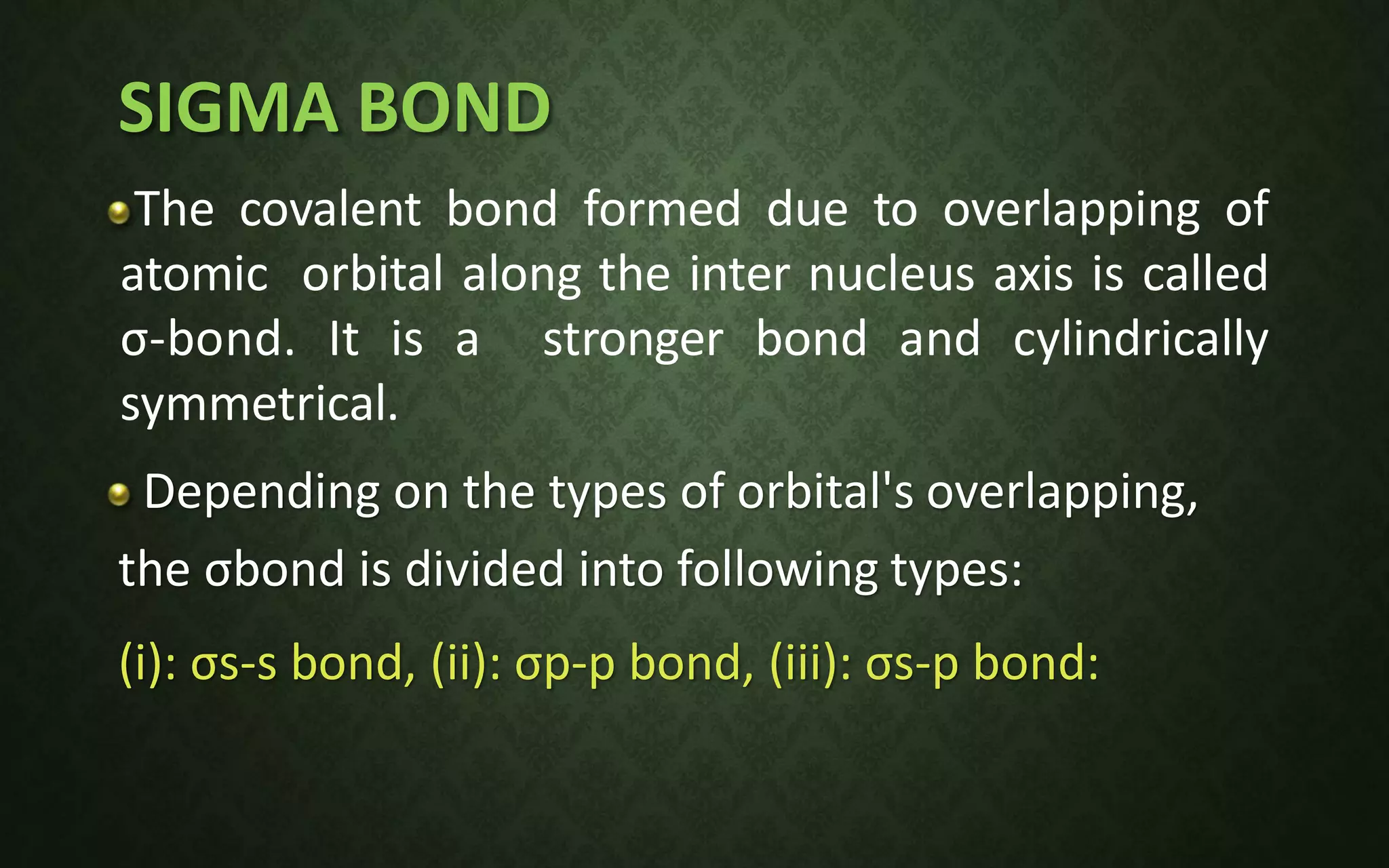
Greater the extent of overlapping, stronger is the bond
formed.
The direction of the covalent bond is along the region
of overlapping of the atomic orbital's i.e., covalent
bond is directional.
Σ-BOND
A SIGMA BOND (SYMBOL: Σ) IS ACOVALENT
BOND FORMED VIA LINEAR OVERLAP OF
TWO ORBITAL'S.
π-BOND
A Pi-BOND (SYMBOL: π) IS ACOVALENT
BOND FORMED VIA PARALLEL OVERLAP OF
TWO ORBITALS.
There are two types of covalent bonds based on the
pattern of overlapping as follows:
Π bond
SIGMA BOND
The covalent bond formed due to overlapping of
atomic orbital along the inter nucleus axis is called
σ-bond. It is a stronger bond and cylindrically
symmetrical.
Depending on the types of orbital's overlapping,
the σbond is divided into following types:
(i): σs-s bond, (ii): σp-p bond, (iii): σs-p bond:
SIGMA BOND
σs-s bond:
SIGMA BOND
σp-p bond:
SIGMA BOND
σs-p bond:
Π-BOND
The covalent bond formed by sidewise
overlapping of atomic orbital's is called π-
bond. In this bond, the electron density is
present above and below the inter nuclear
axis. It is relatively a weaker bond since the
electrons are not strongly attracted by the
nuclei of bonding atoms.
Note: The 's' orbital's canonly form σ-bonds, whereas the p, d & f orbital's canform both σand
π-bonds.
COMPARISON
σ-bond
This bond is formed due
to the overlap of pure s-
s;s-p;p-p (or) hybrid
orbitals of two atoms
along their internuclear
axis.
It is a strongest bond
because the extent of
overlapping of orbitals
in sigma bond is greater.
Electeron density of a
sigma bond is
symmetrical about the
line joining the two
nuclei.
π-bond
This bond is formed
due to lateral or side
wise or parallel
overlapping of pure ‘p’
orbitals of two atoms.
It is weaker than sigma
bond because the extent
of overlapping of
orbitals in pi bond is
lesser.
Electron density of pi
bond is
unsymmetrical.
COMPARISON
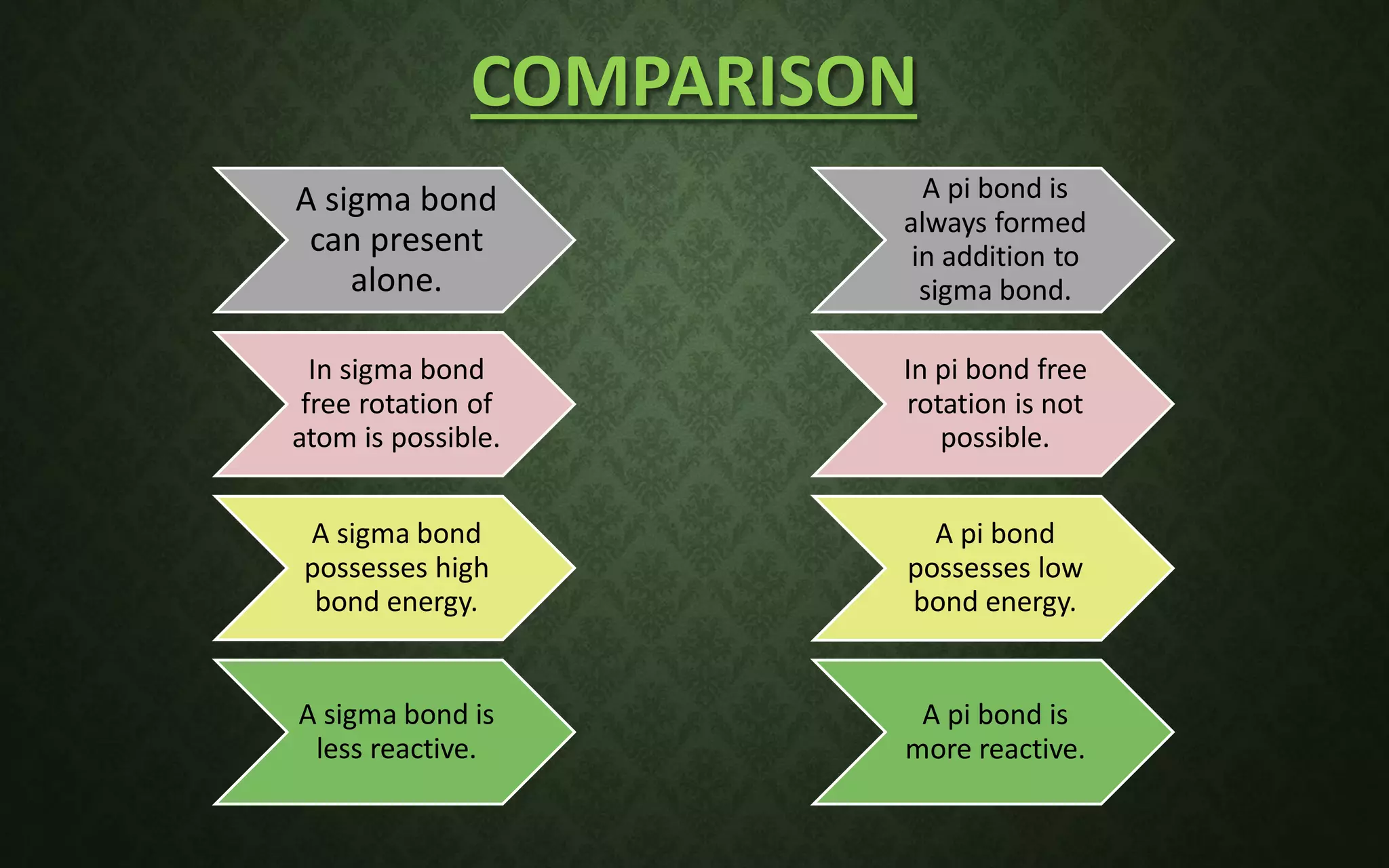
A sigma bond
can present
alone.
In sigma bond
free rotation of
atom is possible.
A sigma bond
possesses high
bond energy.
A sigma bond is
less reactive.
A pi bond is
always formed
in addition to
sigma bond.
In pi bond free
rotation is not
possible.
A pi bond
possesses low
bond energy.
A pi bond is
more reactive.
COMPARISON
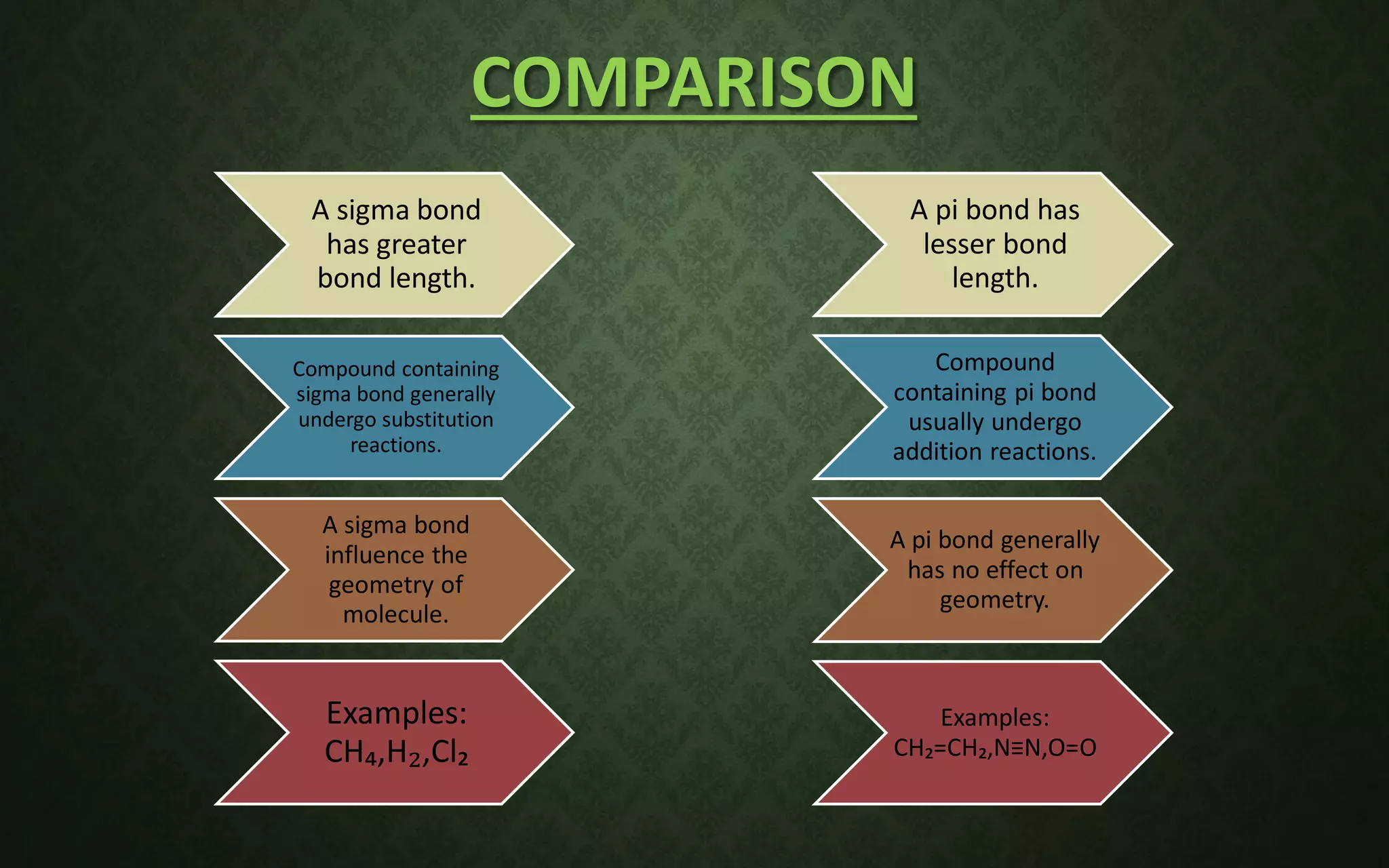
A sigma bond
has greater
bond length.
Compound containing
sigma bond generally
undergo substitution
reactions.
A sigma bond
influence the
geometry of
molecule.
Examples:
CH₄,H₂,Cl₂
A pi bond has
lesser bond
length.
Compound
containing pi bond
usually undergo
addition reactions.
A pi bond generally
has no effect on
geometry.
Examples:
CH₂=CH₂,N≡N,O=O
The electronic configuration of hydrogen atom in the
ground state is 1s1.
In the formation of hydrogen molecule, two half filled
1s orbital's of hydrogen atoms overlap along the inter-
nuclear axisand thus by forming a σs-s bond.
The electronic configuration of Cl atom in the ground
state is [Ne]3s2 3px
2 3py
23pz
1.
The two half filled 3pz atomic orbital's of two chlorine
atoms overlap along the inter-nuclear axis and thus by
forming a σp-p bond.
In the ground state, the electronic configuration of
hydrogen atom is 1s1 .
And the ground state electronic configuration of Cl
atom is [Ne]3s2 3px 2 3py 2 3pz 1 .
The half filled 1s orbital of hydrogen overlap with the
half filled 3pz atomic orbital of chlorine atom along the
internuclear axis to form a σs-p bond.
The electronic configuration of O in the ground state is
[He] 2s2 2px 2 2py 1 2pz 1 .
The half filled 2py orbital's of two oxygen atoms
overlap along the inter-nuclear axis and form σp-p
bond.
The remaining half filled 2pz orbital's overlap laterally
to form a πp-p bond.
Thus a double bond (one σp-p and one πp-p ) is
formed between two oxygen atoms.
The ground state electronic configuration of N is [He]
2s2 2px
1 2py
1 2pz
1.
Aσp-p bond is formed between two nitrogen atoms due
to overlapping of half filled 2px atomic orbital's along
the inter-nuclear axis.
The remaining half filled 2py and 2pz orbital'sform
two πp-p bonds due to lateral overlapping. Thus a triple
bond (one and two) is formed between two nitrogen
atoms.
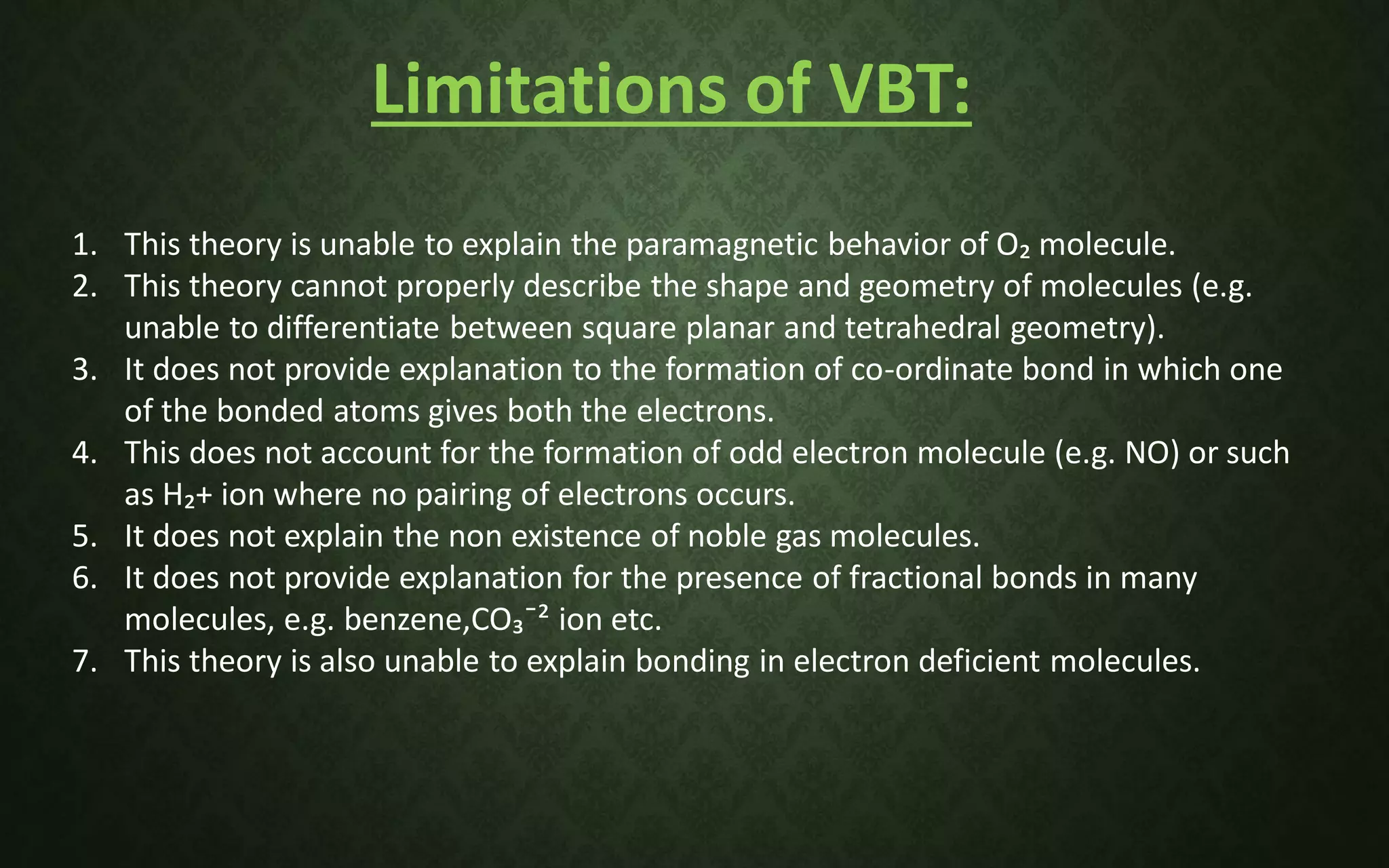
Limitations of VBT:
1. This theory is unable to explain the paramagnetic behavior of O₂ molecule.
2. This theory cannot properly describe the shape and geometry of molecules (e.g.
unable to differentiate between square planar and tetrahedral geometry).
3. It does not provide explanation to the formation of co-ordinate bond in which one
of the bonded atoms gives both the electrons.
4. This does not account for the formation of odd electron molecule (e.g. NO) or such
as H₂+ ion where no pairing of electrons occurs.
5. It does not explain the non existence of noble gas molecules.
6. It does not provide explanation for the presence of fractional bonds in many
molecules, e.g. benzene,CO₃¯² ion etc.
7. This theory is also unable to explain bonding in electron deficient molecules.
The intermixing of two or more pure atomic orbital's
of an atom with almost same energy to give same
number of identical and degenerate new type of
orbital's is known as hybridization.
The new orbital's formed are also known as hybrid
orbital's.
During hybridization, the atomic orbitals with
different characteristics are mixed with each other.
sp
sp2
sp3
sp3d
sp3d2
sp3d3
Intermixing of one 's' and one 'p'
orbital's of almost equal energy to
give two identical and degenerate
hybrid orbital's is called 'sp'
hybridization.
These sp-hybrid orbital's are arranged
linearly at by making 180 ⁰ of angle.
They possess 50% 's' and 50% 'p'
character.
For example:
Intermixing of one 's' and two 'p'
orbital's of almost equal energy to
give three identical and degenerate
hybrid orbital's is known as 'sp2'
hybridization.
The three sp2 hybrid orbital's are
oriented in trigonal planar
symmetry at angles of 120 ⁰ to each
other.
The sp2 hybrid orbital's have 33.3%
's' and 66.6% 'p' character.
For example:
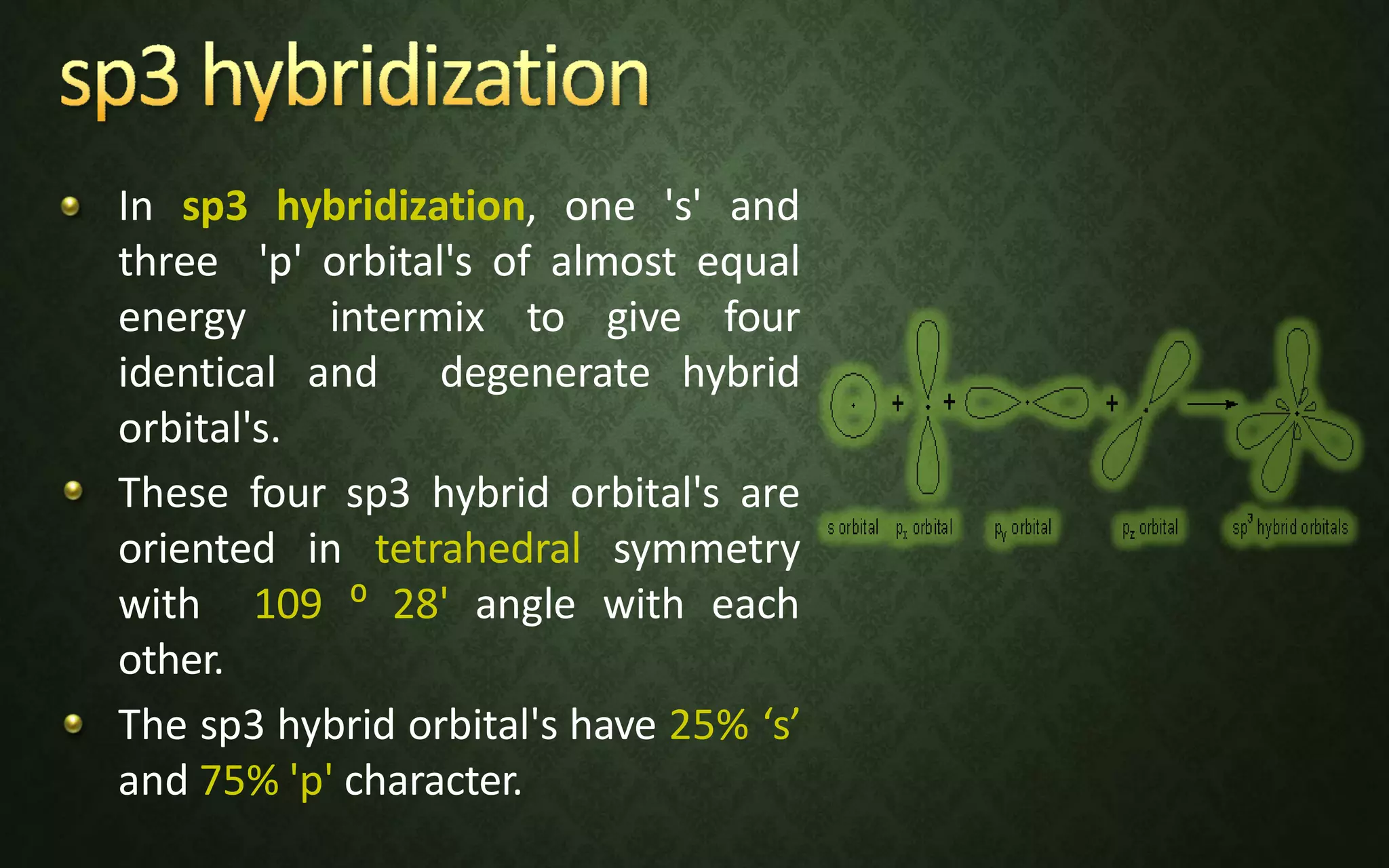
In sp3 hybridization, one 's' and
three 'p' orbital's of almost equal
energy intermix to give four
identical and degenerate hybrid
orbital's.
These four sp3 hybrid orbital's are
oriented in tetrahedral symmetry
with 109 ⁰ 28' angle with each
other.
The sp3 hybrid orbital's have 25% ‘s’
and 75% 'p' character.
For example:
In sp3d hybridization, one 's', three 'p' and one
'd' orbital's of almost equal energy intermix to
give five identical and degenerate hybrid
orbital's, which are arranged in trigonal
bipyramidal symmetry.
Among them, three are arranged in trigonal
plane and the remaining two orbital's are
present above and below the trigonal plane at
right angles.
The sp3d hybrid orbital's have 20% 's', 60% 'p'
and 20% 'd' characters.
For example:
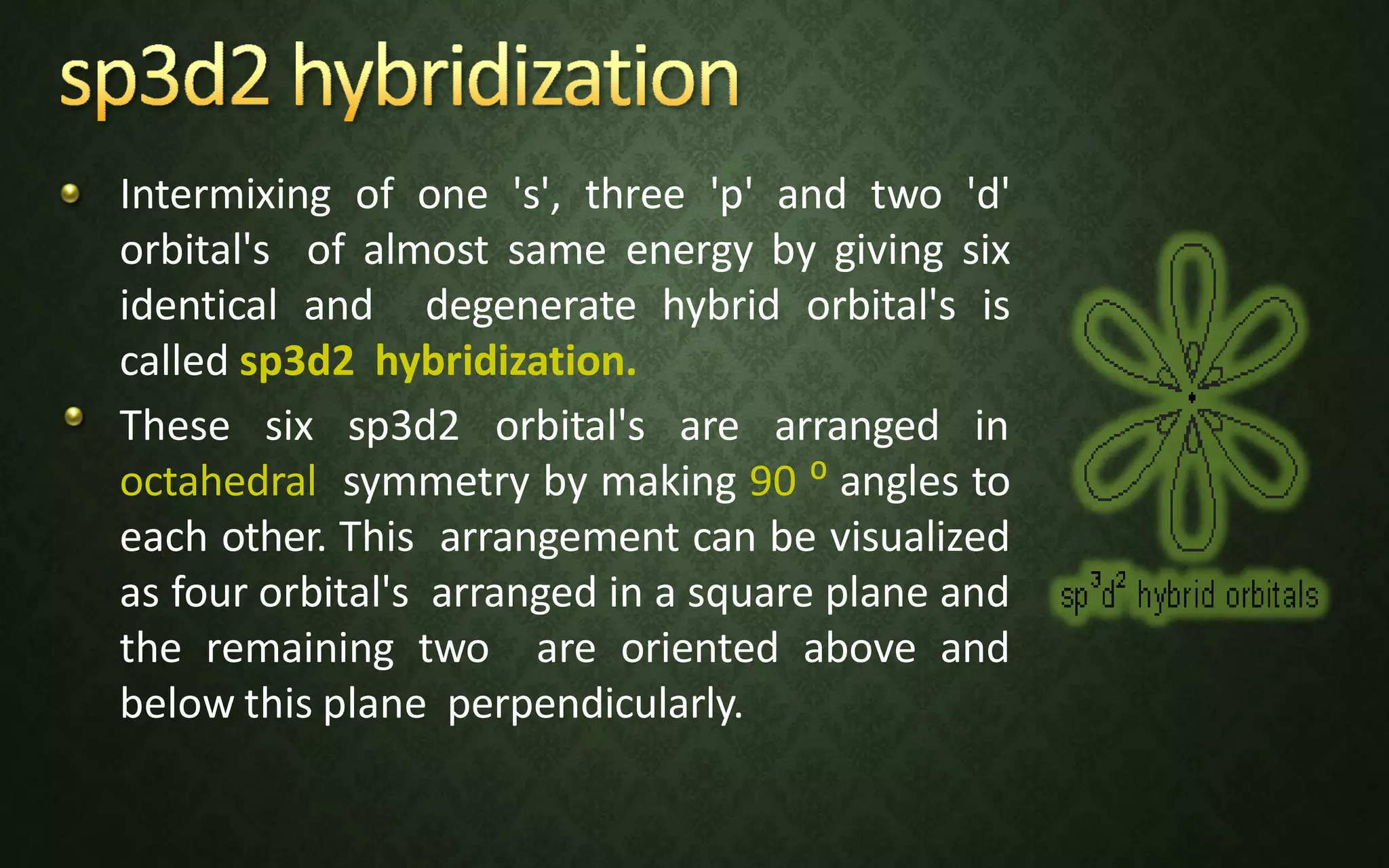
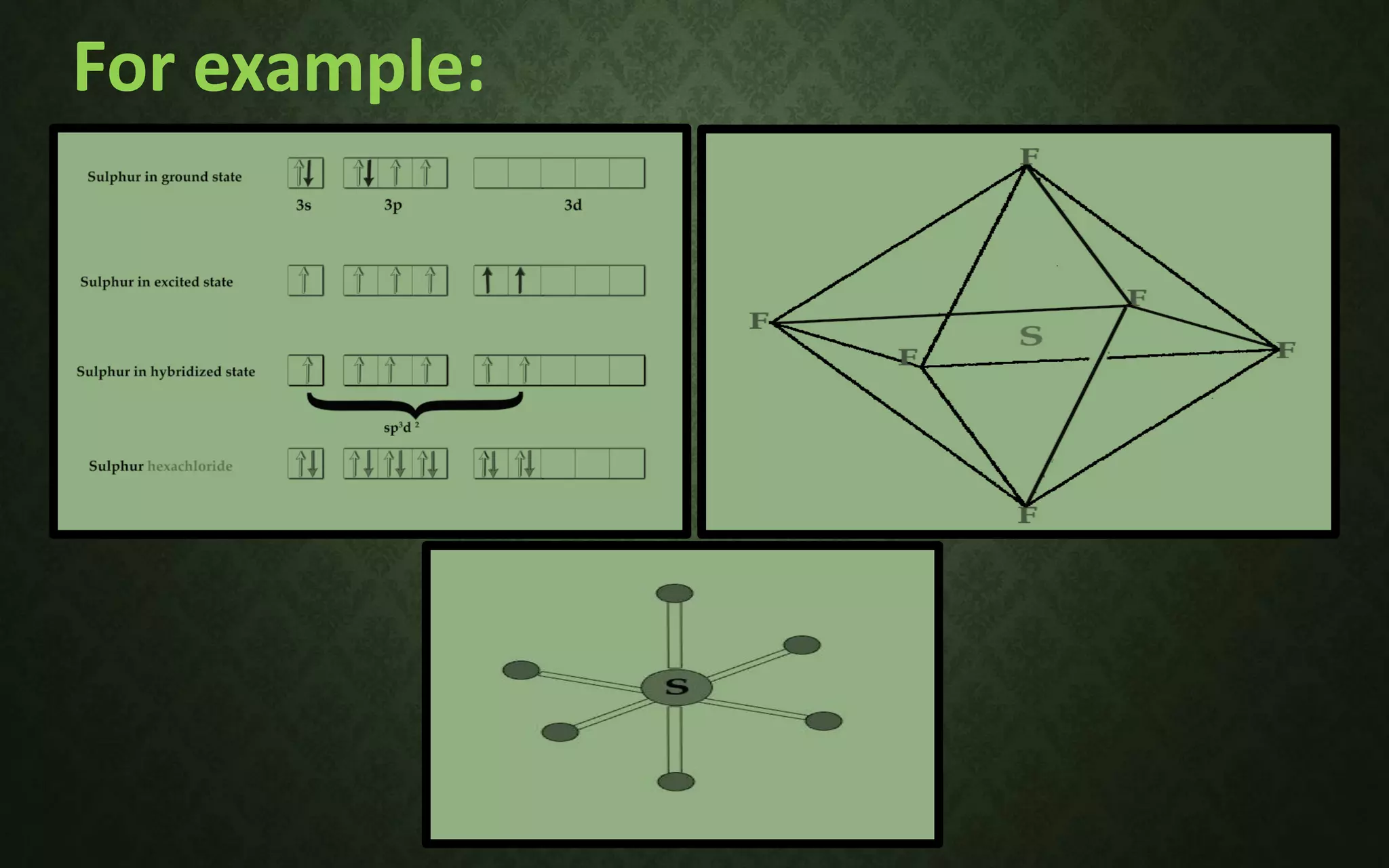
Intermixing of one 's', three 'p' and two 'd'
orbital's of almost same energy by giving six
identical and degenerate hybrid orbital's is
called sp3d2 hybridization.
These six sp3d2 orbital's are arranged in
octahedral symmetry by making 90 ⁰ angles to
each other. This arrangement can be visualized
as four orbital's arranged in a square plane and
the remaining two are oriented above and
below this plane perpendicularly.
For example:
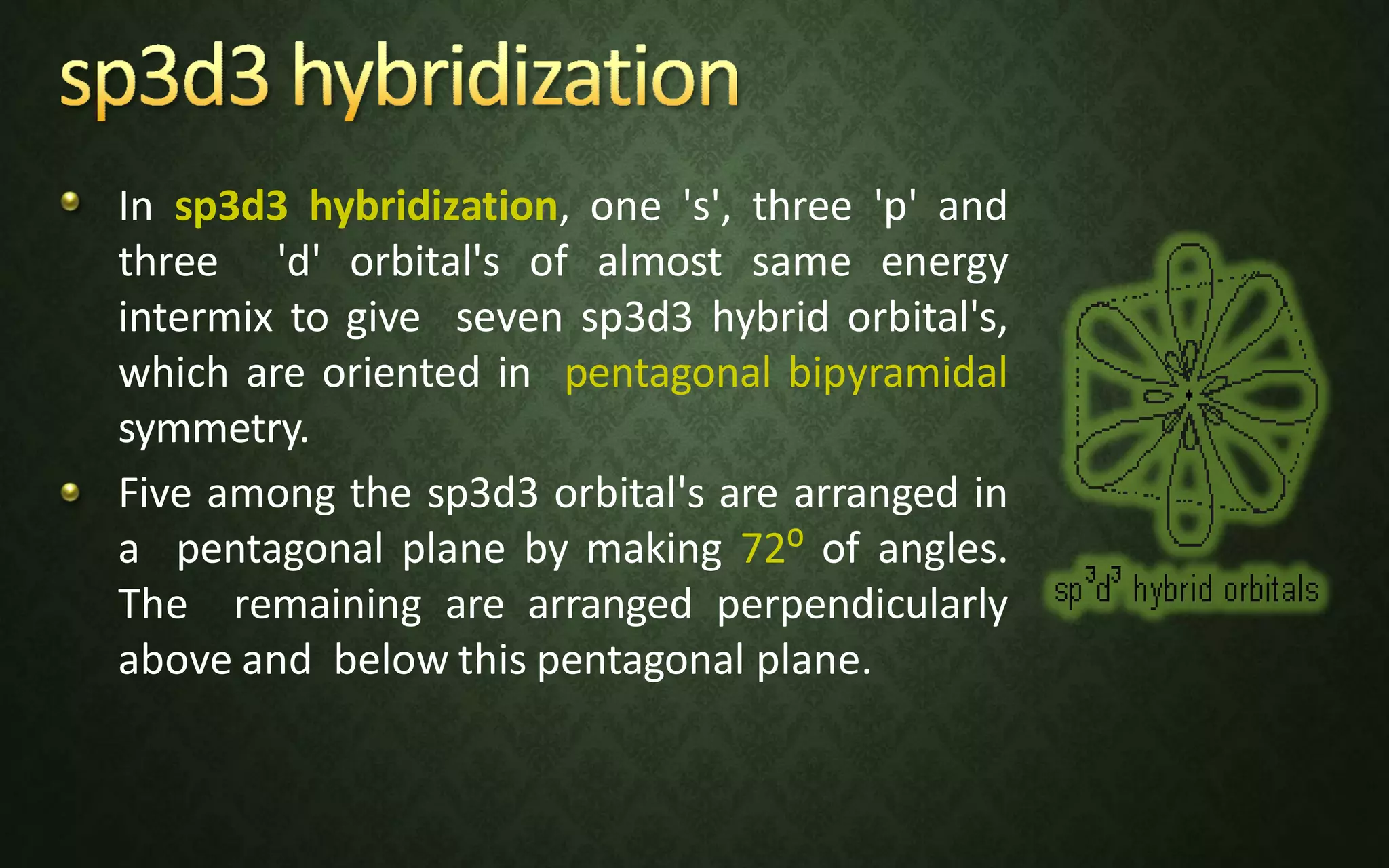
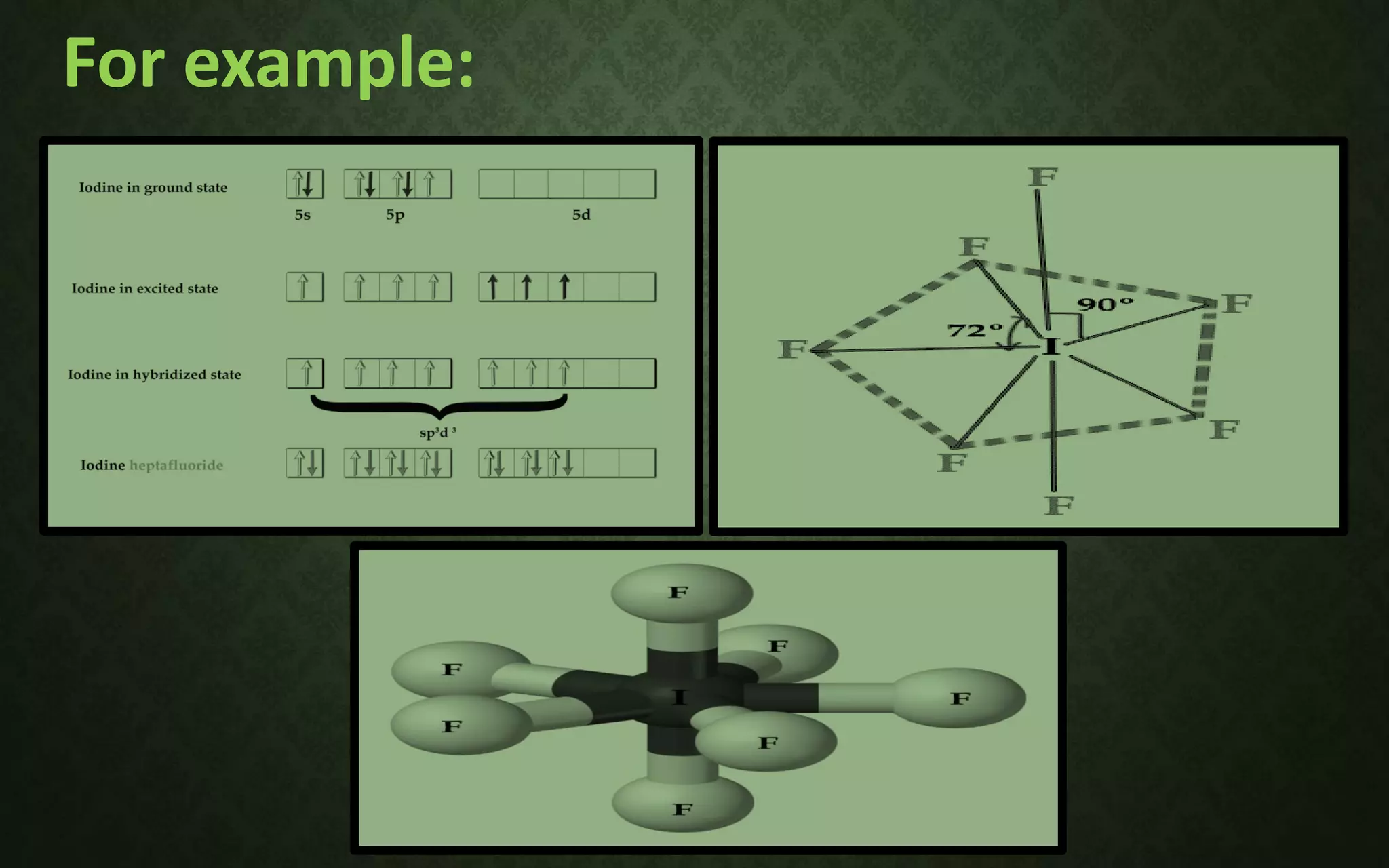
In sp3d3 hybridization, one 's', three 'p' and
three 'd' orbital's of almost same energy
intermix to give seven sp3d3 hybrid orbital's,
which are oriented in pentagonal bipyramidal
symmetry.
Five among the sp3d3 orbital's are arranged in
a pentagonal plane by making 72⁰ of angles.
The remaining are arranged perpendicularly
above and below this pentagonal plane.
For example:
ē Pair Hybridization Shape
2 sp
3 sp2
4 sp3
5 sp3d
6 sp3d2
“GREAT THINGS ARE NOT DONE BY
ONE PERSON.THEY’RE DONE BY A
TEAM OF PEOPLE”

Vbt and hybridization

  • 1.
    Prepared By :Asma Khalil University of Sialkot (USKT) Email:itsasmakhalil011@gmail.com
  • 2.
    CONTENTS • Valence BondTheory • σ-Bond • π —Bond • Comparison • Illustration • Hybridization • Types of Hybridization • sp,sp2,sp3,sp3d,sp3d2,sp3d3
  • 3.
    The valence bondtheory was proposed by Heitler and London to explain the formation of covalent bond quantitatively using quantum mechanics. Later on, Linus Pauling improved this theory by introducing the concept of hybridization. Valence bond (VB) theory assumes that all bonds are localized bonds formed between two atoms by the donation of an electron from each atom.
  • 4.
    Valence Bond theorydescribes covalent bond formation as well as the electronic structure of molecules. The theory assumes that electrons occupy atomic orbital's of individual atoms within a molecule, and that the electrons of one atom are attracted to the nucleus of another atom.
  • 5.
    A covalent bondis formed by the overlapping of two half filled valence atomic orbital's of two different atoms. The electronsin the overlappingorbital's get paired and confined between the nuclei of two atoms. The electron density between two bonded atoms increases due to overlapping. This confers stability to the molecule.
  • 6.
    Greater the extentof overlapping, stronger is the bond formed. The direction of the covalent bond is along the region of overlapping of the atomic orbital's i.e., covalent bond is directional.
  • 7.
    Σ-BOND A SIGMA BOND(SYMBOL: Σ) IS ACOVALENT BOND FORMED VIA LINEAR OVERLAP OF TWO ORBITAL'S. π-BOND A Pi-BOND (SYMBOL: π) IS ACOVALENT BOND FORMED VIA PARALLEL OVERLAP OF TWO ORBITALS. There are two types of covalent bonds based on the pattern of overlapping as follows: Π bond
  • 8.
    SIGMA BOND The covalentbond formed due to overlapping of atomic orbital along the inter nucleus axis is called σ-bond. It is a stronger bond and cylindrically symmetrical. Depending on the types of orbital's overlapping, the σbond is divided into following types: (i): σs-s bond, (ii): σp-p bond, (iii): σs-p bond:
  • 9.
  • 10.
  • 11.
  • 12.
    Π-BOND The covalent bondformed by sidewise overlapping of atomic orbital's is called π- bond. In this bond, the electron density is present above and below the inter nuclear axis. It is relatively a weaker bond since the electrons are not strongly attracted by the nuclei of bonding atoms. Note: The 's' orbital's canonly form σ-bonds, whereas the p, d & f orbital's canform both σand π-bonds.
  • 13.
    COMPARISON σ-bond This bond isformed due to the overlap of pure s- s;s-p;p-p (or) hybrid orbitals of two atoms along their internuclear axis. It is a strongest bond because the extent of overlapping of orbitals in sigma bond is greater. Electeron density of a sigma bond is symmetrical about the line joining the two nuclei. π-bond This bond is formed due to lateral or side wise or parallel overlapping of pure ‘p’ orbitals of two atoms. It is weaker than sigma bond because the extent of overlapping of orbitals in pi bond is lesser. Electron density of pi bond is unsymmetrical.
  • 14.
    COMPARISON A sigma bond canpresent alone. In sigma bond free rotation of atom is possible. A sigma bond possesses high bond energy. A sigma bond is less reactive. A pi bond is always formed in addition to sigma bond. In pi bond free rotation is not possible. A pi bond possesses low bond energy. A pi bond is more reactive.
  • 15.
    COMPARISON A sigma bond hasgreater bond length. Compound containing sigma bond generally undergo substitution reactions. A sigma bond influence the geometry of molecule. Examples: CH₄,H₂,Cl₂ A pi bond has lesser bond length. Compound containing pi bond usually undergo addition reactions. A pi bond generally has no effect on geometry. Examples: CH₂=CH₂,N≡N,O=O
  • 17.
    The electronic configurationof hydrogen atom in the ground state is 1s1. In the formation of hydrogen molecule, two half filled 1s orbital's of hydrogen atoms overlap along the inter- nuclear axisand thus by forming a σs-s bond.
  • 18.
    The electronic configurationof Cl atom in the ground state is [Ne]3s2 3px 2 3py 23pz 1. The two half filled 3pz atomic orbital's of two chlorine atoms overlap along the inter-nuclear axis and thus by forming a σp-p bond.
  • 19.
    In the groundstate, the electronic configuration of hydrogen atom is 1s1 . And the ground state electronic configuration of Cl atom is [Ne]3s2 3px 2 3py 2 3pz 1 . The half filled 1s orbital of hydrogen overlap with the half filled 3pz atomic orbital of chlorine atom along the internuclear axis to form a σs-p bond.
  • 20.
    The electronic configurationof O in the ground state is [He] 2s2 2px 2 2py 1 2pz 1 . The half filled 2py orbital's of two oxygen atoms overlap along the inter-nuclear axis and form σp-p bond. The remaining half filled 2pz orbital's overlap laterally to form a πp-p bond.
  • 21.
    Thus a doublebond (one σp-p and one πp-p ) is formed between two oxygen atoms.
  • 22.
    The ground stateelectronic configuration of N is [He] 2s2 2px 1 2py 1 2pz 1. Aσp-p bond is formed between two nitrogen atoms due to overlapping of half filled 2px atomic orbital's along the inter-nuclear axis.
  • 23.
    The remaining halffilled 2py and 2pz orbital'sform two πp-p bonds due to lateral overlapping. Thus a triple bond (one and two) is formed between two nitrogen atoms.
  • 24.
    Limitations of VBT: 1.This theory is unable to explain the paramagnetic behavior of O₂ molecule. 2. This theory cannot properly describe the shape and geometry of molecules (e.g. unable to differentiate between square planar and tetrahedral geometry). 3. It does not provide explanation to the formation of co-ordinate bond in which one of the bonded atoms gives both the electrons. 4. This does not account for the formation of odd electron molecule (e.g. NO) or such as H₂+ ion where no pairing of electrons occurs. 5. It does not explain the non existence of noble gas molecules. 6. It does not provide explanation for the presence of fractional bonds in many molecules, e.g. benzene,CO₃¯² ion etc. 7. This theory is also unable to explain bonding in electron deficient molecules.
  • 26.
    The intermixing oftwo or more pure atomic orbital's of an atom with almost same energy to give same number of identical and degenerate new type of orbital's is known as hybridization. The new orbital's formed are also known as hybrid orbital's. During hybridization, the atomic orbitals with different characteristics are mixed with each other.
  • 27.
  • 28.
    Intermixing of one's' and one 'p' orbital's of almost equal energy to give two identical and degenerate hybrid orbital's is called 'sp' hybridization. These sp-hybrid orbital's are arranged linearly at by making 180 ⁰ of angle. They possess 50% 's' and 50% 'p' character.
  • 29.
  • 30.
    Intermixing of one's' and two 'p' orbital's of almost equal energy to give three identical and degenerate hybrid orbital's is known as 'sp2' hybridization. The three sp2 hybrid orbital's are oriented in trigonal planar symmetry at angles of 120 ⁰ to each other. The sp2 hybrid orbital's have 33.3% 's' and 66.6% 'p' character.
  • 31.
  • 32.
    In sp3 hybridization,one 's' and three 'p' orbital's of almost equal energy intermix to give four identical and degenerate hybrid orbital's. These four sp3 hybrid orbital's are oriented in tetrahedral symmetry with 109 ⁰ 28' angle with each other. The sp3 hybrid orbital's have 25% ‘s’ and 75% 'p' character.
  • 33.
  • 34.
    In sp3d hybridization,one 's', three 'p' and one 'd' orbital's of almost equal energy intermix to give five identical and degenerate hybrid orbital's, which are arranged in trigonal bipyramidal symmetry. Among them, three are arranged in trigonal plane and the remaining two orbital's are present above and below the trigonal plane at right angles. The sp3d hybrid orbital's have 20% 's', 60% 'p' and 20% 'd' characters.
  • 35.
  • 36.
    Intermixing of one's', three 'p' and two 'd' orbital's of almost same energy by giving six identical and degenerate hybrid orbital's is called sp3d2 hybridization. These six sp3d2 orbital's are arranged in octahedral symmetry by making 90 ⁰ angles to each other. This arrangement can be visualized as four orbital's arranged in a square plane and the remaining two are oriented above and below this plane perpendicularly.
  • 37.
  • 38.
    In sp3d3 hybridization,one 's', three 'p' and three 'd' orbital's of almost same energy intermix to give seven sp3d3 hybrid orbital's, which are oriented in pentagonal bipyramidal symmetry. Five among the sp3d3 orbital's are arranged in a pentagonal plane by making 72⁰ of angles. The remaining are arranged perpendicularly above and below this pentagonal plane.
  • 39.
  • 40.
    ē Pair HybridizationShape 2 sp 3 sp2 4 sp3 5 sp3d 6 sp3d2
  • 41.
    “GREAT THINGS ARENOT DONE BY ONE PERSON.THEY’RE DONE BY A TEAM OF PEOPLE”