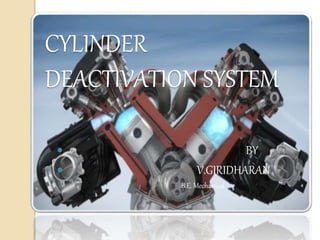
CYLINDER
DEACTIVATION SYSTEM
 BY
 V.GIRIDHARAN
B.E. Mechanical
INTRODUCTION
 This topic focuses about the reduction of fuel
consumption of an internal combustion engine.
 The power required is very less inside the city than the
peak power generated by the car.
 This mechanism is introduced in 1981 by General
Motors .
 It keeps on developing by adding new technologies by
car manufacturing companies.
MECHANISM
 This is the method of deactivating engine
cylinders according to requirement of power to
achieve better fuel efficiency and also emission
control.
 It works because only a small fraction of an
engine’s peak horsepower is needed to maintain
cruising speed.
 Each cylinder is disabled only at the intake and
exhaust stroke. It takes 40 to 50 milliseconds.
 Each cylinder is disabled by interrupting the
operation of intake and exhausts valves with spark
and fuel delivery.
METHODS FOR CYLINDER
DEACTIVATION SYSTEM
 Lifter Pin Control Mechanism
 Variable Profile Cam Shaft
 Active Valve Train Technology.
I. LIFTER PIN CONTROL
MECHANISM
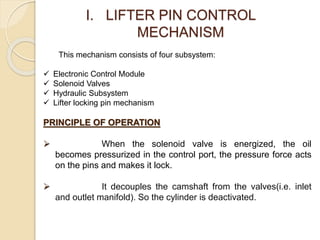
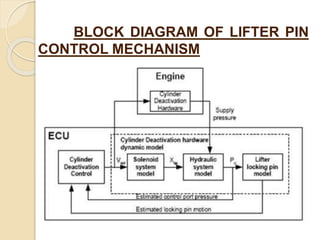
This mechanism consists of four subsystem:
 Electronic Control Module
 Solenoid Valves
 Hydraulic Subsystem
 Lifter locking pin mechanism
PRINCIPLE OF OPERATION
 When the solenoid valve is energized, the oil
becomes pressurized in the control port, the pressure force acts
on the pins and makes it lock.
 It decouples the camshaft from the valves(i.e. inlet
and outlet manifold). So the cylinder is deactivated.
BLOCK DIAGRAM OF LIFTER PIN
CONTROL MECHANISM
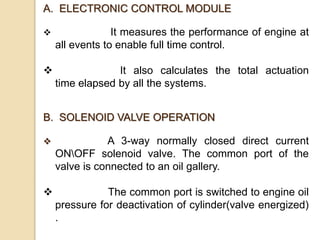
A. ELECTRONIC CONTROL MODULE
 It measures the performance of engine at
all events to enable full time control.
 It also calculates the total actuation
time elapsed by all the systems.
B. SOLENOID VALVE OPERATION
 A 3-way normally closed direct current
ONOFF solenoid valve. The common port of the
valve is connected to an oil gallery.
 The common port is switched to engine oil
pressure for deactivation of cylinder(valve energized)
.
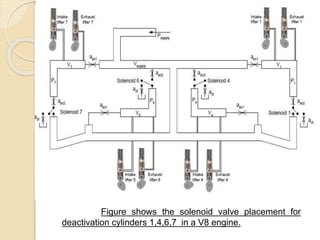
WORKING OF SOLENOID VALVE
Figure shows the solenoid valve placement for
deactivation cylinders 1,4,6,7 in a V8 engine.
C. HYDRAULIC SUBSYSTEM
 The working fluid (engine oil) is to lock the lifter pin by
pressure and it must be calculated.
 The actuation time elapsed by the fluid must be taken into
account, because the time taken to deactivate the cylinder is very
less.
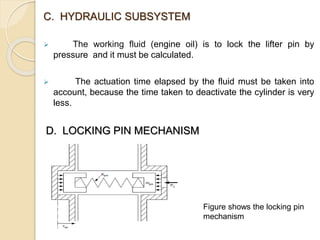
D. LOCKING PIN MECHANISM
Figure shows the locking pin
mechanism
 The common port of the control valve is
connected via an oil gallery to a pair of spring based
locking pins inside the valve lifter.
 When the pins are locked the camshaft is
decoupled from the engine valve. So that we
deactivate the cylinder.
 It is desirable to change the switching sequence
of cylinder-by-cylinder and to complete transition from
V8 to V4.
METHODS USED IN LIFTER PIN CONTROL
MECHANISM
1. Cylinder Bank Control.
In this method the 2 cylinders from each bank is
selected for deactivation.
This control method is mainly used in inline
cylinder engines
2. Individual Cylinder Control.
In this method each cylinder is deactivated
independently and its selection depends on firing order.
This control method is mainly used in Boxer
engines and V engines.
II. VARIABLE PROFILE CAMSHAFT MECHANISM
 This system allows the engine to have multiple cam
shafts.
 As the engine moves into different r.p.m computer can
activate alternate lobes on the camshaft and change the
cam timings.
 This system uses a Cam Profile Switching tappet, to
switch between two different cam profiles. In this way the
engine gets best features of low speed as well as high
speed camshaft of same engine.
 This is similar to the patented V-Tech technology used in
Honda.
III. ACTIVE VALVE TRAIN TECHNOLOGY
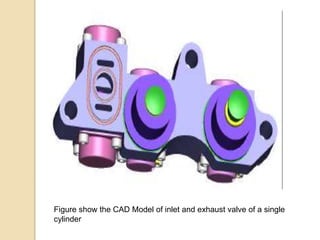
 This system uses electrohydraulic operation, movement
of engine poppet valves initiated by oil flow into and out of
the hydraulic chamber.
 It is controlled by fast acting electrohydraulic servo
valves, this inturn allows variable timing, duration and lift
 Increased combustion control due to variable lift and it
offers fuel consumption benefits over conventional
camshaft driven valve actuation mechanisms.
 But this method is still in experimental stage to rectify
the disadvantages.
Figure show the CAD Model of inlet and exhaust valve of a single
cylinder
ADVANTAGES OF CYLINDER DEACTIVATED
ENGINES
1. Increased fuel efficiency (10-25%).
2. Decreased emissions from deactivated cylinders.
3. Better breathing capability of the engine, thereby
reducing the power consumed in suction stroke.
DISADVANTAGES
1. Engine balancing – Deactivating cylinders can cause
change in engine balancing which leads to violent
vibration and noises. The way of attaching counter
masses to the moving parts like crankshaft is very
difficult to calculate and attach the counter masses.
2. Increased cost of manufactuing – Though the
deactivation process reduces operation costs, the
additional parts like ECM and others will increase the
cost of manufacturing.
3. Overall increase in weight
4. Complexity of system makes maintenance difficult.
5. Since these methods are still under experimental stage,
the reliability of the engine is not predicted yet.
CONCLUSION
 To reduce the pollution from the internal
combustion engines and the demand of
automobile which burns less fuel.
 With the increase of price of petroleum
products the fuel is burnt according to the
power requirement.
 So, Cylinder deactivation solve these
problems to a great extend without
compromising engine performance thus
satisfies both manufacturer and consumer.
REFERENCES
 Research paper published by Quant Zheng, Delphi
Motors.
 Internet.
 Research paper published by Lotus and Eaton
Automotive Systems.
cylinder-deactivation-system.pptx

cylinder-deactivation-system.pptx

  • 1.
    CYLINDER DEACTIVATION SYSTEM  BY V.GIRIDHARAN B.E. Mechanical
  • 2.
    INTRODUCTION  This topicfocuses about the reduction of fuel consumption of an internal combustion engine.  The power required is very less inside the city than the peak power generated by the car.  This mechanism is introduced in 1981 by General Motors .  It keeps on developing by adding new technologies by car manufacturing companies.
  • 3.
    MECHANISM  This isthe method of deactivating engine cylinders according to requirement of power to achieve better fuel efficiency and also emission control.  It works because only a small fraction of an engine’s peak horsepower is needed to maintain cruising speed.  Each cylinder is disabled only at the intake and exhaust stroke. It takes 40 to 50 milliseconds.  Each cylinder is disabled by interrupting the operation of intake and exhausts valves with spark and fuel delivery.
  • 4.
    METHODS FOR CYLINDER DEACTIVATIONSYSTEM  Lifter Pin Control Mechanism  Variable Profile Cam Shaft  Active Valve Train Technology.
  • 5.
    I. LIFTER PINCONTROL MECHANISM This mechanism consists of four subsystem:  Electronic Control Module  Solenoid Valves  Hydraulic Subsystem  Lifter locking pin mechanism PRINCIPLE OF OPERATION  When the solenoid valve is energized, the oil becomes pressurized in the control port, the pressure force acts on the pins and makes it lock.  It decouples the camshaft from the valves(i.e. inlet and outlet manifold). So the cylinder is deactivated.
  • 6.
    BLOCK DIAGRAM OFLIFTER PIN CONTROL MECHANISM
  • 7.
    A. ELECTRONIC CONTROLMODULE  It measures the performance of engine at all events to enable full time control.  It also calculates the total actuation time elapsed by all the systems. B. SOLENOID VALVE OPERATION  A 3-way normally closed direct current ONOFF solenoid valve. The common port of the valve is connected to an oil gallery.  The common port is switched to engine oil pressure for deactivation of cylinder(valve energized) .
  • 8.
  • 9.
    Figure shows thesolenoid valve placement for deactivation cylinders 1,4,6,7 in a V8 engine.
  • 10.
    C. HYDRAULIC SUBSYSTEM The working fluid (engine oil) is to lock the lifter pin by pressure and it must be calculated.  The actuation time elapsed by the fluid must be taken into account, because the time taken to deactivate the cylinder is very less. D. LOCKING PIN MECHANISM Figure shows the locking pin mechanism
  • 11.
     The commonport of the control valve is connected via an oil gallery to a pair of spring based locking pins inside the valve lifter.  When the pins are locked the camshaft is decoupled from the engine valve. So that we deactivate the cylinder.  It is desirable to change the switching sequence of cylinder-by-cylinder and to complete transition from V8 to V4.
  • 12.
    METHODS USED INLIFTER PIN CONTROL MECHANISM 1. Cylinder Bank Control. In this method the 2 cylinders from each bank is selected for deactivation. This control method is mainly used in inline cylinder engines 2. Individual Cylinder Control. In this method each cylinder is deactivated independently and its selection depends on firing order. This control method is mainly used in Boxer engines and V engines.
  • 13.
    II. VARIABLE PROFILECAMSHAFT MECHANISM  This system allows the engine to have multiple cam shafts.  As the engine moves into different r.p.m computer can activate alternate lobes on the camshaft and change the cam timings.  This system uses a Cam Profile Switching tappet, to switch between two different cam profiles. In this way the engine gets best features of low speed as well as high speed camshaft of same engine.  This is similar to the patented V-Tech technology used in Honda.
  • 14.
    III. ACTIVE VALVETRAIN TECHNOLOGY  This system uses electrohydraulic operation, movement of engine poppet valves initiated by oil flow into and out of the hydraulic chamber.  It is controlled by fast acting electrohydraulic servo valves, this inturn allows variable timing, duration and lift  Increased combustion control due to variable lift and it offers fuel consumption benefits over conventional camshaft driven valve actuation mechanisms.  But this method is still in experimental stage to rectify the disadvantages.
  • 15.
    Figure show theCAD Model of inlet and exhaust valve of a single cylinder
  • 16.
    ADVANTAGES OF CYLINDERDEACTIVATED ENGINES 1. Increased fuel efficiency (10-25%). 2. Decreased emissions from deactivated cylinders. 3. Better breathing capability of the engine, thereby reducing the power consumed in suction stroke.
  • 17.
    DISADVANTAGES 1. Engine balancing– Deactivating cylinders can cause change in engine balancing which leads to violent vibration and noises. The way of attaching counter masses to the moving parts like crankshaft is very difficult to calculate and attach the counter masses. 2. Increased cost of manufactuing – Though the deactivation process reduces operation costs, the additional parts like ECM and others will increase the cost of manufacturing. 3. Overall increase in weight 4. Complexity of system makes maintenance difficult. 5. Since these methods are still under experimental stage, the reliability of the engine is not predicted yet.
  • 18.
    CONCLUSION  To reducethe pollution from the internal combustion engines and the demand of automobile which burns less fuel.  With the increase of price of petroleum products the fuel is burnt according to the power requirement.  So, Cylinder deactivation solve these problems to a great extend without compromising engine performance thus satisfies both manufacturer and consumer.
  • 19.
    REFERENCES  Research paperpublished by Quant Zheng, Delphi Motors.  Internet.  Research paper published by Lotus and Eaton Automotive Systems.