AUTOMOBILE COOLING SYSTEM
UNIT-4 COOLING SYSTEM
EME-505
BY
S K Singh
Centre for Energy Studies
IIT Delhi
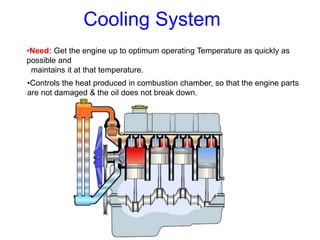
Cooling System
•Need: Get the engine up to optimum operating Temperature as quickly as
possible and
maintains it at that temperature.
•Controls the heat produced in combustion chamber, so that the engine parts
are not damaged & the oil does not break down.
Cooling System
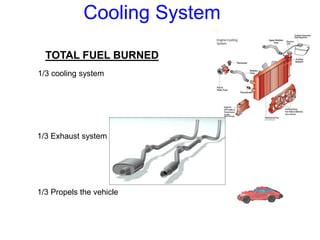
TOTAL FUEL BURNED
1/3 cooling system
1/3 Exhaust system
1/3 Propels the vehicle
Cooling System
• Automotive cooling systems operate
around (82-100 degree C)
• Engine coolant is used to remove heat
from the cylinder to the radiator where it is
then dissipated.
• Engine coolant mixture should be
approximately a 50/50 mixture of coolant
and water.
COOLING SYSTEM IMPORTANCE
• High temp reduces strength of piston and piston rings may lead to
engine seizure
• Decomposition of lubricating oil at high temp
• Overheating of the valves
• Detonation tendency increases
• Pre ignition of the charge
CLASSIFICATION OF COOLING SYSTEM
1- AIR COOLING
2- WATER COOLING
Cooling System TYPES
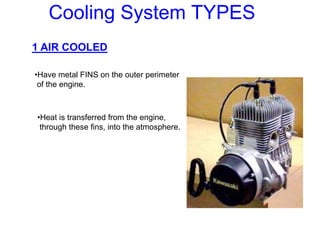
1 AIR COOLED
•Have metal FINS on the outer perimeter
of the engine.
•Heat is transferred from the engine,
through these fins, into the atmosphere.
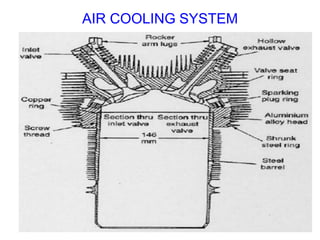
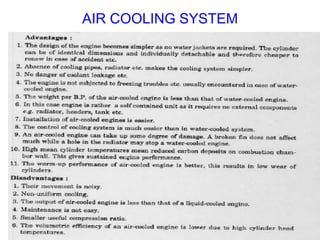
AIR COOLING SYSTEM
AIR COOLING SYSTEM
Cooling System TYPES Contd..
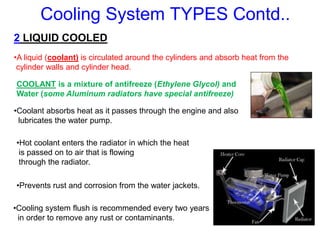
2 LIQUID COOLED
•A liquid (coolant) is circulated around the cylinders and absorb heat from the
cylinder walls and cylinder head.
COOLANT is a mixture of antifreeze (Ethylene Glycol) and
Water (some Aluminum radiators have special antifreeze)
•Coolant absorbs heat as it passes through the engine and also
lubricates the water pump.
•Hot coolant enters the radiator in which the heat
is passed on to air that is flowing
through the radiator.
•Prevents rust and corrosion from the water jackets.
•Cooling system flush is recommended every two years
in order to remove any rust or contaminants.
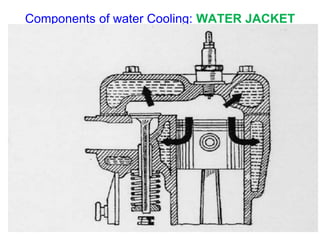
Components of water Cooling: WATER JACKET
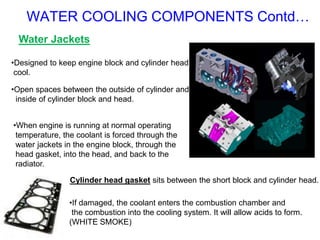
WATER COOLING COMPONENTS Contd…
Water Jackets
•Designed to keep engine block and cylinder head
cool.
•Open spaces between the outside of cylinder and
inside of cylinder block and head.
•When engine is running at normal operating
temperature, the coolant is forced through the
water jackets in the engine block, through the
head gasket, into the head, and back to the
radiator.
Cylinder head gasket sits between the short block and cylinder head.
•If damaged, the coolant enters the combustion chamber and
the combustion into the cooling system. It will allow acids to form.
(WHITE SMOKE)
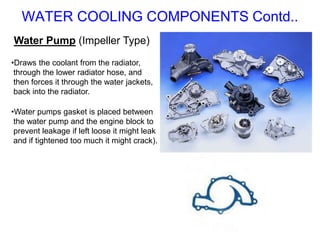
Water Pump (Impeller Type)
•Draws the coolant from the radiator,
through the lower radiator hose, and
then forces it through the water jackets,
back into the radiator.
•Water pumps gasket is placed between
the water pump and the engine block to
prevent leakage if left loose it might leak
and if tightened too much it might crack).
WATER COOLING COMPONENTS Contd..
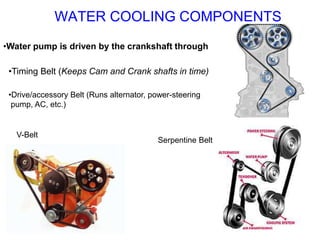
•Water pump is driven by the crankshaft through
•Timing Belt (Keeps Cam and Crank shafts in time)
•Drive/accessory Belt (Runs alternator, power-steering
pump, AC, etc.)
Serpentine Belt
V-Belt
WATER COOLING COMPONENTS
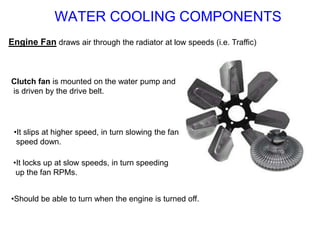
Engine Fan draws air through the radiator at low speeds (i.e. Traffic)
Clutch fan is mounted on the water pump and
is driven by the drive belt.
•It slips at higher speed, in turn slowing the fan
speed down.
•Should be able to turn when the engine is turned off.
•It locks up at slow speeds, in turn speeding
up the fan RPMs.
WATER COOLING COMPONENTS
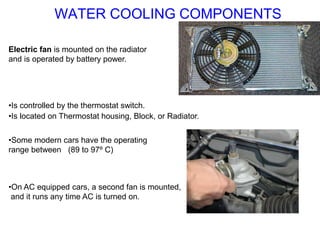
Electric fan is mounted on the radiator
and is operated by battery power.
•Is controlled by the thermostat switch.
•Some modern cars have the operating
range between (89 to 97º C)
•On AC equipped cars, a second fan is mounted,
and it runs any time AC is turned on.
•Is located on Thermostat housing, Block, or Radiator.
WATER COOLING COMPONENTS
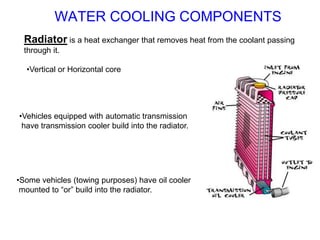
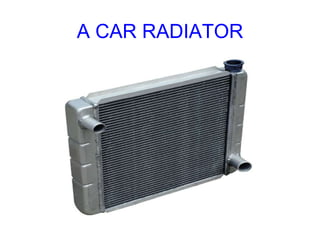
Radiator is a heat exchanger that removes heat from the coolant passing
through it.
•Vertical or Horizontal core
•Vehicles equipped with automatic transmission
have transmission cooler build into the radiator.
•Some vehicles (towing purposes) have oil cooler
mounted to “or” build into the radiator.
WATER COOLING COMPONENTS
A CAR RADIATOR
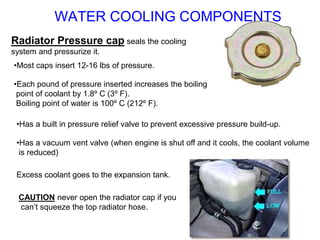
Radiator Pressure cap seals the cooling
system and pressurize it.
•Most caps insert 12-16 lbs of pressure.
•Each pound of pressure inserted increases the boiling
point of coolant by 1.8º C (3º F).
Boiling point of water is 100º C (212º F).
•Has a built in pressure relief valve to prevent excessive pressure build-up.
•Has a vacuum vent valve (when engine is shut off and it cools, the coolant volume
is reduced)
Excess coolant goes to the expansion tank.
CAUTION never open the radiator cap if you
can’t squeeze the top radiator hose.
WATER COOLING COMPONENTS
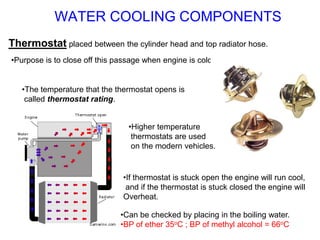
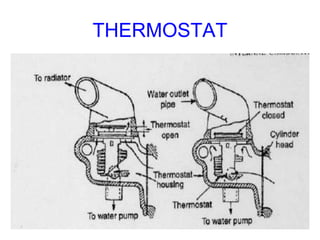
Thermostat placed between the cylinder head and top radiator hose.
•Purpose is to close off this passage when engine is cold.
•The temperature that the thermostat opens is
called thermostat rating.
•If thermostat is stuck open the engine will run cool,
and if the thermostat is stuck closed the engine will
Overheat.
•Can be checked by placing in the boiling water.
•BP of ether 35oC ; BP of methyl alcohol = 66oC
•Higher temperature
thermostats are used
on the modern vehicles.
WATER COOLING COMPONENTS
THERMOSTAT
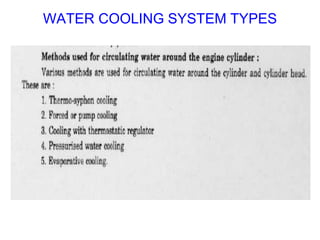
WATER COOLING SYSTEM TYPES
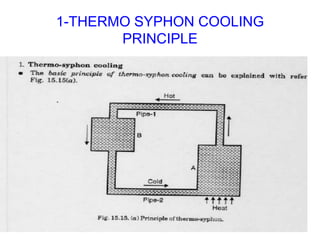
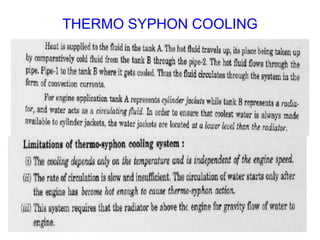
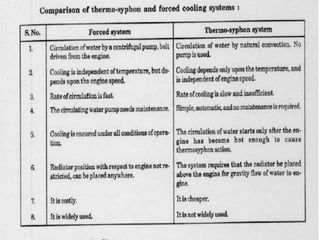
1-THERMO SYPHON COOLING
PRINCIPLE
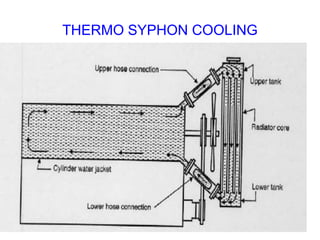
THERMO SYPHON COOLING
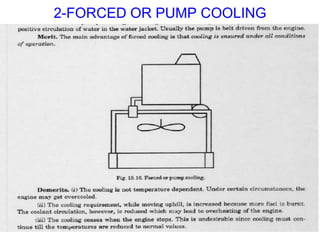
2-FORCED OR PUMP COOLING
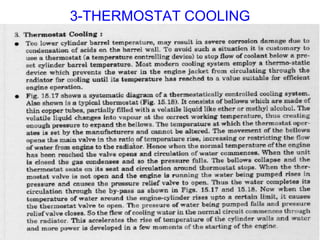
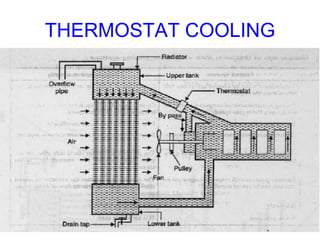
3-THERMOSTAT COOLING
THERMOSTAT COOLING
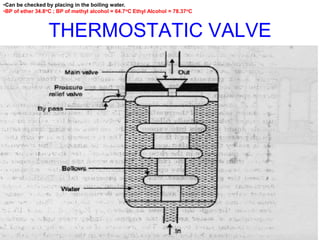
THERMOSTATIC VALVE
•Can be checked by placing in the boiling water.
•BP of ether 34.8oC ; BP of methyl alcohol = 64.7oC Ethyl Alcohol = 78.37oC
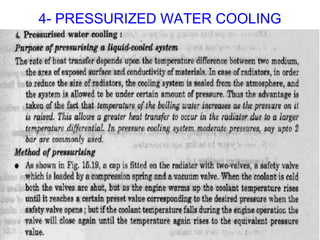
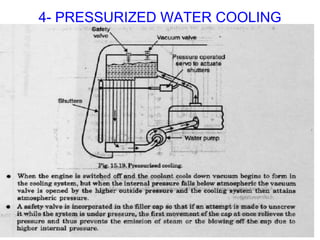
4- PRESSURIZED WATER COOLING
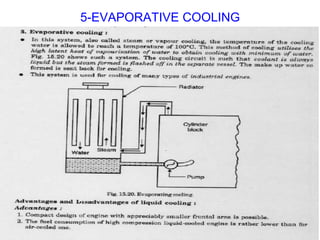
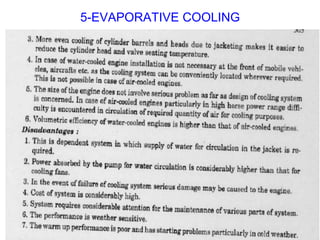
5-EVAPORATIVE COOLING

Unit 4 cooling system

  • 1.
    AUTOMOBILE COOLING SYSTEM UNIT-4COOLING SYSTEM EME-505 BY S K Singh Centre for Energy Studies IIT Delhi
  • 2.
    Cooling System •Need: Getthe engine up to optimum operating Temperature as quickly as possible and maintains it at that temperature. •Controls the heat produced in combustion chamber, so that the engine parts are not damaged & the oil does not break down.
  • 3.
    Cooling System TOTAL FUELBURNED 1/3 cooling system 1/3 Exhaust system 1/3 Propels the vehicle
  • 4.
    Cooling System • Automotivecooling systems operate around (82-100 degree C) • Engine coolant is used to remove heat from the cylinder to the radiator where it is then dissipated. • Engine coolant mixture should be approximately a 50/50 mixture of coolant and water.
  • 5.
    COOLING SYSTEM IMPORTANCE •High temp reduces strength of piston and piston rings may lead to engine seizure • Decomposition of lubricating oil at high temp • Overheating of the valves • Detonation tendency increases • Pre ignition of the charge CLASSIFICATION OF COOLING SYSTEM 1- AIR COOLING 2- WATER COOLING
  • 6.
    Cooling System TYPES 1AIR COOLED •Have metal FINS on the outer perimeter of the engine. •Heat is transferred from the engine, through these fins, into the atmosphere.
  • 7.
  • 8.
  • 9.
    Cooling System TYPESContd.. 2 LIQUID COOLED •A liquid (coolant) is circulated around the cylinders and absorb heat from the cylinder walls and cylinder head. COOLANT is a mixture of antifreeze (Ethylene Glycol) and Water (some Aluminum radiators have special antifreeze) •Coolant absorbs heat as it passes through the engine and also lubricates the water pump. •Hot coolant enters the radiator in which the heat is passed on to air that is flowing through the radiator. •Prevents rust and corrosion from the water jackets. •Cooling system flush is recommended every two years in order to remove any rust or contaminants.
  • 10.
    Components of waterCooling: WATER JACKET
  • 11.
    WATER COOLING COMPONENTSContd… Water Jackets •Designed to keep engine block and cylinder head cool. •Open spaces between the outside of cylinder and inside of cylinder block and head. •When engine is running at normal operating temperature, the coolant is forced through the water jackets in the engine block, through the head gasket, into the head, and back to the radiator. Cylinder head gasket sits between the short block and cylinder head. •If damaged, the coolant enters the combustion chamber and the combustion into the cooling system. It will allow acids to form. (WHITE SMOKE)
  • 12.
    Water Pump (ImpellerType) •Draws the coolant from the radiator, through the lower radiator hose, and then forces it through the water jackets, back into the radiator. •Water pumps gasket is placed between the water pump and the engine block to prevent leakage if left loose it might leak and if tightened too much it might crack). WATER COOLING COMPONENTS Contd..
  • 13.
    •Water pump isdriven by the crankshaft through •Timing Belt (Keeps Cam and Crank shafts in time) •Drive/accessory Belt (Runs alternator, power-steering pump, AC, etc.) Serpentine Belt V-Belt WATER COOLING COMPONENTS
  • 14.
    Engine Fan drawsair through the radiator at low speeds (i.e. Traffic) Clutch fan is mounted on the water pump and is driven by the drive belt. •It slips at higher speed, in turn slowing the fan speed down. •Should be able to turn when the engine is turned off. •It locks up at slow speeds, in turn speeding up the fan RPMs. WATER COOLING COMPONENTS
  • 15.
    Electric fan ismounted on the radiator and is operated by battery power. •Is controlled by the thermostat switch. •Some modern cars have the operating range between (89 to 97º C) •On AC equipped cars, a second fan is mounted, and it runs any time AC is turned on. •Is located on Thermostat housing, Block, or Radiator. WATER COOLING COMPONENTS
  • 16.
    Radiator is aheat exchanger that removes heat from the coolant passing through it. •Vertical or Horizontal core •Vehicles equipped with automatic transmission have transmission cooler build into the radiator. •Some vehicles (towing purposes) have oil cooler mounted to “or” build into the radiator. WATER COOLING COMPONENTS
  • 17.
  • 18.
    Radiator Pressure capseals the cooling system and pressurize it. •Most caps insert 12-16 lbs of pressure. •Each pound of pressure inserted increases the boiling point of coolant by 1.8º C (3º F). Boiling point of water is 100º C (212º F). •Has a built in pressure relief valve to prevent excessive pressure build-up. •Has a vacuum vent valve (when engine is shut off and it cools, the coolant volume is reduced) Excess coolant goes to the expansion tank. CAUTION never open the radiator cap if you can’t squeeze the top radiator hose. WATER COOLING COMPONENTS
  • 19.
    Thermostat placed betweenthe cylinder head and top radiator hose. •Purpose is to close off this passage when engine is cold. •The temperature that the thermostat opens is called thermostat rating. •If thermostat is stuck open the engine will run cool, and if the thermostat is stuck closed the engine will Overheat. •Can be checked by placing in the boiling water. •BP of ether 35oC ; BP of methyl alcohol = 66oC •Higher temperature thermostats are used on the modern vehicles. WATER COOLING COMPONENTS
  • 20.
  • 21.
  • 22.
  • 23.
  • 24.
  • 25.
  • 27.
  • 28.
  • 29.
    THERMOSTATIC VALVE •Can bechecked by placing in the boiling water. •BP of ether 34.8oC ; BP of methyl alcohol = 64.7oC Ethyl Alcohol = 78.37oC
  • 30.
  • 31.
  • 33.
  • 34.