Created by
ROYAL MADAN & VIVEK KUMAR
Asst. prof. at Mechanical dept
royalmadan6293@gmail.com
1. INTRODUCTION

2. FUNCTION OF CAM
3. EXISTING TECHNOLOGY
4. CAMLESS VALVE TRAIN OPERATION
5. ELECTRO/MECHANICAL
6. ELECTRO /HYDRAULIC
7. BENEFITS
8. CONCLUSION

9. REFERENCES
Various engine systems have been developed in the
effort to improve the engine performance and fuel
economy of an automobile.
The engine will either have powerful performance or
increased fuel economy, but with the existing
technology it is difficult to achieve both
simultaneously.
The conceptual development, design, manufacture,
and analysis of a piezoelectric controlled hydraulic
actuator. This actuator was developed for use as a
replacement for the camshaft in an internal
combustion engine, its development results in a new
device; called, the camless engine (CLE).
CAM


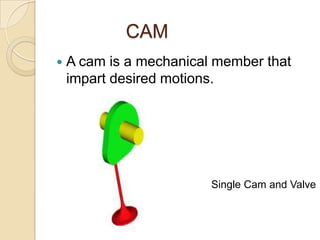
A cam is a mechanical member that
impart desired motions.

Single Cam and Valve
FUNCTION OF CAMSHAFT


As the camshaft rotates, cam lobes,
attached to the camshaft, interface with
the engine’s valves.



This interface may take place via a
mechanical linkage, but the result is, as
the cam rotates it forces the valve open.



The spring return closes the valve when
the cam is no longer supplying the
opening force.
1.The valve train in a typical internal combustion
engine comprises several moving components that are
cam, camshaft, cam lobes ,poppet valves ,with valve
springs.

2.The camshaft is attached to the crankshaft of IC
engine and rotates relatively to rotation of crankshaft.
3.This dependence on the rotational velocity of the

crankshaft provides the primary limitation on the use of
cam.
4.Since the timing of engine dependent on the shape of
the cam lobes and rotational velocity of camshaft
5.This resulting design represent s a compromise

between fuel efficiency and engine power.
6.Considering

this

compromise

,automobile

manufacturers have been attempting to provide vehicles
capable of cylinder deactivation ,by variable valve
timing (VVT).
7. Camless VVT allows an engine to experience
maximum engine performance and fuel efficiency at
each and every engine speed
WHAT IS CAMLESS ENGINE
A camless engine uses
electromagnetic, hydraulic, or
pneumatic actuator to open the
poppet valves.
 Actuator can be used to both open
and close the valve or an actuator
opens while spring closes it.
 Ability to achieve truly variable valve
timing in each cycle.

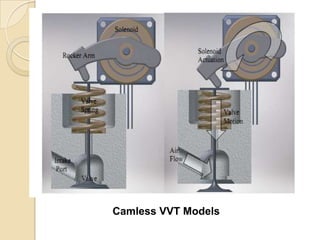
Camless VVT Models
EXPLANATION
They
are
Composed
of
two
superimposed electromagnets, between
which moves a metal part that is
interdependent with a push rod.
 Electromechanical actuators are placed
at the tail-end of the valves.
 Management unit send command to the
electromagnets which alternatively attract
the moving component i.e. push rod.

CONT.


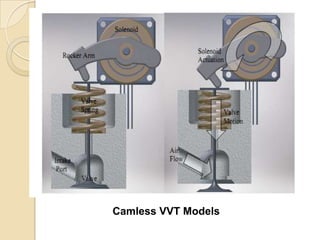
Once the solenoid get actuated, the
rocker arm pivots and compresses the
valve and valve spring which in turn
releases the flow of air in to the engine
cylinder.
BLOCK DIAGRAM
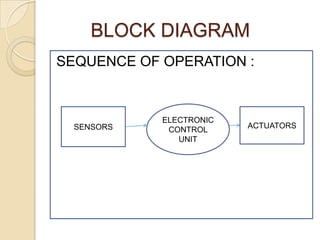
SEQUENCE OF OPERATION :

SENSORS

ELECTRONIC
CONTROL
UNIT

ACTUATORS
EXISTING TECHNOLOGY
In response to the needs of improved engines, some
manufacturers have designed mechanical devices to
achieve some variable valve timing. These devices are
essentially camshafts with multiple cam lobes or engines
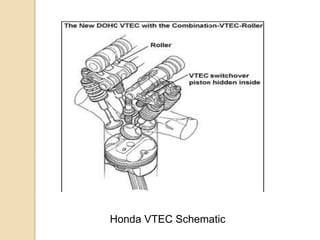
with multiple camshafts. For example, the Honda VTEC
uses three lobes, low, mid, and high to create a broader
power band. This does represent an increased level of

sophistication, but still limits the engine timing to a few
discrete changes.
Honda VTEC Schematic
Camless Valve train Operation
The types of camless variable valve actuating systems

being developed can be classed in two groups:
1. Electromechanical
2. Electrohydraulic
1. Electromechanical actuators, commanded by a
distribution management unit, control the movement of
the valves. There is therefore no longer any direct
mechanical bond between the valves and the crankshaft.
2. Camless valve variable timing is electronically operated
by a microcontroller which will control electro-mechanical
rotary solenoid actuators.
3. The required amount of force and speed needed from a
solenoid in order for this system to be effective, rotary
solenoids meet the requirement for this system.
4. Each of these solenoids will be connected to the intake
and
exhaust valves relieving the engine of the load of
a cam system.
Camless VVT Models
5.Depending on the load and engine speed, the
microcontroller will process the information given and use
pulse width modulation (PWM) to actuate the solenoid
valves.
6.These PWMs will generate square waves that are identical
to the timing profile for the most efficient engine at that
particular speed and load combination.
7.These PWMs will be sent to the solenoids to actuate the
timing of these devices. Once the solenoid is actuated, the
rocker arm pivots and compresses the valve and valve
spring which in turn releases the flow of air into the engine’s
cylinder.
8. Theses generated PWMs are predetermined square
waves that will be hard coded and referenced by the
microcontroller depending on the load and speed of the
engine for maximum engine efficiency.
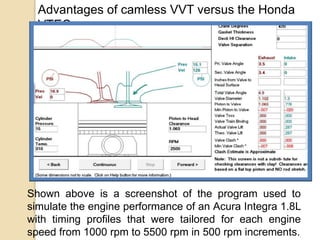
Advantages of camless VVT versus the Honda
VTEC.

Shown above is a screenshot of the program used to
simulate the engine performance of an Acura Integra 1.8L
with timing profiles that were tailored for each engine
speed from 1000 rpm to 5500 rpm in 500 rpm increments.
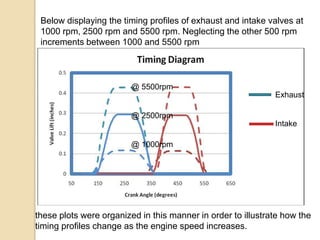
Below displaying the timing profiles of exhaust and intake valves at
1000 rpm, 2500 rpm and 5500 rpm. Neglecting the other 500 rpm
increments between 1000 and 5500 rpm

@ 5500rpm
Exhaust
@ 2500rpm
Intake
@ 1000rpm

these plots were organized in this manner in order to illustrate how the
timing profiles change as the engine speed increases.
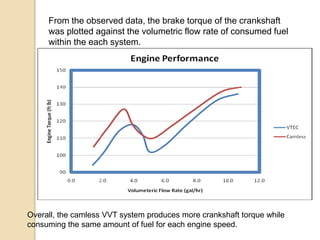
From the observed data, the brake torque of the crankshaft
was plotted against the volumetric flow rate of consumed fuel
within the each system.

Overall, the camless VVT system produces more crankshaft torque while
consuming the same amount of fuel for each engine speed.
1.By use of this design, the flow of air through the
engine’s cylinder can be directly controlled by
microprocessor to supply the engine with precise
amounts of air at designated engine speeds.
2.As a result, the valve lift and timing events of the
valve train were experimentally balanced to gain the
largest amount of engine performance while limiting
fuel consumption.
3.The results show that this design would improve the
fuel economy of an engine by 2.3% overall compared
with the Honda VTEC, ranging from a high 6.5% at
engine idle to a low 0.3% at mid range speeds.
In general terms, electrohydraulic valves comprise poppet valves
moveable between a first and second position. Used in a source
of pressurised hydraulic fluid and a hydraulic actuator coupled to
the poppet valve.
The motion between a first and second position is responsive to
the flow of the pressurised hydraulic fluid. An electrically
operated hydraulic valve controls the flow of the pressurised
hydraulic fluid to the hydraulic actuator.
In one design, the provision is made for a three-way electrically
operated valve to control the flow of the pressurised hydraulic
fluid to the actuator. This supplies pressure when electrically
pulsed open, and dumps actuator oil to the engine oil sump when
the valve is electrically pulsed to close. The use of engine oil as
the hydraulic fluid simplifies and lowers the cost of the design by
removing the need for a separate hydraulic system.
As is the trend with all modern engine systems, the camless
engine has an even greater reliance on sensors.
The valve actuation and control system typically needs a

manifold pressure sensor, a manifold temperature sensor, a
mass flow sensor, a coolant temperature sensor, a throttle
position sensor, an exhaust gas sensor, a high resolution

engine position encoder, a valve/ignition timing decoder
controller, injection driver electronics, valve coil driver
electronics, ignition coil driver electronics, air idle speed

control

driver

electronics.

electronics

and

power

down

control
BENEFITS OF CAMLESS
 More

torque is made available.
 Optimal volumetric efficiency.
 Increase engine performance.
 Decrease fuel consumption.
 Decrease harmful emission
 Cylinder deactivation
 Increasing durability and engine life
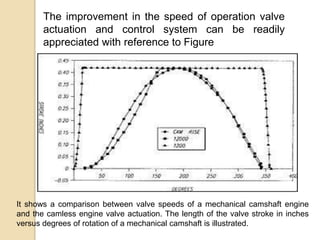
The improvement in the speed of operation valve
actuation and control system can be readily
appreciated with reference to Figure

It shows a comparison between valve speeds of a mechanical camshaft engine
and the camless engine valve actuation. The length of the valve stroke in inches
versus degrees of rotation of a mechanical camshaft is illustrated.
APPLICATIONS
 In

automobile & heavy vehicles
 Reverse operation is advantageous in
marine equipment having dual
outdrives or T-drives.
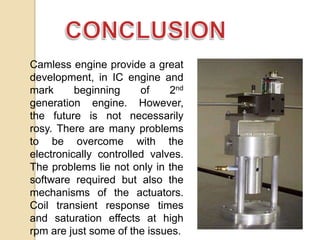
Camless engine provide a great
development, in IC engine and
mark
beginning
of
2nd
generation engine. However,
the future is not necessarily
rosy. There are many problems
to be overcome with the
electronically controlled valves.
The problems lie not only in the
software required but also the
mechanisms of the actuators.
Coil transient response times
and saturation effects at high
rpm are just some of the issues.
For any queries,suggessions and
feedback.
Pls.send us at:
royalmadan6293@gmail.com
Your suggesions are always welcomed.
THANKS FOR READING

HAVE A NICE DAY

Camless engine by Royal Madan & Vivek Kumar

  • 1.
    Created by ROYAL MADAN& VIVEK KUMAR Asst. prof. at Mechanical dept royalmadan6293@gmail.com
  • 2.
    1. INTRODUCTION 2. FUNCTIONOF CAM 3. EXISTING TECHNOLOGY 4. CAMLESS VALVE TRAIN OPERATION 5. ELECTRO/MECHANICAL 6. ELECTRO /HYDRAULIC 7. BENEFITS 8. CONCLUSION 9. REFERENCES
  • 3.
    Various engine systemshave been developed in the effort to improve the engine performance and fuel economy of an automobile. The engine will either have powerful performance or increased fuel economy, but with the existing technology it is difficult to achieve both simultaneously. The conceptual development, design, manufacture, and analysis of a piezoelectric controlled hydraulic actuator. This actuator was developed for use as a replacement for the camshaft in an internal combustion engine, its development results in a new device; called, the camless engine (CLE).
  • 4.
    CAM  A cam isa mechanical member that impart desired motions. Single Cam and Valve
  • 5.
    FUNCTION OF CAMSHAFT  Asthe camshaft rotates, cam lobes, attached to the camshaft, interface with the engine’s valves.  This interface may take place via a mechanical linkage, but the result is, as the cam rotates it forces the valve open.  The spring return closes the valve when the cam is no longer supplying the opening force.
  • 6.
    1.The valve trainin a typical internal combustion engine comprises several moving components that are cam, camshaft, cam lobes ,poppet valves ,with valve springs. 2.The camshaft is attached to the crankshaft of IC engine and rotates relatively to rotation of crankshaft. 3.This dependence on the rotational velocity of the crankshaft provides the primary limitation on the use of cam.
  • 7.
    4.Since the timingof engine dependent on the shape of the cam lobes and rotational velocity of camshaft 5.This resulting design represent s a compromise between fuel efficiency and engine power. 6.Considering this compromise ,automobile manufacturers have been attempting to provide vehicles capable of cylinder deactivation ,by variable valve timing (VVT). 7. Camless VVT allows an engine to experience maximum engine performance and fuel efficiency at each and every engine speed
  • 8.
    WHAT IS CAMLESSENGINE A camless engine uses electromagnetic, hydraulic, or pneumatic actuator to open the poppet valves.  Actuator can be used to both open and close the valve or an actuator opens while spring closes it.  Ability to achieve truly variable valve timing in each cycle. 
  • 9.
  • 10.
    EXPLANATION They are Composed of two superimposed electromagnets, between whichmoves a metal part that is interdependent with a push rod.  Electromechanical actuators are placed at the tail-end of the valves.  Management unit send command to the electromagnets which alternatively attract the moving component i.e. push rod. 
  • 11.
    CONT.  Once the solenoidget actuated, the rocker arm pivots and compresses the valve and valve spring which in turn releases the flow of air in to the engine cylinder.
  • 12.
    BLOCK DIAGRAM SEQUENCE OFOPERATION : SENSORS ELECTRONIC CONTROL UNIT ACTUATORS
  • 13.
    EXISTING TECHNOLOGY In responseto the needs of improved engines, some manufacturers have designed mechanical devices to achieve some variable valve timing. These devices are essentially camshafts with multiple cam lobes or engines with multiple camshafts. For example, the Honda VTEC uses three lobes, low, mid, and high to create a broader power band. This does represent an increased level of sophistication, but still limits the engine timing to a few discrete changes.
  • 14.
  • 15.
    Camless Valve trainOperation The types of camless variable valve actuating systems being developed can be classed in two groups: 1. Electromechanical 2. Electrohydraulic
  • 16.
    1. Electromechanical actuators,commanded by a distribution management unit, control the movement of the valves. There is therefore no longer any direct mechanical bond between the valves and the crankshaft. 2. Camless valve variable timing is electronically operated by a microcontroller which will control electro-mechanical rotary solenoid actuators. 3. The required amount of force and speed needed from a solenoid in order for this system to be effective, rotary solenoids meet the requirement for this system. 4. Each of these solenoids will be connected to the intake and exhaust valves relieving the engine of the load of a cam system.
  • 17.
  • 18.
    5.Depending on theload and engine speed, the microcontroller will process the information given and use pulse width modulation (PWM) to actuate the solenoid valves. 6.These PWMs will generate square waves that are identical to the timing profile for the most efficient engine at that particular speed and load combination. 7.These PWMs will be sent to the solenoids to actuate the timing of these devices. Once the solenoid is actuated, the rocker arm pivots and compresses the valve and valve spring which in turn releases the flow of air into the engine’s cylinder. 8. Theses generated PWMs are predetermined square waves that will be hard coded and referenced by the microcontroller depending on the load and speed of the engine for maximum engine efficiency.
  • 19.
    Advantages of camlessVVT versus the Honda VTEC. Shown above is a screenshot of the program used to simulate the engine performance of an Acura Integra 1.8L with timing profiles that were tailored for each engine speed from 1000 rpm to 5500 rpm in 500 rpm increments.
  • 20.
    Below displaying thetiming profiles of exhaust and intake valves at 1000 rpm, 2500 rpm and 5500 rpm. Neglecting the other 500 rpm increments between 1000 and 5500 rpm @ 5500rpm Exhaust @ 2500rpm Intake @ 1000rpm these plots were organized in this manner in order to illustrate how the timing profiles change as the engine speed increases.
  • 21.
    From the observeddata, the brake torque of the crankshaft was plotted against the volumetric flow rate of consumed fuel within the each system. Overall, the camless VVT system produces more crankshaft torque while consuming the same amount of fuel for each engine speed.
  • 22.
    1.By use ofthis design, the flow of air through the engine’s cylinder can be directly controlled by microprocessor to supply the engine with precise amounts of air at designated engine speeds. 2.As a result, the valve lift and timing events of the valve train were experimentally balanced to gain the largest amount of engine performance while limiting fuel consumption. 3.The results show that this design would improve the fuel economy of an engine by 2.3% overall compared with the Honda VTEC, ranging from a high 6.5% at engine idle to a low 0.3% at mid range speeds.
  • 23.
    In general terms,electrohydraulic valves comprise poppet valves moveable between a first and second position. Used in a source of pressurised hydraulic fluid and a hydraulic actuator coupled to the poppet valve. The motion between a first and second position is responsive to the flow of the pressurised hydraulic fluid. An electrically operated hydraulic valve controls the flow of the pressurised hydraulic fluid to the hydraulic actuator. In one design, the provision is made for a three-way electrically operated valve to control the flow of the pressurised hydraulic fluid to the actuator. This supplies pressure when electrically pulsed open, and dumps actuator oil to the engine oil sump when the valve is electrically pulsed to close. The use of engine oil as the hydraulic fluid simplifies and lowers the cost of the design by removing the need for a separate hydraulic system.
  • 24.
    As is thetrend with all modern engine systems, the camless engine has an even greater reliance on sensors. The valve actuation and control system typically needs a manifold pressure sensor, a manifold temperature sensor, a mass flow sensor, a coolant temperature sensor, a throttle position sensor, an exhaust gas sensor, a high resolution engine position encoder, a valve/ignition timing decoder controller, injection driver electronics, valve coil driver electronics, ignition coil driver electronics, air idle speed control driver electronics. electronics and power down control
  • 25.
    BENEFITS OF CAMLESS More torque is made available.  Optimal volumetric efficiency.  Increase engine performance.  Decrease fuel consumption.  Decrease harmful emission  Cylinder deactivation  Increasing durability and engine life
  • 26.
    The improvement inthe speed of operation valve actuation and control system can be readily appreciated with reference to Figure It shows a comparison between valve speeds of a mechanical camshaft engine and the camless engine valve actuation. The length of the valve stroke in inches versus degrees of rotation of a mechanical camshaft is illustrated.
  • 27.
    APPLICATIONS  In automobile &heavy vehicles  Reverse operation is advantageous in marine equipment having dual outdrives or T-drives.
  • 28.
    Camless engine providea great development, in IC engine and mark beginning of 2nd generation engine. However, the future is not necessarily rosy. There are many problems to be overcome with the electronically controlled valves. The problems lie not only in the software required but also the mechanisms of the actuators. Coil transient response times and saturation effects at high rpm are just some of the issues.
  • 29.
    For any queries,suggessionsand feedback. Pls.send us at: royalmadan6293@gmail.com Your suggesions are always welcomed.
  • 30.