AROMATIC AMINES
(ROLL NO : 33 TO 40)
INTRODUCTION : PURVAA INGALE
CLASSIFICATION : RITIKA JADHAV
NITROSATION REACTION : AMRUTA HUMBE
COUPLING AND SANDMEYERS REACTION : AKSHADA JADHAV
HINSBERG TEST : AYUSH JAIN
BASICITY OF AROMATIC AMINES : YASH JADHAV
EFFECT OF SUBSTITUENT ON BASICITY AMINE : VAIBHAVI JOGI
ARYL DIAZONIUM SALTS AND IT’S USES:- PURVAA INGALE
SIR.Dr. M.S.GOSAVI
COLLEGE OF
PHARMACEUTICAL
EDUCATION AND
RESEARCH,NASHIK
Introduction :
● The aromatic amines are an industrially important class of organic compounds being widely used in the
production of compounds and intermediates for the dyestuff, rubber-processing, and drug-manufacturing
industries.
● Most aromatic amines possess the expected basic character that results from the presence of the lone pair of
electrons on the nitrogen atom and like the aliphatic amines, they usually form stable salts with inorganic and also
with many organic acids.
● They are, however, considerably weaker bases than ammonia or the aliphatic amines, and this reduced basicity
may be interpreted as resulting from the direct attachment of the nitrogen atom to the aromatic system.
● Primary aromatic amines undergo N-alkylation on heating with an alkyl halide to give successively secondary
amines, tertiary amines, and, finally, quaternary ammonium halides. Primary aromatic amines condense with
aromatic aldehydes, but less readily with ketones, to form anils (Schiff bases). Tertiary amines cannot react with
aldehydes to form anils.
Characteristics:-
(i) Physical state: Aromatic amines are colorless liquid or solid compounds
having an unpleasant odor. They become brown colored by oxidation with light
or air. They are poisonous or toxic. Readily formed aniline is an oily liquid.
(ii) Melting point & Boiling Point: M.P & B.P increase with the rise of molecular
mass. The melting point & boiling point of aromatic amines are higher than that
of aliphatic ones.
(iii) Solubility: They are slightly soluble in water but completely soluble in organic
solvents. Aniline is more soluble in water than the n-hexyl amine.
(iv) Hydrogen bonding: Hydrogen bonding significantly influences the properties
of primary and secondary amines. Thus the boiling point of amines is higher than
those of the corresponding phosphines but generally lower than those of the
corresponding alcohols.
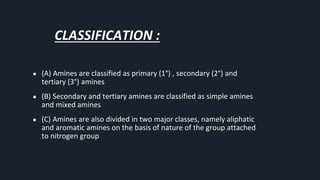
CLASSIFICATION :
● (A) Amines are classified as primary (1°) , secondary (2°) and
tertiary (3°) amines
● (B) Secondary and tertiary amines are classified as simple amines
and mixed amines
● (C) Amines are also divided in two major classes, namely aliphatic
and aromatic amines on the basis of nature of the group attached
to nitrogen group
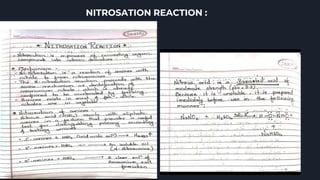
NITROSATION REACTION :
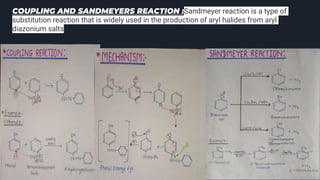
COUPLING AND SANDMEYERS REACTION :Sandmeyer reaction is a type of
substitution reaction that is widely used in the production of aryl halides from aryl
diazonium salts
HINSBERG TEST :
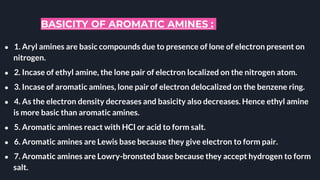
BASICITY OF AROMATIC AMINES :
● 1. Aryl amines are basic compounds due to presence of lone of electron present on
nitrogen.
● 2. Incase of ethyl amine, the lone pair of electron localized on the nitrogen atom.
● 3. Incase of aromatic amines, lone pair of electron delocalized on the benzene ring.
● 4. As the electron density decreases and basicity also decreases. Hence ethyl amine
is more basic than aromatic amines.
● 5. Aromatic amines react with HCl or acid to form salt.
● 6. Aromatic amines are Lewis base because they give electron to form pair.
● 7. Aromatic amines are Lowry-bronsted base because they accept hydrogen to form
salt.
EFFECT OF SUBSTITUENT ON BASICITY AMINE :
Electronic effects :
Owing to inductive effects, the basicity of an amine might be expected to
increase with the number of alkyl groups on the amine. Correlations are
complicated owing to the effects of solvation which are opposite the
trends for inductive effects. Solvation effects also dominate the basicity
of aromatic amines (anilines). For anilines, the lone pair of electrons on
nitrogen delocalizes into the ring, resulting in decreased basicity.
Substituents on the aromatic ring, and their positions relative to the
amino group, also affect basicity .
Solvation effects :
Solvation significantly affects the basicity of amines. N-H groups strongly
interact with water, especially in ammonium ions. Consequently, the basicity
of ammonia is enhanced by solvation. The intrinsic basicity of amines, i.e. the
situation where solvation is unimportant, has been evaluated in the gas phase.
In the gas phase, amines exhibit the basicities predicted from the electron-
releasing effects of the organic substituents. Thus tertiary amines are more
basic than secondary amines, which are more basic than primary amines, and
finally ammonia is least basic.
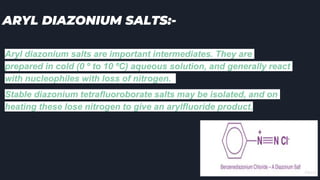
ARYL DIAZONIUM SALTS:-
Aryl diazonium salts are important intermediates. They are
prepared in cold (0 º to 10 ºC) aqueous solution, and generally react
with nucleophiles with loss of nitrogen.
Stable diazonium tetrafluoroborate salts may be isolated, and on
heating these lose nitrogen to give an arylfluoride product.
USES:
The first use of diazonium salts was to produce water-fast dyed fabrics by
immersing the fabric in an aqueous solution of the diazonium compound, followed
by immersion in a solution of the coupler
Diazonium compounds are standard reagents used in synthesis of organic
compounds, especially aryl derivatives.
Diazonium salts are light sensitive and break down under near UV or violet
light. This property has led to their use in document reproduction. In this process,
paper or film is coated with a diazonium salt.
THANK YOU

Aromatic amines

  • 1.
    AROMATIC AMINES (ROLL NO: 33 TO 40) INTRODUCTION : PURVAA INGALE CLASSIFICATION : RITIKA JADHAV NITROSATION REACTION : AMRUTA HUMBE COUPLING AND SANDMEYERS REACTION : AKSHADA JADHAV HINSBERG TEST : AYUSH JAIN BASICITY OF AROMATIC AMINES : YASH JADHAV EFFECT OF SUBSTITUENT ON BASICITY AMINE : VAIBHAVI JOGI ARYL DIAZONIUM SALTS AND IT’S USES:- PURVAA INGALE SIR.Dr. M.S.GOSAVI COLLEGE OF PHARMACEUTICAL EDUCATION AND RESEARCH,NASHIK
  • 2.
    Introduction : ● Thearomatic amines are an industrially important class of organic compounds being widely used in the production of compounds and intermediates for the dyestuff, rubber-processing, and drug-manufacturing industries. ● Most aromatic amines possess the expected basic character that results from the presence of the lone pair of electrons on the nitrogen atom and like the aliphatic amines, they usually form stable salts with inorganic and also with many organic acids. ● They are, however, considerably weaker bases than ammonia or the aliphatic amines, and this reduced basicity may be interpreted as resulting from the direct attachment of the nitrogen atom to the aromatic system. ● Primary aromatic amines undergo N-alkylation on heating with an alkyl halide to give successively secondary amines, tertiary amines, and, finally, quaternary ammonium halides. Primary aromatic amines condense with aromatic aldehydes, but less readily with ketones, to form anils (Schiff bases). Tertiary amines cannot react with aldehydes to form anils.
  • 3.
    Characteristics:- (i) Physical state:Aromatic amines are colorless liquid or solid compounds having an unpleasant odor. They become brown colored by oxidation with light or air. They are poisonous or toxic. Readily formed aniline is an oily liquid. (ii) Melting point & Boiling Point: M.P & B.P increase with the rise of molecular mass. The melting point & boiling point of aromatic amines are higher than that of aliphatic ones. (iii) Solubility: They are slightly soluble in water but completely soluble in organic solvents. Aniline is more soluble in water than the n-hexyl amine. (iv) Hydrogen bonding: Hydrogen bonding significantly influences the properties of primary and secondary amines. Thus the boiling point of amines is higher than those of the corresponding phosphines but generally lower than those of the corresponding alcohols.
  • 4.
    CLASSIFICATION : ● (A)Amines are classified as primary (1°) , secondary (2°) and tertiary (3°) amines ● (B) Secondary and tertiary amines are classified as simple amines and mixed amines ● (C) Amines are also divided in two major classes, namely aliphatic and aromatic amines on the basis of nature of the group attached to nitrogen group
  • 5.
  • 6.
    COUPLING AND SANDMEYERSREACTION :Sandmeyer reaction is a type of substitution reaction that is widely used in the production of aryl halides from aryl diazonium salts
  • 7.
  • 8.
    BASICITY OF AROMATICAMINES : ● 1. Aryl amines are basic compounds due to presence of lone of electron present on nitrogen. ● 2. Incase of ethyl amine, the lone pair of electron localized on the nitrogen atom. ● 3. Incase of aromatic amines, lone pair of electron delocalized on the benzene ring. ● 4. As the electron density decreases and basicity also decreases. Hence ethyl amine is more basic than aromatic amines. ● 5. Aromatic amines react with HCl or acid to form salt. ● 6. Aromatic amines are Lewis base because they give electron to form pair. ● 7. Aromatic amines are Lowry-bronsted base because they accept hydrogen to form salt.
  • 9.
    EFFECT OF SUBSTITUENTON BASICITY AMINE : Electronic effects : Owing to inductive effects, the basicity of an amine might be expected to increase with the number of alkyl groups on the amine. Correlations are complicated owing to the effects of solvation which are opposite the trends for inductive effects. Solvation effects also dominate the basicity of aromatic amines (anilines). For anilines, the lone pair of electrons on nitrogen delocalizes into the ring, resulting in decreased basicity. Substituents on the aromatic ring, and their positions relative to the amino group, also affect basicity .
  • 10.
    Solvation effects : Solvationsignificantly affects the basicity of amines. N-H groups strongly interact with water, especially in ammonium ions. Consequently, the basicity of ammonia is enhanced by solvation. The intrinsic basicity of amines, i.e. the situation where solvation is unimportant, has been evaluated in the gas phase. In the gas phase, amines exhibit the basicities predicted from the electron- releasing effects of the organic substituents. Thus tertiary amines are more basic than secondary amines, which are more basic than primary amines, and finally ammonia is least basic.
  • 11.
    ARYL DIAZONIUM SALTS:- Aryldiazonium salts are important intermediates. They are prepared in cold (0 º to 10 ºC) aqueous solution, and generally react with nucleophiles with loss of nitrogen. Stable diazonium tetrafluoroborate salts may be isolated, and on heating these lose nitrogen to give an arylfluoride product.
  • 12.
    USES: The first useof diazonium salts was to produce water-fast dyed fabrics by immersing the fabric in an aqueous solution of the diazonium compound, followed by immersion in a solution of the coupler Diazonium compounds are standard reagents used in synthesis of organic compounds, especially aryl derivatives. Diazonium salts are light sensitive and break down under near UV or violet light. This property has led to their use in document reproduction. In this process, paper or film is coated with a diazonium salt.
  • 13.