Presented By
amaljose949563
Cyber Security in Smart Grid System
Under the guidance of
________________
Coordinator
________________
Contents
 Introduction
 What is Smart Grid
 Why Smart Grid
 Cyber Security of Smart Grid
 Security requirements and objectives
 Security Challenges
 Solutions to smart grid system
 Conclusion
Introduction
 Nations across the world face the challenge of increasing power production
while reducing the carbon footprint. They need to minimize power loss and
downtime, harness alternative power sources, and so on.
 The numerous challenges facing them have one solution – smart grids.
 While smart grid bring improvements in cost and performance, the security of
the power grids becomes more complex and risky, calling for a comprehensive
and integrated solution.
What is Smart Grid
 “A smart grid uses digital technology to improve reliability, security and
efficiency (both economic and energy) of the electric system from large
generation, through the delivery system to electricity consumers and a growing
number of distributed generation and storage resources.”
Understanding Smart Grid
 System (G,T,D) with an advanced two-way communication system
 Enables real-time monitoring and control
 Consequently, enables cost reduction and efficiency improvement
SMART GRID = POWER GRID + ICT
Information and Communication Technology
 ICT are core of successful smart grid implementation.
 Systems (G,T,D) , consumption, marketing, retailing etc are heavily based on
ICT infrastructures.
 Using ICT, the smart grid becomes more reliability, security and efficiency.
Functions of ICT’s in G,T,D
 IN ‘G’ Domain
 Automation of bulk generation and DER operations.
 Synchronizing and adjusting the voltage levels.
 IN ‘T’ Domain
 Automation of the transmission power grid (SCADA/EMS)
 IN ‘D’ Domain
 DMS improves classical outage management systems (OMS) by automation
 Real-time adjustments by Advanced Distribution Automation
Why Smart Grid?
The traditional power system
• The present infrastructure is overstrained and inter region bulk transfer is limited
• Cannot fully support the integration of renewable energy
• Low reliability of power – outage
• Almost zero participation
• Low billing and collecting efficiency
What smart grid does?
• Decentralization of generating resources
• Integration of all sources of energy, mainly renewable
• Continuous monitoring and feedback from the network
• Anticipation of faults and helps in fault prevention
• Two way communication between the utilities and the consumers
• Reduces the stress on the power system infrastructure
• Continuous self learning
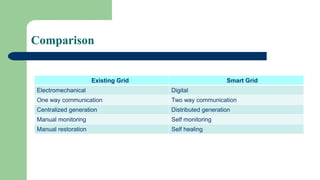
Comparison
Existing Grid Smart Grid
Electromechanical Digital
One way communication Two way communication
Centralized generation Distributed generation
Manual monitoring Self monitoring
Manual restoration Self healing
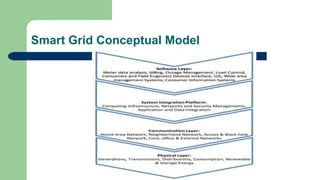
Smart Grid Conceptual Model
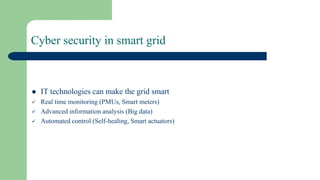
Cyber security in smart grid
 IT technologies can make the grid smart
 Real time monitoring (PMUs, Smart meters)
 Advanced information analysis (Big data)
 Automated control (Self-healing, Smart actuators)
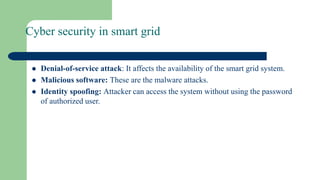
Cyber security in smart grid
 Denial-of-service attack: It affects the availability of the smart grid system.
 Malicious software: These are the malware attacks.
 Identity spoofing: Attacker can access the system without using the password
of authorized user.
Security Requirements and Objectives
 Availability : Accessing information in a timely in the smart grid.
 Integrity : Preventing an unauthorized modification of information or system
by illegitimate users.
 Confidentiality : Preventing unauthorized users from accessing information in
order to protect personal privacy and safety.
Security Requirements and Objectives
• Authentication : Validating the true identity of the communicating parties.
• Authorization : Providing permission and granting access to the system.
• Non-Repudiation : Assuring that a certain action performed by a user cant be
later denied.
Security Challenges in Smart Grid System
 Connectivity : Attacks leads to physical damage, black-outs and lack of
efficiency.
 Trust : Some customers will not adhere to the policies and agreements.
 Customer's Privacy : Ensuring customers privacy is a important aspect in any
system including smart grid.
 Software Vulnerabilities : Software suffers from a wide variety of
vulnerabilities that include malwares.
Solution to Smart Grid Security System
Cyber security in the smart grid is a crucial issue tat attracted the attention of
researchers and industry professionals. Wile some solutions were proposed to
solve security issues in the smart rid, vulnerabilities still exist.
Solution to Smart Grid Security System
A. Network Security
DoS is the most common attack in the smart grid network.
 DoS Detection: Smart grid system must detect DoS attacks as they happen in order to apply
appropriate counter measures.
For DoS detection there are some methods:
1. Using flow entropy
2. Using signal strength
3. Using sensing time measurement
4. Using transmission failure count
5. Using signatures
Solution to Smart Grid Security System
A. Network Security
DoS is the most common attack in the smart grid network.
 DoS Mitigation: Smart grid system should be able to take appropriate actions wit in a
sort period , once a DoS attack as been detected.
In order to protect the nodes and minimize the outage time.
Solution to Smart Grid Security System
For DoS mitigation there are some methods:
1. Pushback
2. Rate limiting
3. Filtering
4. Reconfiguration
5. Cleaning center
6. Physical layer mitigation
Solution to Smart Grid Security System
B. Data security
• Another level of securing a smart grid network by providing data
protection and object authentication.
• Cryptography methods and algorithms are used to encrypt data in order to
secure communication
• And users to authenticate to prevent attacks against data integrity.
Solution to Smart Grid Security System
B. Data security
Authentication for multicast applications can be done trough one of the following
methods:
• Secret- info asymmetry: each transmitter uses a different key to authenticate
itself at each receiver
• Time asymmetry: the transmitter first sends the message, then creates a
temporary authentication key.
• Hybrid asymmetry: this method incorporates both secret-info asymmetry and
time asymmetry by creating different temporary keys for every transmission.
Solution to Smart Grid Security System
C. Key management
Key management plays a significant role in authentication and encryption to
achieve a secure system.
It is categorized into :
• Public key infrastructure (PKI) : ensures security by verifying the true identity
of the party.
• Symmetric key management : It is used in symmetric cryptography.
The advantage of symmetric key management over the PKI is speed and
efficiency.
Solution to Smart Grid Security System
D. Network security protocol
• The design of secure network protocols and architecture plays an
important role in smart grid security.
• Some of the existing smart grid system use internet-based protocols for
secure communication such as IPSec and TLS.
• Secure DNP3 and IEC61850 & IEC62351 are the protocols modify
existing smart grid communication protocol by adding security layers to
the architecture.
Solution to Smart Grid Security System
D. Network security protocol
To have a secure architecture, smart grid networks are built using one of the
architectures:
• Trust computing – based architecture:
• Role- based networking architecture:
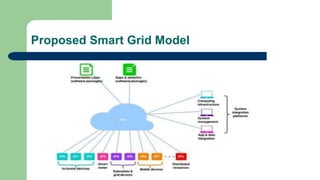
Proposed Smart Grid Model
Advantages
 New job
 Innovation
 Lower cost
 Higher customer satisfaction
 Improved reliability
Disadvantages
 Biggest concern: privacy and security
 Some types of meters can be hacked
 Various technology components. So expensive in terms of installation
Conclusion
 Smart grid has numerous benefits like lower cost, high reliability and
efficiency.
 ICT are at the core of successful smart grid implementation, which can improve
reliability, security and efficiency.
 A Power grid can be make smart grid by using the combination of information
technology, communication technology and electrical system.
Conclusion
 Cyber security in the smart grid is still under research and needs more
investigation to overcome the vulnerabilities and threats.
 Cyber security in the smart grid is a critical issue that received attention of
researchers and industry professionals.
 Cyber-physical system security demands additional security requirements such
as continuity of power delivery and other features.
References
 [1] Salsabeel, Fatma, Raafat (2015) ‘Smart grid cyber security: challenges and solutions’
 [2] Y.Yang, Tim Littler, S.Sezer, H.F.Wang (2015) ‘impact of cyber security issues on smart
grid’
 [3] Danda, Chandra (2015) ‘cyber security for smart grid system: status, challenges and
perspectives’
 [4] Sharmin, Rabeya (2015) ‘An analysis of smart gridcommunication infrastructure & cyber
security in smart grid’
 [5] Ye yan, Yi qian, Hamid and David (2012) ‘A survey on cyber security for smart grid
communication’
 [6] Adam, Aditya, Siddharth, Manimaran (2013) ‘Cyber physical security testbeds: architecture,
application’
 [7] A.David (2014) ‘Bio inspired cyber security for the smart grid’
THANK YOU

Cyber security in Smart grid system

  • 1.
    Presented By amaljose949563 Cyber Securityin Smart Grid System Under the guidance of ________________ Coordinator ________________
  • 2.
    Contents  Introduction  Whatis Smart Grid  Why Smart Grid  Cyber Security of Smart Grid  Security requirements and objectives  Security Challenges  Solutions to smart grid system  Conclusion
  • 3.
    Introduction  Nations acrossthe world face the challenge of increasing power production while reducing the carbon footprint. They need to minimize power loss and downtime, harness alternative power sources, and so on.  The numerous challenges facing them have one solution – smart grids.  While smart grid bring improvements in cost and performance, the security of the power grids becomes more complex and risky, calling for a comprehensive and integrated solution.
  • 4.
    What is SmartGrid  “A smart grid uses digital technology to improve reliability, security and efficiency (both economic and energy) of the electric system from large generation, through the delivery system to electricity consumers and a growing number of distributed generation and storage resources.” Understanding Smart Grid  System (G,T,D) with an advanced two-way communication system  Enables real-time monitoring and control  Consequently, enables cost reduction and efficiency improvement SMART GRID = POWER GRID + ICT
  • 5.
    Information and CommunicationTechnology  ICT are core of successful smart grid implementation.  Systems (G,T,D) , consumption, marketing, retailing etc are heavily based on ICT infrastructures.  Using ICT, the smart grid becomes more reliability, security and efficiency.
  • 6.
    Functions of ICT’sin G,T,D  IN ‘G’ Domain  Automation of bulk generation and DER operations.  Synchronizing and adjusting the voltage levels.  IN ‘T’ Domain  Automation of the transmission power grid (SCADA/EMS)  IN ‘D’ Domain  DMS improves classical outage management systems (OMS) by automation  Real-time adjustments by Advanced Distribution Automation
  • 7.
    Why Smart Grid? Thetraditional power system • The present infrastructure is overstrained and inter region bulk transfer is limited • Cannot fully support the integration of renewable energy • Low reliability of power – outage • Almost zero participation • Low billing and collecting efficiency
  • 8.
    What smart griddoes? • Decentralization of generating resources • Integration of all sources of energy, mainly renewable • Continuous monitoring and feedback from the network • Anticipation of faults and helps in fault prevention • Two way communication between the utilities and the consumers • Reduces the stress on the power system infrastructure • Continuous self learning
  • 9.
    Comparison Existing Grid SmartGrid Electromechanical Digital One way communication Two way communication Centralized generation Distributed generation Manual monitoring Self monitoring Manual restoration Self healing
  • 10.
  • 11.
    Cyber security insmart grid  IT technologies can make the grid smart  Real time monitoring (PMUs, Smart meters)  Advanced information analysis (Big data)  Automated control (Self-healing, Smart actuators)
  • 12.
    Cyber security insmart grid  Denial-of-service attack: It affects the availability of the smart grid system.  Malicious software: These are the malware attacks.  Identity spoofing: Attacker can access the system without using the password of authorized user.
  • 13.
    Security Requirements andObjectives  Availability : Accessing information in a timely in the smart grid.  Integrity : Preventing an unauthorized modification of information or system by illegitimate users.  Confidentiality : Preventing unauthorized users from accessing information in order to protect personal privacy and safety.
  • 14.
    Security Requirements andObjectives • Authentication : Validating the true identity of the communicating parties. • Authorization : Providing permission and granting access to the system. • Non-Repudiation : Assuring that a certain action performed by a user cant be later denied.
  • 15.
    Security Challenges inSmart Grid System  Connectivity : Attacks leads to physical damage, black-outs and lack of efficiency.  Trust : Some customers will not adhere to the policies and agreements.  Customer's Privacy : Ensuring customers privacy is a important aspect in any system including smart grid.  Software Vulnerabilities : Software suffers from a wide variety of vulnerabilities that include malwares.
  • 16.
    Solution to SmartGrid Security System Cyber security in the smart grid is a crucial issue tat attracted the attention of researchers and industry professionals. Wile some solutions were proposed to solve security issues in the smart rid, vulnerabilities still exist.
  • 17.
    Solution to SmartGrid Security System A. Network Security DoS is the most common attack in the smart grid network.  DoS Detection: Smart grid system must detect DoS attacks as they happen in order to apply appropriate counter measures. For DoS detection there are some methods: 1. Using flow entropy 2. Using signal strength 3. Using sensing time measurement 4. Using transmission failure count 5. Using signatures
  • 18.
    Solution to SmartGrid Security System A. Network Security DoS is the most common attack in the smart grid network.  DoS Mitigation: Smart grid system should be able to take appropriate actions wit in a sort period , once a DoS attack as been detected. In order to protect the nodes and minimize the outage time.
  • 19.
    Solution to SmartGrid Security System For DoS mitigation there are some methods: 1. Pushback 2. Rate limiting 3. Filtering 4. Reconfiguration 5. Cleaning center 6. Physical layer mitigation
  • 20.
    Solution to SmartGrid Security System B. Data security • Another level of securing a smart grid network by providing data protection and object authentication. • Cryptography methods and algorithms are used to encrypt data in order to secure communication • And users to authenticate to prevent attacks against data integrity.
  • 21.
    Solution to SmartGrid Security System B. Data security Authentication for multicast applications can be done trough one of the following methods: • Secret- info asymmetry: each transmitter uses a different key to authenticate itself at each receiver • Time asymmetry: the transmitter first sends the message, then creates a temporary authentication key. • Hybrid asymmetry: this method incorporates both secret-info asymmetry and time asymmetry by creating different temporary keys for every transmission.
  • 22.
    Solution to SmartGrid Security System C. Key management Key management plays a significant role in authentication and encryption to achieve a secure system. It is categorized into : • Public key infrastructure (PKI) : ensures security by verifying the true identity of the party. • Symmetric key management : It is used in symmetric cryptography. The advantage of symmetric key management over the PKI is speed and efficiency.
  • 23.
    Solution to SmartGrid Security System D. Network security protocol • The design of secure network protocols and architecture plays an important role in smart grid security. • Some of the existing smart grid system use internet-based protocols for secure communication such as IPSec and TLS. • Secure DNP3 and IEC61850 & IEC62351 are the protocols modify existing smart grid communication protocol by adding security layers to the architecture.
  • 24.
    Solution to SmartGrid Security System D. Network security protocol To have a secure architecture, smart grid networks are built using one of the architectures: • Trust computing – based architecture: • Role- based networking architecture:
  • 25.
  • 26.
    Advantages  New job Innovation  Lower cost  Higher customer satisfaction  Improved reliability
  • 27.
    Disadvantages  Biggest concern:privacy and security  Some types of meters can be hacked  Various technology components. So expensive in terms of installation
  • 28.
    Conclusion  Smart gridhas numerous benefits like lower cost, high reliability and efficiency.  ICT are at the core of successful smart grid implementation, which can improve reliability, security and efficiency.  A Power grid can be make smart grid by using the combination of information technology, communication technology and electrical system.
  • 29.
    Conclusion  Cyber securityin the smart grid is still under research and needs more investigation to overcome the vulnerabilities and threats.  Cyber security in the smart grid is a critical issue that received attention of researchers and industry professionals.  Cyber-physical system security demands additional security requirements such as continuity of power delivery and other features.
  • 30.
    References  [1] Salsabeel,Fatma, Raafat (2015) ‘Smart grid cyber security: challenges and solutions’  [2] Y.Yang, Tim Littler, S.Sezer, H.F.Wang (2015) ‘impact of cyber security issues on smart grid’  [3] Danda, Chandra (2015) ‘cyber security for smart grid system: status, challenges and perspectives’  [4] Sharmin, Rabeya (2015) ‘An analysis of smart gridcommunication infrastructure & cyber security in smart grid’  [5] Ye yan, Yi qian, Hamid and David (2012) ‘A survey on cyber security for smart grid communication’  [6] Adam, Aditya, Siddharth, Manimaran (2013) ‘Cyber physical security testbeds: architecture, application’  [7] A.David (2014) ‘Bio inspired cyber security for the smart grid’
  • 31.