CYBER SECURITY IN THE SMART GRID
Presented by
SIVARATHRI SIVA SASTHRI
15121D0719
Under the guidance of
Dr.T.DEVARAJU,M.E.,Ph.D.
Professor, Dept. of EEE
DEPARTMENT OF ELECTRICAL AND ELECTRONIC ENGINEERING
SREE VIDYANIKETHAN ENGINEERING COLLEGE
A.RANGAMPET, TIRUPATI – 517 102
INDIA
2016 - 2017
Contents
1. Introduction to Smart Grid
2. Information and Communication Technology
3. Cyber Security in the Smart Grid
4. Types of Attacks and it’s Detection
5. Conclusion
6. References
INTRODUCTION TO SMART GRID
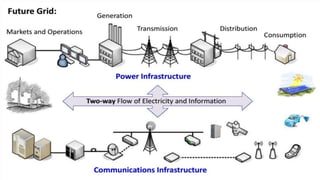
• System (G, T, D) with an advanced two-way communications system
• Enables real-time monitoring and control
• Consequently, enables cost reduction and efficiency improvement
Understanding Smart Grid
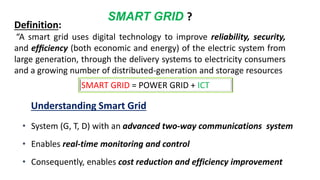
SMART GRID ?
Definition:
“A smart grid uses digital technology to improve reliability, security,
and efficiency (both economic and energy) of the electric system from
large generation, through the delivery systems to electricity consumers
and a growing number of distributed-generation and storage resources
SMART GRID = POWER GRID + ICT
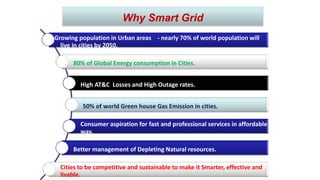
Why Smart Grid
Growing population in Urban areas - nearly 70% of world population will
live in cities by 2050.
80% of Global Energy consumption in Cities.
High AT&C Losses and High Outage rates.
50% of world Green house Gas Emission in cities.
Consumer aspiration for fast and professional services in affordable
way.
Better management of Depleting Natural resources.
Cities to be competitive and sustainable to make it Smarter, effective and
livable.
 ICT are core of a successful smart grid implementation.
 Using ICT , the grid become more reliability, security, and efficiency.
 Systems (G,T,D), consumption, marketing , retailing ,etc. .,are heavily based
on ICT infrastructures
INFORMATION AND COMMUNICATION TECHNOLGY
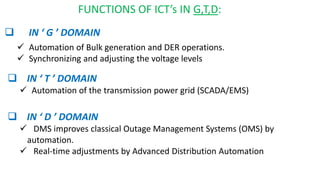
 Automation of Bulk generation and DER operations.
 Synchronizing and adjusting the voltage levels
FUNCTIONS OF ICT’s IN G,T,D:
 IN ‘ G ’ DOMAIN
 IN ‘ D ’ DOMAIN
 DMS improves classical Outage Management Systems (OMS) by
automation.
 Real-time adjustments by Advanced Distribution Automation
 IN ‘ T ’ DOMAIN
 Automation of the transmission power grid (SCADA/EMS)
CYBER SECURITY IN THE SMART GRID
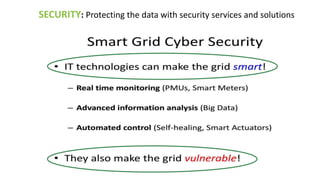
SECURITY: Protecting the data with security services and solutions
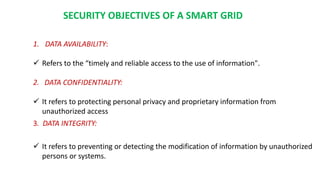
SECURITY OBJECTIVES OF A SMART GRID
1. DATA AVAILABILITY:
 Refers to the “timely and reliable access to the use of information".
2. DATA CONFIDENTIALITY:
 It refers to protecting personal privacy and proprietary information from
unauthorized access
3. DATA INTEGRITY:
 It refers to preventing or detecting the modification of information by unauthorized
persons or systems.
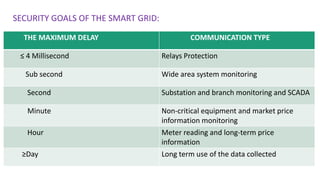
THE MAXIMUM DELAY COMMUNICATION TYPE
≤ 4 Millisecond Relays Protection
Sub second Wide area system monitoring
Second Substation and branch monitoring and SCADA
Minute Non-critical equipment and market price
information monitoring
Hour Meter reading and long-term price
information
≥Day Long term use of the data collected
SECURITY GOALS OF THE SMART GRID:
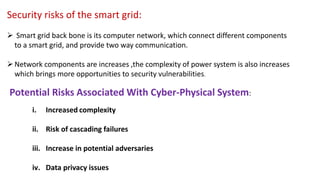
i. Increased complexity
ii. Risk of cascading failures
iii. Increase in potential adversaries
iv. Data privacy issues
Security risks of the smart grid:
 Smart grid back bone is its computer network, which connect different components
to a smart grid, and provide two way communication.
Network components are increases ,the complexity of power system is also increases
which brings more opportunities to security vulnerabilities.
Potential Risks Associated With Cyber-Physical System:
1. Denial-of-service attack :
 Attacker floods packets in the network to jam legitimate services.
 It leads to damage the network performance of power substation system
2 Random attack :
 Attacker simply manipulates the sensor readings by inserting a random
attack vector.
3. False data injection attack:
 Attacker is assumed to be familiar to the system and its parameters used
in estimation and detection.
TYPES OF ATTACKS
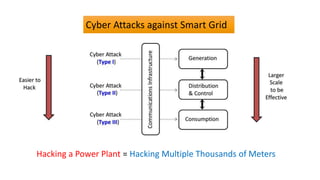
Cyber Attacks against Smart Grid
Hacking a Power Plant = Hacking Multiple Thousands of Meters
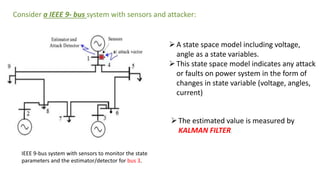
Consider a IEEE 9- bus system with sensors and attacker:
The estimated value is measured by
KALMAN FILTER.
IEEE 9-bus system with sensors to monitor the state
parameters and the estimator/detector for bus 3.
A state space model including voltage,
angle as a state variables.
This state space model indicates any attack
or faults on power system in the form of
changes in state variable (voltage, angles,
current)
TECHNIQUES TO DETECT ATTACKS :
Techniques are used to detect attacks. They are:
1. A Lightweight Message Authentication Method:
o It is used to secure smart grid systems where distributed meters are mutually
authenticated
2. By Using Supervised Learning Algorithms:
o The data (observations, measurements, etc.,) are labeled with pre-defined
classes
3. Generalized likelihood ratio Detector:
o It is a statistical test used to compare the goodness of fit two models .It
express how many times more likely the data are under one model than
the other
4. a) Chi-Square Test as an Attack Detector:
 It is used to determine whether there is a significant difference between the
expected frequencies and the observed frequencies in one or more categories
 The deviation in expected/estimated value(by Kalman Filter) and measured
value (by sensor measurements)is used to detect malicious attacks in the smart
grid
 This approach is fast and easily implemented
b) Cosine Similarity Matching as an Attack Detector:
 False data injection attacks can be crafted to bypass the
statistical detectors such as Chi-square detector.
 It is used to detect any deviation between measured data and
estimated data using Kalman Filter.
 The cosine similarity matching metric tells how similar the two
data vectors are.
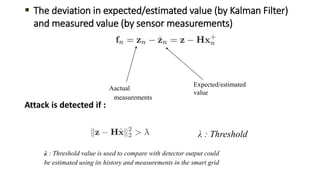
 The deviation in expected/estimated value (by Kalman Filter)
and measured value (by sensor measurements)
Aactual
measurements
Expected/estimated
value
Attack is detected if :
λ : Threshold
λ : Threshold value is used to compare with detector output could
be estimated using its history and measurements in the smart grid
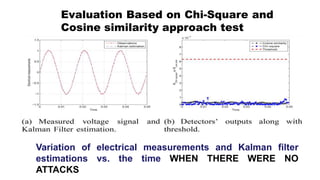
Variation of electrical measurements and Kalman filter
estimations vs. the time WHEN THERE WERE NO
ATTACKS
Evaluation Based on Chi-Square and
Cosine similarity approach test
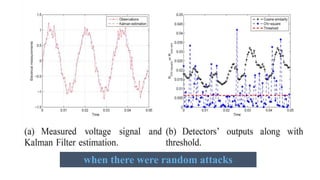
when there were random attacks
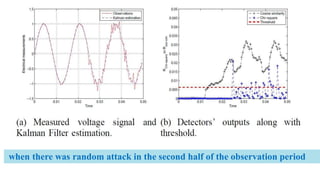
when there was random attack in the second half of the observation period
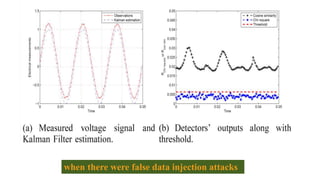
when there were false data injection attacks
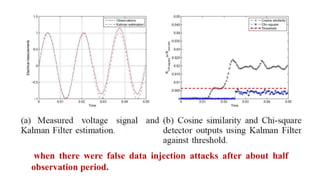
when there were false data injection attacks after about half
observation period.
Conclusion:
 Smart Grid has numerous benefits like lower cost, customer satisfaction,
improved reliability, customer energy/cost savings.
 ICT are at the core of a successful smart grid implementation, which can improve
reliability, security, and efficiency.
 Smart grid security is crucial to maintain stable and reliable power system
operation during the contingency situation due to the failure of any critical power
system component.
 Chi-square detector and cosine similarity matching are capable of detecting
random attacks .
 However, FDI attacks can be detected efficiently by the cosine similarity matching
approach.
REFERENCES
1. DandaB. Rawat, Chandra Bajracharya “Detection of False Data Injection Attacks in Smart Grid Communication
Systems”, IEEE SIGNAL PROCESSING LETTERS,VOL.22,NO.10,pp.1652-1656,OCTOBER2015.
2. S.Amin,A. A.Cardenas, and S.S.Sastry,“Safe and secure networked control systems under denial-of-service
attacks,” in Hybrid Systems: Computation and Control. Berlin, Germany: Springer, 2009, pp. 31–45.
3. Y.Mo,E.Garone,A.Casavola,and B.Sinopoli,“False data injection attacks against state estimationin wireless
sensor networks,” in 2010 49th IEEE Conf. Decision and Control,2010,pp.5967–5972.
4. S. Bi and Y. J. A. Zhang, “Defending mechanisms against false-data injection attacks in the power system state
estimation,” in 2011 IEEE GLOBECOM Workshops (GC Workshops), 2011, pp.1162–1167.
5. Janaka Ekanayake, Kithsiri Liyanage, SMART GRID TECHNOLOGY AND APPLICATIONS, A John Wiley & Sons, Ltd.,
Publication, edition first published 2012.
6. James Momoh, SMART GRID Fundamentals of Design and Analysis, A JOHN WILEY & SONS, INC.,
PUBLICATION, Printed in the United States of America,2012.
CYBER SECURITY IN THE SMART GRID

CYBER SECURITY IN THE SMART GRID

  • 2.
    CYBER SECURITY INTHE SMART GRID Presented by SIVARATHRI SIVA SASTHRI 15121D0719 Under the guidance of Dr.T.DEVARAJU,M.E.,Ph.D. Professor, Dept. of EEE DEPARTMENT OF ELECTRICAL AND ELECTRONIC ENGINEERING SREE VIDYANIKETHAN ENGINEERING COLLEGE A.RANGAMPET, TIRUPATI – 517 102 INDIA 2016 - 2017
  • 3.
    Contents 1. Introduction toSmart Grid 2. Information and Communication Technology 3. Cyber Security in the Smart Grid 4. Types of Attacks and it’s Detection 5. Conclusion 6. References
  • 4.
  • 5.
    • System (G,T, D) with an advanced two-way communications system • Enables real-time monitoring and control • Consequently, enables cost reduction and efficiency improvement Understanding Smart Grid SMART GRID ? Definition: “A smart grid uses digital technology to improve reliability, security, and efficiency (both economic and energy) of the electric system from large generation, through the delivery systems to electricity consumers and a growing number of distributed-generation and storage resources SMART GRID = POWER GRID + ICT
  • 6.
    Why Smart Grid Growingpopulation in Urban areas - nearly 70% of world population will live in cities by 2050. 80% of Global Energy consumption in Cities. High AT&C Losses and High Outage rates. 50% of world Green house Gas Emission in cities. Consumer aspiration for fast and professional services in affordable way. Better management of Depleting Natural resources. Cities to be competitive and sustainable to make it Smarter, effective and livable.
  • 8.
     ICT arecore of a successful smart grid implementation.  Using ICT , the grid become more reliability, security, and efficiency.  Systems (G,T,D), consumption, marketing , retailing ,etc. .,are heavily based on ICT infrastructures INFORMATION AND COMMUNICATION TECHNOLGY
  • 9.
     Automation ofBulk generation and DER operations.  Synchronizing and adjusting the voltage levels FUNCTIONS OF ICT’s IN G,T,D:  IN ‘ G ’ DOMAIN  IN ‘ D ’ DOMAIN  DMS improves classical Outage Management Systems (OMS) by automation.  Real-time adjustments by Advanced Distribution Automation  IN ‘ T ’ DOMAIN  Automation of the transmission power grid (SCADA/EMS)
  • 10.
    CYBER SECURITY INTHE SMART GRID
  • 11.
    SECURITY: Protecting thedata with security services and solutions
  • 12.
    SECURITY OBJECTIVES OFA SMART GRID 1. DATA AVAILABILITY:  Refers to the “timely and reliable access to the use of information". 2. DATA CONFIDENTIALITY:  It refers to protecting personal privacy and proprietary information from unauthorized access 3. DATA INTEGRITY:  It refers to preventing or detecting the modification of information by unauthorized persons or systems.
  • 13.
    THE MAXIMUM DELAYCOMMUNICATION TYPE ≤ 4 Millisecond Relays Protection Sub second Wide area system monitoring Second Substation and branch monitoring and SCADA Minute Non-critical equipment and market price information monitoring Hour Meter reading and long-term price information ≥Day Long term use of the data collected SECURITY GOALS OF THE SMART GRID:
  • 14.
    i. Increased complexity ii.Risk of cascading failures iii. Increase in potential adversaries iv. Data privacy issues Security risks of the smart grid:  Smart grid back bone is its computer network, which connect different components to a smart grid, and provide two way communication. Network components are increases ,the complexity of power system is also increases which brings more opportunities to security vulnerabilities. Potential Risks Associated With Cyber-Physical System:
  • 15.
    1. Denial-of-service attack:  Attacker floods packets in the network to jam legitimate services.  It leads to damage the network performance of power substation system 2 Random attack :  Attacker simply manipulates the sensor readings by inserting a random attack vector. 3. False data injection attack:  Attacker is assumed to be familiar to the system and its parameters used in estimation and detection. TYPES OF ATTACKS
  • 16.
    Cyber Attacks againstSmart Grid Hacking a Power Plant = Hacking Multiple Thousands of Meters
  • 17.
    Consider a IEEE9- bus system with sensors and attacker: The estimated value is measured by KALMAN FILTER. IEEE 9-bus system with sensors to monitor the state parameters and the estimator/detector for bus 3. A state space model including voltage, angle as a state variables. This state space model indicates any attack or faults on power system in the form of changes in state variable (voltage, angles, current)
  • 18.
    TECHNIQUES TO DETECTATTACKS : Techniques are used to detect attacks. They are: 1. A Lightweight Message Authentication Method: o It is used to secure smart grid systems where distributed meters are mutually authenticated 2. By Using Supervised Learning Algorithms: o The data (observations, measurements, etc.,) are labeled with pre-defined classes 3. Generalized likelihood ratio Detector: o It is a statistical test used to compare the goodness of fit two models .It express how many times more likely the data are under one model than the other
  • 19.
    4. a) Chi-SquareTest as an Attack Detector:  It is used to determine whether there is a significant difference between the expected frequencies and the observed frequencies in one or more categories  The deviation in expected/estimated value(by Kalman Filter) and measured value (by sensor measurements)is used to detect malicious attacks in the smart grid  This approach is fast and easily implemented
  • 20.
    b) Cosine SimilarityMatching as an Attack Detector:  False data injection attacks can be crafted to bypass the statistical detectors such as Chi-square detector.  It is used to detect any deviation between measured data and estimated data using Kalman Filter.  The cosine similarity matching metric tells how similar the two data vectors are.
  • 21.
     The deviationin expected/estimated value (by Kalman Filter) and measured value (by sensor measurements) Aactual measurements Expected/estimated value Attack is detected if : λ : Threshold λ : Threshold value is used to compare with detector output could be estimated using its history and measurements in the smart grid
  • 22.
    Variation of electricalmeasurements and Kalman filter estimations vs. the time WHEN THERE WERE NO ATTACKS Evaluation Based on Chi-Square and Cosine similarity approach test
  • 23.
    when there wererandom attacks
  • 24.
    when there wasrandom attack in the second half of the observation period
  • 25.
    when there werefalse data injection attacks
  • 26.
    when there werefalse data injection attacks after about half observation period.
  • 27.
    Conclusion:  Smart Gridhas numerous benefits like lower cost, customer satisfaction, improved reliability, customer energy/cost savings.  ICT are at the core of a successful smart grid implementation, which can improve reliability, security, and efficiency.  Smart grid security is crucial to maintain stable and reliable power system operation during the contingency situation due to the failure of any critical power system component.  Chi-square detector and cosine similarity matching are capable of detecting random attacks .  However, FDI attacks can be detected efficiently by the cosine similarity matching approach.
  • 28.
    REFERENCES 1. DandaB. Rawat,Chandra Bajracharya “Detection of False Data Injection Attacks in Smart Grid Communication Systems”, IEEE SIGNAL PROCESSING LETTERS,VOL.22,NO.10,pp.1652-1656,OCTOBER2015. 2. S.Amin,A. A.Cardenas, and S.S.Sastry,“Safe and secure networked control systems under denial-of-service attacks,” in Hybrid Systems: Computation and Control. Berlin, Germany: Springer, 2009, pp. 31–45. 3. Y.Mo,E.Garone,A.Casavola,and B.Sinopoli,“False data injection attacks against state estimationin wireless sensor networks,” in 2010 49th IEEE Conf. Decision and Control,2010,pp.5967–5972. 4. S. Bi and Y. J. A. Zhang, “Defending mechanisms against false-data injection attacks in the power system state estimation,” in 2011 IEEE GLOBECOM Workshops (GC Workshops), 2011, pp.1162–1167. 5. Janaka Ekanayake, Kithsiri Liyanage, SMART GRID TECHNOLOGY AND APPLICATIONS, A John Wiley & Sons, Ltd., Publication, edition first published 2012. 6. James Momoh, SMART GRID Fundamentals of Design and Analysis, A JOHN WILEY & SONS, INC., PUBLICATION, Printed in the United States of America,2012.