Introduction
History of cyber crime
What is cyber crime?
Classification
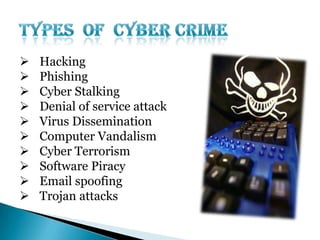
Types of cyber crime
Cyber criminals
Prevention
Conclusion
 Cyber crime is an “unlawful acts wherein the computer
is either a tool or target or both”
The term “cyber crime” was first coined by Barry
Collins in 1980’s.
Criminals simply devise different ways to undertake
standard criminal activities such as fraud theft, blackmail,
forgery using the new medium, often involving the
Internet.
 The first recorded cyber crime took place in the year
1820!
The first spam email took place in 1978 when it was
sent out over the Arpanet.
 The first virus was installed on an Apple computer in
1982.
Denial of Service (DoS) attacks by „Mafia Boy‟ on
eBay, Yahoo! and other popular sites (2000)
 FBI's e-mail system is hacked (Feb,2005)
“Cybercrime is criminal activity done using computers and the Internet.”

Criminal activity involving






Information technology infrastructure
Illegal access
Data interference
Misuse of devices
Forgery and
Electronic fraud.
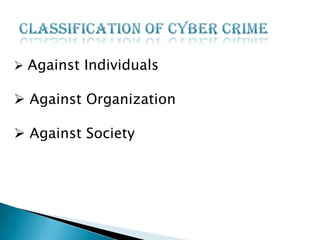
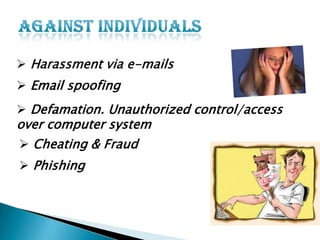
 Against Individuals

 Against Organization

 Against Society
 Harassment via e-mails

 Email spoofing
 Defamation. Unauthorized control/access

over computer system
 Cheating & Fraud
 Phishing
Unauthorized

control/access over
computer system.
Possession

of unauthorized information.

Cyber

terrorism against the government
organization.
Distribution

of pirated software etc.
Polluting the youth through

indecent exposure.
 Trafficking
 Financial crimes
 Sale of illegal articles
 Online gambling
 Forgery











Hacking
Phishing
Cyber Stalking
Denial of service attack
Virus Dissemination
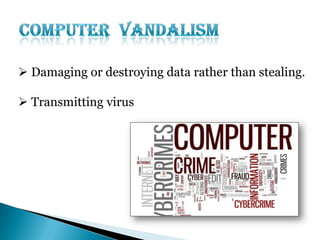
Computer Vandalism
Cyber Terrorism
Software Piracy
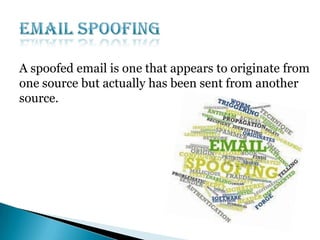
Email spoofing
Trojan attacks
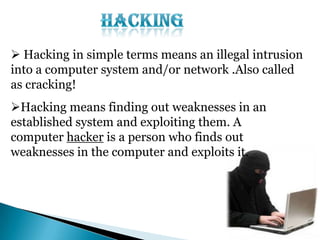
 Hacking in simple terms means an illegal intrusion
into a computer system and/or network .Also called
as cracking!

Hacking means finding out weaknesses in an
established system and exploiting them. A
computer hacker is a person who finds out
weaknesses in the computer and exploits it.









For profit, protest, or challenge.
A large fraction of hacker attacks have been
pranks
Financial Gain
Revenge
Venting anger at a company or organization
Terrorism
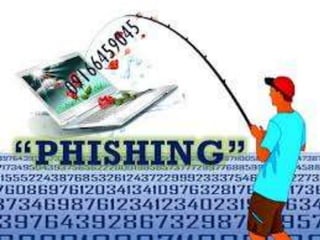
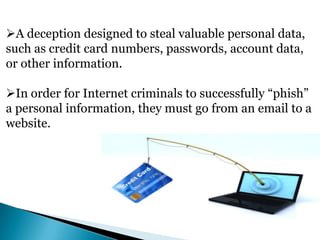
A deception designed to steal valuable personal data,
such as credit card numbers, passwords, account data,
or other information.
In order for Internet criminals to successfully “phish”
a personal information, they must go from an email to a
website.
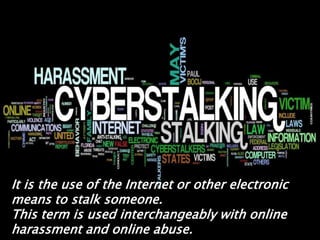
It is the use of the Internet or other electronic
means to stalk someone.
This term is used interchangeably with online
harassment and online abuse.
 Attack through which a person can render a system
unusable or significantly slow down the system for
legitimate users by overloading the system so that no
one else can use it.
 Act by the criminal, who floods the bandwidth of
the victims network.
Malicious software that attaches itself to other
software. (virus, worms, Trojan Horse etc.)
 Damaging or destroying data rather than stealing.
 Transmitting virus
Use of Internet based attacks in terrorist activities.
Technology savvy terrorists are using 512-bit
encryption, which is impossible to decrypt.
Theft of software through the illegal copying of
genuine programs.
Distribution of products intended to pass for
the original.
A spoofed email is one that appears to originate from
one source but actually has been sent from another
source.
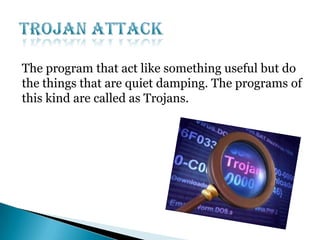
The program that act like something useful but do
the things that are quiet damping. The programs of
this kind are called as Trojans.
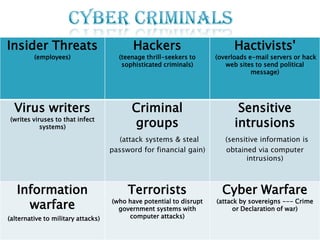
Insider Threats

Hackers

Hactivists'

(employees)

(teenage thrill-seekers to
sophisticated criminals)

(overloads e-mail servers or hack
web sites to send political
message)

Virus writers

Criminal
groups

Sensitive
intrusions

(attack systems & steal
password for financial gain)

(sensitive information is
obtained via computer
intrusions)

Terrorists

Cyber Warfare

(who have potential to disrupt
government systems with
computer attacks)

(attack by sovereigns --- Crime
or Declaration of war)

(writes viruses to that infect
systems)

Information
warfare
(alternative to military attacks)
Cyber Crime

In

India

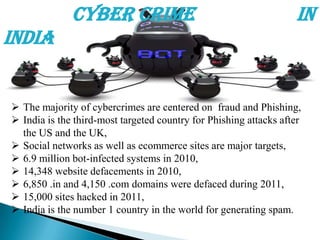
 The majority of cybercrimes are centered on fraud and Phishing,
 India is the third-most targeted country for Phishing attacks after
the US and the UK,
 Social networks as well as ecommerce sites are major targets,
 6.9 million bot-infected systems in 2010,
 14,348 website defacements in 2010,
 6,850 .in and 4,150 .com domains were defaced during 2011,
 15,000 sites hacked in 2011,
 India is the number 1 country in the world for generating spam.
 Anti-virus software

 Firewalls.
 Safe surfing.

 Frequent virus checks.
 Email filters.
Frequent password changing.
History is the witness that no legislation has succeeded in
totally eliminating crime.
We need to bring changes in the Information Technology
Act to make it more effective to combat cyber crime.
 User awareness is key to a secure computer/network
 Do not open suspicious files/emails
 Avoid using P2P programs
 Avoid downloading freeware
Cybercrime
Cybercrime