Welcome to  CV and Applications Briefing
Appreciate the function of CVs and Application forms  Understand how to select relevant biographical details for the job and employer Make connections between your experience and the employer requirements Learn about UK good practice in content and style of CV and application forms and how Careers & Employability can offer support Session Aims
What is the purpose of your CV/ Application form For applicants….. Demonstrates both suitability and potential for the job/ sector To promote yourself- with particular emphasis on recent and relevant experience and to tell your story To get an interview For employers… To initially weed out unsuitable candidates To select suitable applicants
What do employers look for? Employers essentially want work related skills- communication, teamwork, organisation, problem solving, technical Read job adverts/ job descriptions carefully and circle the skills and experience that the employer is looking for- look for key words or phrases or make a list Show on your CV/ Application form that you have met the criteria / requirements of the position and show that you understand what skills the employer is looking for – focus on your message! Give evidence of HOW you have demonstrated relevant skills with examples
Recruiters want to read about the skills/qualities that are relevant and of interest to them and their selection criteria. This is a  ‘ matching process ’! i.e. Mirror the job description or recruitment marketing material. Write about what you have to offer the employer  i.e.- *What is it exactly that you have done?  *What have you been responsible for?  *What were the outcomes?  *How did you achieve success? A CV is a marketing exercise / You are selling your skills, either in general or to a targeted audience. That means that you have to look at company material / web pages / recruitment packs. The matching process
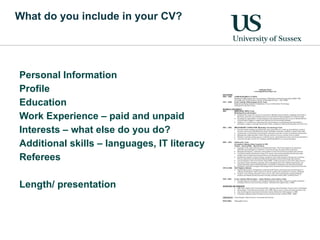
Personal Information Profile  Education  Work Experience – paid and unpaid Interests – what else do you do? Additional skills – languages, IT literacy Referees Length/ presentation What do you include in your CV?
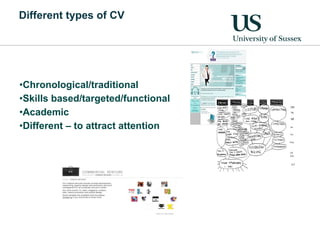
Chronological/traditional Skills based/targeted/functional Academic Different – to attract attention Different types of CV
Writing Style/ Layout Detail is convincing Use Active Language Accurate grammar and spelling Clarity, c arefully and clearly laid out Format/ presentation-  logically ordered, easy to read and not cramped
Application forms Employers select against a criteria (skills and experience) and to get selected for interview, you have to match this criteria!  Match  what you have got to what they are looking for! Give plenty of evidence, vary your examples and go into detail- show that you have what they want Work in draft first and take your time! Research is key so check out their website, brochures, presentations Be clear- make it easy for the selector to see exactly how you meet what they want. Use headings and a clear structure.
Filling in Application Forms - Follow tips for online applications (word counts) - Check spelling and grammar Complete all the sections Add detail but if the employer has only given you a small amount of space, they only want a small amount of information! Be honest and truthful!
Application forms-  typical examples of competency based questions Why  questions – testing motivation, knowledge of organisation “ Why are you applying to Amnesty International?” How  questions – looking for examples of how you are suitable “ Give an example of when you have shown flexibility” Problem solving  questions- looking for creativity/ your approach “ How many telephone boxes are there in London?” Open ended  questions – looking for structure and clarity “ Tell me about yourself……..”
The big white space! Favoured by some employers, especially public sector employers “additional information in support of your application” “… you should provide details of relevant skills, abilities, experience and knowledge that you have which will enable you to carry out the job effectively. These may be gained from your life and work experience (paid or unpaid), education, training or hobbies/ interests” -  The key to writing these types of statement is  structure . Use the person specification as headings with your examples underneath (this makes it easy for the employer to shortlist) or write a statement outlining why you want the job and how you meet the criteria they are asking for.
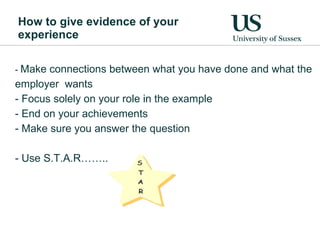
How to give evidence of your experience  -  Make connections between what you have done and what the employer  wants  Focus solely on your role in the example End on your achievements Make sure you answer the question Use S.T.A.R……..
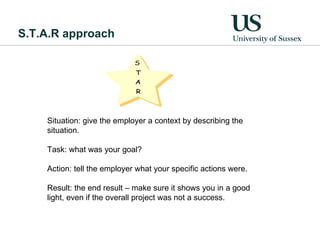
S.T.A.R approach Situation: give the employer a context by describing the situation.  Task: what was your goal?  Action: tell the employer what your specific actions were.  Result: the end result – make sure it shows you in a good light, even if the overall project was not a success.
CV & Application Checklist Have you dissected the job details and researched the job and organisation? Have you written a list of the essential skills, qualities and experience required and the matching evidence you can offer? Are you using the right language- brochure, website? Have you spoken to anyone in the organisation about the job?
Careers & Employability Centre Short interview with a Careers Adviser- discuss your career plans 12-4 Mon- Fri plus 5-7 on a Weds (Book on the day) Briefing sessions- Applications forms, CVs, Skills, Finding Work Events- we have a comprehensive events programme CV and Application Feedback www.sussex.ac.uk/careers

CV and Applications Briefing

  • 1.
    Welcome to CV and Applications Briefing
  • 2.
    Appreciate the functionof CVs and Application forms Understand how to select relevant biographical details for the job and employer Make connections between your experience and the employer requirements Learn about UK good practice in content and style of CV and application forms and how Careers & Employability can offer support Session Aims
  • 3.
    What is thepurpose of your CV/ Application form For applicants….. Demonstrates both suitability and potential for the job/ sector To promote yourself- with particular emphasis on recent and relevant experience and to tell your story To get an interview For employers… To initially weed out unsuitable candidates To select suitable applicants
  • 4.
    What do employerslook for? Employers essentially want work related skills- communication, teamwork, organisation, problem solving, technical Read job adverts/ job descriptions carefully and circle the skills and experience that the employer is looking for- look for key words or phrases or make a list Show on your CV/ Application form that you have met the criteria / requirements of the position and show that you understand what skills the employer is looking for – focus on your message! Give evidence of HOW you have demonstrated relevant skills with examples
  • 5.
    Recruiters want toread about the skills/qualities that are relevant and of interest to them and their selection criteria. This is a ‘ matching process ’! i.e. Mirror the job description or recruitment marketing material. Write about what you have to offer the employer i.e.- *What is it exactly that you have done? *What have you been responsible for? *What were the outcomes? *How did you achieve success? A CV is a marketing exercise / You are selling your skills, either in general or to a targeted audience. That means that you have to look at company material / web pages / recruitment packs. The matching process
  • 6.
    Personal Information Profile Education Work Experience – paid and unpaid Interests – what else do you do? Additional skills – languages, IT literacy Referees Length/ presentation What do you include in your CV?
  • 7.
    Chronological/traditional Skills based/targeted/functionalAcademic Different – to attract attention Different types of CV
  • 8.
    Writing Style/ LayoutDetail is convincing Use Active Language Accurate grammar and spelling Clarity, c arefully and clearly laid out Format/ presentation- logically ordered, easy to read and not cramped
  • 9.
    Application forms Employersselect against a criteria (skills and experience) and to get selected for interview, you have to match this criteria! Match what you have got to what they are looking for! Give plenty of evidence, vary your examples and go into detail- show that you have what they want Work in draft first and take your time! Research is key so check out their website, brochures, presentations Be clear- make it easy for the selector to see exactly how you meet what they want. Use headings and a clear structure.
  • 10.
    Filling in ApplicationForms - Follow tips for online applications (word counts) - Check spelling and grammar Complete all the sections Add detail but if the employer has only given you a small amount of space, they only want a small amount of information! Be honest and truthful!
  • 11.
    Application forms- typical examples of competency based questions Why questions – testing motivation, knowledge of organisation “ Why are you applying to Amnesty International?” How questions – looking for examples of how you are suitable “ Give an example of when you have shown flexibility” Problem solving questions- looking for creativity/ your approach “ How many telephone boxes are there in London?” Open ended questions – looking for structure and clarity “ Tell me about yourself……..”
  • 12.
    The big whitespace! Favoured by some employers, especially public sector employers “additional information in support of your application” “… you should provide details of relevant skills, abilities, experience and knowledge that you have which will enable you to carry out the job effectively. These may be gained from your life and work experience (paid or unpaid), education, training or hobbies/ interests” - The key to writing these types of statement is structure . Use the person specification as headings with your examples underneath (this makes it easy for the employer to shortlist) or write a statement outlining why you want the job and how you meet the criteria they are asking for.
  • 13.
    How to giveevidence of your experience - Make connections between what you have done and what the employer wants Focus solely on your role in the example End on your achievements Make sure you answer the question Use S.T.A.R……..
  • 14.
    S.T.A.R approach Situation:give the employer a context by describing the situation. Task: what was your goal? Action: tell the employer what your specific actions were. Result: the end result – make sure it shows you in a good light, even if the overall project was not a success.
  • 15.
    CV & ApplicationChecklist Have you dissected the job details and researched the job and organisation? Have you written a list of the essential skills, qualities and experience required and the matching evidence you can offer? Are you using the right language- brochure, website? Have you spoken to anyone in the organisation about the job?
  • 16.
    Careers & EmployabilityCentre Short interview with a Careers Adviser- discuss your career plans 12-4 Mon- Fri plus 5-7 on a Weds (Book on the day) Briefing sessions- Applications forms, CVs, Skills, Finding Work Events- we have a comprehensive events programme CV and Application Feedback www.sussex.ac.uk/careers

Editor's Notes

  • #2 Title slide of presentation.
  • #7 Title slide of presentation.
  • #8 Title slide of presentation.
  • #9 Title slide of presentation.
  • #11 Academic – panel, presentation, meet others in department questions on research and teaching, also funding Technical – questions about degree, projects, work experience projects, also hypothetical work based questions Case study – used in management consultancy to see if you are suited– looking for how you approach problem solving and how you think about the client, your company and possible competitors Telephone – next slide Always find out what to expect at interview – who is interviewing, for how long, is there anything else eg selection tests
  • #12 Why – I want to work for Amnesty because…. There are three main reasons why I want to work for Amnesty……. How – During my year abroad I developed my ability to adapt to new cultures including meeting new people What – How many telephone boxes are there in London/ Tell me about yourself……….
  • #14 Avoid ‘you know’ ‘like’
  • #15 Avoid ‘you know’ ‘like’