Careers and Employability Centre
Effective CVs and
Applications for
Researchers
•Functions of CVs and application forms
•Choosing form and content
•Competency-based recruiting
•Interpreting your career for non-academic readers
•Conventions and formats
Agenda for today
What is the purpose of your CV?
• Show how you meet the recruiter’s needs (matching)
• Interpret your experience for a new purpose (?)
• Get an interview
• What do they want?
• How can you find out?
• How is it different from academic appointment boards?
Non-academic recruiters
• Employers looking at PhDs
• Advantages
• Disadvantages
• What do they want you to
know?
• Researchers looking at employers
(Stereotypical) perceptions
• Skills and interests/values audit (career planning workshop)
• Identify target role(s) and type(s) of organisation
• List and prioritise competencies (and values)
• Map your record against competencies
• Design the application around this
Common process: CVs and AFs
• Skills and interests/values audit (career planning workshop)
• Identify target role(s) and type(s) of organisation
• List and prioritise competencies (and values)
• Map your record against competencies
• Design the application around this
Common process: CVs and AFs
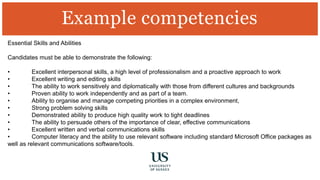
Essential Skills and Abilities
Candidates must be able to demonstrate the following:
• Excellent interpersonal skills, a high level of professionalism and a proactive approach to work
• Excellent writing and editing skills
• The ability to work sensitively and diplomatically with those from different cultures and backgrounds
• Proven ability to work independently and as part of a team.
• Ability to organise and manage competing priorities in a complex environment,
• Strong problem solving skills
• Demonstrated ability to produce high quality work to tight deadlines
• The ability to persuade others of the importance of clear, effective communications
• Excellent written and verbal communications skills
• Computer literacy and the ability to use relevant software including standard Microsoft Office packages as
well as relevant communications software/tools.
Example competencies
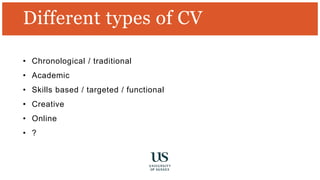
Different types of CV
• Chronological / traditional
• Academic
• Skills based / targeted / functional
• Creative
• Online
• ?
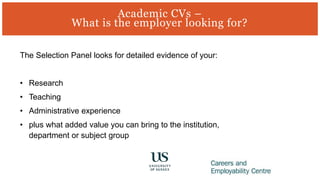
The Selection Panel looks for detailed evidence of your:
• Research
• Teaching
• Administrative experience
• plus what added value you can bring to the institution,
department or subject group
Academic CVs –
What is the employer looking for?
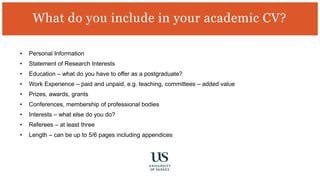
• Personal Information
• Statement of Research Interests
• Education – what do you have to offer as a postgraduate?
• Work Experience – paid and unpaid, e.g. teaching, committees – added value
• Prizes, awards, grants
• Conferences, membership of professional bodies
• Interests – what else do you do?
• Referees – at least three
• Length – can be up to 5/6 pages including appendices
What do you include in your academic CV?
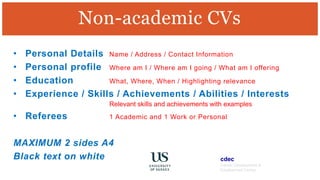
Non-academic CVs
cdec
Career Development &
Employment Centre
• Personal Details Name / Address / Contact Information
• Personal profile Where am I / Where am I going / What am I offering
• Education What, Where, When / Highlighting relevance
• Experience / Skills / Achievements / Abilities / Interests
Relevant skills and achievements with examples
• Referees 1 Academic and 1 Work or Personal
MAXIMUM 2 sides A4
Black text on white
Writing style and layout
Active Language to highlight your SKILLS
• Accurate grammar and spelling
• Clarity
• Logically ordered
• Easy to read and not cramped
• Bullet points, underlining, bold
Tips for completing application forms
Filling in application forms
• No formatting worries!
• Work offline in draft first
• Remember to use plain text
• Check for spelling and grammar
• Complete all the sections
• Check you have answered the question
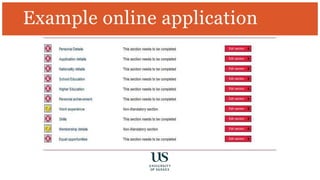
Example online application
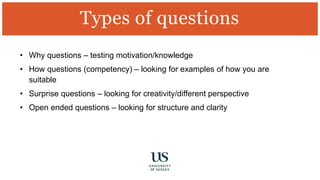
• Why questions – testing motivation/knowledge
• How questions (competency) – looking for examples of how you are
suitable
• Surprise questions – looking for creativity/different perspective
• Open ended questions – looking for structure and clarity
Types of questions
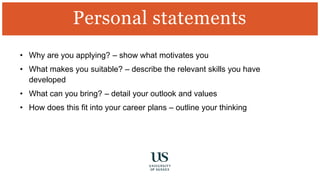
• Why are you applying? – show what motivates you
• What makes you suitable? – describe the relevant skills you have
developed
• What can you bring? – detail your outlook and values
• How does this fit into your career plans – outline your thinking
Personal statements
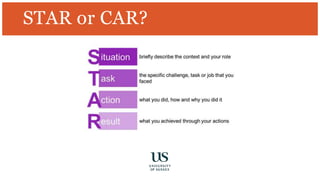
STAR or CAR?
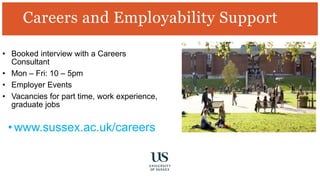
Careers and Employability Support
• Booked interview with a Careers
Consultant
• Mon – Fri: 10 – 5pm
• Employer Events
• Vacancies for part time, work experience,
graduate jobs
• www.sussex.ac.uk/careers

Effective CVs and Applications for Researchers

  • 1.
    Careers and EmployabilityCentre Effective CVs and Applications for Researchers
  • 2.
    •Functions of CVsand application forms •Choosing form and content •Competency-based recruiting •Interpreting your career for non-academic readers •Conventions and formats Agenda for today
  • 3.
    What is thepurpose of your CV? • Show how you meet the recruiter’s needs (matching) • Interpret your experience for a new purpose (?) • Get an interview
  • 4.
    • What dothey want? • How can you find out? • How is it different from academic appointment boards? Non-academic recruiters
  • 5.
    • Employers lookingat PhDs • Advantages • Disadvantages • What do they want you to know? • Researchers looking at employers (Stereotypical) perceptions
  • 6.
    • Skills andinterests/values audit (career planning workshop) • Identify target role(s) and type(s) of organisation • List and prioritise competencies (and values) • Map your record against competencies • Design the application around this Common process: CVs and AFs
  • 7.
    • Skills andinterests/values audit (career planning workshop) • Identify target role(s) and type(s) of organisation • List and prioritise competencies (and values) • Map your record against competencies • Design the application around this Common process: CVs and AFs
  • 8.
    Essential Skills andAbilities Candidates must be able to demonstrate the following: • Excellent interpersonal skills, a high level of professionalism and a proactive approach to work • Excellent writing and editing skills • The ability to work sensitively and diplomatically with those from different cultures and backgrounds • Proven ability to work independently and as part of a team. • Ability to organise and manage competing priorities in a complex environment, • Strong problem solving skills • Demonstrated ability to produce high quality work to tight deadlines • The ability to persuade others of the importance of clear, effective communications • Excellent written and verbal communications skills • Computer literacy and the ability to use relevant software including standard Microsoft Office packages as well as relevant communications software/tools. Example competencies
  • 9.
    Different types ofCV • Chronological / traditional • Academic • Skills based / targeted / functional • Creative • Online • ?
  • 10.
    The Selection Panellooks for detailed evidence of your: • Research • Teaching • Administrative experience • plus what added value you can bring to the institution, department or subject group Academic CVs – What is the employer looking for?
  • 11.
    • Personal Information •Statement of Research Interests • Education – what do you have to offer as a postgraduate? • Work Experience – paid and unpaid, e.g. teaching, committees – added value • Prizes, awards, grants • Conferences, membership of professional bodies • Interests – what else do you do? • Referees – at least three • Length – can be up to 5/6 pages including appendices What do you include in your academic CV?
  • 12.
    Non-academic CVs cdec Career Development& Employment Centre • Personal Details Name / Address / Contact Information • Personal profile Where am I / Where am I going / What am I offering • Education What, Where, When / Highlighting relevance • Experience / Skills / Achievements / Abilities / Interests Relevant skills and achievements with examples • Referees 1 Academic and 1 Work or Personal MAXIMUM 2 sides A4 Black text on white
  • 13.
    Writing style andlayout Active Language to highlight your SKILLS • Accurate grammar and spelling • Clarity • Logically ordered • Easy to read and not cramped • Bullet points, underlining, bold
  • 14.
    Tips for completingapplication forms
  • 15.
    Filling in applicationforms • No formatting worries! • Work offline in draft first • Remember to use plain text • Check for spelling and grammar • Complete all the sections • Check you have answered the question
  • 16.
  • 17.
    • Why questions– testing motivation/knowledge • How questions (competency) – looking for examples of how you are suitable • Surprise questions – looking for creativity/different perspective • Open ended questions – looking for structure and clarity Types of questions
  • 18.
    • Why areyou applying? – show what motivates you • What makes you suitable? – describe the relevant skills you have developed • What can you bring? – detail your outlook and values • How does this fit into your career plans – outline your thinking Personal statements
  • 19.
  • 20.
    Careers and EmployabilitySupport • Booked interview with a Careers Consultant • Mon – Fri: 10 – 5pm • Employer Events • Vacancies for part time, work experience, graduate jobs • www.sussex.ac.uk/careers