Careers and Employability Centre
Effective CVs and
Application Forms
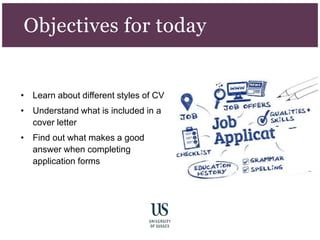
Objectives for today
• Learn about different styles of CV
• Understand what is included in a
cover letter
• Find out what makes a good
answer when completing
application forms
1. What does your CV need to say?
Focus your message, check what the employer is looking for.
2. What format will you use?
Use the space wisely, make it a logical, easy to read layout and use
headings to highlight sections they’ll be most interested in.
3. Fill in the gaps
Don’t leave it to their imagination
4. Check your CV carefully
No spelling mistakes!
5. Stand out from the crowd
Highlight how your skills and experiences match with what the employer is
looking for, with evidence and examples
Creating a CV
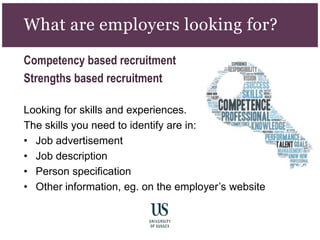
What are employers looking for?
Competency based recruitment
Strengths based recruitment
Looking for skills and experiences.
The skills you need to identify are in:
• Job advertisement
• Job description
• Person specification
• Other information, eg. on the employer’s website
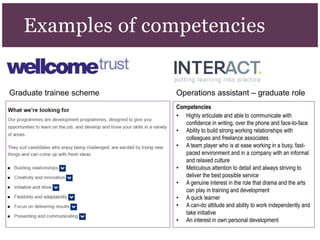
Examples of competencies
Competencies
• Highly articulate and able to communicate with
confidence in writing, over the phone and face-to-face
• Ability to build strong working relationships with
colleagues and freelance associates
• A team player who is at ease working in a busy, fast-
paced environment and in a company with an informal
and relaxed culture
• Meticulous attention to detail and always striving to
deliver the best possible service
• A genuine interest in the role that drama and the arts
can play in training and development
• A quick learner
• A can-do attitude and ability to work independently and
take initiative
• An interest in own personal development
Graduate trainee scheme Operations assistant – graduate role
Discuss with your neighbour which works best and why?
Take two CVs…
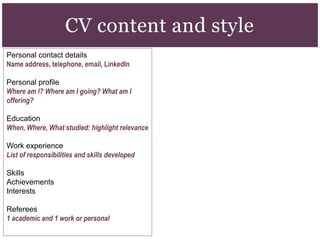
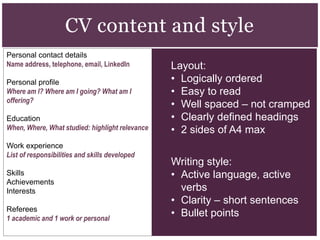
CV content and style
Personal contact details
Name address, telephone, email, LinkedIn
Personal profile
Where am I? Where am I going? What am I
offering?
Education
When, Where, What studied: highlight relevance
Work experience
List of responsibilities and skills developed
Skills
Achievements
Interests
Referees
1 academic and 1 work or personal
Personal contact details
Name address, telephone, email, LinkedIn
Personal profile
Where am I? Where am I going? What am I
offering?
Education
When, Where, What studied: highlight relevance
Work experience
List of responsibilities and skills developed
Skills
Achievements
Interests
Referees
1 academic and 1 work or personal
CV content and style
Layout:
• Logically ordered
• Easy to read
• Well spaced – not cramped
• Clearly defined headings
• 2 sides of A4 max
Writing style:
• Active language, active
verbs
• Clarity – short sentences
• Bullet points
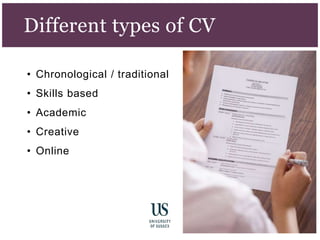
Different types of CV
• Chronological / traditional
• Skills based
• Academic
• Creative
• Online
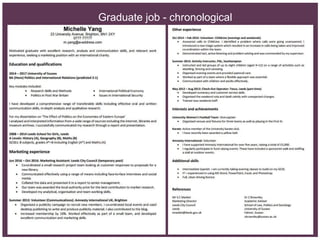
Graduate job - chronological
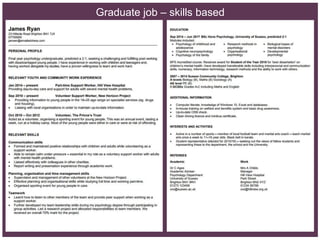
Graduate job – skills based
Examples:
www.vitae.ac.uk
www.prospects.ac.uk
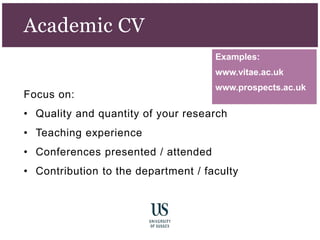
Academic CV
Focus on:
• Quality and quantity of your research
• Teaching experience
• Conferences presented / attended
• Contribution to the department / faculty
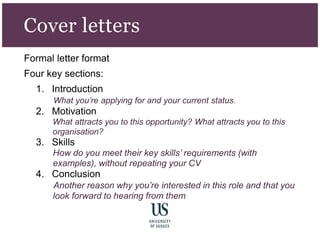
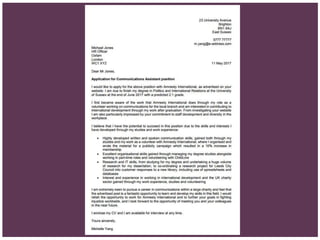
Formal letter format
Four key sections:
1. Introduction
What you’re applying for and your current status.
2. Motivation
What attracts you to this opportunity? What attracts you to this
organisation?
3. Skills
How do you meet their key skills’ requirements (with
examples), without repeating your CV
4. Conclusion
Another reason why you’re interested in this role and that you
look forward to hearing from them
Cover letters
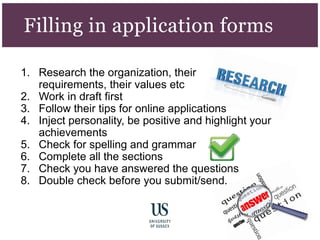
Tips for completing application forms
1. Research the organization, their
requirements, their values etc
2. Work in draft first
3. Follow their tips for online applications
4. Inject personality, be positive and highlight your
achievements
5. Check for spelling and grammar
6. Complete all the sections
7. Check you have answered the questions
8. Double check before you submit/send.
Filling in application forms
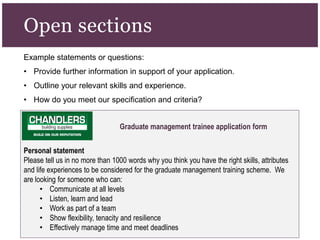
Example statements or questions:
• Provide further information in support of your application.
• Outline your relevant skills and experience.
• How do you meet our specification and criteria?
Open sections
Graduate management trainee application form
Personal statement
Please tell us in no more than 1000 words why you think you have the right skills, attributes
and life experiences to be considered for the graduate management training scheme. We
are looking for someone who can:
• Communicate at all levels
• Listen, learn and lead
• Work as part of a team
• Show flexibility, tenacity and resilience
• Effectively manage time and meet deadlines
1. Use employers’ guidelines, job description and/or
person specification as a structure and checklist.
2. Use examples of how you meet the criteria, from your full
range of experiences.
3. State why you want to do this job and work for this
organisation.
4. Inject personality – it’s ok to state that you’re really
enthusiastic about this opportunity.
Top tips for open sections
Motivational
• Why do you want to work here?
• Why do you think you are suitable for this role?
• Where do you see yourself in X years time?
Competency and strengths based
• Give an example of when you have worked under pressure?
• What is your greatest achievement?
• Give an example of a time when you have made a contribution to a team.
What was the outcome?
• What is the biggest challenge you have faced and how did you handle it?
• Describe a situation where you’ve had to use good communication skills.
Example questions
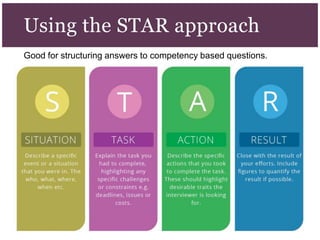
Good for structuring answers to competency based questions.
Using the STAR approach
Describe a time when you’ve worked well in a
team. What role did you take and what was the
outcome?
Have a go at STAR
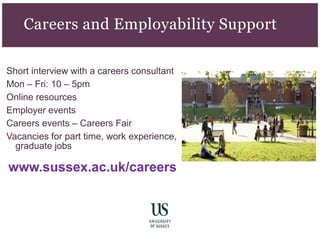
Short interview with a careers consultant
Mon – Fri: 10 – 5pm
Online resources
Employer events
Careers events – Careers Fair
Vacancies for part time, work experience,
graduate jobs
www.sussex.ac.uk/careers
Careers and Employability Support

Effective CVs and Application Forms

  • 1.
    Careers and EmployabilityCentre Effective CVs and Application Forms
  • 2.
    Objectives for today •Learn about different styles of CV • Understand what is included in a cover letter • Find out what makes a good answer when completing application forms
  • 3.
    1. What doesyour CV need to say? Focus your message, check what the employer is looking for. 2. What format will you use? Use the space wisely, make it a logical, easy to read layout and use headings to highlight sections they’ll be most interested in. 3. Fill in the gaps Don’t leave it to their imagination 4. Check your CV carefully No spelling mistakes! 5. Stand out from the crowd Highlight how your skills and experiences match with what the employer is looking for, with evidence and examples Creating a CV
  • 4.
    What are employerslooking for? Competency based recruitment Strengths based recruitment Looking for skills and experiences. The skills you need to identify are in: • Job advertisement • Job description • Person specification • Other information, eg. on the employer’s website
  • 5.
    Examples of competencies Competencies •Highly articulate and able to communicate with confidence in writing, over the phone and face-to-face • Ability to build strong working relationships with colleagues and freelance associates • A team player who is at ease working in a busy, fast- paced environment and in a company with an informal and relaxed culture • Meticulous attention to detail and always striving to deliver the best possible service • A genuine interest in the role that drama and the arts can play in training and development • A quick learner • A can-do attitude and ability to work independently and take initiative • An interest in own personal development Graduate trainee scheme Operations assistant – graduate role
  • 6.
    Discuss with yourneighbour which works best and why? Take two CVs…
  • 7.
    CV content andstyle Personal contact details Name address, telephone, email, LinkedIn Personal profile Where am I? Where am I going? What am I offering? Education When, Where, What studied: highlight relevance Work experience List of responsibilities and skills developed Skills Achievements Interests Referees 1 academic and 1 work or personal
  • 8.
    Personal contact details Nameaddress, telephone, email, LinkedIn Personal profile Where am I? Where am I going? What am I offering? Education When, Where, What studied: highlight relevance Work experience List of responsibilities and skills developed Skills Achievements Interests Referees 1 academic and 1 work or personal CV content and style Layout: • Logically ordered • Easy to read • Well spaced – not cramped • Clearly defined headings • 2 sides of A4 max Writing style: • Active language, active verbs • Clarity – short sentences • Bullet points
  • 9.
    Different types ofCV • Chronological / traditional • Skills based • Academic • Creative • Online
  • 10.
    Graduate job -chronological
  • 11.
    Graduate job –skills based
  • 12.
    Examples: www.vitae.ac.uk www.prospects.ac.uk Academic CV Focus on: •Quality and quantity of your research • Teaching experience • Conferences presented / attended • Contribution to the department / faculty
  • 13.
    Formal letter format Fourkey sections: 1. Introduction What you’re applying for and your current status. 2. Motivation What attracts you to this opportunity? What attracts you to this organisation? 3. Skills How do you meet their key skills’ requirements (with examples), without repeating your CV 4. Conclusion Another reason why you’re interested in this role and that you look forward to hearing from them Cover letters
  • 15.
    Tips for completingapplication forms
  • 16.
    1. Research theorganization, their requirements, their values etc 2. Work in draft first 3. Follow their tips for online applications 4. Inject personality, be positive and highlight your achievements 5. Check for spelling and grammar 6. Complete all the sections 7. Check you have answered the questions 8. Double check before you submit/send. Filling in application forms
  • 17.
    Example statements orquestions: • Provide further information in support of your application. • Outline your relevant skills and experience. • How do you meet our specification and criteria? Open sections Graduate management trainee application form Personal statement Please tell us in no more than 1000 words why you think you have the right skills, attributes and life experiences to be considered for the graduate management training scheme. We are looking for someone who can: • Communicate at all levels • Listen, learn and lead • Work as part of a team • Show flexibility, tenacity and resilience • Effectively manage time and meet deadlines
  • 18.
    1. Use employers’guidelines, job description and/or person specification as a structure and checklist. 2. Use examples of how you meet the criteria, from your full range of experiences. 3. State why you want to do this job and work for this organisation. 4. Inject personality – it’s ok to state that you’re really enthusiastic about this opportunity. Top tips for open sections
  • 19.
    Motivational • Why doyou want to work here? • Why do you think you are suitable for this role? • Where do you see yourself in X years time? Competency and strengths based • Give an example of when you have worked under pressure? • What is your greatest achievement? • Give an example of a time when you have made a contribution to a team. What was the outcome? • What is the biggest challenge you have faced and how did you handle it? • Describe a situation where you’ve had to use good communication skills. Example questions
  • 20.
    Good for structuringanswers to competency based questions. Using the STAR approach
  • 21.
    Describe a timewhen you’ve worked well in a team. What role did you take and what was the outcome? Have a go at STAR
  • 23.
    Short interview witha careers consultant Mon – Fri: 10 – 5pm Online resources Employer events Careers events – Careers Fair Vacancies for part time, work experience, graduate jobs www.sussex.ac.uk/careers Careers and Employability Support